With Inked Deal, Oil & Gas Co. To Own 100% of Subsidiary

Source: Bill Newman  (3/3/23)

With the transaction close, the acquirer will also assume total interest in the now jointly owned oil asset, noted a Research Capital Corp. report.

CanAsia Energy Corp. (CEC:TSX.V) agreed to buy Andora Energy’s common shares owned by minority shareholders for US$1.7 million (US$0.044 per share) in cash, reported Research Capital Corp. analyst Bill Newman in a March 2 research note. This will take CanAsia’s ownership of Andora’s common shares to 100% from 88.2%.

The deal is expected to close by this month’s end, noted Newman, and will likely catalyze CanAsia’s stock.

“We view this transaction as positive,” Newman added.

Research Capital maintained its Speculative Buy recommendation and CA$0.50 per share price target on CanAsia, noted Newman. The stock is currently trading at CA$0.22 per share, which implies a significant, or 127%, potential return on investment from here.

Stake in Resource To Change

Newman pointed out that with the transaction, the portion of the Sawn Lake resource net to CanAsia will increase to 100%, according to the updated resource previously prepared by Sproule Associates and effective Dec. 31, 2022.

The risked best estimate contingent resource net to CanAsia will increase to 248,200,000 barrels (248.2 MMbbl) from 218.9 MMbbl.

Accordingly, the after-tax net present value discounted at 15% of this resource will change to CA$198 million (CA$198M), or CA$3.98 per share, previously CA$175M, or CA$3.51 per share.

Disclosures:
1) Doresa Banning wrote this article for Streetwise Reports LLC. She or members of her household own securities of the following companies mentioned in the article: None. She or members of her household are paid by the following companies mentioned in this article: None.

2) The following companies mentioned in this article are billboard sponsors of Streetwise Reports: CanAsia Energy Corp. Click here for important disclosures about sponsor fees. As of the date of this article, an affiliate of Streetwise Reports has a consulting relationship with: None. Please click here for more information.

3) Statements and opinions expressed are the opinions of the author and not of Streetwise Reports or its officers. The author is wholly responsible for the validity of the statements. The author was not paid by Streetwise Reports for this article. Streetwise Reports was not paid by the author to publish or syndicate this article. Streetwise Reports requires contributing authors to disclose any shareholdings in, or economic relationships with, companies that they write about. Streetwise Reports relies upon the authors to accurately provide this information and Streetwise Reports has no means of verifying its accuracy.

4) This article does not constitute investment advice. Each reader is encouraged to consult with his or her individual financial professional and any action a reader takes as a result of information presented here is his or her own responsibility. By opening this page, each reader accepts and agrees to Streetwise Reports’ terms of use and full legal disclaimer. This article is not a solicitation for investment. Streetwise Reports does not render general or specific investment advice and the information on Streetwise Reports should not be considered a recommendation to buy or sell any security. Streetwise Reports does not endorse or recommend the business, products, services or securities of any company mentioned on Streetwise Reports.

5) From time to time, Streetwise Reports LLC and its directors, officers, employees or members of their families, as well as persons interviewed for articles and interviews on the site, may have a long or short position in securities mentioned. Directors, officers, employees or members of their immediate families are prohibited from making purchases and/or sales of those securities in the open market or otherwise from the time of the decision to publish an article until three business days after the publication of the article. The foregoing prohibition does not apply to articles that in substance only restate previously published company releases. As of the date of this article, officers and/or employees of Streetwise Reports LLC (including members of their household) own securities of


Want to be the first to know about interesting Oil & Gas – Exploration & Production investment ideas? Sign up to receive the FREE Streetwise Reports’ newsletter.Subscribe


Disclosures:
1) Doresa Banning wrote this article for Streetwise Reports LLC. She or members of her household own securities of the following companies mentioned in the article: None. She or members of her household are paid by the following companies mentioned in this article: None.

2) The following companies mentioned in this article are billboard sponsors of Streetwise Reports: TAG Oil Ltd. Click here for important disclosures about sponsor fees. As of the date of this article, an affiliate of Streetwise Reports has a consulting relationship with: None. Please click here for more information.

3) Statements and opinions expressed are the opinions of the author and not of Streetwise Reports or its officers. The author is wholly responsible for the validity of the statements. The author was not paid by Streetwise Reports for this article. Streetwise Reports was not paid by the author to publish or syndicate this article. Streetwise Reports requires contributing authors to disclose any shareholdings in, or economic relationships with, companies that they write about. Streetwise Reports relies upon the authors to accurately provide this information and Streetwise Reports has no means of verifying its accuracy.

4) This article does not constitute investment advice. Each reader is encouraged to consult with his or her individual financial professional and any action a reader takes as a result of information presented here is his or her own responsibility. By opening this page, each reader accepts and agrees to Streetwise Reports’ terms of use and full legal disclaimer. This article is not a solicitation for investment. Streetwise Reports does not render general or specific investment advice and the information on Streetwise Reports should not be considered a recommendation to buy or sell any security. Streetwise Reports does not endorse or recommend the business, products, services or securities of any company mentioned on Streetwise Reports.

5) From time to time, Streetwise Reports LLC and its directors, officers, employees or members of their families, as well as persons interviewed for articles and interviews on the site, may have a long or short position in securities mentioned. Directors, officers, employees or members of their immediate families are prohibited from making purchases and/or sales of those securities in the open market or otherwise from the time of the decision to publish an article until three business days after the publication of the article. The foregoing prohibition does not apply to articles that in substance only restate previously published company releases. As of the date of this article, officers and/or employees of Streetwise Reports LLC (including members of their household) own securities of CHECK a company mentioned in this article.

Disclosures for Research Capital Corp., CanAsia Energy Corp., March 2, 2023

Analyst Certification: I, Bill Newman, CFA, certify the views expressed in this report were formed by my review of relevant company data and industry investigation, and accurately reflect my opinion about the investment merits of the securities mentioned in the report. I also certify that my compensation is not related to specific recommendations or views expressed in this report. Research Capital Corporation publishes research and investment recommendations for the use of its clients. Information regarding our categories of recommendations, quarterly summaries of the percentage of our recommendations which fall into each category and our policies regarding the release of our research reports is available at www.researchcapital.com or may be requested by contacting the analyst. Each analyst of Research Capital Corporation whose name appears in this report hereby certifies that (i) the recommendations and opinions expressed in this research report accurately reflect the analyst’s personal views and (ii) no part of the research analyst’s compensation was or will be directly or indirectly related to the specific conclusions or recommendations expressed in this research report.

Relevant Disclosures Applicable to Companies Under Coverage: Relevant disclosures required under IIROC Rule 3400 applicable to companies under coverage discussed in this research report are available on our website at www.researchcapital.ca

General Disclosures: The opinions, estimates and projections contained in all Research Reports published by Research Capital Corporation (“RCC”) are those of RCC as of the date of publication and are subject to change without notice. RCC makes every effort to ensure that the contents have been compiled or derived from sources believed to be reliable and that contain information and opinions that are accurate and complete; RCC makes no representation or warranty, express or implied, in respect thereof, takes no responsibility for any errors and omissions which may be contained therein and accepts no liability whatsoever for any loss arising from any use of or reliance on its Research Reports or its contents. Information may be available to RCC that is not contained therein. Research Reports disseminated by RCC are not a solicitation to buy or sell. All securities not available in all jurisdictions.

Company Specific Disclosures: Within the past 12 months, Research Capital has provided investment banking services to the issuer. The Analyst currently owns or is short shares of the issuer, which represents less than 1% of shares outstanding.

Potential Conflicts of Interest: All Research Capital Corporation (“RCC”) Analysts are compensated based in part on the overall revenues of RCC, a portion of which are generated by investment banking activities. RCC may have had, or seek to have, an investment banking relationship with companies mentioned in this report. RCC and/or its officers, directors and employees may from time to time acquire, hold or sell securities mentioned in our Research Reports as principal or agent. RCC makes every effort possible to avoid conflicts of interest, however readers should assume that a conflict might exist, and therefore not rely solely on this report when evaluating whether or not to buy or sell the securities of subject companies.

RC USA INC.: Information about Research Capital Corporation’s Rating System, the distribution of our research to clients and the percentage of recommendations which are in each of our rating categories is available on our website at www.researchcapital.com. The information contained in this report has been drawn from sources believed to be reliable but its accuracy or completeness is not guaranteed, nor in providing it does Research Capital Corporation assume any responsibility or liability. Research Capital Corporation, its directors, officers and other employees may, from time to time, have positions in the securities mentioned herein. Contents of this report cannot be reproduced in whole or in part without the express permission of Research Capital Corporation. US Institutional Clients – Research Capital USA Inc., a wholly owned subsidiary of Research Capital Corporation, accepts responsibility for the contents of this report subject to the terms and limitations set out above. US firms or institutions receiving this report should effect transactions in securities discussed in the report through Research Capital USA Inc., a Broker – Dealer registered with the Financial Industry Regulatory Authority (FINRA).
Eli Lilly is cutting insulin prices and capping copays at $35 – 5 questions answered

By Dana Goldman, University of Southern California and Karen Van Nuys, University of Southern California 

Pharmaceutical giant Eli Lilly is slashing the list prices for some of its most popular insulin products by 70% and capping insulin copays at US$35 for uninsured patients and those with private health insurance. These changes follow efforts by the federal government, the California state government, nonprofits and some companies to make insulin more affordable for the more than 7 million Americans with diabetes who require it.

The Conversation asked Dana Goldman and Karen Van Nuys, two scholars who have researched insulin pricing, to explain why Eli Lilly is dramatically cutting the cost of some of its insulin products and to sum up how it may improve access to this essential medical treatment.

1. Why is Lilly reducing prices now?

High insulin prices have not earned any U.S. manufacturer many friends, with list prices increasing 54% from 2014 to 2019.

Most troublingly, an estimated 1.3 million uninsured people with diabetes and patients with inadequate insurance have resorted to rationing their insulin. Skipping doses because of high insulin prices has sometimes had tragic and even deadly consequences.

But growing competition has shaken up the insulin market in recent years.

For example, Walmart introduced its own private-brand insulin in 2021. Mylan, a large generic drugmaker, developed a version of long-acting insulin called Semglee, priced 65% lower than its branded competitor. But few consumers use those products.

Efforts to produce cheaper insulin by the nonprofit drugmaker CivicaRx and the state of California are several years out and won’t provide immediate relief.

Then there’s the Inflation Reduction Act, a big spending package Congress approved in 2022. It capped insulin out-of-pocket costs at $35 for Americans with Medicare, a government health insurance program that covers people over 65.

And, in fact, Lilly itself has been trying to disrupt insulin prices. In 2019, the drugmaker introduced insulin lispro, a lower-cost version of its blockbuster insulin, Humalog.

2. What does this mean for Americans who need insulin?

Part of the problem with the existing system is that some patients, especially if they’re uninsured or have high deductibles, end up paying the list price – which can mean spending $1,000 or more a month on insulin. This can be a crushing financial burden.

Lilly’s new $35 out-of-pocket cap means that privately insured patients and those without insurance requiring insulin will spend no more than that monthly for copays. Its 70% reduction in the list price of two popular name brand insulins, Humalog and Humulin, will bring some financial relief. And the company has also reduced its generic lispro’s list price to $25 a vial, down from $126.

The evidence is clear that these price reductions will improve patient adherence – which means fewer missed doses of this lifesaving medication.

3. How might Lilly’s actions affect the whole industry?

Lilly has put pressure on its biggest competitors, Novo Nordisk and Sanofi, to follow suit.

These lower prices could also make Lilly’s insulins affordable to cash-paying patients. As a result, these insulins could be added to the list of drugs provided by pharmacies that are disrupting the U.S. prescription drug industry, like Mark Cuban’s Cost Plus Drug Co. and Blueberry Pharmacy. These companies provide low-cost drugs with transparent markups or through membership programs, typically without insurance.

4. Why did insulin get so expensive in the US?

That lispro, Lilly’s own, cheaper authorized generic insulin, hasn’t completely displaced the equivalent name brand Humalog in the market by now may seem surprising. But it is the result of the complex U.S. prescription drug distribution system.

Insulin prices are the result of a complex set of negotiations between manufacturers and pharmacy benefit managers, which act on behalf of insurers. The three largest – CVS Caremark, Express Scripts and Optum Rx – handle about 80% of all prescriptions.

These middlemen negotiate directly with Lilly and other insulin manufacturers, focusing on two key sums: the list price and the rebate. Manufacturers are paid the list price but then must pay a rebate to the pharmacy benefit managers.

How do pharmacy benefit managers get manufacturers to pay rebates? They maintain formularies – lists of drugs that patients in a health plan can access. If an insulin manufacturer wants to supply diabetes patients, it needs to remain on those formularies. And doing so requires the manufacturer to pay bigger rebates. Otherwise, pharmacy benefit managers can exclude the manufacturer.

In 2016, OptumRx, which negotiates insulin prices for about 28 million people, excluded only four types of insulin from its formulary. By 2022, OptumRx was excluding 13 insulins.

Keeping insulin on formularies, in short, has required high rebates, and list prices have increased along with them. Ironically, as insulin list prices have been rising, manufacturers have been making less money off of insulin sales, while middlemen have been making more. The key to true price competition is to ensure access to all versions of insulin and to convince patients and providers that people with diabetes can substitute lower-cost versions without compromising their health.

5. What might happen next?

The Federal Trade Commission, a government agency that probes anti-competitive practices, and Congress are now investigating pharmacy benefit managers’ rebate and formulary practices, among other things. These investigations, along with Lilly’s moves, may lead other insulin manufacturers to lower their list prices.

And once its competitors decide whether they will follow Lilly’s example, pharmacy benefit managers will be under a lot of scrutiny to see whether they give preferred formulary placement to the lowest-cost insulin products, or to those that pay the highest rebates.The Conversation

About the Authors:

Dana Goldman, Dean of the Sol Price School of Public Policy; Professor of Pharmacy, Public Policy, and Economics, University of Southern California and Karen Van Nuys, Executive Director of the Value of Life Sciences Innovation program; Fellow at the USC Schaeffer Center, University of Southern California

This article is republished from The Conversation under a Creative Commons license. Read the original article.


The ECB will remain hawkish until the summer. UAE plans to exit OPEC

By JustMarkets

The recent string of strong economic data has caused investors to rethink how much more Fed tightening is needed to slow the economy significantly. Investors have begun to realize that the Fed will stop raising rates probably before early summer, and the current price levels in the stock market are a great opportunity to buy or average portfolios. This caused the indices to rise sharply at the end of last week. At the close of the stock market on Friday, the Dow Jones Index (US30) increased by 1.17% (+1.47% for the week), and the S&P 500 (US500) added 1.61% (+1.33% for the week). The NASDAQ Technology Index (US100) jumped by 1.97% on Friday (+1.49% for the week). The S&P 500 (US500) broke a three-week losing streak, and the Dow Jones Industrial Average (US30) posted its first weekly gain since late January.

The fourth-quarter reporting season is coming to a close, and all but seven companies in the S&P 500 have reported. According to Refinitiv, results for the quarter beat consensus forecasts 68% of the time.

Federal Reserve Bank of Richmond President Thomas Barkin said Friday that he could envision a scenario in which the central bank would raise the US benchmark interest rate to a range of 5.5%-5.75%. Barkin also added that inflation might cool faster than he expects, implying a shallower rate trajectory. But it is more likely that inflation will persist, requiring the Fed to do more. That said, the policymaker does not expect a rate cut before the end of 2023.

(DE30) gained 1.64% (+1.48% for the week), French CAC 40 (FR40) added 0.88% (+1.48% for the week), Spanish IBEX 35 (ES35) jumped by 0.47% (+2.29% for the week), British FTSE 100 (UK100) closed on Friday with 0.04% (+0.87% for the week).

The latest Eurozone inflation report showed that price pressures remain persistently high in the single block, especially for core inflation. The ECB will meet in mid-March to announce its next 50bp interest rate hike. And this scenario is already almost entirely factored into prices. Several ECB policymakers have recently warned that ECB rate hikes should continue until core inflation turns around. With the head of the ECB expecting core inflation to remain high through the summer, there is a high probability that the ECB will undertake another 0.5% rate hike at its May meeting.

On Friday, the Wall Street Journal reported that there is an internal debate in the United Arab Emirates over the prospect of leaving OPEC. The UAE’s decision to leave the Organization of Petroleum Exporting Countries would reduce the group’s authority to set oil prices, which account for nearly 38% of global production. The Emirates produces more than 3 million barrels a day and is OPEC’s third-largest oil producer. Analysts say oil prices are likely to be in the $75 to $80 a barrel range.

Saudi Arabia raised oil prices for Asia and Europe for April. The reason is rising demand from China, the world’s biggest oil importer. Aramco sells about 60% of its crude supply to Asia, mostly under long-term contracts whose prices are reviewed monthly. China, Japan, South Korea, and India are the biggest buyers. According to some experts, as the heat approaches, demand will only increase, which, given the current supply, could push oil prices back up to $100 a barrel.

Asian markets mostly declined last week. Japan’s Nikkei 225 (JP225) jumped by 2.21% over the week, China’s FTSE China A50 (CHA50) gained 1.90%, Hong Kong’s Hang Seng (HK50) jumped by 3.77%, India’s NIFTY 50 (IND50) added 0.89%, and Australia’s S&P/ASX 200 (AU200) was negative by 0.32%.

China maintained its language on Taiwan in its annual report to the country’s legislature, suggesting that President Xi Jinping maintains his policy on the self-governing island even as global tensions rise. “We must promote the peaceful development of relations on both sides of the Taiwan Strait and advance the process of China’s peaceful reunification,” Premier Li Keqiang said in a work report to the National People’s Congress. On the one hand, this is great news for the de-escalation of relations between China and Taiwan along with the United States. On the other hand, at the same time, China has increased defense spending by 7.2%, which contrasts slightly with plans to resolve things diplomatically. But it should be noted that since Russia’s invasion of Ukraine, the world has begun “military reform” – almost all countries have begun to increase military budgets, especially European countries.

For its part, the Biden administration is close to tightening regulations on some foreign investments by US companies in order to limit China’s ability to acquire technology that could improve its military power. This is another attempt by the White House to hit China’s military and technology sectors at a time of increasingly strained relations between the world’s two largest economies.

In the commodities market, futures on natural gas (+18.37%), platinum (+8.37%), gasoline (+6.76%), sugar (+6.41%), palladium (+5.06%), WTI oil (+4.63%), Brent oil (+3.42%), copper (+3.01%), silver (+2.76%) and gold (+2.51%) showed the biggest gains last week. Futures on orange juice (-8.82%), coffee (-5.06%), and wheat (-1.84%) showed the biggest drop.

S&P 500 (F) (US500) 4,045.64 +64.29 (+1.61%)

Dow Jones (US30)33,390.97 +387.40 (+1.17%)

DAX (DE40) 15,578.39 +250.75 (+1.64%)

FTSE 100 (UK100) 7,947.11 +3.07  (+0.039%)

USD Index 104.53 -0.50 (-0.48%)

Important events for today:
  • – Switzerland Consumer Price Index (m/m) at 09:30 (GMT+2);
  • – UK Construction PMI (m/m) at 11:30 (GMT+2);
  • – Eurozone Retail Sales (m/m) at 12:00 (GMT+2);
  • – Canada Ivey PMI (m/m) at 17:00 (GMT+2).

By JustMarkets


This article reflects a personal opinion and should not be interpreted as an investment advice, and/or offer, and/or a persistent request for carrying out financial transactions, and/or a guarantee, and/or a forecast of future events.

Trade Of The Week: Are Gold Bulls Back In Town?

By ForexTime 

After securing its best week since mid-January, could gold prices be gearing up for more upside?

The precious metal staged a solid rebound last week, climbing 2.5% due to dollar weakness and positive economic data from China. A pullback in Treasury yields last Friday fuelled upside gains, pushing prices closer to the 50-day Simple Moving Average around $1870. Price action suggests that bulls could be back in action after gold received a thorough beating last month. However, the key question is whether the current momentum will result in a bullish reversal or a dead cat bounce.

Revisiting our 2023 outlook, we discussed how gold could be one of the biggest winners this year based on expectations around the Federal Reserve pausing rate hikes down the line. In February, these expectations were tempered by robust jobs data and sticky inflation figures which fuelled fears about rates staying higher for longer. Nevertheless, sentiment towards gold may experience a positive shift this month if US economic data disappoints and inflation shows signs of cooling.

Taking a quick looking at the technical picture, gold turned bullish on the daily charts after breaking above the $1845 lower high. A strong daily close above the 50-day SMA could encourage an incline towards $1880 and $1900, respectively.

Big week for gold as Powell & NFP eyed

Watch this space as the events this week could either fuel gold’s upside momentum or end the party for bulls. All eyes will be on Fed Chair Jerome Powell’s Testimony and US jobs data which have the potential to inject the precious metal with explosive levels of volatility.

On Tuesday, Fed Chair Powell provides his semi-annual report to the Senate Banking Committee. Any hints or signals on the Fed potentially straying away from 25bp hikes in future meetings will most likely influence markets. Powell will address the House Financial Services Committee on Wednesday and is expected to reiterate a similar message. If Powell strikes a hawkish tone during Testimony, this could rekindle dollar strength and rate hike bets – ultimately dragging gold prices lower. Alternatively, a cautiously sounding Powell may cool rate hike bets, providing even more room for gold bulls to fight back.

It’s all about the US jobs report on Friday which could determine whether the dollar’s renewed strength is temporary or lasting. After the breathtaking 517,000 reading back in January, around 215,000 is projected for February. Another healthy jobs report may reinforce expectations around the Federal Reserve holding rates higher for longer. On the other hand, if the NFP report fails to meet expectations – the dollar is likely to tumble as investors pare back their rate hike bets.

Other factors influencing gold

It will be wise to keep an eye on the ADP’s monthly read and initial jobless claims which could act as an appetiser before the main course. On the geopolitical front, developments concerning Sino-US relations may add more spice and flavour to the precious metal – especially if investors become edgy. While escalating tensions could fuel risk aversion sweetening appetite for safe-haven assets, this also includes the dollar. As we have identified earlier, dollar strength tends to make things difficult for gold bulls.

Gold to see rebound or dead cat bounce?

Gold turned bullish on the daily charts after prices blasted above $1845 lower high. The precious metal trades above the 100-day and 200-day Simple Moving Average with bulls eyeing the 50-day SMA at $1870. A strong breakout and daily close above this level could encourage an incline toward $1880 and potentially beyond the psychological $1900 resistance level. On the other hand, if bulls are capped below the 50-day SMA or lose momentum around $1880 – this could trigger a move lower with $1825 and $1800 acting as key levels of interest. Ultimately, the pending key US economic reports and Powell’s testimony will most likely shape the outlook for gold this month.


Forex-Time-LogoArticle by ForexTime

ForexTime Ltd (FXTM) is an award winning international online forex broker regulated by CySEC 185/12 www.forextime.com

Tricky issue of client suitability for ESG investments

By George Prior

As global investors become increasingly focused on environmental, social, and governance (ESG) investments, one of the world’s largest independent financial advisory and asset management organizations is partnering with a pioneering profiling tool to ensure clients’ personal suitability for this kind of investment.

deVere Group says its partnership with EnlightenESG will enable it to better understand clients’ attitudes to ESG investing and to ensure greater transparency around the intersection of suitability and sustainability.

James Green, deVere Group’s Investment Director, says: “Clients are increasingly seeking to align their investments with their values, and support companies that are making a positive impact on society and the environment.

“ESG investing allows clients to invest in entities that are helping the world transition to a fairer, more diverse and sustainable future, while also generating the appropriate financial returns.

He continues: “ESG investing can be a suitable investment strategy for many investors, but it may not be appropriate for all.

“Whether or not ESG-orientated investments are suitable for a particular client will depend not only on their individual investment goals, risk tolerance, and financial situation, but also on their core values.

“And with something so emotive and fundamental to all our lives, it can be easy to get caught up in the debate or drowned in a tidal wave of opinions and, as consequence, lose sight of what sustainability really means to our clients.”

EnlightenESG, a groundbreaking profiling tool, addresses this issue by personalizing the sustainable investment requirements that help investors and their advisors make informed sustainability decisions in the context of suitability.

“EnlightenESG will help us to engage our clients and to truly understand their sustainable preferences and in time ultimately better match their ESG views to their investment goals,” explains James Green.

Thanks to deVere Group’s resources, scale and global presence, it hopes to become a key actor in terms of education around sustainable investing.

Before using the tool with clients, deVere trialled it in-house to engage with the technology themselves to understand the process, the data it provides, and what it could potentially teach the firm on how it could help its global client base.

As part of onboarding EnlightenESG into the firm’s relationships with clients, deVere Western Europe profiled over 75 employees across its European offices and engaged with EnlightenESG to help interpret and understand the results.

The Group analysed individuals’ attitudes toward sustainability and ESG as well as how the Group scored as whole and in the context of the entire EnlightenESG ecosystem.

“We noted our staff are more focused on ESG than the EnlightenESG index average, the data also highlighted our understanding of the long-term nature of ESG investing,” comments the deVere Group Investment Director.

“As is often the case with new and evolving investment opportunities, the market can over-estimate the short term and underestimate the long-term opportunities.  Our EnlightenESG results demonstrate that we have a good understanding and education around these critical points.”

Of the partnership with deVere Group, Simon Lowans Chief Marketing Officer at EnlightenESG says: “We are thrilled with the modern and forward-looking approach that the team at deVere are taking towards sustainability.

“EnlightenESG technology not only documents and allows for a repeatable and consistent process, the technology also loves to learn!  It is the continuous learning within the technology that helps frame and understand the societal norm across the ESG spectrum.

“The continued growth in our EnlightenESG user base is helping the profiler, and as a result our users, to better understand how clients score relative to the universe average or societal norm.   We have always said EnlightenESG can only be built for individuals if the data itself is powered by individuals.”

The EnlightenESG partnership underscores deVere’s ongoing commitment to sustainable investing.

Ahead of COP27, the international climate summit, last November, deVere Group CEO Nigel Green told media:  “Climate change is the greatest risk multiplier to our planet, to our communities, and to our way of life.

“Joined-up planning followed by urgent action is essential.  But this will not only take political and social will. It will take trillions of dollars.

“There needs to be unprecedented levels of cooperation between financial advisories, insurance firms, banks, wealth and asset managers, investment companies, fintech groups, banks, auditors, amongst others, to help unlock and mobilise the trillions of dollars of private finance that is urgently required.”

deVere Group is also one of 18 founding signatories of the UN-backed Net Zero initiative, the international alliance of powerhouse global finance companies that will help accelerate the transition to a net zero financial system.

James Green concludes: “EnlightenESG will become an invaluable tool to determine a client’s sustainability values and helps advisors map clients to a sustainable investment, where appropriate.”

About:

deVere Group is one of the world’s largest independent advisors of specialist global financial solutions to international, local mass affluent, and high-net-worth clients.  It has a network of more than 70 offices across the world, over 80,000 clients and $12bn under advisement.


Communications Co. To Acquire ‘Perfect Fit’

Source: Streetwise Reports  (3/2/23)

Printing and marketing services company Data Communications Management Corp. has entered into a share purchase agreement to acquire R.R. Donnelley & Sons’ Canadian operations.

Printing and marketing services company Data Communications Management Corp. (DCM:TSX; DCMDF:OTCQX) has entered into a share purchase agreement to acquire R.R. Donnelley & Sons’ Canadian operations for CA$123 million, the company said.

R.R. Donnelly Canada provides print and related services to thousands of customers across the country, had a revenue of about CA$250 million in 2022, and has 1,000 employees.

The companies are “a perfect fit,” DCM President and Chief Executive Officer Richard Kellam said after the announcement.

The transaction “combines two companies with complementary operating models and best-in-class products, (and) very strong customer relationships,” he said. “It’s also very complementary to some of the digital-first technology capabilities we’ve built here at DCM, and the opportunity to expand those into RRD’s clients.

Analyst Chris Thompson of eResearch maintained a Buy rating on the stock with a target of CA$4.50 even before the announcement based on third-quarter 2022 results that showed revenue up 11.4% YoY from 2021.

There (are) many meaningful benefits for our clients and for our customers, being bigger and better together and obviously, attractive financial benefits and value creation opportunities for DCM.”

Analyst Chris Thompson of eResearch maintained a Buy rating on the stock with a target of CA$4.50 even before the announcement based on third-quarter 2022 results that showed revenue up 11.4% YoY from 2021.

Preliminary results for 2022 show the company’s revenues up 15% to 16.5% over 2021. The company is expected to release the final 2022 results later this month.

“As DCM executes its ‘digital first’ strategy, we expect revenue from technology-enabled hardware solutions and tech-enabled subscription services and fees to increase,” Thompson wrote.

The tech-enabled marketing and digital asset management (DAM) sectors are forecasted to grow annually by 15% and 21%, respectively, Thompson said. DAM services generated only 1.3% of the company’s revenue in 2020.

But “with the proliferation of video and digital content, the total DAM addressable market is forecasted to reach US$6 billion by 2025, thus there is plenty of upside revenue potential,” Thompson wrote.

The Catalyst: More than CA$500 Million in Annual Sales

The new company would have more than CA$500 million in annual sales from day one, an expanded customer base, and an enhanced product portfolio, DCM said.

DCM is only buying the Canadian operations of RRD, which is a provider of marketing, packaging, print, and supply chain solutions with 25,000 clients worldwide across 29 countries.

“They serve key verticals from financial institutions, retail, insurance, transportation, government, and other regulated industries,” Kellam said.

RRD said it serves “thousands of customers across Canada.”

“Combining our business with DCM is a strategic opportunity to broaden our existing offering to customers across a variety of industries,” RRD President Rael Fisher said.

Under the share purchase agreement, DCM will acquire 100% of the shares of Moore Canada Corp. (RRD Canada) in a transaction expected to close in the second quarter of this year, subject to closing conditions and regulatory approvals.

DCM is financing 100% of the purchase in cash through “fully committed credit facilities from a Canadian Chartered Bank and Fiera Private Debt,” the company said in its news release.

Included in the purchase will be three sites owned by RRD with an implied net value of about CA$30 million. DCM said it intends to enter into a sale and lease-back arrangement for each site.

DCM Had a ‘Very Solid Year’

In its preliminary results for the fiscal year ending Dec. 31, 2022, DCM said total revenue increased to between CA$270 million to CA$274 million, or a jump of 15% to 16.5%, over 2021.

Gross profit as a percentage of revenue increased in a range of 30.5% to 31%, with gross profit increasing between 20% and 21% YoY.

The company plans to release the final results for 2022 and the fourth quarter of that year on March 21.

“We had a very solid year on revenue and revenue acceleration,” Kellam said. It was “one of the best growth years that we’ve delivered on record here in DCM. We’re very proud of the revenue acceleration, and the value we’re bringing to clients in the marketplace.”

DCM launched its DAM cloud solution, ASMBL, to manage corporate media files and other content, in 2021. The company has said the technology has the potential to become a key growth opportunity for DCM as it is deployed to the company’s 2,500 corporate clients.

DCM has been in business for 60 years. It helps companies with branding, communications, and logistics and provides customer loyalty programs, data, and content management, location-specific marketing, labels and asset tracking, multimedia campaign management, and workflow management. Its clients are in many industries, including financial services, health care, emerging markets, retail, non-profits, energy, hospitality, and transportation.

Ownership and Share Structure

Streetwise Ownership Overview*

Retail: 55%
Management/Insiders: 45%
55%
45%
*Share Structure as of 3/2/2023


Management and insiders own about 45% of DCM, including a share program that gives employees close to 4% ownership.

Top insider shareholders include Director Michael Sifton with 10.2% or 4.5 million shares, Board Vice Chairman Greg Cochrane with 7.43% or 3.28 million shares, Chairman of the Board J.R. Kingsley Ward with 5.54% or 2.44 million shares, and the CEO Kellam with 1.66% or 0.73 million shares, according to Reuters.

According to the company, the rest, 55%, is retail. Reuters lists KST Industries Inc. as the top shareholder in the company overall with 11.69% or 5.15 million shares.

The company is covered by Noel Atkinson of Clarus Securities and Chris Thompson of eResearch. Newsletter writer Clive Maund also covers the stock.

It has a market cap of CA$82.84 million with 44 million shares outstanding, with 27.3 million shares free-floating. It trades in the 52-week range of CA$1.97 and CA$1.01.


Disclosures:

1) Steve Sobek wrote this article for Streetwise Reports LLC. He or members of his household own securities of the following companies mentioned in the article: None. He or members of his household are paid by the following companies mentioned in this article: None.

2) The following companies mentioned in this article are billboard sponsors of Streetwise Reports: Data Communications Management Corp. Click here for important disclosures about sponsor fees. The information provided above is for informational purposes only and is not a recommendation to buy or sell any security.

3) Statements and opinions expressed are the opinions of the author and not of Streetwise Reports or its officers. The author is wholly responsible for the validity of the statements. The author was not paid by Streetwise Reports for this article. Streetwise Reports was not paid by the author to publish or syndicate this article. Streetwise Reports requires contributing authors to disclose any shareholdings in or economic relationships with, companies that they write about. Streetwise Reports relies upon the authors to accurately provide this information and Streetwise Reports has no means of verifying its accuracy.

4) This article does not constitute investment advice. Each reader is encouraged to consult with his or her individual financial professional and any action a reader takes as a result of information presented here is his or her own responsibility. By opening this page, each reader accepts and agrees to Streetwise Reports’ terms of use and full legal disclaimer. This article is not a solicitation for investment. Streetwise Reports does not render general or specific investment advice and the information on Streetwise Reports should not be considered a recommendation to buy or sell any security. Streetwise Reports does not endorse or recommend the business, products, services or securities of any company mentioned on Streetwise Reports.

5) From time to time, Streetwise Reports LLC and its directors, officers, employees or members of their families, as well as persons interviewed for articles and interviews on the site, may have a long or short position in securities mentioned. Directors, officers, employees or members of their immediate families are prohibited from making purchases and/or sales of those securities in the open market or otherwise from the time of the decision to publish an article until three business days after the publication of the article. The foregoing prohibition does not apply to articles that in substance only restate previously published company releases.

eResearch Disclosures:

eResearch was established in 2000 as Canada’s first equity issuer-sponsored research organization. As a primary source for professional investment research, our Subscribers benefit by having written research on a variety of under-covered companies. We also provide unsponsored research reports on middle and larger-cap companies, using a combination of fundamental and technical analysis. We complement our corporate research coverage with a diversified selection of informative research publications from a wide variety of investment professionals. We provide our professional investment research and analysis directly to our extensive subscriber network of discerning investors, and electronically through our website: www.eresearch.com

NOTE: eResearch company reports are available FREE on our website: www.eresearch.com

eResearch Intellectual Property: No representations, express or implied, are made by eResearch as to the accuracy, completeness, or correctness of the comments made in this report. This report is not an offer to sell or a solicitation to buy any security of the Company. Neither eResearch nor any person employed by eResearch accepts any liability whatsoever for any direct or indirect loss resulting from any use of this report or the information it contains. This report may not be reproduced, distributed, or published without the express permission of eResearch.

ANALYST ACCREDITATION

eResearch Analyst on this Report: Chris Thompson CFA, MBA, P.Eng.

Analyst Affirmation: I, Chris Thompson, hereby state that, at the time of issuance of this research report, I do not own common shares, share options, or share warrants of DATA Communications Management Corp. (TSX:DCM).

eRESEARCH DISCLOSURE STATEMENT

eResearch is engaged solely in the provision of equity research to the investment community. eResearch provides published research and analysis to its Subscribers on its website (www.eresearch.com), and to the general investing public through its extensive electronic distribution network and newswire agencies. eResearch makes all reasonable efforts to distribute research material simultaneously to all of its Subscribers.

eResearch does not manage money or trade with the general public, provides full disclosure of all fee arrangements, and adheres to the strict application of its Best Practices Guidelines. eResearch accepts fees from the companies it researches (the “Covered Companies”), and from financial institutions or other third parties. The purpose of this policy is to defray the cost of researching small and medium-capitalization stocks which otherwise receive little or no research coverage.

DATA Communications Management Corp. paid eResearch a fee to have it conduct research and publish reports on the Company for one year.

To ensure complete independence and editorial control over its research, eResearch follows certain business practices and compliance procedures. For instance, fees from Covered Companies are due and payable before research starts. Management of the Covered Companies is sent copies, in draft form without a Recommendation or a Target Price, of the Initiating Report and the Update Report before publication to ensure our facts are correct, that we have not misrepresented anything, and have not included any non-public, confidential information. At no time is management entitled to comment on issues of judgment, including Analyst opinions, viewpoints, or recommendations. All research reports must be approved, before publication, by eResearch’s Director of Research, who is a Chartered Financial Analyst (CFA).

All Analysts are required to sign a contract with eResearch before engagement and agree to adhere at all times to the CFA Institute Code of Ethics and Standards of Professional Conduct. eResearch Analysts are compensated on a per-report, per-company basis and not based on his/her recommendations. Analysts are not allowed to accept any fees or other considerations from the companies they cover for eResearch.

Officers, analysts, and directors of eResearch are allowed to trade in shares, warrants, convertible securities, or options of any of the Covered Companies only under strict, specified conditions, which restrict trading 30 days before and after a Research Report is published.

Murrey Math Lines 03.03.2023 (Brent, S&P 500)

By RoboForex.com

BRENT

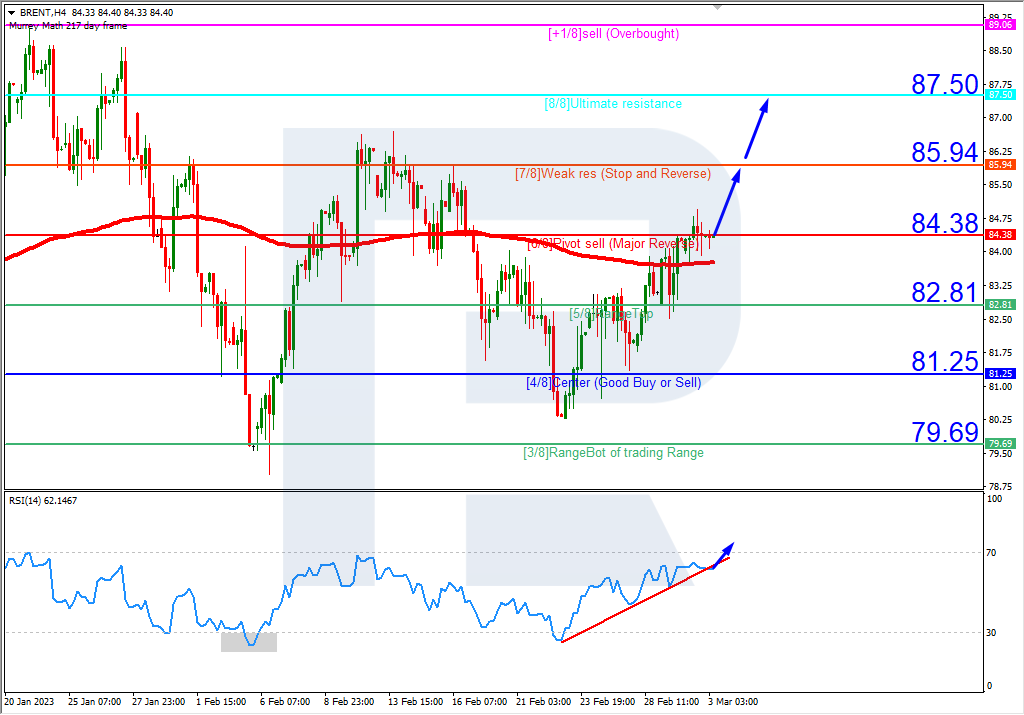
On H4, the quotes have broken through the 200-day Moving Average and are now above it, revealing possible development of an uptrend. The RSI is testing the support level. As a result, we are to expect an upward breakaway of 6/8 (84.38), followed by growth to the resistance level of 8/8 (87.50). The scenario can be cancelled by a downward breakaway of the support level of 5/8 (82.81). In this case, the pair may return to 4/8 (81.25).

BRENTH4
Risk Warning: the result of previous trading operations do not guarantee the same results in the future

On M15, the upper line of VoltyChannel is broken away, which increases the probability of further growth of the price.

BRENT_M15
Risk Warning: the result of previous trading operations do not guarantee the same results in the future

S&P 500

On H4, the quotes are under the 200-day Moving Average, which indicates prevalence of a downtrend. The RSI has pushed off the resistance line. A test of 1/8 (3945.3) is expected, followed by a breakaway and decline to the support level of 0/8 (3906.2). The scenario can be cancelled by rising above the resistance level of 2/8 (3984.4). In this case, the index may rise to 3/8 (4023.4).

S&P 500_H4
Risk Warning: the result of previous trading operations do not guarantee the same results in the future

On M15, the decline can additionally be confirmed by a breakaway of the lower border of VoltyChannel.

S&P 500_M15

Article By RoboForex.com

Attention!
Forecasts presented in this section only reflect the author’s private opinion and should not be considered as guidance for trading. RoboForex LP bears no responsibility for trading results based on trading recommendations described in these analytical reviews.

The Analytical Overview of the Main Currency Pairs on 2023.03.03

By JustMarkets

The EUR/USD currency pair

Technical indicators of the currency pair:
  • Prev Open: 1.0667
  • Prev Close: 1.0596
  • % chg. over the last day: -0.67 %

The latest data showed that inflationary pressures remain in the Eurozone. Although the annualized consumer price index fell from 8.6% to 8.5%, core inflation (excluding food and energy prices) unexpectedly rose from 5.3% to 5.6%. Meanwhile, the unemployment rate rose from 6.6% to 6.7%. Such data support the idea that without lower energy prices, inflation remains tight, which will reinforce the hawkish rhetoric of ECB policymakers. Core inflation data is likely to drive ECB decisions, with ECB head Christine Lagarde saying that the need for higher rates remains.

Trading recommendations
  • Support levels: 1.0582, 1.0544
  • Resistance levels: 1.0614, 1.0656, 1.0704, 1.0804, 1.0906, 1.0926, 1.0967

The trend on the EUR/USD currency pair on the hourly time frame is bearish. The price has fallen below the moving averages again. The MACD indicator has become negative, and sellers’ pressure prevails within the day. Under such market conditions, buy trades are best considered after an impulse breakdown of the resistance level 1.0614. Selling can be considered from the resistance level of 1.0656, subject to confirmation in the form of a reversal in the intraday time frames.

Alternative scenario: if the price breaks down through the resistance level of 1.0704 and fixes above it, the uptrend will likely resume.

EUR/USD
News feed for 2023.03.03:
  • – German Services PMI (m/m) at 10:55 (GMT+2);
  • – Eurozone Services PMI (m/m) at 11:00 (GMT+2);
  • – Eurozone Producer Price Index (m/m) at 12:00 (GMT+2);
  • – US ISM Services PMI (m/m) at 17:00 (GMT+2).

The GBP/USD currency pair

Technical indicators of the currency pair:
  • Prev Open: 1.2025
  • Prev Close: 1.1947
  • % chg. over the last day: -0.65 %

British Prime Minister Rishi Sunak reached an agreement with the European Union on the status of Northern Ireland, which is expected to open up more trade after Brexit between the EU and the United Kingdom. The Brexit deal may lead to some short-term strengthening of the pound. Still, the medium-term picture for the British currency remains bleak amid a lot of problems in the economy with continued inflationary pressures.

Trading recommendations
  • Support levels: 1.1954, 1.1929, 1.1875
  • Resistance levels: 1.1988, 1.2051, 1.2087, 1.2147, 1.2200, 1.2267, 1.2311, 1.2416

From the technical point of view, the trend on the GBP/USD currency pair on the hourly time frame is bearish. At the moment, the price is trading below the moving averages. The MACD indicator has become negative. Under such market conditions, it is better to look for sell deals from the resistance level of 1.1988 or 1.2051 but with a confirmation in the form of a false breakout. Buy trades are best sought from the support level of 1.1954 but better with confirmation on intraday time frames.

Alternative scenario: if the price breaks out through the 1.2147 resistance level and fixes above it, the uptrend will likely resume.

GBP/USD
News feed for 2023.03.03:
  • – UK Services PMI (m/m) at 11:30 (GMT+2).

The USD/JPY currency pair

Technical indicators of the currency pair:
  • Prev Open: 136.15
  • Prev Close: 136.74
  • % chg. over the last day: +0.43 %

The Japanese yen has remained stable this week. The Bank of Japan holds the interest rate at 0.10% and maintains control of the yield curve (YCC), targeting a range of +/- 0.50% near zero for Japanese ten years government bonds (JGBs). But yields often reach the upper range, causing the central bank to constantly have to step in and spend money. Analysts speculate that the YCC threshold may be adjusted in the second or third quarter of this year. But for now, the new governor of the Bank of Japan (BoJ), Kazuo Ueda, plans to temporarily maintain an ultra-soft monetary policy.

Trading recommendations
  • Support levels: 136.55, 135.94, 135.04, 134.04, 133.47, 132.95, 131.43, 129.68
  • Resistance levels: 137.48

From the technical point of view, the medium-term trend on the currency pair USD/JPY is bullish. The price managed to consolidate above the level of 136.55, canceling the false breakout area. The MACD indicator is in the positive zone, but signs of divergence are still observed in several time frames. Under such market conditions, buy trades are best sought from the support level of 136.55, but only with intraday confirmation. Sell deals can be sought from the 137.48 resistance level, but with additional confirmation in the form of a reverse initiative on the lower time frames.

Alternative scenario: if the price fixes below the 135.04 support level, the downtrend will be resumed with a high probability.

USD/JPY
News feed for 2023.03.03:
  • – Japan Tokyo Core CPI (m/m) at 01:30 (GMT+2);
  • – Japan Unemployment Rate (m/m) at 01:30 (GMT+2);
  • – Japan Services PMI (m/m) at 01:30 (GMT+2).

The USD/CAD currency pair

Technical indicators of the currency pair:
  • Prev Open: 1.3590
  • Prev Close: 1.3595
  • % chg. over the last day: +0.04 %

Oil prices continued to rise on Thursday, helped by signs of a strong recovery in China, the largest importer of crude oil, and easing fears of aggressive rate hikes in the US. The Canadian dollar is a commodity currency, so it is highly correlated with the oil market. Given that the Bank of Canada has probably already completed its tightening cycle, while the US Fed is likely to peak rates by mid-summer, the increasing interest rate differential is not in favor of the Canadian dollar. However, strengthening oil prices may revive investor interest in the Canadian currency.

Trading recommendations
  • Support levels: 1.3582, 1.3513, 1.3471, 1.3441, 1.3390, 1.3347, 1.3295, 1.3212
  • Resistance levels: 1.3664, 1.3700

From the point of view of technical analysis, the trend on the USD/CAD currency pair is bullish. The price is trading at the level of the moving averages and forming a wide-volatile corridor, which makes it difficult to find good entry points. The MACD indicator has become negative, and there is seller pressure inside the day. In such market conditions, buy trades are worth looking for from the support level of 1.3582, but only with a confirmation in the form of a false breakdown and a reverse reaction. Sell trades can be searched from the resistance level of 1.3664 or 1.3700, but only with a confirmation of a false breakout and short targets. The false break is very important in a reversal because there is a liquidity grab above /below the level.

Alternative scenario: if the price breaks down and consolidates below the support level of 1.3513, the downtrend will likely resume.

USD/CAD
News feed for 2023.03.03:
  • – Canada Building Permits (m/m) at 15:30 (GMT+2).

By JustMarkets


This article reflects a personal opinion and should not be interpreted as an investment advice, and/or offer, and/or a persistent request for carrying out financial transactions, and/or a guarantee, and/or a forecast of future events.

The Fed will not return to aggressive rate hikes. Inflation in the Eurozone is rising again

By JustMarkets

The US Treasury bond yields fell sharply yesterday after Atlanta Federal Reserve President Rafael Bostic ruled out a return to more aggressive Fed rate hikes and said the central bank would suspend its tightening efforts by mid to late summer. This brought optimism back to the stock market. As the stock market closed Thursday, the Dow Jones Index (US30) increased by 1.05%, and the S&P 500 Index (US500) added 0.76%. The NASDAQ Technology Index (US100) closed positive by 0.73%.

According to the US Department of Labor, initial jobless claims fell by 2,000 to 190,000 last week. Separate data showed that labor costs per unit rose 3.2% year-over-year in the fourth quarter, nearly three times the preliminary estimate. The figures underscore the steady strength of the labor market.

Wells Fargo has pushed back its US recession forecast and now expects an economic slowdown in the second half of the year and expects interest rates to remain high for an extended period.

Macy’s (M) reported quarterly earnings that beat expectations, sending the department store chain’s stock up more than 10%.

Stock markets in Europe were mostly up yesterday. German DAX (DE30) gained 0.15%, French CAC 40 (FR40) jumped by 0.69%, Spanish IBEX 35 (ES35) added 0.02%, and British FTSE 100 (UK100) closed yesterday with a 0.37% gain.

The latest Eurozone inflation data showed that inflationary pressures remain elevated. The annualized consumer price index fell from 8.6% to 8.5%, but core inflation (excluding food and energy prices) unexpectedly rose from 5.3% to 5.6%. ECB meeting minutes on Thursday showed that the central bank would continue to raise interest rates after its March meeting. Analysts are currently forecasting a 0.5% ECB rate hike both at the March meeting and in May and another final 0.25% hike in June.

Oil prices rose Thursday, helped by signs of a strong economic recovery in China, the biggest importer of crude oil, and easing fears of aggressive rate hikes in the United States.

As the Federal Open Market Committee (FOMC) nears a peak in interest rates this summer, investors are starting to invest in gold. Gold is inversely correlated to government bond yields, which rise as interest rates rise. Therefore, a peak in rates would end the uptrend in yields, which would return fundamental support to the precious metals.

Asian markets were mostly down yesterday. Japan’s Nikkei 225 (JP225) decreased by 0.06% for the day, China’s FTSE China A50 (CHA50) fell by 0.32%, Hong Kong’s Hang Seng (HK50) was down by 0.92% for the day, India’s NIFTY 50 (IND50) lost 0.74%, and Australia’s S&P/ASX 200 (AU200) was positive by 0.05%.

Japanese bond yields remain high as the Bank of Japan is unwilling to change its soft monetary policy. Incoming BOJ Governor Kazuo Ueda said that now might not be the time to abandon current monetary policy given the current economic circumstances, a sign that the BoJ plans to stick with large-scale quantitative easing for the foreseeable future without making major adjustments to yield curve controls. The latest economic data showed that Tokyo’s core inflation rate fell from 4.3% to 3.3% year-over-year, and the unemployment rate also showed a decline from 2.5% to 2.4%. Such macro statistics are good for the BoJ in terms of maintaining stimulus.

S&P 500 (F) (US500) 3,981.35 +29.96 (+0.76%)

Dow Jones (US30)33,003.57 +341.73 (+1.05%)

DAX (DE40) 115,327.64 +22.62 (+0.15%)

FTSE 100 (UK100) 7,944.04 +29.11 (+0.37%)

USD Index 104.42 −0.45 (−0.43%)

Important events for today:
  • – Japan Tokyo Core CPI (m/m) at 01:30 (GMT+2);
  • – Japan Unemployment Rate (m/m) at 01:30 (GMT+2);
  • – Japan Services PMI (m/m) at 01:30 (GMT+2);
  • – German Services PMI (m/m) at 10:55 (GMT+2);
  • – Eurozone Services PMI (m/m) at 11:00 (GMT+2);
  • – UK Services PMI (m/m) at 11:30 (GMT+2);
  • – Eurozone Producer Price Index (m/m) at 12:00 (GMT+2);
  • – Canada Building Permits (m/m) at 15:30 (GMT+2);
  • – US ISM Services PMI (m/m) at 17:00 (GMT+2).

By JustMarkets


This article reflects a personal opinion and should not be interpreted as an investment advice, and/or offer, and/or a persistent request for carrying out financial transactions, and/or a guarantee, and/or a forecast of future events.

Week Ahead: Watch these 3 major FX pairs

By ForexTime

The FX world could see some heightened volatility if the US Dollar receives a double boost, along with any surprises out of G10 central banks in action over the coming week:

Monday, March 6

  • AUD: Australia February inflation gauge
  • EUR: Euro area January retail sales

Tuesday, March 7

  • AUD: Reserve Bank of Australia decision; Australia January external trade
  • CNH: China February external trade
  • EUR Germany January factory orders
  • USD: Fed Chair Jerome Powell testifies before Congress

Wednesday, March 8

  • AUD: RBA Governor Philip Lowe speech
  • EUR: Eurozone 4Q GDP (final); Germany January industrial production and retail sales; ECB President Christine Lagarde speech
  • US crude: EIA crude oil inventories
  • CAD: Bank of Canada rate decision
  • USD: Fed Chair Jerome Powell continues testimony before Congress

Thursday, March 9

  • JPY: Japan 4Q GDP (final)
  • CNH: China February CPI
  • USD: US weekly jobless claims; US President Joe Biden to release fiscal 2024 US budget

Friday, March 10

  • JPY: Bank of Japan rate decision; Japan February PPI
  • EUR: Germany February CPI (final)
  • GBP: UK January GDP, industrial production, and trade balance
  • CAD: Canada February jobs report
  • USD: US February nonfarm payrolls report


Of course, we must start with King Dollar, which is set to face two major catalysts:

  1. Fed Chair Powell’s 2-day testimony before Congress (March 7-8)

    The US dollar may climb higher if the boss of the world’s most influential central bank affirms that US interest rates have to be raised further in order to vanquish red-hot inflation.

  2. February US jobs report (Friday, March 10)

    Here are the forecasts for this widely-followed economic data:

    – Nonfarm payrolls: 215,000 (lower than January’s blockbuster 517,000 new jobs added)

    – Unemployment rate: 3.4% (matching pre-pandemic lows)

    – Average hourly earnings month-on-month growth: 0.3% (matching January’s 0.3% month-on-month growth)

The US dollar could grow stronger if the above data exceed market forecasts, especially if still-resilient US hiring along with faster earnings growth feed into inflationary pressures.

Still-stubborn inflation would then force the Fed into prolonging its policy tightening, despite already triggering 450 basis points in demand-destroying rate hikes.

And recall that currencies tend to be boosted by the prospects of its economy’s interest rates moving even higher than its peers.

Fed Chair Powell pressing home his hawkish policy bias US jobs report exceeds market expectations = double boost for Dollar bulls!


Moving beyond the USD side of the FX equation, here are three G10 FX pairs to keep an eye on next week:


1) USDJPY

The Japanese Yen is expected to be the most volatile among its G10 peers versus the US dollar over the next one week.


The one-week implied volatility for USDJPY is duly rising again in the lead up to the March 10th  Bank of Japan policy meeting – the last one for outgoing BoJ Governor Haruhiko Kuroda.

To be clear, markets aren’t expecting any policy changes (no rate hikes, no tweaks to yield curve control) for next week’s BoJ meeting.

Yet, traders are already on edge on rumours that Kuroda may deliver another surprise policy change as his final salvo before leaving the hot seat.


And why might Kuroda do just that?

Governor Kuroda may have to do the “dirty job” of rocking markets next week.

This would give markets time to digest an out-of-the-blue move, before handing over the reins of Japanese monetary policy in a calmer fashion to his successor, Kazuo Ueda, on April 9th.

Also, keep in mind that the BoJ has shown a penchant for shocking markets over the decades, including:

  • surprise rate hike on Christmas Day 1989
  • Kuroda’s bond purchase boost in 2014
  • Kuroda’s tweak to the yield curve control in December 2022

One final policy surprise before he steps down wouldn’t be uncharacteristic for Kuroda, and that could translate into big moves for the Japanese Yen.

Bloomberg FX model: 72% chance that USDJPY trades within 133.41 – 139.64 range next week.


2) AUDUSD

The Reserve Bank of Australia is expected to hike its cash rate by another 25 basis points, bringing it up to 3.6%.

However, the surprise slowdown in Australia’s January inflation data as well as last quarter’s (Q4 2022) GDP print suggest that the economy is already feeling the strain from the RBA’s rate hikes totaling 325 basis points since May 2022.

  • If the RBA actually stands pat on the cash rate, amid rising concerns of incurring too much economic damage, that may heap more downward pressure on AUDUSD.
  • On the other hand, if the RBA signals its intent to keep pressing ahead with even more rate hikes to cool down problematic inflation, that could see an uplift in AUDUSD.

Bloomberg FX model: 72% chance that AUDUSD trades within 0.6628 – 0.6867 range next week.


3) USDCAD

Referring back to the Bloomberg chart above of 1-week implied volatilities for G10 currencies vs. the US dollar …

The Canadian Dollar is set to have the mildest week relative to its G10 peers.

After all, Bank of Canada governor Tiff Macklem had already signaled a pause in rate hikes at the central bank’s previous meeting in January.

For next week’s meeting, the Bank of Canada is expected to stand pat on its benchmark rate, keeping it at 4.5% – its highest level in 15 years.


Then comes Canada’s jobs report on Friday.

Weaker-than-expected Canadian employment data, which then threatens to widen the policy gap between a BoC that’s on pause versus a still-aggressive Federal Reserve … could see the Canadian Dollar lose out on its title as the smallest-loser against the US dollar so far this year.

Bloomberg FX model: 72% chance that AUDUSD trades within 0.6628 – 0.6867 range next week.


Forex-Time-LogoArticle by ForexTime

ForexTime Ltd (FXTM) is an award winning international online forex broker regulated by CySEC 185/12 www.forextime.com