The Australian Dollar rapidly depreciates

By RoboForex Analytical Department

The AUD/USD pair has fallen rapidly in the final week, reaching 0.6592. This decline is primarily driven by the US dollar’s robust performance, following stronger-than-expected US economic data. Investors now speculate that the Federal Reserve may postpone any interest rate cuts.

The minutes from the Fed’s recent meeting have revealed concerns among policymakers about the possibility of high and persistent inflation. This has led some monetary committee members to express a readiness to tighten policy further if inflation continues to rise.

Similarly, the minutes from the Reserve Bank of Australia’s (RBA) recent meeting revealed doubts among local policymakers. Although the RBA considered raising interest rates in May, it ultimately decided to maintain the current policy stance. Meanwhile, domestic statistics showed that inflation expectations in Australia fell to 4.1% in May, the lowest level since October 2021.

Technical Analysis of AUD/USD

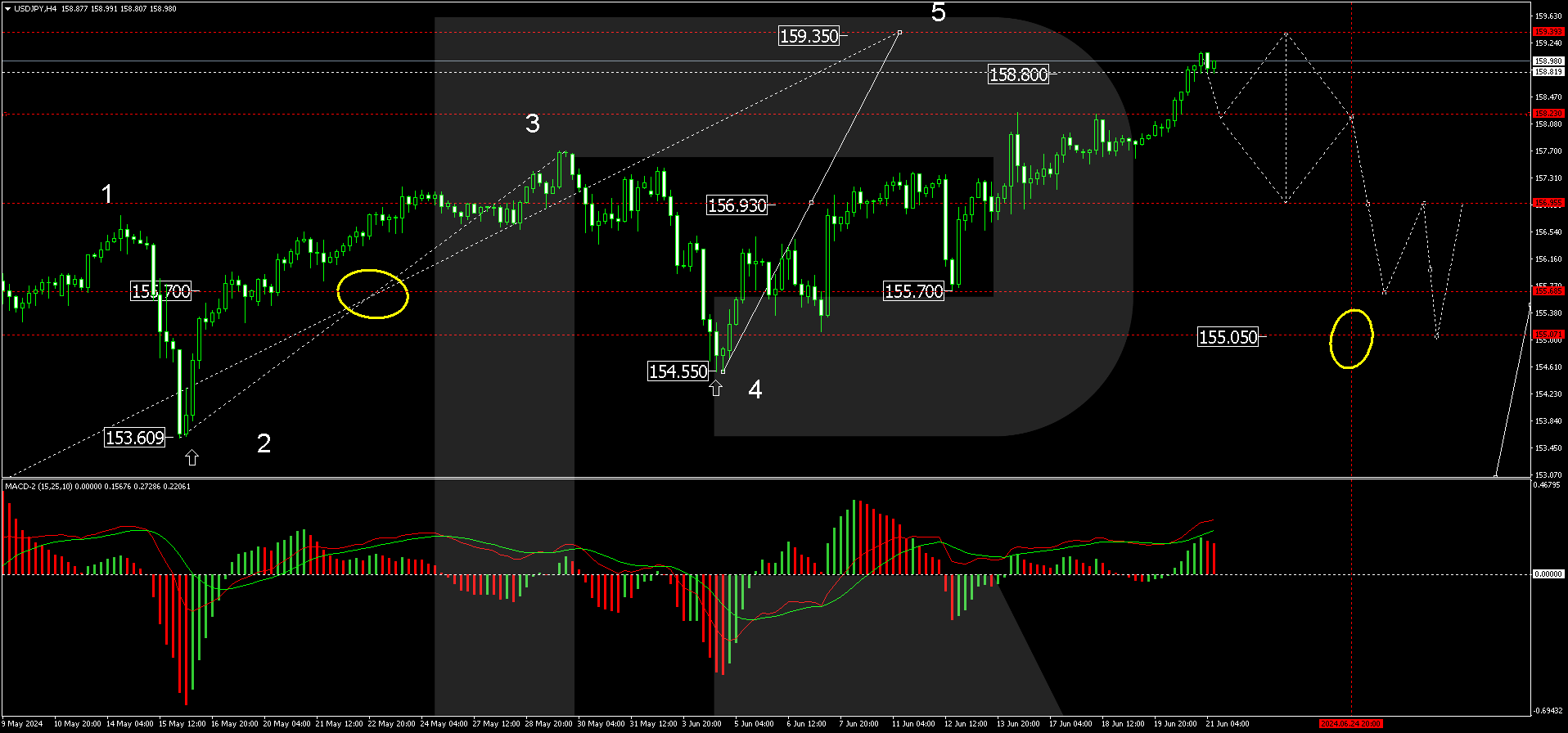
On the H4 chart of AUD/USD, a decline to 0.6663 was followed by a correction to 0.6780. Subsequently, a new wave of decline to 0.6580 has formed, serving as the local target. Upon reaching this target, a correction to 0.6630 (testing from below) is possible, followed by another decline to 0.6548. This target represents the initial objective of the downward trend wave. Technically, this scenario is confirmed by the MACD indicator, with its signal line above zero and pointing strictly downwards.

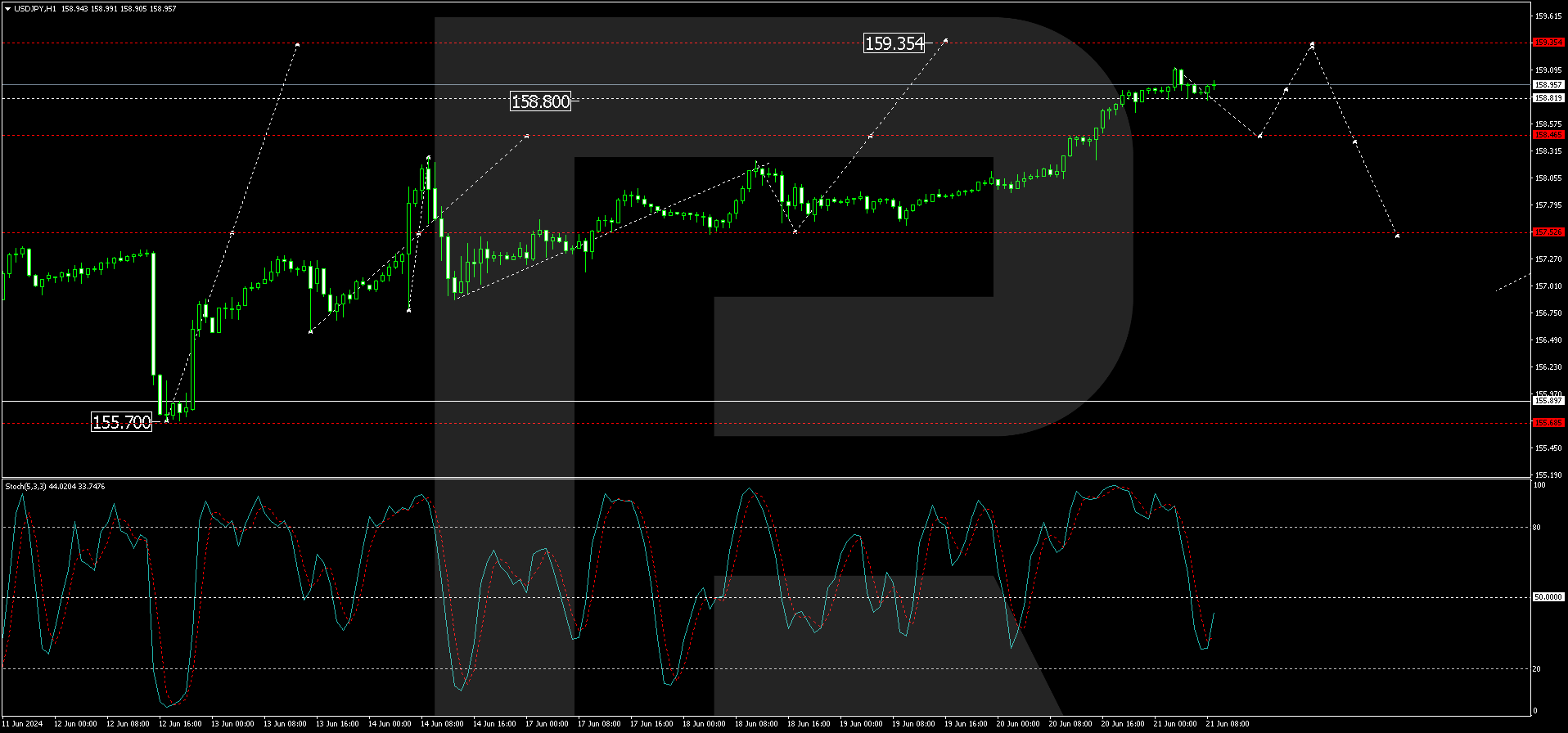
On the H1 chart, a consolidation range has formed around 0.6645. The downward exit from this range achieved the local target of 0.6607. The market has since corrected to 0.6646 (testing from below). Today, the decline wave to 0.6580 continues. After reaching this level, a consolidation range is expected to form around it. An upward exit from this range could lead to a correction to 0.6630. Conversely, a downward exit would open the potential for a further decline to 0.6540. This scenario is technically confirmed by the Stochastic oscillator, with its signal line below 20, indicating a potential beginning of a growth link to 50.

Summary

The Australian dollar’s depreciation is largely influenced by the strong US dollar and the cautious outlook of the Federal Reserve and the Reserve Bank of Australia. Technical indicators suggest further potential declines with possible corrective rebounds. Market participants should closely monitor these levels as economic conditions and policy expectations evolve.


Disclaimer

Any forecasts contained herein are based on the author’s particular opinion. This analysis may not be treated as trading advice. RoboForex bears no responsibility for trading results based on trading recommendations and reviews contained herein.

Weather risk can move markets months in advance: Stock traders pay attention to these 2 long-range climate forecasts

By Derek Lemoine, University of Arizona 

To understand how important weather and climate risks are to the economy, watch investors. New research shows that two long-range seasonal weather forecasts in particular can move the stock market in interesting ways.

We often think about forecasts as telling us what the weather will bring in coming days, but the National Oceanic and Atmospheric Administration also predicts weather conditions several months out. These seasonal climate outlooks tell us whether the hurricane season is likely to be active, whether the winter is likely to be snowy or cold, and whether an El Niño or La Niña climate pattern is likely to emerge with the potential to influence weather across the U.S.

I study the impacts of weather on economic activity as an economist. In a new paper, an atmospheric scientist at NOAA and I analyzed the influence of long-range forecasts by looking at the changing prices of stock options over 10 years and thousands of companies.

We found that investors are paying millions of dollars to hedge the risks of what NOAA’s seasonal outlooks might say. Their bets suggest that seasonal climate matters for the success of companies throughout the economy, even in sectors that might not seem especially exposed to weather.

Betting on seasonal forecasts in options markets

When you buy a stock, you buy a share of ownership in a company. The value of that stock is tied to the company’s expected future profits.

When you buy a stock option, you pay for the right to buy a particular stock at a particular price on some particular future date. Importantly, the option is just that: an option to buy, not a requirement to buy. You’ll pay a premium for this flexibility.

If the stock’s value falls, then you can just let the option expire and all you’ve lost is the premium. But if the stock price rises enough, you can exercise the option and buy the stock at the lower price built into the option. Another type of option, called a “put,” lets you sell stock you already own in a similar way.

The prices of these options tell us how uncertain investors are about the future economy.

Imagine that you know NOAA will be releasing its winter seasonal outlook in 10 days. You are considering whether to invest in a ski resort whose profits are directly tied to having a snowy, skiable winter. You expect the forecast to affect the price of the ski resort’s stock, but you don’t know which way it will go.

The more uncertain investors are about a stock’s future price, the greater their expected gains from holding the option: They get all the potential gain from big increases in the stock’s price and none of the downside risk of falling stock prices. And the greater their expected gains, the more they are willing to pay for the option and the higher the option’s price in the market. So, knowing the winter seasonal outlook is coming can make one willing to pay more for an option on the ski resort’s stock and raise the option’s price in the market.

While there are now many forecasts and available data to provide clues about the coming seasons, two forecasts tend to move the market.

Winter, El Niño outlooks affect many companies

We found that, from 2010 through 2019, the prices of options on companies throughout U.S. markets tended to fall once NOAA released its Winter Outlook, in October, and the most important of its El Niño outlooks, released in June.

In other words, before the reports came out, traders were willing to pay a higher price for options that hedge, or protect against, whatever news was going to be released. So, traders must believe that seasonal climate matters for companies’ profits and that forecasters might say something important about the coming season’s climate.

We did not detect similar effects on option prices when either NOAA or Colorado State University released their Hurricane Outlooks in May and April, or when the Farmers’ Almanac released its Winter Outlook in August. Traders seem to distinguish among outlooks based on their perceived quality and on the importance of what these reports are able to predict, rather than on media attention.

The seasonal climate also matters for more than just outdoor industries. We found the June El Niño Outlook affects options on construction, transportation and utilities – all industries that can be directly affected by weather. It also affects options on other sectors, such as manufacturing and education, possibly reflecting spillovers from elsewhere in the economy. NOAA’s Winter Outlook has similarly broad effects.

The only sector that the June El Niño Outlook does not clearly affect is agriculture, which may just reflect that El Niño’s and La Niña’s strongest effects are on winter weather, when most agriculture is less vulnerable.

Traders pay money to wait for El Niño Outlook

Traders’ interest in the June El Niño Outlook is especially interesting because NOAA releases an El Niño outlook every month. Most months, the outlook changes little from the previous month’s forecast. But in June, once spring is past, the ability to accurately forecast future El Niño events suddenly jumps.

We found that traders value that jump in quality.

The June Outlook corresponds with a US$12 million premium each year on average, showing traders are willing to put real money on the line just to know what NOAA will say in its June forecast before they commit to a stock. That’s about four times higher than we found with the average May outlook.

The traders’ hedging shows that having high-quality seasonal climate forecasts matters to investors, just as it does to communities, companies and emergency responders who rely on these analyses to prepare for severe weather seasons.

It also supports the argument that there is value in investing in the technology to improve these forecasts. And it shows the importance of keeping these outlooks confidential until their official release, similar to how the U.S. government closely guards important economic statistics prior to making them public.The Conversation

About the Author:

Derek Lemoine, Professor of Economics, University of Arizona

This article is republished from The Conversation under a Creative Commons license. Read the original article.

Strong NVDA report helped indices stay afloat after hawkish FOMC minutes

By JustMarkets

The US stock indices closed moderately lower on Wednesday, with the Dow Jones Industrials Index falling to a 1-week low. At Wednesday’s close, the Dow Jones Industrial Average (US30) decreased by 0.51%, while the S&P 500 Index (US500) was down 0.27%. The NASDAQ Technology Index (US100) closed negative 0.18%. “Hawkish” minutes from the May 1 FOMC meeting showed that “many” officials doubted that Fed policy was tight enough to bring inflation down to target levels. As a result, officials suggested that the disinflation process is likely to take longer than previously thought, and some expressed a willingness to tighten policy further if risks to inflation materialize. But after the market closed, the S&P 500 (US500) and NASDAQ (US100) Indexes rose sharply on the strong NVDA report.

Nvidia (NVDA) beat Wall Street prognoses on Wednesday. Its surging earnings due to its chip manufacturing dominance made the company an icon of the artificial intelligence boom. NVDA shares rose by 6% in after-hours trading to $1,006.89. The company’s stock has gained over 200% over the past year. Based in Santa Clara, California, the company has taken a leadership position in the hardware and software needed to adapt the technology to artificial intelligence applications.

Equity markets in Europe were mostly down yesterday. Germany’s DAX (DE40) fell by 0.25%, France’s CAC 40 (FR40) closed down 0.61%, Spain’s IBEX 35 (ES35) lost 0.05%, and the UK’s FTSE 100 (UK100) closed negative 0.55%.

The UK and German 10-year bond yields rose to 2-week highs after UK consumer prices slowed less than expected last month, raising questions about when the Bank of England (BoE) might start cutting interest rates. In addition, first-quarter wages in Germany rose more than expected, prompting the Bundesbank to warn of continued price pressures in the services sector.

ECB President Lagarde noted yesterday that there is a strong possibility of such a move on June 6 if the data reinforces confidence that inflation will fall to 2% in the medium term. The Eurozone’s inflation rate currently stands at 2.4%, close to the ECB’s 2% target and well below the 7% a year earlier. In addition, fresh Eurozone GDP estimates confirmed that the economy came out of recession in the first quarter. The European Commission’s new prognoses still point to a soft landing scenario.

WTI crude oil prices fell below $77 a barrel on Thursday, declining for the fourth consecutive session, as the latest minutes from the US Federal Reserve indicated its members’ willingness to further tighten policy if inflation rises, which could hurt energy demand in the world’s top oil consumer. EIA data also showed that US crude inventories rose by 1.825 million barrels last week, contradicting market expectations of a 2.55 million barrel decline. On Wednesday, Russia said it exceeded its OPEC+ oil production quota in April for “technical reasons” and will propose a plan to compensate for the mistake. All eyes are now on the upcoming OPEC+ meeting scheduled for June 1.

Asian markets were mostly down on Wednesday. Japan’s Nikkei 225 (JP225) was down 0.85%, China’s FTSE China A50 (CHA50) decreased by 0.02%, Hong Kong’s Hang Seng (HK50) lost 0.13%, and Australia’s ASX 200 (AU200) was negative 0.05%. The Hang Seng Index (HK50) approached its lowest level in two weeks amid growing skepticism that China’s major moves to stabilize the property slump will lead to a sustained turnaround in demand and confidence. Comforting earnings results from technology giant Nvidia failed to lift sentiment, especially after the US said some of its steep tariff hikes on Chinese goods, including electric cars, chips, and medical products, would take effect on August 1.

The Bank of Korea kept the policy rate at 3.5% for the 11th consecutive meeting, with markets expecting a possible rate cut in the 4th quarter. The country’s inflation fell to 2.9% y/y, which, despite the decline, is above the Bank’s 2% target. Notably, the economy grew by 3.4% in the first quarter of 2024, the fastest growth since the fourth quarter of 2021, leading to an upward revision of growth forecasts to 2.5% from previous estimates of 2.1%.

In his latest interview, RBNZ Governor Adrian Orr downplayed the chances of another interest rate hike, saying the bank would only tighten policy if it needed to rein in inflation expectations. Meanwhile, an unexpected rise in the country’s retail sales has reduced the odds of a rate cut this year following the RBNZ’s rate decision and its hawkish prognosis on Wednesday.

Singapore’s annual inflation rate stood at 2.7% in April 2024, holding steady for the second consecutive month and slightly above market estimates of 2.6%. The rate remains the lowest since September 2021.

S&P 500 (US500) 5,307.01 −14.40 (−0.27%)

Dow Jones (US30) 39,671.04 −201.95 (−0.51%)

DAX (DE40) 18,680.20 −46.56 (−0.25%)

FTSE 100 (UK100) 8,370.33 −46.12 (−0.55%)

USD Index 104.94 +0.28 (+0.27%)

Important events today:
  • – New Zealand Retail Sales (m/m) at 01:45 (GMT+3).
  • – Australia Manufacturing PMI (m/m) at 02:00 (GMT+3);
  • – Australia Services PMI (m/m) at 02:00 (GMT+3);
  • – Japan Manufacturing PMI (m/m) at 03:30 (GMT+3);
  • – Japan Services PMI (m/m) at 03:30 (GMT+3);
  • – Singapore Consumer Price Index (m/m) at 08:00 (GMT+3);
  • – Eurozone German Manufacturing PMI (m/m) at 10:30 (GMT+3);
  • – Eurozone German Services PMI (m/m) at 10:30 (GMT+3);
  • – Eurozone Manufacturing PMI (m/m) at 11:00 (GMT+3);
  • – Eurozone Services PMI (m/m) at 11:00 (GMT+3);
  • – Hong Kong Consumer Price Index (m/m) at 11:30 (GMT+3);
  • – UK Manufacturing PMI (m/m) at 11:30 (GMT+3);
  • – UK Services PMI (m/m) at 11:30 (GMT+3);
  • – US Initial Jobless Claims  (w/w) at 15:30 (GMT+3);
  • – US Manufacturing PMI (m/m) at 16:45 (GMT+3);
  • – US Services PMI (m/m) at 16:45 (GMT+3);
  • – US New Home Sales (m/m) at 17:00 (GMT+3);
  • – US Natural Gas Storage  (w/w) at 17:30 (GMT+3);
  • – US FOMC Member Bostic Speaks at 22:00 (GMT+3).

By JustMarkets


This article reflects a personal opinion and should not be interpreted as an investment advice, and/or offer, and/or a persistent request for carrying out financial transactions, and/or a guarantee, and/or a forecast of future events.

Gold falls from highs

By RoboForex Analytical Department

The price of gold fell to $2370.00 per troy ounce by Thursday following the release of the minutes from the latest US Federal Reserve meeting. The general tone of the Fed’s policymakers was notably cautious, aligning with previous calls for a restrained approach to monetary policy.

The Fed indicated that more time is needed to be confident that US inflation is declining towards the 2% target. This cautious sentiment has tempered market expectations of imminent interest rate cuts. Previously, the market anticipated two rate cuts (in September and December); now, it expects no more than one. Consequently, the US interest rate is likely to remain at 5.5% per annum for an extended period before the Fed considers revising it.

Higher interest rates reduce the attractiveness of gold, which does not yield interest. This dynamic has contributed to the recent decline in gold prices.

Technical analysis of XAU/USD

On the H4 chart, XAU/USD has formed a downward impulse to the level of 2404.40, followed by a correction to 2433.90. The limits of the consolidation range are now well-defined, and the market has recently broken out downwards. This breakout opens the potential for a further decline to 2322.00. After reaching this level, a rebound to 2385.35 is expected. This scenario is technically supported by the MACD indicator, with its signal line above zero but directed strictly downwards towards new lows.

On the H1 chart, a decline to 2385.00 has been executed, followed by the formation of a consolidation range around this level. The market has recently broken out downwards from this range, opening the potential for a further decline to 2337.35, which is the local target. Following this, a correction back to 2385.00 (testing from below) is possible. Further decline towards 2321.45 may follow. This scenario is technically confirmed by the Stochastic oscillator, with its signal line above 20 and poised to rise to 50 before another potential decline to 20.

Summary

Gold prices have declined due to the Fed’s cautious stance on monetary policy and the expectation of prolonged high interest rates. Technical indicators suggest further potential declines, with possible corrective rebounds along the way. Investors should monitor these levels closely as market conditions evolve.


Disclaimer

Any forecasts contained herein are based on the author’s particular opinion. This analysis may not be treated as trading advice. RoboForex bears no responsibility for trading results based on trading recommendations and reviews contained herein.

Is Oil Back in Buying Territory?

Source: Clive Maund (5/21/24)

Technical Analyst Clive Maund reviews charts in the oil sector to explain why he believes oil might be in buying back territory.

With the main fundamental drivers for a higher oil price remaining in play, namely continuing strife in the Mid-East with the ongoing risk of flare ups and the growing risk of a dollar collapse, this looks like a good point to buy oil and oil related investments after the corrective phase of the past five weeks or so.

On the 8-month chart for Light Crude we can see how oil ran up in late March and early April following a breakout from a Head-and-Shoulders bottom. Then we saw what looks like a normal post-breakout reaction back to test the support at the top of the pattern with an intermediate base pattern forming in this support this month, within which are a couple of “bull hammers,” which are long-tailed bullish candles, which are more easily seen on shorter-term charts. This correction has more than fully unwound the earlier overbought condition and has put oil in a position to advance anew soon.

Turning now to oil stocks, we see on the 8-month chart for the Amex Oil Index (XOI:INDEXNYSEGIS)  that they had quite a strong runup on the back of the rise in the oil price in March and April, but from early April, we see that this index has reacted back in what looks like a classic bull Flag / Pennant that will lead to renewed advance.

We can see that the duration of this corrective pattern has allowed time for the earlier heavily overbought condition shown by the MACD indicator to fully unwind, thus restoring upside potential, and for its bullishly aligned moving averages to partially catch up, thus creating the conditions for renewed advance. This, therefore, is believed to be a good time to buy selected oil stocks.

A good vehicle for playing renewed advance by the energy sector is the Energy Select Sector SPDR Fund (XLE:NYSEARC), and on its 8-month chart, we see that it has corrected back over the past five weeks or so in sympathy with the sector to arrive at the lower rail of a powerful uptrend channel, which has allowed time for its earlier heavily overbought condition to fully unwind.

This correction is believed to be a bull Flag that will lead soon to another strong upleg, an interpretation that is given added weight by the fact that the Accumulation line has held up very well on the correction and is even on the point of making new highs even though the price has not yet broken out of the Flag. This is very bullish, so XLE is rated as a Strong Buy here.

Whilst XLE is not viewed as especially speculative in this environment, buyers here may want to place a stop some way beneath the lower rail of the channel or to reduce the risk of being shaken out before a big rally, it’s perhaps better to place a stop beneath the support level at approximately $90 – $91.50.


Important Disclosures:

  1. Statements and opinions expressed are the opinions of the author and not of Streetwise Reports, Street Smart, or their officers. The author is wholly responsible for the accuracy of the statements. Streetwise Reports was not paid by the author to publish or syndicate this article. Streetwise Reports requires contributing authors to disclose any shareholdings in, or economic relationships with, companies that they write about. Any disclosures from the author can be found  below. Streetwise Reports relies upon the authors to accurately provide this information and Streetwise Reports has no means of verifying its accuracy.
  2. This article does not constitute investment advice and is not a solicitation for any investment. Streetwise Reports does not render general or specific investment advice and the information on Streetwise Reports should not be considered a recommendation to buy or sell any security. Each reader is encouraged to consult with his or her personal financial adviser and perform their own comprehensive investment research. By opening this page, each reader accepts and agrees to Streetwise Reports’ terms of use and full legal disclaimer. Streetwise Reports does not endorse or recommend the business, products, services or securities of any company.

For additional disclosures, please click here.

Clivemaund.com Disclosures

The above represents the opinion and analysis of Mr. Maund, based on data available to him, at the time of writing. Mr. Maund’s opinions are his own, and are not a recommendation or an offer to buy or sell securities. As trading and investing in any financial markets may involve serious risk of loss, Mr. Maund recommends that you consult with a qualified investment advisor, one licensed by appropriate regulatory agencies in your legal jurisdiction and do your own due diligence and research when making any kind of a transaction with financial ramifications. Although a qualified and experienced stock market analyst, Clive Maund is not a Registered Securities Advisor. Therefore Mr. Maund’s opinions on the market and stocks cannot be  only be construed as a recommendation or solicitation to buy and sell securities.

Is a Scorching PM Sector Rally Ahead?

Technical Analyst Clive Maund explains why he believes a rally in precious metals, specifically gold and silver, may be imminent. 

Source: Clive Maund (5/20/24) 

The PM sector did exactly as predicted in the article WHEN THE RUBBER HITS THE ROAD – THE SCORCHING PM SECTOR RALLY AHEAD posted on the site about a week ago, with breakouts by metals and stocks last week from Flag / Pennant consolidation patterns into powerful uplegs. The purpose of this update is to inform you of the fact that THE REALLY BIG ACTION HASN’T EVEN STARTED YET, but it will soon, and we will proceed to see exactly why in this update.

Let’s start by reviewing what happened. Our first chart is the 6-month chart for gold and it’s interesting to see that while silver and PM stocks raced ahead last week, gold’s new upleg has barely gotten started and it has yet to break above the resistance at its early April highs — it will though and when it does it is expected to soar towards the upper rail of the uptrend channel shown and that implies further strong gains by silver and PM stocks in the days and weeks ahead.

Silver, however, showed no such hesitancy and broke out of its bull Flag and raced ahead, clearing the important psychological $30 barrier almost as if wasn’t there and as we can see on its 6-month chart it looks set for further gains as it has a ways to go before it reaches the upper rail of its uptrend channel.

We correctly anticipated this development and bought a raft of 6 SILVER STOCKS POISED TO ADVANCE about a week ago, all of which are up.

This break above $30 by silver was an important technical milestone for as we can see on the 20-year chart it means that it has cleared the important resistance established at this level back in 2020 and 2021 which means it now has its sights set on its 2011 highs at about $50 as its next major objective.

PM stocks meanwhile continued to forge ahead, especially on Friday, building on the breakout from the bull Pennant of May 9, as we can see on the 6-month chart for sector proxy GDX, which shows that they have plenty more upside before they arrive at the upper rail of their uptrend channel.

The 5-year chart makes clear the reason for the claim at the start of this article that THE REALLY BIG ACTION HASN’T EVEN STARTED YET, which is that, despite the gains so far, GDX is still some way from breaking out of the giant Head-and-Shoulders continuation pattern shown on this chart. The real action will start once GDX breaks above not just the neckline of the H&S pattern (the red line) but above the band of resistance that marks the upper boundary of the entire pattern and dates back to the 2020 highs.

Sentiment indicators continue to show that there is still little interest in the sector and a lot of skepticism, which is of course very bullish. This will change and change fast once GDX breaks above the key resistance, with a lot of investors coming down off the fence and piling in, driving a robust rally.

The 20-year chart for GDX is most interesting as it shows very clearly why the PM sector has such a huge upside from here. One is that GDX is still way below its 2011 highs, and this is despite gold having made clear new highs.

Gold is shown at the top of this chart and we see that it is romping ahead with a now very big positive divergence relative to PM stocks. This isn’t the way it is supposed to be — traditionally, during sector bull markets, stocks way outperform bullion for the obvious reason that with their high fixed costs, mines become vastly more profitable as gold continues to appreciate. What this means is that PM stocks have a lot of catching up to do — and the more gold (and silver) ascend, the more catching up there will be to do.

This is why PM stocks are expected to rip higher once GDX overcomes the resistance shown on this chart and the 5-year earlier.

Lastly, we will take a quick look at the dollar because of the increasing likelihood of a dollar collapse, which would be a big driver for strong gains not just by gold and silver but across the commodity complex generally.

So, let’s now take a quick look at a 20-year chart for the dollar index. On it, we can see that, so far, it hasn’t collapsed and has actually held up very well in the circumstances. In looking at this chart, we should keep in mind that as it is an index, it is a measure of the value of the dollar relative to other currencies and since all currencies are losing purchasing power, it doesn’t mean that because the dollar index has been more or less moving sideways since early 2023 it hasn’t lost purchasing power — it has a lot.

Going forward, if we see widespread dumping of Treasuries coupled with a buyer’s strike and the Fed aggressively monetizing new issues, as looks likely, it means that the dollar and the dollar index will drop and drop hard. This is why the sideways range of the past year or so is suspected to be some sort of bear Flag that will lead to renewed severe decline, as shown, and if it does, gold and silver and commodities will generally soar.

Streetwise has some sponsored companies that may be impacted by a rise in gold and silver. Click here to see the gold and here for the silver.


Important Disclosures:

  1. Statements and opinions expressed are the opinions of the author and not of Streetwise Reports, Street Smart, or their officers. The author is wholly responsible for the accuracy of the statements. Streetwise Reports was not paid by the author to publish or syndicate this article. Streetwise Reports requires contributing authors to disclose any shareholdings in, or economic relationships with, companies that they write about. Any disclosures from the author can be found  below. Streetwise Reports relies upon the authors to accurately provide this information and Streetwise Reports has no means of verifying its accuracy.
  2. This article does not constitute investment advice and is not a solicitation for any investment. Streetwise Reports does not render general or specific investment advice and the information on Streetwise Reports should not be considered a recommendation to buy or sell any security. Each reader is encouraged to consult with his or her personal financial adviser and perform their own comprehensive investment research. By opening this page, each reader accepts and agrees to Streetwise Reports’ terms of use and full legal disclaimer. Streetwise Reports does not endorse or recommend the business, products, services or securities of any company.

For additional disclosures, please click here.

Clivemaund.com Disclosures

The above represents the opinion and analysis of Mr. Maund, based on data available to him, at the time of writing. Mr. Maund’s opinions are his own, and are not a recommendation or an offer to buy or sell securities. As trading and investing in any financial markets may involve serious risk of loss, Mr. Maund recommends that you consult with a qualified investment advisor, one licensed by appropriate regulatory agencies in your legal jurisdiction and do your own due diligence and research when making any kind of a transaction with financial ramifications. Although a qualified and experienced stock market analyst, Clive Maund is not a Registered Securities Advisor. Therefore Mr. Maund’s opinions on the market and stocks cannot be  only be construed as a recommendation or solicitation to buy and sell securities.

Dow tops 40,000 as stock indexes continue to cross milestones − making many investors feel wealthier

By Alexander Kurov, West Virginia University 

The Dow Jones Industrial Average topped 40,000 for the first time on May 16, 2024. It spent the next few hours hovering around that mark, occasionally dipping under. But the breakthrough, even if fleeting, nonetheless marks another symbolic milestone in a monthslong bull market, coming three months after the S&P 500 index surpassed 5,000 for the first time.

The Conversation asked Alexander Kurov, a financial markets scholar, to explain what stock indexes are and to say whether these kinds of milestones are a big deal or not.

What are stock indexes?

Stock indexes measure the performance of a group of stocks. When prices rise or fall overall for the shares of those companies, so do stock indexes. The number of stocks in those baskets varies, as does the system for how this mix of shares gets updated.

The Dow Jones Industrial Average, also known as the Dow, includes shares in the 30 U.S. companies with the largest market capitalization – meaning the total value of all the stock belonging to shareholders. That list currently spans companies from Apple to Walt Disney Co.

The S&P 500 tracks shares in 500 of the largest U.S. publicly traded companies.

The Nasdaq composite tracks performance of more than 2,500 stocks listed on the Nasdaq stock exchange.

The DJIA, launched on May 26, 1896, is the oldest of these three popular indexes, and it was one of the first established.

Two enterprising journalists, Charles H. Dow and Edward Jones, had created a different index tied to the railroad industry a dozen years earlier. Most of the 12 stocks the DJIA originally included wouldn’t ring many bells today, such as Chicago Gas and National Lead. But one company that only got booted in 2018 had stayed on the list for 120 years: General Electric.

The S&P 500 index was introduced in 1957 because many investors wanted an option that was more representative of the overall U.S. stock market. The Nasdaq composite was launched in 1971.

You can buy shares in an index fund that mirrors a particular index. This approach can diversify your investments and make them less prone to big losses.

Index funds, which have existed only since Vanguard Group founder John Bogle launched the first one in 1976, now hold trillions of dollars.

Why are there so many?

There are hundreds of stock indexes in the world, but only about 50 major ones.

Most of them, including the Nasdaq composite and the S&P 500, are value-weighted. That means stocks with larger market values account for a larger share of the index’s performance.

In addition to these broad-based indexes, there are many less prominent ones. Many of those emphasize a niche by tracking stocks of companies in specific industries like energy or finance.

Do these milestones matter?

Stock prices move constantly in response to corporate, economic and political news, as well as changes in investor psychology. Because company profits will typically grow gradually over time, the market usually fluctuates in the short term while increasing in value over the long term.

The DJIA first reached 1,000 in November 1972, and it crossed the 10,000 mark on March 29, 1999. On Jan. 22, 2024, it surpassed 38,000 for the first time. Breaking through 40,000 on May 16 prompted a flurry of congratulatory news reports.

Because there’s a lot of randomness in financial markets, the significance of round-number milestones is mostly psychological. There is no evidence they portend any further gains.

For example, the Nasdaq composite first hit 5,000 on March 10, 2000, at the end of the dot-com bubble.

The index then plunged by almost 80% by October 2002. It took 15 years – until March 3, 2015 – for it to return to 5,000.

As 2024 has progressed, the Nasdaq composite has regularly closed at record highs.

Index milestones matter to the extent they pique investors’ attention and boost market sentiment.

Investors afflicted with a fear of missing out may then invest more in stocks, pushing stock prices to new highs. Chasing after stock trends may destabilize markets by moving prices away from their underlying values.

When a stock index passes a new milestone, investors become more aware of their growing portfolios. Feeling richer can lead them to spend more.

This is called the wealth effect. Many economists believe that the consumption boost that arises in response to a buoyant stock market can make the economy stronger.

Is there a best stock index to follow?

Not really. They all measure somewhat different things and have their own quirks.

For example, the S&P 500 tracks many different industries. However, because it is value-weighted, it’s heavily influenced by only seven stocks with very large market values.

Known as the “Magnificent Seven,” shares in Amazon, Apple, Alphabet, Meta, Microsoft, Nvidia and Tesla now account for over one-fourth of the S&P 500’s value. Nearly all are in the tech sector, and they played a big role in pushing the S&P across the 5,000 mark.

This makes the index more concentrated on a single sector than it appears.

But if you check out several stock indexes rather than just one, you’ll get a good sense of how the market is doing. If they’re all rising quickly or breaking records, that’s a clear sign that the market as a whole is gaining.

Sometimes the smartest thing is to not pay too much attention to any of them.

For example, after hitting record highs on Feb. 19, 2020, the S&P 500 plunged by 34% in just 23 trading days because of concerns about what COVID-19 would do to the economy. But the market rebounded, with stock indexes hitting new milestones and notching new highs by the end of that year.

Panicking in response to short-term market swings would have made investors more likely to sell off their investments in too big a hurry – a move they might have later regretted. This is why I believe advice from the immensely successful investor and fan of stock index funds Warren Buffett is worth heeding.

Buffett, whose stock-selecting prowess has made him one of the world’s 10 richest people, likes to say, “Don’t watch the market closely.”

If you’re reading this because stock prices are falling and you’re wondering if you should be worried about that, consider something else Buffett has said: “The light can at any time go from green to red without pausing at yellow.”

And the opposite is true as well.

This article is an updated version of a story that was first published on Feb. 15, 2024.The Conversation

About the Author:

Alexander Kurov, Professor of Finance and Fred T. Tattersall Excellence in Finance Research Chair, West Virginia University

This article is republished from The Conversation under a Creative Commons license. Read the original article.


What is wind shear? An atmospheric scientist explains how it can tear down hurricanes

By Zachary Handlos, Georgia Institute of Technology 

Weather forecasters talk about wind shear a lot during hurricane season, but what exactly is it?

I teach meteorology at Georgia Tech, in a part of the country that pays close attention to the Atlantic hurricane season. Here’s a quick look at one of the key forces that can determine whether a storm will become a destructive hurricane.

What is wind shear?

Wind shear is defined as the change in wind speed, wind direction, or both, over some distance.

You may have heard airplane pilots talk about turbulence and warn passengers that they’re in for a bumpy ride. They’re typically seeing signs of sudden changes in wind speed or wind direction directly ahead, and wind shear can sometimes cause this.

With hurricanes, the focus is usually on vertical wind shear, or how wind changes in speed and direction with height.

Two illustrations show different types of wind shear. On the left, change in height rolls a cloud under. On the right, change in direction affects a plane in flight.
The effects of wind shear when wind speed increases with height (left) or changes direction (right).
National Weather Service

Vertical wind shear is present nearly everywhere on Earth, since winds typically move faster at higher altitudes than at the surface. It can be stronger or weaker than normal, and that’s especially important during hurricane season.

Tropical storms typically start as a tropical wave, or low-pressure system associated with a cluster of thunderstorms over warm water in the tropics. Warm air over the ocean surface rises rapidly, drawing in fuel for the storm. The winds begin to rotate and can intensify into a tropical storm and then a hurricane.

Hurricanes thrive in environments where their vertical structure is as symmetrical as possible. The more symmetrical the hurricane is, the faster the storm can rotate, like a skater pulling in her arms to spin.

Too much vertical wind shear, however, can offset the top of the storm. This weakens the wind circulation, as well as the transport of heat and moisture needed to fuel the storm. The result can tear a hurricane apart.

El Niño’s and La Niña’s influence

Wind shear becomes a hot topic during El Niño years, when wind shear tends to be stronger over the Atlantic during hurricane season.

An El Niño event occurs when sea surface waters in the eastern Pacific Ocean basin become significantly warmer than average, while western Pacific Ocean basin waters become cooler than average. This happens every two to seven years or so, and it affects weather around the world.

During El Niño events, upper-level winds over the Atlantic tend to be stronger than usual, and thus stronger wind shear results. The faster air flow in the upper troposphere leads to faster wind speed with increasing height, making the upper atmosphere less favorable for tropical storm development. The eastern North Pacific, in contrast, tends to have less wind shear during El Niño.

How El Niño affects the entire planet.

No two El Niño events are the same, of course. In 2023, record warm sea surface temperatures threatened to power up hurricanes so much that El Niño’s increase in wind shear couldn’t tear them down. For example, Hurricane Idalia fought through the wind shear in August and hit Florida as a powerful Category 3 storm.

El Niño’s opposite is La Niña – the two climate patterns shift every two to seven years or so. La Niña allows for more active hurricane seasons, as the Atlantic saw during the record-breaking 2020 season. La Niña conditions were expected to develop by fall 2024, and the Atlantic hurricane forecasts reflect that with expectations for another busy season.

The 2023 Atlantic hurricane season was a good reminder that there are always multiple factors at play affecting how destructive hurricanes become. Nevertheless, vertical wind shear will always be present and something meteorologists will keep an eye on.The Conversation

About the Author:

Zachary Handlos, Atmospheric Science Educator, Georgia Institute of Technology

This article is republished from The Conversation under a Creative Commons license. Read the original article.

The RBNZ maintained its hawkish bias, leaving the interest rate at 5.5%. Inflationary pressures are easing in Canada

By JustMarkets

At the end of Tuesday, the Dow Jones Index (US30) was up 0.17%, while the S&P 500 Index (US500) added 0.25%. The NASDAQ Technology Index (US100) closed positive 0.22%. The US stock indices closed moderately higher, consolidating just below last week’s all-time highs. The rise in stocks was limited by comments from Fed Representative Waller and FRB Atlanta President Bostic, who said they favored waiting for inflation to fall before cutting interest rates.

FRB Atlanta President Bostic reiterated his view that inflation will continue to decline slowly and that the Fed could likely begin cutting interest rates in the 4th quarter. Today, markets await Wednesday’s release of the minutes from the May 1 FOMC meeting to see how close the Fed is to cutting interest rates.

Tesla (TSLA) stock price rose more than 6%, leading the Nasdaq 100 higher as a coalition of Tesla shareholders urges peers to reject CEO Musk’s $56 billion compensation package. AstraZeneca Plc (AZN) closed higher by more than 2% after the company said it expects to generate $80 billion in cumulative revenue by 2030 from “significant growth” in its portfolio of existing oncology, biopharmaceuticals, and rare diseases.

The Canadian dollar weakened to 1.36 per dollar, moving away from the five-week highs reached earlier this month, as the latest inflation data raised bets that the Bank of Canada could start cutting interest rates as early as next month. As expected, core inflation slowed to 2.7% y/y in April, hitting the lowest level in three years, while the core rate fell for the 5th straight month to 1.6% y/y, also the lowest since 2021. The Bank of Canada kept its key rate at 5% in April. Still, policymakers recently said they needed to see further and sustained weakening in core inflation before moving to a looser policy. Odds of a rate cut in June rose to 50% from 40% before the report was published.

Equity markets in Europe were mostly down yesterday. Germany’s DAX (DE40) fell by 0.22%, France’s CAC 40 (FR40) closed down by 0.66%, Spain’s IBEX 35 (ES35) lost 0.04%, and the UK’s FTSE 100 (UK100) closed negative 0.09%.

Asian markets were mostly down on Tuesday. Japan’s Nikkei 225 (JP225) declined 0.31%, China’s FTSE China A50 (CHA50) fell 0.19% for the day, Hong Kong’s Hang Seng (HK50) fell 2.12% on Monday, and Australia’s ASX 200 (AU200) closed negative 0.15%.

The Reserve Bank of New Zealand kept the official cash rate (OCR) at 5.5% during its May 2024 policy meeting, extending the rate pause for the 7th straight time and confirming market expectations. Policymakers noted that restrictive monetary policy has eased pressure on manufacturing capacity and lowered consumer price inflation. Although the country’s core inflation fell to a nearly three-year low of 4% in the first quarter of 2024, it remained above the target range of 1% to 3%. At the same time, the Central Bank raised its rate prognosis maximum and delayed the timing of rate cuts until the third quarter of 2025, later than its previous estimate for the second quarter.

Japan’s trade deficit widened to JPY 462.50 billion in April 2024 from JPY 429.79 billion in the same month a year earlier, exceeding market prognoses. Exports rose by 8.3% y/y, marking the fifth consecutive month of growth, mainly due to continued shipments to major trading partners, notably the US and China. Imports also rose by 8.3%, the strongest growth in 14 months, to a four-month high, driven by increased purchases of mineral fuels.

S&P 500 (US500) 5,321.41 +13.28 (+0.25%)

Dow Jones (US30) 39,872.99 +66.22 (+0.17%)

DAX (DE40) 18,726.76 −42.20 (−0.22%)

FTSE 100 (UK100) 8,416.45 −7.75 (−0.09%)

USD Index 104.65 +0.09 (+0.08%)

Important events today:
  • – US FOMC Member Collins Speaks at 02:00 (GMT+3);
  • – US FOMC Member Mester Speaks at 02:00 (GMT+3);
  • – Japan Trade Balance at 02:50 (GMT+3);
  • – New Zealand RBNZ Interest Rate Decision at 05:00 (GMT+3);
  • – New Zealand RBNZ Monetary Policy Statement at 05:00 (GMT+3);
  • – New Zealand RBNZ Press Conference at 06:00 (GMT+3);
  • – UK Consumer Price Index (m/m) at 09:00 (GMT+3);
  • – UK Producer Price Index (m/m) at 09:00 (GMT+3);
  • – US Existing Home Sales (m/m) at 17:00 (GMT+3);
  • – US Crude Oil Reserves (w/w) at 17:30 (GMT+3);
  • – US FOMC Meeting Minutes at 21:00 (GMT+3);
  • – New Zealand RBNZ Gov Orr Speaks at 23:10 (GMT+3).

By JustMarkets


This article reflects a personal opinion and should not be interpreted as an investment advice, and/or offer, and/or a persistent request for carrying out financial transactions, and/or a guarantee, and/or a forecast of future events.

The New Zealand Dollar shows a steady rise

By RoboForex Analytical Department

The NZD/USD pair is preparing for a mid-week rally, approaching the 0.6116 level. These current values mark the highest point for the Kiwi in two months, following the Reserve Bank of New Zealand’s decision to maintain its monetary policy structure unchanged during the May meeting.

The interest rate remains at 5.5% per annum, as anticipated.

The RBNZ has determined that maintaining a restrictive monetary policy is necessary to ensure inflation returns to target within the planned timeframe. The central bank has noted a cooling labour market and rising unemployment as potential risks. Support factors include higher housing rents, insurance costs, and increasing utility rates.

According to the official forecast, the consumer price index in New Zealand is expected to return to the 1-3% range by the end of 2024.

Overall, the NZD exchange rate is poised to increase. The RBNZ’s policy is viewed as balanced and consistent, which helps mitigate the risks of excessive volatility for the Kiwi.

On a broader scale, investors are awaiting the minutes from the latest US Federal Reserve meeting, which will provide further insights into the Fed’s upcoming steps.

NZD/USD technical analysis

On the H4 chart of NZD/USD, a consolidation range has formed around the 0.6000 level. Following an upward breakout, a growth wave to 0.6151 has been achieved. A consolidation range is currently emerging around 0.6114. A downward breakout from this range could open the potential for a decline to 0.6000, the first target. After reaching this level, a correction wave to 0.6075 (testing from below) is possible, followed by a further decline along the trend to 0.5853. This scenario is technically supported by the MACD indicator, with its signal line above zero but directed strictly downwards.

On the H1 chart, an impulse of decline to 0.6114 has formed. Today, the market might perform a correction to 0.6132. After this correction, the continuation of the growth wave to 0.6075 is expected, with the prospect of further trend development.

Summary

The NZD/USD pair is steadily rising, bolstered by the Reserve Bank of New Zealand’s consistent monetary policy. Technical indicators suggest potential corrections and further growth, with close attention to the upcoming US Federal Reserve minutes for additional market direction.


Disclaimer

Any forecasts contained herein are based on the author’s particular opinion. This analysis may not be treated as trading advice. RoboForex bears no responsibility for trading results based on trading recommendations and reviews contained herein.