Precious Mettle

Source: Michael Ballanger (8/19/24)

 Michael Ballanger of GGM Advisory Inc. shares his thoughts on the current state of the junior mining sector, and one copper stock he believes should be in your portfolio.

“The desire for gold is the most universal and deeply rooted commercial instinct of the human race.” – Gerald M. Loeb

Gerald M. Loeb was a founding partner of the famous brokerage house E.F. Hutton, where he honed his skills as a Wall Street trader and investment banker. Having survived the 1929 market crash, that experience marred him for life, creating an investment style that involved “never holding a stock position for the long-term.”

He wrote the book that I have read cover-to-cover three times in forty-five years, The Battle for Investment Survival, which emphasized the concept of cutting losses quickly and letting profits “ride” as a surefire strategy for above-average performance and risk control. It is also in direct contravention of the Benjamin Graham/Warren Buffet rules of investment engagement that dictate that value investors buy and hold securities for longer-term periods.

Loeb’s quote at the top of this page joins the famous quote by J.P. Morgan, “Gold is money; everything else is credit.” in defining how these two merchants of the 1900’s bond and stock markets viewed the one asset that today’s Wall Street mavens view as a “barbarous relic.

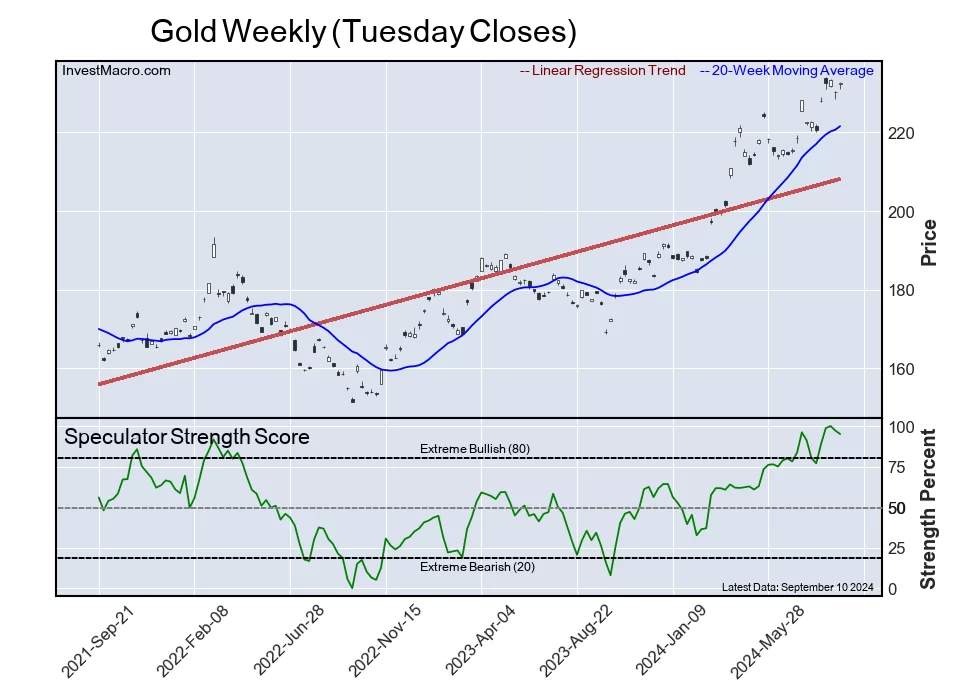
As gold moves to escape velocity above the magical USD $2,500/oz. level, and the SPDR Gold Shares ETF (GLD:NYSE) hits an all-time high this morning, it is instructive to sit back and ponder the remarks of two titans of finance when it comes to their view on gold’s utility within portfolios.

The current Wall Street narrative is now dominated with this nagging debate over the Fed’s next course of action. The “stocks for the long-term” spin machine has done such a wonderful job of training the portfolio managers to drool uncontrollably at the mere mention of rate cuts, it is as if Pavlov has forgotten to ring the bell for a solid week in front of a cage of ravenous, starving canines.

It seems like it was just yesterday that the world was on the brink of a total self-immolation of the banking system thanks to the unbridled overindulgence in leverage everywhere that a commission fee could be levied. The GFC of 2008 was followed by bailout after bailout, replete with outsized bonus pools for all that participated in the sub-prime scam. No jail time, no convictions, and zero regulatory reprimand for any of the architects of the largest public swindle of taxpayer money in the history of the planet.

Yet without mention anywhere amongst the legions of “expert commentators” in the financial media is the fact that gold bullion purchased in January 2003 has outperformed the S&P 500 by a margin of 615% to 529%.

Why is that?

Well, let us start with the fee structure. It is no secret that recommending that a client go on a monthly investment plan for gold involves no rotation, and in the world of Wall Street “comp,” there are much larger fees for turning a client’s portfolio over three or four times a year especially when in-house products with big fat underwriting fees are included. Also, investment banking is a huge source of revenue for Wall Street banks like Goldman or JP Morgan, and again, it is no mystery that “paper” products like IPOs are easier with which to conjure up financial wizardry with huge built-in fees that are geared around “sophistication” (more appropriately called “the ability to confuse and confound“) as they bundle up various layers of credit risk to resemble an AAA-rated security.

You simply cannot do that with a metal that carries the periodic number “79.” In reality, if you really backed out all the fees generated within the perimeter of the S&P 500 realm of companies by the Wall Street geniuses, that 529% for the S&P return would probably be half that number.

In a fit of forlorn reasoning, I decided back in May that I would refrain from adding to my gold holdings until mid-August, a practice that I have used frequently in setting up a year-end portfolio structure that captures gold’s seasonality trade. Because I had my head buried in a seemingly enlightened crevice of self-certainty and intransigence, I anchored the notion that just because I thought it made sense, it just had to happen.

Well, a month ago, I woke up to the reality that gold had decided that perhaps — just perhaps — the “analyst” from Port Perry was going to get left summarily behind in his maniacal quest to pick gold off in the $2,250-2,300 range or the GLD in the $200-205 range before new highs could be possibly achieved.

Alas, as usually happens, I forgot the “Twainian” Rule that goes something like this: “It ain’t what you don’t know that gets you into trouble’; it’s what you know for sure that turns out to be not exactly so.”

I knew “for sure” that gold would bottom in mid-August, and luckily, my hedges on GLD were modest at best, and they did not exactly get me “into trouble.” What it represented was more of an opportunity cost more than a financial cost with a smattering of reputational embarrassment thrown in. Nevertheless, as the famous quote by Martin Zweig goes, “It’s OK to be wrong; it’s unforgivable to stay wrong.”

GLD has moved to an all-time high today (which is the exact definition of the term “mid-August) with a move to $231.10, surpassing the prior high of $229.65 last seen on July 17.

Silver

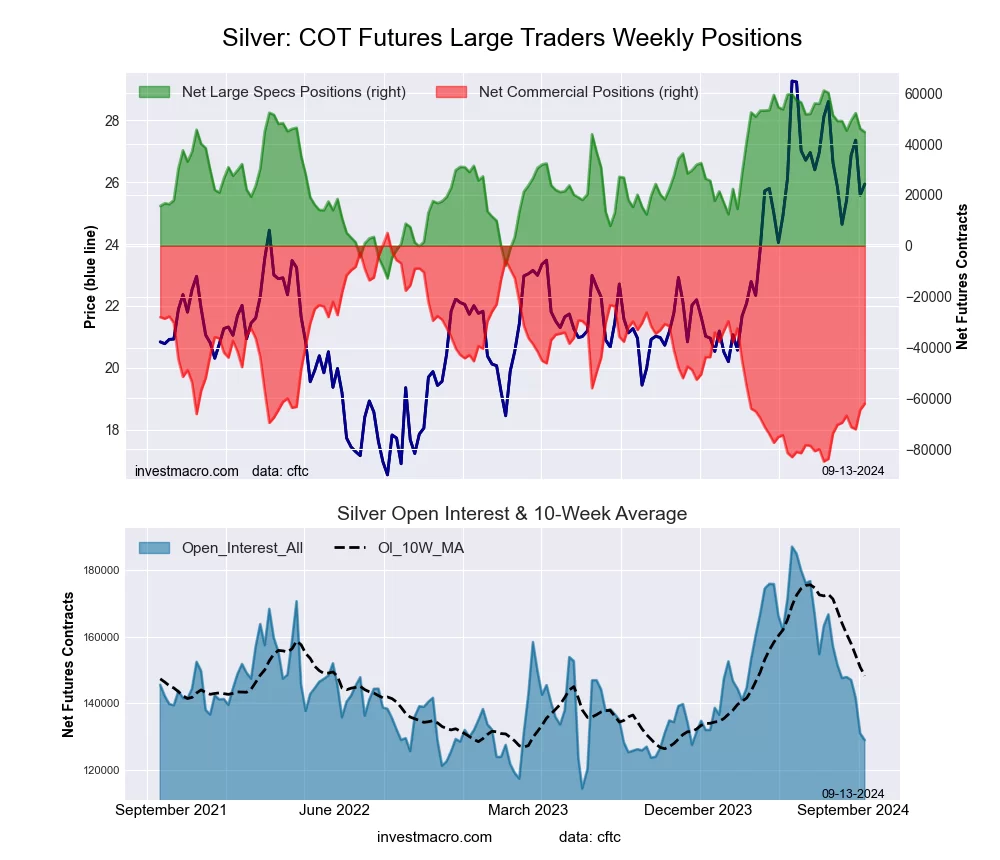
iShares Silver Trust (ETF) (SLV:NYSE), by contrast, has failed to come anywhere near its 2022 high of $29.56, last seen on May 20. Using the GLD:SLV to arrive at the gold-silver ratio, the GSR is now at 88.30 up from 74, which marked the May low for that very important ratio. The GSR is the concrete that bonds together all aspects of the gold-silver bull thesis because (and I know you are all rolling your eyes) without this ratio making new lows as the precious metals advance, any rally is doomed. Silver is the speculative spark that ignites the animal spirits that drive the precious metals shares which in turn drives the retail public into the explorers and developers where most of the leverage is contained. To attract the interest (and dollars) of the wild-eyed speculator, there needs to be a “hook.

Silver fills that roll.

Just as most of the tried-and-true rules surrounding stocks are now prehistoric drivel thanks largely to the predominance of the algobots, it is entirely possible that gold can continue to outperform silver right through $3,000/ounce driven by the current narrative that the main buyers of the precious metals are central banks where record after record continues to be broken in terms of physical offtake.

No such offtake is occurring in the silver arena. Only industrial and investment demand (primarily from retail) drives silver, and thus far, that has been insufficient to replace the sheer volume of central bank buying in the yellow metal. Hence, I have stuck to gold and copper as my top metals to own for the past decade.

Copper

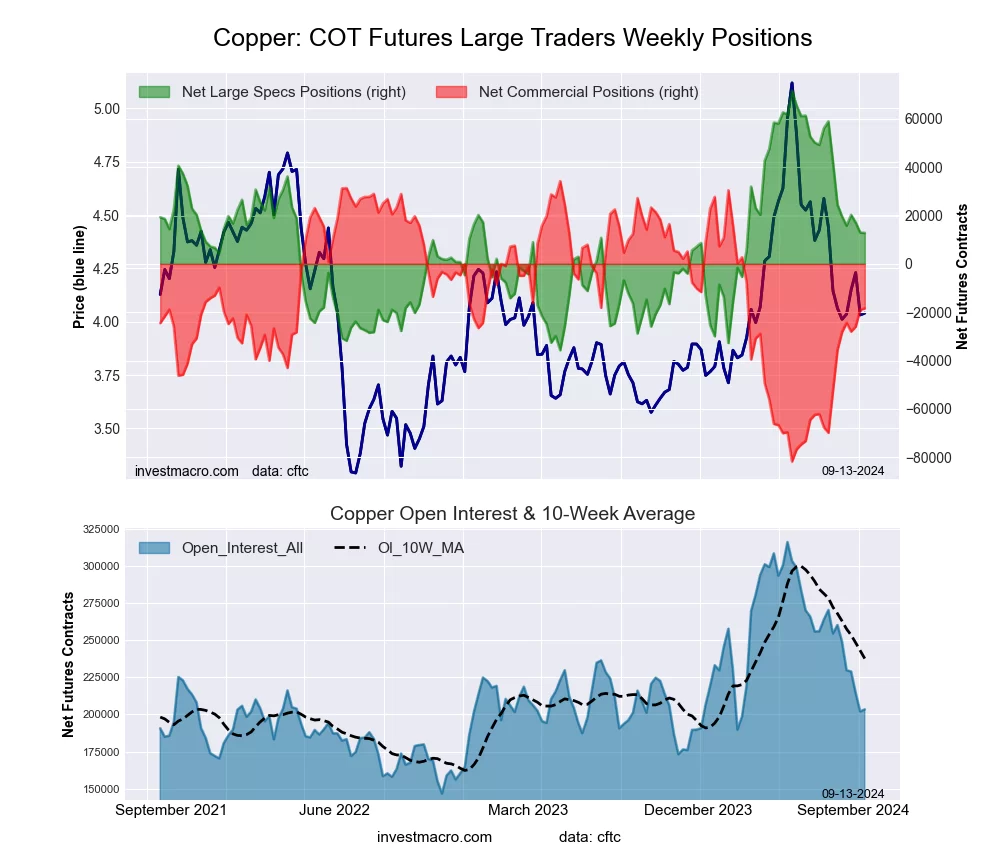
Speaking of the copper market, I have been typing away since the Nikkei “carry trade crash” on August 5, urging subscribers to replace all of the copper names they sold back in May when copper broke below $4.00/lb. bottoming in the $3.92/lb. range joining stocks in that Monday rout.

Copper just initiated a bullish MACD crossover and is now on a “buy signal,” as is the money flow indicator. RSI at 48.73 provides considerable runway for price before it approaches overbought territory so these momentum indicators are pretty powerful reasons to own the red metal.

As for target prices, the 50-dma at $4.33/lb. and the 100-dma at $4.42 will probably cap the advance but if they are taken out, what now must be classified as a “bear market rally” will be reclassified as a “bull market resumption” and the negative implications of the 24.6% correction from the May highs get thrown overboard.

Fundamentals for copper remain strongly bullish, with the most recent comment by RBC being retweeted by Ivanhoe Mines founder Robert Friedland. “An attractive entry point for <copper> equities”  is exactly what I have been hammering since the August 5 flush with my number one portfolio move in months being the replacement of all stock and call option positions in Freeport-McMoRan Inc. (FCX:NYSE).

The stock touched down on crash day at $39.21, sporting an RSI under 25, and gave me the fortuitous window in which to replace the positions that I jettisoned back in May when the RSI was screaming toward 80 and trading over $53 per share.

The terror I felt in dumping my beloved FCX was overshadowed only by the capital gains I crystallized in both stock and June call options, but for the past three months, I writhed in stressful agony every time the stock upticked a dime or two. Now, I own an oversized position in the company that produces two of my favorite metals for the decade ending in 2030 — copper and gold.

Everyone should visit its website and take the time to review their operations around the world. They are everywhere — including next to my largest junior explorer-developer Fitzroy Minerals Inc. (FTZ:TSX.V; FTZFF:OTCQB)in the Valparaiso district of Chile where FTZ is conducting exploration on the highly-prospective Caballos Copper Property.

The junior miners as a group are still about as challenged a group as I have seen in my forty-five years as an “incubator” of these little guys who have made most of the world-class discoveries in the past five decades. As the Boomers age and settle on clipping coupons and playing golf, the last demographic to experience true financial rapture through mineral discoveries of all types and sizes on all five continents is now a pitiably smaller force than in the 1990s when listening to exploration “stories” was the ultimate in water cooler conversation.

The mania that swept investors into a financing frenzy that brought untold wealth through ownership of juniors finding ore bodies that became world-class mining operations like Dia Met (diamonds in Canada) and Diamondfields (Voisey’s Bay nickel-copper-cobalt) and Eskay Creek (gold-silver) is going to return with a vengeance. This is going to be driven when the Gen-X and Millennial generations suddenly wake up and realize that they are missing the biggest commodity boom in world history.

It was only 15 years ago that I first learned that a “Tier One” gold asset involved a minimum of 5 million ounces, with gold prices at $1,250 per ounce. Today, we are at $2,534. Using simple math, that should mean that a gold project with half as many ounces should now be valued as a “Tier One” asset.

How many junior gold developers out there have 2.5 million ounces in the ground trading for a fraction of a proper “Tier One” valuation?

Dozens upon dozens in jurisdictions like Nevada and Quebec that cannot get a meeting with investment bankers if their lives depended on it. That, my friend, is going to change at a point where rising gold prices force the bankers and the M&A specialists to smell the money and start dialing feverishly to cement banking relationships from these struggling juniors.

It will not just be gold; juniors with copper-gold porphyry or IOCG deposits will be in the queue, readily open for business. As in all eras, it is the allure of fee-generating deals that drives the bankers into the waiting arms of anyone with a story. For most of this decade, that story has been technology and is now cresting with the latest mania called “artificial intelligence.” The rotation I foresee is into the junior exploration space where gold and copper are kings.

As they used to say in the pork belly pit on the old Chicago Board of Trade: “Buy ’em!


Important Disclosures:

  1. As of the date of this article, officers and/or employees of Streetwise Reports LLC (including members of their household) own securities of Fitzroy Minerals Inc.
  2. Michael Ballanger:  I, or members of my immediate household or family, own securities of: All. My company has a financial relationship with Fitzroy Minerals Inc.  I determined which companies would be included in this article based on my research and understanding of the sector.
  3. Statements and opinions expressed are the opinions of the author and not of Streetwise Reports, Street Smart, or their officers. The author is wholly responsible for the accuracy of the statements. Streetwise Reports was not paid by the author to publish or syndicate this article. Streetwise Reports requires contributing authors to disclose any shareholdings in, or economic relationships with, companies that they write about. Any disclosures from the author can be found  below. Streetwise Reports relies upon the authors to accurately provide this information and Streetwise Reports has no means of verifying its accuracy.
  4.  This article does not constitute investment advice and is not a solicitation for any investment. Streetwise Reports does not render general or specific investment advice and the information on Streetwise Reports should not be considered a recommendation to buy or sell any security. Each reader is encouraged to consult with his or her personal financial adviser and perform their own comprehensive investment research. By opening this page, each reader accepts and agrees to Streetwise Reports’ terms of use and full legal disclaimer. Streetwise Reports does not endorse or recommend the business, products, services or securities of any company.

For additional disclosures, please click here.
Michael Ballanger Disclosures

This letter makes no guarantee or warranty on the accuracy or completeness of the data provided. Nothing contained herein is intended or shall be deemed to be investment advice, implied or otherwise. This letter represents my views and replicates trades that I am making but nothing more than that. Always consult your registered advisor to assist you with your investments. I accept no liability for any loss arising from the use of the data contained on this letter. Options and junior mining stocks contain a high level of risk that may result in the loss of part or all invested capital and therefore are suitable for experienced and professional investors and traders only. One should be familiar with the risks involved in junior mining and options trading and we recommend consulting a financial adviser if you feel you do not understand the risks involved.

Pet Odor Product Continues to Be Lucrative for Clean Tech Co.

Source: Streetwise Reports (8/19/24)

Clean technology company BioLargo Inc. (BLGO:OTCQX) continues to see rising revenues with strong year-over-year and quarter-over-quarter growth, an analyst wrote in an updated research note on Friday.

The company this week announced revenues were up, coming in at at a record US$5 million, a 247% increase for the same period from Q2 in 2023. For the six-month period, revenues came in at US$9.7, a 46% increase over the same period from last year, as subsidiary ONM Environmental’s pet odor control product, Pooph, continue to see expanding sales and its engineering services company posted a record quarter.

“For the quarter, Pooph revenues were 70% of total revenues, or ~(US)$3.5M, down from (US)$4.2M in 1Q24 due to timing,” analyst Richard Ryan wrote for Oak Ridge Financial. “Management believes its marketing partner anticipates strong 2H24 sales with new product additions and new retailers added, including Target.”

Ryan noted that BLGO’s marketing partner for the product continues to pursue 20% quarter-over-quarter growth. The company’s management said Pooph is in up to 35,000 retail outlets and its partner goal is getting to 80,000 outlets. Ralph’s and Target have been added, the marketing partner has added Pooph wipes and Litterizer, and puppy pads are on the way.

“Pooph sales should show strong growth again during 2024, approaching ~(US)$20M,” wrote Ryan, who reaffirmed his Buy rating with a US$0.38 per share target price.

In addition, BioLargo said revenues for the first six months of 2024 increased 88% over the year before.

BioLargo did register a net loss for the quarter of US$780,000, which included about US$669,000 in non-cash equity compensation expenses.

Pipeline of PFAS Opportunities ‘Growing’

BioLargo is made up of several subsidiaries that work in different sectors, a “family of companies,” including ONM Environmental, BioLargo Engineering, BioLargo Water, BioLargo Energy Technologies, Clyra Medical Technologies, and the new BioLargo Equipment Solutions & Technologies Inc. (BEST) subsidiary.

Standout products have included Pooph, BEST’s solution to treat water contaminated with the so-called “forever chemicals” that have been getting more attention from environmental regulators, and a new long-last battery that the company said is safer than lithium-ion batteries.

“Pooph sales should show strong growth again during 2024, approaching ~(US)$20M,” wrote Ryan, who reaffirmed his Buy rating with a US$0.38 per share target price.

Forever chemicals, or per- and polyfluoroalkyl substances (PFAS), are a group of thousands of synthetic chemicals used in everything from the linings of fast-food boxes and non-stick cookware to fire-fighting foams and other purposes.

High concentrations of some PFAS may lead to adverse health risks such as cancer, hormonal disruption, and reduced immune system effectiveness, although research is still being conducted. They are called “forever chemicals” because they break down very slowly. Tens of millions of people have been explosed.

BioLargo’s Aqueous Electrostatic Concentrator (AEC) technology removes more than 99% of PFAS chemicals from water, the company said.

Ryan noted that the company has an AEC municipal project in Stockholm, N.J., with a targeted installation of November and “the pipeline of opportunities is large and growing.”

“The large emerging market for PFAS removal and BLGO’s growing validation in this opportunity should not be overlooked,” the analyst wrote. “Modeling expectations are difficult to time, but we endeavored to incrementally include PFAS-related revenues and developed a bull case Price Target of $0.50.”

A Catalyst: A Better Battery

Negotiations continue with potential partners to distribute the company’s copper-iodine would irrigation solution, Clyra, which has secured third-party FDA-compliant manufacturing capabilities. Ryan said Oak Ridge anticipates likely growth for the product in 2025.

Another technology from BioLargo is its liquid sodium prototype battery. Cellinity™ cells have no runaway fires or risk of explosion, don’t decrease in performance over thousands of uses, and store more energy per unit of weight than lithium batteries, the company noted.

The company also said the battery is not self-discharging and does not have outgassing or parasitic load for cooling, and all of the materials in it can be sourced in North America without the need for rare earth elements.

The batteries involve a unique chemistry involving molten salt electrolytes that “imparts substantial benefits over lithium-ion chemistry,” the company noted.

“Management believes the chemistries for its batteries are superior to other battery types and is assessing how it can compete in such a dynamic market environment,” Ryan wrote. “BLGO’s strategy is to sell factories, not batteries, and this puts them in a position to receive a royalty (~6%) and carried interest on the project.”

Streetwise Ownership Overview*

BioLargo Inc. (BLGO:OTCQB)

Retail: 85%
Insiders & Management: 15%
85%
15%
*Share Structure as of 2/20/2024


In July, Technical Analyst Clive Maund noted that according to the company’s chart, “a range of facts strongly suggest that it will now embark on another upleg.”

“Amongst the bullish factors to observe here is the increase in upside volume in recent weeks, with the Accumulation line showing remarkable strength and advancing to new highs, indicating that the stock has continued to be accumulated even as it has corrected back in a downtrend from its February peak,” he wrote. “With the price believed to be at the second low of a small Double Bottom at support just above the rising 200-day moving average, this looks like an excellent point to buy the stock or add to positions.”

Ownership and Share Structure

About 14.6% of BioLargo is owned by insiders and management, according to Yahoo! Finance. They include Chief Science Officer Kenneth Code with 8.44%, CEO Calvert with 3.32%, and Director Jack Strommen with 1.64%, Reuters reported.

About 0.04% is held by the institution First American Trust, Reuters said.

The rest, about 85%, is retail.

Its market cap is US$75.69 million, with about 296.84 million shares outstanding and about 254.71 million free-floating. It trades in a 52-week range of US$0.45 and US$0.15.


Important Disclosures:

  1. BioLargo Inc. is a billboard sponsor of Streetwise Reports and pays SWR a monthly sponsorship fee between US$4,000 and US$5,000.
  2. As of the date of this article, officers and/or employees of Streetwise Reports LLC (including members of their household) own securities of BioLargo Inc.,  BioLargo Energy Technologies, and Clyra Medical Technologies.
  3. Steve Sobek wrote this article for Streetwise Reports LLC and provides services to Streetwise Reports as an employee.
  4.  This article does not constitute investment advice and is not a solicitation for any investment. Streetwise Reports does not render general or specific investment advice and the information on Streetwise Reports should not be considered a recommendation to buy or sell any security. Each reader is encouraged to consult with his or her personal financial adviser and perform their own comprehensive investment research. By opening this page, each reader accepts and agrees to Streetwise Reports’ terms of use and full legal disclaimer. Streetwise Reports does not endorse or recommend the business, products, services or securities of any company.
  5. This article does not constitute medical advice. Officers, employees and contributors to Streetwise Reports are not licensed medical professionals. Readers should always contact their healthcare professionals for medical advice.

For additional disclosures, please click here.
Brent Oil Falters Amid Surprising Inventory Growth and Geopolitical Developments

By RoboForex Analytical Department

Brent crude oil has seen a decline to 77.07 USD a barrel on Wednesday, influenced by unexpected shifts in U.S. energy inventories and ongoing geopolitical developments. The analysis of Brent prices highlights key factors contributing to this downturn.

The market has had to adjust its risk assessment following a recent increase in U.S. crude oil stocks, contrary to the anticipated decrease. According to the American Petroleum Institute (API), inventories rose by 0.347 million barrels, whereas analysts had forecast a reduction of 2.800 million barrels. This update has fueled bearish sentiments among traders, marking the second inventory increase in the last eight weeks, impacting the broader commodities analysis as well.

Geopolitically, the situation in the Middle East remains a critical focus. Although Israel has agreed to a proposal to resolve tensions with the Gaza Strip, the absence of a full ceasefire keeps the regional stability fragile and continues to impact global oil supply fears. This geopolitical uncertainty has also influenced Brent signals, adding to the complexity of forecasting future price movements.

Additionally, economic signals from China are exerting fundamental pressure on oil prices. The persistent economic struggles in China, a major global oil consumer, are dampening demand expectations and consequently affecting oil prices. As a result, Brent forecasts remain cautious, with analysts watching closely for any shifts in economic indicators that could influence demand.

Technical analysis of Brent

The market has established a consolidation range at approximately 78.20 USD, from which a downtrend towards 74.74 USD is currently developing. Looking ahead, there is potential for a reversal with growth targets at 81.81 USD and possibly extending to 88.80 USD should the upper resistance break. This bullish scenario is technically supported by the MACD indicator, whose Brent signal line is positioned below zero but poised for an upward shift, suggesting a possible change in momentum.

On the hourly chart, Brent analysis indicates the commodity is progressing through a bearish phase towards 75.75 USD. Once this target is reached, a retracement to 78.20 USD could occur before further declines towards 74.74 USD. This outlook is corroborated by the Stochastic oscillator, with its Brent signal line currently hovering around the 50 mark and directed downward, reinforcing the short-term bearish trend.

In summary, Brent forecast suggests that the market is facing a period of volatility, with the potential for both short-term declines and longer-term bullish reversals depending on how global events and economic indicators unfold.


Disclaimer

Any forecasts contained herein are based on the author’s particular opinion. This analysis may not be treated as trading advice. RoboForex bears no responsibility for trading results based on trading recommendations and reviews contained herein.

AI pioneers want bots to replace human teachers – here’s why that’s unlikely

By Annette Vee, University of Pittsburgh 

OpenAI co-founder Andrej Karpathy envisions a world in which artificial intelligence bots can be made into subject matter experts that are “deeply passionate, great at teaching, infinitely patient and fluent in all of the world’s languages.” Through this vision, the bots would be available to “personally tutor all 8 billion of us on demand.”

The embodiment of that idea is his latest venture, Eureka Labs, which is merely the newest prominent example of how tech entrepreneurs are seeking to use AI to revolutionize education.

Karpathy believes AI can solve a long-standing challenge: the scarcity of good teachers who are also subject experts.

And he’s not alone. OpenAI CEO Sam Altman, Khan Academy CEO Sal Khan, venture capitalist Marc Andreessen and University of California, Berkeley computer scientist Stuart Russell also dream of bots becoming on-demand tutors, guidance counselors and perhaps even replacements for human teachers.

As a researcher focused on AI and other new writing technologies, I’ve seen many cases of high-tech “solutions” for teaching problems that fizzled. AI certainly may enhance aspects of education, but history shows that bots probably won’t be an effective substitute for humans. That’s because students have long shown resistance to machines, however sophisticated, and a natural preference to connect with and be inspired by fellow humans.

The costly challenge of teaching writing to the masses

As the director of the English Composition program at the University of Pittsburgh, I oversee instruction for some 7,000 students a year. Programs like mine have long wrestled with how to teach writing efficiently and effectively to so many people at once.

The best answer so far is to keep class sizes to no more than 15 students. Research shows that students learn writing better in smaller classes because they are more engaged.

Yet small classes require more instructors, and that can get expensive for school districts and colleges.

Resuscitating dead scholars

Enter AI. Imagine, Karpathy posits, that the great theoretical physicist Richard Feynman, who has been dead for over 35 years, could be brought back to life as a bot to tutor students.

For Karpathy, an ideal learning experience would be working through physics material “together with Feynman, who is there to guide you every step of the way.” Feynman, renowned for his accessible way of presenting theoretical physics, could work with an unlimited number of students at the same time.

In this vision, human teachers still design course materials, but they are supported by an AI teaching assistant. This teacher-AI team “could run an entire curriculum of courses on a common platform,” Karpathy wrote. “If we are successful, it will be easy for anyone to learn anything,” whether it be a lot of people learning about one subject, or one person learning about many subjects.

Other efforts to personalize learning fall short

Yet technologies for personal learning aren’t new. Exactly 100 years ago, at the 1924 meeting of the American Psychological Association, inventor Sidney Pressey unveiled an “automatic teacher” made out of typewriter parts that asked multiple-choice questions.

In the 1950s, the psychologist B. F. Skinner designed “teaching machines.” If a student answered a question correctly, the machine advanced to ask about the problem’s next step. If not, the student stayed on that step of the problem until they solved it.

In both cases, students received positive feedback for correct answers. This gave them confidence as well as skills in the subject. The problem was that students didn’t learn much – they also found these nonhuman approaches boring, education writer Audrey Watters documents in “Teaching Machines.”

More recently, the world of education saw the rise and fall of “massive open online courses,” or MOOCs. These classes, which delivered video and quizzes, were heralded by The New York Times and others for their promise of democratizing education. Again, students lost interest and logged off.

Other web-based efforts have popped up, including course platforms like Coursera and Outlier. But the same problem persists: There’s no genuine interactivity to keep students engaged. One of the latest casualties in online learning was 2U, which acquired leading MOOC company edX in 2021 and in July 2024 filed for bankruptcy restructuring to reduce its US$945 million debt load. The culprit: falling demand for services.

Now comes the proliferation of AI-fueled platforms. Khanmigo deploys AI tutors to, as Sal Khan writes in his latest book, “personalize and customize coaching, as well as adapt to an individual’s needs while hovering beside our learners as they work.”

The educational publisher Pearson, too, is integrating AI into its educational materials. More than 1,000 universities are adopting these materials for fall 2024.

AI in education isn’t just coming; it’s here. The question is how effective it will be.
Drawbacks in AI learning

Some tech leaders believe bots can customize teaching and replace human teachers and tutors, but they’re likely to face the same problem as these earlier attempts: Students may not like it.

There are important reasons why, too. Students are unlikely to be inspired and excited the way they can be by a live instructor. Students in crisis often turn to trusted adults like teachers and coaches for help. Would they do the same with a bot? And what would the bot do if they did? We don’t know yet.

A lack of data privacy and security can also be a deterrent. These platforms collect volumes of information on students and their academic performance that can be misused or sold. Legislation may try to prevent this, but some popular platforms are based in China, out of reach of U.S. law.

Finally, there are concerns even if AI tutors and teachers become popular. If a bot teaches millions of students at once, we may lose diversity of thought. Where does originality come from when everyone receives the same teachings, especially if “academic success” relies on regurgitating what the AI instructor says?

The idea of an AI tutor in every pocket sounds exciting. I would love to learn physics from Richard Feynman or writing from Maya Angelou or astronomy from Carl Sagan. But history reminds us to be cautious and keep a close eye on whether students are actually learning. The promises of personalized learning are no guarantee for positive results.The Conversation

About the Author:

Annette Vee, Associate Professor of English, University of Pittsburgh

This article is republished from The Conversation under a Creative Commons license. Read the original article.

Inflationary pressures are easing in Canada. Riksbank cut interest rate by 0.25%

By JustMarkets

On Tuesday, stocks in the US ended the session lower. The Dow Jones Index (US30) was down 0.15%, while the S&P 500 Index (US500) fell by 0.20%. The NASDAQ Technology Index (US100) closed negative 0.33%. Volatility increased ahead of the upcoming Jackson Hole Symposium and the release of minutes from the Fed’s last meeting, which could provide insight into the potential size of the expected September rate cut. Weakness in microchip stocks also weighed on the overall market. Energy producers also fell after crude oil prices fell to a one-week low.

Boeing (BA) fell 4.2% after its 777x test fleet was grounded due to structural cracks.

Canada’s annual inflation rate fell to 2.5% in July 2024 from 2.7% in the previous month, matching market expectations and marking the softest rise in consumer prices since March 2021. The result matched the Bank of Canada’s prognosis that inflation would fall to the 2.5% mark in the second half of the year, although inflation is still expected to jump due to the incoming base effect for gasoline prices. In addition, the closely watched median and truncated averages of key rates came in below expectations at 2.4% and 2.7%, respectively, reinforcing dovish expectations for the Bank of Canada.

Equity markets in Europe were mostly down yesterday. The German DAX (DE40) was down 0.35%, the French CAC 40 (FR40) closed down 0.22%, the Spanish IBEX 35 (ES35) was down 0.13%, and the British FTSE 100 (UK100) closed down 1.00%.

Eurozone construction output rose by 1.7% m/m in June, the largest increase in 17 months. Germany’s July Producer Price Index fell by 0.8% y/y, marking the thirteenth consecutive month of year-on-year price declines. The Bundesbank said in its monthly report that relatively strong wage growth in the Eurozone will likely keep core inflation “elevated.” That sets the stage for the euro to strengthen against the US dollar in the medium term. However, swaps discount the chances of a 25bp ECB rate cut at the September 12 meeting to 100%.

Sweden’s Riksbank cut its key rate by 25 bps to 3.5% at its August 2024 meeting, in line with market consensus, and signaled that two or three more rate cuts would be needed this year if inflation evolves in line with the Central Bank’s estimates. It was the second rate cut in this cycle. The Riksbank noted that inflation has continued to fall in recent months, with core rates converging quickly to the 2% target, giving the Central Bank more confidence that the disinflation projected in the June policy report correctly gauges the economic backdrop. In addition, policymakers noted that the growth outlook for Sweden’s economy may be weaker than expected earlier this year.

Turkey’s Central Bank left the benchmark weekly repo auction rate unchanged at 50% at its August 2024 meeting, as expected by markets. The Monetary Policy Committee noted that core inflation in the Turkish economy rose slightly as expected but remained below the second-quarter average amid signs that the restrictive monetary backdrop has led to a slowdown in domestic demand.

WTI crude oil prices settled near $74 a barrel on Tuesday after dropping 2.5% in the previous session amid hopes of a ceasefire in the Middle East. The US Secretary of State Antony Blinken confirmed that Israeli Prime Minister Benjamin Netanyahu has accepted an offer to resolve differences preventing a ceasefire agreement in Gaza, but tensions remain high.

Asian markets traded flat yesterday. Japan’s Nikkei 225 (JP225) rose by 1.80%, China’s FTSE China A50 (CHA50) was down 0.45%, Hong Kong’s Hang Seng (HK50) was down 0.33%, while Australia’s ASX 200 (AU200) was positive 0.22%.

S&P 500 (US500) 5,597.12 −11.13 (−0.20%)

Dow Jones (US30) 40,834.97 −61.56 (−0.15%)

DAX (DE40) 18,357.52 −64.17 (−0.35%)

FTSE 100 (UK100) 8,273.32 −83.62 (−1.00%)

USD Index 101.37 −0.52 (−0.51%)

Important events today:
  • – Japan Trade Balance (m/m) at 09:00 (GMT+3);
  • – US Crude Oil Reserves (w/w) at 17:30 (GMT+3);
  • – US FOMC Meeting Minutes at 21:00 (GMT+3).

By JustMarkets


This article reflects a personal opinion and should not be interpreted as an investment advice, and/or offer, and/or a persistent request for carrying out financial transactions, and/or a guarantee, and/or a forecast of future events.

Can Boeing Recover? Analyzing the Company’s Path to Profitability

By The Ino.com Team

Since the start of 2024, aerospace giant The Boeing Company (BA) has faced a turbulent ride, with its stock plummeting over 30%. The decline was primarily triggered by heightened regulatory scrutiny following a severe safety incident involving one of its planes earlier this year.

Boeing has been working hard to enhance its safety protocols and address regulatory concerns. While these efforts show progress, the company’s latest Q2 earnings report has done little to restore investor confidence. The results revealed a larger-than-expected loss and weaker revenue, culminating in a significant leadership shakeup, with the CEO stepping down.

What’s Going on With Boeing?

Last month, Boeing missed the earnings targets by a wide margin. Revenue for the second quarter that ended June 30, 2024, came in at $16.87 billion, down 15% year-over-year. It fell short of the $17.35 billion revenue analysts had anticipated. On the bottom line, the company posted a non-GAAP net loss of $2.90 per share, much worse than the expected negative $2.01 per share. That compared to a loss per share of $0.82 a year ago.
Moreover, the company’s free cash flow, which was positive in last year’s second quarter, has now turned negative. The company has burned more than $8.26 billion so far this year, leaving with just $12.60 billion in its cash reserves against a hefty debt of $57.90 billion. Also, it reported a cash burn of $4.3 billion in just one quarter.
The management attributed the disappointing second-quarter results to two main factors: lower commercial aircraft deliveries and significant losses on fixed-price defense development programs. During the quarter, Boeing delivered just 92 commercial planes (down 32% year-over-year), leading to a corresponding 32% decline in revenue from what was once its largest business segment.

Meanwhile, the defense, space, and security unit experienced a smaller 2% sales dip but posted a loss of $913 million, nearly double the previous year’s loss of $527 million. Profit margins continued to worsen across these segments. The global services division was the only area with slight improvement, reflecting a 3% revenue increase and a 2% rise in operating earnings, but even here, profit margins declined.

Boeing’s disappointing results came during a period of intense scrutiny, as it faces multiple investigations into its safety practices and manufacturing standards. The company recently pleaded guilty to a federal fraud charge tied to its 737 Max following two fatal crashes that killed 346 people. As a result, the FAA has increased its oversight and limited BA’s production capacity after a serious incident involving an Alaska Airlines Max.

Furthermore, CFO Brian West warned that due to “near-term working capital pressures,” the third quarter will likely see another outflow of cash.

Boeing’s Critical Challenges

Boeing’s troubles are no secret; its repair list is long and daunting. For instance, the company’s commercial airplanes unit has struggled with recurring quality control problems, including serious incidents like doors falling off planes.

In the defense sector, Boeing is struggling with the Pentagon’s push for fixed-price contracts, leading to significant financial write-downs, like those from the Air Force tanker deal. That puts Boeing in a tough spot: accept risky fixed-price contracts or risk losing future defense agreements to competitors who will agree to them.

The company’s space segment isn’t faring much better. Boeing’s Starliner crew transport, essential to fulfilling its commercial crew contract with NASA, has been stranded at the International Space Station for over two months. Boeing might face hefty write-downs and losses if it fails to safely return the astronauts. Thus, addressing these challenges head-on seems crucial for the company’s path to recovery.

A New Leader for Boeing: What’s Next?

As Boeing grapples with its ongoing challenges, outgoing CEO Dave Calhoun assured that the company is “making substantial progress” in enhancing its quality management system and preparing for the future. However, Calhoun will not be steering BA through these transitions, as he announced his retirement shortly after the second quarter earnings report.

On August 8, former Rockwell Collins and RTX executive Robert Kelly Ortberg was appointed Boeing’s new CEO. Unlike his recent predecessors, Ortberg brings a background in Mechanical Engineering, which signals a shift towards prioritizing engineering and safety. This move could address previous criticisms of cost-cutting measures and refocus the company on improving aircraft safety, ultimately benefiting shareholders by mitigating the risk of future incidents.

Can Boeing Recover?

Despite recent safety setbacks, BA’s demand for its planes remains surprisingly strong. By the end of the second quarter, the company had amassed a hefty backlog of $516 billion, which includes over 5,400 commercial plane orders. The Farnborough Airshow further highlighted this demand with 118 new orders and commitments worth $17.1 billion.

This indicates that, despite its current challenges, the appetite for the company’s planes is robust. The path to recovery will depend on Boeing’s ability to address safety issues and lift the FAA’s production cap on the 737 MAX. If the company can make these adjustments, it could quickly regain its footing, especially since it showed promising progress in 2023.

Moreover, the air travel market is set to hit new highs this year, with Airbus projecting increased air traffic in the coming years. This provides Boeing with ample growth opportunities, provided it can navigate its current issues. Street expects the company’s revenue to increase by 20.7% year-over-year in the fiscal year 2025, with a projected EPS of $4.06.

Despite the promising growth prospects, investors should be aware of several risks. There’s no guarantee that Boeing won’t face another safety incident, as seen earlier this year, which could disrupt production and financial stability. Additionally, Airbus continues to outpace the company, and the emerging Chinese C919 could erode market share if Boeing faces more setbacks. While the aerospace giant has promising prospects, navigating these risks will be crucial to sustaining long-term growth and investor confidence.

Should you Invest in Boeing?

While BA’s market cap of $110.36 billion might suggest stability, it’s far from a safe bet. With no dividends since 2020 and a streak of unprofitability since 2018, BA’s investment appeal hinges on its turnaround potential.

The big question is whether or not the new CEO, Kelly Ortberg, can turn things around and revive the company’s fortunes. If Ortberg successfully navigates the company’s current challenges, there could be a significant upside. However, until then, investing in BA is decidedly riskier than it once was.

By Ino.com – See our Trader Blog, INO TV Free & Market Analysis Alerts

Source: Can Boeing Recover? Analyzing the Company’s Path to Profitability


EUR/USD Holds Near Seven-Month High Amid Speculation on Fed Rate Cuts

By RoboForex Analytical Department

Euro vs dollar maintains its position close to a seven-month peak, trading at 1.1077 on Tuesday. The US dollar’s weakening continues, largely driven by market expectations of an imminent interest rate cut by the US Federal Reserve next month. Attention is also geared towards Fed Chairman Jerome Powell’s upcoming remarks at the Jackson-Hole symposium on Friday.

Market participants anticipate Powell will signal the necessity for a rate reduction. The nuances of his speech will be critically evaluated to discern whether the Fed is leaning towards a moderate 25 basis point cut or a more substantial reduction in September.

While there’s a possibility Powell might opt for cautious language to provide the Fed with flexibility to adjust the pace of rate cuts based on future economic data, current conditions seem conducive for at least a 25bp reduction in borrowing costs next month. The Fed could then decide to accelerate cuts depending on subsequent economic indicators.

Until further data becomes available, the US dollar might remain under pressure. So far, EUR/USD has appreciated by 2.4% since the start of August, marking the most robust monthly gain since November of the previous year.

Technical analysis of EUR/USD

The EUR/USD has established a consolidation pattern around 1.1020, breaking upwards to reach 1.1080. This growth trajectory appears to have peaked, and the market is now likely to form a consolidation range at these high levels. A downward breakout is anticipated, potentially driving the pair towards 1.0980. A breach of this level could extend losses to 1.0880. The MACD indicator supports this view, with its signal line positioned above zero but poised to decline, suggesting a potential reversal of the current EUR/USD price forecast.

On the H1 chart, EUR/USD is currently forming a consolidation range near 1.1080, with a possible expansion to 1.1090. A downward departure from this range could target 1.1020. Following this, a corrective move to 1.1050 may occur before the pair resumes its descent to 1.0990 and potentially extends to 1.0950. This bearish outlook is corroborated by the Stochastic oscillator, which is near the 80 level and anticipated to drop towards 20, indicating a potential decline.


Disclaimer

Any forecasts contained herein are based on the author’s particular opinion. This analysis may not be treated as trading advice. RoboForex bears no responsibility for trading results based on trading recommendations and reviews contained herein.

PBoC expectedly left rates unchanged. Bitcoin returned to the $60,000 mark

By JustMarkets

At Monday’s close, the Dow Jones (US30) Index was up 0.58%, while the S&P 500 (US500) Index increased by 0.97%. The NASDAQ Technology Index (US100) closed positive 1.39%. That day, dovish Fed comments drove bond yields lower and supported equities. San Francisco Fed President Daly said that recent US economic data has given the Fed “more confidence” that inflation is under control and it is time to consider adjusting the underlying cost of borrowing. In addition, Minneapolis FRB President Kashkari signaled that he would be open to a Fed rate cut at the September FOMC meeting. Positive corporate news also supported stocks on Monday, with Advanced Micro Devices (AMD) rising more than 4% and leading chip maker stocks higher after acquiring server maker ZT Systems in a deal valued at $4.9 billion.

The US leading indicators for July fell by 0.6% m/m, weaker than expectations of 0.4% m/m.

Markets rate the odds of a 25bp rate cut at the September 17–18 FOMC meeting at 100% and a 50bp rate cut at 24%. Investor optimism is high as they anticipate a possible interest rate cut by the Federal Reserve, with Fed Chairman Jerome Powell’s speech at the upcoming symposium in Jackson Hole taking center stage.

Canada will release its inflation report today. Inflation is expected to remain at 2.9% y/y, and core inflation (excluding food and energy prices) is expected to remain at 1.9% y/y. However, it is important to remember that the Bank of Canada (BoC) also targets median rates. According to the median estimate, inflationary pressures are expected to ease slightly from 2.6% y/y to 2.5% y/y. Overall, lower inflation will increase the likelihood of further rate cuts by the Bank of Canada, which will hurt the Canadian dollar. If the data shows a surprise in the form of rising inflation, it will increase the likelihood that the BoC will not be in a hurry to cut rates further and will support the Canadian dollar.

Bitcoin rose above the $60,000 mark on Tuesday, hitting a one-week-high amid improving risk sentiment and a steady increase in global liquidity. Traders also argued that cryptocurrencies could now resume their rally on the back of seasonality.

Equity markets in Europe mostly went up yesterday. Germany’s DAX (DE40) rose by 0.54%, France’s CAC 40 (FR40) closed higher by 0.70%, Spain’s IBEX 35 (ES35) added 1.40%, and the UK’s FTSE 100 (UK100) closed up 0.55%. In Europe today, investors will be evaluating German producer inflation data and the latest decision by Sweden’s Central Bank.

On Monday, WTI crude oil prices fell more than 2.5% below $75 per barrel, extending a 1.9% decline from the previous session amid ongoing Gaza ceasefire talks and concerns about weakening demand, especially from China. US Secretary of State Antony Blinken is in Israel emphasizing the urgency of achieving a ceasefire and hostage release, with further talks scheduled in Cairo this week. This desire for peace could ease geopolitical tensions and lower the risk premium for oil. In addition, China’s recent economic data has been disappointing, with slowing growth, falling house prices, and rising unemployment. This has forced Chinese refineries to cut back on crude oil processing, further reducing demand.

The US natural gas (XNG/USD) prices rose by 5% to over $2.20/MMBtu, nearing a one-month high amid tightening supply and demand. Estimates predict a heat wave across much of the western, central, and southern US this week, which is expected to increase cooling demand and boost natural gas consumption.

Asian markets were mostly up yesterday. Japan’s Nikkei 225 (JP225) was down 1.77%, China’s FTSE China A50 (CHA50) added 0.51%, Hong Kong’s Hang Seng (HK50) was up 0.80%, and Australia’s ASX 200 (AU200) was positive 0.12%.

Minutes of the Reserve Bank of Australia’s August meeting showed that board officials discussed further tightening but decided that keeping the current rate would better balance risks. The Central Bank also indicated that the money rate might need to remain stable for an extended period, saying the risks that inflation will not return to the 2–3% target within a reasonable time frame have increased. Governor Michele Bullock recently said the Central Bank still has a long way to go in easing monetary policy as core inflation remains too high.

The People’s Bank of China (PBoC) kept key lending rates at record lows, which was in line with market expectations. The one-year prime rate (LPR), the benchmark for most corporate and household loans, remained unchanged at 3.45%, while the five-year rate, the key benchmark for mortgages, remained at 3.85%. The decision underscores the Central Bank’s commitment to avoiding “radical” economic measures.

S&P 500 (US500) 5,608.25 +54.00 (+0.97%)

Dow Jones (US30) 40,896.53 +236.77 (+0.58%)

DAX (DE40) 18,421.69 +99.29 (+0.54%)

FTSE 100 (UK100) 8,356.94 +45.53 (+0.55%)

USD index 101.87 −0.59 (−0.58%)

Important events today:
  • – New Zealand Trade Balance (q/q) at 01:45 (GMT+3);
  • – China PBoC Loan Prime Rate at 03:15 (GMT+3);
  • – Australia Monetary Policy Meeting Minutes (m/m) at 04:30 (GMT+3);
  • – Switzerland Trade Balance (m/m) at 09:00 (GMT+3);
  • – Eurozone Consumer Price Index (m/m) at 12:00 (GMT+3);
  • – Switzerland SNB Chairman Jordan Speaks at 12:30 (GMT+3);
  • – Canada Consumer Price Index (m/m) at 15:30 (GMT+3);
  • – US FOMC Member Bostic Speaks at 20:35 (GMT+3);
  • – US FOMC Member Barr Speaks at 21:45 (GMT+3).

By JustMarkets


This article reflects a personal opinion and should not be interpreted as an investment advice, and/or offer, and/or a persistent request for carrying out financial transactions, and/or a guarantee, and/or a forecast of future events.

Oil prices are declining due to weakening demand from China. US and European stock indices continue to rise in price

By JustMarkets

On Friday, the Dow Jones (US30) Index gained 0.24% (+2.79% for the week), while the S&P 500 (US500) Index gained 0.20% (+3.78% for the week). The NASDAQ Technology Index (US100) closed positive 0.21% (for the week +4.99%). A busy week of economic data helped the market recover from earlier losses in August. Lower inflation, strong retail sales, and fewer jobless claims helped calm fears of a possible recession. In addition, investor sentiment was boosted by Federal Reserve officials signaling a possible rate cut in September, which supported the week’s momentum.

The US presidential race is heating up as Democrats seek to boost Vice Presidential nominee Kamala Harris during the party’s convention in Chicago, which begins on Monday. During the four-day event, prominent Democratic figures are expected to deliver speeches to bolster Harris’s support. Harris has energized the Democratic base and narrowed the gap with Republican nominee Donald Trump in some opinion polls. As the election race tightens, investors seek clarity on Harris’ policy positions. In particular, Harris has emphasized her commitment to maintaining the independence of the Federal Reserve, which is in stark contrast to Trump’s stance.

Equity markets in Europe mostly rose on Friday. Germany’s DAX (DE40) rose by 0.77% (for the week +3.03%), France’s CAC 40 (FR40) closed up 0.35% (for the week +2.09%), Spain’s IBEX 35 (ES35) added 0.59% (for the week +2.52%), and the UK’s FTSE 100 (UK100) closed down 0.43% (for the week +1.75%).

WTI crude futures fell 1.9% to settle at $76.65 per barrel on Friday following reports that Qatar urged Iran to ease tensions with Israel during ceasefire talks in the Gaza Strip. The drop in oil prices also reflects broader concerns about weakening demand from China, the world’s top oil importer. Recent data on China’s economy show slowing growth, falling housing prices, and rising unemployment, which has prompted Chinese refineries to cut back on oil processing. In addition, the Organization of the Petroleum Exporting Countries (OPEC) and the International Energy Agency (IEA) lowered their estimates for oil demand growth due to China’s weakening economy.

Asian markets were mostly up last week. Japan’s Nikkei 225 (JP225) rose by 7.91%, China’s FTSE China A50 (CHA50) added 1.15%, Hong Kong’s Hang Seng (HK50) gained 1.91% over 5 trading days, and Australia’s ASX 200 (AU200) posted a positive 2.49%.

The Nikkei 225 Index (JP225) fell by 1.77%, and the broader Topix Index lost 1.4% on Monday, ending a five-day run of gains amid profit-taking and a rising yen-pressured domestic equities. A stronger yen hurts the profitability outlook for Japan’s export-oriented industries and discourages investors from borrowing the currency to invest in higher-yielding assets. Markets now await Japanese inflation data on Friday to clarify the Bank of Japan’s (BoJ) monetary policy path.

Thailand’s economy grew by 0.8% in the second quarter of 2024, compared with market estimates of 0.9% after a marginally revised 1.1% growth in the first quarter. The slowdown came amid heightened political uncertainty due to several major court cases in the constitutional court. Private consumption growth slowed sharply (0.3% vs. 1.1% in the first quarter) amid uncertainty over the fate of the $14 billion stimulus plan.

S&P 500 (US500) 5,554.25 +11.03 (+0.20%)

Dow Jones (US30) 40,659.76 +96.70 (+0.24%)

DAX (DE40) 18,322.40 +139.16 (+0.77%)

FTSE 100 (UK100) 8,311.41 −35.94 (−0.43%)

USD Index 102.40 −0.06 (−0.06%)

There are no important events today.


by JustMarkets, 2024.08.19

We advise you to get acquainted with the daily forecasts for the major currency pairs.
By JustMarkets


This article reflects a personal opinion and should not be interpreted as an investment advice, and/or offer, and/or a persistent request for carrying out financial transactions, and/or a guarantee, and/or a forecast of future events.

XAUUSD: Holds near record high…what next?

By ForexTime 

  • Gold ↑ 21% year-to-date
  • FOMC minutes & Jackson Hole in focus
  • Bullish but RSI overbought on multiple timeframes
  • Bloomberg FX model: 73% XAUUSD – (2440.49 – 2567.13)
  • Key technical level – $2500

In case you missed it, gold surged over 2% last Friday to create a fresh all-time high above $2509!

Prices sprinted past the psychological $2500 level after disappointing US economic data boosted bets around faster and deeper cuts by the Fed. With the US dollar and Treasury yields on the back foot, it felt like everyone wanted a shiny piece of the zero-yielding metal.

Gold

Despite the shaky start to the new week, gold bulls remain in a position of power.

However, the Relative Strength Index on the daily, weekly and monthly are signalling that prices are heavily overbought. If the upside momentum loses steam, this could lead to a technical pullback.

Note: A technical pullback is a temporary pause or decline in an asset’s overall bullish trend.

Gold weekly

In our mid-year review, we highlighted how gold’s outlook will be influenced by what actions the Fed takes in the second half of 2024. Much has changed since then with traders currently expecting one 25 bp rate cut by September, another 25 bp cut by November and a potential 50bp cut by December.

With all the above said, this promises to be another eventful week for gold.

Here are 3 factors that could spark volatility:


    1) FOMC minutes + US Jobless claims

The aggressive price action witnessed last Friday shows how gold remains highly sensitive US interest rate expectations.

This could mean more volatility on the horizon, especially with the incoming FOMC minutes and US jobless claims. Last month, Fed Chair Jerome Powell struck a dovish tone and signalled that rate cuts were on the horizon during his press conference. Should the minutes mirror the same message, this could further support rate cut bets.

Regarding the US initial jobless claims report on Thursday, any weakness in the labour forces could reinforce expectations around faster and deeper cuts.

  • Gold prices are likely to push higher if soft US data supports the case for lower rates.
  • Should economic data print higher than expected, this may drag the precious metal lower.


    2) Jackson Hole Symposium

As covered in our week ahead report, Jackson Hole is an annual event packed with central bankers, finance ministers and economists discussing pressing global economic issues. This year it will be held from August 22nd – August 24th.

On Friday 23rd August, Fed Chair Jerome Powell is expected to signal that a September rate cut is on the cards. This could mean fresh volatility for gold due to its sensitivity to US interest rates. Ultimately, the precious metal’s outlook could be influenced by what’s said or not during Powell’s big speech.


    3) Technical forces

Prices are firmly bullish on the daily charts as there have been consistently higher highs and higher lows.  The candlesticks are trading above the 50, 100 and 200-day SMA but the RSI is trading near overbought territory.

  • Should $2500 prove to be reliable support, this may encourage a move towards the next psychological point at $2550.​​​​​​​
  • Sustained weakness below $2500, could open a path toward $2483, $2450 and $2440.  

Gold 2

According to Bloomberg’s FX forecast model, there’s a 73% chance that XAUUSD trades within the 2440.49 – 2567.13 range this week.


Forex-Time-LogoArticle by ForexTime

ForexTime Ltd (FXTM) is an award winning international online forex broker regulated by CySEC 185/12 www.forextime.com