Archive for Stock Market News – Page 5

Piper Sandler leads latest Small-Cap Stock System Scores

By InvestMacro Research | Stock Market Ideas

The second quarter of 2025 is underway and we wanted to highlight three of the top small-cap companies that have been just recently added to our Cosmic Rays Watchlist. Today’s group includes a financial services company, an industrial company and a communications provider.

The Cosmic Rays Watchlist is the output from our proprietary fundamental analysis algorithm. The algo examines company fundamental metrics, earnings trends and overall sector strength trends. The aim is identify quality dividend-paying companies on the NYSE and Nasdaq stock exchanges. If a company scores over 50, it gets added to our Watchlist for further analysis.

We use this system as a stock market ideas generator and to update our Watchlist every quarter. However, be aware the fundamental system does not take the stock price as a direct element in our rating so one must compare each idea with their current stock prices (this is not a timing tool).

Currently, the total number of stocks in our model is 1,291. We have scored 12,949 quarterly earnings reports so far and overall, only 7.74% of company earnings reports have come in with a 50 or above score.

Many studies are consistently showing overvalued markets and that has to be taken into consideration with any stock market idea. As with all investment ideas, past performance does not guarantee future results. A stock added to our list is not a recommendation to buy or sell the security.

Here we go with 3 of our Top Small-Cap Stocks scored in Q1 2025:


Piper Sandler Companies (PIPR):

Piper Sandler Companies (Symbol: PIPR) was recently added to our Cosmic Rays WatchList. PIPR scored a 81 in our fundamental rating system on May 5th, 2025.

At time of writing, only 0.66% of stocks have scored a 80 or better out of a total of 12,949 scores in our earnings database. This stock has made our Watchlist a total of 2 times.

PIPR is a Small-Cap stock and part of the Financial Services sector. The industry focus for PIPR is the Capital Markets.

Piper Sandler

– P.E. ratio: 23.38
– Dividend: approximately 1.00%
– Dividend payout ratio: approximately 25%
– Earnings: Earnings PerShare (EPS) has risen 3 out of the last 4 quarters, beating analyst expectations for the last 2 quarters in a row

Piper Sandler Price Performance:
– Trades above 0.382 fibonacci retracement level (2022 to present)
– Down 11% year to date
– Up 20% in the last month

Company Description (courtesy of SEC.gov):

Piper Sandler Companies operates as an investment bank and institutional securities firm that serves corporations, private equity groups, public entities, non-profit entities, and institutional investors in the United States and internationally. The company offers investment banking and institutional sales, trading, and research services for various equity and fixed income products. Company Website: https://www.pipersandler.com


Asset vs Sector Benchmark:*P/E Ratio (TTM)*52-Week Price Return
– Stock: Piper Sandler Companies (PIPR)23.3825.84
– Benchmark Symbol: XLF17.0121.85


* Data through May 14, 2025


Griffon Corporation (GFF):

Griffon Corporation (Symbol: GFF) was recently added to our Cosmic Rays WatchList. GFF scored a 56 in our fundamental rating system on May 9th, 2025.

At time of writing, only 7.74% of stocks have scored a 50 or better out of a total of 12,949 scores in our earnings database. This stock is on our Watchlist for the first time after rising by 10 system points from our last update.

GFF is a Small-Cap stock and part of the Industrials sector. The industry focus for GFF is Conglomerates.

Griffon Company:
– P.E. ratio: 15.45
– Dividend ratio: approximately 1%
– Payout ratio: approximately 15%
– Beaten analysts’ EPS expectations for three straight quarters
– EPS, P.E., and 5-year average P.E. below the industry average

Griffon Corporation Price Performance:
– Uptrend since 2022
– Trades above 0.236 fibonacci retracement level (2020 to present)
– Up 2.50% year to date
– Up 3.60% in the last month

Company Description (courtesy of SEC.gov):

Griffon Corporation, through its subsidiaries, provides consumer and professional, and home and building products in the United States, Europe, Canada, Australia, and internationally. Company Website: https://www.griffon.com


Asset vs Sector Benchmark:*P/E Ratio (TTM)*52-Week Price Return
– Stock: Griffon Corporation (GFF)15.453.26
– Benchmark Symbol: XLI24.5112.01


* Data through May 14, 2025


TEGNA Inc. (TGNA):

TEGNA Inc. (Symbol: TGNA) was recently added to our Cosmic Rays WatchList. TGNA scored a 61 in our fundamental rating system on May 9th, 2025.

At time of writing, only 4.43% of stocks have scored a 60 or better out of a total of 12,949 scores in our earnings database. This stock has made our Watchlist a total of 4 times and rose by 25 system points from our last update.

TGNA is a Small-Cap stock and part of the Communication Services sector. The industry focus for TGNA is Broadcasting.

Tenga:
– P.E. ratio: 6.26
– Dividend ratio: slightly under 3%
– Dividend payout ratio: around 18%
– Beaten analysts’ expectations for four quarters
– EPS, P.E., and 5-year P.E. average below the industry average

Price Performance:
– Down 4% year-to-date
– Trading off the April lows
– Up over 13% in the last month
– Trades above 0.50 fibonacci retracement level (2020 to present)

Company Description (courtesy of SEC.gov):

TEGNA Inc. operates as a media company in the United States. The company operates television stations that deliver television programming and digital content. It offers news content to consumers across various platforms, including online, mobile, and social platforms; owns and operates multicast networks under the names True Crime Network, Quest, and Twist that offer on-demand episodes of shows; and operates VAULT Studios, which provides True Crime Network and Quest. Company Website: https://www.tegna.com


Asset vs Sector Benchmark:*P/E Ratio (TTM)*52-Week Price Return
– Stock: TEGNA Inc. (TGNA)6.2616.93
– Benchmark Symbol: XLC19.0920.18


* Data through May 14, 2025


By InvestMacro – Be sure to join our stock market newsletter to get our updates and to see more top companies we add to our stock watch list.

All information, stock ideas and opinions on this website are for general informational purposes only and do not constitute investment advice. Stock scores are a data driven process through company fundamentals and are not a recommendation to buy or sell a security. Company descriptions provided by sec.gov.

COT Stock Market Charts: Speculator Changes led higher by VIX & MSCI EAFE-Mini

By InvestMacro

Speculators OI Stocks COT Chart

Here are the latest charts and statistics for the Commitment of Traders (COT) data published by the Commodities Futures Trading Commission (CFTC).

The latest COT data is updated through Tuesday May 6th and shows a quick view of how large traders (for-profit speculators and commercial entities) were positioned in the futures markets.

Weekly Speculator Changes led by VIX & MSCI EAFE-Mini

Speculators Nets Stocks COT Chart

The COT stock markets speculator bets were higher this week as six out of the seven stock markets we cover had higher positioning while the other one markets had lower speculator contracts.

Leading the gains for the stock markets was the VIX (6,703 contracts) with the MSCI EAFE-Mini (5,840 contracts), the S&P500-Mini (2,261 contracts), the Nikkei 225 (2,025 contracts), the Nasdaq-Mini (1,984 contracts) and the DowJones-Mini (246 contracts) also seeing positive weeks.

The only market with a decline in speculator bets this week was the Russell-Mini with a drop of -14,422 contracts on the week.


Stock Market Data:

Speculators Table Stocks COT Chart

Legend: Weekly Speculators Change | Speculators Current Net Position | Speculators Strength Score compared to last 3-Years (0-100 range)


Strength Scores led by VIX & Nikkei 225

Speculators Strength Stocks COT Chart

COT Strength Scores (a normalized measure of Speculator positions over a 3-Year range, from 0 to 100 where above 80 is Extreme-Bullish and below 20 is Extreme-Bearish) showed that the VIX (100 percent) and the Nikkei 225 (96 percent) lead the stock markets this week. The Nasdaq-Mini (90 percent) and MSCI EAFE-Mini (83 percent) come in as the next highest in the weekly strength scores.

Strength Statistics:
VIX (100.0 percent) vs VIX previous week (94.3 percent)
S&P500-Mini (65.3 percent) vs S&P500-Mini previous week (64.9 percent)
DowJones-Mini (69.7 percent) vs DowJones-Mini previous week (69.3 percent)
Nasdaq-Mini (90.1 percent) vs Nasdaq-Mini previous week (87.0 percent)
Russell2000-Mini (71.9 percent) vs Russell2000-Mini previous week (81.7 percent)
Nikkei USD (96.4 percent) vs Nikkei USD previous week (79.1 percent)
EAFE-Mini (83.0 percent) vs EAFE-Mini previous week (74.8 percent)


Nasdaq-Mini & Nikkei 225 top the 6-Week Strength Trends

Speculators Trend Stocks COT Chart

COT Strength Score Trends (or move index, calculates the 6-week changes in strength scores) showed that the Nasdaq-Mini (37 percent) leads the past six weeks trends for the stock markets. The Nikkei 225 (35 percent), the VIX (17 percent) and the DowJones-Mini (16 percent) are the next highest positive movers in the latest trends data.

The S&P500-Mini (-4 percent) is the only market with a lower trend score currently.

Strength Trend Statistics:
VIX (17.0 percent) vs VIX previous week (-1.6 percent)
S&P500-Mini (-4.2 percent) vs S&P500-Mini previous week (-26.8 percent)
DowJones-Mini (16.3 percent) vs DowJones-Mini previous week (7.0 percent)
Nasdaq-Mini (37.4 percent) vs Nasdaq-Mini previous week (12.2 percent)
Russell2000-Mini (0.4 percent) vs Russell2000-Mini previous week (6.7 percent)
Nikkei USD (35.0 percent) vs Nikkei USD previous week (25.1 percent)
EAFE-Mini (10.3 percent) vs EAFE-Mini previous week (-2.2 percent)


Individual Stock Market Charts:

VIX Volatility Futures:

VIX Volatility Futures COT ChartThe VIX Volatility large speculator standing this week resulted in a net position of 10,943 contracts in the data reported through Tuesday. This was a weekly lift of 6,703 contracts from the previous week which had a total of 4,240 net contracts.

This week’s current strength score (the trader positioning range over the past three years, measured from 0 to 100) shows the speculators are currently Bullish-Extreme with a score of 100.0 percent. The commercials are Bearish-Extreme with a score of 0.0 percent and the small traders (not shown in chart) are Bullish-Extreme with a score of 80.8 percent.

Price Trend-Following Model: Uptrend

Our weekly trend-following model classifies the current market price position as: Uptrend.

VIX Volatility Futures StatisticsSPECULATORSCOMMERCIALSSMALL TRADERS
– Percent of Open Interest Longs:25.543.69.3
– Percent of Open Interest Shorts:21.648.48.4
– Net Position:10,943-13,5452,602
– Gross Longs:71,127121,60425,910
– Gross Shorts:60,184135,14923,308
– Long to Short Ratio:1.2 to 10.9 to 11.1 to 1
NET POSITION TREND:
– Strength Index Score (3 Year Range Pct):100.00.080.8
– Strength Index Reading (3 Year Range):Bullish-ExtremeBearish-ExtremeBullish-Extreme
NET POSITION MOVEMENT INDEX:
– 6-Week Change in Strength Index:17.0-13.5-19.2


S&P500 Mini Futures:

SP500 Mini Futures COT ChartThe S&P500 Mini large speculator standing this week resulted in a net position of -76,405 contracts in the data reported through Tuesday. This was a weekly boost of 2,261 contracts from the previous week which had a total of -78,666 net contracts.

This week’s current strength score (the trader positioning range over the past three years, measured from 0 to 100) shows the speculators are currently Bullish with a score of 65.3 percent. The commercials are Bearish with a score of 40.9 percent and the small traders (not shown in chart) are Bullish with a score of 51.7 percent.

Price Trend-Following Model: Downtrend

Our weekly trend-following model classifies the current market price position as: Downtrend.

S&P500 Mini Futures StatisticsSPECULATORSCOMMERCIALSSMALL TRADERS
– Percent of Open Interest Longs:11.874.011.1
– Percent of Open Interest Shorts:15.472.29.4
– Net Position:-76,40540,18236,223
– Gross Longs:251,3511,579,940237,311
– Gross Shorts:327,7561,539,758201,088
– Long to Short Ratio:0.8 to 11.0 to 11.2 to 1
NET POSITION TREND:
– Strength Index Score (3 Year Range Pct):65.340.951.7
– Strength Index Reading (3 Year Range):BullishBearishBullish
NET POSITION MOVEMENT INDEX:
– 6-Week Change in Strength Index:-4.211.1-20.2


Dow Jones Mini Futures:

Dow Jones Mini Futures COT ChartThe Dow Jones Mini large speculator standing this week resulted in a net position of 5,795 contracts in the data reported through Tuesday. This was a weekly gain of 246 contracts from the previous week which had a total of 5,549 net contracts.

This week’s current strength score (the trader positioning range over the past three years, measured from 0 to 100) shows the speculators are currently Bullish with a score of 69.7 percent. The commercials are Bearish with a score of 33.2 percent and the small traders (not shown in chart) are Bearish with a score of 40.1 percent.

Price Trend-Following Model: Downtrend

Our weekly trend-following model classifies the current market price position as: Downtrend.

Dow Jones Mini Futures StatisticsSPECULATORSCOMMERCIALSSMALL TRADERS
– Percent of Open Interest Longs:16.763.111.7
– Percent of Open Interest Shorts:9.167.714.8
– Net Position:5,795-3,505-2,290
– Gross Longs:12,69448,0338,949
– Gross Shorts:6,89951,53811,239
– Long to Short Ratio:1.8 to 10.9 to 10.8 to 1
NET POSITION TREND:
– Strength Index Score (3 Year Range Pct):69.733.240.1
– Strength Index Reading (3 Year Range):BullishBearishBearish
NET POSITION MOVEMENT INDEX:
– 6-Week Change in Strength Index:16.3-8.9-23.0


Nasdaq Mini Futures:

Nasdaq Mini Futures COT ChartThe Nasdaq Mini large speculator standing this week resulted in a net position of 32,847 contracts in the data reported through Tuesday. This was a weekly lift of 1,984 contracts from the previous week which had a total of 30,863 net contracts.

This week’s current strength score (the trader positioning range over the past three years, measured from 0 to 100) shows the speculators are currently Bullish-Extreme with a score of 90.1 percent. The commercials are Bearish with a score of 29.1 percent and the small traders (not shown in chart) are Bearish with a score of 35.2 percent.

Price Trend-Following Model: Downtrend

Our weekly trend-following model classifies the current market price position as: Downtrend.

Nasdaq Mini Futures StatisticsSPECULATORSCOMMERCIALSSMALL TRADERS
– Percent of Open Interest Longs:32.952.612.0
– Percent of Open Interest Shorts:20.261.415.9
– Net Position:32,847-22,754-10,093
– Gross Longs:85,091135,79231,046
– Gross Shorts:52,244158,54641,139
– Long to Short Ratio:1.6 to 10.9 to 10.8 to 1
NET POSITION TREND:
– Strength Index Score (3 Year Range Pct):90.129.135.2
– Strength Index Reading (3 Year Range):Bullish-ExtremeBearishBearish
NET POSITION MOVEMENT INDEX:
– 6-Week Change in Strength Index:37.41.2-48.1


Russell 2000 Mini Futures:

Russell 2000 Mini Futures COT ChartThe Russell 2000 Mini large speculator standing this week resulted in a net position of -14,828 contracts in the data reported through Tuesday. This was a weekly decrease of -14,422 contracts from the previous week which had a total of -406 net contracts.

This week’s current strength score (the trader positioning range over the past three years, measured from 0 to 100) shows the speculators are currently Bullish with a score of 71.9 percent. The commercials are Bearish with a score of 35.5 percent and the small traders (not shown in chart) are Bearish-Extreme with a score of 13.0 percent.

Price Trend-Following Model: Downtrend

Our weekly trend-following model classifies the current market price position as: Downtrend.

Russell 2000 Mini Futures StatisticsSPECULATORSCOMMERCIALSSMALL TRADERS
– Percent of Open Interest Longs:16.773.85.2
– Percent of Open Interest Shorts:20.069.66.1
– Net Position:-14,82818,843-4,015
– Gross Longs:75,021331,97623,509
– Gross Shorts:89,849313,13327,524
– Long to Short Ratio:0.8 to 11.1 to 10.9 to 1
NET POSITION TREND:
– Strength Index Score (3 Year Range Pct):71.935.513.0
– Strength Index Reading (3 Year Range):BullishBearishBearish-Extreme
NET POSITION MOVEMENT INDEX:
– 6-Week Change in Strength Index:0.45.8-28.0


Nikkei Stock Average (USD) Futures:

Nikkei Stock Average (USD) Futures COT ChartThe Nikkei Stock Average (USD) large speculator standing this week resulted in a net position of 1,904 contracts in the data reported through Tuesday. This was a weekly boost of 2,025 contracts from the previous week which had a total of -121 net contracts.

This week’s current strength score (the trader positioning range over the past three years, measured from 0 to 100) shows the speculators are currently Bullish-Extreme with a score of 96.4 percent. The commercials are Bearish-Extreme with a score of 15.4 percent and the small traders (not shown in chart) are Bearish with a score of 37.1 percent.

Price Trend-Following Model: Weak Uptrend

Our weekly trend-following model classifies the current market price position as: Weak Uptrend.

Nikkei Stock Average Futures StatisticsSPECULATORSCOMMERCIALSSMALL TRADERS
– Percent of Open Interest Longs:20.360.519.2
– Percent of Open Interest Shorts:2.575.422.1
– Net Position:1,904-1,590-314
– Gross Longs:2,1696,4802,056
– Gross Shorts:2658,0702,370
– Long to Short Ratio:8.2 to 10.8 to 10.9 to 1
NET POSITION TREND:
– Strength Index Score (3 Year Range Pct):96.415.437.1
– Strength Index Reading (3 Year Range):Bullish-ExtremeBearish-ExtremeBearish
NET POSITION MOVEMENT INDEX:
– 6-Week Change in Strength Index:35.0-26.7-5.5


MSCI EAFE Mini Futures:

MSCI EAFE Mini Futures COT ChartThe MSCI EAFE Mini large speculator standing this week resulted in a net position of -4,592 contracts in the data reported through Tuesday. This was a weekly gain of 5,840 contracts from the previous week which had a total of -10,432 net contracts.

This week’s current strength score (the trader positioning range over the past three years, measured from 0 to 100) shows the speculators are currently Bullish-Extreme with a score of 83.0 percent. The commercials are Bearish with a score of 23.1 percent and the small traders (not shown in chart) are Bullish with a score of 52.9 percent.

Price Trend-Following Model: Strong Uptrend

Our weekly trend-following model classifies the current market price position as: Strong Uptrend.

MSCI EAFE Mini Futures StatisticsSPECULATORSCOMMERCIALSSMALL TRADERS
– Percent of Open Interest Longs:9.088.32.6
– Percent of Open Interest Shorts:10.088.81.0
– Net Position:-4,592-2,6177,209
– Gross Longs:42,076411,01411,942
– Gross Shorts:46,668413,6314,733
– Long to Short Ratio:0.9 to 11.0 to 12.5 to 1
NET POSITION TREND:
– Strength Index Score (3 Year Range Pct):83.023.152.9
– Strength Index Reading (3 Year Range):Bullish-ExtremeBearishBullish
NET POSITION MOVEMENT INDEX:
– 6-Week Change in Strength Index:10.3-7.4-6.3


Article By InvestMacroReceive our weekly COT Newsletter

*COT Report: The COT data, released weekly to the public each Friday, is updated through the most recent Tuesday (data is 3 days old) and shows a quick view of how large speculators or non-commercials (for-profit traders) were positioned in the futures markets.

The CFTC categorizes trader positions according to commercial hedgers (traders who use futures contracts for hedging as part of the business), non-commercials (large traders who speculate to realize trading profits) and nonreportable traders (usually small traders/speculators) as well as their open interest (contracts open in the market at time of reporting). See CFTC criteria here.

Can Fed rate decision extend US stocks’ rebound?

By ForexTime 

  • Fed widely expected to leave US rates unchanged
  • Markets fully anticipate next Fed rate cut in July; 1-in-3 chance of June cut
  • Hints of earlier-than-expected rate cut could send US stock indices soaring
  • Risk assets may pare recent gains if Chair Powell pushes back on rate cuts
  • See below for past and projected post-Fed reactions for US500, NAS100, US30


The Fed is set to dominate the market’s attention overnight.

To be clear, the FOMC (Federal Open Market Committee) is widely expected to keep its benchmark rates unchanged at 4.25 – 4.50%.

Given its forward-looking nature, markets are already trying to anticipate the outcomes of FOMC meetings in the months ahead.

Here’s what markets currently predict:

  • June: 1-in-3 chance (33.7%)
  • July: 25-basis point rate cut fully priced in!

Of course, those odds could drastically change in the days, weeks, and months ahead, not just depending on what the Fed tells us this week.

The chances of a Fed rate cut may also depend heavily on whether US President Donald Trump’s tariffs further weaken US economic growth, forcing the Fed into a sooner-than-expected rate cut.

NOTE: The FOMC lowers interest rates in order to shore up economic growth.


What to look out for today (Wednesday, May 7th)?

Markets will be combing through the:

  • FOMC policy statement released at 6:00PM GMT on Wednesday, May 7th, along with …
  • Fed Chair Jerome Powell’s press conference (due 30 minutes after the FOMC statement).

Both the FOMC statement and Powell’s spoken words will be scrutinized for clues about the timing of the next Fed rate cut.

Judging by recent commentary, Fed officials appear to be adopting a wait-and-see approach, in assessing the tariffs’ impact on inflation and growth in the world’s largest economy.

After all, recent weeks have shown that tariffs can be announced, and then retracted, seemingly at POTUS’s whims and fancy.

The ongoing narrative is that …

If US tariffs are kept at elevated levels for longer, the greater the potential damage on the US economy.

And given that this week’s FOMC meeting also comes amid the 90-day pause on some of the harshest tariffs, the Fed may be inclined to maintain this wait-and-see approach, without jolting markets in the interim.

Also note that, at this week’s meeting, the Fed will not be releasing a new dot plot (forecasts by each FOMC member on US interest rate levels in the future), nor fresh economic projections.

Hence, any incoming policy signals, if any, are set to stem from the FOMC policy statement and Powell’s press conference.

How might US stock indices react to today’s Fed meeting?

  • BULLISH: Should Chair Powell and his FOMC colleagues sound “dovish” and start paving the way for rate cuts, that should cheer on risk assets that sends US stock indices higher.
  • BEARISH: If Chair Powell and his FOMC colleagues instead strike a “hawkish” tone, suggesting that US interest rates could stay higher for longer to quell any tariff-induced spikes to US inflation, that could force US stock indices to pare its stunning rebound since early April.

Here’s what markets predict these major US stock indices could react in the 6 hours after today’s FOMC decision:

S&P 500 (tracked by FXTM’s US500) could:

  • rise by as much as 1.4%
  • fall by as much as 1.6

Nasdaq 100 (tracked by FXTM’s NAS100) could:

  • rise/fall by as much as 1.9%

Dow Jones Industrial Average (tracked by FXTM’s US30) could:

  • rise as much as 1.1%
  • fall by as much as 1.7%


How have US stock indices reacted to recent Fed meetings?

These Fed rate decisions of course hold tremendous sway over markets.

Here’s a sample of the “biggest” reactions by major US stock indices within 6 hours of Fed decisions from the past 12 months:

S&P 500 (US500)

  • rose as much as 1.7% (Sept 2024)
  • fell as much as 3% (Dec 2024)

Nasdaq 100 (NAS100)

  • rose as much as 2.35% (Sept 2024)
  • fell as much as 3.5% (Dec 2024)

Dow Jones Industrial Average (US30)

  • rose as much as 1.2% (Sept 2024)
  • fell as much as 2.7% (Dec 2024)


Over the next 12 months …

Wall Street still predicts double-digit potential gains for US stock indices by this time next year.

Here are the projections for 12-month potential upside for 3 major US stock indices:

  • S&P 500 (tracked by FXTM’s US500 index): 16%
    (S&P 500 to cross above 6500 by this time next year)
  • Nasdaq 100 (tracked by FXTM’s NAS100 index): 18%
    (Nasdaq 100 to cross above 23,300 by this time next year)
  • Dow Jones Industrial Average (tracked by FXTM’s US30 index): 14%
    (Dow to cross above 46,700 by this time next year)


Looking at the price charts …

Widely-followed simple moving averages (SMA) stand in the way of bulls (those hoping prices will go higher) of these stock indexes, and could act as immediate resistance levels post-FOMC meeting:


  • 200-day SMA potential immediate resistance for the US500
Imagen
Markets await Fed rate decision

US500: Potential Scenarios

BULLISH: Greater prospects of a mid-year Fed rate cut could send the US500 towards its 200-day SMA / 5700 psychological level. Further north lies its 100-day SMA and 5800 target.

BEARISH: A break below its 50-day SMA could test initial support at the 5,500 round number, with its 21-day SMA and 5400 price region potentially offering stronger support.


  • 200-day SMA potential immediate resistance for the NAS100
    Imagen
    Markets await Fed rate decision

NAS100: Potential Scenarios

BULLISH: A break above the 200-day SMA could see the NAS100 striving for its upside target of 20,800.

BEARISH: The NAS100 may look to find support at its 50-day SMA around the 19,400 region. Further support could arrive around the 21-day SMA.


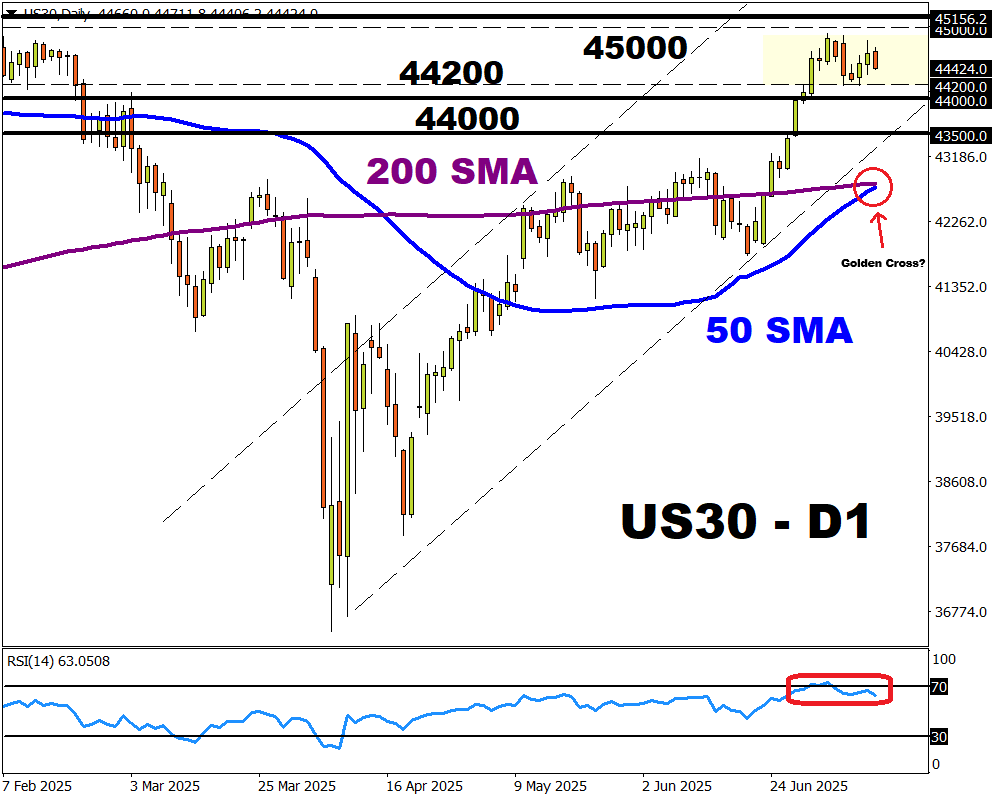
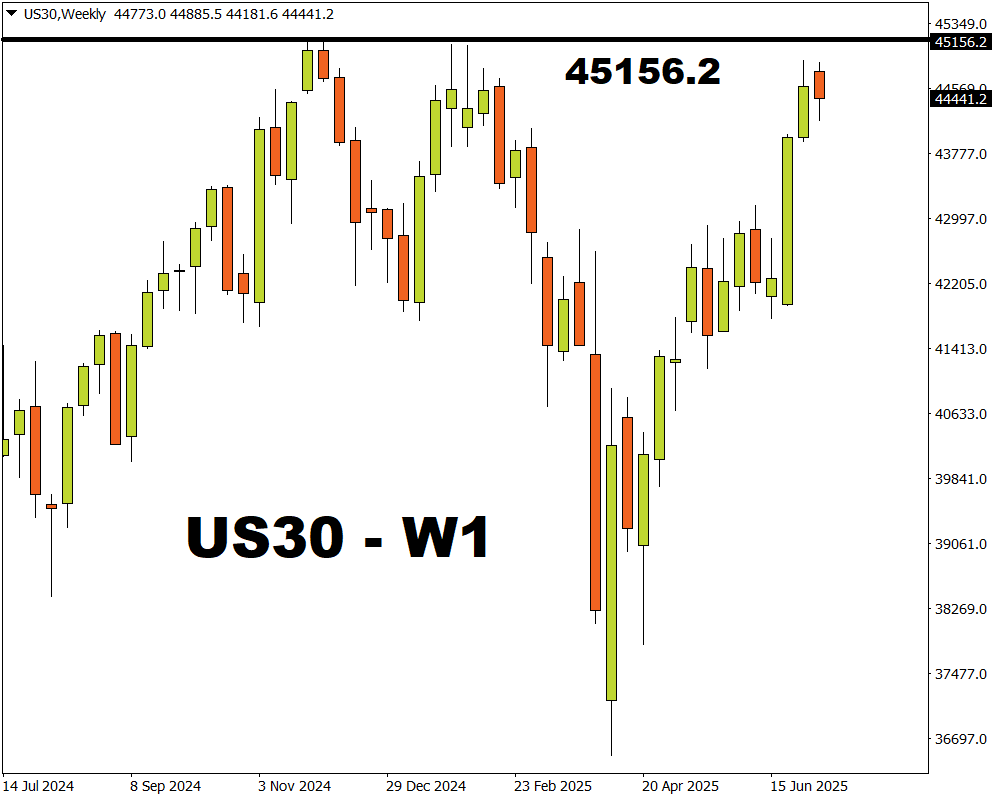
  • 50-day SMA immediate resistance for the US30
Imagen
Markets await Fed rate decision

US30: Potential Scenarios

BULLISH: A break above the 50-day SMA could see the US30 striving for its immediate upside target of 41,800. Further north, the price region around its 200-day SMA / 42,500 level / 100-day SMA could lend stronger resistance to bulls.

BEARISH: A second consecutive daily close below the 41k mark for the US30 could see prices faltering to the big, round 40,000 number, where its 21-day SMA also currently lies.


Forex-Time-LogoArticle by ForexTime

ForexTime Ltd (FXTM) is an award winning international online forex broker regulated by CySEC 185/12 www.forextime.com

COT Stock Market Charts: Speculator Bets led higher by VIX & Russell 2000

By InvestMacro

Speculators OI Stocks COT Chart

Here are the latest charts and statistics for the Commitment of Traders (COT) data published by the Commodities Futures Trading Commission (CFTC).

The latest COT data is updated through Tuesday April 29th and shows a quick view of how large traders (for-profit speculators and commercial entities) were positioned in the futures markets.

Weekly Speculator Changes led higher by VIX & Russell 2000

Speculators Nets Stocks COT Chart

The COT stock markets speculator bets were higher this week as five out of the seven stock markets we cover had higher positioning while the other two markets had lower speculator contracts.

Leading the gains for the stock markets was the VIX (9,985 contracts) with the Russell-Mini (6,313 contracts), the DowJones-Mini (4,662 contracts), the Nikkei 225 (2,025 contracts) and the MSCI EAFE-Mini (618 contracts) also showing positive weeks.

The markets with the declines in speculator bets this week were the Nasdaq-Mini (-6,817 contracts) and the S&P500-Mini (-2,731 contracts) also registering lower bets on the week.


Stock Market Data:

Speculators Table Stocks COT Chart

Legend: Weekly Speculators Change | Speculators Current Net Position | Speculators Strength Score compared to last 3-Years (0-100 range)


Strength Scores led by VIX & Nikkei 225

Speculators Strength Stocks COT Chart

COT Strength Scores (a normalized measure of Speculator positions over a 3-Year range, from 0 to 100 where above 80 is Extreme-Bullish and below 20 is Extreme-Bearish) showed that the VIX (98 percent) and the Nikkei 225 (96 percent) lead the stock markets this week. The Nasdaq-Mini (87 percent) and Russell-Mini (82 percent) come in as the next highest in the weekly strength scores.

On the downside, there are no markets at less than 50 percent of the past 3-year range.

Strength Statistics:
VIX (98.3 percent) vs VIX previous week (89.4 percent)
S&P500-Mini (63.9 percent) vs S&P500-Mini previous week (64.4 percent)
DowJones-Mini (69.3 percent) vs DowJones-Mini previous week (61.7 percent)
Nasdaq-Mini (87.0 percent) vs Nasdaq-Mini previous week (97.6 percent)
Russell2000-Mini (81.7 percent) vs Russell2000-Mini previous week (77.4 percent)
Nikkei USD (96.4 percent) vs Nikkei USD previous week (79.1 percent)
EAFE-Mini (74.8 percent) vs EAFE-Mini previous week (74.0 percent)


Nikkei 225 & Nasdaq-Mini top the 6-Week Strength Trends

Speculators Trend Stocks COT Chart

COT Strength Score Trends (or move index, calculates the 6-week changes in strength scores) showed that the Nikkei 225 (35 percent) leads the past six weeks trends for the stock markets. The Nasdaq-Mini (12 percent), the DowJones-Mini (7 percent) and the Russell-Mini (7 percent) are the next highest positive movers in the latest trends data.

The S&P500-Mini (-26 percent) leads the downside trend scores currently with the MSCI EAFE-Mini (-2 percent) coming in as the next market with lower trend scores.

Strength Trend Statistics:
VIX (-1.7 percent) vs VIX previous week (10.8 percent)
S&P500-Mini (-26.4 percent) vs S&P500-Mini previous week (-28.2 percent)
DowJones-Mini (7.0 percent) vs DowJones-Mini previous week (-1.9 percent)
Nasdaq-Mini (12.2 percent) vs Nasdaq-Mini previous week (23.2 percent)
Russell2000-Mini (6.7 percent) vs Russell2000-Mini previous week (-1.1 percent)
Nikkei USD (35.0 percent) vs Nikkei USD previous week (25.1 percent)
EAFE-Mini (-2.2 percent) vs EAFE-Mini previous week (-26.0 percent)


Individual Stock Market Charts:

VIX Volatility Futures:

VIX Volatility Futures COT ChartThe VIX Volatility large speculator standing this week recorded a net position of 4,240 contracts in the data reported through Tuesday. This was a weekly boost of 9,985 contracts from the previous week which had a total of -5,745 net contracts.

This week’s current strength score (the trader positioning range over the past three years, measured from 0 to 100) shows the speculators are currently Bullish-Extreme with a score of 98.3 percent. The commercials are Bearish-Extreme with a score of 1.3 percent and the small traders (not shown in chart) are Bullish-Extreme with a score of 86.2 percent.

Price Trend-Following Model: Uptrend

Our weekly trend-following model classifies the current market price position as: Uptrend.

VIX Volatility Futures StatisticsSPECULATORSCOMMERCIALSSMALL TRADERS
– Percent of Open Interest Longs:26.843.310.6
– Percent of Open Interest Shorts:25.346.19.3
– Net Position:4,240-7,8373,597
– Gross Longs:74,898120,74729,624
– Gross Shorts:70,658128,58426,027
– Long to Short Ratio:1.1 to 10.9 to 11.1 to 1
NET POSITION TREND:
– Strength Index Score (3 Year Range Pct):98.31.386.2
– Strength Index Reading (3 Year Range):Bullish-ExtremeBearish-ExtremeBullish-Extreme
NET POSITION MOVEMENT INDEX:
– 6-Week Change in Strength Index:-1.7-2.928.7


S&P500 Mini Futures:

SP500 Mini Futures COT ChartThe S&P500 Mini large speculator standing this week recorded a net position of -78,666 contracts in the data reported through Tuesday. This was a weekly reduction of -2,731 contracts from the previous week which had a total of -75,935 net contracts.

This week’s current strength score (the trader positioning range over the past three years, measured from 0 to 100) shows the speculators are currently Bullish with a score of 63.9 percent. The commercials are Bearish with a score of 40.5 percent and the small traders (not shown in chart) are Bullish with a score of 53.5 percent.

Price Trend-Following Model: Downtrend

Our weekly trend-following model classifies the current market price position as: Downtrend.

S&P500 Mini Futures StatisticsSPECULATORSCOMMERCIALSSMALL TRADERS
– Percent of Open Interest Longs:11.374.611.3
– Percent of Open Interest Shorts:14.972.99.4
– Net Position:-78,66637,75340,913
– Gross Longs:240,0961,592,776240,722
– Gross Shorts:318,7621,555,023199,809
– Long to Short Ratio:0.8 to 11.0 to 11.2 to 1
NET POSITION TREND:
– Strength Index Score (3 Year Range Pct):63.940.553.5
– Strength Index Reading (3 Year Range):BullishBearishBullish
NET POSITION MOVEMENT INDEX:
– 6-Week Change in Strength Index:-26.434.3-32.7


Dow Jones Mini Futures:

Dow Jones Mini Futures COT ChartThe Dow Jones Mini large speculator standing this week recorded a net position of 5,549 contracts in the data reported through Tuesday. This was a weekly boost of 4,662 contracts from the previous week which had a total of 887 net contracts.

This week’s current strength score (the trader positioning range over the past three years, measured from 0 to 100) shows the speculators are currently Bullish with a score of 69.3 percent. The commercials are Bearish with a score of 34.4 percent and the small traders (not shown in chart) are Bearish with a score of 36.4 percent.

Price Trend-Following Model: Downtrend

Our weekly trend-following model classifies the current market price position as: Downtrend.

Dow Jones Mini Futures StatisticsSPECULATORSCOMMERCIALSSMALL TRADERS
– Percent of Open Interest Longs:16.964.010.7
– Percent of Open Interest Shorts:9.867.414.4
– Net Position:5,549-2,637-2,912
– Gross Longs:13,20250,1368,381
– Gross Shorts:7,65352,77311,293
– Long to Short Ratio:1.7 to 11.0 to 10.7 to 1
NET POSITION TREND:
– Strength Index Score (3 Year Range Pct):69.334.436.4
– Strength Index Reading (3 Year Range):BullishBearishBearish
NET POSITION MOVEMENT INDEX:
– 6-Week Change in Strength Index:7.0-0.8-22.2


Nasdaq Mini Futures:

Nasdaq Mini Futures COT ChartThe Nasdaq Mini large speculator standing this week recorded a net position of 30,863 contracts in the data reported through Tuesday. This was a weekly fall of -6,817 contracts from the previous week which had a total of 37,680 net contracts.

This week’s current strength score (the trader positioning range over the past three years, measured from 0 to 100) shows the speculators are currently Bullish-Extreme with a score of 87.0 percent. The commercials are Bearish with a score of 28.5 percent and the small traders (not shown in chart) are Bearish with a score of 40.0 percent.

Price Trend-Following Model: Downtrend

Our weekly trend-following model classifies the current market price position as: Downtrend.

Nasdaq Mini Futures StatisticsSPECULATORSCOMMERCIALSSMALL TRADERS
– Percent of Open Interest Longs:31.253.813.1
– Percent of Open Interest Shorts:18.763.316.2
– Net Position:30,863-23,292-7,571
– Gross Longs:77,026132,87332,433
– Gross Shorts:46,163156,16540,004
– Long to Short Ratio:1.7 to 10.9 to 10.8 to 1
NET POSITION TREND:
– Strength Index Score (3 Year Range Pct):87.028.540.0
– Strength Index Reading (3 Year Range):Bullish-ExtremeBearishBearish
NET POSITION MOVEMENT INDEX:
– 6-Week Change in Strength Index:12.219.5-49.5


Russell 2000 Mini Futures:

Russell 2000 Mini Futures COT ChartThe Russell 2000 Mini large speculator standing this week recorded a net position of -406 contracts in the data reported through Tuesday. This was a weekly advance of 6,313 contracts from the previous week which had a total of -6,719 net contracts.

This week’s current strength score (the trader positioning range over the past three years, measured from 0 to 100) shows the speculators are currently Bullish-Extreme with a score of 81.7 percent. The commercials are Bearish with a score of 25.9 percent and the small traders (not shown in chart) are Bearish-Extreme with a score of 16.5 percent.

Price Trend-Following Model: Downtrend

Our weekly trend-following model classifies the current market price position as: Downtrend.

Russell 2000 Mini Futures StatisticsSPECULATORSCOMMERCIALSSMALL TRADERS
– Percent of Open Interest Longs:18.472.65.2
– Percent of Open Interest Shorts:18.571.95.8
– Net Position:-4063,154-2,748
– Gross Longs:84,850333,92823,884
– Gross Shorts:85,256330,77426,632
– Long to Short Ratio:1.0 to 11.0 to 10.9 to 1
NET POSITION TREND:
– Strength Index Score (3 Year Range Pct):81.725.916.5
– Strength Index Reading (3 Year Range):Bullish-ExtremeBearishBearish-Extreme
NET POSITION MOVEMENT INDEX:
– 6-Week Change in Strength Index:6.7-1.5-20.7


Nikkei Stock Average (USD) Futures:

The Nikkei Stock Average (USD) large speculator standing this week recorded a net position of 1,904 contracts in the data reported through Tuesday. This was a weekly lift of 2,025 contracts from the previous week which had a total of -121 net contracts.

This week’s current strength score (the trader positioning range over the past three years, measured from 0 to 100) shows the speculators are currently Bullish-Extreme with a score of 96.4 percent. The commercials are Bearish-Extreme with a score of 15.4 percent and the small traders (not shown in chart) are Bearish with a score of 37.1 percent.

Price Trend-Following Model: Downtrend

Our weekly trend-following model classifies the current market price position as: Downtrend.

Nikkei Stock Average Futures StatisticsSPECULATORSCOMMERCIALSSMALL TRADERS
– Percent of Open Interest Longs:20.360.519.2
– Percent of Open Interest Shorts:2.575.422.1
– Net Position:1,904-1,590-314
– Gross Longs:2,1696,4802,056
– Gross Shorts:2658,0702,370
– Long to Short Ratio:8.2 to 10.8 to 10.9 to 1
NET POSITION TREND:
– Strength Index Score (3 Year Range Pct):96.415.437.1
– Strength Index Reading (3 Year Range):Bullish-ExtremeBearish-ExtremeBearish
NET POSITION MOVEMENT INDEX:
– 6-Week Change in Strength Index:35.0-26.7-5.5


MSCI EAFE Mini Futures:

MSCI EAFE Mini Futures COT ChartThe MSCI EAFE Mini large speculator standing this week recorded a net position of -10,432 contracts in the data reported through Tuesday. This was a weekly increase of 618 contracts from the previous week which had a total of -11,050 net contracts.

This week’s current strength score (the trader positioning range over the past three years, measured from 0 to 100) shows the speculators are currently Bullish with a score of 74.8 percent. The commercials are Bearish with a score of 32.2 percent and the small traders (not shown in chart) are Bearish with a score of 44.3 percent.

Price Trend-Following Model: Strong Uptrend

Our weekly trend-following model classifies the current market price position as: Strong Uptrend.

MSCI EAFE Mini Futures StatisticsSPECULATORSCOMMERCIALSSMALL TRADERS
– Percent of Open Interest Longs:9.288.22.4
– Percent of Open Interest Shorts:11.487.11.2
– Net Position:-10,4324,9605,472
– Gross Longs:43,109414,03111,117
– Gross Shorts:53,541409,0715,645
– Long to Short Ratio:0.8 to 11.0 to 12.0 to 1
NET POSITION TREND:
– Strength Index Score (3 Year Range Pct):74.832.244.3
– Strength Index Reading (3 Year Range):BullishBearishBearish
NET POSITION MOVEMENT INDEX:
– 6-Week Change in Strength Index:-2.24.6-11.2


Article By InvestMacroReceive our weekly COT Newsletter

*COT Report: The COT data, released weekly to the public each Friday, is updated through the most recent Tuesday (data is 3 days old) and shows a quick view of how large speculators or non-commercials (for-profit traders) were positioned in the futures markets.

The CFTC categorizes trader positions according to commercial hedgers (traders who use futures contracts for hedging as part of the business), non-commercials (large traders who speculate to realize trading profits) and nonreportable traders (usually small traders/speculators) as well as their open interest (contracts open in the market at time of reporting). See CFTC criteria here.

COT Stock Market Charts: Speculator Changes led by MSCI EAFE & VIX

By InvestMacro

Speculators OI Stocks COT Chart

Here are the latest charts and statistics for the Commitment of Traders (COT) data published by the Commodities Futures Trading Commission (CFTC).

The latest COT data is updated through Tuesday April 22nd and shows a quick view of how large traders (for-profit speculators and commercial entities) were positioned in the futures markets.

Weekly Speculator Changes led by MSCI EAFE & VIX

Speculators Nets Stocks COT Chart

The COT stock markets speculator bets were higher this week as five out of the seven stock markets we cover had higher positioning while the other two markets had lower speculator contracts.

Leading the gains for the stock markets was the MSCI EAFE-Mini (15,219 contracts) with the VIX (11,552 contracts), the Nasdaq-Mini (5,886 contracts), the Nikkei 225 (2,025 contracts) and the DowJones-Mini (646 contracts) also having positive weeks.

The markets with the declines in speculator bets this week were the S&P500-Mini (-12,838 contracts) and with the Russell-Mini (-7,398 contracts) also seeing lower bets on the week.


Stock Market Data:

Speculators Table Stocks COT ChartLegend: Weekly Speculators Change | Speculators Current Net Position | Speculators Strength Score compared to last 3-Years (0-100 range)


Strength Scores led by Nasdaq-Mini & Nikkei 225

Speculators Strength Stocks COT ChartCOT Strength Scores (a normalized measure of Speculator positions over a 3-Year range, from 0 to 100 where above 80 is Extreme-Bullish and below 20 is Extreme-Bearish) showed that the Nasdaq-Mini (98 percent) and the Nikkei 225 (96 percent) lead the stock markets this week. The VIX (89 percent) and the Russell-Mini (77 percent) come in as the next highest in the weekly strength scores.

The lowest strength score this week was the DowJones-Mini (62 percent).

Strength Statistics:
VIX (89.4 percent) vs VIX previous week (79.1 percent)
S&P500-Mini (64.4 percent) vs S&P500-Mini previous week (66.7 percent)
DowJones-Mini (61.7 percent) vs DowJones-Mini previous week (60.7 percent)
Nasdaq-Mini (97.6 percent) vs Nasdaq-Mini previous week (88.4 percent)
Russell2000-Mini (77.4 percent) vs Russell2000-Mini previous week (82.5 percent)
Nikkei USD (96.4 percent) vs Nikkei USD previous week (79.1 percent)
EAFE-Mini (74.0 percent) vs EAFE-Mini previous week (52.8 percent)


Nikkei 225 & Nasdaq-Mini top the 6-Week Strength Trends

Speculators Trend Stocks COT ChartCOT Strength Score Trends (or move index, calculates the 6-week changes in strength scores) showed that the Nikkei 225 (35 percent) leads the past six weeks trends for the stock markets. The Nasdaq-Mini (23 percent) and the VIX (11 percent) are the next highest positive movers in the latest trends data.

The S&P500-Mini (-28 percent) leads the downside trend scores currently with the MSCI EAFE-Mini (-26 percent) coming in as the next market with lower trend scores.

Strength Trend Statistics:
VIX (10.8 percent) vs VIX previous week (20.4 percent)
S&P500-Mini (-28.2 percent) vs S&P500-Mini previous week (-17.1 percent)
DowJones-Mini (-1.9 percent) vs DowJones-Mini previous week (-1.4 percent)
Nasdaq-Mini (23.2 percent) vs Nasdaq-Mini previous week (15.5 percent)
Russell2000-Mini (-1.1 percent) vs Russell2000-Mini previous week (3.6 percent)
Nikkei USD (35.0 percent) vs Nikkei USD previous week (25.1 percent)
EAFE-Mini (-26.0 percent) vs EAFE-Mini previous week (-20.1 percent)


Individual Stock Market Charts:

VIX Volatility Futures:

VIX Volatility Futures COT ChartThe VIX Volatility large speculator standing this week came in at a net position of -5,745 contracts in the data reported through Tuesday. This was a weekly gain of 11,552 contracts from the previous week which had a total of -17,297 net contracts.

This week’s current strength score (the trader positioning range over the past three years, measured from 0 to 100) shows the speculators are currently Bullish-Extreme with a score of 89.4 percent. The commercials are Bearish-Extreme with a score of 10.5 percent and the small traders (not shown in chart) are Bullish-Extreme with a score of 81.5 percent.

Price Trend-Following Model: Uptrend

Our weekly trend-following model classifies the current market price position as: Uptrend.

VIX Volatility Futures StatisticsSPECULATORSCOMMERCIALSSMALL TRADERS
– Percent of Open Interest Longs:28.743.910.3
– Percent of Open Interest Shorts:30.942.89.3
– Net Position:-5,7453,0192,726
– Gross Longs:78,508119,92428,192
– Gross Shorts:84,253116,90525,466
– Long to Short Ratio:0.9 to 11.0 to 11.1 to 1
NET POSITION TREND:
– Strength Index Score (3 Year Range Pct):89.410.581.5
– Strength Index Reading (3 Year Range):Bullish-ExtremeBearish-ExtremeBullish-Extreme
NET POSITION MOVEMENT INDEX:
– 6-Week Change in Strength Index:10.8-14.023.4


S&P500 Mini Futures:

SP500 Mini Futures COT ChartThe S&P500 Mini large speculator standing this week came in at a net position of -75,935 contracts in the data reported through Tuesday. This was a weekly fall of -12,838 contracts from the previous week which had a total of -63,097 net contracts.

This week’s current strength score (the trader positioning range over the past three years, measured from 0 to 100) shows the speculators are currently Bullish with a score of 64.4 percent. The commercials are Bearish with a score of 40.3 percent and the small traders (not shown in chart) are Bullish with a score of 53.0 percent.

Price Trend-Following Model: Downtrend

Our weekly trend-following model classifies the current market price position as: Downtrend.

S&P500 Mini Futures StatisticsSPECULATORSCOMMERCIALSSMALL TRADERS
– Percent of Open Interest Longs:11.874.510.7
– Percent of Open Interest Shorts:15.272.98.9
– Net Position:-75,93536,39639,539
– Gross Longs:260,9301,646,290236,445
– Gross Shorts:336,8651,609,894196,906
– Long to Short Ratio:0.8 to 11.0 to 11.2 to 1
NET POSITION TREND:
– Strength Index Score (3 Year Range Pct):64.440.353.0
– Strength Index Reading (3 Year Range):BullishBearishBullish
NET POSITION MOVEMENT INDEX:
– 6-Week Change in Strength Index:-28.238.0-38.7


Dow Jones Mini Futures:

Dow Jones Mini Futures COT ChartThe Dow Jones Mini large speculator standing this week came in at a net position of 887 contracts in the data reported through Tuesday. This was a weekly lift of 646 contracts from the previous week which had a total of 241 net contracts.

This week’s current strength score (the trader positioning range over the past three years, measured from 0 to 100) shows the speculators are currently Bullish with a score of 61.7 percent. The commercials are Bearish with a score of 38.6 percent and the small traders (not shown in chart) are Bearish with a score of 47.2 percent.

Price Trend-Following Model: Downtrend

Our weekly trend-following model classifies the current market price position as: Downtrend.

Dow Jones Mini Futures StatisticsSPECULATORSCOMMERCIALSSMALL TRADERS
– Percent of Open Interest Longs:12.266.212.2
– Percent of Open Interest Shorts:11.166.013.6
– Net Position:887217-1,104
– Gross Longs:9,62352,3249,616
– Gross Shorts:8,73652,10710,720
– Long to Short Ratio:1.1 to 11.0 to 10.9 to 1
NET POSITION TREND:
– Strength Index Score (3 Year Range Pct):61.738.647.2
– Strength Index Reading (3 Year Range):BullishBearishBearish
NET POSITION MOVEMENT INDEX:
– 6-Week Change in Strength Index:-1.96.8-21.0


Nasdaq Mini Futures:

Nasdaq Mini Futures COT ChartThe Nasdaq Mini large speculator standing this week came in at a net position of 37,680 contracts in the data reported through Tuesday. This was a weekly gain of 5,886 contracts from the previous week which had a total of 31,794 net contracts.

This week’s current strength score (the trader positioning range over the past three years, measured from 0 to 100) shows the speculators are currently Bullish-Extreme with a score of 97.6 percent. The commercials are Bearish-Extreme with a score of 13.5 percent and the small traders (not shown in chart) are Bullish with a score of 53.5 percent.

Price Trend-Following Model: Downtrend

Our weekly trend-following model classifies the current market price position as: Downtrend.

Nasdaq Mini Futures StatisticsSPECULATORSCOMMERCIALSSMALL TRADERS
– Percent of Open Interest Longs:31.753.413.8
– Percent of Open Interest Shorts:16.168.814.0
– Net Position:37,680-37,245-435
– Gross Longs:76,663129,36633,405
– Gross Shorts:38,983166,61133,840
– Long to Short Ratio:2.0 to 10.8 to 11.0 to 1
NET POSITION TREND:
– Strength Index Score (3 Year Range Pct):97.613.553.5
– Strength Index Reading (3 Year Range):Bullish-ExtremeBearish-ExtremeBullish
NET POSITION MOVEMENT INDEX:
– 6-Week Change in Strength Index:23.210.2-46.5


Russell 2000 Mini Futures:

Russell 2000 Mini Futures COT ChartThe Russell 2000 Mini large speculator standing this week came in at a net position of -6,719 contracts in the data reported through Tuesday. This was a weekly fall of -7,398 contracts from the previous week which had a total of 679 net contracts.

This week’s current strength score (the trader positioning range over the past three years, measured from 0 to 100) shows the speculators are currently Bullish with a score of 77.4 percent. The commercials are Bearish with a score of 21.0 percent and the small traders (not shown in chart) are Bullish with a score of 56.9 percent.

Price Trend-Following Model: Downtrend

Our weekly trend-following model classifies the current market price position as: Downtrend.

Russell 2000 Mini Futures StatisticsSPECULATORSCOMMERCIALSSMALL TRADERS
– Percent of Open Interest Longs:17.972.08.2
– Percent of Open Interest Shorts:19.473.15.8
– Net Position:-6,719-4,79511,514
– Gross Longs:83,303334,26538,247
– Gross Shorts:90,022339,06026,733
– Long to Short Ratio:0.9 to 11.0 to 11.4 to 1
NET POSITION TREND:
– Strength Index Score (3 Year Range Pct):77.421.056.9
– Strength Index Reading (3 Year Range):BullishBearishBullish
NET POSITION MOVEMENT INDEX:
– 6-Week Change in Strength Index:-1.1-0.67.2


Nikkei Stock Average (USD) Futures:

Nikkei Stock Average (USD) Futures COT ChartThe Nikkei Stock Average (USD) large speculator standing this week came in at a net position of 1,904 contracts in the data reported through Tuesday. This was a weekly rise of 2,025 contracts from the previous week which had a total of -121 net contracts.

This week’s current strength score (the trader positioning range over the past three years, measured from 0 to 100) shows the speculators are currently Bullish-Extreme with a score of 96.4 percent. The commercials are Bearish-Extreme with a score of 15.4 percent and the small traders (not shown in chart) are Bearish with a score of 37.1 percent.

Price Trend-Following Model: Downtrend

Our weekly trend-following model classifies the current market price position as: Downtrend.

Nikkei Stock Average Futures StatisticsSPECULATORSCOMMERCIALSSMALL TRADERS
– Percent of Open Interest Longs:20.360.519.2
– Percent of Open Interest Shorts:2.575.422.1
– Net Position:1,904-1,590-314
– Gross Longs:2,1696,4802,056
– Gross Shorts:2658,0702,370
– Long to Short Ratio:8.2 to 10.8 to 10.9 to 1
NET POSITION TREND:
– Strength Index Score (3 Year Range Pct):96.415.437.1
– Strength Index Reading (3 Year Range):Bullish-ExtremeBearish-ExtremeBearish
NET POSITION MOVEMENT INDEX:
– 6-Week Change in Strength Index:35.0-26.7-5.5


MSCI EAFE Mini Futures:

MSCI EAFE Mini Futures COT ChartThe MSCI EAFE Mini large speculator standing this week came in at a net position of -11,050 contracts in the data reported through Tuesday. This was a weekly rise of 15,219 contracts from the previous week which had a total of -26,269 net contracts.

This week’s current strength score (the trader positioning range over the past three years, measured from 0 to 100) shows the speculators are currently Bullish with a score of 74.0 percent. The commercials are Bearish with a score of 34.5 percent and the small traders (not shown in chart) are Bearish with a score of 37.9 percent.

Price Trend-Following Model: Strong Uptrend

Our weekly trend-following model classifies the current market price position as: Strong Uptrend.

MSCI EAFE Mini Futures StatisticsSPECULATORSCOMMERCIALSSMALL TRADERS
– Percent of Open Interest Longs:9.088.42.2
– Percent of Open Interest Shorts:11.487.01.3
– Net Position:-11,0506,8594,191
– Gross Longs:41,995412,91410,383
– Gross Shorts:53,045406,0556,192
– Long to Short Ratio:0.8 to 11.0 to 11.7 to 1
NET POSITION TREND:
– Strength Index Score (3 Year Range Pct):74.034.537.9
– Strength Index Reading (3 Year Range):BullishBearishBearish
NET POSITION MOVEMENT INDEX:
– 6-Week Change in Strength Index:-26.025.9-14.5


Article By InvestMacroReceive our weekly COT Newsletter

*COT Report: The COT data, released weekly to the public each Friday, is updated through the most recent Tuesday (data is 3 days old) and shows a quick view of how large speculators or non-commercials (for-profit traders) were positioned in the futures markets.

The CFTC categorizes trader positions according to commercial hedgers (traders who use futures contracts for hedging as part of the business), non-commercials (large traders who speculate to realize trading profits) and nonreportable traders (usually small traders/speculators) as well as their open interest (contracts open in the market at time of reporting). See CFTC criteria here.

Can Alphabet’s Q1 earnings arrest its stock’s slump?

By ForexTime 

  • Alphabet’s stocks down 19.2% year-to-date; market cap now US$ 1.86 trillion
  • Company set to unveil Q1 earnings after US markets close Thursday, April 24th
  • Investors eager for updates on Cloud margins, AI capex plans, tariff impact
  • Alphabet’s share price forecasted to move 5.8% up/down when US markets reopen Friday
  • Wall Street lowers 12-month target price; still a strong buy with 33% potential upside


After US markets close this Thursday, April 24th, Alphabet is set to unveil its Q1 financial results.

Despite a rebound yesterday (Tuesday, April 22nd), Big Tech stocks have been languishing in the run up to this upcoming set of earnings reports.

The current record high of US$208.60 for Alphabet’s C-class shares (no voting rights) were from February 4ththe day of its last earnings announcement – when it announced slowing growth in its Cloud segment and lower-than-expected revenue in Q4 2024.

Since then, this stock has fallen:

  • Intraday prices: as much as 31.6% (Feb 4th intraday high through April 7th intraday low)
  • Closing prices: 26.2% lower (Feb 4th close through April 22nd close)
Imagen
Alphabet’s Q1 earnings due after US markets close April 24, 2025

Why are US tech stocks falling?

US President Donald Trump’s erratic policy rollout, especially surrounding trade tariffs, have dented the aura surrounding “US exceptionalism”.

US tech stocks certainly have been one of the primary victims from this major blow to risk-taking activities across global financial markets.

For comparison, the 19.2% year-to-date drop in Alphabet’s C-class shares:

  • are almost double the S&P 500’s 10.1% decline so far this year
  • exceeds the tech-heavy Nasdaq 100 index’s 13% year-to-date drop


Alphabet’s Q1 earnings: What to look out for?


1) Cloud compression?

Revenue from its Cloud segment is expected to breach US$12.3 billion for Q1 2025 – the segment’s highest ever top line number.

However, the operating income for the segment is expected to dip back below the US$ 2 billion figure:

  • Q4 2024: $2.09B down to …
  • Q1 2025: US$1.94B … marking the first contraction for this line item since Q3 2023.

Investors and analysts will be keen to find out how Alphabet can buttress its Cloud margins, even as rising AI-fueled demand also requires more infrastructure investments.

NOTE: According to Alphabet CEO Sundar Pichai, Google’s Cloud is still smaller in size relative to Amazon’s and Microsoft’s.


And that brings us to the second key area to look out for …

2) AI integration (Gemini, AI agents) and capital expenditure (capex) plans

The integration of Gemini appears to be central to the growth of Alphabet’s Search segment – which accounts for more than half (55 – 57%) of total revenue in recent quarters.

Also, Gemini and other AI use cases are expected to help grow its Cloud segment from its:

  • Q1 2024: 11.9% of total company revenue for the quarter
  • Q1 2025: 13.8% of total company revenue for the quarter

Looking ahead, recall that the company had already issued capex guidance for US$75 billion for this year’s capex.

And that’s despite the risks posed DeepSeek’s apparent showing that AI gains can be achieved using lower-cost models.

The slightest hint of a pullback in capex plans could send Alphabet’s stocks tumbling on fears that the fervor for all things AI is losing momentum still.


3) Tariff impact

Since the flurry of tariff-related announcements this month, the expected impact on Alphabet’s financial figures appears limited to its:

  • hardware sales (think Pixel phones) and also …
  • Cloud infrastructure (think of the chips required to build out Alphabet’s data centers).

Hence, Alphabet’s share price is bound to reflect the company’s guidance on the tariffs’ impact on future earnings.


Beyond the main themes listed above, here are some headline Q1 figures to look out for:

  • Revenue: forecasted at US$75.4 billion
  • Net income: forecasted at US$24.7 billion
  • Earnings per share (EPS): forecasted at US$ 2.04


Potential Post-Earnings Scenarios

Note that markets currently predict that Alphabet’s stocks could move 5.8% up or down when US markets reopen on Friday, April 25th – the day after Alphabet’s Q1 earnings announcement.

  • BULLISH: Should Alphabet’s past quarterly financials and forward guidance help restore sentiment surrounding this stock, that could help pare its year-to-date declines.

Using Tuesday’s closing price of $154.02 as a reference point, a 5.8% climb would see this stock breaking above its 21-day simple moving average (SMA) and reaching around $163 – closing in on its mid-April intraday high.

  • BEARISH: Should Alphabet announce lower-than-expected Q1 2025 financial results, while citing greater concern about its earnings outlook, a 5.8% move downwards from Tuesday’s closing price should see this stock opening around $145 this Friday.

Still, much may yet happen across US stock markets over the next 2 days (Wednesday’s and Thursday’s cash sessions) which could drastically alter the above-listed numbers.


Over the next 12 months …

Wall Street analysts are still bullish on this stock, with:

  • 20 “Buy” calls
  • 1 “Hold”
  • 0 “Sells”

By this time in 2026, this stock is forecasted to have an upside potential of 34%, eventually touching $205.33.

To be clear, so far this month, many research houses including Morgan Stanley, UBS, Citi, Mizuho, and Bank of America have lowered their respective 12-month target prices on this stock.

And there’s bound to be more revisions after what Alphabet conveys to the world this week.

In short, this upcoming earnings release is set to hold great influence over how Alphabet’s shares perform, both in the immediate aftermath, and for the longer-term.


Forex-Time-LogoArticle by ForexTime

ForexTime Ltd (FXTM) is an award winning international online forex broker regulated by CySEC 185/12 www.forextime.com

COT Stock Market Charts: Speculator Bets led higher by Nasdaq, Russell & DowJones

By InvestMacro

Here are the latest charts and statistics for the Commitment of Traders (COT) data published by the Commodities Futures Trading Commission (CFTC).

The latest COT data is updated through Tuesday April 8th and shows a quick view of how large traders (for-profit speculators and commercial entities) were positioned in the futures markets.

Weekly Speculator Changes led by Nasdaq, Russell & DowJones

The COT stock markets speculator bets were overall higher this week as five out of the seven stock markets we cover had higher positioning while the other two markets had lower speculator contracts.

Leading the gains for the stock markets was the Nasdaq-Mini (9,086 contracts) with the Russell-Mini (4,426 contracts), the DowJones-Mini (3,924 contracts), the Nikkei 225 (2,025 contracts) and the MSCI EAFE-Mini (1,117 contracts) also showing positive weeks.

The market leading the declines in speculator bets this week was with the S&P500-Mini (-9,665 contracts) and with the VIX (-3,615 contracts) also registering lower bets on the week.


Stocks Data:

Legend: Open Interest | Weekly Speculators Change | Speculators Current Net Position | Strength Score compared to last 3-Years (0-100 range)


Strength Scores led by Nikkei 225 & VIX

COT Strength Scores (a normalized measure of Speculator positions over a 3-Year range, from 0 to 100 where above 80 is Extreme-Bullish and below 20 is Extreme-Bearish) showed that the Nikkei 225 (96 percent) and the VIX (82 percent) lead the stock markets this week. The MSCI EAFE-Mini (78 percent) and Nasdaq-Mini (77 percent) come in as the next highest in the weekly strength scores.

The DowJones-Mini (62 percent) comes in at the lowest strength level currently but is above 50 percent which is the mid-point for the past 3 years.

Strength Statistics:
VIX (82.1 percent) vs VIX previous week (85.3 percent)
S&P500-Mini (72.8 percent) vs S&P500-Mini previous week (74.5 percent)
DowJones-Mini (62.4 percent) vs DowJones-Mini previous week (56.1 percent)
Nasdaq-Mini (76.8 percent) vs Nasdaq-Mini previous week (62.7 percent)
Russell2000-Mini (73.3 percent) vs Russell2000-Mini previous week (70.3 percent)
Nikkei USD (96.4 percent) vs Nikkei USD previous week (79.1 percent)
EAFE-Mini (77.5 percent) vs EAFE-Mini previous week (76.0 percent)


VIX & Nikkei 225 top the 6-Week Strength Trends

COT Strength Score Trends (or move index, calculates the 6-week changes in strength scores) showed that the VIX (49 percent) leads the past six weeks trends for the stock markets. The Nikkei 225 (35 percent) and the Russell-Mini (6 percent) are the next highest positive movers in the latest trends data.

The Nasdaq-Mini (-2 percent) is the only market with a lower trend score currently.

Strength Trend Statistics:
VIX (49.0 percent) vs VIX previous week (42.0 percent)
S&P500-Mini (0.7 percent) vs S&P500-Mini previous week (3.8 percent)
DowJones-Mini (3.6 percent) vs DowJones-Mini previous week (-2.5 percent)
Nasdaq-Mini (-2.3 percent) vs Nasdaq-Mini previous week (8.3 percent)
Russell2000-Mini (5.9 percent) vs Russell2000-Mini previous week (8.6 percent)
Nikkei USD (35.0 percent) vs Nikkei USD previous week (25.1 percent)
EAFE-Mini (2.0 percent) vs EAFE-Mini previous week (-2.4 percent)


Individual Stock Market Charts:

VIX Volatility Futures:

VIX Volatility Futures COT ChartThe VIX Volatility large speculator standing this week recorded a net position of -13,973 contracts in the data reported through Tuesday. This was a weekly fall of -3,615 contracts from the previous week which had a total of -10,358 net contracts.

This week’s current strength score (the trader positioning range over the past three years, measured from 0 to 100) shows the speculators are currently Bullish-Extreme with a score of 82.1 percent. The commercials are Bearish-Extreme with a score of 19.1 percent and the small traders (not shown in chart) are Bullish with a score of 71.2 percent.

Price Trend-Following Model: Strong Uptrend

Our weekly trend-following model classifies the current market price position as: Strong Uptrend.

VIX Volatility Futures StatisticsSPECULATORSCOMMERCIALSSMALL TRADERS
– Percent of Open Interest Longs:28.244.49.3
– Percent of Open Interest Shorts:31.940.99.1
– Net Position:-13,97313,134839
– Gross Longs:106,385167,48435,156
– Gross Shorts:120,358154,35034,317
– Long to Short Ratio:0.9 to 11.1 to 11.0 to 1
NET POSITION TREND:
– Strength Index Score (3 Year Range Pct):82.119.171.2
– Strength Index Reading (3 Year Range):Bullish-ExtremeBearish-ExtremeBullish
NET POSITION MOVEMENT INDEX:
– 6-Week Change in Strength Index:49.0-46.8-0.9


S&P500 Mini Futures:

SP500 Mini Futures COT ChartThe S&P500 Mini large speculator standing this week recorded a net position of -28,687 contracts in the data reported through Tuesday. This was a weekly fall of -9,665 contracts from the previous week which had a total of -19,022 net contracts.

This week’s current strength score (the trader positioning range over the past three years, measured from 0 to 100) shows the speculators are currently Bullish with a score of 72.8 percent. The commercials are Bearish with a score of 33.4 percent and the small traders (not shown in chart) are Bullish with a score of 52.6 percent.

Price Trend-Following Model: Strong Downtrend

Our weekly trend-following model classifies the current market price position as: Strong Downtrend.

S&P500 Mini Futures StatisticsSPECULATORSCOMMERCIALSSMALL TRADERS
– Percent of Open Interest Longs:13.871.910.8
– Percent of Open Interest Shorts:15.072.39.2
– Net Position:-28,687-9,95138,638
– Gross Longs:321,4511,677,831252,928
– Gross Shorts:350,1381,687,782214,290
– Long to Short Ratio:0.9 to 11.0 to 11.2 to 1
NET POSITION TREND:
– Strength Index Score (3 Year Range Pct):72.833.452.6
– Strength Index Reading (3 Year Range):BullishBearishBullish
NET POSITION MOVEMENT INDEX:
– 6-Week Change in Strength Index:0.714.6-40.4


Dow Jones Mini Futures:

Dow Jones Mini Futures COT ChartThe Dow Jones Mini large speculator standing this week recorded a net position of 1,320 contracts in the data reported through Tuesday. This was a weekly lift of 3,924 contracts from the previous week which had a total of -2,604 net contracts.

This week’s current strength score (the trader positioning range over the past three years, measured from 0 to 100) shows the speculators are currently Bullish with a score of 62.4 percent. The commercials are Bearish with a score of 38.8 percent and the small traders (not shown in chart) are Bearish with a score of 43.4 percent.

Price Trend-Following Model: Strong Downtrend

Our weekly trend-following model classifies the current market price position as: Strong Downtrend.

Dow Jones Mini Futures StatisticsSPECULATORSCOMMERCIALSSMALL TRADERS
– Percent of Open Interest Longs:12.465.812.5
– Percent of Open Interest Shorts:10.765.214.8
– Net Position:1,320419-1,739
– Gross Longs:9,19248,5499,211
– Gross Shorts:7,87248,13010,950
– Long to Short Ratio:1.2 to 11.0 to 10.8 to 1
NET POSITION TREND:
– Strength Index Score (3 Year Range Pct):62.438.843.4
– Strength Index Reading (3 Year Range):BullishBearishBearish
NET POSITION MOVEMENT INDEX:
– 6-Week Change in Strength Index:3.62.1-21.8


Nasdaq Mini Futures:

Nasdaq Mini Futures COT ChartThe Nasdaq Mini large speculator standing this week recorded a net position of 24,264 contracts in the data reported through Tuesday. This was a weekly rise of 9,086 contracts from the previous week which had a total of 15,178 net contracts.

This week’s current strength score (the trader positioning range over the past three years, measured from 0 to 100) shows the speculators are currently Bullish with a score of 76.8 percent. The commercials are Bearish with a score of 20.9 percent and the small traders (not shown in chart) are Bullish with a score of 66.1 percent.

Price Trend-Following Model: Strong Downtrend

Our weekly trend-following model classifies the current market price position as: Strong Downtrend.

Nasdaq Mini Futures StatisticsSPECULATORSCOMMERCIALSSMALL TRADERS
– Percent of Open Interest Longs:28.956.413.8
– Percent of Open Interest Shorts:19.468.411.4
– Net Position:24,264-30,4316,167
– Gross Longs:73,557143,67635,189
– Gross Shorts:49,293174,10729,022
– Long to Short Ratio:1.5 to 10.8 to 11.2 to 1
NET POSITION TREND:
– Strength Index Score (3 Year Range Pct):76.820.966.1
– Strength Index Reading (3 Year Range):BullishBearishBullish
NET POSITION MOVEMENT INDEX:
– 6-Week Change in Strength Index:-2.312.8-19.7


Russell 2000 Mini Futures:

Russell 2000 Mini Futures COT ChartThe Russell 2000 Mini large speculator standing this week recorded a net position of -12,745 contracts in the data reported through Tuesday. This was a weekly advance of 4,426 contracts from the previous week which had a total of -17,171 net contracts.

This week’s current strength score (the trader positioning range over the past three years, measured from 0 to 100) shows the speculators are currently Bullish with a score of 73.3 percent. The commercials are Bearish with a score of 26.4 percent and the small traders (not shown in chart) are Bearish with a score of 48.9 percent.

Price Trend-Following Model: Strong Downtrend

Our weekly trend-following model classifies the current market price position as: Strong Downtrend.

Russell 2000 Mini Futures StatisticsSPECULATORSCOMMERCIALSSMALL TRADERS
– Percent of Open Interest Longs:18.971.45.9
– Percent of Open Interest Shorts:21.770.54.0
– Net Position:-12,7454,0578,688
– Gross Longs:85,645323,66726,618
– Gross Shorts:98,390319,61017,930
– Long to Short Ratio:0.9 to 11.0 to 11.5 to 1
NET POSITION TREND:
– Strength Index Score (3 Year Range Pct):73.326.448.9
– Strength Index Reading (3 Year Range):BullishBearishBearish
NET POSITION MOVEMENT INDEX:
– 6-Week Change in Strength Index:5.9-2.8-11.4


Nikkei Stock Average (USD) Futures:

Nikkei Stock Average (USD) Futures COT ChartThe Nikkei Stock Average (USD) large speculator standing this week recorded a net position of 1,904 contracts in the data reported through Tuesday. This was a weekly advance of 2,025 contracts from the previous week which had a total of -121 net contracts.

This week’s current strength score (the trader positioning range over the past three years, measured from 0 to 100) shows the speculators are currently Bullish-Extreme with a score of 96.4 percent. The commercials are Bearish-Extreme with a score of 15.4 percent and the small traders (not shown in chart) are Bearish with a score of 37.1 percent.

Price Trend-Following Model: Strong Downtrend

Our weekly trend-following model classifies the current market price position as: Strong Downtrend.

Nikkei Stock Average Futures StatisticsSPECULATORSCOMMERCIALSSMALL TRADERS
– Percent of Open Interest Longs:20.360.519.2
– Percent of Open Interest Shorts:2.575.422.1
– Net Position:1,904-1,590-314
– Gross Longs:2,1696,4802,056
– Gross Shorts:2658,0702,370
– Long to Short Ratio:8.2 to 10.8 to 10.9 to 1
NET POSITION TREND:
– Strength Index Score (3 Year Range Pct):96.415.437.1
– Strength Index Reading (3 Year Range):Bullish-ExtremeBearish-ExtremeBearish
NET POSITION MOVEMENT INDEX:
– 6-Week Change in Strength Index:35.0-26.7-5.5


MSCI EAFE Mini Futures:

MSCI EAFE Mini Futures COT ChartThe MSCI EAFE Mini large speculator standing this week recorded a net position of -8,496 contracts in the data reported through Tuesday. This was a weekly rise of 1,117 contracts from the previous week which had a total of -9,613 net contracts.

This week’s current strength score (the trader positioning range over the past three years, measured from 0 to 100) shows the speculators are currently Bullish with a score of 77.5 percent. The commercials are Bearish with a score of 26.0 percent and the small traders (not shown in chart) are Bullish with a score of 60.1 percent.

Price Trend-Following Model: Strong Downtrend

Our weekly trend-following model classifies the current market price position as: Strong Downtrend.

MSCI EAFE Mini Futures StatisticsSPECULATORSCOMMERCIALSSMALL TRADERS
– Percent of Open Interest Longs:9.387.33.2
– Percent of Open Interest Shorts:11.287.31.3
– Net Position:-8,496-1688,664
– Gross Longs:41,546389,65514,324
– Gross Shorts:50,042389,8235,660
– Long to Short Ratio:0.8 to 11.0 to 12.5 to 1
NET POSITION TREND:
– Strength Index Score (3 Year Range Pct):77.526.060.1
– Strength Index Reading (3 Year Range):BullishBearishBullish
NET POSITION MOVEMENT INDEX:
– 6-Week Change in Strength Index:2.0-6.118.4


Article By InvestMacroReceive our weekly COT Newsletter

*COT Report: The COT data, released weekly to the public each Friday, is updated through the most recent Tuesday (data is 3 days old) and shows a quick view of how large speculators or non-commercials (for-profit traders) were positioned in the futures markets.

The CFTC categorizes trader positions according to commercial hedgers (traders who use futures contracts for hedging as part of the business), non-commercials (large traders who speculate to realize trading profits) and nonreportable traders (usually small traders/speculators) as well as their open interest (contracts open in the market at time of reporting). See CFTC criteria here.

COT Stock Market Charts: Speculator Bets led by S&P500 & Nasdaq

By InvestMacro

Here are the latest charts and statistics for the Commitment of Traders (COT) data published by the Commodities Futures Trading Commission (CFTC).

The latest COT data is updated through Tuesday April 1st and shows a quick view of how large traders (for-profit speculators and commercial entities) were positioned in the futures markets.

Weekly Speculator Changes led by S&P500 & Nasdaq

The COT stock markets speculator bets were higher this week (through Tuesday) as five out of the seven stock markets we cover had higher positioning while the other three markets had lower speculator contracts.

Leading the gains for the stock markets was the S&P500-Mini (34,340 contracts) with the Nasdaq-Mini (6,489 contracts), the MSCI EAFE-Mini (2,410 contracts), the DowJones-Mini (1,602 contracts) and the Nikkei 225 (540 contracts) also having positive weeks.

The markets with the declines in speculator bets this week were the Russell-Mini (-1,826 contracts) with the VIX (-1,367 contracts) also seeing lower bets on the week.


Stock Market Net Speculators Leaderboard

Legend: Weekly Speculators Change | Speculators Current Net Position | Speculators Strength Score compared to last 3-Years (0-100 range)


Strength Scores led by VIX & Nikkei 225

COT Strength Scores (a normalized measure of Speculator positions over a 3-Year range, from 0 to 100 where above 80 is Extreme-Bullish and below 20 is Extreme-Bearish) showed that the VIX (85 percent) and the Nikkei 225 (79 percent) lead the stock markets this week. The MSCI EAFE-Mini (76 percent) and S&P500-Mini (75 percent) come in as the next highest in the weekly strength scores.

On the downside, the DowJones-Mini (56 percent) comes in at the lowest strength level currently.

Strength Statistics:
VIX (85.3 percent) vs VIX previous week (86.5 percent)
S&P500-Mini (74.5 percent) vs S&P500-Mini previous week (68.4 percent)
DowJones-Mini (56.1 percent) vs DowJones-Mini previous week (53.5 percent)
Nasdaq-Mini (62.7 percent) vs Nasdaq-Mini previous week (52.6 percent)
Russell2000-Mini (70.3 percent) vs Russell2000-Mini previous week (71.5 percent)
Nikkei USD (79.1 percent) vs Nikkei USD previous week (74.5 percent)
EAFE-Mini (76.0 percent) vs EAFE-Mini previous week (72.6 percent)


VIX & Nikkei 225 top the 6-Week Strength Trends

COT Strength Score Trends (or move index, calculates the 6-week changes in strength scores) showed that the VIX (42 percent) leads the past six weeks trends for the stock markets. The Nikkei 225 (25 percent), the Russell-Mini (9 percent) and the Nasdaq-Mini (8 percent) are the next highest positive movers in the latest trends data.

The DowJones-Mini (-3 percent) leads the downside trend scores currently with the EAFE-Mini (-2 percent) coming in as the next market with lower trend scores.

Strength Trend Statistics:
VIX (42.0 percent) vs VIX previous week (44.4 percent)
S&P500-Mini (3.8 percent) vs S&P500-Mini previous week (-6.5 percent)
DowJones-Mini (-2.5 percent) vs DowJones-Mini previous week (-11.5 percent)
Nasdaq-Mini (8.3 percent) vs Nasdaq-Mini previous week (-7.4 percent)
Russell2000-Mini (8.6 percent) vs Russell2000-Mini previous week (11.7 percent)
Nikkei USD (25.1 percent) vs Nikkei USD previous week (17.9 percent)
EAFE-Mini (-2.4 percent) vs EAFE-Mini previous week (-14.2 percent)


Individual Stock Market Charts:

VIX Volatility Futures:

VIX Volatility Futures COT ChartThe VIX Volatility large speculator standing this week equaled a net position of -10,358 contracts in the data reported through Tuesday. This was a weekly reduction of -1,367 contracts from the previous week which had a total of -8,991 net contracts.

This week’s current strength score (the trader positioning range over the past three years, measured from 0 to 100) shows the speculators are currently Bullish-Extreme with a score of 85.3 percent. The commercials are Bearish-Extreme with a score of 14.8 percent and the small traders (not shown in chart) are Bullish with a score of 79.2 percent.

Price Trend-Following Model: Strong Uptrend

Our weekly trend-following model classifies the current market price position as: Strong Uptrend.

VIX Volatility Futures StatisticsSPECULATORSCOMMERCIALSSMALL TRADERS
– Percent of Open Interest Longs:29.442.89.0
– Percent of Open Interest Shorts:32.640.38.3
– Net Position:-10,3588,0552,303
– Gross Longs:94,853138,09329,211
– Gross Shorts:105,211130,03826,908
– Long to Short Ratio:0.9 to 11.1 to 11.1 to 1
NET POSITION TREND:
– Strength Index Score (3 Year Range Pct):85.314.879.2
– Strength Index Reading (3 Year Range):Bullish-ExtremeBearish-ExtremeBullish
NET POSITION MOVEMENT INDEX:
– 6-Week Change in Strength Index:42.0-40.51.4


S&P500 Mini Futures:

SP500 Mini Futures COT ChartThe S&P500 Mini large speculator standing this week equaled a net position of -19,022 contracts in the data reported through Tuesday. This was a weekly advance of 34,340 contracts from the previous week which had a total of -53,362 net contracts.

This week’s current strength score (the trader positioning range over the past three years, measured from 0 to 100) shows the speculators are currently Bullish with a score of 74.5 percent. The commercials are Bearish with a score of 26.5 percent and the small traders (not shown in chart) are Bullish with a score of 67.1 percent.

Price Trend-Following Model: Strong Downtrend

Our weekly trend-following model classifies the current market price position as: Strong Downtrend.

S&P500 Mini Futures StatisticsSPECULATORSCOMMERCIALSSMALL TRADERS
– Percent of Open Interest Longs:14.271.311.8
– Percent of Open Interest Shorts:15.173.98.2
– Net Position:-19,022-56,19975,221
– Gross Longs:300,3661,504,785249,432
– Gross Shorts:319,3881,560,984174,211
– Long to Short Ratio:0.9 to 11.0 to 11.4 to 1
NET POSITION TREND:
– Strength Index Score (3 Year Range Pct):74.526.567.1
– Strength Index Reading (3 Year Range):BullishBearishBullish
NET POSITION MOVEMENT INDEX:
– 6-Week Change in Strength Index:3.85.4-22.5


Dow Jones Mini Futures:

Dow Jones Mini Futures COT ChartThe Dow Jones Mini large speculator standing this week equaled a net position of -2,604 contracts in the data reported through Tuesday. This was a weekly boost of 1,602 contracts from the previous week which had a total of -4,206 net contracts.

This week’s current strength score (the trader positioning range over the past three years, measured from 0 to 100) shows the speculators are currently Bullish with a score of 56.1 percent. The commercials are Bearish with a score of 43.5 percent and the small traders (not shown in chart) are Bearish with a score of 47.7 percent.

Price Trend-Following Model: Strong Downtrend

Our weekly trend-following model classifies the current market price position as: Strong Downtrend.

Dow Jones Mini Futures StatisticsSPECULATORSCOMMERCIALSSMALL TRADERS
– Percent of Open Interest Longs:13.263.214.3
– Percent of Open Interest Shorts:16.758.315.7
– Net Position:-2,6043,625-1,021
– Gross Longs:9,84647,04510,660
– Gross Shorts:12,45043,42011,681
– Long to Short Ratio:0.8 to 11.1 to 10.9 to 1
NET POSITION TREND:
– Strength Index Score (3 Year Range Pct):56.143.547.7
– Strength Index Reading (3 Year Range):BullishBearishBearish
NET POSITION MOVEMENT INDEX:
– 6-Week Change in Strength Index:-2.58.9-27.4


Nasdaq Mini Futures:

Nasdaq Mini Futures COT ChartThe Nasdaq Mini large speculator standing this week equaled a net position of 15,178 contracts in the data reported through Tuesday. This was a weekly lift of 6,489 contracts from the previous week which had a total of 8,689 net contracts.

This week’s current strength score (the trader positioning range over the past three years, measured from 0 to 100) shows the speculators are currently Bullish with a score of 62.7 percent. The commercials are Bearish with a score of 22.9 percent and the small traders (not shown in chart) are Bullish with a score of 79.7 percent.

Price Trend-Following Model: Strong Downtrend

Our weekly trend-following model classifies the current market price position as: Strong Downtrend.

Nasdaq Mini Futures StatisticsSPECULATORSCOMMERCIALSSMALL TRADERS
– Percent of Open Interest Longs:28.454.216.6
– Percent of Open Interest Shorts:22.365.711.3
– Net Position:15,178-28,51213,334
– Gross Longs:70,420134,32341,232
– Gross Shorts:55,242162,83527,898
– Long to Short Ratio:1.3 to 10.8 to 11.5 to 1
NET POSITION TREND:
– Strength Index Score (3 Year Range Pct):62.722.979.7
– Strength Index Reading (3 Year Range):BullishBearishBullish
NET POSITION MOVEMENT INDEX:
– 6-Week Change in Strength Index:8.3-12.612.2


Russell 2000 Mini Futures:

Russell 2000 Mini Futures COT ChartThe Russell 2000 Mini large speculator standing this week equaled a net position of -17,171 contracts in the data reported through Tuesday. This was a weekly decline of -1,826 contracts from the previous week which had a total of -15,345 net contracts.

This week’s current strength score (the trader positioning range over the past three years, measured from 0 to 100) shows the speculators are currently Bullish with a score of 70.3 percent. The commercials are Bearish with a score of 29.4 percent and the small traders (not shown in chart) are Bearish with a score of 47.8 percent.

Price Trend-Following Model: Strong Downtrend

Our weekly trend-following model classifies the current market price position as: Strong Downtrend.

Russell 2000 Mini Futures StatisticsSPECULATORSCOMMERCIALSSMALL TRADERS
– Percent of Open Interest Longs:17.069.98.7
– Percent of Open Interest Shorts:21.167.86.7
– Net Position:-17,1718,8568,315
– Gross Longs:70,029288,40335,994
– Gross Shorts:87,200279,54727,679
– Long to Short Ratio:0.8 to 11.0 to 11.3 to 1
NET POSITION TREND:
– Strength Index Score (3 Year Range Pct):70.329.447.8
– Strength Index Reading (3 Year Range):BullishBearishBearish
NET POSITION MOVEMENT INDEX:
– 6-Week Change in Strength Index:8.6-4.0-17.2


Nikkei Stock Average (USD) Futures:

Nikkei Stock Average (USD) Futures COT ChartThe Nikkei Stock Average (USD) large speculator standing this week equaled a net position of -121 contracts in the data reported through Tuesday. This was a weekly boost of 540 contracts from the previous week which had a total of -661 net contracts.

This week’s current strength score (the trader positioning range over the past three years, measured from 0 to 100) shows the speculators are currently Bullish with a score of 79.1 percent. The commercials are Bearish with a score of 26.1 percent and the small traders (not shown in chart) are Bearish with a score of 46.3 percent.

Price Trend-Following Model: Strong Downtrend

Our weekly trend-following model classifies the current market price position as: Strong Downtrend.

Nikkei Stock Average Futures StatisticsSPECULATORSCOMMERCIALSSMALL TRADERS
– Percent of Open Interest Longs:7.469.019.5
– Percent of Open Interest Shorts:8.269.318.4
– Net Position:-121-46167
– Gross Longs:1,0689,9522,817
– Gross Shorts:1,1899,9982,650
– Long to Short Ratio:0.9 to 11.0 to 11.1 to 1
NET POSITION TREND:
– Strength Index Score (3 Year Range Pct):79.126.146.3
– Strength Index Reading (3 Year Range):BullishBearishBearish
NET POSITION MOVEMENT INDEX:
– 6-Week Change in Strength Index:25.1-18.4-5.9


MSCI EAFE Mini Futures:

MSCI EAFE Mini Futures COT ChartThe MSCI EAFE Mini large speculator standing this week equaled a net position of -9,613 contracts in the data reported through Tuesday. This was a weekly gain of 2,410 contracts from the previous week which had a total of -12,023 net contracts.

This week’s current strength score (the trader positioning range over the past three years, measured from 0 to 100) shows the speculators are currently Bullish with a score of 76.0 percent. The commercials are Bearish with a score of 27.1 percent and the small traders (not shown in chart) are Bullish with a score of 61.3 percent.

Price Trend-Following Model: Weak Uptrend

Our weekly trend-following model classifies the current market price position as: Weak Uptrend.

MSCI EAFE Mini Futures StatisticsSPECULATORSCOMMERCIALSSMALL TRADERS
– Percent of Open Interest Longs:11.285.62.9
– Percent of Open Interest Shorts:13.485.50.9
– Net Position:-9,6137218,892
– Gross Longs:49,736380,09312,869
– Gross Shorts:59,349379,3723,977
– Long to Short Ratio:0.8 to 11.0 to 13.2 to 1
NET POSITION TREND:
– Strength Index Score (3 Year Range Pct):76.027.161.3
– Strength Index Reading (3 Year Range):BullishBearishBullish
NET POSITION MOVEMENT INDEX:
– 6-Week Change in Strength Index:-2.4-3.322.3


Article By InvestMacroReceive our weekly COT Newsletter

*COT Report: The COT data, released weekly to the public each Friday, is updated through the most recent Tuesday (data is 3 days old) and shows a quick view of how large speculators or non-commercials (for-profit traders) were positioned in the futures markets.

The CFTC categorizes trader positions according to commercial hedgers (traders who use futures contracts for hedging as part of the business), non-commercials (large traders who speculate to realize trading profits) and nonreportable traders (usually small traders/speculators) as well as their open interest (contracts open in the market at time of reporting). See CFTC criteria here.

Week Ahead: S&P 500 to flirt with “bear market”?

By ForexTime 

  • US500 plummets to lowest since August; after Thursday’s biggest 1-day drop since pandemic
  • China announces tariff retaliation ahead of Friday’s NFP, Powell speech
  • Week Ahead: EU retaliation, US CPI, and earnings season could trigger more big moves!
  • Markets may not find comfort from Fed speakers next week
  • Technical rebound likely not sustained, barring stunning risk turnaround
  • Wall Street still forecasting new record high for S&P 500 over next 12 months
  • US500 would officially enter “bear market” if it falls to 4921.04.


US stock indices are extending their steep drop on Friday!

This comes after just posting their biggest one-day drop since the pandemic on Thursday, April 3rd, 2025 when the:

  • S&P 500 (tracked by FXTM’s US500) fell 4.84%.
  • Dow Jones Industrial Average a.k.a. the Dow (tracked by FXTM’s US30) fell 3.98%.
  • S&P Midcap 400 index (tracked by FXTM’s US400) fell 6.66%.
  • Russell 2000 (tracked by FXTM’s RUS2000) fell 6.59%.

Thursday’s declines marked their largest one-day drop (in % terms) for each of these US stock indices since June 11th, 2020!

As for the tech-heavy Nasdaq 100 (tracked by FXTM’s NAS100), it fell 5.41% yesterday – nearly matching its 5.54% plummet on September 13th, 2022.

READ MORE: Trump’s “Liberation Day” Tariffs: How are markets reacting? (published Thursday, April 3rd, 2025)


Why are US stock markets falling on Friday (April 4th)?

In a tit-for-tat move, China has just responded to US President Donald Trump’s “liberation day” tariff hike earlier this week (Wednesday, April 2nd).

Today, China announced 34% tariffs on all US imports starting April 10th!

Although the 34% number is lower than the 54% rate imposed by President Trump on Chinese shipments …

This has clearly escalated the trade war between the world’s two largest economies! 

This has left investors and traders worldwide outright fearful about the impact from an escalating global trade war, potentially sending the world into a recession!

And there could be even more volatility today for US stock indices.

Note that these steep declines at the time of writing are happening even before the release of the monthly US jobs report (NFP – nonfarm payrolls) as Fed Chair Jerome Powell’s speech due later today (Friday, April 4th).


And that’s before we enter the week ahead which features these key scheduled economic events:

Monday, April 7

  • XAU: China foreign reserves
  • GER40 index: Germany February industrial production, external trade
  • EUR: EU trade minister to discuss reaction to Trump tariffs; Eurozone February retail sales
  • USDInd: Speech by Dallas Fed President Lorie Logan

Tuesday, April 8

  • AUD: Australia April consumer confidence; March business confidence
  • TWN index: Taiwan March CPI, PPI
  • USDInd: Speech by San Franscisco Fed President Mary Daly

Wednesday, April 9

  • NZD: RBNZ rate decision
  • MXN: Mexico March CPI
  • USDInd: FOMC meeting minutes; speech by Richmond Fed President Tom Barkin
  • US “reciprocal” tariffs go into effect

Thursday, April 10

  • JP225 index: Japan March PPI
  • CN50 index: China March CPI, PPI
  • TWN index: Taiwan March trade balance
  • US500 index: US March CPI
  • RUS2000 index: US initial weekly jobless claims; speeches by Chicago Fed President Austan Goolsbee, Philadelphia Fed President Patrick Harker, Dallas Fed President Lorie Logan
  • China’s retaliatory 34% tariffs against US go into effect

Friday, April 11

  • NZD: New Zealand March manufacturing PMI
  • GBP: UK February GDP, industrial production, trade balance
  • US400 index: US April consumer sentiment; March PPI
  • USDInd: Speeches by New York Fed President John Williams, St. Louis Fed President Alberto Musalem
  • US30 index: US earnings season kicks off with JPMorgan Chase, Morgan Stanley, Wells Fargo etc.


3 things to look out for next week (April 7– 11):


1) Monday, April 7th: Tariff Retaliation

EU trade ministers are set to gather in Luxembourg for a closely-watched meeting.

The agenda?

To formulate the EU’s reaction to President Trump’s tariff salvo.

  • BEARISH: US stock indexes could fall further if the EU adopts an aggressive stance, emulating China, and retaliates in a tit-for-tat manner.
  • BULLISH: US stock indexes could rebound if the EU adopts a more conciliatory tone with the US administration, looking to swiftly strike a trade deal instead.


2) Thursday, April 10th: US March consumer price index (CPI)

Here’s what economists predict for the upcoming inflation report (CPI measures inflation)

  • CPI month-on-month (March 2025 vs. February 2025): 0.1%

If so, this would be lower than February’s 0.2% month-on-month number.

  • CPI year-on-year (March 2025 vs. March 2024): 2.6%

If so, this would be lower than February’s 2.8% year-on-year number.

  • Core CPI (excluding volatile food and energy prices) month-on-month: 0.3%

If so, this would be higher than February’s 0.2% core month-on-month number.

  • Core CPI year-on-year: 3.0%

If so, this would be lower than February’s 3.1% core year-on-year number.

US stagflation fears are running rampant across US stock markets as we head into the weekend and is set to persist into the coming week.

NOTE: Stagflation is when inflation remains high, at a time when economic growth is sluggish.

  • BEARISH: US stock indexes could fall further if the CPI numbers come in higher-than-expected, lending credence to a stagflation scenario.
  • BULLISH: US stock indexes could rebound if the CPI numbers come in lower-than-expected, easing stagflation fears.


3) Friday, April 11th: US earnings season kicks off with Wall Street banks

Banking titans such as JPMorgan Chase, Bank of New York Mellon, Morgan Stanley, and Wells Fargo are due to report their respective Q1 earnings a week from today.

However, markets are set to look past the backward-looking reported figures, and instead focus on the earnings outlook for these major US banks, in light of stagflation/recession risks.

  • BEARISH: US stock indexes could fall further if these banking giants sound the alarm about a looming stagflation/recession for the world’s largest economy.
  • BULLISH: US stock indexes could rebound if these banking giants remain confident about their respective earnings and the broader US economic growth narrative, despite President Trump’s tariff shocker.


But wait, there’s more.

Beyond the 3 above-listed events, note that the coming week will also be peppered with Fed Speak.

At least 7 different Fed officials are set to make scheduled speeches in the week ahead.

  • BEARISH: US stock indexes could fall further if these Fed officials, especially those speaking after the CPI print, say they are more hesitant to cut interest rates this year as tariffs may reignite US inflation.
  • BULLISH: US stock indexes could rebound if these Fed officials view the potential inflationary impact from US tariffs as being “transitory”, in turn allowing the Fed to eventually cut rates later this year.


US500 in focus

FXTM’s US500 tracks the S&P 500 – the most widely-used benchmark for US stock markets.

At the time of writing, the US500 is testing support around the big 5,200 level.

From a technical perspective, it appears to have met the textbook threshold for “oversold” conditions, as its 14-day relative strength has dropped below the 30 line.

This suggests a near-term technical pullback could be in order (depending on how today’s NFP and Powell speech pan out).

Imagen
S&P 500 falls sharply further into technical correction


  • BEARISH: If the downside momentum persists over the coming week, the US500 may fall to the big, round 5k level – a level last seen 12 months ago (April 2024).

The US500 at the 5,000 level would put it within spitting distance of a ‘bear market”!

NOTE: A “bear market” is when prices have fallen 20% from its recent peak. 
A 20% drop from the US500’s all-time intraday high of 6151.3 (on February 19th, 2025) would be 4921.04.


  • BULLISH: If there’s an abrupt turnaround in risk sentiment, perhaps by way of an easing of trade war/stagflation/recession fears, that could see the US500 recover back to 5400.


Over the long term …

Wall Street experts still predict the US stock markets to recover eventually by this time next year, with the aggregated 12-month target price for the S&P 500 now standing at 6822.87.

If those long-term predictions come true …

That would mark a new record high for the S&P 500/US500, and a whopping 26.4% in potential upside over the coming year.

However, before it can presumably get there, traders must first battle through the twists and turns in the days ahead pertaining to the Trump-led trade war.

Although market fears are still running high, and risks still aplenty, there are bound to be sizeable trading opportunities amidst all the market volatility expected in the coming week.


Forex-Time-LogoArticle by ForexTime

ForexTime Ltd (FXTM) is an award winning international online forex broker regulated by CySEC 185/12 www.forextime.com

COT Stock Market Charts: Weekly Speculator Bets led this week by Nikkei 225

By InvestMacro

Here are the latest charts and statistics for the Commitment of Traders (COT) data published by the Commodities Futures Trading Commission (CFTC).

The latest COT data is updated through Tuesday March 25th and shows a quick view of how large traders (for-profit speculators and commercial entities) were positioned in the futures markets.

Weekly Speculator Changes led by Nikkei 225


The COT stock markets speculator bets were decisively lower this week as just one out of the seven stock markets we cover had higher positioning while the other six markets had lower speculator contracts.

Leading the gains for the stock markets was the Nikkei 225 stock index with a small rise of 540 contracts on the week.

The markets with the declines in speculator bets this week were the S&P500-Mini (-121,673 contracts), the VIX (-15,159 contracts), the Nasdaq-Mini (-14,307 contracts), the DowJones-Mini (-5,479 contracts), the Russell-Mini (-5,137 contracts) and the MSCI EAFE-Mini (-3,180 contracts) with also registering lower bets on the week.


Stock Market Net Speculators Leaderboard

Legend: Weekly Speculators Change | Speculators Current Net Position | Speculators Strength Score compared to last 3-Years (0-100 range)


Strength Scores led by VIX & Nikkei 225

COT Strength Scores (a normalized measure of Speculator positions over a 3-Year range, from 0 to 100 where above 80 is Extreme-Bullish and below 20 is Extreme-Bearish) showed that the VIX (87 percent) and the Nikkei 225 (79 percent) lead the stock markets this week. The MSCI EAFE-Mini (73 percent) and Russell-Mini (72 percent) come in as the next highest in the weekly strength scores.

On the downside, the DowJones-Mini (53 percent) comes in at the lowest strength level currently.

Strength Statistics:
VIX (86.5 percent) vs VIX previous week (100.0 percent)
S&P500-Mini (68.4 percent) vs S&P500-Mini previous week (90.2 percent)
DowJones-Mini (53.5 percent) vs DowJones-Mini previous week (62.4 percent)
Nasdaq-Mini (52.6 percent) vs Nasdaq-Mini previous week (74.8 percent)
Russell2000-Mini (71.5 percent) vs Russell2000-Mini previous week (75.0 percent)
Nikkei USD (79.1 percent) vs Nikkei USD previous week (74.5 percent)
EAFE-Mini (72.6 percent) vs EAFE-Mini previous week (77.1 percent)


VIX & Nikkei 225 top the 6-Week Strength Trends

COT Strength Score Trends (or move index, calculates the 6-week changes in strength scores) showed that the VIX (44 percent) leads the past six weeks trends for the stock markets. The Nikkei 225 (25 percent) and the Russell-Mini (12 percent) are the next highest positive movers in the latest trends data.

The MSCI EAFE-Mini (-14 percent) leads the downside trend scores currently with the DowJones-Mini (-12 percent) coming in as the next market with lower trend scores.

Strength Trend Statistics:
VIX (44.4 percent) vs VIX previous week (48.6 percent)
S&P500-Mini (-6.5 percent) vs S&P500-Mini previous week (13.1 percent)
DowJones-Mini (-11.5 percent) vs DowJones-Mini previous week (-0.7 percent)
Nasdaq-Mini (-7.4 percent) vs Nasdaq-Mini previous week (6.2 percent)
Russell2000-Mini (11.7 percent) vs Russell2000-Mini previous week (11.8 percent)
Nikkei USD (25.1 percent) vs Nikkei USD previous week (17.9 percent)
EAFE-Mini (-14.2 percent) vs EAFE-Mini previous week (8.0 percent)


Individual Stock Market Charts:

VIX Volatility Futures:

VIX Volatility Futures COT ChartThe VIX Volatility large speculator standing this week totaled a net position of -8,991 contracts in the data reported through Tuesday. This was a weekly fall of -15,159 contracts from the previous week which had a total of 6,168 net contracts.

This week’s current strength score (the trader positioning range over the past three years, measured from 0 to 100) shows the speculators are currently Bullish-Extreme with a score of 86.5 percent. The commercials are Bearish-Extreme with a score of 10.4 percent and the small traders (not shown in chart) are Bullish-Extreme with a score of 100.0 percent.

Price Trend-Following Model: Uptrend

Our weekly trend-following model classifies the current market price position as: Uptrend.

VIX Volatility Futures StatisticsSPECULATORSCOMMERCIALSSMALL TRADERS
– Percent of Open Interest Longs:25.741.88.9
– Percent of Open Interest Shorts:28.740.96.9
– Net Position:-8,9912,8436,148
– Gross Longs:79,034128,54627,278
– Gross Shorts:88,025125,70321,130
– Long to Short Ratio:0.9 to 11.0 to 11.3 to 1
NET POSITION TREND:
– Strength Index Score (3 Year Range Pct):86.510.4100.0
– Strength Index Reading (3 Year Range):Bullish-ExtremeBearish-ExtremeBullish-Extreme
NET POSITION MOVEMENT INDEX:
– 6-Week Change in Strength Index:44.4-43.45.6


S&P500 Mini Futures:

SP500 Mini Futures COT ChartThe S&P500 Mini large speculator standing this week totaled a net position of -53,362 contracts in the data reported through Tuesday. This was a weekly lowering of -121,673 contracts from the previous week which had a total of 68,311 net contracts.

This week’s current strength score (the trader positioning range over the past three years, measured from 0 to 100) shows the speculators are currently Bullish with a score of 68.4 percent. The commercials are Bearish with a score of 29.8 percent and the small traders (not shown in chart) are Bullish with a score of 71.8 percent.

Price Trend-Following Model: Strong Downtrend

Our weekly trend-following model classifies the current market price position as: Strong Downtrend.

S&P500 Mini Futures StatisticsSPECULATORSCOMMERCIALSSMALL TRADERS
– Percent of Open Interest Longs:12.772.112.1
– Percent of Open Interest Shorts:15.373.87.9
– Net Position:-53,362-33,83787,199
– Gross Longs:263,7541,496,022251,247
– Gross Shorts:317,1161,529,859164,048
– Long to Short Ratio:0.8 to 11.0 to 11.5 to 1
NET POSITION TREND:
– Strength Index Score (3 Year Range Pct):68.429.871.8
– Strength Index Reading (3 Year Range):BullishBearishBullish
NET POSITION MOVEMENT INDEX:
– 6-Week Change in Strength Index:-6.511.9-17.2


Dow Jones Mini Futures:

Dow Jones Mini Futures COT ChartThe Dow Jones Mini large speculator standing this week totaled a net position of -4,206 contracts in the data reported through Tuesday. This was a weekly reduction of -5,479 contracts from the previous week which had a total of 1,273 net contracts.

This week’s current strength score (the trader positioning range over the past three years, measured from 0 to 100) shows the speculators are currently Bullish with a score of 53.5 percent. The commercials are Bearish with a score of 42.1 percent and the small traders (not shown in chart) are Bullish with a score of 63.2 percent.

Price Trend-Following Model: Strong Downtrend

Our weekly trend-following model classifies the current market price position as: Strong Downtrend.

Dow Jones Mini Futures StatisticsSPECULATORSCOMMERCIALSSMALL TRADERS
– Percent of Open Interest Longs:11.963.516.1
– Percent of Open Interest Shorts:17.659.914.0
– Net Position:-4,2062,6461,560
– Gross Longs:8,89447,27211,996
– Gross Shorts:13,10044,62610,436
– Long to Short Ratio:0.7 to 11.1 to 11.1 to 1
NET POSITION TREND:
– Strength Index Score (3 Year Range Pct):53.542.163.2
– Strength Index Reading (3 Year Range):BullishBearishBullish
NET POSITION MOVEMENT INDEX:
– 6-Week Change in Strength Index:-11.514.4-16.9


Nasdaq Mini Futures:

Nasdaq Mini Futures COT ChartThe Nasdaq Mini large speculator standing this week totaled a net position of 8,689 contracts in the data reported through Tuesday. This was a weekly decline of -14,307 contracts from the previous week which had a total of 22,996 net contracts.

This week’s current strength score (the trader positioning range over the past three years, measured from 0 to 100) shows the speculators are currently Bullish with a score of 52.6 percent. The commercials are Bearish with a score of 27.9 percent and the small traders (not shown in chart) are Bullish-Extreme with a score of 83.3 percent.

Price Trend-Following Model: Strong Downtrend

Our weekly trend-following model classifies the current market price position as: Strong Downtrend.

Nasdaq Mini Futures StatisticsSPECULATORSCOMMERCIALSSMALL TRADERS
– Percent of Open Interest Longs:27.652.618.7
– Percent of Open Interest Shorts:23.763.212.0
– Net Position:8,689-23,88315,194
– Gross Longs:61,767117,91642,020
– Gross Shorts:53,078141,79926,826
– Long to Short Ratio:1.2 to 10.8 to 11.6 to 1
NET POSITION TREND:
– Strength Index Score (3 Year Range Pct):52.627.983.3
– Strength Index Reading (3 Year Range):BullishBearishBullish-Extreme
NET POSITION MOVEMENT INDEX:
– 6-Week Change in Strength Index:-7.4-1.111.0


Russell 2000 Mini Futures:

Russell 2000 Mini Futures COT ChartThe Russell 2000 Mini large speculator standing this week totaled a net position of -15,345 contracts in the data reported through Tuesday. This was a weekly decline of -5,137 contracts from the previous week which had a total of -10,208 net contracts.

This week’s current strength score (the trader positioning range over the past three years, measured from 0 to 100) shows the speculators are currently Bullish with a score of 71.5 percent. The commercials are Bearish with a score of 29.7 percent and the small traders (not shown in chart) are Bearish with a score of 41.0 percent.

Price Trend-Following Model: Strong Downtrend

Our weekly trend-following model classifies the current market price position as: Strong Downtrend.

Russell 2000 Mini Futures StatisticsSPECULATORSCOMMERCIALSSMALL TRADERS
– Percent of Open Interest Longs:16.073.17.1
– Percent of Open Interest Shorts:19.870.75.6
– Net Position:-15,3459,4575,888
– Gross Longs:63,721291,91928,244
– Gross Shorts:79,066282,46222,356
– Long to Short Ratio:0.8 to 11.0 to 11.3 to 1
NET POSITION TREND:
– Strength Index Score (3 Year Range Pct):71.529.741.0
– Strength Index Reading (3 Year Range):BullishBearishBearish
NET POSITION MOVEMENT INDEX:
– 6-Week Change in Strength Index:11.7-6.6-17.9


Nikkei Stock Average (USD) Futures:

Nikkei Stock Average (USD) Futures COT ChartThe Nikkei Stock Average (USD) large speculator standing this week totaled a net position of -121 contracts in the data reported through Tuesday. This was a weekly lift of 540 contracts from the previous week which had a total of -661 net contracts.

This week’s current strength score (the trader positioning range over the past three years, measured from 0 to 100) shows the speculators are currently Bullish with a score of 79.1 percent. The commercials are Bearish with a score of 26.1 percent and the small traders (not shown in chart) are Bearish with a score of 46.3 percent.

Price Trend-Following Model: Uptrend

Our weekly trend-following model classifies the current market price position as: Uptrend.

Nikkei Stock Average Futures StatisticsSPECULATORSCOMMERCIALSSMALL TRADERS
– Percent of Open Interest Longs:7.469.019.5
– Percent of Open Interest Shorts:8.269.318.4
– Net Position:-121-46167
– Gross Longs:1,0689,9522,817
– Gross Shorts:1,1899,9982,650
– Long to Short Ratio:0.9 to 11.0 to 11.1 to 1
NET POSITION TREND:
– Strength Index Score (3 Year Range Pct):79.126.146.3
– Strength Index Reading (3 Year Range):BullishBearishBearish
NET POSITION MOVEMENT INDEX:
– 6-Week Change in Strength Index:25.1-18.4-5.9


MSCI EAFE Mini Futures:

MSCI EAFE Mini Futures COT ChartThe MSCI EAFE Mini large speculator standing this week totaled a net position of -12,023 contracts in the data reported through Tuesday. This was a weekly lowering of -3,180 contracts from the previous week which had a total of -8,843 net contracts.

This week’s current strength score (the trader positioning range over the past three years, measured from 0 to 100) shows the speculators are currently Bullish with a score of 72.6 percent. The commercials are Bearish with a score of 30.5 percent and the small traders (not shown in chart) are Bullish with a score of 59.2 percent.

Price Trend-Following Model: Uptrend

Our weekly trend-following model classifies the current market price position as: Uptrend.

MSCI EAFE Mini Futures StatisticsSPECULATORSCOMMERCIALSSMALL TRADERS
– Percent of Open Interest Longs:10.985.73.2
– Percent of Open Interest Shorts:13.884.91.1
– Net Position:-12,0233,5408,483
– Gross Longs:45,965359,98513,278
– Gross Shorts:57,988356,4454,795
– Long to Short Ratio:0.8 to 11.0 to 12.8 to 1
NET POSITION TREND:
– Strength Index Score (3 Year Range Pct):72.630.559.2
– Strength Index Reading (3 Year Range):BullishBearishBullish
NET POSITION MOVEMENT INDEX:
– 6-Week Change in Strength Index:-14.27.022.0


Article By InvestMacroReceive our weekly COT Newsletter

*COT Report: The COT data, released weekly to the public each Friday, is updated through the most recent Tuesday (data is 3 days old) and shows a quick view of how large speculators or non-commercials (for-profit traders) were positioned in the futures markets.

The CFTC categorizes trader positions according to commercial hedgers (traders who use futures contracts for hedging as part of the business), non-commercials (large traders who speculate to realize trading profits) and nonreportable traders (usually small traders/speculators) as well as their open interest (contracts open in the market at time of reporting). See CFTC criteria here.