Archive for Stock Market News – Page 6

Can Alphabet’s Q1 earnings arrest its stock’s slump?

By ForexTime 

  • Alphabet’s stocks down 19.2% year-to-date; market cap now US$ 1.86 trillion
  • Company set to unveil Q1 earnings after US markets close Thursday, April 24th
  • Investors eager for updates on Cloud margins, AI capex plans, tariff impact
  • Alphabet’s share price forecasted to move 5.8% up/down when US markets reopen Friday
  • Wall Street lowers 12-month target price; still a strong buy with 33% potential upside


After US markets close this Thursday, April 24th, Alphabet is set to unveil its Q1 financial results.

Despite a rebound yesterday (Tuesday, April 22nd), Big Tech stocks have been languishing in the run up to this upcoming set of earnings reports.

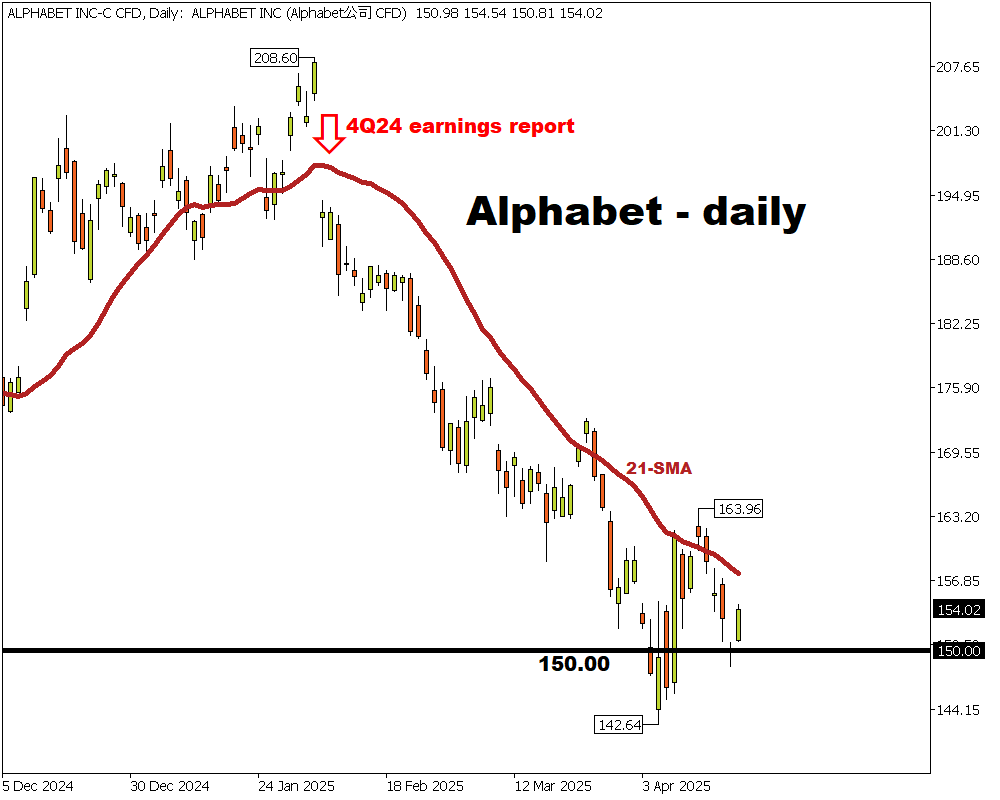
The current record high of US$208.60 for Alphabet’s C-class shares (no voting rights) were from February 4ththe day of its last earnings announcement – when it announced slowing growth in its Cloud segment and lower-than-expected revenue in Q4 2024.

Since then, this stock has fallen:

  • Intraday prices: as much as 31.6% (Feb 4th intraday high through April 7th intraday low)
  • Closing prices: 26.2% lower (Feb 4th close through April 22nd close)
Imagen
Alphabet’s Q1 earnings due after US markets close April 24, 2025

Why are US tech stocks falling?

US President Donald Trump’s erratic policy rollout, especially surrounding trade tariffs, have dented the aura surrounding “US exceptionalism”.

US tech stocks certainly have been one of the primary victims from this major blow to risk-taking activities across global financial markets.

For comparison, the 19.2% year-to-date drop in Alphabet’s C-class shares:

  • are almost double the S&P 500’s 10.1% decline so far this year
  • exceeds the tech-heavy Nasdaq 100 index’s 13% year-to-date drop


Alphabet’s Q1 earnings: What to look out for?


1) Cloud compression?

Revenue from its Cloud segment is expected to breach US$12.3 billion for Q1 2025 – the segment’s highest ever top line number.

However, the operating income for the segment is expected to dip back below the US$ 2 billion figure:

  • Q4 2024: $2.09B down to …
  • Q1 2025: US$1.94B … marking the first contraction for this line item since Q3 2023.

Investors and analysts will be keen to find out how Alphabet can buttress its Cloud margins, even as rising AI-fueled demand also requires more infrastructure investments.

NOTE: According to Alphabet CEO Sundar Pichai, Google’s Cloud is still smaller in size relative to Amazon’s and Microsoft’s.


And that brings us to the second key area to look out for …

2) AI integration (Gemini, AI agents) and capital expenditure (capex) plans

The integration of Gemini appears to be central to the growth of Alphabet’s Search segment – which accounts for more than half (55 – 57%) of total revenue in recent quarters.

Also, Gemini and other AI use cases are expected to help grow its Cloud segment from its:

  • Q1 2024: 11.9% of total company revenue for the quarter
  • Q1 2025: 13.8% of total company revenue for the quarter

Looking ahead, recall that the company had already issued capex guidance for US$75 billion for this year’s capex.

And that’s despite the risks posed DeepSeek’s apparent showing that AI gains can be achieved using lower-cost models.

The slightest hint of a pullback in capex plans could send Alphabet’s stocks tumbling on fears that the fervor for all things AI is losing momentum still.


3) Tariff impact

Since the flurry of tariff-related announcements this month, the expected impact on Alphabet’s financial figures appears limited to its:

  • hardware sales (think Pixel phones) and also …
  • Cloud infrastructure (think of the chips required to build out Alphabet’s data centers).

Hence, Alphabet’s share price is bound to reflect the company’s guidance on the tariffs’ impact on future earnings.


Beyond the main themes listed above, here are some headline Q1 figures to look out for:

  • Revenue: forecasted at US$75.4 billion
  • Net income: forecasted at US$24.7 billion
  • Earnings per share (EPS): forecasted at US$ 2.04


Potential Post-Earnings Scenarios

Note that markets currently predict that Alphabet’s stocks could move 5.8% up or down when US markets reopen on Friday, April 25th – the day after Alphabet’s Q1 earnings announcement.

  • BULLISH: Should Alphabet’s past quarterly financials and forward guidance help restore sentiment surrounding this stock, that could help pare its year-to-date declines.

Using Tuesday’s closing price of $154.02 as a reference point, a 5.8% climb would see this stock breaking above its 21-day simple moving average (SMA) and reaching around $163 – closing in on its mid-April intraday high.

  • BEARISH: Should Alphabet announce lower-than-expected Q1 2025 financial results, while citing greater concern about its earnings outlook, a 5.8% move downwards from Tuesday’s closing price should see this stock opening around $145 this Friday.

Still, much may yet happen across US stock markets over the next 2 days (Wednesday’s and Thursday’s cash sessions) which could drastically alter the above-listed numbers.


Over the next 12 months …

Wall Street analysts are still bullish on this stock, with:

  • 20 “Buy” calls
  • 1 “Hold”
  • 0 “Sells”

By this time in 2026, this stock is forecasted to have an upside potential of 34%, eventually touching $205.33.

To be clear, so far this month, many research houses including Morgan Stanley, UBS, Citi, Mizuho, and Bank of America have lowered their respective 12-month target prices on this stock.

And there’s bound to be more revisions after what Alphabet conveys to the world this week.

In short, this upcoming earnings release is set to hold great influence over how Alphabet’s shares perform, both in the immediate aftermath, and for the longer-term.


Forex-Time-LogoArticle by ForexTime

ForexTime Ltd (FXTM) is an award winning international online forex broker regulated by CySEC 185/12 www.forextime.com

COT Stock Market Charts: Speculator Bets led higher by Nasdaq, Russell & DowJones

By InvestMacro

Here are the latest charts and statistics for the Commitment of Traders (COT) data published by the Commodities Futures Trading Commission (CFTC).

The latest COT data is updated through Tuesday April 8th and shows a quick view of how large traders (for-profit speculators and commercial entities) were positioned in the futures markets.

Weekly Speculator Changes led by Nasdaq, Russell & DowJones

The COT stock markets speculator bets were overall higher this week as five out of the seven stock markets we cover had higher positioning while the other two markets had lower speculator contracts.

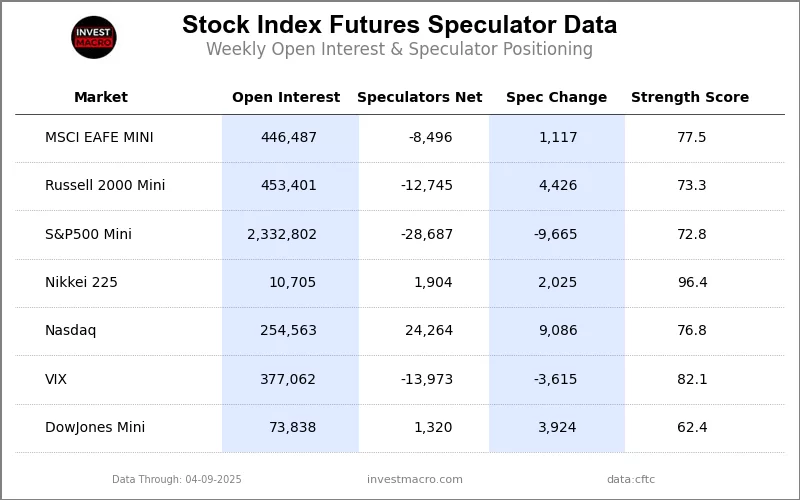
Leading the gains for the stock markets was the Nasdaq-Mini (9,086 contracts) with the Russell-Mini (4,426 contracts), the DowJones-Mini (3,924 contracts), the Nikkei 225 (2,025 contracts) and the MSCI EAFE-Mini (1,117 contracts) also showing positive weeks.

The market leading the declines in speculator bets this week was with the S&P500-Mini (-9,665 contracts) and with the VIX (-3,615 contracts) also registering lower bets on the week.


Stocks Data:

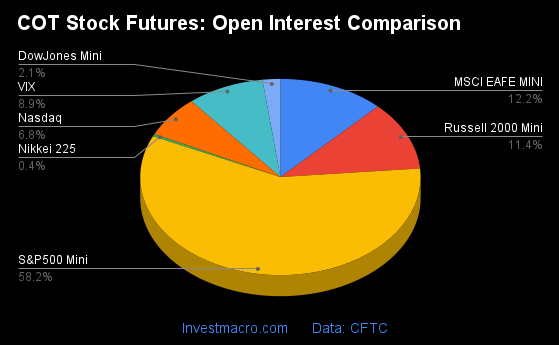
Legend: Open Interest | Weekly Speculators Change | Speculators Current Net Position | Strength Score compared to last 3-Years (0-100 range)


Strength Scores led by Nikkei 225 & VIX

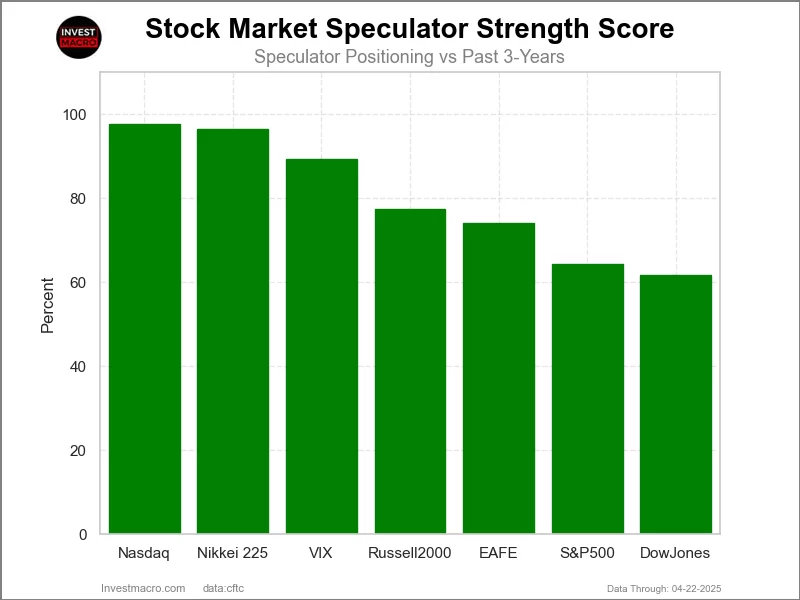
COT Strength Scores (a normalized measure of Speculator positions over a 3-Year range, from 0 to 100 where above 80 is Extreme-Bullish and below 20 is Extreme-Bearish) showed that the Nikkei 225 (96 percent) and the VIX (82 percent) lead the stock markets this week. The MSCI EAFE-Mini (78 percent) and Nasdaq-Mini (77 percent) come in as the next highest in the weekly strength scores.

The DowJones-Mini (62 percent) comes in at the lowest strength level currently but is above 50 percent which is the mid-point for the past 3 years.

Strength Statistics:
VIX (82.1 percent) vs VIX previous week (85.3 percent)
S&P500-Mini (72.8 percent) vs S&P500-Mini previous week (74.5 percent)
DowJones-Mini (62.4 percent) vs DowJones-Mini previous week (56.1 percent)
Nasdaq-Mini (76.8 percent) vs Nasdaq-Mini previous week (62.7 percent)
Russell2000-Mini (73.3 percent) vs Russell2000-Mini previous week (70.3 percent)
Nikkei USD (96.4 percent) vs Nikkei USD previous week (79.1 percent)
EAFE-Mini (77.5 percent) vs EAFE-Mini previous week (76.0 percent)


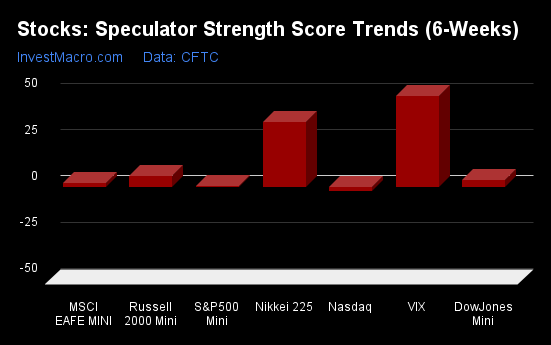
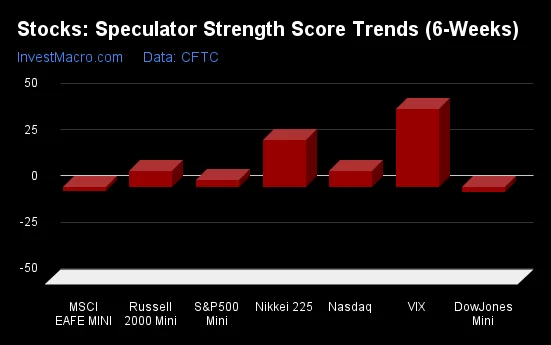
VIX & Nikkei 225 top the 6-Week Strength Trends

COT Strength Score Trends (or move index, calculates the 6-week changes in strength scores) showed that the VIX (49 percent) leads the past six weeks trends for the stock markets. The Nikkei 225 (35 percent) and the Russell-Mini (6 percent) are the next highest positive movers in the latest trends data.

The Nasdaq-Mini (-2 percent) is the only market with a lower trend score currently.

Strength Trend Statistics:
VIX (49.0 percent) vs VIX previous week (42.0 percent)
S&P500-Mini (0.7 percent) vs S&P500-Mini previous week (3.8 percent)
DowJones-Mini (3.6 percent) vs DowJones-Mini previous week (-2.5 percent)
Nasdaq-Mini (-2.3 percent) vs Nasdaq-Mini previous week (8.3 percent)
Russell2000-Mini (5.9 percent) vs Russell2000-Mini previous week (8.6 percent)
Nikkei USD (35.0 percent) vs Nikkei USD previous week (25.1 percent)
EAFE-Mini (2.0 percent) vs EAFE-Mini previous week (-2.4 percent)


Individual Stock Market Charts:

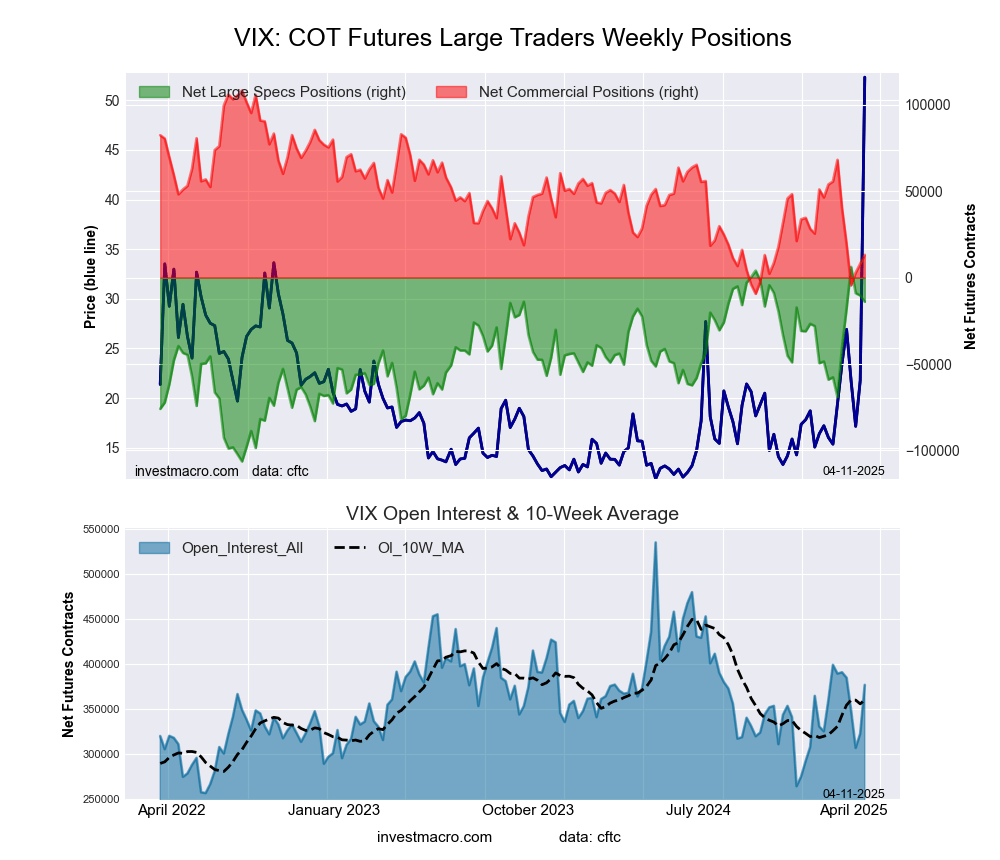
VIX Volatility Futures:

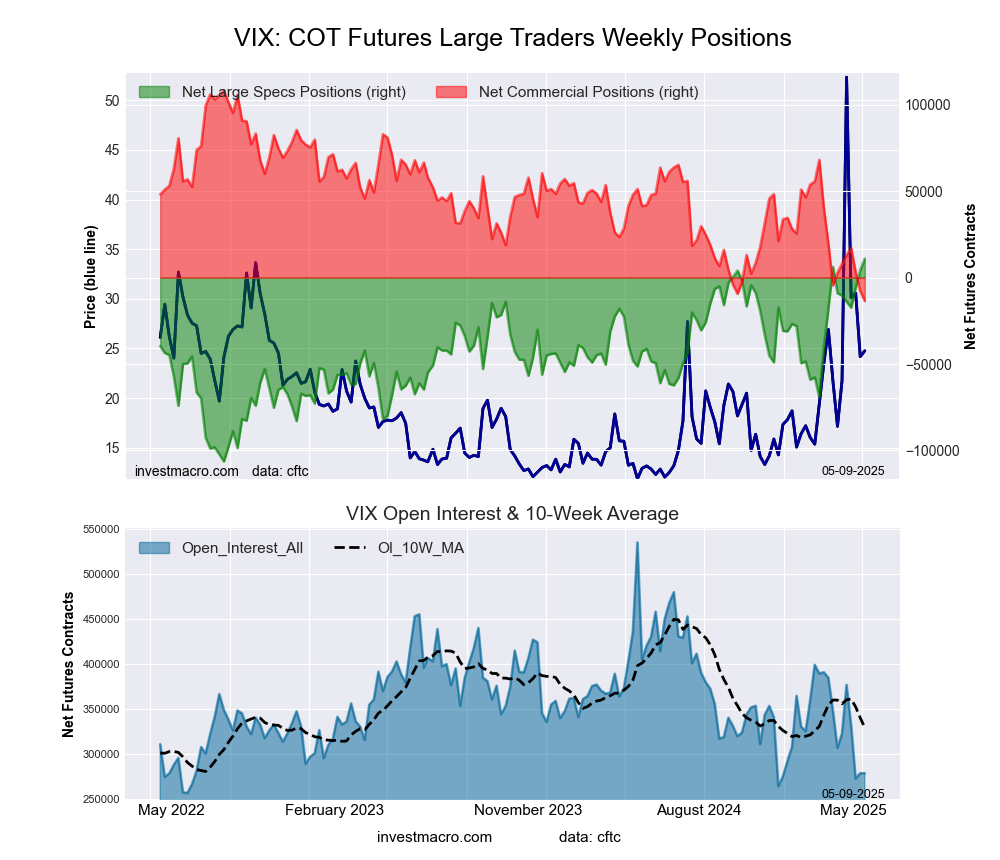
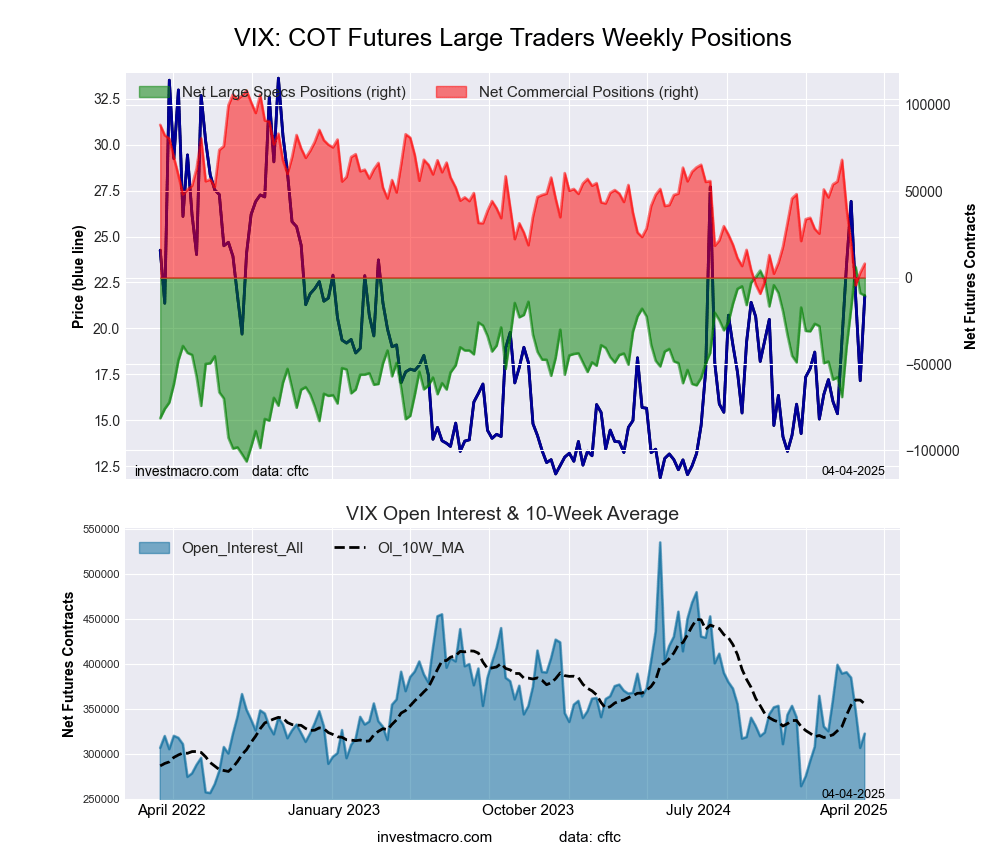
VIX Volatility Futures COT ChartThe VIX Volatility large speculator standing this week recorded a net position of -13,973 contracts in the data reported through Tuesday. This was a weekly fall of -3,615 contracts from the previous week which had a total of -10,358 net contracts.

This week’s current strength score (the trader positioning range over the past three years, measured from 0 to 100) shows the speculators are currently Bullish-Extreme with a score of 82.1 percent. The commercials are Bearish-Extreme with a score of 19.1 percent and the small traders (not shown in chart) are Bullish with a score of 71.2 percent.

Price Trend-Following Model: Strong Uptrend

Our weekly trend-following model classifies the current market price position as: Strong Uptrend.

VIX Volatility Futures StatisticsSPECULATORSCOMMERCIALSSMALL TRADERS
– Percent of Open Interest Longs:28.244.49.3
– Percent of Open Interest Shorts:31.940.99.1
– Net Position:-13,97313,134839
– Gross Longs:106,385167,48435,156
– Gross Shorts:120,358154,35034,317
– Long to Short Ratio:0.9 to 11.1 to 11.0 to 1
NET POSITION TREND:
– Strength Index Score (3 Year Range Pct):82.119.171.2
– Strength Index Reading (3 Year Range):Bullish-ExtremeBearish-ExtremeBullish
NET POSITION MOVEMENT INDEX:
– 6-Week Change in Strength Index:49.0-46.8-0.9


S&P500 Mini Futures:

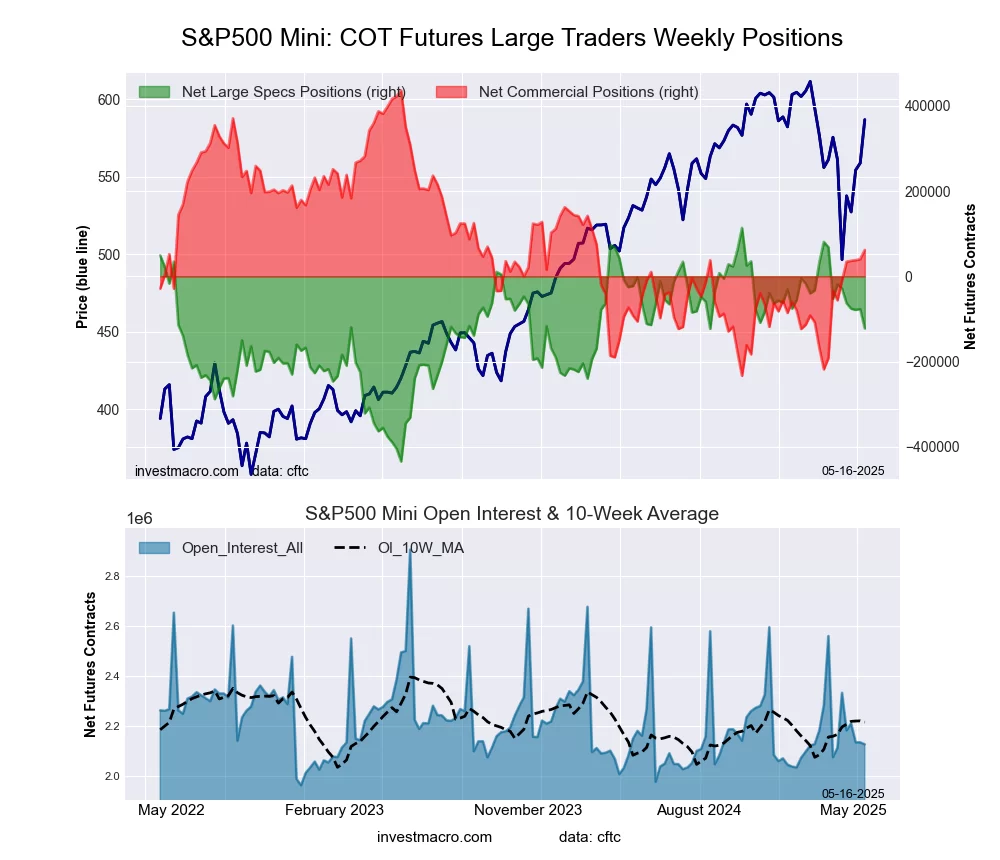
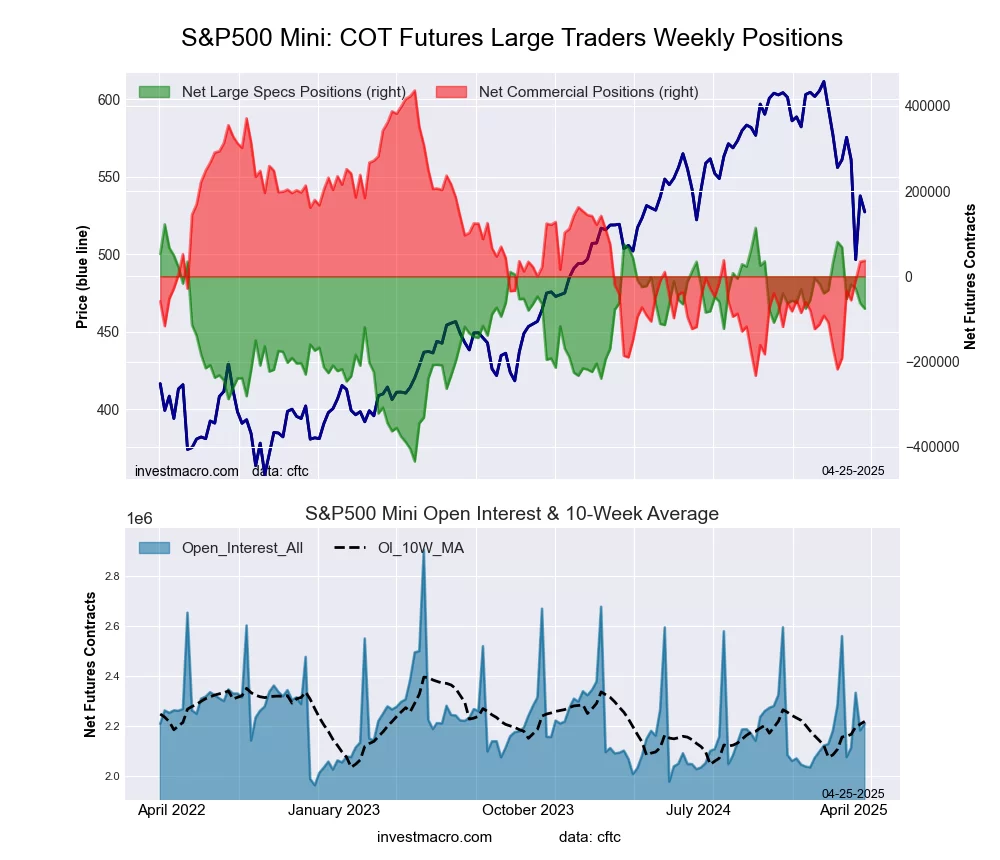
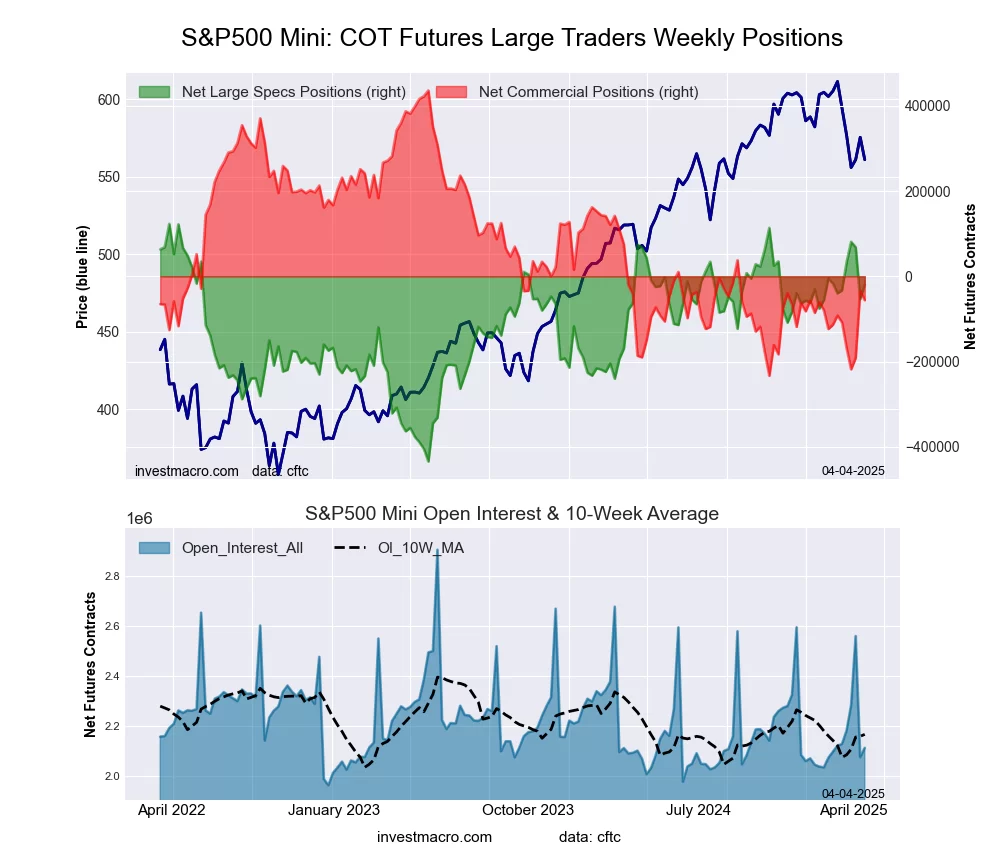
SP500 Mini Futures COT ChartThe S&P500 Mini large speculator standing this week recorded a net position of -28,687 contracts in the data reported through Tuesday. This was a weekly fall of -9,665 contracts from the previous week which had a total of -19,022 net contracts.

This week’s current strength score (the trader positioning range over the past three years, measured from 0 to 100) shows the speculators are currently Bullish with a score of 72.8 percent. The commercials are Bearish with a score of 33.4 percent and the small traders (not shown in chart) are Bullish with a score of 52.6 percent.

Price Trend-Following Model: Strong Downtrend

Our weekly trend-following model classifies the current market price position as: Strong Downtrend.

S&P500 Mini Futures StatisticsSPECULATORSCOMMERCIALSSMALL TRADERS
– Percent of Open Interest Longs:13.871.910.8
– Percent of Open Interest Shorts:15.072.39.2
– Net Position:-28,687-9,95138,638
– Gross Longs:321,4511,677,831252,928
– Gross Shorts:350,1381,687,782214,290
– Long to Short Ratio:0.9 to 11.0 to 11.2 to 1
NET POSITION TREND:
– Strength Index Score (3 Year Range Pct):72.833.452.6
– Strength Index Reading (3 Year Range):BullishBearishBullish
NET POSITION MOVEMENT INDEX:
– 6-Week Change in Strength Index:0.714.6-40.4


Dow Jones Mini Futures:

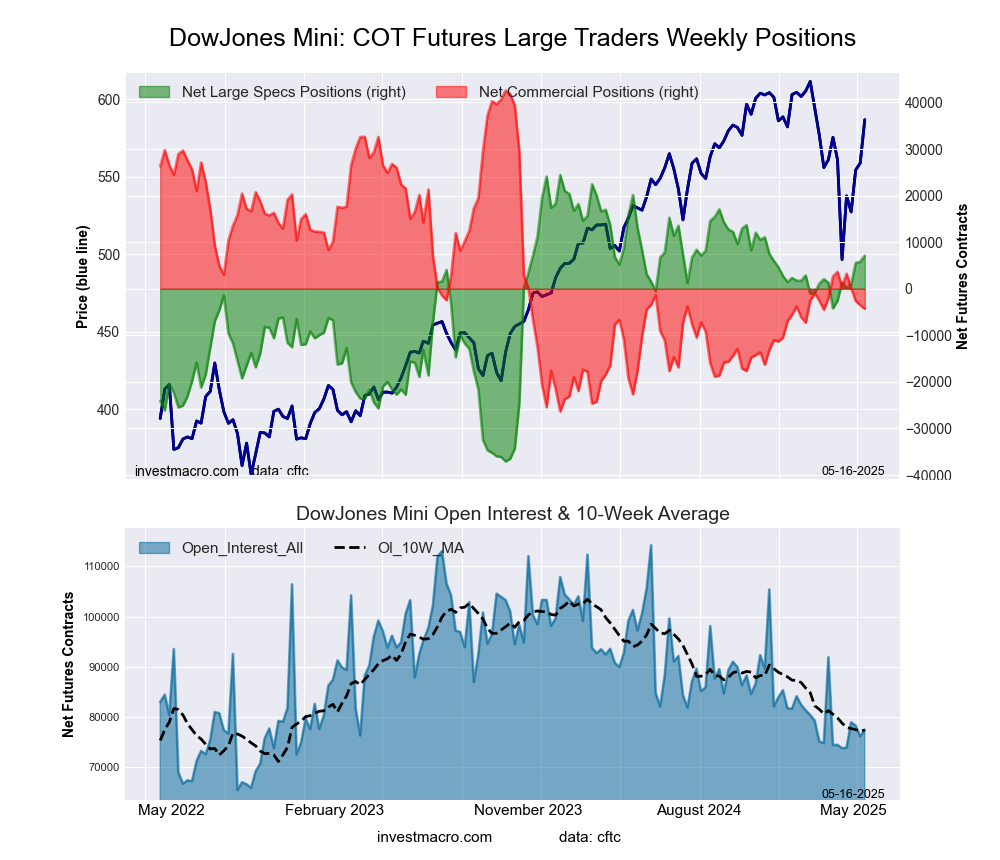
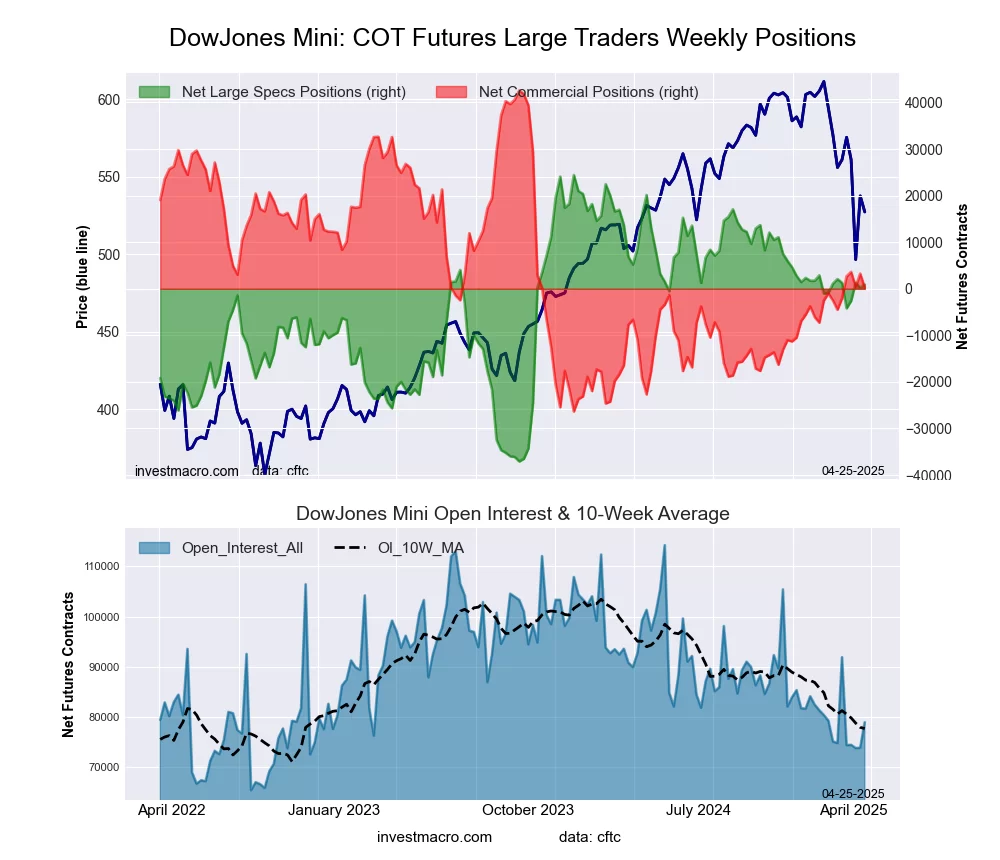
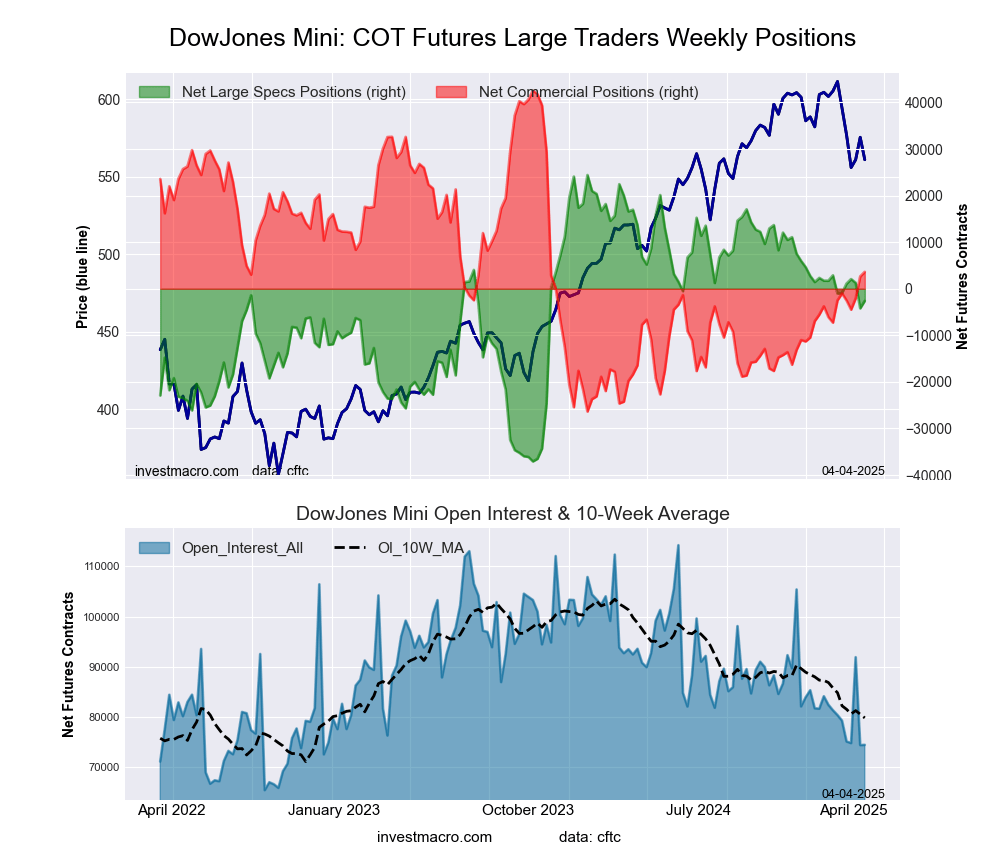
Dow Jones Mini Futures COT ChartThe Dow Jones Mini large speculator standing this week recorded a net position of 1,320 contracts in the data reported through Tuesday. This was a weekly lift of 3,924 contracts from the previous week which had a total of -2,604 net contracts.

This week’s current strength score (the trader positioning range over the past three years, measured from 0 to 100) shows the speculators are currently Bullish with a score of 62.4 percent. The commercials are Bearish with a score of 38.8 percent and the small traders (not shown in chart) are Bearish with a score of 43.4 percent.

Price Trend-Following Model: Strong Downtrend

Our weekly trend-following model classifies the current market price position as: Strong Downtrend.

Dow Jones Mini Futures StatisticsSPECULATORSCOMMERCIALSSMALL TRADERS
– Percent of Open Interest Longs:12.465.812.5
– Percent of Open Interest Shorts:10.765.214.8
– Net Position:1,320419-1,739
– Gross Longs:9,19248,5499,211
– Gross Shorts:7,87248,13010,950
– Long to Short Ratio:1.2 to 11.0 to 10.8 to 1
NET POSITION TREND:
– Strength Index Score (3 Year Range Pct):62.438.843.4
– Strength Index Reading (3 Year Range):BullishBearishBearish
NET POSITION MOVEMENT INDEX:
– 6-Week Change in Strength Index:3.62.1-21.8


Nasdaq Mini Futures:

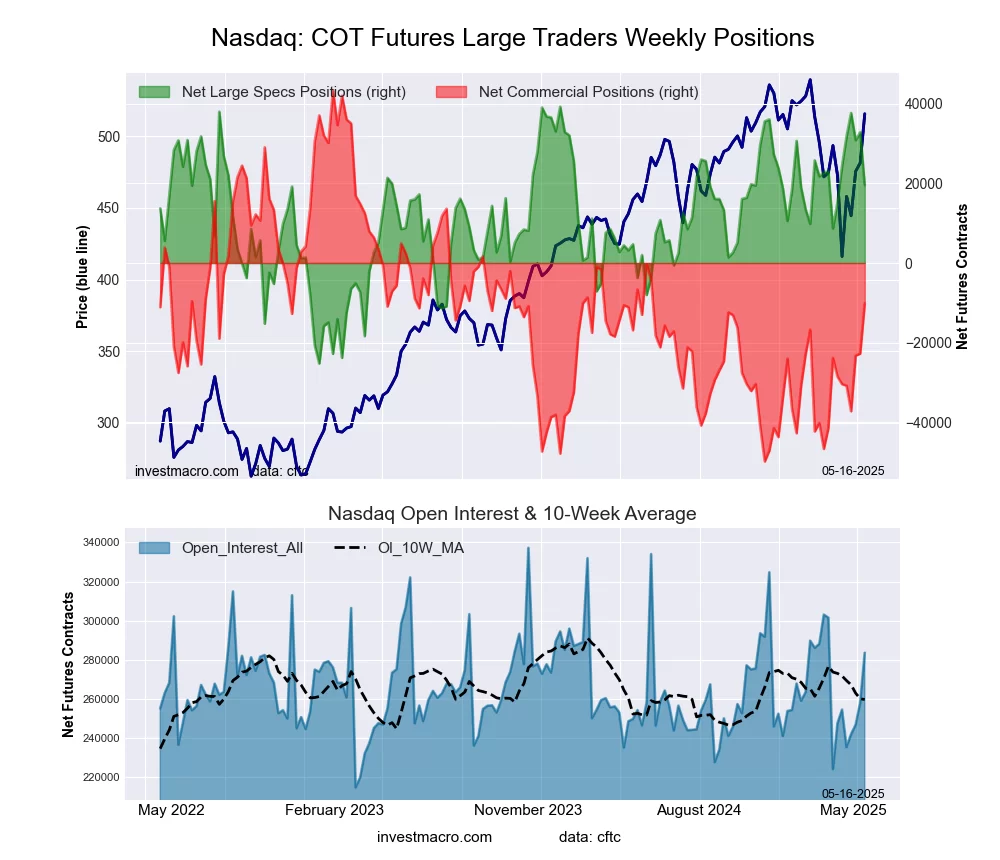
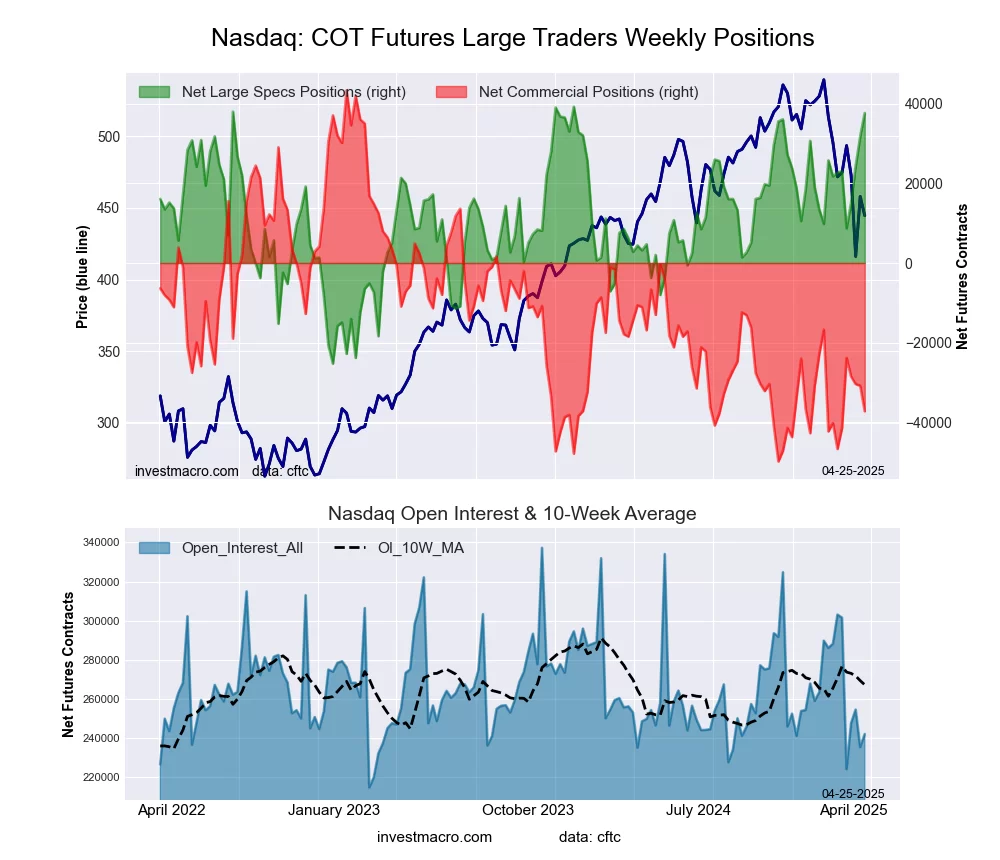
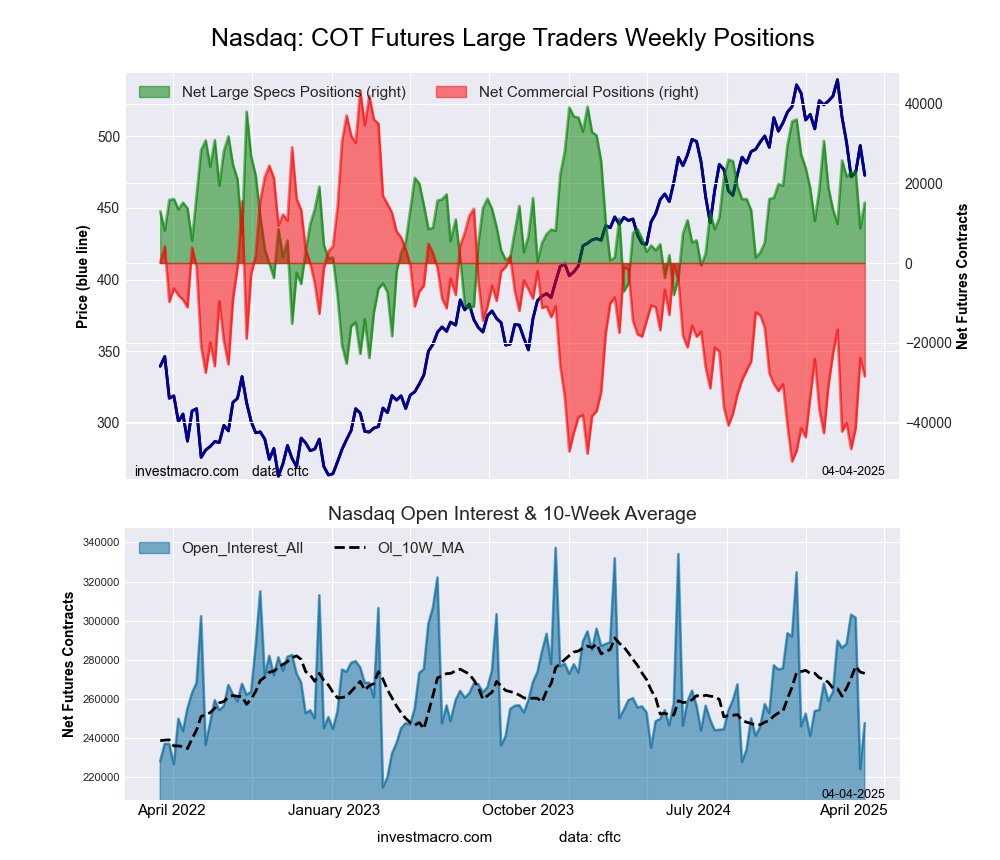
Nasdaq Mini Futures COT ChartThe Nasdaq Mini large speculator standing this week recorded a net position of 24,264 contracts in the data reported through Tuesday. This was a weekly rise of 9,086 contracts from the previous week which had a total of 15,178 net contracts.

This week’s current strength score (the trader positioning range over the past three years, measured from 0 to 100) shows the speculators are currently Bullish with a score of 76.8 percent. The commercials are Bearish with a score of 20.9 percent and the small traders (not shown in chart) are Bullish with a score of 66.1 percent.

Price Trend-Following Model: Strong Downtrend

Our weekly trend-following model classifies the current market price position as: Strong Downtrend.

Nasdaq Mini Futures StatisticsSPECULATORSCOMMERCIALSSMALL TRADERS
– Percent of Open Interest Longs:28.956.413.8
– Percent of Open Interest Shorts:19.468.411.4
– Net Position:24,264-30,4316,167
– Gross Longs:73,557143,67635,189
– Gross Shorts:49,293174,10729,022
– Long to Short Ratio:1.5 to 10.8 to 11.2 to 1
NET POSITION TREND:
– Strength Index Score (3 Year Range Pct):76.820.966.1
– Strength Index Reading (3 Year Range):BullishBearishBullish
NET POSITION MOVEMENT INDEX:
– 6-Week Change in Strength Index:-2.312.8-19.7


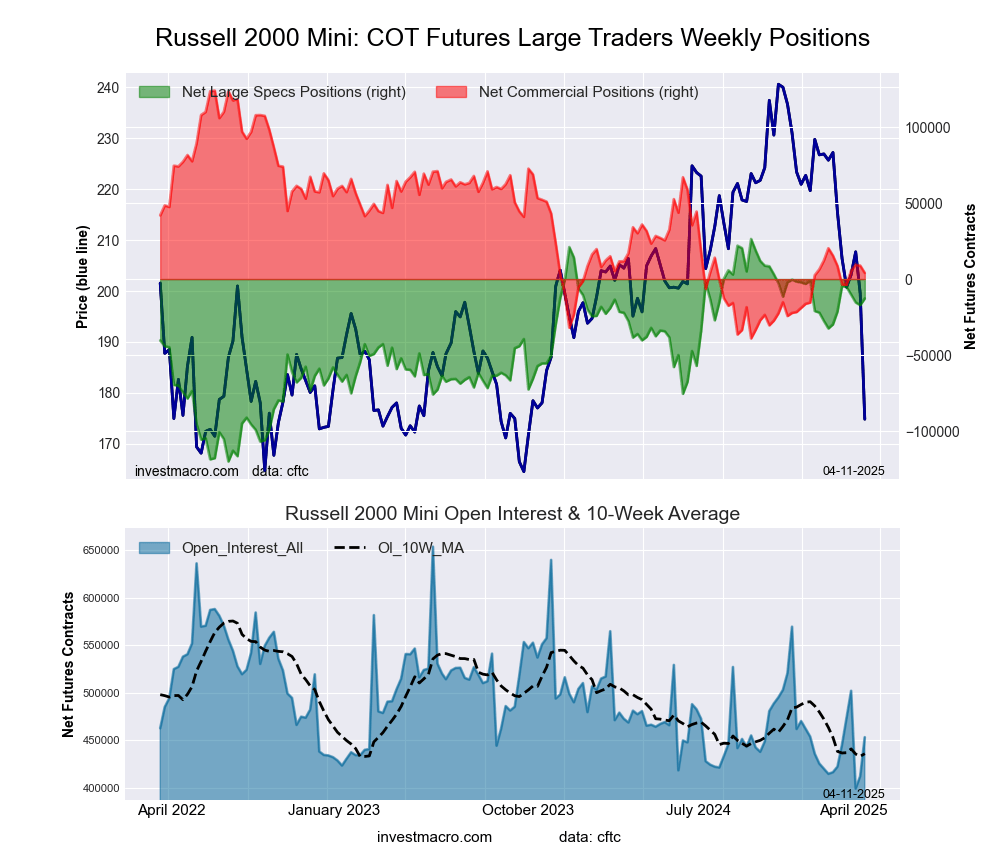
Russell 2000 Mini Futures:

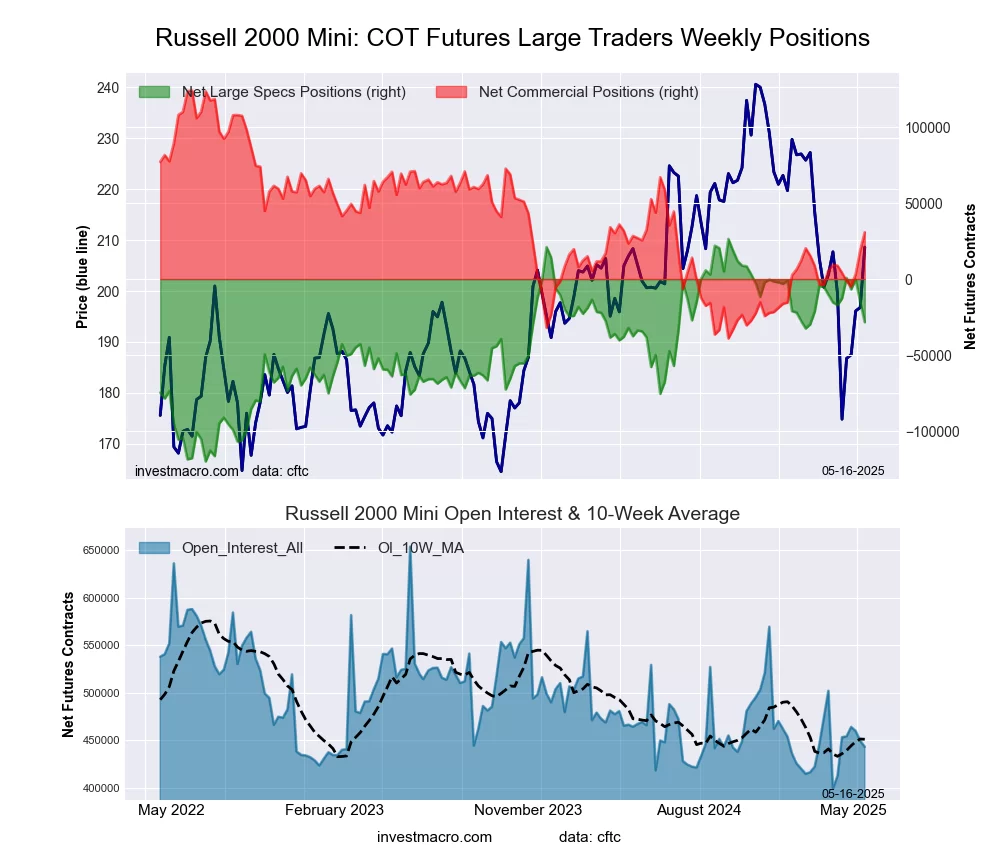
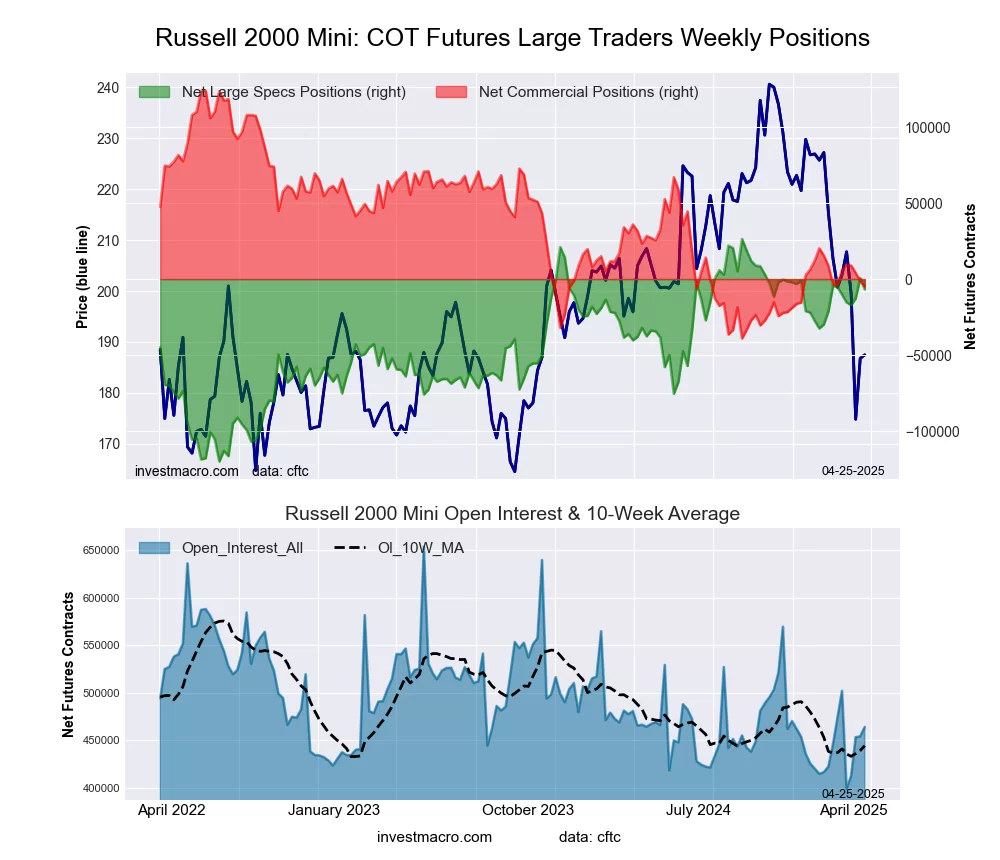
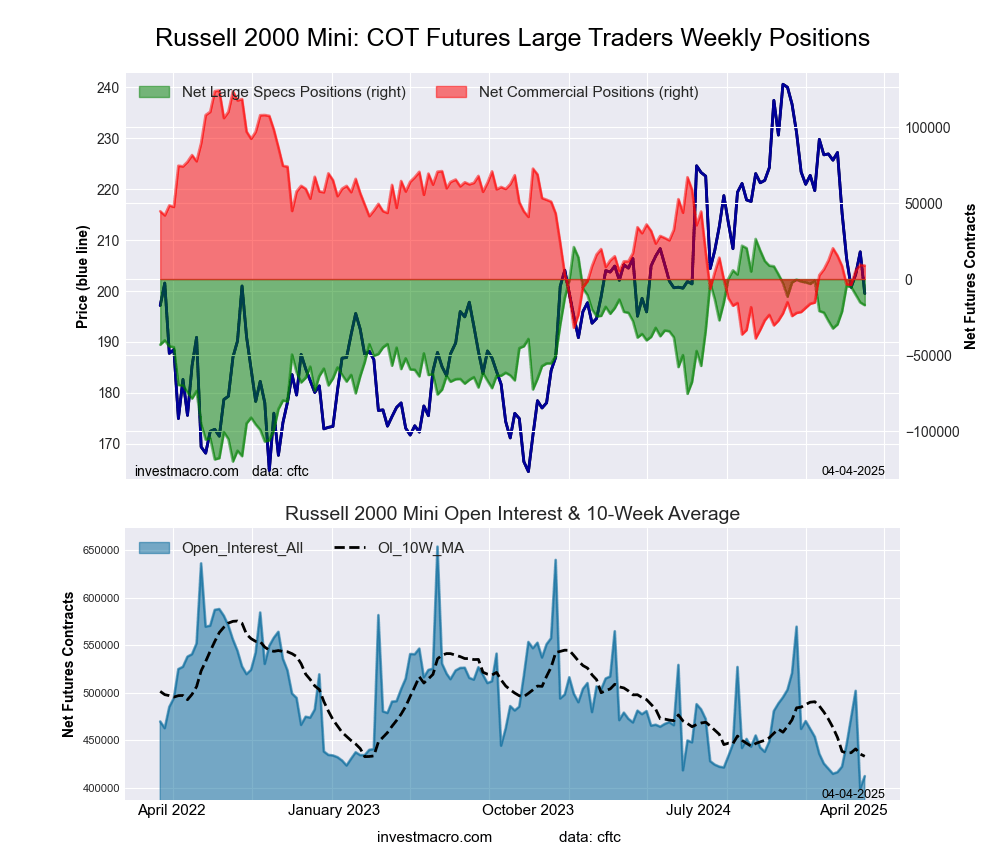
Russell 2000 Mini Futures COT ChartThe Russell 2000 Mini large speculator standing this week recorded a net position of -12,745 contracts in the data reported through Tuesday. This was a weekly advance of 4,426 contracts from the previous week which had a total of -17,171 net contracts.

This week’s current strength score (the trader positioning range over the past three years, measured from 0 to 100) shows the speculators are currently Bullish with a score of 73.3 percent. The commercials are Bearish with a score of 26.4 percent and the small traders (not shown in chart) are Bearish with a score of 48.9 percent.

Price Trend-Following Model: Strong Downtrend

Our weekly trend-following model classifies the current market price position as: Strong Downtrend.

Russell 2000 Mini Futures StatisticsSPECULATORSCOMMERCIALSSMALL TRADERS
– Percent of Open Interest Longs:18.971.45.9
– Percent of Open Interest Shorts:21.770.54.0
– Net Position:-12,7454,0578,688
– Gross Longs:85,645323,66726,618
– Gross Shorts:98,390319,61017,930
– Long to Short Ratio:0.9 to 11.0 to 11.5 to 1
NET POSITION TREND:
– Strength Index Score (3 Year Range Pct):73.326.448.9
– Strength Index Reading (3 Year Range):BullishBearishBearish
NET POSITION MOVEMENT INDEX:
– 6-Week Change in Strength Index:5.9-2.8-11.4


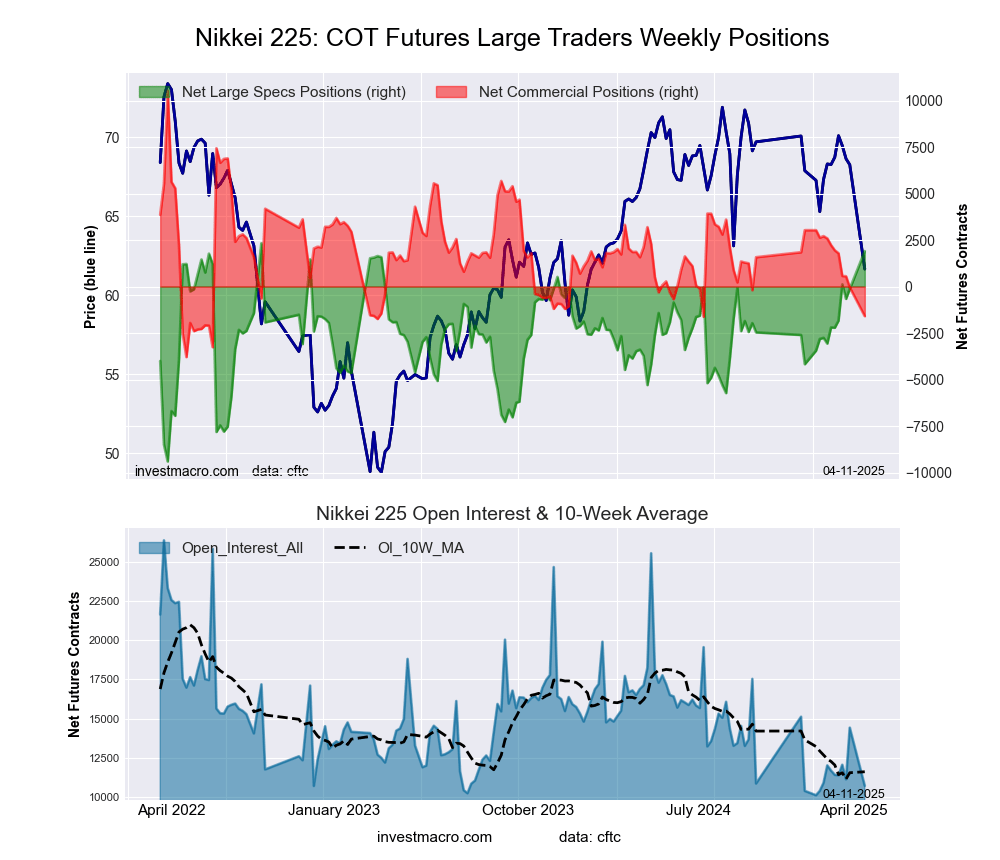
Nikkei Stock Average (USD) Futures:

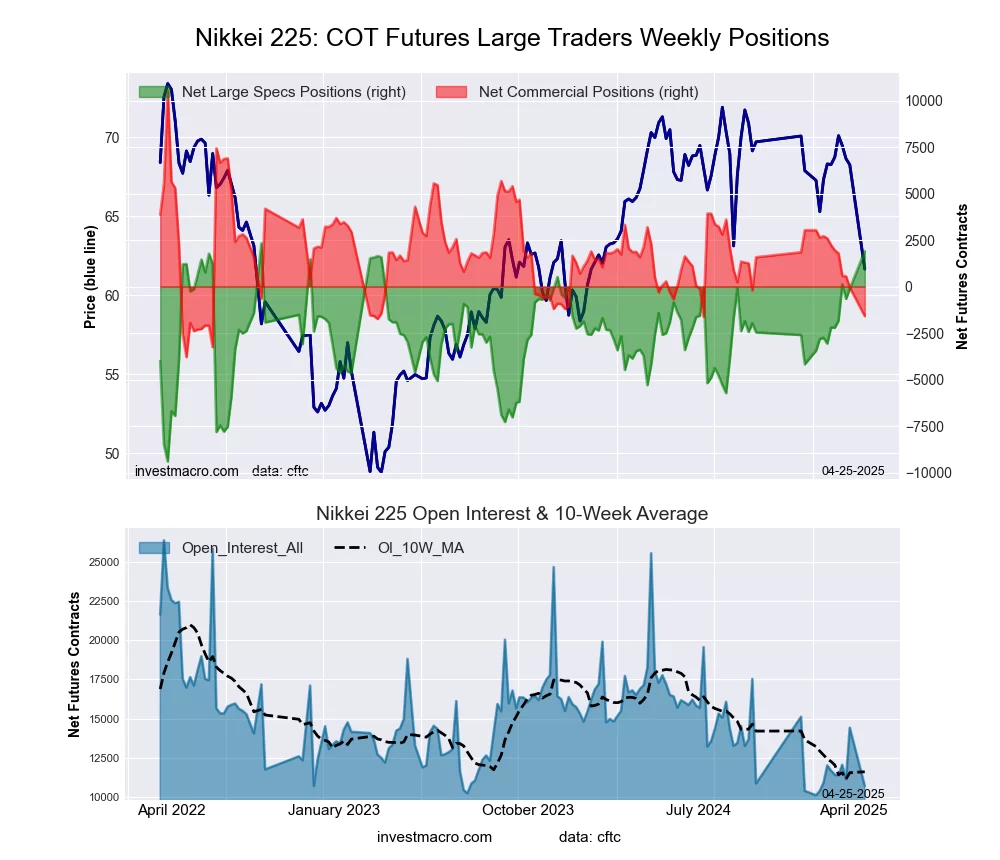
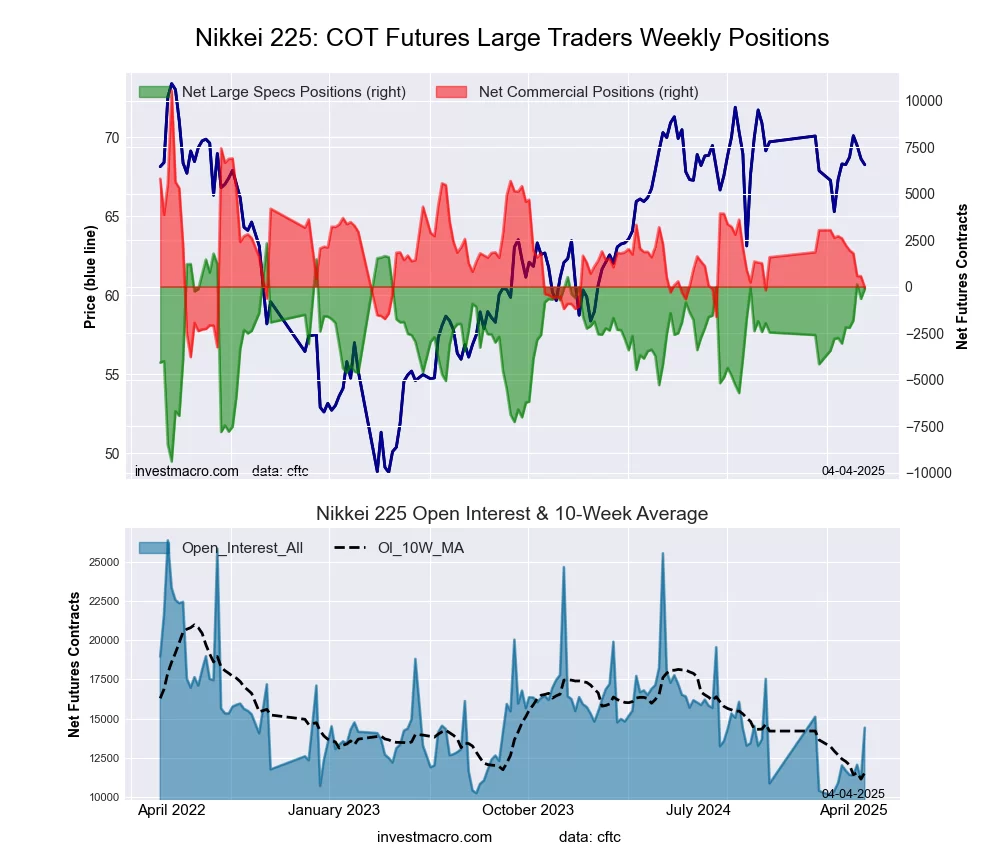
Nikkei Stock Average (USD) Futures COT ChartThe Nikkei Stock Average (USD) large speculator standing this week recorded a net position of 1,904 contracts in the data reported through Tuesday. This was a weekly advance of 2,025 contracts from the previous week which had a total of -121 net contracts.

This week’s current strength score (the trader positioning range over the past three years, measured from 0 to 100) shows the speculators are currently Bullish-Extreme with a score of 96.4 percent. The commercials are Bearish-Extreme with a score of 15.4 percent and the small traders (not shown in chart) are Bearish with a score of 37.1 percent.

Price Trend-Following Model: Strong Downtrend

Our weekly trend-following model classifies the current market price position as: Strong Downtrend.

Nikkei Stock Average Futures StatisticsSPECULATORSCOMMERCIALSSMALL TRADERS
– Percent of Open Interest Longs:20.360.519.2
– Percent of Open Interest Shorts:2.575.422.1
– Net Position:1,904-1,590-314
– Gross Longs:2,1696,4802,056
– Gross Shorts:2658,0702,370
– Long to Short Ratio:8.2 to 10.8 to 10.9 to 1
NET POSITION TREND:
– Strength Index Score (3 Year Range Pct):96.415.437.1
– Strength Index Reading (3 Year Range):Bullish-ExtremeBearish-ExtremeBearish
NET POSITION MOVEMENT INDEX:
– 6-Week Change in Strength Index:35.0-26.7-5.5


MSCI EAFE Mini Futures:

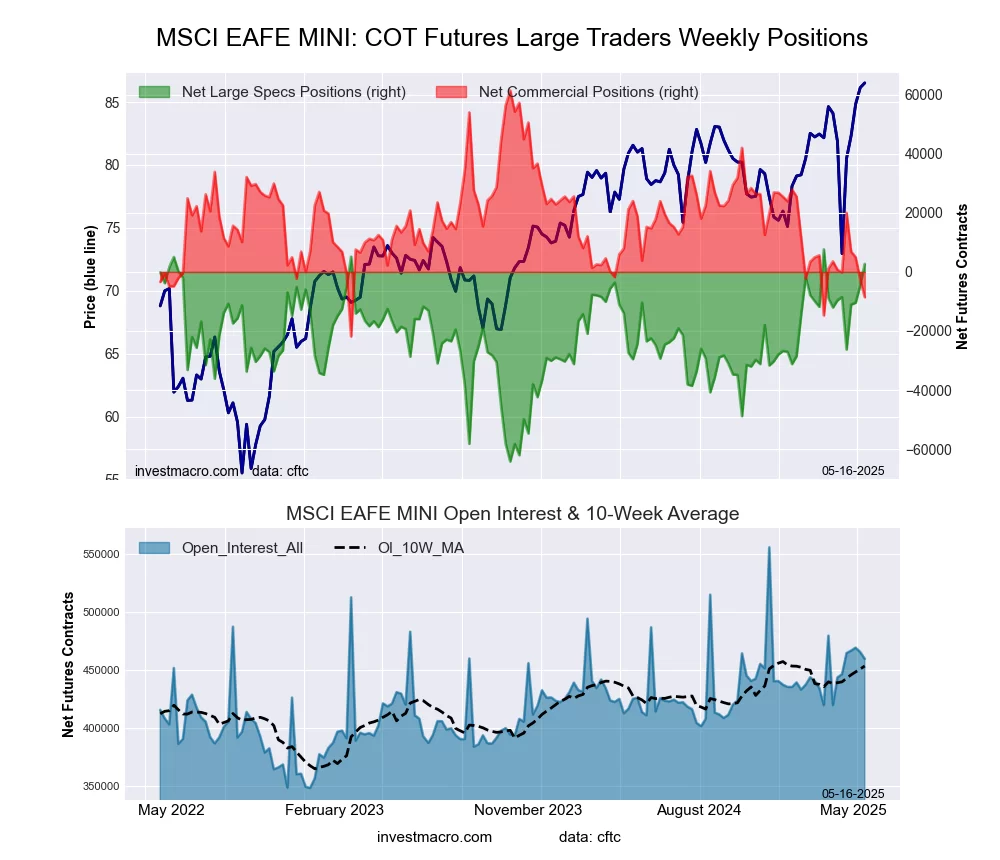
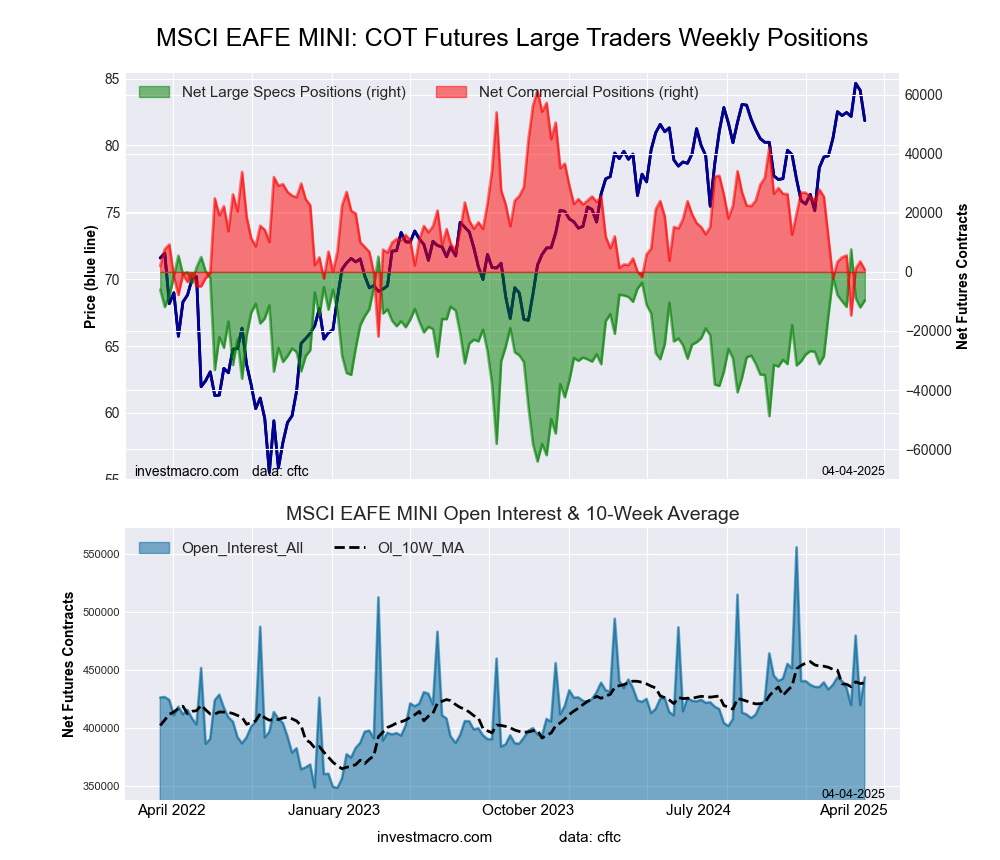
MSCI EAFE Mini Futures COT ChartThe MSCI EAFE Mini large speculator standing this week recorded a net position of -8,496 contracts in the data reported through Tuesday. This was a weekly rise of 1,117 contracts from the previous week which had a total of -9,613 net contracts.

This week’s current strength score (the trader positioning range over the past three years, measured from 0 to 100) shows the speculators are currently Bullish with a score of 77.5 percent. The commercials are Bearish with a score of 26.0 percent and the small traders (not shown in chart) are Bullish with a score of 60.1 percent.

Price Trend-Following Model: Strong Downtrend

Our weekly trend-following model classifies the current market price position as: Strong Downtrend.

MSCI EAFE Mini Futures StatisticsSPECULATORSCOMMERCIALSSMALL TRADERS
– Percent of Open Interest Longs:9.387.33.2
– Percent of Open Interest Shorts:11.287.31.3
– Net Position:-8,496-1688,664
– Gross Longs:41,546389,65514,324
– Gross Shorts:50,042389,8235,660
– Long to Short Ratio:0.8 to 11.0 to 12.5 to 1
NET POSITION TREND:
– Strength Index Score (3 Year Range Pct):77.526.060.1
– Strength Index Reading (3 Year Range):BullishBearishBullish
NET POSITION MOVEMENT INDEX:
– 6-Week Change in Strength Index:2.0-6.118.4


Article By InvestMacroReceive our weekly COT Newsletter

*COT Report: The COT data, released weekly to the public each Friday, is updated through the most recent Tuesday (data is 3 days old) and shows a quick view of how large speculators or non-commercials (for-profit traders) were positioned in the futures markets.

The CFTC categorizes trader positions according to commercial hedgers (traders who use futures contracts for hedging as part of the business), non-commercials (large traders who speculate to realize trading profits) and nonreportable traders (usually small traders/speculators) as well as their open interest (contracts open in the market at time of reporting). See CFTC criteria here.

COT Stock Market Charts: Speculator Bets led by S&P500 & Nasdaq

By InvestMacro

Here are the latest charts and statistics for the Commitment of Traders (COT) data published by the Commodities Futures Trading Commission (CFTC).

The latest COT data is updated through Tuesday April 1st and shows a quick view of how large traders (for-profit speculators and commercial entities) were positioned in the futures markets.

Weekly Speculator Changes led by S&P500 & Nasdaq

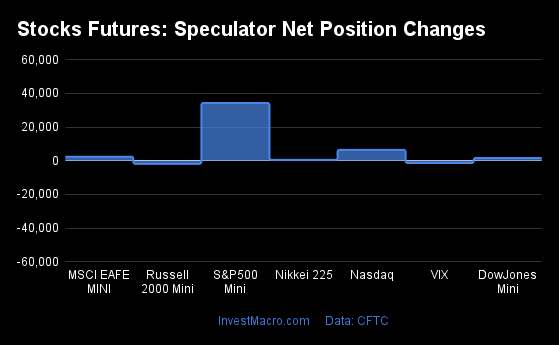
The COT stock markets speculator bets were higher this week (through Tuesday) as five out of the seven stock markets we cover had higher positioning while the other three markets had lower speculator contracts.

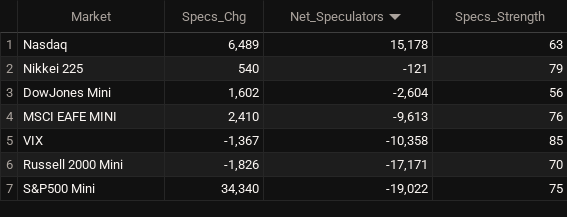
Leading the gains for the stock markets was the S&P500-Mini (34,340 contracts) with the Nasdaq-Mini (6,489 contracts), the MSCI EAFE-Mini (2,410 contracts), the DowJones-Mini (1,602 contracts) and the Nikkei 225 (540 contracts) also having positive weeks.

The markets with the declines in speculator bets this week were the Russell-Mini (-1,826 contracts) with the VIX (-1,367 contracts) also seeing lower bets on the week.


Stock Market Net Speculators Leaderboard

Legend: Weekly Speculators Change | Speculators Current Net Position | Speculators Strength Score compared to last 3-Years (0-100 range)


Strength Scores led by VIX & Nikkei 225

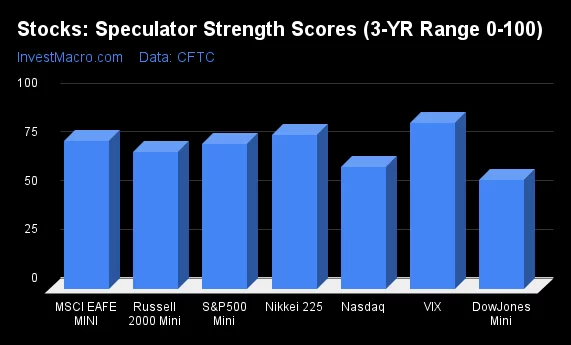
COT Strength Scores (a normalized measure of Speculator positions over a 3-Year range, from 0 to 100 where above 80 is Extreme-Bullish and below 20 is Extreme-Bearish) showed that the VIX (85 percent) and the Nikkei 225 (79 percent) lead the stock markets this week. The MSCI EAFE-Mini (76 percent) and S&P500-Mini (75 percent) come in as the next highest in the weekly strength scores.

On the downside, the DowJones-Mini (56 percent) comes in at the lowest strength level currently.

Strength Statistics:
VIX (85.3 percent) vs VIX previous week (86.5 percent)
S&P500-Mini (74.5 percent) vs S&P500-Mini previous week (68.4 percent)
DowJones-Mini (56.1 percent) vs DowJones-Mini previous week (53.5 percent)
Nasdaq-Mini (62.7 percent) vs Nasdaq-Mini previous week (52.6 percent)
Russell2000-Mini (70.3 percent) vs Russell2000-Mini previous week (71.5 percent)
Nikkei USD (79.1 percent) vs Nikkei USD previous week (74.5 percent)
EAFE-Mini (76.0 percent) vs EAFE-Mini previous week (72.6 percent)


VIX & Nikkei 225 top the 6-Week Strength Trends

COT Strength Score Trends (or move index, calculates the 6-week changes in strength scores) showed that the VIX (42 percent) leads the past six weeks trends for the stock markets. The Nikkei 225 (25 percent), the Russell-Mini (9 percent) and the Nasdaq-Mini (8 percent) are the next highest positive movers in the latest trends data.

The DowJones-Mini (-3 percent) leads the downside trend scores currently with the EAFE-Mini (-2 percent) coming in as the next market with lower trend scores.

Strength Trend Statistics:
VIX (42.0 percent) vs VIX previous week (44.4 percent)
S&P500-Mini (3.8 percent) vs S&P500-Mini previous week (-6.5 percent)
DowJones-Mini (-2.5 percent) vs DowJones-Mini previous week (-11.5 percent)
Nasdaq-Mini (8.3 percent) vs Nasdaq-Mini previous week (-7.4 percent)
Russell2000-Mini (8.6 percent) vs Russell2000-Mini previous week (11.7 percent)
Nikkei USD (25.1 percent) vs Nikkei USD previous week (17.9 percent)
EAFE-Mini (-2.4 percent) vs EAFE-Mini previous week (-14.2 percent)


Individual Stock Market Charts:

VIX Volatility Futures:

VIX Volatility Futures COT ChartThe VIX Volatility large speculator standing this week equaled a net position of -10,358 contracts in the data reported through Tuesday. This was a weekly reduction of -1,367 contracts from the previous week which had a total of -8,991 net contracts.

This week’s current strength score (the trader positioning range over the past three years, measured from 0 to 100) shows the speculators are currently Bullish-Extreme with a score of 85.3 percent. The commercials are Bearish-Extreme with a score of 14.8 percent and the small traders (not shown in chart) are Bullish with a score of 79.2 percent.

Price Trend-Following Model: Strong Uptrend

Our weekly trend-following model classifies the current market price position as: Strong Uptrend.

VIX Volatility Futures StatisticsSPECULATORSCOMMERCIALSSMALL TRADERS
– Percent of Open Interest Longs:29.442.89.0
– Percent of Open Interest Shorts:32.640.38.3
– Net Position:-10,3588,0552,303
– Gross Longs:94,853138,09329,211
– Gross Shorts:105,211130,03826,908
– Long to Short Ratio:0.9 to 11.1 to 11.1 to 1
NET POSITION TREND:
– Strength Index Score (3 Year Range Pct):85.314.879.2
– Strength Index Reading (3 Year Range):Bullish-ExtremeBearish-ExtremeBullish
NET POSITION MOVEMENT INDEX:
– 6-Week Change in Strength Index:42.0-40.51.4


S&P500 Mini Futures:

SP500 Mini Futures COT ChartThe S&P500 Mini large speculator standing this week equaled a net position of -19,022 contracts in the data reported through Tuesday. This was a weekly advance of 34,340 contracts from the previous week which had a total of -53,362 net contracts.

This week’s current strength score (the trader positioning range over the past three years, measured from 0 to 100) shows the speculators are currently Bullish with a score of 74.5 percent. The commercials are Bearish with a score of 26.5 percent and the small traders (not shown in chart) are Bullish with a score of 67.1 percent.

Price Trend-Following Model: Strong Downtrend

Our weekly trend-following model classifies the current market price position as: Strong Downtrend.

S&P500 Mini Futures StatisticsSPECULATORSCOMMERCIALSSMALL TRADERS
– Percent of Open Interest Longs:14.271.311.8
– Percent of Open Interest Shorts:15.173.98.2
– Net Position:-19,022-56,19975,221
– Gross Longs:300,3661,504,785249,432
– Gross Shorts:319,3881,560,984174,211
– Long to Short Ratio:0.9 to 11.0 to 11.4 to 1
NET POSITION TREND:
– Strength Index Score (3 Year Range Pct):74.526.567.1
– Strength Index Reading (3 Year Range):BullishBearishBullish
NET POSITION MOVEMENT INDEX:
– 6-Week Change in Strength Index:3.85.4-22.5


Dow Jones Mini Futures:

Dow Jones Mini Futures COT ChartThe Dow Jones Mini large speculator standing this week equaled a net position of -2,604 contracts in the data reported through Tuesday. This was a weekly boost of 1,602 contracts from the previous week which had a total of -4,206 net contracts.

This week’s current strength score (the trader positioning range over the past three years, measured from 0 to 100) shows the speculators are currently Bullish with a score of 56.1 percent. The commercials are Bearish with a score of 43.5 percent and the small traders (not shown in chart) are Bearish with a score of 47.7 percent.

Price Trend-Following Model: Strong Downtrend

Our weekly trend-following model classifies the current market price position as: Strong Downtrend.

Dow Jones Mini Futures StatisticsSPECULATORSCOMMERCIALSSMALL TRADERS
– Percent of Open Interest Longs:13.263.214.3
– Percent of Open Interest Shorts:16.758.315.7
– Net Position:-2,6043,625-1,021
– Gross Longs:9,84647,04510,660
– Gross Shorts:12,45043,42011,681
– Long to Short Ratio:0.8 to 11.1 to 10.9 to 1
NET POSITION TREND:
– Strength Index Score (3 Year Range Pct):56.143.547.7
– Strength Index Reading (3 Year Range):BullishBearishBearish
NET POSITION MOVEMENT INDEX:
– 6-Week Change in Strength Index:-2.58.9-27.4


Nasdaq Mini Futures:

Nasdaq Mini Futures COT ChartThe Nasdaq Mini large speculator standing this week equaled a net position of 15,178 contracts in the data reported through Tuesday. This was a weekly lift of 6,489 contracts from the previous week which had a total of 8,689 net contracts.

This week’s current strength score (the trader positioning range over the past three years, measured from 0 to 100) shows the speculators are currently Bullish with a score of 62.7 percent. The commercials are Bearish with a score of 22.9 percent and the small traders (not shown in chart) are Bullish with a score of 79.7 percent.

Price Trend-Following Model: Strong Downtrend

Our weekly trend-following model classifies the current market price position as: Strong Downtrend.

Nasdaq Mini Futures StatisticsSPECULATORSCOMMERCIALSSMALL TRADERS
– Percent of Open Interest Longs:28.454.216.6
– Percent of Open Interest Shorts:22.365.711.3
– Net Position:15,178-28,51213,334
– Gross Longs:70,420134,32341,232
– Gross Shorts:55,242162,83527,898
– Long to Short Ratio:1.3 to 10.8 to 11.5 to 1
NET POSITION TREND:
– Strength Index Score (3 Year Range Pct):62.722.979.7
– Strength Index Reading (3 Year Range):BullishBearishBullish
NET POSITION MOVEMENT INDEX:
– 6-Week Change in Strength Index:8.3-12.612.2


Russell 2000 Mini Futures:

Russell 2000 Mini Futures COT ChartThe Russell 2000 Mini large speculator standing this week equaled a net position of -17,171 contracts in the data reported through Tuesday. This was a weekly decline of -1,826 contracts from the previous week which had a total of -15,345 net contracts.

This week’s current strength score (the trader positioning range over the past three years, measured from 0 to 100) shows the speculators are currently Bullish with a score of 70.3 percent. The commercials are Bearish with a score of 29.4 percent and the small traders (not shown in chart) are Bearish with a score of 47.8 percent.

Price Trend-Following Model: Strong Downtrend

Our weekly trend-following model classifies the current market price position as: Strong Downtrend.

Russell 2000 Mini Futures StatisticsSPECULATORSCOMMERCIALSSMALL TRADERS
– Percent of Open Interest Longs:17.069.98.7
– Percent of Open Interest Shorts:21.167.86.7
– Net Position:-17,1718,8568,315
– Gross Longs:70,029288,40335,994
– Gross Shorts:87,200279,54727,679
– Long to Short Ratio:0.8 to 11.0 to 11.3 to 1
NET POSITION TREND:
– Strength Index Score (3 Year Range Pct):70.329.447.8
– Strength Index Reading (3 Year Range):BullishBearishBearish
NET POSITION MOVEMENT INDEX:
– 6-Week Change in Strength Index:8.6-4.0-17.2


Nikkei Stock Average (USD) Futures:

Nikkei Stock Average (USD) Futures COT ChartThe Nikkei Stock Average (USD) large speculator standing this week equaled a net position of -121 contracts in the data reported through Tuesday. This was a weekly boost of 540 contracts from the previous week which had a total of -661 net contracts.

This week’s current strength score (the trader positioning range over the past three years, measured from 0 to 100) shows the speculators are currently Bullish with a score of 79.1 percent. The commercials are Bearish with a score of 26.1 percent and the small traders (not shown in chart) are Bearish with a score of 46.3 percent.

Price Trend-Following Model: Strong Downtrend

Our weekly trend-following model classifies the current market price position as: Strong Downtrend.

Nikkei Stock Average Futures StatisticsSPECULATORSCOMMERCIALSSMALL TRADERS
– Percent of Open Interest Longs:7.469.019.5
– Percent of Open Interest Shorts:8.269.318.4
– Net Position:-121-46167
– Gross Longs:1,0689,9522,817
– Gross Shorts:1,1899,9982,650
– Long to Short Ratio:0.9 to 11.0 to 11.1 to 1
NET POSITION TREND:
– Strength Index Score (3 Year Range Pct):79.126.146.3
– Strength Index Reading (3 Year Range):BullishBearishBearish
NET POSITION MOVEMENT INDEX:
– 6-Week Change in Strength Index:25.1-18.4-5.9


MSCI EAFE Mini Futures:

MSCI EAFE Mini Futures COT ChartThe MSCI EAFE Mini large speculator standing this week equaled a net position of -9,613 contracts in the data reported through Tuesday. This was a weekly gain of 2,410 contracts from the previous week which had a total of -12,023 net contracts.

This week’s current strength score (the trader positioning range over the past three years, measured from 0 to 100) shows the speculators are currently Bullish with a score of 76.0 percent. The commercials are Bearish with a score of 27.1 percent and the small traders (not shown in chart) are Bullish with a score of 61.3 percent.

Price Trend-Following Model: Weak Uptrend

Our weekly trend-following model classifies the current market price position as: Weak Uptrend.

MSCI EAFE Mini Futures StatisticsSPECULATORSCOMMERCIALSSMALL TRADERS
– Percent of Open Interest Longs:11.285.62.9
– Percent of Open Interest Shorts:13.485.50.9
– Net Position:-9,6137218,892
– Gross Longs:49,736380,09312,869
– Gross Shorts:59,349379,3723,977
– Long to Short Ratio:0.8 to 11.0 to 13.2 to 1
NET POSITION TREND:
– Strength Index Score (3 Year Range Pct):76.027.161.3
– Strength Index Reading (3 Year Range):BullishBearishBullish
NET POSITION MOVEMENT INDEX:
– 6-Week Change in Strength Index:-2.4-3.322.3


Article By InvestMacroReceive our weekly COT Newsletter

*COT Report: The COT data, released weekly to the public each Friday, is updated through the most recent Tuesday (data is 3 days old) and shows a quick view of how large speculators or non-commercials (for-profit traders) were positioned in the futures markets.

The CFTC categorizes trader positions according to commercial hedgers (traders who use futures contracts for hedging as part of the business), non-commercials (large traders who speculate to realize trading profits) and nonreportable traders (usually small traders/speculators) as well as their open interest (contracts open in the market at time of reporting). See CFTC criteria here.

Week Ahead: S&P 500 to flirt with “bear market”?

By ForexTime 

  • US500 plummets to lowest since August; after Thursday’s biggest 1-day drop since pandemic
  • China announces tariff retaliation ahead of Friday’s NFP, Powell speech
  • Week Ahead: EU retaliation, US CPI, and earnings season could trigger more big moves!
  • Markets may not find comfort from Fed speakers next week
  • Technical rebound likely not sustained, barring stunning risk turnaround
  • Wall Street still forecasting new record high for S&P 500 over next 12 months
  • US500 would officially enter “bear market” if it falls to 4921.04.


US stock indices are extending their steep drop on Friday!

This comes after just posting their biggest one-day drop since the pandemic on Thursday, April 3rd, 2025 when the:

  • S&P 500 (tracked by FXTM’s US500) fell 4.84%.
  • Dow Jones Industrial Average a.k.a. the Dow (tracked by FXTM’s US30) fell 3.98%.
  • S&P Midcap 400 index (tracked by FXTM’s US400) fell 6.66%.
  • Russell 2000 (tracked by FXTM’s RUS2000) fell 6.59%.

Thursday’s declines marked their largest one-day drop (in % terms) for each of these US stock indices since June 11th, 2020!

As for the tech-heavy Nasdaq 100 (tracked by FXTM’s NAS100), it fell 5.41% yesterday – nearly matching its 5.54% plummet on September 13th, 2022.

READ MORE: Trump’s “Liberation Day” Tariffs: How are markets reacting? (published Thursday, April 3rd, 2025)


Why are US stock markets falling on Friday (April 4th)?

In a tit-for-tat move, China has just responded to US President Donald Trump’s “liberation day” tariff hike earlier this week (Wednesday, April 2nd).

Today, China announced 34% tariffs on all US imports starting April 10th!

Although the 34% number is lower than the 54% rate imposed by President Trump on Chinese shipments …

This has clearly escalated the trade war between the world’s two largest economies! 

This has left investors and traders worldwide outright fearful about the impact from an escalating global trade war, potentially sending the world into a recession!

And there could be even more volatility today for US stock indices.

Note that these steep declines at the time of writing are happening even before the release of the monthly US jobs report (NFP – nonfarm payrolls) as Fed Chair Jerome Powell’s speech due later today (Friday, April 4th).


And that’s before we enter the week ahead which features these key scheduled economic events:

Monday, April 7

  • XAU: China foreign reserves
  • GER40 index: Germany February industrial production, external trade
  • EUR: EU trade minister to discuss reaction to Trump tariffs; Eurozone February retail sales
  • USDInd: Speech by Dallas Fed President Lorie Logan

Tuesday, April 8

  • AUD: Australia April consumer confidence; March business confidence
  • TWN index: Taiwan March CPI, PPI
  • USDInd: Speech by San Franscisco Fed President Mary Daly

Wednesday, April 9

  • NZD: RBNZ rate decision
  • MXN: Mexico March CPI
  • USDInd: FOMC meeting minutes; speech by Richmond Fed President Tom Barkin
  • US “reciprocal” tariffs go into effect

Thursday, April 10

  • JP225 index: Japan March PPI
  • CN50 index: China March CPI, PPI
  • TWN index: Taiwan March trade balance
  • US500 index: US March CPI
  • RUS2000 index: US initial weekly jobless claims; speeches by Chicago Fed President Austan Goolsbee, Philadelphia Fed President Patrick Harker, Dallas Fed President Lorie Logan
  • China’s retaliatory 34% tariffs against US go into effect

Friday, April 11

  • NZD: New Zealand March manufacturing PMI
  • GBP: UK February GDP, industrial production, trade balance
  • US400 index: US April consumer sentiment; March PPI
  • USDInd: Speeches by New York Fed President John Williams, St. Louis Fed President Alberto Musalem
  • US30 index: US earnings season kicks off with JPMorgan Chase, Morgan Stanley, Wells Fargo etc.


3 things to look out for next week (April 7– 11):


1) Monday, April 7th: Tariff Retaliation

EU trade ministers are set to gather in Luxembourg for a closely-watched meeting.

The agenda?

To formulate the EU’s reaction to President Trump’s tariff salvo.

  • BEARISH: US stock indexes could fall further if the EU adopts an aggressive stance, emulating China, and retaliates in a tit-for-tat manner.
  • BULLISH: US stock indexes could rebound if the EU adopts a more conciliatory tone with the US administration, looking to swiftly strike a trade deal instead.


2) Thursday, April 10th: US March consumer price index (CPI)

Here’s what economists predict for the upcoming inflation report (CPI measures inflation)

  • CPI month-on-month (March 2025 vs. February 2025): 0.1%

If so, this would be lower than February’s 0.2% month-on-month number.

  • CPI year-on-year (March 2025 vs. March 2024): 2.6%

If so, this would be lower than February’s 2.8% year-on-year number.

  • Core CPI (excluding volatile food and energy prices) month-on-month: 0.3%

If so, this would be higher than February’s 0.2% core month-on-month number.

  • Core CPI year-on-year: 3.0%

If so, this would be lower than February’s 3.1% core year-on-year number.

US stagflation fears are running rampant across US stock markets as we head into the weekend and is set to persist into the coming week.

NOTE: Stagflation is when inflation remains high, at a time when economic growth is sluggish.

  • BEARISH: US stock indexes could fall further if the CPI numbers come in higher-than-expected, lending credence to a stagflation scenario.
  • BULLISH: US stock indexes could rebound if the CPI numbers come in lower-than-expected, easing stagflation fears.


3) Friday, April 11th: US earnings season kicks off with Wall Street banks

Banking titans such as JPMorgan Chase, Bank of New York Mellon, Morgan Stanley, and Wells Fargo are due to report their respective Q1 earnings a week from today.

However, markets are set to look past the backward-looking reported figures, and instead focus on the earnings outlook for these major US banks, in light of stagflation/recession risks.

  • BEARISH: US stock indexes could fall further if these banking giants sound the alarm about a looming stagflation/recession for the world’s largest economy.
  • BULLISH: US stock indexes could rebound if these banking giants remain confident about their respective earnings and the broader US economic growth narrative, despite President Trump’s tariff shocker.


But wait, there’s more.

Beyond the 3 above-listed events, note that the coming week will also be peppered with Fed Speak.

At least 7 different Fed officials are set to make scheduled speeches in the week ahead.

  • BEARISH: US stock indexes could fall further if these Fed officials, especially those speaking after the CPI print, say they are more hesitant to cut interest rates this year as tariffs may reignite US inflation.
  • BULLISH: US stock indexes could rebound if these Fed officials view the potential inflationary impact from US tariffs as being “transitory”, in turn allowing the Fed to eventually cut rates later this year.


US500 in focus

FXTM’s US500 tracks the S&P 500 – the most widely-used benchmark for US stock markets.

At the time of writing, the US500 is testing support around the big 5,200 level.

From a technical perspective, it appears to have met the textbook threshold for “oversold” conditions, as its 14-day relative strength has dropped below the 30 line.

This suggests a near-term technical pullback could be in order (depending on how today’s NFP and Powell speech pan out).

Imagen
S&P 500 falls sharply further into technical correction


  • BEARISH: If the downside momentum persists over the coming week, the US500 may fall to the big, round 5k level – a level last seen 12 months ago (April 2024).

The US500 at the 5,000 level would put it within spitting distance of a ‘bear market”!

NOTE: A “bear market” is when prices have fallen 20% from its recent peak. 
A 20% drop from the US500’s all-time intraday high of 6151.3 (on February 19th, 2025) would be 4921.04.


  • BULLISH: If there’s an abrupt turnaround in risk sentiment, perhaps by way of an easing of trade war/stagflation/recession fears, that could see the US500 recover back to 5400.


Over the long term …

Wall Street experts still predict the US stock markets to recover eventually by this time next year, with the aggregated 12-month target price for the S&P 500 now standing at 6822.87.

If those long-term predictions come true …

That would mark a new record high for the S&P 500/US500, and a whopping 26.4% in potential upside over the coming year.

However, before it can presumably get there, traders must first battle through the twists and turns in the days ahead pertaining to the Trump-led trade war.

Although market fears are still running high, and risks still aplenty, there are bound to be sizeable trading opportunities amidst all the market volatility expected in the coming week.


Forex-Time-LogoArticle by ForexTime
ForexTime Ltd (FXTM) is an award winning international online forex broker regulated by CySEC 185/12 www.forextime.com

COT Stock Market Charts: Weekly Speculator Bets led this week by Nikkei 225

By InvestMacro

Here are the latest charts and statistics for the Commitment of Traders (COT) data published by the Commodities Futures Trading Commission (CFTC).

The latest COT data is updated through Tuesday March 25th and shows a quick view of how large traders (for-profit speculators and commercial entities) were positioned in the futures markets.

Weekly Speculator Changes led by Nikkei 225


The COT stock markets speculator bets were decisively lower this week as just one out of the seven stock markets we cover had higher positioning while the other six markets had lower speculator contracts.

Leading the gains for the stock markets was the Nikkei 225 stock index with a small rise of 540 contracts on the week.

The markets with the declines in speculator bets this week were the S&P500-Mini (-121,673 contracts), the VIX (-15,159 contracts), the Nasdaq-Mini (-14,307 contracts), the DowJones-Mini (-5,479 contracts), the Russell-Mini (-5,137 contracts) and the MSCI EAFE-Mini (-3,180 contracts) with also registering lower bets on the week.


Stock Market Net Speculators Leaderboard

Legend: Weekly Speculators Change | Speculators Current Net Position | Speculators Strength Score compared to last 3-Years (0-100 range)


Strength Scores led by VIX & Nikkei 225

COT Strength Scores (a normalized measure of Speculator positions over a 3-Year range, from 0 to 100 where above 80 is Extreme-Bullish and below 20 is Extreme-Bearish) showed that the VIX (87 percent) and the Nikkei 225 (79 percent) lead the stock markets this week. The MSCI EAFE-Mini (73 percent) and Russell-Mini (72 percent) come in as the next highest in the weekly strength scores.

On the downside, the DowJones-Mini (53 percent) comes in at the lowest strength level currently.

Strength Statistics:
VIX (86.5 percent) vs VIX previous week (100.0 percent)
S&P500-Mini (68.4 percent) vs S&P500-Mini previous week (90.2 percent)
DowJones-Mini (53.5 percent) vs DowJones-Mini previous week (62.4 percent)
Nasdaq-Mini (52.6 percent) vs Nasdaq-Mini previous week (74.8 percent)
Russell2000-Mini (71.5 percent) vs Russell2000-Mini previous week (75.0 percent)
Nikkei USD (79.1 percent) vs Nikkei USD previous week (74.5 percent)
EAFE-Mini (72.6 percent) vs EAFE-Mini previous week (77.1 percent)


VIX & Nikkei 225 top the 6-Week Strength Trends

COT Strength Score Trends (or move index, calculates the 6-week changes in strength scores) showed that the VIX (44 percent) leads the past six weeks trends for the stock markets. The Nikkei 225 (25 percent) and the Russell-Mini (12 percent) are the next highest positive movers in the latest trends data.

The MSCI EAFE-Mini (-14 percent) leads the downside trend scores currently with the DowJones-Mini (-12 percent) coming in as the next market with lower trend scores.

Strength Trend Statistics:
VIX (44.4 percent) vs VIX previous week (48.6 percent)
S&P500-Mini (-6.5 percent) vs S&P500-Mini previous week (13.1 percent)
DowJones-Mini (-11.5 percent) vs DowJones-Mini previous week (-0.7 percent)
Nasdaq-Mini (-7.4 percent) vs Nasdaq-Mini previous week (6.2 percent)
Russell2000-Mini (11.7 percent) vs Russell2000-Mini previous week (11.8 percent)
Nikkei USD (25.1 percent) vs Nikkei USD previous week (17.9 percent)
EAFE-Mini (-14.2 percent) vs EAFE-Mini previous week (8.0 percent)


Individual Stock Market Charts:

VIX Volatility Futures:

VIX Volatility Futures COT ChartThe VIX Volatility large speculator standing this week totaled a net position of -8,991 contracts in the data reported through Tuesday. This was a weekly fall of -15,159 contracts from the previous week which had a total of 6,168 net contracts.

This week’s current strength score (the trader positioning range over the past three years, measured from 0 to 100) shows the speculators are currently Bullish-Extreme with a score of 86.5 percent. The commercials are Bearish-Extreme with a score of 10.4 percent and the small traders (not shown in chart) are Bullish-Extreme with a score of 100.0 percent.

Price Trend-Following Model: Uptrend

Our weekly trend-following model classifies the current market price position as: Uptrend.

VIX Volatility Futures StatisticsSPECULATORSCOMMERCIALSSMALL TRADERS
– Percent of Open Interest Longs:25.741.88.9
– Percent of Open Interest Shorts:28.740.96.9
– Net Position:-8,9912,8436,148
– Gross Longs:79,034128,54627,278
– Gross Shorts:88,025125,70321,130
– Long to Short Ratio:0.9 to 11.0 to 11.3 to 1
NET POSITION TREND:
– Strength Index Score (3 Year Range Pct):86.510.4100.0
– Strength Index Reading (3 Year Range):Bullish-ExtremeBearish-ExtremeBullish-Extreme
NET POSITION MOVEMENT INDEX:
– 6-Week Change in Strength Index:44.4-43.45.6


S&P500 Mini Futures:

SP500 Mini Futures COT ChartThe S&P500 Mini large speculator standing this week totaled a net position of -53,362 contracts in the data reported through Tuesday. This was a weekly lowering of -121,673 contracts from the previous week which had a total of 68,311 net contracts.

This week’s current strength score (the trader positioning range over the past three years, measured from 0 to 100) shows the speculators are currently Bullish with a score of 68.4 percent. The commercials are Bearish with a score of 29.8 percent and the small traders (not shown in chart) are Bullish with a score of 71.8 percent.

Price Trend-Following Model: Strong Downtrend

Our weekly trend-following model classifies the current market price position as: Strong Downtrend.

S&P500 Mini Futures StatisticsSPECULATORSCOMMERCIALSSMALL TRADERS
– Percent of Open Interest Longs:12.772.112.1
– Percent of Open Interest Shorts:15.373.87.9
– Net Position:-53,362-33,83787,199
– Gross Longs:263,7541,496,022251,247
– Gross Shorts:317,1161,529,859164,048
– Long to Short Ratio:0.8 to 11.0 to 11.5 to 1
NET POSITION TREND:
– Strength Index Score (3 Year Range Pct):68.429.871.8
– Strength Index Reading (3 Year Range):BullishBearishBullish
NET POSITION MOVEMENT INDEX:
– 6-Week Change in Strength Index:-6.511.9-17.2


Dow Jones Mini Futures:

Dow Jones Mini Futures COT ChartThe Dow Jones Mini large speculator standing this week totaled a net position of -4,206 contracts in the data reported through Tuesday. This was a weekly reduction of -5,479 contracts from the previous week which had a total of 1,273 net contracts.

This week’s current strength score (the trader positioning range over the past three years, measured from 0 to 100) shows the speculators are currently Bullish with a score of 53.5 percent. The commercials are Bearish with a score of 42.1 percent and the small traders (not shown in chart) are Bullish with a score of 63.2 percent.

Price Trend-Following Model: Strong Downtrend

Our weekly trend-following model classifies the current market price position as: Strong Downtrend.

Dow Jones Mini Futures StatisticsSPECULATORSCOMMERCIALSSMALL TRADERS
– Percent of Open Interest Longs:11.963.516.1
– Percent of Open Interest Shorts:17.659.914.0
– Net Position:-4,2062,6461,560
– Gross Longs:8,89447,27211,996
– Gross Shorts:13,10044,62610,436
– Long to Short Ratio:0.7 to 11.1 to 11.1 to 1
NET POSITION TREND:
– Strength Index Score (3 Year Range Pct):53.542.163.2
– Strength Index Reading (3 Year Range):BullishBearishBullish
NET POSITION MOVEMENT INDEX:
– 6-Week Change in Strength Index:-11.514.4-16.9


Nasdaq Mini Futures:

Nasdaq Mini Futures COT ChartThe Nasdaq Mini large speculator standing this week totaled a net position of 8,689 contracts in the data reported through Tuesday. This was a weekly decline of -14,307 contracts from the previous week which had a total of 22,996 net contracts.

This week’s current strength score (the trader positioning range over the past three years, measured from 0 to 100) shows the speculators are currently Bullish with a score of 52.6 percent. The commercials are Bearish with a score of 27.9 percent and the small traders (not shown in chart) are Bullish-Extreme with a score of 83.3 percent.

Price Trend-Following Model: Strong Downtrend

Our weekly trend-following model classifies the current market price position as: Strong Downtrend.

Nasdaq Mini Futures StatisticsSPECULATORSCOMMERCIALSSMALL TRADERS
– Percent of Open Interest Longs:27.652.618.7
– Percent of Open Interest Shorts:23.763.212.0
– Net Position:8,689-23,88315,194
– Gross Longs:61,767117,91642,020
– Gross Shorts:53,078141,79926,826
– Long to Short Ratio:1.2 to 10.8 to 11.6 to 1
NET POSITION TREND:
– Strength Index Score (3 Year Range Pct):52.627.983.3
– Strength Index Reading (3 Year Range):BullishBearishBullish-Extreme
NET POSITION MOVEMENT INDEX:
– 6-Week Change in Strength Index:-7.4-1.111.0


Russell 2000 Mini Futures:

Russell 2000 Mini Futures COT ChartThe Russell 2000 Mini large speculator standing this week totaled a net position of -15,345 contracts in the data reported through Tuesday. This was a weekly decline of -5,137 contracts from the previous week which had a total of -10,208 net contracts.

This week’s current strength score (the trader positioning range over the past three years, measured from 0 to 100) shows the speculators are currently Bullish with a score of 71.5 percent. The commercials are Bearish with a score of 29.7 percent and the small traders (not shown in chart) are Bearish with a score of 41.0 percent.

Price Trend-Following Model: Strong Downtrend

Our weekly trend-following model classifies the current market price position as: Strong Downtrend.

Russell 2000 Mini Futures StatisticsSPECULATORSCOMMERCIALSSMALL TRADERS
– Percent of Open Interest Longs:16.073.17.1
– Percent of Open Interest Shorts:19.870.75.6
– Net Position:-15,3459,4575,888
– Gross Longs:63,721291,91928,244
– Gross Shorts:79,066282,46222,356
– Long to Short Ratio:0.8 to 11.0 to 11.3 to 1
NET POSITION TREND:
– Strength Index Score (3 Year Range Pct):71.529.741.0
– Strength Index Reading (3 Year Range):BullishBearishBearish
NET POSITION MOVEMENT INDEX:
– 6-Week Change in Strength Index:11.7-6.6-17.9


Nikkei Stock Average (USD) Futures:

Nikkei Stock Average (USD) Futures COT ChartThe Nikkei Stock Average (USD) large speculator standing this week totaled a net position of -121 contracts in the data reported through Tuesday. This was a weekly lift of 540 contracts from the previous week which had a total of -661 net contracts.

This week’s current strength score (the trader positioning range over the past three years, measured from 0 to 100) shows the speculators are currently Bullish with a score of 79.1 percent. The commercials are Bearish with a score of 26.1 percent and the small traders (not shown in chart) are Bearish with a score of 46.3 percent.

Price Trend-Following Model: Uptrend

Our weekly trend-following model classifies the current market price position as: Uptrend.

Nikkei Stock Average Futures StatisticsSPECULATORSCOMMERCIALSSMALL TRADERS
– Percent of Open Interest Longs:7.469.019.5
– Percent of Open Interest Shorts:8.269.318.4
– Net Position:-121-46167
– Gross Longs:1,0689,9522,817
– Gross Shorts:1,1899,9982,650
– Long to Short Ratio:0.9 to 11.0 to 11.1 to 1
NET POSITION TREND:
– Strength Index Score (3 Year Range Pct):79.126.146.3
– Strength Index Reading (3 Year Range):BullishBearishBearish
NET POSITION MOVEMENT INDEX:
– 6-Week Change in Strength Index:25.1-18.4-5.9


MSCI EAFE Mini Futures:

MSCI EAFE Mini Futures COT ChartThe MSCI EAFE Mini large speculator standing this week totaled a net position of -12,023 contracts in the data reported through Tuesday. This was a weekly lowering of -3,180 contracts from the previous week which had a total of -8,843 net contracts.

This week’s current strength score (the trader positioning range over the past three years, measured from 0 to 100) shows the speculators are currently Bullish with a score of 72.6 percent. The commercials are Bearish with a score of 30.5 percent and the small traders (not shown in chart) are Bullish with a score of 59.2 percent.

Price Trend-Following Model: Uptrend

Our weekly trend-following model classifies the current market price position as: Uptrend.

MSCI EAFE Mini Futures StatisticsSPECULATORSCOMMERCIALSSMALL TRADERS
– Percent of Open Interest Longs:10.985.73.2
– Percent of Open Interest Shorts:13.884.91.1
– Net Position:-12,0233,5408,483
– Gross Longs:45,965359,98513,278
– Gross Shorts:57,988356,4454,795
– Long to Short Ratio:0.8 to 11.0 to 12.8 to 1
NET POSITION TREND:
– Strength Index Score (3 Year Range Pct):72.630.559.2
– Strength Index Reading (3 Year Range):BullishBearishBullish
NET POSITION MOVEMENT INDEX:
– 6-Week Change in Strength Index:-14.27.022.0


Article By InvestMacroReceive our weekly COT Newsletter

*COT Report: The COT data, released weekly to the public each Friday, is updated through the most recent Tuesday (data is 3 days old) and shows a quick view of how large speculators or non-commercials (for-profit traders) were positioned in the futures markets.

The CFTC categorizes trader positions according to commercial hedgers (traders who use futures contracts for hedging as part of the business), non-commercials (large traders who speculate to realize trading profits) and nonreportable traders (usually small traders/speculators) as well as their open interest (contracts open in the market at time of reporting). See CFTC criteria here.

CN50 index sensitive to flood of earnings this week

By ForexTime 

  • 34% of CN50 members reporting earnings this week.
  • Earnings by BYD and China Merchants Bank helped support CN50 above 21-day SMA.
  • 24% of CN50 members left to report earnings by the weekend.
  • Banking stocks carry the most weightage (23.8%) on the CN50 index.
  • CN50 bulls eager for more signs of economic resilience and support.


FXTM’s CN50 index is bracing for even more earnings announcements this week.

NOTE: FXTM’s CN50 index tracks the underlying FTSE China A50 index, which measures the overall performance of the 50 biggest A Share Chinese companies.

For the entire week, about a third (34%) of the 50 members on this stock index are set to unveil their respective financial results.

Earlier this week, BYD and China Merchants Bank – two of the 5-biggest CN50 members – have already made their respective announcements, which helped keep CN50 supported above its 21-day simple moving average (SMA).

However, initial gains were thwarted around the 13,470 region – a notable resistance back in February 2025 as well, before returning to test support around the 21-day SMA once more.

Also, the 13,470 region served as the mid-range for the CN50’s sideways pattern in most of Q4 2024.

Imagen
CN50 to react to earnings


But there’s more!

Some 24% of the CN50’s members are due to release their earnings in the days ahead.

  • This includes many major banks, such as Industrial & Commercial Bank of China, Industrial Bank, and the Agricultural Bank of China.
  • Banking stocks have the most members (12) represented on the CN50 index of any other industry group, collectively account for nearly 24% of this index.

In short, these earnings could hold great influence over the CN50’s near-term performance.


And the CN50 could use all the help it can get.

The CN50 has lagged behind FXTM’s other Chinese stock indexes, namely the CHINAH and HK50, in terms of their respective performances so far in 2025:

  • CN50: down 0.8% year-to-date
  • HK50: up 17.1% year-to-date
  • CHINAH: up 18.8% year-to-date

Even though it’s pretty much flat on a year-to-date basis, the CN50 is still holding up well relative to its US counterparts:

  • US500: down 1.8% year-to-date
  • NAS100: down 3.4% year-to-date
  • US400: down 3.6% year-to-date
  • RUS2000: down 6% year-to-date


Earnings boost enough for CN50 bulls?

Granted, while an earnings boost will be roundly welcomed by CN50 bulls (those hoping prices will go higher), it’s unlikely to rapidly narrow the year-to-date gap with the likes of CHINAH and HK50.

After all, the latter two indices have soared on the AI-mania that’s now swaying Chinese markets.

Ultimately, given how economically-sensitive CN50’s constituents are, this index may need further evidence of incoming support to shore up China’s recovery.

Hence, beyond the corporate earnings announcements, traders and investors are also set to draw clues about the overall health of China’s economy via these upcoming major data releases:

  • Thursday, March 27th: February industrial profits
  • Monday, March 31st: March purchasing managers’ indexes (PMIs)

Should concerns surrounding global economic growth become less pronounced, that could carve out more upside for the CN50 index, and vice versa.


Potential Scenarios:

  • BULLISH: Better-than-expected earnings, along with easing concerns over the global economic outlook, should raise the odds of CN50 reclaiming the 13,800 handle.


  • BEARISH: Disappointing CN50 member earnings this week, along with rising concerns about the global economic outlook, could drag this stock index below its 21-day SMA to potentially test its 50-day SMA as an immediate downside target. 

    The psychologically-important 13k level then lies further south to potentially shore up support.


Forex-Time-LogoArticle by ForexTime
ForexTime Ltd (FXTM) is an award winning international online forex broker regulated by CySEC 185/12 www.forextime.com

The push to restore semiconductor manufacturing faces a labor crisis − can the US train enough workers in time?

By Michael Moats, Missouri University of Science and Technology 

Semiconductors power nearly every aspect of modern life – cars, smartphones, medical devices and even national defense systems. These tiny but essential components make the information age possible, whether they’re supporting lifesaving hospital equipment or facilitating the latest advances in artificial intelligence.

It’s easy to take them for granted, until something goes wrong. That’s exactly what happened when the COVID-19 pandemic exposed major weaknesses in the global semiconductor supply chain. Suddenly, to name just one consequence, new vehicles couldn’t be finished because chips produced abroad weren’t being delivered. The semiconductor supply crunch disrupted entire industries and cost hundreds of billions of dollars.

The crisis underscored a hard reality: The U.S. depends heavily on foreign countries – including China, a geopolitical rival – to manufacture semiconductors. This isn’t just an economic concern; it’s widely recognized as a national security risk.

That’s why the U.S. government has taken steps to invest in semiconductor production through initiatives such as the CHIPS and Science Act, which aims to revitalize American manufacturing and was passed with bipartisan support in 2022. While President Donald Trump has criticized the CHIPS and Science Act recently, both he and his predecessor, Joe Biden, have touted their efforts to expand domestic chip manufacturing in recent years.

Yet, even with bipartisan support for new chip plants, a major challenge remains: Who will operate them?

Minding the workforce gap

The push to bring semiconductor manufacturing back to the U.S. faces a significant hurdle: a shortage of skilled workers. The semiconductor industry is expected to need 300,000 engineers by 2030 as new plants are built. Without a well-trained workforce, these efforts will fall short, and the U.S. will remain dependent on foreign suppliers.

This isn’t just a problem for the tech sector – it affects every industry that relies on semiconductors, from auto manufacturing to defense contractors. Virtually every military communication, monitoring and advanced weapon system relies on microchips. It’s not sustainable or safe for the U.S. to rely on foreign nations – especially adversaries – for the technology that powers its military.

For the U.S. to secure supply chains and maintain technological leadership, I believe it would be wise to invest in education and workforce development alongside manufacturing expansion.

Building the next generation of semiconductor engineers

Filling this labor gap will require a nationwide effort to train engineers and technicians in semiconductor research, design and fabrication. Engineering programs across the country are taking up this challenge by introducing specialized curricula that combine hands-on training with industry-focused coursework.

Future semiconductor workers will need expertise in chip design and microelectronics, materials science and process engineering, and advanced manufacturing and clean room operations. To meet this demand, it will be important for universities and colleges to work alongside industry leaders to ensure students graduate with the skills employers need. Offering hands-on experience in semiconductor fabrication, clean-room-based labs and advanced process design will be essential for preparing a workforce that’s ready to contribute from Day 1.

At Missouri University of Science of Technology, where I am the chair of the materials science and engineering department, we’re launching a multidisciplinary bachelor’s degree in semiconductor engineering this fall. Other universities across the U.S. are also expanding their semiconductor engineering options amid strong demand from both industry and students.

A historic opportunity for economic growth

Rebuilding domestic semiconductor manufacturing isn’t just about national security – it’s an economic opportunity that could benefit millions of Americans. By expanding training programs and workforce pipelines, the U.S. can create tens of thousands of high-paying jobs, strengthening the economy and reducing reliance on foreign supply chains.

And the race to secure semiconductor supply chains isn’t just about stability – it’s about innovation. The U.S. has long been a global leader in semiconductor research and development, but recent supply chain disruptions have shown the risks of allowing manufacturing to move overseas.

If the U.S. wants to remain at the forefront of technological advancement in artificial intelligence, quantum computing and next-generation communication systems, it seems clear to me it will need new workers – not just new factories – to gain control of its semiconductor production.The Conversation

About the Author:

Michael Moats, Professor of Metallurgical Engineering, Missouri University of Science and Technology

This article is republished from The Conversation under a Creative Commons license. Read the original article.


COT Stock Market Charts: Weekly Speculator Changes led by S&P500-Mini & VIX

By InvestMacro

Here are the latest charts and statistics for the Commitment of Traders (COT) data published by the Commodities Futures Trading Commission (CFTC).

The latest COT data is updated through Tuesday March 4th and shows a quick view of how large traders (for-profit speculators and commercial entities) were positioned in the futures markets.

Weekly Speculator Changes led by S&P500-Mini & VIX

The COT stock markets speculator bets were overall slightly higher this week as four out of the seven stock markets we cover had higher positioning while the other three markets had lower speculator contracts.

Leading the gains for the stock markets was the S&P500-Mini (64,882 contracts) with the VIX (28,878 contracts), the Russell-Mini (16,757 contracts) and the DowJones-Mini (2,021 contracts) also having positive weeks.

The markets with the declines in speculator bets this week were the Nasdaq-Mini (-4,011 contracts), the MSCI EAFE-Mini (-1,914 contracts) and with the Nikkei 225 (-780 contracts) also seeing lower bets on the week.


Stock Market Net Speculators Leaderboard

Legend: Weekly Speculators Change | Speculators Current Net Position | Speculators Strength Score compared to last 3-Years (0-100 range)


Strength Scores led by S&P500-Mini & Russell-Mini

COT Strength Scores (a normalized measure of Speculator positions over a 3-Year range, from 0 to 100 where above 80 is Extreme-Bullish and below 20 is Extreme-Bearish) showed that the S&P500-Mini (84 percent) and the Russell-Mini (79 percent) lead the stock markets this week. The Nikkei 225 (75 percent) and MSCI EAFE-Mini (75 percent) come in as the next highest in the weekly strength scores.

The VIX (60 percent) the comes in at the lowest strength level currently but is above the 3-year midpoint of 50 percent.

Strength Statistics:
VIX (59.9 percent) vs VIX previous week (33.7 percent)
S&P500-Mini (83.7 percent) vs S&P500-Mini previous week (72.1 percent)
DowJones-Mini (62.1 percent) vs DowJones-Mini previous week (58.8 percent)
Nasdaq-Mini (72.9 percent) vs Nasdaq-Mini previous week (79.1 percent)
Russell2000-Mini (78.9 percent) vs Russell2000-Mini previous week (67.4 percent)
Nikkei USD (74.5 percent) vs Nikkei USD previous week (81.2 percent)
EAFE-Mini (75.1 percent) vs EAFE-Mini previous week (77.9 percent)


MSCI EAFE-Mini & S&P500-Mini top the 6-Week Strength Trends

COT Strength Score Trends (or move index, calculates the 6-week changes in strength scores) showed that the MSCI EAFE-Mini (28 percent) leads the past six weeks trends for the stock markets. The S&P500-Mini (19 percent), the Nikkei 225 (18 percent) and the Russell-Mini (11 percent) are the next highest positive movers in the latest trends data.

The VIX (-11 percent) leads the downside trend scores currently with the DowJones-Mini (-2.0 percent) coming in as the next market with lower trend scores.

Strength Trend Statistics:
VIX (-11.0 percent) vs VIX previous week (-38.4 percent)
S&P500-Mini (19.4 percent) vs S&P500-Mini previous week (-0.4 percent)
DowJones-Mini (-2.0 percent) vs DowJones-Mini previous week (-3.8 percent)
Nasdaq-Mini (5.1 percent) vs Nasdaq-Mini previous week (23.6 percent)
Russell2000-Mini (11.2 percent) vs Russell2000-Mini previous week (-13.8 percent)
Nikkei USD (17.9 percent) vs Nikkei USD previous week (25.0 percent)
EAFE-Mini (27.8 percent) vs EAFE-Mini previous week (24.6 percent)


Individual Stock Market Charts:

VIX Volatility Futures:

VIX Volatility Futures COT ChartThe VIX Volatility large speculator standing this week resulted in a net position of -40,225 contracts in the data reported through Tuesday. This was a weekly jump by 28,878 contracts from the previous week which had a total of -69,103 net contracts.

This week’s current strength score (the trader positioning range over the past three years, measured from 0 to 100) shows the speculators are currently Bullish with a score of 59.9 percent. The commercials are Bearish with a score of 42.2 percent and the small traders (not shown in chart) are Bullish with a score of 78.0 percent.

Price Trend-Following Model: Strong Uptrend

Our weekly trend-following model classifies the current market price position as: Strong Uptrend.

VIX Volatility Futures StatisticsSPECULATORSCOMMERCIALSSMALL TRADERS
– Percent of Open Interest Longs:22.347.38.0
– Percent of Open Interest Shorts:32.637.08.0
– Net Position:-40,22540,231-6
– Gross Longs:87,215184,87631,279
– Gross Shorts:127,440144,64531,285
– Long to Short Ratio:0.7 to 11.3 to 11.0 to 1
NET POSITION TREND:
– Strength Index Score (3 Year Range Pct):59.942.278.0
– Strength Index Reading (3 Year Range):BullishBearishBullish
NET POSITION MOVEMENT INDEX:
– 6-Week Change in Strength Index:-11.012.6-10.9


S&P500 Mini Futures:

SP500 Mini Futures COT ChartThe S&P500 Mini large speculator standing this week resulted in a net position of 32,103 contracts in the data reported through Tuesday. This was a weekly lift of 64,882 contracts from the previous week which had a total of -32,779 net contracts.

This week’s current strength score (the trader positioning range over the past three years, measured from 0 to 100) shows the speculators are currently Bullish-Extreme with a score of 83.7 percent. The commercials are Bearish-Extreme with a score of 9.9 percent and the small traders (not shown in chart) are Bullish-Extreme with a score of 90.8 percent.

Price Trend-Following Model: Weak Uptrend

Our weekly trend-following model classifies the current market price position as: Weak Uptrend.

S&P500 Mini Futures StatisticsSPECULATORSCOMMERCIALSSMALL TRADERS
– Percent of Open Interest Longs:16.868.013.2
– Percent of Open Interest Shorts:15.375.77.0
– Net Position:32,103-167,315135,212
– Gross Longs:366,5101,483,119287,647
– Gross Shorts:334,4071,650,434152,435
– Long to Short Ratio:1.1 to 10.9 to 11.9 to 1
NET POSITION TREND:
– Strength Index Score (3 Year Range Pct):83.79.990.8
– Strength Index Reading (3 Year Range):Bullish-ExtremeBearish-ExtremeBullish-Extreme
NET POSITION MOVEMENT INDEX:
– 6-Week Change in Strength Index:19.4-16.0-0.4


Dow Jones Mini Futures:

Dow Jones Mini Futures COT ChartThe Dow Jones Mini large speculator standing this week resulted in a net position of 1,110 contracts in the data reported through Tuesday. This was a weekly rise of 2,021 contracts from the previous week which had a total of -911 net contracts.

This week’s current strength score (the trader positioning range over the past three years, measured from 0 to 100) shows the speculators are currently Bullish with a score of 62.1 percent. The commercials are Bearish with a score of 34.6 percent and the small traders (not shown in chart) are Bullish with a score of 62.3 percent.

Price Trend-Following Model: Uptrend

Our weekly trend-following model classifies the current market price position as: Uptrend.

Dow Jones Mini Futures StatisticsSPECULATORSCOMMERCIALSSMALL TRADERS
– Percent of Open Interest Longs:20.359.318.4
– Percent of Open Interest Shorts:18.862.616.5
– Net Position:1,110-2,5191,409
– Gross Longs:15,22744,55113,813
– Gross Shorts:14,11747,07012,404
– Long to Short Ratio:1.1 to 10.9 to 11.1 to 1
NET POSITION TREND:
– Strength Index Score (3 Year Range Pct):62.134.662.3
– Strength Index Reading (3 Year Range):BullishBearishBullish
NET POSITION MOVEMENT INDEX:
– 6-Week Change in Strength Index:-2.04.4-10.9


Nasdaq Mini Futures:

Nasdaq Mini Futures COT ChartThe Nasdaq Mini large speculator standing this week resulted in a net position of 21,766 contracts in the data reported through Tuesday. This was a weekly lowering of -4,011 contracts from the previous week which had a total of 25,777 net contracts.

This week’s current strength score (the trader positioning range over the past three years, measured from 0 to 100) shows the speculators are currently Bullish with a score of 72.9 percent. The commercials are Bearish-Extreme with a score of 10.3 percent and the small traders (not shown in chart) are Bullish-Extreme with a score of 89.8 percent.

Price Trend-Following Model: Weak Uptrend

Our weekly trend-following model classifies the current market price position as: Weak Uptrend.

Nasdaq Mini Futures StatisticsSPECULATORSCOMMERCIALSSMALL TRADERS
– Percent of Open Interest Longs:28.753.915.6
– Percent of Open Interest Shorts:21.267.99.2
– Net Position:21,766-40,22218,456
– Gross Longs:82,749155,44744,972
– Gross Shorts:60,983195,66926,516
– Long to Short Ratio:1.4 to 10.8 to 11.7 to 1
NET POSITION TREND:
– Strength Index Score (3 Year Range Pct):72.910.389.8
– Strength Index Reading (3 Year Range):BullishBearish-ExtremeBullish-Extreme
NET POSITION MOVEMENT INDEX:
– 6-Week Change in Strength Index:5.1-3.80.6


Russell 2000 Mini Futures:

Russell 2000 Mini Futures COT ChartThe Russell 2000 Mini large speculator standing this week resulted in a net position of -4,574 contracts in the data reported through Tuesday. This was a weekly gain of 16,757 contracts from the previous week which had a total of -21,331 net contracts.

This week’s current strength score (the trader positioning range over the past three years, measured from 0 to 100) shows the speculators are currently Bullish with a score of 78.9 percent. The commercials are Bearish with a score of 21.7 percent and the small traders (not shown in chart) are Bearish with a score of 47.4 percent.

Price Trend-Following Model: Strong Downtrend

Our weekly trend-following model classifies the current market price position as: Strong Downtrend.

Russell 2000 Mini Futures StatisticsSPECULATORSCOMMERCIALSSMALL TRADERS
– Percent of Open Interest Longs:15.073.37.0
– Percent of Open Interest Shorts:16.074.15.2
– Net Position:-4,574-3,5808,154
– Gross Longs:66,840326,54131,232
– Gross Shorts:71,414330,12123,078
– Long to Short Ratio:0.9 to 11.0 to 11.4 to 1
NET POSITION TREND:
– Strength Index Score (3 Year Range Pct):78.921.747.4
– Strength Index Reading (3 Year Range):BullishBearishBearish
NET POSITION MOVEMENT INDEX:
– 6-Week Change in Strength Index:11.2-3.8-29.2


Nikkei Stock Average (USD) Futures:

Nikkei Stock Average (USD) Futures COT ChartThe Nikkei Stock Average (USD) large speculator standing this week resulted in a net position of -661 contracts in the data reported through Tuesday. This was a weekly reduction of -780 contracts from the previous week which had a total of 119 net contracts.

This week’s current strength score (the trader positioning range over the past three years, measured from 0 to 100) shows the speculators are currently Bullish with a score of 74.5 percent. The commercials are Bearish with a score of 30.3 percent and the small traders (not shown in chart) are Bearish with a score of 45.2 percent.

Price Trend-Following Model: Strong Uptrend

Our weekly trend-following model classifies the current market price position as: Strong Uptrend.

Nikkei Stock Average Futures StatisticsSPECULATORSCOMMERCIALSSMALL TRADERS
– Percent of Open Interest Longs:1.975.521.6
– Percent of Open Interest Shorts:7.970.620.6
– Net Position:-661553108
– Gross Longs:2158,4002,402
– Gross Shorts:8767,8472,294
– Long to Short Ratio:0.2 to 11.1 to 11.0 to 1
NET POSITION TREND:
– Strength Index Score (3 Year Range Pct):74.530.345.2
– Strength Index Reading (3 Year Range):BullishBearishBearish
NET POSITION MOVEMENT INDEX:
– 6-Week Change in Strength Index:17.9-15.01.1


MSCI EAFE Mini Futures:

MSCI EAFE Mini Futures COT ChartThe MSCI EAFE Mini large speculator standing this week resulted in a net position of -11,821 contracts in the data reported through Tuesday. This was a weekly reduction of -1,914 contracts from the previous week which had a total of -9,907 net contracts.

This week’s current strength score (the trader positioning range over the past three years, measured from 0 to 100) shows the speculators are currently Bullish with a score of 75.1 percent. The commercials are Bearish with a score of 33.0 percent and the small traders (not shown in chart) are Bearish with a score of 48.1 percent.

Price Trend-Following Model: Strong Uptrend

Our weekly trend-following model classifies the current market price position as: Strong Uptrend.

MSCI EAFE Mini Futures StatisticsSPECULATORSCOMMERCIALSSMALL TRADERS
– Percent of Open Interest Longs:11.385.62.9
– Percent of Open Interest Shorts:14.084.31.4
– Net Position:-11,8215,5926,229
– Gross Longs:49,088371,89512,435
– Gross Shorts:60,909366,3036,206
– Long to Short Ratio:0.8 to 11.0 to 12.0 to 1
NET POSITION TREND:
– Strength Index Score (3 Year Range Pct):75.133.048.1
– Strength Index Reading (3 Year Range):BullishBearishBearish
NET POSITION MOVEMENT INDEX:
– 6-Week Change in Strength Index:27.8-26.814.6


Article By InvestMacroReceive our weekly COT Newsletter

*COT Report: The COT data, released weekly to the public each Friday, is updated through the most recent Tuesday (data is 3 days old) and shows a quick view of how large speculators or non-commercials (for-profit traders) were positioned in the futures markets.

The CFTC categorizes trader positions according to commercial hedgers (traders who use futures contracts for hedging as part of the business), non-commercials (large traders who speculate to realize trading profits) and nonreportable traders (usually small traders/speculators) as well as their open interest (contracts open in the market at time of reporting). See CFTC criteria here.

COT Stock Market Charts: Speculator Bets led by Nasdaq-Mini & Russell-Mini

By InvestMacro

Here are the latest charts and statistics for the Commitment of Traders (COT) data published by the Commodities Futures Trading Commission (CFTC).

The latest COT data is updated through Tuesday February 25th and shows a quick view of how large traders (for-profit speculators and commercial entities) were positioned in the futures markets.

Weekly Speculator Changes led by Nasdaq-Mini & Russell-Mini

The COT stock markets speculator bets were overall higher this week as five out of the seven stock markets we cover had higher positioning while the other two markets had lower speculator contracts.

Leading the gains for the stock markets was the Nasdaq-Mini (15,949 contracts) with the Russell-Mini (8,475 contracts), the S&P500-Mini (7,187 contracts), the Nikkei 225 (1,950 contracts) and the DowJones-Mini (1,156 contracts) also having positive weeks.

The markets with the declines in speculator bets this week were the VIX (-11,438 contracts) with the MSCI EAFE-Mini (-2,051 contracts) also registering lower bets on the week.


Stock Market Net Speculators Leaderboard

Legend: Weekly Speculators Change | Speculators Current Net Position | Speculators Strength Score compared to last 3-Years (0-100 range)


Strength Scores led by Nikkei 225 & Nasdaq-Mini

COT Strength Scores (a normalized measure of Speculator positions over a 3-Year range, from 0 to 100 where above 80 is Extreme-Bullish and below 20 is Extreme-Bearish) showed that the Nikkei 225 (81 percent) and the Nasdaq-Mini (79 percent) lead the stock markets this week. The MSCI EAFE-Mini (73 percent) and S&P500-Mini (71 percent) come in as the next highest in the weekly strength scores.

On the downside, the VIX (34 percent) comes in at the lowest strength level currently.

Strength Statistics:
VIX (33.7 percent) vs VIX previous week (44.1 percent)
S&P500-Mini (71.4 percent) vs S&P500-Mini previous week (70.2 percent)
DowJones-Mini (65.0 percent) vs DowJones-Mini previous week (63.1 percent)
Nasdaq-Mini (79.1 percent) vs Nasdaq-Mini previous week (54.4 percent)
Russell2000-Mini (67.4 percent) vs Russell2000-Mini previous week (61.6 percent)
Nikkei USD (81.2 percent) vs Nikkei USD previous week (64.6 percent)
EAFE-Mini (72.8 percent) vs EAFE-Mini previous week (75.5 percent)


Nikkei 225 & Nasdaq-Mini top the 6-Week Strength Trends

COT Strength Score Trends (or move index, calculates the 6-week changes in strength scores) showed that the Nikkei 225 (25 percent) leads the past six weeks trends for the stock markets. The Nasdaq-Mini (24 percent) and the MSCI EAFE-Mini (23 percent) are the next highest positive movers in the latest trends data.

The VIX (-38 percent) leads the downside trend scores currently with the Russell-Mini (-14 percent) coming in as the next market with lower trend scores.

Strength Trend Statistics:
VIX (-38.4 percent) vs VIX previous week (-24.1 percent)
S&P500-Mini (-0.4 percent) vs S&P500-Mini previous week (4.0 percent)
DowJones-Mini (-2.9 percent) vs DowJones-Mini previous week (-6.9 percent)
Nasdaq-Mini (23.6 percent) vs Nasdaq-Mini previous week (-13.9 percent)
Russell2000-Mini (-13.8 percent) vs Russell2000-Mini previous week (-18.2 percent)
Nikkei USD (25.0 percent) vs Nikkei USD previous week (13.8 percent)
EAFE-Mini (23.0 percent) vs EAFE-Mini previous week (25.4 percent)


Individual Stock Market Charts:

VIX Volatility Futures:

VIX Volatility Futures COT ChartThe VIX Volatility large speculator standing this week came in at a net position of -69,103 contracts in the data reported through Tuesday. This was a weekly fall of -11,438 contracts from the previous week which had a total of -57,665 net contracts.

This week’s current strength score (the trader positioning range over the past three years, measured from 0 to 100) shows the speculators are currently Bearish with a score of 33.7 percent. The commercials are Bullish with a score of 65.9 percent and the small traders (not shown in chart) are Bullish-Extreme with a score of 82.2 percent.

Price Trend-Following Model: Weak Downtrend

Our weekly trend-following model classifies the current market price position as: Weak Downtrend.

VIX Volatility Futures StatisticsSPECULATORSCOMMERCIALSSMALL TRADERS
– Percent of Open Interest Longs:22.149.27.4
– Percent of Open Interest Shorts:39.931.77.2
– Net Position:-69,10368,0931,010
– Gross Longs:86,226191,77328,991
– Gross Shorts:155,329123,68027,981
– Long to Short Ratio:0.6 to 11.6 to 11.0 to 1
NET POSITION TREND:
– Strength Index Score (3 Year Range Pct):33.765.982.2
– Strength Index Reading (3 Year Range):BearishBullishBullish-Extreme
NET POSITION MOVEMENT INDEX:
– 6-Week Change in Strength Index:-38.434.010.2


S&P500 Mini Futures:

SP500 Mini Futures COT ChartThe S&P500 Mini large speculator standing this week came in at a net position of -32,779 contracts in the data reported through Tuesday. This was a weekly increase of 7,187 contracts from the previous week which had a total of -39,966 net contracts.

This week’s current strength score (the trader positioning range over the past three years, measured from 0 to 100) shows the speculators are currently Bullish with a score of 71.4 percent. The commercials are Bearish-Extreme with a score of 18.8 percent and the small traders (not shown in chart) are Bullish-Extreme with a score of 93.0 percent.

Price Trend-Following Model: Weak Uptrend

Our weekly trend-following model classifies the current market price position as: Weak Uptrend.

S&P500 Mini Futures StatisticsSPECULATORSCOMMERCIALSSMALL TRADERS
– Percent of Open Interest Longs:14.170.013.6
– Percent of Open Interest Shorts:15.775.17.0
– Net Position:-32,779-107,803140,582
– Gross Longs:300,9491,489,757288,516
– Gross Shorts:333,7281,597,560147,934
– Long to Short Ratio:0.9 to 10.9 to 12.0 to 1
NET POSITION TREND:
– Strength Index Score (3 Year Range Pct):71.418.893.0
– Strength Index Reading (3 Year Range):BullishBearish-ExtremeBullish-Extreme
NET POSITION MOVEMENT INDEX:
– 6-Week Change in Strength Index:-0.4-3.39.7


Dow Jones Mini Futures:

Dow Jones Mini Futures COT ChartThe Dow Jones Mini large speculator standing this week came in at a net position of 2,877 contracts in the data reported through Tuesday. This was a weekly advance of 1,156 contracts from the previous week which had a total of 1,721 net contracts.

This week’s current strength score (the trader positioning range over the past three years, measured from 0 to 100) shows the speculators are currently Bullish with a score of 65.0 percent. The commercials are Bearish with a score of 27.7 percent and the small traders (not shown in chart) are Bullish-Extreme with a score of 80.1 percent.

Price Trend-Following Model: Strong Uptrend

Our weekly trend-following model classifies the current market price position as: Strong Uptrend.

Dow Jones Mini Futures StatisticsSPECULATORSCOMMERCIALSSMALL TRADERS
– Percent of Open Interest Longs:17.461.018.4
– Percent of Open Interest Shorts:13.970.013.0
– Net Position:2,877-7,2704,393
– Gross Longs:14,17949,67614,949
– Gross Shorts:11,30256,94610,556
– Long to Short Ratio:1.3 to 10.9 to 11.4 to 1
NET POSITION TREND:
– Strength Index Score (3 Year Range Pct):65.027.780.1
– Strength Index Reading (3 Year Range):BullishBearishBullish-Extreme
NET POSITION MOVEMENT INDEX:
– 6-Week Change in Strength Index:-2.95.9-13.7


Nasdaq Mini Futures:

Nasdaq Mini Futures COT ChartThe Nasdaq Mini large speculator standing this week came in at a net position of 25,777 contracts in the data reported through Tuesday. This was a weekly gain of 15,949 contracts from the previous week which had a total of 9,828 net contracts.

This week’s current strength score (the trader positioning range over the past three years, measured from 0 to 100) shows the speculators are currently Bullish with a score of 79.1 percent. The commercials are Bearish-Extreme with a score of 8.1 percent and the small traders (not shown in chart) are Bullish-Extreme with a score of 86.1 percent.

Price Trend-Following Model: Weak Uptrend

Our weekly trend-following model classifies the current market price position as: Weak Uptrend.

Nasdaq Mini Futures StatisticsSPECULATORSCOMMERCIALSSMALL TRADERS
– Percent of Open Interest Longs:29.353.015.9
– Percent of Open Interest Shorts:20.367.810.1
– Net Position:25,777-42,31616,539
– Gross Longs:83,882151,63245,463
– Gross Shorts:58,105193,94828,924
– Long to Short Ratio:1.4 to 10.8 to 11.6 to 1
NET POSITION TREND:
– Strength Index Score (3 Year Range Pct):79.18.186.1
– Strength Index Reading (3 Year Range):BullishBearish-ExtremeBullish-Extreme
NET POSITION MOVEMENT INDEX:
– 6-Week Change in Strength Index:23.6-19.65.8


Russell 2000 Mini Futures:

Russell 2000 Mini Futures COT ChartThe Russell 2000 Mini large speculator standing this week came in at a net position of -21,331 contracts in the data reported through Tuesday. This was a weekly advance of 8,475 contracts from the previous week which had a total of -29,806 net contracts.

This week’s current strength score (the trader positioning range over the past three years, measured from 0 to 100) shows the speculators are currently Bullish with a score of 67.4 percent. The commercials are Bearish with a score of 29.2 percent and the small traders (not shown in chart) are Bullish with a score of 60.3 percent.

Price Trend-Following Model: Strong Downtrend

Our weekly trend-following model classifies the current market price position as: Strong Downtrend.

Russell 2000 Mini Futures StatisticsSPECULATORSCOMMERCIALSSMALL TRADERS
– Percent of Open Interest Longs:12.275.17.8
– Percent of Open Interest Shorts:17.373.04.8
– Net Position:-21,3318,62512,706
– Gross Longs:51,610317,14033,096
– Gross Shorts:72,941308,51520,390
– Long to Short Ratio:0.7 to 11.0 to 11.6 to 1
NET POSITION TREND:
– Strength Index Score (3 Year Range Pct):67.429.260.3
– Strength Index Reading (3 Year Range):BullishBearishBullish
NET POSITION MOVEMENT INDEX:
– 6-Week Change in Strength Index:-13.814.8-10.9


Nikkei Stock Average (USD) Futures:

Nikkei Stock Average (USD) Futures COT ChartThe Nikkei Stock Average (USD) large speculator standing this week came in at a net position of 119 contracts in the data reported through Tuesday. This was a weekly lift of 1,950 contracts from the previous week which had a total of -1,831 net contracts.

This week’s current strength score (the trader positioning range over the past three years, measured from 0 to 100) shows the speculators are currently Bullish-Extreme with a score of 81.2 percent. The commercials are Bearish with a score of 30.4 percent and the small traders (not shown in chart) are Bearish with a score of 30.0 percent.

Price Trend-Following Model: Weak Downtrend

Our weekly trend-following model classifies the current market price position as: Weak Downtrend.

Nikkei Stock Average Futures StatisticsSPECULATORSCOMMERCIALSSMALL TRADERS
– Percent of Open Interest Longs:12.067.820.2
– Percent of Open Interest Shorts:11.063.125.9
– Net Position:119569-688
– Gross Longs:1,4448,1652,430
– Gross Shorts:1,3257,5963,118
– Long to Short Ratio:1.1 to 11.1 to 10.8 to 1
NET POSITION TREND:
– Strength Index Score (3 Year Range Pct):81.230.430.0
– Strength Index Reading (3 Year Range):Bullish-ExtremeBearishBearish
NET POSITION MOVEMENT INDEX:
– 6-Week Change in Strength Index:25.0-14.4-16.8


MSCI EAFE Mini Futures:

MSCI EAFE Mini Futures COT ChartThe MSCI EAFE Mini large speculator standing this week came in at a net position of -9,907 contracts in the data reported through Tuesday. This was a weekly fall of -2,051 contracts from the previous week which had a total of -7,856 net contracts.

This week’s current strength score (the trader positioning range over the past three years, measured from 0 to 100) shows the speculators are currently Bullish with a score of 72.8 percent. The commercials are Bearish with a score of 32.2 percent and the small traders (not shown in chart) are Bearish with a score of 41.8 percent.

Price Trend-Following Model: Strong Uptrend

Our weekly trend-following model classifies the current market price position as: Strong Uptrend.

MSCI EAFE Mini Futures StatisticsSPECULATORSCOMMERCIALSSMALL TRADERS
– Percent of Open Interest Longs:11.785.42.7
– Percent of Open Interest Shorts:13.984.31.6
– Net Position:-9,9074,9464,961
– Gross Longs:51,405376,32111,891
– Gross Shorts:61,312371,3756,930
– Long to Short Ratio:0.8 to 11.0 to 11.7 to 1
NET POSITION TREND:
– Strength Index Score (3 Year Range Pct):72.832.241.8
– Strength Index Reading (3 Year Range):BullishBearishBearish
NET POSITION MOVEMENT INDEX:
– 6-Week Change in Strength Index:23.0-22.89.3


Article By InvestMacroReceive our weekly COT Newsletter

*COT Report: The COT data, released weekly to the public each Friday, is updated through the most recent Tuesday (data is 3 days old) and shows a quick view of how large speculators or non-commercials (for-profit traders) were positioned in the futures markets.

The CFTC categorizes trader positions according to commercial hedgers (traders who use futures contracts for hedging as part of the business), non-commercials (large traders who speculate to realize trading profits) and nonreportable traders (usually small traders/speculators) as well as their open interest (contracts open in the market at time of reporting). See CFTC criteria here.

Nvidia earnings preview: Make-or-break moment…

By ForexTime 

  • Nvidia world’s 2nd largest company with $3.1 trillion market cap
  • Earnings due after US markets close Wednesday, 26th Feb
  • DeepSeek threat, tariffs and supply outlook in focus
  • Shares forecast to move almost 10% ↑ or ↓ post earnings
  • Technical levels: $115, $138 & $150

Nvidia’s earnings will be a defining moment for itself and the entire tech space.

Making it one of the biggest events for Q1.

Given the lofty expectations, the AI giant must deliver exceptional results to keep bulls alive.

But this could be complicated by mounting competition and supply constraints.

Here is what you need to know:


The lowdown…

Nvidia shares took a beating in late January, plunging 17% after Chinese artificial intelligence startup DeepSeek rocked the tech space. Although shares later rebounded, prices are still down almost 6% year-to-date.


When will earnings be released?

Nvidia will report its fiscal fourth-quarter 2025 earnings after US markets close on Wednesday.


What are markets expecting

  • Revenue: $38.2 billion – reflecting a staggering 73% YoY increase.
  • Data Center revenue: $34.1 billion
  • Gross profit margins: 73.5%
  • Net profits: $21.0 billion
  • Earnings per share (EPS): $0.84 – reflecting a massive 64% YoY increase.

Most importantly, all eyes will be on Nvidia’s guidance for future earnings which could boost or reduce confidence over its business outlook.

Note: Nvidia projected Q4 revenues of $37.5 billion, plus or minus 2% during its last report.


Why is Nvidia’s earnings so important?

Nvidia plays a critical role in AI development across the world.

The likes of Microsoft, Meta, Amazon and Alphabet use Nvidia’s GPUs for their AI systems while Tesla uses them in its vehicles. OpenAI relies on Nvidia chips to train ChatGPT and Tencent/Alibaba use them in their chatbots.

So, the company’s earnings could serve as a major gauge for the AI trade while also re-confirming whether its $3.1 trillion valuation is justified.


Potential challenges

  • DeepSeek’s cheaper AI models hitting demand for Nvidia’s pricier chips.
  • Trump’s tariffs and trade uncertainty reducing chip sales, especially in China.
  • Supply challenges and production delays for Blackwell GPUs limiting growth.


How will Nvidia react to earnings?

Markets are forecasting a near 10% move, either up or down, for Nvidia stocks post earnings.

Note: With a $3.1 billion valuation, a nearly 10% move in the price of Nvidia is $310 billion. This is larger than the entire value of over 95% of companies in the S&P500.


Possible scenarios

  • If Nvidia delivers exceptional results and raises its guidance – prices could rally.
  • If Nvidia misses expectations and flags potential challenges down the road – prices may tumble.


What does this mean for FXTM’s NAS100 index.

FXTM’s NAS100 tracks the underlying benchmark Nasdaq 100 index.

And Nvidia makes up under 10% of the index weighting, meaning that the upcoming earnings could result in heightened volatility.

The index is down almost 2% this month, with year-to-date gains flat. Prices are under pressure on the daily charts with bears eyeing support at 20500.

Key levels of interest can be found at 22256, 21400 and 20500.

nasdaq1000

Technical forces

Nvidia shares are under pressure on the daily charts.

This continues to be reflected in price action with the candlesticks below the 21, 50 and 100-day SMA.

  • Weakness below the 200-day SMA could signal a decline toward the $115.00 support and $100.
  • A solid move above the 50 and 100-day SMA could signal a move back toward $138, $150, and fresh all-time high beyond $152.69.

Nvidia chart 1


Forex-Time-LogoArticle by ForexTime
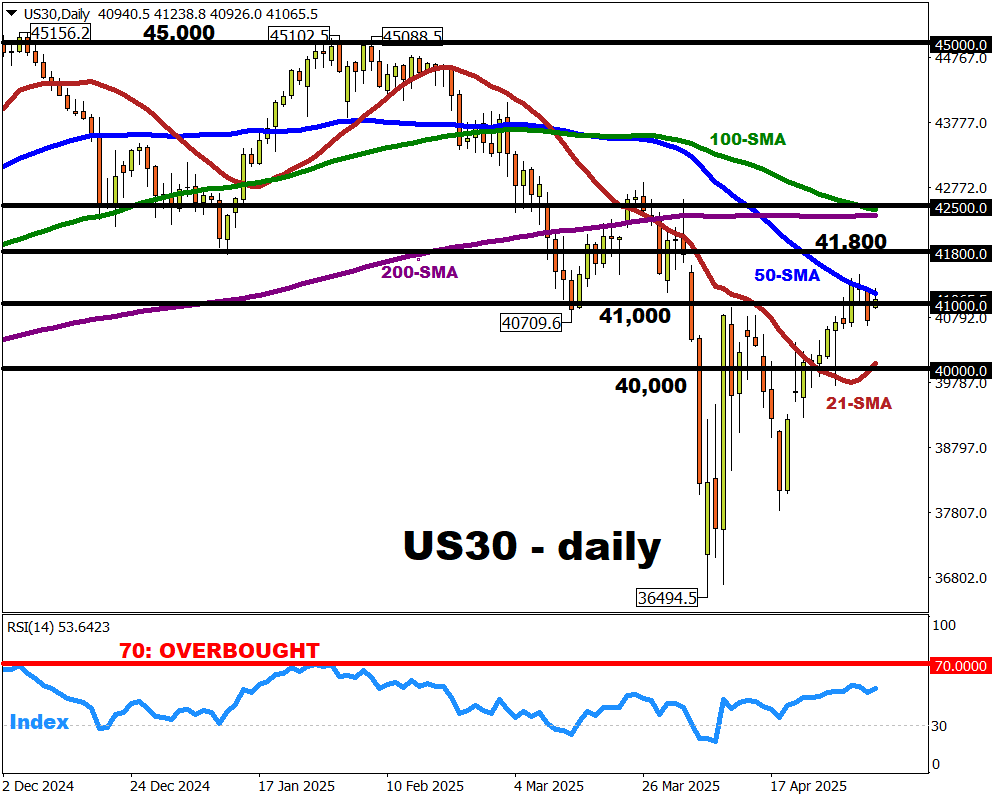
ForexTime Ltd (FXTM) is an award winning international online forex broker regulated by CySEC 185/12 www.forextime.com