Archive for Stock Market News – Page 13

Cutting marketing spending often backfires on businesses – new research could help investors distinguish shortsighted cuts from smart ones

By Andre Martin, University of Notre Dame  

Businesses are often tempted to cut their marketing budgets for the short-term savings it provides – but those cuts can cause problems in the long term. A new study my colleague Tarun Kushwaha and I published in The Journal of Marketing proposes a method for predicting whether these counterproductive cuts will take place up to a year in advance.

We gathered transcripts of nearly 25,000 earnings calls held by public companies from 2008 to 2019. We then analyzed how management teams discussed marketing and earnings. We found that the more earnings-oriented language was in a call — think words like “lucrative” or “revenues” — the more likely a management team was to cut their marketing budget for a boost in earnings.

Unlike business-as-usual budget shifts, the motive in these cases was to raise short-term earnings to gain personal profits – for example, to boost stock prices before an executive retires – to raise immediate funds, or to satisfy investor pressure and expectations. These cuts in exchange for a bump in earnings are shortsighted, since investing in marketing tends to grow a company’s market share over time.

Why it matters

Executives often feel pressured to meet short-term earnings targets at the expense of long-term goals, survey data and research have shown. Cutting costs is one way businesses make themselves look better in the short term. And since investing in marketing takes time to pay off, marketing spending often winds up on the chopping block.

My fellow marketing professors call these “myopic” marketing spending decisions – “myopic” being a fancy word for shortsighted. They often happen before initial public offerings, share repurchases and executive retirements.

While these myopic decisions have short-term benefits, they harm investors, customers and other stakeholders in the long term. After companies myopically cut marketing spending, they often lose market value; that’s why such cuts are linked with worse stock-market performance in the long run. A tool that helps investors identify myopic marketing spending would help them protect their portfolios from negative long-term consequences.

Our method isn’t just backward-looking – it can be used to forecast future shortsighted cuts to marketing spending. Investors could use it to analyze publicly available earnings-calls transcripts for useful data up to four times a year. We estimate that for every US$100 invested, using our method to avoid investing in shortsighted companies could return an additional $6.44 over four years compared with conventional methods. Marketing firms and advertising agencies could also use it to identify companies that plan to pare their marketing budgets.

What’s next

As part of our research efforts, my team has published the algorithm and data necessary to replicate our findings. This will let individual investors and other stakeholders gain valuable insights into executives’ intentions regarding the funding of their marketing and research departments.

While our research has primarily focused on transcribed text from earnings calls, we see more potential in analyzing the audio and video from these calls. Audio analysis could reveal insights from tone, pitch, pauses and filler words, while video analysis could capture the brief involuntary facial expressions known as micro-expressions.

The Research Brief is a short take on interesting academic work.The Conversation

About the Author:

Andre Martin, Assistant Professor of Marketing, University of Notre Dame

This article is republished from The Conversation under a Creative Commons license. Read the original article.

COT Stock Market Charts: Speculator Bets led by Russell-2000 & DowJones

By InvestMacro

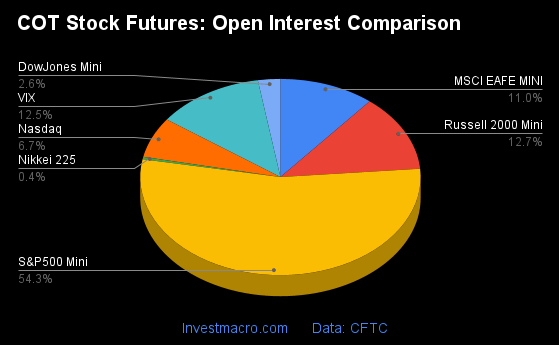
Here are the latest charts and statistics for the Commitment of Traders (COT) data published by the Commodities Futures Trading Commission (CFTC).

The latest COT data is updated through Tuesday July 16thand shows a quick view of how large traders (for-profit speculators and commercial entities) were positioned in the futures markets.

Weekly Speculator Bets led by Russell & DowJones

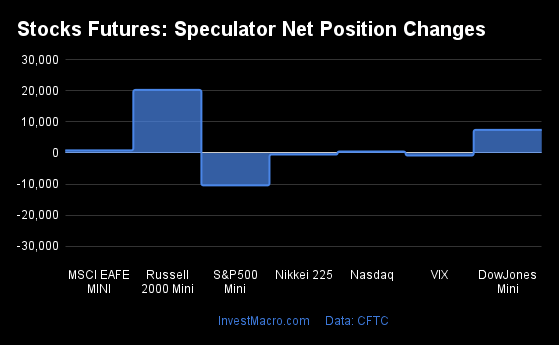
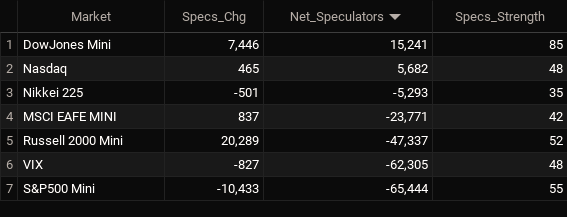
The COT stock markets speculator bets were higher this week as four out of the seven stock markets we cover had higher positioning while the other remaining markets had lower speculator contracts.

Leading the gains for the stock markets was the Russell-Mini (20,289 contracts) with the DowJones-Mini (7,446 contracts), the MSCI EAFE-Mini (837 contracts) and the Nasdaq-Mini (465 contracts) also showing positive weeks.

The markets with the declines in speculator bets this week were the S&P500-Mini (-10,433 contracts), the VIX (-827 contracts) and the Nikkei 225 (-501 contracts) also seeing lower bets on the week.


Stock Market Net Speculators Leaderboard

Legend: Weekly Speculators Change | Speculators Current Net Position | Speculators Strength Score compared to last 3-Years (0-100 range)


Strength Scores led by DowJones-Mini

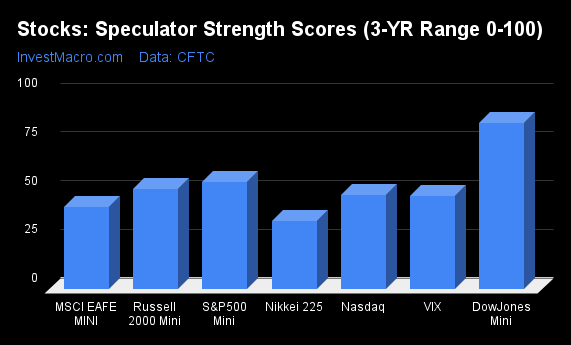
COT Strength Scores (a normalized measure of Speculator positions over a 3-Year range, from 0 to 100 where above 80 is Extreme-Bullish and below 20 is Extreme-Bearish) showed that the DowJones-Mini (85 percent) leads the stock markets this week. The S&P500-Mini (55 percent) and Russell-Mini (52 percent) come in as the next highest in the weekly strength scores.

On the downside, the Nikkei 225 (35 percent) comes in at the lowest strength level currently. The next lowest strength score is the MSCI EAFE-Mini (42 percent).

Strength Statistics:
VIX (47.7 percent) vs VIX previous week (48.6 percent)
S&P500-Mini (55.0 percent) vs S&P500-Mini previous week (56.5 percent)
DowJones-Mini (85.1 percent) vs DowJones-Mini previous week (73.0 percent)
Nasdaq-Mini (48.0 percent) vs Nasdaq-Mini previous week (47.2 percent)
Russell2000-Mini (51.5 percent) vs Russell2000-Mini previous week (37.1 percent)
Nikkei USD (35.0 percent) vs Nikkei USD previous week (39.3 percent)
EAFE-Mini (41.8 percent) vs EAFE-Mini previous week (40.9 percent)


DowJones-Mini & Nasdaq-Mini top the 6-Week Strength Trends

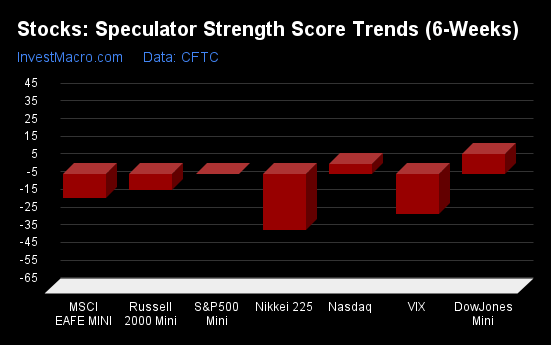
COT Strength Score Trends (or move index, calculates the 6-week changes in strength scores) showed that the DowJones-Mini (11 percent) leads the past six weeks trends for the stock markets. The Nasdaq-Mini (6 percent) is the next highest positive mover in the latest trends data.

The Nikkei 225 (-32 percent) leads the downside trend scores currently with the VIX (-23 percent) coming in as the next market with lower trend scores.

Strength Trend Statistics:
VIX (-22.8 percent) vs VIX previous week (-20.3 percent)
S&P500-Mini (-0.1 percent) vs S&P500-Mini previous week (-7.9 percent)
DowJones-Mini (11.3 percent) vs DowJones-Mini previous week (-8.7 percent)
Nasdaq-Mini (5.7 percent) vs Nasdaq-Mini previous week (13.9 percent)
Russell2000-Mini (-9.2 percent) vs Russell2000-Mini previous week (-24.0 percent)
Nikkei USD (-31.8 percent) vs Nikkei USD previous week (-26.9 percent)
EAFE-Mini (-13.8 percent) vs EAFE-Mini previous week (-0.2 percent)


Individual Stock Market Charts:

VIX Volatility Futures:

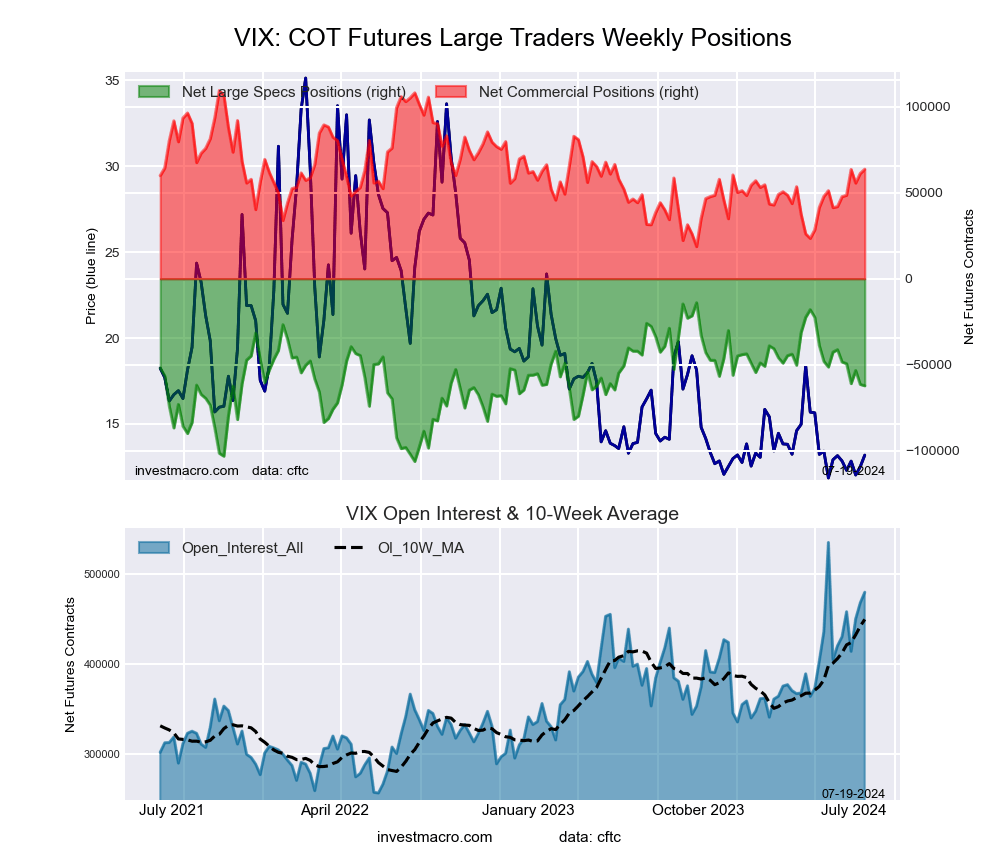
VIX Volatility Futures COT ChartThe VIX Volatility large speculator standing this week recorded a net position of -62,305 contracts in the data reported through Tuesday. This was a weekly lowering of -827 contracts from the previous week which had a total of -61,478 net contracts.

This week’s current strength score (the trader positioning range over the past three years, measured from 0 to 100) shows the speculators are currently Bearish with a score of 47.7 percent. The commercials are Bearish with a score of 49.6 percent and the small traders (not shown in chart) are Bullish-Extreme with a score of 86.3 percent.

Price Trend-Following Model: Weak Downtrend

Our weekly trend-following model classifies the current market price position as: Weak Downtrend. The current action for the model is considered to be: Hold – Maintain Short Position.

VIX Volatility Futures StatisticsSPECULATORSCOMMERCIALSSMALL TRADERS
– Percent of Open Interest Longs:18.350.05.7
– Percent of Open Interest Shorts:31.236.76.0
– Net Position:-62,30563,725-1,420
– Gross Longs:87,625240,03727,308
– Gross Shorts:149,930176,31228,728
– Long to Short Ratio:0.6 to 11.4 to 11.0 to 1
NET POSITION TREND:
– Strength Index Score (3 Year Range Pct):47.749.686.3
– Strength Index Reading (3 Year Range):BearishBearishBullish-Extreme
NET POSITION MOVEMENT INDEX:
– 6-Week Change in Strength Index:-22.823.9-3.5


S&P500 Mini Futures:

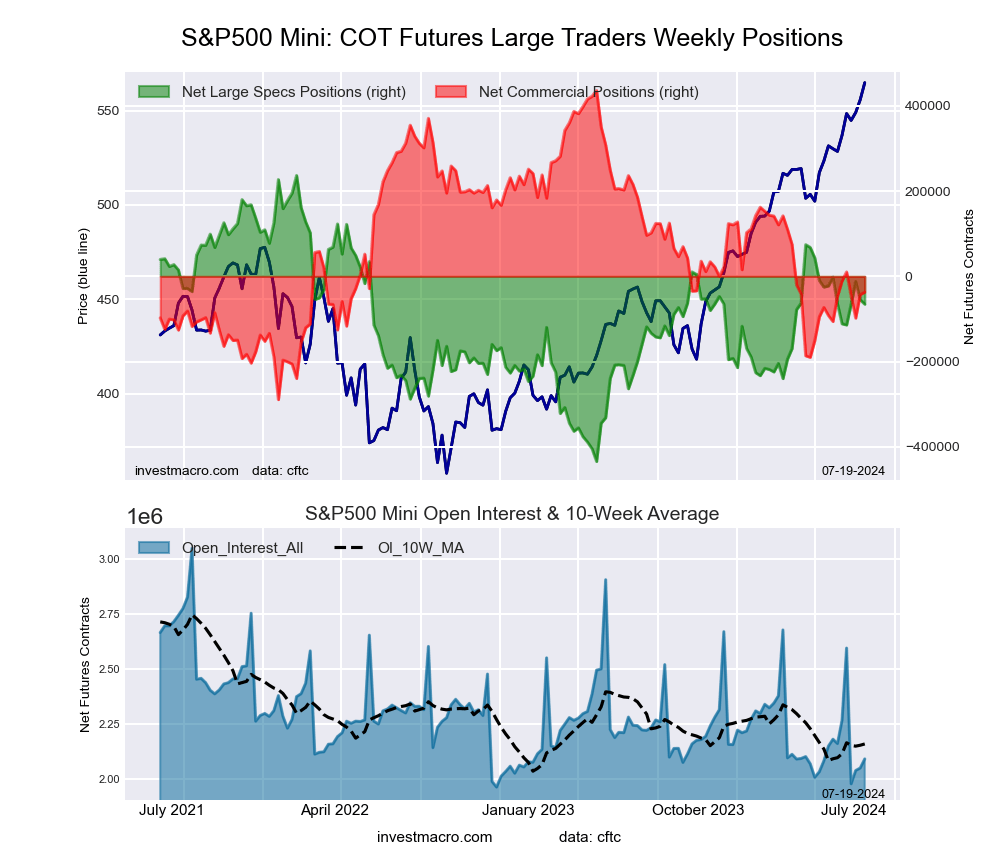
SP500 Mini Futures COT ChartThe S&P500 Mini large speculator standing this week recorded a net position of -65,444 contracts in the data reported through Tuesday. This was a weekly fall of -10,433 contracts from the previous week which had a total of -55,011 net contracts.

This week’s current strength score (the trader positioning range over the past three years, measured from 0 to 100) shows the speculators are currently Bullish with a score of 55.0 percent. The commercials are Bearish with a score of 34.8 percent and the small traders (not shown in chart) are Bullish with a score of 79.5 percent.

Price Trend-Following Model: Uptrend

Our weekly trend-following model classifies the current market price position as: Uptrend. The current action for the model is considered to be: Hold – Maintain Long Position.

S&P500 Mini Futures StatisticsSPECULATORSCOMMERCIALSSMALL TRADERS
– Percent of Open Interest Longs:16.069.412.9
– Percent of Open Interest Shorts:19.171.18.0
– Net Position:-65,444-37,170102,614
– Gross Longs:333,8661,449,475269,625
– Gross Shorts:399,3101,486,645167,011
– Long to Short Ratio:0.8 to 11.0 to 11.6 to 1
NET POSITION TREND:
– Strength Index Score (3 Year Range Pct):55.034.879.5
– Strength Index Reading (3 Year Range):BullishBearishBullish
NET POSITION MOVEMENT INDEX:
– 6-Week Change in Strength Index:-0.11.4-3.8


Dow Jones Mini Futures:

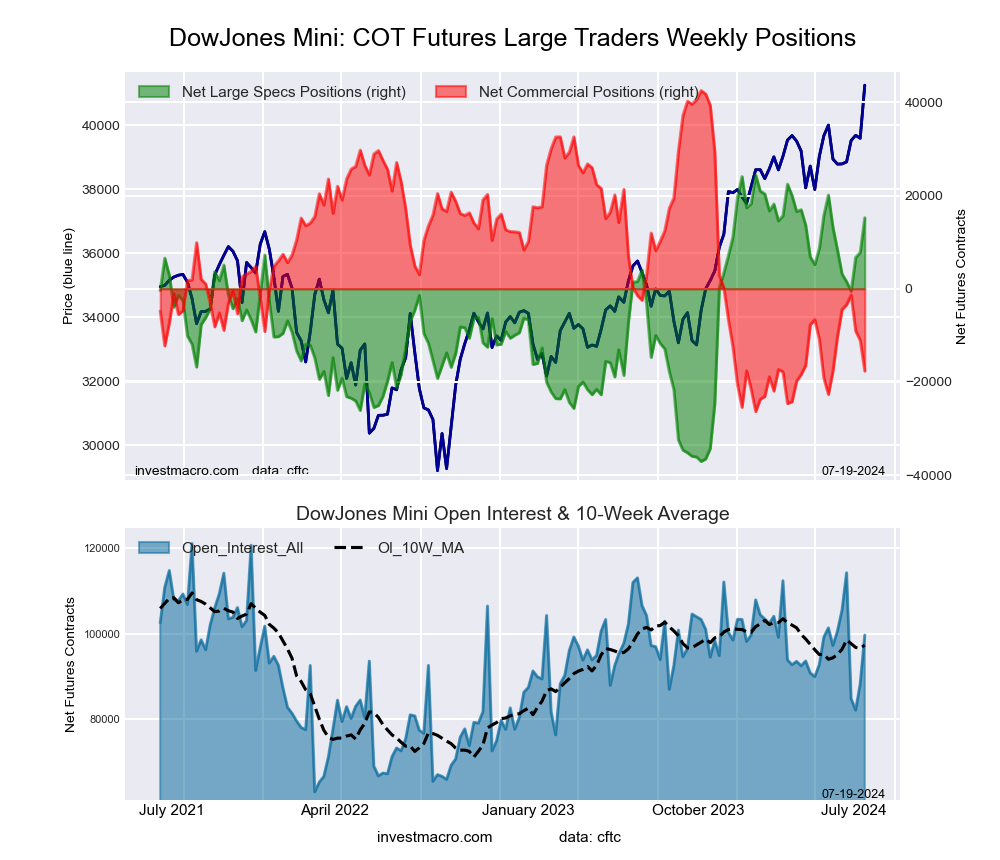
Dow Jones Mini Futures COT ChartThe Dow Jones Mini large speculator standing this week recorded a net position of 15,241 contracts in the data reported through Tuesday. This was a weekly gain of 7,446 contracts from the previous week which had a total of 7,795 net contracts.

This week’s current strength score (the trader positioning range over the past three years, measured from 0 to 100) shows the speculators are currently Bullish-Extreme with a score of 85.1 percent. The commercials are Bearish-Extreme with a score of 12.6 percent and the small traders (not shown in chart) are Bullish with a score of 60.1 percent.

Price Trend-Following Model: Strong Uptrend

Our weekly trend-following model classifies the current market price position as: Strong Uptrend. The current action for the model is considered to be: Hold – Maintain Long Position.

Dow Jones Mini Futures StatisticsSPECULATORSCOMMERCIALSSMALL TRADERS
– Percent of Open Interest Longs:30.750.415.0
– Percent of Open Interest Shorts:15.468.112.5
– Net Position:15,241-17,6612,420
– Gross Longs:30,56850,24414,925
– Gross Shorts:15,32767,90512,505
– Long to Short Ratio:2.0 to 10.7 to 11.2 to 1
NET POSITION TREND:
– Strength Index Score (3 Year Range Pct):85.112.660.1
– Strength Index Reading (3 Year Range):Bullish-ExtremeBearish-ExtremeBullish
NET POSITION MOVEMENT INDEX:
– 6-Week Change in Strength Index:11.3-10.82.7


Nasdaq Mini Futures:

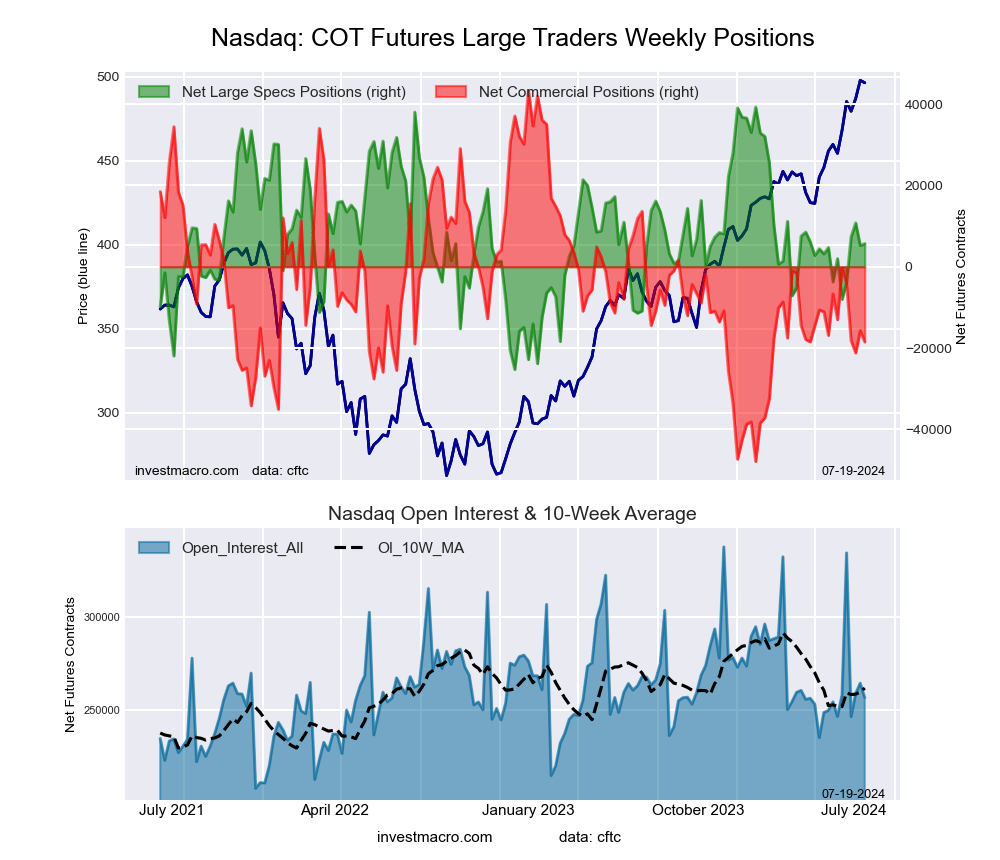
Nasdaq Mini Futures COT ChartThe Nasdaq Mini large speculator standing this week recorded a net position of 5,682 contracts in the data reported through Tuesday. This was a weekly lift of 465 contracts from the previous week which had a total of 5,217 net contracts.

This week’s current strength score (the trader positioning range over the past three years, measured from 0 to 100) shows the speculators are currently Bearish with a score of 48.0 percent. The commercials are Bearish with a score of 32.2 percent and the small traders (not shown in chart) are Bullish-Extreme with a score of 100.0 percent.

Price Trend-Following Model: Uptrend

Our weekly trend-following model classifies the current market price position as: Uptrend. The current action for the model is considered to be: Hold – Maintain Long Position.

Nasdaq Mini Futures StatisticsSPECULATORSCOMMERCIALSSMALL TRADERS
– Percent of Open Interest Longs:25.355.016.6
– Percent of Open Interest Shorts:23.162.211.6
– Net Position:5,682-18,50012,818
– Gross Longs:64,830141,02642,513
– Gross Shorts:59,148159,52629,695
– Long to Short Ratio:1.1 to 10.9 to 11.4 to 1
NET POSITION TREND:
– Strength Index Score (3 Year Range Pct):48.032.2100.0
– Strength Index Reading (3 Year Range):BearishBearishBullish-Extreme
NET POSITION MOVEMENT INDEX:
– 6-Week Change in Strength Index:5.7-6.04.3


Russell 2000 Mini Futures:

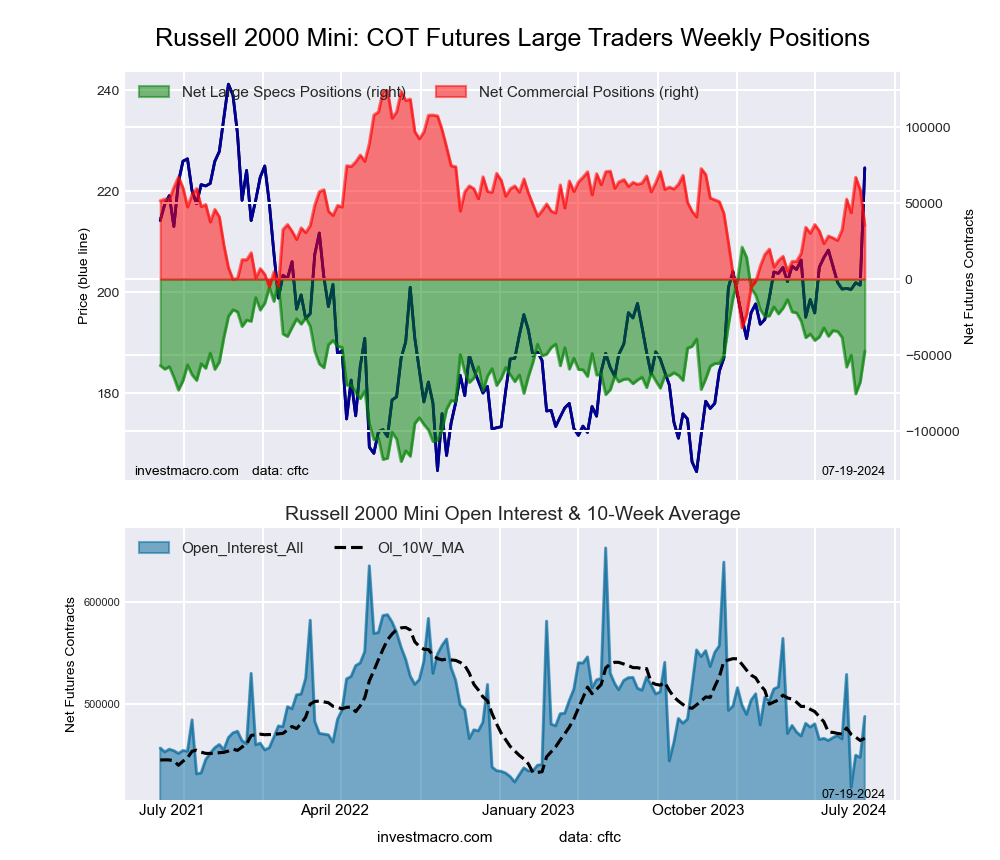
Russell 2000 Mini Futures COT ChartThe Russell 2000 Mini large speculator standing this week recorded a net position of -47,337 contracts in the data reported through Tuesday. This was a weekly rise of 20,289 contracts from the previous week which had a total of -67,626 net contracts.

This week’s current strength score (the trader positioning range over the past three years, measured from 0 to 100) shows the speculators are currently Bullish with a score of 51.5 percent. The commercials are Bearish with a score of 43.2 percent and the small traders (not shown in chart) are Bullish with a score of 69.3 percent.

Price Trend-Following Model: Strong Uptrend

Our weekly trend-following model classifies the current market price position as: Strong Uptrend. The current action for the model is considered to be: New Buy – Long Position.

Russell 2000 Mini Futures StatisticsSPECULATORSCOMMERCIALSSMALL TRADERS
– Percent of Open Interest Longs:18.472.77.3
– Percent of Open Interest Shorts:28.165.54.8
– Net Position:-47,33735,37311,964
– Gross Longs:89,656354,85835,432
– Gross Shorts:136,993319,48523,468
– Long to Short Ratio:0.7 to 11.1 to 11.5 to 1
NET POSITION TREND:
– Strength Index Score (3 Year Range Pct):51.543.269.3
– Strength Index Reading (3 Year Range):BullishBearishBullish
NET POSITION MOVEMENT INDEX:
– 6-Week Change in Strength Index:-9.26.310.4


Nikkei Stock Average (USD) Futures:

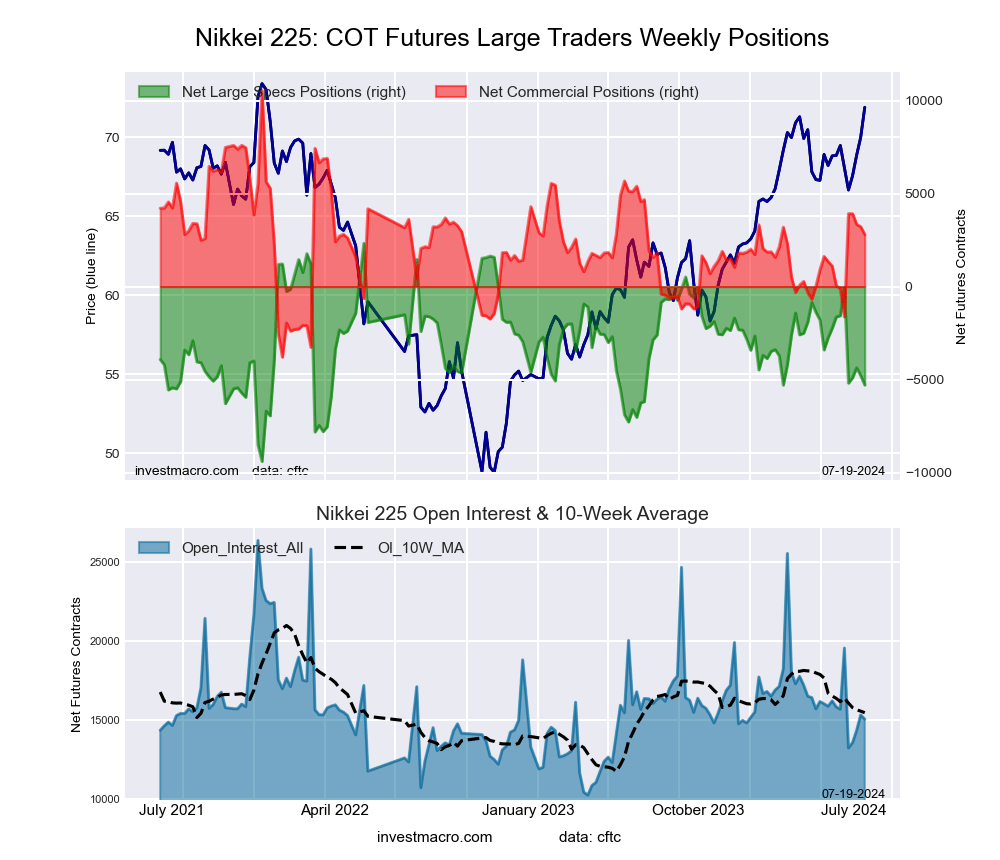
Nikkei Stock Average (USD) Futures COT ChartThe Nikkei Stock Average (USD) large speculator standing this week recorded a net position of -5,293 contracts in the data reported through Tuesday. This was a weekly decline of -501 contracts from the previous week which had a total of -4,792 net contracts.

This week’s current strength score (the trader positioning range over the past three years, measured from 0 to 100) shows the speculators are currently Bearish with a score of 35.0 percent. The commercials are Bearish with a score of 46.0 percent and the small traders (not shown in chart) are Bullish-Extreme with a score of 91.0 percent.

Price Trend-Following Model: Uptrend

Our weekly trend-following model classifies the current market price position as: Uptrend. The current action for the model is considered to be: Hold – Maintain Long Position

Nikkei Stock Average Futures StatisticsSPECULATORSCOMMERCIALSSMALL TRADERS
– Percent of Open Interest Longs:6.063.830.2
– Percent of Open Interest Shorts:41.245.313.6
– Net Position:-5,2932,7942,499
– Gross Longs:9019,6074,539
– Gross Shorts:6,1946,8132,040
– Long to Short Ratio:0.1 to 11.4 to 12.2 to 1
NET POSITION TREND:
– Strength Index Score (3 Year Range Pct):35.046.091.0
– Strength Index Reading (3 Year Range):BearishBearishBullish-Extreme
NET POSITION MOVEMENT INDEX:
– 6-Week Change in Strength Index:-31.820.415.5


MSCI EAFE Mini Futures:

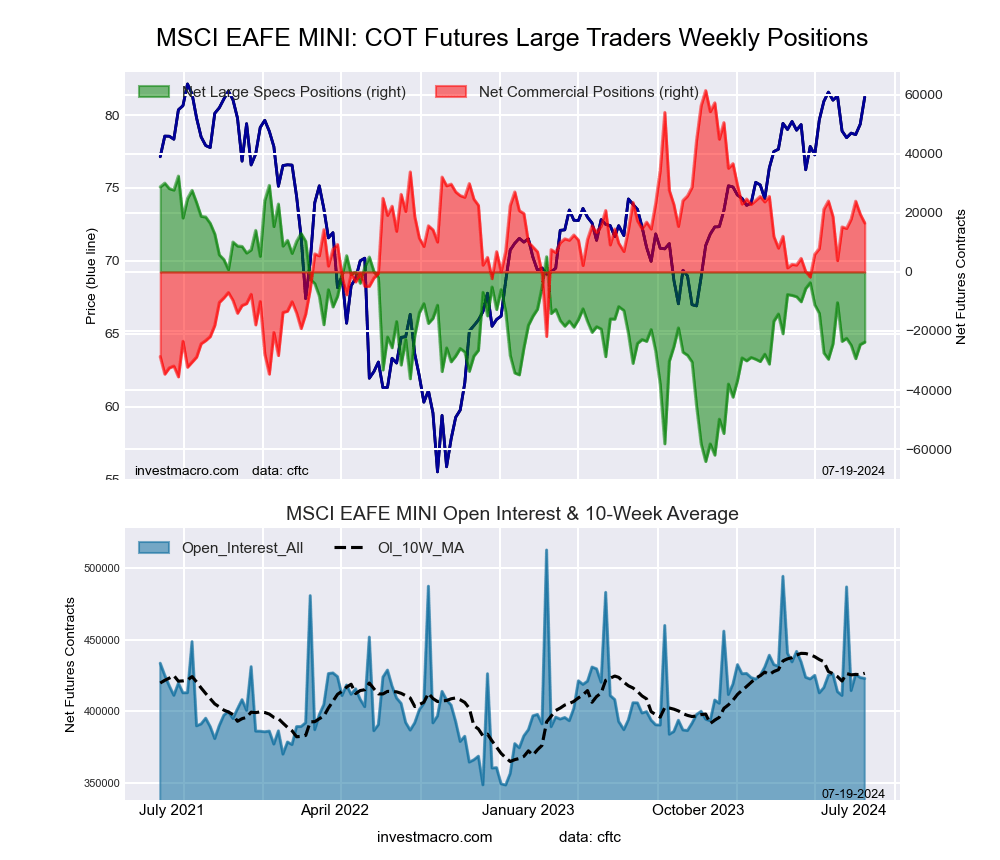
MSCI EAFE Mini Futures COT ChartThe MSCI EAFE Mini large speculator standing this week recorded a net position of -23,771 contracts in the data reported through Tuesday. This was a weekly increase of 837 contracts from the previous week which had a total of -24,608 net contracts.

This week’s current strength score (the trader positioning range over the past three years, measured from 0 to 100) shows the speculators are currently Bearish with a score of 41.8 percent. The commercials are Bullish with a score of 53.7 percent and the small traders (not shown in chart) are Bullish with a score of 53.0 percent.

Price Trend-Following Model: Uptrend

Our weekly trend-following model classifies the current market price position as: Uptrend. The current action for the model is considered to be: Hold – Maintain Long Position.

MSCI EAFE Mini Futures StatisticsSPECULATORSCOMMERCIALSSMALL TRADERS
– Percent of Open Interest Longs:7.788.73.2
– Percent of Open Interest Shorts:13.384.81.5
– Net Position:-23,77116,5457,226
– Gross Longs:32,588375,32713,605
– Gross Shorts:56,359358,7826,379
– Long to Short Ratio:0.6 to 11.0 to 12.1 to 1
NET POSITION TREND:
– Strength Index Score (3 Year Range Pct):41.853.753.0
– Strength Index Reading (3 Year Range):BearishBullishBullish
NET POSITION MOVEMENT INDEX:
– 6-Week Change in Strength Index:-13.813.13.2


Article By InvestMacroReceive our weekly COT Newsletter

*COT Report: The COT data, released weekly to the public each Friday, is updated through the most recent Tuesday (data is 3 days old) and shows a quick view of how large speculators or non-commercials (for-profit traders) were positioned in the futures markets.

The CFTC categorizes trader positions according to commercial hedgers (traders who use futures contracts for hedging as part of the business), non-commercials (large traders who speculate to realize trading profits) and nonreportable traders (usually small traders/speculators) as well as their open interest (contracts open in the market at time of reporting). See CFTC criteria here.

Week Ahead: Alphabet to kick-start Big Tech earnings

By ForexTime 

  • Alphabet ↑ 27% year-to-date
  • Pay close attention to updates on AI innovations
  • Technical levels = $183, $177 & $170 (Alphabet)
  • Tesla earnings also in focus, stocks ↑ 26% MTD

The week ahead is packed with high-impact data releases and a slew of corporate earnings from the largest companies in the world:

Monday, 22nd July

  • CN50: China loan prime rates
  • TWN: Taiwan jobless rate

Tuesday, 23rd July  

  • EU50: Eurozone consumer confidence
  • SG20: Singapore CPI
  • TWN: Taiwan industrial production
  • NAS100: Alphabet, Tesla earnings
  • FRA40: LVMH earnings

Wednesday, 24th July  

  • CAD: Bank of Canada rate decision
  • EU50: Eurozone, Germany PMI
  • UK100: UK S&P Global PMI
  • US30: IBM earnings, US S&P Global PMI
  • GER40: Deutsche Bank earnings

Thursday, 25th July

  • GER40: Germany IFO business climate
  • US500: US Q2 GDP, initial jobless claims
  • Bitcoin: Crypto 2024 conference in Nashville

Friday, 26th July

  • JP225: Japan Tokyo CPI
  • SG20: Singapore industrial production
  • USDInd: US June PCE report, University of Michigan consumer sentiment

Although earnings season is in full swing, the excitement levels could jump next week when big tech companies report their results. Expectations remain high around whether these AI giants can keep up the bullish momentum that has propelled US markets to record highs this year.

Two of the so-called “Magnificent” 7 tech titans will be under the spotlight.  Here’s what you need to know.

    1) Alphabet

Google parent company Alphabet reports its second-quarter earnings on Tuesday 23rd July after US markets close.

Its shares have gained 27% in 2024 thanks to investor hype around artificial intelligence translating to big gains in the tech space. Still, investors will be looking for another round of exceptional results to justify the solid gains fuelled by the A.I. frenzy.

Beyond the revenue growth and earnings-per-share, updates on AI innovations will be in focus.

Markets are forecasting a 5.8% move, either Up or Down, for Alphabet stocks post earnings.

Talking technicals, Alphabet stocks have shed roughly 6% this week with prices wobbling above the 50-day SMA. The past few days have been rough for tech stocks due to reports of the US mulling tougher restrictions on trading chips with China.

  • A solid breakdown below $177 may open a path towards $170.
  • Should the 50-day SMA prove reliable support, prices may retest $183 and $188.50.


    2) Tesla

Tesla is also set to release its second-quarter earnings on Tuesday after the close of US trading.

Despite gaining over 25% in July thanks to a strong delivery report, Tesla stocks are just barely in positive territory year-to-date. The company’s revenues, any mention of affordable vehicles, and the full self-driving software update will be scrutinized by investors to gauge its business outlook.

Quarterly revenues are seen slipping to $24.6 billion from $24.9 billion in the prior year, equating to a 1.2% decline.

Markets are forecasting an 8% move, either Up or Down, for Tesla stocks post-earnings.

Looking at the technical picture, Tesla stocks remain in a wide range on the daily charts with support at $232.50 and resistance at $270. Given the potential 8% move either up or down, a breakout could be on the horizon.


Forex-Time-LogoArticle by ForexTime

ForexTime Ltd (FXTM) is an award winning international online forex broker regulated by CySEC 185/12 www.forextime.com

What You Can Learn from Europe’s “Dow Theory”-esque Non-confirmation

By Brian Whitmer | European Financial Forecast editor

Charles Dow (yes, the one with the averages named after him) developed a foundational concept in technical analysis that requires that price movement in industrial stocks and transportation shares confirm one another.

The main condition for a Dow Theory non-confirmation occurs when one sector makes a new extreme absent the other. Its classic application is observing the position of the Dow Jones Industrial Average, an index of 30 “industrial” stocks, versus the position of the Dow Jones Transportation Average, an index of 20 “transportation” stocks. In essence, whenever one index fails to keep up with the other, in either direction, it suggests an impending reversal.

These concepts can be applied universally.

For example, right now over in Britain, the FTSE 100’s divergence with the FTSE 350 Transportation Index just pushed to 29 months.

Britain's Longest Nonconfirmation to Date

This is a far more prolonged Dow Theory non-confirmation than that seen in July 2007 (seven months) or December 1999 (17 months). In 1999, the FTSE 100 eventually collapsed 53%, while the FTSE 350 Transports fell 66%. In 2007, the resulting declines were 49% and 77%, respectively.

In our view, Britain’s prolonged non-confirmation makes sense given a host of investor psychology and other extremes we’ve been tracking, not just in Europe but around the globe. If you want to stay up-to-date on our findings regarding the position of stocks and bond markets, currencies and the broad economic trends, check out some of our free must-read issues on www.elliottwave.com.

UK100: Dips on sticky inflation data

By ForexTime

  • UK100 ↓ 1% post sticky CPI release
  • Probability of BoE rate cut in August drops to 40%
  • UK jobs data and retail sales in focus
  • UK100 index coils up in a falling wedge pattern
  • Key levels of interest include 8208.4, 8279.0, 8120, and 8083

FXTM’s UK100 declined on Wednesday after stickier-than-expected inflation data cooled bets around the BoE cutting rates next month.

The Consumer Prices Index (CPI) held at the BOE’s 2% target for a second month in June while services inflation was also unchanged at 5.7%. With CPI proving more stubborn than expected, Sterling jumped to a session high as bets for an August rate cut dropped to 40%.

Note: Over 80% of the revenues from FTSE100 companies come from outside of the UK. Meaning, that an appreciating pound results in lower revenues for those companies – weighing on the UK100 as a result. The same is true vice versa.

More volatility could be on the horizon for the UK100 due to the incoming jobs report on Thursday and retail sales on Friday. It is worth keeping in mind that, over the past year, the UK jobs report has triggered upside moves of as much as 0.6% or declines of 1.2% in a 6-hour window post-release.

Technically speaking, UK100, daily is seen consolidating into a falling wedge pattern, (a sideways movement in price bounded by two downward-sloping converging lines).

According to Thomas Bulkowski’s book Encyclopedia of Chart Patterns, price (in a falling wedge pattern) can break out either upward or downward but is usually upward.

The index bulls (those looking to see the index rally) may observe the following near-term resistance levels;

  • 8208.4 – The 21-day simple moving average
  • 8265.2 – The 50-day simple moving average
  • 8279.0 – The upper bound trend line of the falling wedge pattern
  • 8320 –  A significant round number level.

UK 100 bears on the other hand may have their sights on the following near-term support levels

  • 8120 – An important price level
  • 8083 – The lower bound trend line of the falling wedge pattern


Forex-Time-LogoArticle by ForexTime

ForexTime Ltd (FXTM) is an award winning international online forex broker regulated by CySEC 185/12 www.forextime.com

ASML earnings preview: Set for fresh all-time highs?

By ForexTime 

  • ASML ↑ over 40% year-to-date
  • Shares could move 5.7% % ↑ or ↓ post-earnings
  • Machinery bookings & forward guidance in focus
  • Technical levels – 1120 and 1000

Shares of ASML have been on a tear this year, surpassing the $1000 and 1000 milestone across both exchanges.

Note: ASML shares can be traded on the Euronext Amsterdam and Nasdaq exchanges. 

Its position as the world’s leading manufacturer of chip-making equipment has allowed it to benefit from the A.I. frenzy with shares up over 40% year-to-date.

Prices could push higher depending on how investors react to the latest earnings report.

  • When will earnings be published?

ASML will report its earnings for the second quarter before US markets open on Wednesday 17th July.

  • Market expectations:

The company is expected to post earnings of €3.74 compared to €4.93 a year ago.

Quarterly revenues are seen falling to €6 billion from €6.9 billion in the prior year – equating to a 13% decline.

  • Why is this important?

As a leading manufacturer of chip-making equipment, its earnings and forward guidance may serve as a gauge for the AI hype.

In the first quarter, ASML disappointed investors with revenues declining by 21% year-over-year to €5.3 billion. While sales are expected to fall in Q2, much focus will be on net machinery bookings which are estimated to be around €4.56 billion. Still, growing demand for AI Chips may translate to a significant increase in new orders.

  • Potential challenges…

China is ASML’s biggest market, accounting for 49% of total sales in the first quarter of 2024.

However, this may be impacted by Dutch licensing requirements and US export restrictions. A noticeable decline in total sales in China may weigh on the business outlook.

  • How will ASML react to earnings?

Markets are forecasting a 5.7% move, either Up or Down, for ASML stocks on Wednesday post earnings.

  • What does this mean for prices?

A 5.7% move up from $1062 will take ASML shares to fresh all-time highs beyond $1120.  

While a 5.7% move down will send prices back towards the psychological $1000 level.

  • Keep an eye on TSMC’s earnings

Watch out for Taiwan Semiconductor Manufacturing Company (TSMC) which is due to release its earnings on Thursday 18th July. 

TSMC accounts for 28% of ASML’s revenue, so better-than-expected earnings from TSMC may boost ASML’s shares and vice versa.

  • Technical picture

Prices are firmly bullish on the daily charts as there have been consistently higher highs and higher lows.

  • A solid set of earnings and forward guidance that satisfies investors could push prices to all-time highs beyond 1120.
  • If the manufacturer of chipmakers disappoints, prices could slip back towards the 1000 psychological level.


Forex-Time-LogoArticle by ForexTime

ForexTime Ltd (FXTM) is an award winning international online forex broker regulated by CySEC 185/12 www.forextime.com

Will a market crash one day be pinned on the Supreme Court? An accounting expert explains why recent rulings have him worried

By Paul Griffin, University of California, Davis 

In two major rulings this past month, the U.S. Supreme Court curtailed the authority of federal agencies to draft and enforce policies that affect the nation’s financial health. One important agency, the Securities and Exchange Commission, took a particularly big hit.

Speaking as someone who has researched financial shenanigans for almost 50 years, I’m concerned that these rulings will backfire on markets and investors.

Taken together, they could lead to watered-down regulations, weakened enforcement and less oversight of the nation’s financial markets and public companies. I fear that they could ultimately be a significant factor in a future market crash.

In one case, Securities and Exchange Commission v. Jarkesy, the court rebuked the SEC — the agency that protects investors from fraud — for using in-house proceedings to discipline firms and others for breaking securities laws. Now, the SEC will need to bring accused securities fraudsters to federal court, which could be more complicated and expensive.

And in the other case, Loper Bright Enterprises v. Raimondo, the court cut back sharply on a long-standing doctrine — the Chevron rule — that gave agencies considerable freedom to craft rules and regulations, particularly when the underlying law might be ambiguous. As a result, federal agencies, including the SEC, have less power to act, ceding that power to lengthier and costlier trial proceedings.

More layers of hidden risk for investors

Both decisions could affect the nation’s financial well-being. Investors who rely on the disclosure rules and the enforcement mechanisms of the SEC for protection – now subject to legal challenge – are about to be saddled with an extra layer of hidden risk not seen in decades – in particular, more questionable accounting practices in their regulatory filings.

Recall that in 1933 and 1934, Congress established the SEC in the aftermath of the Great Depression. What followed in the ensuing years was the formation of less risky and more informed markets.

Investors could also rely on market prices to efficiently and unbiasedly reflect all public information, rather than have to pore over complex financial statements. This led to the U.S. markets becoming the most attractive destination in the world for funds to invest in risky business projects.

The SEC later bolstered financial markets with measures under the Dodd-Frank Act of 2010 to rectify other excesses — such as overly generous credit ratings — that arguably contributed to the 2007–2008 Great Recession. Today, thanks to extensive disclosure requirements and relatively efficient enforcement mechanisms, the U.S. has perhaps the healthiest and most robust financial markets ever.

A new challenge to enforcement

Healthy and robust financial markets don’t operate out of altruism, however.

Monitoring and enforcement mechanisms are pivotal. While the SEC relies partly on the private sector to spot and discipline errant managers for violations of the securities laws – for example, through federal and state securities class action litigation – much of the effort relies on the enforcement division of the SEC.

In particular, the SEC uses “accounting and auditing enforcement releases,” or AAERs, to ensure that firms keep a clean set of books. Since 1995, the SEC has issued 3,266 AAERs, mostly to correct accounting and auditing deficiencies in company financial statements. Numerous studies confirm AAERs as evidence of financial fraud.

AAERs are also a highly efficient form of enforcement — and much less costly than a private securities class action lawsuit. Companies generally agree to settle the allegations of wrongdoing without admission of liability by taking timely steps to improve accounting and auditing and paying fines and penalties.

The payments have been substantial. For example, for 760 enforcement actions in 2022, companies paid as much as US$6.4 billion to the SEC. The announcement of an AAER action is also costly for the firm’s shareholders, with stock prices falling 50% over the next six months following an AAER announcement, according to researchers.

But the Jarkesy ruling could change everything. I don’t see why any publicly traded company would agree to settle an AAER action with fines and sanctions now that it can challenge the SEC’s arguments in a court of law.

The danger of enforcement by courts

What might be the result of removing or paring back the SEC’s key tool of enforcement?

The risk is possibly reverting to an environment like 1928 or 2007. That’s because the ruling will effectively reduce the cost of accounting or auditing violations for would-be or actual violators. It shifts the purview of deciding penalties and fines to the courts rather than in-house proceedings by the SEC, increasing the cost of enforcement to the SEC.

In short, companies will worry less about a future AAER investigation.

In addition, despite auditors’ efforts to ensure that publicly traded financial and investment firms keep a clean set of books based on generally accepted accounting principles, or GAAP, there is still much room for choice, including greater use of non-GAAP accounting rules. With less enforcement, the Jarkesy ruling will encourage more creative accounting, not less.

That creativity already skews toward optimistic earnings reports. The vast majority of earnings releases now exceed analysts’ forecasts — 77% for the S&P 500 in the first quarter of 2024. Moreover, my own research indicates that it’s not just that earning reports exceed analysts’ forecasts, but the dollar size of firms’ positive earnings surprises has grown steadily over the past decade, which is another hidden risk.

Less scrutiny, more long-term risks

Some securities lawyers say the Jarkesy decision won’t change the SEC’s behavior, since the agency has increasingly shifted proceedings to regular courts.

While that’s true for some actions, I think the largest impact will lie in SEC actions not yet undertaken. Businesses and the SEC will act differently in the future because Jarkesy makes SEC enforcement activity more expensive and more uncertain.

Expect more efforts by firms to present their financial performance in the most glowing terms possible, knowing that the cost of SEC enforcement has just increased and the detection likelihood and expected cost to a firm of violating generally accepted accounting principles or generally accepted auditing standards has just decreased.

While not all scholars agree, there are two major periods in the financial history of the United States when a financial meltdown occurred that was in part plausibly due to shoddy accounting and reporting – the Great Depression of 1929 and the Great Recession of 2007–2009.

In the years or decades ahead, should the country face another serious financial crisis leading to a recession, it will be harder to blame the accountants and investment bankers. Instead, attention may turn to two mid-2024 court decisions and the justices who wrote them.The Conversation

About the Author:

Paul Griffin, Distinguished Emeritus Professor of Management, University of California, Davis

This article is republished from The Conversation under a Creative Commons license. Read the original article.

COT Stock Market Charts: Speculator bets led by Russell 2000 & MSCI EAFE

By InvestMacro

Here are the latest charts and statistics for the Commitment of Traders (COT) data published by the Commodities Futures Trading Commission (CFTC).

The latest COT data is updated through Tuesday July 9th and shows a quick view of how large traders (for-profit speculators and commercial entities) were positioned in the futures markets.

Weekly Speculator Changes led by Russell-Mini & MSCI EAFE-Mini

The COT stock markets speculator bets were higher this week as four out of the seven stock markets we cover had higher positioning while the other three markets had lower speculator contracts.

Leading the gains for the stock markets was the Russell-Mini (7,809 contracts) with the MSCI EAFE-Mini (4,742 contracts) and the DowJones-Mini (1,067 contracts) also showing positive weeks.

The markets with the declines in speculator bets this week were the S&P500-Mini (-43,203 contracts), the VIX (-8,053 contracts), the Nasdaq-Mini (-5,559 contracts) and the Nikkei 225 (-423 contracts) also having lower bets on the week.


Stock Market Net Speculators Leaderboard

Legend: Weekly Speculators Change | Speculators Current Net Position | Speculators Strength Score compared to last 3-Years (0-100 range)


Strength Scores led by DowJones-Mini & S&P500-Mini

COT Strength Scores (a normalized measure of Speculator positions over a 3-Year range, from 0 to 100 where above 80 is Extreme-Bullish and below 20 is Extreme-Bearish) showed that the DowJones-Mini (73 percent) and the S&P500-Mini (57 percent) lead the stock markets this week. The VIX (49 percent) comes in as the next highest in the weekly strength scores.

On the downside, the Russell-Mini (37 percent) comes in at the lowest strength level currently and is in Extreme-Bearish territory (below 20 percent). The next lowest strength score is the Nikkei 225 (39 percent).

Strength Statistics:
VIX (48.6 percent) vs VIX previous week (57.3 percent)
S&P500-Mini (56.5 percent) vs S&P500-Mini previous week (63.0 percent)
DowJones-Mini (73.0 percent) vs DowJones-Mini previous week (71.2 percent)
Nasdaq-Mini (47.2 percent) vs Nasdaq-Mini previous week (55.9 percent)
Russell2000-Mini (37.1 percent) vs Russell2000-Mini previous week (31.6 percent)
Nikkei USD (39.3 percent) vs Nikkei USD previous week (42.9 percent)
EAFE-Mini (40.9 percent) vs EAFE-Mini previous week (36.0 percent)


Nasdaq-Mini tops the 6-Week Strength Trends

COT Strength Score Trends (or move index, calculates the 6-week changes in strength scores) showed that the Nasdaq-Mini (14 percent) leads the past six weeks trends and is the only market with a positive reading for the stock markets.

The Nikkei 225 (-27 percent) leads the downside trend scores currently with the Russell-Mini (-24 percent) coming in as the next market with lower trend scores.

Strength Trend Statistics:
VIX (-20.3 percent) vs VIX previous week (-2.2 percent)
S&P500-Mini (-7.9 percent) vs S&P500-Mini previous week (1.6 percent)
DowJones-Mini (-8.7 percent) vs DowJones-Mini previous week (-21.8 percent)
Nasdaq-Mini (13.9 percent) vs Nasdaq-Mini previous week (9.4 percent)
Russell2000-Mini (-24.0 percent) vs Russell2000-Mini previous week (-26.9 percent)
Nikkei USD (-26.9 percent) vs Nikkei USD previous week (-18.1 percent)
EAFE-Mini (-0.2 percent) vs EAFE-Mini previous week (0.2 percent)


Individual Stock Market Charts:

VIX Volatility Futures:

The VIX Volatility large speculator standing this week totaled a net position of -61,478 contracts in the data reported through Tuesday. This was a weekly reduction of -8,053 contracts from the previous week which had a total of -53,425 net contracts.

This week’s current strength score (the trader positioning range over the past three years, measured from 0 to 100) shows the speculators are currently Bearish with a score of 48.6 percent. The commercials are Bearish with a score of 46.8 percent and the small traders (not shown in chart) are Bullish-Extreme with a score of 94.6 percent.

Price Trend-Following Model: Downtrend

Our weekly trend-following model classifies the current market price position as: Downtrend. The current action for the model is considered to be: Hold – Maintain Short Position.

VIX Volatility Futures StatisticsSPECULATORSCOMMERCIALSSMALL TRADERS
– Percent of Open Interest Longs:18.847.36.1
– Percent of Open Interest Shorts:31.934.26.1
– Net Position:-61,47861,231247
– Gross Longs:87,842221,43028,736
– Gross Shorts:149,320160,19928,489
– Long to Short Ratio:0.6 to 11.4 to 11.0 to 1
NET POSITION TREND:
– Strength Index Score (3 Year Range Pct):48.646.894.6
– Strength Index Reading (3 Year Range):BearishBearishBullish-Extreme
NET POSITION MOVEMENT INDEX:
– 6-Week Change in Strength Index:-20.321.8-5.4


S&P500 Mini Futures:

SP500 Mini Futures COT ChartThe S&P500 Mini large speculator standing this week totaled a net position of -55,011 contracts in the data reported through Tuesday. This was a weekly lowering of -43,203 contracts from the previous week which had a total of -11,808 net contracts.

This week’s current strength score (the trader positioning range over the past three years, measured from 0 to 100) shows the speculators are currently Bullish with a score of 56.5 percent. The commercials are Bearish with a score of 34.0 percent and the small traders (not shown in chart) are Bullish with a score of 77.7 percent.

Price Trend-Following Model: Strong Uptrend

Our weekly trend-following model classifies the current market price position as: Strong Uptrend. The current action for the model is considered to be: Hold – Maintain Long Position.

S&P500 Mini Futures StatisticsSPECULATORSCOMMERCIALSSMALL TRADERS
– Percent of Open Interest Longs:15.170.013.0
– Percent of Open Interest Shorts:17.872.18.2
– Net Position:-55,011-43,07898,089
– Gross Longs:309,7581,434,315266,655
– Gross Shorts:364,7691,477,393168,566
– Long to Short Ratio:0.8 to 11.0 to 11.6 to 1
NET POSITION TREND:
– Strength Index Score (3 Year Range Pct):56.534.077.7
– Strength Index Reading (3 Year Range):BullishBearishBullish
NET POSITION MOVEMENT INDEX:
– 6-Week Change in Strength Index:-7.98.7-4.1


Dow Jones Mini Futures:

Dow Jones Mini Futures COT ChartThe Dow Jones Mini large speculator standing this week totaled a net position of 7,795 contracts in the data reported through Tuesday. This was a weekly boost of 1,067 contracts from the previous week which had a total of 6,728 net contracts.

This week’s current strength score (the trader positioning range over the past three years, measured from 0 to 100) shows the speculators are currently Bullish with a score of 73.0 percent. The commercials are Bearish with a score of 22.2 percent and the small traders (not shown in chart) are Bullish with a score of 64.5 percent.

Price Trend-Following Model: Strong Uptrend

Our weekly trend-following model classifies the current market price position as: Strong Uptrend. The current action for the model is considered to be: Hold – Maintain Long Position.

Dow Jones Mini Futures StatisticsSPECULATORSCOMMERCIALSSMALL TRADERS
– Percent of Open Interest Longs:25.355.215.3
– Percent of Open Interest Shorts:16.467.711.6
– Net Position:7,795-11,0613,266
– Gross Longs:22,31748,73713,525
– Gross Shorts:14,52259,79810,259
– Long to Short Ratio:1.5 to 10.8 to 11.3 to 1
NET POSITION TREND:
– Strength Index Score (3 Year Range Pct):73.022.264.5
– Strength Index Reading (3 Year Range):BullishBearishBullish
NET POSITION MOVEMENT INDEX:
– 6-Week Change in Strength Index:-8.79.6-6.5


Nasdaq Mini Futures:

Nasdaq Mini Futures COT ChartThe Nasdaq Mini large speculator standing this week totaled a net position of 5,217 contracts in the data reported through Tuesday. This was a weekly fall of -5,559 contracts from the previous week which had a total of 10,776 net contracts.

This week’s current strength score (the trader positioning range over the past three years, measured from 0 to 100) shows the speculators are currently Bearish with a score of 47.2 percent. The commercials are Bearish with a score of 35.3 percent and the small traders (not shown in chart) are Bullish-Extreme with a score of 95.5 percent.

Price Trend-Following Model: Strong Uptrend

Our weekly trend-following model classifies the current market price position as: Strong Uptrend. The current action for the model is considered to be: Hold – Maintain Long Position.

Nasdaq Mini Futures StatisticsSPECULATORSCOMMERCIALSSMALL TRADERS
– Percent of Open Interest Longs:25.156.116.1
– Percent of Open Interest Shorts:23.162.012.1
– Net Position:5,217-15,71910,502
– Gross Longs:66,337148,25742,436
– Gross Shorts:61,120163,97631,934
– Long to Short Ratio:1.1 to 10.9 to 11.3 to 1
NET POSITION TREND:
– Strength Index Score (3 Year Range Pct):47.235.395.5
– Strength Index Reading (3 Year Range):BearishBearishBullish-Extreme
NET POSITION MOVEMENT INDEX:
– 6-Week Change in Strength Index:13.9-9.90.2


Russell 2000 Mini Futures:

Russell 2000 Mini Futures COT ChartThe Russell 2000 Mini large speculator standing this week totaled a net position of -67,626 contracts in the data reported through Tuesday. This was a weekly rise of 7,809 contracts from the previous week which had a total of -75,435 net contracts.

This week’s current strength score (the trader positioning range over the past three years, measured from 0 to 100) shows the speculators are currently Bearish with a score of 37.1 percent. The commercials are Bullish with a score of 58.2 percent and the small traders (not shown in chart) are Bullish with a score of 58.8 percent.

Price Trend-Following Model: Weak Downtrend

Our weekly trend-following model classifies the current market price position as: Weak Downtrend. The current action for the model is considered to be: Hold – Maintain Short Position.

Russell 2000 Mini Futures StatisticsSPECULATORSCOMMERCIALSSMALL TRADERS
– Percent of Open Interest Longs:12.479.66.1
– Percent of Open Interest Shorts:27.566.54.1
– Net Position:-67,62658,7898,837
– Gross Longs:55,367356,46027,196
– Gross Shorts:122,993297,67118,359
– Long to Short Ratio:0.5 to 11.2 to 11.5 to 1
NET POSITION TREND:
– Strength Index Score (3 Year Range Pct):37.158.258.8
– Strength Index Reading (3 Year Range):BearishBullishBullish
NET POSITION MOVEMENT INDEX:
– 6-Week Change in Strength Index:-24.020.46.8


Nikkei Stock Average (USD) Futures:

Nikkei Stock Average (USD) Futures COT ChartThe Nikkei Stock Average (USD) large speculator standing this week totaled a net position of -4,792 contracts in the data reported through Tuesday. This was a weekly decrease of -423 contracts from the previous week which had a total of -4,369 net contracts.

This week’s current strength score (the trader positioning range over the past three years, measured from 0 to 100) shows the speculators are currently Bearish with a score of 39.3 percent. The commercials are Bearish with a score of 48.9 percent and the small traders (not shown in chart) are Bullish with a score of 65.4 percent.

Price Trend-Following Model: Weak Downtrend

Our weekly trend-following model classifies the current market price position as: Weak Downtrend. The current action for the model is considered to be: Hold – Maintain Short Position.

Nikkei Stock Average Futures StatisticsSPECULATORSCOMMERCIALSSMALL TRADERS
– Percent of Open Interest Longs:6.065.528.5
– Percent of Open Interest Shorts:37.344.518.2
– Net Position:-4,7923,2181,574
– Gross Longs:92510,0304,358
– Gross Shorts:5,7176,8122,784
– Long to Short Ratio:0.2 to 11.5 to 11.6 to 1
NET POSITION TREND:
– Strength Index Score (3 Year Range Pct):39.348.965.4
– Strength Index Reading (3 Year Range):BearishBearishBullish
NET POSITION MOVEMENT INDEX:
– 6-Week Change in Strength Index:-26.922.1-0.2


MSCI EAFE Mini Futures:

MSCI EAFE Mini Futures COT ChartThe MSCI EAFE Mini large speculator standing this week totaled a net position of -24,608 contracts in the data reported through Tuesday. This was a weekly lift of 4,742 contracts from the previous week which had a total of -29,350 net contracts.

This week’s current strength score (the trader positioning range over the past three years, measured from 0 to 100) shows the speculators are currently Bearish with a score of 40.9 percent. The commercials are Bullish with a score of 57.1 percent and the small traders (not shown in chart) are Bearish with a score of 42.1 percent.

Price Trend-Following Model: Strong Uptrend

Our weekly trend-following model classifies the current market price position as: Strong Uptrend. The current action for the model is considered to be: Hold – Maintain Long Position.

MSCI EAFE Mini Futures StatisticsSPECULATORSCOMMERCIALSSMALL TRADERS
– Percent of Open Interest Longs:7.389.43.0
– Percent of Open Interest Shorts:13.184.81.8
– Net Position:-24,60819,5685,040
– Gross Longs:31,004378,66512,714
– Gross Shorts:55,612359,0977,674
– Long to Short Ratio:0.6 to 11.1 to 11.7 to 1
NET POSITION TREND:
– Strength Index Score (3 Year Range Pct):40.957.142.1
– Strength Index Reading (3 Year Range):BearishBullishBearish
NET POSITION MOVEMENT INDEX:
– 6-Week Change in Strength Index:-0.20.8-2.9


Article By InvestMacroReceive our weekly COT Newsletter

*COT Report: The COT data, released weekly to the public each Friday, is updated through the most recent Tuesday (data is 3 days old) and shows a quick view of how large speculators or non-commercials (for-profit traders) were positioned in the futures markets.

The CFTC categorizes trader positions according to commercial hedgers (traders who use futures contracts for hedging as part of the business), non-commercials (large traders who speculate to realize trading profits) and nonreportable traders (usually small traders/speculators) as well as their open interest (contracts open in the market at time of reporting). See CFTC criteria here.

Spain vs. England: Stock indexes hint at Euro 2024 winners?

By ForexTime 

SPN35 index has risen 9.8% so far this year

  • UK100 index has risen 6.2% so far this year
  • Markets predict SPN35 can climb another 18.7% within 12 months
  • Markets predict UK100 can climb another 14.4% within 12 months
  • Spain favoured to beat England in Euro 2024 final

England and Spain are set to battle it out for Europe’s footballing crown this Sunday, July 14th.

In the lead up to this highly-anticipated football contest, we take the opportunity to compare how their respective stock markets have fared so far this year.


First, here are some basics about stock indexes.

What is a stock index?

Imagine a stock index to be a basket of stocks.

This index measures the combined performance of the stocks within that “basket”.

Hence, the index’s price should rise when the prices of the stocks in that basket are moving higher, and vice versa.

What is the SPN35 index?

FXTM’s SPN35 index tracks the performance of the IBEX 35 index.

The IBEX measures the combined performance of the 35 most-liquid stocks traded on the Spanish Continuous exchange.

This index includes big names such as Inditex (one of the world’s largest fashion retailers which owns brands such as Zara, Pull & Bear, and Massimo Dutti), energy giant Iberdrola, and Banco Santander one of the EU’s largest banks by market value.


What is the UK100 index?

FXTM’s UK100 index tracks the performance of the FTSE 100 index.

The FTSE 100 measures the combined performance of the 100 largest companies listed on the London Stock Exchange, including global names such as AstraZeneca, Shell, HSBC, Unilever, and BP.


Although these men’s national football teams will do battle at the summit, the stock markets tell a different story.

Despite their footballing conquests, neither Spain’s nor England’s benchmark stock indexes are at the top of the continental heap.

Here’s how FXTM’s European stock indices have performed so far in 2024:

  • NETH25: +19.8%
  • EU50: +10%
  • GER40: +10%
  • SPN35: +9.8%
  • UK100: +6.2%
  • FRA40: +0.9%

And when stacked against their global peers, European stock indices have mostly lagged their US and Asian peers year to date:

  • TWN: +31%
  • JP225: +26.2%
  • NAS100: +22.9%
  • US500: +18.1%


Still, if making the comparison solely between the two Euro 2024 finalists’ benchmark stock indexes, there’s one clear winner.

The SPN35 index has outperformed the UK100 index so far in 2024.

And this outperformance is forecasted to extend over the next 12 months.

  • SPN35 is forecasted to climb another 18.7% till mid-2025
  • UK100 is forecasted to climb another 14.4% till mid-2025


The stock indexes seem to affirm the same outcome as forecasted by the sports betting industry:

Spain is favoured to beat England in the Euro 2024 final.

And that’s despite England being ranked higher (5th) on the FIFA Men’s World Ranking, compared to Spain (8th).


Yet, to be diplomatic to England football fans however, the FX arena paints a vastly contrasting picture.

The British Pound has strengthened by 2.8% against the Euro so far this year.

Also, GBP is the only G10 currency that has a year-to-date gain versus the US dollar.

  • GBPUSD: +1.1%
  • EURUSD: -1.7%


Still, anything could happen in the sporting final, hence the drama.

To be clear, financial markets are far more influenced by fundamental factors, including macroeconomic data, central banks’ policy outlooks, and even political risks, rather than fleeting bouts of sporting euphoria or despair.

Similarly, football teams do not rely on stock markets when preparing for major tournament finals.

Yet no matter the outcome of the England vs. Spain Euro 2024 final, traders and investors can take heart from the fact that financial markets do not just trade once every 4 years (unlike the Euros football tournament).

The SPN35 and UK100 indexes, along with a host of other financial instruments, are available for trading across FXTM’s platforms all year round.


Article by ForexTime

ForexTime Ltd (FXTM) is an award winning international online forex broker regulated by CySEC 185/12 www.forextime.com

FRA40: Steady as France faces hung parliament

By ForexTime 

  • France’s Left-Wing coalition bags surprise victory
  • No outright majority means hung parliament outcome
  • FRA40 bounces from 200-day SMA
  • Key levels of interest – 7790, 7700 & 200-day SMA

FXTM’s FRA40 moved higher on Monday as markets digested the unexpected result of France’s legislative election.

The left-wing coalition won the largest amount of seats but could not secure a majority – resulting in a hung parliament outcome.

  • New Popular Front (left-wing): 188 seats
  • Macron’s centrist alliance (centrist): 161 seats
  • National Rally (far-right): 142 seats

Note: 289 seats are needed for absolute majority

With no party close to securing a majority, this could spell months of turmoil and political instability.

But this also means that neither the left nor right party can implement their plans into action, without support from others to pass legislation. This could cool fears around more spending and deeper deficits at a period where France remains under the European Union’s scrutiny for breaking budget rules.

Looking at the charts, the FRA40 bounced from the 200-day SMA on Monday morning with prices trading above 7700 as of writing. Despite the political gridlock down the road, the overall market reaction seems positive.

  • Still, bulls will need to secure a solid daily close above 7700 to encourage an incline toward 7790 and the 50-day SMA at 7900.
  • Should 7700 prove to be a tough resistance, a decline back toward 7470 and 7400 could be on the cards.

Note: FRA40 tracks the underlying CAC 40 Index 


Forex-Time-LogoArticle by ForexTime

ForexTime Ltd (FXTM) is an award winning international online forex broker regulated by CySEC 185/12 www.forextime.com