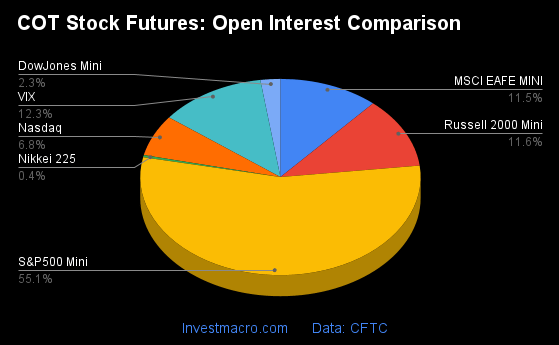
Archive for Stock Market News – Page 12

Can Boeing Recover? Analyzing the Company’s Path to Profitability

By The Ino.com Team

Since the start of 2024, aerospace giant The Boeing Company (BA) has faced a turbulent ride, with its stock plummeting over 30%. The decline was primarily triggered by heightened regulatory scrutiny following a severe safety incident involving one of its planes earlier this year.

Boeing has been working hard to enhance its safety protocols and address regulatory concerns. While these efforts show progress, the company’s latest Q2 earnings report has done little to restore investor confidence. The results revealed a larger-than-expected loss and weaker revenue, culminating in a significant leadership shakeup, with the CEO stepping down.

What’s Going on With Boeing?

Last month, Boeing missed the earnings targets by a wide margin. Revenue for the second quarter that ended June 30, 2024, came in at $16.87 billion, down 15% year-over-year. It fell short of the $17.35 billion revenue analysts had anticipated. On the bottom line, the company posted a non-GAAP net loss of $2.90 per share, much worse than the expected negative $2.01 per share. That compared to a loss per share of $0.82 a year ago.

Moreover, the company’s free cash flow, which was positive in last year’s second quarter, has now turned negative. The company has burned more than $8.26 billion so far this year, leaving with just $12.60 billion in its cash reserves against a hefty debt of $57.90 billion. Also, it reported a cash burn of $4.3 billion in just one quarter.

The management attributed the disappointing second-quarter results to two main factors: lower commercial aircraft deliveries and significant losses on fixed-price defense development programs. During the quarter, Boeing delivered just 92 commercial planes (down 32% year-over-year), leading to a corresponding 32% decline in revenue from what was once its largest business segment.

Meanwhile, the defense, space, and security unit experienced a smaller 2% sales dip but posted a loss of $913 million, nearly double the previous year’s loss of $527 million. Profit margins continued to worsen across these segments. The global services division was the only area with slight improvement, reflecting a 3% revenue increase and a 2% rise in operating earnings, but even here, profit margins declined.

Boeing’s disappointing results came during a period of intense scrutiny, as it faces multiple investigations into its safety practices and manufacturing standards. The company recently pleaded guilty to a federal fraud charge tied to its 737 Max following two fatal crashes that killed 346 people. As a result, the FAA has increased its oversight and limited BA’s production capacity after a serious incident involving an Alaska Airlines Max.

Furthermore, CFO Brian West warned that due to “near-term working capital pressures,” the third quarter will likely see another outflow of cash.

Boeing’s Critical Challenges

Boeing’s troubles are no secret; its repair list is long and daunting. For instance, the company’s commercial airplanes unit has struggled with recurring quality control problems, including serious incidents like doors falling off planes.

In the defense sector, Boeing is struggling with the Pentagon’s push for fixed-price contracts, leading to significant financial write-downs, like those from the Air Force tanker deal. That puts Boeing in a tough spot: accept risky fixed-price contracts or risk losing future defense agreements to competitors who will agree to them.

The company’s space segment isn’t faring much better. Boeing’s Starliner crew transport, essential to fulfilling its commercial crew contract with NASA, has been stranded at the International Space Station for over two months. Boeing might face hefty write-downs and losses if it fails to safely return the astronauts. Thus, addressing these challenges head-on seems crucial for the company’s path to recovery.

A New Leader for Boeing: What’s Next?

As Boeing grapples with its ongoing challenges, outgoing CEO Dave Calhoun assured that the company is “making substantial progress” in enhancing its quality management system and preparing for the future. However, Calhoun will not be steering BA through these transitions, as he announced his retirement shortly after the second quarter earnings report.

On August 8, former Rockwell Collins and RTX executive Robert Kelly Ortberg was appointed Boeing’s new CEO. Unlike his recent predecessors, Ortberg brings a background in Mechanical Engineering, which signals a shift towards prioritizing engineering and safety. This move could address previous criticisms of cost-cutting measures and refocus the company on improving aircraft safety, ultimately benefiting shareholders by mitigating the risk of future incidents.

Can Boeing Recover?

Despite recent safety setbacks, BA’s demand for its planes remains surprisingly strong. By the end of the second quarter, the company had amassed a hefty backlog of $516 billion, which includes over 5,400 commercial plane orders. The Farnborough Airshow further highlighted this demand with 118 new orders and commitments worth $17.1 billion.

This indicates that, despite its current challenges, the appetite for the company’s planes is robust. The path to recovery will depend on Boeing’s ability to address safety issues and lift the FAA’s production cap on the 737 MAX. If the company can make these adjustments, it could quickly regain its footing, especially since it showed promising progress in 2023.

Moreover, the air travel market is set to hit new highs this year, with Airbus projecting increased air traffic in the coming years. This provides Boeing with ample growth opportunities, provided it can navigate its current issues. Street expects the company’s revenue to increase by 20.7% year-over-year in the fiscal year 2025, with a projected EPS of $4.06.

Despite the promising growth prospects, investors should be aware of several risks. There’s no guarantee that Boeing won’t face another safety incident, as seen earlier this year, which could disrupt production and financial stability. Additionally, Airbus continues to outpace the company, and the emerging Chinese C919 could erode market share if Boeing faces more setbacks. While the aerospace giant has promising prospects, navigating these risks will be crucial to sustaining long-term growth and investor confidence.

Should you Invest in Boeing?

While BA’s market cap of $110.36 billion might suggest stability, it’s far from a safe bet. With no dividends since 2020 and a streak of unprofitability since 2018, BA’s investment appeal hinges on its turnaround potential.

The big question is whether or not the new CEO, Kelly Ortberg, can turn things around and revive the company’s fortunes. If Ortberg successfully navigates the company’s current challenges, there could be a significant upside. However, until then, investing in BA is decidedly riskier than it once was.

By Ino.com – See our Trader Blog, INO TV Free & Market Analysis Alerts

Source: Can Boeing Recover? Analyzing the Company’s Path to Profitability


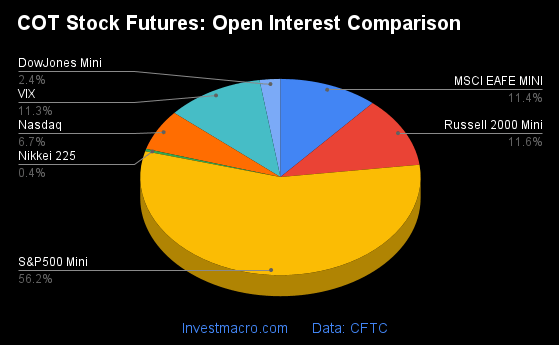
COT Stock Market Charts: Speculator Bets led by VIX

By InvestMacro

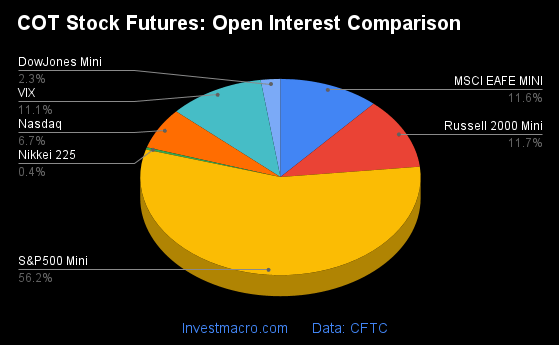
Here are the latest charts and statistics for the Commitment of Traders (COT) data published by the Commodities Futures Trading Commission (CFTC).

The latest COT data is updated through Tuesday August 13th and shows a quick view of how large traders (for-profit speculators and commercial entities) were positioned in the futures markets.

Weekly Speculator Changes led by VIX

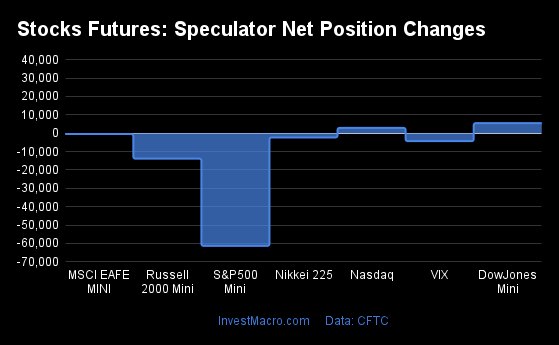
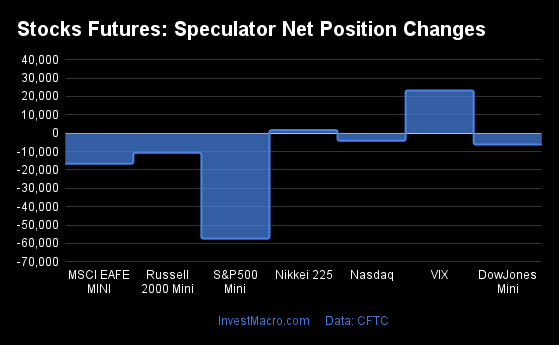
The COT stock markets speculator bets were lower this week as just two out of the seven stock markets we cover had higher positioning while the other five markets had lower speculator contracts.

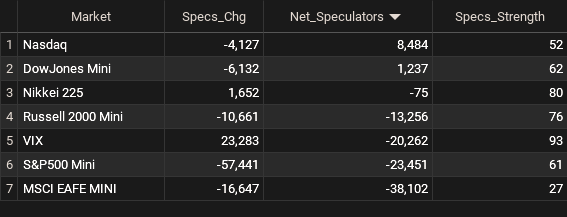
Leading the gains for the stock markets was the VIX (23,283 contracts) with the Nikkei 225 (1,652 contracts) also showing a positive week.

The markets with the declines in speculator bets this week were the S&P500-Mini (-57,441 contracts), the MSCI EAFE-Mini (-16,647 contracts), the Russell-Mini (-10,661 contracts), the DowJones-Mini (-6,132 contracts) and with the Nasdaq-Mini (-4,127 contracts) also registering lower bets on the week.


Stock Market Net Speculators Leaderboard
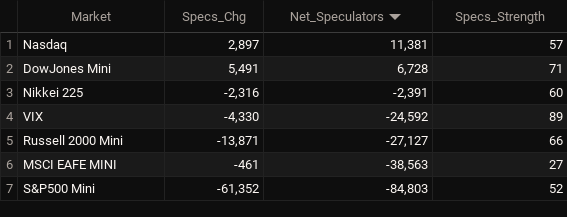
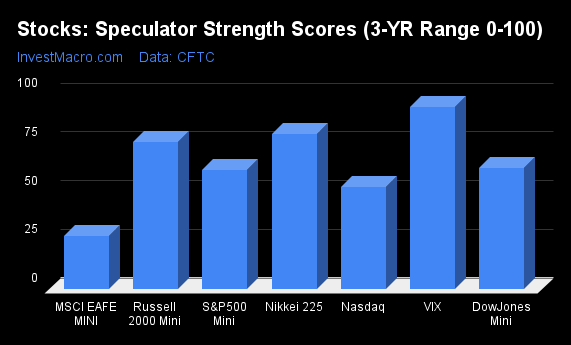
Legend: Weekly Speculators Change | Speculators Current Net Position | Speculators Strength Score compared to last 3-Years (0-100 range)


Strength Scores led by VIX & Nikkei 225

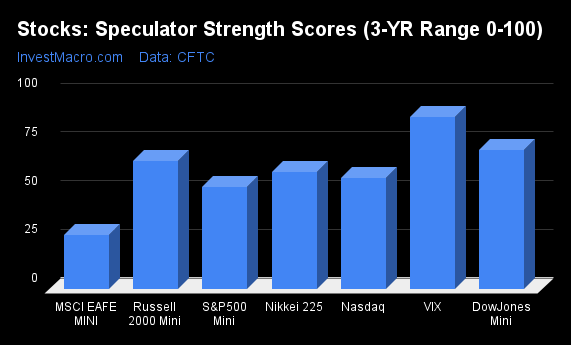
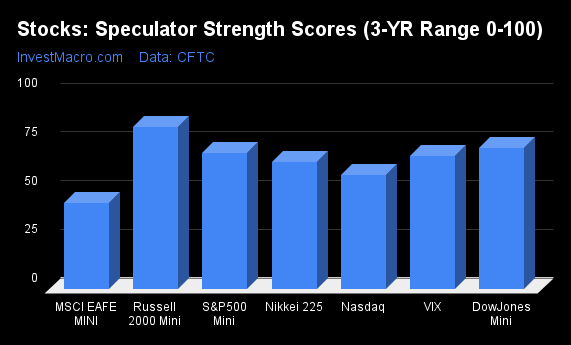
COT Strength Scores (a normalized measure of Speculator positions over a 3-Year range, from 0 to 100 where above 80 is Extreme-Bullish and below 20 is Extreme-Bearish) showed that the VIX (93 percent) and the Nikkei 225 (80 percent) lead the stock markets this week. The Russell-Mini (76 percent) and the DowJones-Mini (62 percent) come in as the next highest in the weekly strength scores.

On the downside, the MSCI EAFE-Mini (27 percent) comes in at the lowest strength level currently.

Strength Statistics:
VIX (93.2 percent) vs VIX previous week (68.0 percent)
S&P500-Mini (61.2 percent) vs S&P500-Mini previous week (69.8 percent)
DowJones-Mini (62.3 percent) vs DowJones-Mini previous week (72.3 percent)
Nasdaq-Mini (52.3 percent) vs Nasdaq-Mini previous week (58.7 percent)
Russell2000-Mini (75.7 percent) vs Russell2000-Mini previous week (83.3 percent)
Nikkei USD (79.5 percent) vs Nikkei USD previous week (65.4 percent)
EAFE-Mini (27.0 percent) vs EAFE-Mini previous week (44.2 percent)


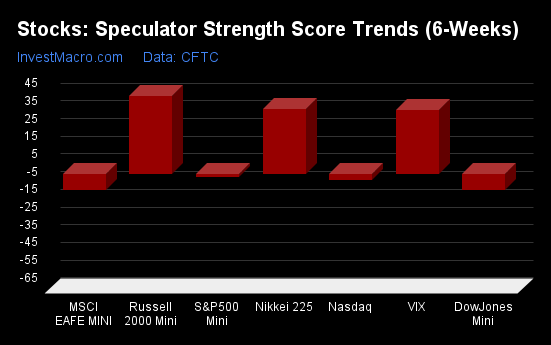
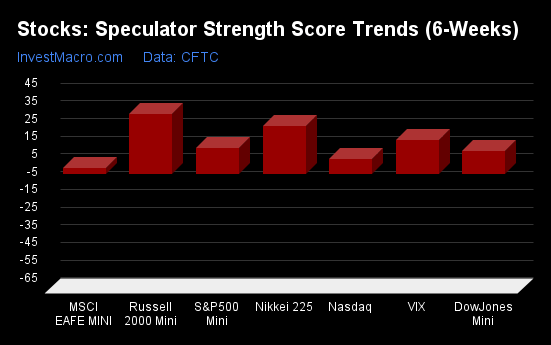
Russell-Mini & Nikkei 225 top the 6-Week Strength Trends

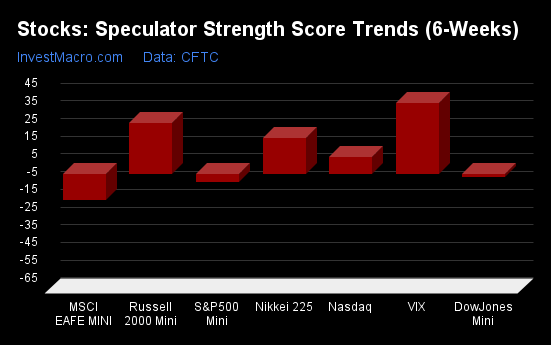
COT Strength Score Trends (or move index, calculates the 6-week changes in strength scores) showed that the Russell-Mini (44 percent) leads the past six weeks trends for the stock markets. The Nikkei 225 (37 percent) and the VIX (36 percent) are the next highest positive movers in the latest trends data.

The MSCI EAFE-Mini (-9 percent) and the DowJones-Mini (-9 percent) lead the downside trend scores currently.

Strength Trend Statistics:
VIX (35.9 percent) vs VIX previous week (18.9 percent)
S&P500-Mini (-1.7 percent) vs S&P500-Mini previous week (14.8 percent)
DowJones-Mini (-8.9 percent) vs DowJones-Mini previous week (12.8 percent)
Nasdaq-Mini (-3.6 percent) vs Nasdaq-Mini previous week (8.1 percent)
Russell2000-Mini (44.1 percent) vs Russell2000-Mini previous week (33.6 percent)
Nikkei USD (36.6 percent) vs Nikkei USD previous week (27.1 percent)
EAFE-Mini (-9.1 percent) vs EAFE-Mini previous week (3.5 percent)


Individual Stock Market Charts:

VIX Volatility Futures:
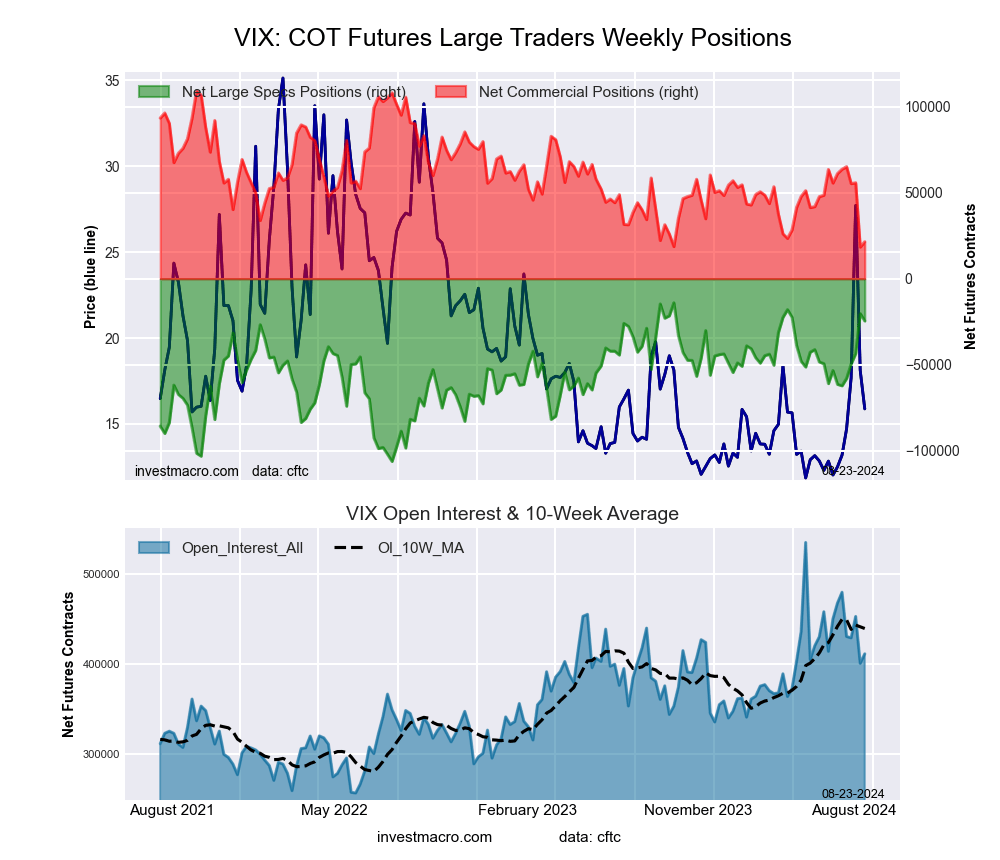
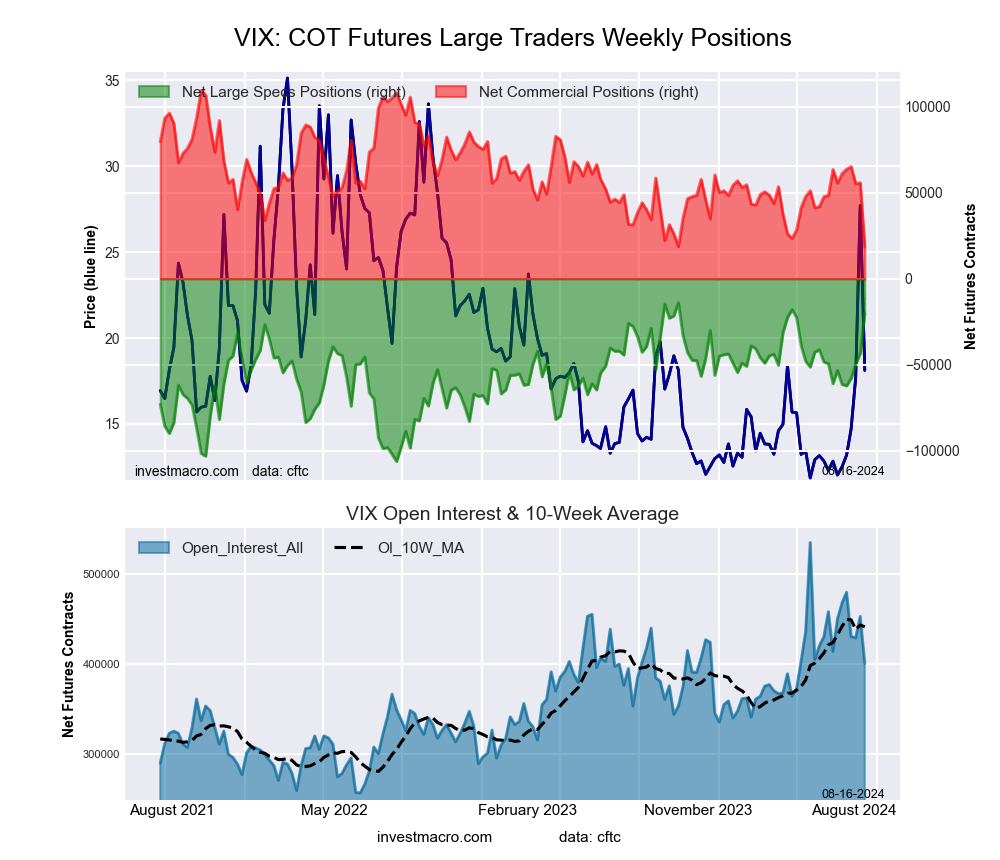
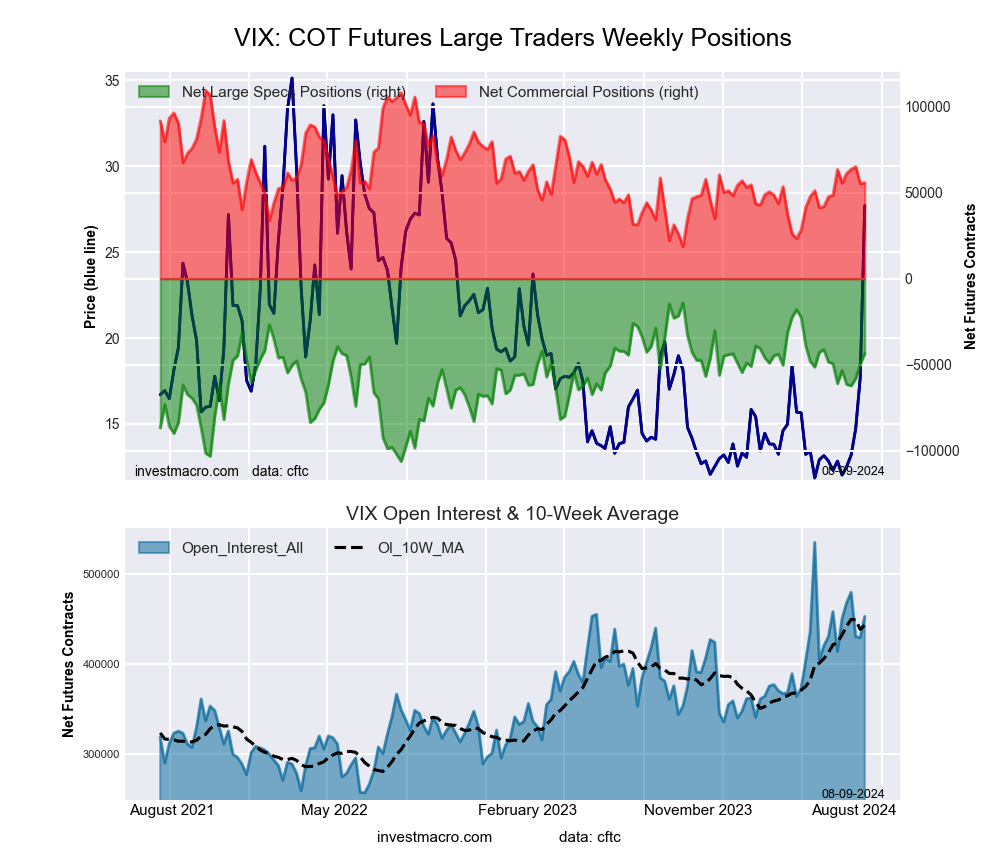
VIX Volatility Futures COT ChartThe VIX Volatility large speculator standing this week reached a net position of -20,262 contracts in the data reported through Tuesday. This was a weekly lift of 23,283 contracts from the previous week which had a total of -43,545 net contracts.

This week’s current strength score (the trader positioning range over the past three years, measured from 0 to 100) shows the speculators are currently Bullish-Extreme with a score of 93.2 percent. The commercials are Bearish-Extreme with a score of 0.0 percent and the small traders (not shown in chart) are Bullish-Extreme with a score of 100.0 percent.

Price Trend-Following Model: Uptrend

Our weekly trend-following model classifies the current market price position as: Uptrend. The current action for the model is considered to be: Hold – Maintain Long Position.

VIX Volatility Futures StatisticsSPECULATORSCOMMERCIALSSMALL TRADERS
– Percent of Open Interest Longs:23.945.66.7
– Percent of Open Interest Shorts:28.941.06.2
– Net Position:-20,26218,4161,846
– Gross Longs:95,786182,83726,785
– Gross Shorts:116,048164,42124,939
– Long to Short Ratio:0.8 to 11.1 to 11.1 to 1
NET POSITION TREND:
– Strength Index Score (3 Year Range Pct):93.20.0100.0
– Strength Index Reading (3 Year Range):Bullish-ExtremeBearish-ExtremeBullish-Extreme
NET POSITION MOVEMENT INDEX:
– 6-Week Change in Strength Index:35.9-40.919.8


S&P500 Mini Futures:

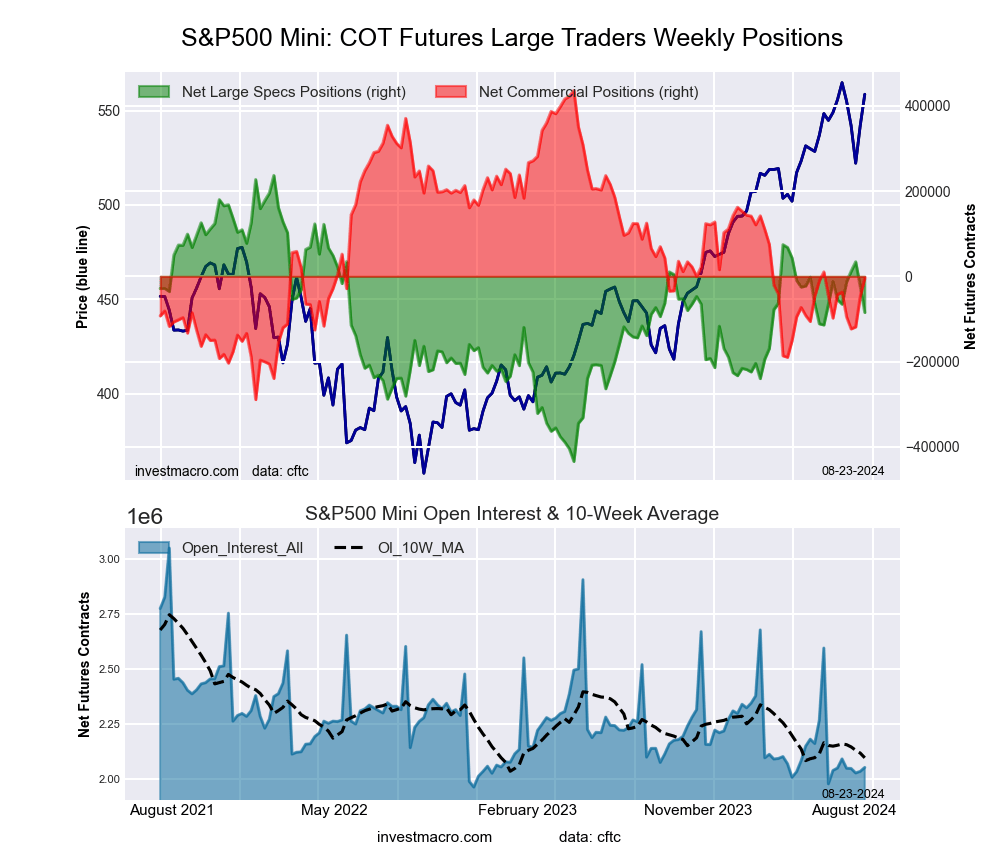
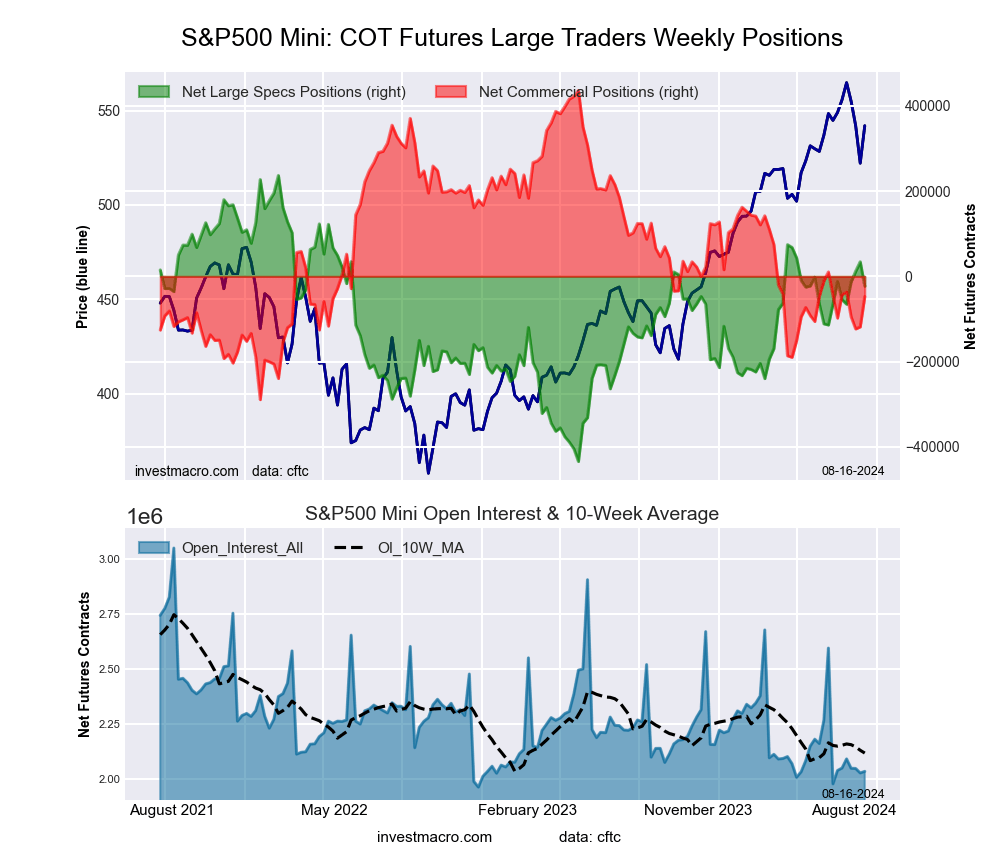
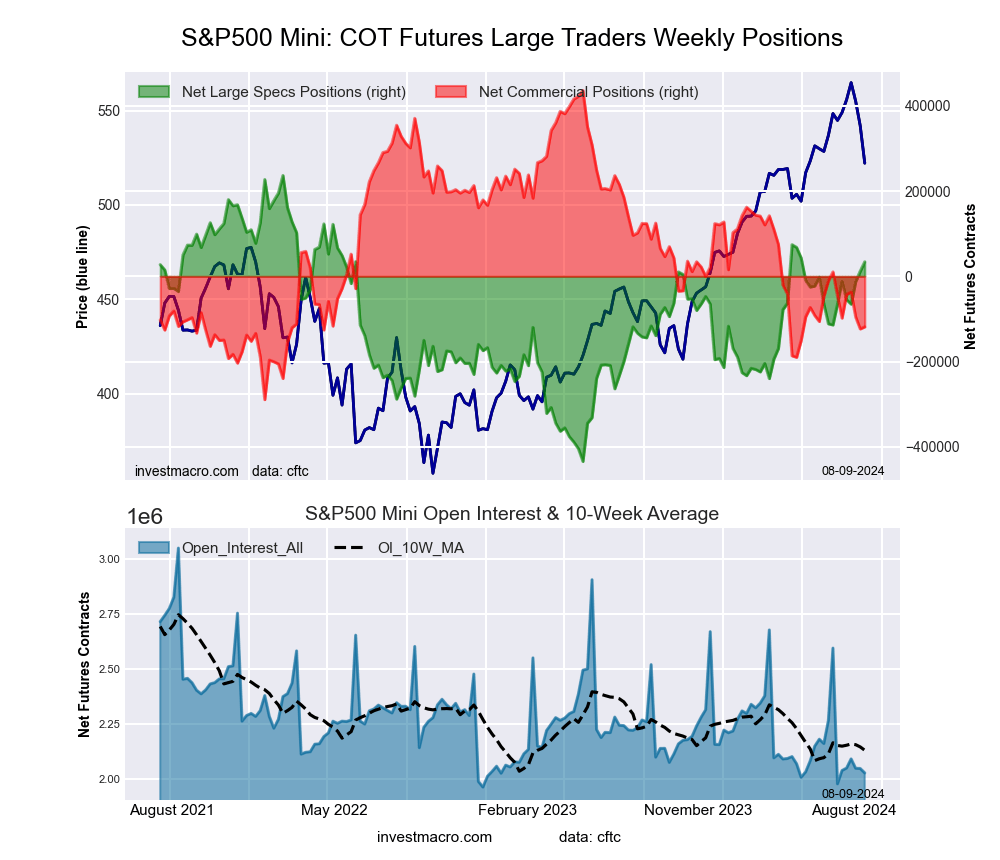
SP500 Mini Futures COT ChartThe S&P500 Mini large speculator standing this week reached a net position of -23,451 contracts in the data reported through Tuesday. This was a weekly decline of -57,441 contracts from the previous week which had a total of 33,990 net contracts.

This week’s current strength score (the trader positioning range over the past three years, measured from 0 to 100) shows the speculators are currently Bullish with a score of 61.2 percent. The commercials are Bearish with a score of 33.3 percent and the small traders (not shown in chart) are Bullish with a score of 66.7 percent.

Price Trend-Following Model: Strong Uptrend

Our weekly trend-following model classifies the current market price position as: Strong Uptrend. The current action for the model is considered to be: Hold – Maintain Long Position.

S&P500 Mini Futures StatisticsSPECULATORSCOMMERCIALSSMALL TRADERS
– Percent of Open Interest Longs:14.170.912.3
– Percent of Open Interest Shorts:15.273.28.9
– Net Position:-23,451-47,51870,969
– Gross Longs:285,9871,441,253250,900
– Gross Shorts:309,4381,488,771179,931
– Long to Short Ratio:0.9 to 11.0 to 11.4 to 1
NET POSITION TREND:
– Strength Index Score (3 Year Range Pct):61.233.366.7
– Strength Index Reading (3 Year Range):BullishBearishBullish
NET POSITION MOVEMENT INDEX:
– 6-Week Change in Strength Index:-1.77.0-15.7


Dow Jones Mini Futures:

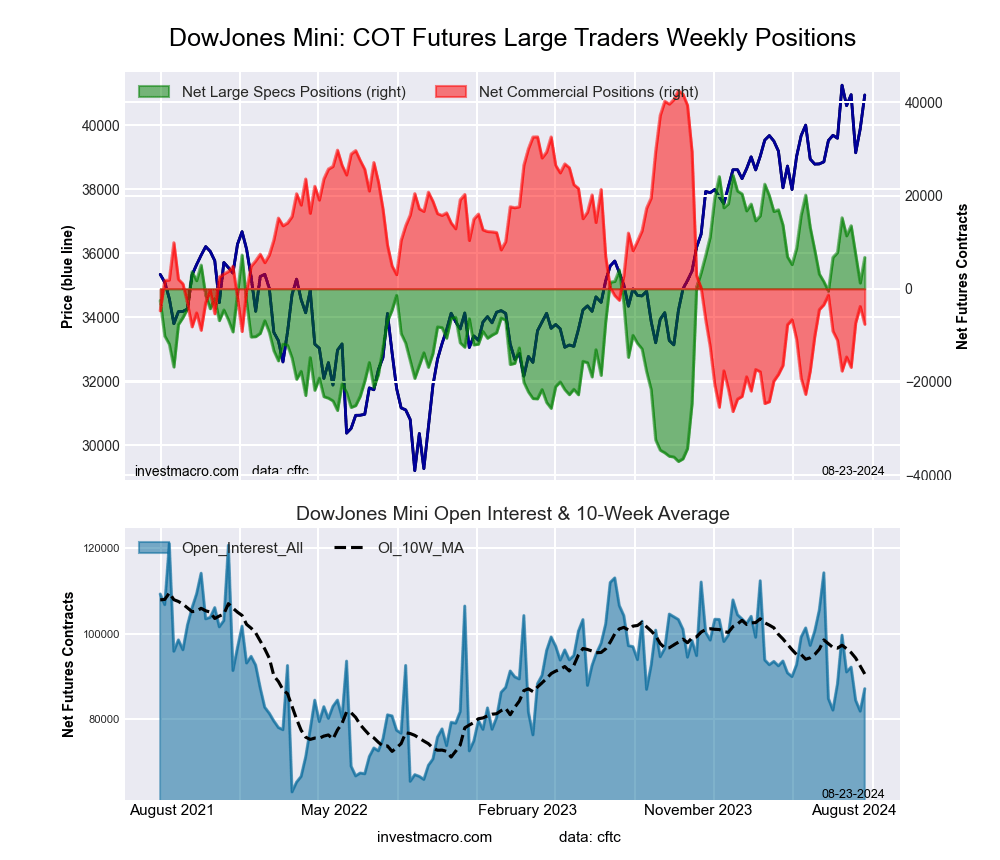
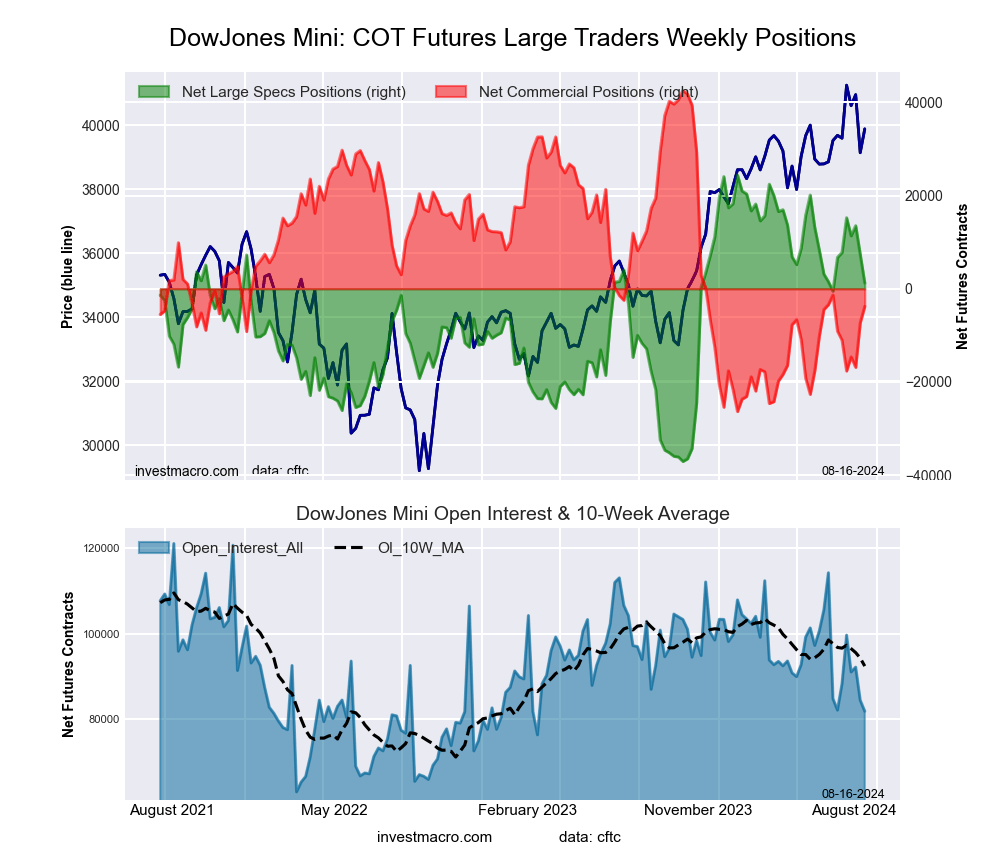
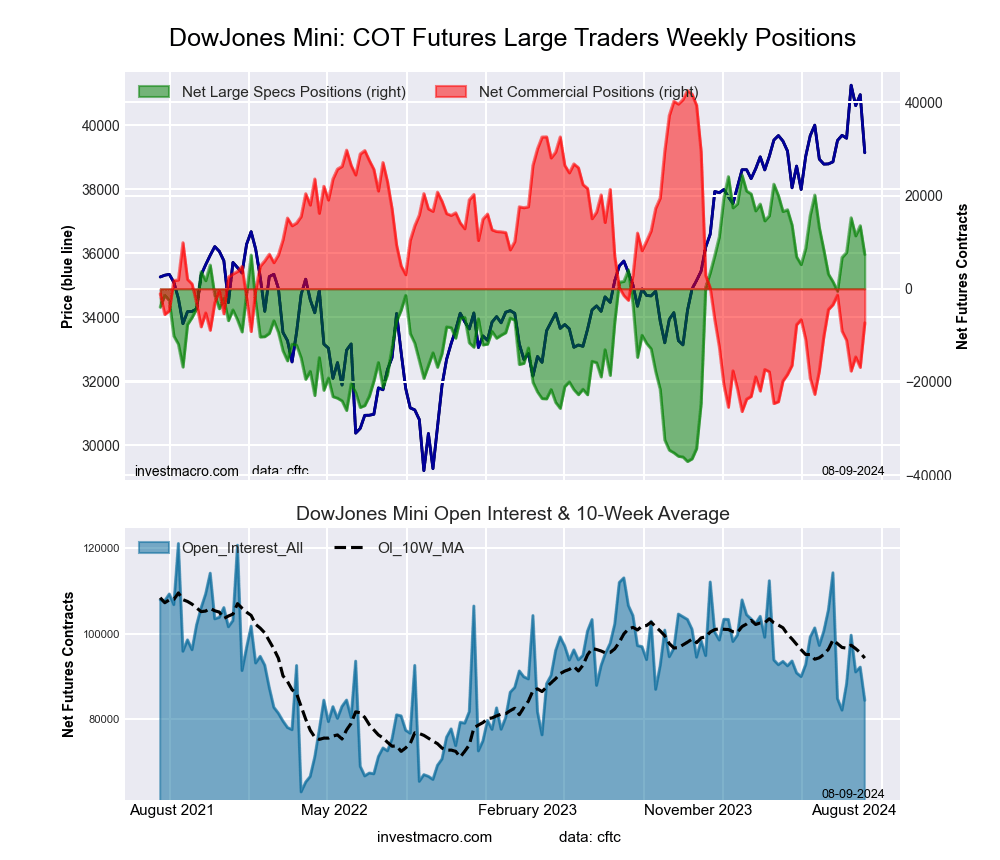
Dow Jones Mini Futures COT ChartThe Dow Jones Mini large speculator standing this week reached a net position of 1,237 contracts in the data reported through Tuesday. This was a weekly reduction of -6,132 contracts from the previous week which had a total of 7,369 net contracts.

This week’s current strength score (the trader positioning range over the past three years, measured from 0 to 100) shows the speculators are currently Bullish with a score of 62.3 percent. The commercials are Bearish with a score of 32.7 percent and the small traders (not shown in chart) are Bullish with a score of 60.7 percent.

Price Trend-Following Model: Strong Uptrend

Our weekly trend-following model classifies the current market price position as: Strong Uptrend. The current action for the model is considered to be: Hold – Maintain Long Position.

Dow Jones Mini Futures StatisticsSPECULATORSCOMMERCIALSSMALL TRADERS
– Percent of Open Interest Longs:22.059.616.5
– Percent of Open Interest Shorts:20.564.213.4
– Net Position:1,237-3,7842,547
– Gross Longs:18,01248,79413,516
– Gross Shorts:16,77552,57810,969
– Long to Short Ratio:1.1 to 10.9 to 11.2 to 1
NET POSITION TREND:
– Strength Index Score (3 Year Range Pct):62.332.760.7
– Strength Index Reading (3 Year Range):BullishBearishBullish
NET POSITION MOVEMENT INDEX:
– 6-Week Change in Strength Index:-8.97.71.0


Nasdaq Mini Futures:

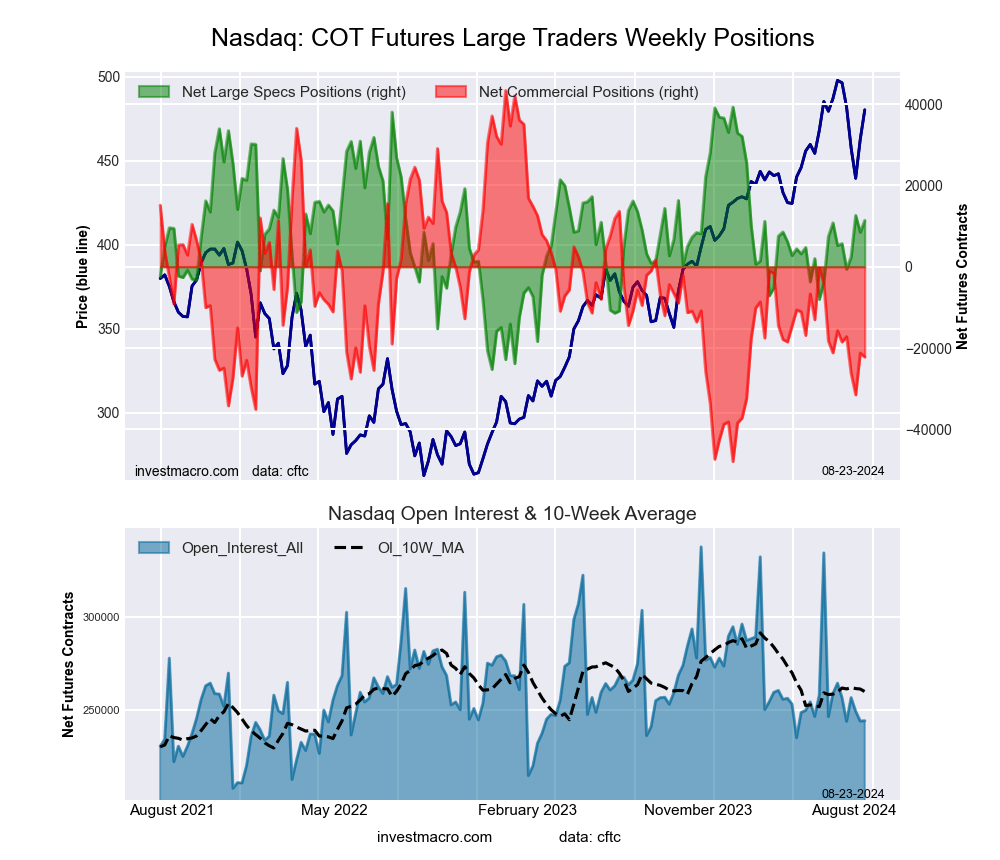
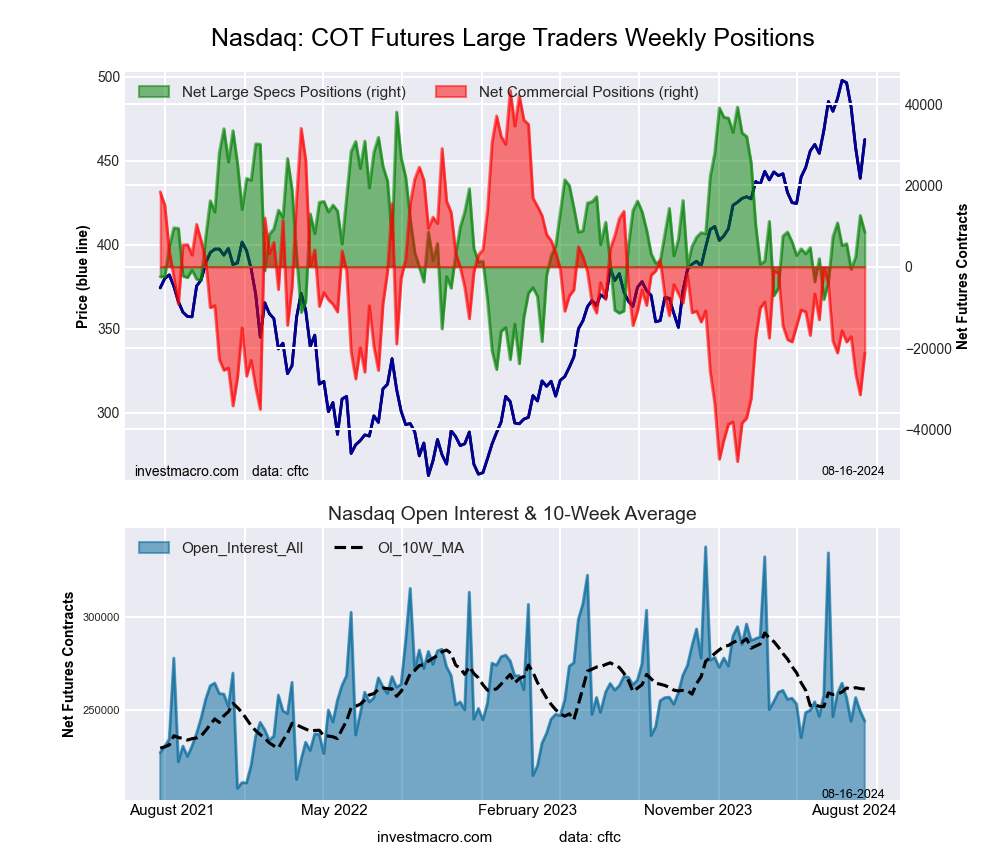
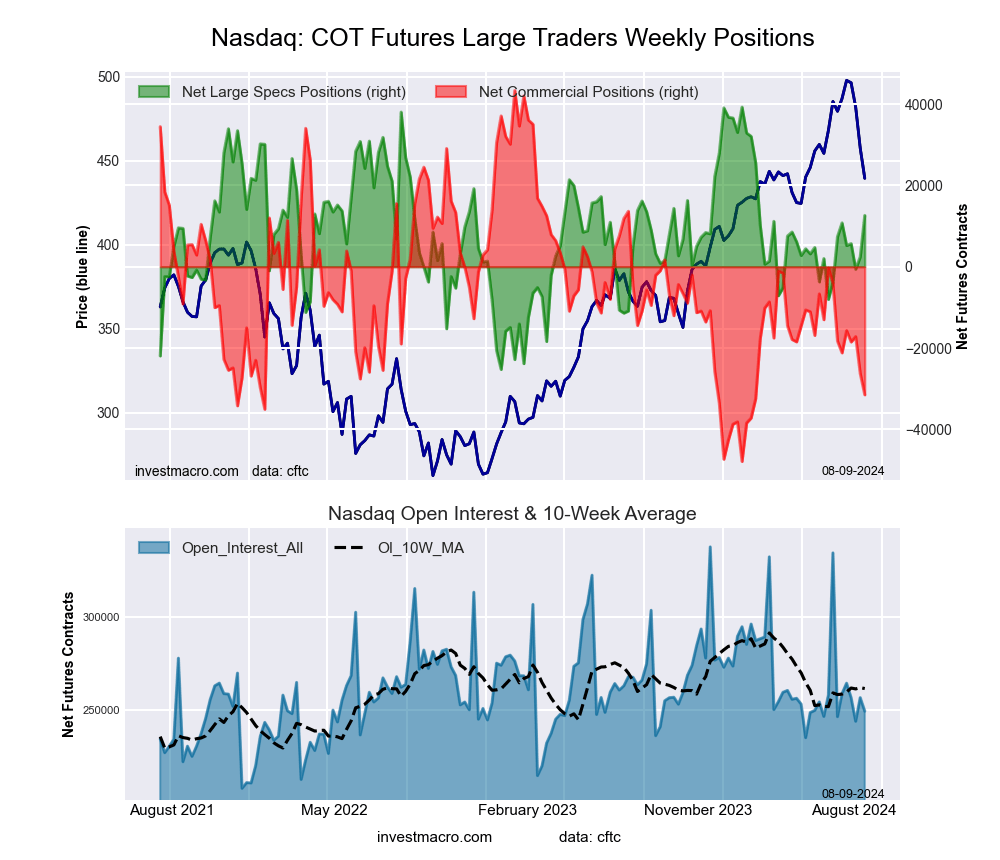
Nasdaq Mini Futures COT ChartThe Nasdaq Mini large speculator standing this week reached a net position of 8,484 contracts in the data reported through Tuesday. This was a weekly decline of -4,127 contracts from the previous week which had a total of 12,611 net contracts.

This week’s current strength score (the trader positioning range over the past three years, measured from 0 to 100) shows the speculators are currently Bullish with a score of 52.3 percent. The commercials are Bearish with a score of 29.2 percent and the small traders (not shown in chart) are Bullish with a score of 78.8 percent.

Price Trend-Following Model: Uptrend

Our weekly trend-following model classifies the current market price position as: Uptrend. The current action for the model is considered to be: Hold – Maintain Long Position.

Nasdaq Mini Futures StatisticsSPECULATORSCOMMERCIALSSMALL TRADERS
– Percent of Open Interest Longs:20.160.916.7
– Percent of Open Interest Shorts:16.669.611.5
– Net Position:8,484-21,22112,737
– Gross Longs:49,051148,52440,833
– Gross Shorts:40,567169,74528,096
– Long to Short Ratio:1.2 to 10.9 to 11.5 to 1
NET POSITION TREND:
– Strength Index Score (3 Year Range Pct):52.329.278.8
– Strength Index Reading (3 Year Range):BullishBearishBullish
NET POSITION MOVEMENT INDEX:
– 6-Week Change in Strength Index:-3.6-0.04.4


Russell 2000 Mini Futures:

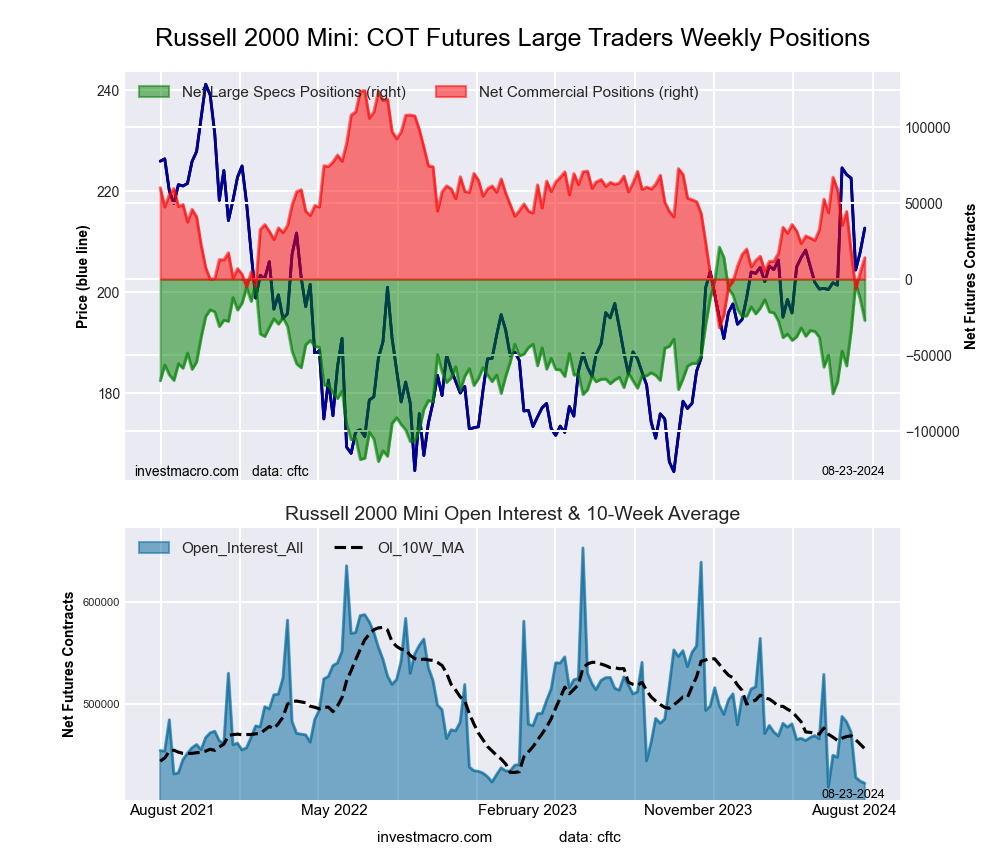
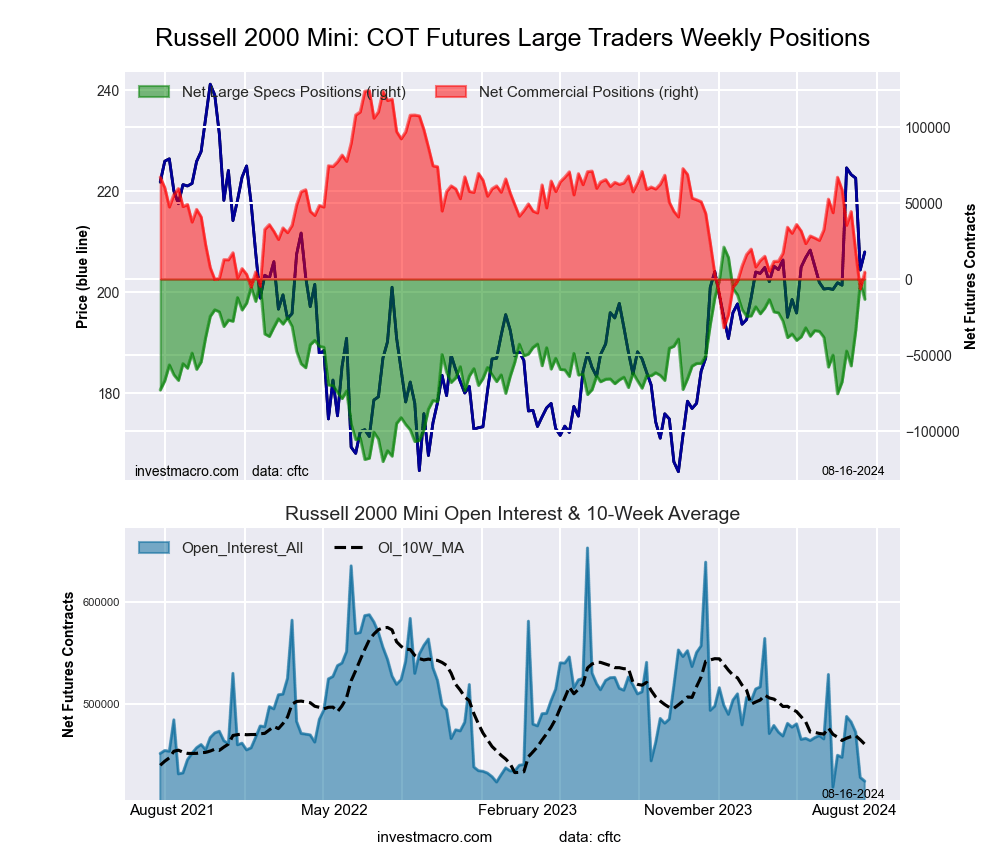
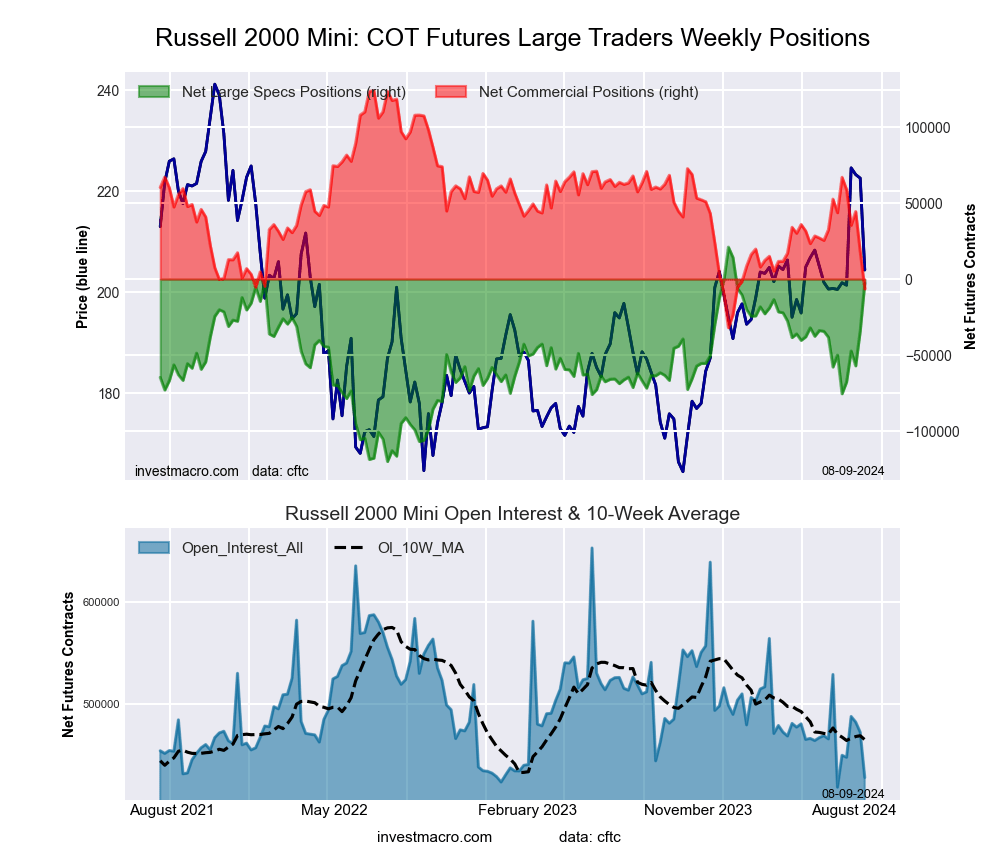
Russell 2000 Mini Futures COT ChartThe Russell 2000 Mini large speculator standing this week reached a net position of -13,256 contracts in the data reported through Tuesday. This was a weekly decrease of -10,661 contracts from the previous week which had a total of -2,595 net contracts.

This week’s current strength score (the trader positioning range over the past three years, measured from 0 to 100) shows the speculators are currently Bullish with a score of 75.7 percent. The commercials are Bearish with a score of 23.4 percent and the small traders (not shown in chart) are Bullish with a score of 58.2 percent.

Price Trend-Following Model: Strong Uptrend

Our weekly trend-following model classifies the current market price position as: Strong Uptrend. The current action for the model is considered to be: Hold – Maintain Long Position.

Russell 2000 Mini Futures StatisticsSPECULATORSCOMMERCIALSSMALL TRADERS
– Percent of Open Interest Longs:15.476.37.0
– Percent of Open Interest Shorts:18.575.25.0
– Net Position:-13,2564,5808,676
– Gross Longs:65,225323,85529,794
– Gross Shorts:78,481319,27521,118
– Long to Short Ratio:0.8 to 11.0 to 11.4 to 1
NET POSITION TREND:
– Strength Index Score (3 Year Range Pct):75.723.458.2
– Strength Index Reading (3 Year Range):BullishBearishBullish
NET POSITION MOVEMENT INDEX:
– 6-Week Change in Strength Index:44.1-40.00.7


Nikkei Stock Average (USD) Futures:

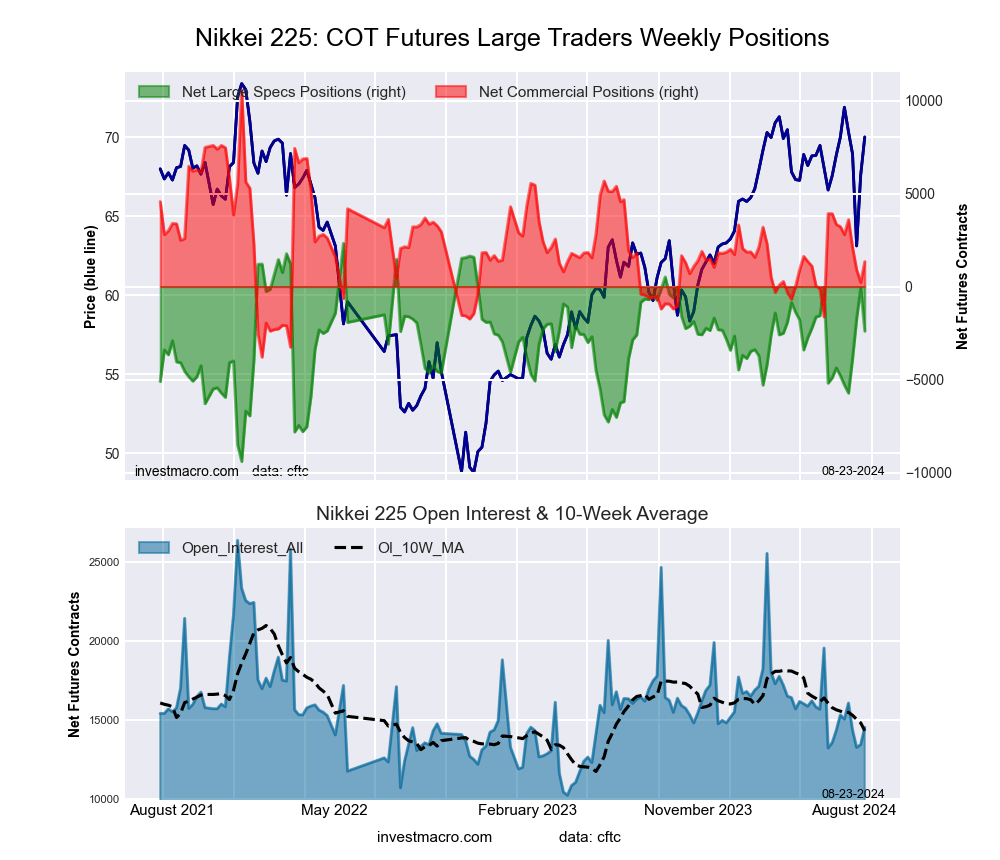
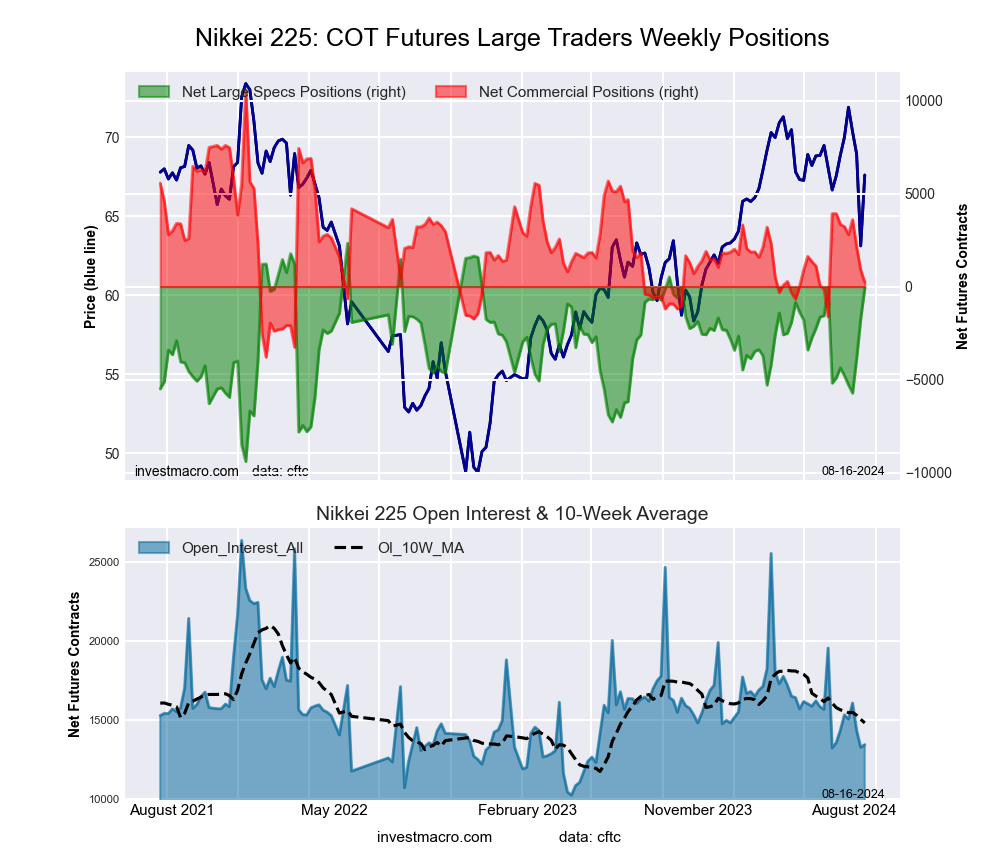
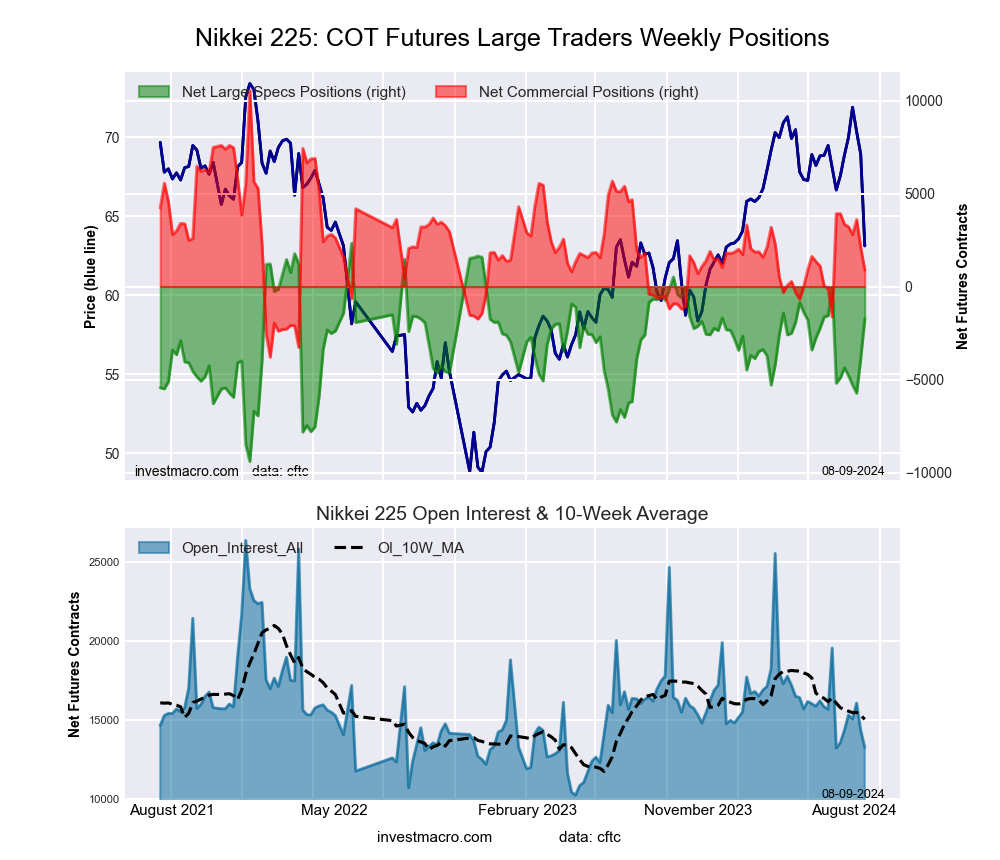
Nikkei Stock Average (USD) Futures COT ChartThe Nikkei Stock Average (USD) large speculator standing this week reached a net position of -75 contracts in the data reported through Tuesday. This was a weekly boost of 1,652 contracts from the previous week which had a total of -1,727 net contracts.

This week’s current strength score (the trader positioning range over the past three years, measured from 0 to 100) shows the speculators are currently Bullish with a score of 79.5 percent. The commercials are Bearish with a score of 28.0 percent and the small traders (not shown in chart) are Bearish with a score of 40.3 percent.

Price Trend-Following Model: Weak Downtrend

Our weekly trend-following model classifies the current market price position as: Weak Downtrend. The current action for the model is considered to be: Hold – Maintain Short Position.

Nikkei Stock Average Futures StatisticsSPECULATORSCOMMERCIALSSMALL TRADERS
– Percent of Open Interest Longs:17.960.921.2
– Percent of Open Interest Shorts:18.559.222.3
– Net Position:-75223-148
– Gross Longs:2,4058,1792,846
– Gross Shorts:2,4807,9562,994
– Long to Short Ratio:1.0 to 11.0 to 11.0 to 1
NET POSITION TREND:
– Strength Index Score (3 Year Range Pct):79.528.040.3
– Strength Index Reading (3 Year Range):BullishBearishBearish
NET POSITION MOVEMENT INDEX:
– 6-Week Change in Strength Index:36.6-21.8-22.4


MSCI EAFE Mini Futures:

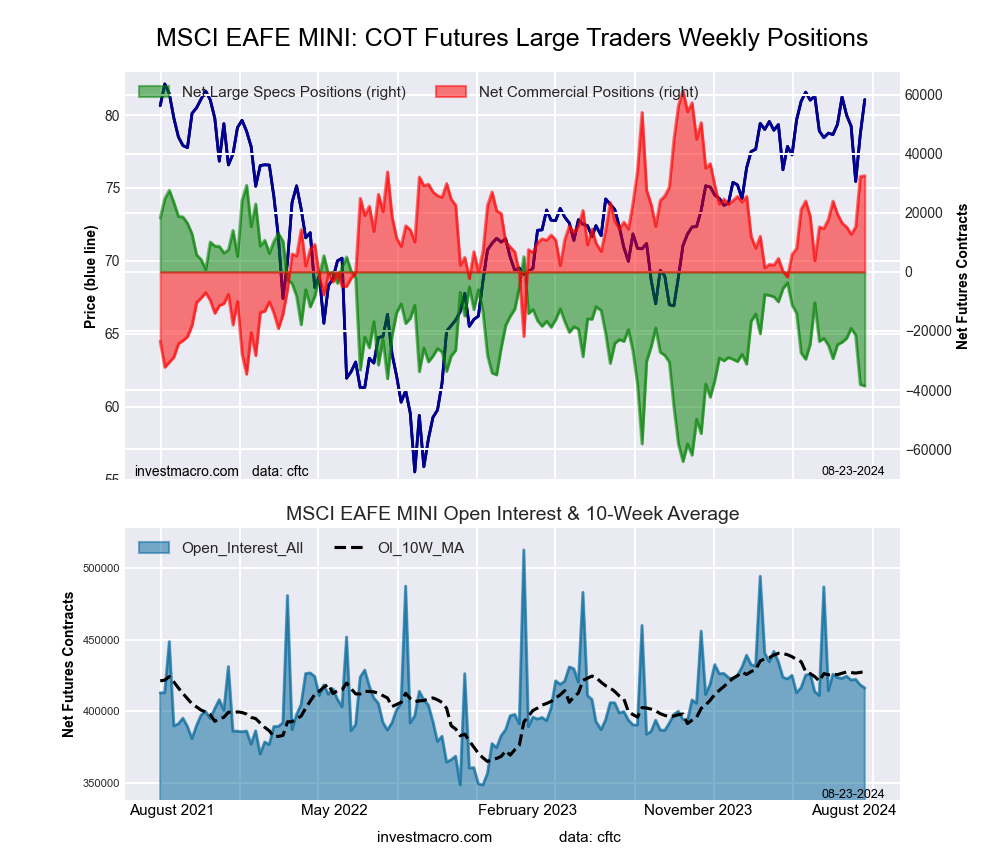
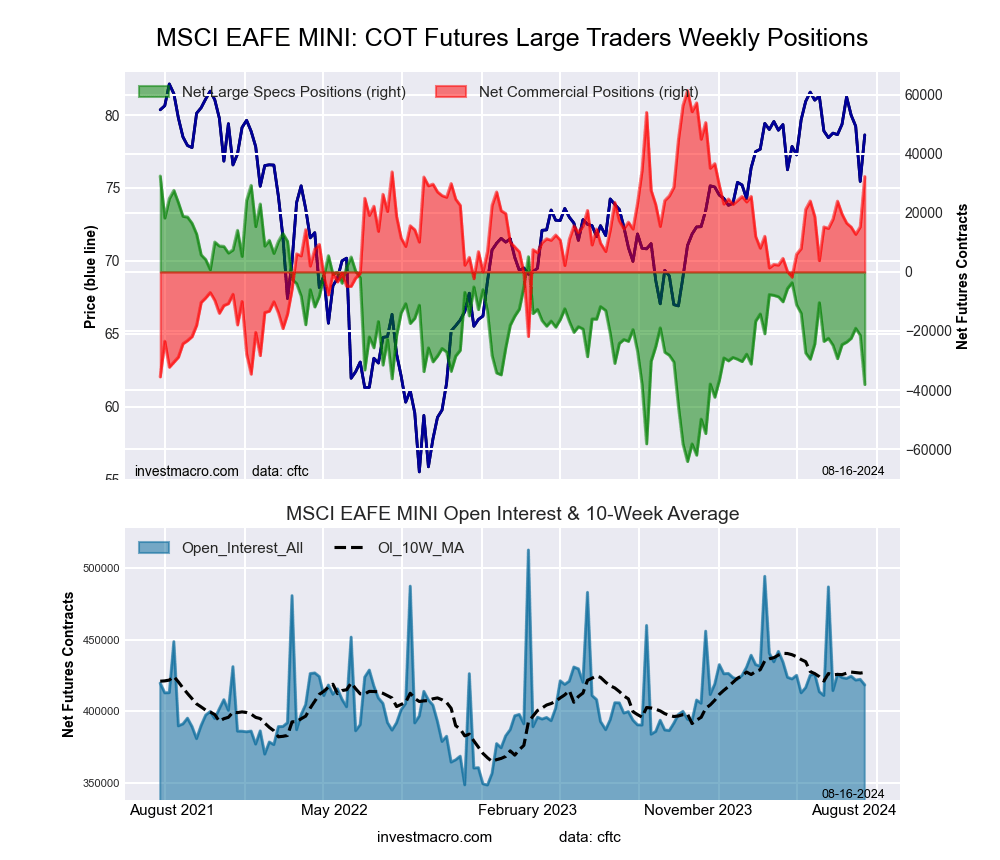
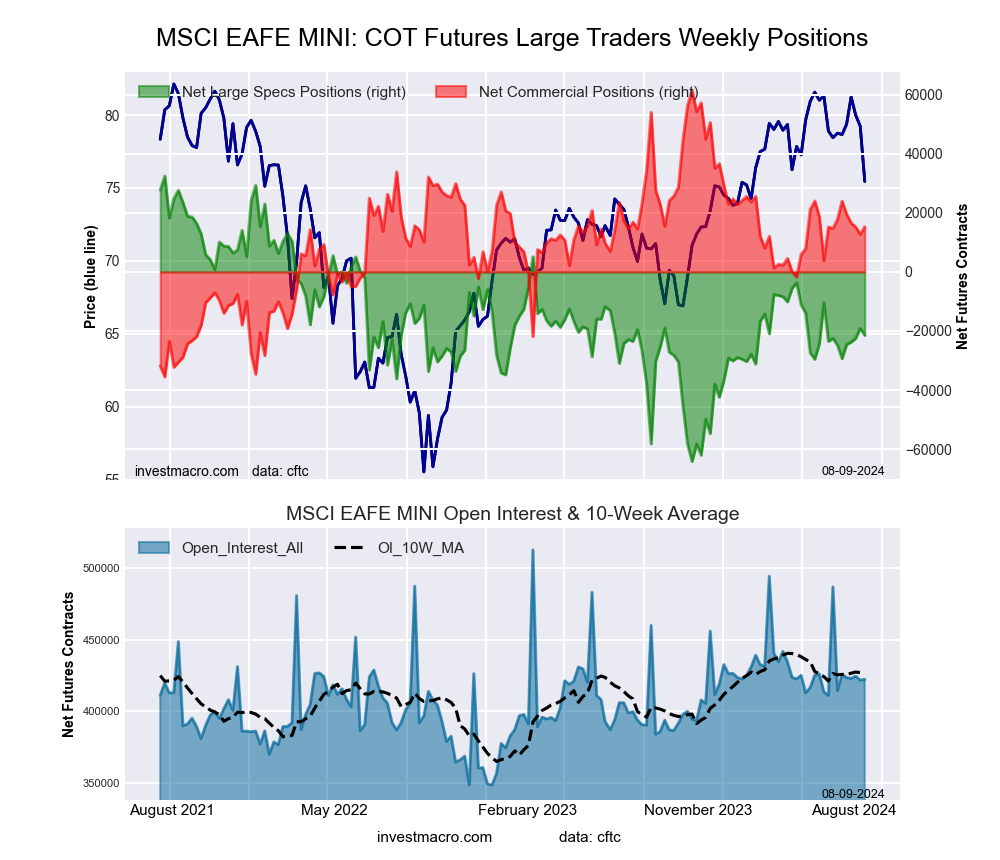
MSCI EAFE Mini Futures COT ChartThe MSCI EAFE Mini large speculator standing this week reached a net position of -38,102 contracts in the data reported through Tuesday. This was a weekly lowering of -16,647 contracts from the previous week which had a total of -21,455 net contracts.

This week’s current strength score (the trader positioning range over the past three years, measured from 0 to 100) shows the speculators are currently Bearish with a score of 27.0 percent. The commercials are Bullish with a score of 70.0 percent and the small traders (not shown in chart) are Bearish with a score of 45.9 percent.

Price Trend-Following Model: Strong Uptrend

Our weekly trend-following model classifies the current market price position as: Strong Uptrend. The current action for the model is considered to be: New Buy – Long Position.

MSCI EAFE Mini Futures StatisticsSPECULATORSCOMMERCIALSSMALL TRADERS
– Percent of Open Interest Longs:6.390.62.8
– Percent of Open Interest Shorts:15.482.91.5
– Net Position:-38,10232,3015,801
– Gross Longs:26,554379,04211,882
– Gross Shorts:64,656346,7416,081
– Long to Short Ratio:0.4 to 11.1 to 12.0 to 1
NET POSITION TREND:
– Strength Index Score (3 Year Range Pct):27.070.045.9
– Strength Index Reading (3 Year Range):BearishBullishBearish
NET POSITION MOVEMENT INDEX:
– 6-Week Change in Strength Index:-9.18.62.0


Article By InvestMacroReceive our weekly COT Newsletter

*COT Report: The COT data, released weekly to the public each Friday, is updated through the most recent Tuesday (data is 3 days old) and shows a quick view of how large speculators or non-commercials (for-profit traders) were positioned in the futures markets.

The CFTC categorizes trader positions according to commercial hedgers (traders who use futures contracts for hedging as part of the business), non-commercials (large traders who speculate to realize trading profits) and nonreportable traders (usually small traders/speculators) as well as their open interest (contracts open in the market at time of reporting). See CFTC criteria here.

Week Ahead: NAS100 set for Jackson Hole shake up?

By ForexTime 

  • NAS100 ↑ 13% from August low
  • Friday speech by Fed Powell to impact Fed cut bets
  • Watch out for FOMC minutes mid-week
  • Index trading roughly 7% away from all-time high
  • Key levels – 18400, 19500, 20100

It’s that time of the year again with the annual Jackson Hole Economic Symposium around the corner…

But before we discuss the importance of this event, here is a breakdown of the data releases and events scheduled for the upcoming week:

Monday, 19th Aug

  • JP225: Japan core machine orders
  • US500: US Conference Board leading index
  • US Democrat National Convention

Tuesday, 20th Aug

  • CN50: China loan prime rates
  • CAD: Canada CPI
  • SEK: Swedish rate decision
  • EU50: Eurozone CPI
  • TWN: Taiwan export orders

Wednesday 21st Aug

  • JP225: Japan trade
  • ZAR: South Africa CPI
  • NAS100: US FOMC minutes

Thursday, 22nd Aug

  • EU50: Eurozone & Germany PMI, consumer confidence
  • TWN: Taiwan jobless rate
  • UK100: UK S&P global PMI
  • US500: US initial jobless claims, S&P Global PMI

Friday, 23rd Aug

  • CAD: Canada retail sales
  • JP225: Japan CPI
  • SG20: Singapore CPI
  • TWN: Taiwan industrial production
  • NAS100: Fed Chair Powell speech at Jackson Hole


What is the Jackson Hole Economic Symposium?

It’s an annual event organised by the Kansas City Fed in Jackson Hole, Wyoming. This year it will be held from August 22nd – August 24th. 

Attendees from central bankers, finance ministers and economists congregate to discuss pressing global economic issues.

Why is it such a big deal?

Anything discussed during the symposium could trigger market volatility, especially if it has to do with monetary policy.

A trip down memory lane…

  • In August 2022, Jerome Powell’s speech at the Jackson Hole symposium was firmly hawkish as he outlined plans to combat inflation. This triggered a selloff on the S&P500, resulting in a 4% decline for the week.
  • Last year, Powell maintained a hawkish tilt by stating that the Fed was prepared to raise rates further if needed – citing high inflation.

What to expect this year?

It’s been a wild week for US markets with recent data soothing recession fears.

Still, Fed Chair Powell is expected to signal that a September rate cut is in the bag. But with the August jobs and inflation report published before the Fed’s September meeting, the size of the cut may remain a mystery.

Traders have currently fully priced in a 25-basis point Fed cut in September, with the probability of a 50-basis point cut at 33%.

NAS100 under the spotlight

There are a handful of assets that could rocked by Powell’s speech, but FXTM’s NAS100 has caught our attention due to its sensitivity to US interest rates.

NAS100 - W1

Note: FXTM’s NAS100 tracks the underlying benchmark Nasdaq 100 index.

It has been somewhat of a rollercoaster month for the index thanks to shifting monetary policy expectations and risk appetite.

Despite the flat month-to-date gains, prices have rallied 13% from Augusts low of 17247. Bulls seem to be back in action with the index knocking on the 19500 resistances as of writing.

  • FXTM’s NAS100 index could push higher if Powell strikes a dovish tone and signals that US rates will be cut in September.
  • Should Powell sound less dovish than expected and provide no fresh insight into the Feds thinking, this could weigh on the NAS100.

Keep eye on the FOMC minutes

Before Powell’s big speech on Friday, the FOMC minutes mid-week may provide some insight into the Feds thinking for the rest of 2024. Should the minutes come across as dovish, this could provide support to the NAS100.

Technical forces

Prices are turning bullish on the daily charts with the NAS100 challenging the 19500-resistance level. The candlesticks are firmly above the 100 and 200-day SMA but the Relative Strength Indicator (RSI) is slowly approaching overbought territory.

  • A solid weekly close above 19500 may encourage an incline toward 20100 and the all-time high at 20796.
  • Should 19500 prove to be reliable resistance, this could trigger a decline to 18400, the 200-day SMA and 17247.

nas100 -d1


Forex-Time-LogoArticle by ForexTime

ForexTime Ltd (FXTM) is an award winning international online forex broker regulated by CySEC 185/12 www.forextime.com

FXTM’s CHINAH: On breakout watch ahead of key events

By ForexTime 

  • Potential trading opportunities on horizon for CHINAH
  • Raft of China data, Alibaba & JD.com earnings on Thursday
  • CHINAH respecting bearish channel on D1 charts
  • Key levels of interest – 5965, 6100 & 6225

If you are seeking fresh market opportunities, then look no further…

FXTM’s CHINAH which tracks the underlying Hang Seng China Enterprise index is trading around key daily resistance ahead of tomorrow’s event-heavy trading session.

On Thursday, key economic data from China and earnings from two Chinese e-commerce giants could trigger significant price swings on the CHINAH index.

CHINAH

But before we discuss how to take advantage of this trading opportunity, here are some fun facts about the CHINAH index:

  • Gained roughly 4.5% year-to-date
  • Down 14.3% from its 2024 high at 7025  
  • Respecting bearish channel on D1 chart

The lowdown…

Chinese shares have been on the decline over the past few weeks as China growth fears weighed on sentiment. Since May, FXTM’s CHINAH has recorded two consecutive months of losses and currently down over 1% in August.

CHINAH W1

Here are 3 forces that may move the index on Thursday:

    1) China policy rate + key data

The People’s Bank of China (PBoc) is expected to maintain its one-year medium-term lending faculty (MLF) rate at 2.3%.

So much focus will be on the barrage of data release, including the industrial production, retail sales and jobless rate among other key reports. Ultimately, better-than-expected data could boost confidence over China’s economic outlook – stimulating appetite for riskier such as the CHINAH index. Should overall economic data disappoint, this may drag the stock index lower.


    2) Alibaba earnings

Alibaba accounts for almost 9% of CHINAH’s weighting – claiming the title of biggest stock within the index.

This alone suggests that its earnings release before US markets open on Thursday could translate to heightened volatility for the stock index. Markets are forecasting Alibaba’s US listed shares to move 5.7% either up or down when US markets on Thursday.

Much focus will be on any updates regarding its cloud and AI-related efforts. Should the Chinese e-commerce giant’s earnings exceed market expectations, this may push Alibaba shares higher along with the CHINAH index.


    3) JD.com earnings

It will be wise to also keep an eye on JD.com which accounts for just over 2% of CHINAH. Markets are forecasting JD.com US listed shares to move 6.4% either up or down when US markets open on Thursday, just hours after its earnings are announced.

Investors will direct their attention toward profitability and how its e-commerce business performed in Q2 amid the fierce competition among major players in China. A strong set of results may support JD.com stocks along with the CHINAH index, and vice versa.


Note: Watch out for the incoming US July CPI report released later today. This could be a huge risk event that rattles global financial markets and influences overall risk sentiment. Its impacts may be reflected on the CHINAH when China markets open on Thursday.


Technical forces…

The trend remains bearish on the daily charts as there have been consistently lower lows and lower highs. However, bulls seem to be lingering in the vicinity with prices trading near a key daily resistance at 6100.

  • A strong daily close above this level could encourage a move toward the 50-day SMA at 6255 and 6360.
  • Should 6100 prove to be reliable resistance, prices may slip to 5965 before retesting 5800.

CHINAH2


Forex-Time-LogoArticle by ForexTime

ForexTime Ltd (FXTM) is an award winning international online forex broker regulated by CySEC 185/12 www.forextime.com

UK100: Set for more wild price swings?

By ForexTime 

  • Raft of UK data could rock UK100 this week
  • UK CPI sparked moves of ↑ 0.9% & ↓ 0.8% over past year
  • Incoming US CPI data may set tone for markets
  • Key levels of interest – 8120, 8200, 8310

Watch this space because FXTM’s UK100 index could see significant price swings!

That’s right, a raft of UK economic data over the next few days may inject the stock index with fresh volatility. We have already seen some action this morning after a surprise drop in the UK’s unemployment rate for June triggered a selloff.

UK100

The strong jobs data cooled bets around BoE rate cuts – boosting the British Pound as a result.

Note: Over 80% of the revenues from FTSE100 companies come from outside of the UK. When the pound appreciates, it results in lower revenues for those companies that acquire sales from overseas – dragging the UK100 lower as a result. The same is true vice versa.

Despite the aggressive selloff last Monday, prices remain trapped within a range on the weekly charts with support at 8150 and resistance at 8450.

UK100 weekly

Note: UK100 tracks the FTSE100 index – the benchmark measuring the stock performance of the 100 largest listed companies on the London Stock Exchange.

With all the above said, here are 3 major economic events that may trigger significant volatility:

    1) UK July CPI report – Wednesday, 14th August

The incoming consumer price index report may influence bets around when the BoE will cut rates again in 2024.

Markets are forecasting:

  • CPI year-on-year (July 2024 vs. July 2023) to rise 2.3% from 2.0% in the prior month.
  • Core CPI year-on-year to cool 3.4% from 3.5% in the prior month.
  • CPI month-on-month (July 2024 vs June 2024) to cool 0.1% from 0.1% in the prior month.

UK inflation rate is expected to have risen in July. If the incoming figures confirm this, then this may push back BoE cut bets.

Golden nugget: Over the past year, the UK CPI report has triggered upside moves on the UK100 as much as 0.9% and declines of 0.8% in a 6-hour window post-release.


    2) UK Q2 GDP data – Thursday 15th August

Beyond the UK CPI report, all eyes will be on second-quarter GDP figures published on Thursday.

Markets expect a modest quarter-on-quarter growth of 0.6%, slightly slower than the 0.7% seen in Q1. Also, keep an eye on the latest industrial production figures which could provide additional insight into the health of the UK economy.

  • Should the data support the case for lower UK interest rates, this could boost the UK100.
  • If the reports push back BoE cut bets – this may hit the UK100 as the pound strengthens.

Golden nugget: Over the past year, the UK GDP report has triggered upside moves on the UK100 as much as 0.7% and declines of 0.6% in a 6-hour window post-release.


    3) US July CPI

Outside of the United Kingdom, all eyes will be on the US July inflation report published on Wednesday.

Markets remain edgy due to the weak jobs report earlier this month with US recession fears lingering in the air. The incoming US CPI report may shape expectations around aggressive Fed rate cuts this year.

Traders have already priced in a 25-basis point move next month with a 50% probability of a 50-basis point cut.

Given how this key report may set the tone for markets, indices across the globe including the UK100 may be impacted.


    4) Technical forces

On the technical front, the UK100 is flirting around the 50 and 100-day SMA with prices still trapped within a range. The index could be waiting for a potent fundamental spark to trigger its next significant move either up or down.

  • A strong daily close above 8200 could encourage a move higher toward 8310 and 8400.
  • Should prices dip below the 100-day SMA, this could encourage a decline to 8120 and 8040.

UK100


Forex-Time-LogoArticle by ForexTime

ForexTime Ltd (FXTM) is an award winning international online forex broker regulated by CySEC 185/12 www.forextime.com

COT Stock Market Charts: Speculator Bets led by Russell & S&P 500

By InvestMacro

Here are the latest charts and statistics for the Commitment of Traders (COT) data published by the Commodities Futures Trading Commission (CFTC).

The latest COT data is updated through Tuesday August 6th and shows a quick view of how large traders (for-profit speculators and commercial entities) were positioned in the futures markets.

Weekly Speculator Changes led by Russell & S&P 500

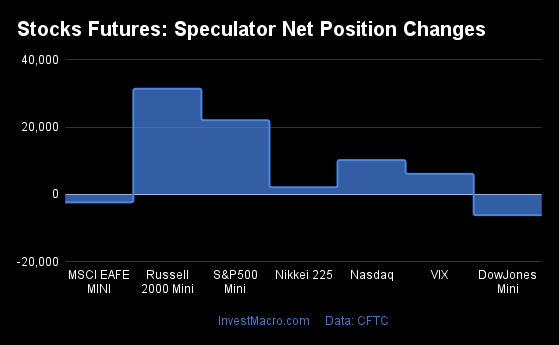
The COT stock markets speculator bets were higher this week as five out of the seven stock markets we cover had higher positioning while the other two markets had lower speculator contracts.

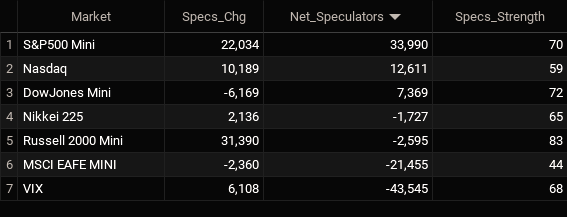
Leading the gains for the stock markets was the Russell-Mini (31,390 contracts), the S&P500-Mini (22,034 contracts), the Nasdaq-Mini (10,189 contracts), the VIX (6,108 contracts) and the Nikkei 225 (2,136 contracts) also showing positive weeks.

The markets with the declines in speculator bets this week were the MSCI EAFE-Mini (-2,360 contracts) and with the DowJones-Mini (-6,169 contracts) also registering lower bets on the week.


Stock Market Net Speculators Leaderboard

Legend: Weekly Speculators Change | Speculators Current Net Position | Speculators Strength Score compared to last 3-Years (0-100 range)


Strength Scores led by Russell-Mini & DowJones-Mini

COT Strength Scores (a normalized measure of Speculator positions over a 3-Year range, from 0 to 100 where above 80 is Extreme-Bullish and below 20 is Extreme-Bearish) showed that the Russell-Mini (83 percent) and the DowJones-Mini (72 percent) lead the stock markets this week. The S&P500-Mini (70 percent) and VIX (68 percent) come in as the next highest in the weekly strength scores.

The MSCI EAFE-Mini (44 percent) comes in at the lowest strength level currently.

Strength Statistics:
VIX (68.0 percent) vs VIX previous week (61.4 percent)
S&P500-Mini (69.8 percent) vs S&P500-Mini previous week (66.5 percent)
DowJones-Mini (72.3 percent) vs DowJones-Mini previous week (82.3 percent)
Nasdaq-Mini (58.7 percent) vs Nasdaq-Mini previous week (42.9 percent)
Russell2000-Mini (83.3 percent) vs Russell2000-Mini previous week (61.0 percent)
Nikkei USD (65.4 percent) vs Nikkei USD previous week (47.2 percent)
EAFE-Mini (44.2 percent) vs EAFE-Mini previous week (46.7 percent)


Russell-Mini & Nikkei 225 top the 6-Week Strength Trends

COT Strength Score Trends (or move index, calculates the 6-week changes in strength scores) showed that the Russell-Mini (34 percent) leads the past six weeks trends for the stock markets. The Nikkei 225 (27 percent), the VIX (19 percent) and the S&P500-Mini (15 percent) are the next highest positive movers in the latest trends data.

Strength Trend Statistics:
VIX (18.9 percent) vs VIX previous week (-0.2 percent)
S&P500-Mini (14.8 percent) vs S&P500-Mini previous week (18.8 percent)
DowJones-Mini (12.8 percent) vs DowJones-Mini previous week (19.5 percent)
Nasdaq-Mini (8.1 percent) vs Nasdaq-Mini previous week (9.7 percent)
Russell2000-Mini (33.6 percent) vs Russell2000-Mini previous week (16.9 percent)
Nikkei USD (27.1 percent) vs Nikkei USD previous week (11.3 percent)
EAFE-Mini (3.5 percent) vs EAFE-Mini previous week (3.5 percent)


Individual Stock Market Charts:

VIX Volatility Futures:

VIX Volatility Futures COT ChartThe VIX Volatility large speculator standing this week reached a net position of -43,545 contracts in the data reported through Tuesday. This was a weekly boost of 6,108 contracts from the previous week which had a total of -49,653 net contracts.

This week’s current strength score (the trader positioning range over the past three years, measured from 0 to 100) shows the speculators are currently Bullish with a score of 68.0 percent. The commercials are Bearish with a score of 40.9 percent and the small traders (not shown in chart) are Bearish with a score of 32.5 percent.

Price Trend-Following Model: Strong Uptrend

Our weekly trend-following model classifies the current market price position as: Strong Uptrend. The current action for the model is considered to be: Hold – Maintain Long Position.

VIX Volatility Futures StatisticsSPECULATORSCOMMERCIALSSMALL TRADERS
– Percent of Open Interest Longs:22.051.16.3
– Percent of Open Interest Shorts:31.638.79.0
– Net Position:-43,54555,847-12,302
– Gross Longs:99,536231,32628,694
– Gross Shorts:143,081175,47940,996
– Long to Short Ratio:0.7 to 11.3 to 10.7 to 1
NET POSITION TREND:
– Strength Index Score (3 Year Range Pct):68.040.932.5
– Strength Index Reading (3 Year Range):BullishBearishBearish
NET POSITION MOVEMENT INDEX:
– 6-Week Change in Strength Index:18.9-8.5-48.2


S&P500 Mini Futures:

SP500 Mini Futures COT ChartThe S&P500 Mini large speculator standing this week reached a net position of 33,990 contracts in the data reported through Tuesday. This was a weekly lift of 22,034 contracts from the previous week which had a total of 11,956 net contracts.

This week’s current strength score (the trader positioning range over the past three years, measured from 0 to 100) shows the speculators are currently Bullish with a score of 69.8 percent. The commercials are Bearish with a score of 23.5 percent and the small traders (not shown in chart) are Bullish with a score of 72.2 percent.

Price Trend-Following Model: Uptrend

Our weekly trend-following model classifies the current market price position as: Uptrend. The current action for the model is considered to be: Hold – Maintain Long Position.

S&P500 Mini Futures StatisticsSPECULATORSCOMMERCIALSSMALL TRADERS
– Percent of Open Interest Longs:16.169.512.4
– Percent of Open Interest Shorts:14.475.38.2
– Net Position:33,990-118,57584,585
– Gross Longs:326,3761,407,615250,827
– Gross Shorts:292,3861,526,190166,242
– Long to Short Ratio:1.1 to 10.9 to 11.5 to 1
NET POSITION TREND:
– Strength Index Score (3 Year Range Pct):69.823.572.2
– Strength Index Reading (3 Year Range):BullishBearishBullish
NET POSITION MOVEMENT INDEX:
– 6-Week Change in Strength Index:14.8-10.0-10.8


Dow Jones Mini Futures:

Dow Jones Mini Futures COT ChartThe Dow Jones Mini large speculator standing this week reached a net position of 7,369 contracts in the data reported through Tuesday. This was a weekly fall of -6,169 contracts from the previous week which had a total of 13,538 net contracts.

This week’s current strength score (the trader positioning range over the past three years, measured from 0 to 100) shows the speculators are currently Bullish with a score of 72.3 percent. The commercials are Bearish with a score of 27.6 percent and the small traders (not shown in chart) are Bearish with a score of 47.1 percent.

Price Trend-Following Model: Uptrend

Our weekly trend-following model classifies the current market price position as: Uptrend. The current action for the model is considered to be: Hold – Maintain Long Position.

Dow Jones Mini Futures StatisticsSPECULATORSCOMMERCIALSSMALL TRADERS
– Percent of Open Interest Longs:25.457.514.6
– Percent of Open Interest Shorts:16.766.114.7
– Net Position:7,369-7,321-48
– Gross Longs:21,48448,53612,361
– Gross Shorts:14,11555,85712,409
– Long to Short Ratio:1.5 to 10.9 to 11.0 to 1
NET POSITION TREND:
– Strength Index Score (3 Year Range Pct):72.327.647.1
– Strength Index Reading (3 Year Range):BullishBearishBearish
NET POSITION MOVEMENT INDEX:
– 6-Week Change in Strength Index:12.8-8.7-10.0


Nasdaq Mini Futures:

Nasdaq Mini Futures COT ChartThe Nasdaq Mini large speculator standing this week reached a net position of 12,611 contracts in the data reported through Tuesday. This was a weekly increase of 10,189 contracts from the previous week which had a total of 2,422 net contracts.

This week’s current strength score (the trader positioning range over the past three years, measured from 0 to 100) shows the speculators are currently Bullish with a score of 58.7 percent. The commercials are Bearish-Extreme with a score of 18.0 percent and the small traders (not shown in chart) are Bullish-Extreme with a score of 90.6 percent.

Price Trend-Following Model: Weak Uptrend

Our weekly trend-following model classifies the current market price position as: Weak Uptrend. The current action for the model is considered to be: Hold – Maintain Long Position.

Nasdaq Mini Futures StatisticsSPECULATORSCOMMERCIALSSMALL TRADERS
– Percent of Open Interest Longs:20.460.017.4
– Percent of Open Interest Shorts:15.372.69.8
– Net Position:12,611-31,50118,890
– Gross Longs:50,888149,54443,363
– Gross Shorts:38,277181,04524,473
– Long to Short Ratio:1.3 to 10.8 to 11.8 to 1
NET POSITION TREND:
– Strength Index Score (3 Year Range Pct):58.718.090.6
– Strength Index Reading (3 Year Range):BullishBearish-ExtremeBullish-Extreme
NET POSITION MOVEMENT INDEX:
– 6-Week Change in Strength Index:8.1-14.515.3


Russell 2000 Mini Futures:

Russell 2000 Mini Futures COT ChartThe Russell 2000 Mini large speculator standing this week reached a net position of -2,595 contracts in the data reported through Tuesday. This was a weekly boost of 31,390 contracts from the previous week which had a total of -33,985 net contracts.

This week’s current strength score (the trader positioning range over the past three years, measured from 0 to 100) shows the speculators are currently Bullish-Extreme with a score of 83.3 percent. The commercials are Bearish-Extreme with a score of 16.3 percent and the small traders (not shown in chart) are Bullish with a score of 59.6 percent.

Price Trend-Following Model: Uptrend

Our weekly trend-following model classifies the current market price position as: Uptrend. The current action for the model is considered to be: Hold – Maintain Long Position.

Russell 2000 Mini Futures StatisticsSPECULATORSCOMMERCIALSSMALL TRADERS
– Percent of Open Interest Longs:16.474.97.1
– Percent of Open Interest Shorts:17.076.45.0
– Net Position:-2,595-6,5029,097
– Gross Longs:70,303320,58830,609
– Gross Shorts:72,898327,09021,512
– Long to Short Ratio:1.0 to 11.0 to 11.4 to 1
NET POSITION TREND:
– Strength Index Score (3 Year Range Pct):83.316.359.6
– Strength Index Reading (3 Year Range):Bullish-ExtremeBearish-ExtremeBullish
NET POSITION MOVEMENT INDEX:
– 6-Week Change in Strength Index:33.6-32.29.2


Nikkei Stock Average (USD) Futures:

Nikkei Stock Average (USD) Futures COT ChartThe Nikkei Stock Average (USD) large speculator standing this week reached a net position of -1,727 contracts in the data reported through Tuesday. This was a weekly boost of 2,136 contracts from the previous week which had a total of -3,863 net contracts.

This week’s current strength score (the trader positioning range over the past three years, measured from 0 to 100) shows the speculators are currently Bullish with a score of 65.4 percent. The commercials are Bearish with a score of 32.7 percent and the small traders (not shown in chart) are Bullish with a score of 59.2 percent.

Price Trend-Following Model: Strong Downtrend

Our weekly trend-following model classifies the current market price position as: Strong Downtrend. The current action for the model is considered to be: Hold – Maintain Short Position.

Nikkei Stock Average Futures StatisticsSPECULATORSCOMMERCIALSSMALL TRADERS
– Percent of Open Interest Longs:12.363.024.7
– Percent of Open Interest Shorts:25.356.318.4
– Net Position:-1,727889838
– Gross Longs:1,6258,3583,278
– Gross Shorts:3,3527,4692,440
– Long to Short Ratio:0.5 to 11.1 to 11.3 to 1
NET POSITION TREND:
– Strength Index Score (3 Year Range Pct):65.432.759.2
– Strength Index Reading (3 Year Range):BullishBearishBullish
NET POSITION MOVEMENT INDEX:
– 6-Week Change in Strength Index:27.1-21.1-2.8


MSCI EAFE Mini Futures:

MSCI EAFE Mini Futures COT ChartThe MSCI EAFE Mini large speculator standing this week reached a net position of -21,455 contracts in the data reported through Tuesday. This was a weekly decline of -2,360 contracts from the previous week which had a total of -19,095 net contracts.

This week’s current strength score (the trader positioning range over the past three years, measured from 0 to 100) shows the speculators are currently Bearish with a score of 44.2 percent. The commercials are Bullish with a score of 52.4 percent and the small traders (not shown in chart) are Bearish with a score of 47.8 percent.

Price Trend-Following Model: Strong Downtrend

Our weekly trend-following model classifies the current market price position as: Strong Downtrend. The current action for the model is considered to be: New Sell – Short Position.

MSCI EAFE Mini Futures StatisticsSPECULATORSCOMMERCIALSSMALL TRADERS
– Percent of Open Interest Longs:7.489.72.6
– Percent of Open Interest Shorts:12.586.11.1
– Net Position:-21,45515,2806,175
– Gross Longs:31,139378,83310,919
– Gross Shorts:52,594363,5534,744
– Long to Short Ratio:0.6 to 11.0 to 12.3 to 1
NET POSITION TREND:
– Strength Index Score (3 Year Range Pct):44.252.447.8
– Strength Index Reading (3 Year Range):BearishBullishBearish
NET POSITION MOVEMENT INDEX:
– 6-Week Change in Strength Index:3.5-2.7-3.8


Article By InvestMacroReceive our weekly COT Newsletter

*COT Report: The COT data, released weekly to the public each Friday, is updated through the most recent Tuesday (data is 3 days old) and shows a quick view of how large speculators or non-commercials (for-profit traders) were positioned in the futures markets.

The CFTC categorizes trader positions according to commercial hedgers (traders who use futures contracts for hedging as part of the business), non-commercials (large traders who speculate to realize trading profits) and nonreportable traders (usually small traders/speculators) as well as their open interest (contracts open in the market at time of reporting). See CFTC criteria here.

Inflation-Resilient Stocks: Why Progressive (PGR) Stands Out

By The Ino.com Team

In July, U.S. consumer confidence unexpectedly ticked up, offering a glimmer of optimism despite ongoing concerns about inflation and rising borrowing costs. The Federal Reserve’s closely watched gauge revealed that inflation eased slightly in June, with the personal consumption expenditures price index inching up by just 0.1% on the month and 2.5% year-over-year. While this slightly improved from May’s 2.6% increase, inflation still hovers above the Fed’s long-term target of 2%, keeping the door open for a potential interest rate cut in September.

In such an inflationary environment, the insurance industry emerges as a safe harbor for investors seeking stability. Insurance isn’t just a safety net; it’s a lifeline for individuals and businesses alike, offering protection from unforeseen events and often fulfilling legal and financial requirements. The industry is notoriously competitive, with many insurers struggling to stand out. However, The Progressive Corporation (PGR) has distinguished itself by excelling in balancing risk and reward.

Progressive’s Strategy for Thriving in Inflationary Times

In recent years, the insurance sector has battled rising inflation, which has driven up repair and replacement costs and impacted profitability. Yet Progressive has adeptly navigated the storm. Since its public debut in 1971, the powerhouse automotive insurer has consistently aimed for a combined ratio of 96%, ensuring it makes $4 in profit for every $100 in premiums received.

While many auto insurers struggled with their worst loss ratios in two decades last year, PGR achieved a combined ratio of 94.5%. This year, they’ve done even better, with a combined ratio of 91.9% in the first half. This strong performance has translated into impressive stock returns, with shares up more than 70% over the past year and nearly 35% year-to-date.

For the second quarter that ended June 30, 2024, PGR’s net premiums earned increased 19% year-over-year to $17.21 billion. Its net income came in at $1.46 billion, or $2.48 per common share, up 322.3% and 335.1% year-over-year, respectively. The company generated total revenues of $35.38 billion year-to-date, compared to $29.66 billion in 2023.

Street expects PGR’s revenue and EPS for the third quarter (ending September 2024) to increase 21.1% and 25.5% year-over-year to $18.89 billion and $2.65, respectively. Moreover, the company has consistently surpassed consensus EPS estimates in each of the trailing four quarters, including the second quarter.

What sets Progressive apart is its innovative approach to insurance. As one of the pioneers in using telematics, or driver data, to price insurance policies, the company has leveraged technology to stay ahead of its competitors.

Moreover, PGR’s non-GAAP PEG ratio is a mere 0.06, indicating that despite its solid growth prospects, the stock is undervalued, making it an attractive option for growth-seeking investors. The company’s strong performance across different market conditions due to its beta of 0.36 further enhances its appeal.

Progressive’s conservative investment strategy, with a focus on shorter-dated debt investments, positions it well to benefit from sustained higher interest rates, making it a strong long-term hold for investors. Morgan Stanley analyst Bob Jian Huang forecasts that the company will capture over 18% of the market by 2028, thanks to its competitive strength and innovative edge.

Progressive vs. Allstate: Which Stock Offers Greater Investment Potential?

While Progressive has adeptly managed rising inflation and repair costs with innovative approaches like telematics, The Allstate Corporation (ALL) has faced its own set of challenges, particularly from natural disasters and high inflation. In 2023, U.S. home insurers experienced their worst underwriting losses this century, with net underwriting losses reaching an eye-watering $15.2 billion. This was largely due to increasing populations in high-risk areas like California and Texas, which exacerbated the impact of natural catastrophes.

To combat these pressures, Allstate has proposed a substantial 34% increase in homeowners’ insurance premiums. This move, pending approval from the California Department of Insurance, aims to mitigate the financial impact of escalating claims and weather-related damages. This isn’t unprecedented, as insurance companies, including State Farm, have also sought similar rate hikes based on claims history and market conditions.

Although this move mirrors PGR’s strategy of adjusting premiums to maintain profitability amidst rising costs, ALL’s focus has been more on addressing the financial stress from natural disasters rather than leveraging technology for competitive advantage.

Despite these hurdles, ALL shares have surged more than 52% over the past year and 22.3% year-to-date, demonstrating strong performance in a turbulent market.

Financially, the company has delivered solid results that are at par with Progressive’s financial performance. ALL’s consolidated net revenues for the second quarter ended June 30, 2024, increased 12.4% year-over-year to $15.71 billion. The company’s adjusted net income amounted to $429 million and $1.61 per share, compared to an adjusted net loss of $1.16 billion and $4.42 per share in the year-ago quarter, respectively. Furthermore, its property-liability insurance premiums earned rose 11.9% year-over-year to $13.34 billion.

Analysts expect ALL’s revenue for the quarter ending September 30, 2024, to increase 8.4% year-over-year to $15.71 billion. Its EPS for the same period is expected to increase 273.6% year-over-year to $3.03. It surpassed the consensus EPS estimates in three of the trailing four quarters.

Moreover, the company’s strong financial health enables it to consistently deliver value to its shareholders. With 13 years of consecutive dividend growth, ALL pays a $3.68 per share dividend annually, translating to a 2.12% yield on the current share price. Its four-year dividend yield is 2.49%. The company’s dividend payouts have grown at CAGRs of 10.3% and 13.5% over the past three and five years, respectively.

Allstate is currently trading at a relatively discounted valuation. The stock’s forward EV/Sales multiple stands at 0.87, which is below the industry average of 3.17x and its five-year median of 0.97x. This attractive valuation provides a margin of safety for investors, reducing downside risk while offering substantial upside potential.

Given these factors, Allstate presents a strong investment case. However, when comparing it to Progressive, ALL’s more traditional approach may not offer the same innovative edge. While both companies exhibit resilience and growth prospects, PGR’s forward-thinking strategies and consistent performance in diverse market conditions position it as the more compelling choice for those seeking robust long-term returns.

By Ino.com – See our Trader Blog, INO TV Free & Market Analysis Alerts

Source: Inflation-Resilient Stocks: Why Progressive (PGR) Stands Out

Week Ahead: Trillion Dollar Titans In Focus

By ForexTime 

  • 4 of the so-called “Magnificent 7” set to publish earnings
  • Combined market cap of 4 tech giants over $9 trillion
  • Beyond earnings, key focus remains on AI initiatives
  • Meta could move almost 10% ↑ or ↓ post-earnings
  • Apple biggest company in the world reports results Friday

An exceptional list of key risk events could present fresh trading opportunities in the week ahead.

Rate decisions my major central banks to the US monthly jobs report and corporate earnings from the most valuable companies in the world will be in focus:

Monday, 29th July

  • US30: McDonald’s earnings
  • NETH25: Heineken earnings
  • NAS100: Nvidia & Meta fireside chat

Tuesday, 30th July

  • EU50: Eurozone economic/consumer confidence, GDP
  • GER40: Germany CPI, GDP
  • JP225: Japan unemployment
  • USDInd: US consumer confidence
  • NAS100: Microsoft earnings

Wednesday, 31st July

  • AU200: Australia CPI, retail sales
  • CN50: China PMI’s
  • EU50: Eurozone CPI, Germany unemployment
  • JP225: BoJ rate decision, industrial production, retail sales
  • TWN: Taiwan GDP
  • US500: Meta Platform earnings, Fed rate decision

Thursday, 1st August  

  • CN50: China Caixin manufacturing PMI
  • EU50: Eurozone/Germany manufacturing PMI
  • UK100: BoE rate decision, manufacturing PMI
  • USDInd: initial jobless claims, ISM manufacturing
  • NAS100: Apple, Amazon earnings

Friday, 2nd August

  • US500: US June NFP report

Our attention falls on earnings from the trillion-dollar club after disappointing results from Alphabet and Tesla fanned fears over the A.I. frenzy being overblown.

As of writing, US equities are heading for a second week of declines after recording their worst day since 2020 on Wednesday.

Four of the so-called “Magnificent” 7 tech giants with a combined market cap of over $9 trillion are set to publish their results in the week ahead. This is what you need to know:

    1) Microsoft

Microsoft reports its fiscal fourth quarter earnings on Tuesday 30th after US markets close.

Despite shedding over 6% this month, its shares are still up roughly 10% year-to-date thanks to the A.I. frenzy. The bar has been set quite high with investors looking for solid results to support its whooping $3.1 trillion market valuation. Much focus will be on Microsoft’s Azure cloud platform business which fueled the tech giant’s earnings beat in previous quarters and any fresh updates on its AI initiatives.

Markets are forecasting a 4.9% move, either Up or Down, for Microsoft stocks post earnings.

Micro


    2) Meta Platforms

Meta is set to report second-quarter earnings after US market close on Wednesday 31st July.

Its shares are up almost 30% this year amid the excitement around AI translating to big profit in the tech arena. While the company is expected to report year-over-year revenue and earnings growth, it’s all about the strength of its advertising business. Any new insight on AI opportunities especially after the launch of Llama 3.1 could be welcomed by investors.

Markets are forecasting a 9% move, either Up or Down, for Meta stocks post earnings.

Meta


    3) Amazon

On Thursday 1st of August after US markets close, Amazon will publish its second quarter earnings.

Quarterly revenues are seen rising to $148.8 billion from $134.4 billion in the prior year, equating to a near 11% increase. Still, much focus will be on Amazons cloud computing and advertising business in addition to any updates on AI to gauge its business outlook.

Markets are forecasting a 7% move, either Up or Down, for Amazon stocks post earnings.

Amazon


    4) Apple

The most valuable company in the entire world with a market cap of $3.3 trillion reports its third quarter earnings on Thursday 1st after US markets close.

The titan is expected to report year-over-year revenue and earnings growth. However, attention will be on the performance of iPhone sales – especially due to the challenges in China. Beyond the earnings investors will be looking for any fresh updates on its new AI generative software or possible guidance for the upcoming quarter.

Still, Apple shares are up 13% this year with markets projecting a 4% move, either Up or Down, for Apple stocks post earnings.

Apple


Forex-Time-LogoArticle by ForexTime
ForexTime Ltd (FXTM) is an award winning international online forex broker regulated by CySEC 185/12 www.forextime.com

Broadcom (AVGO) and Micron (MU): Top Picks for Data Center Investment Surge

By The Ino.com Team

The expected record spending on infrastructure by cloud computing leaders such as Microsoft Corporation (MSFT) and Amazon.com, Inc. (AMZN) this year highlights the escalating investments in artificial intelligence (AI) data centers, a trend likely to benefit chipmakers significantly.
Bank of America (BofA) analysts forecast that cloud service provider capital expenditures will reach $121 billion in the second half of 2024, bringing the total to a record $227 billion in 2024. This figure marks a 39% increase compared to the previous year.

c, Microsoft, and Meta Platforms, Inc. (META) are predicted to more than double their spending compared to 2020 levels, while Oracle Corporation (ORCL) is expected to increase its capital expenditure nearly sixfold. The proportion of this spending allocated to data centers is already around 55% and is anticipated to rise further, reflecting the critical role of data centers in supporting advanced AI applications.

While NVIDIA Corporation (NVDA) stands out as the dominant player in the AI GPU market, BofA analysts have highlighted Broadcom Inc. (AVGO) and Micron Technology, Inc. (MU) as compelling alternatives for investors seeking to benefit from this trend.

In this article, we will delve into why Broadcom and Micron are well-positioned to capitalize on growing investments by cloud service providers in AI data centers, evaluate their financial health and recent performance, and explore the potential headwinds and tailwinds they may encounter in the near future.
Broadcom Inc. (AVGO)

Valued at a $732.45 billion market cap, Broadcom Inc. (AVGO) is a global tech leader that designs, develops, and supplies semiconductor and infrastructure software solutions. Broadcom’s extensive portfolio of semiconductor solutions, including networking chips, storage adapters, and advanced optical components, makes it a critical supplier for data centers.

Moreover, Broadcom’s leadership in networking solutions, exemplified by its Tomahawk and Trident series of Ethernet switches, positions it as a critical beneficiary of increased AI data center spending.

In May, AVGO revolutionized the data center ecosystem with its latest portfolio of highly scalable, high-performing, low-power 400G PCIe Gen 5.0 Ethernet adapters. The latest products provide an improved, open, standards-based Ethernet NIC and switching solution to address connectivity bottlenecks caused by the rapid growth in XPU bandwidth and cluster sizes in AI data centers.

Further, Broadcom’s strategic acquisitions, such as the recent purchase of VMware, Inc., enhance its data center and cloud computing capabilities. With this acquisition, AVGO will bring together its engineering-first, innovation-centric teams as it takes another significant step forward in building the world’s leading infrastructure technology company.

Broadcom’s solid second-quarter performance was primarily driven by AI demand and VMware. AVGO’s net revenue increased 43% year-over-year to $12.49 billion in the quarter that ended May 5, 2024. That exceeded the consensus revenue estimate of $12.01 billion. Revenue from its AI products hit a record of $3.10 billion for the quarter.

AVGO reported triple-digit revenue growth in the Infrastructure Software segment to $5.29 billion as enterprises increasingly adopted the VMware software stack to build their private clouds. Its gross margin rose 27.2% year-over-year to $7.78 billion. Its non-GAAP operating income grew 32% from the year-ago value to $7.15 billion. Its adjusted EBITDA was $7.43 billion, up 30.6% year-over-year.

Further, the company’s non-GAAP net income was $5.39 billion or $10.96 per share, up 20.2% and 6.2% from the prior year’s quarter, respectively. Cash from operations of $4.58 billion for the quarter, less capital expenditures of $132 million, resulted in free cash flow of $4.45 billion, or 36% of revenue.

When it posted solid earnings for its second quarter, Broadcom announced a ten-for-one stock split, which took effect on July 12, making stock ownership more affordable and accessible to investors.

Moreover, AVGO raised its fiscal year 2024 guidance. The tech company expects full-year revenue of nearly $51 billion. Broadcom anticipates $10 billion in revenue from chips related to AI this year. Its adjusted EBITDA is expected to be approximately 61% of projected revenue.

Analysts expect AVGO’s revenue for the third quarter (ending July 2024) to grow 45.9% year-over-year to $12.95 billion. The consensus EPS estimate of $1.20 for the ongoing quarter indicates a 14% year-over-year increase. Also, the company has surpassed the consensus revenue and EPS estimates in each of the trailing four quarters.

In addition, the company’s revenue and EPS for the fiscal year ending October 2024 are expected to increase 43.6% and 12.4% from the previous year to $51.44 billion and $4.75, respectively.

AVGO’s shares have gained more than 29% over the past six months and around 74% over the past year. Moreover, the stock is up nearly 40% year-to-date.

Micron Technology, Inc. (MU)

Another chipmaker that is well-poised to benefit from significant data center spending among enterprises is Micron Technology, Inc. (MU). With a $126.70 billion market cap, MU provides cutting-edge memory and storage products globally. The company operates through four segments: Compute and Networking Business Unit; Mobile Business Unit; Embedded Business Unit; and Storage Business Unit.

Micron’s role as a leading provider of DRAM and NAND flash memory positions it to capitalize on the surging demand for high-performance memory solutions. The need for advanced memory products grows as data centers expand to support AI and machine learning workloads. The company’s innovation in memory technologies, such as the HBM2E, aligns well with the performance requirements of modern data centers.

Also, recently, MU announced sampling its next-generation GDDR7 graphics memory with the industry’s highest bit density. The best-in-class capabilities of Micro GDDR7 will optimize AI, gaming, and high-performance computing workloads. Notably, Micron reached an industry milestone as the first to validate and ship 128GB DDR5 32Gb server DRAM to address the increasing demands for rigorous speed and capacity of memory-intensive Gen AI applications.

Further, MU’s strategic partnerships with leading tech companies like Nvidia and Intel Corporation (INTC) position the chipmaker at the forefront of technology advancements. In February, Micron started mass production of its HBM2E solution for use in Nvidia’s latest AI chip. Micron’s 24GB 8H HBM3E will be part of NVIDIA H200 Tensor Core GPUs, expected to begin shipping in the second quarter.

For the third quarter, which ended May 30, 2024, MU posted revenue of $6.81 billion, surpassing analysts’ expectations of $6.67 billion. That compared to $5.82 billion in the prior quarter and $3.75 billion for the same period last year. Moreover, AI demand drove 50% sequential data center revenue growth and record-high data center revenue mix.

MU’s non-GAAP gross margin was $1.92 billion, versus $1.16 million in the prior quarter and negative $603 million for the previous year’s quarter. Its non-GAAP operating income came in at $941 million, compared to $204 million in the prior quarter and negative $1.47 billion for the same period in 2023.

Additionally, the chip company reported non-GAAP net income and earnings per share of $702 million and $0.62 for the third quarter, compared to non-GAAP net loss and loss per share of $1.57 billion and $1.43 a year ago, respectively. Its EPS beat the consensus estimate of $0.53. Its adjusted free cash flow was $425 million during the quarter, compared to a negative $1.36 billion in the prior year’s quarter.

For the fourth quarter of fiscal 2024, Micron expects non-GAAP revenue of $7.60 million ± $200 million, and its gross margin is anticipated to be 34.5% ± 1%. Also, the company expects its non-GAAP earnings per share to be $1.08 ± 0.08.

Analysts expect AVGO’s revenue for the fourth quarter (ending August 2024) to increase 91.4% year-over-year to $7.68 billion. The company is expected to report an EPS of $1.14 for the current quarter, compared to a loss per share of $1.07 in the prior year’s quarter. Further, the company has surpassed the consensus revenue and EPS estimates in each of the trailing four quarters.

MU’s shares have surged over 30% over the past six months and approximately 75% over the past year.

Bottom Line

The substantial surge in capital expenditures by cloud computing giants like Microsoft, Amazon, and Alphabet highlights the importance of AI and data centers in the tech industry’s landscape. Broadcom and Micron emerge as two of the most promising chip stocks for investors seeking to benefit from this trend. Both companies offer solid financial health, significant market positions, and exposure to the expanding data center and AI markets.

While Broadcom’s diverse semiconductor solutions and Micron’s leadership in memory technology make them attractive investment opportunities, investors must remain mindful of potential headwinds, including market competition and geopolitical risks. By evaluating these factors and understanding the growth potential of these companies, investors can make informed decisions in the rapidly evolving technology sector.


By Ino.com – See our Trader Blog, INO TV Free & Market Analysis Alerts

Source: Broadcom (AVGO) and Micron (MU): Top Picks for Data Center Investment Surge

American Bank Stocks Surge on IB Comeback

Source: McAlinden Research (7/18/24)

 McAlinden Research Partners McAlinden Research takes a look at shares of U.S. banks, which it believes are surging in the wake of recent quarterly earnings.

The latest spate of bank earnings coincided with the SPDR S&P Bank ETF’s (KBE:NYSEARCA) best 5-day span of trading since November 2020, rising by 12% in the period to Wednesday. The market’s positive reaction to second-quarter results was largely based on an ongoing rebound in the investment banking divisions of America’s largest financial institutions and some light at the end of the tunnel for beaten-down regional banks that have languished under persistently high short-term rates at the Fed.

In our July 1 Intelligence Briefing, we noted that results from Jefferies Financial Group, which come in well before most other financial firms, demonstrated a powerful performance from its capital markets and IB businesses. That disclosure resulted in Jefferies’s stock price touching an all-time high. We noted that the bounce in revenues could foreshadow similar strength for its larger peers. This was to be expected as global M&A volumes were up about 8% in Q2 YoY, but JPMorgan, Citigroup, and Wells Fargo reported particularly strong annual increases in their IB revenue of 46%, 60%, and 38%, respectively.

In fact, the Financial Times reports that Q2 was Wall Street’s best quarter for investment banking in more than two years, and four of the five largest US banks (with Goldman Sachs being the exception) announced higher-than-expected investment banking revenues for the quarter.

That was a helpful boost, but U.S. banks will need to see a continued resurgence of M&A to keep an increasing level of fees rolling in. Goldman Sachs noted that M&A volumes were still about 20% below 10-year averages, largely as a result of persistently slow private equity dealmaking volume. Bloomberg notes that PE sponsors have constituted up to 30% of investment banking revenue in some recent years. A burgeoning recovery in the underwriting of new public listings would also help to juice the fortunes of financial shares in quarters to come.

MRP recently highlighted a slight uptick in IPO proceeds YoY in Q1, along with a similarly moderate bounce in the number of initial listings, noting that a critical pillar of any potential IPO market recovery will be an expansion of PE exits. In 2023, US exits fell to a tenth of the 140 recorded in 2021, and it has been a tough start to 2024 as well, as PitchBook data showed only two private equity-backed IPOs over $100 million had been completed by the end of April, raising about $1 billion.

A gradual decline in rates should assist in the bounce-back of M&A activity. Long-term rates in the U.S. have already eased significantly since the end of April, but banks will also need a steeper fall in short-term rates to see earnings improve more significantly. One of the headwinds banks highlighted in second-quarter results was the consistent elevation of funding costs for the capital they lend out. Banks borrow money at the short end of the yield curve and end at the long end and a more than 20-month-long inversion of the 10-year U.S. Treasury yield versus the 3-month yield (10yr-3mo) has continually diminished net interest margins (NIMs which measure interest earned on loans versus interest paid to depositors) across four of the past five quarters.

When short-term rates are high, depositors tend to demand greater compensation for providing banks with their deposits — typically the cheapest source of liquidity for banks. As such, banks end up having to raise rates paid on deposits to compete with money market funds, as well as each other, for flows. Relief on this front is increasingly likely as a continued softening of consumer price inflation and a gradual weakening of labor market tightness is boosting bets on a rate cut in September. In fact, CME’s FedWatch tool calculates that bets made by Fed Funds futures have increased the odds of more than one cut by the end of the year to roughly 95%.


Important Disclosures:

  1. Statements and opinions expressed are the opinions of the author and not of Streetwise Reports, Street Smart, or their officers. The author is wholly responsible for the accuracy of the statements. Streetwise Reports was not paid by the author to publish or syndicate this article. Streetwise Reports requires contributing authors to disclose any shareholdings in, or economic relationships with, companies that they write about. Any disclosures from the author can be found  below. Streetwise Reports relies upon the authors to accurately provide this information and Streetwise Reports has no means of verifying its accuracy.
  2. This article does not constitute investment advice and is not a solicitation for any investment. Streetwise Reports does not render general or specific investment advice and the information on Streetwise Reports should not be considered a recommendation to buy or sell any security. Each reader is encouraged to consult with his or her personal financial adviser and perform their own comprehensive investment research. By opening this page, each reader accepts and agrees to Streetwise Reports’ terms of use and full legal disclaimer. Streetwise Reports does not endorse or recommend the business, products, services or securities of any company.

For additional disclosures, please click here.

McAlinden Research Partners Disclosures
This report has been prepared solely for informational purposes and is not an offer to buy/sell/endorse or a solicitation of an offer to buy/sell/endorse Interests or any other security or instrument or to participate in any trading or investment strategy. No representation or warranty (express or implied) is made or can be given with respect to the sequence, accuracy, completeness, or timeliness of the information in this Report. Unless otherwise noted, all information is sourced from public data.
McAlinden Research Partners is a division of Catalpa Capital Advisors, LLC (CCA), a Registered Investment Advisor. References to specific securities, asset classes and financial markets discussed herein are for illustrative purposes only and should not be interpreted as recommendations to purchase or sell such securities. CCA, MRP, employees and direct affiliates of the firm may or may not own any of the securities mentioned in the report at the time of publication.