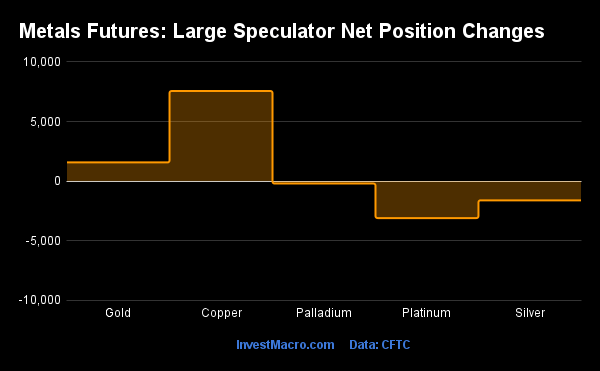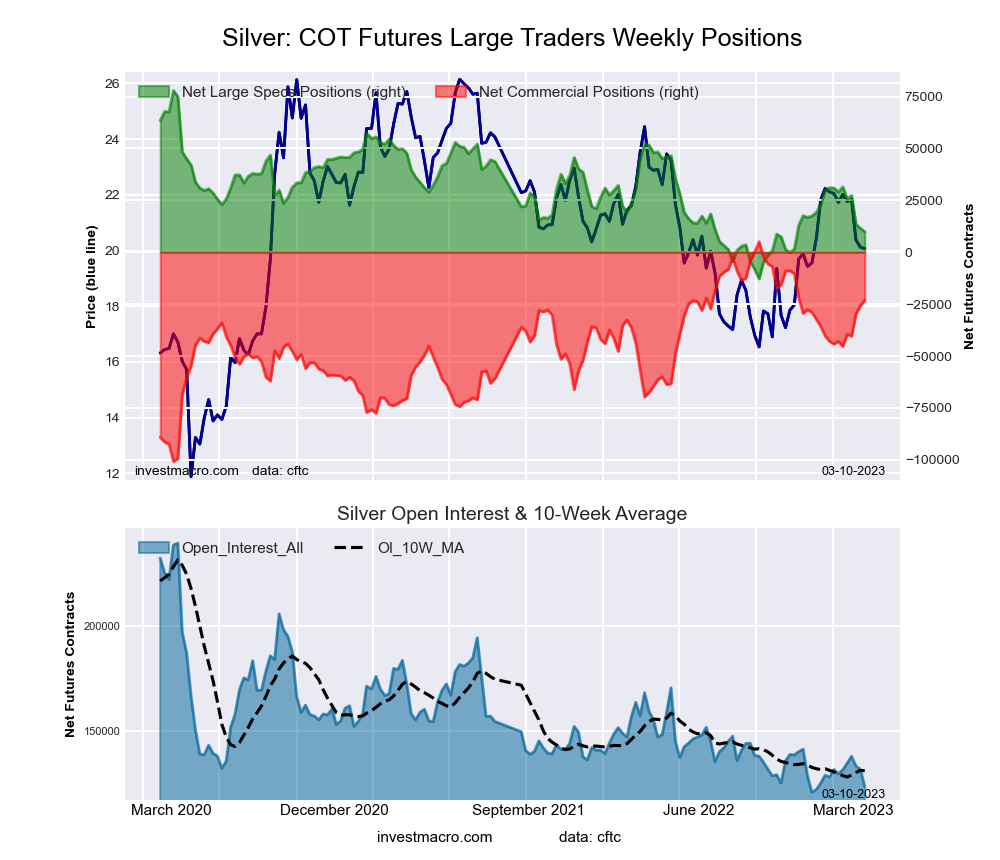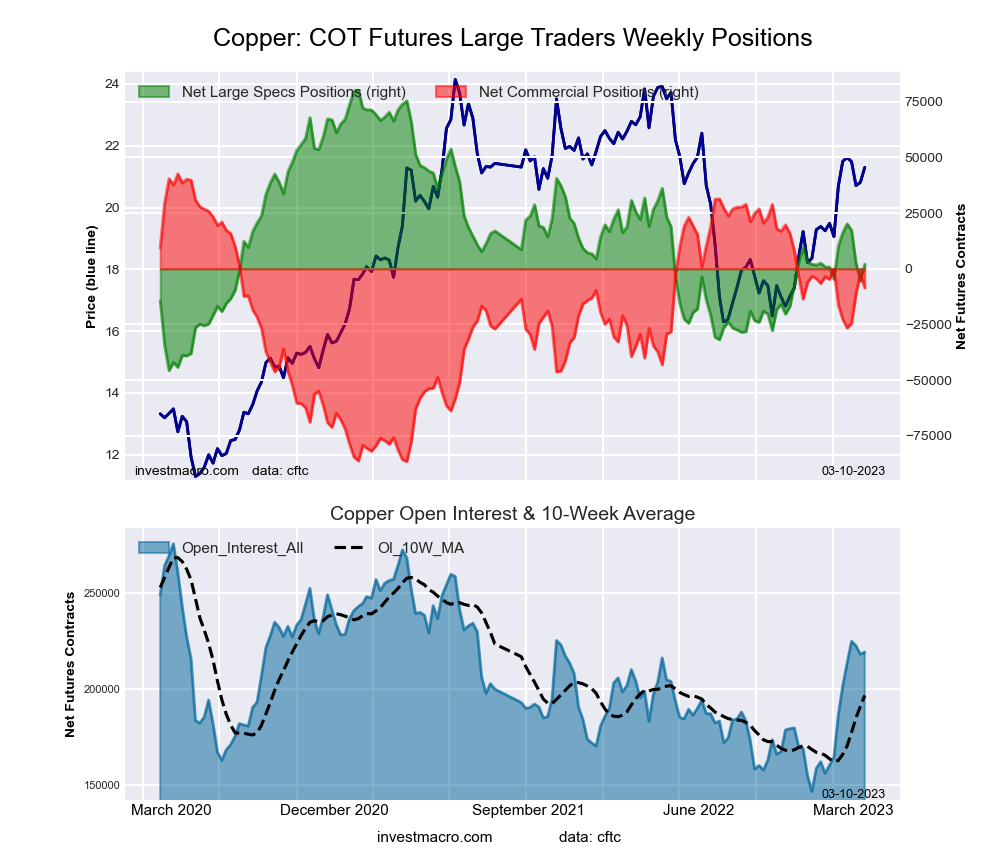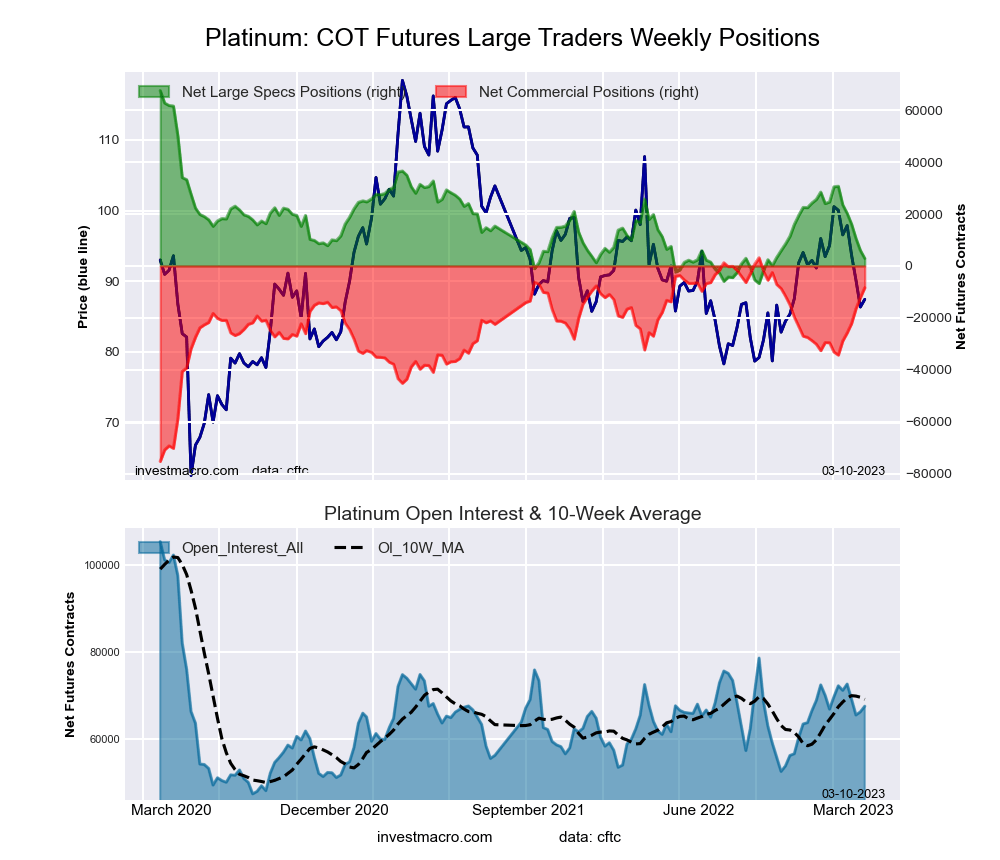
Archive for Opinions – Page 99

Brazil’s economic challenges are again Lula’s to tackle – this time around they’re more daunting

By Marc-Andreas Muendler, University of California, San Diego and Carlos Góes, University of California, San Diego 

Even when they’re in trouble, Brazilians rarely lose their sense of humor. But in recent years, their joviality has often given way to political division everywhere from social media to the dinner table.

One familiar quip – that Brazil is the country of the future and always will be – has lost its levity as Luiz Inácio Lula da Silva begins his third presidential term. Lula previously led his country from 2003 to 2010. The president, who was sworn in again on Jan. 1, 2023, promised on the campaign trail that Brazil’s future can be like its past again: more prosperous and less polarized.

Having studied Brazil in our economic research, and having lived in the country for several years by birth or by choice, we argue that it will not be easy for Lula to fulfill his economic promises.

Unlike in his first two terms, when domestic and foreign markets helped the economy along, Lula now faces strong headwinds at home and abroad – and that means sound policies are even more important this time around.

Good times, bad times and economic choices

Brazil shot up from the world’s 14th-largest economy in 2003 to the seventh-biggest in 2010, during a boom that largely coincided with Lula’s prior presidency. At the same time, the country’s poverty rate, which the World Bank today pegs at the share of the population living on less than US$3.65 a day, fell sharply, from 26% to 12%.

Brazil exports so many gallons of orange juice, bags of coffee, bushels of wheat and other commodities that it’s serving up the world’s breakfast. Global growth during those years boosted the demand for these commodities as well as for Brazil’s processed goods. Manufacturing exports fueled Brazil’s growth in the decade following the year 2000 for the first time, led by sales of products like steel, car parts and cars, and aircraft made by Embraer.

During these boom years, Lula ran a balanced government budget, held inflation low and kept the Brazilian real’s exchange rate with other currencies under control – macroeconomic policies that he maintained from his predecessor, Fernando Henrique Cardoso. Lula also bundled Cardoso’s popular anti-poverty programs into Bolsa Família, a successful conditional cash transfer program. To remain enrolled and receive the monetary benefits, low-income families had to get their children vaccinated against diseases, keep them in school and meet other requirements.

Cynthia Benedetto, Embraer’s chief financial officer, observed in 2011: “Since my childhood I heard that Brazil is the country of the future,” and then warned, “Now the future has arrived, and I start to fear that it is short.”

She was right. The good times didn’t last.

During the second decade of this century, the prices of many of the commodities that Brazil exports fell or even plummeted. The country experienced two of the worst recessions in its history. In the downturn that lasted from late 2014 to mid-2016, nearly 5 million Brazilians lost their jobs. After a sluggish recovery, the COVID-19 pandemic hit, and 10 million Brazilians became jobless in another big downturn.

Political upheaval

Bad choices made tough and unlucky times worse.

A combination of economic mismanagement, widespread corruption, political turmoil and a global pandemic all contributed to 10 years of backward sliding after a decade of progress.

Lula’s allies, including some in his inner circle, were found to be part of one corruption scheme after another. Lula himself ended up in prison for corruption until Brazil’s Supreme Court declared the case a mistrial because the presiding judge was determined to have been biased.

Brazilians elected Lula’s hand-picked successor, Dilma Rousseff, in the 2010 and 2014 presidential races. She cast aside some of her predecessors’ policies that had buttressed economic stability.

Rousseff ended the central bank’s de facto independence and lowered interest rates in an abrupt turnaround that sparked inflation. She gave up on balancing the budget.

Once corruption was exposed in state-owned oil company Petrobras, the construction industry and at Brazil’s massive state-run development bank, economic activity slowed across the board. Rousseff oversaw one of Brazil’s most severe economic contractions in memory: GDP shrank by 7% and public debt increased 20 percentage points as a share of GDP from 2014 to 2016.

Brazil’s Congress impeached and convicted Rousseff in 2016 for fiscal improprieties. Her vice president, Michel Temer, served out the rest of her term and appointed Lula’s central bank chair, Henrique Meirelles, as minister of finance to help rein in public debt.

Jair Bolsonaro, a vocal admirer of Brazil’s 20th-century military dictatorship, became president in 2019 by riding the wave of widespread sentiment against Lula’s and Rousseff’s Workers’ Party. Bolsonaro prioritized short-term political gain over long-term adjustment, often clashing with his own economic aides and dodging rules meant to curb government spending.

By 2020, Brazil’s economy ranked No. 12 in the world in terms of GDP, and living conditions deteriorated. In 2021, the poverty rate likely hit the highest level in a decade, according to estimates by researchers at IPEA, a government think tank, as well as IBGE, Brazil’s statistics agency.

The pandemic and the social spending fluctuations it brought about have made it hard to accurately track economic trends in recent years. But the numbers suggest that Brazil is close again to where it started the 21st century.

Back to the future

Lula’s economic challenges are daunting, over and above the political crisis after the riots by opposition supporters in Brasília.

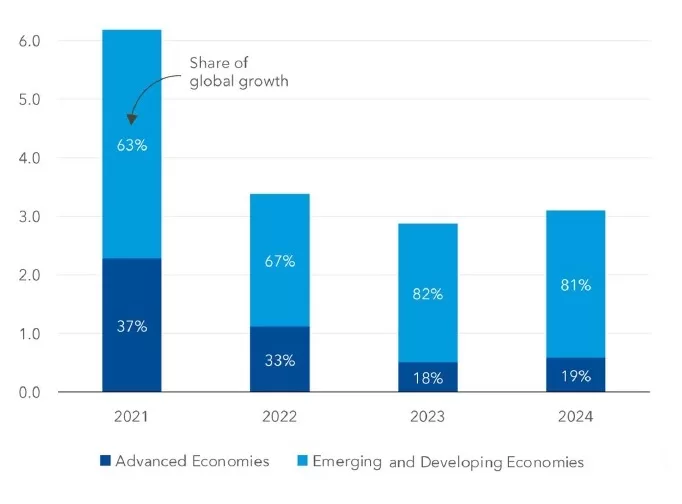
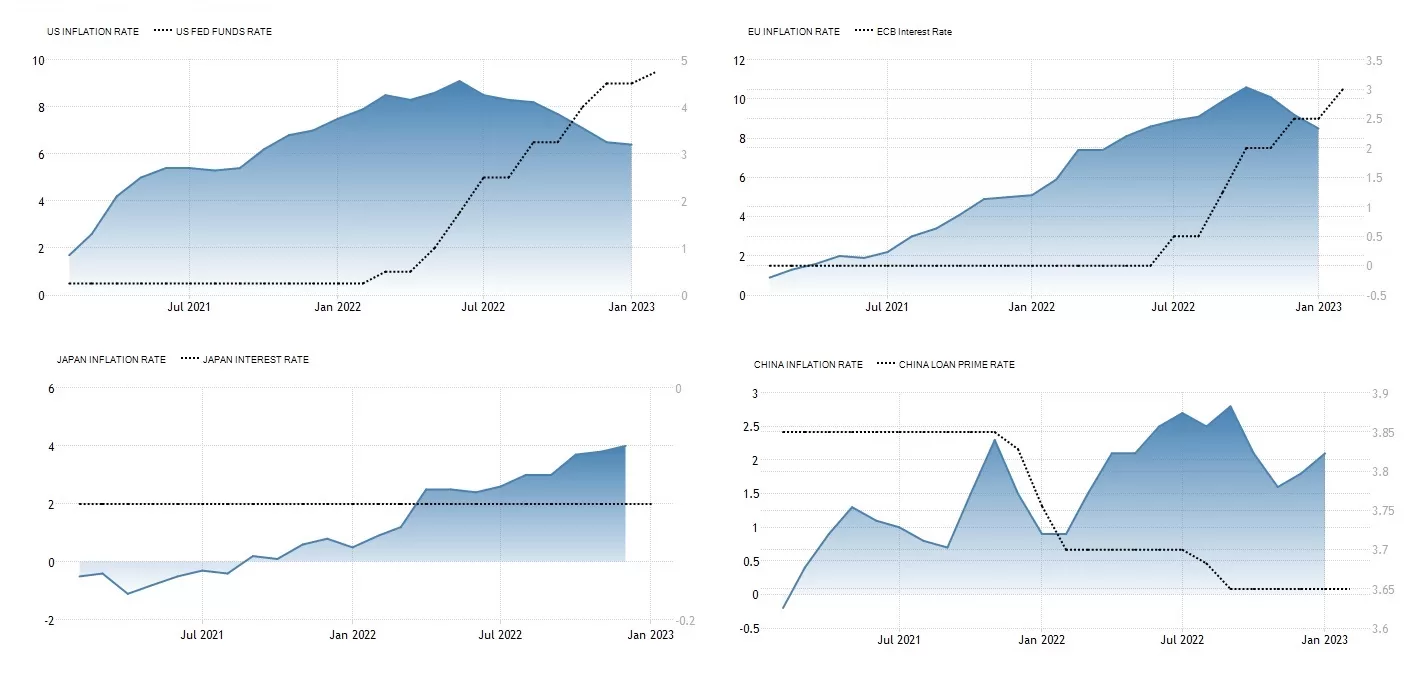
First, the economic outlook is gloomy. Inflation has led central banks worldwide to increase interest rates, and the International Monetary Fund forecasts a global slowdown in 2023.

Even if the world still wants Brazil’s coffee, orange juice and cereal from wheat or corn for breakfast, we doubt that foreign demand for Brazil’s exports will bounce back to the levels seen in past boom years.

Global prices for many of the commodities Brazil exports have been sliding downward for the past 15 years. They briefly reached their 2008 peak level again in mid-2022, partly driven by Russia’s invasion of Ukraine and the ensuing global turmoil that drove food prices up.

But the prices of commodities that are particularly important to Brazil, such as soybeans, corn and coffee, are all down significantly from their recent peaks.

During his 2022 campaign, Lula promised to slash taxes on the upper-middle class and increase benefits for the poor while keeping government finances under control.

This arithmetic is feasible in an era of rapid growth, when newly generated wealth can finance public transfers. At times of slow or no growth, like today, it becomes much harder to pull off.

Second, unlike when Lula first took office following a period of fiscal stability, this time he must credibly rebuild much of the fiscal framework.

After boosts to benefits, tax cuts and some unfunded pension commitments to retirees, it’s become hard to balance Brazil’s budget. In response to the crisis in the mid-2010s, Brazil’s Congress passed a spending cap that gradually rises so as to foster slow fiscal adjustment while avoiding harsh austerity. But Bolsonaro essentially got rid of the cap by circumventing it.

One example is the federal government’s obligation to cover court-mandated payments: Bolsonaro delayed the disbursement of 110 billion reais ($21.6 billion), equal to more than 1% of Brazil’s GDP, in 2022. That means the new government has to pay this year’s and some of last year’s bills at the same time.

While Bolsonaro dismissed the severity of COVID-19 when it was spreading uncontrolled through his country, his government did help people cope with its economic fallout by allowing emergency spending that breached Brazil’s spending cap. However, his administration maneuvered to perpetuate the state of emergency and kept spending levels higher than the cap would allow long after Brazilians stopped staying at home for public health reasons.

Third, we expect political divisions, including some within Lula’s administration, to be another obstacle. Different factions on his economic team are likely to be at loggerheads for the foreseeable future because they prefer starkly different policies.

Simone Tebet, the new economic planning minister who is in charge of coordinating spending, has several fiscal conservatives on her team.

Finance Minister Fernando Haddad, in contrast, has appointed undersecretaries known to invariably advocate for more spending. Plans for taxes and spending released to date set a budget surplus of 0.5% of GDP as the new government’s target, primarily financed with more tax collection.

Using budget projections by the International Monetary Fund, we consider those revenue projections overly optimistic.

To be sure, any new government deserves time to prove itself, especially under tough circumstances. But patience is rarer in Brazil than humor – and always has been.The Conversation

About the Author:

Marc-Andreas Muendler, Professor of Economics, University of California, San Diego and Carlos Góes, Doctoral Candidate in Economics, University of California, San Diego

This article is republished from The Conversation under a Creative Commons license. Read the original article.

Trendline Obsession

Source: Michael Ballanger  (1/30/23) 

Michael Ballanger of GGM Advisory Inc. shares his thoughts on the S&P 500, the outlook of Gold and Silver, and specifically why he believes you should be interested in Norseman Silver Ltd. 

In the mid-1980s, I got to know the late and very much renowned Canadian technical analyst Ian McAvity whose relationship with my boss (Jim Biddell) was forged years earlier in the 1960s when Ian and Jim were amongst the top squash players in Canada. In fact, Ian was a member of the Canadian Champion Doubles Squash team, ranked number one in North America for a time.

He also played exhibition matches against Pakistani-born North American professional champion Sharif Khan while showcasing the sport for South Afrikaan audiences shortly after the fall of apartheid rule. Above all else, Ian was not only a brilliant technical analyst and a pioneer in the use of logarithmic analysis to define trends but also a great storyteller with a wicked sense of humor.

I recall the time Ian put on a seminar at the old Holiday Inn in London, Ontario, and at the end of the presentation during the Q and A period, an elderly bespectacled gentleman got up and began to complain rather vociferously about the advice he was receiving from his stockbroker.

After waiting and listening for several very long moments with the stockbrokers in the audience shifting nervously in their chairs, Ian waited for the man to finish and then return to his seat, at which point Ian said, “When you came into this world, you had nothing. When you leave this world, you take nothing with you. So don’t hate your broker . . .  he’s just doing God’s work.”

Between hysterical guffaws and indignant screams of outrage, it was the best comeback ever in the history of boring high finance, and the box of Kleenex I went through wiping the tears of laughter from my cheeks is now legend.

At which point Ian said, “When you came into this world, you had nothing. When you leave this world, you take nothing with you. So don’t hate your broker . . .  he’s just doing God’s work.”

Please refrain from asking me why Ian McAvity suddenly popped into my mind as I sat down to write this weekly missive, but in case you do, the answer lies in the chart shown above that details arguably the most-watched, most-debated and most beaten-to-death technical pattern that has ever existed in the over-analyzed world of stock trading. So, I was wondering how my late friend Ian McAvity would have assessed it . . .

As I have written about for months now, I turned bullish in late September in what can only be described as an “ad hoc” decision. It was totally impulsive, based purely on the massive number of newly-arrived bears, each podcasting their breathless forecasts of stock market Armageddon sure to arrive in October of last year. It was also based on the sentiment numbers and hedge fund positioning (both at bearish extremes) but what sealed the deal for me was when a central bank that had been boasting loudly about its intention to normalize its balance sheet with huge bond sales suddenly did an abrupt one-eighty-degree turn.

When the Bank of England announced their purchase of some US$5 billion worth of 10-year “gilts” in order to alleviate domestic U.K. pension fund “stress,” a psychosomatic alarm bell went off inside me after which I immediately fired off an email alert to subscribers with the opinion that the Bank of England’s “pivot” was the call to arms for all of us to put away the bear clothes and start thinking about a year-end rally, which we got in spades.

The actual low for the S&P was a few trading days later on October 13th, but it was a great call based upon gut feel and had nothing whatsoever to do with the fine science of technical analysis.

S&P 500

That brings me to the topic of the current technical set-up for the S&P 500, which has the entire world focused on what the Twitterverse calls the “MOAT” — as in “Mother of All Trendlines.” We have everyone from thirty-something single moms doing kitchen table financial planning to seasoned CNBC commentators all weighing in on their analysis of this widely-trumpeted “rising wedge” formation that is “most surely” going to resolve itself to the downside and while the Citigroup panic-euphoria gauge has improved from “GREED” to “NEUTRAL,” I suspect that the consensus positioning is still bearish and that, according to Bob Farrell’s trading rule number nine, means that since so many experts all carry the same opinion, odds dictate an equal but opposite outcome.

With the wit and wisdom of Ian McAvity as my compass, this is what I surmised might be the probable outcome: (from Email Alert 2023-08)

“What I see happening by mid-February is the likelihood that Sam Bankman-Fried operating from the back room of his parents’ multi-million-dollar apartment in NYC, devises an algorithm that sends the S&P straight north of the ascending wedge, triggering an avalanche of “BUY” order from legion after legion of algobot traders, into which SBF shorts the entire volume surge sending the S&P southward and in full “failed-breakout” status. His coaches will be Elizabeth Holmes and the ghost of Bernie Madoff to ensure proper execution with zero prisoners taken.”

At the end of the day, only the market itself has any idea where it is going to wind up so technical analysis is simply just another tool.

My point in that veiled attempt at dark humor is that if there is one thing that Ian McAvity preached in his weekly “Deliberations” newsletter, was that at the end of the day, only the market itself has any idea where it is going to wind up so technical analysis is simply just another tool (like a few of the self-inflated podcasters I watch) with which to make investment/trading decisions.

I urge all of you attempting to use the resolution of the MOAT to park the current MSM obsession in the closet and let the “Two-day Close Rule” take effect before committing capital to the next “no-brainer” trade…

This past week I counted news releases from every junior developer/explorer in my 2023 GGMA Portfolio list as the consensus for 2023 is now tilting in the direction of the return of the commodities bull led by gold and silver but dominated by silver. It was almost as if every junior CEO/President were sent the advanced screening of Rick Rule’s appearance on Adam Taggert’s Wealtheon podcast, where the most-erudite stock peddler in world history (Rule) delivers a compellingly-verbose rendering of the commodities version of “In Flanders Field” punctuated with a “to those with failing hands we throw the torch hold it high” dissertation on silver and why Rick is going to join Neil Armstrong in taking “one small step for a man, but one giant leap for my net worth statement” (i.e., “da moon”)

Gold and Silver

Moonshots notwithstanding, silver has lagged behind gold and copper since late December, and while it can be argued that silver was the standout leader from late September to late December, gold and copper are simply playing “catchup.” I disagree. Traders live in the “now,” and until silver can get to a new recovery high for the advance above US$24.77 (basis March silver), the entire metals complex is going to be vulnerable to another bear raid that serves to deflate not only spirits but also the P&L’s of thousands of short-term option and futures punters that are reading and singing off the Rick Rule hymn sheet.

Since those are the very people that will be buying the junior miners, explorers, and developers (all of which I own), I do not wish to see gold and copper actually “catch up” to silver because chances are by the time that happens, the rally will be punctuated with terminal violence (and cries of anguish).

Norseman Silver

I mentioned Allied Copper Corp. (CPR:TSX.V; CPRRF:OTCQB) last week, and since it popped 46.4% this week, prompting dozens upon dozens of emails requesting more of these “penny dreadful” names, I offer this week another one but for a vastly different reason. The name is Norseman Silver Ltd. (NOC:TSX.V; NOCSF:OTCQB), whose principal project is located in South America.

In my career, there have always been areas of the world where the risk premium is elevated either due to the absence of the Rule of Law, infrastructure deficiencies, or domestic politics. In recent years, populist movements around the globe have shifted the winds of foreign investment in many different directions and in some cases, surprisingly hostile from the most unexpected of countries.

Mexico was once the favorite playground for Canadian miners as it was part of the NAFTA accord, so the free trade statutes were always there to protect the foreign investor. That has now changed with the news that Fortuna Silver has had its San Jose mine in southern Oaxaca shuttered due to environmental concerns. Civil unrest and local community protests have shut down countless operations in Peru recently, and for Peru, where over 40% of national taxes are generated by miners, that is a striking development.

I have a dear friend from the U.S. Midwest whose uncles are all worldly entrepreneurs whose contacts monitor foreign investment flows as a means of practicing the “Follow the Money” school of due diligence. He tells me that there are absolutely massive investment dollars being channeled into three South American countries in the fourth quarter of 2022 and again in January of 2023, with Paraguay and Ecuador the two lesser recipients. However, the primary focus of these enormous capital investments is the one country least likely in the past to enjoy such good fortune — Argentina.

The reality is that when governments erect roadblocks to exploration and development, vast regions that contain potential district-scale mining camps fall into the category of “underexplored” and, therefore, by default, “underdeveloped,” and therein lies the opportunity.

When I think of Argentina, all I can recall is that it has a massive inflation problem (94% in 2022) and that it has tended historically to be decidedly anti-mining and anti-foreign in its treatment of investors.

As an example, in 2009, Pan American Silver Corp. (PAAS:TSX; PAAS:NASDAQ) bought the Navidad Silver deposit through the acquisition of Aquiline for US$630 million, only to discover that the province of Chubut disallowed the use of cyanide in mining operations thus preventing commercial exploitation of one of the world’s largest and richest undeveloped silver deposits.

However, recent legislation began to move in the opposite direction, as “limited development” is now possible in 2023. The reality is that when governments erect roadblocks to exploration and development, vast regions that contain potential district-scale mining camps fall into the category of “underexplored” and, therefore, by default, “underdeveloped,” and therein lies the opportunity.

The Navidad silver deposit was discovered in a geological setting in Patagonia known as the “Gastre Fault” structural corridor, which also contains the Calcatreu Gold Mine. It is a vast region largely untapped, but if a foreign entity can enlist the right person or group to navigate the permitting waters successfully, they will have earned the “first mover advantage,” and that is exactly what Norseman silver has accomplished with their acquisition of the Taquetren Project, a land package of some 145,000 acres located in the Navidad-Calcatreu Mining District.

Gold Ridge

Of even greater importance is that the prospector-geologist and Argentinian national that discovered Navidad, Daniel Bussandri, is now Norseman’s country manager and is completely in charge of all operations, including exploration and permitting, for Taquetren. To have a local with a proven track record as a mine-finder at the helm is an asset that is hard to assess, but the one thing I know for sure is that the risk premium that one would normally assign has now been mitigated by the presence of Daniel Bussandri.

Press releases in 2022 have revealed mineralized outcrops of major copper-silver credits and some minor gold occurrences, but that last one from January 23rd was a game-changer.

Buy Norseman Silver.

It detailed the discovery of a 2 km long, 0.5 km wide mineralized vein structure where sub-crops yielded values as high as 12.2 g/t Au with this “Gold Ridge” zone lying within a larger 5 km long corridor hosting the Martha, Neta Nueva, Irma, and Veta Juan targets.

I have learned that the most recent sampling results at Gold Ridge are attracting the eyes and interest of more than a few of the consulting geologists, including 82-year-old crusty veteran geo Ron McMillan, who carries the reputation of being “unexcitable” about anything to do with early-stage exploration. Well, apparently, Mr. McMillan is “noticeably excited” about Gold Ridge, and given that it is located 20 km NW of Calcatreu and in the same mining district, I deem that as significant.

Norseman is completing a fast CA$750k funding in order to pay for the geophysical survey ordered last week, so with the existing CA$600,000 working capital position, the company is fully-funded to commence drilling once targets have been identified and permits received.

In sum, we have what might be a new gold discovery in a known gold-bearing region located in a largely-underexplored part of the world where for the first time in recent memory, large investment flows are suddenly and impressively showing up. We have a country manager with a proven track record and voluminous local relationships in order to facilitate the needs of the local politicians as he tries to capture the Navidad lightning in the junior exploration bottle once again. Remember, Navidad was sold for US$630 million.

At a CA$6.3m market cap, Norseman Silver Inc. appears ready to assume a dominant role in the Patagonia region as a first-mover with strong management at all levels and with a large land package in a mine-bearing region.

Buy Norseman Silver.

Michael Ballanger Disclaimer:

This letter makes no guarantee or warranty on the accuracy or completeness of the data provided. Nothing contained herein is intended or shall be deemed to be investment advice, implied or otherwise. This letter represents my views and replicates trades that I am making but nothing more than that. Always consult your registered advisor to assist you with your investments. I accept no liability for any loss arising from the use of the data contained on this letter. Options and junior mining stocks contain a high level of risk that may result in the loss of part or all invested capital and therefore are suitable for experienced and professional investors and traders only. One should be familiar with the risks involved in junior mining and options trading and we recommend consulting a financial adviser if you feel you do not understand the risks involved.

Disclosures:

1) Michael J. Ballanger: I, or members of my immediate household or family, own securities of the following companies mentioned in this article: All. I personally am, or members of my immediate household or family are, paid by the following companies mentioned in this article: My company, Bonaventure Explorations Ltd., has a consulting relationship with: None.

2) The following companies mentioned in this article are billboard sponsors of Streetwise Reports: None. Click here for important disclosures about sponsor fees. As of the date of this article, an affiliate of Streetwise Reports has a consulting relationship with: None. Please click here for more information.

3) Statements and opinions expressed are the opinions of the author and not of Streetwise Reports or its officers. The author is wholly responsible for the validity of the statements. The author was not paid by Streetwise Reports for this article. Streetwise Reports was not paid by the author to publish or syndicate this article. Streetwise Reports requires contributing authors to disclose any shareholdings in, or economic relationships with, companies that they write about. Streetwise Reports relies upon the authors to accurately provide this information and Streetwise Reports has no means of verifying its accuracy.

4) This article does not constitute investment advice. Each reader is encouraged to consult with his or her individual financial professional and any action a reader takes as a result of information presented here is his or her own responsibility. By opening this page, each reader accepts and agrees to Streetwise Reports’ terms of use and full legal disclaimer. This article is not a solicitation for investment. Streetwise Reports does not render general or specific investment advice and the information on Streetwise Reports should not be considered a recommendation to buy or sell any security. Streetwise Reports does not endorse or recommend the business, products, services or securities of any company mentioned on Streetwise Reports.

5) From time to time, Streetwise Reports LLC and its directors, officers, employees or members of their families, as well as persons interviewed for articles and interviews on the site, may have a long or short position in securities mentioned. Directors, officers, employees or members of their immediate families are prohibited from making purchases and/or sales of those securities in the open market or otherwise from the time of the decision to publish an article until three business days after the publication of the article. The foregoing prohibition does not apply to articles that in substance only restate previously published company releases.

As of the date of this article, officers and/or employees of Streetwise Reports LLC (including members of their household) own securities of Allied Copper Corp. and  Norseman Silver Ltd., companies mentioned in this article.

US debt default could trigger dollar’s collapse – and severely erode America’s political and economic might

By Michael Humphries, Touro University 

It’s a case of déjà vu all over again on the debt ceiling debate.

Republicans, who regained control of the House of Representatives in November 2022, are threatening to not allow an increase in the debt limit unless they get unspecified spending cuts in return. In so doing, they risk pushing the U.S. government into default.

Brinkmanship over the debt ceiling has become a regular ritual – it happened under the Clinton administration in 1995, then again with Barack Obama as president in 2011, and more recently in 2021.

As an economist, I know that defaulting on the national debt would have real-life consequences. Even the threat of pushing the U.S. into default has an economic impact. In August 2021, the mere prospect of a potential default led to an unprecedented downgrade of the the nation’s credit rating, hurting America’s financial prestige as well as countless individuals, including retirees.

And that was caused by the mere specter of default. An actual default would be far more damaging.

Dollar’s collapse

Possibly the most serious consequence would be the collapse of the U.S. dollar and its replacement as global trade’s “unit of account.” That essentially means that it is widely used in global finance and trade.

Day to day, most Americans are likely unaware of the economic and political power that goes with being the world’s unit of account. Currently, more than half of world trade – from oil and gold to cars and smartphones – is in U.S. dollars, with the euro accounting for around 30% and all other currencies making up the balance.

As a result of this dominance, the U.S. is the only country on the planet that can pay its foreign debt in its own currency. This gives both the U.S. government and American companies tremendous leeway in international trade and finance.

No matter how much debt the U.S. government owes foreign investors, it can simply print the money needed to pay them back – although for economic reasons, it may not be wise to do so. Other countries must buy either the dollar or the euro to pay their foreign debt. And the only way for them to do so is to either to export more than they import or borrow more dollars or euros on the international market.

The U.S. is free from such constraints and can run up large trade deficits – that is, import more than it exports – for decades without the same consequences.

For American companies, the dominance of the dollar means they aren’t as subject to the exchange rate risk as are their foreign competitors. Exchange rate risk refers to how changes in the relative value of currencies may affect a company’s profitability.

Since international trade is generally denominated in dollars, U.S. businesses can buy and sell in their own currency, something their foreign competitors cannot do as easily. As simple as this sounds, it gives American companies a tremendous competitive advantage.

If Republicans push the U.S. into default, the dollar would likely lose its position as the international unit of account, forcing the government and companies to pay their international bills in another currency.

Loss of political power too

Since most foreign trade is denominated in the dollar, trade must go through an American bank at some point. This is one important way dollar dominance gives the U.S. tremendous political power, especially to punish economic rivals and unfriendly governments.

For example, when former President Donald Trump imposed economic sanctions on Iran, he denied the country access to American banks and to the dollar. He also imposed secondary sanctions, which means that non-American companies trading with Iran were also sanctioned. Given a choice of access to the dollar or trading with Iran, most of the world economies chose access to the dollar and complied with the sanctions. As a result, Iran entered a deep recession, and its currency plummeted about 30%.

President Joe Biden did something similar against Russia in response to its invasion of Ukraine. Limiting Russia’s access to the dollar has helped push the country into a recession that’s bordering on a depression.

No other country today could unilaterally impose this level of economic pain on another country. And all an American president currently needs is a pen.

Rivals rewarded

Another consequence of the dollar’s collapse would be enhancing the position of the U.S.‘s top rival for global influence: China.

While the euro would likely replace the dollar as the world’s primary unit of account, the Chinese yuan would move into second place.

If the yuan were to become an a significant international unit of account, this would enhance China’s international position both economically and politically. As it is, China has been working with the other BRIC countries – Brazil, Russia and India – to accept the yuan as a unit of account. With the other three already resentful of U.S. economic and political dominance, a U.S. default would support that effort.

They may not be alone: Recently, Saudi Arabia suggested it was open to trading some of its oil in currencies other than the dollar – something that would change long-standing policy.

Severe consequences

Beyond the impact on the dollar and the economic and political clout of the U.S., a default would be profoundly felt in many other ways and by countless people.

In the U.S., tens of millions of Americans and thousands of companies that depend on government support could suffer, and the economy would most likely sink into recession – or worse, given the U.S. is already expected to soon suffer a downturn. In addition, retirees could see the worth of their pensions dwindle.

The truth is, we really don’t know what will happen or how bad it will get. The scale of the damage caused by a U.S. default is hard to calculate in advance because it has never happened before.

But there’s one thing we can be certain of. If Republicans take their threat of default too far, the U.S. and Americans will suffer tremendously.The Conversation

About the Author:

Michael Humphries, Deputy Chair of Business Administration, Touro University

This article is republished from The Conversation under a Creative Commons license. Read the original article.

Trade of the Week: GBPUSD ready to rock

By ForexTime

In recent sessions, GBPUSD has been relatively quiet, trading just below a key resistance level.

But such relative calm could be pierced this week as markets pit the policy signals out of two major central banks against each other:

the US Federal Reserve (a.k.a. the Fed) vs. the Bank of England (BOE).

First, a quick refresher on how FX markets tend to react to central bank policy moves.

Generally, the central bank that can keep raising its interest rates further while its economy can withstand those higher rates (relative to another central bank’s benchmark rates/economy) typically sees its currency strengthen.

READ MORE: (September 2022) Why FX markets react to central banks


And on that premise, GBPUSD has climbed by more than 2.5% so far this year.

The price consolidation seen in the above chart also suggests this FX pair’s next move may be a big one, depending on how the Fed and the BOE act over the coming days.

According to Bloomberg’s FX forecast model, there’s a 72% chance that GBPUSD trades within the 1.2182 – 1.2614 range this week.

Whether this FX pair (nicknamed “cable) goes up or down is likely to depend on which central bank can convince markets that it’s got more rate hikes in store for 2023.

What are markets expecting the Fed and the BOE to do?

Overall, the BOE is expected to hike by a larger amount compared to the Fed:

  • This week: BOE to hike by 50bps vs. the Fed’s forecasted 25bps hike
  • This year: BOE expected to hike by 100bps in total (including this week’s expected hikes), compared to the Fed’s forecasted remaining hikes of 50bps


Depending on how much either central bank deviates from the above-listed scenario, that may well determine the size of GBPUSD’s move this week.

Overall, if the BOE confirms this week that it can officially out-hike the Fed, not just this week but also over the coming months, that could trigger the next leg up for GBPUSD.


However, we could be in for a SURPRISE this week, if the:

  • BOE hints that it’s almost done with its own rate hikes, for fear of incurring too much damage to the UK economy.
  • Fed reiterates its intentions to keep sending US interest rates higher than the 5% peak that markets are forecasting.

    After all, Fed Chair Jerome Powell has often said he wants today’s Fed to avoid the mistakes from the 1970s, when the then-Fed eased up on its rate hikes too soon.

The above scenario (dovish BOE + still-hawkish Fed) may then trigger GBPUSD into unwinding some of its recent gains.


Key levels for GBPUSD:

RESISTANCE

  • 1.24511: this marks the 61.8% Fibonacci retracement level from GBPUSD’s 2022 peak-to-trough action.

    Although Pound bulls were fought back at this level in mid-December, they are biding their time once more and consolidating just below this key technical level, awaiting hawkish cues from the BOE to help GBPUSD breach this initial resistance level.

  • 1.265: this area resisted GBPUSD upside at both ends of May 2022, and may do so again in the near future.


SUPPORT

  • Upper 1.22 region: cycle highs from early August 2022
  • 1.218: around where GBPUSD’s 50-daysimple moving average (SMA) currently lies.


At the time of writing, from current levels just below 1.24, Bloomberg’s FX model is pointing to a slightly likelier chance that GBPUSD would dip below 1.22 (16.5% chance) rather than breach the 1.26 mark (15% chance).

Amid rising expectations for heightened immediate volatility for GBPUSD, it’s increasingly evident that FX markets are on tenterhooks, eager to react to the latest clues out of the Fed and the BOE this week.


Article by ForexTime

ForexTime Ltd (FXTM) is an award winning international online forex broker regulated by CySEC 185/12 www.forextime.com

Currency Speculators add to EuroFX bullish bets as EURUSD trades at 1.0900

By InvestMacro

Here are the latest charts and statistics for the Commitment of Traders (COT) data published by the Commodities Futures Trading Commission (CFTC).

The latest COT data is updated through Tuesday January 24th and shows a quick view of how large market participants (for-profit speculators and commercial traders) were positioned in the futures markets. All currency positions are in direct relation to the US dollar where, for example, a bet for the euro is a bet that the euro will rise versus the dollar while a bet against the euro will be a bet that the euro will decline versus the dollar.

Weekly Speculator Changes led by EuroFX & US Dollar Index

The COT currency market speculator bets were higher this week as six out of the eleven currency markets we cover had higher positioning while the other five markets had lower speculator contracts.

Leading the gains for the currency markets was the EuroFX (7,365 contracts) with the US Dollar Index (1,805 contracts), Japanese Yen (1,326 contracts), British Pound (763 contracts), Brazilian Real (592 contracts) and the Australian Dollar (449 contracts) also showing positive weeks.

The currencies seeing declines in speculator bets on the week were the New Zealand Dollar (-3,884 contracts), the Canadian Dollar (-3,453 contracts), Swiss Franc (-1,567 contracts), Bitcoin (-810 contracts) and the Mexican Peso (-101 contracts) also registering lower bets on the week.

Highlighting the COT currency’s data this week is the strength of the speculator’s positioning in the Euro. Large speculative positions rose this week by over +7,300 contracts and have risen in four out of the past six weeks. Euro weekly positions have now also been higher in sixteen out of the past twenty-one weeks, going from a total of -47,676 contracts on August 30th to this week’s total net position of +134,349 contracts.

The Euro speculator positions have now been above +100,000 contracts for the past thirteen consecutive weeks which is the best streak since early in 2021. The Euro strength index, a measure of positions compared to the past three year’s range, has now moved up to a level of 76 percent strength of last three years.

The Euro exchange rate against the US Dollar hit it’s highest level this week since April above the 1.0900 exchange level. Since October, the Euro has now had higher weekly closes in eleven out of the past fifteen weeks and looks to soon make a run at the psychological 1.1000 level.


Data Snapshot of Forex Market Traders | Columns Legend
Jan-24-2023OIOI-IndexSpec-NetSpec-IndexCom-NetCOM-IndexSmalls-NetSmalls-Index
USD Index41,2334815,16350-17,909472,74647
EUR777,569100134,34976-186,4502352,10162
GBP194,05133-23,9344827,65453-3,72051
JPY173,32134-21,6355617,145444,49063
CHF35,36820-9,5082911,56564-2,05751
CAD137,47622-30,712529,159931,55333
AUD129,49029-33,1715429,706413,46561
NZD32,710122,17460-4,241362,06775
MXN272,65583-48,740742,327906,41395
RUB20,93047,54331-7,15069-39324
BRL45,1283422,78570-23,6183083371
Bitcoin17,39093-1,43752912052525


Strength Scores led by EuroFX & Brazilian Real

COT Strength Scores (a normalized measure of Speculator positions over a 3-Year range, from 0 to 100 where above 80 is Extreme-Bullish and below 20 is Extreme-Bearish) showed that the EuroFX (76 percent) and the Brazilian Real (70 percent) lead the currency markets this week. The New Zealand Dollar (60 percent), Japanese Yen (56 percent) and the Australian Dollar (54 percent) come in as the next highest in the weekly strength scores.

On the downside, the Canadian Dollar (5 percent) and the Mexican Peso (7 percent) come in at the lowest strength levels currently and are in Extreme-Bearish territory (below 20 percent). The next lowest strength scores are the Swiss Franc (29 percent) and the British Pound (48 percent).

Strength Statistics:
US Dollar Index (50.2 percent) vs US Dollar Index previous week (47.2 percent)
EuroFX (76.2 percent) vs EuroFX previous week (74.0 percent)
British Pound Sterling (48.5 percent) vs British Pound Sterling previous week (47.8 percent)
Japanese Yen (55.6 percent) vs Japanese Yen previous week (54.7 percent)
Swiss Franc (29.5 percent) vs Swiss Franc previous week (33.6 percent)
Canadian Dollar (5.2 percent) vs Canadian Dollar previous week (9.3 percent)
Australian Dollar (54.1 percent) vs Australian Dollar previous week (53.7 percent)
New Zealand Dollar (60.0 percent) vs New Zealand Dollar previous week (70.4 percent)
Mexican Peso (6.7 percent) vs Mexican Peso previous week (6.8 percent)
Brazilian Real (70.3 percent) vs Brazilian Real previous week (69.7 percent)
Bitcoin (51.9 percent) vs Bitcoin previous week (66.0 percent)


New Zealand Dollar & Brazilian Real top the 6-Week Strength Trends

COT Strength Score Trends (or move index, calculates the 6-week changes in strength scores) showed that the New Zealand Dollar (26 percent) and the Brazilian Real (21 percent) lead the past six weeks trends for the currencies. The Japanese Yen (19 percent), the Swiss Franc (6 percent) and the Australian Dollar (4 percent) are the next highest positive movers in the latest trends data.

The Mexican Peso (-41 percent) leads the downside trend scores currently with Bitcoin (-24 percent), the US Dollar Index (-18 percent) and the Canadian Dollar (-4 percent) following next with lower trend scores.

Strength Trend Statistics:
US Dollar Index (-17.7 percent) vs US Dollar Index previous week (-19.2 percent)
EuroFX (3.0 percent) vs EuroFX previous week (0.6 percent)
British Pound Sterling (1.5 percent) vs British Pound Sterling previous week (3.0 percent)
Japanese Yen (19.4 percent) vs Japanese Yen previous week (26.5 percent)
Swiss Franc (6.1 percent) vs Swiss Franc previous week (11.3 percent)
Canadian Dollar (-4.1 percent) vs Canadian Dollar previous week (-6.2 percent)
Australian Dollar (4.3 percent) vs Australian Dollar previous week (6.4 percent)
New Zealand Dollar (25.9 percent) vs New Zealand Dollar previous week (33.6 percent)
Mexican Peso (-40.6 percent) vs Mexican Peso previous week (-42.1 percent)
Brazilian Real (20.7 percent) vs Brazilian Real previous week (21.4 percent)
Bitcoin (-24.4 percent) vs Bitcoin previous week (-12.1 percent)


Individual COT Forex Markets:

US Dollar Index Futures:

US Dollar Index Forex Futures COT ChartThe US Dollar Index large speculator standing this week reached a net position of 15,163 contracts in the data reported through Tuesday. This was a weekly advance of 1,805 contracts from the previous week which had a total of 13,358 net contracts.

This week’s current strength score (the trader positioning range over the past three years, measured from 0 to 100) shows the speculators are currently Bullish with a score of 50.2 percent. The commercials are Bearish with a score of 47.3 percent and the small traders (not shown in chart) are Bearish with a score of 46.6 percent.

US DOLLAR INDEX StatisticsSPECULATORSCOMMERCIALSSMALL TRADERS
– Percent of Open Interest Longs:80.72.413.6
– Percent of Open Interest Shorts:44.045.87.0
– Net Position:15,163-17,9092,746
– Gross Longs:33,2919815,614
– Gross Shorts:18,12818,8902,868
– Long to Short Ratio:1.8 to 10.1 to 12.0 to 1
NET POSITION TREND:
– Strength Index Score (3 Year Range Pct):50.247.346.6
– Strength Index Reading (3 Year Range):BullishBearishBearish
NET POSITION MOVEMENT INDEX:
– 6-Week Change in Strength Index:-17.716.80.5


Euro Currency Futures:

Euro Currency Futures COT ChartThe Euro Currency large speculator standing this week reached a net position of 134,349 contracts in the data reported through Tuesday. This was a weekly advance of 7,365 contracts from the previous week which had a total of 126,984 net contracts.

This week’s current strength score (the trader positioning range over the past three years, measured from 0 to 100) shows the speculators are currently Bullish with a score of 76.2 percent. The commercials are Bearish with a score of 23.1 percent and the small traders (not shown in chart) are Bullish with a score of 62.1 percent.

EURO Currency StatisticsSPECULATORSCOMMERCIALSSMALL TRADERS
– Percent of Open Interest Longs:30.655.212.4
– Percent of Open Interest Shorts:13.379.25.7
– Net Position:134,349-186,45052,101
– Gross Longs:237,743429,25396,793
– Gross Shorts:103,394615,70344,692
– Long to Short Ratio:2.3 to 10.7 to 12.2 to 1
NET POSITION TREND:
– Strength Index Score (3 Year Range Pct):76.223.162.1
– Strength Index Reading (3 Year Range):BullishBearishBullish
NET POSITION MOVEMENT INDEX:
– 6-Week Change in Strength Index:3.0-8.231.0


British Pound Sterling Futures:

British Pound Sterling Futures COT ChartThe British Pound Sterling large speculator standing this week reached a net position of -23,934 contracts in the data reported through Tuesday. This was a weekly rise of 763 contracts from the previous week which had a total of -24,697 net contracts.

This week’s current strength score (the trader positioning range over the past three years, measured from 0 to 100) shows the speculators are currently Bearish with a score of 48.5 percent. The commercials are Bullish with a score of 52.9 percent and the small traders (not shown in chart) are Bullish with a score of 50.7 percent.

BRITISH POUND StatisticsSPECULATORSCOMMERCIALSSMALL TRADERS
– Percent of Open Interest Longs:17.965.613.6
– Percent of Open Interest Shorts:30.251.315.5
– Net Position:-23,93427,654-3,720
– Gross Longs:34,756127,20726,309
– Gross Shorts:58,69099,55330,029
– Long to Short Ratio:0.6 to 11.3 to 10.9 to 1
NET POSITION TREND:
– Strength Index Score (3 Year Range Pct):48.552.950.7
– Strength Index Reading (3 Year Range):BearishBullishBullish
NET POSITION MOVEMENT INDEX:
– 6-Week Change in Strength Index:1.5-2.53.6


Japanese Yen Futures:

Japanese Yen Forex Futures COT ChartThe Japanese Yen large speculator standing this week reached a net position of -21,635 contracts in the data reported through Tuesday. This was a weekly advance of 1,326 contracts from the previous week which had a total of -22,961 net contracts.

This week’s current strength score (the trader positioning range over the past three years, measured from 0 to 100) shows the speculators are currently Bullish with a score of 55.6 percent. The commercials are Bearish with a score of 44.0 percent and the small traders (not shown in chart) are Bullish with a score of 62.6 percent.

JAPANESE YEN StatisticsSPECULATORSCOMMERCIALSSMALL TRADERS
– Percent of Open Interest Longs:15.965.417.9
– Percent of Open Interest Shorts:28.455.615.3
– Net Position:-21,63517,1454,490
– Gross Longs:27,620113,43731,009
– Gross Shorts:49,25596,29226,519
– Long to Short Ratio:0.6 to 11.2 to 11.2 to 1
NET POSITION TREND:
– Strength Index Score (3 Year Range Pct):55.644.062.6
– Strength Index Reading (3 Year Range):BullishBearishBullish
NET POSITION MOVEMENT INDEX:
– 6-Week Change in Strength Index:19.4-20.421.0


Swiss Franc Futures:

Swiss Franc Forex Futures COT ChartThe Swiss Franc large speculator standing this week reached a net position of -9,508 contracts in the data reported through Tuesday. This was a weekly reduction of -1,567 contracts from the previous week which had a total of -7,941 net contracts.

This week’s current strength score (the trader positioning range over the past three years, measured from 0 to 100) shows the speculators are currently Bearish with a score of 29.5 percent. The commercials are Bullish with a score of 64.1 percent and the small traders (not shown in chart) are Bullish with a score of 50.6 percent.

SWISS FRANC StatisticsSPECULATORSCOMMERCIALSSMALL TRADERS
– Percent of Open Interest Longs:10.257.132.6
– Percent of Open Interest Shorts:37.124.438.4
– Net Position:-9,50811,565-2,057
– Gross Longs:3,62420,18511,540
– Gross Shorts:13,1328,62013,597
– Long to Short Ratio:0.3 to 12.3 to 10.8 to 1
NET POSITION TREND:
– Strength Index Score (3 Year Range Pct):29.564.150.6
– Strength Index Reading (3 Year Range):BearishBullishBullish
NET POSITION MOVEMENT INDEX:
– 6-Week Change in Strength Index:6.1-7.37.1


Canadian Dollar Futures:

Canadian Dollar Forex Futures COT ChartThe Canadian Dollar large speculator standing this week reached a net position of -30,712 contracts in the data reported through Tuesday. This was a weekly fall of -3,453 contracts from the previous week which had a total of -27,259 net contracts.

This week’s current strength score (the trader positioning range over the past three years, measured from 0 to 100) shows the speculators are currently Bearish-Extreme with a score of 5.2 percent. The commercials are Bullish-Extreme with a score of 93.0 percent and the small traders (not shown in chart) are Bearish with a score of 33.2 percent.

CANADIAN DOLLAR StatisticsSPECULATORSCOMMERCIALSSMALL TRADERS
– Percent of Open Interest Longs:18.956.422.5
– Percent of Open Interest Shorts:41.235.221.4
– Net Position:-30,71229,1591,553
– Gross Longs:25,97877,57130,927
– Gross Shorts:56,69048,41229,374
– Long to Short Ratio:0.5 to 11.6 to 11.1 to 1
NET POSITION TREND:
– Strength Index Score (3 Year Range Pct):5.293.033.2
– Strength Index Reading (3 Year Range):Bearish-ExtremeBullish-ExtremeBearish
NET POSITION MOVEMENT INDEX:
– 6-Week Change in Strength Index:-4.13.5-1.6


Australian Dollar Futures:

Australian Dollar Forex Futures COT ChartThe Australian Dollar large speculator standing this week reached a net position of -33,171 contracts in the data reported through Tuesday. This was a weekly rise of 449 contracts from the previous week which had a total of -33,620 net contracts.

This week’s current strength score (the trader positioning range over the past three years, measured from 0 to 100) shows the speculators are currently Bullish with a score of 54.1 percent. The commercials are Bearish with a score of 41.0 percent and the small traders (not shown in chart) are Bullish with a score of 60.9 percent.

AUSTRALIAN DOLLAR StatisticsSPECULATORSCOMMERCIALSSMALL TRADERS
– Percent of Open Interest Longs:22.857.817.7
– Percent of Open Interest Shorts:48.434.815.0
– Net Position:-33,17129,7063,465
– Gross Longs:29,46674,81822,903
– Gross Shorts:62,63745,11219,438
– Long to Short Ratio:0.5 to 11.7 to 11.2 to 1
NET POSITION TREND:
– Strength Index Score (3 Year Range Pct):54.141.060.9
– Strength Index Reading (3 Year Range):BullishBearishBullish
NET POSITION MOVEMENT INDEX:
– 6-Week Change in Strength Index:4.3-9.820.7


New Zealand Dollar Futures:

New Zealand Dollar Forex Futures COT ChartThe New Zealand Dollar large speculator standing this week reached a net position of 2,174 contracts in the data reported through Tuesday. This was a weekly decrease of -3,884 contracts from the previous week which had a total of 6,058 net contracts.

This week’s current strength score (the trader positioning range over the past three years, measured from 0 to 100) shows the speculators are currently Bullish with a score of 60.0 percent. The commercials are Bearish with a score of 36.5 percent and the small traders (not shown in chart) are Bullish with a score of 75.4 percent.

NEW ZEALAND DOLLAR StatisticsSPECULATORSCOMMERCIALSSMALL TRADERS
– Percent of Open Interest Longs:31.150.915.5
– Percent of Open Interest Shorts:24.463.99.2
– Net Position:2,174-4,2412,067
– Gross Longs:10,17016,6625,077
– Gross Shorts:7,99620,9033,010
– Long to Short Ratio:1.3 to 10.8 to 11.7 to 1
NET POSITION TREND:
– Strength Index Score (3 Year Range Pct):60.036.575.4
– Strength Index Reading (3 Year Range):BullishBearishBullish
NET POSITION MOVEMENT INDEX:
– 6-Week Change in Strength Index:25.9-24.47.6


Mexican Peso Futures:

Mexican Peso Futures COT ChartThe Mexican Peso large speculator standing this week reached a net position of -48,740 contracts in the data reported through Tuesday. This was a weekly decline of -101 contracts from the previous week which had a total of -48,639 net contracts.

This week’s current strength score (the trader positioning range over the past three years, measured from 0 to 100) shows the speculators are currently Bearish-Extreme with a score of 6.7 percent. The commercials are Bullish-Extreme with a score of 90.3 percent and the small traders (not shown in chart) are Bullish-Extreme with a score of 95.3 percent.

MEXICAN PESO StatisticsSPECULATORSCOMMERCIALSSMALL TRADERS
– Percent of Open Interest Longs:54.442.23.2
– Percent of Open Interest Shorts:72.326.70.8
– Net Position:-48,74042,3276,413
– Gross Longs:148,265115,0538,628
– Gross Shorts:197,00572,7262,215
– Long to Short Ratio:0.8 to 11.6 to 13.9 to 1
NET POSITION TREND:
– Strength Index Score (3 Year Range Pct):6.790.395.3
– Strength Index Reading (3 Year Range):Bearish-ExtremeBullish-ExtremeBullish-Extreme
NET POSITION MOVEMENT INDEX:
– 6-Week Change in Strength Index:-40.639.25.6


Brazilian Real Futures:

Brazil Real Futures COT ChartThe Brazilian Real large speculator standing this week reached a net position of 22,785 contracts in the data reported through Tuesday. This was a weekly gain of 592 contracts from the previous week which had a total of 22,193 net contracts.

This week’s current strength score (the trader positioning range over the past three years, measured from 0 to 100) shows the speculators are currently Bullish with a score of 70.3 percent. The commercials are Bearish with a score of 30.3 percent and the small traders (not shown in chart) are Bullish with a score of 71.4 percent.

BRAZIL REAL StatisticsSPECULATORSCOMMERCIALSSMALL TRADERS
– Percent of Open Interest Longs:79.113.07.9
– Percent of Open Interest Shorts:28.665.36.1
– Net Position:22,785-23,618833
– Gross Longs:35,6915,8473,585
– Gross Shorts:12,90629,4652,752
– Long to Short Ratio:2.8 to 10.2 to 11.3 to 1
NET POSITION TREND:
– Strength Index Score (3 Year Range Pct):70.330.371.4
– Strength Index Reading (3 Year Range):BullishBearishBullish
NET POSITION MOVEMENT INDEX:
– 6-Week Change in Strength Index:20.7-18.9-14.2


Bitcoin Futures:

Bitcoin Crypto Futures COT ChartThe Bitcoin large speculator standing this week reached a net position of -1,437 contracts in the data reported through Tuesday. This was a weekly decrease of -810 contracts from the previous week which had a total of -627 net contracts.

This week’s current strength score (the trader positioning range over the past three years, measured from 0 to 100) shows the speculators are currently Bullish with a score of 51.9 percent. The commercials are Bullish-Extreme with a score of 100.0 percent and the small traders (not shown in chart) are Bearish with a score of 24.9 percent.

BITCOIN StatisticsSPECULATORSCOMMERCIALSSMALL TRADERS
– Percent of Open Interest Longs:75.07.88.4
– Percent of Open Interest Shorts:83.22.65.4
– Net Position:-1,437912525
– Gross Longs:13,0361,3651,467
– Gross Shorts:14,473453942
– Long to Short Ratio:0.9 to 13.0 to 11.6 to 1
NET POSITION TREND:
– Strength Index Score (3 Year Range Pct):51.9100.024.9
– Strength Index Reading (3 Year Range):BullishBullish-ExtremeBearish
NET POSITION MOVEMENT INDEX:
– 6-Week Change in Strength Index:-24.459.01.7


Article By InvestMacroReceive our weekly COT Newsletter

*COT Report: The COT data, released weekly to the public each Friday, is updated through the most recent Tuesday (data is 3 days old) and shows a quick view of how large speculators or non-commercials (for-profit traders) were positioned in the futures markets.

The CFTC categorizes trader positions according to commercial hedgers (traders who use futures contracts for hedging as part of the business), non-commercials (large traders who speculate to realize trading profits) and nonreportable traders (usually small traders/speculators) as well as their open interest (contracts open in the market at time of reporting). See CFTC criteria here.

COT Bonds Speculators cut back on Eurodollar bearish bets for 10th time in 11 weeks

By InvestMacro

Here are the latest charts and statistics for the Commitment of Traders (COT) reports data published by the Commodities Futures Trading Commission (CFTC).

The latest COT data is updated through Tuesday January 24th and shows a quick view of how large traders (for-profit speculators and commercial hedgers) were positioned in the futures markets.

Weekly Speculator Changes led by Fed Funds & 5-Year Bonds

The COT bond market speculator bets were higher this week as five out of the eight bond markets we cover had higher positioning while the other three markets had lower speculator contracts.

Leading the gains for the bond markets was the Fed Funds (50,405 contracts) with the 5-Year Bonds (41,918 contracts), the Eurodollar (39,979 contracts), the 10-Year Bonds (3,236 contracts), and the Ultra 10-Year Bonds (410 contracts) also showing positive weeks.

The bond markets with declines in speculator bets for the week were the Ultra Treasury Bonds (-29,935 contracts), the US Treasury Bonds (-3,423 contracts) and the 2-Year Bonds (-14,352 contracts) also registering lower bets on the week.

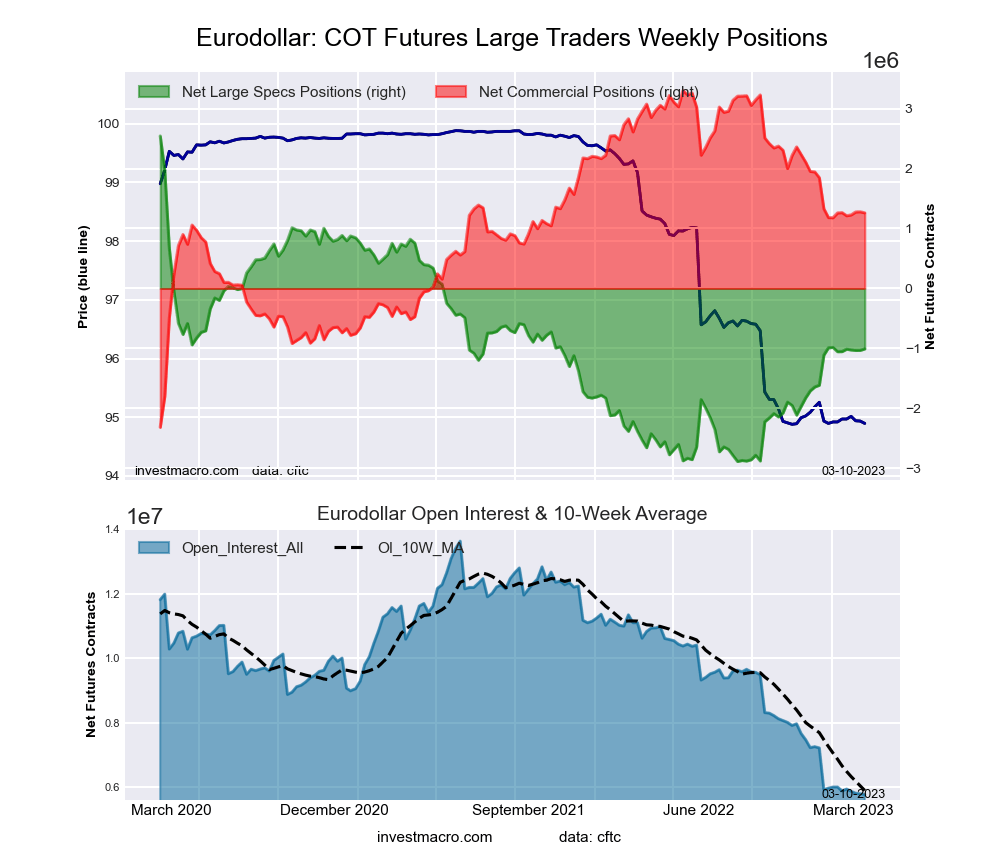
Highlighting the COT bond’s data this week is the continued improvement of the speculator positioning in the Eurodollar. Large speculative positions for the Eurodollar rose this week by almost +40,000 contracts and have now improved (or become less bearish) in ten out of the past eleven weeks. This recent improvement has taken +1,098,777 contracts off of the overall bearish position, going from a total bearish net position of -2,112,650 contracts on November 8th to this week’s total net position of -1,013,873 contracts (an improvement of approximately 50 percent).

Eurodollar futures contracts are one of the largest futures markets and are essentially a bet on short-term interest rates. As Eurodollar prices fall, the implied interest rises (and vice versa) and at this moment, the price of Eurodollar futures is approximately 95.00 for an implied interest rate of 5.00 percent.

The decrease in the bearish positioning of speculators suggests that traders are anticipating a possible peak has happened in the short-term interest rates. This is likely due to falling inflation and anticipation of the US Federal Reserve slowing their interest rate hikes.


Data Snapshot of Bond Market Traders | Columns Legend
Jan-24-2023OIOI-IndexSpec-NetSpec-IndexCom-NetCOM-IndexSmalls-NetSmalls-Index
Eurodollar5,949,5631-1,013,873341,212,77263-198,89961
FedFunds1,798,64172-35,8303561,84767-26,0170
2-Year2,416,61529-477,02316454,8817922,14262
Long T-Bond1,235,75850-195,81621155,7106640,10684
10-Year4,124,38173-541,8210598,83993-57,01867
5-Year4,162,62861-638,7377633,820844,91782


Strength Scores led by Fed Funds & Eurodollar

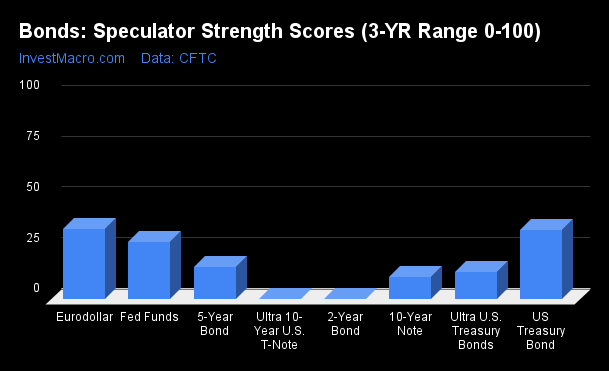
COT Strength Scores (a normalized measure of Speculator positions over a 3-Year range, from 0 to 100 where above 80 is Extreme-Bullish and below 20 is Extreme-Bearish) showed that the Fed Funds (35 percent) and the Eurodollar (34 percent) lead the bond markets this week. The US Treasury Bonds (21 percent) comes in as the next highest in the weekly strength scores.

On the downside, the Ultra 10-Year Bonds (0 percent), the 10-Year Bonds (0 percent), the Ultra Treasury Bonds (5 percent), the 5-Year Bond (6.7 percent) and the 2-Year Bond (16.2 percent) come in at the lowest strength levels currently and are all in Extreme-Bearish territory (below 20 percent).

Strength Statistics:
Fed Funds (35.2 percent) vs Fed Funds previous week (29.0 percent)
2-Year Bond (16.2 percent) vs 2-Year Bond previous week (18.3 percent)
5-Year Bond (6.7 percent) vs 5-Year Bond previous week (1.4 percent)
10-Year Bond (0.4 percent) vs 10-Year Bond previous week (0.0 percent)
Ultra 10-Year Bond (0.1 percent) vs Ultra 10-Year Bond previous week (0.0 percent)
US Treasury Bond (20.9 percent) vs US Treasury Bond previous week (22.0 percent)
Ultra US Treasury Bond (4.8 percent) vs Ultra US Treasury Bond previous week (18.6 percent)
Eurodollar (34.5 percent) vs Eurodollar previous week (33.8 percent)


Eurodollar & 2-Year Bonds top the 6-Week Strength Trends

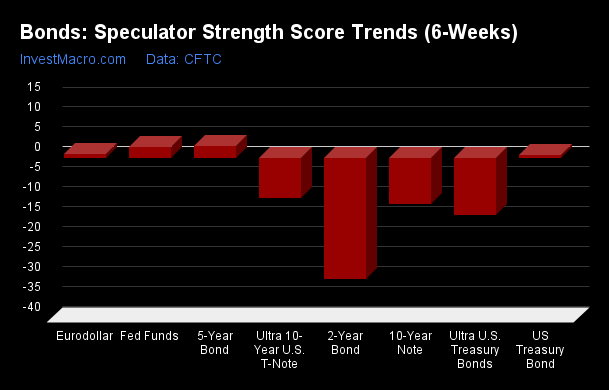
COT Strength Score Trends (or move index, calculates the 6-week changes in strength scores) showed that the Eurodollar (11 percent) and the 2-Year Bonds (7 percent) lead the past six weeks trends for bonds. The 5-Year Bonds (7 percent) is the next highest positive movers in the latest trends data.

The US Treasury Bonds (-26 percent) leads the downside trend scores currently with the 10-Year Bonds (-23 percent) and the Ultra Treasury Bonds (-22 percent) following next with lower trend scores.

Strength Trend Statistics:
Fed Funds (4.7 percent) vs Fed Funds previous week (-0.9 percent)
2-Year Bond (6.6 percent) vs 2-Year Bond previous week (10.7 percent)
5-Year Bond (6.7 percent) vs 5-Year Bond previous week (-2.8 percent)
10-Year Bond (-22.8 percent) vs 10-Year Bond previous week (-24.2 percent)
Ultra 10-Year Bond (-6.1 percent) vs Ultra 10-Year Bond previous week (-4.8 percent)
US Treasury Bond (-25.7 percent) vs US Treasury Bond previous week (-25.1 percent)
Ultra US Treasury Bond (-22.2 percent) vs Ultra US Treasury Bond previous week (-6.3 percent)
Eurodollar (11.1 percent) vs Eurodollar previous week (10.9 percent)


Individual Bond Markets:

3-Month Eurodollars Futures:

Eurodollar Bonds Futures COT ChartThe 3-Month Eurodollars large speculator standing this week totaled a net position of -1,013,873 contracts in the data reported through Tuesday. This was a weekly boost of 39,979 contracts from the previous week which had a total of -1,053,852 net contracts.

This week’s current strength score (the trader positioning range over the past three years, measured from 0 to 100) shows the speculators are currently Bearish with a score of 34.5 percent. The commercials are Bullish with a score of 62.8 percent and the small traders (not shown in chart) are Bullish with a score of 60.7 percent.

3-Month Eurodollars StatisticsSPECULATORSCOMMERCIALSSMALL TRADERS
– Percent of Open Interest Longs:8.868.55.0
– Percent of Open Interest Shorts:25.848.18.3
– Net Position:-1,013,8731,212,772-198,899
– Gross Longs:522,8814,073,591295,903
– Gross Shorts:1,536,7542,860,819494,802
– Long to Short Ratio:0.3 to 11.4 to 10.6 to 1
NET POSITION TREND:
– Strength Index Score (3 Year Range Pct):34.562.860.7
– Strength Index Reading (3 Year Range):BearishBullishBullish
NET POSITION MOVEMENT INDEX:
– 6-Week Change in Strength Index:11.1-11.37.5


30-Day Federal Funds Futures:

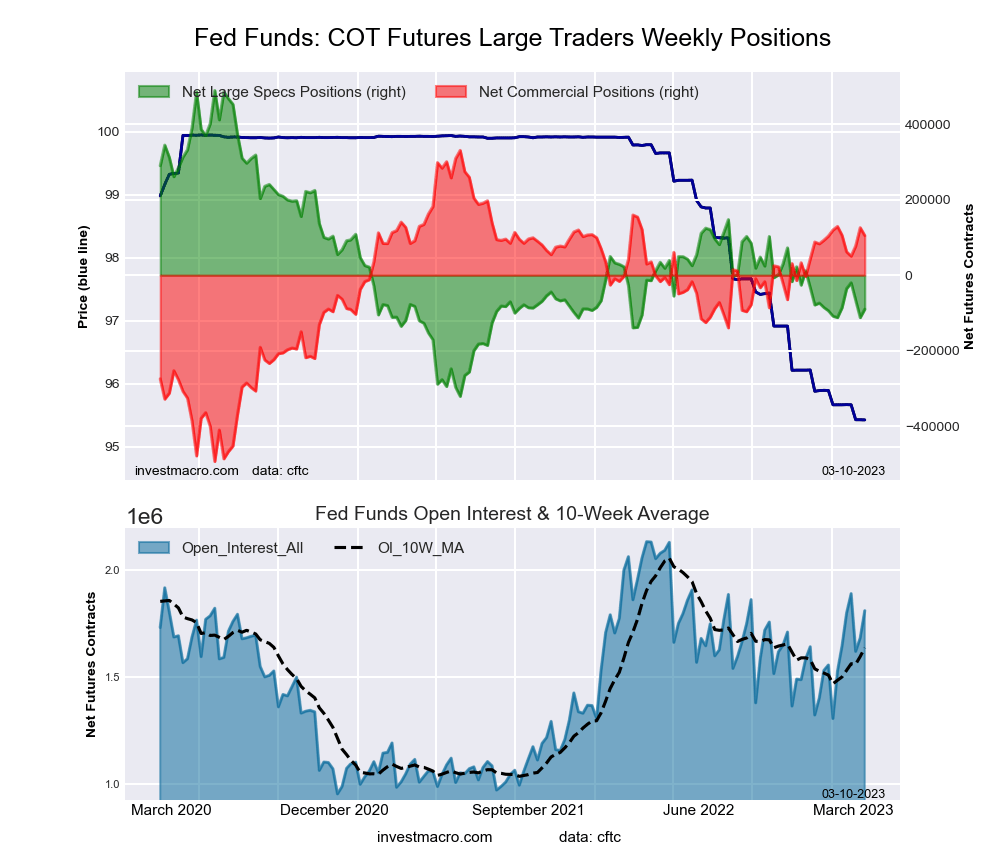
Federal Funds 30-Day Bonds Futures COT ChartThe 30-Day Federal Funds large speculator standing this week totaled a net position of -35,830 contracts in the data reported through Tuesday. This was a weekly advance of 50,405 contracts from the previous week which had a total of -86,235 net contracts.

This week’s current strength score (the trader positioning range over the past three years, measured from 0 to 100) shows the speculators are currently Bearish with a score of 35.2 percent. The commercials are Bullish with a score of 67.4 percent and the small traders (not shown in chart) are Bearish-Extreme with a score of 0.0 percent.

30-Day Federal Funds StatisticsSPECULATORSCOMMERCIALSSMALL TRADERS
– Percent of Open Interest Longs:9.775.41.8
– Percent of Open Interest Shorts:11.772.03.2
– Net Position:-35,83061,847-26,017
– Gross Longs:174,4661,356,28931,773
– Gross Shorts:210,2961,294,44257,790
– Long to Short Ratio:0.8 to 11.0 to 10.5 to 1
NET POSITION TREND:
– Strength Index Score (3 Year Range Pct):35.267.40.0
– Strength Index Reading (3 Year Range):BearishBullishBearish-Extreme
NET POSITION MOVEMENT INDEX:
– 6-Week Change in Strength Index:4.7-2.6-45.1


2-Year Treasury Note Futures:

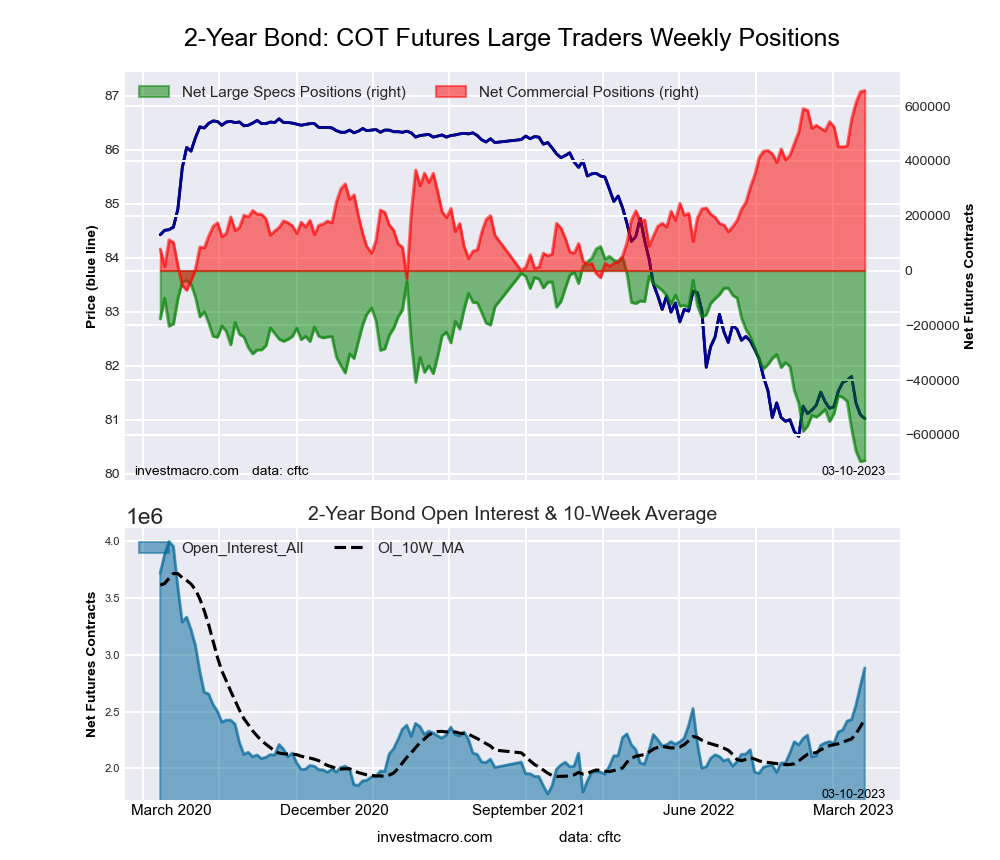
2-Year Treasury Bonds Futures COT ChartThe 2-Year Treasury Note large speculator standing this week totaled a net position of -477,023 contracts in the data reported through Tuesday. This was a weekly lowering of -14,352 contracts from the previous week which had a total of -462,671 net contracts.

This week’s current strength score (the trader positioning range over the past three years, measured from 0 to 100) shows the speculators are currently Bearish-Extreme with a score of 16.2 percent. The commercials are Bullish with a score of 79.5 percent and the small traders (not shown in chart) are Bullish with a score of 61.9 percent.

2-Year Treasury Note StatisticsSPECULATORSCOMMERCIALSSMALL TRADERS
– Percent of Open Interest Longs:7.781.68.6
– Percent of Open Interest Shorts:27.562.87.7
– Net Position:-477,023454,88122,142
– Gross Longs:186,7401,972,486207,471
– Gross Shorts:663,7631,517,605185,329
– Long to Short Ratio:0.3 to 11.3 to 11.1 to 1
NET POSITION TREND:
– Strength Index Score (3 Year Range Pct):16.279.561.9
– Strength Index Reading (3 Year Range):Bearish-ExtremeBullishBullish
NET POSITION MOVEMENT INDEX:
– 6-Week Change in Strength Index:6.6-9.78.7


5-Year Treasury Note Futures:

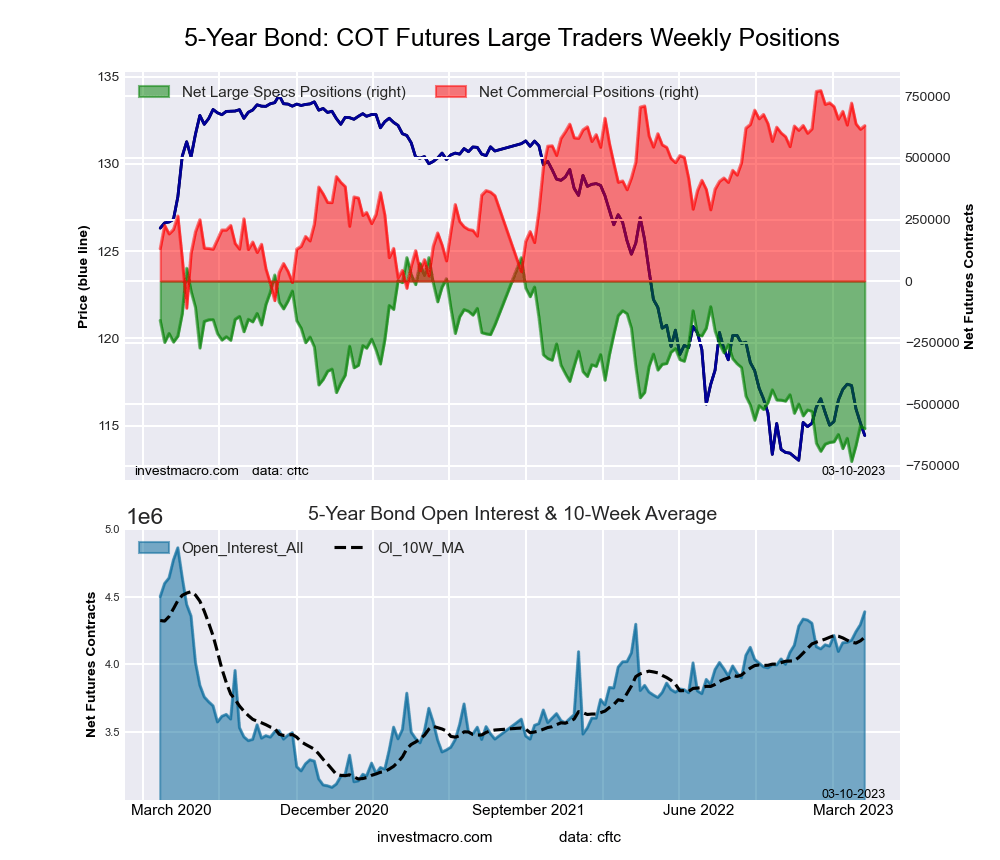
5-Year Treasury Bonds Futures COT ChartThe 5-Year Treasury Note large speculator standing this week totaled a net position of -638,737 contracts in the data reported through Tuesday. This was a weekly rise of 41,918 contracts from the previous week which had a total of -680,655 net contracts.

This week’s current strength score (the trader positioning range over the past three years, measured from 0 to 100) shows the speculators are currently Bearish-Extreme with a score of 6.7 percent. The commercials are Bullish-Extreme with a score of 84.1 percent and the small traders (not shown in chart) are Bullish-Extreme with a score of 82.4 percent.

5-Year Treasury Note StatisticsSPECULATORSCOMMERCIALSSMALL TRADERS
– Percent of Open Interest Longs:6.283.88.5
– Percent of Open Interest Shorts:21.668.68.4
– Net Position:-638,737633,8204,917
– Gross Longs:259,9783,489,305354,429
– Gross Shorts:898,7152,855,485349,512
– Long to Short Ratio:0.3 to 11.2 to 11.0 to 1
NET POSITION TREND:
– Strength Index Score (3 Year Range Pct):6.784.182.4
– Strength Index Reading (3 Year Range):Bearish-ExtremeBullish-ExtremeBullish-Extreme
NET POSITION MOVEMENT INDEX:
– 6-Week Change in Strength Index:6.7-15.924.0


10-Year Treasury Note Futures:

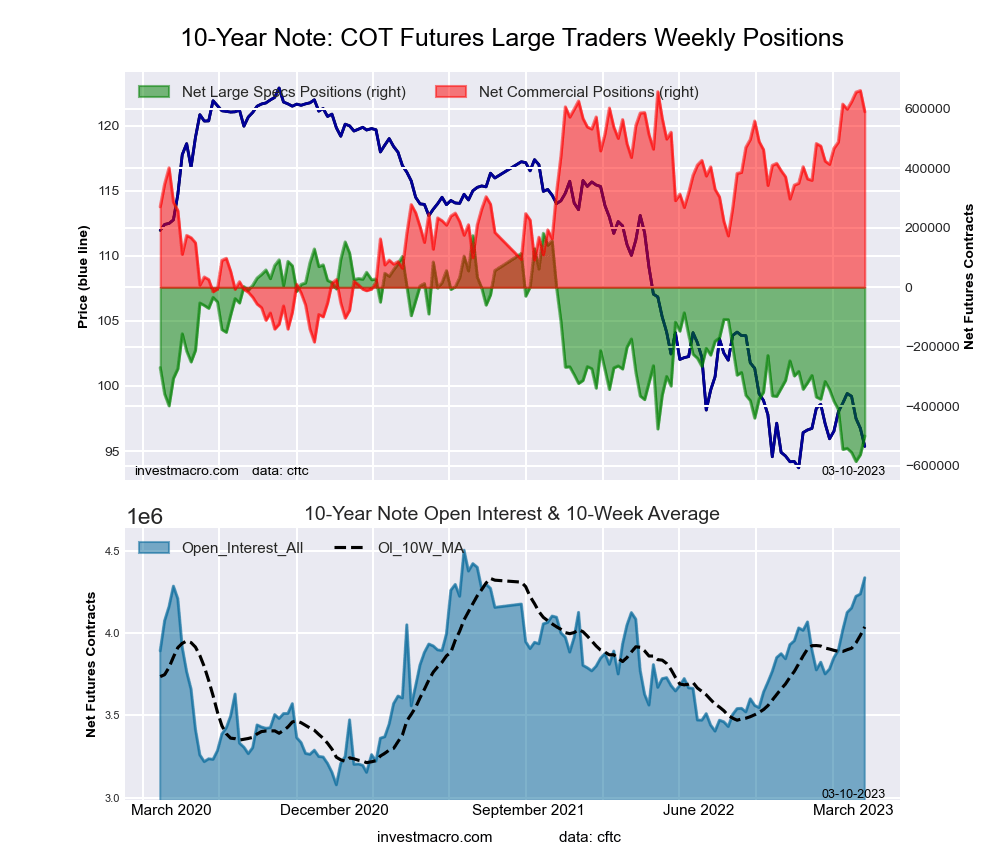
10-Year Treasury Notes Bonds Futures COT ChartThe 10-Year Treasury Note large speculator standing this week totaled a net position of -541,821 contracts in the data reported through Tuesday. This was a weekly boost of 3,236 contracts from the previous week which had a total of -545,057 net contracts.

This week’s current strength score (the trader positioning range over the past three years, measured from 0 to 100) shows the speculators are currently Bearish-Extreme with a score of 0.4 percent. The commercials are Bullish-Extreme with a score of 93.0 percent and the small traders (not shown in chart) are Bullish with a score of 66.5 percent.

10-Year Treasury Note StatisticsSPECULATORSCOMMERCIALSSMALL TRADERS
– Percent of Open Interest Longs:8.780.38.7
– Percent of Open Interest Shorts:21.865.710.1
– Net Position:-541,821598,839-57,018
– Gross Longs:359,1773,310,111360,007
– Gross Shorts:900,9982,711,272417,025
– Long to Short Ratio:0.4 to 11.2 to 10.9 to 1
NET POSITION TREND:
– Strength Index Score (3 Year Range Pct):0.493.066.5
– Strength Index Reading (3 Year Range):Bearish-ExtremeBullish-ExtremeBullish
NET POSITION MOVEMENT INDEX:
– 6-Week Change in Strength Index:-22.814.79.8


Ultra 10-Year Notes Futures:

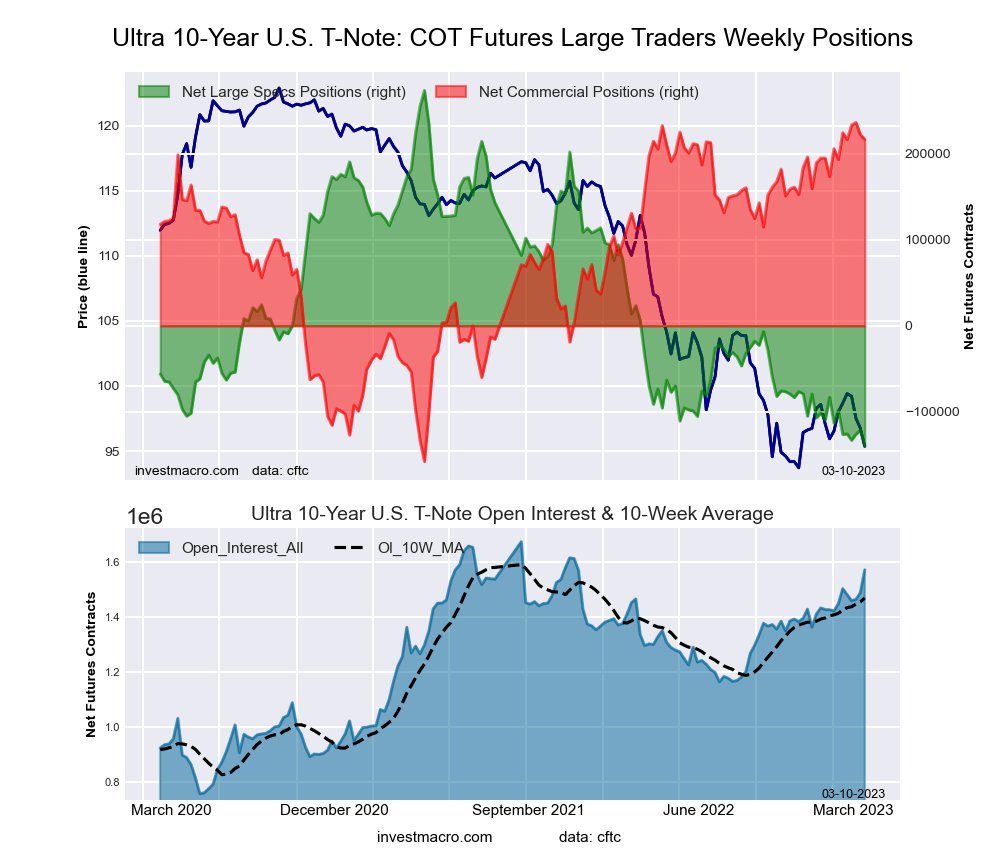
Ultra 10-Year Treasury Notes Bonds Futures COT ChartThe Ultra 10-Year Notes large speculator standing this week totaled a net position of -125,911 contracts in the data reported through Tuesday. This was a weekly lift of 410 contracts from the previous week which had a total of -126,321 net contracts.

This week’s current strength score (the trader positioning range over the past three years, measured from 0 to 100) shows the speculators are currently Bearish-Extreme with a score of 0.1 percent. The commercials are Bullish-Extreme with a score of 95.9 percent and the small traders (not shown in chart) are Bullish with a score of 66.7 percent.

Ultra 10-Year Notes StatisticsSPECULATORSCOMMERCIALSSMALL TRADERS
– Percent of Open Interest Longs:10.777.510.5
– Percent of Open Interest Shorts:19.262.916.6
– Net Position:-125,911216,769-90,858
– Gross Longs:158,9141,148,114155,215
– Gross Shorts:284,825931,345246,073
– Long to Short Ratio:0.6 to 11.2 to 10.6 to 1
NET POSITION TREND:
– Strength Index Score (3 Year Range Pct):0.195.966.7
– Strength Index Reading (3 Year Range):Bearish-ExtremeBullish-ExtremeBullish
NET POSITION MOVEMENT INDEX:
– 6-Week Change in Strength Index:-6.15.51.8


US Treasury Bonds Futures:

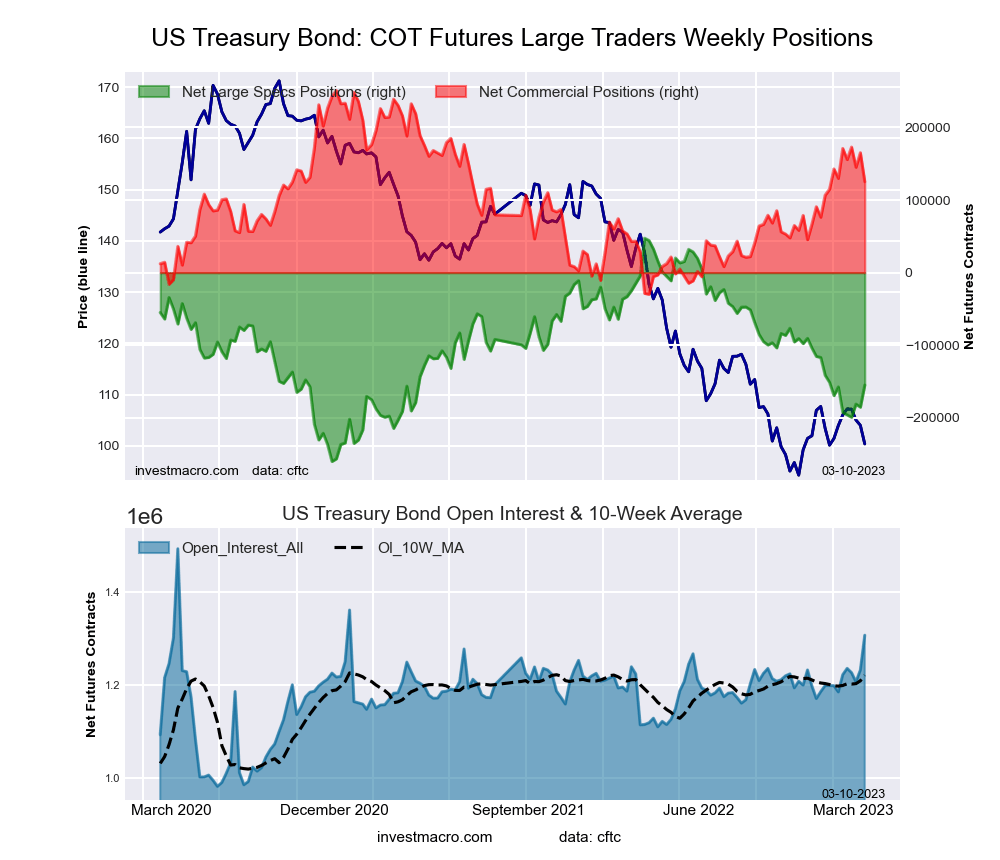
US Year Treasury Notes Long Bonds Futures COT ChartThe US Treasury Bonds large speculator standing this week totaled a net position of -195,816 contracts in the data reported through Tuesday. This was a weekly reduction of -3,423 contracts from the previous week which had a total of -192,393 net contracts.

This week’s current strength score (the trader positioning range over the past three years, measured from 0 to 100) shows the speculators are currently Bearish with a score of 20.9 percent. The commercials are Bullish with a score of 66.1 percent and the small traders (not shown in chart) are Bullish-Extreme with a score of 84.4 percent.

US Treasury Bonds StatisticsSPECULATORSCOMMERCIALSSMALL TRADERS
– Percent of Open Interest Longs:4.280.914.5
– Percent of Open Interest Shorts:20.068.311.2
– Net Position:-195,816155,71040,106
– Gross Longs:51,4631,000,159178,920
– Gross Shorts:247,279844,449138,814
– Long to Short Ratio:0.2 to 11.2 to 11.3 to 1
NET POSITION TREND:
– Strength Index Score (3 Year Range Pct):20.966.184.4
– Strength Index Reading (3 Year Range):BearishBullishBullish-Extreme
NET POSITION MOVEMENT INDEX:
– 6-Week Change in Strength Index:-25.728.3-0.3


Ultra US Treasury Bonds Futures:

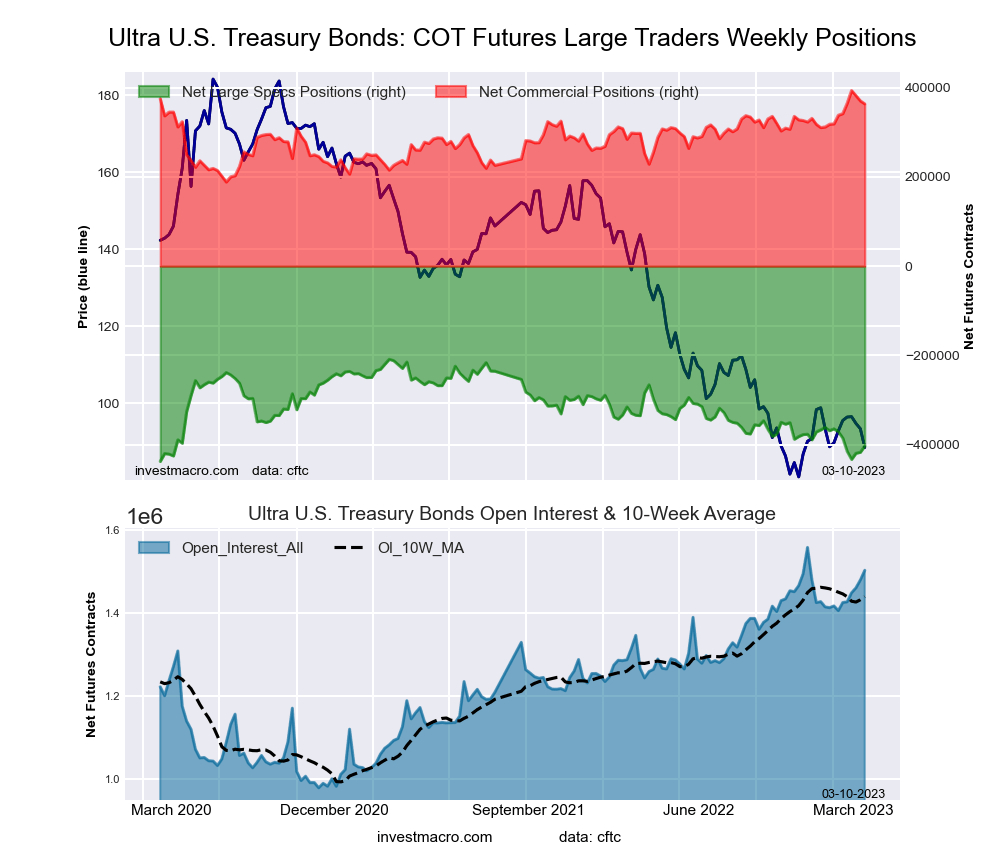
Ultra US Year Treasury Notes Long Bonds Futures COT ChartThe Ultra US Treasury Bonds large speculator standing this week totaled a net position of -415,363 contracts in the data reported through Tuesday. This was a weekly lowering of -29,935 contracts from the previous week which had a total of -385,428 net contracts.

This week’s current strength score (the trader positioning range over the past three years, measured from 0 to 100) shows the speculators are currently Bearish-Extreme with a score of 4.8 percent. The commercials are Bullish-Extreme with a score of 100.0 percent and the small traders (not shown in chart) are Bullish with a score of 73.0 percent.

Ultra US Treasury Bonds StatisticsSPECULATORSCOMMERCIALSSMALL TRADERS
– Percent of Open Interest Longs:3.884.411.7
– Percent of Open Interest Shorts:32.958.88.2
– Net Position:-415,363365,21550,148
– Gross Longs:53,8211,203,706166,548
– Gross Shorts:469,184838,491116,400
– Long to Short Ratio:0.1 to 11.4 to 11.4 to 1
NET POSITION TREND:
– Strength Index Score (3 Year Range Pct):4.8100.073.0
– Strength Index Reading (3 Year Range):Bearish-ExtremeBullish-ExtremeBullish
NET POSITION MOVEMENT INDEX:
– 6-Week Change in Strength Index:-22.230.9-5.1


Article By InvestMacroReceive our weekly COT Newsletter

*COT Report: The COT data, released weekly to the public each Friday, is updated through the most recent Tuesday (data is 3 days old) and shows a quick view of how large speculators or non-commercials (for-profit traders) were positioned in the futures markets.

The CFTC categorizes trader positions according to commercial hedgers (traders who use futures contracts for hedging as part of the business), non-commercials (large traders who speculate to realize trading profits) and nonreportable traders (usually small traders/speculators) as well as their open interest (contracts open in the market at time of reporting). See CFTC criteria here.

Speculators Weekly: Soybean Meal, Heating Oil & Wheat lead Bullish & Bearish Positions

By InvestMacro 

The latest update for the weekly Commitment of Traders (COT) report was released by the Commodity Futures Trading Commission (CFTC) on Friday for data ending on January 24th.

This weekly Extreme Positions report highlights the Most Bullish and Most Bearish Positions for the speculator category. Extreme positioning in these markets can foreshadow strong moves in the underlying market.

To signify an extreme position, we use the Strength Index (also known as the COT Index) of each instrument, a common method of measuring COT data. The Strength Index is simply a comparison of current trader positions against the range of positions over the previous 3 years. We use over 80 percent as extremely bullish and under 20 percent as extremely bearish. (Compare Strength Index scores across all markets in the data table or cot leaders table)


Here Are This Week’s Most Bullish Speculator Positions:

Soybean Meal


The Soybean Meal speculator position comes in as the most bullish extreme standing again this week and has been for multiple weeks. The Soybean Meal speculator level is currently at a 92.3 percent score of its 3-year range.

The six-week trend for the percent strength score totaled 7.5 this week. The overall net speculator position was a total of 149,785 net contracts this week with a change of -16,565 contract in the weekly speculator bets.


Heating Oil


The Heating Oil speculator position comes next in the extreme standings this week. The Heating Oil speculator level is now at a 79.7 percent score of its 3-year range.

The six-week trend for the percent strength score was 11.8 this week. The speculator position registered 25,360 net contracts this week with a weekly change of 6,854 contracts in speculator bets.


Euro


The Euro speculator position comes in third this week in the extreme standings. The Euro speculator level resides at a 76.2 percent score of its 3-year range.

The six-week trend for the speculator strength score came in at 3.0 this week. The overall speculator position was 134,349 net contracts this week with a change of 7,365 contracts in the weekly speculator bets.


VIX


The VIX speculator position comes up number four in the extreme standings this week. The VIX speculator level is at a 76.0 percent score of its 3-year range.

The six-week trend for the speculator strength score totaled a change of 20.6 this week. The overall speculator position was -53,149 net contracts this week with a change of -794 contracts in the speculator bets.


Brazil Real


The Brazil Real speculator position rounds out the top five in this week’s bullish extreme standings. The Brazil Real speculator level sits at a 70.3 percent score of its 3-year range. The six-week trend for the speculator strength score was 20.7 this week.

The speculator position was 22,785 net contracts this week with a change of 592 contracts in the weekly speculator bets.


This Week’s Most Bearish Speculator Positions:

Wheat


The Wheat speculator position comes in as the most bearish extreme standing this week. The Wheat speculator level is at a 0.0 percent score of its 3-year range.

The six-week trend for the speculator strength score was -7.6 this week. The overall speculator position was -48,320 net contracts this week with a change of -6,306 contracts in the speculator bets.


Ultra 10-Year U.S. T-Note


The Ultra 10-Year U.S. T-Note speculator position comes in next for the most bearish extreme standing on the week. The Ultra 10-Year U.S. T-Note speculator level is at a 0.1 percent score of its 3-year range.

The six-week trend for the speculator strength score was -6.1 this week. The speculator position was -125,911 net contracts this week with a change of 410 contracts in the weekly speculator bets.


Lean Hogs


The Lean Hogs speculator position comes in as third most bearish extreme standing of the week. The Lean Hogs speculator level resides at a 0.4 percent score of its 3-year range.

The six-week trend for the speculator strength score was -36.8 this week. The overall speculator position was 3,166 net contracts this week with a change of -12,741 contracts in the speculator bets.


10-Year Note


The 10-Year Note speculator position comes in as this week’s fourth most bearish extreme standing. The 10-Year Note speculator level is at a 0.4 percent score of its 3-year range.

The six-week trend for the speculator strength score was -22.8 this week. The speculator position was -541,821 net contracts this week with a change of 3,236 contracts in the weekly speculator bets.


MSCI EAFE MINI


Finally, the MSCI EAFE MINI speculator position comes in as the fifth most bearish extreme standing for this week. The MSCI EAFE MINI speculator level is at a 2.4 percent score of its 3-year range.

The six-week trend for the speculator strength score was -23.7 this week. The speculator position was -34,202 net contracts this week with a change of -5,924 contracts in the weekly speculator bets.


Speculators or Non-Commercials Notes:

Speculators, classified as non-commercial traders by the CFTC, are made up of large commodity funds, hedge funds and other significant for-profit participants. The Specs are generally regarded as trend-followers in their behavior towards price action – net speculator bets and prices tend to go in the same directions. These traders often look to buy when prices are rising and sell when prices are falling. To illustrate this point, many times speculator contracts can be found at their most extremes (bullish or bearish) when prices are also close to their highest or lowest levels.

These extreme levels can be dangerous for the large speculators as the trade is most crowded, there is less trading ammunition still sitting on the sidelines to push the trend further and prices have moved a significant distance. When the trend becomes exhausted, some speculators take profits while others look to also exit positions when prices fail to continue in the same direction. This process usually plays out over many months to years and can ultimately create a reverse effect where prices start to fall and speculators start a process of selling when prices are falling.


Article By InvestMacroReceive our weekly COT Newsletter

*COT Report: The COT data, released weekly to the public each Friday, is updated through the most recent Tuesday (data is 3 days old) and shows a quick view of how large speculators or non-commercials (for-profit traders) were positioned in the futures markets.

The CFTC categorizes trader positions according to commercial hedgers (traders who use futures contracts for hedging as part of the business), non-commercials (large traders who speculate to realize trading profits) and nonreportable traders (usually small traders/speculators) as well as their open interest (contracts open in the market at time of reporting). See CFTC criteria here.

Large Metals Speculators continue to boost Gold bullish bets to 30-week high

By InvestMacro

Here are the latest charts and statistics for the Commitment of Traders (COT) data published by the Commodities Futures Trading Commission (CFTC).

The latest COT data is updated through Tuesday January 24th and shows a quick view of how large traders (for-profit speculators and commercial entities) were positioned in the futures markets.

Weekly Speculator Changes led by Gold & Copper

The COT metals markets speculator bets were lower this week as two out of the five precious metals markets we cover had higher positioning while the other three markets had lower speculator contracts.

Leading the gains for the metals was Gold (4,433 contracts) with Copper (3,932 contracts) also showing a positive week.

The markets with declines in speculator bets for the week were Silver (-5,784 contracts), Platinum (-3,283 contracts) and Palladium (-546 contracts) also seeing lower bets on the week.

Highlighting the COT metals data this week is the continued bullishness for the Gold speculative positions. The large speculator position in Gold futures advanced once again this week for an eighth straight week and for the tenth time out of the past twelve weeks. The Gold position has now risen from a total of +64,623 contracts on November 1st to a new 30-week high at a total of +157,673 contracts this week.

The Gold futures price closed slightly higher again this week and has now been up for six consecutive weeks. This week’s high was right below the $1,950.00 level and marked the highest Gold prices have reached since April. Gold may be due for a breather with the daily RSI Indicator showing overbought levels but with the US Dollar trending lower, Gold may have a bright outlook in 2023.


Data Snapshot of Commodity Market Traders | Columns Legend
Jan-24-2023OIOI-IndexSpec-NetSpec-IndexCom-NetCOM-IndexSmalls-NetSmalls-Index
Gold499,92725157,67335-180,5546322,88137
Silver134,9221225,68442-39,4615813,77741
Copper213,3985220,17052-26,542466,37262
Palladium9,36320-3,29783,53491-23727
Platinum72,6134620,26139-25,819615,55842


Strength Scores led by Copper & Silver
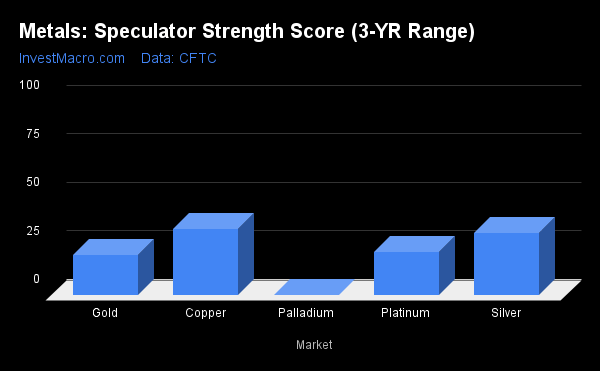
COT Strength Scores (a normalized measure of Speculator positions over a 3-Year range, from 0 to 100 where above 80 is Extreme-Bullish and below 20 is Extreme-Bearish) showed that the Copper (52 percent) leads the metals markets this week. Silver (42 percent) comes in as the next highest in the weekly strength scores.

On the downside, Palladium (8 percent) comes in at the lowest strength level currently and is in Extreme-Bearish territory (below 20 percent). The next lowest strength score was Gold (35 percent).

Strength Statistics:
Gold (35.0 percent) vs Gold previous week (33.5 percent)
Silver (42.4 percent) vs Silver previous week (48.8 percent)
Copper (52.4 percent) vs Copper previous week (49.2 percent)
Platinum (38.8 percent) vs Platinum previous week (43.6 percent)
Palladium (7.5 percent) vs Palladium previous week (12.9 percent)


Copper & Gold top the 6-Week Strength Trends
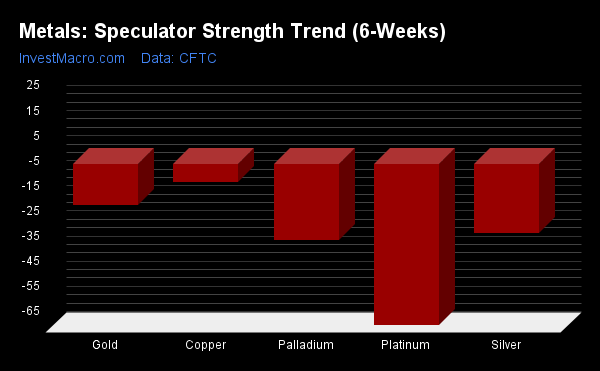
COT Strength Score Trends (or move index, calculates the 6-week changes in strength scores) showed that Copper (14 percent) leads the past six weeks trends for metals. Gold (11 percent) is the next highest positive mover in the latest trends data.

Palladium (-24 percent) leads the downside trend scores currently with Platinum (-12 percent) as the next market with lower trend scores.

Move Statistics:
Gold (10.6 percent) vs Gold previous week (12.6 percent)
Silver (3.2 percent) vs Silver previous week (13.5 percent)
Copper (14.0 percent) vs Copper previous week (11.6 percent)
Platinum (-11.8 percent) vs Platinum previous week (-3.0 percent)
Palladium (-23.9 percent) vs Palladium previous week (-13.7 percent)


Individual Markets:

Gold Comex Futures:
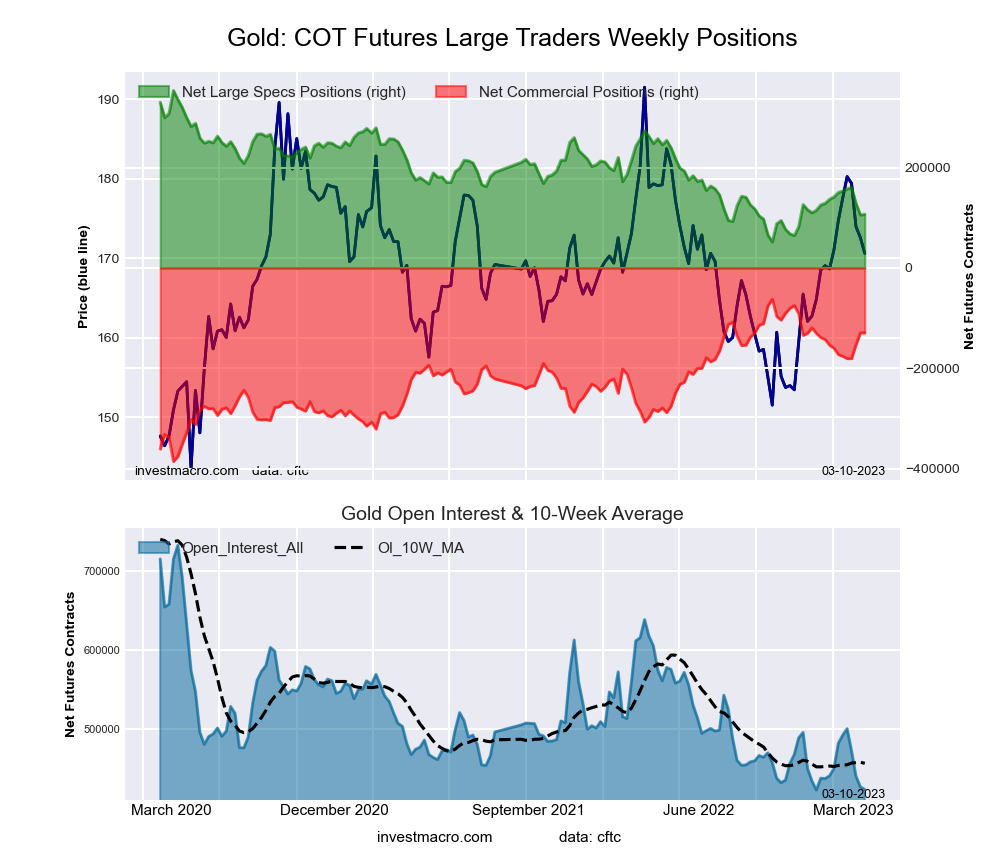
Gold Futures COT ChartThe Gold Comex Futures large speculator standing this week totaled a net position of 157,673 contracts in the data reported through Tuesday. This was a weekly boost of 4,433 contracts from the previous week which had a total of 153,240 net contracts.

This week’s current strength score (the trader positioning range over the past three years, measured from 0 to 100) shows the speculators are currently Bearish with a score of 35.0 percent. The commercials are Bullish with a score of 63.4 percent and the small traders (not shown in chart) are Bearish with a score of 37.3 percent.

Gold Futures StatisticsSPECULATORSCOMMERCIALSSMALL TRADERS
– Percent of Open Interest Longs:50.725.59.6
– Percent of Open Interest Shorts:19.161.65.0
– Net Position:157,673-180,55422,881
– Gross Longs:253,311127,41947,880
– Gross Shorts:95,638307,97324,999
– Long to Short Ratio:2.6 to 10.4 to 11.9 to 1
NET POSITION TREND:
– Strength Index Score (3 Year Range Pct):35.063.437.3
– Strength Index Reading (3 Year Range):BearishBullishBearish
NET POSITION MOVEMENT INDEX:
– 6-Week Change in Strength Index:10.6-13.025.1


Silver Comex Futures:

Silver Futures COT ChartThe Silver Comex Futures large speculator standing this week totaled a net position of 25,684 contracts in the data reported through Tuesday. This was a weekly decline of -5,784 contracts from the previous week which had a total of 31,468 net contracts.

This week’s current strength score (the trader positioning range over the past three years, measured from 0 to 100) shows the speculators are currently Bearish with a score of 42.4 percent. The commercials are Bullish with a score of 57.9 percent and the small traders (not shown in chart) are Bearish with a score of 41.0 percent.

Silver Futures StatisticsSPECULATORSCOMMERCIALSSMALL TRADERS
– Percent of Open Interest Longs:41.235.117.7
– Percent of Open Interest Shorts:22.264.37.5
– Net Position:25,684-39,46113,777
– Gross Longs:55,59547,35923,875
– Gross Shorts:29,91186,82010,098
– Long to Short Ratio:1.9 to 10.5 to 12.4 to 1
NET POSITION TREND:
– Strength Index Score (3 Year Range Pct):42.457.941.0
– Strength Index Reading (3 Year Range):BearishBullishBearish
NET POSITION MOVEMENT INDEX:
– 6-Week Change in Strength Index:3.2-3.54.2


Copper Grade #1 Futures:

Copper Futures COT ChartThe Copper Grade #1 Futures large speculator standing this week totaled a net position of 20,170 contracts in the data reported through Tuesday. This was a weekly increase of 3,932 contracts from the previous week which had a total of 16,238 net contracts.

This week’s current strength score (the trader positioning range over the past three years, measured from 0 to 100) shows the speculators are currently Bullish with a score of 52.4 percent. The commercials are Bearish with a score of 46.4 percent and the small traders (not shown in chart) are Bullish with a score of 62.1 percent.

Copper Futures StatisticsSPECULATORSCOMMERCIALSSMALL TRADERS
– Percent of Open Interest Longs:41.235.09.3
– Percent of Open Interest Shorts:31.847.46.3
– Net Position:20,170-26,5426,372
– Gross Longs:87,94174,71519,913
– Gross Shorts:67,771101,25713,541
– Long to Short Ratio:1.3 to 10.7 to 11.5 to 1
NET POSITION TREND:
– Strength Index Score (3 Year Range Pct):52.446.462.1
– Strength Index Reading (3 Year Range):BullishBearishBullish
NET POSITION MOVEMENT INDEX:
– 6-Week Change in Strength Index:14.0-15.513.7


Platinum Futures:

Platinum Futures COT ChartThe Platinum Futures large speculator standing this week totaled a net position of 20,261 contracts in the data reported through Tuesday. This was a weekly fall of -3,283 contracts from the previous week which had a total of 23,544 net contracts.

This week’s current strength score (the trader positioning range over the past three years, measured from 0 to 100) shows the speculators are currently Bearish with a score of 38.8 percent. The commercials are Bullish with a score of 60.9 percent and the small traders (not shown in chart) are Bearish with a score of 42.5 percent.

Platinum Futures StatisticsSPECULATORSCOMMERCIALSSMALL TRADERS
– Percent of Open Interest Longs:54.130.911.3
– Percent of Open Interest Shorts:26.266.43.6
– Net Position:20,261-25,8195,558
– Gross Longs:39,27922,4288,206
– Gross Shorts:19,01848,2472,648
– Long to Short Ratio:2.1 to 10.5 to 13.1 to 1
NET POSITION TREND:
– Strength Index Score (3 Year Range Pct):38.860.942.5
– Strength Index Reading (3 Year Range):BearishBullishBearish
NET POSITION MOVEMENT INDEX:
– 6-Week Change in Strength Index:-11.89.218.3


Palladium Futures:

Palladium Futures COT ChartThe Palladium Futures large speculator standing this week totaled a net position of -3,297 contracts in the data reported through Tuesday. This was a weekly decline of -546 contracts from the previous week which had a total of -2,751 net contracts.

This week’s current strength score (the trader positioning range over the past three years, measured from 0 to 100) shows the speculators are currently Bearish-Extreme with a score of 7.5 percent. The commercials are Bullish-Extreme with a score of 91.1 percent and the small traders (not shown in chart) are Bearish with a score of 27.5 percent.

Palladium Futures StatisticsSPECULATORSCOMMERCIALSSMALL TRADERS
– Percent of Open Interest Longs:19.162.212.9
– Percent of Open Interest Shorts:54.324.515.5
– Net Position:-3,2973,534-237
– Gross Longs:1,7875,8261,212
– Gross Shorts:5,0842,2921,449
– Long to Short Ratio:0.4 to 12.5 to 10.8 to 1
NET POSITION TREND:
– Strength Index Score (3 Year Range Pct):7.591.127.5
– Strength Index Reading (3 Year Range):Bearish-ExtremeBullish-ExtremeBearish
NET POSITION MOVEMENT INDEX:
– 6-Week Change in Strength Index:-23.924.3-16.0


Article By InvestMacroReceive our weekly COT Newsletter

*COT Report: The COT data, released weekly to the public each Friday, is updated through the most recent Tuesday (data is 3 days old) and shows a quick view of how large speculators or non-commercials (for-profit traders) were positioned in the futures markets.

The CFTC categorizes trader positions according to commercial hedgers (traders who use futures contracts for hedging as part of the business), non-commercials (large traders who speculate to realize trading profits) and nonreportable traders (usually small traders/speculators) as well as their open interest (contracts open in the market at time of reporting). See CFTC criteria here.

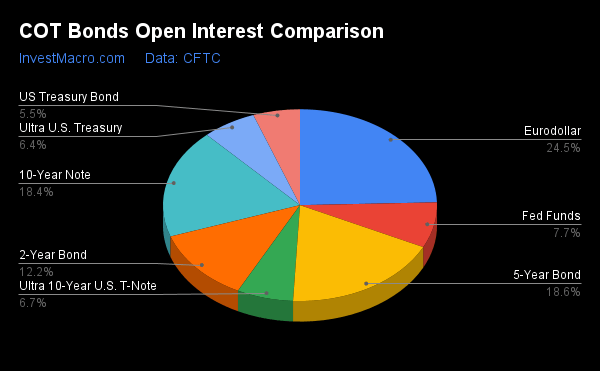
Soft Commodities Speculators drop Lean Hogs bets for 4th week to 134-week low

By InvestMacro

Here are the latest charts and statistics for the Commitment of Traders (COT) reports data published by the Commodities Futures Trading Commission (CFTC).

The latest COT data is updated through Tuesday January 24th and shows a quick view of how large traders (for-profit speculators and commercial entities) were positioned in the futures markets.

Weekly Speculator Changes led by Cotton & Corn

The COT soft commodities markets speculator bets were lower this week as just three out of the eleven softs markets we cover had higher positioning while the other eight markets had lower speculator contracts.

Leading the gains for the softs markets was Cotton (9,880 contracts) with Corn (5,496 contracts) and Coffee (4,017 contracts) also having positive weeks.

The markets with the declines in speculator bets this week were Soybean Oil (-20,245 contracts) with Soybean Meal (-16,565 contracts), Soybeans (-13,843 contracts), Lean Hogs (-12,741 contracts), Live Cattle (-7,915 contracts), Wheat (-6,306 contracts), Cocoa (-2,757 contracts) and Sugar (-1,614 contracts) also registering lower bets on the week.

Highlighting the COT soft commodities data this week is the swift and strong decrease in the Lean Hogs speculator’s positioning. The large speculator bets for Lean Hogs fell this week for a fourth consecutive week (by a total of -41,547 contracts) and for the sixth time in the past nine weeks.

The speculator’s net position has dropped from a total of +44,713 contracts on December 27th to an overall bullish level of just +3,166 contracts this week. This recent weakness in speculator sentiment has now pushed the overall net position standing for Lean Hogs to the lowest level in the past 134 weeks, dating back to June 30th of 2020.

Lean Hogs prices have been under pressure since reaching a recent high in July above the 115.00 price level as the market has responded to ample hogs supply. Since then, the Lean Hog futures price (front-month) has fallen by over 30 percent and closed this week at the lowest level since late in 2021.


Data Snapshot of Commodity Market Traders | Columns Legend
Jan-24-2023OIOI-IndexSpec-NetSpec-IndexCom-NetCOM-IndexSmalls-NetSmalls-Index
WTI Crude1,660,45023249,79912-273,2468823,44738
Gold499,92725157,67335-180,5546322,88137
Silver134,9221225,68442-39,4615813,77741
Copper213,3985220,17052-26,542466,37262
Palladium9,36320-3,29783,53491-23727
Platinum72,6134620,26139-25,819615,55842
Natural Gas1,102,76027-170,97224138,4827832,49057
Brent153,68614-36,8004133,917572,88348
Heating Oil278,1592725,36080-48,5402023,18079
Soybeans667,41620155,22259-117,94552-37,2778
Corn1,274,41011277,36965-205,66243-71,7072
Coffee231,36035-22,728420,167962,56135
Sugar924,84842185,08458-229,3393744,25563
Wheat350,33127-48,320050,423100-2,10399


Strength Scores led by Soybean Meal & Corn

COT Strength Scores (a normalized measure of Speculator positions over a 3-Year range, from 0 to 100 where above 80 is Extreme-Bullish and below 20 is Extreme-Bearish) showed that Soybean Meal (92 percent) and Corn (65 percent) lead the softs markets this week. Live Cattle (62 percent), Soybeans (59 percent) and Sugar (58 percent) come in as the next highest in the weekly strength scores.

On the downside, Lean Hogs (0 percent), Wheat (0 percent) and Coffee (4 percent) come in at the lowest strength levels currently and are in Extreme-Bearish territory (below 20 percent).

Strength Statistics:
Corn (65.5 percent) vs Corn previous week (64.8 percent)
Sugar (57.6 percent) vs Sugar previous week (58.1 percent)
Coffee (4.1 percent) vs Coffee previous week (0.0 percent)
Soybeans (59.4 percent) vs Soybeans previous week (63.9 percent)
Soybean Oil (29.9 percent) vs Soybean Oil previous week (43.8 percent)
Soybean Meal (92.3 percent) vs Soybean Meal previous week (100.0 percent)
Live Cattle (62.4 percent) vs Live Cattle previous week (72.3 percent)
Lean Hogs (0.4 percent) vs Lean Hogs previous week (15.8 percent)
Cotton (20.9 percent) vs Cotton previous week (13.3 percent)
Cocoa (41.5 percent) vs Cocoa previous week (44.2 percent)
Wheat (0.0 percent) vs Wheat previous week (5.7 percent)


Soybeans & Live Cattle top the 6-Week Strength Trends

COT Strength Score Trends (or move index, calculates the 6-week changes in strength scores) showed that Soybeans (13 percent) and Live Cattle (9 percent) lead the past six weeks trends for soft commodities. Corn (8 percent), Soybean Meal (8 percent) and Cotton (3 percent) are the next highest positive movers in the latest trends data.

Lean Hogs (-37 percent) leads the downside trend scores currently with Coffee (-14 percent), Soybean Oil (-11 percent) and Wheat (-8 percent) following next with lower trend scores.

Strength Trend Statistics:
Corn (8.3 percent) vs Corn previous week (9.4 percent)
Sugar (-2.7 percent) vs Sugar previous week (1.2 percent)
Coffee (-13.6 percent) vs Coffee previous week (-12.4 percent)
Soybeans (13.5 percent) vs Soybeans previous week (25.4 percent)
Soybean Oil (-11.3 percent) vs Soybean Oil previous week (-4.7 percent)
Soybean Meal (7.5 percent) vs Soybean Meal previous week (20.5 percent)
Live Cattle (9.3 percent) vs Live Cattle previous week (23.7 percent)
Lean Hogs (-36.8 percent) vs Lean Hogs previous week (-27.8 percent)
Cotton (2.6 percent) vs Cotton previous week (-8.2 percent)
Cocoa (1.6 percent) vs Cocoa previous week (9.6 percent)
Wheat (-7.6 percent) vs Wheat previous week (-1.9 percent)


Individual Soft Commodities Markets:

CORN Futures:

CORN Futures COT ChartThe CORN large speculator standing this week resulted in a net position of 277,369 contracts in the data reported through Tuesday. This was a weekly boost of 5,496 contracts from the previous week which had a total of 271,873 net contracts.

This week’s current strength score (the trader positioning range over the past three years, measured from 0 to 100) shows the speculators are currently Bullish with a score of 65.5 percent. The commercials are Bearish with a score of 42.6 percent and the small traders (not shown in chart) are Bearish-Extreme with a score of 2.1 percent.

CORN Futures StatisticsSPECULATORSCOMMERCIALSSMALL TRADERS
– Percent of Open Interest Longs:30.543.89.0
– Percent of Open Interest Shorts:8.760.014.7
– Net Position:277,369-205,662-71,707
– Gross Longs:388,317558,456115,106
– Gross Shorts:110,948764,118186,813
– Long to Short Ratio:3.5 to 10.7 to 10.6 to 1
NET POSITION TREND:
– Strength Index Score (3 Year Range Pct):65.542.62.1
– Strength Index Reading (3 Year Range):BullishBearishBearish-Extreme
NET POSITION MOVEMENT INDEX:
– 6-Week Change in Strength Index:8.3-4.6-22.3


SUGAR Futures:

SUGAR Futures COT ChartThe SUGAR large speculator standing this week resulted in a net position of 185,084 contracts in the data reported through Tuesday. This was a weekly lowering of -1,614 contracts from the previous week which had a total of 186,698 net contracts.

This week’s current strength score (the trader positioning range over the past three years, measured from 0 to 100) shows the speculators are currently Bullish with a score of 57.6 percent. The commercials are Bearish with a score of 37.4 percent and the small traders (not shown in chart) are Bullish with a score of 62.6 percent.

SUGAR Futures StatisticsSPECULATORSCOMMERCIALSSMALL TRADERS
– Percent of Open Interest Longs:29.243.89.8
– Percent of Open Interest Shorts:9.268.65.1
– Net Position:185,084-229,33944,255
– Gross Longs:270,150404,94891,086
– Gross Shorts:85,066634,28746,831
– Long to Short Ratio:3.2 to 10.6 to 11.9 to 1
NET POSITION TREND:
– Strength Index Score (3 Year Range Pct):57.637.462.6
– Strength Index Reading (3 Year Range):BullishBearishBullish
NET POSITION MOVEMENT INDEX:
– 6-Week Change in Strength Index:-2.7-0.210.8


COFFEE Futures:

COFFEE Futures COT ChartThe COFFEE large speculator standing this week resulted in a net position of -22,728 contracts in the data reported through Tuesday. This was a weekly gain of 4,017 contracts from the previous week which had a total of -26,745 net contracts.

This week’s current strength score (the trader positioning range over the past three years, measured from 0 to 100) shows the speculators are currently Bearish-Extreme with a score of 4.1 percent. The commercials are Bullish-Extreme with a score of 95.9 percent and the small traders (not shown in chart) are Bearish with a score of 35.1 percent.

COFFEE Futures StatisticsSPECULATORSCOMMERCIALSSMALL TRADERS
– Percent of Open Interest Longs:19.652.94.6
– Percent of Open Interest Shorts:29.444.23.5
– Net Position:-22,72820,1672,561
– Gross Longs:45,404122,40010,598
– Gross Shorts:68,132102,2338,037
– Long to Short Ratio:0.7 to 11.2 to 11.3 to 1
NET POSITION TREND:
– Strength Index Score (3 Year Range Pct):4.195.935.1
– Strength Index Reading (3 Year Range):Bearish-ExtremeBullish-ExtremeBearish
NET POSITION MOVEMENT INDEX:
– 6-Week Change in Strength Index:-13.611.621.5


SOYBEANS Futures:

SOYBEANS Futures COT ChartThe SOYBEANS large speculator standing this week resulted in a net position of 155,222 contracts in the data reported through Tuesday. This was a weekly decline of -13,843 contracts from the previous week which had a total of 169,065 net contracts.

This week’s current strength score (the trader positioning range over the past three years, measured from 0 to 100) shows the speculators are currently Bullish with a score of 59.4 percent. The commercials are Bullish with a score of 52.5 percent and the small traders (not shown in chart) are Bearish-Extreme with a score of 8.0 percent.

SOYBEANS Futures StatisticsSPECULATORSCOMMERCIALSSMALL TRADERS
– Percent of Open Interest Longs:30.946.66.9
– Percent of Open Interest Shorts:7.764.312.5
– Net Position:155,222-117,945-37,277
– Gross Longs:206,329311,30746,219
– Gross Shorts:51,107429,25283,496
– Long to Short Ratio:4.0 to 10.7 to 10.6 to 1
NET POSITION TREND:
– Strength Index Score (3 Year Range Pct):59.452.58.0
– Strength Index Reading (3 Year Range):BullishBullishBearish-Extreme
NET POSITION MOVEMENT INDEX:
– 6-Week Change in Strength Index:13.5-11.7-10.6


SOYBEAN OIL Futures:

SOYBEAN OIL Futures COT ChartThe SOYBEAN OIL large speculator standing this week resulted in a net position of 39,250 contracts in the data reported through Tuesday. This was a weekly lowering of -20,245 contracts from the previous week which had a total of 59,495 net contracts.

This week’s current strength score (the trader positioning range over the past three years, measured from 0 to 100) shows the speculators are currently Bearish with a score of 29.9 percent. The commercials are Bullish with a score of 72.2 percent and the small traders (not shown in chart) are Bearish with a score of 33.1 percent.

SOYBEAN OIL Futures StatisticsSPECULATORSCOMMERCIALSSMALL TRADERS
– Percent of Open Interest Longs:20.150.68.7
– Percent of Open Interest Shorts:10.361.67.4
– Net Position:39,250-44,5145,264
– Gross Longs:80,599203,13334,963
– Gross Shorts:41,349247,64729,699
– Long to Short Ratio:1.9 to 10.8 to 11.2 to 1
NET POSITION TREND:
– Strength Index Score (3 Year Range Pct):29.972.233.1
– Strength Index Reading (3 Year Range):BearishBullishBearish
NET POSITION MOVEMENT INDEX:
– 6-Week Change in Strength Index:-11.315.1-28.4


SOYBEAN MEAL Futures:

SOYBEAN MEAL Futures COT ChartThe SOYBEAN MEAL large speculator standing this week resulted in a net position of 149,785 contracts in the data reported through Tuesday. This was a weekly decline of -16,565 contracts from the previous week which had a total of 166,350 net contracts.

This week’s current strength score (the trader positioning range over the past three years, measured from 0 to 100) shows the speculators are currently Bullish-Extreme with a score of 92.3 percent. The commercials are Bearish-Extreme with a score of 7.8 percent and the small traders (not shown in chart) are Bearish with a score of 32.6 percent.

SOYBEAN MEAL Futures StatisticsSPECULATORSCOMMERCIALSSMALL TRADERS
– Percent of Open Interest Longs:40.132.911.7
– Percent of Open Interest Shorts:4.573.27.1
– Net Position:149,785-169,00819,223
– Gross Longs:168,470138,08849,137
– Gross Shorts:18,685307,09629,914
– Long to Short Ratio:9.0 to 10.4 to 11.6 to 1
NET POSITION TREND:
– Strength Index Score (3 Year Range Pct):92.37.832.6
– Strength Index Reading (3 Year Range):Bullish-ExtremeBearish-ExtremeBearish
NET POSITION MOVEMENT INDEX:
– 6-Week Change in Strength Index:7.5-7.73.2


LIVE CATTLE Futures:

LIVE CATTLE Futures COT ChartThe LIVE CATTLE large speculator standing this week resulted in a net position of 66,228 contracts in the data reported through Tuesday. This was a weekly decrease of -7,915 contracts from the previous week which had a total of 74,143 net contracts.

This week’s current strength score (the trader positioning range over the past three years, measured from 0 to 100) shows the speculators are currently Bullish with a score of 62.4 percent. The commercials are Bearish with a score of 27.2 percent and the small traders (not shown in chart) are Bullish with a score of 70.4 percent.

LIVE CATTLE Futures StatisticsSPECULATORSCOMMERCIALSSMALL TRADERS
– Percent of Open Interest Longs:37.030.611.2
– Percent of Open Interest Shorts:16.150.412.2
– Net Position:66,228-62,823-3,405
– Gross Longs:117,24996,72035,368
– Gross Shorts:51,021159,54338,773
– Long to Short Ratio:2.3 to 10.6 to 10.9 to 1
NET POSITION TREND:
– Strength Index Score (3 Year Range Pct):62.427.270.4
– Strength Index Reading (3 Year Range):BullishBearishBullish
NET POSITION MOVEMENT INDEX:
– 6-Week Change in Strength Index:9.3-10.51.4


LEAN HOGS Futures:

LEAN HOGS Futures COT ChartThe LEAN HOGS large speculator standing this week resulted in a net position of 3,166 contracts in the data reported through Tuesday. This was a weekly fall of -12,741 contracts from the previous week which had a total of 15,907 net contracts.

This week’s current strength score (the trader positioning range over the past three years, measured from 0 to 100) shows the speculators are currently Bearish-Extreme with a score of 0.4 percent. The commercials are Bullish-Extreme with a score of 96.9 percent and the small traders (not shown in chart) are Bullish-Extreme with a score of 95.4 percent.

LEAN HOGS Futures StatisticsSPECULATORSCOMMERCIALSSMALL TRADERS
– Percent of Open Interest Longs:32.336.711.3
– Percent of Open Interest Shorts:30.837.012.5
– Net Position:3,166-682-2,484
– Gross Longs:66,93875,92723,357
– Gross Shorts:63,77276,60925,841
– Long to Short Ratio:1.0 to 11.0 to 10.9 to 1
NET POSITION TREND:
– Strength Index Score (3 Year Range Pct):0.496.995.4
– Strength Index Reading (3 Year Range):Bearish-ExtremeBullish-ExtremeBullish-Extreme
NET POSITION MOVEMENT INDEX:
– 6-Week Change in Strength Index:-36.827.747.8


COTTON Futures:

COTTON Futures COT ChartThe COTTON large speculator standing this week resulted in a net position of 17,833 contracts in the data reported through Tuesday. This was a weekly increase of 9,880 contracts from the previous week which had a total of 7,953 net contracts.

This week’s current strength score (the trader positioning range over the past three years, measured from 0 to 100) shows the speculators are currently Bearish with a score of 20.9 percent. The commercials are Bullish with a score of 79.2 percent and the small traders (not shown in chart) are Bearish with a score of 22.2 percent.

COTTON Futures StatisticsSPECULATORSCOMMERCIALSSMALL TRADERS
– Percent of Open Interest Longs:29.648.56.2
– Percent of Open Interest Shorts:21.058.05.3
– Net Position:17,833-19,6791,846
– Gross Longs:61,599100,98112,918
– Gross Shorts:43,766120,66011,072
– Long to Short Ratio:1.4 to 10.8 to 11.2 to 1
NET POSITION TREND:
– Strength Index Score (3 Year Range Pct):20.979.222.2
– Strength Index Reading (3 Year Range):BearishBullishBearish
NET POSITION MOVEMENT INDEX:
– 6-Week Change in Strength Index:2.6-3.49.5


COCOA Futures:

COCOA Futures COT ChartThe COCOA large speculator standing this week resulted in a net position of 24,941 contracts in the data reported through Tuesday. This was a weekly decrease of -2,757 contracts from the previous week which had a total of 27,698 net contracts.

This week’s current strength score (the trader positioning range over the past three years, measured from 0 to 100) shows the speculators are currently Bearish with a score of 41.5 percent. The commercials are Bullish with a score of 58.8 percent and the small traders (not shown in chart) are Bearish with a score of 36.9 percent.

COCOA Futures StatisticsSPECULATORSCOMMERCIALSSMALL TRADERS
– Percent of Open Interest Longs:31.147.34.3
– Percent of Open Interest Shorts:22.657.22.9
– Net Position:24,941-28,9784,037
– Gross Longs:90,986138,39412,460
– Gross Shorts:66,045167,3728,423
– Long to Short Ratio:1.4 to 10.8 to 11.5 to 1
NET POSITION TREND:
– Strength Index Score (3 Year Range Pct):41.558.836.9
– Strength Index Reading (3 Year Range):BearishBullishBearish
NET POSITION MOVEMENT INDEX:
– 6-Week Change in Strength Index:1.6-2.36.9


WHEAT Futures:

WHEAT Futures COT ChartThe WHEAT large speculator standing this week resulted in a net position of -48,320 contracts in the data reported through Tuesday. This was a weekly fall of -6,306 contracts from the previous week which had a total of -42,014 net contracts.

This week’s current strength score (the trader positioning range over the past three years, measured from 0 to 100) shows the speculators are currently Bearish-Extreme with a score of 0.0 percent. The commercials are Bullish-Extreme with a score of 100.0 percent and the small traders (not shown in chart) are Bullish-Extreme with a score of 99.5 percent.

WHEAT Futures StatisticsSPECULATORSCOMMERCIALSSMALL TRADERS
– Percent of Open Interest Longs:25.340.79.7
– Percent of Open Interest Shorts:39.126.310.3
– Net Position:-48,32050,423-2,103
– Gross Longs:88,787142,42233,981
– Gross Shorts:137,10791,99936,084
– Long to Short Ratio:0.6 to 11.5 to 10.9 to 1
NET POSITION TREND:
– Strength Index Score (3 Year Range Pct):0.0100.099.5
– Strength Index Reading (3 Year Range):Bearish-ExtremeBullish-ExtremeBullish-Extreme
NET POSITION MOVEMENT INDEX:
– 6-Week Change in Strength Index:-7.68.24.5


Article By InvestMacroReceive our weekly COT Newsletter

*COT Report: The COT data, released weekly to the public each Friday, is updated through the most recent Tuesday (data is 3 days old) and shows a quick view of how large speculators or non-commercials (for-profit traders) were positioned in the futures markets.

The CFTC categorizes trader positions according to commercial hedgers (traders who use futures contracts for hedging as part of the business), non-commercials (large traders who speculate to realize trading profits) and nonreportable traders (usually small traders/speculators) as well as their open interest (contracts open in the market at time of reporting). See CFTC criteria here.
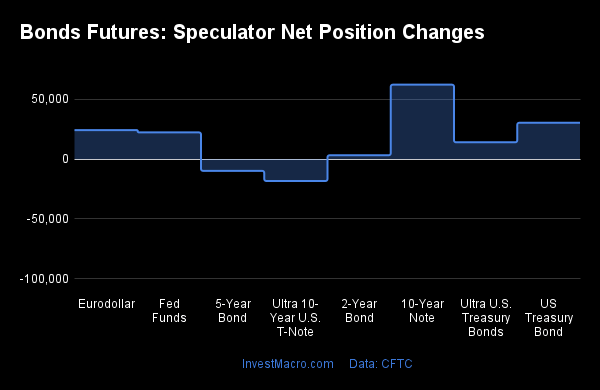
How California’s ambitious new climate plan could help speed energy transformation around the world

By Daniel Sperling, University of California, Davis 

California is embarking on an audacious new climate plan that aims to eliminate the state’s greenhouse gas footprint by 2045, and in the process, slash emissions far beyond its borders. The blueprint calls for massive transformations in industry, energy and transportation, as well as changes in institutions and human behaviors.

These transformations won’t be easy. Two years of developing the plan have exposed myriad challenges and tensions, including environmental justice, affordability and local rule.

For example, the San Francisco Fire Commission had prohibited batteries with more than 20 kilowatt-hours of power storage in homes, severely limiting the ability to store solar electricity from rooftop solar panels for all those times when the sun isn’t shining. More broadly, local opposition to new transmission lines, large-scale solar and wind facilities, substations for truck charging, and oil refinery conversions to produce renewable diesel will slow the transition.

I had a front row seat while the plan was prepared and vetted as a longtime board member of the California Air Resources Board, the state agency that oversees air pollution and climate control. And my chief contributor to this article, Rajinder Sahota, is deputy executive officer of the board, responsible for preparing the plan and navigating political land mines.

We believe California has a chance of succeeding, and in the process, showing the way for the rest of the world. In fact, most of the needed policies are already in place.

What happens in California has global reach

What California does matters far beyond state lines.

California is close to being the world’s fourth-largest economy and has a history of adopting environmental requirements that are imitated across the United States and the world. California has the most ambitious zero-emission requirements in the world for cars, trucks and buses; the most ambitious low-carbon fuel requirements; one of the largest carbon cap-and-trade programs; and the most aggressive requirements for renewable electricity.

In the U.S., through peculiarities in national air pollution law, other states have replicated many of California’s regulations and programs so they can race ahead of national policies. States can either follow federal vehicle emissions standards or California’s stricter rules. There is no third option. An increasing number of states now follow California.

So, even though California contributes less than 1% of global greenhouse gas emissions, if it sets a high bar, its many technical, institutional and behavioral innovations will likely spread and be transformative.

What’s in the California blueprint

The new Scoping Plan lays out in considerable detail how California intends to reduce greenhouse gas emissions 48% below 1990 levels by 2030 and then achieve carbon neutrality by 2045.

It calls for a 94% reduction in petroleum use between 2022 and 2045 and an 86% reduction in total fossil fuel use. Overall, it would cut greenhouse gas emissions by 85% by 2045 relative to 1990 levels. The remaining 15% reduction would come from capturing carbon from the air and fossil fuel plants, and sequestering it below ground or in forests, vegetation and soils.

To achieve these goals, the plan calls for a 37-fold increase in on-road zero-emission vehicles, a sixfold increase in electrical appliances in residences, a fourfold increase in installed wind and solar generation capacity, and doubling total electricity generation to run it all. It also calls for ramping up hydrogen power and altering agriculture and forest management to reduce wildfires, sequester carbon dioxide and reduce fertilizer demand.

This is a massive undertaking, and it implies a massive transformation of many industries and activities.

Transportation: California’s No. 1 emitter

Transportation accounts for about half of the state’s greenhouse gas emissions, including upstream oil refinery emissions. This is where the path forward is perhaps most settled.

The state has already adopted regulations requiring almost all new cars, trucks and buses to have zero emissions – new transit buses by 2029 and most truck sales and light-duty vehicle sales by 2035.

In addition, California’s Low Carbon Fuel Standard requires oil companies to steadily reduce the carbon intensity of transportation fuels. This regulation aims to ensure that the liquid fuels needed for legacy cars and trucks still on the road after 2045 will be low-carbon biofuels.

But regulations can be modified and even rescinded if opposition swells. If battery costs do not resume their downward slide, if electric utilities and others lag in providing charging infrastructure, and if local opposition blocks new charging sites and grid upgrades, the state could be forced to slow its zero-emission vehicle requirements.

The plan also relies on changes in human behavior. For example, it calls for a 25% reduction in vehicle miles traveled in 2030 compared with 2019, which has far dimmer prospects. The only strategies likely to significantly reduce vehicle use are steep charges for road use and parking, a move few politicians or voters in the U.S. would support, and a massive increase in shared-ride automated vehicles, which are not likely to scale up for at least another 10 years. Additional charges for driving and parking raise concerns about affordability for low-income commuters.

Electricity and electrifying buildings

The key to cutting emissions in almost every sector is electricity powered by renewable energy.

Electrifying most everything means not just replacing most of the state’s natural gas power plants, but also expanding total electricity production – in this case doubling total generation and quadrupling renewable generation, in just 22 years.

That amount of expansion and investment is mind-boggling – and it is the single most important change for reaching net zero, since electric vehicles and appliances depend on the availability of renewable electricity to count as zero emissions.

Electrification of buildings is in the early stages in California, with requirements in place for new homes to have rooftop solar, and incentives and regulations adopted to replace natural gas use with heat pumps and electric appliances.

The biggest and most important challenge is accelerating renewable electricity generation – mostly wind and utility-scale solar. The state has laws in place requiring electricity to be 100% zero emissions by 2045 – up from 52% in 2021.

The plan to get there includes offshore wind power, which will require new technology – floating wind turbines. The federal government in December 2022 leased the first Pacific sites for offshore wind farms, with plans to power over 1.5 million homes. However, years of technical and regulatory work are still ahead.

For solar power, the plan focuses on large solar farms, which can scale up faster and at less cost than rooftop solar. The same week the new scoping plan was announced, California’s Public Utility Commission voted to significantly scale back how much homeowners are reimbursed for solar power they send to the grid, a policy known as net metering. The Public Utility Commission argues that because of how electricity rates are set, generous rooftop solar reimbursements have primarily benefited wealthier households while imposing higher electricity bills on others. It believes this new policy will be more equitable and create a more sustainable model.

Industry and the carbon capture challenge

Industry plays a smaller role, and the policies and strategies here are less refined.

The state’s carbon cap-and-trade program, designed to ratchet down total emissions while allowing individual companies some flexibility, will tighten its emissions limits.

But while cap-and-trade has been effective to date, in part by generating billions of dollars for programs and incentives to reduce emissions, its role may change as energy efficiency improves and additional rules and regulations are put in place to replace fossil fuels.

One of the greatest controversies throughout the Scoping Plan process is its reliance on carbon capture and sequestration, or CCS. The controversy is rooted in concern that CCS allows fossil fuel facilities to continue releasing pollution while only capturing the carbon dioxide emissions. These facilities are often in or near disadvantaged communities.

California’s chances of success

Will California make it? The state has a track record of exceeding its goals, but getting to net zero by 2045 requires a sharper downward trajectory than even California has seen before, and there are still many hurdles.

Environmental justice concerns about carbon capture and new industrial facilities, coupled with NIMBYism, could block many needed investments. And the possibility of sluggish economic growth could led to spending cuts and might exacerbate concerns about economic disruption and affordability.

There are also questions about prices and geopolitics. Will the upturn in battery costs in 2022 – due to geopolitical flare-ups, a lag in expanding the supply of critical materials, and the war in Ukraine – turn out to be a hiccup or a trend? Will electric utilities move fast enough in building the infrastructure and grid capacity needed to accommodate the projected growth in zero-emission cars and trucks?

It is encouraging that the state has already created just about all the needed policy infrastructure. Additional tightening of emissions limits and targets will be needed, but the framework and policy mechanisms are largely in place.

Rajinder Sahota, deputy executive officer of the California Air Resources Board, contributed to this article.The Conversation

About the Author:

Daniel Sperling, Distinguished Blue Planet Prize Professor of Civil and Environmental Engineering and Founding Director, Institute of Transportation Studies, University of California, Davis

This article is republished from The Conversation under a Creative Commons license. Read the original article.