Archive for Opinions – Page 100

Mid-Week Technical Outlook: Breakouts In Focus

By ForexTime 

European shares struggled for direction on Wednesday as investors awaited corporate earnings for fresh directional cues ahead of a busy week for financial markets.

The overall mood has been dampened by mass layoffs in the tech space and signs of slowing global growth. With recession fears sapping risk appetite, stock markets remain vulnerable to further losses. In the currency space, the dollar seems to be drawing strength from risk aversion – dragging other G10 currencies lower. Regarding commodities, oil prices remain shaky while gold has slipped from a nine-month high.

Some trading opportunities may be forming during this period of uneasy calm and growing tension. Our tool of choice this afternoon will be technical analysis with our focus falling on currencies, commodities, and indices.

GBPUSD trapped within range

It has been a choppy affair for the GBPUSD over the past few days. Prices remain trapped within a range with support at 1.2150 and resistance at 1.2450. A breakout could be on the horizon but this may need the assistance of a fresh directional catalyst. Although prices are trading above the 50, 100, and 200-day SMA, bears seem to be back in the vicinity. Prices may test the 1.2150 level in the short to medium term. A breakdown below this point could open a path back toward 1.2000.

USDJPY to resume downside

USDJPY remains under pressure on the weekly timeframe as there have been consistently lower lows and lower highs. Prices are trading below 130.00 and could challenge 126.50 in the short to medium term. A strong breakdown below 126.50 may open the doors toward 122.00. If prices are able to push back above 130.00, the next key point can be found at 133.20.

AUDUSD approaches resistance

Aussie bulls continue to draw strength from dollar weakness. After breaking above the 0.7000 level, prices have pushed higher, with 0.7135 acting as a key point of interest. A breakout above this level could suggest an incline towards 0.7250. Should prices slip back below 0.7000, the AUDUSD may decline toward 0.6900.

USDCAD gearing for breakdown?

USDCAD could be on the brink of a breakdown as prices wobble above the 1.3350 support level. A solid move below this point could open the doors towards 1.3240 and potentially lower. Should 1.3350 prove to be reliable support, a rebound back toward 1.3500 could be on the cards.

Gold bull’s still in control

Zooming out on the weekly charts, gold remains firmly bullish on the weekly timeframe. There have been consistently higher highs and higher lows while the MACD trades above zero. A solid breakout and weekly close above $1940 may trigger an incline toward the psychological $2000 level. Should $1940 prove to be a tough nut to crack, the precious metal may dip back toward $1900.

S&P 500 remains rangebound

The S&P500 has been trapped within a wide range since May 2022. May support can be found around 3600 and resistance at 4300 on the monthly timeframe. Given the various fundamental forces influencing global sentiment, a breakout could be on the horizon. A strong breakout above 4300 could open a path towards 4819.5. Alternatively, a selloff below 3600 could signal a further decline towards 3250.


Forex-Time-LogoArticle by ForexTime

ForexTime Ltd (FXTM) is an award winning international online forex broker regulated by CySEC 185/12 www.forextime.com

Is Gold’s Rally Vulnerable, as Fed Readies To Meet?

Source: Adrian Day  (1/23/23)

Adrian Day of Adrian Day Asset Management reviews recent results from several resource companies, mostly positive, though cost increases are an issue everywhere. 

Gold has moved ahead on expectations that the Federal Reserve will start to slow and then pause its tightening program. There have been several indications of this since the last Fed policy meeting, including chairman Jerome Powell’s comment at his December press conference that the Fed would not start to cut interest rates “until we are convinced that inflation is moving down towards 2%”, a quite different matter than inflation actually being at 2%. Then in the last week, several Fed officials said “not so fast,” but some of those, such as James Bullard, who called for a half-point increase later this month and another full percentage point this year, are no longer voting members of the rate-setting committee.

But we know the Fed, and particularly Mr. Powell, are concerned at markets discounting the Fed’s message. They are less concerned about the gold market than they are about stocks, bonds, and other assets, but certainly, gold is vulnerable to a pullback after the 18% move since early November. A quarter-point rate increase is now seen as almost certain; it is very unlikely to be less than that, so any surprise is likely to be on the upside, that is, negative for markets and gold.

We remain very positive for the balance of the year, but some trimming of gold stocks and certainly caution in new buys, would not be out of place.

Pending Acquisition of Yamana Overshares Pan American’s Solid Quarter

Pan American Silver Corp. (PAAS:TSX; PAAS:NASDAQ) reported strong production in the last quarter of the year and probably the last full quarter before the acquisition of Yamana, ending a string of disappointing quarterly results. In its preliminary production report, Pan Am said it met its previously reduced guidance, with gold production up 28% on the prior quarter, while silver output rose 5%; zinc and lead, the two primary non-precious metals, also were up meaningfully.

Though the results were positive, they were overshadowed by the pending acquisition of Yamana, which is expected to close sometime this quarter. The deal is accretive for Pan Am and arguably improves the aggregate quality of its mines. We expect to see the company sell some higher-cost or shorter-life assets, thus reducing its purchase cost. Pan Am said it expects to discuss 2023 guidance after the transaction is complete.

Pan American is trading at a discount to both major miners and to other silver-focused companies. Although we are very positive about the stock longer term, especially with the possibility of Escobal in Guatemala coming back online at some point, we are cautious in the near term. We may see some selling from shareholders who own too much of the combined company or Yamana shareholders unhappy with the transaction, and given that Yamana shareholders will hold nearly half of the combined company, this could be meaningful. Hold.

An Osisko Asset Moves Forward

Osisko Gold Royalties Ltd. (OR:TSX; OR:NYSE) received more good news, with the first resource estimate on Osisko Development’s Tintic project in Utah. The Trixie Zone has 456,000 ounces of gold at an average grade of 23.5 g/t., the resource covering only about 10% of the footprint on limited drilling (50 drill holes). The resource should get to one million ounces, at similar grades, for a high-grade mine expected to commence production in early 2024. Osisko Gold holds a 2.5% metals stream on the project, payable at 25% of the spot prices at delivery; it paid $20 million for the stream.

This is a good example of the benefits that Osisko derives from its offspring. And it is only one of more than a dozen projects advancing this year. Given the strong rally, both since early November (up 34%) and the last few days (traded under $13 on Tuesday), we will wait for a pullback to add. Hold.

Fortuna Delivers Another Solid Quarter

Fortuna Silver Mines Inc. (FSM:NYSE; FVI:TSX; FVI:BVL; F4S:FSE) also reported a solid fourth quarter, with gold and silver production both in line with full-year guidance, while lead and zinc exceeded guidance somewhat. Gold production was above many analyst expectations, although costs were up, at most mines around 15%, driven by sustaining capital spending. This quarter represents another consecutive quarter where Fortuna’s operations have met or exceeded expectations after a frustrating series of issues in 2021 and early 2022. Construction at Séguéla remains on track, with the first gold expected in the second quarter after mining begins this quarter.

The company is initiating action in Mexico, on both the judicial and political front, over the last reversal of its permit for San Jose. The company is looking for an increase in gold-equivalent ounces this year of between 3% and 15% over last year, driven by a 25% increase in gold as Séguéla comes on stream. Gold production is expected at between 282Kk and 320K, as much as a 23% increase, while silver output is expected to decline by up to 9% to 6.3 million to 6.9 million ounces.

Strong management, a solid balance sheet, a diversified asset base, and growth ahead: Fortuna can be accumulated here and bought aggressively on any dips.

Barrick Disappoints on Production and Costs

Barrick Gold Corp. (ABX:TSX; GOLD:NYSE) had a disappointing quarter, even though it was the strongest for gold production of any this past year. Gold output was up 13% over the prior quarter, but that was not sufficient to save full-year production, which at 4.14 million ounces, was below the low end of the company’s guidance. The company’s assertion last quarter that it would still meet guidance was treated somewhat skeptically by many analysts. Though copper production was down 5% from the prior quarter and below some estimates, it still came in within the full-year guidance range.

Costs were also disappointing; although down slightly from the third quarter, largely due to higher volumes, costs were higher than management was indicating. Given the results, it is likely that the variable quarterly dividend will decline to the base of 10 cents a share. Separately, Barrick announced a time frame for its new Reko Diq copper project in Pakistan, with a feasibility update expected to be completed by the end of next year, with 2028 targeted for the first production, as indicated previously. Barrick is the 50% owner and the operator.

Barrick remains inexpensive, both fundamentally and in relation to his historical average valuations. However, we would like to see a pullback before buying, given the strong rally in recent months (the stock was at $13.10 in early November).

Midland Has Another Busy Year Ahead

Midland Exploration Inc. (MD:TSX.V) released an overview of its exploration plans for the coming year, expecting a budget of over $11 million with 20,000 meters of diamond drilling. Its plans for 2023 are aimed at following up on new discoveries made throughout 2022. Midland is working on several projects in partnership with others, including BHP, Rio Tino, SOQUEM, Probe, and Wallbridge. The company will also advance several of its wholly-owned properties. Given the activity, the strong management, and the balance sheet, Midland is a strong buy at the current level.

TOP BUYS THIS WEEK, in addition to the above, include Orogen Royalties Inc. (OGN:TSX.V). As we have said for the last couple of weeks, we are generally cautious on buying right now, given valuations in the broad market and following the strong gold-stock move in the last couple of months. Patience will pay off!

Adrian Day Disclosures:

Adrian Day’s Global Analyst is distributed for $990 per year by Investment Consultants International, Ltd., P.O. Box 6644, Annapolis, MD 21401. (410) 224-8885. www.AdrianDayGlobalAnalyst.com. Publisher: Adrian Day. Owner: Investment Consultants International, Ltd. Staff may have positions in securities discussed herein. Adrian Day is also President of Global Strategic Management (GSM), a registered investment advisor, and a separate company from this service. In his capacity as GSM president, Adrian Day may be buying or selling for clients securities recommended herein concurrently, before or after recommendations herein, and may be acting for clients in a manner contrary to recommendations herein. This is not a solicitation for GSM. Views herein are the editor’s opinion and not fact. All information is believed to be correct, but its accuracy cannot be guaranteed. The owner and editor are not responsible for errors and omissions. © 2022. Adrian Day’s Global Analyst. Information and advice herein are intended purely for the subscriber’s own account. Under no circumstances may any part of a Global Analyst e-mail be copied or distributed without prior written permission of the editor. Given the nature of this service, we will pursue any violations aggressively.

Disclosures:

1) Adrian Day: I, or members of my immediate household or family, own securities of the following companies mentioned in this article: All. I personally am, or members of my immediate household or family are, paid by the following companies mentioned in this article: None. My company has a financial relationship with the following companies mentioned in this article: None. Funds controlled by Adrian Day Asset Management, which is unaffiliated with Adrian Day’s newsletter, hold shares of the following companies mentioned in this article: All. I determined which companies would be included in this article based on my research and understanding of the sector.

2) The following companies mentioned in this article are billboard sponsors of Streetwise Reports: None. Click here for important disclosures about sponsor fees. The information provided above is for informational purposes only and is not a recommendation to buy or sell any security.

3) Statements and opinions expressed are the opinions of the author and not of Streetwise Reports or its officers. The author is wholly responsible for the validity of the statements. The author was not paid by Streetwise Reports for this article. Streetwise Reports was not paid by the author to publish or syndicate this article. Streetwise Reports requires contributing authors to disclose any shareholdings in, or economic relationships with, companies that they write about. Streetwise Reports relies upon the authors to accurately provide this information and Streetwise Reports has no means of verifying its accuracy.

4) This article does not constitute investment advice. Each reader is encouraged to consult with his or her individual financial professional and any action a reader takes as a result of information presented here is his or her own responsibility. By opening this page, each reader accepts and agrees to Streetwise Reports’ terms of use and full legal disclaimer. This article is not a solicitation for investment. Streetwise Reports does not render general or specific investment advice and the information on Streetwise Reports should not be considered a recommendation to buy or sell any security. Streetwise Reports does not endorse or recommend the business, products, services, or securities of any company mentioned on Streetwise Reports.

5) From time to time, Streetwise Reports LLC and its directors, officers, employees, or members of their families, as well as persons interviewed for articles and interviews on the site, may have a long or short position in the securities mentioned. Directors, officers, employees, or members of their immediate families are prohibited from making purchases and/or sales of those securities in the open market or otherwise from the time of the decision to publish an article until three business days after the publication of the article. The foregoing prohibition does not apply to articles that in substance only restate previously published company release.


Trade Of The Week: EURUSD In Breakout Mode?

By ForexTime 

EURUSD may be gearing up for a major breakout as the technicals and fundamentals continue to align.

Over the past few months, euro bulls dominated the scene – pushing prices further away from parity. It also stood its ground in the G10 space, appreciating against most counterparts thanks to fundamental forces.

The single European currency has already kicked off the trading week punching above 1.09, marking a new high since April 2022! With the strong upside momentum showing little signs of cooling down, further upside could be on the cards – especially with the support of economic data.

As the discussion around interest rates between the Federal Reserve (Fed) and European Central bank (ECB) rages on, this is likely to result in increased volatility for the EURUSD. The Euro continues to draw strength from a weaker dollar, rising inflation in the Eurozone, and most importantly a hawkish ECB. On the other hand, repeated signs of easing inflationary pressures in the United States have fuelled speculation about the Fed slowing down its pace of rate increases. Ultimately, the narrowing monetary policy divergence between both central banks is likely to fuel the upside in the EURUSD.

Taking a quick look at the technical picture, the EURUSD remains firmly bullish on the daily charts with prices pressing against 1.0900 as of writing. A solid breakout above this point could encourage an incline towards 1.1200.

The low down…

Christine Lagarde delivered her hawkish message to Davos last week, warning markets not to underestimate the ECB’s monetary policy. Lagarde stated that inflation remained “way too high” with the ECB determined to stay the course on rates till inflation returned to 2%. Markets widely expect the central bank to raise interest rates by 50 basis points next month and potentially a similar move in March. However, this may be influenced by economic data and the Ukraine war. Nevertheless, with inflation still at lofty levels, this may keep doves at bay while empowering hawks.

Regarding the Fed, it has kicked off a two-week black period ahead of the rate meeting on Wednesday 1st of February. With Fed speeches out of the picture, the dollar is set to be influenced by key economic reports. If the incoming data continues to fuel dollar weakness, this will add to the growing list of factors pushing the EURUSD higher.

The week ahead

It is a data-heavy week for the EUR and USD.

On Monday, the Euro was knocked lower by the disappointing consumer confidence figures for January. Although consumer confidence rose for a third month to -22.2 in December 2022, this was below market expectations. Appetite towards the single Euro currency could be rekindled if Christine Lagarde strikes a hawkish note during her speech this evening.

Tuesday sees the Eurozone and US January PMI’s which could inject fresh volatility into the EURUSD. On Wednesday, we have the January IFO business climate figure for Germany, and all-important US Q4 GDP figures on Thursday. The first estimate of Q4 GDP is expected to show that economic growth slowed in Q4. According to Bloomberg, forecasts point to an increase of 2.7% compared to the 3.2% growth witnessed in the third quarter of 2022. A disappointing figure may compound the dollar’s woes, dragging prices lower as bets on smaller Fed rate hikes intensify. Much attention will be on the US December personal income data, including the Fed’s preferred measure of inflation – the core PCE deflator. This is expected to cool further to 4.4% year-on-year compared to the 4.7% seen in November. A report that meets or prints below forecast may weaken the USD even further.

EURUSD poised to push higher

In our 2023 market outlook, we highlighted how a weaker dollar could fuel the EURUSD’s great rebound. Fast forward to today, the currency pair has jumped almost 400 pips. Prices remain firmly bullish on the daily, weekly, and monthly timeframe. Although 1.0900 may provide some resistance, the fundamentals and technicals favour further upside. A strong monthly close above 1.0900 may signal a move towards 1.1200 in February.

Zooming into the daily charts, there are a couple of smaller checkpoints before prices potentially hit 1.1200, which are 1.0970 and 1.1120. Should 1.0900 prove to be reliable resistance, a decline towards 1.0770 and 1.0700 could be on the table.


Forex-Time-LogoArticle by ForexTime

ForexTime Ltd (FXTM) is an award winning international online forex broker regulated by CySEC 185/12 www.forextime.com

Currency Speculators retreat from US Dollar Index bullish bets to a 78-week low

By InvestMacro

Here are the latest charts and statistics for the Commitment of Traders (COT) data published by the Commodities Futures Trading Commission (CFTC).

The latest COT data is updated through Tuesday January 17th and shows a quick view of how large market participants (for-profit speculators and commercial traders) were positioned in the futures markets. All currency positions are in direct relation to the US dollar where, for example, a bet for the euro is a bet that the euro will rise versus the dollar while a bet against the euro will be a bet that the euro will decline versus the dollar.

Weekly Speculator Changes led by Japanese Yen & British Pound

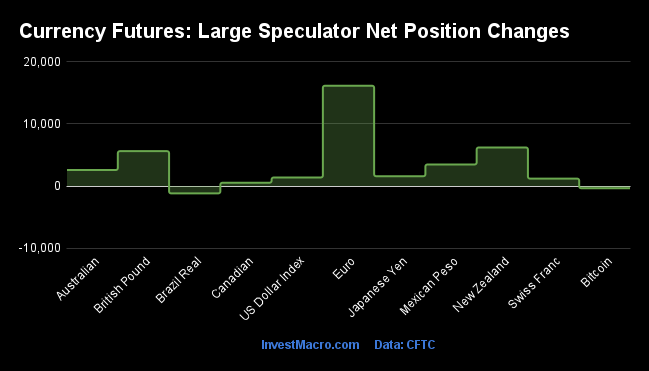
The COT currency market speculator bets were higher this week as six out of the eleven currency markets we cover had higher positioning while the other five markets had lower speculator contracts.

Leading the gains for the currency markets was the Japanese Yen (12,416 contracts) with the British Pound (4,759 contracts), Mexican Peso (4,742 contracts), Canadian Dollar (3,696 contracts) and the Australian Dollar (70 contracts) also showing positive weeks.

The currencies seeing declines in speculator bets on the week were the EuroFX (-7,998 contracts) with the US Dollar Index (-3,182 contracts), the New Zealand Dollar (-1,292 contracts), Bitcoin (-33 contracts) and the Swiss Franc (-571 contracts) also registering lower bets on the week.

Highlighting the COT currencies data is the recent declines in the US Dollar Index bullish speculator positioning. The large speculator bets for the US Dollar Index fell this week for a second straight week and for the third time out of the past five weeks. The speculator’s bullish position has almost fallen by half over the past five weeks going from a total of +25,778 contracts on December 13th to a total of +13,358 contracts this week. These declines have now pushed the Dollar Index to the least bullish level for speculators since July 20th of 2021, a span of 78 weeks.

Since riding a strong bullish wave to a 274-week high on June 14th of 2022 (at +45,010 contracts), the US Dollar Index speculator positioning has been in a slow but steady downtrend that continued this week.

The US Dollar Index futures price has also been in a downtrend after ascending to a multi-year peak in September at the 114.74 level. That marked the best price level for the Dollar Index since 2002 and was the start of the recent slide that has brought the Dollar Index to its current level of 101.78 (for an approximate loss of 11 percent). Since September, most of the major currencies have gained against the Dollar and have made some moderate recoveries after falling to multi-decade lows.


Data Snapshot of Forex Market Traders | Columns Legend
Jan-17-2023OIOI-IndexSpec-NetSpec-IndexCom-NetCOM-IndexSmalls-NetSmalls-Index
USD Index39,3884413,35847-15,570512,21241
EUR753,91592126,98474-179,0742552,09062
GBP201,95638-24,6974831,43655-6,73945
JPY176,86236-22,9615518,084444,87763
CHF34,30016-7,9413411,35764-3,41646
CAD132,34618-27,259927,48892-22930
AUD128,21328-33,6205425,936387,68471
NZD31,579106,05870-6,6863162859
MXN274,22784-48,639742,299906,34095
RUB20,93047,54331-7,15069-39324
BRL40,8002822,19370-23,748301,55579
Bitcoin15,88583-62766337029020


Strength Scores led by EuroFX & New Zealand Dollar
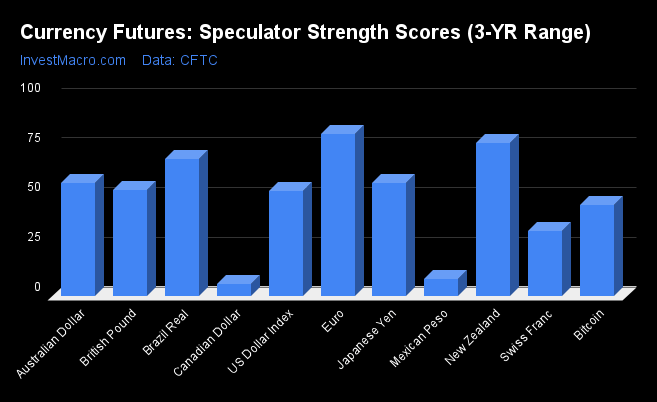
COT Strength Scores (a normalized measure of Speculator positions over a 3-Year range, from 0 to 100 where above 80 is Extreme-Bullish and below 20 is Extreme-Bearish) showed that the EuroFX (74 percent) and the New Zealand Dollar (70 percent) lead the currency markets this week. The Brazilian Real (70 percent), Bitcoin (66 percent) and the Japanese Yen (55 percent) come in as the next highest in the weekly strength scores.

On the downside, the Mexican Peso (7 percent) and the Canadian Dollar (9 percent) come in at the lowest strength levels currently and are in Extreme-Bearish territory (below 20 percent). The next lowest strength scores are the Swiss Franc (34 percent) and the US Dollar Index (47 percent).

Strength Statistics:
US Dollar Index (47.2 percent) vs US Dollar Index previous week (52.5 percent)
EuroFX (74.0 percent) vs EuroFX previous week (76.4 percent)
British Pound Sterling (47.8 percent) vs British Pound Sterling previous week (43.7 percent)
Japanese Yen (54.7 percent) vs Japanese Yen previous week (47.1 percent)
Swiss Franc (33.6 percent) vs Swiss Franc previous week (35.1 percent)
Canadian Dollar (9.3 percent) vs Canadian Dollar previous week (4.9 percent)
Australian Dollar (53.7 percent) vs Australian Dollar previous week (53.6 percent)
New Zealand Dollar (70.4 percent) vs New Zealand Dollar previous week (73.9 percent)
Mexican Peso (6.6 percent) vs Mexican Peso previous week (4.6 percent)
Brazilian Real (69.7 percent) vs Brazilian Real previous week (69.2 percent)
Bitcoin (66.0 percent) vs Bitcoin previous week (66.6 percent)


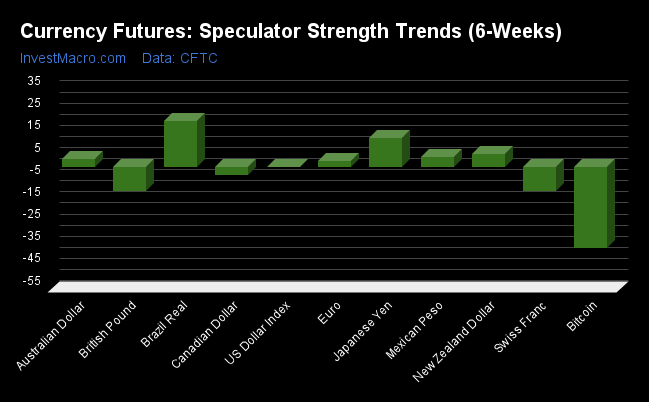
New Zealand Dollar & Japanese Yen top the 6-Week Strength Trends

COT Strength Score Trends (or move index, calculates the 6-week changes in strength scores) showed that the New Zealand Dollar (34 percent) and the Japanese Yen (27 percent) lead the past six weeks trends for the currencies. The Brazilian Real (21 percent), the Swiss Franc (11 percent) and the Australian Dollar (6 percent) are the next highest positive movers in the latest trends data.

The Mexican Peso (-41 percent) leads the downside trend scores currently with the US Dollar Index (-19 percent), Bitcoin (-12 percent) and the Canadian Dollar (-6 percent) following next with lower trend scores.

Strength Trend Statistics:
US Dollar Index (-19.2 percent) vs US Dollar Index previous week (-13.9 percent)
EuroFX (0.6 percent) vs EuroFX previous week (3.9 percent)
British Pound Sterling (3.0 percent) vs British Pound Sterling previous week (6.1 percent)
Japanese Yen (26.5 percent) vs Japanese Yen previous week (19.7 percent)
Swiss Franc (11.3 percent) vs Swiss Franc previous week (18.2 percent)
Canadian Dollar (-6.2 percent) vs Canadian Dollar previous week (-17.7 percent)
Australian Dollar (6.4 percent) vs Australian Dollar previous week (10.1 percent)
New Zealand Dollar (33.6 percent) vs New Zealand Dollar previous week (33.2 percent)
Mexican Peso (-41.2 percent) vs Mexican Peso previous week (-50.9 percent)
Brazilian Real (21.4 percent) vs Brazilian Real previous week (15.1 percent)
Bitcoin (-12.1 percent) vs Bitcoin previous week (-16.0 percent)


Individual COT Forex Markets:

US Dollar Index Futures:
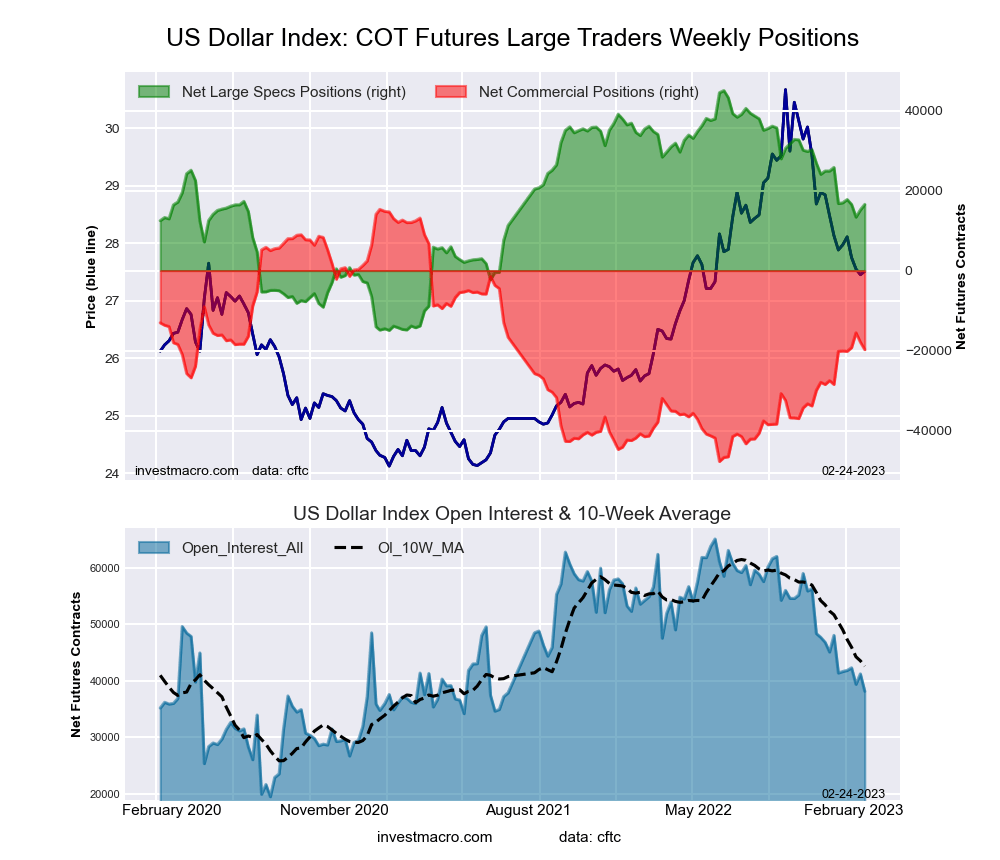
US Dollar Index Forex Futures COT ChartThe US Dollar Index large speculator standing this week reached a net position of 13,358 contracts in the data reported through Tuesday. This was a weekly decline of -3,182 contracts from the previous week which had a total of 16,540 net contracts.

This week’s current strength score (the trader positioning range over the past three years, measured from 0 to 100) shows the speculators are currently Bearish with a score of 47.2 percent. The commercials are Bullish with a score of 51.0 percent and the small traders (not shown in chart) are Bearish with a score of 40.7 percent.

US DOLLAR INDEX StatisticsSPECULATORSCOMMERCIALSSMALL TRADERS
– Percent of Open Interest Longs:80.52.613.4
– Percent of Open Interest Shorts:46.642.17.8
– Net Position:13,358-15,5702,212
– Gross Longs:31,6941,0315,292
– Gross Shorts:18,33616,6013,080
– Long to Short Ratio:1.7 to 10.1 to 11.7 to 1
NET POSITION TREND:
– Strength Index Score (3 Year Range Pct):47.251.040.7
– Strength Index Reading (3 Year Range):BearishBullishBearish
NET POSITION MOVEMENT INDEX:
– 6-Week Change in Strength Index:-19.219.0-4.8


Euro Currency Futures:

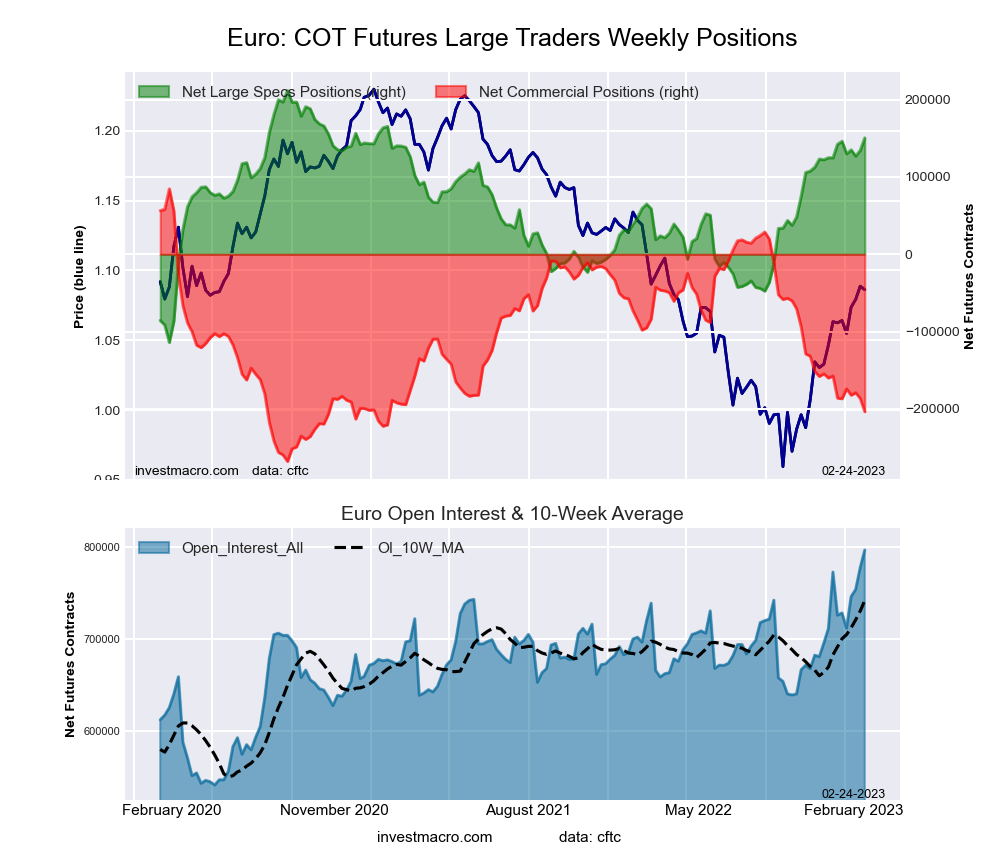
Euro Currency Futures COT ChartThe Euro Currency large speculator standing this week reached a net position of 126,984 contracts in the data reported through Tuesday. This was a weekly reduction of -7,998 contracts from the previous week which had a total of 134,982 net contracts.

This week’s current strength score (the trader positioning range over the past three years, measured from 0 to 100) shows the speculators are currently Bullish with a score of 74.0 percent. The commercials are Bearish with a score of 25.2 percent and the small traders (not shown in chart) are Bullish with a score of 62.1 percent.

EURO Currency StatisticsSPECULATORSCOMMERCIALSSMALL TRADERS
– Percent of Open Interest Longs:30.355.212.5
– Percent of Open Interest Shorts:13.479.05.6
– Net Position:126,984-179,07452,090
– Gross Longs:228,279416,51094,476
– Gross Shorts:101,295595,58442,386
– Long to Short Ratio:2.3 to 10.7 to 12.2 to 1
NET POSITION TREND:
– Strength Index Score (3 Year Range Pct):74.025.262.1
– Strength Index Reading (3 Year Range):BullishBearishBullish
NET POSITION MOVEMENT INDEX:
– 6-Week Change in Strength Index:0.6-5.427.1


British Pound Sterling Futures:

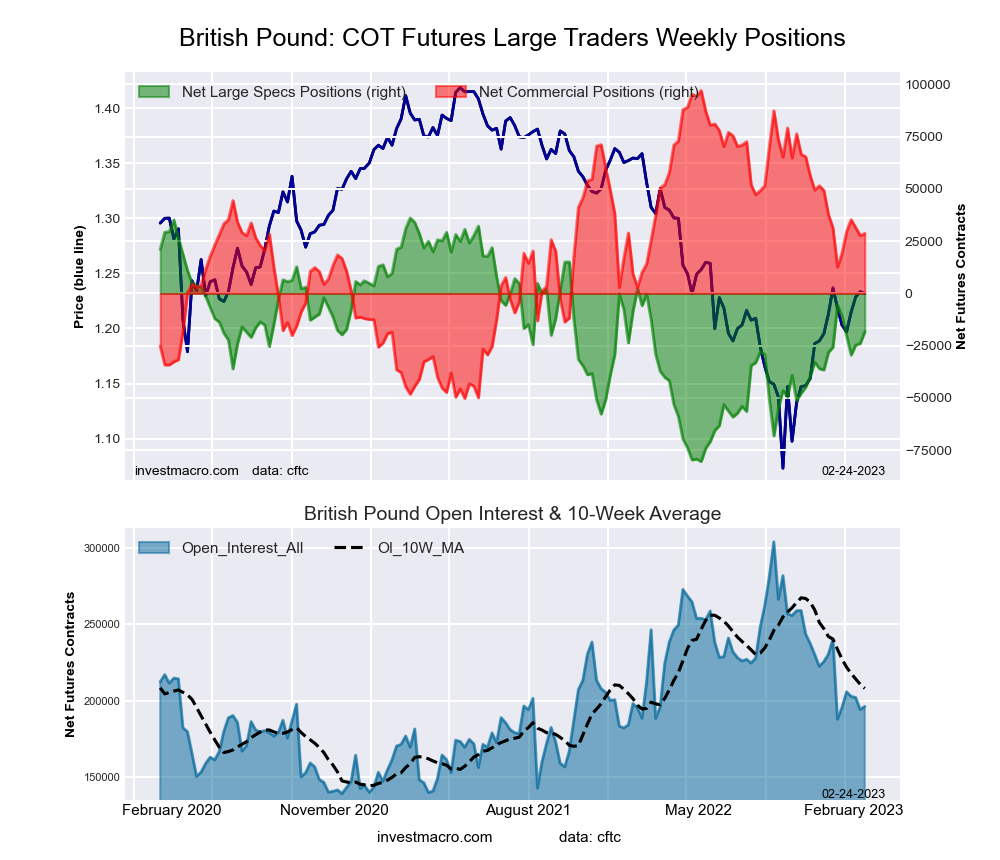
British Pound Sterling Futures COT ChartThe British Pound Sterling large speculator standing this week reached a net position of -24,697 contracts in the data reported through Tuesday. This was a weekly advance of 4,759 contracts from the previous week which had a total of -29,456 net contracts.

This week’s current strength score (the trader positioning range over the past three years, measured from 0 to 100) shows the speculators are currently Bearish with a score of 47.8 percent. The commercials are Bullish with a score of 55.4 percent and the small traders (not shown in chart) are Bearish with a score of 44.8 percent.

BRITISH POUND StatisticsSPECULATORSCOMMERCIALSSMALL TRADERS
– Percent of Open Interest Longs:20.564.711.9
– Percent of Open Interest Shorts:32.849.115.2
– Net Position:-24,69731,436-6,739
– Gross Longs:41,469130,57524,051
– Gross Shorts:66,16699,13930,790
– Long to Short Ratio:0.6 to 11.3 to 10.8 to 1
NET POSITION TREND:
– Strength Index Score (3 Year Range Pct):47.855.444.8
– Strength Index Reading (3 Year Range):BearishBullishBearish
NET POSITION MOVEMENT INDEX:
– 6-Week Change in Strength Index:3.0-4.35.6


Japanese Yen Futures:

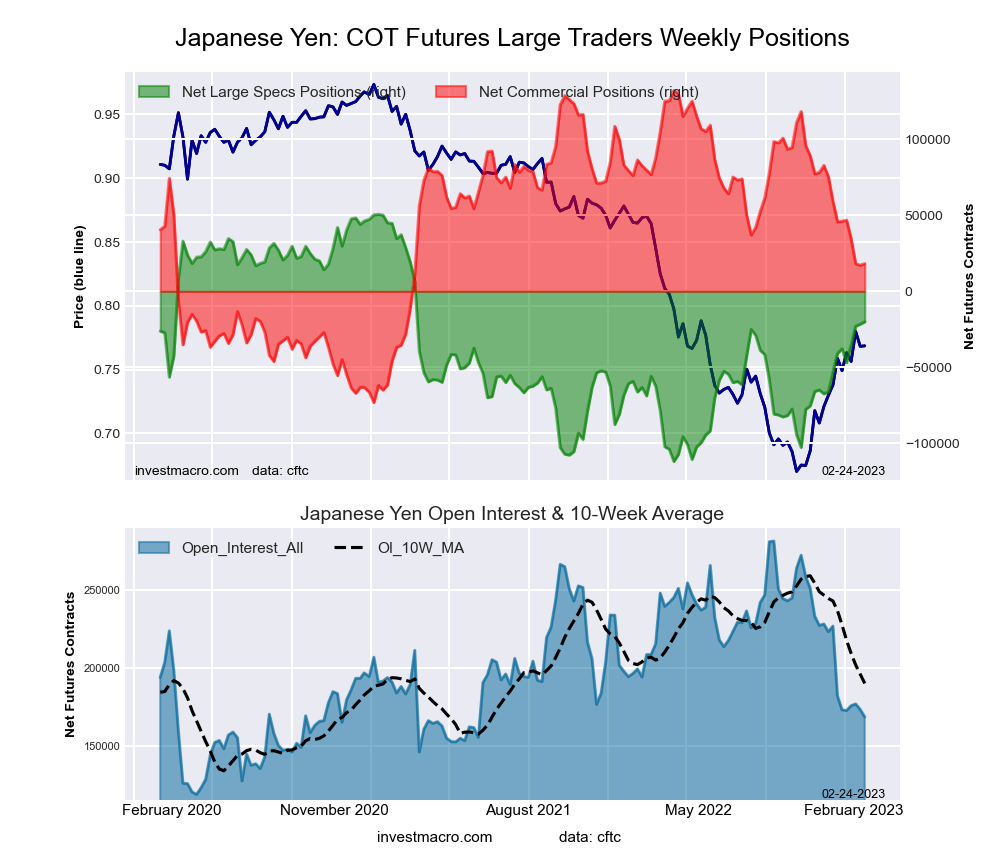
Japanese Yen Forex Futures COT ChartThe Japanese Yen large speculator standing this week reached a net position of -22,961 contracts in the data reported through Tuesday. This was a weekly lift of 12,416 contracts from the previous week which had a total of -35,377 net contracts.

This week’s current strength score (the trader positioning range over the past three years, measured from 0 to 100) shows the speculators are currently Bullish with a score of 54.7 percent. The commercials are Bearish with a score of 44.5 percent and the small traders (not shown in chart) are Bullish with a score of 63.3 percent.

JAPANESE YEN StatisticsSPECULATORSCOMMERCIALSSMALL TRADERS
– Percent of Open Interest Longs:16.765.017.4
– Percent of Open Interest Shorts:29.654.714.6
– Net Position:-22,96118,0844,877
– Gross Longs:29,458114,90730,761
– Gross Shorts:52,41996,82325,884
– Long to Short Ratio:0.6 to 11.2 to 11.2 to 1
NET POSITION TREND:
– Strength Index Score (3 Year Range Pct):54.744.563.3
– Strength Index Reading (3 Year Range):BullishBearishBullish
NET POSITION MOVEMENT INDEX:
– 6-Week Change in Strength Index:26.5-27.928.6


Swiss Franc Futures:

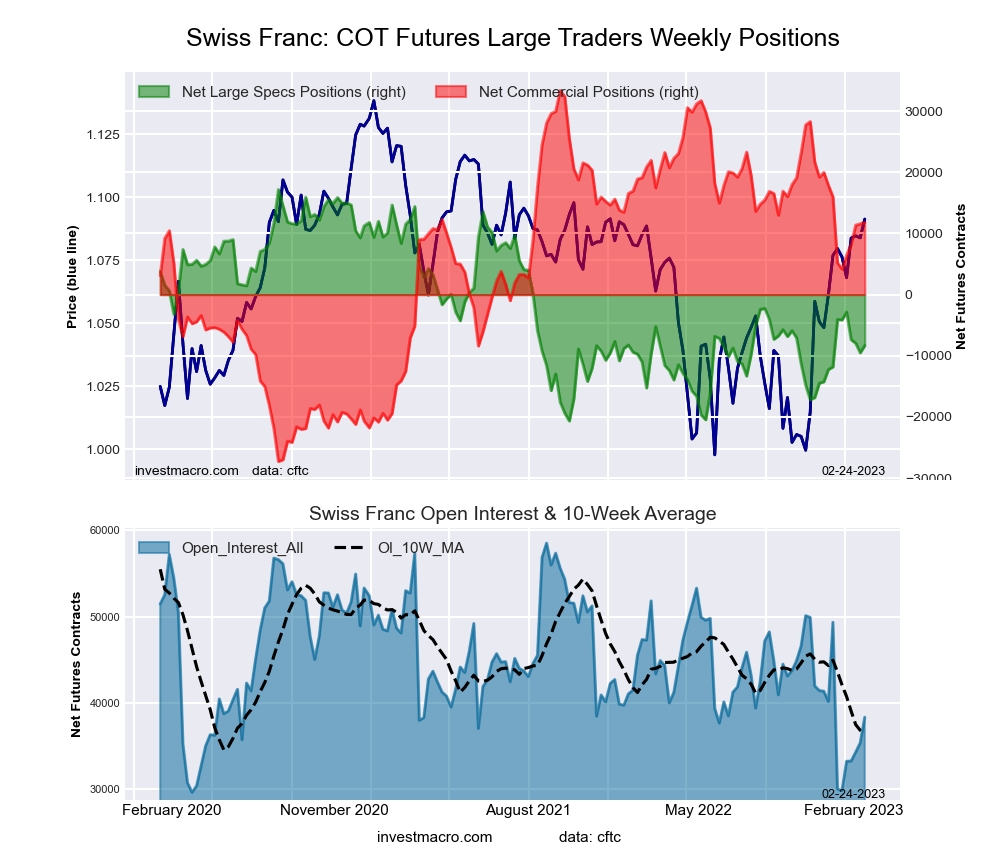
Swiss Franc Forex Futures COT ChartThe Swiss Franc large speculator standing this week reached a net position of -7,941 contracts in the data reported through Tuesday. This was a weekly lowering of -571 contracts from the previous week which had a total of -7,370 net contracts.

This week’s current strength score (the trader positioning range over the past three years, measured from 0 to 100) shows the speculators are currently Bearish with a score of 33.6 percent. The commercials are Bullish with a score of 63.7 percent and the small traders (not shown in chart) are Bearish with a score of 46.0 percent.

SWISS FRANC StatisticsSPECULATORSCOMMERCIALSSMALL TRADERS
– Percent of Open Interest Longs:11.455.233.3
– Percent of Open Interest Shorts:34.622.143.3
– Net Position:-7,94111,357-3,416
– Gross Longs:3,91918,93311,429
– Gross Shorts:11,8607,57614,845
– Long to Short Ratio:0.3 to 12.5 to 10.8 to 1
NET POSITION TREND:
– Strength Index Score (3 Year Range Pct):33.663.746.0
– Strength Index Reading (3 Year Range):BearishBullishBearish
NET POSITION MOVEMENT INDEX:
– 6-Week Change in Strength Index:11.3-10.77.5


Canadian Dollar Futures:

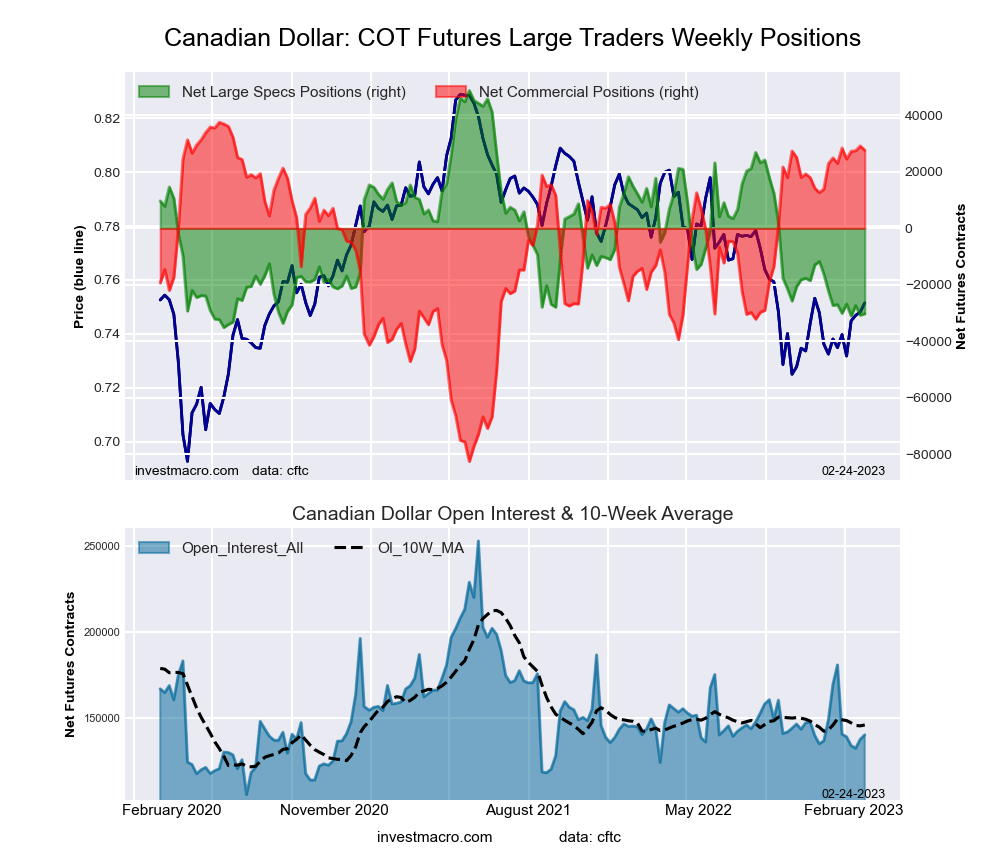
Canadian Dollar Forex Futures COT ChartThe Canadian Dollar large speculator standing this week reached a net position of -27,259 contracts in the data reported through Tuesday. This was a weekly gain of 3,696 contracts from the previous week which had a total of -30,955 net contracts.

This week’s current strength score (the trader positioning range over the past three years, measured from 0 to 100) shows the speculators are currently Bearish-Extreme with a score of 9.3 percent. The commercials are Bullish-Extreme with a score of 91.6 percent and the small traders (not shown in chart) are Bearish with a score of 29.6 percent.

CANADIAN DOLLAR StatisticsSPECULATORSCOMMERCIALSSMALL TRADERS
– Percent of Open Interest Longs:15.857.024.3
– Percent of Open Interest Shorts:36.436.224.5
– Net Position:-27,25927,488-229
– Gross Longs:20,89775,38732,211
– Gross Shorts:48,15647,89932,440
– Long to Short Ratio:0.4 to 11.6 to 11.0 to 1
NET POSITION TREND:
– Strength Index Score (3 Year Range Pct):9.391.629.6
– Strength Index Reading (3 Year Range):Bearish-ExtremeBullish-ExtremeBearish
NET POSITION MOVEMENT INDEX:
– 6-Week Change in Strength Index:-6.23.81.2


Australian Dollar Futures:

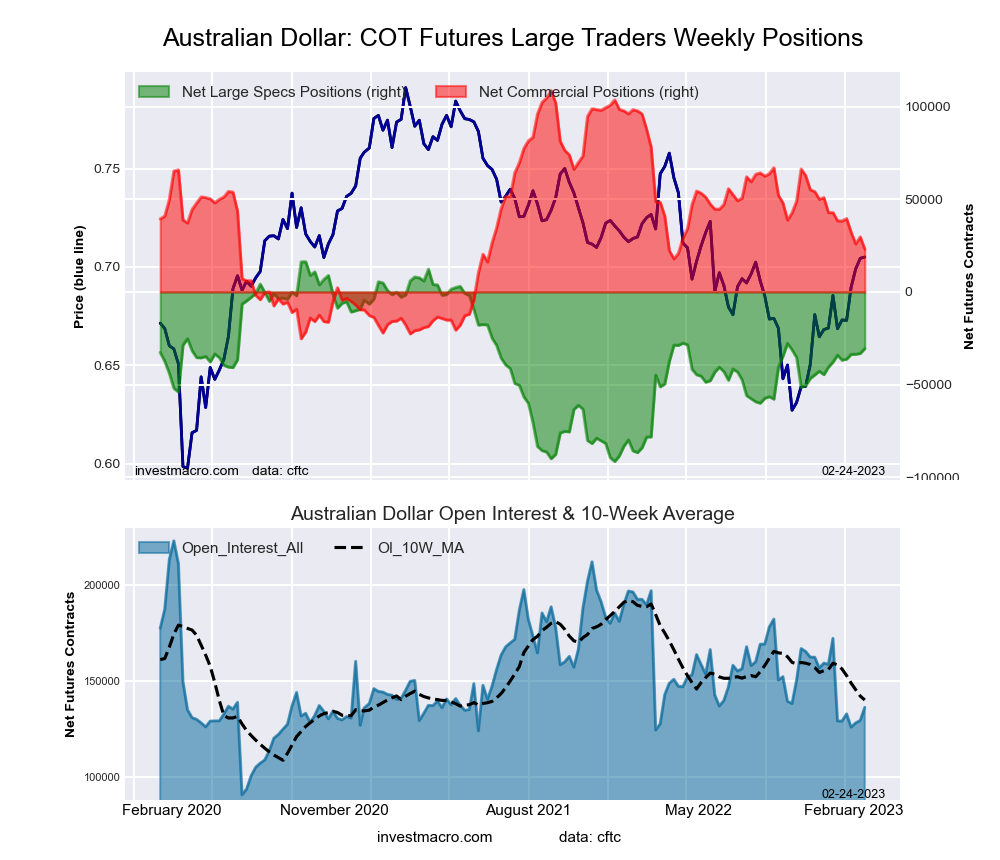
Australian Dollar Forex Futures COT ChartThe Australian Dollar large speculator standing this week reached a net position of -33,620 contracts in the data reported through Tuesday. This was a weekly increase of 70 contracts from the previous week which had a total of -33,690 net contracts.

This week’s current strength score (the trader positioning range over the past three years, measured from 0 to 100) shows the speculators are currently Bullish with a score of 53.7 percent. The commercials are Bearish with a score of 38.2 percent and the small traders (not shown in chart) are Bullish with a score of 71.2 percent.

AUSTRALIAN DOLLAR StatisticsSPECULATORSCOMMERCIALSSMALL TRADERS
– Percent of Open Interest Longs:22.355.420.6
– Percent of Open Interest Shorts:48.535.214.6
– Net Position:-33,62025,9367,684
– Gross Longs:28,59371,05226,348
– Gross Shorts:62,21345,11618,664
– Long to Short Ratio:0.5 to 11.6 to 11.4 to 1
NET POSITION TREND:
– Strength Index Score (3 Year Range Pct):53.738.271.2
– Strength Index Reading (3 Year Range):BullishBearishBullish
NET POSITION MOVEMENT INDEX:
– 6-Week Change in Strength Index:6.4-12.624.2


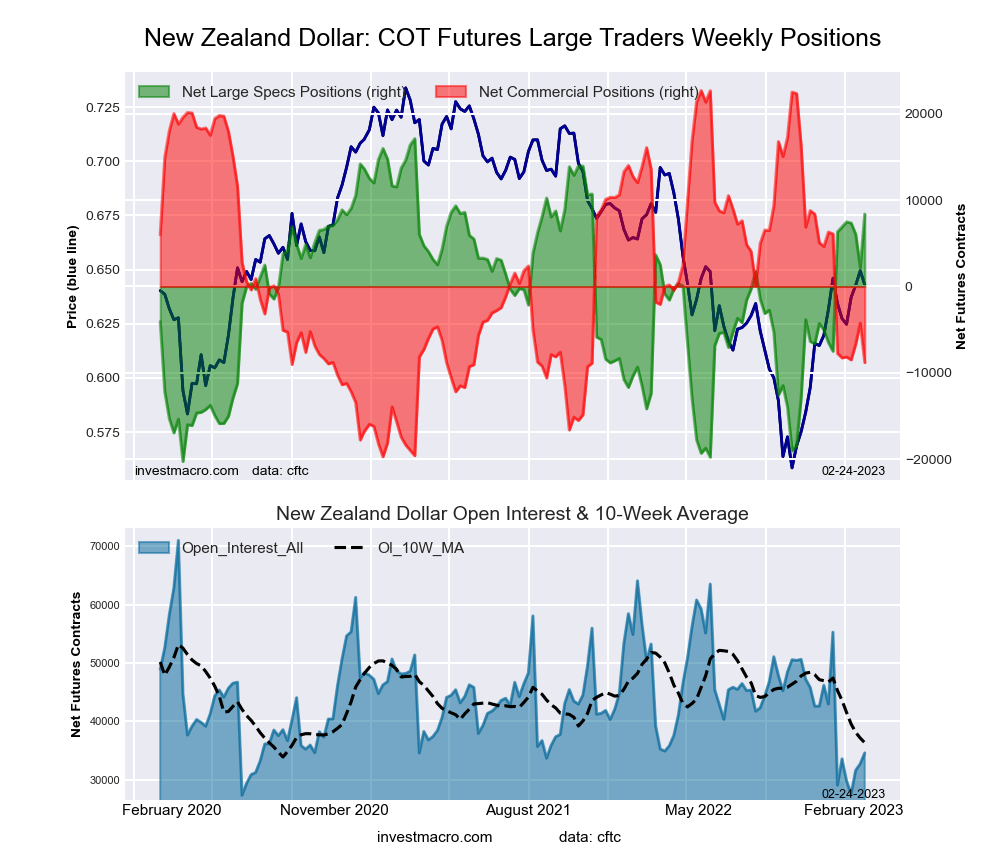
New Zealand Dollar Futures:

New Zealand Dollar Forex Futures COT ChartThe New Zealand Dollar large speculator standing this week reached a net position of 6,058 contracts in the data reported through Tuesday. This was a weekly fall of -1,292 contracts from the previous week which had a total of 7,350 net contracts.

This week’s current strength score (the trader positioning range over the past three years, measured from 0 to 100) shows the speculators are currently Bullish with a score of 70.4 percent. The commercials are Bearish with a score of 30.7 percent and the small traders (not shown in chart) are Bullish with a score of 58.9 percent.

NEW ZEALAND DOLLAR StatisticsSPECULATORSCOMMERCIALSSMALL TRADERS
– Percent of Open Interest Longs:35.850.312.4
– Percent of Open Interest Shorts:16.671.510.4
– Net Position:6,058-6,686628
– Gross Longs:11,30815,8883,903
– Gross Shorts:5,25022,5743,275
– Long to Short Ratio:2.2 to 10.7 to 11.2 to 1
NET POSITION TREND:
– Strength Index Score (3 Year Range Pct):70.430.758.9
– Strength Index Reading (3 Year Range):BullishBearishBullish
NET POSITION MOVEMENT INDEX:
– 6-Week Change in Strength Index:33.6-30.65.0


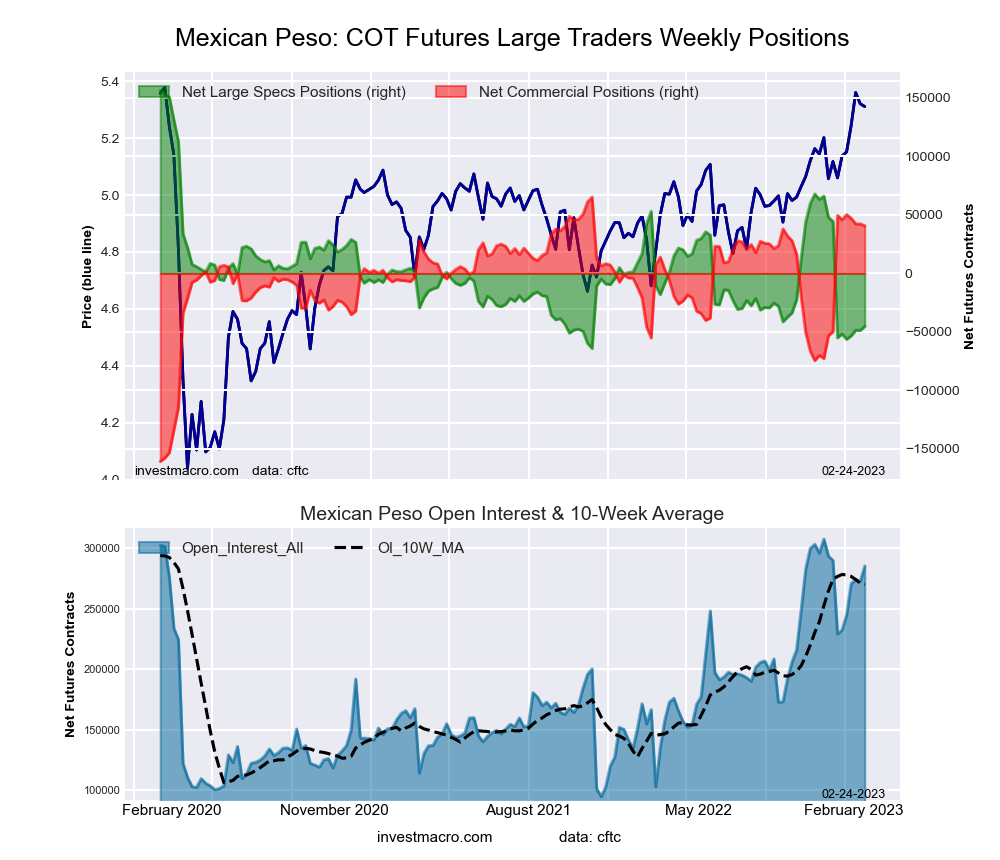
Mexican Peso Futures:

Mexican Peso Futures COT ChartThe Mexican Peso large speculator standing this week reached a net position of -48,639 contracts in the data reported through Tuesday. This was a weekly lift of 4,742 contracts from the previous week which had a total of -53,381 net contracts.

This week’s current strength score (the trader positioning range over the past three years, measured from 0 to 100) shows the speculators are currently Bearish-Extreme with a score of 6.6 percent. The commercials are Bullish-Extreme with a score of 90.4 percent and the small traders (not shown in chart) are Bullish-Extreme with a score of 94.9 percent.

MEXICAN PESO StatisticsSPECULATORSCOMMERCIALSSMALL TRADERS
– Percent of Open Interest Longs:54.941.53.2
– Percent of Open Interest Shorts:72.626.10.9
– Net Position:-48,63942,2996,340
– Gross Longs:150,543113,9248,681
– Gross Shorts:199,18271,6252,341
– Long to Short Ratio:0.8 to 11.6 to 13.7 to 1
NET POSITION TREND:
– Strength Index Score (3 Year Range Pct):6.690.494.9
– Strength Index Reading (3 Year Range):Bearish-ExtremeBullish-ExtremeBullish-Extreme
NET POSITION MOVEMENT INDEX:
– 6-Week Change in Strength Index:-41.239.95.4


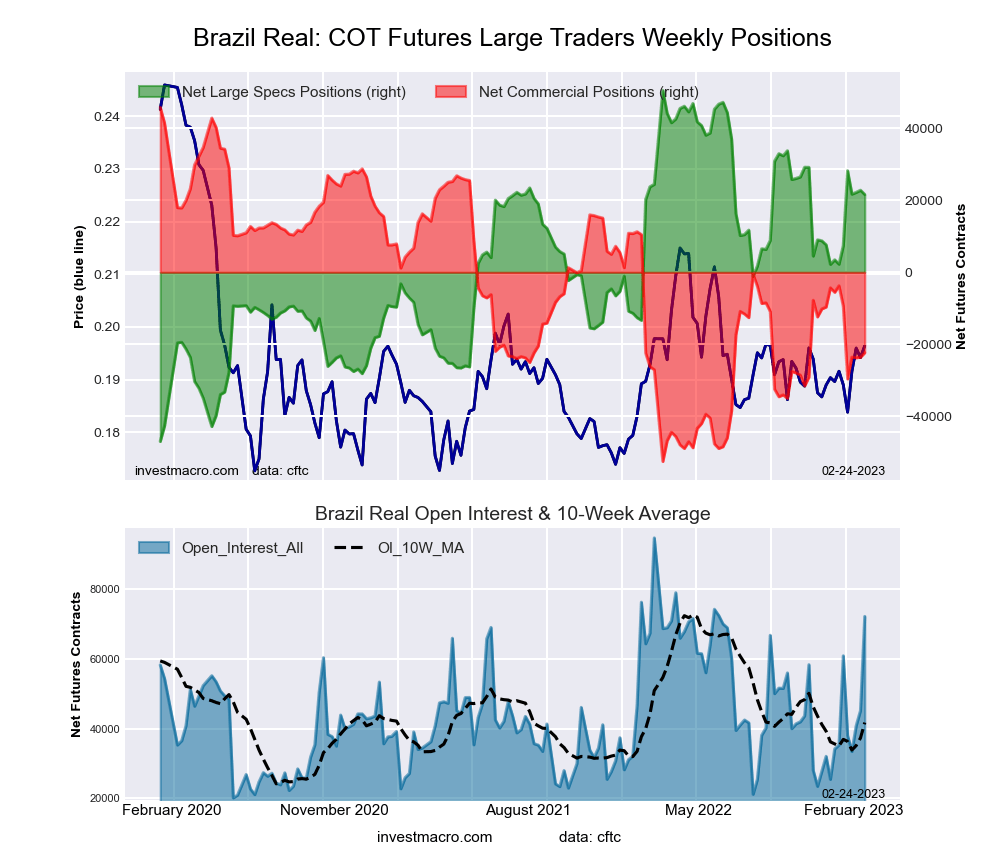
Brazilian Real Futures:

Brazil Real Futures COT ChartThe Brazilian Real large speculator standing this week reached a net position of 22,193 contracts in the data reported through Tuesday. This was a weekly lift of 492 contracts from the previous week which had a total of 21,701 net contracts.

This week’s current strength score (the trader positioning range over the past three years, measured from 0 to 100) shows the speculators are currently Bullish with a score of 69.7 percent. The commercials are Bearish with a score of 30.2 percent and the small traders (not shown in chart) are Bullish with a score of 79.5 percent.

BRAZIL REAL StatisticsSPECULATORSCOMMERCIALSSMALL TRADERS
– Percent of Open Interest Longs:79.510.510.0
– Percent of Open Interest Shorts:25.168.76.2
– Net Position:22,193-23,7481,555
– Gross Longs:32,4294,2704,096
– Gross Shorts:10,23628,0182,541
– Long to Short Ratio:3.2 to 10.2 to 11.6 to 1
NET POSITION TREND:
– Strength Index Score (3 Year Range Pct):69.730.279.5
– Strength Index Reading (3 Year Range):BullishBearishBullish
NET POSITION MOVEMENT INDEX:
– 6-Week Change in Strength Index:21.4-20.4-6.4


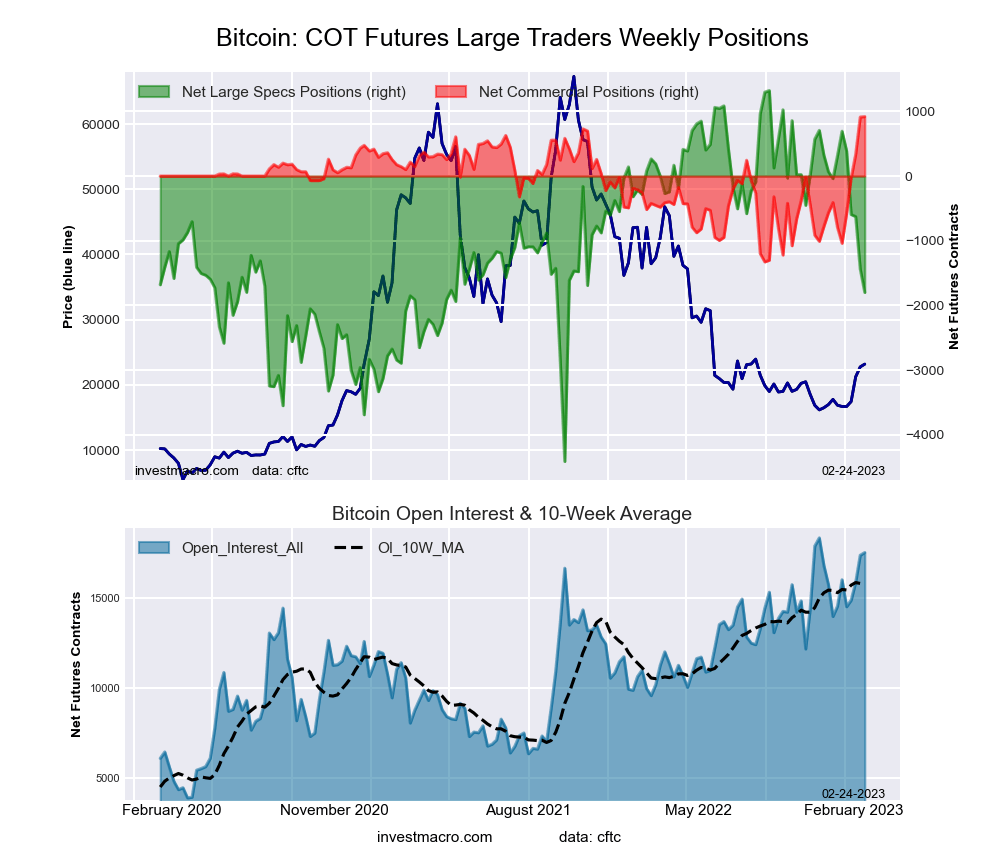
Bitcoin Futures:

Bitcoin Crypto Futures COT ChartThe Bitcoin large speculator standing this week reached a net position of -627 contracts in the data reported through Tuesday. This was a weekly reduction of -33 contracts from the previous week which had a total of -594 net contracts.

This week’s current strength score (the trader positioning range over the past three years, measured from 0 to 100) shows the speculators are currently Bullish with a score of 66.0 percent. The commercials are Bullish-Extreme with a score of 80.9 percent and the small traders (not shown in chart) are Bearish-Extreme with a score of 19.5 percent.

BITCOIN StatisticsSPECULATORSCOMMERCIALSSMALL TRADERS
– Percent of Open Interest Longs:78.46.09.1
– Percent of Open Interest Shorts:82.43.97.2
– Net Position:-627337290
– Gross Longs:12,4569511,440
– Gross Shorts:13,0836141,150
– Long to Short Ratio:1.0 to 11.5 to 11.3 to 1
NET POSITION TREND:
– Strength Index Score (3 Year Range Pct):66.080.919.5
– Strength Index Reading (3 Year Range):BullishBullish-ExtremeBearish-Extreme
NET POSITION MOVEMENT INDEX:
– 6-Week Change in Strength Index:-12.144.0-4.8


Article By InvestMacroReceive our weekly COT Newsletter

*COT Report: The COT data, released weekly to the public each Friday, is updated through the most recent Tuesday (data is 3 days old) and shows a quick view of how large speculators or non-commercials (for-profit traders) were positioned in the futures markets.

The CFTC categorizes trader positions according to commercial hedgers (traders who use futures contracts for hedging as part of the business), non-commercials (large traders who speculate to realize trading profits) and nonreportable traders (usually small traders/speculators) as well as their open interest (contracts open in the market at time of reporting). See CFTC criteria here.

COT Speculator Extremes: Soybean Meal, Ultra 10-Year Treasuries lead Bullish & Bearish Positions

By InvestMacro

The latest update for the weekly Commitment of Traders (COT) report was released by the Commodity Futures Trading Commission (CFTC) on Friday for data ending on January 17th.

This weekly Extreme Positions report highlights the Most Bullish and Most Bearish Positions for the speculator category. Extreme positioning in these markets can foreshadow strong moves in the underlying market.

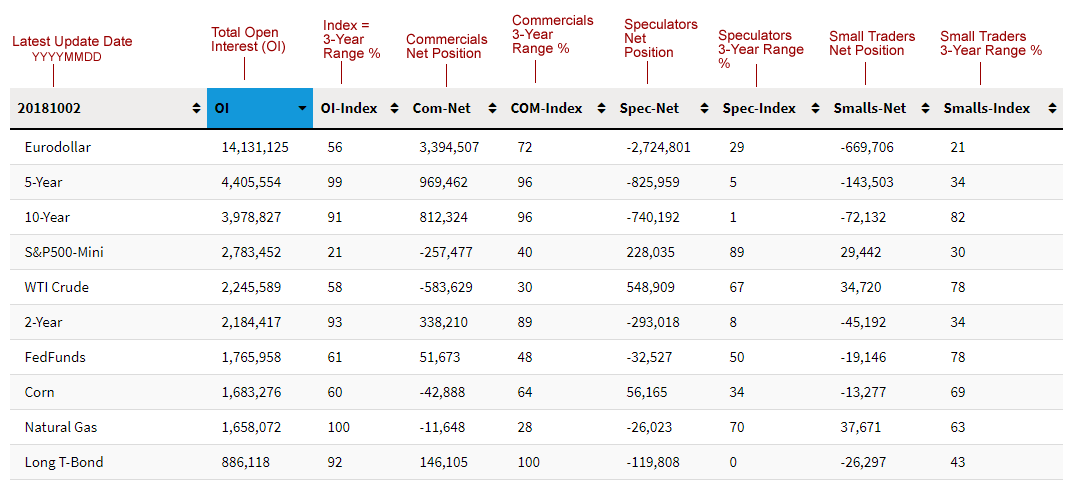
To signify an extreme position, we use the Strength Index (also known as the COT Index) of each instrument, a common method of measuring COT data. The Strength Index is simply a comparison of current trader positions against the range of positions over the previous 3 years. We use over 80 percent as extremely bullish and under 20 percent as extremely bearish. (Compare Strength Index scores across all markets in the data table or cot leaders table)


Here Are This Week’s Most Bullish Speculator Positions:

Soybean Meal


The Soybean Meal speculator position comes in as the most bullish extreme standing this week. The Soybean Meal speculator level is currently at a 100.0 percent score of its 3-year range.

The six-week trend for the percent strength score totaled 20.5 this week. The overall net speculator position was a total of 166,350 net contracts this week with a rise of 8,640 contract in the weekly speculator bets.


VIX


The VIX speculator position comes next in the extreme standings this week. The VIX speculator level is now at a 76.5 percent score of its 3-year range.

The six-week trend for the percent strength score was 15.3 this week. The speculator position registered -52,355 net contracts this week with a weekly gain of 20,452 contracts in speculator bets.


Euro


The Euro speculator position comes in third this week in the extreme standings. The Euro speculator level resides at a 74.0 percent score of its 3-year range.

The six-week trend for the speculator strength score came in at 0.6 this week. The overall speculator position was 126,984 net contracts this week with a decline of -7,998 contracts in the weekly speculator bets.


Live Cattle


The Live Cattle speculator position comes up number four in the extreme standings this week. The Live Cattle speculator level is at a 72.3 percent score of its 3-year range.

The six-week trend for the speculator strength score totaled a change of 23.7 this week. The overall speculator position was 74,143 net contracts this week with a dip of -5,851 contracts in the speculator bets.


New Zealand Dollar


The New Zealand Dollar speculator position rounds out the top five in this week’s bullish extreme standings. The New Zealand Dollar speculator level sits at a 70.4 percent score of its 3-year range. The six-week trend for the speculator strength score was 33.6 this week.

The speculator position was 6,058 net contracts this week with a decrease of -1,292 contracts in the weekly speculator bets.


This Week’s Most Bearish Speculator Positions:

Ultra 10-Year U.S. T-Note


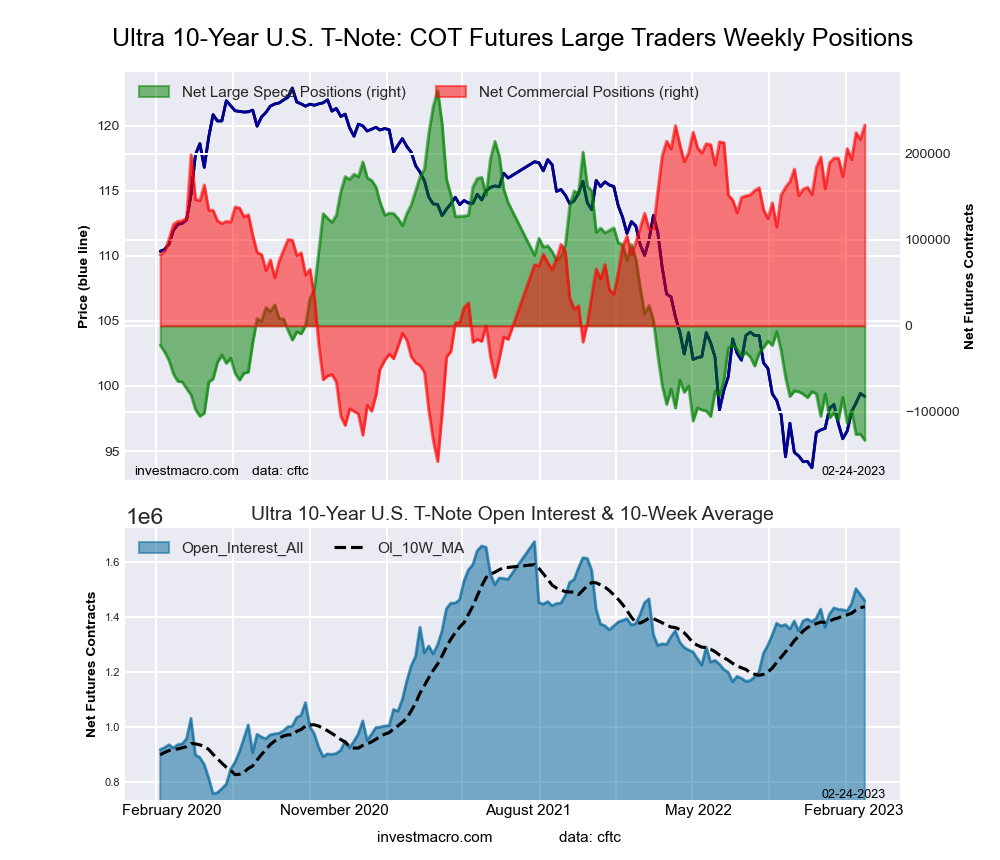
The Ultra 10-Year U.S. T-Note speculator position comes in as the most bearish extreme standing this week. The Ultra 10-Year U.S. T-Note speculator level is at a 0.0 percent score of its 3-year range.

The six-week trend for the speculator strength score was -4.8 this week. The overall speculator position was -126,321 net contracts this week with a decline of -28,051 contracts in the speculator bets.


Wheat


The Wheat speculator position comes in next for the most bearish extreme standing on the week. The Wheat speculator level is at a 0.0 percent score of its 3-year range.

The six-week trend for the speculator strength score was -2.0 this week. The speculator position was -42,014 net contracts this week with a dip of -2,298 contracts in the weekly speculator bets.


10-Year Note


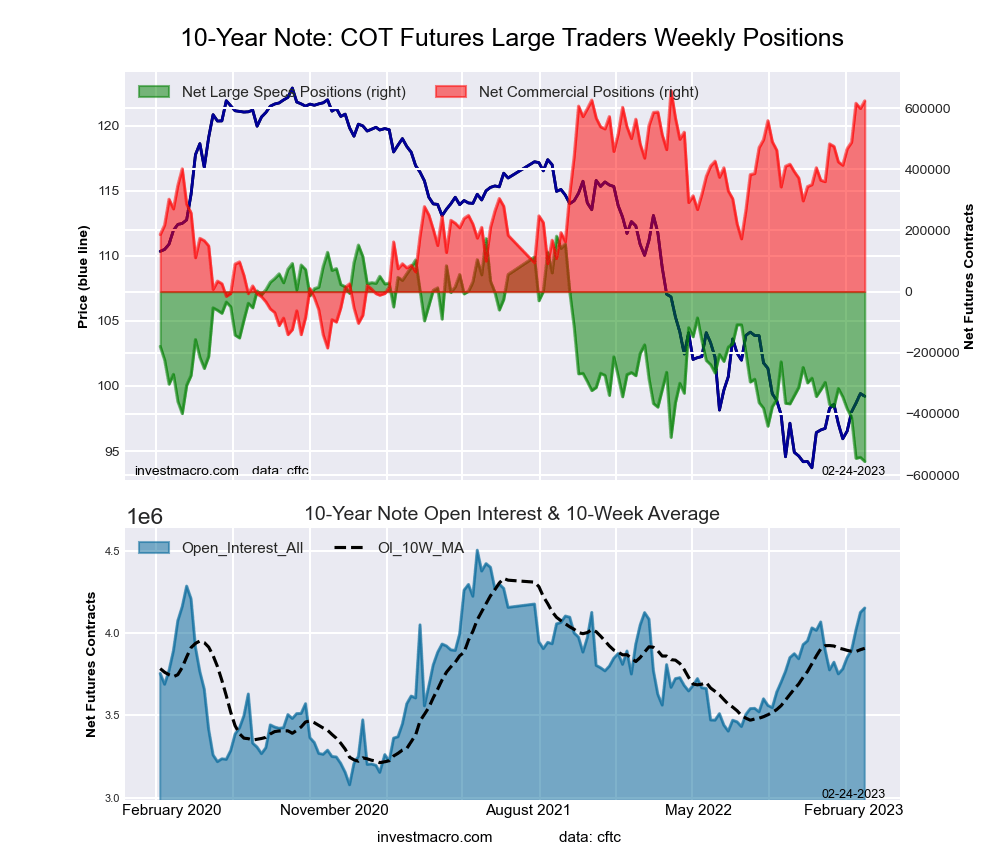
The 10-Year Note speculator position comes in as third most bearish extreme standing of the week. The 10-Year Note speculator level resides at a 0.0 percent score of its 3-year range.

The six-week trend for the speculator strength score was -24.2 this week. The overall speculator position was -545,057 net contracts this week with a shortfall of -133,699 contracts in the speculator bets.


Coffee


The Coffee speculator position comes in as this week’s fourth most bearish extreme standing. The Coffee speculator level is at a 0.0 percent score of its 3-year range.

The six-week trend for the speculator strength score was -12.4 this week. The speculator position was -26,745 net contracts this week with a decline of -12,006 contracts in the weekly speculator bets.


5-Year Bond


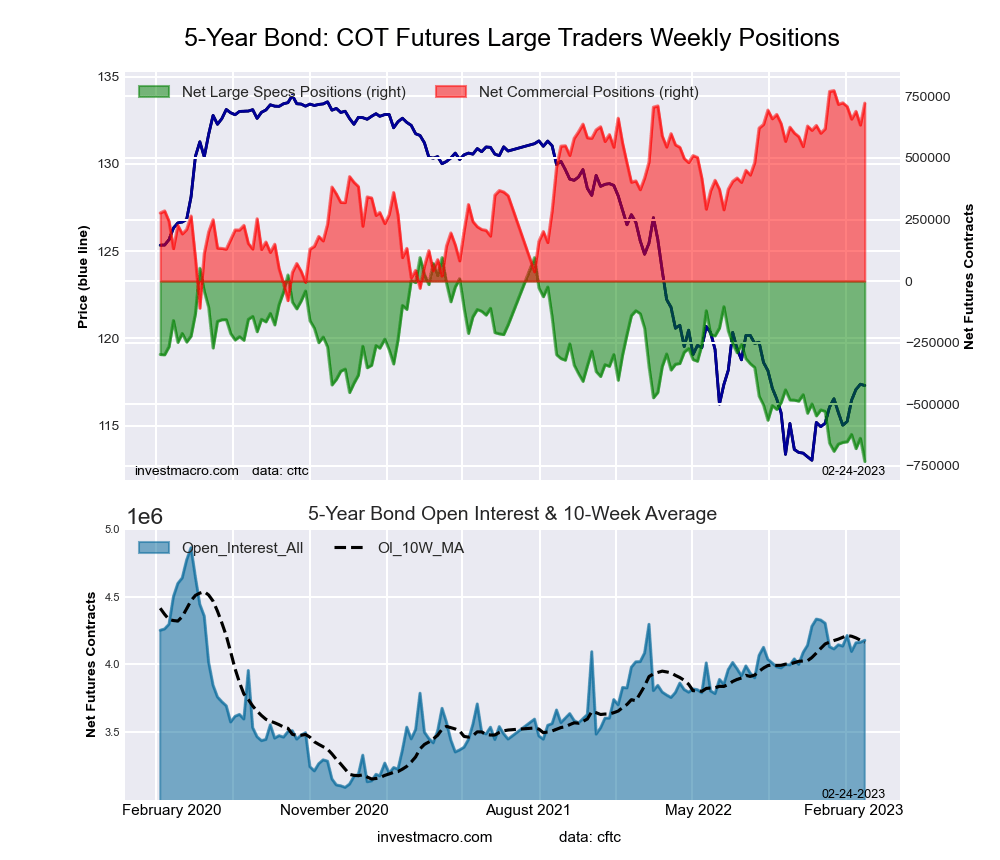
Finally, the 5-Year Bond speculator position comes in as the fifth most bearish extreme standing for this week. The 5-Year Bond speculator level is at a 1.4 percent score of its 3-year range.

The six-week trend for the speculator strength score was -2.8 this week. The speculator position was -680,655 net contracts this week with a drop of -57,504 contracts in the weekly speculator bets.


Speculators or Non-Commercials Notes:

Speculators, classified as non-commercial traders by the CFTC, are made up of large commodity funds, hedge funds and other significant for-profit participants. The Specs are generally regarded as trend-followers in their behavior towards price action – net speculator bets and prices tend to go in the same directions. These traders often look to buy when prices are rising and sell when prices are falling. To illustrate this point, many times speculator contracts can be found at their most extremes (bullish or bearish) when prices are also close to their highest or lowest levels.

These extreme levels can be dangerous for the large speculators as the trade is most crowded, there is less trading ammunition still sitting on the sidelines to push the trend further and prices have moved a significant distance. When the trend becomes exhausted, some speculators take profits while others look to also exit positions when prices fail to continue in the same direction. This process usually plays out over many months to years and can ultimately create a reverse effect where prices start to fall and speculators start a process of selling when prices are falling.


Article By InvestMacroReceive our weekly COT Newsletter

*COT Report: The COT data, released weekly to the public each Friday, is updated through the most recent Tuesday (data is 3 days old) and shows a quick view of how large speculators or non-commercials (for-profit traders) were positioned in the futures markets.

The CFTC categorizes trader positions according to commercial hedgers (traders who use futures contracts for hedging as part of the business), non-commercials (large traders who speculate to realize trading profits) and nonreportable traders (usually small traders/speculators) as well as their open interest (contracts open in the market at time of reporting). See CFTC criteria here.

Metals Speculators boosted their Gold Bullish Bets higher for 7th week

By InvestMacro

Here are the latest charts and statistics for the Commitment of Traders (COT) data published by the Commodities Futures Trading Commission (CFTC).

The latest COT data is updated through Tuesday January 17th and shows a quick view of how large traders (for-profit speculators and commercial entities) were positioned in the futures markets.

Weekly Speculator Changes led by Copper & Gold

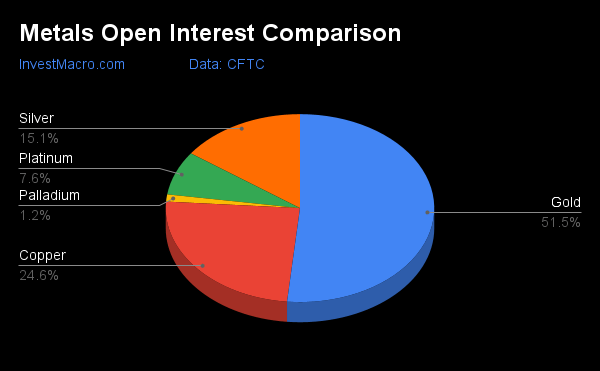
The COT metals markets speculator bets were higher this week as three out of the five precious metals markets we cover had higher positioning while the other two markets had lower speculator contracts.

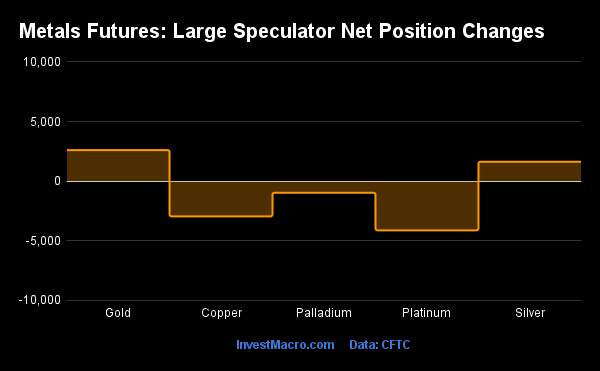
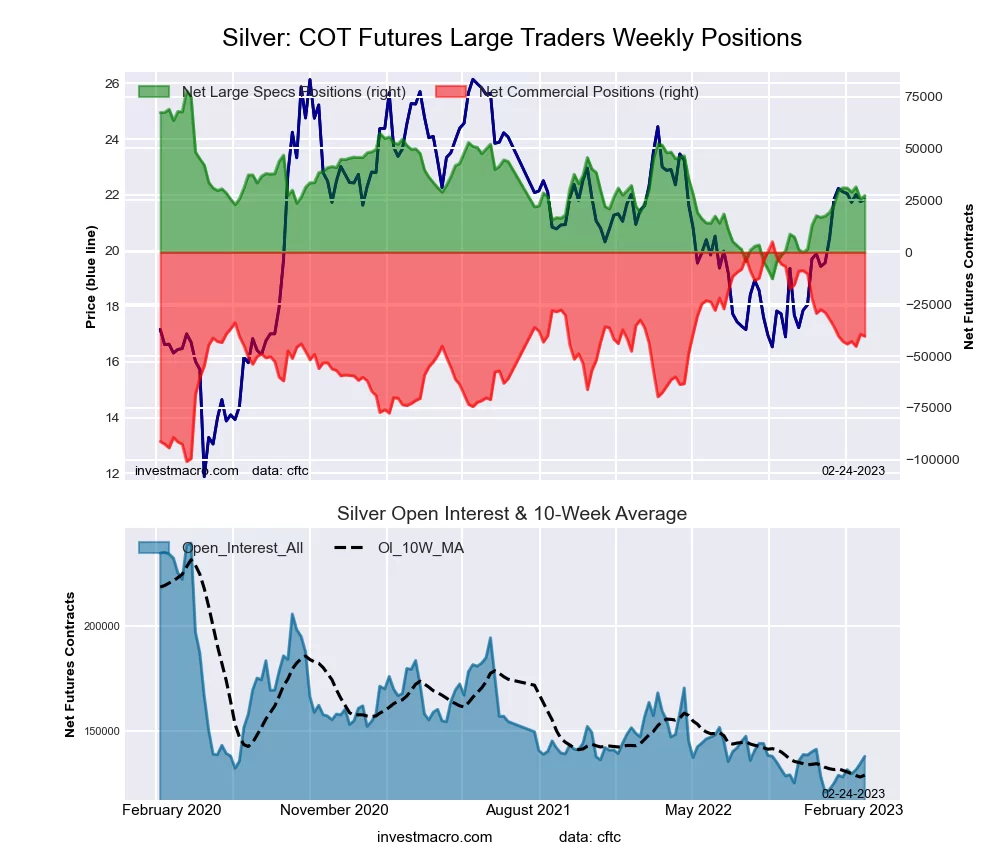
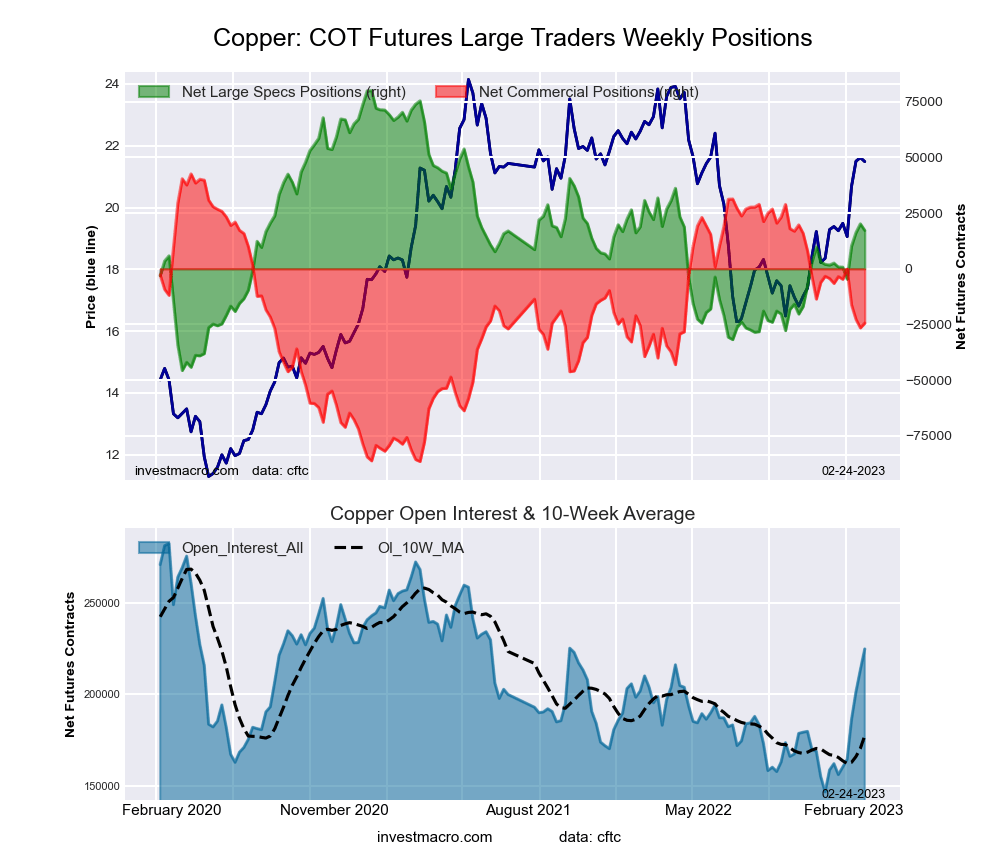
Leading the gains for the metals was Copper (6,011 contracts) with Gold (2,705 contracts) and Silver (2,455 contracts) also showing positive weeks.

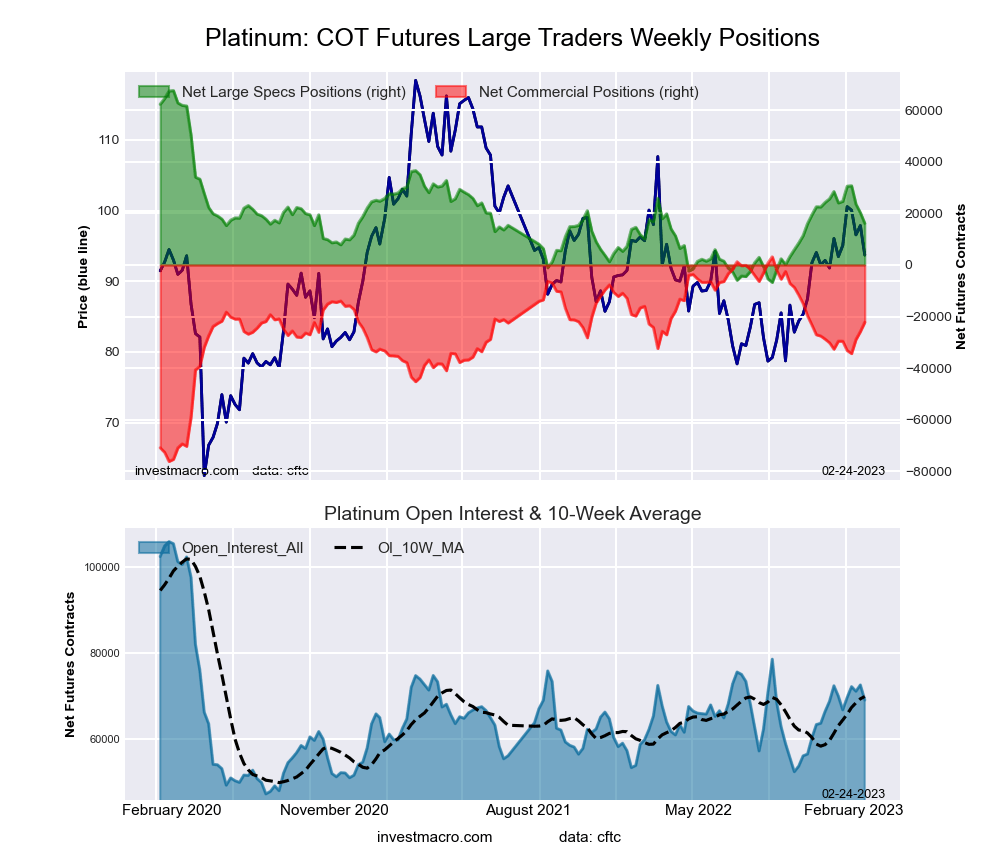
The markets with declines in speculator bets for the week were Platinum (-7,158 contracts) and Palladium (-261 contracts) also registering lower bets on the week.

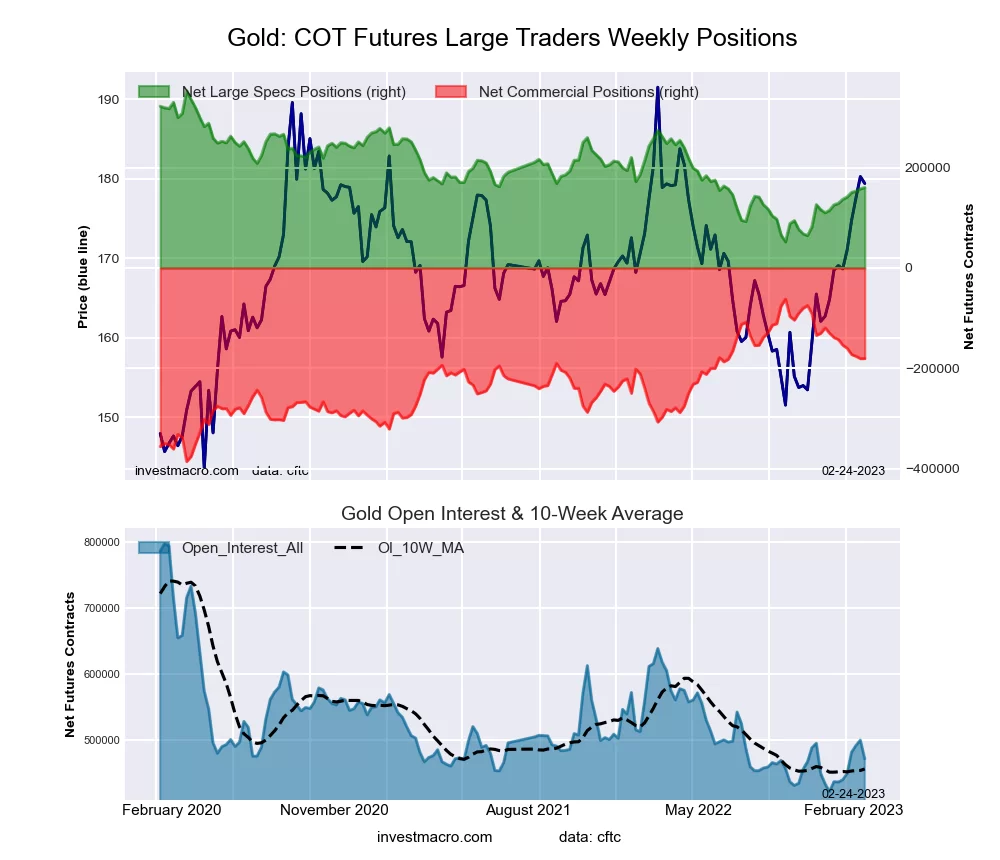
Highlighting the COT metals data this week is the recent streak of gains for the Gold speculative positions. The large speculator position in Gold futures rose this week for a seventh consecutive week and for the ninth time out of the past eleven weeks. The Gold position has now gone from a multi-year low total of +64,623 contracts on November 1st to a total of +153,240 contracts this week which marks the highest weekly total of the past 29 weeks, dating back to June 28th.

The Gold futures price has been on the move higher since seeing a recent bottom in October around the $1,620.00 level. This week, the Gold futures closed at $1,928.20 per ounce which is the highest close since April and Gold is showing an approximate gain by 18 percent since the October bottom.


Data Snapshot of Commodity Market Traders | Columns Legend
Jan-17-2023OIOI-IndexSpec-NetSpec-IndexCom-NetCOM-IndexSmalls-NetSmalls-Index
Gold491,81822153,24034-175,9136522,67337
Silver131,862931,46849-45,3675213,89940
Copper201,4554216,23849-22,695496,45763
Palladium8,79916-2,751122,90286-15133
Platinum71,1444123,54441-28,913595,36940


Strength Scores led by Silver & Copper

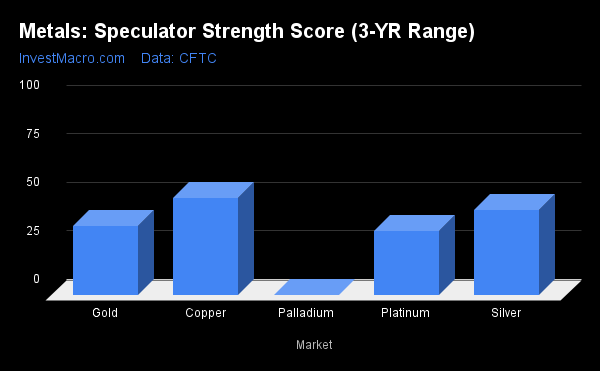
COT Strength Scores (a normalized measure of Speculator positions over a 3-Year range, from 0 to 100 where above 80 is Extreme-Bullish and below 20 is Extreme-Bearish) showed that Silver (49 percent) and Copper (49 percent) lead the metals markets this week.

On the downside, Palladium (12 percent) comes in at the lowest strength level currently and is in Extreme-Bearish territory (below 20 percent). The next lowest strength score was Gold (34 percent).

Strength Statistics:
Gold (33.5 percent) vs Gold previous week (32.6 percent)
Silver (48.8 percent) vs Silver previous week (46.1 percent)
Copper (49.2 percent) vs Copper previous week (44.5 percent)
Platinum (40.7 percent) vs Platinum previous week (50.4 percent)
Palladium (11.9 percent) vs Palladium previous week (14.3 percent)


Silver & Gold top the 6-Week Strength Trends

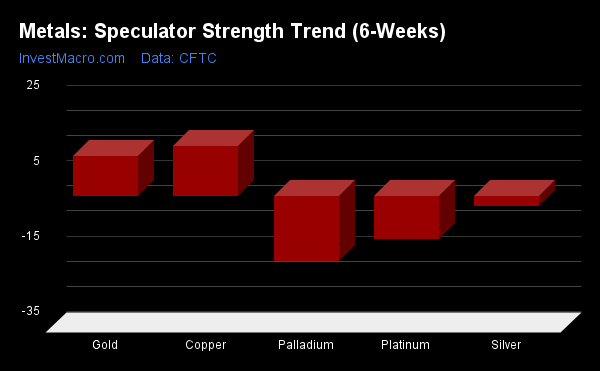
COT Strength Score Trends (or move index, calculates the 6-week changes in strength scores) showed that Silver (14 percent) leads the past six weeks trends for metals. Gold (13 percent) is the next highest positive mover in the latest trends data.

Palladium (-13 percent) leads the downside trend scores currently with Platinum (-3 percent) as the next market with lower trend scores.

Move Statistics:
Gold (12.6 percent) vs Gold previous week (13.4 percent)
Silver (13.5 percent) vs Silver previous week (12.7 percent)
Copper (11.6 percent) vs Copper previous week (6.6 percent)
Platinum (-2.8 percent) vs Platinum previous week (8.7 percent)
Palladium (-12.6 percent) vs Palladium previous week (-7.8 percent)


Individual Markets:

Gold Comex Futures:

Gold Futures COT ChartThe Gold Comex Futures large speculator standing this week reached a net position of 153,240 contracts in the data reported through Tuesday. This was a weekly lift of 2,705 contracts from the previous week which had a total of 150,535 net contracts.

This week’s current strength score (the trader positioning range over the past three years, measured from 0 to 100) shows the speculators are currently Bearish with a score of 33.5 percent. The commercials are Bullish with a score of 64.8 percent and the small traders (not shown in chart) are Bearish with a score of 36.8 percent.

Gold Futures StatisticsSPECULATORSCOMMERCIALSSMALL TRADERS
– Percent of Open Interest Longs:50.225.09.8
– Percent of Open Interest Shorts:19.060.75.2
– Net Position:153,240-175,91322,673
– Gross Longs:246,874122,81448,128
– Gross Shorts:93,634298,72725,455
– Long to Short Ratio:2.6 to 10.4 to 11.9 to 1
NET POSITION TREND:
– Strength Index Score (3 Year Range Pct):33.564.836.8
– Strength Index Reading (3 Year Range):BearishBullishBearish
NET POSITION MOVEMENT INDEX:
– 6-Week Change in Strength Index:12.6-14.219.4


Silver Comex Futures:

Silver Futures COT ChartThe Silver Comex Futures large speculator standing this week reached a net position of 31,468 contracts in the data reported through Tuesday. This was a weekly lift of 2,455 contracts from the previous week which had a total of 29,013 net contracts.

This week’s current strength score (the trader positioning range over the past three years, measured from 0 to 100) shows the speculators are currently Bearish with a score of 48.8 percent. The commercials are Bullish with a score of 52.4 percent and the small traders (not shown in chart) are Bearish with a score of 39.7 percent.

Silver Futures StatisticsSPECULATORSCOMMERCIALSSMALL TRADERS
– Percent of Open Interest Longs:43.632.418.2
– Percent of Open Interest Shorts:19.766.87.6
– Net Position:31,468-45,36713,899
– Gross Longs:57,43942,66823,983
– Gross Shorts:25,97188,03510,084
– Long to Short Ratio:2.2 to 10.5 to 12.4 to 1
NET POSITION TREND:
– Strength Index Score (3 Year Range Pct):48.852.439.7
– Strength Index Reading (3 Year Range):BearishBullishBearish
NET POSITION MOVEMENT INDEX:
– 6-Week Change in Strength Index:13.5-12.44.3


Copper Grade #1 Futures:

Copper Futures COT ChartThe Copper Grade #1 Futures large speculator standing this week reached a net position of 16,238 contracts in the data reported through Tuesday. This was a weekly rise of 6,011 contracts from the previous week which had a total of 10,227 net contracts.

This week’s current strength score (the trader positioning range over the past three years, measured from 0 to 100) shows the speculators are currently Bearish with a score of 49.2 percent. The commercials are Bearish with a score of 49.4 percent and the small traders (not shown in chart) are Bullish with a score of 62.6 percent.

Copper Futures StatisticsSPECULATORSCOMMERCIALSSMALL TRADERS
– Percent of Open Interest Longs:42.134.79.9
– Percent of Open Interest Shorts:34.146.06.7
– Net Position:16,238-22,6956,457
– Gross Longs:84,91069,99719,961
– Gross Shorts:68,67292,69213,504
– Long to Short Ratio:1.2 to 10.8 to 11.5 to 1
NET POSITION TREND:
– Strength Index Score (3 Year Range Pct):49.249.462.6
– Strength Index Reading (3 Year Range):BearishBearishBullish
NET POSITION MOVEMENT INDEX:
– 6-Week Change in Strength Index:11.6-14.221.9


Platinum Futures:

Platinum Futures COT ChartThe Platinum Futures large speculator standing this week reached a net position of 23,544 contracts in the data reported through Tuesday. This was a weekly reduction of -7,158 contracts from the previous week which had a total of 30,702 net contracts.

This week’s current strength score (the trader positioning range over the past three years, measured from 0 to 100) shows the speculators are currently Bearish with a score of 40.7 percent. The commercials are Bullish with a score of 59.1 percent and the small traders (not shown in chart) are Bearish with a score of 40.0 percent.

Platinum Futures StatisticsSPECULATORSCOMMERCIALSSMALL TRADERS
– Percent of Open Interest Longs:56.827.911.5
– Percent of Open Interest Shorts:23.768.53.9
– Net Position:23,544-28,9135,369
– Gross Longs:40,38719,8318,162
– Gross Shorts:16,84348,7442,793
– Long to Short Ratio:2.4 to 10.4 to 12.9 to 1
NET POSITION TREND:
– Strength Index Score (3 Year Range Pct):40.759.140.0
– Strength Index Reading (3 Year Range):BearishBullishBearish
NET POSITION MOVEMENT INDEX:
– 6-Week Change in Strength Index:-2.81.611.4


Palladium Futures:

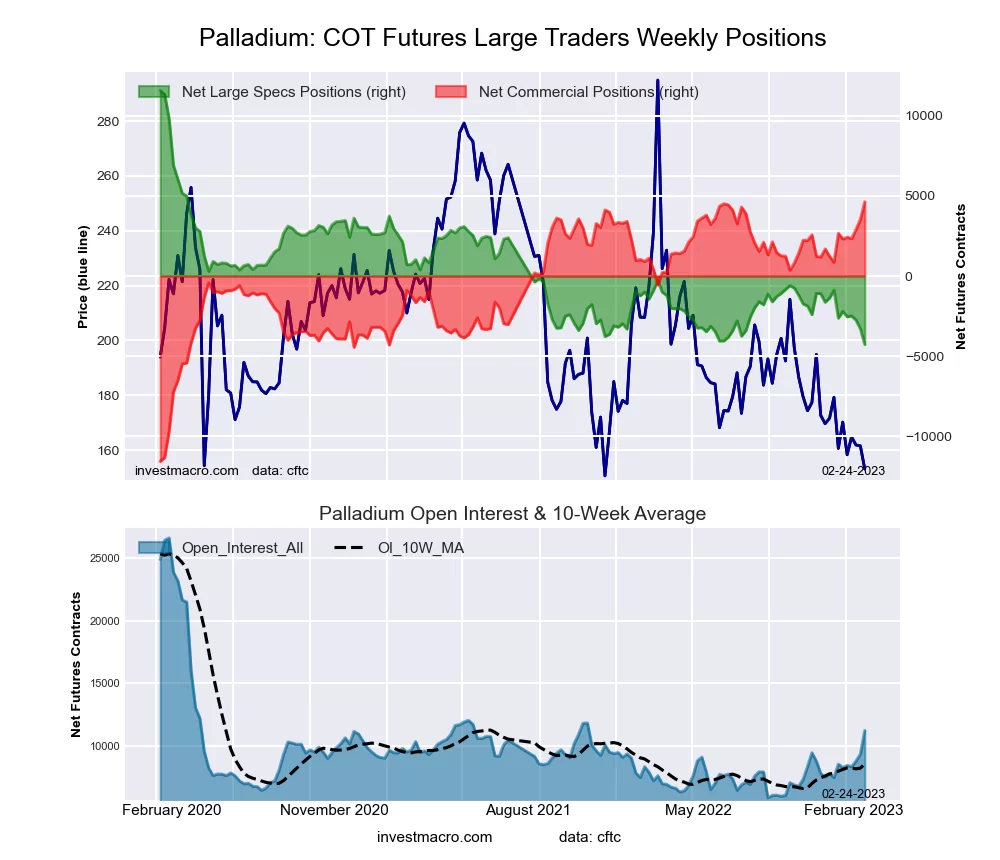
Palladium Futures COT ChartThe Palladium Futures large speculator standing this week reached a net position of -2,751 contracts in the data reported through Tuesday. This was a weekly reduction of -261 contracts from the previous week which had a total of -2,490 net contracts.

This week’s current strength score (the trader positioning range over the past three years, measured from 0 to 100) shows the speculators are currently Bearish-Extreme with a score of 11.9 percent. The commercials are Bullish-Extreme with a score of 86.3 percent and the small traders (not shown in chart) are Bearish with a score of 32.6 percent.

Palladium Futures StatisticsSPECULATORSCOMMERCIALSSMALL TRADERS
– Percent of Open Interest Longs:24.257.114.6
– Percent of Open Interest Shorts:55.424.116.3
– Net Position:-2,7512,902-151
– Gross Longs:2,1255,0251,285
– Gross Shorts:4,8762,1231,436
– Long to Short Ratio:0.4 to 12.4 to 10.9 to 1
NET POSITION TREND:
– Strength Index Score (3 Year Range Pct):11.986.332.6
– Strength Index Reading (3 Year Range):Bearish-ExtremeBullish-ExtremeBearish
NET POSITION MOVEMENT INDEX:
– 6-Week Change in Strength Index:-12.614.3-17.8


Article By InvestMacroReceive our weekly COT Newsletter

*COT Report: The COT data, released weekly to the public each Friday, is updated through the most recent Tuesday (data is 3 days old) and shows a quick view of how large speculators or non-commercials (for-profit traders) were positioned in the futures markets.

The CFTC categorizes trader positions according to commercial hedgers (traders who use futures contracts for hedging as part of the business), non-commercials (large traders who speculate to realize trading profits) and nonreportable traders (usually small traders/speculators) as well as their open interest (contracts open in the market at time of reporting). See CFTC criteria here.

Bonds Speculators increased 10-Year Treasury Bearish Bets to 222-week high

By InvestMacro

Here are the latest charts and statistics for the Commitment of Traders (COT) reports data published by the Commodities Futures Trading Commission (CFTC).

The latest COT data is updated through Tuesday January 17th and shows a quick view of how large traders (for-profit speculators and commercial hedgers) were positioned in the futures markets.

Weekly Speculator Changes led by Fed Funds & Eurodollar

The COT bond market speculator bets were lower this week as just two out of the eight bond markets we cover had higher positioning while the other six markets had lower speculator contracts.

Leading the gains for the bond markets was the Fed Funds (26,095 contracts) with the Eurodollar (1,683 contracts) also seeing positive a week.

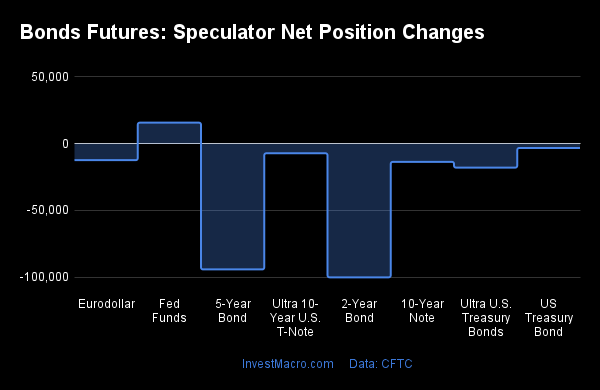
The bond markets with declines in speculator bets for the week were the 10-Year Bonds (-133,699 contracts), the 5-Year Bonds (-57,504 contracts), the US Treasury Bonds (-35,008 contracts), the 2-Year Bonds (-6,620 contracts), the Ultra Treasury Bonds (-14,022 contracts) and the Ultra 10-Year Bonds (-28,051 contracts) also registering lower bets on the week.

Highlighting the COT bonds data is the sharp decline in the 10-Year Treasury Bond speculator positioning. The 10-Year Bond large speculator positions fell this week by a total of -133,699 contracts and have now dropped for four consecutive weeks. The speculator bets have declined in six out of the past seven weeks as well. These last four weeks alone have added a total of -228,114 bearish contracts to the overall bearish position of -545,057 contracts. This weakness has driven the current speculator level to the most bearish point of the past 222 weeks, dating back to October 15th of 2018.

Despite the current speculator sentiment, the 10-Year Bond prices have been edging a little higher since hitting a multi-year low in October. The 10-Year interest rate (rates rise as bond prices fall) is sitting around 3.50 percent currently after peaking in October at just above 4.33 percent.


Data Snapshot of Bond Market Traders | Columns Legend
Jan-17-2023OIOI-IndexSpec-NetSpec-IndexCom-NetCOM-IndexSmalls-NetSmalls-Index
Eurodollar5,891,2380-1,053,852341,265,09864-211,24658
FedFunds1,645,77959-86,23529105,58373-19,34812
2-Year2,335,96725-462,67118452,0427910,62957
Long T-Bond1,222,14147-192,39322170,9327221,46170
10-Year4,018,10766-545,0570615,85595-70,79863
5-Year4,159,39260-680,6551689,57390-8,91879


Strength Scores led by Eurodollar & Fed Funds

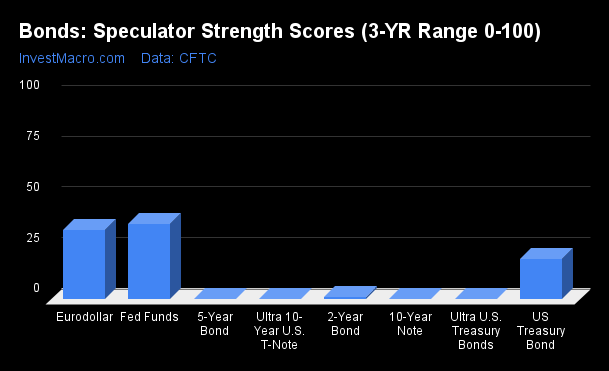
COT Strength Scores (a normalized measure of Speculator positions over a 3-Year range, from 0 to 100 where above 80 is Extreme-Bullish and below 20 is Extreme-Bearish) showed that the Eurodollar (34 percent) and the Fed Funds (29 percent) lead the bond markets this week. The Ultra Treasury Bonds (23 percent) comes in as the next highest in the weekly strength scores.

On the downside, the Ultra 10-Year Bonds (0 percent), the 10-Year Bonds (0 percent),  the 5-Year Bonds (1 percent) and 2-Year Bond (18.3 percent) come in at the lowest strength level currently and are all in Extreme-Bearish territory (below 20 percent).

Strength Statistics:
Fed Funds (29.0 percent) vs Fed Funds previous week (25.8 percent)
vs 2-Year Bond previous week (19.3 percent)
5-Year Bond (1.4 percent) vs 5-Year Bond previous week (8.7 percent)
10-Year Bond (0.0 percent) vs 10-Year Bond previous week (18.4 percent)
Ultra 10-Year Bond (0.0 percent) vs Ultra 10-Year Bond previous week (7.0 percent)
US Treasury Bond (22.0 percent) vs US Treasury Bond previous week (33.4 percent)
Ultra US Treasury Bond (23.0 percent) vs Ultra US Treasury Bond previous week (29.1 percent)
Eurodollar (33.8 percent) vs Eurodollar previous week (33.7 percent)


Eurodollar & 2-Year Bonds top the 6-Week Strength Trends

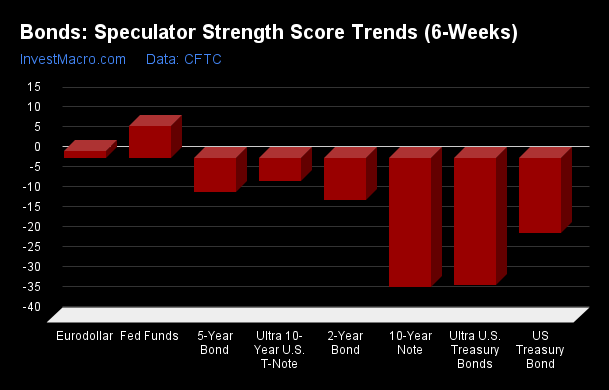
COT Strength Score Trends (or move index, calculates the 6-week changes in strength scores) showed that the Eurodollar (11 percent) and the 2-Year Bonds (11 percent) lead the past six weeks trends for bonds. The Fed Funds (-1 percent) is the next highest positive movers in the latest trends data.

The US Treasury Bonds (-25 percent) leads the downside trend scores currently with the 10-Year Bonds (-24 percent) and the Ultra Treasury Bonds (-6 percent) following next with lower trend scores.

Strength Trend Statistics:
Fed Funds (-0.9 percent) vs Fed Funds previous week (-9.8 percent)
2-Year Bond (10.7 percent) vs 2-Year Bond previous week (10.7 percent)
5-Year Bond (-2.8 percent) vs 5-Year Bond previous week (-11.9 percent)
10-Year Bond (-24.2 percent) vs 10-Year Bond previous week (-15.8 percent)
Ultra 10-Year Bond (-4.8 percent) vs Ultra 10-Year Bond previous week (-4.8 percent)
US Treasury Bond (-25.1 percent) vs US Treasury Bond previous week (-17.4 percent)
Ultra US Treasury Bond (-6.0 percent) vs Ultra US Treasury Bond previous week (7.9 percent)
Eurodollar (10.9 percent) vs Eurodollar previous week (12.0 percent)


Individual Bond Markets:

3-Month Eurodollars Futures:

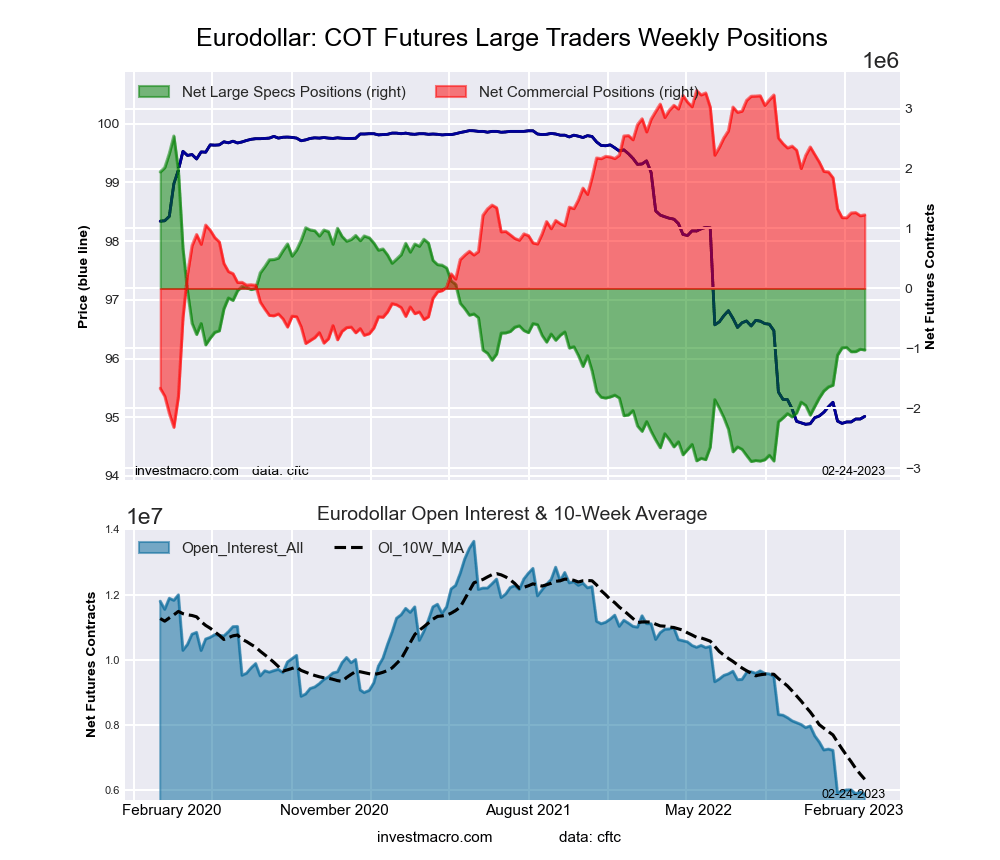
Eurodollar Bonds Futures COT ChartThe 3-Month Eurodollars large speculator standing this week resulted in a net position of -1,053,852 contracts in the data reported through Tuesday. This was a weekly gain of 1,683 contracts from the previous week which had a total of -1,055,535 net contracts.

This week’s current strength score (the trader positioning range over the past three years, measured from 0 to 100) shows the speculators are currently Bearish with a score of 33.8 percent. The commercials are Bullish with a score of 63.8 percent and the small traders (not shown in chart) are Bullish with a score of 58.0 percent.

3-Month Eurodollars StatisticsSPECULATORSCOMMERCIALSSMALL TRADERS
– Percent of Open Interest Longs:7.768.95.1
– Percent of Open Interest Shorts:25.647.58.7
– Net Position:-1,053,8521,265,098-211,246
– Gross Longs:452,2734,061,161299,890
– Gross Shorts:1,506,1252,796,063511,136
– Long to Short Ratio:0.3 to 11.5 to 10.6 to 1
NET POSITION TREND:
– Strength Index Score (3 Year Range Pct):33.863.858.0
– Strength Index Reading (3 Year Range):BearishBullishBullish
NET POSITION MOVEMENT INDEX:
– 6-Week Change in Strength Index:10.9-12.119.6


30-Day Federal Funds Futures:

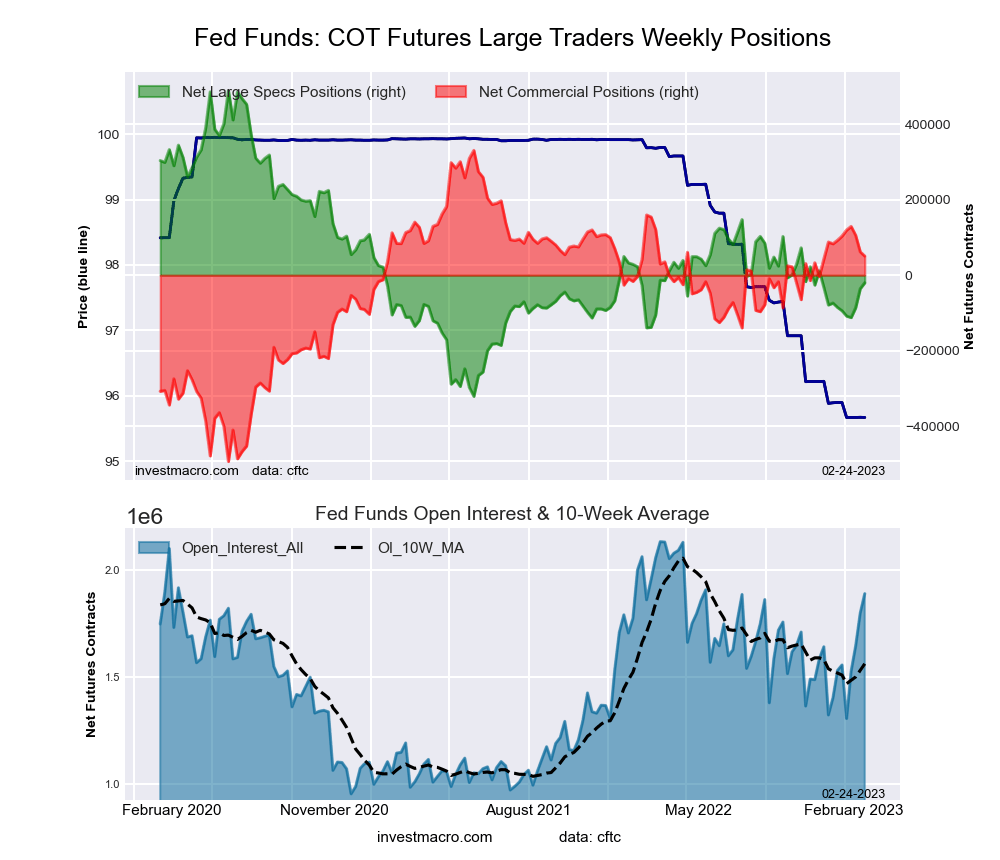
Federal Funds 30-Day Bonds Futures COT ChartThe 30-Day Federal Funds large speculator standing this week resulted in a net position of -86,235 contracts in the data reported through Tuesday. This was a weekly increase of 26,095 contracts from the previous week which had a total of -112,330 net contracts.

This week’s current strength score (the trader positioning range over the past three years, measured from 0 to 100) shows the speculators are currently Bearish with a score of 29.0 percent. The commercials are Bullish with a score of 72.7 percent and the small traders (not shown in chart) are Bearish-Extreme with a score of 11.8 percent.

30-Day Federal Funds StatisticsSPECULATORSCOMMERCIALSSMALL TRADERS
– Percent of Open Interest Longs:10.274.71.8
– Percent of Open Interest Shorts:15.468.33.0
– Net Position:-86,235105,583-19,348
– Gross Longs:167,3851,229,49730,086
– Gross Shorts:253,6201,123,91449,434
– Long to Short Ratio:0.7 to 11.1 to 10.6 to 1
NET POSITION TREND:
– Strength Index Score (3 Year Range Pct):29.072.711.8
– Strength Index Reading (3 Year Range):BearishBullishBearish-Extreme
NET POSITION MOVEMENT INDEX:
– 6-Week Change in Strength Index:-0.92.2-30.2


2-Year Treasury Note Futures:

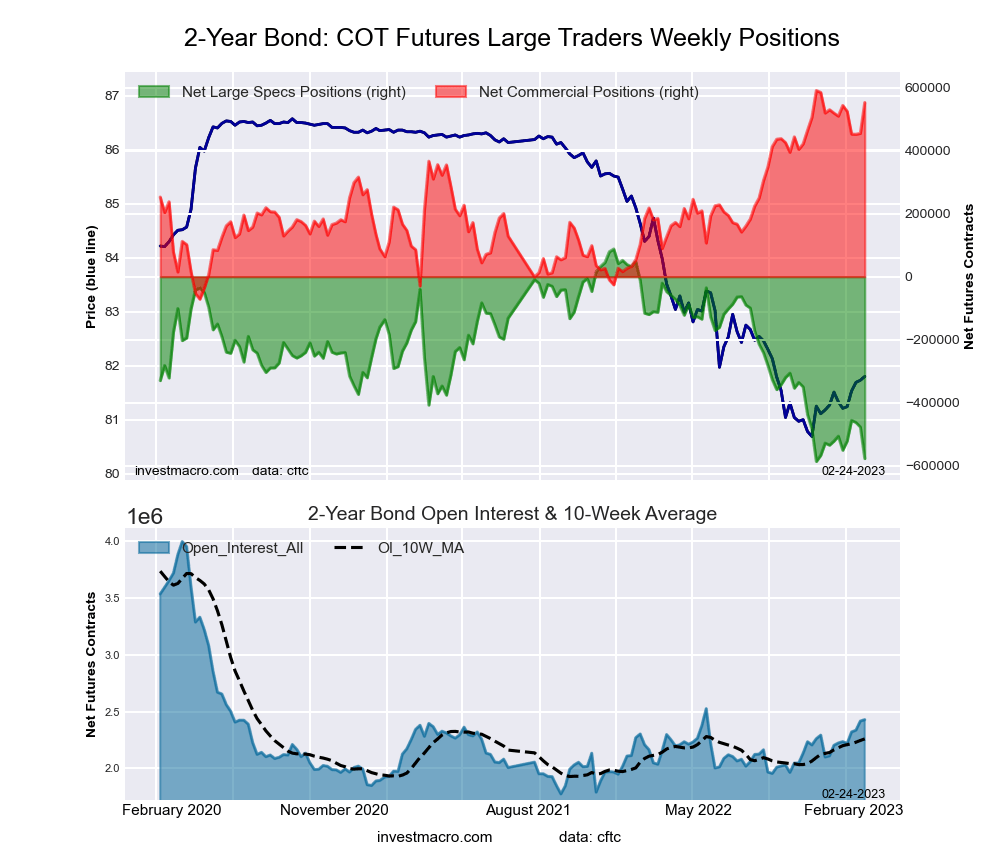
2-Year Treasury Bonds Futures COT ChartThe 2-Year Treasury Note large speculator standing this week resulted in a net position of -462,671 contracts in the data reported through Tuesday. This was a weekly reduction of -6,620 contracts from the previous week which had a total of -456,051 net contracts.

This week’s current strength score (the trader positioning range over the past three years, measured from 0 to 100) shows the speculators are currently Bearish-Extreme with a score of 18.3 percent. The commercials are Bullish with a score of 79.0 percent and the small traders (not shown in chart) are Bullish with a score of 56.8 percent.

2-Year Treasury Note StatisticsSPECULATORSCOMMERCIALSSMALL TRADERS
– Percent of Open Interest Longs:7.781.78.7
– Percent of Open Interest Shorts:27.562.48.3
– Net Position:-462,671452,04210,629
– Gross Longs:179,8981,909,141204,038
– Gross Shorts:642,5691,457,099193,409
– Long to Short Ratio:0.3 to 11.3 to 11.1 to 1
NET POSITION TREND:
– Strength Index Score (3 Year Range Pct):18.379.056.8
– Strength Index Reading (3 Year Range):Bearish-ExtremeBullishBullish
NET POSITION MOVEMENT INDEX:
– 6-Week Change in Strength Index:10.7-11.82.7


5-Year Treasury Note Futures:

5-Year Treasury Bonds Futures COT ChartThe 5-Year Treasury Note large speculator standing this week resulted in a net position of -680,655 contracts in the data reported through Tuesday. This was a weekly lowering of -57,504 contracts from the previous week which had a total of -623,151 net contracts.

This week’s current strength score (the trader positioning range over the past three years, measured from 0 to 100) shows the speculators are currently Bearish-Extreme with a score of 1.4 percent. The commercials are Bullish-Extreme with a score of 90.4 percent and the small traders (not shown in chart) are Bullish with a score of 78.6 percent.

5-Year Treasury Note StatisticsSPECULATORSCOMMERCIALSSMALL TRADERS
– Percent of Open Interest Longs:5.385.18.2
– Percent of Open Interest Shorts:21.768.58.4
– Net Position:-680,655689,573-8,918
– Gross Longs:220,6503,538,627341,784
– Gross Shorts:901,3052,849,054350,702
– Long to Short Ratio:0.2 to 11.2 to 11.0 to 1
NET POSITION TREND:
– Strength Index Score (3 Year Range Pct):1.490.478.6
– Strength Index Reading (3 Year Range):Bearish-ExtremeBullish-ExtremeBullish
NET POSITION MOVEMENT INDEX:
– 6-Week Change in Strength Index:-2.8-9.128.2


10-Year Treasury Note Futures:

10-Year Treasury Notes Bonds Futures COT ChartThe 10-Year Treasury Note large speculator standing this week resulted in a net position of -545,057 contracts in the data reported through Tuesday. This was a weekly decrease of -133,699 contracts from the previous week which had a total of -411,358 net contracts.

This week’s current strength score (the trader positioning range over the past three years, measured from 0 to 100) shows the speculators are currently Bearish-Extreme with a score of 0.0 percent. The commercials are Bullish-Extreme with a score of 95.0 percent and the small traders (not shown in chart) are Bullish with a score of 63.3 percent.

10-Year Treasury Note StatisticsSPECULATORSCOMMERCIALSSMALL TRADERS
– Percent of Open Interest Longs:8.380.69.0
– Percent of Open Interest Shorts:21.965.310.7
– Net Position:-545,057615,855-70,798
– Gross Longs:334,0223,237,951360,271
– Gross Shorts:879,0792,622,096431,069
– Long to Short Ratio:0.4 to 11.2 to 10.8 to 1
NET POSITION TREND:
– Strength Index Score (3 Year Range Pct):0.095.063.3
– Strength Index Reading (3 Year Range):Bearish-ExtremeBullish-ExtremeBullish
NET POSITION MOVEMENT INDEX:
– 6-Week Change in Strength Index:-24.215.810.2


Ultra 10-Year Notes Futures:

Ultra 10-Year Treasury Notes Bonds Futures COT ChartThe Ultra 10-Year Notes large speculator standing this week resulted in a net position of -126,321 contracts in the data reported through Tuesday. This was a weekly reduction of -28,051 contracts from the previous week which had a total of -98,270 net contracts.

This week’s current strength score (the trader positioning range over the past three years, measured from 0 to 100) shows the speculators are currently Bearish-Extreme with a score of 0.0 percent. The commercials are Bullish-Extreme with a score of 97.9 percent and the small traders (not shown in chart) are Bullish with a score of 61.8 percent.

Ultra 10-Year Notes StatisticsSPECULATORSCOMMERCIALSSMALL TRADERS
– Percent of Open Interest Longs:10.378.410.0
– Percent of Open Interest Shorts:18.763.516.6
– Net Position:-126,321224,640-98,319
– Gross Longs:155,6131,178,847150,997
– Gross Shorts:281,934954,207249,316
– Long to Short Ratio:0.6 to 11.2 to 10.6 to 1
NET POSITION TREND:
– Strength Index Score (3 Year Range Pct):0.097.961.8
– Strength Index Reading (3 Year Range):Bearish-ExtremeBullish-ExtremeBullish
NET POSITION MOVEMENT INDEX:
– 6-Week Change in Strength Index:-4.89.0-10.4


US Treasury Bonds Futures:

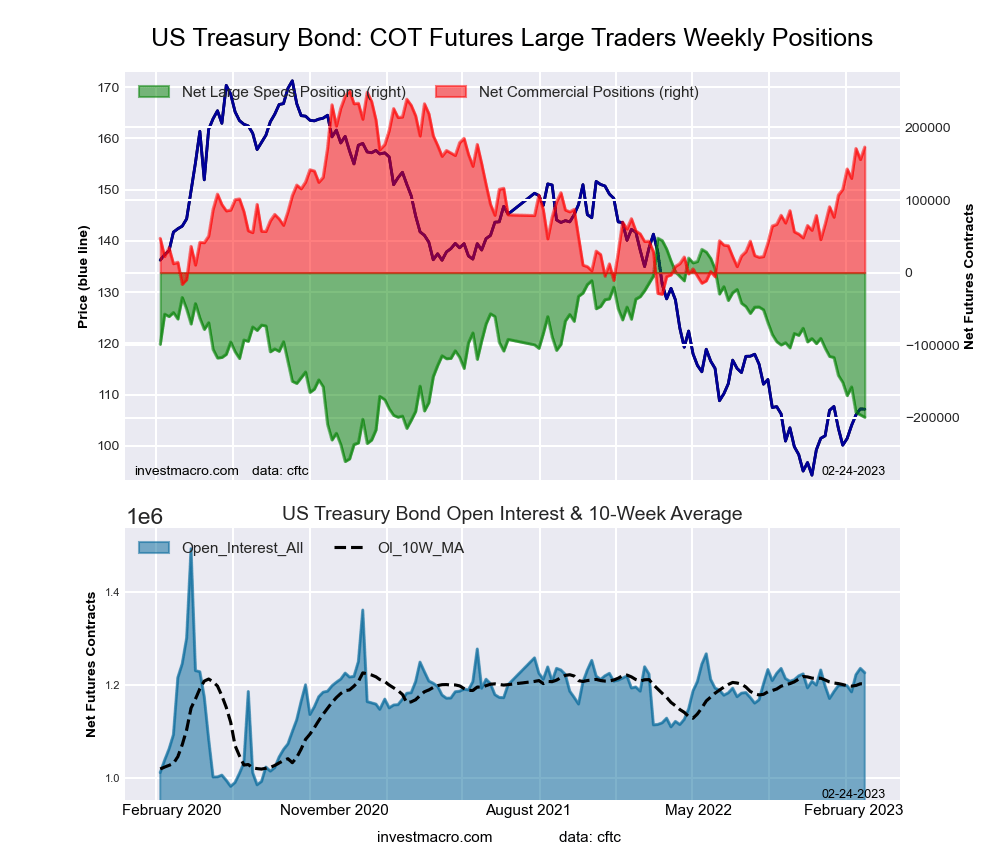
US Year Treasury Notes Long Bonds Futures COT ChartThe US Treasury Bonds large speculator standing this week resulted in a net position of -192,393 contracts in the data reported through Tuesday. This was a weekly fall of -35,008 contracts from the previous week which had a total of -157,385 net contracts.

This week’s current strength score (the trader positioning range over the past three years, measured from 0 to 100) shows the speculators are currently Bearish with a score of 22.0 percent. The commercials are Bullish with a score of 71.6 percent and the small traders (not shown in chart) are Bullish with a score of 69.6 percent.

US Treasury Bonds StatisticsSPECULATORSCOMMERCIALSSMALL TRADERS
– Percent of Open Interest Longs:4.281.314.0
– Percent of Open Interest Shorts:20.067.412.3
– Net Position:-192,393170,93221,461
– Gross Longs:51,842994,046171,647
– Gross Shorts:244,235823,114150,186
– Long to Short Ratio:0.2 to 11.2 to 11.1 to 1
NET POSITION TREND:
– Strength Index Score (3 Year Range Pct):22.071.669.6
– Strength Index Reading (3 Year Range):BearishBullishBullish
NET POSITION MOVEMENT INDEX:
– 6-Week Change in Strength Index:-25.128.6-2.5


Ultra US Treasury Bonds Futures:

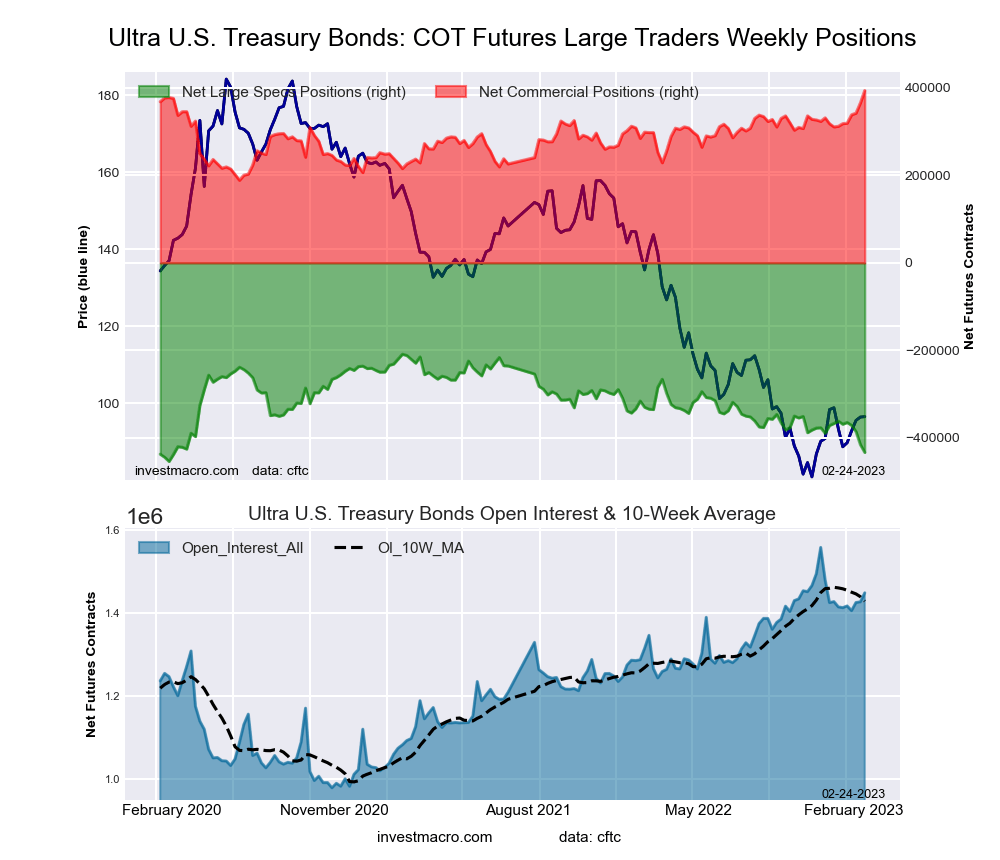
Ultra US Year Treasury Notes Long Bonds Futures COT ChartThe Ultra US Treasury Bonds large speculator standing this week resulted in a net position of -385,428 contracts in the data reported through Tuesday. This was a weekly reduction of -14,022 contracts from the previous week which had a total of -371,406 net contracts.

This week’s current strength score (the trader positioning range over the past three years, measured from 0 to 100) shows the speculators are currently Bearish with a score of 23.0 percent. The commercials are Bullish-Extreme with a score of 81.9 percent and the small traders (not shown in chart) are Bullish with a score of 67.4 percent.

Ultra US Treasury Bonds StatisticsSPECULATORSCOMMERCIALSSMALL TRADERS
– Percent of Open Interest Longs:4.583.711.5
– Percent of Open Interest Shorts:31.559.78.4
– Net Position:-385,428342,09243,336
– Gross Longs:64,1091,193,027163,472
– Gross Shorts:449,537850,935120,136
– Long to Short Ratio:0.1 to 11.4 to 11.4 to 1
NET POSITION TREND:
– Strength Index Score (3 Year Range Pct):23.081.967.4
– Strength Index Reading (3 Year Range):BearishBullish-ExtremeBullish
NET POSITION MOVEMENT INDEX:
– 6-Week Change in Strength Index:-6.012.9-8.6


Article By InvestMacroReceive our weekly COT Newsletter

*COT Report: The COT data, released weekly to the public each Friday, is updated through the most recent Tuesday (data is 3 days old) and shows a quick view of how large speculators or non-commercials (for-profit traders) were positioned in the futures markets.

The CFTC categorizes trader positions according to commercial hedgers (traders who use futures contracts for hedging as part of the business), non-commercials (large traders who speculate to realize trading profits) and nonreportable traders (usually small traders/speculators) as well as their open interest (contracts open in the market at time of reporting). See CFTC criteria here.

Soft Commodities Speculators drop Wheat bets to lowest in 192-weeks

By InvestMacro

Here are the latest charts and statistics for the Commitment of Traders (COT) reports data published by the Commodities Futures Trading Commission (CFTC).

The latest COT data is updated through Tuesday January 17th and shows a quick view of how large traders (for-profit speculators and commercial entities) were positioned in the futures markets.

Weekly Speculator Changes led by Corn & Soybeans

The COT soft commodities markets speculator bets were lower this week as four out of the eleven softs markets we cover had higher positioning while the other seven markets had lower speculator contracts.

Leading the gains for the softs markets was Corn (38,078 contracts) with Soybeans (28,737 contracts), Soybean Meal (8,640 contracts) and Cocoa (477 contracts) also showing positive weeks.

The markets with the declines in speculator bets this week were Coffee (-12,006 contracts), Lean Hogs (-9,862 contracts), Cotton (-9,991 contracts), Sugar (-1,015 contracts), Wheat (-2,298 contracts), Soybean Oil (-2,604 contracts) and Live Cattle (-5,851 contracts) also registering lower bets on the week.

Highlighting the COT soft commodities data this week is the continued declines in the Wheat speculator positioning. The large speculator bets for Wheat fell this week for a second consecutive week and for the twelfth time in the past fifteen weeks. Speculators bets have now pushed the overall net position standing for Wheat (currently at -42,014 contracts) to the most bearish level in the past 192 weeks, dating back to May 14th of 2019.

Wheat prices have been under pressure as well with prices trading at near the lowest levels since 2021. Helping to keep Wheat sentiment and prices down have been better than expected plantings and supply of Wheat in the USA and globally.


Data Snapshot of Commodity Market Traders | Columns Legend
Jan-17-2023OIOI-IndexSpec-NetSpec-IndexCom-NetCOM-IndexSmalls-NetSmalls-Index
WTI Crude1,613,46619239,2189-255,5999216,38126
Gold491,81822153,24034-175,9136522,67337
Silver131,862931,46849-45,3675213,89940
Copper201,4554216,23849-22,695496,45763
Palladium8,79916-2,751122,90286-15133
Platinum71,1444123,54441-28,913595,36940
Natural Gas1,082,45824-177,21925146,4187730,80153
Brent147,1729-25,9806223,414372,56644
Heating Oil269,9112418,50670-40,6122822,10675
Soybeans651,32817169,06564-130,79048-38,2756
Corn1,251,0338271,87365-213,79841-58,07511
Coffee224,82931-26,745024,2511002,49434
Sugar898,52637186,69858-233,1443646,44665
Wheat340,83023-42,014045,261100-3,24794


Strength Scores led by Soybean Meal & Live Cattle

COT Strength Scores (a normalized measure of Speculator positions over a 3-Year range, from 0 to 100 where above 80 is Extreme-Bullish and below 20 is Extreme-Bearish) showed that Soybean Meal (100 percent) and Live Cattle (72 percent) lead the softs markets this week. Corn (65 percent), Soybeans (64 percent) and Sugar (58 percent) come in as the next highest in the weekly strength scores.

On the downside, Wheat (0 percent), Coffee (0 percent), Cotton (13 percent) and the Lean Hogs (16 percent) come in at the lowest strength levels currently and are all in Extreme-Bearish territory (below 20 percent).

Strength Statistics:
Corn (64.8 percent) vs Corn previous week (59.9 percent)
Sugar (58.1 percent) vs Sugar previous week (58.5 percent)
Coffee (0.0 percent) vs Coffee previous week (12.3 percent)
Soybeans (63.9 percent) vs Soybeans previous week (54.7 percent)
Soybean Oil (43.8 percent) vs Soybean Oil previous week (45.6 percent)
Soybean Meal (100.0 percent) vs Soybean Meal previous week (96.0 percent)
Live Cattle (72.3 percent) vs Live Cattle previous week (79.7 percent)
Lean Hogs (15.8 percent) vs Lean Hogs previous week (27.7 percent)
Cotton (13.3 percent) vs Cotton previous week (20.9 percent)
Cocoa (44.2 percent) vs Cocoa previous week (43.8 percent)
Wheat (0.0 percent) vs Wheat previous week (2.2 percent)


Soybeans & Live Cattle top the 6-Week Strength Trends

COT Strength Score Trends (or move index, calculates the 6-week changes in strength scores) showed that Soybeans (25 percent) and Live Cattle (24 percent) lead the past six weeks trends for soft commodities. Soybean Meal (20 percent), Cocoa (10 percent) and Corn (9 percent) are the next highest positive movers in the latest trends data.

Lean Hogs (-28 percent) leads the downside trend scores currently with Coffee (-12 percent), Cotton (-8 percent) and Soybean Oil (-5 percent) following next with lower trend scores.

Strength Trend Statistics:
Corn (9.4 percent) vs Corn previous week (-4.7 percent)
Sugar (1.2 percent) vs Sugar previous week (3.0 percent)
Coffee (-12.4 percent) vs Coffee previous week (-0.1 percent)
Soybeans (25.4 percent) vs Soybeans previous week (17.0 percent)
Soybean Oil (-4.7 percent) vs Soybean Oil previous week (-28.7 percent)
Soybean Meal (20.5 percent) vs Soybean Meal previous week (25.7 percent)
Live Cattle (23.7 percent) vs Live Cattle previous week (32.5 percent)
Lean Hogs (-27.8 percent) vs Lean Hogs previous week (-11.8 percent)
Cotton (-8.2 percent) vs Cotton previous week (1.0 percent)
Cocoa (9.6 percent) vs Cocoa previous week (17.3 percent)
Wheat (-2.0 percent) vs Wheat previous week (-6.2 percent)


Individual Soft Commodities Markets:

CORN Futures:

CORN Futures COT ChartThe CORN large speculator standing this week resulted in a net position of 271,873 contracts in the data reported through Tuesday. This was a weekly boost of 38,078 contracts from the previous week which had a total of 233,795 net contracts.

This week’s current strength score (the trader positioning range over the past three years, measured from 0 to 100) shows the speculators are currently Bullish with a score of 64.8 percent. The commercials are Bearish with a score of 41.5 percent and the small traders (not shown in chart) are Bearish-Extreme with a score of 11.4 percent.

CORN Futures StatisticsSPECULATORSCOMMERCIALSSMALL TRADERS
– Percent of Open Interest Longs:30.144.79.5
– Percent of Open Interest Shorts:8.461.714.1
– Net Position:271,873-213,798-58,075
– Gross Longs:376,732558,706118,719
– Gross Shorts:104,859772,504176,794
– Long to Short Ratio:3.6 to 10.7 to 10.7 to 1
NET POSITION TREND:
– Strength Index Score (3 Year Range Pct):64.841.511.4
– Strength Index Reading (3 Year Range):BullishBearishBearish-Extreme
NET POSITION MOVEMENT INDEX:
– 6-Week Change in Strength Index:9.4-8.0-11.7


SUGAR Futures:

SUGAR Futures COT ChartThe SUGAR large speculator standing this week resulted in a net position of 186,698 contracts in the data reported through Tuesday. This was a weekly decrease of -1,015 contracts from the previous week which had a total of 187,713 net contracts.

This week’s current strength score (the trader positioning range over the past three years, measured from 0 to 100) shows the speculators are currently Bullish with a score of 58.1 percent. The commercials are Bearish with a score of 36.3 percent and the small traders (not shown in chart) are Bullish with a score of 65.3 percent.

SUGAR Futures StatisticsSPECULATORSCOMMERCIALSSMALL TRADERS
– Percent of Open Interest Longs:30.543.110.2
– Percent of Open Interest Shorts:9.769.05.0
– Net Position:186,698-233,14446,446
– Gross Longs:273,666387,18691,248
– Gross Shorts:86,968620,33044,802
– Long to Short Ratio:3.1 to 10.6 to 12.0 to 1
NET POSITION TREND:
– Strength Index Score (3 Year Range Pct):58.136.365.3
– Strength Index Reading (3 Year Range):BullishBearishBullish
NET POSITION MOVEMENT INDEX:
– 6-Week Change in Strength Index:1.2-2.04.3


COFFEE Futures:

COFFEE Futures COT ChartThe COFFEE large speculator standing this week resulted in a net position of -26,745 contracts in the data reported through Tuesday. This was a weekly decrease of -12,006 contracts from the previous week which had a total of -14,739 net contracts.

This week’s current strength score (the trader positioning range over the past three years, measured from 0 to 100) shows the speculators are currently Bearish-Extreme with a score of 0.0 percent. The commercials are Bullish-Extreme with a score of 100.0 percent and the small traders (not shown in chart) are Bearish with a score of 34.1 percent.

COFFEE Futures StatisticsSPECULATORSCOMMERCIALSSMALL TRADERS
– Percent of Open Interest Longs:19.955.04.8
– Percent of Open Interest Shorts:31.844.23.7
– Net Position:-26,74524,2512,494
– Gross Longs:44,803123,56510,878
– Gross Shorts:71,54899,3148,384
– Long to Short Ratio:0.6 to 11.2 to 11.3 to 1
NET POSITION TREND:
– Strength Index Score (3 Year Range Pct):0.0100.034.1
– Strength Index Reading (3 Year Range):Bearish-ExtremeBullish-ExtremeBearish
NET POSITION MOVEMENT INDEX:
– 6-Week Change in Strength Index:-12.411.310.6


SOYBEANS Futures:

SOYBEANS Futures COT ChartThe SOYBEANS large speculator standing this week resulted in a net position of 169,065 contracts in the data reported through Tuesday. This was a weekly advance of 28,737 contracts from the previous week which had a total of 140,328 net contracts.

This week’s current strength score (the trader positioning range over the past three years, measured from 0 to 100) shows the speculators are currently Bullish with a score of 63.9 percent. The commercials are Bearish with a score of 48.3 percent and the small traders (not shown in chart) are Bearish-Extreme with a score of 6.3 percent.

SOYBEANS Futures StatisticsSPECULATORSCOMMERCIALSSMALL TRADERS
– Percent of Open Interest Longs:33.346.46.7
– Percent of Open Interest Shorts:7.366.412.5
– Net Position:169,065-130,790-38,275
– Gross Longs:216,831301,98543,462
– Gross Shorts:47,766432,77581,737
– Long to Short Ratio:4.5 to 10.7 to 10.5 to 1
NET POSITION TREND:
– Strength Index Score (3 Year Range Pct):63.948.36.3
– Strength Index Reading (3 Year Range):BullishBearishBearish-Extreme
NET POSITION MOVEMENT INDEX:
– 6-Week Change in Strength Index:25.4-23.0-14.4


SOYBEAN OIL Futures:

SOYBEAN OIL Futures COT ChartThe SOYBEAN OIL large speculator standing this week resulted in a net position of 59,495 contracts in the data reported through Tuesday. This was a weekly decrease of -2,604 contracts from the previous week which had a total of 62,099 net contracts.

This week’s current strength score (the trader positioning range over the past three years, measured from 0 to 100) shows the speculators are currently Bearish with a score of 43.8 percent. The commercials are Bullish with a score of 55.5 percent and the small traders (not shown in chart) are Bullish with a score of 56.7 percent.

SOYBEAN OIL Futures StatisticsSPECULATORSCOMMERCIALSSMALL TRADERS
– Percent of Open Interest Longs:23.849.99.4
– Percent of Open Interest Shorts:8.068.86.3
– Net Position:59,495-71,07711,582
– Gross Longs:89,394187,76235,188
– Gross Shorts:29,899258,83923,606
– Long to Short Ratio:3.0 to 10.7 to 11.5 to 1
NET POSITION TREND:
– Strength Index Score (3 Year Range Pct):43.855.556.7
– Strength Index Reading (3 Year Range):BearishBullishBullish
NET POSITION MOVEMENT INDEX:
– 6-Week Change in Strength Index:-4.74.9-3.6


SOYBEAN MEAL Futures:

SOYBEAN MEAL Futures COT ChartThe SOYBEAN MEAL large speculator standing this week resulted in a net position of 166,350 contracts in the data reported through Tuesday. This was a weekly advance of 8,640 contracts from the previous week which had a total of 157,710 net contracts.

This week’s current strength score (the trader positioning range over the past three years, measured from 0 to 100) shows the speculators are currently Bullish-Extreme with a score of 100.0 percent. The commercials are Bearish-Extreme with a score of 0.0 percent and the small traders (not shown in chart) are Bearish with a score of 35.5 percent.

SOYBEAN MEAL Futures StatisticsSPECULATORSCOMMERCIALSSMALL TRADERS
– Percent of Open Interest Longs:43.730.111.5
– Percent of Open Interest Shorts:3.675.06.7
– Net Position:166,350-186,13319,783
– Gross Longs:181,071124,54947,680
– Gross Shorts:14,721310,68227,897
– Long to Short Ratio:12.3 to 10.4 to 11.7 to 1
NET POSITION TREND:
– Strength Index Score (3 Year Range Pct):100.00.035.5
– Strength Index Reading (3 Year Range):Bullish-ExtremeBearish-ExtremeBearish
NET POSITION MOVEMENT INDEX:
– 6-Week Change in Strength Index:20.5-20.31.0


LIVE CATTLE Futures:

LIVE CATTLE Futures COT ChartThe LIVE CATTLE large speculator standing this week resulted in a net position of 74,143 contracts in the data reported through Tuesday. This was a weekly fall of -5,851 contracts from the previous week which had a total of 79,994 net contracts.

This week’s current strength score (the trader positioning range over the past three years, measured from 0 to 100) shows the speculators are currently Bullish with a score of 72.3 percent. The commercials are Bearish with a score of 20.5 percent and the small traders (not shown in chart) are Bullish with a score of 64.0 percent.

LIVE CATTLE Futures StatisticsSPECULATORSCOMMERCIALSSMALL TRADERS
– Percent of Open Interest Longs:40.230.110.4
– Percent of Open Interest Shorts:16.751.612.5
– Net Position:74,143-67,709-6,434
– Gross Longs:126,73795,03532,866
– Gross Shorts:52,594162,74439,300
– Long to Short Ratio:2.4 to 10.6 to 10.8 to 1
NET POSITION TREND:
– Strength Index Score (3 Year Range Pct):72.320.564.0
– Strength Index Reading (3 Year Range):BullishBearishBullish
NET POSITION MOVEMENT INDEX:
– 6-Week Change in Strength Index:23.7-21.5-13.8


LEAN HOGS Futures:

LEAN HOGS Futures COT ChartThe LEAN HOGS large speculator standing this week resulted in a net position of 15,907 contracts in the data reported through Tuesday. This was a weekly lowering of -9,862 contracts from the previous week which had a total of 25,769 net contracts.

This week’s current strength score (the trader positioning range over the past three years, measured from 0 to 100) shows the speculators are currently Bearish-Extreme with a score of 15.8 percent. The commercials are Bullish-Extreme with a score of 84.2 percent and the small traders (not shown in chart) are Bullish-Extreme with a score of 80.7 percent.

LEAN HOGS Futures StatisticsSPECULATORSCOMMERCIALSSMALL TRADERS
– Percent of Open Interest Longs:31.637.510.6
– Percent of Open Interest Shorts:23.643.013.1
– Net Position:15,907-10,939-4,968
– Gross Longs:63,07374,84221,157
– Gross Shorts:47,16685,78126,125
– Long to Short Ratio:1.3 to 10.9 to 10.8 to 1
NET POSITION TREND:
– Strength Index Score (3 Year Range Pct):15.884.280.7
– Strength Index Reading (3 Year Range):Bearish-ExtremeBullish-ExtremeBullish-Extreme
NET POSITION MOVEMENT INDEX:
– 6-Week Change in Strength Index:-27.821.632.8


COTTON Futures:

COTTON Futures COT ChartThe COTTON large speculator standing this week resulted in a net position of 7,953 contracts in the data reported through Tuesday. This was a weekly decline of -9,991 contracts from the previous week which had a total of 17,944 net contracts.

This week’s current strength score (the trader positioning range over the past three years, measured from 0 to 100) shows the speculators are currently Bearish-Extreme with a score of 13.3 percent. The commercials are Bullish-Extreme with a score of 86.4 percent and the small traders (not shown in chart) are Bearish-Extreme with a score of 19.5 percent.

COTTON Futures StatisticsSPECULATORSCOMMERCIALSSMALL TRADERS
– Percent of Open Interest Longs:27.950.76.3
– Percent of Open Interest Shorts:23.955.45.6
– Net Position:7,953-9,3821,429
– Gross Longs:56,634103,14612,734
– Gross Shorts:48,681112,52811,305
– Long to Short Ratio:1.2 to 10.9 to 11.1 to 1
NET POSITION TREND:
– Strength Index Score (3 Year Range Pct):13.386.419.5
– Strength Index Reading (3 Year Range):Bearish-ExtremeBullish-ExtremeBearish-Extreme
NET POSITION MOVEMENT INDEX:
– 6-Week Change in Strength Index:-8.27.9-3.3


COCOA Futures:

COCOA Futures COT ChartThe COCOA large speculator standing this week resulted in a net position of 27,698 contracts in the data reported through Tuesday. This was a weekly lift of 477 contracts from the previous week which had a total of 27,221 net contracts.

This week’s current strength score (the trader positioning range over the past three years, measured from 0 to 100) shows the speculators are currently Bearish with a score of 44.2 percent. The commercials are Bullish with a score of 56.6 percent and the small traders (not shown in chart) are Bearish with a score of 31.1 percent.

COCOA Futures StatisticsSPECULATORSCOMMERCIALSSMALL TRADERS
– Percent of Open Interest Longs:31.945.54.3
– Percent of Open Interest Shorts:22.855.83.1
– Net Position:27,698-31,1553,457
– Gross Longs:97,065138,39413,026
– Gross Shorts:69,367169,5499,569
– Long to Short Ratio:1.4 to 10.8 to 11.4 to 1
NET POSITION TREND:
– Strength Index Score (3 Year Range Pct):44.256.631.1
– Strength Index Reading (3 Year Range):BearishBullishBearish
NET POSITION MOVEMENT INDEX:
– 6-Week Change in Strength Index:9.6-9.4-2.9


WHEAT Futures:

WHEAT Futures COT ChartThe WHEAT large speculator standing this week resulted in a net position of -42,014 contracts in the data reported through Tuesday. This was a weekly lowering of -2,298 contracts from the previous week which had a total of -39,716 net contracts.

This week’s current strength score (the trader positioning range over the past three years, measured from 0 to 100) shows the speculators are currently Bearish-Extreme with a score of 0.0 percent. The commercials are Bullish-Extreme with a score of 100.0 percent and the small traders (not shown in chart) are Bullish-Extreme with a score of 93.6 percent.

WHEAT Futures StatisticsSPECULATORSCOMMERCIALSSMALL TRADERS
– Percent of Open Interest Longs:25.441.69.7
– Percent of Open Interest Shorts:37.728.410.6
– Net Position:-42,01445,261-3,247
– Gross Longs:86,569141,95632,942
– Gross Shorts:128,58396,69536,189
– Long to Short Ratio:0.7 to 11.5 to 10.9 to 1
NET POSITION TREND:
– Strength Index Score (3 Year Range Pct):0.0100.093.6
– Strength Index Reading (3 Year Range):Bearish-ExtremeBullish-ExtremeBullish-Extreme
NET POSITION MOVEMENT INDEX:
– 6-Week Change in Strength Index:-2.02.8-1.7


Article By InvestMacroReceive our weekly COT Newsletter

*COT Report: The COT data, released weekly to the public each Friday, is updated through the most recent Tuesday (data is 3 days old) and shows a quick view of how large speculators or non-commercials (for-profit traders) were positioned in the futures markets.

The CFTC categorizes trader positions according to commercial hedgers (traders who use futures contracts for hedging as part of the business), non-commercials (large traders who speculate to realize trading profits) and nonreportable traders (usually small traders/speculators) as well as their open interest (contracts open in the market at time of reporting). See CFTC criteria here.

Something Breaks in 2023

Source: Ron Struthers  (1/17/23)

Ron Struthers believes that specifically, the debt market could break. The U.S. ran about a US$1.4 trillion deficit in 2022 (ended September) that Struthers believes will swell to US$2.5 trillion in 2023. 

Key Points

  • US Deficit to double.
  • The election of House Leader McCarthy will have a huge impact.
  • Fed forced to pivot for the wrong reason.
  • Market narrative wrong again.
  • Inflation back up and interest rates higher.
  • Energy to go higher in 2023.
  • A huge gold rally takes hold.

Specifically, the debt market could break. The U.S. ran about a US$1.4 trillion deficit in 2022 (ended September) that will swell to US$2.5 trillion in 2023. For some round numbers, Interest on the debt is going up with higher rates adding about US$200 billion.

In 2022 about US$600 billion in capital gains tax got paid and that won’t happen in 2023. There was an 8.7% increase in social security etc. that adds about US$120 billion. Then you have student loan forgiveness and Ukraine aid so we can easily go to a US$2.5 trillion deficit. And if a recession sets in, tax receipts will go down too.

McCarthy

Most people don’t understand the implications of the election of new house leader Kevin McCarthy over the majority Republican House. Most media focused on the 15 rounds of voting it took. Republicans divided and it was the evil, extreme far right that forced the situation.

McCarthy made concessions that will weaken his power, make it easier for lawmakers to oust him, and give the right-wing rank-and-file greater input in legislation and in lawmakers’ assignments to committees. Bigger consequences will unfold months from now if these ultraconservatives again withhold their votes until they have their way on looming spending bills and the debt ceiling. One of their main goals is to shrink the size of the government.

If you don’t stop spending money that we don’t have to fund the bureaucracy that is undermining the American people, we cannot win,” said Chip Roy, a Republican who voted against McCarthy in 11 ballots.

They want an end to massive spending bills moved forward with little time to read the legislation. They want a minimum 72-hour review period and a reduction of massive omnibus bills, to allow members and the public to better understand what is being passed.

The market narrative currently is along the lines that inflation will continue downward, the Fed will stop raising rates, and soon start easing. I will try to explain why this is wrong again.

The concessions reportedly include “open rules” on all major rules bills, such as appropriations, to allow lawmakers to offer amendments on the floor. It would restore an amendment process that was gutted in recent sessions, benefiting both parties. They would reinstate “Calendar Wednesday,” which permits committee chairs to bring reported bills directly to the House floor.

Massive bills are a way to hide personal perks and pork projects under fraudulent packaging like the “Inflation Reduction Act” which had little to do with inflation. The omnibus bill recently pushed through the House and Senate is an example of this abusive, opaque process. It was a collection of 7,200 earmarks and pork projects, including tens of millions for libraries for the papers of a couple of retiring senators; five senators grabbed half a billion dollars for their favorite colleges. You had to swallow it whole or kill the whole spending bill.

Fed Forced to Pivot

There is only so much supply the bond market can take, and it won’t like a U.S. debt default scare. So the Fed could be forced to pivot, not because inflation comes down but because the bond market breaks. Most people believe the Fed is bigger than the market and so does the Fed but at times reality sets in. How long will investors and other countries buy bonds yielding 3.5% when inflation is 6% or 7%?

Perhaps the Fed can hold the bond market together this year, but it certainly can’t continue until 2024; something is going to break.

I say it is a good thing that the so-called far-right Republicans will have influence, government spending has to get back to some control and restraint, it has totally gone bonkers in the U.S. and Canada too. This could also cause problems in the bond market, and the first test of this will be passing legislation to extend the debt ceiling. This could drag out a long time, and these Republicans will demand spending cuts. It is probably a good thing in the long run, but the short term could cause market turmoil, raising longer-term interest rates.

The market narrative currently is along the lines that inflation will continue downward, the Fed will stop raising rates, and soon start easing. I will try to explain why this is wrong again.

I made the comment numerous times, such as in June 2022 that the inflation problem was created by Covid-19 policies, specifically all the money printing. In previous QE, after the 2008 financial crash, it was all money created in banking reserves, but that does not mean the money gets into the economy but certainly helps the bank. My point with Covid-19 money printing, a lot was going right to consumers. I highlighted the high personal savings rate and swelling Robinhood stock accounts.

The Fed has now quantified how much Covid-19 stimulus went directly into bank accounts. A friend sent me an excellent video that analysis the Fed’s numbers in the report. This chart from the Fed report shows a strong move above baseline growth.

Bank deposits grew by over US$5 trillion, and that is shown better in the next table below.

The Fed report concludes that “Data from the U.S. Financial Accounts, shown in Table 2 broadly confirm the evidence, specifically, household deposit balances at banks (the sum of checkable, time, and savings deposits) rose by substantially more than deposits held by nonfinancial businesses between 2019:Q4 and 2021:Q4, accounting for nearly two-thirds of the overall increase in aggregate deposits. “

Households got US$3.8 trillion, and that is a huge number. There is your smoking gun that caused the current inflation and now that inflation has become entrenched. The QE from the Fed went mostly to banks that ended up inflating bubbles in stocks, bonds, and somewhat crypto.

Households got US$3.8 trillion, and that is a huge number. There is your smoking gun that caused the current inflation and now that inflation has become entrenched.

About 10% of the Fed’s QE bought nonbank financial assets highlighted in the video, and this is something new and significant from past QE. Households added significantly to stock, crypto, and housing bubbles, but also, a lot of the funds went into the economy, spiking demand for goods at a time of shortages from Covid-19 policies, thus the high inflation.

Some interesting numbers in the video, by wealth, the bottom 50% saw bank deposits increase an additional US$167 billion. The 50% to 90% group saw an increase of US$784.5 billion. Now the bottom 9% of the top 10% or you could say the 90% to 99% group saw an additional US$1.1 trillion, and the wealthiest, the top 1%, also had an increase of US$1.1 trillion.

I took a screenshot of the screen in the video showing this increase. You get a better perspective on how large the increase was relative to pre Covid-19. As always the wealthy get the most, and a lot of this could be related to Covid-19 wage subsidies and loans that went to business owners.

The Fed cannot remove the stimulus already out there, and they cannot control the Biden Administration’s inflationary fiscal policy, although the Republican house might be able to curtail it.

As I mentioned, we probably have a temporary reprieve with energy inflation, but most important for 2023 is a continued labor shortage and tight labor market. This is highlighted by all the problems you see at medical facilities and airlines, and that is because you cannot quickly train new pilots, aircraft mechanics, doctors, nurses, etc. These services affect our day-to-day lives, so another reason there is lots of press coverage. There are three main factors at work here.

1 – The shot mandates for workers in many sectors caused them to quit or be fired. Although ongoing court rulings are allowing them to come back, in many cases, the mandates were enough to tip the scale to an earlier-than-planned retirement. This affected between 10% and 20% of the workforce in some sectors.

2 – Spike in sickness and death post Covid-19 shots along with Covid-19 sickness leave policy. I know this is controversial, and you can argue the cause, but you cannot argue the factual data. In Canada, 80 young doctors have died suddenly or unexpectedly. We need those 80 doctors. As of December 23, 2022, the U.S. Vaccine Adverse Events Reporting System (VAERS) had received 33,334 reports of post-jab deaths, 26,045 cases of myocarditis, and 15,970 heart attacks. Only a small fraction of vaccine problems get officially reported, but it is easy to see it has gone through the roof since the mRNA shots.

The U.S. government suspiciously has data only up to March or June 2020, but more recently, for example, from January 1, 2022, to December 31, 2022, California required most employers to provide workers up to 80 hours of supplemental paid sick leave for COVID-19 reasons. I think sick leave is a bigger factor for businesses trying to cope with worker shortages.

With oil, the key level to watch is US$82. If oil breaks above that, it would be a higher high and break the downtrend channel.

From a US Census Bureau survey in June 2022, they estimated around 16 million working-age Americans had long Covid (3 months and longer).

3 – Boomers are leaving the workforce. In 2019, just before the pandemic, 57% of Americans in their early 60s were still working, compared with 46% of that age group two decades earlier. The outsize importance of the boomers is the result of the generation’s size: Some 76 million Americans were born between 1946 and 1964. By comparison, just 47 million people were born into the so-called silent generation that preceded the boomers and 55 million into Generation X.

Labor Shortage

Although the Covid-19 factors are significant, the boomers’ retirement is the biggest factor, and Covid-19 caused many to retire perhaps a few years ahead of plans. This is a chart from a NY Times article that illustrates well this big group moving into retirement years.

The country has a “structural labor shortage” that is unlikely to be resolved anytime soon, Jerome Powell, the Federal Reserve chair, said last month.

Last Friday’s job report showed that 2022 was the second-best year on record in terms of raw job growth, behind only 2021. The tight labor market is going to continue upward pressure on inflation with higher wages.

Food inflation will likely get worse. Few are talking about the effect of fertilizer shortages and prices because of the Ukraine war. “This could be the end of an era of cheap food. While almost everyone will feel the effects of that on their weekly shop, it’s the poorest people in society, who may already struggle to afford enough healthy food, who will be hit hardest,” said Dr. Peter Alexander, citing a study led by the University of Edinburgh’s School of GeoSciences.

Using computer model simulations, the research team estimated that the combined effect of elevated fertilizer prices, rising energy costs, and export restrictions could push up food costs by 81% in 2023 when compared to 2021.

Nutrien Ltd. (NTR:NYSE) ($74) would be a good stock; it mainly produces from fertilizers from six mines in Canada.

Markets are in for a nasty surprise in 2023 as high inflation, and interest rates prove very sticky. In fact, there is a substantial risk that we even see inflation go back up. As mentioned, food prices will probably rise, and energy markets are still very tight.

Oil and Gas

So far, a milder winter has helped, but there is lots of time for cold spells. Gasoline inventories normally build in the winter before the summer driving season, but after a decent start, it is not looking as good. Gasoline futures bottomed in December just above US$2.00 and now moved up to US$2.50.

Wars are uncertain. Russia is or will soon be launching a winter offensive. How successful will either side be? In a prolonged war, can the West keep providing for Ukraine?

Navy Secretary Carlos Del Toro acknowledged before a naval warfare conference in Arlington, Virginia, last Wednesday that the U.S., within the next six months, could face a decision of whether to arm itself or Ukraine due to rapidly depleting stockpiles due to supplying Ukraine.

Will the sanctions with price caps take much oil off the market? The West has pulled out of Russia, and specifically, BP ran one of the largest oil fields.

Will the Russians be able to keep production going? War in itself is a big consumer of energy, so demand is increasing some here. In a few months’ time, we might have a more clear picture of the war, but there is plenty of uncertainty in oil markets, particularly regarding the timing of China’s demand recovery as it moves away from its zero-Covid policy.

There are no more releases from the SPR, and China demand will gradually recover post-zero-Covid policy. Oil and gas companies are focused on shareholder returns, so we won’t have much new supply either. Energy inventories in all forms are around or below 5-year averages, so there is no buffer to any disruptions. The fundamentals support oil going back above US$100 in 2023

With oil, the key level to watch is US$82. If oil breaks above that, it would be a higher high and break the downtrend channel. On the downside, it would be very bearish if oil dropped below US$70 or new lows in this recent trend.

The Recession Is the End Game

I believe it will take a significant recession and weak jobs market to get inflation under control, and we are headed in that direction. The World Bank has slashed its 2023 global growth forecast by almost half — from 3% to 1.7% — as elevated inflation, higher interest rates, reduced investment, and Russia’s invasion of Ukraine constrain economic activity.

If that wasn’t enough, the Washington-based lender warned that any new adverse shocks could push the global economy into recession, which would mark the first time in more than 80 years that two global recessions occurred within the same decade.

Over in the U.S., the economy is expected to experience 0.5% growth in 2023, 1.9 percentage points below previous forecasts and the weakest performance outside of official recessions since 1970.

Currently, we are not near a recession. In my experience, what is unusual is the huge spread between mainstream analysts at a median of around 1% and the Atlanta Fed at 4%. Usually, the Atlanta Fed has a lower forecast than the mainstream. I expect this is optimism from the mainstream for slower growth and a Fed pivot. 

The market is pricing in a Fed pivot and soft landing. Part of the pivot is when the Fed stops raising rates, but as I mentioned above, bond markets could push long rates higher no matter what the Fed does. I think Powel wants to be a Volcker, and he will drive the economy into the ground to do so.

Unfortunately, that is what it will take. Near term, if inflation keeps easing, the Fed slows or stops the rate increases, and it could be viewed very positively. However, before long, the inflation decreases will stop and remand stubbornly high, and there is considerable risk inflation heads back up. The Fed will keep tightening and force a recession and hard landing. And if they cause a bad recession, it may be difficult to stimulate back out of it. The Fed is walking a tightrope and usually falls.

On the recession watch — In a recession, housing goes, then cars, and then jobs.

Existing home sales are down to 2020 lows. Sales plunged 35.4% from November last year. Excluding the steep sales downturn that occurred in May 2020 at the start of the pandemic, sales are now at the slowest annual pace since November 2010, when the housing market was mired in the aftermath of the foreclosure crisis of 2007/08.

I have focused mostly on the Canadian housing bubble as it is more overpriced in the U.S., but the bubble in the U.S. is no slouch either. Prices went too far with the easy Covid-19 money, so they have a long way to pull back.

U.S. Auto Sales

U.S. auto sales were negatively impacted in 2020/21 by Covid-19 lockdowns and restrictions and then by chip shortages in 2021 and 2022.

Sales dropped another -7.4% in 2022 to 13,899,871. Most analysts now expect a rebound because we have moved from a chip shortage to a surplus. I expect a rebound too, but new car financing will be tougher, and if we are or do go into recession, this will be a negative for Auto sales. I will be watching this closely this year.

Workforce Cuts

The latest:  Salesforce Inc. (CRM:NYSE) is cutting 10% of its workforce and is closing some offices, leading to US$1.4B-$2.1B in charges for the company and around 8,000 layoffs.

Amazon.com Inc. (AMZN:NASDAQ) is also slashing its headcount — by over double that figure.

The retail behemoth has confirmed that 18,000 employees will get the axe, with the bulk of the roles due for elimination concentrated in the firm’s e-commerce and human resources.

According to the tracking website “layoffs.fyi,” more than 150K tech workers were fired in 2022, and that number is poised to grow this year. However, there are growth and labor shortages in many other sectors that are offsetting this resulting in continued job growth and rising wages.

The tech sector is basically shedding excess, and they have further to go. The days of easy debt and equity financing are over that tech companies used to grow. In Canada, Bay Street is full of junior bankers who were not even alive the last time Canadian capital markets had a year as slow as 2022. The Globe’s Jameson Berkow writes that the total value of new stock issued by companies last year fell 73% to US$14.4-billion from US$52.7-billion in 2021. It was much worse in the U.S. as IPO deals plummeted 94%, according to Ernst&Young.

The U.S. economy grew an annualized 3.2% per quarter in Q3 2022, better than 2.9% in the second estimate and rebounding from two straight quarters of contraction. I watch the Atlanta GDP now forecasts, and they are way up at 4% growth for Q4 2022.

Currently, we are not near a recession. In my experience, what is unusual is the huge spread between mainstream analysts at a median of around 1% and the Atlanta Fed at 4%. Usually, the Atlanta Fed has a lower forecast than the mainstream. I expect this is optimism from the mainstream for slower growth and a Fed pivot. Again, a surprise on inflation resilience is around the corner.

Gold has moved strongly from the November bottom and is now around the middle of my resistance area. I am expecting some consolidation and/or a pullback.

On the bullish side, the US$1970 price signifying a new bull market, may act as a magnet. Gold might also be pricing in a Fed slowdown in rate increases and a pivot.

As noted above, I am skeptical about this.

Short term, it is the fall in the U.S. dollar index that has been a significant bullish factor for gold. The U.S. dollar index is nearing a long-term support area, so I do not expect much more weakness in 2023.


In Summary From Above

The market is pricing in a Fed pivot and soft landing. Part of the pivot is when the Fed stops raising rates, but as I mentioned, bond markets could push long rates higher no matter what the Fed does. I think Powel wants to be a Volcker, and he will drive the economy into the ground to do so.

Unfortunately, that is what it will take. Near term, if inflation keeps easing, the Fed slows or stops the rate increases, it could be viewed very positively. However, before long, the inflation decreases will stop and remand stubbornly high and there is considerable risk inflation heads back up. The Fed will keep tightening and force a recession and hard landing. And if they cause a bad recession, it may be difficult to stimulate back out of it.

The Fed is walking a tightrope and usually falls.

Struthers Stock Report Disclaimers: 

All forecasts and recommendations are based on opinion. Markets change direction with consensus beliefs, which may change at any time and without notice. The author/publisher of this publication has taken every precaution to provide the most accurate information possible. The information & data were obtained from sources believed to be reliable, but because the information & data source are beyond the author’s control, no representation or guarantee is made that it is complete or accurate.

The reader accepts information on the condition that errors or omissions shall not be made the basis for any claim, demand or cause for action. Because of the ever-changing nature of information & statistics the author/publisher strongly encourages the reader to communicate directly with the company and/or with their personal investment adviser to obtain up to date information.

Past results are not necessarily indicative of future results. Any statements non-factual in nature constitute only current opinions, which are subject to change. The author/publisher may or may not have a position in the securities and/or options relating thereto, & may make purchases and/or sales of these securities relating thereto from time to time in the open market or otherwise. Neither the information, nor opinions expressed, shall be construed as a solicitation to buy or sell any stock, futures or options contract mentioned herein. The author/publisher of this letter is not a qualified financial adviser & is not acting as such in this publication.

Disclosures: 

Charts provided by the author.

1) Ron Struthers: I, or members of my immediate household or family, own shares of the following companies mentioned in this article: None. I personally am, or members of my immediate household or family are, paid by the following companies mentioned in this article: None. My company currently has a financial relationship with the following companies mentioned in this article: None. I determined which companies would be included in this article based on my research and understanding of the sector.

2) The following companies mentioned in this article are billboard sponsors of Streetwise Reports: None. Click here for important disclosures about sponsor fees. The information provided above is for informational purposes only and is not a recommendation to buy or sell any security.

3) Statements and opinions expressed are the opinions of the author and not of Streetwise Reports or its officers. The author is wholly responsible for the validity of the statements. The author was not paid by Streetwise Reports for this article. Streetwise Reports was not paid by the author to publish or syndicate this article. Streetwise Reports requires contributing authors to disclose any shareholdings in, or economic relationships with, companies that they write about. Streetwise Reports relies upon the authors to accurately provide this information and Streetwise Reports has no means of verifying its accuracy.

4) This article does not constitute investment advice. Each reader is encouraged to consult with his or her individual financial professional and any action a reader takes as a result of information presented here is his or her own responsibility. By opening this page, each reader accepts and agrees to Streetwise Reports’ terms of use and full legal disclaimer. This article is not a solicitation for investment. Streetwise Reports does not render general or specific investment advice and the information on Streetwise Reports should not be considered a recommendation to buy or sell any security. Streetwise Reports does not endorse or recommend the business, products, services, or securities of any company mentioned on Streetwise Reports.

5) From time to time, Streetwise Reports LLC and its directors, officers, employees, or members of their families, as well as persons interviewed for articles and interviews on the site, may have a long or short position in the securities mentioned. Directors, officers, employees, or members of their immediate families are prohibited from making purchases and/or sales of those securities in the open market or otherwise from the time of the decision to publish an article until three business days after the publication of the article. The foregoing prohibition does not apply to articles that in substance only restate previously published company releases.

Implications for the Demise of US Dollar Hegemony

Source: Michael Ballanger  (1/17/23) 

Michael Ballanger of GGM Advisory Inc. reviews the current state of the U.S. dollar to tell you where he believes it is heading.

It was only a few months ago that the world witnessed an event in the Middle East that can only be classified as a “watershed event.” For the first time since Chevron first discovered oil in the Dhahran, Saudi Arabia, a world leader not belonging to the U.S.-dominated NATO alliance, was greeted with all of the pomp and circumstance usually reserved for the United States.

When Chinese President Xi Jinping stepped off the aircraft back in December, he was greeted with such respect by Saudi leader Mohammed bin Salman that the international media made great fanfare out of it while the U.S. MSM downplayed it as if it were an inconsequential state visit.

As we move into the New Year, one of the forecasts about which I am constantly reading is the imminent arrival of the “New World Order” in which the World Economic Forum (“WEF”) led by Klaus Schwab rearranges global priorities by way of seismic changes in politics, economics, and medicine.

The spin doctors conger up images of Dr. Evil-type characters holed up in a luxurious retreat in the Swiss Alps, hovering over a map of the world as they divide up the regions like Monopoly pieces. Unfortunately, there actually is a shift occurring in the way the world works, but it lacks the theatrics of an Ian Fleming novel or a movie by James Cameron. The shift that is occurring at Hemingway-esque speed (first slowly, then suddenly in reference to his bankruptcy) is the demise of the not-so-mighty U.S. dollar.

From a technical perspective, the dollar index is comprised of a basket of currencies (more appropriately referred to as a “basket-case of currencies” like the energy-starved Yen and Euro), but it generally represents the major influence on the commodity prices or as the CPI-watchers like to say “input prices.” I am focused on this because the greenback’s raging ascent, which began in the summer of 2021, put in a major top in late September of last year on the exact day that I marked the turn, which was when the Bank of England did a ferocious one-eighty and instead of selling 10-year gilts to reduce the balance sheet, they were forced to buy gilts in order to rescue their insolvent pension funds.

Since then, two uptrend lines have been vanquished at around 109 and 103, with the first of the greatly-revered “death crosses” occurring last December at around 108 and the second this week around 106. The “death cross” occurs when the one moving average crosses below the second. In this case, the 50-DMA crossed below the 100-DMA in December, with the 50-DMA crossing below the 200-DMA this week.

Historically, these are very powerful signals that speak to the longer-term trend of markets, and the reason I am focused on the dollar is that its behavior can be a predictive tool for monetary and foreign policies.

2022 was a year in which the U.S. financial press was preoccupied with inflation, and it was the CPI bogeyman that hit 9% in the third quarter that was on the minds and lips of all of the Fed governors led by numero uno inflationista Jerome Powell. In order to eliminate the embedding of the dreaded “inflationary psychology,” Powell allowed the Fed Funds rate to advance more in nine months than had ever been experienced in all the years of Federal Reserve Board’s “management” of monetary policy.

What troubles me greatly as we head into 2023 is that the inflation rate in the United States (and Canada) skyrocketed during a period in which the American currency experienced the biggest rise since 1980 and 1994. The past sixteen years have seen the USD move from the low 70’s to the recent 114-plus level allowing the strength of the dollar to negate the effect of rising input prices.

From the summer of 2021 and all through 2022, as CPI began to soar, the strong dollar should have had a moderating impact on input prices, but due to supply chain shocks and fiscal handouts in the form of “stimmy cheques,” input prices were not dulled by the strong dollar.

When I see the chart of the dollar index and ponder the ramifications of its effect upon input prices within an extended period of weakness, I have to wonder how on earth the Fed is going to launch into “pivot” mode during a period of dollar weakness. One also has to wonder how the dollar can be retreating given the typically bullish effect of rising yields on the domestic currency.

The answer lies in the ability of markets to discount future events and what I think the dollar weakness is telling us is that the American economy may no longer be the aphrodisiac for global investment flows. It may just be that the debt monster plaguing the world’s largest deadbeat nation may be the proverbial chickens coming home to roost. Foreign investors typically favor the U.S. dollar during periods when they get a preferential return on their principal; what if the new focus has morphed into a concern of the return OF their principal? Solvency is never a concern until it is one, and with the US$32 trillion debt load, there is going to be a need to refinance that debt at rates far higher than a year ago.

I turned positive on stocks in late September with the Bank of England now forever in my servitude as their move to save their pension funds set the theme for the balance of 2022. I wrote back in December that I was not going to call the October 13th low for the S&P at 3,491.58 as “THE” low until I watched the late December-early January tape action. Now that the Santa Claus Rally and the First Five Days indicators registered positive outcomes, I am confident that the October low was indeed the low for the bear market and that we could see an extended rally into at least the second quarter.

However, there is an indicator called the “December low indicator” that says that if the market takes out its prior December low in the first quarter of the year, then all “BUY” signals are negated, and new lows are on the horizon. The levels that I will use as a stop-loss range is between 3,783 and 3,764 (closing low and intraday low for December).

The first week of trading allowed gold to break out of an oppressive band of resistance between US$1,825 and US$1,875 after which it touched US$1,912 before succumbing to profit-taking.

Also, the relative strength indicator just poked its head above 70 and now resides in overbought territory. That does not mean gold should be sold because it can stay overbought for weeks before reversing. It does mean that one should defer new purchases until the overbought conditions get worked off.

Now, despite the elevated RSI reading, the 50-DMA is about to surpass the 200-DMA, constituting a “Golden Cross” (the opposite of the “Death Cross”), and that could serve as an offset to the RSI reading. If gold can get comfortably above the US$1,900 level and stay there, we will get the cross next week, which is a powerful longer-term signal for the gold market. The next major resistance for the spot is around US$2,000, and then the all-time highs of around US$2,087.

The only problem I have right now with the entire precious metals complex is that this week, unlike the period of September 27th until New Year’s, silver is underperforming gold, which is a big non-confirmation and a near-term negative. Silver usually acts as an early warning device, and when it starts to lag gold, a near-term top usually arrives for the entire complex.

There was a bearish MACD crossover (“sell signal”) just before Christmas, and since then, silver has been in a range between US$23.25 and US$24.75, with resistance sitting in the US$26.00-26.50 range. I think it resolves to the upside in Q1/2023, but it may need a retest back to the 50-DMA around US$22.70 first.

Top-rated Getchell Gold Corp. (GTCH:CSE; GGLDF:OTCQB) reported more positive drill results from Fondaway Canyon, where they have recently upgraded their resource estimate to 2,059,900 ounces of in-ground gold with all zones open along strike and to depth. I get bombarded with emails asking why the stock price continues to languish, and while it is terribly frustrating, it is perfectly understandable.

The answer lies in the recently-reported sentiment numbers for the American Association of Individual Investors (“AAII”), which came in at 20.5% bulls, one of three record-low readings for the month of December, which represented the first time it has occurred since the survey began in 1987!

The AAII is a broad representation of the average retail investor which is typically the type of investor that buys junior resource stocks. With the brutal performance of the small-cap stocks last year, the average investor is licking his/her wounds with portfolio values down savagely in many sectors.

Those investors holding or buying the senior and intermediate miners (GDX/GDXJ) are ahead 49.7% and 53.49%, respectively, in those two ETF’s while the poor TSX Venture Exchange, which houses the junior developers and explorers is up a paltry 8.11% despite raging precious metals prices and copper at $4.15/pound. The microcap juniors are simply lagging behind their bigger brethren, and in time, the inevitable rotation will occur as fund flows begin to favor the little guys.

When sentiment amongst the resource investors (and the AAII) begins to heal, investment flows will move initially to those developers with a resource (such as Getchell) and then ultimately to the explorers. If one is looking for leverage, buying in-ground ounces at US$15.65 per ounce in the State of Nevada is a no-brainer which means Getchell Gold is just that.

Next week I will take the reading of the S&P on the sixteenth (Monday) which is the third of the December-January early warning numbers that I monitor. It will show a decent advance for the month (Approx. 2%) which leaves month-end as the last reading. If I get an up January, then all components of the January Barometer will have passed the test, and from at least a statistically-historical perspective, 2023 should be a bull market year. I think that 2023 will actually turn out to be a stock-picker’s market where fundamentals and valuation will be far more important than momentum or “the story.” I would welcome that with open arms.

I get frequently asked how I can be a bull when earnings are decelerating so rapidly amidst an inflationary backdrop and a hostile Fed. The only answer I have lies in a phrase that I have used for years and that is “Never underestimate the replacement power of equities (stocks) within an inflationary spiral.” From what I read and hear, there is an absolute mountain of cash on the sidelines from either real estate sales of stock market profits taken in 2021, but it is definitely out there, and I suspect that at the first sign of monetary policy relief, there will be a tsunami of buy-side volume piling into the quality names.

Michael Ballanger Disclaimer:

This letter makes no guarantee or warranty on the accuracy or completeness of the data provided. Nothing contained herein is intended or shall be deemed to be investment advice, implied or otherwise. This letter represents my views and replicates trades that I am making but nothing more than that. Always consult your registered advisor to assist you with your investments. I accept no liability for any loss arising from the use of the data contained on this letter. Options and junior mining stocks contain a high level of risk that may result in the loss of part or all invested capital and therefore are suitable for experienced and professional investors and traders only. One should be familiar with the risks involved in junior mining and options trading and we recommend consulting a financial adviser if you feel you do not understand the risks involved.

Disclosures:

1) Michael J. Ballanger: I, or members of my immediate household or family, own securities of the following companies mentioned in this article: All. I personally am, or members of my immediate household or family are, paid by the following companies mentioned in this article: My company, Bonaventure Explorations Ltd., has a consulting relationship with: None.

2) The following companies mentioned in this article are billboard sponsors of Streetwise Reports: None. Click here for important disclosures about sponsor fees. As of the date of this article, an affiliate of Streetwise Reports has a consulting relationship with: None. Please click here for more information.

3) Statements and opinions expressed are the opinions of the author and not of Streetwise Reports or its officers. The author is wholly responsible for the validity of the statements. The author was not paid by Streetwise Reports for this article. Streetwise Reports was not paid by the author to publish or syndicate this article. Streetwise Reports requires contributing authors to disclose any shareholdings in, or economic relationships with, companies that they write about. Streetwise Reports relies upon the authors to accurately provide this information and Streetwise Reports has no means of verifying its accuracy.

4) This article does not constitute investment advice. Each reader is encouraged to consult with his or her individual financial professional and any action a reader takes as a result of information presented here is his or her own responsibility. By opening this page, each reader accepts and agrees to Streetwise Reports’ terms of use and full legal disclaimer. This article is not a solicitation for investment. Streetwise Reports does not render general or specific investment advice and the information on Streetwise Reports should not be considered a recommendation to buy or sell any security. Streetwise Reports does not endorse or recommend the business, products, services or securities of any company mentioned on Streetwise Reports.

5) From time to time, Streetwise Reports LLC and its directors, officers, employees or members of their families, as well as persons interviewed for articles and interviews on the site, may have a long or short position in securities mentioned. Directors, officers, employees or members of their immediate families are prohibited from making purchases and/or sales of those securities in the open market or otherwise from the time of the decision to publish an article until three business days after the publication of the article. The foregoing prohibition does not apply to articles that in substance only restate previously published company releases.

As of the date of this article, officers and/or employees of Streetwise Reports LLC (including members of their household) own securities of Getchell Gold Corp., a company mentioned in this article.