Archive for Opinions – Page 98

Mid-Week Technical Outlook: Commodities & Indices

By ForexTime 

European markets flashed green on Wednesday, tracking gains in Wall Street overnight. A less hawkish than feared Jerome Powell injected global equity bulls with renewed confidence, propelling the S&P500 more than 1%. Stock markets also drew fresh support from positive earnings which boosted market sentiment and sweetened the risk appetite. In the currency space. The dollar slightly dipped thanks to Powell, providing some room for G10 currencies to fight back. Gold continues to linger around $1880 while oil prices stabilized after rising the most in three months.

Today, our focus will be directed toward the global equity and commodity space, especially US indices which remain reactive to rate hike expectations.

S&P 500 waits for catalyst

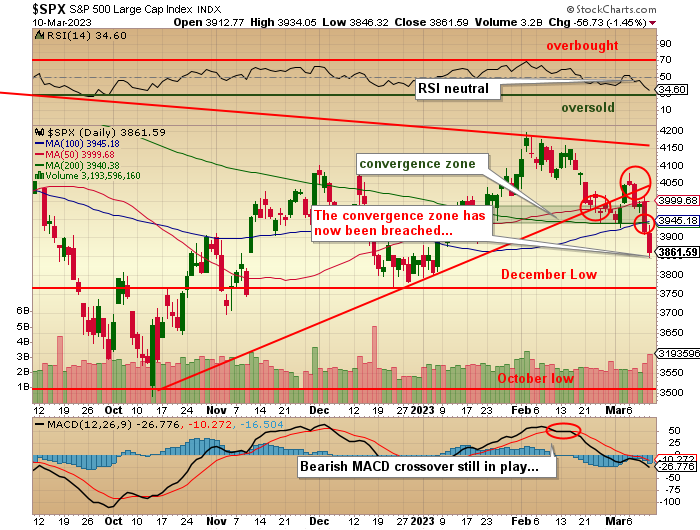
Despite rallying overnight, the S&P 500 remains in a range on the daily charts with support at 4100 and resistance at 4200. A breakout could be on the horizon with the correct fundamental spark. Should prices breach above 4200, the next key point of interest can be found at 4320. Alternatively, a breakdown below 4100 could signal a selloff towards 3950 – a level just above the 50 and 200-day SMA.

Nasdaq eyes 12800

Just like the S&P 500, the Nasdaq 100 jumped overnight with bulls eying 12800. Overall, the Index remains firmly bullish on the daily charts as there have been consistently higher highs and higher lows while the MACD trades above zero. A solid breakout and daily close above 12800 could inspire and incline towards 13150. Should prices slip back below 12400, the Nasdaq could sink back to the 200-day SMA around 11900.

FTSE 100 hits record highs!

The FTSE100 set fresh record highs this morning after risk appetite was boosted by the rally on Wall Street overnight. Prices are trading above the 50, 100, and 200-day SMA while the MACD trades above zero. The trend remains heavily bullish with the next key level of interest found at 8000. Alternatively, a move below the 7730 support level could signal a selloff towards 7620 and 7490, respectively.

STOX50 breakout…

After breaking above 4200, the STOX50 Index could be poised for further upside with 4380 acting as the next key level of interest. Prices remain bullish on the daily charts with the candlesticks trading firmly above the 50, 100, and 200-day SMA. It may be wise to keep a close eye on the RSI which is pointing to overbought levels. Should this lead to a decliner back below 4200, prices may slip back toward the 4105 support.

Gold

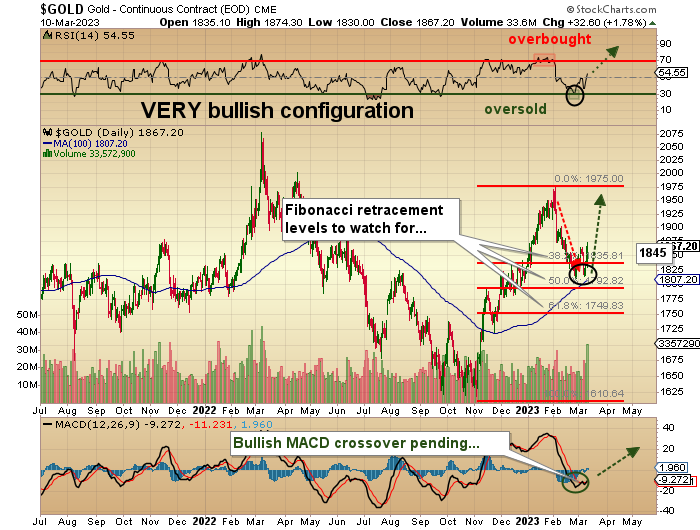
It’s been a shaky week for the precious metal with prices struggling to push back above $1880. Sustained weakness below this level may trigger a selloff towards the 50-day SMA and the next key level at $1825.  A solid breakout above $1880 could see gold test $1900.


Forex-Time-LogoArticle by ForexTime

ForexTime Ltd (FXTM) is an award winning international online forex broker regulated by CySEC 185/12 www.forextime.com

Electrified Excitement

Source: Michael Ballanger  (2/6/23)

Michael Ballanger of GGM Advisory Inc. reviews updates within the metals and energy sectors, focusing on some key companies he believes you should take a look at.

In a couple of weeks, I will be defying the accuracy of the actuarial studies by making that fateful transition from sexagenarian to septuagenarian while continuing to shovel winter snow and taking eight-kilometer walks most mornings (when it isn’t –20 C). Being a resident of this “little blue dot,” as Carl Sagan refers to our planet, for seven decades means that I have more than a few memories to recount and more than a few stories to tell.

With that comes an ample helping of regrets of both personal and career origins, but those are offset by the sweet memories of family, friends, and fortuitous events that have been integral to a magnificent journey through time.

One of the most underrated aspects of aging is that trials and tribulations that would have escalated blood pressure when I was in my thirties no longer make a dent in the stress meter, while conversely, considerate gestures and flatteries deemed unremarkable in youth are greatly appreciated in later years.

Humanity has mined about 700 million tonnes of copper to date. The problem is the need to mine that same amount in the next 22 years to keep up with the deepening green energy transition.”

— Robert Friedland, Billionaire mining entrepreneur

Most members of the Boomer Generation can tell you where they were and what they were doing when JFK was gunned down in 1963, where they were in 2001 when the Twin Towers came down, and for residents of former Czechoslovakia, Hungary, Afghanistan, and Ukraine, they will never be able to forget the day the Russian tanks crossed their borders.

Over the past seventy years, there have been far too many instances where political ambition causing pain and suffering was allowed to exert itself within societies and populations, but from my perspective, be it world wars or regional skirmishes, it is always the misguided intentions of politicians that lie as the root of these evils. Left to their own devices, humans, by and large, have learned how to survive together. For centuries upon centuries, homo sapiens have learned to join arms and raise crops, buildings, and families largely absent the horrors of war, especially when they are insulated from the insidious narcotic that accompanies political ambition.

When I sit down at night and listen to speakers like Robert Friedland speak about the future of the global mining industry with specific reference to electrification, I am emboldened that a powerful and highly-influential billionaire entrepreneur like this can offer such a concise vision of the world. Friedland was recently the keynote speaker at the Future Minerals Forum in Riyadh, Saudi Arabia, where he presented the case for “responsible mining” in the quest to provide sufficient quantities of minerals required to implement the global initiative for electrification.

Copper

Included in his remarks were specific mentions of copper, a maidenhead mineral for this publication as well as the suite of minerals used in batteries.

To have a crusty old billionaire boomer take such an active role in the promotion of “responsible mining” crucial to ending mankind’s reliance on fossil fuels is encouraging. Furthermore, to have the greatest promoter that I have ever watched take up the cause in speaking to Heads of State around the globe is exciting. It is also important to understand that the Friedland flagship company, Ivanhoe Mines, is a part owner (39.8%) of Kamoa-Kakula Copper Mine, the world’s fourth-largest but highest-grade copper mine, the Kamoa-Kakula located in the Congo.

With that in mind, please do not get the mistaken impression that I imply that Friedland has been suddenly motivated by altruistic empowerment in place of greed. Taking up the cause of electrification plays beautifully into the future fate of Ivanhoe, and that he now has subsidiary companies Ivanhoe Electric and Cabot Energy exploring opportunities in battery metals and lithium deposits infers a vertical integration for all things that will require an ample Friedland mineral supply, a talent of which he is most certainly capable, gifted, and blessed.

I am certain that if his Electrification Swan Song turns out to be a roaring success, we will have US$8.00/lb. copper and US$500,000/mt lithium, one will find not only a shining halo in the Friedland war chest but also a brand new currency calculator as well. And that’s just fine because there is no motivation better in “building things better” than capitalist aspirations, which include fame and respect along with copious profits. Hence the term “Master Friedland.”

The BLS came out on Friday with the most absurdly-manufactured statistic in economic history with the staggering news that the U.S. economy created more jobs in the December reporting period than median estimates were forecasting. Estimated to be in the 187,000 “new jobs” range, the number came in at 517,000, a 2.76 times your money “beat” that sent everything into the ash can except, of course, the yield on the 10-year treasury, which spiked up 4% to the 3.519% level.

Gold

Notwithstanding that, I absolutely guarantee major revisions with the next report to have such a reaction in the precious metals markets reeked of one thing — shenanigans. No good, rotten, lousy, nefarious, and totally nauseating shenanigans. The gold market has advanced for the past year during a period where yields essentially tripled, so even when Jay Powell threw a number of half-point rate increases at the capital markets, gold absorbed the event because job growth was not the driving force behind gold prices.

The pundits claimed that the shock in the jobs report would see the Fed having conniptions over the inflationary ramifications of the tight employment scene, but what they all forget is that the cost of servicing the U.S. debt bomb is approaching US$1 trillion per year and there comes a point in time where the U.S. currency begins to take the brunt of the credibility gap where foreign investors begin to focus not on the return ON investment but rather the return OF investment before they write a cheque.

In my view, all that has happened is an overreaction to the overbought condition that I spoke of earlier in the week to my subscribers. Using the gold bullion ETF SPDR Gold Trust (GLD:NYSEARCA) as a trading and charting tool, the big resistance band from late December in the US$170-175 range is now supported after prices escaped the range in January.

We also got a golden cross with the 50-DMA moving above the 200-DMA last month, putting all the technical conditions on buy signals until Wednesday, when we got a bearish MACD crossover constituting a short-term sell signal. As a result, we now have a large gap in the chart between US$175 and US$178 that will get filled in probably sometime next week into a rally.

RSI has moved a massive 25 points in two trading sessions, moving from over 70 (overbought) to under 45, placing it firmly in neutral now, and if we get further weakness early next week, GLD could actually be approaching oversold status in what is surely one of the quickest overbought-oversold transitions in history which – AGAIN — reeks of shenanigans.

Flipping over to spot gold, I maintain my price objective at US$2,250-2,350 in 2023, with the HUI dancing through 350 by year-end. The reasons I own gold and silver do not include a phony interpretation of employment data conjured up and delivered by ambitious bureaucrats with highly-politicized agendas. US$1,850 spot gold or US$170-171 on the GLD:US and I back up the Ram.

Lithium

Up until a few years ago, I had never come across any resource opportunity that involved the exploration for or development and/or production of lithium. However, given the heat behind the lithium juniors back in 2018, I felt obliged to attempt to bring myself up-to-speed on that market but since its pricing structure was thoroughly dominated by China, I elected to give it a pass.

Then a few weeks back, I was discussing the state of the junior resource market with an Australian colleague who proceeded to show me the chart patterns of several West Australia junior lithium plays, at which point I nearly fell over.

One of them, Patriot Battery Metals Inc. (PMET:CA) traded at CA$0.21 in late-2021, which I thought deserved mention in last week’s weekly missive as it closed over CA$10 per share.

Then with the weekend news that General Motors was investing US$650 million into Lithium Americas Corp. (LAC:TSX; LAC:NYSE) to assist in the development of the Nevada-based Thacker Pass lithium deposit, every lithium stock on the board went into full liftoff mode with PMET closing up another 60% for the week.

Accordingly, without delay, I launched into a crash course on lithium, ever fearful that I was tempting fate by charging into a market already well-exploited by stock jockeys from Perth, Australia, to Spokane, Washington. What I discovered was a commodity that was on the verge of a massive shortage situation, and despite the 20% correction in lithium prices since last November, demand for the lithium-ion batteries used in every electric vehicle currently in production is going parabolic but with new supply still a few years out.

Lithium carbonate prices in China fell to CNY 472,500 per tonne in February, the lowest since June 2022 and over 20% down since their all-time high of CNY 600,000 in November, as stronger supply and expectations of lower demand drove industry players to bet on a market surplus this year. Added capacity pushed Chinese domestic production to soar by 89% year-on-year in December and by 32.5% in the whole of 2022 despite output cuts in lake-based smelters.

Additionally, top producer Australia projected global output of lithium carbonate equivalent to reach 915,000 tonnes in 2023, a 32% rise from 2022’s estimate. Meanwhile, electric vehicle sales in China are set to decline sharply after the world’s leading consumer stopped subsidies in the sector.

Lithium and its compounds have several industrial applications, including heat-resistant glass and ceramicslithium grease lubricants, flux additives for iron, steel, and aluminum production, lithium metal batteries, and lithium-ion batteries. These uses consume more than three-quarters of lithium production.

From the Wikipedia textbook: “Because of its relative nuclear instability, lithium is less common in the solar system than 25 of the first 32 chemical elements even though its nuclei are very light: it is an exception to the trend that heavier nuclei are less common.” What that implies is that there is not a great deal of naturally-occurring lithium in nature, so it would stand to reason that dependable resources of lithium concentrate will be in high demand, thus giving junior developers a first-mover advantage if they have had the vision to lock down said resources.

To be sure that I was going to avoid the agony of “Bag Holder Blues,” an affliction suffered by “Last Minute Louie’s” that enter a hot market at or near the top, I did some digging and discovered that not only has Bank of America placed Sigma Lithium Corp. (SGML:TSXV;SGML:US) on its list of “50 Stocks for 10 Scarcity Themes”, a group of automobile manufacturers including BMW, Daimler-Benz, and Volkswagen have entered into an agreement with Chilean-based “Responsible Lithium Partnership” group with a view to developing the Salar de Atacama salt flat. There are two distinct takeaways from this information.

  • Large, multi-billion dollar companies with global presences are investing in lithium projects on both the industrial-usage level and the investment banking level, and
  • To have a TSX Venture exchange resource developer trading at CA$40 (SGML:TSXV) is uncanny, but it clearly illustrates the appetite for and opportunity surrounding junior lithium developers.

Two weeks ago, I mentioned Allied Copper Corp. (CPR:TSX.V; CPRRF:OTCQB), trading at CA$0.135 after their recent acquisition of Volt Lithium Corp. As the name change will go into effect next week, it was fitting that they announced the termination of the Klondike copper deal in Colorado as evidence that their working capital position is going to be dedicated to the Rainbow Lake Lithium project in Alberta.

The company is completing financing that has been upsized from CA$2m to CA$3m  in order to complete the construction of the pilot plant designed to test the economic viability of the process. Early testing confirmed a better-than-anticipated 93% recovery rate for the lithium carbonate, and it is expected to be duplicated after pilot plant completion.

CPR traded up to CA$0.30 to a new 52-week high on Wednesday before closing at CA0$.23 on a weekly volume of 1.88 million shares. Considering that the unit funding is being done at CA$0.20, the tape action has been nothing short of superb.

Once the deal closes, I see another big leg up as the post-financing market cap of US$22 million appears compelling relative to its peer group.

Michael Ballanger Disclaimer:

This letter makes no guarantee or warranty on the accuracy or completeness of the data provided. Nothing contained herein is intended or shall be deemed to be investment advice, implied or otherwise. This letter represents my views and replicates trades that I am making but nothing more than that. Always consult your registered advisor to assist you with your investments. I accept no liability for any loss arising from the use of the data contained on this letter. Options and junior mining stocks contain a high level of risk that may result in the loss of part or all invested capital and therefore are suitable for experienced and professional investors and traders only. One should be familiar with the risks involved in junior mining and options trading and we recommend consulting a financial adviser if you feel you do not understand the risks involved.

Disclosures:

1) Michael J. Ballanger: I, or members of my immediate household or family, own securities of the following companies mentioned in this article: All. I personally am, or members of my immediate household or family are, paid by the following companies mentioned in this article: My company, Bonaventure Explorations Ltd., has a consulting relationship with: None.

2) The following companies mentioned in this article are billboard sponsors of Streetwise Reports: None. Click here for important disclosures about sponsor fees. As of the date of this article, an affiliate of Streetwise Reports has a consulting relationship with: None. Please click here for more information.

3) Statements and opinions expressed are the opinions of the author and not of Streetwise Reports or its officers. The author is wholly responsible for the validity of the statements. The author was not paid by Streetwise Reports for this article. Streetwise Reports was not paid by the author to publish or syndicate this article. Streetwise Reports requires contributing authors to disclose any shareholdings in, or economic relationships with, companies that they write about. Streetwise Reports relies upon the authors to accurately provide this information and Streetwise Reports has no means of verifying its accuracy.

4) This article does not constitute investment advice. Each reader is encouraged to consult with his or her individual financial professional and any action a reader takes as a result of information presented here is his or her own responsibility. By opening this page, each reader accepts and agrees to Streetwise Reports’ terms of use and full legal disclaimer. This article is not a solicitation for investment. Streetwise Reports does not render general or specific investment advice and the information on Streetwise Reports should not be considered a recommendation to buy or sell any security. Streetwise Reports does not endorse or recommend the business, products, services or securities of any company mentioned on Streetwise Reports.

5) From time to time, Streetwise Reports LLC and its directors, officers, employees or members of their families, as well as persons interviewed for articles and interviews on the site, may have a long or short position in securities mentioned. Directors, officers, employees or members of their immediate families are prohibited from making purchases and/or sales of those securities in the open market or otherwise from the time of the decision to publish an article until three business days after the publication of the article. The foregoing prohibition does not apply to articles that in substance only restate previously published company releases.

As of the date of this article, officers and/or employees of Streetwise Reports LLC (including members of their household) own securities of Allied Copper Corp. and Lithium Americas Corp., companies mentioned in this article.


The future of flight in a net-zero-carbon world: 9 scenarios, lots of sustainable biofuel

By Candelaria Bergero, University of California, Irvine and Steve Davis, University of California, Irvine 

Several major airlines have pledged to reach net-zero carbon emissions by midcentury to fight climate change. It’s an ambitious goal that will require an enormous ramp-up in sustainable aviation fuels, but that alone won’t be enough, our latest research shows.

The idea of jetliners running solely on fuel made from used cooking oil from restaurants or corn stalks might seem futuristic, but it’s not that far away.

Several airlines are already experimenting with sustainable aviation fuels. These include biofuels made from agriculture residues, trees, corn and used cooking oil. Other fuels are synthetic, made by combining captured carbon from the air and green hydrogen, made with renewable energy. Often, they can go straight into existing aircraft fuel tanks that normally hold fossil jet fuel.

United Airlines, which has been using a blend of used oil or waste fat and fossil fuels on some flights from Los Angeles and Amsterdam, announced in February 2023 that it had formed a partnership with biofuel companies to power 50,000 flights a year between its Chicago and Denver hubs using ethanol-based sustainable aviation fuels by 2028.

In a new study, we examined different options for aviation to reach net-zero emissions and assessed how air travel could continue without contributing to climate change.

The bottom line: Each pathway has important trade-offs and hurdles. Replacing fossil jet fuel with sustainable aviation fuels will be crucial, but the industry will still need to invest in direct-air carbon capture and storage to offset emissions that can’t be cut.

Scenarios for the future

Before the pandemic, in 2019, aviation accounted for about 3.1% of total global CO₂ emissions from fossil fuel combustion, and the number of passenger miles traveled each year was rising. If aviation emissions were a country, that would make it the sixth-largest emitter, closely following Japan.

In addition to releasing carbon emissions, burning jet fuel produces soot and water vapor, known as contrails, that contribute to warming, and these are not avoided by switching to sustainable aviation fuels.

Aviation is also one of the hardest-to-decarbonize sectors of the economy. Small electric and hydrogen-powered planes are being developed, but long-haul flights with lots of passengers are likely decades away.

We developed and analyzed nine scenarios spanning a range of projected passenger and freight demand, energy intensity and carbon intensity of aviation to explore how the industry might get to net-zero emissions by 2050.

Nine sets of bar charts
Nine scenarios illustrate how much carbon offsets would be required to reach net-zero emissions, depending on choices made about demand and energy and carbon intensity. Each starts with 2021’s emissions (1.2 gigatons of carbon dioxide equivalent). With rising demand and no improvement in carbon intensity, a large amount of carbon capture will be necessary. Less fossil fuel use and slower demand growth reduce offset needs.
Candelaria Bergero

We found that as much as 19.8 exajoules of sustainable aviation fuels could be needed for the entire sector to reach net-zero CO₂ emissions. With other efficiency improvements, that could be reduced to as little as 3 exajoules. To put that into context, 3 exajoules is almost equivalent to all biofuels produced in 2019 and far surpasses the 0.005 exajoules of bio-based jet fuel produced in 2019. An exajoule is a measure of energy.

Flying less and improving airplanes’ energy efficiency, such as using more efficient “glide” landings that allow airlines to approach the airport with engines at near idle, can help reduce the amount of fuel needed. But even in our rosiest scenarios – where demand grows at 1% per year, compared to the historical average of 4% per year, and energy efficiency improves by 4% per year rather than 1% – aviation would still need about 3 exajoules of sustainable aviation fuels.

Why offsets are still necessary

A rapid expansion in biofuel sustainable aviation fuels is easier said than done. It could require as much as 1.2 million square miles (300 million hectares) of dedicated land to grow crops to turn into fuel – roughly 19% of global cropland today.

Another challenge is cost. The global average price of fossil jet fuel is about about US$3 per gallon ($0.80 per liter), while the cost to produce bio-based jet fuels is often twice as much. The cheapest, HEFA, which uses fats, oils and greases, ranges in cost from $2.95 to $8.67 per gallon ($0.78 to $2.29 per liter), but it depends on the availability of waste oil.
Fischer-Tropsch biofuels, produced by a chemical reaction that converts carbon monoxide and hydrogen into liquid hydrocarbons, range from $3.79 to $8.71 per gallon ($1 to $2.30 per liter). And synthetic fuels are from $4.92 to $17.79 per gallon ($1.30 to $4.70 per liter).

Realistically, reaching net-zero emissions will likely also rely on carbon dioxide removal.

In a future with similar airline use as today, as much as 3.4 gigatons of carbon dioxide would have to be captured from the air and locked away – pumped underground, for example – for aviation to reach net-zero. That could cost trillions of dollars.

For these offsets to be effective, the carbon removal would also have to follow a robust eligibility criteria and be effectively permanent. This is not happening today in airline offsetting programs, where airlines are mostly buying cheap, nonpermanent offsets, such as those involving forest conservation and management projects.

Some caveats apply to our findings, which could increase the need for offsets even more.

Our assessment assumes sustainable aviation fuels to be net-zero carbon emissions. However, the feedstocks for these fuels currently have life-cycle emissions, including from fertilizer, farming and transportation. The American Society for Testing Materials also currently has a maximum blend limit: up to 50% sustainable fuels can be blended into conventional jet fuel for aviation in the U.S., though airlines have been testing 100% blends in Europe.

How to overcome the final hurdles

To meet the climate goals the world has set, emissions in all sectors must decrease – including aviation.

While reductions in demand would help reduce reliance on sustainable aviation fuels, it’s more likely that more and more people will fly in the future, as more people become wealthier. Efficiency improvements will help decrease the amount of energy needed to power aviation, but it won’t eliminate it.

Scaling up sustainable aviation fuel production could decrease its costs. Quotas, such as those introduced in the European Union’s “Fit for 55” plan, subsidies and tax credits, like those in the U.S. Inflation Reduction Act signed in 2022, and a carbon tax or other price on carbon, can all help achieve this.

Additionally, given the role that capturing carbon from the atmosphere will play in achieving net-zero emissions, a more robust accounting system is needed internationally to ensure that the offsets are compensating for aviation’s non-CO₂ impacts. If these hurdles are overcome, the aviation sector could achieve net-zero emissions by 2050.The Conversation

About the Author:

Candelaria Bergero, Ph.D. Student in Earth System Science, University of California, Irvine and Steve Davis, Professor of Earth System Science, University of California, Irvine

This article is republished from The Conversation under a Creative Commons license. Read the original article.


Gold and Inflation: Here’s a Market Myth

“If you believe in Gold as a consumer price inflation hedge then…”

By Elliott Wave International

Back in the days of the Roman Empire, an ounce of gold could buy a Roman a well-made toga, belt and finely crafted sandals.

In modern day Rome, lo and behold, a businessman can become sharply dressed via the value of that same ounce of gold.

So, yes, gold has maintained its store of value over the centuries.

However, in the relative short term — which can last years — gold may not be the inflation hedge that gold bugs believe it to be.

In a moment, I’ll show you how this relates to what’s going on with gold and inflation now. However, let’s first get insights from a chart and commentary from our February 2022 Global Market Perspective, which published when inflation was really getting going (The monthly Global Market Perspective is an Elliott Wave International publication which covers 50-plus global financial markets):

The chart shows the U.S. dollar price of Gold versus the annualized rate-of-change in the U.S. Consumer Price Index (CPI). If you believe in Gold as a consumer price inflation hedge then, as the CPI is accelerating, the Gold price should be advancing. The green shaded areas show that there have been five occasions since 1980 when the opposite was true, the last year being a good example. On the other side, the Gold-Inflation myth would allude to the price of Gold declining as CPI was decelerating. The grey shaded areas show five occasions since 1970 when this was not the case, 2007 to 2010 being a prime example.

Fast forward to today and we have these headlines:

  • US inflation eases grip on economy, falling for a 6th month (AP News, Jan. 23)
  • Inflation in U.S. could turn negative by midyear, says [this] billionaire investor … (MarketWatch, Jan. 28)

What’s happened to the price of gold? It’s steadily climbed in the face of easing inflation. Of course, this is just the opposite of what was occurring around this time last year. In both cases, the price of gold went in the opposite direction from what many would expect.

On Sept. 28, gold was trading at $1613.75 and has been in an overall uptrend since. The precious metal traded as high as $1949.46 on Jan. 26 (as of this writing on Jan. 30).

The bottom-line takeaway is that the widespread expected relationship between gold and inflation is not always there — indeed, there have been several instances in the past several decades where the opposite is the case.

Know that Elliott wave analysis, which is by no means a crystal ball, can nonetheless help you anticipate gold’s next big price move.

If you’re unfamiliar with Elliott wave analysis, read Frost & Prechter’s Elliott Wave Principle: Key to Market Behavior. Here’s a quote from the book:

The Wave Principle is governed by man’s social nature, and since he has such a nature, its expression generates forms. As the forms are repetitive, they have predictive value.

Learn about these “forms” for free as a Club EWI member.

That’s right — you can gain free access to the entire online version of this Wall Street classic by joining Club EWI — the world’s largest Elliott wave educational community. A Club EWI membership is also free, and members enjoy complimentary access to a wealth of Elliott wave resources on investing and trading.

Get started right away by following this link: Elliott Wave Principle: Key to Market Behaviorget free and instant access.

This article was syndicated by Elliott Wave International and was originally published under the headline Gold and Inflation: Here’s a Market Myth. EWI is the world’s largest market forecasting firm. Its staff of full-time analysts led by Chartered Market Technician Robert Prechter provides 24-hour-a-day market analysis to institutional and private investors around the world.

Trade Of The Week: Gold Down, But Not Out As February Kicks Off

By ForexTime 

After tumbling 2.5% last Friday due to an unexpectedly strong US jobs report, gold prices have kicked off the new week on a steadier note.

The precious metal is attempting to nurse deep wounds inflicted by January’s blockbuster NFP report which aggressively fuelled expectations around more US rate hikes from the Federal Reserve. Last month, the US economy created a whooping 517k jobs – the most since July and easily bearing market forecasts of 185k. Meanwhile, unemployment fell to its lowest level since 1969 at 3.4%. Given how the stunningly good report is likely to energize dollar bulls and empower Fed hawks, the path of least resistance for gold may point south in the short to medium term.

In our 2023, we highlighted how gold could be one of the biggest gainers this year thanks to expectations around the Fed switching to rate cuts later in 2023. The latest developments may have poured some cold water on these expectations. However, more key economic data may be needed to come to any meaningful conclusions. In the meantime, there is a possibility that the robust jobs data may set the tone for February

Taking a brief look at the technicals, gold may be down but certainly not out yet as bulls remain in some control on the monthly timeframe. There seems to be strong resistance around $1950 – $2000 while support can be found at $1700 – $1680. Gold could find itself rangebound until a fresh directional catalyst is brought into the picture.

Calm week before another storm?

Compared to last week’s mighty few days of market thrills, key central bank meetings, and high-risk events, the economic calendar for this week is relatively lighter.

Naturally, much attention will be directed toward speeches from Fed officials including Jerome Powell and US President Joe Bidens State of the Union Address. Even the weekly initial jobless claims on Thursday and US February consumer sentiment published on Friday may influence gold prices. Overall, the direction of gold should mostly be dictated by renewed Fed hike bets, a stronger dollar, and rising Treasury yields.

Looking beyond this week, it’s all about the US inflation report. Back in December 2022, the annual inflation rate in the United States slowed for a sixth straight month to 6.5%. This was a welcome development for financial markets and raised hopes over the Fed shifting into lower gear on rates. However, the robust strength of the US labour could feed fears over inflation remaining stubbornly high despite the latest recent slowdown. Ultimately, further signs of cooling inflationary pressures in January could provide gold bulls some sort of lifeline as the battle for dominance rages on.

Other themes to watch out for…

It will be wise to keep a close eye on the developments revolving around Sino-U.S. relations. Market sentiment remains gripped by fears over worsening US-China relations after the US shot down a suspected Chinese spy balloon over the weekend. Should tensions escalate, this may promote risk aversion boosting appetite for safe-haven assets. Appetite towards gold could receive a boost, however, this may be capped by an appreciating dollar.

Gold to remain below $1900?

Despite edging higher on Monday, gold prices remain under pressure on the daily charts. After cutting through the $1900 psychological level like a hot knife through butter, bears are clearly in a position of power. Sustained weakness below $1880 may open the doors towards $1825 and $1800, respectively. If prices can push back above $1900, gold could challenge $1950 and $2000, respectively.

Looking at the monthly charts, the recent rejection from the $1950 could guide prices back toward $1700 before bulls re-enter the scene. A breakdown below $1700 has the potential to trigger a selloff towards $1625.


Forex-Time-LogoArticle by ForexTime

ForexTime Ltd (FXTM) is an award winning international online forex broker regulated by CySEC 185/12 www.forextime.com

ChatGPT is great – you’re just using it wrong

By Jonathan May, University of Southern California 

It doesn’t take much to get ChatGPT to make a factual mistake. My son is doing a report on U.S. presidents, so I figured I’d help him out by looking up a few biographies. I tried asking for a list of books about Abraham Lincoln and it did a pretty good job:

screen capture of text
A reasonable list of books about Lincoln.
Screen capture by Jonathan May., CC BY-ND

Number 4 isn’t right. Garry Wills famously wrote “Lincoln at Gettysburg,” and Lincoln himself wrote the Emancipation Proclamation, of course, but it’s not a bad start. Then I tried something harder, asking instead about the much more obscure William Henry Harrison, and it gamely provided a list, nearly all of which was wrong.

screen capture of text
Books about Harrison, fewer than half of which are correct.
Screen capture by Jonathan May., CC BY-ND

Numbers 4 and 5 are correct; the rest don’t exist or are not authored by those people. I repeated the exact same exercise and got slightly different results:

screen capture of text
More books about Harrison, still mostly nonexistent.
Screen capture by Jonathan May., CC BY-ND

This time numbers 2 and 3 are correct and the other three are not actual books or not written by those authors. Number 4, “William Henry Harrison: His Life and Times” is a real book, but it’s by James A. Green, not by Robert Remini, a well-known historian of the Jacksonian age.

I called out the error and ChatGPT eagerly corrected itself and then confidently told me the book was in fact written by Gail Collins (who wrote a different Harrison biography), and then went on to say more about the book and about her. I finally revealed the truth and the machine was happy to run with my correction. Then I lied absurdly, saying during their first hundred days presidents have to write a biography of some former president, and ChatGPT called me out on it. I then lied subtly, incorrectly attributing authorship of the Harrison biography to historian and writer Paul C. Nagel, and it bought my lie.

When I asked ChatGPT if it was sure I was not lying, it claimed that it’s just an “AI language model” and doesn’t have the ability to verify accuracy. However it modified that claim by saying “I can only provide information based on the training data I have been provided, and it appears that the book ‘William Henry Harrison: His Life and Times’ was written by Paul C. Nagel and published in 1977.”

This is not true.

Words, not facts

It may seem from this interaction that ChatGPT was given a library of facts, including incorrect claims about authors and books. After all, ChatGPT’s maker, OpenAI, claims it trained the chatbot on “vast amounts of data from the internet written by humans.”

However, it was almost certainly not given the names of a bunch of made-up books about one of the most mediocre presidents. In a way, though, this false information is indeed based on its training data.

As a computer scientist, I often field complaints that reveal a common misconception about large language models like ChatGPT and its older brethren GPT3 and GPT2: that they are some kind of “super Googles,” or digital versions of a reference librarian, looking up answers to questions from some infinitely large library of facts, or smooshing together pastiches of stories and characters. They don’t do any of that – at least, they were not explicitly designed to.

Sounds good

A language model like ChatGPT, which is more formally known as a “generative pretrained transformer” (that’s what the G, P and T stand for), takes in the current conversation, forms a probability for all of the words in its vocabulary given that conversation, and then chooses one of them as the likely next word. Then it does that again, and again, and again, until it stops.

So it doesn’t have facts, per se. It just knows what word should come next. Put another way, ChatGPT doesn’t try to write sentences that are true. But it does try to write sentences that are plausible.

When talking privately to colleagues about ChatGPT, they often point out how many factually untrue statements it produces and dismiss it. To me, the idea that ChatGPT is a flawed data retrieval system is beside the point. People have been using Google for the past two and a half decades, after all. There’s a pretty good fact-finding service out there already.

In fact, the only way I was able to verify whether all those presidential book titles were accurate was by Googling and then verifying the results. My life would not be that much better if I got those facts in conversation, instead of the way I have been getting them for almost half of my life, by retrieving documents and then doing a critical analysis to see if I can trust the contents.

Improv partner

On the other hand, if I can talk to a bot that will give me plausible responses to things I say, it would be useful in situations where factual accuracy isn’t all that important. A few years ago a student and I tried to create an “improv bot,” one that would respond to whatever you said with a “yes, and” to keep the conversation going. We showed, in a paper, that our bot was better at “yes, and-ing” than other bots at the time, but in AI, two years is ancient history.

I tried out a dialogue with ChatGPT – a science fiction space explorer scenario – that is not unlike what you’d find in a typical improv class. ChatGPT is way better at “yes, and-ing” than what we did, but it didn’t really heighten the drama at all. I felt as if I was doing all the heavy lifting.

After a few tweaks I got it to be a little more involved, and at the end of the day I felt that it was a pretty good exercise for me, who hasn’t done much improv since I graduated from college over 20 years ago.

screen capture of text
A space exploration improv scene the author generated with ChatGPT.
Screen capture by Jonathan May., CC BY-ND

Sure, I wouldn’t want ChatGPT to appear on “Whose Line Is It Anyway?” and this is not a great “Star Trek” plot (though it’s still less problematic than “Code of Honor”), but how many times have you sat down to write something from scratch and found yourself terrified by the empty page in front of you? Starting with a bad first draft can break through writer’s block and get the creative juices flowing, and ChatGPT and large language models like it seem like the right tools to aid in these exercises.

And for a machine that is designed to produce strings of words that sound as good as possible in response to the words you give it – and not to provide you with information – that seems like the right use for the tool.The Conversation

About the Author:

Jonathan May, Research Associate Professor of Computer Science, University of Southern California

This article is republished from The Conversation under a Creative Commons license. Read the original article.

Limits to computing: A computer scientist explains why even in the age of AI, some problems are just too difficult

By Jie Wang, UMass Lowell 

Empowered by artificial intelligence technologies, computers today can engage in convincing conversations with people, compose songs, paint paintings, play chess and go, and diagnose diseases, to name just a few examples of their technological prowess.

These successes could be taken to indicate that computation has no limits. To see if that’s the case, it’s important to understand what makes a computer powerful.

There are two aspects to a computer’s power: the number of operations its hardware can execute per second and the efficiency of the algorithms it runs. The hardware speed is limited by the laws of physics. Algorithms – basically sets of instructions – are written by humans and translated into a sequence of operations that computer hardware can execute. Even if a computer’s speed could reach the physical limit, computational hurdles remain due to the limits of algorithms.

These hurdles include problems that are impossible for computers to solve and problems that are theoretically solvable but in practice are beyond the capabilities of even the most powerful versions of today’s computers imaginable. Mathematicians and computer scientists attempt to determine whether a problem is solvable by trying them out on an imaginary machine.

An imaginary computing machine

The modern notion of an algorithm, known as a Turing machine, was formulated in 1936 by British mathematician Alan Turing. It’s an imaginary device that imitates how arithmetic calculations are carried out with a pencil on paper. The Turing machine is the template all computers today are based on.

To accommodate computations that would need more paper if done manually, the supply of imaginary paper in a Turing machine is assumed to be unlimited. This is equivalent to an imaginary limitless ribbon, or “tape,” of squares, each of which is either blank or contains one symbol.

The machine is controlled by a finite set of rules and starts on an initial sequence of symbols on the tape. The operations the machine can carry out are moving to a neighboring square, erasing a symbol and writing a symbol on a blank square. The machine computes by carrying out a sequence of these operations. When the machine finishes, or “halts,” the symbols remaining on the tape are the output or result.

What is a Turing machine?

Computing is often about decisions with yes or no answers. By analogy, a medical test (type of problem) checks if a patient’s specimen (an instance of the problem) has a certain disease indicator (yes or no answer). The instance, represented in a Turing machine in digital form, is the initial sequence of symbols.

A problem is considered “solvable” if a Turing machine can be designed that halts for every instance whether positive or negative and correctly determines which answer the instance yields.

Not every problem can be solved

Many problems are solvable using a Turing machine and therefore can be solved on a computer, while many others are not. For example, the domino problem, a variation of the tiling problem formulated by Chinese American mathematician Hao Wang in 1961, is not solvable.

The task is to use a set of dominoes to cover an entire grid and, following the rules of most dominoes games, matching the number of pips on the ends of abutting dominoes. It turns out that there is no algorithm that can start with a set of dominoes and determine whether or not the set will completely cover the grid.

Keeping it reasonable

A number of solvable problems can be solved by algorithms that halt in a reasonable amount of time. These “polynomial-time algorithms” are efficient algorithms, meaning it’s practical to use computers to solve instances of them.

Thousands of other solvable problems are not known to have polynomial-time algorithms, despite ongoing intensive efforts to find such algorithms. These include the Traveling Salesman Problem.

The Traveling Salesman Problem asks whether a set of points with some points directly connected, called a graph, has a path that starts from any point and goes through every other point exactly once, and comes back to the original point. Imagine that a salesman wants to find a route that passes all households in a neighborhood exactly once and returns to the starting point.

The Traveling Salesman Problem quickly gets out of hand when you get beyond a few destinations.

These problems, called NP-complete, were independently formulated and shown to exist in the early 1970s by two computer scientists, American Canadian Stephen Cook and Ukrainian American Leonid Levin. Cook, whose work came first, was awarded the 1982 Turing Award, the highest in computer science, for this work.

The cost of knowing exactly

The best-known algorithms for NP-complete problems are essentially searching for a solution from all possible answers. The Traveling Salesman Problem on a graph of a few hundred points would take years to run on a supercomputer. Such algorithms are inefficient, meaning there are no mathematical shortcuts.

Practical algorithms that address these problems in the real world can only offer approximations, though the approximations are improving. Whether there are efficient polynomial-time algorithms that can solve NP-complete problems is among the seven millennium open problems posted by the Clay Mathematics Institute at the turn of the 21st century, each carrying a prize of US$1 million.

Beyond Turing

Could there be a new form of computation beyond Turing’s framework? In 1982, American physicist Richard Feynman, a Nobel laureate, put forward the idea of computation based on quantum mechanics.

What is a quantum computer?

In 1995, Peter Shor, an American applied mathematician, presented a quantum algorithm to factor integers in polynomial time. Mathematicians believe that this is unsolvable by polynomial-time algorithms in Turing’s framework. Factoring an integer means finding a smaller integer greater than 1 that can divide the integer. For example, the integer 688,826,081 is divisible by a smaller integer 25,253, because 688,826,081 = 25,253 x 27,277.

A major algorithm called the RSA algorithm, widely used in securing network communications, is based on the computational difficulty of factoring large integers. Shor’s result suggests that quantum computing, should it become a reality, will change the landscape of cybersecurity.

Can a full-fledged quantum computer be built to factor integers and solve other problems? Some scientists believe it can be. Several groups of scientists around the world are working to build one, and some have already built small-scale quantum computers.

Nevertheless, like all novel technologies invented before, issues with quantum computation are almost certain to arise that would impose new limits.The Conversation

About the Author:

Jie Wang, Professor of Computer Science, UMass Lowell

This article is republished from The Conversation under a Creative Commons license. Read the original article.

US is spending record amounts servicing its national debt – interest rate hikes add billions to the cost

By Gerald P. Dwyer, Clemson University 

Consumers and businesses aren’t the only ones feeling the pain of higher borrowing costs because of Federal Reserve rate hikes. Uncle Sam is too.

The U.S. government spent a record US$213 billion on interest payments on its debt in the fourth quarter, up $63 billion from a year earlier. Indeed, a jump of almost $30 billion on the previous quarter represents the biggest quarterly jump on record. That comes as the Fed lifted interest rates a whopping 4.25 percentage points from March through December.

As an economist, I am concerned that the effect of higher interest payments on the government’s budget is being ignored. Higher interest payments mean the federal government will either have to lower spending, raise taxes or issue more debt to service its obligations. And financing interest payments by issuing more debt could be a particularly poor choice – sooner or later, the bill will come due.

The national debt – the amount the federal government borrows to balance the budget – increases when spending is greater than revenue and accumulates over time. As a general rule, it increases over time because of increases in spending, revenue and the deficit. Inflation tends to increase government spending, as well as revenue and deficits. As a result, the dollar value of government debt increases in times of inflation. Debt also tends to grow as the economy gets bigger – although this is not inevitable as policymakers could choose to balance the government’s budget.

In this way, total government debt has climbed over the years – by the end of 2022 it was 10 times larger than it was in 1990. It currently stands at over $31 trillion dollars and represents more than 120% of the nation’s gross domestic product. GDP is the total annual amount of goods and services produced by a country and often is used to judge whether debt is high or low.

Since 1990, government debt has more than doubled relative to the size of the economy – indicating that servicing debt could be quite a bit more of an issue than it once was.

A decade of record-low borrowing costs

But how concerning are these numbers? After all, it is not as if the government debt has to be paid off every year.

Government borrowing has some similarities to a person paying for an expensive item with a credit card, with the actual amount due to be paid off over an extended period. Just as with purchases on credit, interest is applied – and can add to the overall outlay. The federal government is different from consumers, though – it need not pay off its debt for the foreseeable future.

In terms of interest payments, the U.S. has been fortunate in recent years. Historically low interest rates since the 2008 financial crisis have held down interest payments. And just as low interest rates encourage would-be homeowners, for example, to take out a larger mortgage, they have also made it much more attractive for the federal government to borrow money to pay for whatever Congress and the administration want to finance.

But then came 2022. Soaring inflation – which reached levels not seen in 40 years – meant an end to the days of near-zero interest rates. To restrain inflation, the Fed raised rates seven times in 2022, taking the base rate from near zero to a range of 4.25% to 4.5% at the end of 2022. It is expected that the Fed will raise rates by a further 0.25 percentage point at its next monetary policy meeting starting Jan. 31. Projections made by Federal Board members indicate that, with future increases, rates will average 5% or more in 2023.

Not all government debt, however, carries these current higher interest rates. Just as with typical U.S. mortgages, much of the government debt bears the interest rate applied when it was taken on. The difference is, unlike homeowners, the government does not pay off its debt. Instead it rolls over old debt into new debt – and when it does so it takes on whatever the interest rate is when the debt is rolled over. And when this happens and interest rates have risen, the cost of servicing the overall debt goes up.

There may be trouble ahead

The federal government’s interest expense has only begun to reflect the higher interest rates. The average rate the U.S. paid in 2022 was just over 2%, which is up from the 1.61% average in 2021 but still lower than it’s been over much of the past decade. But even so, the effect is being felt. Since the Fed began hiking rates, the U.S. government’s exposure to debt interest has climbed sharply.

It may all sound a little worrying, especially amid talk of a recession – it is as if the interest on your credit card or mortgage suddenly jumped at a time when you were facing a possible cut in wages.

But there are some reassuring economic projections as well. Inflation declined substantially in the second half of 2022 and appears likely to be under control. And there is good reason to think that interest rates of 4% – or even less – are in the U.S.‘s future, as well as in the Federal Reserve projections. Whether there will be a “soft landing” in the economy – that is, a slowdown that avoids a recession – is not so obvious. While it is not inevitable, many indicators point to a recession in 2023.

Either way, the days of borrowing trillions of dollars at near-zero interest rates to finance extravagant spending are over for the foreseeable future.The Conversation

About the Author:

Gerald P. Dwyer, Professor Emeritus of Economics and BB&T Scholar, Clemson University

This article is republished from The Conversation under a Creative Commons license. Read the original article.

Fed’s hawkish tones and rate rises will become less relevant

By George Prior

Investors are set to largely shrug off hawkish tones and rate rises from the Federal Reserve moving forward, predicts the CEO of one of the world’s largest independent financial advisory, asset management and fintech organizations.

The prediction from Nigel Green of deVere Group, comes as the U.S. central bank’s policy-setting Federal Open Market Committee (FOMC) raised rates by 25 basis points at the conclusion of its two-day meeting, bringing its benchmark to a target range of 4.5% to 4.75%.

The deVere Group CEO observes: “The markets expected a 25bps rise, which is another step downward for the Fed, which increased rates by 50 basis points in December, following four 75 basis-point hikes in 2022.

“The Fed went strong on flagging worries about financial conditions becoming too loose, and that whilst progress on taming inflation has been made, officials remain concerned.

“The central bank delivered hawkish tones about rates having to remain higher for longer and reiterated the Fed’s commitment to cooling inflation.”

However, says Nigel Green, “There’s set to be some fluctuation, but moving forward markets are going to largely shrug off the Fed’s hawkish tones and rate rises.”

He continues: “Markets typically look to the future, not at the present, and will see that inflation has peaked, and the growing signs of a ‘soft landing’ for the U.S. economy as it appears that the central bank is reducing inflation without creating significant unemployment.

“There’s a sense that things are actually better than the Fed is admitting to, in order to stop over-exuberance of the markets.

“The Fed’s rhetoric doesn’t appear to be changing, despite the data, and the markets are aware of this.”

As the U.S. central bank steps down from the aggressive tightening agenda, markets are increasingly “going to overlook the Fed’s rate increases; they’re becoming less relevant.”

Nigel Green affirms: “Savvy investors know that now – in a year in which there will be big winners and big losers – it’s about being invested in the right companies, those which can consistently maintain or steadily grow margin, as well as diversification across sectors, asset classes and regions.

“A good fund manager will be critical in identifying these winners and losers as the economic cycle moves on.”

About the Author:

deVere Group is one of the world’s largest independent advisors of specialist global financial solutions to international, local mass affluent, and high-net-worth clients.  It has a network of more than 70 offices across the world, over 80,000 clients and $12bn under advisement.


Mid-Week Technical Outlook: Exotics & Minors In Focus

By ForexTime 

The next few days promise to be incredibly eventful and volatile for financial markets thanks to major central bank decisions, earnings from tech titans, and key economic reports.

Caution remains the name of the game across markets as investors adopt a guarded approach towards riskier assets with all eyes on the Fed rate decision this evening. In Europe, shares edged higher but US equity futures slipped amid the growing tension and anticipation. Looking at currencies, the dollar has slipped against G10 majors while gold prices staged a sharp rebound from the $1900 region.

Over the past few weeks, we have been covering the dollar and other major currencies but today our attention falls not only on exotics but minor currency pairs. In the FX universe, a minor refers to non-USD currency pairs while exotics are the currency of a developing economy paired with another major. Exotics are notoriously known to be far less liquid than majors and explosively volatile…

While minors and exotics may be less popular than majors and often experience more wild swings thanks to less liquidity, they could still offer trading opportunities. So if you want a quick break from the dollar and other major currency pairs, check out the trading setups below.

GBPJPY trapped within a range

The GBPJPY remains trapped within a 300-pip range with resistance at 162.00 and support at 159.00. A breakout/down could be on the horizon with the correct fundamental spark. On Thursday, the Bank of England is expected to hike interest rates by 50 basis points to tame inflation.  The outcome of the meeting may have an impact on the GBPJPY in the near term. Talking technicals, a breakdown below 159.00 may open a path toward 156.00. Should prices push back above 162.00, the GBPJPY could attack 164.00.

EURJPY ready to resume selloff?

The technical bounce on the EURJPY could be over if prices fail to conquer the 141.50 level. Bears remain in some control with prices respecting a choppy bearish channel on the daily charts. A decline back under the 200-day Simple Moving Average could trigger a selloff towards 139.00 and 138.00, respectively. If prices can break above the 50-day SMA at 142.00, then a move toward 144.00 could become reality.

USDZAR set to slip?

It remains a choppy affair with the USDZAR as the currency swings between losses and gains. Prices seem to be in a wide range with some support found at 17.20. A strong breakdown below this level could encourage a move below the 50-day SMA and 200-day SMA at 16.95. Should prices experience a rebound, the first point of interest will be at 17.50 and 17.74, respectively.

EURAUD breakout/down?

As the subtitle says, the EURAUD can either experience a strong technical bounce from 1.5270 or break down below this point to hit 1.5070. The trend looks flat on the daily charts but prices are trading below the 100 but above the 200-day Simple Moving Average. Should 1.5270 prove to be reliable support, a move back toward 1.5670 after breaking through 1.5450.

AUDNZD bulls in control 

This currency pair remains firmly bullish on the daily timeframe. There have been consistently higher highs and higher lows while the MACD trades to the upside. A solid breakout and daily close above 1.1000 could encourage a move higher towards 1.1150 and 1.1250, respectively. Should 1.1000 prove to be reliable resistance, prices may sink back towards 1.0900.


Article by ForexTime

ForexTime Ltd (FXTM) is an award winning international online forex broker regulated by CySEC 185/12 www.forextime.com