Archive for Opinions – Page 74

Trade Of The Week: Gold Primed For Another Breakout?

By ForexTime 

Gold prices have kicked off the new week still nursing deep wounds inflicted from last Friday’s painful selloff.

The precious metal’s appeal took a hit following hawkish remarks delivered by Federal Reserve Chair Jerome Powell at Jackson Hole. With his comments leaving the doors open for further rate increases, gold found itself capped around $1920 as the dollar rose along with Treasury yields.

Gold is down roughly 2.5% month-to-date. Despite this, bulls and bears remain engaged in a fierce tug of war with prices almost unchanged since the start of Q3. Taking a quick look at the technical picture, the precious metal could experience a rebound or dead cat bounce with key resistance at $1920 and support at $1885.

A major breakout could be on the horizon and here are 4 reasons why:

1) US Data dump 

With the Federal Reserve’s recent shift to data dependency, every release of US economic data is of paramount importance. These data points will play a critical role in determining whether the Fed will raise rates one last time in 2023.

As a result, close attention will be paid to upcoming releases such as US August consumer confidence, US Q2 GDP (2nd estimate), and US weekly initial jobless claims to gauge the health of the US economy.

  • Gold prices may appreciate on a weaker dollar if the overall data disappoints and caps expectations around the Fed keeping rates higher for longer.
  • Gold could depreciate on a stronger dollar should the overall US economic data exceed market forecasts and fuel bets around higher US interest rates.

2) US July PCE report

The Fed’s preferred inflation gauge, the Core Personal Consumption Expenditure will be closely scrutinized by investors, especially after the central bank stressed that incoming data would influence monetary policy decisions.

Markets expect the July PCE report to show headline prices remained steady at 0.2% month-over-month with the core PCE deflator also forecast to remain unchanged at 0.2% MoM. The core personal consumption expenditures price index for projected to rise 4.2% year-over-year in April, up from the 4.1% seen in June.

Ultimately, further signs of easing inflationary pressures may support gold prices as rate hike bets cool. Traders are currently pricing in a 22% probability of a 25 basis point hike in September with this jumping to 67% by November, according to Fed funds futures.

3) US August NFP report

Fasten your seatbelts because the US nonfarm payrolls report on Friday has the potential to rock gold prices.

Markets expect the US economy to have added 168,000 jobs in August, while the unemployment rate is seen remaining unchanged at 3.5%. Given how markets remain sensitive to anything relating to the US economy and rate hike expectations, this jobs report could trigger volatility across the board.

  • Gold prices may appreciate if the August NFP report prints below the 168k market forecast, complemented by a higher unemployment rate. This combo may fuel speculation around the Fed being done with rate hikes, offering an opportunity for gold bulls to charge.
  • Gold prices may depreciate if the August NFP reports exceed markets expectations with the unemployment rate moving lower. This scenario could strengthen the argument around the Fed raising interest rates one more time this year.

4) Technical forces 

Despite pushing back above the 200-day SMA, gold bears still maintain some control on the daily charts.

Prices are trading below the 50 and 100-day SMA while the MACD trades to the downside. Bear may return to the scene if prices sink back below the 200-day SMA with $1885 acting as the first key level of interest. Weakness below this level may open a path towards $1870. Should prices experience a breakout above $1920, bulls could target $1935 and $1957 where the 100-day SMA resides.


Forex-Time-LogoArticle by ForexTime

ForexTime Ltd (FXTM) is an award winning international online forex broker regulated by CySEC 185/12 www.forextime.com

Will the fallout from Prigozhin ‘plane crash’ hit oil prices?

By George Prior

Oil prices are likely to become volatile amid the fallout from the alleged killing of Wagner boss Yevgeny Prigozhin in a plane crash that is reported to be on the orders of Russian President, Vladimir Putin.

The assessment from Nigel Green, CEO of deVere Group, one of the world’s largest independent financial advisory, asset management and fintech organizations, comes as Russian aviation authorities say Prigozhin, the leader of the infamous mercenary group who was denounced as a traitor by Putin following an attempted coup 60 days ago, was among 10 people killed in a plane crash near Moscow on Wednesday.

“Some reports say that Wagner mercenaries can be expected to take revenge on Putin and Defence Minister Shoigu for the death of their leader. Other reports say that Prigozhin, in fact, avoided the killing and will be even more on the war path with Putin,” says Nigel Green.

“Either way, it appears the situation is becoming even more fragile and vulnerable for Vladimir Putin, at least in the short term.

“Some analysts are even warning that this situation could ultimately lead to his downfall and potentially lead to civil war and/or the possible fragmentation of Russia.”

He continues: “A weakening of Vladimir Putin’s stronghold on power could potentially have an impact, albeit not directly, on oil prices as his influence is closely tied to Russia’s oil production and its geopolitical positioning.

“A power struggle or political instability in Russia will introduce uncertainty to global oil markets.

“Geopolitical tensions, disruptions in oil supply routes, or military conflicts, will cause temporary supply disruptions and drive oil price volatility.”

The deVere CEO says oil prices are “particularly vulnerable” right now to the Prigozhin news as the market is “concerned about the pace of China’s economic growth” and as investors monitor the Jackson Hole Federal Reserve meeting which starts Thursday, which “could provide more hints as to whether interest rates will remain higher for longer.”

He concludes: “The situation is looking precarious on many levels for Putin, and we expect that this will contribute to short-term turbulence in the price of oil.

“Oil prices have a substantial influence on wider financial markets due to their far-reaching impact on economies, industries, and consumer behaviours.”

About:

deVere Group is one of the world’s largest independent advisors of specialist global financial solutions to international, local mass affluent, and high-net-worth clients.  It has a network of offices across the world, over 80,000 clients and $12bn under advisement.

Nvidia knockout earnings – two takeaways from deVere CEO

By George Prior

As Nvidia’s knockout earnings and guidance reports showed on Wednesday, AI is not just the future, it’s the present, and all investors need some exposure to it – but there’s much more than just this one California-based mega tech company.

This is the bullish assessment from Nigel Green, the CEO and founder of deVere Group, one of the world’s largest independent financial advisory, asset management and fintech organizations, as the chipmaker beat estimates and says that sales will jump a further 170% this quarter due to soaring demand for AI chips.

Shares in Nvidia jumped 6% on the earnings and guidance, which came after the closing bell.

“Nvidia is the darling of the AI boom – of this there is no doubt – and with robust guidance we expect this to continue for most of the rest of the year,” says Nigel Green.

“For me there are two key takeaways from the Nvidia news.

“First, clearly, AI is not just the future, it’s the present.

“Investors who are serious about building their long-term wealth need exposure to this pivotal driver of innovation, competitiveness, and profitability across almost all industries.

“We’re still at the beginning of the AI age and investors should not miss out on having an early advantage. Almost everyone should have investment exposure to AI as part of the mix.”

He continues: “Second, whilst we expect Nvidia to continue to dominate the AI boom for at least the rest of the year, probably more, savvy investors will now likely be thinking that perhaps a lot of the good news is already priced-in for this company.

“They will be asking: can Nvidia shares really jump another 210% over the next six months? Or are there other similar and/or better opportunities in the same arena?

“They will already be looking for The Next Big Thing – and so they should.

“Despite the fact that Nvidia is way out in front, and probably still has not peaked, history teaches us that challengers can offer potentially blowout returns for investors.”

Diversification as ever is investors’ best tool for long-term financial success. As a strategy, it has been proven to reduce risk, smooth-out volatility, exploit differing market conditions, maximise long-term returns and protect against unforeseen external events.

“Given the rapid evolution of AI and its investment landscape, seeking advice can minimize pitfalls, optimize opportunities, and enhance the likelihood of achieving favorable returns,” concludes Nigel Green.

About:

deVere Group is one of the world’s largest independent advisors of specialist global financial solutions to international, local mass affluent, and high-net-worth clients.  It has a network of offices across the world, over 80,000 clients and $12bn under advisement.

AI and new standards promise to make scientific data more useful by making it reusable and accessible

By Bradley Wade Bishop, University of Tennessee 

Every time a scientist runs an experiment, or a social scientist does a survey, or a humanities scholar analyzes a text, they generate data. Science runs on data – without it, we wouldn’t have the James Webb Space Telescope’s stunning images, disease-preventing vaccines or an evolutionary tree that traces the lineages of all life.

This scholarship generates an unimaginable amount of data – so how do researchers keep track of it? And how do they make sure that it’s accessible for use by both humans and machines?

To improve and advance science, scientists need to be able to reproduce others’ data or combine data from multiple sources to learn something new.

Accessible and usable data can help scientists reproduce prior results. Doing so is an important part of the scientific process, as this TED-Ed video explains.

Any kind of sharing requires management. If your neighbor needs to borrow a tool or an ingredient, you have to know whether you have it and where you keep it. Research data might be on a graduate student’s laptop, buried in a professor’s USB collection or saved more permanently within an online data repository.

I’m an information scientist who studies other scientists. More precisely, I study how scientists think about research data and the ways that they interact with their own data and data from others. I also teach students how to manage their own or others’ data in ways that advance knowledge.

Research data management

Research data management is an area of scholarship that focuses on data discovery and reuse. As a field, it encompasses research data services, resources and cyberinfrastructure. For example, one type of infrastructure, the data repository, gives researchers a place to deposit their data for long-term storage so that others can find it. In short, research data management encompasses the data’s life cycle from cradle to grave to reincarnation in the next study.

Proper research data management also allows scientists to use the data already out there rather than recollecting data that already exists, which saves time and resources.

With increasing science politicization, many national and international science organizations have upped their standards for accountability and transparency. Federal agencies and other major research funders like the National Institutes of Health now prioritize research data management and require researchers to have a data management plan before they can receive any funds.

Scientists and data managers can work together to redesign the systems scientists use to make data discovery and preservation easier. In particular, integrating AI can make this data more accessible and reusable.

Artificially intelligent data management

Many of these new standards for research data management also stem from an increased use of AI, including machine learning, across data-driven fields. AI makes it highly desirable for any data to be machine-actionable – that is, usable by machines without human intervention. Now, scholars can consider machines not only as tools but also as potential autonomous data reusers and collaborators.

The key to machine-actionable data is metadata. Metadata are the descriptions scientists set for their data and may include elements such as creator, date, coverage and subject. Minimal metadata is minimally useful, but correct and complete standardized metadata makes data more useful for both people and machines.

It takes a cadre of research data managers and librarians to make machine-actionable data a reality. These information professionals work to facilitate communication between scientists and systems by ensuring the quality, completeness and consistency of shared data.

The FAIR data principles, created by a group of researchers called FORCE11 in 2016 and used across the world, provide guidance on how to enable data reuse by machines and humans. FAIR data is findable, accessible, interoperable and reusable – meaning it has robust and complete metadata.

In the past, I’ve studied how scientists discover and reuse data. I found that scientists tend to use mental shortcuts when they’re looking for data – for example, they may go back to familiar and trusted sources or search for certain key terms they’ve used before. Ideally, my team could build this decision-making process of experts and remove as many biases as possible to improve AI. The automation of these mental shortcuts should reduce the time-consuming chore of locating the right data.

Data management plans

But there’s still one piece of research data management that AI can’t take over. Data management plans describe the what, where, when, why and who of managing research data. Scientists fill them out, and they outline the roles and activities for managing research data during and long after research ends. They answer questions like, “Who is responsible for long-term preservation,” “Where will the data live,” “How do I keep my data secure,” and “Who pays for all of that?”

Grant proposals for nearly all funding agencies across countries now require data management plans. These plans signal to scientists that their data is valuable and important enough to the community to share. Also, the plans help funding agencies keep tabs on the research and investigate any potential misconduct. But most importantly, they help scientists make sure their data stays accessible for many years.

Making all research data as FAIR and open as possible will improve the scientific process. And having access to more data opens up the possibility for more informed discussions on how to promote economic development, improve the stewardship of natural resources, enhance public health, and how to responsibly and ethically develop technologies that will improve lives. All intelligence, artificial or otherwise, will benefit from better organization, access and use of research data.The Conversation

About the Author:

Bradley Wade Bishop, Professor of Information Sciences, University of Tennessee

This article is republished from The Conversation under a Creative Commons license. Read the original article.

Nvidia hype is dangerous, but AI should be in your investment mix

By George Prior

The hype surrounding chipmaker Nvidia’s earnings is dangerous, but all investors should consider Artificial Intelligence (AI) exposure, affirms the CEO of one of the world’s largest independent financial advisory, asset management and fintech organizations.

The analysis from deVere Group’s Nigel Green comes as investors worldwide await the California-based semiconductor designer Nvidia’s results on Wednesday – which come after the closing bell – to see how it performs against sky high Wall Street expectations after an impressive first quarter.

He comments: “Nvidia’s shares have jumped almost 210% this year on the frenzy around its uses within AI.

“Clearly, this is huge and, as such, all eyes will be on the earnings and also the future guidance from the company after the bell on Wednesday.

“If earnings are again stellar and guidance robust, it will help reignite the tech rally which has stalled in recent weeks. If they don’t, we expect short-term market volatility.”

The deVere CEO warns, however, that as the volume is getting louder, and the frenzy is reaching fever pitch regarding Nvidia and other so-called ‘Magnificent Seven’ tech stocks (Apple, Microsoft, Amazon, Meta, Tesla and Alphabet), the heat needs to be taken down a gear.

“This level of hype is dangerous as it could lead investors to assume that these stocks are a silver bullet to build long-term wealth – and they are not, at least not on their own,” he warns.

“While I believe that exposure to these mega-cap tech stocks should be part of almost every investor’s portfolio, as they have robust fundamentals and are future-focused, especially in AI, they should not be exclusive.”

“These stocks are incredibly important, of course, but they’re not a panacea. I fear some investors will get burned unless some of the frenzy is turned down.”

“Diversification is, as ever, investors’ best tool for long-term financial success. As a strategy, it has been proven to reduce risk, smooth-out volatility, exploit differing market conditions, maximise long-term returns and protect against unforeseen external events.”

That said, the deVere CEO remains bullish on AI-orientated investments as part of the mix.

“The buzz surrounding AI companies is grounded in tangible technological advancements and their potential to reshape industries across the board.

“The transformative capabilities of AI, coupled with its cross-industry disruption, data-driven nature, and rapid innovation, make it a compelling investment opportunity.

“As the AI market continues to expand and evolve, investors who recognise its potential are well poised to reap the rewards of this exciting technological revolution.

“Including AI exposure in investment portfolios isn’t just a trend – it’s a strategic move that aligns with the future of innovation and economic growth. Just do it judiciously.”

About:

deVere Group is one of the world’s largest independent advisors of specialist global financial solutions to international, local mass affluent, and high-net-worth clients.  It has a network of offices across the world, over 80,000 clients and $12bn under advisement.

A carbon tax on investment income could be more fair and make it less profitable to pollute – a new analysis shows why

By Jared Starr, UMass Amherst 

About 10 years ago, a very thick book written by a French economist became a surprising bestseller. It was called “Capital in the 21st Century.” In it, Thomas Piketty traces the history of income and wealth inequality over the past couple of hundred years.

The book’s insights struck a chord with people who felt a growing sense of economic inequality but didn’t have the data to back it up. I was one of them. It made me wonder, how much carbon pollution is being generated to create wealth for a small group of extremely rich households? Two kids, 10 years and a Ph.D. later, I finally have some answers.

In a new study, colleagues and I investigated U.S. households’ personal responsibility for greenhouse gas emissions from 1990 to 2019. We previously studied emissions tied to consumption – the stuff people buy. This time, we looked at emissions used in generating people’s incomes, including investment income.

If you’ve ever thought about how oil company CEOs and shareholders get rich at the expense of the climate, then you’ve been thinking in an “income-responsibility” way.

While it may seem intuitive that those getting rich from fossil fuels bear responsibility for the emissions, very little research has been done to quantify this. Recent efforts have started to look at emissions related to household wages in France, global consumption and investments of different income groups and billionaires’ investments. But no one has analyzed households across a whole country based on the emissions used to generate their full range of income, including wages, investments and retirement income, until now.

We linked a global data set of financial transactions and emissions to microdata from the U.S. Census Bureau and Bureau of Labor Statistics’ monthly labor force survey, which includes respondents’ job, demographics and income from 35 categories, including wages and investments. People’s wages we connected to the emission intensity of the industries that employ them, and we based the emissions intensity of investment income on a portfolio that mirrors the overall economy.

The results of our analysis were eye-opening, and they could have profound implications for producing more effective and fair climate policies in the future.

A view from the top 1%

Both our consumption- and income-based approaches reveal that the highest-earning households are responsible for much more than an equitable share of carbon emissions. What’s more surprising is how different the level of responsibility is depending on whether you look at consumption or income.

In the income-based approach, the share of national emissions coming from the top 1% of households is 15% to 17% of national emissions. That’s about 2.5 times higher than their consumer-related emissions, which is about 6%.

In the bottom 50% of households, however, the trend is the exact opposite: Their share of consumption-based national emissions is 31%, about two times larger than their income-based emissions of 14%.

Why is that?

A couple things are going on here. First, the lowest earning 50% of U.S. households spend all that they earn, and often more via social assistance or debt. The top income groups, on the other hand, are able to save and reinvest more of their income.

Second, while high-income households have very high overall spending and emissions, the carbon intensity – tons of carbon dioxide emitted per dollar – of their purchases is actually lower than that of low-income households. This is because low-income households spend a large share of their income on carbon-intensive basic necessities, like home heating and transportation. High-income households spend more of their income on less-carbon-intensive services, like financial services or higher education.

Implications for a carbon tax

Our detailed comparison could help change how governments think about carbon taxes.

Typically, a carbon tax is applied to fossil fuels when they enter the economy. Coal, oil and gas producers then pass this tax on to consumers. More than two dozen countries have a carbon tax, and U.S. policymakers have proposed adding one in recent years. The idea is that raising the price of these products by taxing them will get consumers to shift to cheaper and presumably less carbon-intensive alternatives.

But our studies show that this kind of tax would disproportionately fall on poorer Americans. Even if a universal dividend check was adopted, consumer-facing carbon taxes have no impact on saved income. Generating that income likely contributed to greenhouse gas emissions, but as long as the money is used to buy stocks rather than consumables, it is excluded from carbon taxes. So, this kind of carbon tax disproportionately affects people whose income goes primarily toward consumption.

A profit-focused carbon tax

What if, instead of focusing on consumption, carbon taxes addressed greenhouse gases as an outcome of profit generation?

The vast majority of American corporations operate under the principle of “shareholder primacy,” where they see a fiduciary duty to maximize profit for their investors. Products – and the greenhouse gases used to make them – are not created for the benefit of the consumer, but because the sale of those products will benefit the shareholders.

If carbon taxes were focused on shareholder income linked to greenhouse gas emissions rather than consumption, they could target those receiving the most economic benefits resulting from these emissions.

The impact

A couple of interesting things might result, particularly if the tax was set based on the carbon intensity of the company.

Corporate executives and boards would have incentive to reduce emissions to lower taxes for shareholders. Shareholders would have incentive, out of self-interest, to pressure companies to do so.

Investors would also have incentive to shift their portfolios to less-polluting companies to avoid the tax. Pension and private wealth fund managers would have incentive to divest from carbon-polluting investments out of a fiduciary duty to their clients. To keep the tax focused on large shareholders, I could see retirement accounts being excluded from the tax, or a minimum asset threshold before the tax applies.

Jared Starr explains the new study’s findings and the implications.

Revenue generated from the carbon tax could help fund adaptation and the transition to clean energy.

Instead of putting the responsibility for cutting emissions on consumers, maybe policies should more directly tie that responsibility to corporate executives, board members and investors who have the most knowledge and power over their industries. Based on our analysis of the consumption and income benefits produced by greenhouse gas emissions, I believe a shareholder-based carbon tax is worth exploring.The Conversation

About the Author:

Jared Starr, Sustainability Scientist, UMass Amherst

This article is republished from The Conversation under a Creative Commons license. Read the original article.


British Pound Sterling Speculator Bets rebound, near 16-Year Highs

By InvestMacro

Here are the latest charts and statistics for the Commitment of Traders (COT) data published by the Commodities Futures Trading Commission (CFTC).

The latest COT data is updated through Tuesday August 15th and shows a quick view of how large market participants (for-profit speculators and commercial traders) were positioned in the futures markets. All currency positions are in direct relation to the US dollar where, for example, a bet for the euro is a bet that the euro will rise versus the dollar while a bet against the euro will be a bet that the euro will decline versus the dollar.

Weekly Speculator Changes led by EuroFX & British Pound

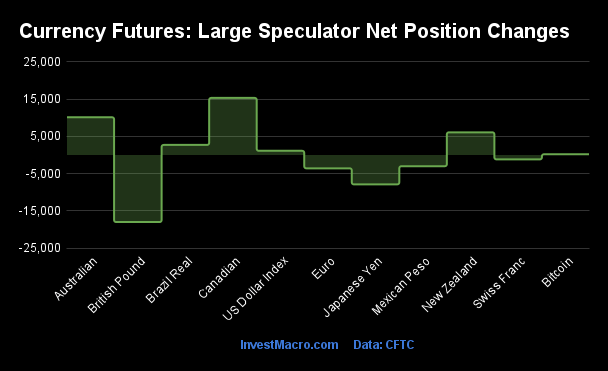
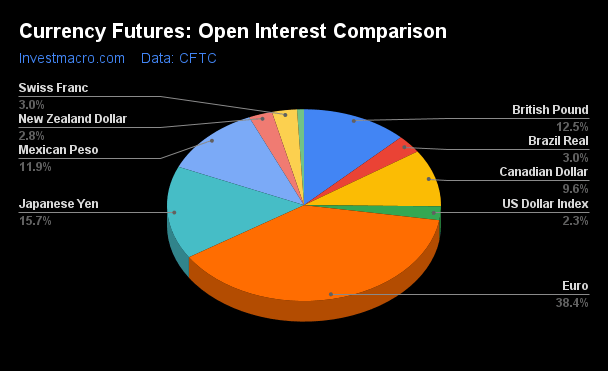
The COT currency market speculator bets were higher this week as six out of the eleven currency markets we cover had higher positioning while the other five markets had lower speculator contracts.

Leading the gains for the currency markets was the EuroFX (10,052 contracts) with the British Pound (3,968 contracts), US Dollar Index (2,367 contracts), Japanese Yen (2,219 contracts), the Swiss Franc (1,445 contracts) and Bitcoin (437 contracts) also recording positive weeks.

The currencies seeing declines in speculator bets on the week were the Canadian Dollar (-10,788 contracts) with the Australian Dollar (-10,205 contracts), the Brazilian Real (-4,564 contracts), New Zealand Dollar (-2,068 contracts) and the Mexican Peso (-1,628 contracts) also registering lower bets on the week.

British Pound Sterling Speculator Bets rebound this week

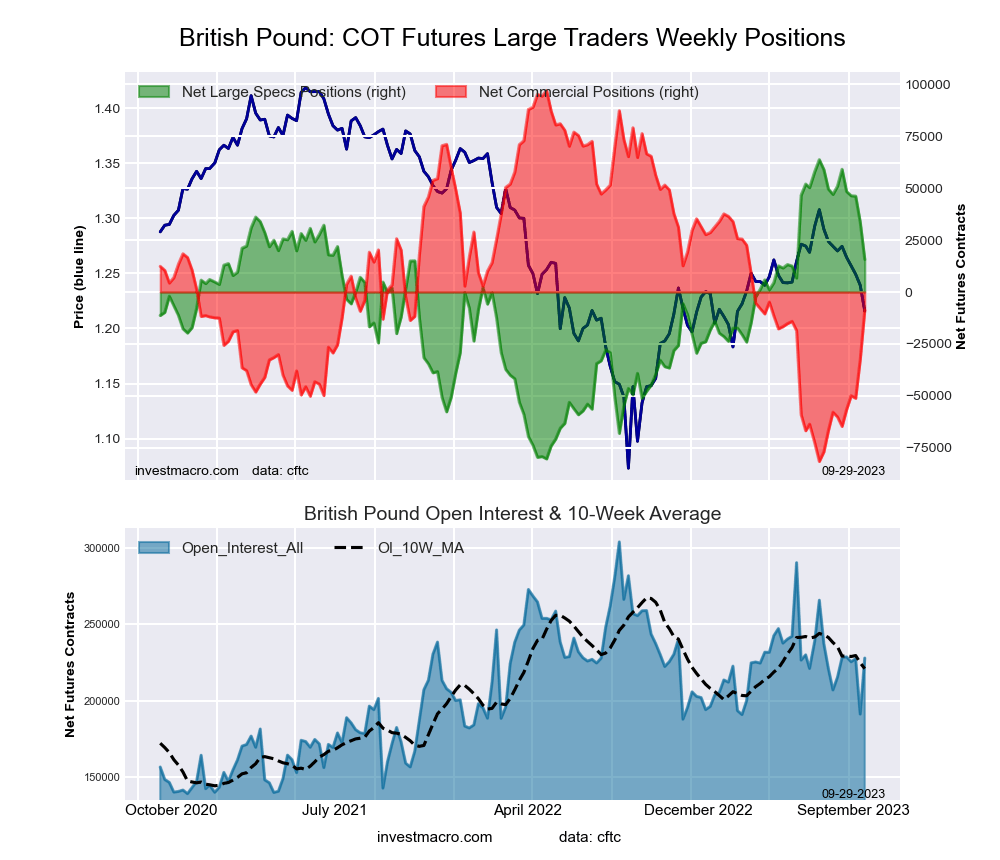
Highlighting the COT currency’s data is this week’s rebound and the overall strength in the speculator’s positioning of the British Pound Sterling. Large speculative Sterling positions rose this week by almost +4,000 contracts and turned around a three-week streak of declines.

The Sterling speculative level has been on the move higher recently and is at its strongest levels in years with the average contract level of the past ten weeks right around +50,000 contracts. On July 18th, the bullish bets for the Sterling (+63,729 contracts) ascended to the highest level since July 31st of 2007, a span of almost exactly sixteen years.

The Pound’s positioning has been helped out by continued high inflation in the United Kingdom which brings forecasts for higher interest rates. The UK consumer inflation numbers for July came in at 6.8 percent with a core inflation reading of 6.9 percent. The Bank of England has boosted the interest rate to combat inflation for fourteen consecutive meetings and brought the rate to 5.25 percent at it’s last meeting which is the highest since 2008. The BOE may need to further push the rate higher to bring inflation back down to reasonable levels which in turn can provide the UK currency with an interest rate differential advantage against other currencies.

The Pound Sterling exchange rate against the US Dollar has been in an uptrend over recent months with the exchange rate hitting over 1.3000 in July. Since that 2023 high, the Sterling has cooled off some but remains over the psychologically significant 1.2500 exchange rate.


Data Snapshot of Forex Market Traders | Columns Legend
Aug-15-2023OIOI-IndexSpec-NetSpec-IndexCom-NetCOM-IndexSmalls-NetSmalls-Index
USD Index26,95414,99133-6,048661,05723
EUR760,23369159,86380-205,2842145,42151
GBP215,3404650,98891-60,188129,20076
JPY247,95475-80,9612290,49780-9,53634
CHF42,79445-4,007464,20049-19357
CAD157,82732-11,4114413,76966-2,35818
AUD204,45891-53,3973565,25868-11,86124
NZD46,78153-2,436474,96958-2,53320
MXN228,9844882,02389-85,227113,20432
RUB20,93047,54331-7,15069-39324
BRL42,0312823,47566-25,216341,74158
Bitcoin15,43273-7126514069829


Strength Scores led by British Pound & Mexican Peso

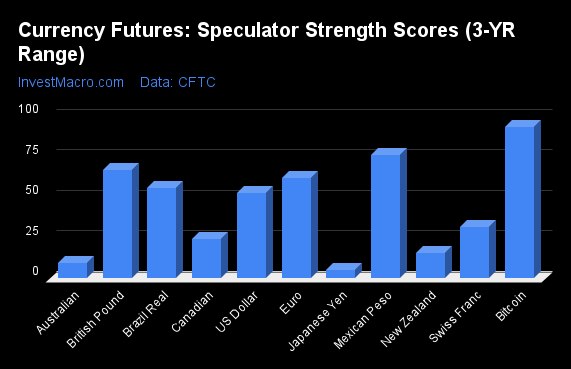
COT Strength Scores (a normalized measure of Speculator positions over a 3-Year range, from 0 to 100 where above 80 is Extreme-Bullish and below 20 is Extreme-Bearish) showed that the British Pound (91 percent), the Mexican Peso (89 percent) and the EuroFX (80 percent) lead the currency markets this week. The Brazilian Real (66 percent) and Bitcoin (65 percent) come in as the next highest in the weekly strength scores.

On the downside, the Japanese Yen (22 percent) and the US Dollar Index (33 percent) come in at the lowest strength levels currently. The next lowest strength scores are the Australian Dollar (35 percent) and the Canadian Dollar (44 percent).

Strength Statistics:
US Dollar Index (33.3 percent) vs US Dollar Index previous week (29.3 percent)
EuroFX (80.0 percent) vs EuroFX previous week (76.1 percent)
British Pound Sterling (91.2 percent) vs British Pound Sterling previous week (88.4 percent)
Japanese Yen (21.9 percent) vs Japanese Yen previous week (20.6 percent)
Swiss Franc (45.5 percent) vs Swiss Franc previous week (41.6 percent)
Canadian Dollar (43.9 percent) vs Canadian Dollar previous week (54.0 percent)
Australian Dollar (35.3 percent) vs Australian Dollar previous week (44.8 percent)
New Zealand Dollar (47.0 percent) vs New Zealand Dollar previous week (52.6 percent)
Mexican Peso (89.2 percent) vs Mexican Peso previous week (90.2 percent)
Brazilian Real (65.6 percent) vs Brazilian Real previous week (71.4 percent)
Bitcoin (64.5 percent) vs Bitcoin previous week (56.9 percent)


Bitcoin & Japanese Yen top the 6-Week Strength Trends

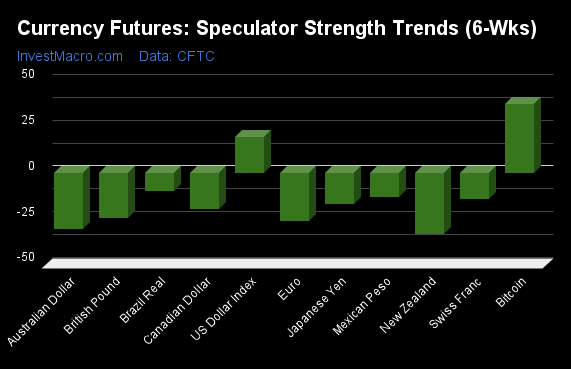
COT Strength Score Trends (or move index, calculates the 6-week changes in strength scores) showed that Bitcoin (24 percent) and the Japanese Yen (22 percent) lead the past six weeks trends for the currencies. The EuroFX (7 percent) and the British Pound (1 percent) are the next highest positive movers in the latest trends data.

The US Dollar Index (-16 percent) leads the downside trend scores currently with the Canadian Dollar (-15 percent), Brazilian Real (-10 percent) and the New Zealand Dollar (-9 percent) following next with lower trend scores.

Strength Trend Statistics:
US Dollar Index (-15.6 percent) vs US Dollar Index previous week (-20.6 percent)
EuroFX (6.6 percent) vs EuroFX previous week (1.8 percent)
British Pound Sterling (0.5 percent) vs British Pound Sterling previous week (-3.5 percent)
Japanese Yen (21.9 percent) vs Japanese Yen previous week (17.6 percent)
Swiss Franc (-1.6 percent) vs Swiss Franc previous week (-1.4 percent)
Canadian Dollar (-14.9 percent) vs Canadian Dollar previous week (2.1 percent)
Australian Dollar (-8.2 percent) vs Australian Dollar previous week (-3.5 percent)
New Zealand Dollar (-8.9 percent) vs New Zealand Dollar previous week (1.3 percent)
Mexican Peso (-8.1 percent) vs Mexican Peso previous week (-7.8 percent)
Brazilian Real (-9.7 percent) vs Brazilian Real previous week (-4.5 percent)
Bitcoin (23.8 percent) vs Bitcoin previous week (16.5 percent)


Individual COT Forex Markets:

US Dollar Index Futures:

US Dollar Index Forex Futures COT ChartThe US Dollar Index large speculator standing this week totaled a net position of 4,991 contracts in the data reported through Tuesday. This was a weekly boost of 2,367 contracts from the previous week which had a total of 2,624 net contracts.

This week’s current strength score (the trader positioning range over the past three years, measured from 0 to 100) shows the speculators are currently Bearish with a score of 33.3 percent. The commercials are Bullish with a score of 66.1 percent and the small traders (not shown in chart) are Bearish with a score of 23.0 percent.

Price Trend-Following Model: Strong Uptrend

Our weekly trend-following model classifies the current market price position as: Strong Uptrend. The current action for the model is considered to be: Hold – Maintain Long Position.

US DOLLAR INDEX StatisticsSPECULATORSCOMMERCIALSSMALL TRADERS
– Percent of Open Interest Longs:72.85.816.3
– Percent of Open Interest Shorts:54.328.212.4
– Net Position:4,991-6,0481,057
– Gross Longs:19,6171,5564,404
– Gross Shorts:14,6267,6043,347
– Long to Short Ratio:1.3 to 10.2 to 11.3 to 1
NET POSITION TREND:
– Strength Index Score (3 Year Range Pct):33.366.123.0
– Strength Index Reading (3 Year Range):BearishBullishBearish
NET POSITION MOVEMENT INDEX:
– 6-Week Change in Strength Index:-15.616.7-14.1


Euro Currency Futures:

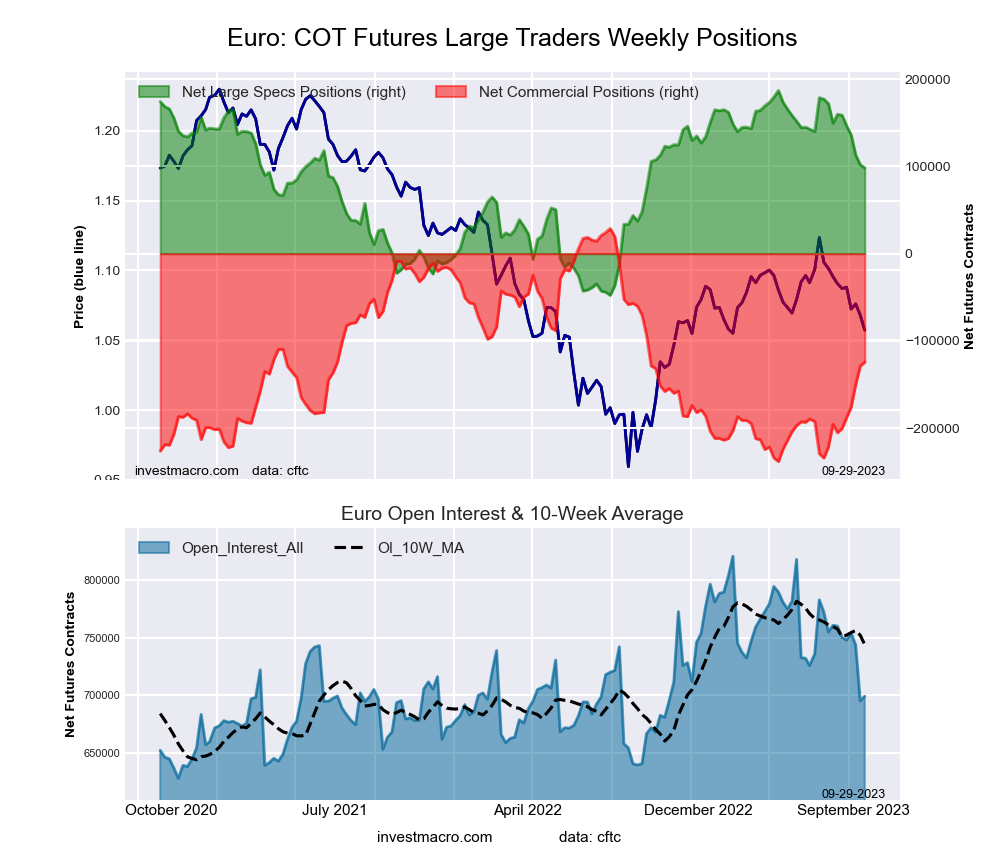
Euro Currency Futures COT ChartThe Euro Currency large speculator standing this week totaled a net position of 159,863 contracts in the data reported through Tuesday. This was a weekly lift of 10,052 contracts from the previous week which had a total of 149,811 net contracts.

This week’s current strength score (the trader positioning range over the past three years, measured from 0 to 100) shows the speculators are currently Bullish with a score of 80.0 percent. The commercials are Bearish with a score of 21.1 percent and the small traders (not shown in chart) are Bullish with a score of 51.4 percent.

Price Trend-Following Model: Weak Uptrend

Our weekly trend-following model classifies the current market price position as: Weak Uptrend. The current action for the model is considered to be: Hold – Maintain Long Position.

EURO Currency StatisticsSPECULATORSCOMMERCIALSSMALL TRADERS
– Percent of Open Interest Longs:30.655.412.0
– Percent of Open Interest Shorts:9.682.46.0
– Net Position:159,863-205,28445,421
– Gross Longs:232,466420,94290,895
– Gross Shorts:72,603626,22645,474
– Long to Short Ratio:3.2 to 10.7 to 12.0 to 1
NET POSITION TREND:
– Strength Index Score (3 Year Range Pct):80.021.151.4
– Strength Index Reading (3 Year Range):BullishBearishBullish
NET POSITION MOVEMENT INDEX:
– 6-Week Change in Strength Index:6.6-5.3-1.9


British Pound Sterling Futures:

British Pound Sterling Futures COT ChartThe British Pound Sterling large speculator standing this week totaled a net position of 50,988 contracts in the data reported through Tuesday. This was a weekly advance of 3,968 contracts from the previous week which had a total of 47,020 net contracts.

This week’s current strength score (the trader positioning range over the past three years, measured from 0 to 100) shows the speculators are currently Bullish-Extreme with a score of 91.2 percent. The commercials are Bearish-Extreme with a score of 12.0 percent and the small traders (not shown in chart) are Bullish with a score of 76.1 percent.

Price Trend-Following Model: Uptrend

Our weekly trend-following model classifies the current market price position as: Uptrend. The current action for the model is considered to be: Hold – Maintain Long Position.

BRITISH POUND StatisticsSPECULATORSCOMMERCIALSSMALL TRADERS
– Percent of Open Interest Longs:42.036.016.1
– Percent of Open Interest Shorts:18.463.911.8
– Net Position:50,988-60,1889,200
– Gross Longs:90,54177,49634,690
– Gross Shorts:39,553137,68425,490
– Long to Short Ratio:2.3 to 10.6 to 11.4 to 1
NET POSITION TREND:
– Strength Index Score (3 Year Range Pct):91.212.076.1
– Strength Index Reading (3 Year Range):Bullish-ExtremeBearish-ExtremeBullish
NET POSITION MOVEMENT INDEX:
– 6-Week Change in Strength Index:0.51.9-8.2


Japanese Yen Futures:

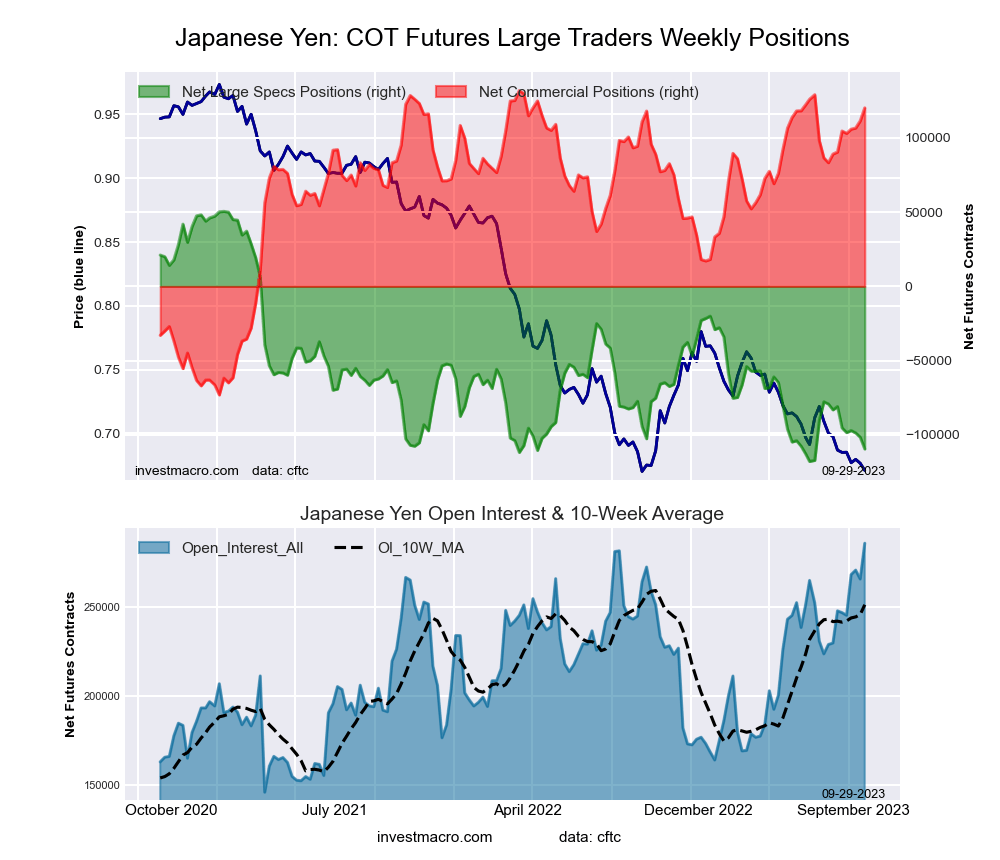
Japanese Yen Forex Futures COT ChartThe Japanese Yen large speculator standing this week totaled a net position of -80,961 contracts in the data reported through Tuesday. This was a weekly boost of 2,219 contracts from the previous week which had a total of -83,180 net contracts.

This week’s current strength score (the trader positioning range over the past three years, measured from 0 to 100) shows the speculators are currently Bearish with a score of 21.9 percent. The commercials are Bullish with a score of 79.8 percent and the small traders (not shown in chart) are Bearish with a score of 34.1 percent.

Price Trend-Following Model: Downtrend

Our weekly trend-following model classifies the current market price position as: Downtrend. The current action for the model is considered to be: Hold – Maintain Short Position.

JAPANESE YEN StatisticsSPECULATORSCOMMERCIALSSMALL TRADERS
– Percent of Open Interest Longs:14.070.813.8
– Percent of Open Interest Shorts:46.734.317.6
– Net Position:-80,96190,497-9,536
– Gross Longs:34,789175,63634,192
– Gross Shorts:115,75085,13943,728
– Long to Short Ratio:0.3 to 12.1 to 10.8 to 1
NET POSITION TREND:
– Strength Index Score (3 Year Range Pct):21.979.834.1
– Strength Index Reading (3 Year Range):BearishBullishBearish
NET POSITION MOVEMENT INDEX:
– 6-Week Change in Strength Index:21.9-17.3-2.9


Swiss Franc Futures:

Swiss Franc Forex Futures COT ChartThe Swiss Franc large speculator standing this week totaled a net position of -4,007 contracts in the data reported through Tuesday. This was a weekly gain of 1,445 contracts from the previous week which had a total of -5,452 net contracts.

This week’s current strength score (the trader positioning range over the past three years, measured from 0 to 100) shows the speculators are currently Bearish with a score of 45.5 percent. The commercials are Bearish with a score of 49.3 percent and the small traders (not shown in chart) are Bullish with a score of 56.9 percent.

Price Trend-Following Model: Uptrend

Our weekly trend-following model classifies the current market price position as: Uptrend. The current action for the model is considered to be: Hold – Maintain Long Position.

SWISS FRANC StatisticsSPECULATORSCOMMERCIALSSMALL TRADERS
– Percent of Open Interest Longs:20.344.035.7
– Percent of Open Interest Shorts:29.734.136.1
– Net Position:-4,0074,200-193
– Gross Longs:8,69318,81215,262
– Gross Shorts:12,70014,61215,455
– Long to Short Ratio:0.7 to 11.3 to 11.0 to 1
NET POSITION TREND:
– Strength Index Score (3 Year Range Pct):45.549.356.9
– Strength Index Reading (3 Year Range):BearishBearishBullish
NET POSITION MOVEMENT INDEX:
– 6-Week Change in Strength Index:-1.6-5.913.4


Canadian Dollar Futures:

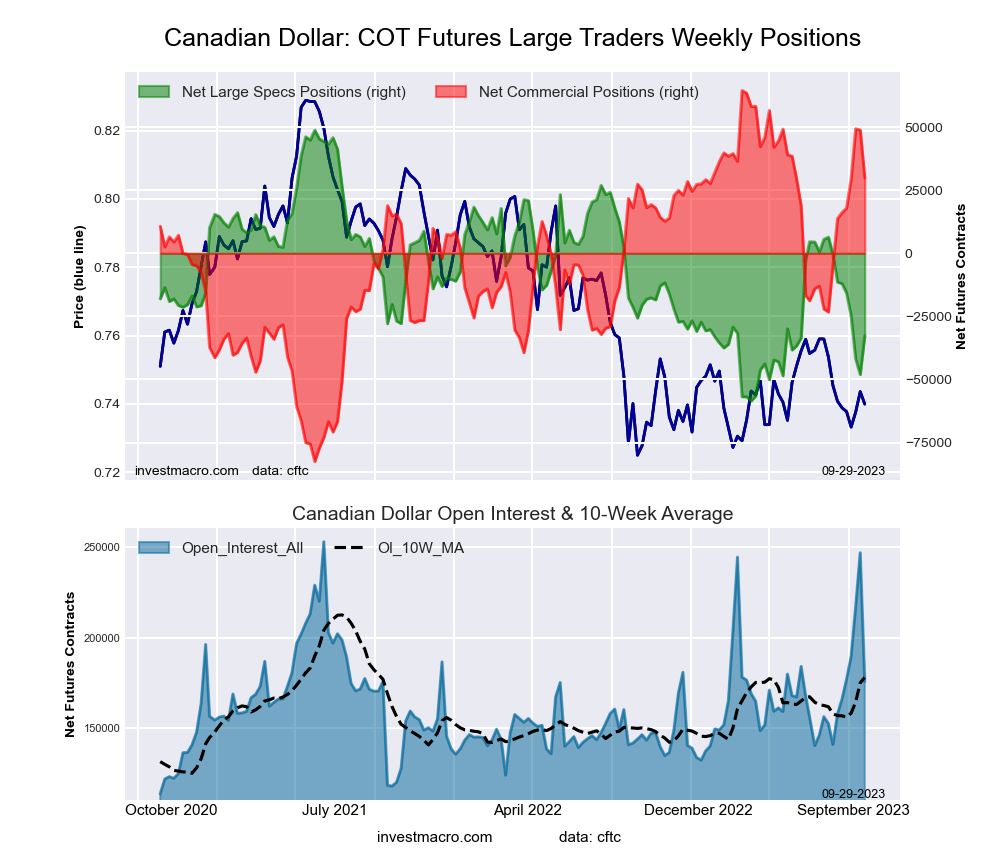
Canadian Dollar Forex Futures COT ChartThe Canadian Dollar large speculator standing this week totaled a net position of -11,411 contracts in the data reported through Tuesday. This was a weekly fall of -10,788 contracts from the previous week which had a total of -623 net contracts.

This week’s current strength score (the trader positioning range over the past three years, measured from 0 to 100) shows the speculators are currently Bearish with a score of 43.9 percent. The commercials are Bullish with a score of 65.5 percent and the small traders (not shown in chart) are Bearish-Extreme with a score of 17.6 percent.

Price Trend-Following Model: Weak Uptrend

Our weekly trend-following model classifies the current market price position as: Weak Uptrend. The current action for the model is considered to be: Hold – Maintain Long Position.

CANADIAN DOLLAR StatisticsSPECULATORSCOMMERCIALSSMALL TRADERS
– Percent of Open Interest Longs:23.554.319.3
– Percent of Open Interest Shorts:30.745.620.8
– Net Position:-11,41113,769-2,358
– Gross Longs:37,11285,77430,496
– Gross Shorts:48,52372,00532,854
– Long to Short Ratio:0.8 to 11.2 to 10.9 to 1
NET POSITION TREND:
– Strength Index Score (3 Year Range Pct):43.965.517.6
– Strength Index Reading (3 Year Range):BearishBullishBearish-Extreme
NET POSITION MOVEMENT INDEX:
– 6-Week Change in Strength Index:-14.922.2-37.0


Australian Dollar Futures:

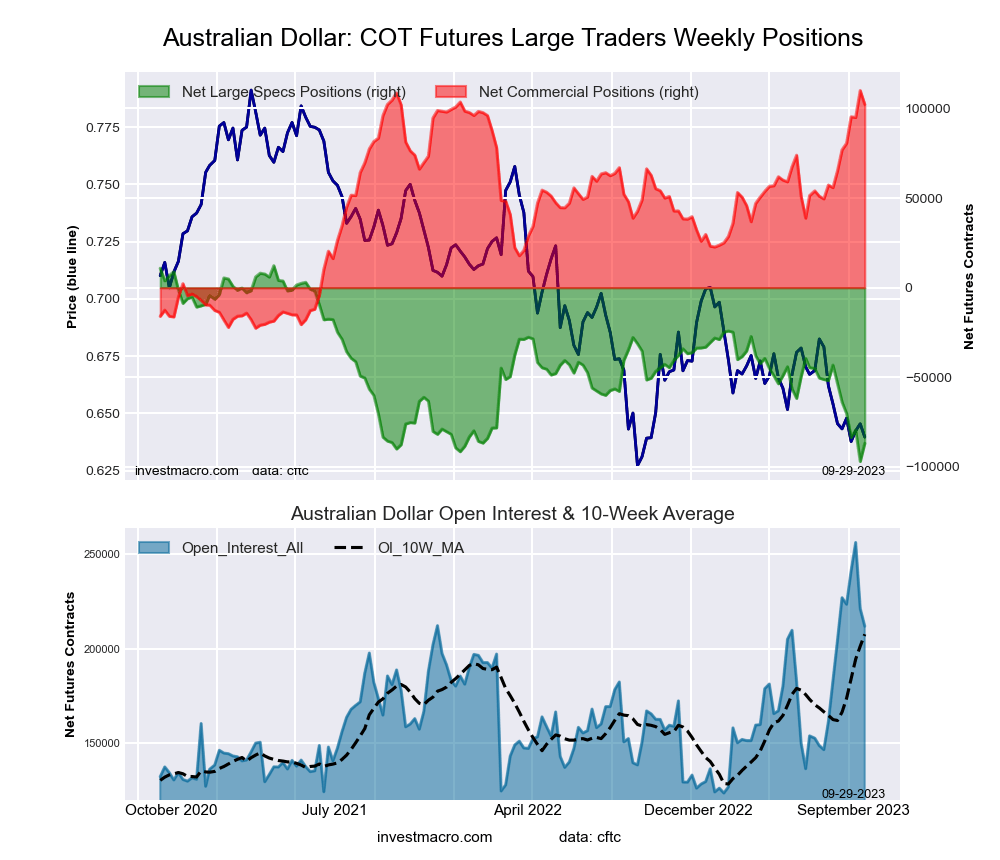
Australian Dollar Forex Futures COT ChartThe Australian Dollar large speculator standing this week totaled a net position of -53,397 contracts in the data reported through Tuesday. This was a weekly fall of -10,205 contracts from the previous week which had a total of -43,192 net contracts.

This week’s current strength score (the trader positioning range over the past three years, measured from 0 to 100) shows the speculators are currently Bearish with a score of 35.3 percent. The commercials are Bullish with a score of 67.6 percent and the small traders (not shown in chart) are Bearish with a score of 23.5 percent.

Price Trend-Following Model: Strong Downtrend

Our weekly trend-following model classifies the current market price position as: Strong Downtrend. The current action for the model is considered to be: Hold – Maintain Short Position.

AUSTRALIAN DOLLAR StatisticsSPECULATORSCOMMERCIALSSMALL TRADERS
– Percent of Open Interest Longs:33.653.410.0
– Percent of Open Interest Shorts:59.721.415.8
– Net Position:-53,39765,258-11,861
– Gross Longs:68,623109,11020,392
– Gross Shorts:122,02043,85232,253
– Long to Short Ratio:0.6 to 12.5 to 10.6 to 1
NET POSITION TREND:
– Strength Index Score (3 Year Range Pct):35.367.623.5
– Strength Index Reading (3 Year Range):BearishBullishBearish
NET POSITION MOVEMENT INDEX:
– 6-Week Change in Strength Index:-8.210.4-12.4


New Zealand Dollar Futures:

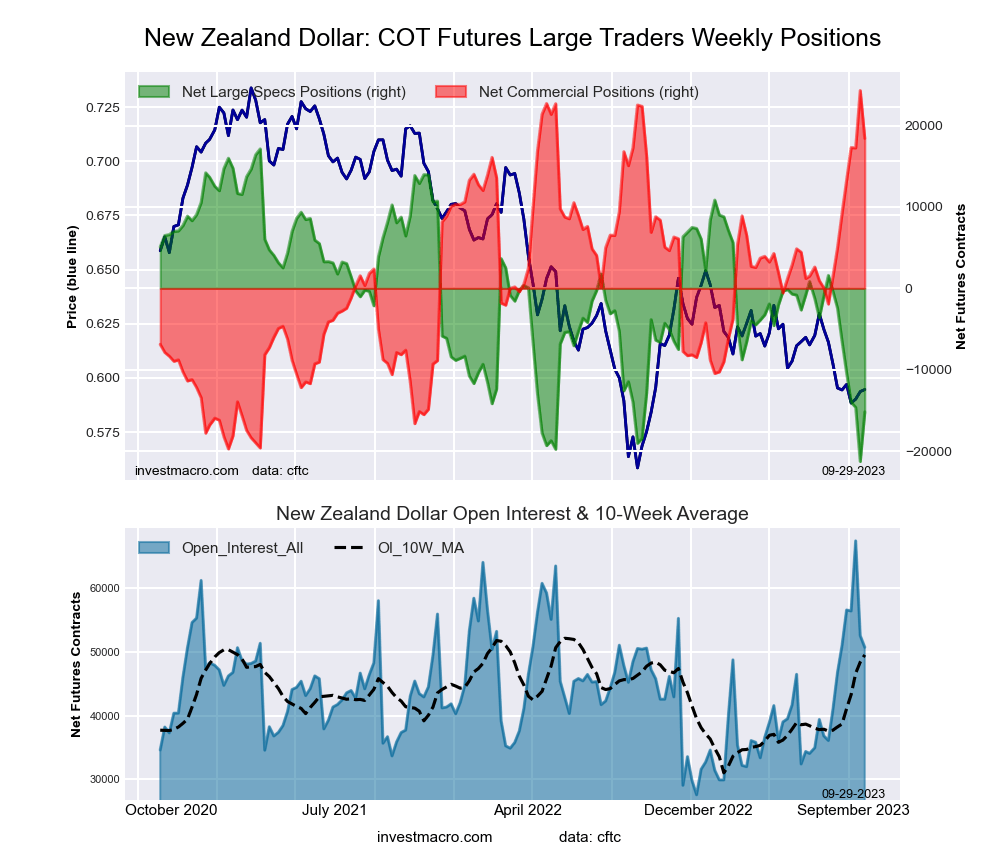
New Zealand Dollar Forex Futures COT ChartThe New Zealand Dollar large speculator standing this week totaled a net position of -2,436 contracts in the data reported through Tuesday. This was a weekly decline of -2,068 contracts from the previous week which had a total of -368 net contracts.

This week’s current strength score (the trader positioning range over the past three years, measured from 0 to 100) shows the speculators are currently Bearish with a score of 47.0 percent. The commercials are Bullish with a score of 58.2 percent and the small traders (not shown in chart) are Bearish-Extreme with a score of 19.9 percent.

Price Trend-Following Model: Strong Downtrend

Our weekly trend-following model classifies the current market price position as: Strong Downtrend. The current action for the model is considered to be: Hold – Maintain Short Position.

NEW ZEALAND DOLLAR StatisticsSPECULATORSCOMMERCIALSSMALL TRADERS
– Percent of Open Interest Longs:46.846.66.3
– Percent of Open Interest Shorts:52.036.011.7
– Net Position:-2,4364,969-2,533
– Gross Longs:21,91021,7952,942
– Gross Shorts:24,34616,8265,475
– Long to Short Ratio:0.9 to 11.3 to 10.5 to 1
NET POSITION TREND:
– Strength Index Score (3 Year Range Pct):47.058.219.9
– Strength Index Reading (3 Year Range):BearishBullishBearish-Extreme
NET POSITION MOVEMENT INDEX:
– 6-Week Change in Strength Index:-8.98.2-2.3


Mexican Peso Futures:

Mexican Peso Futures COT ChartThe Mexican Peso large speculator standing this week totaled a net position of 82,023 contracts in the data reported through Tuesday. This was a weekly decrease of -1,628 contracts from the previous week which had a total of 83,651 net contracts.

This week’s current strength score (the trader positioning range over the past three years, measured from 0 to 100) shows the speculators are currently Bullish-Extreme with a score of 89.2 percent. The commercials are Bearish-Extreme with a score of 10.6 percent and the small traders (not shown in chart) are Bearish with a score of 31.6 percent.

Price Trend-Following Model: Uptrend

Our weekly trend-following model classifies the current market price position as: Uptrend. The current action for the model is considered to be: Hold – Maintain Long Position.

MEXICAN PESO StatisticsSPECULATORSCOMMERCIALSSMALL TRADERS
– Percent of Open Interest Longs:47.847.43.6
– Percent of Open Interest Shorts:11.984.62.2
– Net Position:82,023-85,2273,204
– Gross Longs:109,340108,5968,197
– Gross Shorts:27,317193,8234,993
– Long to Short Ratio:4.0 to 10.6 to 11.6 to 1
NET POSITION TREND:
– Strength Index Score (3 Year Range Pct):89.210.631.6
– Strength Index Reading (3 Year Range):Bullish-ExtremeBearish-ExtremeBearish
NET POSITION MOVEMENT INDEX:
– 6-Week Change in Strength Index:-8.18.4-6.1


Brazilian Real Futures:

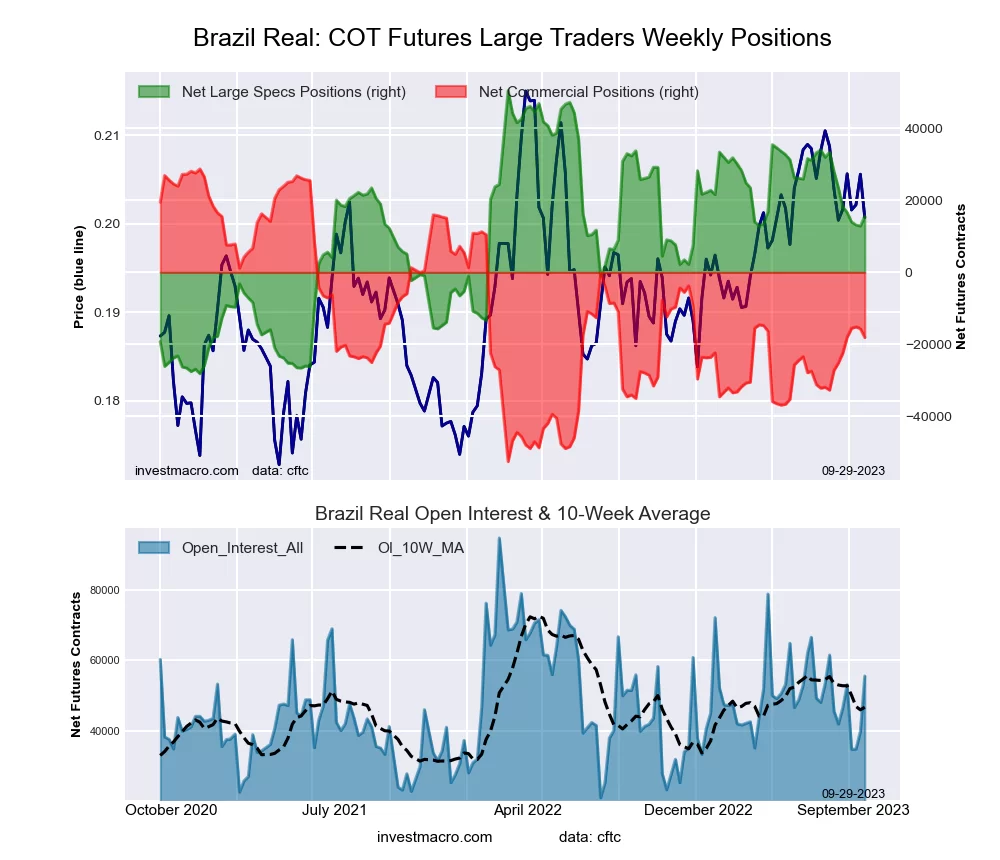
Brazil Real Futures COT ChartThe Brazilian Real large speculator standing this week totaled a net position of 23,475 contracts in the data reported through Tuesday. This was a weekly lowering of -4,564 contracts from the previous week which had a total of 28,039 net contracts.

This week’s current strength score (the trader positioning range over the past three years, measured from 0 to 100) shows the speculators are currently Bullish with a score of 65.6 percent. The commercials are Bearish with a score of 33.6 percent and the small traders (not shown in chart) are Bullish with a score of 57.8 percent.

Price Trend-Following Model: Weak Uptrend

Our weekly trend-following model classifies the current market price position as: Weak Uptrend. The current action for the model is considered to be: Hold – Maintain Long Position.

BRAZIL REAL StatisticsSPECULATORSCOMMERCIALSSMALL TRADERS
– Percent of Open Interest Longs:65.823.99.0
– Percent of Open Interest Shorts:10.083.94.8
– Net Position:23,475-25,2161,741
– Gross Longs:27,67610,0653,774
– Gross Shorts:4,20135,2812,033
– Long to Short Ratio:6.6 to 10.3 to 11.9 to 1
NET POSITION TREND:
– Strength Index Score (3 Year Range Pct):65.633.657.8
– Strength Index Reading (3 Year Range):BullishBearishBullish
NET POSITION MOVEMENT INDEX:
– 6-Week Change in Strength Index:-9.72.743.0


Bitcoin Futures:

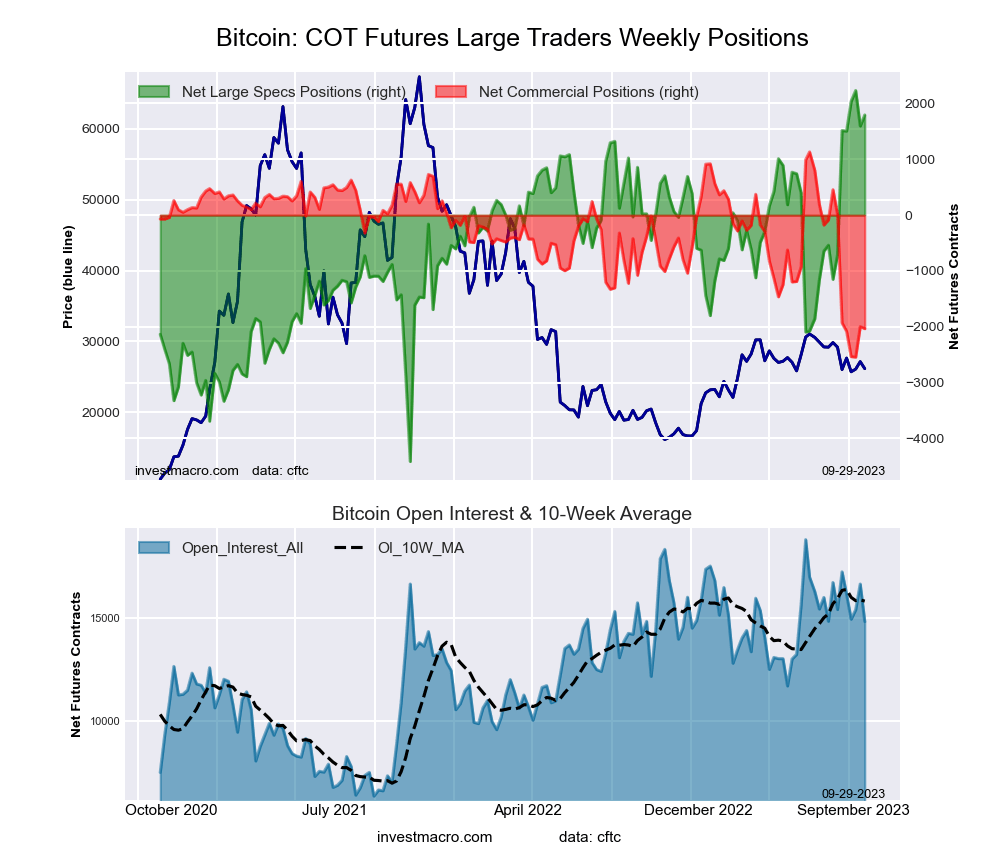
Bitcoin Crypto Futures COT ChartThe Bitcoin large speculator standing this week totaled a net position of -712 contracts in the data reported through Tuesday. This was a weekly increase of 437 contracts from the previous week which had a total of -1,149 net contracts.

This week’s current strength score (the trader positioning range over the past three years, measured from 0 to 100) shows the speculators are currently Bullish with a score of 64.5 percent. The commercials are Bullish with a score of 56.9 percent and the small traders (not shown in chart) are Bearish with a score of 28.8 percent.

Price Trend-Following Model: Weak Uptrend

Our weekly trend-following model classifies the current market price position as: Weak Uptrend. The current action for the model is considered to be: Hold – Maintain Long Position.

BITCOIN StatisticsSPECULATORSCOMMERCIALSSMALL TRADERS
– Percent of Open Interest Longs:77.63.98.4
– Percent of Open Interest Shorts:82.33.83.9
– Net Position:-71214698
– Gross Longs:11,9816021,299
– Gross Shorts:12,693588601
– Long to Short Ratio:0.9 to 11.0 to 12.2 to 1
NET POSITION TREND:
– Strength Index Score (3 Year Range Pct):64.556.928.8
– Strength Index Reading (3 Year Range):BullishBullishBearish
NET POSITION MOVEMENT INDEX:
– 6-Week Change in Strength Index:23.8-43.1-5.6


Article By InvestMacroReceive our weekly COT Newsletter

*COT Report: The COT data, released weekly to the public each Friday, is updated through the most recent Tuesday (data is 3 days old) and shows a quick view of how large speculators or non-commercials (for-profit traders) were positioned in the futures markets.

The CFTC categorizes trader positions according to commercial hedgers (traders who use futures contracts for hedging as part of the business), non-commercials (large traders who speculate to realize trading profits) and nonreportable traders (usually small traders/speculators) as well as their open interest (contracts open in the market at time of reporting). See CFTC criteria here.
Speculator Extremes: VIX, Cocoa, GBP, US Bonds lead Bullish & Bearish Positions

By InvestMacro

The latest update for the weekly Commitment of Traders (COT) report was released by the Commodity Futures Trading Commission (CFTC) on Friday for data ending on August 15th.

This weekly Extreme Positions report highlights the Most Bullish and Most Bearish Positions for the speculator category. Extreme positioning in these markets can foreshadow strong moves in the underlying market.

To signify an extreme position, we use the Strength Index (also known as the COT Index) of each instrument, a common method of measuring COT data. The Strength Index is simply a comparison of current trader positions against the range of positions over the previous 3 years. We use over 80 percent as extremely bullish and under 20 percent as extremely bearish. (Compare Strength Index scores across all markets in the data table or cot leaders table)


Here Are This Week’s Most Bullish Speculator Positions:

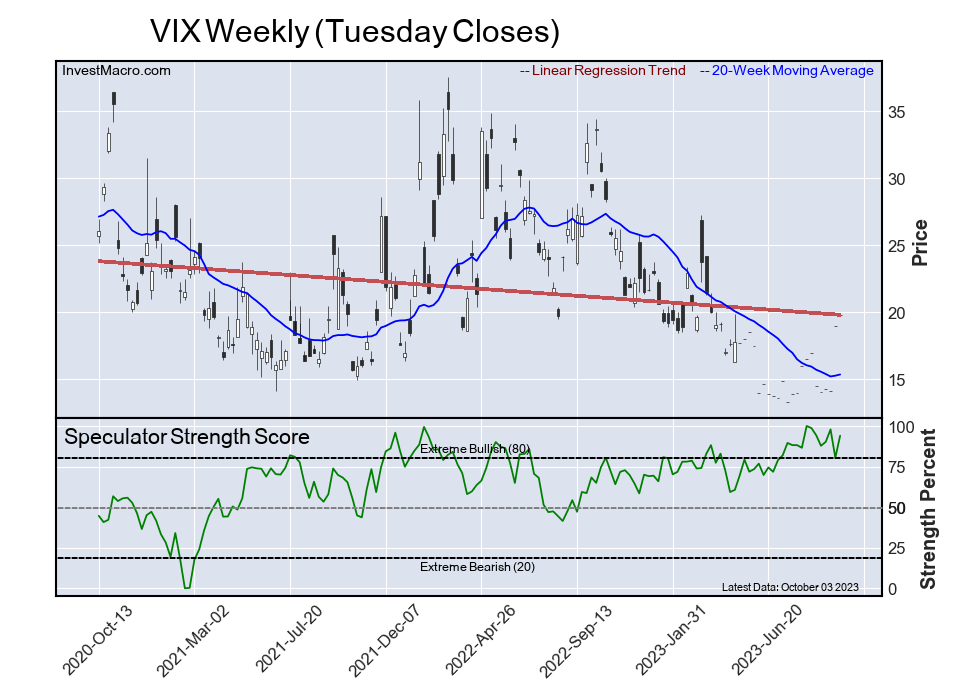
VIX


The VIX speculator position comes in as the most bullish extreme standing this week. The VIX speculator level is currently at a 100.0 percent score of its 3-year range.

The six-week trend for the percent strength score totaled 21.1 this week. The overall net speculator position was a total of -25,985 net contracts this week with a change of 18,419 contract in the weekly speculator bets.


Cocoa Futures


The Cocoa Futures speculator position comes next in the extreme standings this week. The Cocoa Futures speculator level is now at a 97.3 percent score of its 3-year range.

The six-week trend for the percent strength score was 5.1 this week. The speculator position registered 77,125 net contracts this week with a weekly change of -2,377 contracts in speculator bets.


Speculators or Non-Commercials Notes:

Speculators, classified as non-commercial traders by the CFTC, are made up of large commodity funds, hedge funds and other significant for-profit participants. The Specs are generally regarded as trend-followers in their behavior towards price action – net speculator bets and prices tend to go in the same directions. These traders often look to buy when prices are rising and sell when prices are falling. To illustrate this point, many times speculator contracts can be found at their most extremes (bullish or bearish) when prices are also close to their highest or lowest levels.

These extreme levels can be dangerous for the large speculators as the trade is most crowded, there is less trading ammunition still sitting on the sidelines to push the trend further and prices have moved a significant distance. When the trend becomes exhausted, some speculators take profits while others look to also exit positions when prices fail to continue in the same direction. This process usually plays out over many months to years and can ultimately create a reverse effect where prices start to fall and speculators start a process of selling when prices are falling.


British Pound


The British Pound speculator position comes in third this week in the extreme standings. The British Pound speculator level resides at a 91.2 percent score of its 3-year range.

The six-week trend for the speculator strength score came in at 0.5 this week. The overall speculator position was 50,988 net contracts this week with a change of 3,968 contracts in the weekly speculator bets.


Mexican Peso


The Mexican Peso speculator position comes up number four in the extreme standings this week. The Mexican Peso speculator level is at a 89.2 percent score of its 3-year range.

The six-week trend for the speculator strength score totaled a change of -8.1 this week. The overall speculator position was 82,023 net contracts this week with a change of -1,628 contracts in the speculator bets.


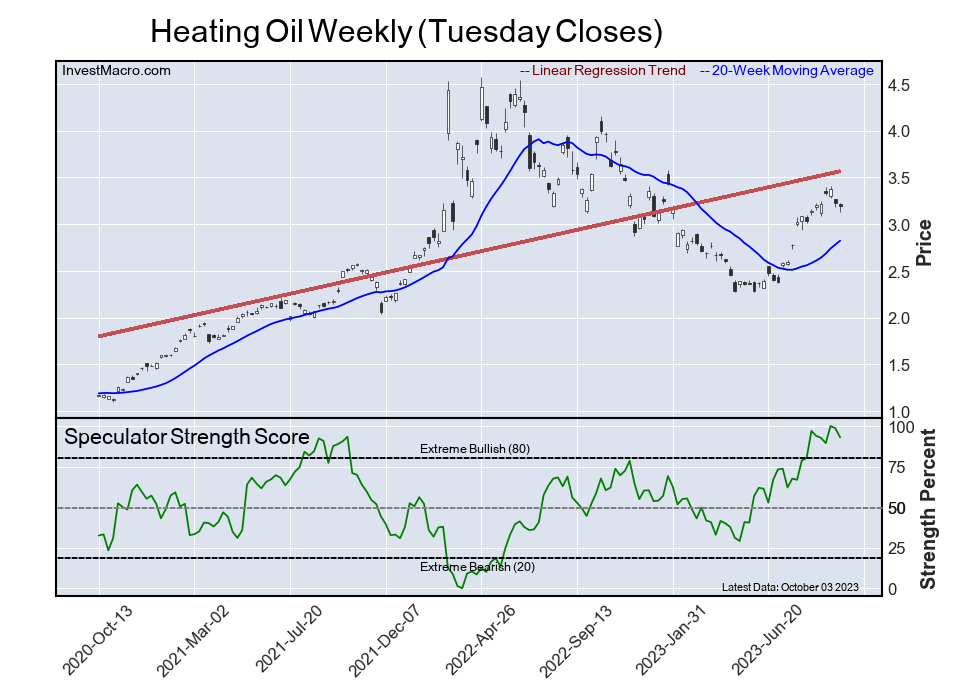
Heating Oil


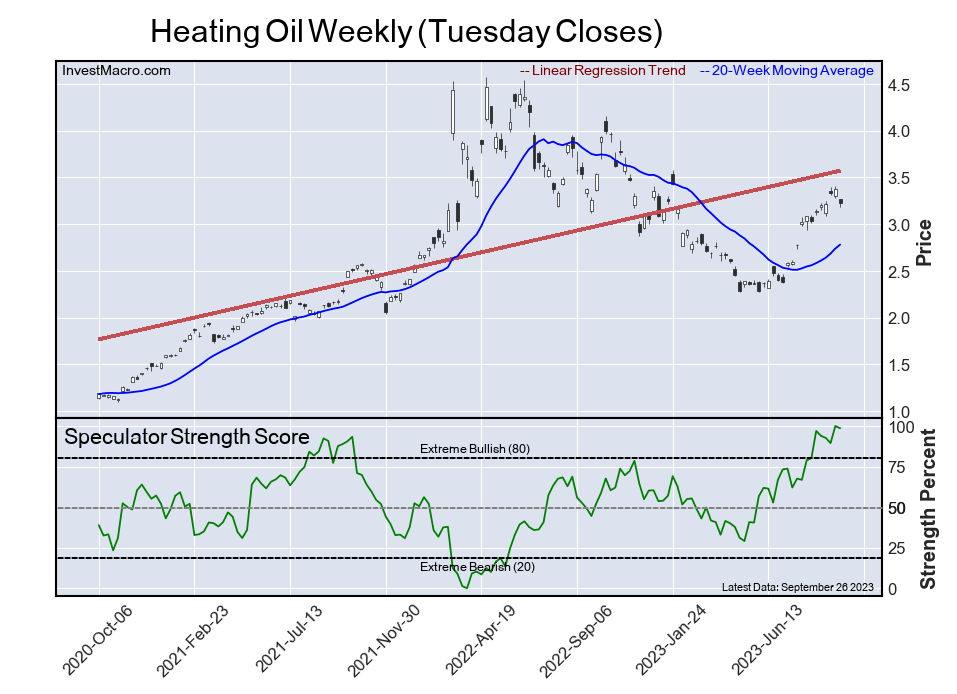
The Heating Oil speculator position rounds out the top five in this week’s bullish extreme standings. The Heating Oil speculator level sits at a 85.9 percent score of its 3-year range. The six-week trend for the speculator strength score was 7.5 this week.

The speculator position was 31,677 net contracts this week with a change of 796 contracts in the weekly speculator bets.


This Week’s Most Bearish Speculator Positions:

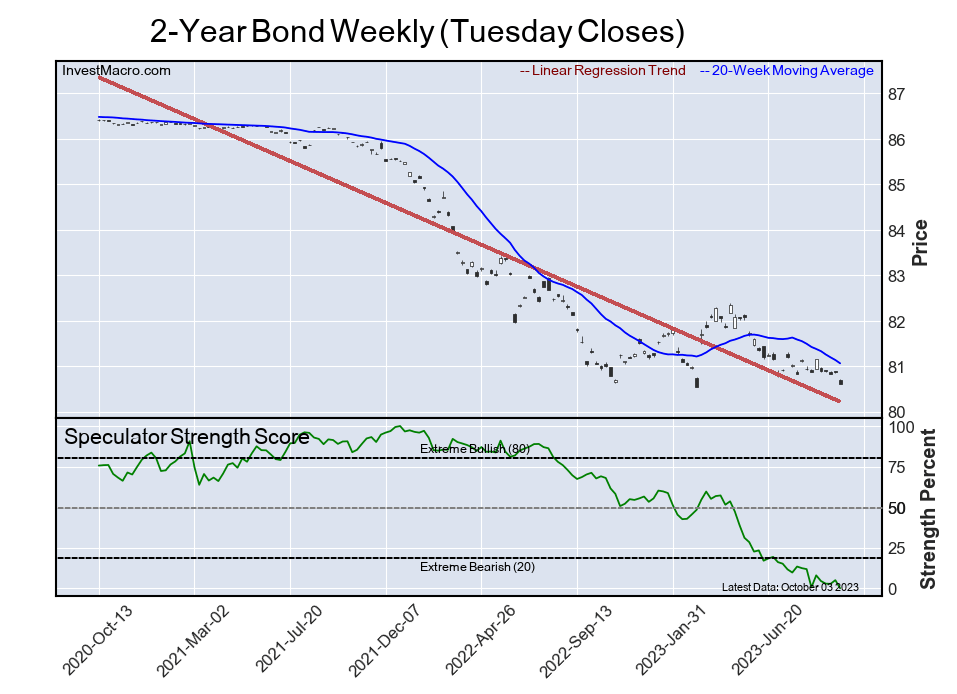
2-Year Bond


The 2-Year Bond speculator position comes in as the most bearish extreme standing this week. The 2-Year Bond speculator level is at a 2.3 percent score of its 3-year range.

The six-week trend for the speculator strength score was -4.8 this week. The overall speculator position was -1,117,392 net contracts this week with a change of -8,266 contracts in the speculator bets.


Ultra U.S. Treasury Bonds


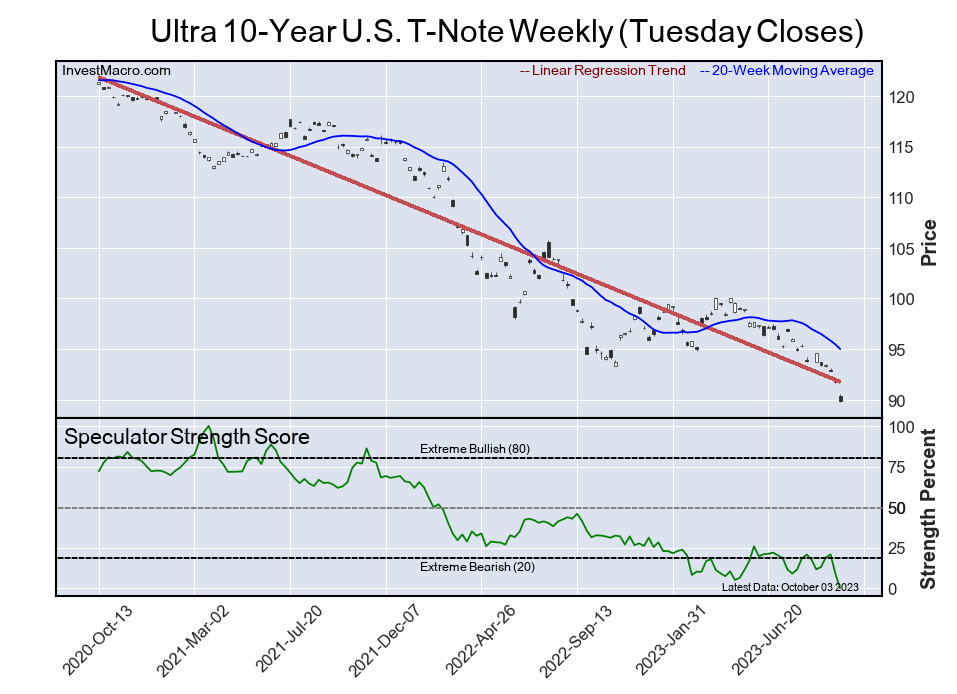
The Ultra U.S. Treasury Bonds speculator position comes in next for the most bearish extreme standing on the week. The Ultra U.S. Treasury Bonds speculator level is at a 4.4 percent score of its 3-year range.

The six-week trend for the speculator strength score was 2.1 this week. The speculator position was -445,497 net contracts this week with a change of -409 contracts in the weekly speculator bets.


5-Year Bond


The 5-Year Bond speculator position comes in as third most bearish extreme standing of the week. The 5-Year Bond speculator level resides at a 4.9 percent score of its 3-year range.

The six-week trend for the speculator strength score was -11.9 this week. The overall speculator position was -1,191,295 net contracts this week with a change of 39,012 contracts in the speculator bets.


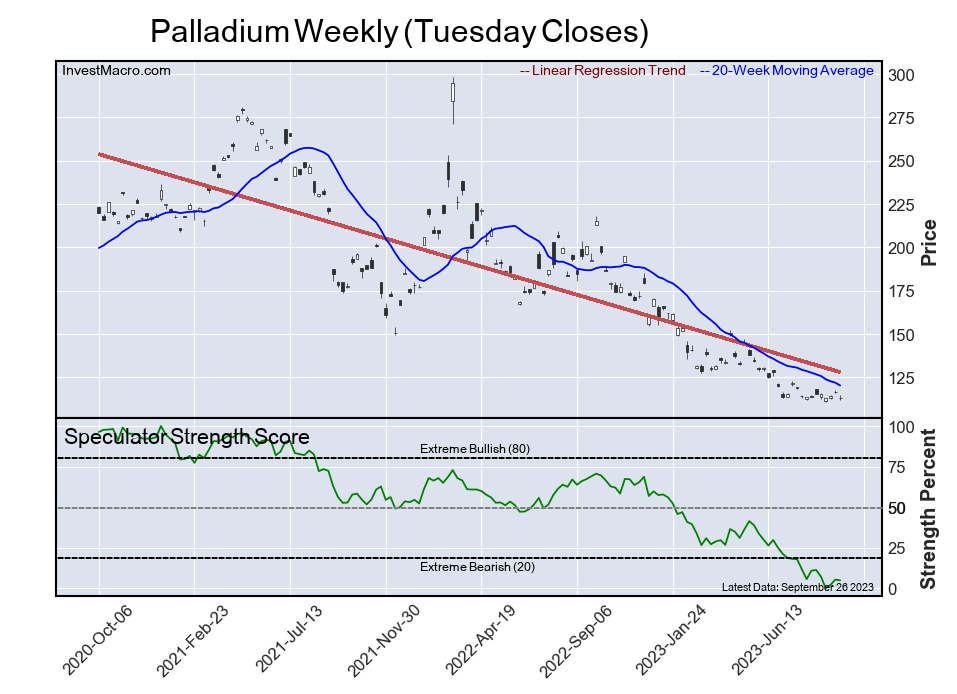
Palladium


The Palladium speculator position comes in as this week’s fourth most bearish extreme standing. The Palladium speculator level is at a 5.5 percent score of its 3-year range.

The six-week trend for the speculator strength score was -11.0 this week. The speculator position was -9,423 net contracts this week with a change of 769 contracts in the weekly speculator bets.


Corn


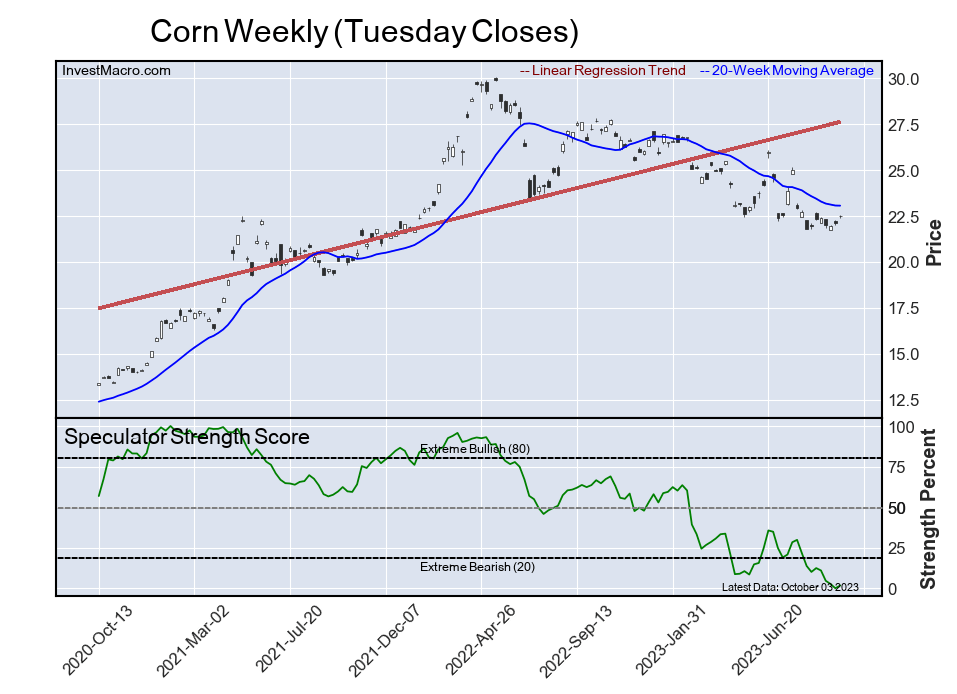
Finally, the Corn speculator position comes in as the fifth most bearish extreme standing for this week. The Corn speculator level is at a 5.8 percent score of its 3-year range.

The six-week trend for the speculator strength score was -12.0 this week. The speculator position was -26,966 net contracts this week with a change of -52,693 contracts in the weekly speculator bets.


Article By InvestMacroReceive our weekly COT Newsletter

*COT Report: The COT data, released weekly to the public each Friday, is updated through the most recent Tuesday (data is 3 days old) and shows a quick view of how large speculators or non-commercials (for-profit traders) were positioned in the futures markets.

The CFTC categorizes trader positions according to commercial hedgers (traders who use futures contracts for hedging as part of the business), non-commercials (large traders who speculate to realize trading profits) and nonreportable traders (usually small traders/speculators) as well as their open interest (contracts open in the market at time of reporting). See CFTC criteria here.
COT Metals Charts: Weekly Speculator Bets led lower by Gold & Copper

By InvestMacro

Here are the latest charts and statistics for the Commitment of Traders (COT) data published by the Commodities Futures Trading Commission (CFTC).

The latest COT data is updated through Tuesday August 15th and shows a quick view of how large traders (for-profit speculators and commercial entities) were positioned in the futures markets.

Weekly Speculator Changes led lower by Gold & Copper

The COT metals markets speculator bets were lower this week as just one out of the six metals markets we cover had higher positioning while the other five markets had lower speculator contracts.

Leading the gains for the metals was Palladium with a weekly rise of 769 contracts.

The markets with declines in speculator bets for the week were Gold (-21,849 contracts) with Copper (-15,641 contracts), Silver (-5,463 contracts), Platinum (-2,991 contracts) and Steel (-403 contracts) also recording lower bets on the week.


Data Snapshot of Commodity Market Traders | Columns Legend
Aug-15-2023OIOI-IndexSpec-NetSpec-IndexCom-NetCOM-IndexSmalls-NetSmalls-Index
Gold433,6115121,13630-141,9306920,79432
Silver138,215307,86129-23,2646615,40352
Copper224,21562-25,698920,665895,03350
Palladium20,511100-9,42369,72296-29924
Platinum84,557100116-5,866815,86547


Strength Scores led by Steel & Gold

COT Strength Scores (a normalized measure of Speculator positions over a 3-Year range, from 0 to 100 where above 80 is Extreme-Bullish and below 20 is Extreme-Bearish) showed that Steel (63 percent) and Gold (30 percent) lead the metals markets this week.  comes in as the next highest in the weekly strength scores.

On the downside, Palladium (6 percent), Copper (9 percent) and Platinum (16 percent) come in at the lowest strength level currently and are in Extreme-Bearish territory (below 20 percent).

Strength Statistics:
Gold (30.4 percent) vs Gold previous week (40.0 percent)
Silver (29.5 percent) vs Silver previous week (37.3 percent)
Copper (8.6 percent) vs Copper previous week (22.2 percent)
Platinum (15.6 percent) vs Platinum previous week (22.5 percent)
Palladium (5.5 percent) vs Palladium previous week (0.0 percent)
Steel (63.0 percent) vs Palladium previous week (64.1 percent)


Platinum & Gold top the negative 6-Week Strength Trends

COT Strength Score Trends (or move index, calculates the 6-week changes in strength scores) showed that all the metals markets have lower six-week trends scores.

Platinum (-19 percent), Gold (-18 percent, Copper (-15 percent) and Silver (-15 percent) lead the downside trend scores currently.

Move Statistics:
Gold (-18.5 percent) vs Gold previous week (-3.9 percent)
Silver (-14.5 percent) vs Silver previous week (-8.2 percent)
Copper (-14.6 percent) vs Copper previous week (-11.2 percent)
Platinum (-18.6 percent) vs Platinum previous week (-21.2 percent)
Palladium (-11.0 percent) vs Palladium previous week (-20.6 percent)
Steel (-9.8 percent) vs Steel previous week (-5.3 percent)


Individual Markets:

Gold Comex Futures:

Gold Futures COT ChartThe Gold Comex Futures large speculator standing this week came in at a net position of 121,136 contracts in the data reported through Tuesday. This was a weekly decline of -21,849 contracts from the previous week which had a total of 142,985 net contracts.

This week’s current strength score (the trader positioning range over the past three years, measured from 0 to 100) shows the speculators are currently Bearish with a score of 30.4 percent. The commercials are Bullish with a score of 69.2 percent and the small traders (not shown in chart) are Bearish with a score of 32.1 percent.

Price Trend-Following Model: Strong Downtrend

Our weekly trend-following model classifies the current market price position as: Strong Downtrend. The current action for the model is considered to be: Hold – Maintain Short Position.

Gold Futures StatisticsSPECULATORSCOMMERCIALSSMALL TRADERS
– Percent of Open Interest Longs:53.826.810.2
– Percent of Open Interest Shorts:25.859.55.4
– Net Position:121,136-141,93020,794
– Gross Longs:233,078116,06244,337
– Gross Shorts:111,942257,99223,543
– Long to Short Ratio:2.1 to 10.4 to 11.9 to 1
NET POSITION TREND:
– Strength Index Score (3 Year Range Pct):30.469.232.1
– Strength Index Reading (3 Year Range):BearishBullishBearish
NET POSITION MOVEMENT INDEX:
– 6-Week Change in Strength Index:-18.516.5-2.1


Silver Comex Futures:

Silver Futures COT ChartThe Silver Comex Futures large speculator standing this week came in at a net position of 7,861 contracts in the data reported through Tuesday. This was a weekly decline of -5,463 contracts from the previous week which had a total of 13,324 net contracts.

This week’s current strength score (the trader positioning range over the past three years, measured from 0 to 100) shows the speculators are currently Bearish with a score of 29.5 percent. The commercials are Bullish with a score of 65.7 percent and the small traders (not shown in chart) are Bullish with a score of 52.1 percent.

Price Trend-Following Model: Strong Downtrend

Our weekly trend-following model classifies the current market price position as: Strong Downtrend. The current action for the model is considered to be: Hold – Maintain Short Position.

Silver Futures StatisticsSPECULATORSCOMMERCIALSSMALL TRADERS
– Percent of Open Interest Longs:36.734.220.3
– Percent of Open Interest Shorts:31.051.09.1
– Net Position:7,861-23,26415,403
– Gross Longs:50,69247,24028,028
– Gross Shorts:42,83170,50412,625
– Long to Short Ratio:1.2 to 10.7 to 12.2 to 1
NET POSITION TREND:
– Strength Index Score (3 Year Range Pct):29.565.752.1
– Strength Index Reading (3 Year Range):BearishBullishBullish
NET POSITION MOVEMENT INDEX:
– 6-Week Change in Strength Index:-14.57.621.4


Copper Grade #1 Futures:

Copper Futures COT ChartThe Copper Grade #1 Futures large speculator standing this week came in at a net position of -25,698 contracts in the data reported through Tuesday. This was a weekly lowering of -15,641 contracts from the previous week which had a total of -10,057 net contracts.

This week’s current strength score (the trader positioning range over the past three years, measured from 0 to 100) shows the speculators are currently Bearish-Extreme with a score of 8.6 percent. The commercials are Bullish-Extreme with a score of 88.7 percent and the small traders (not shown in chart) are Bullish with a score of 50.2 percent.

Price Trend-Following Model: Strong Downtrend

Our weekly trend-following model classifies the current market price position as: Strong Downtrend. The current action for the model is considered to be: Hold – Maintain Short Position.

Copper Futures StatisticsSPECULATORSCOMMERCIALSSMALL TRADERS
– Percent of Open Interest Longs:30.145.48.1
– Percent of Open Interest Shorts:41.536.25.9
– Net Position:-25,69820,6655,033
– Gross Longs:67,401101,82718,180
– Gross Shorts:93,09981,16213,147
– Long to Short Ratio:0.7 to 11.3 to 11.4 to 1
NET POSITION TREND:
– Strength Index Score (3 Year Range Pct):8.688.750.2
– Strength Index Reading (3 Year Range):Bearish-ExtremeBullish-ExtremeBullish
NET POSITION MOVEMENT INDEX:
– 6-Week Change in Strength Index:-14.611.618.2


Platinum Futures:

Platinum Futures COT ChartThe Platinum Futures large speculator standing this week came in at a net position of 1 contracts in the data reported through Tuesday. This was a weekly reduction of -2,991 contracts from the previous week which had a total of 2,992 net contracts.

This week’s current strength score (the trader positioning range over the past three years, measured from 0 to 100) shows the speculators are currently Bearish-Extreme with a score of 15.6 percent. The commercials are Bullish-Extreme with a score of 81.4 percent and the small traders (not shown in chart) are Bearish with a score of 46.6 percent.

Price Trend-Following Model: Strong Downtrend

Our weekly trend-following model classifies the current market price position as: Strong Downtrend. The current action for the model is considered to be: Hold – Maintain Short Position.

Platinum Futures StatisticsSPECULATORSCOMMERCIALSSMALL TRADERS
– Percent of Open Interest Longs:52.328.511.5
– Percent of Open Interest Shorts:52.335.44.6
– Net Position:1-5,8665,865
– Gross Longs:44,23324,0759,751
– Gross Shorts:44,23229,9413,886
– Long to Short Ratio:1.0 to 10.8 to 12.5 to 1
NET POSITION TREND:
– Strength Index Score (3 Year Range Pct):15.681.446.6
– Strength Index Reading (3 Year Range):Bearish-ExtremeBullish-ExtremeBearish
NET POSITION MOVEMENT INDEX:
– 6-Week Change in Strength Index:-18.615.94.8


Palladium Futures:

Palladium Futures COT ChartThe Palladium Futures large speculator standing this week came in at a net position of -9,423 contracts in the data reported through Tuesday. This was a weekly boost of 769 contracts from the previous week which had a total of -10,192 net contracts.

This week’s current strength score (the trader positioning range over the past three years, measured from 0 to 100) shows the speculators are currently Bearish-Extreme with a score of 5.5 percent. The commercials are Bullish-Extreme with a score of 96.1 percent and the small traders (not shown in chart) are Bearish with a score of 23.7 percent.

Price Trend-Following Model: Downtrend

Our weekly trend-following model classifies the current market price position as: Downtrend. The current action for the model is considered to be: Hold – Maintain Short Position.

Palladium Futures StatisticsSPECULATORSCOMMERCIALSSMALL TRADERS
– Percent of Open Interest Longs:19.758.57.2
– Percent of Open Interest Shorts:65.711.18.7
– Net Position:-9,4239,722-299
– Gross Longs:4,04812,0061,482
– Gross Shorts:13,4712,2841,781
– Long to Short Ratio:0.3 to 15.3 to 10.8 to 1
NET POSITION TREND:
– Strength Index Score (3 Year Range Pct):5.596.123.7
– Strength Index Reading (3 Year Range):Bearish-ExtremeBullish-ExtremeBearish
NET POSITION MOVEMENT INDEX:
– 6-Week Change in Strength Index:-11.09.210.2


Steel Futures Futures:

Steel Futures COT ChartThe Steel Futures large speculator standing this week came in at a net position of -3,524 contracts in the data reported through Tuesday. This was a weekly fall of -403 contracts from the previous week which had a total of -3,121 net contracts.

This week’s current strength score (the trader positioning range over the past three years, measured from 0 to 100) shows the speculators are currently Bullish with a score of 63.0 percent. The commercials are Bearish with a score of 37.4 percent and the small traders (not shown in chart) are Bearish-Extreme with a score of 15.8 percent.

Price Trend-Following Model: Downtrend

Our weekly trend-following model classifies the current market price position as: Downtrend. The current action for the model is considered to be: Hold – Maintain Short Position.

Steel Futures StatisticsSPECULATORSCOMMERCIALSSMALL TRADERS
– Percent of Open Interest Longs:7.387.41.3
– Percent of Open Interest Shorts:23.870.71.4
– Net Position:-3,5243,558-34
– Gross Longs:1,54718,597274
– Gross Shorts:5,07115,039308
– Long to Short Ratio:0.3 to 11.2 to 10.9 to 1
NET POSITION TREND:
– Strength Index Score (3 Year Range Pct):63.037.415.8
– Strength Index Reading (3 Year Range):BullishBearishBearish-Extreme
NET POSITION MOVEMENT INDEX:
– 6-Week Change in Strength Index:-9.810.5-24.8


Article By InvestMacroReceive our weekly COT Newsletter

*COT Report: The COT data, released weekly to the public each Friday, is updated through the most recent Tuesday (data is 3 days old) and shows a quick view of how large speculators or non-commercials (for-profit traders) were positioned in the futures markets.

The CFTC categorizes trader positions according to commercial hedgers (traders who use futures contracts for hedging as part of the business), non-commercials (large traders who speculate to realize trading profits) and nonreportable traders (usually small traders/speculators) as well as their open interest (contracts open in the market at time of reporting). See CFTC criteria here.
All Eyes Are on Lithium

Source: Barry Dawes  (8/15/23)

Barry Dawes of Martin Place Securities takes a look at current movements in the gold and lithium market. 

Diggers and Dealers 2023

  • Attendance down in 2022 but still an important showcase
  • Big improvements coming for the gold sector market leaders
  • Excellent progress by many juniors

Gold

  • Still heading to US$2000 and beyond
  • Seasonal influences strong
  • Building quietly
  • May be more short-term softness but technicals positive
  • Conviction elusive

US$ Still Strong

  • U.S. is very attractive investment destination!
  • Downtrend broken!
  • Yen makes new 2023 low
  • Swiss Franc about to crack

Bond Market

  • U.S, bond yields peaking
  • But Japan, Germany, and UK yields to rise
  • Is this being too complicating?

Japanese bonds have had a disaster!

A 60% increase in yield on a long-dated bond to 0.58% would have cut the price by >50%!

Yields to 0.8% and then 1.2% would be catastrophic. Junk status for these and the Yen.

UK

Yields are likely to break higher.

It could be a big move, but the uptrend is broken.

Eurozone

Yields definitely rise here.

Yield rises on long-dated low-coupon bonds are devastating.

Gold

Gold has given us another month of misery after what we thought was going to be a seasonal low around the end of June.

The US$ is strengthening again as the world embraces the ending of the period of control by the criminal mafia in the U.S. The U.S. will become the recipient of massive investment capital inflows as these criminals are removed, and the rule of constitutional law is regained.

The electoral fraud that we’ve talked about over the last few years is now coming to the fore in a crescendo. If you haven’t watched this interview with Dr. Jan Halper-Hayes, you should do so now.

Some interesting background:

She was on the Trump Transition Team in 2016/17 and sits on a U.S. Dept Defence panel, so she has standing.

Note at 10:02, Dr. Halper talks about the repatriation of a large amount of gold stolen from the U.S. Treasury and held by the Vatican.

650 plane loads were involved.

This is the first formal announcement of this action I have seen and follows several hints over the past few years.

The tonnages are large (> several thousand tonnes!), so the US$ may be, in fact, already gold backed.

You will recall videos of Trump looking very happy and the Pope looking very angry during a visit to the Vatican in 2017.

Video

The world is recognizing this, and funds are flowing into the US$.

The world is also seeing the junk status of other currencies like the Yen and the Euro, and even the Swiss franc, and is leaving.

Note the weakness in the bond markets in these countries.

However, it seems the commentators are thinking about just the opposite.

Heed the markets!

The gold-backed BRICs issue will be reviewed later this week.

What can we say about gold now?

It is friendless, and the sentiment is awful.

Gold company booths at Diggers were almost ignored last week.

So here is gold’s action over the past month.

Heading lower, but it’s wedging!

This wedge is playing out here and looks constructive with horizontal support.

This is an interesting uptrend here with some good horizontal support.

And the parabola for US$ gold is still there.

Gold in Yen is still rising.

Gold in Euros is holding there too.

Gold Stocks

  • Leading gold stocks building steadily
  • Horizontal support is good
  • Uptrends are wonky but still OK

Still hanging in there.

But sentiment has collapsed again.

ASX Gold Stocks

Last week I managed to catch up with about 40 ASX gold companies at Diggers.

The big stocks are looking very strong.

I also, courtesy of NST (thank you, Stu, Bec, and Sophie), visited the KCGM Super Pit and was astounded by the progress and the direction of this operation.

No wonder NST was so keen to get control of this operation.

I will do some work on this later in the week, but clearly, NST is heading for something brilliant here. It will be >1mozpa, above their conservative 900koz pa, from this expansion from 13mtpa to 27mt, which is underpinned by the existing 120mt of 0.7g/t low-grade stockpiles by 2029. A$1.5bn being well spent!

Jundee and Pogo are also doing very well.

EVN has now turned the corner and is looking much better at Red Lake, and Mungari is now being expanded.

RRL, GOR, RMS, PNR, WGX also are strong.

GMD looks as though it will now start really growing.

DEG just gets better every quarter.

BGL is just out of this world!

ASX Gold Index

  • Pulled back to horizontal support
  • Completing RHS
  • Small-cap developers bottoming
  • Small-caps developers about to outperform XGD

ASX gold stocks rallied nicely in June but have pulled back to important horizontal support around 6600.

The index is still doing work after testing that 7700 neckline.

Still looking quite constructive despite being still about 30% below the 2020 high.

The index broke a downtrend line this morning and is just backtesting.

There is a wedge here as well.

The underlying corporate fundamentals are very strong and are turning up after a pause.

We can’t have a bear market if output and earnings are rising.

The small gold developers, however, were almost ignored at Diggers last week.

Lithium and rare earths were the flavor of the month.

But do watch this mega wedge going back to 2020.

These small-cap developers are ready to break out.

And they are beginning to break out vs. the Gold Index.

Stocks to watch:-

  • AAR
  • AUC
  • AUT
  • BC8
  • GBR
  • OBM
  • GCY
  • AME
  • KZR
  • SGN
  • RXL

More is coming later this week.

Timing is everything.

Heed the markets, not the commentators.


Important Disclosures:

  1. Statements and opinions expressed are the opinions of the author and not of Streetwise Reports or its officers. The author is wholly responsible for the validity of the statements. The author was not paid by Streetwise Reports for this article. Streetwise Reports was not paid by the author to publish or syndicate this article. Streetwise Reports requires contributing authors to disclose any shareholdings in, or economic relationships with, companies that they write about. Streetwise Reports relies upon the authors to accurately provide this information and Streetwise Reports has no means of verifying its accuracy.
  2.  This article does not constitute investment advice. Each reader is encouraged to consult with his or her individual financial professional. By opening this page, each reader accepts and agrees to Streetwise Reports’ terms of use and full legal disclaimer. This article is not a solicitation for investment. Streetwise Reports does not render general or specific investment advice and the information on Streetwise Reports should not be considered a recommendation to buy or sell any security. Streetwise Reports does not endorse or recommend the business, products, services or securities of any company.

For additional disclosures, please click here.