Archive for Opinions – Page 36

Week Ahead: Big Tech set for big gains?

By ForexTime

  • 5 of “Magnificent 7” set to publish earnings
  • Combined market cap of 5 tech titans over $12 trillion
  • Looking past earnings, key focus on AI spending
  • Meta could move over 7.3% ↑ or ↓ post earnings
  • Apple richest company in the world reports results Thursday

Financial markets could end October with a bang thanks to market-moving events.

High-impact data from across the globe, a general election and rate decision in Japan coupled with earnings from tech titans will be in focus:

Sunday, 27th October

  • JP225: Japan holds general election
  • CN50: China industrial profits

Monday, 28th October

  • CAD: Bank of Canada Governor Tiff Macklem speech

Tuesday, 29th October

  • JP225: Japan unemployment
  • SG20: Singapore unemployment
  • SPN35: Santander earnings
  • UK100: HSBC earnings
  • US500: Alphabet earnings

Wednesday, 30th October

  • CN50: Major Chinese banks earnings
  • AU200: Australia CPI
  • GER40: Germany GDP, CPI, unemployment, Volkswagen earnings
  • UK100: UK Chancellor of the Exchequer presents budget
  • USDInd: US GDP, ADP employment, pending home sales
  • NAS100: Meta platforms, Microsoft earnings

Thursday, 31st October

  • AU200: Australia building approvals, retail sales
  • CN50: China manufacturing and non-manufacturing PMI
  • EU50: Eurozone CPI, unemployment
  • JP225: BoJ rate decision, industrial production, retail sales
  • NAS100: Amazon, Apple earnings, US PCE report, initial jobless claims

Friday, 1st November  

  • CN50: China Caixin manufacturing PMI
  • UK100: S&P Global Manufacturing PMI
  • US500: US NFP report, ISM manufacturing, Exxon Mobil earnings
  • US30: Chevron earnings

It’s all about earnings from the tech giants after Tesla’s blockbuster results sent its shares rallying over 20%!

Despite this burst of positivity, US equities are heading for their first weekly loss in almost two months amid rising Treasury yields and political uncertainty.

Five of the “Magnificent” 7 tech giants with a combined market cap of over $12 trillion are set to publish their results in the week ahead.

This is what you need to know:

    1) Alphabet

Google parent company Alphabet reports its third-quarter earnings on Tuesday 29th October after US markets close.

The tech giant is expected to post revenue and income growth, supported by the cloud division of its business. A positive set of results could boost Alphabet shares, already up over 15% year-to-date. Beyond the revenue growth, updates on AI spending will be in focus.

Markets are forecasting a 5.5% move, either Up or Down, for Alphabet stocks post earnings.

Alphabet


    2) Microsoft

Microsoft reports its fiscal Q1 2025 earnings on Wednesday 30th October after US markets close.

Despite slipping almost 4% in Q3, its shares are still up roughly 13% year-to-date. In July, when reporting its Q4 results investors were disappointed by the Azure cloud services revenue growth. So much focus will be on cloud services growth, AI development and forward guidance.

Markets are forecasting a 4% move, either Up or Down, for Microsoft stocks post earnings.

microsoft1


    3) Meta Platforms


Meta is set to report third quarter earnings after US market close on Wednesday 30th October.

Its shares have gained 60% in 2024, taking the tech giants market cap to over $1.4 trillion. Back in Q2, Meta advertising revenues increased 22% – so investors may be seeking for similar results in Q3 to justify recent gains. Watch out for any fresh insight on AI projects including the upcoming Llama 4 set for released in 2025.

Markets are forecasting a 5.9% move, either Up or Down, for Amazon stocks post earnings.

Meta


    4) Amazon

Amazon will publish its third-quarter earnings after US markets close on Thursday 31st October.

Quarterly revenues are projected to rise $157.3 billion from $143.1 billion in the prior year, translating to a near 10% increase. Investors will direct their focus toward Amazon’s Web Services (AWS) and advertising business in addition to any updates on AI research.

Markets are forecasting a 5.9% move, either Up or Down, for Amazon stocks post earnings.

amazon


    5) Apple

The richest company in the world with a market cap of $3.5 trillion reports its Q4 earnings on Thursday 31st October after US markets close.

Apple is expected to post revenue and earnings growth but it’s all about the performance of iPhone sales. Despite the new iPhone 16 released in September, there have been reports that orders have been cut by 10 million units. Investors will be looking for fresh insight into this development along with any updates on its AI technology through Apple Intelligence features.

Apple shares are up almost 20% year-to-date with markets projecting a 2.6% move, either Up or Down, post earnings.

apple 1


Forex-Time-LogoArticle by ForexTime

ForexTime Ltd (FXTM) is an award winning international online forex broker regulated by CySEC 185/12 www.forextime.com

This year’s Nobel prize in economics awarded to team that examined what makes some countries rich and others poor

By John Hawkins, University of Canberra

The 2024 Nobel Prize in Economics has been awarded to three US-based economists who examined the advantages of democracy and the rule of law, and why they are strong in some countries and not others.

Daron Acemoglu, Simon Johnson and James A. Robinson.
Nobel Prize Outreach

Daron Acemoglu is a Turkish-American economist at the Massachusetts Institute of Technology, Simon Johnson is a British economist at the Massachusetts Institute of Technology and James Robinson is a British-American economist at the University of Chicago.

The citation awards the prize “for studies of how institutions are formed and affect prosperity”, making it an award for research into politics and sociology as much as economics.

At a time when democracy appears to be losing support, the Nobel committee has rewarded work that demonstrates that, on average, democratic countries governed by the rule of law have wealthier citizens.

Diagram of wealth distribution
Johan Jarnestad/Nobel Prize Outreach

The committee says the richest 20% of the world’s countries are now around 30 times richer than the poorest 20%. Moreover, the income gap is persistent; although the poorest countries have become richer, they are not catching up with the most prosperous.

Acemoglu, Johnson and Robinson have connected this difference to differences in institutions, and they find this derives from differences in the behaviour of European colonisers in different parts of the world centuries ago.

The denser the indigenous population, the greater the resistance that could be expected and the fewer European settlers moved there. On the other hand, the large indigenous population – once defeated – ofered lucrative opportunities for cheap labour.

This meant the institutions focused on benefiting a small elite at the expense of the wider population. There were no elections and limited political rights.

In the places that were more sparsely populated and offered less resistance, more colonisers settled and established inclusive institutions that incentivised hard work and led to demands for political rights.

The committee says, paradoxically, this means the parts of the colonised world that were the most prosperous around 500 years ago are now relatively poor. Prosperity was greater in Mexico under the Aztecs than it was at the same time in the part of North America that is now called Canada and the United States.

Diagram of changing economic fortunes
Johan Jarnestad/Nobel Prize Outreach

More so than in previous years, this year’s winners have written for the public as well as the profession. Acemoglu and Robinson are probably best known for their 2013 best-seller Why Nations Fail: The Origins of Power, Prosperity and Poverty.(It has pictures and no equations.)

Last year Acemoglu and Johnson published Power and Progress: Our Thousand-Year Struggle Over Technology and Prosperity.

In May this year Acemoglu wrote about artificial intelligence, putting forward the controversial position that its effects on productivity would be “nontrivial but modest”, which is another way of saying “tiny”. Its effect on wellbeing might be even smaller and it was unlikely to reduce inequality.

Royal Swedish Academy of Sciences.

This year’s award makes the cohort of Nobel winners a little less US-dominated.

Although all three are currently working at American universities, Acemoglu is from Turkey and the others are British. There is even an Australian link. Robinson taught economics at The University of Melbourne between 1992 and 1995.

Winning the prize is life-changing for more reasons than the 11 million Swedish kroner (about $A 1.5 million) the winners share. As Nobel winners, they will have a higher profile. Their opinions will be accorded more respect by most but not all.

Sixteen former winners recently issued a widely reported statement saying they were “deeply concerned about the risks of a second Trump administration for the US economy”. Rather than address their arguments, the Trump campaign called them “worthless out-of-touch Nobel prize winners”.

The new winners might get the same treatment. Johnson has critiqued Trump’s proposal to raise tariffs. Acemoglu has called Trump “a threat to democracy”.The Conversation

About the Author:

John Hawkins, Senior Lecturer, Canberra School of Politics, Economics and Society, University of Canberra

This article is republished from The Conversation under a Creative Commons license. Read the original article.


What France’s ‘McKinsey Gate’ scandal revealed about the four major types of consulting’s conflicts of interests

By Guillaume Carton, EM Lyon Business School 

McKinsey & Company and other consulting firms have long faced criticisms for their involvement with governments. Investigative journalists and academics alike have flagged their growing influence, citing cases like the staggering expenses of up to £1 million per day on private consultants for the UK’s Covid-19 Test-and-Trace service, or the €10.7 million in contracts paid to McKinsey by the French government during the same crisis.

The investigation into the French government’s over-reliance on McKinsey led to a Senate report and, eventually, a scandal dubbed “McKinsey Gate”. On September 18, journalist Elise Lucet brought the issue to the forefront with her investigative TV show Cash Investigation. The episode zeroed in on McKinsey’s ties to the 2017 presidential campaign of Emmanuel Macron, alongside allegations of fraud and tax evasion.

Cash Investigation is famous – or infamous, if you happen to be the subject of an episode – for its deep dives into corporate and political controversies. The show has exposed a myriad of scandals, from environmental misdoings to tax fraud. In the episode dedicated to McKinsey, Lucet was on a mission to unravel the web of influence it allegedly wove during Macron’s ascent to the presidency.

Consultants’ criticism

While the episode raised more than a few eyebrows, consultants who made the time to watch it were less than impressed. “Lame,” said one former strategy expert on social media. For consultants, the documentary’s criticism surrounding the financing of Macron’s 2017 presidential campaign remains limited to his relationship with Karim Tadjeddine, the McKinsey partner who managed the firm’s work with the French government. Similarly, the accusations of fraud and tax evasion were viewed as issues confined to McKinsey’s corporate financial practices, rather than something that implicated individual consultants.

As one senior public sector consultant put it, Lucet’s angle is “rather hackneyed.” With the industry experiencing at least 10% annual growth, consultants argue that they’re simply fulfilling demand. According to an insider working for one of these strategy consulting firms, Lucet is missing the real target – criticising consultants when the fault lies with the French government for mismanaging their services.

Has consulting lost its way?

Yet there is broader criticism that consulting firms have lost their professional ethos. Investigative journalist Duff McDonald, in his 2014 book The Firm, argued that McKinsey veered far from the ethical standards set by its founder, Marvin Bower, in the 1950s, who invented management consulting by taking inspiration from the law profession. What was once a field dedicated to advising clients in the public interest has since become a business focused on maximising profit for its partners.

This shift has led to a long series of scandals involving corruption, unethical work, and conflicts of interest. Other consulting firms, including Bain & Company and BCG, have also faced their fair share of scandals. In 2022, they were banned from bidding on South African government contracts for their role in a state capture scandal, and BCG recently agreed to forfeit $14 million in profits in Angola after admitting to bribery scandal.

While Cash Investigation‘s documentary sheds light on Macron’s ties to McKinsey and highlights the French’s government excessive spending, it pays little attention to a crucial distinction: unlike elected officials, who are accountable to the public, consultants operate in the private sphere. As a consequence, they’re driven by financial interests that may not always align with the government’s responsibility to ensure social welfare. This potential conflict of interest casts doubts on the objectivity and trustworthiness of their advice.

A closer look at recent scandals that strategy consulting firms have faced in advising governments reveals four types of conflicts of interest:

  • Personal interests and relationships: As the Cash Investigation episode revealed, Karim Tadjeddine’s connections with Macron’s party allowed McKinsey to establish a strong foothold within government decision-making. This not only advanced Tadjeddine’s career but also underscored a deeper conflict – where consultants build relationships or align themselves with key networks to secure future contracts, bonuses, or other rewards. One common avenue for such conflicts is their pro bono work, which Cash Investigation exposed as a tool that Tadjeddine used to forge connections that later led to profitable contracts.
  • Working with conflicting clients and assignments: McKinsey & Company’s involvement in the opioid crisis is a striking example. The firm provided strategic advice both to opioid manufacturers like Purdue Pharma and to the US Food and Drug Administration (FDA), which regulates the opioid market. An investigation by the US House of Representatives revealed that McKinsey failed to disclose these conflicts over a 10-year period, impacting 37 FDA contracts at a cost of over $65 million. Although Cash Investigation did not address such overlapping contracts, similar conflicts likely exist in France, where McKinsey’s work with both public and private clients raises red flags. According to the French Senate, those advising the government are legally required to declare potential conflicts of interest, yet in most cases McKinsey failed to submit these declarations.
  • Profit-centered advice: In a highly publicised case, the South African Government Commission found that Bain & Company acted unlawfully colluding with private companies to manipulate government procedures and shape policies in their favour. This highlights a crucial issue overlooked by Cash Investigation: private consultants often pursue financial interests that conflict with the government’s responsibility to serve the public good. When such firms work for governments, these their profit motive can undermine social welfare goals.
  • Revolving doors: Another conflict of interest involves leveraging personal connections within government to influence decisions. Largely overlooked by the documentary, this issue is significant: around 1% of McKinsey’s employees in France previously held high-ranking positions in the government, and several have transitioned into government roles. In an industry where networks create opportunities, this revolving door between consulting firms and government raises serious concerns about impartiality. A notable example outside France is Deloitte’s role in the UK’s Covid-19 Test and Trace program, as detailed in “The Big Con”. Deloitte’s close ties to government officials, including Cabinet Office minister Chloe Smith – who previously worked for Deloitte – likely fast-tracked the firm’s £279.5 million contract during the pandemic.

A missed opportunity

In its attempt to expose the relationship between McKinsey and the French government, Cash Investigation falls short of addressing deeper issues. It fails to fully explain how consultants have become invisible actors within governments, weakening democratic accountability. It also minimises the extent of conflicts of interest, which are far more pervasive than it acknowledges. While former Minister of Transformation and Public Function Stanislas Guerini explained in the documentary that he avoided pro-bono work following the Senate investigations, it raises the question: why focus on just one form of conflict of interest when there are many others at play?


This article was co-written with Master’s student Juan Carlos Javier Sakr.The Conversation

Guillaume Carton, Professeur associé en Stratégie, EM Lyon Business School

This article is republished from The Conversation under a Creative Commons license. Read the original article.

Do people trust AI on financial decisions? We found it really depends on who they are

By Gertjan Verdickt, University of Auckland, Waipapa Taumata Rau 

When it comes to investing and planning your financial future, are you more willing to trust a person or a computer?

This isn’t a hypothetical question any more.

Big banks and investment firms are using artificial intelligence (AI) to help make financial predictions and give advice to clients.

Morgan Stanley uses AI to mitigate the potential biases of its financial analysts when it comes to stock market predictions. And one of the world’s biggest investment banks, Goldman Sachs, recently announced it was trialling the use of AI to help write computer code, though the bank declined to say which division it was being used in. Other companies are using AI to predict which stocks might go up or down.

But do people actually trust these AI advisers with their money?

Our new research examines this question. We found it really depends on who you are and your prior knowledge of AI and how it works.

Despite the growing sophistication of artificial intelligence, investors prefer human expertise when it comes to stock market predictions, according to a new study.

Trust differences

To examine the question of trust when it comes to using AI for investment, we asked 3,600 people in the United States to imagine they were getting advice about the stock market.

In these imagined scenarios, some people got advice from human experts. Others got advice from AI. And some got advice from humans working together with AI.

In general, people were less likely to follow advice if they knew AI was involved in making it. They seemed to trust the human experts more.

But the distrust of AI wasn’t universal. Some groups of people were more open to AI advice than others.

For example, women were more likely to trust AI advice than men (by 7.5%). People who knew more about AI were more willing to listen to the advice it provided (by 10.1%). And politics mattered – people who supported the Democratic Party were more open to AI advice than others (by 7.3%).

We also found people were more likely to trust simpler AI methods.

When we told our research participants the AI was using something called “ordinary least squares” (a basic mathematics technique in which a straight line is used to estimate the relationship between two variables), they were more likely to trust it than when we said it was using “deep learning” (a more complex AI method).

This might be because people tend to trust things they understand. Much like how a person might trust a simple calculator more than a complex scientific instrument they have never seen before.

Trust in the future of finance

As AI becomes more common in the financial world, companies will need to find ways to improve levels of trust.

This might involve teaching people more about how the AI systems work, being clear about when and how AI is being used, and finding the right balance between human experts and AI.

Furthermore, we need to tailor how AI advice is presented to different groups of people and show how well AI performs over time compared to human experts.

The future of finance might involve a lot more AI, but only if people learn to trust it. It’s a bit like learning to trust self-driving cars. The technology might be great, but if people don’t feel comfortable using it, it won’t catch on.

Our research shows that building this trust isn’t just about making better AI. It’s about understanding how people think and feel about AI. It’s about bridging the gap between what AI can do and what people believe it can do.

As we move forward, we’ll need to keep studying how people react to AI in finance. We’ll need to find ways to make AI not just a powerful tool, but a trusted advisor that people feel comfortable relying on for important financial decisions.

The world of finance is changing fast, and AI is a big part of that change. But in the end, it’s still people who decide where to put their money. Understanding how to build trust between humans and AI will be key to shaping the future of finance.The Conversation

About the Author:

Gertjan Verdickt, Lecturer, Business School, University of Auckland, Waipapa Taumata Rau

This article is republished from The Conversation under a Creative Commons license. Read the original article.


Currency Speculators continue to reduce US Dollar Index, Canadian Dollar bets

By InvestMacro

Here are the latest charts and statistics for the Commitment of Traders (COT) data published by the Commodities Futures Trading Commission (CFTC).

The latest COT data is updated through Tuesday October 15th and shows a quick view of how large market participants (for-profit speculators and commercial traders) were positioned in the futures markets. All currency positions are in direct relation to the US dollar where, for example, a bet for the euro is a bet that the euro will rise versus the dollar while a bet against the euro will be a bet that the euro will decline versus the dollar.

Weekly Speculator Changes led by Brazilian Real & British Pound

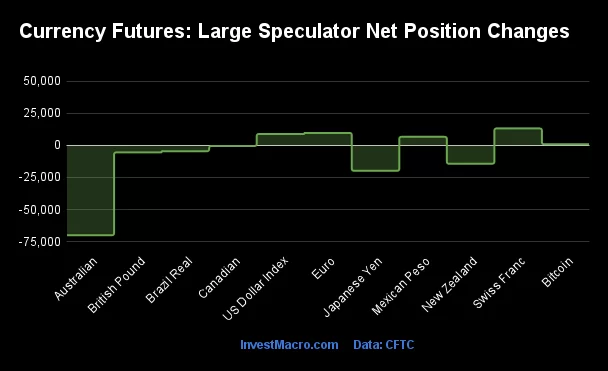
The COT currency market speculator bets were decidedly lower this week as just one out of the eleven currency markets we cover had higher positioning while the other ten markets had lower speculator contracts.

Leading the gains was the Brazilian Real (4,836 contracts) which came through as the only currency having a positive week this week.

The currencies seeing declines in speculator bets on the week were the Canadian Dollar (-33,242 contracts), the EuroFX (-21,948 contracts), the Australian Dollar (-14,153 contracts), the British Pound (-7,333 contracts), the Mexican Peso (-3,947 contracts), the Swiss Franc (-3,702 contracts), the Japanese Yen (-2,418 contracts), the New Zealand Dollar (-1,573 contracts), Bitcoin (-590 contracts) and with the US Dollar Index (-211 contracts) also registering lower bets on the week.

Speculators continue to reduce US Dollar Index, Canadian Dollar bets

This week’s COT currency’s data saw speculators continue to drop their US Dollar Index bets as well as their wagers for the Canadian Dollar.

The USD Index speculative position has fallen for five consecutive weeks and by a total of -22,310 contracts over the last five weeks. This weakness has now dropped the current USD Index speculator position (at -2,100 contracts) to the most bearish level since June 15th of 2021, a span of 174 weeks. This can also be seen in the speculator strength index score for the USD Index which is at 0 percent or in other words, the weakest speculator level of the past three years.

The average speculator contract position over 2024 has dipped to a weekly average of +6,528 contracts through Tuesday. This follows the weekly average of +12,782 contracts over the course of 2023. The 2022 year was a very strong Dollar environment and the USD Index speculator contracts averaged a total of +33,606 contracts per week over the course of that year.

Despite the erosion of the large speculator sentiment, the US Dollar Index (DX) price has increased for three straight weeks and closed the week around 103.30. Previously at the end of September, the price had fallen to the 100.00 level where it found support and bounced rather strongly. Since that strong support, the USD has sailed through the 102.50-103.00 level and the next overhead resistance for the USD coming up is the 104.50-105.00 levels.

The Canadian dollar saw the largest decrease in speculator bets for all the currencies this week. The weaker sentiment coincides with declining oil prices as well as with the expectation the Bank of Canada will be potentially reducing their interest rate by 50 basis points in the coming week. This week’s speculator standing for the CAD is the 10th most bearish level on record at a total of -122,393 net contracts. The all-time record low of -196,263 contracts took place not to long ago on July 30th of 2024.

The CAD exchange rate against the USD has fallen for three straight weeks and is starting to reach the lowest levels of the past few years. Currently, the CAD price (CADUSD or CAD futures) is trading at 0.7254 with a major support level residing close below at 0.7200. This level has provided support three times since 2022 and most recently was tested and rejected in August.


Currencies Net Speculators Leaderboard
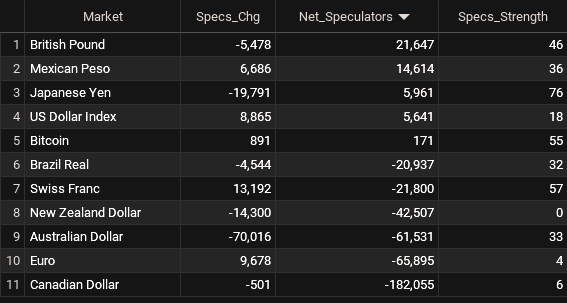
Legend: Weekly Speculators Change | Speculators Current Net Position | Speculators Strength Score compared to last 3-Years (0-100 range)


Strength Scores led by Australian Dollar & Japanese Yen

COT Strength Scores (a normalized measure of Speculator positions over a 3-Year range, from 0 to 100 where above 80 is Extreme-Bullish and below 20 is Extreme-Bearish) showed that the Australian Dollar (90 percent) and the Japanese Yen (87 percent) lead the currency markets this week. The British Pound (75 percent) comes in as the next highest in the weekly strength scores.

On the downside, the US Dollar Index (0 percent) comes in at the lowest strength levels currently and is in Extreme-Bearish territory (below 20 percent). The next lowest strength scores are the EuroFX (28 percent), the Canadian Dollar (33 percent) and the Bitcoin (38 percent).

3-Year Strength Statistics:
US Dollar Index (0.0 percent) vs US Dollar Index previous week (0.4 percent)
EuroFX (27.6 percent) vs EuroFX previous week (37.0 percent)
British Pound Sterling (74.7 percent) vs British Pound Sterling previous week (78.0 percent)
Japanese Yen (87.3 percent) vs Japanese Yen previous week (88.2 percent)
Swiss Franc (47.9 percent) vs Swiss Franc previous week (55.4 percent)
Canadian Dollar (33.1 percent) vs Canadian Dollar previous week (48.0 percent)
Australian Dollar (90.0 percent) vs Australian Dollar previous week (100.0 percent)
New Zealand Dollar (40.3 percent) vs New Zealand Dollar previous week (43.4 percent)
Mexican Peso (43.8 percent) vs Mexican Peso previous week (45.8 percent)
Brazilian Real (47.2 percent) vs Brazilian Real previous week (42.6 percent)
Bitcoin (38.2 percent) vs Bitcoin previous week (47.1 percent)


Brazilian Real & Australian Dollar top the 6-Week Strength Trends

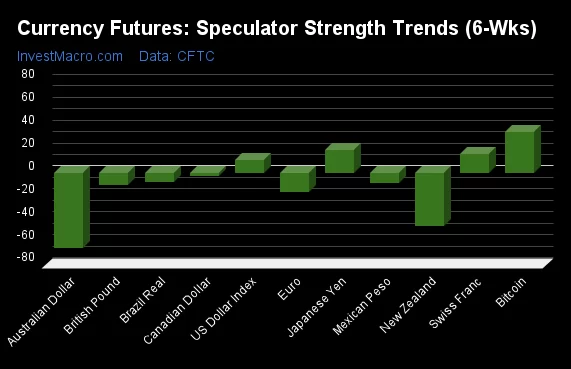
COT Strength Score Trends (or move index, calculates the 6-week changes in strength scores) showed that the Brazilian Real (43 percent) and the Australian Dollar (19 percent) lead the past six weeks trends for the currencies.

The US Dollar Index (-46 percent) leads the downside trend scores currently with the EuroFX (-35 percent), Bitcoin (-30 percent) and the Canadian Dollar (-24 percent) following next with lower trend scores.

3-Year Strength Trends:
US Dollar Index (-45.7 percent) vs US Dollar Index previous week (-44.2 percent)
EuroFX (-35.3 percent) vs EuroFX previous week (-22.9 percent)
British Pound Sterling (-10.0 percent) vs British Pound Sterling previous week (1.4 percent)
Japanese Yen (-2.8 percent) vs Japanese Yen previous week (4.3 percent)
Swiss Franc (-8.7 percent) vs Swiss Franc previous week (4.4 percent)
Canadian Dollar (-24.1 percent) vs Canadian Dollar previous week (9.3 percent)
Australian Dollar (19.2 percent) vs Australian Dollar previous week (37.3 percent)
New Zealand Dollar (-0.1 percent) vs New Zealand Dollar previous week (18.5 percent)
Mexican Peso (-2.6 percent) vs Mexican Peso previous week (-0.7 percent)
Brazilian Real (43.3 percent) vs Brazilian Real previous week (40.8 percent)
Bitcoin (-29.8 percent) vs Bitcoin previous week (-16.8 percent)


Individual COT Forex Markets:

US Dollar Index Futures:
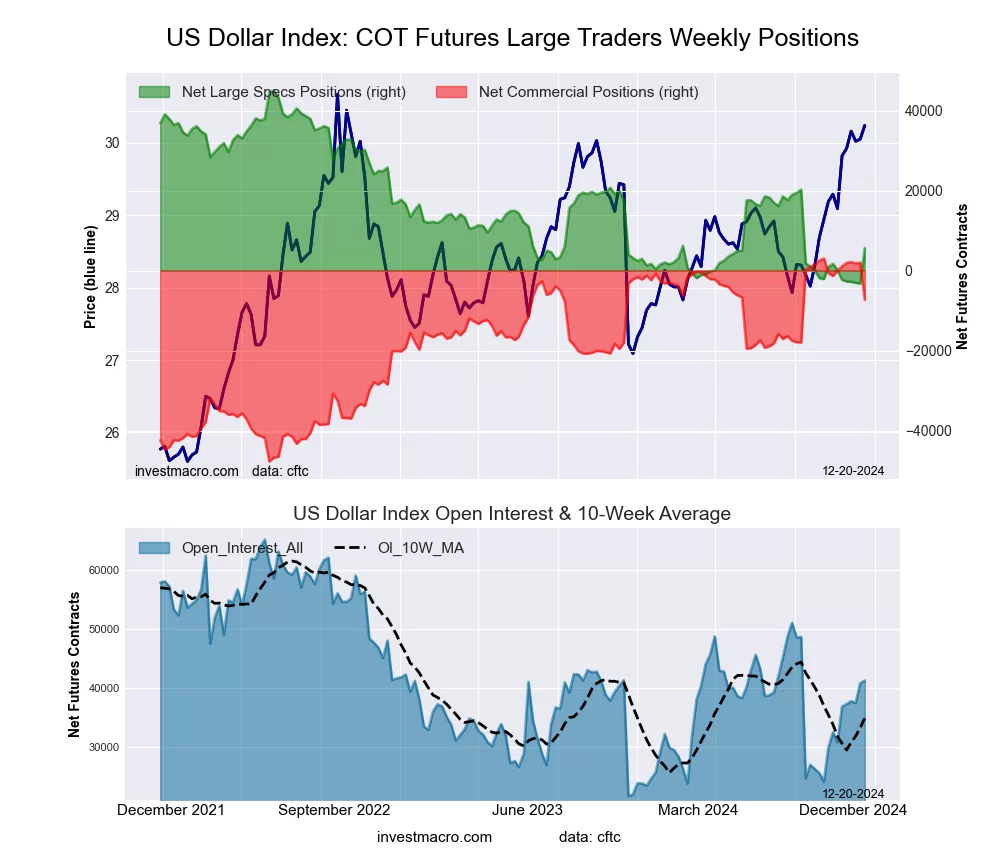
US Dollar Index Forex Futures COT ChartThe US Dollar Index large speculator standing this week recorded a net position of -2,100 contracts in the data reported through Tuesday. This was a weekly lowering of -211 contracts from the previous week which had a total of -1,889 net contracts.

This week’s current strength score (the trader positioning range over the past three years, measured from 0 to 100) shows the speculators are currently Bearish-Extreme with a score of 0.0 percent. The commercials are Bullish-Extreme with a score of 100.0 percent and the small traders (not shown in chart) are Bearish-Extreme with a score of 13.6 percent.

Price Trend-Following Model: Weak Downtrend

Our weekly trend-following model classifies the current market price position as: Weak Downtrend.

US DOLLAR INDEX StatisticsSPECULATORSCOMMERCIALSSMALL TRADERS
– Percent of Open Interest Longs:63.519.111.6
– Percent of Open Interest Shorts:72.26.615.3
– Net Position:-2,1003,011-911
– Gross Longs:15,3524,6072,792
– Gross Shorts:17,4521,5963,703
– Long to Short Ratio:0.9 to 12.9 to 10.8 to 1
NET POSITION TREND:
– Strength Index Score (3 Year Range Pct):0.0100.013.6
– Strength Index Reading (3 Year Range):Bearish-ExtremeBullish-ExtremeBearish-Extreme
NET POSITION MOVEMENT INDEX:
– 6-Week Change in Strength Index:-45.741.26.3


Euro Currency Futures:

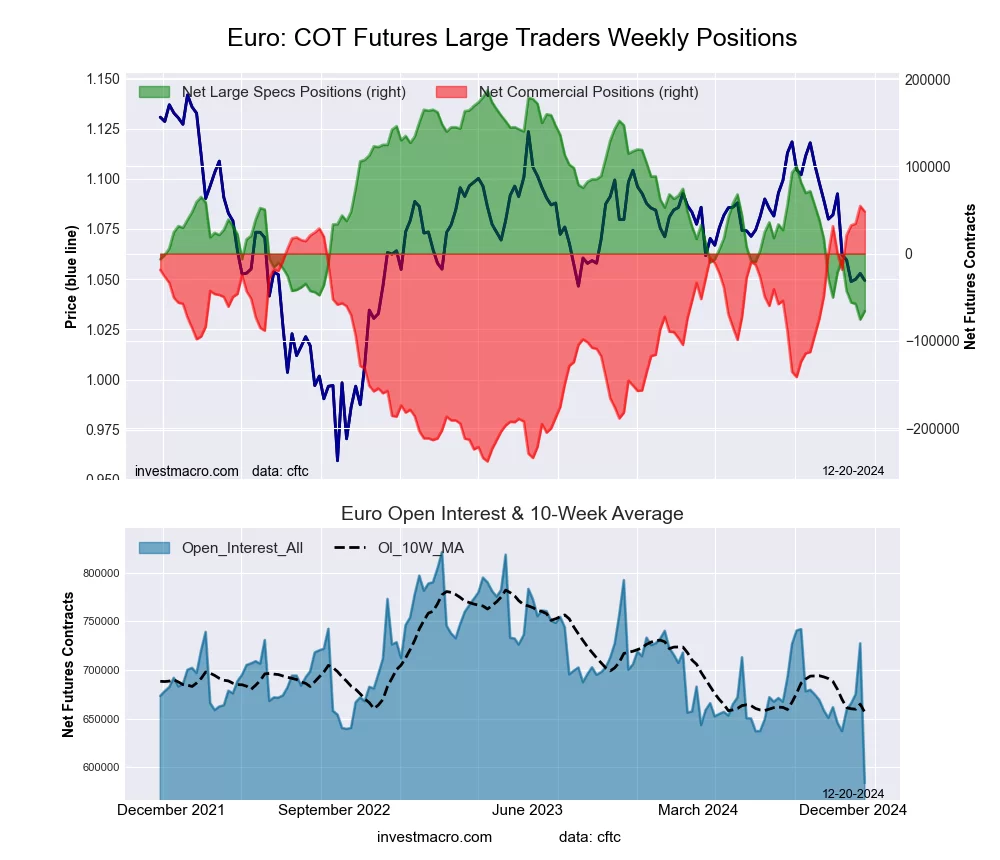
Euro Currency Futures COT ChartThe Euro Currency large speculator standing this week recorded a net position of 17,150 contracts in the data reported through Tuesday. This was a weekly decline of -21,948 contracts from the previous week which had a total of 39,098 net contracts.

This week’s current strength score (the trader positioning range over the past three years, measured from 0 to 100) shows the speculators are currently Bearish with a score of 27.6 percent. The commercials are Bullish with a score of 70.9 percent and the small traders (not shown in chart) are Bearish with a score of 42.5 percent.

Price Trend-Following Model: Weak Uptrend

Our weekly trend-following model classifies the current market price position as: Weak Uptrend.

EURO Currency StatisticsSPECULATORSCOMMERCIALSSMALL TRADERS
– Percent of Open Interest Longs:25.758.112.5
– Percent of Open Interest Shorts:23.165.67.6
– Net Position:17,150-48,97531,825
– Gross Longs:169,319382,89982,051
– Gross Shorts:152,169431,87450,226
– Long to Short Ratio:1.1 to 10.9 to 11.6 to 1
NET POSITION TREND:
– Strength Index Score (3 Year Range Pct):27.670.942.5
– Strength Index Reading (3 Year Range):BearishBullishBearish
NET POSITION MOVEMENT INDEX:
– 6-Week Change in Strength Index:-35.334.6-22.1


British Pound Sterling Futures:

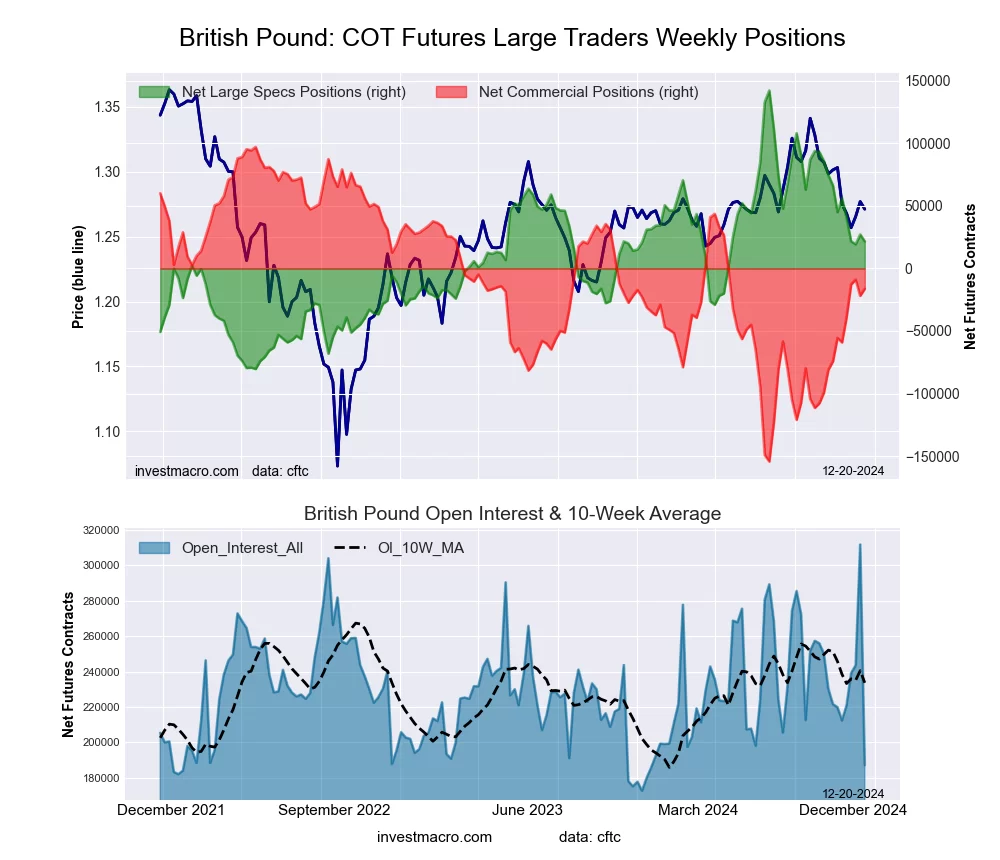
British Pound Sterling Futures COT ChartThe British Pound Sterling large speculator standing this week recorded a net position of 85,802 contracts in the data reported through Tuesday. This was a weekly reduction of -7,333 contracts from the previous week which had a total of 93,135 net contracts.

This week’s current strength score (the trader positioning range over the past three years, measured from 0 to 100) shows the speculators are currently Bullish with a score of 74.7 percent. The commercials are Bearish with a score of 21.8 percent and the small traders (not shown in chart) are Bullish-Extreme with a score of 90.9 percent.

Price Trend-Following Model: Uptrend

Our weekly trend-following model classifies the current market price position as: Uptrend.

BRITISH POUND StatisticsSPECULATORSCOMMERCIALSSMALL TRADERS
– Percent of Open Interest Longs:60.722.015.1
– Percent of Open Interest Shorts:26.461.79.6
– Net Position:85,802-99,44813,646
– Gross Longs:151,92354,93637,756
– Gross Shorts:66,121154,38424,110
– Long to Short Ratio:2.3 to 10.4 to 11.6 to 1
NET POSITION TREND:
– Strength Index Score (3 Year Range Pct):74.721.890.9
– Strength Index Reading (3 Year Range):BullishBearishBullish-Extreme
NET POSITION MOVEMENT INDEX:
– 6-Week Change in Strength Index:-10.08.61.6


Japanese Yen Futures:

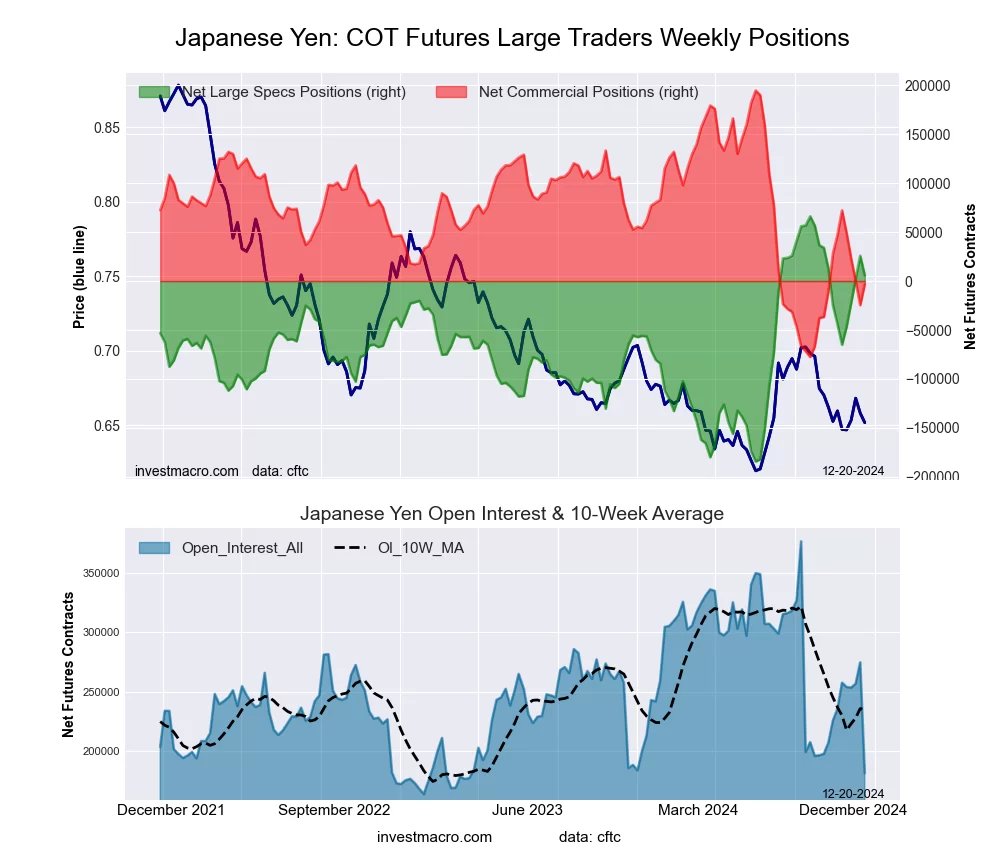
Japanese Yen Forex Futures COT ChartThe Japanese Yen large speculator standing this week recorded a net position of 34,110 contracts in the data reported through Tuesday. This was a weekly reduction of -2,418 contracts from the previous week which had a total of 36,528 net contracts.

This week’s current strength score (the trader positioning range over the past three years, measured from 0 to 100) shows the speculators are currently Bullish-Extreme with a score of 87.3 percent. The commercials are Bearish-Extreme with a score of 15.0 percent and the small traders (not shown in chart) are Bullish with a score of 69.8 percent.

Price Trend-Following Model: Weak Uptrend

Our weekly trend-following model classifies the current market price position as: Weak Uptrend.

JAPANESE YEN StatisticsSPECULATORSCOMMERCIALSSMALL TRADERS
– Percent of Open Interest Longs:43.834.719.1
– Percent of Open Interest Shorts:26.653.217.8
– Net Position:34,110-36,6392,529
– Gross Longs:86,68568,69737,699
– Gross Shorts:52,575105,33635,170
– Long to Short Ratio:1.6 to 10.7 to 11.1 to 1
NET POSITION TREND:
– Strength Index Score (3 Year Range Pct):87.315.069.8
– Strength Index Reading (3 Year Range):Bullish-ExtremeBearish-ExtremeBullish
NET POSITION MOVEMENT INDEX:
– 6-Week Change in Strength Index:-2.83.7-7.6


Swiss Franc Futures:

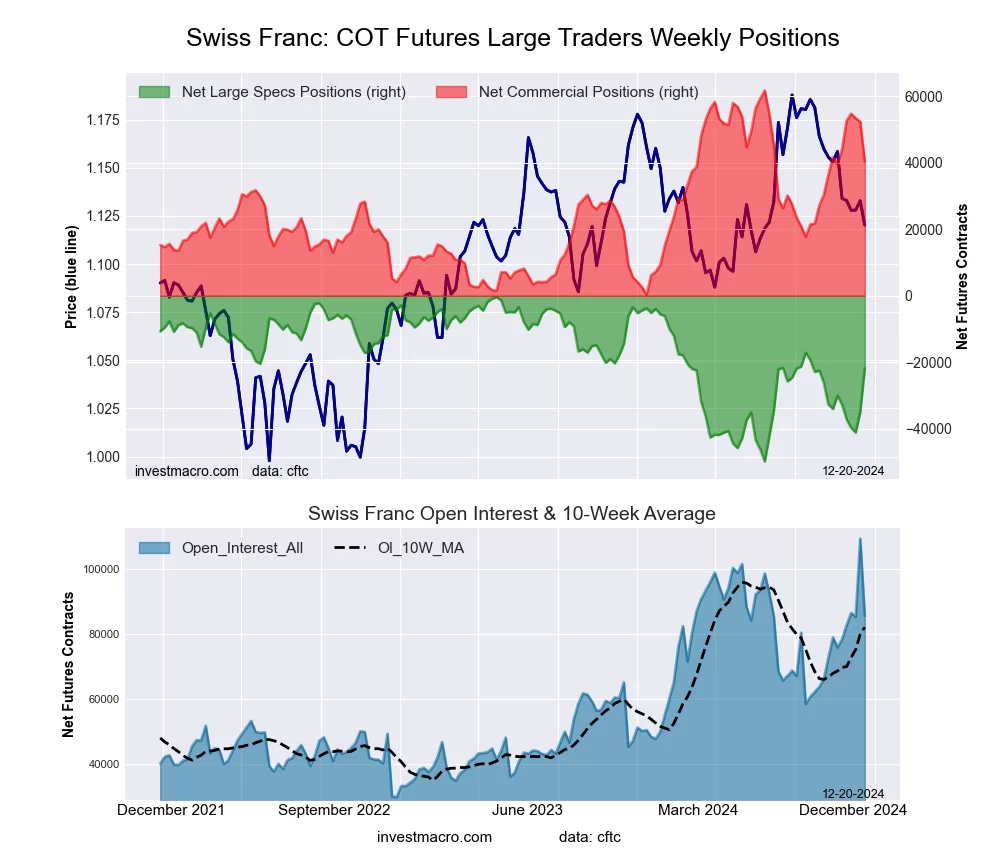
Swiss Franc Forex Futures COT ChartThe Swiss Franc large speculator standing this week recorded a net position of -26,161 contracts in the data reported through Tuesday. This was a weekly decrease of -3,702 contracts from the previous week which had a total of -22,459 net contracts.

This week’s current strength score (the trader positioning range over the past three years, measured from 0 to 100) shows the speculators are currently Bearish with a score of 47.9 percent. The commercials are Bearish with a score of 49.0 percent and the small traders (not shown in chart) are Bullish with a score of 57.6 percent.

Price Trend-Following Model: Weak Uptrend

Our weekly trend-following model classifies the current market price position as: Weak Uptrend.

SWISS FRANC StatisticsSPECULATORSCOMMERCIALSSMALL TRADERS
– Percent of Open Interest Longs:10.373.015.9
– Percent of Open Interest Shorts:49.927.122.2
– Net Position:-26,16130,369-4,208
– Gross Longs:6,83448,27510,505
– Gross Shorts:32,99517,90614,713
– Long to Short Ratio:0.2 to 12.7 to 10.7 to 1
NET POSITION TREND:
– Strength Index Score (3 Year Range Pct):47.949.057.6
– Strength Index Reading (3 Year Range):BearishBearishBullish
NET POSITION MOVEMENT INDEX:
– 6-Week Change in Strength Index:-8.711.3-12.2


Canadian Dollar Futures:

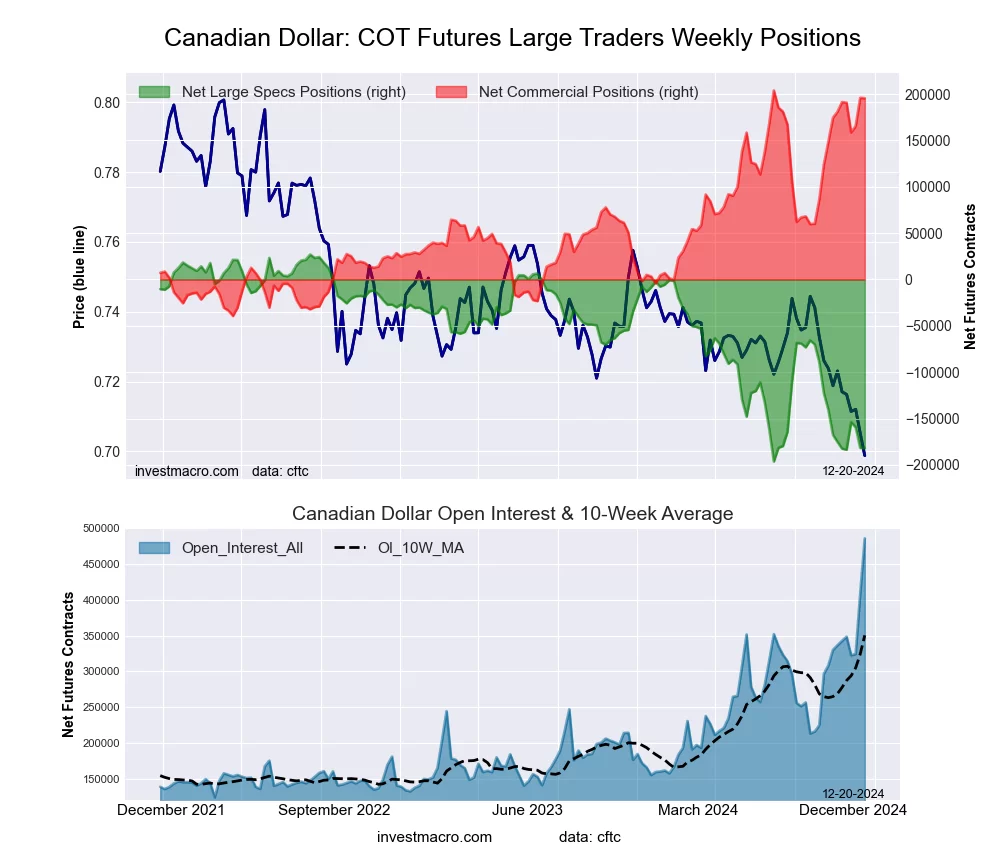
Canadian Dollar Forex Futures COT ChartThe Canadian Dollar large speculator standing this week recorded a net position of -122,393 contracts in the data reported through Tuesday. This was a weekly reduction of -33,242 contracts from the previous week which had a total of -89,151 net contracts.

This week’s current strength score (the trader positioning range over the past three years, measured from 0 to 100) shows the speculators are currently Bearish with a score of 33.1 percent. The commercials are Bullish with a score of 67.1 percent and the small traders (not shown in chart) are Bearish with a score of 26.3 percent.

Price Trend-Following Model: Weak Uptrend

Our weekly trend-following model classifies the current market price position as: Weak Uptrend.

CANADIAN DOLLAR StatisticsSPECULATORSCOMMERCIALSSMALL TRADERS
– Percent of Open Interest Longs:12.476.49.8
– Percent of Open Interest Shorts:53.734.610.3
– Net Position:-122,393123,906-1,513
– Gross Longs:36,718226,42529,024
– Gross Shorts:159,111102,51930,537
– Long to Short Ratio:0.2 to 12.2 to 11.0 to 1
NET POSITION TREND:
– Strength Index Score (3 Year Range Pct):33.167.126.3
– Strength Index Reading (3 Year Range):BearishBullishBearish
NET POSITION MOVEMENT INDEX:
– 6-Week Change in Strength Index:-24.125.5-23.7


Australian Dollar Futures:

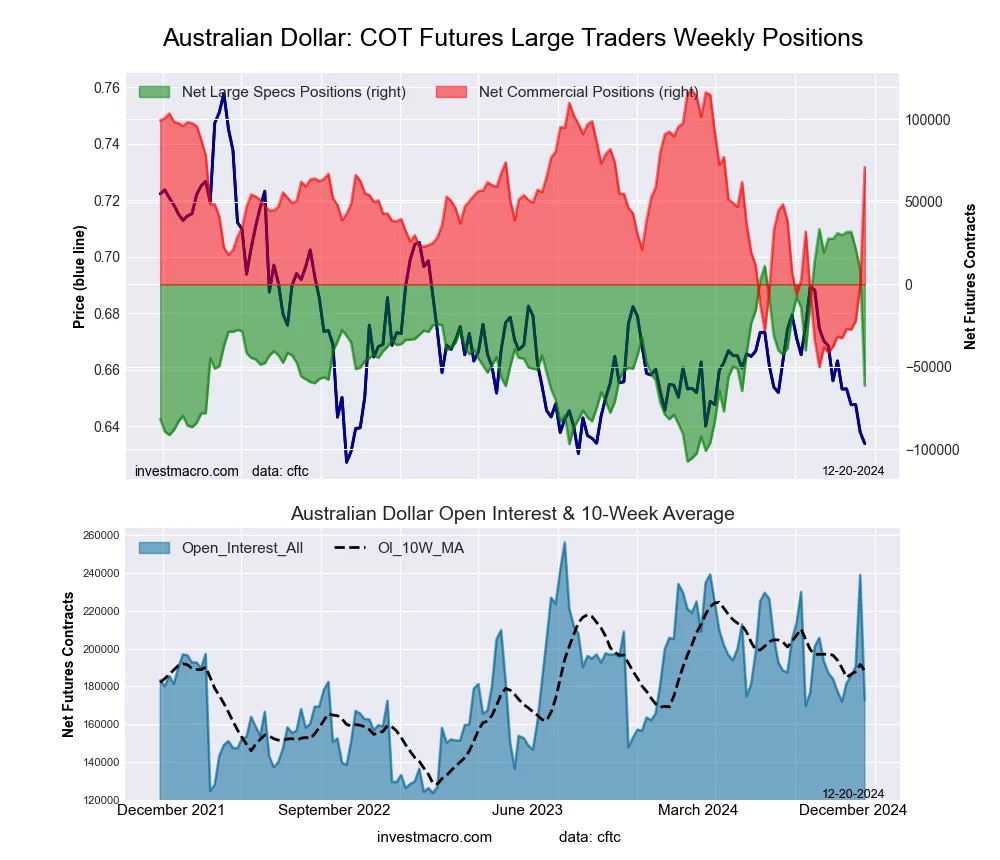
Australian Dollar Forex Futures COT ChartThe Australian Dollar large speculator standing this week recorded a net position of 19,269 contracts in the data reported through Tuesday. This was a weekly decrease of -14,153 contracts from the previous week which had a total of 33,422 net contracts.

This week’s current strength score (the trader positioning range over the past three years, measured from 0 to 100) shows the speculators are currently Bullish-Extreme with a score of 90.0 percent. The commercials are Bearish-Extreme with a score of 7.3 percent and the small traders (not shown in chart) are Bullish-Extreme with a score of 98.7 percent.

Price Trend-Following Model: Weak Uptrend

Our weekly trend-following model classifies the current market price position as: Weak Uptrend.

AUSTRALIAN DOLLAR StatisticsSPECULATORSCOMMERCIALSSMALL TRADERS
– Percent of Open Interest Longs:51.229.218.1
– Percent of Open Interest Shorts:41.348.98.4
– Net Position:19,269-38,07818,809
– Gross Longs:99,05156,41234,998
– Gross Shorts:79,78294,49016,189
– Long to Short Ratio:1.2 to 10.6 to 12.2 to 1
NET POSITION TREND:
– Strength Index Score (3 Year Range Pct):90.07.398.7
– Strength Index Reading (3 Year Range):Bullish-ExtremeBearish-ExtremeBullish-Extreme
NET POSITION MOVEMENT INDEX:
– 6-Week Change in Strength Index:19.2-18.610.6


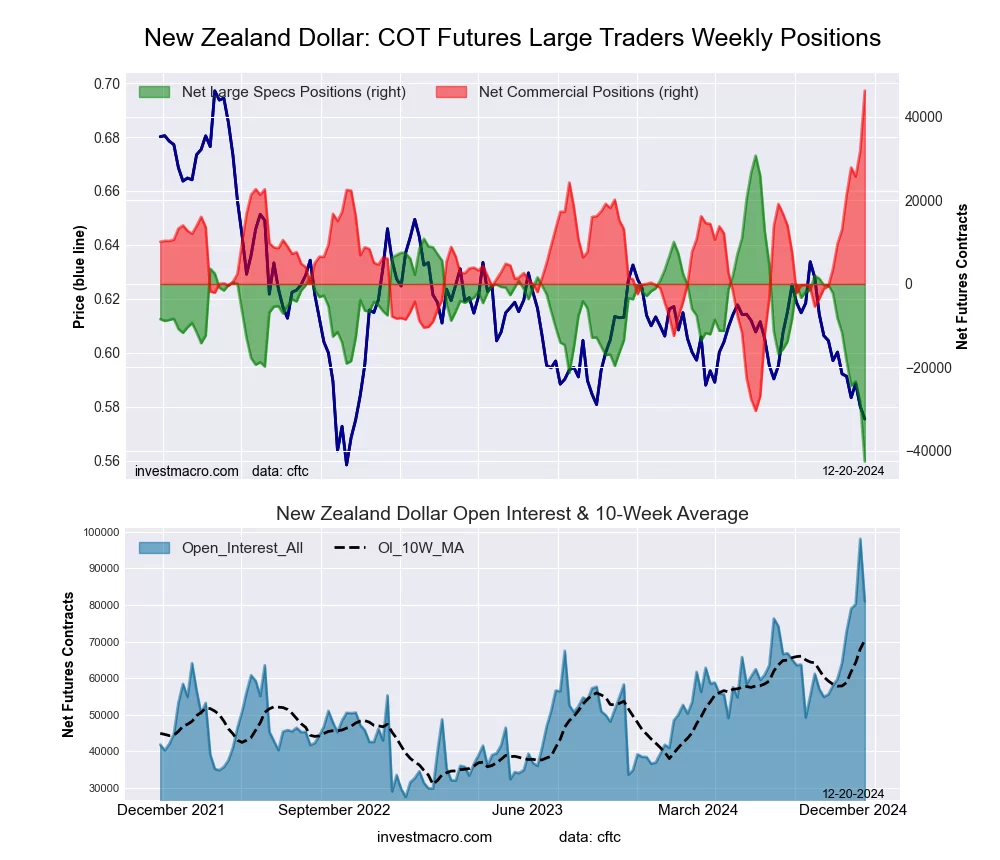
New Zealand Dollar Futures:

New Zealand Dollar Forex Futures COT ChartThe New Zealand Dollar large speculator standing this week recorded a net position of -292 contracts in the data reported through Tuesday. This was a weekly fall of -1,573 contracts from the previous week which had a total of 1,281 net contracts.

This week’s current strength score (the trader positioning range over the past three years, measured from 0 to 100) shows the speculators are currently Bearish with a score of 40.3 percent. The commercials are Bullish with a score of 53.5 percent and the small traders (not shown in chart) are Bullish with a score of 71.4 percent.

Price Trend-Following Model: Weak Uptrend

Our weekly trend-following model classifies the current market price position as: Weak Uptrend.

NEW ZEALAND DOLLAR StatisticsSPECULATORSCOMMERCIALSSMALL TRADERS
– Percent of Open Interest Longs:45.745.18.5
– Percent of Open Interest Shorts:46.247.15.9
– Net Position:-292-1,1221,414
– Gross Longs:25,07924,7484,646
– Gross Shorts:25,37125,8703,232
– Long to Short Ratio:1.0 to 11.0 to 11.4 to 1
NET POSITION TREND:
– Strength Index Score (3 Year Range Pct):40.353.571.4
– Strength Index Reading (3 Year Range):BearishBullishBullish
NET POSITION MOVEMENT INDEX:
– 6-Week Change in Strength Index:-0.11.9-12.5


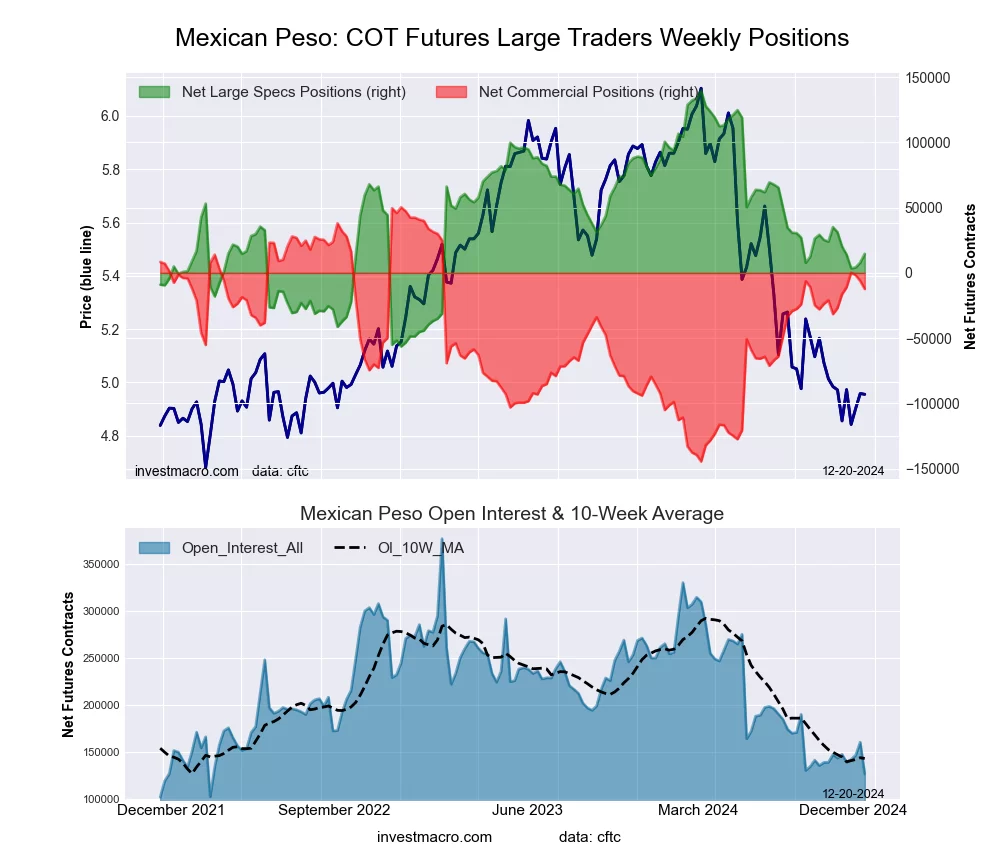
Mexican Peso Futures:

Mexican Peso Futures COT ChartThe Mexican Peso large speculator standing this week recorded a net position of 25,246 contracts in the data reported through Tuesday. This was a weekly lowering of -3,947 contracts from the previous week which had a total of 29,193 net contracts.

This week’s current strength score (the trader positioning range over the past three years, measured from 0 to 100) shows the speculators are currently Bearish with a score of 43.8 percent. The commercials are Bullish with a score of 57.6 percent and the small traders (not shown in chart) are Bearish-Extreme with a score of 7.8 percent.

Price Trend-Following Model: Downtrend

Our weekly trend-following model classifies the current market price position as: Downtrend.

MEXICAN PESO StatisticsSPECULATORSCOMMERCIALSSMALL TRADERS
– Percent of Open Interest Longs:43.750.63.0
– Percent of Open Interest Shorts:25.567.64.1
– Net Position:25,246-23,735-1,511
– Gross Longs:60,75970,3824,237
– Gross Shorts:35,51394,1175,748
– Long to Short Ratio:1.7 to 10.7 to 10.7 to 1
NET POSITION TREND:
– Strength Index Score (3 Year Range Pct):43.857.67.8
– Strength Index Reading (3 Year Range):BearishBullishBearish-Extreme
NET POSITION MOVEMENT INDEX:
– 6-Week Change in Strength Index:-2.61.97.7


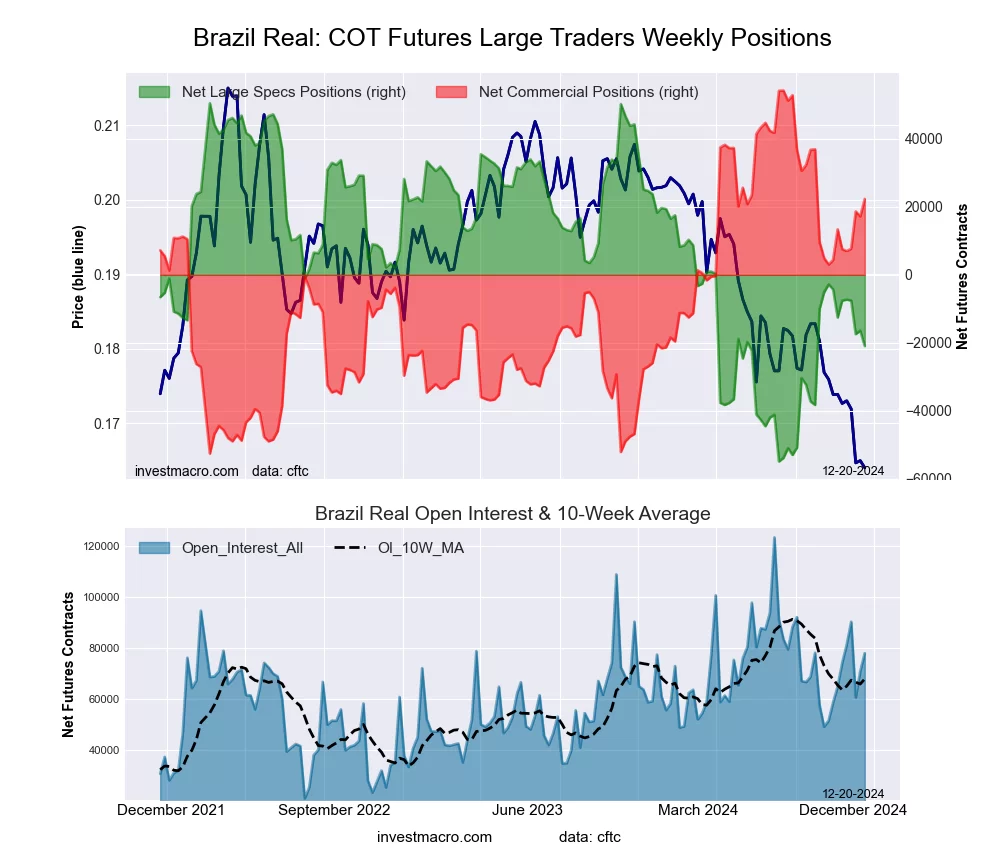
Brazilian Real Futures:

Brazil Real Futures COT ChartThe Brazilian Real large speculator standing this week recorded a net position of -5,143 contracts in the data reported through Tuesday. This was a weekly advance of 4,836 contracts from the previous week which had a total of -9,979 net contracts.

This week’s current strength score (the trader positioning range over the past three years, measured from 0 to 100) shows the speculators are currently Bearish with a score of 47.2 percent. The commercials are Bullish with a score of 53.9 percent and the small traders (not shown in chart) are Bearish with a score of 21.9 percent.

Price Trend-Following Model: Strong Downtrend

Our weekly trend-following model classifies the current market price position as: Strong Downtrend.

BRAZIL REAL StatisticsSPECULATORSCOMMERCIALSSMALL TRADERS
– Percent of Open Interest Longs:38.153.15.4
– Percent of Open Interest Shorts:48.543.05.0
– Net Position:-5,1434,952191
– Gross Longs:18,70326,1052,645
– Gross Shorts:23,84621,1532,454
– Long to Short Ratio:0.8 to 11.2 to 11.1 to 1
NET POSITION TREND:
– Strength Index Score (3 Year Range Pct):47.253.921.9
– Strength Index Reading (3 Year Range):BearishBullishBearish
NET POSITION MOVEMENT INDEX:
– 6-Week Change in Strength Index:43.3-29.8-78.1


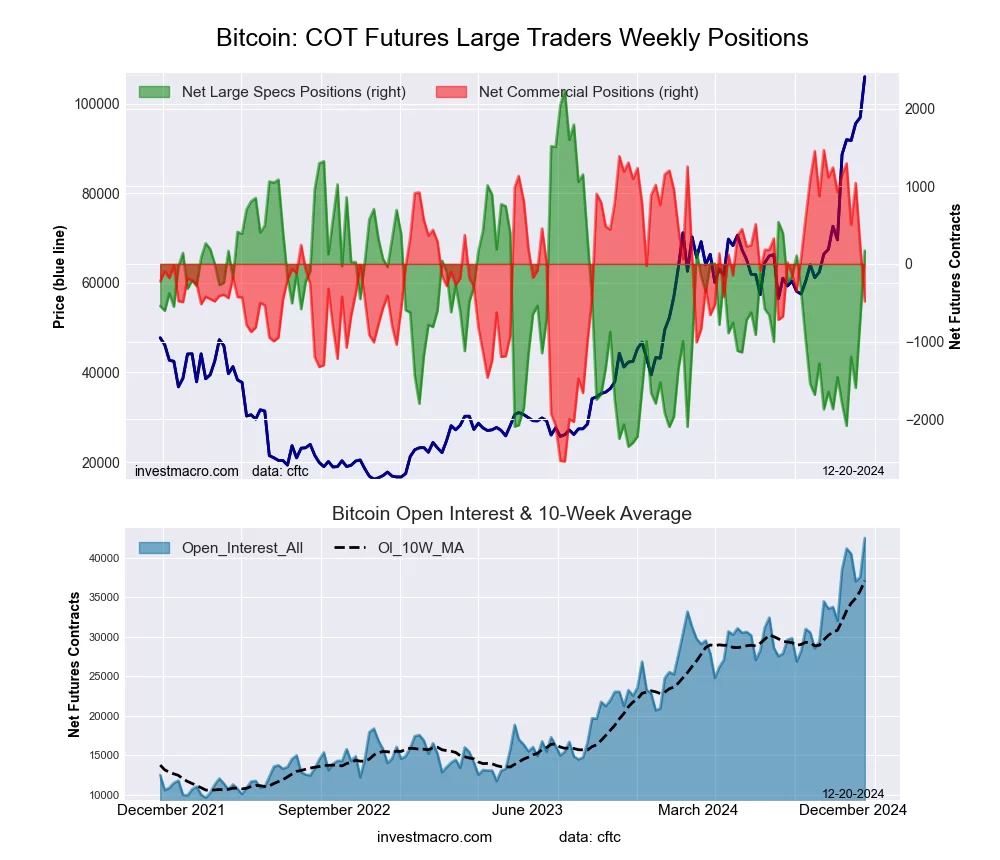
Bitcoin Futures:

Bitcoin Crypto Futures COT ChartThe Bitcoin large speculator standing this week recorded a net position of -1,872 contracts in the data reported through Tuesday. This was a weekly fall of -590 contracts from the previous week which had a total of -1,282 net contracts.

This week’s current strength score (the trader positioning range over the past three years, measured from 0 to 100) shows the speculators are currently Bearish with a score of 38.2 percent. The commercials are Bullish-Extreme with a score of 100.0 percent and the small traders (not shown in chart) are Bearish with a score of 22.2 percent.

Price Trend-Following Model: Weak Downtrend

Our weekly trend-following model classifies the current market price position as: Weak Downtrend.

BITCOIN StatisticsSPECULATORSCOMMERCIALSSMALL TRADERS
– Percent of Open Interest Longs:77.66.84.1
– Percent of Open Interest Shorts:83.02.52.9
– Net Position:-1,8721,466406
– Gross Longs:26,7582,3321,405
– Gross Shorts:28,630866999
– Long to Short Ratio:0.9 to 12.7 to 11.4 to 1
NET POSITION TREND:
– Strength Index Score (3 Year Range Pct):38.2100.022.2
– Strength Index Reading (3 Year Range):BearishBullish-ExtremeBearish
NET POSITION MOVEMENT INDEX:
– 6-Week Change in Strength Index:-29.845.33.7


Article By InvestMacroReceive our weekly COT Newsletter

*COT Report: The COT data, released weekly to the public each Friday, is updated through the most recent Tuesday (data is 3 days old) and shows a quick view of how large speculators or non-commercials (for-profit traders) were positioned in the futures markets.

The CFTC categorizes trader positions according to commercial hedgers (traders who use futures contracts for hedging as part of the business), non-commercials (large traders who speculate to realize trading profits) and nonreportable traders (usually small traders/speculators) as well as their open interest (contracts open in the market at time of reporting). See CFTC criteria here.

Speculator Extremes: Russell2000, VIX, USD Index & 5-Year Bonds lead Bullish & Bearish Positions

By InvestMacro 

The latest update for the weekly Commitment of Traders (COT) report was released by the Commodity Futures Trading Commission (CFTC) on Friday for data ending on October 15th.

This weekly Extreme Positions report highlights the Most Bullish and Most Bearish Positions for the speculator category. Extreme positioning in these markets can foreshadow strong moves in the underlying market.

To signify an extreme position, we use the Strength Index (also known as the COT Index) of each instrument, a common method of measuring COT data. The Strength Index is simply a comparison of current trader positions against the range of positions over the previous 3 years. We use over 80 percent as extremely bullish and under 20 percent as extremely bearish. (Compare Strength Index scores across all markets in the data table or cot leaders table)


Here Are This Week’s Most Bullish Speculator Positions:

Russell 2000 Mini


The Russell 2000 Mini speculator position comes in as the most bullish extreme standing this week. The Russell 2000 Mini speculator level is currently at a 100.0 percent score of its 3-year range.

The six-week trend for the percent strength score totaled 17.8 this week. The overall net speculator position was a total of 26,337 net contracts this week with a jump by 21,330 contract in the weekly speculator bets.


Speculators or Non-Commercials Notes:

Speculators, classified as non-commercial traders by the CFTC, are made up of large commodity funds, hedge funds and other significant for-profit participants. The Specs are generally regarded as trend-followers in their behavior towards price action – net speculator bets and prices tend to go in the same directions. These traders often look to buy when prices are rising and sell when prices are falling. To illustrate this point, many times speculator contracts can be found at their most extremes (bullish or bearish) when prices are also close to their highest or lowest levels.

These extreme levels can be dangerous for the large speculators as the trade is most crowded, there is less trading ammunition still sitting on the sidelines to push the trend further and prices have moved a significant distance. When the trend becomes exhausted, some speculators take profits while others look to also exit positions when prices fail to continue in the same direction. This process usually plays out over many months to years and can ultimately create a reverse effect where prices start to fall and speculators start a process of selling when prices are falling.


VIX


The VIX speculator position comes next in the extreme standings this week. The VIX speculator level is now at a 100.0 percent score of its 3-year range.

The six-week trend for the percent strength score was 24.6 this week. The speculator position registered 322 net contracts this week with a weekly boost by 3,330 contracts in speculator bets.


Platinum


The Platinum speculator position comes in third this week in the extreme standings. The Platinum speculator level resides at a 93.8 percent score of its 3-year range.

The six-week trend for the speculator strength score came in at 72.1 this week. The overall speculator position was 28,387 net contracts this week with a change of 4,730 contracts in the weekly speculator bets.


Coffee


The Coffee speculator position comes up number four in the extreme standings this week. The Coffee speculator level is at a 91.1 percent score of its 3-year range.

The six-week trend for the speculator strength score totaled a change of 2.9 this week. The overall speculator position was 66,950 net contracts this week with a rise of 4,235 contracts in the speculator bets.


Australian Dollar


The Australian Dollar speculator position rounds out the top five in this week’s bullish extreme standings. The Australian Dollar speculator level sits at a 90.0 percent score of its 3-year range. The six-week trend for the speculator strength score was 19.2 this week.

The speculator position was 19,269 net contracts this week with a decrease of -14,153 contracts in the weekly speculator bets.


This Week’s Most Bearish Speculator Positions:

US Dollar Index


The US Dollar Index speculator position comes in as the most bearish extreme standing this week. The US Dollar Index speculator level is at a 0.0 percent score of its 3-year range.

The six-week trend for the speculator strength score was -45.7 this week. The overall speculator position was -2,100 net contracts this week with a small reduction by -211 contracts in the speculator bets.


5-Year Bond


The 5-Year Bond speculator position comes in next for the most bearish extreme standing on the week. The 5-Year Bond speculator level is at a 6.5 percent score of its 3-year range.

The six-week trend for the speculator strength score was 5.4 this week. The speculator position was -1,630,024 net contracts this week with a decrease by -29,699 contracts in the weekly speculator bets.


2-Year Bond


The 2-Year Bond speculator position comes in as third most bearish extreme standing of the week. The 2-Year Bond speculator level resides at a 8.6 percent score of its 3-year range.

The six-week trend for the speculator strength score was -23.0 this week. The overall speculator position was -1,342,260 net contracts this week with a decline of -117,224 contracts in the speculator bets.


1-Month Secured Overnight Financing Rate


The 1-Month Secured Overnight Financing Rate speculator position comes in as this week’s fourth most bearish extreme standing. The 1-Month Secured Overnight Financing Rate speculator level is at a 9.6 percent score of its 3-year range.

The six-week trend for the speculator strength score was -29.2 this week. The speculator position was -215,156 net contracts this week with a gain of 7,304 contracts in the weekly speculator bets.


Heating Oil


Finally, the Heating Oil speculator position comes in as the fifth most bearish extreme standing for this week. The Heating Oil speculator level is at a 14.0 percent score of its 3-year range.

The six-week trend for the speculator strength score was -28.3 this week. The speculator position was -6,710 net contracts this week with a drop of -5,144 contracts in the weekly speculator bets.


Article By InvestMacroReceive our weekly COT Newsletter

*COT Report: The COT data, released weekly to the public each Friday, is updated through the most recent Tuesday (data is 3 days old) and shows a quick view of how large speculators or non-commercials (for-profit traders) were positioned in the futures markets.

The CFTC categorizes trader positions according to commercial hedgers (traders who use futures contracts for hedging as part of the business), non-commercials (large traders who speculate to realize trading profits) and nonreportable traders (usually small traders/speculators) as well as their open interest (contracts open in the market at time of reporting). See CFTC criteria here.

AUD/USD Rises Following Strong Australian Employment Data

By RoboForex Analytical Department 

AUD/USD rebounded on Thursday after three consecutive days of declines. This was supported by robust employment data from Australia, which bolstered the hawkish outlook on the Reserve Bank of Australia’s (RBA) monetary policy.

Key Employment Data Highlights:

  • Job creation: the Australian economy added 64.1k jobs in September, significantly surpassing the expected 25.0k. This marked improvement suggests strong economic momentum
  • Unemployment rate: the rate held steady at 4.1%, aligning with expectations and underscoring the labour market’s resilience
  • Labour force participation: the participation rate rose to a record 67.2% in September from 67.1% in August, beating the forecast of 67.1%. This increase reflects a growing workforce, which could sustain consumer spending and economic activity

These indicators of labour market strength make it less likely that the RBA will opt for rate cuts in the near term. Additionally, RBA Deputy Governor Sarah Hunter emphasised the central bank’s commitment to controlling inflation, which continues to be a concern amid sustained price increases. Analysts now suggest that the RBA is unlikely to cut rates until at least the first half of the next year, considering the tight labour market conditions.

Technical analysis of AUD/USD

The AUD/USD pair is extending its downward movement towards a target of 0.6645. After testing the resistance at 0.6700 from below, it continues its decline. Once the 0.6645 level is reached, a new consolidation range is expected to form above this level. A breakout above this range could initiate a corrective phase towards 0.6790. This bearish trend is supported by the MACD indicator, which remains below zero and points downwards, indicating sustained downward momentum.

On the hourly chart, AUD/USD has completed a downward wave to 0.6660, followed by a corrective rise to 0.6700. The pair is expected to continue its decline to the 0.6645 level. After this target is met, a potential reversal could push the price towards 0.6710. The Stochastic oscillator supports this outlook, with its signal line below 50 and heading towards 20, suggesting that there may be further downside before any significant recovery.


Disclaimer

Any forecasts contained herein are based on the author’s particular opinion. This analysis may not be treated as trading advice. RoboForex bears no responsibility for trading results based on trading recommendations and reviews contained herein.

Netflix earnings preview: Set for fresh all-time highs?

By ForexTime 

  • Netflix ↑ 45% year-to-date
  • Shares could move 7.6% % ↑ or ↓ post-earnings
  • Subscription numbers & live sports offering in focus
  • Technical levels – $735 & $700

Netflix is probably one of the first providers you think about regarding TV streaming services.

And it remains the biggest player in this space, boasting almost 280 million subscribers worldwide!

The company shares have been edging higher, hitting a fresh all-time high at $734.92 last Friday.

Despite the recent selloff, Netflix stocks are still up 45% year-to-date.

Prices could push higher or lower depending on how investors react to the latest earnings report.

  • When will earnings be published?

Netflix will report its earnings for the third quarter after US markets close on Thursday 17th October.

  • Market expectations:

The company is expected to post earnings per share of $5.12 compared to $3.73 a year ago.

Quarterly revenues are seen rising $9.8 billion from $8.5 billion in the prior year – equating to a 15.3% increase.

  • Why is this important?

As the biggest streaming service in the world, Netflix’s results could provide key insights into consumer spending habits and the health of the streaming industry.

  • Key metrics…

When publishing its earnings for Q2 back in July, Netflix reported just under 278 million subscribers.

So, it will be interesting to see what impacts the crackdown on password sharing have on this number.

According to analyst expectations, the streaming giant is expected to report around 286 million active subscribers for Q3 – further solidifying its grip on the throne.

Investors will be looking for more information on live sports offerings, especially when considering how the NFL will see its first games on Netflix on Christmas Day.

  • Potential challenges

In such a competitive industry filled with the likes of Amazon Prime, Disney+, Hulu and Apple TV among others, investors will be keen to see how Netflix fared.

Consumers are spoilt for choice for quality streaming services, and this has the potential to impact the company’s overall results.

  • How will Netflix react to earnings?

Markets are forecasting a 7.6% move, either Up or Down, for Netflix stocks on Thursday post earnings.

  • What does this mean for prices?

A 7.6% move up from $704.56 (current price) will take Netflix shares to a fresh all-time high at $758.

While a 7.6% move down will send prices back toward $651.

  • Technical picture

Although prices have been trending higher on the daily charts, a range can be identified with support at $700 and resistance at $734.92. The incoming earnings report could push the scales of power in favour of bulls or bears.

  • A solid set of earnings could push prices back above the all-time high at $734.92 with $750 acting as a point of interest.
  • If the earnings disappoint, prices could slip below $700 – opening a path back toward the 100-day SMA at $670 and $650.

netflix


Forex-Time-LogoArticle by ForexTime

ForexTime Ltd (FXTM) is an award winning international online forex broker regulated by CySEC 185/12 www.forextime.com

US Dollar Index Speculator bets fall for 4th straight week to 6-month low

By InvestMacro

Here are the latest charts and statistics for the Commitment of Traders (COT) data published by the Commodities Futures Trading Commission (CFTC).

The latest COT data is updated through Tuesday October 8th and shows a quick view of how large market participants (for-profit speculators and commercial traders) were positioned in the futures markets. All currency positions are in direct relation to the US dollar where, for example, a bet for the euro is a bet that the euro will rise versus the dollar while a bet against the euro will be a bet that the euro will decline versus the dollar.

Weekly Speculator Changes led by Brazilian Real & Australian Dollar

The COT currency market speculator bets were slightly lower overall this week as five out of the eleven currency markets we cover had higher positioning while the other six markets had lower speculator contracts.

Leading the gains for the currency markets was the Brazilian Real (28,276 contracts) with the Australian Dollar (18,894 contracts), the Mexican Peso (2,894 contracts), Bitcoin (402 contracts) and the Swiss Franc (395 contracts) also showing positive weeks.

The currencies seeing declines in speculator bets on the week were the Japanese Yen (-20,244 contracts), the Canadian Dollar (-19,148 contracts), the EuroFX (-16,229 contracts), the US Dollar Index (-2,043 contracts), the New Zealand Dollar (-689 contracts) and the British Pound (-630 contracts) also registering lower bets on the week.

US Dollar Index Speculator bets fall for 4th straight week to 6-month low

Highlighting the COT currency’s data this week is the decrease in the speculator’s positioning in the US Dollar Index. The large speculative US Dollar Index positions declined for a fourth straight week and have now dipped by a total of -22,099 net contracts over this 4-week period. This recent weakness has pushed the US Dollar Index speculator net position into an overall bearish position at a total of -1,889 contracts. The current speculator standing now resides at the lowest level since April 2nd, a span of 27 weeks.

The Dollar Index sentiment has been feeling the pressure over the past few months with US inflation steadily coming down since the highs of 2022 and with the government interest rates already in a cutting cycle. The US Federal Reserve reduced the benchmark interest rate by 50 basis points at the last central bank meeting and brought the current rate down to a range of 4.75-5.00 percent.

There was an expectation of another jumbo rate cut coming up but a recent strong jobs report combined with a recent sticky inflation report puts a higher probability now for a smaller rate cut or even the possibility of a Fed hold. The CME Fedwatch tool shows at the current time, there is a 89.5 percent probability outlook that the Fed will cut the rate by another 25 basis points at the November 7th meeting while there is also 10.5 percent probability outlook that the Fed will hold the rate steady next month.

Despite the recent sentiment deficit, the US Dollar Index price has had a strong couple of weeks after falling to and rebounding off the 100.15 level on September 27th. Including September 30th, the Dollar Index has risen in nine out of the past ten days and closed this week right below 103.00 at a close of 102.91. We will see if this strength in the USD continues and whether the Dollar Index can get over the 103.00 support/resistance barrier or perhaps, head back lower toward 100.


Currencies Net Speculators Leaderboard

Legend: Weekly Speculators Change | Speculators Current Net Position | Speculators Strength Score compared to last 3-Years (0-100 range)


Strength Scores led by Australian Dollar & Japanese Yen

COT Strength Scores (a normalized measure of Speculator positions over a 3-Year range, from 0 to 100 where above 80 is Extreme-Bullish and below 20 is Extreme-Bearish) showed that the Australian Dollar (100 percent) and the Japanese Yen (88 percent) lead the currency markets this week. The British Pound (78 percent) and the Swiss Franc (55 percent) come in as the next highest in the weekly strength scores.

On the downside, the US Dollar Index (0 percent) comes in at the lowest strength levels currently and is in Extreme-Bearish territory (below 20 percent). The next lowest strength scores are the EuroFX (37 percent), the Brazilian Real (43 percent) and the New Zealand Dollar (43 percent).

3-Year Strength Statistics:
US Dollar Index (0.0 percent) vs US Dollar Index previous week (4.4 percent)
EuroFX (37.0 percent) vs EuroFX previous week (43.9 percent)
British Pound Sterling (78.0 percent) vs British Pound Sterling previous week (78.2 percent)
Japanese Yen (88.2 percent) vs Japanese Yen previous week (96.3 percent)
Swiss Franc (55.4 percent) vs Swiss Franc previous week (54.6 percent)
Canadian Dollar (48.0 percent) vs Canadian Dollar previous week (56.6 percent)
Australian Dollar (100.0 percent) vs Australian Dollar previous week (86.6 percent)
New Zealand Dollar (43.4 percent) vs New Zealand Dollar previous week (44.7 percent)
Mexican Peso (45.8 percent) vs Mexican Peso previous week (44.4 percent)
Brazilian Real (42.6 percent) vs Brazilian Real previous week (15.8 percent)
Bitcoin (47.1 percent) vs Bitcoin previous week (41.1 percent)


Brazilian Real & Australian Dollar top the 6-Week Strength Trends

COT Strength Score Trends (or move index, calculates the 6-week changes in strength scores) showed that the Brazilian Real (41 percent) and the Australian Dollar (37 percent) lead the past six weeks trends for the currencies. The New Zealand Dollar (18 percent), the Canadian Dollar (9 percent) and the Japanese Yen (4 percent) are the next highest positive movers in the 3-Year trends data.

The US Dollar Index (-44 percent) leads the downside trend scores currently with the EuroFX (-23 percent), Bitcoin (-17 percent) and the Mexican Peso (-1 percent) following next with lower trend scores.

3-Year Strength Trends:
US Dollar Index (-44.3 percent) vs US Dollar Index previous week (-37.2 percent)
EuroFX (-22.9 percent) vs EuroFX previous week (-0.3 percent)
British Pound Sterling (1.4 percent) vs British Pound Sterling previous week (11.8 percent)
Japanese Yen (4.3 percent) vs Japanese Yen previous week (13.3 percent)
Swiss Franc (4.4 percent) vs Swiss Franc previous week (5.8 percent)
Canadian Dollar (9.3 percent) vs Canadian Dollar previous week (42.3 percent)
Australian Dollar (37.3 percent) vs Australian Dollar previous week (37.9 percent)
New Zealand Dollar (18.5 percent) vs New Zealand Dollar previous week (30.3 percent)
Mexican Peso (-0.7 percent) vs Mexican Peso previous week (-4.1 percent)
Brazilian Real (40.8 percent) vs Brazilian Real previous week (12.1 percent)
Bitcoin (-16.8 percent) vs Bitcoin previous week (-21.7 percent)


Individual COT Forex Markets:

US Dollar Index Futures:

US Dollar Index Forex Futures COT ChartThe US Dollar Index large speculator standing this week equaled a net position of -1,889 contracts in the data reported through Tuesday. This was a weekly decrease of -2,043 contracts from the previous week which had a total of 154 net contracts.

This week’s current strength score (the trader positioning range over the past three years, measured from 0 to 100) shows the speculators are currently Bearish-Extreme with a score of 0.0 percent. The commercials are Bullish-Extreme with a score of 100.0 percent and the small traders (not shown in chart) are Bearish-Extreme with a score of 16.2 percent.

Price Trend-Following Model: Weak Downtrend

Our weekly trend-following model classifies the current market price position as: Weak Downtrend.

US DOLLAR INDEX StatisticsSPECULATORSCOMMERCIALSSMALL TRADERS
– Percent of Open Interest Longs:58.623.511.2
– Percent of Open Interest Shorts:65.913.613.7
– Net Position:-1,8892,542-653
– Gross Longs:15,0166,0162,869
– Gross Shorts:16,9053,4743,522
– Long to Short Ratio:0.9 to 11.7 to 10.8 to 1
NET POSITION TREND:
– Strength Index Score (3 Year Range Pct):0.0100.016.2
– Strength Index Reading (3 Year Range):Bearish-ExtremeBullish-ExtremeBearish-Extreme
NET POSITION MOVEMENT INDEX:
– 6-Week Change in Strength Index:-44.340.07.3


Euro Currency Futures:

Euro Currency Futures COT ChartThe Euro Currency large speculator standing this week equaled a net position of 39,098 contracts in the data reported through Tuesday. This was a weekly decrease of -16,229 contracts from the previous week which had a total of 55,327 net contracts.

This week’s current strength score (the trader positioning range over the past three years, measured from 0 to 100) shows the speculators are currently Bearish with a score of 37.0 percent. The commercials are Bullish with a score of 61.2 percent and the small traders (not shown in chart) are Bullish with a score of 51.6 percent.

Price Trend-Following Model: Weak Uptrend

Our weekly trend-following model classifies the current market price position as: Weak Uptrend.

EURO Currency StatisticsSPECULATORSCOMMERCIALSSMALL TRADERS
– Percent of Open Interest Longs:26.057.512.6
– Percent of Open Interest Shorts:20.168.77.2
– Net Position:39,098-74,89535,797
– Gross Longs:173,866384,95484,183
– Gross Shorts:134,768459,84948,386
– Long to Short Ratio:1.3 to 10.8 to 11.7 to 1
NET POSITION TREND:
– Strength Index Score (3 Year Range Pct):37.061.251.6
– Strength Index Reading (3 Year Range):BearishBullishBullish
NET POSITION MOVEMENT INDEX:
– 6-Week Change in Strength Index:-22.922.7-15.7


British Pound Sterling Futures:

British Pound Sterling Futures COT ChartThe British Pound Sterling large speculator standing this week equaled a net position of 93,135 contracts in the data reported through Tuesday. This was a weekly lowering of -630 contracts from the previous week which had a total of 93,765 net contracts.

This week’s current strength score (the trader positioning range over the past three years, measured from 0 to 100) shows the speculators are currently Bullish with a score of 78.0 percent. The commercials are Bearish-Extreme with a score of 18.4 percent and the small traders (not shown in chart) are Bullish-Extreme with a score of 93.4 percent.

Price Trend-Following Model: Uptrend

Our weekly trend-following model classifies the current market price position as: Uptrend.

BRITISH POUND StatisticsSPECULATORSCOMMERCIALSSMALL TRADERS
– Percent of Open Interest Longs:61.621.214.9
– Percent of Open Interest Shorts:25.263.49.1
– Net Position:93,135-108,00814,873
– Gross Longs:157,66654,32938,166
– Gross Shorts:64,531162,33723,293
– Long to Short Ratio:2.4 to 10.3 to 11.6 to 1
NET POSITION TREND:
– Strength Index Score (3 Year Range Pct):78.018.493.4
– Strength Index Reading (3 Year Range):BullishBearish-ExtremeBullish-Extreme
NET POSITION MOVEMENT INDEX:
– 6-Week Change in Strength Index:1.4-1.1-0.9


Japanese Yen Futures:

Japanese Yen Forex Futures COT ChartThe Japanese Yen large speculator standing this week equaled a net position of 36,528 contracts in the data reported through Tuesday. This was a weekly lowering of -20,244 contracts from the previous week which had a total of 56,772 net contracts.

This week’s current strength score (the trader positioning range over the past three years, measured from 0 to 100) shows the speculators are currently Bullish-Extreme with a score of 88.2 percent. The commercials are Bearish-Extreme with a score of 14.6 percent and the small traders (not shown in chart) are Bullish with a score of 66.4 percent.

Price Trend-Following Model: Uptrend

Our weekly trend-following model classifies the current market price position as: Uptrend.

JAPANESE YEN StatisticsSPECULATORSCOMMERCIALSSMALL TRADERS
– Percent of Open Interest Longs:42.537.418.2
– Percent of Open Interest Shorts:24.056.617.6
– Net Position:36,528-37,6591,131
– Gross Longs:83,67973,62635,746
– Gross Shorts:47,151111,28534,615
– Long to Short Ratio:1.8 to 10.7 to 11.0 to 1
NET POSITION TREND:
– Strength Index Score (3 Year Range Pct):88.214.666.4
– Strength Index Reading (3 Year Range):Bullish-ExtremeBearish-ExtremeBullish
NET POSITION MOVEMENT INDEX:
– 6-Week Change in Strength Index:4.3-2.3-10.8


Swiss Franc Futures:

Swiss Franc Forex Futures COT ChartThe Swiss Franc large speculator standing this week equaled a net position of -22,459 contracts in the data reported through Tuesday. This was a weekly lift of 395 contracts from the previous week which had a total of -22,854 net contracts.

This week’s current strength score (the trader positioning range over the past three years, measured from 0 to 100) shows the speculators are currently Bullish with a score of 55.4 percent. The commercials are Bearish with a score of 43.8 percent and the small traders (not shown in chart) are Bullish with a score of 55.4 percent.

Price Trend-Following Model: Uptrend

Our weekly trend-following model classifies the current market price position as: Uptrend.

SWISS FRANC StatisticsSPECULATORSCOMMERCIALSSMALL TRADERS
– Percent of Open Interest Longs:11.969.717.4
– Percent of Open Interest Shorts:47.127.124.8
– Net Position:-22,45927,158-4,699
– Gross Longs:7,61944,47311,109
– Gross Shorts:30,07817,31515,808
– Long to Short Ratio:0.3 to 12.6 to 10.7 to 1
NET POSITION TREND:
– Strength Index Score (3 Year Range Pct):55.443.855.4
– Strength Index Reading (3 Year Range):BullishBearishBullish
NET POSITION MOVEMENT INDEX:
– 6-Week Change in Strength Index:4.4-0.5-8.6


Canadian Dollar Futures:

Canadian Dollar Forex Futures COT ChartThe Canadian Dollar large speculator standing this week equaled a net position of -89,151 contracts in the data reported through Tuesday. This was a weekly lowering of -19,148 contracts from the previous week which had a total of -70,003 net contracts.

This week’s current strength score (the trader positioning range over the past three years, measured from 0 to 100) shows the speculators are currently Bearish with a score of 48.0 percent. The commercials are Bullish with a score of 51.6 percent and the small traders (not shown in chart) are Bearish with a score of 39.4 percent.

Price Trend-Following Model: Weak Uptrend

Our weekly trend-following model classifies the current market price position as: Weak Uptrend.

CANADIAN DOLLAR StatisticsSPECULATORSCOMMERCIALSSMALL TRADERS
– Percent of Open Interest Longs:9.675.213.5
– Percent of Open Interest Shorts:49.336.812.2
– Net Position:-89,15186,2302,921
– Gross Longs:21,643168,98330,344
– Gross Shorts:110,79482,75327,423
– Long to Short Ratio:0.2 to 12.0 to 11.1 to 1
NET POSITION TREND:
– Strength Index Score (3 Year Range Pct):48.051.639.4
– Strength Index Reading (3 Year Range):BearishBullishBearish
NET POSITION MOVEMENT INDEX:
– 6-Week Change in Strength Index:9.3-8.2-2.8


Australian Dollar Futures:

Australian Dollar Forex Futures COT ChartThe Australian Dollar large speculator standing this week equaled a net position of 33,422 contracts in the data reported through Tuesday. This was a weekly boost of 18,894 contracts from the previous week which had a total of 14,528 net contracts.

This week’s current strength score (the trader positioning range over the past three years, measured from 0 to 100) shows the speculators are currently Bullish-Extreme with a score of 100.0 percent. The commercials are Bearish-Extreme with a score of 0.0 percent and the small traders (not shown in chart) are Bullish-Extreme with a score of 93.6 percent.

Price Trend-Following Model: Uptrend

Our weekly trend-following model classifies the current market price position as: Uptrend.

AUSTRALIAN DOLLAR StatisticsSPECULATORSCOMMERCIALSSMALL TRADERS
– Percent of Open Interest Longs:54.228.715.9
– Percent of Open Interest Shorts:38.053.17.7
– Net Position:33,422-50,25316,831
– Gross Longs:111,56159,05732,659
– Gross Shorts:78,139109,31015,828
– Long to Short Ratio:1.4 to 10.5 to 12.1 to 1
NET POSITION TREND:
– Strength Index Score (3 Year Range Pct):100.00.093.6
– Strength Index Reading (3 Year Range):Bullish-ExtremeBearish-ExtremeBullish-Extreme
NET POSITION MOVEMENT INDEX:
– 6-Week Change in Strength Index:37.3-34.312.6


New Zealand Dollar Futures:

New Zealand Dollar Forex Futures COT ChartThe New Zealand Dollar large speculator standing this week equaled a net position of 1,281 contracts in the data reported through Tuesday. This was a weekly decline of -689 contracts from the previous week which had a total of 1,970 net contracts.

This week’s current strength score (the trader positioning range over the past three years, measured from 0 to 100) shows the speculators are currently Bearish with a score of 43.4 percent. The commercials are Bearish with a score of 49.2 percent and the small traders (not shown in chart) are Bullish-Extreme with a score of 81.7 percent.

Price Trend-Following Model: Weak Uptrend

Our weekly trend-following model classifies the current market price position as: Weak Uptrend.

NEW ZEALAND DOLLAR StatisticsSPECULATORSCOMMERCIALSSMALL TRADERS
– Percent of Open Interest Longs:46.144.09.5
– Percent of Open Interest Shorts:43.850.15.6
– Net Position:1,281-3,5032,222
– Gross Longs:26,28725,0885,417
– Gross Shorts:25,00628,5913,195
– Long to Short Ratio:1.1 to 10.9 to 11.7 to 1
NET POSITION TREND:
– Strength Index Score (3 Year Range Pct):43.449.281.7
– Strength Index Reading (3 Year Range):BearishBearishBullish-Extreme
NET POSITION MOVEMENT INDEX:
– 6-Week Change in Strength Index:18.5-20.419.9


Mexican Peso Futures:

Mexican Peso Futures COT ChartThe Mexican Peso large speculator standing this week equaled a net position of 29,193 contracts in the data reported through Tuesday. This was a weekly advance of 2,894 contracts from the previous week which had a total of 26,299 net contracts.

This week’s current strength score (the trader positioning range over the past three years, measured from 0 to 100) shows the speculators are currently Bearish with a score of 45.8 percent. The commercials are Bullish with a score of 55.6 percent and the small traders (not shown in chart) are Bearish-Extreme with a score of 9.1 percent.

Price Trend-Following Model: Downtrend

Our weekly trend-following model classifies the current market price position as: Downtrend.

MEXICAN PESO StatisticsSPECULATORSCOMMERCIALSSMALL TRADERS
– Percent of Open Interest Longs:40.753.83.2
– Percent of Open Interest Shorts:19.274.34.2
– Net Position:29,193-27,901-1,292
– Gross Longs:55,32773,0354,374
– Gross Shorts:26,134100,9365,666
– Long to Short Ratio:2.1 to 10.7 to 10.8 to 1
NET POSITION TREND:
– Strength Index Score (3 Year Range Pct):45.855.69.1
– Strength Index Reading (3 Year Range):BearishBullishBearish-Extreme
NET POSITION MOVEMENT INDEX:
– 6-Week Change in Strength Index:-0.70.70.7


Brazilian Real Futures:

Brazil Real Futures COT ChartThe Brazilian Real large speculator standing this week equaled a net position of -9,979 contracts in the data reported through Tuesday. This was a weekly boost of 28,276 contracts from the previous week which had a total of -38,255 net contracts.

This week’s current strength score (the trader positioning range over the past three years, measured from 0 to 100) shows the speculators are currently Bearish with a score of 42.6 percent. The commercials are Bullish with a score of 58.3 percent and the small traders (not shown in chart) are Bearish with a score of 22.8 percent.

Price Trend-Following Model: Strong Downtrend

Our weekly trend-following model classifies the current market price position as: Strong Downtrend.

BRAZIL REAL StatisticsSPECULATORSCOMMERCIALSSMALL TRADERS
– Percent of Open Interest Longs:43.750.04.5
– Percent of Open Interest Shorts:61.133.33.9
– Net Position:-9,9799,637342
– Gross Longs:25,20128,8042,598
– Gross Shorts:35,18019,1672,256
– Long to Short Ratio:0.7 to 11.5 to 11.2 to 1
NET POSITION TREND:
– Strength Index Score (3 Year Range Pct):42.658.322.8
– Strength Index Reading (3 Year Range):BearishBullishBearish
NET POSITION MOVEMENT INDEX:
– 6-Week Change in Strength Index:40.8-40.51.2


Bitcoin Futures:

Bitcoin Crypto Futures COT ChartThe Bitcoin large speculator standing this week equaled a net position of -1,282 contracts in the data reported through Tuesday. This was a weekly gain of 402 contracts from the previous week which had a total of -1,684 net contracts.

This week’s current strength score (the trader positioning range over the past three years, measured from 0 to 100) shows the speculators are currently Bearish with a score of 47.1 percent. The commercials are Bullish-Extreme with a score of 85.5 percent and the small traders (not shown in chart) are Bearish with a score of 22.3 percent.

Price Trend-Following Model: Weak Downtrend

Our weekly trend-following model classifies the current market price position as: Weak Downtrend.

BITCOIN StatisticsSPECULATORSCOMMERCIALSSMALL TRADERS
– Percent of Open Interest Longs:82.56.24.3
– Percent of Open Interest Shorts:86.83.32.9
– Net Position:-1,282872410
– Gross Longs:24,2331,8271,250
– Gross Shorts:25,515955840
– Long to Short Ratio:0.9 to 11.9 to 11.5 to 1
NET POSITION TREND:
– Strength Index Score (3 Year Range Pct):47.185.522.3
– Strength Index Reading (3 Year Range):BearishBullish-ExtremeBearish
NET POSITION MOVEMENT INDEX:
– 6-Week Change in Strength Index:-16.825.12.5


Article By InvestMacroReceive our weekly COT Newsletter

*COT Report: The COT data, released weekly to the public each Friday, is updated through the most recent Tuesday (data is 3 days old) and shows a quick view of how large speculators or non-commercials (for-profit traders) were positioned in the futures markets.

The CFTC categorizes trader positions according to commercial hedgers (traders who use futures contracts for hedging as part of the business), non-commercials (large traders who speculate to realize trading profits) and nonreportable traders (usually small traders/speculators) as well as their open interest (contracts open in the market at time of reporting). See CFTC criteria here.

Speculator Extremes: Australian Dollar & VIX lead weekly Bullish Positions

By InvestMacro

The latest update for the weekly Commitment of Traders (COT) report was released by the Commodity Futures Trading Commission (CFTC) on Friday for data ending on October 8th.

This weekly Extreme Positions report highlights the Most Bullish and Most Bearish Positions for the speculator category. Extreme positioning in these markets can foreshadow strong moves in the underlying market.

To signify an extreme position, we use the Strength Index (also known as the COT Index) of each instrument, a common method of measuring COT data. The Strength Index is simply a comparison of current trader positions against the range of positions over the previous 3 years. We use over 80 percent as extremely bullish and under 20 percent as extremely bearish. (Compare Strength Index scores across all markets in the data table or cot leaders table)


Here Are This Week’s Most Bullish Speculator Positions:

Australian Dollar


The Australian Dollar speculator position comes in as the most bullish extreme standing this week. The Australian Dollar speculator level is currently at a 100.0 percent maximum score of its 3-year range.

The six-week trend for the percent strength score totaled 37.3 this week. The overall net speculator position was a total of 33,422 net contracts this week with a boost of 18,894 contract in the weekly speculator bets.


Speculators or Non-Commercials Notes:

Speculators, classified as non-commercial traders by the CFTC, are made up of large commodity funds, hedge funds and other significant for-profit participants. The Specs are generally regarded as trend-followers in their behavior towards price action – net speculator bets and prices tend to go in the same directions. These traders often look to buy when prices are rising and sell when prices are falling. To illustrate this point, many times speculator contracts can be found at their most extremes (bullish or bearish) when prices are also close to their highest or lowest levels.

These extreme levels can be dangerous for the large speculators as the trade is most crowded, there is less trading ammunition still sitting on the sidelines to push the trend further and prices have moved a significant distance. When the trend becomes exhausted, some speculators take profits while others look to also exit positions when prices fail to continue in the same direction. This process usually plays out over many months to years and can ultimately create a reverse effect where prices start to fall and speculators start a process of selling when prices are falling.


VIX


The VIX speculator position comes next in the extreme standings this week. The VIX speculator level is also at a 100.0 percent score of its 3-year range.

The six-week trend for the percent strength score was 26.6 this week. The speculator position registered -3,008 net contracts this week with a weekly gain of 12,869 contracts in speculator bets.


Silver


The Silver speculator position comes in third this week in the extreme standings. The Silver speculator level resides at a 90.0 percent score of its 3-year range.

The six-week trend for the speculator strength score came in at 3.4 this week. The overall speculator position was 54,715 net contracts this week with a decline by -2,209 contracts in the weekly speculator bets.


Fed Funds


The Fed Funds speculator position comes up number four in the extreme standings this week. The Fed Funds speculator level is at a 90.0 percent score of its 3-year range.

The six-week trend for the speculator strength score totaled a change of 69.8 this week. The overall speculator position was 191,471 net contracts this week despite a drop of -54,222 contracts in the speculator bets.


Steel


The Steel speculator position rounds out the top five in this week’s bullish extreme standings. The Steel speculator level sits at a 89.4 percent score of its 3-year range. The six-week trend for the speculator strength score was 11.8 this week.

The speculator position was -1,801 net contracts this week following an increase by 830 contracts in the weekly speculator bets.


This Week’s Most Bearish Speculator Positions:

US Dollar Index


The US Dollar Index speculator position comes in as the most bearish extreme standing this week. The US Dollar Index speculator level is at a 0.0 percent score of its 3-year range.

The six-week trend for the speculator strength score was -44.3 this week. The overall speculator position was -1,889 net contracts this week and had a change of -2,043 contracts in the speculator bets.


1-Month Secured Overnight Financing Rate


The 1-Month Secured Overnight Financing Rate speculator position comes in next for the most bearish extreme standing on the week. The 1-Month Secured Overnight Financing Rate speculator level is at a 7.7 percent score of its 3-year range.

The six-week trend for the speculator strength score was -47.6 this week. The speculator position was -222,460 net contracts this week with a decline of -27,938 contracts in the weekly speculator bets.


5-Year Bond


The 5-Year Bond speculator position comes in as third most bearish extreme standing of the week. The 5-Year Bond speculator level resides at a 8.4 percent score of its 3-year range.

The six-week trend for the speculator strength score was 3.4 this week. The overall speculator position was -1,600,325 net contracts this week with a drop of -49,535 contracts in the speculator bets.


E-mini SP MidCap400

The E-mini SP MidCap400 speculator position comes in as this week’s fourth most bearish extreme standing. The E-mini SP MidCap400 speculator level is at just a 12.6 percent score of its 3-year range.

The six-week trend for the speculator strength score was -4.4 this week. The speculator position was 98 net contracts this week following a change of -898 contracts in the weekly speculator bets.


2-Year Bond


Finally, the 2-Year Bond speculator position comes in as the fifth most bearish extreme standing for this week. The 2-Year Bond speculator level is at a 16.0 percent score of its 3-year range.

The six-week trend for the speculator strength score was -12.5 this week. The speculator position was -1,225,036 net contracts this week with a decrease by -46,817 contracts in the weekly speculator bets.


Article By InvestMacroReceive our weekly COT Newsletter

*COT Report: The COT data, released weekly to the public each Friday, is updated through the most recent Tuesday (data is 3 days old) and shows a quick view of how large speculators or non-commercials (for-profit traders) were positioned in the futures markets.

The CFTC categorizes trader positions according to commercial hedgers (traders who use futures contracts for hedging as part of the business), non-commercials (large traders who speculate to realize trading profits) and nonreportable traders (usually small traders/speculators) as well as their open interest (contracts open in the market at time of reporting). See CFTC criteria here.