Archive for Metals – Page 34

COT Metals Speculators boosted their Silver bullish bets to 30-week high

By InvestMacro

Here are the latest charts and statistics for the Commitment of Traders (COT) data published by the Commodities Futures Trading Commission (CFTC).

The latest COT data is updated through Tuesday December 6th and shows a quick view of how large traders (for-profit speculators and commercial entities) were positioned in the futures markets.

Gold & Platinum lead the Weekly Speculator Changes
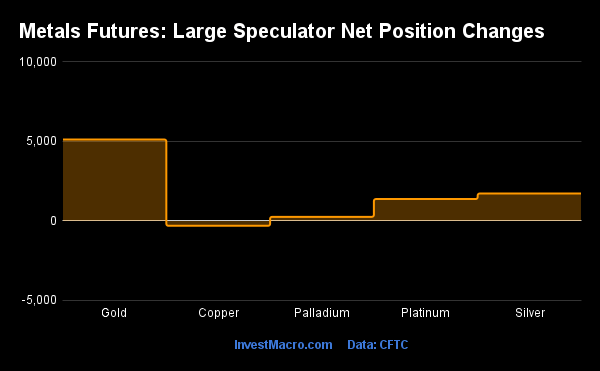
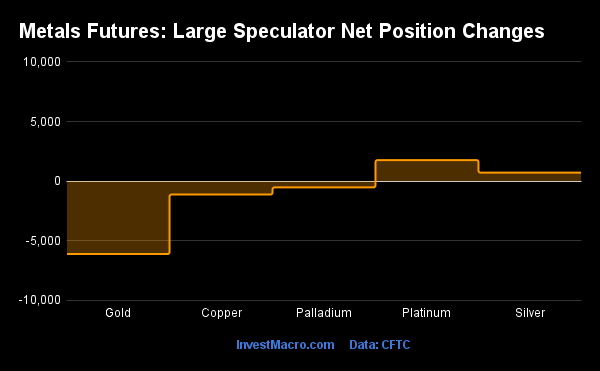
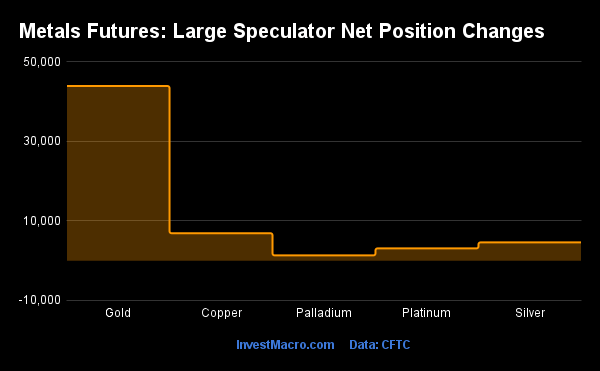
The COT precious metals speculator bets were higher this week as four out of the five metals markets we cover had higher positioning this week while just one market had lower contracts.

Leading the gains for the precious metals markets was Gold (5,122 contracts) with Platinum (1,377 contracts), Silver (1,725 contracts) and Palladium (259 contracts) also showing a positive week.

The only metals markets with declines in speculator bets this week was Copper at a total of -305 contracts.

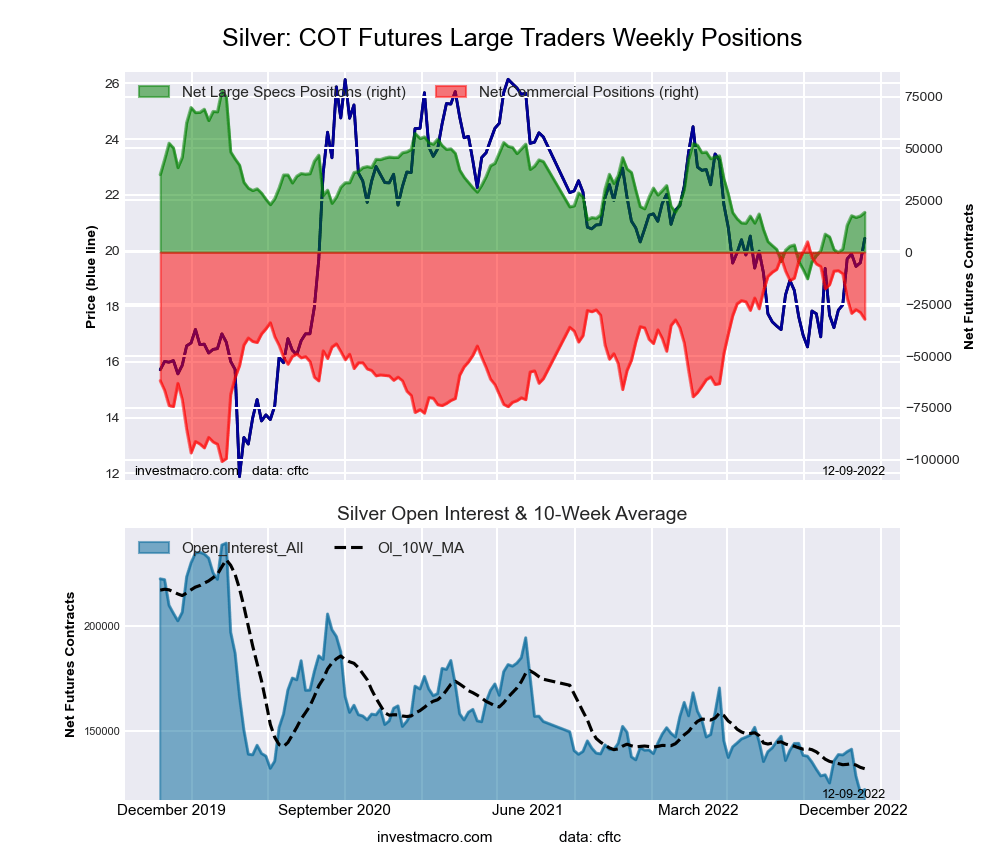
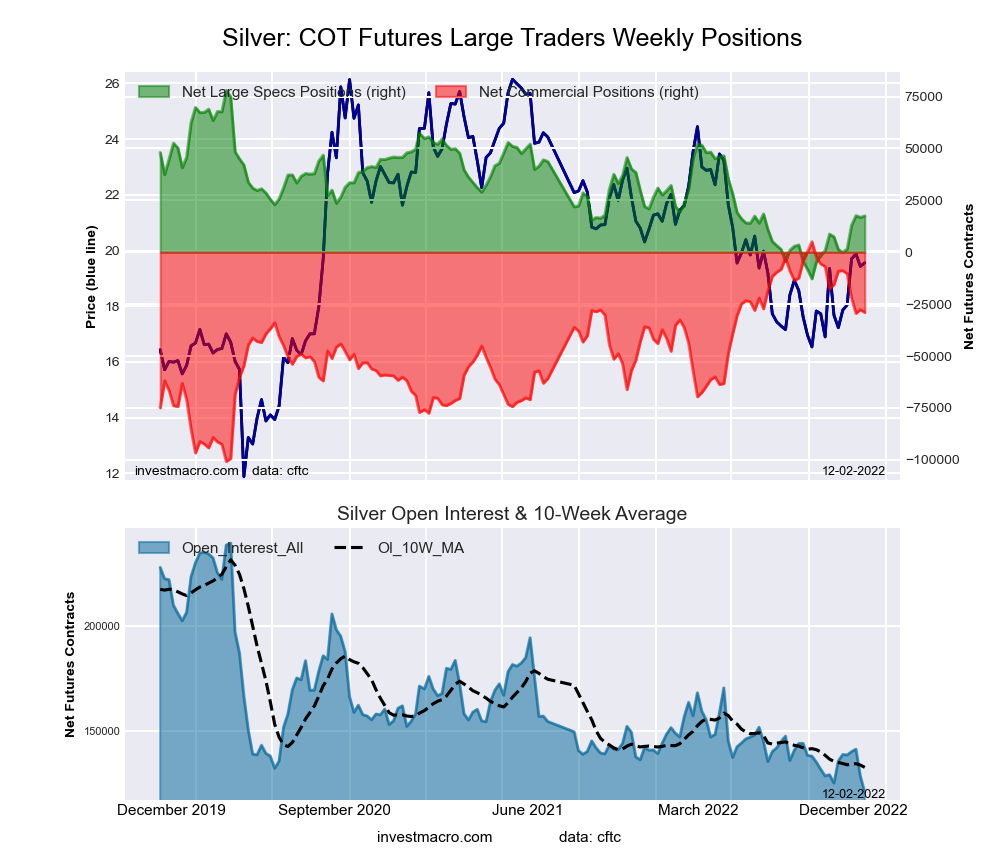
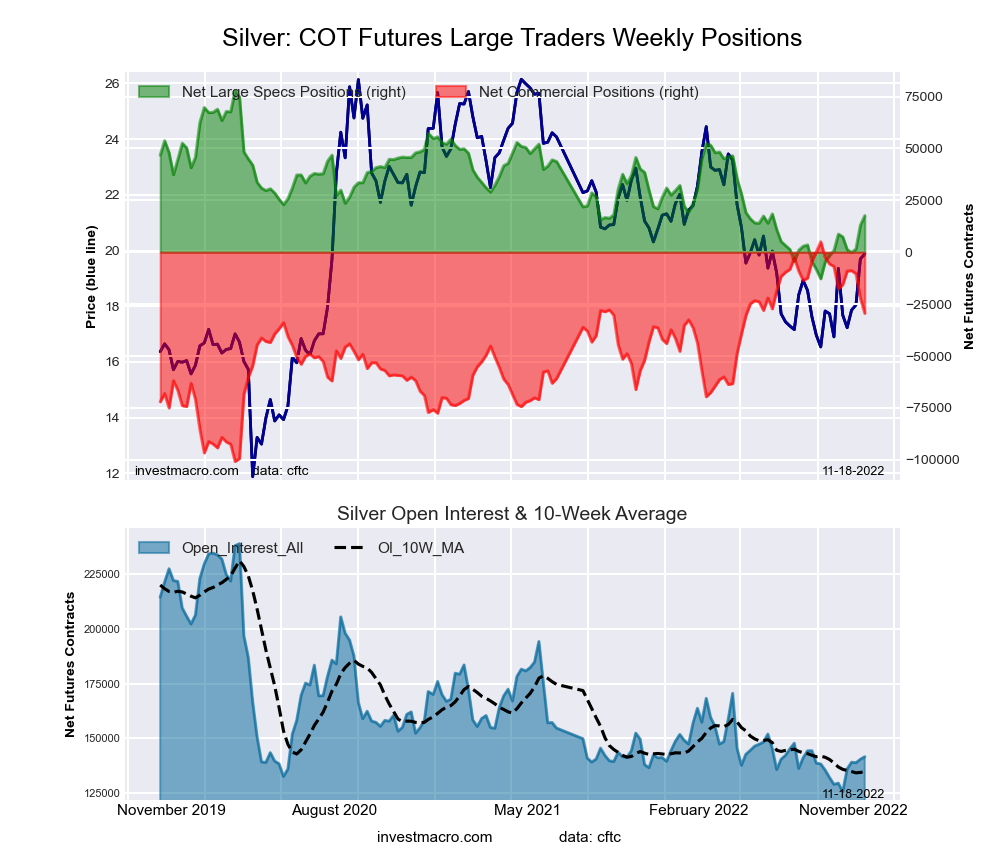
Highlighting the COT metals data this week is the increasing bullishness of Silver positions. The large speculator position in Silver futures rose this week for a second straight week and for the fifth time out of the past six weeks. Speculator bets have now risen by a total of +19,309 contracts over these past six weeks, going from a total of -101 contracts on October 25th to a total of +19,208 contracts this week. The recent gains have now positioned the speculator standing at its highest level since May 10th, a span of 30 weeks.

The Silver futures price has been on the move as well with prices closing out the week at $23.71. This is the highest weekly close for Silver since April and Silver is now up by over +30 percent since bottoming at the beginning of September.


Data Snapshot of Commodity Market Traders | Columns Legend
Dec-06-2022OIOI-IndexSpec-NetSpec-IndexCom-NetCOM-IndexSmalls-NetSmalls-Index
WTI Crude1,436,7283231,7206-259,5539427,83345
Gold422,1000115,12521-130,0797914,95417
Silver122,558119,20835-32,2626513,05433
Copper158,76291,67938-4,354642,67541
Palladium7,7859-1,372161,2268114650
Platinum68,8213725,63644-30,148584,51229
Natural Gas1,010,47911-164,03729135,6067428,43148
Brent144,1477-28,1186423,746334,37268
Heating Oil257,1581922,82876-39,5062916,67856
Soybeans622,2001189,66138-59,88271-29,77921
Corn1,232,3071198,37555-157,53649-40,83920
Coffee203,29614-14,642212,907981,73524
Sugar881,38834183,12457-226,0663842,94261
Wheat334,76021-39,897042,820100-2,92395


Strength Scores led by Platinum & Copper
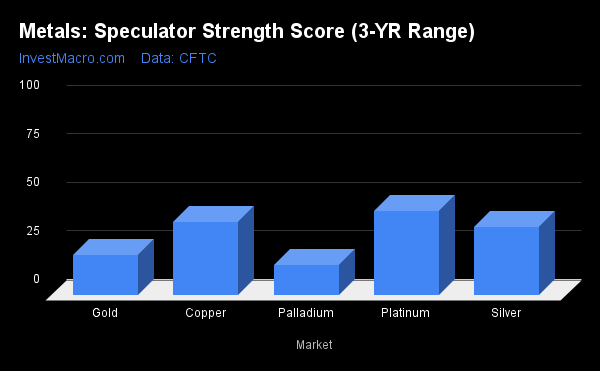
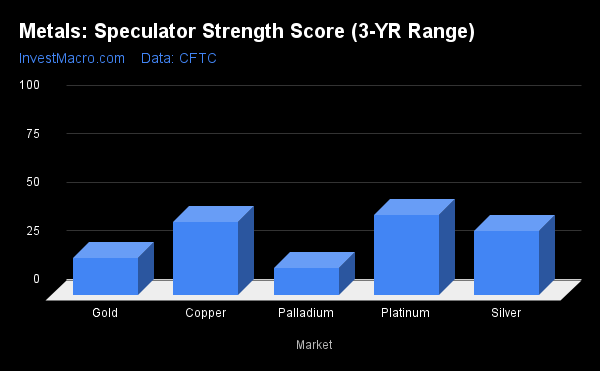
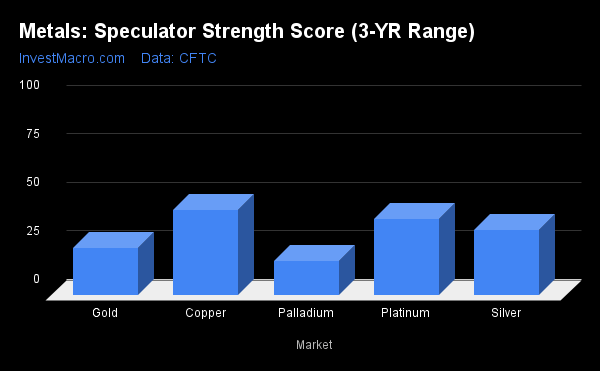
Strength scores (a measure of the 3-Year range of Speculator positions, from 0 to 100 where above 80 is extreme bullish and below 20 is extreme bearish) showed that Platinum (43.6 percent) and Copper (37.7 percent) lead the metals category this week. Silver (35.3 percent) and then Gold (20.9 percent) comes in as the next highest metals market in strength scores.

On the downside, Palladium (15.7 percent) is at the lowest strength level currently and is in an Extreme-Bearish level below 20 percent.

Strength Statistics:
Gold (20.9 percent) vs Gold previous week (19.2 percent)
Silver (35.3 percent) vs Silver previous week (33.4 percent)
Copper (37.7 percent) vs Copper previous week (37.9 percent)
Platinum (43.6 percent) vs Platinum previous week (41.7 percent)
Palladium (15.7 percent) vs Palladium previous week (14.2 percent)

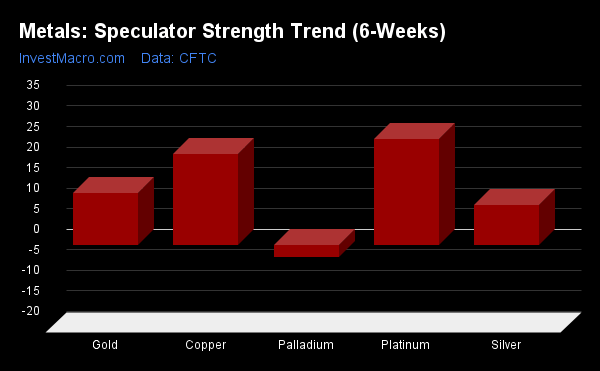
Silver & Platinum tops Strength Trends
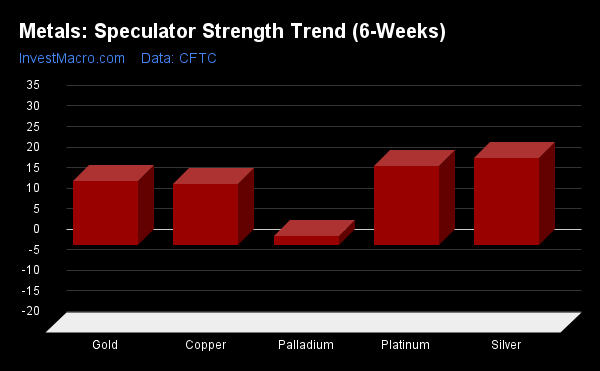
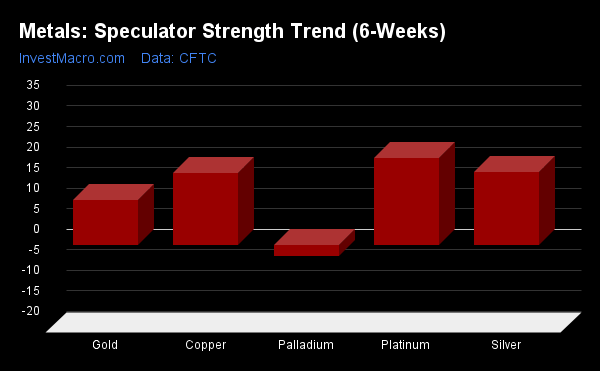
Strength Score Trends (or move index, calculates the 6-week changes in strength scores) showed that all metals markets were positive movers this week. Silver (21.3 percent) leads the past six weeks trends for metals. Platinum (19.2 percent), Gold (15.6 percent), Copper (14.8 percent) and Palladium (2.2 percent) fill out the positive movers in the latest trends data.

Move Statistics:
Gold (15.6 percent) vs Gold previous week (11.0 percent)
Silver (21.3 percent) vs Silver previous week (17.9 percent)
Copper (14.8 percent) vs Copper previous week (17.7 percent)
Platinum (19.2 percent) vs Platinum previous week (21.2 percent)
Palladium (2.2 percent) vs Palladium previous week (-2.5 percent)


Individual Markets:

Gold Comex Futures:
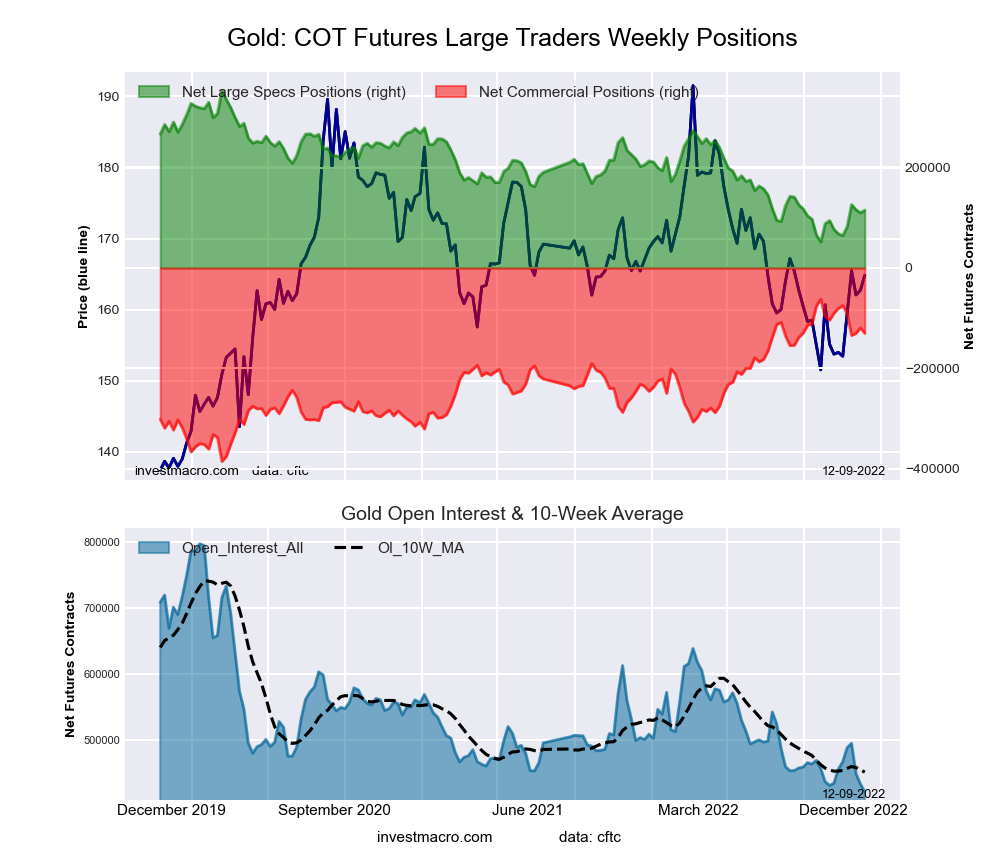
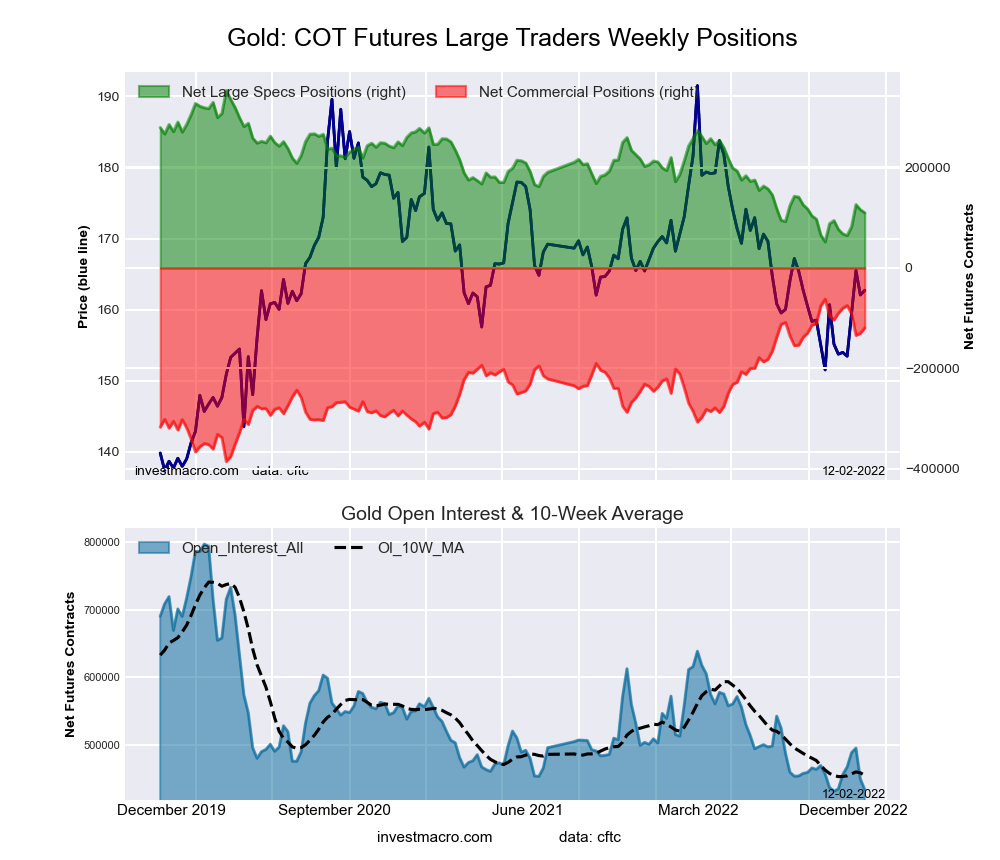
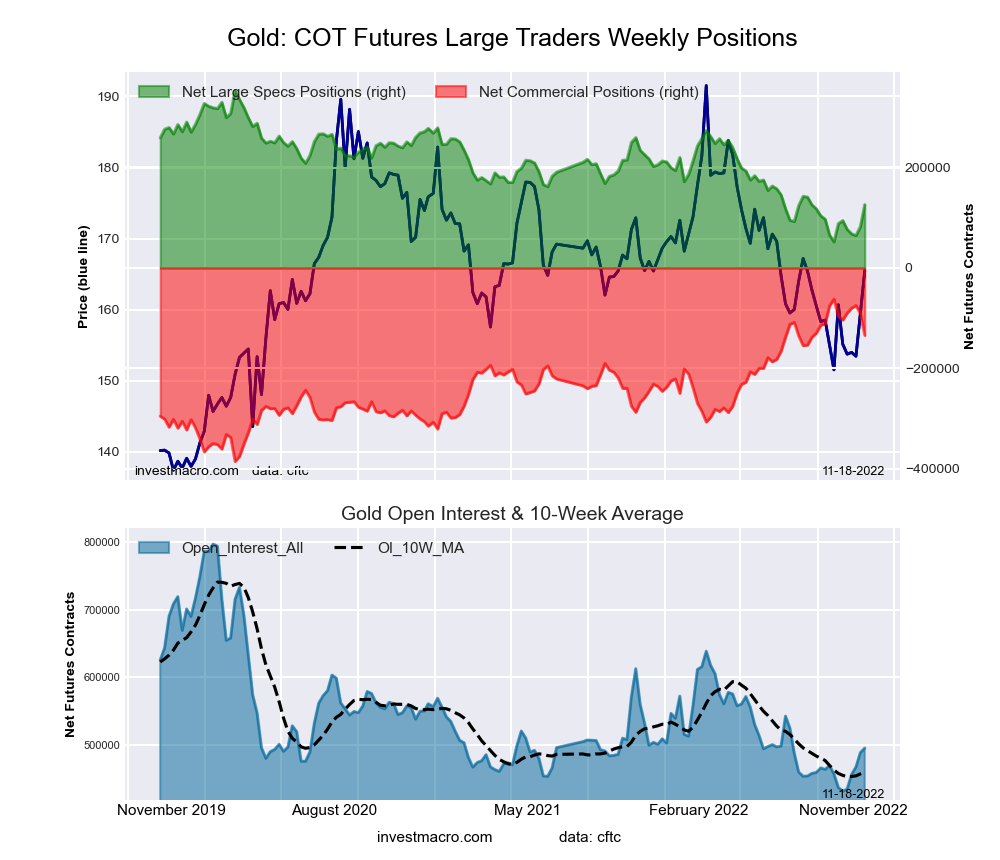
Gold Futures COT ChartThe Gold Comex Futures large speculator standing this week reached a net position of 115,125 contracts in the data reported through Tuesday. This was a weekly boost of 5,122 contracts from the previous week which had a total of 110,003 net contracts.

This week’s current strength score (the trader positioning range over the past three years, measured from 0 to 100) shows the speculators are currently Bearish with a score of 20.9 percent. The commercials are Bullish with a score of 79.0 percent and the small traders (not shown in chart) are Bearish-Extreme with a score of 17.4 percent.

Gold Futures StatisticsSPECULATORSCOMMERCIALSSMALL TRADERS
– Percent of Open Interest Longs:50.127.99.0
– Percent of Open Interest Shorts:22.858.75.4
– Net Position:115,125-130,07914,954
– Gross Longs:211,472117,57837,785
– Gross Shorts:96,347247,65722,831
– Long to Short Ratio:2.2 to 10.5 to 11.7 to 1
NET POSITION TREND:
– Strength Index Score (3 Year Range Pct):20.979.017.4
– Strength Index Reading (3 Year Range):BearishBullishBearish-Extreme
NET POSITION MOVEMENT INDEX:
– 6-Week Change in Strength Index:15.6-15.47.0


Silver Comex Futures:

Silver Futures COT ChartThe Silver Comex Futures large speculator standing this week reached a net position of 19,208 contracts in the data reported through Tuesday. This was a weekly lift of 1,725 contracts from the previous week which had a total of 17,483 net contracts.

This week’s current strength score (the trader positioning range over the past three years, measured from 0 to 100) shows the speculators are currently Bearish with a score of 35.3 percent. The commercials are Bullish with a score of 64.7 percent and the small traders (not shown in chart) are Bearish with a score of 33.4 percent.

Silver Futures StatisticsSPECULATORSCOMMERCIALSSMALL TRADERS
– Percent of Open Interest Longs:39.936.519.3
– Percent of Open Interest Shorts:24.362.88.6
– Net Position:19,208-32,26213,054
– Gross Longs:48,95444,75723,648
– Gross Shorts:29,74677,01910,594
– Long to Short Ratio:1.6 to 10.6 to 12.2 to 1
NET POSITION TREND:
– Strength Index Score (3 Year Range Pct):35.364.733.4
– Strength Index Reading (3 Year Range):BearishBullishBearish
NET POSITION MOVEMENT INDEX:
– 6-Week Change in Strength Index:21.3-22.119.7


Copper Grade #1 Futures:

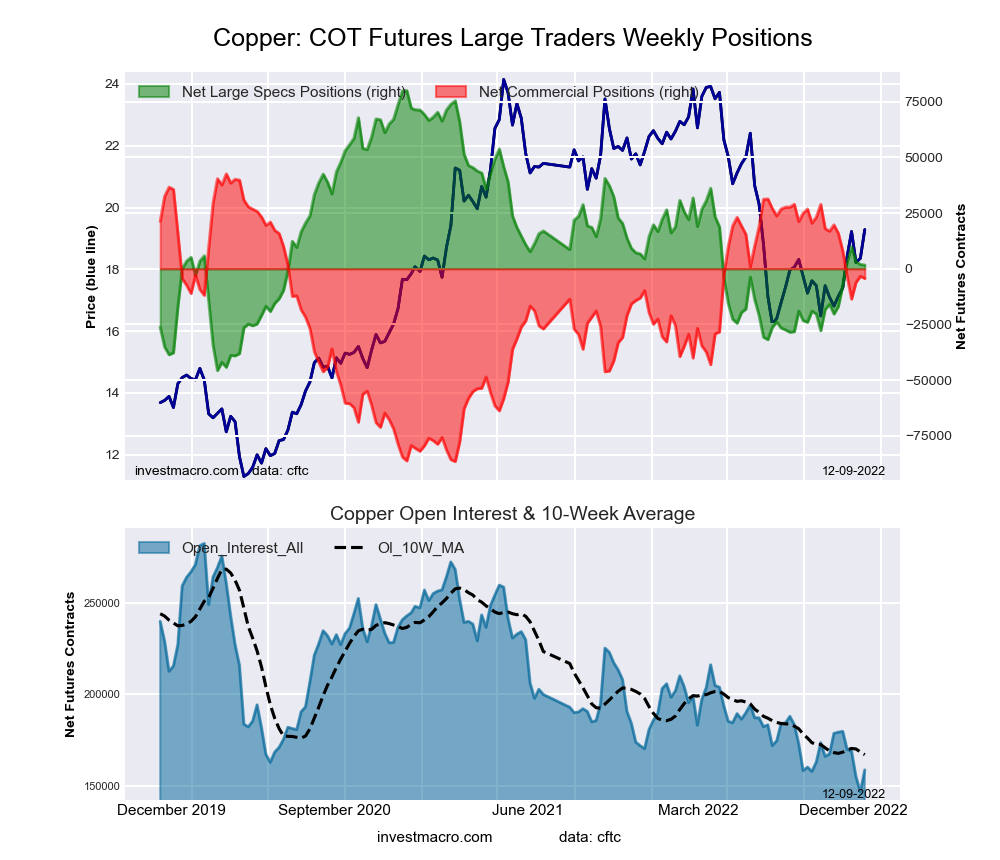
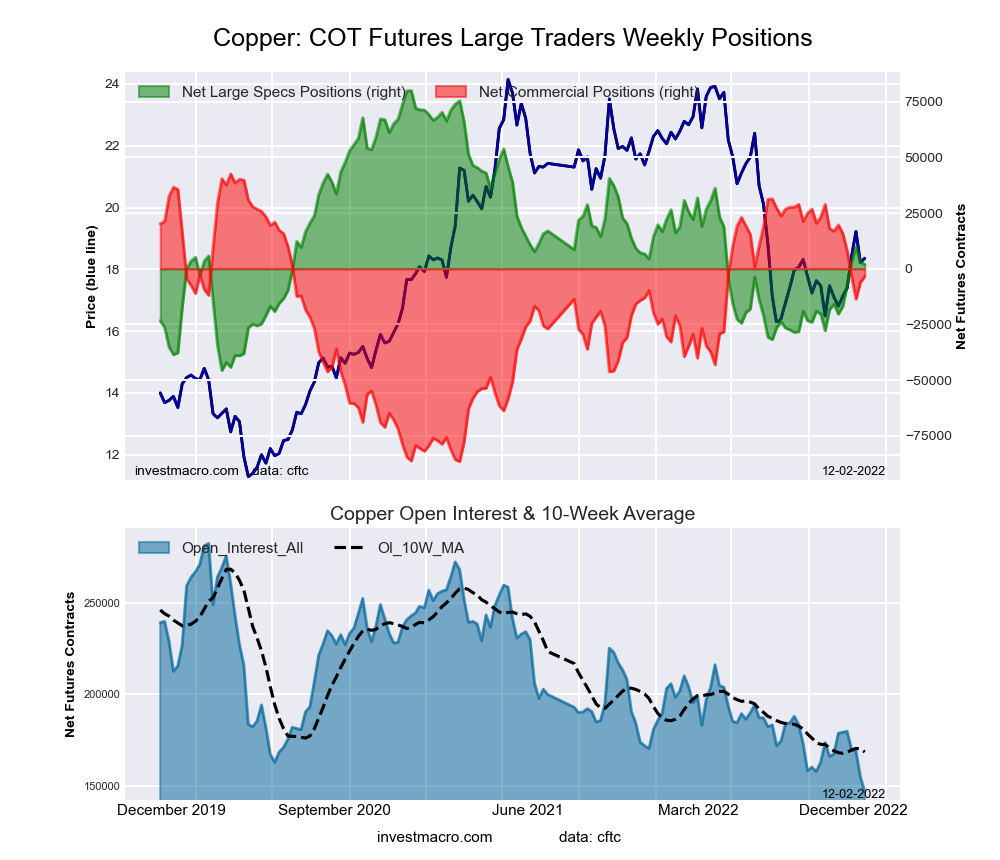
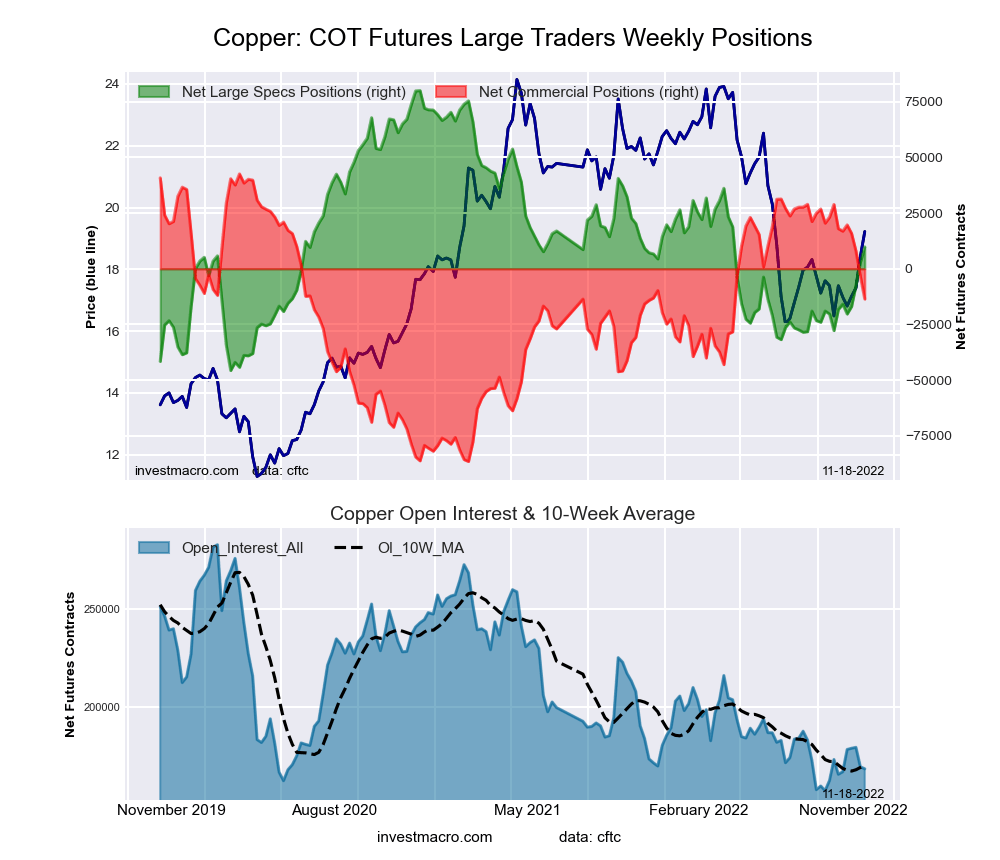
Copper Futures COT ChartThe Copper Grade #1 Futures large speculator standing this week reached a net position of 1,679 contracts in the data reported through Tuesday. This was a weekly reduction of -305 contracts from the previous week which had a total of 1,984 net contracts.

This week’s current strength score (the trader positioning range over the past three years, measured from 0 to 100) shows the speculators are currently Bearish with a score of 37.7 percent. The commercials are Bullish with a score of 63.6 percent and the small traders (not shown in chart) are Bearish with a score of 40.8 percent.

Copper Futures StatisticsSPECULATORSCOMMERCIALSSMALL TRADERS
– Percent of Open Interest Longs:35.041.89.7
– Percent of Open Interest Shorts:33.944.58.0
– Net Position:1,679-4,3542,675
– Gross Longs:55,49666,28615,368
– Gross Shorts:53,81770,64012,693
– Long to Short Ratio:1.0 to 10.9 to 11.2 to 1
NET POSITION TREND:
– Strength Index Score (3 Year Range Pct):37.763.640.8
– Strength Index Reading (3 Year Range):BearishBullishBearish
NET POSITION MOVEMENT INDEX:
– 6-Week Change in Strength Index:14.8-15.79.6


Platinum Futures:

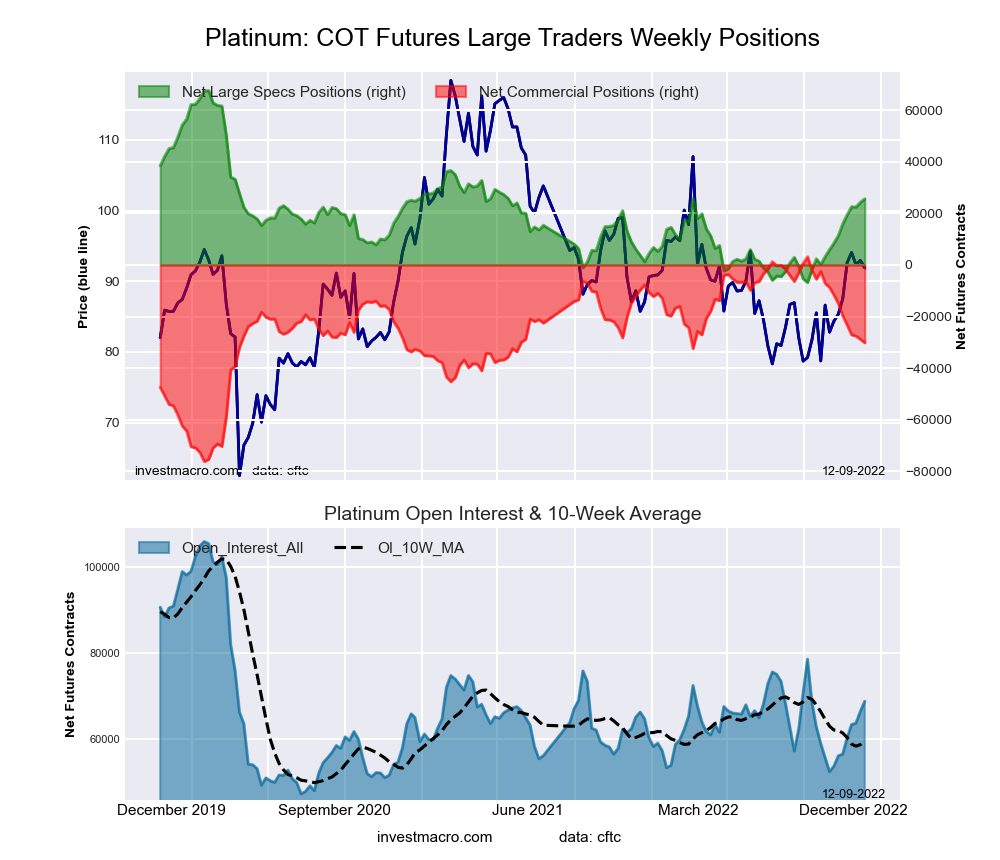
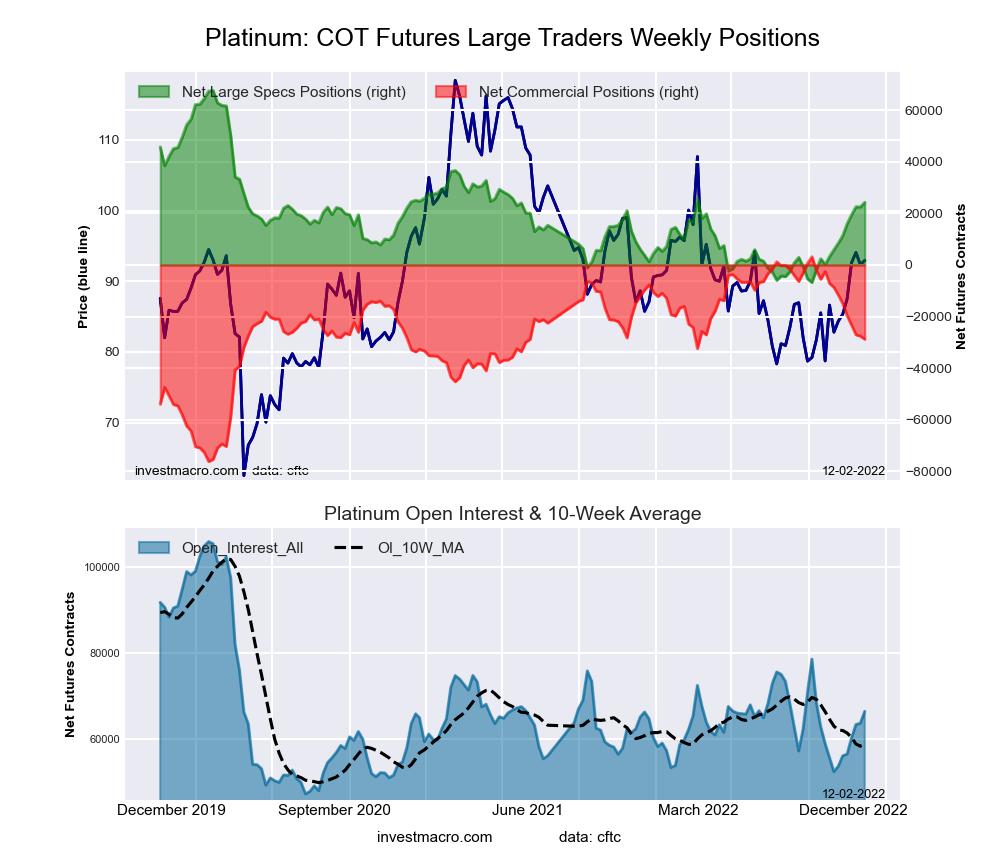
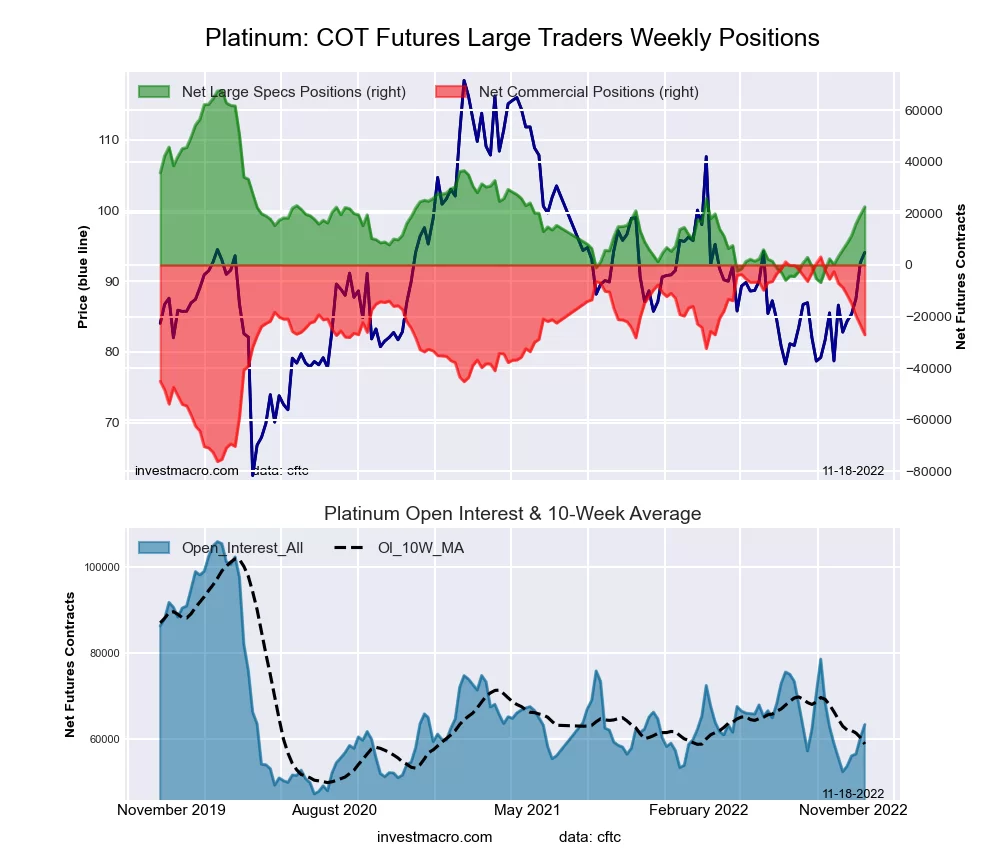
Platinum Futures COT ChartThe Platinum Futures large speculator standing this week reached a net position of 25,636 contracts in the data reported through Tuesday. This was a weekly lift of 1,377 contracts from the previous week which had a total of 24,259 net contracts.

This week’s current strength score (the trader positioning range over the past three years, measured from 0 to 100) shows the speculators are currently Bearish with a score of 43.6 percent. The commercials are Bullish with a score of 58.0 percent and the small traders (not shown in chart) are Bearish with a score of 28.6 percent.

Platinum Futures StatisticsSPECULATORSCOMMERCIALSSMALL TRADERS
– Percent of Open Interest Longs:53.329.110.6
– Percent of Open Interest Shorts:16.172.94.1
– Net Position:25,636-30,1484,512
– Gross Longs:36,69320,0257,324
– Gross Shorts:11,05750,1732,812
– Long to Short Ratio:3.3 to 10.4 to 12.6 to 1
NET POSITION TREND:
– Strength Index Score (3 Year Range Pct):43.658.028.6
– Strength Index Reading (3 Year Range):BearishBullishBearish
NET POSITION MOVEMENT INDEX:
– 6-Week Change in Strength Index:19.2-19.112.3


Palladium Futures:

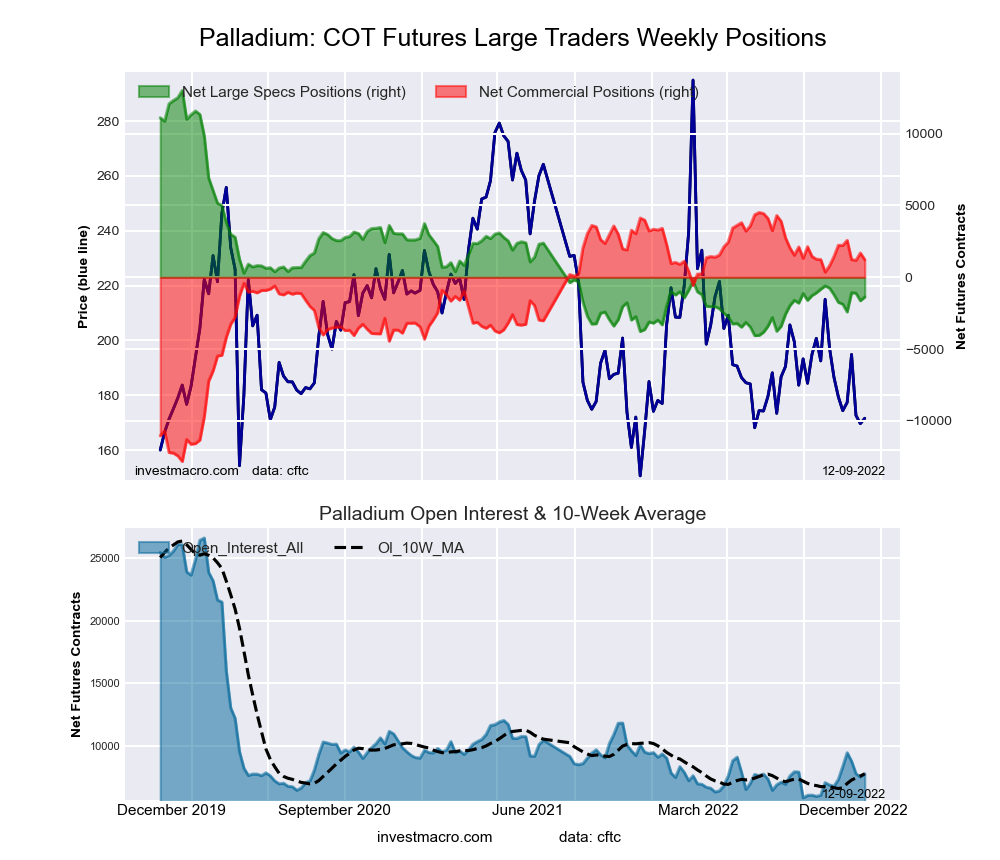
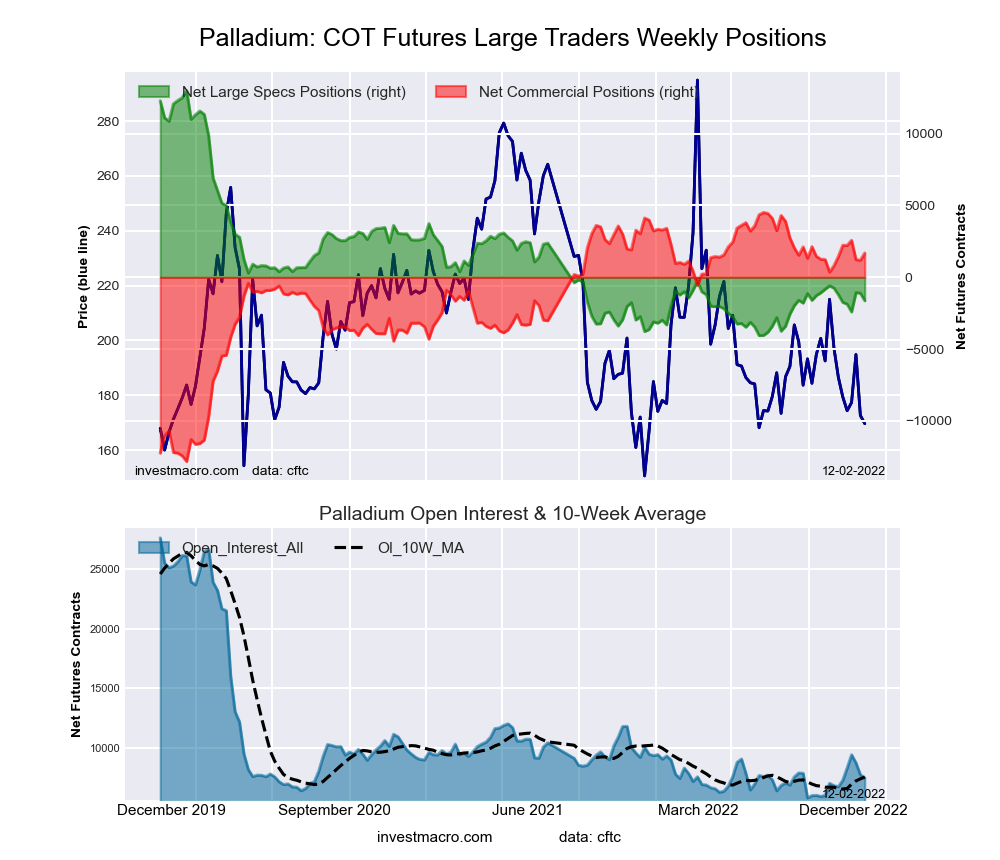
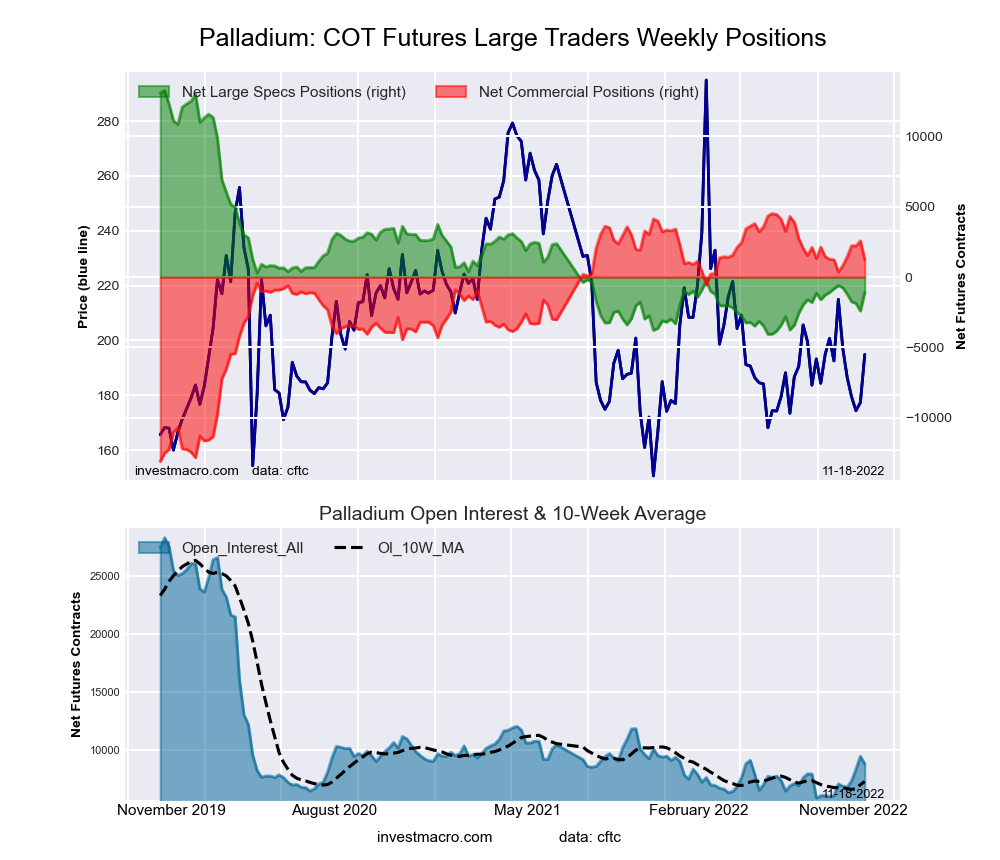
Palladium Futures COT ChartThe Palladium Futures large speculator standing this week reached a net position of -1,372 contracts in the data reported through Tuesday. This was a weekly boost of 259 contracts from the previous week which had a total of -1,631 net contracts.

This week’s current strength score (the trader positioning range over the past three years, measured from 0 to 100) shows the speculators are currently Bearish-Extreme with a score of 15.7 percent. The commercials are Bullish-Extreme with a score of 81.1 percent and the small traders (not shown in chart) are Bullish with a score of 50.5 percent.

Palladium Futures StatisticsSPECULATORSCOMMERCIALSSMALL TRADERS
– Percent of Open Interest Longs:31.649.814.9
– Percent of Open Interest Shorts:49.234.013.0
– Net Position:-1,3721,226146
– Gross Longs:2,4603,8751,157
– Gross Shorts:3,8322,6491,011
– Long to Short Ratio:0.6 to 11.5 to 11.1 to 1
NET POSITION TREND:
– Strength Index Score (3 Year Range Pct):15.781.150.5
– Strength Index Reading (3 Year Range):Bearish-ExtremeBullish-ExtremeBullish
NET POSITION MOVEMENT INDEX:
– 6-Week Change in Strength Index:2.2-5.837.8


Article By InvestMacroReceive our weekly COT Newsletter

*COT Report: The COT data, released weekly to the public each Friday, is updated through the most recent Tuesday (data is 3 days old) and shows a quick view of how large speculators or non-commercials (for-profit traders) were positioned in the futures markets.

The CFTC categorizes trader positions according to commercial hedgers (traders who use futures contracts for hedging as part of the business), non-commercials (large traders who speculate to realize trading profits) and nonreportable traders (usually small traders/speculators) as well as their open interest (contracts open in the market at time of reporting). See CFTC criteria here.

Resource Co. Completes 2022 Drilling and Receives US$895 Million

Source: Streetwise Reports  (12/7/22)

Canadian-based Skyharbour Resources has announced it plans to complete a 10,000m drill program at its Russell Lake property. It has also recently received US$895 million from the exercise of share purchase warrants. Read here to learn more about the project and where the company is headed for 2023.

Skyharbour Resources Ltd. (SYH:TSX.V; SYHBF:OTCQX; SC1P:FSE) is a Canadian-based exploration company. The company is focused on acquiring and advancing uranium exploration projects in Canada’s Athabasca Basin.

Why Uranium?

Uranium is an element that is mainly used to provide nuclear energy. Because of its radioactive properties, it can manufacture a tremendous amount of emissions-free energy. It is also considered more reliable than other emissions-free energy sources such as wind and solar. The outlook around the nuclear and uranium mining industries has changed significantly over the past several years and continues to improve.

While uranium has taken a dip in the past, recent news has led to its rise with the worldwide push to green energy, inflated energy costs, and the war in Ukraine. This August, Japan’s prime minister announced they would restart more idled nuclear plants and look at developing next-generation reactors. At this announcement, Forbes reported, “The Global X Uranium ETF surged 11.5%.”

Source: Skyharbour Resources.

The United States also has leaned into green energy. Currently, 20% of the electricity and 50% of the clean energy in the United States is nuclear, and this number seems to be on a path to only getting bigger.

On July 5, 2022, The New York Times reported that “the Biden administration has established a US$6 billion fund to help troubled nuclear plant operators keep their reactors running and make them more economically competitive against cheaper resources like solar and wind power.” The administration also is alluding US$2.5 million to fund two projects intended to showcase new nuclear technology.

Rajeev identified “the ongoing/planned exploration programs by Skyharbour and its partners” as major catalysts toward the company’s impending growth” and said that “as a result, Fundamental Research maintains its Buy recommendations for Skyharbour.”

This October 2022, the Biden administration also announced they would be providing US$150 million to improve nuclear research and development infrastructure at Idaho National Laboratory as a part of President Biden’s Inflation Reduction Act.

U.S. Secretary of Energy Jennifer M. Granholm commented that the Department of Energy “is taking critical steps to strengthen domestic nuclear development and deployment — helping ensure the United States is on track to reach a clean energy future.”

This, of course, leads to more uranium demand, or as Forbes said, “with many major nations rethinking their approach to clean, affordable energy, nuclear power plants are an obvious option. That’s good news for uranium investors, as more nuclear power means more demand for the radioactive metal.”

Skyharbour’s Plethora of Projects

Skyharbour Resources has been active in the Athabasca Basin since 2013 and has a myriad of projects, including Moore, Russell Lake, South Falcon Point, South Falcon East, Preston, East Preston, Hook Lake, Mann Lake, Yurchison, Riou River, Pluto Bay, Wallee, Usam Island, Foster River, West Dufferin, and South Dufferin.

Management noted that “Skyharbour holds an extensive portfolio of uranium exploration projects in Canada’s Athabasca basin and is well positioned to benefit from improving uranium market fundamentals with 15 projects, 10 of which are drill ready, covering over 450,000 hectares of land.”

Skyharbour estimates that over 30,000 meters of exploratory drilling will take place between all of its Athabasca Basin projects — including its two core assets and its multiple partner-funded projects — over the course of the next year. The company plans to dedicate a third of this work toward its flagship projects in Russell Lake and Moore Lake and is fully funded to conduct this work.

Catalyst: Plans to Break Ground at Russell Lake

Rio Tinto Plc. (RIO:NYSE; RIO:ASX; RIO:LSE; RTPPF:OTCPK), whose asset focus lies primarily in iron and copper, temporarily shelved the Russell Lake project. Rio has since optioned the project to Skyharbour, which plans to engage in advanced-stage exploration by drill testing “a number of the prospective targets [that] weren’t fully and systematically drill tested,” according to CEO Jordan Trimble. It wasn’t until a recent “resurgence in uranium and the nuclear industry” Trimble suggested that the industrial metals giant was willing to option the project to Skyharbour.

In resuming operations on the Russell Lake project, Skyharbour assumes the 40-person exploration camp previously used by Rio. Trimble believes that the inheritance and use of this asset for staging purposes “will bring [its]  drill costs down quite a bit, not just at Russell Lake, but also at the adjacent Moore Lake Project.”

A summer’s night at Russell Lake’s camp in the Athabasca Basin. Source: Skyharbour Resources.

On November 23, the company announced it will carry out multiple phases of diamond drilling totaling 10,000 meters at Russell Lake. It plans on breaking ground sometime within the next month.

This minimum 10,000-meter exploration program will be carried out concurrently with Skyharbour’s multiple partner-funded uranium-drilling program at some of its other projects in the Athabasca Basin.

Analyst Sid Rajeev of Fundamental Research noted that Russell Lake “is strategically located between Cameco’s Key Lake mill and MacArthur uranium mine,” such that Skyharbour has a direct and rapid processing line between “the world’s largest uranium mill and the largest high-grade uranium mine.”

Catalyst: 2022 Drilling Complete at Mann Lake

At the end of last month, the company announced its partner company Basin Uranium Corp. had completed drilling at Mann Lake for 2022. 6,279 meters were drilled. Core samples have been submitted for analysis to the Saskatchewan Research Council (SRC).

As they hold steady for the assay results, Skyharbour’s partner company Basin Uranium plans to continue its exploration programs at it Mann Lake project in the Athabasca Basin in 2023.

Rajeev identified “the ongoing/planned exploration programs by Skyharbour and its partners” as major catalysts toward the company’s impending growth” and said that “as a result, Fundamental Research maintains its Buy recommendations for Skyharbour.”

Catalyst: Skyharbour Receives US$895 Million

Friday, Skyharbour announced it had received US$895,027.32 from the exercise of share purchase warrants with a strike price of US$0.22 since June 29, 2022. 4,068,306 of the warrants have been exercised, with this batch of warrants expiring on Nov. 29, 2022.

Furthermore, the company noted that “collectively, Skyharbour has now signed option agreements with partners that total over US$34 million in partner-financed exploration expenditures, over US$22 million in stock being issued and just under US$15 million in cash payments coming into Skyharbour, assuming that these partner companies earn in the full amounts at their respective projects.”

Ownership and Share Structure

Skyharbour’s management owns approx. 5% of the company’s 145 million marketable shares. CEO Trimble owns 2.514 million shares of Skyharbour, maintaining a 1.73% stake. Director David Cates’ 1.247 million shares constitute an additional 0.86% management stake. Mr. Cates is the President and CEO of Denison Mines, a larger uranium developer that is a strategic partner and shareholder of Skyharbour Resources.

Aside from the aforementioned Denison and Rio Tinto, notable strategic and institutional investors in the company’s growth include the Global X and Sprott Uranium ETFs, Extract Capital, L2, Sachem Cove, and Sprott Capital Partners.

It is also worth noting that Skyharbour maintains a minority equity stake in several of its other option and joint-venture partner companies. Skyharbour has signed option agreements over the last several years with partners that total approx. CA$22 million worth of shares being issued between Azincourt Energy, Valor Resources, Basin Uranium, Medaro Mining, Yellow Rocks Energy, and Tisdale Clean Energy — the companies behind Skyharbour’s partnerships in East Preston, Hook Lake, Mann Lake, Yurchison, Wallee/Usam, and South Falcon East respectively.

The company’s burn rate is US$110,000. It has over US$6M in the treasury, with another approximately US$2.5 million expected to come in from option partner payments and shares in the next 12 months.

Skyharbour has a market cap of US$39 million and 144.99 million outstanding shares. It has 138.45 million shares in the public float and trades in the 52-week range at between US$0.2223 and US$0.6558 per share.

Disclosures:
1) Katherine DeGilio and Thomas Griffin wrote this article for Streetwise Reports LLC, and Thomas Griffin provides services to Streetwise Reports as an independent contractor. They or members of their household own securities of the following companies mentioned in the article: None. They or members of their household are paid by the following companies mentioned in this article: None.

2) The following companies mentioned in this article are billboard sponsors of Streetwise Reports: Skyharbour Resources Ltd. Click here for important disclosures about sponsor fees. As of the date of this article, an affiliate of Streetwise Reports has a consulting relationship with: None. Please click here for more information.

3) Statements and opinions expressed are the opinions of the author and not of Streetwise Reports or its officers. The author is wholly responsible for the validity of the statements. The author was not paid by Streetwise Reports for this article. Streetwise Reports was not paid by the author to publish or syndicate this article. Streetwise Reports requires contributing authors to disclose any shareholdings in, or economic relationships with, companies that they write about. Streetwise Reports relies upon the authors to accurately provide this information and Streetwise Reports has no means of verifying its accuracy.

4) This article does not constitute investment advice. Each reader is encouraged to consult with his or her individual financial professional and any action a reader takes as a result of information presented here is his or her own responsibility. By opening this page, each reader accepts and agrees to Streetwise Reports’ terms of use and full legal disclaimer. This article is not a solicitation for investment. Streetwise Reports does not render general or specific investment advice and the information on Streetwise Reports should not be considered a recommendation to buy or sell any security. Streetwise Reports does not endorse or recommend the business, products, services or securities of any company mentioned on Streetwise Reports.

5) From time to time, Streetwise Reports LLC and its directors, officers, employees or members of their families, as well as persons interviewed for articles and interviews on the site, may have a long or short position in securities mentioned. Directors, officers, employees or members of their immediate families are prohibited from making purchases and/or sales of those securities in the open market or otherwise from the time of the decision to publish an article until three business days after the publication of the article. The foregoing prohibition does not apply to articles that in substance only restate previously published company releases.  As of the date of this article, officers and/or employees of Streetwise Reports LLC (including members of their household) own securities of Skyharbour Resources Ltd., a company mentioned in this article.

Analyst: Timing Perfect for Nevada Lithium Project

Source: Streetwise Reports  (12/7/22)

Rover Metals Corp. is making the jump from gold to lithium and critical elements. One analyst said the timing is perfect.

The timing of Rover Metals Corp. (ROVR:TSX.V; ROVMF:OTCQB; 4X0:FSE) move from gold to lithium and critical elements is perfect, an analyst said, as other projects near its new Let’s Go Lithium project in Nevada are “ripe for consolidation.”

Let’s Go Lithium is estimated to hold lithium-bearing clay mineralization similar to other advanced-stage deposits held in the state by Cypress Development Corp. (CYP:TSX.V; CYDVF:OTCQB; C1Z1:FSE), American Lithium Corp. (LIACF:US-OTC; LI:TSX.V; 5LA1:FSE), and Noram Lithium Corp. (NRM:TSX.V).

Economic studies on Cypress’ and Noram’s projects have returned “robust economics,” according to Sid Rajeev, head of research for Fundamental Research Corp.

“We believe miners/battery manufacturers are actively monitoring juniors for M&A, as they are constantly seeking long-term stable sources of lithium for EV (electric vehicle) batteries,” Rajeev wrote in a note on December 1, 2022.

Rover Chief Executive Officer and Director Judson Culter said the company was open to such transactions.

“The battery producers want mines being built ASAP,” Culter told Streetwise Reports. “The bigger the resource companies are, the easier it will be for them to capitalize and build refineries.”

The World Needs More Lithium

According to Benchmark Mineral Intelligence, the deficit between lithium demand and production and highly probable and probable lithium projects will be over 3.5 million tonnes (Mt) by 2040. The world needs lithium and other critical elements like copper to help fuel the move to green energy. Lithium — a soft, silvery metal with highly reactive and flammable properties — is a major component of EV batteries. It’s also used to strengthen alloys, as a high-temperature lubricant, and as a drug to treat bipolar disorder.

One out of five vehicles sold worldwide could be an EV in less than two years, and Ford and General Motors have set a goal of achieving 40–50% of their sales from EVs in the U.S. by 2030.

To qualify for tax credits under new U.S. laws, a significant percentage of batteries and minerals in batteries must come from the U.S. or Canada, a regional trade-treaty country.

China only has less than a quarter of the world’s lithium resources but controlled about two-thirds of the world’s lithium processing and refining capacity in 2021, Rystad Energy said.

The Catalyst: Lithium

Rover has signed a definitive agreement to option a 100% ownership interest in the Let’s Go Lithium project. It’s located in Nevada’s southwest lithium jurisdiction near Albemarle Corp.’s (ALB:NYSE) Silver Peak mine, which is the only lithium-producing mine in North America.

The company plans to convert the project into an NI 43-101-compliant resource within two years and plans to conduct a drill program. Rajeev said that “delineating a lithium resource is a faster and cheaper process vs. mainstream metals such as gold [and] copper.”

Unlike other metals, lithium is deposited in “a vast amount close to the surface,” Culter said. “In gold and copper, you typically have to chase shoots or veins of the high-grade (ore), which are narrow (and go) to great depths. These are very tricky to follow below the surface.”

The climate and energy package recently passed in the United States is bringing new urgency to the production of electric vehicle (EV) metals and minerals like lithium. Rover officials said they want to be positioned to take advantage of that.

Rover last summer announced it had also closed on a deal involving the Indian Mountain Lake copper and zinc project in the Northwest Territories. It had verified high-grade lithium surface samples at Let’s Go Lithium of 780 parts per million lithium (ppm Li), 910 ppm Li, and 710 ppm Li.

Further analysis of samples using handheld laser-induced breakdown spectroscopy found results of 1,218 ppm Li, 778 ppm Li, and 724 ppm Li.

Culter said the company is readying a US$200,000 reverse-circulation drill program to follow up on those high-grade samples. That exploration money will also be the company’s required earn-in to a 100% ownership of the project.

Rajeev said Fundamental was maintaining its Buy rating on Rover.

The later-stage greenfields lithium project includes hydro power lines, direct road access, and a nearby town with a readily available workforce, the company said.

There have been four historical water wells drilled on the project that logged the claystone orebody as being close to surface, with an average thickness of over 300 feet across the approximate 6,000 acres of the property. Because of that, the project is district-scale in nature, Culter said.

Cypress is producing a feasibility study looking at the commercial viability of producing lithium carbonate for EV batteries from Nevada claystone like at Let’s Go Lithium.

Albemarle Corp.’s Silver Peak mine in Nevada is the only lithium-producing mine in North America, but it uses a water-intensive process to get at lithium-bearing brine deposits in an area that’s seeing record droughts. The claystone method uses acids to process lithium-bearing clay.

Rajeev said Fundamental was maintaining its Buy rating on Rover but adjusting its fair value estimate for its share price from CA$1.14 down to CA$0.56. It was CA$0.10 per share on Tuesday afternoon.

Ownership and Share Structure

Culter and family members own about 2 million shares of Rover, and directors Keith Minty and Louis Covello own about 360,000 and about 50,000, respectively. There are no institutional shareholders, and the rest are retail.

Rover’s market cap is CA$2.63 million, and it has 26.3 million shares outstanding, 24.9 million of them free-floating. It trades in a 52-week range of CA$0.39 and CA$0.06.

Disclosures:

1) Steve Sobek wrote this article for Streetwise Reports LLC. He or members of his household own securities of the following companies mentioned in the article: None. He or members of his household are paid by the following companies mentioned in this article: None.

2) The following companies mentioned in this article are billboard sponsors of Streetwise Reports: Rover Metals Corp. Click here for important disclosures about sponsor fees. The information provided above is for informational purposes only and is not a recommendation to buy or sell any security.

3) The article does not constitute investment advice. Each reader is encouraged to consult with his or her individual financial professional and any action a reader takes as a result of information presented here is his or her own responsibility. By opening this page, each reader accepts and agrees to Streetwise Reports’ terms of use and full legal disclaimer. This article is not a solicitation for investment. Streetwise Reports does not render general or specific investment advice and the information on Streetwise Reports should not be considered a recommendation to buy or sell any security. Streetwise Reports does not endorse or recommend the business, products, services or securities of any company mentioned on Streetwise Reports.

4) From time to time, Streetwise Reports LLC and its directors, officers, employees or members of their families, as well as persons interviewed for articles and interviews on the site, may have a long or short position in securities mentioned. Directors, officers, employees or members of their immediate families are prohibited from making purchases and/or sales of those securities in the open market or otherwise from the time of the decision to publish an article until three business days after the publication of the article. The foregoing prohibition does not apply to articles that in substance only restate previously published company releases. As of the date of this article, officers and/or employees of Streetwise Reports LLC (including members of their household) own securities of Rover Metals Corp., a company mentioned in this article.

Rare Earths Co. Drills Deepest Hole Yet in B.C.

Source: Streetwise Reports  (12/5/22)

Defense Metals Corp. has now released results from 10 of 18 holes in its 5,500m drill program this year.

Defense Metals Corp. (DEFN:TSX.V; DFMTF:OTCQB; 35D:FSE) has released results from the deepest hole it’s drilled yet at its Wicheeda rare earth element (REE) deposit in British Columbia.

Hole WI22-72 totaled 374 meters, terminating 360 meters below the surface and 150 meters below the pit shell and intersecting high-grade mineralized dolomite carbonate from surface grading 3.02% total rare earth oxides (TREO) over 55 meters.

Assays also returned a broader zone of 2.56% TREO over 122 meters.

With assays from 10 of 18 holes in the 5,500-meter drilling program still pending, results from this year and data from 2021 will be incorporated in a preliminary feasibility study (PFS) for the 100%-company-owned site.

“The 2022 Wicheeda Deposit resource infill drilling continues to yield high-grade REE intercepts from surface exceeding 3% TREO,” wrote analyst Mark Reichman.

“The 2022 Wicheeda Deposit resource infill drilling continues to yield high-grade REE intercepts from surface exceeding 3% TREO,” wrote analyst Mark Reichman in a Nov. 23 note for Noble Capital Markets.

“Results from the 2022 drilling are expected to contribute greatly toward upgrading resource categories in support of the preliminary feasibility study which is expected to be completed by the fourth quarter of 2023.”

Defense Metals Chief Executive Officer and Director Craig Taylor said the drill results “are doubly significant in that they represent the deepest test of the Wicheeda Deposit to date, which yielded a broad mixed lithology interval averaging nearly two times the mineral resource cutoff grade ending 50 meters below the current pit shell. The fact that we continue to see potentially economic REE grades at these depths is extremely encouraging.”

The company also announced a private placement that is expected to close this week to raise up to CA$6 million to advance the project.

The offering consisted of the sale of up to 12.5 million common shares of the company that qualified as flow-through shares (FT) at a price of CA$0.28 per FT share and up to 11.4 million units at a price of CA$0.22 per unit.

Each unit consists of one common share and one-half of a common share purchase warrant.

The Catalyst

Reichman said he expected the PFS to potentially extend the resource and the mine’s life past 19 years.

Analyst Michael Gray of Agentis Capital said, Wicheeda was well-located with access to key infrastructure and “could become a globally significant producer” of REEs.

“The 2022 resource infill drilling continues to yield high-grade REE intercepts from surface exceeding 3% TREO,” Reichman wrote.

“The recent drill results are significant in that they represent the deepest drilling to test the Wicheeda Deposit to date, yielding a broad mixed lithology interval averaging nearly two times the mineral resource cut-off grade ending 50 meters below the current pit shell.”

Analyst Michael Gray of Agentis Capital recently initiated coverage on the company, saying Wicheeda was well-located with access to key infrastructure and “could become a globally significant producer” of REEs. He set a 12-month valuation of CA$3.50 for the stock.

“DEFN is a best-of-breed North American REE developer that is well-positioned to its leverage growing global REE demand and government support to become part of a North American REE critical metals supply chain,” Gray wrote.

The World Needs REEs

Defense Metals hopes to produce as much as 10% of the world’s light REEs to reduce reliance on China, which has about 85% of the world’s REE processing capacity. Political issues between the United States, China, and Taiwan put that vital supply at risk, as well as pressure from within China itself.

REEs are in high demand in the new green economy for purifying water, MRIs, fertilizers, weapons, research, wind turbines, computers, and permanent magnet motors for electric vehicles (EVs).

A preliminary economic assessment (PEA) for Wicheeda in 2021 showed an after-tax net present value of CA$512 million. Its 43-101 technical report showed a 5 million tonne indicated resource at 2.95% total rare earth oxides (TREO) and a 29.5 million tonne inferred resource averaging 1.83% TREO.

Results from another core hole, WI22-70, were released this fall. Drilling there intersected 2.5% of total TREO over 113 meters. DEFN also intersected a broad zone of mineralized dolomite carbonatite averaging 2.14% TREO over 221 meters, including an interval of 3.52% TREO over 111 meters, at hole WI22-69.

Wicheeda could help fill the resource gap with China, Reichman said. “The assay results released thus far have been outstanding,” he wrote.

Ownership, Coverage, and Share Structure

Three money managers — Marquest Asset Management, U.S. Global Investors, and Probity/Qwest Funds — own a small percentage of the company. The rest is retail.

Currently, the analysts covering Defense Metals Corp. include Reichman and Gray. Newsletter writers Clive Maund and Bob Moriarty also follow the stock. You can see all the analyst and newsletter coverage by clicking “See More Live Data” in the data box above.

Defense Metals has a market cap of CA$39.43 million with 183.4 million shares outstanding, 140.6 million of them free floating. It trades in a 52-week range of CA$0.36 and CA$0.165.

Disclosures:

1) Steve Sobek wrote this article for Streetwise Reports LLC. He or members of his household own securities of the following companies mentioned in the article: None. He and members of his household are paid by the following companies mentioned in this article: None.

2) The following companies mentioned in this article are billboard sponsors of Streetwise Reports: Defense Metals Corp. Click here for important disclosures about sponsor fees. As of the date of this article, an affiliate of Streetwise Reports has a consulting relationship with Defense Metals Corp. Please click here for more information. The information provided above is for informational purposes only and is not a recommendation to buy or sell any security.

3) The article does not constitute investment advice. Each reader is encouraged to consult with his or her individual financial professional and any action a reader takes as a result of information presented here is his or her own responsibility. By opening this page, each reader accepts and agrees to Streetwise Reports’ terms of use and full legal disclaimer. This article is not a solicitation for investment. Streetwise Reports does not render general or specific investment advice and the information on Streetwise Reports should not be considered a recommendation to buy or sell any security. Streetwise Reports does not endorse or recommend the business, products, services or securities of any company mentioned on Streetwise Reports.

4) From time to time, Streetwise Reports LLC and its directors, officers, employees, or members of their families, as well as persons interviewed for articles and interviews on the site, may have a long or short position in securities mentioned. Directors, officers, employees or members of their immediate families are prohibited from making purchases and/or sales of those securities in the open market or otherwise from the time of the decision to publish an article until three business days after the publication of the article. The foregoing prohibition does not apply to articles that in substance only restate previously published company releases. As of the date of this article, officers and/or employees of Streetwise Reports LLC (including members of their household) own securities of Defense Metals Corp., a company mentioned in this article.

Welcome to the New Golden Bull

Source: Michael Ballanger  (12/5/22)

 Expert Michael Ballanger of GGM Advisory Inc. reviews Andrew Ross Sorkin’s decision to interview SBF in a global broadcast, Fed Chairman Jerome Powell’s November 30th email alert, and the price of gold as it advances to tell you where he believes the market is heading and what you should look out for.

I will discuss gold in a few paragraphs, but first. . .

Andrew Ross Sorkin

At the exact moment where I thought I could move on from this incessant preoccupation with FTX founder Sam Bankman-Fried, along comes one of the Wall Street media “royalty,” author of the book Too Big to Fail and a regular morning anchor on CNBC, Andrew Ross Sorkin, who makes the fateful decision to interview SBF in a global broadcast effectively allowing the alleged mastermind of the largest “misallocation” of customer funds in history a virtually unchallenged opportunity to pre-plead his case.

Notwithstanding the softball questions and buddy-buddy repartee between them, Sorkin and the NT Times audience actually applauded Bankman-Fried at the end of the interview.

Granted that the young man has not been indicted for any crime yet, these media gluttons are free to take whatever cash he transferred their way in return for the venue. They were (and still are) free to do anything they so choose with him because he is innocent until proven guilty, despite the admissions of the comingling of customer funds with that of his private trading entity, Alameda, as well as failure to adequately explain why he felt it excusable to buy tens of millions of dollars of real estate and put it in his own name or that of his parents.

The only reason I bring this up lies in the now-famous quote by the late, brilliant comedian George Carlin, when he said in reference to the elites that run the nation, “It is one big club, and you ain’t in it!”

Now, I am not going to continue to beat this dead mule as it truly serves no purpose but what I will say is that I find these interviews in poor taste at best and obscenely greed-driven at worst with the determination of legality to be decided at a later date.

To think that political parties on both sides of the aisle were given enormous amounts of campaign funding as well as all of the media companies, is an absolute abomination and an abject conflict of interest of staggering proportions.

The only reason I bring this up lies in the now-famous quote by the late, brilliant comedian George Carlin, when he said in reference to the elites that run the nation, “It is one big club, and you ain’t in it!”

To have such a prominent Wall Street cheerleader like Ross-Sorkin sit there and serve up overhand smashes for the fully-prepared SBF was, at least for me, an offense. It makes one wonder just how much the average investor is getting played by the Wall Street titans that control the behemoth software programs that are able to identify trades nanoseconds before they occur.

As my late friend and technical analyst Ian McAvity used to say, “In the hold of every sunken ship, you will always find a chart.”

It makes you wonder whether the bid offer for a particular security is real and whether the research report recommending an issuer is the product of actual research (as in “unbiased”) or whether it is part of an investment banking agreement where the only research generated with positive tilts are those attached to banking fees.

Plus ça change, plus c’est la meme chose,” (The more things change, the more they remain the same.) wrote French writer Alphonse Karr and in the case of Wall Street, it is a most-fitting and very apropos phrase for describing an event that mirrors the unbridled hubris of the 2001 DotCom crash and the 2008 Subprime crash, two of the most recent examples of Wall Street Gone Wild under the influence of the most powerful narcotic known to mankind — greed.

I want this chapter to be the last in the sequence, but until someone actually goes to jail for white-collar crimes of ever-increasing magnitude and audacity, it is an exercise in futility.

The Fed Concerned About Overtightening

Moving along, this week was dominated by Fed Chairman Jerome Powell, so I will provide a sample of Email Alert 2022-109 sent to subscribers on Thursday morning pre-opening:

“I am concerned about overtightening.”

Jerome Powell, November 30th, 2022

Yesterday afternoon, one solitary word  — “overtightening” —  sent the Dow Jones Industrials up 2.18% on the hope and prayer that the rate-hike cycle is soon coming to a close.

The S&P 500 popped 3.09%, with the NASDAQ an impressive 4.41% as the beaten-up technology issues caught a hefty, short-covering bid. That he reaffirmed the Fed’s intention to continue increasing — as opposed to lowering — borrowing costs means nothing when the bulls decide to charge.

What I take to the bank about yesterday’s reaction to Powell’s speech is that it was most certainly not his preferred outcome because rising stock prices are in direct opposition to the stated goal of reducing demand in the economy.

I have often referred to the asymmetrical wealth effect, which was first introduced in the 1980s and assumes that rising equity prices have a positive effect on consumer spending habits. A big year-end rally that begins at the end of November will give the holiday shopping season a boost from improved month-end statements and portfolio values.

Gold Advancing

The good news for me was that while everyone was mesmerized with stocks, the gold and silver markets advanced 1.28% and 4.45%, respectively, in response to Powell’s “overtightening” fears.

In markets dominated by apprehension, knee-jerk reactions tend to be overblown by abnormally-large short positions and/or FOMO (fear of missing out), but while I think that applies to stocks, it was not the case for the precious metals, where an orderly advance simply gathered steam as the session wore on.

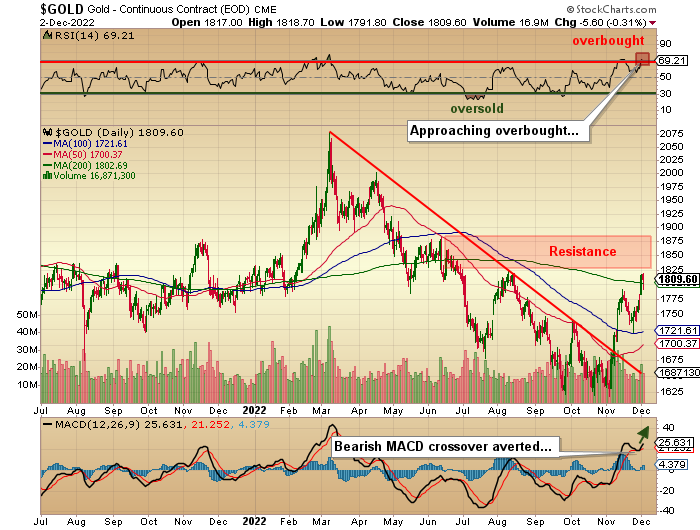
What is usually absent from the gold and silver markets is next-day follow-through, so to have gold nudging up against US$1,800 resistance and silver blowing through US$22.00 resistance is encouraging (verging upon exciting).”

The highlighted part is particularly important as Thursday saw an extremely powerful follow-through, with February gold punching out through that US$1,800 resistance and actually settling at US$1,815.30.

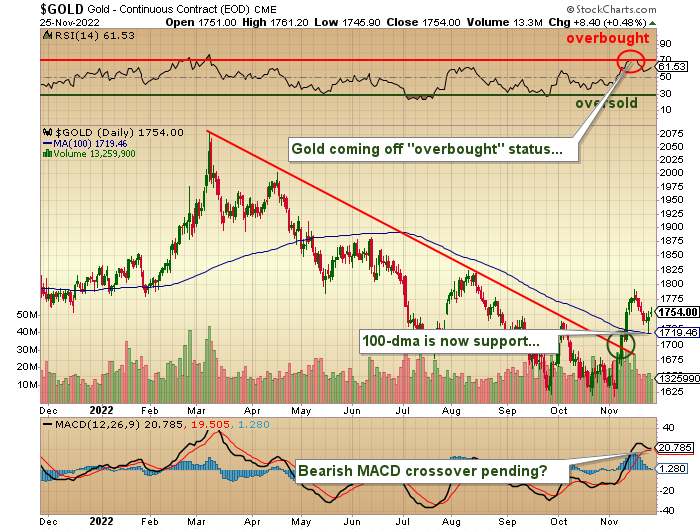
From the CME pit session close Wednesday to the pit session close Thursday saw a US$55.30/ounce pop, which broke it out through the 200-DMA as well.

The next two resistance levels are US$1,825 and US$1,875, but with the RSI settling on Thursday at US$71.22, gold moved into an overbought condition and in need of a sideways consolidation with which to work it off while holding US$1,800.

Mind you, it should be known that coming off the COVID crash lows of March 2020, gold stayed in overbought condition for eleven days, with RSI eventually topping out at US$91.57.

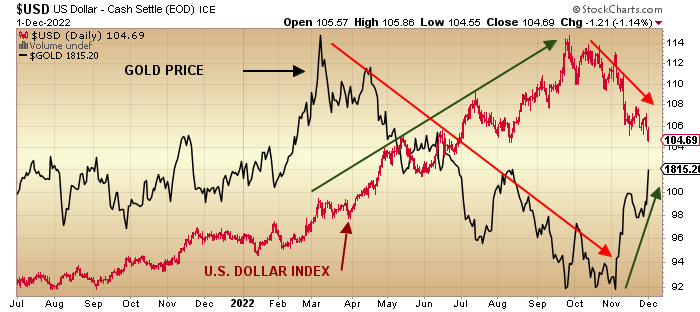
As I have been discussing for the better part of twenty years, the prices for precious metals are inextricably linked to the U.S. dollar because all commodities are priced in the reserve currency of the globe.

It is akin to a “peg” only because if your domestic currency is the British pound and you step into the London Metals Exchange to buy a carload of gold, you are paying the dollar quote, not the pound quote.

Weakness in non-dollar units of exchange will buy less gold per unit and vice-versa.

This chart is a clear illustration of the near 1:1 inverse correlation between gold and the U.S. greenback, with tops in the dollar on September 28 and November 3 coinciding perfectly with lows in gold US$1,622 and US$1,618 before embarking on the current almost US$200 per ounce rally.

To try to map out the course for gold and the dollar for the next six months is more an exercise in mindreading rather than an analysis of the economic or geopolitical landscapes.

There are just so many possible policy alternatives, all being weighed upon by domestic and foreign policy agendas related to inflation, oil prices, and partisan politics, that you have to read multiple minds to achieve accuracy.

Since mind reading is only possible if one wears a cape and goes by the title of “The Amazing Kreskin,” I depend on the predictive power of technical analysis to guide me in the general vicinity of accuracy because all of those head-and-shoulders tops and bottoms and ascending cup-and-handle mumbo-jumbo “signals” are simply clues to the mystery and not the ultimate solution.

As my late friend and technical analyst Ian McAvity used to say, “In the hold of every sunken ship, you will always find a chart.”

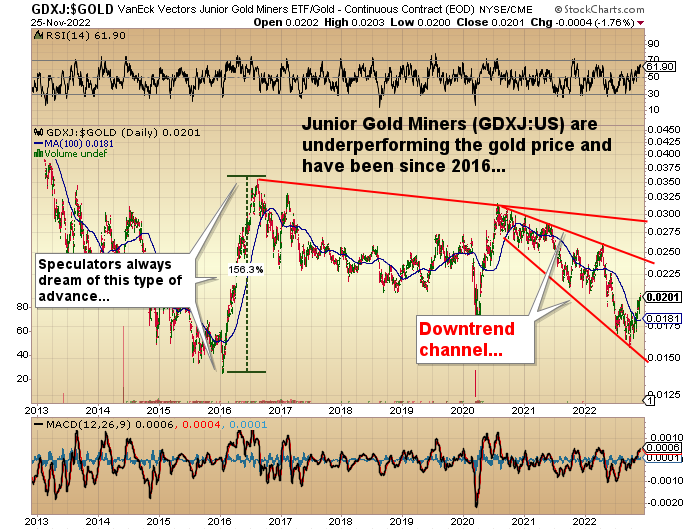
In all successful starts to bull moves in the precious metals, you need a combination of positive events occurring simultaneously. You need the more speculative assets classes to outperform the more conservative — i.e. junior gold miners (GDXJ:US) outperforming senior gold miners (GDX:US) and silver (SLV:US) outperforming gold (GLD:US) with the shares outperforming the metals.

This is exactly what we have seen off the September 28 lows all coincident with U.S. dollar weakness and declining bond yields.

Gold Versus the Basket

There used to be an expression about a certain profession that went like this:

How do you tell if a <insert profession> is lying?”

“His lips are moving.”

Well, the profession that has earned that reputation is now all central bank governors, presidents, and vice presidents, with the chairman being the leader.

As the former head of the European Central bank, Jean-Claude Juncker, once said, “When it becomes serious, you have to lie.” So with the global economy, with particular emphasis on the U.S. economy, decelerating rapidly, I would surmise that we have reached the point of “seriousness.”

Jerome Powell addressed the Brookings Institute on Wednesday afternoon, and despite reiterating all of his warnings about “higher for longer” (interest rate levels and duration), the infinitesimal wisdom of stock markets determined that Mr. Powell was “lying” and decided that the “pivot” was “on” and that seasonality would trump policy into year-end selling dollars and buying stocks and gold and bonds as if this was April of 2020.

Only time will tell, but I learned a long time ago that markets that spit in the eye of the consensus view are markets that should not be faded (sold).

This creates a monumental problem for the Fed (as discussed earlier), but it creates an even greater problem for me in that despite the awesome technical set-up for the precious metals as we move into December, one word out of Powell’s mouth at the December 14 FOMC meeting could derail the dollar decline and stock/gold/bond rally in a New York minute.

On the other hand, what if the events of September 28 in London, where the Band of England was forced to reverse their QT course and instead launch a QE rescue mission for their pension funds, was a precursor of systemic risks to the global financial system due — once again — to the excessive use of leverage in meeting yield requirements?

If that event is what is spooking Powell & Company, then the “pivot” actually began in clandestine fashion in late September, with all markets around the globe looking far beyond the futile jawboning of the Fed and its “honored representatives.”

Only time will tell, but I learned a long time ago that markets that spit in the eye of the consensus view are markets that should not be faded (sold).

The Friday Jobs Report came in hotter than expectations but failed to derail a major chunk of the weekly gains, most of which came after the Powell speech. I find it hilarious that a mere two days after the narrative turns “pivot positive” due to that one word — “overtighten” — a jobs report that is a lagging indicator of economic activity brings about yet another 180-degree shift in sentiment.

I suspect that in a couple of weeks, the NFP will come in under consensus with revisions to Friday’s report knocking it back to a “miss.” However, profits were taken before the Powell speech, so I am now looking for a suitable re-entry point in anticipation of a continuation of the seasonal rally into year-end.

I suspect that in a couple of weeks, the NFP will come in under consensus with revisions to Friday’s report knocking it back to a “miss.” However, profits were taken before the Powell speech, so I am now looking for a suitable re-entry point in anticipation of a continuation of the seasonal rally into year-end.

With the Dow actually up after being down US$350 on the opening, it did a complete 180 — to my absolute AWE — and closed up US$34.78 to add 82 points for the week. Astounding, but not unexpected for followers of my weekly diatribe . . .

I suspect that in a couple of weeks, the NFP will come in under consensus with revisions to Friday’s report knocking it back to a “miss.” However, profits were taken before the Powell speech, so I am now looking for a suitable re-entry point in anticipation of a continuation of the seasonal rally into year-end.

Ditto the precious metals, where I have been looking to add aggressively on dips under US$1,800 and did today with the early plunge under US$1,800. For an old gold trader like me, trained in the late 80’s bull market where a lifelong narcotic was injected into my bloodstream, the action in gold is reminiscent of the period 2009-2021 for tech stocks — all dips are bought, and no pops are sold (at least for long).

Silver went out with a US$0.57/ounce gain on a day where all other white metals (palladium, platinum) lost 2.48% and 2.80%, respectively. Copper also had not only a decent day; it had a decent week giving me great confidence in the outlook for 2023 for all these metals AND for the junior wannabes that are either searching for or developing them.

Today’s resiliency for all markets in the face of a hostile jobs report and in the face of overbought market conditions reeks of too many portfolio managers (not yet born when the market crashed in ’87) underweight equities and panicking to get back into “fully-invested” mode.

If this trend accelerates, there might be an EPIC short squeeze into year-end that could rival the one that nailed those fuzzy-cheeked whiz kids back in April of 2020 when they were certain that the global pandemic was going to throw us into the 1930s again, which was EXACTLY what I was told by one of the kiddies in 2008 after junior stocks all crashed.

It never happened then, and it won’t happen now as the BIG MONEY wants a rally, and that is all one needs to know.

End of story.

Michael Ballanger Disclaimer:

This letter makes no guarantee or warranty on the accuracy or completeness of the data provided. Nothing contained herein is intended or shall be deemed to be investment advice, implied or otherwise. This letter represents my views and replicates trades that I am making but nothing more than that. Always consult your registered advisor to assist you with your investments. I accept no liability for any loss arising from the use of the data contained on this letter. Options and junior mining stocks contain a high level of risk that may result in the loss of part or all invested capital and therefore are suitable for experienced and professional investors and traders only. One should be familiar with the risks involved in junior mining and options trading and we recommend consulting a financial adviser if you feel you do not understand the risks involved.

Disclosures:
1) Statements and opinions expressed are the opinions of Michael Ballanger and not of Streetwise Reports or its officers. Michael Ballanger is wholly responsible for the validity of the statements. Streetwise Reports was not involved in any aspect of the article preparation. Michael Ballanger was not paid by Streetwise Reports LLC for this article. Streetwise Reports was not paid by the author to publish or syndicate this article.

2) The following companies mentioned in this article are billboard sponsors of Streetwise Reports: None. Click here for important disclosures about sponsor fees. The information provided above is for informational purposes only and is not a recommendation to buy or sell any security.

3) This article does not constitute investment advice. Each reader is encouraged to consult with his or her individual financial professional and any action a reader takes as a result of information presented here is his or her own responsibility. By opening this page, each reader accepts and agrees to Streetwise Reports’ terms of use and full legal disclaimer. This article is not a solicitation for investment. Streetwise Reports does not render general or specific investment advice and the information on Streetwise Reports should not be considered a recommendation to buy or sell any security. Streetwise Reports does not endorse or recommend the business, products, services or securities of any company mentioned on Streetwise Reports.

4) From time to time, Streetwise Reports LLC and its directors, officers, employees or members of their families, as well as persons interviewed for articles and interviews on the site, may have a long or short position in securities mentioned. Directors, officers, employees or members of their immediate families are prohibited from making purchases and/or sales of those securities in the open market or otherwise from the time of the decision to publish an article until three business days after the publication of the article. The foregoing prohibition does not apply to articles that in substance only restate previously published company releases.

Platinum Speculators raise their bullish bets to 38-week high

By InvestMacro

Here are the latest charts and statistics for the Commitment of Traders (COT) data published by the Commodities Futures Trading Commission (CFTC).

The latest COT data is updated through Tuesday November 29th and shows a quick view of how large traders (for-profit speculators and commercial entities) were positioned in the futures markets.

Weekly Speculator Changes led by Platinum

The COT precious metals speculator bets were a little lower this week as two out of the five metals markets we cover had higher positioning this week while three markets had lower contracts.

Leading the gains for the precious metals markets was Platinum (1,769 contracts) with Silver (717 contracts) also showing a positive week.

The metals markets leading the declines in speculator bets this week were Gold (-6,110 contracts) with Copper (-1,120 contracts) and Palladium (-523 contracts) also registering lower bets on the week.

Highlighting the COT metals data this week is the continued bullishness of Platinum positions. The large speculator standing in Platinum futures rose this week by +1,769 contracts. Speculator bets have now gained in eight out of the past nine weeks with a total rise of +24,098 contracts over that period. This has pushed the overall speculator’s bullish level for Platinum to its highest level in the past thirty-eight weeks, dating back to March 8th when the net position totaled +25,833 contracts.

Platinum futures prices have also been on the rise since hitting a September low near the $800.00 level. Platinum futures closed out this week right around the $1,026.60 level for an approximate  gain by 28 percent since the September 1st low.


Data Snapshot of Commodity Market Traders | Columns Legend
Nov-29-2022OIOI-IndexSpec-NetSpec-IndexCom-NetCOM-IndexSmalls-NetSmalls-Index
WTI Crude1,412,1211239,7398-262,6549322,91537
Gold433,6611110,00319-119,233829,2303
Silver121,258017,48333-28,9976811,51426
Copper146,76001,98438-3,362641,37833
Palladium7,5378-1,631141,68784-5638
Platinum66,4683324,25942-28,762604,50328
Natural Gas985,0107-163,42930136,1917427,23845
Brent155,50015-32,0875729,424422,66345
Heating Oil266,8292330,73388-48,2552017,52259
Soybeans634,7541387,20840-61,55168-25,65728
Corn1,226,4100270,24265-231,16939-39,07321
Coffee196,3659-14,636213,6959994112
Sugar876,30934179,03556-222,6073943,57262
Wheat310,66710-33,305037,024100-3,71991


Strength Scores led by Platinum & Copper

Strength scores (a measure of the 3-Year range of Speculator positions, from 0 to 100 where above 80 is extreme bullish and below 20 is extreme bearish) show that Platinum (41.7 percent) and Copper (37.9 percent) lead the metals category at the moment. Silver (33.4 percent) comes in as the next highest metals market in strength scores.

On the downside, Palladium (14.2 percent) and Gold (19.2 percent) are at the lowest strength levels currently and are both in extreme bearish levels.

Strength Statistics:
Gold (19.2 percent) vs Gold previous week (21.2 percent)
Silver (33.4 percent) vs Silver previous week (32.6 percent)
Copper (37.9 percent) vs Copper previous week (38.8 percent)
Platinum (41.7 percent) vs Platinum previous week (39.3 percent)
Palladium (14.2 percent) vs Palladium previous week (17.3 percent)

Platinum tops Strength Trends

Strength Score Trends (or move index, calculates the 6-week changes in strength scores) show that Platinum (21.2 percent) leads the past six weeks trends for metals this week. Silver (17.9 percent), Copper (17.7 percent) and Gold (11.0 percent) are also positive movers in the latest trends data.

Palladium (-2.5 percent) leads the downside trend scores currently.

Move Statistics:
Gold (11.0 percent) vs Gold previous week (7.2 percent)
Silver (17.9 percent) vs Silver previous week (10.3 percent)
Copper (17.7 percent) vs Copper previous week (15.1 percent)
Platinum (21.2 percent) vs Platinum previous week (22.3 percent)
Palladium (-2.5 percent) vs Palladium previous week (-2.1 percent)


Individual Markets:

Gold Comex Futures:

Gold Futures COT ChartThe Gold Comex Futures large speculator standing this week equaled a net position of 110,003 contracts in the data reported through Tuesday. This was a weekly decrease of -6,110 contracts from the previous week which had a total of 116,113 net contracts.

This week’s current strength score (the trader positioning range over the past three years, measured from 0 to 100) shows the speculators are currently Bearish-Extreme with a score of 19.2 percent. The commercials are Bullish-Extreme with a score of 82.3 percent and the small traders (not shown in chart) are Bearish-Extreme with a score of 3.0 percent.

Gold Futures StatisticsSPECULATORSCOMMERCIALSSMALL TRADERS
– Percent of Open Interest Longs:48.230.97.8
– Percent of Open Interest Shorts:22.958.45.7
– Net Position:110,003-119,2339,230
– Gross Longs:209,161134,18433,946
– Gross Shorts:99,158253,41724,716
– Long to Short Ratio:2.1 to 10.5 to 11.4 to 1
NET POSITION TREND:
– Strength Index Score (3 Year Range Pct):19.282.33.0
– Strength Index Reading (3 Year Range):Bearish-ExtremeBullish-ExtremeBearish-Extreme
NET POSITION MOVEMENT INDEX:
– 6-Week Change in Strength Index:11.0-9.0-9.7


Silver Comex Futures:

Silver Futures COT ChartThe Silver Comex Futures large speculator standing this week equaled a net position of 17,483 contracts in the data reported through Tuesday. This was a weekly boost of 717 contracts from the previous week which had a total of 16,766 net contracts.

This week’s current strength score (the trader positioning range over the past three years, measured from 0 to 100) shows the speculators are currently Bearish with a score of 33.4 percent. The commercials are Bullish with a score of 67.8 percent and the small traders (not shown in chart) are Bearish with a score of 26.0 percent.

Silver Futures StatisticsSPECULATORSCOMMERCIALSSMALL TRADERS
– Percent of Open Interest Longs:39.938.218.3
– Percent of Open Interest Shorts:25.562.18.8
– Net Position:17,483-28,99711,514
– Gross Longs:48,44146,27022,150
– Gross Shorts:30,95875,26710,636
– Long to Short Ratio:1.6 to 10.6 to 12.1 to 1
NET POSITION TREND:
– Strength Index Score (3 Year Range Pct):33.467.826.0
– Strength Index Reading (3 Year Range):BearishBullishBearish
NET POSITION MOVEMENT INDEX:
– 6-Week Change in Strength Index:17.9-18.817.8


Copper Grade #1 Futures:

Copper Futures COT ChartThe Copper Grade #1 Futures large speculator standing this week equaled a net position of 1,984 contracts in the data reported through Tuesday. This was a weekly reduction of -1,120 contracts from the previous week which had a total of 3,104 net contracts.

This week’s current strength score (the trader positioning range over the past three years, measured from 0 to 100) shows the speculators are currently Bearish with a score of 37.9 percent. The commercials are Bullish with a score of 64.4 percent and the small traders (not shown in chart) are Bearish with a score of 33.3 percent.

Copper Futures StatisticsSPECULATORSCOMMERCIALSSMALL TRADERS
– Percent of Open Interest Longs:35.043.19.2
– Percent of Open Interest Shorts:33.745.48.3
– Net Position:1,984-3,3621,378
– Gross Longs:51,43363,19613,549
– Gross Shorts:49,44966,55812,171
– Long to Short Ratio:1.0 to 10.9 to 11.1 to 1
NET POSITION TREND:
– Strength Index Score (3 Year Range Pct):37.964.433.3
– Strength Index Reading (3 Year Range):BearishBullishBearish
NET POSITION MOVEMENT INDEX:
– 6-Week Change in Strength Index:17.7-17.94.5


Platinum Futures:

Platinum Futures COT ChartThe Platinum Futures large speculator standing this week equaled a net position of 24,259 contracts in the data reported through Tuesday. This was a weekly lift of 1,769 contracts from the previous week which had a total of 22,490 net contracts.

This week’s current strength score (the trader positioning range over the past three years, measured from 0 to 100) shows the speculators are currently Bearish with a score of 41.7 percent. The commercials are Bullish with a score of 59.8 percent and the small traders (not shown in chart) are Bearish with a score of 28.5 percent.

Platinum Futures StatisticsSPECULATORSCOMMERCIALSSMALL TRADERS
– Percent of Open Interest Longs:53.129.811.1
– Percent of Open Interest Shorts:16.673.14.4
– Net Position:24,259-28,7624,503
– Gross Longs:35,26819,8247,400
– Gross Shorts:11,00948,5862,897
– Long to Short Ratio:3.2 to 10.4 to 12.6 to 1
NET POSITION TREND:
– Strength Index Score (3 Year Range Pct):41.759.828.5
– Strength Index Reading (3 Year Range):BearishBullishBearish
NET POSITION MOVEMENT INDEX:
– 6-Week Change in Strength Index:21.2-21.618.2


Palladium Futures:

Palladium Futures COT ChartThe Palladium Futures large speculator standing this week equaled a net position of -1,631 contracts in the data reported through Tuesday. This was a weekly lowering of -523 contracts from the previous week which had a total of -1,108 net contracts.

This week’s current strength score (the trader positioning range over the past three years, measured from 0 to 100) shows the speculators are currently Bearish-Extreme with a score of 14.2 percent. The commercials are Bullish-Extreme with a score of 83.7 percent and the small traders (not shown in chart) are Bearish with a score of 38.3 percent.

Palladium Futures StatisticsSPECULATORSCOMMERCIALSSMALL TRADERS
– Percent of Open Interest Longs:30.452.414.1
– Percent of Open Interest Shorts:52.030.014.8
– Net Position:-1,6311,687-56
– Gross Longs:2,2893,9511,061
– Gross Shorts:3,9202,2641,117
– Long to Short Ratio:0.6 to 11.7 to 10.9 to 1
NET POSITION TREND:
– Strength Index Score (3 Year Range Pct):14.283.738.3
– Strength Index Reading (3 Year Range):Bearish-ExtremeBullish-ExtremeBearish
NET POSITION MOVEMENT INDEX:
– 6-Week Change in Strength Index:-2.51.410.8


Article By InvestMacroReceive our weekly COT Newsletter

*COT Report: The COT data, released weekly to the public each Friday, is updated through the most recent Tuesday (data is 3 days old) and shows a quick view of how large speculators or non-commercials (for-profit traders) were positioned in the futures markets.

The CFTC categorizes trader positions according to commercial hedgers (traders who use futures contracts for hedging as part of the business), non-commercials (large traders who speculate to realize trading profits) and nonreportable traders (usually small traders/speculators) as well as their open interest (contracts open in the market at time of reporting). See CFTC criteria here.

Graphene is a proven supermaterial, but manufacturing the versatile form of carbon at usable scales remains a challenge

By Kevin Wyss, Rice University 

“Future chips may be 10 times faster, all thanks to graphene”; “Graphene may be used in COVID-19 detection”; and “Graphene allows batteries to charge 5x faster” – those are just a handful of recent dramatic headlines lauding the possibilities of graphene. Graphene is an incredibly light, strong and durable material made of a single layer of carbon atoms. With these properties, it is no wonder researchers have been studying ways that graphene could advance material science and technology for decades.

I never know what to expect when I tell people I study graphene – some have never heard of it, while others have seen some version of these headlines and inevitably ask, “So what’s the holdup?”

Graphene is a fascinating material, just as the sensational headlines suggest, but it is only just starting be used in real-world applications. The problem lies not in graphene’s properties, but in the fact that it is still incredibly difficult and expensive to manufacture at commercial scales.

A black and white image of a crystalline layer on a surface.
Pure graphene is a uniform, single-atom-thick crystal of carbon arranged in a hexagonal pattern, as seen in this electron microscope image.
M.H. Gass/Wikimedia Commons, CC BY

What is graphene?

Graphene is most simply defined as a single layer of carbon atoms bonded together in a hexagonal, sheetlike structure. You can think of pure graphene as a one-layer-thick sheet of carbon tissue paper that happens to be the strongest material on Earth.

Graphene usually comes in the form of a powder made of small, individual sheets that are roughly the diameter of a grain of sand. An individual sheet of graphene is 200 times stronger than an equally thin piece of steel. Graphene is also extremely conductive, holds together at up to 1,300 degrees Fahrenheit (700 C), can withstand acids and is flexible and very lightweight.

Because of these properties, graphene could be extremely useful. The material can be used to create flexible electronics and to purify or desalinate water. And adding just 0.03 ounces (1 gram) of graphene to 11.5 pounds (5 kilograms) of cement increases the strength of the cement by 35%.

As of late 2022, Ford Motor Co., with which I worked as part of my doctoral research, is one of the the only companies to use graphene at industrial scales. Starting in 2018, Ford began making plastic for its vehicles that was 0.5% graphene – increasing the plastic’s strength by 20%.

Graphene has many incredible physical properties that arise from its one-atom-thick carbon structure.
AlexanderAlUS/Wikimedia Commons, CC BY-SA

How to make a supermaterial

Graphene is produced in two principal ways that can be described as either a top-down or bottom-up process.

The world’s first sheet of graphene was created in 2004 out of graphite. Graphite, commonly known as pencil lead, is composed of millions of graphene sheets stacked on top of one another. Top-down synthesis, also known as graphene exfoliation, works by peeling off the thinnest possible layers of carbon from graphite. Some of the earliest graphene sheets were made by using cellophane tape to peel off layers of carbon from a larger piece of graphite.

The problem is that the molecular forces holding graphene sheets together in graphite are very strong, and it’s hard to pull sheets apart. Because of this, graphene produced using top-down methods is often many layers thick, has holes or deformations, and can contain impurities. Factories can produce a few tons of mechanically or chemically exfoliated graphene per year, and for many applications – like mixing it into plastic – the lower-quality graphene works well.

A thin, folded, rough-edged piece of graphene.
Graphene flakes made from top-down methods are usually more than one atom thick and have impurities like folds and tears, as seen in this image.
Дагесян Саркис Арменакович/Wikimedia Commons, CC BY-SA

Top-down, exfoliated graphene is far from perfect, and some applications do need that pristine single sheet of carbon.

Bottom-up synthesis builds the carbon sheets one atom at a time over a few hours. This process – called vapor deposition – allows researchers to produce high-quality graphene that is one atom thick and up to 30 inches across. This yields graphene with the best possible mechanical and electrical properties. The problem is that with a bottom-up synthesis, it can take hours to make even 0.00001 gram – not nearly fast enough for any large scale uses like in flexible touch-screen electronics or solar panels, for example.

So what’s the holdup?

Current production methods of graphene, both top-down and bottom-up, are expensive as well as energy and resource intensive, and simply produce too little product, too slowly.

Some companies do manufacture graphene and sell it for US$60,000 to $200,000 per ton. There are a limited number of uses that make sense at these high costs.

While small amounts of top-down or bottom-up graphene can satisfy the needs of researchers, for companies even just the process of prototyping a new material, application or manufacturing process requires many pounds of graphene powder or hundreds of graphene sheets and a lot of time and effort. It took significant investment and more than four years of study, development and optimization before graphene hit the production line at Ford.

Current production can barely cover experimentation, much less widespread use.

Improving manufacturing

For a material that has been around since only 2004, a lot of progress has been made in scaling up the production and implementation of graphene.

There are hints that graphene is starting to break through at a commercial level. There are a huge number of graphene-related startups looking at a wide range of uses ranging from energy storage to composites to nerve stimulation. Major companies – such as Tesla, LG and chemical giant BASF – are also investigating how graphene could be used, in rechargeable batteries, flexible or wearable electronics and next-generation materials.

Graphene is ripe for a breakthrough that will bring down the cost and increase the scale of production, and this is an area of intense academic research. One new technique discovered in 2020, called flash joule heating, is especially promising. Researchers have shown that passing large amounts of electricity through any carbon source reorganizes the carbon-carbon bonds into a graphene structure. Using this process, it is possible to make many pounds of high-quality graphene for a relatively low cost out of any carbon-containing material like coal or even trash. A company called Universal Matter Inc. is already commercializing the process.

Once the cost of graphene comes down, the commercial applications will follow. The appetite for graphene is huge, but it is going to take some time before this material lives up to its potential.The Conversation

About the Author:

Kevin Wyss, PhD Student in Chemistry, Rice University

This article is republished from The Conversation under a Creative Commons license. Read the original article.

We’re at the Home Stretch

Source: Michael Ballanger  (11/28/22)

– With only 33 days left in the fiscal year 2022, expert Michael Ballanger reviews where he believes the markets are heading. 

With little over thirty-six days left in the fiscal year 2022, it is critical that investors remember that bear markets do not last forever. Alas, neither do bull markets. And while the Jim Cramer’s of the world want to remind you that “there is always a bull market somewhere,” the reality is that there are also bear markets out there all of the time as well.

Home Stretch of 2022

As I enter the “home stretch” for calendar 2022, I can only recall one time in the past forty years that markets had a serious decline in December, and that was in 2018. Mind you, a Christmas Eve emergency meeting between Fed Chairman Powell and Treasury Secretary Mnuchin quickly remedied the Grinch-like behavior resulting in a Santa Claus rally that carried right through to new highs by the end of February 2019.

The Fed’s posture in 2018-2019 was accommodative, and their love affair with the asymmetrical wealth effect of rising equity prices was free of the impairment brought on by a 9% inflation rate so “conditions” in December 2018 were starkly distant from the conditions I face in 2022 (and beyond).

The Fed will “re-allocate” aggressively between now and year-end, and that combined with the historically high short interest should (operative word) propel stocks to higher levels by New Year’s Day.

As the portfolio manager horses gallop their way down the final few furlongs of 2022, they are not nearly as deeply underweight equities as they were in late September (when I turned on a dime and went bullish), but they are still underweight and need to deploy larger than normal cash positions before the auditors record their final holdings for 2022.

You see, they cannot have an abnormally high cash position and still charge 2% management fees without severe client pushback, so they will “re-allocate” aggressively between now and year-end, and that combined with the historically high short interest should (operative word) propel stocks to higher levels by New Year’s Day.

The month of December ranks number three in performance for two of the three major averages (Dow and S&P at number three with NASDAQ as number two), with small-cap issues outperforming the blue-chips starting around mid-month due largely to the cessation of tax-loss selling and rebalancing. There were some shaky weeks, such as in 2008 and in 1987, but since 1950, stocks have enjoyed fifty-three winning Decembers versus eighteen losers for a 74.6%-win ratio.

With that in mind, my positioning should be bullish stocks, and has been since late September, begging the question, “What could go wrong?”.

What Could Go Wrong?

The troublesome idiosyncrasy of the current profile for equities lies in the behavior of the sub-groups — as in Dow Jones Industrials — which have very few tech stocks and which are massively outperforming the S&P and the NASDAQ with the health care stocks taking on leadership roles.

That is exactly how one positions portfolios if one looks for more bear market action in 2023, which means that the defensive sectors get pumped while the heroes of the last bull get dumped.

My point is this: I think there are going to be a great many of the players exiting the markets before year-end for fear that the “Q1 Crash” narrative plays out, so when matched up against the “performance chasers,” it may just be that the net effect is a flat December and that the bulk of the gains actually was made in the first two months of Q4.

That in itself is where my contrarian nature starts to rebel because every single market pundit that I hear or read is positive for the seasonality trade but negative due to expected earnings markdowns in Q1/2023.

I cannot figure out whether it is a reverberating echo — a feedback loop —  that keeps circling back to the accepted narrative or whether it represents the “collective wisdom” of market participants and one that I should actually heed rather than dismiss as “adolescent idolatry” because the kiddies that run the billion-dollar funds love to hide in the anonymity of consensus investing while old geezers like me absolutely revel in isolationism. (BTW, neither is optimum behavior.)

Make no mistake; swimming against the tide is not always the easiest nor the smartest strategy, with tech stocks and crypto being generational favorites amongst the younger crowd but toxic waste for those that are older.

As timing is everything in the world in which we trade, there was a time to listen to the kiddies, and there was a time to send them into a corner wearing dunce caps so as to cast judgment on the investment acumen on a generational basis has devolved into a name-calling mug’s game and one which I prefer to avoid.

My point is this: I think there are going to be a great many of the players exiting the markets before year-end for fear that the “Q1 Crash” narrative plays out, so when matched up against the “performance chasers,” it may just be that the net effect is a flat December and that the bulk of the gains actually was made in the first two months of Q4.

The Junior Sector

I only speak of the broad equity markets because against the backdrop of a hostile Fed and decelerating global growth, it is hard to imagine people suddenly going stark bullish on commodities, led as always by gold and silver, which is precisely what is required to light a fire under the junior resource sector, a space where I, unfortunately (due to a gambling addiction) have a large portion of my investable capital.

As I have written on countless occasions, if I woke up tomorrow from a twenty-two-year coma and scanned all news headlines related to geopolitical, fiscal, and monetary events over that time period, I would have expected gold to be priced at US$30,000 an ounce with silver at US$600. I would also have the Canadian dollar trading at US$0.10 while its citizens combat a 75% inflation rate.

However, through the machinations of the Federal Reserve and the U.S. Treasury, the legions of desk traders under contract to the National Security Services have been assigned to maintain U.S. dollar hegemony, sparing no expense and taking no prisoners.

To be sure, they have done a superb job while their bosses have been able to print astonishing amounts of phony money through unbridled DEBT creation and, until 2022, enjoyed a disinflationary, Goldilocks Nirvana where literally everything moved into “bubble” territory — except of course — the two metals that over the past five-thousand years represented safe haven, sound money status, gold, and silver.

Gold put in a triple-bottom in Q4 at between US$1,618 and US$1,622, after which it responded to the collapse in the U.S. dollar index from 114.76 to 105.26 within a three-week period in November.

After testing the highs of the rebound near US$1,792, it is now working off the mid-month overbought condition by pulling back to test the 100-DMA around US$1,720, then closing out the week at US$1,754.

The MACD indicator is threatening to flip into a bearish crossover, but it did that very briefly back in October without derailing the advance, so I am placing minimal emphasis on the MACD unless we break the 100-DMA with RSI reversing back into a downtrend; neither of which I see as being “in-the-cards.”

As for the juniors, could there be a more pitiable sector in which to throw away your savings than in the junior gold miner space?

Since the 2008 Great Financial Bailout, there have been two serious rallies in the miners — the first off the major bottom in gold prices in late 2015 and lasting until August 2016 and the second being of the Fed-induced major bottom in “everything” after the Covid Crash of March 2020, with that advance, also ending in August.

Other than that, the junior gold space (GDXJ:US), shown above when priced against the gold price, is trading at levels it last saw in Q1/2016 when gold was under US$1,200. There are dozens of other studies depicting the extreme levels of undervaluation for both senior and junior gold equities but nowhere is it more shocking than in the juniors.

Gambling Versus Speculation

My area of specialization (and passion) has always been the explorers and developers, where the terms “gambling” and “speculation” are often misplaced. This was explained to me a great many years ago after being unfairly accused of being a fan of the “ponies.”

Having grown up in the town of Malton, I used to sell newspapers (including The Daily Racing Forum (“DRF”) at Woodbine at 6:00 am to owners, breeders, and trainers, all of whom showed up coffees-in-hands to give me my US$0.25 gratuity for keeping their papers warm.

One time, I was reading the DRF when a lady in a Saint John Ambulance nurse’s outfit scolded me for being a “sinner” because, in her words, “gambling” was the “devil’s playground.”

Overhearing this exchange, one of the trainers (who turned out to be two-time Queen’s Plate winner Jerry Lavigne) walked over and pointed to the DRF in my lap and said, “Kid, don’t listen to that old biddy. As long as you’re following the numbers in that rag (the DRF) and watching the heats, you are not gamblin’. You’re handicappin’, which is another word for speculatin’ .“

Junior mining companies, including the explorers, if researched properly, are not to be considered “gambling” because of the immense reporting requirements levied upon the management teams.

Years later, I read the now-famous words of a famous Wall Street speculator that said this: “Gambling” is a venture without calculation; “speculation” is a venture with calculation.”

Walking up to the ticket window at Woodbine and placing a bet on Malarctic Nag because you like the color of the jockey’s tights would not be classified as “handicapping” nor “speculating” because there was no calculation. It was a random selection based on no prior history of performance. If, by contrast, you watched how it ran beautifully in the slop and it was raining that day, those tender hooves would not be affected thanks to the moisture, and it would be a reasonable speculation because there was calculation involved in that decision.

Junior mining companies, including the explorers, if researched properly, are not to be considered “gambling” because of the immense reporting requirements levied upon the management teams. In prior times, due diligence involved buying the penny mining “expert” a drink at the local watering hole for his next “hot tip” and then loading up because you had it “on good information” that they were about to make a discovery.

That, my friends, is gambling. Poring over page after page of geochemical and geophysical surveys, many of which are found on sedar.com and date back fifteen years while under different ownership, after speaking with contacts that have decades of experience in a particular region or with a particular type of geology and then putting the data into a cause-effect format is actually a very sophisticated yet rudimentary form of calculation. It is like looking at the Daily Racing Form at the “heats.”

Like everything else in life, if you put in the hours, you usually have success, and in the world of junior exploration and development, you can have all of the inputs called correctly, and you can assemble all of the data properly, but if the two goddesses of the junior mining universe — Mother Nature and Lady Luck — refuse to bless you, then you are either waiting a long time (at best) or kissing your money goodbye (at worst).

As we hurtle down the home stretch of what has been a very difficult year, the bulls are calling for 4,400 whilst the bears see 3,000, and with both now screaming their cases with decibel levels resembling a 747 at takeoff, it might be a good idea to minimize expectations moving into 2023

The investing world has finally entered an era of non-interference by central bankers and sovereign treasury departments, not so much out of choice but more out of necessity, because they know that accelerating inflation rates around the globe are forcing civil unrest.

Knowing that the elitists that control 90% of the world’s wealth only thrive when they have an obedient populace chasing the clearly-crafted dream of untold riches, status, and social media popularity and recognition.

When the lure of such achievement is finally and summarily dismissed by a generational metamorphosis of expectations, it becomes the personal nightmare of the privileged classes because the tools they have used since 1910’s Jekyll Island event (resulting in the creation of the Federal Reserve in 1913) have been rendered obsolete in 2022 by the arrival of a 9% inflation monster and a bear market in stocks.

For the return of Mother Nature’s blessing to the junior miners, the new and very much younger generation of speculators must be repelled by technology and crypto and enticed by physical ownership of hard assets. Once physical gold and silver become accepted by the Millennial and Gen-X crowd, then the offshoots, such as the junior producers, developers, and explorers, will rise like the Phoenix and take their rightful places at the head of the Table of Outsized Returns.

With my portfolio suffering from the apathy surrounding some very well-positioned (and well-financed) junior mining companies, I have allocated some 15% to the double-leveraged SPY ETF trading under the symbol of UPR:US where purchases in late-September/early October have me ahead 20.75%, hanging on to that gain for dear life in order to either add to my metals or re-allocate to the volatility trade (UVXY:US) which is down from its yearly high of US$26.22 to the unfathomable level of US$7.66 before closing the week at US$7.75.

As we hurtle down the home stretch of what has been a very difficult year, the bulls are calling for 4,400 whilst the bears see 3,000, and with both now screaming their cases with decibel levels resembling a 747 at takeoff, it might be a good idea to minimize expectations moving into 2023 because the truly contrarian viewpoint is to expect nothing but sideways action until mid-January.

Would that it could be so . . .


Michael Ballanger Disclaimer:

This letter makes no guarantee or warranty on the accuracy or completeness of the data provided. Nothing contained herein is intended or shall be deemed to be investment advice, implied or otherwise. This letter represents my views and replicates trades that I am making but nothing more than that. Always consult your registered advisor to assist you with your investments. I accept no liability for any loss arising from the use of the data contained on this letter. Options and junior mining stocks contain a high level of risk that may result in the loss of part or all invested capital and therefore are suitable for experienced and professional investors and traders only. One should be familiar with the risks involved in junior mining and options trading and we recommend consulting a financial adviser if you feel you do not understand the risks involved.

Disclosures:
1) Statements and opinions expressed are the opinions of Michael Ballanger and not of Streetwise Reports or its officers. Michael Ballanger is wholly responsible for the validity of the statements. Streetwise Reports was not involved in any aspect of the article preparation. Michael Ballanger was not paid by Streetwise Reports LLC for this article. Streetwise Reports was not paid by the author to publish or syndicate this article.

2) The following companies mentioned in this article are billboard sponsors of Streetwise Reports: None. Click here for important disclosures about sponsor fees. The information provided above is for informational purposes only and is not a recommendation to buy or sell any security.

3) This article does not constitute investment advice. Each reader is encouraged to consult with his or her individual financial professional and any action a reader takes as a result of information presented here is his or her own responsibility. By opening this page, each reader accepts and agrees to Streetwise Reports’ terms of use and full legal disclaimer. This article is not a solicitation for investment. Streetwise Reports does not render general or specific investment advice and the information on Streetwise Reports should not be considered a recommendation to buy or sell any security. Streetwise Reports does not endorse or recommend the business, products, services or securities of any company mentioned on Streetwise Reports.

4) From time to time, Streetwise Reports LLC and its directors, officers, employees or members of their families, as well as persons interviewed for articles and interviews on the site, may have a long or short position in securities mentioned. Directors, officers, employees or members of their immediate families are prohibited from making purchases and/or sales of those securities in the open market or otherwise from the time of the decision to publish an article until three business days after the publication of the article. The foregoing prohibition does not apply to articles that in substance only restate previously published company releases.

Trade of the week: Gold Waits For Fresh Fundamental Spark

By ForexTime

Gold kicked off the week on a positive note as unrest in China over Covid restrictions strained global sentiment. A growing sense of anticipation ahead of the US jobs report along with other top-tier data this week added to the overall caution, leaving investors on edge. With a softer dollar adding to the mix, bulls were injected with enough confidence to challenge levels not seen since November 18.

Nevertheless, the precious metal remains in a wide range on the daily charts with support at $1735 and resistance at $1785. Over the past few weeks, gold has bounced within this range as bulls and bears engaged in a fierce tug of war.

However, with the fundamentals slowly tilting in favour of gold bulls – a solid breakout could be around the corner. Gold needs a fresh fundamental spark to get its gears moving and this could come in the form of speeches from Fed officials, geopolitical risks, or high-quality US economic data.

Before we thoroughly discuss what to expect from gold over the next few days, it is worth keeping in mind that gold is up roughly 8% this month. November will be the first positive month for the precious metal since March 2022! Looking at the technicals, bulls are certainly in the vicinity on the daily and weekly timeframe but things still look choppy on the monthly charts. If the developments and data over the next few days support gold bulls, this could set the tone for December.

The low down…

It has been a volatile year for gold.

After surging and peaking in March following Russia’s invasion of Ukraine, the precious metal found itself on a slippery decline as the Fed aggressively raised rates to tame inflation. Although gold is down roughly 4% year-to-date, this inflates to almost 15% when measured from the March 2022 high.

Could the precious metal be experiencing a change of fortune after being beaten black and blue for most of this year? Given how the Fed is expected to slow its pace of interest rate increases in the face of cooling inflation, this may lead to a weaker dollar and falling Treasury yields. This combination is nothing but good news for zero-yielding gold which will most likely shine in a low-interest rate environment.

The week ahead…

This could be a big week for gold due to the protests in China, speeches from Fed officials including Jerome Powell, and key US economic reports.

Bulls have already made a move on Monday thanks to geopolitical tensions and this momentum could roll over into the next trading session. It may be worth keeping an eye on speeches by New York Fed President John Williams, and St. Louis Fed President James Bullard. There is a lot going on mid-week with Fed Chair Jerome Powell under the spotlight. He is expected to reinforce expectations over the central bank slowing its pace of interest rate increases from December. Such a development may lead to a weaker dollar and falling Treasury yields – resulting in a boost for gold prices. Investors will also be presented with the Fed Beige Book report and US 3Q GDP second estimate which could result in some additional dollar volatility, spilling over to gold.

Thursday sees the release of the US weekly initial jobless claims and most importantly PCE deflator. Much attention will be directed toward the PCE Core Deflator which is the Fed’s preferred measure of inflation. Any signs of cooling inflation will most likely fortify expectations around the Fed adopting a less aggressive approach toward rates.

It’s all about the US jobs report on Friday which could be the real market shaker. Markets expect the US economy to have created roughly 200,000 jobs in October while the jobless rate is expected to remain unchanged. A report that meets or prints below expectations may justify a change in the pace of the Fed’s policy tightening – ultimately supporting gold.

Time for gold to re-test $1800 and beyond?

On the daily timeframe, gold prices are trading above the 50 and 100 SMA but below the 200 SMA. As identified earlier, support can be found at around $1735 and resistance at $1780. A solid breakout above $1780 could open the doors towards $1800, $1840, and $1858. Alternatively, a move back below $1735 could signal a selloff towards $1700, $1680, and $1665.


Forex-Time-LogoArticle by ForexTime

ForexTime Ltd (FXTM) is an award winning international online forex broker regulated by CySEC 185/12 www.forextime.com

COT Metals Speculators boost their Gold bullish bets to 13-week high

By InvestMacro

Here are the latest charts and statistics for the Commitment of Traders (COT) data published by the Commodities Futures Trading Commission (CFTC).

The latest COT data is updated through Tuesday November 15th and shows a quick view of how large traders (for-profit speculators and commercial entities) were positioned in the futures markets.

Weekly Speculator Changes led by Gold

The COT precious metals speculator bets were higher this week as all five of the metals markets we cover had higher positioning this week.

Leading the gains for the precious metals markets was Gold (43,931 contracts) with Copper (6,908 contracts), Silver (4,604 contracts), Platinum (3,095 contracts) and Palladium (1,338 contracts) also showing a positive week.

Highlighting the COT metals data this week is the rebound of the Gold speculator bets. The large speculator position for Gold jumped by over +40,000 contracts this week following a gain by over +17,000 contracts. This week’s rise marked the highest weekly gain in 143-weeks and the renewed speculator sentiment has pushed the overall Gold net position back above the +100,000 contract level for the first time since early September. The Gold speculator net standing is now at the highest level since August 16th when the net contracts was +141,164 contracts.

Gold prices have had a bit of an upswing since November 4th as well as the futures price has risen from the (Nov. 4th) opening level of $1,631.00 to close out this week at the $1,754.40 threshold. Gold, also this week, touched its highest level since the middle of August just below $1,792.00 before retreating lower.


Data Snapshot of Commodity Market Traders | Columns Legend
Nov-15-2022OIOI-IndexSpec-NetSpec-IndexCom-NetCOM-IndexSmalls-NetSmalls-Index
WTI Crude1,469,4373278,26718-307,3958129,12848
Gold495,17117126,26925-134,308788,0390
Silver141,6231417,60734-29,4246711,81727
Copper168,96299,82144-13,583563,76247
Palladium8,79314-1,072171,23181-15932
Platinum63,3912722,54439-27,037624,49328
Natural Gas978,4256-152,11433120,8306931,28454
Brent139,0804-25,1946920,782284,41269
Heating Oil275,2542625,66080-46,9332121,27372
Soybeans616,094976,80437-49,04672-27,75824
Corn1,421,55522252,90862-211,86242-41,04619
Coffee191,7436-14,154011,8401002,31432
Sugar832,52226156,19459-201,7793945,58564
Wheat350,09127-22,481029,310100-6,82975


Copper & Platinum lead Strength Scores

Strength scores (a measure of the 3-Year range of Speculator positions, from 0 to 100 where above 80 is extreme bullish and below 20 is extreme bearish) showed that Copper (44.1 percent) and Platinum (39.4 percent) lead the metals category. Silver (33.5 percent) comes in as the next highest metals market in strength scores.

On the downside, Palladium (17.5 percent) is at the lowest strength level currently and is in a bearish extreme position with a score under 20 percent.

Strength Statistics:
Gold (24.6 percent) vs Gold previous week (10.0 percent)
Silver (33.5 percent) vs Silver previous week (28.4 percent)
Copper (44.1 percent) vs Copper previous week (38.6 percent)
Platinum (39.4 percent) vs Platinum previous week (35.2 percent)
Palladium (17.5 percent) vs Palladium previous week (9.7 percent)

Platinum tops the Strength Trends

Strength Score Trends (or move index, calculates the 6-week changes in strength scores) showed that the Platinum (25.9 percent) leads the past six weeks trends for metals this week. Copper (22.3 percent), Gold (12.6 percent) and Silver (9.8 percent) fill out the other positive movers in the latest trends data.

Palladium (-2.8 percent) leads the downside trend scores currently.

Move Statistics:
Gold (12.6 percent) vs Gold previous week (10.0 percent)
Silver (9.8 percent) vs Silver previous week (13.5 percent)
Copper (22.3 percent) vs Copper previous week (24.4 percent)
Platinum (25.9 percent) vs Platinum previous week (25.9 percent)
Palladium (-2.8 percent) vs Palladium previous week (-9.3 percent)


Individual Markets:

Gold Comex Futures:

Gold Futures COT ChartThe Gold Comex Futures large speculator standing this week reached a net position of 126,269 contracts in the data reported through Tuesday. This was a weekly lift of 43,931 contracts from the previous week which had a total of 82,338 net contracts.

This week’s current strength score (the trader positioning range over the past three years, measured from 0 to 100) shows the speculators are currently Bearish with a score of 24.6 percent. The commercials are Bullish with a score of 77.7 percent and the small traders (not shown in chart) are Bearish-Extreme with a score of 0.0 percent.

Gold Futures StatisticsSPECULATORSCOMMERCIALSSMALL TRADERS
– Percent of Open Interest Longs:45.927.37.5
– Percent of Open Interest Shorts:20.454.45.8
– Net Position:126,269-134,3088,039
– Gross Longs:227,282135,03536,973
– Gross Shorts:101,013269,34328,934
– Long to Short Ratio:2.3 to 10.5 to 11.3 to 1
NET POSITION TREND:
– Strength Index Score (3 Year Range Pct):24.677.70.0
– Strength Index Reading (3 Year Range):BearishBullishBearish-Extreme
NET POSITION MOVEMENT INDEX:
– 6-Week Change in Strength Index:12.6-11.7-0.3


Silver Comex Futures:

Silver Futures COT ChartThe Silver Comex Futures large speculator standing this week reached a net position of 17,607 contracts in the data reported through Tuesday. This was a weekly increase of 4,604 contracts from the previous week which had a total of 13,003 net contracts.

This week’s current strength score (the trader positioning range over the past three years, measured from 0 to 100) shows the speculators are currently Bearish with a score of 33.5 percent. The commercials are Bullish with a score of 67.4 percent and the small traders (not shown in chart) are Bearish with a score of 27.4 percent.

Silver Futures StatisticsSPECULATORSCOMMERCIALSSMALL TRADERS
– Percent of Open Interest Longs:37.234.217.2
– Percent of Open Interest Shorts:24.854.98.9
– Net Position:17,607-29,42411,817
– Gross Longs:52,69248,39324,386
– Gross Shorts:35,08577,81712,569
– Long to Short Ratio:1.5 to 10.6 to 11.9 to 1
NET POSITION TREND:
– Strength Index Score (3 Year Range Pct):33.567.427.4
– Strength Index Reading (3 Year Range):BearishBullishBearish
NET POSITION MOVEMENT INDEX:
– 6-Week Change in Strength Index:9.8-11.214.0


Copper Grade #1 Futures:

Copper Futures COT ChartThe Copper Grade #1 Futures large speculator standing this week reached a net position of 9,821 contracts in the data reported through Tuesday. This was a weekly gain of 6,908 contracts from the previous week which had a total of 2,913 net contracts.

This week’s current strength score (the trader positioning range over the past three years, measured from 0 to 100) shows the speculators are currently Bearish with a score of 44.1 percent. The commercials are Bullish with a score of 56.5 percent and the small traders (not shown in chart) are Bearish with a score of 47.0 percent.

Copper Futures StatisticsSPECULATORSCOMMERCIALSSMALL TRADERS
– Percent of Open Interest Longs:35.936.510.3
– Percent of Open Interest Shorts:30.144.68.0
– Net Position:9,821-13,5833,762
– Gross Longs:60,73061,69317,332
– Gross Shorts:50,90975,27613,570
– Long to Short Ratio:1.2 to 10.8 to 11.3 to 1
NET POSITION TREND:
– Strength Index Score (3 Year Range Pct):44.156.547.0
– Strength Index Reading (3 Year Range):BearishBullishBearish
NET POSITION MOVEMENT INDEX:
– 6-Week Change in Strength Index:22.3-24.520.4


Platinum Futures:

Platinum Futures COT ChartThe Platinum Futures large speculator standing this week reached a net position of 22,544 contracts in the data reported through Tuesday. This was a weekly gain of 3,095 contracts from the previous week which had a total of 19,449 net contracts.

This week’s current strength score (the trader positioning range over the past three years, measured from 0 to 100) shows the speculators are currently Bearish with a score of 39.4 percent. The commercials are Bullish with a score of 61.9 percent and the small traders (not shown in chart) are Bearish with a score of 28.3 percent.

Platinum Futures StatisticsSPECULATORSCOMMERCIALSSMALL TRADERS
– Percent of Open Interest Longs:52.227.411.9
– Percent of Open Interest Shorts:16.670.14.8
– Net Position:22,544-27,0374,493
– Gross Longs:33,07917,3747,567
– Gross Shorts:10,53544,4113,074
– Long to Short Ratio:3.1 to 10.4 to 12.5 to 1
NET POSITION TREND:
– Strength Index Score (3 Year Range Pct):39.461.928.3
– Strength Index Reading (3 Year Range):BearishBullishBearish
NET POSITION MOVEMENT INDEX:
– 6-Week Change in Strength Index:25.9-25.18.5


Palladium Futures:

Palladium Futures COT ChartThe Palladium Futures large speculator standing this week reached a net position of -1,072 contracts in the data reported through Tuesday. This was a weekly increase of 1,338 contracts from the previous week which had a total of -2,410 net contracts.

This week’s current strength score (the trader positioning range over the past three years, measured from 0 to 100) shows the speculators are currently Bearish-Extreme with a score of 17.5 percent. The commercials are Bullish-Extreme with a score of 81.1 percent and the small traders (not shown in chart) are Bearish with a score of 32.2 percent.

Palladium Futures StatisticsSPECULATORSCOMMERCIALSSMALL TRADERS
– Percent of Open Interest Longs:22.751.313.2
– Percent of Open Interest Shorts:34.937.315.0
– Net Position:-1,0721,231-159
– Gross Longs:1,9974,5121,161
– Gross Shorts:3,0693,2811,320
– Long to Short Ratio:0.7 to 11.4 to 10.9 to 1
NET POSITION TREND:
– Strength Index Score (3 Year Range Pct):17.581.132.2
– Strength Index Reading (3 Year Range):Bearish-ExtremeBullish-ExtremeBearish
NET POSITION MOVEMENT INDEX:
– 6-Week Change in Strength Index:-2.85.0-23.5


Article By InvestMacroReceive our weekly COT Newsletter

*COT Report: The COT data, released weekly to the public each Friday, is updated through the most recent Tuesday (data is 3 days old) and shows a quick view of how large speculators or non-commercials (for-profit traders) were positioned in the futures markets.

The CFTC categorizes trader positions according to commercial hedgers (traders who use futures contracts for hedging as part of the business), non-commercials (large traders who speculate to realize trading profits) and nonreportable traders (usually small traders/speculators) as well as their open interest (contracts open in the market at time of reporting). See CFTC criteria here.