Archive for Forex and Currency News – Page 96

Japanese Candlesticks Analysis 10.10.2022 (USDCAD, AUDUSD, USDCHF)

Article By RoboForex.com

USDCAD, “US Dollar vs Canadian Dollar”

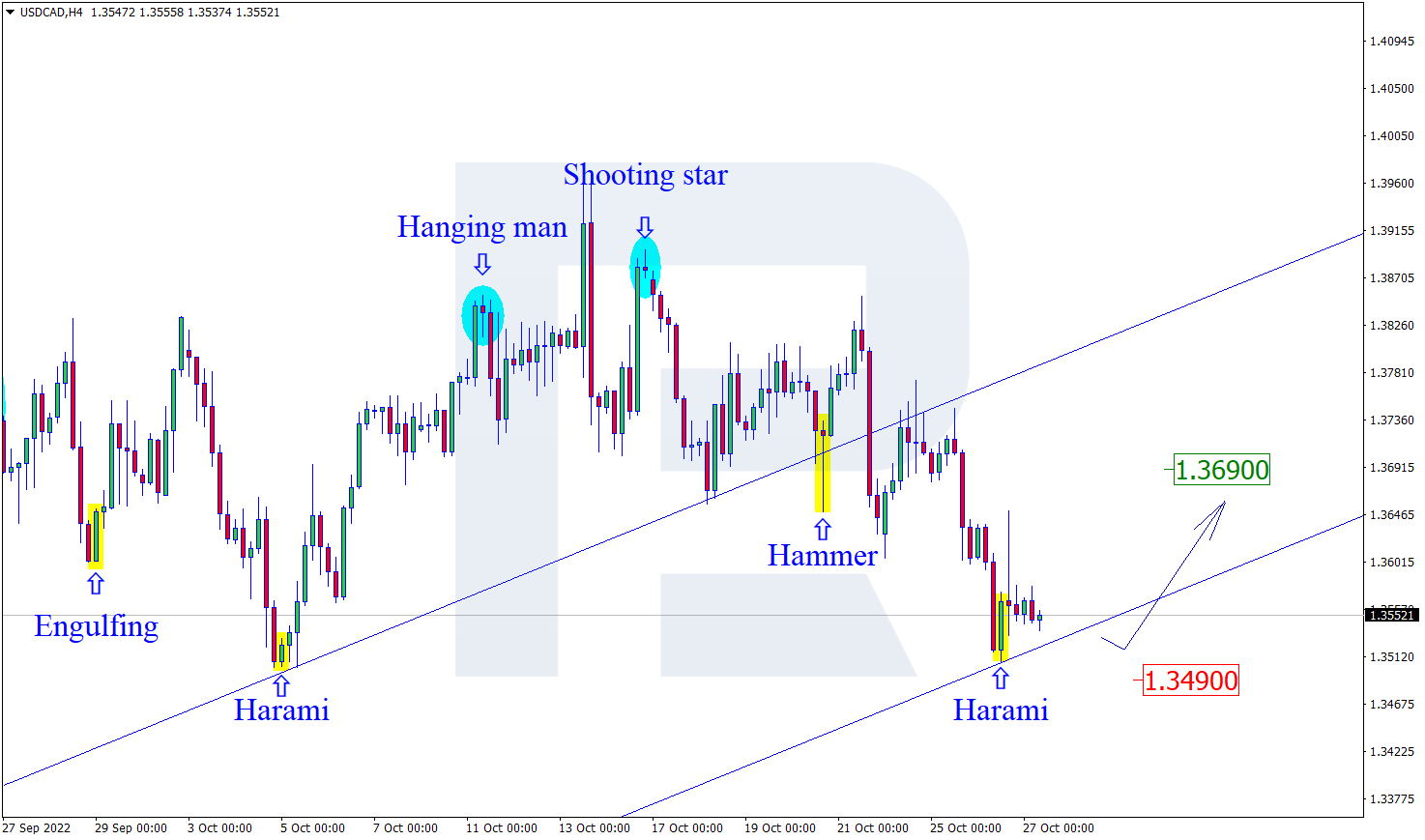
As we can see in the H4 chart, after forming a Shooting Star reversal pattern close to the resistance level, USDCAD may reverse in the form of a new descending wave. In this case, the downside correctional target may be at 1.3665. Later, the market may rebound from the support area and resume trading upwards. However, an alternative scenario implies that the asset may continue growing to reach 1.3850 without any pullbacks.

USDCAD
Risk Warning: the result of previous trading operations do not guarantee the same results in the future

AUDUSD, “Australian Dollar vs US Dollar”

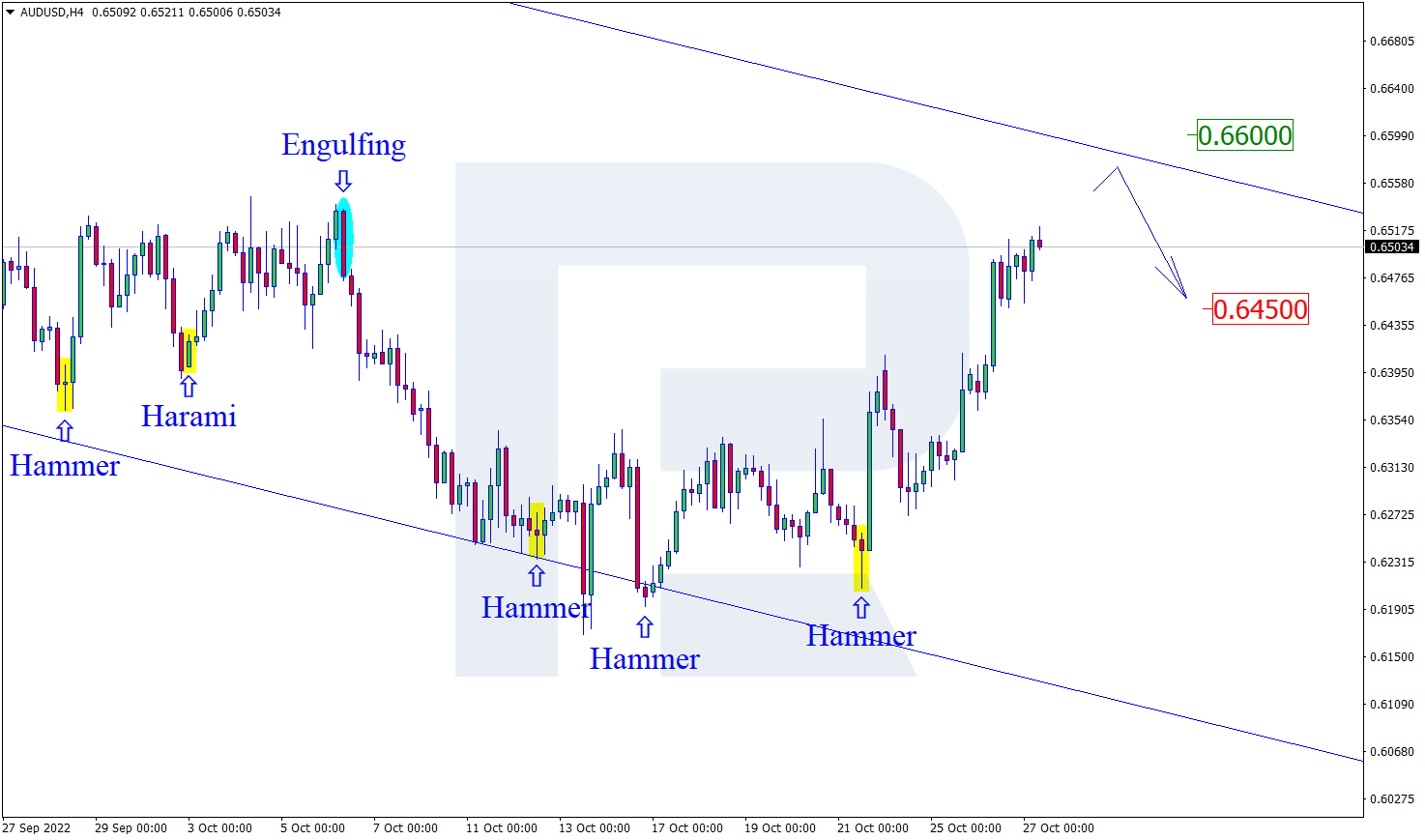
As we can see in the H4 chart, AUDUSD has formed an Engulfing reversal pattern near the resistance area. At the moment, the asset is reversing in the form of a new descending structure. In this case, the downside target may be the support level at 0.6255. After testing the level, the price may break it and continue the descending wave. At the same time, the opposite scenario implies that the price may correct to reach 0.6380 first and then resume the downtrend.

AUDUSD
Risk Warning: the result of previous trading operations do not guarantee the same results in the future

USDCHF, “US Dollar vs Swiss Franc”

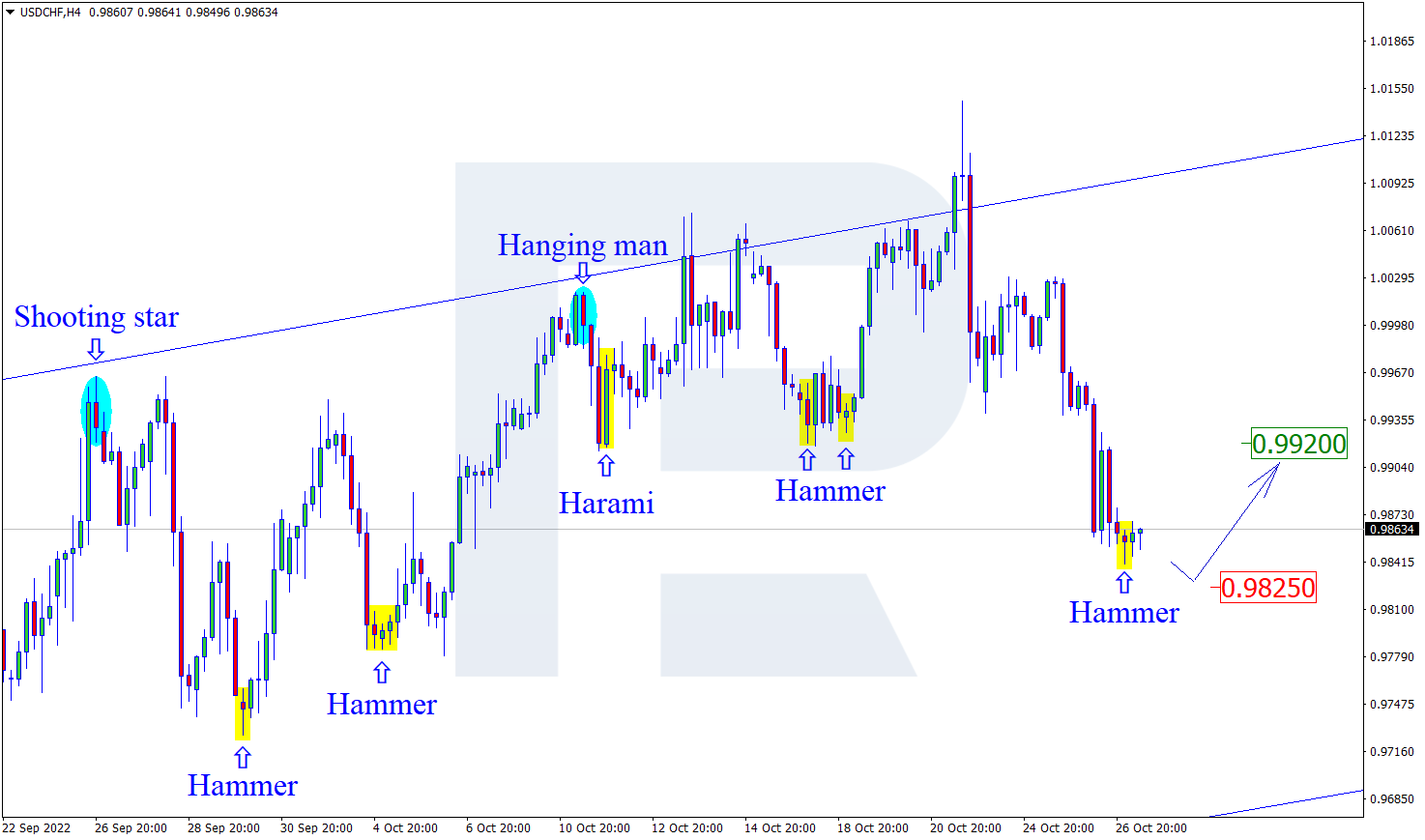
As we can see in the H4 chart, the pair has formed a Hanging Man reversal pattern not far from the resistance area. At the moment, USDCHF may reverse in the form of a new descending wave. In this case, the downside correctional target may be the support level at 0.9890. After testing this level, the price may rebound from it and resume trading upwards. Still, there might be an alternative scenario, in which the asset may continue growing to reach 1.0025 without any pullbacks.

USDCHF

Article By RoboForex.com

Attention!
Forecasts presented in this section only reflect the author’s private opinion and should not be considered as guidance for trading. RoboForex LP bears no responsibility for trading results based on trading recommendations described in these analytical reviews.

The Analytical Overview of the Main Currency Pairs on 2022.10.07

By JustForex

The EUR/USD currency pair

Technical indicators of the currency pair:
  • Prev Open: 0.9871
  • Prev Close: 0.9790
  • % chg. over the last day: -0.82 %

The report on the ECB’s September 7, 8 monetary policy meeting released yesterday showed that many Governing Council representatives approved a 75 basis point rate hike. The report also indicated that in the medium term, a 50 basis point hike would be part of a sustainable path towards more neutral rate levels, and such a dynamic would be enough to alleviate inflationary pressures and not “drop” the economy deep into recession. But all inflation forecasts for 2023 and 2024 have been revised upward.

Trading recommendations
  • Support levels: 0.9782, 0.9748, 0.9666
  • Resistance levels: 0.9856, 0.9962, 1.0058, 1.0111, 1.0162, 1.0230

From the technical point of view, the trend on the EUR/USD currency pair on the hourly time frame is bullish. But the MACD indicator became negative, the price is trading below the moving averages, and the sellers’ pressure is increasing again. Buy trades should be considered from the support level of 0.9782. Sell deals may be considered from the resistance level of 0.9856, but only with confirmation.

Alternative scenario: if the price breaks down through the support level of 0.9666 and fixes below it, the downtrend will likely resume.

EUR/USD
News feed for 2022.10.07:
  • – US FOMC Member Waller Speaks (m/m) at 00:00 (GMT+3);
  • – US FOMC Member Mester Speaks (m/m) at 01:30 (GMT+3);
  • – German Industrial Production (m/m) at 09:00 (GMT+3);
  • – US Nonfarm Payrolls (m/m) at 15:30 (GMT+3);
  • – US Unemployment Rate (m/m) at 15:30 (GMT+3);
  • – US FOMC Member Williams Speaks (m/m) at 17:00 (GMT+3).

The GBP/USD currency pair

Technical indicators of the currency pair:
  • Prev Open: 1.1324
  • Prev Close: 1.1158
  • % chg. over the last day: -1.49 %

The UK construction companies reported a moderate increase in business activity in September, marking a return to growth after two months of declining output. Nevertheless, subdued demand persists, as evidenced by the weakest new orders since the economic recovery began in June 2020. Confidence in business prospects fell to its lowest level in two years in September, reflecting fears of higher interest rates and a downturn in the UK economy as a whole. On a more positive note, the supply deficit narrowed in September, and delivery delays were the least common since February 2020.

Trading recommendations
  • Support levels: 1.1121, 1.0915, 1.0816, 1.0711, 1.03
  • Resistance levels: 1.1248, 1.1478, 1.1693, 1.1816, 1.1901

From the technical point of view, the GBP/USD currency pair trend on the hourly time frame is bullish. But the MACD indicator became negative, the price is trading below the moving averages, and the sellers’ pressure is increasing again. Under such market conditions, buy trades can be considered from the support level of 1.1121, but only with confirmation. Sell trades are best to look for on intraday time frames. The nearest resistance level is 1.1248, but also better with confirmation.

Alternative scenario: if the price breaks down from the 1.0915 support level and fixes below it, the downtrend will likely resume.

GBP/USD
There is no news feed for today.

The USD/JPY currency pair

Technical indicators of the currency pair:
  • Prev Open: 144.58
  • Prev Close: 145.13
  • % chg. over the last day: +0.38 %

The USD/JPY quotes are slowly increasing again. Analysts are confident that it is not worth expecting another currency intervention from the Japanese government, as it is costly and has a temporary effect. Secondly, the Bank of Japan does not have enough funds to stop the yen’s fall. Japan has $1.3 trillion in reserves, but only about $135.5 billion is in the form of deposits. The rest is held in US Treasury bills. To stop the yen from falling, the Bank of Japan needs to shift the narrative from a soft monetary policy to a neutral one. However, since the Bank of Japan has no plans to change anything in its policy until the end of the year, and the US Federal Reserve continues to aggressively raise rates, USD/JPY quotes will be inclined to rise.

Trading recommendations
  • Support levels: 144.16, 143.00, 140.60, 139.61, 138.78, 137.65, 136.80, 135.20
  • Resistance levels: 145.35

From the technical point of view, the medium-term trend on the currency pair USD/JPY is bullish. The MACD indicator has become positive, and the price trades above the moving levels again. Under such market conditions, buy trades can be searched for on the intraday time frames from the support level of 144.16, but with confirmation. Sell deals can be searched from the resistance level of 145.35, but only with an additional confirmation in the form of a false breakout, since the level has already been tested.

Alternative scenario: If the price fixes below 140.60, the downtrend will likely resume.

USD/JPY
There is no news feed for today.

The USD/CAD currency pair

Technical indicators of the currency pair:
  • Prev Open: 1.3615
  • Prev Close: 1.3746
  • % chg. over the last day: +0.96 %

Despite falling consumer prices in Canada, Bank of Canada Governor Tiff Macklem said he is firmly on a path to raise interest rates because policymakers are concerned about heightened domestic price pressures and rising inflationary expectations. Canada’s two-year bond yield reached its highest level since 2007, rising more than five basis points to 3.98%. Traders increased the odds of a 50 basis point rate hike at the next policy decision on October 26. Analysts are predicting that the Bank of Canada will stop at 4% in its rate hike cycle. The rate is currently at 3.25%.

Trading recommendations
  • Support levels: 1.3675, 1.3619, 1.3583, 1.3535, 1.3454
  • Resistance levels: 1.3755, 1.3858, 1.3968

From the point of view of technical analysis, the trend on the USD/CAD currency pair is bearish. But the price is trading above the moving lines again. The MACD indicator has become positive, and the buyer’s pressure is increasing. Under such market conditions, buy trades should be considered on the lower time frames from the support level of 1.3675 or 1.3619, but with confirmation. For sell deals, it is better to consider the resistance level of 1.3756, but only after the additional confirmation.

Alternative scenario: if the price breaks out through and consolidates above the resistance level of 1.3756, the uptrend will likely resume.

USD/CAD
News feed for 2022.10.07:
  • – Canada Unemployment Rate (m/m) at 15:30 (GMT+3).

By JustForex


This article reflects a personal opinion and should not be interpreted as an investment advice, and/or offer, and/or a persistent request for carrying out financial transactions, and/or a guarantee, and/or a forecast of future events.

EUR Under Pressure Again

By RoboForex Analytical Department

Early in another week of October, the major currency pair is falling. At the moment, EUR/USD is balancing around 0.9720.

Global capital markets are trying to escape risks amid recession concerns and this fact makes the “greenback” attractive again. On the other hand, the Euro is getting a huge hit from external economic stress – the upcoming heating season in Europe and many problems around it.

Last Friday’s statistics on the US labour market in September turned out to be better than expected. As a result, the US FOMC has a good reason to continue tightening its monetary policy – the employment sector is stable.

The Unemployment Rate dropped from 3.7% in August to 3.5% in September, while the Non-Farm Payrolls shoed 263K against the expected reading of 248K.

In the H4 chart, after rebounding from 0.9990, EUR/USD is forming a new descending wave towards 0.9360; right now, it is forming the first structure of this wave with the predicted target at 0.9680 and may later consolidate there. In the future, the asset may break the range to the downside and resume falling to reach 0.9360. From the technical point of view, this scenario is confirmed by MACD Oscillator: having broken 0 downwards, its signal line continues falling to update the lows.

As we can see in the H1 chart, having finished the descending structure at 0.9815 and forming a new consolidation range there, EUR/USD has broken it downwards; right now, it is still falling and forming another descending structure towards 0.9700. After that, the instrument may start a new correction to test 0.9815 from below and then resume falling with the target at 0.9630. From the technical point of view, this idea is confirmed by the Stochastic Oscillator: its signal line is falling towards 20.

Disclaimer

Any forecasts contained herein are based on the author’s particular opinion. This analysis may not be treated as trading advice. RoboForex bears no responsibility for trading results based on trading recommendations and reviews contained herein.

More Global Forex Turmoil Ahead

By Dan Steinbock

– As if the world economy would need another crisis trigger, global foreign exchange markets are in historical turmoil. Over time, it can’t be contained without a more diversified global reserve currency system.

According to Bloomberg, global foreign currency reserves have fallen some 7.8% to $12 trillion this year; a decline of $1 trillion, or more than in almost two decades, when Bloomberg began to compile its data.

The plunge reflects the frantic activity of central banks across the world as they struggle to intervene and support ailing currencies.  In late September, the euro coped with its 20-year low against the US dollar.

Meanwhile, the British pound suffered its all-time low vis-à-vis the greenback. Recently, the pound has recovered some of the lost ground, as has the euro. But new pressures will ensue as the Fed will continue its tightening.

In September, Japan spent some $20 billion to slow the yen’s slide in its first intervention to boost the currency since 1998. That’s 19% of the loss of reserves this year. Still, the yen has already lost a fifth of its value this year, which could prove its worst since 1970. Meanwhile, Japan’s gross debt as percentage of the GDP could soar close to 270% by the year-end; the highest among major advanced economies – and most vulnerable to a crisis that would have global repercussions.

Emerging Asia has not been immune to these pressures.

Korea’s plunge, India’s all-time low, China’s dual story

In September, Korean foreign reserves amounted to $417 billion, having taken a $20 billion hit from the previous month. That’s the fastest on-month decline since the West’s financial crisis in October 2008.

In India, forex reserves have tumbled $96 billion this year to $538 billion. The pressures are accelerating as inflation is rising and the Fed’s hikes continue.

While currency depreciation can benefit exporters, it tends to foster capital flight and imported inflation, both of which are spreading in emerging Asia. Hence, too, the plunge of India’s forex reserves by $110 billion in the last 13 months and the rupee’s all-time low against the greenback.

At the end of September, Reuters reported that Chinese state-owned banks are preparing to sell dollars and buy yuan to boost the local currency. The yuan has fallen 11% against the dollar and could finish the year with its biggest decline against the greenback since 1994.

Yet, the dollar pressures tell only a part of the story. China’s central bank is increasingly managing the yuan against the currencies of a broad group of major trading partners, not just against the greenback. Despite its decline vis-à-vis the dollar, the yuan has appreciated against the euro, the yen and other major currencies.

Today, forex volatility is not a mainly economic issue. It also reflects geopolitical objectives.

Huge forex interventions

As the world economy is teetering at the edge of still another global recession, the Fed’s belated and aggressive tightening is causing huge monetary shocks in the world economy.

While the magnitude of the decline of global forex reserves is massive, the efforts to exploit reserves to protect currencies are nothing new. Nevertheless, these huge forex interventions take place in the most challenging economic and geopolitical moment since World War II, due to a series of shocks:

  • the failure of global recovery since 2017, as a result of US protectionism and misguided trade wars
  • the subsequent Covid-19 pandemic and the accompanying global depression and the consequent lost years in many countries
  • over a decade of huge fiscal stimulus packages, ultra-low rates and rounds of quantitative easing in the West
  • the ensuing debt crises in many middle- and low-income countries
  • the US-led NATO war against Russia in Ukraine, which has led to global energy and food shocks and the worst nuclear crisis since 1962

If the Fed sticks to its “dot plot,” interest rates could reach 4.4% by December, above 3.4% projected in June, and rise to 4.6% next year. As a result, the peso could slide to an all-time low of about 62 against the US dollar later in the year. Just as the global forex turmoil could prevail until the first quarter of 2023.

Even if the buoyant dollar will make the US a more expensive place to produce, it will affect America less severely than its trading partners, mainly because US trade is almost entirely invoiced in dollars.

But what will happen when the dollar’s surge against other major currencies will eclipse? Some previous big run-ups in the dollar’s value, particularly in the mid-1980s and early 2000s, were eventually followed by sharp declines. And this time could prove worse.

A rising dollar is neither stabilizing nor strong

After two decades of postwar recovery in Western Europe and Japan, US began to suffer from huge trade deficits. In 1971, President Nixon ended unilaterally the convertibility of the dollar to gold, which resulted in a price shock that reverberated across the world.

As gold no longer offered a yardstick for value, the perception of value replaced value itself.

Since the 1970s, three periods of dollar surges have been followed by periods of decline that have caused much international collateral damage. Each of these surges reflects progressive relative erosion of the dollar. When the dollar surged with sky-high rates in the early 1980s, US sovereign debt was still less than 40% of America’s GDP. With the surge in the early 2000s, the ratio was hovering around 55%. That prevailed until the 2008 crisis, which was overcome with massive debt-taking that pushed the ratio beyond 100% in the early 2010s.

Then came the pandemic and the Biden administration’s irresponsible fiscal policies and now the ratio exceeds 137% of US GDP (more than twice as high than the Philippines’ 62%). As the trendline will accelerate in the coming years, the ratio could double by 2050 (Figure).

Figure U.S. dollar Index and debt-to-GDP ratio

More Global Forex Turmoil Ahead

Source: TradingEconomics; Difference Group

Toward the crisis    

Today, US debt per GDP is where that of Italy was in the early 2010s, right before Rome’s debt crisis. Here’s the problem: The Italian lira is irrelevant in international transactions, but US dollar isn’t.

The presumed strength of the U.S. dollar no longer relies on America’s economic fundamentals, but on a perception that such fundamentals prevail, despite drastic shifts in the world economy.

U.S. dollar is no longer a sustained safe haven, but a temporary safe house. And that’s why the day of reckoning is no longer a matter of principle, just a matter of time.

About the Author:

Dr. Dan Steinbock is an internationally recognized strategist of the multipolar world and the founder of Difference Group. He has served at India, China and America Institute (US), Shanghai Institutes for International Studies (China) and the EU Center (Singapore). For more, see https://www.differencegroup.net/

Based on Dr Steinbock’s global briefing of Oct. 7, 2022

Currency Speculators continued to boost their Euro bets to 17-week high

By InvestMacro

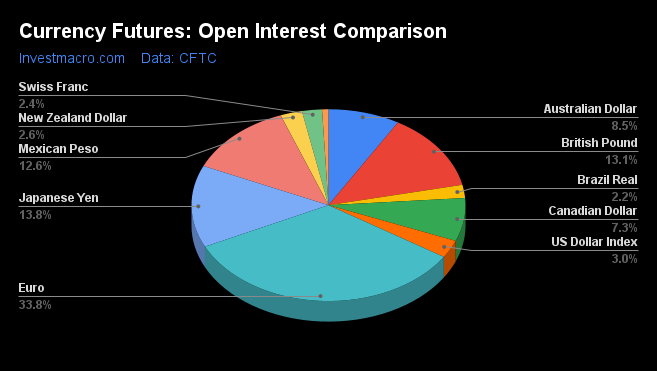
Here are the latest charts and statistics for the Commitment of Traders (COT) data published by the Commodities Futures Trading Commission (CFTC).

The latest COT data is updated through Tuesday October 4th and shows a quick view of how large market participants (for-profit speculators and commercial traders) were positioned in the futures markets. All currency positions are in direct relation to the US dollar where, for example, a bet for the euro is a bet that the euro will rise versus the dollar while a bet against the euro will be a bet that the euro will decline versus the dollar.

Weekly Speculator Changes

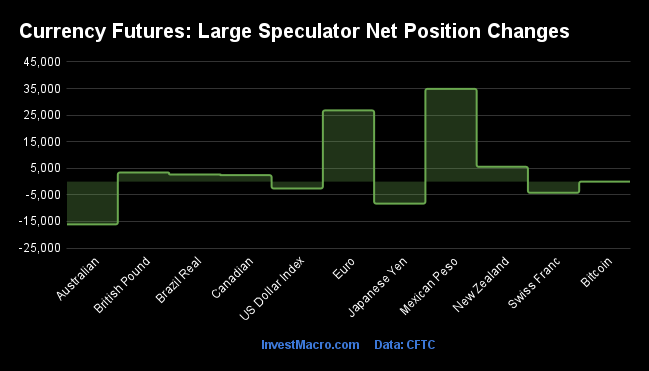
The COT currency market speculator bets were slightly lower this week as five out of the eleven currency markets we cover had higher positioning while the other six markets had lower speculator contracts.

Leading the gains for the currency markets was the Euro (9,885 contracts) with the Australian dollar (6,889 contracts), the Mexican peso (4,001 contracts), the US Dollar Index (1,135 contracts) and the Japanese yen (933 contracts) also showing a positive week.

The currencies leading the declines in speculator bets this week were the Brazilian real (-7,985 contracts) with the Canadian dollar (-3,741 contracts), the British pound sterling (-3,115 contracts),  the New Zealand dollar (-2,507 contracts), the Swiss franc (-1,122 contracts) and Bitcoin (-1,056 contracts) also registering lower bets on the week.

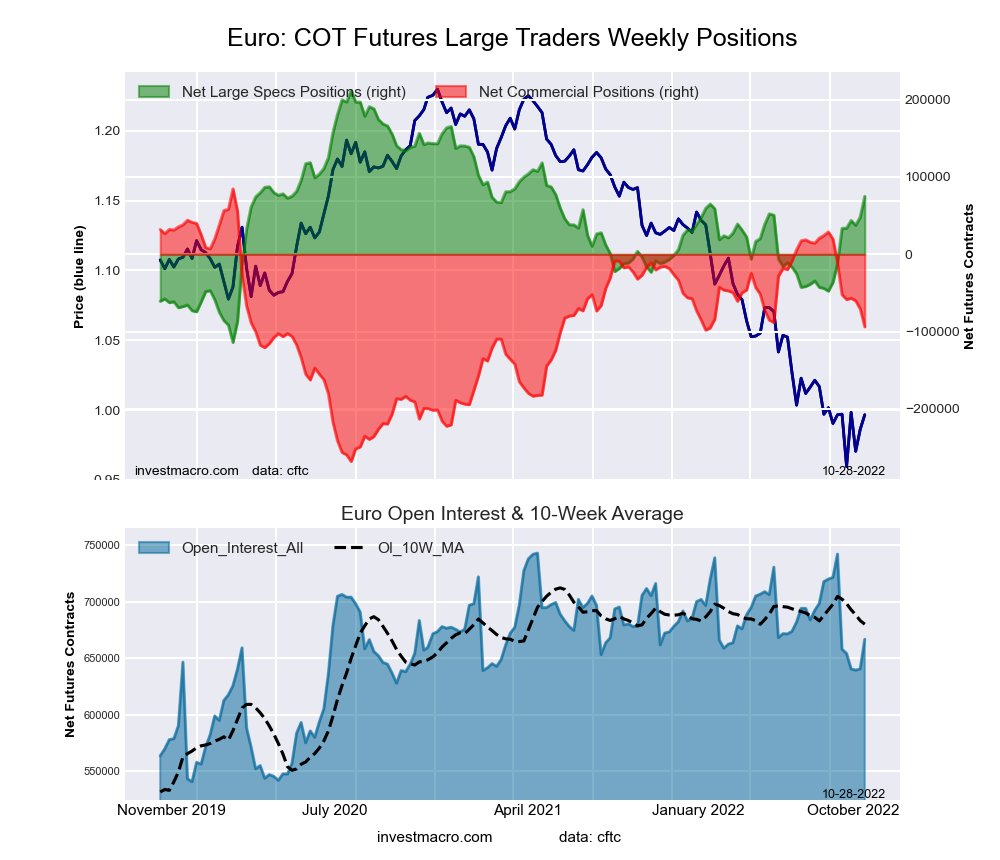
Highlighting the COT currency positioning this week is the Euro speculators positioning that has improved for the fifth straight week. Euro speculators have now boosted their net positions by a total of +91,358 contracts over these past five weeks. This has taken the net positioning from -47,676 contracts on August 30th to a total of +43,682 contracts this week and to the most bullish level since June 7th, a span of 17 weeks.

Speculators are clearly betting that the Euro is near or getting near a bottom against the US dollar as the Euro prices have been testing 20-year lows versus its American counterpart.

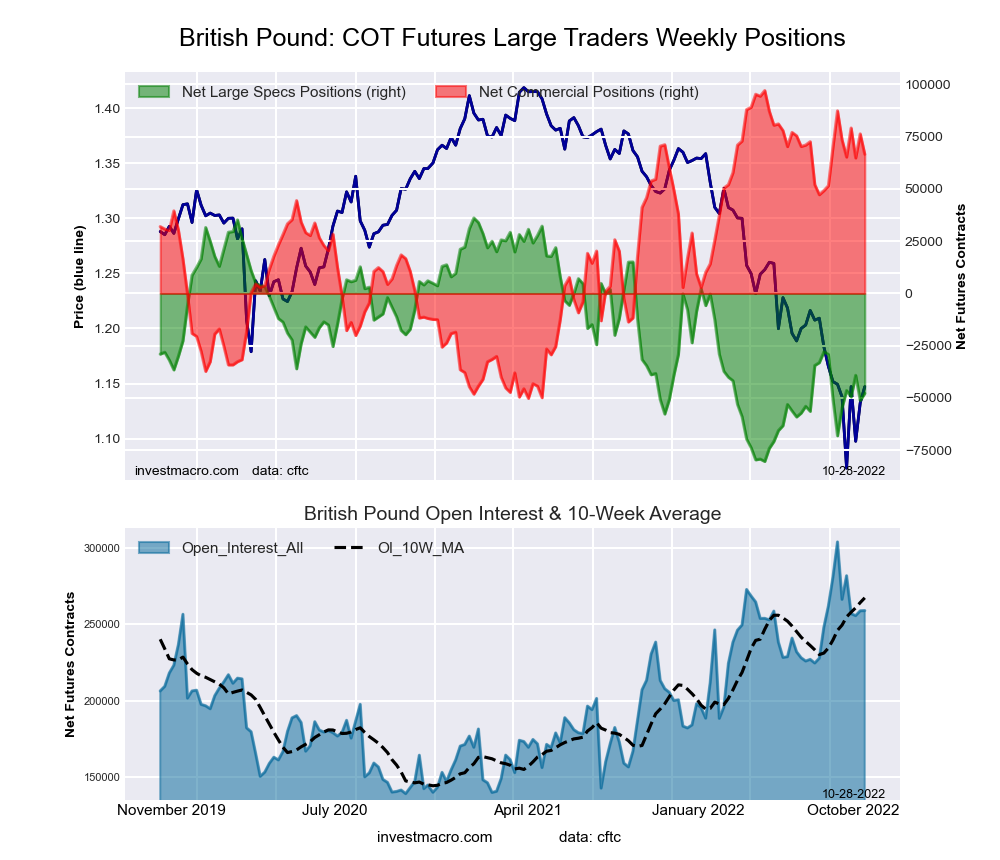
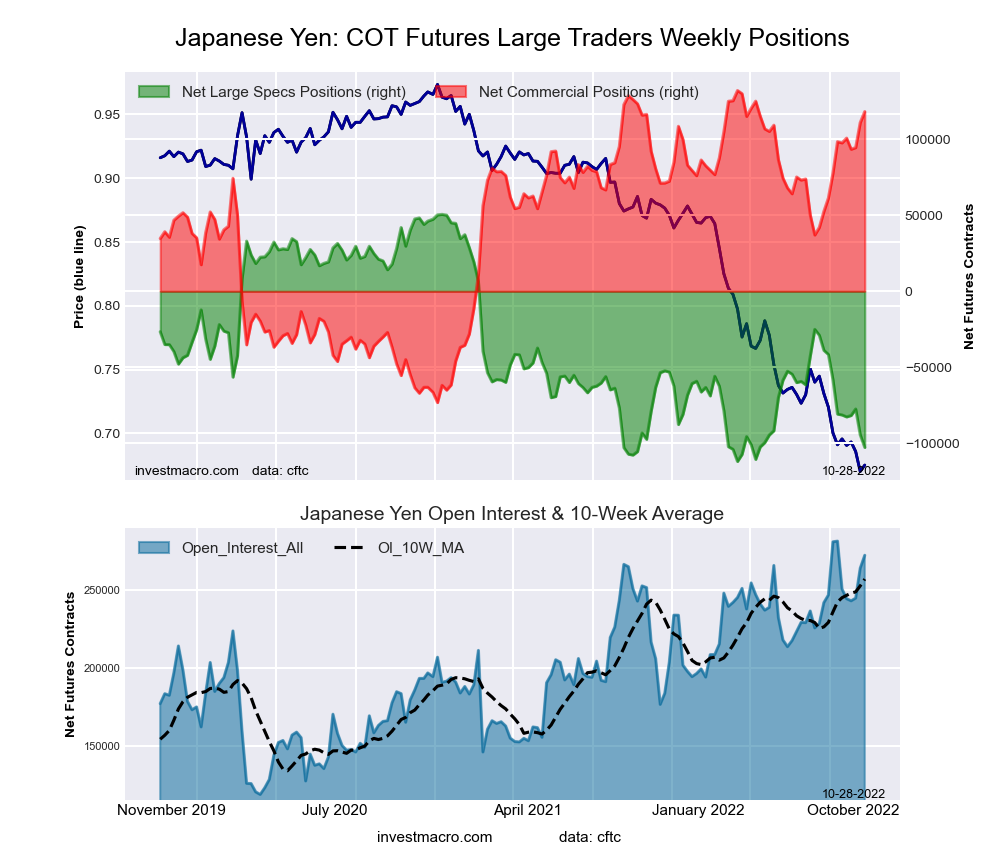
Speculator contracts are usually trend-following and stay relatively in lock-step with prices. The current unusual situation in the Euro contracts can be contrasted with other major currencies at the moment. The British pound sterling net positions are currently at -49,539 contracts while its currency is at similar multi-decade lows and the Japanese yen speculator level is at -81,623 contracts while its currency is also near its own 25-year lows.

The European economic situation seems to be as uncertain as the UK (recession?) and the Japanese (low interest rates) situations with an energy crisis potentially looming and a recession on the horizon. However, speculators are feeling differently at the moment.

Meanwhile in the markets, the EURUSD exchange rate remained below parity this week and fell modestly by less than -1.00 percent, closing out the week at the 0.9742 exchange rate.


Data Snapshot of Forex Market Traders | Columns Legend
Oct-04-2022OIOI-IndexSpec-NetSpec-IndexCom-NetCOM-IndexSmalls-NetSmalls-Index
USD Index54,6387731,69778-36,817175,12073
EUR640,4585543,68248-56,8486013,1660
GBP256,90671-49,5392679,11688-29,5770
JPY243,28976-81,6231993,32481-11,70130
CHF43,12127-6,8523916,02269-9,17026
CAD141,79925-21,4071517,947843,46037
AUD139,49037-27,7645938,80448-11,04026
NZD48,48741-13,9784617,25959-3,28114
MXN192,35246-37,3211131,914865,40766
RUB20,93047,54331-7,15069-39324
BRL39,9842725,77976-27,570241,79186
Bitcoin14,23082-3276-421045323


US Dollar Index (77.8 percent) leads Strength Scores

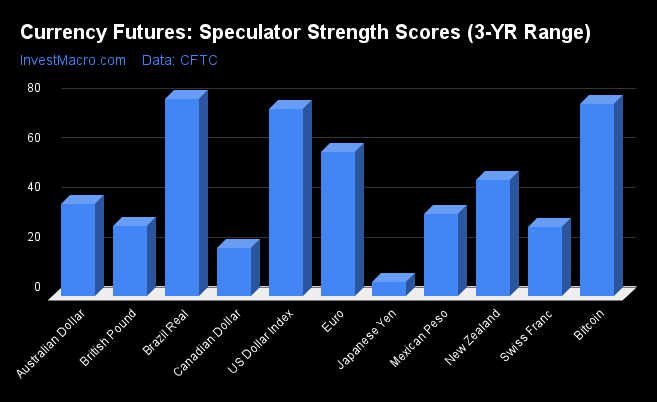
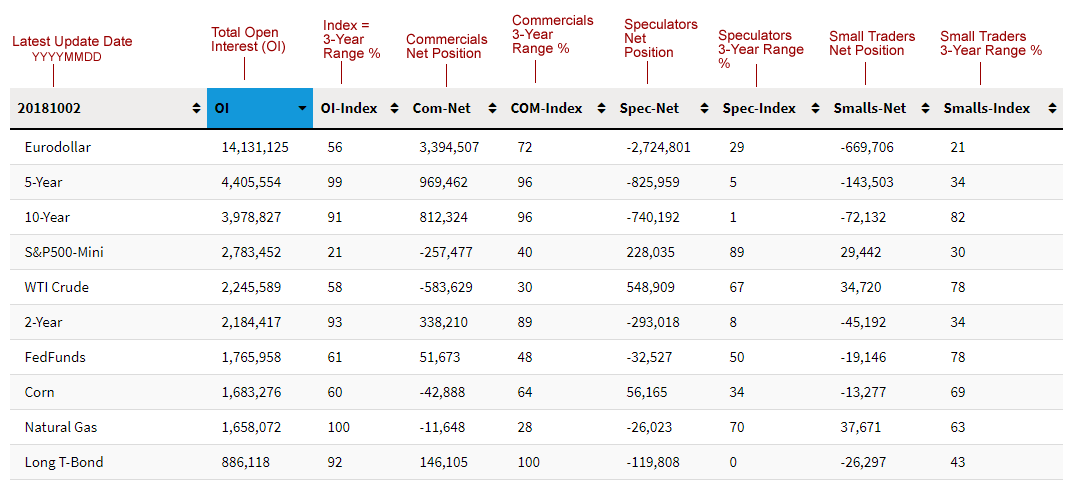
Strength Scores (a normalized measure of Speculator positions over a 3-Year range, from 0 to 100 where above 80 is extreme bullish and below 20 is extreme bearish) showed that the US Dollar Index (77.8 percent) is back in the lead for the currency markets scores. Bitcoin (76.4 percent) and the Brazilian Real (75.7 percent) come in as the next highest in the currency markets in strength scores.

On the downside, the Mexican Peso (11.4 percent), Canadian Dollar (15.3 percent) and the Japanese Yen (18.6 percent) come in at the lowest strength level currently. All three of these markets are in bearish extreme positions with scores under the 20 percent level.


Strength Statistics:
US Dollar Index (77.8 percent) vs US Dollar Index previous week (75.9 percent)
EuroFX (48.4 percent) vs EuroFX previous week (45.4 percent)
British Pound Sterling (26.5 percent) vs British Pound Sterling previous week (29.2 percent)
Japanese Yen (18.6 percent) vs Japanese Yen previous week (18.0 percent)
Swiss Franc (39.1 percent) vs Swiss Franc previous week (42.0 percent)
Canadian Dollar (15.3 percent) vs Canadian Dollar previous week (19.5 percent)
Australian Dollar (59.1 percent) vs Australian Dollar previous week (52.7 percent)
New Zealand Dollar (45.9 percent) vs New Zealand Dollar previous week (50.3 percent)
Mexican Peso (11.4 percent) vs Mexican Peso previous week (9.7 percent)
Brazilian Real (75.7 percent) vs Brazilian Real previous week (83.6 percent)
Bitcoin (76.4 percent) vs Bitcoin previous week (94.8 percent)

Australian Dollar (29.9 percent) leads Strength Trends

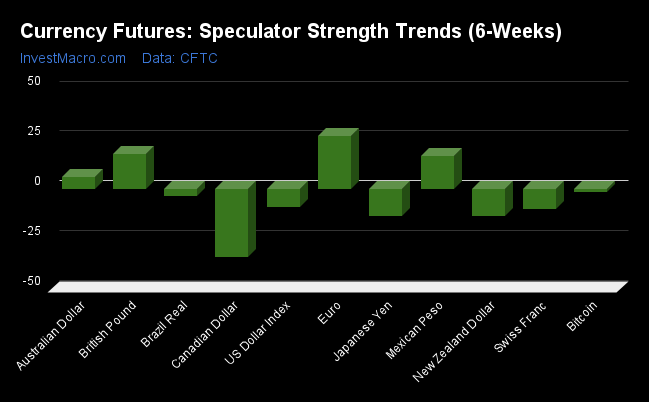
Strength Score Trends (or move index, calculates the 6-week changes in strength scores) show that the Australian Dollar (29.9 percent) leads the past six weeks trends for the currency markets this week. The EuroFX (26.9 percent) and the Brazilian Real (19.1 percent) fill out the rest of the positive movers in the latest trends data.

The Canadian Dollar (-50.1 percent) leads the downside trend scores currently while the next markets with lower trend scores were the Japanese Yen (-26.4 percent), New Zealand Dollar (-21.7 percent) and the British Pound Sterling (-18.5 percent).

Strength Trend Statistics:
US Dollar Index (-5.7 percent) vs US Dollar Index previous week (-12.3 percent)
EuroFX (26.9 percent) vs EuroFX previous week (23.5 percent)
British Pound Sterling (-18.5 percent) vs British Pound Sterling previous week (-11.4 percent)
Japanese Yen (-26.4 percent) vs Japanese Yen previous week (-33.1 percent)
Swiss Franc (-11.3 percent) vs Swiss Franc previous week (-1.6 percent)
Canadian Dollar (-50.1 percent) vs Canadian Dollar previous week (-50.0 percent)
Australian Dollar (29.9 percent) vs Australian Dollar previous week (22.8 percent)
New Zealand Dollar (-21.7 percent) vs New Zealand Dollar previous week (-23.0 percent)
Mexican Peso (-2.6 percent) vs Mexican Peso previous week (-8.5 percent)
Brazilian Real (19.1 percent) vs Brazilian Real previous week (26.8 percent)
Bitcoin (-17.4 percent) vs Bitcoin previous week (19.5 percent)


Individual COT Forex Markets:

US Dollar Index Futures:
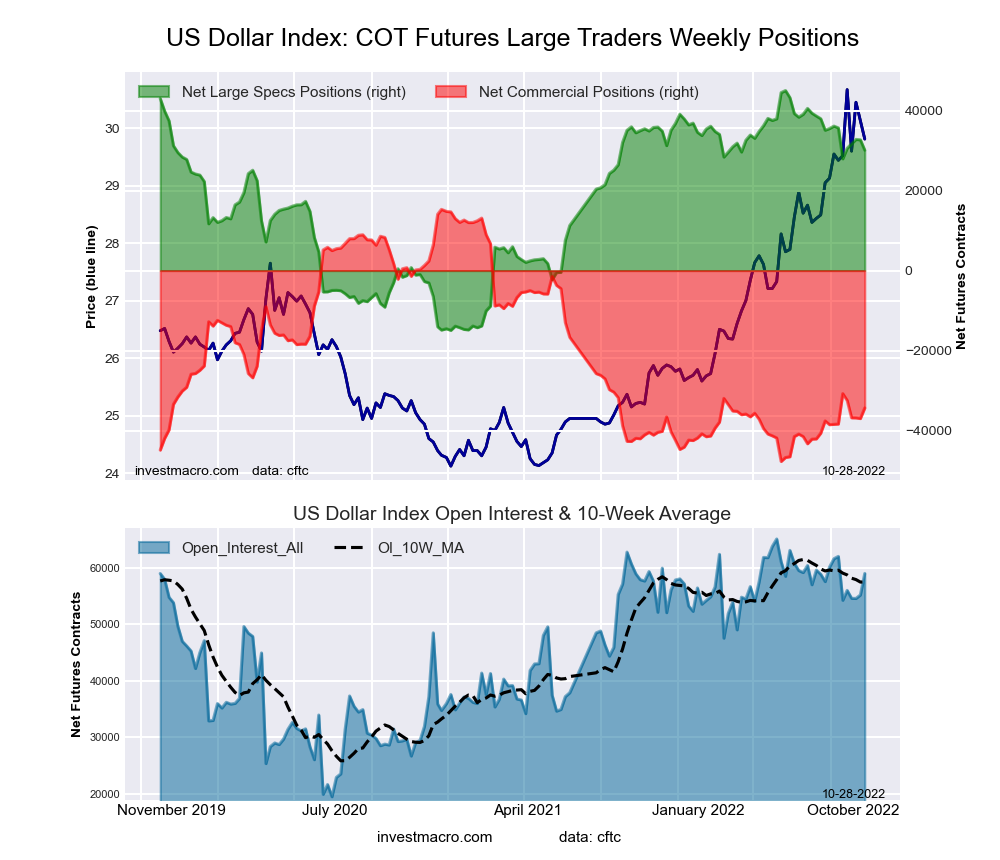
US Dollar Index Forex Futures COT ChartThe US Dollar Index large speculator standing this week recorded a net position of 31,697 contracts in the data reported through Tuesday. This was a weekly boost of 1,135 contracts from the previous week which had a total of 30,562 net contracts.

This week’s current strength score (the trader positioning range over the past three years, measured from 0 to 100) shows the speculators are currently Bullish with a score of 77.8 percent. The commercials are Bearish-Extreme with a score of 17.3 percent and the small traders (not shown in chart) are Bullish with a score of 72.5 percent.

US DOLLAR INDEX StatisticsSPECULATORSCOMMERCIALSSMALL TRADERS
– Percent of Open Interest Longs:81.43.513.0
– Percent of Open Interest Shorts:23.370.93.7
– Net Position:31,697-36,8175,120
– Gross Longs:44,4491,9267,123
– Gross Shorts:12,75238,7432,003
– Long to Short Ratio:3.5 to 10.0 to 13.6 to 1
NET POSITION TREND:
– Strength Index Score (3 Year Range Pct):77.817.372.5
– Strength Index Reading (3 Year Range):BullishBearish-ExtremeBullish
NET POSITION MOVEMENT INDEX:
– 6-Week Change in Strength Index:-5.71.228.7


Euro Currency Futures:

Euro Currency Futures COT ChartThe Euro Currency large speculator standing this week recorded a net position of 43,682 contracts in the data reported through Tuesday. This was a weekly rise of 9,885 contracts from the previous week which had a total of 33,797 net contracts.

This week’s current strength score (the trader positioning range over the past three years, measured from 0 to 100) shows the speculators are currently Bearish with a score of 48.4 percent. The commercials are Bullish with a score of 59.9 percent and the small traders (not shown in chart) are Bearish-Extreme with a score of 0.0 percent.

EURO Currency StatisticsSPECULATORSCOMMERCIALSSMALL TRADERS
– Percent of Open Interest Longs:31.154.511.6
– Percent of Open Interest Shorts:24.363.39.5
– Net Position:43,682-56,84813,166
– Gross Longs:199,391348,81774,175
– Gross Shorts:155,709405,66561,009
– Long to Short Ratio:1.3 to 10.9 to 11.2 to 1
NET POSITION TREND:
– Strength Index Score (3 Year Range Pct):48.459.90.0
– Strength Index Reading (3 Year Range):BearishBullishBearish-Extreme
NET POSITION MOVEMENT INDEX:
– 6-Week Change in Strength Index:26.9-23.0-10.6


British Pound Sterling Futures:

British Pound Sterling Futures COT ChartThe British Pound Sterling large speculator standing this week recorded a net position of -49,539 contracts in the data reported through Tuesday. This was a weekly decline of -3,115 contracts from the previous week which had a total of -46,424 net contracts.

This week’s current strength score (the trader positioning range over the past three years, measured from 0 to 100) shows the speculators are currently Bearish with a score of 26.5 percent. The commercials are Bullish-Extreme with a score of 87.8 percent and the small traders (not shown in chart) are Bearish-Extreme with a score of 0.0 percent.

BRITISH POUND StatisticsSPECULATORSCOMMERCIALSSMALL TRADERS
– Percent of Open Interest Longs:16.474.76.4
– Percent of Open Interest Shorts:35.743.917.9
– Net Position:-49,53979,116-29,577
– Gross Longs:42,078191,81916,367
– Gross Shorts:91,617112,70345,944
– Long to Short Ratio:0.5 to 11.7 to 10.4 to 1
NET POSITION TREND:
– Strength Index Score (3 Year Range Pct):26.587.80.0
– Strength Index Reading (3 Year Range):BearishBullish-ExtremeBearish-Extreme
NET POSITION MOVEMENT INDEX:
– 6-Week Change in Strength Index:-18.520.3-16.4


Japanese Yen Futures:

Japanese Yen Forex Futures COT ChartThe Japanese Yen large speculator standing this week recorded a net position of -81,623 contracts in the data reported through Tuesday. This was a weekly rise of 933 contracts from the previous week which had a total of -82,556 net contracts.

This week’s current strength score (the trader positioning range over the past three years, measured from 0 to 100) shows the speculators are currently Bearish-Extreme with a score of 18.6 percent. The commercials are Bullish-Extreme with a score of 81.2 percent and the small traders (not shown in chart) are Bearish with a score of 29.7 percent.

JAPANESE YEN StatisticsSPECULATORSCOMMERCIALSSMALL TRADERS
– Percent of Open Interest Longs:11.176.311.0
– Percent of Open Interest Shorts:44.638.015.8
– Net Position:-81,62393,324-11,701
– Gross Longs:26,962185,69126,766
– Gross Shorts:108,58592,36738,467
– Long to Short Ratio:0.2 to 12.0 to 10.7 to 1
NET POSITION TREND:
– Strength Index Score (3 Year Range Pct):18.681.229.7
– Strength Index Reading (3 Year Range):Bearish-ExtremeBullish-ExtremeBearish
NET POSITION MOVEMENT INDEX:
– 6-Week Change in Strength Index:-26.419.94.0


Swiss Franc Futures:

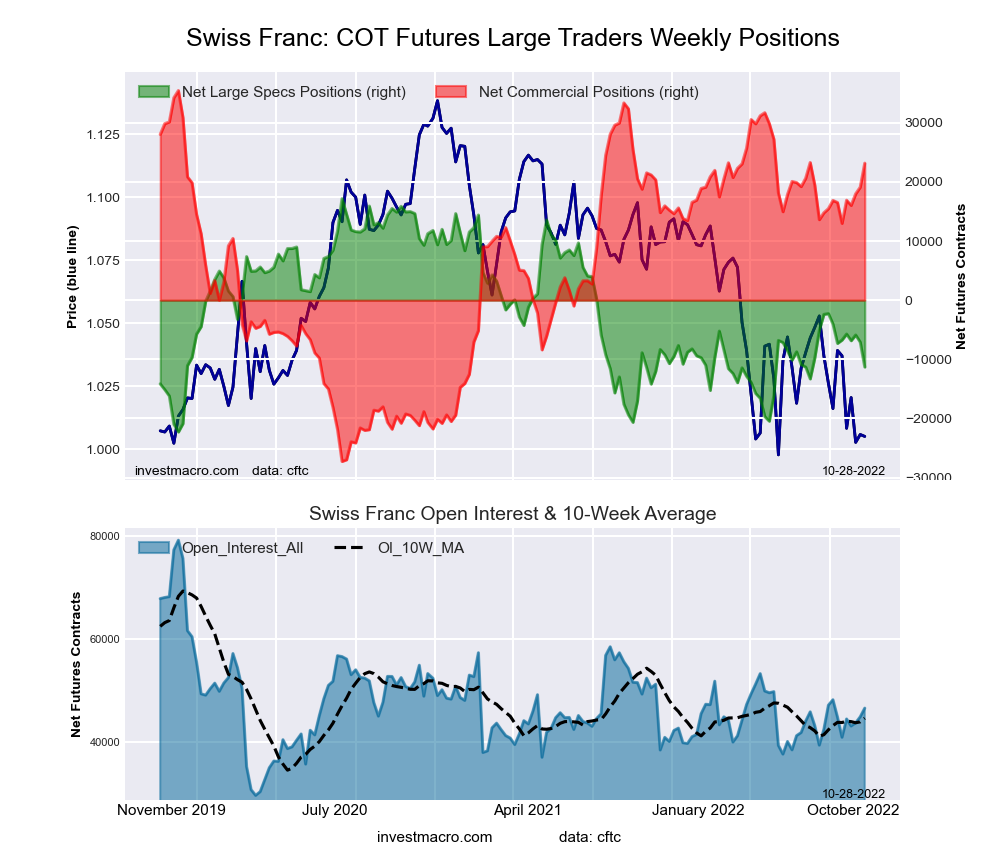
Swiss Franc Forex Futures COT ChartThe Swiss Franc large speculator standing this week recorded a net position of -6,852 contracts in the data reported through Tuesday. This was a weekly lowering of -1,122 contracts from the previous week which had a total of -5,730 net contracts.

This week’s current strength score (the trader positioning range over the past three years, measured from 0 to 100) shows the speculators are currently Bearish with a score of 39.1 percent. The commercials are Bullish with a score of 69.0 percent and the small traders (not shown in chart) are Bearish with a score of 26.5 percent.

SWISS FRANC StatisticsSPECULATORSCOMMERCIALSSMALL TRADERS
– Percent of Open Interest Longs:18.160.621.2
– Percent of Open Interest Shorts:34.023.542.4
– Net Position:-6,85216,022-9,170
– Gross Longs:7,81626,1409,128
– Gross Shorts:14,66810,11818,298
– Long to Short Ratio:0.5 to 12.6 to 10.5 to 1
NET POSITION TREND:
– Strength Index Score (3 Year Range Pct):39.169.026.5
– Strength Index Reading (3 Year Range):BearishBullishBearish
NET POSITION MOVEMENT INDEX:
– 6-Week Change in Strength Index:-11.32.010.8


Canadian Dollar Futures:

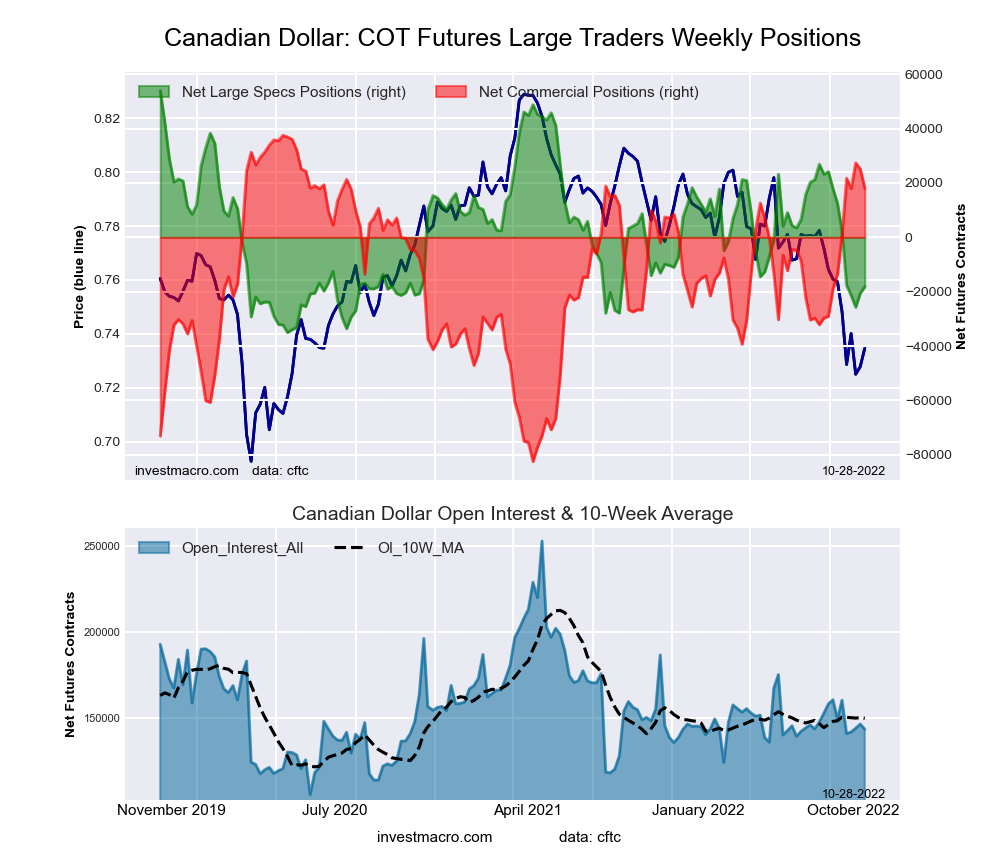
Canadian Dollar Forex Futures COT ChartThe Canadian Dollar large speculator standing this week recorded a net position of -21,407 contracts in the data reported through Tuesday. This was a weekly lowering of -3,741 contracts from the previous week which had a total of -17,666 net contracts.

This week’s current strength score (the trader positioning range over the past three years, measured from 0 to 100) shows the speculators are currently Bearish-Extreme with a score of 15.3 percent. The commercials are Bullish-Extreme with a score of 83.7 percent and the small traders (not shown in chart) are Bearish with a score of 37.1 percent.

CANADIAN DOLLAR StatisticsSPECULATORSCOMMERCIALSSMALL TRADERS
– Percent of Open Interest Longs:25.649.823.3
– Percent of Open Interest Shorts:40.737.120.8
– Net Position:-21,40717,9473,460
– Gross Longs:36,24670,62433,001
– Gross Shorts:57,65352,67729,541
– Long to Short Ratio:0.6 to 11.3 to 11.1 to 1
NET POSITION TREND:
– Strength Index Score (3 Year Range Pct):15.383.737.1
– Strength Index Reading (3 Year Range):Bearish-ExtremeBullish-ExtremeBearish
NET POSITION MOVEMENT INDEX:
– 6-Week Change in Strength Index:-50.139.7-6.0


Australian Dollar Futures:

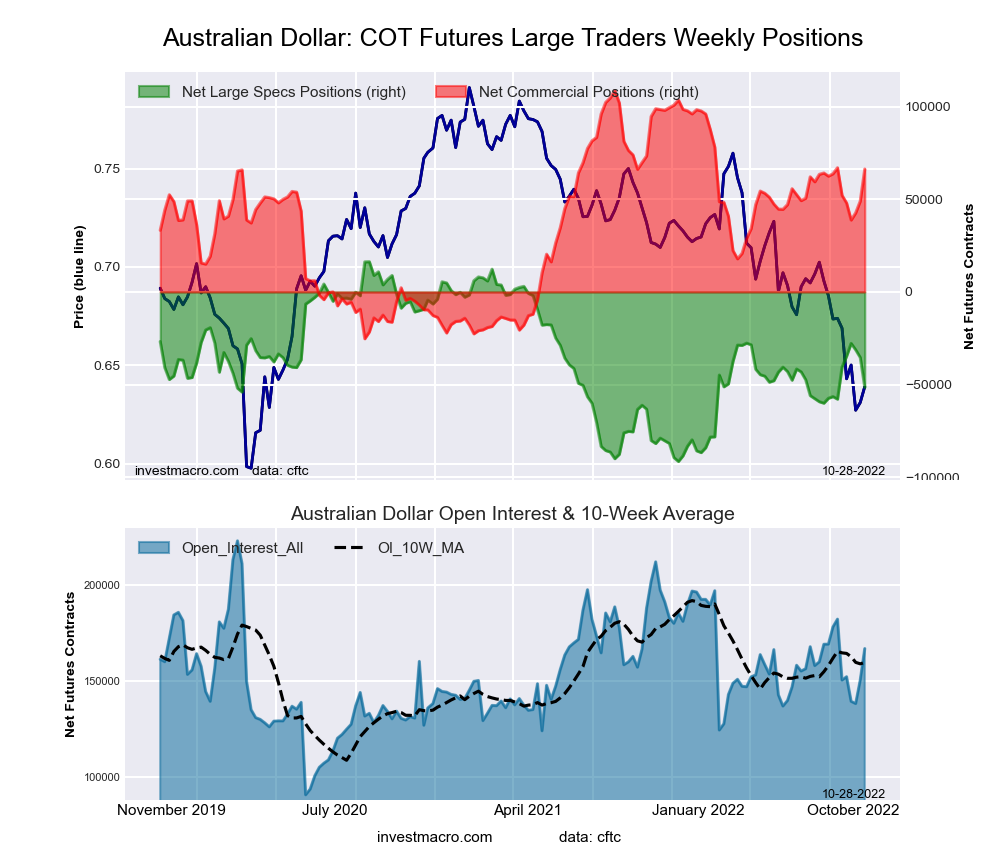
Australian Dollar Forex Futures COT ChartThe Australian Dollar large speculator standing this week recorded a net position of -27,764 contracts in the data reported through Tuesday. This was a weekly advance of 6,889 contracts from the previous week which had a total of -34,653 net contracts.

This week’s current strength score (the trader positioning range over the past three years, measured from 0 to 100) shows the speculators are currently Bullish with a score of 59.1 percent. The commercials are Bearish with a score of 47.8 percent and the small traders (not shown in chart) are Bearish with a score of 25.5 percent.

AUSTRALIAN DOLLAR StatisticsSPECULATORSCOMMERCIALSSMALL TRADERS
– Percent of Open Interest Longs:26.058.812.1
– Percent of Open Interest Shorts:45.931.020.0
– Net Position:-27,76438,804-11,040
– Gross Longs:36,24882,08016,813
– Gross Shorts:64,01243,27627,853
– Long to Short Ratio:0.6 to 11.9 to 10.6 to 1
NET POSITION TREND:
– Strength Index Score (3 Year Range Pct):59.147.825.5
– Strength Index Reading (3 Year Range):BullishBearishBearish
NET POSITION MOVEMENT INDEX:
– 6-Week Change in Strength Index:29.9-18.9-16.8


New Zealand Dollar Futures:

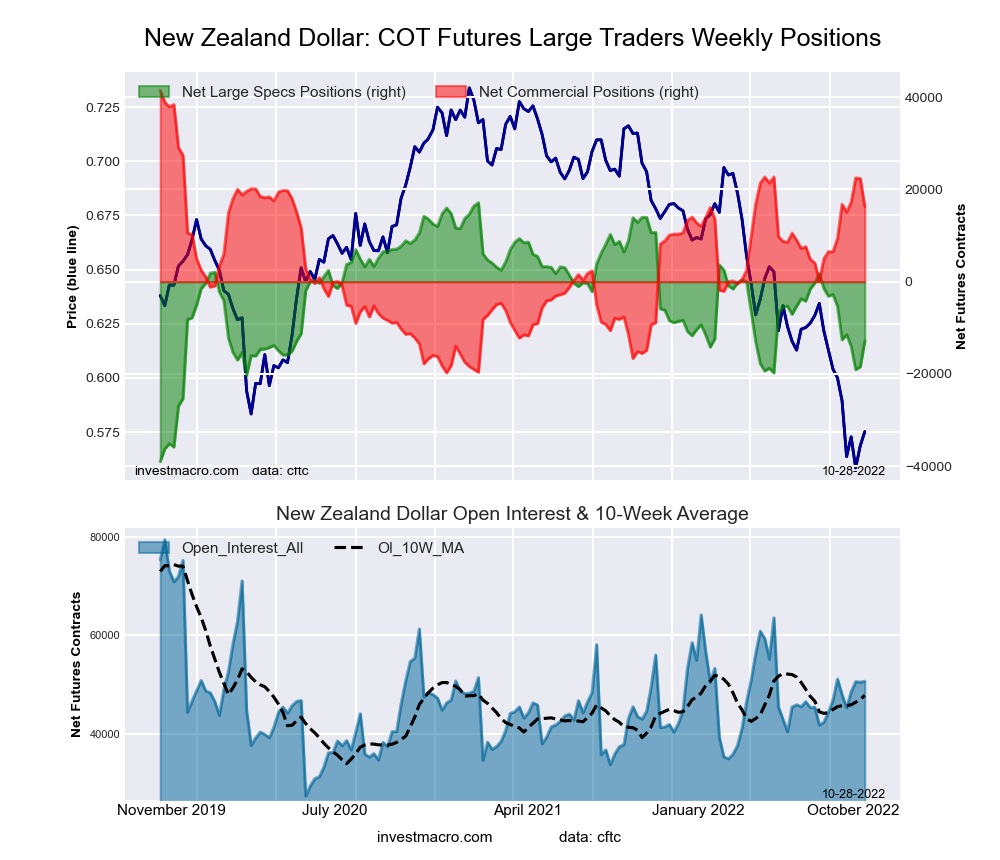
New Zealand Dollar Forex Futures COT ChartThe New Zealand Dollar large speculator standing this week recorded a net position of -13,978 contracts in the data reported through Tuesday. This was a weekly reduction of -2,507 contracts from the previous week which had a total of -11,471 net contracts.

This week’s current strength score (the trader positioning range over the past three years, measured from 0 to 100) shows the speculators are currently Bearish with a score of 45.9 percent. The commercials are Bullish with a score of 58.6 percent and the small traders (not shown in chart) are Bearish-Extreme with a score of 13.9 percent.

NEW ZEALAND DOLLAR StatisticsSPECULATORSCOMMERCIALSSMALL TRADERS
– Percent of Open Interest Longs:30.963.84.9
– Percent of Open Interest Shorts:59.728.311.6
– Net Position:-13,97817,259-3,281
– Gross Longs:14,96630,9572,359
– Gross Shorts:28,94413,6985,640
– Long to Short Ratio:0.5 to 12.3 to 10.4 to 1
NET POSITION TREND:
– Strength Index Score (3 Year Range Pct):45.958.613.9
– Strength Index Reading (3 Year Range):BearishBullishBearish-Extreme
NET POSITION MOVEMENT INDEX:
– 6-Week Change in Strength Index:-21.719.42.8


Mexican Peso Futures:

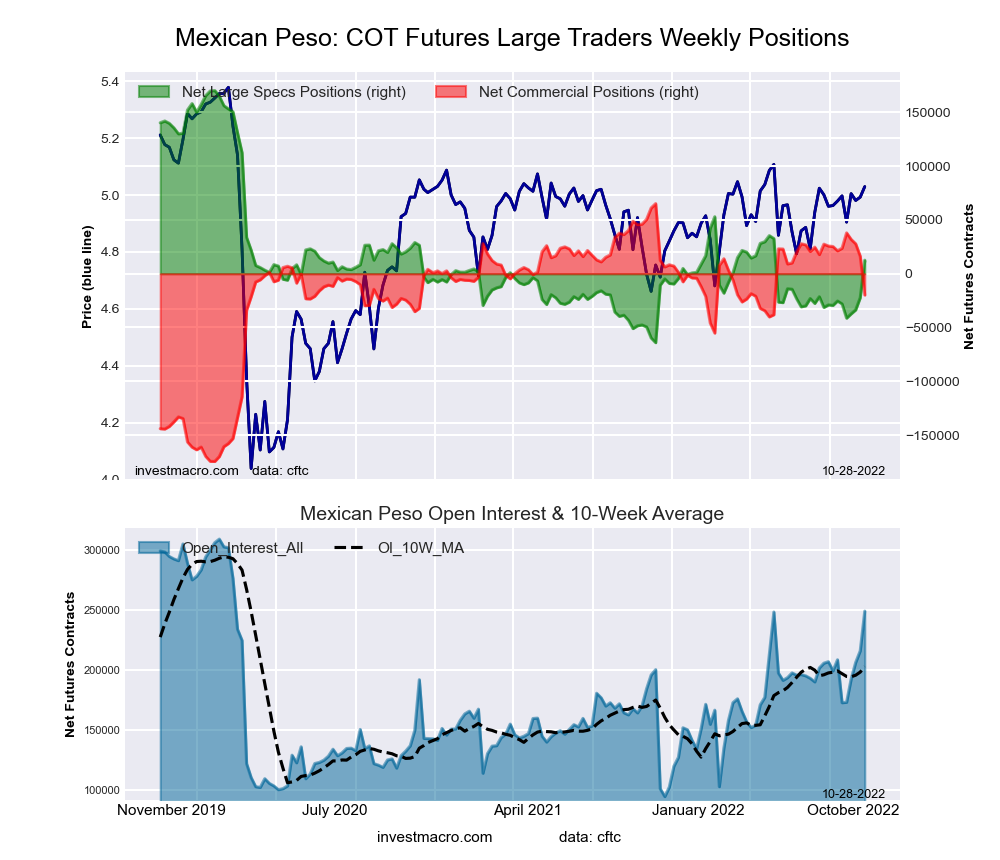
Mexican Peso Futures COT ChartThe Mexican Peso large speculator standing this week recorded a net position of -37,321 contracts in the data reported through Tuesday. This was a weekly gain of 4,001 contracts from the previous week which had a total of -41,322 net contracts.

This week’s current strength score (the trader positioning range over the past three years, measured from 0 to 100) shows the speculators are currently Bearish-Extreme with a score of 11.4 percent. The commercials are Bullish-Extreme with a score of 86.1 percent and the small traders (not shown in chart) are Bullish with a score of 65.9 percent.

MEXICAN PESO StatisticsSPECULATORSCOMMERCIALSSMALL TRADERS
– Percent of Open Interest Longs:56.539.34.1
– Percent of Open Interest Shorts:75.922.71.3
– Net Position:-37,32131,9145,407
– Gross Longs:108,62675,6487,916
– Gross Shorts:145,94743,7342,509
– Long to Short Ratio:0.7 to 11.7 to 13.2 to 1
NET POSITION TREND:
– Strength Index Score (3 Year Range Pct):11.486.165.9
– Strength Index Reading (3 Year Range):Bearish-ExtremeBullish-ExtremeBullish
NET POSITION MOVEMENT INDEX:
– 6-Week Change in Strength Index:-2.61.86.7


Brazilian Real Futures:

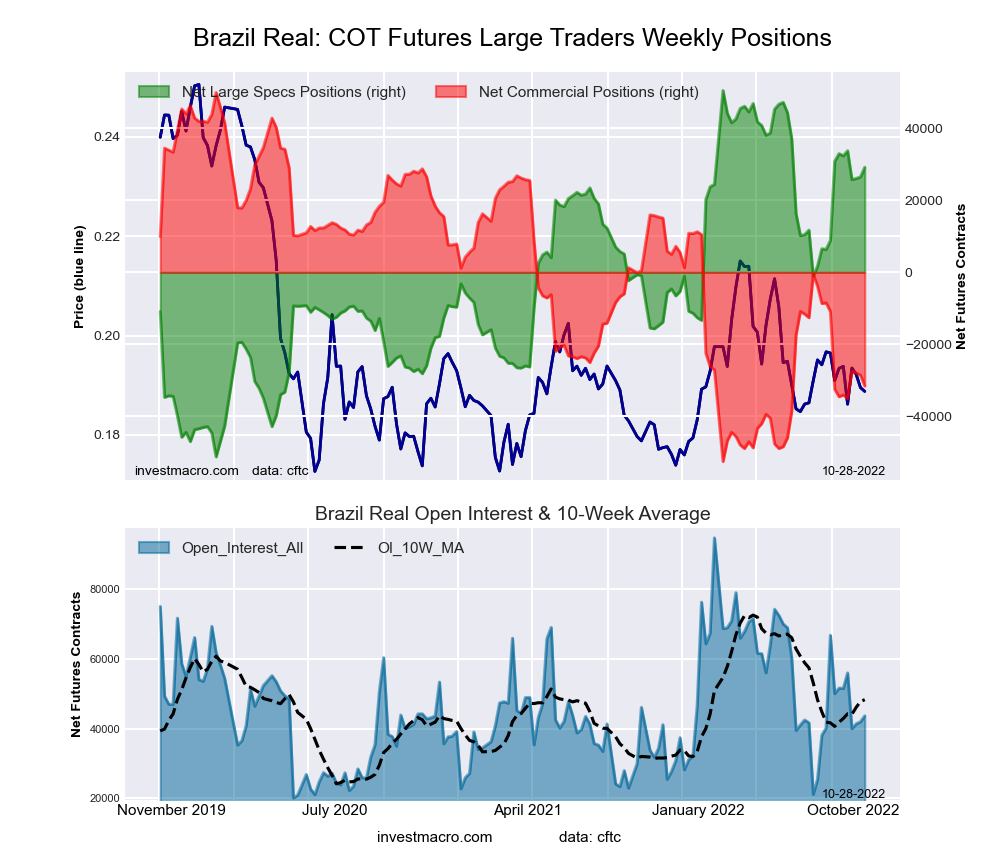
Brazil Real Futures COT ChartThe Brazilian Real large speculator standing this week recorded a net position of 25,779 contracts in the data reported through Tuesday. This was a weekly lowering of -7,985 contracts from the previous week which had a total of 33,764 net contracts.

This week’s current strength score (the trader positioning range over the past three years, measured from 0 to 100) shows the speculators are currently Bullish with a score of 75.7 percent. The commercials are Bearish with a score of 24.4 percent and the small traders (not shown in chart) are Bullish-Extreme with a score of 85.8 percent.

BRAZIL REAL StatisticsSPECULATORSCOMMERCIALSSMALL TRADERS
– Percent of Open Interest Longs:72.319.87.3
– Percent of Open Interest Shorts:7.888.82.9
– Net Position:25,779-27,5701,791
– Gross Longs:28,8947,9202,935
– Gross Shorts:3,11535,4901,144
– Long to Short Ratio:9.3 to 10.2 to 12.6 to 1
NET POSITION TREND:
– Strength Index Score (3 Year Range Pct):75.724.485.8
– Strength Index Reading (3 Year Range):BullishBearishBullish-Extreme
NET POSITION MOVEMENT INDEX:
– 6-Week Change in Strength Index:19.1-18.6-4.0


Bitcoin Futures:

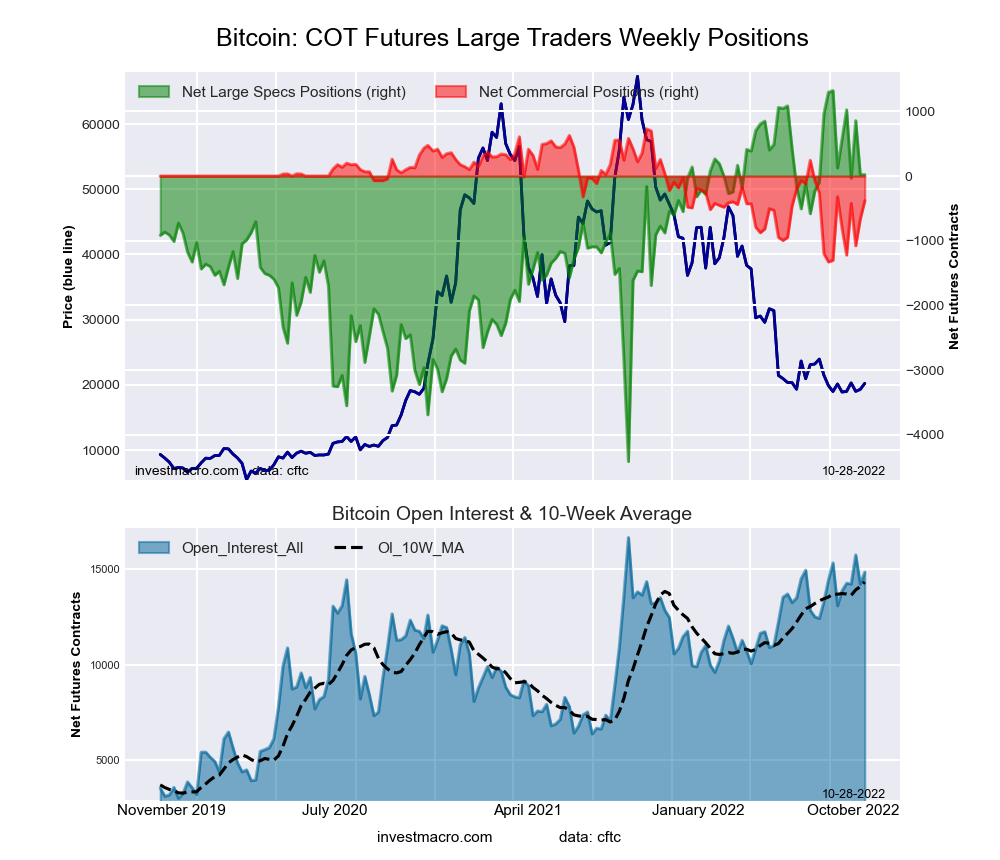
Bitcoin Crypto Futures COT ChartThe Bitcoin large speculator standing this week recorded a net position of -32 contracts in the data reported through Tuesday. This was a weekly reduction of -1,056 contracts from the previous week which had a total of 1,024 net contracts.

This week’s current strength score (the trader positioning range over the past three years, measured from 0 to 100) shows the speculators are currently Bullish with a score of 76.4 percent. The commercials are Bearish with a score of 44.1 percent and the small traders (not shown in chart) are Bearish with a score of 23.2 percent.

BITCOIN StatisticsSPECULATORSCOMMERCIALSSMALL TRADERS
– Percent of Open Interest Longs:80.72.69.1
– Percent of Open Interest Shorts:80.95.55.9
– Net Position:-32-421453
– Gross Longs:11,4813631,291
– Gross Shorts:11,513784838
– Long to Short Ratio:1.0 to 10.5 to 11.5 to 1
NET POSITION TREND:
– Strength Index Score (3 Year Range Pct):76.444.123.2
– Strength Index Reading (3 Year Range):BullishBearishBearish
NET POSITION MOVEMENT INDEX:
– 6-Week Change in Strength Index:-17.437.85.0


Article By InvestMacroReceive our weekly COT Newsletter

*COT Report: The COT data, released weekly to the public each Friday, is updated through the most recent Tuesday (data is 3 days old) and shows a quick view of how large speculators or non-commercials (for-profit traders) were positioned in the futures markets.

The CFTC categorizes trader positions according to commercial hedgers (traders who use futures contracts for hedging as part of the business), non-commercials (large traders who speculate to realize trading profits) and nonreportable traders (usually small traders/speculators) as well as their open interest (contracts open in the market at time of reporting). See CFTC criteria here.

 

COT Speculator Extremes: Soybean Meal & Nikkei 225 lead weekly Bullish & Bearish Positions

By InvestMacro

The latest update for the weekly Commitment of Traders (COT) report was released by the Commodity Futures Trading Commission (CFTC) on Friday for data ending on Tuesday October 4th.

This weekly Extreme Positions report highlights the Top Most Bullish and Top Most Bearish Positions for the speculator category. Extreme positioning in these markets can foreshadow strong moves in the underlying market.

To signify an extreme position, we use the Strength Index (also known as the COT Index) of each instrument, a common method of measuring COT data. The Strength Index is simply a comparison of current trader positions against the range of positions over the previous 3 years. We use over 80 percent as extremely bullish and under 20 percent as extremely bearish.

Compare Strength Index scores across all markets in the data table or cot leaders table, see a profile of speculators in COT markets in our cot reports guide.


Here Are This Week’s Most Bullish Speculator Positions:

Soybean Meal – 86.4 percent

This week there are only two bullish markets (above the 80 percent) and Soybean Meal is the most bullish market of the week. This market has come in near the top of the most bullish markets for several weeks now. The strength score for Soybean Meal is currently 86.4 percent, down from 91.5 percent last week and 97.9 percent the week before.

The net speculator positioning for Soybean Meal dipped for a second straight this week but the overall net position has remained above the +100,000 contract level for the thirteenth consecutive week. This is the longest such streak since the middle of 2018.


Nikkei 225 – 84.9 percent


The Nikkei 225 speculator futures position comes in as the second most bullish extreme standing this week. The Nikkei 225 speculator level is currently at a 85 percent score of its 3-year range.

The speculator position totaled 1,558 net contracts this week which was a change of just 38 contracts from last week. The Nikkei strength score is near the top of the list because over the past 3 years, speculators have usually held a bearish position and this has changed over the past two weeks (both bullish levels).


This Week’s Most Bearish Speculator Positions:

MSCI EAFE MINI – 2.7 percent

The EAFE Mini registered as the most bearish of the markets this week. The EAFE came in with a strength score of just 2.7 percent out of its 3-year range, near the very bottom of its range.

Speculators sharply cut their net positions this week by -22,448 contracts and pushed the overall net positioning for speculators to the lowest level since July.


Ultra 10-Year U.S. T-Note – 7.4 percent

The Ultra 10-Year Bond large speculator position comes in as the next bearish extreme standing this week. The Ultra 10-Year Bond speculator level is currently at a 7.4 percent score of its 3-year range.

The speculator position was a total of -82,091 net contracts this week, a weekly change of -22,331 contracts from last week. This market has seen a total speculator net position decline of -75,305 contracts over the past three weeks and has pushed the net position to the lowest level since May 31st.


WTI Crude Oil – 8.3 percent


The WTI Crude Oil speculator position is next in line of the most bearish extreme standings on the week. The WTI Crude speculator level is currently residing at a 8.3 percent score of its 3-year range.

The speculator position was a total of 241,999 net contracts this week which had a positive gain by 15,919 contracts from last week. Overall, the net position for WTI futures has been under the +300,000 net contract level for the past sixteen weeks, something that has not happened since 2015.


Mexican Peso – 11.4 percent


The Mexican Peso speculator position comes in as the next most bearish extreme standing of the week. The MXN speculator level currently sits at a 11.4 percent score of its 3-year range.

The speculator position was -37,321 net contracts this week and had a gain by 4,001 contracts from last week. The peso net contract positioning has been lower in two out of the past three weeks and touched the lowest level in forty-two weeks last week (before this week’s gain by 4,001 contracts).


Russell 2000 Mini – 11.6 percent

The Russell 2000 Mini speculator position comes in as the next most bearish extreme standing of the week. The Russell 2000 Mini speculator level is currently at a 11.6 percent score of its 3-year range.

The overall large speculator position was -99,193 net contracts this week and had a gain by 6,868 contracts from last week. The Russell Mini has now been in a continuous bearish position for the past eighty weeks, dating back to March of 2021.


Gold – 12 percent


Finally, the Gold speculator position comes in as the sixth most bearish extreme standing for this week. The Gold speculator level is currently at a 12 percent score of its 3-year range.

The speculator position was 88,385 net contracts this week and bounced back from multiple weeks of declines to rise by 36,304 contracts from last week.


Article By InvestMacroReceive our weekly COT Newsletter

*COT Report: The COT data, released weekly to the public each Friday, is updated through the most recent Tuesday (data is 3 days old) and shows a quick view of how large speculators or non-commercials (for-profit traders) were positioned in the futures markets.

The CFTC categorizes trader positions according to commercial hedgers (traders who use futures contracts for hedging as part of the business), non-commercials (large traders who speculate to realize trading profits) and nonreportable traders (usually small traders/speculators) as well as their open interest (contracts open in the market at time of reporting). See CFTC criteria here.

The Analytical Overview of the Main Currency Pairs on 2022.10.07

By JustForex

The EUR/USD currency pair

Technical indicators of the currency pair:
  • Prev Open: 0.9871
  • Prev Close: 0.9790
  • % chg. over the last day: -0.82 %

The report on the ECB’s September 7, 8 monetary policy meeting released yesterday showed that many Governing Council representatives approved a 75 basis point rate hike. The report also indicated that in the medium term, a 50 basis point hike would be part of a sustainable path towards more neutral rate levels, and such a dynamic would be enough to alleviate inflationary pressures and not “drop” the economy deep into recession. But all inflation forecasts for 2023 and 2024 have been revised upward.

Trading recommendations
  • Support levels: 0.9782, 0.9748, 0.9666
  • Resistance levels: 0.9856, 0.9962, 1.0058, 1.0111, 1.0162, 1.0230

From the technical point of view, the trend on the EUR/USD currency pair on the hourly time frame is bullish. But the MACD indicator became negative, the price is trading below the moving averages, and the sellers’ pressure is increasing again. Buy trades should be considered from the support level of 0.9782. Sell deals may be considered from the resistance level of 0.9856, but only with confirmation.

Alternative scenario: if the price breaks down through the support level of 0.9666 and fixes below it, the downtrend will likely resume.

EUR/USD
News feed for 2022.10.07:
  • – US FOMC Member Waller Speaks (m/m) at 00:00 (GMT+3);
  • – US FOMC Member Mester Speaks (m/m) at 01:30 (GMT+3);
  • – German Industrial Production (m/m) at 09:00 (GMT+3);
  • – US Nonfarm Payrolls (m/m) at 15:30 (GMT+3);
  • – US Unemployment Rate (m/m) at 15:30 (GMT+3);
  • – US FOMC Member Williams Speaks (m/m) at 17:00 (GMT+3).

The GBP/USD currency pair

Technical indicators of the currency pair:
  • Prev Open: 1.1324
  • Prev Close: 1.1158
  • % chg. over the last day: -1.49 %

The UK construction companies reported a moderate increase in business activity in September, marking a return to growth after two months of declining output. Nevertheless, subdued demand persists, as evidenced by the weakest new orders since the economic recovery began in June 2020. Confidence in business prospects fell to its lowest level in two years in September, reflecting fears of higher interest rates and a downturn in the UK economy as a whole. On a more positive note, the supply deficit narrowed in September, and delivery delays were the least common since February 2020.

Trading recommendations
  • Support levels: 1.1121, 1.0915, 1.0816, 1.0711, 1.03
  • Resistance levels: 1.1248, 1.1478, 1.1693, 1.1816, 1.1901

From the technical point of view, the GBP/USD currency pair trend on the hourly time frame is bullish. But the MACD indicator became negative, the price is trading below the moving averages, and the sellers’ pressure is increasing again. Under such market conditions, buy trades can be considered from the support level of 1.1121, but only with confirmation. Sell trades are best to look for on intraday time frames. The nearest resistance level is 1.1248, but also better with confirmation.

Alternative scenario: if the price breaks down from the 1.0915 support level and fixes below it, the downtrend will likely resume.

GBP/USD
There is no news feed for today.

The USD/JPY currency pair

Technical indicators of the currency pair:
  • Prev Open: 144.58
  • Prev Close: 145.13
  • % chg. over the last day: +0.38 %

The USD/JPY quotes are slowly increasing again. Analysts are confident that it is not worth expecting another currency intervention from the Japanese government, as it is costly and has a temporary effect. Secondly, the Bank of Japan does not have enough funds to stop the yen’s fall. Japan has $1.3 trillion in reserves, but only about $135.5 billion is in the form of deposits. The rest is held in US Treasury bills. To stop the yen from falling, the Bank of Japan needs to shift the narrative from a soft monetary policy to a neutral one. However, since the Bank of Japan has no plans to change anything in its policy until the end of the year, and the US Federal Reserve continues to aggressively raise rates, USD/JPY quotes will be inclined to rise.

Trading recommendations
  • Support levels: 144.16, 143.00, 140.60, 139.61, 138.78, 137.65, 136.80, 135.20
  • Resistance levels: 145.35

From the technical point of view, the medium-term trend on the currency pair USD/JPY is bullish. The MACD indicator has become positive, and the price trades above the moving levels again. Under such market conditions, buy trades can be searched for on the intraday time frames from the support level of 144.16, but with confirmation. Sell deals can be searched from the resistance level of 145.35, but only with an additional confirmation in the form of a false breakout, since the level has already been tested.

Alternative scenario: If the price fixes below 140.60, the downtrend will likely resume.

USD/JPY
There is no news feed for today.

The USD/CAD currency pair

Technical indicators of the currency pair:
  • Prev Open: 1.3615
  • Prev Close: 1.3746
  • % chg. over the last day: +0.96 %

Despite falling consumer prices in Canada, Bank of Canada Governor Tiff Macklem said he is firmly on a path to raise interest rates because policymakers are concerned about heightened domestic price pressures and rising inflationary expectations. Canada’s two-year bond yield reached its highest level since 2007, rising more than five basis points to 3.98%. Traders increased the odds of a 50 basis point rate hike at the next policy decision on October 26. Analysts are predicting that the Bank of Canada will stop at 4% in its rate hike cycle. The rate is currently at 3.25%.

Trading recommendations
  • Support levels: 1.3675, 1.3619, 1.3583, 1.3535, 1.3454
  • Resistance levels: 1.3755, 1.3858, 1.3968

From the point of view of technical analysis, the trend on the USD/CAD currency pair is bearish. But the price is trading above the moving lines again. The MACD indicator has become positive, and the buyer’s pressure is increasing. Under such market conditions, buy trades should be considered on the lower time frames from the support level of 1.3675 or 1.3619, but with confirmation. For sell deals, it is better to consider the resistance level of 1.3756, but only after the additional confirmation.

Alternative scenario: if the price breaks out through and consolidates above the resistance level of 1.3756, the uptrend will likely resume.

USD/CAD
News feed for 2022.10.07:
  • – Canada Unemployment Rate (m/m) at 15:30 (GMT+3).

By JustForex


This article reflects a personal opinion and should not be interpreted as an investment advice, and/or offer, and/or a persistent request for carrying out financial transactions, and/or a guarantee, and/or a forecast of future events.

Forex Technical Analysis & Forecast 06.10.2022

Article By RoboForex.com

EURUSD, “Euro vs US Dollar”

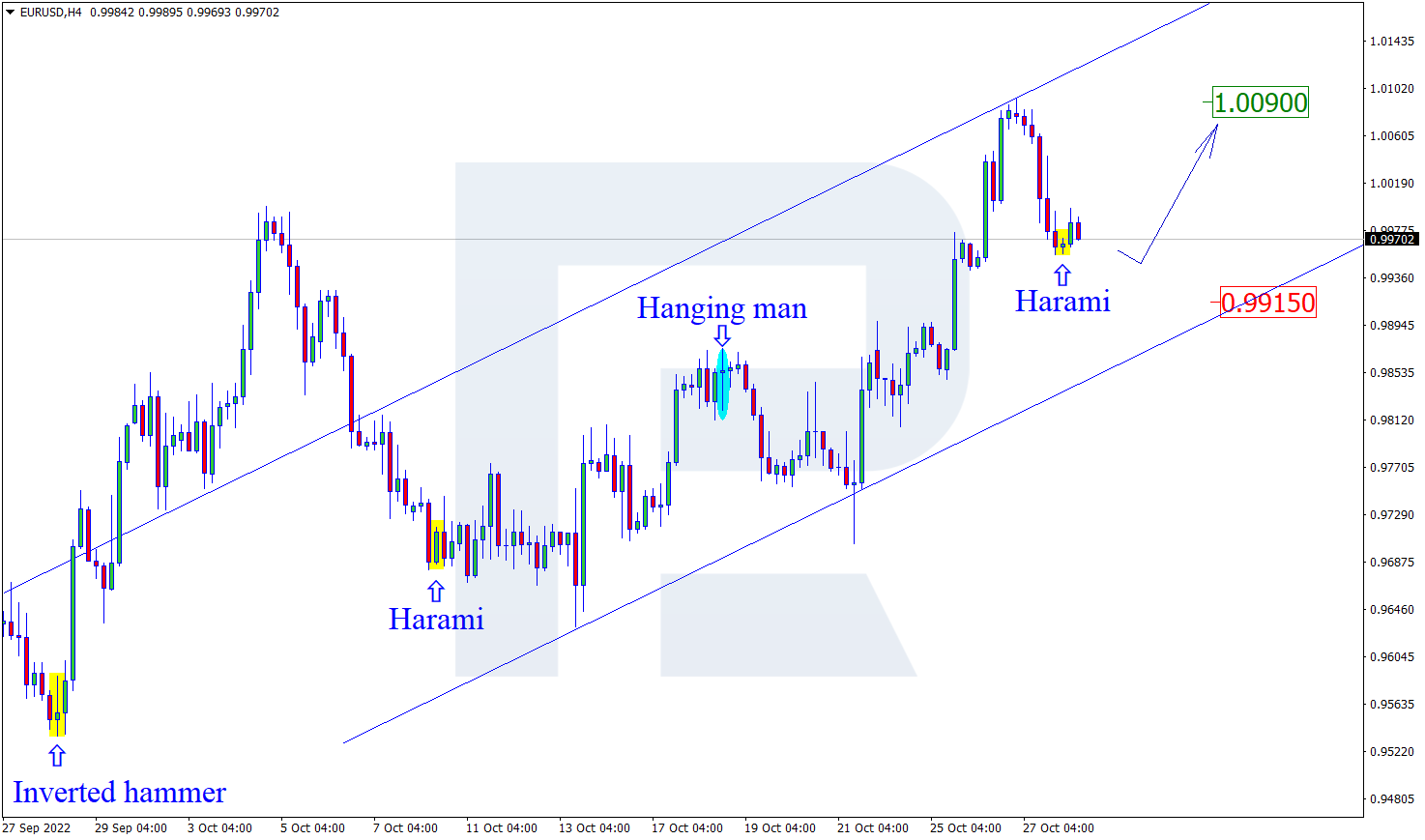
After completing the descending wave at 0.9834 along with the correction up to 0.9922, EURUSD is expected to fall to break 0.9800 and then continue trading downwards with the short-term target at 0.9744.

EURUSD
Risk Warning: the result of previous trading operations do not guarantee the same results in the future

GBPUSD, “Great Britain Pound vs US Dollar”

GBPUSD has finished the descending structure at 1.1226 along with the correction up to 1.1355. Today, the pair may resume trading downwards to break 1.1220 and then continue falling with the short-term 1.1000.

GBPUSD
Risk Warning: the result of previous trading operations do not guarantee the same results in the future

USDJPY, “US Dollar vs Japanese Yen”

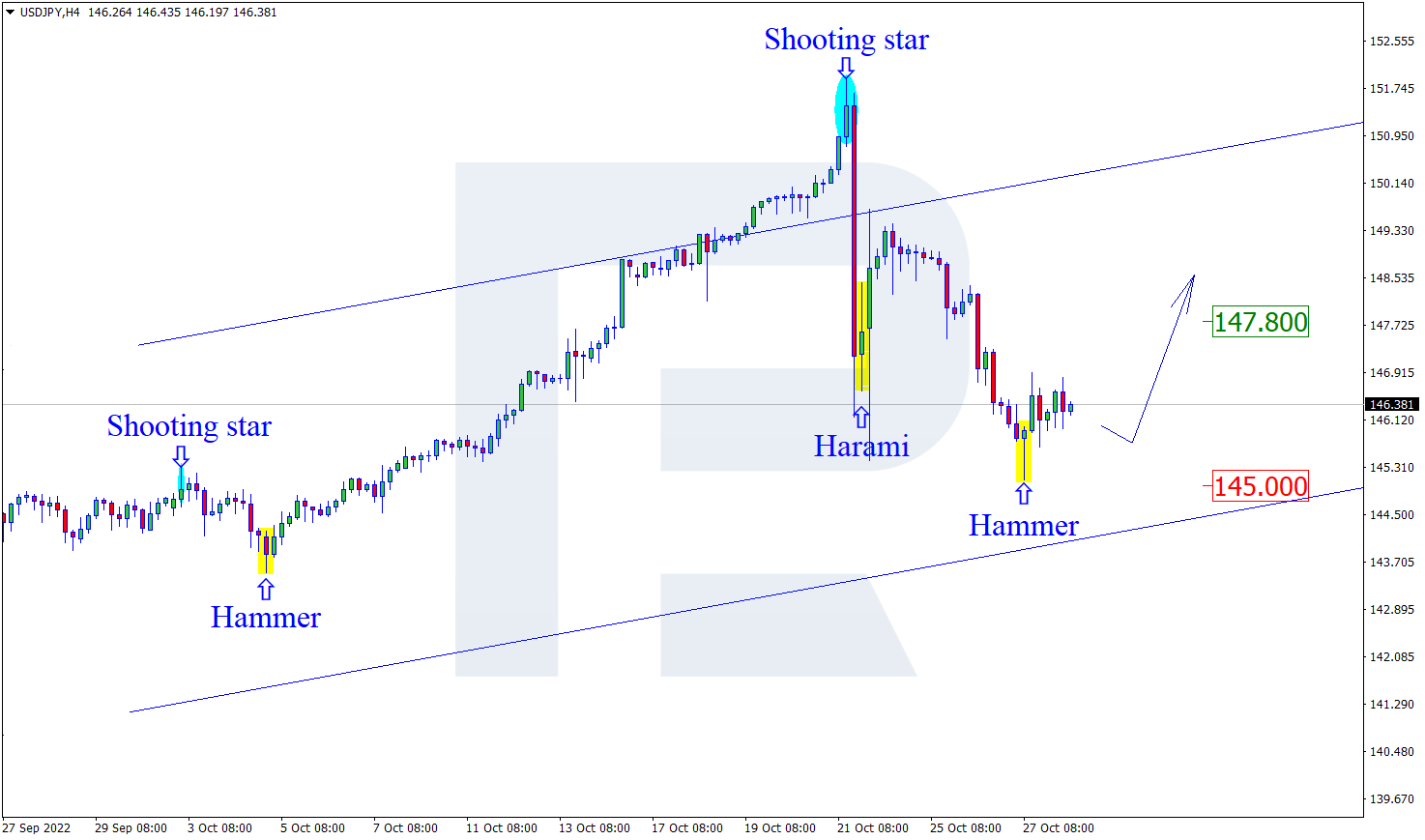
Having completed the ascending wave at 144.80, USDJPY is expected to resume falling to break 144.06 and then continue trading downwards with the target at 143.50.

USDJPY
Risk Warning: the result of previous trading operations do not guarantee the same results in the future

USDCHF, “US Dollar vs Swiss Franc”

USDCHF is consolidating above 0.9797. Possibly, the pair may form one more ascending wave to reach 0.9999 and then start a new decline with the target at 0.9700.

USDCHF
Risk Warning: the result of previous trading operations do not guarantee the same results in the future

AUDUSD, “Australian Dollar vs US Dollar”

AUDUSD is still consolidating around 0.6500. Possibly, today the pair may grow to reach 0.6600 and then resume trading downwards with the target at 0.6400.

AUDUSD
Risk Warning: the result of previous trading operations do not guarantee the same results in the future

BRENT

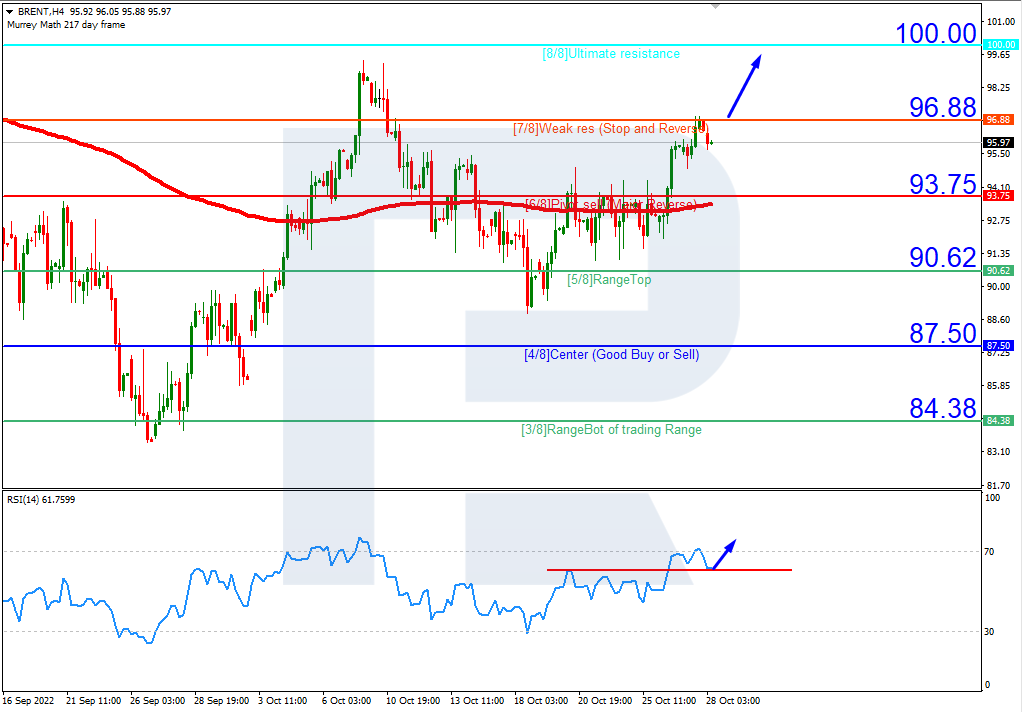
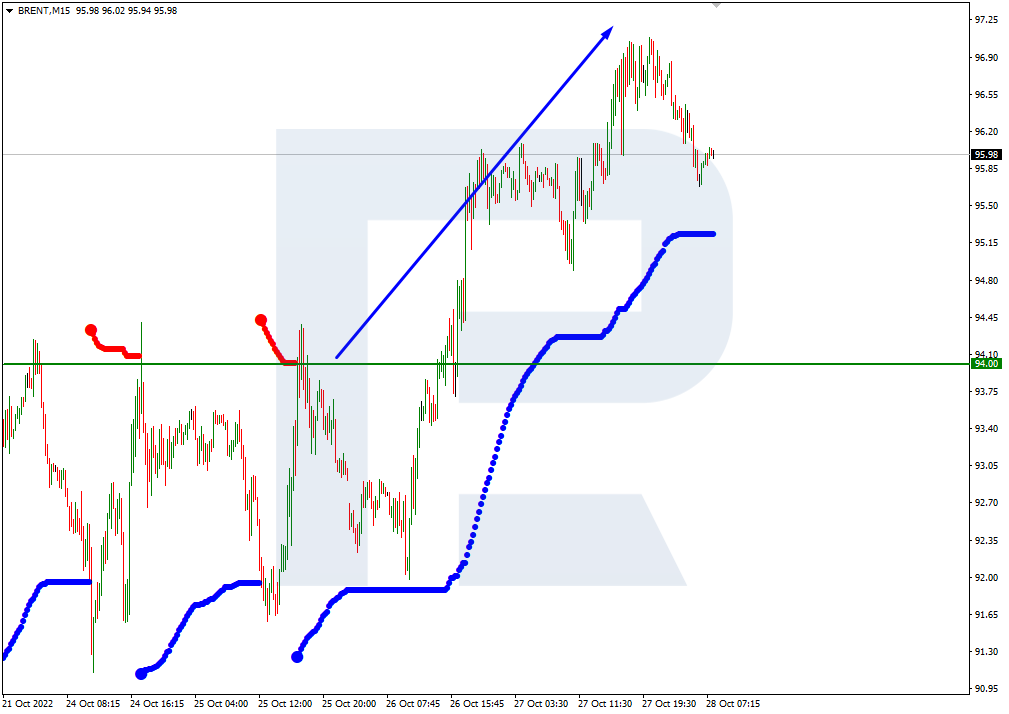
After finishing the ascending wave at 94.76, Brent is forming a new consolidation there. Possibly, the asset may break the range to the upside and resume growing towards 95.00, or even extend this structure to reach the short-term target at 97.30.

BRENT
Risk Warning: the result of previous trading operations do not guarantee the same results in the future

XAUUSD, “Gold vs US Dollar”

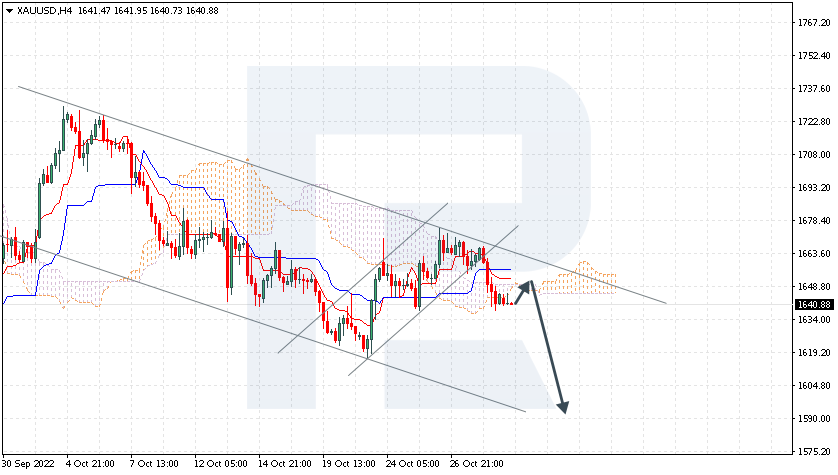
After completing the descending wave at 1700.44 along with the correction up to 1722.22, Gold is expected to form a new descending structure to break 1694.22 and then continue trading downwards with the target at 1660.00.

GOLD
Risk Warning: the result of previous trading operations do not guarantee the same results in the future

S&P 500

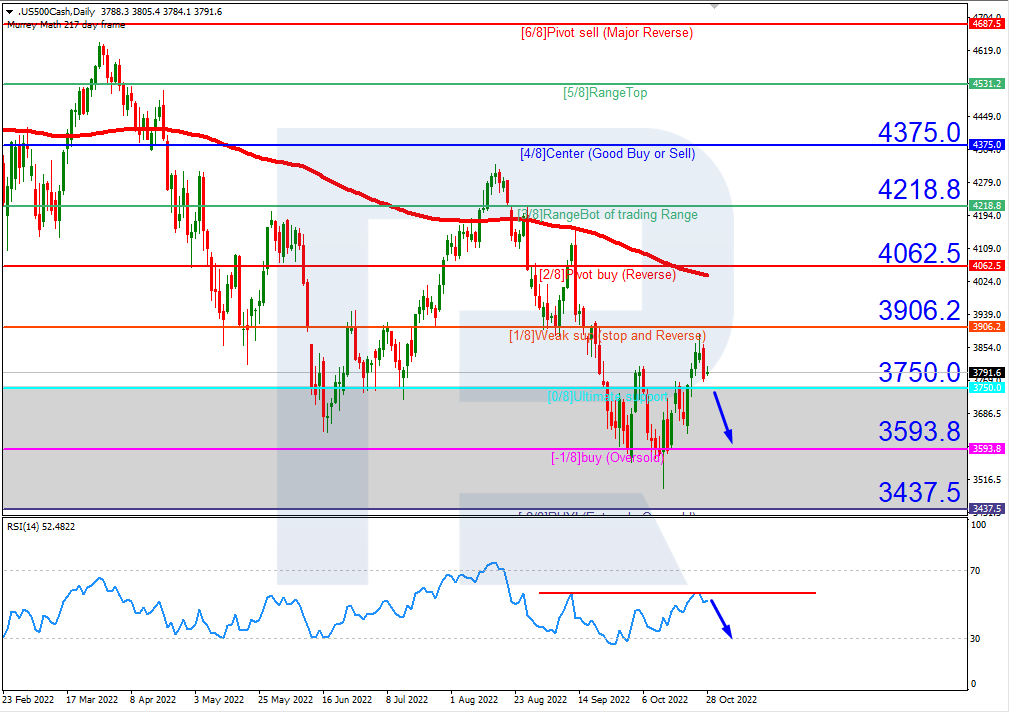
Having finished the ascending wave at 3800.0, the S&P index is expected to start a new decline to break 3666.6 and then continue falling with the short-term target at 3500.0.

S&P 500

Article By RoboForex.com

Attention!
Forecasts presented in this section only reflect the author’s private opinion and should not be considered as guidance for trading. RoboForex LP bears no responsibility for trading results based on trading recommendations described in these analytical reviews.

The Australian Dollar moved “into the black”. Overview for 06.10.2022

Article By RoboForex.com

The Australian Dollar reached stability against the USD on Thursday. The current quote for the instrument is 0.6534.

The Aussie had difficult times handling the RBA’s decision to raise the benchmark interest rate below market expectations. The next thing that put pressure on the Australian currency was a local recovery of the “greenback”. However, these reasons are no longer actual.

The statistics published today showed that the Australian Trade Balance dropped to AUD$8.32 billion in June against the expected reading of AUD$10.0 billion. The components of the report show that the Export gained 2.6% after losing 9.9% the month before, while the Import went from 5.2% to 4.5%.

Globally, Australia could have enhanced its standing on the world economic stage by increasing the production of coal and other energy resources. Australia already did this in the past, but about ten years ago the country started to restructure and diversify its economy. As a result, coal mining was no longer the key income source for the budget.

Nowadays, demand for alternative sources of energy is increasing. Possibly, Australia might expand its share in this market. However, if it happens, the AUD might get more volatile due to the fluctuations in energy prices.

Article By RoboForex.com

Attention!
Forecasts presented in this section only reflect the author’s private opinion and should not be considered as guidance for trading. RoboForex LP bears no responsibility for trading results based on trading recommendations described in these analytical reviews.

The Analytical Overview of the Main Currency Pairs on 2022.10.06

By JustForex

The EUR/USD currency pair

Technical indicators of the currency pair:
  • Prev Open: 0.9981
  • Prev Close: 0.9868
  • % chg. over the last day: -1.15 %

Fed Funds futures traders still estimate a roughly 67% chance of another Fed Funds interest rate hike of 75 basis points in early November and an almost 70% chance of another 50-75 bps hike by the end of the year. Thus, experts believe that the current decline of the dollar is temporary. Goldman Sachs analysts said there is a 30% chance that the US will go into recession within the next 12 months, but the probability of recession in the Eurozone is twice as high.

Trading recommendations
  • Support levels: 0.9845, 0.9748, 0.9666.
  • Resistance levels: 0.9965, 1.0111, 1.0162, 1.0230

From the technical point of view, the trend on the EUR/USD currency pair on the hourly time frame is bullish. The MACD indicator has become inactive, but the price is trading above the average lines, and the buyer’s pressure remains high. Buy trades should be considered from the support level of 0.9883. Sell deals can be considered from the resistance level of 1.0058, but only with confirmation.

Alternative scenario: if the price breaks down through the support level of 0.9666 and fixes below it, the downtrend will likely resume.
EUR/USD
News feed for 2022.10.06:
  • – Eurozone ECB Monetary Policy Meeting Accounts at 14:30 (GMT+3);
  • – US Initial Jobless Claims (w/w) at 15:30 (GMT+3).

The GBP/USD currency pair

Technical indicators of the currency pair:
  • Prev Open: 1.1462
  • Prev Close: 1.1321
  • % chg. over the last day: -1.25 %

The British Pound is “frozen in the air” because of the uncertainty of further steps of the British Government. Now the Bank of England has to make a move to balance the situation and not let the British currency plummet to lows again. Analysts believe that the fundamental component still points to GBP/USD quotes decrease due to the difference in the interest rates of the US Federal Reserve and the Bank of England, and also because of the growing problems in the UK, especially in the energy sector, before the coming winter.

Trading recommendations
  • Support levels: 1.1248, 1.1121, 1.0915, 1.0816, 1.0711, 1.03
  • Resistance levels: 1.1478, 1.1693, 1.1816, 1.1901

From the technical point of view, the GBP/USD currency pair trend on the hourly time frame is bullish. The MACD indicator has become inactive, but the divergence is still present. Under such market conditions, buy trades can be considered from the support level of 1.1248 or 1.1121, but only with confirmation. Sell trades are best to look for on intraday time frames. The nearest resistance level is 1.1478, but better also with a confirmation in the form of a false breakout since the level has already been tested.

Alternative scenario: if the price breaks down of the 1.0817 support level and fixes below it, the downtrend will likely resume.

GBP/USD
News feed for 2022.10.06:
  • – UK Construction PMI (m/m) at 11:30 (GMT+3).

The USD/JPY currency pair

Technical indicators of the currency pair:
  • Prev Open: 144.06
  • Prev Close: 144.67
  • % chg. over the last day: +0.42 %

The situation on the USD/JPY currency pair remains the same. The Bank of Japan is keeping its ultra-soft monetary policy and will not change it before the end of the year. The US Federal Reserve, on the contrary, is in a cycle of tightening monetary policy and aggressively raises the interest rate at each of its meetings. Such divergent policy has already caused unprecedented growth of USD/JPY quotes for the last half a year, which resulted in the Ministry of Finance of Japan conducting an intervention in currency and informing to defend the level of 145. The problem is that the situation has not changed fundamentally, and USD/JPY is inclined to grow. The question is whether the Ministry of Finance of Japan has enough courage and resources to intervene more to hold the rate.

Trading recommendations
  • Support levels: 143.00, 140.60, 139.61, 138.78, 137.65, 136.80, 135.20
  • Resistance levels: 144.66, 145.35

From the technical point of view, the medium-term trend on the currency pair USD/JPY is bullish. The MACD indicator has become inactive, and the price is trading at the level of moving averages. Under such market conditions, buy trades can be searched for on intraday time frames from the support level of 143.00, but with confirmation. Sell deals can be searched from the resistance level of 144.66 or 145.35, but only with additional confirmation.

Alternative scenario: If the price fixes below 140.60, the downtrend will likely resume.

USD/JPY
News feed for 2022.10.06:
  • – Japan BOJ Gov Kuroda Speaks at 03: (Tentative).

The USD/CAD currency pair

Technical indicators of the currency pair:
  • Prev Open: 1.3517
  • Prev Close: 1.3617
  • % chg. over the last day: +0.74 %

The Canadian dollar is a commodity currency and depends on the performance of the dollar index and oil prices. Yesterday, the OPEC+ countries agreed to cut oil production by 2 million barrels daily. Oil producers do not want to allow oil prices to fall and keep the price of “black gold” above $90 per barrel. After this statement, Goldman Sachs has increased at once by $10 up to $110 by the end of the year. Thus, the growth in oil prices can trigger a new round of inflation acceleration on the background of growing energy prices. However, the Canadian dollar will only benefit from it and will get stronger as oil prices go up.

Trading recommendations
  • Support levels: 1.3434, 1.3297, 1.3212, 1.3053, 1.2990, 1.2958
  • Resistance levels: 1.3660, 1.3755, 1.3858, 1.3968

From the point of view of technical analysis, the trend on the USD/CAD currency pair is bearish. The price is trading below the moving lines. The MACD indicator has become inactive. Under such market conditions, buy trades should be considered on the lower time frames from the support level of 1.3534, but with confirmation. For sell deals, it is better to consider the resistance level of 1.3660 or 1.3756, but only after the additional confirmation.

Alternative scenario: if the price breaks out through and consolidates above the resistance level of 1.3756, the uptrend will likely resume.

USD/CAD
News feed for 2022.10.06:
  • – Canada Ivey PMI (m/m) at 17:00 (GMT+3).

By JustForex


This article reflects a personal opinion and should not be interpreted as an investment advice, and/or offer, and/or a persistent request for carrying out financial transactions, and/or a guarantee, and/or a forecast of future events.