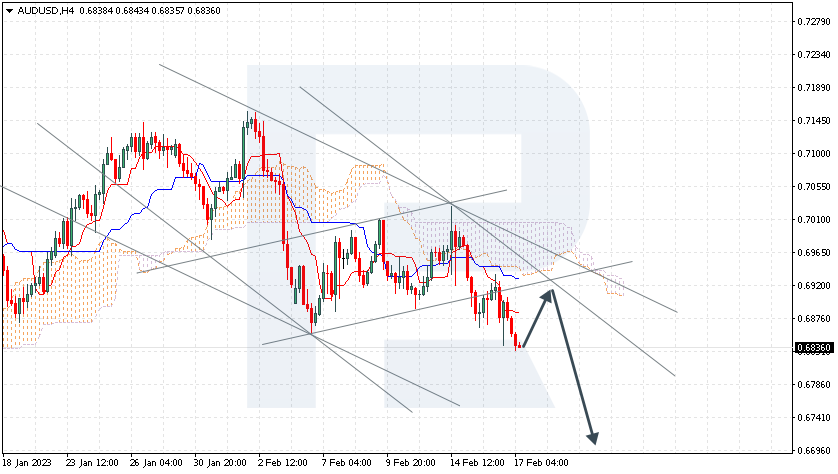
AUDUSD is declining inside a bearish channel. The instrument is going below the Ichimoku Cloud, which suggests a downtrend. A test of the Kijun-Sen line of the Cloud at 0.6920 is expected, followed by falling to 0.6695. An additional signal confirming the decline will be a bounce off the upper border of the descending channel. The scenario can be cancelled by a breakaway of the upper border of the Cloud and securing above 0.7015, which will mean further growth to 0.7105.
USDCAD, “US Dollar vs Canadian Dollar”
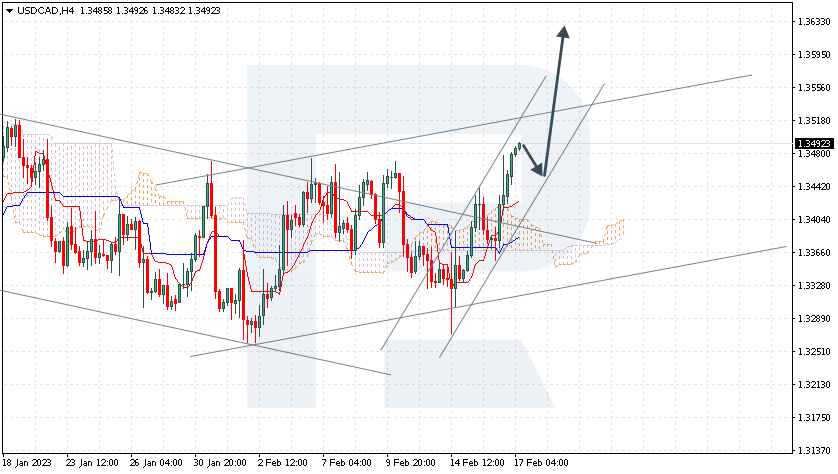
USDCAD has secured above the resistance level. The instrument is going above the Ichimoku Cloud, which suggests an uptrend. A test of the Tenkan-Sen line of the Cloud at 1.3445 is expected, followed by growth to 1.3635. An additional signal confirming the decline will be a bounce off the lower border of the bullish channel. The scenario can be cancelled by a breakaway of the lower border of the Cloud and securing under 1.3325, which will mean further falling to 1.3235. The scenario can be confirmed by a breakaway of the upper border of the bullish channel and securing above 1.3555.
USDCHF, “US Dollar vs Swiss Franc”
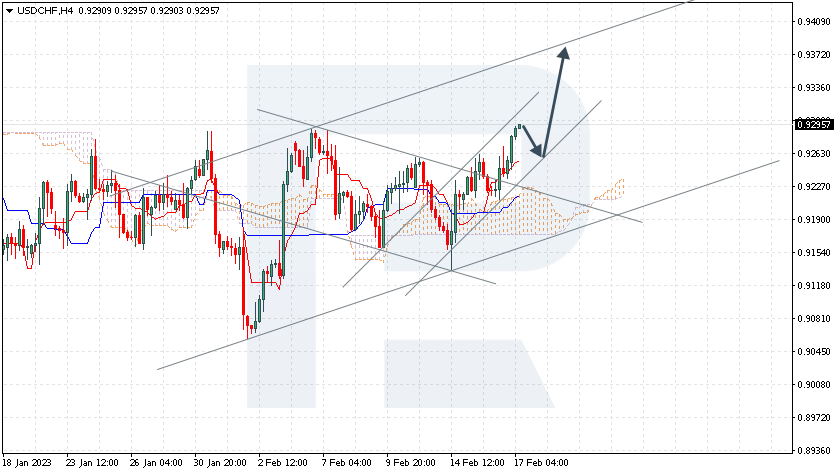
USDCHF is getting ready for a breakaway of the resistance level. The instrument is going above the Ichimoku Cloud, which suggests an uptrend. A test of the Tenkan-Sen line of the Cloud at 0.9260 is expected, followed by growth to 0.9375. An additional signal confirming the decline will be a bounce off the lower border of the ascending channel. The scenario can be cancelled by a breakaway of the lower border of the Cloud and securing under 0.9145, which will mean further falling to 0.9055.
Attention! Forecasts presented in this section only reflect the author’s private opinion and should not be considered as guidance for trading. RoboForex LP bears no responsibility for trading results based on trading recommendations described in these analytical reviews.
The EU economy has not yet felt the full impact of an interest rate hike from the European Central Bank, two senior ECB officials said Thursday. Nevertheless, the Eurozone economy is holding up better than expected, and inflation indicators are trending downward. According to ECB policymakers, overall inflation in the Eurozone could fall below 3% by the end of the year if falling energy prices continue. Financial markets expect the ECB to raise the bank deposit rate to at least 3.5% by summer 2023.
The trend on the EUR/USD currency pair on the hourly time frame is bearish. The price forms a wide corridor, inside which there is a downward channel. The MACD indicator is negative again, but the divergence is becoming more pronounced on many timeframes. Under such market conditions, buy trades are best considered from the support level of 1.0597. Sell deals can be considered from the resistance level of 1.0695, but it is better with confirmation in the form of a reverse initiative on the lower time frames.
Alternative scenario: if the price breaks down through the resistance level of 1.0839 and fixes above it, the uptrend will likely resume.
News feed for 2023.02.17:
– US FOMC Member Mester Speaks at 01:00 (GMT+2);
– German Producer Price Index (m/m) at 09:00 (GMT+2);
– French Consumer Price Index (m/m) at 09:45 (GMT+2);
– US FOMC Member Barkin Speaks at 15:30 (GMT+2).
The GBP/USD currency pair
Technical indicators of the currency pair:
Prev Open: 1.2021
Prev Close: 1.1986
% chg. over the last day: -0.29 %
The recent rise in the dollar has knocked the pound sterling’s confidence. St. Louis Federal Reserve Bank President James Bullard said yesterday that the prospect of the US Federal Reserve returning to larger hikes is not out of the table. Bullard’s comments echoed those of Cleveland Fed President Loretta Mester, who said she saw a compelling case for a 0.5% rate hike at the Fed’s last meeting. The dollar index has short-term fundamental support right now. In the medium term, the US Fed and the Bank of England are at the end of the rate hike cycle. Therefore, traders should not expect medium-term trends in the GBP/USD currency pair.
From the technical point of view, the trend on the GBP/USD currency pair on the hourly time frame is bearish. At the moment, the price is trading below the moving averages, and sellers’ pressure remains intraday. The MACD indicator has become negative but with signs of divergence. Under such market conditions, it is better to look for buy trades on intraday time frames from the support level of 1.1930 but with a confirmation in the form of a false breakdown. Sell deals are best sought from the resistance level of 1.2055 or 1.2118, but also better with a confirmation in the form of a reverse initiative on the lower time frames.
Alternative scenario: if the price breaks out through the 1.2200 resistance level and fixes above it, the uptrend will likely resume.
News feed for 2023.02.17:
– UK Retail Sales (m/m) at 09:00 (GMT+2).
The USD/JPY currency pair
Technical indicators of the currency pair:
Prev Open: 134.09
Prev Close: 133.94
% chg. over the last day: -0.12 %
The appointment of former Bank of Japan policy council representative Kazuo Ueda as central bank governor has cooled rumors of an earlier interest rate normalization. In the past, Ueda has warned of the dangers of premature interest rate hikes, dispelling any fears of higher interest rates in the foreseeable future. However, a reassessment of the yield curve management policy cannot be ruled out, given that he has pointed out its potential shortcomings.
Trading recommendations
Support levels: 133.47, 132.95, 131.43, 129.68, 129.98, 129.19, 129.04, 128.16
Resistance levels: 134.65
From the technical point of view, the medium-term trend on the currency pair USD/JPY is bullish. The price is trading above the moving averages, but it has reached the daily resistance level. The MACD indicator is in the positive zone, and there are signs of divergence already on several timeframes. Buying pressure is present, but it is limited. It is best to look for buy deals from the support level of 133.47 or 132.95, but only with confirmation on the lower time frames. Sell deals can be sought from 134.65, but with additional confirmation.
Alternative scenario: if the price fixes below the 131.43 support level, the downtrend will be resumed with a high probability.
There is no news feed for today.
The USD/CAD currency pair
Technical indicators of the currency pair:
Prev Open: 1.3384
Prev Close: 1.3456
% chg. over the last day: +0.54 %
The US and Canada are closely linked economies. Their economic health and financial flows between them are fairly stable relative to external exchange rates. The US Fed and the Bank of Canada practically go hand in hand in terms of raising interest rates, so only energy prices, especially oil prices, will cause an imbalance in USD/CAD pricing. The OPEC+ countries do not intend to lose profits on the background of falling oil prices and will try by all means to keep the quotations from falling, up to a reduction of the production volume. A significant rise in oil prices is also undesirable as it might trigger a new wave of inflation while the rates are already at their highest levels.
Trading recommendations
Support levels: 1.3444, 1.3390, 1.3347, 1.3295, 1.3212
Resistance levels: 1.3497, 1.3520, 1.3554, 1.3595
From the point of view of technical analysis, the trend on the USD/CAD currency pair is bullish. The price is trading above the moving averages. The MACD indicator is in the positive zone, with no signs of divergence. Buy trades can be considered from the support of 1.3390, but with additional confirmation on the lower time frames. Sell deals should be considered from the resistance level of 1.3497 or 1.3520, but on the condition of a reverse reaction or false breakout, as the levels have already been tested.
Alternative scenario: if the price breaks down and consolidates below the support level of 1.3263, the downtrend will likely resume.
News feed for 2023.02.17:
– Canada Producer Price Index (m/m) at 15:30 (GMT+2).
This article reflects a personal opinion and should not be interpreted as an investment advice, and/or offer, and/or a persistent request for carrying out financial transactions, and/or a guarantee, and/or a forecast of future events.
The New Zealand dollar (NZD) is the second worst-performing G10 currency against the US dollar so far this month, with NZDUSD having fallen by about 3.4% month-to-date.
But before we get into the reasons that could either worsen or offer relief to NZDUSD’s woes, let’s first look at the list of key economic data releases and events that could move FX markets next week:
Monday, February 20
CNH: China loan prime rates
EUR: Eurozone February consumer confidence
US markets closed
Tuesday, February 21
AUD: Reserve Bank of Australia policy meeting minutes
EUR: Eurozone February ZEW survey, PMIs
GBP: UK February PMIs
CAD: Canada January inflation, December retail sales
USD: US February PMIs
Wednesday, February 22
NZD: RBNZ rate decision, January external trade
EUR: Germany January CPI (final)
USD: FOMC minutes
Thursday, February 23
EUR: Eurozone January CPI (final)
USD: US weekly jobless claims, Q4 GDP (second), Atlanta Fed President Raphael Bostic speech
Friday, February 24
JPY: Japan January CPI; BOJ Governor-nominee Ueda to appear before Japan’s lower house
EUR: Germany Q4 GDP (final), March consumer confidence
USD: US January PCE deflator, personal income and spending, February consumer sentiment
1-year anniversary of Russia’s invasion of Ukraine
Now, here are 3 reasons why we’re watching NZDUSD:
#1: Reserve Bank of New Zealand (RBNZ) rate decision
New Zealand’s central bank is expected to hike by another 50 basis points next week to bring its Official Cash Rate up to 4.75%.
But the RBNZ may be faced with a dilemma:
On one hand, policymakers may be forced to keep hiking to offset any near-term inflationary pressures stemming from supply chains that have been disrupted by Cyclone Gabrielle (think of destroyed fruit and vegetable farms, which in turn drive up prices of harder-to-find food supplies).
On the other hand, the RBNZ may opt for the relatively smaller 25-bps hike instead because of the deadly cyclone’s negative impact on New Zealand’s economy. (Note that interest rate hikes are intended to “destroy” demand to subdue inflation. But if some of that demand has already been destroyed by Cyclone Gabrielle, more rate hikes risks sending New Zealand into a recession!)
Hence, amid this dilemma, NZDUSD could be rocked by:
the size the RBNZ’s incoming rate hike
and what the central bank says about its future plans for the official cash rate.
As a rule of thumb, the central bank that can continue sending its benchmark rates higher than its peers, should see its currency strengthen.
And as things stand, markets are now forecasting that the RBNZ’s official cash rate will peak around 5.2% in May this year.
If the RBNZ has to ease up on its rate hikes and stop short of that 5.2% forecasted peak, that may spell more near-term declines for NZDUSD, and vice versa.
But just as markets digest the results of Wednesday morning’s RBNZ meeting, attentions will quickly shift to the US Dollar side of the NZDUSD equation for the rest of the week.
And that brings us to our second reason …
#2: More clues about incoming Fed rate hikes
Arguably, the single biggest driver across FX markets has been the shifting expectations surrounding the Fed rate hikes.
The US dollar could extend its February recovery if any (or a combo) of the scenarios below materialize:
Minutes from the FOMC’s Jan 31-Feb 1 meeting suggest US policymakers are still wary about the inflation outlook, despite opting to hike by “only” 25 basis points (bps) earlier this month. (25bps is much smaller than the 75bps hikes triggered multiple times around mid-2022)
US weekly initial jobless claims remain around historically-low levels around 200k, which underscores the strength of the US jobs market.
Atlanta Fed President Raphael Bostic’s speech heralds even more Fed rate hikes (though Bostic is a non-voting member of the FOMC this year)
The US PCE Deflator, the Fed’s preferred way for measuring inflation, comes in higher than the 4.9% advance expected for January. That’s only slightly lower than December’s 5% year-on-year rise, suggesting that inflation still isn’t abating fast enough despite the Fed’s rate hikes totalling 450 bps already since Q1 2022.
Overall, if US hiring and inflation remain resilient while reinforcing the Fed’s hawkish chorus, that could strengthen the US dollar while heaping more downward pressure on NZDUSD.
And that brings us our final stated reason for this article …
#3: NZD is forecasted to be second-most volatile G10 currency next week
Noting the uncertainty surrounding the RBNZ and Fed’s respective rate-hiking plans, no surprise that NZDUSD is expected to rather volatile over the coming week.
(The G10 currency that’s expected to be most volatile – the Norwegian Krone – is highly sensitive to commodity prices and broader risk sentiment).
While it remains to be seen whether the implied volatility actually becomes reality, make no mistake: NZD traders are ready to pounce on fresh signals emanating out of the RBNZ or surrounding the Fed next week.
Key levels for NZDUSD in the week ahead:
SUPPORT
0.620 region: this psychologically-important area has supported NZDUSD on several occasions since May/June 2022, and most recently in January 2023. This is also around where this FX pair’s 200-day simple moving average currently lies
100-day simple moving average (SMA)
0.61462: 61.8% Fibonacci level from NZDUSD’s October 2022-February 2023 ascent.
RESISTANCE
0.62702: February 6th cycle low
0.63186: 78.6% Fibonacci level from NZDUSD’s October 2022-February 2023 ascent.
50-day SMA
At the time of writing, Bloomberg’s FX model forecasts a 71% chance that NZDUSD will trade within the 0.6085 – 0.6344 range, using current levels as a base, over the next one week.
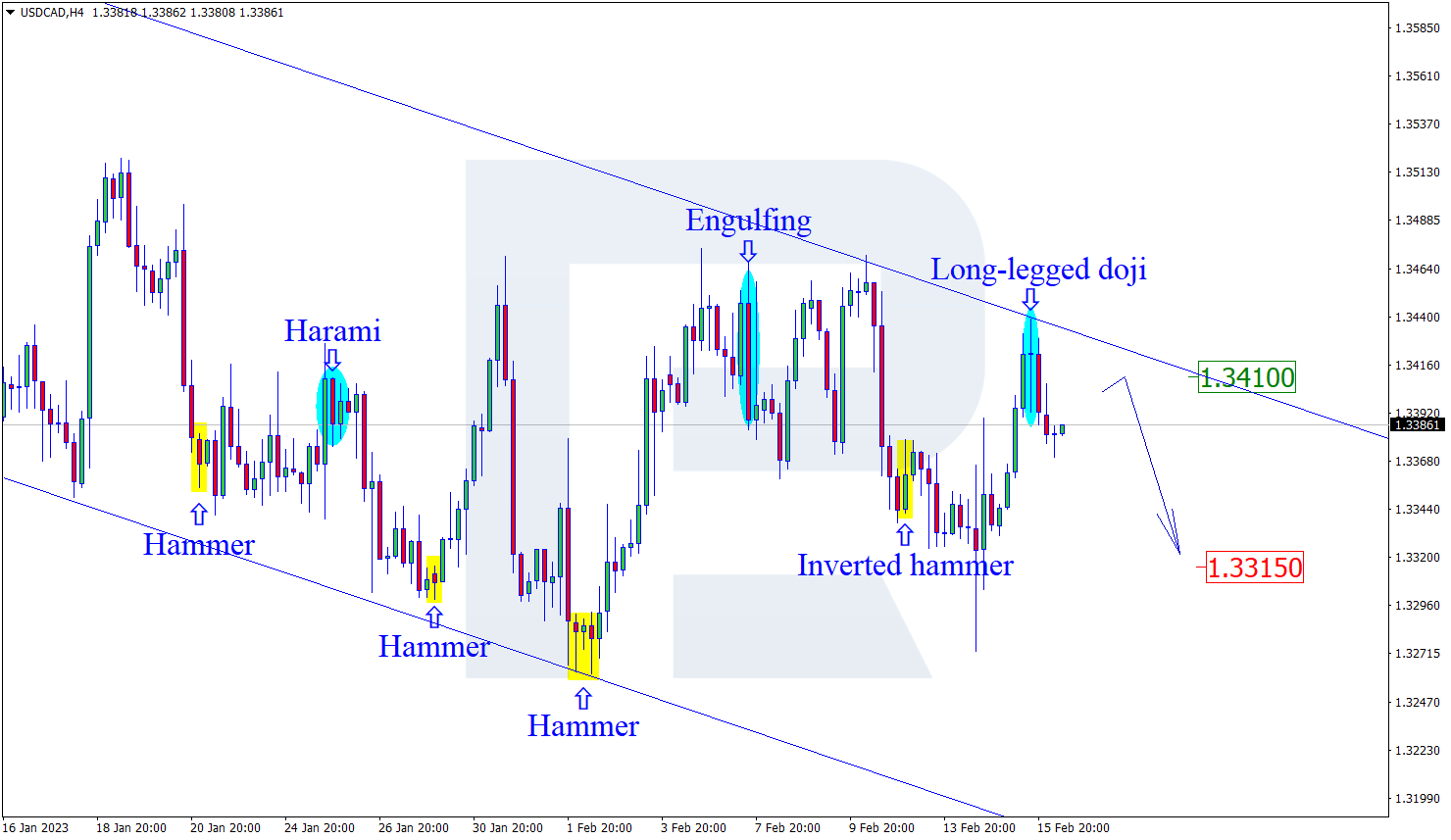
On H4, the pair has formed a Longed Legged Doji reversal pattern. The instrument is now going by the signal in a descending wave. The goal of the decline might be 1.3315; later the pair may break through the support level and continue the decline. However, the price may pull back to 1.3410 before falling.
AUDUSD, “Australian Dollar vs US Dollar”
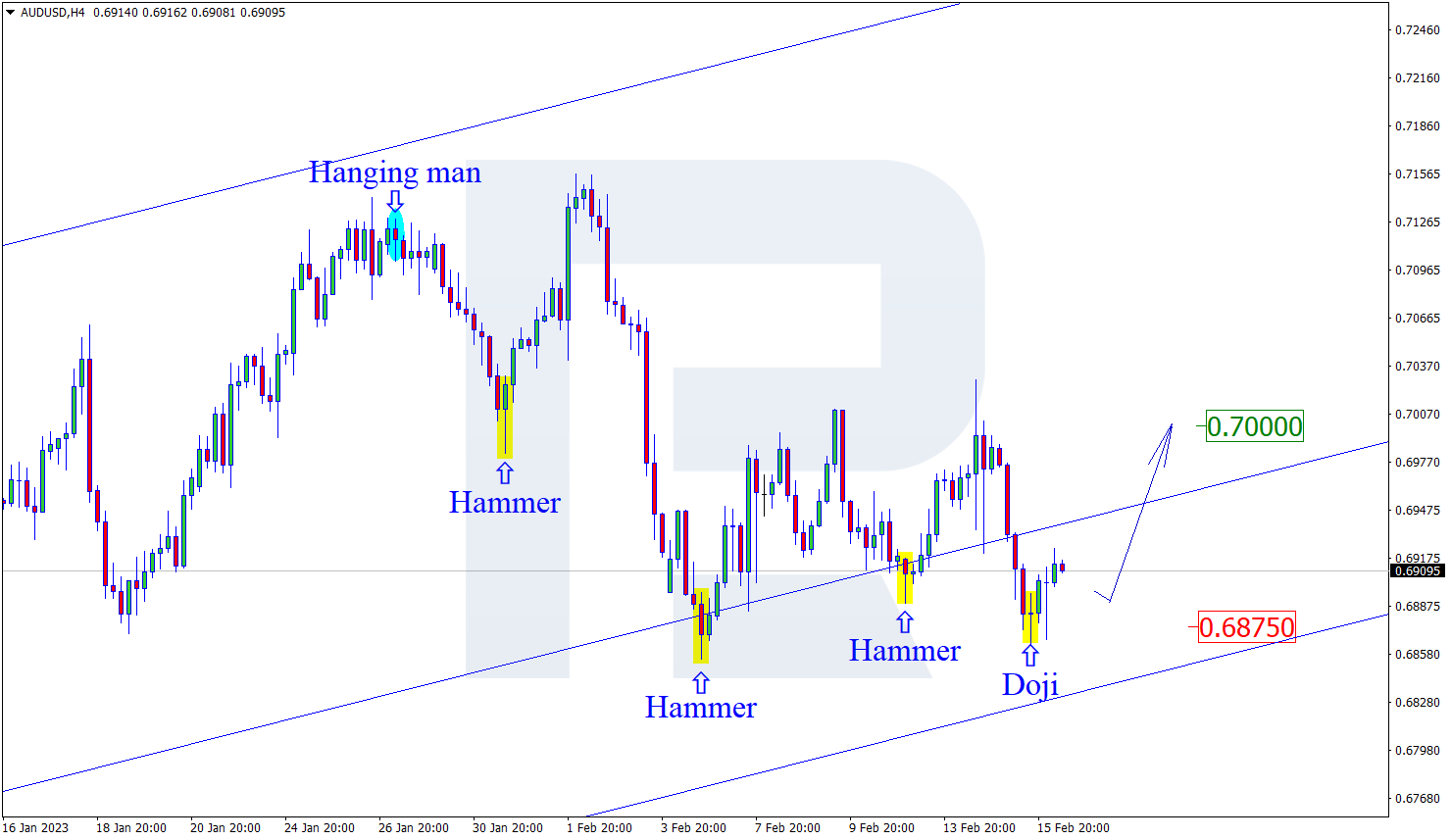
On H4, the pair has formed a Doji reversal pattern. The instrument is now going by the signal in an ascending wave. The goal of the decline might still be 0.7000. After testing the resistance level the quotes might break through it and go on growing. However, the price may pull back to 0.6875 and continue the uptrend after the correction.
USDCHF, “US Dollar vs Swiss Franc”
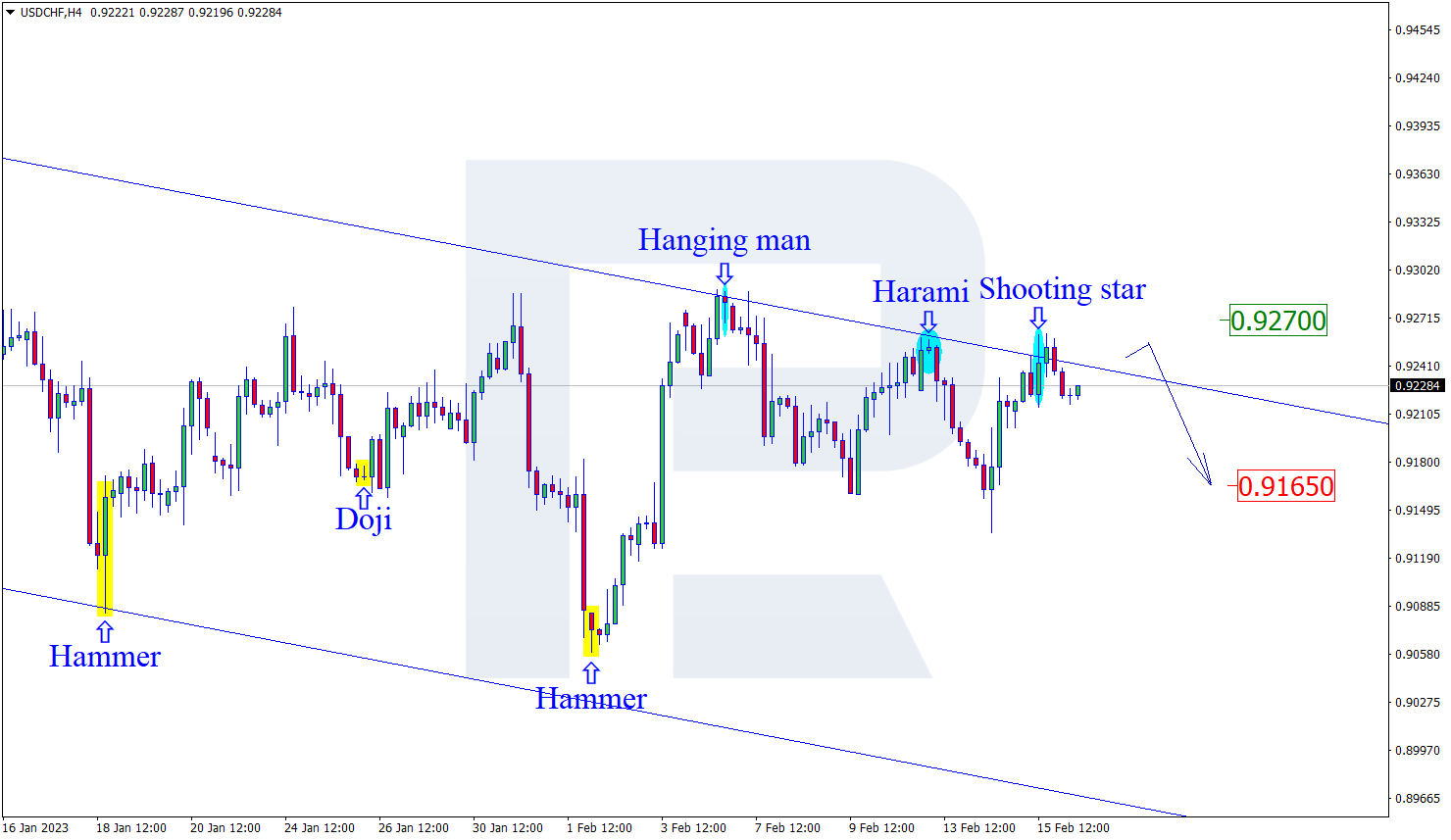
On H4, at the resistance level the pair has formed a Shooting Star reversal pattern. The instrument is now going by the signal in a descending wave. The goal of the decline might be 0.9165. Upon testing the support level, the pair might break through it and further develop the downtrend. However, the price may pull back to 0.9270 before the decline.
Attention! Forecasts presented in this section only reflect the author’s private opinion and should not be considered as guidance for trading. RoboForex LP bears no responsibility for trading results based on trading recommendations described in these analytical reviews.
ECB head Christine Lagarde said yesterday that she would vote for a 0.5% rate hike at the next ECB meeting. The medium-term outlook for the euro remains bullish, but the EUR/USD is pulling lower amid a temporary rise in the dollar index. The dollar index is rising on the back of strong US economic data (labor market, GDP, industrial production), which opens up more room for the Fed to raise rates.
The trend on the EUR/USD currency pair on the hourly time frame is bearish. The price forms a wide corridor, inside which there is a downward channel. The MACD indicator has become inactive again. Under such market conditions, buy trades are best considered on the lower time frames from the support level of 1.0696 or after the impulse breakout from the descending channel. Sell deals can be considered from the resistance level of 1.0839, but it is better with confirmation in the form of a reverse initiative on the lower time frames.
Alternative scenario: if the price breaks down through the resistance level of 1.0926 and fixes above it, the uptrend will likely resume.
News feed for 2023.02.16:
– US Building Permits (m/m) at 15:30 (GMT+2);
– US Initial Jobless Claims (w/w) at 15:30 (GMT+2);
– US Philadelphia Fed Manufacturing Index (m/m) at 15:30 (GMT+2);
– US Producer Price Index (m/m) at 15:30 (GMT+2);
– US FOMC Member Mester Speaks at 15:45 (GMT+2);
– US FOMC Member Bullard Speaks at 20:30 (GMT+2).
The GBP/USD currency pair
Technical indicators of the currency pair:
Prev Open: 1.2169
Prev Close: 1.2032
% chg. over the last day: -1.14 %
The UK Consumer Price Index (CPI) fell from 10.5% to 10.1% (forecast 10.3%) in annual terms. Core inflation fell even more, from 6.3% to 5.8% (forecast 6.2%). Such data on the back of a strong labor market may provide the Bank of England with at least another 0.25% rate hike at its next meeting. The report indicates that the January 2023 decline mainly reflects price changes in the transportation segment. There was also a downward effect in the services sector. Since there is no mention of energy, the peak of UK inflation has likely passed. But since inflation remains extremely high and much higher than in other economies, the British pound reacted very negatively to the data.
From the technical point of view, the trend on the GBP/USD currency pair on the hourly time frame is bearish. At the moment, the price is trading below the moving averages, and sellers’ pressure remains intraday. The MACD indicator has become negative, with no signs of divergence. Under such market conditions, it is better to look for buy trades on intraday time frames from the support level of 1.2200, but with a confirmation in the form of a false breakdown. Sell deals are best to look for from the resistance level of 1.2055 or 1.2117, but also better with a confirmation in the form of a reverse initiative on the lower time frames.
Alternative scenario: if the price breaks out through the 1.2416 resistance level and fixes above it, the uptrend will likely resume.
There is no news feed for today.
The USD/JPY currency pair
Technical indicators of the currency pair:
Prev Open: 133.10
Prev Close: 134.16
% chg. over the last day: +0.80 %
Kazuo Ueda, nominated by the Japanese government as the next governor of the Bank of Japan (BoJ), will inherit a number of difficult challenges when he replaces the current governor Haruhiko Kuroda on April 8. Annualized inflation in Japan reached 4% in December, the highest level since January 1991, while GDP in the fourth quarter did not meet expectations of a 2% rise on an annualized basis and grew by a modest 0.6%. The new Central Bank Governor will have to decide when and by how much the Bank of Japan should start cutting back on its ultra-soft monetary policy in order to restrain inflation while allowing a sufficient reserve of the money supply to allow the economy to grow. It is unlikely that the new BOJ Governor will make any harsh statements on his first day in office, but there is a high probability that the BOJ will abandon its soft policy this year.
Trading recommendations
Support levels: 133.47, 132.95, 131.43, 129.68, 129.98, 129.19, 129.04, 128.16
Resistance levels: 134.65
From the technical point of view, the medium-term trend on the currency pair USD/JPY is bullish. The price is traded above the moving averages while not falling below dynamic lines, supporting the upward movement. The MACD indicator is in the positive zone, but there are signs of divergence already on several timeframes. Buying pressure is present, but it is limited. It is best to look for buy trades from the support level of 133.47 or 132.95, but only with confirmation on the lower time frames. Sell deals can be sought after an impulse return of the price below the level of 132.95 or from 134.65, but with additional confirmation.
Alternative scenario: if the price fixes below the 131.43 support level, the downtrend will be resumed with a high probability.
There is no news feed for today.
The USD/CAD currency pair
Technical indicators of the currency pair:
Prev Open: 1.3336
Prev Close: 1.3392
% chg. over the last day: +0.42 %
The International Energy Agency (IEA) raised its 2023 oil demand forecast by 500,000 BPD to nearly 102 million BPD. The agency also warned that an alliance of OPEC+ producers might try to cut production to support oil prices. What does this mean for USD/CAD quotes? With the Bank of Canada and the US Federal Reserve holding rates almost at the same level, only oil prices will be the imbalance in pricing. And since the Canadian dollar is a commodity currency, rising oil prices will strengthen the Canadian (USD/CAD decline).
From the point of view of technical analysis, the trend on the USD/CAD currency pair is bullish. The price is trading above the moving averages again. The MACD indicator has become positive, but there is some seller pressure inside the day. Buy trades can be considered from the support of 1.3347, but with additional confirmation on the lower time frames. Sell deals should be considered from the resistance level of 1.3390 but on the condition of a reverse reaction. Also, sales can be looked for after a false breakout of the 1.3439 resistance level.
Alternative scenario: if the price breaks down and consolidates below the support level of 1.3263, the downtrend will likely resume.
This article reflects a personal opinion and should not be interpreted as an investment advice, and/or offer, and/or a persistent request for carrying out financial transactions, and/or a guarantee, and/or a forecast of future events.
The US inflation rate declined from 6.5% to 6.4% (forecast 6.2%) annually, while core inflation, which excludes food and energy prices, also declined from 5.7% to 5.6% (forecast 5.5%). Although inflationary pressures are easing, the fall in inflation is not happening as quickly as the US Federal Reserve had predicted. This factor increases the likelihood that the US Fed will hold one or two more interest rate hikes before pausing. Therefore, in the short term, the dollar has fundamental reasons to strengthen. On the other hand, the ECB is now acting more aggressively than the US Fed, and the narrowing of the interest rate differential should play in favor of a stronger euro in the medium term.
The trend on the EUR/USD currency pair on the hourly time frame is bearish. The price is forming a wide corridor. Yesterday, the liquidity above the level of 1.0791 was tested, after which the price returned to the balance. The MACD indicator became inactive. Under such market conditions, buy trades are best considered on the lower time frames from the support level of 1.0686. Sell deals can be considered from the resistance level of 1.0839, but it is better with confirmation in the form of reverse initiative on the lower time frames.
Alternative scenario: if the price breaks down through the resistance level of 1.0926 and fixes above it, the uptrend will likely resume.
News feed for 2023.02.15:
– Spanish Consumer Price Index (m/m) at 10:00 (GMT+2);
– Eurozone Industrial Production (m/m) at 12:00 (GMT+2);
– US Retail Sales (m/m) at 15:30 (GMT+2);
– US NY Empire State Manufacturing Index (m/m) at 15:30 (GMT+2);
– Eurozone ECB President Lagarde Speaks at 16:00 (GMT+2);
– US Industrial Production (m/m) at 16:15 (GMT+2).
The GBP/USD currency pair
Technical indicators of the currency pair:
Prev Open: 1.2132
Prev Close: 1.2174
% chg. over the last day: +0.35 %
The GBP/USD quotes strengthened on Tuesday after UK employment figures beat estimates. The unemployment rate remained at 3.7% while the economy added 74K jobs last month, with expectations of 40K. But the potential for growth in quotes was limited by stronger-than-expected January US consumer price indices that resulted in an increase in Treasury bond yields. Expectations for the Fed’s final rate could rise slightly, which would create a favorable environment for the US dollar, and threaten the pound’s recovery, especially if the rate differential widens.
Trading recommendations
Support levels: 1.2082, 1.2000, 1.1930
Resistance levels: 1.2188, 1.2311, 1.2416
From the technical point of view, the trend on the GBP/USD currency pair on the hourly time frame is bearish. At the moment, the price is trading above the moving averages, and there is a slight buying pressure inside the day. The MACD indicator has become inactive. Under such market conditions, buy trades are better to look for on intraday time frames from the support level of 1.2200, but with confirmation in the form of initiative and short targets. Sell trades are best sought after a pullback from the resistance level of 1.2188 but are also better with confirmation in the form of a reverse initiative.
Alternative scenario: if the price breaks out through the 1.2416 resistance level and fixes above it, the uptrend will likely resume.
News feed for 2023.02.15:
– UK Consumer Price Index (m/m) at 09:00 (GMT+2);
– UK Producer Price Index (m/m) at 09:00 (GMT+2).
The USD/JPY currency pair
Technical indicators of the currency pair:
Prev Open: 132.40
Prev Close: 133.08
% chg. over the last day: +0.87 %
The Japanese government on Tuesday introduced Kazuo Ueda as a candidate for the next governor of the Bank of Japan, suggesting the academic and former Bank of Japan policymaker will replace Haruhiko Kuroda. The new leadership is said to be attuned to the complex challenges facing the central bank, from addressing the side effects of years of monetary policy easing that has distorted bond markets and widened the Bank of Japan’s balance sheet. Ueda’s nomination, along with those of two deputy governors, Ryozo Himino, a former Financial Services Agency commissioner, and Shinichi Uchida, the Central Bank’s executive director, is expected to be approved by mid-March. Given that Ueda will not dramatically change monetary policy, the Japanese yen continued its decline.
Trading recommendations
Support levels: 131.43, 129.68, 129.98, 129.19, 129.04, 128.16
Resistance levels: 133.47, 134.65
From the technical point of view, the medium-term trend on the currency pair USD/JPY is bullish. The price is forming a wide-volatile corridor. The MACD indicator is in the positive zone, but there are signs of divergence. Buying pressure is present, but it is limited. It is better to look for buy deals from the support level of 131.43, but only with confirmation on the lower time frames. Sell deals can be sought after an impulse return of the price to the balance below the level of 132.89.
Alternative scenario: If the price fixes below the support level of 128.16, the downtrend will be renewed with a high probability.
There is no news feed for today.
The USD/CAD currency pair
Technical indicators of the currency pair:
Prev Open: 1.3331
Prev Close: 1.3335
% chg. over the last day: +0.03 %
The Canadian dollar is a commodity currency, so it highly depends on instruments such as the dollar index and oil. A decline in oil prices on the back of rising inventories and a strengthening dollar index are negative factors for the Canadian currency. Higher than expected US inflation data added to fears of more hawkish actions by the Federal Reserve, which caused the dollar to rise. At the moment, the interest rate differential between the US Fed and the Bank of Canada is only 0.25%, so any rise in oil prices would help to strengthen the Canadian economy.
From the point of view of technical analysis, the trend on the USD/CAD currency pair is bullish. The price corrected up to the priority change level, after which there was a sharp rebound. The MACD indicator became positive, and buyers would dominate during the day. Buy trades can be considered from the support at 1.3333, but with additional confirmation on the lower time frames, as the level has already been tested. Sell deals should be considered from the resistance level of 1.3416 but on the condition of a reverse reaction.
Alternative scenario: if the price breaks down and consolidates below the support level of 1.3263, the downtrend will likely resume.
News feed for 2023.02.15:
– Canada Manufacturing Sales (m/m) at 15:30 (GMT+2);
This article reflects a personal opinion and should not be interpreted as an investment advice, and/or offer, and/or a persistent request for carrying out financial transactions, and/or a guarantee, and/or a forecast of future events.
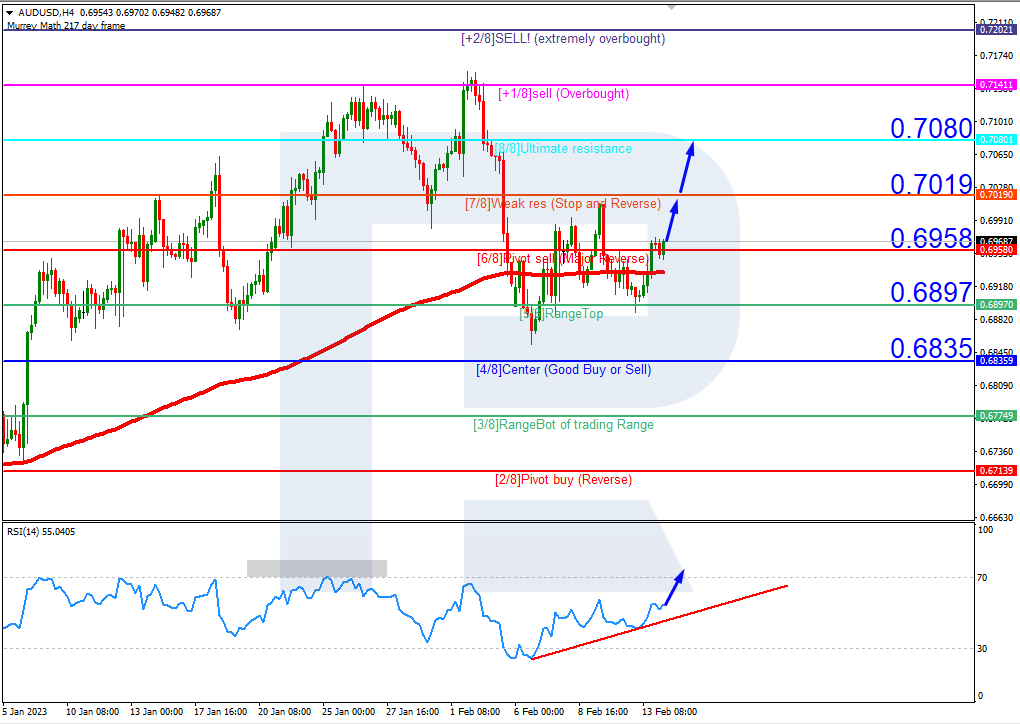
On H4, the quotes have broken through the 200-day Moving Average and are now above it, which reveals possible development of an uptrend. The RSI has bounced off the support line. An upward breakaway of 7/8 (0.7019) should be expected, followed by growth of the resistance level of 8/8 (0.7080). The scenario can be cancelled by a downward breakaway of the support level of 5/8 (0.6897). In this case, the pair may drop to 3/8 (0.6774).
On M15, the upper line of VoltyChannel is broken away, which increases the probability of further growth on H4.
NZDUSD, “New Zealand Dollar vs US Dollar”
On H4, the quotes are under the 200-day Moving Average, which reveals the prevalence of a downtrend. The RSI is testing the resistance line. A test of 3/8 (0.6286) is expected, followed by falling to the support level of 2/8 (0.6225). The scenario can be cancelled by rising over the resistance level of 5/8 (0.6408), which might lead to a trend reversal and growth to 6/8 (0.6469).
On M15, an additional signal confirming the decline will be a breakaway of the lower border of VoltyChannel.
Attention! Forecasts presented in this section only reflect the author’s private opinion and should not be considered as guidance for trading. RoboForex LP bears no responsibility for trading results based on trading recommendations described in these analytical reviews.
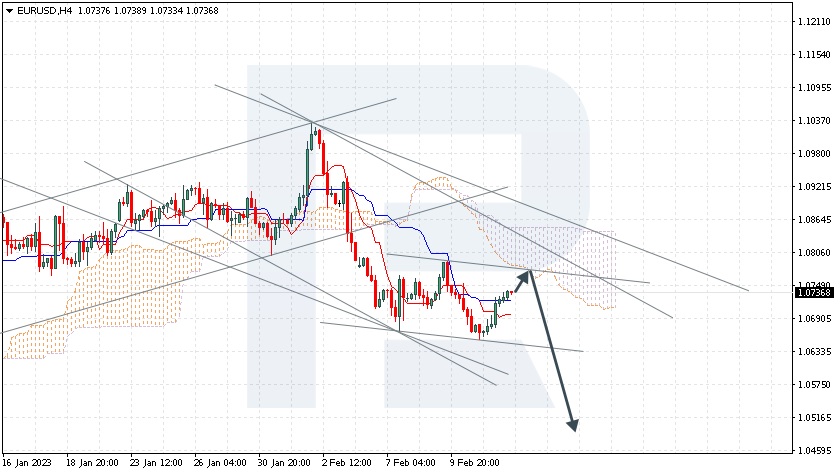
EURUSD has pushed off the support level. The instrument is going below the Ichimoku Cloud, which suggests a downtrend. A test of the lower border of the Cloud at 1.0755 is expected, followed by falling to 1.0505. An additional signal confirming the decline will be a bounce off the upper border of the descending channel. The scenario can be cancelled by a breakaway of the upper border of the Cloud and securing above 1.0875, which will mean further growth to 1.0965.
USDJPY, “US Dollar vs Japanese Yen”
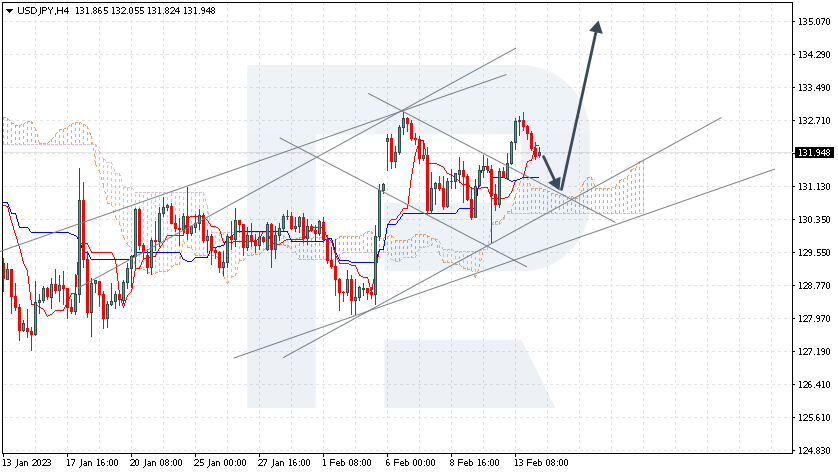
USDJPY is testing the Tenkan-Sen line. The instrument is going above the Ichimoku Cloud, which suggests an uptrend. A test of the upper border of the Cloud at 131.15 is expected, followed by growth to 135.05. An additional signal confirming the decline will be a bounce off the lower border of the bullish channel. The scenario can be cancelled by a breakaway of the lower border of the Cloud and securing under 130.25, which will mean further falling to 129.35.
NZDUSD, “New Zealand Dollar vs US Dollar”
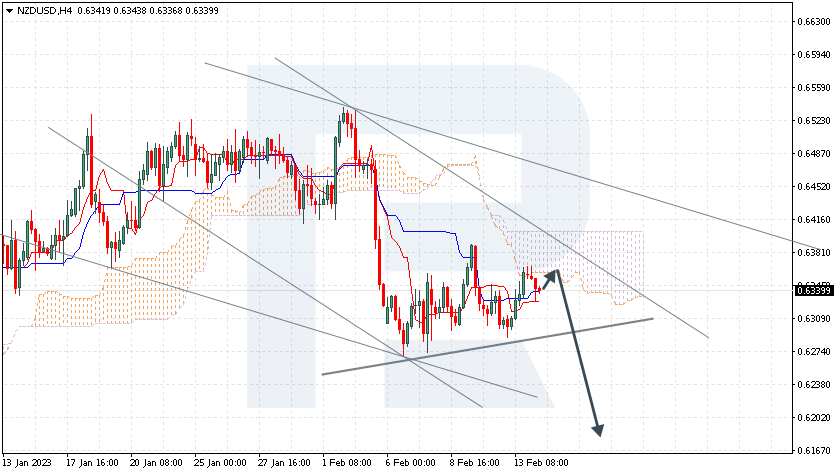
NZDUSD is correcting by the Head and Shoulders pattern. The instrument is going below the Ichimoku Cloud, which suggests a downtrend. A test of the lower border of the Cloud at 0.6365 is expected, followed by falling to 0.6175. An additional signal confirming the decline will be a bounce off the upper border of the descending channel. The scenario can be cancelled by a breakaway of the upper border of the Cloud and securing above 0.6420, which will mean further growth to 0.6515. The scenario can be confirmed by a breakaway of the lower border of the Head and Shoulders pattern and securing under 0.6265.
Attention! Forecasts presented in this section only reflect the author’s private opinion and should not be considered as guidance for trading. RoboForex LP bears no responsibility for trading results based on trading recommendations described in these analytical reviews.
New inflation data will be released in the US today. The Consumer Price Index is expected to fall from 6.5% to 6.3% year-over-year, while basic inflation (excluding food and energy prices) will also decrease from 5.7% to 5.4%. If the actual data matches, or at least is no worse, the dollar index will probably start to lose ground, as falling inflation would indicate that the US Fed is on the right track and the high probability of a “soft” economic landing. But if inflation turns out to be hotter, especially the core index, it will give confidence to the dollar on the back of the fact that the US Fed will not stop and continue to raise interest rates.
The trend on the EUR/USD currency pair on the hourly time frame is bearish. The price is forming a wide corridor, and volatility in anticipation of CPI data is reducing. The MACD indicator has become positive, but buying pressure is weak. Under such market conditions, buy trades are best considered from the support level of 1.0651 or after the breakout of the 1.0739 resistance level, but with confirmation in the form of impulse movement. Sell deals can be considered from the resistance level of 1.0739, but better with confirmation in the form of a reverse initiative on the lower time frames.
Alternative scenario: if the price breaks down through the resistance level of 1.0926 and fixes above it, the uptrend will likely resume.
News feed for 2023.02.14:
– Eurozone GDP (q/q) at 12:00 (GMT+2);
– US Consumer Price Index (m/m) at 15:30 (GMT+2);
– US FOMC Member Williams Speaks at 21:05 (GMT+2).
The GBP/USD currency pair
Technical indicators of the currency pair:
Prev Open: 1.2062
Prev Close: 1.2139
% chg. over the last day: +0.64 %
Important labor market data will be released today in Great Britain. The unemployment rate is projected to be unchanged, with jobless claims up slightly. Such data is likely to cause a less aggressive reaction from the Bank of England (BoE) at the expense of easing inflationary pressure in the services sector. Traders need to understand that a strong labor market does not benefit the central bank in raising rates, as rising wages fuel inflationary indicators.
From the technical point of view, the trend on the GBP/USD currency pair on the hourly time frame is bearish. At the moment, the price is trading above the moving averages, and there is a slight buying pressure inside the day. The MACD indicator has turned positive. Under such market conditions, buy trades are better to look for on intraday time frames from the support level of 1.2078, but with confirmation in the form of initiative and short targets. Sell trades are best sought after a pullback from the resistance level of 1.2150 or 1.2203, but also better with confirmation in the form of a reverse initiative or a false breakout.
Alternative scenario: if the price breaks out through the 1.2416 resistance level and fixes above it, the uptrend will likely resume.
News feed for 2023.02.14:
– UK Average Earnings Index (m/m) at 09:00 (GMT+2);
– UK Claimant Count Change (m/m) at 09:00 (GMT+2);
– UK Unemployment Rate (m/m) at 09:00 (GMT+2).
The USD/JPY currency pair
Technical indicators of the currency pair:
Prev Open: 131.25
Prev Close: 132.40
% chg. over the last day: +0.87 %
The new Governor of the Bank of Japan (BoJ) will be announced today, and Kazuo Ueda is expected to be endorsed by the government. His attitude to monetary policy is somewhat unclear. During his tenure as representative of the Bank of Japan board from 1998 to 2005, Ueda played a key role in introducing new monetary policy easing tools to combat the domestic banking crisis and ease deflation. Analysts believe that Kazuo Ueda is likely to be in no rush to revise the ultra-soft policy and instead let economic data determine the future outcome, especially inflation and wage data.
Trading recommendations
Support levels: 131.45, 129.68, 129.98, 129.19, 129.04, 128.16
Resistance levels: 132.89, 133.23
From the technical point of view, the medium-term trend on the currency pair USD/JPY is bullish. The price is forming a wide-volatile corridor. At the same time, at the level of 132.89, a double top has been formed. The MACD indicator has become inactive. Under such market conditions, it is worth expecting the price to rise above 132.89 to test the liquidity above the level. Most likely, it will happen at the publication of today’s CPI. Buy trades are best to look for from the support level of 131.46, but only with confirmation on the lower time frames. Sell deals can be searched for from the resistance level of 132.89, but only after a false breakout.
Alternative scenario: If the price fixes below the support level of 128.16, the downtrend will be renewed with a high probability.
News feed for 2023.02.14:
– Japan GDP (q/q) at 01:50 (GMT+2);
– Japan Industrial Production (m/m) at 06:30 (GMT+2).
The USD/CAD currency pair
Technical indicators of the currency pair:
Prev Open: 1.3340
Prev Close: 1.3330
% chg. over the last day: -0.08 %
The Canadian dollar is a commodity currency, so it is highly dependent on instruments such as the dollar index and oil. Concerns about another hot US inflation figure have led to speculation that the Federal Reserve may have to be more hawkish than previously thought. Any rally in the US currency would put pressure on commodities, led by oil. The dollar index will get fundamental support if today’s US inflation data is worse than forecast and vice versa.
From the point of view of technical analysis, the trend on the USD/CAD currency pair is bullish. The price has corrected to the “discount” market area, where traders can look for good buying points. The MACD indicator is in the negative zone, and there are signs of divergence. Buy trades can be considered from the support of 1.3333, but with additional confirmation in the form of impulse initiative on the lower time frames. Sell deals should be considered from the resistance level of 1.3416 but on the condition of a reverse reaction.
Alternative scenario: if the price breaks down and consolidates below the support level of 1.3263, the downtrend will likely resume.
This article reflects a personal opinion and should not be interpreted as an investment advice, and/or offer, and/or a persistent request for carrying out financial transactions, and/or a guarantee, and/or a forecast of future events.
Since late November 2022, prices have been trapped within a very wide range with support at 1.1850 and resistance at 1.2450.
There has been a combination of fundamental and technical forces empowering both bulls and bears. However, until there is a noticeable shift in power or major technical breakout, prices are likely to remain rangebound in the short term. It is worth keeping in mind that the Pound has weakened against every single G10 currency since the start of February thanks to a dovish Bank of England.
Interestingly, the dollar straightened up – boosted by January’s robust jobs figures which revived market expectations around the Fed raising interest rates over a longer period.
The combination of dollar strength and pound weakness has resulted in the GBPUSD shedding roughly 2% month-to-date. Nevertheless, it is clear that a fresh directional catalyst may be required to shift the balance of power in favour of bulls or bears.
Will GBPUSD get some love this week?
Keep an eye on a couple of key risk events that could inject the GBPUSD with fresh volatility this week.
The UK inflation release will be under the spotlight on Wednesday 15th February. Markets are forecasting CPI to cool 10.3% in January 2023 versus 10.5% in December 2022. Given how inflation is expected to have already peaked in the United Kingdom, a report that meets or prints below expectations may boost sentiment and fuel speculation around the BoE pausing on rate hikes down the road. Ultimately, is seen dragging the GBPUSD lower. Alternatively, a hotter-than-expected CPI report may force the central bank to re-adopt a hawkish stance – boosting Sterling in the process.
It’s all about the retail sales report on Friday which is expected to dip in January compared to December. A disappointing figure is likely to strengthen the argument around the BoE pausing hikes down the road.
Outside of the UK, investors will be paying very close attention to the US inflation report on Tuesday. Inflation is expected to have cooled further to 6.2% in January compared to the 6.5% witnessed in December. A report that meets or prints below market projections is likely to not only pour cold water on the renewed Fed hike bets but also weaken the dollar. A weaker dollar could trigger a bounce on the GBPUSD.
Breakout on the horizon?
On the daily timeframe, the GBPUSD remains wedged between the 50-day and 200-day SMA. Prices are choppy and almost directionless with minor support found around 1.1950. As identified earlier, the currency pair remains within a very wide range with a fresh fundamental spark needed to trigger a major breakout/down. In the meantime, sustained weakness below 1.2177 could open the doors towards 1.1960 and 1.1850, respectively. According to Bloomberg’s probability calculator, there is a 29% chance from current levels that the GBPUSD ends Q1 below 1.1850. Should prices experience a rebound from the 1.1950/1.1850 regions, the next key level of interest can be found back at 1.2450. Interestingly, there is a 40% chance from current levels that the GBPUSD touches 1.2450 by the end of Q1.







 Article by