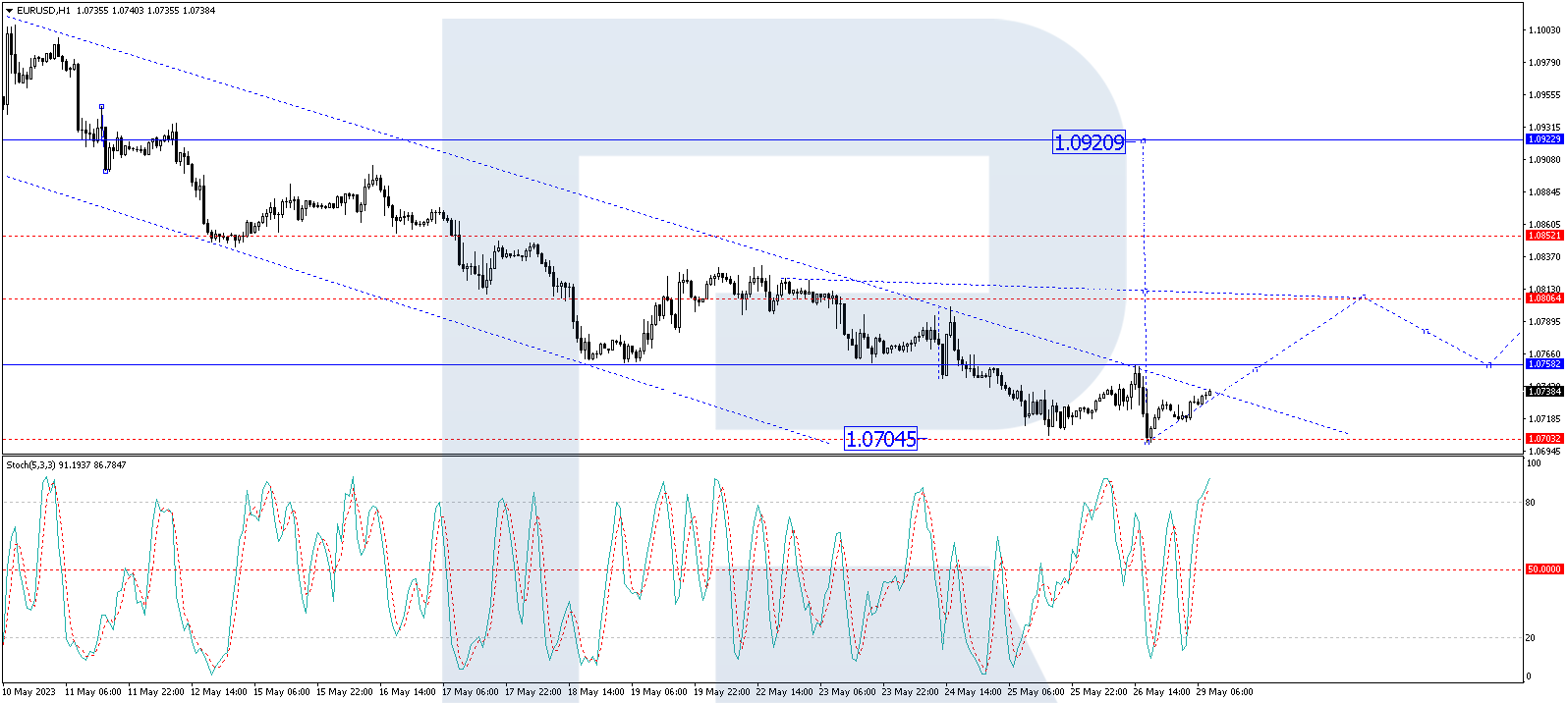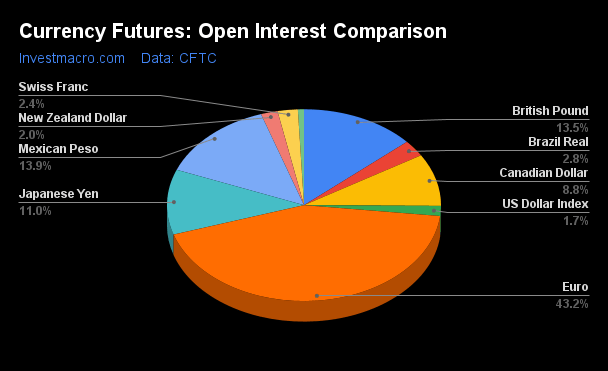
Archive for Forex and Currency News – Page 69

Trade Of The Week: What’s Next For The EURUSD?

By ForexTime 

Fasten your seatbelts, because the next few days could be wild for the world’s most traded FX pair.

Prices have already kicked off the new trading week in a volatile fashion, gapping higher thanks to potent fundamental forces.

We witnessed EURUSD bulls dominate the scene last Friday following the mixed US jobs report which tempered expectations around more aggressive policy tightening by the Federal Reserve (Fed). NFP revealed that 311k new jobs were created in February, substantially below the previous month’s downwardly revised figure of 504k. To rub salt into the wound, the jobless rate unexpectedly rose to 3.6% whiles wages missed expectations by rising 0.2% for the month. With the dollar bashed by investors, the currency pair staged a sharp rebound – gaining 0.6% for the day.

Zooming out, it has certainly been a choppy affair with prices trapped within a messy range on the weekly charts. Major resistance can be found around 1.0900 and support at 1.0500. Fundamentally, the pendulum swings in favour of bulls due to the narrowing divergence between the European Central Bank and the Fed. However, these dynamics could be rattled in the week ahead thanks to key economic reports and major risk events.

Regarding the technical picture, prices are back within a range on the weekly charts. Bull and bears are likely to remain entangled in a tough tug of war until a fundamental spark shifts the balance.

The low down…

The euro has appreciated most G10 currencies since the start of 2023.

Euro bulls continue to draw strength from rate hike bets with markets expecting a 50bp rate hike in March and a 70% probability of another move in April. This comes in contrast to the rapidly shifting expectations around what the Fed will do in March and beyond. Earlier last week, a hawkish Jerome Powell boosted dollar bulls and speculation intensified over the Fed holding rates higher for longer. However, these bets were tempered by last Friday’s mixed jobs report.

It does not end here. The recent collapse of Silicon Valley Bank (SVB) dealt another heavy blow to Fed hike expectations. Given how the US central bank may be forced to shift into lower gear on rates to limit the contagion from the SVB fallout, this is bad news for dollar bulls.

The week ahead…

It is safe to say that the pending US inflation report and ECB meeting could set the tone for the EURUSD ahead of the Fed decision next week.

Tuesday see’s the latest US CPI figures which are expected to show price pressures easing to 6% last month compared to the 6.4% witnessed in January. Inflation is expected to cool thanks to falling energy prices but all eyes will be on the core inflation rate which could rock markets. If inflation figures print higher than expected, this could throw the dollar a lifeline – limiting downside losses. However, a figure that meets or prints below the 6% level may boost speculation around the Fed adopting a less aggressive stance.

It’s all about the European Central Bank meeting on Thursday which is widely expected to conclude with a 50-basis point rate hike, especially after the record-high Eurozone core CPI figures in February. Much focus will be on the messaging on the size of rate increases beyond the March meeting. It will be wise to keep a close eye on the updated ECB staff projections which may offer fresh insight into inflation expectations for 2024 and 2025. On top of this, the new growth estimates could also provide insight into how the central bank sees the economy faring this year. Ultimately, if the ECB strikes a hawkish stance this will support euro bulls, while a dovish stance may promote fresh euro weakness.

Looking beyond the US CPI and ECB meeting, there are other data points and market developments that could add some more spice and flavour to the EURUSD this week. On Wednesday, Eurozone January Industrial production figures and US retail sales for February will be published. Thursday, see the US weekly jobless claims and on Friday, US February industrial production coupled with consumer sentiment for March will be revealed.

EURUSD: Noisy and choppy as ever

There is much activity on the EURUSD with prices oscillating within a very wide range. There are two layers of resistance on the daily chart at 1.0750 and 1.0800 and support around 1.0500. A breakout could be on the horizon but such may require a major fundamental catalyst. In the meantime, A breakout above 1.0750 could suggest an incline towards 1.0800 and 1.0900. Alternatively, if prices sink back below 1.0650, euro bears could target 1.0500.


Forex-Time-LogoArticle by ForexTime

ForexTime Ltd (FXTM) is an award winning international online forex broker regulated by CySEC 185/12 www.forextime.com

Currency COT Charts: February 21st data shows Speculator bets led by Australian Dollar & Mexican Peso

By InvestMacro

Here are the latest charts and statistics for the Commitment of Traders (COT) data published by the Commodities Futures Trading Commission (CFTC).

The latest COT data is updated through Tuesday February 21st and shows a quick view of how large market participants (for-profit speculators and commercial traders) were positioned in the futures markets. All currency positions are in direct relation to the US dollar where, for example, a bet for the euro is a bet that the euro will rise versus the dollar while a bet against the euro will be a bet that the euro will decline versus the dollar.

*** This data is still a few weeks behind the current data because the CFTC up-to-date data has been delayed due to a cybersecurity event that happened in early February to ION Cleared Derivatives (a subsidiary of ION Markets). This hack of ION has created a problem for the large trader positions to be reported and reconciled. The CFTC has back-filled some data over the past few weeks and will get the data back up to date in the coming weeks.

Weekly Speculator Changes led by Australian Dollar & Mexican Peso

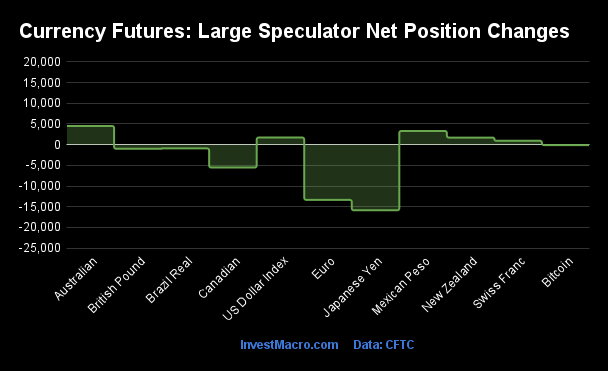
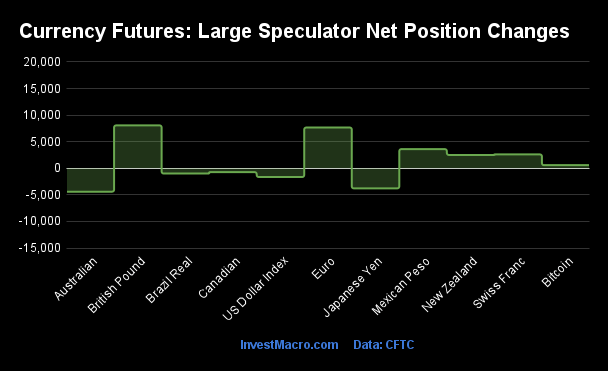
The COT currency market speculator bets were lower through February 21st as five out of the eleven currency markets we cover had higher positioning while the other six markets had lower speculator contracts.

Leading the gains for the currency markets was the Australian Dollar (4,119 contracts) with the Mexican Peso (2,794 contracts), EuroFX (1,162 contracts), the US Dollar Index (224 contracts) and the Swiss Franc (948 contracts) also showing positive weeks.

The currencies seeing declines in speculator bets on the week were the Japanese Yen (-6,186 contracts), Canadian Dollar (-2,009 contracts), Brazilian Real (-1,409 contracts), the British Pound (-1,621 contracts), the New Zealand Dollar (-215 contracts) and Bitcoin (-29 contracts) also registering lower bets on the week.


Data Snapshot of Forex Market Traders | Columns Legend
Feb-21-2023OIOI-IndexSpec-NetSpec-IndexCom-NetCOM-IndexSmalls-NetSmalls-Index
USD Index36,0223612,19845-16,640494,44265
EUR789,89897165,06884-213,8181748,75057
GBP213,50245-21,4165137,64160-16,22526
JPY186,10041-34,0294846,88959-12,86027
CHF39,08733-6,5203712,05865-5,53839
CAD151,89632-37,503039,753100-2,25026
AUD123,45625-24,7886225,04938-26152
NZD29,88868,78878-9,0242523654
MXN277,35386-36,8731431,458835,41590
RUB20,93047,54331-7,15069-39324
BRL47,2473630,53379-32,115211,58280
Bitcoin16,50187-81263438037421


Strength Scores led by EuroFX & Brazilian Real

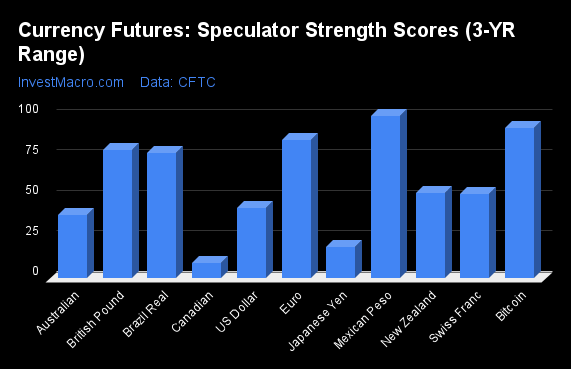
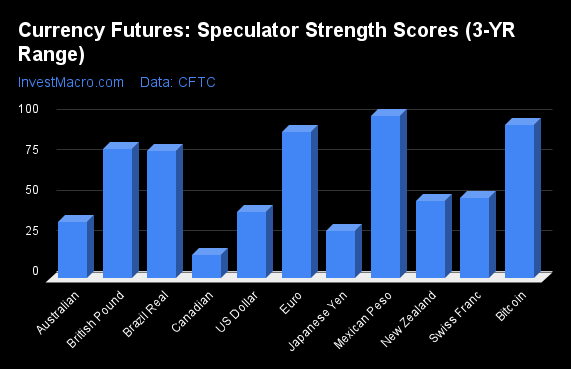
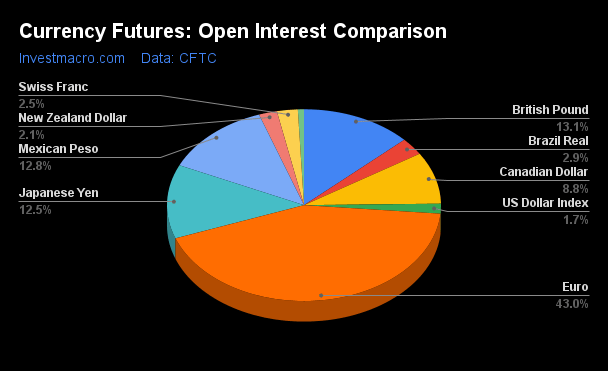
COT Strength Scores (a normalized measure of Speculator positions over a 3-Year range, from 0 to 100 where above 80 is Extreme-Bullish and below 20 is Extreme-Bearish) showed that the EuroFX (84 percent) and the Brazilian Real (79 percent) lead the currency markets through February 21st. The New Zealand Dollar (78 percent), Bitcoin (63 percent) and the Australian Dollar (62 percent) come in as the next highest in the weekly strength scores.

On the downside, the Canadian Dollar (0 percent) and the Mexican Peso (14 percent) come in at the lowest strength levels currently and are in Extreme-Bearish territory (below 20 percent). The next lowest strength scores are the Swiss Franc (37 percent) and the US Dollar Index (45 percent).

Strength Statistics:
US Dollar Index (45.3 percent) vs US Dollar Index previous week (44.9 percent)
EuroFX (84.4 percent) vs EuroFX previous week (84.0 percent)
British Pound Sterling (50.6 percent) vs British Pound Sterling previous week (52.0 percent)
Japanese Yen (47.9 percent) vs Japanese Yen previous week (51.7 percent)
Swiss Franc (37.4 percent) vs Swiss Franc previous week (34.9 percent)
Canadian Dollar (0.0 percent) vs Canadian Dollar previous week (2.3 percent)
Australian Dollar (61.9 percent) vs Australian Dollar previous week (58.0 percent)
New Zealand Dollar (77.7 percent) vs New Zealand Dollar previous week (78.3 percent)
Mexican Peso (14.0 percent) vs Mexican Peso previous week (12.5 percent)
Brazilian Real (78.6 percent) vs Brazilian Real previous week (80.1 percent)
Bitcoin (62.8 percent) vs Bitcoin previous week (63.3 percent)


EuroFX & Brazilian Real top the 6-Week Strength Trends
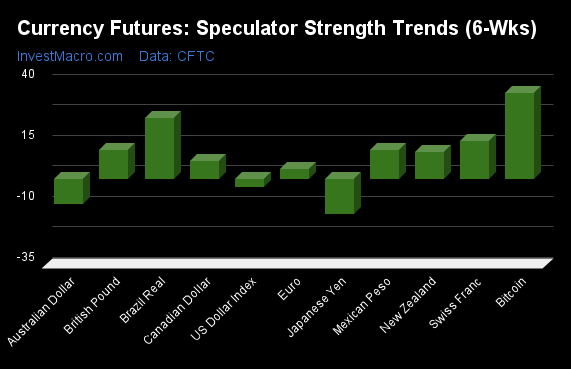
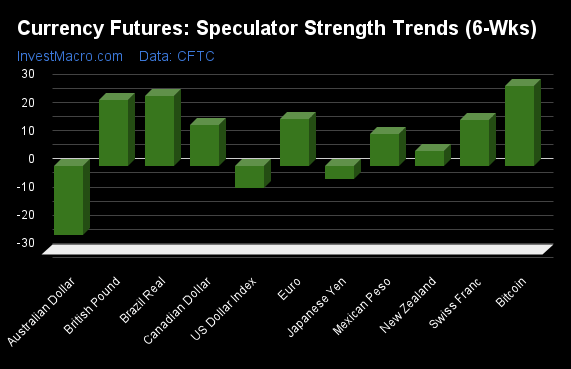
COT Strength Score Trends (or move index, calculates the 6-week changes in strength scores) showed that the EuroFX (10 percent) and the Brazilian Real (9 percent) led the past six weeks trends for the currencies through February 21st. The Australian Dollar (8 percent), the Mexican Peso (8 percent) and the British Pound (7 percent) were the next highest positive movers in the latest trends data.

The Canadian Dollar (-8 percent) led the downside trend scores currently with the US Dollar Index (-7 percent), Bitcoin (-4 percent) and the Japanese Yen (1 percent) following next with lower trend scores.

Strength Trend Statistics:
US Dollar Index (-7.2 percent) vs US Dollar Index previous week (-9.7 percent)
EuroFX (10.1 percent) vs EuroFX previous week (11.4 percent)
British Pound Sterling (6.9 percent) vs British Pound Sterling previous week (0.4 percent)
Japanese Yen (0.8 percent) vs Japanese Yen previous week (11.7 percent)
Swiss Franc (2.2 percent) vs Swiss Franc previous week (-12.2 percent)
Canadian Dollar (-7.6 percent) vs Canadian Dollar previous week (-10.1 percent)
Australian Dollar (8.3 percent) vs Australian Dollar previous week (6.8 percent)
New Zealand Dollar (3.8 percent) vs New Zealand Dollar previous week (4.1 percent)
Mexican Peso (8.5 percent) vs Mexican Peso previous week (8.6 percent)
Brazilian Real (9.5 percent) vs Brazilian Real previous week (4.0 percent)
Bitcoin (-3.8 percent) vs Bitcoin previous week (-20.4 percent)


Individual COT Forex Markets:

US Dollar Index Futures:
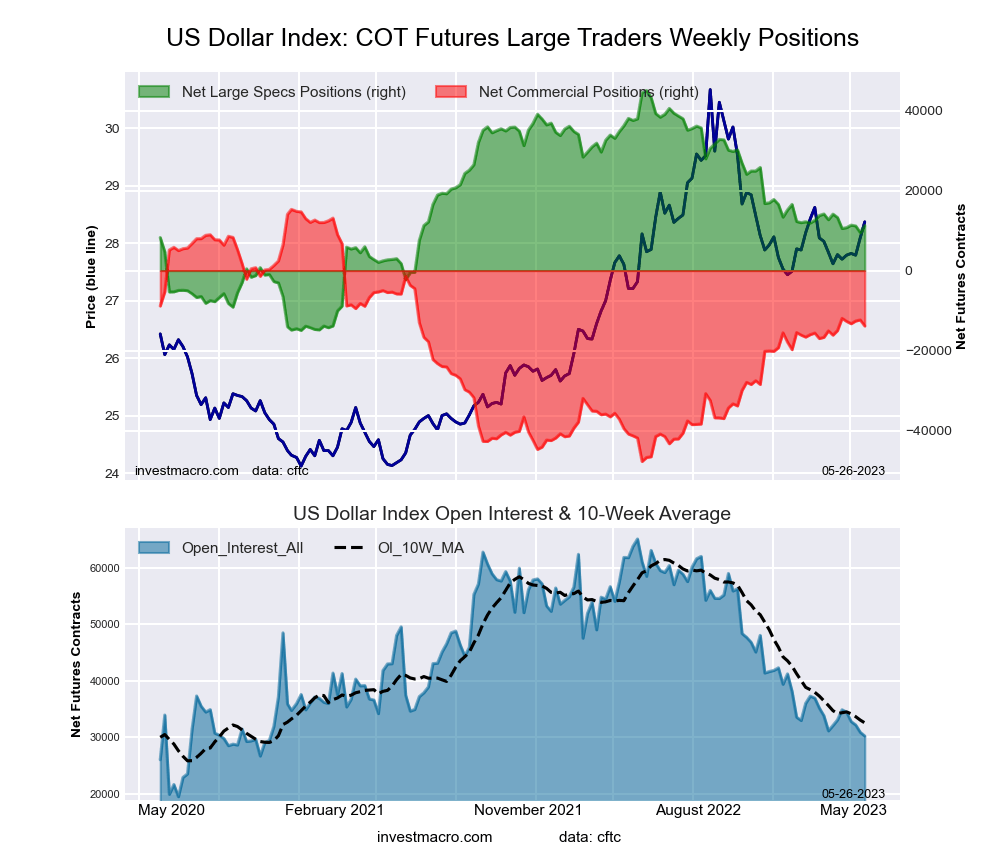
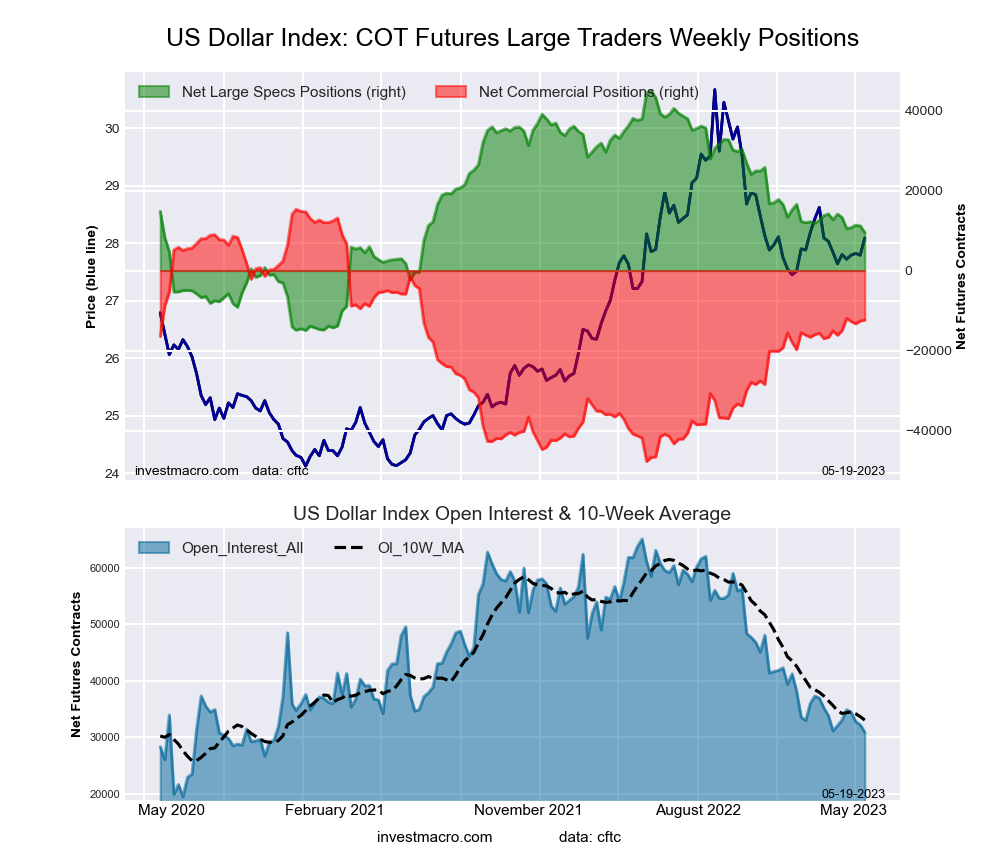
US Dollar Index Forex Futures COT ChartThe US Dollar Index large speculator standing equaled a net position of 12,198 contracts in the data reported through Tuesday February 21st. This was a weekly lift of 224 contracts from the previous week which had a total of 11,974 net contracts.

The week’s current strength score (the trader positioning range over the past three years, measured from 0 to 100) shows the speculators are currently Bearish with a score of 45.3 percent. The commercials are Bearish with a score of 49.3 percent and the small traders (not shown in chart) are Bullish with a score of 65.1 percent.

US DOLLAR INDEX StatisticsSPECULATORSCOMMERCIALSSMALL TRADERS
– Percent of Open Interest Longs:73.52.519.0
– Percent of Open Interest Shorts:39.648.76.6
– Net Position:12,198-16,6404,442
– Gross Longs:26,4699096,832
– Gross Shorts:14,27117,5492,390
– Long to Short Ratio:1.9 to 10.1 to 12.9 to 1
NET POSITION TREND:
– Strength Index Score (3 Year Range Pct):45.349.365.1
– Strength Index Reading (3 Year Range):BearishBearishBullish
NET POSITION MOVEMENT INDEX:
– 6-Week Change in Strength Index:-7.24.218.6


Euro Currency Futures:

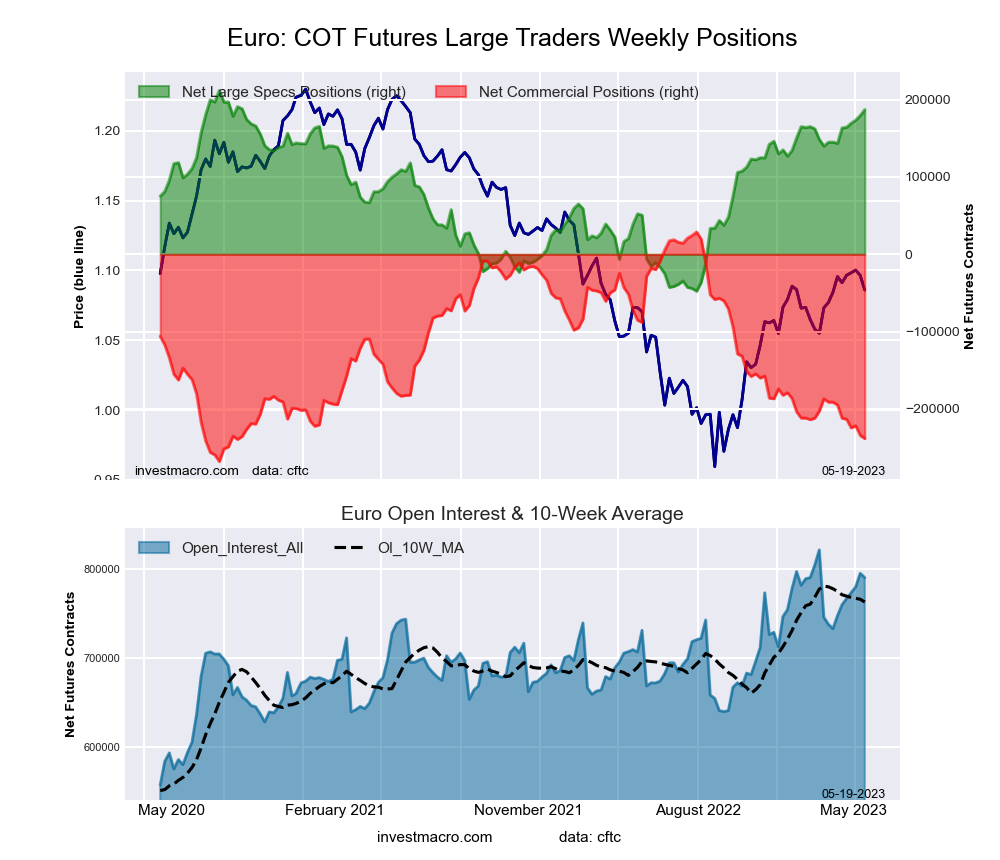
Euro Currency Futures COT ChartThe Euro Currency large speculator standing equaled a net position of 165,068 contracts in the data reported through Tuesday February 21st. This was a weekly boost of 1,162 contracts from the previous week which had a total of 163,906 net contracts.

The week’s current strength score (the trader positioning range over the past three years, measured from 0 to 100) shows the speculators are currently Bullish-Extreme with a score of 84.4 percent. The commercials are Bearish-Extreme with a score of 16.7 percent and the small traders (not shown in chart) are Bullish with a score of 56.8 percent.

EURO Currency StatisticsSPECULATORSCOMMERCIALSSMALL TRADERS
– Percent of Open Interest Longs:29.956.311.6
– Percent of Open Interest Shorts:9.083.45.4
– Net Position:165,068-213,81848,750
– Gross Longs:236,414444,65891,704
– Gross Shorts:71,346658,47642,954
– Long to Short Ratio:3.3 to 10.7 to 12.1 to 1
NET POSITION TREND:
– Strength Index Score (3 Year Range Pct):84.416.756.8
– Strength Index Reading (3 Year Range):Bullish-ExtremeBearish-ExtremeBullish
NET POSITION MOVEMENT INDEX:
– 6-Week Change in Strength Index:10.1-9.82.4


British Pound Sterling Futures:

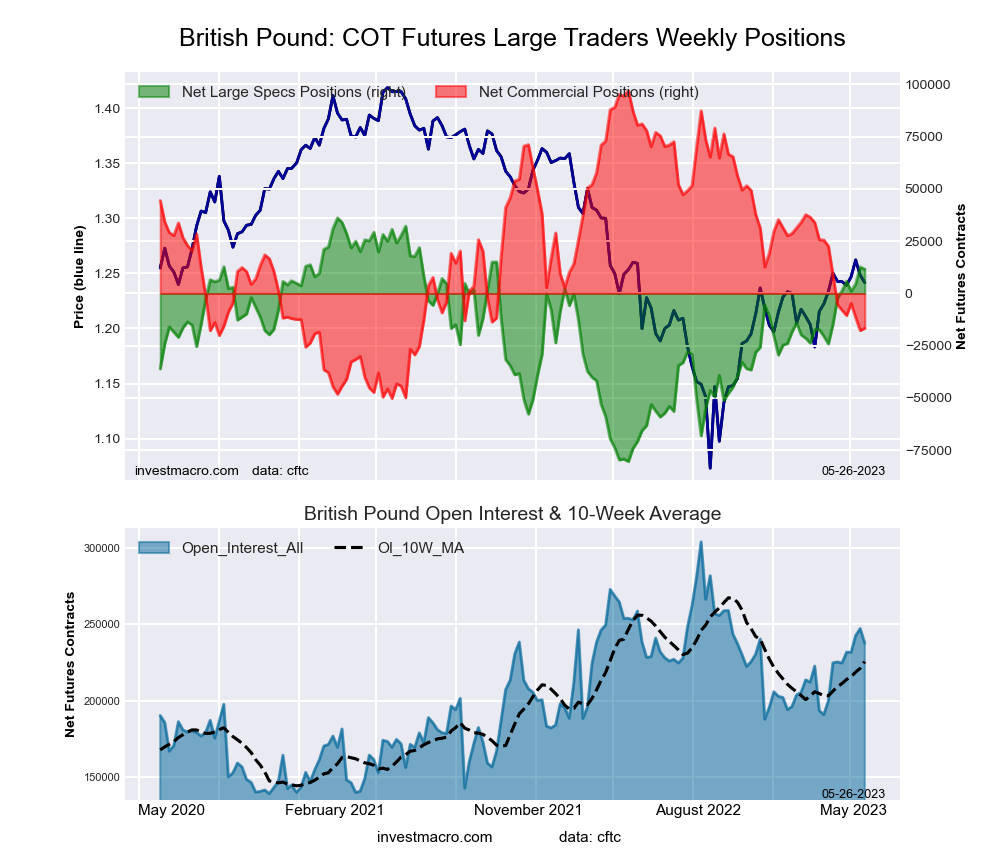
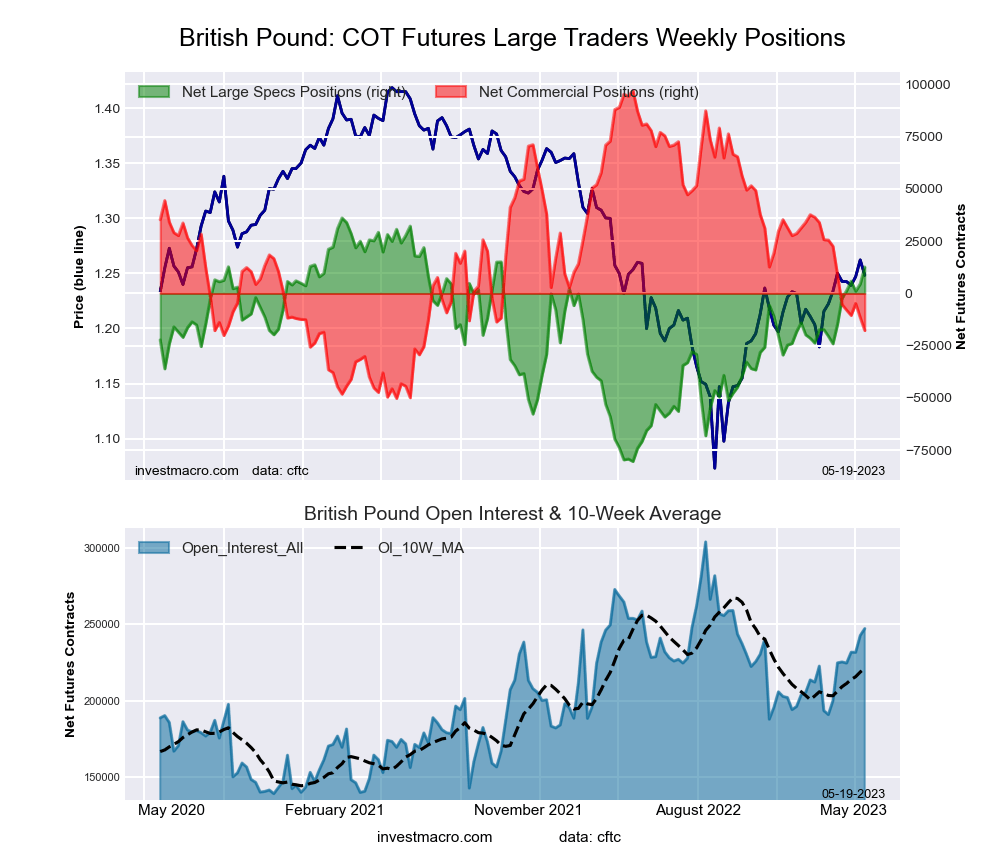
British Pound Sterling Futures COT ChartThe British Pound Sterling large speculator standing equaled a net position of -21,416 contracts in the data reported through Tuesday February 21st. This was a weekly lowering of -1,621 contracts from the previous week which had a total of -19,795 net contracts.

The week’s current strength score (the trader positioning range over the past three years, measured from 0 to 100) shows the speculators are currently Bullish with a score of 50.6 percent. The commercials are Bullish with a score of 59.7 percent and the small traders (not shown in chart) are Bearish with a score of 26.2 percent.

BRITISH POUND StatisticsSPECULATORSCOMMERCIALSSMALL TRADERS
– Percent of Open Interest Longs:21.367.09.5
– Percent of Open Interest Shorts:31.349.417.1
– Net Position:-21,41637,641-16,225
– Gross Longs:45,475143,07720,231
– Gross Shorts:66,891105,43636,456
– Long to Short Ratio:0.7 to 11.4 to 10.6 to 1
NET POSITION TREND:
– Strength Index Score (3 Year Range Pct):50.659.726.2
– Strength Index Reading (3 Year Range):BullishBullishBearish
NET POSITION MOVEMENT INDEX:
– 6-Week Change in Strength Index:6.91.6-20.4


Japanese Yen Futures:

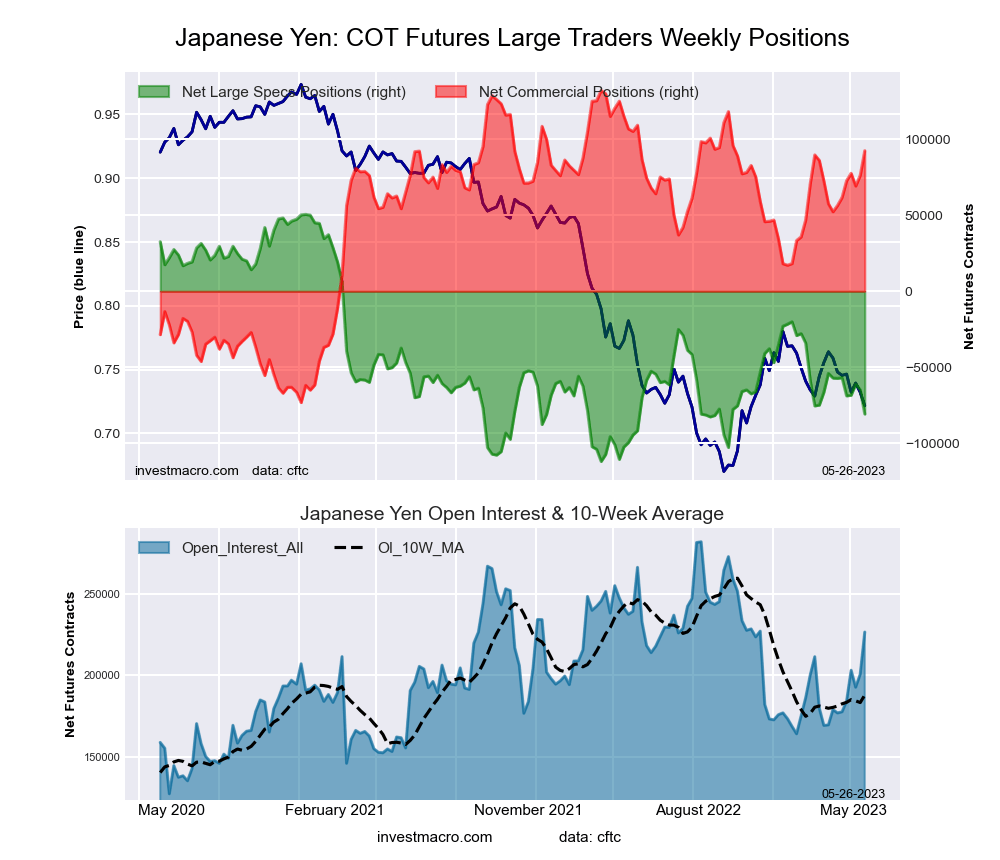
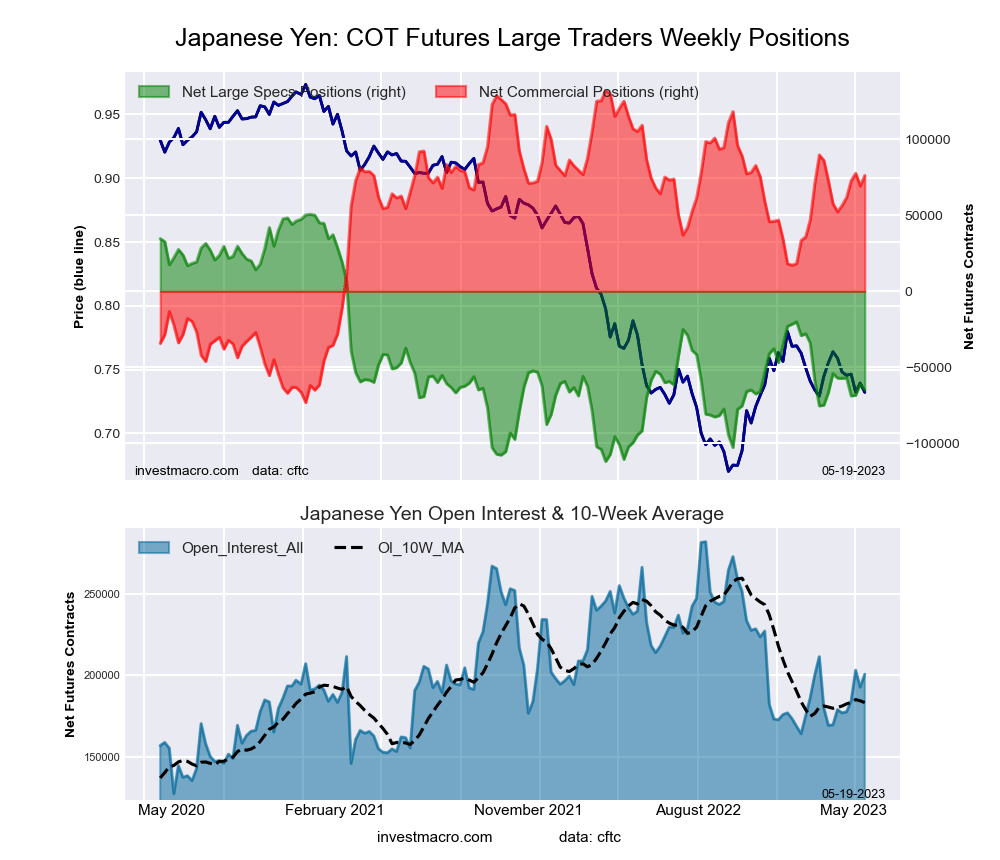
Japanese Yen Forex Futures COT ChartThe Japanese Yen large speculator standing totaled a net position of -34,029 contracts in the data reported through Tuesday February 21st. This was a weekly lowering of -6,186 contracts from the previous week which had a total of -27,843 net contracts.

The week’s current strength score (the trader positioning range over the past three years, measured from 0 to 100) shows the speculators are currently Bearish with a score of 47.9 percent. The commercials are Bullish with a score of 58.5 percent and the small traders (not shown in chart) are Bearish with a score of 27.3 percent.

JAPANESE YEN StatisticsSPECULATORSCOMMERCIALSSMALL TRADERS
– Percent of Open Interest Longs:17.568.112.4
– Percent of Open Interest Shorts:35.742.919.3
– Net Position:-34,02946,889-12,860
– Gross Longs:32,486126,77723,044
– Gross Shorts:66,51579,88835,904
– Long to Short Ratio:0.5 to 11.6 to 10.6 to 1
NET POSITION TREND:
– Strength Index Score (3 Year Range Pct):47.958.527.3
– Strength Index Reading (3 Year Range):BearishBullishBearish
NET POSITION MOVEMENT INDEX:
– 6-Week Change in Strength Index:0.86.0-27.9


Swiss Franc Futures:

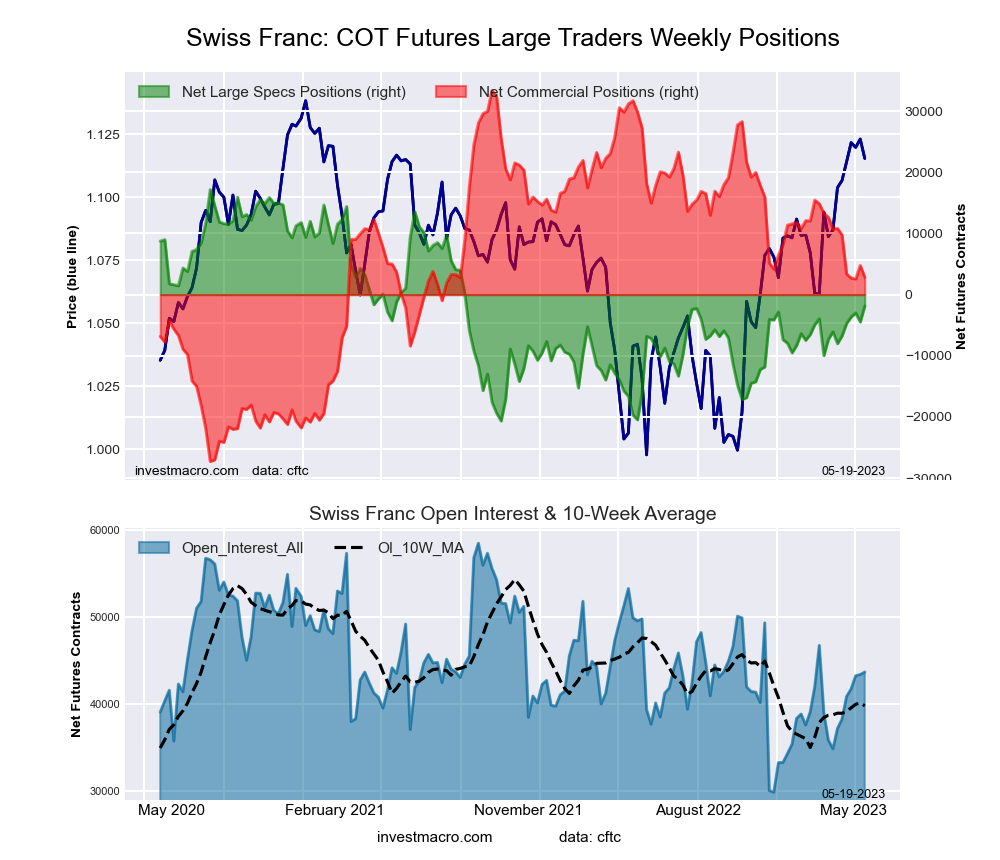
Swiss Franc Forex Futures COT ChartThe Swiss Franc large speculator standing amounted to a net position of -6,520 contracts in the data reported through Tuesday February 21st. This was a weekly rise of 948 contracts from the previous week which had a total of -7,468 net contracts.

The week’s current strength score (the trader positioning range over the past three years, measured from 0 to 100) shows the speculators are currently Bearish with a score of 37.4 percent. The commercials are Bullish with a score of 64.9 percent and the small traders (not shown in chart) are Bearish with a score of 38.8 percent.

SWISS FRANC StatisticsSPECULATORSCOMMERCIALSSMALL TRADERS
– Percent of Open Interest Longs:18.558.023.3
– Percent of Open Interest Shorts:35.227.137.5
– Net Position:-6,52012,058-5,538
– Gross Longs:7,24322,6689,110
– Gross Shorts:13,76310,61014,648
– Long to Short Ratio:0.5 to 12.1 to 10.6 to 1
NET POSITION TREND:
– Strength Index Score (3 Year Range Pct):37.464.938.8
– Strength Index Reading (3 Year Range):BearishBullishBearish
NET POSITION MOVEMENT INDEX:
– 6-Week Change in Strength Index:2.26.4-15.9


Canadian Dollar Futures:

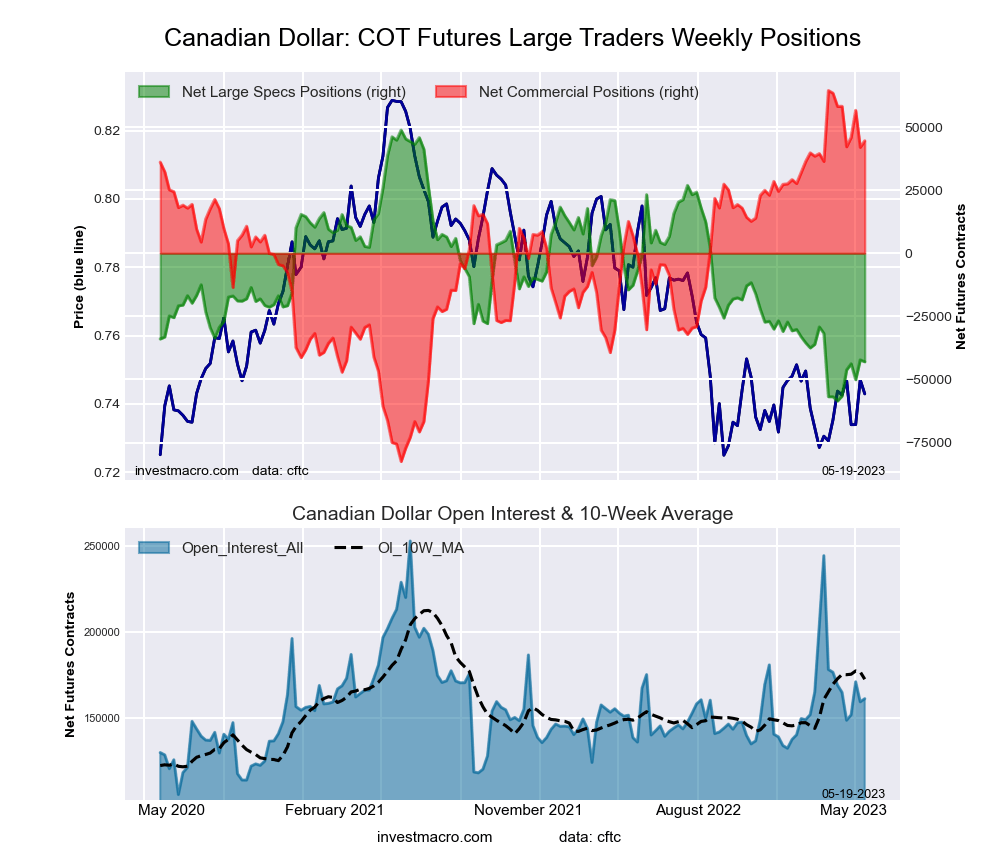
Canadian Dollar Forex Futures COT ChartThe Canadian Dollar large speculator standing totaled a net position of -37,503 contracts in the data reported through Tuesday February 21st. This was a weekly reduction of -2,009 contracts from the previous week which had a total of -35,494 net contracts.

The week’s current strength score (the trader positioning range over the past three years, measured from 0 to 100) shows the speculators are currently Bearish-Extreme with a score of 0.0 percent. The commercials are Bullish-Extreme with a score of 100.0 percent and the small traders (not shown in chart) are Bearish with a score of 25.6 percent.

CANADIAN DOLLAR StatisticsSPECULATORSCOMMERCIALSSMALL TRADERS
– Percent of Open Interest Longs:14.459.623.0
– Percent of Open Interest Shorts:39.133.424.5
– Net Position:-37,50339,753-2,250
– Gross Longs:21,88990,48934,967
– Gross Shorts:59,39250,73637,217
– Long to Short Ratio:0.4 to 11.8 to 10.9 to 1
NET POSITION TREND:
– Strength Index Score (3 Year Range Pct):0.0100.025.6
– Strength Index Reading (3 Year Range):Bearish-ExtremeBullish-ExtremeBearish
NET POSITION MOVEMENT INDEX:
– 6-Week Change in Strength Index:-7.610.2-11.9


Australian Dollar Futures:

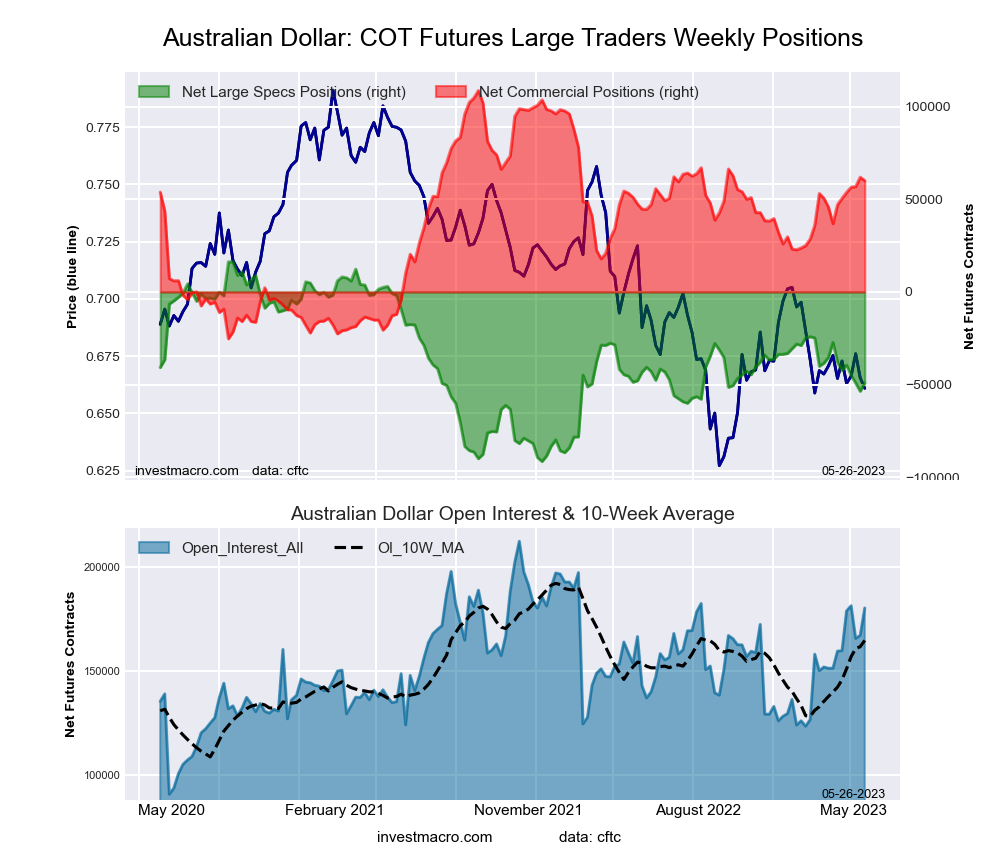
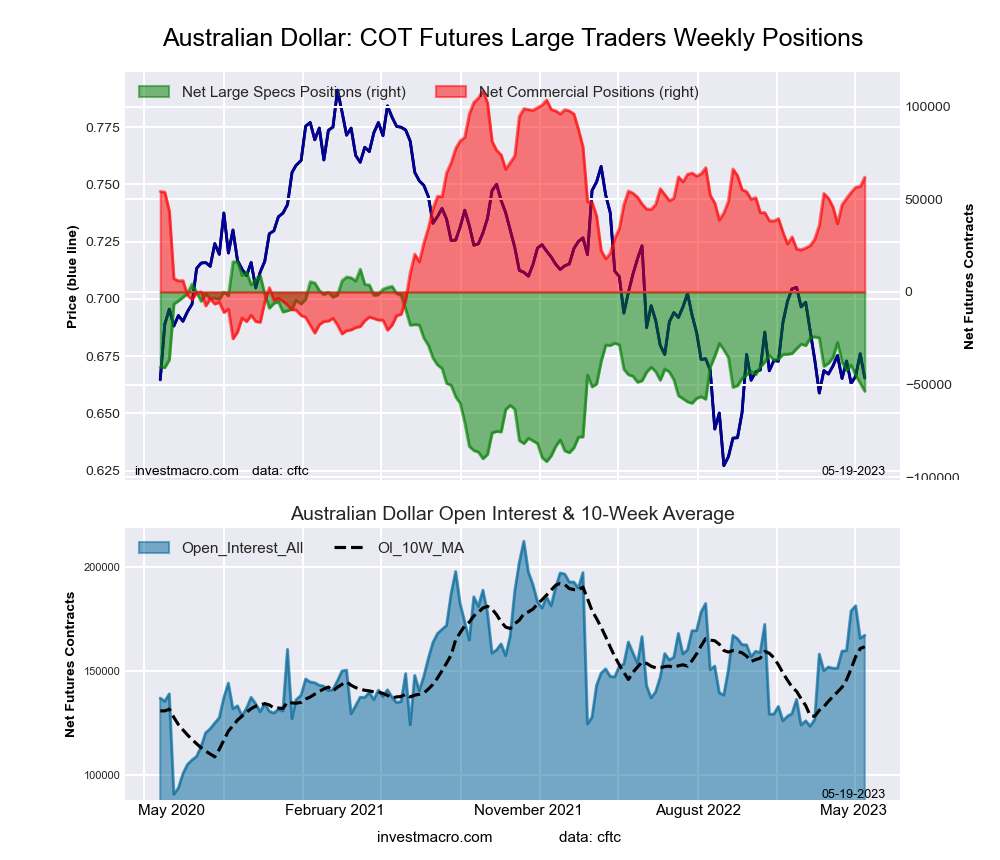
Australian Dollar Forex Futures COT ChartThe Australian Dollar large speculator standing was a net position of -24,788 contracts in the data reported through Tuesday February 21st. This was a weekly boost of 4,119 contracts from the previous week which had a total of -28,907 net contracts.

The week’s current strength score (the trader positioning range over the past three years, measured from 0 to 100) shows the speculators are currently Bullish with a score of 61.9 percent. The commercials are Bearish with a score of 37.6 percent and the small traders (not shown in chart) are Bullish with a score of 51.8 percent.

AUSTRALIAN DOLLAR StatisticsSPECULATORSCOMMERCIALSSMALL TRADERS
– Percent of Open Interest Longs:31.249.017.8
– Percent of Open Interest Shorts:51.328.818.0
– Net Position:-24,78825,049-261
– Gross Longs:38,49260,54321,994
– Gross Shorts:63,28035,49422,255
– Long to Short Ratio:0.6 to 11.7 to 11.0 to 1
NET POSITION TREND:
– Strength Index Score (3 Year Range Pct):61.937.651.8
– Strength Index Reading (3 Year Range):BullishBearishBullish
NET POSITION MOVEMENT INDEX:
– 6-Week Change in Strength Index:8.3-5.3-4.2


New Zealand Dollar Futures:

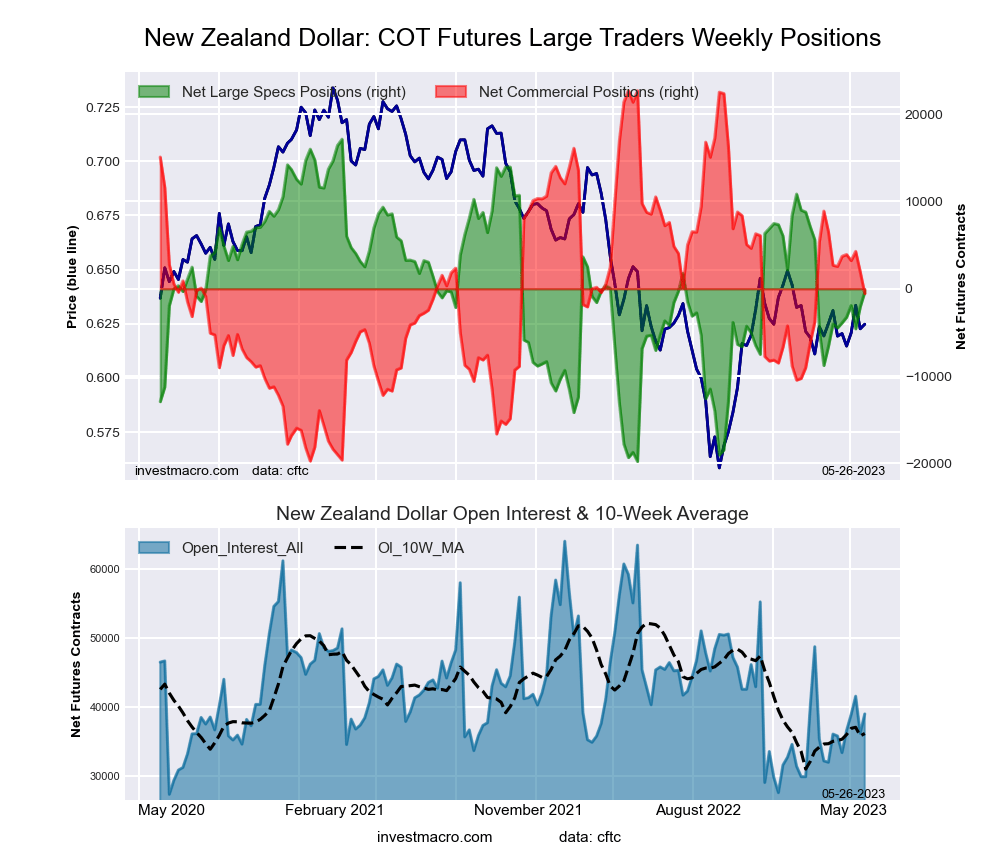
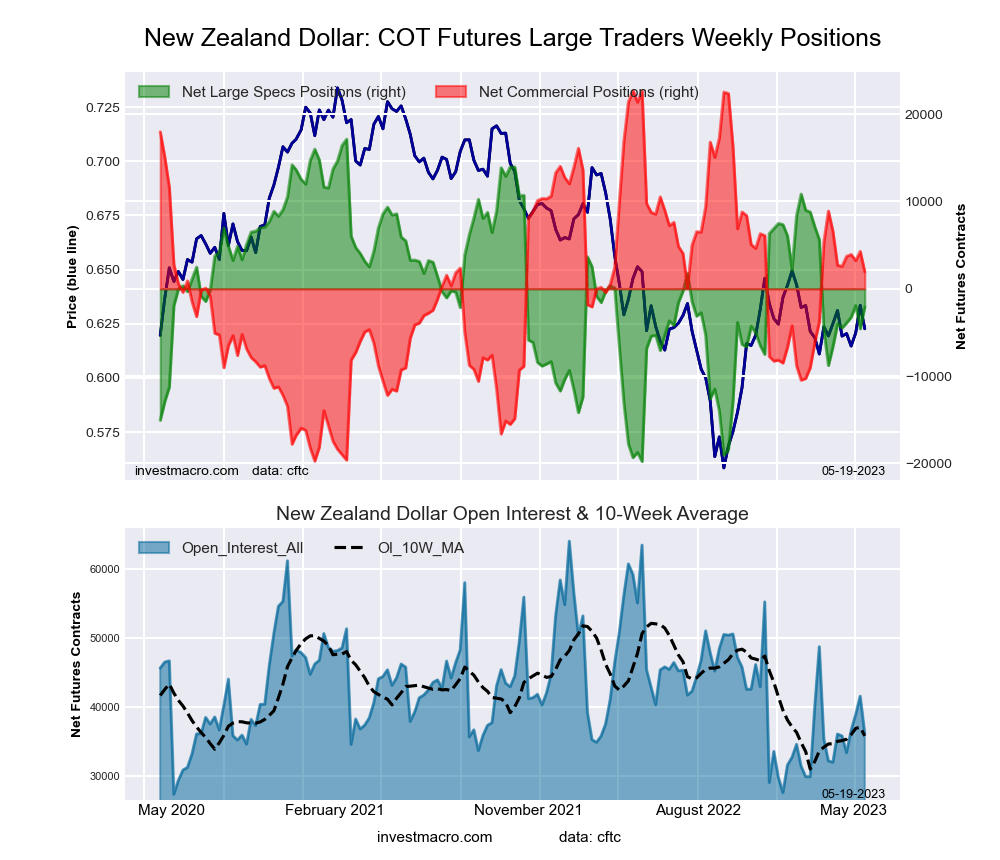
New Zealand Dollar Forex Futures COT ChartThe New Zealand Dollar large speculator standing amounted to a net position of 8,788 contracts in the data reported through Tuesday February 21st. This was a weekly fall of -215 contracts from the previous week which had a total of 9,003 net contracts.

The week’s current strength score (the trader positioning range over the past three years, measured from 0 to 100) shows the speculators are currently Bullish with a score of 77.7 percent. The commercials are Bearish with a score of 25.2 percent and the small traders (not shown in chart) are Bullish with a score of 54.4 percent.

NEW ZEALAND DOLLAR StatisticsSPECULATORSCOMMERCIALSSMALL TRADERS
– Percent of Open Interest Longs:52.130.013.5
– Percent of Open Interest Shorts:22.760.212.7
– Net Position:8,788-9,024236
– Gross Longs:15,5618,9654,026
– Gross Shorts:6,77317,9893,790
– Long to Short Ratio:2.3 to 10.5 to 11.1 to 1
NET POSITION TREND:
– Strength Index Score (3 Year Range Pct):77.725.254.4
– Strength Index Reading (3 Year Range):BullishBearishBullish
NET POSITION MOVEMENT INDEX:
– 6-Week Change in Strength Index:3.8-1.2-10.5


Mexican Peso Futures:

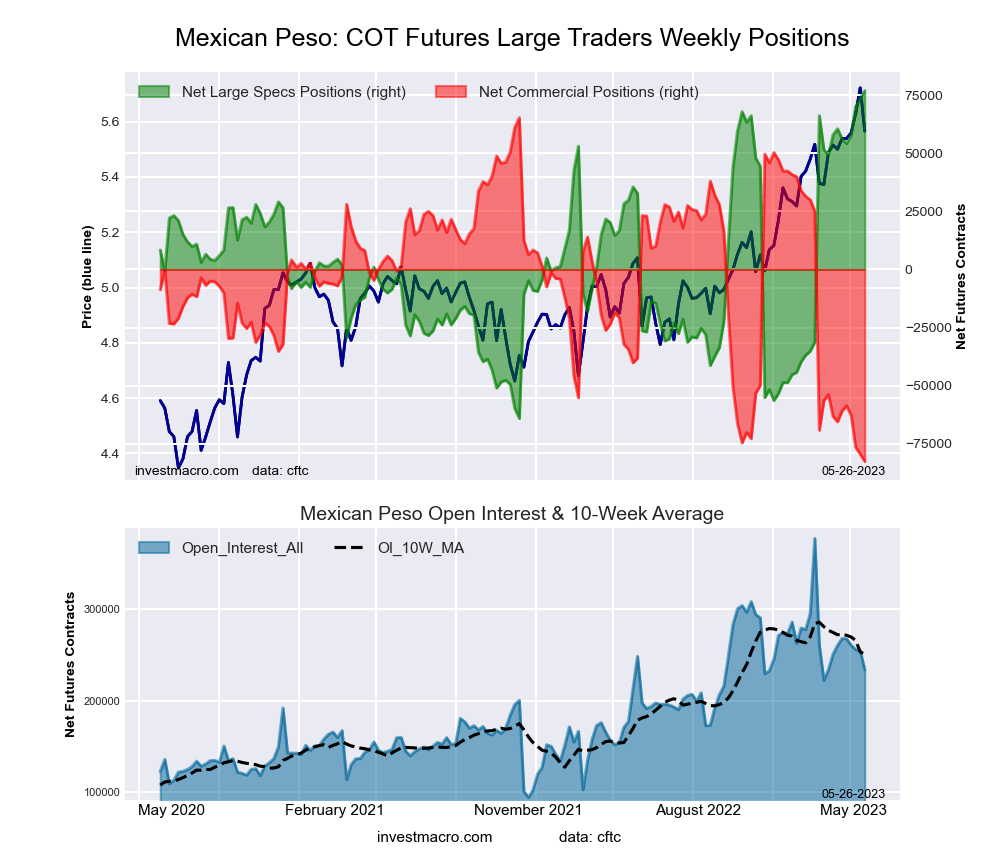
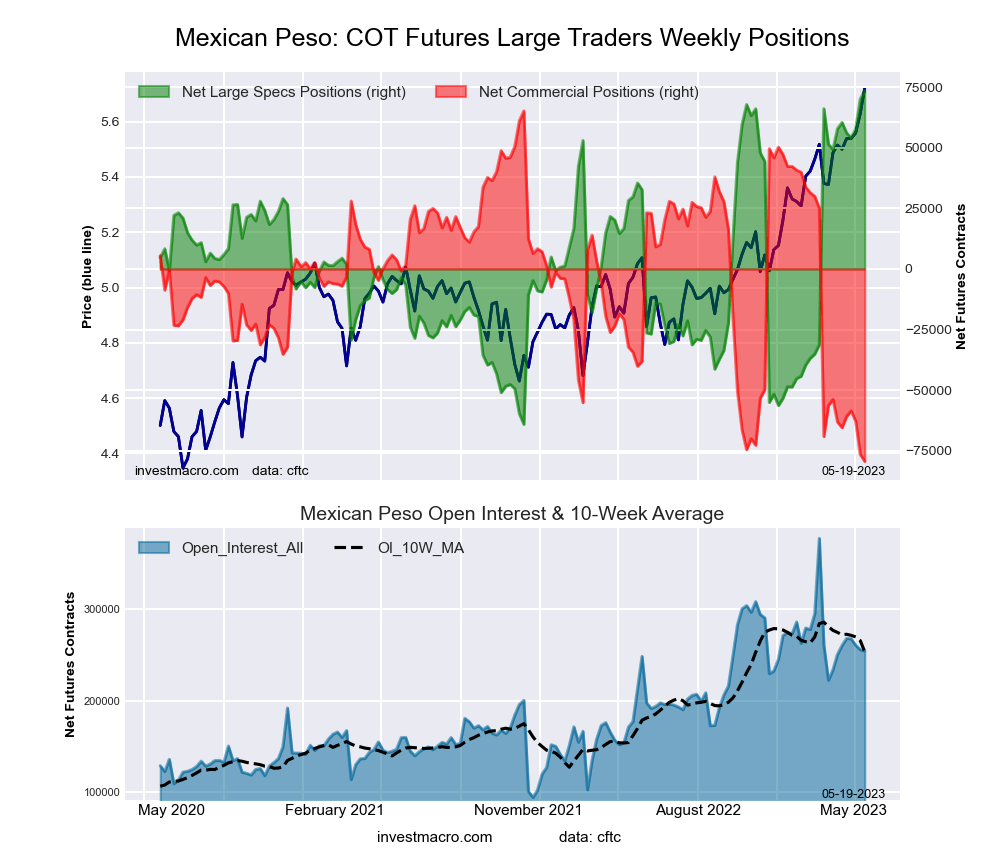
Mexican Peso Futures COT ChartThe Mexican Peso large speculator standing equaled a net position of -36,873 contracts in the data reported through Tuesday February 21st. This was a weekly advance of 2,794 contracts from the previous week which had a total of -39,667 net contracts.

The week’s current strength score (the trader positioning range over the past three years, measured from 0 to 100) shows the speculators are currently Bearish-Extreme with a score of 14.0 percent. The commercials are Bullish-Extreme with a score of 83.0 percent and the small traders (not shown in chart) are Bullish-Extreme with a score of 89.5 percent.

MEXICAN PESO StatisticsSPECULATORSCOMMERCIALSSMALL TRADERS
– Percent of Open Interest Longs:55.041.03.1
– Percent of Open Interest Shorts:68.329.71.2
– Net Position:-36,87331,4585,415
– Gross Longs:152,675113,8168,689
– Gross Shorts:189,54882,3583,274
– Long to Short Ratio:0.8 to 11.4 to 12.7 to 1
NET POSITION TREND:
– Strength Index Score (3 Year Range Pct):14.083.089.5
– Strength Index Reading (3 Year Range):Bearish-ExtremeBullish-ExtremeBullish-Extreme
NET POSITION MOVEMENT INDEX:
– 6-Week Change in Strength Index:8.5-7.9-4.4


Brazilian Real Futures:

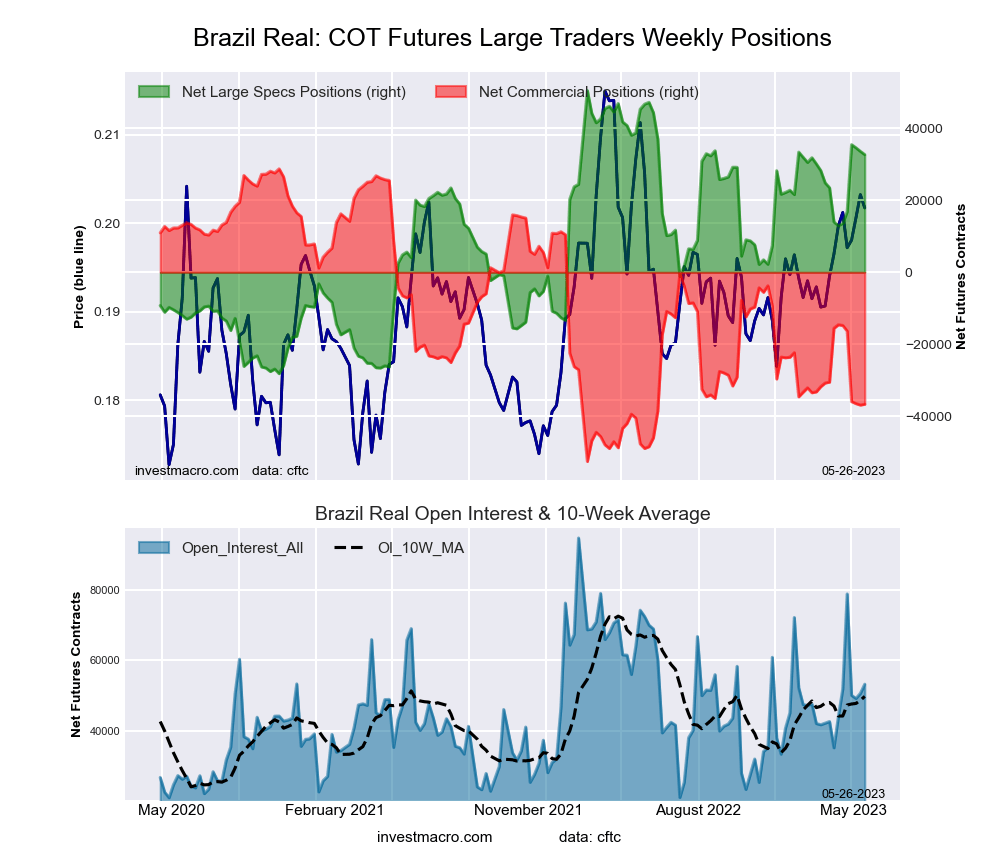
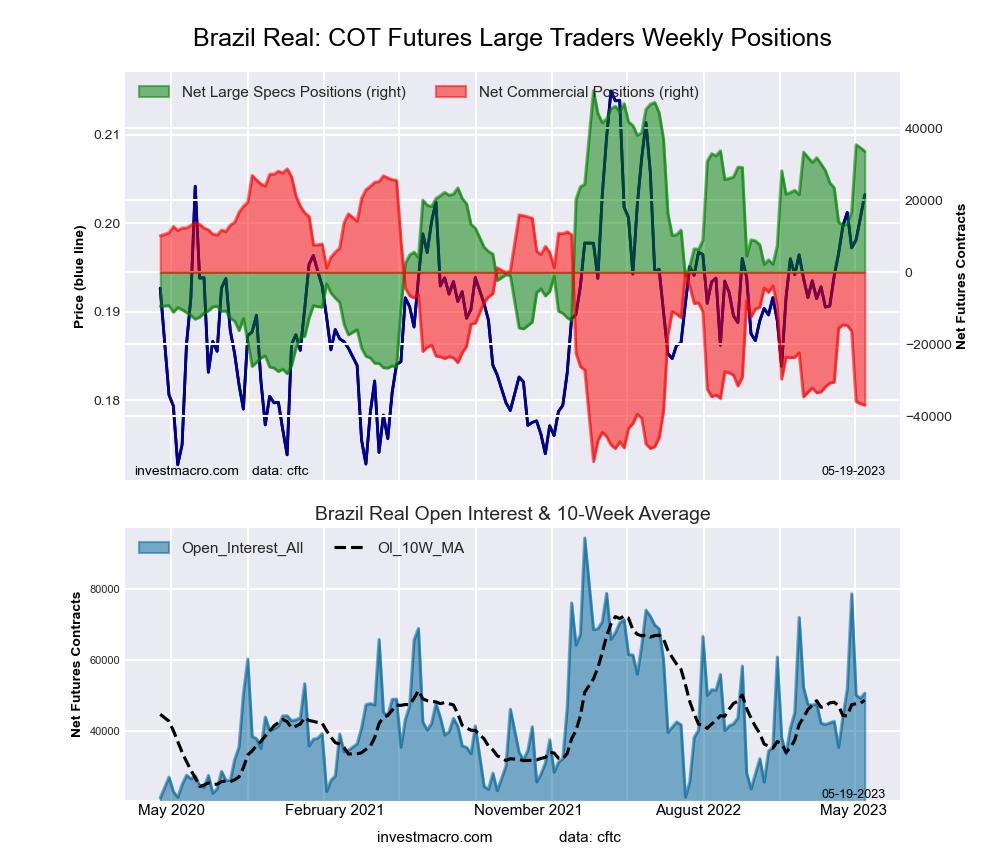
Brazil Real Futures COT ChartThe Brazilian Real large speculator standing equaled a net position of 30,533 contracts in the data reported through Tuesday February 21st. This was a weekly lowering of -1,409 contracts from the previous week which had a total of 31,942 net contracts.

The week’s current strength score (the trader positioning range over the past three years, measured from 0 to 100) shows the speculators are currently Bullish with a score of 78.6 percent. The commercials are Bearish with a score of 21.4 percent and the small traders (not shown in chart) are Bullish with a score of 79.8 percent.

BRAZIL REAL StatisticsSPECULATORSCOMMERCIALSSMALL TRADERS
– Percent of Open Interest Longs:74.417.77.9
– Percent of Open Interest Shorts:9.785.74.6
– Net Position:30,533-32,1151,582
– Gross Longs:35,1378,3573,733
– Gross Shorts:4,60440,4722,151
– Long to Short Ratio:7.6 to 10.2 to 11.7 to 1
NET POSITION TREND:
– Strength Index Score (3 Year Range Pct):78.621.479.8
– Strength Index Reading (3 Year Range):BullishBearishBullish
NET POSITION MOVEMENT INDEX:
– 6-Week Change in Strength Index:9.5-9.0-3.3


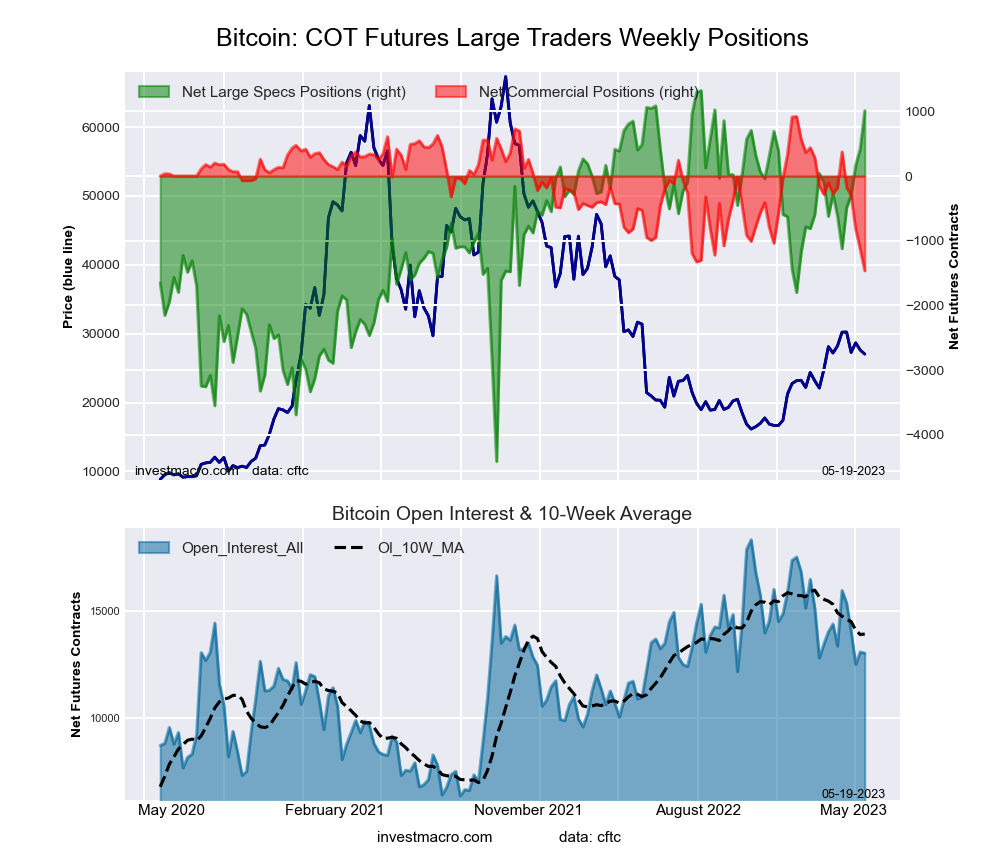
Bitcoin Futures:

Bitcoin Crypto Futures COT ChartThe Bitcoin large speculator standing was a net position of -812 contracts in the data reported through Tuesday February 21st. This was a weekly lowering of -29 contracts from the previous week which had a total of -783 net contracts.

The week’s current strength score (the trader positioning range over the past three years, measured from 0 to 100) shows the speculators are currently Bullish with a score of 62.8 percent. The commercials are Bullish with a score of 78.5 percent and the small traders (not shown in chart) are Bearish with a score of 21.4 percent.

BITCOIN StatisticsSPECULATORSCOMMERCIALSSMALL TRADERS
– Percent of Open Interest Longs:73.94.98.5
– Percent of Open Interest Shorts:78.82.36.2
– Net Position:-812438374
– Gross Longs:12,1888101,398
– Gross Shorts:13,0003721,024
– Long to Short Ratio:0.9 to 12.2 to 11.4 to 1
NET POSITION TREND:
– Strength Index Score (3 Year Range Pct):62.878.521.4
– Strength Index Reading (3 Year Range):BullishBullishBearish
NET POSITION MOVEMENT INDEX:
– 6-Week Change in Strength Index:-3.820.8-5.7


Article By InvestMacroReceive our weekly COT Newsletter

*COT Report: The COT data, released weekly to the public each Friday, is updated through the most recent Tuesday (data is 3 days old) and shows a quick view of how large speculators or non-commercials (for-profit traders) were positioned in the futures markets.

The CFTC categorizes trader positions according to commercial hedgers (traders who use futures contracts for hedging as part of the business), non-commercials (large traders who speculate to realize trading profits) and nonreportable traders (usually small traders/speculators) as well as their open interest (contracts open in the market at time of reporting). See CFTC criteria here.

Week Ahead: Say bye to EURUSD’s March gains?

By ForexTime 

Even as markets brace for the highly-anticipated US jobs report due later today (Friday, March 10th), the prudent investor/trader will already be keeping an eye on what’s to come:
Sunday, March 12

  • US daylight savings time ends

Tuesday, March 14

  • AUD: Australia February business confidence; March consumer confidence
  • GBP: UK January unemployment rate, February jobless claims
  • USD: US February consumer price index (CPI)

Wednesday, March 15

  • CNH: China February industrial production, retail sales, jobless rate
  • JPY: Bank of Japan meeting minutes
  • EUR: Eurozone January industrial production
  • GBP: UK Chancellor presents Spring Budget
  • USD: US February retail sales

Thursday, March 16

  • NZD: New Zealand 4Q GDP
  • AUD: Australia February unemployment, March inflation expectations
  • EUR: ECB rate decision
  • USD: US weekly jobless claims

Friday, March 17

  • EUR: Eurozone February CPI (final)
  • USD: US February industrial production, March consumer sentiment


Here are 3 reasons why we’re especially focusing on EURUSD for the coming week:


1) US inflation still stubborn?

The incoming CPI (consumer price index – which measures headline inflation) is set to be the next major risk event (after today’s NFP release) for the US dollar, and by extension, the rest of the FX universe.

This is also arguably the most important datapoint that the US central bank a.k.a. the Fed will take into account ahead of its upcoming policy meeting on 21-22 March.

The February CPI number due Tuesday is forecasted to come in at 6%, which would be:

  • lower than January’s 6.4%
  • but still three times higher than the Fed’s inflation target of 2%

A significantly higher-than-6% CPI number implies that the Fed has to send US interest rates much higher to quell still-stubborn inflation. Such an outlook should strengthen the US Dollar which in turn would drag EURUSD lower.

On the other hand, a lower-than-6% CPI suggests that the Fed does not have to be as aggressive as markets fear, which would offer much relief to markets and potentially send EURUSD higher.


2) ECB rate hike

A 50-basis point hike by the European Central Bank (ECB) is all but certain at its Thursday meeting.

Less known is how high the ECB has to ultimately send its benchmark rate to subdue its own inflationary pressures, noting that the Eurozone’s February core CPI (released on March 2nd) came in at a higher-than-expected 5.6% – a new record high!

As things stand, markets forecasting that the ECB’s deposit rate will peak at 4% by the end of 2023, from the current 2.5% ahead of next week’s decision.

That implies a further 150-bps in rate hikes (including next week’s 50-bps hike).

 And recall that, generally, the central bank that has more rate hikes in store (relative to the central bank’s peers) tends to see its currency strengthen.

Hence, markets will be more sensitive to what the ECB says about its plans for future adjustments to its benchmark rates:

  • If the ECB suggests strongly that another 50-bps hike is in store at its early-May rate decision, that should send the EURUSD higher either towards or above its 50-day simple moving average (SMA), depending on where EURUSD ends up after today’s US jobs report.
  • However, if the ECB strikes a more dovish tone and opens the door for a downshift towards a relatively smaller 25-bps hike for upcoming meetings, that could weigh on EURUSD and potentially drag it below its 100-day SMA and into sub-1.05 domain, depending on where this FX pair ends up by the weekend.


3) EURUSD’s 1-week implied volatility at year-to-date high

The EURUSD’s forecasted volatility over the next one-week period for has reached its highest levels so far in 2023.

The above chart lays bare just how sensitive the world’s most popularly traded FX pair is to the incoming US CPI print and also the ECB decision.


At the time of writing (and before the pivotal US jobs report due later today), Bloomberg’s FX model forecasts a 71% chance that EURUSD will trade within the 1.0411 – 1.0775 range over the upcoming week.

Although EURUSD has been in a downtrend since early February, printing a series of lower lows on the price charts, next week’s events would have major sway over EURUSD’s immediate fate.

Ultimately, EURUSD’s slim month-to-date gain of just 0.1% (at the time of writing) will either evaporate, or be added to, by the upcoming week’s events.


Key levels for EURUSD

RESISTANCE

  • 1.060 region: around 38.2% Fibonacci level from January 2021 – October 2022 drop
  • 21-day SMA
  • 1.069 region: resisted EURUSD bulls on several episodes since mid-December 2023
  • 50-day SMA


SUPPORT

  • 100-day SMA
  • 1.050 psychologically-important level
  • 1.04832 cycle low in January 2023
  • 1.04433 low on December 7th

Forex-Time-LogoArticle by ForexTime

ForexTime Ltd (FXTM) is an award winning international online forex broker regulated by CySEC 185/12 www.forextime.com

Japanese Candlesticks Analysis 09.03.2023 (USDCAD, AUDUSD, USDCHF)

By RoboForex.com

USDCAD, “US Dollar vs Canadian Dollar”

On H4, USDCAD has formed a Shooting Star reversal pattern. Currently, the pair may go by the reversal signal in a descending wave. The target of the correction might be 1.3730; later the price might push off this level and continue the uptrend. However, the price may grow to 1.3875 without pulling back to the support.

USDCAD
Risk Warning: the result of previous trading operations do not guarantee the same results in the future

AUDUSD, “Australian Dollar vs US Dollar”

On H4, AUDUSD has formed a Hammer reversal pattern. Currently, the pair is going by the reversal signal in an ascending wave. The target of the growth is 0.6655. Upon testing the resistance, the quotes might push off it and continue the decline. However, the price may drop to 0.6560 and continue the downtrend without any correction to the resistance.

AUDUSD
Risk Warning: the result of previous trading operations do not guarantee the same results in the future

USDCHF, “US Dollar vs Swiss Franc”

On H4, near the resistance level, USDCHF has formed a Hanging Man reversal pattern. The instrument is now going by the reversal signal in a descending wave. The target of the pullback might be 0.9370. After the test of the support, the price might push off it and continue with the uptrend. However, it may grow directly to 0.9450 without any correction to the support.

USDCHF

Article By RoboForex.com

Attention!
Forecasts presented in this section only reflect the author’s private opinion and should not be considered as guidance for trading. RoboForex LP bears no responsibility for trading results based on trading recommendations described in these analytical reviews.

The Analytical Overview of the Main Currency Pairs on 2023.03.08

By JustMarkets

The EUR/USD currency pair

Technical indicators of the currency pair:
  • Prev Open: 1.0675
  • Prev Close: 1.0548
  • % chg. over the last day: -1.20 %

Federal Reserve Chairman Jerome Powell’s testimony has certainly taken on a more hawkish tone compared to his last comments in February. Powell’s words now: “Because recent economic data have been stronger than expected, it suggests that the ultimate level of interest rates is likely to be higher than previously thought”. The probability of a 50 basis point interest rate hike at the March 21-22 Fed meeting jumped to nearly 70% from 24% the day before. In December, the average forecast of Fed officials assumed a target federal funds rate of 5.1%. Still, yesterday’s message from Powell indicates that markets estimate the federal funds rate at 5.4% by the end of the year. That means rates will rise another 100 bps. This hawkish stance has led to a sharp increase in government bond yields and a rise in the dollar index against major currencies.

Trading recommendations
  • Support levels: 1.0519, 1.0482
  • Resistance levels: 1.0564, 1.0576, 1.0621, 1.0656, 1.0704, 1.0804, 1.0906

The trend on the EUR/USD currency pair on the hourly time frame is bearish. The price is trading below the moving averages. The MACD indicator is deeply negative, but there are the first signs of sellers’ weakness. Under such market conditions, traders should expect a slight pullback to the moving averages, as the price is oversold. Buy trades are best considered from the support level of 1.0519 but with intraday confirmation. Sell deals can be considered from the resistance level of 1.0564 or 1.0576, subject to a reversal impulse.

Alternative scenario: if the price breaks down through the resistance level of 1.0656 and fixes above it, the uptrend will likely resume.

EUR/USD
News feed for 2023.03.08:
  • – German Industrial Production (m/m) at 09:00 (GMT+2);
  • – German Retail Sales (m/m) at 09:00 (GMT+2);
  • – Eurozone ECB President Lagarde Speaks at 12:00 (GMT+2);
  • – Eurozone GDP (q/q) at 12:00 (GMT+2);
  • – US ADP Nonfarm Employment Change (m/m) at 15:15 (GMT+2);
  • – US Trade Balance (m/m) at 15:30 (GMT+2);
  • – US Fed Chair Jerome Powell Testifies at 17:00 (GMT+2);
  • – US JOLTs Job Openings (m/m) at 17:00 (GMT+2).

The GBP/USD currency pair

Technical indicators of the currency pair:
  • Prev Open: 1.2017
  • Prev Close: 1.1825
  • % chg. over the last day: -1.62 %

Despite a sense of stability returning to the UK real estate market, despite the conclusion of an important Brexit deal with Northern Ireland, despite an unexpected rise in business activity, the British pound was unable to maintain its upward momentum. After Fed Chairman Jerome Powell reopened the door for a faster interest rate hike yesterday, investors began to return to the dollar, leading to sell-offs in other currencies, such as the euro and the pound sterling.

Trading recommendations
  • Support levels: 1.1799, 1.1603
  • Resistance levels: 1.1929, 1.1956, 1.1993, 1.2086, 1.2147

From the technical point of view, the trend on the GBP/USD currency pair on the hourly time frame is bearish. The price has deviated strongly from the moving averages. The MACD indicator is deeply negative, with signs of divergence. Under such market conditions, sell trades are best sought from the resistance level of 1.1928 but with confirmation in the form of a false breakout or reverse reaction. Buy trades are best sought from the support level of 1799, but better with confirmation on intraday time frames.

Alternative scenario: if the price breaks out through the 1.2050 resistance level and fixes above it, the uptrend will likely resume.

GBP/USD
There is no news feed for today.

The USD/JPY currency pair

Technical indicators of the currency pair:
  • Prev Open: 135.90
  • Prev Close: 137.14
  • % chg. over the last day: +0.91 %

The Bank of Japan faces problems that no other central bank faces. As demand in the country has been declining for decades, the central bank has used stimulative monetary policy for years to restore it. The country’s domestic inflation is now at a 40-year high at 4%, but it’s not much compared to other major economies. Among the world’s leading central banks, the Bank of Japan has not raised interest rates since 2016 while adhering to its “Yield Curve Control” (YCC) policy to keep long-term interest rates low. This involves buying virtually unlimited amounts of Japanese government bonds. The new BoC Governor, Ueda, who is likely to take Kuroda’s place after April 8, will also be constrained by the same circumstances.

Trading recommendations
  • Support levels: 137.09, 136.42,135.25, 134.04, 133.47,
  • Resistance levels: 138.15, 138.88

From the technical point of view, the medium-term trend on the currency pair USD/JPY is bullish. The uptrend trend continues, and the price is steadily growing, breaking through the resistance levels one after another. The MACD indicator is positive, and there are signs of overbought. To buy at such heights is not the best idea, so it is better to wait for a small correction. Under such market conditions, it is better to look for buy deals from the support level of 137.09, but only with intraday confirmation. Sell deals can be searched from the 138.15 level, but with additional confirmation in the form of a reverse initiative on the lower time frames.

Alternative scenario: if the price fixes below the 135.25 support level, the downtrend will be resumed with a high probability.

USD/JPY
There is no news feed for today.

The USD/CAD currency pair

Technical indicators of the currency pair:
  • Prev Open: 1.3612
  • Prev Close: 1.3753
  • % chg. over the last day: +1.04 %

The OECD’s latest Canadian Economic Survey says that faster growth in living standards will require a stronger business environment to bring Canada’s weak productivity and investment growth in line with the leading economies. The Survey presents updated GDP growth forecasts of 1.3% for 2023 and 1.5% for 2024. The tight monetary policy last year will help reduce inflation to 2% by the end of 2024. Public finances are also expected to strengthen in 2023, helped in part by rising commodity price revenues. The Bank of Canada will also meet today on monetary policy. Economists believe the BoC will not raise rates, but the key question will be whether the BoC will leave the door open for further hikes.

Trading recommendations
  • Support levels: 1.3711, 1.3664, 1.3645, 1.3515
  • Resistance levels: 1.3775, 1.3853

From the point of view of technical analysis, the trend on the USD/CAD currency pair is bullish. The triangle pattern is classically triggered in the continuation of the trend. The price impulsively broke through all the levels and rushed upwards. At the moment, the price is trading above the moving averages. The MACD indicator is overbought. Under such market conditions, it is worth looking for buy deals from the support level of 1.3711 or 1.3664, but only with confirmation in the form of reaction on the lower time frames. Sell positions can be searched from the resistance level of 1.3775, but only with a confirmation in the form of a false breakout and short targets.

Alternative scenario: if the price breaks down and consolidates below the support level of 1.3600, the downtrend will likely resume.

USD/CAD
News feed for 2023.03.08:
  • – Canada Trade Balance (m/m) at 15:30 (GMT+2);
  • – Canada BoC Interest Rate Decision at 17:00 (GMT+2);
  • – Canada BoC Rate Statement at 17:00 (GMT+2);
  • – US Crude Oil Reserves (w/w) at 17:30 (GMT+2).

By JustMarkets


This article reflects a personal opinion and should not be interpreted as an investment advice, and/or offer, and/or a persistent request for carrying out financial transactions, and/or a guarantee, and/or a forecast of future events.

Aussie gravitates deeper down. Overview for 07.03.2023

By RoboForex.com

The Australian dollar in pair with the US dollar lost balance and dropped. The current quote is 0.6707.

At the meeting that closed today, the Reserve Bank of Australia lifted the interest rate by just 25 base points to 3.6% per annum. This decision went in line with the forecasts.

This is the tenth increase in the interest rate in a row. By market expectations, the RBA will lift the rate once again in Q2 and then will make a pause in tightening the monetary policy.

The regulator supposes that inflation in Australia has reached its peak. According to the RBA, the monetary policy should remain tight to bring the CPI back to its target values, which is the range between 2 and 3%.

The Australian economy is slowing down, and the RBA has mentioned it several times. Moreover, a drop in consumption of households is noticeable because the monetary conditions are becoming tighter. The employment sector also proves deficient. At the same time, the growth of wages is speeding up, answering the lack of workforce.

The CB is watching the wage-price spiral and still states certain risks in this area.

AUD dropped, reacting to the view of the RBA.

Article By RoboForex.com

Attention!
Forecasts presented in this section only reflect the author’s private opinion and should not be considered as guidance for trading. RoboForex LP bears no responsibility for trading results based on trading recommendations described in these analytical reviews.

The Analytical Overview of the Main Currency Pairs on 2023.03.03

By JustMarkets

The EUR/USD currency pair

Technical indicators of the currency pair:
  • Prev Open: 1.0667
  • Prev Close: 1.0596
  • % chg. over the last day: -0.67 %

The latest data showed that inflationary pressures remain in the Eurozone. Although the annualized consumer price index fell from 8.6% to 8.5%, core inflation (excluding food and energy prices) unexpectedly rose from 5.3% to 5.6%. Meanwhile, the unemployment rate rose from 6.6% to 6.7%. Such data support the idea that without lower energy prices, inflation remains tight, which will reinforce the hawkish rhetoric of ECB policymakers. Core inflation data is likely to drive ECB decisions, with ECB head Christine Lagarde saying that the need for higher rates remains.

Trading recommendations
  • Support levels: 1.0582, 1.0544
  • Resistance levels: 1.0614, 1.0656, 1.0704, 1.0804, 1.0906, 1.0926, 1.0967

The trend on the EUR/USD currency pair on the hourly time frame is bearish. The price has fallen below the moving averages again. The MACD indicator has become negative, and sellers’ pressure prevails within the day. Under such market conditions, buy trades are best considered after an impulse breakdown of the resistance level 1.0614. Selling can be considered from the resistance level of 1.0656, subject to confirmation in the form of a reversal in the intraday time frames.

Alternative scenario: if the price breaks down through the resistance level of 1.0704 and fixes above it, the uptrend will likely resume.

EUR/USD
News feed for 2023.03.03:
  • – German Services PMI (m/m) at 10:55 (GMT+2);
  • – Eurozone Services PMI (m/m) at 11:00 (GMT+2);
  • – Eurozone Producer Price Index (m/m) at 12:00 (GMT+2);
  • – US ISM Services PMI (m/m) at 17:00 (GMT+2).

The GBP/USD currency pair

Technical indicators of the currency pair:
  • Prev Open: 1.2025
  • Prev Close: 1.1947
  • % chg. over the last day: -0.65 %

British Prime Minister Rishi Sunak reached an agreement with the European Union on the status of Northern Ireland, which is expected to open up more trade after Brexit between the EU and the United Kingdom. The Brexit deal may lead to some short-term strengthening of the pound. Still, the medium-term picture for the British currency remains bleak amid a lot of problems in the economy with continued inflationary pressures.

Trading recommendations
  • Support levels: 1.1954, 1.1929, 1.1875
  • Resistance levels: 1.1988, 1.2051, 1.2087, 1.2147, 1.2200, 1.2267, 1.2311, 1.2416

From the technical point of view, the trend on the GBP/USD currency pair on the hourly time frame is bearish. At the moment, the price is trading below the moving averages. The MACD indicator has become negative. Under such market conditions, it is better to look for sell deals from the resistance level of 1.1988 or 1.2051 but with a confirmation in the form of a false breakout. Buy trades are best sought from the support level of 1.1954 but better with confirmation on intraday time frames.

Alternative scenario: if the price breaks out through the 1.2147 resistance level and fixes above it, the uptrend will likely resume.

GBP/USD
News feed for 2023.03.03:
  • – UK Services PMI (m/m) at 11:30 (GMT+2).

The USD/JPY currency pair

Technical indicators of the currency pair:
  • Prev Open: 136.15
  • Prev Close: 136.74
  • % chg. over the last day: +0.43 %

The Japanese yen has remained stable this week. The Bank of Japan holds the interest rate at 0.10% and maintains control of the yield curve (YCC), targeting a range of +/- 0.50% near zero for Japanese ten years government bonds (JGBs). But yields often reach the upper range, causing the central bank to constantly have to step in and spend money. Analysts speculate that the YCC threshold may be adjusted in the second or third quarter of this year. But for now, the new governor of the Bank of Japan (BoJ), Kazuo Ueda, plans to temporarily maintain an ultra-soft monetary policy.

Trading recommendations
  • Support levels: 136.55, 135.94, 135.04, 134.04, 133.47, 132.95, 131.43, 129.68
  • Resistance levels: 137.48

From the technical point of view, the medium-term trend on the currency pair USD/JPY is bullish. The price managed to consolidate above the level of 136.55, canceling the false breakout area. The MACD indicator is in the positive zone, but signs of divergence are still observed in several time frames. Under such market conditions, buy trades are best sought from the support level of 136.55, but only with intraday confirmation. Sell deals can be sought from the 137.48 resistance level, but with additional confirmation in the form of a reverse initiative on the lower time frames.

Alternative scenario: if the price fixes below the 135.04 support level, the downtrend will be resumed with a high probability.

USD/JPY
News feed for 2023.03.03:
  • – Japan Tokyo Core CPI (m/m) at 01:30 (GMT+2);
  • – Japan Unemployment Rate (m/m) at 01:30 (GMT+2);
  • – Japan Services PMI (m/m) at 01:30 (GMT+2).

The USD/CAD currency pair

Technical indicators of the currency pair:
  • Prev Open: 1.3590
  • Prev Close: 1.3595
  • % chg. over the last day: +0.04 %

Oil prices continued to rise on Thursday, helped by signs of a strong recovery in China, the largest importer of crude oil, and easing fears of aggressive rate hikes in the US. The Canadian dollar is a commodity currency, so it is highly correlated with the oil market. Given that the Bank of Canada has probably already completed its tightening cycle, while the US Fed is likely to peak rates by mid-summer, the increasing interest rate differential is not in favor of the Canadian dollar. However, strengthening oil prices may revive investor interest in the Canadian currency.

Trading recommendations
  • Support levels: 1.3582, 1.3513, 1.3471, 1.3441, 1.3390, 1.3347, 1.3295, 1.3212
  • Resistance levels: 1.3664, 1.3700

From the point of view of technical analysis, the trend on the USD/CAD currency pair is bullish. The price is trading at the level of the moving averages and forming a wide-volatile corridor, which makes it difficult to find good entry points. The MACD indicator has become negative, and there is seller pressure inside the day. In such market conditions, buy trades are worth looking for from the support level of 1.3582, but only with a confirmation in the form of a false breakdown and a reverse reaction. Sell trades can be searched from the resistance level of 1.3664 or 1.3700, but only with a confirmation of a false breakout and short targets. The false break is very important in a reversal because there is a liquidity grab above /below the level.

Alternative scenario: if the price breaks down and consolidates below the support level of 1.3513, the downtrend will likely resume.

USD/CAD
News feed for 2023.03.03:
  • – Canada Building Permits (m/m) at 15:30 (GMT+2).

By JustMarkets


This article reflects a personal opinion and should not be interpreted as an investment advice, and/or offer, and/or a persistent request for carrying out financial transactions, and/or a guarantee, and/or a forecast of future events.

Week Ahead: Watch these 3 major FX pairs

By ForexTime

The FX world could see some heightened volatility if the US Dollar receives a double boost, along with any surprises out of G10 central banks in action over the coming week:

Monday, March 6

  • AUD: Australia February inflation gauge
  • EUR: Euro area January retail sales

Tuesday, March 7

  • AUD: Reserve Bank of Australia decision; Australia January external trade
  • CNH: China February external trade
  • EUR Germany January factory orders
  • USD: Fed Chair Jerome Powell testifies before Congress

Wednesday, March 8

  • AUD: RBA Governor Philip Lowe speech
  • EUR: Eurozone 4Q GDP (final); Germany January industrial production and retail sales; ECB President Christine Lagarde speech
  • US crude: EIA crude oil inventories
  • CAD: Bank of Canada rate decision
  • USD: Fed Chair Jerome Powell continues testimony before Congress

Thursday, March 9

  • JPY: Japan 4Q GDP (final)
  • CNH: China February CPI
  • USD: US weekly jobless claims; US President Joe Biden to release fiscal 2024 US budget

Friday, March 10

  • JPY: Bank of Japan rate decision; Japan February PPI
  • EUR: Germany February CPI (final)
  • GBP: UK January GDP, industrial production, and trade balance
  • CAD: Canada February jobs report
  • USD: US February nonfarm payrolls report


Of course, we must start with King Dollar, which is set to face two major catalysts:

  1. Fed Chair Powell’s 2-day testimony before Congress (March 7-8)

    The US dollar may climb higher if the boss of the world’s most influential central bank affirms that US interest rates have to be raised further in order to vanquish red-hot inflation.

  2. February US jobs report (Friday, March 10)

    Here are the forecasts for this widely-followed economic data:

    – Nonfarm payrolls: 215,000 (lower than January’s blockbuster 517,000 new jobs added)

    – Unemployment rate: 3.4% (matching pre-pandemic lows)

    – Average hourly earnings month-on-month growth: 0.3% (matching January’s 0.3% month-on-month growth)

The US dollar could grow stronger if the above data exceed market forecasts, especially if still-resilient US hiring along with faster earnings growth feed into inflationary pressures.

Still-stubborn inflation would then force the Fed into prolonging its policy tightening, despite already triggering 450 basis points in demand-destroying rate hikes.

And recall that currencies tend to be boosted by the prospects of its economy’s interest rates moving even higher than its peers.

Fed Chair Powell pressing home his hawkish policy bias US jobs report exceeds market expectations = double boost for Dollar bulls!


Moving beyond the USD side of the FX equation, here are three G10 FX pairs to keep an eye on next week:


1) USDJPY

The Japanese Yen is expected to be the most volatile among its G10 peers versus the US dollar over the next one week.


The one-week implied volatility for USDJPY is duly rising again in the lead up to the March 10th  Bank of Japan policy meeting – the last one for outgoing BoJ Governor Haruhiko Kuroda.

To be clear, markets aren’t expecting any policy changes (no rate hikes, no tweaks to yield curve control) for next week’s BoJ meeting.

Yet, traders are already on edge on rumours that Kuroda may deliver another surprise policy change as his final salvo before leaving the hot seat.


And why might Kuroda do just that?

Governor Kuroda may have to do the “dirty job” of rocking markets next week.

This would give markets time to digest an out-of-the-blue move, before handing over the reins of Japanese monetary policy in a calmer fashion to his successor, Kazuo Ueda, on April 9th.

Also, keep in mind that the BoJ has shown a penchant for shocking markets over the decades, including:

  • surprise rate hike on Christmas Day 1989
  • Kuroda’s bond purchase boost in 2014
  • Kuroda’s tweak to the yield curve control in December 2022

One final policy surprise before he steps down wouldn’t be uncharacteristic for Kuroda, and that could translate into big moves for the Japanese Yen.

Bloomberg FX model: 72% chance that USDJPY trades within 133.41 – 139.64 range next week.


2) AUDUSD

The Reserve Bank of Australia is expected to hike its cash rate by another 25 basis points, bringing it up to 3.6%.

However, the surprise slowdown in Australia’s January inflation data as well as last quarter’s (Q4 2022) GDP print suggest that the economy is already feeling the strain from the RBA’s rate hikes totaling 325 basis points since May 2022.

  • If the RBA actually stands pat on the cash rate, amid rising concerns of incurring too much economic damage, that may heap more downward pressure on AUDUSD.
  • On the other hand, if the RBA signals its intent to keep pressing ahead with even more rate hikes to cool down problematic inflation, that could see an uplift in AUDUSD.

Bloomberg FX model: 72% chance that AUDUSD trades within 0.6628 – 0.6867 range next week.


3) USDCAD

Referring back to the Bloomberg chart above of 1-week implied volatilities for G10 currencies vs. the US dollar …

The Canadian Dollar is set to have the mildest week relative to its G10 peers.

After all, Bank of Canada governor Tiff Macklem had already signaled a pause in rate hikes at the central bank’s previous meeting in January.

For next week’s meeting, the Bank of Canada is expected to stand pat on its benchmark rate, keeping it at 4.5% – its highest level in 15 years.


Then comes Canada’s jobs report on Friday.

Weaker-than-expected Canadian employment data, which then threatens to widen the policy gap between a BoC that’s on pause versus a still-aggressive Federal Reserve … could see the Canadian Dollar lose out on its title as the smallest-loser against the US dollar so far this year.

Bloomberg FX model: 72% chance that AUDUSD trades within 0.6628 – 0.6867 range next week.


Forex-Time-LogoArticle by ForexTime
ForexTime Ltd (FXTM) is an award winning international online forex broker regulated by CySEC 185/12 www.forextime.com

Murrey Math Lines 02.03.2023 (USDCHF, XAUUSD)

By RoboForex.com

USDCHF, “US Dollar vs Swiss Franc”

On H4, the quotes are above the 200-day Moving Average, revealing prevalence of an uptrend. The RSI has bounced off the support level. The quotes should now rise above the resistance level of 7/8 (0.9460) and grow to 8/8 (0.9521). The scenario can be cancelled by a downward breakaway of the support level of 6/8 (0.9399). In this case, the pair may drop to 4/8 (0.9277).
USDCHFH4
Risk Warning: the result of previous trading operations do not guarantee the same results in the future

On M15, the upper line of VoltyChannel is broken away, which increases the probabilitt of further growth.

USDCHF_M15
Risk Warning: the result of previous trading operations do not guarantee the same results in the future

XAUUSD, “Gold vs US Dollar”

On H4, the quotes are under the 200-day Moving Average, which indicates prevalence of a downtrend. The RSI has bounced off the resistance line. As a result, a downward breakaway of 1/8 (1828.12) is expected, followed by falling to the support level of -1/8 (1796.88). The scenario can be cancelled by an upward breakaway of the resistance level of 2/8 (1843.75). In this case, the quotes might rise to 4/8 (1875.50).

XAUUSD_H4
Risk Warning: the result of previous trading operations do not guarantee the same results in the future

On M15, further falling of the price can be supported by a breakaway of the lower border of VoltyChannel.

XAUUSD_M15

Article By RoboForex.com

Attention!
Forecasts presented in this section only reflect the author’s private opinion and should not be considered as guidance for trading. RoboForex LP bears no responsibility for trading results based on trading recommendations described in these analytical reviews.

The Analytical Overview of the Main Currency Pairs on 2023.03.02

By JustMarkets

The EUR/USD currency pair

Technical indicators of the currency pair:
  • Prev Open: 1.0575
  • Prev Close: 1.0668
  • % chg. over the last day: +0.87 %

A 0.5% rate hike is almost guaranteed at the ECB’s March meeting, and investors are focused on how the ECB will further shape monetary policy. This week’s negative inflation data from France, Spain, and Germany have prompted markets to assess a longer cycle of tightening monetary policy that will see the deposit rate peak at 4%. Bank of France Governor François Villeroy de Galhau said Wednesday in Paris that the final rate should be reached no later than September. Eurostat will publish Eurozone inflation data today. Analysts forecast that overall inflation will fall from 8.6% to 8.3%, while core inflation will remain at an annualized rate of 5.3%.

Trading recommendations
  • Support levels: 1.0644,1.0595, 1.0544
  • Resistance levels: 1.0704, 1.0804, 1.0906, 1.0926, 1.0967, 1.1017, 1.1077

The trend on the EUR/USD currency pair on the hourly time frame is bearish. But the price is approaching the priority change level. The MACD indicator has become positive, and buyers’ pressure is increasing. Under such market conditions, buy trades are best considered from the support level of 1.0644 or 1.0595, but with confirmation on the intraday time frames. Sell deals can be considered from the resistance level of 1.0704 under a false breakout or an impulse return of the price below the 1.0644 level.

Alternative scenario: if the price breaks down through the resistance level of 1.0704 and fixes above it, the uptrend will likely resume.

EUR/USD
News feed for 2023.03.02:
  • – Eurozone Consumer Price Index (m/m) at 12:00 (GMT+2);
  • – Eurozone Unemployment Rate (m/m) at 12:00 (GMT+2);
  • – Eurozone ECB Monetary Policy Statement (m/m) at 14:30 (GMT+2);
  • – US Initial Jobless Claims (w/w) at 15:30 (GMT+2);
  • – US FOMC member Waller Speaks at 23:00 (GMT+2).

The GBP/USD currency pair

Technical indicators of the currency pair:
  • Prev Open: 1.2018
  • Prev Close: 1.2026
  • % chg. over the last day: +0.07 %

Over the last month, the index of business activity in the UK manufacturing sector has slightly increased from 49.2 to 49.3. The dynamics of recovery can be traced for the whole quarter, but production is still in contraction territory for more than seven months. Bank of England Governor Andrew Bailey warned yesterday that there is “no easy way out” of the UK cost of living crisis, and further interest rate hikes may be needed to combat inflation. Bailey also added that the final decision on interest rates would depend on the latest inflation data.

Trading recommendations
  • Support levels: 1.1984, 1.1929, 1.1875
  • Resistance levels: 1.2087, 1.2147, 1.2200, 1.2267, 1.2311, 1.2416

From the technical point of view, the trend on the GBP/USD currency pair on the hourly time frame is bearish. At the moment, the price is trading below the moving averages. The MACD indicator has become negative. Within the day, sales prevail, but their pressure decreases. Under such market conditions, it is better to look for buy deals from the support level of 1.1984, but better with confirmation. It is better to look for sell deals from the resistance level of 1.2087 but with a confirmation in the form of a false breakout.

Alternative scenario: if the price breaks out through the 1.2147 resistance level and fixes above it, the uptrend will likely resume.

GBP/USD
There is no news feed for today.

The USD/JPY currency pair

Technical indicators of the currency pair:
  • Prev Open: 136.10
  • Prev Close: 136.18
  • % chg. over the last day: +0.06 %

Bank of Japan (BOJ) board spokeswoman Nakagawa said Wednesday that the central bank should maintain an ultra-soft monetary policy for now, as the economy has not yet reached a steady 2% inflation target. Ms. Nakagawa also added that more time is needed to assess whether the Bank of Japan’s December decision to extend the limits of its 10-year bond yield target will be enough to correct market distortions caused by active bond purchases. Investors are putting pressure on the Bank of Japan to lock in yield control, but so far, the situation remains unchanged.

Trading recommendations
  • Support levels: 135.04, 134.04, 133.47, 132.95, 131.43, 129.68, 129.98, 129.19
  • Resistance levels: 136.55, 137.48

From the technical point of view, the medium-term trend on the currency pair USD/JPY is bullish. But the price formed a false breakout area above the resistance level of 136.55. Now this area will act as an obstacle for the bulls. The MACD indicator is in the positive zone, but signs of divergence are still observed in several time frames. Under such market conditions, buy trades are best sought from the support level of 135.60 or 135.04, but only with confirmation. Sell deals can be sought from the 136.55 level, but with additional confirmation in the form of a reverse initiative on the lower time frames.

Alternative scenario: if the price fixes below the 134.04 support level, the downtrend will be resumed with a high probability.

USD/JPY
There is no news feed for today.

The USD/CAD currency pair

Technical indicators of the currency pair:
  • Prev Open: 1.3639
  • Prev Close: 1.3590
  • % chg. over the last day: -0.36 %

Oil prices rose on Wednesday as China’s January manufacturing activity data was above expectations and served as an indicator of energy demand from the world’s largest crude oil importer. The Canadian dollar is a commodity currency, so rising oil prices tend to accompany a strengthening Canadian. Other data showed that Canada’s Manufacturing Purchasing Managers’ Index (PMI) was 52.4 in February, up from 51.0 in January and the highest reading since last July. The report said the pace of growth in output and new orders is the fastest since last May as companies continue to add new jobs. This is another growth driver for the Canadian currency.

Trading recommendations
  • Support levels: 1.3582, 1.3513, 1.3471, 1.3441, 1.3390, 1.3347, 1.3295, 1.3212
  • Resistance levels: 1.3664, 1.3700

From the point of view of technical analysis, the trend on the USD/CAD currency pair is bullish. The price is trading at the level of the moving averages and forming a wide-volatile corridor, which makes it difficult to find good entry points. The MACD indicator has become inactive. Under such market conditions, it is worth looking for buy trades from the support level of 1.3582, but only with a confirmation in the form of a false breakdown. Sell trades may be sought from the resistance level of 1.3664 or 1.3700, but only with a confirmation of a false breakout and short targets. A false break is very important for the price reversal because there is liquidity grabbing behind the level.

Alternative scenario: if the price breaks down and consolidates below the support level of 1.3513, the downtrend will likely resume.

USD/CAD
There is no news feed for today.

By JustMarkets


This article reflects a personal opinion and should not be interpreted as an investment advice, and/or offer, and/or a persistent request for carrying out financial transactions, and/or a guarantee, and/or a forecast of future events.