Archive for Forex and Currency News – Page 66

Meet the EU’s answer to crypto: the e-euro

By Iordanis Kalaitzoglou, Audencia 

In a bid to play catch up with technology companies and younger generations of consumers, central banks are finally starting to take digital currencies seriously. Countries such as Sweden, China, and India have establish pilot digital currencies – respectively, the e-krona, e-yuan and e-rupee – via their central banks. In the finance sector, these are known as central bank digital currencies (CBDCs).

The purpose, scale and status of such efforts vary considerably. In Sweden, the goal is to investigate the potential transition from banknotes to a digital currency, and the e-krona remains in the starting blocks. In China, the “digital renminbi” started to roll out in 2020, and its goal is to allow the state to better control the retail economy. India launched an e-rupee pilot in 2022 and its purpose is to facilitate a broad range of transactions. Meanwhile, the United States is exploring the potential repercussions of establishing its own digital currency.

Along the same lines, the European Union is currently toying with the idea of launching its own digital currency, the e-euro. As the European Central Bank (ECB) explains, it would provide a digital alternative to existing payment methods with the goal of increasing the security and stability of the EU’s monetary system. The e-euro would be held in digital wallets, with transactions facilitated by the use of blockchain.

A crucial difference between the e-euro (a CBDC) and cryptocurrencies is that its overall quantity – the number in circulation – would not be capped. Because bitcoins and other cryptocurrencies aren’t issued by central banks, the number in circulation is limited by the fact that creating new ones requires “mining”, an energy-intensive process that involves solving extremely complicated math problems. Not the case with the e-euro, as it would be regulated by the European Central Bank and be linked directly to the euro itself – there will be no exchange rate, it would simply be the euro in another format.

While there is a superficial similarity between the e-euro and “stablecoins” – cryptocurrencies whose value is pegged to a major currency – the e-euro would be issued and controlled from a public entity. This will ensure stability in valuations and regulation.

EU consumers are familiar making payments with traditional coins and bills, but soon they could be joined by an ‘e-euro”.
Christian Dubovan/Unsplash

The case in favour

The 1 million euro question is why is the ECB would consider a digital currency. While we all have a centuries-long familiarity with physical currencies, digital ones have some advantages:

  • Less resource intensive. A central bank digital currency doesn’t require printing, validation, circulation, monitoring and replacement, and thus would have a considerably lower ecological footprint. That it will be issued rather than mined adds to its energy efficiency. The International Monetary Fund estimates that a CBDC’s payment system for clearance and settlement could use hundreds of thousand of times less energy than physical currencies and cryptocurrencies while maintaining low transaction costs.
  • Increased banking access. Because a digital euro would be directly managed by central banks, it would eliminate the need for intermediaries such as private financial institutions. It thus has the potential to reduce economic exclusion, such as in the cases of “the unbanked” – low-income people without bank accounts. The ECB would create and sustain the required infrastructure, making the e-euro available to all. For example, while private institutions would require a minimum credibility score to open an account, governments could facilitate access to money by opening digital wallets as part of a social policy agenda.
  • Economic sovereignty. It can protect the euro from competing CBDC and other cryptocurrencies and thus defend Europe’s economic sovereignty. It will also allow governments to monitor transactions and so reduce tax avoidance and money laundering .

Where a digital currency leaves central and commercial banks

Given the potential advantages of central bank digital currencies, what is holding countries back? Everything depends on how CBDCs are be designed and implemented, and some challenges that might overshadow any potential.

  • Pushing back against private digital currencies. Imagine a world where private digital currencies like bitcoin or Facebook’s libra become the means for a substantial share of world’s financial transactions. In this world, the value of the means of exchange would be entirely determined by supply and demand or by the private venture – for example, Facebook itself. The introduction of CBDCs would enable central banks to determine the value of money itself and thus help ensure their country’s monetary sovereignty. People will still be able to choose between national currencies or those supported by private firms, but with the e-euro, Europe will at least be on an equal footing.
  • Balancing security and privacy The basic principle of tangible money is anonymity. In its cash format, money can be exchanged for goods or services without necessarily disclosing one’s identity with every transaction. A fully secure digital currency would require that all transaction information be reported to the authorities, while a fully private one disclose no information. The former would give too much power to central authorities, while the latter would encourage tax avoidance and other nefarious behaviour. The traceability of blockchain can assist in tracking back the full financial history, but should the identity of the actor be public information? The e-euro is likely to operate in a semi-anonymous format to preserve a balance between security and privacy.
  • More stability, less speculation. The initial idea of digital currencies was that they would become decentralized means of exchange, governed by the forces of supply and demand. However, they shortly became speculative assets, subject to vertiginous spikes and brutal crashes. Instead, a major currency should reflect the conditions of the real economy rather than speculation about its future state.

So is the e-euro something that we need or want? This depends on how it will be designed and regulated. For this particular venture, given the complexity of EU regulation, the devil is in the details.The Conversation

About the Author:

Iordanis Kalaitzoglou, Ascociate Professor in Finance, Audencia

This article is republished from The Conversation under a Creative Commons license. Read the original article.

Why is the US dollar stronger today?

By ForexTime

The USD Index has punched its way to a fresh two-month high, and is on course for its largest monthly gain (2.8%) since September 2022.

NOTE: The USD Index tracks how the US dollar is performing against a basket of six different G10 currencies, including the euro, British Pound, and Japanese Yen.


Also, the US dollar has strengthened against all of its G10 peers today:


Here are 3 reasons why the dollar bulls (those hoping prices will move higher) are having a wonderful Wednesday:


1) China’s weaker-than-expected data prompted demand for safe haven dollar

Earlier today, China revealed that its purchasing managers’ index (PMI) for its manufacturing sector (think of factories) and non-manufacturing sector (think of services) both came in below market expectations.

Hence, markets got spooked on signs that the recovery in the world’s second largest economy is not on solid footing, especially as fears of a recession abound.

And when investors are traders are fearful, they flock to safe haven assets which help protect one’s wealth in times of great fear and uncertainty.

With the US dollar long been seen as a traditional safe haven, no surprise that China’s wobbly recovery in turn drove the US dollar higher.


2) Germany and France’s lower-than-expected inflation data weakened the euro, in a further boost for USD

First, some important notes:

  • Germany and France are the two largest economies in the Eurozone.
  • The European Central Bank (ECB) has been hiking interest rates aggressively to bring inflation down from its record high.
  • A currency softens at the thought of interest rates not moving higher.
  • The euro is the largest component of the USD Index, with the former accounting for 57.6% – more than half – of the benchmark index.

With all of the above in mind, today’s announcements that inflation in the Eurozone’s two largest economies are slowing down further, that suggests that the ECB has less reasons to keep hiking its benchmark rates much further.

And in this zero-sum game that is the FX markets, with the Euro (more than half of the USD index) weakening at the thought of a less-aggressive ECB, that allowed the US dollar to punch higher!

Furthermore, and this brings us back to reason #1, the Eurozone is very dependent on the Chinese economy. The Eurozone economy will feel the effects of a slowdown in the Chinese economy.

Hence, there was less demand for the euro today in light of China’s weaker-than-expected PMI data, which in turn bolstered the US dollar.


3) US debt-ceiling deal moving closer to Congress approval, restoring faith in dollar

Later today, the US House of Representatives (the lower body of Congress) is set to vote on the tentative deal to raise the US debt ceiling.

This tentative deal, struck between US President Joe Biden (Democrat) and Speaker Kevin McCarthy (Republican) over the weekend, would ensure that the US government can issue more debt to get the cash it needs to keep paying its bills.

Otherwise, failure to raise the debt ceiling (allow the US government to issue more debt), would trigger a catastrophic default by the US government for the first time in history!

Although this tentative deal faces a race against time in requiring approval before the June 5th deadline, markets are hoping that the deal will be approved, thus restoring faith in US assets including the US dollar.


Technical Perspective: Where to possibly next for the USD index?


Potential upside scenario:

At the time of writing, this index is facing immediate resistance around the 104.60 region, which had also resisted bulls on January 3rd and February 17th earlier this year.

A daily close above this 104.60 level could set the USD Index on course for these key levels:

Potential near-term resistance:

  • 105.00 (psychologically-important handle).
  • 105.105 (March 15th high)
  • 105.27 – 105.41 (early Jan- late Feb highs)

Bullish technical crossover?

The US dollar may also draw a bullish cue from the fact that its 21-day simple moving average (SMA) has crossed above its 100-day counterpart.

The last time this technical event (21-day SMA crossed above 100-day SMA) happened was in mid-2021.

After that last bullish episode, the USD Index then went on a 15-month winning streak that culminated in a 23% climb.

Though to be clear, it’s a lot harder to imagine the US dollar going on another 20+% climb from here, given the macro headwinds facing the US economy as well as expectations that the Fed will lower interest rates in 2024.


Potential downside scenario:

However, if the US dollar’s upwards momentum fails to hold over the immediate future, bears (those hoping prices will move lower) would be eager to test these key levels:

Potential near-term support:

  • 103.8 (intraday lows during recent consolidation)
  • 103.4 – 103.6

Technical pullback soon?

Also, note in the chart at the top of this article, that the USDInd’s 14-day relative strength index (RSI) has broken above the 70 threshold which denotes “overbought conditions”.

In the prior instance of this technical event (RSI breaking above 70) back in late February, the USD Index then fell by about 4.4% over the following seven weeks.


Dollar tends to fall in June over past 30 years

It remains to be seen whether the USD Index can reverse the downtrend that’s in place, having posted a series of lower highs and lower lows since late September 2022.

Although dollar bulls are enjoying their time in the sun currently, history may be against them.

Since 1993, the month of June has averaged a monthly drop of 0.27%.


And with the US debt ceiling drama set to be extended into the new month, coupled with a highly-anticipated Federal Reserve meeting due in a couple of weeks

time will tell whether dollar bulls will still be basking in the sunshine by this time next month.


Forex-Time-LogoArticle by ForexTime

ForexTime Ltd (FXTM) is an award winning international online forex broker regulated by CySEC 185/12 www.forextime.com

NZDJPY D1 – The bears are stirring

By ForexTime

The NZDJPY bulls on the D1 time frame have been making higher tops and bottoms since the beginning of May.

A last higher top was reached when the price bounced off a weekly resistance level on 23 May at 87.304.

A closer look at the Momentum Oscillator reveals negative divergence between point “a” and “b” when comparing the tops at 86.173 and 87.304.

This could have alerted technical traders that the bears might be stirring and getting ready to challenge the bullish reign.

Confirmation of this was in the form of strong bearish candles with the market breaking through the 15 Simple Moving Average and the Momentum Oscillator dipping into bearish territory.

A possible critical support level formed near the 34 Simple Moving Average when a lower bottom was recorded on 25 May at 84.446.

The bulls then tried to regain the upper hand, but a lower top formed on 29 May at 85.338.

If the bears break through the critical support level at 84.446, then three possible price targets can be set from there.

Attaching the Fibonacci tool to the lower bottom 84.446 and dragging it to the resistance level at 85.338, the following targets can be determined:

  • 83.895 (161.8%)
  • 83.003 (261.8%)
  • 81.559 (423.6%)

If the resistance level at 85.338 is challenged and broken, the current scenario is not valid any longer.

As long as support overcomes demand and market sentiment stays negative, the outlook for the NZDJPY on the D1 time frame will remain bearish.


Forex-Time-LogoArticle by ForexTime

ForexTime Ltd (FXTM) is an award winning international online forex broker regulated by CySEC 185/12 www.forextime.com

Trade of the Week: EURUSD set for rebound?

By ForexTime

The euro has weakened against the US dollar by about 2.7% so far this month, as we see out the final days of May.

Could June herald better fortunes for EURUSD?


The first 2 days of the new month will feature some tier-1 events on either side of the Atlantic that may jolt global FX markets:


(1) Thursday, June 1: Eurozone May CPI

What markets want to know: 

If higher-than-expected inflation would in turn force the European Central Bank (ECB) to persist with more rate hikes.

And if so, that should prompt a recovery in EURUSD.

Market expectations:

The Eurozone’s headline inflation, as measured by the consumer price index (CPI), is forecasted to come in at 6.3%.

If so, that would be notably lower than April’s 7% figure.

Otherwise, a lower-than-expected CPI print on Thursday may ease bets surrounding ECB rate hikes, with such prospects then likely to translate into more euro declines in the CPI’s aftermath.


(2) Friday, June 2: US May nonfarm payrolls data

What markets want to know:

If there’s enough “destruction” in the US jobs market to allow the Fed to ease up on its rate hikes.

If so, that should lead to a weaker US dollar and a higher EURUSD.

Market expectations:

  • Economists are forecasting that 190,000 new jobs were added to the US economy in May, which would be its lowest tally since before the pandemic.
  • Furthermore, the unemployment rate is expected to tick higher to 3.5%, relative to April’s 3.4% unemployment rate.
  • Also, wage growth in May is expected to slow to 0.3% compared to April 2023 (month-on-month), which would be notably slower than April’s 0.5 month-on-month advance (compared to March 2023).

However, the US dollar may strengthen and drag EURUSD lower if the US jobs market continues to demonstrate its resilience.

Such resilience may be derived from either a higher-than-expected NFP headline number / lower-than-3.5% unemployment rate / faster-than-expected wage growth.


(3) All of this week: US debt ceiling developments

What markets want to know:

Whether the US Congress can approve a deal before the June 5th deadline to avert a catastrophic default.

If so, EURUSD could fall further as faith is restored in US assets and the dollar.

Market expectations:

Republicans and Democrats are in a race against time to pass the tentative deal that was reached over this past weekend between US President Joe Biden (Democrat) and House Speaker Kevin McCarthy (Republican).

Both sounded optimistic that they would garner enough support from their respective party members.

Otherwise, failure to raise the debt ceiling before the US government runs out of cash would all but seal a recession for the world’s largest economy.


EURUSD tends to climb in June

Beyond the macroeconomic events listed above, euro bulls (those hoping EUR will move higher) will also be hoping that history will be on their side once more.

Since the euro’s launch in 1999, EURUSD has posted its third-highest monthly advance on average in June:

  • June = average monthly climb of 0.34%
  • April = average monthly climb of 0.45%
  • December = average monthly climb of 1.50%

Euro bulls will be hoping that such seasonality could restore the bloc currency’s year-to-date gains.

At the time of writing, EURUSD has only climbed by a paltry 0.09% so far this year, and is precariously close to completely snuffing out its year-to-date gains over the immediate future.


From a technical perspective …

  • The formation of a long-legged doji candle on the daily charts last Friday (May 26th) may signal that EURUSD could see a trend reversal soon.

    To be fair, that reversal did play out earlier today (Monday, May 29th), only for EURUSD to unwind its early morning gains in a session likely with thinned-out liquidity given the UK/US extended weekend.

  • Also, further declines in EURUSD may see its 14-day relative strength index (RSI) break below the 30 threshold that denotes oversold conditions.

    Such a technical event (RSI crossing below 30) may trigger a technical rebound for EURUSD.

Should these technical signals fail, traders may have to rely on fundamental forces to trigger a reversal in the euro’s fortunes.


This week’s forecasted range

From current levels, Bloomberg’s FX model points to a 75% chance that EURUSD will trade within the 1.0610 – 1.0833 range over the next one-week period.

Furthermore, analyst expectations are concentrated towards the upper end of that range.


Key levels

Potential Support:

  • 1.07018 (intraday low on Friday’s doji candle)
  • 1.06556 (mid-February cycle low)
  • 1.06106 (38.2% Fibonacci retracement level from EURUSD’s long-term downtrend; also lower limit of Bloomberg model’s forecasted range)


Potential Resistance:

  • 1.07587 (intraday high on Friday’s doji candle)
  • 100-day simple moving average (SMA)
  • 1.0833 (upper limit of Bloomberg model’s forecasted range)


Ultimately, the world’s most-traded FX pair appears to have enough reasons to make potentially outsized moves this week.

And depending on how these fundamental and technical forces play out, they should present trading opportunities for investors and traders across global financial markets.


Forex-Time-LogoArticle by ForexTime

ForexTime Ltd (FXTM) is an award winning international online forex broker regulated by CySEC 185/12 www.forextime.com

EUR Remains Low Amidst Debt Ceiling Discussions: Technical Analysis and Market Outlook

By RoboForex Analytical Department

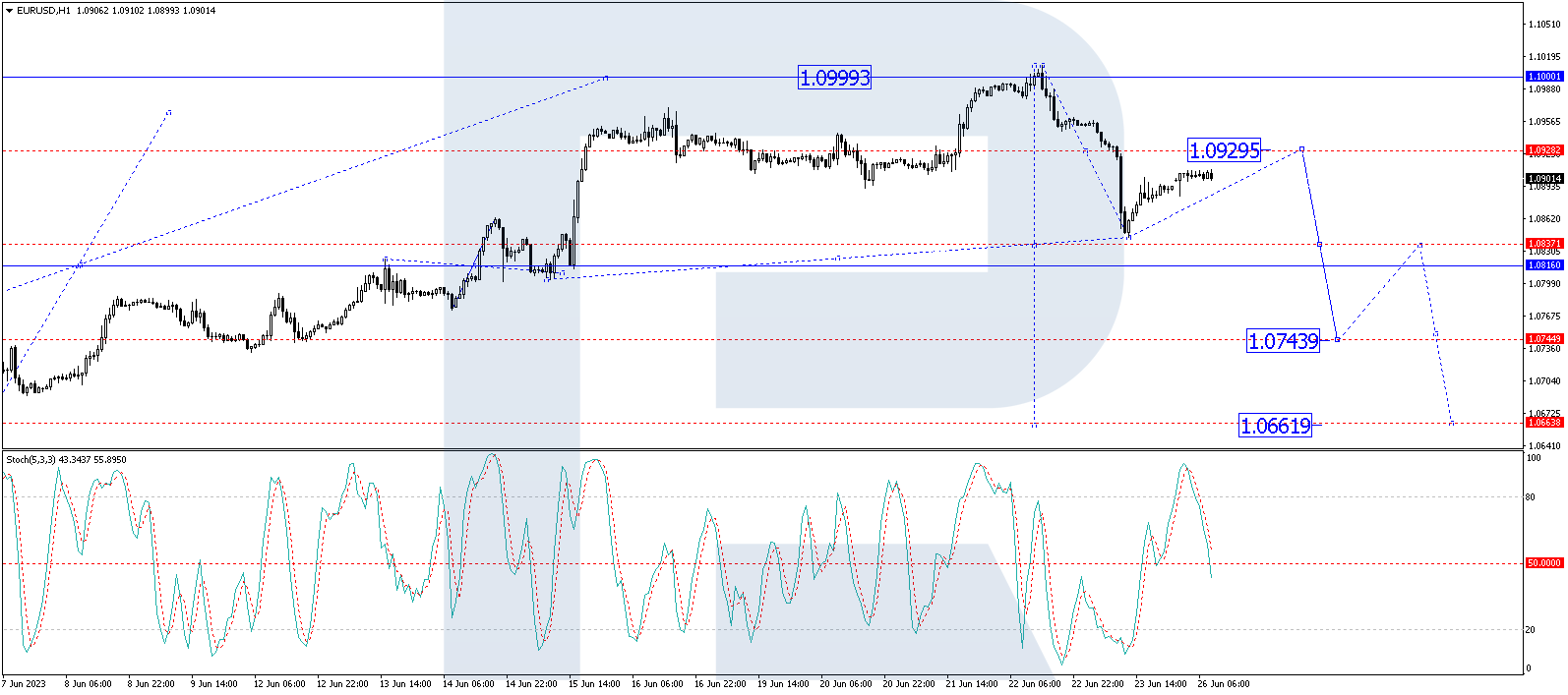
The EUR remains at a low level, with the most traded currency pair in the market staying near 1.0730 on Monday.

Investors continue to focus on the issue of raising the US public debt limit. There are discussions underway between Congress and the White House regarding a framework agreement on increasing the debt ceiling.

It is expected that Republicans will agree to raise the borrowing limits by 4 trillion USD over two years if the Democrats allow for restrictions on non-defense spending in 2024.

As it is a public holiday in the US on Monday, official news is anticipated in the coming days. This week, the country will release important statistics, including labor market indicators for May.

Technical analysis:

On the H4 timeframe, EUR/USD has completed a downward wave, reaching 1.0701. Currently, the market is correcting towards 1.0760. After the correction, a decline to 1.0730 can be expected. It is possible for a consolidation range to form around 1.0730. If the price breaks out of the range upwards, the correction might continue towards 1.0804, which is the initial target. This scenario is technically supported by the MACD, as its signal line is currently at lows below zero and preparing to rise towards the zero mark.

On the H1 timeframe, EUR/USD experienced a downward wave, reaching 1.0701. The market has made an upward impulse towards 1.0730 and is currently forming a consolidation range around this level. A potential upward structure might develop towards 1.0744, which is a local target. Once the price reaches this level, a decline to 1.0730 followed by a rise to 1.0760 is expected. The Stochastic oscillator confirms this scenario, as its signal line is near 80. A decline to 50 could occur today, after which a rise towards 80 may follow.

Disclaimer

Any forecasts contained herein are based on the author’s particular opinion. This analysis may not be treated as trading advice. RoboForex bears no responsibility for trading results based on trading recommendations and reviews contained herein.

Currency Speculators drop Japanese Yen bets to 30-week low

By InvestMacro

Here are the latest charts and statistics for the Commitment of Traders (COT) data published by the Commodities Futures Trading Commission (CFTC).

The latest COT data is updated through Tuesday May 23rd and shows a quick view of how large market participants (for-profit speculators and commercial traders) were positioned in the futures markets. All currency positions are in direct relation to the US dollar where, for example, a bet for the euro is a bet that the euro will rise versus the dollar while a bet against the euro will be a bet that the euro will decline versus the dollar.

Weekly Speculator Changes led by the Australian Dollar & Mexican Peso

The COT currency market speculator bets were lower this week as five out of the eleven currency markets we cover had higher positioning while the other six markets had lower speculator contracts.

Leading the gains for the currency markets was the Australian Dollar (4,513 contracts) with the Mexican Peso (3,308 contracts), US Dollar Index (1,726 contracts), New Zealand Dollar (1,712 contracts) and the Swiss Franc (956 contracts) also showing positive weeks.

The currencies seeing declines in speculator bets on the week were the Japanese Yen (-15,869 contracts), EuroFX (-13,353 contracts), Canadian Dollar (-5,536 contracts), British Pound (-1,004 contracts), Brazilian Real (-914 contracts) and Bitcoin (-118 contracts) also registering lower bets on the week.

Speculators drop Japanese Yen bets to 30-week low

Highlighting the COT currency’s data this week is the renewed weakness of the speculator’s positioning for the Japanese yen.

Large speculative yen positions dropped this week by -15,869 net contracts and fell for the second week in a row. Over the past fifteen weeks, yen speculator bets have declined in eight of those weeks and a total of -51,571 contracts has been added to the bearish standing.

This week’s yen net position of -80,660 contracts marks the most bearish level of the past 30 weeks, dating back to October. From November to late-January, the yen positions had started to improve and started to shed bearish bets. The spec position saw improving positions in 10 out of 12 weeks through January 31st and this improvement brought the overall net position down to just -20,060 contracts. Since then, however, bearish bets have steadily risen and culminated in this week’s 30-week high.

The yen futures price is also back in a downtrend after rising approximately 17 percent from the most recent bottom in October to the most recent top in January. The yen futures have now fallen for three straight weeks and for six out of the past seven weeks with this week’s closing price at 0.0071 and at the lowest level since November.


Data Snapshot of Forex Market Traders | Columns Legend
May-23-2023OIOI-IndexSpec-NetSpec-IndexCom-NetCOM-IndexSmalls-NetSmalls-Index
USD Index30,2032411,24044-13,869542,62945
EUR781,12384173,73685-224,1951550,45959
GBP237,6146011,58979-16,676235,08768
JPY226,40064-80,6601992,37881-11,71830
CHF44,80852-903521,69148-78855
CAD159,19936-48,526949,14090-61421
AUD180,13874-49,0813960,04364-10,96226
NZD39,01132-36353-5564591961
MXN233,5384976,943100-82,61605,67383
RUB20,93047,54331-7,15069-39324
BRL53,2234432,69277-36,671203,97976
Bitcoin13,0435689393-1,245035221


Strength Scores led by Mexican Peso & Bitcoin

COT Strength Scores (a normalized measure of Speculator positions over a 3-Year range, from 0 to 100 where above 80 is Extreme-Bullish and below 20 is Extreme-Bearish) showed that the Mexican Peso (100 percent) and Bitcoin (93 percent) lead the currency markets this week. The EuroFX (85 percent), British Pound (79 percent) and the Brazilian Real (77 percent) come in as the next highest in the weekly strength scores.

On the downside, the Canadian Dollar (9 percent) and the Japanese Yen (19 percent) come in at the lowest strength levels currently and are in Extreme-Bearish territory (below 20 percent). The next lowest strength scores are the Australian Dollar (39 percent) and the US Dollar Index (44 percent).

Strength Statistics:
US Dollar Index (43.7 percent) vs US Dollar Index previous week (40.8 percent)
EuroFX (85.3 percent) vs EuroFX previous week (90.5 percent)
British Pound Sterling (79.0 percent) vs British Pound Sterling previous week (79.8 percent)
Japanese Yen (19.2 percent) vs Japanese Yen previous week (29.0 percent)
Swiss Franc (52.2 percent) vs Swiss Franc previous week (49.7 percent)
Canadian Dollar (9.3 percent) vs Canadian Dollar previous week (14.5 percent)
Australian Dollar (39.3 percent) vs Australian Dollar previous week (35.1 percent)
New Zealand Dollar (52.6 percent) vs New Zealand Dollar previous week (48.0 percent)
Mexican Peso (100.0 percent) vs Mexican Peso previous week (97.7 percent)
Brazilian Real (77.4 percent) vs Brazilian Real previous week (78.5 percent)
Bitcoin (92.5 percent) vs Bitcoin previous week (94.6 percent)


Bitcoin & Brazilian Real top the 6-Week Strength Trends

COT Strength Score Trends (or move index, calculates the 6-week changes in strength scores) showed that the Bitcoin (35 percent) and the Brazilian Real (25 percent) lead the past six weeks trends for the currencies. The Swiss Franc (15 percent), the British Pound (12 percent) and the Mexican Peso (12 percent) are the next highest positive movers in the latest trends data.

The Japanese Yen (-14 percent) leads the downside trend scores currently with the Australian Dollar (-10 percent) and the US Dollar Index (-3 percent) following next with lower trend scores.

Strength Trend Statistics:
US Dollar Index (-3.4 percent) vs US Dollar Index previous week (-7.7 percent)
EuroFX (4.0 percent) vs EuroFX previous week (16.8 percent)
British Pound Sterling (12.0 percent) vs British Pound Sterling previous week (23.5 percent)
Japanese Yen (-14.4 percent) vs Japanese Yen previous week (-4.8 percent)
Swiss Franc (15.4 percent) vs Swiss Franc previous week (16.2 percent)
Canadian Dollar (7.5 percent) vs Canadian Dollar previous week (14.5 percent)
Australian Dollar (-10.3 percent) vs Australian Dollar previous week (-24.4 percent)
New Zealand Dollar (11.2 percent) vs New Zealand Dollar previous week (5.3 percent)
Mexican Peso (11.7 percent) vs Mexican Peso previous week (11.1 percent)
Brazilian Real (25.1 percent) vs Brazilian Real previous week (24.9 percent)
Bitcoin (35.1 percent) vs Bitcoin previous week (28.4 percent)


Individual COT Forex Markets:

US Dollar Index Futures:
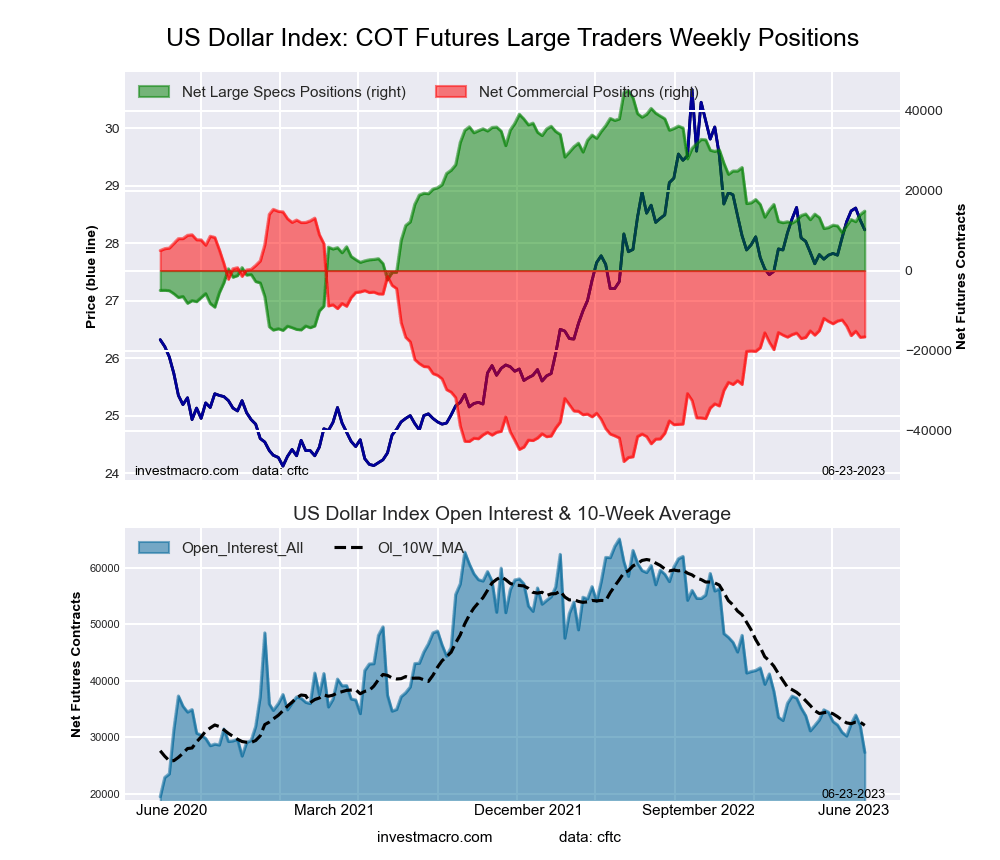
US Dollar Index Forex Futures COT ChartThe US Dollar Index large speculator standing this week came in at a net position of 11,240 contracts in the data reported through Tuesday. This was a weekly increase of 1,726 contracts from the previous week which had a total of 9,514 net contracts.

This week’s current strength score (the trader positioning range over the past three years, measured from 0 to 100) shows the speculators are currently Bearish with a score of 43.7 percent. The commercials are Bullish with a score of 53.7 percent and the small traders (not shown in chart) are Bearish with a score of 45.3 percent.

US DOLLAR INDEX StatisticsSPECULATORSCOMMERCIALSSMALL TRADERS
– Percent of Open Interest Longs:73.52.817.9
– Percent of Open Interest Shorts:36.348.89.2
– Net Position:11,240-13,8692,629
– Gross Longs:22,1948595,398
– Gross Shorts:10,95414,7282,769
– Long to Short Ratio:2.0 to 10.1 to 11.9 to 1
NET POSITION TREND:
– Strength Index Score (3 Year Range Pct):43.753.745.3
– Strength Index Reading (3 Year Range):BearishBullishBearish
NET POSITION MOVEMENT INDEX:
– 6-Week Change in Strength Index:-3.41.89.6


Euro Currency Futures:

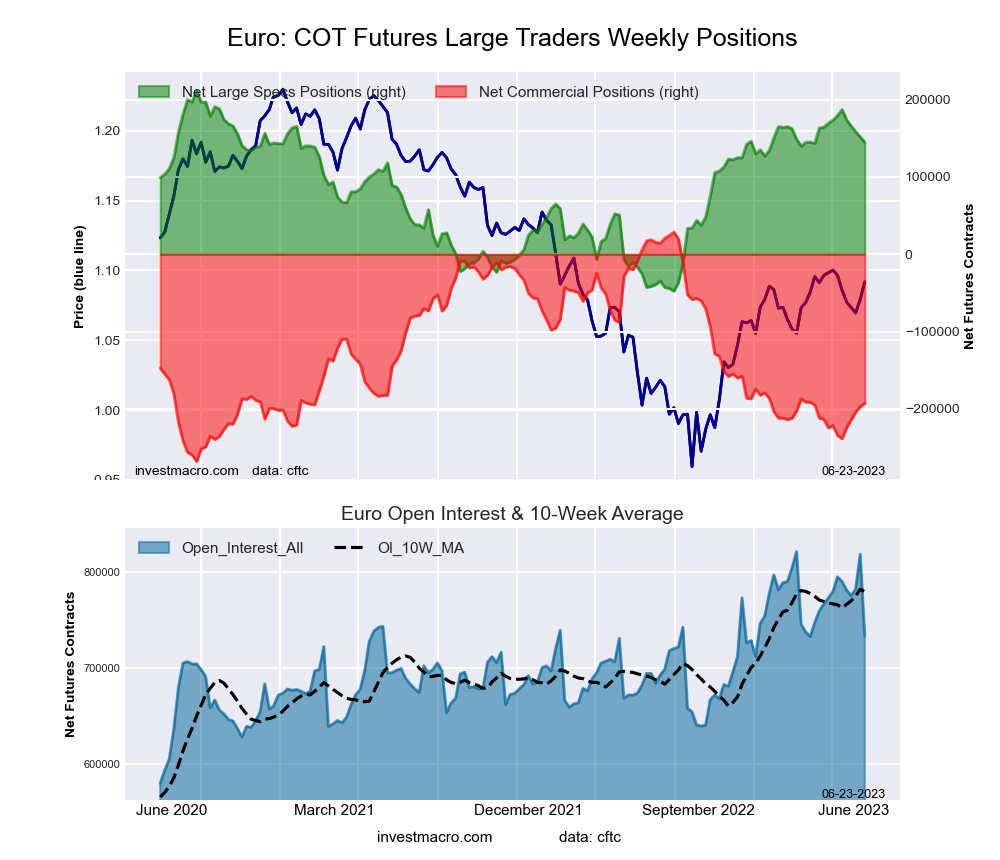
Euro Currency Futures COT ChartThe Euro Currency large speculator standing this week came in at a net position of 173,736 contracts in the data reported through Tuesday. This was a weekly reduction of -13,353 contracts from the previous week which had a total of 187,089 net contracts.

This week’s current strength score (the trader positioning range over the past three years, measured from 0 to 100) shows the speculators are currently Bullish-Extreme with a score of 85.3 percent. The commercials are Bearish-Extreme with a score of 14.8 percent and the small traders (not shown in chart) are Bullish with a score of 59.5 percent.

EURO Currency StatisticsSPECULATORSCOMMERCIALSSMALL TRADERS
– Percent of Open Interest Longs:32.053.511.8
– Percent of Open Interest Shorts:9.882.25.3
– Net Position:173,736-224,19550,459
– Gross Longs:250,070418,07192,077
– Gross Shorts:76,334642,26641,618
– Long to Short Ratio:3.3 to 10.7 to 12.2 to 1
NET POSITION TREND:
– Strength Index Score (3 Year Range Pct):85.314.859.5
– Strength Index Reading (3 Year Range):Bullish-ExtremeBearish-ExtremeBullish
NET POSITION MOVEMENT INDEX:
– 6-Week Change in Strength Index:4.0-4.12.8


British Pound Sterling Futures:

British Pound Sterling Futures COT ChartThe British Pound Sterling large speculator standing this week came in at a net position of 11,589 contracts in the data reported through Tuesday. This was a weekly fall of -1,004 contracts from the previous week which had a total of 12,593 net contracts.

This week’s current strength score (the trader positioning range over the past three years, measured from 0 to 100) shows the speculators are currently Bullish with a score of 79.0 percent. The commercials are Bearish with a score of 22.8 percent and the small traders (not shown in chart) are Bullish with a score of 68.0 percent.

BRITISH POUND StatisticsSPECULATORSCOMMERCIALSSMALL TRADERS
– Percent of Open Interest Longs:29.151.913.1
– Percent of Open Interest Shorts:24.258.910.9
– Net Position:11,589-16,6765,087
– Gross Longs:69,203123,34831,097
– Gross Shorts:57,614140,02426,010
– Long to Short Ratio:1.2 to 10.9 to 11.2 to 1
NET POSITION TREND:
– Strength Index Score (3 Year Range Pct):79.022.868.0
– Strength Index Reading (3 Year Range):BullishBearishBullish
NET POSITION MOVEMENT INDEX:
– 6-Week Change in Strength Index:12.0-7.7-5.2


Japanese Yen Futures:

Japanese Yen Forex Futures COT ChartThe Japanese Yen large speculator standing this week came in at a net position of -80,660 contracts in the data reported through Tuesday. This was a weekly decline of -15,869 contracts from the previous week which had a total of -64,791 net contracts.

This week’s current strength score (the trader positioning range over the past three years, measured from 0 to 100) shows the speculators are currently Bearish-Extreme with a score of 19.2 percent. The commercials are Bullish-Extreme with a score of 80.7 percent and the small traders (not shown in chart) are Bearish with a score of 29.6 percent.

JAPANESE YEN StatisticsSPECULATORSCOMMERCIALSSMALL TRADERS
– Percent of Open Interest Longs:16.269.612.2
– Percent of Open Interest Shorts:51.928.817.4
– Net Position:-80,66092,378-11,718
– Gross Longs:36,760157,49827,680
– Gross Shorts:117,42065,12039,398
– Long to Short Ratio:0.3 to 12.4 to 10.7 to 1
NET POSITION TREND:
– Strength Index Score (3 Year Range Pct):19.280.729.6
– Strength Index Reading (3 Year Range):Bearish-ExtremeBullish-ExtremeBearish
NET POSITION MOVEMENT INDEX:
– 6-Week Change in Strength Index:-14.417.6-25.5


Swiss Franc Futures:

Swiss Franc Forex Futures COT ChartThe Swiss Franc large speculator standing this week came in at a net position of -903 contracts in the data reported through Tuesday. This was a weekly increase of 956 contracts from the previous week which had a total of -1,859 net contracts.

This week’s current strength score (the trader positioning range over the past three years, measured from 0 to 100) shows the speculators are currently Bullish with a score of 52.2 percent. The commercials are Bearish with a score of 47.8 percent and the small traders (not shown in chart) are Bullish with a score of 54.9 percent.

SWISS FRANC StatisticsSPECULATORSCOMMERCIALSSMALL TRADERS
– Percent of Open Interest Longs:22.940.930.5
– Percent of Open Interest Shorts:24.937.132.3
– Net Position:-9031,691-788
– Gross Longs:10,26718,32813,674
– Gross Shorts:11,17016,63714,462
– Long to Short Ratio:0.9 to 11.1 to 10.9 to 1
NET POSITION TREND:
– Strength Index Score (3 Year Range Pct):52.247.854.9
– Strength Index Reading (3 Year Range):BullishBearishBullish
NET POSITION MOVEMENT INDEX:
– 6-Week Change in Strength Index:15.4-13.37.5


Canadian Dollar Futures:

Canadian Dollar Forex Futures COT ChartThe Canadian Dollar large speculator standing this week came in at a net position of -48,526 contracts in the data reported through Tuesday. This was a weekly decline of -5,536 contracts from the previous week which had a total of -42,990 net contracts.

This week’s current strength score (the trader positioning range over the past three years, measured from 0 to 100) shows the speculators are currently Bearish-Extreme with a score of 9.3 percent. The commercials are Bullish-Extreme with a score of 89.6 percent and the small traders (not shown in chart) are Bearish with a score of 21.4 percent.

CANADIAN DOLLAR StatisticsSPECULATORSCOMMERCIALSSMALL TRADERS
– Percent of Open Interest Longs:12.865.119.6
– Percent of Open Interest Shorts:43.334.219.9
– Net Position:-48,52649,140-614
– Gross Longs:20,388103,59731,126
– Gross Shorts:68,91454,45731,740
– Long to Short Ratio:0.3 to 11.9 to 11.0 to 1
NET POSITION TREND:
– Strength Index Score (3 Year Range Pct):9.389.621.4
– Strength Index Reading (3 Year Range):Bearish-ExtremeBullish-ExtremeBearish
NET POSITION MOVEMENT INDEX:
– 6-Week Change in Strength Index:7.5-6.22.2


Australian Dollar Futures:

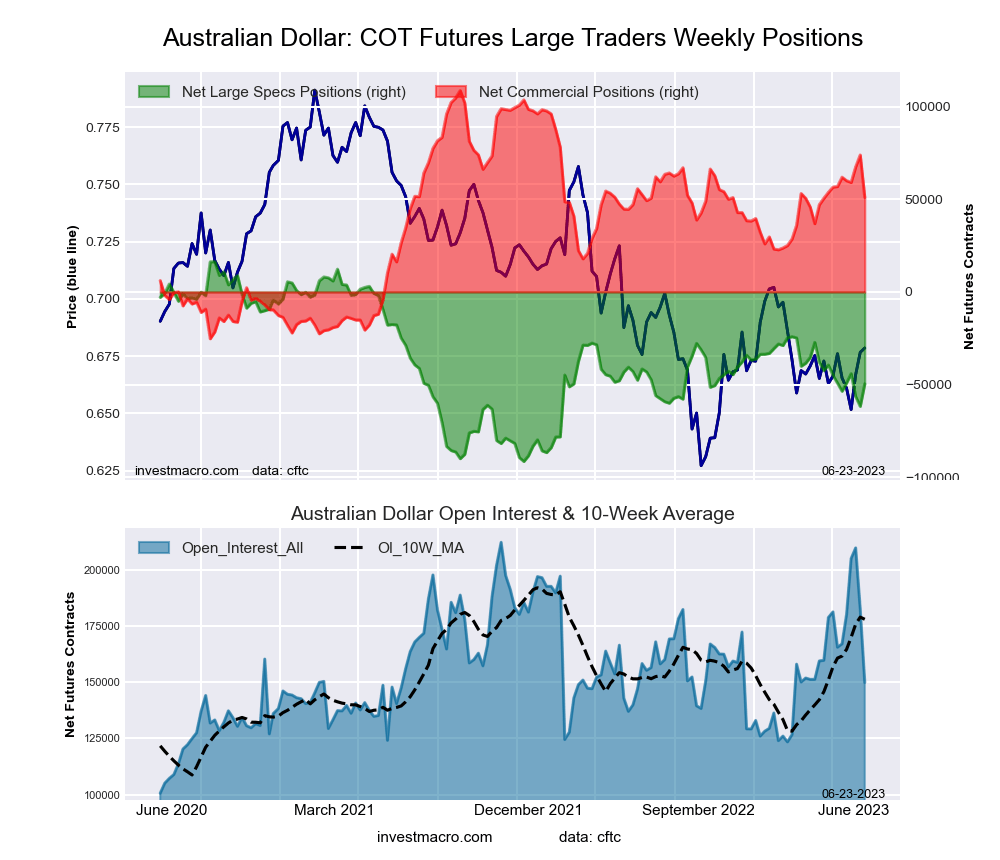
Australian Dollar Forex Futures COT ChartThe Australian Dollar large speculator standing this week came in at a net position of -49,081 contracts in the data reported through Tuesday. This was a weekly rise of 4,513 contracts from the previous week which had a total of -53,594 net contracts.

This week’s current strength score (the trader positioning range over the past three years, measured from 0 to 100) shows the speculators are currently Bearish with a score of 39.3 percent. The commercials are Bullish with a score of 63.7 percent and the small traders (not shown in chart) are Bearish with a score of 25.7 percent.

AUSTRALIAN DOLLAR StatisticsSPECULATORSCOMMERCIALSSMALL TRADERS
– Percent of Open Interest Longs:29.756.710.6
– Percent of Open Interest Shorts:56.923.316.7
– Net Position:-49,08160,043-10,962
– Gross Longs:53,419102,07919,057
– Gross Shorts:102,50042,03630,019
– Long to Short Ratio:0.5 to 12.4 to 10.6 to 1
NET POSITION TREND:
– Strength Index Score (3 Year Range Pct):39.363.725.7
– Strength Index Reading (3 Year Range):BearishBullishBearish
NET POSITION MOVEMENT INDEX:
– 6-Week Change in Strength Index:-10.39.7-4.5


New Zealand Dollar Futures:

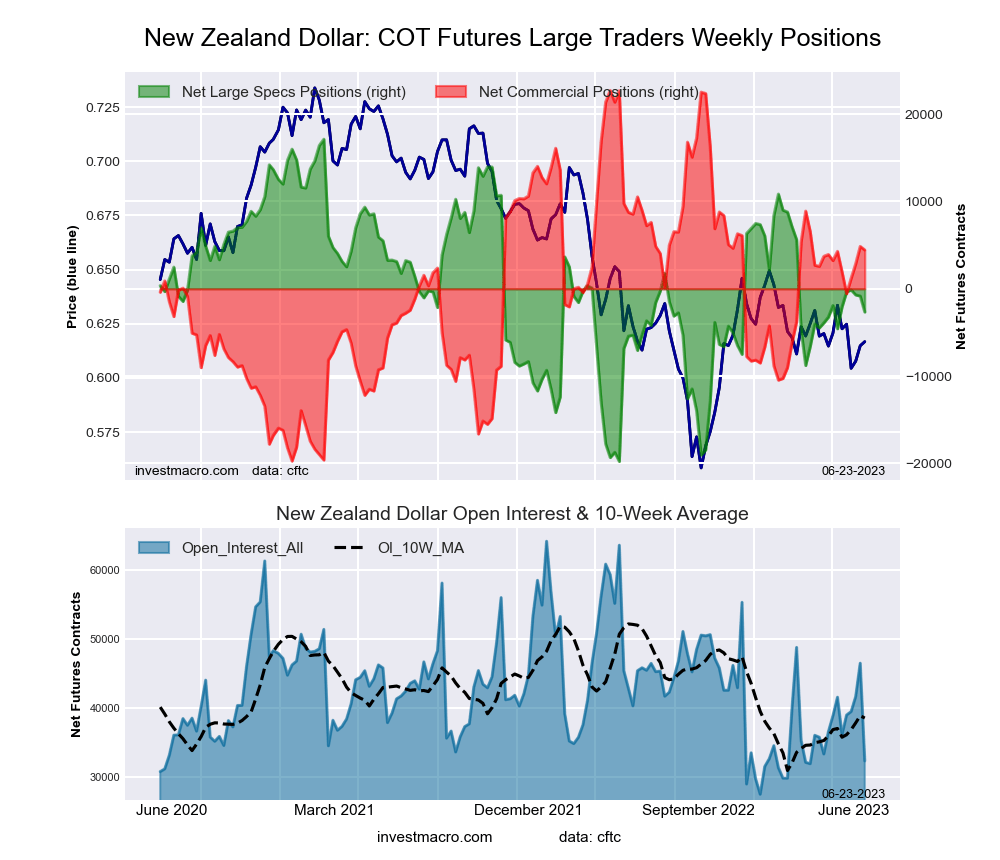
New Zealand Dollar Forex Futures COT ChartThe New Zealand Dollar large speculator standing this week came in at a net position of -363 contracts in the data reported through Tuesday. This was a weekly rise of 1,712 contracts from the previous week which had a total of -2,075 net contracts.

This week’s current strength score (the trader positioning range over the past three years, measured from 0 to 100) shows the speculators are currently Bullish with a score of 52.6 percent. The commercials are Bearish with a score of 45.2 percent and the small traders (not shown in chart) are Bullish with a score of 60.9 percent.

NEW ZEALAND DOLLAR StatisticsSPECULATORSCOMMERCIALSSMALL TRADERS
– Percent of Open Interest Longs:42.745.810.3
– Percent of Open Interest Shorts:43.647.28.0
– Net Position:-363-556919
– Gross Longs:16,64817,8544,036
– Gross Shorts:17,01118,4103,117
– Long to Short Ratio:1.0 to 11.0 to 11.3 to 1
NET POSITION TREND:
– Strength Index Score (3 Year Range Pct):52.645.260.9
– Strength Index Reading (3 Year Range):BullishBearishBullish
NET POSITION MOVEMENT INDEX:
– 6-Week Change in Strength Index:11.2-7.4-11.8


Mexican Peso Futures:

Mexican Peso Futures COT ChartThe Mexican Peso large speculator standing this week came in at a net position of 76,943 contracts in the data reported through Tuesday. This was a weekly gain of 3,308 contracts from the previous week which had a total of 73,635 net contracts.

This week’s current strength score (the trader positioning range over the past three years, measured from 0 to 100) shows the speculators are currently Bullish-Extreme with a score of 100.0 percent. The commercials are Bearish-Extreme with a score of 0.0 percent and the small traders (not shown in chart) are Bullish-Extreme with a score of 82.6 percent.

MEXICAN PESO StatisticsSPECULATORSCOMMERCIALSSMALL TRADERS
– Percent of Open Interest Longs:50.845.63.5
– Percent of Open Interest Shorts:17.881.01.1
– Net Position:76,943-82,6165,673
– Gross Longs:118,579106,5418,155
– Gross Shorts:41,636189,1572,482
– Long to Short Ratio:2.8 to 10.6 to 13.3 to 1
NET POSITION TREND:
– Strength Index Score (3 Year Range Pct):100.00.082.6
– Strength Index Reading (3 Year Range):Bullish-ExtremeBearish-ExtremeBullish-Extreme
NET POSITION MOVEMENT INDEX:
– 6-Week Change in Strength Index:11.7-11.67.1


Brazilian Real Futures:

Brazil Real Futures COT ChartThe Brazilian Real large speculator standing this week came in at a net position of 32,692 contracts in the data reported through Tuesday. This was a weekly fall of -914 contracts from the previous week which had a total of 33,606 net contracts.

This week’s current strength score (the trader positioning range over the past three years, measured from 0 to 100) shows the speculators are currently Bullish with a score of 77.4 percent. The commercials are Bearish-Extreme with a score of 19.5 percent and the small traders (not shown in chart) are Bullish with a score of 75.6 percent.

BRAZIL REAL StatisticsSPECULATORSCOMMERCIALSSMALL TRADERS
– Percent of Open Interest Longs:72.117.010.8
– Percent of Open Interest Shorts:10.785.93.3
– Net Position:32,692-36,6713,979
– Gross Longs:38,3719,0745,736
– Gross Shorts:5,67945,7451,757
– Long to Short Ratio:6.8 to 10.2 to 13.3 to 1
NET POSITION TREND:
– Strength Index Score (3 Year Range Pct):77.419.575.6
– Strength Index Reading (3 Year Range):BullishBearish-ExtremeBullish
NET POSITION MOVEMENT INDEX:
– 6-Week Change in Strength Index:25.1-27.218.6


Bitcoin Futures:

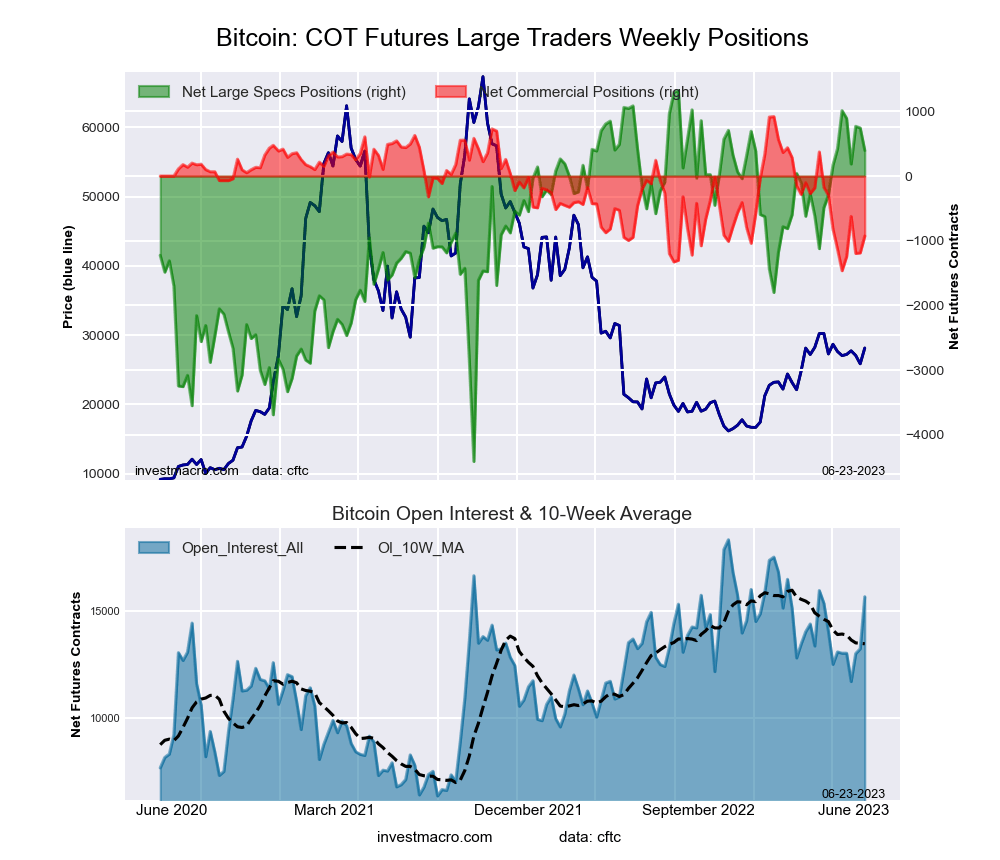
Bitcoin Crypto Futures COT ChartThe Bitcoin large speculator standing this week came in at a net position of 893 contracts in the data reported through Tuesday. This was a weekly lowering of -118 contracts from the previous week which had a total of 1,011 net contracts.

This week’s current strength score (the trader positioning range over the past three years, measured from 0 to 100) shows the speculators are currently Bullish-Extreme with a score of 92.5 percent. The commercials are Bearish-Extreme with a score of 9.1 percent and the small traders (not shown in chart) are Bearish with a score of 20.9 percent.

BITCOIN StatisticsSPECULATORSCOMMERCIALSSMALL TRADERS
– Percent of Open Interest Longs:77.61.39.3
– Percent of Open Interest Shorts:70.810.86.6
– Net Position:893-1,245352
– Gross Longs:10,1241681,207
– Gross Shorts:9,2311,413855
– Long to Short Ratio:1.1 to 10.1 to 11.4 to 1
NET POSITION TREND:
– Strength Index Score (3 Year Range Pct):92.59.120.9
– Strength Index Reading (3 Year Range):Bullish-ExtremeBearish-ExtremeBearish
NET POSITION MOVEMENT INDEX:
– 6-Week Change in Strength Index:35.1-67.9-9.0


Article By InvestMacroReceive our weekly COT Newsletter

*COT Report: The COT data, released weekly to the public each Friday, is updated through the most recent Tuesday (data is 3 days old) and shows a quick view of how large speculators or non-commercials (for-profit traders) were positioned in the futures markets.

The CFTC categorizes trader positions according to commercial hedgers (traders who use futures contracts for hedging as part of the business), non-commercials (large traders who speculate to realize trading profits) and nonreportable traders (usually small traders/speculators) as well as their open interest (contracts open in the market at time of reporting). See CFTC criteria here.

Mid-Week Technical Outlook: Market Mashup

By ForexTime

It is certainly shaping up to be another wild week for financial markets thanks to the US debt limit saga. The risk pendulum continues to swing back and forth on this major development with volatility expected to intensify as the so-called default X-date looms.

Markets could be injected with even more volatility thanks to geopolitical tensions, growth concerns, and more data from major economies. Later today, investors will direct their attention towards the minutes from the May FOMC meeting which could offer more clues about the central bank’s next move.

Here are some technical setups to keep an eye on ahead of the Fed minutes.

Dollar holds firm

The dollar has been trading a little firmer despite the impasse in US debt-ceiling negotiations. Bulls seem to be drawing strength from hawkish Fed speakers and technical forces. Prices have turned bullish on the daily charts with support found at 103.00. The upside momentum has already taken prices towards 103.80 with 104.00 the next key level of interest.

EURUSD breakdown alert?

The EURUSD remains bearish on the daily charts with bears grinding down the 1.0760 support level. A solid daily close below this point could signal a decline toward 1.0686. Should bulls push back above 1.8110 – where the 100-day SMA resides, this could open a path back toward 1.0845 and 50-day SMA at 1.0900.

GBPUSD wobbles above 1.2370

Sterling seems to be under pressure despite the UK inflation figures printing higher than expected. A solid breakdown below the 1.2370 level could open a path toward 1.2280. Should 1.2370 prove to be reliable support, prices may rebound back toward 1.2550.

AUDUSD poised to sink further?

The AUDUSD has smashed into the 0.6570 support level. A breakdown below this point may see 0.6480. If bulls are able to defend 0.6570, prices could rebound toward 0.6630.

NZDUSD breaches key support

Our trade of the week (NZDUSD), tumbled this morning after the Reserve Bank of New Zealand hiked rates by 25 basis points and signalled that it could be done with rate hikes. Prices are trading below the 200-day SMA as of writing and could hit 0.6100 in the short term. Below this level may see the NZDUSD hit levels not seen since November 2022 around 0.6070.

USDJPY upwards and onwards

After creating a fresh higher low of around 137.40, USDJPY bulls continue to eye higher levels. Further upside could be expected if a solid daily close above 139.00 is achieved. If prices slip back below 137.40, tough support around the 200-day SMA may limit downside losses.

SPX500_m trapped in wide range.

The index remains trapped within a range with support at 4050 and resistance at 4200. A potent fundamental catalyst may be needed for prices to experience a bullish or bearish breakout.

Gold approaches 50-day SMA

Gold remains heavily influenced by fundamental forces. Prices are choppy and noisy on the daily timeframe. Should $1970 prove to be reliable support, the upside could take prices towards the 50-day SMA and psychological $2000 level. If prices dip back under $1970, gold may see $1945.


Forex-Time-LogoArticle by ForexTime

ForexTime Ltd (FXTM) is an award winning international online forex broker regulated by CySEC 185/12 www.forextime.com

JPY plunged into devaluation again. Overview for 23.05.2023

By RoboForex.com

The Japanese yen, paired with the US dollar, continues to decline. The current USDJPY quote is 138.37.

The strong US dollar, which is in demand as a safe haven asset, is having a remarkable influence on the Japanese yen.

Fresh Japanese statistics have attracted attention. The PMI report turned out positive: the services sector is reviving thanks to the rebound of the tourist flow into the country. Activity is also increasing in the manufacturing sector.

Both reports are favourable for Japan’s economy, which is still lagging behind its global counterparts in terms of recovery. Providers of services report noticeable demand and a record increase in business activity. Service-oriented businesses rebounded noticeably after Japan lifted restrictions on the entry of foreign tourists to the country.

Earlier, Japan presented its first-quarter GDP report, which also turned out favourable. It is clear that the Japanese economy has gained momentum. This could eventually be a good signal for the JPY.

Article By RoboForex.com

Attention!
Forecasts presented in this section only reflect the author’s private opinion and should not be considered as guidance for trading. RoboForex LP bears no responsibility for trading results based on trading recommendations described in these analytical reviews.

Trade Of The Week: 3 Reasons Why NZDUSD Could Breakout

By ForexTime

This could be a wild week for the New Zealand Dollar thanks to fundamental and technical forces.

The New Zealand dollar is the best-performing G10 currency month-to-date, gaining roughly 1.7% against the dollar.

On the fundamental side, the NZD bulls continue to draw support from expectations around a 25-basis point hike by the Reserve Bank of New Zealand (RBNZ) at its May meeting. Taking a glance at the technicals, prices remain trapped within a wide range with key support at 0.6150 where the 200-day SMA resides while resistance is just above the 100-day SMA at 0.6320.

A major breakout could be on the horizon for the NZDUSD and here are 3 reasons why…

  1. Reserve Bank of New Zealand rate decision

Markets widely expect the RBNZ to raise interest rates by 25bps, taking the cash rate to 5.5%. This would be the highest among G10 nations and 12th straight increase.

Although inflationary pressures slightly cooled in the first quarter of 2023, policymakers still see more upside risks due to severe weather events. Investors will also keep a close on the bank’s new projections for growth and inflation which could offer fresh insight into the RBNZ’s next move. Any hawkish bias has the potential to strengthen NZD bulls.

  • Buying sentiment towards the New Zealand dollar may receive a boost if the RBNZ moves ahead with the expected 25 bps rate hike and signals further increases. This may push the NZDUSD towards the 0.6380 resistance.
  • If the RBNZ shocks market with a 50-basis point hike like what was witnessed back in April, this could send the NZD surging across the board, pushing prices beyond 0.6830.
  1. Extreme dollar volatility

This could be an explosively volatile trading week for the US dollar thanks to the US debt limit negotiations, Fed minutes, speeches, and key US economic data.

Despite the recent news around debt limit talks resuming on Monday, investors are likely to remain jittery as the window to strike a deal shrinks by the day. The Fed minutes and speeches from policymakers could provide more clues about the central bank’s next move. On top of this, much attention will be on the Fed’s preferred inflation gauge, the Core Personal Consumption Expenditure – especially after the central bank stressed that incoming data would influence monetary policy decisions. With so many forces influencing the dollar, this could translate to heightened volatility.

  • If dollar bulls dominate the scene this week, this could see the NZDUSD decline back toward the 200-day simple moving average at 0.6150.
  • Should all the combined forces translate to a weaker dollar, the New Zealand dollar has a stronger potential to experience a bullish breakout.
  1. NZDUSD in breakout mode?

The NZDUSD has been trapped within a wide range since early February 2023.

The first major resistance can be found at 0.6380 and secondary resistance at 0.6310. Looking at support levels, there is strong support at 0.6150, followed by another level of defence at 0.6100. It seems that the currency pair needs a potent fundamental spark to experience a strong breakout from this current range.

Should bulls seize the driving seat this week, prices could experience a breakout above 0.6310 and 0.6380, respectively. A weekly close above 0.6380 could signal a further incline toward 0.6460. Alternatively, if 0.6310 proves to be reliable resistance, bears may target the 0.6150 support – where the 200-day SMA resides and 0.6100.


Forex-Time-LogoArticle by ForexTime

ForexTime Ltd (FXTM) is an award winning international online forex broker regulated by CySEC 185/12 www.forextime.com
Currency Speculators raise British Pound bullish bets for 6th time in 7 weeks

By InvestMacro

Here are the latest charts and statistics for the Commitment of Traders (COT) data published by the Commodities Futures Trading Commission (CFTC).

The latest COT data is updated through Tuesday May 16th and shows a quick view of how large market participants (for-profit speculators and commercial traders) were positioned in the futures markets. All currency positions are in direct relation to the US dollar where, for example, a bet for the euro is a bet that the euro will rise versus the dollar while a bet against the euro will be a bet that the euro will decline versus the dollar.

Weekly Speculator Changes led by British Pound & EuroFX

The COT currency market speculator bets were higher this week as six out of the eleven currency markets we cover had higher positioning while the other five markets had lower speculator contracts.

Leading the gains for the currency markets was the British Pound (8,065 contracts) with the EuroFX (7,667 contracts), Mexican Peso (3,603 contracts), Swiss Franc (2,608 contracts), New Zealand Dollar (2,506 contracts) and Bitcoin (588 contracts) also showing positive weeks.

The currencies seeing declines in speculator bets on the week were the Australian Dollar (-4,401 contracts), the Japanese Yen (-3,776 contracts), the US Dollar Index (-1,642 contracts), Canadian Dollar (-727 contracts) and the Brazilian Real (-988 contracts) also registering lower bets on the week.

Speculators raise British Pound bullish bets for 6th time in 7 weeks

Highlighting the COT currency’s data this week is the rising bullishness of the speculator’s positioning in the British pound sterling. Large speculative pound Sterling positions gained this week for a second consecutive week and for the sixth time in the past seven weeks.

Sterling weekly positions have now increased by a total of +36,677 contracts over the past seven-week period. This bullish turn in bets has taken the overall net speculator position from a total of -24,084 contracts on March 28th to a total of +12,593 contracts this week, the best level since November of 2021. The sterling position has been in a bullish level for five straight weeks after a streak of sixty straight weeks in bearish territory through April 11th.

The sterling’s front-month future’s price has been on the uptrend since bottoming in September with a low at the 1.0392 exchange rate. This week’s closing price of 1.2457 is approximately 20 percent higher than that September low.

Helping boost the sterling in recent months is the rising interest rate as the Bank of England increased it’s Bank Rate to 4.5 percent at the May 11th meeting. The inflation rate in the UK currently is right around 10 percent (with a target of 2 percent) and investor’s are expecting more rate rises to come, according to ING.


Data Snapshot of Forex Market Traders | Columns Legend
May-16-2023OIOI-IndexSpec-NetSpec-IndexCom-NetCOM-IndexSmalls-NetSmalls-Index
USD Index30,880259,51441-12,357562,84348
EUR789,93088187,08990-238,3331051,24461
GBP247,1656612,59380-17,729225,13668
JPY200,51547-64,7912976,13773-11,34630
CHF43,68148-1,859502,83850-97954
CAD161,19538-42,9901444,53386-1,54319
AUD167,02063-53,5943561,90265-8,30832
NZD36,18724-2,075481,9435113252
MXN254,0375773,635100-79,46505,83092
RUB20,93047,54331-7,15069-39324
BRL50,6334033,60679-36,899193,29370
Bitcoin13,043561,01195-1,463045223


Strength Scores led by Mexican Peso & Bitcoin

COT Strength Scores (a normalized measure of Speculator positions over a 3-Year range, from 0 to 100 where above 80 is Extreme-Bullish and below 20 is Extreme-Bearish) showed that the Mexican Peso (100 percent) and the Bitcoin (95 percent) lead the currency markets this week. The EuroFX (90 percent), British Pound (80 percent) and the Brazilian Real (79 percent) come in as the next highest in the weekly strength scores.

On the downside, the Canadian Dollar (14 percent) comes in at the lowest strength levels currently and is in Extreme-Bearish territory (below 20 percent). The next lowest strength scores are the Japanese Yen (29 percent) and the Australian Dollar (35 percent).

Strength Statistics:
US Dollar Index (40.8 percent) vs US Dollar Index previous week (43.5 percent)
EuroFX (90.5 percent) vs EuroFX previous week (87.5 percent)
British Pound Sterling (79.8 percent) vs British Pound Sterling previous week (72.9 percent)
Japanese Yen (29.0 percent) vs Japanese Yen previous week (31.3 percent)
Swiss Franc (49.7 percent) vs Swiss Franc previous week (42.8 percent)
Canadian Dollar (14.5 percent) vs Canadian Dollar previous week (15.1 percent)
Australian Dollar (35.1 percent) vs Australian Dollar previous week (39.2 percent)
New Zealand Dollar (48.0 percent) vs New Zealand Dollar previous week (41.2 percent)
Mexican Peso (100.0 percent) vs Mexican Peso previous week (97.4 percent)
Brazilian Real (78.5 percent) vs Brazilian Real previous week (79.8 percent)
Bitcoin (94.6 percent) vs Bitcoin previous week (84.3 percent)


Bitcoin & Brazilian Real top the 6-Week Strength Trends

COT Strength Score Trends (or move index, calculates the 6-week changes in strength scores) showed that the Bitcoin (28 percent) and the Brazilian Real (25 percent) lead the past six weeks trends for the currencies. The British Pound (24 percent), the EuroFX (17 percent) and the Swiss Franc (16 percent) are the next highest positive movers in the latest trends data.

The Australian Dollar (-24 percent) leads the downside trend scores currently with the US Dollar Index (-8 percent) and Japanese Yen (-5 percent) following next with lower trend scores.

Strength Trend Statistics:
US Dollar Index (-7.7 percent) vs US Dollar Index previous week (-2.6 percent)
EuroFX (16.8 percent) vs EuroFX previous week (13.3 percent)
British Pound Sterling (23.5 percent) vs British Pound Sterling previous week (24.6 percent)
Japanese Yen (-4.8 percent) vs Japanese Yen previous week (-4.3 percent)
Swiss Franc (16.2 percent) vs Swiss Franc previous week (4.2 percent)
Canadian Dollar (14.5 percent) vs Canadian Dollar previous week (13.6 percent)
Australian Dollar (-24.4 percent) vs Australian Dollar previous week (-12.8 percent)
New Zealand Dollar (5.3 percent) vs New Zealand Dollar previous week (5.5 percent)
Mexican Peso (11.4 percent) vs Mexican Peso previous week (15.1 percent)
Brazilian Real (24.9 percent) vs Brazilian Real previous week (14.1 percent)
Bitcoin (28.4 percent) vs Bitcoin previous week (12.2 percent)


Individual COT Forex Markets:

US Dollar Index Futures:

US Dollar Index Forex Futures COT ChartThe US Dollar Index large speculator standing this week reached a net position of 9,514 contracts in the data reported through Tuesday. This was a weekly reduction of -1,642 contracts from the previous week which had a total of 11,156 net contracts.

This week’s current strength score (the trader positioning range over the past three years, measured from 0 to 100) shows the speculators are currently Bearish with a score of 40.8 percent. The commercials are Bullish with a score of 56.1 percent and the small traders (not shown in chart) are Bearish with a score of 47.6 percent.

US DOLLAR INDEX StatisticsSPECULATORSCOMMERCIALSSMALL TRADERS
– Percent of Open Interest Longs:66.99.118.3
– Percent of Open Interest Shorts:36.149.19.1
– Net Position:9,514-12,3572,843
– Gross Longs:20,6692,8175,644
– Gross Shorts:11,15515,1742,801
– Long to Short Ratio:1.9 to 10.2 to 12.0 to 1
NET POSITION TREND:
– Strength Index Score (3 Year Range Pct):40.856.147.6
– Strength Index Reading (3 Year Range):BearishBullishBearish
NET POSITION MOVEMENT INDEX:
– 6-Week Change in Strength Index:-7.76.08.7


Euro Currency Futures:

Euro Currency Futures COT ChartThe Euro Currency large speculator standing this week reached a net position of 187,089 contracts in the data reported through Tuesday. This was a weekly advance of 7,667 contracts from the previous week which had a total of 179,422 net contracts.

This week’s current strength score (the trader positioning range over the past three years, measured from 0 to 100) shows the speculators are currently Bullish-Extreme with a score of 90.5 percent. The commercials are Bearish-Extreme with a score of 10.0 percent and the small traders (not shown in chart) are Bullish with a score of 60.7 percent.

EURO Currency StatisticsSPECULATORSCOMMERCIALSSMALL TRADERS
– Percent of Open Interest Longs:32.852.711.8
– Percent of Open Interest Shorts:9.182.95.3
– Net Position:187,089-238,33351,244
– Gross Longs:258,736416,38393,212
– Gross Shorts:71,647654,71641,968
– Long to Short Ratio:3.6 to 10.6 to 12.2 to 1
NET POSITION TREND:
– Strength Index Score (3 Year Range Pct):90.510.060.7
– Strength Index Reading (3 Year Range):Bullish-ExtremeBearish-ExtremeBullish
NET POSITION MOVEMENT INDEX:
– 6-Week Change in Strength Index:16.8-14.7-0.2


British Pound Sterling Futures:

British Pound Sterling Futures COT ChartThe British Pound Sterling large speculator standing this week reached a net position of 12,593 contracts in the data reported through Tuesday. This was a weekly gain of 8,065 contracts from the previous week which had a total of 4,528 net contracts.

This week’s current strength score (the trader positioning range over the past three years, measured from 0 to 100) shows the speculators are currently Bullish with a score of 79.8 percent. The commercials are Bearish with a score of 22.0 percent and the small traders (not shown in chart) are Bullish with a score of 68.1 percent.

BRITISH POUND StatisticsSPECULATORSCOMMERCIALSSMALL TRADERS
– Percent of Open Interest Longs:31.350.812.5
– Percent of Open Interest Shorts:26.258.010.4
– Net Position:12,593-17,7295,136
– Gross Longs:77,388125,67530,873
– Gross Shorts:64,795143,40425,737
– Long to Short Ratio:1.2 to 10.9 to 11.2 to 1
NET POSITION TREND:
– Strength Index Score (3 Year Range Pct):79.822.068.1
– Strength Index Reading (3 Year Range):BullishBearishBullish
NET POSITION MOVEMENT INDEX:
– 6-Week Change in Strength Index:23.5-18.1-1.5


Japanese Yen Futures:

Japanese Yen Forex Futures COT ChartThe Japanese Yen large speculator standing this week reached a net position of -64,791 contracts in the data reported through Tuesday. This was a weekly decline of -3,776 contracts from the previous week which had a total of -61,015 net contracts.

This week’s current strength score (the trader positioning range over the past three years, measured from 0 to 100) shows the speculators are currently Bearish with a score of 29.0 percent. The commercials are Bullish with a score of 72.8 percent and the small traders (not shown in chart) are Bearish with a score of 30.4 percent.

JAPANESE YEN StatisticsSPECULATORSCOMMERCIALSSMALL TRADERS
– Percent of Open Interest Longs:14.771.013.3
– Percent of Open Interest Shorts:47.033.018.9
– Net Position:-64,79176,137-11,346
– Gross Longs:29,494142,39226,570
– Gross Shorts:94,28566,25537,916
– Long to Short Ratio:0.3 to 12.1 to 10.7 to 1
NET POSITION TREND:
– Strength Index Score (3 Year Range Pct):29.072.830.4
– Strength Index Reading (3 Year Range):BearishBullishBearish
NET POSITION MOVEMENT INDEX:
– 6-Week Change in Strength Index:-4.811.6-32.7


Swiss Franc Futures:

Swiss Franc Forex Futures COT ChartThe Swiss Franc large speculator standing this week reached a net position of -1,859 contracts in the data reported through Tuesday. This was a weekly advance of 2,608 contracts from the previous week which had a total of -4,467 net contracts.

This week’s current strength score (the trader positioning range over the past three years, measured from 0 to 100) shows the speculators are currently Bearish with a score of 49.7 percent. The commercials are Bearish with a score of 49.7 percent and the small traders (not shown in chart) are Bullish with a score of 54.2 percent.

SWISS FRANC StatisticsSPECULATORSCOMMERCIALSSMALL TRADERS
– Percent of Open Interest Longs:19.642.433.4
– Percent of Open Interest Shorts:23.935.935.7
– Net Position:-1,8592,838-979
– Gross Longs:8,56118,52414,600
– Gross Shorts:10,42015,68615,579
– Long to Short Ratio:0.8 to 11.2 to 10.9 to 1
NET POSITION TREND:
– Strength Index Score (3 Year Range Pct):49.749.754.2
– Strength Index Reading (3 Year Range):BearishBearishBullish
NET POSITION MOVEMENT INDEX:
– 6-Week Change in Strength Index:16.2-13.26.2


Canadian Dollar Futures:

Canadian Dollar Forex Futures COT ChartThe Canadian Dollar large speculator standing this week reached a net position of -42,990 contracts in the data reported through Tuesday. This was a weekly decrease of -727 contracts from the previous week which had a total of -42,263 net contracts.

This week’s current strength score (the trader positioning range over the past three years, measured from 0 to 100) shows the speculators are currently Bearish-Extreme with a score of 14.5 percent. The commercials are Bullish-Extreme with a score of 86.4 percent and the small traders (not shown in chart) are Bearish-Extreme with a score of 19.4 percent.

CANADIAN DOLLAR StatisticsSPECULATORSCOMMERCIALSSMALL TRADERS
– Percent of Open Interest Longs:17.760.919.1
– Percent of Open Interest Shorts:44.433.220.0
– Net Position:-42,99044,533-1,543
– Gross Longs:28,51498,08930,767
– Gross Shorts:71,50453,55632,310
– Long to Short Ratio:0.4 to 11.8 to 11.0 to 1
NET POSITION TREND:
– Strength Index Score (3 Year Range Pct):14.586.419.4
– Strength Index Reading (3 Year Range):Bearish-ExtremeBullish-ExtremeBearish-Extreme
NET POSITION MOVEMENT INDEX:
– 6-Week Change in Strength Index:14.5-9.3-4.2


Australian Dollar Futures:

Australian Dollar Forex Futures COT ChartThe Australian Dollar large speculator standing this week reached a net position of -53,594 contracts in the data reported through Tuesday. This was a weekly decrease of -4,401 contracts from the previous week which had a total of -49,193 net contracts.

This week’s current strength score (the trader positioning range over the past three years, measured from 0 to 100) shows the speculators are currently Bearish with a score of 35.1 percent. The commercials are Bullish with a score of 65.1 percent and the small traders (not shown in chart) are Bearish with a score of 32.2 percent.

AUSTRALIAN DOLLAR StatisticsSPECULATORSCOMMERCIALSSMALL TRADERS
– Percent of Open Interest Longs:26.358.711.8
– Percent of Open Interest Shorts:58.421.716.8
– Net Position:-53,59461,902-8,308
– Gross Longs:43,90398,06919,676
– Gross Shorts:97,49736,16727,984
– Long to Short Ratio:0.5 to 12.7 to 10.7 to 1
NET POSITION TREND:
– Strength Index Score (3 Year Range Pct):35.165.132.2
– Strength Index Reading (3 Year Range):BearishBullishBearish
NET POSITION MOVEMENT INDEX:
– 6-Week Change in Strength Index:-24.418.73.2


New Zealand Dollar Futures:

New Zealand Dollar Forex Futures COT ChartThe New Zealand Dollar large speculator standing this week reached a net position of -2,075 contracts in the data reported through Tuesday. This was a weekly increase of 2,506 contracts from the previous week which had a total of -4,581 net contracts.

This week’s current strength score (the trader positioning range over the past three years, measured from 0 to 100) shows the speculators are currently Bearish with a score of 48.0 percent. The commercials are Bullish with a score of 51.1 percent and the small traders (not shown in chart) are Bullish with a score of 51.5 percent.

NEW ZEALAND DOLLAR StatisticsSPECULATORSCOMMERCIALSSMALL TRADERS
– Percent of Open Interest Longs:40.449.210.2
– Percent of Open Interest Shorts:46.143.89.8
– Net Position:-2,0751,943132
– Gross Longs:14,61017,7893,695
– Gross Shorts:16,68515,8463,563
– Long to Short Ratio:0.9 to 11.1 to 11.0 to 1
NET POSITION TREND:
– Strength Index Score (3 Year Range Pct):48.051.151.5
– Strength Index Reading (3 Year Range):BearishBullishBullish
NET POSITION MOVEMENT INDEX:
– 6-Week Change in Strength Index:5.3-1.8-14.3


Mexican Peso Futures:

Mexican Peso Futures COT ChartThe Mexican Peso large speculator standing this week reached a net position of 73,635 contracts in the data reported through Tuesday. This was a weekly boost of 3,603 contracts from the previous week which had a total of 70,032 net contracts.

This week’s current strength score (the trader positioning range over the past three years, measured from 0 to 100) shows the speculators are currently Bullish-Extreme with a score of 100.0 percent. The commercials are Bearish-Extreme with a score of 0.0 percent and the small traders (not shown in chart) are Bullish-Extreme with a score of 91.9 percent.

MEXICAN PESO StatisticsSPECULATORSCOMMERCIALSSMALL TRADERS
– Percent of Open Interest Longs:52.543.83.5
– Percent of Open Interest Shorts:23.575.01.2
– Net Position:73,635-79,4655,830
– Gross Longs:133,268111,1788,968
– Gross Shorts:59,633190,6433,138
– Long to Short Ratio:2.2 to 10.6 to 12.9 to 1
NET POSITION TREND:
– Strength Index Score (3 Year Range Pct):100.00.091.9
– Strength Index Reading (3 Year Range):Bullish-ExtremeBearish-ExtremeBullish-Extreme
NET POSITION MOVEMENT INDEX:
– 6-Week Change in Strength Index:11.4-11.33.3


Brazilian Real Futures:

Brazil Real Futures COT ChartThe Brazilian Real large speculator standing this week reached a net position of 33,606 contracts in the data reported through Tuesday. This was a weekly decline of -988 contracts from the previous week which had a total of 34,594 net contracts.

This week’s current strength score (the trader positioning range over the past three years, measured from 0 to 100) shows the speculators are currently Bullish with a score of 78.5 percent. The commercials are Bearish-Extreme with a score of 19.3 percent and the small traders (not shown in chart) are Bullish with a score of 70.2 percent.

BRAZIL REAL StatisticsSPECULATORSCOMMERCIALSSMALL TRADERS
– Percent of Open Interest Longs:76.414.78.9
– Percent of Open Interest Shorts:10.087.62.4
– Net Position:33,606-36,8993,293
– Gross Longs:38,6617,4394,485
– Gross Shorts:5,05544,3381,192
– Long to Short Ratio:7.6 to 10.2 to 13.8 to 1
NET POSITION TREND:
– Strength Index Score (3 Year Range Pct):78.519.370.2
– Strength Index Reading (3 Year Range):BullishBearish-ExtremeBullish
NET POSITION MOVEMENT INDEX:
– 6-Week Change in Strength Index:24.9-26.213.8


Bitcoin Futures:

Bitcoin Crypto Futures COT ChartThe Bitcoin large speculator standing this week reached a net position of 1,011 contracts in the data reported through Tuesday. This was a weekly increase of 588 contracts from the previous week which had a total of 423 net contracts.

This week’s current strength score (the trader positioning range over the past three years, measured from 0 to 100) shows the speculators are currently Bullish-Extreme with a score of 94.6 percent. The commercials are Bearish-Extreme with a score of 0.0 percent and the small traders (not shown in chart) are Bearish with a score of 23.2 percent.

BITCOIN StatisticsSPECULATORSCOMMERCIALSSMALL TRADERS
– Percent of Open Interest Longs:77.11.210.2
– Percent of Open Interest Shorts:69.312.56.8
– Net Position:1,011-1,463452
– Gross Longs:10,0551631,334
– Gross Shorts:9,0441,626882
– Long to Short Ratio:1.1 to 10.1 to 11.5 to 1
NET POSITION TREND:
– Strength Index Score (3 Year Range Pct):94.60.023.2
– Strength Index Reading (3 Year Range):Bullish-ExtremeBearish-ExtremeBearish
NET POSITION MOVEMENT INDEX:
– 6-Week Change in Strength Index:28.4-53.7-7.9


Article By InvestMacroReceive our weekly COT Newsletter

*COT Report: The COT data, released weekly to the public each Friday, is updated through the most recent Tuesday (data is 3 days old) and shows a quick view of how large speculators or non-commercials (for-profit traders) were positioned in the futures markets.

The CFTC categorizes trader positions according to commercial hedgers (traders who use futures contracts for hedging as part of the business), non-commercials (large traders who speculate to realize trading profits) and nonreportable traders (usually small traders/speculators) as well as their open interest (contracts open in the market at time of reporting). See CFTC criteria here.