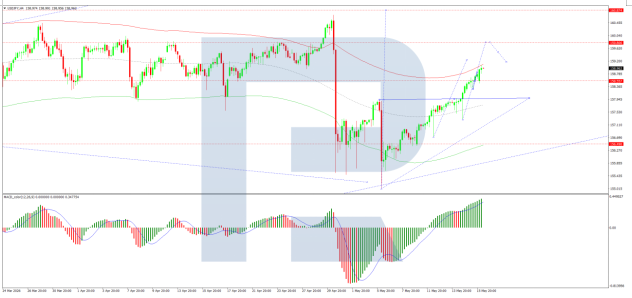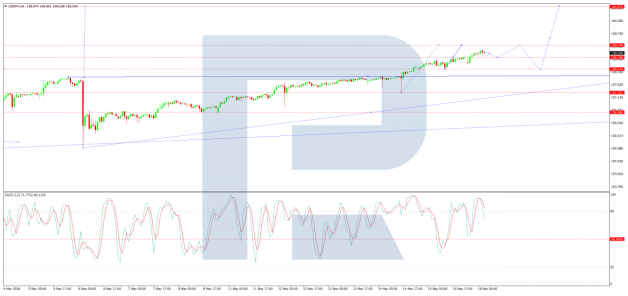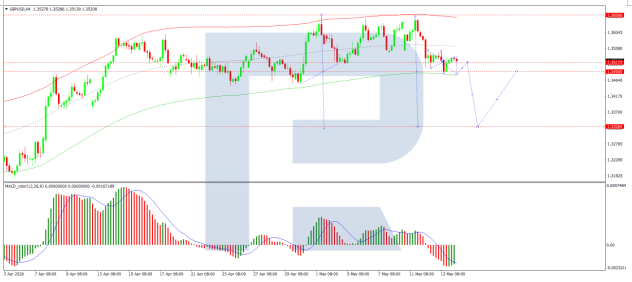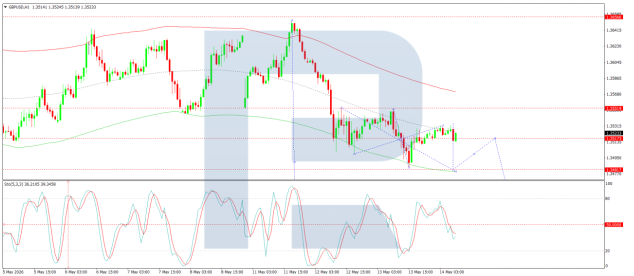
Archive for Forex and Currency News – Page 6

GBP/USD: Slide Enters Fifth Consecutive Day

By RoboForex Analytical Department 

GBP/USD fell for the fifth consecutive day, reaching 1.3445. The slowdown in headline price growth has boosted expectations of an imminent rate cut by the Bank of England, although underlying price pressures remain robust.

Annual inflation in January slowed to 3.0% from 3.4% in December, in line with forecasts. However, inflation in the services sector, which reflects domestic price pressures, only fell to 4.4% from 4.5%, above the expected 4.3%. This partly supported the pound. Earlier, sterling had fallen after weak labour data raised expectations of a rate cut.

According to Chris Turner, Head of Global Research at ING, the market had been counting on a more pronounced slowdown in inflation, but the data were not unambiguously weak. A better-than-expected figure for services gave sterling “only limited respite.”

Investors now price the chance of a 25bp rate cut by the Bank of England next month at around 85%. By the end of the year, the market fully prices in two 25bp reductions.

The political situation remains an additional factor of uncertainty. The upcoming parliamentary by-election in Greater Manchester could reignite discussions about Prime Minister Keir Starmer’s leadership in the event of a Labour defeat. According to ING, a major loss for the party could increase pressure on the pound and the government bond market.

Technical Analysis

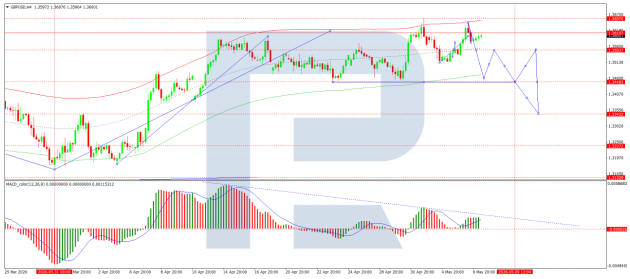
The H4 chart maintains a pronounced downtrend. After a series of lower highs, the pair broke through the 1.3490–1.3500 zone and accelerated its decline to 1.3430–1.3440. The price moves along the lower band of the Bollinger Bands, confirming the dominance of sellers.

Local rebound attempts remain weak and are quickly sold into. The nearest resistance stands at 1.3490–1.3520, followed by 1.3660. Support is at 1.3430; a break below would open the path to further losses.

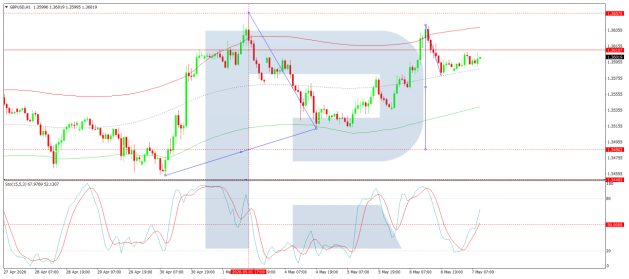
The H1 time frame shows a sharp sell-off on 19 February, followed by narrow consolidation at the lows. The Bollinger Bands have begun to narrow, suggesting volatility is easing after the recent sharp move.

The price is holding near 1.3430–1.3450. A sustained move above 1.3490 would allow for a more pronounced corrective pullback. The bearish scenario remains intact while the pair trades below 1.3490.

Conclusion

In summary, GBP/USD remains entrenched in a sustained downtrend, extending its losing streak to five sessions. While headline inflation softened as expected, sticky services inflation and resilient underlying pressures complicate the BoE’s policy calculus. The market remains firmly priced for a March rate cut, with political risks adding to the uncertainty. Technically, the pair has breached key support and trades with a clear bearish bias. Any corrective bounces are likely to be capped near 1.3490–1.3520, with a break below 1.3430 opening the door to deeper losses. The near-term outlook remains firmly negative unless prices can reclaim the 1.3490 level.


Disclaimer

Any forecasts contained herein are based on the author’s particular opinion. This analysis may not be treated as trading advice. RoboForex bears no responsibility for trading results based on trading recommendations and reviews contained herein.

EUR/USD Forced Lower: US Dollar Has a Strong Case

By RoboForex Analytical Department

EUR/USD on Thursday stabilised at 1.1792 after a sharp decline the day before. The US dollar was supported by strong US macro data and unexpectedly tough signals from the Fed.

The minutes of the previous meeting showed that disagreements remain within the Federal Reserve regarding the future path of rates. This suggests that it may not be easy for the new chair to implement a rate cut. Some members had previously explicitly admitted the possibility of a rate hike if inflation remains above target.

The market has slightly reduced expectations for policy easing this year, but still prices in two 25-basis-point cuts before the end of the year.

Additional support for the dollar was provided by industrial production data. It grew at the highest rate in almost a year. Orders for core capital goods exceeded forecasts, and the number of new home mortgages reached a five-month high.

PMI indices and GDP data are due next, which may provide additional guidance on the path of interest rates.

Technical Analysis

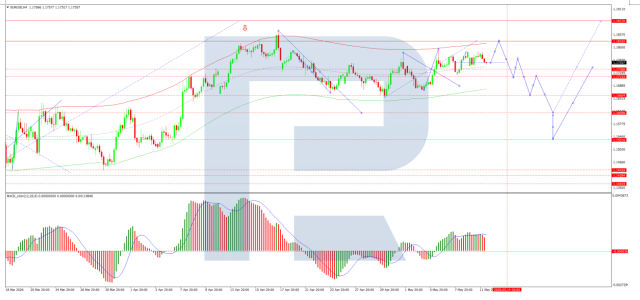
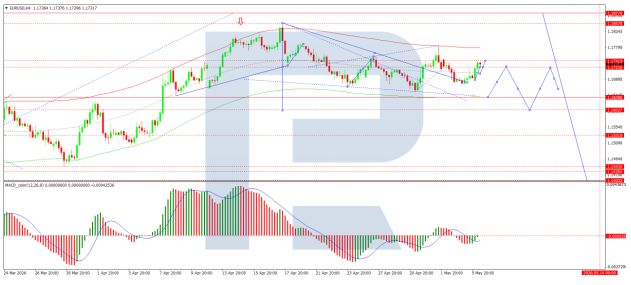
On the H4 chart, EUR/USD stays close to 1.1790–1.1800 after breaking support at 1.1885 and accelerating the decline. The price has firmed below the Bollinger Bands’ midline; the bands have widened, indicating bearish momentum. The MACD is in negative territory; the histogram is deepening further, reinforcing downward momentum. The Stochastic oscillator has rebounded from oversold. Against this background, a brief correction is possible, but the structure remains weak. The nearest support is at 1.1765, and resistance is at 1.1885.

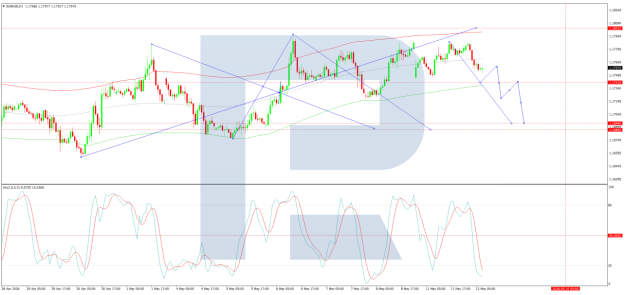
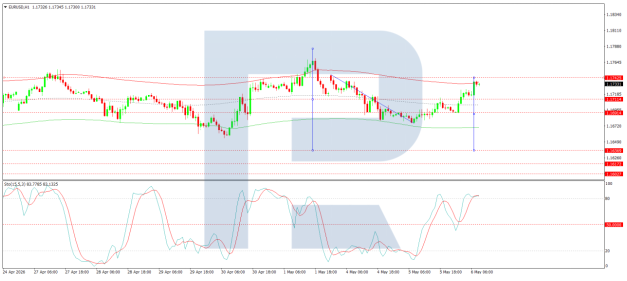
On the lower H1 time frame, a sharp downward move is visible, followed by local stabilisation. The price is forming a small bounce off 1.1780 but remains below the Bollinger Bands’ middle line. The MACD remains negative, although the pressure is gradually decreasing. The Stochastic oscillator is in the overbought zone, suggesting that any corrective rebound could fade in the 1.1820–1.1840 area.

The overall picture points to a short-term rebound within a broader bearish move.

Conclusion

In summary, EUR/USD remains under decisive pressure following hawkish Fed signals and resilient US economic data. The technical breakdown below key support has confirmed a bearish shift, with momentum indicators favouring further downside despite oversold conditions. The current stabilisation appears corrective rather than reversal, with any bounce likely capped near 1.1820–1.1840. Upcoming US PMI and GDP releases will shape the near-term direction. A break below 1.1765 would open the door to deeper losses towards 1.1700, while a sustained move above 1.1885 is needed to alleviate bearish pressure.


Disclaimer

Any forecasts contained herein are based on the author’s particular opinion. This analysis may not be treated as trading advice. RoboForex bears no responsibility for trading results based on trading recommendations and reviews contained herein.

USD/JPY Moderately Higher: Market Balances Between Data and Forecasts

By RoboForex Analytical Department

USD/JPY rose to 153.50 on Wednesday. The yen gave up some of the gains from the previous session, despite strong foreign trade statistics.

Japan’s exports rose at their fastest pace in more than three years in January, driven by robust demand for AI-related chips. This data increased expectations of continued policy normalisation by the Bank of Japan.

At the same time, weak fourth-quarter GDP, which came in below forecasts and narrowly avoided a technical recession, is restraining optimism.

Investors believe Prime Minister Sanae Takaichi’s economic policy could support growth and indirectly strengthen the case for a gradual rate hike. The market is now pricing in the possibility of a tightening policy in April.

The IMF has previously stated that it does not set a specific target level for the yen, believing instead that the exchange rate is determined by market factors.

Technical Analysis

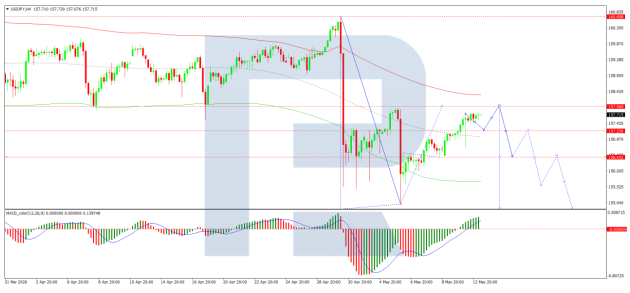
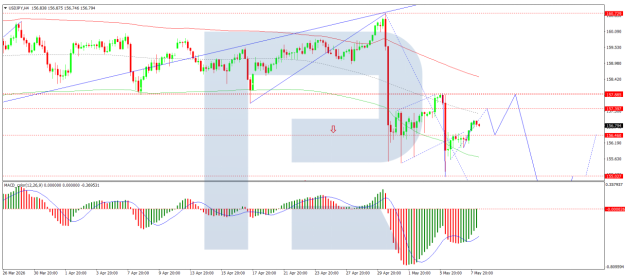
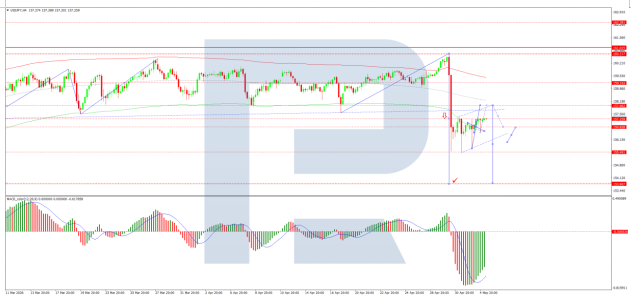
On the H4 chart, USD/JPY has entered a consolidation phase following a sharp drop from 157.50–158.00. The price is currently held in the range of 152.25–153.80. The Bollinger Bands have narrowed markedly, indicating that volatility is declining and the market is forming a base. The 153.80–153.95 area represents the nearest resistance. Support stands at 152.25. As long as the price remains below 153.80, the structure remains neutral to bearish.

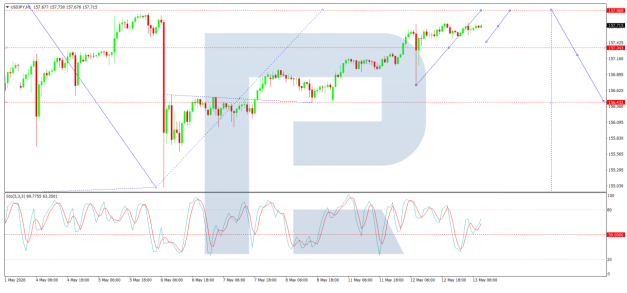
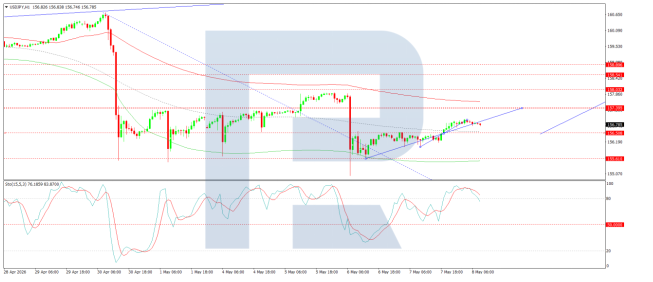
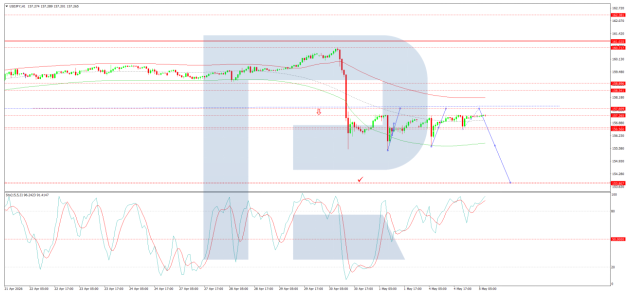
On the shorter H1 time frame, there is a short-term local rebound from 152.80–153.00 with an attempt to exit towards the upper limit of the range. The price is approaching 153.90, where strong intraday resistance is forming. A break above 153.95 would open the way towards 154.60. Failure to break resistance could bring the pair back to 153.00 and then on to 152.25.

Overall, the market is compressing ahead of a potential move. A breakout of the range will set the direction for the next motion.

Conclusion

In summary, USD/JPY remains caught between conflicting fundamental factors: robust export data support BoJ normalisation expectations, but weak GDP and political uncertainty limit yen strength. Technically, the pair is coiling within a tightening range, signalling an imminent directional breakout. The neutral-bearish bias persists as long as the price holds below 153.80–153.95 resistance. A clear break above this level would target 154.60, while failure could trigger a retest of 152.25 support. With the BoJ’s April policy meeting in focus, the next significant move awaits a fresh catalyst.


Disclaimer

Any forecasts contained herein are based on the author’s particular opinion. This analysis may not be treated as trading advice. RoboForex bears no responsibility for trading results based on trading recommendations and reviews contained herein.

EURUSD Slides Smoothly: Fed Minutes in Focus

By RoboForex Analytical Department

EURUSD is moving smoothly downward and has touched 1.1840. Investors are preparing for the release of key US statistics that could affect expectations for the Fed’s future policy.

The focus is on the minutes of the last Fed meeting, a preliminary estimate of GDP, and the PCE core inflation index. The latter is a key policy gauge for the regulator.

The dollar came under pressure last week following softer inflation data, which increased expectations of rate easing in the second half of the year. However, a strong labour market report – showing the highest employment growth in more than a year and an unexpected decline in unemployment – pointed to the resilience of the economy.

The market is now pricing in the first rate cut in June. Overall, around 62 basis points of easing are expected for 2026, corresponding to two 25 bp reductions and roughly a 50% probability of a third step.

Technical Analysis

On the H4 time frame, EURUSD is consolidating after pulling back from January highs. The range has expanded, but the price is gradually moving towards its lower limit. The key level stands at 1.1835, an intermediate support within the wider range of 1.1765–1.2000. If it holds, sideways movement with attempts to correct upward is likely to persist. A break below 1.1835 would open the way to 1.1765. A return above 1.1890–1.1900 would ease bearish pressure and return the pair to the middle of the range.

Short-term downward pressure remains on the H1 chart for EURUSD. The price consistently forms lower highs and lows, trading near the bottom of the Bollinger Bands. The middle line acts as dynamic resistance.

The Stochastic oscillator is in the oversold zone, which allows for local rebounds, but the MACD remains in negative territory – momentum is still on the side of sellers. The nearest support is at 1.1835. Securing below it would intensify the decline towards 1.1810–1.1800. Resistance stands at 1.1860–1.1870.

Conclusion

In summary, EURUSD remains under steady selling pressure as markets await pivotal US data that will shape Fed expectations. The pair is testing critical support at 1.1835, with technical indicators confirming bearish momentum despite oversold conditions. The fundamental picture is mixed: softer inflation points to eventual Fed easing, but robust employment data complicates the timeline. The near-term direction hinges entirely on today’s releases. A break below 1.1835 would likely accelerate losses towards 1.1765, while a rebound above 1.1890–1.1900 could signal a temporary respite. Until then, the path of least resistance remains lower.


Disclaimer

Any forecasts contained herein are based on the author’s particular opinion. This analysis may not be treated as trading advice. RoboForex bears no responsibility for trading results based on trading recommendations and reviews contained herein.

Week Ahead: USDJPY braces for quadruple risk cocktail

By ForexTime

  • USDJPY ↓ 2.5% YTD
  • Yen expected to be one of the most volatile G10 currencies vs USD
  • US PCE + Japan CPI combo = fresh volatility?
  • Japan CPI forecast to trigger moves of ↑ 0.4% & ↓ 0.2%
  • Bloomberg FX model – 74% USDJPY – (150.21 – 155.26)

Even as anticipation builds ahead of the US CPI report this afternoon (Friday, 13th February), traders are bracing for more high-risk events in the week ahead.

From the Fed’s meeting minutes to the Japan CPI report and the US December PCE index, among other key reports will be in focus:

Monday, 16th February

  • US Markets closed for Presidents’ Day holiday
  • JPY: Japan Q4 GDP, industrial production
  •  EUR: Eurozone Industrial Production (Dec)
  • CAD: Canada Housing Starts (Jan)


Tuesday, 17th February

  • AUD: RBA Meeting Minutes
  • GBP: UK Unemployment Rate (Dec)
  • EUR: Germany ZEW Economic Sentiment Index (Feb)
  • JPY: Japan Balance of Trade (Jan)
  • USD: US Empire manufacturing


Wednesday, 18th February

  • GBP: UK Inflation Rate (Jan)
  • USD: FOMC Minutes, US Building Permits (Nov, Dec), Durable Goods Orders (Dec), Housing Starts (Nov, Dec)
  • NZD: New Zealand rate decision
  • Crude (WTI, Brent): US API Crude Oil Stock Change (w/e Feb 13)


Thursday, 19th February

  • AUD: Australia Employment Data (Jan)
  • USD: US Balance of Trade (Dec), Initial Jobless Claims (w/e Feb 14)
  • EUR: Eurozone Consumer Confidence (Feb)
  • Crude (WTI, Brent): US EIA Crude Oil stocks Change (w/e Feb 13)
  • US30: Walmart earnings


Friday, 20th February

  • GBP: UK Retail Sales (Jan), S&P Global Manufacturing & Services PMIs (Feb)
  • EUR: Germany HCOB Manufacturing, Services & Composite PMIs (Feb)
  • CAD: Canada Retail Sales (Jan)
  • JPY: Japan CPI, S&P Global manufacturing
  • USD: US PCE Price Index (Dec), GDP Growth Rate (Q4), Personal Income & Spending (Dec)


The USDJPY is back in focus thanks to a string of high-impact data releases from the United States and Japan.

Over the past few weeks, the USDJPY has exhibited heightened volatility amid concerns about intervention, political risk in Japan, and overall dollar volatility.

With the Yen expected to be one of the most volatile G10 currencies versus the USD next week, this could spell fresh trading opportunities.


Here are 3 reasons why the USDJPY could see significant swings:


1) Fed minutes + US December PCE

The Federal Reserve releases minutes from its Jan 27 – 28 meeting, when it held interest rates steady. Any new clues regarding future policy moves may impact expectations for lower rates over the coming months.

But the major risk event for the dollar may be the Fed’s preferred inflation gauge – the Core PCE.

Markets are forecasting the core PCE deflator to rise 2.9% in December compared to 2.8% in the previous month. Ultimately, signs of rising inflationary pressures may further cool bets around the Fed cutting rates anytime soon.

USDJPY is forecast to move 0.2% up or 0.3% down in a 6-hour window after the US PCE report.


2) Japan Q4 GDP + Japan CPI

It’s a data heavy week in Japan with the latest GDP figures and key CPI report likely to shape bets around the BoJ hiking rates.

Economic growth is expected to have rebounded in Q4, while CPI is seen cooling 1.6% in January compared to the 2.1% in the previous month.

Traders are currently pricing in a 78% chance that the BoJ hikes rates by April. Any major shifts to these expectations could rock the Japanese Yen.


3) Technical forces

The USDJPY is under pressure on the daily charts with prices approaching the 152.00 support level. However, the RSI is approaching oversold levels.

  •  A solid breakout and daily close below 152.00 may open a path toward the 200-day SMA at 150.50.
  •  Should 152.00 prove to be reliable support, this could send prices toward the 100 and 50-day SMA.

Bloomberg’s FX model points to a 74.6% chance that USDJPY will trade within the 150.28 – 155.04 range over the next one-week period.


Forex-Time-LogoArticle by ForexTime


ForexTime Ltd (FXTM) is an award winning international online forex broker regulated by CySEC 185/12 www.forextime.com

EUR/USD Consolidates Ahead of US Inflation Data

By RoboForex Analytical Department

EUR/USD ended the week at 1.1868, remaining within a narrow sideways range for the fourth consecutive session. The market has adopted a wait-and-see approach ahead of the release of January’s US consumer price index. The report could influence expectations for Federal Reserve policy.

Forecasts suggest a slowdown in headline inflation to 2.5% year-on-year from 2.7%, while core inflation is expected to ease to 2.5% from 2.6%.

Earlier in the week, strong employment data confirmed the resilience of the labour market, although recent jobless claims came in higher than expected. Investors are now pricing in rates remaining unchanged in March, followed by two 25-basis-point cuts in the second half of the year, in June and September.

The broader backdrop for EUR/USD remains clear: most Fed officials have adopted a wait-and-see stance and are not ready to resume rate cuts imminently. Despite previous easing and the current rate range of 3.50-3.75%, inflation remains below 3%, and the economy continues to demonstrate stability. January’s employment data only strengthens the case for a pause.

While some Fed policymakers support further easing, they remain in the minority. The market is shifting expectations for the first cut closer to July. For EUR/USD, this maintains structural support for the dollar. The pair’s next move will depend on inflation and signs of a real cooling in the US economy.

Technical Analysis

On the H4 chart, EUR/USD remains in a sideways consolidation phase following January’s upward momentum. The price is held within the 1.1785-1.1930 range and is currently trading near 1.1870. Bollinger Bands have narrowed, signalling declining volatility. The MACD is hovering near the zero line, indicating weak momentum, while the Stochastic oscillator remains neutral, without a clear directional signal. The market is trading in the middle of the range.

On the H1 chart, price action reflects a tight consolidation with occasional volatility spikes. Buyers quickly absorbed the latest downward move, but attempts to break above 1.1925 have failed. The price has stabilised near the midline of the Bollinger Bands. The MACD remains close to zero, and the Stochastic oscillator is turning lower in neutral territory. In the near term, range trading remains the preferred strategy.

Conclusion

In summary, EUR/USD remains in a state of consolidation, trapped in its narrowest range in weeks as markets await the crucial US inflation report. The pair is caught between two opposing forces: resilient US economic data and delayed Fed easing expectations (supporting the dollar), versus a relatively hawkish ECB stance and already priced-in policy divergence (supporting the euro).


Technically, compressed volatility and neutral indicators signal a breakout may be approaching, but its direction will depend entirely on tonight’s CPI outcome. A hotter-than-expected inflation reading would likely push the pair towards the lower boundary at 1.1785, while softer inflation could trigger a retest of resistance near 1.1930. Until then, the range remains the game.


Disclaimer

Any forecasts contained herein are based on the author’s particular opinion. This analysis may not be treated as trading advice. RoboForex bears no responsibility for trading results based on trading recommendations and reviews contained herein.

GBP/USD Regains Ground After US Data and Finds an Equilibrium

By RoboForex Analytical Department

GBP/USD was trading at 1.3632 on Thursday. Sterling found an equilibrium point after volatility triggered by a stronger dollar following US labour market data.

The number of people employed in January increased by 130 thousand, marking the largest rise in more than a year. The unemployment rate unexpectedly fell to 4.3%. Against this backdrop, investors have revised expectations for the Fed rate path. The market now fully prices in the first rate cut for July rather than June, and the probability of a move in March is estimated at less than 5%.

Partial support for the pound came from a decline in domestic political uncertainty. British Prime Minister Keir Starmer received the backing of key cabinet members and Labour Party representatives after the resignation of Chief of Staff Morgan McSweeney amid the scandal surrounding Lord Peter Mandelson.

At the same time, market participants still expect further easing from the Bank of England. The regulator kept the rate at 3.75% but delivered softer guidance. It indicated that inflation could return to the 2% target from April.

Technical Analysis

The H4 chart for GBP/USD shows that after a brief rise to 1.3850, the pair entered a correction. A downward phase has formed, characterised by lower highs and lower lows. The price is now testing the 1.3580–1.3600 support zone. The Bollinger Bands are pointing downward, and volatility remains elevated. As long as the pair remains below 1.3710–1.3730, downside pressure is likely to persist.

On the lower H1 timeframe, a local recovery from 1.3580 is visible, but the structure remains neutral to bearish. The price is trading within the 1.3580–1.3650 range. The Bollinger Bands’ midline acts as short-term resistance. A sustained move above 1.3660 would open the way towards 1.3700. A move back below 1.3600 would increase the risk of a retest of recent lows.

Conclusion

In summary, GBP/USD has stabilised following a sharp repricing of Fed expectations triggered by robust US jobs data. The pair found technical equilibrium near key support, with political relief at home providing some offsetting support for sterling. However, the broader technical structure remains corrective and neutral-to-bearish, with resistance capping recovery attempts. The near-term direction hinges on two factors: whether the 1.3580–1.3600 support zone holds, and any further divergence in tone between a patient Fed and an increasingly dovish Bank of England. Until GBP/USD reclaims 1.3660–1.3700, downside risks remain elevated.


Disclaimer

Any forecasts contained herein are based on the author’s particular opinion. This analysis may not be treated as trading advice. RoboForex bears no responsibility for trading results based on trading recommendations and reviews contained herein.

EUR/USD Set for Growth: Dollar Fears Demand Slump

By RoboForex Analytical Department

EUR/USD rose to 1.1911 on Tuesday. Pressure on the USD increased amid concerns that external demand for dollar-denominated assets could decline significantly.

The reason behind this shift was reports suggesting that Chinese regulators have advised financial institutions to reduce their holdings of US government bonds. This move could help diversify risks and mitigate the impact of uncertain US economic policies.

Investors are awaiting delayed reports on the US labour market and inflation this week. These figures could adjust expectations regarding the Federal Reserve’s future policy direction.

White House economic adviser Kevin Hassett noted that the pace of US employment growth may slow in the coming months due to weaker labour and productivity growth.

The Fed is expected to leave interest rates unchanged in March, with markets still pricing in two rate cuts for the remainder of the year.

Technical Analysis

On the H4 chart for EUR/USD, after a momentum rally in late January, the pair entered a phase of correction and consolidation. The price has recovered above the 1.1760 support level and is now testing the 1.1920-1.1950 area. The Bollinger Bands are narrowing, indicating stabilisation and preparation for the next move. The medium-term structure remains moderately bullish as long as prices stay above 1.1760.

On the shorter-term H1 time frame, upward momentum remains confined to the short term. The price is moving along the upper Bollinger band after a sharp upward acceleration. It is now consolidating just below resistance at 1.1920-1.1950. Oscillators are in the overbought zone, raising the risk of a pause or shallow pullback, although the overall structure remains intact.

Conclusion

EUR/USD is poised for gains, driven by concerns about USD demand and a cautious outlook for US economic growth. While short-term fluctuations are expected, the medium-term trend remains bullish as long as key support levels hold. Investors will be closely watching upcoming data on inflation and employment, which could influence future Federal Reserve policy decisions.


Disclaimer

Any forecasts contained herein are based on the author’s particular opinion. This analysis may not be treated as trading advice. RoboForex bears no responsibility for trading results based on trading recommendations and reviews contained herein.

USD/JPY Reacts to Political News: Budget Line Will Be Soft

By RoboForex Analytical Department

USD/JPY is down to 156.73 on Monday. The Japanese yen had earlier dropped to its lowest levels in almost two weeks after a landslide victory for Japan’s ruling Liberal Democratic Party in early elections to the lower house of parliament. The coalition is led by Prime Minister Sanae Takaichi. However, demand for the yen returned shortly after.

Takaichi’s coalition won 352 of 465 seats in the House of Representatives, according to NHK. At the same time, the Liberal Democratic Party of Japan itself secured a majority of 316 seats. The vote’s outcome provided the prime minister with a clear mandate to implement an expansive fiscal policy.

Markets regarded the result as a signal in favour of a softer budget line and possible tax breaks. This increased pressure on the yen and Japanese government bonds amid fears of a rise in the debt burden. At the same time, the results supported expectations of more favourable dynamics for the stock market.

A more conservative domestic agenda is now expected to advance, including stricter immigration policies and land ownership rules. All this adds uncertainty to the assessment of medium-term consequences for the economy and financial markets.

Technical Analysis

On the H4 chart for USD/JPY, following a sharp decline at the end of January, a local bottom formed in the 152.00-152.20 zone, from which the pair began to recover. This impulsive growth was accompanied by movement along the upper border of the Bollinger Bands. The price is now trading below recent highs and consolidating in the 155.80-157.70 range. Volatility has decreased, and the structure remains corrective. However, momentum weakened, and the market has entered a pause phase under resistance.

The H1 chart shows the development of lateral dynamics after growth, with the price hovering around the Bollinger Bands’ midline, and no new momentum forming. Selling pressure quickly cancelled attempts to move higher to 157.40-157.70, while support holds in the 155.50-155.80 region. The near-term trajectory appears neutral, with a balance between correction and attempts to continue the recovery.

Conclusion

In summary, USD/JPY is undergoing a corrective pullback as the market digests the political implications of Japan’s election outcome. While the landslide victory initially weakened the yen on expectations of expansive fiscal policy, a technical pause has followed. The pair is now consolidating, caught between the fundamental pressure from anticipated higher Japanese debt (bearish for JPY) and technical resistance. The near-term trajectory will depend on whether this consolidation leads to a continuation of the recovery or a deeper correction, with clarity on the new government’s fiscal measures serving as the next major catalyst.


Disclaimer

Any forecasts contained herein are based on the author’s particular opinion. This analysis may not be treated as trading advice. RoboForex bears no responsibility for trading results based on trading recommendations and reviews contained herein.

Currency Speculators boost Euro bets to highest since 2023, CAD bets go Bullish

By InvestMacro

Speculators OI FX Futures COT Chart

Here are the latest charts and statistics for the Commitment of Traders (COT) data published by the Commodities Futures Trading Commission (CFTC).

The latest COT data is updated through Tuesday February 3rd and shows a quick view of how large market participants (for-profit speculators and commercial traders) were positioned in the futures markets. All currency positions are in direct relation to the US dollar where, for example, a bet for the euro is a bet that the euro will rise versus the dollar while a bet against the euro will be a bet that the euro will decline versus the dollar.

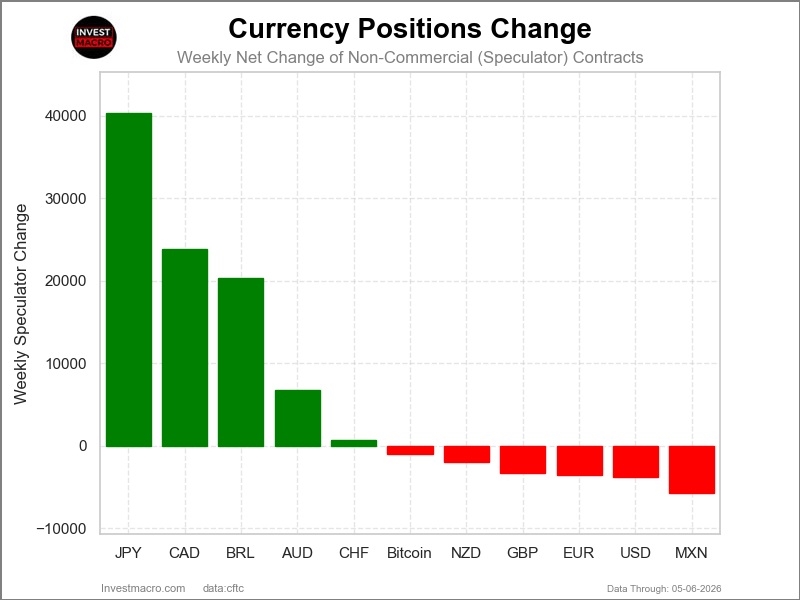
Weekly Speculator Changes led by Euro, Australian Dollar and Canadian Dollar

Speculators Nets FX Futures COT Chart
The COT currency market speculator bets were higher this week as ten out of the eleven currency markets we cover had higher positioning while the other one markets had lower speculator contracts.

Leading the gains for the currency markets was the EuroFX (31,227 contracts) with the Australian Dollar (18,972 contracts), the Canadian Dollar (18,176 contracts), the Japanese Yen (14,711 contracts), the New Zealand Dollar (13,451 contracts), the Brazilian Real (12,117 contracts), the US Dollar Index (3,553 contracts), the British Pound (2,251 contracts), the Swiss Franc (2,176 contracts) and Bitcoin (318 contracts) with also showing positive weeks.

The currency seeing declines in speculator bets on the week was the Mexican Peso with a drop by -12,522 contracts on the week.

Currency Speculators sharply boost Euro bets to highest since 2023, CAD bets go Bullish

Highlighting this week’s currency speculator changes were the strong gains in the Euro, the Australian Dollar, and the Canadian Dollar.

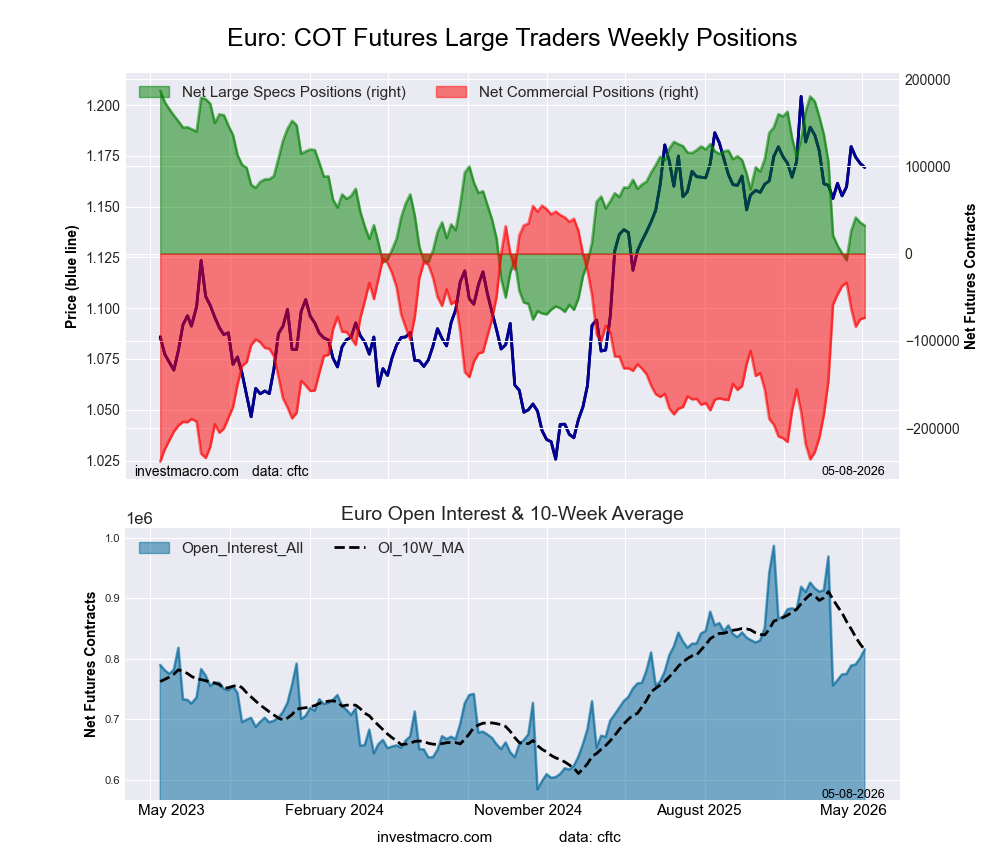
First off, the Euro jumped by over 30,000 contracts this week and this week’s gain marked the largest one-week gain since March of 2025, when speculative bets surged by over +46,000 contracts. This week’s surge follows last week’s rise by over 20,000 contracts and has now pushed the overall speculative level to a total of 163,361 net contracts, which marks the highest level for the Euro bets dating back to August 1st of 2023. The European currency’s speculative standing has now been above +100,000 net contracts for 10 consecutive weeks, and for 30 out of the last 34 weeks as well. The Euro exchange rate this week dipped slightly for a second consecutive week and closed out the week around the 1.1840 exchange level. Last week, however, the Euro hit its highest level since 2021 with a high around 1.2110 before retreating. We’ll see in the weeks to come if the Euro will threaten the 1.20 psychological threshold once again.

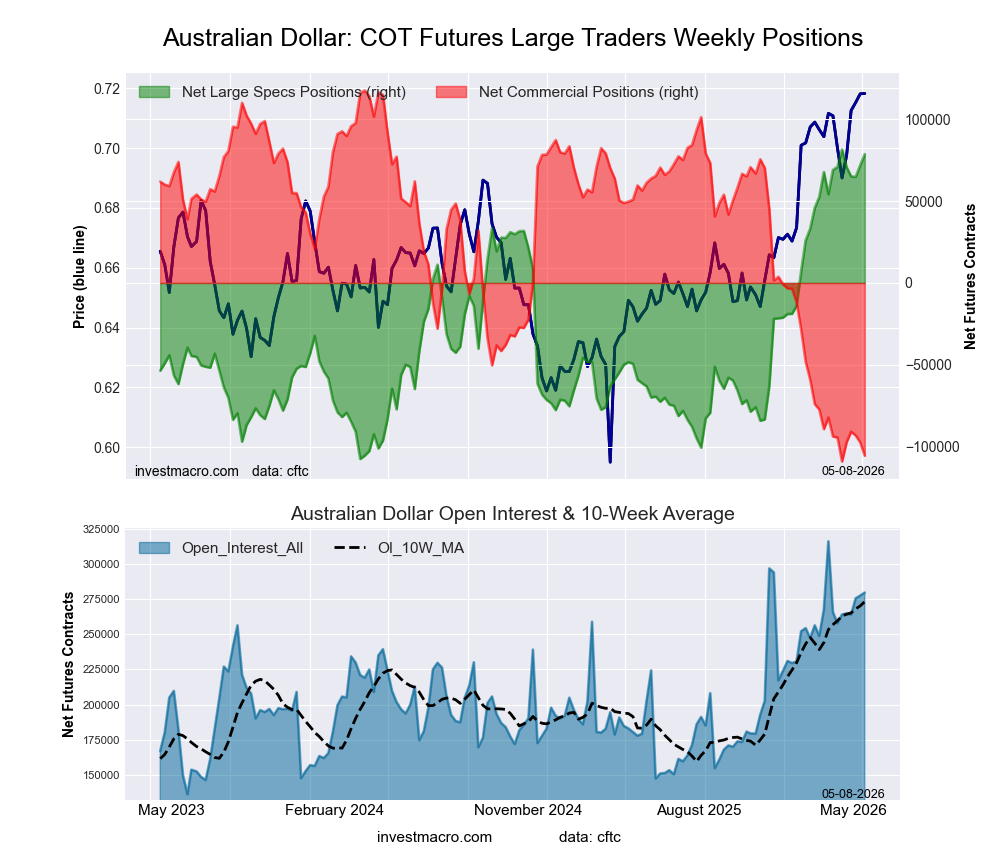
Next up, the Australian Dollar speculative bets surged higher for a second consecutive week, and are now in an overall bullish position also for a second straight week. Last week marked the first time since December of 2024 that the Australian Dollar speculative position was in bullish territory. And this week, the position grew further. The Australian Dollar exchange rate has risen for three consecutive weeks, and this week closed at the highest levels since 2023, where it closed above the 0.700 significant psychological level. The Australian Dollar is up by over 5% against the U.S. Dollar this year so far, and is higher by about 14% since the start of 2025. The weekly RSI for the Australian Dollar is currently in overbought position so we’ll see if the Aussie can hold these multi-year high levels.

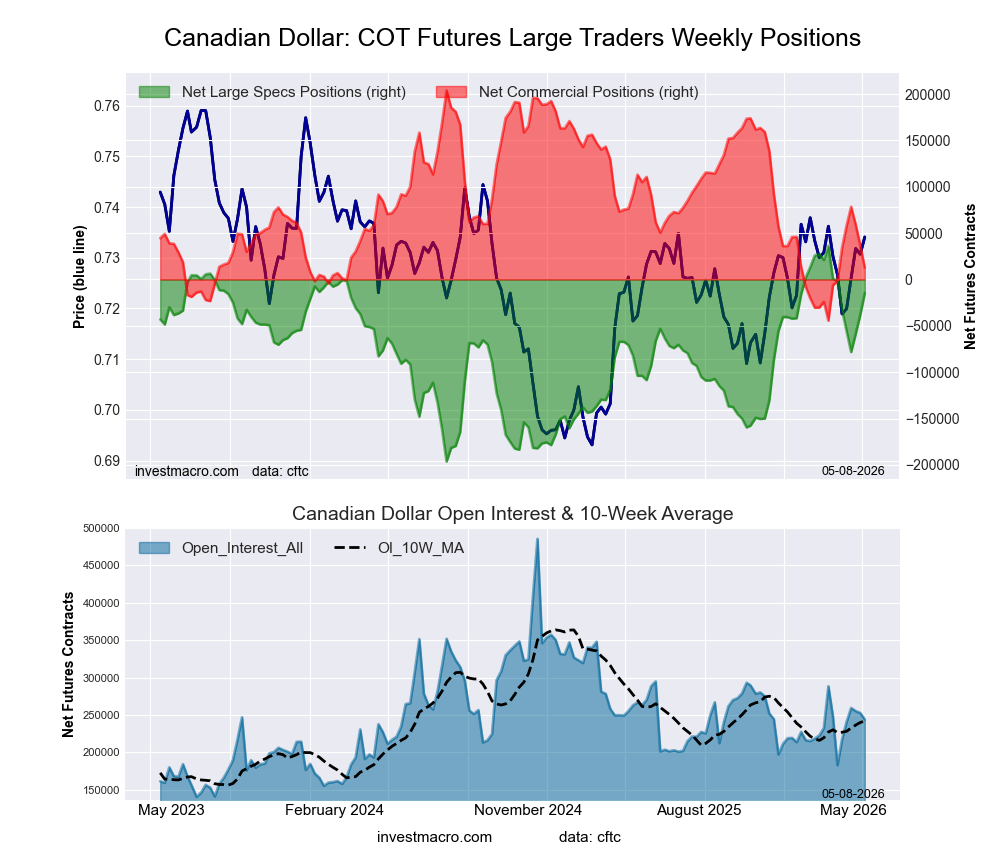
The Canadian Dollar speculator positions rose for a third consecutive week, as well as the eighth time in the last ten weeks that speculator bets have been bullish. Overall, the net standing for the Canadian Dollar speculators this week went bullish with a total of 2,130 net contracts. This is the first time the Canadian Dollar has seen a bullish net contract level since August 1st of 2023, a span of 131 straight weeks. The turnaround in the Canadian Dollar speculator positions has been fast and furious as the net position totaled a -130,600 contracts as recently as December 9th. And then eight weeks later, the net position has managed to turn bullish. In the foreign exchange markets, the Canadian Dollar trades right around its 200-week moving average at the 0.7333 exchange rate. This week, the CAD fell a little bit, but has been higher in total over the past three weeks. Time will tell if the CAD can break through its 200-weekly moving average level and can work its way back to the strong support and resistance level of 0.7500.

The US Dollar Index saw improving bets for the second consecutive week and for the ninth time out of the last 10 weeks. This has taken the speculator level from a total of -16,347 net contracts down to a tiny bearish level of just -852 net contracts this week. Overall, the Dollar Index has consistently been in a bearish level dating back to June 10th of 2025, a span of 34 consecutive weeks. In the foreign exchange market, the US Dollar Index saw a boost this week after falling for the previous two weeks and trades at the 97.50 level. Since the beginning of 2025, the Dollar Index has fallen by over 10%, however, prices have bounced off the 96.00 area three times since June. We’ll see if the Dollar Index can hold this level and can find its way higher or will eventually break lower.

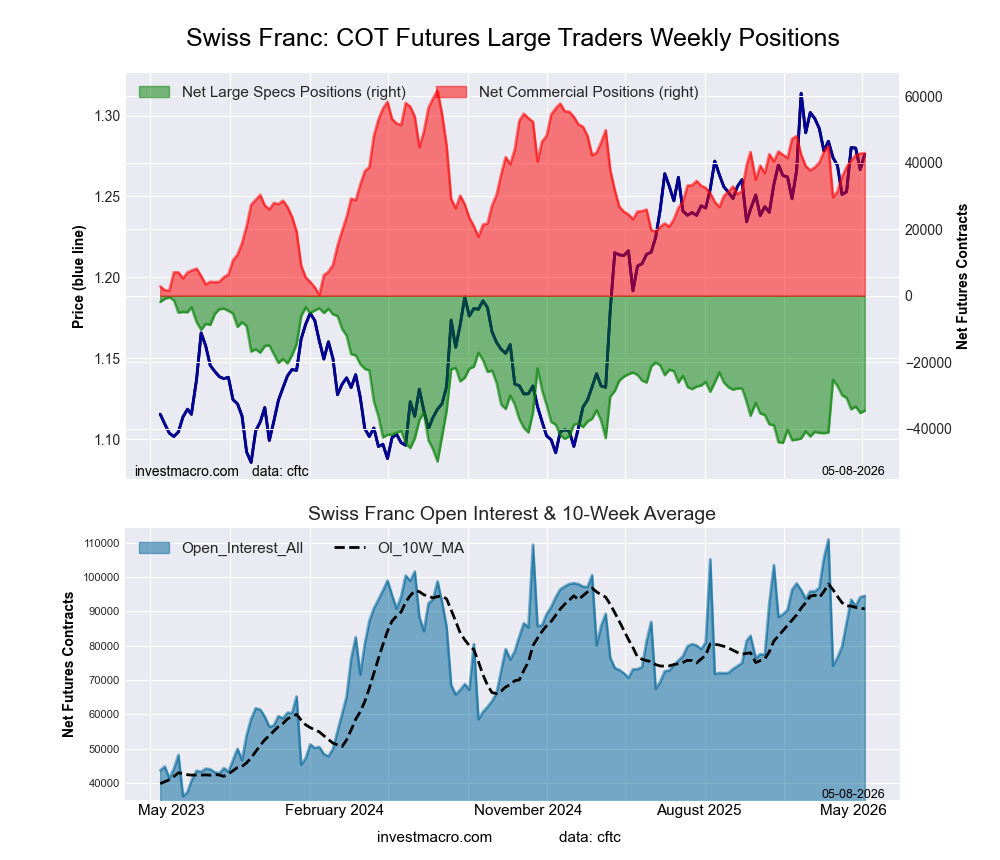
Finally, the Swiss Franc positions rose modestly for a third consecutive week and for the fourth time out of the past five weeks. Interestingly, the Swiss Franc speculator net position is highly bearish and has been in an overall bearish level dating all the way back to September of 2021 while the Swiss Franc exchange rate is at the strongest levels it has traded since 2011. The dichotomy in the speculator positions versus the strength of the currency can be explained through hedging, as there has been reports that many business entities are hedging away the historic strength of the Swiss Franc at the current time while the Franc is also a sought-after safe haven in an uncertain geopolitical time. Currently, the Swiss Franc trades at 1.2946 against the U.S. Dollar in the exchange markets. Since the beginning of 2025, the Franc is up by approximately 18% against the U.S. Dollar and looks to be threatening the 1.30 major level.

Mexican Peso leads Currency Price Returns this week

The major currency markets price performance was led by the Mexican Peso this week. The Peso was the highest riser by 1.25% over the past five days. The Brazilian Real followed that up with a 0.99% gain. The Australian Dollar was higher by 0.79%. The US Dollar Index showed a 0.60% rise. The New Zealand Dollar was virtually unchanged at a 0.04% dip, followed by the euro which fell by 0.26%. The Canadian Dollar was lower by 0.28%. The Swiss Franc fell by 0.30%. The British Pound was lower by 0.48%. The Japanese Yen was lower by over 1% with a 1.48% decrease.

Bitcoin was the biggest loser on the week with a 16.45% drop.


Currencies Data:

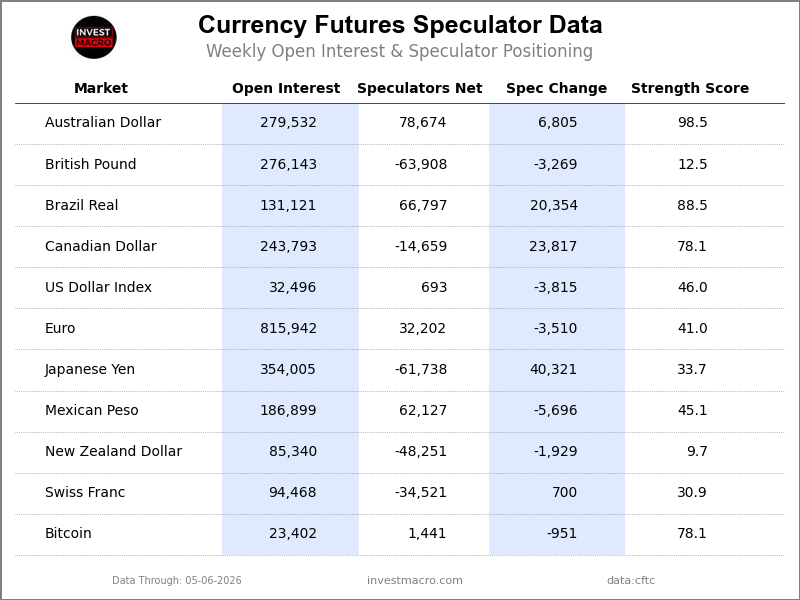
Speculators FX Futures COT Data Table
Legend: Open Interest | Speculators Current Net Position | Weekly Specs Change | Specs Strength Score compared to last 3-Years (0-100 range)


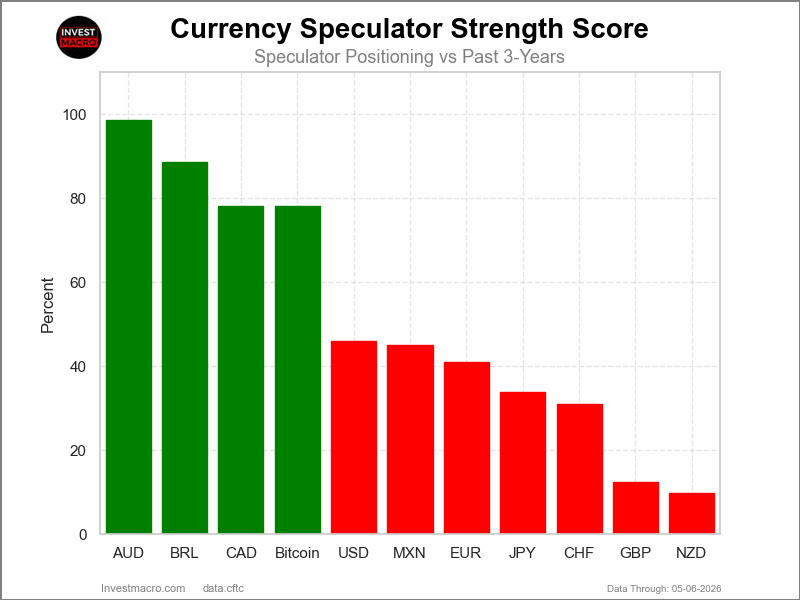
Strength Scores led by Canadian Dollar & Australian Dollar

Speculators Strength Scores FX Futures COT Chart
COT Strength Scores (a normalized measure of Speculator positions over a 3-Year range, from 0 to 100 where above 80 is Extreme-Bullish and below 20 is Extreme-Bearish) showed that the Canadian Dollar (98 percent) and the Australian Dollar (95 percent) lead the currency markets this week. The EuroFX (91 percent), Bitcoin (74 percent) and the Mexican Peso (73 percent) come in as the next highest in the weekly strength scores.

On the downside, the Swiss Franc (18 percent) comes in at the lowest strength levels currently and are in Extreme-Bearish territory (below 20 percent). The next lowest strength scores are the the New Zealand Dollar (26 percent), the British Pound (34 percent) and the US Dollar Index (42 percent).

3-Year Strength Statistics:
US Dollar Index (41.8 percent) vs US Dollar Index previous week (32.2 percent)
EuroFX (91.0 percent) vs EuroFX previous week (79.1 percent)
British Pound Sterling (33.7 percent) vs British Pound Sterling previous week (32.7 percent)
Japanese Yen (45.4 percent) vs Japanese Yen previous week (41.4 percent)
Swiss Franc (18.4 percent) vs Swiss Franc previous week (14.0 percent)
Canadian Dollar (97.9 percent) vs Canadian Dollar previous week (88.9 percent)
Australian Dollar (94.8 percent) vs Australian Dollar previous week (81.4 percent)
New Zealand Dollar (25.7 percent) vs New Zealand Dollar previous week (10.3 percent)
Mexican Peso (72.6 percent) vs Mexican Peso previous week (79.6 percent)
Brazilian Real (62.5 percent) vs Brazilian Real previous week (53.6 percent)
Bitcoin (74.1 percent) vs Bitcoin previous week (67.3 percent)


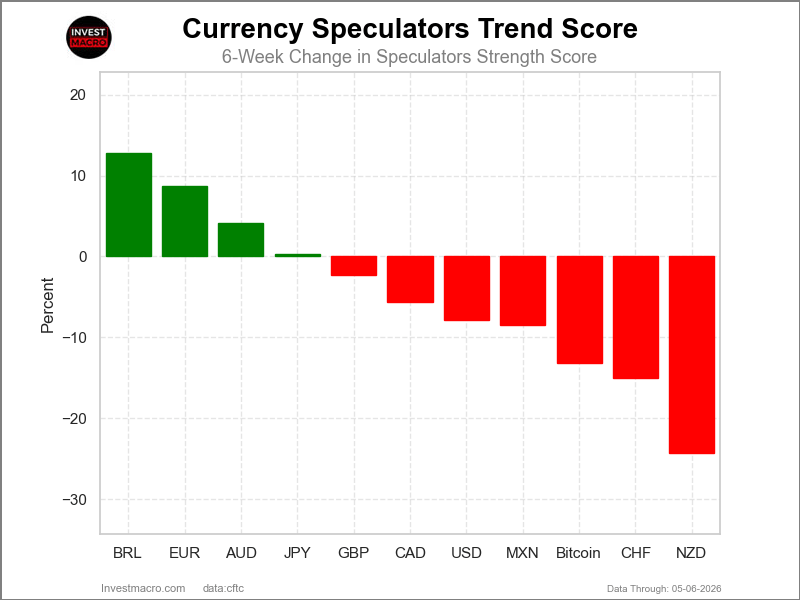
Australian Dollar & Bitcoin top the 6-Week Strength Trends

Speculators Trends FX Futures COT Chart
COT Strength Score Trends (or move index, calculates the 6-week changes in strength scores) showed that the Australian Dollar (34 percent) and the Bitcoin (32 percent) lead the past six weeks trends for the currencies. The Canadian Dollar (29 percent), the British Pound (12 percent) and the New Zealand Dollar (11 percent) are the next highest positive movers in the 3-Year trends data.

The Brazilian Real (-12 percent) leads the downside trend scores currently with the Mexican Peso (-6 percent), Japanese Yen (-6 percent) and the EuroFX (1 percent) following next with lower trend scores.

3-Year Strength Trends:
US Dollar Index (8.6 percent) vs US Dollar Index previous week (0.5 percent)
EuroFX (1.3 percent) vs EuroFX previous week (-4.9 percent)
British Pound Sterling (11.6 percent) vs British Pound Sterling previous week (13.7 percent)
Japanese Yen (-5.6 percent) vs Japanese Yen previous week (-8.5 percent)
Swiss Franc (6.6 percent) vs Swiss Franc previous week (-8.1 percent)
Canadian Dollar (28.6 percent) vs Canadian Dollar previous week (34.8 percent)
Australian Dollar (33.9 percent) vs Australian Dollar previous week (20.6 percent)
New Zealand Dollar (11.1 percent) vs New Zealand Dollar previous week (0.3 percent)
Mexican Peso (-5.9 percent) vs Mexican Peso previous week (8.9 percent)
Brazilian Real (-12.2 percent) vs Brazilian Real previous week (-21.2 percent)
Bitcoin (31.5 percent) vs Bitcoin previous week (12.4 percent)


Individual COT Forex Markets:

US Dollar Index Futures:
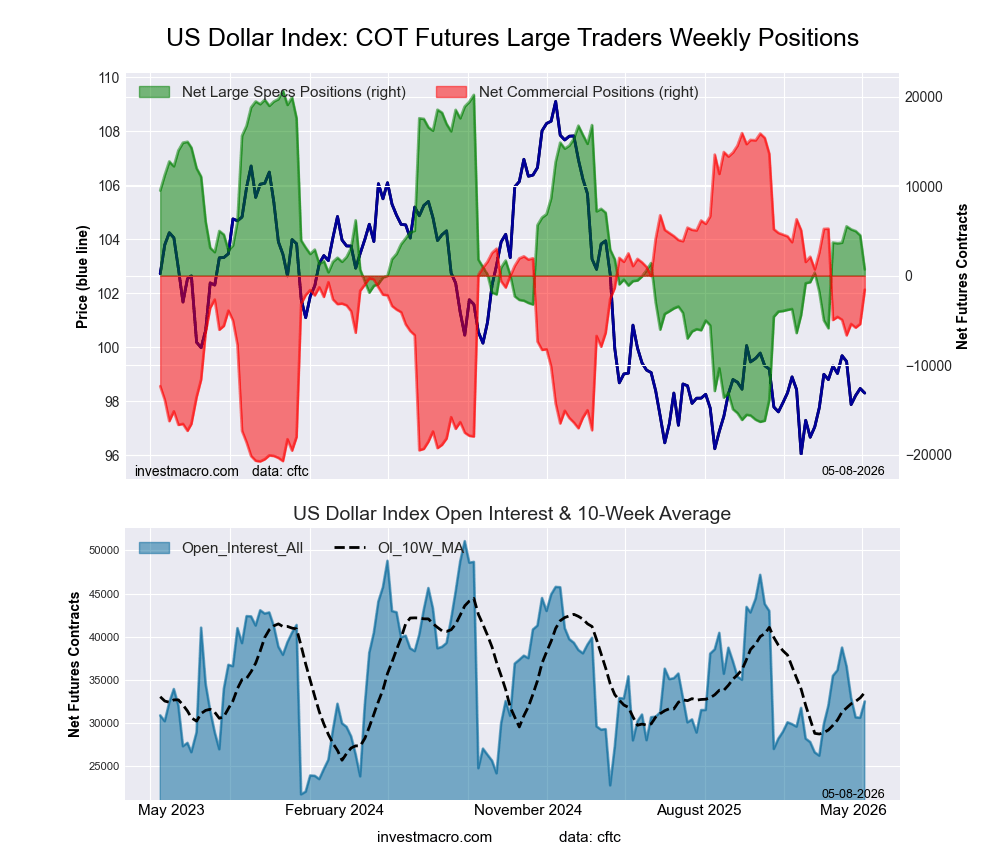
US Dollar Index Forex Futures COT ChartThe US Dollar Index large speculator standing this week recorded a net position of -852 contracts in the data reported through Tuesday. This was a weekly gain of 3,553 contracts from the previous week which had a total of -4,405 net contracts.

This week’s current strength score (the trader positioning range over the past three years, measured from 0 to 100) shows the speculators are currently Bearish with a score of 41.8 percent. The commercials are Bullish with a score of 60.7 percent and the small traders (not shown in chart) are Bearish with a score of 23.3 percent.

Price Trend-Following Model: Strong Downtrend

Our weekly trend-following model classifies the current market price position as: Strong Downtrend.

US DOLLAR INDEX StatisticsSPECULATORSCOMMERCIALSSMALL TRADERS
– Percent of Open Interest Longs:58.925.77.8
– Percent of Open Interest Shorts:61.920.310.2
– Net Position:-8521,529-677
– Gross Longs:16,6107,2392,188
– Gross Shorts:17,4625,7102,865
– Long to Short Ratio:1.0 to 11.3 to 10.8 to 1
NET POSITION TREND:
– Strength Index Score (3 Year Range Pct):41.860.723.3
– Strength Index Reading (3 Year Range):BearishBullishBearish
NET POSITION MOVEMENT INDEX:
– 6-Week Change in Strength Index:8.6-8.81.2


Euro Currency Futures:

Euro Currency Futures COT ChartThe Euro Currency large speculator standing this week recorded a net position of 163,361 contracts in the data reported through Tuesday. This was a weekly lift of 31,227 contracts from the previous week which had a total of 132,134 net contracts.

This week’s current strength score (the trader positioning range over the past three years, measured from 0 to 100) shows the speculators are currently Bullish-Extreme with a score of 91.0 percent. The commercials are Bearish-Extreme with a score of 6.7 percent and the small traders (not shown in chart) are Bullish-Extreme with a score of 91.0 percent.

Price Trend-Following Model: Strong Uptrend

Our weekly trend-following model classifies the current market price position as: Strong Uptrend.

EURO Currency StatisticsSPECULATORSCOMMERCIALSSMALL TRADERS
– Percent of Open Interest Longs:33.253.110.2
– Percent of Open Interest Shorts:15.377.24.2
– Net Position:163,361-218,54155,180
– Gross Longs:302,301483,91193,181
– Gross Shorts:138,940702,45238,001
– Long to Short Ratio:2.2 to 10.7 to 12.5 to 1
NET POSITION TREND:
– Strength Index Score (3 Year Range Pct):91.06.791.0
– Strength Index Reading (3 Year Range):Bullish-ExtremeBearish-ExtremeBullish-Extreme
NET POSITION MOVEMENT INDEX:
– 6-Week Change in Strength Index:1.3-3.111.8


British Pound Sterling Futures:

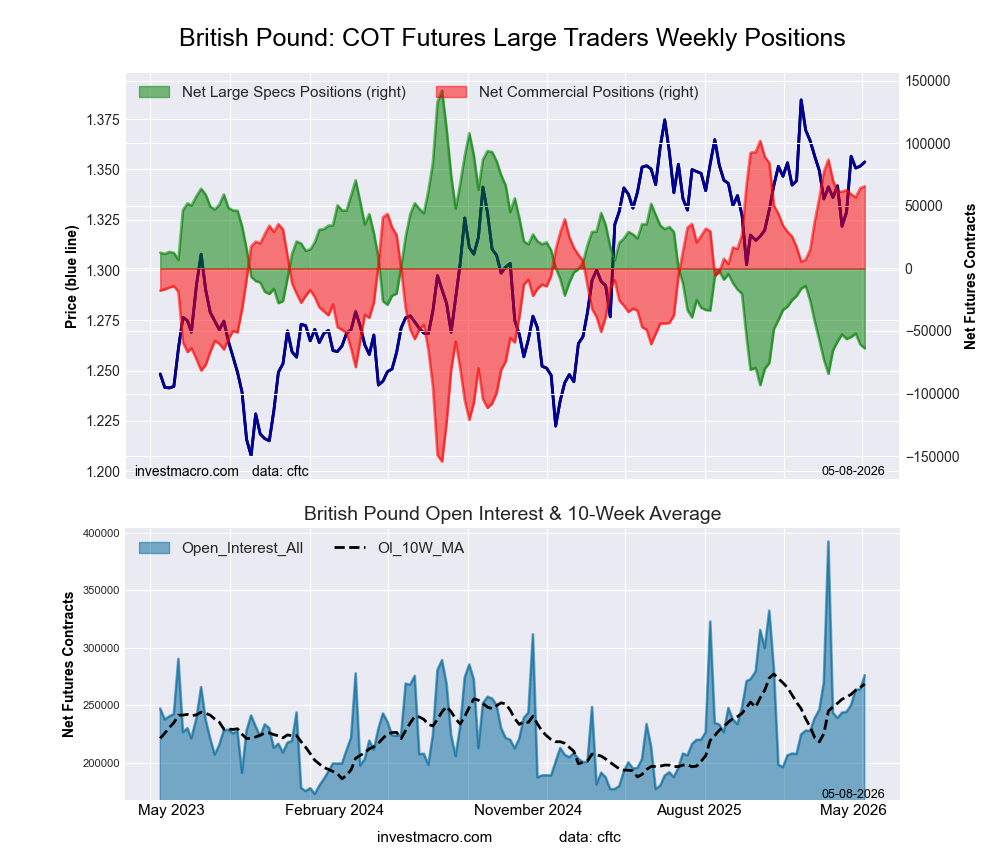
British Pound Sterling Futures COT ChartThe British Pound Sterling large speculator standing this week recorded a net position of -13,911 contracts in the data reported through Tuesday. This was a weekly boost of 2,251 contracts from the previous week which had a total of -16,162 net contracts.

This week’s current strength score (the trader positioning range over the past three years, measured from 0 to 100) shows the speculators are currently Bearish with a score of 33.7 percent. The commercials are Bullish with a score of 63.0 percent and the small traders (not shown in chart) are Bullish with a score of 71.0 percent.

Price Trend-Following Model: Strong Uptrend

Our weekly trend-following model classifies the current market price position as: Strong Uptrend.

BRITISH POUND StatisticsSPECULATORSCOMMERCIALSSMALL TRADERS
– Percent of Open Interest Longs:41.642.115.0
– Percent of Open Interest Shorts:47.739.012.0
– Net Position:-13,9117,0646,847
– Gross Longs:94,89396,00434,151
– Gross Shorts:108,80488,94027,304
– Long to Short Ratio:0.9 to 11.1 to 11.3 to 1
NET POSITION TREND:
– Strength Index Score (3 Year Range Pct):33.763.071.0
– Strength Index Reading (3 Year Range):BearishBullishBullish
NET POSITION MOVEMENT INDEX:
– 6-Week Change in Strength Index:11.6-14.324.2


Japanese Yen Futures:

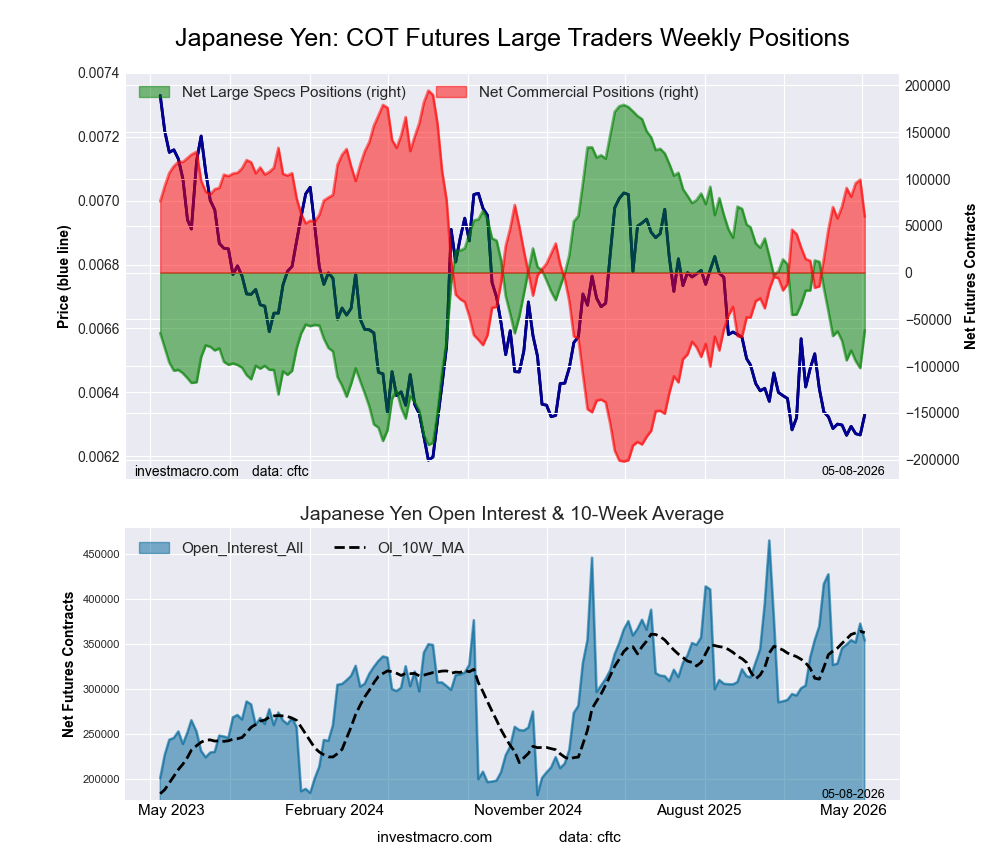
Japanese Yen Forex Futures COT ChartThe Japanese Yen large speculator standing this week recorded a net position of -19,222 contracts in the data reported through Tuesday. This was a weekly rise of 14,711 contracts from the previous week which had a total of -33,933 net contracts.

This week’s current strength score (the trader positioning range over the past three years, measured from 0 to 100) shows the speculators are currently Bearish with a score of 45.4 percent. The commercials are Bullish with a score of 54.6 percent and the small traders (not shown in chart) are Bearish with a score of 49.3 percent.

Price Trend-Following Model: Downtrend

Our weekly trend-following model classifies the current market price position as: Downtrend.

JAPANESE YEN StatisticsSPECULATORSCOMMERCIALSSMALL TRADERS
– Percent of Open Interest Longs:37.740.412.9
– Percent of Open Interest Shorts:44.035.611.3
– Net Position:-19,22214,4174,805
– Gross Longs:114,428122,66539,140
– Gross Shorts:133,650108,24834,335
– Long to Short Ratio:0.9 to 11.1 to 11.1 to 1
NET POSITION TREND:
– Strength Index Score (3 Year Range Pct):45.454.649.3
– Strength Index Reading (3 Year Range):BearishBullishBearish
NET POSITION MOVEMENT INDEX:
– 6-Week Change in Strength Index:-5.65.10.3


Swiss Franc Futures:

Swiss Franc Forex Futures COT ChartThe Swiss Franc large speculator standing this week recorded a net position of -40,717 contracts in the data reported through Tuesday. This was a weekly advance of 2,176 contracts from the previous week which had a total of -42,893 net contracts.

This week’s current strength score (the trader positioning range over the past three years, measured from 0 to 100) shows the speculators are currently Bearish-Extreme with a score of 18.4 percent. The commercials are Bullish with a score of 63.1 percent and the small traders (not shown in chart) are Bullish-Extreme with a score of 86.0 percent.

Price Trend-Following Model: Strong Uptrend

Our weekly trend-following model classifies the current market price position as: Strong Uptrend.

SWISS FRANC StatisticsSPECULATORSCOMMERCIALSSMALL TRADERS
– Percent of Open Interest Longs:10.469.919.1
– Percent of Open Interest Shorts:53.928.217.3
– Net Position:-40,71739,0121,705
– Gross Longs:9,68765,42417,858
– Gross Shorts:50,40426,41216,153
– Long to Short Ratio:0.2 to 12.5 to 11.1 to 1
NET POSITION TREND:
– Strength Index Score (3 Year Range Pct):18.463.186.0
– Strength Index Reading (3 Year Range):Bearish-ExtremeBullishBullish-Extreme
NET POSITION MOVEMENT INDEX:
– 6-Week Change in Strength Index:6.6-7.14.5


Canadian Dollar Futures:

Canadian Dollar Forex Futures COT ChartThe Canadian Dollar large speculator standing this week recorded a net position of 2,130 contracts in the data reported through Tuesday. This was a weekly gain of 18,176 contracts from the previous week which had a total of -16,046 net contracts.

This week’s current strength score (the trader positioning range over the past three years, measured from 0 to 100) shows the speculators are currently Bullish-Extreme with a score of 97.9 percent. The commercials are Bearish-Extreme with a score of 6.8 percent and the small traders (not shown in chart) are Bullish with a score of 61.5 percent.

Price Trend-Following Model: Strong Uptrend

Our weekly trend-following model classifies the current market price position as: Strong Uptrend.

CANADIAN DOLLAR StatisticsSPECULATORSCOMMERCIALSSMALL TRADERS
– Percent of Open Interest Longs:35.848.114.4
– Percent of Open Interest Shorts:34.851.811.8
– Net Position:2,130-7,9165,786
– Gross Longs:77,397104,11931,230
– Gross Shorts:75,267112,03525,444
– Long to Short Ratio:1.0 to 10.9 to 11.2 to 1
NET POSITION TREND:
– Strength Index Score (3 Year Range Pct):97.96.861.5
– Strength Index Reading (3 Year Range):Bullish-ExtremeBearish-ExtremeBullish
NET POSITION MOVEMENT INDEX:
– 6-Week Change in Strength Index:28.6-28.720.1


Australian Dollar Futures:

Australian Dollar Forex Futures COT ChartThe Australian Dollar large speculator standing this week recorded a net position of 26,118 contracts in the data reported through Tuesday. This was a weekly boost of 18,972 contracts from the previous week which had a total of 7,146 net contracts.

This week’s current strength score (the trader positioning range over the past three years, measured from 0 to 100) shows the speculators are currently Bullish-Extreme with a score of 94.8 percent. The commercials are Bearish-Extreme with a score of 1.3 percent and the small traders (not shown in chart) are Bullish-Extreme with a score of 91.3 percent.

Price Trend-Following Model: Strong Uptrend

Our weekly trend-following model classifies the current market price position as: Strong Uptrend.

AUSTRALIAN DOLLAR StatisticsSPECULATORSCOMMERCIALSSMALL TRADERS
– Percent of Open Interest Longs:46.736.416.3
– Percent of Open Interest Shorts:36.455.37.7
– Net Position:26,118-48,06021,942
– Gross Longs:118,75192,58241,430
– Gross Shorts:92,633140,64219,488
– Long to Short Ratio:1.3 to 10.7 to 12.1 to 1
NET POSITION TREND:
– Strength Index Score (3 Year Range Pct):94.81.391.3
– Strength Index Reading (3 Year Range):Bullish-ExtremeBearish-ExtremeBullish-Extreme
NET POSITION MOVEMENT INDEX:
– 6-Week Change in Strength Index:33.9-30.99.3


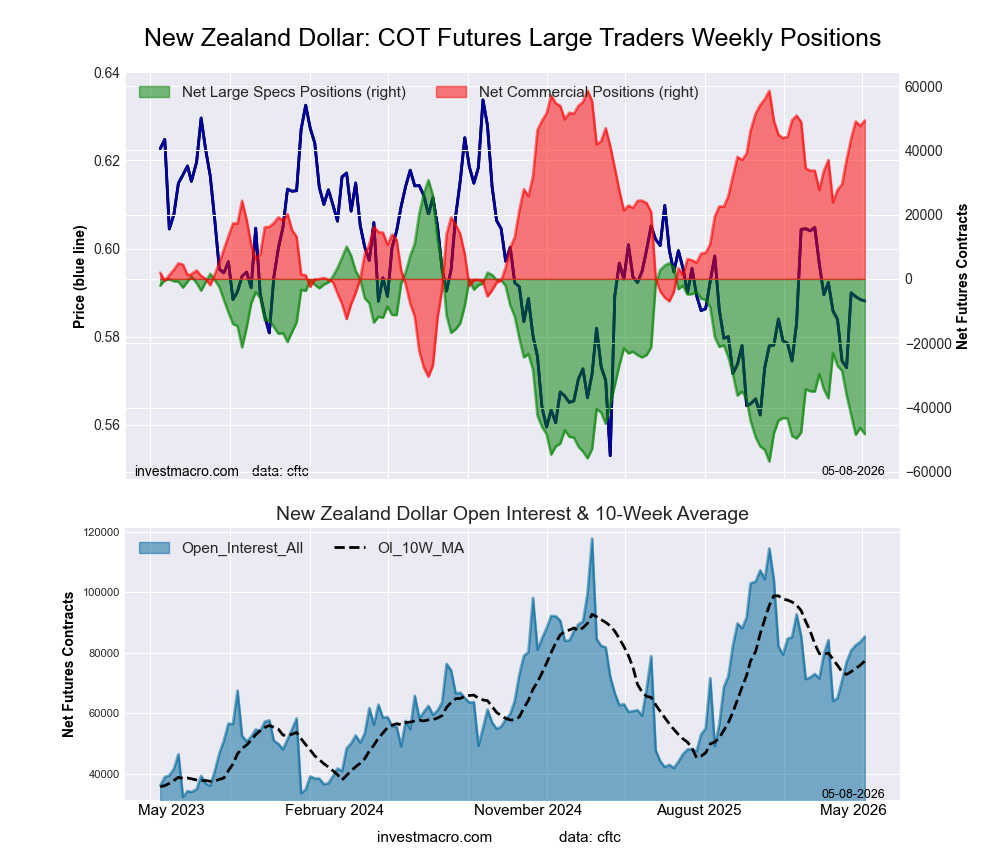
New Zealand Dollar Futures:

New Zealand Dollar Forex Futures COT ChartThe New Zealand Dollar large speculator standing this week recorded a net position of -34,294 contracts in the data reported through Tuesday. This was a weekly gain of 13,451 contracts from the previous week which had a total of -47,745 net contracts.

This week’s current strength score (the trader positioning range over the past three years, measured from 0 to 100) shows the speculators are currently Bearish with a score of 25.7 percent. The commercials are Bullish with a score of 72.8 percent and the small traders (not shown in chart) are Bullish with a score of 51.3 percent.

Price Trend-Following Model: Strong Uptrend

Our weekly trend-following model classifies the current market price position as: Strong Uptrend.

NEW ZEALAND DOLLAR StatisticsSPECULATORSCOMMERCIALSSMALL TRADERS
– Percent of Open Interest Longs:16.776.65.6
– Percent of Open Interest Shorts:64.828.45.7
– Net Position:-34,29434,376-82
– Gross Longs:11,88354,5963,988
– Gross Shorts:46,17720,2204,070
– Long to Short Ratio:0.3 to 12.7 to 11.0 to 1
NET POSITION TREND:
– Strength Index Score (3 Year Range Pct):25.772.851.3
– Strength Index Reading (3 Year Range):BearishBullishBullish
NET POSITION MOVEMENT INDEX:
– 6-Week Change in Strength Index:11.1-11.910.5


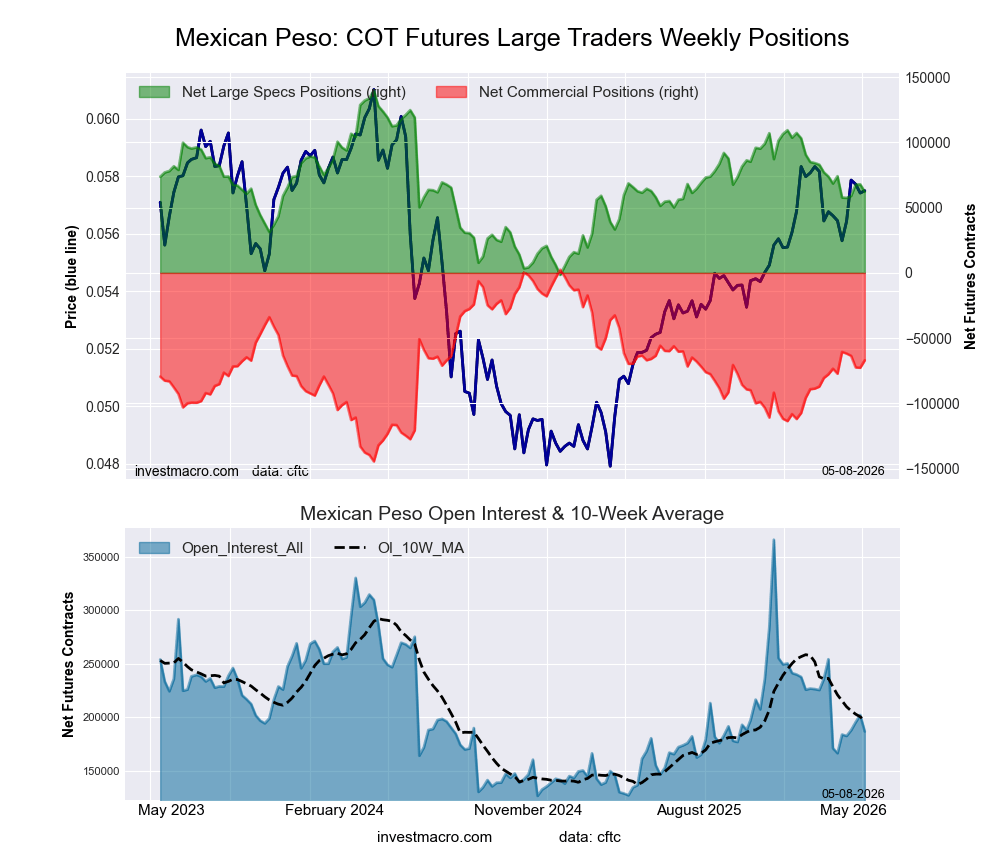
Mexican Peso Futures:

Mexican Peso Futures COT ChartThe Mexican Peso large speculator standing this week recorded a net position of 90,592 contracts in the data reported through Tuesday. This was a weekly lowering of -12,522 contracts from the previous week which had a total of 103,114 net contracts.

This week’s current strength score (the trader positioning range over the past three years, measured from 0 to 100) shows the speculators are currently Bullish with a score of 72.6 percent. The commercials are Bearish with a score of 27.3 percent and the small traders (not shown in chart) are Bullish with a score of 51.7 percent.

Price Trend-Following Model: Strong Uptrend

Our weekly trend-following model classifies the current market price position as: Strong Uptrend.

MEXICAN PESO StatisticsSPECULATORSCOMMERCIALSSMALL TRADERS
– Percent of Open Interest Longs:58.637.33.4
– Percent of Open Interest Shorts:18.579.71.1
– Net Position:90,592-95,8035,211
– Gross Longs:132,39284,2247,660
– Gross Shorts:41,800180,0272,449
– Long to Short Ratio:3.2 to 10.5 to 13.1 to 1
NET POSITION TREND:
– Strength Index Score (3 Year Range Pct):72.627.351.7
– Strength Index Reading (3 Year Range):BullishBearishBullish
NET POSITION MOVEMENT INDEX:
– 6-Week Change in Strength Index:-5.95.71.9


Brazilian Real Futures:

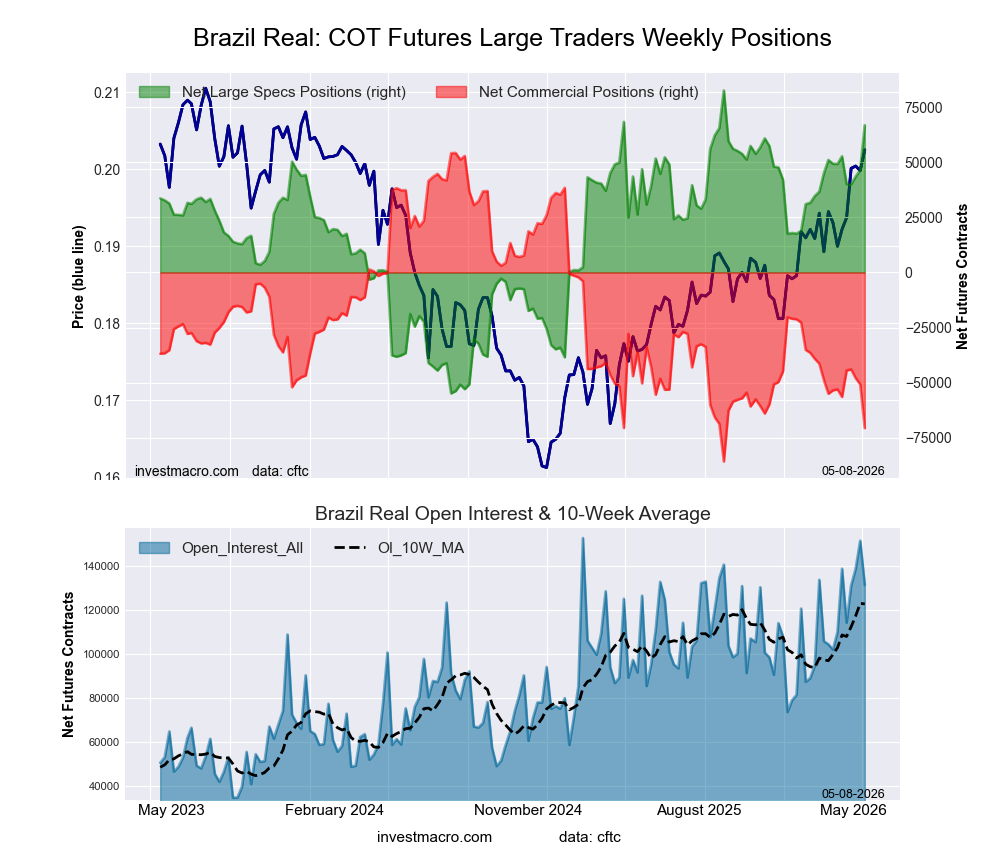
Brazil Real Futures COT ChartThe Brazilian Real large speculator standing this week recorded a net position of 30,962 contracts in the data reported through Tuesday. This was a weekly lift of 12,117 contracts from the previous week which had a total of 18,845 net contracts.

This week’s current strength score (the trader positioning range over the past three years, measured from 0 to 100) shows the speculators are currently Bullish with a score of 62.5 percent. The commercials are Bearish with a score of 36.2 percent and the small traders (not shown in chart) are Bearish with a score of 44.4 percent.

Price Trend-Following Model: Strong Uptrend

Our weekly trend-following model classifies the current market price position as: Strong Uptrend.

BRAZIL REAL StatisticsSPECULATORSCOMMERCIALSSMALL TRADERS
– Percent of Open Interest Longs:65.528.05.9
– Percent of Open Interest Shorts:30.168.21.1
– Net Position:30,962-35,1334,171
– Gross Longs:57,23224,4215,163
– Gross Shorts:26,27059,554992
– Long to Short Ratio:2.2 to 10.4 to 15.2 to 1
NET POSITION TREND:
– Strength Index Score (3 Year Range Pct):62.536.244.4
– Strength Index Reading (3 Year Range):BullishBearishBearish
NET POSITION MOVEMENT INDEX:
– 6-Week Change in Strength Index:-12.210.411.9


Bitcoin Futures:

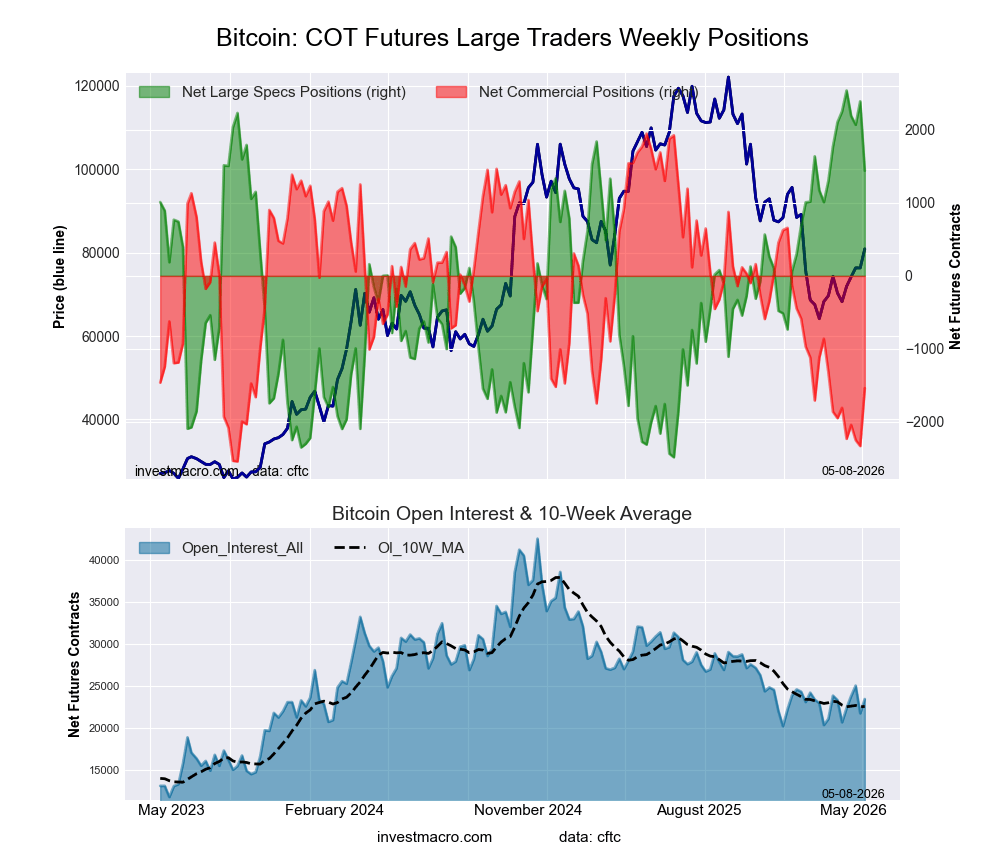
Bitcoin Crypto Futures COT ChartThe Bitcoin large speculator standing this week recorded a net position of 1,008 contracts in the data reported through Tuesday. This was a weekly lift of 318 contracts from the previous week which had a total of 690 net contracts.

This week’s current strength score (the trader positioning range over the past three years, measured from 0 to 100) shows the speculators are currently Bullish with a score of 74.1 percent. The commercials are Bearish with a score of 35.1 percent and the small traders (not shown in chart) are Bearish with a score of 35.3 percent.

Price Trend-Following Model: Strong Downtrend

Our weekly trend-following model classifies the current market price position as: Strong Downtrend.

BITCOIN StatisticsSPECULATORSCOMMERCIALSSMALL TRADERS
– Percent of Open Interest Longs:82.22.35.0
– Percent of Open Interest Shorts:77.86.55.2
– Net Position:1,008-968-40
– Gross Longs:18,9395211,151
– Gross Shorts:17,9311,4891,191
– Long to Short Ratio:1.1 to 10.3 to 11.0 to 1
NET POSITION TREND:
– Strength Index Score (3 Year Range Pct):74.135.135.3
– Strength Index Reading (3 Year Range):BullishBearishBearish
NET POSITION MOVEMENT INDEX:
– 6-Week Change in Strength Index:31.5-31.6-3.4


Article By InvestMacroReceive our weekly COT Newsletter

*COT Report: The COT data, released weekly to the public each Friday, is updated through the most recent Tuesday (data is 3 days old) and shows a quick view of how large speculators or non-commercials (for-profit traders) were positioned in the futures markets.

The CFTC categorizes trader positions according to commercial hedgers (traders who use futures contracts for hedging as part of the business), non-commercials (large traders who speculate to realize trading profits) and nonreportable traders (usually small traders/speculators) as well as their open interest (contracts open in the market at time of reporting). See CFTC criteria here.