Archive for Forex and Currency News – Page 17

The Pound Faces Challenges: Weak Data and External Pressures Mount

By RoboForex Analytical Department

The GBP/USD pair is trading near 1.3445 on Wednesday, with the pound closing September with its first monthly decline against the US dollar since July.

Short-term price action remains under pressure from the looming US government shutdown, which threatens to delay the release of key US macroeconomic data, injecting uncertainty into the market.

Domestic economic figures from the UK offered a mixed picture. Second-quarter GDP growth was confirmed at 0.3% quarter-on-quarter, matching forecasts. However, the current account deficit widened significantly to £28.9 billion, or 3.8% of GDP, up from 2.8% in the previous quarter and well beyond expectations.

The pound is also contending with substantial domestic headwinds. The UK continues to grapple with the highest inflation rate among major developed economies (around 4%) and elevated borrowing costs. Bank of England Deputy Governor Sarah Breeden emphasised that inflation remains excessively high, noting two-sided risks. She warned that prices for food and services could keep inflation stubbornly elevated, despite emerging signs of a slowdown in wage growth.

Further pressure stems from fiscal policy, with Chancellor of the Exchequer Rachel Reeves preparing the budget for 26th November. Tax rises are seen as almost inevitable to cover a fiscal gap estimated in the tens of billions of pounds.

In summary, the pound is caught between external risks—such as the US shutdown and global capital flows—and domestic challenges, including a high deficit, persistent inflation, and the prospect of fiscal tightening.

Technical Analysis: GBP/USD

H4 Chart:

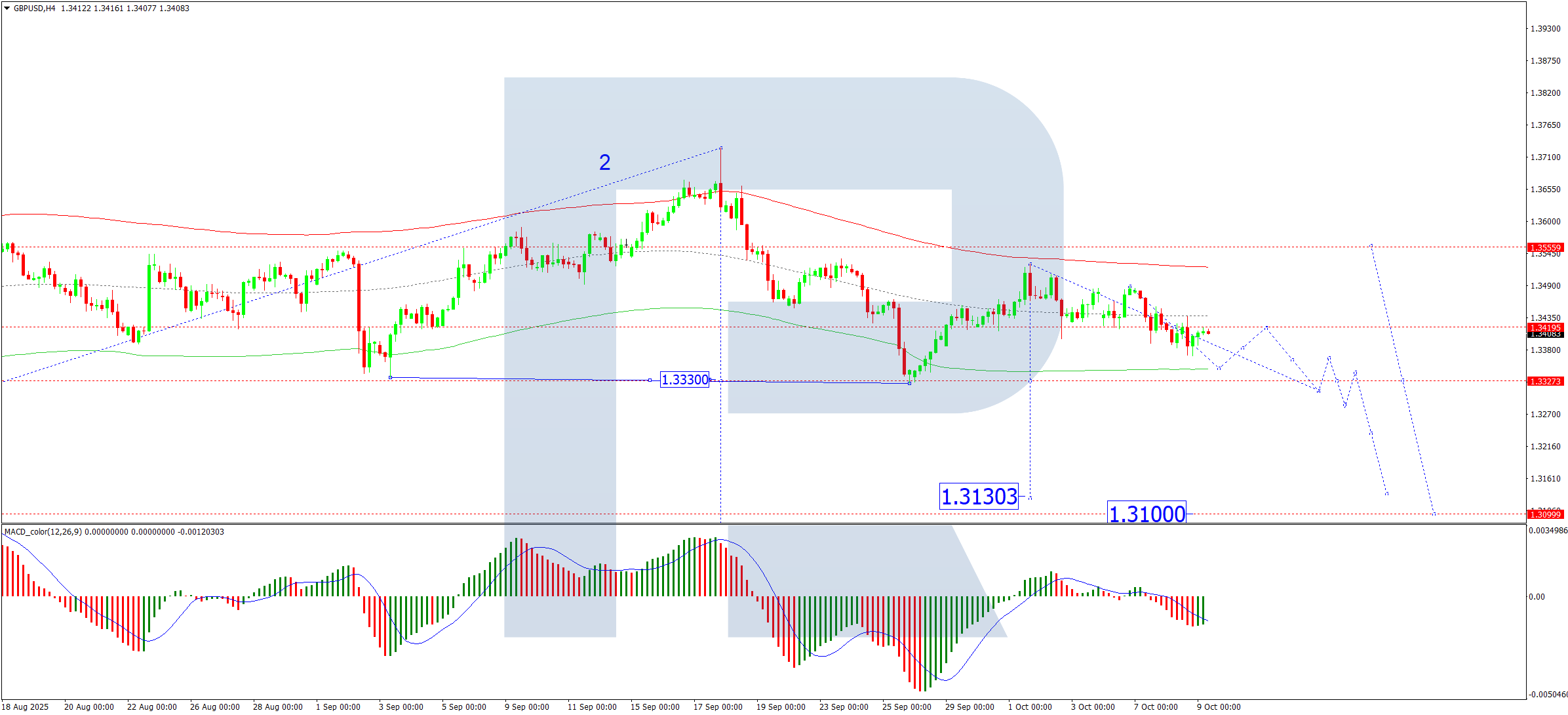
On the H4 chart, GBP/USD formed a tight consolidation range around 1.3434. Following an upward breakout, the pair is now developing a corrective wave towards 1.3550. Once this correction is complete, we anticipate the start of a new decline towards 1.3434, with a longer-term prospect of extending the downtrend to 1.3330. This outlook is technically confirmed by the MACD indicator, whose signal line is below zero but is rising steadily.

H1 Chart:

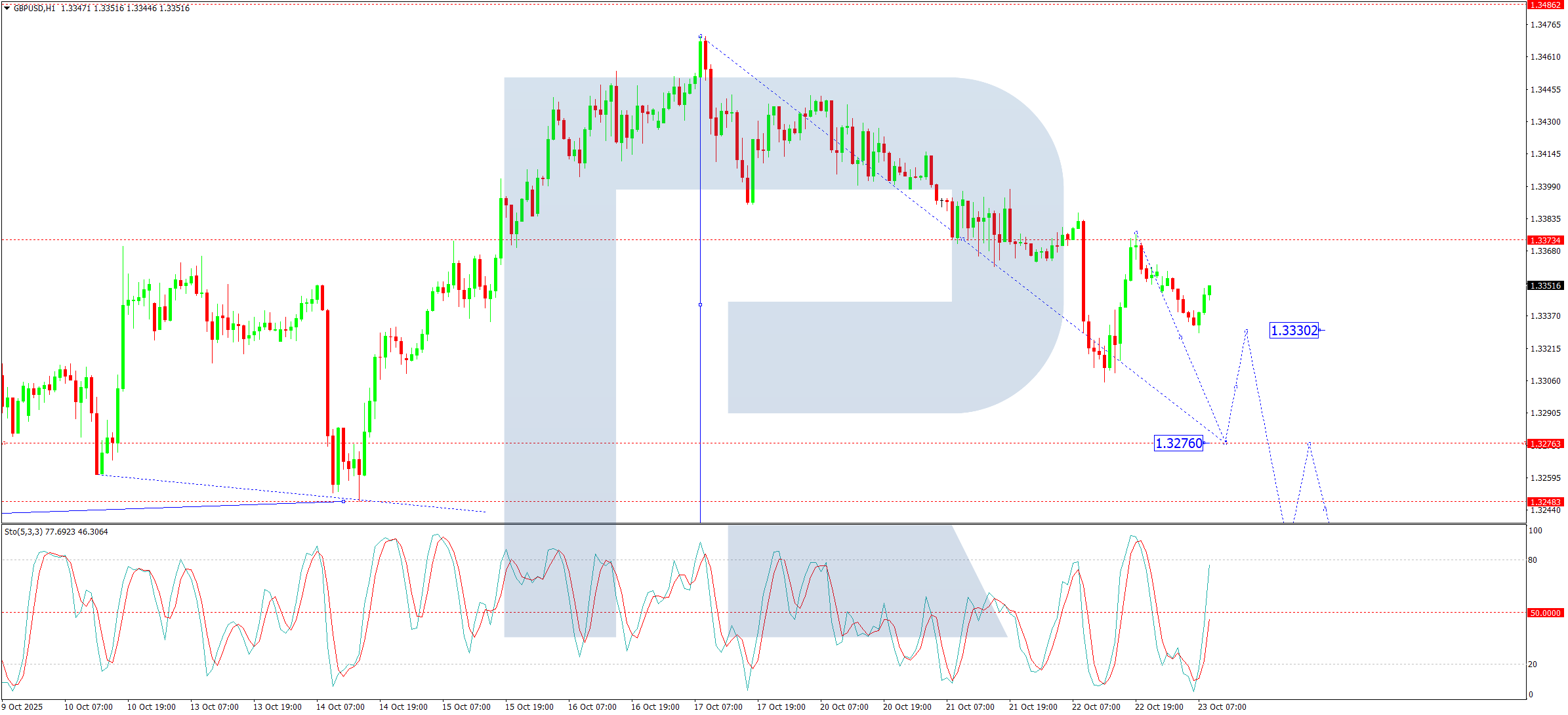
The H1 chart shows the pair forming a consolidation range around 1.3418 before breaking upwards. It is now continuing a growth wave towards a local target of 1.3490. Following this, a decline back to 1.3418 (testing it as support from above) is expected. Subsequently, another upward structure could develop, targeting at least 1.3508, with a potential extension to 1.3550. The Stochastic oscillator supports this view, with its signal line above 50 and rising sharply towards 80.

Conclusion

The pound is navigating a complex landscape of domestic economic weaknesses and external uncertainties. While a short-term technical correction is underway, the broader fundamental and technical picture suggests the downward trajectory is likely to resume after the current upward move is exhausted.


Disclaimer:

Any forecasts contained herein are based on the author’s particular opinion. This analysis may not be treated as trading advice. RoboForex bears no responsibility for trading results based on trading recommendations and reviews contained herein.

USD/JPY Under Pressure: All Eyes on Bank of Japan Rhetoric

By RoboForex Analytical Department

The USD/JPY pair fell to 148.49, marking a third consecutive day of declines as markets digest mixed signals from the Bank of Japan.

The recently published summary of opinions from the September meeting revealed a divided policy committee. Some members advocated for further rate hikes, assuming current growth and inflation forecasts hold. Others, however, argued for maintaining low rates to help cushion the economy from the impact of new US tariffs.

Further highlighting the internal debate, one board member emphasised a wait-and-see approach, stressing the need to monitor global trade policy, the yen’s exchange rate, and domestic price and wage dynamics. In contrast, another member noted that with over six months having passed since the last policy shift, it was time to consider another increase.

Weakening Japanese economic data added to the downward pressure. August retail sales fell 1.1%, missing forecasts for 1.0% growth and marking the first decline since February 2022. Industrial production figures also came in worse than expected.

Technical Analysis: USD/JPY

H4 Chart:

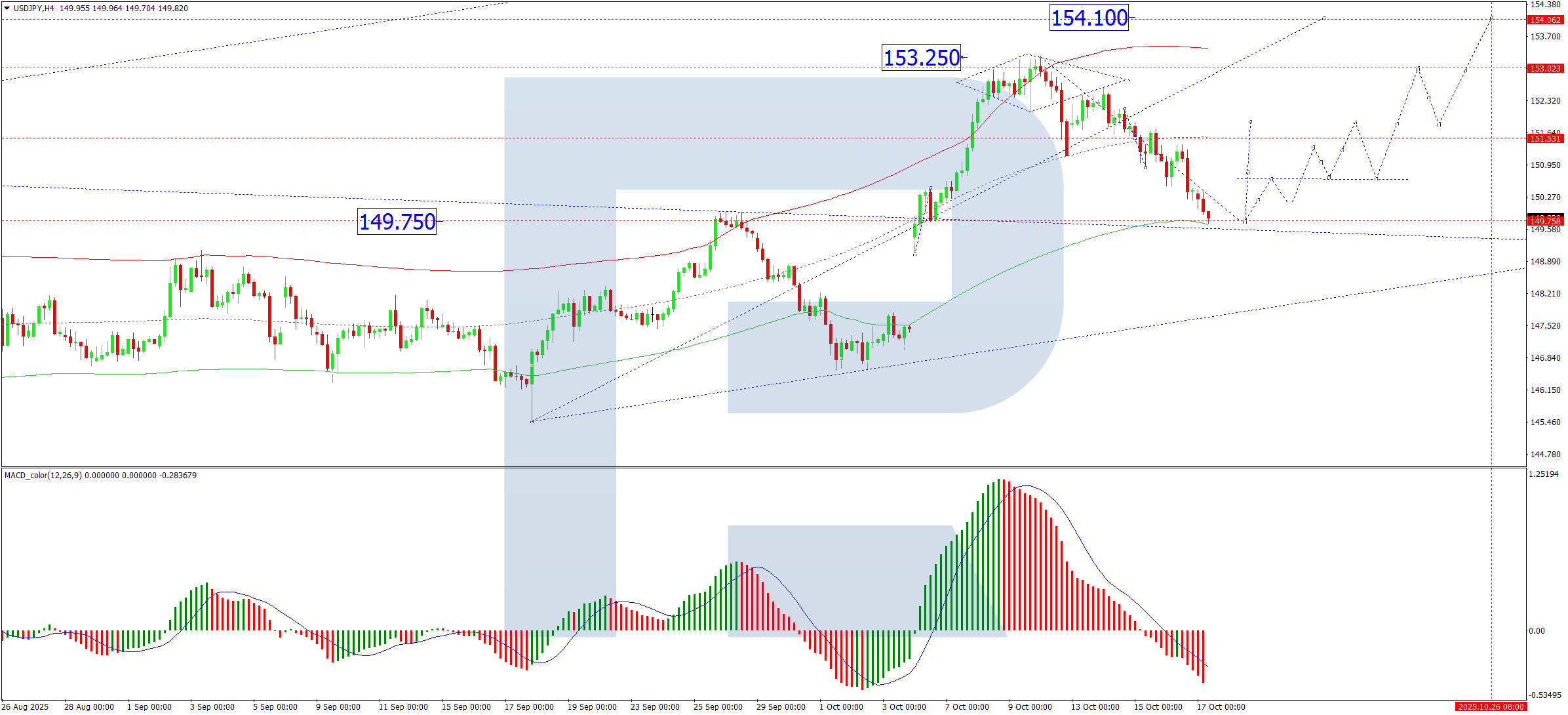
On the H4 chart, USD/JPY formed a tight consolidation range around 148.80. Today’s downside breakout has extended the correction, with the next target at 147.72. Upon reaching this level, we anticipate a potential new growth wave towards 149.95. This scenario is technically confirmed by the MACD indicator, whose signal line is above zero but pointing firmly downward.

H1 Chart:

The H1 chart shows the pair completed a decline to 148.80 and consolidated around this level. The subsequent downside breakout has confirmed the continuation of the bearish wave structure towards 147.72. The Stochastic oscillator supports this view, with its signal line below 50 and falling sharply towards 20.

Conclusion

USD/JPY remains under pressure amid divergent signals from the BoJ and soft domestic data. While the near-term technical bias is bearish, the current decline is viewed as a correction within a broader uptrend, with the potential for a renewed upward move upon completion of the current wave.


Disclaimer:

Any forecasts contained herein are based on the author’s particular opinion. This analysis may not be treated as trading advice. RoboForex bears no responsibility for trading results based on trading recommendations and reviews contained herein.

EUR/USD Gains on US Shutdown Fears and Data Watch

By RoboForex Analytical Department

The EUR/USD pair extended gains for a second consecutive session, trading around 1.1727. The move reflects market concerns over a potential US government shutdown and caution ahead of key economic releases due this week.

A partial shutdown of US federal agencies could begin as early as Wednesday if Congress fails to pass a funding bill before the fiscal year ends on Tuesday. President Donald Trump is scheduled to meet with congressional leaders in an effort to reach a compromise.

Investor attention is also focused on upcoming US data, including the September non-farm payrolls report, JOLTS job openings, the ADP private employment survey, and the ISM manufacturing index. Strong indicators last week have tempered expectations for aggressive Fed easing, with markets now pricing in roughly 40 basis points of rate cuts by year-end.

Broad-based US dollar weakness has provided additional support for the euro.

Technical Analysis: EUR/USD

H4 Chart:

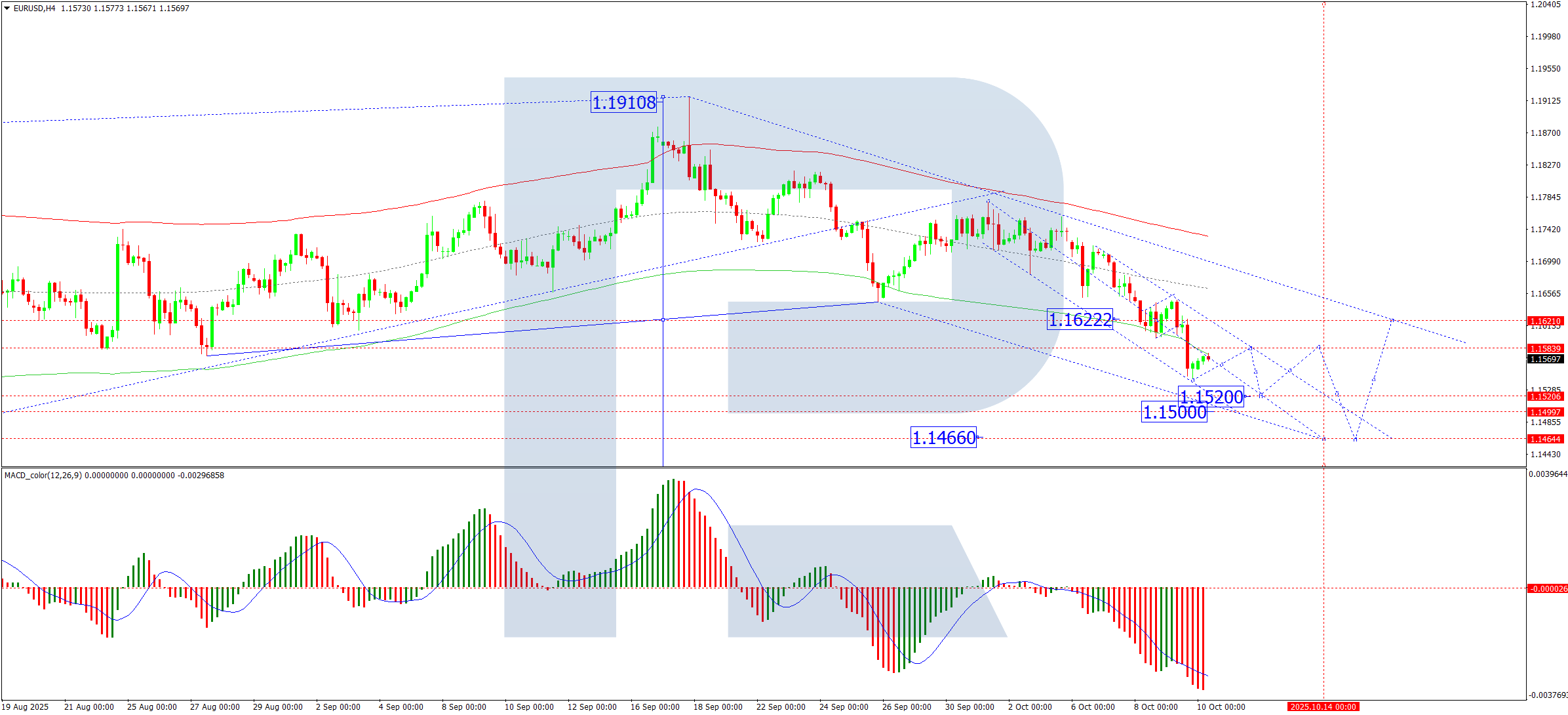
On the H4 chart, EUR/USD established a consolidation range above 1.1645 before breaking upward into a corrective phase. We expect the pair to advance toward 1.1730, followed by a pullback to 1.1695. A subsequent rise toward 1.1780 is anticipated, at which point the corrective potential is likely to be exhausted. A new decline toward 1.1625 may then develop. The MACD indicator supports this view, with its signal line below zero but exiting the histogram zone—suggesting potential upward momentum toward the zero line.

H1 Chart:

The H1 chart shows the completion of a decline to 1.1645, followed by the formation of a corrective structure. The initial advance to 1.1730 appears complete. A dip toward 1.1695 is possible before another rise toward 1.1780. Once this correction concludes, a new decline toward 1.1625 is expected. A break below this level could open the way toward 1.1470. The Stochastic oscillator aligns with this outlook, with its signal line above 80 and turning downward toward 20.

Conclusion

EUR/USD is drawing support from US fiscal uncertainty and a softer dollar, though the broader technical structure remains corrective. Traders are likely to remain cautious ahead of critical US employment and activity data, which may determine the near-term direction for the pair.


Disclaimer:

Any forecasts contained herein are based on the author’s particular opinion. This analysis may not be treated as trading advice. RoboForex bears no responsibility for trading results based on trading recommendations and reviews contained herein.

USD/JPY Rally Pauses as Yen Seeks Footing

By RoboForex Analytical Department

The USD/JPY pair slowed its ascent on Friday, stabilising near 149.69 – close to its lowest level in nearly two months. The yen remained under pressure from broad US dollar strength, fueled by robust economic data that tempered expectations for aggressive Federal Reserve easing.

Recent figures reinforced the resilience of the US economy: weekly jobless claims fell to 218,000, while second-quarter GDP growth was revised up to 3.8% year-on-year, marking the fastest pace in nearly two years.

In Japan, data provided mixed signals. Core inflation in Tokyo held steady at 2.5% in September, matching the August reading but falling short of the 2.8% forecast. The minutes from the Bank of Japan’s July policy meeting revealed that some members are inclined toward further rate hikes, contingent on aligned economic and inflation trends. While rates were held unchanged in September, two dissenting votes suggest that monetary tightening may be approaching sooner than anticipated.

Technical Analysis: USD/JPY

H4 Chart:

On the H4 chart, USD/JPY completed an initial advance to 149.90. The pair is now forming a consolidation range below this level. A downward breakout would likely initiate a correction towards 148.78, with a potential extension to 147.77 (testing the level from above). Once this correction concludes, a new upward move targeting 151.05 is expected to develop. This outlook is supported by the MACD indicator: its signal line remains well above zero, although a pullback towards the zero line is anticipated.

H1 Chart:

The H1 chart shows the pair forming a consolidation range around 148.78 before breaking upward and achieving its first target at 149.90. A new range is now forming below this peak. An expected downside breakout should trigger a correction towards 148.78. The Stochastic oscillator aligns with this view, as its signal line is below 50 and falling sharply towards 20.

Conclusion

USD/JPY is taking a breather after its recent rally, caught between a strong US dollar and growing speculation around a more hawkish BoJ. The near-term technical bias suggests a corrective pullback is likely, which could offer a more solid foundation for the next leg upward. Traders will be watching for clearer signals from both central banks to determine the pair’s next sustained move.


Disclaimer:

Any forecasts contained herein are based on the author’s particular opinion. This analysis may not be treated as trading advice. RoboForex bears no responsibility for trading results based on trading recommendations and reviews contained herein.

GBP/USD Under Pressure as Markets Question Bank of England’s Stance

By RoboForex Analytical Department

The GBP/USD pair remains under pressure, trading around 1.3460, as it contends with a mix of conflicting factors.

In the UK, Bank of England Governor Andrew Bailey stated that inflation is expected to decline next year but confirmed that the central bank’s policy will remain restrictive. He pointed to a weakening labour market and cautious consumers, whose savings are twice as high as pre-pandemic levels. Bailey acknowledged that interest rates would likely continue to fall but emphasised that the pace of easing would be strictly dependent on incoming inflation data.

Across the Atlantic, the US dollar is holding its ground following the Fed’s rate cut last week. Markets are currently pricing in approximately 43 basis points of additional easing by year-end, although there is no clear consensus on whether a move will occur at the next meeting. Recent comments from Chair Jerome Powell and other Fed officials consistently underscore that any further action will be data-dependent, hinging on fresh inflation and employment figures.

Consequently, the pound is weighed down by domestic economic concerns and the BoE’s cautious stance. The dollar, in turn, finds support from expectations of a gradual and measured Fed policy. This creates a stalemate marked by uncertainty, which is clearly reflected in the current range-bound dynamics of GBP/USD.

Technical Analysis: GBP/USD

H4 Chart:

On the H4 chart, GBP/USD formed a tight consolidation range around 1.3544 before breaking lower to achieve the local target of the decline at 1.3427. Today, we anticipate the development of a consolidation range above this level. An upward breakout from this range would open the potential for a corrective move towards 1.3544 (testing it as resistance from below). Following this, we would expect the resumption of the downtrend targeting 1.3366. This bearish outlook is technically confirmed by the MACD indicator, whose signal line is located below zero and pointing decisively downward.

H1 Chart:

The H1 chart shows the pair forming the second leg of a downward impulse towards 1.3422, marking a local target. Upon its completion, we anticipate a potential correction towards the 1.3544 level. This scenario is supported by the Stochastic oscillator, with its signal line currently below 80 and falling sharply towards the 20 level.

Conclusion

The GBP/USD pair is caught between a cautious BoE and a data-dependent Fed, leading to a tentative equilibrium. The technical structure leans bearish, suggesting that any near-term rebounds are likely to be corrective within a broader downtrend, contingent on upcoming economic data from both sides of the Atlantic.


Disclaimer:

Any forecasts contained herein are based on the author’s particular opinion. This analysis may not be treated as trading advice. RoboForex bears no responsibility for trading results based on trading recommendations and reviews contained herein.

EUR/USD Extends Gains as US Dollar Weakens on Fed Uncertainty and Shutdown Fears

By RoboForex Analytical Department

The EUR/USD pair advanced to 1.1804 on Tuesday, marking a second consecutive day of gains. The US dollar faced sustained pressure as markets digested mixed signals from Federal Reserve officials regarding the interest rate outlook.

Several Fed members advocated for caution on further easing, pointing to signs of stabilising inflation. However, this stance was countered by new Governing Council member Stephen Miran, who warned that the central bank may be underestimating current policy tightness and risks damaging the labour market without more decisive rate cuts.

Investors are now focused on the upcoming release of the PCE price index on Friday – the Fed’s preferred inflation gauge – which is expected to provide critical guidance for future monetary policy.

Adding to the market’s unease are the ongoing US congressional budget negotiations. Lawmakers are working to avert a potential government shutdown by the 30 September deadline, creating a fresh layer of uncertainty.

Technical Analysis: EUR/USD

H4 Chart:

On the H4 chart, EUR/USD completed a decline to 1.1727, followed by a correction to 1.1818. The current expectation is for a resumption of the downward move towards an initial target of 1.1704. Upon reaching this level, a subsequent rebound towards 1.1800 is anticipated. This bearish scenario is technically supported by the MACD indicator, whose signal line is around the zero line and pointing decisively downwards.

H1 Chart:

The H1 chart shows the pair completed its descent to 1.1727 and is now forming a corrective structure. Today’s price action has created an upward move towards 1.1818. From here, we expect a decline to 1.1777. A further rise to 1.1824 could then unfold, completing the corrective phase and setting the stage for a new downward wave targeting 1.1704. This outlook is confirmed by the Stochastic oscillator, with its signal line currently below 50 and falling sharply towards 20.

Conclusion

While the euro is capitalising on a weaker dollar driven by divergent Fed commentary and political risks, the technical structure suggests the upside may be limited. The broader trend appears poised for a resumption of declines, contingent on the key PCE data and developments in Washington.


Disclaimer:

Any forecasts contained herein are based on the author’s particular opinion. This analysis may not be treated as trading advice. RoboForex bears no responsibility for trading results based on trading recommendations and reviews contained herein.

USD/JPY Soars as Yen Weakens on BoJ Policy Concerns

By RoboForex Analytical Department

The USD/JPY pair climbed to 148.31 on Monday, extending its gains from the previous week as the US dollar strengthened across the board. The yen faced additional pressure from heightened anticipation around upcoming comments from Federal Reserve officials and the release of critical US inflation data.

Last week, the Federal Reserve delivered a widely expected 25-basis-point cut – its first since December. The central bank’s projections indicated two further reductions before the end of the year.

This contrasts sharply with the Bank of Japan’s (BoJ) stance. Last Friday, the BoJ held its key rate at 0.5% per annum for a fifth consecutive meeting, a decision that was squarely in line with market forecasts. In its accompanying statement, the central bank described a moderate economic recovery but pointed to persistent weak spots and warned of risks stemming from global trade policy.

In a more significant step, the regulator unanimously approved plans to begin selling ETFs and J-REITs from its vast portfolio. This detail is particularly noteworthy and can be interpreted as a cautious signal that the bank is preparing to wind down its long-standing asset purchase program.

This week, investor focus will shift to the latest PMI data and inflation figures for Tokyo, alongside the release of the minutes from the BoJ’s July meeting. These documents may provide crucial insights into the timing and nature of the regulator’s next policy steps.

Technical Analysis: USD/JPY

H4 Chart:

On the H4 chart, USD/JPY found solid support at the 147.20 level and is now developing a fresh upward move targeting 148.88. We expect this target to be tested today. Following this, a corrective pullback towards 147.20 is likely. Following this correction, we anticipate another upward move aiming for the 150.00 psychological level. This outlook is technically confirmed by the MACD indicator, whose signal line is positioned above zero and pointing sharply upwards.

H1 Chart:

The H1 chart shows the pair completed an upward move to 148.23, followed by a correction to 147.20. The current momentum is building for a further advance towards 148.88. Upon reaching this level, a corrective pullback towards 147.20 is possible. The broader upward trajectory is then expected to resume, with a minimum target of 150.00. This scenario is supported by the Stochastic oscillator, with its signal line currently above 50 and rising firmly towards the 80 level.

Conclusion

The yen remains under significant pressure, caught between a resilient US dollar and the Bank of Japan’s cautious, gradual approach to policy normalisation. The path of least resistance for USD/JPY remains higher, contingent on this week’s key data releases reinforcing the current fundamental and technical picture.

Disclaimer:

Any forecasts contained herein are based on the author’s particular opinion. This analysis may not be treated as trading advice. RoboForex bears no responsibility for trading results based on trading recommendations and reviews contained herein.
US Dollar Index Speculators push Bets to most bearish level since 2021

By InvestMacro

Speculators OI FX Futures COT Chart

Open Interest Strength Levels vs Past 3-Years (Where are Traders putting positions in?)

Here are the latest charts and statistics for the Commitment of Traders (COT) data published by the Commodities Futures Trading Commission (CFTC).

The latest COT data is updated through Tuesday September 16th and shows a quick view of how large market participants (for-profit speculators and commercial traders) were positioned in the futures markets. All currency positions are in direct relation to the US dollar where, for example, a bet for the euro is a bet that the euro will rise versus the dollar while a bet against the euro will be a bet that the euro will decline versus the dollar.

Weekly Speculator Changes led by Australian Dollar & British Pound

Speculators Nets FX Futures COT Chart
The COT currency market speculator bets were overall higher this week as seven out of the eleven currency markets we cover had higher positioning while the other four markets had lower speculator contracts.

Leading the gains for the currency markets was the Australian Dollar (28,071 contracts), the British Pound (27,025 contracts), the Brazilian Real (6,135 contracts), the Mexican Peso (4,261 contracts), the Swiss Franc (2,799 contracts), the Canadian Dollar (1,740 contracts) and Bitcoin (488 contracts) also showing positive weeks.

The currencies seeing declines in speculator bets on the week were the Japanese Yen (-30,232 contracts), the New Zealand Dollar (-9,261 contracts), the US Dollar Index (-7,336 contracts) and with the EuroFX (-7,918 contracts) also registering lower bets on the week.

US Dollar Speculators push Bets to most bearish level since 2021

This week’s Currency Speculator positioning is highlighted by the number of big changes on the week. We had three currency positions changed by over 25,000 contracts and three others by 7,500 contracts or more.

  • Starting off, the U.S. Dollar Index positions fell this week by -7,336 net contracts. This was the second straight week of declines and the third out of the last four weeks. This was influenced by the U.S. Federal Reserve’s decision to reduce interest rates on September 17th by 25 basis points. The overall U.S. Dollar Index positioning has now been in a negative or bearish standing for 14 consecutive weeks. This week’s current standing at -12,894 contracts is the most bearish level for the U.S. Dollar Index since February 23, 2021, a span of 238 weeks. At that time, the U.S. Dollar Index price was right around the 90.90 exchange rate, compared to today, where the U.S. Dollar Index resides at 97.27 to close out last week.
  • Next up, the biggest gain on the week was by the Australian Dollar with a rise by 28,071 contracts. Over the past three weeks, Australian Dollar contracts have risen by almost +50,000 positions after dropping to a -100,000 contract (close to a record bearish low) standing on August 26th. Overall, AUD speculator positions have been highly bearish since December of 2024 and have now been in negative territory for 40 consecutive weeks. The Australian Dollar exchange rate has risen by over 7% this year against the U.S. Dollar but remains under its 200-week moving average, with the AUD closing this week at 0.6602.
  • The British Pound Sterling had the next highest gain of the week as spec positions jumped by over 27,000 contracts. This week’s gain followed three weeks of declines as well as decreases in eight out of the previous nine weeks. Overall, the British Pound Sterling has now been in a bearish position for eight consecutive weeks but the strong rebound this week brings the overall net standing for the British Pound Sterling to a small bearish position of -6,580 net contracts.  In terms of exchange rates, the British Pound Sterling has been up by 10.33% against the U.S. Dollar this year as the British Pound closed out the week at 1.3472.
  • The Japanese Yen saw the largest decline this week by a -30,232 net contract shortfall. The yen positions had started out the year of 2025 on a sharp incline but has been trending the other way and has been quickly shedding its bullish positions with declines in eight out of the past 12 weeks for a loss of -70,866 net contracts over the past 12 weeks. The Japanese Yen position has eroded after reaching an all-time high in April at a total of +179,212 net contracts. This week the overall net position came in at a +61,411 net contracts, the lowest level of the past 30 weeks. The Japanese Yen exchange rate does remain higher against the U.S. Dollar by approximately 8% on the year but has cooled off and has been sliding since hitting a yearly high in April.

Brazilian Real leads FX Price Changes this week

Leading this week’s currency market price changes was the Brazilian Real, which advanced by 0.56%. The Real has now been up by approximately 2% over the last 30 days and is higher now by 5.86% over the past 90 days.

The Canadian Dollar comes up next with a 0.41% increase on the week. The ‘Loonie’ Dollar has turned positive over the past 90 days with a 1.41% rise. The Mexican Peso follows next with a 0.27% edge higher on the week. The Peso has advanced by approximately 6% over the past 90 days.

The U.S. Dollar Index edged up by 0.16% this week, followed by the Euro and the Swiss Franc, which were virtually unchanged but up by 0.09% each for the past 5 days.

The Japanese Yen dipped by -0.24% on the week, followed by the British Pound Sterling, which saw a slide by -0.67%. The Australian Dollar was lower by -0.84%, while Bitcoin declined by -1.20%. And finally, the New Zealand Dollar saw the largest shortfall on the week with a -1.68% decline.


Currencies Data:

Speculators FX Futures COT Data Table
Legend: Open Interest | Speculators Current Net Position | Weekly Specs Change | Specs Strength Score compared to last 3-Years (0-100 range)


Strength Scores led by Brazilian Real & EuroFX

Speculators Strength Scores FX Futures COT Chart
COT Strength Scores (a normalized measure of Speculator positions over a 3-Year range, from 0 to 100 where above 80 is Extreme-Bullish and below 20 is Extreme-Bearish) showed that the Brazilian Real (95 percent) and the EuroFX (74 percent) lead the currency markets this week. The Mexican Peso (69 percent), Japanese Yen (68 percent) and the Bitcoin (53 percent) come in as the next highest in the weekly strength scores.

On the downside, the US Dollar Index (0 percent) comes in at the lowest strength levels currently and are in Extreme-Bearish territory (below 20 percent). The next lowest strength scores is the British Pound (23 percent).

3-Year Strength Statistics:
US Dollar Index (0.0 percent) vs US Dollar Index previous week (16.1 percent)
EuroFX (73.6 percent) vs EuroFX previous week (76.6 percent)
British Pound Sterling (23.1 percent) vs British Pound Sterling previous week (9.1 percent)
Japanese Yen (67.6 percent) vs Japanese Yen previous week (75.9 percent)
Swiss Franc (48.1 percent) vs Swiss Franc previous week (42.5 percent)
Canadian Dollar (44.0 percent) vs Canadian Dollar previous week (43.1 percent)
Australian Dollar (40.0 percent) vs Australian Dollar previous week (20.1 percent)
New Zealand Dollar (43.7 percent) vs New Zealand Dollar previous week (54.4 percent)
Mexican Peso (68.5 percent) vs Mexican Peso previous week (66.4 percent)
Brazilian Real (95.0 percent) vs Brazilian Real previous week (90.1 percent)
Bitcoin (53.1 percent) vs Bitcoin previous week (42.8 percent)


Bitcoin & Brazilian Real top the 6-Week Strength Trends

Speculators Trends FX Futures COT Chart
COT Strength Score Trends (or move index, calculates the 6-week changes in strength scores) showed that Bitcoin (32 percent) and the Brazilian Real (31 percent) lead the past six weeks trends for the currencies. The Australian Dollar (23 percent), the British Pound (14 percent) and the Mexican Peso (5 percent) are the next highest positive movers in the 3-Year trends data.

The New Zealand Dollar (-15 percent) leads the downside trend scores currently with the Canadian Dollar (-14 percent), US Dollar Index (-13 percent) and the Japanese Yen (-6 percent) following next with lower trend scores.

3-Year Strength Trends:
US Dollar Index (-12.8 percent) vs US Dollar Index previous week (-3.1 percent)
EuroFX (0.7 percent) vs EuroFX previous week (0.9 percent)
British Pound Sterling (13.8 percent) vs British Pound Sterling previous week (-11.2 percent)
Japanese Yen (-5.7 percent) vs Japanese Yen previous week (0.7 percent)
Swiss Franc (2.7 percent) vs Swiss Franc previous week (-9.7 percent)
Canadian Dollar (-13.7 percent) vs Canadian Dollar previous week (-16.0 percent)
Australian Dollar (23.0 percent) vs Australian Dollar previous week (-0.8 percent)
New Zealand Dollar (-15.2 percent) vs New Zealand Dollar previous week (-7.7 percent)
Mexican Peso (5.1 percent) vs Mexican Peso previous week (8.7 percent)
Brazilian Real (30.5 percent) vs Brazilian Real previous week (26.1 percent)
Bitcoin (32.2 percent) vs Bitcoin previous week (11.4 percent)


Individual COT Forex Markets:

US Dollar Index Futures:

US Dollar Index Forex Futures COT ChartThe US Dollar Index large speculator standing this week totaled a net position of -12,894 contracts in the data reported through Tuesday. This was a weekly decline of -7,336 contracts from the previous week which had a total of -5,558 net contracts.

This week’s current strength score (the trader positioning range over the past three years, measured from 0 to 100) shows the speculators are currently Bearish-Extreme with a score of 0.0 percent. The commercials are Bullish-Extreme with a score of 100.0 percent and the small traders (not shown in chart) are Bearish with a score of 21.6 percent.

Price Trend-Following Model: Weak Downtrend

Our weekly trend-following model classifies the current market price position as: Weak Downtrend.

US DOLLAR INDEX StatisticsSPECULATORSCOMMERCIALSSMALL TRADERS
– Percent of Open Interest Longs:32.454.47.2
– Percent of Open Interest Shorts:65.919.38.9
– Net Position:-12,89413,534-640
– Gross Longs:12,49120,9612,776
– Gross Shorts:25,3857,4273,416
– Long to Short Ratio:0.5 to 12.8 to 10.8 to 1
NET POSITION TREND:
– Strength Index Score (3 Year Range Pct):0.0100.021.6
– Strength Index Reading (3 Year Range):Bearish-ExtremeBullish-ExtremeBearish
NET POSITION MOVEMENT INDEX:
– 6-Week Change in Strength Index:-12.816.2-31.4


Euro Currency Futures:

Euro Currency Futures COT ChartThe Euro Currency large speculator standing this week totaled a net position of 117,759 contracts in the data reported through Tuesday. This was a weekly decline of -7,918 contracts from the previous week which had a total of 125,677 net contracts.

This week’s current strength score (the trader positioning range over the past three years, measured from 0 to 100) shows the speculators are currently Bullish with a score of 73.6 percent. The commercials are Bearish with a score of 24.2 percent and the small traders (not shown in chart) are Bullish with a score of 79.2 percent.

Price Trend-Following Model: Uptrend

Our weekly trend-following model classifies the current market price position as: Uptrend.

EURO Currency StatisticsSPECULATORSCOMMERCIALSSMALL TRADERS
– Percent of Open Interest Longs:29.657.311.1
– Percent of Open Interest Shorts:15.876.95.3
– Net Position:117,759-167,38049,621
– Gross Longs:253,261490,48194,620
– Gross Shorts:135,502657,86144,999
– Long to Short Ratio:1.9 to 10.7 to 12.1 to 1
NET POSITION TREND:
– Strength Index Score (3 Year Range Pct):73.624.279.2
– Strength Index Reading (3 Year Range):BullishBearishBullish
NET POSITION MOVEMENT INDEX:
– 6-Week Change in Strength Index:0.7-1.34.3


British Pound Sterling Futures:

British Pound Sterling Futures COT ChartThe British Pound Sterling large speculator standing this week totaled a net position of -6,580 contracts in the data reported through Tuesday. This was a weekly lift of 27,025 contracts from the previous week which had a total of -33,605 net contracts.

This week’s current strength score (the trader positioning range over the past three years, measured from 0 to 100) shows the speculators are currently Bearish with a score of 23.1 percent. The commercials are Bullish with a score of 63.9 percent and the small traders (not shown in chart) are Bullish-Extreme with a score of 86.7 percent.

Price Trend-Following Model: Weak Uptrend

Our weekly trend-following model classifies the current market price position as: Weak Uptrend.

BRITISH POUND StatisticsSPECULATORSCOMMERCIALSSMALL TRADERS
– Percent of Open Interest Longs:34.548.015.9
– Percent of Open Interest Shorts:37.350.210.9
– Net Position:-6,580-5,09911,679
– Gross Longs:80,796112,62037,259
– Gross Shorts:87,376117,71925,580
– Long to Short Ratio:0.9 to 11.0 to 11.5 to 1
NET POSITION TREND:
– Strength Index Score (3 Year Range Pct):23.163.986.7
– Strength Index Reading (3 Year Range):BearishBullishBullish-Extreme
NET POSITION MOVEMENT INDEX:
– 6-Week Change in Strength Index:13.8-16.223.2


Japanese Yen Futures:

Japanese Yen Forex Futures COT ChartThe Japanese Yen large speculator standing this week totaled a net position of 61,411 contracts in the data reported through Tuesday. This was a weekly reduction of -30,232 contracts from the previous week which had a total of 91,643 net contracts.

This week’s current strength score (the trader positioning range over the past three years, measured from 0 to 100) shows the speculators are currently Bullish with a score of 67.6 percent. The commercials are Bearish with a score of 33.7 percent and the small traders (not shown in chart) are Bullish with a score of 58.8 percent.

Price Trend-Following Model: Downtrend

Our weekly trend-following model classifies the current market price position as: Downtrend.

JAPANESE YEN StatisticsSPECULATORSCOMMERCIALSSMALL TRADERS
– Percent of Open Interest Longs:54.031.813.5
– Percent of Open Interest Shorts:33.554.611.2
– Net Position:61,411-68,3386,927
– Gross Longs:161,67395,15740,523
– Gross Shorts:100,262163,49533,596
– Long to Short Ratio:1.6 to 10.6 to 11.2 to 1
NET POSITION TREND:
– Strength Index Score (3 Year Range Pct):67.633.758.8
– Strength Index Reading (3 Year Range):BullishBearishBullish
NET POSITION MOVEMENT INDEX:
– 6-Week Change in Strength Index:-5.74.83.7


Swiss Franc Futures:

Swiss Franc Forex Futures COT ChartThe Swiss Franc large speculator standing this week totaled a net position of -26,040 contracts in the data reported through Tuesday. This was a weekly boost of 2,799 contracts from the previous week which had a total of -28,839 net contracts.

This week’s current strength score (the trader positioning range over the past three years, measured from 0 to 100) shows the speculators are currently Bearish with a score of 48.1 percent. The commercials are Bearish with a score of 45.5 percent and the small traders (not shown in chart) are Bullish with a score of 69.6 percent.

Price Trend-Following Model: Uptrend

Our weekly trend-following model classifies the current market price position as: Uptrend.

SWISS FRANC StatisticsSPECULATORSCOMMERCIALSSMALL TRADERS
– Percent of Open Interest Longs:8.768.921.8
– Percent of Open Interest Shorts:45.029.624.8
– Net Position:-26,04028,198-2,158
– Gross Longs:6,23549,40515,606
– Gross Shorts:32,27521,20717,764
– Long to Short Ratio:0.2 to 12.3 to 10.9 to 1
NET POSITION TREND:
– Strength Index Score (3 Year Range Pct):48.145.569.6
– Strength Index Reading (3 Year Range):BearishBearishBullish
NET POSITION MOVEMENT INDEX:
– 6-Week Change in Strength Index:2.7-8.015.2


Canadian Dollar Futures:

Canadian Dollar Forex Futures COT ChartThe Canadian Dollar large speculator standing this week totaled a net position of -107,177 contracts in the data reported through Tuesday. This was a weekly increase of 1,740 contracts from the previous week which had a total of -108,917 net contracts.

This week’s current strength score (the trader positioning range over the past three years, measured from 0 to 100) shows the speculators are currently Bearish with a score of 44.0 percent. The commercials are Bullish with a score of 60.5 percent and the small traders (not shown in chart) are Bearish with a score of 23.9 percent.

Price Trend-Following Model: Strong Downtrend

Our weekly trend-following model classifies the current market price position as: Strong Downtrend.

CANADIAN DOLLAR StatisticsSPECULATORSCOMMERCIALSSMALL TRADERS
– Percent of Open Interest Longs:7.982.18.5
– Percent of Open Interest Shorts:48.039.311.1
– Net Position:-107,177114,181-7,004
– Gross Longs:20,975218,99322,611
– Gross Shorts:128,152104,81229,615
– Long to Short Ratio:0.2 to 12.1 to 10.8 to 1
NET POSITION TREND:
– Strength Index Score (3 Year Range Pct):44.060.523.9
– Strength Index Reading (3 Year Range):BearishBullishBearish
NET POSITION MOVEMENT INDEX:
– 6-Week Change in Strength Index:-13.712.9-4.4


Australian Dollar Futures:

Australian Dollar Forex Futures COT ChartThe Australian Dollar large speculator standing this week totaled a net position of -51,160 contracts in the data reported through Tuesday. This was a weekly gain of 28,071 contracts from the previous week which had a total of -79,231 net contracts.

This week’s current strength score (the trader positioning range over the past three years, measured from 0 to 100) shows the speculators are currently Bearish with a score of 40.0 percent. The commercials are Bullish with a score of 54.2 percent and the small traders (not shown in chart) are Bullish with a score of 76.8 percent.

Price Trend-Following Model: Strong Uptrend

Our weekly trend-following model classifies the current market price position as: Strong Uptrend.

AUSTRALIAN DOLLAR StatisticsSPECULATORSCOMMERCIALSSMALL TRADERS
– Percent of Open Interest Longs:26.053.019.3
– Percent of Open Interest Shorts:59.126.812.5
– Net Position:-51,16040,65110,509
– Gross Longs:40,27682,08329,912
– Gross Shorts:91,43641,43219,403
– Long to Short Ratio:0.4 to 12.0 to 11.5 to 1
NET POSITION TREND:
– Strength Index Score (3 Year Range Pct):40.054.276.8
– Strength Index Reading (3 Year Range):BearishBullishBullish
NET POSITION MOVEMENT INDEX:
– 6-Week Change in Strength Index:23.0-25.025.0


New Zealand Dollar Futures:

New Zealand Dollar Forex Futures COT ChartThe New Zealand Dollar large speculator standing this week totaled a net position of -18,004 contracts in the data reported through Tuesday. This was a weekly reduction of -9,261 contracts from the previous week which had a total of -8,743 net contracts.

This week’s current strength score (the trader positioning range over the past three years, measured from 0 to 100) shows the speculators are currently Bearish with a score of 43.7 percent. The commercials are Bullish with a score of 56.0 percent and the small traders (not shown in chart) are Bearish with a score of 34.0 percent.

Price Trend-Following Model: Downtrend

Our weekly trend-following model classifies the current market price position as: Downtrend.

NEW ZEALAND DOLLAR StatisticsSPECULATORSCOMMERCIALSSMALL TRADERS
– Percent of Open Interest Longs:18.870.57.4
– Percent of Open Interest Shorts:55.531.010.3
– Net Position:-18,00419,416-1,412
– Gross Longs:9,25134,6343,655
– Gross Shorts:27,25515,2185,067
– Long to Short Ratio:0.3 to 12.3 to 10.7 to 1
NET POSITION TREND:
– Strength Index Score (3 Year Range Pct):43.756.034.0
– Strength Index Reading (3 Year Range):BearishBullishBearish
NET POSITION MOVEMENT INDEX:
– 6-Week Change in Strength Index:-15.214.9-1.1


Mexican Peso Futures:

Mexican Peso Futures COT ChartThe Mexican Peso large speculator standing this week totaled a net position of 77,993 contracts in the data reported through Tuesday. This was a weekly gain of 4,261 contracts from the previous week which had a total of 73,732 net contracts.

This week’s current strength score (the trader positioning range over the past three years, measured from 0 to 100) shows the speculators are currently Bullish with a score of 68.5 percent. The commercials are Bearish with a score of 31.7 percent and the small traders (not shown in chart) are Bearish with a score of 49.1 percent.

Price Trend-Following Model: Uptrend

Our weekly trend-following model classifies the current market price position as: Uptrend.

MEXICAN PESO StatisticsSPECULATORSCOMMERCIALSSMALL TRADERS
– Percent of Open Interest Longs:61.734.04.1
– Percent of Open Interest Shorts:18.979.51.5
– Net Position:77,993-82,7414,748
– Gross Longs:112,39561,9577,553
– Gross Shorts:34,402144,6982,805
– Long to Short Ratio:3.3 to 10.4 to 12.7 to 1
NET POSITION TREND:
– Strength Index Score (3 Year Range Pct):68.531.749.1
– Strength Index Reading (3 Year Range):BullishBearishBearish
NET POSITION MOVEMENT INDEX:
– 6-Week Change in Strength Index:5.1-5.76.2


Brazilian Real Futures:

Brazil Real Futures COT ChartThe Brazilian Real large speculator standing this week totaled a net position of 62,222 contracts in the data reported through Tuesday. This was a weekly advance of 6,135 contracts from the previous week which had a total of 56,087 net contracts.

This week’s current strength score (the trader positioning range over the past three years, measured from 0 to 100) shows the speculators are currently Bullish-Extreme with a score of 95.0 percent. The commercials are Bearish-Extreme with a score of 3.9 percent and the small traders (not shown in chart) are Bearish with a score of 40.8 percent.

Price Trend-Following Model: Strong Uptrend

Our weekly trend-following model classifies the current market price position as: Strong Uptrend.

BRAZIL REAL StatisticsSPECULATORSCOMMERCIALSSMALL TRADERS
– Percent of Open Interest Longs:60.631.43.7
– Percent of Open Interest Shorts:8.886.10.8
– Net Position:62,222-65,7523,530
– Gross Longs:72,83237,8054,483
– Gross Shorts:10,610103,557953
– Long to Short Ratio:6.9 to 10.4 to 14.7 to 1
NET POSITION TREND:
– Strength Index Score (3 Year Range Pct):95.03.940.8
– Strength Index Reading (3 Year Range):Bullish-ExtremeBearish-ExtremeBearish
NET POSITION MOVEMENT INDEX:
– 6-Week Change in Strength Index:30.5-30.41.7


Bitcoin Futures:

Bitcoin Crypto Futures COT ChartThe Bitcoin large speculator standing this week totaled a net position of 20 contracts in the data reported through Tuesday. This was a weekly rise of 488 contracts from the previous week which had a total of -468 net contracts.

This week’s current strength score (the trader positioning range over the past three years, measured from 0 to 100) shows the speculators are currently Bullish with a score of 53.1 percent. The commercials are Bearish with a score of 46.5 percent and the small traders (not shown in chart) are Bullish with a score of 59.8 percent.

Price Trend-Following Model: Uptrend

Our weekly trend-following model classifies the current market price position as: Uptrend.

BITCOIN StatisticsSPECULATORSCOMMERCIALSSMALL TRADERS
– Percent of Open Interest Longs:82.54.04.6
– Percent of Open Interest Shorts:82.45.63.1
– Net Position:20-453433
– Gross Longs:23,7881,1511,323
– Gross Shorts:23,7681,604890
– Long to Short Ratio:1.0 to 10.7 to 11.5 to 1
NET POSITION TREND:
– Strength Index Score (3 Year Range Pct):53.146.559.8
– Strength Index Reading (3 Year Range):BullishBearishBullish
NET POSITION MOVEMENT INDEX:
– 6-Week Change in Strength Index:32.2-36.76.6


Article By InvestMacroReceive our weekly COT Newsletter

*COT Report: The COT data, released weekly to the public each Friday, is updated through the most recent Tuesday (data is 3 days old) and shows a quick view of how large speculators or non-commercials (for-profit traders) were positioned in the futures markets.

The CFTC categorizes trader positions according to commercial hedgers (traders who use futures contracts for hedging as part of the business), non-commercials (large traders who speculate to realize trading profits) and nonreportable traders (usually small traders/speculators) as well as their open interest (contracts open in the market at time of reporting). See CFTC criteria here.

EUR/USD Corrects Lower in Post-Fed Pause

By RoboForex Analytical Department

The EUR/USD pair extended its decline on Friday, retreating further following the US Federal Reserve’s September meeting. The US dollar found support as the Fed’s rhetoric proved less dovish than markets had anticipated.

While the central bank cut rates by 25 basis points and signalled two additional cuts in 2025, it projected only one further reduction in 2026, tempering expectations for more aggressive easing. Chair Jerome Powell described the decision as a “risk management” response to a softening labour market, emphasising that the Fed saw “no need to rush” into further moves.

The dollar drew additional strength from initial jobless claims data, which fell to 231,000 – below forecasts of 241,000 and well under the previous week’s revised figure of 264,000.

Earlier in the week, eurozone inflation held steady at 2.0% year-on-year in August, unchanged from July and slightly better than the 2.1% forecast.

Despite this week’s pullback, the broader trend for EUR/USD remains bullish.

Technical Analysis: EUR/USD

H4 Chart:

On the H4 chart, EUR/USD formed a consolidation range around 1.1800 USD before breaking downward. The pair is now extending its decline towards 1.1680 USD. Once this target is reached, a corrective rebound towards 1.1800 USD may follow. The MACD indicator supports this view: its signal line remains above zero but is trending firmly lower, reflecting building near-term selling pressure.

H1 Chart:

On the H1 chart, the pair completed a downward move to 1.1777 USD and a corrective bounce to 1.1845 USD. The market is now forming a new downward structure towards 1.1720 USD, with further downside potential to 1.1680 USD. A brief correction towards 1.1800 USD is possible before any renewed decline towards 1.1630 USD, and eventually 1.1550 USD. The Stochastic oscillator confirms the near-term bearish momentum, with its signal line below 50 and pointing downward towards 20.

Conclusion

EUR/USD is undergoing a technical correction after the Fed tempered expectations for aggressive easing. While the dollar has found near-term support, the euro’s underlying fundamentals remain steady, with inflation under control and growth concerns limited. The pair’s broader uptrend is likely to resume once the current corrective phase concludes, though a deeper retracement cannot be ruled out if US data continues to surprise to the upside. Traders will be watching next week’s eurozone PMI and US PCE data for fresh directional catalysts.

Disclaimer:

Any forecasts contained herein are based on the author’s particular opinion. This analysis may not be treated as trading advice. RoboForex bears no responsibility for trading results based on trading recommendations and reviews contained herein.

GBP Holds Near Highs as Market Awaits BoE Decision

By RoboForex Analytical Department

The GBP/USD pair stabilised around 1.3626 USD on Thursday, following a highly volatile session on Wednesday. The pair remains close to its highest level in over ten weeks, as markets await the Bank of England’s policy decision later today.

The BoE is widely expected to maintain rates at 5.25% (note: corrected from 4% based on current BoE rate) and may signal a reduction in its £100 billion annual bond-purchase program.

Recent data showed UK inflation held steady at 3.8% in August, matching both forecasts and July’s 18-month high. Labour market figures were broadly in line with expectations: unemployment remained at 4.7%, wage growth (ex-bonuses) came in at 4.8% (4.7% including bonuses), and payrolls declined by 8,000.

Market expectations for a BoE rate cut remain subdued, with only a one-in-three chance priced in for a reduction by December.

Meanwhile, the US Federal Reserve delivered a widely anticipated 25-basis-point cut yesterday, with traders now expecting at least two additional cuts by the end of 2025.

Technical Analysis: GBP/USD

H4 Chart:

On the H4 chart, GBP/USD completed an upward move to 1.3723 USD, followed by a downward impulse to 1.3620 USD. The pair is now likely to form a consolidation range around this level. A break below 1.3620 USD could initiate a decline towards 1.3528 USD. A corrective rebound towards 1.3620 USD may then follow. Renewed selling pressure could subsequently drive the pair towards 1.3500 USD, with further downside potential to 1.3277 USD. The MACD indicator supports this outlook, with its signal line positioned above zero but turning decisively downward.

H1 Chart:

On the H1 chart, the pair has completed a downward impulse to 1.3620 USD. A consolidation phase is expected around this level. A break lower would likely trigger the first wave of a new downtrend towards 1.3530 USD. The Stochastic oscillator aligns with this near-term bearish view, as its signal line lies below 50 and is trending downward towards 20.

Conclusion

The pound is trading near multi-week highs as markets await guidance from the BoE. While UK inflation remains elevated, softening labour data and a dovish Fed have limited the GBP’s upside. Technically, the pair appears vulnerable to a near-term correction, particularly if the BoE maintains a cautious tone. Today’s decision and accompanying communications will be critical in determining whether cable extends its rally or enters a deeper corrective phase.


Disclaimer:

Any forecasts contained herein are based on the author’s particular opinion. This analysis may not be treated as trading advice. RoboForex bears no responsibility for trading results based on trading recommendations and reviews contained herein.