Archive for Forex and Currency News – Page 122

Trade Of The Week: Volatile Week For Dollar As Focus Shifts To NFP?

By ForexTime 

The mighty dollar reigned supreme during the first half of 2022, asserting its dominance over all G10 currencies.

Greenback bulls drew ample inspiration from risk aversion as geopolitical risks and recession fears sent investors sprinting towards safe-haven destinations. Appetite towards the currency was also stimulated by expectations for aggressive Fed rate hikes in the face of soaring inflation with rising Treasury yields fuelling upside gains.

As buying sentiment improved throughout H1, this propelled the Dollar Index (DXY) to levels not seen in 20 years.

There was also some action on the equally- weighted USD Index which hit a 2022 high of 1.1954 in June.

Given how bulls dominated the scene in H1, the momentum could roll over into the second half of 2022 if the fundamentals forces remain intact. Taking a quick look at the technicals, both the Dollar Index and Equally-weighted USD index remain firmly bullish on multiple timeframes with the path of least resistance north. When considering how the week ahead is jam-packed with key US economic reports and speeches from numerous Fed officials, it may be wise to fasten your seatbelts for potential USD volatility.

The low down…

Last week, Federal Reserve Chair reiterated that the US economy was “well positioned to withstand tighter monetary policy” during a panel discussion at the ECB forum. However, he cautioned about the Fed’s ability to achieve a “soft landing”. This has fed into the US recession fears as the central bank wages war against soaring inflation.

Annual inflation rate in the United States unexpectedly accelerated to 8.6% in May, the highest since December 1981 as energy prices jumped the most since September 2005. This red-hot figure poured cold water on hopes of inflation peaking and fuelled speculation of aggressive interest rate hikes from the Fed.

Interestingly, the latest core Personal Consumption Expenditure (PCE) painted a different picture as inflation showed some signs of cooling off in May. This was a significant development, especially when considering how the core PCE is the Fed’s preferred inflation metric. The PCE Price Index rose 6.3% year-over-year which was slightly below market forecast while the core PCE dropped to 4.7%, down from April’s 4.9%. This better-than-expected data may revive hopes around price pressures peaking, cooling bets around aggressive hikes. Nevertheless, traders are still pricing in around a 75% chance of a 75-basis point rate hike at the Fed meeting this month.

The week ahead…

US markets will be closed on Monday for Independence Day.

Nevertheless, the holiday-shortened week promises to be eventful due to key economic reports and risk events. All eyes will be on the FOMC minutes on Wednesday which could provide fresh insight into policy paths ahead of the key US jobs report on Friday. At its June meeting, the Fed raised interest rates by 75 basis points, its biggest rate increase since 1994. The minutes should provide more insight into the internal discussions over the decision.

Before the NFP report on Friday, investors will be served side dishes in the form of the US ADP employment change and initial jobless claims. This will be topped off with speeches from Fed officials.

The main course on Friday could satisfy or dissatisfy investors depending on the print. Markets expect the US economy to have added 250,000 jobs in June, while the unemployment rate is seen holding at 3.6%. Should the headline NFP meet or exceed market forecasts with the unemployment rate holding steady or falling, this could soothe US recession fears. Alternatively, a lower-than-expected headline NFP figure coupled with a higher-than-3.6% unemployment rate could fuel fears around the US economy bound for a recession down the road.

Dollar breakout on the horizon?

It looks like the equally-weighted USD Index could be gearing to push higher with 1.1950 acting as a key level of interest.

Prices remain bullish on the weekly and daily timeframe. Beyond 1.1950, the next key point can be found at 1.2070. A solid breakout above 1.2070 could open the doors towards 1.2300.

Should 1.1950 prove to be reliable resistance, a decline back towards 1.1700, 1.1640, and 1.1400 could be on the cards.


Forex-Time-LogoArticle by ForexTime

ForexTime Ltd (FXTM) is an award winning international online forex broker regulated by CySEC 185/12 www.forextime.com

Currency Speculators reduced their British Pound and Japanese Yen bearish bets to multi-week lows

By InvestMacro | COT | Data Tables | COT Leaders | Downloads | COT Newsletter

Here are the latest charts and statistics for the Commitment of Traders (COT) data published by the Commodities Futures Trading Commission (CFTC).

The latest COT data is updated through Tuesday June 28th and shows a quick view of how large traders (for-profit speculators and commercial entities) were positioned in the futures markets. All currency positions are in direct relation to the US dollar where, for example, a bet for the euro is a bet that the euro will rise versus the dollar while a bet against the euro will be a bet that the euro will decline versus the dollar.

Currency market speculator bets were mostly higher this week as seven out of the eleven currency markets we cover had higher positioning while four markets had lower contracts.

Leading the gains for currency markets was the Mexican peso (12,890 contracts) and the British pound sterling (10,129 contracts) with the Japanese yen (5,884 contracts), Euro (5,009 contracts), Canadian dollar (4,992 contracts), New Zealand dollar (112 contracts) and Bitcoin (39 contracts) also showing a positive week.

Meanwhile, leading the declines in speculator bets this week were the Brazilian real (-7,317 contracts) and the Australian dollar (-2,374 contracts) with the US Dollar Index (-1,781 contracts) and the Swiss franc (-1,434 contracts) also registering lower bets on the week.

Highlighting the currency contracts this week was the cool off in bearish bets for both the British pound and the Japanese yen.

British pound sterling speculator positions rose for the fifth straight week and this week’s improvement pushed the overall position to the least bearish standing of the past eleven weeks. The GBP speculative standing has been in a continual bearish position since the middle of February but has come down from a total of -80,372 contracts on May 24th to a total of -53,118 contracts this week after the past five week’s improvement (by 27,254 contracts). The GBPUSD exchange rate has remained in a downtrend despite the recent cool off in speculator sentiment and touched below the 1.20 exchange this week for the second time this month.

Japanese yen speculator bets rose for the seventh straight week this week and reached the least bearish position of the past 27 weeks. Japanese yen bets have been sharply bearish for over a year were at -110,454 contracts as recently as May 10th. The past seven weeks have shaved 57,884 contracts off the bearish level and brought the current speculative position to a total of -52,570 contracts this week. The exchange rate for the USDJPY currency pair remains at the top of its range (yen weakness) and near 20-year highs around 135.00.

In other currency contracts, the US Dollar Index speculator positions slid a bit this week after rising for six out of the previous seven weeks. The Dollar Index spec position had hit a new 5-year high last week at over +45,000 contracts and was at a 100 percent strength score (measured against past 3-years spec positioning). This week’s decline doesn’t dent the overall position much as the net position remains over +43,000 contracts for the third straight week. The Dollar Index futures price has remained strongly in an uptrend and reached a high over 105 this week before closing just below that figure at 104.91.


forex speculator strength levels

Strength scores (a measure of the 3-Year range of Speculator positions, from 0 to 100 where above 80 is extreme bullish and below 20 is extreme bearish) show that the Bitcoin (100 percent), the US Dollar Index (97 percent) and the Brazilian real (87 percent) are currently near the top of their ranges and in bullish extreme levels. The Mexican peso at 21 percent is at the lowest strength level currently and followed by the Euro at 32 percent.

forex strength trends of speculators

Strength score trends (or move index, that calculate 6-week changes in strength scores) shows that the Japanese yen (31 percent) is on the greatest move of the past six weeks. The Canadian dollar (27 percent), New Zealand dollar (21 percent) and the Swiss franc (20 percent) round out the top movers in the latest data. The Mexican peso at -18 percent leads the downtrending currencies followed by the Euro at -10 percent and the Brazilian real at -1 percent.


Data Snapshot of Forex Market Traders | Columns Legend
Jun-28-2022OIOI-IndexSpec-NetSpec-IndexCom-NetCOM-IndexSmalls-NetSmalls-Index
USD Index63,1439643,22997-46,55823,32953
EUR671,47270-10,59632-19,8127030,40825
GBP228,73657-53,1183670,23071-17,11220
JPY213,76764-52,5703767,89569-15,32522
CHF40,12321-8,5913517,86272-9,27126
CAD142,584259,09750-12,247593,15036
AUD139,89137-42,9804547,16354-4,18342
NZD40,33725-5,311628,55144-3,24014
MXN193,53646-13,980219,107774,87364
RUB20,93047,54331-7,15069-39324
BRL60,1075437,02887-38,531141,50382
Bitcoin13,707781,085100-9470-13810


US Dollar Index Futures:

US Dollar Index Forex Futures COT ChartThe US Dollar Index large speculator standing this week resulted in a net position of 43,229 contracts in the data reported through Tuesday. This was a weekly decline of -1,781 contracts from the previous week which had a total of 45,010 net contracts.

This week’s current strength score (the trader positioning range over the past three years, measured from 0 to 100) shows the speculators are currently Bullish-Extreme with a score of 97.0 percent. The commercials are Bearish-Extreme with a score of 1.9 percent and the small traders (not shown in chart) are Bullish with a score of 52.9 percent.

US DOLLAR INDEX StatisticsSPECULATORSCOMMERCIALSSMALL TRADERS
– Percent of Open Interest Longs:86.53.78.5
– Percent of Open Interest Shorts:18.177.43.2
– Net Position:43,229-46,5583,329
– Gross Longs:54,6462,3405,371
– Gross Shorts:11,41748,8982,042
– Long to Short Ratio:4.8 to 10.0 to 12.6 to 1
NET POSITION TREND:
– Strength Index Score (3 Year Range Pct):97.01.952.9
– Strength Index Reading (3 Year Range):Bullish-ExtremeBearish-ExtremeBullish
NET POSITION MOVEMENT INDEX:
– 6-Week Change in Strength Index:11.7-11.20.4


Euro Currency Futures:

Euro Currency Futures COT ChartThe Euro Currency large speculator standing this week resulted in a net position of -10,596 contracts in the data reported through Tuesday. This was a weekly advance of 5,009 contracts from the previous week which had a total of -15,605 net contracts.

This week’s current strength score (the trader positioning range over the past three years, measured from 0 to 100) shows the speculators are currently Bearish with a score of 31.7 percent. The commercials are Bullish with a score of 70.4 percent and the small traders (not shown in chart) are Bearish with a score of 24.8 percent.

EURO Currency StatisticsSPECULATORSCOMMERCIALSSMALL TRADERS
– Percent of Open Interest Longs:28.256.612.5
– Percent of Open Interest Shorts:29.859.68.0
– Net Position:-10,596-19,81230,408
– Gross Longs:189,414380,08483,853
– Gross Shorts:200,010399,89653,445
– Long to Short Ratio:0.9 to 11.0 to 11.6 to 1
NET POSITION TREND:
– Strength Index Score (3 Year Range Pct):31.770.424.8
– Strength Index Reading (3 Year Range):BearishBullishBearish
NET POSITION MOVEMENT INDEX:
– 6-Week Change in Strength Index:-9.59.0-1.3


British Pound Sterling Futures:

British Pound Sterling Futures COT ChartThe British Pound Sterling large speculator standing this week resulted in a net position of -53,118 contracts in the data reported through Tuesday. This was a weekly advance of 10,129 contracts from the previous week which had a total of -63,247 net contracts.

This week’s current strength score (the trader positioning range over the past three years, measured from 0 to 100) shows the speculators are currently Bearish with a score of 35.7 percent. The commercials are Bullish with a score of 71.2 percent and the small traders (not shown in chart) are Bearish with a score of 20.2 percent.

BRITISH POUND StatisticsSPECULATORSCOMMERCIALSSMALL TRADERS
– Percent of Open Interest Longs:15.474.77.9
– Percent of Open Interest Shorts:38.644.015.4
– Net Position:-53,11870,230-17,112
– Gross Longs:35,184170,96718,055
– Gross Shorts:88,302100,73735,167
– Long to Short Ratio:0.4 to 11.7 to 10.5 to 1
NET POSITION TREND:
– Strength Index Score (3 Year Range Pct):35.771.220.2
– Strength Index Reading (3 Year Range):BearishBullishBearish
NET POSITION MOVEMENT INDEX:
– 6-Week Change in Strength Index:18.8-14.3-4.2


Japanese Yen Futures:

japanese yen

The Japanese Yen large speculator standing this week resulted in a net position of -52,570 contracts in the data reported through Tuesday. This was a weekly boost of 5,884 contracts from the previous week which had a total of -58,454 net contracts.

This week’s current strength score (the trader positioning range over the past three years, measured from 0 to 100) shows the speculators are currently Bearish with a score of 36.5 percent. The commercials are Bullish with a score of 68.8 percent and the small traders (not shown in chart) are Bearish with a score of 22.3 percent.

JAPANESE YEN StatisticsSPECULATORSCOMMERCIALSSMALL TRADERS
– Percent of Open Interest Longs:17.171.110.5
– Percent of Open Interest Shorts:41.639.417.6
– Net Position:-52,57067,895-15,325
– Gross Longs:36,462152,07122,379
– Gross Shorts:89,03284,17637,704
– Long to Short Ratio:0.4 to 11.8 to 10.6 to 1
NET POSITION TREND:
– Strength Index Score (3 Year Range Pct):36.568.822.3
– Strength Index Reading (3 Year Range):BearishBullishBearish
NET POSITION MOVEMENT INDEX:
– 6-Week Change in Strength Index:30.6-23.0-5.2


Swiss Franc Futures:

Swiss Franc Forex Futures COT ChartThe Swiss Franc large speculator standing this week resulted in a net position of -8,591 contracts in the data reported through Tuesday. This was a weekly reduction of -1,434 contracts from the previous week which had a total of -7,157 net contracts.

This week’s current strength score (the trader positioning range over the past three years, measured from 0 to 100) shows the speculators are currently Bearish with a score of 34.7 percent. The commercials are Bullish with a score of 72.0 percent and the small traders (not shown in chart) are Bearish with a score of 26.1 percent.

SWISS FRANC StatisticsSPECULATORSCOMMERCIALSSMALL TRADERS
– Percent of Open Interest Longs:11.364.823.9
– Percent of Open Interest Shorts:32.720.347.0
– Net Position:-8,59117,862-9,271
– Gross Longs:4,52325,9949,588
– Gross Shorts:13,1148,13218,859
– Long to Short Ratio:0.3 to 13.2 to 10.5 to 1
NET POSITION TREND:
– Strength Index Score (3 Year Range Pct):34.772.026.1
– Strength Index Reading (3 Year Range):BearishBullishBearish
NET POSITION MOVEMENT INDEX:
– 6-Week Change in Strength Index:20.3-21.218.0


Canadian Dollar Futures:

Canadian dollar forex speculators commercials sentiment chart

The Canadian Dollar large speculator standing this week resulted in a net position of 9,097 contracts in the data reported through Tuesday. This was a weekly gain of 4,992 contracts from the previous week which had a total of 4,105 net contracts.

This week’s current strength score (the trader positioning range over the past three years, measured from 0 to 100) shows the speculators are currently Bearish with a score of 49.6 percent. The commercials are Bullish with a score of 58.5 percent and the small traders (not shown in chart) are Bearish with a score of 36.4 percent.

CANADIAN DOLLAR StatisticsSPECULATORSCOMMERCIALSSMALL TRADERS
– Percent of Open Interest Longs:32.245.920.7
– Percent of Open Interest Shorts:25.854.518.5
– Net Position:9,097-12,2473,150
– Gross Longs:45,89365,40729,537
– Gross Shorts:36,79677,65426,387
– Long to Short Ratio:1.2 to 10.8 to 11.1 to 1
NET POSITION TREND:
– Strength Index Score (3 Year Range Pct):49.658.536.4
– Strength Index Reading (3 Year Range):BearishBullishBearish
NET POSITION MOVEMENT INDEX:
– 6-Week Change in Strength Index:26.5-20.72.5


Australian Dollar Futures:

Australian Dollar Forex Futures COT ChartThe Australian Dollar large speculator standing this week resulted in a net position of -42,980 contracts in the data reported through Tuesday. This was a weekly decrease of -2,374 contracts from the previous week which had a total of -40,606 net contracts.

This week’s current strength score (the trader positioning range over the past three years, measured from 0 to 100) shows the speculators are currently Bearish with a score of 45.0 percent. The commercials are Bullish with a score of 54.1 percent and the small traders (not shown in chart) are Bearish with a score of 42.2 percent.

AUSTRALIAN DOLLAR StatisticsSPECULATORSCOMMERCIALSSMALL TRADERS
– Percent of Open Interest Longs:20.661.714.1
– Percent of Open Interest Shorts:51.428.017.1
– Net Position:-42,98047,163-4,183
– Gross Longs:28,88786,34719,791
– Gross Shorts:71,86739,18423,974
– Long to Short Ratio:0.4 to 12.2 to 10.8 to 1
NET POSITION TREND:
– Strength Index Score (3 Year Range Pct):45.054.142.2
– Strength Index Reading (3 Year Range):BearishBullishBearish
NET POSITION MOVEMENT INDEX:
– 6-Week Change in Strength Index:1.5-5.413.7


New Zealand Dollar Futures:

New Zealand Dollar Forex Futures COT ChartThe New Zealand Dollar large speculator standing this week resulted in a net position of -5,311 contracts in the data reported through Tuesday. This was a weekly gain of 112 contracts from the previous week which had a total of -5,423 net contracts.

This week’s current strength score (the trader positioning range over the past three years, measured from 0 to 100) shows the speculators are currently Bullish with a score of 62.4 percent. The commercials are Bearish with a score of 43.6 percent and the small traders (not shown in chart) are Bearish-Extreme with a score of 14.4 percent.

NEW ZEALAND DOLLAR StatisticsSPECULATORSCOMMERCIALSSMALL TRADERS
– Percent of Open Interest Longs:29.164.95.6
– Percent of Open Interest Shorts:42.243.713.6
– Net Position:-5,3118,551-3,240
– Gross Longs:11,72026,1672,256
– Gross Shorts:17,03117,6165,496
– Long to Short Ratio:0.7 to 11.5 to 10.4 to 1
NET POSITION TREND:
– Strength Index Score (3 Year Range Pct):62.443.614.4
– Strength Index Reading (3 Year Range):BullishBearishBearish-Extreme
NET POSITION MOVEMENT INDEX:
– 6-Week Change in Strength Index:20.9-19.84.4


Mexican Peso Futures:

The Mexican Peso large speculator standing this week resulted in a net position of -13,980 contracts in the data reported through Tuesday. This was a weekly boost of 12,890 contracts from the previous week which had a total of -26,870 net contracts.

This week’s current strength score (the trader positioning range over the past three years, measured from 0 to 100) shows the speculators are currently Bearish with a score of 21.4 percent. The commercials are Bullish with a score of 76.6 percent and the small traders (not shown in chart) are Bullish with a score of 63.7 percent.

MEXICAN PESO StatisticsSPECULATORSCOMMERCIALSSMALL TRADERS
– Percent of Open Interest Longs:55.340.93.6
– Percent of Open Interest Shorts:62.536.11.1
– Net Position:-13,9809,1074,873
– Gross Longs:107,03179,0607,059
– Gross Shorts:121,01169,9532,186
– Long to Short Ratio:0.9 to 11.1 to 13.2 to 1
NET POSITION TREND:
– Strength Index Score (3 Year Range Pct):21.476.663.7
– Strength Index Reading (3 Year Range):BearishBullishBullish
NET POSITION MOVEMENT INDEX:
– 6-Week Change in Strength Index:-18.017.23.6


Brazilian Real Futures:

Brazil Real Futures COT ChartThe Brazilian Real large speculator standing this week resulted in a net position of 37,028 contracts in the data reported through Tuesday. This was a weekly lowering of -7,317 contracts from the previous week which had a total of 44,345 net contracts.

This week’s current strength score (the trader positioning range over the past three years, measured from 0 to 100) shows the speculators are currently Bullish-Extreme with a score of 86.8 percent. The commercials are Bearish-Extreme with a score of 13.7 percent and the small traders (not shown in chart) are Bullish-Extreme with a score of 82.4 percent.

BRAZIL REAL StatisticsSPECULATORSCOMMERCIALSSMALL TRADERS
– Percent of Open Interest Longs:71.722.85.5
– Percent of Open Interest Shorts:10.186.93.0
– Net Position:37,028-38,5311,503
– Gross Longs:43,08813,6913,307
– Gross Shorts:6,06052,2221,804
– Long to Short Ratio:7.1 to 10.3 to 11.8 to 1
NET POSITION TREND:
– Strength Index Score (3 Year Range Pct):86.813.782.4
– Strength Index Reading (3 Year Range):Bullish-ExtremeBearish-ExtremeBullish-Extreme
NET POSITION MOVEMENT INDEX:
– 6-Week Change in Strength Index:-1.00.91.9


Bitcoin Futures:

Bitcoin Speculators Commercials Sentiment Futures chart

The Bitcoin large speculator standing this week resulted in a net position of 1,085 contracts in the data reported through Tuesday. This was a weekly gain of 39 contracts from the previous week which had a total of 1,046 net contracts.

This week’s current strength score (the trader positioning range over the past three years, measured from 0 to 100) shows the speculators are currently Bullish-Extreme with a score of 100.0 percent. The commercials are Bearish-Extreme with a score of 2.8 percent and the small traders (not shown in chart) are Bearish-Extreme with a score of 9.8 percent.

BITCOIN StatisticsSPECULATORSCOMMERCIALSSMALL TRADERS
– Percent of Open Interest Longs:81.30.86.5
– Percent of Open Interest Shorts:73.37.77.5
– Net Position:1,085-947-138
– Gross Longs:11,137115890
– Gross Shorts:10,0521,0621,028
– Long to Short Ratio:1.1 to 10.1 to 10.9 to 1
NET POSITION TREND:
– Strength Index Score (3 Year Range Pct):100.02.89.8
– Strength Index Reading (3 Year Range):Bullish-ExtremeBearish-ExtremeBearish-Extreme
NET POSITION MOVEMENT INDEX:
– 6-Week Change in Strength Index:5.1-4.2-4.7


Article By InvestMacroReceive our weekly COT Reports by Email

*COT Report: The COT data, released weekly to the public each Friday, is updated through the most recent Tuesday (data is 3 days old) and shows a quick view of how large speculators or non-commercials (for-profit traders) were positioned in the futures markets.

The CFTC categorizes trader positions according to commercial hedgers (traders who use futures contracts for hedging as part of the business), non-commercials (large traders who speculate to realize trading profits) and nonreportable traders (usually small traders/speculators) as well as their open interest (contracts open in the market at time of reporting).See CFTC criteria here.

Forex Technical Analysis & Forecast 01.07.2022

Article By RoboForex.com

EURUSD, “Euro vs US Dollar”

Having completed the descending wave at 1.0383 along with the correction up to 1.0484, EURUSD continues falling towards 1.0355. Later, the market may correct to return to 1.0484 and then resume trading downwards with the target at 1.0300.

EURUSD
Risk Warning: the result of previous trading operations do not guarantee the same results in the future

GBPUSD, “Great Britain Pound vs US Dollar”

After finishing the descending wave at 1.2100 along with the correction up to 1.2187, GBPUSD continues falling towards 1.2079 and may later correct up to 1.2200. After that, the instrument may start another decline with the target at 1.2000.

GBPUSD
Risk Warning: the result of previous trading operations do not guarantee the same results in the future

USDJPY, “US Dollar vs Japanese Yen”

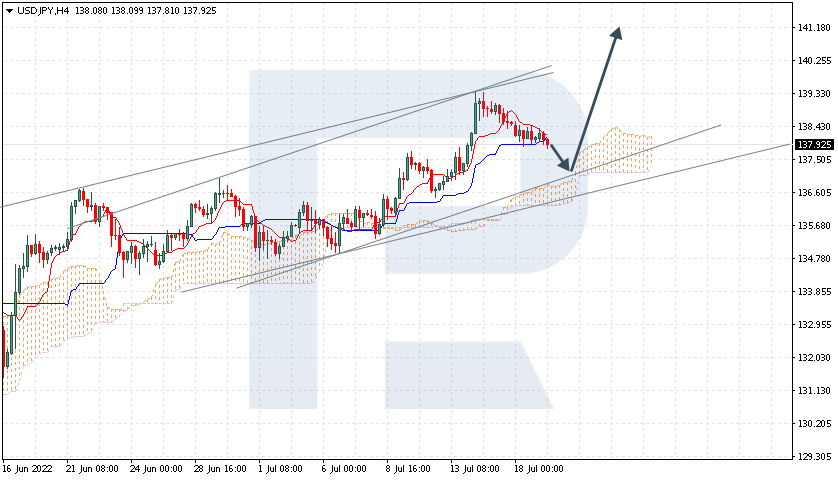
Having finished the descending wave at 135.83 and then forming a new consolidation range around this level, USDJPY has broken it to the downside and may later continue falling with the short-term target at 134.85. After that, the instrument may form one more ascending structure to return to 135.82 and then resume trading downwards to reach 134.66.

USDJPY
Risk Warning: the result of previous trading operations do not guarantee the same results in the future

USDCHF, “US Dollar vs Swiss Franc”

USDCHF has completed the ascending wave at 0.9600 along with the correction down to 0.9535; right now, it is growing towards 0.9610. After that, the instrument may break this level to the upside and then form one more ascending structure with the target at 0.9685.

USDCHF
Risk Warning: the result of previous trading operations do not guarantee the same results in the future

AUDUSD, “Australian Dollar vs US Dollar”

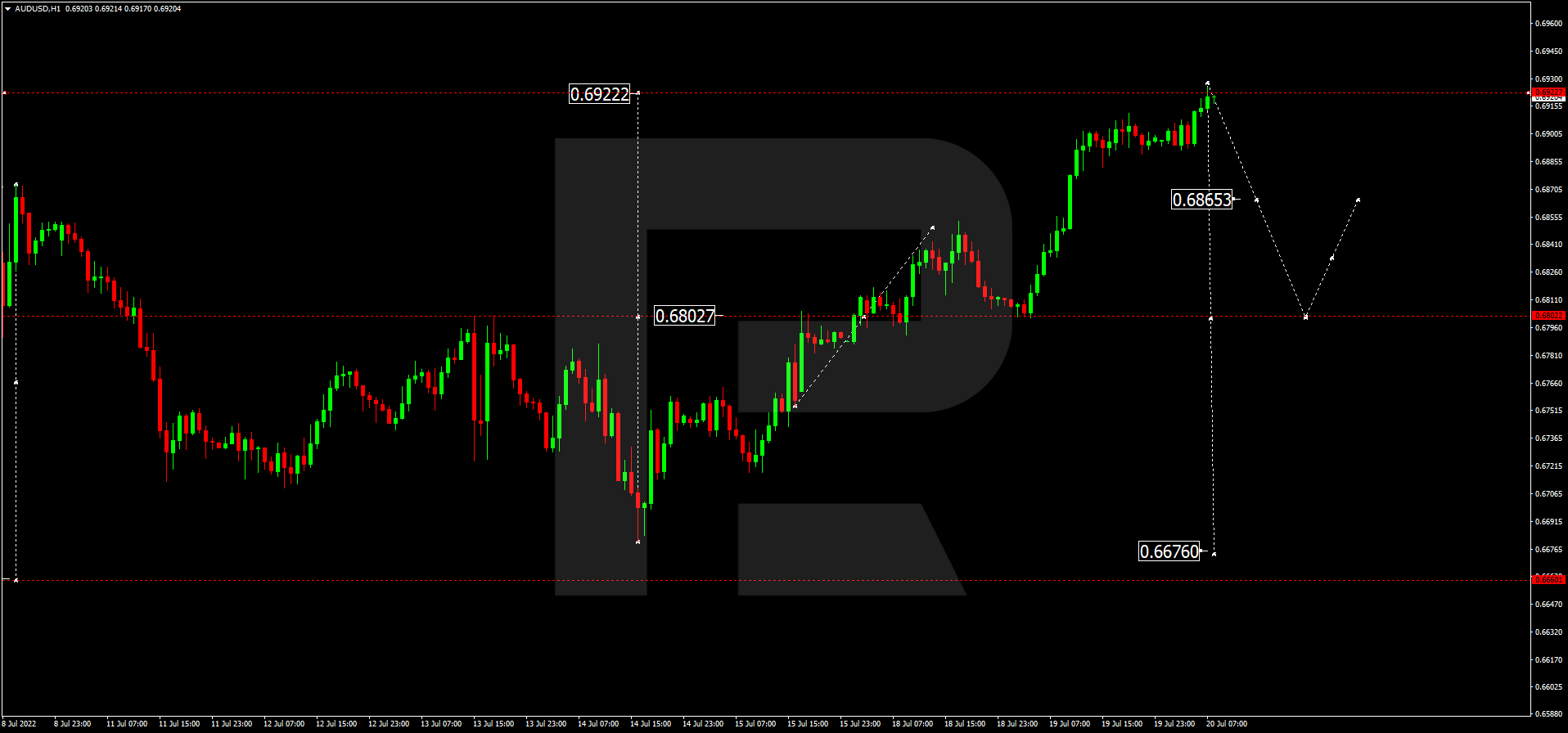
After finishing the descending wave at 0.6858 along with the correction up to 0.6915, AUDUSD is forming a new descending structure towards 0.6800. Later, the market may grow to return to 0.6858 and then resume trading downwards with the target at 0.6755.

AUDUSD
Risk Warning: the result of previous trading operations do not guarantee the same results in the future

BRENT

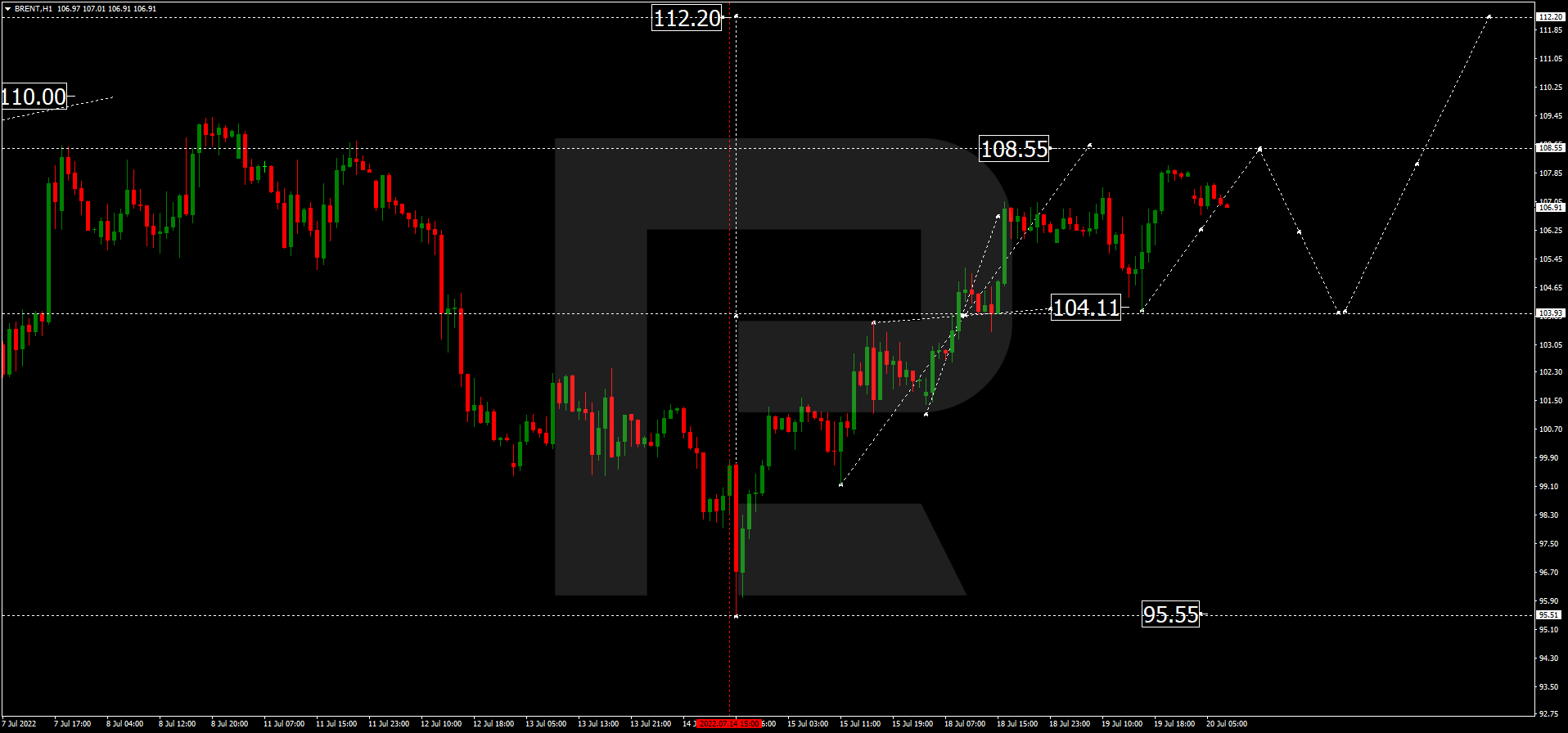
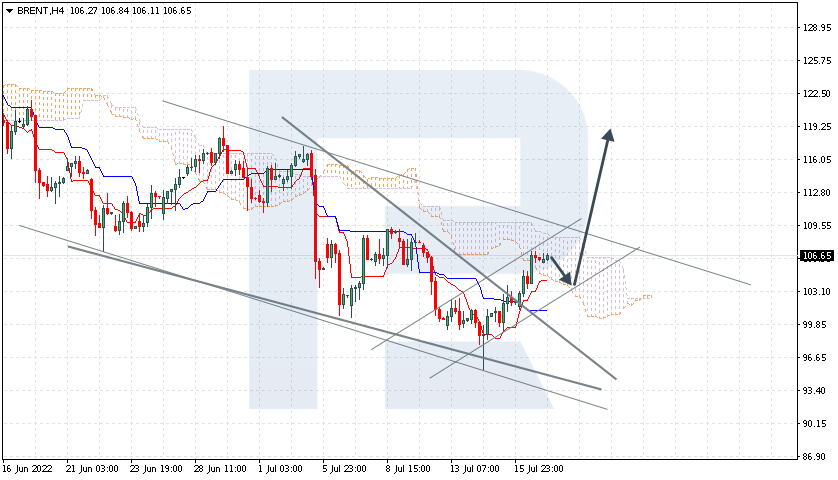
Brent is still correcting down to 110.00. After that, the instrument may start another growth with the target at 116.85 or even extend this structure up to 123.00.

BRENT
Risk Warning: the result of previous trading operations do not guarantee the same results in the future

XAUUSD, “Gold vs US Dollar”

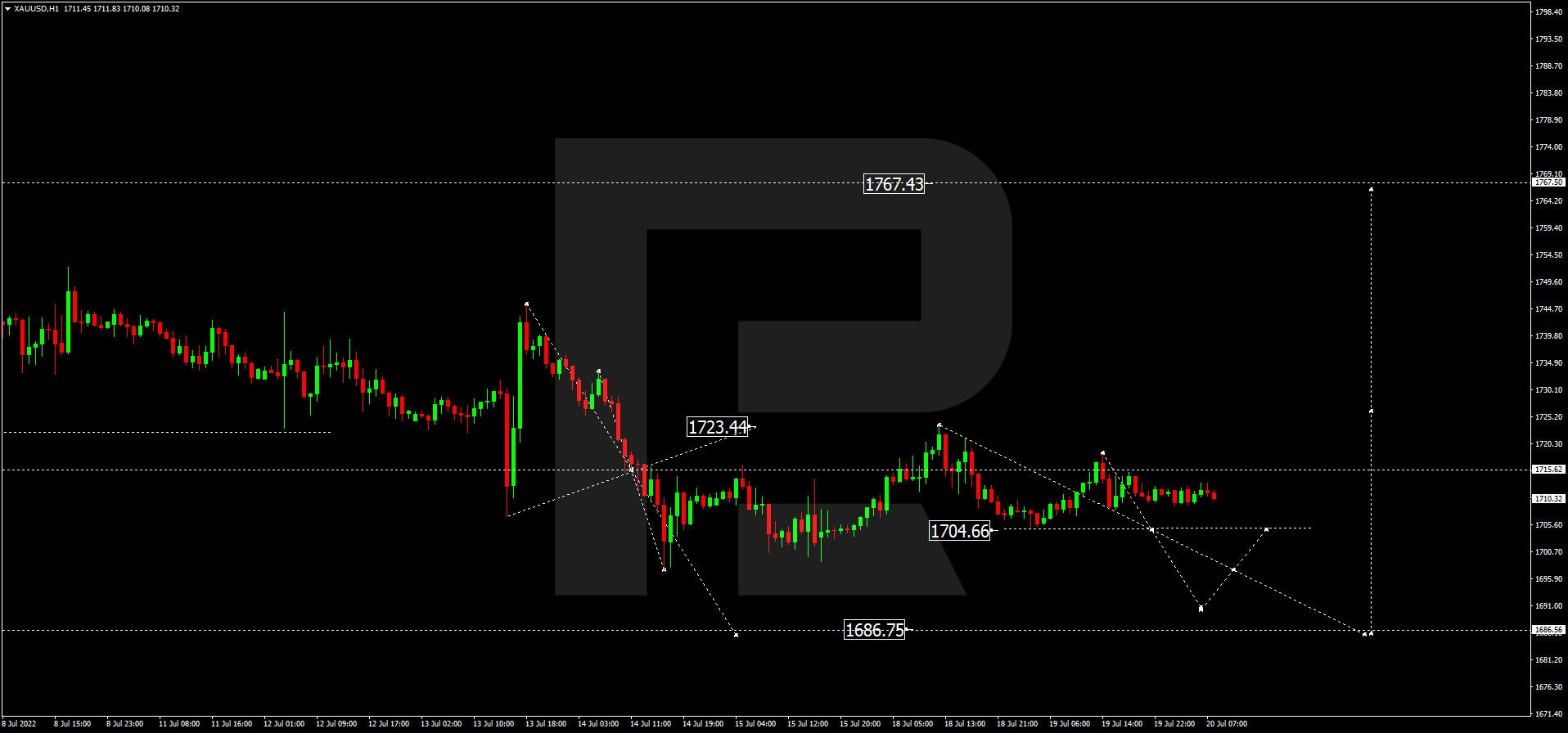
Gold is falling towards 1799.40. Later, the market may grow to reach 1812.40 and then resume trading downwards with the target at 1791.30.

GOLD
Risk Warning: the result of previous trading operations do not guarantee the same results in the future

S&P 500

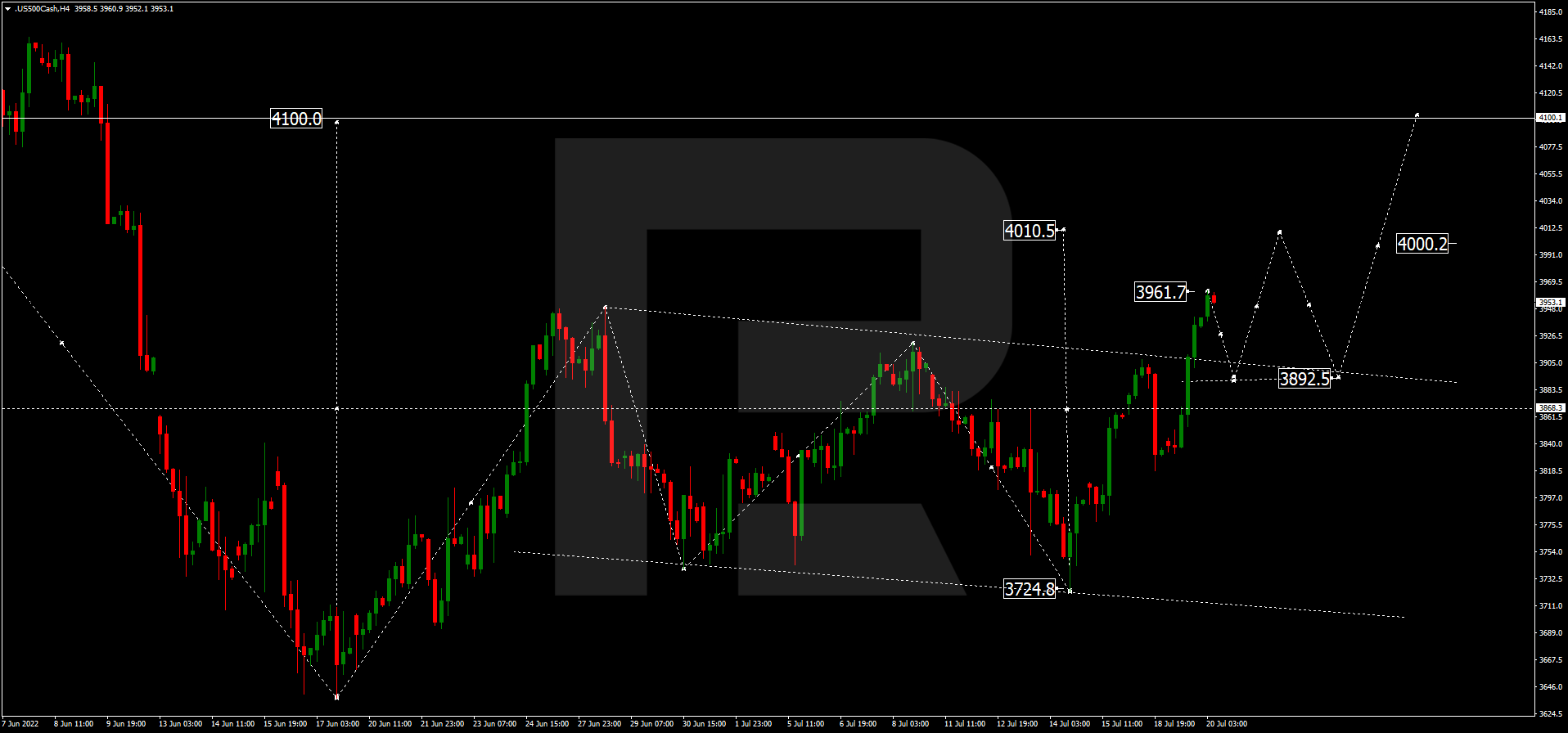
The S&P index is still falling towards 3690.0. After that, the instrument may correct up to 3817.5 and then form a new descending wave with the target at 3620.0.

S&P 500

Article By RoboForex.com

Attention!
Forecasts presented in this section only reflect the author’s private opinion and should not be considered as guidance for trading. RoboForex LP bears no responsibility for trading results based on trading recommendations described in these analytical reviews.


The Analytical Overview of the Main Currency Pairs on 2022.07.01

By JustForex

The EUR/USD currency pair

Technical indicators of the currency pair:
  • Prev Open: 1.0441
  • Prev Close: 1.0483
  • % chg. over the last day: -0.40%

The latest economic data showed that the seasonally adjusted unemployment rate in the Eurozone was 6.6%, down from 6.7%. Inflation in France climbed to a record high of 6.5% in June, with consumer price growth of 0.7% last month. Against this data, the euro rose sharply against the dollar yesterday, increasing the probability that the ECB will act more aggressively in terms of tightening monetary policy. Today in Europe, the preliminary total inflation figure for the Eurozone will be released, and analysts are leaning that consumer prices will rise from 8.1% to 8.5% annually.

Trading recommendations
  • Support levels: 1.0425, 1.0379
  • Resistance levels: 1.0504, 1.0564, 1.0611, 1.0680, 1.0723

From the technical point of view, the trend on the EUR/USD currency pair on the hourly time frame is bearish. The price is trading below the moving averages, but the MACD indicator has become positive. There is a new initiative from the buyers. Under such market conditions, sell deals can be considered from the resistance level of 1.0504, but only after the additional confirmation. Buy trades are best to look for on intraday time frames from the support level of 1.0425, but only with confirmation and short targets.

Alternative scenario: if the price breaks out through the 1.0611 resistance level and fixes above, the uptrend will likely resume.

EUR/USD
News feed for 2022.07.01:
  • – Eurozone Spanish Manufacturing PMI (m/m) at 10:15 (GMT+3);
  • – Eurozone Italian Manufacturing PMI (m/m) at 10:45 (GMT+3);
  • – Eurozone French Manufacturing PMI (m/m) at 10:50 (GMT+3);
  • – Eurozone German Manufacturing PMI (m/m) at 10:55 (GMT+3);
  • – Eurozone Manufacturing PMI (m/m) at 11:00 (GMT+3);
  • – Eurozone Italian Consumer Price Index (m/m) at 12:00 (GMT+3);
  • – Eurozone Consumer Price Index (m/m) at 12:00 (GMT+3);
  • – US ISM Manufacturing PMI (m/m) at 17:00 (GMT+3).

The GBP/USD currency pair

Technical indicators of the currency pair:
  • Prev Open: 1.2122
  • Prev Close: 1.2178
  • % chg. over the last day: -0.46%

The British pound rose yesterday as the dollar index fell after negative US spending data. The UK Gross Domestic Product (GDP) increased by 0.8% in the first quarter of 2022. But the outlook for the British pound now depends more on the future direction of inflation in the US and the current instability in the UK. The Core Personal Consumption Expenditures Price Index stalled at 0.3% month-over-month in May, pushing the annual core PCE inflation rate down to 4.7% from 4.9%. At the same time, the Bank of England remains most concerned about the risk of higher commodity prices, which will cause wages and other prices in the economy to rise faster than usual.

Trading recommendations
  • Support levels: 1.2115, 1.1974
  • Resistance levels: 1.2172, 1.2238, 1.2324, 1.2422, 1.2470, 1.2523, 1.2629

From the technical point of view, the trend on the GBP/USD currency pair on the hourly time frame is bearish. The situation is very similar to the euro. The price is trading below the moving averages, the MACD indicator has become inactive, and there is a new buying initiative on the intraday time frames. Under such market conditions, sell deals can be considered from the resistance level of 1.2172, but only after the additional confirmation. Buy trades are best to look for on intraday time frames from the support level of 1.2115, but only with confirmation and short targets.

Alternative scenario: if the price breaks out through the 1.2422 resistance level and fixes above, the uptrend will likely resume.

GBP/USD
News feed for 2022.07.01:
  • – UK Manufacturing PMI (m/m) at 11:30 (GMT+3).

The USD/JPY currency pair

Technical indicators of the currency pair:
  • Prev Open: 136.58
  • Prev Close: 135.70
  • % chg. over the last day: -0.64%

Japan’s main Purchasing Managers’ Index (PMI) declined from 53.3 in May to 52.7 in June. According to the PMI report, Japanese companies noted that rising costs and persistent material shortages contributed to the slowdown in production, and new orders increased only fractionally. Continued supply chain disruptions and delays led to further rapid cost increases, leading to a sharp rise in factory prices, the fastest in the survey’s history. That said, companies are increasingly confident that these problems will dissipate next year as business confidence rose to its highest level since March. Lower economic indicators are prompting investors to buy the Japanese yen amid a possible rejection of monetary policy easing by the Bank of Japan.

Trading recommendations
  • Support levels: 134.83, 133.35, 131.67, 131.00, 130.12, 129.48, 128.76
  • Resistance levels: 135.56, 136.24

The medium-term trend on the USD/JPY currency pair is bullish. But sellers’ pressure has been growing during the last few days. The MACD indicator has become negative. Under such market conditions, buy trades can be considered from the support level of 134.83, but with confirmation. A resistance level of 135.56 is good for sell deals, but only with additional confirmation and short targets.

Alternative scenario: If the price fixes below 133.35, the downtrend will likely resume.

USD/JPY
News feed for 2022.07.01:
  • – Japan Tokyo Core CPI (m/m) at 02:30 (GMT+3);
  • – Japan Large Manufacturers Index (m/m) at 02:50 (GMT+3);
  • – Japan Large Non-Manufacturers Index (m/m) at 02:50 (GMT+3);
  • – Japan Manufacturing PMI (m/m) at 03:30 (GMT+3).

The USD/CAD currency pair

Technical indicators of the currency pair:
  • Prev Open: 1.2886
  • Prev Close: 1.2873
  • % chg. over the last day: +0.10%

Real Gross Domestic Product (GDP) increased by 0.3% in April, following a 0.7% increase in March. Mining, quarrying, and oil and gas production sectors showed the largest gains. The Canadian dollar is a commodity currency, so it depends not only on the dynamics of the dollar index but also on oil prices. Both the dollar index and oil quotes went down yesterday. As a result, the price of USD/CAD continues to form a wide price corridor. It should be noted that both the Bank of Canada and the US Federal Reserve are on track to raise interest rates, while the oil market is still in deficit with rising summer demand. All of this suggests that no medium-term trends should be expected on the USD/CAD currency pair, as market conditions favor strengthening the dollar index and the Canadian dollar.

Trading recommendations
  • Support levels: 1.2885, 1.2831, 1.2781, 1.2701, 1.2616
  • Resistance levels: 1.2932, 1.2957, 1.3045

In terms of technical analysis, the trend on the USD/CAD currency pair is bullish. The price is now trading in a wide corridor, a slight pressure from buyers prevails, and the MACD indicator does not show activity. Under such market conditions, it is better to look for buy deals in the lower time frames from the support level of 1.2885, but with confirmation. For sell deals, it is better to consider the resistance level of 1.2957, but it is also better with confirmation and short targets.

Alternative scenario: if the price breaks through and consolidates below the 1.2831 support level, the downtrend will likely resume.

USD/CAD
There is no news feed for today.

By JustForex


This article reflects a personal opinion and should not be interpreted as an investment advice, and/or offer, and/or a persistent request for carrying out financial transactions, and/or a guarantee, and/or a forecast of future events.

Week Ahead: USDCHF to fall on US recession fears?

By ForexTime 

– Market chaos reigned throughout the first half of 2022. Bond yields, oil prices and the US dollar soared to levels not seen in over a decade, while the S&P 500 experienced its worst first half of the year since 1970.

But that doesn’t mean market volatility is now done and over with.

Markets are set to remain jumpy as we enter the first full trading week of July, with recession fears still clouding broader sentiment.

For the week ahead, the US nonfarm payrolls report is set to grab the spotlight in a holiday-shortened week for markets stateside, amid these scheduled global data releases and events:

Monday, July 4

  • AUD: Australia June inflation gauge
  • EUR: Germany May trade data
  • CHF: Switzerland June inflation
  • CAD: Canada June manufacturing PMI
  • US markets closed for Independence Day

Tuesday, July 5

  • CNH: China June Caixin Services PMI
  • AUD: Reserve Bank of Australia rate decision
  • EUR: Eurozone June services PMI
  • USD: US May factory orders and durable goods

Wednesday, July 6

  • GBP: Speeches by Bank of England Chief Economist Huw Pill, and Deputy Governor Jon Cunliffe
  • EUR: Eurozone May retail sales, Germany May factory orders
  • USD: FOMC minutes, June services PMI

Thursday, July 7

  • AUD: Australia May trade balance
  • EUR: ECB meeting minutes, speeches by ECB Governing Council members, Germany May industrial production
  • USD: US weekly initial jobless claims
  • US crude: EIA weekly US crude inventories
  • USD: Fed speak – Fed Governor Christopher Waller, St. Louis Fed President James Bullard

Friday, July 8

  • CAD: Canada June unemployment rate
  • USD: US June nonfarm payrolls

The “r” word (recession) is set to continue dominating market chatter in the latter half of the year, as the Fed raises interest rates in order to rein in inflation that’s at multi-decade highs.

Fed Chair Jerome Powell argued that more unemployed Americans could be what’s needed to ultimately cool inflation down to the Fed’s 2% target (the May US consumer price index came in at 8.6% – its highest since December 1981).

What are markets expecting for the next US jobs report?

The median estimate by economists for this coming Friday’s June US nonfarm payrolls report:

  • Unemployment rate: 3.6%
  • Jobs added: 250,000 (which would mark the lowest US jobs growth since 2019).

Ultimately, policymakers at the US central bank are aiming for some demand destruction, with the unemployment rate forecasted to move up to 4.1% towards the end of 2024 – a forecast that some segments of the market think is still too optimistic.

Why is the Swiss Franc strengthening?

The Swiss Franc is the only G10 currency to register an advance against the US dollar in June, with USDCHF dropping by 0.46% last month. CHF also registered a monthly advance in June against all of its G10 peers.

Besides being widely viewed as a safe haven currency, CHF’s strength has been fuelled of late by the Swiss National Bank’s hawkish surprise in June. The central bank unexpectedly raised interest rates by 50-basis points – its first hike in 15 years, while signalling more hikes to come.

Switzerland’s June consumer price index announcement on Monday could also spur more gains for the Swiss Franc, especially if its CPI print comes in above the estimated 3.1% figure, which would be its highest levels since July 2008.

Recession fears could fuel demand for safe-haven Swiss Franc

Back to the headline-grabbing NFP, should the US jobs market continue showing signs of softening, either by way of a higher-than-3.6% unemployment rate, or a lower-than-250k headline NFP figure, that could heighten expectations that the world’s largest economy is destined for a recession sometime in the latter part of 2023.

More risk aversion may result in lower US Treasury yields that dampen the US dollar, in turn potentially allowing the Swiss Franc – a traditional safe haven – to strengthen instead.

USDCHF to break below key 100-day SMA support?

Looking at the charts, USDCHF has found support at its 100-day simple moving average on a couple of occasions over the past 3 months.

Another gust of risk aversion, especially amid elevated fears of a US recession, could see USDCHF breaking below that key support level to revisit its mid-March peak at 0.946.

Though of course, a hawkish surprise out of the mid-week FOMC minutes from its June meeting, when the Fed triggered a jumbo-sized 75-basis point hike, could undermine the case for a lower USDCHF.


Forex-Time-LogoArticle by ForexTime

ForexTime Ltd (FXTM) is an award winning international online forex broker regulated by CySEC 185/12 www.forextime.com

Murrey Math Lines 30.06.2022 (USDCHF, GOLD)

Article By RoboForex.com

USDCHF, “US Dollar vs Swiss Franc”

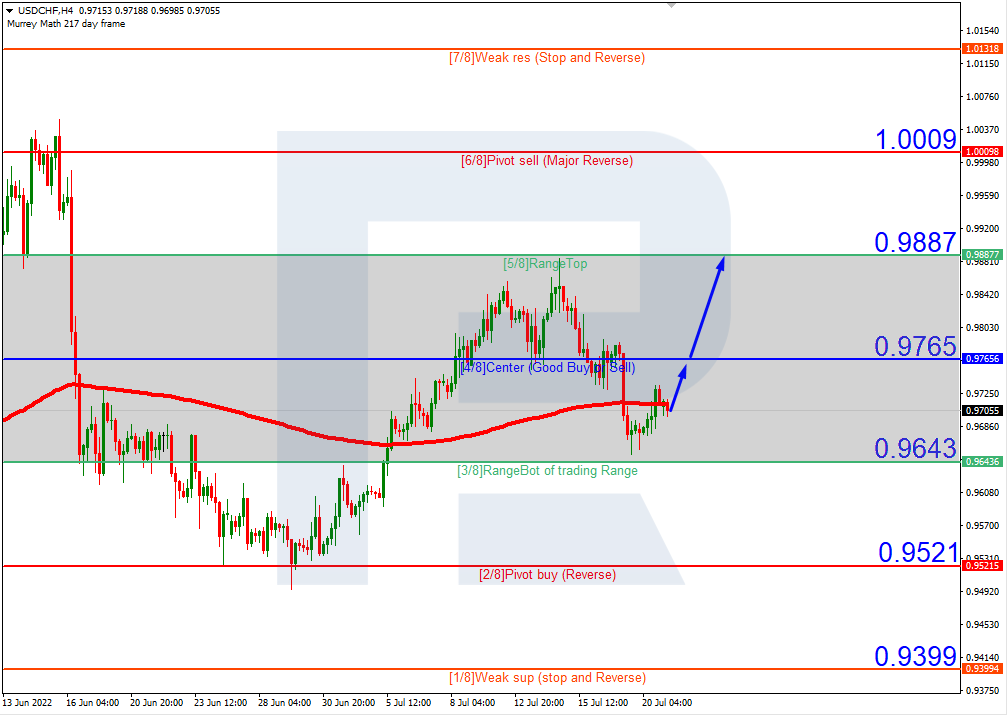
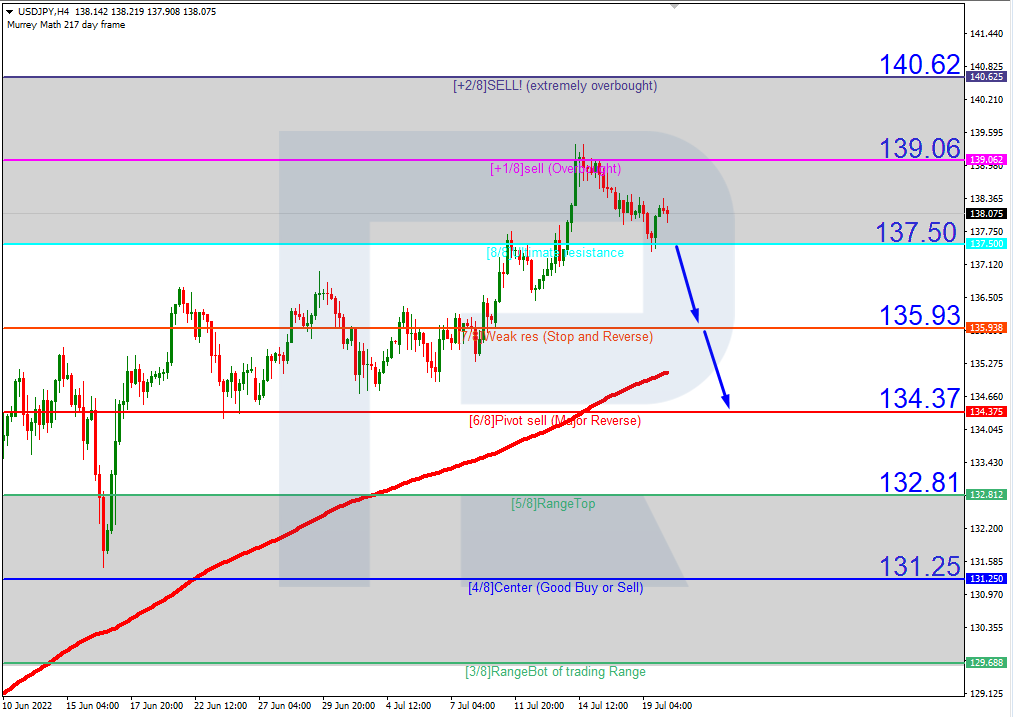
As we can see in the H4 chart, USDCHF is trading below the 200-day Moving Average, thus indicating a descending tendency. In this case, the pair is expected to test break 2/8 and continue falling towards the support at 0/8. However, this scenario may be cancelled if the price breaks the resistance at 3/8 to the upside. After that, the instrument may move upwards to reach 4/8.

USDCHFH4
Risk Warning: the result of previous trading operations do not guarantee the same results in the future

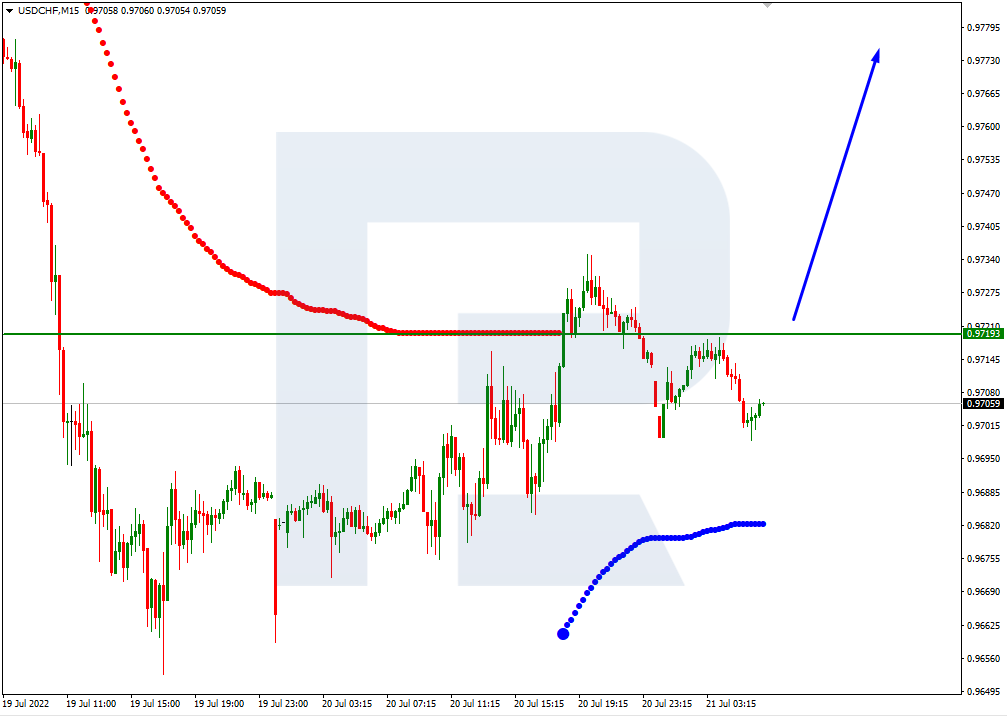
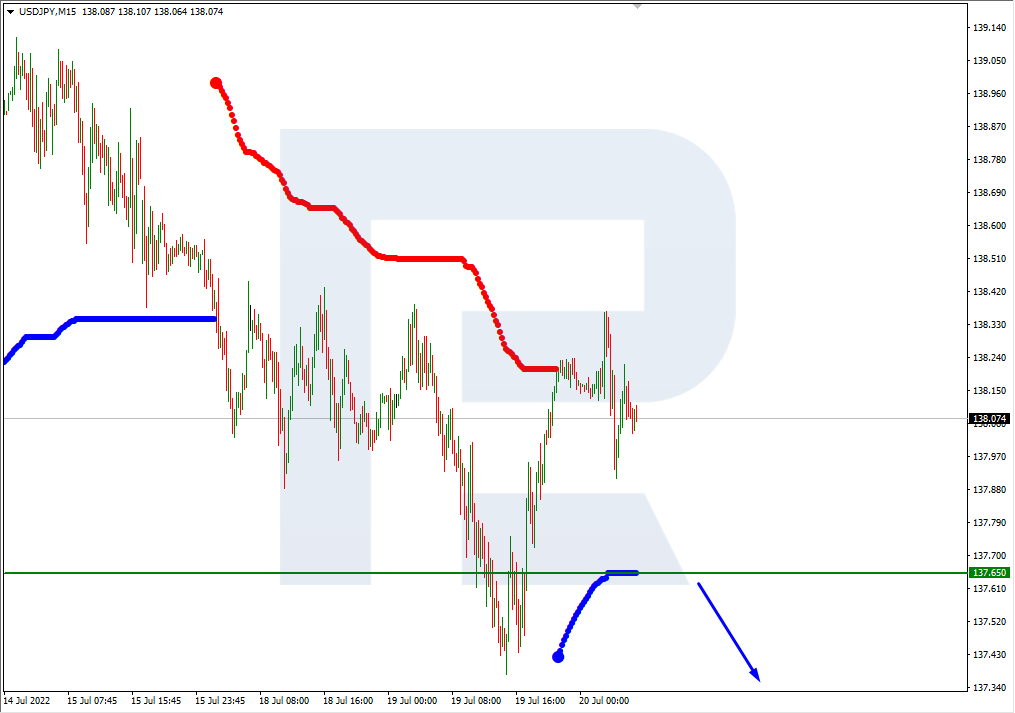
In the M15 chart, the pair may break the downside line of the VoltyChannel indicator and, as a result, continue its decline.

USDCHF_M15
Risk Warning: the result of previous trading operations do not guarantee the same results in the future

XAUUSD, “Gold vs US Dollar”

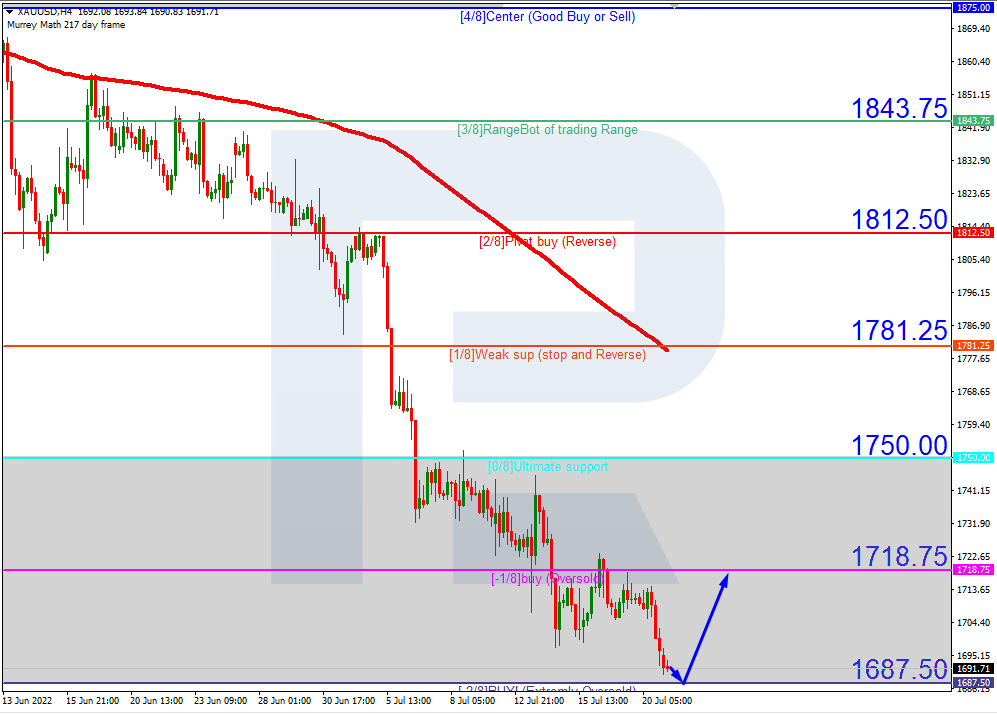
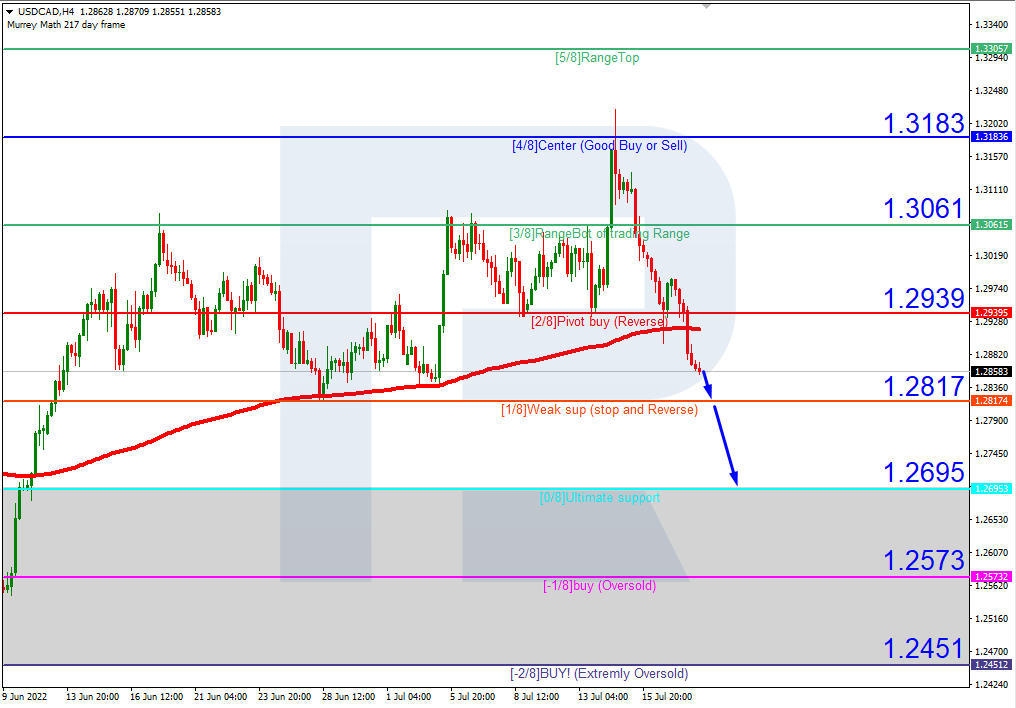
As we can see in the H4 chart, XAUUSD is also trading below the 200-day Moving Average to indicate a possible descending tendency. In this case, the price is expected to test 4/8, break it, and then continue moving downwards to reach the support at 3/8. However, this scenario may no longer be valid if the price breaks the resistance at 5/8 to the upside. After that, the instrument may reverse and correct up to 6/8.

USDCAD_H4
Risk Warning: the result of previous trading operations do not guarantee the same results in the future

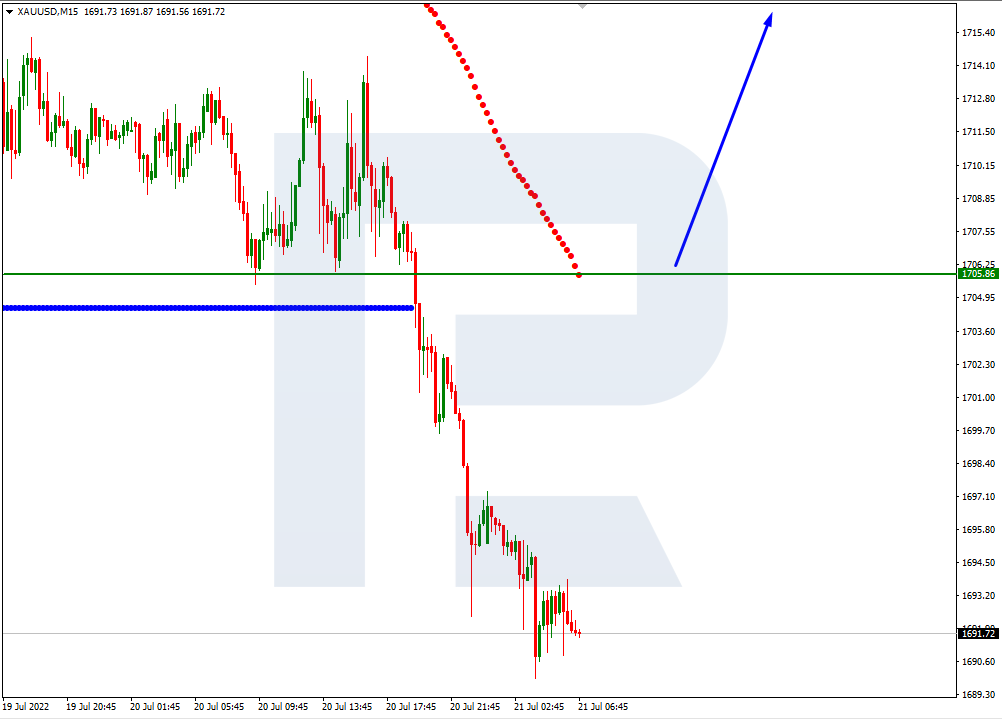
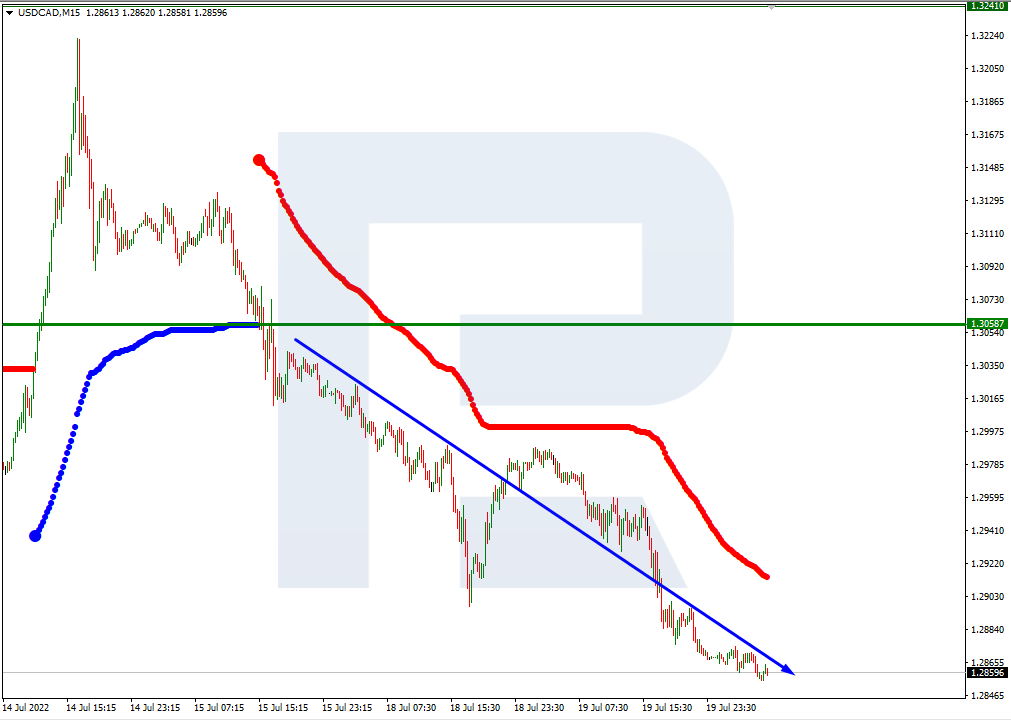
In the M15 chart, the pair may break the downside line of the VoltyChannel indicator and, as a result, continue trading downwards.

USDCAD_M15

Article By RoboForex.com

Attention!
Forecasts presented in this section only reflect the author’s private opinion and should not be considered as guidance for trading. RoboForex LP bears no responsibility for trading results based on trading recommendations described in these analytical reviews.

Japanese Candlesticks Analysis 30.06.2022 (EURUSD, USDJPY, EURGBP)

Article By RoboForex.com

EURUSD, “Euro vs US Dollar”

As we can see in the H4 chart, the asset has formed a Hammer reversal pattern close to the support area. At the moment, EURUSD may reverse in the form of a new ascending impulse. In this case, the upside target may be at 1.0490. However, an alternative scenario implies that the price may fall to reach 1.0400 and continue the downtrend without testing 1.0490.

EURUSD
Risk Warning: the result of previous trading operations do not guarantee the same results in the future

USDJPY, “US Dollar vs Japanese Yen”

As we can see in the H4 chart, USDJPY has formed several reversal patterns not far from the resistance area, such as Doji. At the moment, the asset is reversing in the form of a new descending impulse. In this case, the downside target may be at 135.25. At the same time, an opposite scenario implies that the price may grow to reach 137.50 and continue the uptrend without any pullbacks.

USDJPY
Risk Warning: the result of previous trading operations do not guarantee the same results in the future

EURGBP, “Euro vs Great Britain Pound”

As we can see in the H4 chart, after forming an Engulfing pattern near the resistance area, EURGBP is reversing in the form of a new descending impulse. In this case, the downside correctional target may be the support level at 0.8580. Later, the market may test this level, rebound from it, and resume moving upwards. Still, there might be an alternative scenario, according to which the asset may grow to reach 0.8660 without any corrections.

EURGBP

Article By RoboForex.com

Attention!
Forecasts presented in this section only reflect the author’s private opinion and should not be considered as guidance for trading. RoboForex LP bears no responsibility for trading results based on trading recommendations described in these analytical reviews.

The Analytical Overview of the Main Currency Pairs on 2022.06.30

By JustForex

The EUR/USD currency pair

Technical indicators of the currency pair:
  • Prev Open: 1.0518
  • Prev Close: 1.0441
  • % chg. over the last day: -0.73%

The euro fell sharply on Wednesday after European Central Bank President Christine Lagarde said that the era of ultra-low inflation that preceded the pandemic is unlikely to return. Speaking at an ECB forum in Sintra, Portugal, along with US Federal Reserve Chairman Jerome Powell and Bank of England Governor Andrew Bailey, Lagarde added that central banks need to adjust to higher price growth expectations. As before, analysts expect the ECB to raise interest rates by 0.25% in July. A number of inflation data will be released this week in European countries. Germany’s preliminary Consumer price level was 7.6% on an annualized basis, down from 7.9% in May. And in Spain, the inflation rate jumped from 8.7% to 10.2% annually.

Trading recommendations
  • Support levels: 1.0425, 1.0379
  • Resistance levels: 1.0468, 1.0504, 1.0564, 1.0611, 1.0680, 1.0723

From the technical point of view, the trend on the EUR/USD currency pair on the hourly time frame is bearish. The price is trading below the moving averages, the MACD indicator has become negative, and there is a new sellers’ initiative. Under such market conditions, sell deals can be considered from the resistance level of 1.0468, but only after the additional confirmation. Buy trades are best to look for on intraday time frames from the support level of 1.0425, but only with confirmation and short targets.

Alternative scenario: if the price breaks out through the 1.0611 resistance level and fixes above, the uptrend will likely resume.

EUR/USD
News feed for 2022.06.30:
  • – Eurozone German Retail Sales (m/m) at 09:00 (GMT+3);
  • – Eurozone French Consumer Price Index (m/m) at 09:45 (GMT+3);
  • – Eurozone German Unemployment Rate (m/m) at 10:55 (GMT+3);
  • – Eurozone Unemployment Rate (m/m) at 12:00 (GMT+3);
  • – US PCE Price index (m/m) at 15:30 (GMT+3);
  • – US Initial Jobless Claims (w/w) at 15:30 (GMT+3).

The GBP/USD currency pair

Technical indicators of the currency pair:
  • Prev Open: 1.2182
  • Prev Close: 1.2121
  • % chg. over the last day: -0.50%

At the Monetary Policy Forum, the Governor of the Bank of England said in his speech that inflation in the UK would continue to rise. When asked about a 50 bp rate hike at the next meeting, the answer was: “If we see greater persistence of inflation, we will have to act more forcefully. The situation leaves options on the table.”

Trading recommendations
  • Support levels: 1.2093, 1.1974
  • Resistance levels: 1.2171, 1.2238, 1.2324, 1.2422, 1.2470, 1.2523, 1.2629

From the technical point of view, the trend on the GBP/USD currency pair on the hourly time frame is bearish. The situation is very similar to the euro. The price is trading below the moving averages, the MACD indicator has become negative, and there is a new sellers’ initiative. Under such market conditions, sell deals can be considered from the resistance level of 1.2171, but only after the additional confirmation. Buy trades are best to look for on intraday time frames from the support level of 1.2093, but only with confirmation and short targets.

Alternative scenario: if the price breaks out through the 1.2422 resistance level and fixes above, the uptrend will likely resume.

GBP/USD
News feed for 2022.06.30:
  • – UK GDP (q/q) at 09:00 (GMT+3).

The USD/JPY currency pair

Technical indicators of the currency pair:
  • Prev Open: 136.04
  • Prev Close: 136.59
  • % chg. over the last day: +0.40%

The fundamental picture of the USD/JPY currency pair remains the same. The divergent policies of the central banks have already caused the yen to fall to 24-year highs against the dollar. Yesterday the former chief executive of the Bank of Japan, Yamaoka, said that the BOJ might have to adjust the yield ceiling if inflation continues to exceed forecasts. But such action would weaken the yen further.

Trading recommendations
  • Support levels: 136.21, 135.45, 134.84, 133.35, 131.67, 131.00, 130.12, 129.48, 128.76
  • Resistance levels: 136.66

The medium-term trend on the USD/JPY currency pair is bullish. Buyers’ pressure is still present, and the price is steadily growing. The MACD indicator is in the positive zone, but there is divergence in the higher time frames. Under such market conditions, buy trades can be considered from the support level of 136.21, but with confirmation. A resistance level of 136.66 is good for sell deals, but only with additional confirmation and short targets.

Alternative scenario: If the price fixes below 133.35, the downtrend will likely resume.

USD/JPY
News feed for 2022.06.30:
  • – Japan Industrial Production (m/m) at 02:50 (GMT+3).

The USD/CAD currency pair

Technical indicators of the currency pair:
  • Prev Open: 1.2860
  • Prev Close: 1.2895
  • % chg. over the last day: +0.27%

The Canadian dollar is a commodity currency, so it depends on the US Dollar Index dynamics and oil quotes. The dollar index increased yesterday, while oil prices fell more than 2% in anticipation of the OPEC+ meeting today. As a result, the USD/CAD price started to form a corridor with a slight advantage over the US dollar. It should be noted that the Bank of Canada and the US Federal Reserve are on track to raise interest rates, while the oil market is still in deficit with increased demand over the summer. These facts suggest that no medium-term trends should be expected on the USD/CAD currency pair, as market conditions favor the strengthening of both the US and Canadian dollar.

Trading recommendations
  • Support levels: 1.2831, 1.2709, 1.2618, 1.2578, 1.2510
  • Resistance levels: 1.2899, 1.2956, 1.3068

In terms of technical analysis, the trend on the USD/CAD currency pair is bullish. But now, the price has started to form a corridor, and the MACD indicator has become inactive. Under such market conditions, it is better to look for buy deals in the lower time frames from the support level of 1.2831, but with confirmation. For sell deals, it is better to consider the resistance level of 1.2899, but it is also better with confirmation and short targets.

Alternative scenario: if the price breaks through and consolidates below the 1.2831 support level, the downtrend will likely resume.

USD/CAD
News feed for 2022.06.30:
  • – OPEC+ meeting (m/m) at 12:00 (GMT+3);
  • – Canada GDP (q/q) at 15:30 (GMT+3).

By JustForex


This article reflects a personal opinion and should not be interpreted as an investment advice, and/or offer, and/or a persistent request for carrying out financial transactions, and/or a guarantee, and/or a forecast of future events.

3 potential opportunities in Q3

By ForexTime 

– For Q3, investors and traders worldwide are set to continue obsessing about similar themes that have rocked markets so far in 2022:

  • Inflation
  • Rate hikes (or the lack thereof) by major central banks
  • Recession risks and how it impacts Wall Street earnings

As we count down the hours before the third quarter rolls along (and marvel yet again at how quickly time flies), let’s filter those three market themes down to how they might impact these major instruments/assets:

  • EURUSD
  • USDJPY
  • S&P 500
  1. EURUSD to move lower and closer to parity?

EURUSD has been finding it hard to stay above its 50-day simple moving average – a key resistance level for the world’s most-traded currency pair over the past 12 months.

This downtrend in EURUSD reflects two major factors:

  • The US economy’s healthier outlook relative to the Eurozone’s. After all, there’s still the Russia-Ukraine war raging off to the latter’s eastern borders.
  • The Fed’s plans for more incoming rate hikes appears to be less risky than the European Central Bank’s.
    The ECB is just only getting started, with two rate hikes slated for Q3. But markets fear that the incoming ECB hikes could inadvertently result in a sovereign debt crisis/fragmentation risks.

Overall, if the EU’s economic outlook turns darker than the US, which implies that the ECB can’t hike its benchmark rate as fast as the Fed, that could lead to more downward pressure on EURUSD.

If the above assumption holds, EURUSD could be dragged and kept below that psychologically-important 1.04 level in Q3.

At the time of writing, markets are forecasting a 72.5% chance that EURUSD could reach even parity sometime over the next 3 months!

Though to be clear, the same odds are placed on EURUSD recovering back to 1.09.

Much will depend on how much the outlooks differ between the US economy/Fed vs. Eurozone economy/ECB.

Key events to watch for EURUSD:

  • Economic data out of the EU and the US (especially the monthly consumer price index)
  • Market expectations for the July and September policy meetings for both the ECB and the Fed
  • August 25-27: Fed’s Jackson Hole Economic symposium – a key event which often sees the Fed offering a big signal to the markets about its policy outlook

2) USDJPY to climb above 140?

USDJPY has reached its highest levels since 1998, skyrocketing past previous peaks set in 2015 and also in 2002 with such ease.

The soaring USDJPY reflects the widening policy gap between the US Federal Reserve and the Bank of Japan.

  • In June, the Fed raised its benchmark rates by 75-basis points – its largest hike since 1994 – and now at 1.75%.
  • Meanwhile, the Bank of Japan appears content to keep its policy rate in negative territory, at minus 0.1%.

This divergence has also seen 10-year US Treasury yields soar past 3%, while Japan’s equivalent remains capped at 0.25% by the Bank of Japan.

In other words, global investors would be more enticed by the higher yields on offer in the US, creating more demand for the US dollar … as opposed to Japanese yields (less demand for JPY).

This divergence is set to persist in Q3 as well, which should translate into more upside for USDJPY.

Markets are forecasting a 74.7% chance that USDJPY could reach 144.93 over the coming months.

However, there’s also a similar-sized chance that USDJPY could plummet back down to 125.847, which was also its June 2015 peak.

A significantly lower USDJPY would require Japanese policymakers to stem the Yen’s declines, either by intervening in the FX markets or by way of the Bank of Japan shockingly pivoting to a hawkish tune (signal that it would start raising interest rates/raising its yield curve control targets).

Key events to watch for USDJPY:

  • What is said by officials out of the US Federal Reserve vs. the Bank of Japan
  • Yields in Japanese government bonds vs. US Treasuries

READ MORE: Why is the Yen so weak? (April 2022 article)

3) S&P 500 to fall deeper into bear market, reach 3500?

At the time of writing, the S&P 500 index – which is the benchmark used to measure the overall performance of the US stock market – is set to re-enter a bear market.

NOTE: A bear market means that the price of an asset has fallen by 20% from its recent peak.

Although fears of a US recession have been dominating market chatter of late, the S&P 500’s drop so far this year has yet to fully reflect such risks.

Stock bulls (those hoping that an asset’s price will climb) are hoping that US consumers are resilient enough to keep generating revenue and profits for these publicly-listed companies.

And this is where the upcoming US earnings season would play a pivotal part in the S&P 500’s performance.

If Wall Street can continue sounding optimistic about its earnings outlook, and markets can believe in such optimism, that could shore up support for the S&P 500.

However, the likelier scenario appears to point the S&P 500 closer to 3500 or lower in the second half of 2022, as markets brace for earnings downgrades and more warnings about a US recession, especially if the Fed is forced to trigger more larger-than-usual rate hikes in its battle against stubbornly persistent red-hot inflation.

Key events to watch for the S&P 500:

  • July 14th onwards: US earnings season
  • US economic data
  • What Wall Street’s C-suite and Fed officials say about the chances of a US recession

And as always, you can stay up-to-date on how markets are faring on a daily basis throughout Q3 and beyond by reading our Daily Market Analysis.


Forex-Time-LogoArticle by ForexTime

ForexTime Ltd (FXTM) is an award winning international online forex broker regulated by CySEC 185/12 www.forextime.com

Mid-Week Technical Outlook: Pivot Points & Breakouts

By ForexTime 

– A sense of unease lingered in the air on Wednesday as recession fears, jitters around soaring inflation, and concerns about aggressive monetary tightening left investors on edge.

Global stocks slipped amid the risk-off mood and growing caution ahead of today’s highly anticipated panel discussion at the ECB forum in Sintra, Portugal. In the currency space, the dollar was on standby while the euro appreciated against most G10 currencies. Oil benchmarks extended gains, lifted by supply worries while gold rose in range-bound trading with prices eyeing $1830.

As we head into the new trading month and second half of 2022, this could present fresh opportunities across the FX space. Today, we will use pivot points and moving averages among other technical tools to unearth potential setups on various currency pairs.

A pivot point is a technical analysis indicator used to determine the overall trend of the market over different timeframes. Pivot points have predictive qualities, so it is considered a leading indicator to traders. The FXTM pivot point indicator can be downloaded HERE.

GBPUSD breakdown on horizon

If you are looking for a bearish trend, then look no further.

The GBPUSD is under pressure on the weekly and monthly charts as there have been consistently lower lows and lower highs. Bears seem to be making a move on the daily charts as prices wobble above the 1.2150 support level. Given how the currency pair is trading below the weekly pivot and has already hit the weekly support level, further downside could be on the cards. A strong daily close below 1.2150 could trigger a selloff towards the S2 at 1.2088 and S3 at 1.2016.

The bearish trend is already defined on the weekly charts. A strong weekly close below 1.2150 could trigger a selloff towards 1.1930 and potentially lower.

A similar theme can be observed in the monthly timeframe. The GBPUSD has shed roughly 3.5% this month with the bearish candle likely to encourage further downside. Should 1.2150 prove to be tough support to crack, prices have the potential to rebound towards 1.2400 before bears re-enter the scene.

USDJPY bulls relentless

The USDJPY is on a path to hitting a new 24-year high beyond 136.70.

Prices are firmly bullish on the daily charts and have already hit the first weekly resistance level at 136.504. A daily breakout above 136.70 could inspire a move higher towards 137.831 which is where the second weekly resistance level resides. Should bulls run out of steam, prices could decline back towards the weekly pivot at 135.377.

Zooming out to the weekly charts, the USDJPY seems to be gearing up for another breakout. A strong push above 136.70 could trigger an incline towards 138.00.

AUDUSD ready to breakdown?

The AUDUSD weekly chart says it all. Prices are under pressure and trading below the 50,100- and 200-week Simple Moving Averages. Support can be found at 0.6850 while resistance can be seen at 0.7000. A strong weekly close below the 0.6850 support could trigger a selloff to 0.6650. If prices manage to push back above 0.7000, then the next resistance will be at the 200-week SMA at 0.7130.

EURJPY eyes 144.00 level

A possible breakout opportunity could be forming on the EURJPY. On repeated occasions, bulls have attempted to conquer the 144.00 resistance level with no luck. The currency pair could be waiting for a fresh directional catalyst before making its next major move. If bulls are able to secure a solid move above 144.00, this could trigger a rally to levels not seen since December 2014 around 146.50. Sustained weakness under 144.00 may encourage a decline towards 142.50 and 141.50, respectively.

NZDUSD destined to tumble?

All eyes will be on how prices behave around the 0.6220 support level which has been held on a couple of occasions. A strong breakdown below this point could encourage a selloff towards 0.6100 and 0.6030. A move back above 0.6300 may suggest an incline back towards 0.6370 and 0.6450.


Forex-Time-LogoArticle by ForexTime

ForexTime Ltd (FXTM) is an award winning international online forex broker regulated by CySEC 185/12 www.forextime.com