Archive for Financial News – Page 74

COT Stock Market Charts: Speculator Bets led by Nasdaq-Mini & Russell-Mini

By InvestMacro

Here are the latest charts and statistics for the Commitment of Traders (COT) data published by the Commodities Futures Trading Commission (CFTC).

The latest COT data is updated through Tuesday February 25th and shows a quick view of how large traders (for-profit speculators and commercial entities) were positioned in the futures markets.

Weekly Speculator Changes led by Nasdaq-Mini & Russell-Mini

The COT stock markets speculator bets were overall higher this week as five out of the seven stock markets we cover had higher positioning while the other two markets had lower speculator contracts.

Leading the gains for the stock markets was the Nasdaq-Mini (15,949 contracts) with the Russell-Mini (8,475 contracts), the S&P500-Mini (7,187 contracts), the Nikkei 225 (1,950 contracts) and the DowJones-Mini (1,156 contracts) also having positive weeks.

The markets with the declines in speculator bets this week were the VIX (-11,438 contracts) with the MSCI EAFE-Mini (-2,051 contracts) also registering lower bets on the week.


Stock Market Net Speculators Leaderboard

Legend: Weekly Speculators Change | Speculators Current Net Position | Speculators Strength Score compared to last 3-Years (0-100 range)


Strength Scores led by Nikkei 225 & Nasdaq-Mini

COT Strength Scores (a normalized measure of Speculator positions over a 3-Year range, from 0 to 100 where above 80 is Extreme-Bullish and below 20 is Extreme-Bearish) showed that the Nikkei 225 (81 percent) and the Nasdaq-Mini (79 percent) lead the stock markets this week. The MSCI EAFE-Mini (73 percent) and S&P500-Mini (71 percent) come in as the next highest in the weekly strength scores.

On the downside, the VIX (34 percent) comes in at the lowest strength level currently.

Strength Statistics:
VIX (33.7 percent) vs VIX previous week (44.1 percent)
S&P500-Mini (71.4 percent) vs S&P500-Mini previous week (70.2 percent)
DowJones-Mini (65.0 percent) vs DowJones-Mini previous week (63.1 percent)
Nasdaq-Mini (79.1 percent) vs Nasdaq-Mini previous week (54.4 percent)
Russell2000-Mini (67.4 percent) vs Russell2000-Mini previous week (61.6 percent)
Nikkei USD (81.2 percent) vs Nikkei USD previous week (64.6 percent)
EAFE-Mini (72.8 percent) vs EAFE-Mini previous week (75.5 percent)


Nikkei 225 & Nasdaq-Mini top the 6-Week Strength Trends

COT Strength Score Trends (or move index, calculates the 6-week changes in strength scores) showed that the Nikkei 225 (25 percent) leads the past six weeks trends for the stock markets. The Nasdaq-Mini (24 percent) and the MSCI EAFE-Mini (23 percent) are the next highest positive movers in the latest trends data.

The VIX (-38 percent) leads the downside trend scores currently with the Russell-Mini (-14 percent) coming in as the next market with lower trend scores.

Strength Trend Statistics:
VIX (-38.4 percent) vs VIX previous week (-24.1 percent)
S&P500-Mini (-0.4 percent) vs S&P500-Mini previous week (4.0 percent)
DowJones-Mini (-2.9 percent) vs DowJones-Mini previous week (-6.9 percent)
Nasdaq-Mini (23.6 percent) vs Nasdaq-Mini previous week (-13.9 percent)
Russell2000-Mini (-13.8 percent) vs Russell2000-Mini previous week (-18.2 percent)
Nikkei USD (25.0 percent) vs Nikkei USD previous week (13.8 percent)
EAFE-Mini (23.0 percent) vs EAFE-Mini previous week (25.4 percent)


Individual Stock Market Charts:

VIX Volatility Futures:

VIX Volatility Futures COT ChartThe VIX Volatility large speculator standing this week came in at a net position of -69,103 contracts in the data reported through Tuesday. This was a weekly fall of -11,438 contracts from the previous week which had a total of -57,665 net contracts.

This week’s current strength score (the trader positioning range over the past three years, measured from 0 to 100) shows the speculators are currently Bearish with a score of 33.7 percent. The commercials are Bullish with a score of 65.9 percent and the small traders (not shown in chart) are Bullish-Extreme with a score of 82.2 percent.

Price Trend-Following Model: Weak Downtrend

Our weekly trend-following model classifies the current market price position as: Weak Downtrend.

VIX Volatility Futures StatisticsSPECULATORSCOMMERCIALSSMALL TRADERS
– Percent of Open Interest Longs:22.149.27.4
– Percent of Open Interest Shorts:39.931.77.2
– Net Position:-69,10368,0931,010
– Gross Longs:86,226191,77328,991
– Gross Shorts:155,329123,68027,981
– Long to Short Ratio:0.6 to 11.6 to 11.0 to 1
NET POSITION TREND:
– Strength Index Score (3 Year Range Pct):33.765.982.2
– Strength Index Reading (3 Year Range):BearishBullishBullish-Extreme
NET POSITION MOVEMENT INDEX:
– 6-Week Change in Strength Index:-38.434.010.2


S&P500 Mini Futures:

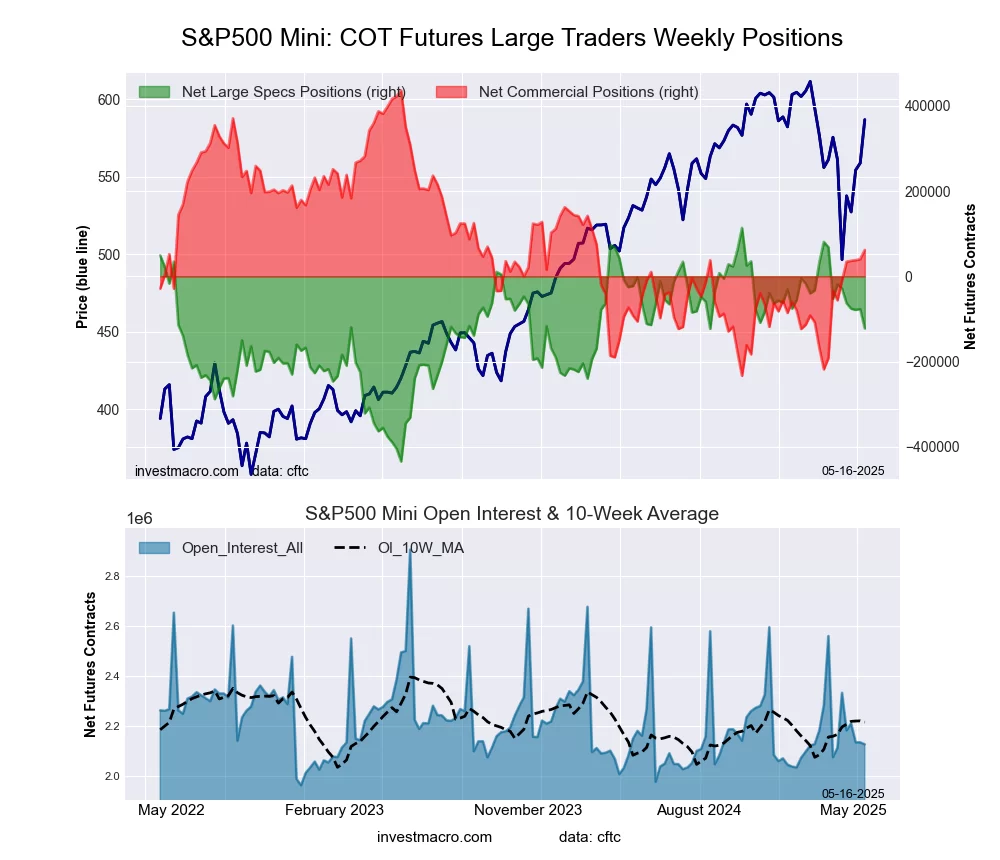
SP500 Mini Futures COT ChartThe S&P500 Mini large speculator standing this week came in at a net position of -32,779 contracts in the data reported through Tuesday. This was a weekly increase of 7,187 contracts from the previous week which had a total of -39,966 net contracts.

This week’s current strength score (the trader positioning range over the past three years, measured from 0 to 100) shows the speculators are currently Bullish with a score of 71.4 percent. The commercials are Bearish-Extreme with a score of 18.8 percent and the small traders (not shown in chart) are Bullish-Extreme with a score of 93.0 percent.

Price Trend-Following Model: Weak Uptrend

Our weekly trend-following model classifies the current market price position as: Weak Uptrend.

S&P500 Mini Futures StatisticsSPECULATORSCOMMERCIALSSMALL TRADERS
– Percent of Open Interest Longs:14.170.013.6
– Percent of Open Interest Shorts:15.775.17.0
– Net Position:-32,779-107,803140,582
– Gross Longs:300,9491,489,757288,516
– Gross Shorts:333,7281,597,560147,934
– Long to Short Ratio:0.9 to 10.9 to 12.0 to 1
NET POSITION TREND:
– Strength Index Score (3 Year Range Pct):71.418.893.0
– Strength Index Reading (3 Year Range):BullishBearish-ExtremeBullish-Extreme
NET POSITION MOVEMENT INDEX:
– 6-Week Change in Strength Index:-0.4-3.39.7


Dow Jones Mini Futures:

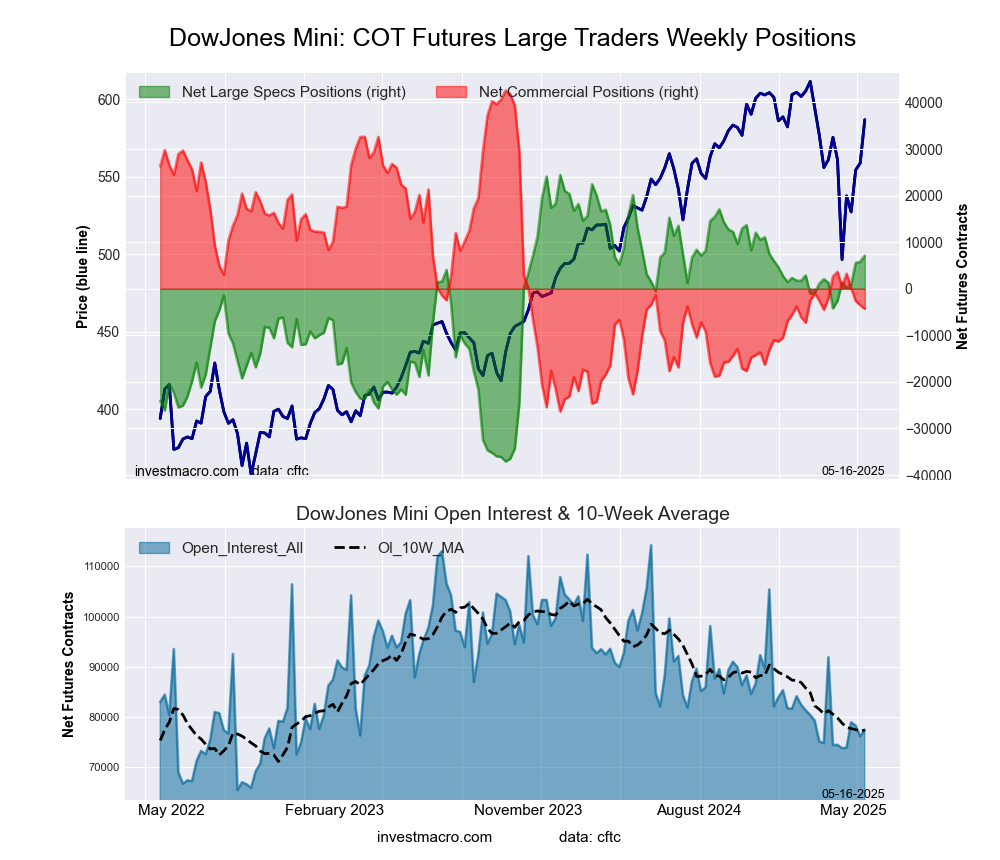
Dow Jones Mini Futures COT ChartThe Dow Jones Mini large speculator standing this week came in at a net position of 2,877 contracts in the data reported through Tuesday. This was a weekly advance of 1,156 contracts from the previous week which had a total of 1,721 net contracts.

This week’s current strength score (the trader positioning range over the past three years, measured from 0 to 100) shows the speculators are currently Bullish with a score of 65.0 percent. The commercials are Bearish with a score of 27.7 percent and the small traders (not shown in chart) are Bullish-Extreme with a score of 80.1 percent.

Price Trend-Following Model: Strong Uptrend

Our weekly trend-following model classifies the current market price position as: Strong Uptrend.

Dow Jones Mini Futures StatisticsSPECULATORSCOMMERCIALSSMALL TRADERS
– Percent of Open Interest Longs:17.461.018.4
– Percent of Open Interest Shorts:13.970.013.0
– Net Position:2,877-7,2704,393
– Gross Longs:14,17949,67614,949
– Gross Shorts:11,30256,94610,556
– Long to Short Ratio:1.3 to 10.9 to 11.4 to 1
NET POSITION TREND:
– Strength Index Score (3 Year Range Pct):65.027.780.1
– Strength Index Reading (3 Year Range):BullishBearishBullish-Extreme
NET POSITION MOVEMENT INDEX:
– 6-Week Change in Strength Index:-2.95.9-13.7


Nasdaq Mini Futures:

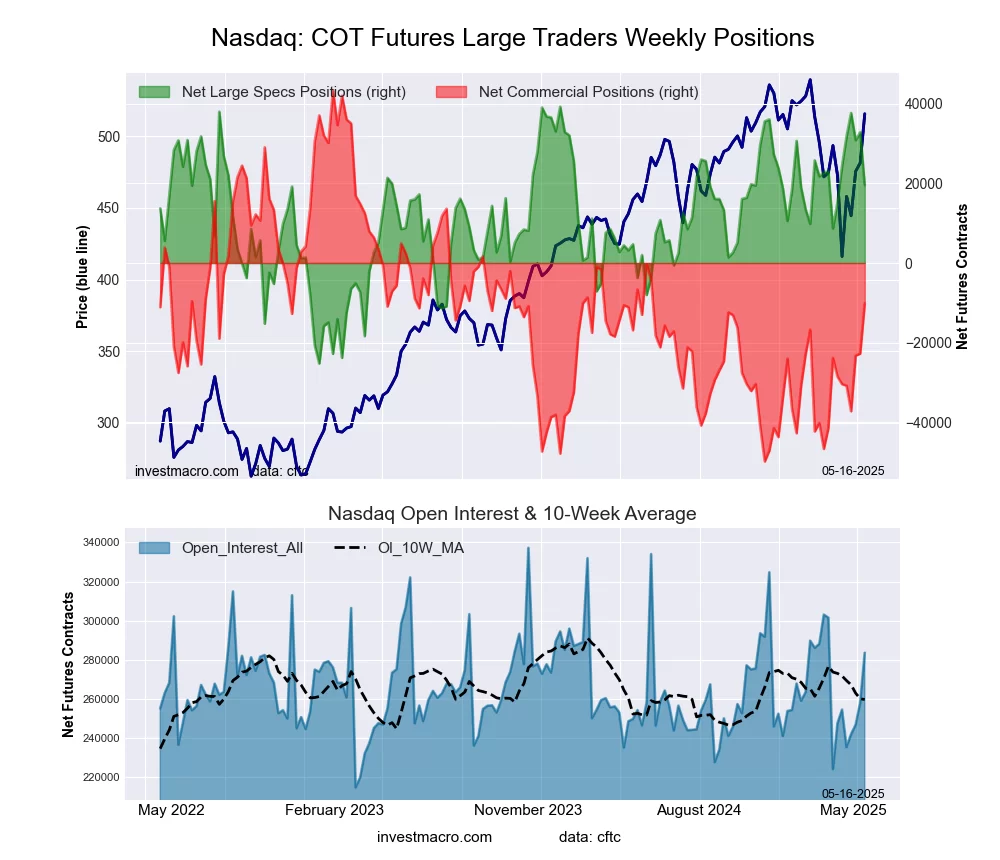
Nasdaq Mini Futures COT ChartThe Nasdaq Mini large speculator standing this week came in at a net position of 25,777 contracts in the data reported through Tuesday. This was a weekly gain of 15,949 contracts from the previous week which had a total of 9,828 net contracts.

This week’s current strength score (the trader positioning range over the past three years, measured from 0 to 100) shows the speculators are currently Bullish with a score of 79.1 percent. The commercials are Bearish-Extreme with a score of 8.1 percent and the small traders (not shown in chart) are Bullish-Extreme with a score of 86.1 percent.

Price Trend-Following Model: Weak Uptrend

Our weekly trend-following model classifies the current market price position as: Weak Uptrend.

Nasdaq Mini Futures StatisticsSPECULATORSCOMMERCIALSSMALL TRADERS
– Percent of Open Interest Longs:29.353.015.9
– Percent of Open Interest Shorts:20.367.810.1
– Net Position:25,777-42,31616,539
– Gross Longs:83,882151,63245,463
– Gross Shorts:58,105193,94828,924
– Long to Short Ratio:1.4 to 10.8 to 11.6 to 1
NET POSITION TREND:
– Strength Index Score (3 Year Range Pct):79.18.186.1
– Strength Index Reading (3 Year Range):BullishBearish-ExtremeBullish-Extreme
NET POSITION MOVEMENT INDEX:
– 6-Week Change in Strength Index:23.6-19.65.8


Russell 2000 Mini Futures:

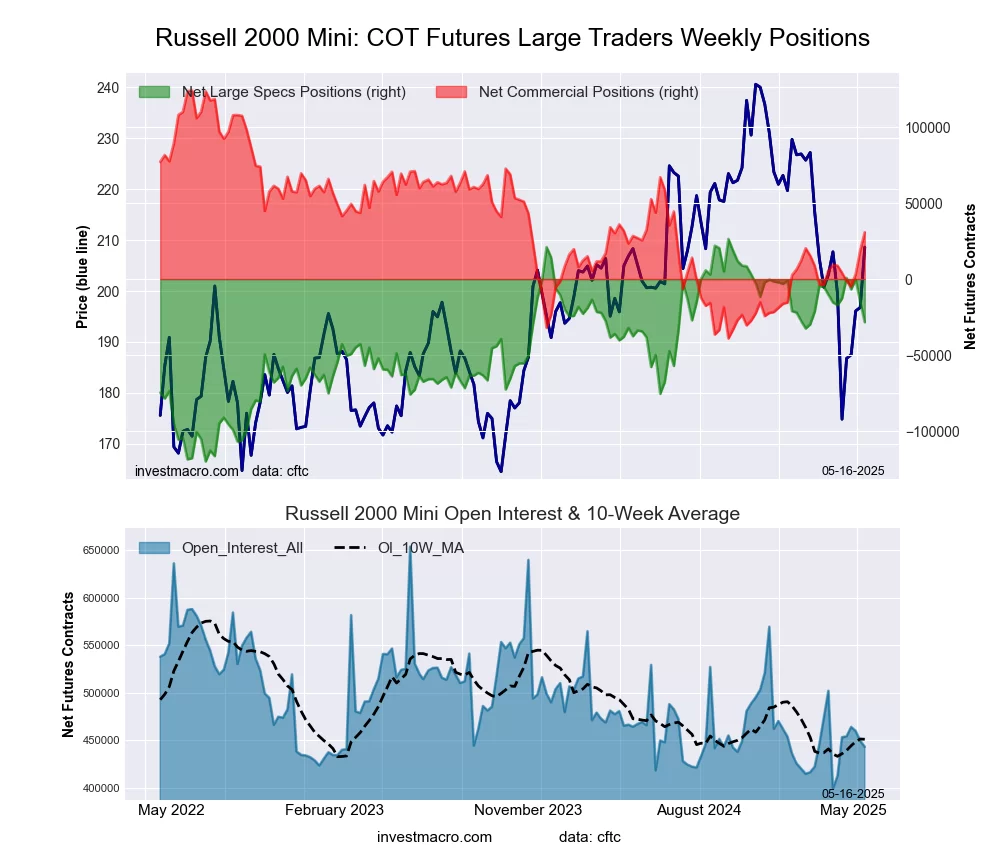
Russell 2000 Mini Futures COT ChartThe Russell 2000 Mini large speculator standing this week came in at a net position of -21,331 contracts in the data reported through Tuesday. This was a weekly advance of 8,475 contracts from the previous week which had a total of -29,806 net contracts.

This week’s current strength score (the trader positioning range over the past three years, measured from 0 to 100) shows the speculators are currently Bullish with a score of 67.4 percent. The commercials are Bearish with a score of 29.2 percent and the small traders (not shown in chart) are Bullish with a score of 60.3 percent.

Price Trend-Following Model: Strong Downtrend

Our weekly trend-following model classifies the current market price position as: Strong Downtrend.

Russell 2000 Mini Futures StatisticsSPECULATORSCOMMERCIALSSMALL TRADERS
– Percent of Open Interest Longs:12.275.17.8
– Percent of Open Interest Shorts:17.373.04.8
– Net Position:-21,3318,62512,706
– Gross Longs:51,610317,14033,096
– Gross Shorts:72,941308,51520,390
– Long to Short Ratio:0.7 to 11.0 to 11.6 to 1
NET POSITION TREND:
– Strength Index Score (3 Year Range Pct):67.429.260.3
– Strength Index Reading (3 Year Range):BullishBearishBullish
NET POSITION MOVEMENT INDEX:
– 6-Week Change in Strength Index:-13.814.8-10.9


Nikkei Stock Average (USD) Futures:

Nikkei Stock Average (USD) Futures COT ChartThe Nikkei Stock Average (USD) large speculator standing this week came in at a net position of 119 contracts in the data reported through Tuesday. This was a weekly lift of 1,950 contracts from the previous week which had a total of -1,831 net contracts.

This week’s current strength score (the trader positioning range over the past three years, measured from 0 to 100) shows the speculators are currently Bullish-Extreme with a score of 81.2 percent. The commercials are Bearish with a score of 30.4 percent and the small traders (not shown in chart) are Bearish with a score of 30.0 percent.

Price Trend-Following Model: Weak Downtrend

Our weekly trend-following model classifies the current market price position as: Weak Downtrend.

Nikkei Stock Average Futures StatisticsSPECULATORSCOMMERCIALSSMALL TRADERS
– Percent of Open Interest Longs:12.067.820.2
– Percent of Open Interest Shorts:11.063.125.9
– Net Position:119569-688
– Gross Longs:1,4448,1652,430
– Gross Shorts:1,3257,5963,118
– Long to Short Ratio:1.1 to 11.1 to 10.8 to 1
NET POSITION TREND:
– Strength Index Score (3 Year Range Pct):81.230.430.0
– Strength Index Reading (3 Year Range):Bullish-ExtremeBearishBearish
NET POSITION MOVEMENT INDEX:
– 6-Week Change in Strength Index:25.0-14.4-16.8


MSCI EAFE Mini Futures:

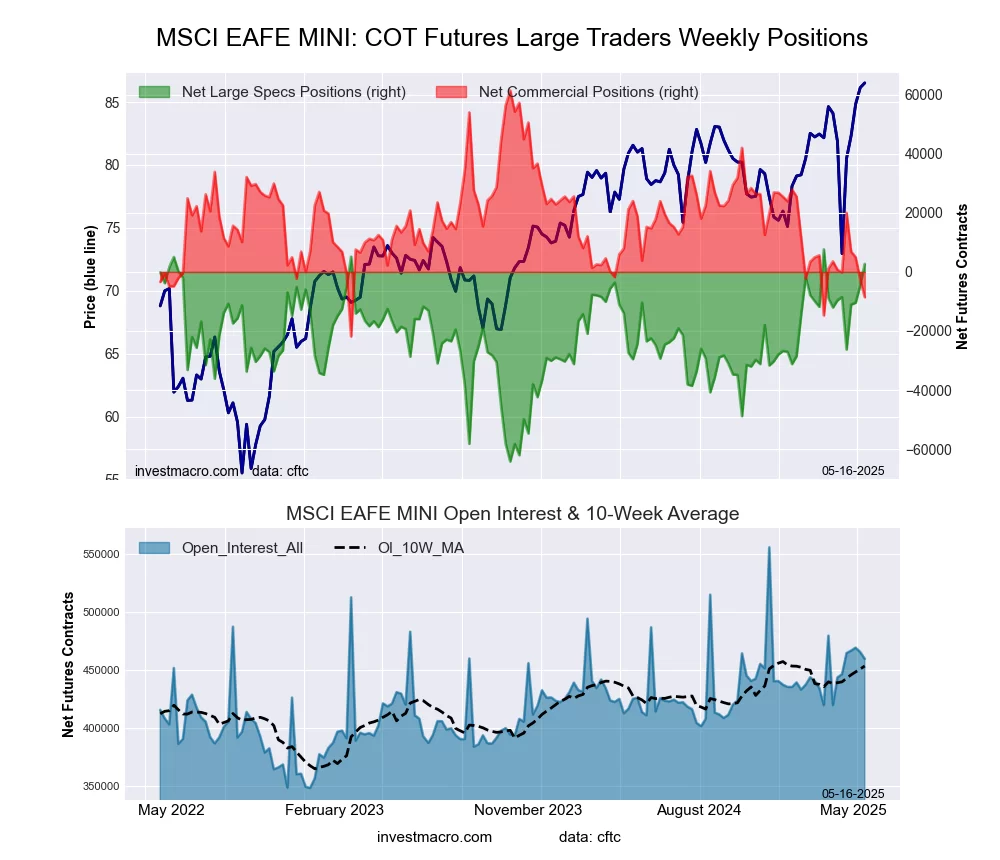
MSCI EAFE Mini Futures COT ChartThe MSCI EAFE Mini large speculator standing this week came in at a net position of -9,907 contracts in the data reported through Tuesday. This was a weekly fall of -2,051 contracts from the previous week which had a total of -7,856 net contracts.

This week’s current strength score (the trader positioning range over the past three years, measured from 0 to 100) shows the speculators are currently Bullish with a score of 72.8 percent. The commercials are Bearish with a score of 32.2 percent and the small traders (not shown in chart) are Bearish with a score of 41.8 percent.

Price Trend-Following Model: Strong Uptrend

Our weekly trend-following model classifies the current market price position as: Strong Uptrend.

MSCI EAFE Mini Futures StatisticsSPECULATORSCOMMERCIALSSMALL TRADERS
– Percent of Open Interest Longs:11.785.42.7
– Percent of Open Interest Shorts:13.984.31.6
– Net Position:-9,9074,9464,961
– Gross Longs:51,405376,32111,891
– Gross Shorts:61,312371,3756,930
– Long to Short Ratio:0.8 to 11.0 to 11.7 to 1
NET POSITION TREND:
– Strength Index Score (3 Year Range Pct):72.832.241.8
– Strength Index Reading (3 Year Range):BullishBearishBearish
NET POSITION MOVEMENT INDEX:
– 6-Week Change in Strength Index:23.0-22.89.3


Article By InvestMacroReceive our weekly COT Newsletter

*COT Report: The COT data, released weekly to the public each Friday, is updated through the most recent Tuesday (data is 3 days old) and shows a quick view of how large speculators or non-commercials (for-profit traders) were positioned in the futures markets.

The CFTC categorizes trader positions according to commercial hedgers (traders who use futures contracts for hedging as part of the business), non-commercials (large traders who speculate to realize trading profits) and nonreportable traders (usually small traders/speculators) as well as their open interest (contracts open in the market at time of reporting). See CFTC criteria here.

Bitcoin has fallen toward the $80,000 mark. Trump confirmed 25% tariffs on Canada and Mexico starting March 4

By JustMarkets

On Thursday’s close, the Dow Jones Index (US30) decreased by 0.45%. The S&P 500 Index (US500) closed down 1.59%. The Nasdaq Technology Index (US100) fell by 2.75%. The broad market also came under pressure after President Trump announced that the proposed 25% tariffs on Canada and Mexico would take effect on March 4, while China will be hit with an additional 10% tariffs from the same date.

The US GDP for Q4 was unchanged at 2.3% (QoQ annualized). The core PCE Price Index for Q4 was revised upward to 2.7% from the previously reported 2.5%. US weekly initial jobless claims rose 22,000 to a 2.5-month high of 242,000, indicating a weaker labor market than expectations of 221,000. Markets rate the odds of a 25 bps rate cut at the next FOMC meeting on March 18-19 at 2%.

The digital assets’ selloff has deepened. Bitcoin continued its fall toward the $80,000 mark on Friday and is now about 25% below all-time highs. The fall followed a widespread sell-off in risk assets amid worries over Trump’s trade policies and growing concerns about the state of the US economy. In addition, continued uncertainty over the Trump administration’s policy regarding digital assets has pressured the market. The $1.5 billion hack of the ByBit exchange also highlighted the significant risks facing the industry.

Equity markets in Europe were mostly down on Thursday. Germany’s DAX (DE40) fell by 1.07%, France’s CAC 40 (FR40) closed down 0.51%, Spain’s IBEX 35 (ES35) lost 0.46%, and the UK’s FTSE 100 (UK100) closed positive 0.28%.

WTI crude oil prices fell below the $70 a barrel mark on Friday, reaching their biggest monthly decline since September, as US economic woes and broader market uncertainty weighed on the outlook for energy demand. Hopes for progress on a peace deal in Ukraine also pressured prices, as a settlement could lead to the lifting of Russian sanctions and increased oil exports.

Asian markets traded flat yesterday. Japan’s Nikkei 225 (JP225) rose by 0.30%, China’s FTSE China A50 (CHA50) gained 0.81%, Hong Kong’s Hang Seng (HK50) fell by 0.29% and Australia’s ASX 200 (AU200) was positive 0.33%.

The offshore yuan maintained its fall around 7.29 per dollar, driven by US President Donald Trump’s announcement of an additional 10% tariff on Chinese imports. The tariffs will take effect on March 4, 2025, and are expected to put significant pressure on China’s export-driven economy, which remains heavily reliant on free trade. Meanwhile, investors are eagerly awaiting fiscal stimulus measures from China’s “Two Sessions” next week. The annual parliamentary meeting is expected to outline a policy agenda to revive economic growth, with a key focus on restoring domestic confidence, addressing economic pressures, and overcoming the developing trade war and technology rivalry with the US.

The Australian dollar slipped to $0.623 on Friday and was down more than 2% for the week as US President Donald Trump’s escalating tariffs heightened fears of a global trade war, weighing on export-oriented economies and their currencies. Australia’s economy, which relies heavily on exports to China, is particularly vulnerable to policies that could dampen Chinese demand.

In February, the Indonesian rupiah hit a five-year low of around 16,500 per US dollar amid a general weakening of Asian currencies. The US President Trump said his proposed tariffs on Mexico and Canada would take effect on March 4, while an additional 10% tariff on China would be imposed on the same day, which strengthened the US dollar. Also weighing on the rupiah was Indonesia’s persistent current account deficit, which remained negative for the 7th consecutive quarter at the end of 2024.

S&P 500 (US500) 5,861.57 −94.49 (−1.59%)

Dow Jones (US30) 43,239.50 −193.62 (−0.45%)

DAX (DE40) 22,550.89 −243.22 (−1.07%)

FTSE 100 (UK100) 8,756.21 +24.75 (+0.28%)

USD Index 107.29 +0.88 (+0.83%)

News feed for: 2025.02.28

  • Japan Tokyo Core CPI (m/m) at 01:30 (GMT+2);
  • Japan Industrial Production (m/m) at 01:50 (GMT+2);
  • Japan Retail Sales (m/m) at 01:50 (GMT+2);
  • German Retail Sales (m/m) at 09:00 (GMT+2);
  • Switzerland Retail Sales (m/m) at 09:30 (GMT+2);
  • Switzerland KOF Leading Indicators (m/m) at 10:00 (GMT+2);
  • German Unemployment Rate (m/m) at 10:55 (GMT+2);
  • German Consumer Price Index (m/m) at 15:00 (GMT+2);
  • Canada GDP (q/q) at 15:30 (GMT+2);
  • US PCE Price Index (m/m) at 15:30 (GMT+2);
  • US Chicago PMI (m/m) at 16:45 (GMT+2).

By JustMarkets


This article reflects a personal opinion and should not be interpreted as an investment advice, and/or offer, and/or a persistent request for carrying out financial transactions, and/or a guarantee, and/or a forecast of future events.

Week Ahead: Can US500 index hold on to post-election gains?

By ForexTime

  • US500 now merely 1.4% higher since November US elections
  • US500 dragged down by poor US data, tariff threats, subdued Nvidia earnings
  • Coming up: Trump speech, tariff deadline, NFP report, Powell speech could dictate US500’s fortunes
  • Key levels: 6,000 to the upside; 200-day SMA to the downside; technical rebound possible
  • Wall Street’s 12-month S&P 500 target price: 6874 – about 17% higher from current levels


A lot can happen in just one week in global financial markets.

(which is why you must regularly stay up to date with our Week Ahead articles, published every Friday)


Just last week, on February 19th, the US500 index posted an all-time intraday high of 6151.3.

Since then, it has tumbled about 4.4%, and completely wiped out all of the gains it had built up so far in 2025.

NOTE: FXTM’s US500 index tracks the S&P 500 – the benchmark index measuring the overall performance of the US stock market.

US500 hanging on to post-election gains

Why have US stocks fallen?

Two words: risk aversion.

Risk aversion simply means that investors and traders are selling off riskier assets, such as US stocks and cryptos, as they grow fearful about future risks.


QUICK RECAP: Here are 3 key events that fuelled the recent bout of risk aversion:

1) Feb 21st: US stocks finally took heed of worsening economic data.

​​Recall last Friday, the US services purchasing managers index (PMI) came in at 49.7.

When the PMI number comes in below 50, it means a contraction for that sector.

Note also that the services sector is a bigger driver of the world’s largest economy, as opposed to manufacturing.

Hence, that surprise worsening in the US services sector triggered a 1.7% drop on February 21st – the S&P 500’s biggest one-day drop so far in 2025.


2) President Trump’s tariffs threats

Also, recent days have seen President Donald Trump continue banging on his trade war drums.

Markets fear that heightened trade tariffs, if imposed against China, the EU, Canada, and Mexico, could actually hurt the US economy more.

In short, markets sold off from riskier assets first, not sticking around to to find out the full extent of the economic impact, or even if the tariffs would actually be imposed.


3) Feb 26th: Nvidia’s not-spectacular earnings

Nvidia is the second-biggest of the 500 or so companies contained within the S&P 500 stock index (Apple is the largest).

To be certain, after US markets closed last Wednesday, Nvidia still announced better-than-expected sales and profits for the 3 months ending January 26th, 2025.

The AI champion also was bullish about its earnings for this ongoing quarter (3 months through April 30th).

However, that wasn’t enough to satiate the appetites of investors who had been spoiled by blockbuster earnings in recent years.

Hence, Nvidia’s stocks fell 8.5% when US markets reopened yesterday (Thursday, Feb 27th) – its biggest one-day drop since January 27th – at the height of the DeepSeek-inspired rout.

And given Nvidia’s size and influence on the US500, the former’s steep drop in turn also dragged the latter lower.


With all the above-listed “scars” still fresh in recent memory, investors and traders will be pondering …

Is the US500 susceptible to even more declines in the new month?


US stock markets will have plenty to contend with over the coming week:

Monday, March 3

  • AUD: February Melbourne Institute Inflation
  • CN50 index: China February manufacturing PMI
  • GER40 index: Eurozone February CPI
  • Global February PMIs (final)
  • US30 index: US February ISM manufacturing; speech by St. Louis Fed President Alberto Musalem

Tuesday, March 4

  • JPY: Japan January jobless rate
  • AU200 index: RBA meeting minutes; January retail sales
  • EU50 index: Eurozone January unemployment
  • US500 index: President Trump’s speech before Congress
  • US tariffs set to be imposed on China, Canada, Mexico

Wednesday, March 5

  • AUD: Australia 4Q GDP
  • CNH: China February services, composite PMIs
  • CHINAH index: China 2025 growth target report
  • SG20 index: Singapore February PMI; January retail sales
  • RUS2000 index: Fed Beige Book; US February ISM services index; January factory orders

Thursday, March 6

  • AUD: Australia January trade balance
  • EUR: ECB rate decision; Eurozone January retail sales
  • RUS2000 index: US initial weekly jobless claims; 4Q GDP (second est.)
  • USDInd: Speeches by Fed Governor Christopher Waller, Atlanta Fed President Raphael Bostic

Friday, March 7

  • CNH: China February trade balance
  • TWN index: Taiwan February trade balance, CPI
  • GER40 index: Germany January factory orders; Eurozone 4Q GDP, employment (final)
  • US500 index: US February nonfarm payrolls
  • USDInd: Speeches by Fed Chair Jerome Powell, New York Fed President John Williams, Fed Governor Michelle Bowman
  • CAD: Canada February employment


Here, we highlight specific events that could trigger massive reactions in the US500 index:

  • Tuesday, March 4th: President Trump’s speech before Congress; and fresh US tariffs?

As mentioned earlier, more trade war rhetoric out of POTUS, coupled with the actual imposition of trade tariffs, could trigger another leg down for riskier assets, including the US500 index.


  • Friday, March 7th: US jobs report; speech by Fed Chair Jerome Powell

The monthly nonfarm payrolls (NFP) report is a major event for global financial markets, as US consumers are the main growth driver of the world’s largest economy.

The more jobs that Americans have, the more money they have to spend and keep growing the US economy.

Here’s what economists are forecasting for the upcoming February NFP report:

  • Headline NFP number: 158,000 new jobs added last month
    (if so, that would be higher than January’s 143,000 headline NFP number)
  • Unemployment rate: 4%
    (if so, that would be match than January’s 4.0% figure – the lowest since May 2024)
  • Average hourly earnings growth (month-on-month): 0.3% higher than January 2025
    (if so, that would be lower than January’s 0.5% month-on-month figure – Jan 2025 vs. Dec 2024)
  • Average hourly earnings growth (year-on-year): 4.2% higher than February 2024
    (if so, that would be higher than January’s 4.1% year-on-year figure – Jan 2025 vs. Jan 2024)


After the NFP’s release, Fed Chair Jerome Powell is due to make a speech.

If a weaker-than-expected US jobs report prompts the Fed Chair to hint at a sooner-than-later US rate cut, that could help the US500 rebound.


POTENTIAL SCENARIOS:

  • The US500 could tumble towards its 200-day simple moving average (SMA), if Trump’s speech and tariffs trigger more risk aversion, along with an unexpected weakness in the US jobs market.

    However, further signs of economic weakness may also prompt the Federal Reserve – the US central bank – to move forward its next rate cut to May 2025.


  • The US500 could stage a recovery back towards the 6,000 mark, if Trump’s speech doesn’t produce any negative shockers, and if more trade tariffs are delayed yet again.

    A “goldilocks” US jobs print (resilient hiring and subdued wage growth) could help risk sentiment recover too, although potentially forcing the Fed to delay its intended rate cuts further out into the year.


From a technical perspective …

Referring to the chart above, recent declines have pushed the US500 index’s 14-day relative strength index (RSI) to its lowest levels since early-August 2024.

If the RSI falls below the 30 line, which is the textbook threshold for “oversold” conditions, that could prompt a technical rebound.

Note that, the last time the 14-day RSI were at these low-30 levels, the S&P 500 duly rebounded.

The US500 then went on to climb as much as 20% (using intraday prices) over the next 6 months to reach its latest record high (6151.3 intraday high on February 29th, 2025).


Of course, the fundamental backdrop is very much different this time around, with the prospects of a global trade war looming.

It would require a meaningful dilution of market fears before US stock indexes can stage a sustained recovery.


Over the longer-term …

Wall Street analysts and experts still predict that the S&P 500 would hit 6874 – which would be about 17% higher than current levels – by February 2026.

But as we said at the very top of this article, a week is a long time in markets, what more 12 months out.

Still, the days ahead may yet produce massive trading opportunities to be taken advantage of, provided market participants remain alert and can react fast.


Forex-Time-LogoArticle by ForexTime

ForexTime Ltd (FXTM) is an award winning international online forex broker regulated by CySEC 185/12 www.forextime.com

Commodity currencies decline following the fall in oil prices. Ukraine and the USA are close to signing a deal on fossil production

By JustMarkets

The Dow Jones Index (US30) gained 0.43% on Wednesday. The S&P 500 Index (US500) closed 0.01% higher. The Nasdaq Technology Index (US100) gained 0.22%. Nvidia shares hovered near zero despite the company reporting better-than-expected fourth-quarter sales and earnings and a strong outlook for the current quarter. The chipmaker increased revenue by 78% year-over-year, helped by strong demand for its GPUs in the artificial intelligence sector. Meanwhile, Salesforce plummeted more than 5% after disappointing quarterly results and a weak outlook.

The Canadian dollar weakened to 1.43 per US dollar, nearing a 22-year low of 1.455 hit on January 31, as renewed threats of tariffs from the US weighed on the demand outlook. The earlier risk of a trade imbalance has already prompted the Bank of Canada to announce a willingness to adjust policy to support domestic growth. In addition, falling crude oil prices, hovering at two-month lows, further weakened the outlook for the loonie, given Canada’s dependence on oil exports.

Equity markets in Europe were mostly up on Wednesday. Germany’s DAX (DE40) rose by 1.71%, France’s CAC 40 (FR40) closed 1.15% higher, Spain’s IBEX 35 (ES35) added 1.64%, and the UK’s FTSE 100 (UK100) closed positive 0.72%. On Wednesday, the DAX Index continued the rally that began after the German federal election over the weekend and outperformed its peers. Investors followed a wave of strong corporate earnings and remained optimistic about a potential mining deal between Ukraine and the US. Meanwhile, market participants continued to weigh the outlook for increased defense spending in Europe and lingering concerns over US trade tariffs.

WTI crude oil prices slipped below $69 a barrel on Thursday, to their lowest level since December last year, pressured by prospects for increased supply and a bearish demand outlook. A potential peace deal between Russia and Ukraine continued to weigh on prices as expectations of an easing of Russian sanctions could boost the global oil supply. The US and Ukraine also reached a draft agreement on minerals, a key step in President Trump’s efforts to end the war as soon as possible. In addition, oil prices have been hurt by concerns that Trump’s tariffs on China and other trading partners could slow economic growth and dampen demand.

The US natural gas prices (XNG/USD) fell below $4.0/MMBtu as prognoses of warmer weather and record production outweighed strong LNG exports and inventory shortages. Milder conditions are expected through March 12, reducing demand for natural gas to heat homes and businesses. In addition, February production remains at record levels, rising to 104.3 Bcf/d by February 25 from 100.5 Bcf/d on February 19.

Asian markets traded flat yesterday. Japan’s Nikkei 225 (JP225) fell by 0.25%, China’s FTSE China A50 (CHA50) rose by 0.61%, Hong Kong’s Hang Seng (HK50) gained 3.27%, and Australia’s ASX 200 (AU200) was negative 0.14%.

The New Zealand dollar fell to US$0.567 on Thursday, hitting its lowest level in a week. The kiwi was weakened by the US dollar’s gains amid uncertainty over US trade policy following President Donald Trump’s vague promises of tariffs on Europe, as well as further postponements of planned duties on Canada and Mexico. Domestically, the currency remains under pressure after the Reserve Bank of New Zealand delivered a dovish monetary policy statement.

S&P 500 (US500) 5,956.06 +0.81 (+0.014%)

Dow Jones (US30) 43,433.12 −188.04 (+0.43%)

DAX (DE40) 22,794.11 +383.84 (+1.71%)

FTSE 100 (UK100) 8,731.46 +62.79 (+0.72%)

USD Index 106.49 +0.18 (+0.17%)

News feed for: 2025.02.27

  • Switzerland GDP (q/q) at 10:00 (GMT+2);
  • Eurozone ECB Monetary Policy Meeting Accounts (m/m) at 14:30 (GMT+2);
  • US GDP (q/q) at 15:30 (GMT+2);
  • US Initial Jobless Claims (w/w) at 15:30 (GMT+2);
  • US Durable Goods Orders (m/m) at 15:30 (GMT+2);
  • US Pending Home Sales (m/m) at 17:00 (GMT+2);
  • US Natural Gas Storage (w/w) at 17:30 (GMT+2);
  • G20 Meetings (Day 2);

By JustMarkets


This article reflects a personal opinion and should not be interpreted as an investment advice, and/or offer, and/or a persistent request for carrying out financial transactions, and/or a guarantee, and/or a forecast of future events.

USD/JPY steadies as the market consolidates after fresh lows

By RoboForex Analytical Department

USD/JPY is consolidating near 149.33 on Thursday, with the yen pausing its rally while holding near four-month highs against the USD. This stabilisation follows renewed support for the US dollar amid concerns that US President Donald Trump’s trade tariff policies could escalate once again.

Key drivers influencing USD/JPY

Trump recently announced plans to review the possibility of imposing reciprocal 25% tariffs on European cars and other goods. Additionally, he confirmed that tariffs on imports from Mexico and Canada will take effect on 2 April rather than the initially planned 4 March. These developments have intensified trade tensions, lending support to the USD.

Despite today’s consolidation, the yen remains strong, with expectations that the Bank of Japan (BoJ) may continue raising interest rates this year following Q4 inflation data.

Additionally, the JPY remains in demand as a safe-haven asset amid ongoing uncertainty and underlying risks in global financial markets.

A crucial set of economic data will be released on Friday, including figures on industrial production, retail sales, and Tokyo’s inflation rate. These reports could provide further insight into the BoJ’s future monetary policy trajectory.

Technical analysis of USD/JPY

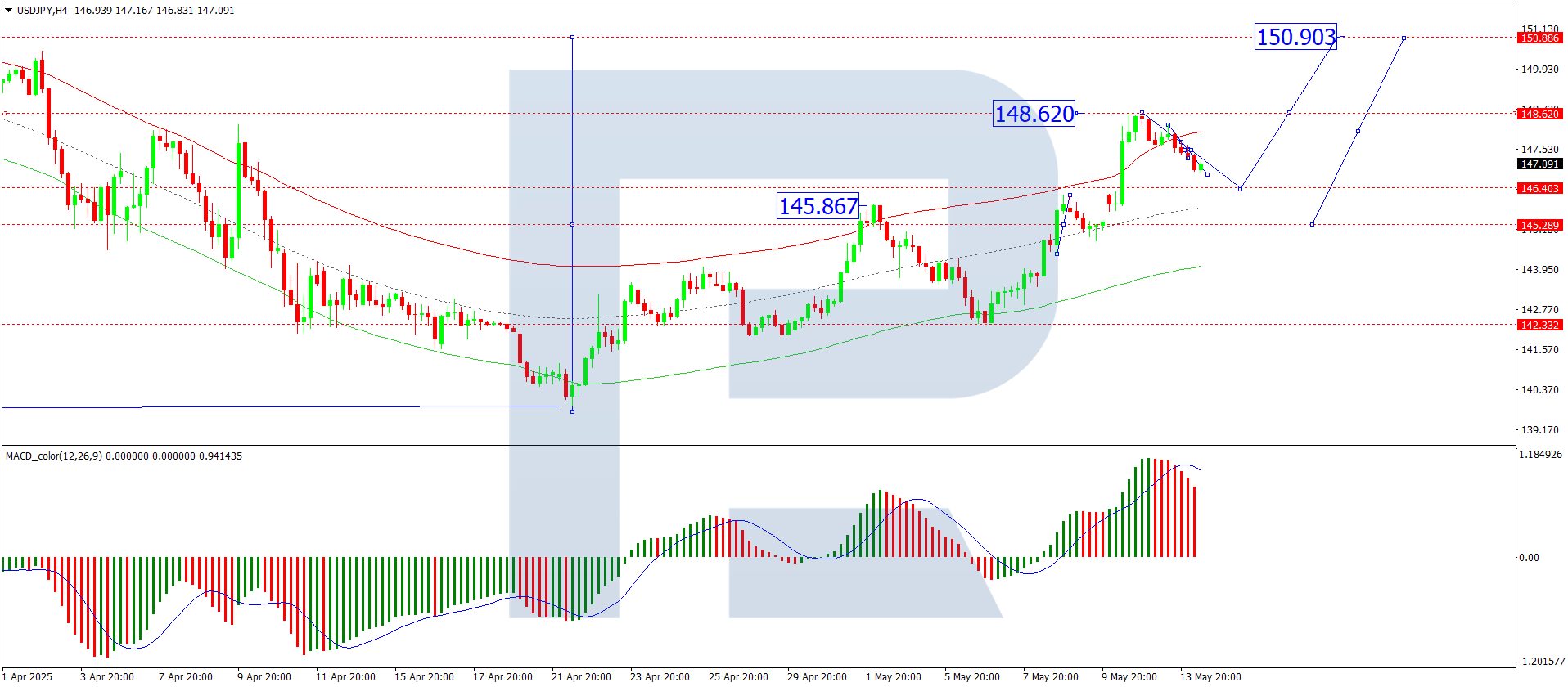
On the H4 chart, USD/JPY completed a downward wave to 148.55. The market is now forming a consolidation range at this low. A corrective move towards 151.80 could develop if the price breaks upward, marking the first key target. Upon reaching this level, a further corrective decline towards 150.20 may follow. The MACD indicator confirms this scenario, with its signal line positioned below zero but pointing upward, indicating potential correction.

On the H1 chart, USD/JPY is forming an upward wave structure towards 150.00. A broad consolidation range is developing around 149.25. If the price breaks upwards from this range, a correction towards 151.80 could unfold. After reaching this target, the pair could pull back to 150.20. The Stochastic oscillator supports this outlook, with its signal line above 50 and pointing upwards, suggesting short-term bullish momentum.

Conclusion

USD/JPY has temporarily stabilised after recent declines, with technical indicators suggesting a potential corrective move towards 151.80. However, upcoming Japanese economic data and ongoing geopolitical uncertainties could introduce volatility. Market participants will closely monitor BoJ signals and further developments regarding US trade tariffs, which could impact the yen’s safe-haven appeal.


Disclaimer

Any forecasts contained herein are based on the author’s particular opinion. This analysis may not be treated as trading advice. RoboForex bears no responsibility for trading results based on trading recommendations and reviews contained herein.

Australia sees inflationary pressures easing. Bitcoin has reached a 3-month low

By JustMarkets

At the end of Tuesday, the Dow Jones Index (US30) was up 0.37%. The S&P 500 Index (US500) was down 0.47%. The Nasdaq Technology Index (US100) fell by 1.24%. Investor sentiment continued to be pressured by geopolitical and trade tensions after President Trump confirmed the imposition of tariffs on Mexican and Canadian imports, previously delayed by a month. There were also reports that the US was tightening restrictions on China’s chip industry. The technology, communication services, and utilities sectors fared the worst, while real estate, materials, and consumer staples were the gainers.

Today, investors are awaiting Nvidia’s earnings report, which could be a new catalyst for the market. Nvidia, like other AI-related stocks, has recently come under pressure due to concerns over China’s DeepSeek project, raising doubts about the sustainability of the AI rally. Market participants are also awaiting the second estimate of fourth-quarter GDP growth at the end of the week, as well as the upcoming PCE Price Index report, which will provide key insights into the outlook for the economy and monetary policy.

BTC/USD fell below $88,000, its lowest in 3 months, as concerns over a slowing US economy, rising inflation, and Trump’s aggressive trade policies eroded investor confidence. Bitcoin has fallen about 20% since Trump’s inauguration in January as initial optimism over his digital-asset-friendly stance fades. Other major digital assets, including ETH and SOL, have also declined, and bitcoin ETFs saw record outflows of nearly $1 billion in February. Industry issues such as the $1.5 billion hack of Bybit also dampened sentiment.

Equity markets in Europe traded flat on Tuesday. Germany’s DAX (DE40) fell by 0.07%, France’s CAC 40 (FR40) closed down 0.49%, Spain’s IBEX 35 (ES35) added 0.80%, and the UK’s FTSE 100 (UK100) closed positive 0.11%. Eurozone wages were 4.12% year-on-year in the fourth quarter of 2024, slowing from the 31-year high of 5.43% recorded in the previous quarter. The data brought some relief to European Central Bank policymakers as they continue their efforts to contain inflation while supporting sluggish economic growth. The ECB recently announced its plans to continue easing monetary policy, with money markets anticipating at least two interest rate cuts before the end of December.

The formation of a new government coalition in Germany also remains in the spotlight. Conservative leader Friedrich Merz intends to strike an agreement with the SPD “in the near future,” while talks on increased defense spending continue. On the corporate front, shares of Siemens Energy and Infineon Technologies are down 7.3% and 2.6% respectively amid concerns over US restrictions on the Chinese technology sector and ahead of Nvidia’s earnings report.

WTI crude oil prices were trading near $69 a barrel on Wednesday, near their lowest level since last December, as US economic concerns and broader market uncertainty put pressure on the outlook for energy demand. President Trump’s foreign policy also put pressure on oil, with the prospect of a peace deal between Russia and Ukraine raising expectations of the lifting of Russian sanctions, which would pave the way for more Russian oil exports.

Asian markets traded flat yesterday. Japan’s Nikkei 225 (JP225) fell by 1.39%, China’s FTSE China A50 (CHA50) lost 1.14%, Hong Kong’s Hang Seng (HK50) decreased by 1.32%, and Australia’s ASX 200 (AU200) was negative 0.68%. Hong Kong stocks rose by 2.3% on Wednesday, reversing a weak session the previous day amid strong gains across sectors. The mood was upbeat as the city’s Financial Secretary Paul Chan is due to unveil his plan to reduce Hong Kong’s deficit while mitigating the negative effects of a slowing Chinese economy and rising trade tensions with the US.

The Australian dollar fell below $0.633 on Wednesday, nearing two-week lows, as weaker-than-expected economic data fueled expectations of further interest rate cuts by the Reserve Bank of Australia (RBA). Australia’s monthly Consumer Price Index was unchanged at 2.5% in January, defeating expectations of a slight rise to 2.6%. On the external front, the Aussie faced additional pressure from US President Donald Trump’s tariff proposals, which could disrupt global trade and negatively impact export-dependent economies such as Australia.

S&P 500 (US500) 5,983.25 −29.88 (−0.50%)

Dow Jones (US30) 43,461.21 +33.19 (+0.08%)

DAX (DE40) 22,425.93 +138.37 (+0.62%)

FTSE 100 (UK100) 8,658.98 −0.39 (−0.0045%)

USD Index 106.67 +0.06 (+0.06%)

News feed for: 2025.02.26

  • Australia Consumer Price Index (m/m) at 02:30 (GMT+2);
  • Japan BOJ Core CPI (m/m) at 07:00 (GMT+2);
  • German GfK Consumer Confidence (m/m) at 09:00 (GMT+2);
  • US New Home Sales (m/m) at 17:00 (GMT+2);
  • US Crude Oil Reserves (w/w) at 17:30 (GMT+2);
  • G20 Meetings (Day 1).

By JustMarkets


This article reflects a personal opinion and should not be interpreted as an investment advice, and/or offer, and/or a persistent request for carrying out financial transactions, and/or a guarantee, and/or a forecast of future events.

Nvidia earnings preview: Make-or-break moment…

By ForexTime 

  • Nvidia world’s 2nd largest company with $3.1 trillion market cap
  • Earnings due after US markets close Wednesday, 26th Feb
  • DeepSeek threat, tariffs and supply outlook in focus
  • Shares forecast to move almost 10% ↑ or ↓ post earnings
  • Technical levels: $115, $138 & $150

Nvidia’s earnings will be a defining moment for itself and the entire tech space.

Making it one of the biggest events for Q1.

Given the lofty expectations, the AI giant must deliver exceptional results to keep bulls alive.

But this could be complicated by mounting competition and supply constraints.

Here is what you need to know:


The lowdown…

Nvidia shares took a beating in late January, plunging 17% after Chinese artificial intelligence startup DeepSeek rocked the tech space. Although shares later rebounded, prices are still down almost 6% year-to-date.


When will earnings be released?

Nvidia will report its fiscal fourth-quarter 2025 earnings after US markets close on Wednesday.


What are markets expecting

  • Revenue: $38.2 billion – reflecting a staggering 73% YoY increase.
  • Data Center revenue: $34.1 billion
  • Gross profit margins: 73.5%
  • Net profits: $21.0 billion
  • Earnings per share (EPS): $0.84 – reflecting a massive 64% YoY increase.

Most importantly, all eyes will be on Nvidia’s guidance for future earnings which could boost or reduce confidence over its business outlook.

Note: Nvidia projected Q4 revenues of $37.5 billion, plus or minus 2% during its last report.


Why is Nvidia’s earnings so important?

Nvidia plays a critical role in AI development across the world.

The likes of Microsoft, Meta, Amazon and Alphabet use Nvidia’s GPUs for their AI systems while Tesla uses them in its vehicles. OpenAI relies on Nvidia chips to train ChatGPT and Tencent/Alibaba use them in their chatbots.

So, the company’s earnings could serve as a major gauge for the AI trade while also re-confirming whether its $3.1 trillion valuation is justified.


Potential challenges

  • DeepSeek’s cheaper AI models hitting demand for Nvidia’s pricier chips.
  • Trump’s tariffs and trade uncertainty reducing chip sales, especially in China.
  • Supply challenges and production delays for Blackwell GPUs limiting growth.


How will Nvidia react to earnings?

Markets are forecasting a near 10% move, either up or down, for Nvidia stocks post earnings.

Note: With a $3.1 billion valuation, a nearly 10% move in the price of Nvidia is $310 billion. This is larger than the entire value of over 95% of companies in the S&P500.


Possible scenarios

  • If Nvidia delivers exceptional results and raises its guidance – prices could rally.
  • If Nvidia misses expectations and flags potential challenges down the road – prices may tumble.


What does this mean for FXTM’s NAS100 index.

FXTM’s NAS100 tracks the underlying benchmark Nasdaq 100 index.

And Nvidia makes up under 10% of the index weighting, meaning that the upcoming earnings could result in heightened volatility.

The index is down almost 2% this month, with year-to-date gains flat. Prices are under pressure on the daily charts with bears eyeing support at 20500.

Key levels of interest can be found at 22256, 21400 and 20500.

nasdaq1000

Technical forces

Nvidia shares are under pressure on the daily charts.

This continues to be reflected in price action with the candlesticks below the 21, 50 and 100-day SMA.

  • Weakness below the 200-day SMA could signal a decline toward the $115.00 support and $100.
  • A solid move above the 50 and 100-day SMA could signal a move back toward $138, $150, and fresh all-time high beyond $152.69.

Nvidia chart 1


Forex-Time-LogoArticle by ForexTime

ForexTime Ltd (FXTM) is an award winning international online forex broker regulated by CySEC 185/12 www.forextime.com

EUR/USD appreciates as optimism builds around Germany’s fiscal plans

By RoboForex Analytical Department

EUR/USD climbed to 1.0504 on Wednesday, nearing its monthly high of 1.0528. The pair gained momentum following positive news from Germany, fuelling market optimism.

Key factors driving EUR/USD

Reports have emerged suggesting that Germany is considering the creation of a 200-billion-euro emergency fund, boosting expectations for increased local fiscal spending.

Additionally, Friedrich Merz, a leading candidate for the next German Chancellor, has proposed reforming the country’s debt brake to allow for more flexible financing of key expenditures. This could include tax cuts, lower energy prices, and a significant increase in defence spending – all of which could stimulate the German economy and support the euro.

Meanwhile, market participants are closely analysing recent comments from the European Central Bank (ECB) comments ahead of next week’s policy meeting. The ECB is widely expected to cut interest rates for the fifth consecutive time. However, some policymakers, including Isabel Schnabel, suggest that the central bank may soon need to pause or halt rate cuts altogether. The euro could find additional support if the ECB signals a more cautious stance on further easing,

Technical analysis of EUR/USD

On the H4 chart, EUR/USD completed a growth wave to 1.0524 and is now developing a downward wave towards 1.0450. A breakout below this level would open the potential for a further decline towards 1.0380. After reaching this target, a corrective rebound towards 1.0450 is likely. The MACD indicator confirms this scenario, with its signal line positioned above zero but pointing sharply downward.

On the H1 chart, the market declined to 1.0453, followed by a correction to 1.0524. The likelihood of the downward wave continuing towards 1.0450 remains high. If this level is breached, the correction could extend towards 1.0380, with the broader trend potentially targeting 1.0373. The Stochastic oscillator supports this outlook, with its signal line above 50 and pointing decisively downward.


Conclusion

EUR/USD benefits from renewed optimism surrounding Germany’s potential fiscal expansion, but downside risks persist due to the uncertainty surrounding ECB policy. While technical indicators suggest an ongoing downward wave, the pair’s movement will depend on key support levels around 1.0450 and 1.0380. The upcoming ECB meeting remains a critical event that could shape the euro’s near-term direction.


Disclaimer

Any forecasts contained herein are based on the author’s particular opinion. This analysis may not be treated as trading advice. RoboForex bears no responsibility for trading results based on trading recommendations and reviews contained herein.

Bitcoin has fallen below $92K. The US imposed additional sanctions on oil trade from Iran

By JustMarkets

At the end of Monday, the Dow Jones Index (US30) added 0.08%. The S&P 500 Index (US500) was down 0.50%. The Nasdaq Technology Index (US100) decreased 1.21%. Among individual stocks, Palantir, a key player in defense AI, fell sharply by 10.5% and is now down nearly 30% from its peak. Nvidia also fell by 3.1% as it prepares to release its earnings report on Wednesday, while Microsoft lost 1% amid concerns about slowing data center spending growth. On the other hand, Apple rose by 0.6% as it announced plans to invest $500 billion in the US over the next four years and plans to hire 20,000 new employees.

Bitcoin prices fell below $92,000, hitting their lowest level since last November. The collapse in risk assets began last week amid growing concerns about the outlook for the US economy, amplified by President Donald Trump’s escalating tariff threats and the Federal Reserve’s hawkish stance on interest rates. Meanwhile, MicroStrategy bought another 20,365 bitcoins worth nearly $2 billion, bringing the total number of bitcoins to 499,096 or roughly $33.1 billion.

Equity markets in Europe traded flat on Monday. Germany’s DAX (DE40) rose by 0.62%, France’s CAC 40 (FR40) closed down 0.78%, Spain’s IBEX 35 (ES35) added 0.47%, and the UK’s FTSE 100 (UK100) closed negative 0.01%. In Germany, Friedrich Merz’s conservatives won the election. Investors are closely watching for signs of Germany’s fiscal strategy, while economists remain divided on the government’s ability to enact significant economic reforms.

Ukraine and the United States are in the final stages of negotiating a mineral deal considered key to ending Russia’s three-year war in Ukraine. Kyiv and Washington are interested in US access to Ukraine’s underground wealth, but President Volodymyr Zelenskyy said any deal must include specific security guarantees. Zelenskyy refused to sign an initial draft of the agreement earlier this month, sparking displeasure at the White House.

WTI crude prices climbed above $71 a barrel on Tuesday, posting a second straight day of gains after the US imposed additional sanctions on oil trade from Iran, adding to fears of dwindling global supplies. On Monday, the US imposed sanctions on brokers, tanker operators, and shipping companies involved in the sale and transportation of Iranian oil, affecting 22 individuals and 13 vessels based in China, the UAE, India, and Hong Kong. This is the second round of sanctions as President Donald Trump seeks to zero out Iran’s crude oil exports to prevent the country from obtaining nuclear weapons.

Asian markets traded flat yesterday. Japan’s Nikkei 225 (JP225) rose by 0.26%, China’s FTSE China A50 (CHA50) fell by 0.37%, Hong Kong’s Hang Seng (HK50) lost 0.58% and Australia’s ASX 200 (AU200) was up 0.14%. Hong Kong stocks fell 1.4% in Tuesday morning trading, marking a second session of sharp declines amid losses in the broad sector, especially consumer discretionary and technology. Traders retreated from risky assets after the US stepped up restrictions on Chinese investment and continued to impose tariffs on Canada and Mexico. Caution also intensified ahead of China’s official PMI data for February to be released over the weekend, with the reading expected to be lower due to the impact of the New Year’s Eve holiday break.

The offshore yuan remained weak around 7.26 per dollar as investors remained cautious amid escalating trade tensions between the US and China. President Donald Trump is reportedly planning to tighten controls on chip exports to China following a recent executive order to restrict Chinese investment in technology and other strategic US industries.

The Australian dollar traded near US$0.635 on Tuesday, remaining under pressure after falling for two consecutive sessions, driven by US President Donald Trump’s recent comments on tariffs that raised fears of a possible global trade war. On Monday, Trump said tariffs on Canada and Mexico “will be imposed” as soon as the one-month delay period ends next week. Domestically, investors are also awaiting Australia’s monthly inflation report on Wednesday, which is expected to provide crucial insight into the future direction of monetary policy.

S&P 500 (US500) 5,983.25 −29.88 (−0.50%)

Dow Jones (US30) 43,461.21 +33.19 (+0.08%)

DAX (DE40) 22,425.93 +138.37 (+0.62%)

FTSE 100 (UK100) 8,658.98 −0.39 (−0.0045%)

USD Index 106.67 +0.06 (+0.06%)

News feed for: 2025.02.25

  • German GDP (q/q) at 09:00 (GMT+2);
  • US CB Consumer Confidence (m/m) at 17:00 (GMT+2).

By JustMarkets


This article reflects a personal opinion and should not be interpreted as an investment advice, and/or offer, and/or a persistent request for carrying out financial transactions, and/or a guarantee, and/or a forecast of future events.

Bitcoin tumbles below $90k on risk-off mood

By ForexTime 

    • Bitcoin ↓ 7% on Tuesday, pulling YTD losses to 5%
    • Bears exploit Trump tariff fears & industry-related drama
    • Over past year US PCE triggered moves of ↑ 4.1% & ↓ 2.5%
    • Technical levels: $94,000, $87,000 and 200-day SMA

    Bitcoin collapsed over 7% on Tuesday, hitting its lowest level since mid-November as a messy cocktail of developments soured investor appetite.

    The “OG” crypto cut through the $90,000 weekly support level, dragging year-to-date losses to 5% amid Trump’s tariff fears and a series of industry-specific drama.

    bitcoin weekly

    Last Friday, cryptocurrency exchange Bybit was hacked – losing $1.5 billion in what could be the biggest crypt theft in history. With investors jittery about the safety of digital-asset platforms, Bitcoin was left vulnerable to heavy losses.

    Also weighing on sentiment was the memecoin scandal in mid-February involving Argentina’s President’s $LIBRA token.

    All this uncertainty was reflected in the massive $516 million outflows from Bitcoin ETFs on Monday.

    More losses could be on the cards for Bitcoin if the market mood fails to improve.

    outflows

    Source: Coinglass

    On the macro front, incoming US data and Fed speeches may trigger fresh volatility for Bitcoin but to its sensitivity to interest rates.

    Note: Traders are currently pricing in a 33% probability of a 25bp rate cut by May with this jumping to 83% by June.

    • Thursday 27th February: US Q4 GDP (second estimate), initial weekly jobless claims, speeches by Fed officials.
    • Friday 28th February: US January PCE, speech by Chicago Fed President Austan Goolsbee.

    Over the past year, the US PCE report has triggered upside moves of as much as 4.1% or declines of 2.5% in a 6-hour window post-release.


    Technical outlook

    Prices are under pressure on the daily charts, trading below the 21, 50 and 100-day SMA.

    • Should $87,000 prove to be reliable support, this may trigger a rebound back toward $94,000.
    • A breakdown below $87,000 may open a path toward the 200-day SMA at $81,800.

    bitcoin weekly


Forex-Time-LogoArticle by ForexTime

ForexTime Ltd (FXTM) is an award winning international online forex broker regulated by CySEC 185/12 www.forextime.com