Archive for Financial News – Page 50

EUR/USD Volatility Rises, But Fails to Drive Direction

By RoboForex Analytical Department

On Thursday, the EUR/USD pair is trading around 1.1646, consolidating after the previous session’s volatility. The market is stabilising following the recent US dollar rally, driven by expectations ahead of the Federal Reserve’s annual symposium in Jackson Hole. Investors remain cautious before Fed Chair Jerome Powell’s speech, seeking clarity on interest rate prospects and any potential adjustments to expectations of rapid monetary easing.

Futures currently assign an 82% probability of a 25-basis-point rate cut in September, down from last week’s 94%. The minutes of the July Fed meeting revealed that policymakers remain more concerned with inflation risks than labour market conditions. Tariffs, however, continue to divide opinion among officials.

In Washington, US President Donald Trump urged Fed Board Member Lisa Cook to resign amid allegations of mortgage fraud and reiterated his demand for lower interest rates. With Powell’s term expiring in May, Trump is actively considering potential successors. As expected, Treasury Secretary Scott Bessent once again advocated for a more aggressive 50-basis-point cut in September.

Technical analysis of EUR/USD

On the H4 chart, the market is consolidating around 1.1656. A downward breakout is anticipated, targeting 1.1597, with the potential for further decline to 1.1582. The first target in the next downward wave is set at 1.1455. This scenario is technically supported by the MACD indicator, whose signal line lies below zero and is pointing sharply downwards, indicating strong bearish pressure.

On the H1 chart, the pair completed a downward wave to 1.1622, followed by a correction to 1.1670, effectively defining the consolidation range. A downward breakout towards 1.1597 is possible today, followed by a rebound to 1.1645. Beyond this, the pair may resume a decline to 1.1455, with the wave potentially extending to 1.1430. The Stochastic oscillator confirms this bearish scenario: its signal line is below the 50 level and is trending sharply towards 20, signalling continued downside momentum.

Summary

The EUR/USD pair remains directionless despite heightened volatility as traders await Powell’s speech at Jackson Hole. Technical signals point to a continuation of the bearish trend, with key downside levels at 1.1597 and 1.1455, while any rebounds are likely to remain short-lived corrections.


Disclaimer

Any forecasts contained herein are based on the author’s particular opinion. This analysis may not be treated as trading advice. RoboForex bears no responsibility for trading results based on trading recommendations and reviews contained herein.

Cleantech Co. Advances Innovative Systems for Data Centers

Source: Streetwise Reports (8/19/25)

Environmental and cleantech company BioLargo Inc. (BLGO:OTCQX) announces its financial results, including a huge increase in revenue in its engineering segment due to contracts to provide control compliance services.

Environmental and cleantech company BioLargo Inc. (BLGO:OTCQX) announced that new engineering contracts to provide air quality control compliance services has increased its engineering segment revenue by 517%.

However, due to decreased volume of sales of its pet odor product Poop, overall revenues fell to US$ 2.78 million in the second quarter of this year and US$6.046 million in the first half, the company said in a release on August 13.

The company had reported in its annual report that it had achieved record revenues in 2024, marking a 45% increase compared to the previous year, largely driven by the success of Pooph. For the year ending December 31, 2024, revenues reached US$17,779,000, reflecting a 45% increase over 2023 and marking the 10th consecutive year of revenue growth, according to the company.

“There are many important technologies and products in our portfolio that will have a major role in industry,” President and Chief Executive Officer Dennis P. Calvert said.

He continued, “Over the past few months and quarters, our team has done a tremendous job in progressing the overall value of the BioLargo portfolio … the unseen value is many multiples of our current US$50 million market cap, driven by our unmatched technologies, capital-conserving strategy, highly qualified people and high impact.”

“We are very optimistic with our emerging solutions surrounding surgical products, water treatment for the global PFAS contamination crisis and battery energy storage technology,” Calvert said. “Our team is focused on creating optimal partnerships to drive commercialization of these solutions across varying industries.”

Calvert noted that BioLargo’s investments in these technologies have yielded a suite of validated technical claims and product features that “we believe are unmatched in the marketplace.” This diversification strategy has proved “especially wise” as BioLargo advances its commercial efforts into high-growth opportunities like its Clyra and Cellinity technologies, Calvert has said.

According to the company, here are some of the other key highlights of the report:

  • Clyra Medical Technologies secured a series of sales and distribution agreements to make its products available to 6,100 hospitals, 6,300 ambulatory surgery centers, and 2,200 specialty wound care clinics in the U.S. alone.
  • An independent evaluation by U.S. BESS Corporation, a leading provider of advanced energy storage solutions, confirmed the breakthrough performance of BioLargo’s Cellinity battery technology for grid-scale energy storage.
  • Cellinity, our innovative battery technology, signed four memoranda of understanding (MOUs) with prospective joint venture partners interested in building and operating Cellinity battery factories.
  • Garratt Callahan, one of the company’s co-development technology partners, continued efforts in selling and business development, focusing on the reuse of cooling tower water, such as at data centers.
  • Engineering & Environmental Services is actively working with clients to develop scopes of work and budgets for several significant projects.
  • As of June 30, 2025, stockholders’ equity was $6,060,000, assets totaled $12,499,000, liabilities were $6,439,000, and the company held $3,471,000 in cash and cash equivalents.

Independent Evaluation Confirms Advantages of Cellinity

In June, BioLargo announced that an independent evaluation had confirmed the significant advantages of its Cellinity battery technology for grid-scale energy storage systems. The assessment was carried out by U.S. BESS Corp. is a leading provider of advanced energy storage solutions for critical infrastructure in utilities, defense, microgrids, and heavy industry, according to BioLargo.

“Based on our inspection and the evidence provided, U.S. BESS finds that the Cellinity Cell demonstrates a sufficient performance profile, with strong indications of high thermal stability, efficiency, energy and power density, and material sustainability, to suggest further investment in testing and commercialization,” the report stated. “These attributes position this technology as a potential solution for critical gaps in grid-scale energy storage markets.”

The senior technical team at U.S. BESS conducted a thorough review of Cellinity’s design and assembly processes, inspected the testing infrastructure, analyzed test data, and evaluated the methodologies used for performance characterization.

U.S. BESS Corp. further determined that it is reasonable to assert that: a) the cell would not undergo thermal runaway, b) the materials used in its construction are commonly available and can be sourced domestically, c) the cell does not incorporate rare earth elements, and d) the components of the cell are fully recyclable.

Analyst Maintains Rating, Price Target

In a July 23 research note, Oak Ridge Financial Analyst Richard Ryan noted, “BioLargo’s business model approach is to invent or acquire novel technologies, develop them into product offerings, and extend their commercial reach through licensing and channel partnerships to maximize their impact.”

This cleantech and life sciences innovator, according to the analyst, has several core products that address PFAS (also known as “forever chemicals” because of the time they take to break down) contamination, advanced water and wastewater treatment, odor and volatile organic compound control, air quality improvement, energy efficiency and safe onsite energy storage, and infection control. BioLargo remains a Buy, according to Ryan.

Ryan noted that in a letter to shareholders in July, Calvert noted that he believes Pooph will ultimately be successful. He added that it is difficult to forecast future Pooph results given the lack of visibility into the business and the short time (three years) its products have been on the market.

The Catalyst: More Energy for AI, Data Centers, and Grid Resilience

The global need for grid-scale energy storage is rapidly growing to support increasing demands. In 2024, the U.S. Energy Information Administration (EIA) noted a 66% rise in battery energy storage capacity in the U.S. While lithium-ion batteries currently lead this sector, they present several challenges, such as fire risks due to thermal runaway, efficiency loss over time, and sourcing difficulties related to rare and critical minerals.

BioLargo said its Cellinity battery technology tackles these issues by using innovative materials and designs to deliver exceptional thermal performance and operational efficiency without relying on rare earth elements.

According to a February report by the International Energy Agency (IEA), global electricity consumption is expected to grow at its fastest rate in recent years, increasing by nearly 4% annually through 2027 as power use rises across various sectors.

“The growth in global demand will be the equivalent of adding an amount greater than Japan’s annual electricity consumption every year between now and 2027,” the agency noted. This surge is largely driven by the robust use of electricity for industrial production, increased demand for air conditioning, accelerating electrification led by the transport sector, and the rapid expansion of data centers.

Streetwise Ownership Overview*

BioLargo Inc. (BLGO:OTCQX)

Retail: 85.36%
Insiders & Management: 14.6%
Institutions: 0.04%
85.4%
14.6%
*Share Structure as of 6/19/2025


In the United States, the total capacity for large-scale battery storage exceeded 26 gigawatts (GW) in 2024, as detailed in the EIA’s January 2025 Preliminary Monthly Electric Generator Inventory. That year, generators added 10.4 GW of battery storage capacity, marking the second-largest increase in generating capability after solar energy. Despite the rapid growth of battery storage, it accounted for just 2% of the total 1,230 GW of utility-scale electricity generation capacity in the country in 2024.

Looking forward to 2025, battery storage growth could potentially reach new heights, with operators planning to add 19.6 GW of large-scale battery storage to the electrical grid, as indicated in the January 2025 preliminary electric generator inventory data, the agency reported.

Ownership and Share Structure

About 14.6% of BioLargo is owned by insiders and management, according to Yahoo! Finance. They include Chief Science Officer Kenneth Code with 8.3%, CEO Calvert with 3.29%, and Director Jack Strommen with 1.6%, Refinitiv reported.

About 0.04% is held by the institution First American Trust, Refinitiv said.

The rest, about 85%, is retail.

Its market cap is US$56.12 million, with about 304.85 million shares outstanding and about 262.22 million free-floating. It trades in a 52-week range of US$0.32 and US$0.16.


Important Disclosures:

  1. BioLargo Inc. is a billboard sponsor of Streetwise Reports and pays SWR a monthly sponsorship fee between US$4,000 and US$5,000.
  2. As of the date of this article, officers and/or employees of Streetwise Reports LLC (including members of their household) own securities of BioLargo Inc.
  3. Steve Sobek wrote this article for Streetwise Reports LLC and provides services to Streetwise Reports as an employee.
  4. This article does not constitute investment advice and is not a solicitation for any investment. Streetwise Reports does not render general or specific investment advice and the information on Streetwise Reports should not be considered a recommendation to buy or sell any security. Each reader is encouraged to consult with his or her personal financial adviser and perform their own comprehensive investment research. By opening this page, each reader accepts and agrees to Streetwise Reports’ terms of use and full legal disclaimer. Streetwise Reports does not endorse or recommend the business, products, services or securities of any company.
  5. This article does not constitute medical advice. Officers, employees and contributors to Streetwise Reports are not licensed medical professionals. Readers should always contact their healthcare professionals for medical advice.

For additional disclosures, please click here.

RBNZ predictably cut rates. Investors are selling off risky assets ahead of the Jackson Hole Symposium

By JustMarkets

The Dow Jones Industrial Average (US30) finished Tuesday up 0.02%. The S&P 500 (US500) fell 0.59%, and the tech-heavy Nasdaq (US100) closed down 1.39%, hitting its lowest level in over two weeks amid a sharp drop in chipmakers. US stocks largely closed lower as losses in major tech companies weighed on the market. Nvidia fell by 3.5%, AMD was down 5.4%, Broadcom dropped 3.6%, and Palantir was the weakest performer in the S&P 500, plunging 9.3%. Intel bucked the trend, rising 7% after SoftBank announced a $2 billion investment, which fueled optimism about its turnaround. Investors are now focused on the Federal Reserve’s Jackson Hole Symposium, where Chair Jerome Powell’s speech on Friday could provide insight into the September policy meeting and the possibility of rate cuts.

The Canadian dollar weakened to 1.38 per US dollar, nearing its two-month low of 1.386 from July 31, as investors digested the latest inflation data. Headline inflation slowed to 1.7% in July, largely driven by lower gasoline prices, but the Bank of Canada’s core measures remained near the top of its target range. The trimmed mean measure, in particular, was stuck at 3.0% in July against expectations of 3.1%, which pushed the market toward a more dovish stance from the Central Bank. This was compounded by an unexpected loss of 41,000 jobs in July, far worse than the 13,500 analysts had projected, and an unchanged unemployment rate of 6.9%.

Bitcoin (BTC/USD) is trading around $113,000, holding most of its losses after a sharp sell-off that sent it to a six-week low. The decline reflects the correlation between digital assets and tech stocks, as investors moved away from growth-oriented assets ahead of the Fed’s Jackson Hole Symposium. The sell-off was further intensified by reports that the Securities and Exchange Commission is investigating potential stock fraud and manipulation at Alt5 Sigma, which fueled broader risk-off sentiment in speculative markets.

European stock markets gained yesterday. Germany’s DAX (DE40) rose by 0.45%, France’s CAC 40 (FR40) closed up 1.21%, Spain’s IBEX35 (ES35) gained 0.34%, and the UK’s FTSE 100 (UK100) closed positive 0.34%. On Tuesday, European equities closed sharply higher, reaching their highest level since March, on optimism about steps taken to end the war between Russia and Ukraine. On Monday, European leaders met with US and Ukrainian Presidents Trump and Zelenskyy in Washington and announced they would provide security guarantees to Ukraine if it began to end the war.

The US natural gas prices (XNG/USD) fell below $2.80 per MBtu, their lowest level since November 2024, pressured by near-record production and high storage levels. The average production in the Lower 48 states was 108.1 billion cubic feet per day in August, up from the record 107.9 billion cubic feet per day in July. The latest EIA data showed that storage inventories grew by 56 billion cubic feet for the week ending August 8, well above seasonal norms.

Asian markets were mostly lower yesterday. Japan’s Nikkei 225 (JP225) fell by 0.38%, China’s FTSE China A50 (CHA50) declined 0.28%, Hong Kong’s Hang Seng (HK50) dropped 0.21%, and Australia’s ASX 200 (AU200) ended the day down 0.70%.

The New Zealand dollar fell by more than 1% to $0.582 on Wednesday, reaching its lowest level since mid-April, after the Reserve Bank, as expected, cut interest rates and signaled that further easing was possible. The Central Bank lowered the Official Cash Rate by 25 basis points to a three-year low of 3%, bringing its easing cycle to 250 basis points, as policymakers sought to revive a struggling economy and protect it from risks related to US tariff policy. Following the announcement, markets quickly priced in two more rate cuts by the end of the year, setting a 50% probability for such a move in October and more than a 100% chance in November.

S&P 500 (US500) 6,411.37 −37.78 (−0.59%)

Dow Jones (US30) 44,922.27 +10.45 (+0.02%)

DAX (DE40) 24,423.07 +108.30 (+0.45%)

FTSE 100 (UK100) 9,189.22 +31.48 (+0.34%)

USD Index 98.26 +0.09 (+0.09%)

News feed for: 2025.08.20

  • Japan Trade Balance (m/m) at 02:50 (GMT+3);
  • China PBoC Loan Prime Rate at 04:15 (GMT+3);
  • New Zealand RBNZ Official Cash Rate at 05:00 (GMT+3);
  • New Zealand RBNZ Monetary Policy Statement at 05:00 (GMT+3);
  • UK Consumer Price Index (m/m) at 09:00 (GMT+3);
  • Sweden Riksbank Rate Decision at 10:30 (GMT+3);
  • Eurozone Consumer Price Index (m/m) at 12:00 (GMT+3);
  • US Crude Oil Reserves (w/w) at 17:30 (GMT+3);
  • US FOMC Meeting Minutes at 21:00 (GMT+3).

By JustMarkets


This article reflects a personal opinion and should not be interpreted as an investment advice, and/or offer, and/or a persistent request for carrying out financial transactions, and/or a guarantee, and/or a forecast of future events.

USDJPY declines: market unfazed by weak Japanese statistics

By RoboForex Analytical Department

On Wednesday, the USDJPY pair consolidated near 147.50, extending the previous session’s decline, despite weak Japanese foreign trade figures.

Exports dropped by 2.6% y/y in July, marking the steepest decline in over four years, largely due to pressure from US tariffs. Imports fell by 7.5%, the fourth drop since the beginning of the year. However, the data still came in better than expectations, which pointed to a 10.4% decline.

In contrast, equipment orders — a proxy for capital investment — rose unexpectedly in June, following two months of contraction, signalling some resilience in corporate spending.

Meanwhile, investors remain uncertain about the Bank of Japan’s future steps. Governor Kazuo Ueda maintains a cautious stance, highlighting that core inflation is still below the 2.0% target.

The yen has also seen temporary demand as a safe-haven asset, supporting its appreciation.

Technical analysis of USDJPY

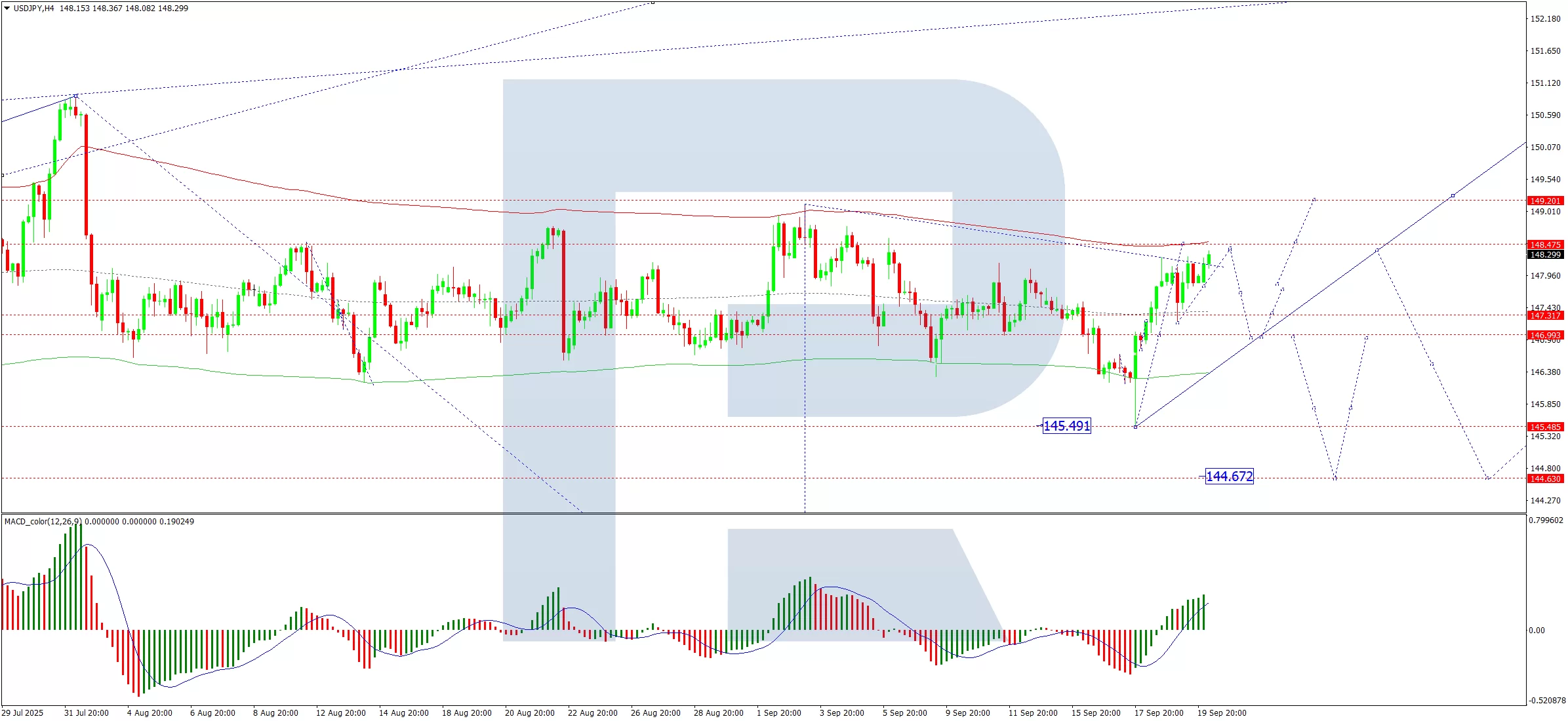
On the H4 USDJPY chart, the market continues to develop a downward wave towards 146.14. This level is expected to be reached today. A temporary rebound to 147.30 cannot be ruled out. Following that, we anticipate a further decline to 145.45, with the potential for the trend to extend to 144.30. The target remains local. This bearish scenario is technically supported by the MACD indicator, whose signal line is below zero and pointing strictly downwards, indicating ongoing downside momentum.

On the H1 chart, the market is shaping a downward wave structure towards 146.12. Today, we are considering a short-term move to 147.12, followed by a potential growth link to 147.60. After that, the market is likely to decline again to 146.60, and further to 146.12, continuing the bearish trend. The Stochastic oscillator confirms this view, with its signal line below the 50 level, directed sharply towards 20, reflecting a strong bearish bias.

Summary

Despite weak trade statistics, USDJPY is falling amid resilient investment data and growing demand for the yen as a safe-haven. Technical indicators point towards a continued downward trend, with key targets at 146.14, 145.45, and 144.30, while any rebounds are likely to remain temporary.


Disclaimer

Any forecasts contained herein are based on the author’s particular opinion. This analysis may not be treated as trading advice. RoboForex bears no responsibility for trading results based on trading recommendations and reviews contained herein.

Markets remain cautious due to geopolitics and ahead of the annual Jackson Hole symposium

By JustMarkets 

On Monday, the Dow Jones (US30) fell by 0.08%, and the S&P 500 (US500) dropped by 0.01%. The technology-focused Nasdaq (US100) closed slightly higher, up 0.01%. US equities showed mixed performance amid growing geopolitical concerns. European leaders and the President of Ukraine met with US President Trump in Washington to discuss potential terms for ending the Russian-Ukrainian war. The outcome could have significant macroeconomic consequences for tariffs and oil prices, and it could also profoundly affect European security.

European stock markets saw mixed movement on Monday. Germany’s DAX (DE40) declined by 0.18%, France’s CAC 40 (FR 40) was down by 0.50%, Spain’s IBEX35 (ES35) fell by 0.17%, and the UK’s FTSE 100 (UK100) closed up 0.21%.

European equities closed slightly lower overall as markets avoided risky assets in anticipation of a week of events that could shift the geopolitical landscape and the global rate outlook. Federal Reserve Chair Jerome Powell may offer guidance on the interest rate outlook at the Jackson Hole symposium, as softer labor market data has strengthened the position of dissenting voices within the FOMC. Meanwhile, Ukrainian President Zelenskyy and European leaders were scheduled to meet with US President Trump in Washington to discuss a potential peace agreement.

WTI crude oil prices rose by 1% to reach $63.4 a barrel on Monday following the Washington talks between US President Donald Trump and Ukrainian President Volodymyr Zelenskyy, which took place after an inconclusive US-Russia summit in Alaska last Friday. Investors are closely monitoring the potential impact of the talks on global oil supply, including possible changes in sanctions or moves toward reconciliation. Concerns over energy flows were reignited after White House advisor Peter Navarro criticized India’s purchases of Russian oil.

Asian markets were mostly higher yesterday. Japan’s Nikkei 225 (JP225) rose by 0.77%, China’s FTSE China A50 (CHA50) climbed 0.50%, Hong Kong’s Hang Seng (HK50) fell by 0.37%, and Australia’s ASX 200 (AU200) closed with a positive result of 0.23%.

On Tuesday, the New Zealand dollar fluctuated around the $0.593 mark, staying in a narrow range as traders awaited the RBNZ’s rate decision. Markets have already priced in a potential 25 basis point rate cut to 3%, which would extend the current easing cycle to 250 basis points. Supporting a further easing is a 0.6% quarter-over-quarter rise in producer prices in Q2, which fell short of the 1% growth expected and was down from a 2.1% increase in Q1. Analysts, however, note that policy settings are close to neutral, and the effects of previous cuts are still working their way through the economy.

The offshore yuan held near 7.19 per dollar on Tuesday, trading within a tight range as the market’s focus shifted to the US Federal Reserve’s Jackson Hole symposium later this week for clues on policy direction and potential impacts on global currencies. Markets were watching the dollar amid expectations of a Fed pivot, with the probability of a 25 basis point rate cut in September now at 84%, down from 98% last week following stronger US wholesale and retail trade data, which tempered hopes for a more significant move. In China, markets are now awaiting this week’s loan prime rate decision, with expectations leaning toward the rate remaining unchanged.

The Westpac-Melbourne Institute Australian Consumer Sentiment Index rose by 5.7% in August 2025 to 98.5, its highest level since February 2022. Sentiment was boosted by the Reserve Bank’s 75 basis point rate cut since January and a more optimistic policy tone. The head of Australian macro expectations said that a long period of consumer pessimism may be ending, though additional easing might be needed to maintain momentum. However, he noted that policymakers are not in urgent need of further cuts.

S&P 500 (US500) 6,449.16 −0.64 (−0.01%)

Dow Jones (US30) 44,912.19 −33.93 (−0.08%)

DAX (DE40) 24,314.77 −44.53 (−0.18%)

FTSE 100 (UK100) 9,157.74 +18.84 (+0.21%)

USD Index 98.17 +0.32 (+0.33%)

News feed for: 2025.08.19

  • Canada Consumer Price Index (m/m) at 15:30 (GMT+3);
  • US Building Permits (m/m) at 17:00 (GMT+3).

By JustMarkets


This article reflects a personal opinion and should not be interpreted as an investment advice, and/or offer, and/or a persistent request for carrying out financial transactions, and/or a guarantee, and/or a forecast of future events.

US, European, and Asian markets show mixed results amid geopolitical and economic uncertainty

By JustMarkets

On Friday, the US stocks closed with mixed results as investors analyzed economic data, corporate news, and geopolitical developments. The Dow Jones (US30) rose by 0.08% on Friday, bringing its weekly gain to 1.72%. The S&P 500 (US500) declined by 0.29% (+0.94% for the week), and the technology-heavy Nasdaq (US100) fell by 0.51% (+0.35% for the week). Retail sales for July grew by 0.5%, meeting expectations, but the University of Michigan Consumer Sentiment Index dropped to 58.6 from 61.7, as inflation concerns rose. Markets also remained cautious ahead of President Trump’s meeting with President Putin, with his plan to impose new tariffs on steel and semiconductors adding to trade uncertainty.

Bitcoin fell to around $115,000 as profit-taking and waning expectations for US rate cuts weighed on sentiment. Higher-than-expected US producer inflation and retail sales data reduced the likelihood of aggressive Federal Reserve policy easing, pressuring risk assets. Further headwinds included statements from the US Treasury on strategic reserves, which heightened concerns about liquidity tightening, and a change in leadership at key financial market bodies, which increased policy uncertainty and risk aversion.

European stock markets traded without a clear direction on Friday. The German DAX (DE40) fell by 0.08% (+0.63% for the week), the French CAC 40 (FR40) closed higher by 0.67% (+2.05% for the week), the Spanish IBEX35 (ES35) rose by 0.47% (+4.72% for the week), and the British FTSE 100 (UK100) fell by 0.42% (+0.47% for the week). In Europe, investors focused on a key meeting in Washington between US President Donald Trump and Ukrainian President Volodymyr Zelenskyy, aimed at advancing a peace agreement with Russia. European Commission President Ursula von der Leyen, French President Emmanuel Macron, and NATO Secretary-General Mark Rutte were also expected to attend. Trump stated that following Friday’s talks with Russian President Vladimir Putin, he would press Zelenskyy for a swift resolution. While these discussions did not lead to a ceasefire breakthrough, Putin agreed to the US and Europe providing reliable security guarantees to Ukraine as part of a potential deal.

On Monday, WTI crude oil prices rose to $63 per barrel after an early-session drop, as markets focused on the Washington meeting between President Trump and Ukrainian President Zelenskyy aimed at advancing a peace agreement with Russia. Trump stated he would pressure Zelenskyy to accept a fast resolution after his Friday talks with President Putin, which centered on Moscow’s demand for Ukraine to cede territory. Trump also said he would not urgently impose sanctions on Russia and countries buying its oil, softening his stance from their earlier summit in Alaska. Oil prices have fallen more than 10% this month, also pressured by concerns about the economic impact of Trump’s tariffs and rising OPEC+ supply.

Asian markets were mostly up last week. Japan’s Nikkei 225 (JP225) rose by 5.07%, the Chinese FTSE China A50 (CHA50) climbed 1.94%, Hong Kong’s Hang Seng (HK50) gained 1.30%, and Australia’s ASX 200 (AU200) posted a positive return of 1.38%.

In its quarterly report, the People’s Bank of China confirmed its commitment to “carefully” implement a “moderately loose” monetary policy, with an emphasis on targeted support for the economy. This pledge came amid signs of slowing momentum in July, as domestic efforts to curb overcapacity and higher US tariffs weighed on growth.

The Australian dollar rose to $0.651 on Monday, as domestic economic data saw a relatively quiet week. Investor focus now shifts to this week’s scheduled releases of the Westpac Consumer Confidence Index, Consumer Inflation Expectations, flash PMI, and speeches from RBA officials. In terms of monetary policy, investors are increasingly anticipating further RBA easing before the year’s end. While no immediate policy changes are expected, traders are currently pricing in the possibility of an additional 50 basis point rate cut by November.

S&P 500 (US500) 6,449.80 −18.74 (−0.29%)

Dow Jones (US30) 44,946.12 +34.86 (+0.08%)

DAX (DE40) 24,359.30 −18.20 (−0.08%)

FTSE 100 (UK100) 9,138.90 −38.34 (−0.42%)

USD Index 97.78 −0.07 (−0.07%)

By JustMarkets


This article reflects a personal opinion and should not be interpreted as an investment advice, and/or offer, and/or a persistent request for carrying out financial transactions, and/or a guarantee, and/or a forecast of future events.

COT Metals Charts: Speculator Changes led by Copper & Platinum

By InvestMacro

Metals Open Interest COT Chart
Here are the latest charts and statistics for the Commitment of Traders (COT) data published by the Commodities Futures Trading Commission (CFTC).

The latest COT data is updated through Tuesday August 12th and shows a quick view of how large traders (for-profit speculators and commercial entities) were positioned in the futures markets.

Weekly Speculator Changes led by Copper & Platinum

Metals Net Positions COT Chart
The COT metals markets speculator bets were overall lower this week as just two out of the six metals markets we cover had higher positioning while the other four markets had lower speculator contracts.

Leading the gains for the metals was Copper (7,525 contracts) with Platinum (1,126 contracts) also showing a positive week.

The markets with declines in speculator bets for the week were Gold (-7,565 contracts), Silver (-6,390 contracts), Palladium (-1,161 contracts) and with Steel (-626 contracts) also seeing lower bets on the week.

Weekly Metals Performance

The metals markets on the week were mostly lower as 4 out of the 6 markets saw declining prices. Platinum led the week with a 0.58% increase, while Copper rose by 0.54%. Palladium was lower by -0.5%, Silver was down by -1.09% and Gold was down by -1.80%. Steel was the biggest loser on the week with a -3.33% decrease.

In the longer term, over the last 90 days, all these markets are higher, with Copper seeing just a 4.65% rise and is the smallest gainer over 90 days. Palladium, Silver, and Steel are all up by over 20% in the last 90 days, while Gold is up by 12.32%. Platinum is the biggest mover over the last 90 days with a gain of 42.67%.


Metals Data:

Metals Table COT Chart
Legend: Weekly Speculators Change | Speculators Current Net Position | Speculators Strength Score compared to last 3-Years (0-100 range)


Strength Scores led by Palladium & Silver

Metals Strength Scores COT Chart
COT Strength Scores (a normalized measure of Speculator positions over a 3-Year range, from 0 to 100 where above 80 is Extreme-Bullish and below 20 is Extreme-Bearish) showed that Palladium (78 percent) and Silver (71 percent) lead the metals markets this week. Gold (67 percent) comes in as the next highest in the weekly strength scores.

Strength Statistics:
Gold (67.4 percent) vs Gold previous week (70.2 percent)
Silver (71.4 percent) vs Silver previous week (79.3 percent)
Copper (59.5 percent) vs Copper previous week (52.5 percent)
Platinum (58.0 percent) vs Platinum previous week (55.4 percent)
Palladium (78.2 percent) vs Palladium previous week (86.9 percent)
Steel (59.6 percent) vs Palladium previous week (64.0 percent)


Gold & Palladium top the 6-Week Strength Trends

Metals Trends COT Chart
COT Strength Score Trends (or move index, calculates the 6-week changes in strength scores) showed that Gold (10 percent) and Palladium (7 percent) lead the past six weeks trends for metals.

Silver (-24 percent) leads the downside trend scores currently with Platinum (-11 percent) as the next market with lower trend scores.

Move Statistics:
Gold (10.4 percent) vs Gold previous week (16.0 percent)
Silver (-23.9 percent) vs Silver previous week (-15.4 percent)
Copper (-5.1 percent) vs Copper previous week (-8.1 percent)
Platinum (-11.5 percent) vs Platinum previous week (-20.2 percent)
Palladium (7.4 percent) vs Palladium previous week (16.3 percent)
Steel (-8.3 percent) vs Steel previous week (6.8 percent)


Individual Markets:

Gold Comex Futures:

Gold Futures COT ChartThe Gold Comex Futures large speculator standing this week was a net position of 229,485 contracts in the data reported through Tuesday. This was a weekly decline of -7,565 contracts from the previous week which had a total of 237,050 net contracts.

This week’s current strength score (the trader positioning range over the past three years, measured from 0 to 100) shows the speculators are currently Bullish with a score of 67.4 percent. The commercials are Bearish with a score of 27.6 percent and the small traders (not shown in chart) are Bullish-Extreme with a score of 86.5 percent.

Price Trend-Following Model: Uptrend

Our weekly trend-following model classifies the current market price position as: Uptrend.

Gold Futures StatisticsSPECULATORSCOMMERCIALSSMALL TRADERS
– Percent of Open Interest Longs:64.614.212.0
– Percent of Open Interest Shorts:13.173.24.5
– Net Position:229,485-263,06533,580
– Gross Longs:288,11563,42753,656
– Gross Shorts:58,630326,49220,076
– Long to Short Ratio:4.9 to 10.2 to 12.7 to 1
NET POSITION TREND:
– Strength Index Score (3 Year Range Pct):67.427.686.5
– Strength Index Reading (3 Year Range):BullishBearishBullish-Extreme
NET POSITION MOVEMENT INDEX:
– 6-Week Change in Strength Index:10.4-9.7-1.7


Silver Comex Futures:

Silver Futures COT ChartThe Silver Comex Futures large speculator standing this week was a net position of 44,268 contracts in the data reported through Tuesday. This was a weekly decrease of -6,390 contracts from the previous week which had a total of 50,658 net contracts.

This week’s current strength score (the trader positioning range over the past three years, measured from 0 to 100) shows the speculators are currently Bullish with a score of 71.4 percent. The commercials are Bearish with a score of 21.5 percent and the small traders (not shown in chart) are Bullish with a score of 77.9 percent.

Price Trend-Following Model: Uptrend

Our weekly trend-following model classifies the current market price position as: Uptrend.

Silver Futures StatisticsSPECULATORSCOMMERCIALSSMALL TRADERS
– Percent of Open Interest Longs:42.426.420.9
– Percent of Open Interest Shorts:14.168.96.7
– Net Position:44,268-66,42122,153
– Gross Longs:66,25241,33132,647
– Gross Shorts:21,984107,75210,494
– Long to Short Ratio:3.0 to 10.4 to 13.1 to 1
NET POSITION TREND:
– Strength Index Score (3 Year Range Pct):71.421.577.9
– Strength Index Reading (3 Year Range):BullishBearishBullish
NET POSITION MOVEMENT INDEX:
– 6-Week Change in Strength Index:-23.919.94.9


Copper Grade #1 Futures:

Copper Futures COT ChartThe Copper Grade #1 Futures large speculator standing this week was a net position of 28,211 contracts in the data reported through Tuesday. This was a weekly advance of 7,525 contracts from the previous week which had a total of 20,686 net contracts.

This week’s current strength score (the trader positioning range over the past three years, measured from 0 to 100) shows the speculators are currently Bullish with a score of 59.5 percent. The commercials are Bearish with a score of 37.7 percent and the small traders (not shown in chart) are Bullish with a score of 77.2 percent.

Price Trend-Following Model: Weak Uptrend

Our weekly trend-following model classifies the current market price position as: Weak Uptrend.

Copper Futures StatisticsSPECULATORSCOMMERCIALSSMALL TRADERS
– Percent of Open Interest Longs:30.333.09.8
– Percent of Open Interest Shorts:15.852.64.7
– Net Position:28,211-38,0339,822
– Gross Longs:58,80263,85519,016
– Gross Shorts:30,591101,8889,194
– Long to Short Ratio:1.9 to 10.6 to 12.1 to 1
NET POSITION TREND:
– Strength Index Score (3 Year Range Pct):59.537.777.2
– Strength Index Reading (3 Year Range):BullishBearishBullish
NET POSITION MOVEMENT INDEX:
– 6-Week Change in Strength Index:-5.1-0.637.7


Platinum Futures:

Platinum Futures COT ChartThe Platinum Futures large speculator standing this week was a net position of 17,788 contracts in the data reported through Tuesday. This was a weekly rise of 1,126 contracts from the previous week which had a total of 16,662 net contracts.

This week’s current strength score (the trader positioning range over the past three years, measured from 0 to 100) shows the speculators are currently Bullish with a score of 58.0 percent. The commercials are Bearish with a score of 41.3 percent and the small traders (not shown in chart) are Bullish with a score of 58.8 percent.

Price Trend-Following Model: Uptrend

Our weekly trend-following model classifies the current market price position as: Uptrend.

Platinum Futures StatisticsSPECULATORSCOMMERCIALSSMALL TRADERS
– Percent of Open Interest Longs:58.119.111.8
– Percent of Open Interest Shorts:36.347.25.4
– Net Position:17,788-23,0155,227
– Gross Longs:47,45815,5719,606
– Gross Shorts:29,67038,5864,379
– Long to Short Ratio:1.6 to 10.4 to 12.2 to 1
NET POSITION TREND:
– Strength Index Score (3 Year Range Pct):58.041.358.8
– Strength Index Reading (3 Year Range):BullishBearishBullish
NET POSITION MOVEMENT INDEX:
– 6-Week Change in Strength Index:-11.511.5-3.1


Palladium Futures:

Palladium Futures COT ChartThe Palladium Futures large speculator standing this week was a net position of -3,496 contracts in the data reported through Tuesday. This was a weekly fall of -1,161 contracts from the previous week which had a total of -2,335 net contracts.

This week’s current strength score (the trader positioning range over the past three years, measured from 0 to 100) shows the speculators are currently Bullish with a score of 78.2 percent. The commercials are Bearish-Extreme with a score of 9.1 percent and the small traders (not shown in chart) are Bullish-Extreme with a score of 100.0 percent.

Price Trend-Following Model: Uptrend

Our weekly trend-following model classifies the current market price position as: Uptrend.

Palladium Futures StatisticsSPECULATORSCOMMERCIALSSMALL TRADERS
– Percent of Open Interest Longs:39.634.115.1
– Percent of Open Interest Shorts:57.026.45.5
– Net Position:-3,4961,5581,938
– Gross Longs:8,0056,8913,049
– Gross Shorts:11,5015,3331,111
– Long to Short Ratio:0.7 to 11.3 to 12.7 to 1
NET POSITION TREND:
– Strength Index Score (3 Year Range Pct):78.29.1100.0
– Strength Index Reading (3 Year Range):BullishBearish-ExtremeBullish-Extreme
NET POSITION MOVEMENT INDEX:
– 6-Week Change in Strength Index:7.4-10.214.0


Steel Futures Futures:

Steel Futures COT ChartThe Steel Futures large speculator standing this week was a net position of -718 contracts in the data reported through Tuesday. This was a weekly fall of -626 contracts from the previous week which had a total of -92 net contracts.

This week’s current strength score (the trader positioning range over the past three years, measured from 0 to 100) shows the speculators are currently Bullish with a score of 59.6 percent. The commercials are Bearish with a score of 40.3 percent and the small traders (not shown in chart) are Bullish with a score of 63.6 percent.

Price Trend-Following Model: Strong Downtrend

Our weekly trend-following model classifies the current market price position as: Strong Downtrend.

Steel Futures StatisticsSPECULATORSCOMMERCIALSSMALL TRADERS
– Percent of Open Interest Longs:18.077.32.0
– Percent of Open Interest Shorts:21.275.01.0
– Net Position:-718501217
– Gross Longs:4,02317,306444
– Gross Shorts:4,74116,805227
– Long to Short Ratio:0.8 to 11.0 to 12.0 to 1
NET POSITION TREND:
– Strength Index Score (3 Year Range Pct):59.640.363.6
– Strength Index Reading (3 Year Range):BullishBearishBullish
NET POSITION MOVEMENT INDEX:
– 6-Week Change in Strength Index:-8.38.9-11.8


Article By InvestMacroReceive our weekly COT Newsletter

*COT Report: The COT data, released weekly to the public each Friday, is updated through the most recent Tuesday (data is 3 days old) and shows a quick view of how large speculators or non-commercials (for-profit traders) were positioned in the futures markets.

The CFTC categorizes trader positions according to commercial hedgers (traders who use futures contracts for hedging as part of the business), non-commercials (large traders who speculate to realize trading profits) and nonreportable traders (usually small traders/speculators) as well as their open interest (contracts open in the market at time of reporting). See CFTC criteria here.


COT Bonds Charts: Speculator Bets led by SOFR 3-Months & US Treasury Bonds

By InvestMacro

Bonds Market Open Interest Comparison
Here are the latest charts and statistics for the Commitment of Traders (COT) reports data published by the Commodities Futures Trading Commission (CFTC).

The latest COT data is updated through Tuesday August 12th and shows a quick view of how large traders (for-profit speculators and commercial hedgers) were positioned in the futures markets.

Weekly Speculator Changes led by SOFR 3-Months & US Treasury Bonds

Bonds Market Net Speculators Positions
The COT bond market speculator bets were slightly lower overall this week as four out of the nine bond markets we cover had higher positioning while the other five markets had lower speculator contracts.

Leading the gains for the bond markets was the SOFR 3-Months (158,614 contracts) with the US Treasury Bonds (49,646 contracts), the Ultra Treasury Bonds (19,235 contracts) and the 10-Year Bonds (17,611 contracts) also recording positive weeks.

The bond markets with declines in speculator bets for the week were the 2-Year Bonds (-54,074 contracts), the 5-Year Bonds (-29,492 contracts), the Fed Funds (-6,397 contracts), the SOFR 1-Month (-3,468 contracts) and with the Ultra 10-Year Bonds (-699 contracts) also having lower bets on the week.

Bond market prices this week

The major US bond market prices this week were pretty subdued, with the 3-month secured overnight financing rate (3-M SOFR) leading the way for the last 5 days with a 0.64% increase.

The 2-year bond (0.06%) and the 5-year bond (0.03%) were virtually unchanged, while the fed funds (-0.02%) and the 10-year note (-0.16%) were also virtually unchanged to the downside. The 1-month secured overnight financing rate was lower by 0.5%, while the longer treasury bonds were down by 1%.


Bonds Data:

Bonds Market Speculators Data Table
Legend: Open Interest | Speculators Current Net Position | Weekly Specs Change | Specs Strength Score compared to last 3-Years (0-100 range)


Strength Scores led by Ultra Treasury Bonds & US Treasury Bonds

Bonds Market Strength Index Comparison
COT Strength Scores (a normalized measure of Speculator positions over a 3-Year range, from 0 to 100 where above 80 is Extreme-Bullish and below 20 is Extreme-Bearish) showed that the Ultra Treasury Bonds (93 percent) and the US Treasury Bonds (62 percent) lead the bond markets this week. The SOFR 1-Month (61 percent) comes in as the next highest in the weekly strength scores.

On the downside, the 5-Year Bond (0 percent), the 2-Year Bonds (9 percent), the Fed Funds (11 percent) and the Ultra 10-Year Bonds (12 percent) come in at the lowest strength level currently and are in Extreme-Bearish territory (below 20 percent).

Strength Statistics:
Fed Funds (11.5 percent) vs Fed Funds previous week (12.6 percent)
2-Year Bond (8.6 percent) vs 2-Year Bond previous week (12.9 percent)
5-Year Bond (0.0 percent) vs 5-Year Bond previous week (1.4 percent)
10-Year Bond (22.1 percent) vs 10-Year Bond previous week (20.1 percent)
Ultra 10-Year Bond (11.9 percent) vs Ultra 10-Year Bond previous week (12.1 percent)
US Treasury Bond (62.2 percent) vs US Treasury Bond previous week (45.0 percent)
Ultra US Treasury Bond (92.7 percent) vs Ultra US Treasury Bond previous week (85.5 percent)
SOFR 1-Month (61.4 percent) vs SOFR 1-Month previous week (62.3 percent)
SOFR 3-Months (45.7 percent) vs SOFR 3-Months previous week (37.5 percent)


SOFR 1-Month & SOFR 3-Months top the 6-Week Strength Trends

Bonds Market Trend Index Comparison
COT Strength Score Trends (or move index, calculates the 6-week changes in strength scores) showed that the SOFR 1-Month (26 percent) and the SOFR 3-Months (21 percent) lead the past six weeks trends for bonds. The US Treasury Bonds (15 percent) are the next highest positive movers in the latest trends data.

The Fed Funds (-45 percent), the 10-Year Bonds (-17 percent) and the 2-Year Bonds (-8 percent) lead the downside trend scores currently.

Strength Trend Statistics:
Fed Funds (-44.9 percent) vs Fed Funds previous week (-32.2 percent)
2-Year Bond (-7.9 percent) vs 2-Year Bond previous week (-7.7 percent)
5-Year Bond (-4.2 percent) vs 5-Year Bond previous week (-3.4 percent)
10-Year Bond (-17.3 percent) vs 10-Year Bond previous week (-30.6 percent)
Ultra 10-Year Bond (8.4 percent) vs Ultra 10-Year Bond previous week (1.9 percent)
US Treasury Bond (15.2 percent) vs US Treasury Bond previous week (-3.0 percent)
Ultra US Treasury Bond (6.7 percent) vs Ultra US Treasury Bond previous week (-7.1 percent)
SOFR 1-Month (26.1 percent) vs SOFR 1-Month previous week (29.3 percent)
SOFR 3-Months (20.7 percent) vs SOFR 3-Months previous week (6.3 percent)


30-Day Federal Funds Futures:

Federal Funds 30-Day Bonds Futures COT ChartThe 30-Day Federal Funds large speculator standing this week came in at a net position of -233,667 contracts in the data reported through Tuesday. This was a weekly decline of -6,397 contracts from the previous week which had a total of -227,270 net contracts.

This week’s current strength score (the trader positioning range over the past three years, measured from 0 to 100) shows the speculators are currently Bearish-Extreme with a score of 11.5 percent. The commercials are Bullish-Extreme with a score of 83.1 percent and the small traders (not shown in chart) are Bullish with a score of 72.4 percent.

Price Trend-Following Model: Downtrend

Our weekly trend-following model classifies the current market price position as: Downtrend.

30-Day Federal Funds StatisticsSPECULATORSCOMMERCIALSSMALL TRADERS
– Percent of Open Interest Longs:11.869.42.3
– Percent of Open Interest Shorts:22.359.21.9
– Net Position:-233,667225,7027,965
– Gross Longs:260,7751,535,52850,810
– Gross Shorts:494,4421,309,82642,845
– Long to Short Ratio:0.5 to 11.2 to 11.2 to 1
NET POSITION TREND:
– Strength Index Score (3 Year Range Pct):11.583.172.4
– Strength Index Reading (3 Year Range):Bearish-ExtremeBullish-ExtremeBullish
NET POSITION MOVEMENT INDEX:
– 6-Week Change in Strength Index:-44.944.8-4.2


Secured Overnight Financing Rate (3-Month) Futures:

SOFR 3-Months Bonds Futures COT ChartThe Secured Overnight Financing Rate (3-Month) large speculator standing this week came in at a net position of -282,447 contracts in the data reported through Tuesday. This was a weekly rise of 158,614 contracts from the previous week which had a total of -441,061 net contracts.

This week’s current strength score (the trader positioning range over the past three years, measured from 0 to 100) shows the speculators are currently Bearish with a score of 45.7 percent. The commercials are Bullish with a score of 53.1 percent and the small traders (not shown in chart) are Bullish-Extreme with a score of 88.3 percent.

Price Trend-Following Model: Weak Uptrend

Our weekly trend-following model classifies the current market price position as: Weak Uptrend.

SOFR 3-Months StatisticsSPECULATORSCOMMERCIALSSMALL TRADERS
– Percent of Open Interest Longs:14.756.20.6
– Percent of Open Interest Shorts:17.054.10.4
– Net Position:-282,447261,92120,526
– Gross Longs:1,818,3946,932,25471,213
– Gross Shorts:2,100,8416,670,33350,687
– Long to Short Ratio:0.9 to 11.0 to 11.4 to 1
NET POSITION TREND:
– Strength Index Score (3 Year Range Pct):45.753.188.3
– Strength Index Reading (3 Year Range):BearishBullishBullish-Extreme
NET POSITION MOVEMENT INDEX:
– 6-Week Change in Strength Index:20.7-20.1-6.8


Individual Bond Markets:

Secured Overnight Financing Rate (1-Month) Futures:

SOFR 1-Month Bonds Futures COT ChartThe Secured Overnight Financing Rate (1-Month) large speculator standing this week came in at a net position of -28,652 contracts in the data reported through Tuesday. This was a weekly decline of -3,468 contracts from the previous week which had a total of -25,184 net contracts.

This week’s current strength score (the trader positioning range over the past three years, measured from 0 to 100) shows the speculators are currently Bullish with a score of 61.4 percent. The commercials are Bearish with a score of 38.1 percent and the small traders (not shown in chart) are Bullish with a score of 70.6 percent.

Price Trend-Following Model: Weak Uptrend

Our weekly trend-following model classifies the current market price position as: Weak Uptrend.

SOFR 1-Month StatisticsSPECULATORSCOMMERCIALSSMALL TRADERS
– Percent of Open Interest Longs:13.967.50.3
– Percent of Open Interest Shorts:16.065.50.2
– Net Position:-28,65226,8401,812
– Gross Longs:187,765910,6874,165
– Gross Shorts:216,417883,8472,353
– Long to Short Ratio:0.9 to 11.0 to 11.8 to 1
NET POSITION TREND:
– Strength Index Score (3 Year Range Pct):61.438.170.6
– Strength Index Reading (3 Year Range):BullishBearishBullish
NET POSITION MOVEMENT INDEX:
– 6-Week Change in Strength Index:26.1-25.2-6.8


2-Year Treasury Note Futures:

2-Year Treasury Bonds Futures COT ChartThe 2-Year Treasury Note large speculator standing this week came in at a net position of -1,379,597 contracts in the data reported through Tuesday. This was a weekly decline of -54,074 contracts from the previous week which had a total of -1,325,523 net contracts.

This week’s current strength score (the trader positioning range over the past three years, measured from 0 to 100) shows the speculators are currently Bearish-Extreme with a score of 8.6 percent. The commercials are Bullish-Extreme with a score of 92.2 percent and the small traders (not shown in chart) are Bullish with a score of 69.2 percent.

Price Trend-Following Model: Weak Downtrend

Our weekly trend-following model classifies the current market price position as: Weak Downtrend.

2-Year Treasury Note StatisticsSPECULATORSCOMMERCIALSSMALL TRADERS
– Percent of Open Interest Longs:11.480.05.8
– Percent of Open Interest Shorts:41.752.43.0
– Net Position:-1,379,5971,253,871125,726
– Gross Longs:519,4093,638,973262,521
– Gross Shorts:1,899,0062,385,102136,795
– Long to Short Ratio:0.3 to 11.5 to 11.9 to 1
NET POSITION TREND:
– Strength Index Score (3 Year Range Pct):8.692.269.2
– Strength Index Reading (3 Year Range):Bearish-ExtremeBullish-ExtremeBullish
NET POSITION MOVEMENT INDEX:
– 6-Week Change in Strength Index:-7.910.0-1.3


5-Year Treasury Note Futures:

5-Year Treasury Bonds Futures COT ChartThe 5-Year Treasury Note large speculator standing this week came in at a net position of -2,566,369 contracts in the data reported through Tuesday. This was a weekly lowering of -29,492 contracts from the previous week which had a total of -2,536,877 net contracts.

This week’s current strength score (the trader positioning range over the past three years, measured from 0 to 100) shows the speculators are currently Bearish-Extreme with a score of 0.0 percent. The commercials are Bullish-Extreme with a score of 100.0 percent and the small traders (not shown in chart) are Bullish-Extreme with a score of 90.8 percent.

Price Trend-Following Model: Strong Uptrend

Our weekly trend-following model classifies the current market price position as: Strong Uptrend.

5-Year Treasury Note StatisticsSPECULATORSCOMMERCIALSSMALL TRADERS
– Percent of Open Interest Longs:6.883.76.5
– Percent of Open Interest Shorts:42.351.23.5
– Net Position:-2,566,3692,352,918213,451
– Gross Longs:492,8676,055,630468,638
– Gross Shorts:3,059,2363,702,712255,187
– Long to Short Ratio:0.2 to 11.6 to 11.8 to 1
NET POSITION TREND:
– Strength Index Score (3 Year Range Pct):0.0100.090.8
– Strength Index Reading (3 Year Range):Bearish-ExtremeBullish-ExtremeBullish-Extreme
NET POSITION MOVEMENT INDEX:
– 6-Week Change in Strength Index:-4.24.61.5


10-Year Treasury Note Futures:

10-Year Treasury Notes Bonds Futures COT ChartThe 10-Year Treasury Note large speculator standing this week came in at a net position of -942,223 contracts in the data reported through Tuesday. This was a weekly boost of 17,611 contracts from the previous week which had a total of -959,834 net contracts.

This week’s current strength score (the trader positioning range over the past three years, measured from 0 to 100) shows the speculators are currently Bearish with a score of 22.1 percent. The commercials are Bullish with a score of 72.3 percent and the small traders (not shown in chart) are Bullish-Extreme with a score of 89.8 percent.

Price Trend-Following Model: Strong Uptrend

Our weekly trend-following model classifies the current market price position as: Strong Uptrend.

10-Year Treasury Note StatisticsSPECULATORSCOMMERCIALSSMALL TRADERS
– Percent of Open Interest Longs:10.276.88.8
– Percent of Open Interest Shorts:27.861.96.0
– Net Position:-942,223793,295148,928
– Gross Longs:544,4344,100,111470,827
– Gross Shorts:1,486,6573,306,816321,899
– Long to Short Ratio:0.4 to 11.2 to 11.5 to 1
NET POSITION TREND:
– Strength Index Score (3 Year Range Pct):22.172.389.8
– Strength Index Reading (3 Year Range):BearishBullishBullish-Extreme
NET POSITION MOVEMENT INDEX:
– 6-Week Change in Strength Index:-17.313.820.1


Ultra 10-Year Notes Futures:

Ultra 10-Year Treasury Notes Bonds Futures COT ChartThe Ultra 10-Year Notes large speculator standing this week came in at a net position of -360,321 contracts in the data reported through Tuesday. This was a weekly decline of -699 contracts from the previous week which had a total of -359,622 net contracts.

This week’s current strength score (the trader positioning range over the past three years, measured from 0 to 100) shows the speculators are currently Bearish-Extreme with a score of 11.9 percent. The commercials are Bullish-Extreme with a score of 81.9 percent and the small traders (not shown in chart) are Bullish with a score of 71.1 percent.

Price Trend-Following Model: Weak Uptrend

Our weekly trend-following model classifies the current market price position as: Weak Uptrend.

Ultra 10-Year Notes StatisticsSPECULATORSCOMMERCIALSSMALL TRADERS
– Percent of Open Interest Longs:11.977.69.7
– Percent of Open Interest Shorts:26.561.211.4
– Net Position:-360,321402,305-41,984
– Gross Longs:292,4851,908,261239,327
– Gross Shorts:652,8061,505,956281,311
– Long to Short Ratio:0.4 to 11.3 to 10.9 to 1
NET POSITION TREND:
– Strength Index Score (3 Year Range Pct):11.981.971.1
– Strength Index Reading (3 Year Range):Bearish-ExtremeBullish-ExtremeBullish
NET POSITION MOVEMENT INDEX:
– 6-Week Change in Strength Index:8.4-10.54.6


US Treasury Bonds Futures:

US Year Treasury Notes Long Bonds Futures COT ChartThe US Treasury Bonds large speculator standing this week came in at a net position of -60,794 contracts in the data reported through Tuesday. This was a weekly advance of 49,646 contracts from the previous week which had a total of -110,440 net contracts.

This week’s current strength score (the trader positioning range over the past three years, measured from 0 to 100) shows the speculators are currently Bullish with a score of 62.2 percent. The commercials are Bearish with a score of 24.1 percent and the small traders (not shown in chart) are Bullish-Extreme with a score of 93.6 percent.

Price Trend-Following Model: Downtrend

Our weekly trend-following model classifies the current market price position as: Downtrend.

US Treasury Bonds StatisticsSPECULATORSCOMMERCIALSSMALL TRADERS
– Percent of Open Interest Longs:8.376.713.4
– Percent of Open Interest Shorts:11.779.67.1
– Net Position:-60,794-51,181111,975
– Gross Longs:148,9731,372,602239,356
– Gross Shorts:209,7671,423,783127,381
– Long to Short Ratio:0.7 to 11.0 to 11.9 to 1
NET POSITION TREND:
– Strength Index Score (3 Year Range Pct):62.224.193.6
– Strength Index Reading (3 Year Range):BullishBearishBullish-Extreme
NET POSITION MOVEMENT INDEX:
– 6-Week Change in Strength Index:15.2-14.45.6


Ultra US Treasury Bonds Futures:

Ultra US Year Treasury Notes Long Bonds Futures COT ChartThe Ultra US Treasury Bonds large speculator standing this week came in at a net position of -209,132 contracts in the data reported through Tuesday. This was a weekly increase of 19,235 contracts from the previous week which had a total of -228,367 net contracts.

This week’s current strength score (the trader positioning range over the past three years, measured from 0 to 100) shows the speculators are currently Bullish-Extreme with a score of 92.7 percent. The commercials are Bearish-Extreme with a score of 18.1 percent and the small traders (not shown in chart) are Bearish with a score of 26.3 percent.

Price Trend-Following Model: Downtrend

Our weekly trend-following model classifies the current market price position as: Downtrend.

Ultra US Treasury Bonds StatisticsSPECULATORSCOMMERCIALSSMALL TRADERS
– Percent of Open Interest Longs:6.981.49.2
– Percent of Open Interest Shorts:17.271.68.6
– Net Position:-209,132198,28710,845
– Gross Longs:138,9391,643,416185,310
– Gross Shorts:348,0711,445,129174,465
– Long to Short Ratio:0.4 to 11.1 to 11.1 to 1
NET POSITION TREND:
– Strength Index Score (3 Year Range Pct):92.718.126.3
– Strength Index Reading (3 Year Range):Bullish-ExtremeBearish-ExtremeBearish
NET POSITION MOVEMENT INDEX:
– 6-Week Change in Strength Index:6.7-11.913.7


Article By InvestMacroReceive our weekly COT Newsletter

*COT Report: The COT data, released weekly to the public each Friday, is updated through the most recent Tuesday (data is 3 days old) and shows a quick view of how large speculators or non-commercials (for-profit traders) were positioned in the futures markets.

The CFTC categorizes trader positions according to commercial hedgers (traders who use futures contracts for hedging as part of the business), non-commercials (large traders who speculate to realize trading profits) and nonreportable traders (usually small traders/speculators) as well as their open interest (contracts open in the market at time of reporting). See CFTC criteria here.

COT Soft Commodities Charts: Weekly Speculator Bets led by Soybeans & Soybean Meal

By InvestMacro

Speculators OI Softs
Here are the latest charts and statistics for the Commitment of Traders (COT) reports data published by the Commodities Futures Trading Commission (CFTC).

The latest COT data is updated through Tuesday August 12th and shows a quick view of how large traders (for-profit speculators and commercial entities) were positioned in the futures markets.

Weekly Speculator Changes led by Soybeans & Soybean Meal

Speculators Nets Softs
The COT soft commodities markets speculator bets were slightly lower this week as five out of the eleven softs markets we cover had higher positioning while the other six markets had lower speculator contracts.

Leading the gains for the softs markets was Soybeans (23,585 contracts) with Soybean Meal (23,298 contracts), Sugar (8,460 contracts), Cocoa (3,706 contracts) and Lean Hogs (789 contracts) also showing positive weeks.

The markets with the declines in speculator bets this week were Corn (-25,206 contracts), Wheat (-10,481 contracts), Soybean Oil (-8,877 contracts), Coffee (-3,056 contracts), Cotton (-2,961 contracts) and with Live Cattle (-234 contracts) also registering lower bets on the week.

Soft Commodities Price Changes:

Leading the prices this week for the soft commodity markets was Coffee, which jumped by over 10%. Coffee has now been up by 16% in the last 30 days, but over the last 90 days it is down by almost 1%.

Soybeans came in second this week with a gain of over 5%, followed by Soybean Meal, which rose by over 2.5% on the week. Cocoa was next with a gain of almost 2%, followed by Cotton with a 1.3% rise, and then Sugar, which rose by just about 1.2% on the week. Corn (0.29%) and Soybean Oil (0.14%) edged up a minuscule amount on the week.

Live cattle (-0.22%), Lean Hogs (-0.97%), and Wheat were all down on the week, with Wheat seeing the biggest downfall at -1.86%.


Soft Commodities Data:

Speculators Table Softs
Legend: Weekly Speculators Change | Speculators Current Net Position | Speculators Strength Score compared to last 3-Years (0-100 range)


Strength Scores led by Live Cattle & Lean Hogs

Speculators Strength Softs
COT Strength Scores (a normalized measure of Speculator positions over a 3-Year range, from 0 to 100 where above 80 is Extreme-Bullish and below 20 is Extreme-Bearish) showed that Live Cattle (83 percent) and Lean Hogs (83 percent) lead the softs markets this week. Soybean Oil (78 percent) and Coffee (51 percent) come in as the next highest in the weekly strength scores.

On the downside, Sugar (2 percent), Soybean Meal (11 percent), Cotton (14 percent) and the Corn (18 percent) come in at the lowest strength levels currently and are in Extreme-Bearish territory (below 20 percent).

Strength Statistics:
Corn (18.1 percent) vs Corn previous week (21.5 percent)
Sugar (2.4 percent) vs Sugar previous week (0.0 percent)
Coffee (51.3 percent) vs Coffee previous week (54.2 percent)
Soybeans (46.5 percent) vs Soybeans previous week (40.5 percent)
Soybean Oil (78.3 percent) vs Soybean Oil previous week (83.3 percent)
Soybean Meal (10.8 percent) vs Soybean Meal previous week (2.0 percent)
Live Cattle (82.6 percent) vs Live Cattle previous week (82.9 percent)
Lean Hogs (83.1 percent) vs Lean Hogs previous week (82.5 percent)
Cotton (14.4 percent) vs Cotton previous week (16.2 percent)
Cocoa (24.0 percent) vs Cocoa previous week (20.2 percent)
Wheat (23.5 percent) vs Wheat previous week (32.0 percent)


Soybean Meal & Soybean Oil top the 6-Week Strength Trends

Speculators Trend Softs
COT Strength Score Trends (or move index, calculates the 6-week changes in strength scores) showed that Soybean Meal (11 percent) and Soybean Oil (5 percent) lead the past six weeks trends for soft commodities. Corn (3 percent) and Live Cattle (2 percent) are the next highest positive movers in the latest trends data.

Lean Hogs (-16 percent) leads the downside trend scores currently with Wheat (-16 percent), Soybeans (-15 percent) and Cotton (-7 percent) following next with lower trend scores.

Strength Trend Statistics:
Corn (3.0 percent) vs Corn previous week (3.1 percent)
Sugar (-0.4 percent) vs Sugar previous week (-8.3 percent)
Coffee (-2.7 percent) vs Coffee previous week (-1.8 percent)
Soybeans (-14.6 percent) vs Soybeans previous week (-24.3 percent)
Soybean Oil (4.6 percent) vs Soybean Oil previous week (6.3 percent)
Soybean Meal (10.8 percent) vs Soybean Meal previous week (-2.1 percent)
Live Cattle (2.0 percent) vs Live Cattle previous week (0.2 percent)
Lean Hogs (-15.7 percent) vs Lean Hogs previous week (-16.5 percent)
Cotton (-6.5 percent) vs Cotton previous week (-2.7 percent)
Cocoa (0.2 percent) vs Cocoa previous week (-2.9 percent)
Wheat (-15.7 percent) vs Wheat previous week (-6.0 percent)


Individual Soft Commodities Markets:

CORN Futures:

CORN Futures COT ChartThe CORN large speculator standing this week came in at a net position of -133,174 contracts in the data reported through Tuesday. This was a weekly decline of -25,206 contracts from the previous week which had a total of -107,968 net contracts.

This week’s current strength score (the trader positioning range over the past three years, measured from 0 to 100) shows the speculators are currently Bearish-Extreme with a score of 18.1 percent. The commercials are Bullish-Extreme with a score of 80.7 percent and the small traders (not shown in chart) are Bullish-Extreme with a score of 81.0 percent.

Price Trend-Following Model: Strong Downtrend

Our weekly trend-following model classifies the current market price position as: Strong Downtrend.

CORN Futures StatisticsSPECULATORSCOMMERCIALSSMALL TRADERS
– Percent of Open Interest Longs:20.244.69.3
– Percent of Open Interest Shorts:28.834.510.7
– Net Position:-133,174155,179-22,005
– Gross Longs:313,217690,502144,348
– Gross Shorts:446,391535,323166,353
– Long to Short Ratio:0.7 to 11.3 to 10.9 to 1
NET POSITION TREND:
– Strength Index Score (3 Year Range Pct):18.180.781.0
– Strength Index Reading (3 Year Range):Bearish-ExtremeBullish-ExtremeBullish-Extreme
NET POSITION MOVEMENT INDEX:
– 6-Week Change in Strength Index:3.0-2.9-3.8


SUGAR Futures:

SUGAR Futures COT ChartThe SUGAR large speculator standing this week came in at a net position of -68,512 contracts in the data reported through Tuesday. This was a weekly boost of 8,460 contracts from the previous week which had a total of -76,972 net contracts.

This week’s current strength score (the trader positioning range over the past three years, measured from 0 to 100) shows the speculators are currently Bearish-Extreme with a score of 2.4 percent. The commercials are Bullish-Extreme with a score of 94.0 percent and the small traders (not shown in chart) are Bearish with a score of 26.9 percent.

Price Trend-Following Model: Downtrend

Our weekly trend-following model classifies the current market price position as: Downtrend.

SUGAR Futures StatisticsSPECULATORSCOMMERCIALSSMALL TRADERS
– Percent of Open Interest Longs:22.152.38.0
– Percent of Open Interest Shorts:29.745.27.5
– Net Position:-68,51264,0084,504
– Gross Longs:198,447470,36472,133
– Gross Shorts:266,959406,35667,629
– Long to Short Ratio:0.7 to 11.2 to 11.1 to 1
NET POSITION TREND:
– Strength Index Score (3 Year Range Pct):2.494.026.9
– Strength Index Reading (3 Year Range):Bearish-ExtremeBullish-ExtremeBearish
NET POSITION MOVEMENT INDEX:
– 6-Week Change in Strength Index:-0.4-2.918.9


COFFEE Futures:

COFFEE Futures COT ChartThe COFFEE large speculator standing this week came in at a net position of 26,202 contracts in the data reported through Tuesday. This was a weekly lowering of -3,056 contracts from the previous week which had a total of 29,258 net contracts.

This week’s current strength score (the trader positioning range over the past three years, measured from 0 to 100) shows the speculators are currently Bullish with a score of 51.3 percent. The commercials are Bullish with a score of 51.1 percent and the small traders (not shown in chart) are Bearish with a score of 32.6 percent.

Price Trend-Following Model: Weak Downtrend

Our weekly trend-following model classifies the current market price position as: Weak Downtrend.

COFFEE Futures StatisticsSPECULATORSCOMMERCIALSSMALL TRADERS
– Percent of Open Interest Longs:31.839.15.2
– Percent of Open Interest Shorts:13.957.64.6
– Net Position:26,202-27,078876
– Gross Longs:46,59357,1947,616
– Gross Shorts:20,39184,2726,740
– Long to Short Ratio:2.3 to 10.7 to 11.1 to 1
NET POSITION TREND:
– Strength Index Score (3 Year Range Pct):51.351.132.6
– Strength Index Reading (3 Year Range):BullishBullishBearish
NET POSITION MOVEMENT INDEX:
– 6-Week Change in Strength Index:-2.73.7-19.6


SOYBEANS Futures:

SOYBEANS Futures COT ChartThe SOYBEANS large speculator standing this week came in at a net position of -15,575 contracts in the data reported through Tuesday. This was a weekly rise of 23,585 contracts from the previous week which had a total of -39,160 net contracts.

This week’s current strength score (the trader positioning range over the past three years, measured from 0 to 100) shows the speculators are currently Bearish with a score of 46.5 percent. The commercials are Bullish with a score of 52.3 percent and the small traders (not shown in chart) are Bullish with a score of 73.4 percent.

Price Trend-Following Model: Strong Uptrend

Our weekly trend-following model classifies the current market price position as: Strong Uptrend.

SOYBEANS Futures StatisticsSPECULATORSCOMMERCIALSSMALL TRADERS
– Percent of Open Interest Longs:17.452.35.6
– Percent of Open Interest Shorts:19.248.87.3
– Net Position:-15,57530,518-14,943
– Gross Longs:153,439460,20249,113
– Gross Shorts:169,014429,68464,056
– Long to Short Ratio:0.9 to 11.1 to 10.8 to 1
NET POSITION TREND:
– Strength Index Score (3 Year Range Pct):46.552.373.4
– Strength Index Reading (3 Year Range):BearishBullishBullish
NET POSITION MOVEMENT INDEX:
– 6-Week Change in Strength Index:-14.615.12.1


SOYBEAN OIL Futures:

SOYBEAN OIL Futures COT ChartThe SOYBEAN OIL large speculator standing this week came in at a net position of 66,069 contracts in the data reported through Tuesday. This was a weekly decrease of -8,877 contracts from the previous week which had a total of 74,946 net contracts.

This week’s current strength score (the trader positioning range over the past three years, measured from 0 to 100) shows the speculators are currently Bullish with a score of 78.3 percent. The commercials are Bearish with a score of 22.3 percent and the small traders (not shown in chart) are Bullish with a score of 73.1 percent.

Price Trend-Following Model: Uptrend

Our weekly trend-following model classifies the current market price position as: Uptrend.

SOYBEAN OIL Futures StatisticsSPECULATORSCOMMERCIALSSMALL TRADERS
– Percent of Open Interest Longs:22.644.96.3
– Percent of Open Interest Shorts:11.957.54.6
– Net Position:66,069-77,07511,006
– Gross Longs:139,219276,37739,003
– Gross Shorts:73,150353,45227,997
– Long to Short Ratio:1.9 to 10.8 to 11.4 to 1
NET POSITION TREND:
– Strength Index Score (3 Year Range Pct):78.322.373.1
– Strength Index Reading (3 Year Range):BullishBearishBullish
NET POSITION MOVEMENT INDEX:
– 6-Week Change in Strength Index:4.6-4.0-2.6


SOYBEAN MEAL Futures:

SOYBEAN MEAL Futures COT ChartThe SOYBEAN MEAL large speculator standing this week came in at a net position of -58,312 contracts in the data reported through Tuesday. This was a weekly advance of 23,298 contracts from the previous week which had a total of -81,610 net contracts.

This week’s current strength score (the trader positioning range over the past three years, measured from 0 to 100) shows the speculators are currently Bearish-Extreme with a score of 10.8 percent. The commercials are Bullish-Extreme with a score of 90.8 percent and the small traders (not shown in chart) are Bearish with a score of 44.5 percent.

Price Trend-Following Model: Weak Downtrend

Our weekly trend-following model classifies the current market price position as: Weak Downtrend.

SOYBEAN MEAL Futures StatisticsSPECULATORSCOMMERCIALSSMALL TRADERS
– Percent of Open Interest Longs:16.751.57.8
– Percent of Open Interest Shorts:25.545.45.1
– Net Position:-58,31240,39017,922
– Gross Longs:111,199342,67551,943
– Gross Shorts:169,511302,28534,021
– Long to Short Ratio:0.7 to 11.1 to 11.5 to 1
NET POSITION TREND:
– Strength Index Score (3 Year Range Pct):10.890.844.5
– Strength Index Reading (3 Year Range):Bearish-ExtremeBullish-ExtremeBearish
NET POSITION MOVEMENT INDEX:
– 6-Week Change in Strength Index:10.8-7.8-45.8


LIVE CATTLE Futures:

LIVE CATTLE Futures COT ChartThe LIVE CATTLE large speculator standing this week came in at a net position of 106,141 contracts in the data reported through Tuesday. This was a weekly decrease of -234 contracts from the previous week which had a total of 106,375 net contracts.

This week’s current strength score (the trader positioning range over the past three years, measured from 0 to 100) shows the speculators are currently Bullish-Extreme with a score of 82.6 percent. The commercials are Bearish with a score of 20.7 percent and the small traders (not shown in chart) are Bearish-Extreme with a score of 17.2 percent.

Price Trend-Following Model: Strong Uptrend

Our weekly trend-following model classifies the current market price position as: Strong Uptrend.

LIVE CATTLE Futures StatisticsSPECULATORSCOMMERCIALSSMALL TRADERS
– Percent of Open Interest Longs:48.129.27.6
– Percent of Open Interest Shorts:20.351.013.5
– Net Position:106,141-83,367-22,774
– Gross Longs:183,808111,51128,951
– Gross Shorts:77,667194,87851,725
– Long to Short Ratio:2.4 to 10.6 to 10.6 to 1
NET POSITION TREND:
– Strength Index Score (3 Year Range Pct):82.620.717.2
– Strength Index Reading (3 Year Range):Bullish-ExtremeBearishBearish-Extreme
NET POSITION MOVEMENT INDEX:
– 6-Week Change in Strength Index:2.01.2-10.2


LEAN HOGS Futures:

LEAN HOGS Futures COT ChartThe LEAN HOGS large speculator standing this week came in at a net position of 73,927 contracts in the data reported through Tuesday. This was a weekly increase of 789 contracts from the previous week which had a total of 73,138 net contracts.

This week’s current strength score (the trader positioning range over the past three years, measured from 0 to 100) shows the speculators are currently Bullish-Extreme with a score of 83.1 percent. The commercials are Bearish-Extreme with a score of 16.4 percent and the small traders (not shown in chart) are Bearish with a score of 48.1 percent.

Price Trend-Following Model: Weak Uptrend

Our weekly trend-following model classifies the current market price position as: Weak Uptrend.

LEAN HOGS Futures StatisticsSPECULATORSCOMMERCIALSSMALL TRADERS
– Percent of Open Interest Longs:45.028.76.0
– Percent of Open Interest Shorts:23.449.07.4
– Net Position:73,927-69,042-4,885
– Gross Longs:153,61098,07620,430
– Gross Shorts:79,683167,11825,315
– Long to Short Ratio:1.9 to 10.6 to 10.8 to 1
NET POSITION TREND:
– Strength Index Score (3 Year Range Pct):83.116.448.1
– Strength Index Reading (3 Year Range):Bullish-ExtremeBearish-ExtremeBearish
NET POSITION MOVEMENT INDEX:
– 6-Week Change in Strength Index:-15.715.013.6


COTTON Futures:

COTTON Futures COT ChartThe COTTON large speculator standing this week came in at a net position of -38,439 contracts in the data reported through Tuesday. This was a weekly fall of -2,961 contracts from the previous week which had a total of -35,478 net contracts.

This week’s current strength score (the trader positioning range over the past three years, measured from 0 to 100) shows the speculators are currently Bearish-Extreme with a score of 14.4 percent. The commercials are Bullish-Extreme with a score of 87.2 percent and the small traders (not shown in chart) are Bearish-Extreme with a score of 16.7 percent.

Price Trend-Following Model: Downtrend

Our weekly trend-following model classifies the current market price position as: Downtrend.

COTTON Futures StatisticsSPECULATORSCOMMERCIALSSMALL TRADERS
– Percent of Open Interest Longs:28.146.64.8
– Percent of Open Interest Shorts:44.030.55.1
– Net Position:-38,43939,218-779
– Gross Longs:68,099113,06311,588
– Gross Shorts:106,53873,84512,367
– Long to Short Ratio:0.6 to 11.5 to 10.9 to 1
NET POSITION TREND:
– Strength Index Score (3 Year Range Pct):14.487.216.7
– Strength Index Reading (3 Year Range):Bearish-ExtremeBullish-ExtremeBearish-Extreme
NET POSITION MOVEMENT INDEX:
– 6-Week Change in Strength Index:-6.56.7-7.2


COCOA Futures:

COCOA Futures COT ChartThe COCOA large speculator standing this week came in at a net position of 13,749 contracts in the data reported through Tuesday. This was a weekly increase of 3,706 contracts from the previous week which had a total of 10,043 net contracts.

This week’s current strength score (the trader positioning range over the past three years, measured from 0 to 100) shows the speculators are currently Bearish with a score of 24.0 percent. The commercials are Bullish with a score of 74.8 percent and the small traders (not shown in chart) are Bullish with a score of 71.3 percent.

Price Trend-Following Model: Weak Uptrend

Our weekly trend-following model classifies the current market price position as: Weak Uptrend.

COCOA Futures StatisticsSPECULATORSCOMMERCIALSSMALL TRADERS
– Percent of Open Interest Longs:28.140.612.2
– Percent of Open Interest Shorts:14.059.97.1
– Net Position:13,749-18,7855,036
– Gross Longs:27,46939,73611,968
– Gross Shorts:13,72058,5216,932
– Long to Short Ratio:2.0 to 10.7 to 11.7 to 1
NET POSITION TREND:
– Strength Index Score (3 Year Range Pct):24.074.871.3
– Strength Index Reading (3 Year Range):BearishBullishBullish
NET POSITION MOVEMENT INDEX:
– 6-Week Change in Strength Index:0.2-1.311.9


WHEAT Futures:

WHEAT Futures COT ChartThe WHEAT large speculator standing this week came in at a net position of -89,046 contracts in the data reported through Tuesday. This was a weekly decrease of -10,481 contracts from the previous week which had a total of -78,565 net contracts.

This week’s current strength score (the trader positioning range over the past three years, measured from 0 to 100) shows the speculators are currently Bearish with a score of 23.5 percent. The commercials are Bullish with a score of 77.9 percent and the small traders (not shown in chart) are Bullish with a score of 60.1 percent.

Price Trend-Following Model: Strong Downtrend

Our weekly trend-following model classifies the current market price position as: Strong Downtrend.

WHEAT Futures StatisticsSPECULATORSCOMMERCIALSSMALL TRADERS
– Percent of Open Interest Longs:27.437.07.9
– Percent of Open Interest Shorts:45.619.07.7
– Net Position:-89,04688,0241,022
– Gross Longs:133,455180,59838,421
– Gross Shorts:222,50192,57437,399
– Long to Short Ratio:0.6 to 12.0 to 11.0 to 1
NET POSITION TREND:
– Strength Index Score (3 Year Range Pct):23.577.960.1
– Strength Index Reading (3 Year Range):BearishBullishBullish
NET POSITION MOVEMENT INDEX:
– 6-Week Change in Strength Index:-15.711.837.3


Article By InvestMacroReceive our weekly COT Newsletter

*COT Report: The COT data, released weekly to the public each Friday, is updated through the most recent Tuesday (data is 3 days old) and shows a quick view of how large speculators or non-commercials (for-profit traders) were positioned in the futures markets.

The CFTC categorizes trader positions according to commercial hedgers (traders who use futures contracts for hedging as part of the business), non-commercials (large traders who speculate to realize trading profits) and nonreportable traders (usually small traders/speculators) as well as their open interest (contracts open in the market at time of reporting). See CFTC criteria here.

Supply Disruption Creates Opportunity for Lithium Co. as Prices Rally

Source: Streetwise Reports (8/15/25)

While the timing of the lithium market rebalancing remains under debate, demand growth fundamentals are undisputed. Atlas Lithium Corp. (ATLX:NASDAQ), which,, according to analyst Heiko Ihle, is poised for near-term production, might be in the right position to capture value in the next lithium bull cycle.

The prices of lithium and lithium equities rallied early this week on unexpected news that Chinese regulators shuttered operations at the Jianxiawo lepidolite (a lithium-bearing mineral) mine due to owner noncompliance with permitting requirements.

“The current situation underscores lithium’s emergence as a truly strategic commodity in the global transition to electrification, where supply disruptions can trigger immediate and substantial market reactions across multiple industries and continents,” wrote Mark Reichman, Noble Capital Markets research analyst, in an August 11 research report.

After the news, on Monday alone, the lithium spot price rose nearly 4%, and lithium producers saw their share price increase between about 9% and 20%, reported Reichman. Spot lithium was US$10,850 per metric ton at the close of trading on Tuesday, Aug. 12, up 8.5% from US$10,008 at the end of last week.

The impact, if any, the Jianxiawo shutdown will have on the global lithium oversupply is hard to quantify, given the unknowns surrounding the duration of the closure. According to Benchmark in an Aug. 12 article, lithium prices’ gain this week primarily was due to sentiment and reflects the speculative nature of lithium trading in the Asian country.

MST Financial attributed the price movement to supply concerns amid speculation that Jianxiawo could be closed for much longer than the three months its owner, Contemporary Amperex Technology Co. Ltd. (CATL:ASX), announced, as long as a year, reported Stockhead on Aug. 11. CATL is China’s largest lithium battery producer. Dr. Cam Perks, Benchmark lithium product director, told Stockhead the mine is too important to the local economy, providing 30% of supply to the area’s lithium refineries, to remain closed for a significant time period.

“The fundamentals are really still very strong, and these are anchored in some very powerful, megatrends that we see developing within the global economy: the urgent drive for climate change mitigation, the once in a generational shift in the global energy system and also the rise of energy intensive technologies such as artificial intelligence,”

Jianxiawo’s annual production of lithium carbonate equivalent, about 46,000 metric tons, is equal to about 3% of the global output forecasted for this year, Australian government data show, reported Reuters on Aug. 11.

Thus, Reichman noted, “For investors, the situation presents both opportunities and uncertainties. While the immediate supply shock has benefited lithium stockholders, the underlying fundamentals of oversupply that had previously pressured prices remain largely unchanged.”

This oversupply has persisted throughout the past 18–24 months, according to an Aug. 11 Discovery Alert article. It resulted from a large amount of capacity and production expansion during the 2011-2022 bull market. New technological advances in lithium mining bolstered output at existing operations. The oversupply conditions are still in play; global lithium production capacity is estimated to still exceed demand throughout 2025 by about 100,000–150,000 tons.

“One mine suspension alone is unlikely to rebalance the market,” the Discovery Alert article read. “The market will likely require multiple quarters of coordinated production restraint before a sustainable uptrend can develop.”

In contrast, Barry Dawes, executive chairman of Martin Place Securities, wrote in an Aug. 11 note that the needed adjustment to reduce inventory levels has happened, the lithium market has bottomed, and more than half of lithium production costs are higher than the current lithium price. Underlying demand growth is strong, and with that, prices are poised to move higher. In other words, a new lithium bull market is underway.

“Lithium has been the most hated sector in the market for some time,” wrote Dawes. “The wheel turns.”

Investing News Network (INN) wrote in a July 21 article that long-term fundamentals “promise sustained demand growth into the next decade.” Now, with digitalization (data centers) and renewable energy integration (battery energy storage systems) requiring lithium in addition to electric vehicles (EVs), demand for the metal has picked up, remains strong, and is expected to rise.

According to a BloombergNEF report in June, global EV sales are predicted to reach 22 million (22M) in 2025, up 25% from last year due to lithium-ion batteries being less expensive and greater availability of more affordable EV models.

Total global demand for lithium carbonate equivalent, reported Statista, could reach about 2,500,000 metric tons by 2030, up from 292,000 metric tons in 2020.

“The fundamentals are really still very strong, and these are anchored in some very powerful, megatrends that we see developing within the global economy: the urgent drive for climate change mitigation, the once in a generational shift in the global energy system and also the rise of energy intensive technologies such as artificial intelligence,” Paul Lusty, head of battery raw materials research at Fastmarkets, said about lithium at a July conference, INN reported.

A more favorable lithium market, including higher prices of the metal, could benefit companies in the lithium mining space. Here’s a look at one U.S.-based lithium developer:

Atlas Lithium

Atlas Lithium Corp. (ATLX:NASDAQ) is advancing its fully permitted Neves Lithium Project in Brazil. On August 4, 2025, the Company released its Definitive Feasibility Study (DFS), a nearly 500-page comprehensive technical report that establishes the foundation for the project’s anticipated strong financial returns. The study projects an 11-month payback period, a 145% internal rate of return, and a net present value exceeding $539 million. Additional details are available in the Company’s DFS filing with the SEC.

“With Atlas’ low-cost operations nearing first production, we believe that the company is well-positioned to generate strong long-term returns and provide valuable geopolitical diversification compared to other major lithium players, justifying its continued position as one of our Top Picks for 2025,” wrote Heiko Ihle, analyst at H.C. Wainwright & Co., in a July 14 research report.

Earlier this month, Atlas released a definitive feasibility study of Neves, Streetwise Reports reported. Study highlights were strong economics and a low capex. At an SC5.5 price of US$1,700 per ton (US$1,700/ton) and at a break-even SC5.5 price of US$735/ton, the project would yield a net present value of about US$540 million (US$540M) and an internal rate of return of 145%. Remaining capex to be paid is US$57.6M.

“The limited capex remaining, coupled with Neves’ status as a shovel-ready project, place Atlas in pole position to become the next lithium producer in Brazil’s lithium valley over the next year,” wrote Jake Sekelsky, analyst with Alliance Global Partners, in an Aug. 5 research report.

Streetwise Ownership Overview*

Atlas Lithium Corp. (ATLX:NASDAQ)

Retail: 52%
Insiders & Management: 27%
Strategic Investors: 11%
Institutional: 10%
52%
27%
11%
10%
*Share Structure as of 8/14/2025


Sekelsky expects Atlas to keep moving forward at Neves despite lithium market headwinds because of the project’s low cost structure and limited capex needed to take it to production. That said, the analyst expects lithium prices to start moving up as 2026 approaches, coinciding with Atlas’ project development ramp-up. Sekelsky also pointed out the expansion potential upside as Atlas could, down the line, increase plant capacity to 300,000 tons per year of SC5.5 from 150,000. Sekelsky has a Buy rating and a target price on Atlas, implying a potential return for investors of 235%.

H.C. Wainwright Analyst Ihle also rates Atlas Buy, and his target on the lithium developer suggests a possible 201% uplift, according to his report. In it, the analyst highlighted how close Atlas is to producing battery-grade spodumene concentrate and how it already secured agreements tied to future production, with Chengxin and Yahua, two major lithium companies, and Mitsui & Co. Ltd., a general trading company. Also, noted Ihle, subsidiary Atlas Critical Minerals, with about 54,000 hectares of property prospective for total rare earth oxides, titanium, graphite, and, potentially, uranium, strengthens Atlas Lithium’s position in Brazil’s critical minerals sector.

“This project complements the firm’s Neves project, as we expect the near-term cash flow to support Atlas’ long-term strategy of becoming a leading player in [the] global energy transition,” wrote Ihle.

Ownership and Share Structure

According to Atlas Lithium, its management and insiders own about 27% of the company’s shares. Strategic partners, including Mitsui & Co., hold another roughly 11%. Institutional investors own about 10%. The rest, about 52%, is in retail.

Refinitiv reports that Atlas has 19.58M outstanding shares and 11.43M free float traded shares. Its market cap is US$117.3M. Its 52-week range is US$3.54–12.48 per share.


Important Disclosures:

  1. Atlas Lithium Corp. is a billboard sponsor of Streetwise Reports and pays SWR a monthly sponsorship fee between US$4,000 and US$5,000
  2. As of the date of this article, officers and/or employees of Streetwise Reports LLC (including members of their household) own securities of Atlas Lithium Corp.
  3. Doresa Banning wrote this article for Streetwise Reports LLC and provides services to Streetwise Reports as an independent contractor.
  4.  This article does not constitute investment advice and is not a solicitation for any investment. Streetwise Reports does not render general or specific investment advice and the information on Streetwise Reports should not be considered a recommendation to buy or sell any security. Each reader is encouraged to consult with his or her personal financial adviser and perform their own comprehensive investment research. By opening this page, each reader accepts and agrees to Streetwise Reports’ terms of use and full legal disclaimer. Streetwise Reports does not endorse or recommend the business, products, services or securities of any company.

For additional disclosures, please click here.