Archive for Financial News – Page 223

3 Reasons forex traders fail

Forex trading is taking over the world’s financial system to become the largest financial platform in the world. As a result, many people have flocked to the trading platform to begin trading. However, many such individuals may lose their money or investment during trading. Why does this happen?

This article examines three reasons why forex traders lose money.

Inadequate knowledge

One of the leading causes of failure in the stock market is a lack of understanding of trading and the tools involved. Before investing money there, you must fully understand how any trading platform functions. This is important because thorough knowledge will enable you to weigh the benefits and drawbacks of each platform. As a result, experimenting with a Demo account before you invest real money is essential.

Intra trading

Many novice traders fall victim to intra-day trading. Purchasing and selling your stocks on the same day puts you on the road to failure. This is because most traders who engage in intraday trading do not set up a stop-loss button. They lack patience and do not research the market's technical aspects before investing.

As a result, they are not well-versed in the tools for trading and resources for learning how to use them.

Lack of discipline and perseverance 

To be a successful forex trader, you must be persistent and disciplined. This is because forex trading is a game of wins and losses. Not a straight road to easy money, as some may believe. You lose some times and gain more others. As a result, you must be disciplined so that your emotions do not cloud your judgment.

Forex trading also requires commitment and a significant amount of time. Poor emotional control will cause you to overtrade out of greed or under-trade out of
fear.

Finally, poor risk management and planning also contribute to trading failure. Thus, before investing, it’s crucial to have a well-thought-out plan for reducing
your losses. This would help you cut your losses and save money. Trading is risky, but taking specific steps can reduce your losses.

For more information on trading tools, visit Finansya.com.


Ichimoku Cloud Analysis 13.03.2023 (EURUSD, USDCAD, GBPUSD)

By RoboForex.com

EURUSD, “Euro vs US Dollar”

EURUSD has consolidated above the upper boundary of the descending channel. The pair is moving above the Ichimoku Cloud, suggesting an uptrend. A test of the Tenkan-Sen line at 1.0685 is expected, followed by a rise to 1.0855. The rebound from the upper boundary of the descending channel will be an additional trigger for the upside. A breakdown of the bottom line of the indicator Cloud and its fixation under 1.0525 will become a cancellation of the upside option, which will indicate the continuation of downside movement to 1.0435.

EURUSD
Risk Warning: the result of previous trading operations do not guarantee the same results in the future

USDCAD, “US Dollar vs Canadian Dollar”

USDCAD is correcting within a bullish channel. The pair is moving above the Ichimoku Cloud, which suggests an uptrend. Another test of the Kijun-Sen line at 1.3695 is expected, followed by the rise to 1.3925. The rebound from the bottom boundary of the bullish channel will be an additional trigger for the upside. A breakdown of the bottom line of the indicator Cloud with its fixation under 1.3575 will become a cancellation of the upside option, which will indicate the continuation of the fall towards 1.3485. The upside for the quotes will be confirmed by the breakdown of the area of the upper boundary of the descending channel and its fixation above the level of 1.3775.

USDCAD
Risk Warning: the result of previous trading operations do not guarantee the same results in the future

GBPUSD, “Great Britain Pound vs US Dollar”

GBPUSD has pushed away from the upper boundary of the descending channel. The pair is moving above the Ichimoku Cloud, suggesting an uptrend. A test of the Tenkan-Sen line at 1.2060 is expected, followed by a rise to 1.2375. The rebound from the upper boundary of the descending channel will be another signal for the upside. A breakdown of the bottom line of the indicator Cloud and its fixation under 1.1845 will become a cancellation of the upside option, which will indicate the continuation of the growth towards 1.1755.

GBPUSD

Article By RoboForex.com

Attention!
Forecasts presented in this section only reflect the author’s private opinion and should not be considered as guidance for trading. RoboForex LP bears no responsibility for trading results based on trading recommendations described in these analytical reviews.

The cryptocurrency market digest (BTC, TRON). Overview for 13.03.2023

By RoboForex.com

The BTC exchange rate experienced a difficult weekend. There was both a drop and a subsequent recovery. By Monday, the flagship cryptocurrency had risen to USD 22,484. The strengthening over the last 24 hours is around 10%.

BTC has regained its correlation with the US stock market, and the good news this morning from this side helped it recoup some of its previous losses.

It is about the US Federal Reserve’s intention to support depositors of all troubled banks – in this case Silicon Valley Bank and Signature Bank. The new emergency bank financing programme has also been approved by the Ministry of Finance. In fact all powers are now being deployed to extinguish the raging fire within the banking segment. Whether or not this works, we shall see, but the decisions look very timely.

Support for BTC is now at 18,500 USD. Resistance is at 22,500 USD.

The cryptocurrency market capitalisation now stands at USD 1.029 trillion, which we consider a positive signal. The share of BTC is estimated at 42.3%, ETH – 19.2%.

Trading volumes on centralised crypto exchanges are rising

Trading volume on centralised cryptocurrency exchanges increased to USD 3.4 trillion in February from USD 3.1 trillion a month earlier, according to publicly available observations. Trading volumes on the spot market expanded by 13.7% m/m.

Justin Sun will support the establishment of the bank

TRON founder Justin Sun is willing to financially support anyone who makes the effort to build a sound bank to meet the needs of the cryptocurrency market. After the collapse of Silicon Valley Bank, the demand for stable banking services will increase.

Article By RoboForex.com

Attention!
Forecasts presented in this section only reflect the author’s private opinion and should not be considered as guidance for trading. RoboForex LP bears no responsibility for trading results based on trading recommendations described in these analytical reviews.

Silicon Valley Bank’s bankruptcy could be a trigger for the financial crisis. The US Federal Reserve may stop rate hikes

By JustMarkets

SVB shares fell by 44% on Friday, adding to a 60% drop in the previous session. Meanwhile, larger US banks JPMorgan (JPM), Citigroup (C), and Morgan Stanley (MS) were also down. The fall of SVB shares, which began on Thursday, spread to other American and European banks. According to Reuters, US banks lost more than $100 billion in the stock market, and European banks lost another $50 billion over the past two trading days. This has caused panic among investors, and that panic could intensify if people start withdrawing their deposits from banks on Monday, fearing a 2008 scenario. At the close of the stock market on Friday, the Dow Jones Index (US30) decreased by 1.07% (-4.53% for the week), and the S&P 500 (US500) lost 1.45% (-4.77% for the week). The NASDAQ Technology Index (US100) fell by 1.76% on Friday (-5.09% for the week).

According to analysts at JPMorgan, the recent sell-off in big bank stocks is an “exaggeration,” mainly because of the stronger monetary position of these lenders compared to their smaller peers.

The Board of Governors of the Federal Reserve has announced that it will hold an emergency closed-door meeting at 4:30 p.m. (GMT+2) on March 13, 2023. It is likely that the sudden collapse and FDIC seizure of SVB Financial Group (SIVB) on Friday was the reason for the Fed’s accelerated meeting. SVB was the largest bank failure since the 2008 financial crisis. Its collapse shook the entire banking system.

Following news of the SVB Financial Group (SIVB) bankruptcy, investors limited their bets on a 50 basis point rate hike in March to 40% from about 80%. The threat that something systemic may be brewing in the banking system, forcing many regional banks out of business, will not be well received by the government. And the likely response could be intense political pressure on Federal Reserve Chairman Jerome Powell to stop raising rates.

The British clearing bank The Bank of London is considering an application to rescue the British division of the bankrupt US bank Silicon Valley Bank. The news of the British bank’s interest comes a day after the Bank of England said it was seeking a court order to put SVB UK into bankruptcy proceedings after US regulators seized control of its parent SVB Financial Group earlier Friday.

The Labor Department reported that Nonfarm payrolls rose by 311,000, well above the consensus forecast of 205,000 but below the revised 507,000 in January. The labor market remains too strong for the Fed to consider stopping rate hikes and cutting rates. But payrolls data indicate that the first signs of a “cooling off” are on the horizon.

Stock markets in Europe were mostly down on Friday. German DAX (DE30) was 1.32% lower (-1.09% for the week), French CAC 40 (FR40) fell by 1.30% (-2.24% for the week), Spanish IBEX 35 (ES35) decreased by 1.47% (-2.24% for the week), British FTSE 100 (UK100) was 1.67% lower (-2.50% for the week).

British Prime Minister Rishi Sunak said on Friday that he was in talks with the United States and the European Union to bring down inflation amid fears that it could make European markets uncompetitive. Europe fears that $369 billion in US subsidies for electric cars and other clean technologies could disadvantage companies on the continent.

Saudi oil giant Aramco on Sunday reported record net income in 2022, helped by higher energy prices, higher sales, and better oil product margins.

Asian markets were mostly down last week. Japan’s Nikkei 225 (JP225) decreased by 0.14% for the week, China’s FTSE China A50 (CHA50) lost 4.34% for the week, Hong Kong’s Hang Seng (HK50) fell by 5.47% for the week, India’s NIFTY 50 (IND50) was down 0.31%, and Australia’s S&P/ASX 200 (AU200) closed negative 2.01% for the week.

China’s legislature confirmed the continued leadership roles in the central bank and finance ministry for Yi Gang and Liu Kun. China plans to redouble efforts to overcome persistent financial risks and technological bottlenecks in President Xi Jinping’s third five-year term.

In the commodities market, futures on orange juice (+6.85%) and lumber (+2.36%) showed the biggest gains last week. Futures on natural gas (-19.04%), cotton (-7.12%), palladium (-5.59%), gasoline (-3.94%), WTI oil (-3.77%), Brent oil (-3.72%), wheat (-3.6%), corn (-3.36%) and silver (-2.98%) showed the biggest drop.

S&P 500 (F) (US500) 3,861.59 −56.73 (−1.45%)

Dow Jones (US30)31,909.64 −345.22 (−1.07%)

DAX (DE40) 15,427.97 −205.24 (−1.31%)

FTSE 100 (UK100) 7,748.35 −131.63 (−1.67%)

USD Index 104.64 −0.67 (−0.67%)

Important events for today:
  • – Indian Consumer Price Index (m/m) at 14:00 (GMT+2);
  • – Fed emergency closed-door meeting at 17:30 (GMT+2).

By JustMarkets


This article reflects a personal opinion and should not be interpreted as an investment advice, and/or offer, and/or a persistent request for carrying out financial transactions, and/or a guarantee, and/or a forecast of future events.

Week’s main events (March 13 – March 17)

By JustMarkets

On Friday, startup-focused lender SVB Financial Group became the largest bank to collapse since the 2008 financial crisis. The decline in SVB stock, which began Thursday, has spread to other US and European banks. This caused panic among investors, which could intensify if people start withdrawing their deposits from banks on Monday, fearing a 2008 scenario. Therefore, this week the main investors’ attention will be focused on how the situation in the banking sector will develop further. Also, this week, important inflation data will be released in the United States and Europe. The main focus will be on the core CPI data. The UK and Australia will publish their labor market reports, which may affect central banks’ monetary policy. On Thursday, the ECB will hold its monetary policy meeting, at which a 0.5% rate hike is expected.

Monday, March 13
On Monday, the main event will be an emergency meeting of the Federal Open Market Committee concerning the situation with Silicon Valley Bank and the US banking system. There may be unpopular decisions. The Fed may suspend rate hikes due to the deteriorating situation in the banking sector.
Main events of the day:
  • – Indian Consumer Price Index (m/m) at 14:00 (GMT+2);
  • – Fed emergency closed-door meeting at 17:30 (GMT+2).
Tuesday, March 14
Various statistics for many countries are expected on Tuesday. The most important event will be the US consumer inflation data. Analysts forecast that annual inflation will fall from 6.4% to 6.0%, but the focus will be on core inflation. Traders should also pay attention to the unemployment rate in the United Kingdom. This indicator is taken into account by the Bank of England to regulate monetary policy.
Main events of the day:
  • – UK Average Earnings Index (m/m) at 09:00 (GMT+2);
  • – UK Claimant Count Change (m/m) at 09:00 (GMT+2);
  • – UK Unemployment Rate (m/m) at 09:00 (GMT+2);
  • – Switzerland Producer Price Index (m/m) at 09:30 (GMT+2);
  • – Spanish Consumer Price Index (m/m) at 10:00 (GMT+2);
  • – US Consumer Price Index (m/m) at 14:30 (GMT+2);
  • – US FOMC Member Bowman Speaks at 23:20 (GMT+2).
Wednesday, March 15
On Wednesday, essential macro statistics on China will be released, affecting Asian indices. The Bank of Japan will publish last month’s monetary policy meeting minutes. There will be no surprises, but volatility in currency pairs with the yen might rise as the report is released. Investors should also keep a close eye on US factory inflation data (PPI), which is considered a leading indicator of consumer inflation. Britain will publish its annual budget, which might give some hints about the economic forecasts for 2023.
Main events of the day:
  • – Japan BoJ Monetary Policy Meeting Minutes at 01:50 (GMT+2);
  • – China Retail Sales (m/m) at 04:00 (GMT+2);
  • – China Industrial Production (m/m) at 04:00 (GMT+2);
  • – China Unemployment Rate (m/m) at 04:00 (GMT+2);
  • – French Consumer Price Index (m/m) at 12:00 (GMT+2);
  • – Eurozone Industrial Production (m/m) at 12:00 (GMT+2);
  • – UK Annual Budget Release at 14:30 (GMT+2);
  • – US Producer Price Index (m/m) at 14:30 (GMT+2);
  • – US Retail Sales (m/m) at 14:30 (GMT+2);
  • – US NY Empire State Manufacturing Index (m/m) at 14:30 (GMT+2);
  • – US Crude Oil Reserves (w/w) at 16:30 (GMT+2);
  • – New Zealand GDP (q/q) at 23:45 (GMT+2).
Thursday, March 16
Thursday’s main event will be the interest rate decision from the European Central Bank. Analysts are predicting a 0.5% rate hike, but the most important will be the press conference, where investors will look for clues regarding the ECB’s next steps. Traders should also pay attention to the Australian labor market data. The RBA is on its way to raising rates, but weak labor market data could affect further RBA decisions.
Main events of the day:
  • – Japan Trade Balance (m/m) at 01:50 (GMT+2);
  • – Australia Unemployment Rate (m/m) at 02:30 (GMT+2);
  • – Italian Consumer Price Index (m/m) at 11:00 (GMT+2);
  • – US Building Permits (m/m) at 14:30 (GMT+2);
  • – US Initial Jobless Claims (w/w) at 14:30 (GMT+2);
  • – US Philadelphia Fed Manufacturing Index (m/m) at 14:30 (GMT+2);
  • – Eurozone ECB Interest Rate Decision at 15:15 (GMT+2);
  • – Eurozone ECB Monetary Policy Statement at 15:15 (GMT+2);
  • – Eurozone ECB Press Conference at 15:45 (GMT+2);
  • – US Natural Gas Storage (w/w) at 16:30 (GMT+2).
Friday, March 17
Friday’s most important release for investors will be the Eurozone Consumer Price Index. The focus will be on core inflation, which excludes food and energy prices. ECB policymakers have repeatedly said to moderate their hawkishness if core inflation begins to decline. Traders will also keep a close eye on consumer sentiment data. This report is a good indicator of how consumers feel about the current economic situation.
Main events of the day:
  • – Eurozone Consumer Price Index (m/m) at 12:00 (GMT+2);
  • – US Industrial Production (m/m) at 15:15 (GMT+2);
  • – US Michigan Consumer Sentiment (m/m) at 16:00 (GMT+2).

by JustMarkets, 2023.03.13

We advise you to get acquainted with the daily forecasts for the major currency pairs.

This article reflects a personal opinion and should not be interpreted as an investment advice, and/or offer, and/or a persistent request for carrying out financial transactions, and/or a guarantee, and/or a forecast of future events.

By JustMarkets


This article reflects a personal opinion and should not be interpreted as an investment advice, and/or offer, and/or a persistent request for carrying out financial transactions, and/or a guarantee, and/or a forecast of future events.

Trade Of The Week: What’s Next For The EURUSD?

By ForexTime 

Fasten your seatbelts, because the next few days could be wild for the world’s most traded FX pair.

Prices have already kicked off the new trading week in a volatile fashion, gapping higher thanks to potent fundamental forces.

We witnessed EURUSD bulls dominate the scene last Friday following the mixed US jobs report which tempered expectations around more aggressive policy tightening by the Federal Reserve (Fed). NFP revealed that 311k new jobs were created in February, substantially below the previous month’s downwardly revised figure of 504k. To rub salt into the wound, the jobless rate unexpectedly rose to 3.6% whiles wages missed expectations by rising 0.2% for the month. With the dollar bashed by investors, the currency pair staged a sharp rebound – gaining 0.6% for the day.

Zooming out, it has certainly been a choppy affair with prices trapped within a messy range on the weekly charts. Major resistance can be found around 1.0900 and support at 1.0500. Fundamentally, the pendulum swings in favour of bulls due to the narrowing divergence between the European Central Bank and the Fed. However, these dynamics could be rattled in the week ahead thanks to key economic reports and major risk events.

Regarding the technical picture, prices are back within a range on the weekly charts. Bull and bears are likely to remain entangled in a tough tug of war until a fundamental spark shifts the balance.

The low down…

The euro has appreciated most G10 currencies since the start of 2023.

Euro bulls continue to draw strength from rate hike bets with markets expecting a 50bp rate hike in March and a 70% probability of another move in April. This comes in contrast to the rapidly shifting expectations around what the Fed will do in March and beyond. Earlier last week, a hawkish Jerome Powell boosted dollar bulls and speculation intensified over the Fed holding rates higher for longer. However, these bets were tempered by last Friday’s mixed jobs report.

It does not end here. The recent collapse of Silicon Valley Bank (SVB) dealt another heavy blow to Fed hike expectations. Given how the US central bank may be forced to shift into lower gear on rates to limit the contagion from the SVB fallout, this is bad news for dollar bulls.

The week ahead…

It is safe to say that the pending US inflation report and ECB meeting could set the tone for the EURUSD ahead of the Fed decision next week.

Tuesday see’s the latest US CPI figures which are expected to show price pressures easing to 6% last month compared to the 6.4% witnessed in January. Inflation is expected to cool thanks to falling energy prices but all eyes will be on the core inflation rate which could rock markets. If inflation figures print higher than expected, this could throw the dollar a lifeline – limiting downside losses. However, a figure that meets or prints below the 6% level may boost speculation around the Fed adopting a less aggressive stance.

It’s all about the European Central Bank meeting on Thursday which is widely expected to conclude with a 50-basis point rate hike, especially after the record-high Eurozone core CPI figures in February. Much focus will be on the messaging on the size of rate increases beyond the March meeting. It will be wise to keep a close eye on the updated ECB staff projections which may offer fresh insight into inflation expectations for 2024 and 2025. On top of this, the new growth estimates could also provide insight into how the central bank sees the economy faring this year. Ultimately, if the ECB strikes a hawkish stance this will support euro bulls, while a dovish stance may promote fresh euro weakness.

Looking beyond the US CPI and ECB meeting, there are other data points and market developments that could add some more spice and flavour to the EURUSD this week. On Wednesday, Eurozone January Industrial production figures and US retail sales for February will be published. Thursday, see the US weekly jobless claims and on Friday, US February industrial production coupled with consumer sentiment for March will be revealed.

EURUSD: Noisy and choppy as ever

There is much activity on the EURUSD with prices oscillating within a very wide range. There are two layers of resistance on the daily chart at 1.0750 and 1.0800 and support around 1.0500. A breakout could be on the horizon but such may require a major fundamental catalyst. In the meantime, A breakout above 1.0750 could suggest an incline towards 1.0800 and 1.0900. Alternatively, if prices sink back below 1.0650, euro bears could target 1.0500.


Forex-Time-LogoArticle by ForexTime

ForexTime Ltd (FXTM) is an award winning international online forex broker regulated by CySEC 185/12 www.forextime.com

COT Stock Market Charts: February 21st Speculator Changes led by S&P500-Mini & Russell-Mini

By InvestMacro

Here are the latest charts and statistics for the Commitment of Traders (COT) data published by the Commodities Futures Trading Commission (CFTC).

The latest COT data is updated through Tuesday February 21st and shows a quick view of how large traders (for-profit speculators and commercial entities) were positioned in the futures markets.

*** This data is still a few weeks behind the current data because the CFTC up-to-date data has been delayed due to a cybersecurity event that happened in early February to ION Cleared Derivatives (a subsidiary of ION Markets). This hack of ION has created a problem for the large trader positions to be reported and reconciled. The CFTC has back-filled some data over the past few weeks and will get the data back up to date in the coming weeks.

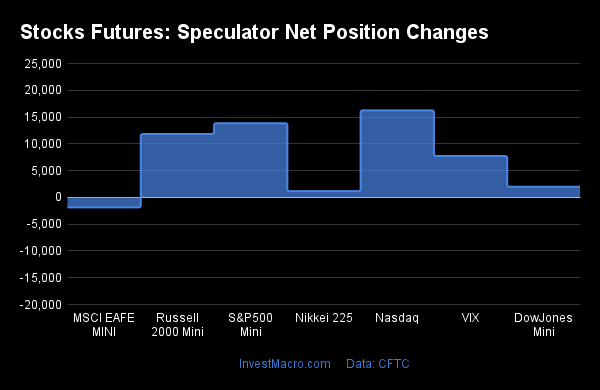
Weekly Speculator Changes led by S&P500-Mini & Russell-Mini

The COT stock markets speculator bets were higher through February 21st as six out of the seven stock markets we cover had higher positioning while the other one market had lower speculator contracts.

Leading the gains for the stock markets was S&P500-Mini (12,163 contracts), Russell-Mini (9,360 contracts), Nasdaq-Mini (8,755 contracts), MSCI EAFE-Mini (3,092 contracts), Nikkei 225 (260 contracts) and VIX (89 contracts) showing positive weeks.

The market with the declines in speculator bets was DowJones-Mini (-9,507 contracts).


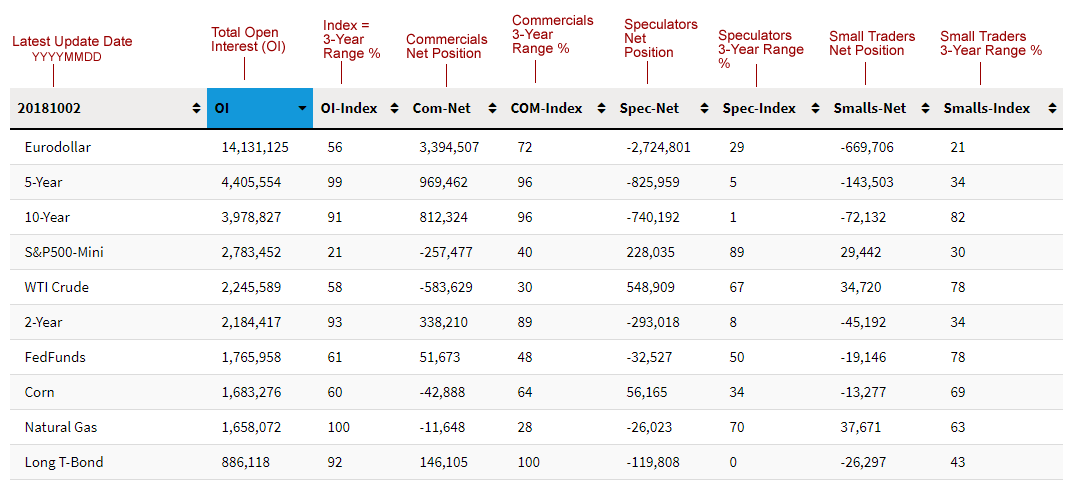
Data Snapshot of Stock Market Traders | Columns Legend
Feb-21-2023OIOI-IndexSpec-NetSpec-IndexCom-NetCOM-IndexSmalls-NetSmalls-Index
S&P500-Mini2,074,4864-234,29113241,15383-6,86225
Nikkei 22512,8496-2,022681,8243919831
Nasdaq-Mini268,29753-14,0696734,62048-20,55113
DowJones-Mini91,28858-16,2452817,59474-1,34934
VIX333,08251-56,1087462,40827-6,30061
Nikkei 225 Yen41,9572512,0057143112-12,43651


Strength Scores led by VIX & Nikkei 225 Yen

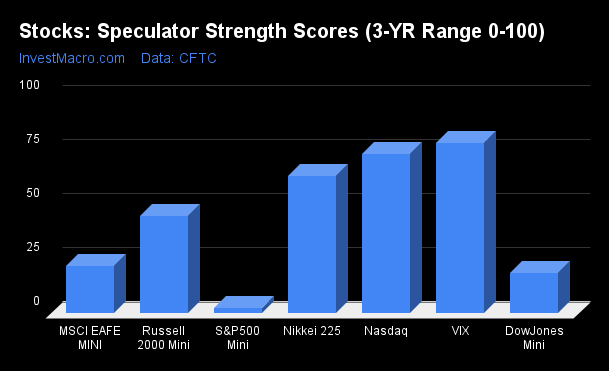
COT Strength Scores (a normalized measure of Speculator positions over a 3-Year range, from 0 to 100 where above 80 is Extreme-Bullish and below 20 is Extreme-Bearish) showed that the VIX (74 percent) and the Nikkei 225 Yen (71 percent) led the stock markets through February 21st. The Nikkei 225 (68 percent) and Nasdaq-Mini (67 percent) came in as the next highest in the weekly strength scores.

On the downside, the S&P500-Mini (13 percent) came in at the lowest strength level currently and is in Extreme-Bearish territory (below 20 percent). The next lowest strength score is the MSCI EAFE-Mini (26 percent).

Strength Statistics:
VIX (74.0 percent) vs VIX previous week (73.9 percent)
S&P500-Mini (12.8 percent) vs S&P500-Mini previous week (10.5 percent)
DowJones-Mini (28.0 percent) vs DowJones-Mini previous week (49.3 percent)
Nasdaq-Mini (67.2 percent) vs Nasdaq-Mini previous week (62.3 percent)
Russell2000-Mini (39.2 percent) vs Russell2000-Mini previous week (33.6 percent)
Nikkei USD (67.9 percent) vs Nikkei USD previous week (66.6 percent)
EAFE-Mini (26.0 percent) vs EAFE-Mini previous week (22.2 percent)


VIX & Nikkei 225 Yen top the 6-Week Strength Trends

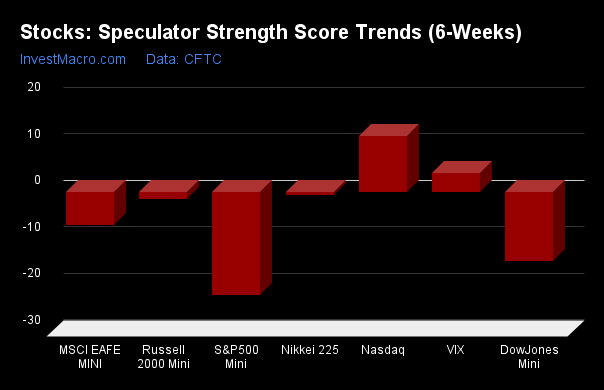
COT Strength Score Trends (or move index, calculates the 6-week changes in strength scores) showed that the VIX (12 percent) led the six weeks trends for the stock markets. The Nikkei 225 Yen (9 percent), the Nikkei 225 (3 percent) and the Russell-Mini (2 percent) are the next highest positive movers in the latest trends data.

The DowJones-Mini (-16 percent) led the downside trend scores with the S&P500-Mini (-4 percent) coming in as the next market with lower trend scores.

Strength Trend Statistics:
VIX (11.5 percent) vs VIX previous week (8.1 percent)
S&P500-Mini (-3.9 percent) vs S&P500-Mini previous week (-14.7 percent)
DowJones-Mini (-15.9 percent) vs DowJones-Mini previous week (11.5 percent)
Nasdaq-Mini (-3.3 percent) vs Nasdaq-Mini previous week (-13.5 percent)
Russell2000-Mini (2.1 percent) vs Russell2000-Mini previous week (0.9 percent)
Nikkei USD (3.3 percent) vs Nikkei USD previous week (3.3 percent)
EAFE-Mini (-1.9 percent) vs EAFE-Mini previous week (-14.8 percent)


Individual Stock Market Charts:

VIX Volatility Futures:

VIX Volatility Futures COT ChartThe VIX Volatility large speculator standing the week reached a net position of -56,108 contracts in the data reported through Tuesday February 21st. This was a weekly lift of 89 contracts from the previous week which had a total of -56,197 net contracts.

The week’s current strength score (the trader positioning range over the past three years, measured from 0 to 100) shows the speculators are currently Bullish with a score of 74.0 percent. The commercials are Bearish with a score of 26.7 percent and the small traders (not shown in chart) are Bullish with a score of 60.8 percent.

VIX Volatility Futures StatisticsSPECULATORSCOMMERCIALSSMALL TRADERS
– Percent of Open Interest Longs:15.455.57.0
– Percent of Open Interest Shorts:32.236.88.9
– Net Position:-56,10862,408-6,300
– Gross Longs:51,233184,96823,405
– Gross Shorts:107,341122,56029,705
– Long to Short Ratio:0.5 to 11.5 to 10.8 to 1
NET POSITION TREND:
– Strength Index Score (3 Year Range Pct):74.026.760.8
– Strength Index Reading (3 Year Range):BullishBearishBullish
NET POSITION MOVEMENT INDEX:
– 6-Week Change in Strength Index:11.5-11.63.4


S&P500 Mini Futures:

SP500 Mini Futures COT ChartThe S&P500 Mini large speculator standing the week reached a net position of -234,291 contracts in the data reported through Tuesday February 21st. This was a weekly gain of 12,163 contracts from the previous week which had a total of -246,454 net contracts.

The week’s current strength score (the trader positioning range over the past three years, measured from 0 to 100) shows the speculators are currently Bearish-Extreme with a score of 12.8 percent. The commercials are Bullish-Extreme with a score of 82.5 percent and the small traders (not shown in chart) are Bearish with a score of 24.9 percent.

S&P500 Mini Futures StatisticsSPECULATORSCOMMERCIALSSMALL TRADERS
– Percent of Open Interest Longs:11.274.412.1
– Percent of Open Interest Shorts:22.562.712.5
– Net Position:-234,291241,153-6,862
– Gross Longs:231,8081,542,524251,654
– Gross Shorts:466,0991,301,371258,516
– Long to Short Ratio:0.5 to 11.2 to 11.0 to 1
NET POSITION TREND:
– Strength Index Score (3 Year Range Pct):12.882.524.9
– Strength Index Reading (3 Year Range):Bearish-ExtremeBullish-ExtremeBearish
NET POSITION MOVEMENT INDEX:
– 6-Week Change in Strength Index:-3.95.2-3.6


Dow Jones Mini Futures:

Dow Jones Mini Futures COT ChartThe Dow Jones Mini large speculator standing the week reached a net position of -16,245 contracts in the data reported through Tuesday February 21st. This was a weekly reduction of -9,507 contracts from the previous week which had a total of -6,738 net contracts.

The week’s current strength score (the trader positioning range over the past three years, measured from 0 to 100) shows the speculators are currently Bearish with a score of 28.0 percent. The commercials are Bullish with a score of 73.6 percent and the small traders (not shown in chart) are Bearish with a score of 33.9 percent.

Dow Jones Mini Futures StatisticsSPECULATORSCOMMERCIALSSMALL TRADERS
– Percent of Open Interest Longs:30.050.415.2
– Percent of Open Interest Shorts:47.731.116.7
– Net Position:-16,24517,594-1,349
– Gross Longs:27,34445,98213,918
– Gross Shorts:43,58928,38815,267
– Long to Short Ratio:0.6 to 11.6 to 10.9 to 1
NET POSITION TREND:
– Strength Index Score (3 Year Range Pct):28.073.633.9
– Strength Index Reading (3 Year Range):BearishBullishBearish
NET POSITION MOVEMENT INDEX:
– 6-Week Change in Strength Index:-15.910.111.1


Nasdaq Mini Futures:

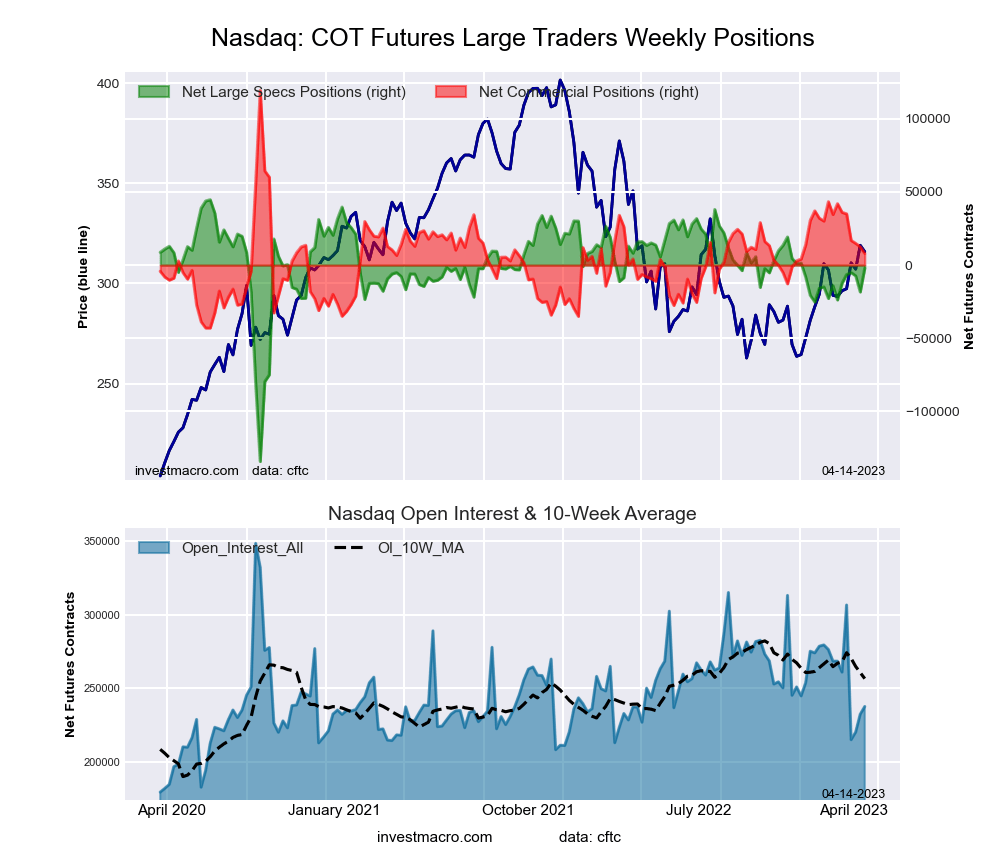
Nasdaq Mini Futures COT ChartThe Nasdaq Mini large speculator standing the week reached a net position of -14,069 contracts in the data reported through Tuesday February 21st. This was a weekly gain of 8,755 contracts from the previous week which had a total of -22,824 net contracts.

The week’s current strength score (the trader positioning range over the past three years, measured from 0 to 100) shows the speculators are currently Bullish with a score of 67.2 percent. The commercials are Bearish with a score of 47.8 percent and the small traders (not shown in chart) are Bearish-Extreme with a score of 13.0 percent.

Nasdaq Mini Futures StatisticsSPECULATORSCOMMERCIALSSMALL TRADERS
– Percent of Open Interest Longs:21.663.513.0
– Percent of Open Interest Shorts:26.850.620.7
– Net Position:-14,06934,620-20,551
– Gross Longs:57,849170,38634,896
– Gross Shorts:71,918135,76655,447
– Long to Short Ratio:0.8 to 11.3 to 10.6 to 1
NET POSITION TREND:
– Strength Index Score (3 Year Range Pct):67.247.813.0
– Strength Index Reading (3 Year Range):BullishBearishBearish-Extreme
NET POSITION MOVEMENT INDEX:
– 6-Week Change in Strength Index:-3.312.7-28.2


Russell 2000 Mini Futures:

Russell 2000 Mini Futures COT ChartThe Russell 2000 Mini large speculator standing reached a net position of -54,548 contracts in the data reported through Tuesday February 21st. This was a weekly rise of 9,360 contracts from the previous week which had a total of -63,908 net contracts.

The week’s current strength score (the trader positioning range over the past three years, measured from 0 to 100) shows the speculators are currently Bearish with a score of 39.2 percent. The commercials are Bullish with a score of 58.0 percent and the small traders (not shown in chart) are Bearish with a score of 44.2 percent.

Russell 2000 Mini Futures StatisticsSPECULATORSCOMMERCIALSSMALL TRADERS
– Percent of Open Interest Longs:10.381.75.8
– Percent of Open Interest Shorts:22.970.54.5
– Net Position:-54,54848,8585,690
– Gross Longs:44,927355,13525,214
– Gross Shorts:99,475306,27719,524
– Long to Short Ratio:0.5 to 11.2 to 11.3 to 1
NET POSITION TREND:
– Strength Index Score (3 Year Range Pct):39.258.044.2
– Strength Index Reading (3 Year Range):BearishBullishBearish
NET POSITION MOVEMENT INDEX:
– 6-Week Change in Strength Index:2.1-3.26.5


Nikkei Stock Average (USD) Futures:

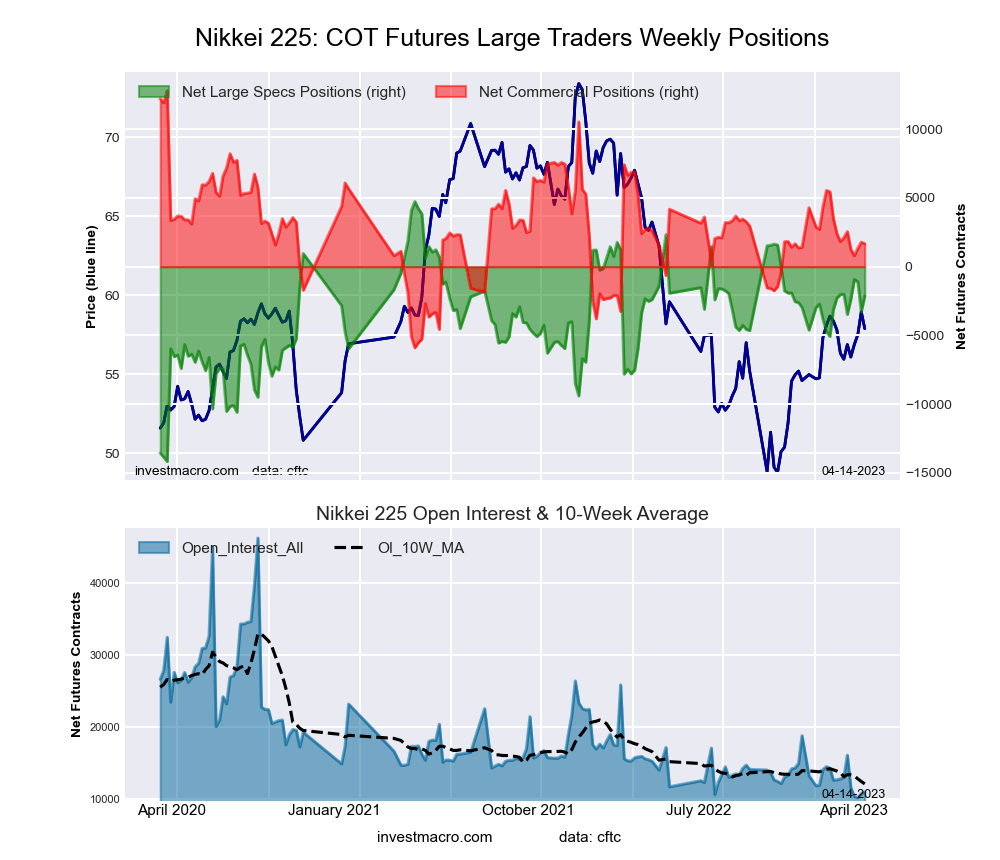
Nikkei Stock Average (USD) Futures COT ChartThe Nikkei Stock Average (USD) large speculator standing the week reached a net position of -2,022 contracts in the data reported through Tuesday February 21st. This was a weekly rise of 260 contracts from the previous week which had a total of -2,282 net contracts.

The week’s current strength score (the trader positioning range over the past three years, measured from 0 to 100) shows the speculators are currently Bullish with a score of 67.9 percent. The commercials are Bearish with a score of 38.8 percent and the small traders (not shown in chart) are Bearish with a score of 30.8 percent.

Nikkei Stock Average Futures StatisticsSPECULATORSCOMMERCIALSSMALL TRADERS
– Percent of Open Interest Longs:25.149.025.9
– Percent of Open Interest Shorts:40.834.824.4
– Net Position:-2,0221,824198
– Gross Longs:3,2256,2963,328
– Gross Shorts:5,2474,4723,130
– Long to Short Ratio:0.6 to 11.4 to 11.1 to 1
NET POSITION TREND:
– Strength Index Score (3 Year Range Pct):67.938.830.8
– Strength Index Reading (3 Year Range):BullishBearishBearish
NET POSITION MOVEMENT INDEX:
– 6-Week Change in Strength Index:3.3-4.52.5


MSCI EAFE Mini Futures:

MSCI EAFE Mini Futures COT ChartThe MSCI EAFE Mini large speculator standing the week reached a net position of -14,968 contracts in the data reported through Tuesday February 21st. This was a weekly gain of 3,092 contracts from the previous week which had a total of -18,060 net contracts.

The week’s current strength score (the trader positioning range over the past three years, measured from 0 to 100) shows the speculators are currently Bearish with a score of 26.0 percent. The commercials are Bullish with a score of 69.2 percent and the small traders (not shown in chart) are Bullish with a score of 56.7 percent.

MSCI EAFE Mini Futures StatisticsSPECULATORSCOMMERCIALSSMALL TRADERS
– Percent of Open Interest Longs:8.188.33.1
– Percent of Open Interest Shorts:11.986.21.5
– Net Position:-14,9688,4606,508
– Gross Longs:32,258350,49612,286
– Gross Shorts:47,226342,0365,778
– Long to Short Ratio:0.7 to 11.0 to 12.1 to 1
NET POSITION TREND:
– Strength Index Score (3 Year Range Pct):26.069.256.7
– Strength Index Reading (3 Year Range):BearishBullishBullish
NET POSITION MOVEMENT INDEX:
– 6-Week Change in Strength Index:-1.91.80.4


Article By InvestMacroReceive our weekly COT Newsletter

*COT Report: The COT data, released weekly to the public each Friday, is updated through the most recent Tuesday (data is 3 days old) and shows a quick view of how large speculators or non-commercials (for-profit traders) were positioned in the futures markets.

The CFTC categorizes trader positions according to commercial hedgers (traders who use futures contracts for hedging as part of the business), non-commercials (large traders who speculate to realize trading profits) and nonreportable traders (usually small traders/speculators) as well as their open interest (contracts open in the market at time of reporting). See CFTC criteria here.


Soft Commodities COT Charts: February 21st data showed Speculators boosted bets of Cocoa & Lean Hogs

By InvestMacro

Here are the latest charts and statistics for the Commitment of Traders (COT) reports data published by the Commodities Futures Trading Commission (CFTC).

The latest COT data is updated through Tuesday February 21st and shows a quick view of how large traders (for-profit speculators and commercial entities) were positioned in the futures markets.

*** This data is still a few weeks behind the current data because the CFTC up-to-date data has been delayed due to a cybersecurity event that happened in early February to ION Cleared Derivatives (a subsidiary of ION Markets). This hack of ION has created a problem for the large trader positions to be reported and reconciled. The CFTC has back-filled some data over the past few weeks and will get the data back up to date in the coming weeks.

Weekly Speculator Changes led by Cocoa & Lean Hogs

The COT soft commodities markets speculator bets were higher that week as seven out of the eleven softs markets we cover had higher positioning while the other four markets had lower speculator contracts.

Leading the gains for the softs markets was Cocoa (17,227 contracts), Lean Hogs (7,584 contracts) with Coffee (7,266 contracts), Soybean Oil (7,105 contracts), Soybean Meal (3,600 contracts), Live Cattle (3,446 contracts) and Soybeans (1,374 contracts) also showing positive weeks.

The markets with the declines in speculator bets were Corn (-21,689 contracts) with Wheat (-13,364 contracts), Cotton (-14,119 contracts) and Sugar (-5,488 contracts) also registering lower bets on the week.


Data Snapshot of Commodity Market Traders | Columns Legend
Feb-21-2023OIOI-IndexSpec-NetSpec-IndexCom-NetCOM-IndexSmalls-NetSmalls-Index
WTI Crude1,756,02932219,6714-241,2979621,62635
Gold422,6480107,10121-129,3557722,25436
Silver123,90639,90232-23,0506613,14839
Copper219,205582,04935-8,510626,46163
Palladium11,94384-5,18805,552100-36420
Platinum67,499582,90522-8,394765,48942
Natural Gas1,270,68663-179,26417141,5158237,74969
Brent150,90712-39,9003336,847653,05351
Heating Oil259,5582017,56567-26,091458,52628
Soybeans731,52934193,26067-150,14145-43,1190
Corn1,340,32220283,02366-209,63542-73,3886
Coffee196,128912,31640-14,198621,88226
Sugar926,55353233,33874-277,7422344,40463
Wheat359,36042-47,488147,55297-64100


Strength Scores were led by Soybean Meal & Live Cattle

COT Strength Scores (a normalized measure of Speculator positions over a 3-Year range, from 0 to 100 where above 80 is Extreme-Bullish and below 20 is Extreme-Bearish) showed that Soybean Meal (100 percent) and Live Cattle (100 percent) led the softs markets on February 21st. Sugar (74 percent), Cocoa (69 percent) and Soybeans (67 percent) come in as the next highest in the weekly strength scores.

On the downside, Wheat (1 percent), Cotton (5 percent) and Lean Hogs (10 percent) came in at the lowest strength levels and are in Extreme-Bearish territory (below 20 percent). The next lowest strength score was Soybean Oil (28 percent).

Strength Statistics:
Corn (66.2 percent) vs Corn previous week (69.0 percent)
Sugar (74.2 percent) vs Sugar previous week (76.0 percent)
Coffee (40.1 percent) vs Coffee previous week (32.6 percent)
Soybeans (67.2 percent) vs Soybeans previous week (66.7 percent)
Soybean Oil (27.8 percent) vs Soybean Oil previous week (23.0 percent)
Soybean Meal (100.0 percent) vs Soybean Meal previous week (98.1 percent)
Live Cattle (100.0 percent) vs Live Cattle previous week (96.1 percent)
Lean Hogs (10.2 percent) vs Lean Hogs previous week (2.0 percent)
Cotton (5.0 percent) vs Cotton previous week (15.8 percent)
Cocoa (69.4 percent) vs Cocoa previous week (50.4 percent)
Wheat (0.9 percent) vs Wheat previous week (14.9 percent)


Coffee & Live Cattle topped the 6-Week Strength Trends

COT Strength Score Trends (or move index, calculates the 6-week changes in strength scores) showed that Coffee (28 percent) and Live Cattle (28 percent) led the past six weeks trends for soft commodities. Cocoa (21 percent), Soybeans (20 percent) and Sugar (16 percent) were the next highest positive movers in the latest trends data.

Lean Hogs (-26 percent) led the downside trend scores that week with Soybean Oil (-18 percent), Cotton (-16 percent) and Wheat (-8 percent) following next with lower trend scores.

Strength Trend Statistics:
Corn (6.3 percent) vs Corn previous week (4.8 percent)
Sugar (15.7 percent) vs Sugar previous week (3.6 percent)
Coffee (27.7 percent) vs Coffee previous week (6.0 percent)
Soybeans (19.6 percent) vs Soybeans previous week (16.0 percent)
Soybean Oil (-17.8 percent) vs Soybean Oil previous week (-28.6 percent)
Soybean Meal (9.6 percent) vs Soybean Meal previous week (8.3 percent)
Live Cattle (27.6 percent) vs Live Cattle previous week (34.5 percent)
Lean Hogs (-25.8 percent) vs Lean Hogs previous week (-53.0 percent)
Cotton (-16.0 percent) vs Cotton previous week (-4.1 percent)
Cocoa (20.7 percent) vs Cocoa previous week (1.1 percent)
Wheat (-8.2 percent) vs Wheat previous week (-1.9 percent)


Individual Soft Commodities Markets:

CORN Futures:

CORN Futures COT ChartThe CORN large speculator standing equaled a net position of 283,023 contracts in the data reported through Tuesday February 21st. This was a weekly decrease of -21,689 contracts from the previous week which had a total of 304,712 net contracts.

The week’s current strength score (the trader positioning range over the past three years, measured from 0 to 100) shows the speculators are currently Bullish with a score of 66.2 percent. The commercials are Bearish with a score of 42.0 percent and the small traders (not shown in chart) are Bearish-Extreme with a score of 5.6 percent.

CORN Futures StatisticsSPECULATORSCOMMERCIALSSMALL TRADERS
– Percent of Open Interest Longs:30.941.98.5
– Percent of Open Interest Shorts:9.857.514.0
– Net Position:283,023-209,635-73,388
– Gross Longs:414,502561,129114,376
– Gross Shorts:131,479770,764187,764
– Long to Short Ratio:3.2 to 10.7 to 10.6 to 1
NET POSITION TREND:
– Strength Index Score (3 Year Range Pct):66.242.05.6
– Strength Index Reading (3 Year Range):BullishBearishBearish-Extreme
NET POSITION MOVEMENT INDEX:
– 6-Week Change in Strength Index:6.3-3.8-16.1


SUGAR Futures:

SUGAR Futures COT ChartThe SUGAR large speculator standing equaled a net position of 233,338 contracts in the data reported through Tuesday February 21st. This was a weekly fall of -5,488 contracts from the previous week which had a total of 238,826 net contracts.

The week’s current strength score (the trader positioning range over the past three years, measured from 0 to 100) shows the speculators are currently Bullish with a score of 74.2 percent. The commercials are Bearish with a score of 23.5 percent and the small traders (not shown in chart) are Bullish with a score of 62.8 percent.

SUGAR Futures StatisticsSPECULATORSCOMMERCIALSSMALL TRADERS
– Percent of Open Interest Longs:34.339.510.3
– Percent of Open Interest Shorts:9.169.55.6
– Net Position:233,338-277,74244,404
– Gross Longs:317,876366,00195,884
– Gross Shorts:84,538643,74351,480
– Long to Short Ratio:3.8 to 10.6 to 11.9 to 1
NET POSITION TREND:
– Strength Index Score (3 Year Range Pct):74.223.562.8
– Strength Index Reading (3 Year Range):BullishBearishBullish
NET POSITION MOVEMENT INDEX:
– 6-Week Change in Strength Index:15.7-13.0-0.5


COFFEE Futures:

COFFEE Futures COT ChartThe COFFEE large speculator standing the week equaled a net position of 12,316 contracts in the data reported through Tuesday February 21st. This was a weekly rise of 7,266 contracts from the previous week which had a total of 5,050 net contracts.

The week’s current strength score (the trader positioning range over the past three years, measured from 0 to 100) shows the speculators are currently Bearish with a score of 40.1 percent. The commercials are Bullish with a score of 61.8 percent and the small traders (not shown in chart) are Bearish with a score of 25.6 percent.

COFFEE Futures StatisticsSPECULATORSCOMMERCIALSSMALL TRADERS
– Percent of Open Interest Longs:22.546.25.1
– Percent of Open Interest Shorts:16.253.54.1
– Net Position:12,316-14,1981,882
– Gross Longs:44,12290,64010,018
– Gross Shorts:31,806104,8388,136
– Long to Short Ratio:1.4 to 10.9 to 11.2 to 1
NET POSITION TREND:
– Strength Index Score (3 Year Range Pct):40.161.825.6
– Strength Index Reading (3 Year Range):BearishBullishBearish
NET POSITION MOVEMENT INDEX:
– 6-Week Change in Strength Index:27.7-25.4-21.6


SOYBEANS Futures:

SOYBEANS Futures COT ChartThe SOYBEANS large speculator standing the week equaled a net position of 193,260 contracts in the data reported through Tuesday February 21st. This was a weekly rise of 1,374 contracts from the previous week which had a total of 191,886 net contracts.

The week’s current strength score (the trader positioning range over the past three years, measured from 0 to 100) shows the speculators are currently Bullish with a score of 67.2 percent. The commercials are Bearish with a score of 44.9 percent and the small traders (not shown in chart) are Bearish-Extreme with a score of 0.0 percent.

SOYBEANS Futures StatisticsSPECULATORSCOMMERCIALSSMALL TRADERS
– Percent of Open Interest Longs:32.845.26.5
– Percent of Open Interest Shorts:6.365.712.4
– Net Position:193,260-150,141-43,119
– Gross Longs:239,615330,71947,851
– Gross Shorts:46,355480,86090,970
– Long to Short Ratio:5.2 to 10.7 to 10.5 to 1
NET POSITION TREND:
– Strength Index Score (3 Year Range Pct):67.244.90.0
– Strength Index Reading (3 Year Range):BullishBearishBearish-Extreme
NET POSITION MOVEMENT INDEX:
– 6-Week Change in Strength Index:19.6-15.9-11.6


SOYBEAN OIL Futures:

SOYBEAN OIL Futures COT ChartThe SOYBEAN OIL large speculator standing the week equaled a net position of 36,282 contracts in the data reported through Tuesday February 21st. This was a weekly boost of 7,105 contracts from the previous week which had a total of 29,177 net contracts.

The week’s current strength score (the trader positioning range over the past three years, measured from 0 to 100) shows the speculators are currently Bearish with a score of 27.8 percent. The commercials are Bullish with a score of 70.7 percent and the small traders (not shown in chart) are Bullish with a score of 53.0 percent.

SOYBEAN OIL Futures StatisticsSPECULATORSCOMMERCIALSSMALL TRADERS
– Percent of Open Interest Longs:18.952.87.5
– Percent of Open Interest Shorts:10.963.15.2
– Net Position:36,282-46,88710,605
– Gross Longs:86,110240,46134,271
– Gross Shorts:49,828287,34823,666
– Long to Short Ratio:1.7 to 10.8 to 11.4 to 1
NET POSITION TREND:
– Strength Index Score (3 Year Range Pct):27.870.753.0
– Strength Index Reading (3 Year Range):BearishBullishBullish
NET POSITION MOVEMENT INDEX:
– 6-Week Change in Strength Index:-17.815.45.0


SOYBEAN MEAL Futures:

SOYBEAN MEAL Futures COT ChartThe SOYBEAN MEAL large speculator standing the week equaled a net position of 175,951 contracts in the data reported through Tuesday February 21st. This was a weekly rise of 3,600 contracts from the previous week which had a total of 172,351 net contracts.

The week’s current strength score (the trader positioning range over the past three years, measured from 0 to 100) shows the speculators are currently Bullish-Extreme with a score of 100.0 percent. The commercials are Bearish-Extreme with a score of 0.0 percent and the small traders (not shown in chart) are Bearish-Extreme with a score of 14.7 percent.

SOYBEAN MEAL Futures StatisticsSPECULATORSCOMMERCIALSSMALL TRADERS
– Percent of Open Interest Longs:41.533.810.5
– Percent of Open Interest Shorts:3.175.67.0
– Net Position:175,951-191,70815,757
– Gross Longs:190,333154,81748,064
– Gross Shorts:14,382346,52532,307
– Long to Short Ratio:13.2 to 10.4 to 11.5 to 1
NET POSITION TREND:
– Strength Index Score (3 Year Range Pct):100.00.014.7
– Strength Index Reading (3 Year Range):Bullish-ExtremeBearish-ExtremeBearish-Extreme
NET POSITION MOVEMENT INDEX:
– 6-Week Change in Strength Index:9.6-6.0-36.7


LIVE CATTLE Futures:

LIVE CATTLE Futures COT ChartThe LIVE CATTLE large speculator standing the week equaled a net position of 104,274 contracts in the data reported through Tuesday February 21st. This was a weekly lift of 3,446 contracts from the previous week which had a total of 100,828 net contracts.

The week’s current strength score (the trader positioning range over the past three years, measured from 0 to 100) shows the speculators are currently Bullish-Extreme with a score of 100.0 percent. The commercials are Bearish-Extreme with a score of 0.0 percent and the small traders (not shown in chart) are Bearish with a score of 38.8 percent.

LIVE CATTLE Futures StatisticsSPECULATORSCOMMERCIALSSMALL TRADERS
– Percent of Open Interest Longs:45.023.310.4
– Percent of Open Interest Shorts:14.051.613.1
– Net Position:104,274-95,188-9,086
– Gross Longs:151,31078,36835,012
– Gross Shorts:47,036173,55644,098
– Long to Short Ratio:3.2 to 10.5 to 10.8 to 1
NET POSITION TREND:
– Strength Index Score (3 Year Range Pct):100.00.038.8
– Strength Index Reading (3 Year Range):Bullish-ExtremeBearish-ExtremeBearish
NET POSITION MOVEMENT INDEX:
– 6-Week Change in Strength Index:27.6-26.0-11.4


LEAN HOGS Futures:

LEAN HOGS Futures COT ChartThe LEAN HOGS large speculator standing the week equaled a net position of 1,704 contracts in the data reported through Tuesday February 21st. This was a weekly boost of 7,584 contracts from the previous week which had a total of -5,880 net contracts.

The week’s current strength score (the trader positioning range over the past three years, measured from 0 to 100) shows the speculators are currently Bearish-Extreme with a score of 10.2 percent. The commercials are Bullish-Extreme with a score of 94.8 percent and the small traders (not shown in chart) are Bullish with a score of 74.0 percent.

LEAN HOGS Futures StatisticsSPECULATORSCOMMERCIALSSMALL TRADERS
– Percent of Open Interest Longs:31.135.110.8
– Percent of Open Interest Shorts:30.333.812.9
– Net Position:1,7042,763-4,467
– Gross Longs:65,67874,07022,814
– Gross Shorts:63,97471,30727,281
– Long to Short Ratio:1.0 to 11.0 to 10.8 to 1
NET POSITION TREND:
– Strength Index Score (3 Year Range Pct):10.294.874.0
– Strength Index Reading (3 Year Range):Bearish-ExtremeBullish-ExtremeBullish
NET POSITION MOVEMENT INDEX:
– 6-Week Change in Strength Index:-25.825.610.2


COTTON Futures:

COTTON Futures COT ChartThe COTTON large speculator standing the week equaled a net position of -2,969 contracts in the data reported through Tuesday February 21st. This was a weekly decrease of -14,119 contracts from the previous week which had a total of 11,150 net contracts.

The week’s current strength score (the trader positioning range over the past three years, measured from 0 to 100) shows the speculators are currently Bearish-Extreme with a score of 5.0 percent. The commercials are Bullish-Extreme with a score of 94.7 percent and the small traders (not shown in chart) are Bearish-Extreme with a score of 13.0 percent.

COTTON Futures StatisticsSPECULATORSCOMMERCIALSSMALL TRADERS
– Percent of Open Interest Longs:27.851.26.6
– Percent of Open Interest Shorts:29.449.96.4
– Net Position:-2,9692,542427
– Gross Longs:51,46094,93812,306
– Gross Shorts:54,42992,39611,879
– Long to Short Ratio:0.9 to 11.0 to 11.0 to 1
NET POSITION TREND:
– Strength Index Score (3 Year Range Pct):5.094.713.0
– Strength Index Reading (3 Year Range):Bearish-ExtremeBullish-ExtremeBearish-Extreme
NET POSITION MOVEMENT INDEX:
– 6-Week Change in Strength Index:-16.015.7-10.1


COCOA Futures:

COCOA Futures COT ChartThe COCOA large speculator standing the week equaled a net position of 46,085 contracts in the data reported through Tuesday February 21st. This was a weekly increase of 17,227 contracts from the previous week which had a total of 28,858 net contracts.

The week’s current strength score (the trader positioning range over the past three years, measured from 0 to 100) shows the speculators are currently Bullish with a score of 69.4 percent. The commercials are Bearish with a score of 27.1 percent and the small traders (not shown in chart) are Bullish with a score of 51.7 percent.

COCOA Futures StatisticsSPECULATORSCOMMERCIALSSMALL TRADERS
– Percent of Open Interest Longs:35.839.94.9
– Percent of Open Interest Shorts:20.257.43.0
– Net Position:46,085-51,5945,509
– Gross Longs:105,772117,96714,353
– Gross Shorts:59,687169,5618,844
– Long to Short Ratio:1.8 to 10.7 to 11.6 to 1
NET POSITION TREND:
– Strength Index Score (3 Year Range Pct):69.427.151.7
– Strength Index Reading (3 Year Range):BullishBearishBullish
NET POSITION MOVEMENT INDEX:
– 6-Week Change in Strength Index:20.7-23.215.4


WHEAT Futures:

WHEAT Futures COT ChartThe WHEAT large speculator standing the week equaled a net position of -47,488 contracts in the data reported through Tuesday February 21st. This was a weekly reduction of -13,364 contracts from the previous week which had a total of -34,124 net contracts.

The week’s current strength score (the trader positioning range over the past three years, measured from 0 to 100) shows the speculators are currently Bearish-Extreme with a score of 0.9 percent. The commercials are Bullish-Extreme with a score of 96.7 percent and the small traders (not shown in chart) are Bullish-Extreme with a score of 100.0 percent.

WHEAT Futures StatisticsSPECULATORSCOMMERCIALSSMALL TRADERS
– Percent of Open Interest Longs:25.739.010.3
– Percent of Open Interest Shorts:38.925.810.3
– Net Position:-47,48847,552-64
– Gross Longs:92,453140,22436,892
– Gross Shorts:139,94192,67236,956
– Long to Short Ratio:0.7 to 11.5 to 11.0 to 1
NET POSITION TREND:
– Strength Index Score (3 Year Range Pct):0.996.7100.0
– Strength Index Reading (3 Year Range):Bearish-ExtremeBullish-ExtremeBullish-Extreme
NET POSITION MOVEMENT INDEX:
– 6-Week Change in Strength Index:-8.24.717.7


Article By InvestMacroReceive our weekly COT Newsletter

*COT Report: The COT data, released weekly to the public each Friday, is updated through the most recent Tuesday (data is 3 days old) and shows a quick view of how large speculators or non-commercials (for-profit traders) were positioned in the futures markets.

The CFTC categorizes trader positions according to commercial hedgers (traders who use futures contracts for hedging as part of the business), non-commercials (large traders who speculate to realize trading profits) and nonreportable traders (usually small traders/speculators) as well as their open interest (contracts open in the market at time of reporting). See CFTC criteria here.

Murrey Math Lines 10.03.2023 (Brent, S&P 500)

By RoboForex.com

Brent

On H4, the 200-day Moving Average has broken, and Brent quotes are now below it, which means they might develop a downtrend. However, the RSI has already reached the oversold area. As a result, we should expect a breakaway of 4/8 (81.25) upwards and growth of the price to the resistance level of 5/8 (82.81). The scenario can be cancelled by a downwards breakaway of the support at 3/8 (79.69), in which case Brent quotes will continue falling and might reach 2/8 (78.12).

BrentH4
Risk Warning: the result of previous trading operations do not guarantee the same results in the future

On M15, price growth can additionally be supported by a breakaway of the upper border of the VoltyChannel indicator.

Brent_M15
Risk Warning: the result of previous trading operations do not guarantee the same results in the future

S&P 500

On H4, the S&P 500 index quotes and the RSI are in the oversold area, which points on a possible increase in the price. The quotes are expected to rise above 0/8 (3906.2) and then reach the resistance level of 2/8 (3984.4). The scenario can be cancelled by a downward breakaway of the support at -1/8 (3867.2). In this case, quotes might drop to -2/8 (3828.1).

S&P500_H4
Risk Warning: the result of previous trading operations do not guarantee the same results in the future

On M15, a breakaway of the upper border of VoltyChannel will increase the probability of an increase in the price.

S&P500_M15

Article By RoboForex.com

Attention!
Forecasts presented in this section only reflect the author’s private opinion and should not be considered as guidance for trading. RoboForex LP bears no responsibility for trading results based on trading recommendations described in these analytical reviews.

The Bank of Japan kept its monetary policy unchanged. The US banking sector is under pressure

By JustMarkets

Yesterday, the US stock indices fell sharply, mainly due to falling banking sector shares. Shares of SVB Financial Group (SIVB) fell more than 55% after the bank disclosed a net loss of $1.8 billion and gave a negative outlook for the year on the impact of higher interest rates. SVB Financial Group said it was taking aggressive measures to shore up its balance sheet, including selling shares and liquidating its securities portfolio. The SIVB’s fall has dampened sentiment toward bank stocks, which have been pressured by a deeper inversion of the yield curve, a harbinger of recession. As the stock market closed Thursday, the Dow Jones Index (US30) decreased by 1.66%, and the S&P 500 Index (US500) lost 1.85%. The NASDAQ Technology Index (US100) fell by 2.05%.

Investors remain tense ahead of Friday’s jobs report. The US economy is expected to grow by 200,000 jobs last month, well below January’s 517,000. The unemployment rate is forecast at 3.4%. Yesterday’s weekly labor market data showed that US employers announced 77,770 job cuts in February, down 24% from the 102,943 cuts announced in January. This indicates a resilient labor market. Many fear that a strong Nonfarm Payrolls report could solidify the return of aggressive rate hikes by the Federal Reserve.

On Thursday, President Joe Biden unveiled a $6.9 trillion budget proposal. The proposal, which the Republican-controlled House of Representatives will undoubtedly reject, showed little inclination to compromise. The president’s proposal would increase funding for a number of government programs, increase Medicare solvency, lower prescription drug prices, and reduce the deficit by $3 trillion over the next decade. Biden also proposes adding $77 billion for defense spending.

Stock markets in Europe were mostly down yesterday. Germany’s DAX (DE30) gained 0.01%, France’s CAC 40 (FR40) fell by 0.12%, Spain’s IBEX 35 (ES35) decreased by 0.45%, and Britain’s FTSE 100 (UK100) closed down 0.63%.

The ECB will raise rates by 50 basis points at its March meeting, and analysts expect the central bank to signal the next such move, probably in May. Executive Board spokeswoman Isabel Schnabel recently said that in order to slow the pace of rate hikes, she needs to see the ECB’s monetary policy become restrictive, which should show up in credit markets, labor markets, and various components of aggregate demand. But there is disagreement within the ECB. On the hawkish side, Holzmann argued that the ECB should raise the rate by 50 basis points at all the next four meetings. On the other hand, Visco did not appreciate such comments from his colleagues and said that decisions should be made meeting by meeting in an environment of high uncertainty. But in any scenario, the ECB will remain hawkish until the summer.

On Wednesday, crude oil prices fell for a second straight day, even as oil inventories fell. Inventories fell by 1.694 million barrels last week, the first weekly drop in inventories since December. The rise in the dollar index on the back of the US Federal Reserve’s aggressiveness outweighs the factors of falling inventories and rising demand from China.

Oil prices continued to fall Friday due to fears of more aggressive interest rate hikes by the US Federal Reserve and disappointing data from China. Markets are worried that a potential US recession triggered by tighter monetary conditions could hit oil demand this year. China’s weak economic signals also upset oil markets, as the world’s largest oil importer recorded a drop in oil imports between January and February. Expectations of higher interest rates are strengthening the dollar, putting pressure on commodities priced in the currency, mainly oil. A stronger dollar makes oil more expensive for international buyers, which reduces demand.

Asian markets traded flat yesterday. Japan’s Nikkei 225 (JP225) jumped 0.63%, China’s FTSE China A50 (CHA50) fell by 0.61%, Hong Kong’s Hang Seng (HK50) ended the day down by 0.63%, India’s NIFTY 50 (IND50) fell by 0.93%, and Australia’s S&P/ASX 200 (AU200) ended the day up by 0.05%.

The Bank of Japan kept interest rates at record lows on Friday and said it would continue the current rate of Yield Curve Control (YCC). The BOJ said in a statement that inflation is likely to slow by mid-2023, thanks to government subsidies on energy prices and easing pressure from high commodity rates. But the Bank of Japan also said that prices would rise again by the end of the year and that growing uncertainty about the economy underscored the need to maintain the adaptive monetary policy. This was the last meeting in the office for Haruhiko Kuroda.

S&P 500 (F) (US500) 3,918.32 −73.69 (−1.85%)

Dow Jones (US30)32,254.86 −543.54 (−1.66%)

DAX (DE40) 15,653.58 +75.19 (+0.01%)

FTSE 100 (UK100) 7,879.98 −49.94 (−0.63%)

USD Index 105.28 −0.38 (−0.36%)

Important events for today:
  • – Japan BoJ Interest Rate Decision at 05:00 (GMT+2);
  • – Japan BoJ Rate Statement at 05:00 (GMT+2);
  • – Japan BoJ Press Conference at 07:00 (GMT+2);
  • – UK GDP (m/m) at 09:00 (GMT+2);
  • – UK Industrial Production (m/m) at 09:00 (GMT+2);
  • – UK Manufacturing Production (m/m) at 09:00 (GMT+2);
  • – US Nonfarm Payrolls (m/m) at 15:30 (GMT+2);
  • – US Unemployment Rate (m/m) at 15:30 (GMT+2);
  • – Canada Unemployment Rate (m/m) at 15:30 (GMT+2).

By JustMarkets


This article reflects a personal opinion and should not be interpreted as an investment advice, and/or offer, and/or a persistent request for carrying out financial transactions, and/or a guarantee, and/or a forecast of future events.