Archive for Financial News – Page 141

Natural gas prices rise amid production cuts. US stock indices under pressure from rising government bond yields

By JustMarkets

At the end of the day yesterday, the Dow Jones (US30) index decreased by 0.60%, while the S&P 500 (US500) Index fell 0.20%. The NASDAQ Technology Index (US100) closed positive 0.11%. Stocks on Monday initially found support on the dovish PCE price deflator report for February released last Friday. But the broader market gave up early gains after bond yields jumped on the back of a stronger-than-expected US ISM manufacturing index. The report was hawkish for Fed policy and could delay an expected Fed rate cut. Meanwhile, strong chip maker stocks raised tech stocks on Monday and kept the NASDAQ Index (US100) in positive territory.

Alphabet (GOOGL) closed at a record high (+3%) after agreeing to delete web browsing data collected from users of its Chrome browser to settle a class action lawsuit that alleged the company tracked people without their knowledge.

In Canada, the S&P manufacturing PMI remained relatively stable in March, marking the eleventh consecutive month of contraction in activity in the sector. However, crude oil prices supported the loonie, helped by the prospect of foreign exchange inflows from Canada’s top exports.

Equity markets in Europe did not trade yesterday due to the Easter holiday.

WTI crude oil prices are trading near 5-month highs at 83 dollars per barrel as investors await the joint OPEC+ ministerial meeting this week. OPEC+ has pledged to extend production cuts through June, which could lead to supply cuts during the summer months in the Northern Hemisphere.

US natural gas prices rose more than 4% on Monday to above $1.8/mmbtu amid continued production declines and forecasts that demand next week will be higher than previously expected. Gas production declined to an average of 100.8 billion cubic feet per day (bcfd) in March, down from 104.8 bcfd in February, as several energy companies, including EQT and Chesapeake Energy, postponed well completions and curtailed other drilling activity.

Asian markets were mostly up yesterday. Japan’s Nikkei 225 (JP225) was down 1.40%, China’s FTSE China A50 (CHA50) was up 1.54%, Hong Kong’s Hang Seng (HK50) was up 0.91% by Monday’s close, and Australia’s ASX 200 (AU200) was positive 0.99%. Optimism about the Chinese economy is supporting equities after the Caixin Mar China Manufacturing PMI rose by 0.2 to 51.1, the highest level in 13 months, and surpassed the 50.0 mark, which indicates the economy is expanding for the fifth month, the longest streak in more than two years.

Australia’s stock market fell by 0.11% on Tuesday after briefly hitting another record high in the morning session. This was led by a drop in US futures as sentiment on US interest rates may shift to a hawkish path amid a resilient economy. In Australia’s domestic market, job advertisements fell for the second straight month in March, while minutes from the central bank’s meeting last month showed policymakers can neither rule in nor rule out future monetary rate changes as uncertainty in the domestic economy persists. In addition, the politicians noted that concerns about the outlook for steel demand have impacted iron ore prices, reducing the earnings of Australian exporters.

S&P 500 (US500) 5,243.77 −10.58 (−0.20%)

Dow Jones (US30) 39,566.85 −240.52 (−0.60%)

DAX (DE40) 18,492.49 0 (0%)

FTSE 100 (UK100) 7,952.62 0 (0%)

USD Index 104.97 +0.43 (+0.41%)

Important events today:
  • – Australia RBA Monetary Policy Meeting Minutes at 03:30 (GMT+3);
  • – Switzerland Retail Sales (m/m) at 09:30 (GMT+3);
  • – Switzerland Manufacturing PMI (m/m) at 10:30 (GMT+3);
  • – German Manufacturing PMI (m/m) at 10:55 (GMT+3);
  • – Eurozone Manufacturing PMI (m/m) at 11:00 (GMT+3);
  • – UK Manufacturing PMI (m/m) at 11:30 (GMT+3);
  • – German Consumer Price Index (m/m) at 15:00 (GMT+3);
  • – US JOLTs Job Openings (m/m) at 17:00 (GMT+3).

By JustMarkets


This article reflects a personal opinion and should not be interpreted as an investment advice, and/or offer, and/or a persistent request for carrying out financial transactions, and/or a guarantee, and/or a forecast of future events.

The US Dollar strengthens following positive manufacturing data

By RoboForex Analytical Department

The EUR/USD pair has dipped to its lowest since 15 February this year following the release of encouraging data regarding the US manufacturing sector’s activity on Monday. This improvement, the first since September 2022, has bolstered the US dollar’s position.

The Institute for Supply Management (ISM) reported that the manufacturing business activity index climbed to 50.3 points in March from 47.8 in the preceding month. This rise above the crucial 50.0-point threshold, which distinguishes contraction from expansion, signals a positive development for the sector.

Key insights from the report highlight an increase in new orders, although manufacturing employment figures remained subdued. The surge in raw material prices also influenced the overall index, which might have otherwise recorded a higher reading. Importantly, this data signifies the end of the manufacturing sector’s most prolonged downturn in 16 months, a sector that constitutes approximately 10.4% of the US economy.

Further economic data revealed that the US Core Personal Consumption Expenditure (PCE) rose by 0.3% in February, slightly below the anticipated 0.4% increase. This Core PCE index, closely monitored by the Federal Reserve, suggests that the Fed may have room to adjust interest rates downwards in June 2024, given the subdued inflationary pressures.

Market expectations for the Federal Reserve’s decision in June have seen slight adjustments. CME FedWatch Tool data indicate a 66% likelihood of policy easing, a slight decrease from the prior 68% and significantly up from 57% the previous week.

Technical analysis of EUR/USD

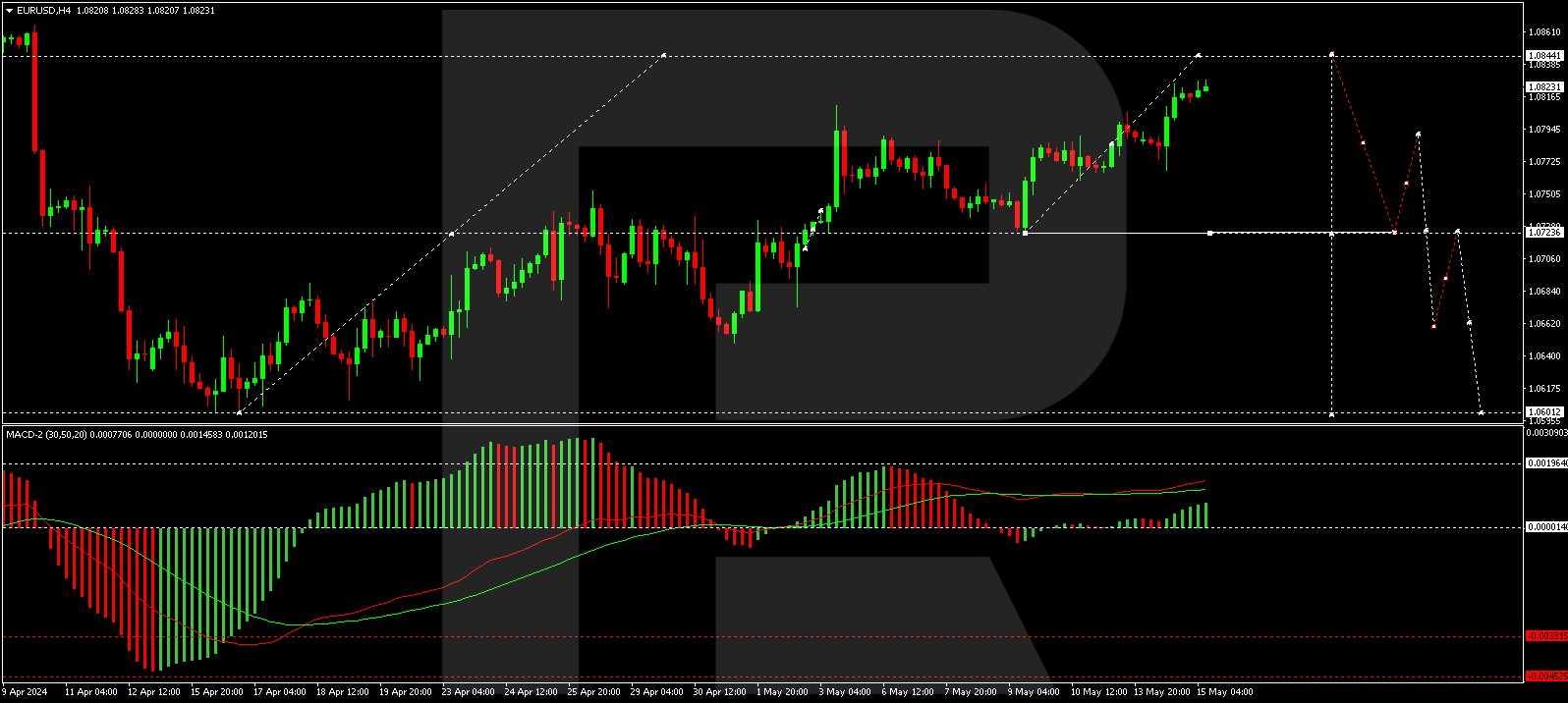
H4 Chart Analysis: the EUR/USD pair is currently in a consolidation phase around the 1.0794 level. A downward breakout from this range could lead to a continued decline towards 1.0650. A corrective move back to 1.0794, testing from below, may follow, with potential further descent to 1.0600. This scenario is supported by the MACD indicator, which shows the signal line below zero, indicating a continued downward trend.

H1 Chart Analysis: a corrective structure has been completed at the 1.0804 level on the H1 chart. Following the news release, the market breached the 1.0777 level downwards, continuing the downward trajectory towards 1.0720. Upon completion, a potential uptick to 1.0790 (testing from below) could occur before another drop to the 1.0650 mark. The Stochastic oscillator, currently below 50, anticipates a further decline to the 20 mark, supporting the bearish outlook.

Disclaimer

Any forecasts contained herein are based on the author’s particular opinion. This analysis may not be treated as trading advice. RoboForex bears no responsibility for trading results based on trading recommendations and reviews contained herein.

Oil rises ahead of this week’s OPEC+ meeting. Inflation is rising in Indonesia

By JustMarkets

At the end of last trading week, the Dow Jones Index (US30) was up 0.08%, while the S&P 500 Index (US500) was up 0.23%. The NASDAQ Technology Index (US100) closed negative 0.05%.

The dollar index settled at 104.5 in post-holiday trading on Monday. Investors are digesting the latest PCE Price Index report, searching for clues about the Federal Reserve’s future monetary policy. Data released on Friday showed that the Fed’s recommended inflation rate rose by 0.3% month-on-month in February, slowing from an upwardly revised 0.4% increase in January, which was also in line with the consensus predicted. The report also showed that consumer spending last month rose by the most in a year, indicating the economy is resilient. Meanwhile, Fed Chairman Jerome Powell reiterated on Friday that the central bank is in no rush to cut interest rates and that the latest PCE inflation data aligns with what the Fed wants. Markets now believe there is a nearly 70% chance that the Fed will start cutting rates in June, with a total rate cut of 75 basis points this year.

Equity markets in Europe mostly went up last week. Germany’s DAX (DE40) increased by 1.75%, France’s CAC 40 (FR40) gained 0.69%, Spain’s IBEX 35 (ES35) jumped by 2.01%, and the UK’s FTSE 100 (UK100) closed positive 0.89%.

The UK economy remains weak, and rate cuts will be welcomed across sectors. The latest ONS data showed that the UK economy entered a technical recession in Q4 2023. The Spring Budget is forecast to boost GDP by around a quarter of one percentage point, but domestic growth needs more stimulus. Against this economic backdrop, the economy needs stimulus, with inflation falling rapidly and the labor market stagnant or marginally weaker. Therefore, the Bank of England has every reason to plan for a series of rate cuts this year, starting with its June 20 meeting.

According to the latest forecasts from ECB staff, Eurozone inflation will continue to fall in the coming months and quarters. With price pressures easing rapidly, the European Central Bank has additional certainty and flexibility regarding the timing of the first interest rate cut. Financial markets certainly believe this is the most likely scenario, which will put pressure on the euro in the weeks and months ahead.

Gold rose above $2,250 an ounce on Monday, extending its rally to record levels. Softer-than-expected US inflation data bolstered bets that the Federal Reserve will begin cutting interest rates in June. Lower interest rates reduce the opportunity cost of holding bullion, increasing its investment value.

WTI crude oil prices rose to around $83.5 a barrel on Monday, hitting their highest level in five months, as investors look ahead to this week’s joint OPEC+ ministerial meeting. The group is expected to review market fundamentals and OPEC representatives’ adherence to production targets, which will continue to support oil prices.

Asian markets traded flat last week. Japan’s Nikkei 225 (JP225) declined by 1.05%, China’s FTSE China A50 (CHA50) gained 0.05% over 5 trading days, Hong Kong’s Hang Seng (HK50) fell by 0.35% last week, and Australia’s ASX 200 (AU200) was positive 1.48%.

Asian stock markets were mixed on Monday as investors assessed several regional economic reports. A private survey showed that China’s manufacturing activity in March grew rapidly since February 2023 amid robust demand. Meanwhile, the Bank of Japan’s quarterly Tankan survey showed that sentiment among large manufacturers in Japan declined in Q1 for the first time in a year as automobile plant closures over the past few months took a heavy toll.

Indonesia’s annual inflation rate rose to 3.05% in March 2024 from 2.75% in February, beating expectations of 2.91%, above the BI (Bank Indonesia) target range of 1.5 to 3.5%. It was the highest inflation rate since August last year, with food prices rising the most in 18 months amid fasting in Ramadan and ahead of the Eid-el-Fitr holiday.

S&P 500 (US500) 5,254.35 0 (0%)

Dow Jones (US30) 39,807.37 0 (0%)

DAX (DE40) 18,492.49 0 (0%)

FTSE 100 (UK100) 7,952.62 0 (0%)

USD Index 104.49 -0.06 (-0.06%)

Important events today:
  • – Japan Tankan Large Manufacturers Index (q/q) at 02:50 (GMT+3);
  • – Japan Tankan Large Non-Manufacturers Index (q/q) at 02:50 (GMT+3);
  • – Japan Manufacturing PMI (m/m) at 03:30 (GMT+3);
  • – China Caixin Manufacturing PMI (m/m) at 04:45 (GMT+3);
  • – Canada Manufacturing PMI (m/m) at 16:30 (GMT+3);
  • – US ISM Manufacturing PMI (m/m) at 17:00 (GMT+3);
  • – Canada BoC Business Outlook Survey at 17:30 (GMT+3).

By JustMarkets


This article reflects a personal opinion and should not be interpreted as an investment advice, and/or offer, and/or a persistent request for carrying out financial transactions, and/or a guarantee, and/or a forecast of future events.

Which FXTM crypto CFD might outperform in April?

By ForexTime

  • Bitcoin Cash, Dogecoin each climbed over 130% so far in 2024
  • Futures for Dogecoin, BitcoinCash, Litecoin to start trading on US exchange this month
  • Bitcoin “halving”, due in late April, may boost other cryptos


Of the 11 crypto CFDs offered by FXTM, Bitcoin Cash is leading the pack with about 160% in year-to-date gains.

That 160% is far superior compared to the “OG” Bitcoin’s 64% year-to-date gains.

BITCOINC (Bitcoin Cash) has now touched the $700 mark for the first time since November 2021, before the crypto world fell into the infamous crypto winter of 2022.

What is Bitcoin Cash?

According to CoinGecko data, Bitcoin Cash is the world’s 14th largest cryptocurrency, with a total market value (market capitalisation) of US$13.4 billion.

Created in August 2017, Bitcoin Cash is an offshoot of the original Bitcoin, with the former intended to be the faster and cheaper version of the latter.


Dogecoin is not far behind in 2nd place (for now), having soared about 140% so far in 2024.

What is Dogecoin?

Dogecoin is now the 9th largest cryptocurrency in the world, according to CoinGecko, with a market cap of nearly US$30 billion.

Created in December 2013, this cryptocurrency began as a “joke” off the popular meme featuring the Shiba Inu dog.

Today, it is mainly used as a tipping system on some social media sites, positioning it as the “internet currency”.

More recently, in March 2024, Elon Musk hinted that Dogecoin could be used to buy Tesla cars “at some point”.


Even Litecoin has had an Easter weekend to remember.

This crypto has punched its way to a 9-month high, now trading above the psychological $110 level for the first time since July 2023!

What is Litecoin?

Litecoin is the world’s 22nd-largest cryptocurrency, with a market cap of just over US$ 8 billion, according to CoinGecko.

This peer-to-peer cryptocurrency was created in 2011, as a faster version of Bitcoin and intended to act as a “digital silver” compared to Bitcoin’s “digital gold” status.


Why are Dogecoin, Bitcoin Cash, and Litecoin soaring?

Last month (March 2024):

  • BITCOINC skyrocketed 125.8%
  • DOGECOIN soared 83.7%
  • LITECOIN climbed 31.2%

1) Futures contracts to begin trading in April 2024

The derivatives arm of US-based crypto exchange, Coinbase, has obtained approval from the Commodity Futures Trading Commission (CFTC) to launch futures contracts for Dogecoin, Bitcoin Cash, and Litecoin.

And those futures contracts are set to begin trading this month!

Note from the charts above, how this piece of news in March helped awaken Dogecoin, Bitcoin Cash, and Litecoin prices from their respective slumbers in the months prior.

Furthermore, these cryptos may have also been jolted by the revived excitement and mania surrounding memecoins and altcoins.

How could the futures contracts impact the underlying crypto’s prices?

Having a futures contract go live could boost the underlying cryptocurrency’s prices.

Here’s how Bitcoin and Ether prices fared when their respective futures contracts went live:

  • Bitcoin prices rose 45.5% in December 2017, the month when Bitcoin futures first started trading.

    That added to the gains already garnered in the prior months (51.4% in November 2017, and 52.9% in October 2017).

  • Ether prices rose over 9% in February 2021, the month when Ether futures first started trading.

    Ether then went on to climb even higher in the ensuing months: up 37% in March 2021 and up another 42.5% in April 2021.

In short, the rollout of futures contracts has historically proven to be a price booster for the underlying crypto.

And this could be due to a variety of reasons, such as:

  • increased demand for the underlying cryptocurrency for arbitrage/hedging purposes by institutional investors
  • increased liquidity, legitimacy, and transparency stemming from CFTC’s approval, ultimately boosting the appeal for these cryptocurrencies


But wait, there’s more …


2) Bitcoin “halving” could push wider crypto prices even higher!

Of course, the much-anticipated Bitcoin “halving”, which happens once every 4 years, is due later in April 2024.

A “halving” is when the rewards for mining new Bitcoins are halved, which in turn reduces incoming new supply.

And if demand for Bitcoin holds up post-halving, coupled with lessened supply, such dynamics tends to push prices higher.

Note also the positive correlation between Bitcoin and Dogecoin, Bitcoin Cash, and Litecoin.

Over any 5-day rolling period over the past 5 years, these cryptos have moved in the same direction as Bitcoin:

  • Dogecoin: 90% of the time
  • Bitcoin Cash: 54% of the time
  • Litecoin: 48% of the time

That means, when Bitcoin prices go, these 3 cryptos tend to follow, and vice versa.


IMPORTANT: Cryptocurrencies are volatile!

Note how the 14-day relative strength index (RSI – a popular technical indicator) of the 3 highlighted cryptos are close to the 70 mark which denotes “overbought” conditions.

This suggests that a technical pullback is likely due over the immediate term!

Still, it’s these heightened volatility (wild price swings) where traders find the greater opportunities.

Using Crypto CFDs, traders stand to potentially profit in both environments, whether prices are rising or falling.


Overall, if these futures contracts, as well as the Bitcoin halving”, have the expected impact on crypto prices …

this should lead to further gains for Dogecoin, Bitcoin Cash, and Litecoin!

Of course, if the ongoing meme-mania persists, buffered by risk-on sentiment, that should lend a helping hand for these crypto bulls.


Forex-Time-LogoArticle by ForexTime

ForexTime Ltd (FXTM) is an award winning international online forex broker regulated by CySEC 185/12 www.forextime.com

Today most financial markets are closed due to the Good Friday holiday

By JustMarkets

As of Wednesday’s stock market close, the Dow Jones Index (US30) was up 0.12%. The S&P 500 Index (US500) added 0.11%, setting an all-time high. The NASDAQ Technology Index (US100) closed negative 0.14%. Stocks received some support from Thursday’s upwardly revised fourth-quarter GDP report. In contrast, the core PCE price deflator was revised downward, reinforcing the prospect of a soft landing for the economy. However, hawkish comments from Fed spokesman Waller on Wednesday night pushed bond yields higher and capped gains in stocks when he said the latest inflation data was disappointing and he wanted to see at least a couple of months of better inflation data before cutting interest rates.

US weekly initial jobless claims unexpectedly fell by 2,000 to 210,000, indicating a stronger labor market than expectations of a rise to 212,000. US GDP for Q4 was revised upward to 3.4% (QoQ), which is stronger than expectations of 3.2%, and Personal Consumption for Q4 was revised upward to 3.3%, which is stronger than expectations of 3.0%. US home sales for February rose by 1.6 % mom, slightly stronger than expectations of 1.5% mom. The March University of Michigan Consumer Sentiment Index was revised upward to a 2-year high of 79.4, stronger than expectations of 76.5.

Although most financial markets are closed today, the PCE Price Index report will be released in the US. The overall PCE Price Index is expected to remain at a 2.4% annualized rate. The Core Price Index (which excludes food and energy prices) is forecast at 2.7% y/y from the current 2.8%. If the Core PCE Price Index remains around 2.8%, it would confirm the Fed’s hypothesis that progress on the inflation front has stalled. In such a scenario, the dollar index may get additional support.

Equity markets in Europe mostly rose on Thursday. Germany’s DAX (DE40) rose by 0.08%, France’s CAC 40 (FR40) closed up 0.01%, Spain’s IBEX 35 (ES35) fell by 0.33%, and the UK’s FTSE 100 (UK100) closed positive 0.26%.

Thursday’s Eurozone money supply report and German retail sales report for February proved dovish for ECB policy and supported European indices. In addition, indices rose due to dovish comments from ECB Governing Council representatives Panetta and Villeroy de Galhau, who said that conditions for monetary easing are emerging and rate cuts should start in the spring. Swaps estimate the odds of a 25 bps ECB rate cut at 11% at the next meeting on April 11 and 95% at the June 6 meeting.

Gold (XAU/USD) held above $2,230 an ounce on Friday, sitting at all-time highs amid bets that major central banks will move to cut interest rates this year. Heated geopolitical tensions boosted bullion demand. The metal’s price rose more than 9% in March. Silver (XAG/USD) gained support on Thursday after the US fourth-quarter GDP data was revised slightly higher, which was a positive for industrial metals demand.

WTI crude oil prices rose above $82 per barrel on Thursday, marking the third consecutive monthly rise. This was driven by optimism over the OPEC+ alliance’s continued production cuts. Despite rising geopolitical tensions that could disrupt supplies, OPEC+ is expected to maintain its current oil production policy at its meeting next Wednesday.

Asian markets traded flat yesterday. Japan’s Nikkei 225 (JP225) was down 1.46%, China’s FTSE China A50 (CHA50) lost 0.90%, Hong Kong’s Hang Seng (HK50) added 0.91% on the day and Australia’s ASX 200 (AU200) was positive 0.99%.

The offshore yuan weakened to 7.26 per dollar, near its lowest level in four months, amid expectations that China will further ease policy to stimulate growth. Meanwhile, US interest rates may remain elevated for an extended period amid stagnant inflation. A senior central bank official recently said the People’s Bank of China has room to further reduce banks’ reserve requirement ratios.

S&P 500 (US500) 5,254.35 +5.86 (+0.11%)

Dow Jones (US30) 39,807.37 +47.29 (+0.12%)

DAX (DE40) 18,492.49 +15.40 (+0.083%)

FTSE 100 (UK100) 7,952.62 +20.64 (+0.26%)

USD Index 104.53 +0.19 (+0.18%)

Important events today:
  • – Japan Tokyo Core CPI (m/m) at 01:30 (GMT+2);
  • – Japan Unemployment Rate (m/m) at 02:30 (GMT+2);
  • – Japan Industrial Production (m/m) at 02:50 (GMT+2);
  • – Japan Retail Sales (m/m) at 02:50 (GMT+2);
  • – US Core PCE Price Index (m/m) at 15:30 (GMT+2);
  • – US FOMC Member Daly Speaks at 17:20 (GMT+2);
  • – US Fed Chair Powell Speaks at 17:30 (GMT+2).

By JustMarkets


This article reflects a personal opinion and should not be interpreted as an investment advice, and/or offer, and/or a persistent request for carrying out financial transactions, and/or a guarantee, and/or a forecast of future events.

Gold’s Price Reaches New Heights Amid Global Market Uncertainty

By RoboForex Analytical Department

On Friday, the price of gold reached an unprecedented peak, soaring above 2,230 USD. The global capital market experienced low activity due to the observance of Good Friday in many Catholic countries, leading to abrupt movements by investors.

The surge in gold prices is primarily attributed to anticipations that global financial regulators will lower lending costs within the year. Furthermore, escalating geopolitical tensions have bolstered gold’s appeal as a safe-haven asset.

March saw gold’s price increase by over 9%, marking a significant uptick for what is typically considered a conservative investment. Several key developments support this rally:

  • US Federal Reserve’s rate cut intentions: in its March meeting, the Fed outlined plans to reduce interest rates three times over the year.
  • Bank of Japan’s policy shift: this month, the Bank of Japan abandoned its negative interest rate policy.
  • Swiss National Bank’s rate adjustment: in an unexpected move, the Swiss National Bank lowered its interest rate, sparking speculation that other financial authorities might take similar actions.

Gold’s status as a safe asset has been reinforced amidst a market climate favouring risk aversion, driven by ongoing geopolitical instability, especially in the Middle East.

Technical analysis of XAU/USD

H4 chart analysis: The H4 chart reveals that XAU/USD prices have broken out of their consolidation range, embarking on the fifth wave of growth. An upward movement towards 2,250 USD is currently forming. Following this, a corrective movement to 2,211.11 USD may occur, potentially leading to a new growth phase targeting 2,262.38 USD. This scenario is supported by the MACD indicator, with the signal line positioned above zero and trending upwards.

H1 chart analysis: On the H1 chart, XAU/USD established a consolidation range of around 2,211.11 USD. An upward breakout from this range could set the stage for a rise towards 2,250 USD. After achieving this level, a correction towards 2,222.50 USD may unfold before considering a further ascent to 2,262.38 USD and a pullback to 2,180.60 USD. The Stochastic oscillator, currently above 80, indicates a forthcoming decline to 20, aligning with this analysis.

Disclaimer

Any forecasts contained herein are based on the author’s particular opinion. This analysis may not be treated as trading advice. RoboForex bears no responsibility for trading results based on trading recommendations and reviews contained herein.

AI Revolution and NVDA: Why Tough Going May Be Ahead

“These things could get more intelligent than us”

By Elliott Wave International

The topic with all the buzz these days is Artificial Intelligence (AI) and its future.

The potential benefits include automating repetitive tasks, enhancing productivity, data analysis, assisting in medical applications — and more.

Then there’s the possible downside. Some of the major worries include the elimination of jobs, privacy violations, unclear legal regulations and the potential for AIs to go rogue as the goals of AI become misaligned with the goals of humans.

In an interview with NPR in 2023, computer scientist Geoffrey Hinton, who is known as the godfather of AI, said:

These things could get more intelligent than us and could decide to take over, and we need to worry now about how we prevent that happening.

However, right now, the mood surrounding AI is way more optimistic than pessimistic.

Just think about how investors have bid up the price of AI-related stock Nvidia Corp., which has a market capitalization of around $2 trillion. That’s more than the GDP of Australia or South Korea. Indeed, if Nvidia was a country, it would rank just outside the top ten largest economies on Earth.

Yet — a word of caution: Trends generally don’t go up or down in straight lines without significant interruptions.

Indeed, the March Global Rates & Money Flows, one of Elliott Wave International’s newest services, which covers global fixed income markets, stocks, currencies and more, shows this chart of an AI exchange-traded fund and says:

BOTZ, the ticker for the Global X Robotics & Artificial Intelligence ETF, sports a clear five-wave decline from 2021 to 2022. Since then, a corrective rally appears to be in operation with wave C advancing now. … [The] evidence suggests that the AI revolution may be off to a false start.

But what about the price pattern of Nvidia? — you may ask.

Know that our Senior Global Strategist, Murray Gunn, also provides Elliott wave analysis of Nvidia in the March Global Rates & Money Flows.

If you’re unfamiliar with Elliott wave analysis, read Frost & Prechter’s definitive text on the topic, Elliott Wave Principle: Key to Market Behavior. Here’s a quote from this Wall Street classic:

Despite the fact that many analysts do not treat it as such, the Wave Principle is by all means an objective study, or as [Charles] Collins put it, “a disciplined form of technical analysis.” [Hamilton] Bolton used to say that one of the hardest things he had to learn was to believe what he saw. If you do not believe what you see, you are likely to read into your analysis what you think should be there for some other reason. At this point, your count becomes subjective and worthless.

How can you remain objective in a world of uncertainty? It is not difficult once you understand the proper goal of your analysis.

Without Elliott, there appear to be an infinite number of possibilities for market action. What the Wave Principle provides is a means of first limiting the possibilities and then ordering the relative probabilities of possible future market paths. Elliott’s highly specific rules reduce the number of valid alternatives to a minimum.

If you’d like to learn about the “highly specific rules” of the Wave Principle, know that you can gain complimentary access to the entire online version of Elliott Wave Principle: Key to Market Behavior for free.

Just follow the link and you can have the Wall Street bestseller on your computer in moments: Elliott Wave Principle: Key to Market Behavior — get free and instant access.

GBP Consolidates Amid Concerns Over Economic Growth and Wage Trends

By RoboForex Analytical Department

The GBP/USD pair is currently consolidating, hovering around the 1.2631 mark. This consolidation phase follows recent reports highlighting a slowdown in the expansion plans of British businesses for workforce and wage growth, raising concerns about future economic dynamics and inflationary pressures.

A key report from the Lloyds Bank Business Barometer indicates a noticeable dip in the hiring outlook among companies. The differential between firms looking to hire and those planning cuts fell to 27% from a peak of 36% in February. This level is only slightly above the long-term average of 22%. Moreover, there has also been a marginal decline in the proportion of businesses anticipating wage increases in the next year.

Despite these trends, Bank of England (BoE) data provides a somewhat optimistic outlook, showing that British borrowers manage the high-interest environment relatively well. The incidence of problematic debt remains significantly lower than levels seen following the 2008 financial crisis, underscoring the resilience of the UK’s economic system and indicating signs of GDP recovery.

Catherine Mann, a member of the BoE’s Monetary Policy Committee, has called for a more realistic assessment of monetary policy expectations, suggesting that market predictions for substantial interest rate cuts by the BoE might be overly optimistic. Current market sentiment suggests a high probability of a rate reduction at the BoE’s August meeting.

Technical analysis of GBP/USD

The H4 chart analysis for GBP/USD shows ongoing consolidation around 1.2626. A breakout above this range could signal a potential corrective rise to 1.2700. Conversely, a move below this level may indicate a downward trend towards 1.2450 as an initial target. A potential correction to 1.2626 could follow, with a possible further decline to 1.2355. The MACD oscillator’s position below zero supports the possibility of continued downward movement.

On the H1 chart, the pair is forming a consolidation range around 1.2626, with no definitive trend. An upward breakout might lead to a corrective move towards 1.2676, while a downward breakout could signal the continuation of a decline to 1.2545 and potentially to 1.2450. The Stochastic oscillator, currently below 80 and trending downwards, aligns with the likelihood of a continued decline.


Disclaimer

Any forecasts contained herein are based on the author’s particular opinion. This analysis may not be treated as trading advice. RoboForex bears no responsibility for trading results based on trading recommendations and reviews contained herein.

The Australian and German indexes set all-time highs. The Reserve Bank of South Africa kept the rate at 8.25%

By JustMarkets

On Wednesday, the US stock indices ended trading with moderate growth. A decline in T-note bond yields supported the broader market. Investors also welcomed reports that S&P Global Ratings maintained its AA+ long-term US sovereign credit rating and A-1+ short-term sovereign credit rating with a stable outlook. As of Wednesday’s stock market close, the Dow Jones Index (US30) increased by 1.22%. The S&P 500 Index (US500) added 0.86%. The NASDAQ Technology Index (US100) closed positive 0.51%.

Merck’s (MRK) stock price rose more than 4% and topped the Dow Jones Industrials Index after its pulmonary arterial hypertension drug Winrevair received approval from the US Food and Drug Administration. Netflix (NFLX) shares closed down more than 2% after Wedbush removed it from its list of best ideas, saying the company will have a “much harder time” impressing investors this year compared to last. According to SEC filings, Salesforce (CRM) closed down more than 1% and topped the Dow Jones Industrials losers list on signs of insider selling after CEO Benioff sold $4.59 million worth of shares on Monday.

Equity markets in Europe were mostly up on Wednesday. Germany’s DAX (DE40) rose by 0.50% and set a new all-time high, France’s CAC 40 (FR40) closed yesterday up 0.25%, Spain’s IBEX 35 (ES35) added 1.09%, and the UK’s FTSE 100 (UK100) closed positive 0.01%. The Euro Stoxx 50 Index (EU50) rose to a 23-year high on Wednesday.

More ECB policymakers are hinting at a rate cut in June. Yesterday, ECB Governing Council representative Kazaks said inflation will continue to fall across the Eurozone, and June could be a good time for the ECB to start lowering borrowing costs. His colleague, ECB executive board representative Cipollone, added that if incoming data confirms the scenario envisioned in the March forecasts, the ECB should be ready to roll back its restrictive monetary policy stance quickly. Currently, swaps are pricing in the odds of a 25 bps ECB rate cut to 13% at the next meeting on April 11 and fully pricing in that rate cut (100%) at the next meeting on June 6.

German retail sales in February 2024 fell by 1.9% month-on-month, falling short of market forecasts that expected a 0.3% increase. This was the fourth consecutive month of decline in retail sales and the sharpest pace since October 2022, reflecting the impact of higher inflation and high borrowing costs.

The UK economy contracted by 0.3% in the final quarter of 2023, entering a technical recession as high inflation, record borrowing costs, and weak external demand put pressure on demand and activity.

WTI crude futures rose to $82 a barrel on Thursday, breaking a two-day decline, as the latest EIA report pointed to a smaller weekly increase in US crude inventories compared to API data. The EIA data showed that US crude inventories rose by 3.165 million barrels last week, beating market expectations for a 1.275 million barrel decline but far less than the 9.337 million barrel increase reported by the API. Investors also highlighted ongoing supply concerns before next week’s OPEC Joint Ministerial Monitoring Committee meeting.

Asian markets traded flat yesterday. Japan’s Nikkei 225 (JP225) rose by 0.90%, China’s FTSE China A50 (CHA50) declined by 0.76%, Hong Kong’s Hang Seng (HK50) lost 1.36% yesterday, while Australia’s ASX 200 (AU200) was positive 0.51%. At the market open on Thursday, Chinese indices bounced off one-month lows amid expectations that Chinese authorities will step up policy support to shore up the economy. On Thursday, Chinese lawmaker Zhao Leji said that the country would continue to open its economy to foreign investors, which boosted market sentiment. Investors are awaiting data on manufacturing and services activity in China in the coming days to gauge the health of the world’s second-largest economy. Meanwhile, Chinese President Xi Jinping met with US business leaders in Beijing on Wednesday as the government seeks to return foreign investors to the country.

The Reserve Bank of South Africa unanimously decided to keep the key repo rate at 8.25%, marking the fifth consecutive meeting at 2009 levels, as expected. Policymakers emphasized that risks to the inflation outlook were generally skewed to the upside. Core inflation accelerated for the second consecutive month, reaching 5.6% in February from January’s 5.3%, nearing the upper end of the central bank’s target range of 3-6%. Inflation is not expected to reach the middle of the target range until the end of 2025, later than previously thought, as it was initially expected to do so by mid-year.

Expectations for Australian consumer inflation fell to 4.3% in March 2024 from 4.5% in February, indicating the lowest level since October 2021 amid signs that domestic price pressures continue to ease. Australian retail sales rose by 0.3% month-on-month in February 2024, slowing sharply from a 1.1% increase in the previous month and below market forecasts of 0.4%. The S&P/ASX 200 Index (AU200) closed at 7,897 on Thursday, hitting new record highs. Mining stocks led the gains amid higher gold, iron ore, and lithium prices. The interest rate-sensitive banking, real estate, and retail sectors also rose as softer-than-expected domestic inflation data bolstered bets for a rate cut in the second half of 2024.

S&P 500 (US500) 5,248.49 +44.91 (+0.86%)

Dow Jones (US30) 39,760.08 +477.75 (+1.22%)

DAX (DE40) 18,477.09 +92.74 (+0.50%)

FTSE 100 (UK100) 7,931.98 +1.02 (+0.01%)

USD Index 104.37 +0.08 (+0.07%)

Important events today:
  • – Australia Retail Sales (m/m) at 02:30 (GMT+2);
  • – UK GDP (q/q) at 09:00 (GMT+2);
  • – Eurozone German Retail Sales (m/m) at 09:00 (GMT+2);
  • – Switzerland KOF Leading Indicators (m/m) at 10:00 (GMT+2);
  • – Eurozone German Unemployment Rate (m/m) at 10:55 (GMT+2);
  • – US GDP (q/q) at 14:30 (GMT+2);
  • – Canada GDP (m/m) at 14:30 (GMT+2);
  • – US Initial Jobless Claims (w/w) at 14:30 (GMT+2);
  • – US Chicago PMI (m/m) at 15:45 (GMT+2);
  • – US Michigan Consumer Sentiment (m/m) at 16:00 (GMT+2).
  • – US Pending Home Sales (m/m) at 16:00 (GMT+2);
  • – US Natural Gas Storage (w/w) at 16:30 (GMT+2).

By JustMarkets


This article reflects a personal opinion and should not be interpreted as an investment advice, and/or offer, and/or a persistent request for carrying out financial transactions, and/or a guarantee, and/or a forecast of future events.

Target Thursdays: EURGBP, GBPUSD & Crude hit targets!

By ForexTime

Check out these potential profits that you may have missed from our Daily Market Analysis.

  • EURGBP bears bag 20 pips
  • GBPUSD reaches all profit targets
  • Crude bulls pockets 63 points


    1) EURGBP extends downside pressure

  • Where and when was Target Price (TP) published?

This technical scenario (EURGBP) is based on the FXTM Signals that are posted twice a day (before the London and New York sessions) for all FXTM clients to follow.

It can be found in the MyFXTM profile under Trading Services… FXTM Trading Signals.


  • What happened since TP was published?

After consolidating in the Asian session, the EURGBP extended losses this morning thanks to mixed data from Germany and dovish remarks by an ECB policymaker.


  • How much in potential profits?

The EURGBP tumbled through all bearish profit targets on the H1 timeframe.

Given how the entry was at 0.85713, this is equivalent to  20 pips of profit.


    2) GBPUSD hits all target levels

This technical scenario (GBPUSD) is based on the FXTM Signals that are posted twice a day (before the London and New York sessions) for all FXTM clients to follow.

It can be found in the MyFXTM profile under Trading Services… FXTM Trading Signals.


  • What happened since TP was published?

The major currency pair tumbled this morning, dragged down by an appreciating dollar.


  • How much in potential profits?

Considering how the entry was at 1.26267, this is roughly 15 pips of profit on the M15 timeframe.


    3) Crude touches 4th and final profit target

This technical scenario (Crude) is based on the FXTM Signals that are posted twice a day (before the London and New York sessions) for all FXTM clients to follow.

It can be found in the MyFXTM profile under Trading Services… FXTM Trading Signals.


  • What happened since TP was published?

Oil prices are rising on expectations around OPEC+ supply cuts tightening global oil markets.


  • How much in potential profits?

The fourth and final profit target was hit at $82.29, which is 63 points away from the entry price.


Forex-Time-LogoArticle by ForexTime

ForexTime Ltd (FXTM) is an award winning international online forex broker regulated by CySEC 185/12 www.forextime.com