Week Ahead: US500 braces for massive week of risk events

By ForexTime 

  • US500 rebounds 15% from 2025 low
  • Meta, Microsoft, Amazon & Apple make almost 20% of US500 weight
  • US GDP, PCE & NFP report could impact Fed cut bets 
  • NFP sparked moves of ↑ 1.2% & ↓ 3.2% over past year
  • Technical levels: 50-day SMA, 5500 & 5300

US-China trade developments, major economic data and big tech earnings will dominate the week ahead:


Sunday, 27th April 

  • CN50: China industrial profits

Monday, 28th April

  • SG20: Singapore unemployment
  • CAD: Canadians head to the polls in a snap vote

Tuesday, 29th April 

  • EUR: Eurozone consumer confidence
  • SPN35: Spain GDP, CPI
  • UK100: HSBC earnings
  • RUS2000: Conference Board consumer confidence

Wednesday, 30th April    

  • AUD: Australia CPI
  • CN50: China official PMIs, Caixin manufacturing PMI
  • EUR: Eurozone GDP
  • GER40: Germany CPI, GDP, unemployment
  • JP225: Japan industrial production, retail sales
  • TWN: Taiwan GDP
  • US500: US GDP, PCE price index, ADP employment, Meta, Microsoft earnings

Thursday, 1st May

  • May Day – European markets closed except UK
  • AUD: Australia trade
  • JPY: BoJ rate decision
  • UK100: UK S&P Global Manufacturing PMI
  • US500: US ISM manufacturing, initial jobless claims, Amazon, Apple earnings

Friday, 2nd May

  • AUD: Australia retail sales
  • EUR: Eurozone CPI, unemployment, Germany HCOB Manufacturing PMI
  • JP225: Japan unemployment
  • US500: US April jobs report 

The spotlight shines on FXTM’s US500 which has rebounded 15% from its 2025 low. 

Imagen
US500 W1

Note: FXTM’s US500 tracks the underlying S&P 500 index

Recently, US equities have been empowered by bets around the Fed cutting interest rates sooner than expected to prevent a recession. However, uncertainty around trade talks may impact upside gains.

Still, the US500 is over 4% this week, lingering around key resistance at 5500.


Here are 4 factors that could trigger significant price swings:  

1) US-China trade saga

China denied having any trade talks with the United States despite Trump’s claims of progress earlier in the week. However, Trump has pushed back against China’s denial, stating that negotiations were happening.

On a brighter note, there are reports of China’s government weighing the suspension of its 125% tariffs on some US imports.

  • If this eases tensions and paves the path to actual negotiations, the US500 may jump as risk appetite improves.
  • Any signs of escalating tensions or growing uncertainty around trade developments may weigh on the US500.


2) Big tech earnings

Four of the so-called “Magnificent” 7 tech giants with a combined market cap of over $9 trillion are set to publish their results in the week ahead.

Quarterly results from Meta, Microsoft, Amazon and Apple could provide fresh insight into how the industry fared last quarter in the face of Trump’s tariffs. Google-parent Alphabet has already set the bar high by reporting solid earnings.

Considering that the combined weight of Meta, Microsoft, Amazon and Apple makes up roughly 19% of the US500, the incoming earnings could spark significant price swings.

  • A solid set of results and optimistic forward guidance from tech titans may propel the US500 higher.
  • Should results disappoint and concerns expressed about the earnings outlook, the US500 could sink. 


3) US data dump: Q1 GDP, PCE inflation, ISM & NFP

Fed officials have hinted at a possible rate cut if tariffs start weighing on the US jobs market and economic growth.  

This puts extra attention on the US data dump in the week ahead, featuring Q1 GDP, Fed’s preferred inflation gauge and the latest NFP jobs report.

  • Wednesday 30th April – Q1 GDP, US PCE price index 

Note: Over the past 12 months, the US GDP report has triggered upside moves on the US500 of as much as 0.7% or declines of 1.7% in a 6-hour window post-release.

  • Thursday 1st April – US ISM Manufacturing 

Note: Over the past 12 months, the US ISM Manufacturing report has triggered upside moves on the US500 of as much as 1.0% or declines of 2.0% in a 6-hour window post-release.

  • Friday 2nd April – US April NFP report

Note: Over the past 12 months, the US NFP report has triggered upside moves on the US500 of as much as 1.2% or declines of 3.2% in a 6-hour window post-release.

Traders are currently pricing three Fed rate cuts in 2025 with the odds of a fourth cut by December at 35%. Any major shifts to these bets may influence the US500.

  • A set of figures that support the case around the Fed cutting interest rates sooner than expected may push the US500 higher. But gains may be capped by recession fears.
  • While stronger-than-expected data may cool Fed cut bets, the US500 may rise if sentiment improves over the US economic outlook. 


4) Technical forces

The US500 is testing key resistance at 5500, but prices remain below the 50, 100 and 200-day SMA.

  • A solid breakout and daily close above 5500 may inspire a move toward the 50-day SMA at 5637 and the 200-day SMA at 5764.
  • Sustained weakness below 5500, may drag prices back toward 5300 and 5150.
Imagen
US500 3

Forex-Time-LogoArticle by ForexTime

ForexTime Ltd (FXTM) is an award winning international online forex broker regulated by CySEC 185/12 www.forextime.com

EUR/USD Stuck in Consolidation: Rumours Abound, but Facts Remain Scarce

By RoboForex Analytical Department 

On Friday, the major currency pair became further entrenched within a local sideways channel, hovering around 1.1339. The US dollar retained gains accumulated over recent sessions, supported by US President Donald Trump’s confirmation that trade negotiations with China would continue.

Key factors driving EUR/USD movements

The dollar received additional support from signs of progress in trade discussions with Japan and South Korea.

Earlier in the week, US Treasury Secretary Scott Bessent emphasised that substantial US-China negotiations would require significant tariff reductions, highlighting the importance of reducing tensions between the world’s two largest economies.

Trump also softened his stance on Federal Reserve Chair Jerome Powell, saying he had no plans to replace him. This statement helped alleviate investor uncertainty regarding the Fed’s leadership.

Meanwhile, Cleveland Fed President Beth Hammack suggested that an interest rate cut could materialise as early as June, contingent on economic data. While this initially weighed on the dollar, the currency regained strength amid renewed trade optimism.

Technical analysis: EUR/USD

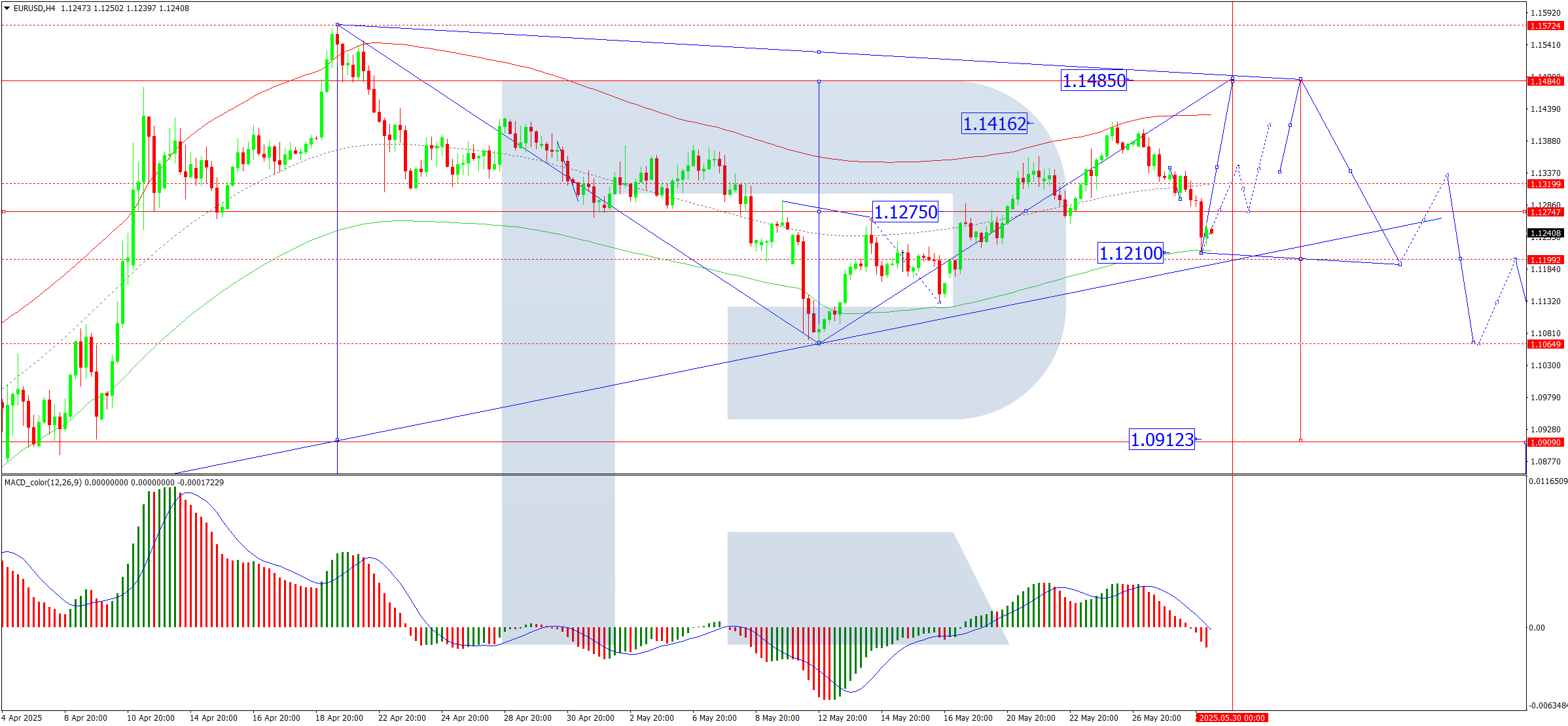
H4 chart

The EUR/USD pair has formed a consolidation range around 1.1358. We anticipate the downward wave to continue towards 1.1280, followed by a potential corrective rebound to 1.1427. A subsequent decline towards 1.1045 remains plausible. This scenario is technically supported by the MACD indicator, with its signal line firmly below zero and pointing downward.

H1 chart

On the hourly chart, the pair continues its downward trajectory towards 1.1280, with this level likely to be tested imminently. A corrective pullback towards 1.1427 may follow. The Stochastic oscillator corroborates this outlook, with its signal line currently below 20 and poised for an upward swing towards 80.

Conclusion

The EUR/USD remains confined within a consolidation phase, with trade developments and Fed policy expectations driving near-term volatility. Traders should monitor key support and resistance levels for confirmation of the next directional move.


Disclaimer

Any forecasts contained herein are based on the author’s particular opinion. This analysis may not be treated as trading advice. RoboForex bears no responsibility for trading results based on trading recommendations and reviews contained herein.

Why predicting battery performance is like forecasting traffic − and how researchers are making progress

By Emmanuel Olugbade, Missouri University of Science and Technology 

Lithium-ion batteries are quietly powering large parts of the world, including electric vehicles and smartphones. They have revolutionized how people store and use energy. But as these batteries become more central to daily life, they bring more attention to the challenges of managing them and the energy they store safely, efficiently and intelligently.

I’m a mechanical engineer who studies these nearly ubiquitous batteries. They have been around for decades, yet researchers like me are still trying to fully understand how these batteries behave – especially when they are working hard.

Batteries may seem simple, but they are as complicated as the real-world uses people devise for them.

The big picture

At their core, lithium-ion batteries rely on the movement of charged particles, called ions, of the element lithium between two electric poles, or electrodes. The lithium ions move from the positive electrode to the negative one through a conductive substance called an electrolyte, which can be a solid or a liquid.

The basics of how a lithium-ion battery works.

How much energy these batteries store and how well they work depends on a tangle of factors, including the temperature, physical structure of the battery and how the materials age over time.

Around the world, researchers are trying to answer questions about each of these factors individually and in concert with each other. Some research focuses on improving lifespan and calculating how batteries degrade over time. Other projects are tackling safety under extreme conditions, such as fast-charging use in extreme climates – either hot or cold. Many are exploring entirely new materials that could make batteries cheaper, longer-lasting or safer. And a significant group – including me – are working with computer simulations to improve real-time battery monitoring.

Real‑time monitoring in your electric vehicle’s battery system functions like a health check: It tracks voltage, current and temperature to estimate how much energy remains so you won’t be stranded with a dead battery.

But it’s difficult to precisely measure how well each of the energy cells within the battery is performing as they age or as the weather changes from cold in winter to hotter in summer. So the battery management system uses a computer simulation to estimate those factors. When combined with real-time monitoring, the system can prevent overusing the battery, balance charging speed with long-term health, avoid power failures and keep performance high. But there are a lot of variables.

The traffic analogy

One of the best ways to understand this challenge is to think about city traffic.

Let’s say you want to drive across town and need to determine whether your car has enough charge to travel the best route. If your navigation simulator accounted for every stoplight, every construction zone and every vehicle on the road, it would give you a very accurate answer. But it might take an hour to run, by which time the circumstances would have changed and the answer would likely be wrong. That’s not helpful if you’re trying to make a decision right now.

A simpler model might assume that every road is clear and every car is moving at the speed limit. That simulation delivers a result instantly – but its results are very inaccurate when traffic is heavy or a road is closed. It doesn’t capture the reality of rush hour.

While you’re driving, the battery management system would do a similar set of calculations to see how much charge is available for the rest of the trip. It would look at the battery’s temperature, how old it is and how much energy the car is asking for, like when going up a steep hill or accelerating quickly to keep up with other cars. But like the navigation simulations, it has to strike a balance between being extremely accurate and giving you useful information before your battery runs out in the middle of your trip.

The most accurate models, which simulate every chemical reaction inside the battery, are too slow for real-time use. The faster models simplify things so much that they miss key behaviors – especially under stress, such as fast charging or sudden bursts of energy use.

How researchers are bridging the gap

This trade-off between speed and accuracy is at the heart of battery modeling research today. Scientists and engineers are exploring many ways to solve it.

Some are rewriting modeling software to make the physics calculations more efficient, reducing complexity without losing the key details. Others, like me, are turning to machine learning – training computers to recognize patterns in data and make fast, accurate predictions without having to solve every underlying equation.

In my recent work, I used a high-accuracy battery simulator – one of the ones that’s really accurate but very slow – to generate a massive amount of data about how a battery functions when charging and discharging. I used that data to train a machine learning algorithm called XGBoost, which is particularly good at finding patterns in data.

Then I used software to pair the XGBoost system with a simple, fast-running battery model that captures the basic physics but can miss finer details. The simpler model puts out an initial set of results, and the XGBoost element fine-tunes those to make corrections on the fly, especially when the battery is under strain.

The result is a hybrid model that is able to respond both quickly and accurately to changes in driving conditions. A driver who floors the accelerator with just the simple model wouldn’t get enough energy; a more detailed model would give the right amount of energy only after it finished all its calculations. My hybrid model delivers a rapid boost of energy without delays.

Other teams are working on similar hybrid approaches, blending physics and artificial intelligence in creative ways. Some are even building digital twinsreal-time virtual replicas of physical batteries – to offer sophisticated simulations that update constantly as conditions change.

What’s next

Battery research is moving quickly, and the field is already seeing signs of change. Models are becoming more reliable across a wider range of conditions. Engineers are using real-time monitoring to extend battery life, prevent overheating and improve energy efficiency. Machine learning lets researchers train battery management systems to optimize performance for specific applications, such as high power demands in electric vehicles, daily cycles of home electricity use, short power bursts for drones, or long-duration requirements for building-scale battery systems.

And there’s more to come: Researchers are working to include other important factors into their battery models, such as heat generation and mechanical stress.

Some teams are taking hybrid models and compiling their software into lightweight code that runs on microcontrollers inside battery hardware. In practice, that means each battery pack carries its own brain on-board, calculating state-of-charge, estimating aging and tracking thermal or mechanical stress in near-real time. By embedding the model in the device’s electronics, the pack can autonomously adjust its charging and discharging strategy on the fly, making every battery smarter, safer and more efficient.

As the energy landscape evolves – with more electric vehicles on the road, more renewable energy sources feeding into the grid, and more people relying on batteries in daily life – the ability to understand what a battery is doing in real time becomes more critical than ever.The Conversation

About the Author:

Emmanuel Olugbade, Ph.D. Candidate in Mechanical Engineering, Missouri University of Science and Technology

This article is republished from The Conversation under a Creative Commons license. Read the original article.


Tourists are cancelling trips to the US – here’s how this could affect its economy

By Ross Bennett-Cook, Leeds Beckett University 

The United States is one of the top three most visited countries in the world. The big draw cards – cities such as San Francisco, New York and Chicago and national parks such as Yosemite – have attracted international tourists for decades. This combined with its role as a global business powerhouse meant it had 66.5 million visitors in 2023 – and the 2024 figure is expected to be higher still.

But a lot has changed in recent months, and 2025’s figures may not be as strong. The 2024 reelection of Donald Trump as the president of the United States and the consequential changes in foreign diplomacy and relations, alongside internal cultural shifts, are starting to change global attitudes towards the US – attitudes that appear to be affecting tourists’ desire to visit the US.

In a recent report by research firm Tourism Economics, inbound travel to the US is now projected to decline by 5.5% this year, instead of growing by nearly 9% as had previously been forecast. A further escalation in tariff and trade wars could result in further reductions in international tourism, which could amount to a US$18 billion (£13.8 billion) annual reduction in tourist spending in 2025.

There is already some evidence of travel cancellations. Since Trump announced 25% tariffs on many Canadian goods, the number of Canadians driving across the border at some crossings has fallen by up to 45%, on some days, when compared to last year. Canada is the biggest source of international tourists to the US. Air Canada has announced it is reducing flights to some US holiday destinations, including Las Vegas, from March, as demand reduces.

According to a March poll by Canadian market researcher Leger, 36% of Canadians who had planned trips to the United States had already cancelled them. According to data from the aviation analytics company OAG, passenger bookings on Canada to US routes are down by over 70% compared to the same period last year. This comes after the U.S. Travel Association warned that even a 10% reduction in Canadian inbound travel could result in a US$2.1 billion (£1.6 billion) loss in spending, putting 140,000 hospitality jobs at risk.

An unwelcoming environment?

Some would-be visitors have cited an unwelcoming political climate as part of a concern about visiting the US – including angry rhetoric about foreigners, migrants and the LGBTQ+ community. The Tourism Economics report also cited “polarizing Trump Administration policies and rhetoric” as a factor in travel cancellations.

There are other factors that may influence travellers from, for instance, western Europe, which represented 37% of overseas travel to the US last year. These include US tariffs pushing prices up at home and the US administration’s perceived alignment with Russia in the war in Ukraine.

Canadian trips to the US are going down.

Research by YouGov in March found that western European attitudes towards the US have become more negative since Trump’s reelection last November. More than half of people in Britain (53%), Germany (56%), Sweden (63%) and Denmark (74%) now have an unfavourable opinion of the US. In five of the seven countries polled, figures for US favourability are at the lowest since polling began in November 2016.

Border issues

Some high-profile cases at the US border could also be putting off tourists. In March, a British woman was handcuffed and detained for more than ten days by US Customs Enforcement after a visa problem. In the same month, a Canadian tourist was detained after attempting to renew her visa at the US-Mexico border. During the 12-day detention, she was held in crowded jail cells and even put in chains.

Mexico is the US’s second largest inbound travel market. Tourism Economics suggests that issues around new border enforcement rules will raise concerns with potential Mexican tourists. During Trump’s first term in office, Mexican visits to the US fell by 3%. In February this year, air travel from Mexico had already fallen 6% when compared to 2024.

Many countries including Canada have been updating their travel advice for the US. For instance, on March 15 the UK Foreign and Commonwealth Office updated its advice for the US, warning visitors that “you may be liable to arrest or detention if you break the rules”. The previous version of advice, from February, had no mention of arrest or detention. Germany has made similar updates to its travel advisory, after several Germans were recently detained for weeks by US border officials.

Multiple European countries, including France, Germany, Denmark and Norway have also issued specific travel warnings to transgender and non-binary citizens, as US authorities demand tourists declare their biological sex at birth on visa applications. This comes as the US has stopped issuing of passports with a X marker – commonly used by those identifying as non-binary – for its own citizens.

Alternative destinations

As thousands of travellers cancel their trips to the US, other destinations are seeing a spike in interest. Hotels in Bermuda have reported a surge in enquiries as Canadians relocate business and leisure trips away from the US, with some predicting a 20% increase in revenue from Canadian visits.

Europe too has reported increased bookings from Canada, with rental properties experiencing a 32% jump in summer reservations when compared to last year, according to some reports.

There are already growing concerns that visa and entry restrictions will disrupt fans and athletes from enjoying 2026 men’s Fifa World Cup, held on sites in the US, Canada and Mexico. Visitors from some countries, such as Brazil, Turkey and Colombia, could wait up to 700 days to obtain visas. The International Olympic Committee has also raised concerns over the 2028 Olympics Games in Los Angeles, although US officials have insisted that “America will be open”.

With mounting visa delays, stricter border enforcement and growing concerns over human rights and anti-minority rhetoric, the United States risks losing its appeal as a top holiday destination. The long-term impact on its tourism industry may prove difficult to reverse.The Conversation

About the Author:

Ross Bennett-Cook, PhD Researcher, Carnegie School of Sport, Leeds Beckett University

This article is republished from The Conversation under a Creative Commons license. Read the original article.


IMF World Economic Outlook: economic uncertainty is now higher than it ever was during COVID

By Sergi Basco, Universitat de Barcelona 

The International Monetary Fund (IMF) has just published its World Economic Outlook, and it does not take an expert to deduce that, even among some of the world’s top economic minds, confident predictions are currently hard to come by.

Every spring the IMF and World Bank hold their Spring Meetings in Washington DC: a week of seminars, briefings and press conferences focusing on the global economy, international development and world financial markets. At both the Spring Meetings and the Annual Meeting, held each autumn, the IMF publishes its global economic growth forecasts.

For its 2025 Spring Meeting the IMF has published a baseline forecast, as well as an addendum analysing the tariff events that took place between 9 and 14 April. According to the Fund’s report, world GDP will grow by 2.8% in 2025 and 3.0% in 2026. For the euro area, growth will be 0.8% and 1.2% for 2025 and 2026 respectively.

These forecasts represent a substantial downward revision from IMF figures published just three months ago. Globally, growth in 2025 is down by 0.5% compared to the Fund’s January update, with a reduction of 0.2% for the euro area.

One major shift is key to understanding the most recent IMF report and its pessimistic predictions: we live in a much more uncertain world than we did three months ago.

Trump, tariffs and uncertainty

If one had to sum up the new US tariff policy in a word, “unpredictable” would suffice, as the so-called “Liberation Day” of 2 April 2025 represented the largest tariff increase in modern history.

Just one week later, the US president then made two further announcements. First, a 90-day freeze on tariff hikes, apparently in search of bilateral agreements with the countries to which he had applied tariffs above 10%. Second, that China would be excluded from this exception, with tariffs on its products being raised to 145%.

This freeze means that until July EU goods being sold to the US will have a 10% tariff instead of the 20% that was announced on 2 April. However, the 10% applied by the new US administration is still much higher than the average tariff of 1.34% that was in force before 5 April.

But what will the tariff be after these 90 days? What about in December? What about in 2 years’ time? What goods will be exempted? How far will the trade war between China and the US go? The answer to all of these questions is: nobody knows. This uncertainty is evident in of the IMF’s spring forecast.

Uncertainty is off the charts

The IMF’s world trade uncertainty index is currently 7 times higher than it was in October 2024, much higher than in the pandemic.

As far as the economy is concerned, this uncertainty is far worse than a high but definitive tariff. With a tariff, companies can at least reorganise their production chain, and consumers can look for alternative products. There is a cost, but at least businesses and consumers can plan for it.

However, nobody can calculate these costs today because nobody knows how tariffs will evolve. An American company may decide today to buy a particular product from the EU thinking that the tariff will be 10%, but upon the product’s arrival in the US it turns out the tariff has risen to 100% because a presidential advisor said it would be good for the US economy to raise tariffs on that product.

Unbelievable though it may sound, this appears to be how the tariffs are being decided and enacted. According to one account, the US Treasury and Commerce Secretaries were only able to persuade Trump to freeze recent tariff hikes because Peter Navarro – the president’s economic advisor and tariff ideologue – was in another room at the time.

The end result of this unpredictability is that the best course of action, for consumers and businesses alike, is inaction.

Fear and volatility

It is no surprise that these constant changes of plans are causing great instability in financial markets. Although Trump may have triumphantly celebrated rising stock prices immediately after the tariff freeze was announced, financial markets are now subject to levels of uncertainty and fear similar to those seen during COVID-19.

Five years ago, volatility was associated with increased demand for US government debt due to the “flight to safety” effect: investors selling higher risk investments and buying safer assets, such as gold and government bonds, in times of uncertainty.

Now we are seeing the exact opposite. The price of US bonds has fallen since “Liberation Day”, and this means that investors are selling them. In other words, markets no longer believe that US government debt is a safe asset. Given the role of the dollar and US debt in international markets, this paradigm shift may generate even more financial instability down the line.

Supply chains are breaking (again)

COVID-19, the last major global economic crisis, has one thing in common with the current situation: disruption of global supply chains. During the pandemic it was confinement that forced production to stop. Today, it is the imposition of tariffs.

However, there is another major difference. During COVID people knew it was a matter of time before vaccines became available and normality returned. Today, instability in financial markets comes not from any virus, but from President Trump’s own advisors selling him all manner of plans to protect US economic interests.The Conversation

About the Author:

Sergi Basco, Profesor Agregado de Economia, Universitat de Barcelona

This article is republished from The Conversation under a Creative Commons license. Read the original article.


The focus of investors’ attention remains on the US tariff policy

By JustMarkets 

As of Wednesday, the Dow Jones Index (US30) rose by 1.07%. The S&P 500 Index (US500) gained 1.67%. The Nasdaq Technology Index (US100) was up 2.28%. Easing trade tensions between the US and China and President Trump’s assurances that he will not remove Fed Chairman Jerome Powell continue to boost sentiment.

The first-quarter earnings reporting season is in full swing. According to data compiled by Bloomberg Intelligence, market consensus expects first-quarter annualized first-quarter earnings growth of 6.7% for S&P 500 stocks, down from expectations of 11.1% in early November. Boeing (BA) rose more than 6% and topped the Dow Jones Industrials after reporting first-quarter revenue of $19.50 billion, better than the consensus expectations of $19.37 billion. Intel (INTC) closed higher by more than 6% after Bloomberg reported that the company plans to cut more than 20% of its workforce to streamline operations. Tesla (TSLA) shares rose by 5.4% after CEO Elon Musk announced that he will significantly reduce his involvement in the government to focus on running his companies.

The Canadian dollar weakened to US$1.39, down from a six-month high of US$1.38 on April 22, as it came under pressure from a recovering US dollar. Meanwhile, the IMF’s downgrade of Canada’s 2025 GDP expectations to 1.4% has renewed concerns about domestic demand, limiting Lonnie’s upside potential. And the Bank of Canada’s decision to keep the benchmark rate at 2.75% reflects caution amid the unclear outlook for US tariffs, which could either support sustainable growth with inflation around 2% or, if tariffs intensify, create the risk of recession and higher inflation.

Equity markets in Europe were mostly up on Wednesday. Germany’s DAX (DE40) rose by 3.14%, France’s CAC 40 (FR40) closed 2.13% higher, Spain’s IBEX 35 (ES35) gained 1.52%, and the UK’s FTSE 100 (UK100) closed positive 0.90%. European stocks closed sharply higher on Wednesday, following strong momentum in stock markets around the world after the US presidential administration signaled that tariffs against China are likely to be reduced or eliminated soon.

WTI crude prices fell below $62.6 a barrel on Wednesday, down 9% since early April, amid the likelihood that OPEC+ will continue to increase supply in the coming months. Key OPEC+ member Kazakhstan has said it will put national interests ahead of OPEC+ rules, signaling increased production for a key pool of consumers and raising tensions between cartel members as many countries fight to keep production below their quotas. That prompted individual cartel members to call for another production increase in June, adding to surprise plans to raise output three times faster than expected in May.

Asian markets were predominantly rising yesterday. Japan’s Nikkei 225 (JP225) gained 1.89% yesterday, China’s FTSE China A50 (CHA50) climbed 0.02%, Hong Kong’s Hang Seng (HK50) added 2.37%, and Australia’s ASX 200 (AU200) closed positive 1.33%.

Consumer sentiment in New Zealand rose to a 4-month high. The ANZ-Roy Morgan Consumer Confidence Index rose by 5 points to 98.3 in April, the highest reading since December, reinforcing a recovery that had begun to falter. The rise in the index was broad-based, with the current Conditions Index and future Conditions Index rising by 6 and 4 points, respectively.

S&P 500 (US500) 5,375.86 +88.10 (+1.67%)

Dow Jones (US30) 39,606.57 +419.59 (+1.07%)

DAX (DE40) 21,961.97 +668.44 (+3.14%)

FTSE 100 (UK100) 8,403.18 +74.58 (+0.90%)

USD Index 98.87 +0.95 (+0.96%)

News feed for: 2025.04.24

  • German IFO Business Climate (m/m) at 11:00 (GMT+3);
  • Mexican Inflation Rate (m/m) at 15:00 (GMT+3);
  • US Durable Goods Orders (m/m) at 15:30 (GMT+3);
  • US Initial Jobless Claims (w/w) at 15:30 (GMT+3);
  • US Existing Home Sales (m/m) at 17:00 (GMT+3);
  • Natural Gas Storage (w/w) at 17:30 (GMT+3).

By JustMarkets


This article reflects a personal opinion and should not be interpreted as an investment advice, and/or offer, and/or a persistent request for carrying out financial transactions, and/or a guarantee, and/or a forecast of future events.

Can Alphabet’s Q1 earnings arrest its stock’s slump?

By ForexTime 

  • Alphabet’s stocks down 19.2% year-to-date; market cap now US$ 1.86 trillion
  • Company set to unveil Q1 earnings after US markets close Thursday, April 24th
  • Investors eager for updates on Cloud margins, AI capex plans, tariff impact
  • Alphabet’s share price forecasted to move 5.8% up/down when US markets reopen Friday
  • Wall Street lowers 12-month target price; still a strong buy with 33% potential upside


After US markets close this Thursday, April 24th, Alphabet is set to unveil its Q1 financial results.

Despite a rebound yesterday (Tuesday, April 22nd), Big Tech stocks have been languishing in the run up to this upcoming set of earnings reports.

The current record high of US$208.60 for Alphabet’s C-class shares (no voting rights) were from February 4ththe day of its last earnings announcement – when it announced slowing growth in its Cloud segment and lower-than-expected revenue in Q4 2024.

Since then, this stock has fallen:

  • Intraday prices: as much as 31.6% (Feb 4th intraday high through April 7th intraday low)
  • Closing prices: 26.2% lower (Feb 4th close through April 22nd close)
Imagen
Alphabet’s Q1 earnings due after US markets close April 24, 2025

Why are US tech stocks falling?

US President Donald Trump’s erratic policy rollout, especially surrounding trade tariffs, have dented the aura surrounding “US exceptionalism”.

US tech stocks certainly have been one of the primary victims from this major blow to risk-taking activities across global financial markets.

For comparison, the 19.2% year-to-date drop in Alphabet’s C-class shares:

  • are almost double the S&P 500’s 10.1% decline so far this year
  • exceeds the tech-heavy Nasdaq 100 index’s 13% year-to-date drop


Alphabet’s Q1 earnings: What to look out for?


1) Cloud compression?

Revenue from its Cloud segment is expected to breach US$12.3 billion for Q1 2025 – the segment’s highest ever top line number.

However, the operating income for the segment is expected to dip back below the US$ 2 billion figure:

  • Q4 2024: $2.09B down to …
  • Q1 2025: US$1.94B … marking the first contraction for this line item since Q3 2023.

Investors and analysts will be keen to find out how Alphabet can buttress its Cloud margins, even as rising AI-fueled demand also requires more infrastructure investments.

NOTE: According to Alphabet CEO Sundar Pichai, Google’s Cloud is still smaller in size relative to Amazon’s and Microsoft’s.


And that brings us to the second key area to look out for …

2) AI integration (Gemini, AI agents) and capital expenditure (capex) plans

The integration of Gemini appears to be central to the growth of Alphabet’s Search segment – which accounts for more than half (55 – 57%) of total revenue in recent quarters.

Also, Gemini and other AI use cases are expected to help grow its Cloud segment from its:

  • Q1 2024: 11.9% of total company revenue for the quarter
  • Q1 2025: 13.8% of total company revenue for the quarter

Looking ahead, recall that the company had already issued capex guidance for US$75 billion for this year’s capex.

And that’s despite the risks posed DeepSeek’s apparent showing that AI gains can be achieved using lower-cost models.

The slightest hint of a pullback in capex plans could send Alphabet’s stocks tumbling on fears that the fervor for all things AI is losing momentum still.


3) Tariff impact

Since the flurry of tariff-related announcements this month, the expected impact on Alphabet’s financial figures appears limited to its:

  • hardware sales (think Pixel phones) and also …
  • Cloud infrastructure (think of the chips required to build out Alphabet’s data centers).

Hence, Alphabet’s share price is bound to reflect the company’s guidance on the tariffs’ impact on future earnings.


Beyond the main themes listed above, here are some headline Q1 figures to look out for:

  • Revenue: forecasted at US$75.4 billion
  • Net income: forecasted at US$24.7 billion
  • Earnings per share (EPS): forecasted at US$ 2.04


Potential Post-Earnings Scenarios

Note that markets currently predict that Alphabet’s stocks could move 5.8% up or down when US markets reopen on Friday, April 25th – the day after Alphabet’s Q1 earnings announcement.

  • BULLISH: Should Alphabet’s past quarterly financials and forward guidance help restore sentiment surrounding this stock, that could help pare its year-to-date declines.

Using Tuesday’s closing price of $154.02 as a reference point, a 5.8% climb would see this stock breaking above its 21-day simple moving average (SMA) and reaching around $163 – closing in on its mid-April intraday high.

  • BEARISH: Should Alphabet announce lower-than-expected Q1 2025 financial results, while citing greater concern about its earnings outlook, a 5.8% move downwards from Tuesday’s closing price should see this stock opening around $145 this Friday.

Still, much may yet happen across US stock markets over the next 2 days (Wednesday’s and Thursday’s cash sessions) which could drastically alter the above-listed numbers.


Over the next 12 months …

Wall Street analysts are still bullish on this stock, with:

  • 20 “Buy” calls
  • 1 “Hold”
  • 0 “Sells”

By this time in 2026, this stock is forecasted to have an upside potential of 34%, eventually touching $205.33.

To be clear, so far this month, many research houses including Morgan Stanley, UBS, Citi, Mizuho, and Bank of America have lowered their respective 12-month target prices on this stock.

And there’s bound to be more revisions after what Alphabet conveys to the world this week.

In short, this upcoming earnings release is set to hold great influence over how Alphabet’s shares perform, both in the immediate aftermath, and for the longer-term.


Forex-Time-LogoArticle by ForexTime

ForexTime Ltd (FXTM) is an award winning international online forex broker regulated by CySEC 185/12 www.forextime.com

Gold’s Downturn Won’t Last: Global Risks Remain Elevated

By RoboForex Analytical Department 

The gold price rebounded to $3,350 per troy ounce on Thursday after two consecutive days of steep declines unsettled investors. However, this dip is likely temporary.

Key Drivers Behind Gold’s Movements

U.S. Treasury Secretary Scott Bessent noted that high tariffs between the U.S. and China must be reduced before trade negotiations progress. However, he stressed that President Donald Trump would not unilaterally remove tariffs on Chinese goods.

Trump’s immediate focus includes exempting automakers from certain tariffs following weeks of intense discussions with industry leaders—a move that has partially eased concerns over trade complications.

Gold has surged over 30% since the start of the year, and the gold-to-silver ratio has hit its highest level since 1994 (excluding the pandemic period).

The primary catalyst behind gold’s rally is waning confidence in U.S. economic exceptionalism, driven by escalating trade barriers and unpredictable policy shifts. This has prompted investors to shift from U.S. assets to gold as a safe haven.

Technical Analysis: XAU/USD

On the H4 chart of XAU/USD, the market is forming a downside wave structure to the 3225 level. Today we will consider the probability of reaching this target level. Further we will consider the probability of correction development to the level of 3363. After the completion of this correction, we will consider the probability of a new wave of decline to the level of 3055. The target is local. Technically, this scenario is confirmed by the MACD indicator. Its signal line is above the zero level and is directed strictly downwards.

On the H1 chart of XAU/USD the market formed a consolidation range around the level of 3363 and worked off the third wave of decline to the level of 3260 with a downward exit. Today the correction to the level of 6363 is executed. In the future it will be relevant to consider the development of the fifth wave of decline to the level of 3232, at least. Technically, this scenario is confirmed by the Stochastic oscillator. Its signal line is under the level of 50 and is directed strictly downwards to the level of 20.

Conclusion

Despite recent volatility, gold’s long-term bullish case remains intact, supported by persistent global risks and shifting investor sentiment.


Disclaimer

Any forecasts contained herein are based on the author’s particular opinion. This analysis may not be treated as trading advice. RoboForex bears no responsibility for trading results based on trading recommendations and reviews contained herein.

IMF warns that US tariffs portend a slowdown in global economic growth

By JustMarkets 

The Dow Jones (US30) Index was up 2.66% at Tuesday’s close. The S&P500 Index (US500) added 2.51%, and the Nasdaq Technology Index (US100) increased by 2.63%. US stocks rose on Tuesday as hopes of an easing trade war between the US and China lifted investor sentiment after a sharp drop the previous day. Meanwhile, concerns over President Trump’s attacks on Fed Chairman Jerome Powell persisted, contributing to recent market volatility.

Technology stocks led the rise, with Tesla shares up 4.6% ahead of its earnings release, although the company has fallen 40% in the period since. On the earnings side, General Electric shares jumped 6.1% after the release of results, while Verizon shares added 0.6% after the earnings release.

Producer prices for manufactured goods (a leading indicator of consumer inflation) in Canada rose by 0.5% month-over-month in March 2025, following an upwardly revised 0.6% increase in February and above market forecasts expecting a 0.3% increase. This marked the sixth consecutive monthly increase. Excluding energy and petroleum products, CPI rose by 1%. On an annualized basis, producer prices rose by 4.7%.

The IMF has warned that rising tariffs in the US mark the start of a new global era of slowing growth. President Trump has imposed massive import duties since January, triggering retaliatory tariffs and raising trade barriers to levels not seen since the Great Depression. The IMF has cut its global growth forecast 2024 to 2.8% from 3.3% and expects further weakening through 2026. The US will be hit hardest, with growth in 2025 falling to 1.8 % from 2.7 %. Mexico, China, and the Eurozone will also feel the effects. Although Trump claims the tariffs will revive US manufacturing, the IMF believes the real cause of job losses is automation, not trade. It warns that tariffs will hurt innovation and competitiveness in the long term.

Equity markets in Europe were mostly up on Tuesday. Germany’s DAX (DE40) rose by 0.41%, France’s CAC 40 (FR40) closed 0.56% higher, Spain’s IBEX 35 (ES35) gained 0.72%, and the UK’s FTSE 100 (UK100) closed 0.64% higher yesterday. On Tuesday, European stocks reversed early losses. They closed higher, benefiting from a rebound in US stocks as markets continued to assess how the risks of reduced trade relations with the US could affect European corporate giants. Automakers were among the session’s top gainers, with Mercedes-Benz, BMW, and Volkswagen adding more than 2%. Banks, meanwhile, rose steadily, with BNP Paribas, Intesa Sanpaolo, and ING adding around 1.5%. However, UniCredit fell nearly -3% after the Italian government placed restrictions on the lender’s bid to acquire Banco BPM. On the earnings side, L’Oreal shares rose more than 6% after posting strong results.

Silver prices (XAG/USD) are down nearly 1% to $32.30 an ounce on Tuesday as investors lock in profits after the precious metal’s strong rally. The pullback came after recent gains driven by safe-haven demand amid growing concerns about the impact of escalating trade tensions on the global economy. Market sentiment worsened due to stalled trade talks between the US and China, with Beijing accusing Washington of abusing tariffs and warning other countries against unilateral deals.

WTI crude prices rose above $64 a barrel on Wednesday, extending gains of more than 2% from the previous session, helped by new US sanctions and a sharp decline in crude inventories. The US has imposed new restrictions on a key Iranian figure supplying liquefied natural gas and crude oil. Meanwhile, industry data showed that US crude oil inventories fell by 4.6 million barrels last week, which could be the largest decline since November.

Asian markets traded flat. Japan’s Nikkei 225 (JP225) was down 0.17% yesterday, China’s FTSE China A50 (CHA50) was up 0.33%, Hong Kong’s Hang Seng (HK50) added 0.78%, and Australia’s ASX 200 (AU200) closed 0.03%.

Malaysia’s annual inflation rate eased to 1.4% in March 2025 from 1.5% in the previous month, the lowest since February 2021 and below market forecasts of 1.6%. Core consumer prices, excluding volatile fresh food and administrative expenses, rose to 1.9% y/y, holding steady for the second month and remaining at the lowest level in six months.

Singapore’s annual inflation rate for March 2025 was 0.9%, unchanged from the previous month but slightly below market expectations of 1%. The rate remained at its lowest level since February 2021.

S&P 500 (US500) 5,287.76 +129.56 (+2.51%)

Dow Jones (US30) 39,186.98 +1,016.57 (+2.66%)

DAX (DE40) 21,293.53 +87.67 (+0.41%)

FTSE 100 (UK100) 8,328.60 +52.94 (+0.64%)

USD index 98.99 +0.71 (+0.72%)

News feed for: 2025.04.23

  • Australia Manufacturing PMI (m/m) at 02:00 (GMT+3);
  • Australia Services PMI (m/m) at 02:00 (GMT+3);
  • Japan Manufacturing PMI (m/m) at 03:30 (GMT+3);
  • Japan Services PMI (m/m) at 03:30 (GMT+3);
  • Singapore Consumer Price Index (m/m) at 08:00 (GMT+3);
  • German Manufacturing PMI (m/m) at 10:30 (GMT+3);
  • German Services PMI (m/m) at 10:30 (GMT+3);
  • Eurozone Manufacturing PMI (m/m) at 11:00 (GMT+3);
  • Eurozone Services PMI (m/m) at 11:00 (GMT+3);
  • UK Manufacturing PMI (m/m) at 11:30 (GMT+3);
  • UK Services PMI (m/m) at 11:30 (GMT+3);
  • Eurozone Trade Balance (m/m) at 12:00 (GMT+3);
  • US Manufacturing PMI (m/m) at 16:45 (GMT+3);
  • US Services PMI (m/m) at 16:45 (GMT+3);
  • US New Home Sales (m/m) at 17:00 (GMT+3);
  • US Crude Oil Reserves (w/w) at 17:30 (GMT+3);
  • UK BOE Gov Bailey Speaks at 19:30 (GMT+3).

By JustMarkets


This article reflects a personal opinion and should not be interpreted as an investment advice, and/or offer, and/or a persistent request for carrying out financial transactions, and/or a guarantee, and/or a forecast of future events.

Pound Hits Fresh High Against the US Dollar Before Correcting: What’s Driving GBP/USD?

By RoboForex Analytical Department 

GBP/USD reached a seven-month peak at 1.3423 — its highest level since 26 September 2024 — before entering a corrective phase.

Key Drivers Behind GBP/USD Movements

Market concerns over US President Donald Trump’s criticism of Federal Reserve Chair Jerome Powell have eased. Trump has since clarified that Powell will not be dismissed, though he expressed frustration over the Fed’s reluctance to cut interest rates sooner.

The US Dollar’s rebound against the Pound followed the release of UK inflation data and a slightly weaker outlook for the labour market. Although the figures were published last week, the market has only now fully digested their implications.

In March, the UK Consumer Price Index (CPI) slowed to a three-month low. Meanwhile, the employment sector appears vulnerable ahead of another planned rise in employer taxes, due by the end of April.

Current market expectations suggest the Bank of England (BoE) will cut interest rates by 25 basis points (bps) in May, with an additional 85 bps of easing anticipated by year-end.

While US tariff policies are unlikely to directly impact UK inflation, their broader effect may contribute to lower rather than higher price pressures.

Technical Analysis: GBP/USD

H4 Chart Overview

  • The pair formed a consolidation range near 1.3066 before breaking upwards in a wave structure towards 1.3420.
  • A corrective pullback to 1.3200 is now underway.
  • The next phase may see a resumption of upward momentum towards 1.3310, potentially establishing a new consolidation range around this level.
  • The MACD indicator supports this outlook, with its signal line exiting the histogram area and pointing sharply downward, suggesting near-term bearish momentum.


H1 Chart Overview

  • GBP/USD broke below 1.3310, hitting a local downside target at 1.3233.
  • Today, the pair retested 1.3310 from below, and further downside movement towards 1.3200 is now in focus.
  • The Stochastic oscillator aligns with this view, as its signal line remains below 80 and is trending downward towards 20, indicating weakening bullish momentum.


Conclusion

The GBP/USD rally has paused as traders assess mixed UK economic data and shifting Fed policy expectations. While near-term corrections are likely, the broader trend could see renewed upside if key support levels hold. Technical indicators suggest further consolidation before the next decisive move.


Disclaimer

Any forecasts contained herein are based on the author’s particular opinion. This analysis may not be treated as trading advice. RoboForex bears no responsibility for trading results based on trading recommendations and reviews contained herein.