The Analytical Overview of the Main Currency Pairs on 2022.07.26

By JustForex

The EUR/USD currency pair

Technical indicators of the currency pair:
  • Prev Open: 1.0208
  • Prev Close: 1.0218
  • % chg. over the last day: -0.10%

The US central bank has no reason to get more hawkish, especially as the economy may be on the verge of recession. According to analysts, lower inflation expectations and an expected decline in the consumer price index are imminent in the coming months. It means that the Fed’s peak hawkishness has likely passed, removing a powerful bullish catalyst from the US dollar. On that basis, the most likely scenario of this week’s Fed meeting will be a 75 basis point rate hike. And this scenario is already priced in.

Trading recommendations
  • Support levels: 1.0181, 1.0106, 1.0035, 1.0000
  • Resistance levels: 1.0250, 1.0284, 1.0365, 1.0415, 1.050

From the technical point of view, the trend on the EUR/USD currency pair on the hourly time frame is bullish. The price is forming a wide balance, and the MACD indicator has become inactive, but the buyers’ pressure remains. Under such market conditions, it is best to look for buy trades on intraday time frames from the support level of 1.0181 or 1.0106, but only with confirmation. Sell trades can be considered from the resistance level of 1.0250 or 1.0284, but only after additional confirmation and only with short targets.

Alternative scenario: if the price breaks down through the 1.0000 support level and fixes below, the downtrend will likely resume.

EUR/USD
News feed for 2022.07.26:
  • – US CB Consumer Confidence (m/m) at 17:00 (GMT+3);
  • – US New Home Sales (m/m) at 17:00 (GMT+3).

The GBP/USD currency pair

Technical indicators of the currency pair:
  • Prev Open: 1.1993
  • Prev Close: 1.2046
  • % chg. over the last day: +0.44%

Despite gains in recent days, fundamentally, the British currency remains weak as the struggle for the Conservative Party leadership highlights the problems facing the country. The latest data from the US Commodity Futures Trading Commission shows that investors slightly reduced their net short positions in the sterling last week, halting a two-week rise but still keeping the market negative for the pound. As the race for the Prime Minister’s seat intensifies, analysts will be watching today’s televised debate between Foreign Secretary Liz Truss and former Finance Minister Rishi Sunak. Many expect UK policy to increase negative sentiment against the sterling in the coming months.

Trading recommendations
  • Support levels: 1.2000, 1.1907, 1.1803
  • Resistance levels: 1.2085, 1.2137

From the technical point of view, the trend on the GBP/USD currency pair on the hourly time frame is bullish. Buyers’ pressure has intensified. The MACD indicator is positive again, but there are signs of divergence. Under such market conditions, buy trades are best to look at intraday time frames from the support level of 1.2000, but only with confirmation. Sell trades can be considered from the resistance level of 1.2085, but only after additional confirmation and with short targets.

Alternative scenario: if the price breaks down through the 1.1907 support level and fixes below, the downtrend will likely resume.

GBP/USD
There is no news feed for today.

The USD/JPY currency pair

Technical indicators of the currency pair:
  • Prev Open: 136.09
  • Prev Close: 136.65
  • % chg. over the last day: +0.41%

According to the monetary policy minutes report, the Bank of Japan expects core consumer prices (excluding food and fuel) in Japan to rise by 2.3% this fiscal year on an annualized basis, mainly due to Russia’s invasion of Ukraine and the impact of yen depreciation. For the fiscal 2023 year, the forecasts are a 1.7% increase in consumer prices. Crude oil and other energy prices are expected to remain high. So, there are no fundamental reasons for the yen to strengthen at the moment, and the decrease in USD/JPY quotes occurs mainly due to the decline in the US Dollar Index.

Trading recommendations
  • Support levels: 135.99, 135.40, 134.64, 134.11
  • Resistance levels: 136.60, 137.26, 137.81, 138.25, 138.56, 140.29

From the technical point of view, the medium-term trend on the USD/JPY currency pair is bearish. The price is trading below the moving averages. The MACD indicator is not active. It should be noted that any fundamental factors do not accompany the fall in the USD/JPY quotes, so selling is still a very cautious option. Under such market conditions, buy trades can be searched for intraday from the support level of 135.99, but with additional confirmation. For sell deals, traders can consider the resistance level of 136.60 or 137.26, but only with additional confirmation and short targets.

Alternative scenario: If the price fixes above 138.25, the uptrend will likely resume.

USD/JPY
News feed for 2022.07.26:
  • – Japan Monetary Policy Meeting Minutes (m/m) at 02:50 (GMT+3).

The USD/CAD currency pair

Technical indicators of the currency pair:
  • Prev Open: 1.2917
  • Prev Close: 1.2846
  • % chg. over the last day: -0.55%

The Canadian dollar is a commodity currency, so rising oil prices are strengthening the Canadian currency. The Bank of Canada, as well as the Fed, is on the path of aggressive interest rate increases. The difference between rates is minimal. The Central Bank of Canada holds the rate at 2.5%, while the Fed has a rate of 1.75%. A 0.75% rate hike on Wednesday would put both central banks’ rates at 2.5%. Therefore, traders should not expect a medium-term trend on the USD/CAD currency pair right now.

Trading recommendations
  • Support levels: 1.2781
  • Resistance levels: 1.2841, 1.2912, 1.3006, 1.3085, 1.3154

In terms of technical analysis, the trend on the USD/CAD currency pair is bearish. At the moment, the price is forming a balance and trading at the levels of the moving lines. The MACD indicator has become negative again. Under such market conditions, it is best to consider sell deals from the resistance level of 1.2841 or 1.2912, but with confirmation. Buy trades should be considered on the lower time frames from the support level 1.2781, but only with confirmation and short targets.

Alternative scenario: if the price breaks out and consolidates above the 1.3006 resistance level, the uptrend will likely resume.

USD/CAD
There is no news feed for today.

By JustForex


This article reflects a personal opinion and should not be interpreted as an investment advice, and/or offer, and/or a persistent request for carrying out financial transactions, and/or a guarantee, and/or a forecast of future events.

Traders focus on big-company reports today

By JustForex

The Dow Jones index had a positive start to the week on Monday as a rally in energy offset weakness in the technology sector ahead of quarterly reports from major technology companies and a Federal Reserve meeting. As the stock market closed yesterday, the Dow Jones index (US30) increased by 0.28%, and the S&P 500 Index (US500) added 0.13%. The Technology Index NASDAQ (US100) was down by 0.35% yesterday.

The threat of a recession could push the Fed to roll back its hike cycle as the central bank tries to get a soft landing for the US economy, and raising interest rates brings the US economy closer to recession. According to analysts, lower inflation expectations and an expected decline in the Consumer Price Index are imminent in the coming months. That means the Fed’s hawkishness is at its peak, and a change in the Fed’s outlook could lead to a bearish US dollar reaction.

On Monday, US retailer Walmart (WMT) Inc lowered its earnings forecast and said shoppers are cutting back on discretionary purchases as inflation hits family budgets. Shares of WMT fell by 10% on the report.

Microsoft (MSFT), Alphabet (GOOGL), Visa (V), Louis Vuitton ADR (LVMUY), Coca-Cola (KO), McDonald’s (MCD), United Parcel Service (UPS), Texas Instruments (TXN), Raytheon Technologies (RTX), Unilever ADR (UL), 3M (MMM), General Electric (GE), General Motors (GM) and others report today.

Equity markets in Europe were mostly up yesterday. German DAX (DE30) was down by 0.33% on Monday, French CAC 40 (FR40) gained 0.33%, Spanish IBEX 35 (ES35) gained0.42%, British FTSE 100 (UK100) was up by 0.41%.

Business sentiment in Germany is cooling down. The Ifo Business Climate Index fell to 88.6 points in July from 92.2 points (seasonally adjusted) in June and reached its lowest value since June 2020. Companies expect doing business to become much more difficult in the coming months. Higher energy prices and the threat of gas shortages are putting pressure on the economy. Germany is on the verge of a recession.

Oil rose in volatile trading ahead of the Federal Reserve’s rate decision this week. Oil prices increased amid expectations that a reduction in natural gas supplies from Russia to Europe could encourage a switch to crude oil.

Asian markets traded lower yesterday. Japan’s Nikkei 225 (JP225) decreased by 0.77%, Hong Kong’s Hang Seng (HK50) fell by 0.22%, and Australia’s S&P/ASX 200 (AU200) ended the day gaining 0.02%.

Singapore’s Consumer Price Index rose from 5.6% to 6.7% year on year, surpassing economists’ median estimate of 6.2%. The last time such a figure was in 2008. The core Consumer Price Index, which excludes fuel and living expenses, increased to 4.4% in June from 3.6% in May. According to experts, a rebound in domestic demand in some regional economies as the Covid-19 restrictions are loosened could lead to a further rise in inflation.

In Australia, inflation data will be released on Wednesday. In addition to being an important indicator, Australia publishes consumer price data once a quarter. The RBA is expected to hold its monetary policy meeting next week. It is expected that inflation will rise to 4.7% YoY from 3.7%. Thus, the most likely scenario for the central bank’s further actions is another 0.5% rate hike.

S&P 500 (F) (US500) 3,966.84 +5.21 (+0.13%)

Dow Jones (US30) 31,990.04 +90.75 (+0.28%)

DAX (DE40) 13,210.32 −43.36 (−0.33%)

FTSE 100 (UK100) 7,306.30 +29.93 (+0.41%)

USD Index 106.43 −0.30 (−0.28%)

Important events for today:
  • – Japan Monetary Policy Meeting Minutes (m/m) at 02:50 (GMT+3);
  • – US CB Consumer Confidence (m/m) at 17:00 (GMT+3);
  • – US New Home Sales (m/m) at 17:00 (GMT+3).

By JustForex


This article reflects a personal opinion and should not be interpreted as an investment advice, and/or offer, and/or a persistent request for carrying out financial transactions, and/or a guarantee, and/or a forecast of future events.

Big Tech earnings and Fed meeting in focus

By ForexTime

Asian markets edged higher on Tuesday, drawing support from China’s technology sector as investors braced for another busy and potentially volatile week for financial markets.

Overnight, Wall Street delivered a mixed performance thanks to the growing caution ahead of earnings from the tech titans, as well as the Federal Reserve decision on Wednesday. In the FX space, the dollar weakened against most G10 currencies while gold traded within a tight range, waiting for a fresh fundamental catalyst. Oil prices are on the front foot this morning following reports that Russia plans to tighten its gas supplies on Europe.

On the data front, the IMF will be in focus today as it releases an updated world economic outlook. There are also a couple of key economic releases from major economies over the next few days, especially in the United States. It may be wise to keep an eye out on the latest US consumer confidence report for July, US Q2 GDP, and the PCE core deflator among other key economic releases.

The tech megacaps will be under the spotlight as they publish their earnings this week. Google’s parent company, Alphabet, and Microsoft announce their results today after US markets close. Meta, Amazon, and Apple report their earnings over the next few days. If these titans report much better than expected quarterly result, this could support US equity markets, especially the Nasdaq 100 which is down almost 25% year-to-date.

It’s all about the Fed meeting

The Federal Reserve is widely expected to raise interest rates by 75-basis points for a second straight meeting tomorrow. However, the main focus will be directed towards Fed Chair Jerome Powell’s post-meeting conference. When considering how financial markets remain highly sensitive to any topic relating to inflation and interest rates, Powell will have to choose his words very wisely. He is likely to highlight the Fed’s determination to extinguish inflation while inflicting more pain on the economy with continued policy tightening. While the U.S economy seems to be holding steady with the latest employment numbers encouraging, inflation remains a cause for concern as consumer prices jumped 9.1% in June from a year earlier. There have also been worrying signs from recent data with weakness in business survey data and the jobless claims.

If the Fed moves ahead with a 75-basis point hike, this may not be enough to keep dollar bulls in the driving seat. Such a move needs to be complemented by firmly hawkish comments from Powell, feeding speculation around more aggressive hikes this year. Should the Fed surprise the market with a smaller than expected hike, this could send the dollar tumbling with a cautious-sounding Powell adding insult to injury. Whatever the outcome of the Fed meeting, it is likely to influence the dollar which has weakened against most G10 currencies this week.

Commodity spotlight – Gold

Gold is likely to remain on standby until the Fed rate decision on Wednesday. The precious metal has barely moved since Monday due to the absence of a fresh directional catalyst. It will be interesting to see how gold reacts when the Fed moves ahead with a 75-basis rate hike. Will the precious metal weaken due to its zero-yielding status? Or will a weaker dollar limit downside losses?

Looking at the technical picture, prices are trading around the $1724 level as of writing. The $1700 remains a key point of interest this week and a level that can determine whether gold rebounds or extends the decline.


Forex-Time-LogoArticle by ForexTime

ForexTime Ltd (FXTM) is an award winning international online forex broker regulated by CySEC 185/12 www.forextime.com

Cross-pollination among neuroscience, psychology and AI research yields a foundational understanding of thinking

By Paul S. Rosenbloom, University of Southern California; Christian Lebiere, Carnegie Mellon University, and John E. Laird, University of Michigan 

Progress in artificial intelligence has enabled the creation of AIs that perform tasks previously thought only possible for humans, such as translating languages, driving cars, playing board games at world-champion level and extracting the structure of proteins. However, each of these AIs has been designed and exhaustively trained for a single task and has the ability to learn only what’s needed for that specific task.

Recent AIs that produce fluent text, including in conversation with humans, and generate impressive and unique art can give the false impression of a mind at work. But even these are specialized systems that carry out narrowly defined tasks and require massive amounts of training.

It still remains a daunting challenge to combine multiple AIs into one that can learn and perform many different tasks, much less pursue the full breadth of tasks performed by humans or leverage the range of experiences available to humans that reduce the amount of data otherwise required to learn how to perform these tasks. The best current AIs in this respect, such as AlphaZero and Gato, can handle a variety of tasks that fit a single mold, like game-playing. Artificial general intelligence (AGI) that is capable of a breadth of tasks remains elusive.

Ultimately, AGIs need to be able to interact effectively with each other and people in various physical environments and social contexts, integrate the wide varieties of skill and knowledge needed to do so, and learn flexibly and efficiently from these interactions.

Building AGIs comes down to building artificial minds, albeit greatly simplified compared to human minds. And to build an artificial mind, you need to start with a model of cognition.

a robot with a single arm grasps one of five colored blocks on a small table
This robot, powered by an AI called Rosie, learned how to solve this puzzle from a human who communicated to the robot using natural language.
James Kirk, CC BY-ND

From human to Artificial General Intelligence

Humans have an almost unbounded set of skills and knowledge, and quickly learn new information without needing to be re-engineered to do so. It is conceivable that an AGI can be built using an approach that is fundamentally different from human intelligence. However, as three longtime researchers in AI and cognitive science, our approach is to draw inspiration and insights from the structure of the human mind. We are working toward AGI by trying to better understand the human mind, and better understand the human mind by working toward AGI.

From research in neuroscience, cognitive science and psychology, we know that the human brain is neither a huge homogeneous set of neurons nor a massive set of task-specific programs that each solves a single problem. Instead, it is a set of regions with different properties that support the basic cognitive capabilities that together form the human mind.

These capabilities include perception and action; short-term memory for what is relevant in the current situation; long-term memories for skills, experience and knowledge; reasoning and decision making; emotion and motivation; and learning new skills and knowledge from the full range of what a person perceives and experiences.

Instead of focusing on specific capabilities in isolation, AI pioneer Allen Newell in 1990 suggested developing Unified Theories of Cognition that integrate all aspects of human thought. Researchers have been able to build software programs called cognitive architectures that embody such theories, making it possible to test and refine them.

Cognitive architectures are grounded in multiple scientific fields with distinct perspectives. Neuroscience focuses on the organization of the human brain, cognitive psychology on human behavior in controlled experiments, and artificial intelligence on useful capabilities.

The Common Model of Cognition

We have been involved in the development of three cognitive architectures: ACT-R, Soar and Sigma. Other researchers have also been busy on alternative approaches. One paper identified nearly 50 active cognitive architectures. This proliferation of architectures is partly a direct reflection of the multiple perspectives involved, and partly an exploration of a wide array of potential solutions. Yet, whatever the cause, it raises awkward questions both scientifically and with respect to finding a coherent path to AGI.

Fortunately, this proliferation has brought the field to a major inflection point. The three of us have identified a striking convergence among architectures, reflecting a combination of neural, behavioral and computational studies. In response, we initiated a communitywide effort to capture this convergence in a manner akin to the Standard Model of Particle Physics that emerged in the second half of the 20th century.

a graphic showing a human head and brain on the left, a robot head with circuits on the right, and a chart with five colored blocks and arrows connecting the blocks
This basic model of cognition both explains human thinking and provides a blueprint for true artificial intelligence.
Andrea Stocco, CC BY-ND

This Common Model of Cognition divides humanlike thought into multiple modules, with a short-term memory module at the center of the model. The other modules – perception, action, skills and knowledge – interact through it.

Learning, rather than occurring intentionally, happens automatically as a side effect of processing. In other words, you don’t decide what is stored in long-term memory. Instead, the architecture determines what is learned based on whatever you do think about. This can yield learning of new facts you are exposed to or new skills that you attempt. It can also yield refinements to existing facts and skills.

The modules themselves operate in parallel; for example, allowing you to remember something while listening and looking around your environment. Each module’s computations are massively parallel, meaning many small computational steps happening at the same time. For example, in retrieving a relevant fact from a vast trove of prior experiences, the long-term memory module can determine the relevance of all known facts simultaneously, in a single step.

Guiding the way to Artificial General Intelligence

The Common Model is based on the current consensus in research in cognitive architectures and has the potential to guide research on both natural and artificial general intelligence. When used to model communication patterns in the brain, the Common Model yields more accurate results than leading models from neuroscience. This extends its ability to model humans – the one system proven capable of general intelligence – beyond cognitive considerations to include the organization of the brain itself.

We are starting to see efforts to relate existing cognitive architectures to the Common Model and to use it as a baseline for new work – for example, an interactive AI designed to coach people toward better health behavior. One of us was involved in developing an AI based on Soar, dubbed Rosie, that learns new tasks via instructions in English from human teachers. It learns 60 different puzzles and games and can transfer what it learns from one game to another. It also learns to control a mobile robot for tasks such as fetching and delivering packages and patrolling buildings.

Rosie is just one example of how to build an AI that approaches AGI via a cognitive architecture that is well characterized by the Common Model. In this case, the AI automatically learns new skills and knowledge during general reasoning that combines natural language instruction from humans and a minimal amount of experience – in other words, an AI that functions more like a human mind than today’s AIs, which learn via brute computing force and massive amounts of data.

From a broader AGI perspective, we look to the Common Model both as a guide in developing such architectures and AIs, and as a means for integrating the insights derived from those attempts into a consensus that ultimately leads to AGI.The Conversation

About the Author:

Paul S. Rosenbloom, Professor Emeritus of Computer Science, University of Southern California; Christian Lebiere, Research Psychologist, Carnegie Mellon University, and John E. Laird, John L. Tishman Professor of Engineering, University of Michigan

This article is republished from The Conversation under a Creative Commons license. Read the original article.


 

Dispirited homebuyers show why Fed’s unprecedented fight against inflation is beginning to succeed

By Mark Flannery, University of Florida 

I’ve studied finance and financial markets since the 1970s, and I have never seen the Federal Reserve’s monetary policy get such prominent news coverage as it has this past year.

And with good reason. What the Fed does has profound implications for companies, consumers and the U.S. economy, especially now as the U.S. central bank tries to tame the fastest jump in consumer prices in decades. In short, the Fed is jacking up interest rates in hopes that doing so slows the economy enough to bring down inflation.

The housing market is the sector most substantially influenced by interest rate changes, and as such, it’s a key indicator of whether the Fed’s plans are succeeding. To see why, I need only consider the experience of my son – or the many other Americans hunting for a new home at a time of rising interest rates.

What the Fed is doing

First, a little background.

The Federal Reserve is raising interest rates at the fastest pace in its 108-year history as part of its inflation battle. Today’s big policy steps are needed in part because the Fed and many others took awhile to understand what was causing the rise in inflation.

In fall 2021, while the pace of inflation was accelerating past 4% – double the Fed’s targeted rate – the prevailing view at the central bank and elsewhere was that it reflected temporary disruptions following two years of COVID-19-related slowdowns. The assumption was that inflation would abate automatically as supply chains worked themselves out.

Unfortunately, that assumption proved wrong because it did not recognize how much government COVID-19 relief spending had stimulated what economists call “aggregate demand” – in other words, the total demand for goods and services produced in an economy. Put another way, consumer spending spurred by government aid created strong demand across the economy.

And so consumer prices continued to accelerate. Russia’s war in Ukraine made the problem worse, especially by driving up global food and energy prices. As of June 2022, inflation was surging at 9.1%, the fastest pace since 1981.

While the Fed can’t do much about the war or other supply-chain issues, it can address domestic aggregate demand. That’s where higher interest rates come in.

Higher borrowing costs choke off consumer demand for homes, cars and other goods and services that typically require a loan, while companies pare back their investments in factories and hiring, which should ease overall inflation.

The Fed began its most recent tightening policy in March 2022 with a 0.25 percentage point increase in its target interest rate, which acts as a benchmark for other borrowing costs in the U.S. and around the world. Since then, the central bank has raised its target rate twice more – by 0.5 percentage point in May and 0.75 percentage point in June.

On July 27, the Fed is expected to raise the rate by another 0.75 percentage point, though some observers have predicted an unprecedented 1 point increase after the June consumer prices report showed inflation was still accelerating.

Why the housing market matters

The trick to reducing inflation is to choke off enough aggregate demand to tame inflation without driving the economy into recession. One of the main ways to see whether this is happening is to look at housing, which has always been particularly sensitive to rate changes and constitutes more than one-quarter of total U.S. wealth.

Because buying a house or apartment is such a large expenditure, nearly all purchasers must borrow a pretty big share of the purchase price. And just as record-low mortgages borrowing costs in 2021 helped fuel a housing market boom by lowering the cost of servicing that debt, higher rates increase the cost, discouraging housing purchases.

The average rate on a 30-year mortgage hit 5.81% in June, the highest level since 2008 and up from less than 3% throughout most of 2021. The rate currently stands at 5.54%. On a $200,000 mortgage, a 5.54% rate translates into over $400 in extra interest costs every month compared with 3%.

Confronted with such an increase, some house hunters – like my son – have stepped back and reconsidered whether now is the right time to buy.

Housing starting to stall

In other words, higher mortgage rates lead individuals to invest less in housing. And the effect of falling demand doesn’t stop with the house. When people buy a new house, they also tend to purchase new furniture, lawn equipment, televisions and so on. And buying a used home often requires hiring contractors and others to remodel the kitchen or build a new closet in the kids’ room.

So if people are buying fewer homes, they also are purchasing less furniture, electronics and lawnmowers and have less need for electricians and plumbers.

The drop in demand for all these goods and services should take a meaningful bite out of inflation. While it’s still too early to say if this part of the Fed plan is working, we can already see the effects of rising mortgage rates in recent housing data.

In recent months, fewer new houses are being built, fewer existing homes are being sold and homebuyers are walking away from signed deals at the highest rate since the start of the COVID-19 pandemic.

At the same time, consumers and investors are beginning to anticipate less inflationary pressure in the next year or so.

What it means for homebuyers

So as the Fed prepares to hike benchmark rates again, what does all this mean for U.S. consumers, and especially my son and other people looking for a new home?

For one thing, don’t expect long-term interest rates, including for mortgages, to rise much, and certainly not by the same amount of the Fed’s interest rate hike.

Investors tend to factor expected Fed policy changes into its market rates. So unless there is a surprise from the Fed, like a full 1-point hike, long-term rates are unlikely to change much. And they may even begin to fall soon, either because inflation is subdued or the U.S. slips into recession.

And while it would be nice to know how tighter monetary policy – that is, higher interest rates – will affect today’s stratospheric house prices, this is hard to predict. The withdrawal of some buyers from the market should depress house prices by reducing demand, but sellers may also simply decide to delay selling rather than accept a lower price.

The challenge for would-be homebuyers like my son and his family is to find a seller who cannot hold their house off the market and to offer a lower price than the house would have attracted a few months ago to offset its higher financing cost. The more that happens, the more the Fed will know its rate hikes are working.The Conversation

About the Author:

Mark Flannery, Professor of Finance, University of Florida

This article is republished from The Conversation under a Creative Commons license. Read the original article.


Half of investors to buy more stocks this year, despite market volatility

By George Prior 

More than half of retail investors are planning to buy more stocks before the end of 2022, reveals a new global survey, but they must do so carefully and avoid over-exposure, warns Nigel Green, CEO of the deVere Group of companies.

The warning from the game-changing chief executive of one of the world’s largest financial advisory, asset management and fintech organisations, comes after a poll of more than 700 clients found that 56% are seeking to add more equities to their investment portfolios this year.

The respondents are clients who currently reside in North America, the UK, Europe, Asia, Africa, the Middle East, and Latin America.

Of the findings, Nigel Green says: “The poll’s findings show that retail investors are not behaving as you might expect.

“A jittery start to the year for stock markets got even worse last month, with most major indexes coping with major bouts of volatility.

“The S&P 500, for example, ended the first half of the year down nearly 21%, the most dramatic first-half shedding in more than five decades.

“However, investors are shrugging off the bearish sentiment and are preparing to top-up their portfolios.”

He continues: “This is a good thing as it shows that people are thinking about the long-term.  They are preparing to use the downturn to their financial advantage by building their future wealth with quality stocks at lower prices.

“They see that the recent panic-selling has created some important long-term opportunities with high upside potential and low-risk possibilities.

“Sensibly, they are not only remaining fully invested but they are looking to build their investments.”

Despite the bullish sentiment, the deVere CEO also issues a warning to those seeking radically more exposure to equities.

“Stepping off the sidelines to enhance your investment portfolios is to be championed, but you must also ensure that those bolsters help to create resilience and dynamism.

“You must buy wisely in this current volatile, high inflation environment.

“You should bear in mind that long-term and short-duration assets respond differently to rising inflation and interest rates.

“In addition, against the current backdrop, you should be considering less familiar, return-enhancing asset classes which could include venture capital, structured products, cryptocurrencies, high dividend stocks, hedge funds and managed futures, and real estate, amongst others.”

Nigel Green concludes: “Building your investments is, clearly, the best way to grow your long-term wealth. But don’t get carried away with one asset class.

“Diversification remains your best tool to reach your financial objectives.”

About:

deVere Group is one of the world’s largest independent advisors of specialist global financial solutions to international, local mass affluent, and high-net-worth clients.  It has a network of more than 70 offices across the world, over 80,000 clients and $12bn under advisement.

Cryptocurrencies are gaining ground across Africa. That’s both good news and bad

By Iwa Salami, University of East London 

Cryptocurrencies have become popular in African and other developing countries. That’s according to a policy brief released recently by UNCTAD, a United Nations agency. Significant proportions of Kenya (8.5%), South Africa (7.1%) and Nigeria’s (6.3%) populations are using these digital currencies. In June, the Central African Republic adopted bitcoin as a legal tender.

The report warns that widespread use of unregulated digital currencies poses danger to the continent’s financial system. In an interview with The Conversation Africa, Iwa Salami, an expert in financial technology law and regulation, examines the future of digital currencies in Africa.

Why is cryptocurrency becoming popular in Africa?

Cryptocurrencies have gained acceptance among a large proportion of the low-income population that was, previously, financially marginalised. Most banks in Africa were not accessible to this segment. Even when they were, low-income account holders were discouraged by high transaction costs.

Another factor is economic stagnation compounded by debt crises and political instability in African economies since the era of independence. This has resulted in weak currencies ravaged by inflation in countries like Kenya and Nigeria.

Cryptocurrencies promised to address both financial exclusion and the problem of weak domestic currencies.

Cryptocurrency gives everyone with access to a mobile device and internet connectivity the opportunity to engage in activities similar to those conducted through financial institutions and intermediaries. That includes payments, sending remittances and making investments.

Investment is particularly inviting to the technically savvy. It gives them the opportunity to hold assets that aren’t affected by rising inflation and depreciating domestic currencies.

Cryptocurrencies are also quicker, cheaper and easier to use than conventional methods. That’s because the technology facilitates peer-to-peer transactions rather than relying on intermediaries. These currencies were more accessible than traditional banks during the pandemic and lockdowns. This further drove their use and growth across Africa.

What does a high number of people holding cryptos imply?

This can facilitate economic activity in African countries. People with no access to banks and banking services are able to pay for goods and services using cryptos.

Crypto transactions are also believed to be a more secure way of transacting. Unless someone gains access to the private key for your crypto wallet, they cannot sign transactions or access your funds.

The system also facilitates transparency. All cryptocurrency transactions take place on the publicly distributed blockchain ledger. There are tools that allow anyone to look up transaction data – including where, when, and how much of a cryptocurrency someone sent from a wallet address.

But there are risks, too. What are those?

First, cryptocurrencies are very complex. They require a bit of technological astuteness to embrace. A significant proportion of the adult population in sub-Saharan Africa (34.7%) is illiterate and may not be able to grasp it. This, to a certain extent, turns the financial inclusion argument on its head.

Secondly, although it is argued that the blockchain is a more secure way of transacting, the downside, of course, is that if you lose your private key there’s no way to recover your funds. This is a threat that does not exist if you have a bank account.

Thirdly, cryptocurrencies have had a history of volatility, as is currently being experienced in the crypto market). This has adversely affected retail investors, especially those who do not understand this type of asset class.

Another issue of profound concern to African states is the potential threat to monetary sovereignty. Should crypto ever be more widely used than domestic fiat currency, national monetary agencies such as central banks may not be able to steer their economies to a path of growth using monetary policy. Such policy is, after all, primarily administered through domestic currencies.

An associated threat is the weakening of effective capital controls in African states. These are needed to prevent capital flight from domestic economies. Any weakening can result in significant volatility in currency rates and the rapid depreciation of domestic currencies.

There are also threats to financial stability. This could arise from significant exposure that financial institutions, like banks, have to crypto firms such as through loans. Regulation in some African countries, such as Nigeria addresses this by restricting transactions between banks and crypto assets service providers.

What is the future of cryptocurrencies in Africa?

Despite the ongoing downturn in the market, cryptocurrency represents the future of finance and financial transactions. And there are indications that cryptocurrencies are here to stay which is seen from their increasing recognition by countries. At one extreme, the governments of El Salvador and the Central African Republic have adopted bitcoin as legal tender, although the implementation and impact of this on their broader economies have been faced with severe criticisms.

Others, such as Nigeria, have recognised the need for state representation of digital currencies in the form of central bank digital currencies. Many other countries are now exploring this option.

It is important to note, however, that the uptake of central bank digital currencies has been very low in developing countries that have rolled them out. There are also ongoing investigations by countries into the economic impact of central bank digital currencies and whether adoption is the right approach.

But if cryptocurrencies are to live up to their promise, both on the African continent and elsewhere, there must be a globally coordinated and holistic approach to regulation, since transactions are global. Although some action on this front is emerging, the current fragmented approach to regulation across the world is not ideal.The Conversation

About the Author:

Iwa Salami, Reader (Associate Professor) in Law, University of East London

This article is republished from The Conversation under a Creative Commons license. Read the original article.

 

Murrey Math Lines 25.07.2022 (EURUSD, GBPUSD)

Article By RoboForex.com

EURUSD, “Euro vs US Dollar”

As we can see in the H4 chart, EURUSD is trading below the 200-day Moving Average, thus indicating a descending tendency. In this case, the price is expected to test 3/8, break it, and then continue falling to reach the support at 2/8. Still, this scenario may no longer be valid if the price breaks 4/8 to the upside. After that, the instrument may reverse and grow towards the resistance at 5/8.

EURUSDH4
Risk Warning: the result of previous trading operations do not guarantee the same results in the future

In the M15 chart, the pair may break the downside line of the VoltyChannel indicator and, as a result, continue trading downwards.

EURUSD_M15
Risk Warning: the result of previous trading operations do not guarantee the same results in the future

GBPUSD, “Great Britain Pound vs US Dollar”

As we can see in the H4 chart, GBPUSD is also trading below the 200-day Moving Average to indicate a possible descending tendency. In this case, the price is expected to break 2/8 and continue falling to reach the support at 1/8. However, this scenario may no longer be valid if the price breaks the resistance 3/8 to the upside. After that, the instrument may reverse and grow towards 4/8.

GBPUSD_H4
Risk Warning: the result of previous trading operations do not guarantee the same results in the future

In the M15 chart, the pair may break the downside line of the VoltyChannel indicator and, as a result, continue its decline.

GBPUSD_M15

Article By RoboForex.com

Attention!
Forecasts presented in this section only reflect the author’s private opinion and should not be considered as guidance for trading. RoboForex LP bears no responsibility for trading results based on trading recommendations described in these analytical reviews.

Ichimoku Cloud Analysis 25.07.2022 (GBPUSD, BRENT, USDJPY)

Article By RoboForex.com

GBPUSD, “Great Britain Pound vs US Dollar”

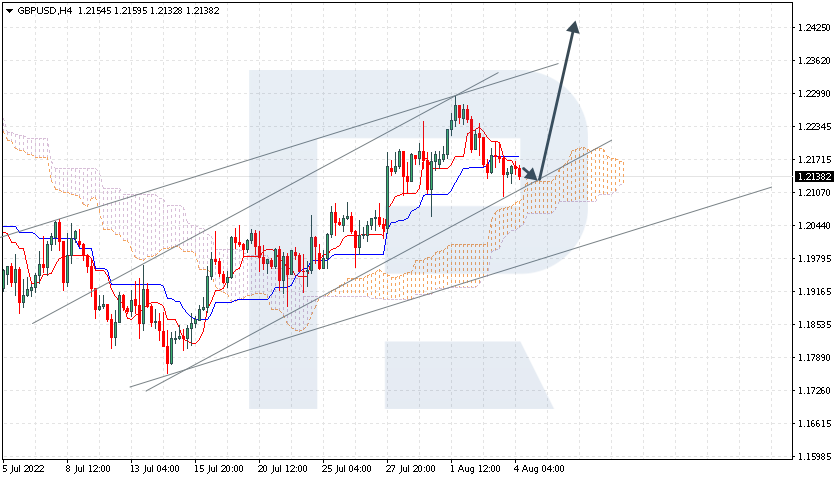
GBPUSD is testing Tenkan-Sen and Kijun-Sen. The instrument is currently moving above Ichimoku Cloud, thus indicating an ascending tendency. The markets could indicate that the price may test the cloud’s upside border at 1.1935 and then resume moving upwards to reach 1.2235. Another signal in favour of a further uptrend will be a rebound from the rising channel’s downside border. However, the bullish scenario may no longer be valid if the price breaks the cloud’s downside border and fixes below 1.1875. In this case, the pair may continue falling towards 1.1685.

GBPUSD
Risk Warning: the result of previous trading operations do not guarantee the same results in the future

BRENT

Brent is falling within the bearish channel. The instrument is currently moving below Ichimoku Cloud, thus indicating a descending tendency. The markets could indicate that the price may test the cloud’s upside border at 103.05 and then resume moving downwards to reach 92.15. Another signal in favour of a further downtrend will be a rebound from the descending channel’s upside border. However, the bearish scenario may no longer be valid if the price breaks the cloud’s upside border and fixes above 106.05. In this case, the pair may continue growing towards 110.55.

BRENT
Risk Warning: the result of previous trading operations do not guarantee the same results in the future

USDJPY, “US Dollar vs Japanese Yen”

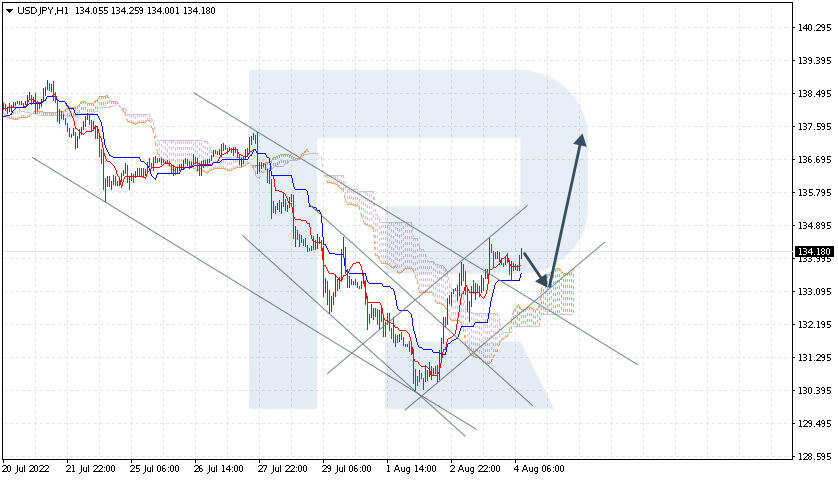
USDJPY is rebounding from the support area. The instrument is currently moving below Ichimoku Cloud, thus indicating a descending tendency. The markets could indicate that the price may test Tenkan-Sen at 137.00 and then resume moving upwards to reach 133.70. Another signal in favour of a further downtrend will be a rebound from the rising channel’s downside border. However, the bearish scenario may no longer be valid if the price breaks the cloud’s upside border and fixes above 138.75. In this case, the pair may continue growing towards 139.65.

USDJPY

Article By RoboForex.com

Attention!
Forecasts presented in this section only reflect the author’s private opinion and should not be considered as guidance for trading. RoboForex LP bears no responsibility for trading results based on trading recommendations described in these analytical reviews.

Is the world retracting from globalisation, setting it up for a fifth wave?

By Elsabe Loots, University of Pretoria 

– Over the past 25 years there has been lots of research and debate about the concept, the history and state of globalisation, its various dimensions and benefits.

The World Economic Forum has set out the case that the world has experienced four waves of globalisation. In a 2019 publication it summarised them as follows.

The first wave is seen as the period since the late 19th century, boosted by the industrial revolution associated with the improvements in transportation and communication, and ended in 1914. The second wave commenced after WW2 in 1945 and ended in 1989. The third commenced with the fall of the Berlin Wall in 1989 and the disbanding of the former Soviet Union in 1991, and ended with the global financial crises in 2008.

The fourth wave kicked off in 2010 with the recovery of the impact of the global financial crises, the rising of the digital economy, artificial intelligence and, among others, the increasing role of China as a global powerhouse.

More recent debates on the topic focus on whether the world is now experiencing a retraction from the fourth wave and whether it is ready for the take-off of the fifth wave.

The similarities between the retraction period of the first wave and the current global dynamics a century later are startling. But do these similarities mean that a retraction from globalisation is evident? Is there sufficient evidence of de-globalisation or rather “slowbalisation”?

Parallels

The drawn-out retreat from globalisation during the 30-year period – 1914 to 1945 – was characterised by the geopolitical and economic impact of WWI and WWII. Other factors were the 1918-1920 Spanish Flu pandemic ; the Stock Market Crash of 1929 followed by the Great Depression of the 1930s; and the rise of the Communist Bloc under Stalin in the 1940s.

This period was further typified by protectionist sentiments, increases in tariffs and other trade barriers and a general retraction in international trade.

Looking at the current global context, the parallels are remarkable. The world is still fighting the COVID pandemic that had devastating effects on the world economy, global supply chains and people’s lives and well-being.

For its part, the Russia-Ukraine war has caused major global uncertainties and food shortages. It has also led to increases in gas and fuel prices, further disruptions in global value chains and political polarisation.

The increase in the price of various consumer goods and in energy have put pressure on the general price level. World inflation is aggressively on the rise for the first time in 40 years. Monetary authorities worldwide are trying to fight inflation.

Global governance institutions like the World Trade Organisation and the UN, which functioned well in the post-WWII period, now have less influence while the Russian-Ukraine war has split the world politically into three groups. They are the Russian invasion supporters, the neutral countries and those opposing, a group dominated by the US, EU and the UK. This split is contributing to complex geopolitical challenges, which are slowly leading to changes in trade partnerships and regionalism.

Europe is already looking for new suppliers for oil and gas and early indications of the potential expansion of the Chinese influence in Asia are evident.

A less connected world

De-globalisation is seen as

a movement towards a less connected world, characterised by powerful nation states, local solutions and border controls rather than global institutions, treaties, and free movement.

There’s now talk of slowbalisation. The term was first used by trendwatcher and futurologist Adjiedji Bakas in 2015 to describe the phenomenon as the

continued integration of the global economy via trade, financial and other flows, albeit at a significant slower pace.

The data on economic globalisation paint an interesting picture. They show that, even before the COVID pandemic hit the world in 2020, a deceleration in the intensity of globalisation is evident. The data which represent broad measures of globalisation, includes:

  • World exports of goods and services. As a percentage of world GDP, these reached an all-time high of 31% in 2008 at the end of the third globalisation wave. Exports fell as a percentage of global GDP and only recovered to that level during the early stages of the fourth wave in 2011. Exports then slowly started to regress to 28% of global GDP in 2019 and further to a low of 26% during the first Covid-19 year in 2020.
  • The volume of foreign direct investment inflows. These reached a peak of US$2 trillion in 2016 before trending lower, reaching US$1.48 trillion in 2019. Although the 2020 foreign direct investment inflows of US$963 billion are a staggering 20% below the 2009 financial crises level, they recovered to US$1.58 billion in 2021.
  • Foreign direct investment as percentage of GDP started to increase from a mere 1% in 1989 to a peak of 5,3% in 2007. After a retraction following the global financial crises, it peaked again in 2015 and 2016 at around 3,5%. It then declined to 1,7% in 2019 and 1,4% in 2020.
  • Multinational enterprises have been the major vehicle for economic globalisation over time. The number of them indicates the willingness of companies to invest outside their home countries. In 2008 the UN Conference on Trade and Development reported approximately 82 000. The number declined to 60 000 in 2017.
  • Data on world private capital flows (including foreign direct investment, portfolio equity flows, remittances and private sector borrowing) are not readily available. However, Organisation for Economic Co-operation and Development data show that private capital flows for reporting countries reached an all-time high of US$414 billion in 2014, followed by a declining trend to US$229 billion in 2019 and a negative outflow of US$8 billion in 2020.

These declining trends are further substantiated by the evidence of deeper fragmentation in economic relations caused by Brexit and the problematic US/China relations, in particular during the Trump era.

What next?

The question now is whether the latest data is:

  • indicative of either a retraction from globalisation similar to that experienced after the first wave a century ago;
  • or it is merely a process of de-globalisation;
  • or slowbalisation in anticipation of the world economy’s recovery from the impact of Covid-19 pandemic and the war in Ukraine?

The similarities between the first wave of globalisation and the existing global events are certainly significant, although embedded in a total different world order.

The current dynamics shaping the world such as the advancement of technology, the digital era and the speed with which technology and information is spread, will certainly influence the intensity of the retraction of the already embedded dependence on globalisation.

Nation states realise that blindly entering into contracts and agreements with companies in other countries, may be problematic and that trade and investment partners need to be chosen carefully. The events over the past three years have certainly shown that economies around the world are deeply integrated and, despite examples of protectionism and threats of more inward-looking policies, it will not be possible to retract in totality.

What may occur is fragmentation where supply chains becoming more regionalised. Nobel prize winning economist Joseph Stiglitz refers to the move to “friend shoring” of production, a phrase coined by US Treasury Secretary Janet Yellen.

It is becoming obvious that the process of globalisation certainly shows characteristics of both de-globalisation and slowbalisation. It’s also clear that the global external shocks require a total rethink, repurpose and reform of the process of globalisation. This will most probably lead the world into the fifth wave of globalisation.The Conversation

About the Author:

Elsabe Loots, Professor of Economics and former Dean of the Faculty of Economic and Management Sciences, University of Pretoria

This article is republished from The Conversation under a Creative Commons license. Read the original article.