The US Supreme сourt may cancel most of Trump’s reciprocal tariffs. Riksbank holds rate at 1.75%

By JustMarkets 

On Wednesday, the Dow Jones Index (US30) rose by 0.48%. The S&P 500 Index (US500) gained 0.37%. The technology-heavy Nasdaq Index (US100) closed higher by 0.65%. A positive factor for the market was the skeptical stance of the US Supreme Court regarding the case on Donald Trump’s “reciprocal tariffs,” which reduced the likelihood of their premature application. Against this backdrop, market participants cut their bets on the Supreme Court upholding the imposed tariffs. Further support for risk appetite came from stronger-than-expected employment data: the ADP report showed a moderate job gain of about 42,000, and the ISM Services PMI rose to an eight-month high, signaling continued economic resilience.

The Canadian dollar weakened to 1.41 CAD per US Dollar, nearing a seven-month low, amid the further strengthening of the US currency and heightened trade uncertainty. An additional factor was the announcement of the new federal budget, which will see the deficit more than double to approximately 78.3 billion CAD this year. This significant expansion of fiscal spending eases financial conditions but increases pressure on the currency amid an already weak macroeconomic outlook.

European stock markets grew steadily on Wednesday. Germany’s DAX (DE40) rose by 0.42%, France’s CAC 40 (FR40) closed up by 0.08%, Spain’s IBEX 35 (ES35) gained 0.39%, and the UK’s FTSE 100 (UK100) closed up by 0.64%.

The Swedish Central Bank (Riksbank), as expected, left its key interest rate unchanged at 1.75% at its October meeting, adhering to a course of supporting economic activity and gradually returning inflation to its medium-term target of 2%. The regulator indicated that the borrowing cost is likely to remain unchanged in the near term. Economic growth in the third quarter was slightly above expectations, but the labor market continues to signal weakness.
The Swiss franc traded near 0.81 per US dollar, remaining near its maximum levels since 2011, amid increased demand for safe-haven assets and expectations that the Swiss National Bank (SNB) will refrain from cutting rates in the near future. Simultaneously, softer-than-expectations inflation data in Switzerland renewed discussions about the possibility of further policy easing, which could theoretically return rates to negative territory. However, the SNB leadership is exercising caution, citing risks to financial stability.

WTI crude oil prices dropped to the $60 per barrel area. Concerns over excess supply and sluggish demand continued to weigh on the market. According to the US Energy Information Administration (EIA), crude oil inventories rose by 5.202 million barrels for the week – the largest increase since July. Pressure on prices is intensified by rising production from both OPEC+ countries and non-OPEC producers, fueling concerns about a global market glut.
Asian markets also declined yesterday. Japan’s Nikkei 225 (JP225) fell by 2.50%, China’s FTSE China A50 (CHA50) dropped by 0.01%, Hong Kong’s Hang Seng (HK50) declined by 0.07%, and Australia’s ASX 200 (AU200) showed a negative result of 0.13%.

Australia’s trade surplus expanded to 3.94 billion AUD in September, compared to a revised 1.11 billion AUD in August, and exceeded the prognosis of 3.85 billion AUD. The increase was driven by a 7.9% jump in exports, primarily due to increased shipments of gold amidst rising prices for the precious metal. Meanwhile, imports rose by 1.1% and reached a record level, supported by an increase in the inflow of capital goods.

S&P 500 (US500) 6,796.29 +24.74 (+0.37%)

Dow Jones (US30) 47,311.00 +225.76 (+0.48%)

DAX (DE40) 24,049.74 +100.63 (+0.42%)

FTSE 100 (UK100) 9,777.08 +62.12 (+0.64%)

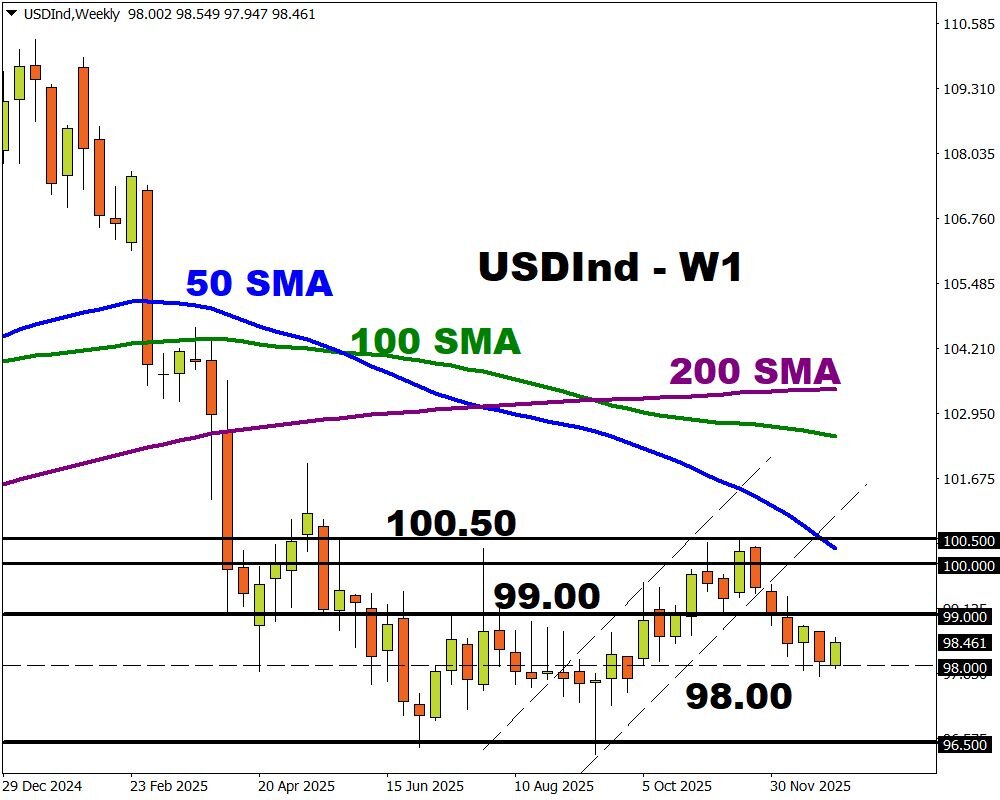
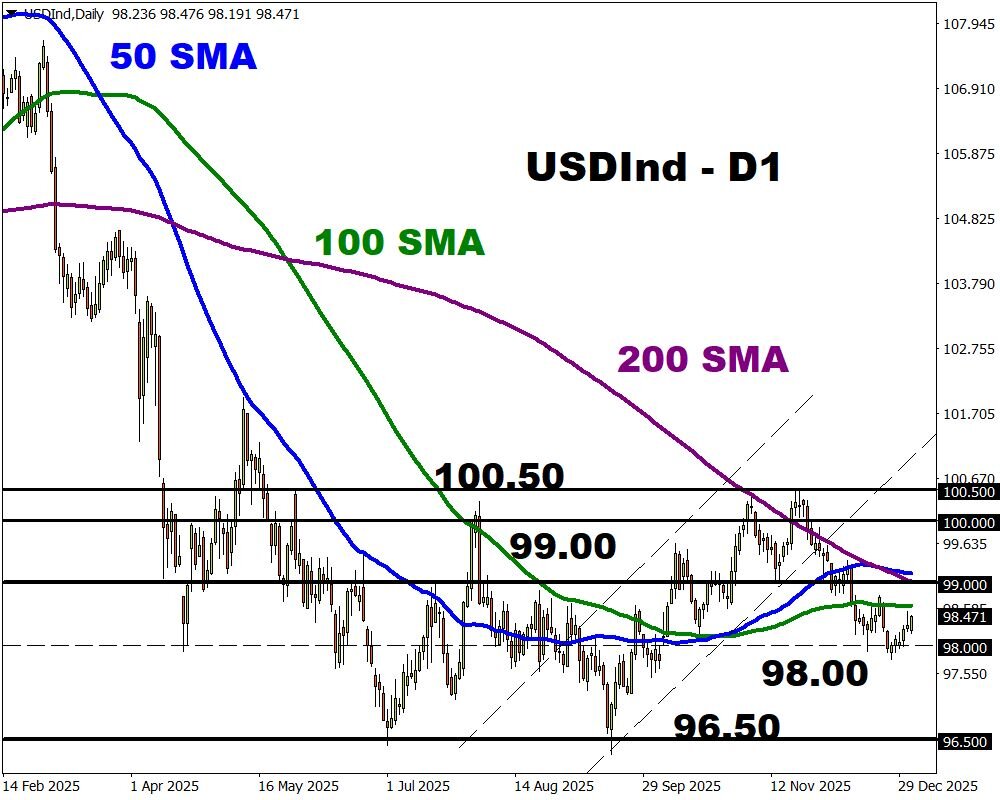
USD Index 100.16 -0.06% (-0.06%)

News feed for: 2025.11.06

  • Japan Average Cash Earnings (m/m) at 01:30 (GMT+2);
  • Japan Services PMI (m/m) at 02:30 (GMT+2);
  • Australia Trade Balance (m/m) at 02:30 (GMT+2);
  • German Industrial Production (m/m) at 09:00 (GMT+2);
  • Sweden Inflation Rate at 09:00 (GMT+2);
  • Switzerland Unemployment Rate (m/m) at 10:00 (GMT+2);
  • Norway Norges Rate Decision at 11:00 (GMT+2);
  • UK BoE Interest Rate Decision at 14:00 (GMT+2);
  • UK BoE Rate Statement at 14:00 (GMT+2);
  • UK BoE Gov Bailey Speaks at 14:30 (GMT+2);
  • Canada Ivey PMI (m/m) at 17:00 (GMT+2);
  • US Natural Gas Storage (w/w) at 17:30 (GMT+2);
  • Mexico Interest Rate Decision at 21:00 (GMT+2).

By JustMarkets


This article reflects a personal opinion and should not be interpreted as an investment advice, and/or offer, and/or a persistent request for carrying out financial transactions, and/or a guarantee, and/or a forecast of future events.

GBP/USD Hovers Near Lows as Bank of England Decision Looms

By RoboForex Analytical Department

The GBP/USD pair is attempting to find support around 1.3062 on Thursday, with investors cautiously positioning themselves ahead of today’s pivotal Bank of England (BoE) monetary policy meeting. The British currency remains under pressure, trading near a seven-month low against the US dollar and at its weakest level in over two years against the euro.

Market pricing currently implies roughly a one-in-three chance of a 25-basis-point rate cut from the BoE. This uncertainty creates significant asymmetric risk, meaning the pound is poised for a sharp move in either direction once the decision and accompanying statement are released.

The pound’s weakness was compounded by the recent release of softer-than-expected UK inflation data, which bolstered expectations for an imminent shift towards policy easing. A simultaneous global sell-off in equity markets, particularly in the tech sector, has further dampened sentiment by reducing appetite for risk-sensitive assets such as sterling.

Adding to the headwinds, investor focus is shifting to the UK budget, due for approval later this month. Chancellor Rachel Reeves has signalled the potential for tax rises, a measure that could stifle economic growth and potentially prompt the BoE to adopt a more dovish stance – another factor weighing on the currency.

Technical Analysis: GBP/USD

H4 Chart:

On the H4 chart, GBP/USD broke downwards from a consolidation range around 1.3140, completing a bearish wave to 1.3010. We now anticipate a technical correction towards 1.3090. Following this pullback, the primary downtrend is expected to resume, with the next key targets at 1.2910 and, ultimately, 1.2811. The MACD indicator supports this bearish outlook. While its signal line is at deeply oversold levels and has diverged from its histogram, suggesting the potential for a short-term corrective rise, the overall structure remains negative.

H1 Chart:

On the H1 chart, the pair similarly broke down from a range around 1.3157, reaching the 1.3010 target. A corrective retracement to test 1.3100 from below is now expected. Once this correction is complete, the downtrend is likely to extend towards at least 1.2950. The Stochastic oscillator aligns with this view. Its signal line is in overbought territory above 80 and appears poised to turn down towards 20, indicating that any near-term strength is likely corrective before selling pressure reasserts itself.

Conclusion

GBP/USD is stabilising at multi-month lows ahead of a high-stakes BoE meeting. The combination of dovish inflation data, a risk-off market mood, and looming fiscal uncertainty has created a profoundly negative backdrop for sterling. Technically, the path of least resistance remains downward. While a short-covering bounce back towards 1.3100 is possible post-decision, the broader trend suggests further losses, with key targets at 1.2910 and 1.2811.

Disclaimer:

Any forecasts contained herein are based on the author’s particular opinion. This analysis may not be treated as trading advice. RoboForex bears no responsibility for trading results based on trading recommendations and reviews contained herein.

Investors are switching to risk-off mode. The price of Bitcoin has fallen below $100,000

By JustMarkets 

On Tuesday, the Dow Jones Index (US30) fell by 0.53%. The S&P 500 Index (US500) declined by 1.17%. The technology-heavy Nasdaq Index (US100) closed lower by 2.04%. Investors intensified their concerns over the overheated valuations of artificial intelligence (AI) companies. Pressure mounted as the S&P 500’s forward P/E ratio rose above 23, bringing the metric close to the highs of the early 2000s and triggering fears of a correction after months of gains concentrated among a narrow group of AI giants. The technology sector was the hardest hit. Palantir plunged 8.1% due to valuation concerns despite reporting better-than-expected earnings. Nvidia (-2.7%), AMD (-2.1%), and Oracle (-2.6%) also saw notable drops. Market caution was amplified by warnings from Goldman Sachs CEO David Solomon and Morgan Stanley CEO Ted Pick, who both suggested a potential market drop of 10-20%.

The Mexican peso weakened to 18.6 per US dollar, hitting an eight-week low as domestic and external factors amplified pressure on the currency. Local interest rates are now being priced by the market to include future cuts, while the dollar strengthened amid reduced expectations for an imminent Federal Reserve rate cut. The market anticipates that Banxico (Mexico’s central bank) will continue its easing cycle this week and lower the rate by 25 bps to 7.25%, which would narrow Mexico’s yield advantage and potentially weaken capital inflows into the peso.

The Bitcoin price dropped below $100,000, approaching two-month lows and intensifying the downtrend that began after the digital assets market’s “Black Friday” in mid-October. Global equities and digital assets were under pressure amid mounting concerns over the overheated valuations of artificial intelligence companies. Against this backdrop, spot Bitcoin ETFs experienced significant capital outflows. The correction also affected a broad range of altcoins.

European stock markets were mostly lower on Tuesday. Germany’s DAX (DE40) fell by 0.76%, France’s CAC 40 (FR40) closed down by 0.52%, Spain’s IBEX 35 (ES35) declined by 0.01%, and the UK’s FTSE 100 (UK100) closed up by 0.14%. Trading saw profit-taking amidst continued market uncertainty: the publication of key economic data remains suspended due to the ongoing US government shutdown.

Silver (XNG/USD) was under pressure yesterday due to weak demand for industrial metals after total US auto sales in October fell to a 14-month low. Additional negative impact came from comments by ECB Governing Council member Yannis Stournaras, who stated that the Eurozone’s economic growth prospects are subject to multiple downside risks. Nevertheless, precious metals retain fundamental support as safe-haven assets due to the ongoing US government shutdown, uncertainty surrounding tariff policy, geopolitical tensions, active central bank purchases, and political pressure on the Federal Reserve.
Asian markets also declined yesterday. Japan’s Nikkei 225 (JP225) fell by 1.74%, China’s FTSE China A50 (CHA50) dropped by 0.27%, Hong Kong’s Hang Seng (HK50) declined by 0.79%, and Australia’s ASX 200 (AU200) recorded a negative result of 0.91%.

The overnight sell-off on Wall Street dampened investor sentiment, increasing caution and lowering risk appetite in regional markets. The correction was driven by rising concerns over inflated valuations, particularly in the high-tech and AI-related sectors. An additional pressure factor was a private survey that showed China’s services sector posted its weakest growth in three months in October. The indicator reflects weakening external demand and continued job contraction.
New Zealand’s unemployment rate rose to 5.2% in the second quarter of 2025, slightly exceeding the previous quarter’s figure (5.1%) and matching market expectations. This marks the highest level since late 2016. The number of unemployed individuals increased to 158,000 compared to 156,000 in March, representing an annual increase of 16,000 people, or 11.1%. The data points to a further softening of the labor market and intensifies pressure on the RBNZ amidst the ongoing economic downturn.

S&P 500 (US500) 6,771.55 −80.42 (−1.17%)

Dow Jones (US30) 47,085.24 −251.44 (−0.53%)

DAX (DE40) 23,949.11 −183.30 (−0.76%)

FTSE 100 (UK100) 9,714.96 +13.59 (+0.14%)

USD Index 100.20 +0.33% (+0.33%)

News feed for: 2025.11.05

  • Japan Monetary Policy Meeting Minutes at 01:50 (GMT+2);
  • Australia Services PMI (m/m) at 02:30 (GMT+2);
  • Sweden Riksbank Rate Decision at 10:30 (GMT+2);
  • German Services PMI (m/m) at 10:55 (GMT+2);
  • Eurozone Services PMI (m/m) at 11:00 (GMT+2);
  • UK Services PMI (m/m) at 11:30 (GMT+2);
  • Eurozone Producer Price Index (m/m) at 12:00 (GMT+2);
  • US ADP Employment Change (m/m) at 15:15 (GMT+2);
  • Canada Services PMI (m/m) at 16:30 (GMT+2);
  • US ISM Services PMI (m/m) at 17:00 (GMT+2);
  • US Crude Oil Reserves (w/w) at 17:30 (GMT+2).

By JustMarkets


This article reflects a personal opinion and should not be interpreted as an investment advice, and/or offer, and/or a persistent request for carrying out financial transactions, and/or a guarantee, and/or a forecast of future events.

Gold Holds at October Lows Amid Shifting Rate Expectations

By RoboForex Analytical Department

On Wednesday, gold traded around 3,940 USD per troy ounce, stabilising near its lowest levels since early October. The precious metal remains under pressure from a recalibration of interest rate expectations, as markets adopt a more cautious outlook on further easing by the Federal Reserve.

Several Fed officials have recently struck a neutral tone, aligning with Chair Jerome Powell’s hawkish rhetoric last week, which suggested the October rate cut could be the final one for the year. Market-implied probabilities for a December rate cut have subsequently fallen to 69%, down sharply from 90% before the latest FOMC meeting.

With the release of official US data hampered by the ongoing government shutdown, investor attention is turning to private-sector labour market reports for guidance. Further headwinds for gold stem from easing trade tensions and China’s decision to revoke tax incentives for certain jewellery retailers. This move could dampen physical demand in the world’s largest gold market.

Nevertheless, a broader shift towards risk-off sentiment across global markets may renew the metal’s appeal as a traditional safe-haven asset.

Technical Analysis: XAU/USD

H4 Chart:

On the H4 chart, XAU/USD is forming a consolidation range around 3,970 USD. A breakdown from this range is expected to trigger a decline toward 3,880 USD, potentially followed by a corrective rebound to 4,020 USD (testing the broken level from below). The subsequent resumption of selling pressure could drive the pair towards 3,660 USD, where the current correction may conclude, setting the stage for a new upward wave towards 4,400 USD. The MACD indicator supports this bearish near-term view, with its signal line below zero and pointing downward, confirming ongoing corrective momentum.

H1 Chart:

On the H1 chart, the market is consolidating around 3,971 USD. A break below this level could trigger a further decline towards 3,790 USD. The Stochastic oscillator aligns with this outlook, as its signal line hovers above 80 and appears poised to reverse downward toward 20, indicating building selling pressure.

Conclusion

Gold remains under pressure as expectations for a Fed cut are scaled back and concerns about physical demand emerge. While risk-off sentiment may provide intermittent support, the near-term technical structure favours further declines. A sustained break below 3,970 USD could accelerate the move towards 3,790–3,880 USD, although a deeper correction to 3,660 USD may ultimately offer a more compelling buying opportunity ahead of the next major rally.

Disclaimer:

Any forecasts contained herein are based on the author’s particular opinion. This analysis may not be treated as trading advice. RoboForex bears no responsibility for trading results based on trading recommendations and reviews contained herein.


As expected, RBA keeps the rate at 3.6%. New Zealand dollar hits 7-month low

By JustMarkets 

The Dow Jones Index (US30) fell by 0.48% at the close on Monday. The S&P 500 Index (US500) rose by 0.17%. The technology-heavy Nasdaq Index (US100) closed higher by 0.46%. US stock indices received support on Monday amid continued optimism surrounding artificial intelligence following the report that OpenAI purchased $38 billion worth of AI computing capacity from Amazon. Markets also reacted to a number of dovish comments from Federal Reserve officials. Federal Reserve Board Governor Stephen Miran stated that the Fed’s current policy is “too tight” and above the neutral rate level, adding that he sees no need to maintain such a restrictive stance given a more moderate outlook on inflation. Lisa Cook also noted that the risks of the labor market weakening now outweigh the risks of accelerating inflation. According to the futures market, investors are pricing in an approximately 66% chance of a December rate cut of 25 basis points (bps).

Investors are also preparing for a US Supreme Court hearing on Wednesday regarding the legality of President Trump’s “reciprocal tariffs.” Lower courts had previously ruled these tariffs illegal. If the Supreme Court upholds this decision, the US could face the necessity of repaying over $80 billion in collected tariffs, and the White House’s authority to impose tariffs would be restricted to only existing sections of trade law.

European stock markets were mostly up on Monday. Germany’s DAX (DE40) rose by 0.73%, France’s CAC 40 (FR 40) closed down by 0.14%, Spain’s IBEX 35 (ES35) increased by 0.03%, and the UK’s FTSE 100 (UK100) closed negative 0.16%. Sectorally, car manufacturers made the largest contribution: shares in Mercedes-Benz, Volkswagen, BMW, and Stellantis rose by 0.9-2.3% following statements from China about the possible granting of exceptions for the export of Nexperia chips, which are vital for automotive electronics.

WTI crude oil prices fell to $60.8 per barrel on Tuesday after four days of gains, as markets continued to assess oversupply risks despite the OPEC+ decision to freeze production increases early next year. The group of producers agreed to a moderate production increase in December, but further growth will be frozen from January to March due to a seasonal decline in demand. The decision comes amid expectations that the oil market may face a supply surplus in 2026 due to expanded supplies from both OPEC countries and non-OPEC producers.

Platinum is trading near $1570 per ounce, correcting from its mid-October peak of around $1722, as demand for safe-haven assets weakened following the US-China trade agreement and amid a stricter tone from the Federal Reserve. Despite the correction, platinum has risen by nearly 60% since the start of the year, outperforming gold and silver, thanks to limited supply and high industrial demand, primarily from the auto industry and hydrogen technologies. Traders are also anticipating the potential launch of platinum futures trading in China, which could boost market liquidity.

Asian markets traded with mixed dynamics last week. Japan’s Nikkei 225 (JP225) rose by 2.12%, China’s FTSE China A50 (CHA50) increased by 0.16%, Hong Kong’s Hang Seng (HK50) rose by 0.97%, and Australia’s ASX 200 (AU200) showed a positive result of 0.15% yesterday. In the first ten months of 2025, 80 IPOs were registered in Hong Kong, highlighting the resilience of the local capital market.

The Australian dollar weakened to below 0.652 USD, marking its fifth consecutive day of decline after the Reserve Bank of Australia (RBA) left the cash rate unchanged, fully aligning with market expectations. At the November meeting, the RBA Board unanimously voted to keep the official cash rate at 3.60%, declining to consider a further rate hike despite persistent inflationary pressure. The regulator also downplayed the unexpected rise in unemployment in September, noting that the labor market remains “slightly tight.” RBA Governor Michele Bullock stressed that the potential for further rate cuts is limited and that the scale of the forthcoming easing may be smaller than in previous cycles.

The New Zealand dollar reached a nearly 7-month low amid growing expectations of further interest rate cuts by the Reserve Bank of New Zealand (RBNZ). Markets have almost fully priced in a 25 bps rate cut at the late-November meeting, following the 50 bps reduction that already occurred last month, against the backdrop of weak economic activity and slowing inflation. Investors are now awaiting the release of Q3 labor market data. Unemployment is expected to rise to a near nine-year high, which could further strengthen the case for more policy easing

S&P 500 (US500) 6,851.97 +11.77 (+0.17%)

Dow Jones (US30) 47,336.68 −226.19 (−0.48%)

DAX (DE40) 24,132.41 +174.11 (+0.73%)

FTSE 100 (UK100) 9,701.37 −15.88 (−0.16%)

USD Index 99.88 +0.08% (+0.08%)

News feed for: 2025.11.04

  • Japan Manufacturing PMI (m/m) at 02:30 (GMT+2);
  • Australia RBA Interest Rate Decision at 05:30 (GMT+2);
  • Australia RBA Rate Statement at 05:30 (GMT+2);
  • Australia RBA Press Conference at 06:30 (GMT+2);
  • Eurozone ECB President Lagarde Speaks at 09:40 (GMT+2);
  • Eurozone ECB President Lagarde Speaks at 12:00 (GMT+2);
  • New Zealand RBNZ Financial Stability Report at 22:00 (GMT+2);
  • New Zealand Unemployment Rate at 23:45 (GMT+2).

By JustMarkets


This article reflects a personal opinion and should not be interpreted as an investment advice, and/or offer, and/or a persistent request for carrying out financial transactions, and/or a guarantee, and/or a forecast of future events.

EUR/USD Under Sustained Pressure as Markets Await Key Data

By RoboForex Analytical Department

The EUR/USD pair is declining for a fourth consecutive session, edging closer to the 1.1532 level. Investor sentiment remains cautious as markets digest recent trade developments and await a slew of high-impact economic data.

Over the weekend, the White House announced a de-escalation in trade tensions with China. Beijing has agreed to suspend additional export restrictions on rare earth metals and end investigations into US semiconductor companies. In return, the US will freeze certain existing tariffs and cancel a planned 100% tariff hike on Chinese exports. This decision follows last week’s summit between Donald Trump and Xi Jinping, which aimed to stabilise bilateral relations.

Meanwhile, the protracted US government shutdown continues to delay the release of official key statistics, notably employment data. In their absence, market participants will seek guidance from private-sector indicators due in the coming days, including the ADP employment report, the ISM Services PMI, and the University of Michigan Consumer Sentiment Index.

This comes after the Federal Reserve’s expected 25-basis-point rate cut last week. Chair Jerome Powell maintained a cautious stance, emphasising that a follow-up cut in December is not a foregone conclusion – a message that has provided underlying support for the US dollar.

Technical Analysis: EUR/USD

H4 Chart:

On the H4 chart, EUR/USD formed a tight consolidation range around 1.1569. A subsequent downward breakout completed a bearish wave to 1.1521, and the pair is now consolidating above this local low.

A technical rebound to retest 1.1569 from below is a possibility. However, with bearish momentum still intact, we anticipate a further decline towards 1.1500 following any such pullback. The broader target for this move is 1.1488, which is viewed as the first leg of the third and typically strongest wave within the prevailing downtrend. The MACD indicator confirms this outlook, with its signal line positioned below zero and pointing decisively downward, reflecting sustained selling pressure.

H1 Chart:

On the H1 chart, the pair broke downwards from a consolidation range around 1.1566, achieving its initial target at 1.1495. Once this level is reached, a corrective bounce towards 1.1533 is likely before the resumption of the downtrend towards 1.1468.

This scenario is supported by the Stochastic oscillator, whose signal line is below 50 and is falling confidently towards the 20 zone, indicating that short-term downward momentum remains dominant.

Conclusion

EUR/USD remains under clear selling pressure, with a de-escalation in US-China trade tensions and a cautiously hawkish Fed stance providing a supportive backdrop for the US dollar. Technically, the structure is bearish, suggesting that any near-term rebounds are likely to be corrective within a broader downtrend, with key downside targets at 1.1488 and 1.1468.

Disclaimer:

Any forecasts contained herein are based on the author’s particular opinion. This analysis may not be treated as trading advice. RoboForex bears no responsibility for trading results based on trading recommendations and reviews contained herein.

OPEC+ is expected to approve another increase in the collective oil production level. Canada released a weak GDP report.

By JustMarkets 

By the end of Friday, the Dow Jones Index (US30) rose by 0.09% (for the week +0.32%). The S&P 500 Index (US500) gained 0.26% (for the week, 0.08%). The Technology Index Nasdaq (US100) closed higher by 0.48% (for the week +0.61%). AMZN shares jumped over 10% after reporting that third-quarter cloud revenue increased by 20% and exceeded analyst expectations. This supported the entire technology sector. Positive momentum was also observed in companies related to the development of artificial intelligence: Palantir and Oracle shares added 3% and 2.8%, respectively. Netflix rose by 2.9% on news of a planned 10-for-1 stock split, while Tesla gained 3.1%.

The Canadian dollar fell below the 1.40 per USD mark following the release of a surprisingly weak GDP report, which fueled market expectations of a potential rate cut by the Bank of Canada. Canada’s GDP in September is expected to have grown by 0.1% month-over-month, while the August figure was revised down to 0.3%, the largest drop since December 2022. The weak data reflects the consequences of trade frictions with the US and the negative impact of higher Bank of Canada rates.

European stock markets mostly declined on Friday. Germany’s DAX (DE40) fell by 0.67% (for the week -1.54%), France’s CAC 40 (FR40) closed lower by 0.44% (for the week -1.41%), Spain’s IBEX 35 (ES35) dropped by 0.05% (for the week +0.72%), and the UK’s FTSE 100 (UK100) closed negative 0.44% (for the week +0.74%). Investors were taking profits and evaluating a busy week during which markets processed a significant volume of corporate earnings, macro statistics, and central bank decisions. The situation surrounding the one-year technology and trade truce between the US and China remained an additional factor of uncertainty. Focus also remained on the upcoming Bank of England meeting. A broad consensus suggests keeping the rate unchanged, but expectations of possible policy easing are already beginning to intensify.

Eight key OPEC+ participants are likely to approve another increase in the collective target oil production level by 137 thousand barrels per day. This would be the ninth consecutive monthly increase for Saudi Arabia, Iraq, Kuwait, Russia, UAE, Algeria, Oman, and Kazakhstan. The meeting takes place against the backdrop of recently imposed US sanctions against Russian oil companies Rosneft and Lukoil, creating uncertainty about Russia’s ability to maintain current production and export volumes. The group emphasized that it will approach the monthly production increase flexibly, adjusting it according to market conditions.

The US natural gas prices (XNG/USD) rose above $4.1 per MMBtu, reaching a seven-month high, amid a combination of increased demand for heating and projections of active LNG exports to Europe and Asia. Expectations of colder weather leading into the winter season have boosted gas consumption for heating.
Asian markets traded without a unified direction last week. Japan’s Nikkei 225 (JP225) rose by 5.02%, China’s FTSE China A50 (CHA50) fell by 1.59%, Hong Kong’s Hang Seng (HK50) dropped by 1.03%, and Australia’s ASX 200 (AU200) showed a negative result of 1.94%.

On Monday, the offshore yuan held near 7.12 per USD after two consecutive days of weakening. The private manufacturing PMI for October declined more than expected, continuing the negative trend confirmed by official statistics last week, which indicated that the industry’s downturn was the longest in nine years. Weak macro statistics once again amplified expectations of additional government support. On the trade front, China agreed to suspend new export control measures on rare earth metals and cease investigations into US semiconductor manufacturers. In response, the US will suspend a range of tariffs and forgo the planned 100% duty tax on Chinese exports.

S&P 500 (US500) 6,840.20 +17.86 (+0.26%)

Dow Jones (US30) 47,562.87 +40.75 (+0.09%)

DAX (DE40) 23,958.30 −160.59 (−0.67%)

FTSE 100 (UK100) 9,717.25 −42.81 (−0.44%)

USD Index 99.72 +0.19% (+0.19%)

News feed for: 2025.11.03

  • Australia Manufacturing PMI (m/m) at 00:00 (GMT+2);
  • Switzerland Consumer Price Index at 09:30 (GMT+2);
  • German Manufacturing PMI (m/m) at 10:55 (GMT+2);
  • Eurozone Manufacturing PMI (m/m) at 11:00 (GMT+2);
  • UK Manufacturing PMI (m/m) at 11:30 (GMT+2);
  • Canada Manufacturing PMI (m/m) at 16:30 (GMT+2);
  • US ISM Manufacturing PMI (m/m) at 17:00 (GMT+2);
  • Canada BoC Gov Macklem Speaks (m/m) at 20:30 (GMT+2).

By JustMarkets


This article reflects a personal opinion and should not be interpreted as an investment advice, and/or offer, and/or a persistent request for carrying out financial transactions, and/or a guarantee, and/or a forecast of future events.

FED and Bank of Canada cut rates. ECB decision due today

By JustMarkets 

On Wednesday, US stock indices showed mixed performance. The Dow Jones (US30) Index fell by 0.16%. The S&P 500 (US500) declined by 0.01%. The technology-heavy Nasdaq (US100) closed higher by 0.55%. The Federal Reserve announced a 25 basis point (bps) cut to the federal funds rate, bringing it to 4.00% at its October 2025 meeting, a move that fully aligned with market expectations. This was the second consecutive cut after the September decision. The regulator noted increasing risks in the labor market in recent months, while inflation has accelerated since the start of the year and remains relatively elevated. During the press conference, Chairman Jerome Powell stressed that a rate cut in December is not guaranteed, although investors still price in a high probability of another 25 bps move, consistent with the Fed’s September forecasts. Additionally, the central bank announced that the reduction of its balance sheet (Quantitative Tightening) will conclude on December 1st.

The Bank of Canada (BoC) cut its rate to 2.25% and signaled a potential pause in the easing cycle. The regulator indicated that the easing cycle is likely nearing its end, provided the baseline economic forecast remains unchanged amidst ongoing uncertainty. The Governing Council noted that trade conflict has caused structural damage to the economy, reducing its potential, which aligns with the 1.6% year-over-year GDP decline in the second quarter.

G7 nations plan to establish a critical minerals alliance to counter China’s dominance in global supply chains. The alliance aims to reduce China’s market influence, including its practice of dumping to push out Western projects and the imposition of export controls. Canada, in particular, expects economic benefits, leveraging its domestic resource base and ready-to-go infrastructure projects.

European stock markets traded with mixed dynamics yesterday. Germany’s DAX (DE40) fell by 0.64%, France’s CAC 40 (FR40) closed down 0.19%, Spain’s IBEX35 (ES35) gained 0.39%, and the UK’s FTSE 100 (UK100) closed 0.61% higher. Contradictory corporate results amplified uncertainty regarding the region’s economic outlook. The banking sector was the leader of the gains: Santander added 4% after publishing a record nine-month profit, and Deutsche Bank rose by 5% on strong investment division results. Mercedes-Benz climbed 4.3% as growth in premium segment sales ensured margin expansion and compensated for a decline in China revenue.

Today, the ECB will hold its monetary policy meeting. There is an almost 99% probability that the interest rate will remain unchanged at 2.15%. This stands in contrast to the situation at the US Federal Reserve (Fed).

WTI crude oil prices rose on Wednesday to around $60.6 per barrel due to a reduction in inventories. According to the EIA, US crude oil stocks fell by 6.9 million barrels, a more significant drop than expected. Gasoline and distillate inventories also decreased, while stocks at the Cushing, Oklahoma, hub increased. Indian refineries temporarily halted new purchases pending official instructions, though the state-owned IOC confirmed it would continue imports under contractual obligations. However, some analysts doubt that the sanctions will lead to a significant supply reduction, given reports that OPEC+ may consider another production increase at its next meeting to stabilize the market.

Asian markets also traded with mixed results yesterday. Japan’s Nikkei 225 (JP225) surged 2.17%, China’s FTSE China A50 (CHA50) gained 0.10%, Hong Kong’s Hang Seng (HK50) fell by 0.33%, and Australia’s ASX 200 (AU200) posted a negative result of 0.96%.

The Bank of Japan (BoJ) kept its key short-term rate at 0.5%, holding borrowing costs at their highest level since 2008 and extending the pause after the January hike. The regulator reiterated its readiness to tighten policy further if the economy evolves within its outlook. In its quarterly projections, the BoJ maintained its core inflation estimate for the 2025 fiscal year at 2.7%, expecting it to slow to 1.8% in 2026. The GDP growth forecast for 2025 was improved from 0.6% to 0.7%, facilitated by a new trade agreement with the US and the policies of Prime Minister Sanae Takaichi’s cabinet.

S&P 500 (US500) 6,890.59 −0.30 (−0.01%)

Dow Jones (US30) 47,632.00 −74.37 (−0.16%)

DAX (DE40) 24,124.21 −154.42 (−0.64%)

FTSE 100 (UK100) 9,756.14 +59.40 (+0.61%)

USD Index 99.13 +0.47% (+0.47%)

News feed for: 2025.10.30

  • Japan BoJ Interest Rate Decision at 05:00 (GMT+2);
  • Japan BoJ Monetary Policy Statement at 05:00 (GMT+2);
  • Japan BOJ Outlook Report at 05:00 (GMT+2);
  • Switzerland KOF Leading Indicators (m/m) at 10:00 (GMT+2);
  • German Unemployment Rate (m/m) at 10:55 (GMT+2);
  • German GDP (m/m) at 11:00 (GMT+2);
  • Eurozone GDP (m/m) at 12:00 (GMT+2);
  • Eurozone Unemployment Rate (m/m) at 12:00 (GMT+2);
  • German Inflation Rate (m/m) at 15:00 (GMT+2);
  • Eurozone ECB Interest Rate Decision at 15:15 (GMT+2);
  • Eurozone ECB Monetary Policy Statement at 15:15 (GMT+2);
  • Eurozone ECB Press Conference at 15:45 (GMT+2);
  • US Natural Gas Storage (w/w) at 16:30 (GMT+2).

By JustMarkets


This article reflects a personal opinion and should not be interpreted as an investment advice, and/or offer, and/or a persistent request for carrying out financial transactions, and/or a guarantee, and/or a forecast of future events.

USD/JPY Hits Nine-Month High as Yen Endures Tough October

By RoboForex Analytical Department

The USD/JPY pair climbed to a nine-month high on Friday, approaching the key 154.00 level. The yen concluded October with losses of approximately 4%, marking a highly unsuccessful month. The currency’s decline was exacerbated by domestic political shifts, following the election of Sanae Takaichi as Prime Minister. Takaichi is a known advocate for stimulative fiscal policy and the maintenance of ultra-loose monetary conditions—a combination that typically weighs on a currency.

This dovish political backdrop was complemented by the Bank of Japan’s decision to hold interest rates steady in October. Governor Kazuo Ueda further dampened sentiment by warning that tighter global trade conditions could stifle economic growth and reduce corporate profits.

In a notable shift, the new Finance Minister, Satsuki Katayama, clarified that she no longer views a yen exchange rate of 120-130 per dollar as appropriate. She emphasised that currency stability is now her primary focus, a comment markets interpreted as a step back from direct intervention.

The yen also faced pressure from a broadly strengthening US dollar. Market expectations for further Federal Reserve rate cuts have receded, while data showing higher-than-expected inflation in Tokyo for October complicated the domestic policy outlook.

Technical Analysis: USD/JPY

H4 Chart:

On the H4 chart, USD/JPY has completed a bullish wave structure, reaching 154.40. The pair is now likely to enter a period of consolidation at these highs. A decisive downward breakout from this range would signal the start of a correction, with an initial target at 151.88. Conversely, an upward breakout would open the path for the next leg of the rally towards 155.70.

This technical outlook is supported by the MACD indicator. Its signal line remains above zero and is pointing firmly upwards, confirming the underlying bullish momentum.

H1 Chart:

On the H1 chart, the market completed an initial growth wave to 153.33, formed a tight consolidation range, and then broke upwards to achieve its local target of 154.40. Following this peak, a pullback towards at least 153.33 is anticipated. Upon finding support, the next upward wave is expected to target 154.83, with the potential to extend the broader bullish trend towards 155.15.

The Stochastic oscillator aligns with this view. Its signal line is above 50 and rising sharply towards 80, indicating that short-term bullish momentum remains intact.

Conclusion

The yen’s sharp decline in October was driven by a perfect storm of domestic political and monetary dovishness, coupled with a resurgent US dollar. Technically, USD/JPY’s bullish structure is firmly established. While a short-term correction is possible, the path of least resistance remains skewed to the upside, with key targets at 155.70 on the H4 chart. All eyes will be on whether Japanese authorities will transition from verbal intervention to concrete action if the yen’s weakness persists.


Disclaimer:

Any forecasts contained herein are based on the author’s particular opinion. This analysis may not be treated as trading advice. RoboForex bears no responsibility for trading results based on trading recommendations and reviews contained herein.

ERIC, TSM & AMX lead Latest Top Stocks Scored to our Watchlist

By InvestMacro Research

The fourth quarter of 2025 is underway and earnings reports are coming in. I wanted to highlight some of the top companies that have been added to our Cosmic Rays Watchlist in the past couple of weeks.

Quick Overview: 

The Problem: Finding Stock Ideas to fill out a diversified portfolio of different Sectors, Industries amid the various Market Caps.

What is our Watchlist: The Cosmic Rays Watchlist is the output from our proprietary fundamental analysis algorithm. This list scans dividend-paying companies every quarter (from the NYSE & Nasdaq stock exchanges) and analyzes numerous fundamental metrics to weigh these stocks against their peers and sectors. The ones that come out with a 50 point score or more are then added to our watch list. From there, we do a deeper dive, focusing on their story, their potential for future earnings, and momentum. We also use a trend-following trading strategy or other technical analytics to help us buy and sell at the appropriate times.

Be aware the fundamental system does not take the stock price as a direct element in our rating so one must compare each idea with their current stock prices (i.e., this is not a timing tool).

Most studies are consistently showing overvalued markets and that has to be taken into consideration with any stock market idea. As with all investment ideas, past performance does not guarantee future results. A stock added to our list is not a recommendation to buy or sell the security.

Here we go with 5 of our Top Stocks scored in Q3 2024:


Taiwan Semiconductor Manufacturing Company Limited (TSM):

TSM Net Income

Taiwan Semiconductor Manufacturing Company Limited (Symbol: TSM) was recently added to our Cosmic Rays WatchList. TSM scored a 67 in our fundamental rating system on October 20, 2025.

At time of writing, only 4.31% of stocks have scored a 60 or better out of a total of 14,496 scores in our earnings database. This stock has made our Watchlist a total of 5 times and rose by 10 system points from our last update.

TSM is a Mega Cap stock and part of the Technology sector. The industry focus for TSM is Semiconductors.

TSM has beaten its earnings-per-share estimates for the past four quarters and currently pays a 1% dividend with a 32% payout ratio. TSM’s stock price has had a banner year with over a 45% gain year-to-date.

Company Description (courtesy of SEC.gov):

Taiwan Semiconductor Manufacturing Company Limited, together with its subsidiaries, manufactures, packages, tests, and sells integrated circuits and other semiconductor devices in Taiwan, China, Europe, the Middle East, Africa, Japan, the United States, and internationally.

Company Website: https://www.tsmc.com


Asset vs Sector Benchmark:*P/E Ratio (TTM)*52-Week Price Return
– Stock: Taiwan Semiconductor Manufacturing Company Limited (TSM)30.3648.45
– Benchmark Symbol: XLK41.4430.6


* Data through October 27, 2025


América Móvil, S.A.B. de C.V. (AMX):

América Móvil, S.A.B. de C.V. (Symbol: AMX) was recently added to our Cosmic Rays WatchList. AMX scored a 80 in our fundamental rating system on October 16, 2025.

At time of writing, only 0.61% of stocks have scored a 80 or better out of a total of 14,496 scores in our earnings database. This stock has made our Watchlist a total of 4 times and rose by 87 system points from our last update.

AMX is a Large Cap stock and part of the Communication Services sector. The industry focus for AMX is Telecommunications Services.

AMX has narrowly missed its last two quarterly earnings per share expectations while AMX currently pays a 2.5% dividend with a 60% payout ratio. AMX’s stock price has made a huge leap this year in its year-to-date gain.

Company Description (courtesy of SEC.gov):

América Móvil, S.A.B. de C.V. provides telecommunications services in Latin America and internationally. The company offers wireless and fixed voice services, including local, domestic, and international long-distance services; and network interconnection services. It also provides data services, such as data centers, data administration, and hosting services to residential and corporate clients; value-added services, including Internet access, m

Company Website: https://www.americamovil.com


Asset vs Sector Benchmark:*P/E Ratio (TTM)*52-Week Price Return
– Stock: América Móvil, S.A.B. de C.V. (AMX)18.4236.93
– Benchmark Symbol: XLC20.4231.1


* Data through October 27, 2025


Community Trust Bancorp, Inc. (CTBI):

Community Trust Bancorp, Inc. (Symbol: CTBI) was recently added to our Cosmic Rays WatchList. CTBI scored a 54 in our fundamental rating system on October 17, 2025.

At time of writing, only 7.60% of stocks have scored a 50 or better out of a total of 14,496 scores in our earnings database. This stock is on our Watchlist for the first time and rose by 28 system points from our last update.

CTBI is a Small Cap stock and part of the Financial Services sector. The industry focus for CTBI is Banks – Regional.

This stock currently has a 4% dividend with a payout ratio around 40%. CTBI has beaten its earnings per share estimates three out of the past four quarters, with the last quarter narrowly missing. Latest research opinions are mixed, with a Buy opinion, a Bullish opinion, and a few Neutrals. CTBI is up by approximately 1% year-to-date.

Company Description (courtesy of SEC.gov):

Community Trust Bancorp, Inc. operates as the bank holding company for Community Trust Bank, Inc. that provides commercial and personal banking services to small and mid-sized communities. The company accepts time and demand deposits, checking accounts, savings accounts and savings certificates, individual retirement accounts and Keogh plans, and money market accounts.

Company Website: https://www.ctbi.com


Asset vs Sector Benchmark:*P/E Ratio (TTM)*52-Week Price Return
– Stock: Community Trust Bancorp, Inc. (CTBI)9.570.82
– Benchmark Symbol: XLF19.6213.0


* Data through October 27, 2025


Synchrony Financial (SYF):

Synchrony Financial (Symbol: SYF) was recently added to our Cosmic Rays WatchList. SYF scored a 82 in our fundamental rating system on October 17, 2025.

At time of writing, only 0.61% of stocks have scored a 80 or better out of a total of 14,496 scores in our earnings database. This stock has made our Watchlist a total of 10 times and rose by 20 system points from our last update.

SYF is a Large Cap stock and part of the Financial Services sector. The industry focus for SYF is Financial – Credit Services.

This stock has a 1.65% dividend with an approximate payout ratio of 13%. Overall, SYF has beaten its earnings per share estimates three out of the last four quarters, with the last quarter narrowly missing. Analyst research opinions are mixed, with a Buy opinion, a Bullish opinion, and a few Neutrals.

Company Description (courtesy of SEC.gov):

Synchrony Financial, together with its subsidiaries, operates as a consumer financial services company in the United States. It provides credit products, such as credit cards, commercial credit products, and consumer installment loans.

Company Website: https://www.synchrony.com


Asset vs Sector Benchmark:*P/E Ratio (TTM)*52-Week Price Return
– Stock: Synchrony Financial (SYF)8.0836.21
– Benchmark Symbol: XLF19.6213.0


* Data through October 27, 2025


Telefonaktiebolaget LM Ericsson (ERIC):

Telefonaktiebolaget LM Ericsson (publ) (Symbol: ERIC) was recently added to our Cosmic Rays WatchList. ERIC scored a 63 in our fundamental rating system on October 16, 2025.

At time of writing, only 4.31% of stocks have scored a 60 or better out of a total of 14,496 scores in our earnings database. This stock is on our Watchlist for the first time and rose by 60 system points from our last update.

ERIC is a Large Cap stock and part of the Technology sector. The industry focus for ERIC is Communication Equipment.

Ericsson has an approximate dividend of 3% with a payout ratio near 40%. Ericsson has beaten its earnings per share estimates for the last three quarters running.

Company Description (courtesy of SEC.gov):

Telefonaktiebolaget LM Ericsson (publ), together with its subsidiaries, provides communication infrastructure, services, and software solutions to the telecom and other sectors. It operates through four segments: Networks, Digital Services, Managed Services, and Emerging Business and Other. The Networks segment offers radio access network solutions for various network spectrum bands, including integrated high-performing hardware and software. Thi

Company Website: https://www.ericsson.com


Asset vs Sector Benchmark:*P/E Ratio (TTM)*52-Week Price Return
– Stock: Telefonaktiebolaget LM Ericsson (publ) (ERIC)14.7712.25
– Benchmark Symbol: XLK41.4430.6


* Data through October 27, 2025


By InvestMacro – Be sure to join our stock market newsletter to get our updates and to see more top companies we add to our stock watch list.

All information, stock ideas and opinions on this website are for general informational purposes only and do not constitute investment advice. Stock scores are a data driven process through company fundamentals and are not a recommendation to buy or sell a security. Company descriptions provided by sec.gov.