EUR/USD Under Pressure: Middle East Risks Outweigh All Else

By Analytical Department RoboForex

EUR/USD is holding near 1.1620 on Friday, with the US dollar on track to gain approximately 1% by the end of the week. The dollar is benefiting from safe-haven demand amid the escalating conflict in the Middle East and rising crude oil prices.

The joint US-Israel military operation against Iran continues into its seventh day. Tehran has responded with a fresh wave of missile and drone strikes targeting Gulf countries.

US President Donald Trump also stated that he would like to be involved in selecting Iran’s next leader. At the same time, he described the appointment of Mojtaba Khamenei – son of the late Supreme Leader – as unlikely.

Rising oil prices have heightened concerns over a new wave of global inflation, reinforcing expectations that the Federal Reserve may delay interest rate cuts. Markets now anticipate the first Fed rate cut no earlier than September or October, revised down from the previous July forecast.

This week, the dollar strengthened most notably against the euro, reflecting the European economy’s heavy reliance on oil imports from the Middle East.

Technical Analysis

On the H4 chart, EUR/USD is forming a compact consolidation range around the 1.1600 level. The current structure suggests a high probability of a wave developing towards 1.1533, with scope to extend further to 1.1500.

A downside breakout from this range would open the door for the second half of the momentum to unfold, with targets at least around 1.1400. Technically, this scenario is confirmed by the MACD indicator, whose signal line is below zero and pointing strictly downwards, reflecting sustained bearish momentum.

On the H1 chart, the market has completed a growth wave targeting 1.1620, followed by a decline to form a consolidation range around 1.1600. An upside breakout from this range could trigger another growth leg to 1.1660, potentially extending to 1.1675, after which the broader downward trend is likely to resume towards 1.1500.

A downside breakout from the range would activate a continuation wave towards 1.1500, which could mark the completion of the third wave in the broader downward trend. This scenario is confirmed by the Stochastic oscillator, whose signal line has turned away from 80, indicating a short-term downward swing towards the 20 level.

Conclusion

EUR/USD remains under significant pressure as geopolitical tensions in the Middle East drive safe-haven flows into the US dollar, while pushing oil prices higher and stoking inflation concerns. The combination of delayed Fed rate cut expectations and Europe’s particular vulnerability to energy disruptions has exacerbated the euro’s weakness. With technical indicators pointing firmly lower, further downside appears likely, though short-term consolidation around key levels may precede the next leg of the downtrend.


Disclaimer

Any forecasts contained herein are based on the author’s particular opinion. This analysis may not be treated as trading advice. RoboForex bears no responsibility for trading results based on trading recommendations and reviews contained herein.

Bitcoin shows resilience to Middle East events. Oil market stabilizes

By JustMarkets

The US stock market rose on Wednesday. By the end of the day, the Dow Jones (US30) increased by 0.49%. The S&P 500 (US500) gained 0.79%. The tech-heavy NASDAQ (US100) closed higher by 1.51%. The US stock market displayed a confident “bullish” sentiment, largely ignoring geopolitical tensions. The primary driver of optimism was a decline in WTI oil prices: the market reacted with relief to Treasury Secretary Scott Bessent’s plan to protect oil traffic in the Persian Gulf. Even the official confirmation of the 15% global tariffs taking effect this week failed to dampen risk appetite, as strong US macro data outweighed trade concerns. The February ADP report showed private sector employment growth of 185k (above the 145k prediction), while wage growth slowed. This created an ideal “soft landing” picture – a strong economy with cooling inflation in the services sector. The semiconductor sector led the rally: Micron and AMD shares jumped more than 5.5%, while Amazon rose 3.9%. Investors are betting that tech giants will remain resilient even under inflationary pressure.

The market was also stirred by a New York Times report stating that Iranian intelligence, through intermediaries, reached out to the CIA to discuss ceasefire terms. Despite this rare signal toward de-escalation, investor reaction remained cautious. US officials expressed doubt regarding Iran’s sincerity, viewing it as an attempt to buy time. Following the deaths of Iran’s top leadership, it remains unclear who possesses the authority to negotiate, which intensifies political chaos and sustains demand for safe-haven assets.

Bitcoin has consolidated above the psychological threshold of $72,000, holding near monthly highs as markets gradually stabilize following the escalation in the Middle East. Despite disruptions in global logistics through the Strait of Hormuz and the initial flight to safety, the digital coin demonstrated exceptional resilience. Notably, in recent days, the flagship of the digital assets market outperformed traditional gold in recovery pace: while the precious metal dipped by 2%, Bitcoin gained about 12%, effectively seizing the status of a priority haven amid geopolitical turbulence.

European markets showed a strong bullish reversal, almost completely recouping the losses of “Black Tuesday.” The German DAX (DE40) rose by 1.74%, the French CAC 40 (FR40) closed up 0.79%, the Spanish IBEX 35 (ES35) gained 2.49%, and the British FTSE 100 (UK100) closed up 0.80%. Despite the ongoing conflict in the Middle East, diplomatic signals from Washington and the stabilization of the energy market provided Europe with a necessary breathing spell.

The Swiss franc (CHF) held its position near 0.78 against the US dollar, remaining at historic highs amid a complex interplay of geopolitics and domestic economics. Investors continue to view the franc as a “safe harbor,” though further growth potential is limited by the hawkish rhetoric of the SNB. Internal conditions are complicated by fresh inflation data: in February, the CPI rose 0.6% for the month, but annual inflation stalled at 0.1%. This is a critically low figure, sitting at the very edge of the SNB’s target range (0-2%). SNB Vice Chairman Antoine Martin confirmed that the bank is ready for aggressive currency interventions, fearing that an overly strong franc will cheapen imports and push the economy into a deflationary spiral.

The oil market moved toward a fragile stabilization, with WTI crude futures declining to $74 per barrel. This marked the first drop in prices since the start of direct military confrontation between the US and Iran. The primary factor for the price decline was the decisive economic measures taken by the Donald Trump administration aimed at preventing a global energy collapse. Specifically, the President directed the International Development Finance Corporation (DFC) to implement a political risk insurance mechanism with affordable rates for vessels operating in the conflict zone. Despite verbal interventions by Scott Bessent and US promises of military escort for tankers, the physical situation in the Persian Gulf remains paralyzed. Commercial shipping through the Strait of Hormuz has effectively ceased following IRGC threats to attack any vessels. Most large tankers remain at anchor.

The US natural gas prices (XNG) broke a three-day rally on Wednesday, falling below $3 per MMBtu. The market reacted to the first signals of possible de-escalation in the Middle East: reports of Iran’s readiness for negotiations reduced fears of a global fuel shortage, leading to a price correction, following oil. Despite positive news regarding possible contacts between Tehran and Washington, the physical blockage of supplies from the Persian Gulf remains a reality. The Strait of Hormuz remains closed to most commercial traffic, and Qatar’s largest LNG plant has yet to resume operations.

Asian markets traded lower yesterday. The Japanese Nikkei 225 (JP225) fell by 3.61% during the session, the FTSE China A50 (CHA50) dropped 1.60%, the Hong Kong Hang Seng (HK50) fell 2.01%, and the Australian ASX 200 (AU200) showed a negative result of 1.91%. On Thursday, however, Chinese stock indices showed a confident rebound. The recovery was driven by improved global sentiment and the stabilization of inflation expectations, despite ongoing tensions between Washington and Tehran. Beijing intends to counter deflationary risks and external tariff pressure through aggressive subsidies for the high-tech sector, R&D, and support for domestic consumer demand.

S&P 500 (US500) 6,869.50 +52.87 (+0.78%)

Dow Jones (US30) 48,739.41 +238.14 +(0.49%)

DAX (DE40) 24,205.36 +414.71 (+1.74%)

FTSE 100 (UK100) 10,567.65 +83.52 (+0.80%)

USD Index 98.76 -0.28% (-0.29%)

News feed for: 2026.03.05

  • Australia Trade Balance (m/m) at 02:30 (GMT+2); – AUD (MED)
  • Switzerland Unemployment Rate (m/m) at 08:45 (GMT+2); – CHF (MED)
  • Eurozone Retail Sales (m/m) at 12:00 (GMT+2); – EUR (MED)
  • Eurozone ECB Monetary Policy Meeting Accounts at 14:30 (GMT+2); – EUR (LOW)
  • US Initial Jobless Claims (w/w) at 15:30 (GMT+2); – USD (MED)
  • US Natural Gas Storage (w/w) at 17:30 (GMT+2). – XNG (HIGH)

By JustMarkets


This article reflects a personal opinion and should not be interpreted as an investment advice, and/or offer, and/or a persistent request for carrying out financial transactions, and/or a guarantee, and/or a forecast of future events.

What oil, stocks and bonds are telling us about the Iran conflict and how long it might last

By Daniele D’Alvia, Queen Mary University of London 

When a conflict escalates, financial markets respond within minutes. That reaction is not just panic or speculation – it is a kind of collective judgement about what might happen next.

The conflict between the US, Israel and Iran, which started on Saturday, triggered a sharp jump in oil prices when Asian markets opened on Monday (rising by as much as 13% amid fears of supply disruption). Major Gulf indices fell steeply, and in some cases trading was suspended amid volatility.

At the same time, investors moved into so-called “safe-haven” assets. Gold prices rose, and demand increased for traditionally defensive currencies such as the US dollar and Swiss franc.

This may sound like distant noise or random financial moves. In reality though, it is one of the clearest signals we have about how serious investors think the situation with Iran could become.

Markets are forward-looking. They do not only react to what has happened – they try to price what they expect will happen. Here’s how to read the signals.

Oil: the first warning light

Oil is usually the first market to move during Middle East tensions. That is because the region plays a crucial role in the global supply of energy. A particular point of concern is the strait of Hormuz, a narrow shipping route through which roughly a fifth of the world’s oil exports pass.

When oil prices jump, it does not mean supply has already stopped. It means traders believe there is a higher risk that supply could be disrupted.

Think of it like insurance. If the risk of damage rises, the price of insurance goes up immediately – even if no damage has yet occurred. Oil markets work in a similar way. Prices reflect the probability of trouble.

Why does this matter? Because oil affects almost everything. Higher oil prices push up fuel costs. Fuel affects transport. Transport affects food prices and goods on supermarket shelves. If oil remains expensive for weeks or months, it can push inflation higher.

So when oil spikes, markets are signalling that they see real economic risk – not just political drama.

At present, the scale of the oil move suggests markets are seriously reassessing the probability of disruption. The crucial question is persistence. If prices stabilise quickly, investors may believe escalation will be contained. If they remain elevated, markets are signalling expectations of prolonged instability.

Bonds: investors looking for safety

The second place to look is the bond market. A bond is essentially a loan. When you buy a government bond, you are lending money to a government in exchange for interest. US government bonds (Treasuries) are widely seen as one of the safest investments in the world.

In times of uncertainty, investors often move their money into these safer assets. This is known as “flight to safety”. When many people buy bonds at once, bond prices go up and their yields (the interest rate that is paid) go down.

You don’t need to follow bond charts every day to understand the message. If investors are accepting lower returns just to keep their money safe, it tells us they are worried.

If oil prices are rising while investors are piling into safe government bonds, markets may be signalling two concerns at the same time: higher short-term prices and weaker economic growth ahead. That is a difficult combination for any economy. Bond markets, in other words, are measuring anxiety.

Stock markets: how long will this last?

Stock markets reflect confidence in companies and economic growth. When shares fall sharply, it often means investors expect profits to be squeezed or business conditions to worsen. But the key issue is duration.

If stock markets fall briefly and then stabilise, investors may believe the conflict will be contained. If losses spread and persist, it suggests markets expect a longer or more disruptive episode.

Markets are not predicting headlines. They are estimating how long uncertainty might last and how deeply it might affect trade, energy supplies and consumer confidence.

Modern financial markets are highly interconnected. A shock in one region can ripple quickly across continents because supply chains, investment funds and large companies operate globally. That is why even a regional conflict can affect pension funds and savings accounts elsewhere.

Equity markets are not judging politics. They are estimating economic consequences.

What this means for markets – and for the conflict

Taken together, oil, bonds and equities provide a temperature check of expectations. Right now, markets are clearly pricing higher geopolitical risk. The sharp initial oil move shows concern about supply. The shift towards safer assets signals caution. Equity volatility reflects uncertainty about the duration of the conflict.

However, markets are not yet behaving as though they expect a systemic global crisis. We are seeing repricing – not collapse. That distinction matters.

As a finance expert, I believe markets are acting as early warning systems. If escalation of the conflict threatens to cause sustained disruption to energy infrastructure or shipping routes, we would expect the oil price to stay elevated, continued safe-haven flows and broader equity declines.

That would tighten financial conditions globally because higher energy prices push up inflation, falling stock markets reduce household wealth and confidence, and increased demand for safe assets raises borrowing costs for business and governments. In other words, credit becomes more expensive, investment decisions are delayed and consumers become cautious. This could slow economic growth.

If, however, tensions stabilise or de-escalate, markets may reverse quickly. Financial systems adjust rapidly when perceptions of risk change.

The broader implication is that modern conflicts transmit economic effects almost instantly through markets. Even before physical supply chains are interrupted, expectations alone can influence inflation, investment and policy decisions.

Markets do not determine the course of a conflict. But they shape the economic environment in which political decisions are made. For now, they are signalling caution – not panic. Whether that caution turns into something more severe will depend less on today’s headlines and more on whether disruption proves temporary or structural. That is what investors are watching. And it is what we should be watching too.The Conversation

About the Author:

Daniele D’Alvia, Lecturer in Banking and Finance Law, Queen Mary University of London

This article is republished from The Conversation under a Creative Commons license. Read the original article.


GBP/USD: Market Not Expecting BoE Rate Cut in March

By Analytical Department RoboForex

GBP/USD contracted to 1.3350 on Thursday, with the pound remaining under pressure and trading near three-month lows.

Pressure on the dollar has eased over the past 24 hours following reports that Iran has offered to discuss terms for a potential end to the conflict. According to The New York Times, representatives of the Iranian Ministry of Intelligence made contact with the CIA through intermediaries, just one day after the commencement of joint US-Israel attacks. However, Israeli authorities have advised Washington not to respond to this proposal just yet.

Investors are also weighing the impact of rising energy prices on the Bank of England’s (BoE) future policy. With inflationary risks rising, expectations of an imminent rate cut have diminished significantly.

The market now assigns only a 20% probability of a BoE rate cut this month, a sharp decline from around 75% just a week ago.

Meanwhile, the UK’s Office for Budget Responsibility (OBR) has downgraded its economic growth forecast for 2026 to 1.1%, down from the previously anticipated 1.4%. However, the outlook for 2027 and 2028 remains more optimistic, with annual growth projected at around 1.6%. A gradual decline in government borrowing and inflation is also expected.

Technical Analysis

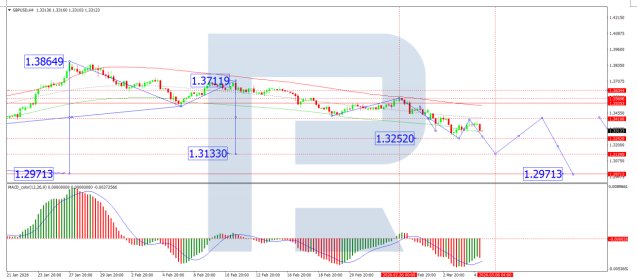
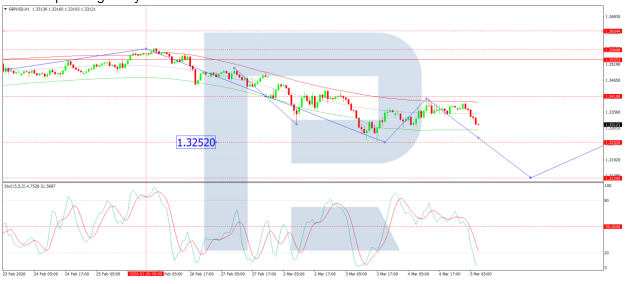
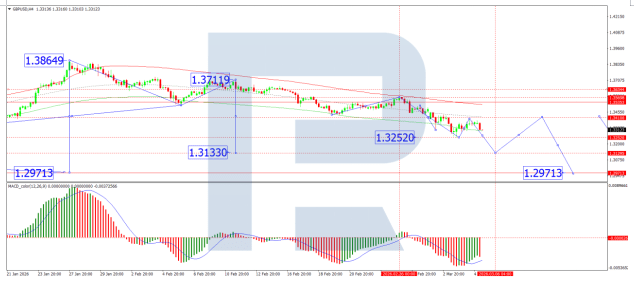
On the H4 GBP/USD chart, the market is forming a wide consolidation range around the 1.3326 level, currently extending up to 1.3393. A decline to 1.3131 is expected in the near term. Following this correction, a new consolidation phase is likely. An upside breakout would pave the way for the wave to extend to 1.3410, while a downside breakout would suggest further movement towards 1.2971. This scenario is confirmed by the MACD indicator, which shows its signal line below the zero line and pointing firmly downwards.

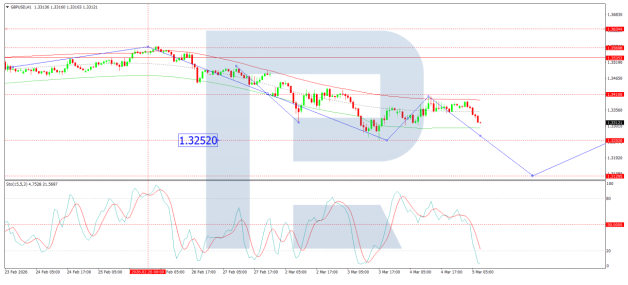
On the H1 chart, the market has formed a compact consolidation range around the 1.3333 level. A downside breakout has initiated a wave structure extending to 1.3266. If this level is breached, further downside potential towards 1.3125 is possible. This scenario is supported by the Stochastic oscillator, whose signal line is below the 50 level and pointing firmly downwards.

Conclusion

GBP/USD remains under pressure, with shifting central bank expectations and geopolitical developments driving price action. The dramatic reversal in BoE rate-cut probabilities – from 75% to just 20% in a week – reflects growing concerns about inflation driven by rising energy prices. While tentative diplomatic signals from Iran have temporarily eased dollar strength, the technical outlook for the pair remains decidedly bearish, with further downside anticipated in the near term.


Disclaimer

Any forecasts contained herein are based on the author’s particular opinion. This analysis may not be treated as trading advice. RoboForex bears no responsibility for trading results based on trading recommendations and reviews contained herein.

Geopolitical Distraction

Opinion — Source: Michael Ballanger (3/2/26) 

Michael Ballanger of GGM Advisory Inc. shares his view of current moves in geopolitics and the stock market. He also looks at one copper stock on his list and discusses PDAC.

As we head into the month of March, the headline that dominated the last weekend of February was the U.S.-Israeli attacks on key Iranian targets, which included the killing of Iranian Supreme Leader Ayatollah Ali Khamenei and (allegedly) several of his top military and political staff. Described as a “massive intelligence failure” by the Iranian leadership, the stage has been set for regime change in a country that has been threatening “Death to America” since the overthrow of the Shah of Iran in February of 1979.

CNN, Fox, the BBC, and Bloomberg have been flashing headlines for the past 48 hours that have viewers morbidly riveted to the television screens grasping for any and all confirmation that the theocracy has been eliminated. Unfortunately, despite there being a democratically-elected president in Iran, the only real power lies with the Islamic clerics whose foreign policy strategy has supported (and funded) many terrorist organizations over the past three decades.

  • Hezbollah (Lebanon): Iran’s most powerful and capable proxy, receiving an estimated $700 million annually. Iran provided the foundation for the group in the 1980s and continues to supply sophisticated missiles and air-defence systems.
  • Hamas (Palestinian Territories): A Sunni militant group that has received up to $350 million per year as of 2023 for its operations against Israel. Support includes rocket technology and military training.
  • Palestinian Islamic Jihad (PIJ): Heavily dependent on Iran for its budget, training, and weaponry. It is often described as Tehran’s most loyal Palestinian proxy.
  • The Houthis (Yemen): Formally known as Ansar Allah, they receive advanced UAVs (drones), ballistic missiles, and maritime attack capabilities from Iran, which they have used to target international shipping in the Red Sea.

As a result, years of waffling by Western nations, including the U.S., have allowed the Iranians to construct an informal yet effective counter presence to the domination of the Israeli military in the Middle East region. As always, heavy lobbying by the Israeli supporters in Washington has turned the tide, and now the world faces a direct declaration of war against Iran led by Israel and backstopped by the massive American strike force now positioned in the Gulf, armed and ready to unleash shock-and-awe power on the Iranians. I suspect that surveillance over the Straits of Hormuz will be intense, as over 20 million barrels of oil pass through the waterway each day, representing over 20% of global oil production. As the passage is only 21 miles across at its narrowest point, any steps to block tankers from navigating the Straits would be catastrophic to the world economy.

However, as is the case with all geopolitical events, their impact on markets is usually short, sharp, and swift and rarely cause protracted declines in stocks or rises in gold but ancillary effects of the conflict such as the closing of the Straits of Hormuz would send oil prices into a vertical trajectory that has some pundits calling for $100/bbl. as a result. The inflationary impact of such a price spike would be immediate, so the beneficiaries would be gold and silver, but not the mining stocks, because the greater portion of input costs for those miners is energy, with a specific focus on diesel, which powers trucks, and front-end loaders and drill rigs.

I expect oil to gap up into the $70 range overnight unless the evidence shows that the oil-producing facilities are untouched or that hostilities have abated.

As much as I have narrowed this discussion to the weekend attacks on Iran and the death of Khamenei, it has camouflaged what I believe was an even bigger story for the global capital markets last week and that was the sudden failure of Market Financial Solutions (MFS) which specialized in housing bridging loans and, as was well-stated by Zerohedge on Sunday, “is a mutant melange of all the worst traits of both Tricolor and First Brands — last year’s Private Credit implosion superstars — which collapsed virtually overnight having previously attracted backing from firms such financial giants as Barclays, Apollo’s Atlas SP Partners unit, Jefferies (which is now two for two after its participation in the First Brands bankruptcy) and TPG.

The practice that sank this outfit was the “rehypothecation” of underlying collateral with multiple lenders many times over, such that an asset worth £230 million has over £1.2 billion in debt pledged against it. While these practices are essentially fraud, they never get revealed until there is concern over the underlying asset, and once any one lender demands the collateral, the Ponzi scheme collapses, taking everyone with it.

The MFS story surfaced on Thursday night, but the initial hiccup on Wall Street with the DJIA off over 700 points in the first hour was met with aggressive dip-buying all session, with the bulk of the sell-off not in the software stocks but in the financials, where the selling was broadly-based and across-the-board.
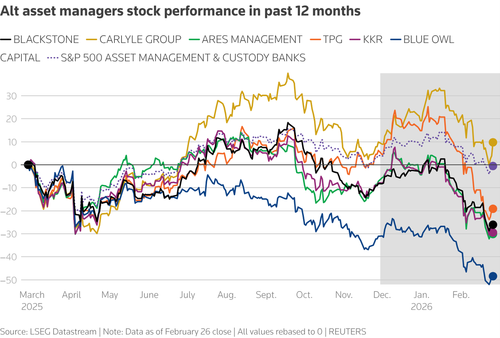
Global skirmishes rarely cause prolonged market declines, but credit events do, as we saw in 2008 with the initial collapse of the two Bear Stearns hedge funds tied to subprime loans. Wall Street shrugged off those two failures, citing “containment” to only one firm. As we all found out later, it was not “contained” and was in fact “systemic,” eventually taking the entire global financial system to the point of full-on collapse.

I would point to the failures of Tricolor and First Brands last October, followed by last week’s blow-up by MFS, as evidence of more cockroaches appearing in the kitchen of private credit, and just like Wall Street’s full denial back in 2007 of any possible contagion, these were the headlines in October worth noting:

  • Wall Street lenders see limited fallout from bankruptcies
  • JPMorgan CEO warns of potential credit market excess
  • BlackRock CFO sees strong credit quality despite bankruptcies

To see the name “Blackrock” up there referring to “strong credit quality” is far more impactful than the events in Iran, which are now looking like a purposeful distraction, deflecting all eyes away from the escalating rot that is again starting to envelop the financial sector just as it did eighteen years ago.

So, when I see the gold and silver miners in retreat next week despite rising gold and silver prices, I will look to rising oil and collapsing credit as the culprits.

Fitzroy

I had the pleasure of sitting down to a luncheon with Fitzroy Minerals Inc. (FTZ:TSX.V; FTZFF:OTCQB) Chairman Campbell Smyth as well as CEO Merlin Marr-Johnson along with two current investors on Saturday and watched and listened as they mapped out the game plan for Fitzroy for 2026 and the rationale for raising over CA$20 million (announced last week) while sitting with nearly CA$12 million in the bank. A large number of investors have asked me why they elected to dilute current shareholders now instead of more drilling at both Buen Retiro and Caballos before financing. With 330 million shares issued, the new financing for “up to CA$26 million” by way of LIFE and concurrent private placement offerings could add up to 78 million additional shares, which would capitalize the deal at CA$204 million (assuming full dilution).

A few subscribers came back with the “CA$204m for an exploration company not yet in production? Isn’t that rich?” so when I threw that out in front of Smyth and Marr-Johnson, their explanation was at once both revealing and exciting.

The key to the transaction lies in the agreement signed on July 3, 2023, when pre-Fitzroy company Ptolemy Inc. entered into the earn-in with Pucobre SA, which at the time was a US$800m Chilean copper miner specializing in small-scale oxide deposits. The terms included:

  • Work Commitment: Ptolemy must carry out a US$7,000,000 work program over four years.
    • Year 1: US$2,000,000.
    • Years 2–4: US$5,000,000 (minimum US$1,000,000 in any consecutive 12-month period).
  • Option Exercise: In Year 5, Ptolemy can exercise the option to acquire 100% ownership with a US$4,000,000 payment.
  • Royalties: Vendors retain a 2% Net Smelter Royalty (NSR), with a 1% buyback provision for US$5,000,000 prior to production.

Pucobre’s 30% Clawback Right 

  • Clawback Right: After Ptolemy completes the acquisition, Pucobre has the right to purchase back up to 30% of the local subsidiary holding the asset.
  • Purchase Price: The price is calculated as three times 30% of the sum of:
    1. A fixed US$300,000 amount.
    2. All investment made by Ptolemy related to the Buen Retiro Option.
  • Post-Clawback: If exercised, Pucobre will fund the project pro rata or face dilution.

Following these initial agreements, Fitzroy Minerals Inc. completed the acquisition of Ptolemy Mining Limited in March 2025, thereby assuming these option terms.

So now, Fitzroy Minerals has until July 3, 2028, to complete the remaining terms after which they will have earned a full 100% interest in the Buen Retiro project. Where this gets interesting lies in that “clawback provision” (“CP”). If Pucobre SA elects to exercise the CP, they are obligated to pay FTZ/FTZFF 90% of all expenditures retroactive to Day One. So, if the company were to spend the entire CA$26 million in expanding both the economically-viable oxides and the newly-discovered sulphide zone, they would be refunded CA$23.4 million and wind up with 70% interest in the project.

The initial expectation is an operation generating 20m lbs. of Cu with a margin of around US$4/lb. at US$6.00/lb. Cu. The CAPEX for this operation would be approximately US$50m of which Fitzroy’s portion would be 70% or US$35m. Commencing in 2028, the company could potentially receive US$56m/year of free cash flow with an expected mine life of eight years.
According to Marr-Johnson, that would justify a US$400m market cap or a little under US$1.00 per share for FTZ/FTZFF, and since the copper-bearing oxides at Buen Retiro have been thoroughly tested with over 40k metres of drilling, there is little risk (other than the copper price) to the achievement of that valuation.
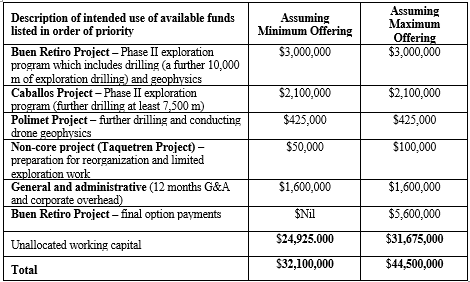
However, it will require money and lots of it in order to successfully execute the milestones set out in the earn-in agreement, so rather than gamble on the financing environment down the line, they elected to take the prudent course of action and access the larger institutional market now, and that, my friends, was simply a brilliant move. At the end of the day, they will have a CA$32m war chest with which to compete all terms of the earn-in and still have enough money for a 10,000m drill program at Buen Retiro and “at least” 7,500m of drilling at Caballos.

I have never encountered any exploration company in my five-decade career that can drill out a project knowing with confidence that 90% of whatever they spend will be returned by an eager and established partner. More importantly, since equity markets are valued at over two standard deviations above the norm, with technology stocks led by “AI” now rolling over, there is no need for concern about a funding shortfall at least until well into 2027. Hopefully, by then, the company has established economic viability of the deeper Cu-bearing sulphide zone(s) and the same for Caballos, two accomplishments that would move the implied market cap for FTZ/FTZFF to north of US$1 billion (or around US$2.50 on a fully-diluted basis).

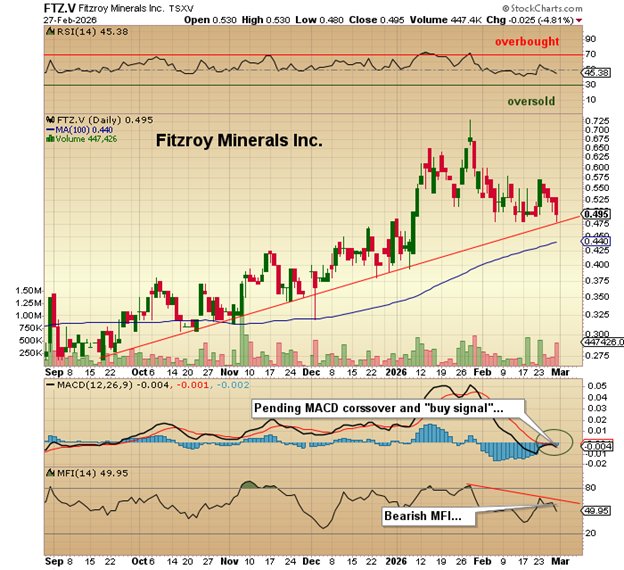
One final observation from the luncheon: This is a well-oiled and seasoned team of proven professionals running Fitzroy’s two flagship programs. With this financing, they have brought in large, deep-pocketed global investment firms from the U.K. and Australia as strategic investors. One of these investors that constituted the lead order in the raise gave instructions to Merlin Marr-Johnson which resonate strongly: “Go find us “BIG COPPER.” With that as a clarion call, I urge all subscribers to heed the words because with that, FTZ/FTZFF has finally entered the “big leagues” of junior exploration and development as there is less risk today at CA$0.50 than there was last June at CA$0.30.

PDAC

The largest collection of mining promoters on the planet can be found at noon on Sunday at the Toronto Metro Convention Centre where the Prospectors and Developers Association of Canada (“PDAC”) annual convention gets underway with what could be the largest attendance in the history of the show. Established in 1932, the association expanded their annual meeting to a full-day affair and then later in 1944 moved to the Royal York Hotel to accommodate the large increase in both members and attendees.

Since 1997, it has become the biggest gong-show in North America with hundreds of mining companies both junior and senior all vying for the attention of the retail and institutional investor complete with contests, featured speakers, investment workshops, and the usual parade of carnival barkers, confidence men, and charlatans all doing what they must to relieve us of our hard-earned savings all in the quest for untold wealth and instant enrichment by way of the drill bit.

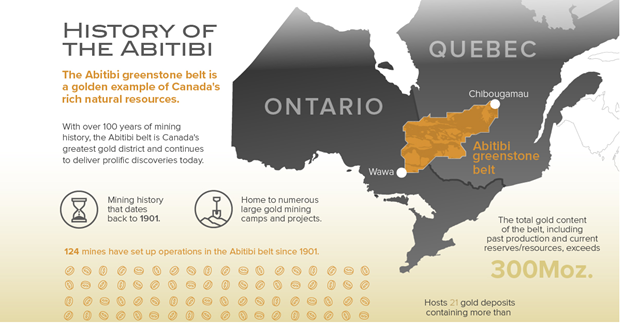
Mark Twain was once asked the definition of a gold mine, and he answered, “a hole in the ground with a liar at the top,” in what over the years has grown to be a somewhat accurate measure of the veracity of the claims made by those looking for investors to finance a project. In the old days of the early 1900’s it was farmers from southwest Ontario what had most of the disposable wealth in the country and it was their money that funded big discoveries in the north in small towns like Cobalt and Kirkland Lake that led to the discovery of the mighty Abitibi Greenstone Belt, a geological province stretching from northwestern Quebec to Wawa, Ontario that was the source of over 190–200 million ounces of gold, more than 35 billion pounds of zinc, 15 billion pounds of copper, and at least 400 million ounces of silver.
Many of these discoveries were aided and abetted by the PDAC convention, where it showcased actual samples of rock containing all of the metals mentioned above. When I first attended in 1981, the booths were filled with mining people with few “suits”, many “lumberjack jackets”, and rarely a female. That all changed in the 1980s during a particularly flat period for the metals. During the years after gold’s top in 1980 at $857 per ounce, PDAC conventions needed to re-invent themselves from standard industrial-style “workshops” that featured core shacks and claim maps to something more akin to the trade shows in Miami and Las Vegas, where the marketing wizards utilized new technologies to attract investors. By the mid-1980s, the booths were lit up with lights and music and free giveaways like key chains, calendars, and baseball caps, all designed to get bodies into the aisles where they could be corralled into booth after booth and in front of arguably the finest pitchmen on the planet.

My friend Robert Bishop and I were once having a conversation in the newsletter section where Bob was signing up the odd straggler to his advisory service “The Gold Mining Stock Report” which at the time was the singular best source of junior mining information and advice that money could buy. However, Bob was struggling to make a living while twenty feet away, another newsletter writer, James Dines, had engaged two gorgeous, tall platinum blondes to man the booth, complete with jaw-dropping cleavages bursting from low-cut evening gowns. Lined up to subscribe to the vastly inferior Dines Letter were perhaps fifty to one hundred goggle-eyed “investors”, all male and all clamouring for a chance to stand and fill out the forms handed to them by ladies as they bent over lasciviously to deliver the papers. Eventually, Bishop’s research and diligence moved him to the pinnacle of his industry and when he retired in 2007, he was the heavyweight champion of the junior mining newsletter world with no one within miles of his title. That day, however, he was an afterthought as Dines ruled the venue.

I also recall the period in the mid-1990’s after Bob had delivered Dia Met Minerals ($0.60 to $60), Arequipa ($0.25 to $34.75), and Diamondfields ($0.25 to $160) and had several thousand paid subscribers as I was walking with him down one of the aisles at the convention centre when I said “Hey Bob, look behind you.” at which point we both turned to see a line of perhaps fifty or sixty promoters, investor relations executives, and seniors carrying shopping bags full of baseball caps, calendars, and key chains all waiting for a chance to catch Bob’s attention. I turned to him and said, “Nice entourage you’ve developed!”

PDAC can be a great source of networking and idea-generation, but with the advent and rise of social media and the internet, the value of the conference these days is catching up with old colleagues who have enough scars on their backs and faces to have earned the right of PDAC passage. Those Johnny-come-Latelys attending for the first time after dumping all of their crypto or artificial intelligence stocks have zero scars and little right to assume the role of “PDAC Member” despite the fact that they paid the fee and now have a name tag. Attendance in 2020 was 23,000 people, and after being strictly “virtual” in 2021, it has since grown to 27,000+ in 2025. This year, the estimates are for a full 30,000 or more people to be in attendance.

It should be remembered that there is a seasonal hangover just after the convention that can last for up to four months. In fact, one of the older veterans I used to speak with used to sell all of his junior mining issues and not take any phone calls until August. He once emailed me the results, and while this was back in 2011, it showed an uncanny track record of avoiding the summer doldrums in most years when interest in exploration and development issues waned, and prices retrenched right up until mid-August. His spreadsheet confirmed that the performance of the TSX Venture Exchange was inferior in most years between March and August but vastly superior between August and March. From my own years of experience, June and July can be problematic, but I always tried to focus on companies that had active catalysts attracting investor attention during those months, and have been fortunate to have benefited, for the most part.

I think that the trend of metal prices will have copper at the forefront at PDAC 2026, whereas last year it was gold and silver. I also believe that the rise in valuation for many of the mid-tier metal producers are going to force investors to move down the risk-curve to begin to include non-producers and favour the developers. That should favour those companies fortunate enough to have established an economic resource. As valuations increase for the developers, it will ultimately force investors to populate the bottom rung of the junior mining food chain — the explorers — and that is where the fun should start, and also, regrettably, mark the end of the cycle. When the junior explorers start to rise on rank speculation, that is when we will be exiting the space and raising cash.
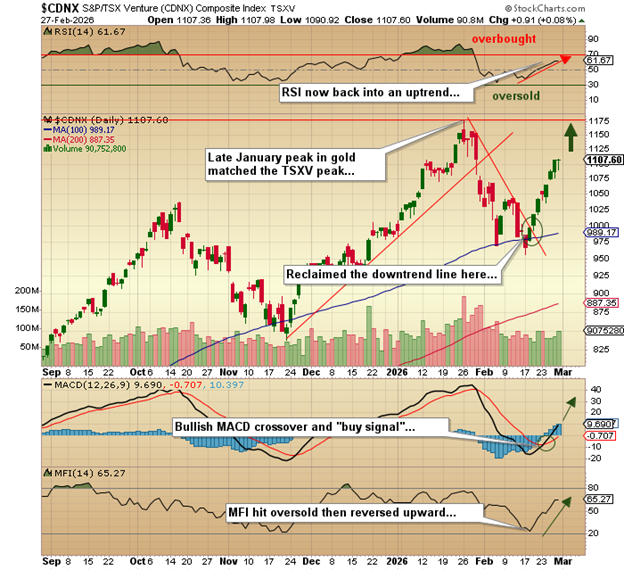
As for the PDAC “curse” that has the TSXV regressing into a three to four month corrective phase, I will need to watch metal prices and energy to see if they can countermand the seasonal softness that accompanies the post-PDAC period.

My guess is that the developers may dodge the bullet, but that the seniors and mid-tier names trade flat or lower. I shall remain focused on those companies with solid stories and active catalysts, most of which are contained in the GGMA 2026 Trading and Portfolio accounts.


Important Disclosures:

  1. As of the date of this article, officers, contractors, shareholders, and/or employees of Streetwise Reports LLC (including members of their household) own securities of Fitzroy Minerals.
  2. Michael Ballanger: I, or members of my immediate household or family, own securities of:  Fitzroy Minerals. My company has a financial relationship with: None. My company has purchased stocks mentioned in this article for my management clients: None. I determined which companies would be included in this article based on my research and understanding of the sector.
  3. Statements and opinions expressed are the opinions of the author and not of Streetwise Reports, Street Smart, or their officers. The author is wholly responsible for the accuracy of the statements. Streetwise Reports was not paid by the author to publish or syndicate this article. Streetwise Reports requires contributing authors to disclose any shareholdings in, or economic relationships with, companies that they write about. Any disclosures from the author can be found  below. Streetwise Reports relies upon the authors to accurately provide this information and Streetwise Reports has no means of verifying its accuracy.
  4. This article does not constitute investment advice and is not a solicitation for any investment. Streetwise Reports does not render general or specific investment advice and the information on Streetwise Reports should not be considered a recommendation to buy or sell any security. Each reader is encouraged to consult with his or her personal financial adviser and perform their own comprehensive investment research. By opening this page, each reader accepts and agrees to Streetwise Reports’ terms of use and full legal disclaimer. Streetwise Reports does not endorse or recommend the business, products, services or securities of any company.

For additional disclosures, please click here.

Michael Ballanger Disclosures

This letter makes no guarantee or warranty on the accuracy or completeness of the data provided. Nothing contained herein is intended or shall be deemed to be investment advice, implied or otherwise. This letter represents my views and replicates trades that I am making but nothing more than that. Always consult your registered advisor to assist you with your investments. I accept no liability for any loss arising from the use of the data contained on this letter. Options and junior mining stocks contain a high level of risk that may result in the loss of part or all invested capital and therefore are suitable for experienced and professional investors and traders only. One should be familiar with the risks involved in junior mining and options trading and we recommend consulting a financial adviser if you feel you do not understand the risks involved.

Brent headed for $100?

By ForexTime 

  • Oil benchmarks surge over 15% since Monday on supply fears
  • Spiking energy prices have fueled inflation fears
  • Cooling Fed cut bets could hit equity markets
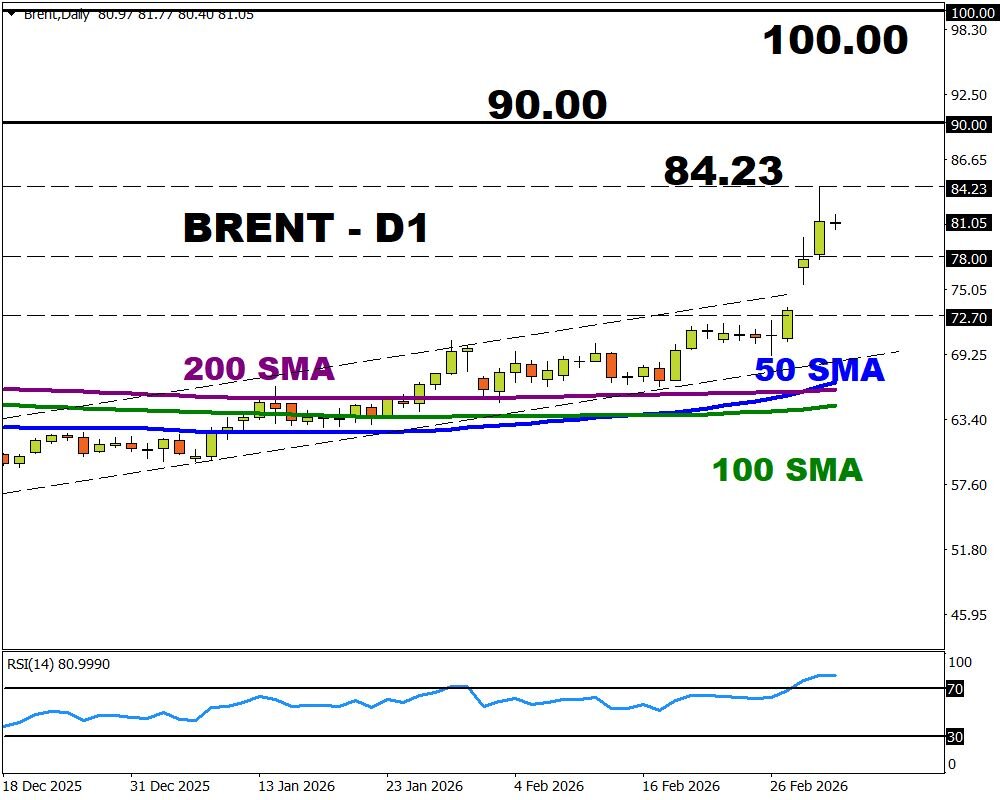
  • Brent firmly bullish with $90and $100 acting as key levels of interest

Brent oil has rallied as much as 17% since Monday, pushing 2026 gains to 35%.

Why:

  •  Iran conflict: Global oil markets have been thrown into turmoil by the US and Israeli war against Iran. This has halted trade, driven producers to lock output and forced the closure of a major refinery part.


  • Closure of the Strait of Hormuz: This is a narrow waterway that connects the Persian Gulf to the Indian Ocean where around 20% of the world’s oil passes through. Iran has effectively closed this passage – warning that any vessel that passes would be set “ablaze”.

What does this mean?

  • Consumer pain: A sustained rise in oil prices could be bad news for consumers as the cost of petrol and domestic energy bills increases.
  • Inflation fears: Aggressively rising energy prices may raise inflationary fears, forcing markets to push back against rate-cut expectations.
  • Return of equity bears: This domino effect may hit global stocks which have been benefiting from the prospect of lower rates in 2026.

Potential scenarios

Bullish Scenario: The direct military escalation in the Middle East has led to the closure of the Strait of Hormuz. Any supply shock could drive Brent toward $90 and $100.

Bearish Scenario: Easing tensions or the re-opening of the Strait of Hormuz may cool supple-side fears. A break below the $78 support could trigger a sell-off toward $75 for Brent.


Forex-Time-LogoArticle by ForexTime


ForexTime Ltd (FXTM) is an award winning international online forex broker regulated by CySEC 185/12 www.forextime.com

Global stock indices continue sell-off due to Middle East conflict

By JustMarkets 

The US stock market declined sharply on Tuesday. By the end of the day, the Dow Jones (US30) fell by 0.83%. The S&P 500 (US500) dropped by 0.94%. The tech-heavy NASDAQ (US100) closed lower by 1.09%. A turning point came with President Trump’s announcement that the US Navy would provide military escort for tankers through the Strait of Hormuz. This promise not only checked the speculative peak in Brent crude prices but also calmed the bond market, allowing Treasury yields to stabilize and providing a breather for the technology sector. Nevertheless, previous growth leaders such as Nvidia and Tesla ended the day in the red, down 1.3% and 2.7% respectively, remaining under pressure from high borrowing costs.

The Mexican peso (MXN) weakened to 17.7 per dollar, hitting a six-week low amid catastrophic foreign trade data and intensifying geopolitical risks. In January, Mexico recorded a historic trade deficit of $6.48 billion, driven by a 33.5% collapse in oil exports and a 9% reduction in vehicle shipments to the US. The situation is exacerbated by a new 10% global US import tax introduced on February 24, which threatens Mexico’s key export chains and offsets the positive impact of the Q4 GDP revision to 0.9%.

Stock markets in Europe continued their plunge on Tuesday. The German DAX (DE40) fell by 3.44%, the French CAC 40 (FR40) closed down 3.46%, the Spanish IBEX 35 (ES35) dropped 4.55%, and the British FTSE 100 (UK100) closed down 2.75%. The primary driver of the sell-off was the fear of a massive energy shock: due to the blockade of the Strait of Hormuz and the suspension of production at Qatari plants, natural gas prices in Europe soared by more than 40%, exceeding €60/MWh. This jeopardizes the region’s energy-intensive industrial sector. Additional pressure came from fresh Eurozone inflation data for February, which unexpectedly accelerated to 1.9% (against an anticipation of 1.7%), while core inflation jumped to 2.4%. This spike, amplified by the Milan Winter Olympics and rising service prices, forced traders to revise ECB rate expectations – the probability of rate cuts in 2026 has practically vanished, giving way to prognosis of potential policy tightening.

Silver prices (XAG) suffered a crushing collapse on March 3, plummeting by more than 10% and falling below the psychological mark of $80 per ounce. Much like gold, silver fell victim to the phenomenal strengthening of the US dollar, which has displaced all other safe-haven assets amid the full-scale military conflict with Iran. Investors preferred the liquidity of the US currency, while silver, possessing a significant industrial component, faced double pressure: as a precious metal, it suffered from rising bond yields, and as an industrial metal, it was hit by global recession risks due to expensive energy.

WTI oil prices demonstrated extreme volatility decreasing to $73.8 per barrel after an initial morning surge of over 8%. The initial panic jump was caused by massive drone attacks on strategic sites: the Ras Tanura refinery in Saudi Arabia and the oil hub near the port of Fujairah (UAE). However, the market reversed sharply following President Trump’s emergency statement regarding US Navy escorts in the Strait of Hormuz. Despite the correction from daily highs, quotes remain at their peak levels since June of last year due to ongoing logistical paralysis. Even with US Navy support, shipping in the Persian Gulf is effectively paralyzed as leading insurers (Lloyd’s of London, etc.) continue to refuse war risk coverage or set prohibitive rates. Investor attention is now fixed on the effectiveness of air defense systems in the Emirates: any successful breach by Iranian missiles targeting export terminals could instantly return prices to levels above $80.

Asian markets traded lower yesterday. The Japanese Nikkei 225 (JP225) fell by 3.06%, the FTSE China A50 (CHA50) dropped 0.14%, the Hong Kong Hang Seng (HK50) lost 1.12%, and the Australian ASX 200 (AU200) showed a negative result of 1.34%. On Wednesday morning, the Hang Seng plunged to 25,098 (-2.6%), its third consecutive decline, nearing an 11-week low. Investors fear the blockade will trigger a prolonged energy shock that will accelerate global inflation.
The Australian dollar (“aussie”) dropped to the $0.700 level, hitting a four-week low. Paradoxically, even brilliant Q4 2025 GDP data (Australia’s economy grew by 0.8% against a 0.7% prediction, with the annual rate accelerating to a three-year high of 2.6%) could not stop the fall. The currency became a hostage to the global flight to safety as investors ignored domestic economic success in the face of a looming full-scale war in the Middle East.

The New Zealand dollar (“kiwi”) made a weak attempt to rise to $0.589 but remained near a six-week low. As a “risk” currency, the kiwi is highly sensitive to the escalation in the Persian Gulf. The main pressure factor is New Zealand’s critical dependence on imported refined fuel: the blockade of the Strait of Hormuz and the halt of exports from Qatar threaten the country with a sharp spike in gasoline prices. Amid the external chaos, the RBNZ maintains a surprisingly calm stance. New Governor Anna Breman confirmed a soft monetary policy path, stating the economy is capable of recovering without creating excessive inflationary pressure.

S&P 500 (US500) 6,816.63 −64.99 (−0.94%)

Dow Jones (US30) 48,501.27 −403.51 (−0.83%)

DAX (DE40) 23,790.65 −847.35 (−3.44%)

FTSE 100 (UK100) 10,484.13 −295.98 (−2.75%)

USD Index 99.03 +0.64% (+0.65%)

News feed for: 2026.03.04

  • Australia Services PMI (m/m) at 00:00 (GMT+2); – AUD (MED)
  • Australia GDP (q/q) at 02:30 (GMT+2); – AUD (MED)
  • Japan Services PMI (m/m) at 02:30 (GMT+2); – JPY (MED)
  • China Manufacturing PMI (m/m) at 03:45 (GMT+2); – CHA50, HK50 (MED)
  • China Services PMI (m/m) at 03:45 (GMT+2); – CHA50, HK50 (MED)
  • Switzerland Consumer Price Index (m/m) at 09:30 (GMT+2); – CHF (HIGH)
  • Eurozone Services PMI (m/m) at 11:00 (GMT+2); – EUR (MED)
  • UK Services PMI (m/m) at 11:30 (GMT+2); – GBP (MED)
  • Eurozone Producer Price Index (m/m) at 12:00 (GMT+2); – EUR (MED)
  • Eurozone Unemployment Rate (m/m) at 12:00 (GMT+2); – EUR (MED)
  • US ADP Non-Farm Employment Change (m/m) at 15:15 (GMT+2); – USD (MED)
  • US ISM Services PMI (m/m) at 17:00 (GMT+2); – USD (MED)
  • US Crude Oil Reserves (w/w) at 17:30 (GMT+2); – WTI (HIGH)
  • Canada BOC Gov Macklem Speaks at 17:30 (GMT+2). – CAD (LOW)

By JustMarkets


This article reflects a personal opinion and should not be interpreted as an investment advice, and/or offer, and/or a persistent request for carrying out financial transactions, and/or a guarantee, and/or a forecast of future events.

USD/JPY to Quickly Return to Growth: Momentum Favours the US Dollar

By Analytical Department RoboForex

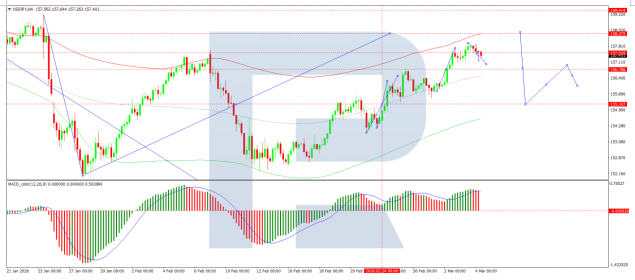
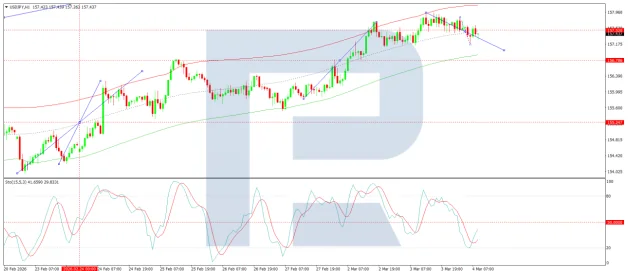
USD/JPY paused briefly midweek after a series of solid gains, currently trading at 157.59. The Japanese currency remains under pressure from a strengthening US dollar amid concerns that a prolonged conflict in the Middle East could keep energy prices elevated and heighten inflation risks.

The market has also revised its expectations for Federal Reserve rate cuts, shifting the likelihood of a reduction from July to September. Amid escalating geopolitical tensions, the dollar has emerged as a primary safe-haven asset, particularly as the US-Israel military operation against Iran enters its fifth phase.

US President Donald Trump suggested that the strikes could lead to a change of power in Iran. However, any new regime might prove equally problematic, underscoring the uncertainty surrounding the conflict’s outcome.

Japanese Finance Minister Satsuki Katayama reiterated that currency interventions remain a potential tool to support the yen. According to her, authorities are monitoring exchange rate dynamics with heightened urgency and are coordinating their actions with the US.

Technical Analysis

On the H4 USD/JPY chart, the market is forming a consolidation range around 157.00, which is currently extending to 157.92. A decline to test the 157.00 level from above is expected today. Following this, a potential growth leg towards 158.06 is likely. Technically, this scenario is supported by the MACD indicator, whose signal line is well above the zero line and pointing firmly downward.

On the H1 chart, USD/JPY is forming a downward wave pattern, targeting the 157.00 level, with a possible extension to 156.66, and further growth towards 158.38 anticipated thereafter. Technically, this scenario is confirmed by the Stochastic oscillator, with its signal line above the 20 level and pointing firmly downward.

Conclusion

USD/JPY’s brief consolidation appears temporary, with the broader trend favouring further upside for the dollar. Geopolitical tensions in the Middle East have reinforced the dollar’s safe-haven status, pushing back expectations for Fed rate cuts and creating a supportive backdrop for the pair. Despite verbal intervention warnings from Japanese officials, the technical outlook suggests USD/JPY is poised to resume its upward trajectory once the current correction runs its course.


Disclaimer

Any forecasts contained herein are based on the author’s particular opinion. This analysis may not be treated as trading advice. RoboForex bears no responsibility for trading results based on trading recommendations and reviews contained herein.

European equities plunge amid Persian Gulf military conflict

By JustMarkets 

The US stock market demonstrated impressive resilience on Monday: after a morning plunge, the indices almost completely recouped their losses. By the end of the day, the Dow Jones (US30) decreased by 0.15%. The S&P 500 (US500) gained 0.04%. The tech-heavy NASDAQ (US100) closed higher by 0.13%. The recovery was driven by a powerful wave of “buy-the-dip” activity focused on tech giants with massive liquidity reserves – Nvidia and Microsoft rose by 2.9% and 1.5%, respectively. Investors view “Big Tech” as a kind of “safe haven” within the technology sector, capable of weathering periods of high geopolitical turbulence.

Additional support came from the defense and energy sectors, which were direct beneficiaries of the escalation in the Middle East. Northrop Grumman shares soared 6% in response to the launch of Operation “Epic Fury,” while Exxon Mobil added 1.1% amid the oil rally caused by the blockade of the Strait of Hormuz.
The Canadian dollar (CAD) fell to 1.37 against the US dollar, testing a monthly low. The uniqueness of the situation lies in the fact that the “loonie” failed to benefit from the 8% spike in oil prices triggered by the blockade of the Strait of Hormuz and the death of Ayatollah Khamenei. Normally, the Canadian currency rises alongside energy prices, but the current dominance of the US dollar as the world’s primary haven and Canada’s internal economic issues have completely neutralized the “oil factor.” Fundamental pressure on the currency intensified following the release of Q4 GDP data, which confirmed a 0.6% contraction of the Canadian economy – the worst performance since the 2020 pandemic. Even the fact that the manufacturing PMI reached a 13-month high in February (51 points) failed to encourage investors.

Stock markets in Europe fell sharply. The German DAX (DE40) dropped 2.56%, the French CAC 40 (FR40) closed down 2.17%, the Spanish IBEX 35 (ES35) fell 2.64%, and the British FTSE 100 (UK100) closed down 1.20%. The German DAX 40 showed the worst performance among major European floors, crashing to 24,672 – the lowest closing level since early February. The decline affected almost all sectors of the German economy, as investors fear that the escalation of war in the Middle East and the blockade of the Strait of Hormuz will lead to a new round of inflation and indefinitely delay ECB interest rate cuts.

The most devastating blow hit the tourism and aviation sectors. Lufthansa shares plummeted 4.6% (with the drop exceeding 6% at one point) due to mass flight cancellations to the region and a sharp increase in jet fuel costs. The situation is even worse for the travel giant TUI, whose stock crashed nearly 9%. Investors are pricing in not only operational losses from tour disruptions but also the risk of a global decline in demand for long-haul travel under “wartime” uncertainty.
The silver (XAG) market saw a dramatic reversal: after a 3% rising morning surge, quotes collapsed by more than 6%, ending trade near $28. This “bearish” maneuver was caused by a sharp shift in market priorities. While gold maintained its safe-haven status, silver suffered due to its industrial nature. The blockade of the Strait of Hormuz and the death of Ayatollah Khamenei created a real threat of a global energy crisis. An additional blow came from US macroeconomic statistics: the jump in the ISM Manufacturing Prices Index to 70.5 (an 11.5-point increase) shocked markets, signaling a new wave of inflation. This triggered a spike in 10-year Treasury yields and pushed the US dollar Index to a five-week high.

WTI oil prices demonstrated explosive growth, soaring by more than 12% at one point to a high since June of last year. Although quotes stabilized around $71-$72 by the close of the session, the market remains in a state of unprecedented shock. The main trigger was the de facto halt of shipping through the Strait of Hormuz. Insurance companies began mass-canceling policies or raising premiums to prohibitive levels (up to 0.4% of the vessel’s value), forcing more than 150 tankers to anchor and wait for safety.

The situation was exacerbated by a direct attack on Saudi Arabia’s energy infrastructure. Drones struck the kingdom’s largest refinery in Ras Tanura (capacity 550,000 barrels per day). Although the fire was quickly localized, Saudi Aramco was forced to temporarily shut down the facility for safety reasons. This incident confirmed analysts’ worst fears: that Iranian retaliatory strikes would target not only US military logistics but also critical nodes of the world’s energy supply. With 20% of global oil passing through the closed strait, analysts at JPMorgan and Goldman Sachs warn: if the blockade lasts more than three weeks, oil prices will inevitably break the $100 per barrel level, creating an “inflationary tsunami” for the global economy.

Asian markets traded with mixed dynamics yesterday. The Japanese Nikkei 225 (JP225) decreased by 1.35% during the session, the FTSE China A50 (CHA50) rose by 0.30%, the Hong Kong Hang Seng (HK50) dropped 2.14%, and the Australian ASX 200 (AU200) showed a positive result of 0.03%.

The Australian dollar (AUD) recovered to $0.71, partially offsetting Monday’s sharp fall. The driver of this growth was the hawkish rhetoric of RBA Governor Michele Bullock, who, against the backdrop of the Middle East crisis, shifted from a policy of patience to a readiness for action. Bullock explicitly warned that the surge in oil prices due to the conflict surrounding Iran carries serious inflationary risks for Australia and confirmed that the regulator would consider a rate hike at the March meeting. This triggered a revision of market expectations: the probability of a 25-basis-point hike in March is now estimated at 28%, with full policy tightening expected by May.

S&P 500 (US500) 6,881.62 +2.74 (+0.04%)

Dow Jones (US30) 48,904.78 −73.14 (−0.15%)

DAX (DE40) 24,638.00 −646.26 (−2.56%)

FTSE 100 (UK100) 10,780.11 −130.44 (−1.20%)

USD Index 98.54 +0.93% (+0.95%)

News feed for: 2026.03.03

  • Japan Unemployment Rate (m/m) at 01:30 (GMT+2); – JPY (MED)
  • Japan BOJ Gov Ueda Speaks at 06:00 (GMT+2); – JPY (LOW)
  • Eurozone Consumer Price Index (m/m) at 12:00 (GMT+2); – EUR (MED)
  • UK Annual Budget Release at 14:30 (GMT+2). – GBP (MED)

By JustMarkets


This article reflects a personal opinion and should not be interpreted as an investment advice, and/or offer, and/or a persistent request for carrying out financial transactions, and/or a guarantee, and/or a forecast of future events.

The oil price surge is just one symptom of a supply chain network that is not fit for this age of global tensions

By Maryam Lotfi, Cardiff University 

The escalating conflict between Iran, the US and Israel has taken a critical turn. The strait of Hormuz – one of the most important shipping routes for oil and gas – is facing significant disruption. The strait is the main route connecting Persian Gulf ports in Iran and some of the region’s other oil producers to the open ocean.

The strikes on Iran are already having tangible effects: energy flows are slowing, markets are reacting and supply chains are under pressure. This is not just a regional conflict – it is a global supply chain crisis unfolding in real time.

As an expert on supply chains, I am acutely aware of how central the strait is – not only for the stability of the region but also to the functioning of the global economy.

This narrow corridor is one of the world’s most critical chokepoints – around a fifth of the world’s oil passes through the strait daily. Its sudden disruption represents a “chokepoint failure” – a breakdown at a critical node that triggers cascading effects across global systems.

Tanker traffic has dropped sharply, with vessels waiting in surrounding waters as ship owners reassess the risks. Oil prices surged in response to the strikes and the threat to shipping routes. Analysts have warned that prices could climb significantly higher if the disruption persists.

But crucially, this reaction was not driven solely by actual shortages. Markets respond to uncertainty itself. The mere possibility that several million barrels per day could be disrupted is enough to push prices up, even before supply is properly hit. This reflects a broader feature of geopolitical risk: expectations and perceptions can be as economically powerful as material disruptions.

Because energy underpins almost every sector, these price increases transmit rapidly through supply chains. Higher fuel costs raise transportation expenses, increase production costs and ultimately feed into inflation across goods and services that eventually land with consumers.

The strategic importance of the Gulf states

The disruption is not confined to the strait. Instability across the wider Gulf region also affects the United Arab Emirates, as well as other strategically important energy producers and logistics hubs, such as Qatar, Kuwait and Saudi Arabia.

This dimension matters because the Gulf functions not only as an energy supplier but also as a crossroads in global trade and logistics.

Ports such as Dubai handle vast volumes of international shipping, linking Asia, Europe and Africa. As tensions spread, the reliability of these logistics systems is increasingly called into question.

The result is a shift to more widespread insecurity, where both energy flows and trade infrastructure – things like major container ports, shipping lanes, export terminals and storage facilities – are simultaneously at risk.

Energy is the heart of global supply chains. Manufacturing depends on electricity and fuel, transport relies on oil-based logistics and agriculture depends heavily on natural gas-derived fertilisers. When energy flows are disrupted or become more expensive, the effects propagate across entire networks.

Research on geopolitical crises shows that disruptions to key inputs such as oil and gas quickly translate into broader supply chain instability. This affects production, trade and the availability of goods far beyond the conflict zone. The Iran crisis reflects this dynamic. What begins as disruption in a maritime corridor can become a global economic issue within days.

For decades, global supply chains have been optimised for efficiency. This means that they concentrate sourcing and production in regions that minimise costs. This model has delivered large economic benefits, but it has also created weaknesses in the structure.

The concentration of energy flowing through a single chokepoint such as the strait of Hormuz exemplifies this trade-off. When it is disrupted, the system lacks resilience.

In response, supply chains are likely to accelerate efforts to diversify and invest in alternative energy routes and sources. Countries that are heavily dependent on oil transiting through the Gulf will seek to expand strategic reserves, diversify their import routes and invest in pipelines that bypass maritime chokepoints.

But at the same time, geopolitical instability strengthens the case for renewable energy, electrification and regional energy integration. Expanding solar, wind and green hydrogen capacity reduces exposure to concentrated fossil fuel corridors. And cross-border electricity connections can improve flexibility during shocks. In this sense, resilience is also an energy transition issue.

At the same time, instability in conflict-hit regions can fuel the rise of informal and illegal supply chains, particularly where governance is weakened. These can include things like unregulated oil trading, goods being smuggled through informal maritime routes and labour exploitation hidden within subcontracting chains.

What’s more, supply chains themselves are increasingly shaped by geopolitical forces, as states use trade, energy and logistics networks as instruments of power.

For consumers, this could mean greater price volatility, shortages and reduced choice as firms adjust sourcing strategies in response to sanctions, trade restrictions or security risks. In some cases, it may also mean higher costs over the long term, as businesses prioritise resilience over efficiency.

A turning point for globalisation?

The situation in the strait of Hormuz may mark a turning point in how global supply chains are understood. It has shone a light on a fundamental tension at the heart of globalisation. Efficiency depends on sourcing and production being concentrated in a few locations, but resilience depends on diversification. When critical links in the chain fail, the consequences extend far beyond their immediate location.

This war demonstrates that supply chains are not merely economic systems. They are deeply embedded in geopolitical realities. The challenge ahead is not simply to manage disruption, but to redesign supply chains and energy sources for a world in which geopolitical risk is no longer exceptional, but structural.The Conversation

About the Author:

Maryam Lotfi, Senior Lecturer in Sustainable Supply Chain Management, Cardiff University

This article is republished from The Conversation under a Creative Commons license. Read the original article.