REIT Aims To Improve Value for Unitholders

Source: David Chrystal (12/1/22)

To achieve this end, the board of trustees is currently weighing various options, noted an Echelon Capital Markets report.

The Firm Capital Apartment REIT (FCA.U:TSX.V) posted a year-over-year AFFO/unit, or adjusted funds from operation per unit, gain in Q3/22 and during the quarter, commenced a strategic review, reported Echelon Capital Markets analyst David Chrystal in a Nov. 15 research note. Firm Capital invests in U.S. multifamily properties, owns assets and interests in joint venture investments, and provides debt financing.

The Canada-based real estate investment trust’s Q3/22 AFFO/unit was US$0.09, a 7% increase over Q3/21, Chrystal relayed. The figure beat Echelon’s estimate of US$0.06 due to a foreign exchange gain.

Target Price Decreased

However, Echelon reduced its target price on the REIT to US$7 per share from US$7.50, following the release of its Q3/22 results, to reflect writedowns carried out during the quarter on certain investments. The trust’s current share price is about US$4.67.

“Given the current capital market environment, a significant NAV discount is likely to persist under the trust’s current structure,” wrote Chrystal.

The target price could be raised in the future, Chrystal noted, if First Capital were to divest certain assets at an international financial reporting standards net asset value (NAV) of US$8.44 per unit.

This is because Echelon predicts near-term “incremental impairment of certain assets in the trust’s Northeast markets, where operations remain challenged due to regulatory issues delaying evictions and collections.”

Strategic Review Underway

The REIT’s board of trustees, in fact, may decide, during its strategic review, to dispose of some assets. The objective of the review is to “identify, evaluate and pursue potential strategic alternatives aimed at maximizing unitholder value,” Chrystal relayed.

Other options under consideration include effecting some type of merger or acquisition, privatizing, and changing the business to a real estate merchant bank or value-add model.

“Given the current capital market environment, a significant NAV discount is likely to persist under the trust’s current structure,” wrote Chrystal.

Distributions Paused

The analyst pointed out that while the review, in progress, is taking place, distributions by the REIT are and will remain on hold.

“A quarterly review will determine if the trust will allocate capital to unitholder distributions, unit repurchases, or reinvestment,” Chrystal added.

Echelon maintained its Buy rating on the First Capital Apartment REIT.


Disclosures:
1) Doresa Banning wrote this article for Streetwise Reports LLC and provides services to Streetwise Reports as an independent contractor. She or members of her household own securities of the following companies mentioned in the article: None. She or members of her household are paid by the following companies mentioned in this article: None.

2) The following companies mentioned in this article are billboard sponsors of Streetwise Reports: None. Click here for important disclosures about sponsor fees. The information provided above is for informational purposes only and is not a recommendation to buy or sell any security.

3) Statements and opinions expressed are the opinions of the author and not of Streetwise Reports or its officers. The author is wholly responsible for the validity of the statements. The author was not paid by Streetwise Reports for this article. Streetwise Reports was not paid by the author to publish or syndicate this article. Streetwise Reports requires contributing authors to disclose any shareholdings in, or economic relationships with, companies that they write about. Streetwise Reports relies upon the authors to accurately provide this information and Streetwise Reports has no means of verifying its accuracy.

4) This article does not constitute investment advice. Each reader is encouraged to consult with his or her individual financial professional and any action a reader takes as a result of information presented here is his or her own responsibility. By opening this page, each reader accepts and agrees to Streetwise Reports’ terms of use and full legal disclaimer. This article is not a solicitation for investment. Streetwise Reports does not render general or specific investment advice and the information on Streetwise Reports should not be considered a recommendation to buy or sell any security. Streetwise Reports does not endorse or recommend the business, products, services or securities of any company mentioned on Streetwise Reports.

5) From time to time, Streetwise Reports LLC and its directors, officers, employees or members of their families, as well as persons interviewed for articles and interviews on the site, may have a long or short position in securities mentioned. Directors, officers, employees or members of their immediate families are prohibited from making purchases and/or sales of those securities in the open market or otherwise from the time of the decision to publish an article until three business days after the publication of the article. The foregoing prohibition does not apply to articles that in substance only restate previously published company releases.

Disclosures For Echelon Wealth Partners Inc., Firm Capital Apartment REIT, November 15, 2022

Echelon Wealth Partners Inc. is a member of IIROC and CIPF. The documents on this website have been prepared for the viewer only as an example of strategy consistent with our recommendations; it is not an offer to buy or sell or a solicitation of an offer to buy or sell any security or instrument or to participate in any particular investing strategy. Any opinions or recommendations expressed herein do not necessarily reflect those of Echelon Wealth Partners Inc. Echelon Wealth Partners Inc. cannot accept any trading instructions via e-mail as the timely receipt of e-mail messages, or their integrity over the Internet, cannot be guaranteed. Dividend yields change as stock prices change, and companies may change or cancel dividend payments in the future. All securities involve varying amounts of risk, and their values will fluctuate, and the fluctuation of foreign currency exchange rates will also impact your investment returns if measured in Canadian Dollars. Past performance does not guarantee future returns, investments may increase or decrease in value and you may lose money. Data from various sources were used in the preparation of these documents; the information is believed but in no way warranted to be reliable, accurate and appropriate. Echelon Wealth Partners Inc. employees may buy and sell shares of the companies that are recommended for their own accounts and for the accounts of other clients.

Echelon Wealth Partners compensates its Research Analysts from a variety of sources. The Research Department is a cost centre and is funded by the business activities of Echelon Wealth Partners including, Institutional Equity Sales and Trading, Retail Sales and Corporate and Investment Banking.

U.S. Disclosures: This research report was prepared by Echelon Wealth Partners Inc., a member of the Investment Industry Regulatory Organization of Canada and the Canadian Investor Protection Fund. This report does not constitute an offer to sell or the solicitation of an offer to buy any of the securities discussed herein. Echelon Wealth Partners Inc. is not registered as a broker-dealer in the United States and is not be subject to U.S. rules regarding the preparation of research reports and the independence of research analysts. Any resulting transactions should be effected through a U.S. broker-dealer.

ANALYST CERTIFICATION

Company: Firm Capital Apartment REIT | FCA.U-TSXV

I, David Chrystal, hereby certify that the views expressed in this report accurately reflect my personal views about the subject securities or issuers. I also certify that I have not, am not, and will not receive, directly or indirectly, compensation in exchange for expressing the specific recommendations or views in this report.

Darknet markets generate millions in revenue selling stolen personal data, supply chain study finds

By Christian Jordan Howell, University of South Florida and David Maimon, Georgia State University 

It is common to hear news reports about large data breaches, but what happens once your personal data is stolen? Our research shows that, like most legal commodities, stolen data products flow through a supply chain consisting of producers, wholesalers and consumers. But this supply chain involves the interconnection of multiple criminal organizations operating in illicit underground marketplaces.

The stolen data supply chain begins with producers – hackers who exploit vulnerable systems and steal sensitive information such as credit card numbers, bank account information and Social Security numbers. Next, the stolen data is advertised by wholesalers and distributors who sell the data. Finally, the data is purchased by consumers who use it to commit various forms of fraud, including fraudulent credit card transactions, identity theft and phishing attacks.

This trafficking of stolen data between producers, wholesalers and consumers is enabled by darknet markets, which are websites that resemble ordinary e-commerce websites but are accessible only using special browsers or authorization codes.

We found several thousand vendors selling tens of thousands of stolen data products on 30 darknet markets. These vendors had more than US$140 million in revenue over an eight-month period.

Horizontal left-to-right flowchart with four segments
The stolen data supply chain, from data theft to fraud.
Christian Jordan Howell, CC BY-ND

Darknet markets

Just like traditional e-commerce sites, darknet markets provide a platform for vendors to connect with potential buyers to facilitate transactions. Darknet markets, though, are notorious for the sale of illicit products. Another key distinction is that access to darknet markets requires the use of special software such as the Onion Router, or TOR, which provides security and anonymity.

Silk Road, which emerged in 2011, combined TOR and bitcoin to become the first known darknet market. The market was eventually seized in 2013, and the founder, Ross Ulbricht, was sentenced to two life sentences plus 40 years without the possibility of parole. Ulbricht’s hefty prison sentence did not appear to have the intended deterrent effect. Multiple markets emerged to fill the void and, in doing so, created a thriving ecosystem profiting from stolen personal data.

Screenshot of a webpage showing a product for sale
Example of a stolen data ‘product’ sold on a darknet market.
Screenshot by Christian Jordan Howell, CC BY-ND

Stolen data ecosystem

Recognizing the role of darknet markets in trafficking stolen data, we conducted the largest systematic examination of stolen data markets that we are aware of to better understand the size and scope of this illicit online ecosystem. To do this, we first identified 30 darknet markets advertising stolen data products.

Next, we extracted information about stolen data products from the markets on a weekly basis for eight months, from Sept. 1, 2020, through April 30, 2021. We then used this information to determine the number of vendors selling stolen data products, the number of stolen data products advertised, the number of products sold and the amount of revenue generated.

In total, there were 2,158 vendors who advertised at least one of the 96,672 product listings across the 30 marketplaces. Vendors and product listings were not distributed equally across markets. On average, marketplaces had 109 unique vendor aliases and 3,222 product listings related to stolen data products. Marketplaces recorded 632,207 sales across these markets, which generated $140,337,999 in total revenue. Again, there is high variation across the markets. On average, marketplaces had 26,342 sales and generated $5,847,417 in revenue.

Graphic with a silhouette representing a person and a dollar sign
The size and scope of the stolen data ecosystem over an eight-month period.
Christian Jordan Howell, CC BY-ND

After assessing the aggregate characteristics of the ecosystem, we analyzed each of the markets individually. In doing so, we found that a handful of markets were responsible for trafficking most of the stolen data products. The three largest markets – Apollon, WhiteHouse and Agartha – contained 58% of all vendors. The number of listings ranged from 38 to 16,296, and the total number of sales ranged from 0 to 237,512. The total revenue of markets also varied substantially during the 35-week period: It ranged from $0 to $91,582,216 for the most successful market, Agartha.

For comparison, most midsize companies operating in the U.S. earn between $10 million and $1 billion annually. Both Agartha and Cartel earned enough revenue within the 35-week period we tracked them to be characterized as midsize companies, earning $91.6 million and $32.3 million, respectively. Other markets like Aurora, DeepMart and WhiteHouse were also on track to reach the revenue of a midsize company if given a full year to earn.

Our research details a thriving underground economy and illicit supply chain enabled by darknet markets. As long as data is routinely stolen, there are likely to be marketplaces for the stolen information.

These darknet markets are difficult to disrupt directly, but efforts to thwart customers of stolen data from using it offers some hope. We believe that advances in artificial intelligence can provide law enforcement agencies, financial institutions and others with information needed to prevent stolen data from being used to commit fraud. This could stop the flow of stolen data through the supply chain and disrupt the underground economy that profits from your personal data.The Conversation

About the Author:

Christian Jordan Howell, Assistant Professor in Cybercrime, University of South Florida and David Maimon, Professor of Criminal Justice and Criminology, Georgia State University

This article is republished from The Conversation under a Creative Commons license. Read the original article.

Murrey Math Lines 02.12.2022 (Brent, S&P 500)

By RoboForex.com

BRENT

On H4, the quotes are under the 200-day Moving Average, which indicates the prevalence of a downtrend. The RSI has broken through the ascending trendline downwards. Hence, we should expect a test of 3/8 (84.38), a breakaway of it, and falling to the support level of 2/8 (81.25). The scenario can be cancelled by rising over the resistance level of 4/8 (87.50). In this case, the quotes may rise to 5/8 (90.62).

BRENTH4
Risk Warning: the result of previous trading operations do not guarantee the same results in the future

On M15, further decline of the price can be signaled by a breakaway of the lower line of VoltyChannel.

BRENT_M15
Risk Warning: the result of previous trading operations do not guarantee the same results in the future

S&P 500

On H4, the quotes have broken through the 200-day Moving Average and rest above it, which indicates possible development of an uptrend. The RSI has bounced off the ascending trendline and continues going upwards. Hence, we should expect further growth of the quotes to the nearest resistance level of 3/8 (4218.8). The scenario can be cancelled by a downwards breakaway of the support level of 2/8 (4062.5). This might entail further falling of the quotes to 1/8 (3906.2).

S&P 500_H4
Risk Warning: the result of previous trading operations do not guarantee the same results in the future

On M15, the upper line of VoltyChannel is broken away, which increases the probability of price growth to 3/8 (4218.8) on H4.

S&P 500_M15

Article By RoboForex.com

Attention!
Forecasts presented in this section only reflect the author’s private opinion and should not be considered as guidance for trading. RoboForex LP bears no responsibility for trading results based on trading recommendations described in these analytical reviews.

Japanese Candlesticks Analysis 02.12.2022 (EURUSD, USDJPY, EURGBP)

By RoboForex.com

EURUSD, “Euro vs US Dollar”

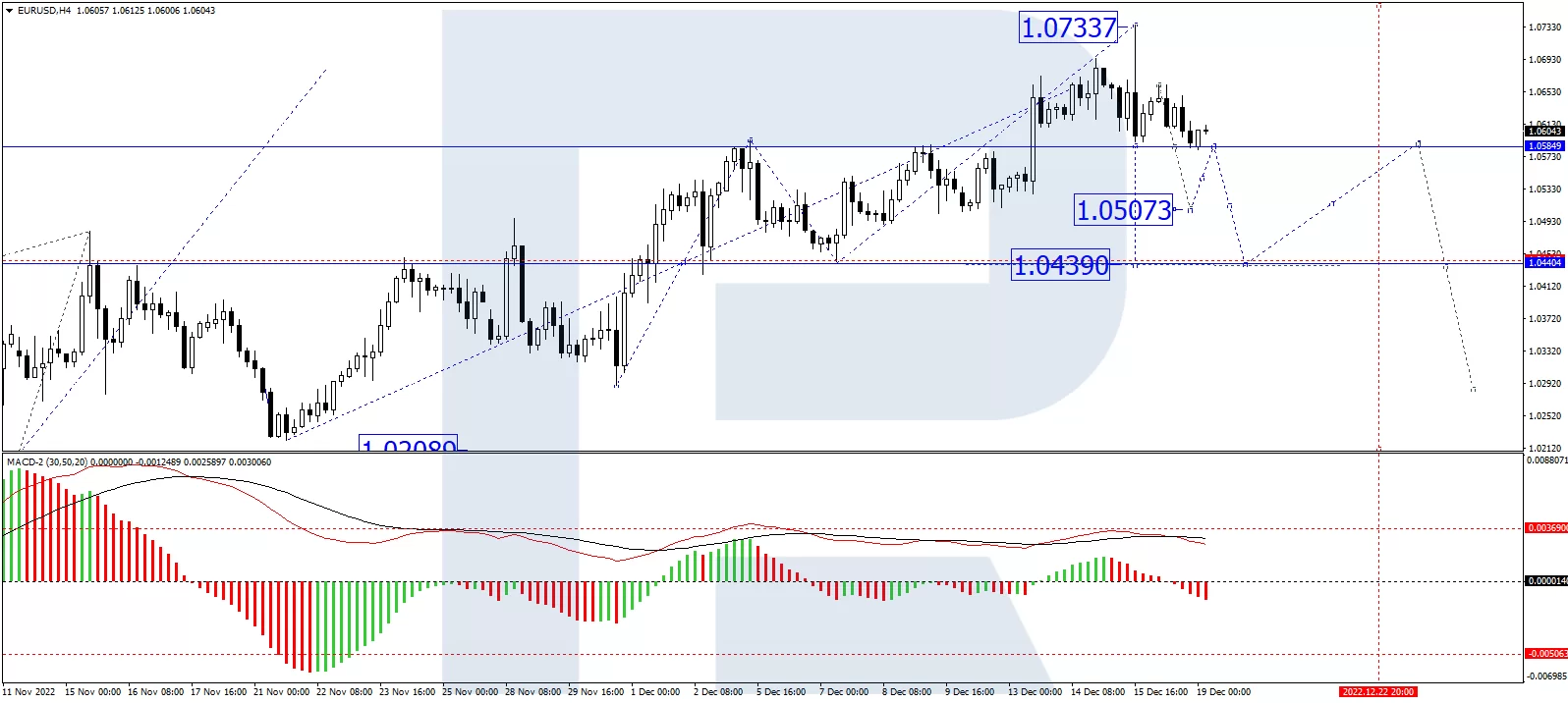
On H4, at the resistance level, the pair has formed a Shooting Star reversal pattern. Currently, the pair may go by the signal in a correctional wave. The goal of the pullback will be 1.0435. However, the pair might grow to 1.0650, break through the level, and continue the uptrend without any correction to the support level.

EURUSD
Risk Warning: the result of previous trading operations do not guarantee the same results in the future

USDJPY, “US Dollar vs Japanese Yen”

On H4, at the support level, the pair has formed an Inverted Hammer reversal pattern. Currently, the pair may go by the signal in the form of an ascending wave. The goal of the correction will be 136.65. However, the price might fall to 134.00 and continue the downtrend without any correction to the resistance level.

USDJPY
Risk Warning: the result of previous trading operations do not guarantee the same results in the future

EURGBP, “Euro vs Great Britain Pound”

On H4, the pair has formed a Hammer reversal pattern. Currently, the pair may go by the signal in yet another ascending wave. The goal of the growth can be the resistance level of 0.8655. Upon testing it and bouncing off it, the price will get a chance for continuing the downtrend. However, the quotes may drop to 0.8570 without pulling back to the resistance level.

EURGBP

Article By RoboForex.com

Attention!
Forecasts presented in this section only reflect the author’s private opinion and should not be considered as guidance for trading. RoboForex LP bears no responsibility for trading results based on trading recommendations described in these analytical reviews.

The Analytical Overview of the Main Currency Pairs on 2022.12.02

By JustMarkets

The EUR/USD currency pair

Technical indicators of the currency pair:
  • Prev Open: 1.0405
  • Prev Close: 1.0525
  • % chg. over the last day: +1.15 %

Eurozone manufacturing PMI showed a decline from 47.3 to 47.1. Data for European countries were mixed. Germany posted a decline from 46.7 to 46.2, France showed a decline from 49.1 to 48.3, but Spain’s PMI rose from 44.7 to 45.7, and Italy also saw an increase from 46.5 to 48.4. The unemployment rate in Europe declined from 6.6% to 6.5%. A strong labor market is room for the ECB to act more aggressively, but a drop in overall business activity is a sign of rate pressure on the economy. Therefore, the ECB is likely to choose a less aggressive path, especially given the fact that there are signs of slowing inflation.

Trading recommendations
  • Support levels: 1.04554, 1.0361, 1.0332, 1.0284, 1.0193, 1.0092, 1.0043, 0.9968
  • Resistance levels: 1.0504, 1.0562

The trend on the EUR/USD currency pair on the hourly time frame is bullish. The price is trading above the moving averages, and the MACD indicator is in the positive zone, without any signs of reversal but with signs of overbuying. Buy trades are best considered from the support level of 1.0455, but with additional confirmation. Sell deals can be considered from the resistance level of 1.0504 or 1.0562, but it is better with confirmation in the form of reverse initiative.

Alternative scenario: if the price breaks down through the support level of 1.0284 and fixes below it, the downtrend will likely resume.

EUR/USD
News feed for 2022.12.02:
  • – Eurozone ECB President Lagarde Speaks at 04:40 (GMT+3);
  • – Eurozone Producer Price Index (m/m) at 12:00 (GMT+3);
  • – US Nonfarm Payrolls (m/m) at 15:30 (GMT+3);
  • – US Unemployment Rate (m/m) at 15:30 (GMT+3).

The GBP/USD currency pair

Technical indicators of the currency pair:
  • Prev Open: 1.2055
  • Prev Close: 1.2255
  • % chg. over the last day: +1.65 %

The UK Manufacturing Business Activity Index is starting to show small signs of recovery. Whether this is a temporary spike in activity in the run-up to the holidays or whether it is consistent growth, data will show next month. For now, the British pound is rising on the back of a declining dollar index. Data from retail traders show that about 35% have a net long position, and the ratio of short to long traders is 1.87:1. Usually, analysts take the opposite view of the “crowd” sentiment. The fact that traders are closing short positions suggests that GBP/USD prices may continue to rise.

Trading recommendations
  • Support levels: 1.2154, 1.2016, 1.1964, 1.1684, 1.1476, 1.1418
  • Resistance levels: 1.2254, 1.2381, 1.2431

From the technical point of view, the trend on the GBP/USD currency pair on the hourly time frame is bullish. The price is trading above the moving levels MACD indicator is in the positive zone, and there are signs of overbuying. Under such market conditions, it is better to look for buy deals from the support level of 1.2154, but with confirmation. It is better to look for sell deals on intraday time frames from the resistance level of 1.2254, but it is also better with confirmation because the level has already been tested.

Alternative scenario: if the price breaks down of the 1.1900 support level and fixes below it, the downtrend will likely resume.

GBP/USD
There is no news feed for today:

The USD/JPY currency pair

Technical indicators of the currency pair:
  • Prev Open: 138.02
  • Prev Close: 135.33
  • % chg. over the last day: -1.98 %

Bank of Japan Governor Kuroda said Friday that the bank expects inflation in Japan to start slowing in 2023. That suggests the Bank of Japan won’t change its soft monetary policy until at least the spring of 2023, when Mr. Kuroda’s term ends. The Japanese yen is now strengthening only at the expense of the dollar index on the back of the fact that the Fed will slow the pace of interest rate hikes.

Trading recommendations
  • Support levels: 135.20, 133.53
  • Resistance levels: 137.65, 139.09, 140.75, 143.17, 145.16

From the technical point of view, the medium-term trend on the currency pair USD/JPY is bearish. The MACD indicator is in the negative zone, but on the higher time frames, a divergence is formed, which indicates a certain weakness of the sellers. Under such market conditions, buy trades can be sought on the intraday time frames from the support level of 135.20, but only with confirmation. There is none at the moment. Sell deals can be sought from the resistance level of 136.65 or 139.09, provided there is a reverse reaction.

Alternative scenario: If the price fixes above 140.75, the uptrend will likely resume.

USD/JPY
News feed for 2022.12.02:
  • – Japan BoJ Kuroda Speaks at 03:30 (GMT+3).

The USD/CAD currency pair

Technical indicators of the currency pair:
  • Prev Open: 1.3424
  • Prev Close: 1.3431
  • % chg. over the last day: +0.05 %

Canada’s manufacturing economy remained in contractionary territory in November, but only because the rate of decline in output and new orders slowed compared to October. But overall, there are signs of an improving business climate. The Industrial PMI rose from 48.8 to 49.6 and is as close to 50 as possible. Values above 50 mean that the economy is recovering.

Trading recommendations
  • Support levels: 1.3386, 1.3360, 1.3281, 1.3212
  • Resistance levels: 1.3479, 1.3522, 1.3658, 1.3682, 1.3776, 1.3855

From the point of view of technical analysis, the trend on the USD/CAD currency pair has changed to bullish. But the price is close to changing the priority. The MACD indicator is in the negative zone, but sellers’ pressure is weak. The deals to buy should be considered on the lower time frames from the support level of 1.3386 or 1.3360, but with additional confirmation. For sell deals, it is better to consider the resistance level of 1.3479 but with confirmation in the form of reverse initiative.

Alternative scenario: if the price breaks down and consolidates below the support level of 1.3386, the downtrend will likely resume.

USD/CAD
News feed for 2022.12.02:
  • – Canada Unemployment Rate (m/m) at 15:30 (GMT+3).

By JustMarkets


This article reflects a personal opinion and should not be interpreted as an investment advice, and/or offer, and/or a persistent request for carrying out financial transactions, and/or a guarantee, and/or a forecast of future events.

EU governments have set a price ceiling for Russian oil. NFP report in the spotlight today

By JustMarkets

The US stock market traded mixed yesterday ahead of the monthly jobs report due today. The Dow Jones Index (US30) decreased by 0.08% at the stock market’s close yesterday, while the S&P 500 Index (US500) lost 0.08%. The NASDAQ Technology Index (US100) gained 0.13% on Thursday.

Investors are cautiously awaiting the release of key monthly US employment data, which could affect the Federal Reserve’s monetary policy. The monthly employment data is expected to show that the economy created fewer jobs in November than in the previous month. Treasury yields fell sharply yesterday on concerns that the economy could face a deeper recession next year, despite early signs of declining consumer inflation. Although data on Thursday showed that the PCE index, the Federal Reserve’s preferred measure of inflation, remains well above (6%) the Central Bank’s target range (2%).

Equity markets in Europe were mostly up yesterday. German DAX (DE30) gained 0.65%, French CAC 40 (FR40) added 0.23%, Spanish IBEX 35 (ES35) increased by 0.53%, and British FTSE 100 (UK100) closed on Thursday down by 0.19%.

In a speech in Thailand, European Central Bank President Lagarde said that central banks should work to get the Consumer Price Index back to target levels. But monetary policy is complicated by the uncertainty resulting from Russia’s invasion of Ukraine. Ms. Lagarde also added that the fiscal policies of some European governments may lead to excess demand and that fiscal and monetary policies must work in sync to ensure sustainable and balanced economic growth.

Oil prices traded mixed Thursday as worrisome US production data and uncertainty over the course of OPEC+ actions restrained the market. European Union governments have tentatively agreed to set a ceiling on Russian oil at $60 a barrel, which is also restraining oil bulls.

Gold hit a 5-month high on rising hopes of a slowdown in the pace of Fed rate hikes. Gold futures yesterday at $1,815.20 an ounce. Silver, which often follows gold, also rose sharply. The December through February period is a seasonally stronger time for precious metals, so there are many positives here.

Asian markets were mostly up yesterday. Japan’s Nikkei 225 (JP225) gained 0.92% on the day, Hong Kong’s Hang Seng (HK50) added 0.75%, and Australia’s S&P/ASX 200 (AU200) closed up 0.96%.

Bank of Japan Governor Kuroda indicated that a gradual slowdown in global rate increases and gradual growth of the global economy is expected. Global inflation is also expected to exceed the 2021 level in 2022 and then decline in 2023, a forecast that applies to Japan as well.

Reserve Bank of Australia Governor Lowe, speaking at an event in Thailand, pointed out that inflation expectations remain firmly entrenched. However, household spending in Australia is still resilient to higher interest rates. Lowe added that the Reserve Bank of Australia is trying to slow inflation without much negative impact on the economy. Still, this cycle of high rates will be longer than previous ones.

S&P 500 (F) (US500) 4,076.57 −3.54 (−0.087%)

Dow Jones (US30) 34,395.01 −194.76 (−0.56%)

DAX (DE40) 14,490.30 +93.26 (+0.65%)

FTSE 100 (UK100) 7,558.49 −14.56 (−0.19%)

USD Index 104.71 −1.24 (−1.17%)

Important events for today:
  • – Japan BoJ Kuroda Speaks at 03:30 (GMT+3);
  • – Australia RBA Gov Lowe Speaks at 04:40 (GMT+3);
  • – Eurozone ECB President Lagarde Speaks at 04:40 (GMT+3);
  • – New Zealand RBNZ Gov Orr Speaks at 06:30 (GMT+3);
  • – Switzerland Unemployment Rate (m/m) at 09:30 (GMT+3);
  • – Eurozone Producer Price Index (m/m) at 12:00 (GMT+3);
  • – US Nonfarm Payrolls (m/m) at 15:30 (GMT+3);
  • – US Unemployment Rate (m/m) at 15:30 (GMT+3);
  • – Canada Unemployment Rate (m/m) at 15:30 (GMT+3).

By JustMarkets


This article reflects a personal opinion and should not be interpreted as an investment advice, and/or offer, and/or a persistent request for carrying out financial transactions, and/or a guarantee, and/or a forecast of future events.

Week Ahead: Big Week For Oil Markets…

By ForexTime 

Fasten your seatbelts because the next few days could be wild for oil markets.

The global commodity may be injected with fresh volatility due to not only the OPEC+ meeting but developments revolving around European Union sanctions on Russian oil. Other factors like geopolitical risks, economic data and overall sentiment may play an important role in shaping the global commodities outlook for the rest of 2022.

Before we tackle what to expect from oil as December gets in full swing, here are the scheduled economic data releases/events in the coming week:

Sunday, 4 December  

  • OIL: OPEC+ virtual meeting   

Monday, 5 December  

  • CNH: China Caixin services PMI
  • OIL: EU ban on Russian crude  
  • EUR: S&P Global PMI, Eurozone retail sales, ECB President Christine Lagarde speech
  • USD: US factory orders, durable goods, ISM services index

Tuesday, 6 December

  • AUD: Reserve Bank of Australia rate decision   
  • EUR: Germany factory orders, S&P Global PMI
  • USD: US trade data

Wednesday, 7 December

  • EUR: Eurozone GDP, Germany industrial production
  • CAD: Bank of Canada rate decision
  • OIL: EIA crude oil inventory report
  • USD: MBA mortgage applications

Thursday, 8 December

  • JPY: Japan GDP
  • EUR: ECB President Christine Lagarde speech
  • USD: US initial jobless claims

Friday, 9 December

  • CNH: China Inflation, PPI, money supply
  • USD: US PPI, University of Michigan consumer sentiment
  • FIFA World Cup quarterfinal matches

Oil prices nosedived in November as concerns that a rebound in Covid-19 cases in China would hit demand. Rising US stock pilled rubbed salt into the wound with Brent shedding almost 10% last month. Nevertheless, both Crude and Brent are still up roughly 10% year-to-date and could be supported by the key risk events and data releases over the next few days.

Over the weekend, the Organisation of Petroleum Exporting Countries and Co. including Russia are expected to leave production unchanged after the group changed its meeting to an online format. This move comes after the cartel agreed in early October to reduce production by 2 million barrels per day from November despite calls from the United States to pump more oil. The decision to leave production unchanged is based on the growing uncertainty over China’s demand outlook and the looming price cap on Russian crude exports. However, any unexpected decisions could result in explosive volatility in oil markets.

It’s all about the upcoming sanctions on Russian oil which are expected to start on Monday 5th December. Back in June, the EU agreed to ban the purchase of Russian crude in an attempt to limit its earnings – ultimately impacting Moscow’s budget. According to Bloomberg, the EU is closing in a deal to cap Russian crude oil at $60 a barrel before the Monday deadline. Should this deal go through, it could have uncertain effects on the price of oil as concerns over lost supply through the price cap clash with fears over a gloomy demand outlook. Whatever the outcome on Sunday and Monday, it will most likely set the tone for oil as 2022 slowly comes to an end.

Looking at the technical picture, Brent remains under pressure on the daily charts with prices respecting a bearish channel. Should prices push back below $87 this could encourage a decline back toward $82.50 and $80.00. Alternatively, a strong breakout above $90.00 may open the doors towards $95.00 – a level above the 100-day SMA.


Forex-Time-LogoArticle by ForexTime

ForexTime Ltd (FXTM) is an award winning international online forex broker regulated by CySEC 185/12 www.forextime.com

Expert Says Health Tech Co. Is in Another Buy Spot

Source: Clive Maund  (11/30/22)

Expert Clive Maund reviews the 1-year chart for Reliq Health Technologies to tell you why he believes it is in another buy spot.

We caught a perfect buy spot when we went for Reliq Health Technologies Inc. (RHT:TSX.V; RQHTF:OTCQB; A2AJTB:WKN) at the start of the month (it was recommended in a Market Notebook update), as right after it proceeded to break out of a quite large Head-and-Shoulders bottom to rise quite steeply, resulting in good percentage gains for us in a short space of time.

The purpose of this update is to point out that it still looks good here.

It is, in fact, at another buy spot as it is starting to break out of a completing bull Flag that has formed over the past couple of weeks, as we can see on its latest 1-year chart below.

November 21, 2022, would have been the perfect time to buy, of course, because it ended up adding CA$0.04 by the end of the day, but it still looks good here as a breakout from the Flag should lead to a rally of similar magnitude to the one preceding the Flag.

We, therefore, stay long and this is a good point to add to positions or make fresh purchases. Reliq trades in reasonable volumes on the US OTC market.

Reliq Health Tech closed for trading at CA$0.71, $0.54 on November 21, 2022. It is currently trading at CA$0.69.

CliveMaund.com Disclosures

The above represents the opinion and analysis of Mr. Maund, based on data available to him, at the time of writing. Mr. Maund’s opinions are his own, and are not a recommendation or an offer to buy or sell securities. Mr. Maund is an independent analyst who receives no compensation of any kind from any groups, individuals or corporations mentioned in his reports. As trading and investing in any financial markets may involve serious risk of loss, Mr. Maund recommends that you consult with a qualified investment advisor, one licensed by appropriate regulatory agencies in your legal jurisdiction and do your own due diligence and research when making any kind of a transaction with financial ramifications. Although a qualified and experienced stock market analyst, Clive Maund is not a Registered Securities Advisor. Therefore Mr. Maund’s opinions on the market and stocks can only be construed as a solicitation to buy and sell securities when they are subject to the prior approval and endorsement of a Registered Securities Advisor operating in accordance with the appropriate regulations in your area of jurisdiction.

Disclosures:
1) Clive Maund: I, or members of my immediate household or family, own securities of the following companies mentioned in this article: None. I personally am, or members of my immediate household or family are, paid by the following companies mentioned in this article: None.

2) The following companies mentioned in this article are billboard sponsors of Streetwise Reports: Reliq Health Technologies Inc. Click here for important disclosures about sponsor fees.

3) Statements and opinions expressed are the opinions of the author and not of Streetwise Reports or its officers. The author is wholly responsible for the validity of the statements. The author was not paid by Streetwise Reports for this article. Streetwise Reports was not paid by the author to publish or syndicate this article. Streetwise Reports requires contributing authors to disclose any shareholdings in, or economic relationships with, companies that they write about. Streetwise Reports relies upon the authors to accurately provide this information and Streetwise Reports has no means of verifying its accuracy.

4) This article does not constitute investment advice. Each reader is encouraged to consult with his or her individual financial professional and any action a reader takes as a result of information presented here is his or her own responsibility. By opening this page, each reader accepts and agrees to Streetwise Reports’ terms of use and full legal disclaimer. This article is not a solicitation for investment. Streetwise Reports does not render general or specific investment advice and the information on Streetwise Reports should not be considered a recommendation to buy or sell any security. Streetwise Reports does not endorse or recommend the business, products, services or securities of any company mentioned on Streetwise Reports.

5) From time to time, Streetwise Reports LLC and its directors, officers, employees or members of their families, as well as persons interviewed for articles and interviews on the site, may have a long or short position in securities mentioned. Directors, officers, employees or members of their immediate families are prohibited from making purchases and/or sales of those securities in the open market or otherwise from the time of the decision to publish an article until three business days after the publication of the article. The foregoing prohibition does not apply to articles that in substance only restate previously published company releases. As of the date of this article, officers and/or employees of Streetwise Reports LLC (including members of their household) own securities of Reliq Health Technologies Inc., a company mentioned in this article.

Equipment Dealer Posts Record 88% Increase in Q3 EPS

Source: Streetwise Reports  (12/1/22)

Shares of Titan Machinery Inc. traded 26% higher yesterday to a new 52-week high after the company reported Q3/23 financial results, highlighting a 47.3% YoY increase in revenue. The firm additionally raised its full-year revenue and earnings estimates.

Agricultural and construction equipment dealer

Titan Machinery Inc. (TITN:NASDA), which owns and operates more than 100 full-service stores in the U.S. and Europe, yesterday announced financial results for the third quarter of 2023, which ended October 31, 2022.

The company’s Chairman and CEO, David Meyer, led off the report by stating, “We delivered another consecutive quarter of record financial results, with third-quarter earnings per share of US$1.82. The ongoing strength of the agriculture sector combined with our customer-centric focus drove consolidated revenue growth of 47%, which was supported by strong contributions across each of our revenue streams – equipment, parts, and service . . . Given these strong third-quarter results, coupled with our expectations for the solid market fundamentals continuing through the fourth quarter, we are increasing our earnings per share modeling assumption for the fiscal year 2023 to a midpoint of US$4.70 per share.”

Gross profit in Q3/23 rose to US$139.6 million (20.9%), up from US$92.5 million (20.4%) in Q3/22. The company indicated that the increases were due mostly to stronger margins from equipment sales.

The firm reported that total revenue during Q3/23 increased by 47.3% to US$668.8 million, compared to US$454.0 million in Q3/22.

Revenues across almost all business segments increased versus the same period in the prior year and consisted of US$509.0 million from Equipment sales, US$108.7 million from parts sales, US$39.0 from Service, and US$12.1 million from rental and other sales.

Gross profit in Q3/23 rose to US$139.6 million (20.9%), up from US$92.5 million (20.4%) in Q3/22. The company indicated that the increases were due mostly to stronger margins from equipment sales.

Titan Machinery reported that for Q3/23, it recorded a net income of US$41.3 million, or US$1.83 per diluted share, versus a net income of US$21.8 million, or US$0.97 per share in Q3/22.

The firm added that during Q3/23, adjusted EBITDA increased by 80% to US$63.5 million, compared to US$35.3 million in Q3/22.

The company advised that in Q3/23, agriculture segment revenues grew to US$493.3 million, compared to US$281.5 million in Q3/22. The firm said the gains were the result of a combination of positive organic growth and contributions from three separate company acquisitions.

Titan added that during Q3/23, construction segment revenues increased to US$86.4 million, up from US$79.7 million in Q3/22, driven by increased demand for equipment, and listed that it posted revenues of US$89.0 million in its international segment.

CEO Meyer commented further that “The momentum in our business continues to be visible across all aspects of Titan Machinery, as favorable industry conditions combine with several years of operational improvements and solid growth through accretive and strategic acquisitions . . . Looking ahead, we are very well positioned to serve the strong industries that we operate in with our robust balance sheet and powerful operational performance.”

The company offered some upward adjusted forward guidance and stated that for FY/23, it expects that agriculture revenue will be up 55-60% year-over-year, compared to its prior estimates of 50-55%. The firm stated that construction revenue is expected to decrease by 0-5% y-o-y, and international segment revenue is also projected to be down by 0-5% y-o-y. Titan Machinery added that for FY/23, it now expects it will have diluted earnings per share (EPS) of US$4.55-4.85. Prior estimates called for diluted EPS of US$3.70-4.00.

Titan Machinery owns and operates full-service agricultural and construction equipment dealer locations in North America and Europe. The company is based in West Fargo, N.D., and offers products and services to farmers, ranchers, and other commercial customers from its network of over 100 dealer locations in Europe and 13 U.S. midwestern and western states.

The firm’s international stores are located in Bulgaria, Germany, Romania, and Ukraine. Titan noted that each of its store locations represents one or more of CNH Industrial N.V.’s (CNHI:NYSE; CNHI:MI) equipment brands, including Case Construction, Case IH, CNH Capital, New Holland Agriculture, and New Holland Construction.

Titan Machinery started the day with a market cap of around US$787.17 million yesterday with approximately 22.57 million shares outstanding. TITN shares opened 15% higher yesterday at US$40.20 (+US$5.32, +15.25%) over the previous day’s US$34.88 closing price and reached a new 52-week high price yesterday afternoon of US$44.29. The stock traded yesterday between US$38.31 and US$44.29 per share and closed for trading at US$44.03 (+US$9.15, +26.23%).

Disclosures:

1) Stephen Hytha wrote this article for Streetwise Reports LLC and provides services to Streetwise Reports as an independent contractor. He or members of his household own securities of the following companies mentioned in the article: None. He or members of his household are paid by the following companies mentioned in this article: None.

2) The following companies mentioned in this article are billboard sponsors of Streetwise Reports: None. Click here for important disclosures about sponsor fees.

3) Comments and opinions expressed are those of the specific experts and not of Streetwise Reports or its officers. The information provided above is for informational purposes only and is not a recommendation to buy or sell any security.

4) The article does not constitute investment advice. Each reader is encouraged to consult with his or her individual financial professional and any action a reader takes as a result of information presented here is his or her own responsibility. By opening this page, each reader accepts and agrees to Streetwise Reports’ terms of use and full legal disclaimer. This article is not a solicitation for investment. Streetwise Reports does not render general or specific investment advice and the information on Streetwise Reports should not be considered a recommendation to buy or sell any security. Streetwise Reports does not endorse or recommend the business, products, services or securities of any company mentioned on Streetwise Reports.

5) From time to time, Streetwise Reports LLC and its directors, officers, employees or members of their families, as well as persons interviewed for articles and interviews on the site, may have a long or short position in securities mentioned. Directors, officers, employees or members of their immediate families are prohibited from making purchases and/or sales of those securities in the open market or otherwise from the time of the decision to publish an article until three business days after the publication of the article. The foregoing prohibition does not apply to articles that in substance only restate previously published company releases.

The Economy May Not Look Good but Oil and Energy Transport Stocks Do

Source: Ron Struthers  (11/29/22) 

Expert Ron Struthers believes consumers are on an unsustainable path of wracking up credit card debt, and it is only a matter of when the economy buckles, meanwhile big profits are being made by tanker companies and oil and gas/energy transmission companies as supplies continue to tighten.

Gold bounced off the US$1730 support area I outlined in my Nov 22, 2022 update. Last week witnessed a hammer candle stick down to US$1720. So far, we are holding above my support level, and my new bull market theory is looking good so far. A break above US$1830 would be a strong sign of a new bull move.

A U.S. consumer confidence survey fell to 100.2 in November and touched the lowest level in four months, reflecting growing angst about a softening economy and potential recession. The closely followed index dropped 2 points from 102.2 in the prior month, the nonprofit Conference Board said today.

The U.S. Housing Market

The U.S. housing market pulled back even more in September, with prices slipping 1.2% from a month earlier. It was the third straight decline for the seasonally adjusted measure of prices in 20 large U.S. cities, according to the S&P CoreLogic Case-Shiller index.

Canada is setting records. Home sales had fallen for eight straight months before October brought a small uptick. Not only is that the longest stretch of falling sales on record, but it is also the steepest, said a CIBC team. “And it’s not really over yet.”

Prices are also setting records. With the average price of a home in Canada down 20% since February, the correction is already the steepest on record, said CIBC.

Well, this is no surprise to us. I believe the bad effect on Canadian Banks will be delayed some. I have learned that many of the variable rate mortgages have fixed payments but increase the amount of the payment that is interest only as rates rise until some trigger point is met, and the mortgagee will then have to make a large lump sum payment.

Skyrocketing home prices and massive interest rate spikes have driven affordability to its worst level in decades, according to a TD Economics report, leaving some first-time buyers shut out of the market altogether.

It is hard to get a handle on the numbers, but there was an article last week where the Bank of Canada said 50% of variable rate mortgages have hit the trigger. I quote from that article.

“After hiking the overnight rate from near zero at the start of the year to 3.75%, the Bank of Canada said this week that about 50% of borrowers with variable-rate, fixed-payment mortgages have reached a trigger rate — the point at which set monthly payments cover only the interest while the principal remains unpaid. Nearly 13% of all Canadian mortgages are affected, according to the central bank.

Federal rules stipulate that mortgages must be amortizing — meaning borrowers must be repaying principal — but lenders have three options once a trigger-rate threshold is reached: raise monthly payments, require a lump-sum pre-payment on the mortgage, or allow borrowers to slip into negative or reverse amortization for a period under rules set by banking authorities and mortgage insurers.”

I expect the majority of affected mortgages are in Ontario. This has likely delayed defaults and more selling pressure, and the banks have not had to increase their loss reserves as quickly as past housing declines. That said, Canadian Banks are reporting financials this week, so we will get a picture of how much their earnings are declining, but they won’t feel the heavy brunt of the housing decline until 2023.

Canada house prices will fall much further. Skyrocketing home prices and massive interest rate spikes have driven affordability to its worst level in decades, according to a TD Economics report, leaving some first-time buyers shut out of the market altogether.

The drop in prices has not offset the effect of higher interest rates,” said RBC economist Robert Hogue. “Our affordability measure is still deteriorating.

Another factor is that homeowners and consumers are piling up credit card debt, which only delays the reckoning.

Equifax Canada’s consumer survey released end of October found the average credit card balance held by Canadians was at a record high of CA$2,121 by the end of September.

This chart was posted by @zerohedge on Twitter. U.S. consumers are piling on credit card debt even faster than Canadians.

Cyber Monday Vs. Black Friday

According to Adobe Analytics, the e-commerce-focused Cyber Monday has usurped Black Friday as the premier sales day of the holiday season.

Consumers spent US$11.79B on Cyber Monday sales, comfortably above the US$9.12B recorded for Black Friday, which was a new record.

It would appear that U.S. consumers are not worried about high-interest rates and a recession or maybe don’t know what one is. At the moment, there is no sign of a recession, but avoiding one by making ends meet with credit cards is just a band-aid.

The chart next page shows the spike in Monday online sales over Black Friday.

Meanwhile, the equity markets seem to be undecided about their direction.

I think there is some more room to rally up to around 4,100, but if we see a drop below 3,900, it would likely mean this bear market rally is over.

The Oil Market

Now let’s get to some better news for us with our shipping stocks, ATCO and DHT. And a look at the oil market.

Earnings on the U.S. Gulf Coast-to-China shipping route have soared above US$100,000 per day, equivalent to US$7 per barrel, demonstrating the shrinking availability of crude tankers lately.

As reported by Bloomberg, global long-term LNG contracts before 2026 are all sold out, meaning that over the upcoming three years (until Qatar’s upgrades are commissioned), Europe and Asia will remain on a collision course for remaining spot cargoes.

The recent weakness in oil is probably because of shipping costs. Spot differentials for crudes across the Americas are tanking because of higher shipping costs — free-on-board prices for WTI plummeted a whopping US$5 per barrel week-on-week to reflect the shipping.

Oilprice.com pointed out last week that the shortage of tankers is taking place across all vessel categories; even VLCC freight costs from the Middle East into Asia Pacific have tripled year-on-year. The news of Freeport LNG pushing its restart into March 2023 following a damning report from federal pipeline safety regulators has pushed U.S. natural gas prices to US$6.7 per mmBtu, aggravated by forecasts for colder weather into December.

Germany’s LNG Terminal Costs Soar

The cost of purchasing and maintaining floating LNG terminals to help Germany survive this winter and diversify away from Russian gas has doubled to some US$6.6 billion, with the first unit already completed at the North Sea port of Wilhelmshaven.

As reported by Bloomberg, global long-term LNG contracts before 2026 are all sold out, meaning that over the upcoming three years (until Qatar’s upgrades are commissioned), Europe and Asia will remain on a collision course for remaining spot cargoes.

Remember, the oil sanctions on Russia were only announced, and the EU sanctions are supposed to come into effect in less than two weeks. Italy is considering several options to save its largest refinery, operated by Russia’s Lukoil in Sicily; one of them is to ask the EU for a temporary waiver.

A petition from a range of public interest groups is pushed the U.S. government to condition the approval of federal drilling permits on operators posting the upfront cost to clean up wells, trying to deter cases when small producers file for bankruptcy to avoid cleanup costs.

More Biden Administration negative influence on oil and gas exploration. The only thing I know for certain is the whole energy sector is in a mess and will just get worse. This winter will be horrific for many. However, as investors, there are great ways to profit from the government fiasco. Our two shipping stocks are doing great.

Atlas Energy Group

Atlas Energy Group, LLC (ATLS:OTCMKT) is being bought out at US$15.50 and will be taken private by Q2 2023, and they will keep paying the dividend until then.

You can hold the stock and get US$15.50 or sell now and put funds into one of my other millennium stocks.

We have a yield of 6.8%, but that is based on our US$7.33 buy price. The current yield is 3.2%, and there are other stocks on my Millennium Index with higher yields. A good replacement could be—

Energy Transfer

Energy Transfer Partners L.P. (ET:NYSE) is yielding 8.5% paying US$0.265 per quarter. The company plans to get back to its pre covid dividend of US$0.305 per quarter. I see no reason why they will not get there.

ET reported very good Q3 results on September 30, 2022. Net income attributable to partners for the three months ended September 30, 2022, of US$1.01 billion, a US$371 million increase from the same period last year. For the same period, net income per limited partner unit (basic and diluted) was US$0.29 per unit.

In the third quarter of 2022, the partnership experienced a US$126 million charge in the crude oil transportation and services segment related to a legal matter. In addition, Energy Transfer’s third quarter 2022 results were impacted by an approximately US$130 million negative adjustment related to hedged inventory in the NGL and refined products transportation and services segment.

These two items impacted the third quarter of 2022’s Adjusted EBITDA by approximately US$260 million in aggregate. Otherwise, ET numbers could have been better still.

During the third quarter of 2022, each of Energy Transfer’s five core segments realized higher volumes compared with the same period in 2021.

  • Intrastate natural gas transportation volumes were up 28% and set a new Partnership record.
  • Interstate natural gas transportation volumes were up 43%.
  • Midstream gathered volumes were up 47% and set a new Partnership record.
  • NGL transportation volumes were up 5%.
  • NGL fractionation volumes were up 6% and set a new Partnership record.
  • Crude oil transportation and terminal volumes were up 10% and 14%, respectively.

Over 90% of ET’s growth capital spending is comprised of projects that are already on-line or expected to be on-line and contributing cash flow at very attractive returns before the end of 2023.

The project backlog includes Gulf Run Pipeline in Louisiana, Grey Wolf and Bear processing plants in the Permian Basin, Fractionator VIII in Mont Belvieu, and LPG facilities projects at Energy Transfer’s Nederland Terminal.

There is no good reason why this stock is not back to the higher levels witnessed in 2019. The recent break above US$12.50 is a good signal the stock is headed higher.

DHT Holdings

DHT Holdings Inc.’s (DHT:NYSE) stock moved very quickly for us, breaking out to highs and prices not seen since 2012. The oil shipping market will probably get tighter still this winter. Since we bought the stock in early October, they released their Q3 results on November 7, 2022.

In the third quarter of 2022, the Company achieved combined time charter equivalent earnings of US$25,400 per day, comprised of US$35,300 per day for the Company’s VLCCs on time-charter and US$22,000 per day for the Company’s VLCCs operating in the spot market. Adjusted EBITDA for the third quarter of 2022 was US$35.6 million. Net profit for the quarter was US$7.5 million, which equates to US$0.04 per basic share. DHT is paying a US$0.04 dividend, payable today.

Profits and dividends are going much higher. Look at the rates they are getting so far in Q4 compared to the above. Thus far, in the fourth quarter of 2022, 69% of the available VLCC spot days have been booked at an average rate of US$61,800 per day on a discharge-to-discharge basis.

77% of the available VLCC days, combined spot and time-charter days, have been booked at an average rate of US$53,100 per day (not including any potential profit splits on time charters).

Our timing to buy the stock was perfect, with the dip under US$7.50. The pullback from the recent US$10.50 is healthy market action, and I would buy on any dip below US$9.50.

Sentiment in the oil market has been weak, with the China Covid-19 lockdowns causing demand fear.

At the same time, liquidity in the key contracts traded is wafer-thin as last week’s volatility prompted the sell-off of an equivalent of 90 million barrels, with open interest in WTI falling to the lowest since 2015.

Oil dropped under US$40 in 2015, where it bottomed, so this low open interest is likely another bottom with a second test of US$75.

The Emergencies Act

I hate to say I told you so because it is not good news.

Early this year, I commented that invoking the Emergencies Act in Canada caused a bank run and would result in strong capital outflows from Canada.

Capital flows are transactions involving financial assets between international entities.

The Emergencies Act was invoked in February, and you can see the steep plunge since then. The last biggest steep plunge was in the 2008 financial crisis, which saw a plunge from around +6000 to -11,000 (click 25-year chart). This current plunge is much more than that.

Financial assets to be included can be bank deposits, loans, equity securities, debt securities, etc. Capital outflow generally results from economic uncertainty in a country, whereas large amounts of capital inflow indicate a growing economy.

It has been a while now since Trudeau made his ridiculous move, and we have some data.

This is a 10-year chart of Canada Capital flows from Statistics Canada.

You can see that Capital flows were improving with the recovery from the pandemic and high oil prices that in the past have been a big benefit to Canada.

From around 2001 to 2008, Canada had its strongest inflows when oil ran from around US$60 to US$150. Canada was running at the 10,000 mark on the plus side back then.

The Emergencies Act was invoked in February, and you can see the steep plunge since then. The last biggest steep plunge was in the 2008 financial crisis, which saw a plunge from around +6000 to -11,000 (click 25-year chart). This current plunge is much more than that, and we have not seen the bottom yet. There is no doubt we are seeing the greatest outflow of money from Canada in its history.

The Emergencies Act in Canada was all about going after the ‘Freedom Convoy’ money. The big Canadian banks admitted just that in the current parliament inquiry underway. I am not going to get into that and the political BS right now, but it is no surprise business confidence is plunging also.

Small business confidence in Canada has hit one of its lowest levels ever, according to the Canadian Federation of Independent Business (CFIB). Meanwhile, the long-term index, based on a 12-month outlook, dropped 1.2 points to 50.0 this month — the lowest recorded since 2009, outside of the 2008/09 and 2020 recessions, the CFIB said.

Right now, markets in Canada and the U.S. are trading on the proverbial ‘soft landing’ that seldom occurs. A severe recession is coming that will get started in Europe this winter as they are forced to shut down industries because of energy shortages.

Putin’s recent attacks on Ukraine’s energy grid will result in more shortages as Ukraine is no longer able to export electricity to Europe.

I hate to say it, but another bad news told-you-so will sadly occur this winter.

From a personal experience, I have an emergency kerosene heater and paid around US$20 for an 18 to 19-liter jug of fuel. A recent discussion prompted me to check prices, and I found out those jugs of fuel are now selling for over US$100. And that is if you can find one.

Struthers Stock Report Disclaimers: 

All forecasts and recommendations are based on opinion. Markets change direction with consensus beliefs, which may change at any time and without notice. The author/publisher of this publication has taken every precaution to provide the most accurate information possible. The information & data were obtained from sources believed to be reliable, but because the information & data source are beyond the author’s control, no representation or guarantee is made that it is complete or accurate.

The reader accepts information on the condition that errors or omissions shall not be made the basis for any claim, demand or cause for action. Because of the ever-changing nature of information & statistics the author/publisher strongly encourages the reader to communicate directly with the company and/or with their personal investment adviser to obtain up to date information.

Past results are not necessarily indicative of future results. Any statements non-factual in nature constitute only current opinions, which are subject to change. The author/publisher may or may not have a position in the securities and/or options relating thereto, & may make purchases and/or sales of these securities relating thereto from time to time in the open market or otherwise. Neither the information, nor opinions expressed, shall be construed as a solicitation to buy or sell any stock, futures or options contract mentioned herein. The author/publisher of this letter is not a qualified financial adviser & is not acting as such in this publication.

Disclosures: 

Charts provided by the author.

1) Ron Struthers: I, or members of my immediate household or family, own shares of the following companies mentioned in this article: Energy Transfer and DHT Holdings. I personally am, or members of my immediate household or family are, paid by the following companies mentioned in this article: None. My company currently has a financial relationship with the following companies mentioned in this article: None. I determined which companies would be included in this article based on my research and understanding of the sector.

2) The following companies mentioned in this article are billboard sponsors of Streetwise Reports: None. Click here for important disclosures about sponsor fees. The information provided above is for informational purposes only and is not a recommendation to buy or sell any security.

3) Statements and opinions expressed are the opinions of the author and not of Streetwise Reports or its officers. The author is wholly responsible for the validity of the statements. The author was not paid by Streetwise Reports for this article. Streetwise Reports was not paid by the author to publish or syndicate this article. Streetwise Reports requires contributing authors to disclose any shareholdings in, or economic relationships with, companies that they write about. Streetwise Reports relies upon the authors to accurately provide this information and Streetwise Reports has no means of verifying its accuracy.

4) This article does not constitute investment advice. Each reader is encouraged to consult with his or her individual financial professional and any action a reader takes as a result of information presented here is his or her own responsibility. By opening this page, each reader accepts and agrees to Streetwise Reports’ terms of use and full legal disclaimer. This article is not a solicitation for investment. Streetwise Reports does not render general or specific investment advice and the information on Streetwise Reports should not be considered a recommendation to buy or sell any security. Streetwise Reports does not endorse or recommend the business, products, services, or securities of any company mentioned on Streetwise Reports.

5) From time to time, Streetwise Reports LLC and its directors, officers, employees, or members of their families, as well as persons interviewed for articles and interviews on the site, may have a long or short position in the securities mentioned. Directors, officers, employees, or members of their immediate families are prohibited from making purchases and/or sales of those securities in the open market or otherwise from the time of the decision to publish an article until three business days after the publication of the article. The foregoing prohibition does not apply to articles that in substance only restate previously published company releases.