Mixed market sentiment amid geopolitical tensions and economic cooling

By JustMarkets 

On Wednesday, the US stocks closed mixed as investors balanced contradictory macroeconomic signals against expectations of a possible Fed policy easing. By the end of Wednesday, the Dow Jones Index (US30) decreased by 0.94%. The S&P 500 Index (US500) dropped by 0.34%. The Technology Index Nasdaq (US100) closed higher by 0.16%. JOLTS data indicated a notable contraction in job openings and a cooling of labor demand, while the ADP report showed a moderate recovery in private sector hiring, and the growth in the ISM Services PMI confirmed a scenario of a slowing but still resilient economy. At the corporate level, the market was pressured by a decline in banking stocks: JPMorgan Chase and Bank of America shares fell by more than 2%, which was one of the reasons for the Dow’s weakness. At the same time, the technology sector appeared more stable – NVIDIA rose by 1%, and Alphabet gained 2.5%, supporting the Nasdaq.

European stock indices ended Wednesday’s trading with slight declines, taking a pause after the recent strong rally amid the ongoing reassessment of the ECB’s monetary policy prospects. The German DAX (DE40) rose by 0.92%, the French CAC 40 (FR40) closed with a decrease of 0.04%, the Spanish Index IBEX 35 (ES35) fell by 0.29%, and the British FTSE 100 (UK100) closed at negative 0.74%. Recent data showed that Eurozone inflation slowed to 2% in December, as expected, while core inflation fell more than projections, strengthening expectations that the ECB may proceed with rate cuts during the year. Defense companies were among the top gainers amid rising geopolitical tensions related to White House statements regarding Greenland and the US seizure of a Russian tanker that violated the blockade of Venezuela.

On Thursday, silver dropped below the $77 per ounce mark, continuing a correction after the recent rapid rally to historic highs. The weakening of bullish momentum coincided with a strengthening of the US dollar and mixed macroeconomic signals from the US, which failed to provide markets with a clear direction regarding the Federal Reserve’s next steps. Currently, market participants estimate the probability of the Fed holding rates steady at the next meeting at nearly 90%, although expectations for several rate cuts in the second half of the year remain priced in. This combination is curbing demand for precious metals in the short term, increasing investors’ inclination to take profits after the sharp rise in prices.

The US natural gas prices rose by more than 4% to $3.50 per MMBtu, rebounding from a 10-week low reached on January 6, amid a reduction in production and a revision of weather prognoses toward colder conditions and increased heating demand. Average production in the Lower 48 states in early January decreased to 109.0 billion cubic feet per day from the December record of 109.7 billion. Additional market support came from a rise in LNG exports: deliveries to the eight largest export terminals increased to a record 18.6 billion cubic feet per day.

Asian markets traded without a unified dynamic yesterday. The Japanese Nikkei 225 (JP225) fell by 1.06%, the Chinese FTSE China A50 (CHA50) rose by 0.45%, the Hong Kong Hang Seng (HK50) decreased by 0.94%, and the Australian ASX 200 (AU200) showed a positive result of 0.15%. At the start of Thursday’s trading, Hong Kong stocks declined by 1.4%, continuing a fall for the second consecutive session. Pressure was intensified by profit-taking after the market reached a seven-week high earlier in the week, as well as growing caution ahead of Friday’s release of December inflation data from China (CPI and PPI). An additional negative factor was the geopolitical tension following Beijing’s decision to ban the export of dual-use goods to Japan in response to Prime Minister Sanae Takaichi’s statements on Taiwan. However, the decline was partially mitigated by optimistic expectations from Goldman Sachs, which predicts steady growth for Chinese stocks this year due to increased corporate profits related to the development of artificial intelligence.

The New Zealand dollar held near the $0.576 mark, remaining in a sideways range throughout the week as investors balance external risks and domestic monetary expectations. On the external side, sentiment continues to be pressured by geopolitical uncertainty: political events in Venezuela following the removal of Nicolás Maduro, as well as rising tension between China and Japan, maintain a cautious approach to risk currencies, including the NZD. In the domestic context, the position of the Reserve Bank of New Zealand (RBNZ) remains a key anchor for the exchange rate. The regulator signaled that the easing cycle, in which rates were cut by 225 bps, likely concluded last year, while also dispelling expectations for an imminent policy tightening.

S&P 500 (US500) 6,920.93 −23.89 (−0.34%)

Dow Jones (US30) 48,996.08 −466.00 (−0.94%)

DAX (DE40) 25,122.26 +230.06 (+0.92%)

FTSE 100 (UK100) 10,048.21 −74.52 (−0.74%)

USD Index 98.75 +0.17% (+0.17%)

News feed for: 2026.01.08

  • Japan Average Cash Earnings (m/m) at 01:30 (GMT+2); – JPY (MED)
  • Sweden Inflation Rate (m/m) at 09:00 (GMT+2); – SWE (MED)
  • Switzerland Consumer Price Index (m/m) at 09:30 (GMT+2); – CHF (HIGH)
  • Eurozone Producer Price Index (m/m) at 12:00 (GMT+2); – EUR (MED)
  • Eurozone Unemployment Rate (m/m) at 12:00 (GMT+2); – EUR (MED)
  • Mexican Inflation Rate (m/m) at 14:00 (GMT+2); – MXN (MED)
  • Canada Trade Balance (m/m) at 15:30 (GMT+2); – CAD (MED)
  • US Trade Balance (m/m) at 15:30 (GMT+2); – USD (MED)
  • US Initial Jobless Claims (w/w) at 15:30 (GMT+2); – USD (MED)
  • US Natural Gas Storage (w/w) at 17:30 (GMT+2). – XNG (HIGH)

By JustMarkets


This article reflects a personal opinion and should not be interpreted as an investment advice, and/or offer, and/or a persistent request for carrying out financial transactions, and/or a guarantee, and/or a forecast of future events.

Seasonally strong month in January for Heating Oil (Past 5 Years)

Heating Oil is currently in its strongest seasonal month (January) over the past 5 years. January has seen an approximate return average of 9.2 percent since 2020 and has the highest win rate out of the calendar. However, Heating Oil has started this month off on the wrong foot and trades down by over -2.50 percent at the current time.


Get our Weekly Commitment of Traders Newsletter: – Follow the Large Hedger & Speculator Positions with our Newsletter

Dollar steady ahead of U.S. JOLTS, Oil benchmarks sink

By ForexTime 

  • Risk assets waver on geopolitical risk
  • USDInd steady ahead of JOLT & Friday’s NFP
  • Oil benchmarks ↓ 1% amid global glut fears
  • Bitcoin hovers above $90,000
  • Precious metals wait for fresh directional catalyst 

A sense of caution gripped markets on Wednesday as investors monitored global geopolitical developments.

Equities were headed for their first negative day of 2026, while oil benchmarks slipped after Washington moved to reinforce greater control over Venezuela’s oil industry.

In the FX space, the dollar held steady while precious metals slipped ahead of key US data.

All eyes will be on the U.S. Jolts data on Thursday and NFP report on Friday.

  • Market Expectation: Job openings for November are forecast at 7.7 million, nearly unchanged from October

Surprise Potential:

  • If openings are higher than expected this may reinforce hopes around a hot jobs markets. Rate cuts get pushed further out, likely pushing the USDInd higher.
  • If openings are lower than expected- signals the labor market is softening. Rate-cut bets increase, likely pulling the USDInd lower.

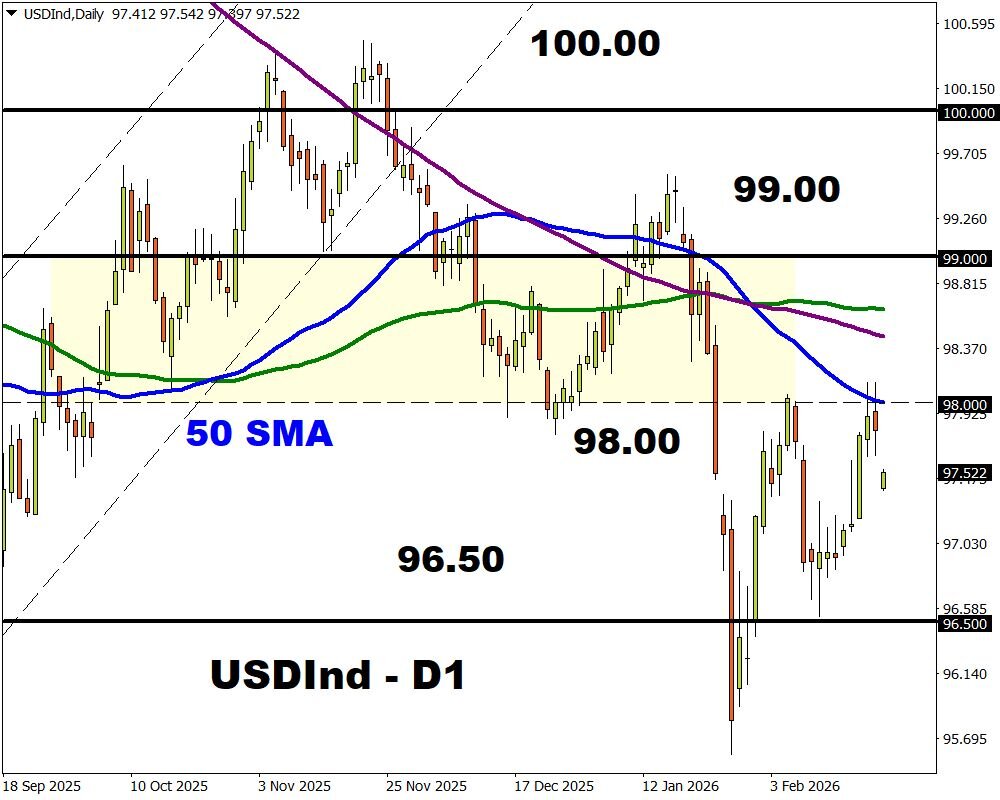
Looking at the charts, the USDInd remains in a range with support at 98.00 and resistance at 99.00.

Brent wobbles above $60

Oil extended losses after Washington moved to reinforce more control over Venezuela’s oil industry.

Trump announced that the U.S. would take and sell 30 to 50 million barrels of “sanctioned oil” currently stuck in tankers and storage. This immediate supply increase weighed on the global commodity, already being pressured by oversupply fears.

Brent is down roughly 0.5% as of writing with support at $60. Weakness below this level may open a path toward $58.50.

Bitcoin waits for fresh catalyst

A graph of stock market AI-generated content may be incorrect.

The CMC Crypto Fear & Greed Index currently sits at 42 (Neutral), reflecting an improvement in sentiment versus recent weeks.

Historically, similar readings have coincided with periods of consolidation and medium-term stabilization.

A fresh directional catalyst may be needed to trigger the next big move.

Major crypto market developments:

Bitcoin has climbed to a three-week high despite the mounting political uncertainty after the US moved to oust Venezuela’s president.

These gains seem to be fuelled by crypto-native firms and an absence of selling by groups including Bitcoin miners and big investment funds.

Nevertheless, prices have been stuck in a tight trading range for weeks with Bitcoin ending 2025 over 6% lower – its first negative year since 2022. In the near term, the trend could be bullish given that investors pumped a whopping $471 million into the 12 US-listed Bitcoin ETFs on January 2, 2026.

Bullish Scenario: A solid daily close above $95,000 may open a path toward $100,000 and higher.

Bearish Scenario: Weakness below $90,000 could see a decline toward $87.500 and $83,000.

Source: https://www.fxtm.com/en/market-analysis/dollar-steady-ahead-of-jolts-oil-benchmarks-sink/


Forex-Time-LogoArticle by ForexTime


ForexTime Ltd (FXTM) is an award winning international online forex broker regulated by CySEC 185/12 www.forextime.com

Stock indices continue to grow despite geopolitics

By JustMarkets

Following Monday’s results, the Dow Jones Index (US30) rose by 1.23%. The S&P 500 Index (US500) gained 0.64%. The Technology Index Nasdaq (US100) closed higher by 0.69%. On Monday, the rally in the US stock market continued, with the energy and financial sectors providing the main support to the indices. Investors perceived the US arrest of the Venezuelan leader more as a potential opportunity for future investment in the country’s oil industry than as a factor for immediate geopolitical escalation. Chevron shares jumped more than 5% due to expectations of the company expanding its presence in Venezuela, while oil refining companies rose on prospects of increased heavy oil supply.

The Canadian dollar (CAD) weakened to 1.38 per US dollar, losing some of its recent gains after reaching its highest level since July. Pressure on the currency intensified due to the strengthening of the dollar caused by the geopolitical situation, specifically the US seizure of the President of Venezuela, which triggered an increase in demand for the dollar and raised concerns about the prospects for Venezuelan oil. Speculation regarding production and an uneven market reaction strengthened doubts about the stability of oil prices, which is a key support factor for the Canadian currency. Furthermore, the slowdown in economic growth in Canada in Q4 weakened the arguments for tight monetary policy, and global oil market expectations for 2026 suggest a supply surplus and moderate demand, further limiting the potential for the Canadian dollar to strengthen.

The Mexican peso (MXN) weakened to a level above 18 per US dollar, as the sharp rise in the dollar caused by US military actions in Venezuela outweighed domestic currency support factors. The increased demand for the dollar triggered pressure on regional currencies, and the easing of the Bank of Mexico policy in late December reduced the yield advantage that had previously supported the peso after strong growth in 2025. This pressure is partially offset by an improvement in the external position and a transition to a current account surplus in mid-2025, which creates a floor for a sharper devaluation.
Equity markets in Europe mostly rose on Monday. The German DAX (DE40) rose by 1.34%, the French CAC 40 (FR40) closed with an increase of 0.20%, the Spanish Index IBEX 35 (ES35) gained 0.70%, and the British FTSE 100 (UK100) closed at a positive 0.54%.

The Swiss franc (CHF) weakened to a level of around 0.795 per US dollar, remaining close to highs not seen since 2011, amid rising geopolitical tensions following the US capture of Venezuelan President Nicolás Maduro. Uncertainty in the global economy related to US trade policy, as well as expectations of further interest rate cuts, intensified demand for safe-haven assets despite the weakness of the franc. Investors remain focused on the upcoming domestic inflation data to be released on January 8: a 0.1% decrease in the Consumer Price Index is expected in monthly terms, with a growth of only 0.1% in annual terms. In December, the Swiss National Bank kept rates at 0%, and most analysts do not expect changes in 2026.

Palladium prices (XPD) rose above 1720 dollars per ounce, approaching a weekly high, amid rising geopolitical tensions in Venezuela following the US capture of President Nicolás Maduro and his wife. The events stimulated demand for precious metals as haven assets and also supported palladium due to its key role in catalytic converters for gasoline engines. Demand is also supported by expectations of the EU easing the ban on internal combustion engines by 2035 while maintaining strict environmental standards, and the launch of palladium futures in China, which increases liquidity and provides hedging opportunities.
Asian markets rose in synchronization yesterday. The Japanese Nikkei 225 (JP225) rose by 2.97%, the Chinese FTSE China A50 (CHA50) gained 1.57%, the Hong Kong Hang Seng (HK50) added 0.03%, and the Australian ASX 200 (AU200) showed a positive result of 0.01%.

On Tuesday, the Australian dollar (AUD) strengthened to 0.672 dollars, remaining near its highest level since October 2024, amid an improvement in global risk sentiment and a weakening of the US dollar. Investor attention is shifting to the publication of Australian inflation data for November, which is expected on Wednesday and is projected to show a moderate slowdown in price pressure. This data could prove key for the next steps of the Reserve Bank of Australia, which had previously allowed for the possibility of a rate hike if inflationary risks persist.

S&P 500 (US500) 6,902.05 +43.58 (+0.64%)

Dow Jones (US30) 48,977.18 +594.79 (+1.23%)

DAX (DE40) 24,868.69 +329.35 (+1.34%)

FTSE 100 (UK100) 10,004.57 +53.43 (+0.54%)

USD Index 98.33 -0.10% (-0.10%)

News feed for: 2026.01.06

  • Australia Services PMI (m/m) at 02:30 (GMT+2); – AUD (MED)
  • Eurozone Services PMI (m/m) at 11:00 (GMT+2); – EUR (MED)
  • UK Services PMI (m/m) at 11:30 (GMT+2); – GBP (MED)
  • German Consumer Price Index (m/m) at 15:00 (GMT+2); – EUR (MED)
  • US Services PMI (m/m) at 16:45 (GMT+2). – USD (MED)

By JustMarkets


This article reflects a personal opinion and should not be interpreted as an investment advice, and/or offer, and/or a persistent request for carrying out financial transactions, and/or a guarantee, and/or a forecast of future events.

The battle over a global energy transition is on between petro-states and electro-states – here’s what to watch for in 2026

By Jennifer Morgan, Tufts University 

Two years ago, countries around the world set a goal of “transitioning away from fossil fuels in energy systems in a just, orderly and equitable manner.” The plan included tripling renewable energy capacity and doubling energy efficiency gains by 2030 – important steps for slowing climate change since the energy sector makes up about 75% of the global carbon dioxide emissions that are heating up the planet.

The world is making progress: More than 90% of new power capacity added in 2024 came from renewable energy sources, and 2025 saw similar growth.

However, fossil fuel production is also still expanding. And the United States, the world’s leading producer of both oil and natural gas, is now aggressively pressuring countries to keep buying and burning fossil fuels.

The energy transition was not meant to be a main topic when world leaders and negotiators met at the 2025 United Nations climate summit, COP30, in November in Belém, Brazil. But it took center stage from the start to the very end, bringing attention to the real-world geopolitical energy debate underway and the stakes at hand.

Brazilian President Luiz Inácio Lula da Silva began the conference by calling for the creation of a formal road map, essentially a strategic process in which countries could participate to “overcome dependence on fossil fuels.” It would take the global decision to transition away from fossil fuels from words to action.

More than 80 countries said they supported the idea, ranging from vulnerable small island nations like Vanuatu that are losing land and lives from sea level rise and more intense storms, to countries like Kenya that see business opportunities in clean energy, to Australia, a large fossil-fuel-producing country.

Opposition, led by the Arab Group’s oil- and gas-producing countries, kept any mention of a “road map” energy transition plan out of the final agreement from the climate conference, but supporters are pushing ahead.

I was in Belém for COP30, and I follow developments closely as former special climate envoy and head of delegation for Germany and senior fellow at the Fletcher School at Tufts University. The fight over whether there should even be a road map shows how much countries that depend on fossil fuels are working to slow down the transition, and how others are positioning themselves to benefit from the growth of renewables. And it is a key area to watch in 2026.

The battle between electro-states and petro-states

Brazilian diplomat and COP30 President André Aranha Corrêa do Lago has committed to lead an effort in 2026 to create two road maps: one on halting and reversing deforestation and another on transitioning away from fossil fuels in energy systems in a just, orderly and equitable manner.

What those road maps will look like is still unclear. They are likely to be centered on a process for countries to discuss and debate how to reverse deforestation and phase out fossil fuels.

Over the coming months, Corrêa plans to convene high-level meetings among global leaders, including fossil fuel producers and consumers, international organizations, industries, workers, scholars and advocacy groups.

For the road map to both be accepted and be useful, the process will need to address the global market issues of supply and demand, as well as equity. For example, in some fossil fuel-producing countries, oil, gas or coal revenues are the main source of income. What can the road ahead look like for those countries that will need to diversify their economies?

Nigeria is an interesting case study for weighing that question.

Oil exports consistently provide the bulk of Nigeria’s revenue, accounting for around 80% to over 90% of total government revenue and foreign exchange earnings. At the same time, roughly 39% of Nigeria’s population has no access to electricity, which is the highest proportion of people without electricity of any nation. And Nigeria possesses abundant renewable energy resources across the country, which are largely untapped: solar, hydro, geothermal and wind, providing new opportunities.

What a road map might look like

In Belém, representatives talked about creating a road map that would be science-based and aligned with the Paris climate agreement, and would include various pathways to achieve a just transition for fossil-fuel-dependent regions.

Some inspiration for helping fossil-fuel-producing countries transition to cleaner energy could come from Brazil and Norway.

In Brazil, Lula asked his ministries to prepare guidelines for developing a road map for gradually reducing Brazil’s dependency on fossil fuels and find a way to financially support the changes.

His decree specifically mentions creating an energy transition fund, which could be supported by government revenues from oil and gas exploration. While Brazil supports moving away from fossil fuels, it is also still a large oil producer and recently approved new exploratory drilling near the mouth of the Amazon River.

Norway, a major oil and gas producer, is establishing a formal transition commission to study and plan its economy’s shift away from fossil fuels, particularly focusing on how the workforce and the natural resources of Norway can be used more effectively to create new and different jobs.

Both countries are just getting started, but their work could help point the way for other countries and inform a global road map process.

The European Union has implemented a series of policies and laws aimed at reducing fossil fuel demand. It has a target for 42.5% of its energy to come from renewable sources by 2030. And its EU Emissions Trading System, which steadily reduces the emissions that companies can emit, will soon be expanded to cover housing and transportation. The Emissions Trading System already includes power generation, energy-intensive industry and civil aviation.

Fossil fuel and renewable energy growth ahead

In the U.S., the Trump administration has made clear through its policymaking and diplomacy that it is pursuing the opposite approach: to keep fossil fuels as the main energy source for decades to come.

The International Energy Agency still expects to see renewable energy grow faster than any other major energy source in all scenarios going forward, as renewable energy’s lower costs make it an attractive option in many countries. Globally, the agency expects investment in renewable energy in 2025 to be twice that of fossil fuels.

At the same time, however, fossil fuel investments are also rising with fast-growing energy demand.

The IEA’s World Energy Outlook described a surge in new funding for liquefied natural gas, or LNG, projects in 2025. It now expects a 50% increase in global LNG supply by 2030, about half of that from the U.S. However, the World Energy Outlook notes that “questions still linger about where all the new LNG will go” once it’s produced.

What to watch for

The Belém road map dialogue and how it balances countries’ needs will reflect on the world’s ability to handle climate change.

Corrêa plans to report on its progress at the next annual U.N. climate conference, COP31, in late 2026. The conference will be hosted by Turkey, but Australia, which supported the call for a road map, will be leading the negotiations.

With more time to discuss and prepare, COP31 may just bring a transition away from fossil fuels back into the global negotiations.The Conversation

About the Author:

Jennifer Morgan, Senior Fellow, Center for International Environment and Resource Policy and Climate Policy Lab, Tufts University

This article is republished from The Conversation under a Creative Commons license. Read the original article.

Stock indices continue to grow despite geopolitics

By JustMarkets 

Following Monday’s results, the Dow Jones Index (US30) rose by 1.23%. The S&P 500 Index (US500) gained 0.64%. The Technology Index Nasdaq (US100) closed higher by 0.69%. On Monday, the rally in the US stock market continued, with the energy and financial sectors providing the main support to the indices. Investors perceived the US arrest of the Venezuelan leader more as a potential opportunity for future investment in the country’s oil industry than as a factor for immediate geopolitical escalation. Chevron shares jumped more than 5% due to expectations of the company expanding its presence in Venezuela, while oil refining companies rose on prospects of increased heavy oil supply.

The Canadian dollar (CAD) weakened to 1.38 per US dollar, losing some of its recent gains after reaching its highest level since July. Pressure on the currency intensified due to the strengthening of the dollar caused by the geopolitical situation, specifically the US seizure of the President of Venezuela, which triggered an increase in demand for the dollar and raised concerns about the prospects for Venezuelan oil. Speculation regarding production and an uneven market reaction strengthened doubts about the stability of oil prices, which is a key support factor for the Canadian currency. Furthermore, the slowdown in economic growth in Canada in Q4 weakened the arguments for tight monetary policy, and global oil market expectations for 2026 suggest a supply surplus and moderate demand, further limiting the potential for the Canadian dollar to strengthen.

The Mexican peso (MXN) weakened to a level above 18 per US dollar, as the sharp rise in the dollar caused by US military actions in Venezuela outweighed domestic currency support factors. The increased demand for the dollar triggered pressure on regional currencies, and the easing of the Bank of Mexico policy in late December reduced the yield advantage that had previously supported the peso after strong growth in 2025. This pressure is partially offset by an improvement in the external position and a transition to a current account surplus in mid-2025, which creates a floor for a sharper devaluation.
Equity markets in Europe mostly rose on Monday. The German DAX (DE40) rose by 1.34%, the French CAC 40 (FR40) closed with an increase of 0.20%, the Spanish Index IBEX 35 (ES35) gained 0.70%, and the British FTSE 100 (UK100) closed at a positive 0.54%.

The Swiss franc (CHF) weakened to a level of around 0.795 per US dollar, remaining close to highs not seen since 2011, amid rising geopolitical tensions following the US capture of Venezuelan President Nicolás Maduro. Uncertainty in the global economy related to US trade policy, as well as expectations of further interest rate cuts, intensified demand for safe-haven assets despite the weakness of the franc. Investors remain focused on the upcoming domestic inflation data to be released on January 8: a 0.1% decrease in the Consumer Price Index is expected in monthly terms, with a growth of only 0.1% in annual terms. In December, the Swiss National Bank kept rates at 0%, and most analysts do not expect changes in 2026.

Palladium prices (XPD) rose above 1720 dollars per ounce, approaching a weekly high, amid rising geopolitical tensions in Venezuela following the US capture of President Nicolás Maduro and his wife. The events stimulated demand for precious metals as haven assets and also supported palladium due to its key role in catalytic converters for gasoline engines. Demand is also supported by expectations of the EU easing the ban on internal combustion engines by 2035 while maintaining strict environmental standards, and the launch of palladium futures in China, which increases liquidity and provides hedging opportunities.
Asian markets rose in synchronization yesterday. The Japanese Nikkei 225 (JP225) rose by 2.97%, the Chinese FTSE China A50 (CHA50) gained 1.57%, the Hong Kong Hang Seng (HK50) added 0.03%, and the Australian ASX 200 (AU200) showed a positive result of 0.01%.

On Tuesday, the Australian dollar (AUD) strengthened to 0.672 dollars, remaining near its highest level since October 2024, amid an improvement in global risk sentiment and a weakening of the US dollar. Investor attention is shifting to the publication of Australian inflation data for November, which is expected on Wednesday and is projected to show a moderate slowdown in price pressure. This data could prove key for the next steps of the Reserve Bank of Australia, which had previously allowed for the possibility of a rate hike if inflationary risks persist.

S&P 500 (US500) 6,902.05 +43.58 (+0.64%)

Dow Jones (US30) 48,977.18 +594.79 (+1.23%)

DAX (DE40) 24,868.69 +329.35 (+1.34%)

FTSE 100 (UK100) 10,004.57 +53.43 (+0.54%)

USD Index 98.33 -0.10% (-0.10%)

News feed for: 2026.01.06

  • Australia Services PMI (m/m) at 02:30 (GMT+2); – AUD (MED)
  • Eurozone Services PMI (m/m) at 11:00 (GMT+2); – EUR (MED)
  • UK Services PMI (m/m) at 11:30 (GMT+2); – GBP (MED)
  • German Consumer Price Index (m/m) at 15:00 (GMT+2); – EUR (MED)
  • US Services PMI (m/m) at 16:45 (GMT+2). – USD (MED)

By JustMarkets


This article reflects a personal opinion and should not be interpreted as an investment advice, and/or offer, and/or a persistent request for carrying out financial transactions, and/or a guarantee, and/or a forecast of future events.

Can the US ‘run’ Venezuela? Military force can topple a dictator, but it cannot create political authority or legitimacy

By Monica Duffy Toft, Tufts University 

An image circulated over media the weekend of Jan. 3 and 4 was meant to convey dominance: Venezuela’s president, Nicolás Maduro, blindfolded and handcuffed aboard a U.S. naval vessel. Shortly after the operation that seized Maduro and his wife, Cilia Flores, President Donald Trump announced that the United States would now “run” Venezuela until a “safe, proper and judicious transition” could be arranged.

The Trump administration’s move is not an aberration; it reflects a broader trend in U.S. foreign policy I described here some six years ago as “America the Bully.”

Washington increasingly relies on coercion – military, economic and political – not only to deter adversaries but to compel compliance from weaker nations. This may deliver short-term obedience, but it is counterproductive as a strategy for building durable power, which depends on legitimacy and capacity. When coercion is applied to governance, it can harden resistance, narrow diplomatic options and transform local political failures into contests of national pride.

There is no dispute that Maduro’s dictatorship led to Venezuela’s catastrophic collapse. Under his rule, Venezuela’s economy imploded, democratic institutions were hollowed out, criminal networks fused with the state, and millions fled the country – many for the United States.

But removing a leader – even a brutal and incompetent one – is not the same as advancing a legitimate political order.

A man wearing sweatpants and a sweatshirt, in handcuffs and blindfolded.
An image of Venezuelan President Nicolás Maduro after his capture, posted by President Donald Trump and reposted by the White House.
White House X.com account

Force doesn’t equal legitimacy

By declaring its intent to govern Venezuela, the United States is creating a governance trap of its own making – one in which external force is mistakenly treated as a substitute for domestic legitimacy.

I write as a scholar of international security, civil wars and U.S. foreign policy, and as author of “Dying by the Sword,” which examines why states repeatedly reach for military solutions, and why such interventions rarely produce durable peace.

The core finding of that research is straightforward: Force can topple rulers, but it cannot generate political authority.

When violence and what I have described elsewhere as “kinetic diplomacy” become a substitute for full spectrum action – which includes diplomacy, economics and what the late political scientist Joseph Nye called “soft power” – it tends to deepen instability rather than resolve it.

More force, less statecraft

The Venezuela episode reflects this broader shift in how the United States uses its power. My co-author Sidita Kushi and I document this by analyzing detailed data from the new Military Intervention Project. We show that since the end of the Cold War, the United States has sharply increased the frequency of military interventions while systematically underinvesting in diplomacy and other tools of statecraft.

One striking feature of the trends we uncover is that if Americans tended to justify excessive military intervention during the Cold War between 1945–1989 due to the perception that the Soviet Union was an existential threat, what we would expect is far fewer military interventions following the Soviet Union’s 1991 collapse. That has not happened.

Even more striking, the mission profile has changed. Interventions that once aimed at short-term stabilization now routinely expand into prolonged governance and security management, as they did in both Iraq after 2003 and Afghanistan after 2001.

This pattern is reinforced by institutional imbalance. In 2026, for every single dollar the United States invests in the diplomatic “scalpel” of the State Department to prevent conflict, it allocates US$28 to the military “hammer” of the Department of Defense, effectively ensuring that force becomes a first rather than last resort.

“Kinetic diplomacy” – in the Venezuela case, regime change by force – becomes the default not because it is more effective, but because it is the only tool of statecraft immediately available. On Jan. 4, Trump told the Atlantic magazine that if Delcy Rodríguez, the acting leader of Venezuela, “doesn’t do what’s right, she is going to pay a very big price, probably bigger than Maduro.”

Lessons from Afghanistan, Iraq and Libya

The consequences of this imbalance are visible across the past quarter-century.

In Afghanistan, the U.S.-led attempt to engineer authority built on external force alone proved brittle by its very nature. The U.S. had invaded Afghanistan in 2001 to topple the Taliban regime, deemed responsible for the 9/11 terrorist attacks. But the subsequent two decades of foreign-backed state-building collapsed almost instantly once U.S. forces withdrew in 2021. No amount of reconstruction spending could compensate for the absence of a political order rooted in domestic consent.

Following the invasion by the U.S. and surrender of Iraq’s armed forces in 2003, both the U.S. Department of State and the Department of Defense proposed plans for Iraq’s transition to a stable democratic nation. President George W. Bush gave the nod to the Defense Department’s plan.

That plan, unlike the State Department’s, ignored key cultural, social and historical conditions. Instead, it proposed an approach that assumed a credible threat to use coercion, supplemented by private contractors, would prove sufficient to lead to a rapid and effective transition to a democratic Iraq. The United States became responsible not only for security, but also for electricity, water, jobs and political reconciliation – tasks no foreign power can perform without becoming, as the United States did, an object of resistance.

Libya demonstrated a different failure mode. There, intervention by a U.S.-backed NATO force in 2011 and removal of dictator Moammar Gadhafi and his regime were not followed by governance at all. The result was civil war, fragmentation, militia rule and a prolonged struggle over sovereignty and economic development that continues today.

The common thread across all three cases is hubris: the belief that American management – either limited or oppressive – could replace political legitimacy.

Venezuela’s infrastructure is already in ruins. If the United States assumes responsibility for governance, it will be blamed for every blackout, every food shortage and every bureaucratic failure. The liberator will quickly become the occupier.

Costs of ‘running’ a country

Taking on governance in Venezuela would also carry broader strategic costs, even if those costs are not the primary reason the strategy would fail.

A military attack followed by foreign administration is a combination that undermines the principles of sovereignty and nonintervention that underpin the international order the United States claims to support. It complicates alliance diplomacy by forcing partners to reconcile U.S. actions with the very rules they are trying to defend elsewhere.

The United States has historically been strongest when it anchored an open sphere built on collaboration with allies, shared rules and voluntary alignment. Launching a military operation and then assuming responsibility for governance shifts Washington toward a closed, coercive model of power – one that relies on force to establish authority and is prohibitively costly to sustain over time.

These signals are read not only in Berlin, London and Paris. They are watched closely in Taipei, Tokyo and Seoul — and just as carefully in Beijing and Moscow.

When the United States attacks a sovereign state and then claims the right to administer it, it weakens its ability to contest rival arguments that force alone, rather than legitimacy, determines political authority.

Beijing needs only to point to U.S. behavior to argue that great powers rule as they please where they can – an argument that can justify the takeover of Taiwan. Moscow, likewise, can cite such precedent to justify the use of force in its near abroad and not just in Ukraine.

This matters in practice, not theory. The more the United States normalizes unilateral governance, the easier it becomes for rivals to dismiss American appeals to sovereignty as selective and self-serving, and the more difficult it becomes for allies to justify their ties to the U.S.

That erosion of credibility does not produce dramatic rupture, but it steadily narrows the space for cooperation over time and the advancement of U.S. interests and capabilities.

Force is fast. Legitimacy is slow. But legitimacy is the only currency that buys durable peace and stability – both of which remain enduring U.S. interests.

If Washington governs by force in Venezuela, it will repeat the failures of Afghanistan, Iraq and Libya: Power can topple regimes, but it cannot create political authority. Outside rule invites resistance, not stability.The Conversation

About the Author:

Monica Duffy Toft, Professor of International Politics and Director of the Center for Strategic Studies, The Fletcher School, Tufts University

This article is republished from The Conversation under a Creative Commons license. Read the original article.

Gold surges as Trump invades Venezuela

By ForexTime 

  • Gold ↑ 2% on mounting geopolitical tensions
  • US invades Venezuela and captures it’s president
  • Ongoing Ukraine talks and US data could add to gold volatility
  • Gold forecasted to move ↑ 0.8% or ↓ 1.2% post NFP
  • Technical levels – $4400, $4500 and ATH at $4550

Markets head into the first full trading week of the year with a bang.

Over the weekend, the US carried out large-scale strikes against Venezuela, capturing its president and flying him out of the country.

President Nicolás Maduro will stand trial on criminal charges in the United States.

This heightened geopolitical risk could spark a wave of risk aversion, prompting investors to seek safe-haven destinations.

In the equity space the reaction has been muted so far, but oil prices could see volatility considering how Trump stated that the US plans to take over Venezuela’s oil.

One of the biggest movers so far has been gold, which gapped higher from Friday’s close as investors reacted to the weekend turmoil.

Prices are currently up over 2%.

A graph of candlesticks and numbers  AI-generated content may be incorrect.

Interestingly, gold fell as much as 6% last week, dipping below $4300 before staging this strong rebound.

A wave of profit-taking triggered the selloff after hitting fresh all-time highs ($4549.92) and a stabilizing dollar.

WHAT COULD MOVE XAUUSD THIS WEEK?

Geopolitics and key US data may shape the outlook for the precious metal.

Beyond the developments in Venezuela, the ongoing Ukraine peace talks will be in focus.

According to Ukrainian President Volodymyr Zelensky, the peace agreement to end the war with Russia is “90% ready”.

However, recent drone strikes in Russia have rekindled tensions between the two nations despite diplomats expressing optimism over peace talks.

On the data front, it’s all about the US NFP report on Friday.

Friday 9th January

US December NFP report – (13:30 PM GMT)

XAUUSD is forecasted to move 0.8% up or 1.2% down in a 6-hour window after the US initial jobless claims.

Note: Traders are pricing in a 51% probability that the Fed cuts rates by March 2026.

A screen shot of a computer  AI-generated content may be incorrect.


POTENTIAL SCENARIOS:

BULLISH – A solid daily close above $4400 may trigger an incline toward $4500 and $4541.79 the upper bound of Bloomberg FX model.

BEARISH – Weakness below $4400 could see prices decline toward $4320 and $4269.41 the lower bound of Bloomberg’s FX model.

A graph with numbers and lines  AI-generated content may be incorrect.

A screen shot of a graph  AI-generated content may be incorrect.


Forex-Time-LogoArticle by ForexTime


ForexTime Ltd (FXTM) is an award winning international online forex broker regulated by CySEC 185/12 www.forextime.com

Investor attention is focused on the commodities market following the situation in Venezuela

By JustMarkets 

The US stocks concluded the first session of the year with gains following volatile trading. At the close of Friday, the Dow Jones (US30) rose by 0.66% (-0.68% for the week). The S&P 500 (US500) gained 0.19% (-1.12% for the week). The technology-heavy Nasdaq (US100) closed lower by 0.17% (-1.89% for the week). The market was supported by a sharp rise in chipmakers following positive corporate news: Nvidia shares rose 2%, Micron gained 10%, and Intel added 7%. Additional drivers included news of the planned IPO of Baidu’s chip division in Hong Kong and rating upgrades for ASML by several asset managers. At the same time, shares of major AI software developers came under pressure: Microsoft, Meta, Amazon, and Palantir declined by 2–5%, reflecting concerns over the return on investment in AI. Tesla lost 2.5% after failing to meet its delivery targets for the fourth quarter.

Equity markets in Europe mostly rose on Friday. The German DAX (DE40) rose by 0.20% (+1.02% for the week), the French CAC 40 (FR40) closed with an increase of 0.56% (+1.06% for the week), the Spanish IBEX 35 (ES35) gained 1.07% (+2.02% for the week), and the British FTSE 100 (UK100) closed up 0.20% (+0.63% for the week).

On Monday, silver appreciated by nearly 4%, rising to around $76 per ounce and continuing the growth of the previous session. The increase in quotes followed the US strikes on Venezuela and the arrest of President Nicolas Maduro over the weekend, which sharply heightened geopolitical risks and triggered a surge in demand for safe-haven assets. President Donald Trump stated on Saturday that the US would “manage” Venezuela until a proper political transition occurs.
WTI crude oil prices dropped below $57 per barrel as investors assessed the consequences of the US strike on Venezuela and the capture of President Nicolas Maduro. Market attention is centered on the potential impact of these events on regional oil supplies, given that Venezuela possesses the world’s largest proven hydrocarbon reserves. At the same time, a number of analysts believe that short-term disruptions will be limited, as Venezuela’s current production is less than 1 million barrels per day – less than 1% of global production.

The US natural gas prices declined by more than 3%, falling to around $3.48 per MMBtu and hitting new lows since late October. Pressure on quotes was exerted by weather prognoses indicating abnormally warm weather in the coming weeks.

Asian markets traded mixed last week. The Japanese Nikkei 225 (JP225) fell by 0.27%, the Chinese FTSE China A50 (CHA50) dropped 0.94%, the Hong Kong Hang Seng (HK50) gained 2.17%, and the Australian ASX 200 (AU200) showed a negative result of 0.64% over the 5-day period.
The New Zealand dollar weakened to the $0.576 area, remaining near a two-week low amid a reassessment of the Reserve Bank of New Zealand’s (RBNZ) monetary policy outlook. The regulator signaled that the easing cycle, in which rates were cut by a total of 225 bps, has likely concluded, while simultaneously cooling expectations for an imminent policy tightening. Comments from RBNZ Governor Anne Breman reinforced this signal, indicating that in the absence of unexpected economic shocks, rates could remain unchanged for an extended period.

On Monday, the Australian dollar fell below the $0.668 level, continuing the decline that began last week amid deteriorating global sentiment due to renewed geopolitical tensions. The currency, sensitive to commodity market dynamics and widely used as an indicator of global risk appetite, came under pressure following the US capture of Venezuelan President Nicolas Maduro.

The offshore yuan weakened slightly below the 6.98 mark per dollar but remained near its highest levels since May 2023 as investors analyzed fresh PMI data for signals on the state of China’s economy. A private survey showed that the composite PMI remained in the growth zone for the seventh consecutive month, although the expansion rate in the services sector slowed to a six-month low. Meanwhile, official statistics published earlier indicated an improvement in the overall picture: the composite PMI rose to a six-month high, manufacturing activity unexpectedly returned to growth, and the services index reached a four-month peak.

S&P 500 (US500) 6,858.47 +12.97 (+0.19%)

Dow Jones (US30) 48,382.39 +319.10 (+0.66%)

DAX (DE40) 24,539.34 +48.93 (+0.20%)

FTSE 100 (UK100 9,951.14 +19.76 (+0.20%)

USD Index 98.43 +0.11% (+0.11%)

News feed for: 2026.01.05

  • Japan Manufacturing PMI (m/m) at 02:30 (GMT+2); – JPY (MED)
  • China RatingDog Services PMI (m/m) at 03:45 (GMT+2); – CHA50, HK50 (MED)
  • Switzerland Retail Sales (m/m) at 08:30 (GMT+2); – CHF (MED)
  • US ISM Manufacturing PMI (m/m) at 17:00 (GMT+2). – USD (MED)

By JustMarkets


This article reflects a personal opinion and should not be interpreted as an investment advice, and/or offer, and/or a persistent request for carrying out financial transactions, and/or a guarantee, and/or a forecast of future events.

New materials, old physics – the science behind how your winter jacket keeps you warm

By Longji Cui, University of Colorado Boulder and Wan Xiong, University of Colorado Boulder 

As the weather grows cold this winter, you may be one of the many Americans pulling their winter jackets out of the closet. Not only can this extra layer keep you warm on a chilly day, but modern winter jackets are also a testament to centuries-old physics and cutting-edge materials science.

Winter jackets keep you warm by managing heat through the three classical modes of heat transfer – conduction, convection and radiation – all while remaining breathable so sweat can escape.

A diagram showing a fireplace in a room. heat radiating off the fire is labeled 'radiation,' heat moving through the floor is labeled 'conduction' and heat moving up through hot air is 'convection'
In a fireplace, heat transfer occurs by all three methods: conduction, convection and radiation. Radiation is responsible for most of the heat transferred into the room. Heat transfer also occurs through conduction into the room’s floor, but at a much slower rate. Heat transfer by convection also occurs through cold air entering the room around windows and hot air leaving the room by rising up the chimney.
Douglas College Physics 1207, CC BY

The physics has been around for centuries, yet modern material innovations represent a leap forward that let those principles shine.

Old science with a new glow

Physicists like us who study heat transfer sometimes see thermal science as “settled.” Isaac Newton first described convective cooling, the heat loss driven by fluid motion that sweeps thermal energy away from a surface, in the early 18th century. Joseph Fourier’s 1822 analytical theory of heat then put conduction – the transfer of thermal energy through direct physical contact – on mathematical footing.

Late-19th-century work by Josef Stefan and Ludwig Boltzmann, followed by the work of Max Planck at the dawn of the 20th century, made thermal radiation – the transfer of heat through electromagnetic waves – a pillar of modern physics.

All these principles inform modern materials design. Yet what feels new today are not the equations but the textiles. Over the last two decades, engineers have developed extremely thin synthetic fibers that trap heat more efficiently and treatments that make natural down repel water instead of soaking it up. They’ve designed breathable membranes full of tiny pores that let sweat escape, thin reflective layers that bounce your body heat back toward you, coatings that store and release heat as the temperature changes, and ultralight materials.

Together, these innovations give designers far more control over warmth, breathability and comfort than ever before. That’s why jackets now feel warmer, lighter and drier than anything Newton or Fourier could have imagined.

Trap still air, slow the leak

Conduction is the direct flow of heat from your warm body into your colder surroundings. In winter, all that heat escaping your body makes you feel cold. Insulation fights conduction by trapping air in a web of tiny pockets, slowing the heat’s escape. It keeps the air still and lengthens the path heat must take to get out.

High-loft down makes up the expansive, fluffy clusters of feathers that create the volume inside a puffer jacket. Combined with modern synthetic fibers, the down immobilizes warm air and slows its escape. New types of fabrics infused with highly porous, ultralight materials called aerogels pack even more insulation into surprisingly slim layers.

Tame the wind, protect the boundary layer

A good winter jacket also needs to withstand wind, which can strip away the thin boundary layer of warm air that naturally forms around you. A jacket with a good outer shell blocks the wind’s pumping action with tightly woven fabric that keeps heat in. Some jackets also have an outer layer of lamination that keeps water and cold air out, and a woven pattern that seals any paths heat might leak through around the cuffs, hems, flaps and collars.

The outer membrane layer on many jacket shells is both waterproof and breathable. It stops rain and snow from getting in, and it also lets your sweat escape as water vapor. This feature is key because insulation, such as down, stops working if it gets wet. It loses its fluff and can’t trap air, meaning you cool quickly.

a diagram showing a jacket, with a zoomed in window showing a variety of fabric layers.
How modern jackets manage heat: Left, a typical insulated shell; right, layers that trap air, block wind, and reflect infrared heat without adding bulk.
Wan Xiong and Longji Cui

These shells also block wind, which protects the bubble of warm air your body creates. By stopping wind and water, the shell creates a calm, dry space for the insulation to do its job and keep you warm.

New tricks to reflect infrared heat

Even in still air, your body sheds heat by emitting invisible waves of heat energy. Modern jackets address this by using new types of cloth and technology that make the jacket’s inner surface reflect your body’s heat back toward you. This type of surface has a subtle space blanket effect that adds noticeable warmth without adding any bulk.

However, how jacket manufacturers apply that reflective material matters. Coating the entire material in metallic film would reflect lots of heat, but it wouldn’t allow sweat to escape, and you might overheat.

Some liners use a micro-dot pattern: The reflective dots bounce heat back while the gaps between them keep the material breathable and allow sweat to escape.

Another approach moves this technology to the outside of the garment. Some designs add a pattern of reflective material to the outer shell to keep heat from radiating out into the cold air.

When those exterior dots are a dark color, they can also absorb a touch of warmth from the sun. This effect is similar to window coatings that keep heat inside while taking advantage of sunlight to add more heat.

Warmth only matters if you stay dry. Sweat that can’t escape wets a jacket’s layer of insulation and accelerates heat loss. That’s why the best winter systems combine moisture-wicking inner fabrics with venting options and membranes whose pores let water vapor escape while keeping liquid water out.

What’s coming

Describing where heat travels throughout textiles remains challenging because, unlike light or electricity, heat diffuses through nearly everything. But new types of unique materials and surfaces with ultra-fine patterns are allowing scientists to better control how heat travels throughout textiles.

Managing warmth in clothing is part of a broader heat-management challenge in engineering that spans microchips, data centers, spacecraft and life-support systems. There’s still no universal winter jacket for all conditions; most garments are passive, meaning they don’t adapt to their environment. We dress for the day we think we’ll face.

But some engineering researchers are working on environmentally adaptive textiles. Imagine fabrics that open microscopic vents as the humidity rises, then close them again in dry, bitter air. Picture linings that reflect more heat under blazing sun and less in the dark. Or loft that puffs up when you’re outside in the cold and relaxes when you step indoors. It’s like a science fiction costume made practical: Clothing that senses, decides and subtly reconfigures itself without you ever touching a zipper.

Today’s jackets don’t need a new law of thermodynamics to work – they couple basic physics with the use of precisely engineered materials and thermal fabrics specifically made to keep heat locked in. That marriage is why today’s winter wear feels like a leap forward.The Conversation

About the Authors: 

Longji Cui, Assistant Professor of Mechanical Engineering, University of Colorado Boulder and Wan Xiong, Ph.D. Student in Physics and Mechanical Engineering, University of Colorado Boulder

This article is republished from The Conversation under a Creative Commons license. Read the original article.