What does ‘moral hazard’ mean? A scholar of financial regulation explains why it’s risky for the government to rescue banks

By Cassandra Jones Havard, University of South Carolina 

Moral hazard” refers to the risks that someone or something becomes more inclined to take because they have reason to believe that an insurer will cover the costs of any damages.

The concept describes financial recklessness. It has its roots in the advent of private insurance companies about 350 years ago. Soon after they began to form, it became clear that people who bought insurance policies took risks they wouldn’t have taken without that coverage.

Here are some illustrative examples: Having worker’s compensation insurance could potentially encourage some workers to stay out of work longer than needed for their health. Or, homeowners insurance may explain why a homeowner might not bother spending their own money on a small repair not covered by their insurance policy because they figure that over time it will turn into a larger problem that would be covered.

Or think of what happens when someone rents a car and parks it where it can easily be damaged. That carelessness reflects an assumption that the rental car company’s insurance policy will pay for the repairs.

Why moral hazard matters

U.S. banks are insured by the Federal Deposit Insurance Corporation, or FDIC, and the risk-takers are both banks and the bank’s depositors.

Congress established the FDIC during the Great Depression, which began with a spate of bank runs. The goal was to boost confidence in the banking system.

The Dodd-Frank Financial Reform Act, enacted after the 2008 financial crisis, was supposed to reduce moral hazard. One way it did that was by making it clear that accounts of more than US$250,000 aren’t insured by the FDIC unless the bank’s failure presents a systemic risk to the financial system.

The implicit assumption behind the government’s insurance limit, which prior to 2008 stood at $100,000, is that depositors who have accounts worth more than the limit will bear the loss of bank failure along with the bank’s executives and shareholders. Yet boosting the size of the guarantee amount also made future bank bailouts more costly, which in turn increased moral hazard.

And when Silicon Valley Bank failed in March 2023, all its depositors got access to their funds – including those with accounts that exceeded the $250,000 limit – because the government made an exception.

‘Too big to fail’

I teach and write about moral hazard in the banking industry
as a banking law professor. As it happens, my banking law class had discussed moral hazard and bank failure for three class sessions held before the 2023 spring break.

When the students returned from their vacation, news of Silicon Valley Bank’s failure appeared to be the start of what might become a bank crisis.

“What happened? It’s completely different from what you taught us!” the students in my class exclaimed, almost in unison. Questions tumbled from their heads demanding an explanation.

Why did the government apparently throw out concerns about moral hazard when SVB failed?

Any explanation would have to begin with what moral hazard can mean in the context of banking, which can summon the colloquial phrase “too big to fail.”

That controversial concept applies to how the government responds in the aftermath of the risky behavior of a bank – if the collapse of the bank is likely to harm the economy. Yet, in reducing the risk of a widespread financial crisis, the government can end up sending the message that it’s willing to protect banks that engage in reckless behavior – and to shield their customers from the consequences.The Conversation

About the Author:

Cassandra Jones Havard, Professor of Law, University of South Carolina

This article is republished from The Conversation under a Creative Commons license. Read the original article.

The March to New Highs

Source: Michael Ballanger  (3/20/23)

Michael Ballanger of GGM Advisory Inc. shares his thoughts on the current state of the stock market, the Silicon Bank Failure, and what stocks he believes should be on your radar.

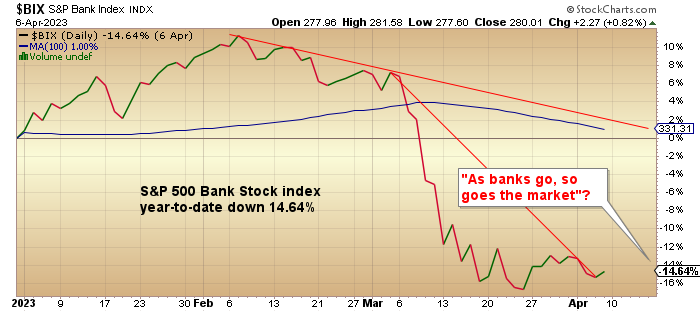
The week that ended in Saint Paddy’s Day celebrations around the world will be long remembered as the week in which investors around the world finally woke up to the terror of counterparty risk and bail-in confiscation. To the infinite chagrin of the Wall Street spin doctors, even the usually complacent and always obedient mainstream media were reporting what really happened at Silicon Valley Bank and Signature Bank as opposed to the trollop we were being fed about “mismanagement” and “lack of risk controls” and “excessive overconcentration.”

The immortal Richard Russell would always urge his subscribers to “follow the money” whenever an event popped out of the blue and shocked investors like a prominent figure disappearing or a corporate failure (like a bank), and in the case of all of these sudden and inexplicable bank runs, one must ask one’s self “Who benefitted?” in respect of not so much the failures but more so of the massive deposits that fled for the safety of the larger “Too Big to Fail” money-center behemoths that just may or may not have been the source of the rumors that led to the panic that caused the cataclysmic drop in deposits at both failed banks.

Stocks Are Cheap

Then, just as Wall Street was acclimatizing itself to the notion of revised deposit insurance levels and Fed backstopping of the smaller regional banks, along with saunters Credit Suisse, the crown jewel investment bank of the Land of the Watchmaking Gnomes of Zurich, getting monkey-hammered to new lows after the Saudi National Bank told them to “pound sand” after they were asked for a “liquidity injection” (bailout). That set off a whole new round of panic sales within the Eurozone banks and continued to feed and fan the fires of uncertainty across the pond, with even those supposedly stodgy Canadian banks caught in the crossfire.

Now, this is all revisionist mumbo-jumbo because all that really matters is how the events pertaining to the global banking fraternity affect central bank monetary policy — as in — will Powell not only pause but also pivot due to the systemic shocks felt in boardrooms and trading floors the world over last week. Christine Lagarde dismissed it as “elitist lobbying” and still proceeded with a 50 bps. hike in the European bank rate.

I usually watch BNN/Bloomberg during the day for its clarity rather than the one I watched on Friday morning (CNBC), and it took very little time for me to be reminded as to why I quit listening to the never-ending parade of stock market cheerleaders that they trot out in ten-minute segments all pretending to be “debating” the course of interest rates or inflation or sentiment, but they all arrive at one breathless conclusion — that stocks are cheap (!) but not for long.

Was the Silicon Bank Failure in the Same Vein as Chrysler?

The most difficult part of analyzing market corrections like this one is that events like those that transpired in the past two weeks are usually found at or near major turning points in both market direction and central bank policy.

For example, people think that the Great Bull Market that began in the 1980s found its bottom in August 1982, the month when Paul Volcker turned on the proverbial dime and suddenly hacked a half point off the Fed Funds rate, and it is true that stock surged from around Dow 875 to over 1,000 within a few weeks but what people fail to realize is that the real low was actually March of 1980 in a period in which the big worry was The Chrysler Corporation whose disastrous expansion into overseas markets during the

It is my belief that with the inflationary effects of the tight jobs market causing nightmares for the Fed, and since stocks are only down 18% from the January 2022 top, there really is very little justification for abandoning the current tight monetary policy.

The stagflation of the ’70s sent it into the crosshairs of bankruptcy. On May 10, 1980, United States Secretary of the Treasury G. William Miller announced the approval of nearly US$1.5 billion dollars in federal loan guarantees for the nearly bankrupt automaker.

At the time, it was the largest rescue package ever granted by the U.S. government to an American corporation but what it represented was what I call “seminal moments” in stock market history.

The moments usually mark the turn for either the very good or the very bad. Examples of this would include the big rally after JFK was killed in 1963, where, as perverse as it might have been thought, JFK tackling Big Oil and threatening to dismantle the Fed were no longer seen as depressants to stocks, hence the rally.

Converse to that event, a seemingly-bullish punctuation to the DotCom mania happened in January 2000 when media giant Time Warner and internet superstar upstart America Online announced that they would be merging in what eventually became the singular worst business combination in all of history. The surviving entity to this day is only one-seventh the value of the merged entities back in 2000.

The question remains: “Was the Silicon Bank failure a seminal moment in the same vein as Chrysler in 1980?”

The jury is most certainly out because Fed Chairman Powell has been seen wearing 6″ elevator shoes, shaving his head, and trying to acquire a taste for large Montezuma cigars while beating back the inflation beast as did a famous predecessor in the 1980-1982 period.

It is my belief that with the inflationary effects of the tight jobs market causing nightmares for the Fed, and since stocks are only down 18% from the January 2022 top, there really is very little justification for abandoning the current tight monetary policy.

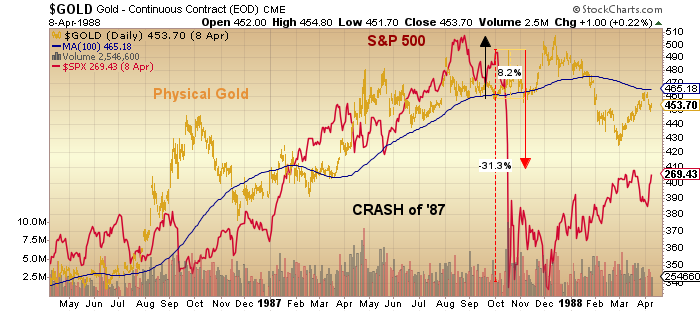
I watched gold plunge 35.3% in 2008 only to advance over 180% to all-time highs after liquidity issues brought about forced selling in the metals just before the central banks bailed out the member banks with a money-printing exercise of orgasmic proportion.

Of course, with all the job cuts on Wall Street and the shrinking bonus pools at all the big investment banks, the wails of protest will be loud and often until the punch bowl gets refilled, and happy days are once again here.

Unless one is a reader of minds or sayer of soothes, it is impossible to determine which was Powell goes next Wednesday so all I will do is look to the tea leaves in the bottom of the cup AND, of course, the charts, which have been a useful sextant with which to navigate the major averages. Last week was actually an “UP” week for stocks despite the volatility and the Friday drubbing.

With all of the negative headlines, it really did appear as though we were in the midst of a seminal moment where traders were buying the regional bank panic thinking that it was a 9/11, GFC, or Covid Crash moment lighting industrial blowtorches into the backsides of those stingy central bankers.

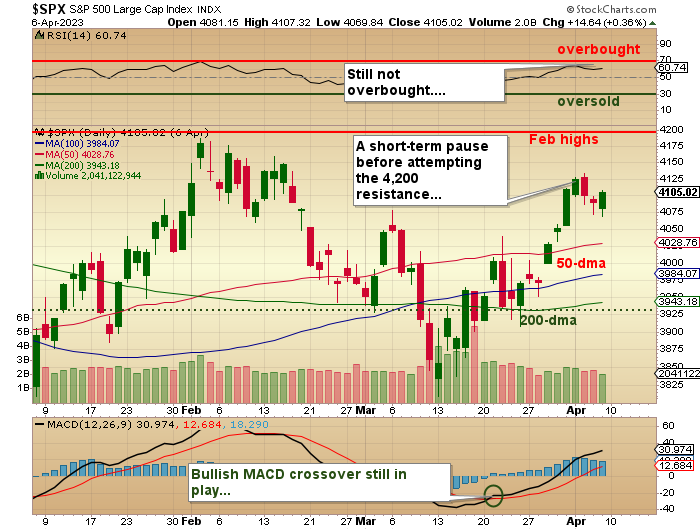
However, all that really occurred was a relief rally after the plunge to SPX 3,808, and while the RSI for the SPX failed to get below 30, MACD looked a tad oversold, which set up the move to the 200-dma at 3,940 above, which reside the 100 and 50-day m.a.’s as well as the big downtrend line off the February top.

Friday’s action negated Thursday’s close above the 200-dma which is now descending and resides at 3,936. I still believe that, at the very best, we can expect a successful retest of the December low at 3,764, but if that fails by month-end, then we are going to new lows below the October lows of 3,491.

Gold and Silver

In last week’s missive, I wrote:I see a test of the US$1,900 range by the end of the month, but if, in fact, I see further turmoil in the regional banks that spreads to the money-center banks and abroad, gold could catch a “fear trade” bid as traders move rapidly for the safety of non-paper assets.”

That “fear trade” bid came in like an Indian monsoon last week, with gold up over US$150/ounce, silver over US$1.20, and the HUI 29 points higher. With crude oil and copper down, color commentary by the pundits suggested that it was the slowing economy that was spooking the oil and copper pits, but from my vantage point, you would have expected the U.S. dollar (USD) to end the week on the lows, which it did not.

Whenever I see the performance triumvirate of gold chasing silver, silver chasing the PM equities (HUI), and PM equities decoupling from their anchorage to the USD and the SPX, I feel justified in adding to holdings. That is precisely what we got last week, and that silver put in a +4.88% move versus a +3.68% move for gold, but the stud of the day was the HUI which posted a +5.42% pop which, as I have been saying, for weeks now, will have a positive effect on our basket of junior miners.

My largest holding and top pick for the past few years, Getchell Gold Corp. (GTCH:CSE; GGLDF:OTCQB) added 12.28% Friday, a welcome relief for those of us that cannot begin to explain how that share price could trade down to US$9.20 per ounce of in-ground gold in mining-friendly Nevada as it did last week.

Their 2,059,900-ounce Fondaway Canyon (100%-owned) deposit is wide open to depth and along strike and is considered to have definite Tier One potential.

A couple of weeks ago, I suggested that Agnico Eagle Mines Ltd. (AEM:TSX; AEM:NYSE) in the low-mid US$40’s might be an interesting contrarian play due to the universal loathing being shown toward a group of companies with near-pristine balance sheets and strong income statements.

In the past two weeks, the number one input cost for miners — energy — has come under huge downside pressure falling 17.5% while their product is up 8.4%. That represents an expanding profit margin for the group, and here we are two weeks later, with AEM touching US$51.22 on Friday, and that is only after miners finally woke up on Thursday.

Another company that has caught my eye (thanks to my colleague and real technical analyst and market historian David Chapman) is Moneta Gold Inc. (MEAUF:OTCMKTS), formerly Moneta Porcupine Mines Inc. (ME:TSX), one of the first stocks I ever bought back in 1977

I used to follow it, but a bloated share structure and unremarkable asset mix kept me at a distance — until last week — when Chappie suggested I have a look. The first thing I asked was about the share structure, and to my surprise, I found that they went through a consolidation a while ago such that today there are a manageable 102,416,437 issued and a market cap of only US$102 million.

Digging deeper, I had forgotten that they always had a big land package in the heart of the Destour-Porcupine-Fault-Zone (“DPFZ”), a mineralized corridor within the legendary Abitibi-Greenstone Belt of northern Ontario and Quebec and have, in recent years significantly advanced the Tower Gold Project which includes a 17-km. strip of the DPFZ.

  • The current mineral resource estimate of 4.46 million ounces (“Moz”) indicated contained gold within 150.6 million tonnes (“Mt”) at a grade of 0.92 grams per tonne Au (“g/t”) and 8.29 Moz inferred contained ounces within 235.6 Mt at a grade of 1.09 g/t announced on September 7, 2022.

Adding 4.46 million ounces of indicated plus 8.28 million ounces inferred and you arrive at a global resource of 12.75 million ounces. From the Friday evening close of US$0.90, the company sports a market cap of US$91.7 million. Dividing the current market cap by the global resource of 12.75 million ounces, I arrive at a market cap per ounce of only US$7.19.

The company completed a Preliminary Economic Assessment in 2022 and arrived at the following:

  • The September 7, 2022, Preliminary Economic Assessment (“PEA”) demonstrated robust economics with C$1,459 million pre-tax Net Present Value of 5% (“NPV”), CA$1,066 million after-tax NPV5%, and a 31.7% after-tax Internal Rate of Return (“IRR”) at US$1,600/oz gold, and an exchange rate of US$0.78.
  • The PEA also demonstrated a CA$1,932 million cumulative after-tax cash flow, a mine life of 24 years, with average annual gold production of 261,014 oz in years one to 11 (192,666 oz for Life of Mine (“LOM”)) for 4,581,000 ounces total gold production LOM. Cash costs are estimated at US$910 per ounce, with all-in-sustaining costs (“AISC”) of US$1,073 per ounce of gold.

A Pre-feasibility Study is underway and expected to be completed next year which means ME qualifies as an advanced developer and a true proxy for rising gold prices. I was shocked to see the value-per-ounce come in at nearly US$7/ounce. I knew that gold miners were being thrown under buses these days as “value traps,” but between Getchell Gold at US$9.27/ounce last week and ME’s number, it really is astounding to see how universally detested the miners have become. My premise for owning Moneta Gold is buttressed by its location in the heart of a mining camp that has already produced over 85 million ounces since discoveries were first made in the 1800s.

Moneta is a sure-fire M&A candidate and is being added to the GGM Advisory portfolio as of Monday’s opening.

I Want To See Silver Outperform Gold

With the miners all catching a major league bid last week led by gold space, silver also caught fire.

I want to see silver outperform gold right through to month’s end. From the chart of silver above, it is clear just how poorly silver has been relative to gold (and everything else, for that matter) since the beginning of 2021.

I excluded 2020 because of the myriad of stimulus-driven deformities that occurred, leaving us only the recovery period. It is imperative for the health of the entire metals complex that silver assumes “big dog” status and takes over the leadership of the rally.

The problem with making forecasts regarding silver is that I can get all of the bullish inputs to the price behavior correct (as I did back in 2020) and yet recoil in amazement (and horror) that the all-important price variable went south instead of north despite rampaging consumer prices, geopolitical turmoil, and central bank profligacy.

The Electrification Movement 

As for the Electrification Movement, there is one very important truism that reigns supreme within the context of even the noblest of undertakings. When stock markets go into panic mode, a carbon-free world takes second place in the preservation of capital. With the banking crisis going global, the battery metals all took it on the chin last week, with copper below US$4/lb. and lithium is now in full correction mode.

Poster child Patriot Battery Metals Inc. (PMET:CA) is still ahead 76.67% YTD while down 34.08% from the top seen in early February.

No changes to my thoughts on Allied Copper Corp. (CPR:TSX.V; CPRRF:OTCQB) / Volt Lithium (CPR:TSXV / CPRRF:US) (which I own), where I await the results of large-scale testing of their DLE Process (“Direct Lithium Extraction”) at Rainbow Lake Alberta. These results, if successful, will be a game-changing thunderbolt for CPR shareholders once markets settle down.

Volatility in US Treasury Market

Speaking of markets “settling down,” this weekend has been a constant bombardment of financial market grave-dancing because there are a great many of those very smart (and Street savvy) people I follow that have issued “crash alerts.” I have issued two via my Email Alert service urging everybody to “get defensive” by way of eliminating margin and raising cash.

Now, markets may not crash at all, but since the conditions out there are so bizarre, with massive volatility in the U.S. treasury market, there is something very untoward happening. Treasury markets are supposed to be safe havens where investors go to hide in relative calm as the equity market tempest passes. Instead, the yield on the U.S. two-year treasury, sitting at 5.07% on March 7th, closed the week at 3.845%, which represents a 25% crash in the 2-year yield. That is unheard of.

In ancient Greek mythology, it was written in The Labours of Heracles that he destroyed the Lernean Hydra, a multi-headed reptilian beast, and to do so, Heracles enlisted the aid of his nephew Iolaus.

As Heracles severed each mortal head, Iolaus was set to the task of cauterizing the fresh wounds so that no new heads would emerge. This story of Heracles evokes images of today’s financial landscape where each time the regulators solve issues of a systemic nature, another one pops up, just like the Hydra’s heads, only in our story, there is no regulator, politician or Keynesian hero able to “cauterize the fresh wounds.”

There are a great many exciting and potentially-enriching stories out there, but the only one that matters at times like these are the ones that have happy endings without us losing all of our wealth because we failed to heed the storm clouds and plunging barometer.

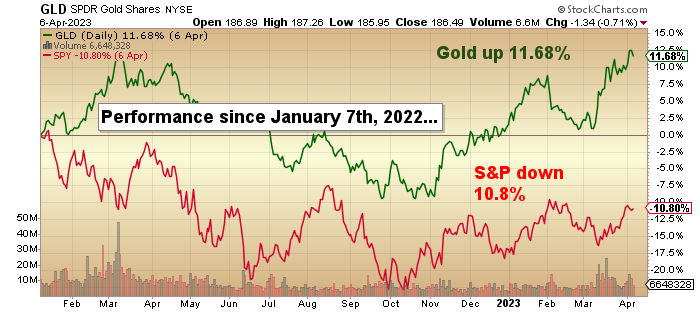
Absent a coordinated rescue mission by central banks the world over, there are few reasons to be bullish on anything out there save gold and silver but need I remind you how those two “ultimate safe havens” acted during the 2008 G.F.C. and the more recent Covid Crash of March 2020.

They outperformed most other asset classes, but outperformance does not pay your electricity bill or college tuition if the price you paid is higher than where it was sold. “Get defensive” means one has cash that they are able to deploy in favor of depressed prices that occur only when liquidity needs supersede valuation metrics.

I watched gold plunge 35.3% in 2008 only to advance over 180% to all-time highs after liquidity issues brought about forced selling in the metals just before the central banks bailed out the member banks with a money-printing exercise of orgasmic proportion.

Carpe diem? No. Caveat emptor? Absolutely.


Michael Ballanger Disclaimer:

This letter makes no guarantee or warranty on the accuracy or completeness of the data provided. Nothing contained herein is intended or shall be deemed to be investment advice, implied or otherwise. This letter represents my views and replicates trades that I am making but nothing more than that. Always consult your registered advisor to assist you with your investments. I accept no liability for any loss arising from the use of the data contained on this letter. Options and junior mining stocks contain a high level of risk that may result in the loss of part or all invested capital and therefore are suitable for experienced and professional investors and traders only. One should be familiar with the risks involved in junior mining and options trading and we recommend consulting a financial adviser if you feel you do not understand the risks involved.

Disclosures:

1) Michael J. Ballanger: I, or members of my immediate household or family, own securities of the following companies mentioned in this article: Getchell Gold Corp., Patriot Battery Metals Inc., and Allied Copper Corp. I personally am, or members of my immediate household or family are, paid by the following companies mentioned in this article: My company, Bonaventure Explorations Ltd., has a consulting relationship with: None.

2) The following companies mentioned in this article are billboard sponsors of Streetwise Reports: None. Click here for important disclosures about sponsor fees. As of the date of this article, an affiliate of Streetwise Reports has a consulting relationship with: None. Please click here for more information.

3) Statements and opinions expressed are the opinions of the author and not of Streetwise Reports or its officers. The author is wholly responsible for the validity of the statements. The author was not paid by Streetwise Reports for this article. Streetwise Reports was not paid by the author to publish or syndicate this article. Streetwise Reports requires contributing authors to disclose any shareholdings in, or economic relationships with, companies that they write about. Streetwise Reports relies upon the authors to accurately provide this information and Streetwise Reports has no means of verifying its accuracy.

4) This article does not constitute investment advice. Each reader is encouraged to consult with his or her individual financial professional and any action a reader takes as a result of information presented here is his or her own responsibility. By opening this page, each reader accepts and agrees to Streetwise Reports’ terms of use and full legal disclaimer. This article is not a solicitation for investment. Streetwise Reports does not render general or specific investment advice and the information on Streetwise Reports should not be considered a recommendation to buy or sell any security. Streetwise Reports does not endorse or recommend the business, products, services or securities of any company mentioned on Streetwise Reports.

5) From time to time, Streetwise Reports LLC and its directors, officers, employees or members of their families, as well as persons interviewed for articles and interviews on the site, may have a long or short position in securities mentioned. Directors, officers, employees or members of their immediate families are prohibited from making purchases and/or sales of those securities in the open market or otherwise from the time of the decision to publish an article until three business days after the publication of the article. The foregoing prohibition does not apply to articles that in substance only restate previously published company releases. As of the date of this article, officers and/or employees of Streetwise Reports LLC (including members of their household) own securities of Agnico Eagle Mines Ltd. and Allied Copper Corp., companies mentioned in this article.

Japanese Candlesticks Analysis 21.03.2023 (XAUUSD, NZDUSD, GBPUSD)

By RoboForex.com

XAUUSD, “Gold vs US Dollar”

Near the resistance, gold has formed a Shooting Star reversal pattern. Currently, the instrument might go by the reversal signal in a descending wave. The target of the decline might be 1960.00. Upon testing the support level, the pair might push off it and continue the uptrend. However, the quotes might grow directly to 2000.00 without any pullback.

GOLD
Risk Warning: the result of previous trading operations do not guarantee the same results in the future

NZDUSD, “New Zealand Dollar vs US Dollar”

On H4, near the resistance, NZDUSD has formed a Harami reversal pattern. Currently, the instrument might go by the reversal signal in a descending wave. The target of the correction might be 0.6180. After a rebound from the support level, the quotes might continue the uptrend. However, the pair might rise to 0.6270 without testing the support.

NZDUSD
Risk Warning: the result of previous trading operations do not guarantee the same results in the future

GBPUSD, “Great Britain Pound vs US Dollar”

On H4, near the resistance level, GBPUSD has formed a Shooting Star reversal pattern. Currently, the instrument might go by the reversal signal in a descending wave. The target of the pullback might be 1.2200. However, the price might grow to 1.2325 and continue the uptrend without correcting to the support.

GBPUSD

Article By RoboForex.com

Attention!
Forecasts presented in this section only reflect the author’s private opinion and should not be considered as guidance for trading. RoboForex LP bears no responsibility for trading results based on trading recommendations described in these analytical reviews.

Investors prepare for next rally ahead of central bank meetings

By George Prior

Investors are ready to build their investment portfolios with new money amid a growing consensus that looser monetary policies are coming which will boost financial markets, says the CEO of one of the world’s largest independent financial advisory and asset management organisations.

This assessment from Nigel Green of deVere Group comes ahead of critical policy meetings this week at the US Federal Reserve and Bank of England.

It also follows the Fed and five other major central banks announcing, in a coordinated joint statement, fresh measures to improve global liquidity. The central banks said the move served as an “important backstop” to ease strains in global funding markets.

He comments: “Global markets remain jittery from the turmoil caused by the fallout of the crises hitting Silicon Valley Bank, Signature Bank, Credit Suisse and First Republic Bank.

“There are fears of runs on other banks as other lenders could find themselves in trouble after rises in interest rates left some harbouring major losses.”

The deVere CEO continues: “The coordinated action being taken by the US Federal Reserve, the Bank of England, Bank of Japan, Bank of Canada, the European Central Bank and Swiss National Bank launched on Monday to keep credit flowing in the serious issues affecting the banking sector, show that they are willing to do whatever it takes to avert a crash.

“Investors are taking this as a sign that central banks will now ease off interest rate hikes.

“Looser monetary policies will trigger a surge in financial markets.

“Not wanting to miss out on the next rally, clients are now telling our consultants around the world that they want to build-up their investment portfolios with new money.”

Looser monetary policy increases liquidity in the markets, stimulates economic activity, and boosts investor confidence, all of which can contribute to higher stock prices.

The next Federal Open Market Committee (FOMC) meeting is scheduled for March 21 and 22. The US Fed rate hike decision will be announced on March 22 at 2 pm (ET) followed by a press conference.

Meanwhile, the Bank of England will meet on Thursday and hold a press conference at noon in London.

“Central banks have the unenviable task of trying to cool stubbornly high inflation and restore financial stability,” says Nigel Green.

He concludes: “It seems that investors are gripped by the Fear Of Missing Out. They’re looking past interest rate hikes and assuming that the chaos in the banking sector will unleash looser monetary policies from central banks, which will be fuel for the markets.”

About:

deVere Group is one of the world’s largest independent advisors of specialist global financial solutions to international, local mass affluent, and high-net-worth clients.  It has a network of offices across the world, over 80,000 clients and $12bn under advisement.

Investors are evaluating the prospects of the US Federal Reserve’s interest rate decision

By JustMarkets

At the close of the stock market yesterday, the Dow Jones Index (US30) gained 1.20%, and the S&P 500 Index (US500) increased by 0.89%. The NASDAQ Technology Index (US100) added 0.32% yesterday. The US Federal Reserve said late last week that it would work with other major central banks to provide liquidity to the global banking sector. Certainly, this has brought some optimism back to the stock market. But that could easily dissipate if the US Federal Reserve raises interest rates on Wednesday and hints at further policy tightening.

Former Goldman Sachs chief executive Lloyd Blankfein said the Federal Reserve might take a pause in raising interest rates this week as the unfolding banking crisis tightens lending standards in the economy. Blankfein also warned that without intervention to protect deposits at small and regional banks, consumers could only rely on large banks that have high capital and liquidity standards. This, he said, could lead to consolidation in the financial sector, which would negatively impact the nation’s large and growing economy. Before the SVB collapse and the resulting policy implications, the Fed was willing to raise rates by as much as 50 basis points as price pressures in the US economy were deemed sustainable. Given the current market volatility, some Fed observers expect a quarter-point hike, while others predict a pause.

Shares of the New York Community Bancorp jumped by more than 31% after his subsidiary Flagstar Bank agreed to buy most of Signature Bank for $2.7 billion. Concerns about the banks’ liquidity crisis subsided somewhat Monday when Swiss investment bank UBS said it would buy Credit Suisse, and JPMorgan (JPM) appeared to have made progress in rescuing First Republic Bank (FRC) following last week’s federal takeover of regional banks Silicon Valley and Signature.

European stock indexes rose on Monday amid improving sentiment in the banking sector after UBS agreed to buy struggling rival Credit Suisse. German DAX (DE30) gained 1.12%, French CAC 40 (FR40) jumped by 1.27%, Spanish IBEX 35 (ES35) gained 1.31%, and British FTSE 100 (UK100) closed yesterday with a 0.93% gain.

To further improve financial stability in Europe, European Central Bank President Christine Lagarde said that the central bank is “ready to respond as necessary” to maintain the stability of the euro area.

Gold prices have finally reached the $2,000 per ounce mark. Falling dollar index and falling government bond yields amid the banking crisis are fueling gold’s rise. But analysts are confident that traders should expect a correction wave in the coming days because prices are heavily overbought now.

Crude markets tried to rebound yesterday after regulatory measures to shore up liquidity and consolidate weak players in the banking sector helped ease some fears of an impending crisis. But that was largely offset by uncertainty ahead of this week’s key Fed meeting. Asian markets mostly fell Monday. Japan’s Nikkei 225 (JP225) decreased by 1.42%, China’s FTSE China A50 (CHA50) lost 0.41% for the day, Hong Kong’s Hang Seng (HK50) lost 2.65% for the day, India’s NIFTY 50 (IND50) decreased by 0.65%, and Australia’s S&P/ASX 200 (AU200) was down by 1.38%.

On Monday, the Bank of Japan appointed Seiichi Shimizu, whose market and technical expertise in the bank’s Yield Curve Control (YCC) policy has earned him the nickname “Mr. YCC. During his tenure as head of the financial market division, the 57-year-old banker helped put together a package of steps to mitigate the side effects of the YCC in 2021, such as phasing out large purchases of risky assets. Shinichi Uchida was elected deputy governor. The new governor, Kazuo Ueda, will join the Bank of Japan when the term of incumbent Haruhiko Kuroda expires next month. Many analysts expect the Bank of Japan to change or cancel the YCC during Ueda’s five years in office, as the bank’s huge bond purchases to protect the yield cap have been criticized for distorting the shape of the yield curve and depleting bond market liquidity.

S&P 500 (F) (US500) 3,951.57 +34.93 (+0.89%)

Dow Jones (US30)32,244.58 +382.60 (+1.20%)

DAX (DE40) 14,933.38 +165.18 (+1.12%)

FTSE 100 (UK100) 7,403.85 +68.45 (+0.93%)

USD Index 103.30 −0.40 (−0.39%)

Important events for today:
  • – Australia RBA Meeting Minutes at 02:30 (GMT+2);
  • – German ZEW Economic Sentiment (m/m) at 12:00 (GMT+2);
  • – Eurozone ZEW Economic Sentiment (m/m) at 12:00 (GMT+2);
  • – Canada Consumer Price Index (m/m) at 14:30 (GMT+2);
  • – Eurozone ECB President Lagarde Speaks at 14:30 (GMT+2);
  • – US Existing Home Sales (m/m) at 16:00 (GMT+2).

By JustMarkets


This article reflects a personal opinion and should not be interpreted as an investment advice, and/or offer, and/or a persistent request for carrying out financial transactions, and/or a guarantee, and/or a forecast of future events.

Markets Stabilise As Investors Digest Credit Suisse Takeover

By ForexTime

Asian markets rose on Tuesday after Wall Street staged a rebound overnight as the historic takeover of Credit Suisse Group AG soothed concerns over the global banking sector.

Switzerland’s largest bank UBS Group AS has agreed to purchase Credit Suisse for $3.2 billion in what’s being labelled a “shotgun marriage”. But it is aimed at containing the panic and jitters currently around the financial system. Although the latest developments have lifted sentiment, the overall mood remains fragile with investors likely to remain guarded ahead of the Fed meeting tomorrow. In the currency space, the dollar steadied during early trade and could end a three-day losing streak if bulls fight back. In the previous session, oil prices rebounded after tumbling to their lowest levels since 2021 while gold punched above$2000 for the first time since March 2022 before ending the session 0.5% lower.

We expect financial markets to remain volatile and highly sensitive to any fresh news concerning the global banking sector. With fears over the crisis easing, we could see a modest return in risk appetite, lending support to global stocks. Shifting our focus elsewhere, this will be a big week for markets with the US Federal Reserve (Fed), Bank of England (BoE), and Swiss National Bank (SNB) policy meetings in focus. It will be interesting to see what the SNB has to say about the Credit Suisse developments, especially after the historic takeover.

Fed meeting in focus

The upcoming Fed meeting could be tough as the central bank decides whether to focus on solid macroeconomic data or the stability of the financial system.

Markets expect the Federal Reserve to raise interest rates by 25 basis points this month, with the chances of this decision currently priced at 74%, according to Fed funds futures. Key for markets will be what the central bank has to say about the recent developments concerning the SVB collapse and Credit Suisse drama, especially after the UBS takeover.

If the Federal Reserve surprises markets by leaving rates unchanged, this could signal the end of the rate hike cycle with the next move being a cut in rates. Such a development is likely to deal a heavy blow to the dollar along with Treasury yields. Markets might also take it as a sign that the Fed fears contagion risks in markets via the banking sector, and this would likely see a sharp sell-off in stock markets. Whatever the outcome of the Fed meeting, it may influence the dollar’s outlook for the rest of March.

Taking a quick look at the Dollar Index (DXY), it remains under pressure on the daily charts. The recent close below 103.00 may signal further downside with 102.30 acting as the next key point of interest. Should prices close back above 103.00, this may invite a move towards 104.00.

Currency spotlight: GBPUSD

The Bank of England policy meeting on Thursday could be tense given the latest turmoil in financial markets.

We could witness a battle between doves and hawks as both charge into the meeting well-equipped and ready to attack. On one side of the equation, stalling wage growth has fueled speculation about the MPC’s tightening cycle coming to an end. However, UK inflation is still well above the 2% target with the latest figures on Wednesday forecast to show prices cooling to 9.9% in February. If the BoE decides to leave rates unchanged this month, this could weigh heavily on the pound. Talking technicals, the GBPUSD is bullish on the daily charts. The daily close above 1.2250 could signal further upside. However, where the currency pair concludes this week will be heavily influenced by the Fed and BoE meetings.

Commodity spotlight – Gold

Gold kicked off Tuesday’s session on a mellow note, a complete contrast from the previous day.

On Monday, the precious metal punched above $2000 for the first time since March 2022 as concerns over the banking system boosted the appetite for safe-haven assets. Given how fears of a full-blown crisis later eased following the historic takeover of Credit Suisse, this blunted appetite for gold. Nevertheless, the precious metal is set to glow amid the fragile sentiment with expectations around a less aggressive Federal Reserve limiting downside losses. Looking at the technical picture, gold could experience a technical pullback towards $1955 before bulls take further action. Should $1955 prove to be unreliable support, prices may decline towards $1935, $1915, and $1900, respectively.


Forex-Time-LogoArticle by ForexTime

ForexTime Ltd (FXTM) is an award winning international online forex broker regulated by CySEC 185/12 www.forextime.com

The Importance of Gold

Source: Streetwise Reports  (3/20/23)

James Turk of Goldmoney, the impetus behind The Gold Report here at Streetwise, explains why he believes gold and silver are imperative assets to own in this current economy and how you can get involved with them.

Starting his career in the 1960s working for Chase Manhattan Bank in Thailand, The Philippines, and Hong Kong, James Turk has a long history in the world of finance. In 2001, Turk started goldmoney.com with his eldest son, Geoffrey.

GoldMoney (XAU:TSX) focuses on precious metals buying and selling, storage, coin retailing, and gold jewelry manufacturing and sales through a subsidiary, Menē.com, aka Menē Inc. (MENE:TSX.V; MENEF:OTCMKTS).

The company has clients in over 100 countries around the world and currently safeguards over US$2 billion of assets owned by its clients. Overall, Goldmoney has a reputation for success that comes with the reputation held by James Turk.

However, people don’t know that while James Turk is the force behind Goldmoney, he was also the reason The Gold Report was started.

A Discussion in the Mountains

The conversation started in the mountains. Gordon Holmes, the CEO and founder of Streetwise Reports, and James had been friends for years. Then one day, Gordon invited James to share a bottle of wine at Lookout Ridge (Gordon’s winery in California).

As they spoke about the market over a glass of pinot, James asked Gordon why he hadn’t stepped into the gold market yet. Gordon was honest and relayed to him that he didn’t believe he knew enough about the market to be all that involved.

That is when James looked Gordon in the eye and told him, “You’ll figure it out.”

And The Gold Report was born.

Without that fortuitous meeting, Streetwise Reports as we know it may have never come to be.

Why Gold?

Goldmoney may have been started in 2001, but Turk’s interest in gold was fostered from a young age. Growing up, Turk’s father and grandparents shared stories of fleeing from Austria’s hyperinflation after World War I.

Because of this, Turk said, “I’ve always been of the view that gold and silver had an important role to play in economic activity and that accumulating gold and silver was a means of saving — a way to save purchasing power.”

He went on to say, “It’s never too late to save money, but it doesn’t make sense to save fiat currency anymore because of negative interest rates. In other words, if you deposit money into a bank at the end of the year, you have less purchasing power. Even though you’re earning interest income, the inflation rate is higher than the interest income that you’re earning. So you’ll never get ahead that way. With physical gold and silver, you won’t be earning interest income, but you’re going to preserve your purchasing power over time.”

This is one of the reasons Turk is such an ardent advocate for owning some precious metals in a diversified investment portfolio.

Gold After Nixon

In our wide-ranging discussion, Turk also touched on the value of the U.S. dollar compared to gold beginning with President Nixon.

“Living and working in a bank through the 1970s was, for me, a life-changing experience. And obviously, something I’m never going to forget. Worryingly, there are a lot of similarities today to what occurred back then. But there are also some differences too.”

Turk explained that in the 70s, easy money printing caused inflation to soar out of control. When Paul Volcker was appointed chairman of the Federal Reserve in 1979, he kept raising interest rates until inflation began to decline. He did this to save the U.S. dollar when faith in the currency was rapidly eroding.

Turk said, “I’ve always been of the view that gold and silver had an important role to play in economic activity and that accumulating gold and silver was a means of saving — a way to save purchasing power.”

Turk went on to say: “At the peak, the interest income you could earn over and above the inflation rate was 6%, which is phenomenally high because the natural interest rate is normally about 1%.

It was enough to rebuild confidence in the dollar. Volcker eventually brought inflation under control by decreasing — and this is important — decreasing the growth rate of the quantity of dollar currency. He never actually decreased the quantity of dollar currency. There was never any deflation. It was just disinflation, but what’s happening this time around is different.”

“The Federal Reserve cannot simply raise interest rates to levels that Volcker needed to bring down the inflation rate. There’s too much debt in the economy. So now, what the Fed is doing is decreasing the quantity of dollars. This could lead to a deflationary economic collapse.”

Turk noted, “Ultimately, in a deflationary economy, the debtors end up in trouble. The debt burden increases because the value of the currency increases. Also, liquidity disappears in a deflationary environment. Anyone who’s heavily leveraged — like a lot of the banks — tends to suffer in that type of environment, as occurred in the 1930s. So it’s a very important time to be focusing on gold and silver because regardless of whether it’s inflation or deflation, gold, and silver will get you through the turmoil to the other side of the valley.”

In 1971, Nixon closed the gold window breaking its formal link to the dollar. Since then, the dollar’s purchasing power has been eroding, but this process began much earlier. The dollar has lost 98.5% of its purchasing power since the creation of the Federal Reserve in 1913. In recent decades this debasement of the dollar has accelerated.

Measuring in Ounces

Turk went on to say that while we calculate the price of things using the dollar, we must also be using ounces of gold or silver to measure prices.

“When looking at the price of crude oil going back to 1950, you get different results depending on the measuring stick used. If you measure oil in terms of ounces of gold, the price of crude oil hasn’t changed much. An ounce of gold buys about the same amount of crude oil today as in 1950.This example shows how gold preserves purchasing power over the long term. It does this because gold is natural money. The quantity of the aboveground stock of gold increases at approximately the same rate as the world’s population and new wealth creation. Because these growth rates are consistent, gold retains its purchasing power.”

“Gold and silver are not investments; they’re money. Gold and silver didn’t increase your wealth — your purchasing power — over these seven decades. They preserved it, which is one of money’s most important functions.”

“I like to tell a story that I remember from growing up in the 1950s. I think is very meaningful.”

“My parents would drive the family car to the local gas station and fill it up for US$2. Back then, the paper currency was silver certificates. You could also pay with silver coins, for example, two silver dollars or four half dollars.”

“Today, US$2 doesn’t even buy a gallon of gas. But the market value of the silver content of those old coins will still fill up the family car.”

The following chart of crude oil prices shows how gold and silver preserve purchasing, but national currencies do not. Measured in dollars, crude oil is 30 times more expensive than it was in 1950. The British pound has fared even worse, with oil 69 times more expensive today in that currency.

“There is one key point that people need to understand,” he continued. “Gold and silver are not investments; they’re money. Gold and silver didn’t increase your wealth — your purchasing power — over these seven decades. They preserved it, which is one of money’s most important functions.”

“Sterile assets like precious metals don’t generate cash flow. When their price rises, purchasing power moves from people owning national currency to people owning precious metals. The precious metals have value because they are useful as money.”

“What’s more,” Turk continued, “they are money that is not based on anyone’s promise, so they don’t have counterparty risk. For that reason, they provide unconditional liquidity. Your purchasing power placed in gold and silver is not reliant upon some bank or a government promise. And by measuring goods, services, and your investment portfolio in terms of ounces, you’ll come up with an entirely different perspective.”

“It is meaningful to use gold to measure accumulated wealth. You are measuring purchasing power with money that has proven its ability to retain its purchasing power over long periods of time — as we can see in the chart of crude oil prices.”

The Decline of the US Dollar

As faith in gold’s purchasing power rises, we see that trust in the U.S. dollar erodes, especially in an inflationary environment.

Turk pointed out that “if you look at measures completed by private economists, the inflation rate is much, much higher than what the government reports. So regardless of who you rely on to measure inflation, the dollar is losing purchasing power every day.”

Will the dollar collapse and become obsolete?

Turk replied: “That involves predicting the future, and unfortunately, no one can predict the future. All you can do is be prepared as best you can for any eventuality. And given their track record going back thousands of years, owning some physical gold and silver is one way to do that. If worse comes to worst, you’ll be prepared and ready by owning some gold and silver so that your wealth is diversified.”

He also favors the shares of precious metal mining companies but advised: “Owning gold and silver is different from owning the shares of mining companies. The shares are investments, not money. Buying shares in mining companies requires the same amount of diligent attention that you apply to any investment. For example, you need to look at the quality of management, the company’s mining property, their financial accounts, country risk where they operate, and many other factors.”

“The mining shares, in my view, are undervalued. They are not tangible assets like gold and silver. I consider them to be ‘near tangible’ because the mining companies own tangible assets in the form of mines and equipment that produce tangible assets.”

How to Store Gold

If you wish to be prepared and get involved in tangible assets, knowing how to store them is imperative. With gold and silver, you have two options. You can either store it yourself or pay for a professional firm to safeguard them for you — this is where Goldmoney comes in.

Turk explained, “Through Goldmoney, customers can store their precious metals in vaults operated by specialized vaulting companies in different places around the world. You can choose among different countries, different political risks, and different geographic risks so that you can diversify. Again, there is no one right answer. But if there is an answer that comes close to being the right choice, it’s diversifying your assets as much as practical.”

When searching for professional storage, Turk pinpointed the importance of working with a company that does independent third-party audits. In this way, you have assurances of integrity that your assets are properly cared for. Goldmoney currently safeguards over US$2 billion in customer assets worldwide.

Money and Liberty: In the Pursuit of Happiness & The Theory of Natural Money

If you’d like to learn more about the importance of gold and silver and how to incorporate them into your portfolio, these and many more topics are covered in James Turk’s latest book, Money and Liberty: In the Pursuit of Happiness & The Theory of Natural Money.

Money and Liberty was published by Wood Lane Books in November 2021 and is available on Amazon. It has been praised as “an excellent and insightful book” that provides “a clear but detailed history of the relationship of sound money to human freedom.”


Disclosures:
1) Katherine DeGilio wrote this article for Streetwise Reports LLC. She or members of her household own securities of the following companies mentioned in the article: None. She or members of her household are paid by the following companies mentioned in this article: None.

2) The following companies mentioned in this article are billboard sponsors of Streetwise Reports: None. Click here for important disclosures about sponsor fees. As of the date of this article, an affiliate of Streetwise Reports has a consulting relationship with: None. Please click here for more information.

3) Statements and opinions expressed are the opinions of the author and not of Streetwise Reports or its officers. The author is wholly responsible for the validity of the statements. The author was not paid by Streetwise Reports for this article. Streetwise Reports was not paid by the author to publish or syndicate this article. Streetwise Reports requires contributing authors to disclose any shareholdings in, or economic relationships with, companies that they write about. Streetwise Reports relies upon the authors to accurately provide this information and Streetwise Reports has no means of verifying its accuracy.

4) This article does not constitute investment advice. Each reader is encouraged to consult with his or her individual financial professional and any action a reader takes as a result of information presented here is his or her own responsibility. By opening this page, each reader accepts and agrees to Streetwise Reports’ terms of use and full legal disclaimer. This article is not a solicitation for investment. Streetwise Reports does not render general or specific investment advice and the information on Streetwise Reports should not be considered a recommendation to buy or sell any security. Streetwise Reports does not endorse or recommend the business, products, services or securities of any company mentioned on Streetwise Reports.

5) From time to time, Streetwise Reports LLC and its directors, officers, employees or members of their families, as well as persons interviewed for articles and interviews on the site, may have a long or short position in securities mentioned. Directors, officers, employees or members of their immediate families are prohibited from making purchases and/or sales of those securities in the open market or otherwise from the time of the decision to publish an article until three business days after the publication of the article. The foregoing prohibition does not apply to articles that in substance only restate previously published company releases.

IPCC report: Climate solutions exist, but humanity has to break from the status quo and embrace innovation

By Robert Lempert, Pardee RAND Graduate School and Elisabeth Gilmore, Carleton University 

It’s easy to feel pessimistic when scientists around the world are warning that climate change has advanced so far, it’s now inevitable that societies will either transform themselves or be transformed. But as two of the authors of a recent international climate report, we also see reason for optimism.

The latest reports from the Intergovernmental Panel on Climate Change, including the synthesis report released March 20, 2023, discuss changes ahead, but they also describe how existing solutions can reduce greenhouse gas emissions and help people adjust to impacts of climate change that can’t be avoided.

The problem is that these solutions aren’t being deployed fast enough. In addition to pushback from industries, people’s fear of change has helped maintain the status quo.

To slow climate change and adapt to the damage already underway, the world will have to shift how it generates and uses energy, transports people and goods, designs buildings and grows food. That starts with embracing innovation and change.

Fear of change can lead to worsening change

From the industrial revolution to the rise of social media, societies have undergone fundamental changes in how people live and understand their place in the world.

Some transformations are widely regarded as bad, including many of those connected to climate change. For example, about half the world’s coral reef ecosystems have died because of increasing heat and acidity in the oceans. Island nations like Kiribati and coastal communities, including in Louisiana and Alaska, are losing land into rising seas.

Residents of the Pacific island nation of Kiribati describe the changes they’re experiencing as sea level rises.

Other transformations have had both good and bad effects. The industrial revolution vastly raised standards of living for many people, but it spawned inequality, social disruption and environmental destruction.

People often resist transformation because their fear of losing what they have is more powerful than knowing they might gain something better. Wanting to retain things as they are – known as status quo bias – explains all sorts of individual decisions, from sticking with incumbent politicians to not enrolling in retirement or health plans even when the alternatives may be rationally better.

This effect may be even more pronounced for larger changes. In the past, delaying inevitable change has led to transformations that are unnecessarily harsh, such as the collapse of some 13th-century civilizations in what is now the U.S. Southwest. As more people experience the harms of climate change firsthand, they may begin to realize that transformation is inevitable and embrace new solutions.

A mix of good and bad

The IPCC reports make clear that the future inevitably involves more and larger climate-related transformations. The question is what the mix of good and bad will be in those transformations.

If countries allow greenhouse gas emissions to continue at a high rate and communities adapt only incrementally to the resulting climate change, the transformations will be mostly forced and mostly bad.

For example, a riverside town might raise its levees as spring flooding worsens. At some point, as the scale of flooding increases, such adaptation hits its limits. The levees necessary to hold back the water may become too expensive or so intrusive that they undermine any benefit of living near the river. The community may wither away.

The riverside community could also take a more deliberate and anticipatory approach to transformation. It might shift to higher ground, turn its riverfront into parkland while developing affordable housing for people who are displaced by the project, and collaborate with upstream communities to expand landscapes that capture floodwaters. Simultaneously, the community can shift to renewable energy and electrified transportation to help slow global warming.

Optimism resides in deliberate action

The IPCC reports include numerous examples that can help steer such positive transformation.

For example, renewable energy is now generally less expensive than fossil fuels, so a shift to clean energy can often save money. Communities can also be redesigned to better survive natural hazards through steps such as maintaining natural wildfire breaks and building homes to be less susceptible to burning.

Charts showing falling costs and rising adoption of clean energy.
Costs are falling for key forms of renewable energy and electric vehicle batteries.
IPCC sixth assessment report

Land use and the design of infrastructure, such as roads and bridges, can be based on forward-looking climate information. Insurance pricing and corporate climate risk disclosures can help the public recognize hazards in the products they buy and companies they support as investors.

No one group can enact these changes alone. Everyone must be involved, including governments that can mandate and incentivize changes, businesses that often control decisions about greenhouse gas emissions, and citizens who can turn up the pressure on both.

Transformation is inevitable

Efforts to both adapt to and mitigate climate change have advanced substantially in the last five years, but not fast enough to prevent the transformations already underway.

Doing more to disrupt the status quo with proven solutions can help smooth these transformations and create a better future in the process.

Editor’s note: This is an update to an article originally published April 18, 2022.The Conversation

About the Author:

Robert Lempert, Professor of Policy Analysis, Pardee RAND Graduate School and Elisabeth Gilmore, Associate Professor of Climate Change, Technology and Policy, Carleton University

This article is republished from The Conversation under a Creative Commons license. Read the original article.

Worst bank turmoil since 2008 means Federal Reserve is damned if it does and damned if it doesn’t in decision over interest rates

By Alexander Kurov, West Virginia University 

The Federal Reserve faces a pivotal decision on March 22, 2023: whether to continue its aggressive fight against inflation or put it on hold.

Making another big interest rate hike would risk exacerbating the global banking turmoil sparked by Silicon Valley Bank’s failure on March 10. Raising rates too little, or not at all as some are calling for, could not only lead to a resurgence in inflation, but it could cause investors to worry that the Fed believes the situation is even worse than they thought – resulting in more panic.

What’s a central banker to do?

As a finance scholar, I have studied the close link between Fed policy and financial markets. Let me just say I would not want to be a Fed policymaker right now.

Break it, you bought it

When the Fed starts hiking rates, it typically keeps at it until something breaks.

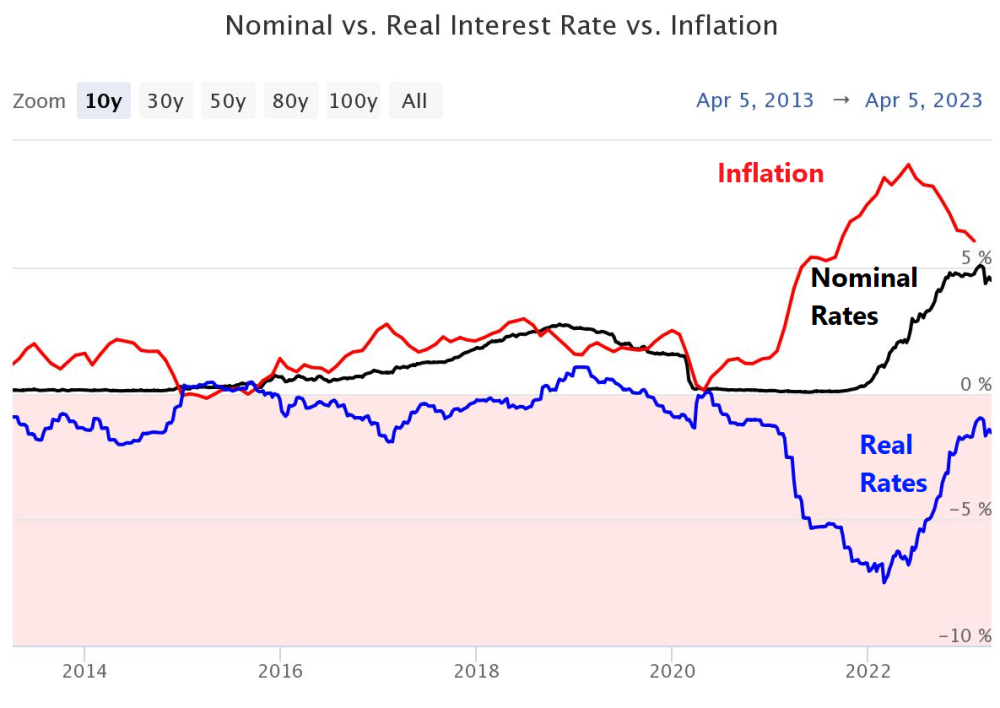
The U.S. central bank began its rate-hiking campaign early last year as inflation began to surge. After initially mistakenly calling inflation “transitory,” the Fed kicked into high gear and raised rates eight times from just 0.25% in early 2022 to 4.75% in February 2023. This is the fastest pace of rate increases since the early 1980s – and the Fed is not done yet.

Consumer prices were up 6% in February from a year earlier. While that’s down from a peak annual rate of 9% in June 2022, it’s still significantly above the Fed’s 2% inflation target.

But then something broke. Seemingly out of nowhere, Silicon Valley Bank, followed by Signature Bank, collapsed virtually overnight. They had over US$300 billion in assets between them and became the second- and third-largest banks to fail in U.S. history.

Panic quickly spread to other regional lenders, such as First Republic, and upset markets globally, raising the prospect of even bigger and more widespread bank failures. Even a $30 billion rescue of First Republic by its much larger peers, including JPMorgan Chase and Bank of America, failed to stem the growing unease.

If the Fed lifts interest rates more than markets expect – currently a 0.25 percentage point increase – it could prompt further anxiety. My research shows that interest rate changes have a much bigger effect on the stock market in bear markets – when there’s a prolonged decline in stock prices, as the U.S. is experiencing now – than in good times.

Making the SVB problem worse

What’s more, the Fed could make the problem that led to Silicon Valley Bank’s troubles even worse for other banks. That’s because the Fed is at least indirectly responsible for what happened.

Banks finance themselves mainly by taking in deposits. They then use those essentially short-term deposits to lend or make investments for longer terms at higher rates. But investing short-term deposits in longer-term securities – even ultra-safe U.S. Treasurys – creates what is known as interest rate risk.

That is, when interest rates go up, as they did throughout 2022, the values of existing bonds drop. SVB was forced to sell $21 billion worth of securities that lost value because of the Fed’s rate hikes at a loss of $1.8 billion, sparking its crisis. When SVB’s depositors got the wind of it and tried to withdraw $42 billion on March 9 alone – a classic bank run – it was over. The bank simply couldn’t meet the demands.

But the entire banking sector is sitting on hundreds of billions of dollars’ worth of unrealized losses – $620 billion as of Dec. 31, 2022. And if rates continue to go up, the value of these bonds will keep going down, which fundamentally weakens banks’ financial situation.

Risks of slowing down

While that may suggest it’s a no-brainer to put the rate hikes on hold, it’s not so simple.

Inflation has been a major problem plaguing the U.S. economy since 2021 as prices for homes, cars, food, energy and so much else jump for consumers. The last time consumer prices soared this much, in the early 1980s, the Fed had to raise rates so high that it sent the U.S. economy into recession – twice.

High inflation quickly cuts into how much stuff your money can buy. It also makes saving money more difficult because it eats at the value of your savings. When high inflation sticks around for a long time, it gets entrenched in expectations, making it very hard to control.

This is why the Fed jacked up rates so fast. And it’s unlikely it’s done enough to bring rates down to its 2% target, so a pause in lifting rates would mean inflation may stay higher for longer.

Moreover, stepping back from its one-year-old inflation campaign may send the wrong signal to investors. If central bankers show they are really concerned about a possible banking crisis, the market may think the Fed knows the financial system is in serious trouble and things are more dire than previously thought.

So what’s a Fed to do

At the very least, the complex global financial system is showing some cracks.

Three U.S. banks collapsed in a matter of days. Credit Suisse, a 166-year-old storied Swiss lender, was teetering on the edge until the government orchestrated a bargain sale to rival USB. A $30 billion rescue of regional U.S. lender First Republic was unable to arrest the drop in its shares. U.S. banks are requesting loans from the Fed like it’s 2008, when the financial system all but collapsed. And liquidity in the Treasury market – basically the blood that keeps financial markets pumping – is drying up.

Before Silicon Valley Bank’s collapse, interest rate futures were putting the odds of an increase in rates – either 0.25 or 0.5 percentage point – on March 22 at 100%. The odds of no increase at all have shot up to as high as 45% on March 15 before falling to 30% early on March 20, with the balance of probability on a 0.25 percentage point hike.

Increasing rates at a moment like this would mean putting more pressure on a structure that’s already under a lot of stress. And if things take a turn for the worse, the Fed would likely have to do a quick U-turn, which would seriously damage the Fed’s credibility and ability to do its job.

Fed officials are right to worry about fighting inflation, but they also don’t want to light the fuse of a financial crisis, which could send the U.S. into a recession. And I doubt it would be a mild one, like the kind economists have been worried the Fed’s inflation fight could cause. Recessions sparked by financial crises tend to be deep and long – putting many millions out of work.

What would normally be a routine Fed meeting is shaping up to be a high-wire balancing act.The Conversation

About the Author:

Alexander Kurov, Professor of Finance and Fred T. Tattersall Research Chair in Finance, West Virginia University

This article is republished from The Conversation under a Creative Commons license. Read the original article.

Tech Analyst Believes Now Is an Excellent Time To Add Positions

Source: Clive Maund  (3/17/23)

Technical analyst Clive Maund of clivemaund.com reviews Dolly Varden Silver Corp.’s 6-month chart to tell you why he believe now would be the time to buy.

The fundamentals for Dolly Varden Silver Corp. (DV:TSX.V; DOLLF:OTCQX) are excellent, as set out by Mr Bob Moriarty of 321gold in a recent piece he wrote on it.

So we have been angling for a good point to add to positions or make fresh purchases but have been waiting for signs that the intermediate downtrend of recent weeks has run its course.

As is so often the case, when too many people are positive on a stock, it drops, and that is what happened with this, excellent fundamentals or not, but now it looks like the excess enthusiasm has been wrung out.

Dolly Varden was mentioned as looking attractive some days back in a wide-ranging Market Notebook article and the reason for this article devoted just to it is that it put in a strongly bullish reversal candle, called a “dragonfly doji” yesterday, which is a sign that the low for the reaction is in and that it should now start higher again.

We have what may prove to be an excellent entry point now, for after closing near to the day’s high yesterday after a wide range that tested support, it is order for it to back off some today which is what it has done.

On short-term charts, we can see greater upside volume kicking in in recent days, which is encouraging.

The conclusion is that this is an excellent point to add to positions in Dolly Varden or make fresh purchases.

Dolly Varden Silver’s website.

Dolly Varden Silver closed for trading at CA$0.90, $0.685 at 12.15 pm on March 16, 2023.


CliveMaund.com Disclosures

The above represents the opinion and analysis of Mr. Maund, based on data available to him, at the time of writing. Mr. Maund’s opinions are his own, and are not a recommendation or an offer to buy or sell securities. Mr. Maund is an independent analyst who receives no compensation of any kind from any groups, individuals or corporations mentioned in his reports. As trading and investing in any financial markets may involve serious risk of loss, Mr. Maund recommends that you consult with a qualified investment advisor, one licensed by appropriate regulatory agencies in your legal jurisdiction and do your own due diligence and research when making any kind of a transaction with financial ramifications. Although a qualified and experienced stock market analyst, Clive Maund is not a Registered Securities Advisor. Therefore Mr. Maund’s opinions on the market and stocks can only be construed as a solicitation to buy and sell securities when they are subject to the prior approval and endorsement of a Registered Securities Advisor operating in accordance with the appropriate regulations in your area of jurisdiction.

Disclosures
1) Clive Maund: I, or members of my immediate household or family, own securities of the following companies mentioned in this article: None. I personally am, or members of my immediate household or family are, paid by the following companies mentioned in this article: None.

2) The following companies mentioned in this article are billboard sponsors of Streetwise Reports: Dolly Varden Silver Corp. Click here for important disclosures about sponsor fees. As of the date of this article, an affiliate of Streetwise Reports has a consulting relationship with: None. Please click here for more information.

3) Statements and opinions expressed are the opinions of the author and not of Streetwise Reports or its officers. The author is wholly responsible for the validity of the statements. The author was not paid by Streetwise Reports for this article. Streetwise Reports was not paid by the author to publish or syndicate this article. Streetwise Reports requires contributing authors to disclose any shareholdings in, or economic relationships with, companies that they write about. Streetwise Reports relies upon the authors to accurately provide this information and Streetwise Reports has no means of verifying its accuracy.

4) This article does not constitute investment advice. Each reader is encouraged to consult with his or her individual financial professional and any action a reader takes as a result of information presented here is his or her own responsibility. By opening this page, each reader accepts and agrees to Streetwise Reports’ terms of use and full legal disclaimer. This article is not a solicitation for investment. Streetwise Reports does not render general or specific investment advice and the information on Streetwise Reports should not be considered a recommendation to buy or sell any security. Streetwise Reports does not endorse or recommend the business, products, services or securities of any company mentioned on Streetwise Reports.

5) From time to time, Streetwise Reports LLC and its directors, officers, employees or members of their families, as well as persons interviewed for articles and interviews on the site, may have a long or short position in securities mentioned. Directors, officers, employees or members of their immediate families are prohibited from making purchases and/or sales of those securities in the open market or otherwise from the time of the decision to publish an article until three business days after the publication of the article. The foregoing prohibition does not apply to articles that in substance only restate previously published company releases. As of the date of this article, officers and/or employees of Streetwise Reports LLC (including members of their household) own securities of Dolly Varden Silver Corp., a company mentioned in this article.