Mixed Trade As Focus Turns To US CPI & Fed Minutes

By ForexTime

Most Asian stocks struggled for direction on Wednesday as investors turned cautious ahead of key U.S inflation data that may impact the Fed’s monetary policy path. European and US equity futures are both pointing to a mixed open in what feels like the calm before a potential storm. In the currency space, the dollar edged lower this morning weakening against almost every single G10 currency excluding the Japanese yen. Gold prices jumped over 0.7% during early trade while oil prices were mostly steady, holding near their highest close since January.

It is safe to say that markets are waiting for the pending US inflation data before making the next big move. Minutes from the Federal Reserve’s March policy meeting are also due to be released this evening, which could offer further clarity about the Fed’s 25-basis point hike after the collapse of Silicon Valley Bank and general banking fears that rattled financial markets.

Spotlight on US CPI Data

Today’s big event and potential market shaker will be the latest US inflation data. US headline CPI is forecast to slow to 5.2% in March compared to the 6% witnessed in February with the key core monthly reading expected to cool modestly but remain elevated. Traders are currently pricing in a 70% probability of a 25-basis point rate hike in May, according to Fed funds futures with today’s inflation data expected to reinforce these bets. Ultimately further evidence of US inflation slowing could fuel the disinflation story that Fed Chair Jerome Powell has talked about recently, sending the dollar lower. Alternatively, stubborn core figures may dampen expectations around the Fed pausing its policy tightening anytime soon, which could offer support to dollar bulls.

A few hours after the US inflation data, the focus will shift to the FOMC minutes. Investors will closely scrutinise the language and whether any fresh clues are offered on future Fed rate moves. If the minutes strike a dovish tone similar to the March meeting decision, this could reinforce market expectations around the Fed’s hiking cycle nearing an end.

Regarding the technical picture, the Dollar Index (DXY) remains in a downtrend on the daily chart. There have been consistent lower lows and lowers highs while the MACD trades below zero. A strong move back below 102.00 could encourage a decline towards this month’s low. Should prices stay above 102.00, this may signal a move back towards 102.80 and 103.30, respectively.

Bank of Canada to keep rates steady

The Bank of Canada (BoC) is expected to keep interest rates unchanged at 4.5% for a second straight meeting. The annual inflation rate in Canada continues to show signs of cooling, falling sharply to 5.2% in February compared to 5.9% in the previous month. However, some economic data has surprised to the upside with the job market still piping hot and wage pressures strong. Much attention will be directed towards the BoC’s updated forecasts and Governor Mackem’s word for fresh clues on the central bank’s policy path. Looking at the technical picture, USDCAD could be injected with fresh volatility due to the BoC meeting, US CPI, and Fed minutes. Prices are under pressure on the daily chart and may descend towards the 200-day SMA around 1.3395.

Commodity Spotlight – Gold

Gold prices extended gains on Wednesday morning, finding comfort above $2000 as caution reigned ahead of the US inflation data.

The precious metal continues to draw strength from a weaker dollar despite last Friday’s jobs report boosting expectations for one more Fed rate hike. Despite the positive performance this week, everything could come crashing down for gold if the US inflation figures exceed market expectations. Expect the precious metal to also be influenced by the FOMC minutes which could provide clues on future Fed moves. Talking technicals, prices remain bullish on the daily charts and could be heading toward the $2032 recent high. Beyond this point, the next levels of interest are $2070 and the all-time high at $2075.47. Should prices slip back under $2000, gold could retest $1950 and $1900, respectively.


Forex-Time-LogoArticle by ForexTime

ForexTime Ltd (FXTM) is an award winning international online forex broker regulated by CySEC 185/12 www.forextime.com

US CPI data: It’s time for the Fed to pivot

By George Prior 

US CPI data is likely to show on Wednesday that inflation has peaked and the Federal Reserve must stop interest rate hikes from next month, warns the CEO and founder of one of the world’s largest independent financial advisory, asset management and fintech organizations.

The warning from deVere Group’s Nigel Green comes as global financial markets await the latest US inflation report for March due out at 8.30 am Eastern Time. Economists forecast it rose 5.6% from a year earlier, excluding food and energy prices, which is approximately the same as the previous month.

He says: “Monetary policy is heavily driven by this data. Investors around the world will be treading water until it’s published as the CPI will give signals about how the Federal Reserve will set interest rates in the world’s largest economy at their next meeting on May 3.

“March’s headline inflation is expected to come in at 5.2%, a slowdown from February’s 6% annual gain. Core inflation, which strips out energy and food, is forecast to ease slightly month-over-month.

“This would suggest that inflation has peaked, being the slowest annual increase in consumer prices since May 2021.

“However, it is not going to be enough for the Fed and we fully expect the FOMC (Federal Open Market Committee) – the branch of the Federal Reserve responsible for implementing monetary policy – will set a quarter point interest rate hike in May.”

But the deVere CEO says he is worried about further rate hikes, citing two main reasons.

“Investors are increasingly concerned that the Fed’s overtightening now – when monetary policy time lags are notoriously long – could steer the US economy into a recession,” he notes.

“The time lag in monetary policies is very high. Economists estimate interest rate changes take up to 18 months to have the full effect. This means monetary policymakers need to try and predict the state of the economy for up to 18 months ahead.

“With inflation seemingly having peaked, the Fed is slowing winning the battle and officials now need to take their foot of the brake.”

He continues: “The Fed must also heed the warnings of the inverted US Treasury yield curve, which is now in day 193. I cannot stress this enough.

“The inverted yield curve suggests a recession is looming because it’s a sign of a tight credit market and weak economic growth.

“The inversion of the yield curve has preceded most US recessions since 1950.”

Should the US, the world’s biggest economy, fall into a recession, it would “clearly have a global impact” says Nigel Green. “At a time when the IMF is saying that five years from now, global growth is expected to be around 3%, which is the lowest medium-term forecast in a World Economic Outlook for over 30 years.”

The world economy is “not currently expected to return over the medium term to the rates of growth that prevailed before the pandemic,” the fund said in its latest economic outlook on Tuesday.

The slower growth prospects come from the increasing living standards in economies such as China and South Korea, weaker global labor force growth and geopolitical issues, such as Brexit and Russia’s invasion of Ukraine, the IMF said.

The deVere CEO concludes: “It’s time for the Fed to pivot. Will it? I doubt it.”

About:

deVere Group is one of the world’s largest independent advisors of specialist global financial solutions to international, local mass affluent, and high-net-worth clients.  It has a network of more than 70 offices across the world, over 80,000 clients and $12bn under advisement.

3 potential targets for SPX500_m D1

By ForexTime

Here’s a look at the S&P 500 from a technical perspective, even as fundamental traders and investors around the world count down to tomorrow’s (Wednesday, April 12) highly-anticipated US inflation data, as we did in our Week Ahead article published this past Friday.

The SPX500_m on the D1 time frame was in a down trend until a lower bottom formed on 13 March at 3806.1.

The bulls found help and started challenging the bearish resolve.

After the lower bottom, the price pushed though a weekly resistance then turned support level and broke through the 15 and 34 Simple Moving Averages.

The Momentum Oscillator provided even more confirmation for technical traders by breaking through the 100 baseline into bullish territory.

At a weekly resistance level, a higher top formed on 4 April at 4146.9.

The  bears desperately tried to take back the control of the market but could not follow through and on 6 April the bulls overpowered the bears at a support level near 4071.6.

If the price breaks through the weekly resistance level at 4146.9, then three possible price targets are possible from there.

Attaching the Fibonacci tool to the higher top 4146.9 and dragging it to the bottom of the support level at 4071.6, the following targets can be established:

  • 4193.4 (161.8%)
  • 4268.7 (261.8%)
  • 4390.6 (423.6%)

If the support level at 4071.6 is violated, the scenario is no longer applicable and should be re-analysed.

As long as the bulls keep their momentum with demand overcoming supply, the market sentiment for SP500 on the D1 time frame will be bullish.


Forex-Time-LogoArticle by ForexTime

ForexTime Ltd (FXTM) is an award winning international online forex broker regulated by CySEC 185/12 www.forextime.com

Time for Rumination

Source: Michael Ballanger  (4/10/23)

Michael Ballanger of GGM Advisory Inc. takes time to ruminate on the current state of the markets, both looking at the S&P Index and the gold market.

Auguste Rodin (1840-1917) was a famous French sculptor that chiseled out “The Thinker” shown above and featured in the highly-popular television series “The Many Loves of Dobie Gillis” as a background set piece.

It is the likeness of a man immersed in “rumination” as if obsessed with a conundrum such that when I was conjuring up a theme for this weekend’s weekly missive, had a mirror been close by, I may have observed Rodin’s masterpiece in lieu of my pitiable visage.

It was John Maynard Keynes that once remarked that “When the facts change, I change my mind.” And it was only after decades of stubborn resistance to any new information challenging my original investment thesis that I learned to embrace it.

That is one of the many cognitive biases that plague investors with this one known as confirmation bias. You seek out only the research and related articles that confirm your original premise for owning something.

The reason I mention this is that the current set of conditions that surround equity markets are sending off conflicting signals.

They say that “beauty is in the eye of the beholder,” but that also applies to “ugliness.” And this market is both.

The last barrage of fundamental data was about as ugly as it comes but when it comes to the technical picture, not so much. Just as “The Thinker” sits mesmerized as he stares down at the floor, many of us are also perplexed, although I do remain a cautious, short-term bull on stocks as well as a pound-the-table bull on gold.

Positive also on the electrification metals and on nuclear energy, I also see selected lithium names with near-term proximity to production at the forefront.

However, as these are amongst the most difficult markets I can ever recall, I empathize with Rodin’s sculpture.

S&P

The chart of the S&P 500 (“SPX”) is about as inoffensive as one could expect after stocks shrugged off several bank “runs” in March and more than a few mini-panics in North America and Europe. Goldman Sachs believes that the lows reached in October of 2022 may have been “THE” lows for the correction and that all-time highs will soon arrive, bypassing the most-heavily predicted recession in world history.

Three weeks ago, Morgan Stanley’s Michael Wilson was warning people of a “20% downside” for the markets before the bear market is over but now says (in very fine print) “for some stocks” as bearish rhetoric eases and forecasts are delivered in increasingly “couched” manners.

I felt like I was doing my rendition of a toilet seat lid at a frat house “kegger” all through March, as the vagary of direction had me wanting to chase breakouts one day and then selling breakdowns the next. Up, down, bullish, bearish – these are the types of choppy markets that drive trend traders crazy. What I am forced to do is refer back to four and half decades of built-up scar tissue to attempt to glean some distant recognition of a pattern or series of patterns that rings a bell, and it was just last evening as I scanned the stock index section of my chart book did I find myself in the agony of self-doubt.

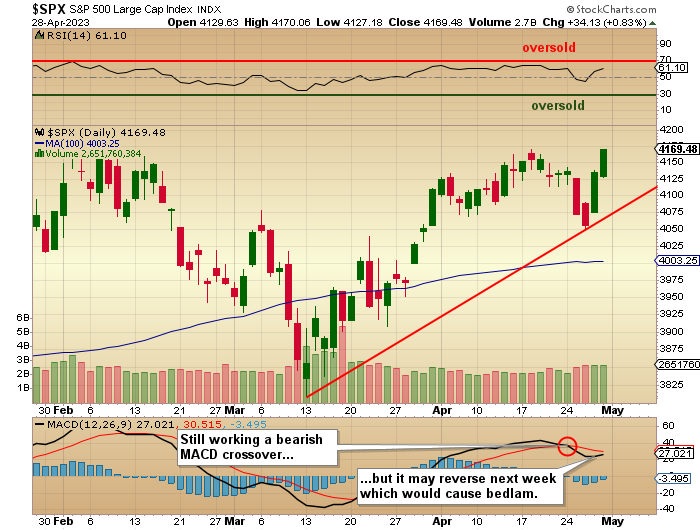
As you will recall, I said one week ago that I thought that “The Bull is Back” with the SPX finally achieving escape velocity above that narrow band where 50, 100, and 200-DMA lines were all clustered together.

Last week, however, the JOLTS and ADP reports threw cold water on the technical heat resulting in a stall of sorts, and if there is anything more doubt-instilling after dodging the jaws of the meat grinder trading range, it is the dreaded stall.

At times like these, I pour myself a cup of Chai tea and gaze out over the lovely swamp called “Lake” Scugog, now devoid of ice after all the wind and rain of yesterday’s tempest, at which point I am reminded of a lecture once administered by a mentor back in the 1980s in which he swore black-and-blue that no bull market could endure without the cooperation and participation of the banks.

Mind you, the banks of the 1980s are mere shadows of the banks of the 2020s as they refrained back then from any of those “shenanigans of speculation” so commonplace today. Nevertheless, banks are banks, and they are important from a technical perspective, acting as a confirming indicator of the health (or fragility) of any market advance.

Despite a 4.5% rebound, the S&P Bank Index is still off 14.64% year-to-date, which really throws a technical damper over the set-up for stocks, albeit nothing as of yet terminal.

I draw this to your attention because whether you are trading tech or crypto or metals or energy, those sub-sectors are all heavily correlated to the SPX, and as we witnessed in 2008, 2020, and 2022, when they take the broad markets down, everything goes with it — or as that mentor of mine used to say, “When they raid the wh*** house, they take all the ladies, even the piano player.” (Please forgive the rather crass analogy.)

Gold

In keeping with the theme of “unavoidable correlation,” while it is important to remember that gold did not go unaffected by the events of 2008 and 2020, there have been two memorable stock market corrections in my recollective wheelhouse that stand out.

The first was October 19 to October 26th, 1987 — the Crash of ’87 — when I was 100%-invested in the senior and junior gold miners as a means of protecting my clients from a serious correction in stock prices which had advanced from Dow Jones 865 to 2,720 in five years sporting an average P/E of over 30 just before the Crash.

That year, there was an inverse correlation between the stock market and gold bullion prices, but it was a very sneaky affair, where the miners related to gold bullion decided to run for the exits along with the panicked equity bulls while physical gold bullion rallied from around US$425 to US$505. Where the lesson of 1987 was absolutely seared into my synapses was watching the TSE Gold and Silver Index ignore physical bullion’s 8% advance over the next four days and get cut in half – 10,300 to under 5,000 despite an US$80/ounce jump in spot gold.

Not only was it shocking, it was cruel.

The other time there was a departure from the correlation with equities was in the past fifteen months.

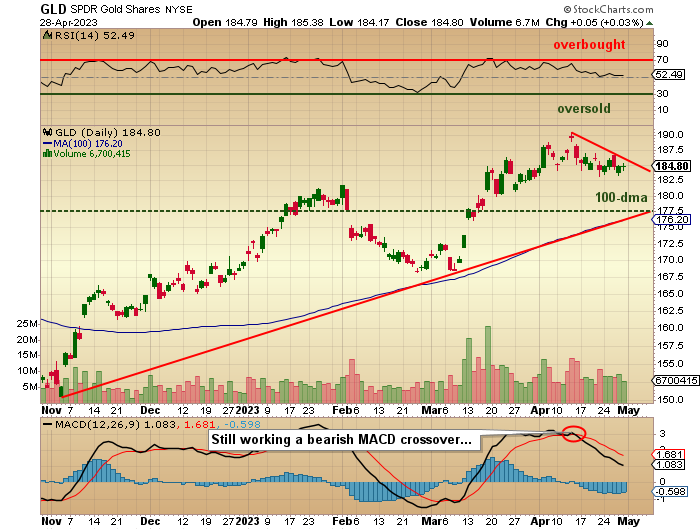
Since the date the SPX topped on January 7, 2022, gold is up 11.68% versus the 10.8% drop in the SPX, and while both 2008 and 2020 were liquidity-starved crashes, 2022 was an orderly decline which speaks even more loudly for gold’s performance.

Because rising real interest rates are the mortal enemy of the gold bug, that real rates have actually been moving in that very time frame from deeply negative (- 7.51%) to mildly negative (- 1.56%) while gold moves to within 3% of (USD) all-time high prices is amazing.

There is a really fascinating interview with geopolitical analyst Peter Zeihan, one of my favorite research sources, and in the interest of giving full credit to where it absolutely deserves to be, his assessment of the inflationary outlook here in 2023 is brilliant and one to which I fully subscribe.

You see, from 1990 until March 2020 (the arrival of the pandemic), the world enjoyed three decades of cheap Asian labor, cheap energy, and cheap capital. The forces of disinflation could not have been scripted any better than in an era in which major improvements in access to the global supply chain were made. By 2020, the trade routes of the seas were like the L.A. Expressway, with the oversupply of dollar store electronics and obsolete air conditioners sitting idle in offshore queues in major western ports.

However, with the shutdown in the global economy by dim-sighted politicians and underqualified medical hacks, the supply chain was irreversibly altered. With the playing field no longer favoring cheap Chinese labor and open-armed American markets, things are simply going to cost more.

Zeihan thinks we will run a 9% CPI for the next fifteen years providing that North America moves quickly to repatriate its once-formidable, post-WWII manufacturing juggernaut as the required resources tilt hard at commodity supplies (and therefore prices). Without this rebuild of the American Middle Class, he sees 15% CPI because, as Zeihan says with such masterful bluntness, “the supply chain is screwed, and stuff will be harder to get.”

As I am watching the carp already starting to flop around the shoreline of the Scugog Swamp in a grotesque mating ritual too bizarre for words, I ruminate on the role of gold given the global outlook described by Zeihan.

Absent any of the counterparty risks associated with virtually every other asset class, physical metals do not need any permissions in order for the owner to transact. I think that when the world suddenly wakes up to the reality of what actually happened at FTX or Silicon Valley Bank (and what was about to happen at Credit Suisse), they will opt for the unimpaired status of owning gold bullion over everything else.

Furthermore, when the generalist money managers decide to shift 1% of their AUM into gold, the impact upon such a comparatively minuscule market cap will be gargantuan in scale. As one walks down the aisle of valuation analysis, the “perfect storm” for gold miners is rising gold prices, declining energy prices, and negative real interest rates.

With the major cost input being diesel fuel for producers as well as timber and concrete for developers, profit margins are widening rapidly while, for the first time since the 1930s, liberal dividend policies are attracting a different breed of investor to an asset class current under-loved and under-owned, an ideal prerequisite for opportune accumulation.


Michael Ballanger Disclaimer:

This letter makes no guarantee or warranty on the accuracy or completeness of the data provided. Nothing contained herein is intended or shall be deemed to be investment advice, implied or otherwise. This letter represents my views and replicates trades that I am making but nothing more than that. Always consult your registered advisor to assist you with your investments. I accept no liability for any loss arising from the use of the data contained on this letter. Options and junior mining stocks contain a high level of risk that may result in the loss of part or all invested capital and therefore are suitable for experienced and professional investors and traders only. One should be familiar with the risks involved in junior mining and options trading and we recommend consulting a financial adviser if you feel you do not understand the risks involved.

Disclosures:

1) Michael J. Ballanger: I, or members of my immediate household or family, own securities of the following companies mentioned in this article: None.  I personally am, or members of my immediate household or family are, paid by the following companies mentioned in this article: None.

2) The following companies mentioned in this article are billboard sponsors of Streetwise Reports: None. Click here for important disclosures about sponsor fees. As of the date of this article, an affiliate of Streetwise Reports has a consulting relationship with: None. Please click here for more information.

3) Statements and opinions expressed are the opinions of the author and not of Streetwise Reports or its officers. The author is wholly responsible for the validity of the statements. The author was not paid by Streetwise Reports for this article. Streetwise Reports was not paid by the author to publish or syndicate this article. Streetwise Reports requires contributing authors to disclose any shareholdings in, or economic relationships with, companies that they write about. Streetwise Reports relies upon the authors to accurately provide this information and Streetwise Reports has no means of verifying its accuracy.

4) This article does not constitute investment advice. Each reader is encouraged to consult with his or her individual financial professional and any action a reader takes as a result of information presented here is his or her own responsibility. By opening this page, each reader accepts and agrees to Streetwise Reports’ terms of use and full legal disclaimer. This article is not a solicitation for investment. Streetwise Reports does not render general or specific investment advice and the information on Streetwise Reports should not be considered a recommendation to buy or sell any security. Streetwise Reports does not endorse or recommend the business, products, services or securities of any company mentioned on Streetwise Reports.

5) From time to time, Streetwise Reports LLC and its directors, officers, employees or members of their families, as well as persons interviewed for articles and interviews on the site, may have a long or short position in securities mentioned. Directors, officers, employees or members of their immediate families are prohibited from making purchases and/or sales of those securities in the open market or otherwise from the time of the decision to publish an article until three business days after the publication of the article. The foregoing prohibition does not apply to articles that in substance only restate previously published company releases.

Buffett is investing in Japanese companies. The US technology sector is under pressure

By JustMarkets

The US stock market traded yesterday without a single trend. At the close of trading, Dow Jones Index (US30) increased by 0.30%, S&P 500 (US500) added 0.10%. But NASDAQ Technology Index (US100) was down by 0.03%.

The minutes of the Fed’s March meeting are due on Wednesday and are expected to provide more information on the Central Bank’s plans to raise interest rates in the face of a potential banking crisis. While the collapse of several US banks in March has spurred bets that the Fed will slow the pace of interest rate hikes, markets are now preparing for at least one more increase in May (80% probability).

According to research firm IDC, Apple’s personal computer shipments decreased by 40.5% in the first quarter due to weak demand and high inventory. Rising Treasury yields also hit sentiment towards the technology sector amid a strong March Nonfarm Payrolls report, which indicated that a robust jobs market could prompt the Federal Reserve to tighten monetary policy further.

Equity markets in Europe did not trade yesterday due to the Catholic Easter holiday.

Oil prices declined on Monday after rising for three consecutive weeks as fears of further interest rate hikes, which could curb demand, counterbalanced the prospect of a market tightening due to supply cuts by OPEC+ producers. Technically, in the higher time frames, oil is trading in a price range. It’s a liquidity accumulation. And any accumulation sooner or later ends with an impulse move. Analysts expect oil prices to continue rising ahead of summer.

Gold prices are trading just below recent highs, remaining relatively resilient as markets await further signals on the US economy from inflation data and the minutes of the Federal Reserve’s March meeting on Wednesday. The yellow metal was supported by demand for a safe haven as investor sentiment remained weak amid fears of slowing economic growth and monetary policy uncertainty.

Asian markets were mostly up yesterday. Japan’s Nikkei 225 (JP225) increased by 0.42%, China’s FTSE China A50 (CHA50) lost 0.19%, Hong Kong’s Hang Seng (HK50) was not trading, India’s NIFTY 50 (IND50) added 0.14%, and Australia’s S&P/ASX 200 (AU200) was also closed yesterday.

Warren Buffett said he had increased his stake in the top 5 companies in Japan’s Nikkei 225 index. Buffett also stated that he intends to continue investing in Japanese stocks. The Nikkei 225 has outperformed its regional peers this year because the Bank of Japan will keep its soft monetary policy for a longer period.

Chinese consumer inflation rose less than expected in March (+0.7% y/y vs +1.0% y/y expected), while producer price inflation continued to decline (-2.5% y/y) amid weak local consumption and slowing manufacturing activity.

In Australia, consumer confidence rose by 1.3% as the Reserve Bank of Australia (RBA) suspended its rate hike cycle.

S&P 500 (F) (US500) 4,109.11 +4.09 (+0.10%)

Dow Jones (US30)33,586.52 +101.23 (+0.30%)

DAX (DE40) 15,597.89 +77.72 (+0.50%)

FTSE 100 (UK100) 7,741.56 +78.62 (+1.03%)

USD Index 102.55 +0.46 (+0.45%)

Important events for today:
  • – China Consumer Price Index (q/q) at 04:30 (GMT+3);
  • – China Producer Price Index (q/q) at 04:30 (GMT+3);
  • – Eurozone Retail Sales (m/m) at 12:00 (GMT+3);
  • – US EIA Short-Term Energy Outlook at 19:00 (GMT+3).

By JustMarkets


This article reflects a personal opinion and should not be interpreted as an investment advice, and/or offer, and/or a persistent request for carrying out financial transactions, and/or a guarantee, and/or a forecast of future events.

Credit Suisse: How the Price of Credit-Default Swaps Provided a Warning

“… exceeded every high-water mark … of the past 15 years”

By Elliott Wave International

Credit-default swaps were invented in the mid-1990s but a lot of people did not become aware of them until around 2000, and that awareness increased dramatically during the 2008 financial crisis. As you may recall, so-called CDSs were all over the news then.

Today, these financial derivatives are in the news again.

In a nutshell, credit-default swaps are insurance against a debt default: The higher the perceived risk of default, the higher the premiums.

With that in mind, back in November, the Global Market Perspective, a monthly Elliott Wave International publication which covers 50-plus financial markets, showed this chart and said:

Just last month, Credit Suisse — the once-venerable Zurich-based global investment bank that [the Global Market Perspective] has warned about for years — saw prices for its credit-default swaps (CDS) shoot past 300, indicating investors’ increasing belief that the bank will default. As shown, CDS prices have exceeded every high-water mark set during every crisis of the past 15 years.

Since then, the price of those CDSs have approximately tripled, climbing north of 1000.

As a March 18 news item from The Financial Times noted:

Cost of insuring Credit Suisse debt dwarfs that of other banks
The price of Swiss lender’s credit default swaps climbs to record high this week

During the same weekend that news item published, Credit Suisse collapsed, and the Swiss government brokered a deal which involved rival UBS buying Credit Suisse for $3.2 billion.

Worries about the global banking sector are not confined to Credit Suisse.

Here’s a March 24 headline (CNBC):

Deutsche Bank shares slide after sudden spike in the cost of insuring against its default

Yet, at least one strategist expressed this (Yahoo! Finance, March 24):

Everything ‘really is fine with Deutsche Bank’ due to capital levels, [chief strategist] says

Other professional observers of the banking sector have also basically said “don’t worry, big banks are in good financial health.” But keep in mind that many of these same observers were caught off guard by what’s already occurred with failed banks.

Elliott Wave International has been warning of this persistent optimism. The time will likely soon arrive when even those who are now expressing the most optimism will shift to pessimism.

That will be the juncture of what Elliott Wave International calls the “point of recognition.”

You want to be prepared before then.

Now is the time to read Elliott Wave International’s special report “How Safe Is My Bank?,” which is valued at $49, yet, you can get it for free by following this link.

This article was syndicated by Elliott Wave International and was originally published under the headline Credit Suisse: How the Price of Credit-Default Swaps Provided a Warning. EWI is the world’s largest market forecasting firm. Its staff of full-time analysts led by Chartered Market Technician Robert Prechter provides 24-hour-a-day market analysis to institutional and private investors around the world.

Trade Of The Week: Another Volatile Week For Gold?

By ForexTime

Gold prices shed as much as 1% on Monday morning after closing above the psychological $2000 level last week. Prices later recovered thanks to a weaker dollar and heightened geopolitical tensions over Taiwan.

Appetite for the precious metal was hit by last Friday’s goldilocks US jobs report which boosted bets around the Federal Reserve raising rates by 25 basis points in May. US payrolls increased by 236k in March, printing in line with expectations while the unemployment rate dropped to near-record lows of 3.5%. The upwardly revised payrolls figure for February of 326k was the icing on the cake, as the overall jobs report eased concerns that the world’s largest economy is heading for a recession. Given how this development may offer support to the dollar and feed Fed hike expectations, gold bulls could be caged in the short term.

Nevertheless, gold prices have been on a tear over the past few weeks as the horrible combination of banking fears and recession concerns fuelled risk aversion. After securing a weekly close above the $2000 level for the first time since August 2020, the key question is whether bulls have what it takes to push prices to the all-time high at $2075.47. While the fundamentals favour further upside, bears could be inspired by the renewed focus on inflation as the banking turmoil cools. On the technical front, the relative strength index (RSI) is signaling that prices are overbought on both the daily and weekly timeframe.

Taking a quick peek at the technical picture, gold remains bullish with the weekly close above the $2000 level signaling further upside. However, anything could be on the table given how prices are flirting close to the 70 level on its 14-week RS1.

The lowdown….

The dollar found itself under renewed selling pressure early last week after disappointing economic data fuelled recession fears and slashed Fed hike bets.

This potent combination, along with falling Treasury yields was enough to propel gold way above the psychological $2000 level on Tuesday with prices reaching their highest level since March 2022 at $2032 mid-week. Gold struggled to preserve its bullish momentum on Thursday thanks to technical forces, with a stabilizing dollar amid risk aversion dragging prices back toward $2000. The recent price action re-confirms that this psychological level remains a pivotal point for bulls and bears. Expect the pending economic reports and risk events to influence whether gold concludes the week above or below this level.

All eyes on US CPI & Fed minutes 

It will be wise to keep an eye on the US CPI report published on Wednesday.

Inflation in the United States is projected to slow 5.2% in March year-on-year compared to the 6% figure witnessed in February. If expectations match reality, this will mark the ninth consecutive decline in inflation. However, all eyes will be on the Core CPI readings which exclude more volatile items such as food and energy. Core inflation year-on-year is expected to rise 5.6% in March compared to 5.5% in the previous month. Ultimately, persistent signs of easing inflationary pressures in the world’s largest economy may fuel speculation around the Fed pausing rate hikes sooner than expected. This could boost appetite for zero-yielding gold, pushing prices back towards $2032 and beyond.

Wednesday also sees the release of the Fed meeting minutes which concluded a 25-basis point rate hike. All eyes will be on the language of the minutes and whether any fresh clues are offered on future Fed rate moves. If the minutes strike a dovish tone similar to the March meeting, this could reinforce market expectations around the Fed’s hiking cycle nearing an end.

Other than the highly anticipated US CPI report and Fed meeting, there are key speeches from Fed officials and key economic data throughout the week that could influence gold prices. On the geopolitical front, heightened tensions around the Taiwan Strait has the potential to fuel risk aversion – supporting safe-haven assets.

Is gold heading for the all-time high?

Gold remains bullish on the daily charts as there have been consistently higher highs and higher lows. However, prices seem to be flirting around overbought conditions on the RSI. The weekly close above $2000 could encourage an incline back toward $2032. Beyond this point, the next levels of interest are $2070 and $2075. Should prices slip back under $2000, gold could retest $1950 and $1900, respectively.


Forex-Time-LogoArticle by ForexTime

ForexTime Ltd (FXTM) is an award winning international online forex broker regulated by CySEC 185/12 www.forextime.com

Technical Analysis of EUR/USD: Consolidation Range and Potential Directional Movements

By RoboForex Analytical Department

The EUR/USD currency pair is starting the new week of April balanced, hovering around 1.0900. Market activity was slowed down during the Easter holidays in the US and Europe, but investors are gradually returning to trades.

Last Friday, the US labor market statistics were released, and while they came out almost unnoticed, market participants will have a chance to account for the data in the quotes later. The unemployment rate in March saw a decrease to 3.5%, which was better than expected. Nonfarm payrolls (NFP) rose by 236 thousand against the forecasted 228 thousand and 326 thousand previously. The data from February were revised and came out better, which is a positive signal. The average hourly wage also grew by a stable 0.3% m/m.

Although for now, the risk that the economy could slow down has not found any reflection in the employment sector, this margin of safety is unlikely to last long.

On the H4 chart, the EUR/USD currency pair has performed an impulse of decline to 1.0875. Currently, the market is forming a consolidation range under this level. There is a possibility of growth to 1.0930, followed by a decline to 1.0760, from where the wave could continue to 1.0720. Technically, this scenario is confirmed by the MACD indicator, which shows that its signal line is above the zero mark and directed strictly down to renew the lows.

On the H1 chart, the EUR/USD currency pair has completed a structure of the declining wave to 1.0875. At the moment, a consolidation range is forming above this level. The price could break the range upwards and correct to 1.0924. Then, a decline to 1.0820 could follow, with the target being local. This scenario is technically confirmed by the Stochastic oscillator, which shows that its signal line is near 50, expected to grow to 80, and then drop to 20.

Disclaimer

Any forecasts contained herein are based on the author’s particular opinion. This analysis may not be treated as trading advice. RoboForex bears no responsibility for trading results based on trading recommendations and reviews contained herein.

The cryptocurrency market digest (BTC). Overview for 10.04.2023

By RoboForex.com

The BTC on Monday saw an increase to 28,272 USD. The weekly rise in the leading cryptocurrency amounts to 2.18%.

It should be noted that over three weeks starting on 23 March, trade volumes of the BTC have dropped almost five times, currently being about 75 thousand BTC a day. This fact might be a sign that the market is ready for a new rally. The quotes have been stuck in a rather narrow range for quite long, and this could also trigger nervous moves and attempts to break the resistance.

The technical picture of the BTC remains favourable, facilitating the return to 30,000 USD. The support is at 26,500 USD.

The capitalisation of the crypto market by today has risen to 1.185 trillion USD. The part taken by the BTC has increased to 46.2%. The part occupied by the ETH has dropped to 18.9%.

Capacity of Cardano network will grow

After the Ouribiros Leios update of the Cardano network, the speed of transaction processing must increase ten times. This can happen through the activation of nods that have not been used yet. They will get the function of making computations between blocks, while the result will be stored in the next blocks.

Coinbase will integrate The Lighting Network

The management of the Coinbase crypto exchange confirmed their plans to add The Lighting Network protocol on the trading platform. This can speed up transactions and make them cheaper. The integration is scheduled for the nearest future.

Article By RoboForex.com

Attention!
Forecasts presented in this section only reflect the author’s private opinion and should not be considered as guidance for trading. RoboForex LP bears no responsibility for trading results based on trading recommendations described in these analytical reviews.

The US labor market remains resilient. China simulates an attack on Taiwan

By JustMarkets

A Nonfarm Payrolls report on Friday showed that US nonfarm payrolls rose by 236,000 in March, in line with a forecast of 239,000. February’s data was revised upwards. 326,000 jobs were added instead of 311,000. The US unemployment rate fell to a record low of 3.5%. At the same time, annual payrolls rose at the slowest rate since June 2021. Although the employment report showed significant growth, some sectors saw moderate declines, particularly manufacturing, and construction. But overall, such data leaves the US Federal Reserve with room for another rate hike at the next meeting. The market currently estimates a 70% probability that the Fed will raise interest rates by 25 basis points in May. The US stock indices did not trade on Friday due to the holidays. By the end of the week, the Dow Jones Index (US30) increased by 1.77%, and the S&P 500 Index (US500) jumped by 1.20%. The NASDAQ Technology Index (US100) gained 0.47% in 5 days.

Tesla (TSLA) announced plans to build a new plant in Shanghai to produce energy storage products.

Equity markets in Europe were also closed Friday. By the end of the week, German DAX (DE30) gained 0.19%, French CAC 40 (FR40) added 0.74% over the week, Spanish IBEX 35 (ES35) gained 0.89%, British FTSE 100 (UK100) jumped by 1.59% over five trading days.

According to the ECB Governing Council spokesman Klaas Knot, Europe’s central bank should continue to raise borrowing costs, with a slower pace of tightening being justified. The Dutch banker also added that even if the ECB reaches an interest rate level that the bank believes will return inflation to 2% in the medium term, the ECB may have to hold interest rates at this peak level for a long time.

Last week Israel’s Central Bank softened the pace of monetary policy tightening, recognizing the potential risks to monetary policy posed by the government’s scandalous “judicial reform.” Sri Lanka kept rates unchanged after receiving a loan from the International Monetary Fund, while Australia, Romania, Chile, Poland, and India also kept borrowing costs unchanged.

Oil prices remained stable at the end of last week. Investors are weighing the prospect of supply cuts by OPEC+ producers in May against concerns about weakening global growth, which could reduce demand for the fuel. Investors are also watching the progress of negotiations between Iraq and “Kurdistan” to restart northern oil exports, which could bring more oil to the global market.

Asian markets mostly rallied last week. Japan’s Nikkei 225 (JP225) declined 2.43% over the week, China’s FTSE China A50 (CHA50) was little changed over the week, Hong Kong’s Hang Seng (HK50) gained 0.30% over the week, India’s NIFTY 50 (IND50) added 3.52%, and Australia’s S&P/ASX 200 (AU200) was positive 1.30% over the week.

An analysis of global financial conditions shows that Asian financial markets have tightened less than in the US, and most Asian currencies have strengthened against the US dollar. Except for Japan, the region’s financial stock index has risen since 10 March (the day of the Silicon Valley bank crash) compared to the US bank index’s fall of almost 10% over the same period. This suggests that the Asian economy remains relatively well insulated from the US and European economies. Economists believe one factor favoring the Asia-Pacific region is a generally softer turn in monetary policy, with central banks in Australia, South Korea, Indonesia, and India putting tightening cycles on hold.

According to analysts, Hong Kong and Thailand, which are benefiting from China’s reopening, as well as domestic service-oriented economies such as India and the Philippines, “look relatively more resilient” to the global shock. And Singapore will be the main beneficiary of growth in the region.

Japan is poised to sharply increase its spending on chips as it tries to consolidate its position in the global semiconductor market, as it cuts exports amid a US drive to curb China’s technological ambitions. Japan is expected to spend $7 billion on manufacturing equipment next year, up 82% from this year.

The Chinese military simulated spot strikes on Taiwan on the second day of exercises around the island on Sunday, with the island’s defense ministry reporting several air force sorties and keeping an eye on Chinese missile forces. The US embassy in Taiwan said on Sunday that the United States was closely monitoring China’s drills around Taiwan and was confident that it had enough resources and capabilities regionally to ensure peace and stability. For his part, French President Macron said after a visit to China that Europe should reduce its dependence on the United States and avoid becoming embroiled in a China-US confrontation over Taiwan.

In the commodities market, futures on coffee (+6.92%), WTI oil (+6.33%), Brent oil (+6.32%), sugar (+6.20%), gasoline (+4.55%), silver (+4.03%) and lumber (+2.99%) showed the biggest gains last week. Futures on natural gas (-8.17%), corn (-2.42%), and wheat (-2.42%) showed the biggest drop.

S&P 500 (F) (US500) 4,105.02 +0 (+0%)

Dow Jones (US30)33,485.29 +0 (+0%)

DAX (DE40) 15,597.89 +0 (+0%)

FTSE 100 (UK100) 7,741.56 +0 (+0%)

USD Index 102.10 +0.27 (+0.27%)

Important events for today:
  • – US FOMC Member Williams Speaks at 23:15 (GMT+3).

By JustMarkets


This article reflects a personal opinion and should not be interpreted as an investment advice, and/or offer, and/or a persistent request for carrying out financial transactions, and/or a guarantee, and/or a forecast of future events.