Dow tops 40,000 as stock indexes continue to cross milestones − making many investors feel wealthier

By Alexander Kurov, West Virginia University 

The Dow Jones Industrial Average topped 40,000 for the first time on May 16, 2024. It spent the next few hours hovering around that mark, occasionally dipping under. But the breakthrough, even if fleeting, nonetheless marks another symbolic milestone in a monthslong bull market, coming three months after the S&P 500 index surpassed 5,000 for the first time.

The Conversation asked Alexander Kurov, a financial markets scholar, to explain what stock indexes are and to say whether these kinds of milestones are a big deal or not.

What are stock indexes?

Stock indexes measure the performance of a group of stocks. When prices rise or fall overall for the shares of those companies, so do stock indexes. The number of stocks in those baskets varies, as does the system for how this mix of shares gets updated.

The Dow Jones Industrial Average, also known as the Dow, includes shares in the 30 U.S. companies with the largest market capitalization – meaning the total value of all the stock belonging to shareholders. That list currently spans companies from Apple to Walt Disney Co.

The S&P 500 tracks shares in 500 of the largest U.S. publicly traded companies.

The Nasdaq composite tracks performance of more than 2,500 stocks listed on the Nasdaq stock exchange.

The DJIA, launched on May 26, 1896, is the oldest of these three popular indexes, and it was one of the first established.

Two enterprising journalists, Charles H. Dow and Edward Jones, had created a different index tied to the railroad industry a dozen years earlier. Most of the 12 stocks the DJIA originally included wouldn’t ring many bells today, such as Chicago Gas and National Lead. But one company that only got booted in 2018 had stayed on the list for 120 years: General Electric.

The S&P 500 index was introduced in 1957 because many investors wanted an option that was more representative of the overall U.S. stock market. The Nasdaq composite was launched in 1971.

You can buy shares in an index fund that mirrors a particular index. This approach can diversify your investments and make them less prone to big losses.

Index funds, which have existed only since Vanguard Group founder John Bogle launched the first one in 1976, now hold trillions of dollars.

Why are there so many?

There are hundreds of stock indexes in the world, but only about 50 major ones.

Most of them, including the Nasdaq composite and the S&P 500, are value-weighted. That means stocks with larger market values account for a larger share of the index’s performance.

In addition to these broad-based indexes, there are many less prominent ones. Many of those emphasize a niche by tracking stocks of companies in specific industries like energy or finance.

Do these milestones matter?

Stock prices move constantly in response to corporate, economic and political news, as well as changes in investor psychology. Because company profits will typically grow gradually over time, the market usually fluctuates in the short term while increasing in value over the long term.

The DJIA first reached 1,000 in November 1972, and it crossed the 10,000 mark on March 29, 1999. On Jan. 22, 2024, it surpassed 38,000 for the first time. Breaking through 40,000 on May 16 prompted a flurry of congratulatory news reports.

Because there’s a lot of randomness in financial markets, the significance of round-number milestones is mostly psychological. There is no evidence they portend any further gains.

For example, the Nasdaq composite first hit 5,000 on March 10, 2000, at the end of the dot-com bubble.

The index then plunged by almost 80% by October 2002. It took 15 years – until March 3, 2015 – for it to return to 5,000.

As 2024 has progressed, the Nasdaq composite has regularly closed at record highs.

Index milestones matter to the extent they pique investors’ attention and boost market sentiment.

Investors afflicted with a fear of missing out may then invest more in stocks, pushing stock prices to new highs. Chasing after stock trends may destabilize markets by moving prices away from their underlying values.

When a stock index passes a new milestone, investors become more aware of their growing portfolios. Feeling richer can lead them to spend more.

This is called the wealth effect. Many economists believe that the consumption boost that arises in response to a buoyant stock market can make the economy stronger.

Is there a best stock index to follow?

Not really. They all measure somewhat different things and have their own quirks.

For example, the S&P 500 tracks many different industries. However, because it is value-weighted, it’s heavily influenced by only seven stocks with very large market values.

Known as the “Magnificent Seven,” shares in Amazon, Apple, Alphabet, Meta, Microsoft, Nvidia and Tesla now account for over one-fourth of the S&P 500’s value. Nearly all are in the tech sector, and they played a big role in pushing the S&P across the 5,000 mark.

This makes the index more concentrated on a single sector than it appears.

But if you check out several stock indexes rather than just one, you’ll get a good sense of how the market is doing. If they’re all rising quickly or breaking records, that’s a clear sign that the market as a whole is gaining.

Sometimes the smartest thing is to not pay too much attention to any of them.

For example, after hitting record highs on Feb. 19, 2020, the S&P 500 plunged by 34% in just 23 trading days because of concerns about what COVID-19 would do to the economy. But the market rebounded, with stock indexes hitting new milestones and notching new highs by the end of that year.

Panicking in response to short-term market swings would have made investors more likely to sell off their investments in too big a hurry – a move they might have later regretted. This is why I believe advice from the immensely successful investor and fan of stock index funds Warren Buffett is worth heeding.

Buffett, whose stock-selecting prowess has made him one of the world’s 10 richest people, likes to say, “Don’t watch the market closely.”

If you’re reading this because stock prices are falling and you’re wondering if you should be worried about that, consider something else Buffett has said: “The light can at any time go from green to red without pausing at yellow.”

And the opposite is true as well.

This article is an updated version of a story that was first published on Feb. 15, 2024.The Conversation

About the Author:

Alexander Kurov, Professor of Finance and Fred T. Tattersall Excellence in Finance Research Chair, West Virginia University

This article is republished from The Conversation under a Creative Commons license. Read the original article.


 

What is wind shear? An atmospheric scientist explains how it can tear down hurricanes

By Zachary Handlos, Georgia Institute of Technology 

Weather forecasters talk about wind shear a lot during hurricane season, but what exactly is it?

I teach meteorology at Georgia Tech, in a part of the country that pays close attention to the Atlantic hurricane season. Here’s a quick look at one of the key forces that can determine whether a storm will become a destructive hurricane.

What is wind shear?

Wind shear is defined as the change in wind speed, wind direction, or both, over some distance.

You may have heard airplane pilots talk about turbulence and warn passengers that they’re in for a bumpy ride. They’re typically seeing signs of sudden changes in wind speed or wind direction directly ahead, and wind shear can sometimes cause this.

With hurricanes, the focus is usually on vertical wind shear, or how wind changes in speed and direction with height.

Two illustrations show different types of wind shear. On the left, change in height rolls a cloud under. On the right, change in direction affects a plane in flight.
The effects of wind shear when wind speed increases with height (left) or changes direction (right).
National Weather Service

Vertical wind shear is present nearly everywhere on Earth, since winds typically move faster at higher altitudes than at the surface. It can be stronger or weaker than normal, and that’s especially important during hurricane season.

Tropical storms typically start as a tropical wave, or low-pressure system associated with a cluster of thunderstorms over warm water in the tropics. Warm air over the ocean surface rises rapidly, drawing in fuel for the storm. The winds begin to rotate and can intensify into a tropical storm and then a hurricane.

Hurricanes thrive in environments where their vertical structure is as symmetrical as possible. The more symmetrical the hurricane is, the faster the storm can rotate, like a skater pulling in her arms to spin.

Too much vertical wind shear, however, can offset the top of the storm. This weakens the wind circulation, as well as the transport of heat and moisture needed to fuel the storm. The result can tear a hurricane apart.

El Niño’s and La Niña’s influence

Wind shear becomes a hot topic during El Niño years, when wind shear tends to be stronger over the Atlantic during hurricane season.

An El Niño event occurs when sea surface waters in the eastern Pacific Ocean basin become significantly warmer than average, while western Pacific Ocean basin waters become cooler than average. This happens every two to seven years or so, and it affects weather around the world.

During El Niño events, upper-level winds over the Atlantic tend to be stronger than usual, and thus stronger wind shear results. The faster air flow in the upper troposphere leads to faster wind speed with increasing height, making the upper atmosphere less favorable for tropical storm development. The eastern North Pacific, in contrast, tends to have less wind shear during El Niño.

How El Niño affects the entire planet.

No two El Niño events are the same, of course. In 2023, record warm sea surface temperatures threatened to power up hurricanes so much that El Niño’s increase in wind shear couldn’t tear them down. For example, Hurricane Idalia fought through the wind shear in August and hit Florida as a powerful Category 3 storm.

El Niño’s opposite is La Niña – the two climate patterns shift every two to seven years or so. La Niña allows for more active hurricane seasons, as the Atlantic saw during the record-breaking 2020 season. La Niña conditions were expected to develop by fall 2024, and the Atlantic hurricane forecasts reflect that with expectations for another busy season.

The 2023 Atlantic hurricane season was a good reminder that there are always multiple factors at play affecting how destructive hurricanes become. Nevertheless, vertical wind shear will always be present and something meteorologists will keep an eye on.The Conversation

About the Author:

Zachary Handlos, Atmospheric Science Educator, Georgia Institute of Technology

This article is republished from The Conversation under a Creative Commons license. Read the original article.

The RBNZ maintained its hawkish bias, leaving the interest rate at 5.5%. Inflationary pressures are easing in Canada

By JustMarkets

At the end of Tuesday, the Dow Jones Index (US30) was up 0.17%, while the S&P 500 Index (US500) added 0.25%. The NASDAQ Technology Index (US100) closed positive 0.22%. The US stock indices closed moderately higher, consolidating just below last week’s all-time highs. The rise in stocks was limited by comments from Fed Representative Waller and FRB Atlanta President Bostic, who said they favored waiting for inflation to fall before cutting interest rates.

FRB Atlanta President Bostic reiterated his view that inflation will continue to decline slowly and that the Fed could likely begin cutting interest rates in the 4th quarter. Today, markets await Wednesday’s release of the minutes from the May 1 FOMC meeting to see how close the Fed is to cutting interest rates.

Tesla (TSLA) stock price rose more than 6%, leading the Nasdaq 100 higher as a coalition of Tesla shareholders urges peers to reject CEO Musk’s $56 billion compensation package. AstraZeneca Plc (AZN) closed higher by more than 2% after the company said it expects to generate $80 billion in cumulative revenue by 2030 from “significant growth” in its portfolio of existing oncology, biopharmaceuticals, and rare diseases.

The Canadian dollar weakened to 1.36 per dollar, moving away from the five-week highs reached earlier this month, as the latest inflation data raised bets that the Bank of Canada could start cutting interest rates as early as next month. As expected, core inflation slowed to 2.7% y/y in April, hitting the lowest level in three years, while the core rate fell for the 5th straight month to 1.6% y/y, also the lowest since 2021. The Bank of Canada kept its key rate at 5% in April. Still, policymakers recently said they needed to see further and sustained weakening in core inflation before moving to a looser policy. Odds of a rate cut in June rose to 50% from 40% before the report was published.

Equity markets in Europe were mostly down yesterday. Germany’s DAX (DE40) fell by 0.22%, France’s CAC 40 (FR40) closed down by 0.66%, Spain’s IBEX 35 (ES35) lost 0.04%, and the UK’s FTSE 100 (UK100) closed negative 0.09%.

Asian markets were mostly down on Tuesday. Japan’s Nikkei 225 (JP225) declined 0.31%, China’s FTSE China A50 (CHA50) fell 0.19% for the day, Hong Kong’s Hang Seng (HK50) fell 2.12% on Monday, and Australia’s ASX 200 (AU200) closed negative 0.15%.

The Reserve Bank of New Zealand kept the official cash rate (OCR) at 5.5% during its May 2024 policy meeting, extending the rate pause for the 7th straight time and confirming market expectations. Policymakers noted that restrictive monetary policy has eased pressure on manufacturing capacity and lowered consumer price inflation. Although the country’s core inflation fell to a nearly three-year low of 4% in the first quarter of 2024, it remained above the target range of 1% to 3%. At the same time, the Central Bank raised its rate prognosis maximum and delayed the timing of rate cuts until the third quarter of 2025, later than its previous estimate for the second quarter.

Japan’s trade deficit widened to JPY 462.50 billion in April 2024 from JPY 429.79 billion in the same month a year earlier, exceeding market prognoses. Exports rose by 8.3% y/y, marking the fifth consecutive month of growth, mainly due to continued shipments to major trading partners, notably the US and China. Imports also rose by 8.3%, the strongest growth in 14 months, to a four-month high, driven by increased purchases of mineral fuels.

S&P 500 (US500) 5,321.41 +13.28 (+0.25%)

Dow Jones (US30) 39,872.99 +66.22 (+0.17%)

DAX (DE40) 18,726.76 −42.20 (−0.22%)

FTSE 100 (UK100) 8,416.45 −7.75 (−0.09%)

USD Index 104.65 +0.09 (+0.08%)

Important events today:
  • – US FOMC Member Collins Speaks at 02:00 (GMT+3);
  • – US FOMC Member Mester Speaks at 02:00 (GMT+3);
  • – Japan Trade Balance at 02:50 (GMT+3);
  • – New Zealand RBNZ Interest Rate Decision at 05:00 (GMT+3);
  • – New Zealand RBNZ Monetary Policy Statement at 05:00 (GMT+3);
  • – New Zealand RBNZ Press Conference at 06:00 (GMT+3);
  • – UK Consumer Price Index (m/m) at 09:00 (GMT+3);
  • – UK Producer Price Index (m/m) at 09:00 (GMT+3);
  • – US Existing Home Sales (m/m) at 17:00 (GMT+3);
  • – US Crude Oil Reserves (w/w) at 17:30 (GMT+3);
  • – US FOMC Meeting Minutes at 21:00 (GMT+3);
  • – New Zealand RBNZ Gov Orr Speaks at 23:10 (GMT+3).

By JustMarkets


This article reflects a personal opinion and should not be interpreted as an investment advice, and/or offer, and/or a persistent request for carrying out financial transactions, and/or a guarantee, and/or a forecast of future events.

The New Zealand Dollar shows a steady rise

By RoboForex Analytical Department

The NZD/USD pair is preparing for a mid-week rally, approaching the 0.6116 level. These current values mark the highest point for the Kiwi in two months, following the Reserve Bank of New Zealand’s decision to maintain its monetary policy structure unchanged during the May meeting.

The interest rate remains at 5.5% per annum, as anticipated.

The RBNZ has determined that maintaining a restrictive monetary policy is necessary to ensure inflation returns to target within the planned timeframe. The central bank has noted a cooling labour market and rising unemployment as potential risks. Support factors include higher housing rents, insurance costs, and increasing utility rates.

According to the official forecast, the consumer price index in New Zealand is expected to return to the 1-3% range by the end of 2024.

Overall, the NZD exchange rate is poised to increase. The RBNZ’s policy is viewed as balanced and consistent, which helps mitigate the risks of excessive volatility for the Kiwi.

On a broader scale, investors are awaiting the minutes from the latest US Federal Reserve meeting, which will provide further insights into the Fed’s upcoming steps.

NZD/USD technical analysis

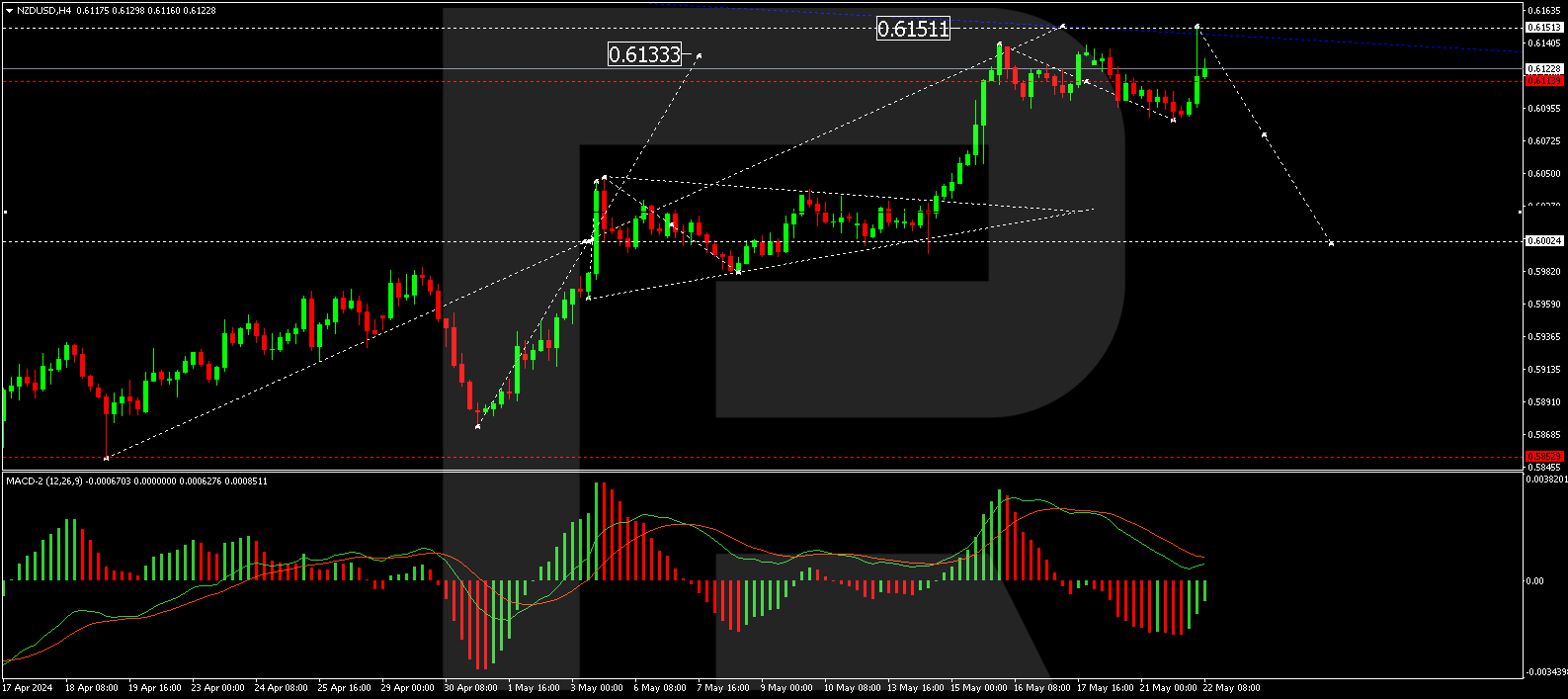
On the H4 chart of NZD/USD, a consolidation range has formed around the 0.6000 level. Following an upward breakout, a growth wave to 0.6151 has been achieved. A consolidation range is currently emerging around 0.6114. A downward breakout from this range could open the potential for a decline to 0.6000, the first target. After reaching this level, a correction wave to 0.6075 (testing from below) is possible, followed by a further decline along the trend to 0.5853. This scenario is technically supported by the MACD indicator, with its signal line above zero but directed strictly downwards.

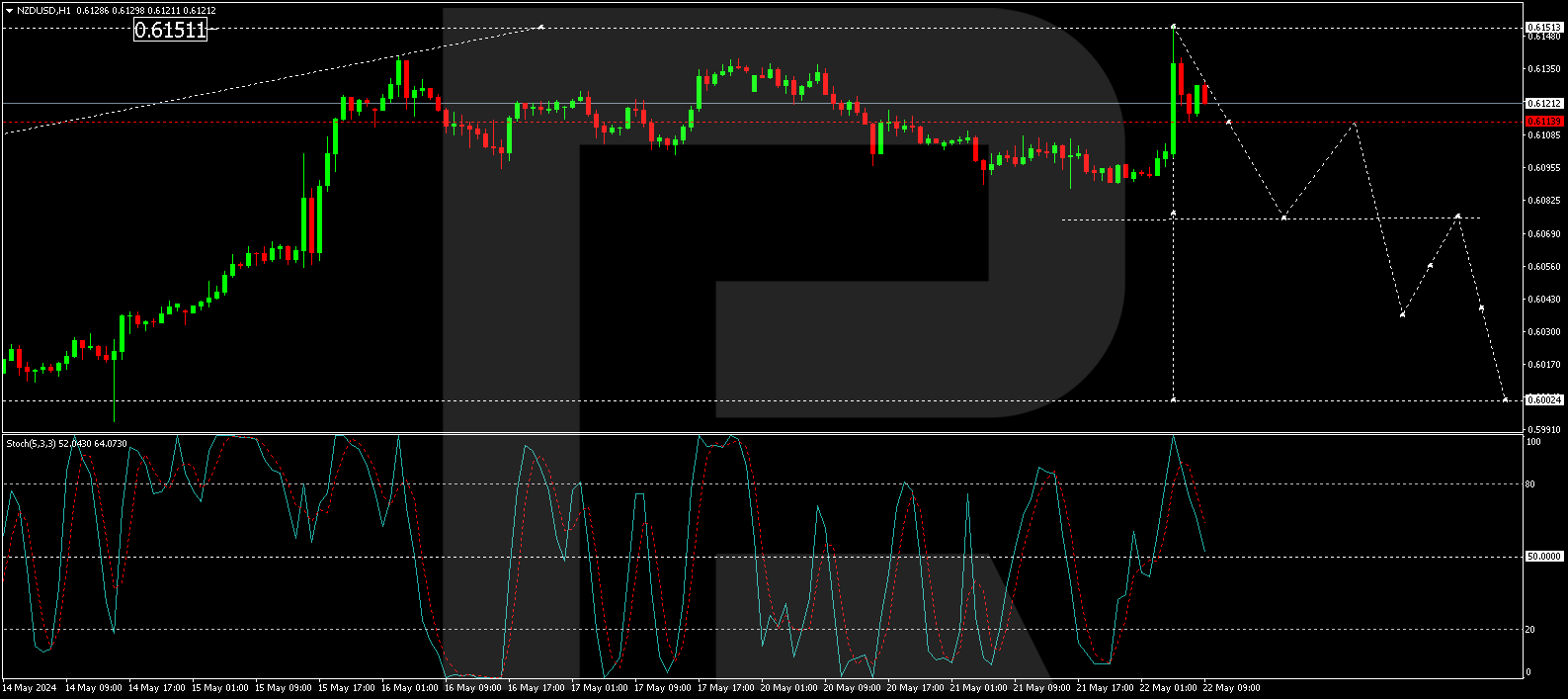
On the H1 chart, an impulse of decline to 0.6114 has formed. Today, the market might perform a correction to 0.6132. After this correction, the continuation of the growth wave to 0.6075 is expected, with the prospect of further trend development.

Summary

The NZD/USD pair is steadily rising, bolstered by the Reserve Bank of New Zealand’s consistent monetary policy. Technical indicators suggest potential corrections and further growth, with close attention to the upcoming US Federal Reserve minutes for additional market direction.


Disclaimer

Any forecasts contained herein are based on the author’s particular opinion. This analysis may not be treated as trading advice. RoboForex bears no responsibility for trading results based on trading recommendations and reviews contained herein.

Ethereum: ETF D-Day looms

By ForexTime 

  • Ethereum ↑ over 20% this week
  • Crypto could rally another 35,000 points
  • Prices bullish on D1 but RSI overbought
  • Key level of interest at $3806.49 & $40000

Ethereum is back in the spotlight after soaring over 20% this week.

The world’s second-largest cryptocurrency by market cap has been boosted by growing expectations around US regulators finally approving spot ETFs.

Investors remain hopeful after the US Securities and Exchange Commission (SEC) showed an interest in giving the green light after months of uncertainty.

This could be a pivotal moment for Ethereum which may ride the crest of this ETF wave to a fresh year-to-date high beyond $4094.

However, this will depend on what the SEC does tomorrow (Thursday, May 23rd) – the final deadline to decide on VanEck’s spot Ethereum application.

Just like we saw with Bitcoin ETFs, the approval of an Ethereum ETF would increase the exposure of the cryptocurrency. This may lead to potential inflows of new investors due to the easier and greater access.

Regarding the technicals, Ethereum bulls (those looking to see Ethereum prices rally), could set their sights on these near-term resistance levels.

  • $3806.49: – The 261.8 Fibonacci level where price is testing today after being rejected yesterday.

  • $40000: – A psychologically important level.

The crypto bears (those looking to see prices of Ethereum decline), on the other hand may take advantage of a possible “buy the rumour sell the fact scenario”, and have their sights set on the near term support at:

  • $3445.05 which is the golden 161.8 Fibonacci ratio.

The Fibonacci retracement tool is drawn from May 6th, high at $3221.68 to May 14th, low at 2860.24.

Looking at the Relative Strength Index (RSI), an indicator that highlights zones in the market that are saturated with buyers (overbought) and sellers (oversold), Ethereum is technically overbought.


Forex-Time-LogoArticle by ForexTime

ForexTime Ltd (FXTM) is an award winning international online forex broker regulated by CySEC 185/12 www.forextime.com

Today, traders are focused on Canadian inflation data and waiting for the RBNZ interest rate decision

By JustMarkets

At Monday’s close, the Dow Jones Index (US30) was down 0.49%, while the S&P 500 Index (US500) was up 0.09%. The NASDAQ Technology Index (US100) closed positive 0.65% and set a new all-time high. A negative factor for the indices was the strengthening of the US dollar amid hawkish comments from FOMC representatives. San Francisco Fed President Daly, Atlanta Fed President Bostic, Cleveland Fed President Mester, and Fed Vice Chairman Jefferson said they favor maintaining the Fed’s current restrictive policy until inflation falls to 2%.

On Wednesday, markets will wait for the minutes from the May 1 FOMC meeting to see how close the Fed is to cutting interest rates. Also, on this day, earnings results from Nvidia and Analog Devices will be examined to gauge demand for semiconductor chips.

Canada’s April inflation data will be released today. Overall, price pressures in Canada are easing. The downward trend in various CPI measures has stabilized in the second half of 2023. The core measures — core, median, and overall CPI — declined for the third consecutive month in March. The headline rate rose slightly to 2.8%, but this is not a concern, as wage growth has also slowed since the beginning of the year. The Bank of Canada meets on June 5, and there is a 40% chance of a 25 basis point rate cut. A softer-than-expected Consumer Price Index report for April could bring that probability closer to 50-60%. However, even if there is significant downward progress in inflation, a rate cut is more likely in July.

Equity markets in Europe mostly went up yesterday. Germany’s DAX (DE40) rose by 0.35%, France’s CAC 40 (FR40) closed 0.35% higher, Spain’s IBEX 35 (ES35) added 0.10%, and the UK’s FTSE 100 (UK100) closed positive 0.05%.

It is almost 100% likely that the ECB will reduce borrowing costs as early as June, but even after that, there is uncertainty, and many policymakers favor a cautious approach. After the June meeting, ECB Governing Council spokesman Kazaks cautioned against a rush to cut ECB interest rates.

WTI crude oil prices fell to $79 a barrel on Tuesday, extending losses from the previous session, as investors continued to assess developments in the Middle East following the death of Iran’s president in a helicopter crash and emerging health concerns for Saudi Arabia’s king. However, markets are not too worried about oil supplies from the region as there are no signs of oil supply disruptions. Investors are also cautiously anticipating the upcoming OPEC meeting on June 1 for a possible postponement of production cuts. Meanwhile, recent events such as Ukraine’s attack on Russian refineries and a Houthi missile attack on a China-bound oil tanker in the Red Sea continued to pose risks to global supply.

Asian markets were mostly up last week. Japan’s Nikkei 225 (JP225) rose by 0.73%, China’s FTSE China A50 (CHA50) gained 0.42%, Hong Kong’s Hang Seng (HK50) gained 0.42%, and Australia’s ASX 200 (AU200) was positive 0.63%.

Australia’s inflation is declining at a slower-than-expected pace, with recent data suggesting that risks to inflation have risen slightly, minutes from the Reserve Bank’s May meeting showed. The situation prompted the Central Bank to reopen discussions on raising the interest rate, but it ultimately decided that the case for holding the rate was stronger. Policymakers reiterated that bringing inflation back to the target range of 2–3% remains their top priority. They added that the target could be reached in the second half of 2025 and the median in 2026. At the same time, the unemployment rate is expected to be at a level consistent with the Committee’s full employment mandate by mid-2025.

The New Zealand dollar has weakened slightly recently as traders await Wednesday’s Reserve Bank of New Zealand’s (RBNZ) interest rate decision. The Central Bank is expected to leave the official money rate at 5.5% for the 7th consecutive meeting. Market attention will thus be focused on whether it will signal that interest rate cuts could begin sooner than the mid-2025 cut indicated in February’s prognoses. Last week, data showed that the country’s two-year inflation expectations fell to the lowest level in almost three years in the second quarter, fueling speculation that the RBNZ may consider cutting rates later this year.

S&P 500 (US500) 5,308.13 +4.86 (+0.09%)

Dow Jones (US30) 39,806.77 −196.82 (−0.49%)

DAX (DE40) 18,768.96 +64.54 (+0.35%)

FTSE 100 (UK100) 8,424.20 +3.94 (+0.05%)

USD Index 104.50 +0.05 (+0.05%)

Important events today:
  • – Australia RBA Meeting Minutes at 04:30 (GMT+3);
  • – Eurozone ECB President Lagarde Speaks at 11:00 (GMT+3);
  • – Eurozone Trade Balance at 12:00 (GMT+3);
  • – Canada Consumer Price Index (m/m) at 15:30 (GMT+3);
  • – US FOMC Member Barkin Speaks at 16:00 (GMT+3);
  • – US FOMC Member Williams Speaks at 16:05 (GMT+3);
  • – US FOMC Member Bostic Speaks at 16:10 (GMT+3);
  • – US FOMC Member Barr Speaks at 18:45 (GMT+3);
  • – UK BoE Gov Bailey Speaks at 20:00 (GMT+3).

By JustMarkets


This article reflects a personal opinion and should not be interpreted as an investment advice, and/or offer, and/or a persistent request for carrying out financial transactions, and/or a guarantee, and/or a forecast of future events.

Euro/Dollar in consolidation

By RoboForex Analytical Department

The EUR/USD pair is gently declining towards 1.0858 on Tuesday but remains within a medium-term range.

This week sees few significant US statistics releases, which could provide investors with insights into future interest rate movements. However, numerous speeches from US Federal Reserve members are expected. Investors will be keenly listening for any indications about the Fed’s monetary policy.

On Monday, several Fed officials advocated for maintaining a cautious monetary policy strategy, despite last week’s data showing a reduction in inflationary pressures in April.

It is likely that all forthcoming comments from Fed officials will echo a similar sentiment—that the Fed remains patient and consistent. The Fed requires time to gather more data on easing price pressures. While there are indications of such easing, they are not yet systemic. This cautious approach has done little to alter investor expectations significantly. The market now anticipates that the Fed will lower rates twice before the end of the year, with the first cut expected in September.

EUR/USD technical analysis

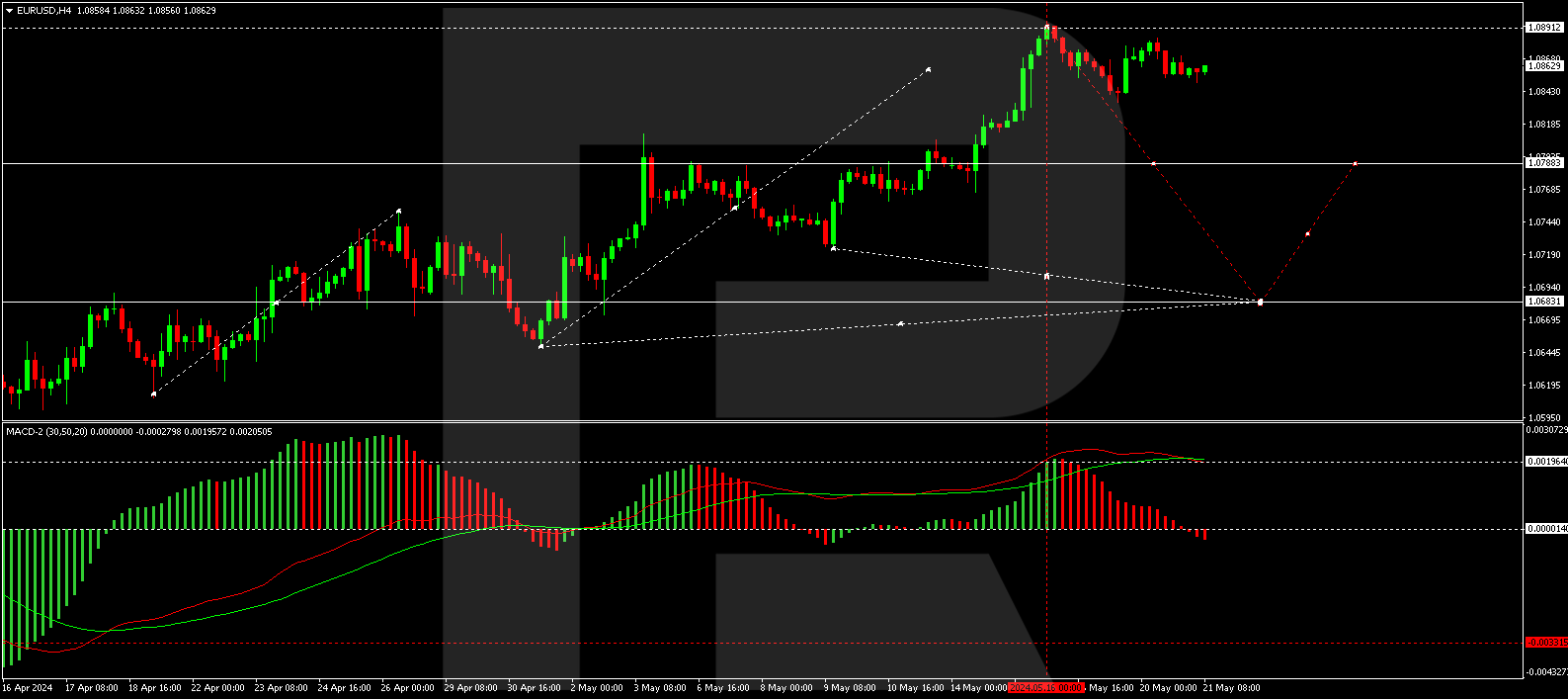
On the H4 chart, EUR/USD has formed a consolidation range below the level of 1.0890. A downward exit from this range could lead to a continuation of the downward wave to 1.0784. Breaking this level might further extend the trend to 1.0683, which is the first target of the decline wave. This scenario is technically supported by the MACD indicator, with its signal line at the maximums while the histograms are below the zero mark and continue to decline.

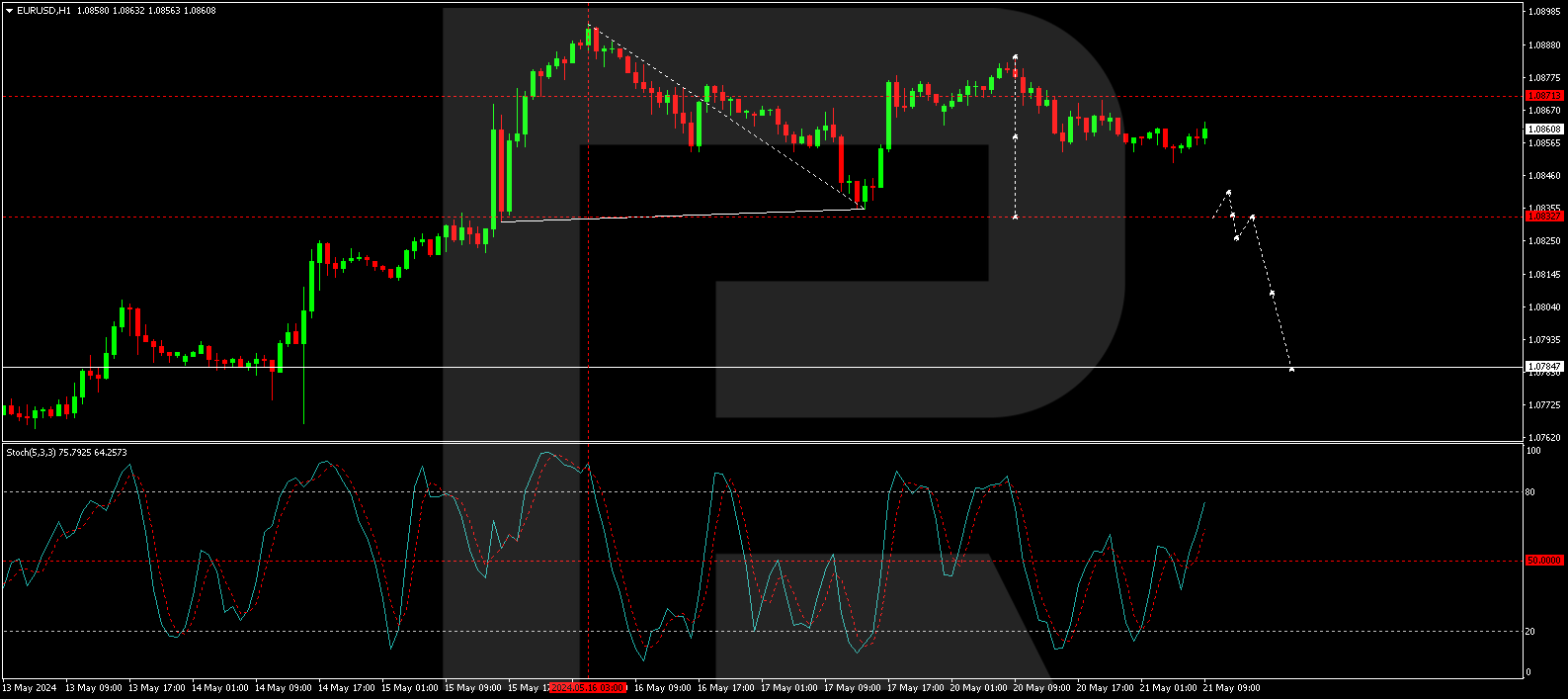
On the H1 chart, the correction to 1.0883 has been completed. Currently, the structure of a downside wave to 1.0833 is forming. After reaching this level, a narrow consolidation range around it is expected. A downward exit from this range could open the potential for a further decline to 1.0785, which is the local target of the downward wave. This scenario is technically confirmed by the Stochastic oscillator, with its signal line below 80 and expected to decline to 20.

Summary

The EUR/USD pair remains in a consolidation phase with a gentle downward movement. Technical indicators suggest potential for further declines, but market participants will be closely watching Fed communications for any hints on future monetary policy, which could influence the pair’s direction.


Disclaimer

Any forecasts contained herein are based on the author’s particular opinion. This analysis may not be treated as trading advice. RoboForex bears no responsibility for trading results based on trading recommendations and reviews contained herein.

XAGUSD: Hits fresh 11-year high above $32

By ForexTime 

  • Silver ↑ 33% year-to-date
  • One of the best-performing major commodities
  • Relatively “cheap” compared to gold
  • Bullish on D1 but RSI overbought

Gold is not the only metal delivering glittering returns this year…

Silver has also been on a tear, soaring to its highest level in more than a decade.

The precious metal punched above $32 this week, and is currently up 33% since the start of 2024. 

When compared with year-to-date gains of:

  • Tin: 35%

  • Copper: 31%

  • Nickel: 30%

  • Gold: 17%

  • Zinc: 17%

  • Platinum: 6%

Silver is the second-best performer in the metal space and one of the top gainers in the wider commodity arena.

Why is silver soaring?

Various forces have propelled the precious metal higher – ranging from growing investor interest to macroeconomic forces and supply-side factors, among other themes.

But gold’s bullish momentum has also provided silver ample support.

Gold hit fresh all-time highs this week due to geopolitical risks with central bank buying and prospects of lower US interest rates keeping bulls in power.

Silver often follows gold’s lead, with interest rate expectations impacting appetite for non-yielding assets like precious metals.

To put things into perspective, silver and gold have moved in tandem over 80% of the time in any given 10-day period over the past 20 years.

What other forces are in play?

Beyond the macroeconomic forces, silver is also influenced by industrial demand.

Given how it’s a key component for clean energy technologies, the usage of the metal is expected to reach records in 2024 amid robust growth in the industry.

Interestingly, copper which is also a crucial element in the creation of solar panels, wind turbines and hydro systems has also reached all-time highs.

It does not end here…

Silver markets are heading for their fourth consecutive year of shortages.

According to the Silver Institute, the precious metal is expected to experience its second-highest deficit on record in 2024. As demand continues to outpace supply of silver, the deficit is forecast to increase by 17% this year amid robust industrial consumption.

Can silver push higher?

When considering all the bullish fundamentals at play, further upside could be on the cards.

But most importantly, silver is still considered relatively cheap compared to gold.

Looking at the gold-silver ratio, it takes around 76 ounces of silver to buy 1 ounce of gold.

Given how the 20-year average is 68, silver has scope to extend gains if the ratio rebalances down the road.

Technical outlook:

Silver is firmly bullish on the daily timeframe as there have been consistently higher highs and higher lows.

Prices are trading above the 50, 100 and 200-day SMA while the MACD above zero. However, the Relative Strength Index (RSI) is above 70 – indicating that prices are heavily overbought.

  • A solid breakout above $32.50 will open doors to fresh all-time highs with the next level of interest rate $33.00.
  • Sustained weakness below $32.50 may encourage a decline toward $29.33.
  • Should prices slip below $29.33 this could open the doors towards the 50-day SMA.


Forex-Time-LogoArticle by ForexTime

ForexTime Ltd (FXTM) is an award winning international online forex broker regulated by CySEC 185/12 www.forextime.com

Trade Of The Week: Nvidia headed for $1000 milestone?

By ForexTime 

  • Nvidia almost ↑ 90% year-to-date
  • Will chipmaker see new all-time high?
  • Pay close attention to Nvidia’s datacenter revenue forecasts
  • Shares could move 8.6% ↑ or ↓ post earnings on Thursday!    
  • Nvidia last earnings saw S&P 500’s biggest 1-day jump in over 12 months

In case you missed the memo, Nvidia is set to announce its latest earnings this week!

This is a major event for markets considering how the chipmaker is at the heart of the AI buzz. Investors will be looking for another round of stellar results to justify its whooping $2.3 trillion valuation.

Since the last earnings release in February, Nvidia shares have climbed about 37%, taking year-to-date gains to almost 90%!

  • When will earnings be published?

Nvidia will report its earnings for the first quarter of its 2025 fiscal year (3 months ending April 30th) after US markets close on Wednesday 22nd May.

  • Market expectations:

The darling of AI and tech investors is expected to post earnings of $5.53 compared to $1.09 a year ago.

Quarterly revenues are seen rising to $24.6 billion from $7.2 billion in the prior year – equating to a 242% increase!

Beyond the backward-looking numbers, markets will also be obsessed about what Nvidia conveys about its potential earnings in the future.

Markets are particularly focused on its revenue from data centers, which now account for over 80% of Nvidia’s total revenue.

Datacenters have now overtaken the gaming sector as the leading contributor to Nvidia’s total revenue.

Revenue from datacenters are expected to reach US$ 30 billion by 2026, which is a massive jump from the US$ 4.3 billion posted in the first quarter of its 2024 fiscal year.

Markets may need to see such projections revised higher in order to justify an even-higher price for this stock, based on its future earnings.

Otherwise, if markets can’t reconcile Nvidia’s 90% year-to-date gains with less-than-expected future earnings, markets may have zero qualms about triggering a massive selloff for this stock.

After all, markets are forward-looking in nature: today’s price reflects tomorrow’s hopes (or disappointments).

  • What is the big deal?

The company’s earnings and forward guidance may serve as a key gauge for the AI hype.

After delivering knockout results last quarter, Nvidia was able to satisfy investor expectations. However, this earnings season is showing that investors are becoming harder to impress.

Still, this could be one of the biggest moving events for the S&P 500 in 2024.

Looking at the charts, the S&P 500 saw its biggest 1-day percentage move in over 12 months back on February 22nd.

This was one day after Nvidia released its Q4 earnings with the S&P 500 soaring over 2%.

To be clear, we are not stating that history will repeat itself but simply highlighting how much muscle Nvidia has to move US markets and even other stock indexes globally.

  • Potential challenges…

Growing competition from other chipmakers and even its biggest customers – Amazon, Meta, Microsoft, and Alphabet.

Threat of disruptions from its major chip supplier Taiwan Semiconductor, after the deadly earthquake in Taiwan last month.

US-China Chip war: Can Nvidia’s earnings take such geopolitical risks in stride?

  • How will Nvidia react to earnings?

Markets are forecasting an 8.6% move, either Up or Down, for Nvidia stocks on Thursday post earnings. 

  • What does this mean for prices?

An 8.6% move up from $923 will take Nvidia’s shares to fresh all-time highs beyond the $1000 level.  

While an 8.6% move down will send prices back below $850.

  • How about wider markets?

Instruments that have a strong correlation with Nvidia could see some action.

Nvidia has shown a 70% correlation with the Nasdaq 100 and over 60% correlation with Taiwan Semiconductor (US listed) in the past 12 months.

But digger deeper, over a rolling 5-day period from the past 20 years:

  • S&P500: +0.94
  • Texas Instruments:  +0.84
  • Broadcom:  +0.84
  • QUALCOMM: +0.75
  • Advanced Micro Devices: +0.40
  • Analog Devices: +0.70
  • Micron Technology: +0.60


  • The bigger picture…

With a $2.3 trillion valuation, an 8.6% move in the price of its stock is almost $200 billion!

This is bigger than the entire market caps of many large companies in the S&P 500 and Nasdaq 100!

Heck, it’s even bigger than some of its competitors like Texas Instrument, Analog Devices, and Micron among others.

  • Ultimately a solid set of earnings along with a forward guidance that excites investors could push prices to all-time highs beyond 973.75.
  • If the chipmaker disappoints, the stocks could find itself on a slippery decline with the 50 SMA acting as the first point of interest.


Forex-Time-LogoArticle by ForexTime

ForexTime Ltd (FXTM) is an award winning international online forex broker regulated by CySEC 185/12 www.forextime.com

Precious and industrial metals show strong growth. Oil grows amid the news about the death of Iran’s leader

By JustMarkets

On Friday, the Dow Jones Index (US30) gained 0.34% (+1.04% for the week), while the S&P 500 Index (US500) rose by 0.12% (+1.34% for the week). The NASDAQ Technology Index (US100) closed negative 0.07% (for the week +1.74%). The US stock indices were mixed on Friday, consolidating just below the week’s highs. Stocks received some support thanks to dovish comments from Atlanta Fed President Bostic, who said that if the outlook develops as he expects, citing a slow downshift in inflation and continued economic momentum, “then it would be appropriate for us to cut rates by the end of the year.”

Reddit (RDDT) surged over 13% after it partnered with OpenAI to bring its content to chatbot ChatGPT. According to analysts, the deal will boost Reddit’s data licensing business. Advanced Micro Devices (AMD) shares rose more than 2% on Friday after Wolfe Research added it to its alpha list, replacing Nvidia (NVDA).

Equity markets in Europe were mostly down on Friday. Germany’s DAX (DE40) fell by 0.18% (for the week -0.37%), France’s CAC 40 (FR40) closed down 0.26% (for the week -0.53%), Spain’s IBEX 35 (ES35) added 0.25% (for the week +2.01%), and the UK’s FTSE 100 (UK100) closed negative 0.22% (for the week -0.16%).

Comments from Fed officials suggesting a prolonged continuation of high interest rates and ECB member Schnabel’s cautious stance on rate cuts after June contributed to the prevailing caution in European markets. The FTSE 100 Index declined on Friday as global markets also showed weakness, fueled by concerns about a prolonged continuation of high interest rates. UK money markets expect a potential 60 bps cut in interest rates by the Bank of England in 2024, with the first cut expected in August.

Gold rose to a record $2,430 an ounce on Monday after recent US economic data reinforced speculation that the Federal Reserve may go for at least two rate cuts this year. Silver surpassed $30 an ounce, hitting its highest level since January 2013, thanks to higher gold prices and robust investment and industrial demand. While ETF funds have shown little interest in silver, physical buying has increased.

WTI crude oil prices rose above $80 a barrel on Monday, extending gains from last week after Iran’s state media reported the death of a leader at the crash site of a helicopter carrying President Ebrahim Raisi, adding to political uncertainty in one of the largest oil-producing countries. The foreign minister was in the helicopter with him.

Asian markets were mostly rising last week. Japan’s Nikkei 225 (JP225) gained 1.51%, China’s FTSE China A50 (CHA50) added 1.29%, Hong Kong’s Hang Seng (HK50) gained 4.74%, and Australia’s ASX 200 (AU200) was positive 0.84%.

The People’s Bank of China (PBoC) left key lending rates unchanged during its May meeting, matching market expectations. The 1-year prime rate (LPR), the benchmark for most corporate and household loans, was kept at 3.45%. Meanwhile, the 5-year rate, the benchmark for real estate mortgages, was maintained at 3.95% after a record 25 bps decline in February. Both rates are at record lows amid Beijing’s attempts to stimulate economic recovery after mixed activity data in April, marked by solid industrial production growth, the lowest unemployment rate in five months, and weak retail sales.

The Australian dollar climbed above $0.67, hitting four-month highs. New stimulus measures in China and bets on lower interest rates in the US boosted commodity prices, boosting sentiment in Australian markets. Later last week, China announced a broad package of measures to support the struggling real estate market, including easing mortgage lending rules and urging local governments to buy unsold homes. Domestically, investors are eagerly awaiting the minutes of the Reserve Bank of Australia’s latest meeting for clues on the future path of rates.

Investors in New Zealand look forward to Wednesday’s Reserve Bank of New Zealand (RBNZ) meeting. The Central Bank is expected to leave the official money rate at 5.5% for the 7th consecutive meeting, with policymakers likely to reiterate the need to maintain restrictive policies for an extended period to bring inflation back into the 1–3% target range.

S&P 500 (US500) 5,303.27 +6.17 (+0.12%)

Dow Jones (US30) 40,003.59 +134.21 (+0.34%)

DAX (DE40) 18,704.42 −34.39 (−0.18%)

FTSE 100 (UK100) 8,420.26 −18.39 (−0.22%)

USD Index 104.50 +0.05 (+0.05%)

Important events today:
  • – China PBoC Loan Prime Rate at 04:15 (GMT+3);
  • – US FOMC Member Bostic Speaks at 15:45 (GMT+3);
  • – US FOMC Member Barr Speaks at 16:00 (GMT+3);
  • – US FOMC Member Jefferson Speaks at 17:30 (GMT+3);
  • – US FOMC Member Mester Speaks at 21:00 (GMT+3).

By JustMarkets


This article reflects a personal opinion and should not be interpreted as an investment advice, and/or offer, and/or a persistent request for carrying out financial transactions, and/or a guarantee, and/or a forecast of future events.