Gold Hits Record High as Demand for Safe-Haven Assets Surges

By RoboForex Analytical Department 

Gold soared towards 2,800 USD per ounce on Friday, setting a new all-time high. The surge comes as investors seek refuge in safe-haven assets amid renewed trade war threats from US President Donald Trump. His latest statements have heightened concerns over economic slowdowns and potential disruptions to global trade.

Key drivers of Gold’s record rally

Global monetary easing is reinforcing Gold’s rally. Several major central banks have adopted a softer stance, increasing liquidity and keeping interest rates low, further supporting the appeal of non-yielding assets like Gold.

  • The European Central Bank (ECB) cut rates as expected, leaving room for further easing
  • The Bank of Canada (BoC) halted quantitative tightening
  • Sweden’s Riksbank also cut rates earlier in the week
  • The People’s Bank of China (PBoC) and the Reserve Bank of India (RBI) signalled their willingness to ease policy further and inject liquidity

Meanwhile, the US Federal Reserve kept rates unchanged this week, maintaining expectations for at least two rate cuts later this year.

With all these factors, Gold is on track for its biggest monthly gain since March 2024.

Technical analysis of XAU/USD

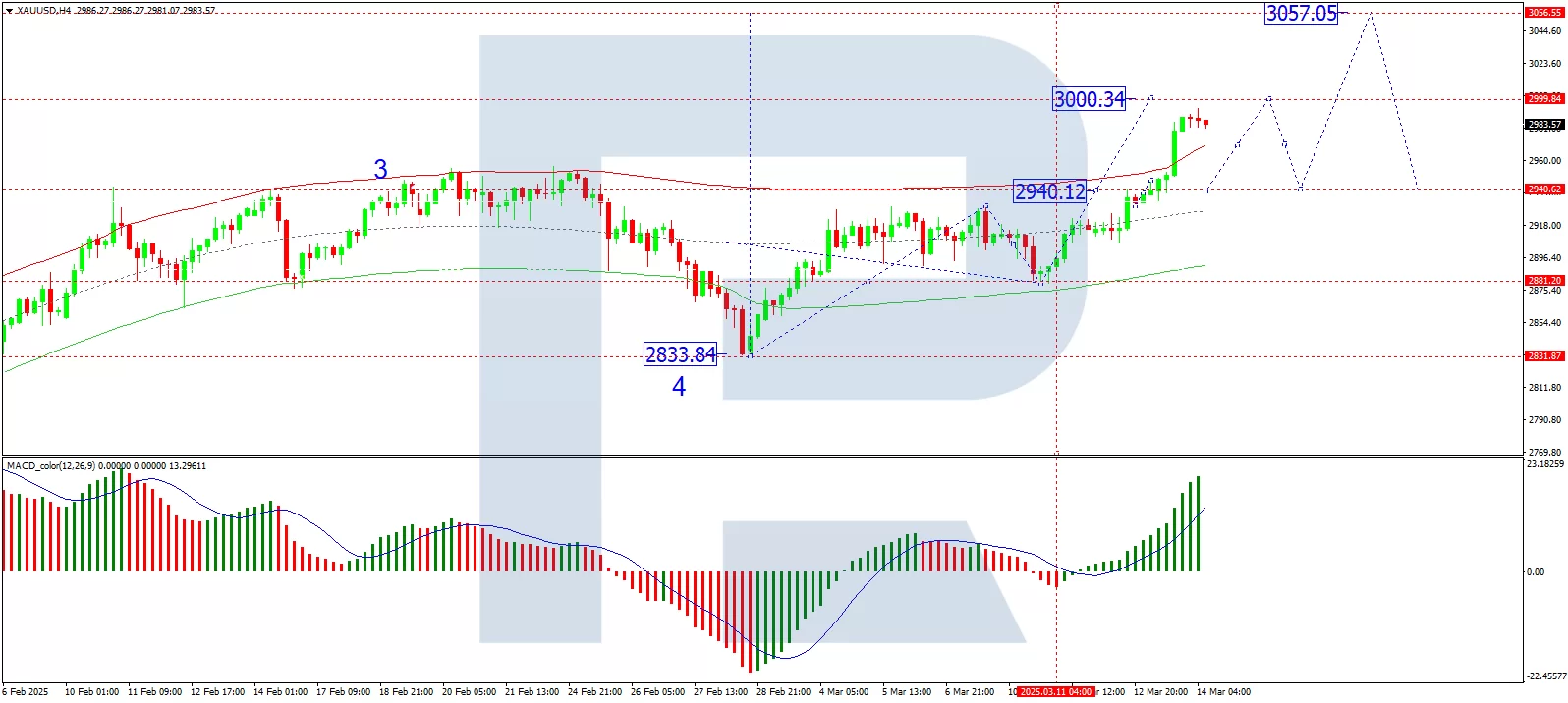
On the H4 chart, Gold found support at 2,731 USD and extended its rally to 2,797 USD. A consolidation range is forming around this level.

  • If the range breaks downward, a correction to 2,772 USD is possible
  • If the range breaks upward, a growth wave towards 2,818 USD may develop, potentially extending further to 2,839 USD

This scenario is supported by the MACD indicator, which has its signal line above zero and points upwards, confirming bullish momentum.

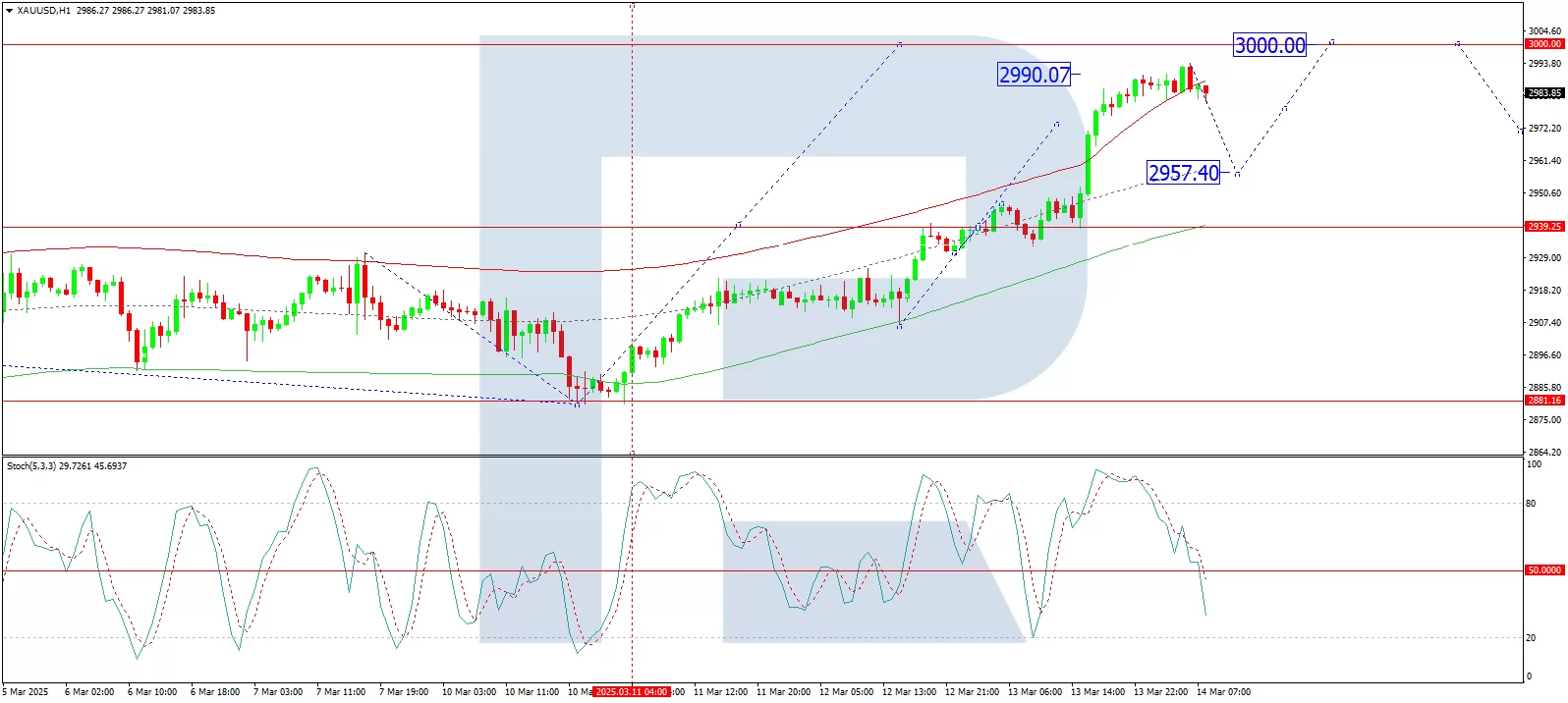
On the H1 chart, Gold initially formed a consolidation range near 2,772 USD before breaking upwards, reaching 2,797 USD.

  • A continuation of the rally towards 2,808 USD is likely.
  • After reaching 2,808 USD, a pullback to 2,777 USD (testing support) is possible
  • Following the correction, further growth towards 2,818 USD and potentially 2,839 USD is expected

The Stochastic oscillator supports this XAU/USD outlook, with its signal line above 50 and preparing for an upward move towards 80, indicating more upside potential.

Conclusion

Gold’s record-high surge reflects heightened risk aversion and global monetary easing. With central banks cutting rates and Trump’s trade threats unsettling markets, demand for Gold remains strong. Technical indicators suggest further upside, with key resistance levels at 2,818 USD and 2,839 USD. However, short-term corrections towards 2,772 USD or 2,777 USD could provide buying opportunities before the uptrend resumes.


Disclaimer

Any forecasts contained herein are based on the author’s particular opinion. This analysis may not be treated as trading advice. RoboForex bears no responsibility for trading results based on trading recommendations and reviews contained herein.

The Bank of Canada and the Riksbank cut rates expectantly. The US Fed took a pause on interest rate cuts.

By JustMarkets

At the end of Wednesday, the Dow Jones Index (US30) decreased by 0.31%. The S&P 500 Index (US500) was down 0.47%. The Nasdaq Technology Index (US100) fell by 0.51%.

The US Federal Reserve kept the federal funds rate at 4.25%-4.5% at its January 2025 meeting, in line with expectations. The Central Bank halted its rate-cutting cycle after three consecutive rate cuts in 2024 totaling a full percentage point. Chairman Powell said the Fed was in no hurry to cut interest rates and that it paused rate cuts to see further progress on inflation. Policymakers noted that recent indicators show that economic activity continues to grow at a solid pace. The unemployment rate has stabilized at low levels in recent months and labor market conditions remain stable.

The Bank of Canada (BoC) cut its key interest rate by 25 bps to 3% in its January 2025 decision, as markets had expected, marking a 200 bps rate cut since the start of the June 2024 rate cut cycle. Meanwhile, the Central Bank also announced the end of quantitative tightening and will resume asset purchases in early March to shore up liquidity and boost economic activity. The Governing Council noted that CPI inflation has moved closer to the 2% mark in recent months and is expected to remain close to the target over the next two years.

Mexico’s unemployment rate fell to 2.4% in December, the lowest since March and a 22-year low, exceeding estimates and signaling the strength of the labor market. This eased pressure on Banxico to maintain its dovish stance, bolstering confidence in the economy. Nevertheless, Banxico’s 2025 monetary program has softer conditions and potential rate cuts beyond 2024, and a 25bp rate cut in February remains the consensus.

Equity markets in Europe traded flat yesterday. Germany’s DAX (DE40) rose by 0.97%, France’s CAC 40 (FR40) closed down 0.32%, Spain’s IBEX 35 (ES35) gained 1.09%, and the UK’s FTSE 100 (UK100) closed positive 0.28%. The DAX Index gained nearly 1% to hit a new record high of 21637.5 on Wednesday, continuing to rise for the second consecutive day. Investors were assessing fresh corporate results and preparing for key ECB monetary policy decisions today, where a 0.25% rate cut is expected.

Sweden’s Riksbank cut its discount rate by 25 bps to 2.25% at its January 2025 meeting in line with market expectations, citing inflation near the 2% target but continued economic weakness. This is the fifth consecutive rate cut and the sixth since May, totaling 175 bps. Previous rate cuts have benefited households and businesses, although their full impact on demand remains to be seen.

WTI crude oil prices fell below $73 a barrel on Wednesday as traders assessed the impact of potential US tariffs on Canada and other oil suppliers, as well as concerns about rising inventories. President Trump’s plan to impose 25% tariffs on Canada and Mexico, which would begin on February 1, added to the pressure as Canada is a major supplier of oil to the US. The threat weakened Canadian crude prices and US inventories rose by 3.463 million barrels, the first increase after nine straight weeks of declines.

Asian markets were mostly up yesterday. Japan’s Nikkei 225 (JP225) was up 1.02%, China’s FTSE China A50 (CHA50) and Hong Kong’s Hang Seng (HK50) were not trading due to holidays, while Australia’s ASX 200 (AU200) was positive 0.57%.

The Hong Kong Monetary Policy Authority (HKMA) kept the benchmark rate unchanged at 4.75% on January 30, hours after the US Federal Reserve kept borrowing costs unchanged. Monetary policy in the Asian financial center is conducted in line with the US as the local currency is pegged to the US dollar. The HKMA last cut interest rates in the city by 25 bps in December.

The New Zealand dollar remains under pressure amid growing expectations that the Reserve Bank of New Zealand (RBNZ) will cut its 4.25% monetary rate by 50 bps at its February meeting. Markets also expect further rate easing to 3.0% by the end of the year. In economic news, New Zealand business confidence fell to a five-month low in January (54.4 vs. 62.3 in December).

In Australia, major banks such as Westpac and NAB have brought forward their projections for the first RBA rate cut, now predicting it could come in February rather than May. Markets rate the probability of a 25 basis point cut in the money rate to 4.35% at the Central Bank’s February 18 meeting at 95%.

S&P 500 (US500) 6,039.31 −28.39 (−0.47%)

Dow Jones (US30) 44,713.52 −136.83 (−0.31%)

DAX (DE40) 21,637.53 +206.95 (+0.97%)

FTSE 100 (UK100) 8,557.81 +23.94 (+0.28%)

USD index 107.94 +0.08 (+0.07%)

News feed for: 2025.01.30

  • Switzerland Trade Balance (m/m) at 09:00 (GMT+2);
  • Switzerland KOF Leading Indicators (m/m) at 10:00 (GMT+2);
  • Eurozone GDP (m/m) at 12:00 (GMT+2);
  • Eurozone Unemployment Rate (m/m) at 12:00 (GMT+2);
  • Eurozone ECB Interest Rate Decision at 15:15 (GMT+2);
  • Eurozone ECB Monetary Policy Statement at 15:15 (GMT+2);
  • US GDP (m/m) at 15:30 (GMT+2);
  •  US Initial Jobless Claims (w/w) at 15:30 (GMT+2);
  • Eurozone ECB Press Conference at 15:45 (GMT+2);
  • US Pending Home Sales (m/m) at 17:00 (GMT+2);
  • US Natural Gas Storage (w/w) at 17:30 (GMT+2).

By JustMarkets


This article reflects a personal opinion and should not be interpreted as an investment advice, and/or offer, and/or a persistent request for carrying out financial transactions, and/or a guarantee, and/or a forecast of future events.

Market round-up: Big tech mixed, Fed holds, ECB next

By ForexTime 

  • Magnificent 3 post mixed earnings; DeepSeek elephant in room
  • Fed in no rush to act, rate cut not expected until June.
  • ECB seen slashing rates by 25bp in January

Big tech earnings season has kicked off with mixed results from Microsoft, Meta and Tesla.

1) Microsoft shares fell over 6% pre-market despite reporting strong quarterly earnings.

Its cloud business missed revenue estimates, disappointing investors – especially after recent events surrounding DeepSeek.

Still, Microsoft CEO assured investors that DeepSeek was good for business – triggering a rebound that recouped all pre-market losses.

2) Meta also published a mixed bag of results, sending its shares whipsawing pre-market.

The tech giant posted quarterly results that beat expectations, but first-quarter revenue projections were slightly weak. However, positive comments by CEO Mark Zuckerberg pushed meta stocks higher.

3) Tesla’s revenue and profit not only missed expectations, but the EV titan also softened projections for 2025 vehicle sales growth.

Despite slipping as much as 6% pre-market prices later rebounded rising over 5%.

Note: Apple reports its fiscal first-quarter earnings on Thursday 30th after US markets close.

DeepSeek remains the elephant in the room and will likely to dominate big tech earnings. If investors remain fearful over DeepSeek threatening US exceptionalism in AI, this could drag tech stocks lower.


Fed in no rush to cut rates

The Federal Reserve left interest rates unchanged as widely expected on Wednesday.

But the biggest takeaway was that officials were not in a rush to cut rates thanks to a strong economy and more time needed to monitor inflation.

Indeed, inflationary pressures could make a return due to possible tariffs and immigration policies implemented by Trump.

Traders are currently pricing in a 53% probability of a 25 bp Fed cut by May with a move fully priced in by June.

FXTM’s USDInd offered a muted reaction to the Fed meeting, with prices trading around 108.00 as of writing.

The outlook for the dollar may be shaped by what actions Trump take on February 1st when 25% tariffs on Canada, and Mexico and 10% tariffs on China. Trump has also threatened to hit the European Union with tariffs, but no date has been confirmed.


ECB expected to cut rates by 25bp

The ECB is expected to cut interest rates by 25 basis points when it meets this afternoon.

Should the central bank signal faster and deeper rate cuts in 2025 due to Trump’s potential tariffs, this could weaken the euro further.

Looking at the charts, the EURUSD is trading below the 50-day SMA as of writing.

Over the past year, the ECB meeting has triggered upside moves of as much as 0.2% or declines of 0.15% in a 6-hour window post-release.

  • Sustained weakness below this point could open a path toward the 21-day SMA at 1.0350 and 1.0276 – the lower bound of Bloomberg’s FX model.
  • A move back above 1.0434 could see an incline back toward 1.0500.

eurusd 2


Forex-Time-LogoArticle by ForexTime

ForexTime Ltd (FXTM) is an award winning international online forex broker regulated by CySEC 185/12 www.forextime.com

EUR/USD Stable as the Market Absorbs Fed Decision and Awaits ECB Meeting

By RoboForex Analytical Department 

The EUR/USD pair is consolidating around 1.0426 on Thursday as investors digest the Federal Reserve’s latest policy decision and shift their focus to the upcoming European Central Bank (ECB) meeting.

Key market influences

As widely expected, the Federal Reserve held its interest rate steady at 4.5% per annum. In its commentary, the central bank reaffirmed its commitment to reducing its balance sheet at a pace of 25 billion USD per month. Fed Chair Jerome Powell stated that inflation does not necessarily need to fall to 2% before considering rate cuts. He also supported banks’ provision of crypto services, a move that signals openness to financial innovation.

Notably, Powell indicated that the Fed is in no rush to lower interest rates. The central bank monitors stock market valuations closely, expressing concerns that some assets may be significantly overvalued. Interestingly, Powell avoided commenting on US President Donald Trump’s repeated calls for immediate rate cuts.

Earlier reports suggested that Trump may push for a policy allowing US presidents to have a say in setting interest rates. While the Fed remains independent for now, the issue could resurface in political discussions.

Technical analysis of EUR/USD

On the H4 chart, EUR/USD moved downward to 1.0382, forming a corrective wave towards 1.0437. After completing this correction, the pair is likely to resume its decline, with an initial target at 1.0345. A brief correction to 1.0437 may follow before the downtrend extends towards 1.0050. The MACD indicator supports this outlook, with its signal line positioned above zero but trending downwards, indicating bearish momentum.

On the H1 chart, the pair consolidated around 1.0437 before breaking lower to reach a local target at 1.0382. A corrective move towards 1.0437 is now likely before the pair resumes its decline towards 1.0345, with a potential continuation to 1.0160. The Stochastic oscillator confirms this scenario, with its signal line above 80 but pointing downward towards 20, signalling the likelihood of further losses.

Conclusion

The EUR/USD pair remains stable following the Fed’s policy announcement, with attention shifting to the ECB’s upcoming meeting. The Fed’s cautious stance on rate cuts supports the USD, while uncertainty surrounding Trump’s potential influence over monetary policy adds another layer of complexity. Technical indicators point to further downside potential for EUR/USD, with key targets at 1.0345 and 1.0160. The next major moves depend on the ECB’s policy outlook and broader market sentiment.


Disclaimer

Any forecasts contained herein are based on the author’s particular opinion. This analysis may not be treated as trading advice. RoboForex bears no responsibility for trading results based on trading recommendations and reviews contained herein.

Why building big AIs costs billions – and how Chinese startup DeepSeek dramatically changed the calculus

By Ambuj Tewari, University of Michigan 

State-of-the-art artificial intelligence systems like OpenAI’s ChatGPT, Google’s Gemini and Anthropic’s Claude have captured the public imagination by producing fluent text in multiple languages in response to user prompts. Those companies have also captured headlines with the huge sums they’ve invested to build ever more powerful models.

An AI startup from China, DeepSeek, has upset expectations about how much money is needed to build the latest and greatest AIs. In the process, they’ve cast doubt on the billions of dollars of investment by the big AI players.

I study machine learning. DeepSeek’s disruptive debut comes down not to any stunning technological breakthrough but to a time-honored practice: finding efficiencies. In a field that consumes vast computing resources, that has proved to be significant.

Where the costs are

Developing such powerful AI systems begins with building a large language model. A large language model predicts the next word given previous words. For example, if the beginning of a sentence is “The theory of relativity was discovered by Albert,” a large language model might predict that the next word is “Einstein.” Large language models are trained to become good at such predictions in a process called pretraining.

Pretraining requires a lot of data and computing power. The companies collect data by crawling the web and scanning books. Computing is usually powered by graphics processing units, or GPUs. Why graphics? It turns out that both computer graphics and the artificial neural networks that underlie large language models rely on the same area of mathematics known as linear algebra. Large language models internally store hundreds of billions of numbers called parameters or weights. It is these weights that are modified during pretraining.

Large language models consume huge amounts of computing resources, which in turn means lots of energy.

Pretraining is, however, not enough to yield a consumer product like ChatGPT. A pretrained large language model is usually not good at following human instructions. It might also not be aligned with human preferences. For example, it might output harmful or abusive language, both of which are present in text on the web.

The pretrained model therefore usually goes through additional stages of training. One such stage is instruction tuning where the model is shown examples of human instructions and expected responses. After instruction tuning comes a stage called reinforcement learning from human feedback. In this stage, human annotators are shown multiple large language model responses to the same prompt. The annotators are then asked to point out which response they prefer.

It is easy to see how costs add up when building an AI model: hiring top-quality AI talent, building a data center with thousands of GPUs, collecting data for pretraining, and running pretraining on GPUs. Additionally, there are costs involved in data collection and computation in the instruction tuning and reinforcement learning from human feedback stages.

All included, costs for building a cutting edge AI model can soar up to US$100 million. GPU training is a significant component of the total cost.

The expenditure does not stop when the model is ready. When the model is deployed and responds to user prompts, it uses more computation known as test time or inference time compute. Test time compute also needs GPUs. In December 2024, OpenAI announced a new phenomenon they saw with their latest model o1: as test time compute increased, the model got better at logical reasoning tasks such as math olympiad and competitive coding problems.

Slimming down resource consumption

Thus it seemed that the path to building the best AI models in the world was to invest in more computation during both training and inference. But then DeepSeek entered the fray and bucked this trend.

DeepSeek sent shockwaves through the tech financial ecosystem.

Their V-series models, culminating in the V3 model, used a series of optimizations to make training cutting edge AI models significantly more economical. Their technical report states that it took them less than $6 million dollars to train V3. They admit that this cost does not include costs of hiring the team, doing the research, trying out various ideas and data collection. But $6 million is still an impressively small figure for training a model that rivals leading AI models developed with much higher costs.

The reduction in costs was not due to a single magic bullet. It was a combination of many smart engineering choices including using fewer bits to represent model weights, innovation in the neural network architecture, and reducing communication overhead as data is passed around between GPUs.

It is interesting to note that due to U.S. export restrictions on China, the DeepSeek team did not have access to high performance GPUs like the Nvidia H100. Instead they used Nvidia H800 GPUs, which Nvidia designed to be lower performance so that they comply with U.S. export restrictions. Working with this limitation seems to have unleashed even more ingenuity from the DeepSeek team.

DeepSeek also innovated to make inference cheaper, reducing the cost of running the model. Moreover, they released a model called R1 that is comparable to OpenAI’s o1 model on reasoning tasks.

They released all the model weights for V3 and R1 publicly. Anyone can download and further improve or customize their models. Furthermore, DeepSeek released their models under the permissive MIT license, which allows others to use the models for personal, academic or commercial purposes with minimal restrictions.

Resetting expectations

DeepSeek has fundamentally altered the landscape of large AI models. An open weights model trained economically is now on par with more expensive and closed models that require paid subscription plans.

The research community and the stock market will need some time to adjust to this new reality.The Conversation

About the Author:

Ambuj Tewari, Professor of Statistics, University of Michigan

This article is republished from The Conversation under a Creative Commons license. Read the original article.

Australian dollar falls amid soft inflation data. Natural gas prices fell to a 3-week low

By JustMarkets

The Dow Jones Index (US30) was up 0.31% on Tuesday. The S&P 500 Index (US500) added 0.92%. The Nasdaq Technology Index (US100) jumped 1.59%. The US stocks rose by 1.5%, led by the Nasdaq Index, as technology stocks recovered from Monday’s selloff. Nvidia rose by 8.8%, recovering some of the historic 17% loss in a single session that wiped out a market value of $593 billion. Broadcom and Oracle added 2.6% and 3.6%, respectively, amid general strength in the technology sector. Meanwhile, Royal Caribbean soared 11.9% on optimistic earnings estimates and General Motors fell 8.9% due to earnings concerns and potential US tariffs on imports of microchips, pharmaceuticals and steel.

The FOMC will meet today for its monetary policy meeting. Markets expect the FOMC to keep the target range for the federal funds rate unchanged at 4.25-4.50% when the 2-day FOMC meeting concludes on Wednesday. However, markets will gauge the Fed’s views on growth and inflation in Fed Chair Powell’s comments after the meeting.

Equity markets in Europe traded flat yesterday. The German DAX (DE40) rose by 0.70%, the French CAC 40 (FR40) closed down 0.12%, the Spanish IBEX 35 (ES35) added 1.31%, and the British FTSE 100 (UK100) closed positive 0.35%. The DAX hit a new record high on Tuesday, following yesterday’s losses due to concerns over the high valuations of some companies and the prospects for the growth of artificial intelligence.

WTI crude oil prices are hovering around $73 a barrel, remaining near a two-week low, as traders’ attention turned to President Donald Trump’s wide-ranging set of tariffs. Trump has said he will soon impose tariffs on foreign-made goods such as steel, aluminum and copper, raising concerns about the potential impact on global demand for commodities. In addition, Treasury Secretary Scott Bessent reportedly supports the gradual imposition of universal tariffs on US imports, starting at 2.5%.

The US natural gas (XNG/USD) prices fell below $3.6/MMBtu, nearly to a three-week low, due to warmer-than-expected weather projections for early February. However, analysts still expect 317 Bcf of gas to be withdrawn in the week ended January 24, which could eliminate a gas inventory glut for the first time since early 2022 and boost gas prices. Meanwhile, LNG exports are rising, helped by the restart of Texas-based Freeport LNG.

Asian markets were mostly down yesterday. Japan’s Nikkei 225 (JP225) fell by 1.39%, China’s FTSE China A50 (CHA50) and Hong Kong’s Hang Seng (HK50) were not trading due to holidays, and Australia’s ASX 200 (AU200) was negative 0.12%.

The Australian dollar fell below USD 0.625 on Wednesday, posting a third straight session of losses as weaker-than-expected domestic inflation data fueled expectations of an interest rate cut by the Reserve Bank of Australia (RBA) in February. The data showed Australia’s annual inflation rate slowed to 2.4% in Q4, down from 2.8% in Q3 and below the prognosis of 2.5%. The quarterly figure was also below expectations at 0.2%. Markets are now pricing in an 80% chance that the RBA will cut its monetary rate by 25 basis points to 4.35% at its February 18 meeting. The Australian dollar also faced downward pressure due to escalating tariff threats from US President Donald Trump and ongoing economic problems in China, Australia’s main trading partner.

S&P 500 (US500) 6,067.70 +55.42 (+0.92%)

Dow Jones (US30) 44,850.35 +136.77 (+0.31%)

DAX (DE40) 21,430.58 +148.40 (+0.70%)

FTSE 100 (UK100) 8,533.87 +30.16 (+0.35%)

USD Index 107.91 +0.57 (+0.53%)

News feed for: 2025.01.29

  • Japan Monetary Policy Meeting Minutes at 01:50 (GMT+2);
  • Australia Consumer Price Index (m/m) at 02:30 (GMT+2);
  • Japan Consumer Confidence (m/m) at 07:00 (GMT+2);
  • German GfK German Consumer Climate (m/m) at 09:00 (GMT+2);
  • Sweden Riksbank Interest Rate Decision at 10:30 (GMT+2);
  • UK BOE Gov Bailey Speaks at 16:15 (GMT+2);
  • Canada BoC Interest Rate Decision at 16:45 (GMT+2);
  • Canada BoC Monetary Policy Report at 16:45 (GMT+2);
  • Canada BoC Press Conference at 17:30 (GMT+2);
  • US Crude Oil Reserves (w/w) at 16:30 (GMT+2);
  • US Fed Interest Rate Decision at 21:00 (GMT+2);
  • US FOMC Statement at 21:00 (GMT+2);
  • US Fed Press Conference at 21:30 (GMT+2).

By JustMarkets


This article reflects a personal opinion and should not be interpreted as an investment advice, and/or offer, and/or a persistent request for carrying out financial transactions, and/or a guarantee, and/or a forecast of future events.

DeepSeek sends NVDA into a knockdown. Falling oil prices have a negative impact on commodity currencies

By JustMarkets

At Monday’s close, the Dow Jones Index (US30) was up 0.65%. The S&P 500 Index (US500) decreased by 1.46%. The Nasdaq Technology Index (US100) fell by 2.97%. The fall in technology stocks on Monday impacted the overall market. Shares of chipmakers and artificial intelligence-related companies fell on Monday as Chinese artificial intelligence startup DeepSeek appears to be delivering performance comparable to Western chatbots for less price. DeepSeek’s latest, released last week, is widely considered competing with OpenAI and Meta Platforms and is now ranked number one on the Apple App Store.

Shares of artificial intelligence company Nvidia (NVDA) fell nearly 17% on Monday, wiping out $589 billion in market value and weighing down the Nasdaq Composite Tech Index as a new model from Chinese startup DeepSeek cast doubt on recent investments in AI infrastructure. Much of the current rise has been on the expectation that US companies have an exclusive advantage in AI, and they can dominate the field and make a lot of money accordingly. However, a Chinese startup is shattering this myth by proving that neural networks can be affordable and accessible. This could significantly hit US stock indices, which many experts believe are inflated due to the AI bubble.

Falling prices for crude oil, which plays a key role in Canada’s economy, are adding pressure on the Canadian dollar as market participants fear the broader implications of tariffs imposed on Canada, Mexico and China, which could reduce global energy demand and growth. These risks, combined with the growing interest rate differential between the US and Canada, put additional pressure on the loonie, making it difficult for it to recover in the near term, especially amid expectations of a possible rate cut by the Bank of Canada.

Equity markets in Europe traded yesterday without a single dynamics. German DAX (DE40) fell by 0.53%, French CAC 40 (FR40) closed down by 0.27%, Spanish IBEX 35 (ES35) gained 0.12%, British FTSE 100 (UK100) closed up 0.02%.

On Monday, WTI crude futures fell more than 2% to $73 per barrel, setting a one-month low. Earlier in the session, weak economic data from China, indicating a decline in factory activity, heightened fears of weaker demand from the world’s largest oil importer. These concerns were heightened by the prospect of US tariffs that could exacerbate economic growth and energy demand problems. Despite these concerns, Saudi Arabia has signaled its intention to raise oil prices for Asia, reflecting tightening global supplies due to OPEC+ production cuts and recent US sanctions against Russian oil exports.

Asian markets were predominantly up yesterday. Japan’s Nikkei 225 (JP225) was down 0.92%, China’s FTSE China A50 (CHA50) was up 0.07%, Hong Kong’s Hang Seng (HK50) increased by 0.66% and Australia’s ASX 200 (AU200) was positive 0.36%.

On Tuesday, the New Zealand dollar extended its fall to US$0.565, continuing its retreat from a five-week high as the US dollar recovered from President Donald Trump’s new tariff threats. On Monday, Trump announced plans to impose tariffs on imported microchips, pharmaceuticals, steel, aluminum, and copper to boost domestic production. Traders also remain on edge as the February 1 deadline for the first round of tariffs aimed at countries including China, New Zealand’s biggest trading partner, approaches.

The Australian dollar weakened to US$0.625 on Tuesday, declining for a second straight session as the US dollar gained ground after fresh tariff threats from US President Donald Trump. On the domestic front, data showed business confidence in Australia improved in December. Investors are now focused on upcoming inflation data, which could heighten expectations of a potential rate cut by the Reserve Bank of Australia in February.

S&P 500 (US500) 6,012.28 −88.96 (−1.46%)

Dow Jones (US30) 44,713.58 +289.33 (+0.65%)

DAX (DE40) 21,282.18 −112.75 (−0.53%)

FTSE 100 (UK100) 8,503.71 +1.36 (+0.02%)

USD Index 107.33 (−0.10%)

News feed for: 2025.01.28

  • Australia NAB Business Confidence at 02:30 (GMT+2);
  • US Durable Goods Orders (m/m) at 15:30 (GMT+2);
  • US CB Consumer Confidence (m/m) at 17:00 (GMT+2).

By JustMarkets


This article reflects a personal opinion and should not be interpreted as an investment advice, and/or offer, and/or a persistent request for carrying out financial transactions, and/or a guarantee, and/or a forecast of future events.

DeepSeek set to wipe out over US$ 1 trillion from tech stock valuations

By ForexTime

  • Nvidia flirts with bear market; nearly 20% drop from record high
  • China AI startup, DeepSeek, challenges US AI dominance
  • DeepSeek to dominate Apple, Microsoft, Tesla, Meta earnings this week
  • Stocks selloff adds to market concerns, including  Fed, Trump watch

DeepSeek – China’s rival to ChatGPT – is stoking fear across global financial markets.

  • Nvidia is down 11%, flirting with a bear market (falling almost 20% from its current record high)
  • FXTM’s NAS100 fell as much as 5% pre-market
  • European equities EU50 and NETH225 tumbled as ASML fell as much as 12%.
  • Even Bitcoin tumbled as low as $97720, mirroring the selloff in Western AI stocks.


What is going on?

The answer is DeepSeek – a Chinese artificial intelligence startup that is China’s answer to ChatGPT.


The bigger picture…

Chinese AI company DeepSeek has gatecrashed the AI party by releasing a new product.

But here is the thing, it is just a fraction of the production cost seen in the United States.

This has raised questions about whether the hundreds of billions of dollars invested were required to stay ahead of the AI race.


A deeper dive…

This development could not have come at a worse time for big tech companies scheduled to publish their latest earnings this week.

4 of the 7 magnificent tech stocks namely Tesla, Meta, Microsoft and Apple will be under the spotlight.

DeepSeek has shown the world that it could develop complex AI models that do not cost hundreds of billions of dollars.

So, this may place extra scrutiny on big tech earnings this week as investors focus all their attention on how much was invested in AI last quarter.

  • If the existing AI leaders can convince investors that they’ll be able to fend off DeepSeek, this could trigger a rebound in AI stocks/US stock indices.
  • However, if AI leaders are unable to soothe market fears about DeepSeek’s threat, this could spell more pain for AI stocks.


What next?

Any more positive developments around DeepSeek could fuel fears about US exceptionalism being eroded.

This may translate to more pain in the US tech space as jittery investors book profits.


Forex-Time-LogoArticle by ForexTime

ForexTime Ltd (FXTM) is an award winning international online forex broker regulated by CySEC 185/12 www.forextime.com

Australian Dollar Declines as External Pressures and Rising Risks Weigh

By RoboForex Analytical Department 

The AUD/USD pair fell to 0.6257 on Tuesday, marking its second consecutive session of losses. The Australian dollar remains under pressure due to external factors, including a strengthening US dollar and growing global risks.

Key drivers behind the AUD decline

The US dollar has gained strength following renewed threats from US President Donald Trump to impose trade duties. Trump announced plans to levy tariffs on imported chips, pharmaceutical products, and raw materials such as aluminium, copper, and steel, aiming to stimulate domestic production. These developments have heightened market uncertainty and weighed on risk-sensitive currencies like the Australian dollar.

In addition, global markets are jittery due to a sharp sell-off in the US stock market. The sell-off was driven by concerns over the open-source AI model DeepSeek which poses a potential challenge to the dominance of US companies in the artificial intelligence sector. This risk-off sentiment has further pressured the aussie.

On the domestic front, Australia reported an improvement in business activity metrics for December. However, the focus is now on the upcoming inflation data, which will provide critical insights ahead of the Reserve Bank of Australia’s (RBA) February meeting to review interest rate policy.

AUD/USD technical analysis

On the H4 chart, AUD/USD has executed a downward wave to 0.6245. A correction towards 0.6290 is expected today. Subsequently, another downward wave targeting 0.6250 may develop, with the potential for a consolidation range forming around this level. If the pair breaks upwards from the consolidation, a further correction towards 0.6290 is possible. Conversely, a downward breakout would open the potential for a deeper decline to 0.6190, which serves as a local target. The MACD indicator confirms this scenario, with its signal line above the zero mark but pointing decisively downwards, indicating continued bearish momentum.

On the H1 chart, AUD/USD formed a consolidation range around 0.6290 before breaking downwards to 0.6245. The market is now consolidating at the current lows. An upward breakout could lead to a correction back to 0.6290 (as a test from below). However, a downward breakout would signal a continuation of the decline towards 0.6204, with the trend potentially extending to 0.6190. The Stochastic oscillator supports this outlook, with its signal line below the 20 mark but pointing upwards towards 80, suggesting a possible short-term correction before further declines.

Conclusion

The Australian dollar remains under pressure due to external uncertainties, including US trade policy developments and global risk aversion. While technical analysis suggests potential for a short-term correction, the broader trend remains bearish, with targets at 0.6204 and 0.6190. Upcoming Australian inflation data will play a key role in determining the currency’s near-term trajectory, particularly as the RBA’s February policy meeting approaches.


Disclaimer

Any forecasts contained herein are based on the author’s particular opinion. This analysis may not be treated as trading advice. RoboForex bears no responsibility for trading results based on trading recommendations and reviews contained herein.

The Mexican peso hit a one-month-high. Silver price under pressure from weak data from China and Trump’s tariff policy

By JustMarkets

The Dow Jones Index (US30) was down 0.32% on Friday (+2.57% for the week). The S&P 500 Index (US500) was down 0.29% (week-to-date +1.77%). The Nasdaq Technology Index (US100) fell by 0.58% (week-to-date +1.45%). The stock market traded quietly on Friday, helped by relative stability in the bond market, which has driven much of the activity on Wall Street of late. When worries about inflation and rising US government debt intensified, Treasury yields rose and helped push stock prices lower. When fears subside, such as after last week’s encouraging inflation data, yields fall and help stocks rise.

Earnings season is in full swing, with companies reporting Q4 results. Texas Instruments closed down more than 7% on Friday, topping the chipmaker’s list after estimating weaker-than-expected first-quarter earnings per share. According to Bloomberg Intelligence, analysts estimate S&P 500 earnings growth of 7.5% y/y in Q4, the second-highest preseason projection in three years.

Canadian dollar growth continues to be held back by ongoing tariff threats from the US, including a proposed 25% tariff hike on Canadian imports effective February 1, which could put further pressure on the Bank of Canada to cut its benchmark interest rate by 25 basis points this week. Additionally, crude oil prices, a key driver for commodity-linked longs, extended their decline as Trump threatened tariffs against China, Canada and Mexico, raising concerns about global economic growth and oil demand.

The Mexican peso (USD/MXN) rose to 20.2 per US dollar, hitting a 1-month-high, driven by easing tariff fears amid a lack of immediate tariff action from US President Trump that had previously driven the currency to three-year lows. The country’s economic activity grew at an annualized rate of 0.5% in November, down from an upwardly revised 0.8% in October and below estimates of 0.6%, though it marked the fifth straight month of growth.

Equity markets in Europe were mostly down on Friday. Germany’s DAX (DE40) fell by 0.08% (week-to-date +2.36%), France’s CAC 40 (FR40) closed higher by 0.44% (week-to-date +2.66%), Spain’s IBEX 35 (ES35) fell by 0.07% (week-to-date +0.46%), and the UK’s FTSE 100 (UK100) closed negative 0.73% (week-to-date -0.03%). The French Index marked its ninth consecutive session of gains and remains at its highest level in more than seven months. Companies such as Ryanair, ASML, LVMH, Shell and Roche are all due to report last quarter’s results this week.

WTI crude prices fell to $74 a barrel on Monday, recording the first weekly drop this year, as President Donald Trump stoked trade concerns and demanded OPEC+ cut oil prices. He also warned of sanctions on Russia if it doesn’t strike a deal to end the war in Ukraine. However, OPEC and its allies, including Russia, have yet to respond in any way to Trump’s call, with OPEC+ delegates instead pointing to a plan to increase production from April.

Silver prices (XAG/USD) fell by 1% on Monday, reversing gains from the previous session as the dollar recovered after US President Donald Trump’s threat to impose tariffs and sanctions on Colombia renewed fears of a broader trade conflict. Trump’s warning came after Colombia blocked two US military planes carrying deported migrants as part of a crackdown on illegal immigration. Market sentiment was also worsened by data showing that manufacturing activity in China, the world’s biggest silver consumer, unexpectedly contracted and growth in the services sector slowed sharply.

Asian markets were mostly up last week. Japan’s Nikkei 225 (JP225) added 3.26%, China’s FTSE China A50 (CHA50) was down 0.59%, Hong Kong’s Hang Seng (HK50) was up 1.32%, and Australia’s ASX 200 (AU200) was positive 1.19%.

The New Zealand dollar slid to $0.568 on Monday, retreating from a five-week high, as traders reacted to weak PMI data from China, New Zealand’s largest trading partner. China’s manufacturing output contracted for the first time since last September, the sharpest decline in five months, while services growth slowed sharply from a nine-month high. Domestically, softer Q4 2024 inflation data in New Zealand reinforced expectations of further rate cuts. Swap markets now estimate a 90% probability of a 50bp rate cut next month, with the RBNZ expected to cut rates by 100bp in 2025.

S&P 500 (US500) 6,101.24 −17.47 (−0.29%)

Dow Jones (US30) 44,424.25 −140.82 (−0.32%)

DAX (DE40) 21,394.93 −16.60 (−0.08%)

FTSE 100 (UK100) 8,502.35 −62.85 (−0.73%)

USD Index 107.47 +0.02 (+0.02%)

News feed for: 2025.01.27

  • China Manufacturing PMI (m/m) at 03:30 (GMT+2);
  • China Non-Manufacturing PMI (m/m) at 03:30 (GMT+2);
  • Eurozone ECB President Lagarde Speech at 10:10 (GMT+2);
  • German Ifo Business Climate (m/m) at 11:00 (GMT+2);
  • US New Home Sales (m/m) at 17:00 (GMT+2);
  • Switzerland SNB Chairman Schlegel Speaks at 23:25 (GMT+2).

By JustMarkets


This article reflects a personal opinion and should not be interpreted as an investment advice, and/or offer, and/or a persistent request for carrying out financial transactions, and/or a guarantee, and/or a forecast of future events.