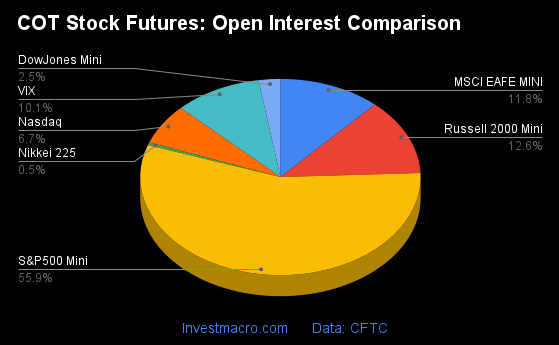
Archive for Stock Market News – Page 19

COT Stock Market Charts: Speculator Bets led by S&P 500 & EAFE

By InvestMacro

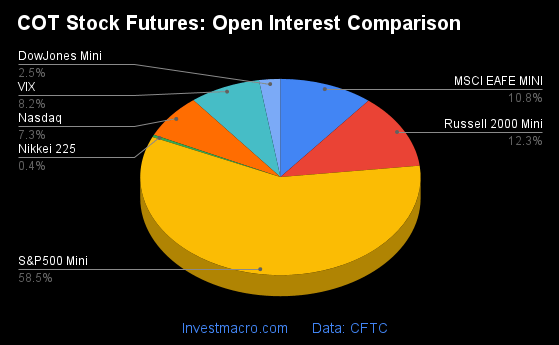
Here are the latest charts and statistics for the Commitment of Traders (COT) data published by the Commodities Futures Trading Commission (CFTC).

The latest COT data is updated through Tuesday March 19th and shows a quick view of how large traders (for-profit speculators and commercial entities) were positioned in the futures markets.

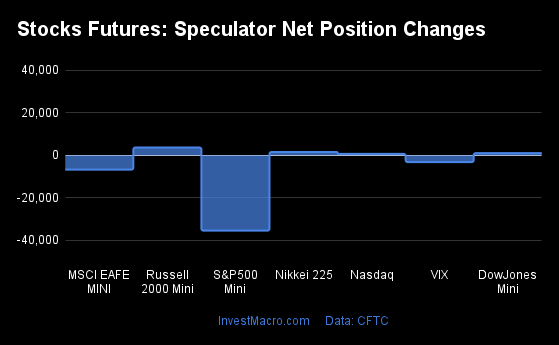
Weekly Speculator Changes led by SP500 & EAFE
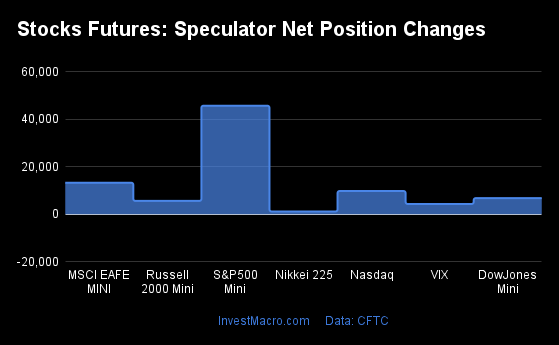
The COT stock markets speculator bets were higher this week as all seven out of the seven stock markets we cover had higher positioning.

Leading the gains for the stock markets was the S&P500-Mini (45,658 contracts) with the MSCI EAFE-Mini (13,261 contracts), the Nasdaq-Mini (9,765 contracts), the DowJones-Mini (6,774 contracts), the VIX (4,316 contracts), the Russell-Mini (5,610 contracts) and the Nikkei 225 (1,171 contracts) also having positive weeks.


Stock Market Net Speculators Leaderboard
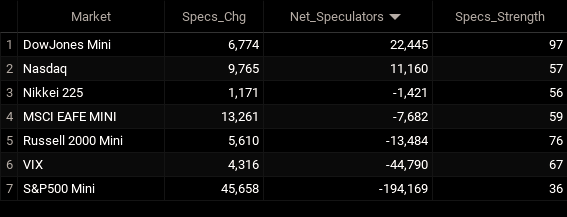
Legend: Weekly Speculators Change | Speculators Current Net Position | Speculators Strength Score compared to last 3-Years (0-100 range)


Strength Scores led by DowJones-Mini & Russell-Mini
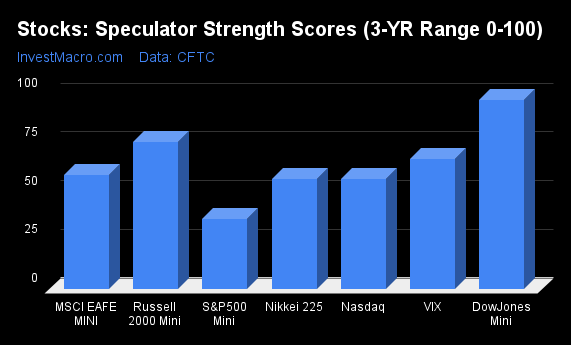
COT Strength Scores (a normalized measure of Speculator positions over a 3-Year range, from 0 to 100 where above 80 is Extreme-Bullish and below 20 is Extreme-Bearish) showed that the DowJones-Mini (97 percent) and the Russell-Mini (76 percent) lead the stock markets this week. The VIX (67 percent) and Nikkei 225 Yen (61 percent) come in as the next highest in the weekly strength scores.

On the downside, the S&P500-Mini (36 percent) comes in at the lowest strength level currently.

Strength Statistics:
VIX (66.6 percent) vs VIX previous week (62.0 percent)
S&P500-Mini (35.8 percent) vs S&P500-Mini previous week (29.0 percent)
DowJones-Mini (96.8 percent) vs DowJones-Mini previous week (85.8 percent)
Nasdaq-Mini (56.5 percent) vs Nasdaq-Mini previous week (41.3 percent)
Russell2000-Mini (75.5 percent) vs Russell2000-Mini previous week (71.5 percent)
Nikkei USD (56.4 percent) vs Nikkei USD previous week (48.2 percent)
EAFE-Mini (58.5 percent) vs EAFE-Mini previous week (44.7 percent)


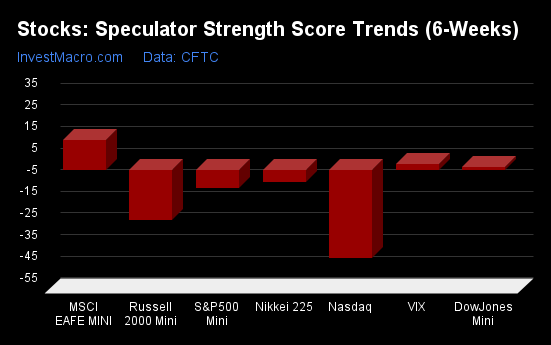
MSCI EAFE-Mini & Nikkei 225 top the 6-Week Strength Trends
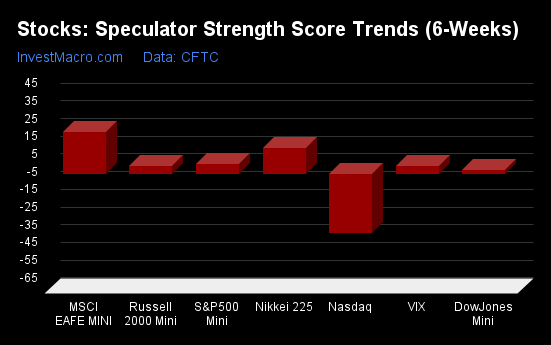
COT Strength Score Trends (or move index, calculates the 6-week changes in strength scores) showed that the MSCI EAFE-Mini (23 percent) leads the past six weeks trends for the stock markets. The Nikkei 225 (15 percent), the S&P500-Mini (6 percent) and the VIX (5 percent) are the next highest positive movers in the latest trends data.

The Nasdaq-Mini (-34 percent) leads the downside trend scores currently.

Strength Trend Statistics:
VIX (4.5 percent) vs VIX previous week (5.9 percent)
S&P500-Mini (5.8 percent) vs S&P500-Mini previous week (-2.1 percent)
DowJones-Mini (2.4 percent) vs DowJones-Mini previous week (-14.2 percent)
Nasdaq-Mini (-33.7 percent) vs Nasdaq-Mini previous week (-58.7 percent)
Russell2000-Mini (4.6 percent) vs Russell2000-Mini previous week (-6.1 percent)
Nikkei USD (14.6 percent) vs Nikkei USD previous week (9.0 percent)
EAFE-Mini (23.4 percent) vs EAFE-Mini previous week (8.9 percent)


Individual Stock Market Charts:

VIX Volatility Futures:
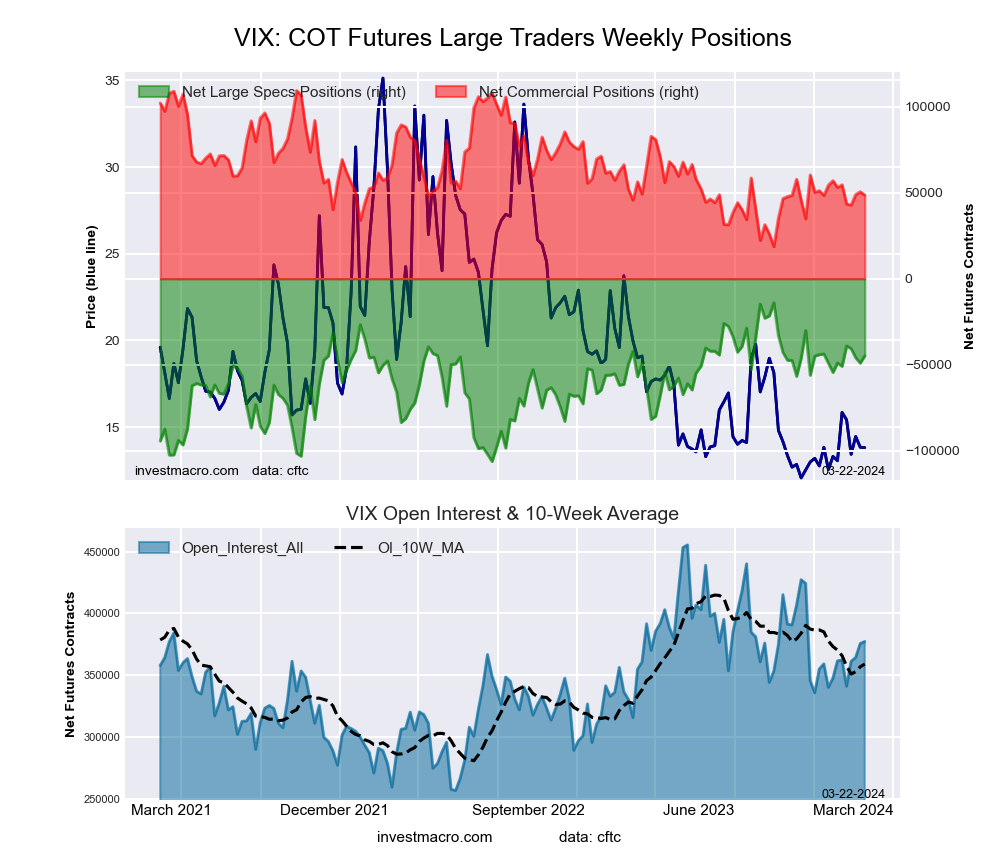
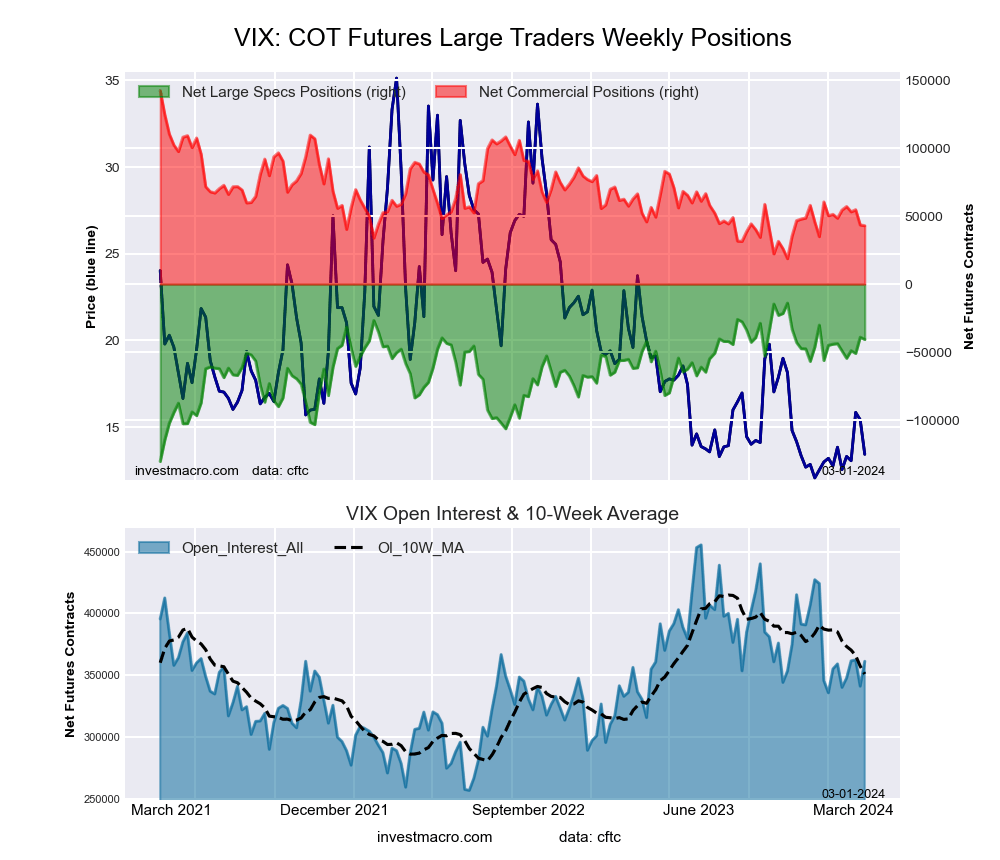
VIX Volatility Futures COT ChartThe VIX Volatility large speculator standing this week resulted in a net position of -44,790 contracts in the data reported through Tuesday. This was a weekly increase of 4,316 contracts from the previous week which had a total of -49,106 net contracts.

This week’s current strength score (the trader positioning range over the past three years, measured from 0 to 100) shows the speculators are currently Bullish with a score of 66.6 percent. The commercials are Bearish with a score of 33.0 percent and the small traders (not shown in chart) are Bullish with a score of 76.8 percent.

Price Trend-Following Model: Weak Uptrend

Our weekly trend-following model classifies the current market price position as: Weak Uptrend. The current action for the model is considered to be: New Buy – Long Position.

VIX Volatility Futures StatisticsSPECULATORSCOMMERCIALSSMALL TRADERS
– Percent of Open Interest Longs:17.947.77.3
– Percent of Open Interest Shorts:29.834.88.3
– Net Position:-44,79048,644-3,854
– Gross Longs:67,646179,88727,545
– Gross Shorts:112,436131,24331,399
– Long to Short Ratio:0.6 to 11.4 to 10.9 to 1
NET POSITION TREND:
– Strength Index Score (3 Year Range Pct):66.633.076.8
– Strength Index Reading (3 Year Range):BullishBearishBullish
NET POSITION MOVEMENT INDEX:
– 6-Week Change in Strength Index:4.5-4.91.5


S&P500 Mini Futures:

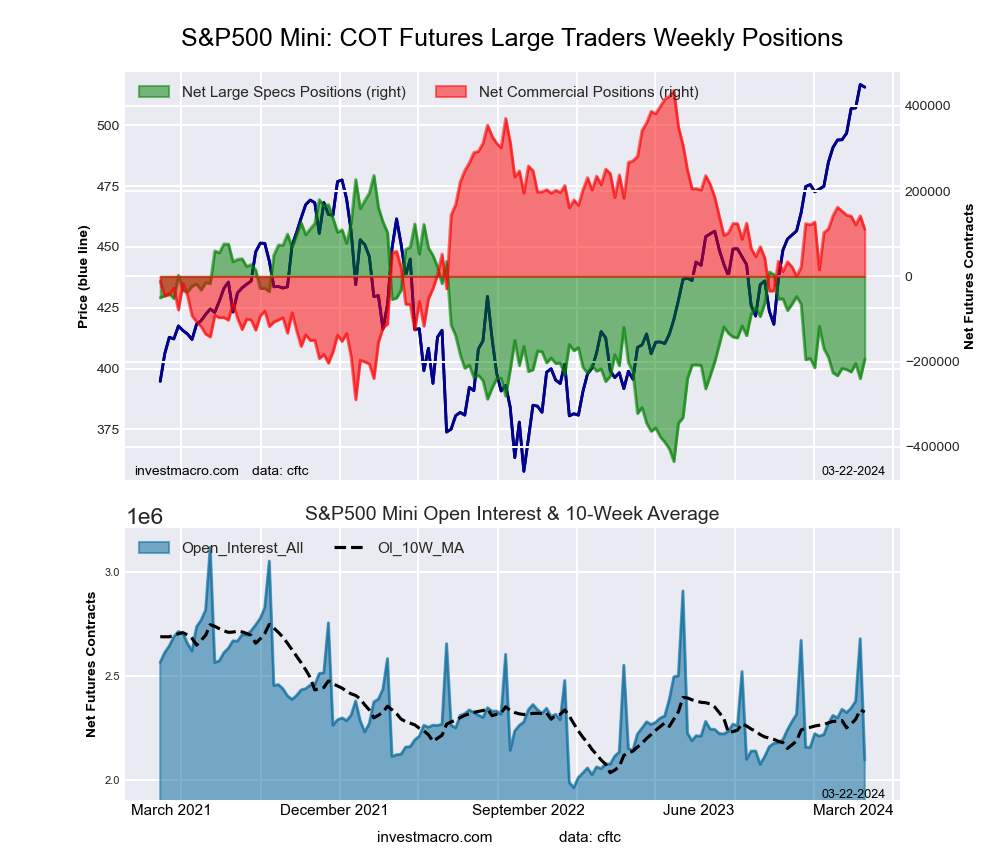
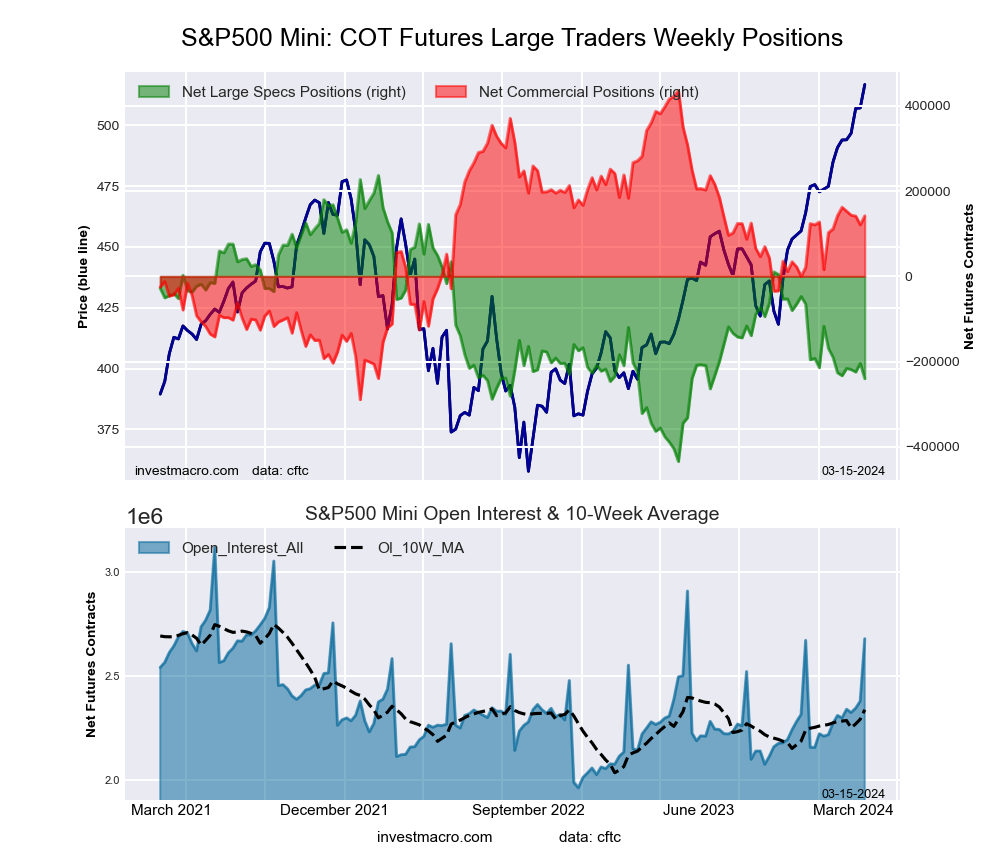
SP500 Mini Futures COT ChartThe S&P500 Mini large speculator standing this week resulted in a net position of -194,169 contracts in the data reported through Tuesday. This was a weekly rise of 45,658 contracts from the previous week which had a total of -239,827 net contracts.

This week’s current strength score (the trader positioning range over the past three years, measured from 0 to 100) shows the speculators are currently Bearish with a score of 35.8 percent. The commercials are Bullish with a score of 55.1 percent and the small traders (not shown in chart) are Bullish with a score of 70.5 percent.

Price Trend-Following Model: Strong Uptrend

Our weekly trend-following model classifies the current market price position as: Strong Uptrend. The current action for the model is considered to be: Hold – Maintain Long Position.

S&P500 Mini Futures StatisticsSPECULATORSCOMMERCIALSSMALL TRADERS
– Percent of Open Interest Longs:12.373.512.5
– Percent of Open Interest Shorts:21.668.28.5
– Net Position:-194,169110,10184,068
– Gross Longs:258,1691,539,140261,988
– Gross Shorts:452,3381,429,039177,920
– Long to Short Ratio:0.6 to 11.1 to 11.5 to 1
NET POSITION TREND:
– Strength Index Score (3 Year Range Pct):35.855.170.5
– Strength Index Reading (3 Year Range):BearishBullishBullish
NET POSITION MOVEMENT INDEX:
– 6-Week Change in Strength Index:5.8-7.15.1


Dow Jones Mini Futures:

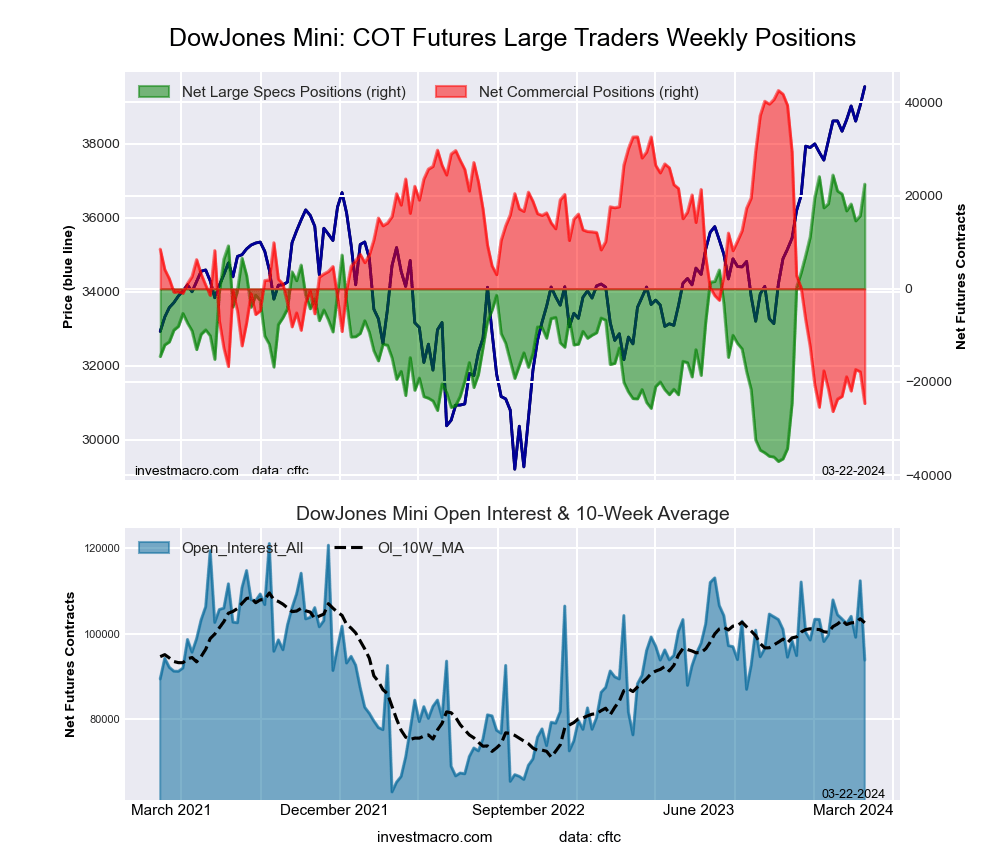
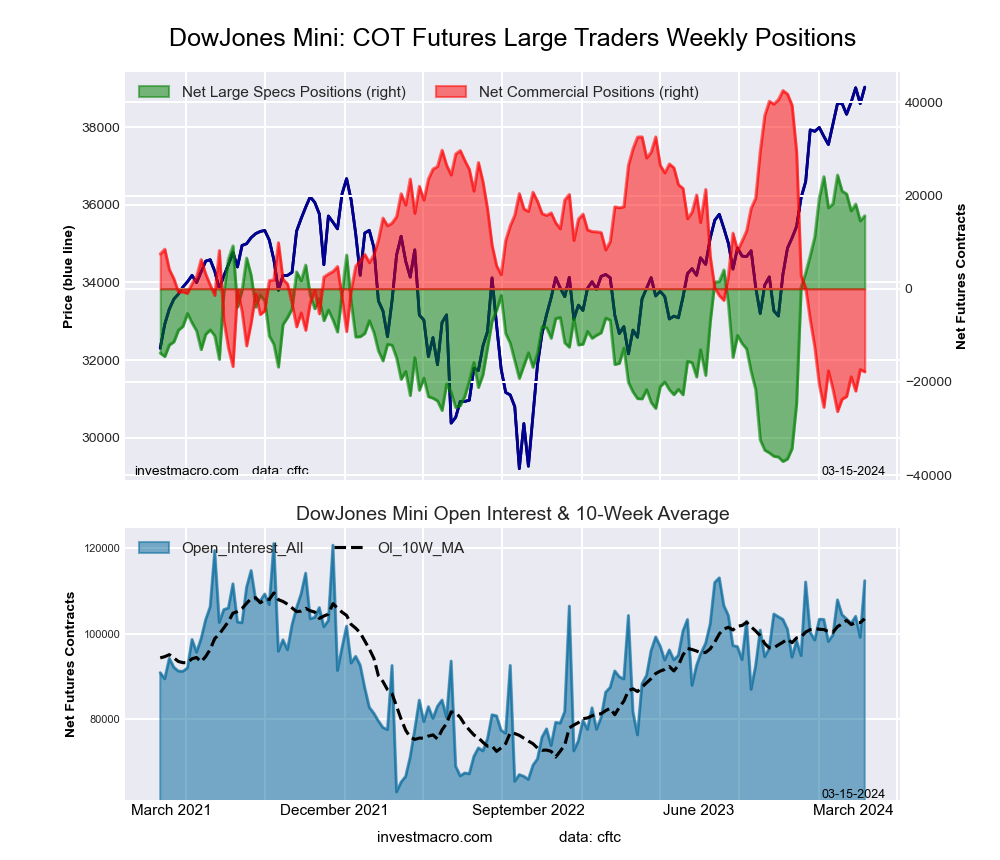
Dow Jones Mini Futures COT ChartThe Dow Jones Mini large speculator standing this week resulted in a net position of 22,445 contracts in the data reported through Tuesday. This was a weekly increase of 6,774 contracts from the previous week which had a total of 15,671 net contracts.

This week’s current strength score (the trader positioning range over the past three years, measured from 0 to 100) shows the speculators are currently Bullish-Extreme with a score of 96.8 percent. The commercials are Bearish-Extreme with a score of 2.5 percent and the small traders (not shown in chart) are Bullish with a score of 54.6 percent.

Price Trend-Following Model: Strong Uptrend

Our weekly trend-following model classifies the current market price position as: Strong Uptrend. The current action for the model is considered to be: Hold – Maintain Long Position.

Dow Jones Mini Futures StatisticsSPECULATORSCOMMERCIALSSMALL TRADERS
– Percent of Open Interest Longs:38.045.214.9
– Percent of Open Interest Shorts:14.171.412.6
– Net Position:22,445-24,6322,187
– Gross Longs:35,68842,38513,967
– Gross Shorts:13,24367,01711,780
– Long to Short Ratio:2.7 to 10.6 to 11.2 to 1
NET POSITION TREND:
– Strength Index Score (3 Year Range Pct):96.82.554.6
– Strength Index Reading (3 Year Range):Bullish-ExtremeBearish-ExtremeBullish
NET POSITION MOVEMENT INDEX:
– 6-Week Change in Strength Index:2.4-1.3-2.6


Nasdaq Mini Futures:

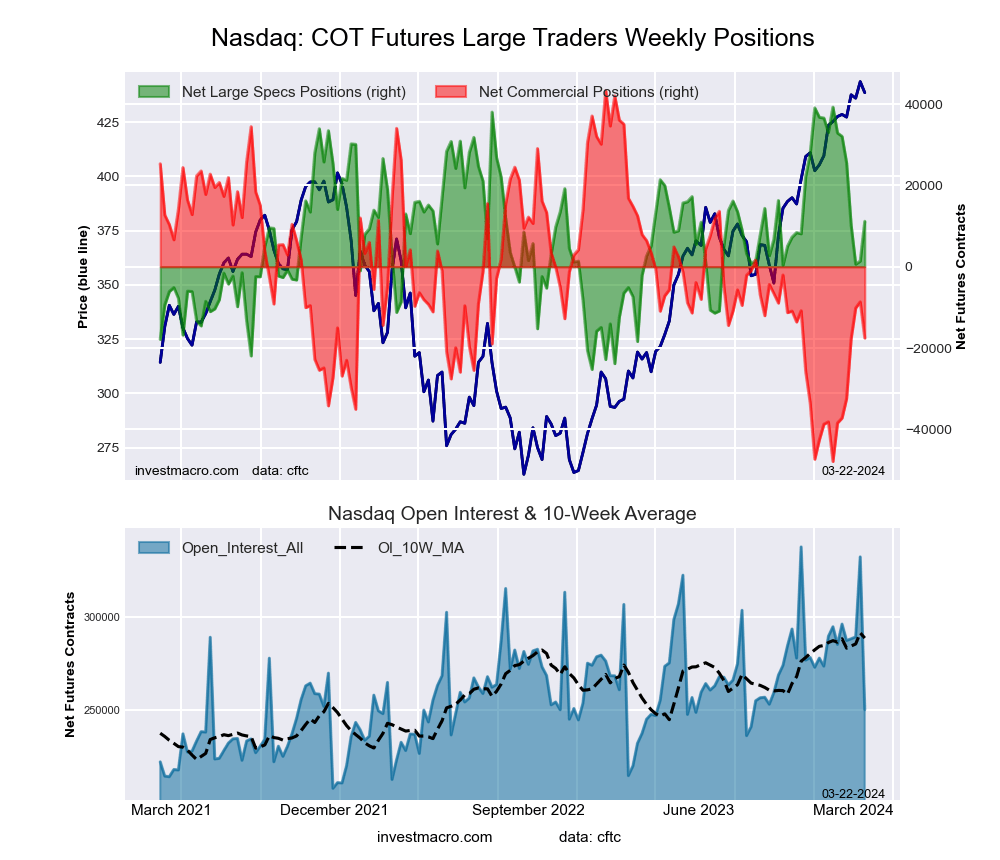
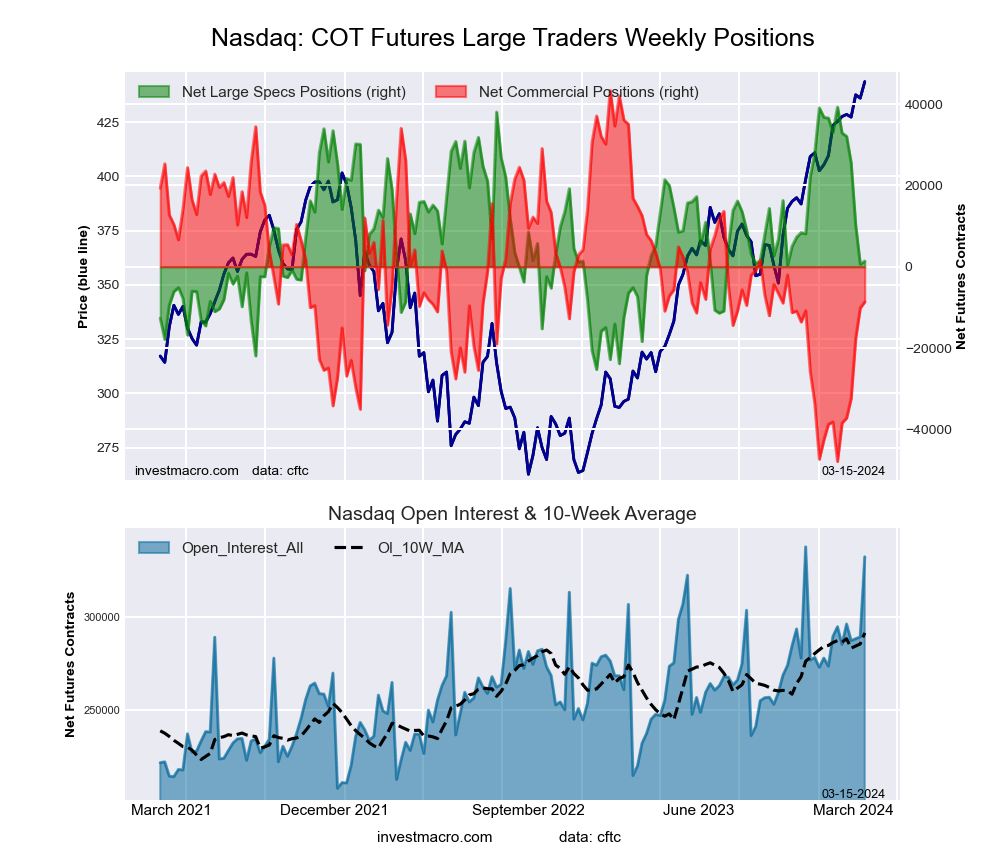
Nasdaq Mini Futures COT ChartThe Nasdaq Mini large speculator standing this week resulted in a net position of 11,160 contracts in the data reported through Tuesday. This was a weekly advance of 9,765 contracts from the previous week which had a total of 1,395 net contracts.

This week’s current strength score (the trader positioning range over the past three years, measured from 0 to 100) shows the speculators are currently Bullish with a score of 56.5 percent. The commercials are Bearish with a score of 33.3 percent and the small traders (not shown in chart) are Bullish-Extreme with a score of 91.7 percent.

Price Trend-Following Model: Uptrend

Our weekly trend-following model classifies the current market price position as: Uptrend. The current action for the model is considered to be: Hold – Maintain Long Position.

Nasdaq Mini Futures StatisticsSPECULATORSCOMMERCIALSSMALL TRADERS
– Percent of Open Interest Longs:27.355.515.7
– Percent of Open Interest Shorts:22.862.513.2
– Net Position:11,160-17,5266,366
– Gross Longs:68,217138,89739,354
– Gross Shorts:57,057156,42332,988
– Long to Short Ratio:1.2 to 10.9 to 11.2 to 1
NET POSITION TREND:
– Strength Index Score (3 Year Range Pct):56.533.391.7
– Strength Index Reading (3 Year Range):BullishBearishBullish-Extreme
NET POSITION MOVEMENT INDEX:
– 6-Week Change in Strength Index:-33.722.92.1


Russell 2000 Mini Futures:

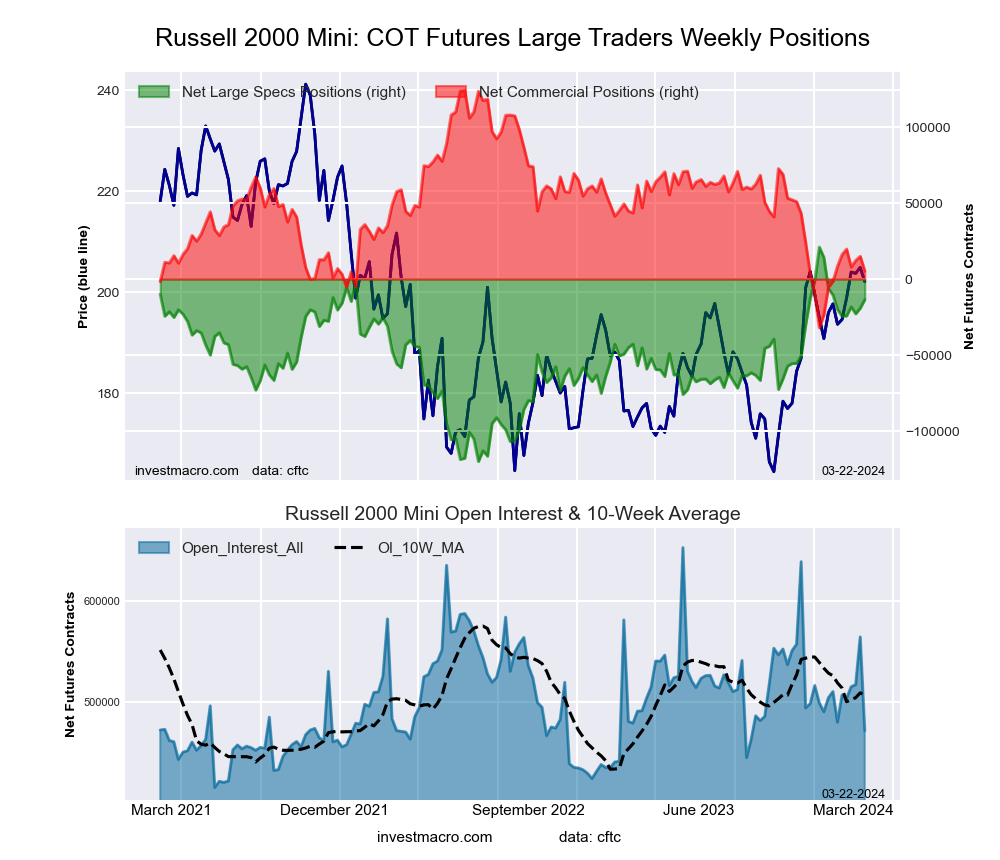
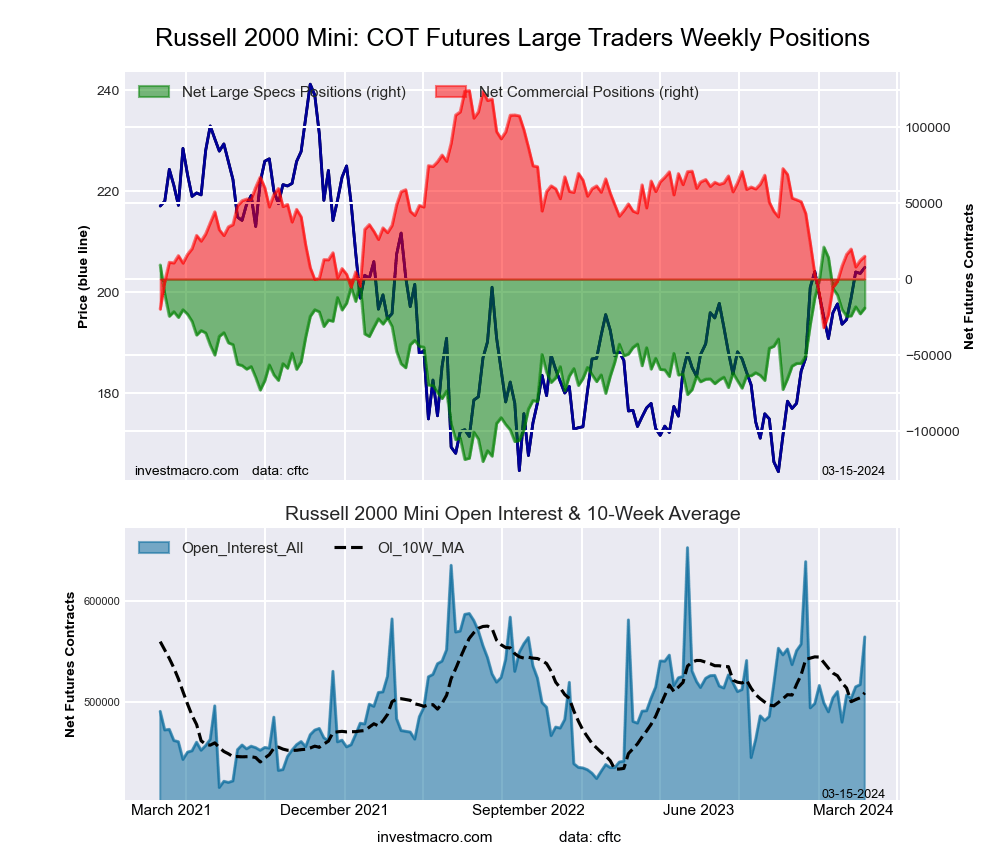
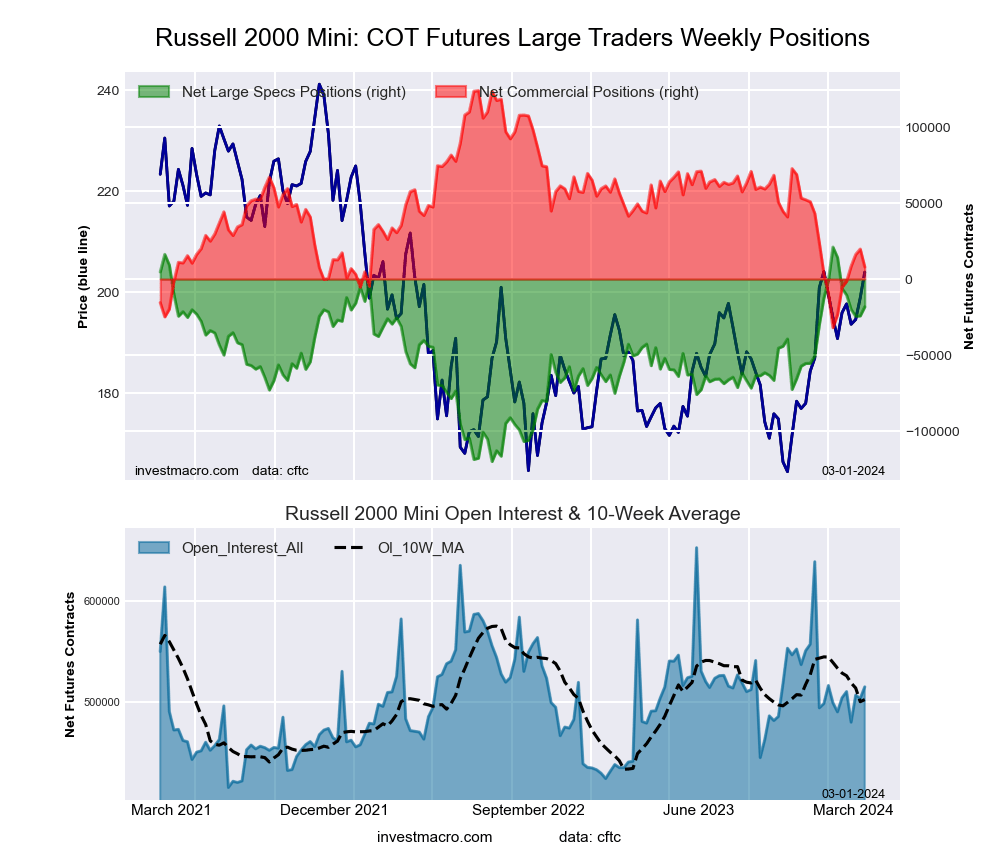
Russell 2000 Mini Futures COT ChartThe Russell 2000 Mini large speculator standing this week resulted in a net position of -13,484 contracts in the data reported through Tuesday. This was a weekly rise of 5,610 contracts from the previous week which had a total of -19,094 net contracts.

This week’s current strength score (the trader positioning range over the past three years, measured from 0 to 100) shows the speculators are currently Bullish with a score of 75.5 percent. The commercials are Bearish with a score of 23.9 percent and the small traders (not shown in chart) are Bullish with a score of 56.6 percent.

Price Trend-Following Model: Uptrend

Our weekly trend-following model classifies the current market price position as: Uptrend. The current action for the model is considered to be: Hold – Maintain Long Position.

Russell 2000 Mini Futures StatisticsSPECULATORSCOMMERCIALSSMALL TRADERS
– Percent of Open Interest Longs:14.778.66.0
– Percent of Open Interest Shorts:17.577.54.3
– Net Position:-13,4845,2738,211
– Gross Longs:69,077370,39628,373
– Gross Shorts:82,561365,12320,162
– Long to Short Ratio:0.8 to 11.0 to 11.4 to 1
NET POSITION TREND:
– Strength Index Score (3 Year Range Pct):75.523.956.6
– Strength Index Reading (3 Year Range):BullishBearishBullish
NET POSITION MOVEMENT INDEX:
– 6-Week Change in Strength Index:4.6-2.1-11.0


Nikkei Stock Average (USD) Futures:

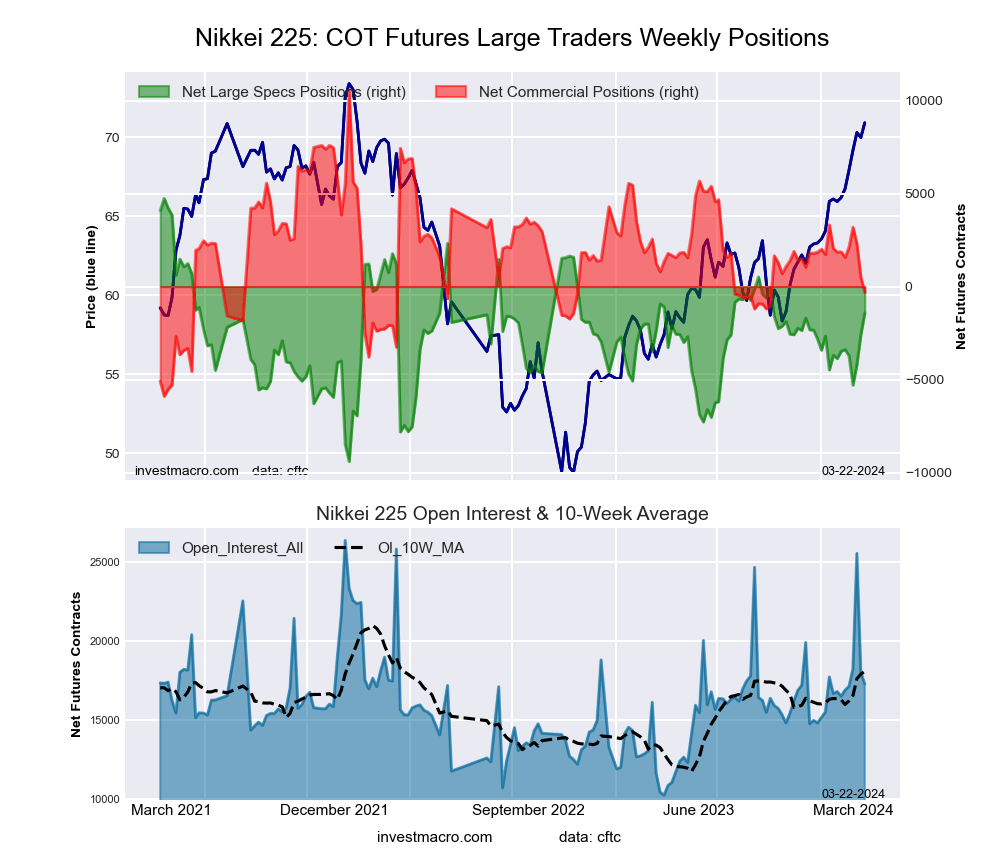
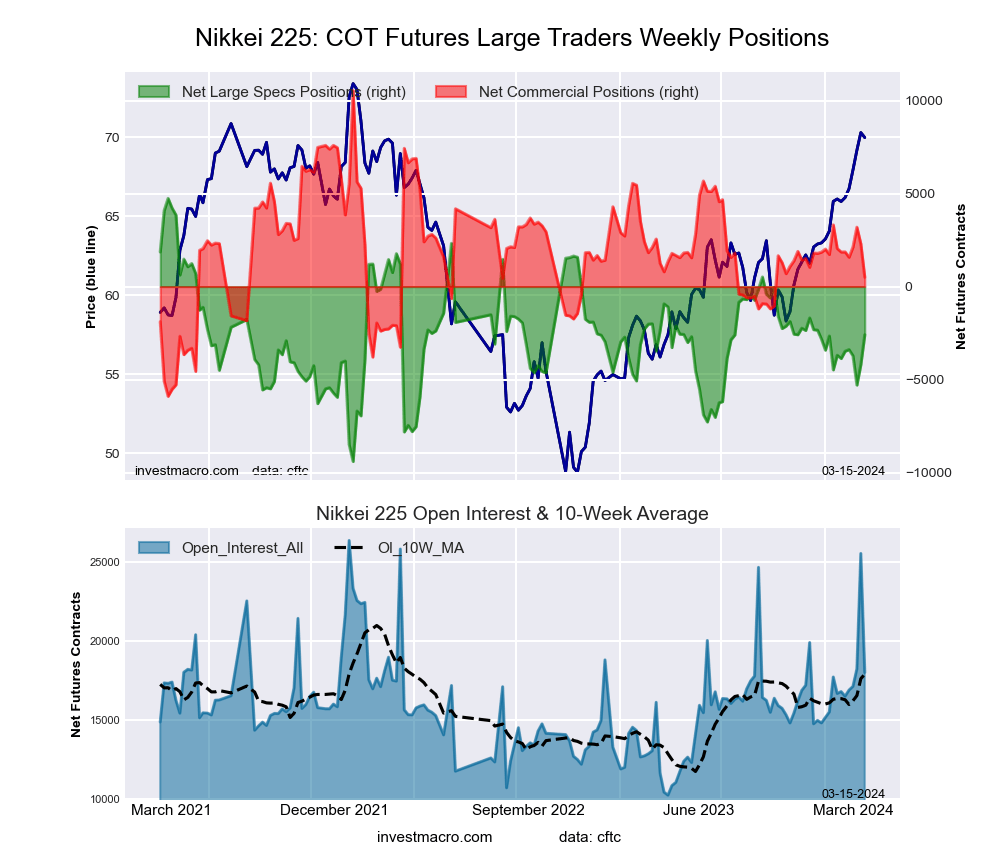
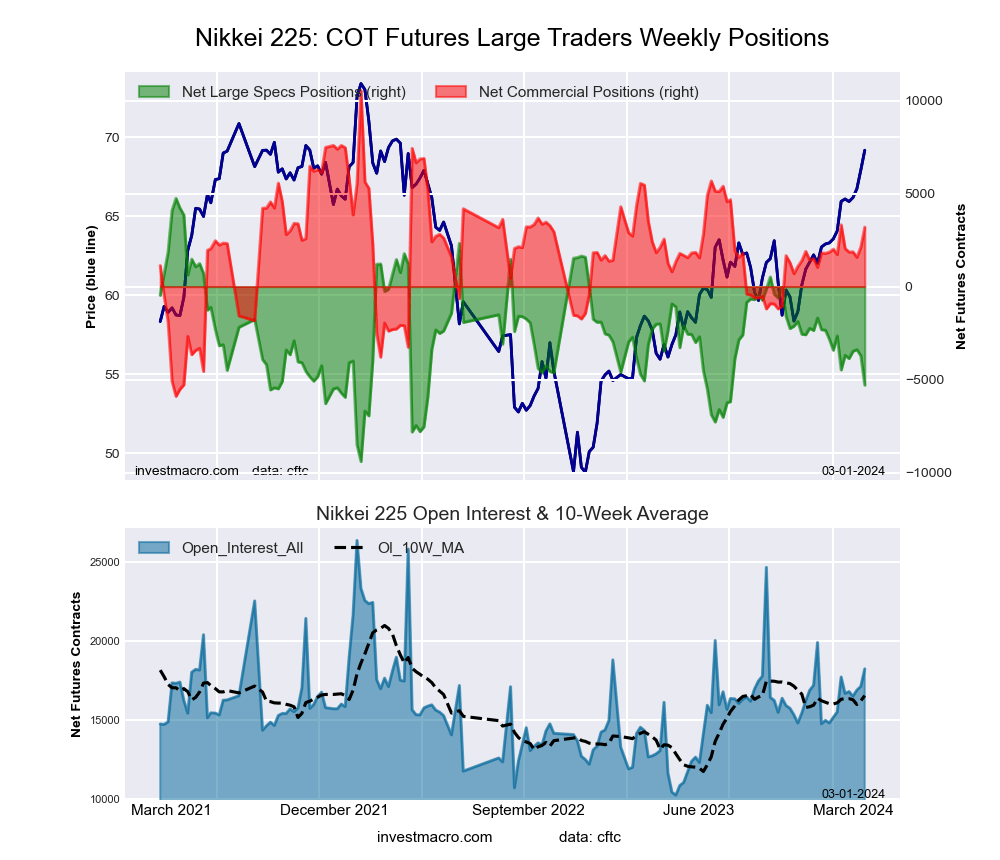
Nikkei Stock Average (USD) Futures COT ChartThe Nikkei Stock Average (USD) large speculator standing this week resulted in a net position of -1,421 contracts in the data reported through Tuesday. This was a weekly rise of 1,171 contracts from the previous week which had a total of -2,592 net contracts.

This week’s current strength score (the trader positioning range over the past three years, measured from 0 to 100) shows the speculators are currently Bullish with a score of 56.4 percent. The commercials are Bearish with a score of 34.0 percent and the small traders (not shown in chart) are Bullish with a score of 65.3 percent.

Price Trend-Following Model: Strong Uptrend

Our weekly trend-following model classifies the current market price position as: Strong Uptrend. The current action for the model is considered to be: Hold – Maintain Long Position.

Nikkei Stock Average Futures StatisticsSPECULATORSCOMMERCIALSSMALL TRADERS
– Percent of Open Interest Longs:8.066.525.5
– Percent of Open Interest Shorts:16.268.315.5
– Net Position:-1,421-3131,734
– Gross Longs:1,38611,4924,413
– Gross Shorts:2,80711,8052,679
– Long to Short Ratio:0.5 to 11.0 to 11.6 to 1
NET POSITION TREND:
– Strength Index Score (3 Year Range Pct):56.434.065.3
– Strength Index Reading (3 Year Range):BullishBearishBullish
NET POSITION MOVEMENT INDEX:
– 6-Week Change in Strength Index:14.6-13.21.9


MSCI EAFE Mini Futures:

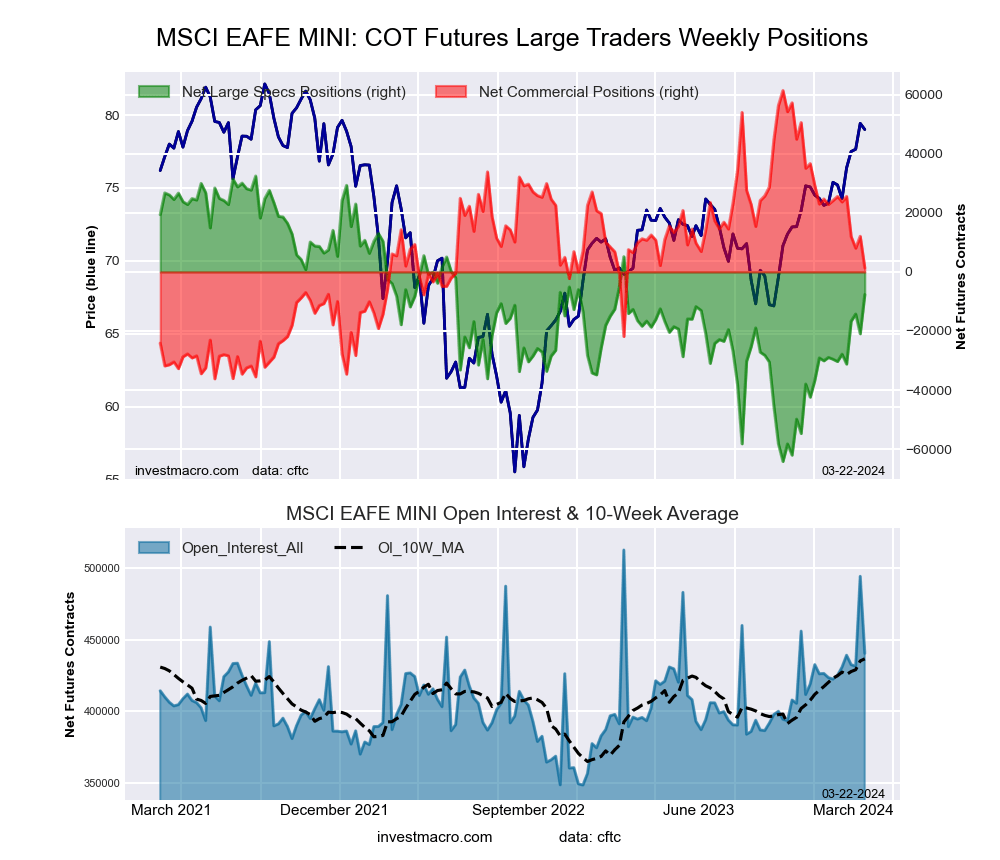
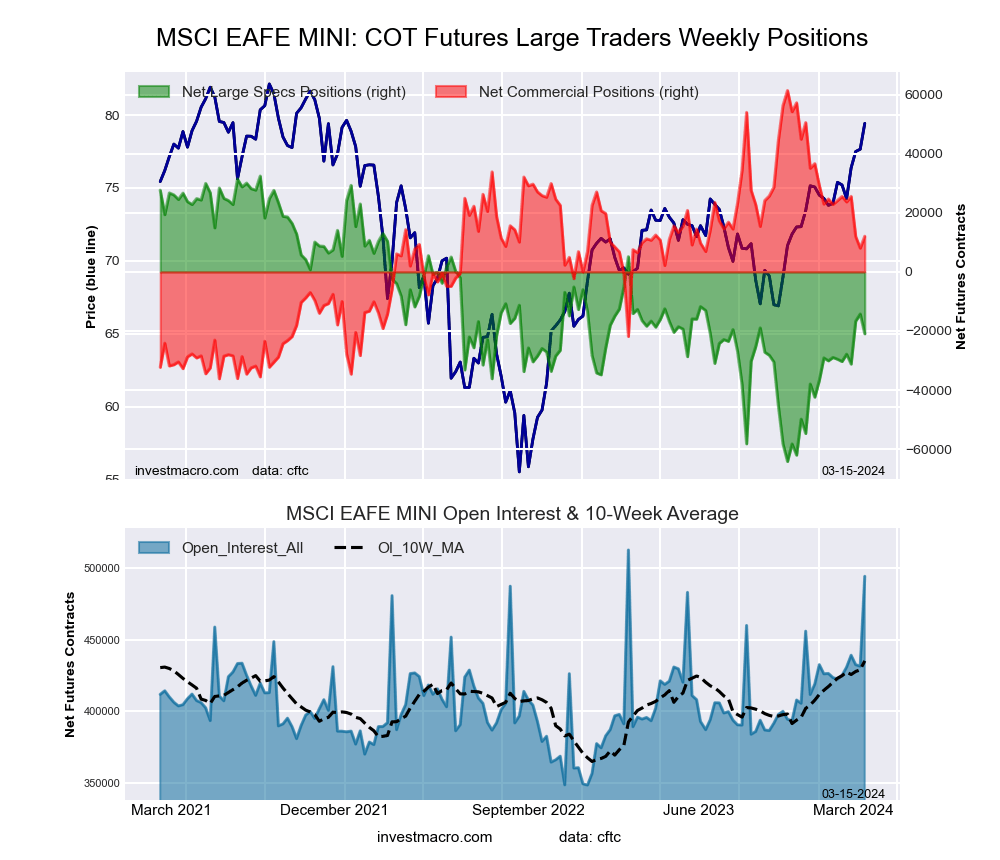
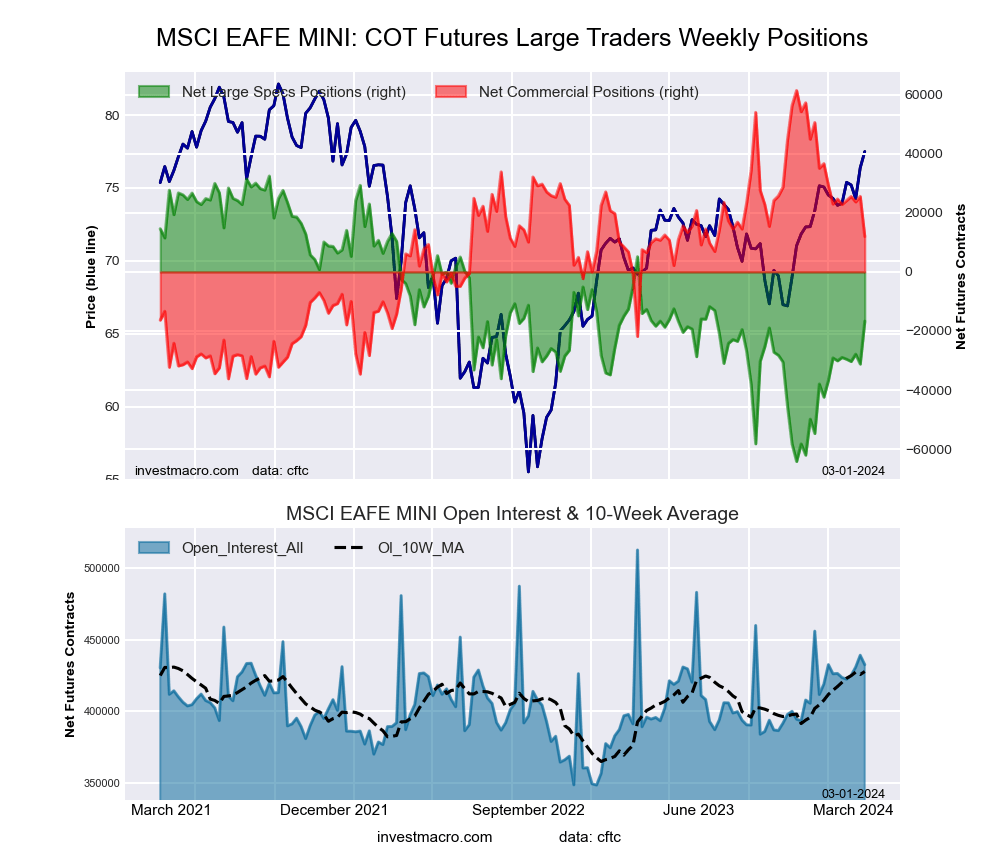
MSCI EAFE Mini Futures COT ChartThe MSCI EAFE Mini large speculator standing this week resulted in a net position of -7,682 contracts in the data reported through Tuesday. This was a weekly lift of 13,261 contracts from the previous week which had a total of -20,943 net contracts.

This week’s current strength score (the trader positioning range over the past three years, measured from 0 to 100) shows the speculators are currently Bullish with a score of 58.5 percent. The commercials are Bearish with a score of 38.5 percent and the small traders (not shown in chart) are Bearish with a score of 48.5 percent.

Price Trend-Following Model: Strong Uptrend

Our weekly trend-following model classifies the current market price position as: Strong Uptrend. The current action for the model is considered to be: Hold – Maintain Long Position.

MSCI EAFE Mini Futures StatisticsSPECULATORSCOMMERCIALSSMALL TRADERS
– Percent of Open Interest Longs:8.788.62.4
– Percent of Open Interest Shorts:10.488.30.9
– Net Position:-7,6821,3696,313
– Gross Longs:38,124390,36910,384
– Gross Shorts:45,806389,0004,071
– Long to Short Ratio:0.8 to 11.0 to 12.6 to 1
NET POSITION TREND:
– Strength Index Score (3 Year Range Pct):58.538.548.5
– Strength Index Reading (3 Year Range):BullishBearishBearish
NET POSITION MOVEMENT INDEX:
– 6-Week Change in Strength Index:23.4-24.87.6


Article By InvestMacroReceive our weekly COT Newsletter

*COT Report: The COT data, released weekly to the public each Friday, is updated through the most recent Tuesday (data is 3 days old) and shows a quick view of how large speculators or non-commercials (for-profit traders) were positioned in the futures markets.

The CFTC categorizes trader positions according to commercial hedgers (traders who use futures contracts for hedging as part of the business), non-commercials (large traders who speculate to realize trading profits) and nonreportable traders (usually small traders/speculators) as well as their open interest (contracts open in the market at time of reporting). See CFTC criteria here.

SG20 index: more dividends, less volatility

By ForexTime

  • FXTM launches brand new SG20 stock index
  • SG20 has highest dividend yield of all FXTM stock indices
  • SG20: most stable Asian stock index within FXTM universe
  • SG20 has strong positive correlation with spot gold
  • Wall Street forecasts that this stock index could rise by another 14%


FXTM’s new SG20 index may be enticing for range traders who enjoy consistent cash payouts.


What is a stock index?

Imagine a stock index being a basket of many different stocks.

The index measures the overall performance of those stocks inside that “basket”.


What does the SG20 stock index track?

FXTMs SG20 stock index tracks the performance of the MSCI Singapore Index.

Note that this MSCI Singapore index is not the same as the benchmark Straits Times index, which is maintained by the FTSE.

This MSCI Singapore index aims to capture the overall performance of 22 different large- and mid-cap stocks in Singapore.

Together, those 22 stocks make up about 85% of the entire Singaporean stock market.


3 key things to know about the SG20 index:


1) Singaporean banks are the largest members of this index

Singapore is a city-state that is also known for its status as a “safe haven”, especially for the Asian region.

As a result, its financial sector tends to attract outsized fund inflows, benefitting its banks.

No surprise then that DBS Group, OBCB Bank, and UOB, combine to make up nearly half (48.17%) of the entire SG20 index.


2) Least volatile Asian stock index within FXTM universe

Of the 6 different Asian stock indices, the SG20 index has the lowest 30-day volatility figure, as of today (Tuesday, March 19th).

  • SDG20: 10.9
  • TWN: 13.2
  • JP225: 15.8
  • CN50: 17.1
  • HK50: 23.6
  • CHINAH: 27.5


Here are more data points to showcase the SG20 index’s relative stability:

  • SG20 index is faring better than Singapore’s benchmark Straits Times index

The SG20 index is up 1.25% so far in 2024.

Compare that to Singapore’s benchmark stock index (FTSE Straits Times index), which has dropped by by more than 2% so far in 2024.

While the performance of Singaporean stocks are in stark contrast to the many stock indices around the world that have printed fresh record highs this year …

SG20 index appears to putting in a relatively steady shift so far this year.
 

  • SG20 index has a strong correlation with gold

To buffer the notion of Singapore as a “safe haven”, this SG20 index tends to mirror the performance of another famed “safe haven” asset: gold.

Over any given 5-day period from the past 20 years, both XAUUSD (gold) and this SG20 index have moved in the same direction 51% of the time (positive correlation.

NOTE: According to Bloomberg data, gold and SG20 have a positive correlation of 0.51, over a rolling 5-day period from the past 20 years. A number of 0.5 or higher indicates a strong correlation.


3) SG20 has highest dividend yield of all FXTM Stock Indices

Over the past 12 months, this SG20 index has paid out a dividend yield of 4.7% (based on current prices).

That’s significantly higher than the dividend yields currently offered by other popular stock indices (based on current prices):

  • UK100: 4%
  • EU50: 2.9%
  • JP225: 1.6%
  • US500: 1.4%
  • NAS100: 0.8%


But wait, there’s more!

Over the next 12 months, Wall Street analysts forecast that members of the SG20 index will pay out EVEN MORE dividends.

This is expected to bring the forward 12-month yield up to 4.9%.


What is a “dividend yield”?

Dividend yield is a % number representing how much money an investor gets for buying and holding an asset.

The higher the yield, the more dividends the investor receives, as a ratio of what was originally invested.

Dividends are cash rewards that are given by companies (in this case, companies that are included in the SG20 index) to its shareholders.

Hence, holders of assets linked to the SG20 index, such as Exchange-Traded Funds (ETF) or even Contracts for Differences (CFD), often are entitled to similar dividends as well.


Where’s SG20 headed next?

Over the next 12 months, Wall Street analysts predict this SG20 index could return to the 330 mark.

From current prices, this implies about 14% in potential gains.

For proper context, a number around 330 would only restore the SG20 index to levels not seen since 2022.

That would still pale in comparison to the SG20 index’s all-time intraday high of 481.23 posted 10th October 2007, before the Global Financial Crisis.


SG20 bulls (those hoping that prices will rise) will be hoping that the Asian “safe haven” economy can continue registering steady growth, benefitting the city-state’s financial sector along the way.

If such an outlook proves true, then …

Traders and investors may yet enjoy more gains amid less-volatile prices, while collecting healthy dividends along the way.


Forex-Time-LogoArticle by ForexTime

ForexTime Ltd (FXTM) is an award winning international online forex broker regulated by CySEC 185/12 www.forextime.com

COT Stock Market Charts: Speculator Bets led by Russell & Nikkei 225

By InvestMacro

Here are the latest charts and statistics for the Commitment of Traders (COT) data published by the Commodities Futures Trading Commission (CFTC).

The latest COT data is updated through Tuesday March 12th and shows a quick view of how large traders (for-profit speculators and commercial entities) were positioned in the futures markets.

Weekly Speculator Changes led by Russell & Nikkei 225

The COT stock markets speculator bets were slightly higher overall this week as four out of the seven stock markets we cover had higher positioning while the other three markets had lower speculator contracts.

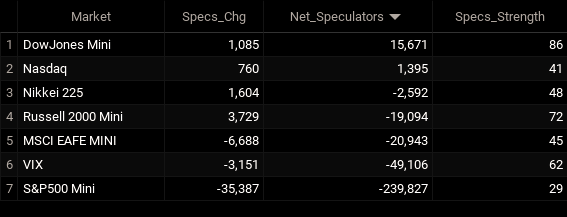
Leading the gains for the stock markets was the Russell-Mini (3,729 contracts) with the Nikkei 225 (1,604 contracts), the DowJones-Mini (1,085 contracts) and the Nasdaq-Mini (760 contracts) also showing positive weeks.

The markets with the declines in speculator bets this week were the S&P500-Mini (-35,387 contracts), the MSCI EAFE-Mini (-6,688 contracts) and the VIX (-3,151 contracts) also registering lower bets on the week.


Stock Markets Net Speculators Leaderboard

Legend: Weekly Speculators Change | Speculators Current Net Position | Speculators Strength Score compared to last 3-Years (0-100 range)


Strength Scores led by DowJones-Mini & Russell-Mini

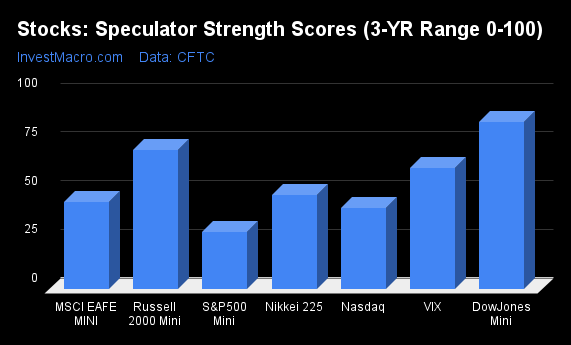
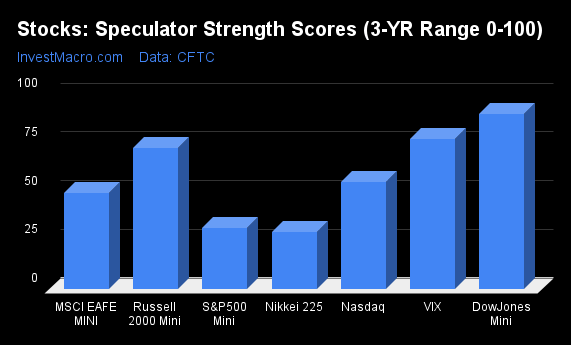
COT Strength Scores (a normalized measure of Speculator positions over a 3-Year range, from 0 to 100 where above 80 is Extreme-Bullish and below 20 is Extreme-Bearish) showed that the DowJones-Mini (86 percent) and the Russell-Mini (72 percent) lead the stock markets this week. The VIX (62 percent) comes in as the next highest in the weekly strength scores.

On the downside, the S&P500-Mini (29 percent) comes in at the lowest strength level currently while the next lowest strength score is the Nasdaq-Mini (41 percent).

Strength Statistics:
VIX (62.0 percent) vs VIX previous week (65.4 percent)
S&P500-Mini (29.0 percent) vs S&P500-Mini previous week (34.3 percent)
DowJones-Mini (85.8 percent) vs DowJones-Mini previous week (84.0 percent)
Nasdaq-Mini (41.3 percent) vs Nasdaq-Mini previous week (40.1 percent)
Russell2000-Mini (71.5 percent) vs Russell2000-Mini previous week (68.9 percent)
Nikkei USD (48.2 percent) vs Nikkei USD previous week (36.8 percent)
EAFE-Mini (44.7 percent) vs EAFE-Mini previous week (51.7 percent)


Nikkei 225 & MSCI EAFE-Mini top the 6-Week Strength Trends

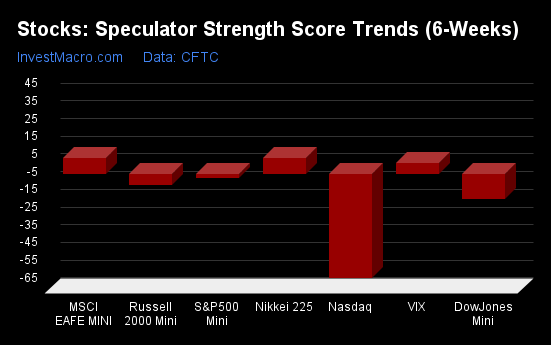
COT Strength Score Trends (or move index, calculates the 6-week changes in strength scores) showed that the Nikkei 225 (9 percent) and the MSCI EAFE-Mini (9 percent) lead the past six weeks trends for the stock markets.

The Nasdaq-Mini (-59 percent) leads the downside trend scores currently with the DowJones-Mini (-14 percent) coming in as the next lowest market in trend scores.

Strength Trend Statistics:
VIX (5.9 percent) vs VIX previous week (3.5 percent)
S&P500-Mini (-2.1 percent) vs S&P500-Mini previous week (-2.2 percent)
DowJones-Mini (-14.2 percent) vs DowJones-Mini previous week (-6.0 percent)
Nasdaq-Mini (-58.7 percent) vs Nasdaq-Mini previous week (-50.2 percent)
Russell2000-Mini (-6.1 percent) vs Russell2000-Mini previous week (-11.8 percent)
Nikkei USD (9.0 percent) vs Nikkei USD previous week (-3.6 percent)
EAFE-Mini (8.9 percent) vs EAFE-Mini previous week (15.2 percent)


Individual Stock Market Charts:

VIX Volatility Futures:

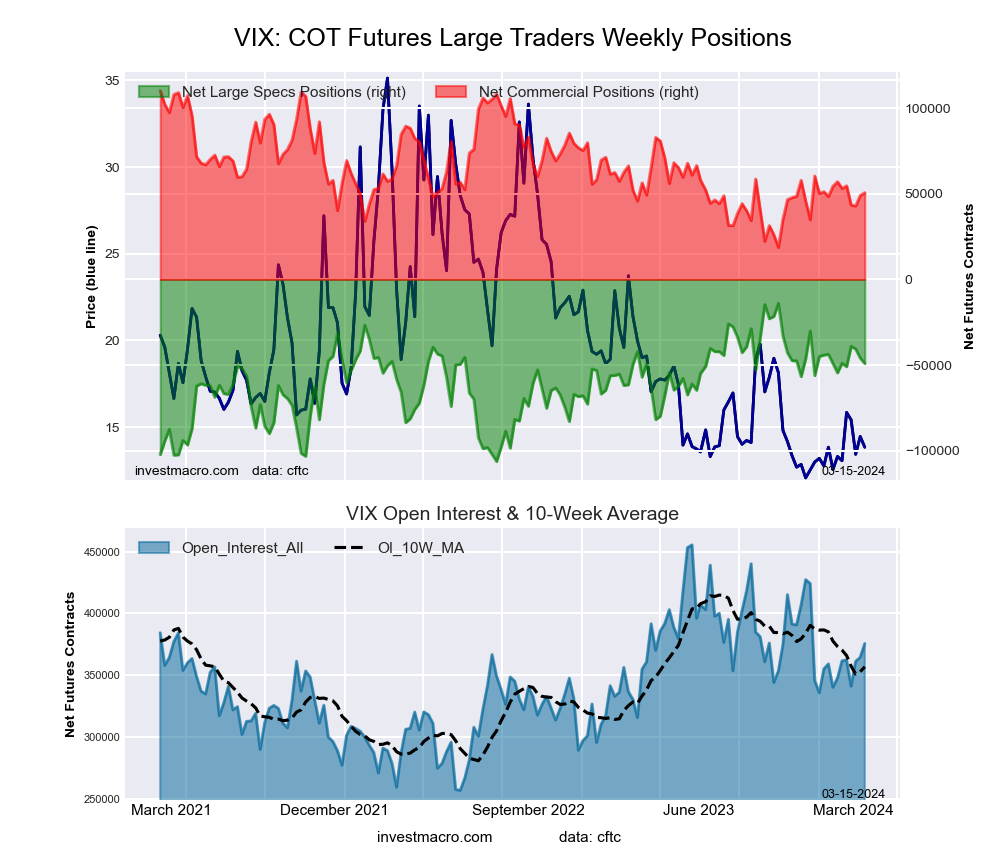
VIX Volatility Futures COT ChartThe VIX Volatility large speculator standing this week totaled a net position of -49,106 contracts in the data reported through Tuesday. This was a weekly reduction of -3,151 contracts from the previous week which had a total of -45,955 net contracts.

This week’s current strength score (the trader positioning range over the past three years, measured from 0 to 100) shows the speculators are currently Bullish with a score of 62.0 percent. The commercials are Bearish with a score of 34.8 percent and the small traders (not shown in chart) are Bullish-Extreme with a score of 88.7 percent.

Price Trend-Following Model: Weak Downtrend

Our weekly trend-following model classifies the current market price position as: Weak Downtrend. The current action for the model is considered to be: Hold – Maintain Short Position.

VIX Volatility Futures StatisticsSPECULATORSCOMMERCIALSSMALL TRADERS
– Percent of Open Interest Longs:18.645.17.8
– Percent of Open Interest Shorts:31.731.68.2
– Net Position:-49,10650,627-1,521
– Gross Longs:70,068169,37929,419
– Gross Shorts:119,174118,75230,940
– Long to Short Ratio:0.6 to 11.4 to 11.0 to 1
NET POSITION TREND:
– Strength Index Score (3 Year Range Pct):62.034.888.7
– Strength Index Reading (3 Year Range):BullishBearishBullish-Extreme
NET POSITION MOVEMENT INDEX:
– 6-Week Change in Strength Index:5.9-7.05.0


S&P500 Mini Futures:

SP500 Mini Futures COT ChartThe S&P500 Mini large speculator standing this week totaled a net position of -239,827 contracts in the data reported through Tuesday. This was a weekly fall of -35,387 contracts from the previous week which had a total of -204,440 net contracts.

This week’s current strength score (the trader positioning range over the past three years, measured from 0 to 100) shows the speculators are currently Bearish with a score of 29.0 percent. The commercials are Bullish with a score of 59.5 percent and the small traders (not shown in chart) are Bullish with a score of 76.1 percent.

Price Trend-Following Model: Uptrend

Our weekly trend-following model classifies the current market price position as: Uptrend. The current action for the model is considered to be: Hold – Maintain Long Position.

S&P500 Mini Futures StatisticsSPECULATORSCOMMERCIALSSMALL TRADERS
– Percent of Open Interest Longs:10.571.410.9
– Percent of Open Interest Shorts:19.466.17.2
– Net Position:-239,827141,73198,096
– Gross Longs:280,7181,911,694291,700
– Gross Shorts:520,5451,769,963193,604
– Long to Short Ratio:0.5 to 11.1 to 11.5 to 1
NET POSITION TREND:
– Strength Index Score (3 Year Range Pct):29.059.576.1
– Strength Index Reading (3 Year Range):BearishBullishBullish
NET POSITION MOVEMENT INDEX:
– 6-Week Change in Strength Index:-2.1-0.15.7


Dow Jones Mini Futures:

Dow Jones Mini Futures COT ChartThe Dow Jones Mini large speculator standing this week totaled a net position of 15,671 contracts in the data reported through Tuesday. This was a weekly gain of 1,085 contracts from the previous week which had a total of 14,586 net contracts.

This week’s current strength score (the trader positioning range over the past three years, measured from 0 to 100) shows the speculators are currently Bullish-Extreme with a score of 85.8 percent. The commercials are Bearish-Extreme with a score of 12.4 percent and the small traders (not shown in chart) are Bullish with a score of 54.4 percent.

Price Trend-Following Model: Uptrend

Our weekly trend-following model classifies the current market price position as: Uptrend. The current action for the model is considered to be: Hold – Maintain Long Position.

Dow Jones Mini Futures StatisticsSPECULATORSCOMMERCIALSSMALL TRADERS
– Percent of Open Interest Longs:26.950.614.4
– Percent of Open Interest Shorts:13.066.512.4
– Net Position:15,671-17,8182,147
– Gross Longs:30,25156,88516,125
– Gross Shorts:14,58074,70313,978
– Long to Short Ratio:2.1 to 10.8 to 11.2 to 1
NET POSITION TREND:
– Strength Index Score (3 Year Range Pct):85.812.454.4
– Strength Index Reading (3 Year Range):Bullish-ExtremeBearish-ExtremeBullish
NET POSITION MOVEMENT INDEX:
– 6-Week Change in Strength Index:-14.212.41.0


Nasdaq Mini Futures:

Nasdaq Mini Futures COT ChartThe Nasdaq Mini large speculator standing this week totaled a net position of 1,395 contracts in the data reported through Tuesday. This was a weekly increase of 760 contracts from the previous week which had a total of 635 net contracts.

This week’s current strength score (the trader positioning range over the past three years, measured from 0 to 100) shows the speculators are currently Bearish with a score of 41.3 percent. The commercials are Bearish with a score of 43.0 percent and the small traders (not shown in chart) are Bullish-Extreme with a score of 94.0 percent.

Price Trend-Following Model: Uptrend

Our weekly trend-following model classifies the current market price position as: Uptrend. The current action for the model is considered to be: Hold – Maintain Long Position.

Nasdaq Mini Futures StatisticsSPECULATORSCOMMERCIALSSMALL TRADERS
– Percent of Open Interest Longs:26.456.813.5
– Percent of Open Interest Shorts:25.959.411.3
– Net Position:1,395-8,6447,249
– Gross Longs:87,501188,65644,899
– Gross Shorts:86,106197,30037,650
– Long to Short Ratio:1.0 to 11.0 to 11.2 to 1
NET POSITION TREND:
– Strength Index Score (3 Year Range Pct):41.343.094.0
– Strength Index Reading (3 Year Range):BearishBearishBullish-Extreme
NET POSITION MOVEMENT INDEX:
– 6-Week Change in Strength Index:-58.743.0-3.7


Russell 2000 Mini Futures:

Russell 2000 Mini Futures COT ChartThe Russell 2000 Mini large speculator standing this week totaled a net position of -19,094 contracts in the data reported through Tuesday. This was a weekly rise of 3,729 contracts from the previous week which had a total of -22,823 net contracts.

This week’s current strength score (the trader positioning range over the past three years, measured from 0 to 100) shows the speculators are currently Bullish with a score of 71.5 percent. The commercials are Bearish with a score of 30.1 percent and the small traders (not shown in chart) are Bearish with a score of 42.8 percent.

Price Trend-Following Model: Uptrend

Our weekly trend-following model classifies the current market price position as: Uptrend. The current action for the model is considered to be: Hold – Maintain Long Position.

Russell 2000 Mini Futures StatisticsSPECULATORSCOMMERCIALSSMALL TRADERS
– Percent of Open Interest Longs:11.780.35.3
– Percent of Open Interest Shorts:15.177.64.6
– Net Position:-19,09414,9914,103
– Gross Longs:66,221453,34029,908
– Gross Shorts:85,315438,34925,805
– Long to Short Ratio:0.8 to 11.0 to 11.2 to 1
NET POSITION TREND:
– Strength Index Score (3 Year Range Pct):71.530.142.8
– Strength Index Reading (3 Year Range):BullishBearishBearish
NET POSITION MOVEMENT INDEX:
– 6-Week Change in Strength Index:-6.110.6-26.6


Nikkei Stock Average (USD) Futures:

Nikkei Stock Average (USD) Futures COT ChartThe Nikkei Stock Average (USD) large speculator standing this week totaled a net position of -2,592 contracts in the data reported through Tuesday. This was a weekly advance of 1,604 contracts from the previous week which had a total of -4,196 net contracts.

This week’s current strength score (the trader positioning range over the past three years, measured from 0 to 100) shows the speculators are currently Bearish with a score of 48.2 percent. The commercials are Bearish with a score of 38.9 percent and the small traders (not shown in chart) are Bullish with a score of 71.2 percent.

Price Trend-Following Model: Uptrend

Our weekly trend-following model classifies the current market price position as: Uptrend. The current action for the model is considered to be: Hold – Maintain Long Position.

Nikkei Stock Average Futures StatisticsSPECULATORSCOMMERCIALSSMALL TRADERS
– Percent of Open Interest Longs:11.763.624.7
– Percent of Open Interest Shorts:26.060.913.1
– Net Position:-2,5925012,091
– Gross Longs:2,10011,4694,451
– Gross Shorts:4,69210,9682,360
– Long to Short Ratio:0.4 to 11.0 to 11.9 to 1
NET POSITION TREND:
– Strength Index Score (3 Year Range Pct):48.238.971.2
– Strength Index Reading (3 Year Range):BearishBearishBullish
NET POSITION MOVEMENT INDEX:
– 6-Week Change in Strength Index:9.0-8.31.3


MSCI EAFE Mini Futures:

MSCI EAFE Mini Futures COT ChartThe MSCI EAFE Mini large speculator standing this week totaled a net position of -20,943 contracts in the data reported through Tuesday. This was a weekly fall of -6,688 contracts from the previous week which had a total of -14,255 net contracts.

This week’s current strength score (the trader positioning range over the past three years, measured from 0 to 100) shows the speculators are currently Bearish with a score of 44.7 percent. The commercials are Bearish with a score of 49.4 percent and the small traders (not shown in chart) are Bullish with a score of 61.2 percent.

Price Trend-Following Model: Uptrend

Our weekly trend-following model classifies the current market price position as: Uptrend. The current action for the model is considered to be: Hold – Maintain Long Position.

MSCI EAFE Mini Futures StatisticsSPECULATORSCOMMERCIALSSMALL TRADERS
– Percent of Open Interest Longs:7.988.82.9
– Percent of Open Interest Shorts:12.186.41.1
– Net Position:-20,94312,0628,881
– Gross Longs:38,994439,22014,460
– Gross Shorts:59,937427,1585,579
– Long to Short Ratio:0.7 to 11.0 to 12.6 to 1
NET POSITION TREND:
– Strength Index Score (3 Year Range Pct):44.749.461.2
– Strength Index Reading (3 Year Range):BearishBearishBullish
NET POSITION MOVEMENT INDEX:
– 6-Week Change in Strength Index:8.9-12.417.3


Article By InvestMacroReceive our weekly COT Newsletter

*COT Report: The COT data, released weekly to the public each Friday, is updated through the most recent Tuesday (data is 3 days old) and shows a quick view of how large speculators or non-commercials (for-profit traders) were positioned in the futures markets.

The CFTC categorizes trader positions according to commercial hedgers (traders who use futures contracts for hedging as part of the business), non-commercials (large traders who speculate to realize trading profits) and nonreportable traders (usually small traders/speculators) as well as their open interest (contracts open in the market at time of reporting). See CFTC criteria here.

Robo-advisers are here – the pros and cons of using AI in investing

By Laurence Jones, Bangor University and Heather He, Bangor University 

Artificial intelligence (AI) is shaking up the way we invest our money. Gone are the days when complex tools were reserved for the wealthy or financial institutions.

AI-powered robo-advisers, such as Betterment and Vanguard in the US, and finance app Revolut in Europe, are now democratising investment. These tools are making professional financial insight and portfolio management available to everyone. But although there are plenty of advantages to using robo-advisers, there are downsides too.

Since the 1990s, AI’s role in this sector was typically confined to algorithmic trading and quantitative strategies. These rely on advanced mathematical models to predict stock market movements and trade at lightning speed, far exceeding the capabilities of human traders.

But that laid the groundwork for more advanced applications. And AI has now evolved to handle data analysis, predict trends and personalise investment strategies. Unlike traditional investment tools, robo-advisers are more accessible, making them ideal for a new generation of investors.

A survey published in 2023 showed that there has been a particular surge in young people using robo-advisers. Some 31% of gen Zs (born after 2000) and 20% of millennials (born between 1980 and 2000) are using robo-advisers.

Another survey from 2022 found that 63% of US consumers were open to using a robo-adviser to manage their investments. In fact, projections indicate that assets managed by robo-advisers will reach US$1.8 trillion (£1.4 trillion) globally in 2024.

This trend reflects not only changing investor preferences but also how the financial industry is adapting to technology.

Tailored advice

AI can tailor investment advice to a person’s preferences. For example, for investors who want to prioritise ethical investing in environmental, social and governance stocks, AI can tailor a strategy without the need to pay for a financial adviser.

AI can analyse news and social media to understand market trends and predict potential movements, offering insights into potential market movements. Portfolios built by robo-advisers may also be more resilient during market downturns, effectively managing risk and protecting investments.

Robo-advisers can offer certain features like reduced investment account minimums and lower fees, which make services more accessible than in the past. Other features such as tax-loss harvesting, a strategy of selling assets at a loss to reduce taxes, and periodic rebalancing, which involves adjusting the proportions of different types of investments, make professional investment advice accessible to a wider audience.

These types of innovations are particularly beneficial for people in underserved communities or with limited financial resources. This has the potential to improve financial literacy through empowering people to make better financial decisions.

AI’s multifaced role

AI’s impact on investment fund management goes way beyond robo-advisers, however. Fund managers are using AI algorithms in a variety of ways.

In terms of data analysis, AI can sift through vast amounts of market data and historical trends to identify ideal assets and adjust portfolios in real time as markets fluctuate. AI is also used to improve risk management by analysing complex data and making sophisticated decisions.

By using AI in this way, traders can react and make faster decisions, which maximises efficiency. Other mundane tasks like compliance monitoring are increasingly automated by AI. This frees fund managers up to focus on more strategic decisions.

What are the disadvantages?

One of the biggest concerns regarding AI in this sector is based on how having easy access to advanced investment tools may lead some people to overestimate their abilities and take too many financial risks. The sophisticated algorithms used by robo-investors can be opaque, which makes it difficult for some investors to fully understand the potential risks involved.

Another concern is how the evolution of robo-advisers has outpaced the implementation of laws and regulations. That could expose investors to financial risks and a lack of legal protection. This is an issue yet to be adequately addressed by financial authorities.

Looking ahead, the future of investment probably lies in a hybrid model. Combining the precision and efficiency of AI with the experience and oversight of human investors is vital.

Ensuring that information is accessible and transparent will be crucial for fostering a more informed and responsible investment landscape. By harnessing the power of AI responsibly, we can create a financial future that benefits everyone.The Conversation

About the Author:

Laurence Jones, Lecturer in Finance, Bangor University and Heather He, Lecturer in Data Science/Analytics, Bangor University

This article is republished from The Conversation under a Creative Commons license. Read the original article.


New FXTM index enters “bull market” today!

By ForexTime

  • FXTM launches brand new CHINAH stock index
  • CHINAH index has now risen over 20% from January low
  • CHINAH is most-volatile and “cheapest” stock index within FXTM universe
  • CHINAH pays higher dividends than many peers
  • Wall Street predicts that CHINAH could climb another 28% over next 12 months


FXTM’s just-launched CHINAH index is enjoying a stellar debut so far!

Since first appearing across FXTM trading platforms on March 4th, this stock index has climbed by almost 4%.

In fact, CHINAH is also outperforming many of its global peers so far in March 2024!

Here’s how major stock indices have each fared on a month-to-date basis:

  • CHINAH: +4.8%
  • UK100: +1.3%
  • EU50: +1.2%
  • US500: +0.4%
  • NAS100: -0.5%
  • JP225: -0.9%

Within the FXTM universe, CHINAH’s month-to-date performance is only currently surpassed, but only just slightly, by the TWN index (+4.9% so far in March 2024).

Technical pullback soon?

In light of its recent runup, CHINAH’s 14-day relative strength index (RSI) is now flirting with the 70 number which marks “overbought” conditions.

This suggests that CHINAH’s prices may soon drop, as this stock index attempts to clear some of the froth from its recent ascent.


More notable is the fact that today (Tuesday, March 12th) …

the CHINAH index has met the textbook criteria for entering a “bull market”.


What is a “bull market”?

According to popular opinion, an asset enters a “bull market” once it has risen by 20% from a recent low.

At the time of writing, with the CHINAH trading above 5950, this stock index is now over 20% higher compared to the intraday low of 4943.24 registered on 22nd January 2024.


What is a stock index?

Imagine a stock index being a basket of many different stocks.

The index measures the overall performance of those stocks inside that “basket”.


What does the CHINAH stock index track?

FXTMs CHINAH stock index tracks the performance of the Hang Seng China Enterprises Index.

This Hang Seng China Enterprises Index aims to capture the overall performance of 50 companies from Mainland China that are listed on the Hong Kong stock market.

The 3 biggest industries represented on CHINAH are:

  • Information Technology
    (35.4% of total index; including Tencent, Alibaba, and Meituan)
  • Financials/Banks
    (25.8% of total index; including CCB – China Construction Bank, ICBC – Industrial and Commercial Bank of China, Bank of China, and Agricultural Bank of China).
  • Consumer Discretionary
    (13.6% of total index, including EV makers such as Li Auto and BYD Company).


Why is CHINAH soaring today (Tuesday, March 12th)?

Here are two reasons:

  • Xiaomi to start selling its electric vehicles later this month

Long known for its affordable smartphones, Xiaomi today announced it will begin selling its electric vehicles (SU7 series) on March 28th across 29 cities.

This news triggered an 11.3% jump in this stock today – its biggest one-day jump since January 2023.

And given the fact that Xiaomi alone accounts for 3.5% of the broader CHINAH index, the jump in Xiaomi’s stocks have also boosted CHINAH in tandem.

NOTE: Xiaomi remains classified as an “Information Technology” stock on this index, despite its multi-billion dollar bet on the EV market, which falls under the “Consumer Discretionary” umbrella.
  • JD.com still climbing post 4Q-earnings beat

JD.com’s Hong Kong listed stocks climbed 7.8% today – its biggest one-day climb since December 2022.

Given that JD.com accounts for 2.4% of CHINAH, the former’s gains also helped propel the latter higher.

The shares of this e-commerce giant has been soaring after posting better-than-expected 4Q earnings last week, while its CEO Sandy XU also predicted that Chinese consumers will benefit from government stimulus this year.

There was also news yesterday (Monday, March 11th) that JD.com’s potential bid for Currys, a British electronics retailer, may have been made easier after another suitor (Elliot Investment Management) decided to walk away.

JD.com has one week, until March 18th, to formally announce its intention to either make a bid for Currys, or walk away.


3 key things to know about the CHINAH index:

1) Most-volatile stock index within the FXTM universe

Of the 18 different stock indices offered by FXTM, this CHINAH index now has the highest 30-day volatility number of 28.17 as of today (Tuesday, March 12th).

For comparison, here are the 30-day volatility readings for some popular stock indices:

  • HK50: 24.17
  • NAS100: 18.84
  • CN50: 18.37
  • JP225: 15.03
  • US500: 12.94
  • EU50: 11.7
  • UK100: 11.09
  • US300: 9.09

And as seasoned traders know, bigger price swings (volatility) translate into larger opportunities to garner potential profits (or losses).


2) CHINAH is the “cheapest” stock index offered by FXTM

To be clear, whether something is considered “cheap” is highly subjective.

A commonly-used metric in deciding whether a financial asset is “cheap” or “expensive” is to use the price-to-earnings ratio, or PE ratio for short.

Simply put, the PE ratio indicates how much an investor would have to pay to access $1 of an asset’s earnings.

Even simpler still, the higher the PE ratio, the more “expensive” an asset is.

(Higher PE ratio = investor has to spend more money to access $1 of an asset’s earnings)

Here’s the PE ratio for the CHINAH index, stacked against some of peers from around the world:

  • CHINAH: 8.2
  • UK100: 11.6
  • EU50: 14.7
  • AU200: 19.5
  • US500: 24.5
  • JP225: 27.8
  • NAS100: 33.1


3) CHINAH pays relatively higher dividends.

Over the past 12 months, CHINAH index has paid out a dividend yield of 3.86% (based on current prices).

That’s significantly higher than the dividend yields currently offered by other popular stock indices (based on current prices):

  • GER40: 3.05%
  • EU50: 2.9%
  • JP225: 1.64%
  • US500: 1.4%
  • NAS100: 0.83%

But wait, there’s more!

Over the next 12 months, Wall Street analysts forecast that members of the CHINAH index will pay out EVEN HIGHER dividends.

This is expected to bring the forward 12-month yield above 4%!

What is “dividend yield”?
Dividends are cash rewards that are given by companies (in this case, companies that are included in the CHINAH index) to its shareholders.
Dividend yield is a % number representing how much money you’re getting back from this asset for every dollar you invest.
The higher the yield, the more money you’re getting back compared to what you put in.


Where’s CHINAH headed next?

Over the next 12 months, Wall Street analysts predict this CHINAH index could return above the 7600 level.

From current prices, this suggests 28% more in potential upside.

For proper context, a number above 7600 would only restore the CHINAH index to levels not seen since January 2023.

A higher-than-7600 CHINAH index would still pale in comparison to its all-time intraday high above 20,609 on November 1st, 2007, before the Global Financial Crisis.

Still, if the Chinese economy can finally get its post-pandemic recovery sustainably underway, aided by government support, that should help restore CHINAH to its former glories.


Forex-Time-LogoArticle by ForexTime
ForexTime Ltd (FXTM) is an award winning international online forex broker regulated by CySEC 185/12 www.forextime.com

Solid Capital Returns Give This Texas Oil Co. a Buy Rating

Source: Leo Mariani  (3/6/24)

Solid returns of capital, including dividends and buybacks, higher production growth vs. peers, and discounted valuation vs. Permian peers, are the reasons Permian is rated a Buy, according to a Roth MKM research note. 

Roth MKM analyst Leo Mariani gave Permian Resources Corp. (PR:NYSE) a Buy rating in a March 6 research note.

Of this decision, Mariani stated, “We rate Permian Resource a Buy due to its solid returns of capital, including dividends and buybacks, higher production growth vs. peers, and discounted valuation vs. Permian peers.”

Mariani noted that, all in all, he anticipates that the company will have a more positive outlook than its peers do today. 

Part of this valuation came from the news that Permian said it would be redeeming US$356 million of its Senior Notes (of which it has 6.875%), due in 2027. The company reported that it would be redeeming this on April 5 of this year. 

Payment of the notes will be made by cash the Permian already has as well as borrowing from its credit. 

Mariani commented, “Redeeming the bonds will save PR around US$24.5 million in interest expense once any credit facility borrowings are paid back with free cash flow.”

The analyst also pointed out that Permian’s co-CEOs had previously given up some stock during the last equity deal. The co-CEOs had sold 4 million shares in the deal. However, the co-CEOs stated that they are both dedicated to keeping at least 12 million shares each. Mariani opined that this is close to current ownership levels.

With his Buy rating, Mariani also gave Permian a target price of US$17, stating, “Our US$17 price target for PR is based on a 4.8x multiple of our 2024 DACF estimate, which is based on US$77 WTI oil and US$2.75 HH gas. Impediments to our target include lower-than-expected commodity prices and failure to hit production targets.”


Important Disclosures:

  1. This article does not constitute investment advice and is not a solicitation for any investment. Streetwise Reports does not render general or specific investment advice and the information on Streetwise Reports should not be considered a recommendation to buy or sell any security. Each reader is encouraged to consult with his or her personal financial adviser and perform their own comprehensive investment research. By opening this page, each reader accepts and agrees to Streetwise Reports’ terms of use and full legal disclaimer. Streetwise Reports does not endorse or recommend the business, products, services or securities of any company.

For additional disclosures, please click here.

Disclosures for Roth MKM, Permian Resource Corp., March 6, 2024

Regulation Analyst Certification (“Reg AC”): The research analyst primarily responsible for the content of this report certifies the following under Reg AC: I hereby certify that all views expressed in this report accurately reflect my personal views about the subject company or companies and its or their securities. I also certify that no part of my compensation was, is or will be, directly or indirectly, related to the specific recommendations or views expressed in this report.

Disclosures: The price target and rating history for Permian Resources Corp. prior to February 1, 2023 reflect MKM’s published opinion prior to the acquisition of MKM Partners, LLC by Roth Capital Partners, LLC.

ROTH Capital Partners, LLC expects to receive or intends to seek compensation for investment banking or other business relationships with the covered companies mentioned in this report in the next three months. The material, information and facts discussed in this report other than the information regarding ROTH Capital Partners, LLC and its affiliates, are from sources believed to be reliable, but are in no way guaranteed to be complete or accurate. This report should not be used as a complete analysis of the company, industry or security discussed in the report. Additional information is available upon request. This is not, however, an offer or solicitation of the securities discussed. Any opinions or estimates in this report are subject to change without notice. An investment in the stock may involve risks and uncertainties that could cause actual results to differ materially from the forward-looking statements. Additionally, an investment in the stock may involve a high degree of risk and may not be suitable for all investors. No part of this report may be reproduced in any form without the express written permission of ROTH. Copyright 2024. Member: FINRA/SIPC.

UK100: Waits on spring budget 2024

By ForexTime

  • UK100 trapped within range
  • UK Spring budget could impact index
  • Prices above 50, 100 and 200-day SMA
  • Double bottom on D1 chart
  • Key weekly resistance at 7689.2

After swinging within a range on the weekly charts, the UK100 which tracks the underlying FTSE100 index could be gearing up for a significant move.

Over the past few months, the index has been influenced by various fundamental forces ranging from the pound’s value to corporate earnings and monetary policy expectations.

Note: The FTSE100 has a strong international focus with 75% of revenues from FTSE100 companies coming from outside the UK.

Looking at the recent price action, a breakout could be on the horizon. This may be triggered by the UK Spring Budget this afternoon, presented by Chancellor of the Exchequer Jeremy Hunt.

  • The budget could provide fresh insight into the country’s economic outlook, finances, public spending, and government’s plan for tax.
  • Given how a UK general election is fast approaching, there is growing speculation around Hunt presenting tax cuts to shift the polls in favour of his own party.
  • Such a development may fuel inflation, which remained unchanged at 4% in January.
  • Ultimately, complicating the Bank of England’s ability to cut interest rates as much as markets expect.

Note: Traders are currently pricing in a 42% probability of a 25-basis point BoE cut by June, with a cut by August fully priced in.

How will this impact the UK100?

When the pound appreciates, it results to lower revenues for FTSE100 companies that acquire sales from overseas, pulling the UK100 lower as a result. The same is true vice versa.

So essentially,

  • The UK100 could see fresh downside pressure if the spring budget confirms tax cuts and strengthens the pound as investors push back BoE cut bets.
  • Should the spring budget omit anything about tax cuts and the pound weakens, this may push the UK100 higher.

Regarding the technical picture…

The FTSE 100 Index (UK100) on the daily time frame made a double bottom and this might signal the end of the current down trend. There is a strong weekly resistance level that will need to be broken though, and this remains to be seen.

On the 4-hour chart an uptrend is in progress with the above-mentioned weekly resistance level at 7689.2 lying right in ahead. Based on projected normal ebb and flow price structures, that means there are two scenarios.

  • Number 1 is that the price bounces off the resistance level and after a possible with a retest, a short opportunity might ensue.
  • Number 2 is that the price breaks through the resistance level, retests the resistance turned support level and then continues upward. In this case a long opportunity.

Both the 50 Exponential Moving Average and the Moving Average Convergence Divergence (MACD) Oscillators confirm that the above-stated scenarios are a possibility.


Forex-Time-LogoArticle by ForexTime
ForexTime Ltd (FXTM) is an award winning international online forex broker regulated by CySEC 185/12 www.forextime.com

New FXTM stock index hits record high!

By ForexTime 

  • FXTM launches 6 new stock indices
  • 11 of FXTM’s 18 total indices hit all-time peaks so far in 2024
  • TW50 index is latest to join the record-high party
  • TW50 historically outperformed many Asian/European peers
  • Less-volatile TW50 may be more suited for risk averse traders


This week, FXTM launched 6 new stock indices.

This now brings FXTM’s tally to 18 different stock indices to choose from.

And the TW50 index made it a debut to remember!

Since launching across FXTM’s trading platforms yesterday …

The TW50 has posted its highest-ever intraday price of 1647.5 today (Tuesday, March 5th)!

This index, which tracks Taiwanese stocks, also appears on course to close the day above 1640 for the first time in its history!

FUN FACT: Of the 18 stock indices currently offered by FXTM, 11 have already hit their respective all-time peaks so far in 2024.


What is a stock index?

Imagine a stock index being a basket of many different stocks.

The index measures the overall performance of those stocks inside that “basket”.


What does the TW50 stock index track?

FXTMs TW50 stock index tracks the performance of the FTSE Taiwan RIC Capped Index.

This index aims to capture the overall performance of 119 different large- and mid-cap stocks in Taiwan.


3 key things to know about the TW50 index:

1) Taiwan Semiconductor Manufacturing is the largest member of the TW50 index!

Taiwan Semiconductor Manufacturing (TSMC), accounts for 21% of the total index.

Hence, with the mania over artificial intelligence in full swing (AI is expected to be a major earnings driver for chipmaking companies), the boost to TSMC’s share prices have helped push the TW50 to a fresh all-time peak.


2) Performs better than many Asian/European counterparts

So far in 2024, the FTSE Taiwan RIC Capped Index has climbed by 5.8%.

Amongst the 6 Asian stock indices offered by FXTM …

TW50 is the second-biggest gainer on a year-to-date basis (at the time of writing).

First place belongs to the JAP225 index (up 20% year-to-date), while the CN50 index is in third place (+4.3% year-to-date).

For a longer historical timeframe, the FTSE Taiwan RIC Capped Index has surged by 64.8% since 16th June 2000.

NOTE: The FTSE Taiwan RIC Capped Index was launched on 29 September 2017. However, historical data is only available from June 2000 onwards.

That has the TW50 index comfortably beating European stock indices such as the EU50, the FRA40, and even the UK100 over the same period (16th June 2000 – present)!


3) Lower Volatility

The creators of this index, FTSE Russell, intended for its FTSE Taiwan RIC Capped Index to have relatively more stability (less volatile).

This is done by more evenly distributing the weights assigned to the stocks on this index across 10 different industries (e.g. tech, financial, industrial, etc).

NOTE: To be clear, tech stocks still account for 60% of the TW50, making it a tech-heavy index.

Since June 2000, this TW50 index has an average 30-day volatility reading of 19.28.

Over the same period, the TW50 has demonstrated less risk of crazy price swings (volatility) on average compared to:

  • NAS100: 23.16
  • JAP225: 21.29
  • HK50: 21.07
  • GER40: 20.49
  • EU50: 20.20
(numbers above are 30-day volatility figures)

Hence, while traders may have less of a chance at stunning gains on outsized upswings, the TW50’s more-stable performance could also lower the risk of jaw-dropping losses from sharp unexpected declines.

In short, given its less-volatile nature, risk-averse traders may find the TW50 index more suited for them.


How much higher can TW50 climb?

Over the next 12 months, Wall Street analysts expect that the FTSE Taiwan RIC Capped Index can add on another 100 index points to reach 1745.8.

If so, that represents a further 6% of potential gains for the TW50.

However, given its stunning, TSMC-fuelled ascent of late, this index could be ripe for a technical pullback in the near future.

After all, its 14-day Relative Strength Index (RSI) is already well above the 70 threshold which marks textbook “overbought” conditions.


Forex-Time-LogoArticle by ForexTime
ForexTime Ltd (FXTM) is an award winning international online forex broker regulated by CySEC 185/12 www.forextime.com
Stocks: What This “Record Extreme” May Be Signaling

“The total easily exceeds the prior net long extreme”

By Elliott Wave International

When most everyone agrees on the future trend of a market, it’s almost guaranteed that the market will go in the other direction — sooner rather than later.

The reason why is that there is no one left to convince, hence, the market in question will likely have difficulty going in the predicted direction.

As Robert Prechter notes in a classic Elliott Wave Theorist (a monthly publication which analyzes major financial and cultural trends):

The more convincing the arguments seem, the surer one can be that a consensus is signaling a turn in the other direction.

With that in mind, consider this chart and commentary from the February Elliott Wave Financial Forecast, a monthly publication which covers major U.S. financial markets:

[A] new record was recently reached in the net long position of Small Traders as published weekly in the Commitment of Traders Report. The combined net long futures position of Small Traders in the S&P 500, NASDAQ 100 and DJIA soared to an all-time high of $51.59 billion on January 9. The total easily exceeds the prior net long extreme of $42.06 billion in September 2021.

As you may recall, that prior peak reading in investor sentiment occurred just weeks before the November 2021 top in the NASDAQ indexes.

That doesn’t mean that the exact same scenario will play out again.

However, keep in mind that the patterns of investor psychology tend to be similar each time around — as markets go from an uptrend to a downtrend and then back again.

And these patterns don’t just apply to the typical retail or Main Street investor, they also apply to money managers who may oversee portfolios in the tens of billions of dollars. Here’s a quote from another classic Theorist:

Small traders are typically on the wrong side of the market at the turns. You might think that large traders, because they have a lot more money, are right a lot, but they are likewise usually wrong at the turns.

The repetitive patterns of investor psychology show up as Elliott waves on the charts of widely traded financial markets.

If you are unfamiliar with the Wave Principle, read Frost & Prechter’s Wall Street classic, Elliott Wave Principle: Key to Market Behavior. Here’s a quote from this “must read” book:

Without Elliott, there appear to be an infinite number of possibilities for market action. What the Wave Principle provides is a means of first limiting the possibilities and then ordering the relative probabilities of possible future market paths. Elliott’s highly specific rules reduce the number of valid alternatives to a minimum.

No analytical method can guarantee a particular outcome in financial markets but given Elliott waves reflect the repetitive patterns of investor psychology, the knowledge those waves provide about the market’s position within the behavioral continuum is extensive and second to none.

You may be interested in knowing that you can access the online version of the book for free once you join Club EWI, the world’s largest Elliott wave educational community.

A Club EWI membership is free and allows you access to a wealth of Elliott wave resources on investing and trading without any obligations.

Just follow the link to get started: Elliott Wave Principle: Key to Market Behaviorget instant and free access.

This article was syndicated by Elliott Wave International and was originally published under the headline Stocks: What This “Record Extreme” May Be Signaling. EWI is the world’s largest market forecasting firm. Its staff of full-time analysts led by Chartered Market Technician Robert Prechter provides 24-hour-a-day market analysis to institutional and private investors around the world.
COT Stock Market Charts: Speculator bets led by MSCI EAFE-Mini & Russell-Mini

By InvestMacro

Here are the latest charts and statistics for the Commitment of Traders (COT) data published by the Commodities Futures Trading Commission (CFTC).

The latest COT data is updated through Tuesday February 27th and shows a quick view of how large traders (for-profit speculators and commercial entities) were positioned in the futures markets.

Weekly Speculator Changes led by MSCI EAFE-Mini & Russell-Mini

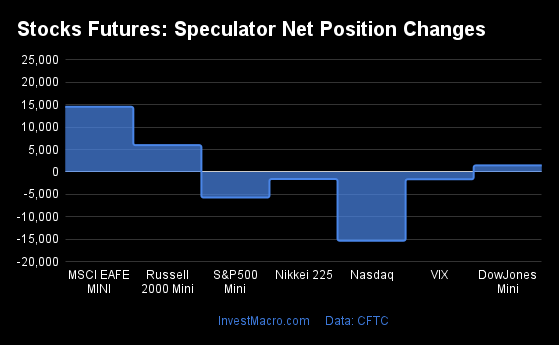
The COT stock markets speculator bets were slightly lower this week as three out of the seven stock markets we cover had higher positioning while the other four markets had lower speculator contracts.

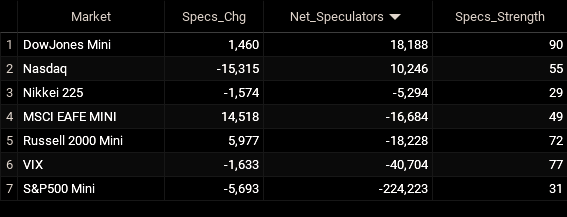
Leading the gains for the stock markets was the MSCI EAFE-Mini (14,518 contracts) with the Russell-Mini (5,977 contracts) and the DowJones-Mini (1,460 contracts) also showing positive weeks.

The markets with declines in speculator bets this week were the Nasdaq-Mini (-15,315 contracts), the S&P500-Mini (-5,693 contracts), the Nikkei 225 (-1,574 contracts) and the VIX (-1,633 contracts).


Net Speculators Leaderboard

Legend: Weekly Speculators Change | Speculators Current Net Position | Speculators Strength Score compared to last 3-Years (0-100 range)


Strength Scores led by DowJones-Mini & VIX

COT Strength Scores (a normalized measure of Speculator positions over a 3-Year range, from 0 to 100 where above 80 is Extreme-Bullish and below 20 is Extreme-Bearish) showed that the DowJones-Mini (90 percent) and the VIX (77 percent) lead the stock markets this week. The Russell-Mini (72 percent) comes in as the next highest in the weekly strength scores.

On the downside, the Nikkei 225 (29 percent) and the S&P500-Mini (31 percent) come in at the lowest strength levels currently.

Strength Statistics:
VIX (77.0 percent) vs VIX previous week (78.4 percent)
S&P500-Mini (31.3 percent) vs S&P500-Mini previous week (32.2 percent)
DowJones-Mini (89.9 percent) vs DowJones-Mini previous week (87.5 percent)
Nasdaq-Mini (55.0 percent) vs Nasdaq-Mini previous week (78.8 percent)
Russell2000-Mini (72.2 percent) vs Russell2000-Mini previous week (67.9 percent)
Nikkei USD (29.0 percent) vs Nikkei USD previous week (40.2 percent)
EAFE-Mini (49.1 percent) vs EAFE-Mini previous week (34.1 percent)


MSCI EAFE-Mini & VIX top the 6-Week Strength Trends

COT Strength Score Trends (or move index, calculates the 6-week changes in strength scores) showed that the MSCI EAFE-Mini (14 percent) leads the past six weeks trends for the stock markets. The VIX (3 percent) and the DowJones-Mini (1 percent) are the other positive movers in the latest trends data.

The Nasdaq-Mini (-41 percent) leads the downside trend scores currently with the Russell-Mini (-23 percent) coming in as the next market with lower trend scores.

Strength Trend Statistics:
VIX (2.6 percent) vs VIX previous week (4.4 percent)
S&P500-Mini (-8.2 percent) vs S&P500-Mini previous week (-15.1 percent)
DowJones-Mini (1.3 percent) vs DowJones-Mini previous week (-12.0 percent)
Nasdaq-Mini (-40.8 percent) vs Nasdaq-Mini previous week (-17.4 percent)
Russell2000-Mini (-23.0 percent) vs Russell2000-Mini previous week (-32.1 percent)
Nikkei USD (-5.8 percent) vs Nikkei USD previous week (-7.5 percent)
EAFE-Mini (13.9 percent) vs EAFE-Mini previous week (-2.1 percent)


Individual Stock Market Charts:

VIX Volatility Futures:

VIX Volatility Futures COT ChartThe VIX Volatility large speculator standing this week recorded a net position of -40,704 contracts in the data reported through Tuesday. This was a weekly fall of -1,633 contracts from the previous week which had a total of -39,071 net contracts.

This week’s current strength score (the trader positioning range over the past three years, measured from 0 to 100) shows the speculators are currently Bullish with a score of 77.0 percent. The commercials are Bearish-Extreme with a score of 19.6 percent and the small traders (not shown in chart) are Bullish-Extreme with a score of 85.1 percent.

Price Trend-Following Model: Downtrend

Our weekly trend-following model classifies the current market price position as: Downtrend. The current action for the model is considered to be: Hold – Maintain Short Position.

VIX Volatility Futures StatisticsSPECULATORSCOMMERCIALSSMALL TRADERS
– Percent of Open Interest Longs:20.644.97.4
– Percent of Open Interest Shorts:31.933.18.0
– Net Position:-40,70442,920-2,216
– Gross Longs:74,471162,35626,855
– Gross Shorts:115,175119,43629,071
– Long to Short Ratio:0.6 to 11.4 to 10.9 to 1
NET POSITION TREND:
– Strength Index Score (3 Year Range Pct):77.019.685.1
– Strength Index Reading (3 Year Range):BullishBearish-ExtremeBullish-Extreme
NET POSITION MOVEMENT INDEX:
– 6-Week Change in Strength Index:2.6-4.512.6


S&P500 Mini Futures:

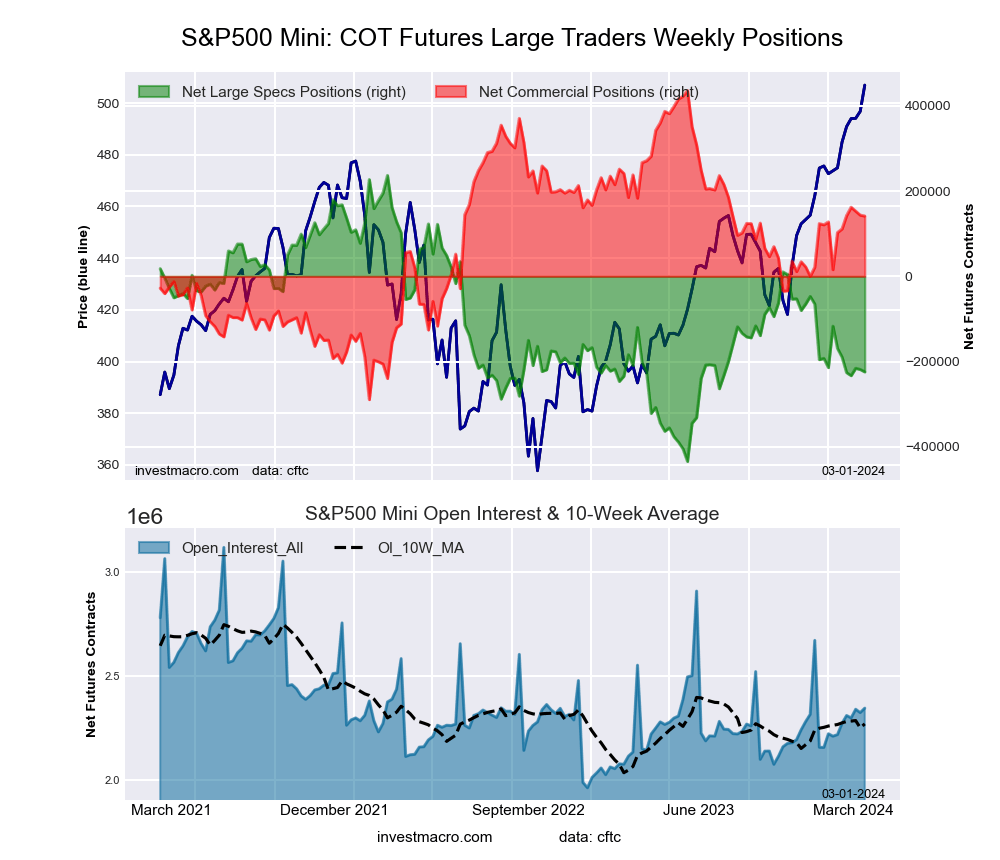
SP500 Mini Futures COT ChartThe S&P500 Mini large speculator standing this week recorded a net position of -224,223 contracts in the data reported through Tuesday. This was a weekly lowering of -5,693 contracts from the previous week which had a total of -218,530 net contracts.

This week’s current strength score (the trader positioning range over the past three years, measured from 0 to 100) shows the speculators are currently Bearish with a score of 31.3 percent. The commercials are Bullish with a score of 59.4 percent and the small traders (not shown in chart) are Bullish with a score of 70.1 percent.

Price Trend-Following Model: Strong Uptrend

Our weekly trend-following model classifies the current market price position as: Strong Uptrend. The current action for the model is considered to be: Hold – Maintain Long Position.

S&P500 Mini Futures StatisticsSPECULATORSCOMMERCIALSSMALL TRADERS
– Percent of Open Interest Longs:12.773.211.2
– Percent of Open Interest Shorts:22.367.27.7
– Net Position:-224,223141,21483,009
– Gross Longs:298,5381,716,692263,456
– Gross Shorts:522,7611,575,478180,447
– Long to Short Ratio:0.6 to 11.1 to 11.5 to 1
NET POSITION TREND:
– Strength Index Score (3 Year Range Pct):31.359.470.1
– Strength Index Reading (3 Year Range):BearishBullishBullish
NET POSITION MOVEMENT INDEX:
– 6-Week Change in Strength Index:-8.25.46.4


Dow Jones Mini Futures:

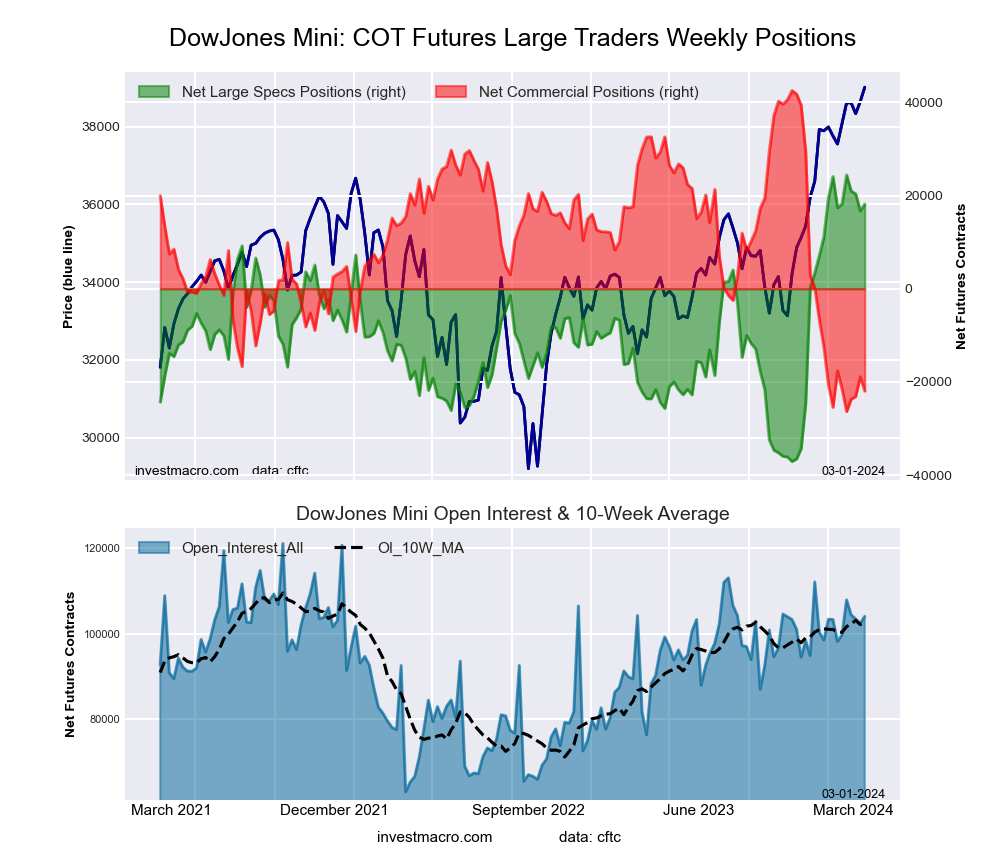
Dow Jones Mini Futures COT ChartThe Dow Jones Mini large speculator standing this week recorded a net position of 18,188 contracts in the data reported through Tuesday. This was a weekly increase of 1,460 contracts from the previous week which had a total of 16,728 net contracts.

This week’s current strength score (the trader positioning range over the past three years, measured from 0 to 100) shows the speculators are currently Bullish-Extreme with a score of 89.9 percent. The commercials are Bearish-Extreme with a score of 6.4 percent and the small traders (not shown in chart) are Bullish with a score of 62.3 percent.

Price Trend-Following Model: Uptrend

Our weekly trend-following model classifies the current market price position as: Uptrend. The current action for the model is considered to be: Hold – Maintain Long Position.

Dow Jones Mini Futures StatisticsSPECULATORSCOMMERCIALSSMALL TRADERS
– Percent of Open Interest Longs:31.551.315.3
– Percent of Open Interest Shorts:14.072.411.6
– Net Position:18,188-21,9573,769
– Gross Longs:32,77953,39915,869
– Gross Shorts:14,59175,35612,100
– Long to Short Ratio:2.2 to 10.7 to 11.3 to 1
NET POSITION TREND:
– Strength Index Score (3 Year Range Pct):89.96.462.3
– Strength Index Reading (3 Year Range):Bullish-ExtremeBearish-ExtremeBullish
NET POSITION MOVEMENT INDEX:
– 6-Week Change in Strength Index:1.3-6.317.3


Nasdaq Mini Futures:

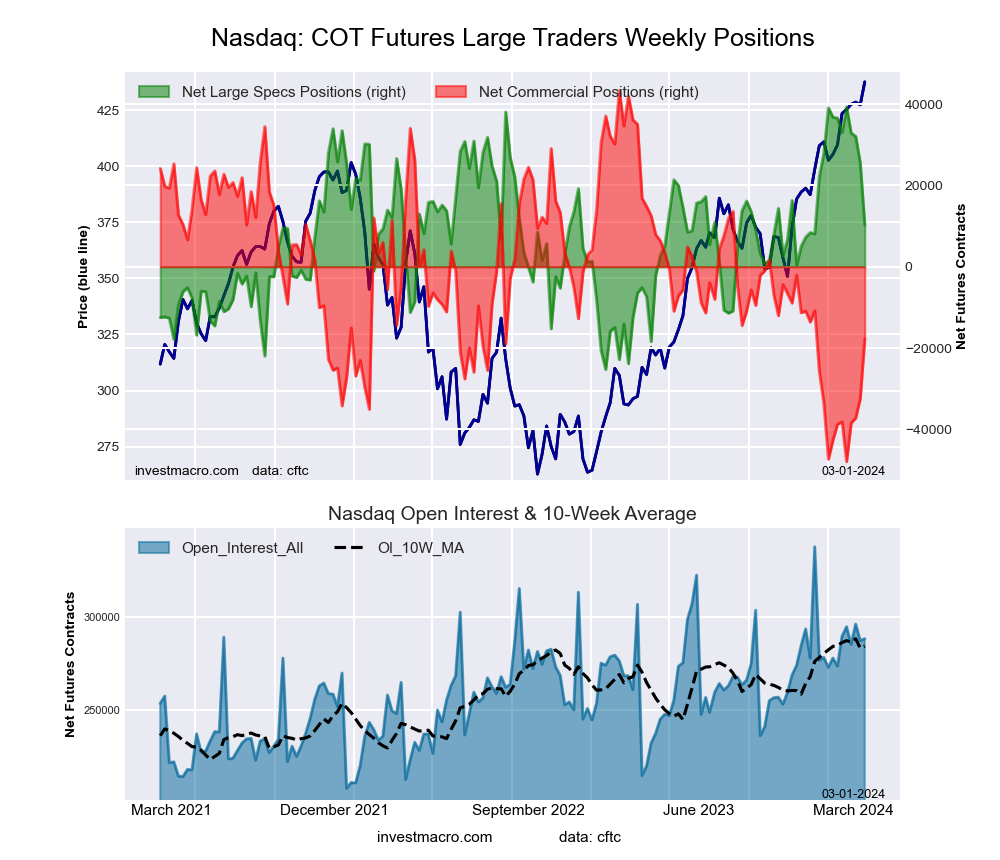
Nasdaq Mini Futures COT ChartThe Nasdaq Mini large speculator standing this week recorded a net position of 10,246 contracts in the data reported through Tuesday. This was a weekly decrease of -15,315 contracts from the previous week which had a total of 25,561 net contracts.

This week’s current strength score (the trader positioning range over the past three years, measured from 0 to 100) shows the speculators are currently Bullish with a score of 55.0 percent. The commercials are Bearish with a score of 33.1 percent and the small traders (not shown in chart) are Bullish-Extreme with a score of 96.8 percent.

Price Trend-Following Model: Strong Uptrend

Our weekly trend-following model classifies the current market price position as: Strong Uptrend. The current action for the model is considered to be: Hold – Maintain Long Position.

Nasdaq Mini Futures StatisticsSPECULATORSCOMMERCIALSSMALL TRADERS
– Percent of Open Interest Longs:31.553.213.7
– Percent of Open Interest Shorts:27.959.411.1
– Net Position:10,246-17,7027,456
– Gross Longs:90,667153,36139,468
– Gross Shorts:80,421171,06332,012
– Long to Short Ratio:1.1 to 10.9 to 11.2 to 1
NET POSITION TREND:
– Strength Index Score (3 Year Range Pct):55.033.196.8
– Strength Index Reading (3 Year Range):BullishBearishBullish-Extreme
NET POSITION MOVEMENT INDEX:
– 6-Week Change in Strength Index:-40.823.114.2


Russell 2000 Mini Futures:

Russell 2000 Mini Futures COT ChartThe Russell 2000 Mini large speculator standing this week recorded a net position of -18,228 contracts in the data reported through Tuesday. This was a weekly advance of 5,977 contracts from the previous week which had a total of -24,205 net contracts.

This week’s current strength score (the trader positioning range over the past three years, measured from 0 to 100) shows the speculators are currently Bullish with a score of 72.2 percent. The commercials are Bearish with a score of 25.6 percent and the small traders (not shown in chart) are Bullish with a score of 63.6 percent.

Price Trend-Following Model: Uptrend

Our weekly trend-following model classifies the current market price position as: Uptrend. The current action for the model is considered to be: Hold – Maintain Long Position.

Russell 2000 Mini Futures StatisticsSPECULATORSCOMMERCIALSSMALL TRADERS
– Percent of Open Interest Longs:12.580.26.1
– Percent of Open Interest Shorts:16.178.74.1
– Net Position:-18,2287,95610,272
– Gross Longs:64,457413,10431,433
– Gross Shorts:82,685405,14821,161
– Long to Short Ratio:0.8 to 11.0 to 11.5 to 1
NET POSITION TREND:
– Strength Index Score (3 Year Range Pct):72.225.663.6
– Strength Index Reading (3 Year Range):BullishBearishBullish
NET POSITION MOVEMENT INDEX:
– 6-Week Change in Strength Index:-23.020.23.5


Nikkei Stock Average (USD) Futures:

Nikkei Stock Average (USD) Futures COT ChartThe Nikkei Stock Average (USD) large speculator standing this week recorded a net position of -5,294 contracts in the data reported through Tuesday. This was a weekly lowering of -1,574 contracts from the previous week which had a total of -3,720 net contracts.

This week’s current strength score (the trader positioning range over the past three years, measured from 0 to 100) shows the speculators are currently Bearish with a score of 29.0 percent. The commercials are Bullish with a score of 55.3 percent and the small traders (not shown in chart) are Bullish with a score of 71.4 percent.

Price Trend-Following Model: Strong Uptrend

Our weekly trend-following model classifies the current market price position as: Strong Uptrend. The current action for the model is considered to be: Hold – Maintain Long Position.

Nikkei Stock Average Futures StatisticsSPECULATORSCOMMERCIALSSMALL TRADERS
– Percent of Open Interest Longs:9.165.625.2
– Percent of Open Interest Shorts:38.248.113.7
– Net Position:-5,2943,1902,104
– Gross Longs:1,66911,9744,600
– Gross Shorts:6,9638,7842,496
– Long to Short Ratio:0.2 to 11.4 to 11.8 to 1
NET POSITION TREND:
– Strength Index Score (3 Year Range Pct):29.055.371.4
– Strength Index Reading (3 Year Range):BearishBullishBullish
NET POSITION MOVEMENT INDEX:
– 6-Week Change in Strength Index:-5.8-0.815.4


MSCI EAFE Mini Futures:

MSCI EAFE Mini Futures COT ChartThe MSCI EAFE Mini large speculator standing this week recorded a net position of -16,684 contracts in the data reported through Tuesday. This was a weekly advance of 14,518 contracts from the previous week which had a total of -31,202 net contracts.

This week’s current strength score (the trader positioning range over the past three years, measured from 0 to 100) shows the speculators are currently Bearish with a score of 49.1 percent. The commercials are Bearish with a score of 49.4 percent and the small traders (not shown in chart) are Bearish with a score of 40.4 percent.

Price Trend-Following Model: Uptrend

Our weekly trend-following model classifies the current market price position as: Uptrend. The current action for the model is considered to be: Hold – Maintain Long Position.

MSCI EAFE Mini Futures StatisticsSPECULATORSCOMMERCIALSSMALL TRADERS
– Percent of Open Interest Longs:9.786.93.1
– Percent of Open Interest Shorts:13.584.12.0
– Net Position:-16,68411,9984,686
– Gross Longs:41,874375,97513,462
– Gross Shorts:58,558363,9778,776
– Long to Short Ratio:0.7 to 11.0 to 11.5 to 1
NET POSITION TREND:
– Strength Index Score (3 Year Range Pct):49.149.440.4
– Strength Index Reading (3 Year Range):BearishBearishBearish
NET POSITION MOVEMENT INDEX:
– 6-Week Change in Strength Index:13.9-13.0-3.6


Article By InvestMacroReceive our weekly COT Newsletter

*COT Report: The COT data, released weekly to the public each Friday, is updated through the most recent Tuesday (data is 3 days old) and shows a quick view of how large speculators or non-commercials (for-profit traders) were positioned in the futures markets.

The CFTC categorizes trader positions according to commercial hedgers (traders who use futures contracts for hedging as part of the business), non-commercials (large traders who speculate to realize trading profits) and nonreportable traders (usually small traders/speculators) as well as their open interest (contracts open in the market at time of reporting). See CFTC criteria here.