Archive for Metals – Page 8

Gold declines as trade optimism reduces safe-haven demand, while a weak dollar limits losses

By RoboForex Analytical Department 

On Thursday, the price of gold fell to 3,340 USD per troy ounce, partially correcting the previous day’s gains. The decline reflects growing optimism over trade agreements, which reduced demand for gold as a safe-haven asset.

Trade optimism weighs on gold, while geopolitical risks provide support

US President Donald Trump announced the conclusion of a trade agreement with Vietnam, under which the US will remove some tariffs on Vietnamese goods in exchange for greater market access for American products. This boosted hopes for new bilateral trade deals, easing global trade tensions.

However, gold’s losses were contained by the weak US dollar, which remains under pressure due to fiscal risks and expectations of further Fed easing. Additional support came from the ADP private sector employment report, which showed an unexpected decline, the first since early 2022. The disappointing data raised concerns about the stability of the labour market and strengthened expectations of interest rate cuts.

Meanwhile, Iran’s decision to end cooperation with the IAEA added a geopolitical risk factor, which traditionally supports gold prices.

Technical analysis of XAU/USD

On the H4 chart, XAU/USD completed a downward wave to 3,250 USD. A correction towards 3,385 USD is expected today. Once the rebound is complete, another decline to 3,250 USD remains likely. A break below this level would suggest a continuation of the downtrend towards the next local target at 3,180 USD. The MACD indicator confirms the bearish scenario, with its signal line above zero and pointing firmly upwards, indicating a corrective movement before a potential resumption of the decline.

On the H1 chart, the market formed a consolidation range around 3,336 USD. An upward breakout suggests the development of a fifth growth wave towards 3,385 USD. At this level, the growth potential may be exhausted, and a subsequent decline back to 3,336 USD is likely. A break below 3,336 USD would open the way for a further drop to 3,313 USD, with the prospect of continuing towards 3,250 USD. The Stochastic oscillator confirms this view, with its signal line above 50 and heading strictly towards 80, indicating short-term upward momentum before potential reversal.

Conclusion

Gold remains under pressure due to trade optimism, but weakness in the dollar and geopolitical risks continue to provide support. Technically, a correction to 3,385 USD is expected before potential further declines to 3,250 USD and 3,180 USD. The short-term outlook favours consolidation and corrective upward movements, followed by a likely continuation of the broader downward trend.


Disclaimer

Any forecasts contained herein are based on the author’s particular opinion. This analysis may not be treated as trading advice. RoboForex bears no responsibility for trading results based on trading recommendations and reviews contained herein.

Copper: The Technical Breakout Hiding in Plain Sight

Source: John Newell (7/1/25) 

John Newell of John Newell & Associates reviews the copper market and shares some copper stocks he believes are worth keeping an eye on.

For years, copper has quietly built a case for being one of the most strategically important — and structurally underappreciated —  commodities in the global economy.

Today, that case is no longer just about long-term fundamentals.

Technically, copper may be on the verge of a historic breakout, with the gold-to-copper ratio flashing one of the clearest signals in decades.

The Coming Copper Supercycle

The world is entering a period of compounding copper demand across sectors that didn’t even exist a generation ago. Clean energy infrastructure, electric vehicles, artificial intelligence, and data center expansion are all rapidly growing copper consumers. By some estimates, copper demand could double by 2035, from ~25 million tonnes to nearly 50 Mt.

This surge is colliding with mounting supply constraints. Ore grades have declined ~40% since 1991, permitting timelines now average more than 15 years, and only a handful of major discoveries have been made in the last decade. Mine development delays, social license challenges, and geopolitical instability in key regions are adding even more friction.

According to the International Energy Agency, even in its most optimistic scenario, a copper supply deficit of at least 1.6 million tonnes will persist by 2035, and under more aggressive climate targets, this deficit could exceed 10 million tonnes annually. With energy transition goals looming, this shortfall threatens to delay or derail critical electrification projects worldwide.

Meanwhile, new demand centers are emerging. Both India and Vietnam are poised to become major copper consumers, while China continues to dominate refining capacity with a 45% global share. Supply, however, remains concentrated in jurisdictions such as Chile and the Democratic Republic of Congo, increasing geopolitical and logistical risk.

The Gold-to-Copper Ratio: A Hidden Signal

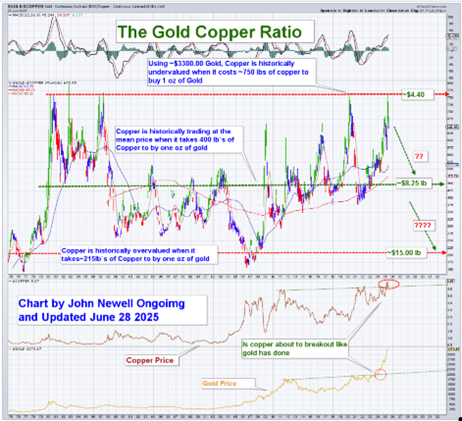
While most headlines focus on copper supply and demand, the gold-to-copper ratio may offer the most striking indicator of what’s coming next.

Historically, this ratio oscillates around a long-term mean, but today, it’s signaling copper is historically cheap relative to gold.

  • At $3,300 gold, the ratio currently implies copper is undervalued at ~$5.00 per lb historically
  • At $3,300 gold, the ratio implies copper should be trading at approximately $8.00/lb to revert to the mean
  • A return to the lower bound of historical undervaluation could imply copper over $15/lb

Technically, the ratio has reached levels not seen since the early 2000s, just before copper launched into a multi-year bull market

This isn’t just a valuation story, it’s a sentiment shift. When gold leads, copper often follows. And gold’s 2024 breakout may be the prelude to a similar move in copper.

Fractal Patterns and Price Projection

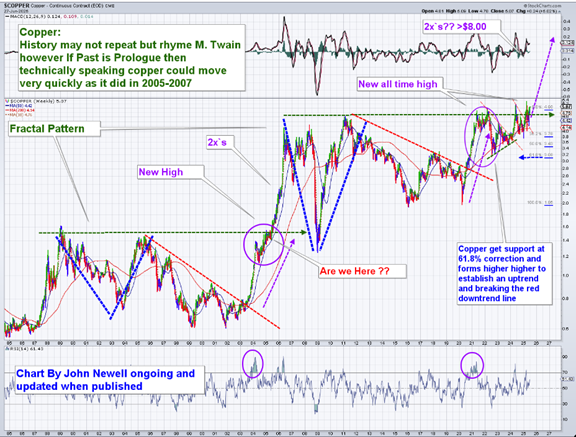
Copper’s price chart is showing a clear fractal pattern resembling its 2003–2007 breakout period. Key technical levels have already been tested and held, and copper appears to be forming a bullish base with higher lows.

The breakout above $5.00/lb could confirm a long-term trend reversal.

Using Fibonacci extensions and historical symmetry:

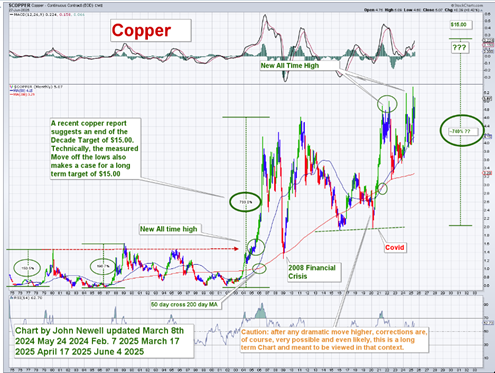
  • A 2x move from the current base projects copper to ~$8.00–$9.00/lb
  • Longer-term targets range up to $12.00–$15.00/lb, particularly if inflation and energy transition tailwinds persist

Fundamental Tailwinds Align

Beyond charts and ratios, the copper bull thesis is grounded in urgent global realities:

Electrification & Renewables: EVs use 3–4x more copper than internal combustion engines. Offshore wind, solar farms, and smart grid infrastructure require unprecedented copper input.

AI and Data Centers: AI infrastructure and high-powered computing require heavy-duty copper wiring and cooling systems. This sector alone could consume 1–2% of global copper demand by 2030.

Falling Ore Grades: As copper grades decline globally, more energy and capital are needed to produce each tonne, raising costs and limiting supply elasticity.

Lack of Discoveries: less than 20 new copper deposits have been discovered in the last decade, compared to over 200 in the prior 23 years.

Capital Intensity and Timelines: New mine development now averages 17+ years, making it nearly impossible to respond quickly to demand shocks.

Recycling Limitations: While helpful, recycling cannot offset primary demand growth in the next two decades.

Strategic Implications for Investors

For investors, the opportunity lies in positioning before the re-rate. Major mining companies are already investing in juniors, particularly in stable jurisdictions like British Columbia, Arizona, Ontario, and Australia.

As copper breaks out technically, capital will chase leverage, and junior explorers offer the highest torque to rising copper prices.

This isn’t about chasing hype. It’s about reading the signals that the market is quietly flashing:

  • Historic undervaluation versus gold
  • Fractal price patterns signaling acceleration
  • Structural supply deficits meeting exponential demand
  • Geopolitical risks realigning the global copper map

New Generation Copper Developers Are Stepping Up

Amid mounting supply pressures and accelerating global demand, a new wave of copper exploration and development companies is emerging to meet the challenge. These juniors are advancing well-positioned projects with strategic advantages, from shorter development timelines to favorable jurisdictions, that could help close the widening copper gap.

As majors increasingly turn to partnerships and acquisitions to secure future supply, these agile explorers and developers are becoming vital players in the next chapter of copper’s story.

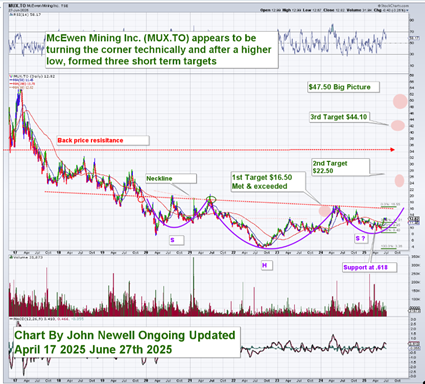
McEwen Mining Inc. (MUX:TSX; MUX:NYSE ) is advancing the massive Los Azules copper project in Argentina, one of the largest undeveloped copper projects in the world.

With over 10 billion pounds of contained copper, Los Azules represents a cornerstone asset with tremendous long-term leverage to rising copper prices.

Recent technical work and a defined development plan are moving the project toward pre-feasibility.

The company has also announced progress on infrastructure, permitting, and funding strategy, positioning itself as a potential takeover target or future producer as the copper cycle matures.

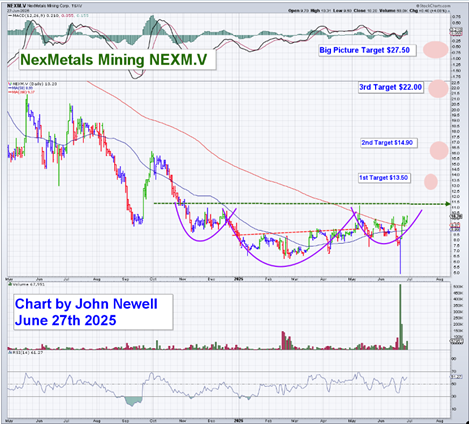
NexMetals Mining Corp. (NEXM:TSX.V) is quietly drilling into one of Botswana’s past-producing copper-nickel mines, and the story is picking up speed.

The Selkirk Mine already has a known copper-nickel-PGE footprint, and the company has completed 2,050 meters of new drilling with assays expected shortly.

A second drill rig is now turning, and NexMetals is also resampling historical holes and running metallurgical tests to define recovery parameters.

All this work is feeding into an updated mineral resource estimate, as the company positions Selkirk for a potential copper-Ni-PGE revival at a time when global supply remains tight.

It’s early days, but with the fundamentals behind copper and the right rocks in the right address, this is a name to keep an eye on.

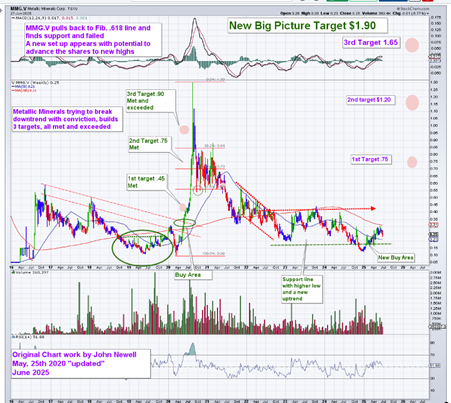
Metallic Minerals Corp. (MMG:TSX.V; MMNGF:OTCQB) is shaping up as a serious copper-silver-gold exploration story, backed by some of the smartest money in the business.

With Newmont (formerly Newcrest) holding a 9.5% stake and Eric Sprott at 12.5%, the company’s flagship La Plata Project in southwest Colorado is drawing comparisons to world-class porphyry systems like Cadia.

The 2023 resource at the Allard deposit shows 1.2 billion lbs of copper and 17.6 million oz of silver, with the next update expected to include gold and PGEs.

What stands out is the scale of the alteration system, over 25 km² with multiple untested targets, including Ridgeway-style zones that could host much higher grades.

With permits in place and Newmont technical input in the field, 2025 could be a breakout year.

Final Thoughts

Copper is no longer just a metal. It’s the backbone of electrification, data, mobility, and decarbonization. The market is beginning to wake up to this. But the technical charts suggest the real move hasn’t even started.

For investors who understand both the fundamental and technical case, copper could represent the most asymmetric opportunity of the next decade.


Important Disclosures:

  1. Metallic Minerals Corp. is a billboard sponsor of Streetwise Reports and pays SWR a monthly sponsorship fee between US$4,000 and US$5,000.
  2. John Newell: I, or members of my immediate household or family, own securities of: [None]. My company has a financial relationship with [None]My company has purchased stocks mentioned in this article for my management clients: [None]. I determined which companies would be included in this article based on my research and understanding of the sector.
  3. Statements and opinions expressed are the opinions of the author and not of Streetwise Reports, Street Smart, or their officers. The author is wholly responsible for the accuracy of the statements. Streetwise Reports was not paid by the author to publish or syndicate this article. Streetwise Reports requires contributing authors to disclose any shareholdings in, or economic relationships with, companies that they write about. Any disclosures from the author can be found  below. Streetwise Reports relies upon the authors to accurately provide this information and Streetwise Reports has no means of verifying its accuracy.
  4.  This article does not constitute investment advice and is not a solicitation for any investment. Streetwise Reports does not render general or specific investment advice and the information on Streetwise Reports should not be considered a recommendation to buy or sell any security. Each reader is encouraged to consult with his or her personal financial adviser and perform their own comprehensive investment research. By opening this page, each reader accepts and agrees to Streetwise Reports’ terms of use and full legal disclaimer. Streetwise Reports does not endorse or recommend the business, products, services or securities of any company.

For additional disclosures, please click here.

John Newell Disclaimer

As always it is important to note that investing in precious metals like silver carries risks, and market conditions can change violently with shock and awe tactics, that we have seen over the past 20 years. Before making any investment decisions, it’s advisable consult with a financial advisor if needed. Also the practice of conducting thorough research and to consider your investment goals and risk tolerance.

The Golden Bull Rests

Source: Michael Ballanger (6/30/25) 

Michael Ballanger of GGM Advisory Inc. shares his thoughts on the current state of the market and reviews a financing by one of his favorite copper stocks.

With stocks charging to record highs this week, and with the personal consumption expenditures showing a big drop-off in spending (-0.4% vs. +0.3% est.), the need for hedging one’s bets with a new allocation of gold or gold miners has disappeared. At the least, that was what the CNBC spin doctors were using as the “new narrative” for gold.

The gold miners, as represented by the HUI, are now off 8.1% from the high registered on June 5, but judging from some of the comments from the Twitterverse and YouTube podcasts, one might presume that gold had crashed.

The reality for old goats like me is that gold has been tracing out a top since the moment U.S. President Donald Trump did that “TACO” move (“Trump Aways Chickens Out”)  and decided to pause the tariffs that threatened to derail the U.S. dollar’s reserve currency status while imploding the global bond markets. Fearing an inflationary surge brought on by tariffs, investors the world over spent March and most of April piling into gold in order to protect portfolios from a fate worse than an evening with Mark Carney.

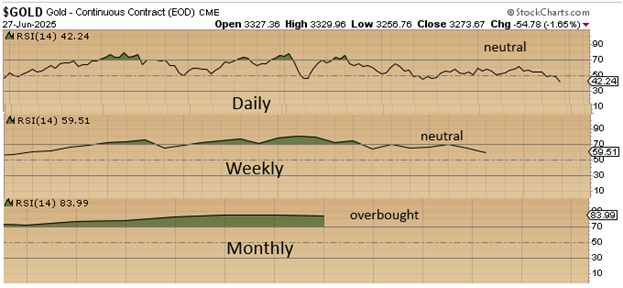
During that period, the relative strength indices for gold from three different time lines — daily, weekly, and monthly — all moved into overbought territory simultaneously, creating one of the most stretched ticker tapes in the past decade.

As one can see from the graphic pinned below, the RSI for daily and weekly readings is now back to neutral for the weekly, while the daily RSI is actually approaching oversold status. Unfortunately, the monthly RSI is still well-ensconced in the overbought domain, which caps the upside potential but does not necessarily imply that we have entered a prolonged bear market. What it does imply is that the gold market is markedly less prone to a sudden downside shock, which a move below $3,000 would certainly create.
Make no mistake; I was lulled into a false sense of security a few weeks ago when the Israelis decided to take out the Irani nuclear sites coercing me to take a shot at some GLD:US calls which promptly reversed forcing me to the sidelines with a 25% haircut and an ample mouthful of crow-filled embarrassment.

However, I came to my senses and reverted back to my bearish stance, which I had been carrying until the Israelis sent me into panic mode. As I said to subscribers this week, “If the recent skirmish between Israel and Iran and then the American bombing of Iranian nuclear facilities failed to light a fuse under gold and silver, then I have to expect that the next move is DOWN. . .”

The high of two weeks ago on the Sunday night session after the Americans sent a number of “bunker busters” into the Iranian mountains was a fleeting moment, as the market is down $180/ounce since then. From an macroeconomic viewpoint, the U.S. appears to be slowing and with that the Q1 narrative of resurging inflation and escalating debt problems being replaced with the Q2 narrative of labor market stability and corporate earnings resiliency followed by the expected Q3 narrative of accelerating growth fueled by lower interest rates and relaxed regulatory environment under the Trump administration.

I strongly resist the expected Q3 narrative because it reeks of the “this time is different” theme that is consistent with every other top since 1980. It is never “different this time” as greed is always followed by fear brought on by the market’s corrective behavior. The momentum-chasing behavior of those that were selling the U.S. to buy Europe and Japan was mirrored by the “sell treasuries and buy gold and silver” strategy that was a reaction to the Trump tariffs but once Trump observed how his actions led by his tweets and verbal impetuousness began to crater the U.S. bond market and the currency, the ensuing about-face marked the top in gold and the bottom in stocks. That event is “transitory” (to coin a phrase), and I believe that fiscal and foreign policy will find itself headlocked by the funding needs of the U.S. Treasury.

Trump will need to go “hat-in-hand” to the international community in order to facilitate the rollover of some $9 trillion in treasury bills that will be coming due in 2025 alone. Just as the bond market forced him to abandon his “America First” agenda, his softened approach has the stock junkies all clamoring behind his pro-growth shift and fleeing the safety of the gold and silver markets which is going to come to an abrupt end very shortly.

Near term, I expect a knee-jerk “flush” of the precious metals in the next two weeks that might take gold back under $3k and silver back under $30 just to scare the living feces out of all the late-comers that piled onto the gold trade in March-April. That, as always, will set up the perfect storm for a lasting bottom in gold that will hopefully be led by silver and the intermediate and junior developers.

After making a little money on the gold hedges in May and losing a little on the long side in early June, I am flat all leveraged gold trades, looking to establish a sizable long position in January calls between now and the middle of July. Stay tuned. The biggest phase of the golden bull is ahead of us, and with the good graces of Lady Luck and U.S. dollar weakness, silver will lead, and the junior explorers and developers will soar.

COT Report
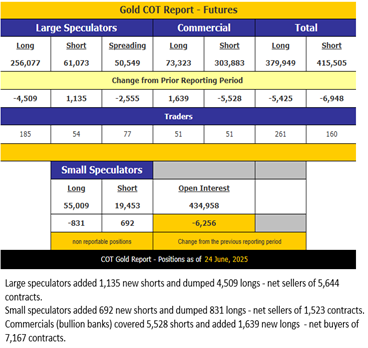
The bullion banks took advantage of the downside action for the week ended Tuesday, June 24, by covering a few of their moderately large net short position.

At 230,560 net shorts, they have reduced exposure markedly from the 325,000 level last seen in May. It is not so much the actual number but more the trend of their activity that I watch. In fact, they are almost always short the gold futures market, and the only time I ever saw them post a net long position was in early December of 2015 at the absolute bottom of the 2011-2015 bear market, around $1,045 per ounce.

I see a Commercial net short position under 200,000 contracts by mid-July, which is bullish.

Stocks
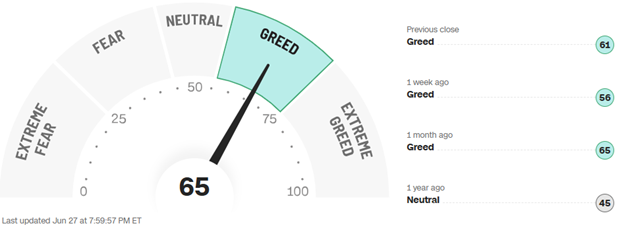
The CNN Fear-Greed Index is sitting at a moderately bearish 65, which places it in the position of <GREED> but nowhere near the extremes of last February when it was solidly in the 85-90 level and in the position of <EXTREME GREED>. Sentiment is not yet in the “LaLaLand” phase as measured by this indicator, but based upon the volume of call buying, which took out records this week, the retail investor is maniacally consumed by the current market action.

The grey-haired professional money gang are waving their fingers and muttering “Tsk-Tsk,” pointing to Warren Buffett’s $300 billion cash position as justification for being “underinvested” in this rally, which is the strongest and most violent equity market rebound in the history of global stock exchanges. In other words, the kiddies that are normally the “suckers at the poker table” are now raking in their obscene profits leaving the older more conservative crowd in their dust.

I am modestly hedged via volatility positions and one “bleeding-from-the-eye-sockets” short via the inverse QQQ ETF (SQQ:US), which I have stubbornly refused to jettison, but only because I had a similar problem last July when I was seriously submerged on a position in the UVIX:US before the early-August “Japan carry-trade” crash rescued me, taking a 30% loss to a 405 win in under two weeks. That is what I expect to transpire in the latter part of July and lasting right through to mid-October, so the $90 million question is “When do I add?” to both volatility and to the SQQQ:US in order to capture the next correction.

Stay tuned.

Copper
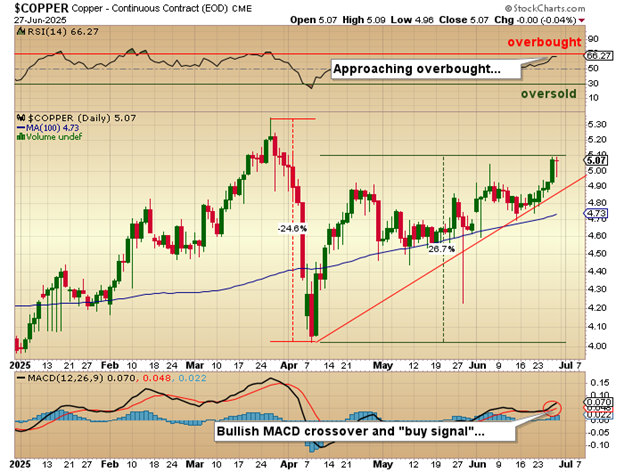
After the absurdity of the one-week crash that ended on April 7, with the “Liberation Day” lows in stocks, gold, copper, and nearly everything else that lives and breathes off the Trump tweets, copper has been on a tear to the upside, closing above $5.00/lb, for the first time since late March.

This week, the red metal reclaimed that level on the heels of a report out of the LME that has copper inventories at their lowest level in decades, with a similar condition affecting the Shanghai futures exchange. Also suffering is the mighty COMEX, where everything copper-related is being hoarded as the looming shortages appear not only on the horizon but just ahead of the grill of one’s car.

The world will soon realize that leftist and “woke” policies prohibiting the exploitation of the planet’s mineral wealth ultimately rise up to “bite you in the butt” making the construction of new copper mines prohibitively expensive with prices under US$15,000 m/t (US$6.80/lb.). Those near-sighted policies of the past decade or so have resulted in no new mine supply coming on stream so when combined with the depletion from exhausted, mined-out sources in Chile and Peru and Canada, there is a looming and very real shortage about to materialize that is going to send prices spiraling northward for the balance of the decade.

The folks over at Crux Investor have published a superb article on copper entitled: “How Copper Supply Deficits Are Reshaping the Critical Minerals Landscape,” and I urge all readers to take some time to study it at this link.

I see new highs on the immediate horizon for copper and a robust second half of 2025 for the copper developers, with particular attention to those with new discoveries. Of note this week was the $12 million LIFE financing announced by one of my absolute favorites, Fitzroy Minerals Inc. (FTZ:TSX.V; FTZFF:OTCQB) that has won the affections of a number of the institutional investors including a US$1.8 billion Asian mining fund whose lead order of $5 million was a huge testimonial to the quality of both management and their two exciting projects in Chile, Caballos and Buen Retiro. The deal is expected to close next week, oversubscribed and trading at a premium to the issue price on excellent volume.

It remains my largest holding and top pick for 2025-2026.

Next week is expected to be an uneventful one with the July 4 holiday in the U.S. falling on Friday. I suspect that most of the trading desks will be manned by juniors for most of the week since the end-of-quarter falls on a Monday.

The first two weeks of July are expected to be the strongest of the month with the remainder of the summer typically a challenge. \

We shall see. . .


Important Disclosures:

  1. As of the date of this article, officers and/or employees of Streetwise Reports LLC (including members of their household) own securities of Fitzroy Minerals Inc.
  2. Michael Ballanger: I, or members of my immediate household or family, own securities of: [All]. My company has a financial relationship with [None]. My company has purchased stocks mentioned in this article for my management clients: [None.] I determined which companies would be included in this article based on my research and understanding of the sector.
  3. Statements and opinions expressed are the opinions of the author and not of Streetwise Reports, Street Smart, or their officers. The author is wholly responsible for the accuracy of the statements. Streetwise Reports was not paid by the author to publish or syndicate this article. Streetwise Reports requires contributing authors to disclose any shareholdings in, or economic relationships with, companies that they write about. Any disclosures from the author can be found  below. Streetwise Reports relies upon the authors to accurately provide this information and Streetwise Reports has no means of verifying its accuracy.
  4.  This article does not constitute investment advice and is not a solicitation for any investment. Streetwise Reports does not render general or specific investment advice and the information on Streetwise Reports should not be considered a recommendation to buy or sell any security. Each reader is encouraged to consult with his or her personal financial adviser and perform their own comprehensive investment research. By opening this page, each reader accepts and agrees to Streetwise Reports’ terms of use and full legal disclaimer. Streetwise Reports does not endorse or recommend the business, products, services or securities of any company.

For additional disclosures, please click here.

Michael Ballanger Disclosures

This letter makes no guarantee or warranty on the accuracy or completeness of the data provided. Nothing contained herein is intended or shall be deemed to be investment advice, implied or otherwise. This letter represents my views and replicates trades that I am making but nothing more than that. Always consult your registered advisor to assist you with your investments. I accept no liability for any loss arising from the use of the data contained on this letter. Options and junior mining stocks contain a high level of risk that may result in the loss of part or all invested capital and therefore are suitable for experienced and professional investors and traders only. One should be familiar with the risks involved in junior mining and options trading and we recommend consulting a financial adviser if you feel you do not understand the risks involve

COT Metals Charts: Speculator Bets mixed, led by Copper & Platinum

By InvestMacro

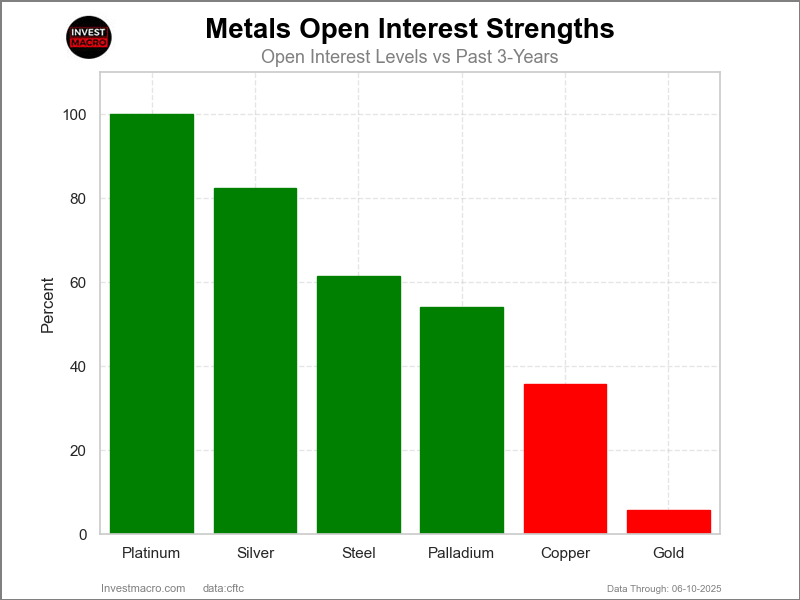
Metals Open Interest COT Chart
Here are the latest charts and statistics for the Commitment of Traders (COT) data published by the Commodities Futures Trading Commission (CFTC).

The latest COT data is updated through Tuesday June 24th and shows a quick view of how large traders (for-profit speculators and commercial entities) were positioned in the futures markets.

Weekly Speculator Changes led by Copper & Platinum

Metals Net Positions COT Chart
The COT metals markets speculator bets were mixed this week as three out of the six metals markets we cover had higher positioning while the other three markets had lower speculator contracts.

Leading the gains for the metals was Copper (5,633 contracts) with Platinum (1,985 contracts) and Palladium (740 contracts) also showing positive weeks.

The markets with declines in speculator bets for the week were Gold (-5,644 contracts), Silver (-4,227 contracts) and with Steel (-378 contracts) also registering lower bets on the week.


Metals Data:

Metals Table COT Chart
Legend: Weekly Speculators Change | Speculators Current Net Position | Speculators Strength Score compared to last 3-Years (0-100 range)


Strength Scores led by Silver & Platinum

Metals Strength Scores COT Chart
COT Strength Scores (a normalized measure of Speculator positions over a 3-Year range, from 0 to 100 where above 80 is Extreme-Bullish and below 20 is Extreme-Bearish) showed that Silver (95 percent) and Platinum (76 percent) lead the metals markets this week. Palladium (71 percent) comes in as the next highest in the weekly strength scores.

Strength Statistics:
Gold (54.3 percent) vs Gold previous week (56.4 percent)
Silver (94.7 percent) vs Silver previous week (100.0 percent)
Copper (60.6 percent) vs Copper previous week (55.4 percent)
Platinum (75.6 percent) vs Platinum previous week (70.9 percent)
Palladium (70.6 percent) vs Palladium previous week (65.1 percent)
Steel (64.7 percent) vs Palladium previous week (66.9 percent)


Palladium & Platinum top the 6-Week Strength Trends

Metals Trends COT Chart
COT Strength Score Trends (or move index, calculates the 6-week changes in strength scores) showed that Palladium (45 percent) and Platinum (38 percent) lead the past six weeks trends for metals. Silver (19 percent) is the next highest positive mover in the latest trends data.

Steel (-7 percent) leads the downside trend scores currently.

Move Statistics:
Gold (12.8 percent) vs Gold previous week (14.5 percent)
Silver (19.0 percent) vs Silver previous week (22.4 percent)
Copper (7.4 percent) vs Copper previous week (2.0 percent)
Platinum (37.6 percent) vs Platinum previous week (32.4 percent)
Palladium (44.7 percent) vs Palladium previous week (35.6 percent)
Steel (-7.1 percent) vs Steel previous week (-8.6 percent)


Individual Markets:

Gold Comex Futures:

Gold Futures COT ChartThe Gold Comex Futures large speculator standing this week equaled a net position of 195,004 contracts in the data reported through Tuesday. This was a weekly decrease of -5,644 contracts from the previous week which had a total of 200,648 net contracts.

This week’s current strength score (the trader positioning range over the past three years, measured from 0 to 100) shows the speculators are currently Bullish with a score of 54.3 percent. The commercials are Bearish with a score of 39.3 percent and the small traders (not shown in chart) are Bullish-Extreme with a score of 94.8 percent.

Price Trend-Following Model: Uptrend

Our weekly trend-following model classifies the current market price position as: Uptrend.

Gold Futures StatisticsSPECULATORSCOMMERCIALSSMALL TRADERS
– Percent of Open Interest Longs:58.916.912.6
– Percent of Open Interest Shorts:14.069.94.5
– Net Position:195,004-230,56035,556
– Gross Longs:256,07773,32355,009
– Gross Shorts:61,073303,88319,453
– Long to Short Ratio:4.2 to 10.2 to 12.8 to 1
NET POSITION TREND:
– Strength Index Score (3 Year Range Pct):54.339.394.8
– Strength Index Reading (3 Year Range):BullishBearishBullish-Extreme
NET POSITION MOVEMENT INDEX:
– 6-Week Change in Strength Index:12.8-14.219.1


Silver Comex Futures:

Silver Futures COT ChartThe Silver Comex Futures large speculator standing this week equaled a net position of 62,947 contracts in the data reported through Tuesday. This was a weekly reduction of -4,227 contracts from the previous week which had a total of 67,174 net contracts.

This week’s current strength score (the trader positioning range over the past three years, measured from 0 to 100) shows the speculators are currently Bullish-Extreme with a score of 94.7 percent. The commercials are Bearish-Extreme with a score of 3.8 percent and the small traders (not shown in chart) are Bullish with a score of 65.2 percent.

Price Trend-Following Model: Strong Uptrend

Our weekly trend-following model classifies the current market price position as: Strong Uptrend.

Silver Futures StatisticsSPECULATORSCOMMERCIALSSMALL TRADERS
– Percent of Open Interest Longs:48.423.118.8
– Percent of Open Interest Shorts:12.370.47.6
– Net Position:62,947-82,47719,530
– Gross Longs:84,49140,42232,867
– Gross Shorts:21,544122,89913,337
– Long to Short Ratio:3.9 to 10.3 to 12.5 to 1
NET POSITION TREND:
– Strength Index Score (3 Year Range Pct):94.73.865.2
– Strength Index Reading (3 Year Range):Bullish-ExtremeBearish-ExtremeBullish
NET POSITION MOVEMENT INDEX:
– 6-Week Change in Strength Index:19.0-17.95.4


Copper Grade #1 Futures:

Copper Futures COT ChartThe Copper Grade #1 Futures large speculator standing this week equaled a net position of 29,433 contracts in the data reported through Tuesday. This was a weekly boost of 5,633 contracts from the previous week which had a total of 23,800 net contracts.

This week’s current strength score (the trader positioning range over the past three years, measured from 0 to 100) shows the speculators are currently Bullish with a score of 60.6 percent. The commercials are Bearish with a score of 43.1 percent and the small traders (not shown in chart) are Bearish with a score of 31.6 percent.

Price Trend-Following Model: Strong Uptrend

Our weekly trend-following model classifies the current market price position as: Strong Uptrend.

Copper Futures StatisticsSPECULATORSCOMMERCIALSSMALL TRADERS
– Percent of Open Interest Longs:34.830.77.4
– Percent of Open Interest Shorts:20.346.36.3
– Net Position:29,433-31,7192,286
– Gross Longs:70,78162,51115,032
– Gross Shorts:41,34894,23012,746
– Long to Short Ratio:1.7 to 10.7 to 11.2 to 1
NET POSITION TREND:
– Strength Index Score (3 Year Range Pct):60.643.131.6
– Strength Index Reading (3 Year Range):BullishBearishBearish
NET POSITION MOVEMENT INDEX:
– 6-Week Change in Strength Index:7.4-6.4-3.2


Platinum Futures:

Platinum Futures COT ChartThe Platinum Futures large speculator standing this week equaled a net position of 25,212 contracts in the data reported through Tuesday. This was a weekly rise of 1,985 contracts from the previous week which had a total of 23,227 net contracts.

This week’s current strength score (the trader positioning range over the past three years, measured from 0 to 100) shows the speculators are currently Bullish with a score of 75.6 percent. The commercials are Bearish with a score of 25.4 percent and the small traders (not shown in chart) are Bullish with a score of 55.0 percent.

Price Trend-Following Model: Strong Uptrend

Our weekly trend-following model classifies the current market price position as: Strong Uptrend.

Platinum Futures StatisticsSPECULATORSCOMMERCIALSSMALL TRADERS
– Percent of Open Interest Longs:59.718.510.5
– Percent of Open Interest Shorts:34.748.45.6
– Net Position:25,212-30,1134,901
– Gross Longs:60,14318,64010,538
– Gross Shorts:34,93148,7535,637
– Long to Short Ratio:1.7 to 10.4 to 11.9 to 1
NET POSITION TREND:
– Strength Index Score (3 Year Range Pct):75.625.455.0
– Strength Index Reading (3 Year Range):BullishBearishBullish
NET POSITION MOVEMENT INDEX:
– 6-Week Change in Strength Index:37.6-37.38.6


Palladium Futures:

Palladium Futures COT ChartThe Palladium Futures large speculator standing this week equaled a net position of -4,508 contracts in the data reported through Tuesday. This was a weekly rise of 740 contracts from the previous week which had a total of -5,248 net contracts.

This week’s current strength score (the trader positioning range over the past three years, measured from 0 to 100) shows the speculators are currently Bullish with a score of 70.6 percent. The commercials are Bearish with a score of 22.9 percent and the small traders (not shown in chart) are Bullish-Extreme with a score of 83.5 percent.

Price Trend-Following Model: Strong Uptrend

Our weekly trend-following model classifies the current market price position as: Strong Uptrend.

Palladium Futures StatisticsSPECULATORSCOMMERCIALSSMALL TRADERS
– Percent of Open Interest Longs:41.739.013.8
– Percent of Open Interest Shorts:64.721.98.0
– Net Position:-4,5083,3591,149
– Gross Longs:8,1867,6612,714
– Gross Shorts:12,6944,3021,565
– Long to Short Ratio:0.6 to 11.8 to 11.7 to 1
NET POSITION TREND:
– Strength Index Score (3 Year Range Pct):70.622.983.5
– Strength Index Reading (3 Year Range):BullishBearishBullish-Extreme
NET POSITION MOVEMENT INDEX:
– 6-Week Change in Strength Index:44.7-48.115.7


Steel Futures Futures:

Steel Futures COT ChartThe Steel Futures large speculator standing this week equaled a net position of -1,074 contracts in the data reported through Tuesday. This was a weekly reduction of -378 contracts from the previous week which had a total of -696 net contracts.

This week’s current strength score (the trader positioning range over the past three years, measured from 0 to 100) shows the speculators are currently Bullish with a score of 64.7 percent. The commercials are Bearish with a score of 36.0 percent and the small traders (not shown in chart) are Bullish with a score of 54.3 percent.

Price Trend-Following Model: Weak Uptrend

Our weekly trend-following model classifies the current market price position as: Weak Uptrend.

Steel Futures StatisticsSPECULATORSCOMMERCIALSSMALL TRADERS
– Percent of Open Interest Longs:24.968.80.9
– Percent of Open Interest Shorts:28.265.90.5
– Net Position:-1,074932142
– Gross Longs:8,14322,470294
– Gross Shorts:9,21721,538152
– Long to Short Ratio:0.9 to 11.0 to 11.9 to 1
NET POSITION TREND:
– Strength Index Score (3 Year Range Pct):64.736.054.3
– Strength Index Reading (3 Year Range):BullishBearishBullish
NET POSITION MOVEMENT INDEX:
– 6-Week Change in Strength Index:-7.16.319.4


Article By InvestMacroReceive our weekly COT Newsletter

*COT Report: The COT data, released weekly to the public each Friday, is updated through the most recent Tuesday (data is 3 days old) and shows a quick view of how large speculators or non-commercials (for-profit traders) were positioned in the futures markets.

The CFTC categorizes trader positions according to commercial hedgers (traders who use futures contracts for hedging as part of the business), non-commercials (large traders who speculate to realize trading profits) and nonreportable traders (usually small traders/speculators) as well as their open interest (contracts open in the market at time of reporting). See CFTC criteria here.

Gold Prices Decline as Risk Appetite Grows, Reducing Safe-Haven Demand

By RoboForex Analytical Department 

Gold has fallen to $3,296 per troy ounce, despite a weaker US dollar, as investors remain focused on the potential easing of Federal Reserve (Fed) policy.

Market expectations suggest that Donald Trump could announce his nominee for Fed chair as early as September or October, with the likely candidate favouring a more accommodative monetary stance.

Jerome Powell, the current Fed chair, has indicated that the absence of new trade duties is helping to curb inflation, potentially paving the way for multiple rate cuts, provided no aggressive tariffs are introduced after 9 July.

Recent Statdata revisions showed the US economy contracted by 0.5% in Q1 (final estimate), reinforcing expectations of a rate cut. However, this weak performance was partially offset by a drop in jobless claims, which fell to a five-week low, alongside an 11-year high in durable goods orders.

Investors are now awaiting the release of the PCE index, the Fed’s preferred inflation gauge.

Further pressure on gold stems from easing geopolitical tensions in the Middle East, reducing demand for safe-haven assets. Over the past five trading sessions, gold has remained on track for a second consecutive weekly decline.

Technical Analysis: XAU/USD

H4 Chart:

The market remains within a broad consolidation range around $3,344. Today’s downward extension reached $3,291, with the potential for a corrective rebound to retest $3,344 (from below) before a possible decline towards $3,237. This scenario is supported by the MACD indicator, with its signal line below zero but turning upward.

H1 Chart:

A downward wave structure has formed, reaching $3,290. A corrective upward move towards $3,344 is anticipated today, maintaining the consolidation range. A breakout below this range could open further downside potential, targeting at least $3,237. The Stochastic oscillator corroborates this outlook, with its signal line below 20 and rising sharply towards 80.

Conclusion

Gold remains under pressure amid shifting Fed expectations and reduced geopolitical risks, with technical indicators suggesting further volatility ahead.


Disclaimer

Any forecasts contained herein are based on the author’s particular opinion. This analysis may not be treated as trading advice. RoboForex bears no responsibility for trading results based on trading recommendations and reviews contained herein.

Gold Set to Rally All Eyes on the Middle East

By RoboForex Analytical Department 

On Monday, gold traded at $3,360 per troy ounce as markets nervously monitor developments in the Middle East.

Washington’s involvement in the conflict has heightened fears of potential retaliation from Tehran. Particularly concerning is the potential disruption of key Middle Eastern oil supply routes. Iran, one of the world’s largest oil producers and exporters, controls the Strait of Hormuz – a critical maritime passage accounting for 20-30% of global oil shipments.

According to state media, Iran’s parliament backed a proposal on Sunday to close the strait. However, the final decision rests with the Supreme National Security Council and the country’s Supreme Leader.

By this morning, exchanges had already priced in the weekend’s volatility and are now consolidating as traders await further developments. Since the start of the year, gold prices have surged by nearly 30%.

This week, market participants are also focused on speeches by Federal Reserve officials, including Chair Jerome Powell, who will testify before Congress in a two-day hearing. Discussions are expected to cover the economic impact of Trump’s trade tariffs and the strikes on Iran.

Key macroeconomic data releases include core inflation (excluding food and energy), initial jobless claims, and PMI business activity indices. These reports could influence the Fed’s next policy moves.

Technical analysis: XAU/USD

H4 Chart:

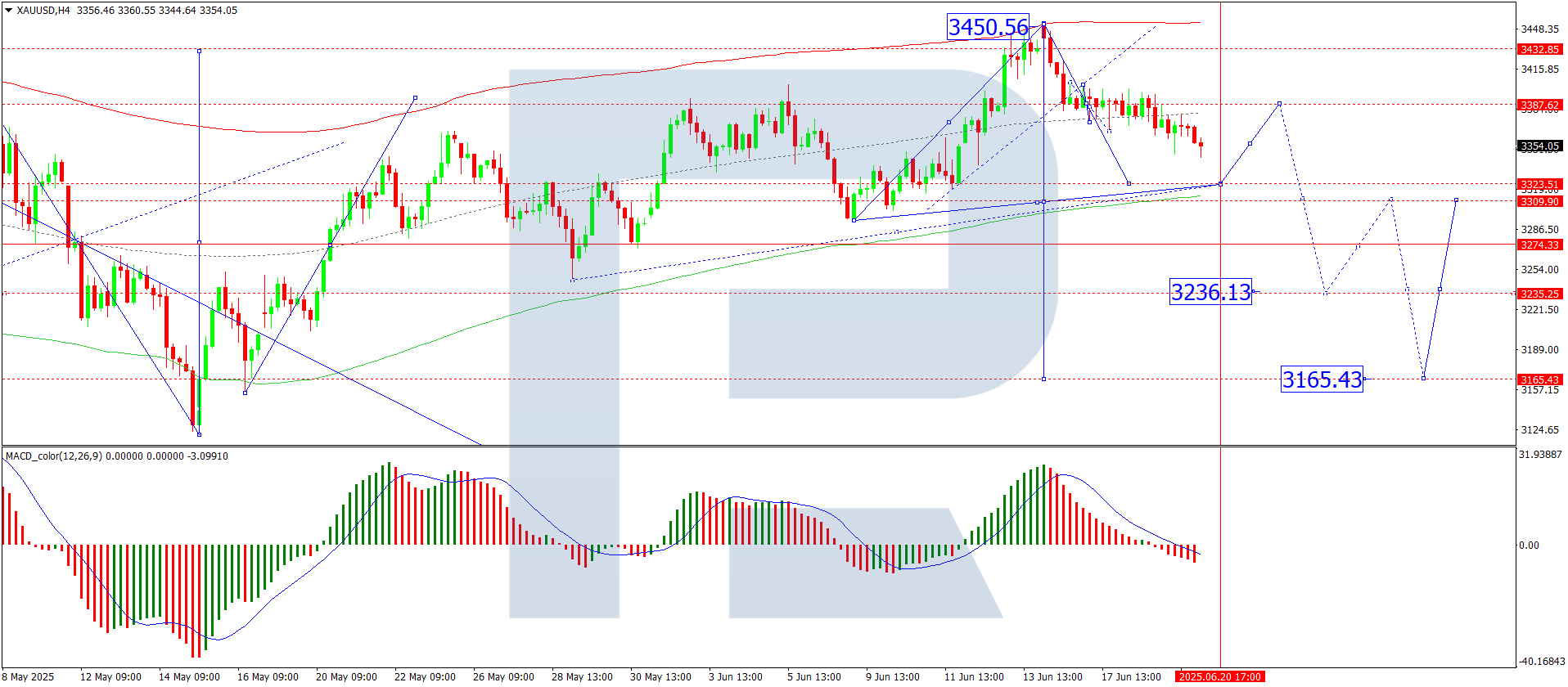
The XAU/USD pair has formed a consolidation range near 3,388 before breaking downward. Further downside is expected towards 3,323 (first target), followed by a possible corrective wave back to 3,388. This scenario is supported by the MACD indicator, where the signal line remains below zero and points sharply downward.

H1 Chart:

The market completed a corrective wave to 3,396 before reversing in an impulsive move towards 3,359. A consolidation range is now forming around this level, with expectations of a downward breakout towards 3,323 (first target). Upon reaching this level, a potential correction back to 3,388 could follow. The Stochastic oscillator supports this outlook, with its signal line below 50 and trending sharply downward towards 20.

Conclusion

Gold remains highly sensitive to geopolitical tensions in the Middle East, while technical indicators suggest further volatility ahead. Traders should monitor Fed commentary and key economic data for directional cues.


Disclaimer

Any forecasts contained herein are based on the author’s particular opinion. This analysis may not be treated as trading advice. RoboForex bears no responsibility for trading results based on trading recommendations and reviews contained herein.

Gold Falls to One-Week Low: What’s Behind the Drop?

By RoboForex Analytical Department 

The price of gold has dropped below $3,360 per troy ounce, nearing a one-week low and marking its first decline in three weeks. Investors are offloading the precious metal to offset losses in other markets amid escalating tensions in the Middle East.

Geopolitical Tensions Weigh on Gold

Israel and Iran continue to exchange strikes, with Israel intensifying attacks on strategic and government sites in Tehran following reports of an Iranian missile hitting a major Israeli hospital.

Meanwhile, investors are closely monitoring developments in Washington. US President Donald Trump has not ruled out direct military intervention in Iran, and speculation is mounting that a decision could come within the next two weeks. However, the market remains driven by rumours rather than confirmed reports.

Earlier this week, the Federal Reserve held interest rates steady but signalled two potential cuts before year-end. Fed Chair Jerome Powell cautioned, however, that trade tariffs could continue to fuel inflation.

The Fed’s latest projections indicate slower economic growth, rising inflation, and weaker employment prospects in 2025. Persistent inflation concerns may limit the scope for rate cuts, further pressuring gold, which, unlike bonds, offers no coupon income.

Technical Analysis: XAU/USD

H4 Chart:

On the H4 chart, XAU/USD formed a consolidation range around 3,388 before breaking downward. The decline is expected to extend towards 3,323, after which a corrective rebound to 3,388 may follow. This scenario is supported by the MACD indicator, with its signal line below zero and pointing firmly downward.

H1 Chart:

On the H1 chart, the market completed a corrective wave to 3,399 before reversing downward and breaking below the consolidation range. The drop below 3,360 opens the door for further downside, with a target at 3,323. Upon reaching this level, a corrective bounce toward 3,350 could follow. The Stochastic oscillator confirms this scenario, with its signal line below 50 and trending sharply down towards 20.

Conclusion

Gold remains under downward pressure from geopolitical uncertainty, expectations of Fed policy, and technical selling. The key levels to watch are 3,323 (support) and 3,388 (resistance), with potential corrections offering short-term trading opportunities.by technical indicators.


Disclaimer

Any forecasts contained herein are based on the author’s particular opinion. This analysis may not be treated as trading advice. RoboForex bears no responsibility for trading results based on trading recommendations and reviews contained herein.

Gold hits record highs as risk aversion dominates the market

By RoboForex Analytical Department 

The price of gold surged to a new record on Monday, reaching 3,446 USD per troy ounce, approaching the peaks seen in April. The rise reflects intensified demand for safe-haven assets as investors react to heightened geopolitical tensions and a broadly weaker US dollar.

Geopolitical fears and monetary policy in focus

The ongoing conflict between Israel and Iran has escalated, prompting fears of a broader geopolitical fallout in the region. This environment is driving capital into defensive assets, such as gold, as risk appetite continues to wane.

Meanwhile, markets are shifting their attention to this week’s US Federal Reserve meeting, which begins on Tuesday and concludes on Wednesday evening. While the Fed is expected to hold interest rates steady, investors will closely watch for any forward guidance on rate cuts, especially following the release of weaker-than-expected US inflation data, which has reinforced speculation of a policy easing as early as September.

Additionally, market participants are awaiting details on President Donald Trump’s next wave of tariffs, which the White House is reportedly preparing to implement in the coming weeks. These trade measures are key in evaluating the broader economic outlook.

The US dollar remains under pressure, which continues to support the bullish momentum in gold.

Technical analysis of XAU/USD

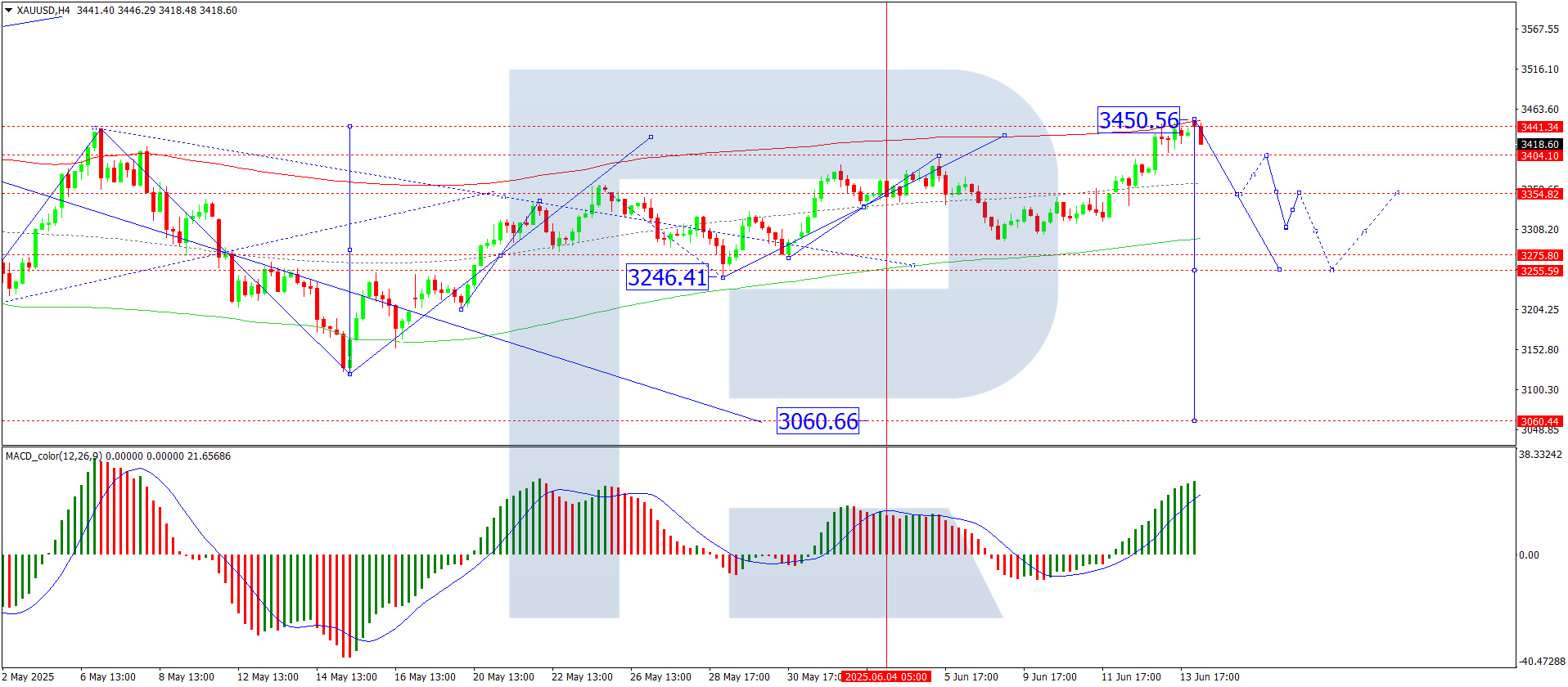
On the H4 chart, XAU/USD has completed the fifth wave of growth, reaching a peak at 3,450 USD. A new decline towards 3,400 USD is now expected. If this support is breached, the trend may extend further down to 3,350 USD. The MACD indicator supports this bearish outlook, with its signal line above zero, exiting the histogram zone and suggesting a potential reversal towards new lows.

On the H1 chart, the pair is building a downward wave structure targeting 3,400 USD. The price is currently testing the lower boundary of the consolidation range at the top of the wave. After reaching 3,400 USD, a correction towards 3,424 USD is anticipated, likely followed by the development of a new downward wave towards 3,375 USD, considered the next local target. The Stochastic oscillator supports this view, with its signal line below 50 and heading towards 20, indicating growing bearish momentum.

Conclusion

Gold remains strongly supported by geopolitical instability, a weak dollar, and dovish monetary policy expectations. While the asset is trading near record highs, technical indicators suggest a potential short-term pullback towards 3,400 USD and possibly deeper to 3,375-3,350 USD. However, the overall bullish trend remains intact as long as risk-off sentiment prevails and macro uncertainty lingers.


Disclaimer

Any forecasts contained herein are based on the author’s particular opinion. This analysis may not be treated as trading advice. RoboForex bears no responsibility for trading results based on trading recommendations and reviews contained herein.

COT Metals Charts: Bets led higher by Platinum & Silver

By InvestMacro

Metals Open Interest COT Chart
Here are the latest charts and statistics for the Commitment of Traders (COT) data published by the Commodities Futures Trading Commission (CFTC).

The latest COT data is updated through Tuesday June 10th and shows a quick view of how large traders (for-profit speculators and commercial entities) were positioned in the futures markets.

Weekly Speculator Changes led by Platinum & Silver

Metals Net Positions COT Chart
The COT metals markets speculator bets were overall higher this week as five out of the six metals markets we cover had higher positioning while one market had lower speculator contracts.

Leading the gains for the metals was Platinum (6,930 contracts) with Silver (5,880 contracts), Copper (2,257 contracts), Palladium (1,485 contracts) and also Steel (666 contracts) showing positive weeks.

The market with declines in speculator bets for the week was Gold with a small decline of -424 contracts on the week.

Metals Markets Price Changes:

In the metals market prices, platinum rose strongly with a gain of over 5%. Gold followed with an increase of more than 3.5%, and silver edged up by nearly 1%. Conversely, palladium and copper saw declines of 1% and 1.5%, respectively, while steel dropped significantly by over 6%.


Metals Data:

Metals Table COT Chart
Legend: Weekly Speculators Change | Speculators Current Net Position | Speculators Strength Score compared to last 3-Years (0-100 range)


Strength Scores led by Silver & Platinum

Metals Strength Scores COT Chart

COT Strength Scores (a normalized measure of Speculator positions over a 3-Year range, from 0 to 100 where above 80 is Extreme-Bullish and below 20 is Extreme-Bearish) showed that Silver (100 percent) and Platinum (80 percent) lead the metals markets this week. Steel (71 percent) comes in as the next highest in the weekly strength scores.

Gold (51 percent) comes in at the lowest strength level currently but is above the 3-Year midpoint of 50 percent.

Strength Statistics:
Gold (51.4 percent) vs Gold previous week (51.6 percent)
Silver (100.0 percent) vs Silver previous week (92.6 percent)
Copper (57.8 percent) vs Copper previous week (55.7 percent)
Platinum (79.8 percent) vs Platinum previous week (63.4 percent)
Palladium (60.9 percent) vs Palladium previous week (49.7 percent)
Steel (71.0 percent) vs Palladium previous week (67.7 percent)


Platinum & Palladium top the 6-Week Strength Trends

Metals Trends COT Chart

COT Strength Score Trends (or move index, calculates the 6-week changes in strength scores) showed that Platinum (40 percent) and Palladium (38 percent) lead the past six weeks trends for metals. Silver (21 percent), Gold (9 percent) and Copper (7 percent) are the next highest positive movers in the latest trends data.

Steel (-7 percent) leads the downside trend scores currently.

Move Statistics:
Gold (9.2 percent) vs Gold previous week (4.8 percent)
Silver (21.0 percent) vs Silver previous week (20.2 percent)
Copper (6.5 percent) vs Copper previous week (-0.6 percent)
Platinum (40.2 percent) vs Platinum previous week (34.0 percent)
Palladium (38.4 percent) vs Palladium previous week (26.7 percent)
Steel (-7.5 percent) vs Steel previous week (-12.9 percent)


Individual Markets:

Gold Comex Futures:

Gold Futures COT ChartThe Gold Comex Futures large speculator standing this week resulted in a net position of 187,481 contracts in the data reported through Tuesday. This was a weekly lowering of -424 contracts from the previous week which had a total of 187,905 net contracts.

This week’s current strength score (the trader positioning range over the past three years, measured from 0 to 100) shows the speculators are currently Bullish with a score of 51.4 percent. The commercials are Bearish with a score of 42.1 percent and the small traders (not shown in chart) are Bullish-Extreme with a score of 100.0 percent.

Price Trend-Following Model: Strong Uptrend

Our weekly trend-following model classifies the current market price position as: Strong Uptrend.

Gold Futures StatisticsSPECULATORSCOMMERCIALSSMALL TRADERS
– Percent of Open Interest Longs:59.016.412.9
– Percent of Open Interest Shorts:14.069.84.5
– Net Position:187,481-222,71835,237
– Gross Longs:245,99568,43254,008
– Gross Shorts:58,514291,15018,771
– Long to Short Ratio:4.2 to 10.2 to 12.9 to 1
NET POSITION TREND:
– Strength Index Score (3 Year Range Pct):51.442.1100.0
– Strength Index Reading (3 Year Range):BullishBearishBullish-Extreme
NET POSITION MOVEMENT INDEX:
– 6-Week Change in Strength Index:9.2-11.528.7


Silver Comex Futures:

Silver Futures COT ChartThe Silver Comex Futures large speculator standing this week resulted in a net position of 66,650 contracts in the data reported through Tuesday. This was a weekly lift of 5,880 contracts from the previous week which had a total of 60,770 net contracts.

This week’s current strength score (the trader positioning range over the past three years, measured from 0 to 100) shows the speculators are currently Bullish-Extreme with a score of 100.0 percent. The commercials are Bearish-Extreme with a score of 0.0 percent and the small traders (not shown in chart) are Bullish with a score of 62.7 percent.

Price Trend-Following Model: Strong Uptrend

Our weekly trend-following model classifies the current market price position as: Strong Uptrend.

Silver Futures StatisticsSPECULATORSCOMMERCIALSSMALL TRADERS
– Percent of Open Interest Longs:48.920.019.1
– Percent of Open Interest Shorts:10.669.28.2
– Net Position:66,650-85,66119,011
– Gross Longs:85,19234,87133,366
– Gross Shorts:18,542120,53214,355
– Long to Short Ratio:4.6 to 10.3 to 12.3 to 1
NET POSITION TREND:
– Strength Index Score (3 Year Range Pct):100.00.062.7
– Strength Index Reading (3 Year Range):Bullish-ExtremeBearish-ExtremeBullish
NET POSITION MOVEMENT INDEX:
– 6-Week Change in Strength Index:21.0-18.1-1.5


Copper Grade #1 Futures:

Copper Futures COT ChartThe Copper Grade #1 Futures large speculator standing this week resulted in a net position of 26,351 contracts in the data reported through Tuesday. This was a weekly gain of 2,257 contracts from the previous week which had a total of 24,094 net contracts.

This week’s current strength score (the trader positioning range over the past three years, measured from 0 to 100) shows the speculators are currently Bullish with a score of 57.8 percent. The commercials are Bearish with a score of 44.3 percent and the small traders (not shown in chart) are Bearish with a score of 41.5 percent.

Price Trend-Following Model: Uptrend

Our weekly trend-following model classifies the current market price position as: Uptrend.

Copper Futures StatisticsSPECULATORSCOMMERCIALSSMALL TRADERS
– Percent of Open Interest Longs:34.829.88.0
– Percent of Open Interest Shorts:22.144.46.1
– Net Position:26,351-30,2843,933
– Gross Longs:72,10161,69116,679
– Gross Shorts:45,75091,97512,746
– Long to Short Ratio:1.6 to 10.7 to 11.3 to 1
NET POSITION TREND:
– Strength Index Score (3 Year Range Pct):57.844.341.5
– Strength Index Reading (3 Year Range):BullishBearishBearish
NET POSITION MOVEMENT INDEX:
– 6-Week Change in Strength Index:6.5-8.819.6


Platinum Futures:

Platinum Futures COT ChartThe Platinum Futures large speculator standing this week resulted in a net position of 26,979 contracts in the data reported through Tuesday. This was a weekly gain of 6,930 contracts from the previous week which had a total of 20,049 net contracts.

This week’s current strength score (the trader positioning range over the past three years, measured from 0 to 100) shows the speculators are currently Bullish with a score of 79.8 percent. The commercials are Bearish with a score of 21.5 percent and the small traders (not shown in chart) are Bullish with a score of 55.1 percent.

Price Trend-Following Model: Strong Uptrend

Our weekly trend-following model classifies the current market price position as: Strong Uptrend.

Platinum Futures StatisticsSPECULATORSCOMMERCIALSSMALL TRADERS
– Percent of Open Interest Longs:62.916.211.3
– Percent of Open Interest Shorts:35.848.26.4
– Net Position:26,979-31,8814,902
– Gross Longs:62,72816,16911,302
– Gross Shorts:35,74948,0506,400
– Long to Short Ratio:1.8 to 10.3 to 11.8 to 1
NET POSITION TREND:
– Strength Index Score (3 Year Range Pct):79.821.555.1
– Strength Index Reading (3 Year Range):BullishBearishBullish
NET POSITION MOVEMENT INDEX:
– 6-Week Change in Strength Index:40.2-38.20.5


Palladium Futures:

Palladium Futures COT ChartThe Palladium Futures large speculator standing this week resulted in a net position of -5,808 contracts in the data reported through Tuesday. This was a weekly boost of 1,485 contracts from the previous week which had a total of -7,293 net contracts.

This week’s current strength score (the trader positioning range over the past three years, measured from 0 to 100) shows the speculators are currently Bullish with a score of 60.9 percent. The commercials are Bearish with a score of 32.1 percent and the small traders (not shown in chart) are Bullish-Extreme with a score of 87.5 percent.

Price Trend-Following Model: Strong Uptrend

Our weekly trend-following model classifies the current market price position as: Strong Uptrend.

Palladium Futures StatisticsSPECULATORSCOMMERCIALSSMALL TRADERS
– Percent of Open Interest Longs:41.939.513.7
– Percent of Open Interest Shorts:71.916.07.3
– Net Position:-5,8084,5701,238
– Gross Longs:8,1247,6612,653
– Gross Shorts:13,9323,0911,415
– Long to Short Ratio:0.6 to 12.5 to 11.9 to 1
NET POSITION TREND:
– Strength Index Score (3 Year Range Pct):60.932.187.5
– Strength Index Reading (3 Year Range):BullishBearishBullish-Extreme
NET POSITION MOVEMENT INDEX:
– 6-Week Change in Strength Index:38.4-41.514.5


Steel Futures Futures:

Steel Futures COT ChartThe Steel Futures large speculator standing this week resulted in a net position of -878 contracts in the data reported through Tuesday. This was a weekly increase of 666 contracts from the previous week which had a total of -1,544 net contracts.

This week’s current strength score (the trader positioning range over the past three years, measured from 0 to 100) shows the speculators are currently Bullish with a score of 71.0 percent. The commercials are Bearish with a score of 29.5 percent and the small traders (not shown in chart) are Bullish with a score of 57.9 percent.

Price Trend-Following Model: Weak Uptrend

Our weekly trend-following model classifies the current market price position as: Weak Uptrend.

Steel Futures StatisticsSPECULATORSCOMMERCIALSSMALL TRADERS
– Percent of Open Interest Longs:25.369.60.9
– Percent of Open Interest Shorts:28.067.40.4
– Net Position:-878707171
– Gross Longs:8,13522,383298
– Gross Shorts:9,01321,676127
– Long to Short Ratio:0.9 to 11.0 to 12.3 to 1
NET POSITION TREND:
– Strength Index Score (3 Year Range Pct):71.029.557.9
– Strength Index Reading (3 Year Range):BullishBearishBullish
NET POSITION MOVEMENT INDEX:
– 6-Week Change in Strength Index:-7.56.427.2


Article By InvestMacroReceive our weekly COT Newsletter

*COT Report: The COT data, released weekly to the public each Friday, is updated through the most recent Tuesday (data is 3 days old) and shows a quick view of how large speculators or non-commercials (for-profit traders) were positioned in the futures markets.

The CFTC categorizes trader positions according to commercial hedgers (traders who use futures contracts for hedging as part of the business), non-commercials (large traders who speculate to realize trading profits) and nonreportable traders (usually small traders/speculators) as well as their open interest (contracts open in the market at time of reporting). See CFTC criteria here.

Platinum, Palladium, Silver Making Big Turns Versus Gold

Source: Barry Dawes (6/13/25) 

Barry Dawes of Martin Place Securities shares his thoughts on the precious metal markets and their stocks and has a warning.

  • Gold seems to be peaking for now
  • 96% bullishness is a warning sign
  • Other commodities ready to move higher
  • CRB Index moving higher again
  • White precious metals heading higher: silver, platinum, palladium

Watch nickel very closely. Copper is set to move higher

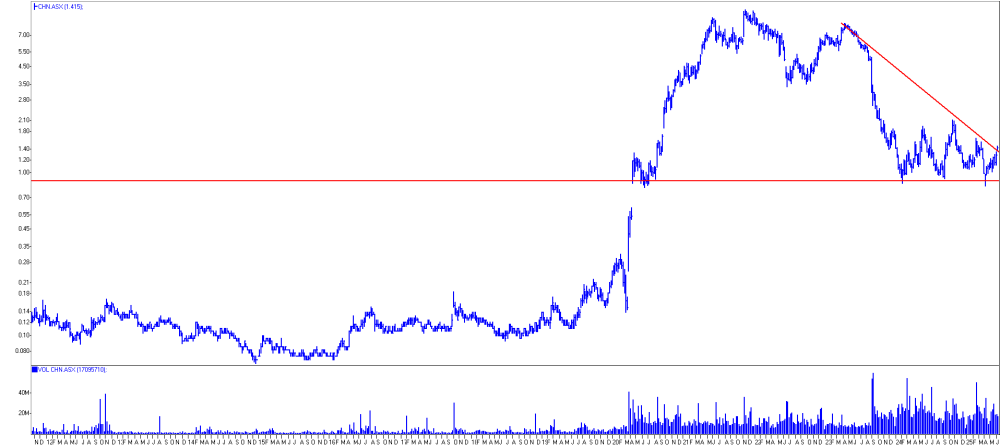
Best plays for PGMs: CHN, ZIM

For Silver: LGM

For Nickel: CHN, WMG

GOLD

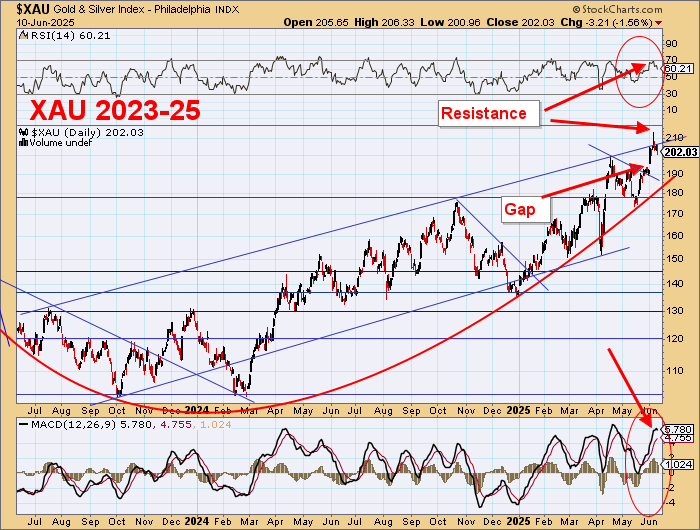
This still might be resolved to the upside but it is making heavy weather of it this week.

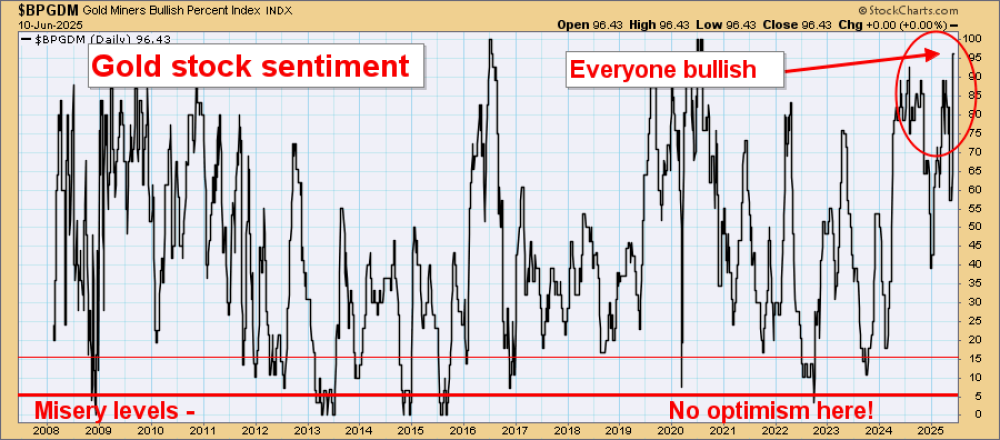
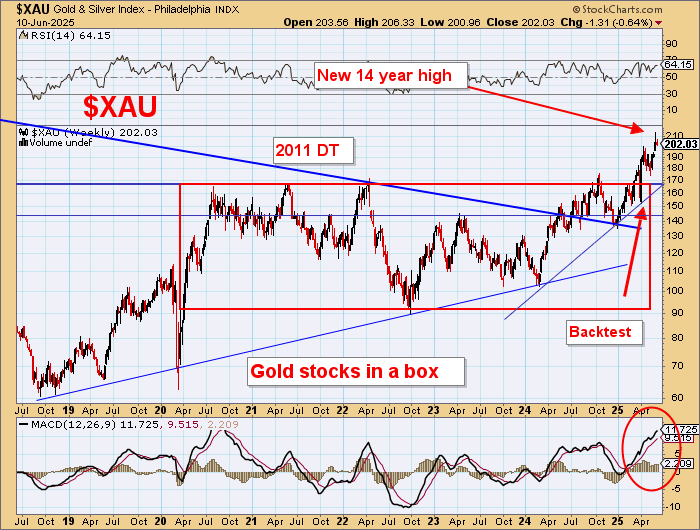
Bullishness for Nth American gold stocks is 96% and neither Newmont nor Barrick look strong.

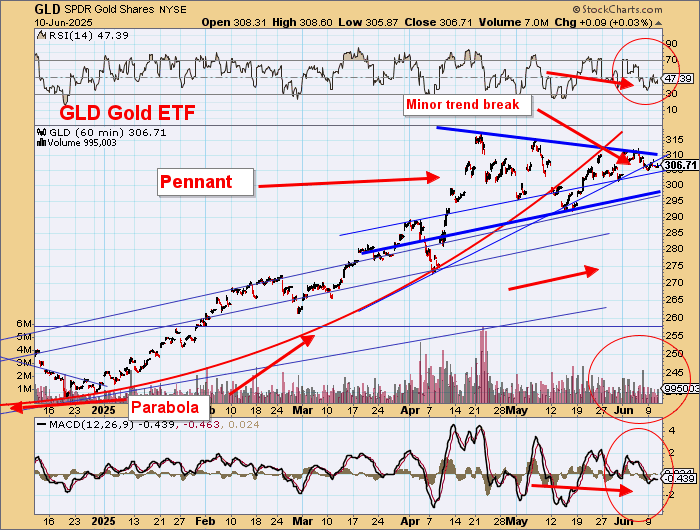
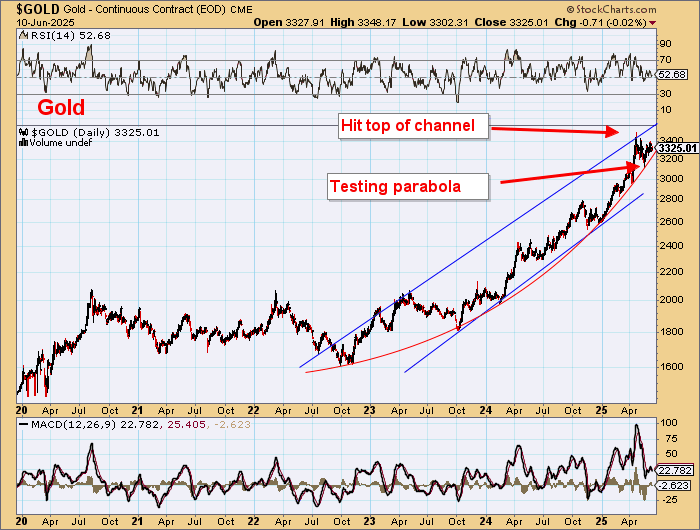
Short term uptrend broken

Close to testing longer term parabola

GOLD STOCKS

No follow through after new high spike.

Everyone is bullish!

No one left to buy.

No follow through after new high spike

Needs a correction after a big 6 month move higher

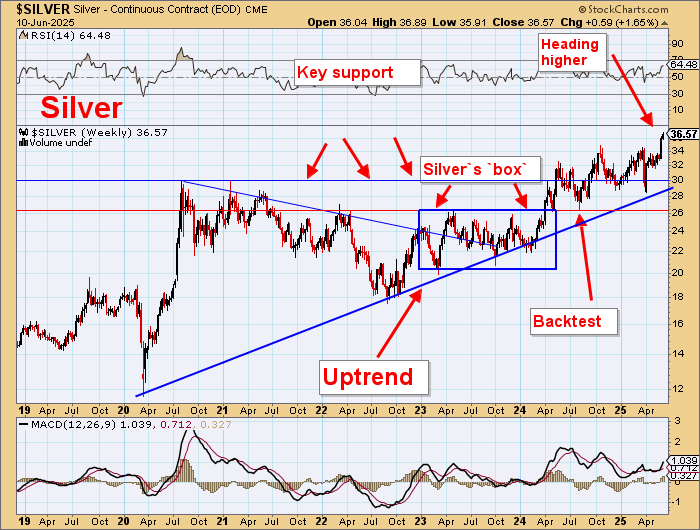
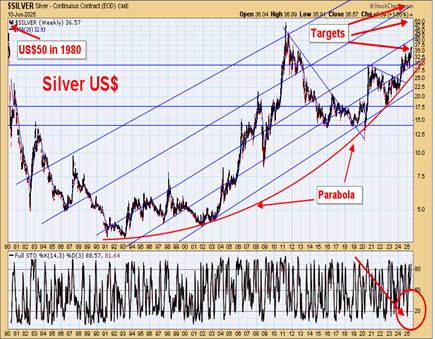
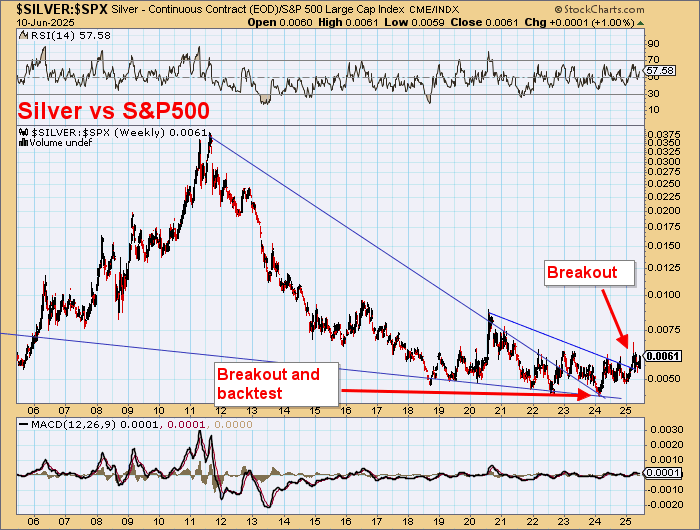
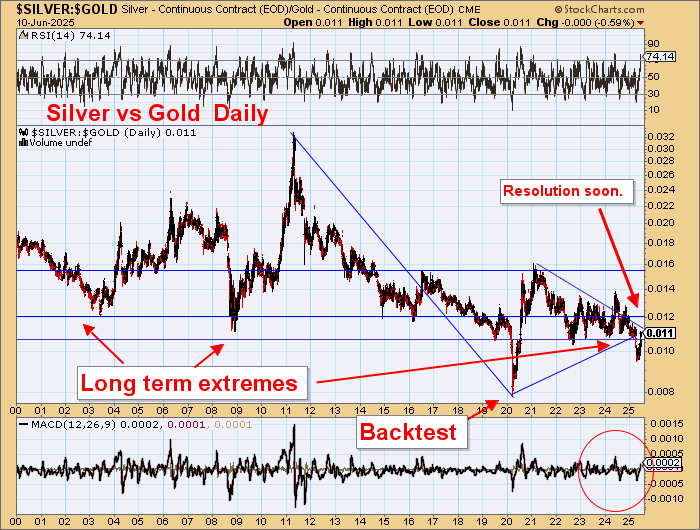
SILVER

Hot money from gold has headed here to silver.

That 100:1 gold:silver ratio was too high.  Silver at just 1% of the gold price.

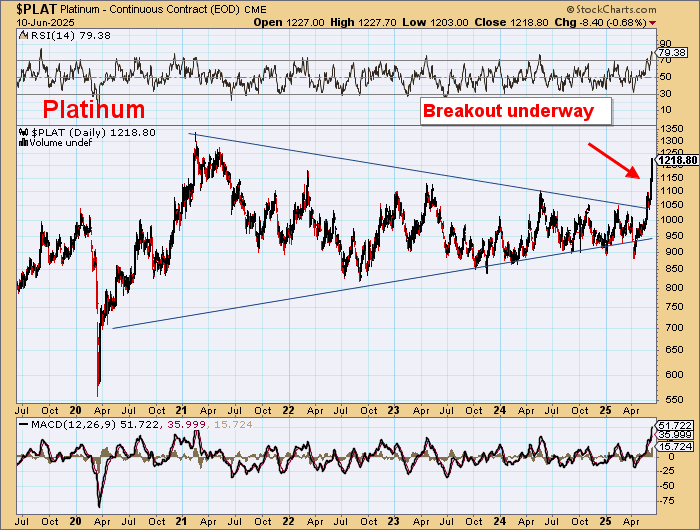
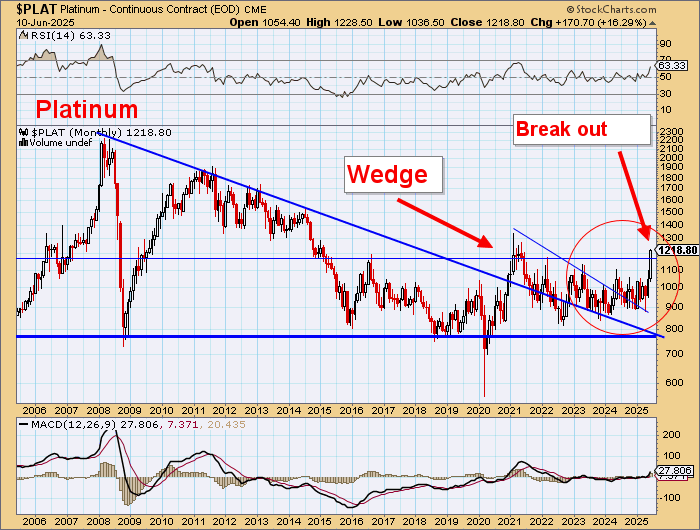
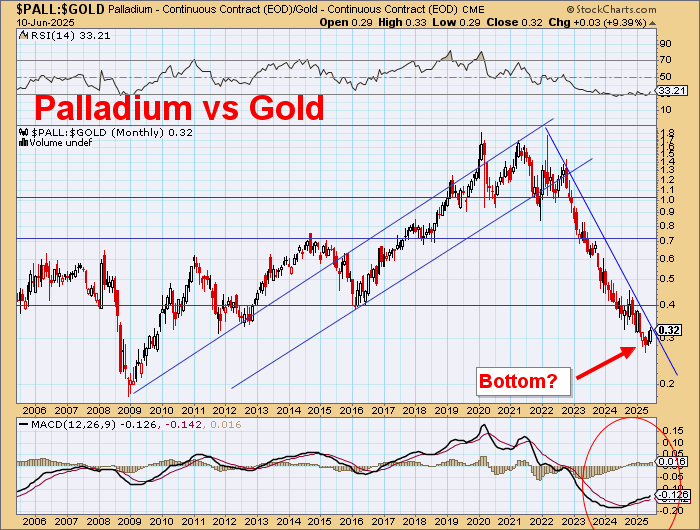
PLATINUM

EVs batteries and ICE catalysts are still fighting it out but Platinum is running a multiyear deficit and prices will have to rise further.

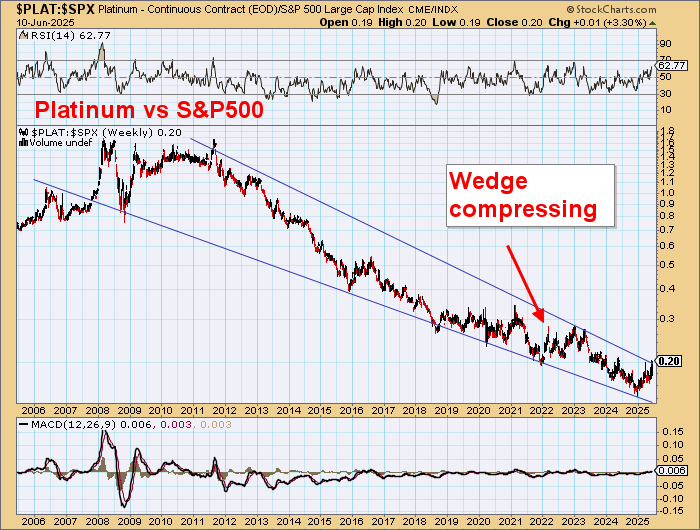
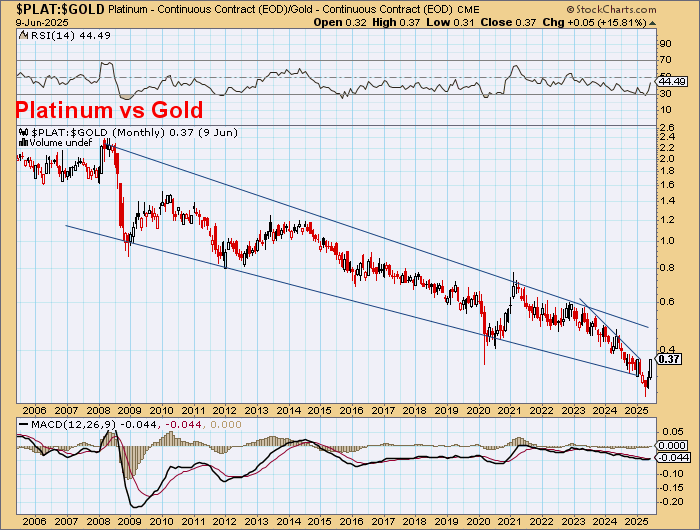
Platinum was grossly oversold vs gold.

A big catch up to come.

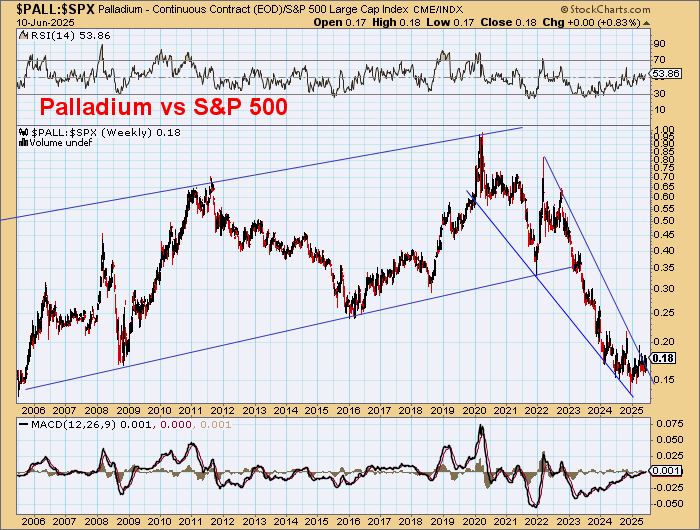
PALLADIUM

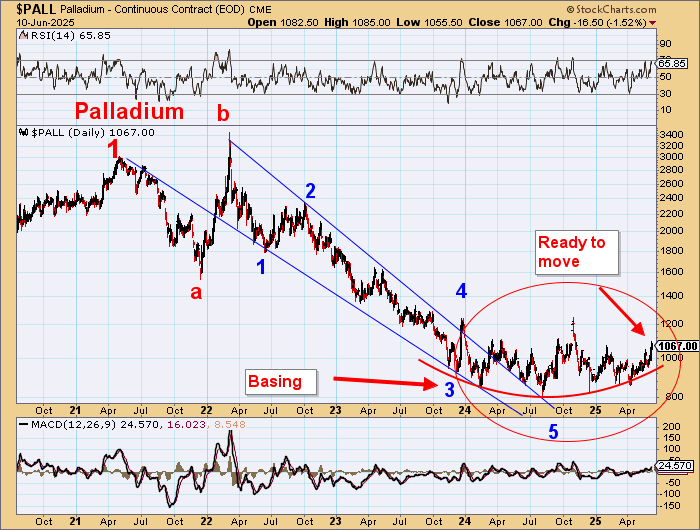
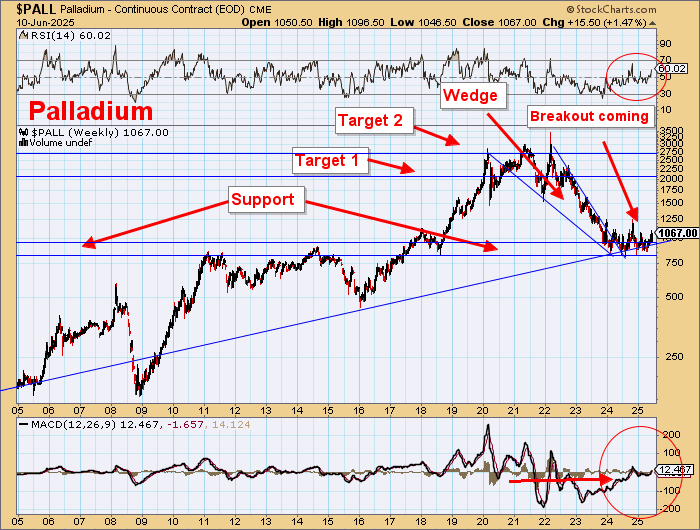
Palladium is also running a multiyear deficit so current prices are quite unsustainable.

Palladium had that `irregular ‘ B wave new high before declining in 5 waves down to complet Wave 2.

Wave 3 to new highs should follow.

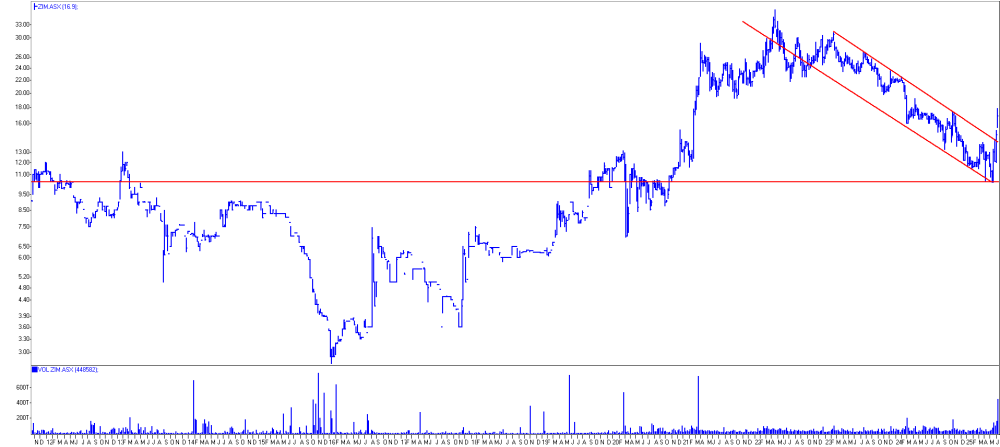
Zimplats (ZIM.ASX) is a strong turnaround as PGM prices turn up.

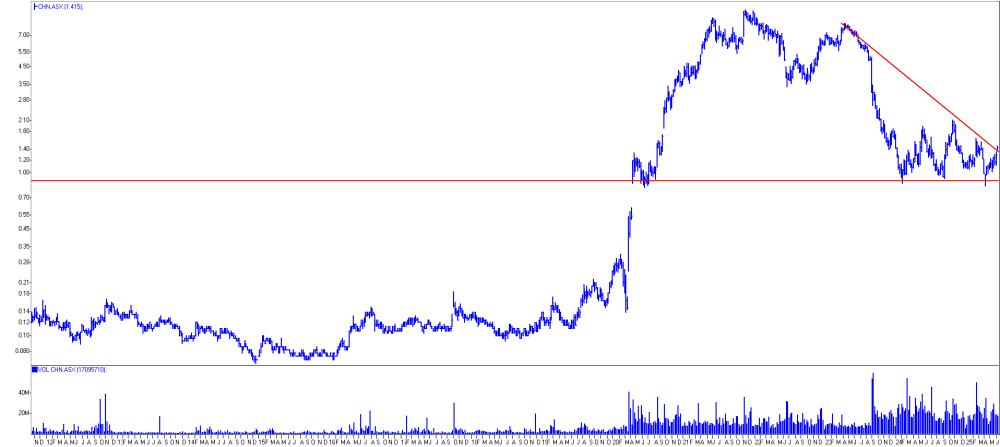
Chalice (CHN.ASX) will be the principal beneficiary of rising palladium prices.

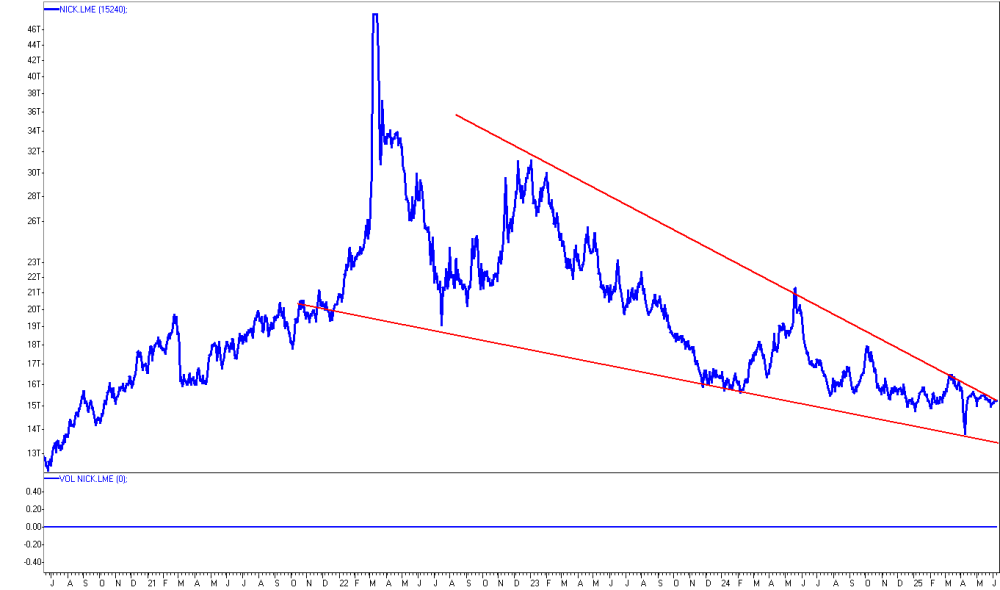
Watch also for nickel prices.

NICKEL

Indonesian nickel production from saprolite/laterite sources has also is share of unprofitable operations at current nickel prices so closures are likely.

It seems Indonesia has the ESG bug at present so environmental regulations on tailings and on new mining areas are likely to interrupt growth plans.

So much of Western nickel sulphide mine production has closed so if demand keeps rising for stainless steel (~67% of nickel usage) the that surplus in 2025 should turn to deficit in 2026.

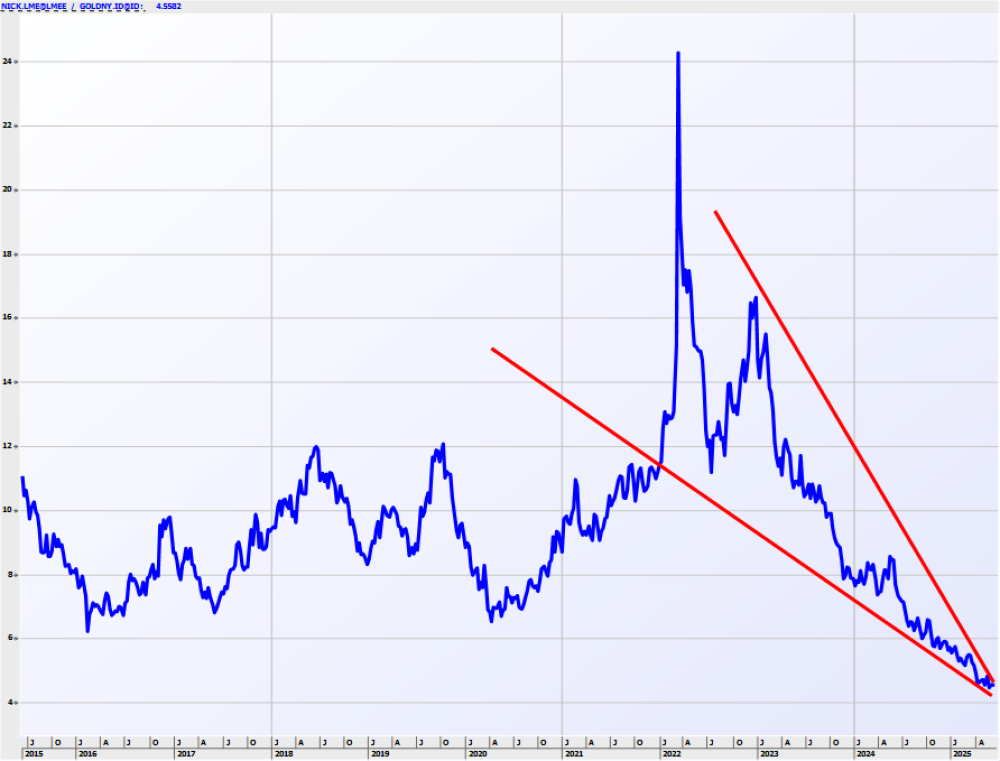
A break of this downtrend seems imminent.

Something has to happen here.

Nickel vs gold.

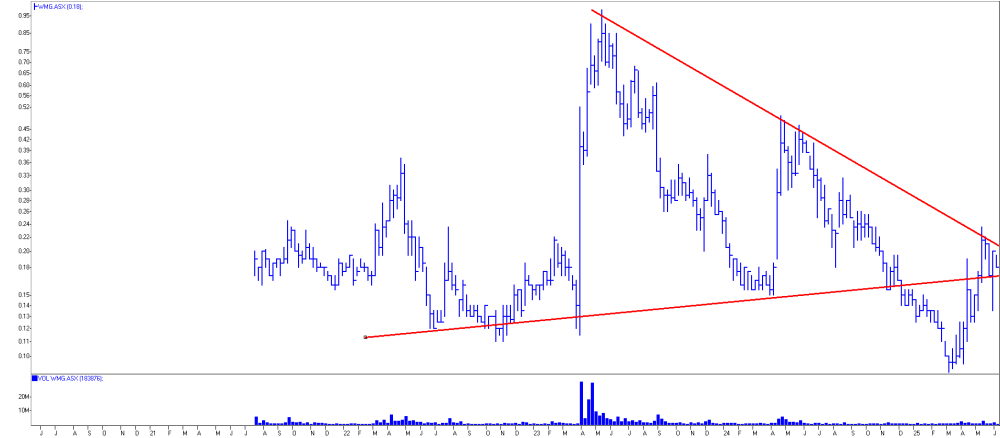
WMG

A higher nickel price will help CHN but also WMG.

CHN’s new metallurgical flowsheet is showing 50 -56% recovery for its 0.24-0.27% Ni ores in Years 1-4 and 30-45% for 0.15-0.17% Ni in later years.

Mulga Tank will be a far cleaner nickel-only ore feed at 0.27% ( and probably much higher in early years starter pits) so perhaps met work might be able to achieve >50% nickel recovery which would have a  major benefit to project profitability.

WMG also has an active drilling program ahead in the September quarter.

WMG 2021-2025 weekly


Important Disclosures:

  1. Barry Dawes: I, or members of my immediate household or family, own securities of: All of the stocks listed in this article, including Zimplats, Chalice Mining, and Western Mines Group. I determined which companies would be included in this article based on my research and understanding of the sector.
  2. Statements and opinions expressed are the opinions of the author and not of Streetwise Reports, Street Smart, or their officers. The author is wholly responsible for the accuracy of the statements. Streetwise Reports was not paid by the author to publish or syndicate this article. Streetwise Reports requires contributing authors to disclose any shareholdings in, or economic relationships with, companies that they write about. Any disclosures from the author can be found  below. Streetwise Reports relies upon the authors to accurately provide this information and Streetwise Reports has no means of verifying its accuracy.
  3.  This article does not constitute investment advice and is not a solicitation for any investment. Streetwise Reports does not render general or specific investment advice and the information on Streetwise Reports should not be considered a recommendation to buy or sell any security. Each reader is encouraged to consult with his or her personal financial adviser and perform their own comprehensive investment research. By opening this page, each reader accepts and agrees to Streetwise Reports’ terms of use and full legal disclaimer. Streetwise Reports does not endorse or recommend the business, products, services or securities of any company.

`For additional disclosures, please click here.