Archive for Metals – Page 33

That Major Revaluation of Gold Is Coming

Source: Barry Dawes  (1/12/23)

Barry Dawes of Martin Place Securities takes a look at multiple charts in the resource sector to tell you where he believes it is headed.

Key Points

Gold

  • Gold trades above US$1880.
  • Not long now before US$1900.
  • Gold in Euros, Yen, and Pounds looking to move up sharply
  • Could we see new all-time highs above US$2100 VERY early in 2023?
  • Gold has started Wave 3

Gold Stocks

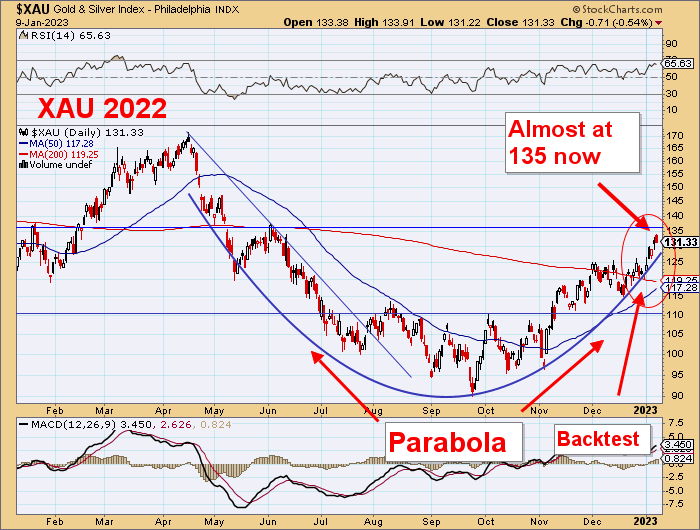
  • XAU over 132
  • 135 very soon
  • 165, not far away.
  • ASX gold stocks breaking out

Copper

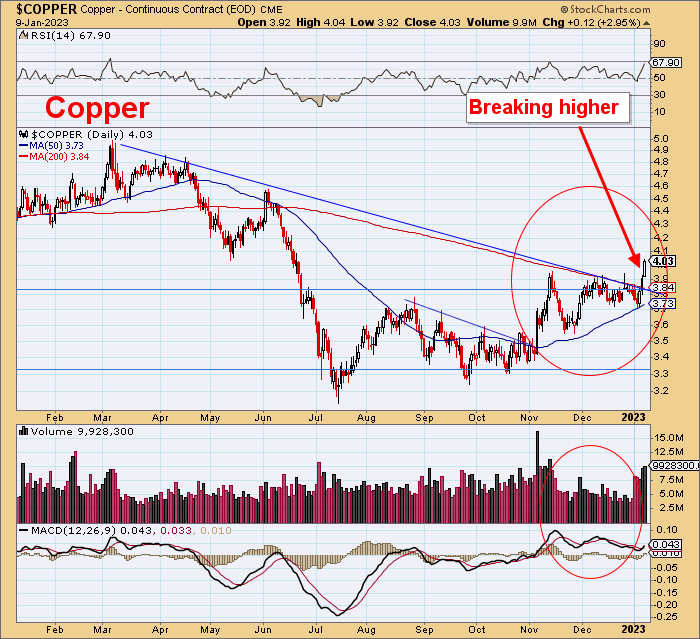
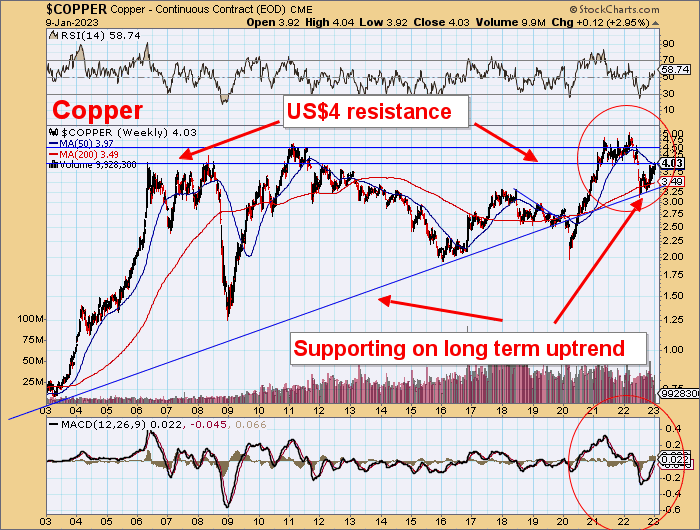
  • Breaking out above US$4/lb
  • Exceeding that LT resistance at US$4/lb
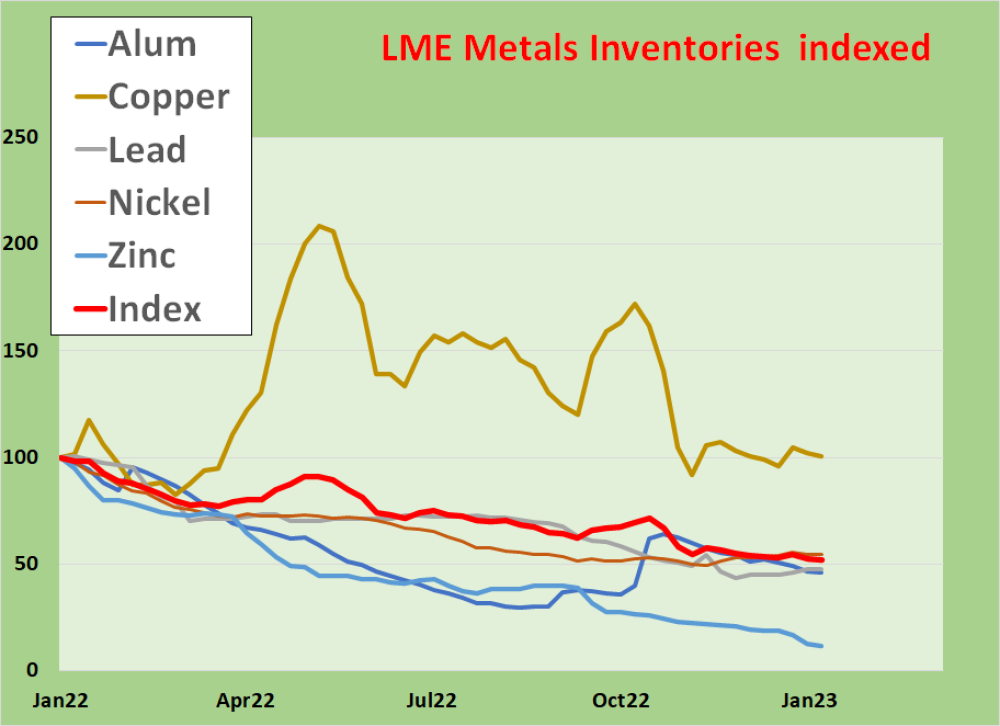
  • NO INVENTORY!
    • Copper back to 2022 inventory level lows
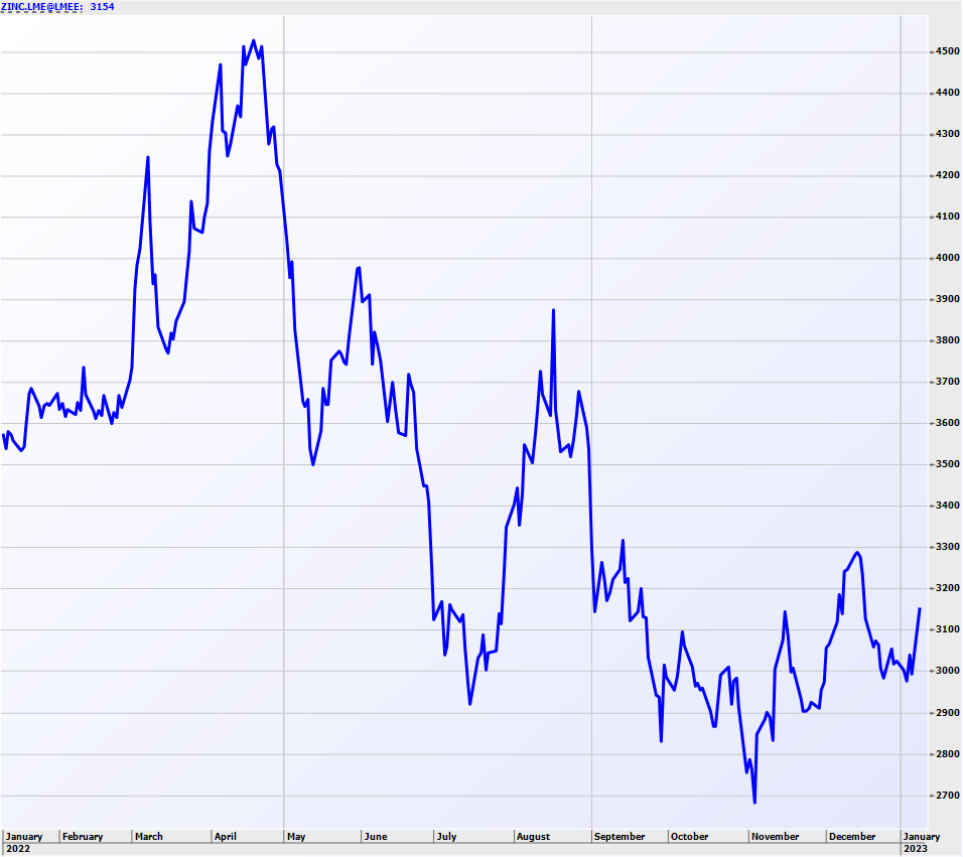
    • Zinc LME inventories down by 87% in past year
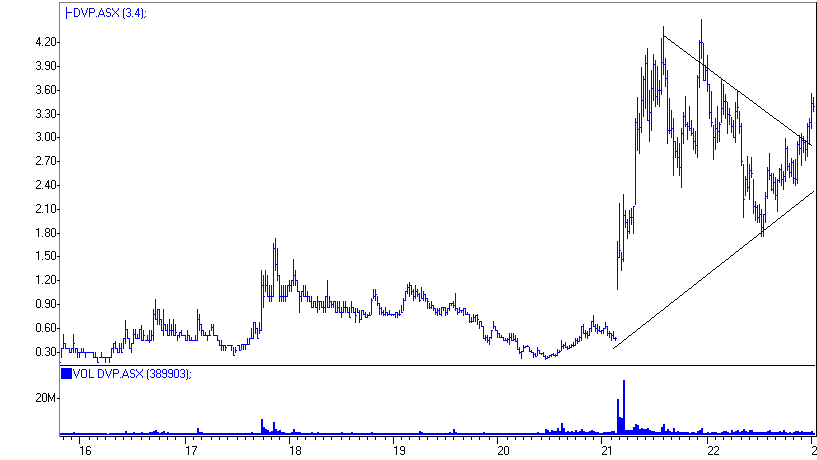
  • Got DVP?
    • Its got Copper
    • And Zinc!

Bonds

  • Yields down again
  • Prices rally

DVP Copper and Zinc

  • Woodlawn
  • Sulphur Springs
  • Mining contracting
  • Market cap ~A$750m @ A$3.40 on 220m shares (diluted)

ICL – Extraordinary WA Explorer

  • 8 major targets
  • 14 >1000m geochem anomalies
  • Gold nuggets confirm nearby sources
  • Market cap A$ 24m @ A$0.115 on 208m shares

TBN – Extraordinary NT Gas Developer

  • Amungee AH2 horizontal well completed
  • Fraccing to commence after current wet period
  • Market cap A$ 353m @ A$0.25 on 1,416m shares

Gold

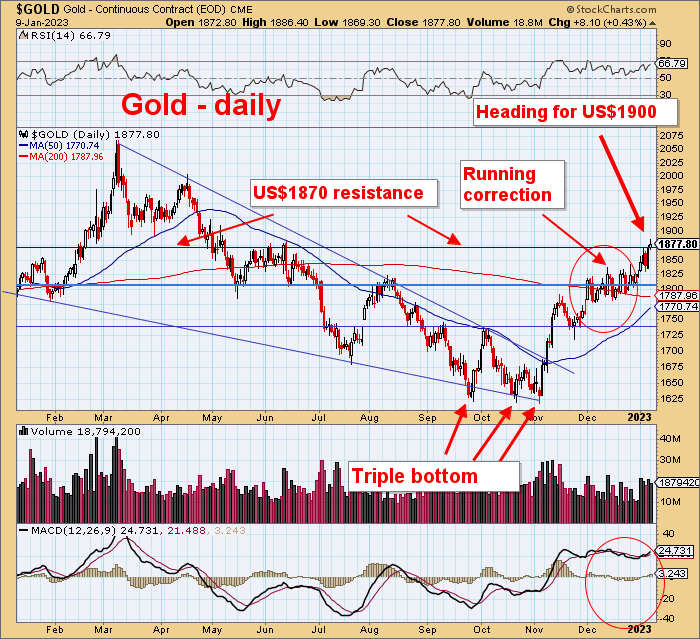
Gold traded higher through US$1880 and held US$1870.

US$1870 is important long term resistance should now be support. US$1900 is now very close so could be much higher over the next few weeks.

Gold Stocks

135 resistance is only 2% away. And it should not last long before gold stocks overcome it and head straight for 165.

Bonds 

  • Yields decline further.
  • Bond rally to continue for a while yet.

ASX Gold Stocks Looking GoodASX Gold’s index is breaking.

Copper

  • breaks out above US$4/lb

US$4/lb is important Long Term resistance. Breaking that brings much higher prices.

NO LME INVENTORY!

  • Index at another 12 month low
  • Copper near 12 month low
  • Zinc down 88%!!!!

Zinc is about to break out.

Got DVP?

  • Woodlawn
  • Sulphur Springs
  • Mining contracting
  • Market cap ~A$750m @ A$3.40 on 220m shares (diluted)
  • Copper and Zinc!!

4

ICL Extraordinary Explorer

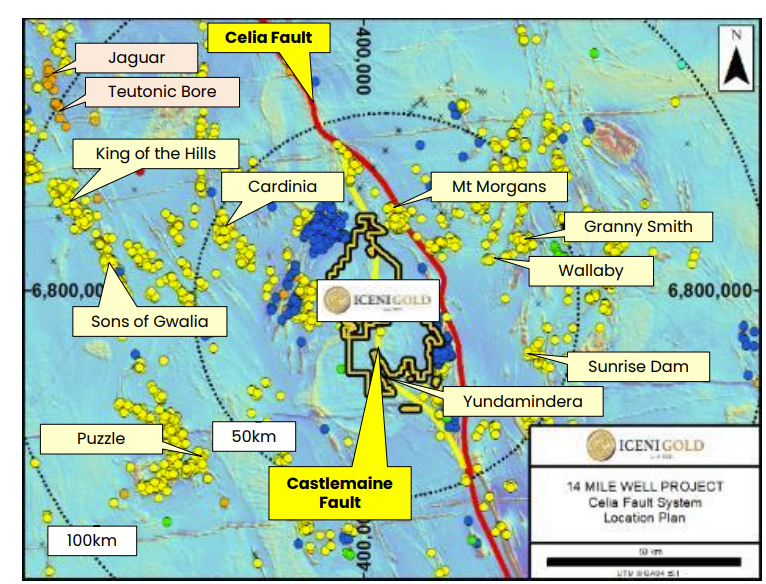
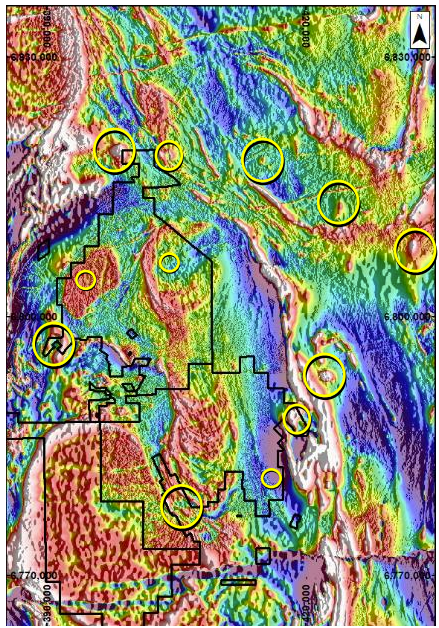
  • 14 Mile Well Project – west of Laverton
  • In elephant country
  • Highlighting Celia Fault
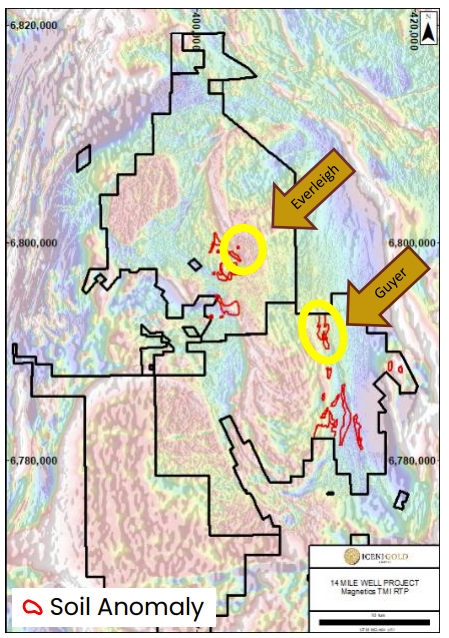
    • Castlemaine and Guyer Fault splays
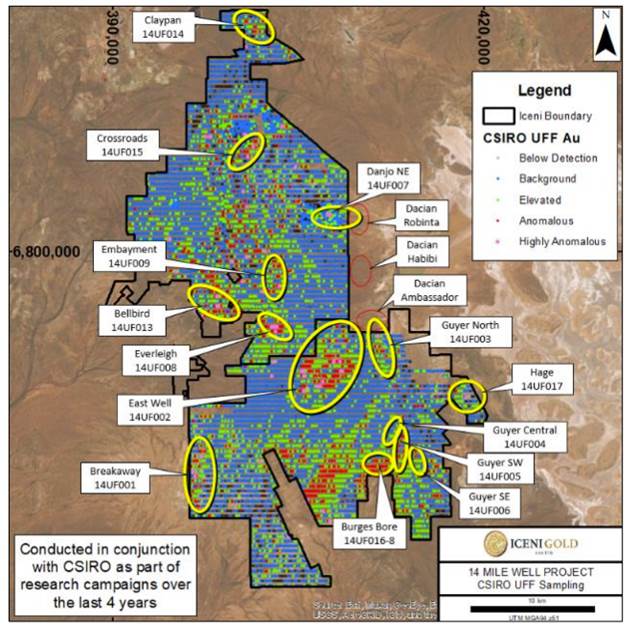
  • Numerous CSIRO UFF+ geochem anomalies
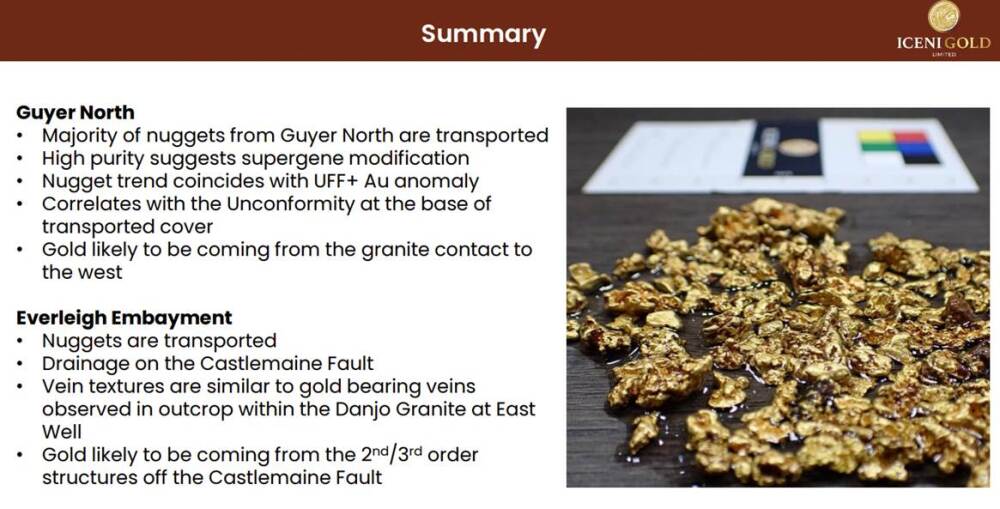
  • Nuggets in paleochannels confirming gold potential.
  • Syenite intrusions as gold conduits and hosts
  • Yet another target found at Goose Well
  • Market cap A$ 24m @ A$0.115 on 208m shares

14 Mile Well Project – On West Side of Celia Fault

  • An early stage explorer with a difference
  • Economic gold deposits will be found!
    • >800kmalmost previously unexplored

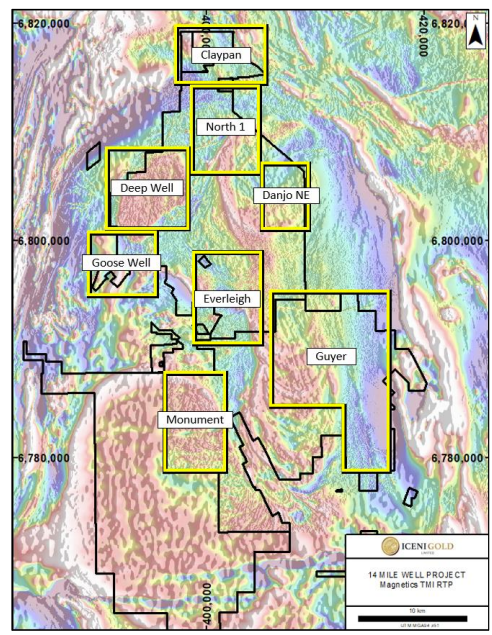
Eight major target areas . . . and counting.

14 geochem anomalies identified using CSIRO UFF+ technology. All over 1000m – up to 5000m.

Syenite intrusions (host of several nearby major gold deposits/mines) identified on tenements.

Most Advanced Projects

  • Everleigh Well
  • Guyer

Drilling has confirmed gold presence. Numerous nuggets in paleochannels.

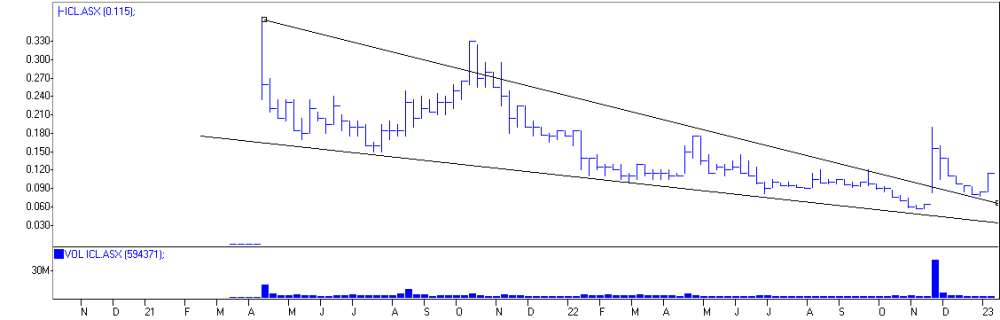
ICL

This is developing into something special

  • Downward sloping wedge
  • Break out
  • Backtest
  • Surging

TBN – Tamboran Resources

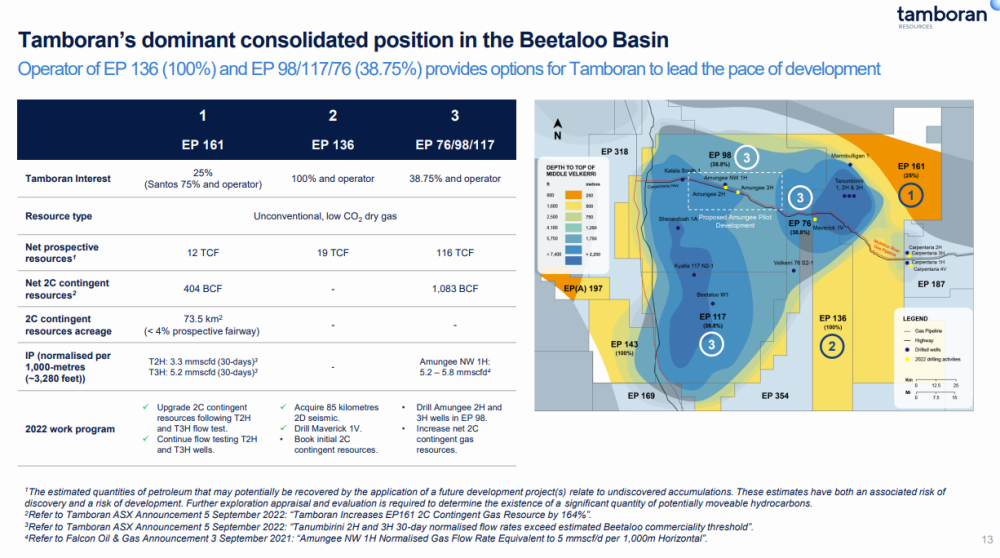
Development of Beetaloo Basin

  • Amungee 2H drilling complete
    • 2413m vertical depth
    • 1275m horizontal section
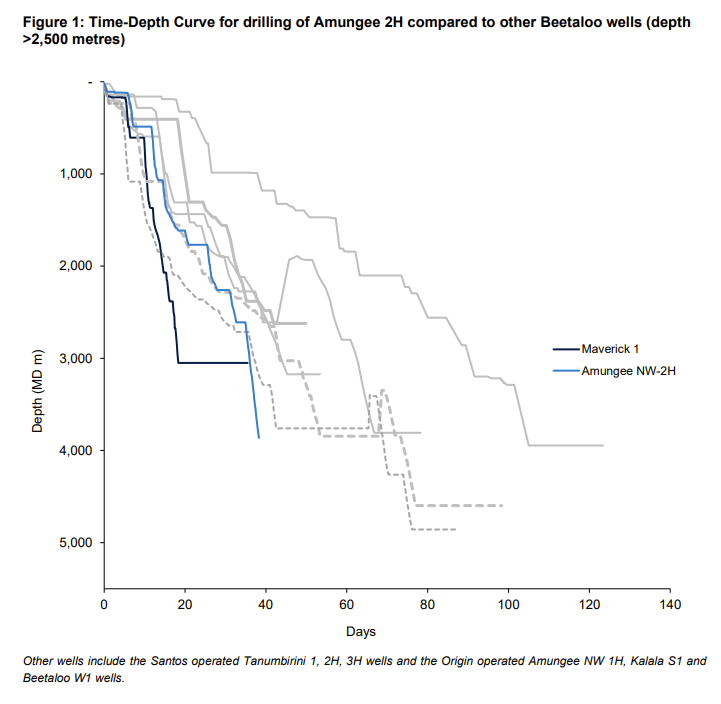
  • Drilling completed in December in 38 days and under budgeted cost and time
  • 5 1/2 inch casing will allow higher sand and fluid input rates and higher gas outflow volumes
  • 24 stages planned for fraccing
  • Awaiting weather clearing to mobilize fraccing fleet in March Qtr
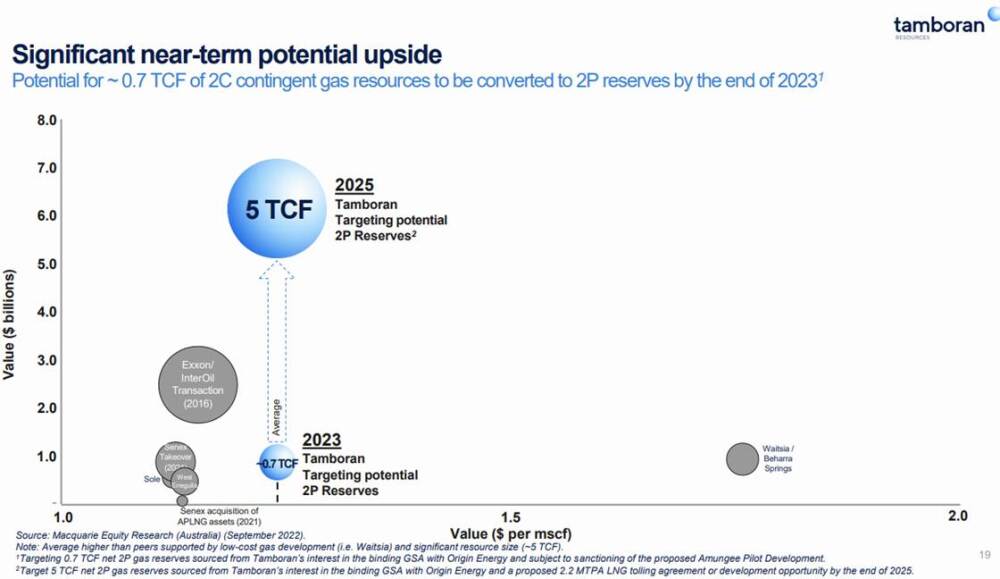
  • 5TCF 2P reserves targeted for 2025 worth A$6bn
  • Market cap A$ 353m @ A$0.25 on 1,416m shares

TBN has successfully drilled its two operated wells much faster than Santos and Origin. Faster wells are cheaper wells (daily rig rate cost)

  • 5 1/2 inch casing will allow higher sand and fluid input rates and higher gas outflow volumes
    • 5 1/2 inch casing has a 22% larger diameter than 4 1/2 inch but has a 50% higher diameter area.

Net Undiscovered Prospective Resources 116TCF

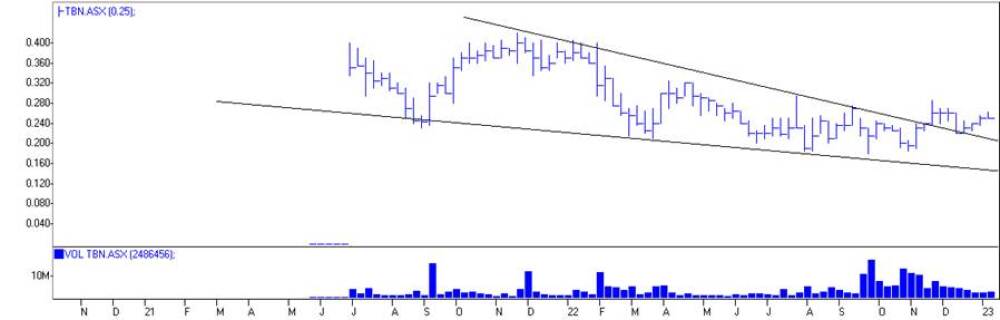
TBN – Also Developing into Something Special

  • Downward sloping wedge
  • Break out
  • Backtest
  • Moving higher

Opportunity is knocking. Timing is everything.


Disclosures:

1) Barry Dawes: I, or members of my immediate household or family, own securities of the following companies mentioned in this article: None. I personally am, or members of my immediate household or family are, paid by the following companies mentioned in this article: My company, has a consulting relationship with: None.

2) The following companies mentioned in this article are billboard sponsors of Streetwise Reports: None. Click here for important disclosures about sponsor fees. As of the date of this article, an affiliate of Streetwise Reports has a consulting relationship with: None. Please click here for more information.

3) Statements and opinions expressed are the opinions of the author and not of Streetwise Reports or its officers. The author is wholly responsible for the validity of the statements. The author was not paid by Streetwise Reports for this article. Streetwise Reports was not paid by the author to publish or syndicate this article. Streetwise Reports requires contributing authors to disclose any shareholdings in, or economic relationships with, companies that they write about. Streetwise Reports relies upon the authors to accurately provide this information and Streetwise Reports has no means of verifying its accuracy.

4) This article does not constitute investment advice. Each reader is encouraged to consult with his or her individual financial professional and any action a reader takes as a result of information presented here is his or her own responsibility. By opening this page, each reader accepts and agrees to Streetwise Reports’ terms of use and full legal disclaimer. This article is not a solicitation for investment. Streetwise Reports does not render general or specific investment advice and the information on Streetwise Reports should not be considered a recommendation to buy or sell any security. Streetwise Reports does not endorse or recommend the business, products, services or securities of any company mentioned on Streetwise Reports.

5) From time to time, Streetwise Reports LLC and its directors, officers, employees or members of their families, as well as persons interviewed for articles and interviews on the site, may have a long or short position in securities mentioned. Directors, officers, employees or members of their immediate families are prohibited from making purchases and/or sales of those securities in the open market or otherwise from the time of the decision to publish an article until three business days after the publication of the article. The foregoing prohibition does not apply to articles that in substance only restate previously published company releases.

Themes for 2023: Sovereign Debt; Silver; Navigating the Post-bubble Train Wreck

Source: Michael Ballanger  (1/11/23)

 Michael Ballanger of GGM Advisory Inc. reviews the current state of U.S debt, the value of the dollar, the resource sector, and more to tell you where he believes the market is heading in 2023. 

As I sat down in mid-December to write the GGMA 2023 Forecast Issue, I was mindful of the one I published in January 2020, where I laid out my conviction that due to rising debt levels around the globe — and this was PRE-COVID — governments would eventually be forced to reprice the collateral backing their skyrocketing sovereign debt (said collateral being gold, of course) sharply higher as a means of shoring up equity.

I surmised that at 10% coverage, the U.S. would need to reprice gold to ~ US$15,700 per ounce because if they wished to achieve a 1:1 ratio of national debt to their 8,311 metric tonnes of gold (allegedly on the books), they would need gold at over US$157,000 per ounce. Again, that was pre-Covid.

Since the beginning of the Great Bull Market, there has been a direct correlation between stock prices and the Federal Reserve Board’s balance sheet.

Of all the gold forecasters and podcasters and self-professed gurus, there was nobody mentioning it as a final solution to the debt bomb that is about to go off in 2023.

The closest is Luke Gromen, a brilliant macro analyst from the U.S. Midwest that believes that a gold-for-oil payment system is soon to be implemented by the major oil producers and consumers to avoid the penalties that result from massive U.S. dollar debasement that can only get worse in 2023 as economic conditions weaken and tax receipts begin to shrink.

It is no coincidence that those countries that are net oil importers are the same ones adding aggressively to gold holdings led by Germany, China, and Japan, the second, sixth, and eighth largest holders of gold in the world.

U.S. Debt

Also, in the GGMA 2000 Forecast Issue was the following paragraph:

“As we look out to the next decade — the “Roaring Twenties” of the 21st Century — I try to identify wherein lies the greatest risk to not only global growth but also global STABILITY. The four-letter answer is the same one I used all throughout 2019 — DEBT. Now, unsubordinated debt is risky, but uncollateralized debt is a nightmare, and all around the world, governments have issued some US$17 trillion of negative-yielding debt (as of August 31), and while that figure will be soon revised downward, all of this debt is riding atop the crest of a fiat wave that is about to break upon a rigid reef of reality.

The only point of debate is “when” because there is no basis whatsoever for the question of “if”. Debt to GDP levels around the world are soaring with little sign of abatement, and since the only collateral behind that debt is the “full faith and confidence of government” (to tax its citizens and repay the debt), I submit that investors around the world are going to demand security before they shell out hard-earned savings, and if you step past tax receipts, you go to “Crown Land” (Canada) or Federal Lands (U.S.), but since that still evokes incendiary responses from the electorate, the only other collateral left is sovereign holdings of one other form of collateral, and that collateral is none other than gold.
I wrote that paragraph prior to the global economic shutdown that was triggered by a virus that was purported to be the second coming of the bubonic plague, which wiped out an estimated sixty million people (up to 60%) of the European population in the 1400s.

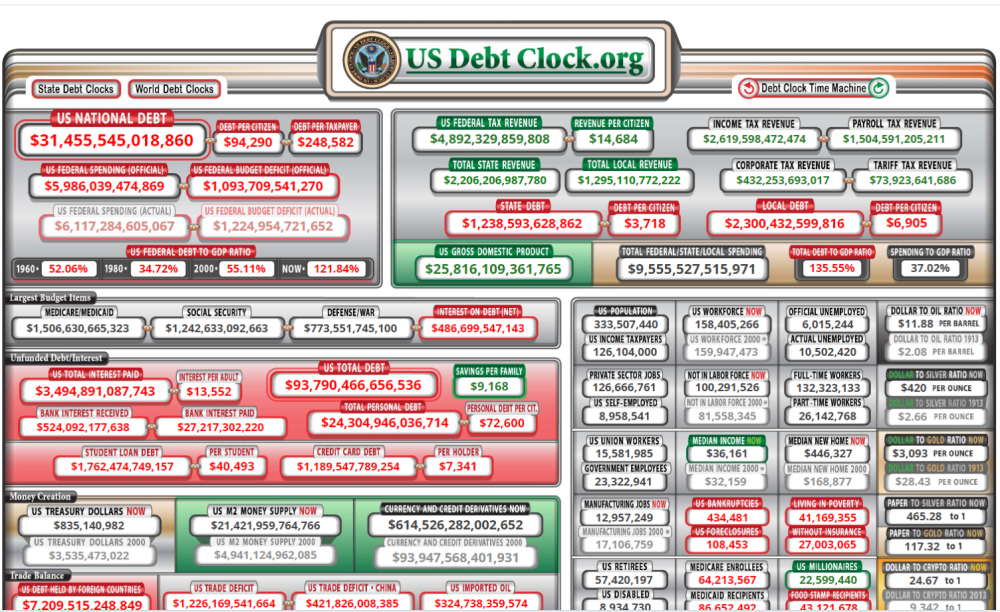
The response to the threat was a simultaneous cessation of global trade accompanied by an airdrop of over US$6 trillion in the U.S. alone in the form of cheques to literally anyone with a pulse and to any business alleged to have workers. The total U.S. national debt is estimated to be in excess of US$32 trillion, so the debt bomb referred to in 2020 has grown by over 20% in less than three years.

Furthermore, it is now at the breaking point with debt serviceability, a major obstacle to the U.S. dollar reserve status and hegemony.

So, how does this affect investment strategy for the year 2023? Well, over the forty-five years that I have waged war against those hideous demons that dominate the capital markets, I have learned through many painful judgemental failures that the greatest danger lies within.
When you are manning a trading terminal, there are only two buttons that count. The first one is a “BUY” button, usually green on the old Quotron terminals, and the second one is a “SELL” button, often sporting a reddish hue. There is no “HOLD” button, and do not attempt to locate the “CANCEL” button because in the trading pits, as in warfare, there is only “ATTACK” or “RETREAT,” although General Patton knew not the meaning of the latter and regaled in the former.

Whenever I am in the “set-up” mode for a big trade, such as the GDX:US in mid-March 2020 (16th to be exact, the exact low for the crash), by the time I sit down at the terminal, I have already processed all of the relevant information pertinent to the trade. Now, when I was a younger man filled with all of the audacity of youth, I would visualize the item I was going to buy with the profits from this “CAN’T MISS” trade, and whether it was a new car or a condo in Florida, there was never the slightest consideration of the likelihood of loss.

This may have stemmed from growing up with aspirations of making the NHL in a sport where hesitancy and uncertainty could result in more than simply losing a game. I saw more than a few promising young men run out of the league due to those character flaws but in the world of trading and investing, they are absolutely invaluable. However, as I was to learn very early in my trading career, successful trading carries none of the prerequisites demanded for success on the hockey rink.

There is a terrific book I read last year that was written in 1989 by Jack D. Schwager, where he interviews a number of famous traders from prior decades. When asked what was the singular most important attribute of a great trader, the recurring theme amongst all of the subjects in the book was the ability to manage risk. Essential to managing risk was the tendency to utilize doubt as a tool in tempering drawdowns, and the two behaviors integral to the process included hesitancy and self-examination (also described as uncertainty).

Since the beginning of the Great Bull Market, which began in 1982 with the Dow Jones Industrials at 785 (and national debt at US$900 billion), there has been a direct correlation between stock prices and the Federal Reserve Board’s balance sheet (debt). Also ingrained in this correlation are tax receipts which are generated by stock market profits, and the financial services industry, which has largely replaced manufacturing as the primary driver for the U.S. economy. Now that the era of globalization has been replaced by a return to “on-shoring,” wide profit margins once enjoyed by multinationals due to cheap labor in Asia and Latin America are going to be no more.
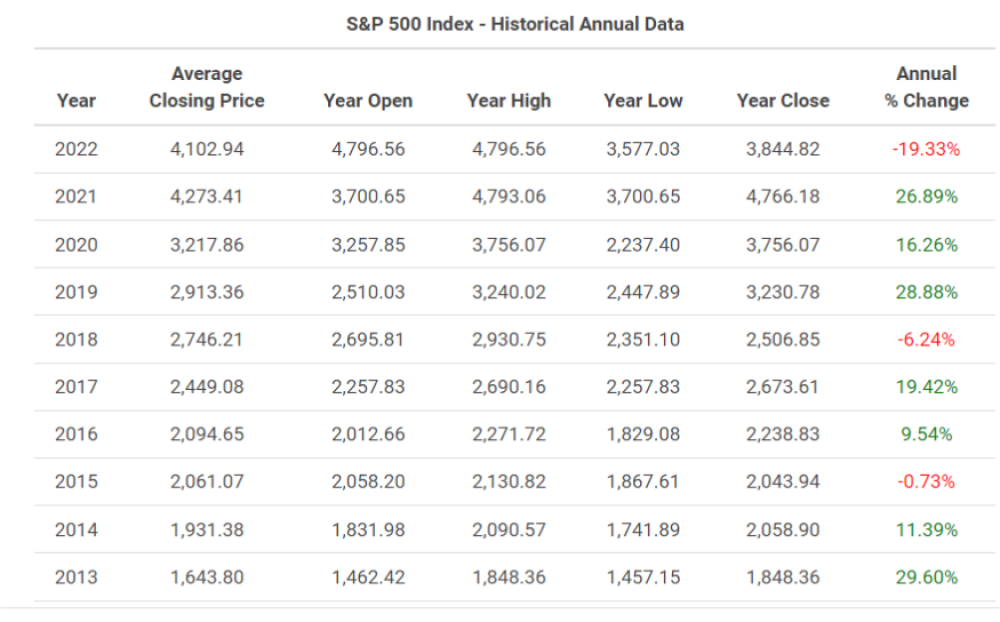
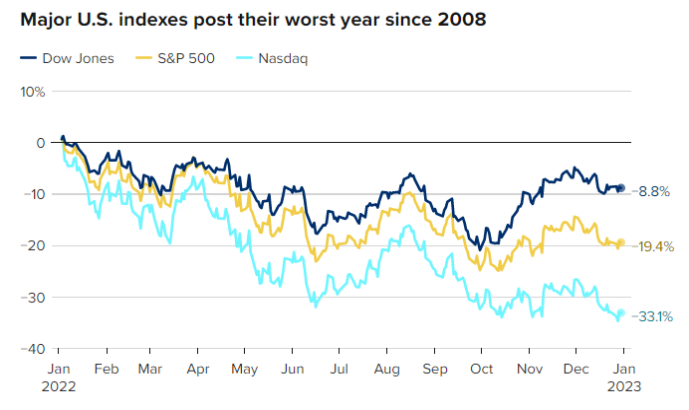
The S&P 500 has posted its third losing year in the past ten, but with the best three being +29.16% (2013), +28.88% (2019), and +26.89% (2021), those up years dwarf the three worst years, which were this year -15.66% (2022), -6.24% (2018), and -0.73% (2015). What gives me pause is that this was the first year in a decade that Federal Reserve monetary policy shifted into full tightening mode.

While its dual mandate is well advertised as “price stability” and “maximum full employment,” a third and somewhat covert mandate is beginning to find its way into the current narrative, and that third mandate is “ensuring that the government is adequately funded.” In being allowed to magically create credit in order to keep the U.S. government afloat, it needs no adherence to General Accepted Accounting Principles or “GAAP” guidelines in order to be compliant.

Given that the Saudis have opted in favor of the yuan over dollars as payment-in-kind for their oil, I see a seismic in-process shift now in place as the dollar gets replaced by non-dollar currency reserves, which would include gold.

If U.S. government budgets were constrained by balanced budget controls, it would be insolvent in the blink of an eye. This, I believe, is where the demise of the petrodollar — as in elimination thereof — will put increasing pressure on the “full, faith, and credit” assumptions of sovereign debt levels around the globe, but with the greatest impact those countries that are either “overweight debt” or “short energy.”

While the U.S. is certainly not energy-challenged, it is the world’s largest debtor nation where the purchasing power of its treasury bonds may appear superior to those issued by energy-starved Europe, Japan, and China, 2023 will be the year that the OPEC members decide to accept payment methods for oil and gas in denominations other than U.S. dollars. It could be an SDR or gold or a combination of both, but if this series of events leads to a confrontation concerning the most credit-worthy and default-protected currency in circulation, I see the ultimate measuring stick being central bank gold holdings. If that is the case, then would an OPEC member rather take U.S. dollars or Russian rubles?
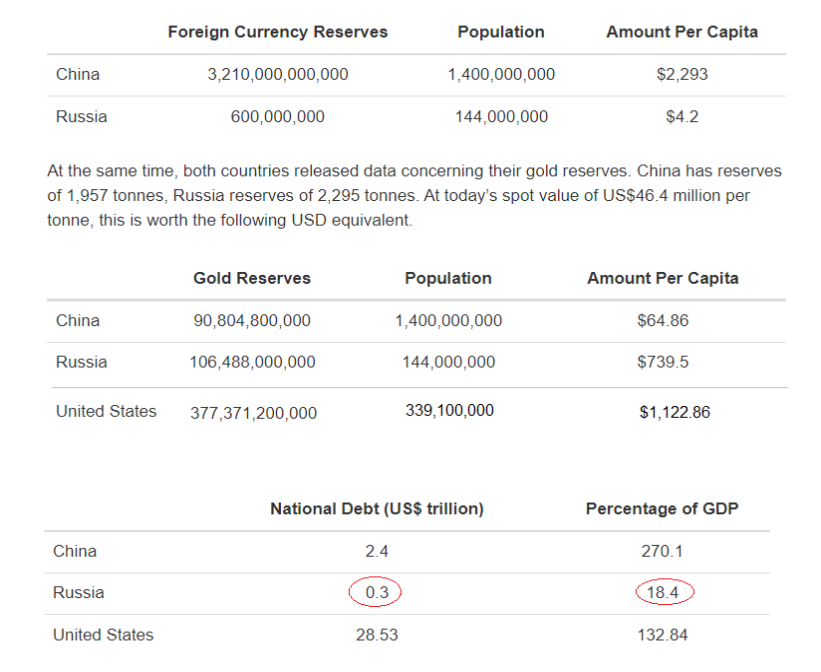
Given that the Saudis have opted in favor of the yuan over dollars as payment-in-kind for their oil, I see a seismic in-process shift now in place as the dollar gets replaced by non-dollar currency reserves, which would include gold. Europe is already paying for Russian oil and gas in rubles, and Brazil appears to be aligning itself within the BRIC bloc of nations all hellbent on removing the shackled encumbrances of U.S. dollar servitude.

In the end, if this gold-for-oil movement is to play out, then it is the non-gold-owning treasuries around the world that will be effectively “short oil” by being “short gold” (meaning owning “no gold” such as Canada). That will set off a buying spree in gold as a means of hedging their energy costs which is effectively the same as arbitrarily re-pricing gold to fortify the value of central bank collateral and, given the American’s 8,311 metric tonnes of gold, this is actually a cloaked benefit to the U.S. dollar’s integrity.

One way or the other, gold seems destined for higher valuations versus North American currencies which will put a punctuative end to this two-and-a-quarter year-long bear market in gold miners and their junior brethren.

Here is a question: If you were an accountant with years of experience dealing with balance sheets and income statements, what would be your advice to the Canadian government today? Or the Eurozone? Or the Fed or U.S. Treasury?

If you were applying the rules of accounting to government management of sovereign finances, what on earth could you possibly say?

When I get a notice from a credit card company, I can either pay the bill or lose the card as well as my credit rating. I am not permitted by law to manufacture either cash or credit or “alternative currency” to satisfy a debt that requires the draining of savings. If stressed, we citizens are required to “get a second job” or “ask a relative,” but we do not have a “phantom sugar daddy” like the U.S. Fed or the ECB, or the BoJ to bail us out of near-term financial difficulties.

2023 is going to be the year that the world decided to abandon mindless obedience to U.S. dollar hegemony.

If we do not have sufficient savings to satisfy obligations taken on in the true honor of commerce, we all lose the privilege and, with it, lifestyle and community standing.

Indeed, what would be the correct words or actions when the tax department demands that one pay a bill now that the government has been able to “inflate away” tomorrow?

The new generations of those children of the elite that are now back living in the basement with the widescreen TV and unlimited Internet access (and Mom’s secret credit card that Dad doesn’t know about) are about to receive a very rude awakening when they step out onto Richmond Street to protest and someone their own age (as opposed to a Babyboomer) tells them to get the **** off the street because they have to get to work.

Markets hate this kind of uncertainty on a near-term basis, but they absolutely love it when the opposing factions from a different regimes finally unite under a common cause.

Volcker told Wall Street that they had “better get short” in late 1979, just as Jerome Powell told Wall Street the same thing late last year. Remember all the “we’ll call his bluff” podcasts from the YouTube crowd in the first six months of 2022? In 1980, the Wall Street crowd actually listened to Paul Volcker, but the retail clients were so few, and far between that they were mere echoes in the price-direction narrative.

Between 1966 and 1982, the Dow Jones Industrial Index vacillated between 785 and 1,024, and by the time we got through the Volcker anti-inflation assault, household ownership of stocks had fallen to under 5% of total equity ownership. The retail impact was not only negligible; it was irrelevant.

In the year 1980, the Japanese citizens had worked so incredibly hard since 1945 that, along with the immense power and impact of The Marshall Plan, Japanese industry along with German industry, had moved to the top of the manufacturing “food chain.” The great diamond marketing company founded by DeBeers called the CSO (“Central Selling Organization”) had completed a marketing survey in Asia, which determined that the only country on the planet rejecting diamonds as a traditional engagement or wedding gift was Japan.

The CSO, located at 17 Charterhouse Street in London at the time, was assigned the task of implementing a marketing campaign with a view to attracting the Japanese to the idea that “Diamonds Are Forever.” In 1980, when the campaign began, no young Japanese males ever used diamonds as a symbol of their commitment; by 1990, ten years later, after a Hiroshima-style bombardment of Japanese media with the campaign, not only were young, newly-rich males buying 5-10 carat diamonds worth tens of thousands of U.S. dollars as engagement rings, the upwardly-mobile and now very-affluent female businesswomen were buying diamonds as investments!

The reason I can relate to this is that I was an early financier in the exploration campaign for Mountain Province Diamonds Inc. (MPVD:TSX), which asked me to help them navigate the world of corporate finance in mid-1995. The company was invited to meet with DeBeers in 1996, shortly after the AK-5037 diamond discovery, during which our stock, all acquired under US$0.50 through various private placements, soared to US$9.75 and enriched a great many of my friends and colleagues, none of whom thought that my US$30 target price was either realistic or achievable.

We all err on the side of unreasonable expectations from time to time, but the reason I mention Mountain Province is that nobody that was associated with the company during the early days is still there. The stock that we were selling in the US$6-9 range has a diamond mine (Gaucho Kwé), of which they own 49%, that earned US$34 million last year, yet the stock is currently quoted at a CA$0.50 bid. I have zero holdings, and every single risk-taker from the 1990s took their money and ran for their life. Lesson learned.

2023 is going to be the year that the world decided to abandon mindless obedience to U.S. dollar hegemony, and ironically, the trigger was in 2022 when the U.S. arbitrarily decided that a suitable “sanction” against Russia would be to confiscate approximately US$300 billion of its foreign exchange reserves held outside of Russia. Countries like Brazil, India, and Saudi Arabia were suddenly forced to take a hard look in the mirror relative to the degree of control they have over their assets. It was a sobering moment when they all collectively realized that with the flick of a computer key, their national property could be stolen with little or no adherence to the rules of international law.

 As this de-dollarization trend grows, the COMEX exchange that governs the “paper price” for gold and silver will take on a diminishing role

The BRIC nations have all aligned in a concerted effort to establish an international payments system independent of the SWIFT system, which is a U.S.-controlled mechanism for moving money around the world. The ramifications of defying American foreign policy demands can be felt by any nation using the American system, and while the Saudis have historically relied upon the West for security, recent events have accelerated their distancing from U.S. policy guidelines.

This is all fodder for a cannon aimed directly at the U.S. dollar’s international role as the world’s reserve currency. For gold and silver investors, it is particularly significant as more and more sovereigns opt for non-dollar settlements for crucial commodities like oil and iron ore — and precious metals. As this de-dollarization trend grows, the COMEX exchange that governs the “paper price” for gold and silver will take on a diminishing role such that the shares of north American mining companies begin to respond to the Shanghai gold quote rather than those posted by the COMEX or the London Metals Exchange.
Silver Short-Term Chart

The New Year 2023 brings with it a whole new set of challenges due largely to the uncertainty that remains physical silver closely followed by a basket of junior exploration and development companies that are awaiting the inevitable upturn in the Senior Gold Miners before heading higher themselves. It is well past the time for this group of companies to finally feel the love of the new generations of stock investors that have largely avoided the sector, and to their credit, I might add.

Old, grizzled veterans like me have wallowed in the nostalgia of those great discoveries of the 1980s and 1990s, like Hemlo and Eskay Creek, Ekati and Voisey’s Bay while the youngsters had huge wins in cannabis, crypto, and technology issues from just after the GFC in 2008 until 2022. The Fed-fuelled bull market that acted as a financial aphrodisiac for millions of Millennials and Gen-Exers created a psychological effect known as the “Buy-The-Dip” mentality that was more of a Pavlovian phenomenon born out of the Federal Reserve’s incessant habit of rescuing the stock market through monetary stimulus or well-scripted bullish narratives jawboned through financial media outlets every time there was a 5% correction.
The need to sustain the asymmetrical wealth effect through ever-rising stock prices as the policy was replaced in late 2021 by a newly-crafted focus upon price stability rather than maximum full employment, where galloping stock prices have a subliminal effect upon corporate planners in their hiring and firing habits and intentions.

Silver is a chameleon of sorts, taking on the visage of a monetary metal one moment, then transforming itself into an industrial metal the next and when one least expects it. This would explain the near 1:1 correlation between the price of copper and the price of silver during certain periods when economic conditions are tilted toward global growth or accelerating inflation. During the 1970s, when silver soared from US$1.50 to US$50, only in the latter part of the decade did copper catch a bid during the final spike in U.S. inflation, moving from US$0.60/lb. to US$1.50/lb. in twenty-four months.

Absent the competition from other investible distractions, I believe that fund flows will gravitate to the precious metals with greater attention to silver because of the belief that it is much closer to  “green” metals than gold or copper, largely because of its application in the EV and medical fields.

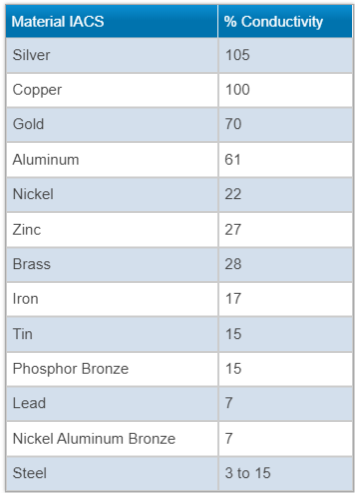
However, observe the chart to the left that lists the percentage conductivity of the various metals.

Silver has greater conductive properties than copper, and both silver, copper, cand gold are ranked well ahead of two more notable battery metals, namely, lead and nickel.

While the sexagenarian community of stock players sees little excitement in the climate-change attributes of gold and silver, the new generations of investors have been educated in a climate-friendly environment where policies related to curricula decisions are heavily tilted toward ecological activism.

This plays quite favorably in the junior exploration space as, in the past few years, I have seen an accelerated interest in battery metals and in copper as a proxy for the electrification movement.

Since youngsters go wild over anything that discourages or replaces the carbon footprint power source, valuations for lithium deposits have been staggeringly large relative to an equally-large deposit of lead or nickel.

Also leaping into the current investment consciousness has been lithium. A major component in the “lithium-ion battery,” lithium allows for the recharging and storing of electrical energy.

Since youngsters go wild over anything that discourages or replaces the carbon footprint power source, valuations for lithium deposits have been staggeringly large relative to an equally-large deposit of lead or nickel.

As enlightenment in the field spreads (and as the table above would prove), silver’s premier rank as an electrical conductor will eventually allow the chameleon to morph into a poster-child “green” metal, attracting millions upon millions of new, well-heeled investors to the party.

This development will allow for the absorption of a great deal of excess supply that is derived from base metals, where silver is mined and stored as a byproduct of copper, lead, and zinc extraction facilities.
Silver Long-Term Chart

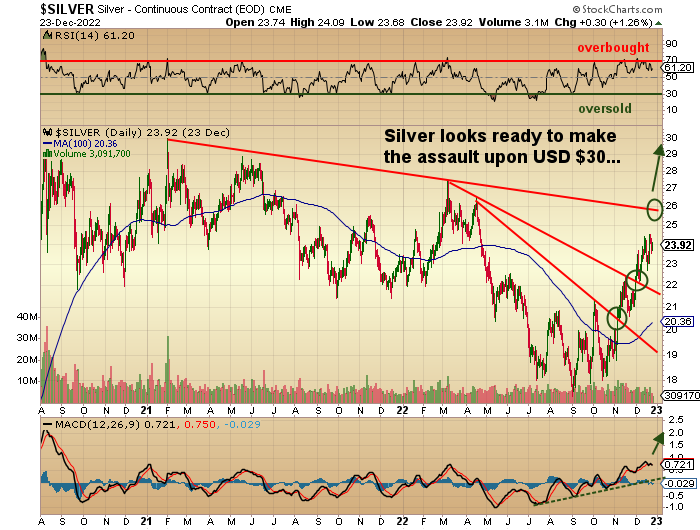
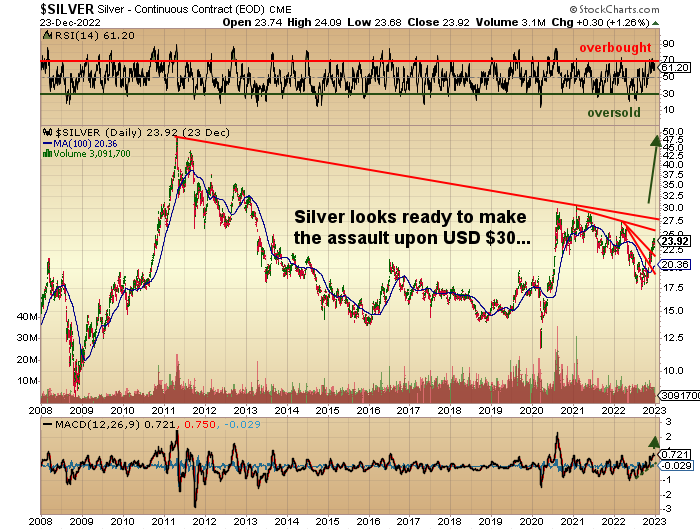
Technically, over the shorter term, silver has reversed the downtrend from the peaks in 2021 and 2020 with two distinct breakouts at US$20.75 and US$22.00 and looks poised for a run to US$25.75-26.00. However, the longer-term chart shown above has major resistance at around US$27.50 to overcome before the big test of the February 2021 “Silver Squeeze” top at US$30.00, which will be formidable.

Silver will need to have a confluence of bullish tailwinds propelling it by the time it tests $30 because it is undoubtedly the most popular shorting candidate of all the metals by the bullion bank behemoths.

We all know painfully well the history of the paper market takedowns that have plagued silver investors for decades. It all began in the late 1970s when the Hunt Brothers from Texas attempted to corner the market through massive purchases of silver futures. The reality is that under exchange rules in place at the time, they actually did corner the market, but with the bullion banks in serious trouble from their short positions, they lobbied the government and the COMEX and got the rules changed such that no further silver could be purchased with the only new orders accepted being “SELL” orders.

As I pointed out in an earlier email alert, famous technical analyst Bob Farrell’s Rule #9 for Investing says: When all experts and forecasts agree, something else I going to happen.”

A few enormous increases in maintenance margin requirements added to the stress, and within weeks of “Silver Thursday,” the market crashed from US$47 to US$11, costing the Hunts about US$1.7 billion and forcing them into bankruptcy.

Since that time, silver has had a history of wild swings and headline-grabbing controversy, and while it has greatly enhanced the fortunes of traders that get it “right,” there are countless body bags piled on both shoulders of the Road to Riches. For those of us that have ridden the silver bull in more than a few earlier rodeos, it has always been the safest entry point when no one cares and volatility is muted, such as early last September when the Relative Strength Index dipped briefly under 30 with price at US$17.56/ounce. Hovering around the US$24.00 mark, silver has suddenly caught a bid, and if this continues into the New Year, an entirely new wave of newbie buying will take silver higher before you can spell the word “breakout.”
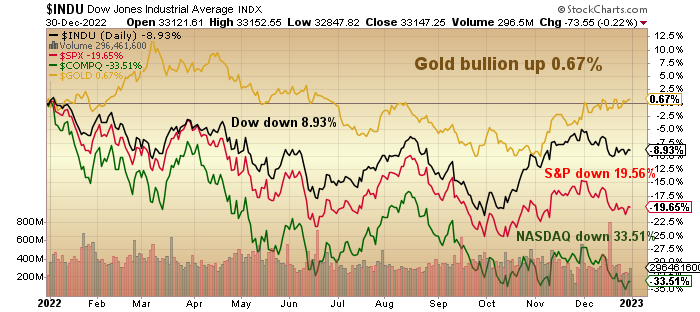
The chart shown here speaks volumes about the utility of gold as a safe haven asset. Even a modest portfolio allocation to physical gold would have mitigated the damage done by the 2022 bear market mauling.

As for the broad stock markets, I always wait for the results of the period of December 23rd to the end of the first five trading days of the New Year before launching the Forecast Issue. I am a staunch believer in the predictive power of the January Barometer, which includes the “early warning signal” of the first five days in combination with the results of the Santa Claus Rally.

First Five Days “Early Warning” Indicator

The last forty-seven up First five Days were followed by full-year gains thirty-nine times for an 83.0% accuracy ratio and a 14% average in all forty-seven years.

With the S&P 500 ahead 52.59 points (1.37%) at the end of the first five trading days of this year, it increases the likelihood that the lows seen in October at 3,491.58 were “THE” lows for the 2022 bear market. With the Santa Claus Rally actually eking out a modest gain of 0.03%, these two outcomes are simply indications that the more important January Barometer may register a positive outcome, and since it sports an 83.3% accuracy rating since 1952, I look for the mid-January reading in order to lock-and-load strategy for the year.

At the end of December, I read hundreds of pages of investment forecasts from dozens of market strategists, and if there is one theme that has been dominating the 2023 investment narrative, it is that the first half of the year is going to see new lows as the U.S. economy sinks into a severe recession brought about by a behind-the-curve Fed and rapidly-dwindling inflation rates.

I will summarize 2023 with this simple comment: what worked in the period 2009 to 2022 will not work in 2023 and beyond.

Every single newsletter has “something breaking” in H1/2023, forcing the Fed to change policy in order to maintain the integrity of the financial system resulting in a massive recovery in stocks and commodities (risk assets).

As I pointed out in an earlier email alert, famous technical analyst Bob Farrell’s Rule #9 for Investing says: When all experts and forecasts agree, something else I going to happen.”

I cannot overestimate this unanimity of opinion as to the outlook for 2023, and it is coming from people that I generally follow and whose advice has been remarkably consistent. The problem I have is that every one of these gurus has been calling for a Fed “pivot” through most of the latter half of 2022, and if there is one thing that I have learned after nearly five decades of following markets, it is this: never try to tell the market what it is going to do; let the market tell you what it wants to do.

I will summarize 2023 with this simple comment: what worked in the period 2009 to 2022 will not work in 2023 and beyond. Given that the reverse of that will turn out to be true, an overweight position in the junior gold and silver developers seems both timely and prudent.

Good luck in 2023.


Michael Ballanger Disclaimer:

This letter makes no guarantee or warranty on the accuracy or completeness of the data provided. Nothing contained herein is intended or shall be deemed to be investment advice, implied or otherwise. This letter represents my views and replicates trades that I am making but nothing more than that. Always consult your registered advisor to assist you with your investments. I accept no liability for any loss arising from the use of the data contained on this letter. Options and junior mining stocks contain a high level of risk that may result in the loss of part or all invested capital and therefore are suitable for experienced and professional investors and traders only. One should be familiar with the risks involved in junior mining and options trading and we recommend consulting a financial adviser if you feel you do not understand the risks involved.

Disclosures:

1) Michael J. Ballanger: I, or members of my immediate household or family, own securities of the following companies mentioned in this article: None.  I personally am, or members of my immediate household or family are, paid by the following companies mentioned in this article: My company, Bonaventure Explorations Ltd., has a consulting relationship with: None.

2) The following companies mentioned in this article are billboard sponsors of Streetwise Reports: None. Click here for important disclosures about sponsor fees. As of the date of this article, an affiliate of Streetwise Reports has a consulting relationship with: None. Please click here for more information.

3) Statements and opinions expressed are the opinions of the author and not of Streetwise Reports or its officers. The author is wholly responsible for the validity of the statements. The author was not paid by Streetwise Reports for this article. Streetwise Reports was not paid by the author to publish or syndicate this article. Streetwise Reports requires contributing authors to disclose any shareholdings in, or economic relationships with, companies that they write about. Streetwise Reports relies upon the authors to accurately provide this information and Streetwise Reports has no means of verifying its accuracy.

4) This article does not constitute investment advice. Each reader is encouraged to consult with his or her individual financial professional and any action a reader takes as a result of information presented here is his or her own responsibility. By opening this page, each reader accepts and agrees to Streetwise Reports’ terms of use and full legal disclaimer. This article is not a solicitation for investment. Streetwise Reports does not render general or specific investment advice and the information on Streetwise Reports should not be considered a recommendation to buy or sell any security. Streetwise Reports does not endorse or recommend the business, products, services or securities of any company mentioned on Streetwise Reports.

5) From time to time, Streetwise Reports LLC and its directors, officers, employees or members of their families, as well as persons interviewed for articles and interviews on the site, may have a long or short position in securities mentioned. Directors, officers, employees or members of their immediate families are prohibited from making purchases and/or sales of those securities in the open market or otherwise from the time of the decision to publish an article until three business days after the publication of the article. The foregoing prohibition does not apply to articles that in substance only restate previously published company releases.

Trade Of The Week: Gold Eyes Key US Inflation Data

By ForexTime 

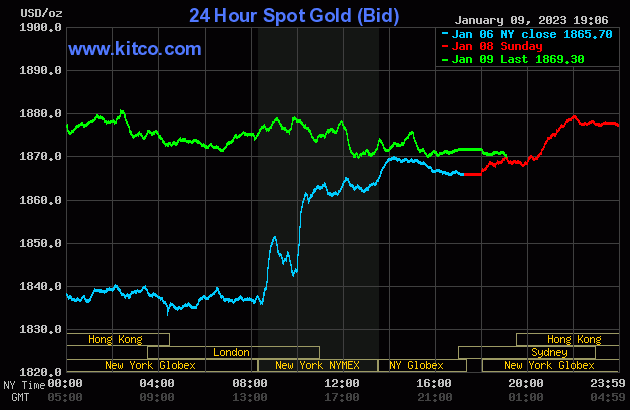
Gold is certainly glittering, gaining 2.3% in the first full trading week of 2023 alone.

The precious metal continues to draw ample strength from a softer dollar, falling Treasury yields, and growing expectations of a less hawkish Federal Reserve. Last Friday’s mixed US jobs report added fuel to the bullish momentum, resulting in a weekly close above resistance at $1860.

In our 2023 outlook, we discussed how gold could be one of the biggest winners in 2023 due to the shifting market dynamics and fundamental themes. Well, it looks like bulls are wasting no time in our marking their territory, pushing the precious metal to levels not seen since May 2022.

Regarding December’s jobs data, it offered conflicting signals as NFP exceeded expectations by rising 223,000k but wage growth slowed, and weekly working hours continued to fall. The slowing wage growth fuelled speculation around the Fed slowing its rate hikes – dealing a blow to the dollar which was already on the verge of a “death cross” technical pattern on the daily charts. Ultimately, this was a welcome development for zero-yielding gold.

Taking a quick peek at the technical picture, gold remains firmly bullish on the daily timeframe. The upside momentum could propel prices towards the psychological $1900 if the fundamentals remain in favour of bulls.

US Inflation report in focus

Inflation in the United States slowed for a fifth straight month to 7.1% in November, the lowest level since December 2021. Persistent signs of easing inflationary pressures in the world’s largest economy have somewhat brightened the market mood and fuelled speculation around a less hawkish Fed.

According to Bloomberg, December’s inflation data is expected to show annual inflation cooling to 6.5%. Should expectations become reality, this will mark the sixth straight monthly decline and the lowest since October 2021. Given the market sensitivity to anything relating to inflation, this could result in explosive levels of volatility across financial markets.

More signs of falling inflation may fuel talks around the Federal Reserve veering to smaller rate hikes. Currently, traders are currently pricing in a 27% probability of a 50-basis point rate hike in February. When considering gold’s zero-yielding nature, this is certainly a welcome development for the metal which could support upside gains.

Alternatively, a hotter-than-expected CPI report could revive aggressive rate hike bets as investors question whether inflation is plateauing. Such a development could see gold prices weaken as the dollar bounces back along with Treasury yields.

Other factors to watch out for…

Other than the highly anticipated US CPI report on Thursday, there are a couple of reports and Fed speeches this week that could influence gold prices.

On Monday, Atlanta Fed President Raphael Bostic will be under the spotlight. All eyes will be on Fed Chair Jerome Powell on Tuesday as he speaks during an international symposium at Riksbank in Stockholm. More Fed members are due to speak on Thursday with the US January consumer sentiment report on Friday ending the week. Should Fed members strike a hawkish note, this could weigh on gold prices. Alternatively, any whiff of caution or appearance of doves may boost gold’s allure.

Gold bulls switch into higher gear…

Gold bulls remain in a position of power with their feet pressed aggressively on the accelerator. Prices are firmly bullish on the daily timeframe with $1900 acting as the first key level of interest. A move above this level could encourage an incline towards $1920 and $1958, respectively. Should bulls run out of steam, prices may dip back below $1860 – opening the doors towards $1840, $1814, and $1800, respectively.


Forex-Time-LogoArticle by ForexTime

ForexTime Ltd (FXTM) is an award winning international online forex broker regulated by CySEC 185/12 www.forextime.com

Metals Speculators push their Platinum bullish bets to 91-week high

By InvestMacro

Here are the latest charts and statistics for the Commitment of Traders (COT) data published by the Commodities Futures Trading Commission (CFTC).

The latest COT data is updated through Tuesday January 3rd and shows a quick view of how large traders (for-profit speculators and commercial entities) were positioned in the futures markets.

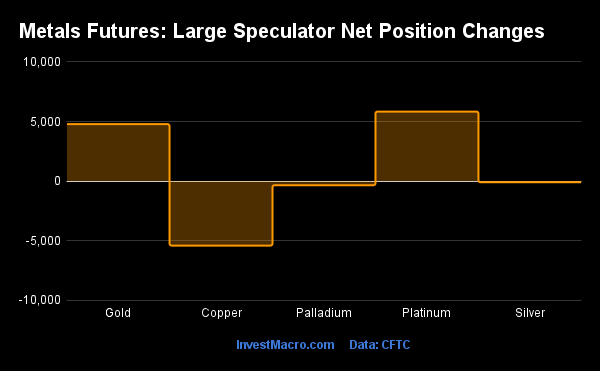
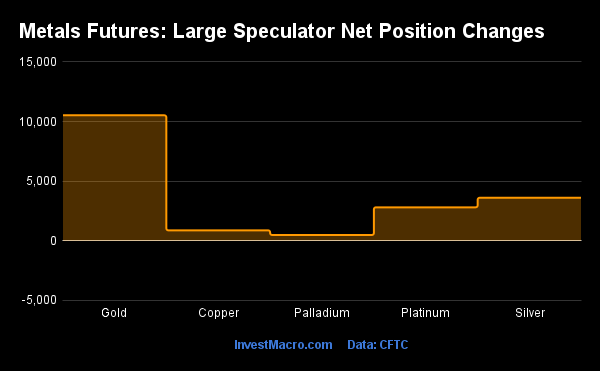
Weekly Speculator Changes led by Platinum & Gold

The COT metals markets speculator bets were lower this week as just two out of the five precious metals markets we cover had higher positioning while the other three markets had lower speculator contracts.

Leading the gains for the metals was Platinum (5,837 contracts) with Gold (4,786 contracts) also showing a positive week.

The markets with declines in speculator bets for the week were Copper (-5,399 contracts), Palladium (-336 contracts) and Silver (-93 contracts) registering lower bets on the week.

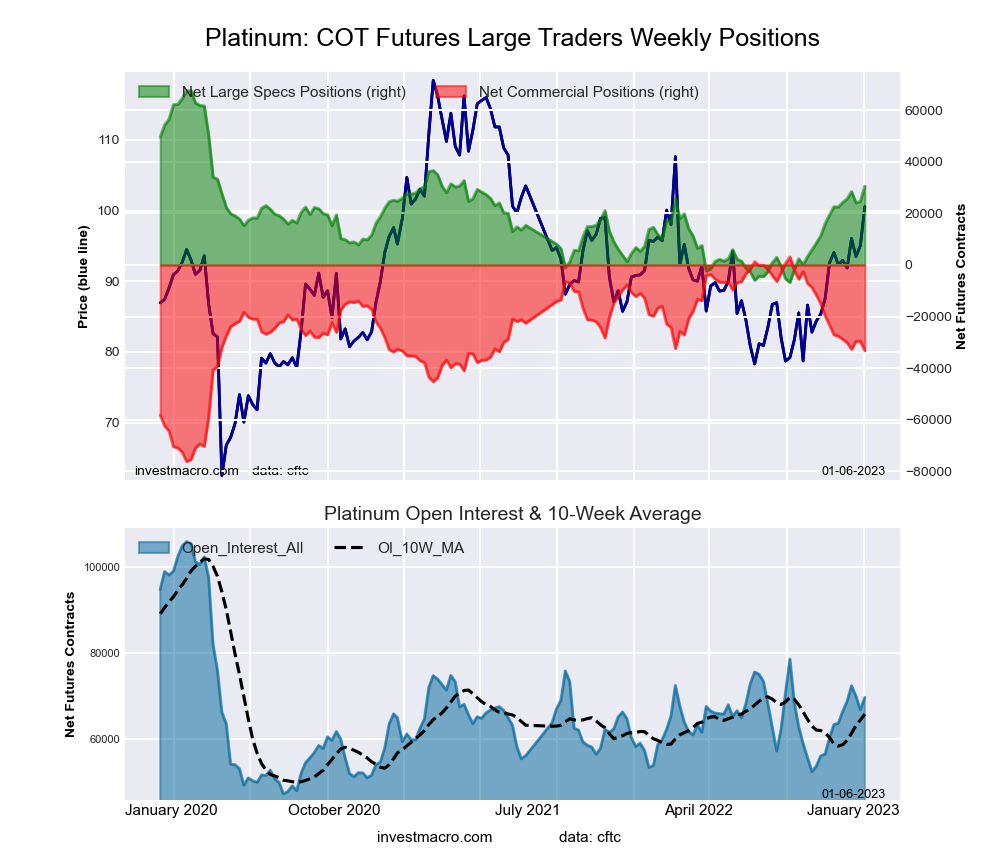
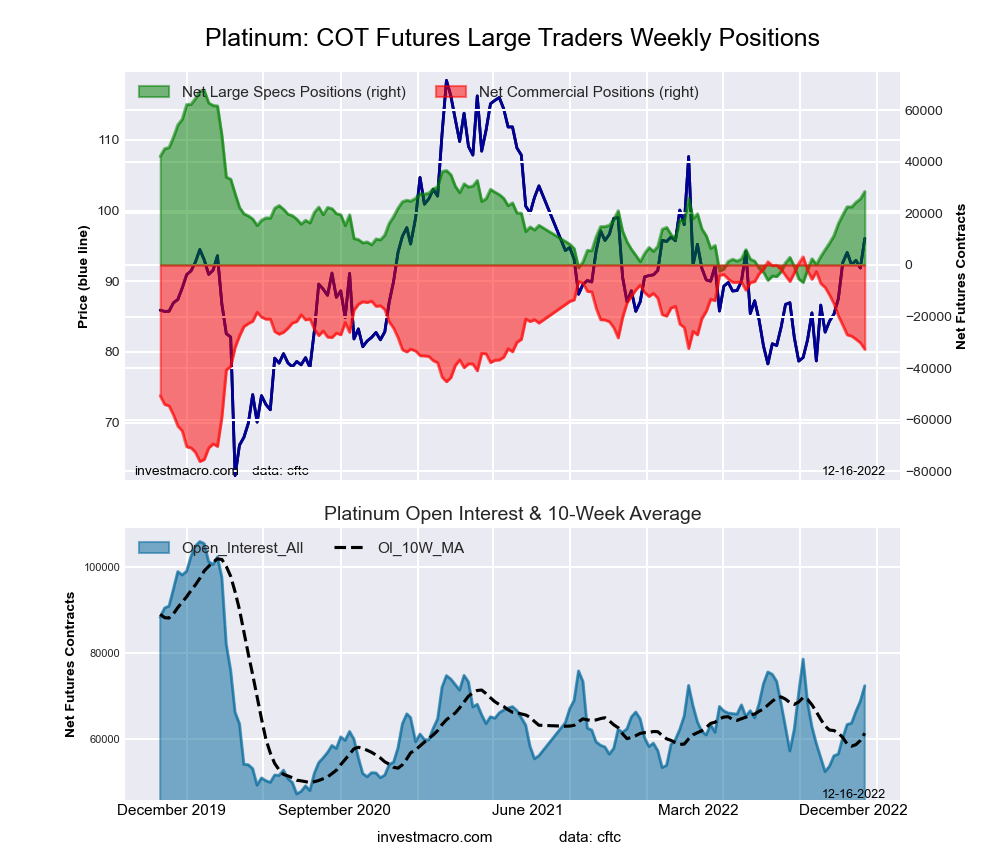
Highlighting the COT metals data this week is the continued gains in bets for the Platinum positions. The large speculator position in Platinum futures rose this week for a second straight week and for the fifth time over the past six weeks. Over the past fourteen weeks, Platinum bets have been higher in twelve of those weeks. The speculator position (sitting at +30,503 contracts) has now risen to the most bullish level since April 6th of 2021, a span of 91 weeks.

Platinum prices have been moving higher since hitting a multi-year low in early September as well. Since falling to a low just beneath $800 on September 1st, Platinum futures have been in a strong uptrend and closed this week above the $1100 price level for an almost 40 percent rise (since Sept. 1st) and the highest weekly close since March 2022.


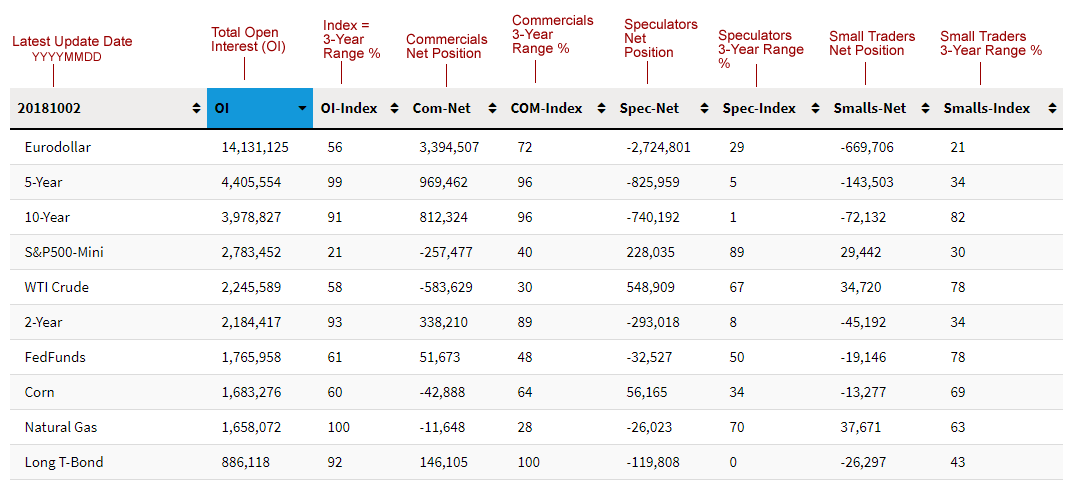
Data Snapshot of Commodity Market Traders | Columns Legend
Jan-03-2023OIOI-IndexSpec-NetSpec-IndexCom-NetCOM-IndexSmalls-NetSmalls-Index
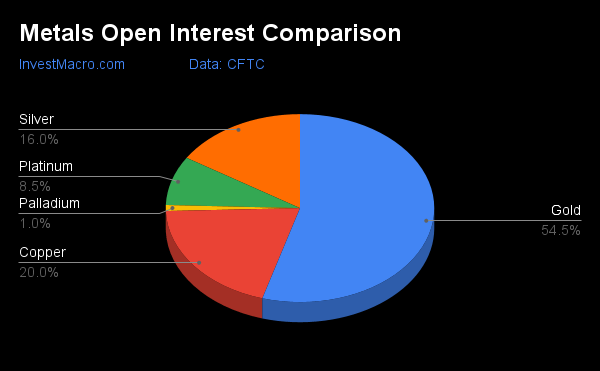
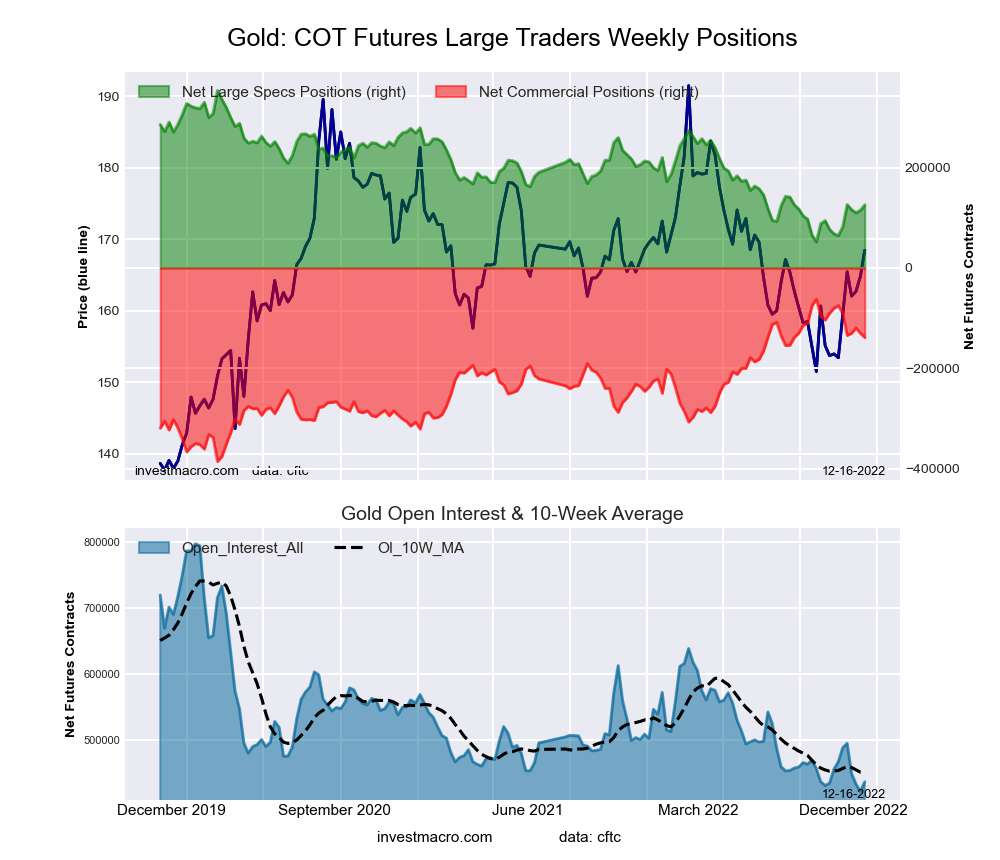
Gold449,3937141,66630-159,9747018,30826
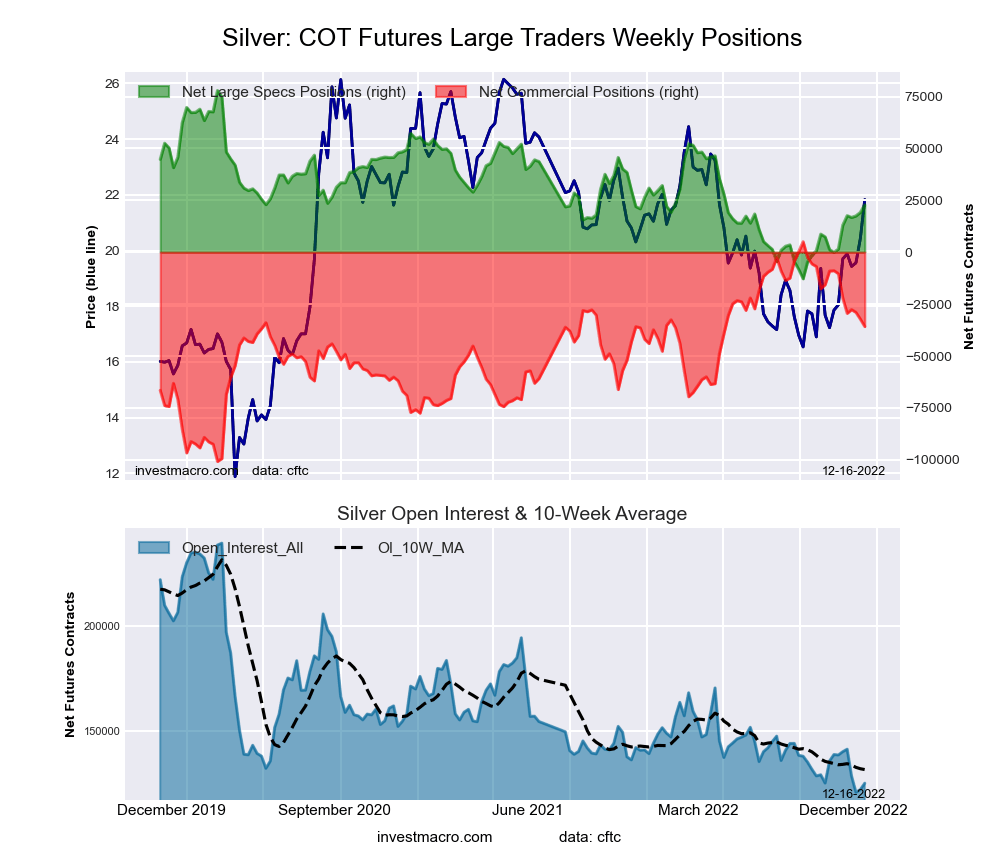
Silver131,990930,93448-44,2115313,27737
Copper164,59413-4,67533-163674,83853
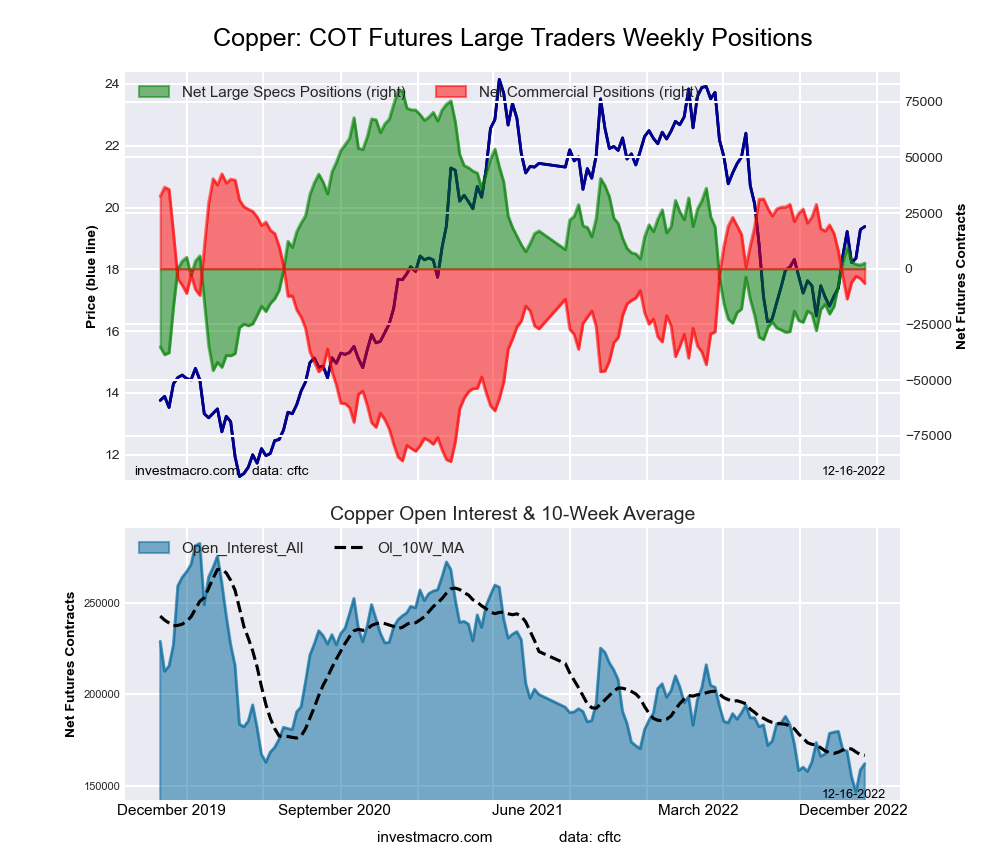
Palladium8,45612-2,542102,4228712049
Platinum69,6873830,50350-33,157542,6544


Strength Scores led by Platinum & Silver

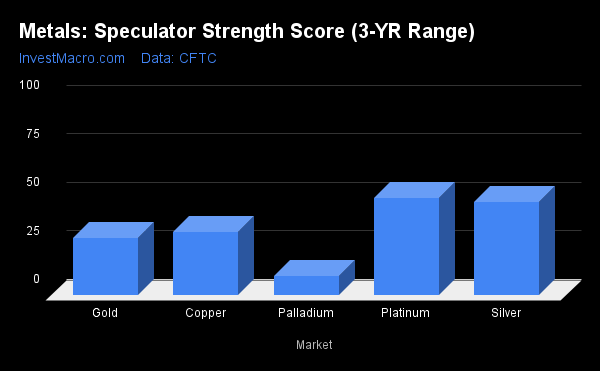
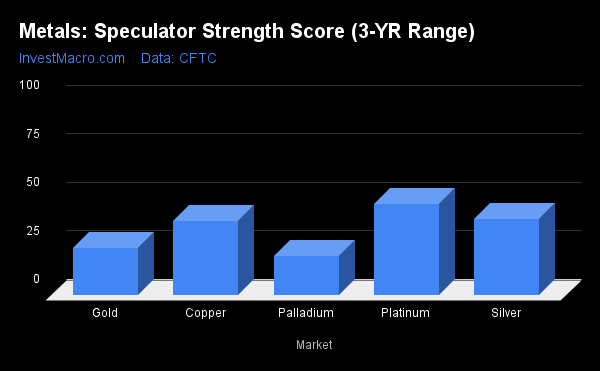
COT Strength Scores (a normalized measure of Speculator positions over a 3-Year range, from 0 to 100 where above 80 is Extreme-Bullish and below 20 is Extreme-Bearish) showed that the Platinum (50 percent) leads the metals markets this week. Silver (48 percent) comes in as the next highest in the weekly strength scores.

On the downside, Palladium (10 percent) comes in at the lowest strength level currently and is in Extreme-Bearish territory (below 20 percent). The next lowest strength score was Gold (30 percent).

Strength Statistics:
Gold (29.7 percent) vs Gold previous week (28.1 percent)
Silver (48.2 percent) vs Silver previous week (48.3 percent)
Copper (32.6 percent) vs Copper previous week (36.9 percent)
Platinum (50.1 percent) vs Platinum previous week (42.3 percent)
Palladium (9.8 percent) vs Palladium previous week (12.0 percent)


Silver & Platinum top the 6-Week Strength Trends

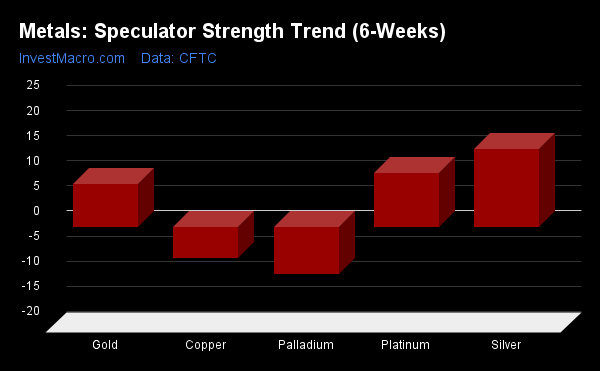
COT Strength Score Trends (or move index, calculates the 6-week changes in strength scores) showed that Silver (16 percent) leads the past six weeks trends for metals. Platinum (11 percent) is the next highest positive mover in the latest trends data.

Palladium (-9 percent) leads the downside trend scores currently with Copper (-6 percent) as the next market with lower trend scores.

Move Statistics:
Gold (8.5 percent) vs Gold previous week (3.5 percent)
Silver (15.6 percent) vs Silver previous week (14.8 percent)
Copper (-6.2 percent) vs Copper previous week (-7.2 percent)
Platinum (10.8 percent) vs Platinum previous week (2.9 percent)
Palladium (-9.3 percent) vs Palladium previous week (-7.4 percent)


Individual Markets:

Gold Comex Futures:

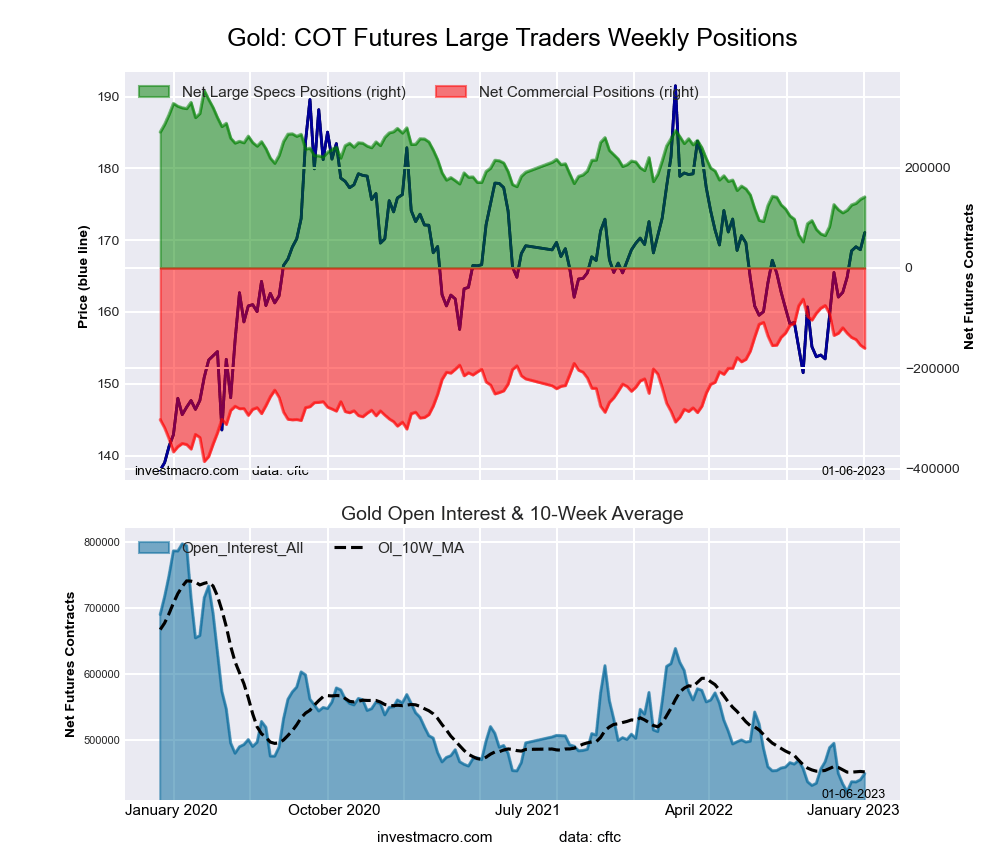
Gold Futures COT ChartThe Gold Comex Futures large speculator standing this week was a net position of 141,666 contracts in the data reported through Tuesday. This was a weekly lift of 4,786 contracts from the previous week which had a total of 136,880 net contracts.

This week’s current strength score (the trader positioning range over the past three years, measured from 0 to 100) shows the speculators are currently Bearish with a score of 29.7 percent. The commercials are Bullish with a score of 69.8 percent and the small traders (not shown in chart) are Bearish with a score of 25.8 percent.

Gold Futures StatisticsSPECULATORSCOMMERCIALSSMALL TRADERS
– Percent of Open Interest Longs:51.425.39.4
– Percent of Open Interest Shorts:19.860.95.3
– Net Position:141,666-159,97418,308
– Gross Longs:230,801113,52042,337
– Gross Shorts:89,135273,49424,029
– Long to Short Ratio:2.6 to 10.4 to 11.8 to 1
NET POSITION TREND:
– Strength Index Score (3 Year Range Pct):29.769.825.8
– Strength Index Reading (3 Year Range):BearishBullishBearish
NET POSITION MOVEMENT INDEX:
– 6-Week Change in Strength Index:8.5-9.211.0


Silver Comex Futures:

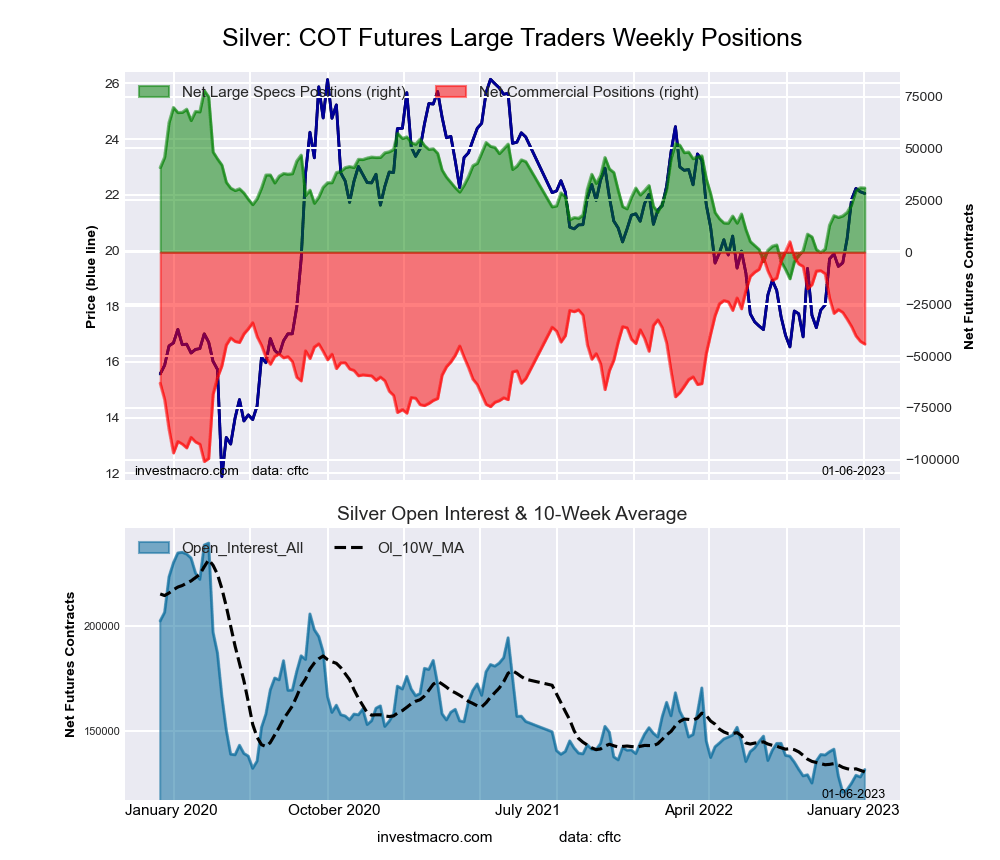
Silver Futures COT ChartThe Silver Comex Futures large speculator standing this week was a net position of 30,934 contracts in the data reported through Tuesday. This was a weekly reduction of -93 contracts from the previous week which had a total of 31,027 net contracts.

This week’s current strength score (the trader positioning range over the past three years, measured from 0 to 100) shows the speculators are currently Bearish with a score of 48.2 percent. The commercials are Bullish with a score of 53.5 percent and the small traders (not shown in chart) are Bearish with a score of 36.5 percent.

Silver Futures StatisticsSPECULATORSCOMMERCIALSSMALL TRADERS
– Percent of Open Interest Longs:43.833.517.9
– Percent of Open Interest Shorts:20.467.07.8
– Net Position:30,934-44,21113,277
– Gross Longs:57,80144,22923,576
– Gross Shorts:26,86788,44010,299
– Long to Short Ratio:2.2 to 10.5 to 12.3 to 1
NET POSITION TREND:
– Strength Index Score (3 Year Range Pct):48.253.536.5
– Strength Index Reading (3 Year Range):BearishBullishBearish
NET POSITION MOVEMENT INDEX:
– 6-Week Change in Strength Index:15.6-15.712.2


Copper Grade #1 Futures:

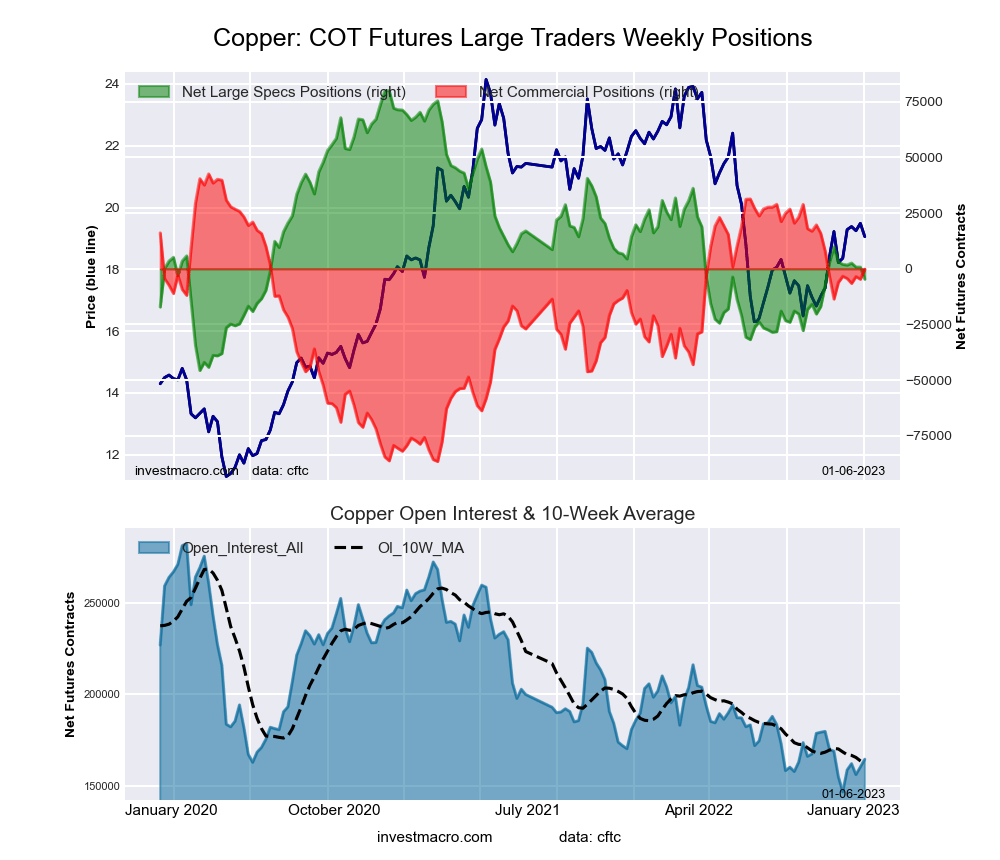
Copper Futures COT ChartThe Copper Grade #1 Futures large speculator standing this week was a net position of -4,675 contracts in the data reported through Tuesday. This was a weekly lowering of -5,399 contracts from the previous week which had a total of 724 net contracts.

This week’s current strength score (the trader positioning range over the past three years, measured from 0 to 100) shows the speculators are currently Bearish with a score of 32.6 percent. The commercials are Bullish with a score of 66.9 percent and the small traders (not shown in chart) are Bullish with a score of 53.3 percent.

Copper Futures StatisticsSPECULATORSCOMMERCIALSSMALL TRADERS
– Percent of Open Interest Longs:34.741.910.4
– Percent of Open Interest Shorts:37.642.07.4
– Net Position:-4,675-1634,838
– Gross Longs:57,19168,90517,079
– Gross Shorts:61,86669,06812,241
– Long to Short Ratio:0.9 to 11.0 to 11.4 to 1
NET POSITION TREND:
– Strength Index Score (3 Year Range Pct):32.666.953.3
– Strength Index Reading (3 Year Range):BearishBullishBullish
NET POSITION MOVEMENT INDEX:
– 6-Week Change in Strength Index:-6.24.610.6


Platinum Futures:

Platinum Futures COT ChartThe Platinum Futures large speculator standing this week was a net position of 30,503 contracts in the data reported through Tuesday. This was a weekly lift of 5,837 contracts from the previous week which had a total of 24,666 net contracts.

This week’s current strength score (the trader positioning range over the past three years, measured from 0 to 100) shows the speculators are currently Bullish with a score of 50.1 percent. The commercials are Bullish with a score of 54.2 percent and the small traders (not shown in chart) are Bearish-Extreme with a score of 3.9 percent.

Platinum Futures StatisticsSPECULATORSCOMMERCIALSSMALL TRADERS
– Percent of Open Interest Longs:59.626.99.9
– Percent of Open Interest Shorts:15.974.56.1
– Net Position:30,503-33,1572,654
– Gross Longs:41,55518,7346,879
– Gross Shorts:11,05251,8914,225
– Long to Short Ratio:3.8 to 10.4 to 11.6 to 1
NET POSITION TREND:
– Strength Index Score (3 Year Range Pct):50.154.23.9
– Strength Index Reading (3 Year Range):BullishBullishBearish-Extreme
NET POSITION MOVEMENT INDEX:
– 6-Week Change in Strength Index:10.8-7.1-31.8


Palladium Futures:

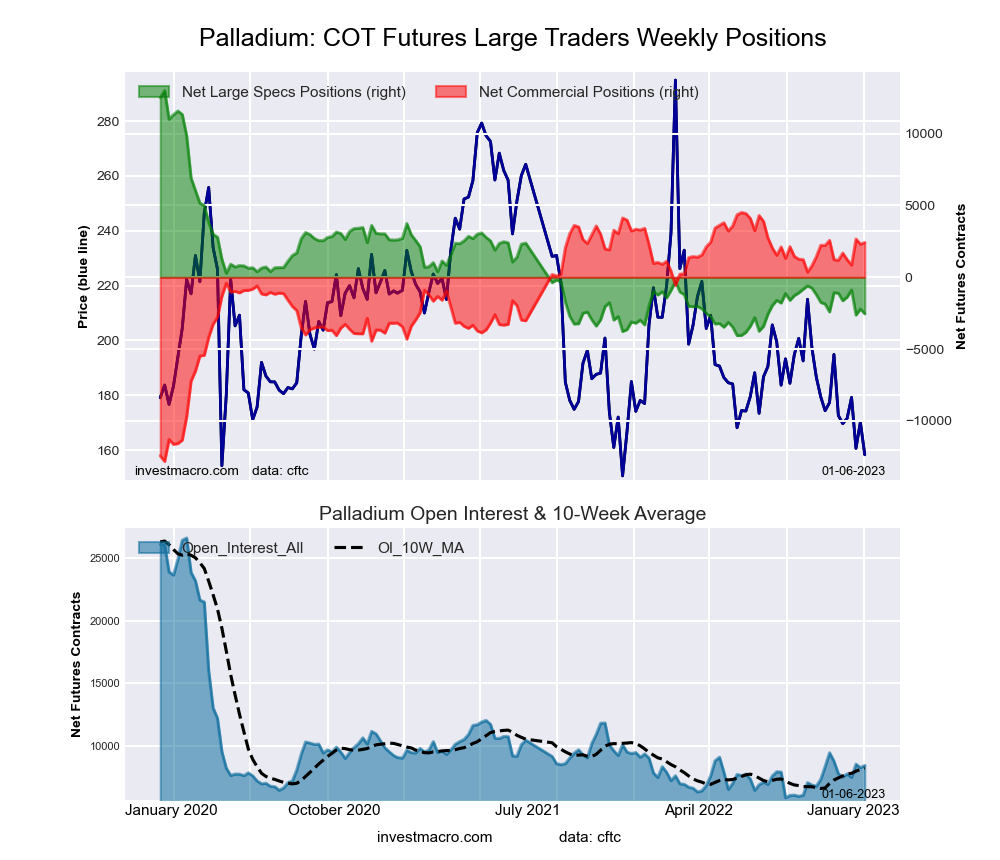
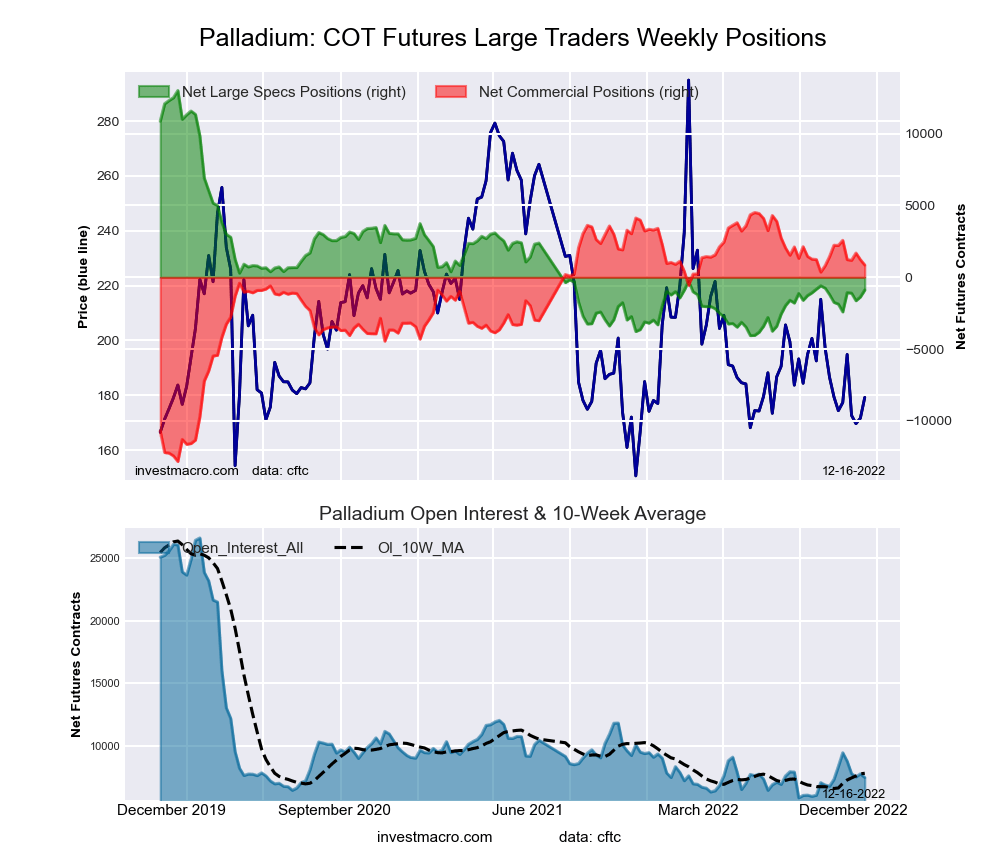
Palladium Futures COT ChartThe Palladium Futures large speculator standing this week was a net position of -2,542 contracts in the data reported through Tuesday. This was a weekly reduction of -336 contracts from the previous week which had a total of -2,206 net contracts.

This week’s current strength score (the trader positioning range over the past three years, measured from 0 to 100) shows the speculators are currently Bearish-Extreme with a score of 9.8 percent. The commercials are Bullish-Extreme with a score of 86.8 percent and the small traders (not shown in chart) are Bearish with a score of 48.9 percent.

Palladium Futures StatisticsSPECULATORSCOMMERCIALSSMALL TRADERS
– Percent of Open Interest Longs:25.155.615.0
– Percent of Open Interest Shorts:55.126.913.6
– Net Position:-2,5422,422120
– Gross Longs:2,1204,7001,270
– Gross Shorts:4,6622,2781,150
– Long to Short Ratio:0.5 to 12.1 to 11.1 to 1
NET POSITION TREND:
– Strength Index Score (3 Year Range Pct):9.886.848.9
– Strength Index Reading (3 Year Range):Bearish-ExtremeBullish-ExtremeBearish
NET POSITION MOVEMENT INDEX:
– 6-Week Change in Strength Index:-9.37.811.9


Article By InvestMacroReceive our weekly COT Newsletter

*COT Report: The COT data, released weekly to the public each Friday, is updated through the most recent Tuesday (data is 3 days old) and shows a quick view of how large speculators or non-commercials (for-profit traders) were positioned in the futures markets.

The CFTC categorizes trader positions according to commercial hedgers (traders who use futures contracts for hedging as part of the business), non-commercials (large traders who speculate to realize trading profits) and nonreportable traders (usually small traders/speculators) as well as their open interest (contracts open in the market at time of reporting). See CFTC criteria here.

Mining Project Could Be Carbon Net Zero

Source: Adam Schatzker  (1/5/23)

Such a scenario is possible for this nickel-cobalt asset thanks to its owner’s carbon sequestering process, noted a Research Capital Corp. report.

Improvements to Canada Nickel Co. Inc.’s (CNIKF:OTCMKTS;CNC:TSX.V) proprietary in-process tailings (IPT) carbonation process are “impressive” on a laboratory scale and, thus, bode well for the explorer’s Crawford nickel-cobalt project in Ontario’s Timmins mining camp, reported Research Capital Corp. analyst Adam Schatzker in a Jan. 4 research note.

“If the testing by Canada Nickel is proven,” Schatzker wrote, “the Crawford project could become a major critical minerals producer while being net zero carbon or perhaps sequestering far more carbon than the project produces.”

Testing of the IPT process revealed two significant findings, noted Schatzker. One, the methodology can be applied to the Toronto-based company’s existing process stream to capture and store carbon dioxide (CO2) at an accelerated rate.

“In the near term, we think Canada Nickel will likely announce some form of financing (likely strategic) that will allow the company to eliminate the debt on its balance sheet,” wrote Schatzker.

Two, in the lab, the IPT process can capture a maximum of 37 tons of CO2 per ton of nickel produced. The amount to be captured routinely, however, is likely to be lower, and the nadir is not yet known, Schatzker wrote.

Regardless, extrapolating this result to the much larger scale of the Crawford project suggests the process would sequester a “very significant amount of CO2,” noted Schatzker, more than enough for Crawford to achieve carbon net-zero status, noted Schatzker. The feasibility study of Crawford is now expected in Q2/23.

Ways To Improve the Project

Schatzker pointed out that by integrating the IPT process into Crawford, Canadian Nickel might qualify for and benefit from some type of governmental incentive. One possibility is Canada’s existing refundable investment tax credits that range from 37.5–60% between 2022 and 2030 and from 18.75–30% between 2031 and 2040. These specific credits, Schatzker noted, would greatly improve Crawford’s economics.

“In the near term, we think Canada Nickel will likely announce some form of financing (likely strategic) that will allow the company to eliminate the debt on its balance sheet,” wrote Schatzker.

Also, the analyst purported the IPT process would work best with “a point source of concentrated CO2,” generated through a vehicle such as a natural gas generating plant or a blue hydrogen project.

“This approach,” he added, “while broadening the scope of the overall project, may make it more attractive from a carbon/environmental, social, and governance perspective.”

Research Capital has a Speculative Buy rating and a CA$2.70 per share price target on Canada Nickel, the current share price of which is about CA$1.76.

Disclosures:
1) Doresa Banning wrote this article for Streetwise Reports LLC and provides services to Streetwise Reports as an independent contractor. She or members of her household own securities of the following companies mentioned in the article: None. She or members of her household are paid by the following companies mentioned in this article: None.

2) The following companies mentioned in this article are billboard sponsors of Streetwise Reports: None. Click here for important disclosures about sponsor fees. The information provided above is for informational purposes only and is not a recommendation to buy or sell any security.

3) Statements and opinions expressed are the opinions of the author and not of Streetwise Reports or its officers. The author is wholly responsible for the validity of the statements. The author was not paid by Streetwise Reports for this article. Streetwise Reports was not paid by the author to publish or syndicate this article. Streetwise Reports requires contributing authors to disclose any shareholdings in, or economic relationships with, companies that they write about. Streetwise Reports relies upon the authors to accurately provide this information and Streetwise Reports has no means of verifying its accuracy.

4) This article does not constitute investment advice. Each reader is encouraged to consult with his or her individual financial professional and any action a reader takes as a result of information presented here is his or her own responsibility. By opening this page, each reader accepts and agrees to Streetwise Reports’ terms of use and full legal disclaimer. This article is not a solicitation for investment. Streetwise Reports does not render general or specific investment advice and the information on Streetwise Reports should not be considered a recommendation to buy or sell any security. Streetwise Reports does not endorse or recommend the business, products, services or securities of any company mentioned on Streetwise Reports.

5) From time to time, Streetwise Reports LLC and its directors, officers, employees or members of their families, as well as persons interviewed for articles and interviews on the site, may have a long or short position in securities mentioned. Directors, officers, employees or members of their immediate families are prohibited from making purchases and/or sales of those securities in the open market or otherwise from the time of the decision to publish an article until three business days after the publication of the article. The foregoing prohibition does not apply to articles that in substance only restate previously published company releases.
Disclosures For Research Capital Corp., Canada Nickel Company Inc.,  January 4, 2023

Analyst Certification: I, Adam Schatzker, certify the views expressed in this report were formed by my review of relevant company data and industry investigation, and accurately reflect my opinion about the investment merits of the securities mentioned in the report. I also certify that my compensation is not related to specific recommendations or views expressed in this report. Research Capital Corporation publishes research and investment recommendations for the use of its clients. Information regarding our categories of recommendations, quarterly summaries of the percentage of our recommendations which fall into each category and our policies regarding the release of our research reports is available at www.researchcapital.com or may be requested by contacting the analyst. Each analyst of Research Capital Corporation whose name appears in this report hereby certifies that (i) the recommendations and opinions expressed in this research report accurately reflect the analyst’s personal views and (ii) no part of the research analyst’s compensation was or will be directly or indirectly related to the specific conclusions or recommendations expressed in this research report.

General Disclosures: The opinions, estimates and projections contained in all Research Reports published by Research Capital Corporation (“RCC”) are those of RCC as of the date of publication and are subject to change without notice. RCC makes every effort to ensure that the contents have been compiled or derived from sources believed to be reliable and that contain information and opinions that are accurate and complete; RCC makes no representation or warranty, express or implied, in respect thereof, takes no responsibility for any errors and omissions which may be contained therein and accepts no liability whatsoever for any loss arising from any use of or reliance on its Research Reports or its contents.

Information may be available to RCC that is not contained therein. Research Reports disseminated by RCC are not a solicitation to buy or sell. All securities not available in all jurisdictions.

Company Specific Disclosures: Within the past 12 months, Research Capital has provided investment banking services to the issuer. The Analyst currently owns or is short shares of the issuer, which represents less than 1% of shares outstanding.

Potential Conflicts of Interest: All Research Capital Corporation (“RCC”) Analysts are compensated based in part on the overall revenues of RCC, a portion of which are generated by investment banking activities. RCC may have had, or seek to have, an investment banking relationship with companies mentioned in this report. RCC and/or its officers, directors and employees may from time to time acquire, hold or sell securities mentioned in our Research Reports as principal or agent. RCC makes every effort possible to avoid conflicts of interest, however readers should assume that a conflict might exist, and therefore not rely solely on this report when evaluating whether or not to buy or sell the securities of subject companies.

RCC USA: Information about Research Capital Corporation’s Rating System, the distribution of our research to clients and the percentage of recommendations which are in each of our rating categories is available on our website at www.researchcapital.ca. The information contained in this report has been drawn from sources believed to be reliable but its accuracy or completeness is not guaranteed, nor in providing it does Research Capital Corporation assume any responsibility or liability. Research Capital Corporation, its directors, officers and other employees may, from time to time, have positions in the securities mentioned herein. Contents of this report cannot be reproduced in whole or in part without the express permission of Research Capital Corporation. US Institutional Clients – Research Capital USA Inc., a wholly owned subsidiary of Research Capital Corporation, accepts responsibility for the contents of this report subject to the terms and limitations set out above. US firms or institutions receiving this report should effect transactions in securities discussed in the report through Research Capital USA Inc., a Broker – Dealer registered with the Financial Industry Regulatory Authority (FINRA).

Which Precious Metal Has Chen Excited for 2023?

Source: Streetwise Reports  (12/28/22)

It’s valued the world over as a precious metal, and now it’s in demand for the green economy. Which element has asset manager Chen Lin looking forward to the New Year?

What is Chen buying? Right now, silver. Lots of silver.

The asset manager and author of the What is Chen Buying? What is Chen Selling? newsletter said he is bullish on the precious metal because the push for greener energy will lead to the adoption of more solar energy, a technology that requires large amounts of it.

“The rising silver loading factor times explosive growth of solar panel demand will create a silver tsunami,” Chen wrote.

“The rising silver loading factor times explosive growth of solar panel demand will create a silver tsunami,” Chen wrote in his newsletter in December.

“Silver mine production, mostly as a by-product, has been very stable for the past decade. As we know, it takes years to explore, then years to permit and build a new mine. So, it will likely take a decade to bring up the production even as the demand explodes.”

The Silver Institute has predicted that global silver demand will reach a new high of 1.21 billion ounces in 2022, up 16% from last year. Industrial demand is on course to grow to 539 million ounces (Moz). And it won’t be just for solar panels.

Chen also suggests that those who wish to have a happy new year invest in companies specializing in rare metals, biotech, and/or energy stocks.

“Developments such as ongoing vehicle electrification (despite sluggish vehicle sales), growing adoption of 5G technologies, and government commitments to green infrastructure will have industrial demand overcome macro-economic headwinds and weaker consumer electronics demand,” the report said.

The global silver market is forecasted to record a second consecutive deficit between supply and demand this year, the Institute said. At 194 Moz, it will be a multi-decade high and four times 2021’s level.

Chen also suggests that those who wish to have a happy new year invest in companies specializing in rare metals, biotech, and/or energy stocks.

SilverCrest

Chen says he has a collection of silver companies, large and small, in his portfolio, but he is especially interested in SilverCrest Metals Inc. (SIL:TSX.V; SILV:NYSE.American).

SilverCrest is developing a 1,250-tonne-per-day processing plant at its Las Chispas Mine located in Sonora, Mexico, with initial proven and probable reserves of 94.7 million ounces (94.7 Moz silver equivalent (AgEq), placing it among the highest-grade primary silver projects in the world.

“I think 2023 could be the year for SILV as it advances the mine production,” Chen said.

The mine would have an initial life of 8.5 years. Analyst Phil Ker of PI Financial Inc. wrote on Dec. 8 that Las Chispas was expected to produce 9.9 Moz AgEq in 2023. Ker rated the stock Buy with a CA$14 target price.

“We believe a premium valuation is warranted and suggest investors continue to accumulate shares ahead of achieving positive cash flow from Las Chispas,” he wrote.

Sprott Asset Management LP owns 5.75% of the company, Gilder Gagnon Howe & Co. LLC owns 5%, Van Eck Associates Corp. owns 4.38%, ETF Managers Group LLC owns 3.46%, and Sprott Asset Management USA Inc. owns 2.94%, according to Reuters.

It has a market cap of US$934.66 million with 146.5 million shares outstanding, 140.6 million of them free-floating. It trades in a 52-week range of US$10.13 and US$4.58.

Chen says he also has other silver producers in Mexico, including MAG Silver Corp. (MAG:TSX; MAG:NYSE American) and GoGold Resources Inc. (GGD:TSX).

First Tellurium Corp.

Another element critical to solar panels is tellurium, one of the planet’s rarest elements. First Tellurium Corp. (FTEL:CSE) has two important tellurium resources at its Deer Horn project in British Columbia and its Klondike Tellurium project in Colorado.

“Governments are just starting to understand the importance of tellurium,” said First Tellurium President and Chief Executive Officer Tyrone Docherty. “It has flown largely under the radar, even though it’s essential for cadmium-telluride solar panels and new lithium-tellurium (Li-Te) batteries that could revolutionize energy storage.”

Chen said that North America is too dependent on foreign sources for the element.

“This metal can be in demand, this is a pure-play, and management just a lot of (its) own money in the stock,” Chen said.

Reuters has Docherty as the top shareholder in the company with 10.46%, Josef Anthony Steve Fogarassy has 1.38%, and Lyle Allen Schwabe owns 0.85%.

Its market cap is CA$9.44 million, with 72.7 million shares outstanding, 63.4 million of them free-floating. It trades in a 52-week range of CA$0.71 and CA$0.085.

Amyris Inc.

A returning favorite of Chen’s is Amyris, Inc. (AMRS:NASDAQ), a synthetic biotech company that “programs” cells to create sustainable ingredients.

The company has begun production at its new precision sugar fermentation plant in Brazil. The plant comprises five precision fermentation “mini-factories” that can produce 13 of Amyris’ molecules, which are used in everything from health and beauty products to flavors and fragrances.

Amyris is a frontrunner for the US$1 billion the U.S. Department of Defense will be investing in the bioindustrial domestic manufacturing infrastructure over the next five years. It’s part of the US$2 billion the U.S. government plans to spend to boost biomanufacturing under an executive order announced last month.
Amyris on Tuesday announced a US$500 million contract to supply two of its ingredients.

“If the stock is over US$5, I wouldn’t buy it,” Chen told Streetwise Reports. “But if it’s two and change . . .  it’s very good risk-reward.”

Amyris’ top shareholders include Foris Ventures LLC at 22.39%, The Vanguard Group Inc. at 5.98%, Koninklijke DSM NV at 5.06%, BlackRock Institutional Trust Co. N.A. at 3.57%, and Vivo Capital LLC at 2.35%, according to Reuters.

Its market cap is US$564.57 million, and it has 330.2 million shares outstanding, 234.2 million of them free-floating. It trades in a 52-week range of US$6.37 and US$1.44.

Viking Therapeutics Inc.

Viking Therapeutics Inc (VKTX:NASD) saw its stock price rise nearly 75% earlier this month when another company, Madrigal Pharmaceuticals Inc. (MDGL:NASDAQ), reported positive results from its Phase 3 clinical trial of its nonalcoholic steatohepatitis (NASH) treatment.

Viking is working on its own NASH drug and is holding a Phase 2b clinical trial. Shareholders are hoping for similar success.

The “situation is very good,” Chen said. “Most fund managers are on vacation. So, if you can get in before the end of the year when they come back . . .  they will start buying, and you can sell.”

The company is also running a Phase 1 clinical trial to develop a drug that could treat various metabolic disorders.

Ligand Pharmaceuticals Inc. owns 8.76% of Viking, the Vanguard Group Inc. owns 4.34%, Millennium Management LLC owns 4.05%, Balyasny Asset Management LP owns 3.49%, and Two Sigma Investments LP owns 2.47%, Reuters said.

Its market cap is US$651.47 million. It has 76.7 million shares outstanding, with 67.8 million free-floating. It trades in a 52-week range of US$8.63 and US$2.02.

TAG Oil Ltd.

In the energy world, Chen likes TAG Oil Ltd. (TAO:TSX) if you can take the risk that its projects are in the volatile Middle East and North Africa.

The company is initiating Phase 1 of a fracking program in Egypt in Q1 2023. It anticipates providing results as early as March.

“This seems to be a relatively low-risk fracking play,” Chen said. “The market value could increase at least tenfold.”

Askar Alshinbayev owns 10.99% of TAG Oil, YF Finance Ltd. owns 8.42%, Abdel Fattah Z. Badwi owns 2.06%, Shawn Reynolds owns 1.54%, and Suneel Gupta owns 1.03%, according to Reuters.

It has a market cap of CA$83.71 million with 154.6 million shares outstanding and 113.2 million free-floating. It trades in a 52-week range of CA$0.70 and CA$0.195.

Canacol Energy Ltd.

Another company returning to Chen’s list is Calgary-based Canacol Energy Ltd. (CNE:TSX; CNNEF:OTCQX), which is a major player in natural gas production and exploration in Colombia. Its stock dipped earlier this year when the country elected its first leftist leader, Gustavo Petro.

While Petro is against new oil and gas exploration, favoring elements needed for the green economy like copper and silver, the company has natural gas contracts that give it a dependable income.

BTG Pactual Affiliate Research analyst Daniel Guardiola rated the stock a Buy with a CA$5.50 target in November.

Canacol said it’s the largest independent onshore conventional natural gas exploration and production company in Colombia and that it supplies about 20% of the country’s natural gas.

Fourth Sail Capital LP owns 20.49% of Canacol, Cavengas Holdings S.R.L. owns 19.12%, Cobas Asset Management SGIIC SA owns 3.12%, Dimensional Fund Advisors LP owns 0.96%, and Abaco Capital Investments owns 0.27%, according to Reuters.

Canacol has a market cap of CA$353 million and 170.6 million outstanding shares, including 137.7 million free-floating. It trades in a 52-week range of CA$3.62 and CA$1.75.

Sign up for our FREE newsletter

Disclosures

1) Steve Sobek wrote this article for Streetwise Reports LLC and provides services to Streetwise Reports. He or members of his household own securities of the following companies mentioned in the article: None. He or members of his household are paid by the following companies mentioned in this article: None.

2) The following companies mentioned in this article are billboard sponsors of Streetwise Reports: MAG Silver Corp. Click here for important disclosures about sponsor fees. As of the date of this article, an affiliate of Streetwise Reports has a consulting relationship with First Tellurium Inc. Please click here for more information.

3) The article does not constitute investment advice. Each reader is encouraged to consult with his or her individual financial professional and any action a reader takes as a result of information presented here is his or her own responsibility. By opening this page, each reader accepts and agrees to Streetwise Reports’ terms of use and full legal disclaimer. This article is not a solicitation for investment. Streetwise Reports does not render general or specific investment advice and the information on Streetwise Reports should not be considered a recommendation to buy or sell any security. Streetwise Reports does not endorse or recommend the business, products, services or securities of any company mentioned on Streetwise Reports.

4) From time to time, Streetwise Reports LLC and its directors, officers, employees or members of their families, as well as persons interviewed for articles and interviews on the site, may have a long or short position in securities mentioned. Directors, officers, employees or members of their immediate families are prohibited from making purchases and/or sales of those securities in the open market or otherwise from the time of the decision to publish an article until three business days after the publication of the article. The foregoing prohibition does not apply to articles that in substance only restate previously published company releases. As of the date of this article, officers and/or employees of Streetwise Reports LLC (including members of their household) own securities of First Tellurium Corp., a company mentioned in this article.
5) This article does not constitute medical advice. Officers, employees and contributors to Streetwise Reports are not licensed medical professionals. Readers should always contact their healthcare professionals for medical advice.


The New Investor’s Guide To Investing in Metal Stocks

Source: Streetwise Reports  (12/22/22)

For new investors, mining stocks can be an excellent gateway to learning about investing in general. Explore how and where you can buy gold stocks and more.

Are you one of the many people who go through life with a vague curiosity about investing?

Perhaps you think you’ll get to it when you’re older or when you have more disposable income. Maybe you see it as gambling and, although interested, you don’t really know where to begin. If that sounds like you, then this guide will serve as a pathway to your investing future. We’ll help you explore the major types of metals people buy and show you some places to buy them.

Explore the most popular types of metal stocks people invest in, including what they are, where you can research them, and how you can begin investing the moment you finish this article.

Which Metals Do People Invest In? 

While the most common mining stocks people invest in are gold and silver stocks, most others are viable investments as well. When you buy the stock of a particular metal, like gold stocks, you’re actually investing in one of the companies that mines that particular mineral. It’s these types of metal stocks that are covered in this article, not purchasing physical metals.

Nevertheless, it helps as an investor to understand what makes these metals so highly valued in the first place. From the beginning of time and throughout every culture, gold, silver, nickel, and other metals have been used as currency.

When America issued its first paper money in 1690, these metals remained valuable. From jewelry to circuitry, building to computing, these metals are deeply ingrained into our society.

Unique for their hardness, beauty, and rarity, precious metals are known as one of the safest and most traditionally stable assets you can invest in.

Precious Metals

The main type of metals people invest in is also the rarest and most valuable. Precious metal stocks are primarily used as a hedge against inflation, and gold, silver, and platinum are the most popular.

Each metal has its own traits, tendencies in the market, and uses in society. Learn more about precious metals and consider which might be worth adding to your portfolio.

Gold

Ancient civilizations placed a lot of value on gold; thousands of years later, it’s still one of the most highly-coveted substances on Earth. Most frequently used as jewelry and a form of currency, gold has special traits that add to its mystique. These include

Unique Facts About Gold

– Gold is special in that it doesn’t rust or corrode and can conduct heat and electricity.

– The United States has the largest reserve of gold in the world, with 8,867 tons.

– Investors love gold and gold stocks for their tendency to hold value in volatile markets.

Where Can You Learn More About Investing in Gold?

As the most widely-invested metal, there are numerous sources of information on gold stocks and other gold-related investments.  Some reputable sources you may want to explore include The Gold Report, Barron’s, and USAGOLD.

Silver

Also a staple in jewelry, in addition to numerous other things, silver is less precious but far more useful than gold. From scrap to batteries, smartphones to car parts, silver is highly-versatile and constantly in demand.

Unique Facts About Silver

– Silver is one of the easiest investments to liquidate; jewelers will pay the market price for silver.

– Unlike stocks, silver is never likely to crash because it holds real-world, inherent value.

– One of the oldest elements, silver has been traded as a currency since 700 BC.

Whether you choose to invest in silver or silver stocks, consider it a viable and popular investment to add to your portfolio.

Platinum

Rounding out the top three precious metals, platinum is just as highly-coveted as gold and silver. As the only material suitable for the electrodes in pacemakers, platinum is extremely valuable to humanity as well as savvy investors.

Unique Facts About Platinum

– The price of platinum typically fluctuates with manufacturing and industrial industries.

– Platinum is even rarer than gold; all the platinum ever found would fill a pool up to your ankles.

– Platinum is among the heaviest metals: a 6-inch cube weighs as much as an average person.

Palladium and Other Precious Metals

The list of precious metals goes far beyond the three most popular options. From palladium to rhodium, there are numerous metals available, each with its own value as an investment.

If you’re curious about some of the other precious metals you can invest in, here’s a list of some that are worth exploring:

  • Palladium
  • Rhodium
  • Ruthenium
  • Osmium
  • Iridium

Whichever precious metal appeals most to you, it’s worth taking some time to research how they’re known to perform as an investment.

Brief Note on Base Metals

In addition to precious metals, you can also choose to invest in base metals. Base metals are used in manufacturing and are typically more vulnerable to corrosion than precious metals.

Common examples of base metals include iron, steel, copper, nickel, aluminum, lead, zinc, tin, and tungsten. While they lack the rarity of precious metals, base metals are in high demand nonetheless, so consider investing in them to balance your portfolio.

How to Start Investing in Mining Stocks

Whenever you’re ready to buy stocks from a company that mines a particular metal, there are many safe places to do it online.

The first thing you’ll need to begin trading stocks online is your credit card, bank account info, or another account, like PayPal for example. This information will be required when making an account so you can buy stocks and metals online.

Making purchases is easy, regardless of the site you’re using. I recommend a few you may want to look into below.

When reviewing investments, there are numbers and symbols that can get confusing until you know what they mean. Remember that it’s critical to understand the measurements of the metals you’re buying and to stay within your budget while investing.

Once you’ve bought metal stocks, you can monitor their progress over time. If you need to liquidate your money by selling the stocks, every stock site will have slightly different guidelines for doing so.

Important Notes on Mining Stocks

If you plan on buying precious metals stocks, it’s worth having a formidable understanding of mining stocks. Here are some useful things to know before purchasing silver stocks or any other mining stock.

The Two Types of Mining Stocks: Juniors and Majors

Juniors are typically related to mining commodities like oil and natural gas. It’s important to know that they’re a risky investment compared to majors.

Junior mining companies are involved in exploring, preparing, and attaining permits for various metals.

Majors are widely considered a safer and much more mature investment. Majors are typically much larger companies that have been successfully mining and producing metals for many years.

What Factors Affect Mining Stocks?

Every type of stock is impacted by different factors, and the same is true for mining stocks.

Factors like fluctuating cost of the metal their mining and external problems at the physical mine, including geopolitical conflict and weather, all affect mining stock prices.

Where are the Best Places to Invest Online?

It’s worthwhile to check out multiple options before choosing which site to purchase mining stocks from. Each site will have unique pricing plans, features, and rules for liquidating your money and making trades.

Investing online is completely normal now with numerous options, and many precautions are in place to keep it as safe as possible.

If you’re interested in purchasing metal mining stocks such as gold stocks, check out these popular sites: 

Fine-Tuning Your Investment Strategy

Depending on how deep you want to take your investment knowledge, you may opt to do additional research online. Many stock experts eagerly offer guidance and advice on maximizing your portfolio.

While you’ll find experts on every side of an investment argument, it’s critical to remember that it’s your money being invested.

Expert opinions may be valuable, but it’s ultimately you who will be celebrating the gains or suffering the losses in your portfolio. For that reason, it’s typically best to look at a variety of sources before making an investment decision.

How To Use Stock Advice From Experts

As a new investor, seeing detailed stock reports may initially seem overwhelming. When first starting, if you can focus on one or two key takeaways and truly understand them, you’ll become increasingly familiar with the terms and concepts.

Over time, some investment experts or websites may resonate with you, becoming a critical part of your research process.

Examples of Popular Sources of Investment Information

Consider these popular sources of stock news and updates, along with a key takeaway from each of them.

  • Stockhead: “Gold to Shine in 2023, says Bloomberg”

This article is immensely useful for metal investors, as it provides updates on iron ore, gold, and lithium.

Among the many details is this key takeaway: Bloomberg senior strategist, Mike McGlome, explains how gold is already trending more positively and that it’s poised to go up in value in 2023.

  • The Gold Report: “Expert Says Silver May Have a ‘Stellar Performance in 2023’”

Always a valuable source due to many knowledgeable contributors, The Gold Report covers all metal mining stocks, including gold. This highly-detailed article focuses on comments by expert Michael Ballanger.

One key takeaway is that Ballanger explained the parallel between the performance of silver and that of copper and stated that silver is in a position for a “stellar performance in 2023.”

Ultimately, understanding how to interpret investment news and advice will get easier with practice and will likely help you become a smarter, more savvy investor.

Trust Streetwise Reports for the Latest News on Metals

Streetwise Reports is a one-stop hub for anyone whose curious about investing. Featuring articles and valuable information you won’t find anywhere else, you can count on Streetwise Reports to provide detailed and updated investment news daily.

Those interested in mining stocks will want to check out the Gold Report. There you’ll find new, in-depth articles on the events affecting stock prices worldwide.

Our team at Streetwise Reports works around the clock to compile meaningful stock information from a wide range of sources. We hope you’ll make Streetwise Reports the main source for investment news that matters.

Want more insight before your next stock purchase? Sign up for one of our FREE newsletters to get information that can help you make better investment decisions

Disclosures:
1) Nicholas Napier wrote this article for Streetwise Reports LLC and provides services to Streetwise Reports as an independent contractor. They members of their household own securities of the following companies mentioned in the article: None. They or members of their household are paid by the following companies mentioned in this article: None.

2) Comments and opinions expressed are those of the specific experts and not of Streetwise Reports or its officers. The information provided above is for informational purposes only and is not a recommendation to buy or sell any security.

3) The article does not constitute investment advice. Each reader is encouraged to consult with his or her individual financial professional and any action a reader takes as a result of information presented here is his or her own responsibility. By opening this page, each reader accepts and agrees to Streetwise Reports’ terms of use and full legal disclaimer. This article is not a solicitation for investment. Streetwise Reports does not render general or specific investment advice and the information on Streetwise Reports should not be considered a recommendation to buy or sell any security. Streetwise Reports does not endorse or recommend the business, products, services or securities of any company mentioned on Streetwise Reports.

4) From time to time, Streetwise Reports LLC and its directors, officers, employees or members of their families, as well as persons interviewed for articles and interviews on the site, may have a long or short position in securities mentioned. Directors, officers, employees or members of their immediate families are prohibited from making purchases and/or sales of those securities in the open market or otherwise from the time of the decision to publish an article until three business days after the publication of the article. The foregoing prohibition does not apply to articles that in substance only restate previously published company releases.
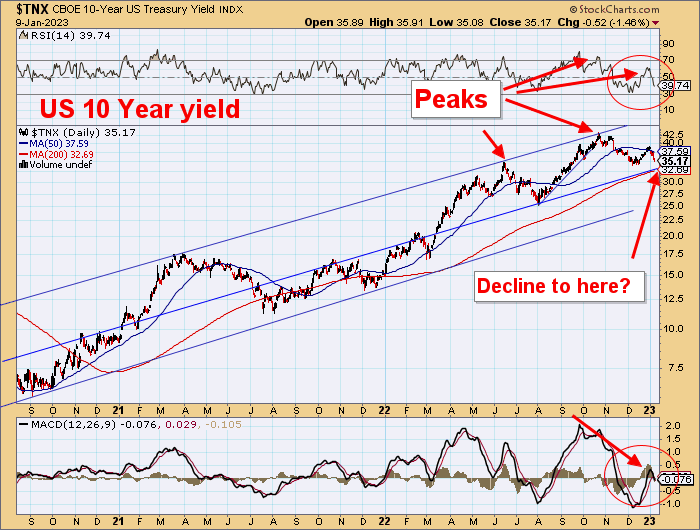
 

Large Speculators raise their Metals bets led higher by Gold

By InvestMacro

Here are the latest charts and statistics for the Commitment of Traders (COT) data published by the Commodities Futures Trading Commission (CFTC).

The latest COT data is updated through Tuesday December 13th and shows a quick view of how large traders (for-profit speculators and commercial entities) were positioned in the futures markets.

Weekly Speculator Changes led by Gold & Silver

The COT metals markets speculator bets were higher this week as five out of the five precious metals markets we cover had higher positioning.

Leading the gains for the metals was Gold (10,524 contracts) with Silver (3,611 contracts), Platinum (2,809 contracts), Copper (877 contracts) and Palladium (489 contracts) all showing positive weeks.

Highlighting the COT metals data this week is the gains in bets for the Gold positions. The large speculator position in Gold futures rose this week for a second straight week and for the fourth time over the past six weeks. Speculator bets have now increased by a total of +61,026 contracts over these past six weeks, going from a total of +64,623 contracts on November 1st to a total of +125,649 contracts this week. These recent gains have now put the net position above +100,000 for the fifth straight week after having been below that threshold for nine consecutive weeks (from September 13th to November 8th) which was the longest stretch under +100,000 net contracts since 2018.

The Gold futures price has been moving positively as well with prices closing higher on a weekly basis for five out of the past seven weeks. The Gold price hit a recent bottom at the $1,618.30 level in early November and has rallied by approximately 11 percent since then to close out this week slightly above the $1,800.00 price threshold.


Data Snapshot of Commodity Market Traders | Columns Legend
Dec-13-2022OIOI-IndexSpec-NetSpec-IndexCom-NetCOM-IndexSmalls-NetSmalls-Index
Gold437,0404125,64924-138,5297612,88012
Silver125,555422,81939-35,8066112,98733
Copper162,191112,55638-6,559624,00348
Palladium7,4948-88320854772943
Platinum72,4164328,44547-32,624554,17924


Strength Scores led by Platinum & Silver

COT Strength Scores (a normalized measure of Speculator positions over a 3-Year range, from 0 to 100 where above 80 is Extreme-Bullish and below 20 is Extreme-Bearish) showed that  Platinum (47 percent) leads the metals markets this week. Silver (39 percent) comes in as the next highest in the weekly strength scores.

On the downside, Palladium (20 percent) comes in at the lowest strength level currently while the next lowest strength score was Gold (24 percent).

Strength Statistics:
Gold (24.4 percent) vs Gold previous week (20.9 percent)
Silver (39.3 percent) vs Silver previous week (35.3 percent)
Copper (38.4 percent) vs Copper previous week (37.7 percent)
Platinum (47.3 percent) vs Platinum previous week (43.6 percent)
Palladium (20.3 percent) vs Palladium previous week (17.2 percent)


Silver & Gold top the 6-Week Strength Trends

COT Strength Score Trends (or move index, calculates the 6-week changes in strength scores) showed that Silver (23 percent) leads the past six weeks trends for metals. Gold (20 percent) is the next highest positive mover in the latest trends data.

Palladium (6 percent) is the lowest in trend scores currently with Copper (8 percent) coming in next. The all positive movement score underlines the change of sentiment for the metals category after spending many weeks of 2022 with all or most of the metals with negative trends.

Move Statistics:
Gold (20.2 percent) vs Gold previous week (15.6 percent)
Silver (23.5 percent) vs Silver previous week (21.3 percent)
Copper (8.0 percent) vs Copper previous week (14.8 percent)
Platinum (16.8 percent) vs Platinum previous week (19.2 percent)
Palladium (6.3 percent) vs Palladium previous week (2.4 percent)


Individual Markets:

Gold Comex Futures:

Gold Futures COT ChartThe Gold Comex Futures large speculator standing this week equaled a net position of 125,649 contracts in the data reported through Tuesday. This was a weekly increase of 10,524 contracts from the previous week which had a total of 115,125 net contracts.

This week’s current strength score (the trader positioning range over the past three years, measured from 0 to 100) shows the speculators are currently Bearish with a score of 24.4 percent. The commercials are Bullish with a score of 76.4 percent and the small traders (not shown in chart) are Bearish-Extreme with a score of 12.2 percent.

Gold Futures StatisticsSPECULATORSCOMMERCIALSSMALL TRADERS
– Percent of Open Interest Longs:51.327.48.5
– Percent of Open Interest Shorts:22.659.15.6
– Net Position:125,649-138,52912,880
– Gross Longs:224,409119,90837,309
– Gross Shorts:98,760258,43724,429
– Long to Short Ratio:2.3 to 10.5 to 11.5 to 1
NET POSITION TREND:
– Strength Index Score (3 Year Range Pct):24.476.412.2
– Strength Index Reading (3 Year Range):BearishBullishBearish-Extreme
NET POSITION MOVEMENT INDEX:
– 6-Week Change in Strength Index:20.2-19.76.8


Silver Comex Futures:

Silver Futures COT ChartThe Silver Comex Futures large speculator standing this week equaled a net position of 22,819 contracts in the data reported through Tuesday. This was a weekly lift of 3,611 contracts from the previous week which had a total of 19,208 net contracts.

This week’s current strength score (the trader positioning range over the past three years, measured from 0 to 100) shows the speculators are currently Bearish with a score of 39.3 percent. The commercials are Bullish with a score of 61.4 percent and the small traders (not shown in chart) are Bearish with a score of 33.1 percent.

Silver Futures StatisticsSPECULATORSCOMMERCIALSSMALL TRADERS
– Percent of Open Interest Longs:40.935.819.0
– Percent of Open Interest Shorts:22.864.38.6
– Net Position:22,819-35,80612,987
– Gross Longs:51,40544,91323,843
– Gross Shorts:28,58680,71910,856
– Long to Short Ratio:1.8 to 10.6 to 12.2 to 1
NET POSITION TREND:
– Strength Index Score (3 Year Range Pct):39.361.433.1
– Strength Index Reading (3 Year Range):BearishBullishBearish
NET POSITION MOVEMENT INDEX:
– 6-Week Change in Strength Index:23.5-24.019.9


Copper Grade #1 Futures:

Copper Futures COT ChartThe Copper Grade #1 Futures large speculator standing this week equaled a net position of 2,556 contracts in the data reported through Tuesday. This was a weekly advance of 877 contracts from the previous week which had a total of 1,679 net contracts.

This week’s current strength score (the trader positioning range over the past three years, measured from 0 to 100) shows the speculators are currently Bearish with a score of 38.4 percent. The commercials are Bullish with a score of 61.9 percent and the small traders (not shown in chart) are Bearish with a score of 48.4 percent.

Copper Futures StatisticsSPECULATORSCOMMERCIALSSMALL TRADERS
– Percent of Open Interest Longs:35.840.910.3
– Percent of Open Interest Shorts:34.244.97.9
– Net Position:2,556-6,5594,003
– Gross Longs:58,05766,26516,760
– Gross Shorts:55,50172,82412,757
– Long to Short Ratio:1.0 to 10.9 to 11.3 to 1
NET POSITION TREND:
– Strength Index Score (3 Year Range Pct):38.461.948.4
– Strength Index Reading (3 Year Range):BearishBullishBearish
NET POSITION MOVEMENT INDEX:
– 6-Week Change in Strength Index:8.0-11.326.1


Platinum Futures:

Platinum Futures COT ChartThe Platinum Futures large speculator standing this week equaled a net position of 28,445 contracts in the data reported through Tuesday. This was a weekly lift of 2,809 contracts from the previous week which had a total of 25,636 net contracts.

This week’s current strength score (the trader positioning range over the past three years, measured from 0 to 100) shows the speculators are currently Bearish with a score of 47.3 percent. The commercials are Bullish with a score of 54.9 percent and the small traders (not shown in chart) are Bearish with a score of 24.1 percent.

Platinum Futures StatisticsSPECULATORSCOMMERCIALSSMALL TRADERS
– Percent of Open Interest Longs:54.029.010.3
– Percent of Open Interest Shorts:14.774.14.5
– Net Position:28,445-32,6244,179
– Gross Longs:39,11221,0037,434
– Gross Shorts:10,66753,6273,255
– Long to Short Ratio:3.7 to 10.4 to 12.3 to 1
NET POSITION TREND:
– Strength Index Score (3 Year Range Pct):47.354.924.1
– Strength Index Reading (3 Year Range):BearishBullishBearish
NET POSITION MOVEMENT INDEX:
– 6-Week Change in Strength Index:16.8-16.36.3


Palladium Futures:

Palladium Futures COT ChartThe Palladium Futures large speculator standing this week equaled a net position of -883 contracts in the data reported through Tuesday. This was a weekly rise of 489 contracts from the previous week which had a total of -1,372 net contracts.

This week’s current strength score (the trader positioning range over the past three years, measured from 0 to 100) shows the speculators are currently Bearish with a score of 20.3 percent. The commercials are Bullish with a score of 77.3 percent and the small traders (not shown in chart) are Bearish with a score of 43.4 percent.

Palladium Futures StatisticsSPECULATORSCOMMERCIALSSMALL TRADERS
– Percent of Open Interest Longs:32.948.614.0
– Percent of Open Interest Shorts:44.737.213.6
– Net Position:-88385429
– Gross Longs:2,4663,6441,050
– Gross Shorts:3,3492,7901,021
– Long to Short Ratio:0.7 to 11.3 to 11.0 to 1
NET POSITION TREND:
– Strength Index Score (3 Year Range Pct):20.377.343.4
– Strength Index Reading (3 Year Range):BearishBullishBearish
NET POSITION MOVEMENT INDEX:
– 6-Week Change in Strength Index:6.3-8.523.0


Article By InvestMacroReceive our weekly COT Newsletter

*COT Report: The COT data, released weekly to the public each Friday, is updated through the most recent Tuesday (data is 3 days old) and shows a quick view of how large speculators or non-commercials (for-profit traders) were positioned in the futures markets.

The CFTC categorizes trader positions according to commercial hedgers (traders who use futures contracts for hedging as part of the business), non-commercials (large traders who speculate to realize trading profits) and nonreportable traders (usually small traders/speculators) as well as their open interest (contracts open in the market at time of reporting). See CFTC criteria here.

Expert Says Gold Is Misunderstood, but It Is Bottoming

Source: Adrian Day  (12/12/22)

 Expert Adrian Day takes a look at gold and discusses why he thinks a turn is very close. Day also recommends his top stocks to buy if you do not already own.

Gold is flirting with US$1,800, and it’s only a matter of time before it breaks through.

Gold shines when the market senses that the central banks will be unable to contain inflation.

Many gold fans believed that this year, with a war in Europe, rising inflation, and a shaky stock market, should have been gold’s year to shine, leaving many disappointed, frustrated, and worse. Gold’s performance should be put in context, however.

Now, as I write, gold is within kissing distance of breaking even (in U.S. dollar terms) for the year, down less than 2% year, while the dollar (per the DXY index) remains up almost 10%.

In addition, in a period of deflating asset prices, gold has held up far better than U.S. and foreign stocks and bonds, as well as other assets such as crypto. This is quite amazing comparative strength for bullion.

Should Investors Be Disappointed in Gold’s Performance This Year?

There are some misunderstandings in the simple narrative that gold “should” be higher.

• Wars or other geopolitical events tend to have only a short-lived effect on the price unless there is concern about it spreading; the Russia-Ukraine conflict has
been contained.

• High inflation in itself is not in fact the main driver of gold, as we shall discuss below.

• And although weak stocks can be positive for gold, much depends on the reasons for the weakness.

Offsetting those ostensibly bullish factors for gold have been two critical negatives: rising interest rates and a strong dollar. For much of the year, a relentlessly strong dollar was a significant headwind for gold, but all along, gold’s decline was meaningfully less than the dollar’s strength.

Inflation Alone Is Not Good for Gold

Inflation itself is not necessarily the optimum environment for gold. Markets, being forward-looking, fear central bank tightening in an inflationary environment. If the market believes that central banks will be able to contain inflation, even as it rages, that is negative for gold.

Gold shines when the market senses that the central banks will be unable to contain inflation.

One only has to look to the inflationary decade of the 1970s to see this. The market did not have confidence that Arthur Burns, as Fed Chairman, would succeed in bringing down inflation.

But far higher inflation under Volker resulted in gold falling because the market believed he would control inflation. The market was correct in both cases.

When Will Gold Move Up?

Since gold’s drop in March, my response to repeated questions about when gold will “finally” respond to inflation has been the same: gold will turn when more investors realize that the Federal Reserve will be unlikely to achieve its 2% inflation goal. Its current policies — the most rapid interest rate appreciation ever — will likely provoke a serious recession, and at that point, it will not follow through and quash inflation.

In short, the market is beginning to sense that the Fed will not be able to bring inflation down towards its target any time soon and certainly will be unable to do so without provoking a recession that could be quite serious.

For most of this year, investors swallowed the Fed narrative; all indicators of inflation expectations, from surveys to markets such as the TIPs, were for inflation to drop significantly next year towards the Fed’s target and for it to happen without a recession. If you believe that, then you do not need gold.

Now, though, expectations are starting to shift. Although inflation expectations two and more years out are still in line with the Fed’s own targets, for next year, investors are forecasting a higher inflation rate than the Fed. And concerns about a recession have increased.

In short, the market is beginning to sense that the Fed will not be able to bring inflation down towards its target any time soon and certainly will be unable to do so without provoking a recession that could be quite serious (though FedHead Jerome Powell still believes a soft landing is possible).

Why a Recession Can Be Good for Gold

Again, since markets are forward-looking, a recession would be positive for gold if the market sees a shift in Fed policy towards easing. The Fed does not have to “pivot” — a misunderstood phenomenon in any event — for gold to move.

The market simply has to believe that the Fed will have to because it will be unable to achieve its inflation goals without a recession. Tough talk from Powell following this week’s final Fed meeting for the year might see gold pullback; that might be our last, best opportunity to load up.

The Economic Pain Is Only Beginning

The signs of an imminent recession are becoming more and more clear if, indeed, the U.S. is not already in one. The Fed recently noted Milton Friedman’s dictum that monetary policy acts with long and variable lags. Indeed, the effects of what the Fed has already done have barely registered so far in the headline numbers.

Even if the Fed were to pause right now, more economic harm is already baked in. Interest rate-sensitive sectors such as housing and automobiles are the first to feel the impact of rising (or indeed declining) rates.

For other sectors, the impact can be delayed, and it can be nine or 18 months before it is clear; meanwhile, everything looks rosy on the surface.

The Fed will likely try to tame optimism in the stock market — it doesn’t really care about gold — but that will also have the effect of dampening the gold price. That may well be a great opportunity to buy.

Retail sales are a good example. Since March, retail sales have been mostly flat or moderately higher. On the surface, there appears to be no problem. Dig deeper, and some things become apparent.

First, if consumer prices are increasing at a nearly 10% rate, then if sales remain flat, that means that people are, in effect, buying nearly 10% fewer goods.

Second, look at other indicators: the savings rate has collapsed to a 17-year low, while credit card debt has shot up at its fastest rate in over 20 years. (Vanguard reported last week that it had experienced record “emergency” withdrawals from 401k plans, another sign of consumer stress.)

Consumers are not buying from income; depleting savings and running up debt can last only so long. It is only a matter of time before the stress shows up in declining retail sales. As it becomes obvious that the U.S. is in a recession without the inflation goal being achieved — a stagflationary environment — then the focus becomes when the Fed will ease.

Gold and Gold Stocks Are Inexpensive

We are, then, entering the sweet spot for gold. A recession will result in a lower dollar and falling stock prices–the result of a weak economy — while gold looks to the eventual Fed reaction. The outlook is positive, and while gold has moved convincingly off its lows, it remains low relative to its price for most of the past two years. With gold almost $200 off the October lows, there has been very little response by investors in the gold ETFs, another indication of the lack of interest among investors in general for gold.

Last week’s action was perhaps a little aggressive for gold, particularly ahead of the last Fed meeting of the year. The Fed will likely try to tame optimism in the stock market — it doesn’t really care about gold — but that will also have the effect of dampening the gold price. That may well be a great opportunity to buy.

It is an anomaly for gold miners to be less expensive, have better balance sheets, and pay higher dividends than the broad market, and investors should take advantage of the opportunities in bullion and in the stocks before the crowd starts buying.

The gold stocks (per the XAU index), meanwhile, though up over 30% in the last two months, are trading, for the most part, well below their average historical valuations. The stocks are near their lows relative to bullion itself. While gold is up around 550% since 2000, gold stocks are up a little more than 100% and are still well below their levels from 2009 to 2013.

Let’s not forget that with the gold price at almost US$1800 and all-in-sustaining costs (AISC) below US$1,200 an ounce, while cash costs are far lower, margins are very strong. The sector in aggregate is net cash positive, while valuations are low: price-to-cash flow of fewer than nine times against 13.7 times for the S&P; price-to-NAV of 0.65 times against a seven-year average 50% higher; and with a yield 25% above that of the broad market.

It is an anomaly for gold miners to be less expensive, have better balance sheets, and pay higher dividends than the broad market, and investors should take advantage of the opportunities in bullion and in the stocks before the crowd starts buying.

From our list, the top stocks to buy if you do not own them would be Barrick Gold Corp. (ABX:TSX; GOLD:NYSE); Midland Exploration Inc. (MD:TSX.V); Lara Exploration Ltd. (LRA:TSX.V); and Orogen Royalties Inc. (OGN:TSX.V). Some of these I suspect we shall be able to buy at a somewhat lower price over the next week or two, but you should be alert if you do not currently own positions.

Adrian Day Disclosures:

Adrian Day’s Global Analyst is distributed for $990 per year by Investment Consultants International, Ltd., P.O. Box 6644, Annapolis, MD 21401. (410) 224-8885. www.AdrianDayGlobalAnalyst.com. Publisher: Adrian Day. Owner: Investment Consultants International, Ltd. Staff may have positions in securities discussed herein. Adrian Day is also President of Global Strategic Management (GSM), a registered investment advisor, and a separate company from this service. In his capacity as GSM president, Adrian Day may be buying or selling for clients securities recommended herein concurrently, before or after recommendations herein, and may be acting for clients in a manner contrary to recommendations herein. This is not a solicitation for GSM. Views herein are the editor’s opinion and not fact. All information is believed to be correct, but its accuracy cannot be guaranteed. The owner and editor are not responsible for errors and omissions. © 2022. Adrian Day’s Global Analyst. Information and advice herein are intended purely for the subscriber’s own account. Under no circumstances may any part of a Global Analyst e-mail be copied or distributed without prior written permission of the editor. Given the nature of this service, we will pursue any violations aggressively.

Disclosures:

1) Adrian Day: I, or members of my immediate household or family, own securities of the following companies mentioned in this article: All. I personally am, or members of my immediate household or family are, paid by the following companies mentioned in this article: None. My company has a financial relationship with the following companies mentioned in this article: None. Funds controlled by Adrian Day Asset Management, which is unaffiliated with Adrian Day’s newsletter, hold shares of the following companies mentioned in this article: All. I determined which companies would be included in this article based on my research and understanding of the sector.

2) The following companies mentioned in this article are billboard sponsors of Streetwise Reports: None. Click here for important disclosures about sponsor fees. The information provided above is for informational purposes only and is not a recommendation to buy or sell any security.

3) Statements and opinions expressed are the opinions of the author and not of Streetwise Reports or its officers. The author is wholly responsible for the validity of the statements. The author was not paid by Streetwise Reports for this article. Streetwise Reports was not paid by the author to publish or syndicate this article. Streetwise Reports requires contributing authors to disclose any shareholdings in, or economic relationships with, companies that they write about. Streetwise Reports relies upon the authors to accurately provide this information and Streetwise Reports has no means of verifying its accuracy.

4) This article does not constitute investment advice. Each reader is encouraged to consult with his or her individual financial professional and any action a reader takes as a result of information presented here is his or her own responsibility. By opening this page, each reader accepts and agrees to Streetwise Reports’ terms of use and full legal disclaimer. This article is not a solicitation for investment. Streetwise Reports does not render general or specific investment advice and the information on Streetwise Reports should not be considered a recommendation to buy or sell any security. Streetwise Reports does not endorse or recommend the business, products, services, or securities of any company mentioned on Streetwise Reports.

5) From time to time, Streetwise Reports LLC and its directors, officers, employees, or members of their families, as well as persons interviewed for articles and interviews on the site, may have a long or short position in the securities mentioned. Directors, officers, employees, or members of their immediate families are prohibited from making purchases and/or sales of those securities in the open market or otherwise from the time of the decision to publish an article until three business days after the publication of the article. The foregoing prohibition does not apply to articles that in substance only restate previously published company release.

Drill Results Show Grade and Growth Possibilities

Source: Geordie Mark  (12/12/22)

The first holes from the copper-gold-silver deposit in British Columbia highlighted updip and downdip extension potential of the mineralization there, noted a Haywood Securities report.

NorthWest Copper Corp.’s (NWST:TSX.V; NWCCF:OTCQX) maiden drill results from its Stardust deposit in British Columbia’s Quesnel Trough mining belt showed continuity and potential for extension of mineralization, reported Haywood Securities analyst Dr. Geordie Mark in a Nov. 16 research note. Stardust will be included in the upcoming preliminary economic assessment (PEA), expected by year-end.

The mineralization at Stardust “exhibits high variability in grade and continuity with drilling highlighting updip and downdip extension potential, probably warranting a niche program focused on testing these facets in 2023,” Mark wrote.

Release of those plus more from drill results from the Kwanika deposit is expected in 2022 and may boost NorthWest Copper’s share price.

Haywood recommends Buying shares of NorthWest Copper at the current price of about CA$0.22 per share. In comparison, Haywood’s target price on the Canadian copper explorer is CA$1.10, implying a significant potential return for investors.

The just released Stardust drill results are for eight holes of a 10-hole program testing whether the copper-gold-silver mineralization there is continuous and if there is likely more of it. Data so far are positive for both.

Results 

Mark presented the holes with standout results and what each of them indicates.

  • Hole DDH22-SD-476: 75.95 meters (75.95m) of 0.98% copper equivalent (Cu eq), including 8.45m of 3.14% Cu eq

This hole shows wide mineralization and potential for downdip extension of it.

  • Hole DDH22-SD-478: 21.1m of 2.41% Cu eq, including 1.55m of 16.64% Cu eq, within 44.2m of 1.31% Cu eq
  • Hole DDH22-SD-480: 35.55m of 0.91% Cu eq, including 11.2m of 2.91% Cu eq

These holes demonstrate the potential for updip expansion of high-grade mineralization at each intersection.

  • Hole DDH22-SD-479: 46.05m of 1.4% Cu eq, including 6.4m of 3.05% Cu eq
  • Hole DDH22-SD-481: 18.9m of 1.14% Cu eq, including 3.85m of 2.98% Cu eq

These holes show a continuity of alteration and mineralization that remains open at depth.

The results of the other two holes drilled at Stardust are pending. Release of those plus more from drill results from the Kwanika deposit is expected in 2022 and may boost NorthWest Copper’s share price. Another impending stock catalyst is the combined Kwanika and Stardust PEA, due out by year-end.

Disclosures:
1) Doresa Banning wrote this article for Streetwise Reports LLC and provides services to Streetwise Reports as an independent contractor. She or members of her household own securities of the following companies mentioned in the article: None. She or members of her household are paid by the following companies mentioned in this article: None.

2) The following companies mentioned in this article are billboard sponsors of Streetwise Reports: None. Click here for important disclosures about sponsor fees. As of the date of this article, an affiliate of Streetwise Reports has a consulting relationship with: None. Please click here for more information.

3) Statements and opinions expressed are the opinions of the author and not of Streetwise Reports or its officers. The author is wholly responsible for the validity of the statements. The author was not paid by Streetwise Reports for this article. Streetwise Reports was not paid by the author to publish or syndicate this article. Streetwise Reports requires contributing authors to disclose any shareholdings in, or economic relationships with, companies that they write about. Streetwise Reports relies upon the authors to accurately provide this information and Streetwise Reports has no means of verifying its accuracy.

4) This article does not constitute investment advice. Each reader is encouraged to consult with his or her individual financial professional and any action a reader takes as a result of information presented here is his or her own responsibility. By opening this page, each reader accepts and agrees to Streetwise Reports’ terms of use and full legal disclaimer. This article is not a solicitation for investment. Streetwise Reports does not render general or specific investment advice and the information on Streetwise Reports should not be considered a recommendation to buy or sell any security. Streetwise Reports does not endorse or recommend the business, products, services or securities of any company mentioned on Streetwise Reports.

5) From time to time, Streetwise Reports LLC and its directors, officers, employees or members of their families, as well as persons interviewed for articles and interviews on the site, may have a long or short position in securities mentioned. Directors, officers, employees or members of their immediate families are prohibited from making purchases and/or sales of those securities in the open market or otherwise from the time of the decision to publish an article until three business days after the publication of the article. The foregoing prohibition does not apply to articles that in substance only restate previously published company releases.
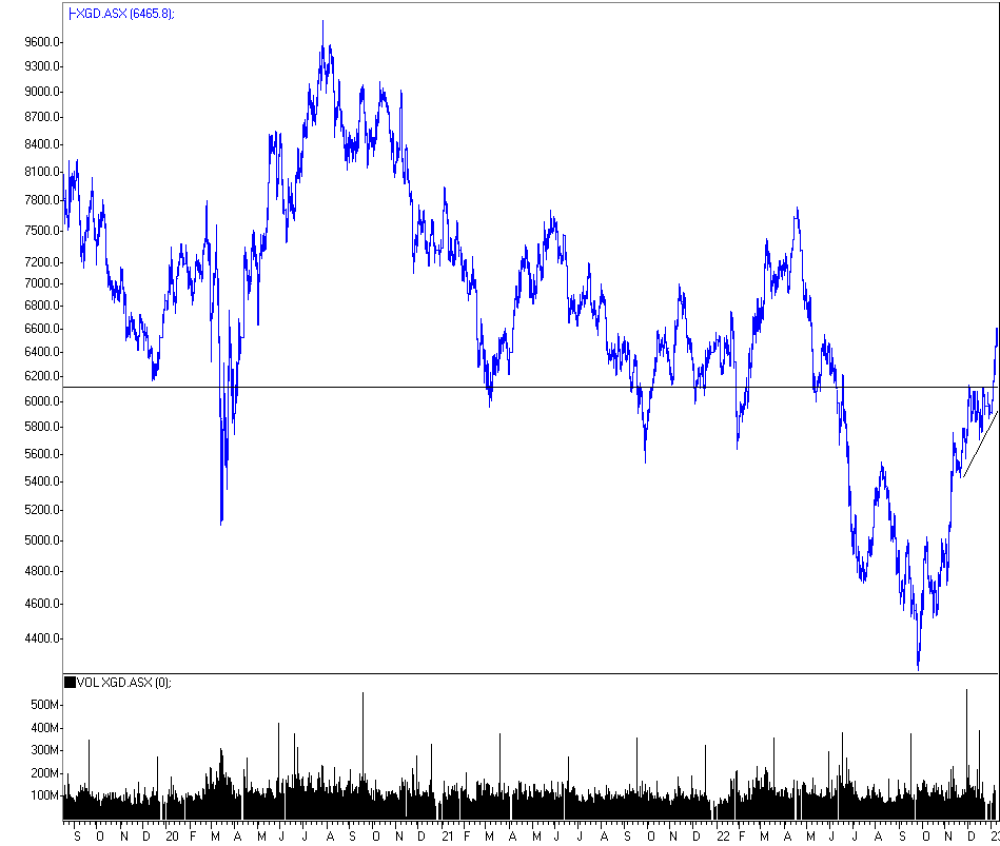
Disclosures For Haywood Capital Markets, NorthWest Copper Corp., November 16, 2022

Analyst Certification: I, Geordie Mark, hereby certify that the views expressed in this report (which includes the rating assigned to the issuer’s shares as well as the analytical substance and tone of the report) accurately reflect my/our personal views about the subject securities and the issuer. No part of my/our compensation was, is, or will be directly or indirectly related to the specific recommendations.

Important Disclosures: Of the companies included in the report the following Important Disclosures apply: Haywood Securities, Inc. has reviewed lead projects of this company and a portion of the expenses for this travel may have been reimbursed by the issuer.