Archive for Forex and Currency News – Page 180

The Decoupling of the US Dollar-Yuan Relationship?

By Dan Steinbock

In the past, US dollar and Chinese yuan used to move inversely. Recently, that has not been the case. Dollar is appreciating, and so is yuan. Are the bilateral currencies decoupling?

In early December, Chinese business and finance media Caixin reported that Chinese yuan has “broken its traditional relationship with the U.S. dollar.”

The breakup was characterized as an “unusual currency decoupling, which has been evident since September.”

The real story, however, is nuanced, complex and not just about currencies.

The Dollar-Yuan Divergence

The Caixin report attracted great attention internationally. After all, the relationship between the yuan and the dollar has been relatively consistent since the mid-2010s, as measured by the US Dollar Index (DXY), which reflects the value of the dollar relative to a basket of currencies of some of America’s biggest trading partners.

Caixin traced the decoupling back to September 2021. It was visualized with a 1-year timeline. And sure enough, the yuan seems to mimic the dollar’s trajectory until late September 2021, which is followed by significant divergence (Figure 1a).

Nonetheless, the current divergence is not the first of its kind. It was preceded by another in the mid-2010s, when the Fed began its gradual exit from ultra-low rates. The dollar soared after the 2015 Chinese market correction until the self-induced double-whammy: US trade wars and pandemic mismanagement (Figure 1b).

Figure 1 Decoupling Yuan-Dollar Relationship

  • 1-Year Perspective

chinese yuan us dollar

  • 15-Year Perspective

chinese yuan us dollar

Forces Behind Decoupling

There are multiple central economic drivers behind the current decoupling, particularly trade balance. The yuan’s recent appreciation has been explained on the basis of China’s strong export performance. In November, exports exceeded $300 billion for a third straight month (22% from the previous year). Yet, imports grew even faster to $254 billion (32%). Export growth has slowed on the back of a stronger yuan, and weakening demand due to the Omicron wave and higher costs.

Overall, the drivers of the trade surplus have narrowed, although it remains strong in a 10-year perspective, despite US trade war (Figure 2).

Figure 2 China’s Trade Balance (2012-Present)

chinese yuan us dollar

Decoupling has been reinforced by strong capital flows, thanks to China’s encouragement of foreign direct investment (FDI) and further opening of capital markets. In the first three quarters of 2021, China’s actual utilization of FDI climbed to almost $130 billion (25% year-on-year). Meanwhile, overseas investors have raised their holdings of mainland stocks and bonds by over 11% since the end of 2020, according to data by the People’s Bank of China (PBOC).

Foreign investment was strong (17%) in the first 11 months of 2021, including into the service sector and particularly advanced technology (19%). In relative terms, FDI into China from the Belt and Road (25%) and ASEAN economies (24%) surged even faster, according to data by China’s Ministry of Commerce.

Bumpy normalization

Even if the Fed’s rate normalization will reduce capital flows to Chinese markets, the continued opening of the mainland’s financial sector may offset some of the pressure. FDI into China is also likely to be resilient, due to capital inflows from the Belt and Road and ASEAN economies.

What complicates assessments of potential dollar-yuan decoupling is the impact of pandemic uncertainty on monetary policies and rates.

Last October, the PBOC stated it was phasing out the use of the countercyclical factor, launched in 2017 to contain yuan’s depreciation. A more hands-off stance toward the exchange rate fosters appreciation. As the PBOC has signaled, the yuan may face a rougher ride in 2022, due to normalization by overseas central banks.

Also, higher interest rates could narrow the yield spread between US Treasuries and Chinese government bonds. The former has traded around 1.6% and is expected to rise. Chinese government bond is currently around 2.8% and could climb to 2.95% in 2022. The gap could increase if the PBOC decides to tighten (Figure 3).

Figure 3 The Yield Difference: US and China Government Bonds (10Y)

In November, U.S. inflation surged to near 40-year high, at 6.8%. Only days later, the Fed indicated it would end its pandemic-era bond purchases in March, thus paving the way for two to three interest rate hikes by the end of 2022.

Pandemic Uncertainty

After the new year, the U.S. reported almost 1.1 million new daily COVID-19 cases, a new global record. The death toll surpassed 800,000. Consequently, the supply disruptions and labor shortages that most countries have seen in the past months will not diminish overnight. And that has significant implications.

Political polarization is likely to escalate, particularly by the US mid-term election in November. Political violence then or in 2022 can no longer be excluded.

Moreover, the Fed and other major central banks have consistently underestimated the persistence of inflation, which was initially seen as merely “transitory.”

These effects could significantly worsen, if the assumption that Omicron is the last hold of the pandemic proves flawed. Despite current surges in the US, Europe, Brazil, India and elsewhere, most observers assume that Omicron trajectories will emulate the South African experience: rapid peak, then speedy decline.

In reality, the global pandemic has changed every few months since spring 2020 from the initial virus to the UK variant, superseded by the Delta and Omicron. The number of the vaccinated has increased significantly. Yet, the pandemic effects may linger for months, perhaps years, due to inadequate global cooperation, vaccine inequality and the huge numbers of the unvaccinated (35 million even in the US).

If the next variant proves highly transmissible, as Omicron, and far more lethal than Delta, it will derail all current economic projections.

From Stagflation to Stagflation

In the US, inflation and federal funds have moved fairly synchronously in the past half century. The current combination of low rates and high inflation is untenable. In the 1970s, the Great Inflation, following two energy crises, morphed into persistent stagflation. In the 2020s, transitionary inflation may prove not-so-transitionary, especially coupled with secular stagnation in the US, Western Europe and Japan (Figure 4).

Figure 4 Two Untenable Trajectories

Rate-Inflation (1970-Present)

In the 1980s, the Reagan rearmament drive deferred the awakening. In the 2020s, US pivot to Asia and new Cold Wars seem to serve a similar function. When economics no longer offers exit strategy, geopolitics does.

After all, the current stagflation has been fueled by the Fed’s ultra-easy monetary policy and the Trump-Biden trade war, both of which are contributing to higher prices. The resulting high inflation cannot be subdued without rate normalization.

When the Fed in 2008 opted for ultra-low rates and rounds of QE, it took a risky path that has suck it into a money-printing quagmire. As Thomas Hoenig, former member of the Fed’s top policy committee (FOMC), has stressed, the Fed may not be able to easily escape without destabilizing the entire financial system.

And the Chinese yuan? In 2022, it will face centrifugal pressures but fundamentals do not warrant disruptive changes. In November, the weakness of other major world currencies pushed the CFETS RMB Index, China’s version of the US Dollar Index, at a record-high of 102.8. Chinese yuan is propelling emerging currencies unlike ever before.

In the longer-term, US dollar and Chinese yuan will decouple. In the short-term, uncertainties reign. And they are not just about economics anymore.

About the Author:

Dr. Dan Steinbock is an internationally recognized strategist of the multipolar world and the founder of Difference Group. He has served at India, China and America Institute (US), Shanghai Institutes for International Studies (China) and the EU Center (Singapore). For more, see https://www.differencegroup.net/  

The original commentary was published by China-US Focus on Jan 7, 2021


COT Forex Speculators US Dollar Index bullish bets climb to 117-week high

By InvestMacro | COT | Data Tables | COT Leaders | Downloads | COT Newsletter

Here are the latest charts and statistics for the Commitment of Traders (COT) data published by the Commodities Futures Trading Commission (CFTC).

The latest COT data is updated through Tuesday January 4th 2022 and shows a quick view of how large traders (for-profit speculators and commercial entities) were positioned in the futures markets. All currency positions are in direct relation to the US dollar where, for example, a bet for the euro is a bet that the euro will rise versus the dollar while a bet against the euro will be a bet that the euro will decline versus the dollar.

Highlighting the COT currency data is the continued strength in the US Dollar Index futures bets. Speculators raised their bullish bets in the Dollar Index for a third consecutive week and for the seventh time in the past ten weeks. Since turning bullish on July 6th, Dollar Index bullish bets have had positive weekly gains in twenty-two out of the past twenty-seven weeks. This positive sentiment has brought the overall speculator standing (current total of +39,078 contracts) to the highest level since October 8th of 2019, a span of 117 weeks. The current speculator strength score (current level compared to past three years of data, above 80 is bullish-extreme, below 20 is bearish-extreme) for the Dollar Index is currently at 93.2 percent for a bullish-extreme reading.

Joining the US Dollar Index (2,289 contracts) with positive changes this week were the Euro (5,080 contracts), Brazil real (4,210 contracts), Swiss franc (1,189 contracts) and the British pound sterling (11,548 contracts).

The currencies with declining speculator bets were the yen (-9,160 contracts), Australian dollar (-7,625 contracts), New Zealand dollar (-424 contracts), Canadian dollar (-691 contracts), Russian ruble (-1,135 contracts) and Bitcoin (-62 contracts) and the Mexican peso (-482 contracts).


Data Snapshot of Forex Market Traders | Columns Legend
Jan-04-2022OIOI-IndexSpec-NetSpec-IndexCom-NetCOM-IndexSmalls-NetSmalls-Index
USD Index58,0898539,07893-44,71705,63978
EUR678,21875-1,55435-26,4586828,01221
GBP200,00739-39,1714649,51659-10,34534
JPY234,06878-62,2622984,74478-22,4821
CHF42,25117-9,5295314,62847-5,09948
CAD135,63320-11,025438,542622,48335
AUD180,10768-89,3661100,80994-11,44325
NZD40,30225-8,8455610,33546-1,49035
MXN119,74812-9,490237,127762,36353
RUB47,674497,32931-8,873651,54476
BRL28,21824-1,076671,28435-20864
Bitcoin10,56355-60489-93069729


US Dollar Index Futures:

US Dollar Index Forex Futures COT ChartThe US Dollar Index large speculator standing this week was a net position of 39,078 contracts in the data reported through Tuesday. This was a weekly lift of 2,289 contracts from the previous week which had a total of 36,789 net contracts.

This week’s current strength score (the trader positioning range over the past three years, measured from 0 to 100) shows the speculators are currently Bullish-Extreme with a score of 93.2 percent. The commercials are Bearish-Extreme with a score of 0.3 percent and the small traders (not shown in chart) are Bullish with a score of 78.2 percent.

US DOLLAR INDEX StatisticsSPECULATORSCOMMERCIALSSMALL TRADERS
– Percent of Open Interest Longs:82.22.913.0
– Percent of Open Interest Shorts:14.979.93.3
– Net Position:39,078-44,7175,639
– Gross Longs:47,7501,6927,571
– Gross Shorts:8,67246,4091,932
– Long to Short Ratio:5.5 to 10.0 to 13.9 to 1
NET POSITION TREND:
– Strength Index Score (3 Year Range Pct):93.20.378.2
– Strength Index Reading (3 Year Range):Bullish-ExtremeBearish-ExtremeBullish
NET POSITION MOVEMENT INDEX:
– 6-Week Change in Strength Index:5.7-5.92.9


Euro Currency Futures:

Euro Currency Futures COT ChartThe Euro Currency large speculator standing this week was a net position of -1,554 contracts in the data reported through Tuesday. This was a weekly increase of 5,080 contracts from the previous week which had a total of -6,634 net contracts.

This week’s current strength score (the trader positioning range over the past three years, measured from 0 to 100) shows the speculators are currently Bearish with a score of 34.5 percent. The commercials are Bullish with a score of 68.2 percent and the small traders (not shown in chart) are Bearish with a score of 20.8 percent.

EURO Currency StatisticsSPECULATORSCOMMERCIALSSMALL TRADERS
– Percent of Open Interest Longs:29.457.311.9
– Percent of Open Interest Shorts:29.661.27.8
– Net Position:-1,554-26,45828,012
– Gross Longs:199,073388,74281,029
– Gross Shorts:200,627415,20053,017
– Long to Short Ratio:1.0 to 10.9 to 11.5 to 1
NET POSITION TREND:
– Strength Index Score (3 Year Range Pct):34.568.220.8
– Strength Index Reading (3 Year Range):BearishBullishBearish
NET POSITION MOVEMENT INDEX:
– 6-Week Change in Strength Index:4.6-2.7-8.7


British Pound Sterling Futures:

British Pound Sterling Futures COT ChartThe British Pound Sterling large speculator standing this week was a net position of -39,171 contracts in the data reported through Tuesday. This was a weekly advance of 11,548 contracts from the previous week which had a total of -50,719 net contracts.

This week’s current strength score (the trader positioning range over the past three years, measured from 0 to 100) shows the speculators are currently Bearish with a score of 45.8 percent. The commercials are Bullish with a score of 59.0 percent and the small traders (not shown in chart) are Bearish with a score of 34.2 percent.

BRITISH POUND StatisticsSPECULATORSCOMMERCIALSSMALL TRADERS
– Percent of Open Interest Longs:13.075.210.3
– Percent of Open Interest Shorts:32.650.415.5
– Net Position:-39,17149,516-10,345
– Gross Longs:25,980150,33220,573
– Gross Shorts:65,151100,81630,918
– Long to Short Ratio:0.4 to 11.5 to 10.7 to 1
NET POSITION TREND:
– Strength Index Score (3 Year Range Pct):45.859.034.2
– Strength Index Reading (3 Year Range):BearishBullishBearish
NET POSITION MOVEMENT INDEX:
– 6-Week Change in Strength Index:-3.32.21.8


Japanese Yen Futures:

Japanese Yen Forex Futures COT ChartThe Japanese Yen large speculator standing this week was a net position of -62,262 contracts in the data reported through Tuesday. This was a weekly fall of -9,160 contracts from the previous week which had a total of -53,102 net contracts.

This week’s current strength score (the trader positioning range over the past three years, measured from 0 to 100) shows the speculators are currently Bearish with a score of 28.7 percent. The commercials are Bullish with a score of 78.3 percent and the small traders (not shown in chart) are Bearish-Extreme with a score of 1.1 percent.

JAPANESE YEN StatisticsSPECULATORSCOMMERCIALSSMALL TRADERS
– Percent of Open Interest Longs:17.472.97.8
– Percent of Open Interest Shorts:44.036.717.4
– Net Position:-62,26284,744-22,482
– Gross Longs:40,816170,53718,339
– Gross Shorts:103,07885,79340,821
– Long to Short Ratio:0.4 to 12.0 to 10.4 to 1
NET POSITION TREND:
– Strength Index Score (3 Year Range Pct):28.778.31.1
– Strength Index Reading (3 Year Range):BearishBullishBearish-Extreme
NET POSITION MOVEMENT INDEX:
– 6-Week Change in Strength Index:22.1-15.6-7.6


Swiss Franc Futures:

Swiss Franc Forex Futures COT ChartThe Swiss Franc large speculator standing this week was a net position of -9,529 contracts in the data reported through Tuesday. This was a weekly advance of 1,189 contracts from the previous week which had a total of -10,718 net contracts.

This week’s current strength score (the trader positioning range over the past three years, measured from 0 to 100) shows the speculators are currently Bullish with a score of 53.3 percent. The commercials are Bearish with a score of 47.3 percent and the small traders (not shown in chart) are Bearish with a score of 48.3 percent.

SWISS FRANC StatisticsSPECULATORSCOMMERCIALSSMALL TRADERS
– Percent of Open Interest Longs:10.762.027.1
– Percent of Open Interest Shorts:33.227.439.2
– Net Position:-9,52914,628-5,099
– Gross Longs:4,51026,20411,466
– Gross Shorts:14,03911,57616,565
– Long to Short Ratio:0.3 to 12.3 to 10.7 to 1
NET POSITION TREND:
– Strength Index Score (3 Year Range Pct):53.347.348.3
– Strength Index Reading (3 Year Range):BullishBearishBearish
NET POSITION MOVEMENT INDEX:
– 6-Week Change in Strength Index:3.2-7.814.8


Canadian Dollar Futures:

Canadian Dollar Forex Futures COT ChartThe Canadian Dollar large speculator standing this week was a net position of -11,025 contracts in the data reported through Tuesday. This was a weekly reduction of -691 contracts from the previous week which had a total of -10,334 net contracts.

This week’s current strength score (the trader positioning range over the past three years, measured from 0 to 100) shows the speculators are currently Bearish with a score of 42.7 percent. The commercials are Bullish with a score of 61.7 percent and the small traders (not shown in chart) are Bearish with a score of 34.7 percent.

CANADIAN DOLLAR StatisticsSPECULATORSCOMMERCIALSSMALL TRADERS
– Percent of Open Interest Longs:30.945.120.4
– Percent of Open Interest Shorts:39.038.818.6
– Net Position:-11,0258,5422,483
– Gross Longs:41,90561,19827,649
– Gross Shorts:52,93052,65625,166
– Long to Short Ratio:0.8 to 11.2 to 11.1 to 1
NET POSITION TREND:
– Strength Index Score (3 Year Range Pct):42.761.734.7
– Strength Index Reading (3 Year Range):BearishBullishBearish
NET POSITION MOVEMENT INDEX:
– 6-Week Change in Strength Index:-6.913.5-24.0


Australian Dollar Futures:

Australian Dollar Forex Futures COT ChartThe Australian Dollar large speculator standing this week was a net position of -89,366 contracts in the data reported through Tuesday. This was a weekly decline of -7,625 contracts from the previous week which had a total of -81,741 net contracts.

This week’s current strength score (the trader positioning range over the past three years, measured from 0 to 100) shows the speculators are currently Bearish-Extreme with a score of 0.6 percent. The commercials are Bullish-Extreme with a score of 94.1 percent and the small traders (not shown in chart) are Bearish with a score of 24.5 percent.

AUSTRALIAN DOLLAR StatisticsSPECULATORSCOMMERCIALSSMALL TRADERS
– Percent of Open Interest Longs:7.081.010.0
– Percent of Open Interest Shorts:56.625.016.4
– Net Position:-89,366100,809-11,443
– Gross Longs:12,632145,91518,060
– Gross Shorts:101,99845,10629,503
– Long to Short Ratio:0.1 to 13.2 to 10.6 to 1
NET POSITION TREND:
– Strength Index Score (3 Year Range Pct):0.694.124.5
– Strength Index Reading (3 Year Range):Bearish-ExtremeBullish-ExtremeBearish
NET POSITION MOVEMENT INDEX:
– 6-Week Change in Strength Index:-24.520.4-3.1


New Zealand Dollar Futures:

New Zealand Dollar Forex Futures COT ChartThe New Zealand Dollar large speculator standing this week was a net position of -8,845 contracts in the data reported through Tuesday. This was a weekly fall of -424 contracts from the previous week which had a total of -8,421 net contracts.

This week’s current strength score (the trader positioning range over the past three years, measured from 0 to 100) shows the speculators are currently Bullish with a score of 56.4 percent. The commercials are Bearish with a score of 46.3 percent and the small traders (not shown in chart) are Bearish with a score of 34.8 percent.

NEW ZEALAND DOLLAR StatisticsSPECULATORSCOMMERCIALSSMALL TRADERS
– Percent of Open Interest Longs:23.467.57.4
– Percent of Open Interest Shorts:45.341.911.1
– Net Position:-8,84510,335-1,490
– Gross Longs:9,41727,2083,000
– Gross Shorts:18,26216,8734,490
– Long to Short Ratio:0.5 to 11.6 to 10.7 to 1
NET POSITION TREND:
– Strength Index Score (3 Year Range Pct):56.446.334.8
– Strength Index Reading (3 Year Range):BullishBearishBearish
NET POSITION MOVEMENT INDEX:
– 6-Week Change in Strength Index:-38.238.8-27.6


Mexican Peso Futures:

Mexican Peso Futures COT ChartThe Mexican Peso large speculator standing this week was a net position of -9,490 contracts in the data reported through Tuesday. This was a weekly decrease of -482 contracts from the previous week which had a total of -9,008 net contracts.

This week’s current strength score (the trader positioning range over the past three years, measured from 0 to 100) shows the speculators are currently Bearish with a score of 23.3 percent. The commercials are Bullish with a score of 75.8 percent and the small traders (not shown in chart) are Bullish with a score of 53.0 percent.

MEXICAN PESO StatisticsSPECULATORSCOMMERCIALSSMALL TRADERS
– Percent of Open Interest Longs:37.557.34.9
– Percent of Open Interest Shorts:45.451.32.9
– Net Position:-9,4907,1272,363
– Gross Longs:44,87668,5955,860
– Gross Shorts:54,36661,4683,497
– Long to Short Ratio:0.8 to 11.1 to 11.7 to 1
NET POSITION TREND:
– Strength Index Score (3 Year Range Pct):23.375.853.0
– Strength Index Reading (3 Year Range):BearishBullishBullish
NET POSITION MOVEMENT INDEX:
– 6-Week Change in Strength Index:17.0-18.114.8


Brazilian Real Futures:

Brazil Real Futures COT ChartThe Brazilian Real large speculator standing this week was a net position of -1,076 contracts in the data reported through Tuesday. This was a weekly boost of 4,210 contracts from the previous week which had a total of -5,286 net contracts.

This week’s current strength score (the trader positioning range over the past three years, measured from 0 to 100) shows the speculators are currently Bullish with a score of 67.2 percent. The commercials are Bearish with a score of 35.1 percent and the small traders (not shown in chart) are Bullish with a score of 64.3 percent.

BRAZIL REAL StatisticsSPECULATORSCOMMERCIALSSMALL TRADERS
– Percent of Open Interest Longs:38.252.49.4
– Percent of Open Interest Shorts:42.047.810.2
– Net Position:-1,0761,284-208
– Gross Longs:10,77614,7852,657
– Gross Shorts:11,85213,5012,865
– Long to Short Ratio:0.9 to 11.1 to 10.9 to 1
NET POSITION TREND:
– Strength Index Score (3 Year Range Pct):67.235.164.3
– Strength Index Reading (3 Year Range):BullishBearishBullish
NET POSITION MOVEMENT INDEX:
– 6-Week Change in Strength Index:18.4-18.84.2


Russian Ruble Futures:

Russian Ruble Futures COT ChartThe Russian Ruble large speculator standing this week was a net position of 7,329 contracts in the data reported through Tuesday. This was a weekly decrease of -1,135 contracts from the previous week which had a total of 8,464 net contracts.

This week’s current strength score (the trader positioning range over the past three years, measured from 0 to 100) shows the speculators are currently Bearish with a score of 30.7 percent. The commercials are Bullish with a score of 65.2 percent and the small traders (not shown in chart) are Bullish with a score of 76.5 percent.

RUSSIAN RUBLE StatisticsSPECULATORSCOMMERCIALSSMALL TRADERS
– Percent of Open Interest Longs:40.953.75.4
– Percent of Open Interest Shorts:25.572.32.1
– Net Position:7,329-8,8731,544
– Gross Longs:19,49025,6102,557
– Gross Shorts:12,16134,4831,013
– Long to Short Ratio:1.6 to 10.7 to 12.5 to 1
NET POSITION TREND:
– Strength Index Score (3 Year Range Pct):30.765.276.5
– Strength Index Reading (3 Year Range):BearishBullishBullish
NET POSITION MOVEMENT INDEX:
– 6-Week Change in Strength Index:-25.424.07.7


Bitcoin Futures:

Bitcoin Crypto Futures COT ChartThe Bitcoin large speculator standing this week was a net position of -604 contracts in the data reported through Tuesday. This was a weekly decline of -62 contracts from the previous week which had a total of -542 net contracts.

This week’s current strength score (the trader positioning range over the past three years, measured from 0 to 100) shows the speculators are currently Bullish-Extreme with a score of 89.2 percent. The commercials are Bearish with a score of 21.7 percent and the small traders (not shown in chart) are Bearish with a score of 28.8 percent.

BITCOIN StatisticsSPECULATORSCOMMERCIALSSMALL TRADERS
– Percent of Open Interest Longs:73.54.114.2
– Percent of Open Interest Shorts:79.25.07.6
– Net Position:-604-93697
– Gross Longs:7,7674371,498
– Gross Shorts:8,371530801
– Long to Short Ratio:0.9 to 10.8 to 11.9 to 1
NET POSITION TREND:
– Strength Index Score (3 Year Range Pct):89.221.728.8
– Strength Index Reading (3 Year Range):Bullish-ExtremeBearishBearish
NET POSITION MOVEMENT INDEX:
– 6-Week Change in Strength Index:-10.4-78.328.8


Article By InvestMacroReceive our weekly COT Reports by Email

*COT Report: The COT data, released weekly to the public each Friday, is updated through the most recent Tuesday (data is 3 days old) and shows a quick view of how large speculators or non-commercials (for-profit traders) were positioned in the futures markets.

The CFTC categorizes trader positions according to commercial hedgers (traders who use futures contracts for hedging as part of the business), non-commercials (large traders who speculate to realize trading profits) and nonreportable traders (usually small traders/speculators) as well as their open interest (contracts open in the market at time of reporting).See CFTC criteria here.

Fibonacci Retracements Analysis 06.01.2022 (Brent, Dow Jones)

Article By RoboForex.com

Brent

As we can see in the H4 chart, Brent has stopped moving upwards after divergence on MACD. In this case, the asset may start a new decline break the low at 65.89 and then continue falling towards long-term 38.2% fibo at 59.53. The key resistance is the high at 86.63.

BRENT_H4
Risk Warning: the result of previous trading operations do not guarantee the same results in the future

The H1 chart shows that divergence on MACD made the asset resume falling after testing 76.0% fibo at 81.65. The downside targets are 23.6%, 38.2%, 50.0%, 61.8%, and 76.0% fibo at 77.90, 75.61, 73.76, 71.91, and 69.67 respectively. The resistance is at 81.62.

BRENT_H1
Risk Warning: the result of previous trading operations do not guarantee the same results in the future

Dow Jones

As we can see in the H4 chart, divergence on MACD made the asset start a steady descending impulse after updating the high. If the index breaks the current high at 36971.0 it may continue trading upwards to reach the post-correctional extension area between 138.2% and 161.8% fibo at 37562.0 and 38177.0 respectively. However, if the market falls and breaks the support at 33962.0, the instrument will start a long-term bearish phase.

US30CASH
Risk Warning: the result of previous trading operations do not guarantee the same results in the future

The H1 chart shows downside correctional targets after divergence on MACD – 38.2%, 50.0%, 61.8%, and 76.0% fibo at 36096.0, 35827.0, 35557.0, and 35235.0 respectively, as well as the low at 34683.0.

DJIA

Article By RoboForex.com

Attention!
Forecasts presented in this section only reflect the author’s private opinion and should not be considered as guidance for trading. RoboForex LP bears no responsibility for trading results based on trading recommendations described in these analytical reviews.

Ichimoku Cloud Analysis 06.01.2022 (NZDUSD, XAGUSD, AUDUSD)

Article By RoboForex.com

NZDUSD, “New Zealand Dollar vs US Dollar”

NZDUSD is trading at 0.6749; the instrument is moving below Ichimoku Cloud, thus indicating a descending tendency. The markets could indicate that the price may test the cloud’s downside border at 0.6775 and then resume moving downwards to reach 0.6630. Another signal in favour of a further downtrend will be a rebound from the rising channel’s downside border. However, the bearish scenario may no longer be valid if the price breaks the cloud’s upside border and fixes above 0.6845. In this case, the pair may continue growing towards 0.6935. To confirm further decline, the asset must break the rising channel’s downside border and fix below 0.6705.

NZDUSD
Risk Warning: the result of previous trading operations do not guarantee the same results in the future

XAGUSD, “Silver vs US Dollar”

XAGUSD is trading at 22.56; the instrument is moving below Ichimoku Cloud, thus indicating a descending tendency. The markets could indicate that the price may the cloud’s downside border at 22.65 and then resume moving downwards to reach 21.75. Another signal in favour of a further downtrend will be a rebound from the neckline of a Head & Shoulders reversal pattern. However, the bearish scenario may no longer be valid if the price breaks the cloud’s upside border and fixes above 23.20. In this case, the pair may continue growing towards 24.10.

SILVER
Risk Warning: the result of previous trading operations do not guarantee the same results in the future

AUDUSD, “Australian Dollar vs US Dollar”

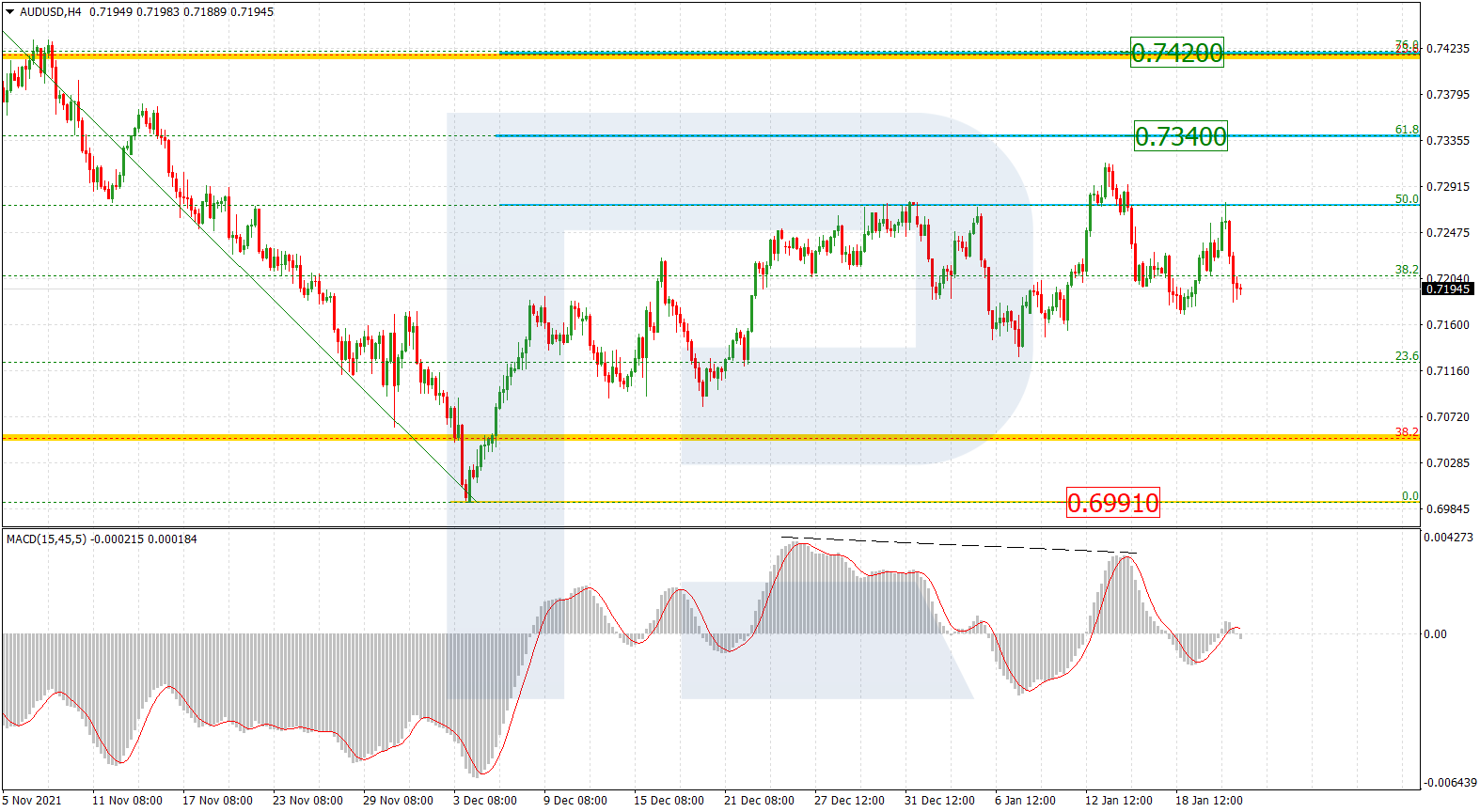
AUDUSD is trading at 0.7165; the instrument is moving below Ichimoku Cloud, thus indicating a descending tendency. The markets could indicate that the price may test the cloud’s downside border at 0.7185 and then resume moving downwards to reach 0.7065. Another signal in favour of a further downtrend will be a rebound from the resistance level. However, the bearish scenario may no longer be valid if the price breaks the cloud’s upside border and fixes above 0.7265. In this case, the pair may continue growing towards 0.7355. To confirm further decline, the asset must break the rising channel’s downside border and fix below 0.7135.

AUDUSD

Article By RoboForex.com

Attention!
Forecasts presented in this section only reflect the author’s private opinion and should not be considered as guidance for trading. RoboForex LP bears no responsibility for trading results based on trading recommendations described in these analytical reviews.

The Analytical Overview of the Main Currency Pairs on 2022.01.07

by JustForex

The EUR/USD currency pair

Technical indicators of the currency pair:
  • Prev Open: 1.1312
  • Prev Close: 1.1298
  • % chg. over the last day: -0.12%

German inflation accelerated to 5.3% in December. The last time German inflation was 5.3%, the Bundesbank’s key interest rate was 8.6%. Today, the ECB’s key rate remains at 0%. Analysts expect the ECB to raise interest rates by 10-15 basis points in October-December 2022.

Trading recommendations
  • Support levels: 1.1288, 1.1271
  • Resistance levels: 1.1336, 1.1368, 1.1369, 1.1436, 1.1535, 1.1613, 1.1667, 1.1717

From the technical point of view, the EUR/USD on the hour time frame is still bullish. After the December FOMC minutes publication, the EUR/USD quotes started a decline, as a more hawkish policy of the Fed led to a rise in the dollar index. Under such market conditions, it is better to consider sell deals from the 1.1336 resistance level, but with additional confirmation. Buy trades can be considered on the lower time frames from the support level 1.1288, but only with additional confirmation in the form of the buyers’ initiative. However, it should be noted that the price has already tested this level several times, and each rebound was weaker than the previous one, which suggests that a breakdown below it and a change of the priority is likely.

Alternative scenario: if the price breaks down through the 1.1288 support level and fixes below, the mid-term uptrend will be broken.

EUR/USD
News feed for 2022.01.07:
  • – German Industrial Production (m/m) at 09:00 (GMT+2);
  • – Eurozone Consumer Price Index (m/m) at 12:00 (GMT+2);
  • – Eurozone Retail Sales (m/m) at 12:00 (GMT+2);
  • – US Nonfarm Payrolls (m/m) at 15:30 (GMT+2);
  • – US Unemployment Rate (m/m) at 15:30 (GMT+2).

The GBP/USD currency pair

Technical indicators of the currency pair:
  • Prev Open: 1.3554
  • Prev Close: 1.3534
  • % chg. over the last day: -0.15%

According to a survey of the Bank of England, British firms expect that the inflation of production prices this year will be 4.5% compared with 4.2% at the end of last year. This suggests that consumer inflation will also rise following higher producer prices.

Trading recommendations
  • Support levels: 1.3465, 1.3396, 1.3352, 1.3257, 1.3220
  • Resistance levels: 1.3551, 1.3583, 1.3685

On the hourly time frame, the trend on GBP/USD is still bullish. The price is now trading in a wide corridor. On Wednesday, the price formed a false breakout zone higher, which will now act as a good resistance area. The MACD indicator is still signaling divergence. Under such market conditions, traders should consider buy positions from the 1.3465 support level but only with additional confirmation in the form of a buyers’ initiative. Sell trades can be considered from the resistance level of 1.3551 or 1.3583.

Alternative scenario: if the price breaks down through the 1.3465 support level and consolidates below, the bearish scenario will likely resume.

GBP/USD
News feed for 2022.01.07:
  • – UK Construction PMI (m/m) at 11:30 (GMT+2).

The USD/JPY currency pair

Technical indicators of the currency pair:
  • Prev Open: 116.07
  • Prev Close: 115.84
  • % chg. over the last day: -0.19%

The consumer price index (CPI) in Japan’s capital, which includes oil prices but excludes food prices, increased by 0.5% in December from a year earlier. It’s the biggest year-over-year increase since February 2020. Meanwhile, inflation-adjusted wages fell by 1.6% in annual terms, declining for the third straight month. Such data does not foresee a stronger economic recovery.

Trading recommendations
  • Support levels: 115.64, 115.34, 115.09, 113.74
  • Resistance levels: 116.11, 116.50

The global trend on the USD/JPY currency pair is bullish. The price is now trading in a price range. It is best to look for buy deals from the support levels around the moving average or from the lower boundary of 115.64, but with additional confirmation. Sell positions are better to look from the resistance level of 116.11, but only with confirmation and short targets.

Alternative scenario: if the price fixes below 115.09, the uptrend will likely be broken.

USD/JPY
News feed for 2022.01.07:
  • – Japan Tokyo Core CPI (m/m) at 01:30 (GMT+2).

The USD/CAD currency pair

Technical indicators of the currency pair:
  • Prev Open: 1.2755
  • Prev Close: 1.2725
  • % chg. over the last day: -0.24%

In November, Canada’s trade surplus increased for the sixth month straight, easing worries about the economic impact after the pandemic. Canada’s trade surplus reached a 13-year high, indicating that the economy is stronger than expected. This economic situation will contribute to a more rapid increase in interest rates, so traders should expect the strengthening of the Canadian dollar shortly. Also, it should be kept in mind that the Canadian dollar is a commodity currency, so rising oil prices almost always positively affect the Canadian dollar.

Trading recommendations
  • Support levels: 1.2710, 1.2667, 1.2628
  • Resistance levels: 1.2792, 1.2824, 1.2903, 1.2951

From the technical point of view, the USD/CAD currency pair has changed to bullish. After the December FOMC minutes publication, the USD/CAD quotes showed a sharp increase, as a more “hawkish” policy of the Fed led to a rise in the dollar index. But yesterday, the oil prices growth contributed to the strengthening of the Canadian dollar and decrease of the USD/CAD quotes. The MACD indicator became negative. Under such market conditions, it is better to look for buy trades from the 1.2710 support level, but with an additional confirmation in the form of a buyers initiative. Sell trades are best to consider from the resistance levels of higher time frames.

Alternative scenario: if the price breaks down through the 1.2667 support level and fixes below, the downtrend is likely to resume.

USD/CAD
News feed for 2022.01.07:
  • – Canada Unemployment Rate (m/m) at 15:30 (GMT+2);
  • – Canada Ivey PMI (m/m) at 17:00 (GMT+2).

by JustForex


This article reflects a personal opinion and should not be interpreted as an investment advice, and/or offer, and/or a persistent request for carrying out financial transactions, and/or a guarantee, and/or a forecast of future events.

Today all investors’ attention is focused on non-farm payrolls data in the US and the inflation rate in Eurozone

by JustForex

The US stock market ended Thursday’s trading with a decline amid negative dynamics from the utilities and healthcare sectors. By the close of the trading day, the Dow Jones Industrial Average (US30) decreased by 0.47%, the S&P 500 (US500) fell by 0.10%, and the NASDAQ Composite (US100) lost 0.13%.

The number of new jobless claims in the US was 207,000, while analysts expected 194,500. But the market participants are still confident in the economic recovery, especially in the labor market, and expect the monthly job gains in December to recover after the weak November data. Economists are predicting that the US economy will create 400,000 jobs in December. The good data may further strengthen the dollar index ahead of an interest rate hike.

Bank of America raised its target for Tesla to $1,300 a share.

European stock indices closed yesterday in the red zone. By the end of the day, German DAX (DE30) lost 1.35%, French CAC 40 (FR40) decreased by 1.72%, British FTSE 100 (UK100) fell by 0.88%, and Spanish IBEX 35 fell by 0.90%.

German inflation accelerated to 5.3% in December. The last time German inflation was 5.3%, the Bundesbank’s key interest rate was 8.6%. Today, the ECB’s key rate remains at 0%. Analysts expect the ECB to raise interest rates by 10-15 basis points in October-December 2022.

In November, German industrial production fell unexpectedly, indicating that the recovery in the manufacturing sector is weakening. On an annualized basis, German industrial production fell to 2.4%.

Eurozone inflation data will be released today. Economists are predicting that inflation will remain the same or even decrease slightly.

Oil prices have exceeded $80 per barrel on unrest in Kazakhstan and supply disruptions in Libya. Still, analysts are confident the price could exhaust itself soon as the Omicron strain continues to threaten demand at a time when supply should increase in the first quarter because of the release of strategic reserves.

Yesterday, gold decreased by 2% and broke down support at $1,800 an ounce. News of a rate hike is almost always negative for gold, which was reflected to some extent last year when gold ended 2021 down 3.6%, its first annual decline in three years and the biggest drop since 2015. But some analysts believe that if US inflation continues to rise through 2022, gold could rise again and even update the price highs of $2,100, which, by the way, happened against the background of concerns about the sharp rise in price pressure.

Asian stock indices closed lower yesterday. Japan’s Nikkei 225 Index (JP225) decreased by 2.9%, Australia’s ASX 200 Index (AU200) lost 2.7%, the exception was Hong Kong’s Hang Seng (HK50), which gained 0.7%.

The benchmark consumer price index (CPI) in Japan’s capital, which includes oil prices but excludes food prices, increased by 0.5% in December from a year earlier, the biggest year-over-year increase since February 2020. Meanwhile, inflation-adjusted wages fell 1.6% in annual terms, declining for the third month straight. Such data does not foresee a stronger economic recovery.

Main market quotes:

S&P 500 (F) (US500) 4,696.05 −4.53 (−0.096%)

Dow Jones (US30) 36,236.47 −170.64 (−0.47%)

DAX (DE40) 16,052.03 −219.72 (−1.35%)

FTSE 100 (UK100) 7,450.37 −66.50 (−0.88%)

USD Index 96.23 +0.06 (+0.06%)

Important events for today:
  • – Japan Tokyo Core CPI (m/m) at 01:30 (GMT+2);
  • – Switzerland Unemployment Rate (m/m) at 08:45 (GMT+2);
  • – German Industrial Production (m/m) at 09:00 (GMT+2);
  • – Switzerland Retail Sales (m/m) at 09:30 (GMT+2);
  • – UK Construction PMI (m/m) at 11:30 (GMT+2);
  • – Eurozone Consumer Price Index (m/m) at 12:00 (GMT+2);
  • – Eurozone Retail Sales (m/m) at 12:00 (GMT+2);
  • – US Nonfarm Payrolls (m/m) at 15:30 (GMT+2);
  • – US Unemployment Rate (m/m) at 15:30 (GMT+2);
  • – Canada Unemployment Rate (m/m) at 15:30 (GMT+2);
  • – Canada Ivey PMI (m/m) at 17:00 (GMT+2).

by JustForex


This article reflects a personal opinion and should not be interpreted as an investment advice, and/or offer, and/or a persistent request for carrying out financial transactions, and/or a guarantee, and/or a forecast of future events.

Japanese Candlesticks Analysis 06.01.2022 (USDCAD, AUDUSD, USDCHF)

Article By RoboForex.com

USDCAD, “US Dollar vs Canadian Dollar”

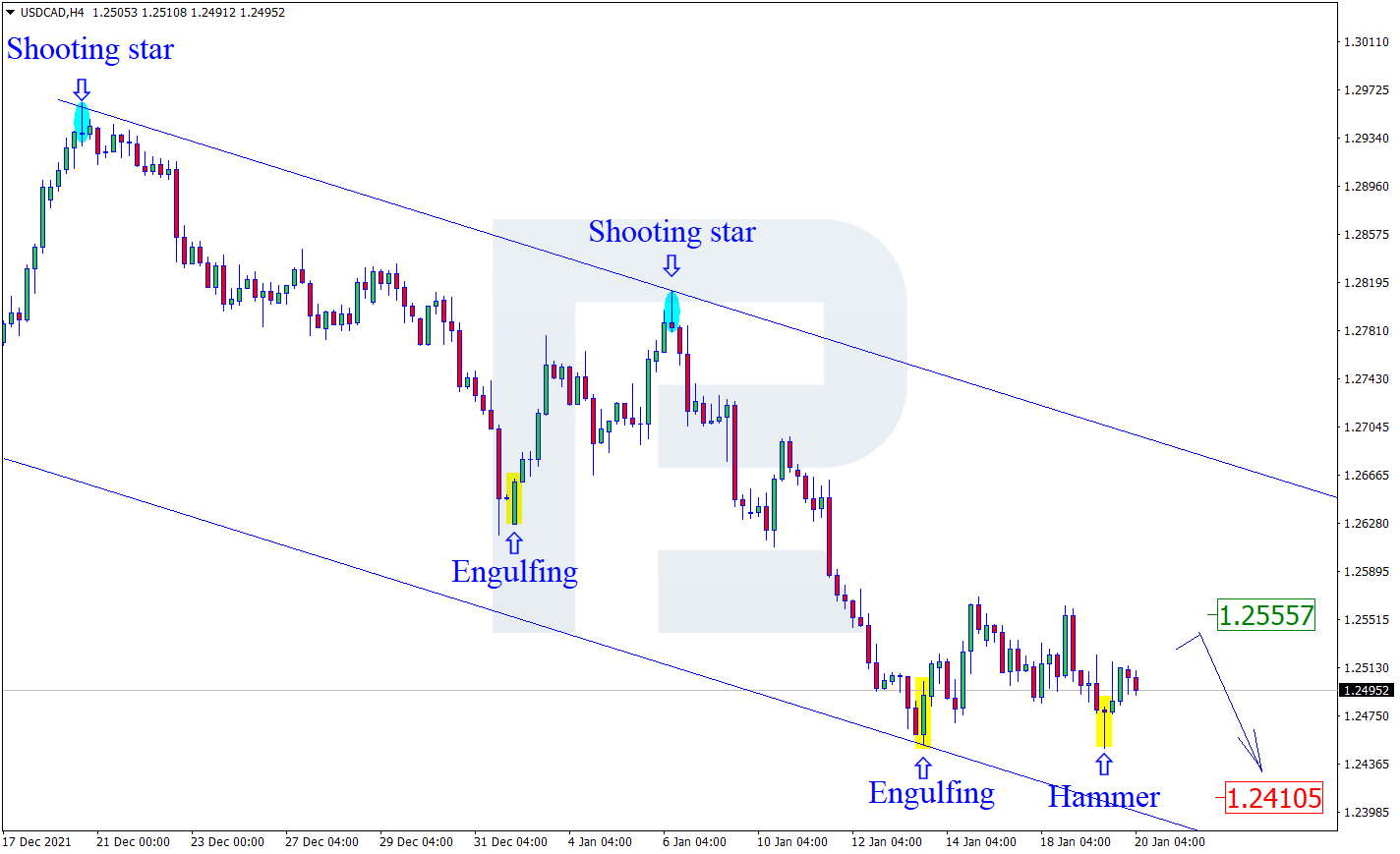
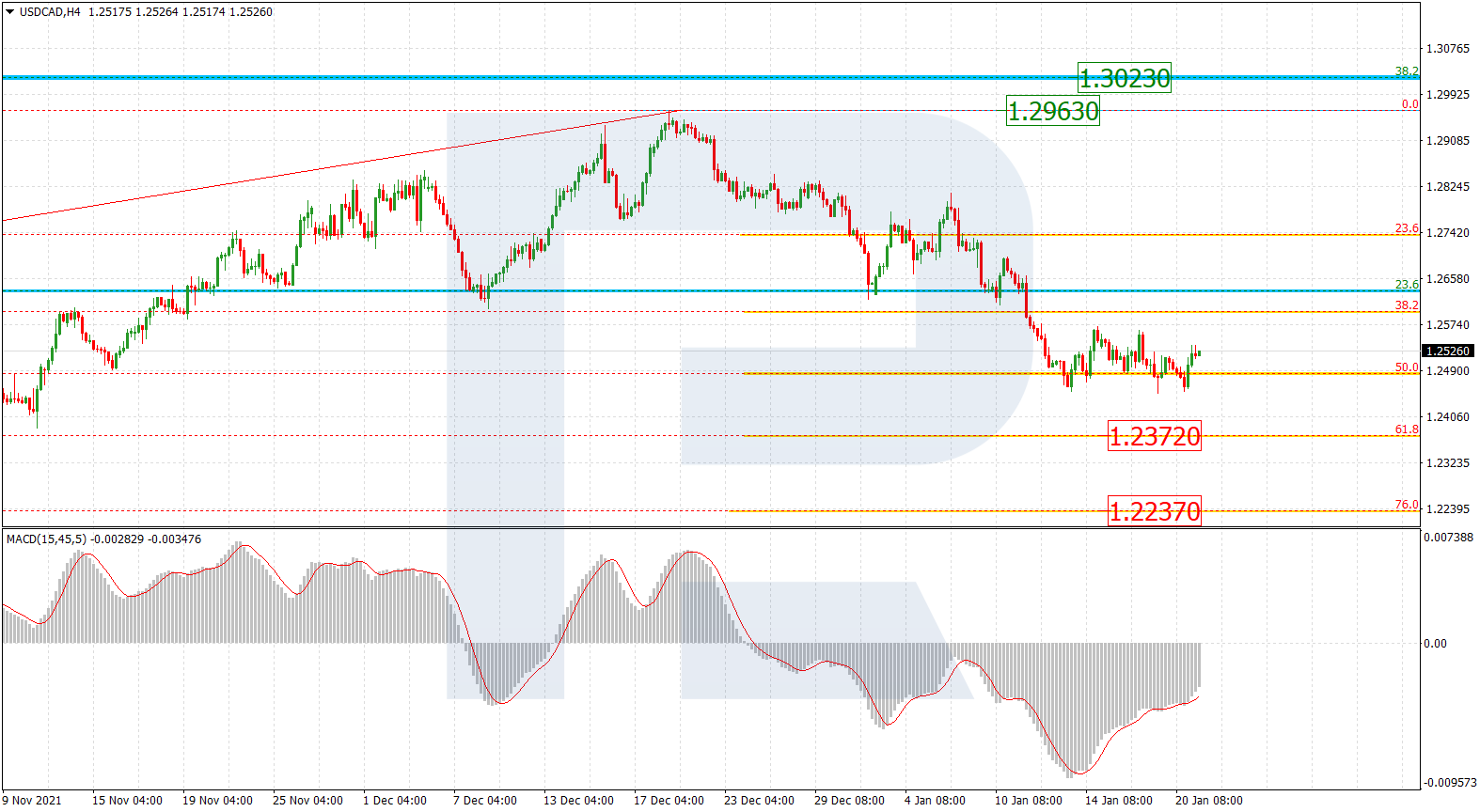
As we can see in the H4 chart, after forming several reversal patterns, including Engulfing, close to the support level, USDCAD is reversing and may resume trading upwards. In this case, the upside target may be the resistance area at 1.2900. However, an alternative scenario implies that the asset may correct to reach 1.2745 before resuming its ascending tendency.

USDCAD
Risk Warning: the result of previous trading operations do not guarantee the same results in the future

AUDUSD, “Australian Dollar vs US Dollar”

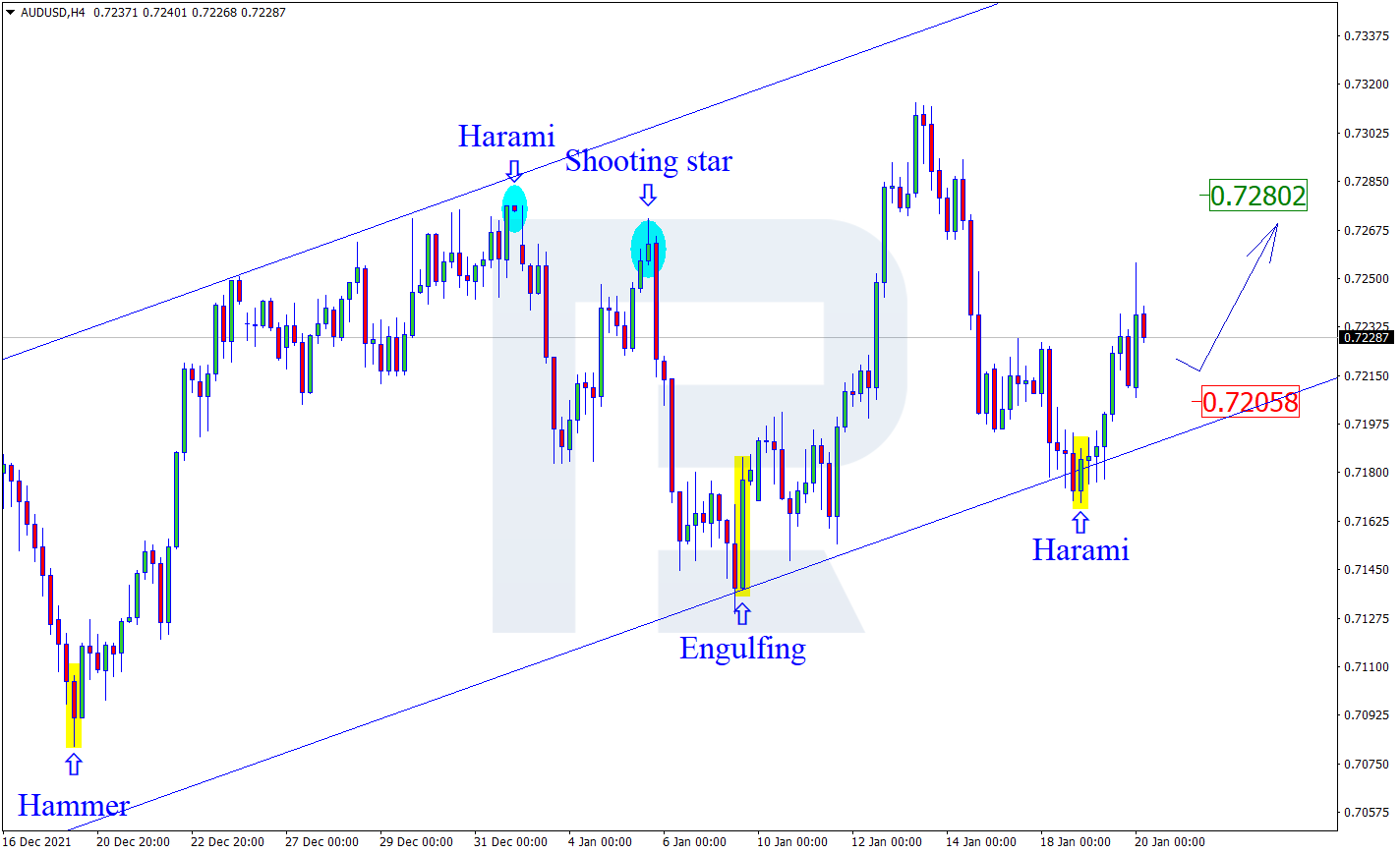
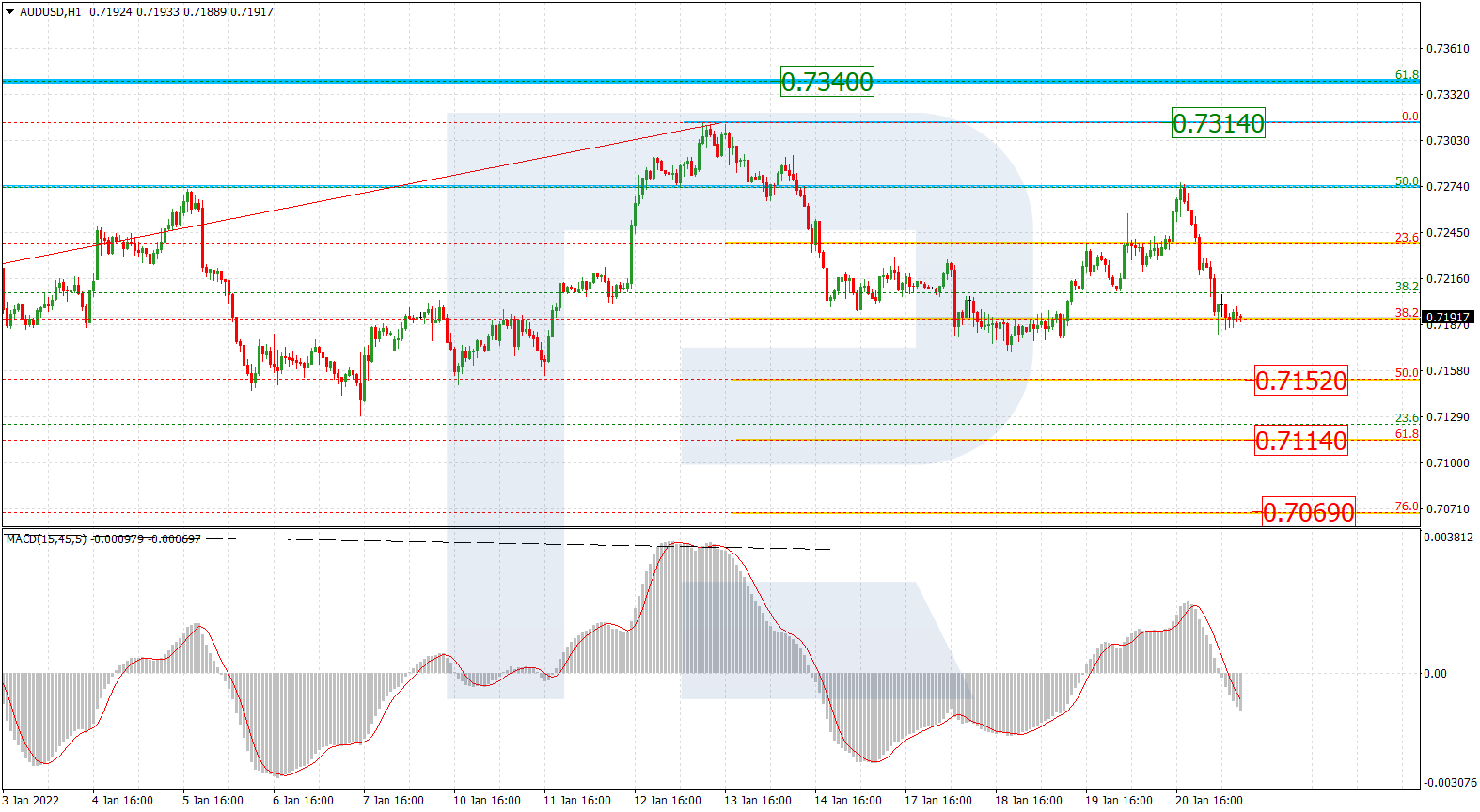
As we can see in the H4 chart, AUDUSD has formed a Shooting Star reversal pattern near the resistance area. At the moment, the asset is reversing in the form of another pullback. In this case, the downside correctional target may be the support level at 0.7100. After testing the level, the price may rebound from it and resume the ascending tendency. The upside target is at 0.7210.

AUDUSD
Risk Warning: the result of previous trading operations do not guarantee the same results in the future

USDCHF, “US Dollar vs Swiss Franc”

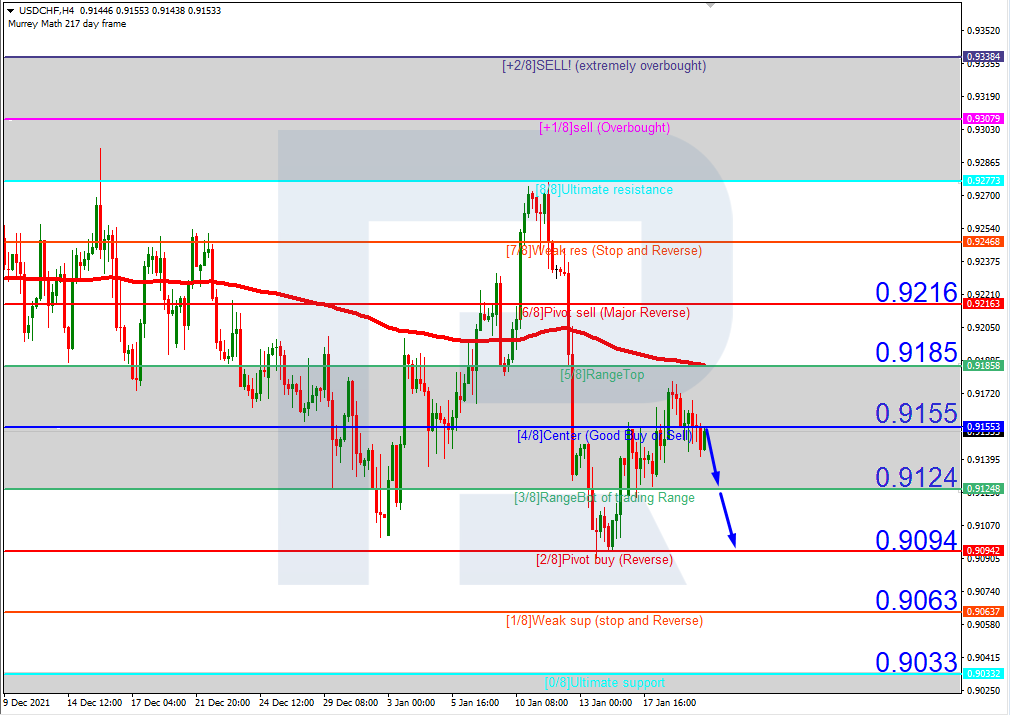
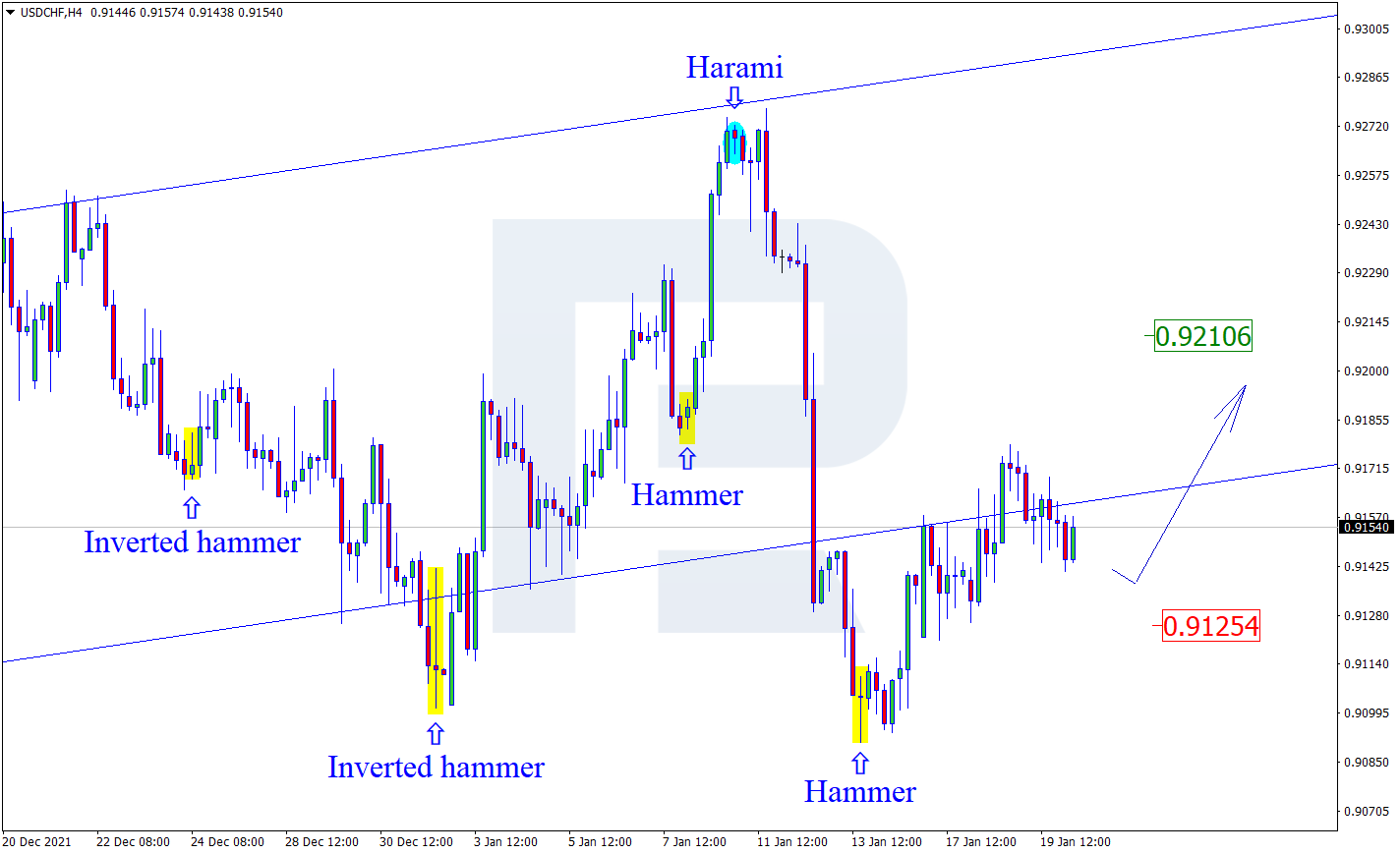
As we can see in the H4 chart, after testing the support area, the pair has formed several reversal patterns, for example, Inverted Hammer. At the moment, USDCHF may reverse in the form of a new rising wave towards the resistance level. In this case, the upside target may be at 0.9235. Still, there might be an alternative scenario, according to which the asset may correct to reach 0.9160 before resuming its ascending tendency.

USDCHF

Article By RoboForex.com

Attention!
Forecasts presented in this section only reflect the author’s private opinion and should not be considered as guidance for trading. RoboForex LP bears no responsibility for trading results based on trading recommendations described in these analytical reviews.
Murrey Math Lines 06.01.2022 (USDJPY, USDCAD)

Article By RoboForex.com

USDJPY, “US Dollar vs. Japanese Yen”

As we can see in the H4 chart, USDJPY is trading within the “overbought area”. In this case, the price is expected to test 8/8, break it, and correct downwards to reach the support at 6/8. However, this scenario may no longer be valid if the price breaks +1/8 to the upside. After that, the instrument may reverse and grow towards the resistance at +2/8.

USDJPY_H4
Risk Warning: the result of previous trading operations do not guarantee the same results in the future

In the M15 chart, the pair may break the downside line of the VoltyChannel indicator and, as a result, continue falling.

USDJPY_M15
Risk Warning: the result of previous trading operations do not guarantee the same results in the future

USDCAD, “US Dollar vs Canadian Dollar”

In the H4 chart, after breaking the 200-day Moving Average, USDCAD is trading above it, thus indicating an ascending tendency. In this case, the price is expected to test 6/8, break it, and continue growing towards the resistance at 8/8. Still, this scenario may no longer be valid if the price breaks the support at 5/8 to the downside. After that, the instrument may correct downwards to reach 3/8.

USDCAD_H4
Risk Warning: the result of previous trading operations do not guarantee the same results in the future

As we can see in the M15 chart, the pair has broken the upside line of the VoltyChannel indicator and, as a result, may continue trading upwards.

USDCAD_M15

Article By RoboForex.com

Attention!
Forecasts presented in this section only reflect the author’s private opinion and should not be considered as guidance for trading. RoboForex LP bears no responsibility for trading results based on trading recommendations described in these analytical reviews.
The Analytical Overview of the Main Currency Pairs on 2022.01.06

by JustForex

The EUR/USD currency pair

Technical indicators of the currency pair:
  • Prev Open: 1.1281
  • Prev Close: 1.1312
  • % chg. over the last day: +0.27%

According to preliminary information, the ECB is ready to decrease its stimulus measures and raise rates if necessary. But that hasn’t happened yet. Given the high probability of the interest rate increase by the Fed in March, the dollar index will keep being stable, which will be negatively reflected in EUR/USD quotes (decrease of EUR/USD).

Trading recommendations
  • Support levels: 1.1288, 1.1271
  • Resistance levels: 1.1336, 1.1368, 1.1369, 1.1436, 1.1535, 1.1613, 1.1667, 1.1717

From the technical point of view, the EUR/USD on the hour time frame is still bullish. After the December FOMC minutes publication, the EUR/USD quotes started a sharp decline, as a more hawkish policy of the Fed led to a rise in the dollar index. Under such market conditions, it is better to consider sell deals from the 1.1336 resistance level, but with additional confirmation. Buy trades can be considered on the lower time frames from the support level 1.1288, but only with additional confirmation in the form of the buyers’ initiative.

Alternative scenario: if the price breaks down through the 1.1288 support level and fixes below, the mid-term uptrend will be broken.

EUR/USD
News feed for 2022.01.06:
  • – US Initial Jobless Claims (w/w) at 15:30 (GMT+2);
  • – US ISM Services PMI (m/m) at 17:00 (GMT+2).

The GBP/USD currency pair

Technical indicators of the currency pair:
  • Prev Open: 1.3528
  • Prev Close: 1.3555
  • % chg. over the last day: +0.20%

The UK is approaching a daily sickness rate of 200,000. But the government is promising not to shut down the country entirely. This is a positive factor since companies have already begun to raise prices for goods and services due to concerns about inflation growth. Any additional restrictions may push inflation higher.

Trading recommendations
  • Support levels: 1.3465, 1.3396, 1.3352, 1.3257, 1.3220
  • Resistance levels: 1.3551, 1.3583, 1.3685

On the hourly time frame, the trend on GBP/USD is still bullish. But yesterday, the price formed a false breakout zone higher, which will now act as a good resistance area. The MACD indicator is still signaling divergence. Under such market conditions, traders should consider buy positions from the 1.3465 support level but only with additional confirmation in the form of a buyers’ initiative. Sell trades can be considered from the resistance level of 1.3551 or 1.3583.

Alternative scenario: if the price breaks down through the 1.3465 support level and consolidates below, the bearish scenario will likely resume.

GBP/USD
News feed for 2022.01.06:
  • – UK Services PMI (m/m) at 11:30 (GMT+2).

The USD/JPY currency pair

Technical indicators of the currency pair:
  • Prev Open: 116.13
  • Prev Close: 116.09
  • % chg. over the last day: -0.03%

Due to the rise in COVID-19 cases, Tokyo may take emergency measures and impose restrictions. Japanese Prime Minister Kishida said yesterday that once the country manages to get COVID-19 under control, the economy will see a vertical increase in all indicators.

Trading recommendations
  • Support levels: 115.64, 115.34, 115.09, 113.74
  • Resistance levels: 116.11, 116.50

The global trend on the USD/JPY currency pair is bullish. The price has started a corrective movement, and this is an excellent opportunity to open buy trades. It is best to look for buy deals from the support levels around the moving average. Sell positions are better to look from the resistance level of 116.11, but only with confirmation and short targets.

Alternative scenario: if the price fixes below 115.09, the uptrend will likely be broken.

USD/JPY
News feed for 2022.01.06:
  • – Japan Services PMI (m/m) at 02:30 (GMT+2).

The USD/CAD currency pair

Technical indicators of the currency pair:
  • Prev Open: 1.2706
  • Prev Close: 1.2755
  • % chg. over the last day: +0.38%

Economists predict three interest rate hikes from the Central Bank of Canada, starting in April. But they are confident that the Canadian economy will show a decline in the first quarter due to the Omicron strain and new restrictions. Fundamentally, both the US Fed and the Central Bank of Canada intend to tighten monetary policy this year, so both currencies will have support from the central banks. As a result, investors should not hope for medium-term trends on the currency pair USD/CAD. In annual terms, quotes will be flat.

Trading recommendations
  • Support levels: 1.2757, 1.2710, 1.2667, 1.2628
  • Resistance levels: 1.2824, 1.2903, 1.2951

From the technical point of view, the USD/CAD currency pair has changed to bullish. After the December FOMC minutes publication, the USD/CAD quotes showed a sharp increase, as a more “hawkish” policy of the Fed led to a rise in the dollar index. The MACD indicator became positive, with no signs of reversal. Under such market conditions, it is better to look for buy trades from the support level 1.2757 or 1.2710, but with an additional confirmation in the form of a buyer’s initiative. Sell trades are best to consider from the resistance levels of higher time frames.

Alternative scenario: if the price breaks down through the 1.2667 support level and fixes below, the downtrend is likely to resume.

USD/CAD
There is no news feed for today.

by JustForex


This article reflects a personal opinion and should not be interpreted as an investment advice, and/or offer, and/or a persistent request for carrying out financial transactions, and/or a guarantee, and/or a forecast of future events.

Major US stock indices began to decline sharply after FOMC minutes

by JustForex

On Wednesday, the US stocks fell sharply after the US Federal Reserve meeting minutes showed that the central bank might raise interest rates earlier than expected. Meanwhile, some Fed officials also warned that the Fed might have to reduce the number of assets on its balance sheet soon after a rate hike. The S&P 500 (US500) and NASDAQ (US100) indices fell sharply after the FOMC minutes were released. The Dow Jones index, which reached a record high at the beginning of the day, also closed lower. By the end of the trading session, the S&P 500 Index (US500) decreased by 1.94%, the Dow Jones Industrial Average (US30) fell by 1.07%, and the Nasdaq Composite Technology Index (US100) lost 3.36%.

The ADP employment report showed that the US private sector added 807,000 jobs (expectation +375,000), but still nearly 4 million below pre-pandemic levels. According to the FOMC minutes, the US labor market is now in a “tight” phase. This week’s investor focus is also on US labor market data. The weekly report on new jobless claims will be released on Thursday, and on Friday, the December non-farm data and unemployment rate will be released.

The World Health Organization (WHO) reported Wednesday 2,294,039 new coronavirus cases worldwide in a 24-hour period. This is the highest daily rate in WHO statistics recorded during the pandemic.

European stock indices mostly rose yesterday despite a decline in business activity in the region and a rise in COVID cases. At the end of the day, French index CAC 40 (FR40) gained 0.81%, German DAX (DE30) added 0.74%, British FTSE 100 (UK100) increased by 0.16%. Spanish IBEX 35 (ES35) was the exception and decreased by 0.06%. European auto manufacturers’ quotes became the leaders of the growth on Wednesday. Renault SA gained 5.3%, Daimler AG added 4%, and Stellantis NV increased by 3.9%. JPMorgan analysts stick to the recommendation to buy all three companies.

But analysts believe that European stock markets will open with a decline on Thursday, which will continue the global sell-off following the release of the “hawkish” December FOMC protocol.

Kazakhstan has declared a state of emergency across the country. An anti-terrorist operation was launched in Almaty. All the banks in Kazakhstan stopped working. Internet access is also restricted. Middle Eastern air carriers cancel flights to Kazakhstan.

Crude oil reserves showed another decline. In the previous week, inventories decreased by 2.14 Mbbl, but less than the expected -3.3 Mbbl. But gasoline reserves increased by more than 10 Mbbl, the biggest weekly increase since April 2020. This indicates that the population does not travel much by car. But this is not surprising, as the rise in incidence increases every day.

On Thursday, Asian stock indices are decreasing during trading amid a decline in the US stock market the day before. Japan’s Nikkei 225 Index (JP225) decreased by 2.88% since the opening, Australia’s ASX 200 (AU200) lost 2.74%, but Hong Kong’s Hang Seng (HK50) feels good, showing an increase of 0.33%.

Main market quotes:

S&P 500 (F) (US500) 4,700.58 −92.96 (−1.94%)

Dow Jones (US30) 36,407.11 −392.54 (−1.07%)

DAX (DE40) 16,271.75 +119.14 (+0.74%)

FTSE 100 (UK100) 7,516.87 +11.72 (+0.16%)

USD Index 96.16 −0.10 (−0.10%)

Important events for today:
  • – Japan Services PMI (m/m) at 02:30 (GMT+2);
  • – UK Services PMI (m/m) at 11:30 (GMT+2);
  • – US Initial Jobless Claims (w/w) at 15:30 (GMT+2);
  • – US ISM Services PMI (m/m) at 17:00 (GMT+2);
  • – US Natural Gas Storage (w/w) at 17:30 (GMT+2).

by JustForex


This article reflects a personal opinion and should not be interpreted as an investment advice, and/or offer, and/or a persistent request for carrying out financial transactions, and/or a guarantee, and/or a forecast of future events.