Archive for Forex and Currency News – Page 144

The Analytical Overview of the Main Currency Pairs on 2022.04.25

by JustForex

The EUR/USD currency pair

Technical indicators of the currency pair:
  • Prev Open: 1.0834
  • Prev Close: 1.0796
  • % chg. over the last day: -0.35%

US manufacturing growth accelerated in March as robust demand and improved forecast countered negative cost pressures. Economic growth in the Eurozone accelerated in April as a rebound in the services sector helped offset stagnant manufacturing output. Business expectations in Europe for next year increased from a 17-month low. However, confidence remains low as fears of the war in Ukraine, rising prices, and the lingering effects of the pandemic are not optimistic.

Trading recommendations
  • Support levels: 1.0727
  • Resistance levels: 1.0770, 1.0870, 1.0908, 1.0958, 1.1027, 1.1196, 1.1291

From the technical point of view, the trend on the EUR/USD currency pair on the hourly time frame is bearish. Growth in the dollar index led to the fall of the European currency. The MACD indicator has become negative, and the selling pressure has increased. Under such market conditions, it is possible to look for buy trades on intraday timeframes from the support level of 1.0727, but only with short targets and confirmation. Sell trades should be considered from the resistance level of 1.0870 or 1.0908, but only after the additional confirmation.

Alternative scenario: if the price breaks out through the 1.0958 resistance level and fixes above, the uptrend will likely resume.

EUR/USD
News feed for 2022.04.23:
  • – Eurozone Germany Ifo Business Climate (m/m) at 11:00 (GMT+2).

The GBP/USD currency pair

Technical indicators of the currency pair:
  • Prev Open: 1.3028
  • Prev Close: 1.2832
  • % chg. over the last day: -1.52%

UK PMI data showed steady growth in March as further recovery from COVID-19 restraint helped offset the downside. Yet the war in Ukraine has led to unprecedented price increases and reduced business confidence to a year-and-a-half low. The largest increase in selling prices of goods and services in the survey’s history took place in March, and consumer price inflation will continue to rise in the coming months. Analysts predict an undesirable pattern of “stagflation” for the UK economy.

Trading recommendations
  • Support levels: 1.2719
  • Resistance levels: 1.2801, 1.2862, 1.2919, 1.2981, 1.3010, 1.3083, 1.3115

On the hourly time frame, the GBP/USD currency pair trend is still bearish. The price fell sharply on Friday amid a likely “stagflationary” scenario for the UK. The MACD indicator has become negative, with no signs of a reversal. Under such market conditions, sell trades should be looked for from the resistance level of 1.2918, but with confirmation. For buy deals, traders may consider the level of 1.2719, but only after the appearance of a bullish initiative and with short targets.

Alternative scenario: if the price breaks down through the 1.3083 resistance level and fixes above, the mid-term uptrend will likely be resumed.

GBP/USD
There is no news feed for today.

The USD/JPY currency pair

Technical indicators of the currency pair:
  • Prev Open: 128.33
  • Prev Close: 128.46
  • % chg. over the last day: +0.10%

The monetary policy of the Bank of Japan remains unchanged. The central bank uses an ultra-soft approach to push the inflation rate closer to the 2% target. The Bank of Japan will hold its next monetary policy meeting this week, but analysts do not expect changes. Thus, fundamentally, USD/JPY quotes tend to rise as the Fed tightens monetary policy, which leads to a rise in the dollar index. But traders should not forget that the Bank of Japan will enter the debt market and sell government bonds to prevent a significant depreciation of the yen in a short period of time. Therefore, a correction might occur soon.

Trading recommendations
  • Support levels: 126.69, 125.72, 124.66, 124.24, 122.97, 122.63, 121.81
  • Resistance levels: 128.83, 129.36

The medium-term trend on the USD/JPY currency pair is bullish. The MACD indicator has become inactive, but the divergence is still visible on the higher timeframes. The price is trading in a narrow corridor. Under such market conditions, it is best to look for buy deals, expecting the continuation of the uptrend, but after the price makes a pullback to the average lines and the nearest support levels. First of all, it is worth considering the support level of 126.69, but with additional confirmation. A resistance level of 128.83 may be considered for sell deals, but only with short targets.

Alternative scenario: If the price fixes below 124.66, the uptrend will likely be broken.

USD/JPY
There is no news feed for today.

The USD/CAD currency pair

Technical indicators of the currency pair:
  • Prev Open: 1.2579
  • Prev Close: 1.2708
  • % chg. over the last day: +1.02%

The Canadian dollar is a commodity currency, highly dependent on oil price dynamics and the dollar index. The dollar index on Friday continued to grow amid statements by the Fed officials, while oil prices remained at the same level. As a result, the USD/CAD currency pair also increased. Fundamentally, there are currently no prerequisites for a medium-term trend in USD/CAD.

Trading recommendations
  • Support levels: 1.2644, 1.2607, 1.2521
  • Resistance levels: 1.2714, 1.2849

The USD/CAD currency pair is bullish in terms of technical analysis. Buying pressure is still high, but the price has deviated strongly from the average values. The MACD indicator has become positive, with no signs of reversal. Trade is worth it only with short targets. Under such market conditions, it is better to look for buy trades on the lower timeframes from the support level of 1.2607 or 1.2644, but it is better with additional confirmation. For sell deals, it is better to consider the resistance level of 1.2849, but it is also better with confirmation and short targets.

Alternative scenario: if the price breaks through and consolidates below 1.2521, the downtrend will likely be resumed.

USD/CAD
News feed for 2022.04.25:
  • – Canada Boc Gov Macklem Speaks at 18:00 (GMT+2).

by JustForex


This article reflects a personal opinion and should not be interpreted as an investment advice, and/or offer, and/or a persistent request for carrying out financial transactions, and/or a guarantee, and/or a forecast of future events.

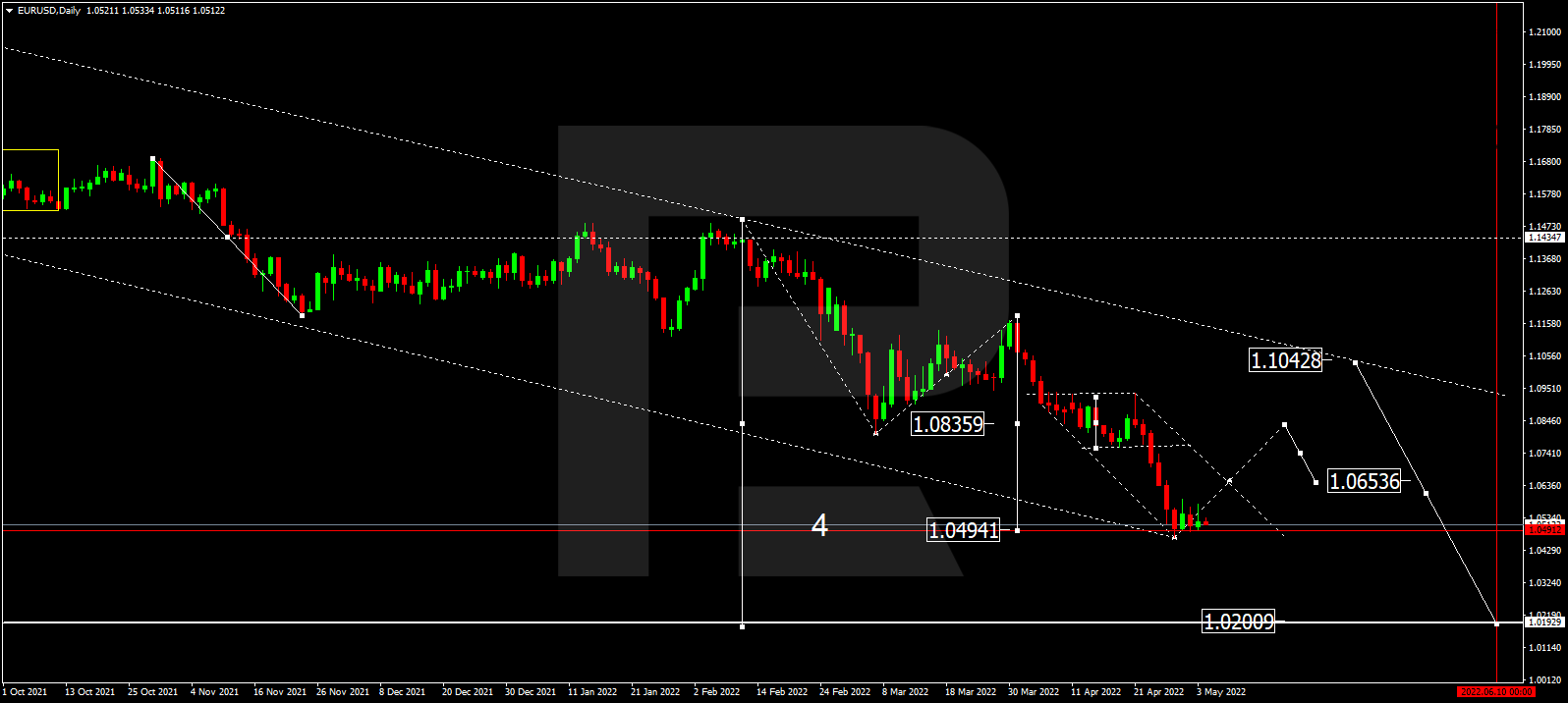
Currency Speculators raise their bullish bets for Canadian Dollar to 40-week high

By InvestMacro | COT | Data Tables | COT Leaders | Downloads | COT Newsletter

Here are the latest charts and statistics for the Commitment of Traders (COT) data published by the Commodities Futures Trading Commission (CFTC).

The latest COT data is updated through Tuesday April 19th and shows a quick view of how large traders (for-profit speculators and commercial entities) were positioned in the futures markets. All currency positions are in direct relation to the US dollar where, for example, a bet for the euro is a bet that the euro will rise versus the dollar while a bet against the euro will be a bet that the euro will decline versus the dollar.

Highlighting the COT currency data is the rising of bullish bets in the Canadian ‘Loonie’ dollar currency futures contracts. CAD speculators raised their bullish bets for a fourth straight week this week and for the fifth time in the past six weeks. Over the past four-week time-frame, CAD bets have improved by a total of +26,166 contracts, going from -4,940 net positions on March 22nd to +21,226 net positions this week. These gains have brought this week’s speculator level to the most bullish position since July 13th of 2021, a span of forty weeks.

This recent improvement in Loonie sentiment has been helped out by the hike in interest rates by the Bank of Canada (BOC). The BOC recently pushed its key interest rate higher by 50 basis points on April 13th and has in the past few days hinted that more interest rate rises were to come. The recent inflation numbers out of Canada were above expectations (6.7 percent) and according to Bloomberg, market participants have pushed their odds to 100 percent for another 50 basis point hike in June.

Overall, the currencies with higher speculator bets this week were the US Dollar Index (2,943 contracts), Japanese yen (4,640 contracts), Swiss franc (2,492 contracts), New Zealand dollar (654 contracts), Canadian dollar (9,068 contracts)and the Mexican peso (6,704 contracts).

The currencies with declining bets were the Euro (-7,759 contracts), Brazil real (-1,557 contracts), Australian dollar (-122 contracts), Bitcoin (-361 contracts) and the British pound sterling (-5,860 contracts).


Speculator strength standings for each Commodity where strength index is current net position compared to past three years, above 80 is bullish extreme, below 20 is bearish extreme


Data Snapshot of Forex Market Traders | Columns Legend
Apr-19-2022OIOI-IndexSpec-NetSpec-IndexCom-NetCOM-IndexSmalls-NetSmalls-Index
USD Index54,5247732,58082-35,893153,31353
EUR675,9397231,30145-49,7266218,4255
GBP249,52970-58,9143272,88973-13,97527
JPY251,29190-107,1873129,84299-22,6557
CHF44,26920-11,4505023,05157-11,60129
CAD153,3023221,22668-39,3383118,11266
AUD147,30943-28,8375820,800348,03772
NZD41,098263657250331-86842
MXN165,4033321,66437-26,214624,55062
RUB20,93047,54331-7,15069-39324
BRL70,5536844,57294-47,06352,49194
Bitcoin11,27661-19490-175036921


US Dollar Index Futures:

US Dollar Index Forex Futures COT ChartThe US Dollar Index large speculator standing this week reached a net position of 32,580 contracts in the data reported through Tuesday. This was a weekly lift of 2,943 contracts from the previous week which had a total of 29,637 net contracts.

This week’s current strength score (the trader positioning range over the past three years, measured from 0 to 100) shows the speculators are currently Bullish-Extreme with a score of 82.0 percent. The commercials are Bearish-Extreme with a score of 15.0 percent and the small traders (not shown in chart) are Bullish with a score of 52.8 percent.

US DOLLAR INDEX StatisticsSPECULATORSCOMMERCIALSSMALL TRADERS
– Percent of Open Interest Longs:85.63.39.5
– Percent of Open Interest Shorts:25.969.13.5
– Net Position:32,580-35,8933,313
– Gross Longs:46,6851,7785,198
– Gross Shorts:14,10537,6711,885
– Long to Short Ratio:3.3 to 10.0 to 12.8 to 1
NET POSITION TREND:
– Strength Index Score (3 Year Range Pct):82.015.052.8
– Strength Index Reading (3 Year Range):Bullish-ExtremeBearish-ExtremeBullish
NET POSITION MOVEMENT INDEX:
– 6-Week Change in Strength Index:-2.53.3-5.8


Euro Currency Futures:

Euro Currency Futures COT ChartThe Euro Currency large speculator standing this week reached a net position of 31,301 contracts in the data reported through Tuesday. This was a weekly lowering of -7,759 contracts from the previous week which had a total of 39,060 net contracts.

This week’s current strength score (the trader positioning range over the past three years, measured from 0 to 100) shows the speculators are currently Bearish with a score of 44.6 percent. The commercials are Bullish with a score of 61.9 percent and the small traders (not shown in chart) are Bearish-Extreme with a score of 4.9 percent.

EURO Currency StatisticsSPECULATORSCOMMERCIALSSMALL TRADERS
– Percent of Open Interest Longs:32.753.711.4
– Percent of Open Interest Shorts:28.161.08.7
– Net Position:31,301-49,72618,425
– Gross Longs:221,003362,93076,939
– Gross Shorts:189,702412,65658,514
– Long to Short Ratio:1.2 to 10.9 to 11.3 to 1
NET POSITION TREND:
– Strength Index Score (3 Year Range Pct):44.661.94.9
– Strength Index Reading (3 Year Range):BearishBullishBearish-Extreme
NET POSITION MOVEMENT INDEX:
– 6-Week Change in Strength Index:-8.59.7-10.9


British Pound Sterling Futures:

British Pound Sterling Futures COT ChartThe British Pound Sterling large speculator standing this week reached a net position of -58,914 contracts in the data reported through Tuesday. This was a weekly decrease of -5,860 contracts from the previous week which had a total of -53,054 net contracts.

This week’s current strength score (the trader positioning range over the past three years, measured from 0 to 100) shows the speculators are currently Bearish with a score of 31.6 percent. The commercials are Bullish with a score of 72.8 percent and the small traders (not shown in chart) are Bearish with a score of 26.7 percent.

BRITISH POUND StatisticsSPECULATORSCOMMERCIALSSMALL TRADERS
– Percent of Open Interest Longs:14.874.68.8
– Percent of Open Interest Shorts:38.445.414.4
– Net Position:-58,91472,889-13,975
– Gross Longs:36,811186,13421,987
– Gross Shorts:95,725113,24535,962
– Long to Short Ratio:0.4 to 11.6 to 10.6 to 1
NET POSITION TREND:
– Strength Index Score (3 Year Range Pct):31.672.826.7
– Strength Index Reading (3 Year Range):BearishBullishBearish
NET POSITION MOVEMENT INDEX:
– 6-Week Change in Strength Index:-33.428.1-2.2


Japanese Yen Futures:

Japanese Yen Forex Futures COT ChartThe Japanese Yen large speculator standing this week reached a net position of -107,187 contracts in the data reported through Tuesday. This was a weekly lift of 4,640 contracts from the previous week which had a total of -111,827 net contracts.

This week’s current strength score (the trader positioning range over the past three years, measured from 0 to 100) shows the speculators are currently Bearish-Extreme with a score of 2.9 percent. The commercials are Bullish-Extreme with a score of 99.0 percent and the small traders (not shown in chart) are Bearish-Extreme with a score of 7.4 percent.

JAPANESE YEN StatisticsSPECULATORSCOMMERCIALSSMALL TRADERS
– Percent of Open Interest Longs:5.186.08.3
– Percent of Open Interest Shorts:47.734.317.3
– Net Position:-107,187129,842-22,655
– Gross Longs:12,723216,10120,761
– Gross Shorts:119,91086,25943,416
– Long to Short Ratio:0.1 to 12.5 to 10.5 to 1
NET POSITION TREND:
– Strength Index Score (3 Year Range Pct):2.999.07.4
– Strength Index Reading (3 Year Range):Bearish-ExtremeBullish-ExtremeBearish-Extreme
NET POSITION MOVEMENT INDEX:
– 6-Week Change in Strength Index:-31.625.9-3.8


Swiss Franc Futures:

Swiss Franc Forex Futures COT ChartThe Swiss Franc large speculator standing this week reached a net position of -11,450 contracts in the data reported through Tuesday. This was a weekly increase of 2,492 contracts from the previous week which had a total of -13,942 net contracts.

This week’s current strength score (the trader positioning range over the past three years, measured from 0 to 100) shows the speculators are currently Bearish with a score of 50.0 percent. The commercials are Bullish with a score of 56.8 percent and the small traders (not shown in chart) are Bearish with a score of 29.2 percent.

SWISS FRANC StatisticsSPECULATORSCOMMERCIALSSMALL TRADERS
– Percent of Open Interest Longs:6.671.721.7
– Percent of Open Interest Shorts:32.419.647.9
– Net Position:-11,45023,051-11,601
– Gross Longs:2,90031,7359,599
– Gross Shorts:14,3508,68421,200
– Long to Short Ratio:0.2 to 13.7 to 10.5 to 1
NET POSITION TREND:
– Strength Index Score (3 Year Range Pct):50.056.829.2
– Strength Index Reading (3 Year Range):BearishBullishBearish
NET POSITION MOVEMENT INDEX:
– 6-Week Change in Strength Index:-3.01.31.8


Canadian Dollar Futures:

Canadian Dollar Forex Futures COT ChartThe Canadian Dollar large speculator standing this week reached a net position of 21,226 contracts in the data reported through Tuesday. This was a weekly advance of 9,068 contracts from the previous week which had a total of 12,158 net contracts.

This week’s current strength score (the trader positioning range over the past three years, measured from 0 to 100) shows the speculators are currently Bullish with a score of 67.7 percent. The commercials are Bearish with a score of 31.1 percent and the small traders (not shown in chart) are Bullish with a score of 65.8 percent.

CANADIAN DOLLAR StatisticsSPECULATORSCOMMERCIALSSMALL TRADERS
– Percent of Open Interest Longs:28.745.024.6
– Percent of Open Interest Shorts:14.970.712.8
– Net Position:21,226-39,33818,112
– Gross Longs:44,06368,98937,784
– Gross Shorts:22,837108,32719,672
– Long to Short Ratio:1.9 to 10.6 to 11.9 to 1
NET POSITION TREND:
– Strength Index Score (3 Year Range Pct):67.731.165.8
– Strength Index Reading (3 Year Range):BullishBearishBullish
NET POSITION MOVEMENT INDEX:
– 6-Week Change in Strength Index:13.4-17.220.4


Australian Dollar Futures:

Australian Dollar Forex Futures COT ChartThe Australian Dollar large speculator standing this week reached a net position of -28,837 contracts in the data reported through Tuesday. This was a weekly decline of -122 contracts from the previous week which had a total of -28,715 net contracts.

This week’s current strength score (the trader positioning range over the past three years, measured from 0 to 100) shows the speculators are currently Bullish with a score of 58.1 percent. The commercials are Bearish with a score of 34.4 percent and the small traders (not shown in chart) are Bullish with a score of 72.0 percent.

AUSTRALIAN DOLLAR StatisticsSPECULATORSCOMMERCIALSSMALL TRADERS
– Percent of Open Interest Longs:26.653.819.2
– Percent of Open Interest Shorts:46.239.613.7
– Net Position:-28,83720,8008,037
– Gross Longs:39,20179,20828,257
– Gross Shorts:68,03858,40820,220
– Long to Short Ratio:0.6 to 11.4 to 11.4 to 1
NET POSITION TREND:
– Strength Index Score (3 Year Range Pct):58.134.472.0
– Strength Index Reading (3 Year Range):BullishBearishBullish
NET POSITION MOVEMENT INDEX:
– 6-Week Change in Strength Index:45.8-42.819.6


New Zealand Dollar Futures:

New Zealand Dollar Forex Futures COT ChartThe New Zealand Dollar large speculator standing this week reached a net position of 365 contracts in the data reported through Tuesday. This was a weekly boost of 654 contracts from the previous week which had a total of -289 net contracts.

This week’s current strength score (the trader positioning range over the past three years, measured from 0 to 100) shows the speculators are currently Bullish with a score of 71.9 percent. The commercials are Bearish with a score of 31.2 percent and the small traders (not shown in chart) are Bearish with a score of 41.9 percent.

NEW ZEALAND DOLLAR StatisticsSPECULATORSCOMMERCIALSSMALL TRADERS
– Percent of Open Interest Longs:46.445.96.8
– Percent of Open Interest Shorts:45.544.68.9
– Net Position:365503-868
– Gross Longs:19,08118,8532,797
– Gross Shorts:18,71618,3503,665
– Long to Short Ratio:1.0 to 11.0 to 10.8 to 1
NET POSITION TREND:
– Strength Index Score (3 Year Range Pct):71.931.241.9
– Strength Index Reading (3 Year Range):BullishBearishBearish
NET POSITION MOVEMENT INDEX:
– 6-Week Change in Strength Index:21.4-20.24.0


Mexican Peso Futures:

Mexican Peso Futures COT ChartThe Mexican Peso large speculator standing this week reached a net position of 21,664 contracts in the data reported through Tuesday. This was a weekly advance of 6,704 contracts from the previous week which had a total of 14,960 net contracts.

This week’s current strength score (the trader positioning range over the past three years, measured from 0 to 100) shows the speculators are currently Bearish with a score of 36.6 percent. The commercials are Bullish with a score of 61.9 percent and the small traders (not shown in chart) are Bullish with a score of 62.3 percent.

MEXICAN PESO StatisticsSPECULATORSCOMMERCIALSSMALL TRADERS
– Percent of Open Interest Longs:44.650.04.7
– Percent of Open Interest Shorts:31.565.81.9
– Net Position:21,664-26,2144,550
– Gross Longs:73,71082,6437,701
– Gross Shorts:52,046108,8573,151
– Long to Short Ratio:1.4 to 10.8 to 12.4 to 1
NET POSITION TREND:
– Strength Index Score (3 Year Range Pct):36.661.962.3
– Strength Index Reading (3 Year Range):BearishBullishBullish
NET POSITION MOVEMENT INDEX:
– 6-Week Change in Strength Index:-13.412.110.1


Brazilian Real Futures:

Brazil Real Futures COT ChartThe Brazilian Real large speculator standing this week reached a net position of 44,572 contracts in the data reported through Tuesday. This was a weekly fall of -1,557 contracts from the previous week which had a total of 46,129 net contracts.

This week’s current strength score (the trader positioning range over the past three years, measured from 0 to 100) shows the speculators are currently Bullish-Extreme with a score of 94.2 percent. The commercials are Bearish-Extreme with a score of 5.4 percent and the small traders (not shown in chart) are Bullish-Extreme with a score of 94.0 percent.

BRAZIL REAL StatisticsSPECULATORSCOMMERCIALSSMALL TRADERS
– Percent of Open Interest Longs:76.217.66.1
– Percent of Open Interest Shorts:13.184.32.5
– Net Position:44,572-47,0632,491
– Gross Longs:53,79012,3994,272
– Gross Shorts:9,21859,4621,781
– Long to Short Ratio:5.8 to 10.2 to 12.4 to 1
NET POSITION TREND:
– Strength Index Score (3 Year Range Pct):94.25.494.0
– Strength Index Reading (3 Year Range):Bullish-ExtremeBearish-ExtremeBullish-Extreme
NET POSITION MOVEMENT INDEX:
– 6-Week Change in Strength Index:-5.85.45.0


Bitcoin Futures:

Bitcoin Crypto Futures COT ChartThe Bitcoin large speculator standing this week reached a net position of -194 contracts in the data reported through Tuesday. This was a weekly decline of -361 contracts from the previous week which had a total of 167 net contracts.

This week’s current strength score (the trader positioning range over the past three years, measured from 0 to 100) shows the speculators are currently Bullish-Extreme with a score of 90.2 percent. The commercials are Bearish with a score of 27.4 percent and the small traders (not shown in chart) are Bearish with a score of 21.3 percent.

BITCOIN StatisticsSPECULATORSCOMMERCIALSSMALL TRADERS
– Percent of Open Interest Longs:73.33.610.2
– Percent of Open Interest Shorts:75.05.27.0
– Net Position:-194-175369
– Gross Longs:8,2634081,155
– Gross Shorts:8,457583786
– Long to Short Ratio:1.0 to 10.7 to 11.5 to 1
NET POSITION TREND:
– Strength Index Score (3 Year Range Pct):90.227.421.3
– Strength Index Reading (3 Year Range):Bullish-ExtremeBearishBearish
NET POSITION MOVEMENT INDEX:
– 6-Week Change in Strength Index:-9.819.84.8


Article By InvestMacroReceive our weekly COT Reports by Email

*COT Report: The COT data, released weekly to the public each Friday, is updated through the most recent Tuesday (data is 3 days old) and shows a quick view of how large speculators or non-commercials (for-profit traders) were positioned in the futures markets.

The CFTC categorizes trader positions according to commercial hedgers (traders who use futures contracts for hedging as part of the business), non-commercials (large traders who speculate to realize trading profits) and nonreportable traders (usually small traders/speculators) as well as their open interest (contracts open in the market at time of reporting).See CFTC criteria here.

Forex Technical Analysis & Forecast 22.04.2022

Article By RoboForex.com

EURUSD, “Euro vs US Dollar”

EURUSD has rebounded from 1.0930; right now, it is falling towards 1.0801. After that, the instrument may correct to reach 1.0866 and then start a new decline with the target at 1.0686.

EURUSD
Risk Warning: the result of previous trading operations do not guarantee the same results in the future

GBPUSD, “Great Britain Pound vs US Dollar”

Having rebounded from 1.3086, GBPUSD is trading downwards to reach 1/2950. Later, the market may start a new correction towards 1.3022 and then resume falling with the target at 1.2930.

GBPUSD
Risk Warning: the result of previous trading operations do not guarantee the same results in the future

USDJPY, “US Dollar vs Japanese Yen”

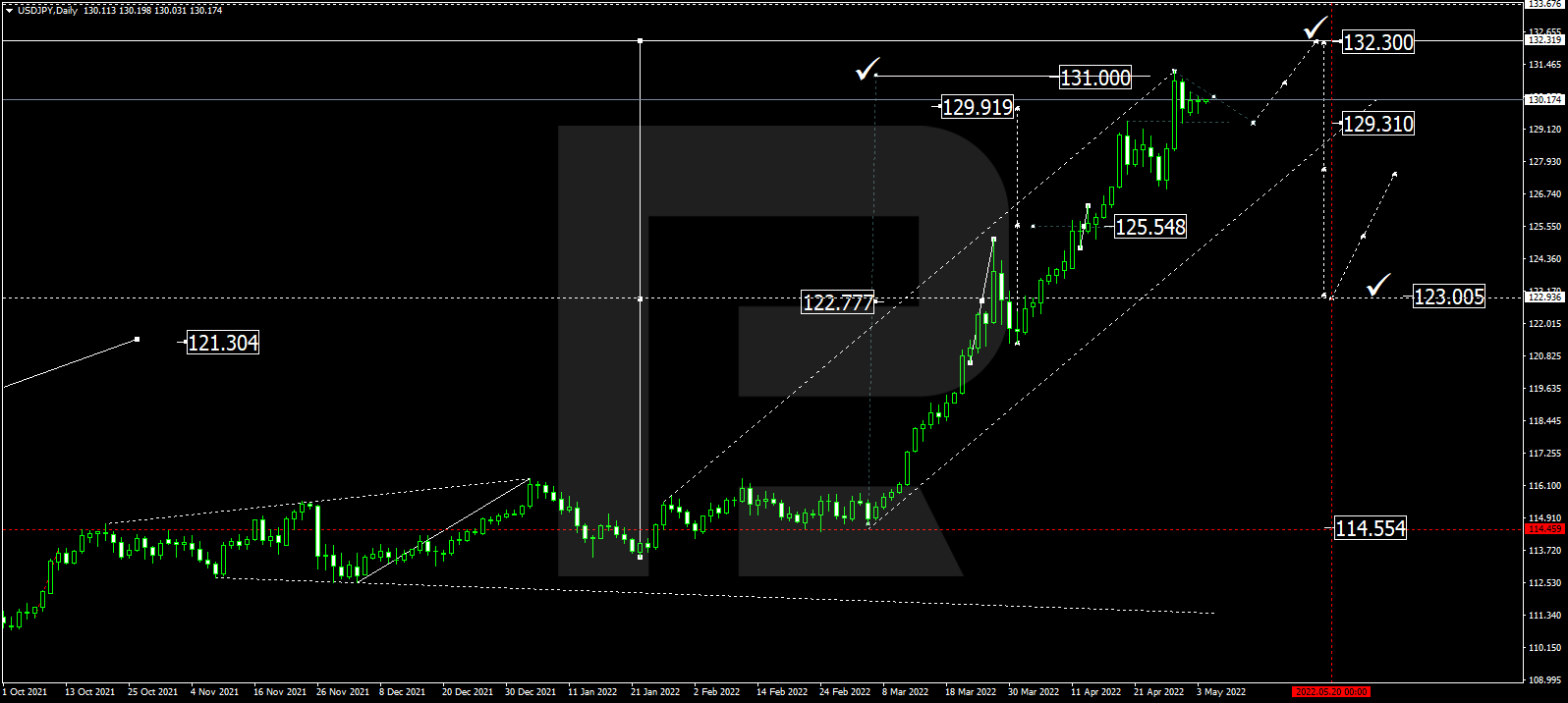
After finishing the correctional wave at 128.60, USDJPY is expected to consolidate below this level. Later, the market may break the range to the downside and start another decline with the target at 127.44.

USDJPY
Risk Warning: the result of previous trading operations do not guarantee the same results in the future

USDCHF, “US Dollar vs Swiss Franc”

Having rebounded from 0.9457, USDCHF is growing towards 0.9560. After that, the instrument may start another correction with the target at 0.9422.

USDCHF
Risk Warning: the result of previous trading operations do not guarantee the same results in the future

AUDUSD, “Australian Dollar vs US Dollar”

After completing the correctional wave at 0.7465 along with the descending structure towards 0.7373, AUDUSD has formed a new consolidation range there. Possibly, today the pair may break the range to the downside and resume moving downwards with the target at 0.7300.

AUDUSD
Risk Warning: the result of previous trading operations do not guarantee the same results in the future

BRENT

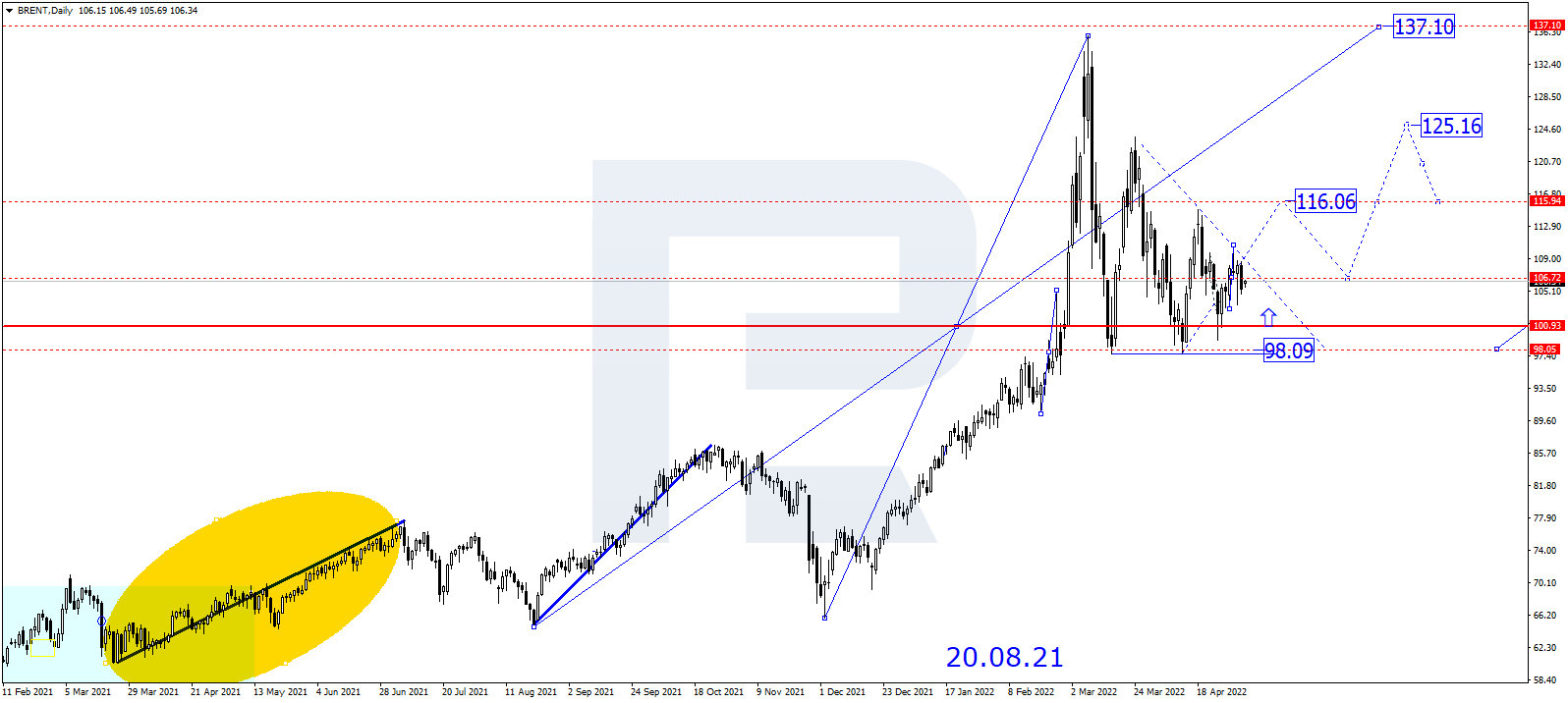
After forming a new consolidation range around 108.33, Brent is expected to break it upwards and form one more ascending wave to reach 111.77. Later, the market may correct towards 108.55 and then resume moving within the uptrend with the target at 117.00.

BRENT
Risk Warning: the result of previous trading operations do not guarantee the same results in the future

XAUUSD, “Gold vs US Dollar”

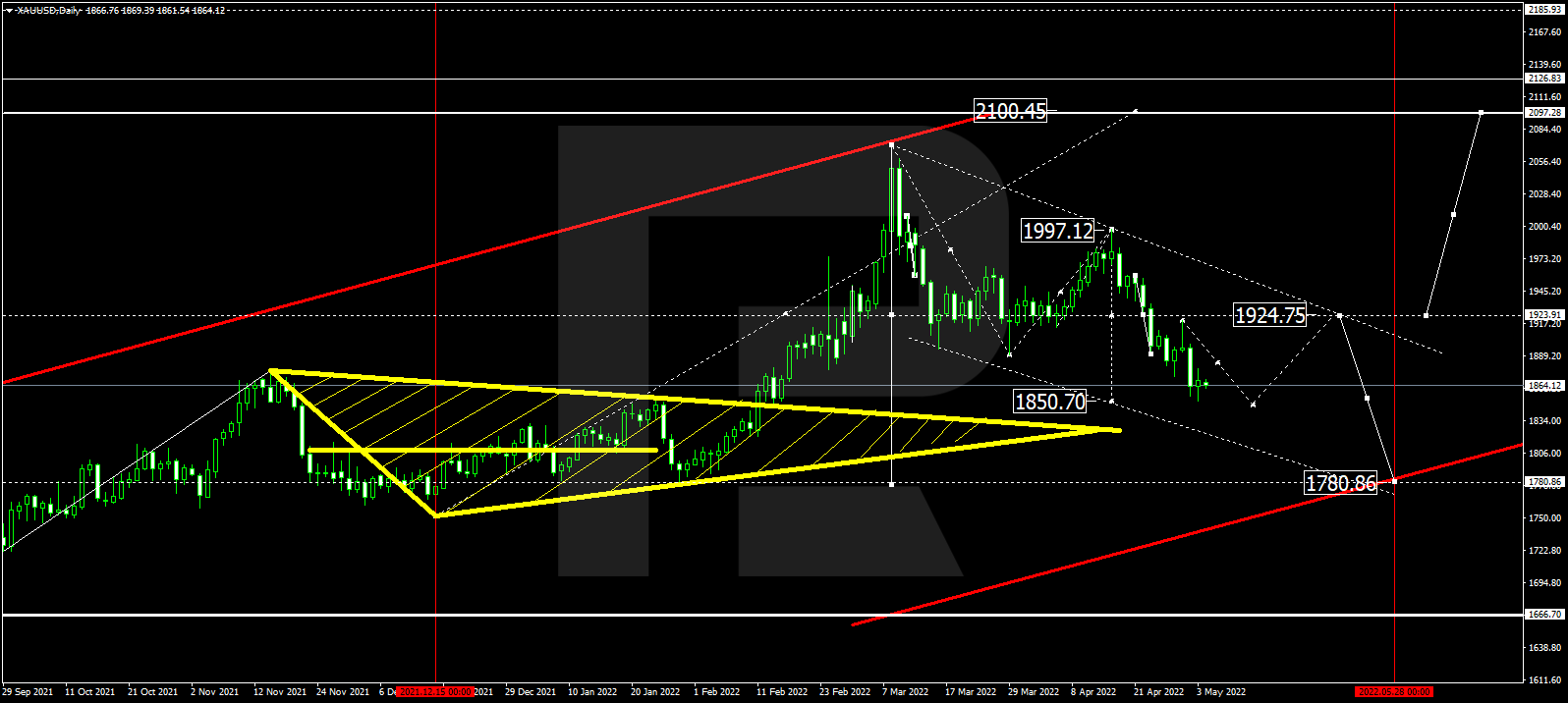
Gold has completed the correctional wave at 1936.40; right now, it is consolidating above this level. If later the price breaks this range to the upside, the market may start another growth towards 1962.68 and then form a new descending structure to reach 1929.00. After that, the instrument may resume trading upwards with the target at 2025.00.

GOLD
Risk Warning: the result of previous trading operations do not guarantee the same results in the future

S&P 500

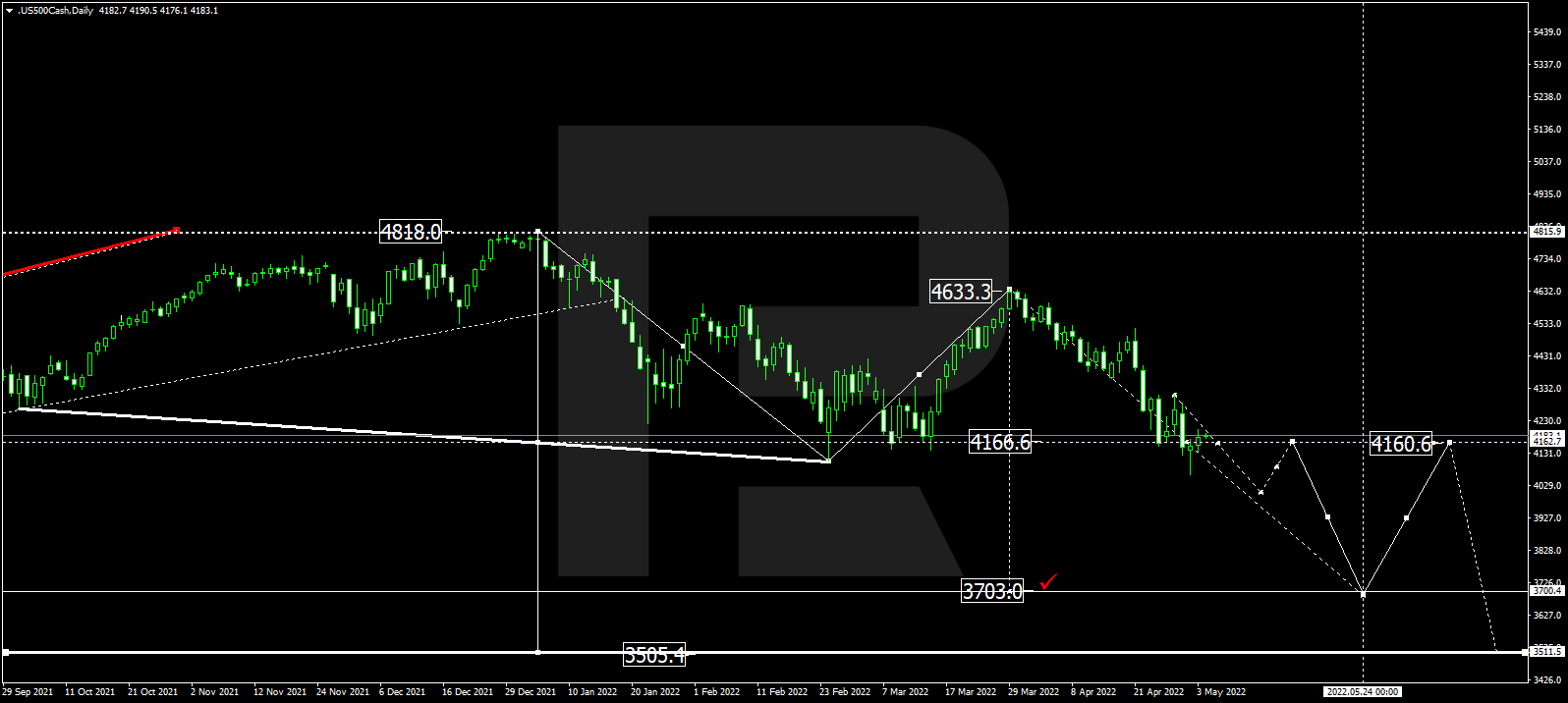
Having rebounded from 4513.0 and finished the descending wave at 4363.0, the S&P index is consolidating above this level. Possibly, the asset may break the range to the downside and resume trading downwards with the target at 4220.0 or even extend this structure down to 4139.0.

S&P 500

Article By RoboForex.com

Attention!
Forecasts presented in this section only reflect the author’s private opinion and should not be considered as guidance for trading. RoboForex LP bears no responsibility for trading results based on trading recommendations described in these analytical reviews.

The Analytical Overview of the Main Currency Pairs on 2022.04.22

by JustForex

The EUR/USD currency pair

Technical indicators of the currency pair:
  • Prev Open: 1.0847
  • Prev Close: 1.0831
  • % chg. over the last day: -0.15%

The annual consumer price index in Europe unexpectedly declined in April from 7.5% to 7.4%. At the same time, the core inflation rate, which excludes food and energy prices, fell from 3.0% to 2.9%. The euro jumped sharply yesterday on this data. But after Jerome Powell’s speech, the euro fell again. Analysts believe that the ongoing war in Ukraine will continue to cause energy and food prices to rise, which will eventually lead to higher inflation in the region. European Central Bank President Christine Lagarde said the ECB may have to cut its growth forecast even further as the effects of Russia’s invasion of Ukraine take a toll on households and businesses.

Trading recommendations
  • Support levels: 1.0835, 1.0800, 1.0772
  • Resistance levels: 1.0870, 1.0907, 1.0958, 1.1027, 1.1196, 1.1291

From the technical point of view, EUR/USD currency pair trend on the hourly time frame is bearish. But against the backdrop of a decrease in the rate of inflation, buyers of the European currency appeared. The MACD indicator has become inactive. Under such market conditions, it is possible consider buy trades on intraday timeframes from the support level of 1.0800, but only with short targets and confirmation. Sell trades should be considered from the resistance level of 1.0870 or 1.0907, but only after the additional confirmation.

Alternative scenario: if the price breaks out through the 1.0958 resistance level and fixes above, the uptrend will likely resume.

EUR/USD
News feed for 2022.04.22:
  • – German Manufacturing PMI (m/m) at 10:30 (GMT+3);
  • – Eurozone Manufacturing PMI (m/m) at 11:00 (GMT+3);
  • – Eurozone ECB President Lagarde Speaks at 16:00 (GMT+3);
  • – US Manufacturing PMI (m/m) at 16:45 (GMT+3).

The GBP/USD currency pair

Technical indicators of the currency pair:
  • Prev Open: 1.3049
  • Prev Close: 1.3026
  • % chg. over the last day: -0.17%

According to Bank of England Governor Andrew Bailey, governments should be prepared to accept economic hardship as payment for forcing Russia to end the war in Ukraine. Skyrocketing energy prices and supply chain problems since the war began in February are exacerbating declining incomes and threatening the deepest cost-of-living crisis in Britain since the 1950s. According to Bailey, the Bank of England is balancing between fighting inflation and preventing economic growth from falling. The governor also expressed concern about rising food prices and wondered if the UK labor market would slow in the event of a recession, as staff shortages are still very acute.

Trading recommendations
  • Support levels: 1.3011, 1.2993
  • Resistance levels: 1.3094, 1.3115, 1.3147, 1.3244, 1.3274

On the hourly time frame, the GBP/USD currency pair trend is still bearish. The MACD indicator has become inactive, the price pullback to the moving averages. Under such market conditions, sell trades should be looked for from the resistance level of 1.3094, but with confirmation. For buy deals, traders may consider the level of 1.3011, but only after the appearance of a bullish initiative and with short targets.

Alternative scenario: if the price breaks down through the 1.3147 resistance level and fixes above, the mid-term uptrend will likely be resumed.

GBP/USD
News feed for 2022.04.22:
  • – UK Retail Sales (m/m) at 09:00 (GMT+3);
  • – UK Manufacturing PMI (m/m) at 11:30 (GMT+3);
  • – UK BoE Gov Bailey Speaks at 17:30 (GMT+3).

The USD/JPY currency pair

Technical indicators of the currency pair:
  • Prev Open: 127.93
  • Prev Close: 128.38
  • % chg. over the last day: +0.35%

Japan’s nationwide consumer price index was 0.8% y/y (previous 0.6%). The ultra-soft policy of the Bank of Japan contributes to the growth of inflation towards the target of 2%, but the growth rate is extremely low. At the moment many analysts believe that a sharp decline in the yen will have a far more negative impact on the economy than the country’s low inflation rate. The Bank of Japan on Wednesday entered the government bond market and carried out a number of operations to prevent the yield from rising above the 0.1% mark. Thus, a technical correction in USD/JPY can be expected in the near future.

Trading recommendations
  • Support levels: 126.69, 125.72, 124.66, 124.24, 122.97, 122.63, 121.81
  • Resistance levels: 128.84, 129.36

The medium-term trend on the USD/JPY currency pair is bullish. The MACD indicator has become inactive, but the divergence is still visible on the higher timeframes. The price is trading in a narrow corridor. Under such market conditions, it is best to look for buy deals, expecting the continuation of the uptrend, but after the price makes a pullback to the average lines and the nearest support levels. First of all, it is worth considering the support level of 126.69, but with additional confirmation. A resistance level of 128.84 may be considered for sell deals, but only with short targets.

Alternative scenario: If the price fixes below 124.66, the uptrend will likely be broken.

USD/JPY
News feed for 2022.04.22:
  • – Japan National Core Consumer Price Index at 02:30 (GMT+3).

The USD/CAD currency pair

Technical indicators of the currency pair:
  • Prev Open: 1.2498
  • Prev Close: 1.2582
  • % chg. over the last day: +0.67%

The Canadian dollar is a commodity currency, and is highly dependent on the dynamics of oil prices and the dollar index. The dollar index jumped sharply yesterday in the background of the statements of the Federal Reserve System officials, while oil prices remained at the same level. As a result, the USD/CAD currency pair rose sharply. At the moment, there are no fundamental prerequisites for a medium-term trend.

Trading recommendations
  • Support levels: 1.2509, 1.2467
  • Resistance levels: 1.2600, 1.2644, 1.2713, 1.2754, 1.2851

The USD/CAD currency pair is bullish in terms of technical analysis. The price rebounded sharply from the priority change level, the buyers defended their positions. The MACD indicator has become positive, with no signs of reversal. Trade is worth it only with short targets. Under such market conditions, it is better to look for buy trades on the lower timeframes from the support level of 1.2509, but it is better with additional confirmation. For sell deals, it is better to consider the resistance level of 1.2600 or 1.2645, but it is also better with confirmation.

Alternative scenario: if the price breaks through and consolidates below 1.2467, the downtrend will likely be resumed.

USD/CAD
News feed for 2022.04.22:
  • – Canada Retail Sales (m/m) at 15:30 (GMT+3).

by JustForex


This article reflects a personal opinion and should not be interpreted as an investment advice, and/or offer, and/or a persistent request for carrying out financial transactions, and/or a guarantee, and/or a forecast of future events.

Why is the Yen so weak?

By Han Tan Chief Market Analyst at Exinity Group

– Two words: policy divergence (read on to find out more).

But first, let’s take a look at just how dismal the Yen’s performance has been so far in 2022.

The Japanese Yen is now trading around a 20-year low against the US dollar.

Last Tuesday, USDJPY posted its biggest single-day climb since November 2020, only to then take a breather for the time being.

(Note: weaker Yen versus the US dollar = USDJPY climbs higher).

FUN FACT: The last time USDJPY traded at these levels just below 130, Eminem had just released his hit 2002 track, “Without Me”.

In fact, JPY is the worst performer against the US dollar amongst all G10 currencies … by far.

And the Yen’s woes aren’t just limited to its performance against the US dollar alone.

Consider how the JPY Index has weakened by almost 9% so far this year.

Note that the index shown above comprises a basket of currency pairs measuring the Yen against its G10 peers, all in equal weights:

The Yen also has a year-to-date decline against all its major Asian counterparts as well.

So why is the Yen so weak?

The main reason is because of monetary policy divergence.

Let’s break it down.

Firstly, monetary policy is the way a central bank achieves its goals for the economy (e.g. maximum employment, stable prices, etc.), using tools like interest rates, money supply, and even currency levels.

And where’s the divergence?

The Bank of Japan is still using its monetary policy to support its economy.

This is in stark contrast to what most other central banks around the world are doing = pulling back that support. They do this by raising interest rates/easing back on bond purchases.

The goal of such policy-tightening (not what the BOJ is doing) is to reduce money supply and demand levels in an economy = less money chasing after scarce goods = to lower consumer prices/inflation.

Monetary policy: Comfort food vs. a regular diet

Consider when a child is feeling down, his/her parents may have no qualms treating the child to some ice cream, candy, or chocolate bars.

Such sweet indulgences are meant to make the child feel better in a jiffy, but is (hopefully) just a short-term fix and also (again, hopefully) far different from the regular diet the child consumes as part of the daily routine.

Similarly, when the economy was suffering during the pandemic, central banks rolled out record-low interest rates and printed money out of thin air to keep financial markets supported.

Low interest rates = cheaper for households/businesses to borrow money = they have money to spend in the economy = the economy gets better

But now that economies are recovering and even posting red-hot inflation numbers, they no longer need record-low interest rates and unlimited bond purchases

Hence, central banks are returning to their economy’s “regular diet” by tightening policy = paring down bond purchases/reducing the supply of money in the economy/raising interest rates.

Who’s already hiking rates?

Within the G10 space alone:

  • Bank of New Zealand – raised its benchmark rate by 125 basis points (1.25%) since Q3 2021
  • Bank of Canada – raised its benchmark rate by 75 basis points so far this year
  • Bank of England – raised its benchmark rate by 65 basis points since December
  • US Federal Reserve – raised rates by 25 basis points in March, perhaps another 50-basis point hike in May

But not so the Bank of Japan.

It’s keeping Japan’s benchmark interest rate at a record low of negative 0.1%, while buying up even more bonds.

Hence, the divergence in monetary policy.

How is policy divergence playing out in markets?

This divergence is evident in the widening gap in yields between Japanese bonds and its global counterparts.

Firstly, what are yields? 

Yields are a way to measure how much money you could earn on an investment over a set period of time.

In the case for bonds, it’s calculated in terms of how much interest one would get paid if they held on to that bond till it matures/reaches the end of its tenure.

For context, bond yields have been climbing around the world.

This is because investors are selling off bonds in tandem with central banks that are reducing their balance sheets.

And when bond prices drop, their yields rise.

Here are the benchmark 10-year yields for these other countries (at the time of writing):

  • US = 2.88%
  • Canada = 2.87%
  • China = 2.82%
  • UK = 1.95%
  • Germany = 0.89%

Contrast the numbers above with Japan’s 10-year yields, which are capped at 0.25%.

As a policy, the Bank of Japan is buying even more bonds to keep bond prices elevated and limit its benchmark 10-year yields to no higher than 0.25% (this process is also known as “yield curve control”).

The goal for capping those yields is to keep borrowing costs low in Japan so that households/businesses can still borrow to stimulate the economy.

Government bond yields are often used as the benchmark by which other banks/financial institutions calculate the interest to charge the customers who borrow money.Here are two charts that show how the widening gap/spread between US benchmark yields vs. Japan’s benchmark yields (10-year government bonds) correspond with the USDJPY’s performance:

See how those two lines are moving in sync with one another?

In essence, the wider the gap between US and Japan’s yields, the higher USDJPY goes (the weaker the Japanese Yen against the US dollar).

How are Japan’s capped yields affecting the yen?

The lower yields on offer in Japan suggests that investors would get more bang for their buck by buying bonds in other countries that are now posting higher yields (again, yields in this case are a measure of how much one could earn from investing in that particular bond).

At risk of oversimplifying matters:

  • Less demand for Japanese assets = less demand for the Japanese yen.
  • And when there’s lower demand = prices fall (all else equal).

Hence, the Yen has been falling as investors shun Japanese bonds.

From a fundamental perspective, markets are getting the sense that the Japanese economy is still too fragile – or at least the Bank of Japan thinks so of its own economy – and is nowhere near strong enough to be able to do without the ‘comfort food’ from the central bank.

But of course all that could change, as the BOJ faces increasing pressure to follow suit with other central banks in tightening policy … or perhaps even just to stem the Yen’s weakness.

Which brings us to this final point …

Will the Yen eventually rebound?

As a market cliche goes … nothing lasts forever.

So yes, theoretically the Yen could eventually rebound.

But one of two things may need to happen first:

1) The Bank of Japan has to signal that its willing to abandon its ultra-loose monetary policies.

Policymakers need to be convicted that Japan’s economic recovery is sustainable, and that inflation is being fuelled by robust demand (a.k.a. demand-pull inflation) as opposed to cost-push inflation.

To be clear, this seems unlikely for a while more, at least through the end of 2022.

Still, look out for the Bank of Japan policy meeting next week (April 28th).

The slightest clue that the BOJ is ready to tweak its policy stance could trigger a big move in the Yen.

2) Policymakers intervene to curb Yen weakness

This has been done before, but not for quite some time.

The last time the Japanse government propped up the yen was back in 1998, when USDJPY traded above 140 and peaked at 147.66 in September 1998.

However, back in 2002 even when USDJPY surpassed 135, the government sat on its hands and didn’t intervene.

So it remains to be seen at what level Japanese policymakers will tolerate before trying to stop the Yen from weakening further.

Keep in mind that a drastically-weaker Yen causes its own problems for the economy.

Japan is a net importer of energy, which are widely denominated in US dollars. The weaker Yen forces Japan to spend more of its currency to buy the same amount of fuel, not to mention the other imported goods (e.g. food) and services that it now has to spend more money on. If the imported costs become too great and weigh on businesses/households, then the Japanese government may be forced to pay for subsidies to ease the pain. That’s money out of the Japanese government’s pocket that could be spent on other things.

So until either of the above scenarios happen, shorting the Yen has remained a popular bet.

Last week, asset managers raised their short bets on the Yen to the most ever on record, according to CFTC data.

Overall, as long as this policy and yields divergence continues to play out between Japan and other major economies, that’s likely to keep the Yen on its weakening path for longer.

That is, unless the BOJ or Japan’s Finance Ministry switches tact and, in intervening to halt the Yen’s weakness, might do so while dropping bars from Eminem’s monster hit from 2002 …

“Now this looks like a job for me
So everybody, just follow me
‘Cause we need a little, controversy
‘Cause it feels so empty, without me”


Disclaimer: The content in this article comprises personal opinions and should not be construed as containing personal and/or other investment advice and/or an offer of and/or solicitation for any transactions in financial instruments and/or a guarantee and/or prediction of future performance. ForexTime (FXTM), its affiliates, agents, directors, officers or employees do not guarantee the accuracy, validity, timeliness or completeness, of any information or data made available and assume no liability as to any loss arising from any investment based on the same.


Forex-Time-LogoArticle by ForexTime

ForexTime Ltd (FXTM) is an award winning international online forex broker regulated by CySEC 185/12 www.forextime.com

Ichimoku Cloud Analysis 21.04.2022 (EURUSD, BRENT, GBPUSD)

Article By RoboForex.com

EURUSD, “Euro vs US Dollar”

EURUSD is rebounding from the cloud’s upside border at 1.0897; bears have failed to fix the price below the support area at 1.0805. The instrument is currently moving inside Ichimoku Cloud, thus indicating a sideways tendency. The markets could indicate that the price may test the cloud’s downside border at 1.0855 and then resume moving upwards to reach 1.1095. Another signal in favour of a further uptrend will be a rebound from the descending channel’s upside border. However, the bullish scenario may no longer be valid if the price breaks the cloud’s downside border and fixes below 1.0780. In this case, the pair may continue falling towards 1.0690. Also, there is a potential for the formation of an upside-down Head & Shoulders reversal pattern with the target at 1.1065. While forming the pattern, the asset may fall to test 1.0820 and complete the pattern’s right “shoulder” there.

EURUSD
Risk Warning: the result of previous trading operations do not guarantee the same results in the future

BRENT

Brent is still testing Tenkan-Sen and Kijun-Sen at 108.10. The instrument is currently moving above Ichimoku Cloud, thus indicating an ascending tendency. The markets could indicate that the price may test the cloud’s upside border at 105.45 and then resume moving upwards to reach 120.65. Another signal in favour of a further uptrend will be a rebound from the rising channel’s downside border. However, the bullish scenario may no longer be valid if the price breaks the cloud’s downside border and fixes below 100.00. In this case, the pair may continue falling towards 90.00. To confirm a further uptrend, the price must break the descending channel’s upside border and fix above 109.55.

BRENT
Risk Warning: the result of previous trading operations do not guarantee the same results in the future

GBPUSD, “Great Britain Pound vs US Dollar”

Having rebounded from the support level, GBPUSD is growing at 1.3079; the daily chart has the potential for the completion of a Double Bottom reversal pattern. To complete the pattern, the price must break 1.3155, and the pattern materialisation target will be at 1.3300. The instrument is currently moving above Ichimoku Cloud, thus indicating an ascending tendency. The markets could indicate that the price may test the cloud’s downside border at 1.3050 and then resume moving upwards to reach 1.3270. Another signal in favour of a further uptrend will be a rebound from the descending channel’s upside border. However, the bullish scenario may no longer be valid if the price breaks the cloud’s downside border and fixes below 1.3005. In this case, the pair may continue falling towards 1.2910. To confirm a further uptrend, the price must break the descending trendline and fix above 1.3115.

GBPUSD

Article By RoboForex.com

Attention!
Forecasts presented in this section only reflect the author’s private opinion and should not be considered as guidance for trading. RoboForex LP bears no responsibility for trading results based on trading recommendations described in these analytical reviews.

Japanese Candlesticks Analysis 21.04.2022 (EURUSD, USDJPY, EURGBP)

Article By RoboForex.com

EURUSD, “Euro vs US Dollar”

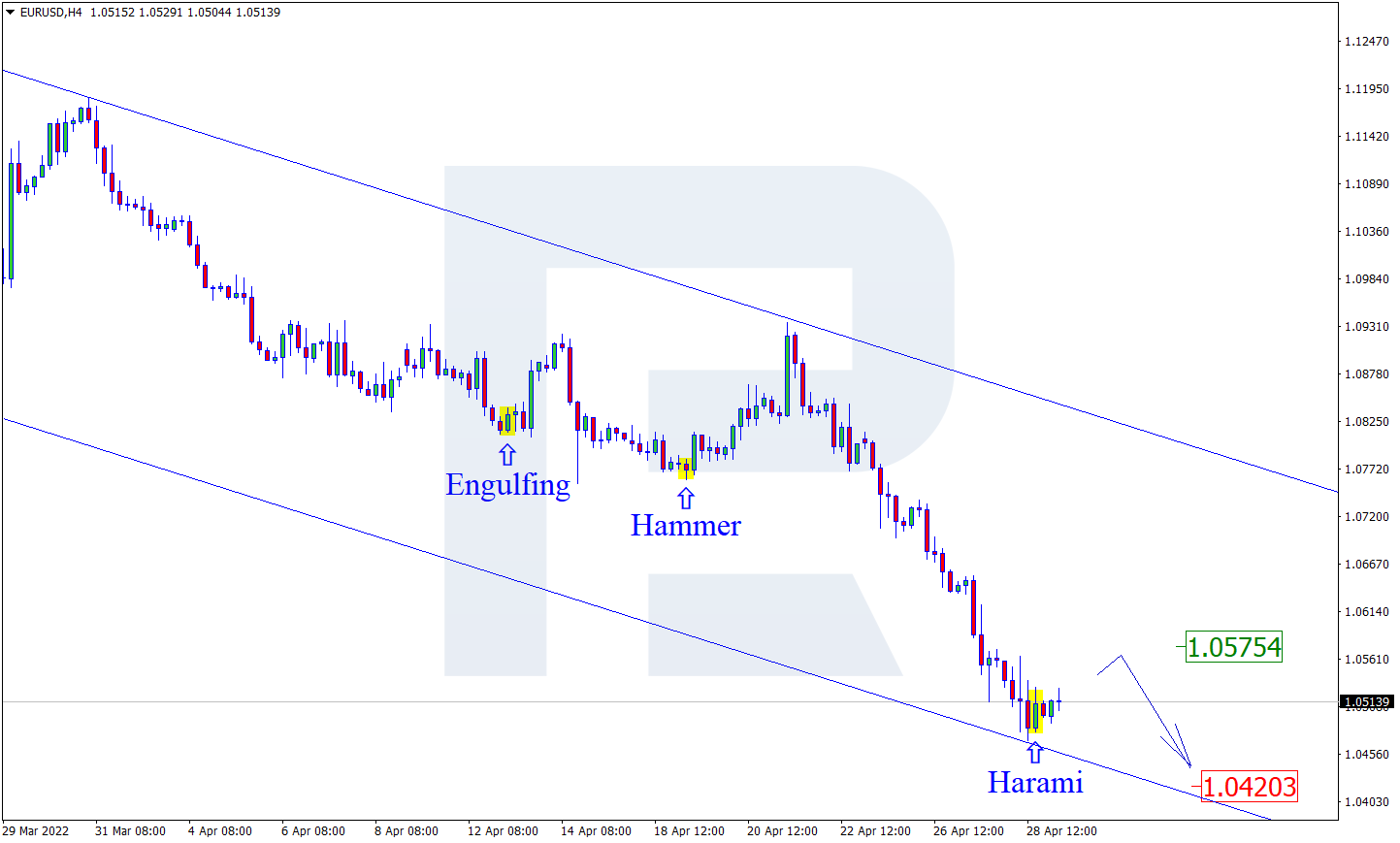
As we can see in the H4 chart, the asset has formed a Hammer reversal pattern close to the support area. At the moment, EURUSD is reversing in the form of a new correctional impulse. In this case, the upside correctional target may be at 1.0895. However, an alternative scenario implies that the price may fall to reach 1.0765 and continue the descending tendency without any corrections towards the resistance level.

EURUSD
Risk Warning: the result of previous trading operations do not guarantee the same results in the future

USDJPY, “US Dollar vs Japanese Yen”

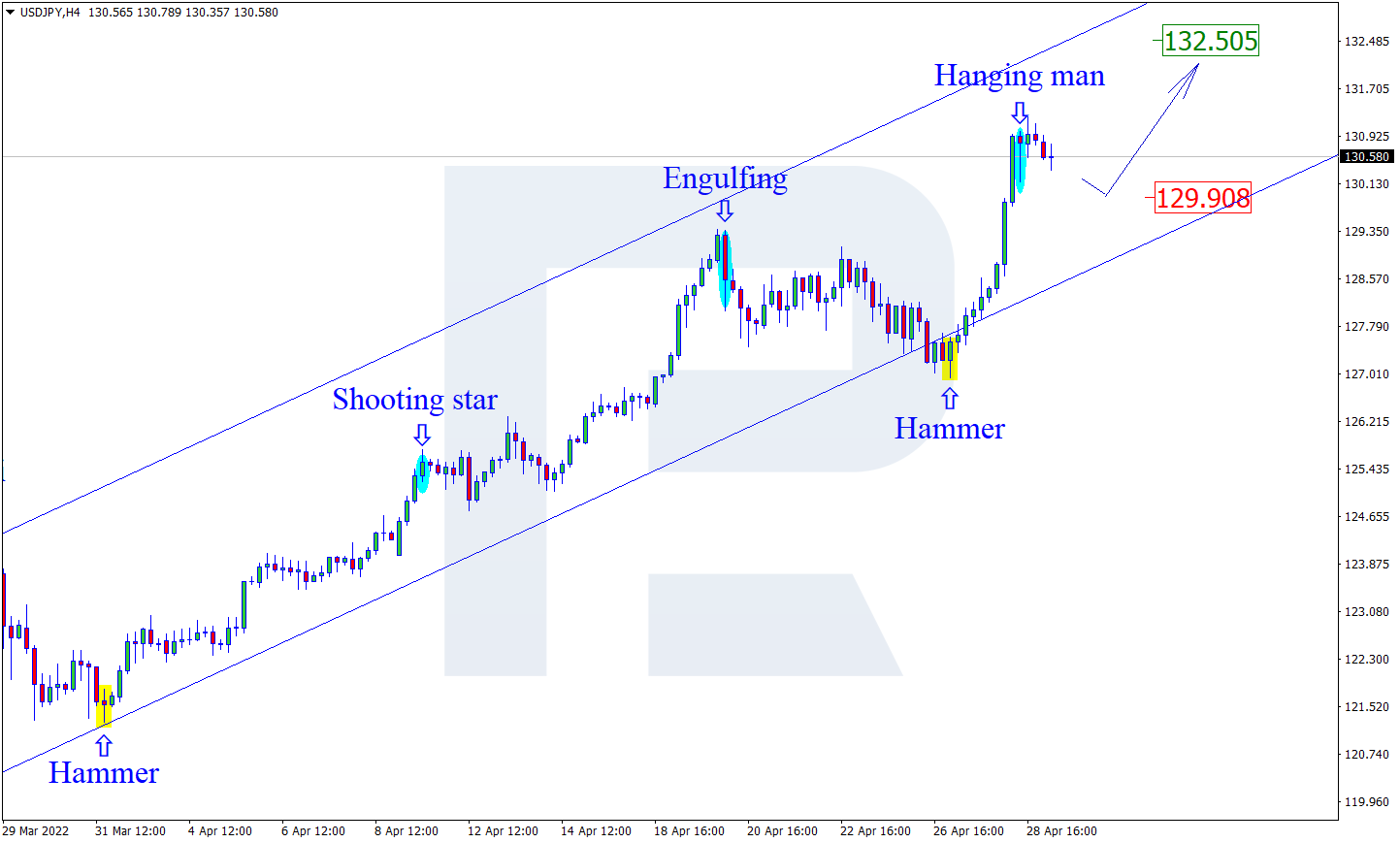
As we can see in the H4 chart, USDJPY has formed an Engulfing pattern not far from the resistance level. At the moment, the asset is reversing in the form of a new correctional impulse. In this case, the downside correctional target may be at 127.25. At the same time, an opposite scenario implies that the price may grow to reach 130.00 and continue the uptrend without any pullbacks.

USDJPY
Risk Warning: the result of previous trading operations do not guarantee the same results in the future

EURGBP, “Euro vs Great Britain Pound”

As we can see in the H4 chart, after forming a Hammer reversal pattern near the support area, EURGBP is reversing and may start another ascending wave. In this case, the upside target may be at 0.8325. Later, the market may test the resistance level, rebound from it, and resume the descending impulse. Still, there might be an alternative scenario, according to which the asset may fall to reach 0.8260 and continue the downtrend without testing the resistance level.

EURGBP

Article By RoboForex.com

Attention!
Forecasts presented in this section only reflect the author’s private opinion and should not be considered as guidance for trading. RoboForex LP bears no responsibility for trading results based on trading recommendations described in these analytical reviews.

The Analytical Overview of the Main Currency Pairs on 2022.04.21

by JustForex

The EUR/USD currency pair

Technical indicators of the currency pair:
  • Prev Open: 1.0787
  • Prev Close: 1.0853
  • % chg. over the last day: +0.61%

Yesterday ECB officials said that the bond-buying program will be completed soon and the interest rate hike will depend on economic data. This is not the first time officials have said such a thing but they do not give any specific date or figure. This once again emphasizes the uncertainty of the ECB in terms of monetary policy. The producer price index, which shows inflation between factories, reached 30.9% in annual terms in Germany. It is a record figure that will undoubtedly affect consumer prices’ growth.

Trading recommendations
  • Support levels: 1.0800, 1.0727, 1.0633
  • Resistance levels: 1.0862, 1.0889, 1.0958, 1.1027, 1.1196, 1.1291

From the technical point of view, the trend on the EUR/USD currency pair on the hourly time frame is bearish. The price has taken a more flat structure. The MACD indicator has become inactive. Under such market conditions, it is possible to look for buy trades on intraday timeframes from the support level of 1.0800, but only with short targets and confirmation. Sell trades should be considered from the resistance level 1.0889, but only after the additional confirmation.

Alternative scenario: if the price breaks out through the 1.0958 resistance level and fixes above, the uptrend will likely resume.

EUR/USD
News feed for 2022.04.21:
  • – Eurozone Consumer Price Index (m/m) at 12:00 (GMT+3);
  • – US Initial Jobless Claims (w/w) at 15:30 (GMT+3);
  • – US Philadelphia Fed Manufacturing Index (m/m) at 15:30 (GMT+3);
  • – Eurozone ECB President Lagarde Speaks at 20:00 (GMT+3);
  • – US Fed Chair Powell Speaks at 20:00 (GMT+3).

The GBP/USD currency pair

Technical indicators of the currency pair:
  • Prev Open: 1.2995
  • Prev Close: 1.3067
  • % chg. over the last day: +0.55%

The situation in the debt market has stabilized a bit, thanks to which the British pound has slightly recovered its position against the dollar index. Despite the fact that the UK economy is showing some stability (compared to other European countries and the US), the discontent with Boris Johnson’s government policy is growing inside the country, which caused a steep rise in the prices of food, fuel, and utilities.

Trading recommendations
  • Support levels: 1.3022, 1.2993
  • Resistance levels: 1.3094, 1.3115, 1.3147, 1.3244, 1.3274

On the hourly time frame, the GBP/USD currency pair trend is still bearish. The MACD indicator has become inactive, the price pullback to the moving averages. Under such market conditions, sell trades should be looked for from the resistance level of 1.3094, but with confirmation. For buy deals, traders may consider the level of 1.3022, but only after the appearance of a bullish initiative and with short targets.

Alternative scenario: if the price breaks down through the 1.3147 resistance level and fixes above, the mid-term uptrend will likely be resumed.

GBP/USD
News feed for 2022.04.21:
  • – UK BoE Gov Bailey Speaks at 19:30 (GMT+3).

The USD/JPY currency pair

Technical indicators of the currency pair:
  • Prev Open: 128.86
  • Prev Close: 127.87
  • % chg. over the last day: -0.77%

The Bank of Japan entered the foreign exchange market and slightly strengthened the Japanese Yen yesterday. The central bank again offered to buy an unlimited amount of Japanese government bonds. The drop in the dollar against the yen also coincided with a decline in US Treasury yields. Nevertheless, the medium-term trend remains bullish as the central banks in Japan and the US now have opposite monetary policies.

Trading recommendations
  • Support levels: 126.69, 125.72, 124.66, 124.24, 122.97, 122.63, 121.81
  • Resistance levels: 128.84, 129.36

The medium-term trend on the USD/JPY currency pair is bullish. The MACD indicator has become inactive, but the divergence is still visible on the higher timeframes. Under such market conditions, it is best to look for buy deals, expecting the continuation of the uptrend, but after the price makes a pullback to the average lines. First of all, it is worth considering the support level of 126.69, but with additional confirmation. A resistance level of 128.84 may be considered for sell deals, but only with short targets.

Alternative scenario: If the price fixes below 124.66, the uptrend will likely be broken.

USD/JPY
There is no news feed for today.

The USD/CAD currency pair

Technical indicators of the currency pair:
  • Prev Open: 1.2614
  • Prev Close: 1.2493
  • % chg. over the last day: -0.96%

Canada’s consumer price index increased by 1.4% last month to 6.7% in annual terms. This is the highest value since January 1991. Prices rose on all major components. Analysts attributed the price increases to persistent price pressures in the Canadian housing market, significant supply constraints, and geopolitical conflict that has affected energy, commodities, and agricultural markets. The rise in inflation is usually accompanied by the strengthening of the national currency, as investors are laying the future scenario of raising interest rates to fight inflation.

Trading recommendations
  • Support levels: 1.2467
  • Resistance levels: 1.2567, 1.2600, 1.2644, 1.2713, 1.2754, 1.2851

The USD/CAD currency pair is bullish in terms of technical analysis. But the price has corrected deeply, to the priority change level. The MACD indicator has become negative, with no signs of reversal. It is worth tradingvonly with short targets because, fundamentally, there are no prerequisites for the medium-term trend on the USD/CAD currency pair. Under such market conditions, it is better to look for buy trades on the lower timeframes from the support level of 1.2467, but it is better with additional confirmation. For sell deals, it is better to consider the resistance level of 1.2567, but it is also better with confirmation.

Alternative scenario: if the price breaks through and consolidates below 1.2467, the downtrend will likely be resumed.

USD/CAD
There is no news feed for today.

by JustForex


This article reflects a personal opinion and should not be interpreted as an investment advice, and/or offer, and/or a persistent request for carrying out financial transactions, and/or a guarantee, and/or a forecast of future events.
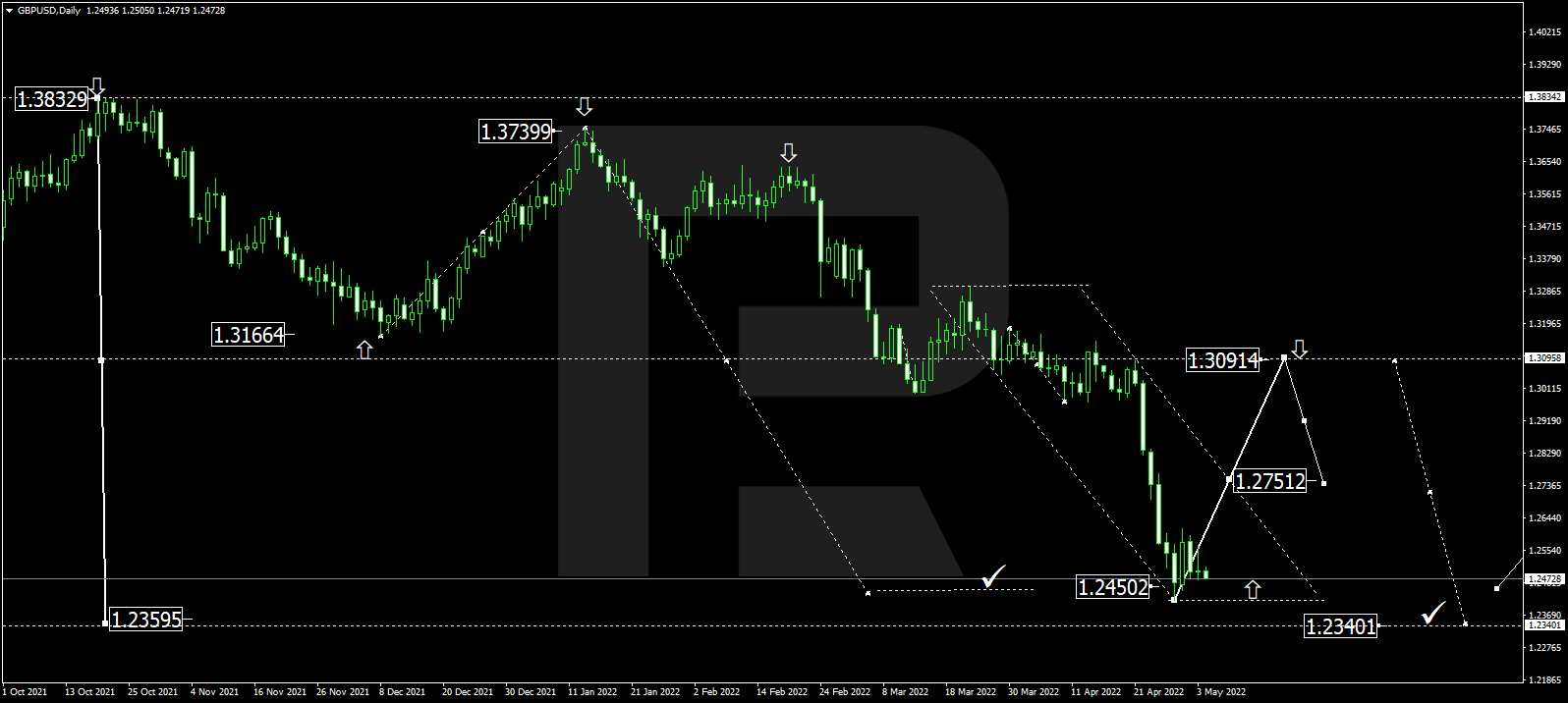
Mid-Week Technical Outlook: FX Movers & Shakers

By Lukman Otunuga Senior Research Analyst, ForexTime 

Currency markets exploded to life this week as global growth concerns, inflation worries, and geopolitical tensions rocked global risk sentiment.

The mighty dollar jumped to a fresh two-year high yesterday only to tumble like a house of cards this morning.

There was no love for the Yen, which collapsed to a 20-year low below 129.00 before clawing back some losses. Even the Aussie made some noise by appreciating against most G10 currencies since the start of the trading week. With so much going on across the FX arena, this presents fresh opportunities and trading setups.

Our primary focus will be on yen crosses, complemented by other movers and shakers.

As stated earlier, the past few days have not been kind to the yen…

It has weakened against every single G10 currency since the start of the week.

USDJPY closes in on 130…

In recent weeks, after prices broke to the upside above the March high at 125.10 who would have thought that the USDJPY would test 130.00? As the fundamentals drag the yen lower and lower, 130.00 could become reality this month. Looking at the technical picture, the currency pair is heavily bullish. According to the RSI, prices are extremely overbought and have been since mid-March. A technical throwback could be in the making before the USDJPY challenges 130.00.

It may be worth keeping a close eye on how prices behave around 126.40 and 125.10 over the next few days. Should these levels prove to be reliable support, this could encourage a rebound back towards 129.00 and 130.00 respectively. A breakdown below 125.10 may invite bears back into the scene.

GBPJPY bulls take a breather

It looks like the GBPJPY could be experiencing a minor decline lower before bulls return to the scene.

Prices remain bullish on the daily charts as there have been consistently higher highs and higher lows. The MACD trades above zero while the 50, 100, and 200-day Simple Moving Averages have been left in the dust. Should 165.40 prove to be reliable support, a move back towards 168.50 could be on the cards. Alternatively, a decline below 165.40 could trigger a selloff to 165.40 and lower.

EURJPY remains bullish for now

A weakening yen continues to drive the EURJPY higher. Prices remain heavily bullish as there have been consistently higher highs and higher lows. A technical bounce from 138.00 could encourage a move towards 139.70 and 140.00. Should 138.00 prove to be unreliable support, prices could slip back towards 137.00. Weakness below 137.00 may drag the EURJPY back within the 250-pip range.

CADJPY touches 102.50

The trend is certainly a traders friend on the CADJPY. Prices are moving higher with bulls in the driving seat. A strong daily close above 102.50 could inspire an incline towards 103.40. Should 102.50 prove to be reliable resistance, a throwback towards 100.17 could be on the table before prices push higher. Weakness below 100.17 may trigger a selloff towards 99.40 and 97.00.

AUDUSD fights back

After experiencing three consecutive weeks of losses, the AUDUSD is attempting to stage a rebound. Prices are trading around 0.7430 as of writing while the MACD on the weekly timeframe trades above zero. A strong move above last week’s high of 0.7492 could signal an incline back towards the 0.7550 resistance level. If 0.7550 is conquered, this may open doors towards 0.7600 and beyond. Alternatively, weakness below 0.7300 may result in a selloff towards 0.7120.

NZDUSD to resume downtrend?

The NZDUSD remains bearish on the daily charts. However, today’s rebound could throw the spanner in the works for bulls. If the 0.6800 level proves to be reliable resistance, a decline back towards 0.6700 is likely. Alternatively, a strong move and daily close above 0.6800 could trigger a move higher to 0.6860 and 0.7000.
Gold back within a range?

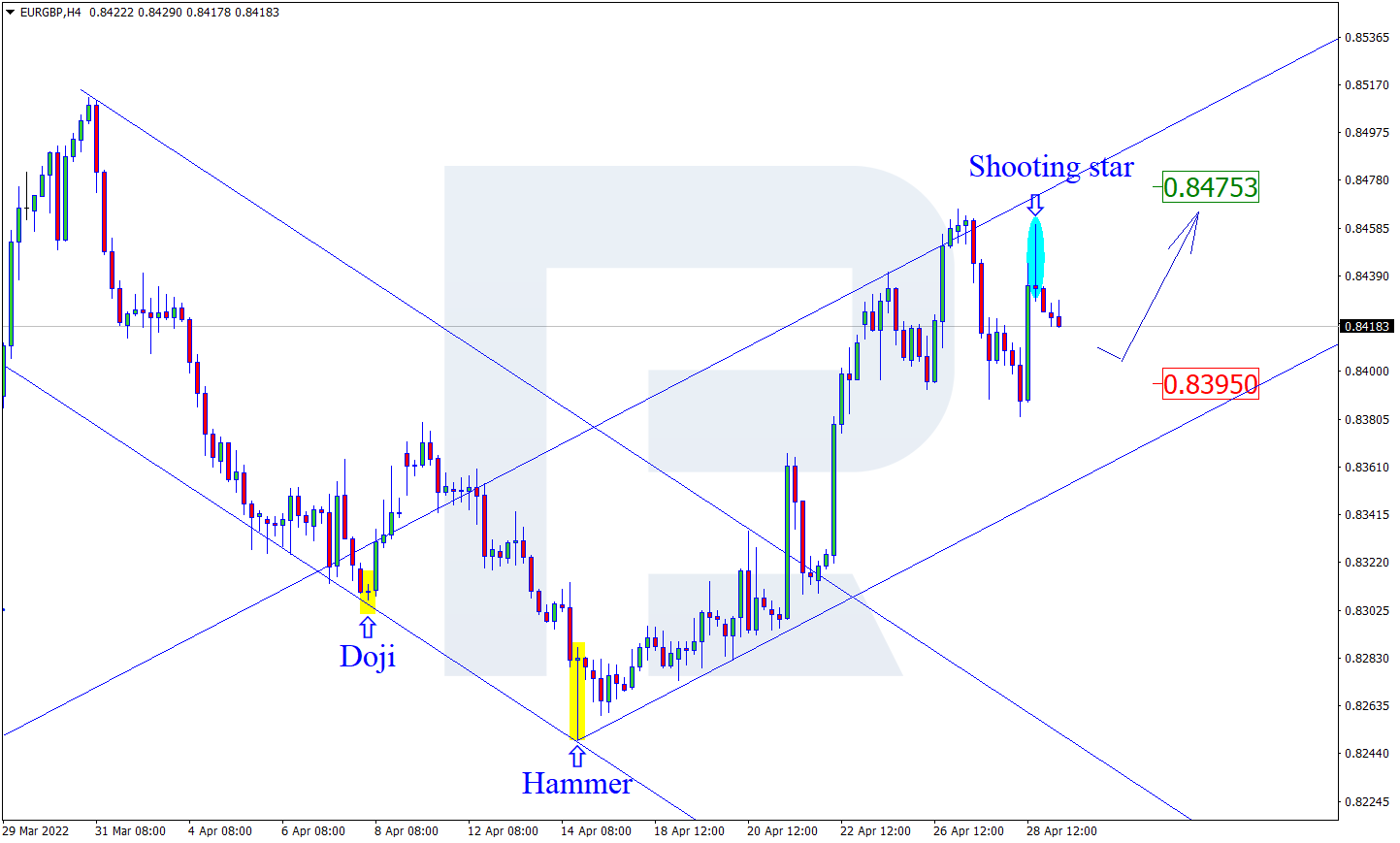
After experiencing a heavy selloff yesterday, gold has found itself back within a range with support at $1920 and resistance at $1960. The precious metal may need a fresh fundamental spark to experience another breakout/down. In the meantime, it may be wise to sit back and enjoy the view.

Disclaimer: The content in this article comprises personal opinions and should not be construed as containing personal and/or other investment advice and/or an offer of and/or solicitation for any transactions in financial instruments and/or a guarantee and/or prediction of future performance. ForexTime (FXTM), its affiliates, agents, directors, officers or employees do not guarantee the accuracy, validity, timeliness or completeness, of any information or data made available and assume no liability as to any loss arising from any investment based on the same.


Forex-Time-LogoArticle by ForexTime

ForexTime Ltd (FXTM) is an award winning international online forex broker regulated by CySEC 185/12 www.forextime.com

GBPJPY Impulse Trend Jumps Over 170

By Orbex

GBPJPY

In the long term, the GBPJPY pair seems to be forming a large correction trend, taking the form of a triple zigzag. On the 1H timeframe, the final actionary wave z of the cycle degree is visible.

It is likely that the wave z takes the form of a simple zigzag Ⓐ-Ⓑ-Ⓒ of the primary degree. After the end of correction Ⓑ, which took the form of a triple combination, prices began to rise.

It is possible that the first four parts are complete as part of the potential impulse Ⓒ. The currency could now grow within the intermediate impulse (5).

The completion of the entire wave Ⓒ is possible near 174.02. At that level, wave z will be equal to wave y.

GBPJPY

Alternatively, only the formation of the intermediate impulse (3), which is part of the primary wave Ⓒ, has come to an end.

Thus, a correction decline in the intermediate wave (4) could happen in the near future. It is possible that prices will fall to 159.74. At that level, correction (4) will be at 50% along the Fibonacci lines of impulse (3).

Join our responsible trading community – Open your Orbex account now!


Orbex-LogoArticle by Orbex

Orbex is a fully licensed broker that was established in 2011. Founded with a mission to serve its traders responsibly and provides traders with access to the world’s largest and most liquid financial markets. www.orbex.com