
By RoboForex Analytical Department
The USD/JPY pair stabilised at 145.11 following three consecutive days of gains.
The Japanese yen had previously faced downward pressure due to a combination of factors, including weak macroeconomic data. Japan’s exports declined for the first time in eight months, indicating that the impact of US tariffs is now being felt. Meanwhile, imports fell more sharply than anticipated, heightening concerns over weakening external demand.
Other indicators painted a similarly bleak picture. Machinery orders dropped significantly in April, while industrial sentiment deteriorated in June. These developments suggest that signs of softening domestic demand are increasingly apparent.
The Bank of Japan (BoJ) held a meeting the previous day, leaving interest rates unchanged and reaffirming its cautious approach to reducing balance sheet assets. BoJ Governor Kazuo Ueda emphasised that the central bank is closely monitoring economic conditions and global trade dynamics, leaving open the possibility of future rate hikes.
Additional pressure on the yen came from the lack of progress at the G7 summit in Canada, where Prime Minister Shigeru Ishiba and US President Donald Trump failed to reach an agreement on tariff cooperation.
Free Reports:
 Get our Weekly Commitment of Traders Reports - See where the biggest traders (Hedge Funds and Commercial Hedgers) are positioned in the futures markets on a weekly basis.
 Download Our Metatrader 4 Indicators – Put Our Free MetaTrader 4 Custom Indicators on your charts when you join our Weekly Newsletter
Technical analysis of USD/JPY
H4 Chart:
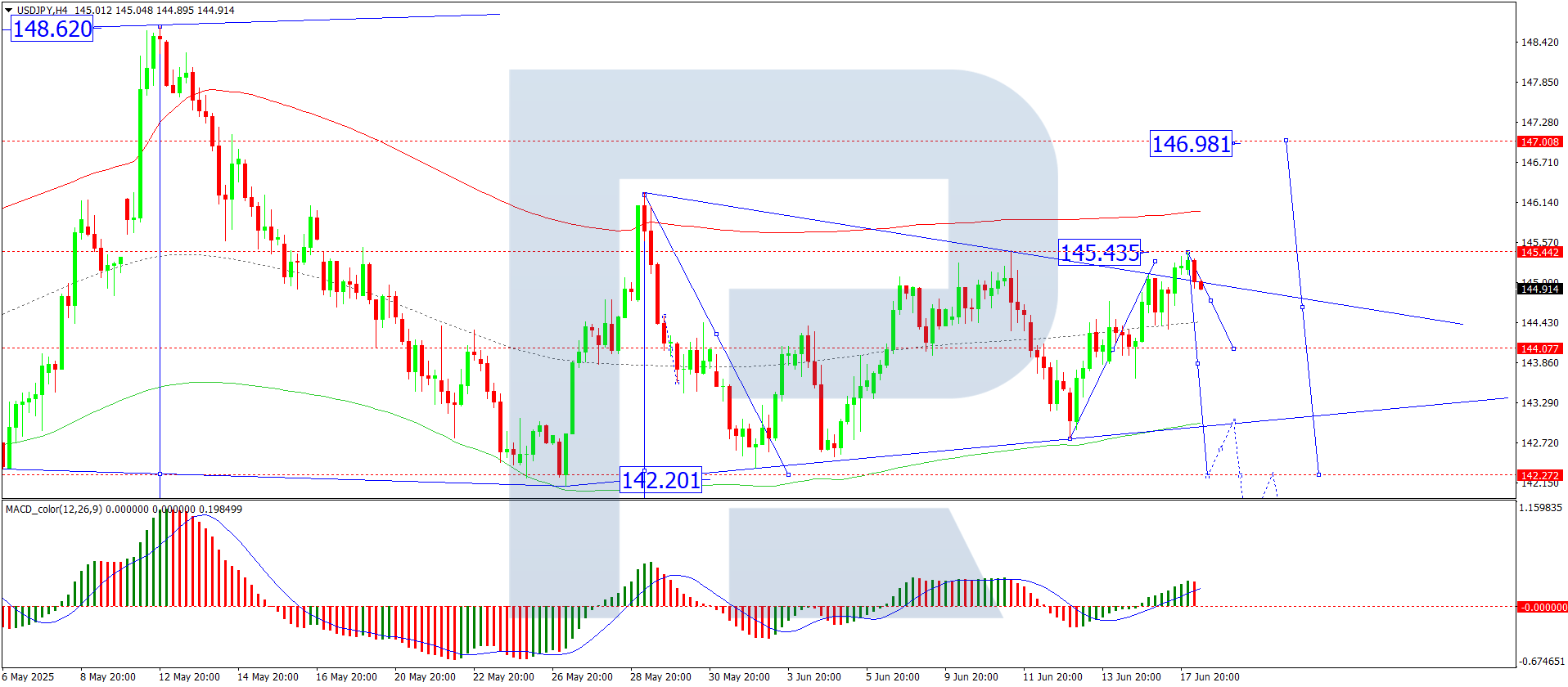
The market has completed an upward wave to the upper boundary of the consolidation range at 145.43. Having reached this target, a decline towards 144.00 is now anticipated. A break below this level could open the door for a further drop towards 142.20, with the potential to extend the downtrend to 140.50. Conversely, an upward move would raise the likelihood of a rally towards 146.98. This scenario is supported by the MACD indicator, where the signal line remains above zero and has exited the histogram area. A downward correction with new lows on the indicator is likely to follow.
H1 Chart:

The market is forming a bearish wave structure targeting 144.00, which is likely to be reached today. Following this, a corrective rebound towards 144.80 may occur. Overall, price action continues to develop within a broad consolidation range at these levels. The Stochastic oscillator corroborates this outlook, with its signal line positioned below 20 and pointing sharply downward.
Conclusion
While the yen’s decline has paused, domestic economic signals remain unfavourable. With weak trade data, cautious BoJ policy, and stalled international negotiations, the currency faces ongoing headwinds. Technically, the USD/JPY pair shows potential for further downside, though a corrective rebound cannot be ruled out.
Disclaimer
Any forecasts contained herein are based on the author’s particular opinion. This analysis may not be treated as trading advice. RoboForex bears no responsibility for trading results based on trading recommendations and reviews contained herein.

- The US introduces new import tariffs for 60 countries. Brent crude surpasses $100 per barrel Jul 24, 2026
- USD/JPY Breaks Records: Nothing Slows the Yen’s Decline Jul 24, 2026
- Oil prices reached a 6‑week high. The AUD strengthened on the back of a strong labor‑market report Jul 23, 2026
- EUR/USD Recovers as Dollar Weakens Jul 23, 2026
- Bitcoin rose to $66,000. The New Zealand dollar continues to strengthen Jul 22, 2026
- Inflationary pressure is easing in Canada. In New Zealand, on the contrary, inflation is rising Jul 21, 2026
- GBP/USD Falls After Cabinet Changes Jul 21, 2026
- Geopolitical and macroeconomic conditions continue to pressure market sentiment Jul 20, 2026
- USD/JPY Poised to Continue Gains as Expensive Oil and Lack of Support Weigh on Yen Jul 20, 2026
- COT Metals Charts: Weekly Speculator Bets led by Copper & Steel Jul 18, 2026
