Archive for Financial News – Page 276

RoboMarkets is the Gold and Title Sponsor of the AEL Women’s Volleyball Team in the 2022-2023 Season

European broker RoboMarkets which provides investment services has become the Gold and Title sponsor of the AEL women’s volleyball club in Limassol. The contract will remain in force through the 2022-2023 season. Through the agreement, the team playing in the Cyprus Major League will be called RoboMarkets AEL Volleyball.

The collaboration of RoboMarkets with AEL started already five years ago and keeps evolving thanks to the goals the two organisations have in common – victory and leadership. However, what mainly unites them both is their passion for volleyball. Over the years of working side by side, there have been challenges and bright times. This invaluable experience made the team stronger, and in the upcoming season, it will fight for victory with the new Title sponsor and under the new name – RoboMarkets AEL Volleyball. Apart from the new name, the sponsorship implies placing a RoboMarkets logo on the team’s outfit and organising joint marketing activities.

Founded in Limassol in 1976, ΑΕΛ (AEL Limassol), now re-named RoboMarkets AEL Volleyball, is the leader among the volleyball teams of the Republic of Cyprus. It boasts a record number of titles among the women’s volleyball teams in Cyprus – 30 Championships. Moreover, the team has become the holder of the Cup of Cyprus 28 times and the Super Cup of Cyprus – 12 times.

Denis Golomedov, Chief Marketing Officer at RoboMarkets, states: “We have been supporting the team for years, and are now on a new collaboration level in our dual capacity as Gold and Title sponsor. This makes our connection even stronger, especially during the 2022-2023 season. We are proud to give our name to one of the best volleyball teams in Cyprus. We will be doing our utmost to help the team become even better and reach new heights together with us!”

“On the occasion of expanding our collaboration with RoboMarkets as our Gold sponsor as well as Title sponsor, I would like, on behalf of the RoboMarkets AEL Volleyball committee to express our deep appreciation to RoboMarkets and its management. Knowing that we have great a company and people as partners, not only supporting us financially but also psychologically, pushes us to maximise our effort for distinction and fulfillment of our goals”, comments Costas Constantinou, President of RoboMarkets AEL Volleyball committee.

About RoboMarkets

RoboMarkets is an investment company with the CySEC license No. 191/13. RoboMarkets offers investment services in many European countries by providing traders, who work on financial market, with access to its proprietary trading platforms. More detailed information about the Company’s products and activities can be found on the official website at www.robomarkets.com.


EUR does not give up parity. Overview for 08.11.2022

Article By RoboForex.com

The market major is stuck to parity, unwilling to give it up. The current quote is 1.0000.

Yesterday, a monetary politician from the European Central Bank has mentioned that sooner or later the regulator will have to start Quantitative Tightening. Also, the ECB will have to increase interest rates to the level that would bring inflation to target levels as fast as possible.

These levels will be directly bound to the CPI dynamics, economic conditions, energy carriers prices and the demand for them.

Certain ECB members are sure that inflation in the Euro zone will remain at 10.7% in the nearest future. It will start declining in the first half of 2023 but on the whole, both average and base inflation will remain high.

Today, the macroeconomic calendar is empty both for the Euro zone and the US. The market will be looking at near-economic events and, most importantly, the US Congress elections.

Article By RoboForex.com

Attention!
Forecasts presented in this section only reflect the author’s private opinion and should not be considered as guidance for trading. RoboForex LP bears no responsibility for trading results based on trading recommendations described in these analytical reviews.

The Analytical Overview of the Main Currency Pairs on 2022.11.08

By JustMarkets

The EUR/USD currency pair

Technical indicators of the currency pair:
  • Prev Open: 0.9901
  • Prev Close: 1.0020
  • % chg. over the last day: +1.20 %

Congressional Elections will be held in the US today. Many traders and investors underestimate this event, referring to it as a political one. But it should be noted that this election puts control of Congress and President Joe Biden’s agenda for the remaining two years of his term at stake. Republicans are leading in the polls, and many analysts believe the likely outcome will be a split government, with the Republican Party controlling the House and possibly the Senate in the second half of Biden’s term. If this scenario goes into effect, the US would not be able to provide financial support in an economic downturn. It would also affect the prospects for government spending, which could be reallocated to other needs. This could lead to a sharp rise in the dollar index, a fall in the European currency, and a drop in stock indices.

Trading recommendations
  • Support levels: 0.9946, 0.9838, 0.9794, 0.9755, 0.9702, 0.9601
  • Resistance levels: 1.0055, 1.0111, 1.0162, 1.0230

From the technical point of view, the trend on the EUR/USD currency pair on the hourly time frame is still bullish. The price is trading above the moving averages. The MACD indicator is positive, but there is a divergence, indicating the weakness of the buyers. Under such market conditions, buy trades should be considered from the support level of 0.9946 or 0.9838, but with additional confirmation. Sell deals can be considered from the resistance level of 1.0055, but with confirmation as well.

Alternative scenario: if the price breaks down through the support level of 0.9795 and fixes below it, the downtrend will likely resume.

EUR/USD
News feed for 2022.11.08:
  • – Eurozone Retail Sales (m/m) at 12:00 (GMT+2);
  • – US Congressional Elections (All Day).

The GBP/USD currency pair

Technical indicators of the currency pair:
  • Prev Open: 1.1308
  • Prev Close: 1.1512
  • % chg. over the last day: +1.80 %

The British pound sterling has strengthened considerably in recent days, mainly due to the decline of the dollar index. But analysts believe that the British pound now has no fundamental basis for growth. The interest rate differential between the US Federal Reserve and the Bank of England is still widening, and the British economy is already on the verge of recession. Friday’s quarterly GDP data is projected to be negative, meaning two consecutive quarters of contraction, a technical recession. The Bank of England predicts that the UK economy will contract for up to 8 consecutive quarters.

Trading recommendations
  • Support levels: 1.1329, 1.1230, 1.1172, 1.1093, 1.0915, 1.0817
  • Resistance levels: 1.1585, 1.1698, 1.1816, 1.1901

From the technical point of view, the trend on the GBP/USD currency pair on the hourly time frame is bullish. The price is trading above the moving averages. The MACD indicator is positive, and the buyers’ pressure is still present. Under such market conditions, buy trades are better to look for on intraday time frames with short targets. It is possible to consider longs from the support level of 1.1329, but a correction is needed. Sell trades are best looked for from the resistance level of 1.1585 but better with confirmation in the form of a reverse initiative.

Alternative scenario: if the price breaks down of the 1.1231 support level and fixes below it, the downtrend will likely resume.

GBP/USD
There is no news feed for today.

The USD/JPY currency pair

Technical indicators of the currency pair:
  • Prev Open: 147.17
  • Prev Close: 146.62
  • % chg. over the last day: -0.38 %

Japan’s Cabinet on Tuesday will approve a supplementary budget for the current fiscal year to spend 29.1 trillion yen ($199 billion) on an economical package designed to ease the pain for households and businesses from rising prices exacerbated by a weaker yen. The government will issue about 22.8 trillion yen in bonds to provide the necessary financing, further pushing back the fiscal recovery despite the fact that its debt is already more than twice the size of its economy. The government estimates that the energy-focused measures will help reduce the country’s core consumer inflation by 1.2%.

Trading recommendations
  • Support levels: 146.38, 145.50, 144.91, 144.19, 143.00
  • Resistance levels: 147.34, 148.82, 150.00, 151.05

From the technical point of view, the medium-term trend on the currency pair USD/JPY is bearish. The price is trading at the level of the moving averages, and a wide-volatility balance is being formed. The MACD indicator is inactive. Under such market conditions, buy trades can be sought on intraday time frames from the support level of 146.38. Sell deals can be searched from the resistance level of 147.34, but only with additional confirmation.

Alternative scenario: If the price fixes above 150.00, the uptrend will likely resume.

USD/JPY
There is no news feed for today.

The USD/CAD currency pair

Technical indicators of the currency pair:
  • Prev Open: 1.3533
  • Prev Close: 1.3490
  • % chg. over the last day: -0.32 %

The Canadian dollar is a commodity currency, so it is highly dependent not only on the monetary policy of the Bank of Canada but also on the dollar index and oil prices. The oil market is very tight right now due to a variety of factors that affect it, from OPEC+ countries cutting production to G7 countries setting a restrictive price in response to Russia’s invasion of Ukraine. On the other hand, the influence of the dollar index, which is strongly confirmed by the US Federal Reserve monetary policy, plus the congressional elections will take place today, which may influence the dynamics. No wonder why the USD/CAD quotes show sharp movements to one side and to the other.

Trading recommendations
  • Support levels: 1.3486, 1.3400
  • Resistance levels: 1.3608, 1.3682, 1.3776, 1.3855, 1.3968

From the point of view of technical analysis, the trend on the USD/CAD currency pair is bearish. The price has consolidated below the moving averages and the priority change level. The MACD indicator is negative now, but there is some buying pressure on the lower time frames. The best way to sell is to consider the resistance level of 1.3608, but only after the additional confirmation. Buy trades should be considered on the lower time frames from the support level of 1.3486, but with additional confirmation.

Alternative scenario: if the price breaks out and consolidates above the resistance level of 1.3682, the uptrend will likely resume.

USD/CAD
There is no news feed for today.

By JustMarkets


This article reflects a personal opinion and should not be interpreted as an investment advice, and/or offer, and/or a persistent request for carrying out financial transactions, and/or a guarantee, and/or a forecast of future events.

Stock indices show optimism ahead of US congressional elections

By JustMarkets

At Monday’s close, the Dow Jones Index (US30) increased by 1.31%, while the S&P 500 (US500) added 0.96%. Technology Index NASDAQ (US100) gained 0.85% yesterday.

Goldman Sachs told its clients on Monday that there is still a 35% chance of a recession in the US over the next 12 months. While that is twice the normal recession risk, it is well below the average of 63%, according to a recent survey by The Wall Street Journal. A Bloomberg Economics model released in late October determined that the risk of recession over the next 12 months is a staggering 100%. A probability model developed by Ned Davis Research also revealed a 98.1% chance of a global recession. But GS analysts believe the Federal Reserve can still make a soft landing for the US economy. The bank also expects the Gross Domestic Product to grow by about 1% over the next year.

Today is the US Congressional elections. Many traders and investors underestimate this event, categorizing it as political. But it should be noted that this election is at stake for control of Congress and President Joe Biden’s agenda for the remaining two years of his term. Republicans are leading in the polls, and many analysts believe the likely outcome will be a split government, with the Republican Party controlling the House and possibly the Senate in the second half of Biden’s term. If this scenario takes effect, the US will not be able to provide financial support in the economic downturn. It would also affect the prospects for government spending, which could be reallocated to other needs. Historically, the markets like it when there is a “Democratic President” and a “Republican Congress.” This has been the case for most of Obama’s and Clinton’s terms. The S&P 500 Index is up 73% and 181%, respectively. But that’s in the long-term run. If to take the short-term picture, the opposite is true. So, a government split could cause the dollar index to spike, the European currency to fall, and stock indices to plummet. In other words, if the Republicans win, the odds increase that inflation will be suppressed in the short term. But it increases the likelihood of a sharper, though shorter, recession.

Stock markets in Europe traded higher yesterday. Germany’s DAX (DE30) gained 0.55%, France’s CAC 40 (FR40) added 0.01%, Spain’s IBEX 35 Index (ES35) increased by 0.25%, and Britain’s FTSE 100 (UK100) closed down by 0.48%.

The government of the Eurozone spent 200 billion euros to support the energy stability in the region. Analysts believe the move will support economic growth but lead to further inflationary increases.

The European Central Bank should continue to raise interest rates, even at a slow pace, until core inflation, which excludes energy and food prices, begins to decline, said Governing Council member François Villeroy de Galhau. Villeroy said he expects overall inflation to peak in the first half of 2023 and begin to decline, probably starting next spring.

The situation in the oil market remains tense. There are multidirectional factors acting on oil, from OPEC+ countries cutting production to G7 countries setting a restrictive price in response to Russia’s invasion of Ukraine. There is also the factor of China and its restrictive policy, and there is the factor of crude oil reserves and energy shortages in Europe. Plus, monetary policy and the dollar index, the growth of which negatively affects oil. Such a mixture of factors all at once led to the difficulty of forecasting the price of oil. Therefore, it is worth relying on more than just fundamental indicators now.

Asian markets were mostly on the rise yesterday. Japan’s Nikkei 225 (JP225) gained 1.21%, Hong Kong’s Hang Seng (HK50) added 2.69%, and Australian S&P/ASX 200 (AU200) was up 0.60% by the end of the day.

Japan’s Cabinet on Tuesday will approve a supplementary budget for the current fiscal year to spend 29.1 trillion yen ($199 billion) on an economical package designed to ease the pain for households and businesses from rising prices exacerbated by a weaker yen. The government will issue about 22.8 trillion yen in bonds to provide the necessary financing, further pushing back the fiscal recovery despite the fact that its debt is already more than twice the size of its economy. The government estimates that the energy-focused measures will help reduce the country’s core consumer inflation by 1.2%.

S&P 500 (F) (US500) 3,770.55 +50.66 (+1.36%)

Dow Jones (US30) 32,403.22 +401.97 (+1.26%)

DAX (DE40) 13,459.85 +329.66 (+2.51%)

FTSE 100 (UK100) 7,299.99 −34.85 (+2.03%)

USD Index 110.16 −0.718 (−0.64%)

Important events for today:
  • – Australia NAB Business Confidence (m/m) at 02:30 (GMT+2);
  • – New Zealand Inflation Expectations (q/q) at 04:00 (GMT+2);
  • – Switzerland SNB Chairman Jordan speaks at 10:15 (GMT+2);
  • – Australia RBA Governor Lowe Speaks at 11:30 (GMT+2);
  • – Eurozone Retail Sales (m/m) at 12:00 (GMT+2);
  • – US Congressional Elections (All Day).

By JustMarkets


This article reflects a personal opinion and should not be interpreted as an investment advice, and/or offer, and/or a persistent request for carrying out financial transactions, and/or a guarantee, and/or a forecast of future events.

Crude Oil Grew Confidently

By RoboForex Analytical Department

The commodity market efficiently reflected the improvement of the general situation. A Brent barrel on Monday is stabilising near 97.60 USD.

The main trigger for buying became an unexpected improvement in the forecasts on the global recession, which is a positive factor for the crude oil sector; also, there is a possibility that China will give up the zero tolerance regime in fighting with the coronavirus.

If these forecasts come true somehow, the commodity market will get serious support.

However, there are too few real reasons for softening the quarantine measures in China, and this understanding make commodity markets correct on Monday.

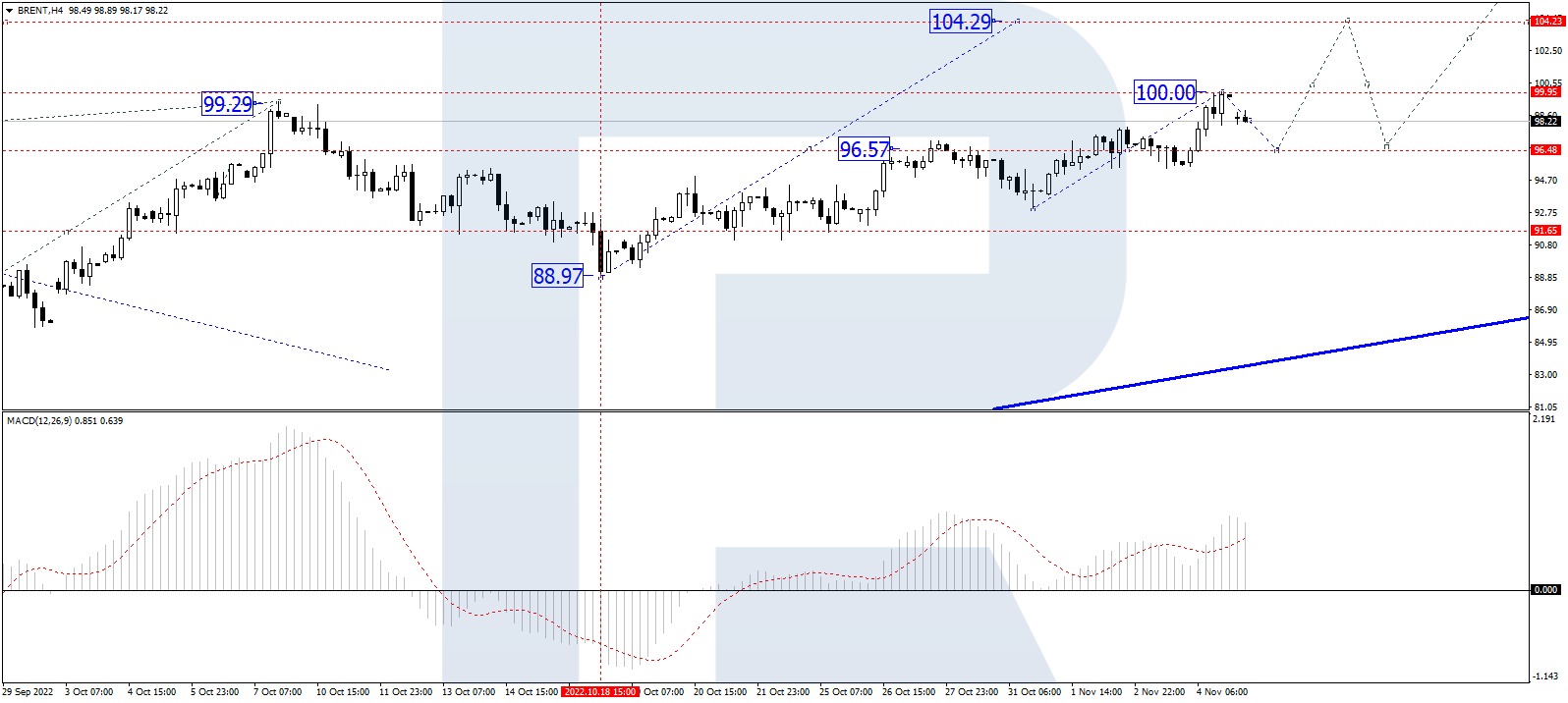
On H4, Brent has completed a wave of growth to 100.00. Today the market is forming a consolidation range under this level. Next, we expect a link of correction to 96.00. After it is over, a new wave of growth to 104.30 should start. The goal is local. Technically, this scenario is confirmed by the MACD. Its signal line is above zero in the histogram area, aimed strictly upwards.

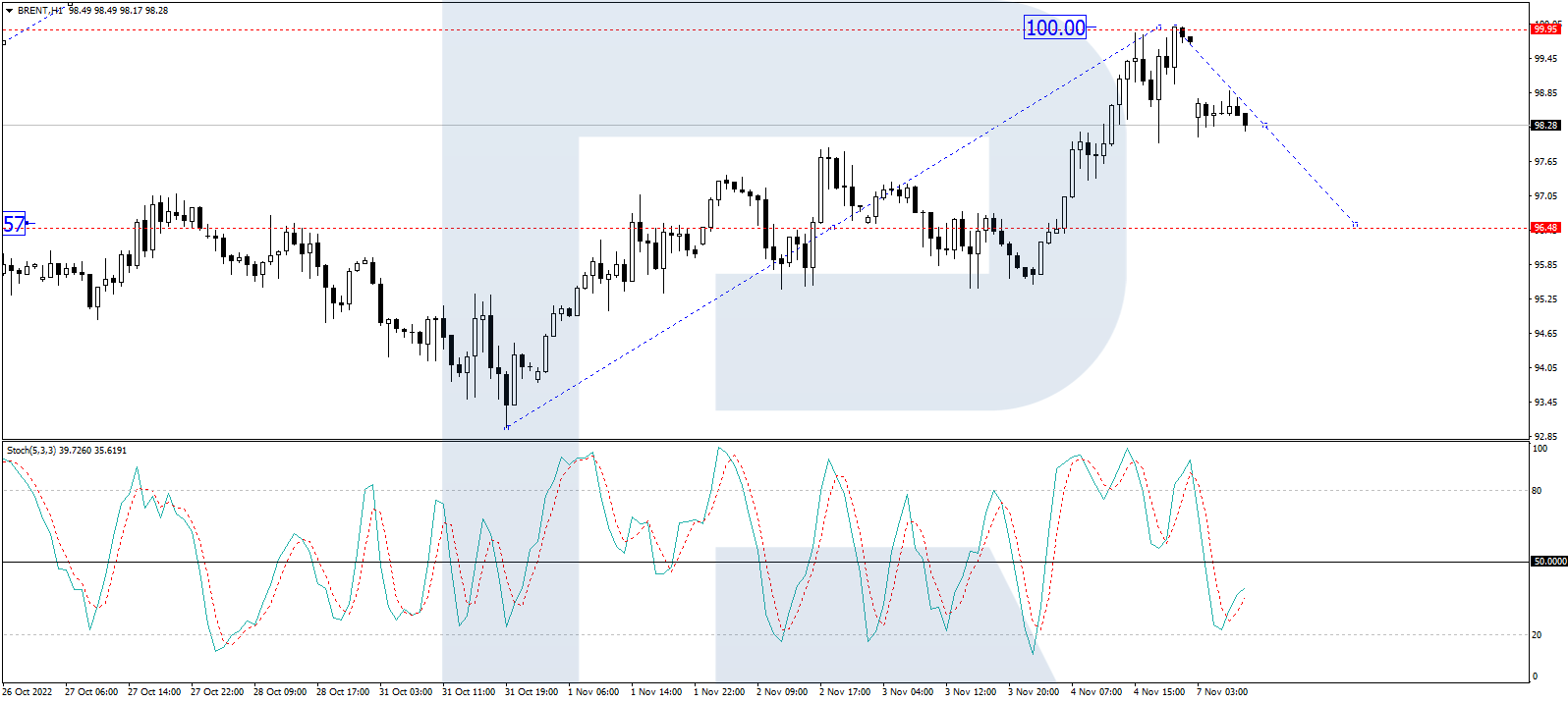
On H1, Brent has formed a consolidation range around 96.50. With an escape upwards, the market has reached the goal of 100.00. This whole wave of growth is interpreted as the third one by the trend. Then we expect a link of correcting decline to 96.50. When this correction is over, another wave of growth to 100.00 should start. And when this level is broken away, a pathway for growth to 104.30 will open. Technically, this scenario is confirmed by the Stochastic oscillator. Its signal line is under 50. Further decline to 20 is expected.

Disclaimer

Any forecasts contained herein are based on the author’s particular opinion. This analysis may not be treated as trading advice. RoboForex bears no responsibility for trading results based on trading recommendations and reviews contained herein.

Murrey Math Lines 07.11.2022 (EURUSD, GBPUSD)

Article By RoboForex.com

EURUSD, “Euro vs US Dollar”

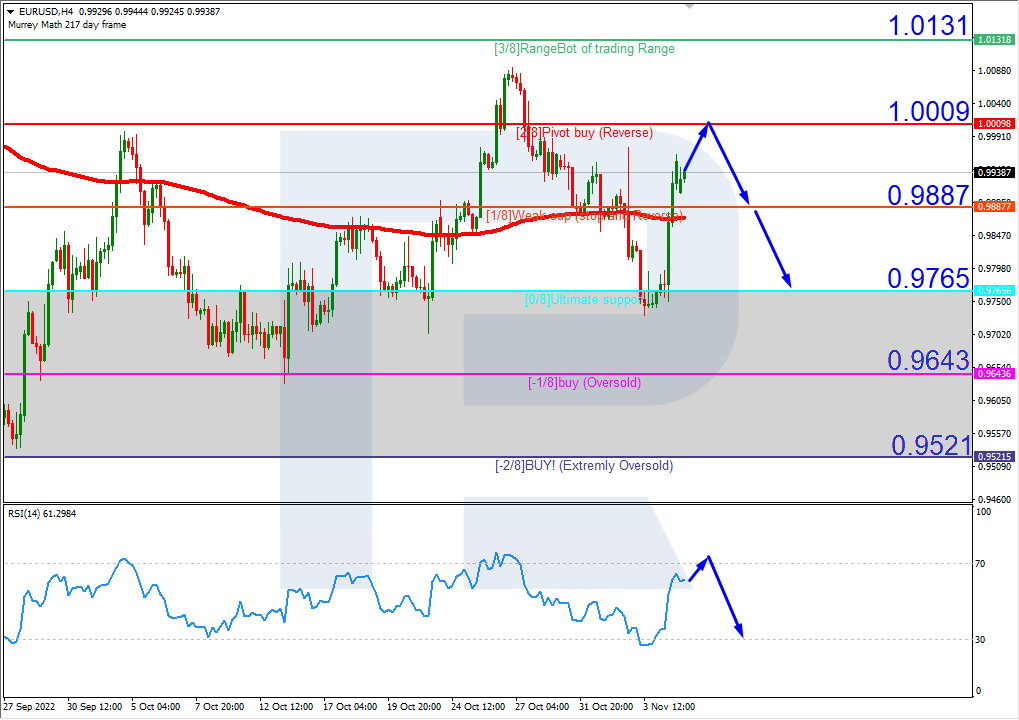
On H4, the quotes have broken through the 200-day Moving Average and are going above it, which signifies possible development of an uptrend. However, the RSI is nearing the overbought area. As a result, we should expect a test of 2/8 (1.0009), a bounce off it, and falling to the support level of 0/8 (0.9765). The scenario can be cancelled by an upward breakaway of the resistance level of 2/8 (1.0009). This may lead to further growth of the pair to 3/8 (1.0131).

EURUSDH4
Risk Warning: the result of previous trading operations do not guarantee the same results in the future

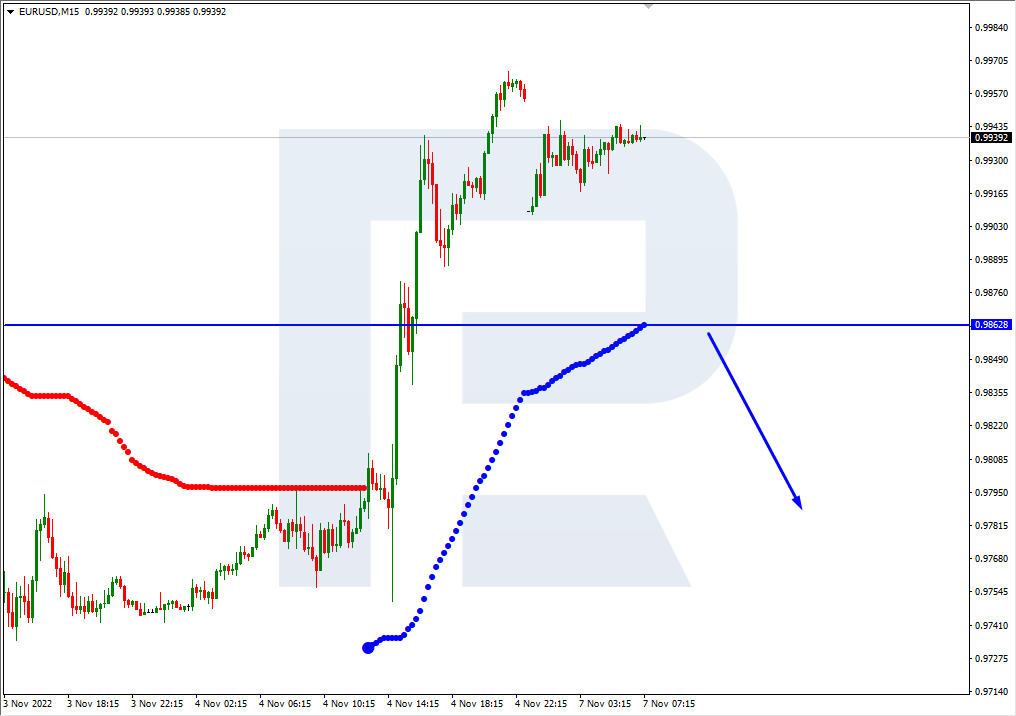
On M15, an additional signal confirming the decline will be a breakaway of the lower border of VoltyChannel.

EURUSD_M15
Risk Warning: the result of previous trading operations do not guarantee the same results in the future

GBPUSD, “Great Britain Pound vs US Dollar”

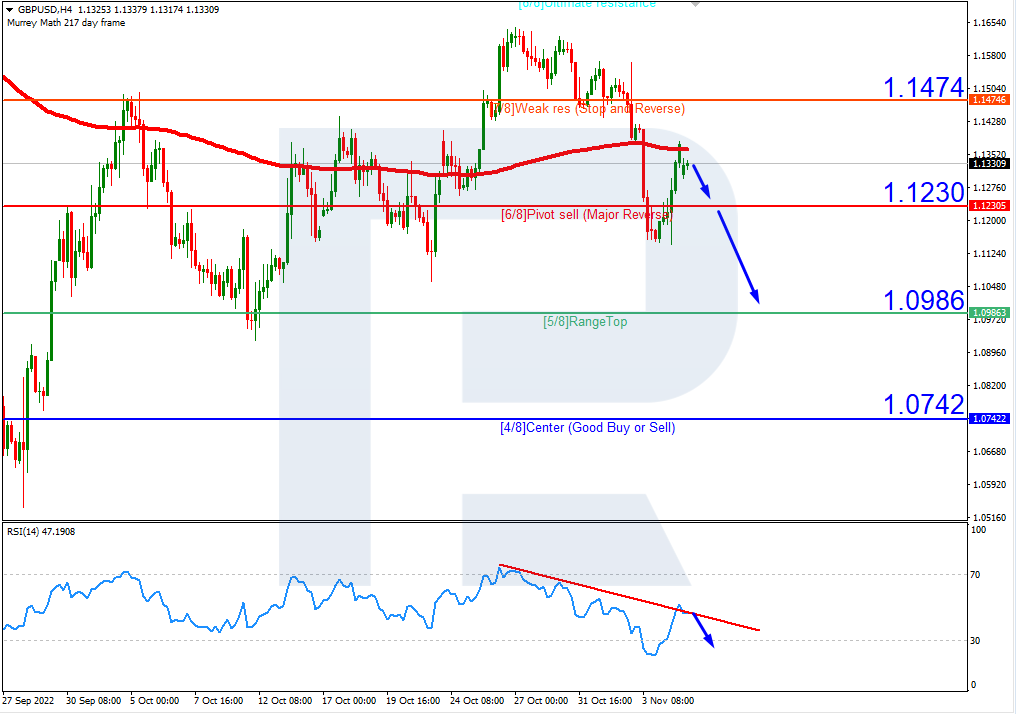
On H4, the quotes have broken through the 200-day Moving Average and are going below it, which signifies possible development of a downtrend. The RSI is testing the resistance line. Currently, we should expect a downward breakaway of the support level of 6/8 (1.1230) and falling to 5/8 (0.0986). The scenario can be cancelled by an upward breakaway of the resistance level of 7/8 (1.1474). In this case, the pair may reach 8/8 (1.1718).

GBPUSD_H4
Risk Warning: the result of previous trading operations do not guarantee the same results in the future

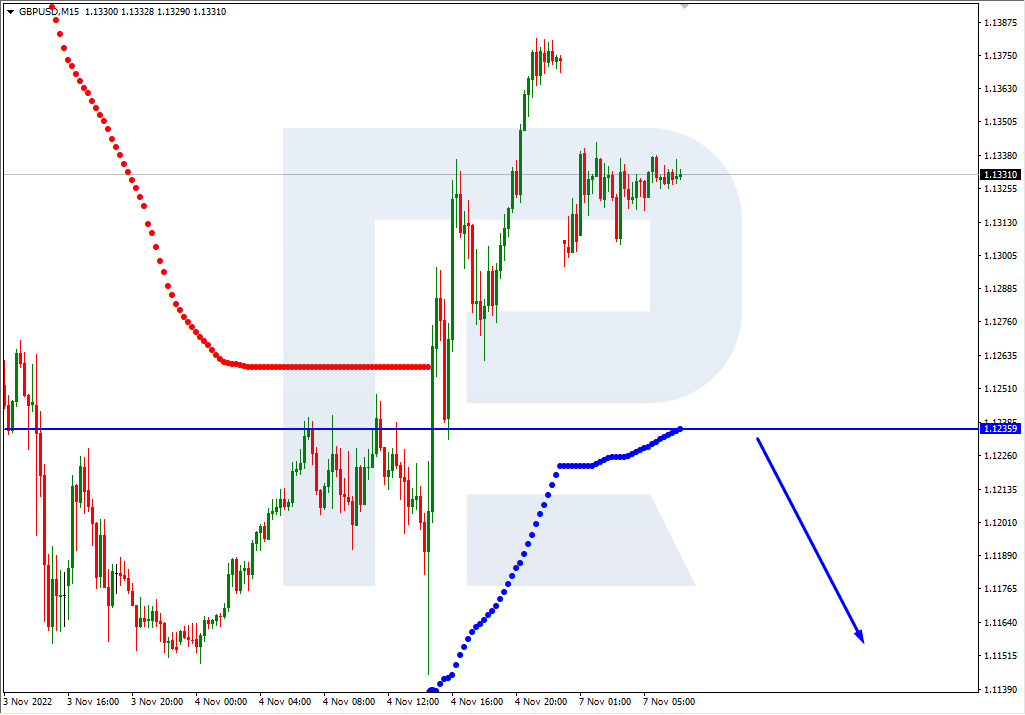
On M15, a breakaway of the lower line of VoltyChannel will increase the probability of price falling to 5/8 (0.0986) on H4.

GBPUSD_M15
Risk Warning: the result of previous trading operations do not guarantee the same results in the future

Article By RoboForex.com

Attention!
Forecasts presented in this section only reflect the author’s private opinion and should not be considered as guidance for trading. RoboForex LP bears no responsibility for trading results based on trading recommendations described in these analytical reviews.

The cryptocurrency market digest (BTC, EUROC, KLAY). Overview for 07.11.2022

Article By RoboForex.com

The BTC is correcting after preceding growth, on Monday balancing near 20,723 USD.

Earlier the BTC rose to 21,258 USD. The rally – and for the crypto that had long been lingering to a narrow range this was a real rally – was based on rather good labour market statistics from the US.

On Friday, the US presented fresh reports on this sector; investors reacted positively, the market started rising and dragged the crypto behind.

What is next? The BTC is now likely to consolidate between 20,000-21,000 USD waiting for the Congress elections and the US inflation statistics (due on 10 November).

On Monday, the capitalisation of the crypto market is 1.028 trillion USD. The BTC takes up 38.9%, the ETH – 18.7%.

NFTs are in demand again

According to DappRadar, the popularity of the NFT market is increasing again, regardless of the BTC stagnation. Over a month, the number of unique investors in NFTs grew by 18%, reaching 1.11 million investors in October.

Circle launches EUR-bound stablecoin

Circle is launching the EUROC stablecoin, based on Solana and bound to the EUR. Several internetwork bridges are expected to be launched by 2023 in order to increase the popularity of the token.

KLAY quotes dropped by 18.3%

The Klayth (KLAY) coin became the most losing last week. It lost more than 18.3% of the price, and the capitalisation of the project dropped to 702.2 million USD. Sales brought the token to the 62th line of the rating of the most liquid cryptocurrencies. Most probably, this was a technical correction upon sky-rocketing earlier.

Article By RoboForex.com

Attention!
Forecasts presented in this section only reflect the author’s private opinion and should not be considered as guidance for trading. RoboForex LP bears no responsibility for trading results based on trading recommendations described in these analytical reviews.

The Analytical Overview of the Main Currency Pairs on 2022.11.07

By JustMarkets

The EUR/USD currency pair

Technical indicators of the currency pair:
  • Prev Open: 0.9748
  • Prev Close: 0.9957
  • % chg. over the last day: +2.14 %

The US labor market data on Friday showed that Nonfarm payrolls added 261,000 jobs last month against expectations of 197,000, but the overall unemployment rate jumped from 3.5% to 3.7%. The US dollar fell sharply on this statistic as rising unemployment is the last piece of the puzzle for the Fed to put the brakes on aggressive rate hikes. A slowdown in the rate hikes is a negative for the dollar index and a positive for the European currency.

Trading recommendations
  • Support levels: 0.9850, 0.9794, 0.9755, 0.9702, 0.9601
  • Resistance levels: 0.9966, 1.0055, 1.0111, 1.0162, 1.0230

From the technical point of view, the trend on the EUR/USD currency pair on the hourly time frame is still bullish. The price failed to break down through the priority change level on Friday. The MACD indicator became positive, and the buying pressure returned. Under such market conditions, buy trades should be considered from the support level of 0.9850 or 0.97994, but with additional confirmation. Sell deals can be considered from the resistance level of 0.9966, but also with confirmation, as the level has already been tested.

Alternative scenario: if the price breaks down through the support level of 0.9755 and fixes below it, the downtrend will likely resume.

EUR/USD
News feed for 2022.11.07:
  • – Eurozone Services PMI (m/m) at 11:00 (GMT+2);
  • – Eurozone ECB President Lagarde Speaks at 11:30 (GMT+2);
  • – US Nonfarm Payrolls (m/m) at 14:30 (GMT+2);
  • – US Unemployment Rate (m/m) at 14:30 (GMT+2).

The GBP/USD currency pair

Technical indicators of the currency pair:
  • Prev Open: 1.1159
  • Prev Close: 1.1372
  • % chg. over the last day: +1.91 %

The Bank of England hiked its interest rate sharply by 0.75% last Thursday as it struggles with risks associated with the inflation of more than 10% and also warned of a prolonged recession. The Bank of England predicts that inflation will hit a 40-year high of about 11% in the current quarter and pointed out that Britain has already entered a recession that could potentially last two years – longer than during the 2008-09 financial crisis.

Trading recommendations
  • Support levels: 1.1230, 1.1172, 1.1093, 1.0915, 1.0817
  • Resistance levels: 1.1450, 1.1578, 1.1698, 1.1816, 1.1901

From the technical point of view, the trend on the GBP/USD currency pair on the hourly time frame is bullish. The price is trading above the moving averages and above the priority change level. The MACD indicator has become positive, and buying pressure has returned to the market. Under such market conditions, buy trades can be considered from the support level of 1.1230, but better after confirmation. Sell trades are best to look for on intraday time frames. The nearest resistance level is 1.1450, but also better with confirmation in the form of a reverse initiative.

Alternative scenario: if the price breaks down of the 1.1172 support level and fixes below it, the downtrend will likely resume.

GBP/USD
There is no news feed for today.

The USD/JPY currency pair

Technical indicators of the currency pair:
  • Prev Open: 148.21
  • Prev Close: 146.65
  • % chg. over the last day: -1.06 %

The situation on the currency pair USD/JPY remains the same. The Bank of Japan keeps an ultra-soft monetary policy and does not plan to change it until spring 2023. The US Federal Reserve, in turn, is on an interest rate hike cycle. This divergent policy strengthens the dollar and weakens the Japanese yen, pushing the USD/JPY up. Even if the US Fed cuts the pace of its rate hikes, the interest rate differential will still rise, resulting in further gains, but maybe slower than before.

Trading recommendations
  • Support levels: 146.37, 145.50, 144.91, 144.19, 143.00
  • Resistance levels: 147.59, 148.82, 150.00, 151.05

From the technical point of view, the medium-term trend on the currency pair USD/JPY is bearish. The price is trading at the level of the moving averages, and a wide balance is forming. The MACD indicator has become negative again, but sellers’ pressure is weak. Under such market conditions, buy trades can be looked for on intraday time frames from the support level of 146.37. Sell deals can be looked for from the resistance level of 147.59 or 148.82, but only with additional confirmation since the level has already been tested.

Alternative scenario: If the price fixes above 150.00, the uptrend will likely resume.

USD/JPY
There is no news feed for today.

The USD/CAD currency pair

Technical indicators of the currency pair:
  • Prev Open: 1.3745
  • Prev Close: 1.3479
  • % chg. over the last day: -1.97 %

Canadian labor market data on Friday pointed to job growth, raising the possibility that the Bank of Canada will need to make another excessive interest rate hike at its meeting next month. The money markets are now leaning towards the Bank of Canada raising its policy rate by 0.5% on December 7. The Bank of Canada’s discount rate is expected to peak at 4.5% in early 2023.

Trading recommendations
  • Support levels: 1.3486, 1.3400
  • Resistance levels: 1.3608, 1.3682, 1.3776, 1.3855, 1.3968

From the point of view of technical analysis, the trend on the USD/CAD currency pair has changed to bearish again. The price confidently broke through and consolidated below the moving averages and the priority change level. The MACD indicator is negative now, and there is the seller’s pressure on the lower time frames. The best way to sell is to consider the resistance level of 1.3608, but only after the additional confirmation. Buy trades should be considered on the lower time frames from the support level 1.3486, but with additional confirmation.

Alternative scenario: if the price breaks out and consolidates above the resistance level of 1.3682, the uptrend will likely resume.

USD/CAD
There is no news feed for today.

By JustMarkets


This article reflects a personal opinion and should not be interpreted as an investment advice, and/or offer, and/or a persistent request for carrying out financial transactions, and/or a guarantee, and/or a forecast of future events.

The US is preparing for the primaries. Investors are returning interest in gold

By JustMarkets

By the closing of the stock market on Friday, Dow Jones (US30) gained 1.26% (-1.07% for the week), and S&P 500 (US500) added 1.36% (-2.87% for the week). The Technology Index NASDAQ (US100) jumped by 1.28% on Friday (-5.02% for the week). Despite Friday’s gains, all indices closed the week with losses.

The US unemployment rate was 3.7% (forecast 3.6%, previous value 3.5%). The only unfulfilled marker of recession in the US at the moment is an overheated labor market. The Fed has repeatedly noted an imbalance in supply and demand for jobs. So rising unemployment is the last piece of the puzzle for the Fed to put the brakes on aggressive rate hikes.

The US is gearing up for Tuesday’s midterm elections, where control of Congress and President Joe Biden’s agenda for the remaining two years of his term are at stake. Republicans are leading in the polls, and many analysts believe the likely outcome will be a split government, with the Republican Party controlling the House and possibly the Senate in the second half of Biden’s term. Biden’s public approval rating has remained below 50% for more than a year, at 40% in a recent Reuters/Ipsos poll. Analysts say a surprise Democratic victory could heighten fears about increased budget spending and the prospect of inflation.

Canada’s plan to spend an additional C$6.1 billion ($4.5 billion) over the next five months could undermine the central bank’s efforts to curb inflation, despite Finance Minister Chrystia Freeland’s pledge not to complicate monetary policy.

Equity markets in Europe traded higher throughout last week. German DAX (DE30) gained 2.51% (+1.55% for the week), French CAC 40 (FR40) increased by 2.77% (+2.18% for the week), Spanish IBEX 35 (ES35) added 0.97% (+0.33% for the week), British FTSE 100 (UK100) closed Friday in plus 2.03% (+4.07% for the week).

Last week’s fundamental catalysts boosted the indices. On the energy side, the warming in the Eurozone has helped lower energy prices, and this situation is expected to continue in November. Lower prices should provide further support to the euro against the US dollar. On the other hand, manufacturing orders are declining across European countries, which limits the growth prospects of the European currency.

Friday’s 5% rally in oil was fueled by talk that China is planning to soften its so-called zero COVID policy. It also became known that the G7 countries, along with Australia, finally agreed to set a fixed price for Russian oil. Expectations that the Fed could still resort to a rate hike were another factor in the rise in oil prices on Friday.

The Kremlin plans to retaliate against the G7 plan to cap the sale price of Russian oil to limit Moscow’s ability to finance its invasion of Ukraine without restricting global supplies. Russian President Vladimir Putin has in the past threatened not to do business with countries participating in the G7 plan or to suspend crude oil exports altogether in response to the scheme.

On Friday, gold showed its best percentage gain in 2.5 years. On a weekly basis, gold added 1.9%, its best week in four years. Hedge fund analysts believe that if gold manages to close the month above $1,735 an ounce, the short- and medium-term outlook will change to bullish.

Asian markets mostly rose last week. Japan’s Nikkei 225 (JP225) gained 0.38% over the week, Hong Kong’s Hang Seng (HK50) jumped by 8.97%, and Australia’s S&P/ASX 200 (AU200) gained 1.57%

Chinese and Hong Kong stocks rose sharply Friday amid rumors that China may soon ease its strict restrictions on COVID-19, but officials said Saturday that the country is sticking to its policy for now. China’s huge trade surplus rose less than expected in October, while exports and imports declined during the month. The data does not bode well for Asian markets, given that China is a major trading partner for much of the region.

In the commodities market, futures on cotton (+20.72%), natural gas (+13.36%), silver (+9.23%), copper (+7.93%), gasoline (+6.94%), sugar (+6.26%), orange juice (+5.89%), cocoa (+5.47%), WTI oil (+5.35%), soybeans (+4.45%), coffee (+3.47%), Brent (+3.11%) and gol (+2.49%) showed the biggest gain. Futures on lumber (-4.82%) showed the biggest drop.

S&P 500 (F) (US500) 3,770.55 +50.66 (+1.36%)

Dow Jones (US30) 32,403.22  +401.97 (+1.26%)

DAX (DE40) 13,459.85 +329.66 (+2.51%)

FTSE 100 (UK100) 7,334.84 +146.21 (+2.03%)

USD Index 110.79 -2.148 (-1.90%)

Important events for today:
  • – China Exports (m/m) at 05:00 (GMT+2);
  • – China Imports (m/m) at 05:00 (GMT+2);
  • – Switzerland Unemployment Rate (m/m) at 08:45 (GMT+2);
  • – German Industrial Production (m/m) at 09:00 (GMT+2);
  • – Eurozone ECB President Lagarde Speaks at 10:40 (GMT+2);
  • – US FOMC Member Mester Speaks at 22:40 (GMT+2).

By JustMarkets


This article reflects a personal opinion and should not be interpreted as an investment advice, and/or offer, and/or a persistent request for carrying out financial transactions, and/or a guarantee, and/or a forecast of future events.

Gold: when the price goes up, more of it gets stolen in break-ins – new research

By Arnaud Chevalier, Royal Holloway University of London; Nils Braakmann, Newcastle University, and Tanya Wilson, University of Glasgow 

Are criminals rational? In his groundbreaking work of 1968, Gary Becker argued that they are. The American economist, who would go on to win the Nobel prize in economics in 1992, theorised that individuals engage in crime only if the returns are greater than the returns from engaging in legal activities, after you factor in the risk of being caught.

This has been largely supported by empirical evidence. But one aspect of Becker’s model which has proven difficult to confirm is whether criminal activity is sensitive to changes in the financial returns from crime. This is mostly because those returns are themselves affected by criminal activity.

For example, when more phones are stolen, the supply of stolen phones increases and their retail value drops, which makes them less attractive to steal. Since the price affects the burglaries as well as the burglaries affecting the price, it can be difficult for researchers to empirically assess the extent to which each is affecting the other.

One way around this problem is to look at a commodity whose price won’t be affected by how much is stolen by criminals. We chose gold. The question our research asked was: how does the gold price affect the rate of burglary in England and Wales?

The burglary business

Jewellery is only stolen in 7% of burglaries. This is according to the Crime Survey for England and Wales (CSEW), which also says that these types of burglaries are perceived as more serious by the victims than other types. No doubt this is partially because of the sentimental value associated with some of the jewellery, but also because of its financial value.

Anecdotal evidence, supported by the CSEW, suggests that south Asian households are more likely to store gold jewellery, in some cases as a way of saving, though also for cultural reasons. This means that when the price of gold goes up, the returns from burgling a south Asian household will go up too. You might therefore expect the rational burglar to disproportionately target these households when the gold price is higher.

It might not be easy for these burglars to recognise a house as belonging to a south Asian family, but they will know which neighbourhoods tend to be popular with this ethnic group. So we should expect that when the price of gold goes up, burglars may become more active in neighbourhoods with a greater share of south Asian families.

Using detailed crime data at the neighbourhood level for the period 2011-19, we tested this hypothesis by comparing burglary rates in neighbourhoods with a relatively high share of south Asian households and neighbourhoods with a lower share. To make the comparison more pertinent, we only compared neighbourhoods within the same local authority, contrasting periods in which the gold price was low to when it was high.

What we consistently found was that burglaries increase when the price of gold surges. A 10% increase in the price of gold increases the burglary rate by an average of 1.5%. In south Asian neighbourhoods, however, burglaries increase by 3.4%.

The wider economy

You might be thinking that burglars aren’t responding to the gold price but to economic conditions more generally, but this is an unlikely explanation. There certainly is a link between burglary rates and economic conditions. For example, when unemployment rises, there are more burglaries everywhere.

But by comparing neighbourhoods within the same local authority, we found it was only neighbourhoods with a higher share of Asian households that saw a larger increase in the rate of burglaries when the price of gold increased. We also found that the location of other crimes was unaffected by variations in the gold price.

In any case, gold and the economy are not especially well correlated. The price of gold is determined by global supply and demand rather than economic conditions in the UK.

Finally, we showed that variations in the price of gold drive up the burglary rate in general. So it’s not just a case of burglars relocating their activities to neighbourhoods with a higher share of south Asian households. When gold is more valuable there are more burglaries, and disproportionately more in south Asian neighbourhoods.

Our results seem to confirm that burglars act rationally and redirect their efforts towards neighbourhoods with higher returns when the reward is greater. If police forces allocate more resources to visible police patrols in areas rich in potential targets when the price of gold or some other valuable commodity is high, it may prove a successful deterrent. Additionally, it might be helpful to introduce policies making it more difficult to resell jewellery.

To end on a positive, the gold price is around 20% down from the highs of the past couple of years. So long as that continues, the temptation to burglars should at least be slightly less than it was before.The Conversation

About the Author:

Arnaud Chevalier, Professor of Economics, Royal Holloway University of London; Nils Braakmann, Professor of Economics, Newcastle University, and Tanya Wilson, Lecturer in Economics, University of Glasgow

This article is republished from The Conversation under a Creative Commons license. Read the original article.