Archive for Financial News – Page 198

Why US ‘dollar doomsayers’ could be wrong about its imminent demise

By Daniel Gros, Bocconi University 

The position of the US dollar in the global league table of foreign exchange reserves held by other countries is closely watched. Every slight fall in its share is interpreted as confirmation of its imminent demise as the preferred global currency for financial transactions.

The recent drama surrounding negotiations about raising the limit on US federal government debt has only fuelled these predictions by “dollar doomsayers”, who believe repeated crises over the US government’s borrowing limit weakens the country’s perceived stability internationally.

But the real foundation of its dominance is global trade – and it would be very complicated to turn the tide of these many transactions away from the US dollar.

The international role of a global currency in financial markets is ultimately based on its use in non-financial transactions, especially as what’s called an “invoicing currency” in trade. This is the currency in which a company charges its customers.

Global network of supply and trade

Modern trade can involve many financial transactions. Today’s supply chains often see goods shipped across several borders, and that’s after they are produced using a combination of intermediate inputs, usually from different countries.

Suppliers may also only get paid after delivery, meaning they have to finance production beforehand. Obtaining this financing in the currency in which they invoice makes trade easier and more cost effective.

In fact, it would be very inconvenient for all participants in a value chain if the invoicing and financing of each element of the chain happened in a different currency. Similarly, if most trade is invoiced and financed in one currency (the US dollar at present), even banks and firms outside the US have an incentive to denominate and settle financial transactions in that currency.

This status quo becomes difficult to change because no individual organisation along the chain has an incentive to switch currencies if others aren’t doing the same.

This is why the US dollar is the most widely used currency in third-country transactions – those that don’t even involve the US. In such situations it’s called a vehicle currency. The euro is used mainly in the vicinity of Europe, whereas the US dollar is widely used in international trade among Asian countries. Researchers call this the dominant currency paradigm.

The convenience of using the US dollar, even outside its home country, is further buttressed by the openness and size of US financial markets. They make up 36% of the world’s total or five times more than the euro area’s markets. Most trade-related financial transactions involve the use of short-term credit, like using a credit card to buy something. As a result, the banking systems of many countries must then be at least partially based on the dollar so they can provide this short-term credit.

And so, these banks need to invest in the US financial markets to refinance themselves in dollars. They can then provide this to their clients as dollar-based short-term loans.

It’s fair to say, then, that the US dollar has not become the premier global currency only because of US efforts to foster its use internationally. It will also continue to dominate as long as private organisations engaged in international trade and finance find it the most convenient currency to use.

What could knock the US dollar off its perch?

Some governments such as that of China might try to offer alternatives to the US dollar, but they are unlikely to succeed.

Government-to-government transactions, for example for crude oil between China and Saudi Arabia, could be denominated in yuan. But then the Saudi government would have to find something to do with the Chinese currency it receives. Some could be used to pay for imports from China, but Saudi Arabia imports a lot less from China (about US$30 billion) than it exports (about US$49 billion) to the country.

The US$600 billion Public Investment Fund (PIF), Saudi Arabia’s sovereign wealth fund, could of course use the yuan to invest in China. But this is difficult on a large scale because Chinese currency remains only partially “convertible”. This means that the Chinese authorities still control many transactions in and out of China, so that the PIF might not be able to use its yuan funds as and when it needs them. Even without convertibility restrictions, few private investors, and even fewer western investment funds, would be keen to put a lot of money into China if they are at the mercy of the Communist party.

China is of course the country with the strongest political motives to challenge the hegemony of the US dollar. A natural first step would be for China to diversify its foreign exchange reserves away from the US by investing in other countries. But this is easier said than done.

There are few opportunities to invest hundreds or thousands of billions of dollars outside of the US. Figures from the Bank of International Settlements show that the euro area bond market – a place for investors to finance loans to Euro area companies and governments – is worth less than one third of that of the US.

Also, in any big crisis, other major OECD economies like Europe and Japan are more likely to side with the US than China – making such a decision is even easier when they are using US dollars for trade. It was said that states accounting for one half of the global population refused to condemn Russia’s invasion of Ukraine, but this half does not account for a large share of global financial markets.

Similarly, it shouldn’t come as a surprise that democracies dominate the world financially. Companies and financial markets require trust and a well-established rule of law. Non-democratic regimes have no basis for establishing the rule of law and every investor is ultimately subject to the whims of the ruler.

When it comes to global trade, currency use is underpinned by a self-reinforcing network of transactions. Because of this, and the size of the US financial market, the dollar’s dominant position remains something for the US to lose rather for others to gain.The Conversation

About the Author:

Daniel Gros, Professor of Practice and Director of the Institute for European Policymaking, Bocconi University

This article is republished from The Conversation under a Creative Commons license. Read the original article.


How Germany’s Economy is Turning Ugly

This economic gauge “dipped back below zero in less than a year”

By Elliott Wave International

In November 2020, when fears were rampant over a second wave of the coronavirus pandemic, the president of the European Central Bank called for economic stimulus (Reuters):

Facing gloomy outlook, Lagarde calls for unlocking EU aid

In December of 2020, what is known as the Next Generation EU package became operational. This economic aid was massive, amounting to more than €2 trillion at current prices.

But you wouldn’t know it by looking at what’s going on in Germany. It took just 24 months for the European Union’s largest economy to resume its decline.

Here’s an overview from the June 2023 Global Market Perspective, a monthly Elliott Wave International publication which covers an array of financial markets:

German manufacturing orders (top left) dipped back below zero in less than a year. Industrial orders (bottom left), which had already rebounded before stimulus was enacted, returned to their old growth rate within 18 months.

Meanwhile, producer prices (middle column) fell to 4% yearly growth in April — down from 46% in August 2022 — while wholesale prices, which tend to lead the consumer-prices indexes, have dipped below zero for the first time since December 2021. … The two ZEW surveys shown in the right column reflect sentiment among institutional investors. Their views about the economy’s current situation (top) and its future growth prospects (bottom) are declining from multi-year highs.

As Bloomberg reported on May 25:

Europe’s Economic Engine Is Breaking Down
Germany is at risk of a long, slow decline — with consequences for the whole of the EU

But what about other major economies in the European Union, as well as Britain?

Indeed, what does the economic picture look like in the world’s two biggest economies, the U.S. and China?

Our Global Market Perspective covers 50-plus financial markets as well as the world’s major economies.

Elliott Wave International’s main way to analyze these 50 financial markets is to employ the Elliott wave model.

If you’d like to get insights into Elliott wave analysis, read Frost & Prechter’s Wall Street classic, Elliott Wave Principle: Key to Market Behavior. Here’s a quote from the book:

The Wave Principle is governed by man’s social nature, and since he has such a nature, its expression generates forms. As the forms are repetitive, they have predictive value.

Sometimes the market appears to reflect outside conditions and events, but at other times it is entirely detached from what most people assume are causal conditions. The reason is that the market has a law of its own. It is not propelled by the external causality to which one becomes accustomed in the everyday experiences of life. The path of prices is not a product of news. Nor is the market the cyclically rhythmic machine that some declare it to be. Its movement reflects a repetition of forms that is independent both of presumed causal events and of periodicity.

The market’s progression unfolds in waves. Waves are patterns of directional movement.

If you’d like to read the entire online version of the book for free, you may do so once you become a member of Club EWI, the world’s largest Elliott wave educational community.

A Club EWI membership is also free and allows for complimentary access to a wealth of Elliott wave resources on investing and trading.

Join Club EWI now by following this link: Elliott Wave Principle: Key to Market Behavior.

This article was syndicated by Elliott Wave International and was originally published under the headline How Germany’s Economy is Turning Ugly. EWI is the world’s largest market forecasting firm. Its staff of full-time analysts led by Chartered Market Technician Robert Prechter provides 24-hour-a-day market analysis to institutional and private investors around the world.

China’s central bank has lowered its interest rate. Bank of England prepares to raise borrowing costs

By JustMarkets

The US stock indices did not trade yesterday due to the bank holiday.

According to the CME FedWatch tool, there is currently a 74% chance of a 25 basis point rate hike at the Fed’s next meeting in late July. But then the markets see a 78% chance that rates will remain unchanged.

The US Secretary of State Anthony Blinken concluded his visit to Beijing on Monday with a surprise meeting with Chinese President Xi Jinping. The latter stressed the importance of sustained relations between the two countries after a period of simmering tensions. During the meeting at the State Guest House, Xi said that the world needs a “generally stable” Sino-American relationship. Xi Jinping also added that the future and fate of humanity depend on whether the two countries can find the right path. The Chinese foreign minister also urged Washington to abandon the so-called “China threat theory” and lift sanctions against Beijing and no longer stifle China’s technological development.

Stock markets in Europe were mostly down on Monday. German DAX (DE30) decreased by 0.96%, French CAC 40 (FR 40) lost 1.01%, Spanish IBEX 35 (ES35) decreased by 0.66%, and British FTSE 100 (UK100) fell by 0.71% yesterday.

The Eurozone will get its first view of how June is shaping up in terms of economic activity when the PMI data is released on Friday. Last month’s reports were dismal, as surveys showed slower growth in services and sharper declines in manufacturing. On the positive side was a decline in inflation expectations. And so far, there are few signs that activity has increased.

After some unwelcome inflation and wage data, markets now expect the Bank of England to raise rates above 5% in the coming months, even though inflation forecasts point to a marked reduction in price pressures over the summer.

Crude oil prices fell Monday on concerns that a fragile economic recovery in China will hit demand from the world’s biggest crude importer in the second half of the year. But from a broader perspective, the analyst community still expects significant shortages in the coming months.

Uncertainty over interest rate hikes combined with mixed signals of a potential recession this year kept gold in a tight trading range last month. Gold came under pressure after the US Federal Reserve raised its peak rate. Gold has an inverse correlation with the US dollar and government bond yields. Tightening monetary policy tends to push the dollar higher and push government bond yields higher, which is negative for precious metals. But analysts believe that since the US Federal Reserve is at the end of its tightening cycle, gold has a good chance of rising before the end of the year.

Asian markets traded mostly in negative territory yesterday. Japan’s Nikkei 225 (JP225) was down by 1.00% for the day, China’s FTSE China A50 (CHA50) fell by 1.58%, Hong Kong’s Hang Seng (HK50) decreased by 0.64% by Monday’s close, and Australia’s S&P/ASX 200 (AU200) was positive 0.60% by the day.

China cut its benchmark interest rate (LPR) by 10 basis points as Beijing struggled to support the country’s slowing economic recovery. But the move sent a somewhat negative signal to metals markets, given that it underscores the deepening cracks in the Chinese economy, despite the reversal of anti-COVID measures earlier this year.

Reserve Bank of Australia (RBA) Deputy Governor Michelle Bullock said the unemployment rate needs to rise to about 4.5% from its current level of 3.6% to bring the economy back into balance. According to the politician, this will help contain inflation and avoid further rate hikes and a deep recession.

S&P 500 (F) (US500) 4,409.59 0 (0%)

Dow Jones (US30)34,299.12 0 (0%)

DAX (DE40) 16,201.20 −156.43 (−0.96%)

FTSE 100 (UK100) 7,588.48 −54.24 (−0.71%)

USD Index 102.52 +0.28 (+0.27%)

Important events for today:
  • – China PBoC Loan Prime Rate (m/m) at 04:15 (GMT+3);
  • – Australia RBA Meeting Minutes (m/m) at 04:30 (GMT+3);
  • – Japan Industrial Production (m/m) at 07:30 (GMT+3);
  • – German Producer Price Index (m/m) at 09:00 (GMT+3);
  • – Hong Kong Inflation Rate (m/m) at 11:30 (GMT+3);
  • – US FOMC Bullard Speaks at 13:30 (GMT+3);
  • – US Building Permits (m/m) at 15:30 (GMT+3);
  • – US FOMC Williams Speaks at 18:45 (GMT+3).

By JustMarkets


This article reflects a personal opinion and should not be interpreted as an investment advice, and/or offer, and/or a persistent request for carrying out financial transactions, and/or a guarantee, and/or a forecast of future events.

Brent Crude Oil Price Sees Slight Decline as Energy Demand Concerns Persist

By RoboForex Analytical Department

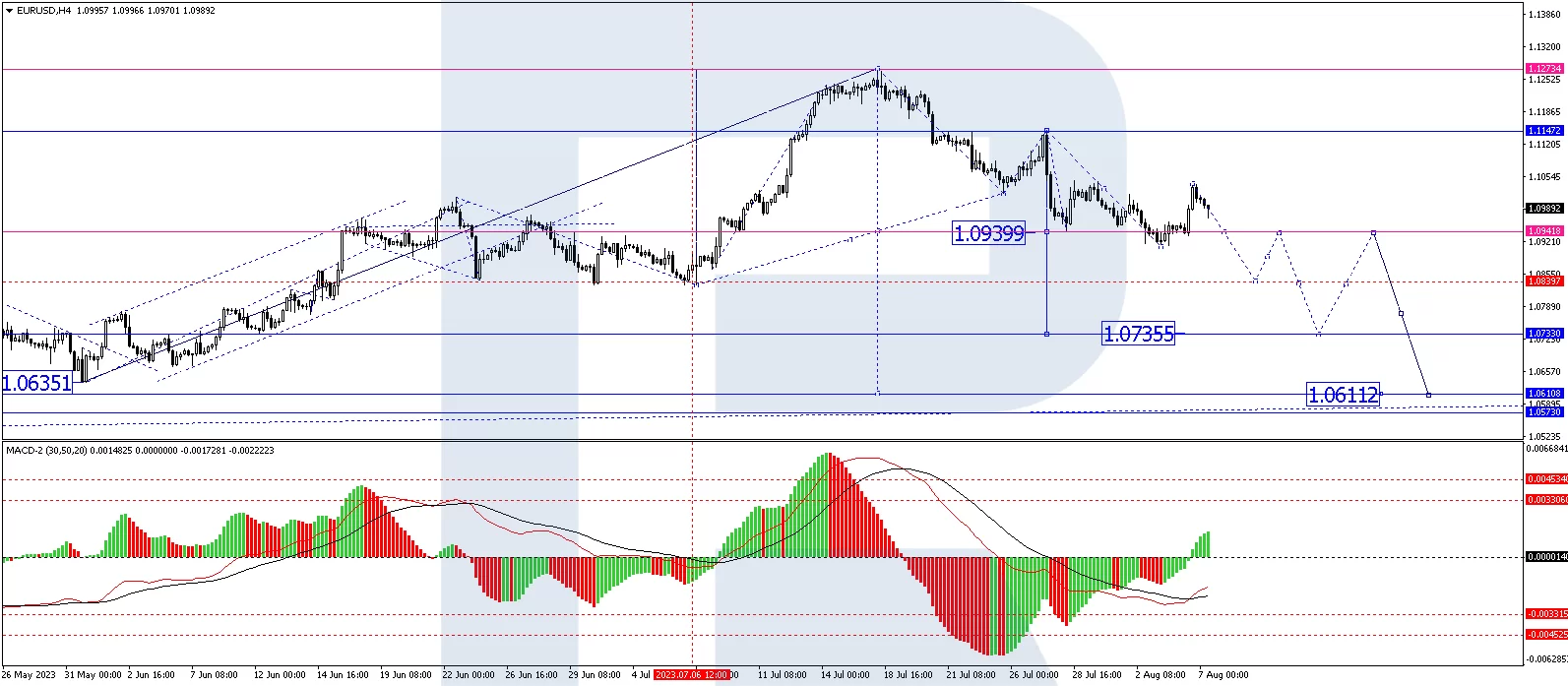
The price of Brent crude oil commenced the new week in June with a marginal decline, reaching $75.70 per barrel.

Investor uncertainty regarding the expansion of energy demand remains a significant factor restricting the potential for price increases in the “black gold” market. There are currently no clear indications from global economies, particularly the United States and China, suggesting a rapid acceleration in GDP growth. Moreover, various pressures on economies, such as disruptions in the supply chain and subdued consumer demand, further contribute to this situation.

It is worth highlighting the weakened position of the US dollar, which provides some local support for oil prices. During periods of US currency depreciation, commodities tend to become more appealing for investment.

Technical Analysis:

On the H4 timeframe, Brent crude oil appears to be forming the structure of a third upward wave. Currently, it has risen to 76.06, and the market continues to consolidate around this level. There is a possibility of a breakout above this range, leading to the continuation of the third wave towards 79.19. Following the attainment of this level, a corrective pullback to 76.66 cannot be ruled out. Subsequently, there is a potential for further growth towards 80.60. The technical analysis supports this scenario, as the MACD indicator’s signal line has recently broken above the zero level, displaying confident growth towards new highs.

On the H1 timeframe, Brent has already formed an upward wave structure, reaching 76.06. The market is presently consolidating around this level, indicating a pattern of a continued upward trend. The projected target for this wave of growth is 79.30. Technical confirmation is provided by the Stochastic oscillator, with its signal line surpassing the level of 50 and exhibiting steady growth towards 80.

Disclaimer

Any forecasts contained herein are based on the author’s particular opinion. This analysis may not be treated as trading advice. RoboForex bears no responsibility for trading results based on trading recommendations and reviews contained herein.

Stocks: Possible Replay of an Ominous Price Pattern

“I became panicky and covered at a considerable loss…”

By Elliott Wave International

The reason price patterns tend to repeat in the stock market is that investor psychology never changes.

The Elliott wave model directly reflects these largely predictable swings in investor psychology. That’s what the Elliott wave principle is all about.

One of those price moves which has historically fooled investors is the first big rally in a bear market.

These rallies are characterized by an “aggressive euphoria,” as Frost & Prechter’s Wall Street classic book, Elliott Wave Principle: Key to Market Behavior, states.

Why? Because many investors are convinced that the bull market is back.

In Robert Rhea’s 1934 book, The Story of the Averages, he described what was going on regarding the rally in the early months of 1930:

I became panicky and covered [my short position] at a considerable loss. … Nearly everyone was proclaiming a new bull market. Services were extremely bullish.

As you know, the 1929-1932 bear market turned out to be brutal.

A more recent example is what took place during the 2007-2009 bear market. This chart is from a past Elliott Wave Theorist, a monthly publication which covers major financial and cultural trends:

The black arrow indicates the October 2007 top. After the initial leg down, notice that sizeable rally around March 2008. A lot of investors plowed a lot of money into the market at precisely the wrong time. As you can see, the worst of the 2007-2009 bear market was ahead.

These two historic examples of bear market rallies do not mean that we’re on the verge of an exact replica.

But we do see striking similarities between those periods of price history and how the market is behaving here in 2023.

Those similarities include the stock market’s Elliott wave pattern. Frost & Prechter’s Elliott Wave Principle: Key to Market Behavior was referenced earlier. Here’s another quote from this definitive text on the Wave Principle:

Without Elliott, there appear to be an infinite number of possibilities for market action. What the Wave Principle provides is a means of first limiting the possibilities and then ordering the relative probabilities of possible future market paths. Elliott’s highly specific rules reduce the number of valid alternatives to a minimum. Among those, the best interpretation, sometimes called the “preferred count,” is the one that satisfies the largest number of guidelines. Other interpretations are ordered accordingly.

If you’d like to read the entire online version of the book, you may do so for free once you become a member of Club EWI, the world’s largest Elliott wave educational community.

A Club EWI membership is also free and allows for free access to a wealth of Elliott wave resources on investing and trading.

Join Club EWI now by following this link: Elliott Wave Principle: Key to Market Behavior.

This article was syndicated by Elliott Wave International and was originally published under the headline Stocks: Possible Replay of an Ominous Price Pattern. EWI is the world’s largest market forecasting firm. Its staff of full-time analysts led by Chartered Market Technician Robert Prechter provides 24-hour-a-day market analysis to institutional and private investors around the world.

George Soros hands control over his family’s philanthropy to son Alex, after giving away billions and enduring years of antisemitic attacks and conspiracy theories

By Armin Langer, University of Florida 

Billionaire investor and philanthropist George Soros is handing control of his US$25 billion holdings, including his Open Society Foundations, to one of his sons, Alexander Soros.

As a sociologist who researches immigrants and minorities in Europe and conspiracy theories about them, I study how Soros became a scapegoat and bogeyman for nationalists and populists and a target of people who harbor and spread antisemitic beliefs.

Baseless conspiracy theories have at times clouded his legacy as one of the world’s biggest donors to causes like higher education, human rights and the democratization of Europe’s formerly communist countries.

Success followed early hardship

Born in 1930 to a Hungarian Jewish family, Soros survived the Nazi occupation and the Holocaust. After World War II, he moved from Budapest to the United Kingdom, where he studied at the London School of Economics while working part time in low-wage jobs. He immigrated to the United States in 1956 and became a U.S. citizen five years later.

In the 1970s, Soros became a successful investor and hedge fund manager. By the 1990s he had amassed a fortune and established himself as one of the world’s most important financiers.

But his dedication to philanthropy and his support for political freedom are what brought him the most attention.

Deep-pocketed philanthropy

In the 1980s, Soros began to contribute to several Eastern European political and social movements that sought to replace communist states with democratic societies. Recognizing the importance of grassroots movements and the power of individuals to bring about change, his support enabled many activists to challenge oppression and advocate for human rights.

He also donated heavily to support education.

Soros’ first philanthropic foray was in 1979, when he funded scholarships for Black students in apartheid South Africa. In the 1980s, he helped promote the exchange of ideas in Communist Hungary by funding visits of Hungarian liberal intellectuals to Western universities.

When he gave $250 million in 2001 to the Central European University in Budapest, it represented, at that time, the continent’s largest higher education endowment.

Soros founded what’s now called the Open Society Foundations in 1993. The name of this international grant-making network was inspired by Karl Popper’s 1945 book “The Open Society and Its Enemies.” Popper argued that individuals thrive in open societies, because they can freely express themselves and test their ideas, while closed societies lead to stagnation.

The broad goal of much of Soros’ philanthropy is to support tolerant societies with governments that are accountable and allow everyone to campaign, protest, donate to candidates they like or even run for office themselves.

Soros’ foundations today support human rights organizations in more than 100 countries. Its initiatives take aim at a wide range of global problems, such as public health emergencies to low economic growth rates in low-income countries.

Soros remains on Bloomberg’s list of the 500 wealthiest people, with a personal net worth in excess of $7 billion as of 2023. But his fortune would have been far larger had he not given some $32 billion to the Open Society Foundations since 1984.

Antisemitic conspiracy myths

The Open Society Foundations’ support for progressive initiatives such as America Votes and Demand Justice have angered many conservatives who don’t agree with the goals of those causes.

Soros’ wealth and influence have also made him a target of numerous conspiracy theories. He’s been demonized as a shadowy puppet master manipulating world events for his own gain. Such baseless accusations often target his Jewish heritage, invoking hatemongering and centuries-old antisemitic tropes.

During the 2015 influx of Syrian refugees in Europe, for example, Hungarian Prime Minister Viktor Orbán accused Soros of a vicious plan of facilitating a supposedly “Islamic takeover of Europe” with the Syrian immigrants.

Former Slovak Prime Minister Robert Fico blamed Soros for being behind press freedom protests in his country after the murder of the investigative journalist Ján Kuciak and his fiancée in 2018.

In 2015, the far-right party All-Polish Youth burned an effigy of Soros dressed as a Hasidic Jew holding an EU flag, even though the philanthropist was raised by a family that was not religious, has never dressed in the style of the ultra-Orthodox Hasidic sect and has not been a major supporter of Jewish causes.

As I explained in a book chapter about nationalism and populism, U.S. conspiracy theories have hounded Soros for years as well. Rep. Kevin McCarthy, a California politician who is now speaker of the House, accused Soros of trying to buy the 2018 midterm elections. National Rifle Association leader Wayne LaPierre accused Soros of planning a socialist takeover of the U.S. in 2018, evoking antisemitic myths from the early 20th century about a Jewish-Bolshevik plot.

That same year, then-President Donald Trump falsely tweeted that Soros was financing the demonstrations against Brett Kavanaugh’s appointment as a Supreme Court justice.

These baseless theories have also inspired extremists to act on them: In 2010, a far-right extremist plotted to attack the progressive San Francisco-based Tides Foundation. His plot failed and ended in a shootout with police officers, and the man was sentenced to 401 years in prison. The extremist falsely believed that Soros used Tides “for all kinds of nefarious activities.”

In 2018, another extremist sent a pipe bomb to Soros’ home in a New York City suburb. Nobody was hurt, but the person responsible was sentenced to 20 years in prison.

Many other far-right extremists have tried to justify their attacks on Jews and other minorities with anti-Soros conspiracy theories – including the man who murdered 10 Black Americans at a supermarket in 2022.

A complex legacy

Not all criticism of Soros is antisemitic.

While I do believe that Soros’ support for freedom and his commitment to empowering marginalized communities are praiseworthy, I also think it’s reasonable to question the sources of his wealth and the methods he employed to accumulate it.

As is true for all billionaires, the Soros family fortune helps perpetuate a system of income inequality and concentrated political influence in the hands of the world’s wealthiest people. I believe that this outsize clout interferes with true democracy.

George Soros has certainly funded work through charitable donations that has fostered democratic values. But his financial support in the political realm, which includes gifts for major Democratic political causes and candidates, such as former U.S. President Barack Obama, former U.S. Secretary of State Hillary Clinton and President Joe Biden, have to a degree made him a polarizing figure.

When megadonors of any political preference make big donations to a candidate or party, their gifts can shape the agenda and distort democratic processes.

In his first interview as the new chair of Open Society Foundations, 37-year-old Alex Soros told The Wall Street Journal that he is “more political” than his father and that he’s likely to make political donations that advance voting rights and abortion rights.

It’s still not clear how Soros’ son aims to put a stop to the demonization of the family’s philanthropic work.The Conversation

About the Author:

Armin Langer, Assistant Professor of European Studies, University of Florida

This article is republished from The Conversation under a Creative Commons license. Read the original article.

The cryptocurrency market digest (BTC). Overview for 16.06.2023

By RoboForex.com

The BTC returned to 25,476 USD on Friday. Yesterday the flagship cryptocurrency experienced new stress with the price drop. Weekly losses are 3.9%.

The market is very thin and nervous. It has been this way since the beginning of the week, and there are no grounds for improvements. Sellers have gone less active, while buyer activity is still absent. In such circumstances, chances are that the BTC will drop to the trendline at 24,500 USD, from where chaotic sales towards 21,000 USD might start.

Recall that the cryptocurrency sector was plagued by fear due to multiple claims from the US Securities and Exchange Commission to the Binance exchange and its management. There has been talk of the possibility of freezing the exchange’s assets in the US, which carries the highest risks of complications for the business.

The capitalisation of the cryptocurrency market is estimated at 1.036 trillion USD. BTC’s share has increased to 47.8%, while the share of ETH has dropped to 19.3%.

Tether raises concerns about CoinDesk

Tether believes that the news website CoinDesk has obtained confidential client information via a hacker attack. This is about possible access to reserve reporting documents that Tether provided to the New York Attorney General’s office to reach a settlement in their legal dispute.

CoinEx ceases operations in the State of New York

Hong Kong exchange CoinEx is banned from operating in New York following a ruling by the New York Attorney General. The problem emerged from the inability to register the business there as a broker or dealer, as well as providing false information. At the same time, assets worth 1.7 million USD were seized from the exchange.

Article By RoboForex.com

Attention!
Forecasts presented in this section only reflect the author’s private opinion and should not be considered as guidance for trading. RoboForex LP bears no responsibility for trading results based on trading recommendations described in these analytical reviews.

The ECB will continue to tighten policy until the autumn. Oil prices are rising on strong data from China

By JustMarkets

At the close of the stock market yesterday, the Dow Jones Index (US30) increased by 1.26%, and the S&P 500 Index (US500) jumped by 1.22%. The NASDAQ Technology Index (US100) closed positive by 1.15% on Thursday.

The US Treasury bond yields fell after data showed that US jobless claims jumped to their highest level in nearly two years. Despite signs of a downturn in the labor market, the latest retail sales data, which were unexpectedly positive, suggests that the average consumer remains in good shape.

Equity markets in Europe traded without a single trend yesterday. Germany’s DAX (DE30) decreased by 0.13%, France’s CAC 40 (FR40) lost 0.51%, Spain’s IBEX 35 (ES35) jumped by 0.10%, Britain’s FTSE 100 (UK100) closed up by 0.34% yesterday.

The European Central Bank (ECB) raised interest rates to a 22-year high, as expected. The ECB interest rate rose from 3.75% to 4.00%. The central bank expects inflation to remain above the 2% target through 2025 and once again hinted at further rate hikes in the coming months. In the latest macroeconomic forecasts, ECB staff now expects overall inflation to be 5.4% this year, 3% in 2024, and 2.2% in 2025. Core inflation is expected to be 5.1%, 3%, and 2.3%, respectively. During the press conference, President Christine Lagarde departed slightly from the ECB’s recent strategy, focusing on forward projections and applying a meeting-by-meeting approach.

Oil was up by 3% yesterday due to strong data from China as well as dollar weakness. Chinese refinery productivity was up by 15.4% in May from a year ago, reaching the second-highest level on record. Oil demand in China is expected to continue growing at a guaranteed rate in the second half of the year. Analysts expect the voluntary oil production cuts implemented in May by OPEC countries as well as Saudi Arabia to support oil prices at a time of strong demand.

A Turkish energy delegation will meet with representatives of Iraqi oil companies in Baghdad on June 19 to discuss resuming Iraq’s northern oil exports. Turkey suspended 450,000 barrels of Iraq’s northern exports through the Iraq-Turkey pipeline on March 25 following an International Chamber of Commerce (ICC) arbitration ruling.

Asian markets traded higher yesterday. Japan’s Nikkei 225 (JP225) decreased by 0.05% for the day, China’s FTSE China A50 (CHA50) was up by 1.82%, Hong Kong’s Hang Seng (HK50) ended the day up by 2.17%, and Australia’s S&P/ASX 200 (AU200) closed positive by 0.19%.

The Bank of Japan maintained an ultra-soft monetary policy on Friday, despite stronger-than-expected inflation, as it focused on supporting a fragile economic recovery amid a sharp slowdown in global growth. As price growth shows signs of expanding, markets are focused on whether Bank of Japan Governor Kazuo Ueda will issue a stronger warning about the risk of overshooting inflation at his press conference.

S&P 500 (F) (US500) 4,425.84 +53.25 (+1.22%)

Dow Jones (US30)34,408.06 +428.73 (+1.26%)

DAX (DE40) 16,290.12 −20.67 (−0.13%)

FTSE 100 (UK100) 7,628.26 +25.52 (+0.34%)

USD Index 102.16 −0.79 (−0.77%)

Important events for today:
  • – Japan BoJ Interest Rate Decision at 06:00 (GMT+3);
  • – Japan BoJ Monetary Policy Statement at 06:00 (GMT+3);
  • – UK Retail Sales (m/m) at 09:00 (GMT+3);
  • – Japan BoJ Press Conference at 09:30 (GMT+3);
  • – Eurozone Consumer Price Index (m/m) at 12:00 (GMT+3);
  • – US FOMC Waller Speaks at 14:45 (GMT+3);
  • – US Michigan Consumer Sentiment (m/m) at 17:00 (GMT+3).

By JustMarkets


This article reflects a personal opinion and should not be interpreted as an investment advice, and/or offer, and/or a persistent request for carrying out financial transactions, and/or a guarantee, and/or a forecast of future events.
1,000,000 USD Promotion for RoboForex Partners

Financial brokerage company RoboForex is launching a new promotional campaign, which offers large cash prizes. This year, the company’s partners can take part in it. The promotion period is from 1 June 2023 to 31 March 2024, with a total prize fund of 1,000,000 USD.

During the 10 months of the promotion, there will be 60 cash prizes, each worth 100,000 USD. The prizes will be distributed among the holders of the winning coupons, which can be obtained for referring clients to the Company through the RoboForex Partner Programme.

The number of coupons a partner can receive per month depends on their monthly affiliate commission, ranging from 1 to 31 coupons.

Drawing procedure and prize allocation

Each Coupon has a unique 6-digit number. To win, a participant’s coupon number must be mathematically closer to one of the winning combinations compared to other participants’ Coupon numbers. The winning combinations are based on the closing prices of the most popular assets on the last trading day of the first week of each calendar month.

The price data is recorded using the independent resource finance.yahoo.com.

PrizePrize amount (USD)
115 000
210 000
38 000
47 000
55 000
6601 000


View more information on the conditions for obtaining coupons and conducting the draw on the RoboForex website.

The distribution of coupons has already begun! Join us and take part in the draw every month of the promotion. We wish you good luck!


Murrey Math Lines 15.06.2023 (USDJPY, USDCAD)

By RoboForex.com
USDJPY, “US Dollar vs Japanese Yen”

On H4, the quotes are above the 200-day Moving Average, indicating the prevalence of an uptrend. However, the RSI is nearing the overbought area. As a result, in these circumstances a test of 7/8 (142.18) is expected, followed by a rebound from this level and a decline to the support at 5/8 (139.06). The scenario can be cancelled by rising above the resistance at 7/8 (142.18). In this case, the pair might continue growing, and the quotes might reach 8/8 (143.75).

USDJPY_H4
Risk Warning: the result of previous trading operations do not guarantee the same results in the future

On M15, an additional signal confirming the decline after a rebound from 7/8 (142.18), might be a breakout of the lower border of the VoltyChannel.

USDJPY_M15
Risk Warning: the result of previous trading operations do not guarantee the same results in the future

USDCAD, “US Dollar vs Canadian Dollar”

On H4, the quotes are under the 200-day Moving Average, indicating the prevalence of a downtrend. The RSI is testing the resistance line. In this situation, a downward breakout of 2/8 (1.3305) is expected, followed by a decline to the support at 0/8 (1.3183). The scenario can be cancelled by rising above the resistance at 3/8 (1.3366). In this case, the pair could correct to 4/8 (1.3427).

USDCAD_H4
Risk Warning: the result of previous trading operations do not guarantee the same results in the future

On M15, a breakout of the lower line of the VoltyChannel might increase the probability of a decline.

USDCAD_M15

Article By RoboForex.com

Attention!
Forecasts presented in this section only reflect the author’s private opinion and should not be considered as guidance for trading. RoboForex LP bears no responsibility for trading results based on trading recommendations described in these analytical reviews.