Archive for Financial News – Page 199

Trade Of The Week: What Next For SPX500_m?

By ForexTime 

The S&P 500 has gained roughly 17% year-to-date, fuelled by the AI mania that magnetized investors toward a handful of big tech names.

After hitting a fresh 2023 high last week thanks to the cooler-than-expected US inflation data, US equity bulls are certainly in the building.

The strong earning results from big Wall Street banks last Friday could support upside gains, possibly pushing the S&P 500 higher. However, this is likely to be influenced by fresh fundamental and technical forces over the next few days. Taking a quick look at the technical picture, the index remains in a firm uptrend on the daily charts. The daily close above 4500 could encourage an incline towards 4580. Should prices slip back under 4500, bears could target 4463.

This could be another volatile week for the SPX500_m and here are 3 reasons why:

  1. US earnings season 

Earnings season is set to enter a busy week as the focus falls on large-cap companies. The likes of Bank of America, Morgan Stanley, Goldman Sachs, Netflix, and Tesla among others will announce their quarterly results. These results are likely to be closely scrutinized by investors for more insight into the health of the economy and corporate America. It may be wise to keep an eye on Tesla which is within the top 5 holdings in the S&P 500. The company is set to post its Q2 results on July 19 after the closing bell.

Ultimately, if the company earnings impress and stimulate risk appetite, this could propel the SPX500_m towards a fresh 2023 high beyond 4530. Alternatively, a set of disappointing earnings could see the index experience a decline back towards 4463 and potentially lower.

  1. Key US economic data

Some key US economic releases may influence the S&P 500 this week.

On Monday, the US Empire manufacturing will be in focus. Attention will be directed toward the key US retail sales and industrial production figures on Tuesday which could provide fresh insight into the health of the largest economy in the world. Thursday sees the US initial jobless claims which have the potential to impact Fed hike expectations.

  • If overall US economic data disappoints, this could fuel expectations around the Federal Reserve pausing rates beyond July – a development that will be welcomed by US equity bulls.
  • A solid set of economic reports could strengthen the argument around US rates remaining higher for longer – a scenario that may drag the SPX500_m lower.
  1. Technical forces

As highlighted earlier, the SPX500_m remains in a bullish trend on the daily timeframe. There have been consistently higher highs and higher lows while prices are trading above the 50, 100, and 200-day SMA. Should 4500 prove to be reliable support, this could springboard prices towards 4580 and 4640, respectively. Should prices slip back below 4500, bulls still have a chance to fight back if 4463 becomes a reliable support. A scenario where prices slip below 4463 may trigger a selloff towards 4390 and 4332, respectively.

Zooming out on the weekly timeframe, bulls seem to be building momentum after securing a weekly close above past resistance at 4332. Although prices are respecting a weekly bullish channel, the weekly Relative Strength Index (RSI) signals that prices are flirting around overbought levels. A solid breakout above 4500 may pave a path to higher levels with 4640 and 4800 acting as key points of interest. Alternatively, if 4500 proves to be a tough nut to crack, prices may slip back towards 4332 and lower.


Forex-Time-LogoArticle by ForexTime

ForexTime Ltd (FXTM) is an award winning international online forex broker regulated by CySEC 185/12 www.forextime.com

China is experiencing a slowdown in economic growth. In the US, the reporting period for the second quarter has started

By JustMarkets

At Friday’s close, the Dow Jones Index (US30) increased by 0.33% (+2.38% for the week), while the S&P 500 Index (US500) was down by 0.10% (+2.53% for the week). The NASDAQ Technology Index (US100) closed negative by 0.18% (+3.43% for the week) on Friday.

Rising interest rates, which surprised many US banks, proved to be a boon for the nation’s largest banks. JPMorgan Chase (JPM) posted record profits, and some of its major competitors reported better-than-expected loan income. Shares of JPMorgan Chase (JPM) rose by 0.6%, while Wells Fargo (WFC) fell by 0.3%. Both major banks reported higher quarterly earnings but said they set aside more funds to cover expected losses on commercial real estate loans. Friday’s quarterly reports unofficially opened the second quarter in the US. According to Refintiiv, analysts expect S&P 500 earnings for the quarter to be down by 8.1% compared with a year ago result, but most companies are expected to beat expectations.

The US consumer sentiment jumped to a near two-year high. The University of Michigan’s preliminary index rose by 8.2 points to 72.6, the highest level since September 2021. The index beat all forecasts. The surge in sentiment was largely attributed to a continued slowdown in inflation along with stability in the labor market. Friday’s report also showed that consumers expect low unemployment over the next year, and most believe their incomes will rise by at least as much as inflation rises. While longer-term inflation expectations appear reasonable, minutes from the Fed’s June meeting showed that some officials remain concerned that these expectations may become unreasonable, especially in light of stronger-than-expected consumer demand and a robust labor market.

Equity markets in Europe were mostly down on Friday, but all closed in positive territory at the end of the week. Germany’s DAX (DE30) decreased by 0.22% (+3.33% for the week), France’s CAC 40 (FR40) added 0.06% on Friday (+4.12% for the week), Spain’s IBEX 35 (ES35) was down by 0.43% (+2.47% for the week), and the UK’s FTSE 100 (UK100) closed negative by 0.08% (+2.45% for the week).

US Treasury bond yields have fallen sharply over the past week as traders raised bets that the US Federal Reserve’s monetary tightening program is coming to an end. Rate-sensitive UST 2 yields are down 50 basis points since last Thursday, while UST 10 yields are down about 30 basis points, and UST 30 yields are down about 18 basis points over the same time period. Since gold and silver have an inverse correlation to US government bond yields, there is a high probability of continued uptrends in the precious metals.

Despite a slight decline in oil prices on Friday, oil prices posted their third consecutive weekly gain last week, and the potential for further gains remains as weakening inflation, plans to replenish the US strategic reserve, supply cuts, and production disruptions in some OPEC countries support black gold prices.

Asian markets were mostly on the rise last week. Japan’s Nikkei 225 (JP225) was little changed for the week, China’s FTSE China A50 (CHA50) gained 2.20%, Hong Kong’s Hang Seng (HK50) ended the week up by 3.55%, and Australia’s S&P/ASX 200 (AU200) ended the week positive by 3.70%.

Chinese indices fell sharply on Monday after data showed a significant slowdown in the country’s economic growth in the second quarter. China’s gross domestic product (GDP) grew by 0.8% in the second quarter. The figure was above expectations of 0.5% growth but significantly weaker than the 2.2% jump recorded in the first quarter. The annualized GDP figure fell short of expectations, showing growth of 6.5% vs. the expected 7.3%. China’s manufacturing sector also came under pressure due to sluggish overseas demand for Chinese exports amid deteriorating economic conditions globally. The data suggest that the economic recovery in Asia’s largest country is decreasing and that the government will likely have to consider additional stimulus measures in the coming months.

S&P 500 (F)(US500) 4,505.42 −4.62 (−0.10%)

Dow Jones (US30) 34,509.03 +113.89 (+0.33%)

DAX (DE40)  16,105.07 −35.96 (−0.22%)

FTSE 100 (UK100) 7,434.57 −5.64 (−0.076%)

USD Index  99.96 +0.19 (−0.19%)

Important events for today:
  • – China GDP (q/q) at 05:00 (GMT+3);
  • – China Industrial Production (m/m) at 05:00 (GMT+3);
  • – China Retail Sales (m/m) at 05:00 (GMT+3);
  • – China Unemployment Rate (m/m) at 05:00 (GMT+3);
  • – Eurozone ECB President Lagarde Speaks at 11:15 (GMT+3);
  • – US NY Empire State Manufacturing Index (m/m) at 15:30 (GMT+3).

By JustMarkets


This article reflects a personal opinion and should not be interpreted as an investment advice, and/or offer, and/or a persistent request for carrying out financial transactions, and/or a guarantee, and/or a forecast of future events.

Stock Market Speculator Changes led by Nasdaq-Mini & the VIX

By InvestMacro

Here are the latest charts and statistics for the Commitment of Traders (COT) data published by the Commodities Futures Trading Commission (CFTC).

The latest COT data is updated through Tuesday July 11th and shows a quick view of how large traders (for-profit speculators and commercial entities) were positioned in the futures markets.

Weekly Speculator Changes led by Nasdaq-Mini & the VIX

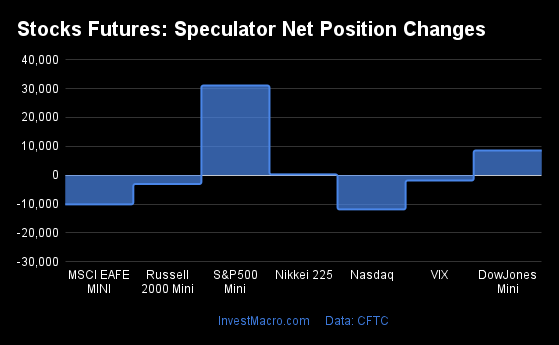
The COT stock markets speculator bets were higher this week as four out of the seven stock markets we cover had higher positioning while the other three markets had lower speculator contracts.

Leading the gains for the stock markets was the Nasdaq-Mini (5,490 contracts) with the VIX (4,191 contracts), the Nikkei 225 (2,314 contracts) and the Russell-Mini (1,637 contracts) also showing positive weeks.

The markets with the declines in speculator bets this week were with DowJones-Mini (-5,503 contracts), the MSCI EAFE-Mini (-1,318 contracts) and the S&P500-Mini (-1,740 contracts) also registering lower bets on the week.


Data Snapshot of Stock Market Traders | Columns Legend
Jul-11-2023OIOI-IndexSpec-NetSpec-IndexCom-NetCOM-IndexSmalls-NetSmalls-Index
S&P500-Mini2,209,60721-208,97934202,437686,54247
Nikkei 22516,33817-3,871441,916481,95553
Nasdaq-Mini259,4913710,94883-8,01318-2,93548
DowJones-Mini97,78260-18,5852121,32577-2,74031
VIX403,07274-50,7338252,12713-1,39489
Nikkei 225 Yen53,8284311,8367112,92046-24,75627


Strength Scores led by Nasdaq-Mini & VIX

COT Strength Scores (a normalized measure of Speculator positions over a 3-Year range, from 0 to 100 where above 80 is Extreme-Bullish and below 20 is Extreme-Bearish) showed that the Nasdaq-Mini (83 percent) and the VIX (82 percent) lead the stock markets this week. The Nikkei 225 Yen (71 percent) and Nikkei 225 (44 percent) come in as the next highest in the weekly strength scores.

On the downside, the DowJones-Mini (21 percent) comes in at the lowest strength level currently. The next lowest strength score is the MSCI EAFE-Mini (28 percent).

Strength Statistics:
VIX (82.4 percent) vs VIX previous week (79.4 percent)
S&P500-Mini (33.6 percent) vs S&P500-Mini previous week (33.8 percent)
DowJones-Mini (21.3 percent) vs DowJones-Mini previous week (36.9 percent)
Nasdaq-Mini (83.5 percent) vs Nasdaq-Mini previous week (80.3 percent)
Russell2000-Mini (32.4 percent) vs Russell2000-Mini previous week (31.5 percent)
Nikkei USD (43.8 percent) vs Nikkei USD previous week (28.7 percent)
EAFE-Mini (28.3 percent) vs EAFE-Mini previous week (29.9 percent)


S&P500-Mini & Nikkei 225 top the 6-Week Strength Trends

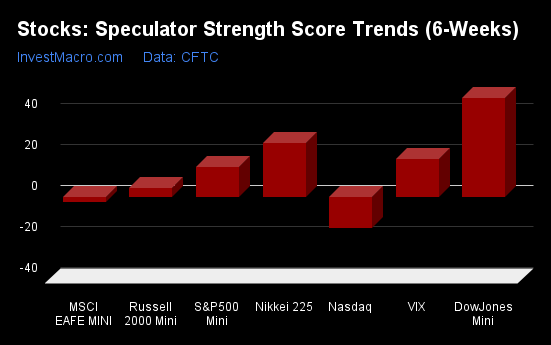
COT Strength Score Trends (or move index, calculates the 6-week changes in strength scores) showed that the S&P500-Mini (34 percent) leads the past six weeks trends for the stock markets. The Nikkei 225 (20 percent), the VIX (9 percent) and the DowJones-Mini (9 percent) are the next highest positive movers in the latest trends data.

The Russell-Mini (-2 percent) leads the downside trend scores currently.

Strength Trend Statistics:
VIX (8.6 percent) vs VIX previous week (7.1 percent)
S&P500-Mini (33.6 percent) vs S&P500-Mini previous week (29.4 percent)
DowJones-Mini (8.5 percent) vs DowJones-Mini previous week (27.3 percent)
Nasdaq-Mini (1.4 percent) vs Nasdaq-Mini previous week (-5.2 percent)
Russell2000-Mini (-1.7 percent) vs Russell2000-Mini previous week (-11.2 percent)
Nikkei USD (19.7 percent) vs Nikkei USD previous week (-4.4 percent)
EAFE-Mini (6.7 percent) vs EAFE-Mini previous week (10.7 percent)


Individual Stock Market Charts:

VIX Volatility Futures:

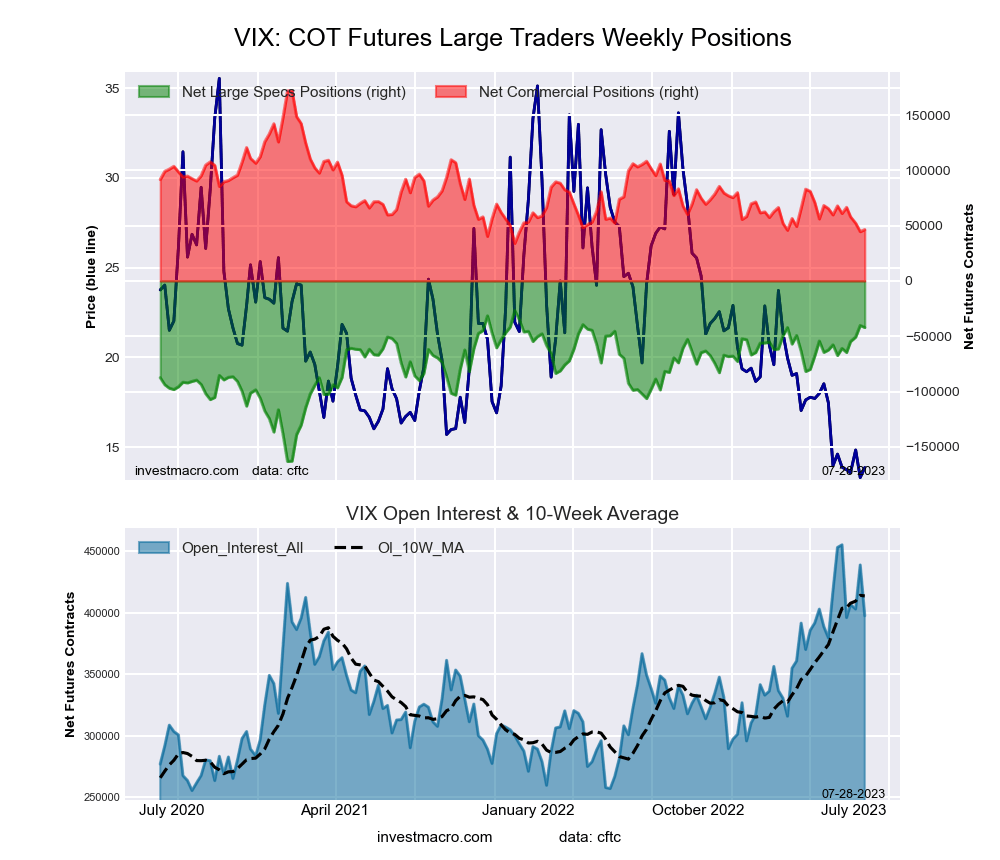
VIX Volatility Futures COT ChartThe VIX Volatility large speculator standing this week resulted in a net position of -50,733 contracts in the data reported through Tuesday. This was a weekly boost of 4,191 contracts from the previous week which had a total of -54,924 net contracts.

This week’s current strength score (the trader positioning range over the past three years, measured from 0 to 100) shows the speculators are currently Bullish-Extreme with a score of 82.4 percent. The commercials are Bearish-Extreme with a score of 13.2 percent and the small traders (not shown in chart) are Bullish-Extreme with a score of 88.7 percent.

Price Trend-Following Model: Downtrend

Our weekly trend-following model classifies the current market price position as: Downtrend. The current action for the model is considered to be: Hold – Maintain Short Position.

VIX Volatility Futures StatisticsSPECULATORSCOMMERCIALSSMALL TRADERS
– Percent of Open Interest Longs:23.348.96.4
– Percent of Open Interest Shorts:35.936.06.7
– Net Position:-50,73352,127-1,394
– Gross Longs:93,879197,28225,734
– Gross Shorts:144,612145,15527,128
– Long to Short Ratio:0.6 to 11.4 to 10.9 to 1
NET POSITION TREND:
– Strength Index Score (3 Year Range Pct):82.413.288.7
– Strength Index Reading (3 Year Range):Bullish-ExtremeBearish-ExtremeBullish-Extreme
NET POSITION MOVEMENT INDEX:
– 6-Week Change in Strength Index:8.6-9.67.5


S&P500 Mini Futures:

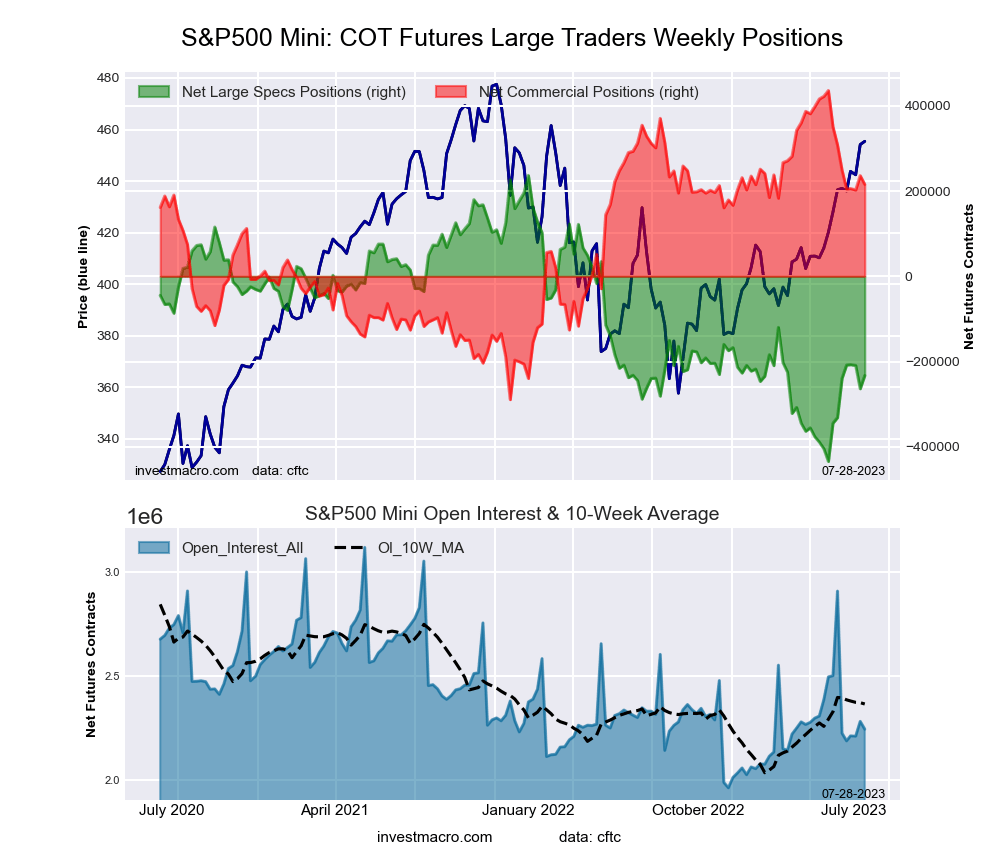
SP500 Mini Futures COT ChartThe S&P500 Mini large speculator standing this week resulted in a net position of -208,979 contracts in the data reported through Tuesday. This was a weekly reduction of -1,740 contracts from the previous week which had a total of -207,239 net contracts.

This week’s current strength score (the trader positioning range over the past three years, measured from 0 to 100) shows the speculators are currently Bearish with a score of 33.6 percent. The commercials are Bullish with a score of 67.8 percent and the small traders (not shown in chart) are Bearish with a score of 46.5 percent.

Price Trend-Following Model: Strong Uptrend

Our weekly trend-following model classifies the current market price position as: Strong Uptrend. The current action for the model is considered to be: Hold – Maintain Long Position.

S&P500 Mini Futures StatisticsSPECULATORSCOMMERCIALSSMALL TRADERS
– Percent of Open Interest Longs:10.276.211.3
– Percent of Open Interest Shorts:19.667.011.0
– Net Position:-208,979202,4376,542
– Gross Longs:224,5541,683,791249,227
– Gross Shorts:433,5331,481,354242,685
– Long to Short Ratio:0.5 to 11.1 to 11.0 to 1
NET POSITION TREND:
– Strength Index Score (3 Year Range Pct):33.667.846.5
– Strength Index Reading (3 Year Range):BearishBullishBearish
NET POSITION MOVEMENT INDEX:
– 6-Week Change in Strength Index:33.6-32.22.8


Dow Jones Mini Futures:

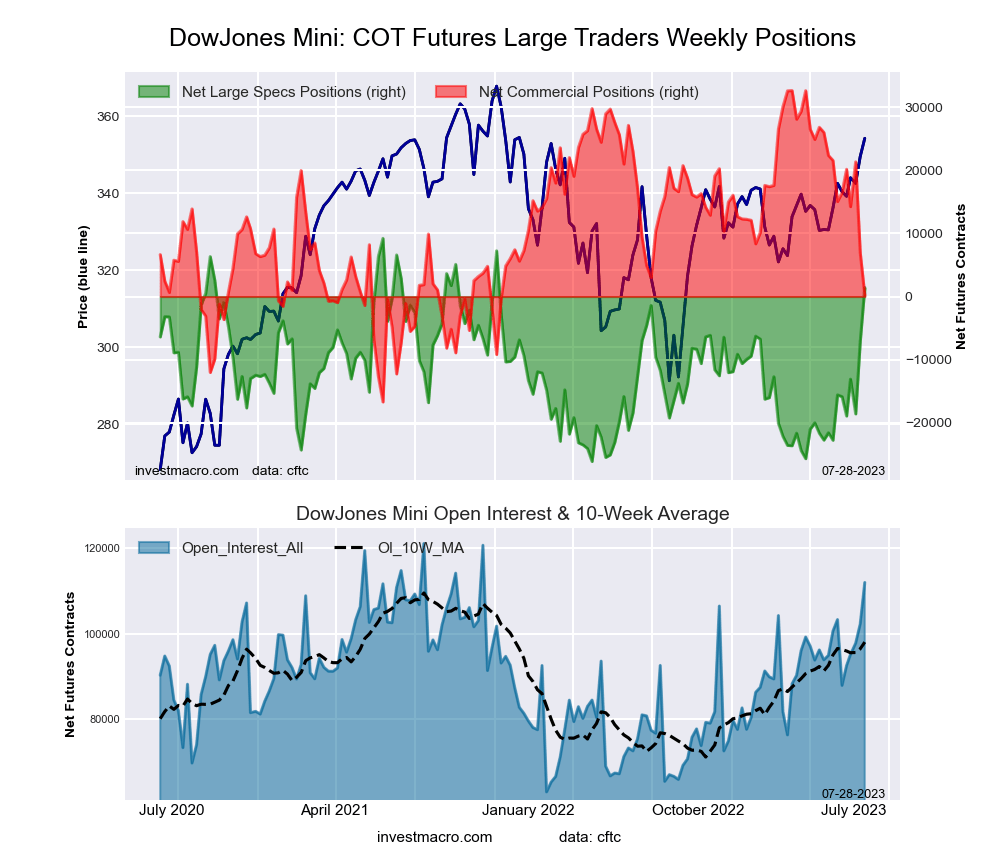
Dow Jones Mini Futures COT ChartThe Dow Jones Mini large speculator standing this week resulted in a net position of -18,585 contracts in the data reported through Tuesday. This was a weekly decrease of -5,503 contracts from the previous week which had a total of -13,082 net contracts.

This week’s current strength score (the trader positioning range over the past three years, measured from 0 to 100) shows the speculators are currently Bearish with a score of 21.3 percent. The commercials are Bullish with a score of 77.1 percent and the small traders (not shown in chart) are Bearish with a score of 30.5 percent.

Price Trend-Following Model: Strong Uptrend

Our weekly trend-following model classifies the current market price position as: Strong Uptrend. The current action for the model is considered to be: Hold – Maintain Long Position.

Dow Jones Mini Futures StatisticsSPECULATORSCOMMERCIALSSMALL TRADERS
– Percent of Open Interest Longs:23.763.112.2
– Percent of Open Interest Shorts:42.741.215.0
– Net Position:-18,58521,325-2,740
– Gross Longs:23,20561,65811,959
– Gross Shorts:41,79040,33314,699
– Long to Short Ratio:0.6 to 11.5 to 10.8 to 1
NET POSITION TREND:
– Strength Index Score (3 Year Range Pct):21.377.130.5
– Strength Index Reading (3 Year Range):BearishBullishBearish
NET POSITION MOVEMENT INDEX:
– 6-Week Change in Strength Index:8.5-2.1-9.6


Nasdaq Mini Futures:

Nasdaq Mini Futures COT ChartThe Nasdaq Mini large speculator standing this week resulted in a net position of 10,948 contracts in the data reported through Tuesday. This was a weekly increase of 5,490 contracts from the previous week which had a total of 5,458 net contracts.

This week’s current strength score (the trader positioning range over the past three years, measured from 0 to 100) shows the speculators are currently Bullish-Extreme with a score of 83.5 percent. The commercials are Bearish-Extreme with a score of 17.5 percent and the small traders (not shown in chart) are Bearish with a score of 47.9 percent.

Price Trend-Following Model: Strong Uptrend

Our weekly trend-following model classifies the current market price position as: Strong Uptrend. The current action for the model is considered to be: Hold – Maintain Long Position.

Nasdaq Mini Futures StatisticsSPECULATORSCOMMERCIALSSMALL TRADERS
– Percent of Open Interest Longs:29.152.715.5
– Percent of Open Interest Shorts:24.955.816.6
– Net Position:10,948-8,013-2,935
– Gross Longs:75,622136,66840,206
– Gross Shorts:64,674144,68143,141
– Long to Short Ratio:1.2 to 10.9 to 10.9 to 1
NET POSITION TREND:
– Strength Index Score (3 Year Range Pct):83.517.547.9
– Strength Index Reading (3 Year Range):Bullish-ExtremeBearish-ExtremeBearish
NET POSITION MOVEMENT INDEX:
– 6-Week Change in Strength Index:1.4-8.419.5


Russell 2000 Mini Futures:

Russell 2000 Mini Futures COT ChartThe Russell 2000 Mini large speculator standing this week resulted in a net position of -65,873 contracts in the data reported through Tuesday. This was a weekly boost of 1,637 contracts from the previous week which had a total of -67,510 net contracts.

This week’s current strength score (the trader positioning range over the past three years, measured from 0 to 100) shows the speculators are currently Bearish with a score of 32.4 percent. The commercials are Bullish with a score of 67.3 percent and the small traders (not shown in chart) are Bearish with a score of 27.8 percent.

Price Trend-Following Model: Strong Uptrend

Our weekly trend-following model classifies the current market price position as: Strong Uptrend. The current action for the model is considered to be: Hold – Maintain Long Position.

Russell 2000 Mini Futures StatisticsSPECULATORSCOMMERCIALSSMALL TRADERS
– Percent of Open Interest Longs:10.283.84.6
– Percent of Open Interest Shorts:22.871.34.5
– Net Position:-65,87365,463410
– Gross Longs:53,492438,84324,054
– Gross Shorts:119,365373,38023,644
– Long to Short Ratio:0.4 to 11.2 to 11.0 to 1
NET POSITION TREND:
– Strength Index Score (3 Year Range Pct):32.467.327.8
– Strength Index Reading (3 Year Range):BearishBullishBearish
NET POSITION MOVEMENT INDEX:
– 6-Week Change in Strength Index:-1.7-2.220.7


Nikkei Stock Average (USD) Futures:

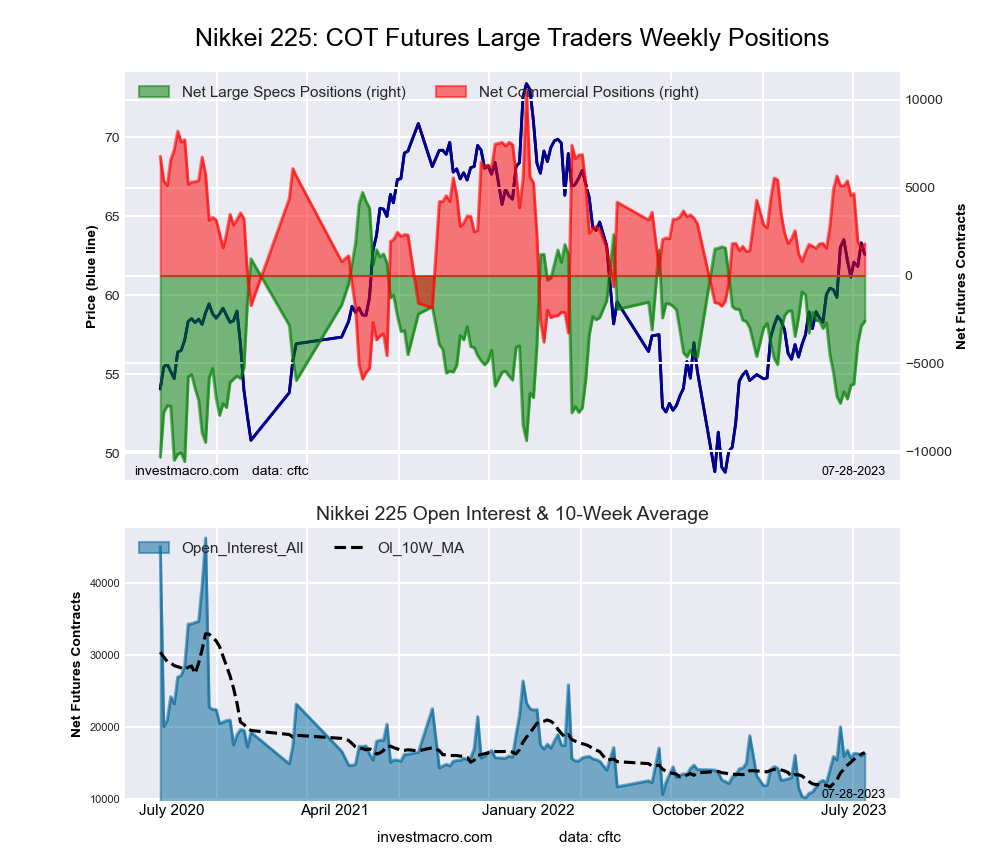
Nikkei Stock Average (USD) Futures COT ChartThe Nikkei Stock Average (USD) large speculator standing this week resulted in a net position of -3,871 contracts in the data reported through Tuesday. This was a weekly lift of 2,314 contracts from the previous week which had a total of -6,185 net contracts.

This week’s current strength score (the trader positioning range over the past three years, measured from 0 to 100) shows the speculators are currently Bearish with a score of 43.8 percent. The commercials are Bearish with a score of 47.5 percent and the small traders (not shown in chart) are Bullish with a score of 52.9 percent.

Price Trend-Following Model: Strong Uptrend

Our weekly trend-following model classifies the current market price position as: Strong Uptrend. The current action for the model is considered to be: Hold – Maintain Long Position.

Nikkei Stock Average Futures StatisticsSPECULATORSCOMMERCIALSSMALL TRADERS
– Percent of Open Interest Longs:8.862.828.4
– Percent of Open Interest Shorts:32.551.016.4
– Net Position:-3,8711,9161,955
– Gross Longs:1,44510,2544,639
– Gross Shorts:5,3168,3382,684
– Long to Short Ratio:0.3 to 11.2 to 11.7 to 1
NET POSITION TREND:
– Strength Index Score (3 Year Range Pct):43.847.552.9
– Strength Index Reading (3 Year Range):BearishBearishBullish
NET POSITION MOVEMENT INDEX:
– 6-Week Change in Strength Index:19.7-22.99.3


MSCI EAFE Mini Futures:

MSCI EAFE Mini Futures COT ChartThe MSCI EAFE Mini large speculator standing this week resulted in a net position of -13,061 contracts in the data reported through Tuesday. This was a weekly fall of -1,318 contracts from the previous week which had a total of -11,743 net contracts.

This week’s current strength score (the trader positioning range over the past three years, measured from 0 to 100) shows the speculators are currently Bearish with a score of 28.3 percent. The commercials are Bullish with a score of 67.4 percent and the small traders (not shown in chart) are Bearish with a score of 47.6 percent.

Price Trend-Following Model: Strong Uptrend

Our weekly trend-following model classifies the current market price position as: Strong Uptrend. The current action for the model is considered to be: Hold – Maintain Long Position.

MSCI EAFE Mini Futures StatisticsSPECULATORSCOMMERCIALSSMALL TRADERS
– Percent of Open Interest Longs:7.189.32.9
– Percent of Open Interest Shorts:10.587.51.3
– Net Position:-13,0616,9266,135
– Gross Longs:27,415345,86311,243
– Gross Shorts:40,476338,9375,108
– Long to Short Ratio:0.7 to 11.0 to 12.2 to 1
NET POSITION TREND:
– Strength Index Score (3 Year Range Pct):28.367.447.6
– Strength Index Reading (3 Year Range):BearishBullishBearish
NET POSITION MOVEMENT INDEX:
– 6-Week Change in Strength Index:6.7-7.94.9


Article By InvestMacroReceive our weekly COT Newsletter

*COT Report: The COT data, released weekly to the public each Friday, is updated through the most recent Tuesday (data is 3 days old) and shows a quick view of how large speculators or non-commercials (for-profit traders) were positioned in the futures markets.

The CFTC categorizes trader positions according to commercial hedgers (traders who use futures contracts for hedging as part of the business), non-commercials (large traders who speculate to realize trading profits) and nonreportable traders (usually small traders/speculators) as well as their open interest (contracts open in the market at time of reporting). See CFTC criteria here.

COT Energy Charts: Weekly Speculator Changes led by WTI Crude Oil and Natural Gas 

By InvestMacro

Here are the latest charts and statistics for the Commitment of Traders (COT) data published by the Commodities Futures Trading Commission (CFTC).

The latest COT data is updated through Tuesday July 11th and shows a quick view of how large traders (for-profit speculators and commercial hedgers) were positioned in the futures markets.

Weekly Speculator Changes led by WTI Crude Oil and Natural Gas

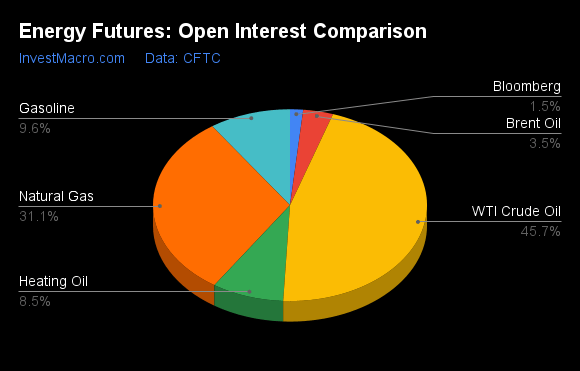
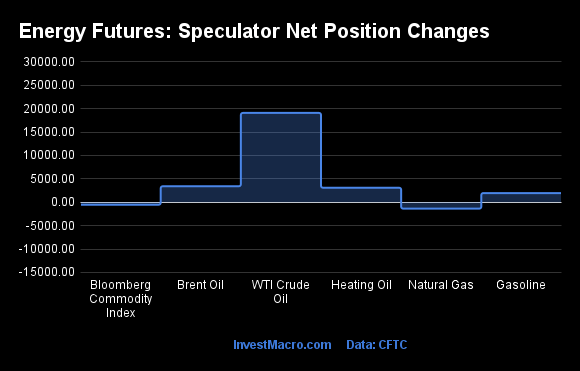
COT energy market speculator bets were higher this week as five out of the six energy markets we cover had higher positioning this week while the other one market had lower contracts.

Leading the gains for energy markets was WTI Crude Oil (32,004 contracts) with Natural Gas (12,020 contracts), Gasoline (7,393 contracts), Heating Oil (301 contracts) and Bloomberg Commodity Index (95 contracts) also showing positive weeks.

The energy market leading the declines in speculator bets this week was Brent Crude Oil with a decrease of -8,158 contracts also registering lower bets on the week.


Data Snapshot of Commodity Market Traders | Columns Legend
Jul-11-2023OIOI-IndexSpec-NetSpec-IndexCom-NetCOM-IndexSmalls-NetSmalls-Index
WTI Crude1,796,34836173,4339-196,6889323,25526
Gold483,17028165,75450-187,7495121,99535
Silver120,282620,29247-31,6495611,35729
Copper197,78541-11,157217,915783,24239
Palladium15,772100-8,27208,765100-49312
Platinum71,007727,78734-13,912656,12550
Natural Gas1,236,80256-86,7553755,5546231,20154
Brent134,6628-48,0311846,617871,41428
Heating Oil320,0014428,00079-47,7283119,72867
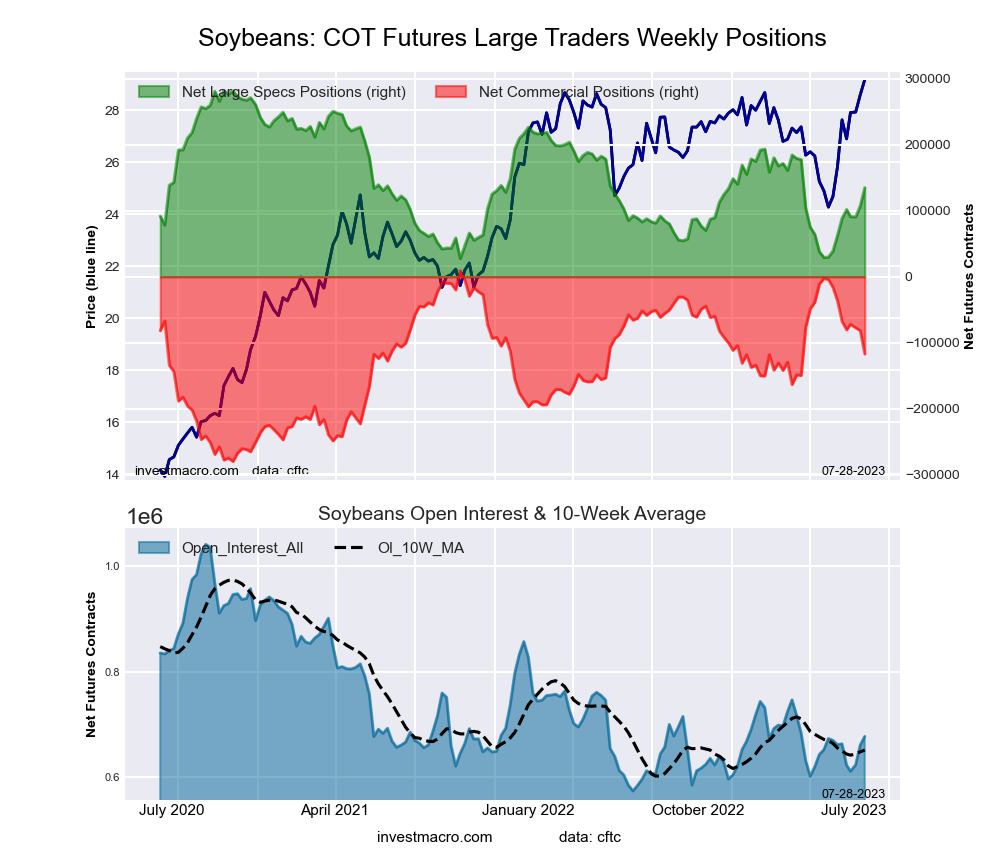
Soybeans622,5091190,86325-77,18070-13,68368
Corn1,241,94077,8112335,21581-43,02652
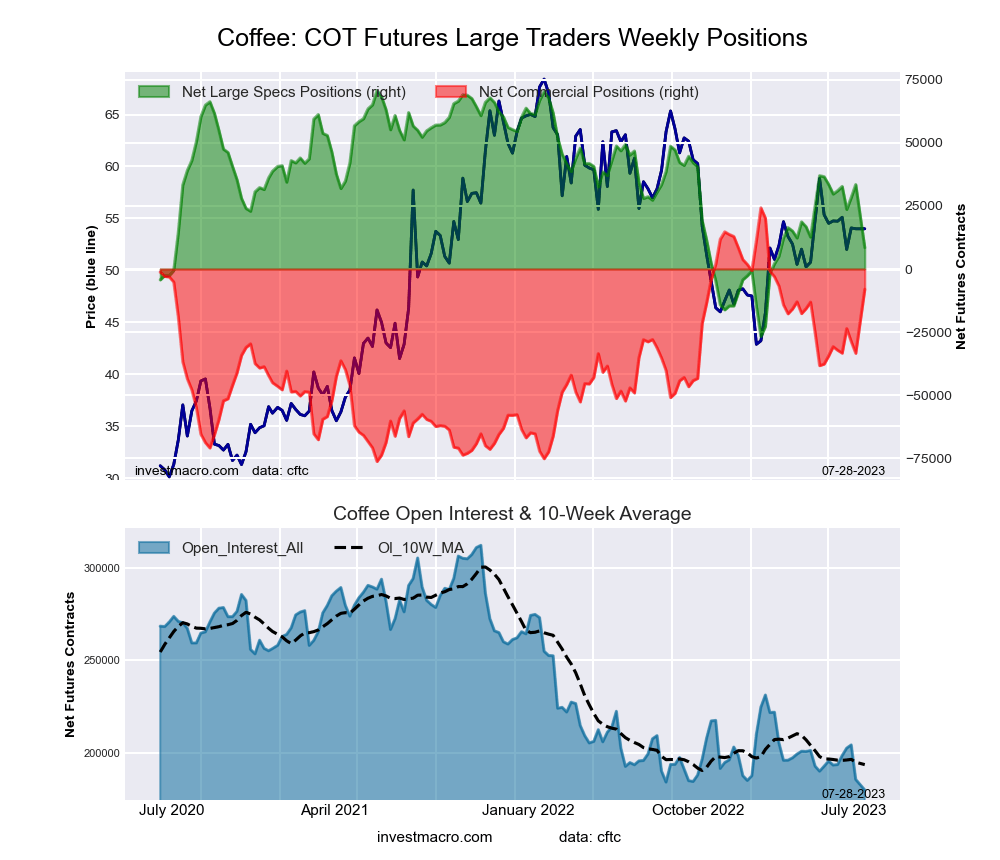
Coffee180,11838,49536-8,05268-4437
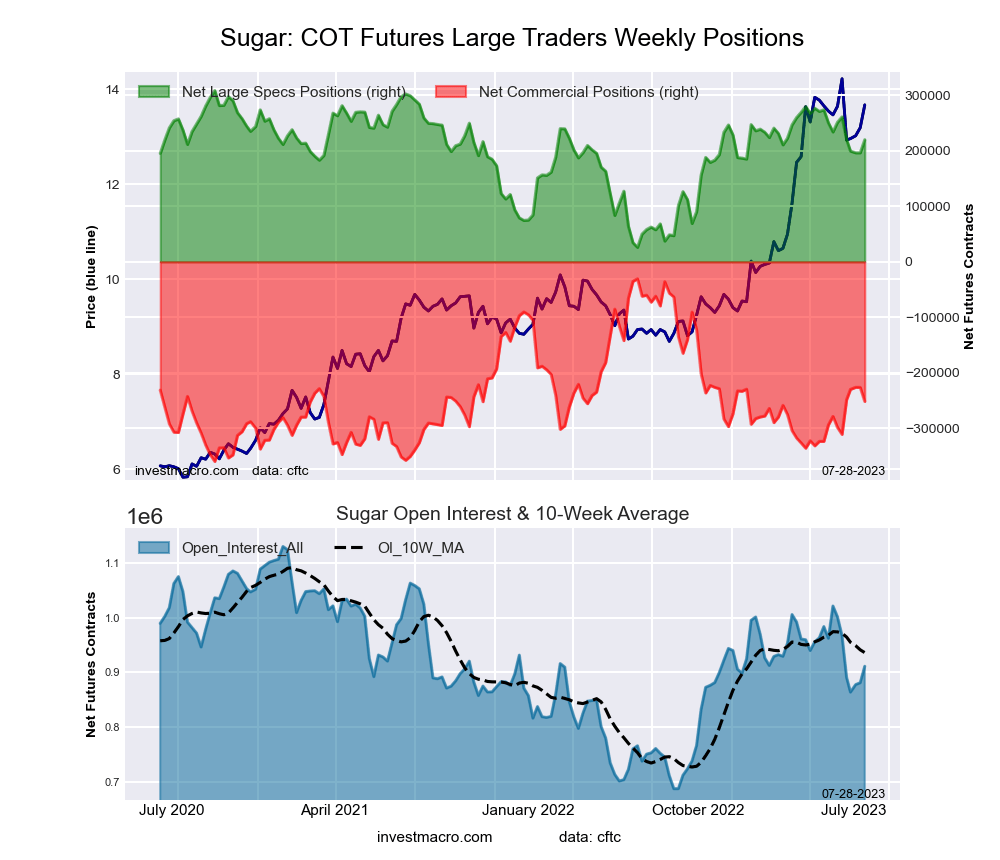
Sugar877,69543196,30460-226,0304129,72641
Wheat297,1467-40,4113845,50665-5,09556


Strength Scores

Strength Scores (a normalized measure of Speculator positions over a 3-Year range, from 0 to 100 where above 80 is extreme bullish and below 20 is extreme bearish) show that the Bloomberg Commodity Index (84.3 percent) and Heating Oil (79.0 percent) lead the energy close to the top of their respective ranges. Gasoline (41.9 percent) comes in as the next highest energy market in strength scores.

On the downside, WTI Crude Oil (8.5 percent) and Brent Crude Oil (17.7 percent) come in at the lowest strength scores currently and are in Extreme-Bearish levels (below 20 percent).

Strength Statistics:
WTI Crude Oil (8.5 percent) vs WTI Crude Oil previous week (0.7 percent)
Brent Crude Oil (17.7 percent) vs Brent Crude Oil previous week (34.0 percent)
Natural Gas (37.4 percent) vs Natural Gas previous week (32.6 percent)
Gasoline (41.9 percent) vs Gasoline previous week (29.7 percent)
Heating Oil (79.0 percent) vs Heating Oil previous week (78.4 percent)
Bloomberg Commodity Index (84.3 percent) vs Bloomberg Commodity Index previous week (83.9 percent)

Strength Trends

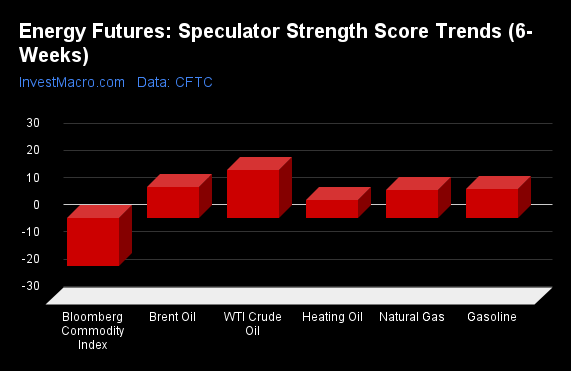
Strength Score Trends (or move index, calculates the 6-week changes in strength scores) show that Heating Oil (18.2 percent) leads the past six weeks trends for energy this week. Brent Crude Oil (10.5 percent), Gasoline (9.5 percent) and Natural Gas (7.7 percent) fill out the top movers in the latest trends data.

The Bloomberg Commodity Index (-15.0 percent) leads the downside trend scores currently.

Strength Trend Statistics:
WTI Crude Oil (2.6 percent) vs WTI Crude Oil previous week (-12.6 percent)
Brent Crude Oil (10.5 percent) vs Brent Crude Oil previous week (15.8 percent)
Natural Gas (7.7 percent) vs Natural Gas previous week (5.4 percent)
Gasoline (9.5 percent) vs Gasoline previous week (-2.1 percent)
Heating Oil (18.2 percent) vs Heating Oil previous week (35.1 percent)
Bloomberg Commodity Index (-15.0 percent) vs Bloomberg Commodity Index previous week (-15.3 percent)


Individual COT Market Charts:

WTI Crude Oil Futures:

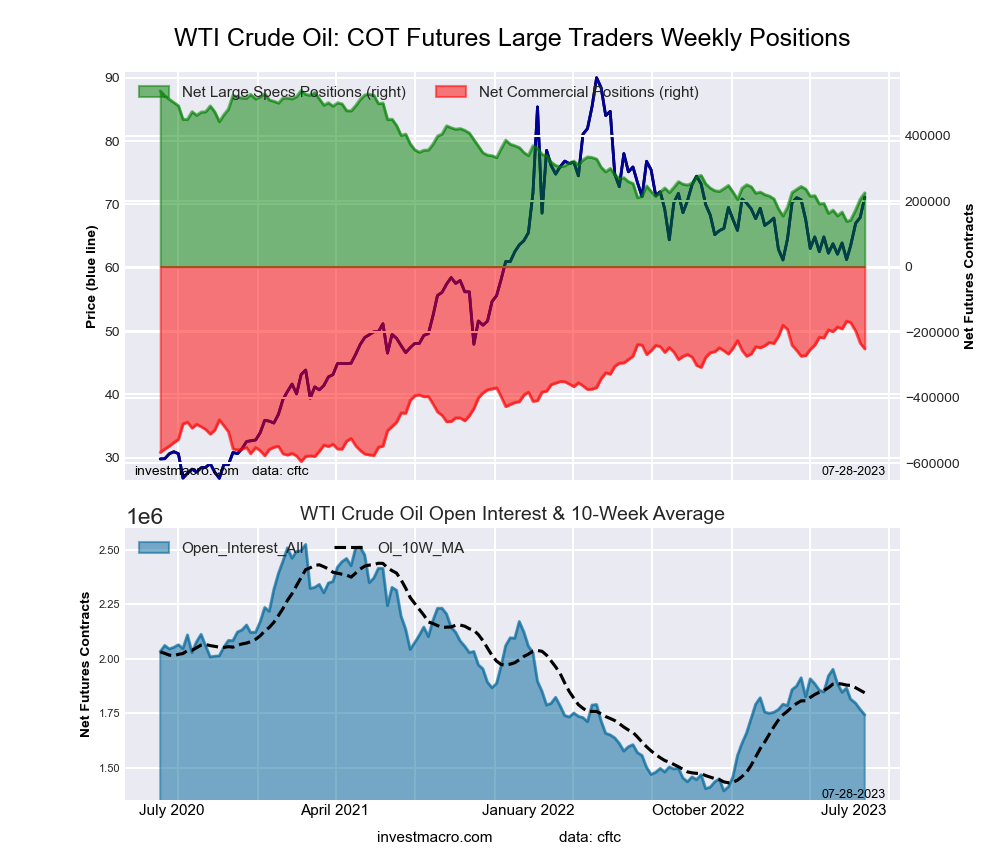
WTI Crude Oil Futures COT ChartThe WTI Crude Oil Futures large speculator standing this week reached a net position of 173,433 contracts in the data reported through Tuesday. This was a weekly increase of 32,004 contracts from the previous week which had a total of 141,429 net contracts.

This week’s current strength score (the trader positioning range over the past three years, measured from 0 to 100) shows the speculators are currently Bearish-Extreme with a score of 8.5 percent. The commercials are Bullish-Extreme with a score of 93.0 percent and the small traders (not shown in chart) are Bearish with a score of 25.5 percent.

Price Trend-Following Model: Weak Downtrend

Our weekly trend-following model classifies the current market price position as: Weak Downtrend. The current action for the model is considered to be: Hold – Maintain Short Position.

WTI Crude Oil Futures StatisticsSPECULATORSCOMMERCIALSSMALL TRADERS
– Percent of Open Interest Longs:18.939.05.0
– Percent of Open Interest Shorts:9.249.93.7
– Net Position:173,433-196,68823,255
– Gross Longs:339,297700,01989,390
– Gross Shorts:165,864896,70766,135
– Long to Short Ratio:2.0 to 10.8 to 11.4 to 1
NET POSITION TREND:
– Strength Index Score (3 Year Range Pct):8.593.025.5
– Strength Index Reading (3 Year Range):Bearish-ExtremeBullish-ExtremeBearish
NET POSITION MOVEMENT INDEX:
– 6-Week Change in Strength Index:2.6-0.9-14.1


Brent Crude Oil Futures:

Brent Last Day Crude Oil Futures COT ChartThe Brent Crude Oil Futures large speculator standing this week reached a net position of -48,031 contracts in the data reported through Tuesday. This was a weekly decline of -8,158 contracts from the previous week which had a total of -39,873 net contracts.

This week’s current strength score (the trader positioning range over the past three years, measured from 0 to 100) shows the speculators are currently Bearish-Extreme with a score of 17.7 percent. The commercials are Bullish-Extreme with a score of 87.4 percent and the small traders (not shown in chart) are Bearish with a score of 28.3 percent.

Price Trend-Following Model: Weak Downtrend

Our weekly trend-following model classifies the current market price position as: Weak Downtrend. The current action for the model is considered to be: Hold – Maintain Short Position.

Brent Crude Oil Futures StatisticsSPECULATORSCOMMERCIALSSMALL TRADERS
– Percent of Open Interest Longs:10.254.15.6
– Percent of Open Interest Shorts:45.819.54.5
– Net Position:-48,03146,6171,414
– Gross Longs:13,70472,8347,524
– Gross Shorts:61,73526,2176,110
– Long to Short Ratio:0.2 to 12.8 to 11.2 to 1
NET POSITION TREND:
– Strength Index Score (3 Year Range Pct):17.787.428.3
– Strength Index Reading (3 Year Range):Bearish-ExtremeBullish-ExtremeBearish
NET POSITION MOVEMENT INDEX:
– 6-Week Change in Strength Index:10.5-4.7-40.2


Natural Gas Futures:

Natural Gas Futures COT ChartThe Natural Gas Futures large speculator standing this week reached a net position of -86,755 contracts in the data reported through Tuesday. This was a weekly increase of 12,020 contracts from the previous week which had a total of -98,775 net contracts.

This week’s current strength score (the trader positioning range over the past three years, measured from 0 to 100) shows the speculators are currently Bearish with a score of 37.4 percent. The commercials are Bullish with a score of 61.5 percent and the small traders (not shown in chart) are Bullish with a score of 54.1 percent.

Price Trend-Following Model: Downtrend

Our weekly trend-following model classifies the current market price position as: Downtrend. The current action for the model is considered to be: Hold – Maintain Short Position.

Natural Gas Futures StatisticsSPECULATORSCOMMERCIALSSMALL TRADERS
– Percent of Open Interest Longs:20.439.25.7
– Percent of Open Interest Shorts:27.434.73.2
– Net Position:-86,75555,55431,201
– Gross Longs:251,784484,75870,705
– Gross Shorts:338,539429,20439,504
– Long to Short Ratio:0.7 to 11.1 to 11.8 to 1
NET POSITION TREND:
– Strength Index Score (3 Year Range Pct):37.461.554.1
– Strength Index Reading (3 Year Range):BearishBullishBullish
NET POSITION MOVEMENT INDEX:
– 6-Week Change in Strength Index:7.7-7.80.0


Gasoline Blendstock Futures:

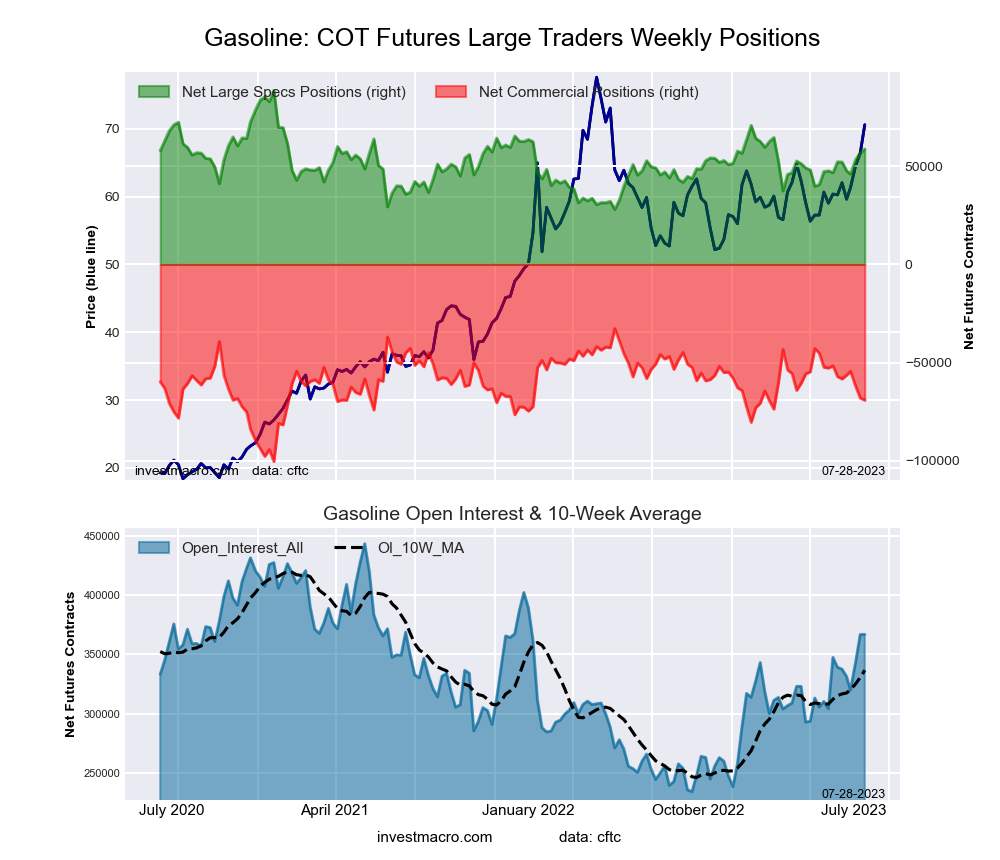
RBOB Gasoline Energy Futures COT ChartThe Gasoline Blendstock Futures large speculator standing this week reached a net position of 53,407 contracts in the data reported through Tuesday. This was a weekly increase of 7,393 contracts from the previous week which had a total of 46,014 net contracts.

This week’s current strength score (the trader positioning range over the past three years, measured from 0 to 100) shows the speculators are currently Bearish with a score of 41.9 percent. The commercials are Bullish with a score of 56.5 percent and the small traders (not shown in chart) are Bullish with a score of 71.1 percent.

Price Trend-Following Model: Strong Uptrend

Our weekly trend-following model classifies the current market price position as: Strong Uptrend. The current action for the model is considered to be: Hold – Maintain Long Position.

Nasdaq Mini Futures StatisticsSPECULATORSCOMMERCIALSSMALL TRADERS
– Percent of Open Interest Longs:27.844.46.8
– Percent of Open Interest Shorts:12.262.54.3
– Net Position:53,407-62,1648,757
– Gross Longs:95,389152,40723,514
– Gross Shorts:41,982214,57114,757
– Long to Short Ratio:2.3 to 10.7 to 11.6 to 1
NET POSITION TREND:
– Strength Index Score (3 Year Range Pct):41.956.571.1
– Strength Index Reading (3 Year Range):BearishBullishBullish
NET POSITION MOVEMENT INDEX:
– 6-Week Change in Strength Index:9.5-13.823.9


#2 Heating Oil NY-Harbor Futures:

NY Harbor Heating Oil Energy Futures COT ChartThe #2 Heating Oil NY-Harbor Futures large speculator standing this week reached a net position of 28,000 contracts in the data reported through Tuesday. This was a weekly lift of 301 contracts from the previous week which had a total of 27,699 net contracts.

This week’s current strength score (the trader positioning range over the past three years, measured from 0 to 100) shows the speculators are currently Bullish with a score of 79.0 percent. The commercials are Bearish with a score of 30.5 percent and the small traders (not shown in chart) are Bullish with a score of 66.7 percent.

Price Trend-Following Model: Weak Downtrend

Our weekly trend-following model classifies the current market price position as: Weak Downtrend. The current action for the model is considered to be: Hold – Maintain Short Position.

Heating Oil Futures StatisticsSPECULATORSCOMMERCIALSSMALL TRADERS
– Percent of Open Interest Longs:16.346.014.6
– Percent of Open Interest Shorts:7.660.98.5
– Net Position:28,000-47,72819,728
– Gross Longs:52,184147,07646,782
– Gross Shorts:24,184194,80427,054
– Long to Short Ratio:2.2 to 10.8 to 11.7 to 1
NET POSITION TREND:
– Strength Index Score (3 Year Range Pct):79.030.566.7
– Strength Index Reading (3 Year Range):BullishBearishBullish
NET POSITION MOVEMENT INDEX:
– 6-Week Change in Strength Index:18.2-39.552.4


Bloomberg Commodity Index Futures:

Bloomberg Commodity Index Futures COT ChartThe Bloomberg Commodity Index Futures large speculator standing this week reached a net position of -5,651 contracts in the data reported through Tuesday. This was a weekly gain of 95 contracts from the previous week which had a total of -5,746 net contracts.

This week’s current strength score (the trader positioning range over the past three years, measured from 0 to 100) shows the speculators are currently Bullish-Extreme with a score of 84.3 percent. The commercials are Bearish-Extreme with a score of 16.2 percent and the small traders (not shown in chart) are Bullish with a score of 54.1 percent.

Price Trend-Following Model: Weak Downtrend

Our weekly trend-following model classifies the current market price position as: Weak Downtrend. The current action for the model is considered to be: Hold – Maintain Short Position.

Bloomberg Index Futures StatisticsSPECULATORSCOMMERCIALSSMALL TRADERS
– Percent of Open Interest Longs:12.186.60.5
– Percent of Open Interest Shorts:22.276.70.2
– Net Position:-5,6515,508143
– Gross Longs:6,69848,079269
– Gross Shorts:12,34942,571126
– Long to Short Ratio:0.5 to 11.1 to 12.1 to 1
NET POSITION TREND:
– Strength Index Score (3 Year Range Pct):84.316.254.1
– Strength Index Reading (3 Year Range):Bullish-ExtremeBearish-ExtremeBullish
NET POSITION MOVEMENT INDEX:
– 6-Week Change in Strength Index:-15.015.1-0.8


Article By InvestMacroReceive our weekly COT Newsletter

*COT Report: The COT data, released weekly to the public each Friday, is updated through the most recent Tuesday (data is 3 days old) and shows a quick view of how large speculators or non-commercials (for-profit traders) were positioned in the futures markets.

The CFTC categorizes trader positions according to commercial hedgers (traders who use futures contracts for hedging as part of the business), non-commercials (large traders who speculate to realize trading profits) and nonreportable traders (usually small traders/speculators) as well as their open interest (contracts open in the market at time of reporting). See CFTC criteria here.

Global inflationary pressures continue to ease. The RBA will have a new governor

By JustMarkets

At yesterday’s stock market close, the Dow Jones Index (US30) increased by 0.14%, while the S&P 500 Index (US500) added 0.85%. The NASDAQ Technology Index (US100) closed positive by 1.58% on Thursday.

Factory inflation (PPI) in the US declined over the past month, another sign that overall inflationary pressures are cooling. But the labor market remains resilient, and this could be a trigger for the US Fed to raise rates even higher. The US jobless claims fell by 12,000 to 237,000 over the past week.

Federal Reserve Bank of San Francisco President Mary Daly said it was too early for policymakers to say they had done enough to bring US inflation back to target levels. The policymaker added that although the consumer price data released on Wednesday was “very positive,” she would take a “wait-and-see stance” as the Fed remains firmly committed to bringing inflation down to 2%.

Federal Reserve Bank of St. Louis President James Bullard, an influential US Fed official who called for aggressive interest rate hikes to combat the recent spike in inflation, has stepped down after 15 years in office. Bullard, 62, will step down completely on August 14 to become dean of the School of Business.

Equity markets in Europe were mostly up yesterday. Germany’s DAX (DE30) increased by 0.74%, France’s CAC 40 (FR40) gained 0.52%, Spain’s IBEX 35 (ES35) added 0.33%, and the UK’s FTSE 100 (UK100) closed up by 0.32%.

The ECB’s monetary policy report from its June meeting confirmed that the ECB still believes policy tightening is necessary. As a result, another 25bp rate hike in July is a done deal. For the ECB to stop after that, it needs to see a further improvement in inflation dynamics, a transmission of monetary tightening to the real economy, including the labor market, and a downward revision of inflation forecasts. Committee officials do not consider a decline in inflation to be a sufficient condition for ending the tightening cycle if a robust labor market and strong wage growth prevail at the same time.

Oil prices rose in Asian trading on Friday and traded near 10-week highs on prospects of supply cuts amid disruptions in Libya and Nigeria. Oil markets rose sharply this week, following a decline in the dollar, as softer-than-expected US inflation data spurred bets that the Federal Reserve is close to peaking interest rates. In addition, the Organization of the Petroleum Exporting Countries (OPEC) highlighted rising global oil demand in 2023 in its monthly report released on Thursday.

Asian markets traded higher on Thursday. Japan’s Nikkei 225 (JP225) increased by 1.00% for the day yesterday, China’s FTSE China A50 (CHA50) jumped by 1.58%, Hong Kong’s Hang Seng (HK50) was up by 2.81%, and Australia’s S&P/ASX 200 (AU200) closed positive by 1.08%. On Friday, most Asian stocks continued to rise, ending a positive week amid signs of slowing inflation in the US. Hong Kong’s Hang Seng Index had its best weekly performance, rising nearly 6% as big tech stocks benefited from bets that the Chinese government will loosen its grip on the country’s largest internet companies.

Singapore’s economy grew slightly more than expected in the second quarter. GDP grew by 0.3% in the latest quarter, with Singapore avoiding a technical recession after GDP contracted by 0.4% last quarter. Singapore’s export sector is suffering badly due to slowing demand in China, a major trading partner.

Philip Lowe will not be reappointed as governor of the Reserve Bank of Australia (RBA). Michelle Bullock will take over as RBA governor in September. Ms. Bullock has been deputy governor of the bank since April 2022, having served since 1985.

S&P 500 (F)(US500) 4,510.04 +37.88 (+0.85%)

Dow Jones (US30) 34,395.14 +47.71 (+0.14%)

DAX (DE40)  16,141.03 +118.03 (+0.74%)

FTSE 100 (UK100) 7,440.21 +24.10 (+0.32%)

USD Index  99.43 −0.85 (−0.85%)

Important events for today:
  • – US FOMC Member Waller Speaks at 01:45 (GMT+3);
  • – Japan Industrial Production (m/m) at 07:30 (GMT+3);
  • – Switzerland Producer Price Index (m/m) at 09:30 (GMT+3);
  • – Eurozone Trade Balance (m/m) at 12:00 (GMT+3);
  • – US Michigan Consumer Sentiment (m/m) at 17:00 (GMT+3).

By JustMarkets


This article reflects a personal opinion and should not be interpreted as an investment advice, and/or offer, and/or a persistent request for carrying out financial transactions, and/or a guarantee, and/or a forecast of future events.

Platinum’s May-June Selloff: When the “Fundamental” Chips Fall

In May, a “record supply deficit” should’ve sent platinum prices soaring. So much for the best laid “fundamental” plans.

By Elliott Wave International

If I had a nickel for every time someone asked me what value “fundamentals” serve in navigating financial markets, well… let’s just say I could’ve retired to the Poconos years ago.

And the short answer I give to this question hasn’t changed in 18 years; namely, none.

This can be hard to accept, considering how fundamental “fundamental” market analysis is for mainstream finance. Pick the equivalent “Wall Street” of the country you live in, ask any pundit on that particular “street,” and they’ll insist the main driver of market trends is the news circulating outside those markets. That includes anything from weather patterns, political unrest, earnings reports, and so on.

But the reason I and we as Elliott wave analysts take such a radical stance against the value of “fundamentals” is simple: These news events don’t occur in a vacuum. They’re filtered through the lens of human beings, and very rarely do those humans see eye-to-eye on what a certain event means for a market’s future.

Or whenever there is a consensus on how a certain event will affect prices, the market goes ahead and does the exact opposite of that consensus.

When you start paying attention to this pattern of markets ignoring the news that’s supposed to move them, you can’t un-see it.

What we as Elliott wave analysts do see, however, is that market trends are driven by investor psychology, which unfolds as measurable wave patterns directly on price charts.

A recent example of this comes from platinum. In May, the industrial metal used in everything from catalytic converters to AI medical technology made the front page of major news outlets from The New York Times to Fortune Magazine.

The word “platinum” was practically clickbait, after the Biden administration floated a long-held and longshot Hail Mary idea for the U.S. Treasury to mint a $1 trillion platinum coin to avert the crashing of the debt ceiling.

At the same time on the investment front, platinum bulls were handed the big blue whale of supportive “fundamentals” — not just low supply numbers amidst rising demand, but the lowest supply data on record care of rolling power outages in South Africa, the world’s largest supplier of mined platinum.

The white metal seemed to be prime for a red-hot rally. Wrote Reuters on May 2: “Platinum prices surge as speculators bet supply will run short… We think this is the first year of serial deficits in the platinum market.”

On May 16, Bullion Vault added: “Platinum Investment to Support $1000 Price on ‘Record Deficit.'”

“Fundamental” signs pointed in a straight line going up. Elliott wave signs, however, aimed to help investors and traders manage the risk of participating in the metal’s action.

On May 11, our Metals Pro Service showed this Elliott wave labeled price chart of platinum. There, our primary count was bullish, and called for “a new high.” But that wasn’t the end of our analysis. We then explained the exact steps price must take to confirm an uptrend. From Metals Pro Service:

“You would think it would’ve given us a new high, and yet price has fallen back to the low it achieved just hours ago. I’m going to stay bullish above the .382 retracement level. I’m not eager to call a top, but if it goes under the .382 retracement level of 1150, then the risk begins to become that a top is in place. I am inclined to call it a truncated fifth wave of wave 1 up.

The next day on May 12, platinum accelerated down, confirming that a truncated fifth wave top was in place. Metals Pro Service showed its newly updated chart and said:

“The outlook is bearish while price holds under its 0.382 retracement level. The farther price falls, the more likely it is that wave (a) of ii (circled) is underway.

And from there, platinum continued falling to a 4-month low on June 23.

Metals trading, as all markets, carries risk. And not all Elliott wave interpretations turn out to be accurate. But like this example shows, Elliott analysis does identify critical price levels to help manage the inherent risk.

“Fundamental” analysis can’t say the same.


The Elliott Wave Hotlist: See 5 top market picks — FREE

70+

That’s how many markets Elliott Wave International’s Pro Services cover for subscribers.

But, you might ask, why the “+”? Why not write the exact number?

Well, because month in and month out, Pro Services also look for special opportunities. Sometimes in markets they cover regularly, sometimes something totally wild and unexpected.

In other words, they go where the opportunity is.

And that’s exactly what you’re about to see.

FREE through July 14, the “Elliott Wave Hotlist” shows you 5 top opportunities straight from the desks of EWI’s Pro Services analysts.

See ALL the setups now at elliottwave.com >>

This article was syndicated by Elliott Wave International and was originally published under the headline Platinum’s May-June Selloff: When the “Fundamental” Chips Fall. EWI is the world’s largest market forecasting firm. Its staff of full-time analysts led by Chartered Market Technician Robert Prechter provides 24-hour-a-day market analysis to institutional and private investors around the world.

US inflation is falling sharply. China’s trade balance points to a slowing economy

By JustMarkets

Stock indices closed higher on Wednesday due to cooling inflation in the United States. The consumer price level fell from 4% to 3% (3.1% expected) on an annualized basis. Core inflation (excludes food and energy prices) fell from 5.3% to 4.8% (5.0% expected). The sharp drop in inflation caused the dollar to fall to a 15-month low. Dollar weakness led most risk currencies, gold, and stock indices to rally. At yesterday’s stock market close, the Dow Jones (US30) Index was up by 0.25%, and the S&P 500 Index (US500) increased by 0.74%. The NASDAQ Technology Index (US100) closed positive 1.15% on Wednesday.

The US Treasury yields also declined following a weak inflation reading, as the data combined with signs of a cooling labor market spurred bets that the Fed is likely to soften its hawkish stance in the coming months. The probability of a rate hike at the July West meeting is 92%, while the probability of a hike at the September and November meetings is 14% and 26%, respectively.

On Wednesday, the Bank of Canada raised the overnight interest rate by 25 basis points to 5.00% and also extended its projected timetable for lowering Canada’s inflation rate to its 2% target by mid-2025. The Bank of Canada left little guidance on the way forward. At the press conference, the Bank of Canada Governor indicated that the improvement in overall momentum was largely due to lower energy prices rather than underlying pressures, hinting that restrictive policies will be in place for longer.

Equity markets in Europe were predominantly up yesterday. Germany’s DAX (DE30) jumped by 1.47%, France’s CAC 40 (FR40) gained 1.57%, Spain’s IBEX 35 (ES35) added 1.37%, and the UK’s FTSE 100 (UK100) closed positive by 1.83%.

UK GDP showed no growth for the second quarter of 2023. On an annualized basis, the economy contracted by 0.4%. Manufacturing fell by 0.6% in May 2023 after falling by 0.2% in April 2023. The construction sector fell by 0.2% in May 2023 after falling by 0.9% in April 2023. Services output showed no growth in May 2023 after rising by 0.3% in April 2023. Overall, economic conditions continue to deteriorate, which could pose a challenge for the Bank of England to further fight inflation.

Gold rose sharply yesterday amid a falling dollar and government bond yields. There are good growth prospects for gold as the US Fed is at the end of its tightening cycle. At the same time, silver shows better performance among precious metals.

Asian markets mostly traded higher on Wednesday. Japan’s Nikkei 225 (JP225) decreased by 1.04% yesterday, China’s FTSE China A50 (CHA50) was up by 0.15%, Hong Kong’s Hang Seng (HK50) added 1.14%, and Australia’s S&P/ASX 200 (AU200) closed positive 0.81% for the day.

In Japan, conditions for rising inflation are emerging, which puts pressure on the Bank of Japan to abandon its multi-year soft monetary policy. Markets are already betting on the Bank of Japan’s policy adjustment, which is reflected in the strengthening of the Japanese yen.

Last month, China’s exports contracted at the fastest pace since the COVID-19 pandemic began. Exports contracted by 12.4% year-on-year in June after falling by 7.5% in May. Imports fell by 6.8%, which was stronger than the 4.0% decline expected and the 4.5% drop in the previous month. The data indicate that China’s economic recovery has slowed after a strong first quarter, and analysts are now downgrading their forecasts for the economy for the rest of the year as factory output slows amid continued weak global demand.

S&P 500 (F) (US500) 4,472.16 +32.90 (+0.74%)

Dow Jones (US30) 34,347.43 +86.01 (+0.25%)

DAX (DE40)  16,023.00 +232.66 (+1.47%)

FTSE 100 (UK100) 7,416.11 +133.59 (+1.83%)

USD Index  100.28 −1.08 (−1.07%)

Important events for today:
  • – China Trade Balance (m/m) at 06:00 (GMT+3);
  • – UK GDP (m/m) at 09:00 (GMT+3);
  • – UK Industrial Production (m/m) at 09:00 (GMT+3);
  • – UK Manufacturing Production (m/m) at 09:00 (GMT+3);
  • – UK Trade Balance (m/m) at 09:00 (GMT+3);
  • – Eurozone Industrial Production (m/m) at 12:00 (GMT+3);
  • – Eurozone ECB Monetary Policy Meeting Accounts at 14:30 (GMT+3);
  • – US Initial Jobless Claims (w/w) at 15:30 (GMT+3);
  • – US Producer Price Index (m/m) at 15:30 (GMT+3);
  • – US Natural Gas Storage (w/w) at 17:30 (GMT+3).

By JustMarkets


This article reflects a personal opinion and should not be interpreted as an investment advice, and/or offer, and/or a persistent request for carrying out financial transactions, and/or a guarantee, and/or a forecast of future events.

Two potential targets for WSt30m_index

By ForexTime 

  • WSt30_m index posted new 2023 intraday high on Wednesday
  • Markets cheered yesterday’s lower-than-expected US inflation data
  • JPMorgan and other big US banks to unofficially kick off US earnings season on Friday
  • WSt30_m bulls may next aim for 335374 and 36470, as long as risk-on sentiment holds


US stock markets cheered the US inflation data released yesterday (Wednesday, July 12th). The consumer price indexes out of the world’s largest economy came in below market expectations.

Such data has raised hopes that the Fed will soon call time on its rate hikes that began over a year ago, and the thought of peak US rates being close at hand was a cause for rejoicing for risk assets.

The WSt30_m index, which tracks the benchmark Dow Jones Industrial average index, joined in Wednesday’s party by posting its highest intraday price so far this year.


However, traders and investors will be bracing for another key event ahead.

Tomorrow (Friday, July 14th), the US earnings season will unofficially kick off with the latest quarterly financial results out of Wall Street banking titans, namely JPMorgan, Citigroup, and Wells Fargo.

Note that JPMorgan alone comprises almost 3% of the Dow Jones Industrial Average index (tracked by WSt30_m).

And the Dow index contains two banking heavyweights in the form of JPMorgan and also Goldman Sachs, which combined account for 9.1% of the benchmark index which tracks 30 industry leaders within the US economy.

With all that in mind, the WSt30_m index is set to be heavily influenced by how markets react to the latest earnings results out of JPMorgan and its peers over the coming days.


Looking at the price charts …

The WSt30_m index has been oscillating between a weekly support and resistance level since the beginning of June.

The battle between the bulls and bears has not been decided yet, but the bulls seem poised for a retest of the weekly resistance level that happened on 12 July.  

This possible scenario is confirmed by the fact that the price is above the 15 and 34 Simple Moving Average with the Momentum Oscillator adding its weight as well when it broke above the 100-base line into bullish terrain.

If the bulls can drive the price above the weekly resistance level and specifically a critical resistance that formed on 12 July at 34627, then two possible targets become possible from there.


Potential opportunities

Attaching the Fibonacci tool to the top 34627 and dragging it to a bottom that formed on 26 June at 33631, the following potential targets can be established:

  • Potential Target 1: 335374
    (situated just before a weekly resistance level at 35569).
  • Potential Target 2: 36470
    (just before another weekly resistance level at 36667)

If the support level at 33631 is broken, this scenario is no longer valid and must be reassessed.

As long as bulls can keep up the momentum with demand overcoming supply, the market outlook for the WSt30_m index on the Daily time frame should have bullish potential.


Forex-Time-LogoArticle by ForexTime
ForexTime Ltd (FXTM) is an award winning international online forex broker regulated by CySEC 185/12 www.forextime.com
The cryptocurrency market digest (BTC, SOL). Overview for 12.07.2023

By RoboForex.com

The BTC quotes on Wednesday rose to 30,575 USD.

The flagship cryptocurrency has not yet used either seasonal cycles that favour a price increase or support from the US stock market. Investors seemingly save power for future purchases. However, the longer this pause drags on, the more chances there are for a price slump.

The resistance levels remain the same: 30,800 USD and 31,150 USD. The support level is still at 29,800 USD.

Today the market will keep an eye on the US inflation statistics for June. The decision of the US Federal Reserve on the interest rate at the meeting in July depends on these data.

The cryptocurrency market capitalisation has risen to 1.190 trillion USD. The BTC share has increased to 50.0%, while the ETH share remains at 19.0%.

New York State Attorney is searching out the FTX co-founder

New York State Attorney is looking into the whereabouts of the FTX cryptocurrency exchange co-founder. The reason is possible violations of the election campaign financing legislation in the US.

SOL might reverse upwards

The technical picture of the SOL token demonstrates a breakout of the short-term and the long-term resistance levels. The coin dropped to the low on 10 June this year. After that, the price entered an ascending channel, where it has stayed since. Market participants think that a bullish trend is forming there.

Article By RoboForex.com

Attention!
Forecasts presented in this section only reflect the author’s private opinion and should not be considered as guidance for trading. RoboForex LP bears no responsibility for trading results based on trading recommendations described in these analytical reviews.

US CPI: Fed will raise rates this month despite cooler than expected inflation

By George Prior

The US Federal Reserve won’t be swayed and will raise interest rates this month despite inflation coming in cooler than expected, says the CEO and founder of one of the world’s largest independent financial advisory, asset management and fintech organizations.

Nigel Green of deVere Group’s warning comes as the latest US CPI comes in lighter than economists predicted.

He says: “Despite the data showing that the battle against inflation in the world’s largest economy is being won, we expect the Federal Reserve will resume its interest rate hiking agenda this month.

“The central banks’ officials will argue that there is still work to be done to tame inflation and they are unlikely to be dissuaded from their course of action for the time being.
“While we believe that the Fed will raise rates in July, there is now less justification for further hikes later this year.”
The deVere CEO is urging the US central bank not to raise interest rates past July.

“Investors are increasingly concerned that the Federal Reserve could with further hikes overtighten and that would steer the US economy into a major recession.

“The central bank must also ensure the broader picture is maintained and not be too cautious by overdoing the hikes, which would trigger the US recession deeper and longer.

“As the world’s largest economy, this would clearly have a serious, negative impact on the global economy.

“The most aggressive tightening campaign in decades is not quite finished – but the tide could be turning.

“Against this backdrop, a good fund manager will help you pick out the winners and losers to help you sidestep the risks to your wealth and seize the opportunities to build it for the long-term.”

About:

deVere Group is one of the world’s largest independent advisors of specialist global financial solutions to international, local mass affluent, and high-net-worth clients.  It has a network of more than 70 offices across the world, over 80,000 clients and $12bn under advisement.