Archive for Financial News – Page 163

The inflow of funds into global funds indicates that investors expect further growth of indices

By JustMarkets

At the close of the stock market on Friday, the Dow Jones Index (US30) increased by 0.33% (+1.22% for the week), while the S&P 500 Index (US500) added 0.06% (+1.10% for the week). The NASDAQ Technology Index (US100) closed Friday negative by 0.11% (+1.06% for the week).

Economic news from the US had a negative impact on the dollar on Friday after S&P reported that activity in the US manufacturing sector contracted more than expected in November, but activity in the service sector increased more than expected in November. The S&P US Manufacturing PMI for November fell by 0.6 to 49.4, weaker than expectations of 49.9. However, the Services PMI for November unexpectedly rose by 0.2 to a 4-month high of 50.8, which was better than expectations of a decline to 50.3. The dollar’s 0.52% decline provided indirect support for the stock. But Nvidia’s (NVDA) drop on Friday had a negative impact on the broad technology sector. The company told customers in China that it is delaying the launch of a new artificial intelligence chip until the first quarter of next year. Apple’s stock price also fell by nearly 1% after Counterpoint Research data showed that iPhone sales in China from October 30 to November 12 fell by 4% from a year ago.

Bank of America said EPFR Global data showed inflows into global equity funds totaled about $49 billion in the two weeks through November 21, the largest in 2 years. This suggests that hedge funds and investors continue to invest in the market with the expectation that the rally will continue into December.

Equity markets in Europe were mostly up on Friday. The German DAX (DE40) gained 0.22% (+0.72% for the week), the French CAC 40 (FR40) gained 0.20% (+0.70% for the week), the Spanish IBEX 35 (ES35) jumped by 0.42% (+1.91% for the week), the British FTSE 100 (UK100) closed positive by 0.06% (-0.21% for the week). European indices were supported by a rally in the Euro Stoxx 50 to a 3-month high after ECB President Lagarde said ECB policymakers may suspend the policy tightening campaign. ECB President Lagarde said on Friday that the central bank has already done enough, and the ECB is now at a stage where it can pause and assess the consequences of tightening its policy. ECB Governing Council spokesman Villeroy de Gallo also complemented Lagarde, saying, “Excluding surprises, I don’t think the ECB will raise interest rates again.”

British consumers have become more optimistic about the outlook for the economy and their personal finances this month, but their sentiment remains far from pre-crisis levels. GfK’s benchmark consumer confidence index rose to minus 24 in November from October’s three-month low of minus 30.

Gulf stock markets ended Sunday lower amid Friday’s drop in oil prices, although Saudi Arabia’s index was ahead of the trend. Oil, a catalyst for Gulf financial markets, fell on Friday as the release of some hostages in Gaza reduced geopolitical risk in the Middle East. OPEC+ countries moved closer to a compromise with African oil producers on production levels for 2024 after disagreements over those targets forced the oil-producing group to postpone a key meeting. The market also expects Saudi Arabia to extend an additional voluntary production cut of 1 million bpd that expires at the end of December.

Asian markets were mostly down last week. Japan’s Nikkei 225 (JP225) gained 0.84% for the week, China’s FTSE China A50 (CHA50) declined by 0.65% over 5 trading days, Hong Kong’s Hang Seng (HK50) ended the week down by 0.38%, and Australia’s ASX 200 (AU200) ended the week negative by 0.12%. On Monday, most Asian stocks fell on weak cues from China. Recent data showed that China’s largest economic engine remains under pressure, leading investors to become impatient for more stimulus measures from Beijing.

Friday’s consumer price news in Japan showed that price pressures remain above the Bank of Japan’s 2.0% target level, which could prompt the central bank to exit ultra-soft monetary policy sooner than expected. Activity in Japan’s manufacturing sector contracted this month at the sharpest pace in 9 months, dovish for BoJ policy. Japan’s index of leading indicators for September was revised upward by 0.2 to 108.9 from the previously announced reading of 108.7. Jibun Bank’s PMI for Japan’s manufacturing sector for November fell by 0.6 to 48.1, the sharpest contraction in 9 months.

S&P 500 (US500) 4,559.34 +2.72 (+0.06%)

Dow Jones (US30) 35,390.15 +117.12 (+0.33%)

DAX (DE40) 16,029.49 +34.76 (+0.22%)

FTSE 100 (UK100) 7,488.20 +4.62 (+0.06%)

USD index  103.42 −0.51 (−0.49%)

News feed for 2023.11.27:
  • – US Building Permits (m/m) at 15:00 (GMT+2);
  • – Eurozone ECB President Lagarde Speaks (m/m) at 16:00 (GMT+2);
  • – US New Home Sales (m/m) at 17:00 (GMT+2).

By JustMarkets


This article reflects a personal opinion and should not be interpreted as an investment advice, and/or offer, and/or a persistent request for carrying out financial transactions, and/or a guarantee, and/or a forecast of future events.

The USD Experiences a Downturn as EUR/USD Rises

By RoboForex Analytical Department

The EUR/USD currency pair saw an uptick, reaching 1.0944 at the onset of the final week of November. This movement indicates a weakening of the US dollar against the Euro.

Key to this shift is the upcoming release of the Core Personal Consumption Expenditures (PCE) Price Index, a crucial measure watched closely by the US Federal Reserve. The Core PCE index, reflecting the primary personal spending of US citizens, is a significant indicator for the Federal Reserve in shaping its credit and monetary policies. The index had previously shown a 0.3% month-over-month increase, but expectations for October point to a potential slowdown to a 0.2% rise.

A slowdown in inflation, as indicated by the Core PCE index, could lead to a softer stance from the Federal Reserve regarding interest rate hikes. This prospect could further contribute to the weakening of the US dollar. From a broader perspective, a decrease in inflation is generally viewed positively for the economy, as it eases financial pressures on consumers and businesses.

Technical Analysis of the EUR/USD Currency Pair

In the H4 chart of the EUR/USD pair, a consolidation pattern around 1.0940 has emerged, suggesting a potential breakout. The analysis predicts an upward move to 1.0990, followed by a possible pullback to 1.0940, and then another rise to 1.1030. This bullish outlook is supported by the Moving Average Convergence Divergence (MACD) indicator, which shows its signal line above zero and oriented upwards.

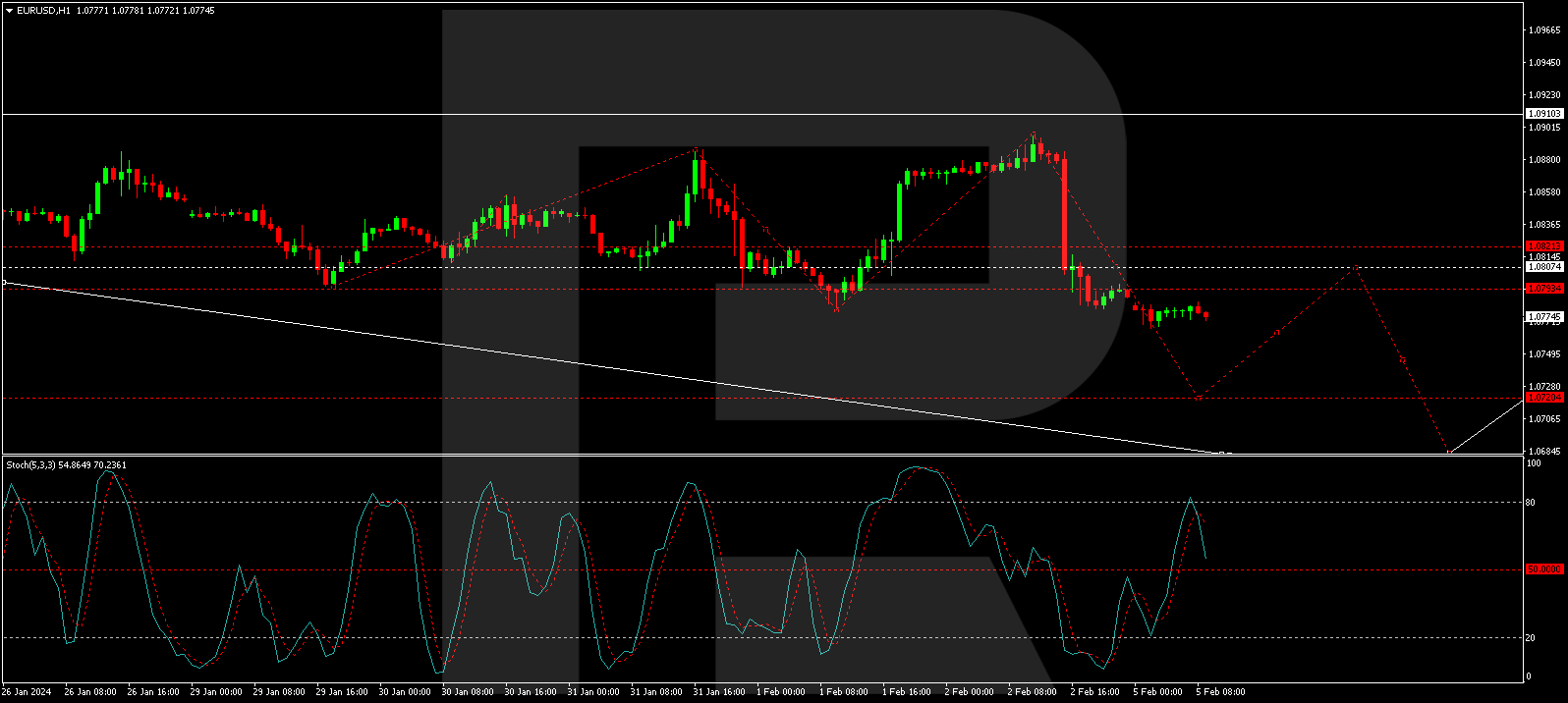
Similarly, the H1 chart for the EUR/USD pair displays a narrow consolidation around 1.0940. The market is anticipated to break upwards from this range, possibly reaching a local target of 1.0990. Upon hitting this level, a correction back to 1.0940 is expected. The Stochastic oscillator, with its signal line currently above 80, suggests the potential for a downward adjustment towards 50, supporting this forecast.

Disclaimer

Any forecasts contained herein are based on the author’s particular opinion. This analysis may not be treated as trading advice. RoboForex bears no responsibility for trading results based on trading recommendations and reviews contained herein.

China attractive in 2024 as Beijing becomes more proactive on property?

By George Prior 

China will be a more attractive investment destination for global investors in 2024 despite the economic warning signs, predicts the CEO and founder of one of the world’s largest independent financial advisory, asset management and fintech organizations.

The bullish predictions from Nigel Green of deVere Group come as Beijing on Thursday confirmed additional financial support for China’s beleaguered property market and developers, including hard-hit Country Garden.

Shenzhen, China’s main industrial hub, has also unveiled new homebuying measures to further support the critical market.

It also comes as Reuters exclusively reports that government advisors are to recommend 2024 growth targets of 4.5-5.5%.

The deVere CEO says: “The marked slowdown of the world’s second-largest economy, home to 1.4 billion people, has been a huge international narrative for the last two years.

“China’s share of the global economy has dropped by 1.4% in this period – the largest drop since the 1960s.

“This matters for not only China but the rest of the world as it’s the largest trading partner of 140 countries and regions globally.”

Much of the focus has been on the downturn of the country’s property market, which makes up a considerable proportion of the economy, and the demographic and unemployment challenges that the economy faces.

But the economic red flags are beginning to flash less brightly say some experts and this will not go unnoticed by global investors.

“The property sector’s drag on China GDP has shrunk from 4% in 2022 to currently less than 2%,” says Nigel Green.

“In addition, Beijing’s further support of the market announced on Thursday shows it is committed to contributing to stability, boosting liquidity, preventing systemic risks, and avoiding contagion.

“Against this backdrop of the government’s increasingly proactive policies, such as stimulus measures and targeted reforms, it is likely that China will again become a more attractive destination for global investors.”

There are other ‘pull factors’ involved too which are expected to be zoomed in upon next year.

“Investors, including multinationals, have shunned the world’s second-largest economy in the last couple of years, but this could change again as the fundamentals come back into focus,” notes the deVere CEO.

“China is transitioning from an export economy to a consumption one that, ultimately, will be more sustainable. Indeed, the country’s burgeoning middle class could create the largest consumption market in the world in the next decade.

“As China moves up the value chain, it is directly acquiring more and more foreign brands, market networks and technologies that will further strengthen its position for global investors.”

He continues: “There’s still enormous potential for infrastructure growth, as its urbanization strategy is still in its infancy and the scope is massive.

“Plus, the reform of state-owned companies could blow apart monopolies and create major investment opportunities.”

The deVere Group chief executive also stresses that China is the world leader in sectors of “the fourth industrial revolution, including clean energy, electric vehicles and industrial robots.”

The Chinese government’s debt could also be noted as a positive. China’s debt to GDP ratio is about 110%, compared to the Japanese and US governments which are around 260% and 120%, respectively.

“China continues to face serious challenges, but the economic woes are starting to look less stark than they have over the last two years as Beijing appears to be becoming increasingly proactive on the essential property sector.

“This is likely to draw the attention of investors in 2024,” concludes Nigel Green.

About:

deVere Group is one of the world’s largest independent advisors of specialist global financial solutions to international, local mass affluent, and high-net-worth clients.  It has a network of more than 70 offices across the world, over 80,000 clients and $12bn under advisement.

Oil Producer Adds Reserves and Exploration Upside Across Africa

Source: Stephane Foucaud  (11/17/23)

Stephane Foucaud at Auctus Advisors sees over 90% upside for Panoro Energy based on increased reserves, new exploration potential, and improving fundamentals.

Norway-based Panoro Energy ASA (PEN:OSE; 1PZ:FRA) provided an operational update highlighting increased reserves and new exploration upside across its African oil assets, noted Auctus Advisors in a November 17 research report.

Analyst Stephane Foucaud reiterated a Buy rating and NOK$50 price target on Panoro Energy.

Expanded Resource Estimates in Gabon

According to Foucaud, the operator of Panoro’s Dussafu permit offshore Gabon now estimates 10 million barrels of oil in place above initial expectations, adding 4-5 million barrels of recoverable resources.

This is in addition to the recent 6-7 million barrel discovery at Hibiscus South, both driving increased reserve potential.

New Exploration Prospects Identified

Panoro also plans to drill the 29 million barrel Bourdon exploration prospect on the Dussafu permit. The company sees further upside at its Ceiba field in Equatorial Guinea and added the Akeng Deep prospect.

The analyst believes these opportunities, along with expanded reserves, support his unchanged valuation.

Production Impacted by Temporary Issues

While Panoro produced 10,000 barrels per day in Q3, exceeding estimates, short-term electrical submersible pump (ESP) problems temporarily impacted the Dussafu wells.

This will defer some production to late 2023 and early 2024 before new wells boost output.

Significant Upside Based on Improving Fundamentals

Auctus’ NOK$50 price target implies over 90% upside potential for Panoro Energy. The firm’s valuation is based on increasing reserves, new exploration prospects, and attractive EV/DACF multiples.

In summary, the analyst sees the company’s expanded resources and lower leverage supporting significant share price appreciation.


Important Disclosures:

  1. The article does not constitute investment advice. Each reader is encouraged to consult with his or her individual financial professional and any action a reader takes as a result of information presented here is his or her own responsibility. By opening this page, each reader accepts and agrees to Streetwise Reports’ terms of use and full legal disclaimer. This article is not a solicitation for investment. Streetwise Reports does not render general or specific investment advice and the information on Streetwise Reports should not be considered a recommendation to buy or sell any security. Streetwise Reports does not endorse or recommend the business, products, services or securities of any company mentioned on Streetwise Reports.

For additional disclosures, please click here.

Disclosures for Auctus Advisors, Panoro Energy ASA, November 17, 2023

Panoro Energy ASA (“Panoro” or the “Company”) is a corporate client of Auctus Advisors LLP (“Auctus”). Auctus receives, and has received in the past 12 months, compensation for providing corporate broking and/or investment banking services to the Company, including the publication and dissemination of marketing material from time to time.

MiFID II Disclosures This document, being paid for by a corporate issuer, is believed by Auctus to be an ‘acceptable minor non-monetary benefit’ as set out in Article 12 (3) of the Commission Delegated Act C(2016) 2031 which is part of UK law by virtue of the European Union (Withdrawal) Act 2018. It is produced solely in support of our corporate broking and corporate finance business. Auctus does not offer a secondary execution service in the UK. This note is a marketing communication and NOT independent research. As such, it has not been prepared in accordance with legal requirements designed to promote the independence of investment research and this note is NOT subject to the prohibition on dealing ahead of the dissemination of investment research.

Author The research analyst who prepared this research report was Stephane Foucaud, a partner of Auctus.

Not an offer to buy or sell Under no circumstances is this note to be construed to be an offer to buy or sell or deal in any security and/or derivative instruments. It is not an initiation or an inducement to engage in investment activity under section 21 of the Financial Services and Markets Act 2000.

Note prepared in good faith and in reliance on publicly available information Comments made in this note have been arrived at in good faith and are based, at least in part, on current public information that Auctus considers reliable, but which it does not represent to be accurate or complete, and it should not be relied on as such. The information, opinions, forecasts and estimates contained in this document are current as of the date of this document and are subject to change without prior notification. No representation or warranty either actual or implied is made as to the accuracy, precision, completeness or correctness of the statements, opinions and judgements contained in this document.

Auctus’ and related interests The persons who produced this note may be partners, employees and/or associates of Auctus. Auctus and/or its employees and/or partners and associates may or may not hold shares, warrants, options, other derivative instruments or other financial interests in the Company and reserve the right to acquire, hold or dispose of such positions in the future and without prior notification to the Company or any other person.

Information purposes only This document is intended to be for background information purposes only and should be treated as such. This note is furnished on the basis and understanding that Auctus is under no responsibility or liability whatsoever in respect thereof, whether to the Company or any other person.

Investment Risk Warning The value of any potential investment made in relation to companies mentioned in this document may rise or fall and sums realised may be less than those originally invested. Any reference to past performance should not be construed as being a guide to future performance. Investment in small companies, and especially upstream oil & gas companies, carries a high degree of risk and investment in the companies or commodities mentioned in this document may be affected by related currency variations. Changes in the pricing of related currencies and or commodities mentioned in this document may have an adverse effect on the value, price or income of the investment.

Distribution This document is directed at persons having professional experience in matters relating to investments to whom Article 19 of the Financial Services and Markets Act 2000 (Financial Promotion) Order 2005 (“FPO”) applies, or high net worth organisations to whom Article 49 of the FPO applies. The investment or investment activity to which this communication relates is available only to such persons and other persons to whom this communication may lawfully be made (“relevant persons”) and will be engaged in only with such persons. This Document must not be acted upon or relied upon by persons who are not relevant persons. Without limiting the foregoing, this note may not be distributed to any persons (or groups of persons), to whom such distribution would contravene the UK Financial Services and Markets Act 2000 or would constitute a contravention of the corresponding statute or statutory instrument in any other jurisdiction.

Disclaimer This note has been forwarded to you solely for information purposes only and should not be considered as an offer or solicitation of an offer to sell, buy or subscribe to any securities or any derivative instrument or any other rights pertaining thereto (“financial instruments”). This note is intended for use by professional and business investors only. This note may not be reproduced without the prior written consent of Auctus. The information and opinions expressed in this note have been compiled from sources believed to be reliable but, neither Auctus, nor any of its partners, officers, or employees accept liability from any loss arising from the use hereof or makes any representations as to its accuracy and completeness. Any opinions, forecasts or estimates herein constitute a judgement as at the date of this note. There can be no assurance that future results or events will be consistent with any such opinions, forecasts or estimates. Past performance should not be taken as an indication or guarantee of future performance, and no representation or warranty, express or implied is made regarding future performance. This information is subject to change without notice, its accuracy is not guaranteed, it may be incomplete or condensed and it may not contain all material information concerning the company and its subsidiaries. Auctus is not agreeing to nor is it required to update the opinions, forecasts or estimates contained herein. The value of any securities or financial instruments mentioned in this note can fall as well as rise. Foreign currency denominated securities and financial instruments are subject to fluctuations in exchange rates that may have a positive or adverse effect on the value, price or income of such securities or financial instruments. Certain transactions, including those involving futures, options and other derivative instruments, can give rise to substantial risk and are not suitable for all investors. This note does not have regard to the specific instrument objectives, financial situation and the particular needs of any specific person who may receive this note. Auctus (or its partners, officers or employees) may, to the extent permitted by law, own or have a position in the securities or financial instruments (including derivative instruments or any other rights pertaining thereto) of the Company or any related or other company referred to herein, and may add to or dispose of any such position or may make a market or act as principle in any transaction in such securities or financial instruments. Partners of Auctus may also be directors of the Company or any other of the companies mentioned in this note. Auctus may, from time to time, provide or solicit investment banking or other financial services to, for or from the Company or any other company referred to herein. Auctus (or its partners, officers or employees) may, to the extent permitted by law, act upon or use the information or opinions presented herein, or research or analysis on which they are based prior to the material being published.

Further Disclosures for the United Kingdom This note has been issued by Auctus Advisors LLP, which is authorised and regulated by the Financial Conduct Authority. This note is not intended for use by, or distribution to, US corporations that do not meet the definition of a major US institutional investor in the United States or for use by any citizen or resident of the United States. This publication is confidential and may not be reproduced in whole or in part or disclosed to another party, without the prior written consent of Auctus. Securities referred to in this note may not be eligible for sale in those jurisdictions where Auctus is not authorised or permitted by local law to do so. In particular, Auctus does not permit the distribution or redistribution of this note to non-professional investors or other persons to whom disclosure would contravene local securities laws. Auctus expressly disclaims and will not be held responsible in any way, for third parties who affect such redistribution. © Auctus Advisors LLP All rights reserved 2023.

The election of Javier Milei and the challenges of an impoverished Argentina

By Matheus de Oliveira Pereira, Universidade Estadual Paulista (Unesp) 

In December 2001, Argentina experienced one of the most dramatic moments in its history. The collapse of convertibility – the monetary stabilisation plan that established parity between the dollar and the peso – brought tens of thousands of people onto the streets to protest against the government’s confiscation of their money, the “corralito”.

In an already historic moment, then-President Fernando de la Rúa fled the Casa Rosada in a helicopter after resigning, to the disbelief of the demonstrators occupying Plaza de Mayo.

Almost 22 years later, the Argentinian population seems to have finally found a figure who could effectively express the “let them all go” slogan that marked that December.

Javier Milei, a far-right economist and founder of the La Libertad Avanza (LLA) party, was elected president of Argentina by defeating Peronist Sergio Massa in the second round held last Sunday.

The more than ten-point lead between Milei and Massa once again called into question the credibility of the polling institutes, which had been predicting a tight race defined by narrow margins. However, there were signs this picture was wrong since the first round. In the first round of voting in October, the sum of the votes given to Milei and Patrícia Bullrich already exceeded Massa’s vote by around 15%.

Victory in 20 of the country’s 23 provinces

In the end, Milei managed to retain more than 80% of Bullrich’s votes and expanded his electoral base by more than 324,000 votes compared to the right-wing’s performance in the first round. The result was a resounding victory, with Milei beating Massa in 20 of the country’s 23 provinces, as well as the federal capital, Buenos Aires. In traditional anti-Peronist strongholds, such as Mendoza, the difference was over 40%, but Milei won in five of the eight provinces currently governed by Peronism.

Understanding the reasons behind this situation is an endeavour that will last for some years. In a preliminary analysis, the results can be read as the expected end of an atypical electoral cycle in which a society punished by a decade of economic stagnation and various failed stabilisation plans decided to punish the traditional political forces. In other words, faced with the rejection of known formulas, the unknown was embraced.

The striking fact is that this discontent has found its main representative in Javier Milei. Milei is an aggressive figure, visibly unprepared, without firm social foundations and who has become known more for idiosyncrasies than for the defence of a project or a track record in politics.

Extreme and rabid campaigning

Milei ran a campaign in his image and likeness: histrionic, extreme and angry, symbolised by the chainsaw with which he sought – metaphorically, one hopes – to destroy the “caste”, the expression by which he referred to the country’s politicians. To this, he added half a dozen slogans (“dollarisation”, “freedom”, “end the Central Bank”), about which little explanation was given, and built the successful campaign that took him to the Casa Rosada.

Understanding this phenomenon requires consideration of transformations underway in Argentine society, ranging from the changes wrought by communication in the internet age to the advance of job insecurity and the marginalisation of large parts of the population from markets and formal state protection networks.

In this sense, it must be recognised that Milei has shown a greater ability to read the current situation than his opponents. He understood that fatigue with the government would not be represented in gradual formulas, as proposed by the coalition Juntos por el Cambio, and made room for accepting a shock therapy proposal.

In this respect, the proposal to dollarise the economy proved a smart electoral move, as it won over younger voters, who have no memory of the collapse of the 1990s and feel the direct impact of a stagnant economy just as they enter the labour market.

Whilst it is necessary to broaden the effort to understand the roots of this result, it is also necessary to reflect on its implications moving forward.

‘Change needs to be drastic, with no middle ground’

Milei himself seems to be aware that his agenda is less feasible than he made it out to be during the campaign. During his victory speech, Milei made no reference to dollarisation or the abolition of the Central Bank, but he made it clear the path he intends to follow is one of shock therapy. He stated: “The changes we need are drastic. There is no room for gradualism, there is no room for middle ground.”

Implementing this shock agenda represents a politically very complex operation. Passing laws and projects that require a qualified majority will require agreements with sectors of Peronism, but the challenge doesn’t end there. The adoption of shock therapy tends to produce very costly effects in terms of employment and income, which could unleash waves of protests that could jeopardise the country’s already difficult governability.

In this context, Milei’s political sustainability will depend on building a network of support that goes beyond votes in the House and Senate and makes a name for itself on the streets.

Will Milei be restrained?

To what extent Milei will be able to make these articulations without losing his anti-system legitimacy is unknown.

Another open question, and a potentially more serious one, concerns the impact of Milei’s presidency on Argentina’s democratic institutions. At the moment, there seems to be an expectation in the country’s traditional circles that the president-elect will be moderate, restrained by the weight of the office, and that his virulent tone is more a candidate’s speech than an expression of temperament.

However, one of the lessons to be learned from the experiences of Donald Trump and Jair Bolsonaro in Brazil is that expectations of moderation are frustrated by far-right politicians. The notion that the Republican Party or the armed forces would contain Trump and Bolsonaro, respectively, was not only wrong, but what we saw was a radicalisation of these actors, who mostly adhered to the authoritarian projects of their leaders.

Authoritarian DNA

To deny the authoritarian DNA of Milei’s project, as the traditional Argentinian right has done, is to close one’s eyes to the obvious in order to avoid facing one’s own contradictions. In the campaign committee, posters with Milei’s face were accompanied by the phrase “the only solution”.

Now, if a figure claims to be the only solution to the country’s problems, all those who oppose that solution automatically become part of the problem.

How the new Argentine president intends to deal with this scenario is something we’ll soon find out, but the clues offered by Milei and Argentine history suggest that the vibrant capacity for mobilisation that distinguishes Argentine society may be more necessary than ever.The Conversation

About the Author:

Matheus de Oliveira Pereira, Pesquisador do INCT – INEU e do GEDES, Universidade Estadual Paulista (Unesp)

This article is republished from The Conversation under a Creative Commons license. Read the original article.

What is quantum advantage? A quantum computing scientist explains an approaching milestone marking the arrival of extremely powerful computers

By Daniel Lidar, University of Southern California 

Quantum advantage is the milestone the field of quantum computing is fervently working toward, where a quantum computer can solve problems that are beyond the reach of the most powerful non-quantum, or classical, computers.

Quantum refers to the scale of atoms and molecules where the laws of physics as we experience them break down and a different, counterintuitive set of laws apply. Quantum computers take advantage of these strange behaviors to solve problems.

There are some types of problems that are impractical for classical computers to solve, such as cracking state-of-the-art encryption algorithms. Research in recent decades has shown that quantum computers have the potential to solve some of these problems. If a quantum computer can be built that actually does solve one of these problems, it will have demonstrated quantum advantage.

I am a physicist who studies quantum information processing and the control of quantum systems. I believe that this frontier of scientific and technological innovation not only promises groundbreaking advances in computation but also represents a broader surge in quantum technology, including significant advancements in quantum cryptography and quantum sensing.

The source of quantum computing’s power

Central to quantum computing is the quantum bit, or qubit. Unlike classical bits, which can only be in states of 0 or 1, a qubit can be in any state that is some combination of 0 and 1. This state of neither just 1 or just 0 is known as a quantum superposition. With every additional qubit, the number of states that can be represented by the qubits doubles.

This property is often mistaken for the source of the power of quantum computing. Instead, it comes down to an intricate interplay of superposition, interference and entanglement.

Interference involves manipulating qubits so that their states combine constructively during computations to amplify correct solutions and destructively to suppress the wrong answers. Constructive interference is what happens when the peaks of two waves – like sound waves or ocean waves – combine to create a higher peak. Destructive interference is what happens when a wave peak and a wave trough combine and cancel each other out. Quantum algorithms, which are few and difficult to devise, set up a sequence of interference patterns that yield the correct answer to a problem.

Entanglement establishes a uniquely quantum correlation between qubits: The state of one cannot be described independently of the others, no matter how far apart the qubits are. This is what Albert Einstein famously dismissed as “spooky action at a distance.” Entanglement’s collective behavior, orchestrated through a quantum computer, enables computational speed-ups that are beyond the reach of classical computers.

The ones and zeros – and everything in between – of quantum computing.

Applications of quantum computing

Quantum computing has a range of potential uses where it can outperform classical computers. In cryptography, quantum computers pose both an opportunity and a challenge. Most famously, they have the potential to decipher current encryption algorithms, such as the widely used RSA scheme.

One consequence of this is that today’s encryption protocols need to be reengineered to be resistant to future quantum attacks. This recognition has led to the burgeoning field of post-quantum cryptography. After a long process, the National Institute of Standards and Technology recently selected four quantum-resistant algorithms and has begun the process of readying them so that organizations around the world can use them in their encryption technology.

In addition, quantum computing can dramatically speed up quantum simulation: the ability to predict the outcome of experiments operating in the quantum realm. Famed physicist Richard Feynman envisioned this possibility more than 40 years ago. Quantum simulation offers the potential for considerable advancements in chemistry and materials science, aiding in areas such as the intricate modeling of molecular structures for drug discovery and enabling the discovery or creation of materials with novel properties.

Another use of quantum information technology is quantum sensing: detecting and measuring physical properties like electromagnetic energy, gravity, pressure and temperature with greater sensitivity and precision than non-quantum instruments. Quantum sensing has myriad applications in fields such as environmental monitoring, geological exploration, medical imaging and surveillance.

Initiatives such as the development of a quantum internet that interconnects quantum computers are crucial steps toward bridging the quantum and classical computing worlds. This network could be secured using quantum cryptographic protocols such as quantum key distribution, which enables ultra-secure communication channels that are protected against computational attacks – including those using quantum computers.

Despite a growing application suite for quantum computing, developing new algorithms that make full use of the quantum advantage – in particular in machine learning – remains a critical area of ongoing research.

a metal apparatus with green laser light in the background
A prototype quantum sensor developed by MIT researchers can detect any frequency of electromagnetic waves.
Guoqing Wang, CC BY-NC-ND

Staying coherent and overcoming errors

The quantum computing field faces significant hurdles in hardware and software development. Quantum computers are highly sensitive to any unintentional interactions with their environments. This leads to the phenomenon of decoherence, where qubits rapidly degrade to the 0 or 1 states of classical bits.

Building large-scale quantum computing systems capable of delivering on the promise of quantum speed-ups requires overcoming decoherence. The key is developing effective methods of suppressing and correcting quantum errors, an area my own research is focused on.

In navigating these challenges, numerous quantum hardware and software startups have emerged alongside well-established technology industry players like Google and IBM. This industry interest, combined with significant investment from governments worldwide, underscores a collective recognition of quantum technology’s transformative potential. These initiatives foster a rich ecosystem where academia and industry collaborate, accelerating progress in the field.

Quantum advantage coming into view

Quantum computing may one day be as disruptive as the arrival of generative AI. Currently, the development of quantum computing technology is at a crucial juncture. On the one hand, the field has already shown early signs of having achieved a narrowly specialized quantum advantage. Researchers at Google and later a team of researchers in China demonstrated quantum advantage for generating a list of random numbers with certain properties. My research team demonstrated a quantum speed-up for a random number guessing game.

On the other hand, there is a tangible risk of entering a “quantum winter,” a period of reduced investment if practical results fail to materialize in the near term.

While the technology industry is working to deliver quantum advantage in products and services in the near term, academic research remains focused on investigating the fundamental principles underpinning this new science and technology. This ongoing basic research, fueled by enthusiastic cadres of new and bright students of the type I encounter almost every day, ensures that the field will continue to progress.The Conversation

About the Author:

Daniel Lidar, Professor of Electrical Engineering, Chemistry, and Physics & Astronomy, University of Southern California

This article is republished from The Conversation under a Creative Commons license. Read the original article.

Copper Stocks: Short-Term Pain for Long-Term Gain

Source: Streetwise Reports  (11/17/23)

Despite stockpiles of copper growing quickly, analysts polled at London Metal Exchange Week believe the red metal will bring good returns in the long run. 

Stockpiles of copper registered with the London Metal Exchange (LME) more than doubled this summer and were at their highest level since May 2022 in September.

Despite that, just one month later, an informal poll of 800 people attending LME Week in London found that 53% believed the red metal needed for the green energy revolution would be the metal with the most upside price potential next year, according to Reuters.

Copper will be “THE bullish energy transition trade within commodities,” said Max Layton of Citi during an analysts’ debate, the report said.

Tin came in a distant second in the survey with 23%.

Copper will be “THE bullish energy transition trade within commodities,” said Max Layton of Citi during an analysts’ debate.

Analysts said several companies — including World Copper Ltd., Granite Creek Copper Ltd., and Fabled Copper Corp. — could be there to reap the benefits of that upside.

The International Copper Study Group met in Lisbon, Portugal, last month, and found that stockpiles are expected to grow, and 2024 could see a surplus of about 467,000 pounds of copper on the market as a consequence of higher supply from new or expanded mines.

“Although the global economic outlook is challenging, an expected improvement in manufacturing activity, the ongoing energy transition and the development of new semis production capacity in various countries should support higher growth in world refined usage in 2024,” the group wrote in a release.

The Catalyst: Deficits Will Grow

Copper (Cu) prices haven’t moved much since spiking earlier this year, but BMI analysts believe deficits could still grow at an extreme pace over the coming decade as the clean energy revolution takes hold, predicting prices of US$11,500 per ton by 2032. Copper’s price was US$8,030 per ton ” Friday morning.

“In the longer term, we expect the copper market to remain in deficit as the green transition accelerates along with the demand for ‘green’ metals, including copper,” BMI’s analysts said, according to Stockhead.

EVs use more than three times as much copper as gas-burning cars. New copper production — and investment in exploration — will be needed to fuel the supply of those vehicles long-term, analysts have said.

“In the longer term, we expect the copper market to remain in deficit as the green transition accelerates along with the demand for ‘green’ metals, including copper,” BMI’s analysts said, according to Stockhead.

“Based on industry-wide capital intensity data, we calculate that some US$196 billion of investment will be required,” a market analysis issued by RFC Ambrian said. “Of this, US$80 billion is for greenfield projects, and US$116 billion is for brownfield projects, of which US$71 billion is simply for replacement capacity. A further US$35 billion of investment will be required to close the supply gap.”

An S&P report called copper “one of the most underappreciated critical minerals.”

“Deeper electrification requires wires, and wires are primarily made from copper,” the report said.

Billionaire Robert Friedland, founder and executive co-chairman of Ivanhoe Mines Ltd., recently told Bloomberg that he fears copper prices could jump tenfold eventually.

“We’re heading for a train wreck here,” he said.

World Copper Ltd.

One company that could benefit from a future spike in copper prices is Vancouver-based World Copper Ltd. (WCU:TSX.V;WCUFF:OTCQX; 7LY0:FRA), which is focused on the exploration and development of its copper porphyry projects: Escalones and Cristal in Chile, and Zonia in Arizona.

Taylor Combaluzier of Red Cloud Securities has rated the stock a Buy with a target of CA$2.15. He said World Copper has “transformed from an explorer into a developer with a portfolio of high-quality copper projects in premiere copper mining jurisdictions.

Streetwise Ownership Overview*

World Copper Ltd. (WCU:TSX.V; WCUFF:OTCQB)

Retail: 40.67%
Strategic Investors: 31.16%
Management & Insiders: 27%
Institutions: 1.17%
40.7%
31.2%
27.0%
*Share Structure as of 4/20/2023


“We believe Escalones shows compelling economics when compared to other copper development projects and that it offers lots of potential for resource expansion,” he wrote. “Additionally, we believe Zonia has lots of untapped potential, as it could either be rapidly developed for nearer-term production or potentially be expanded through exploration to increase the scale of the project.”

Zacks Small-Cap Research analyst Steven Ralston has a CA$0.59 per share target price on the junior mining company. Its share price on Friday, in comparison, was CA$0.065 per share, implying a potential return for investors of more than 800%.

Earlier this year, World Copper filed an updated mineral resource estimate (MRE) for Zonia. It increased total resources by about 90% to about 198 million tonnes from a 2017 estimate, with contained copper increasing by 55% to about 1.03 billion pounds.

Escalones is about 100 kilometers from Santiago. Its PEA (preliminary economic assessment) estimates an inferred resource of 426 million tonnes of 0.367% copper, containing 3,447 pounds of copper.

Coming catalysts include permitting for Escalones and a preliminary feasibility study (PFS) of Zonia’s main deposit.

Wealth Minerals Ltd. (WML:TSX.V; WMLLF:OTCQB) owns about 15.8% of World Copper or about 19.2 million shares. About 27% is owned by management and insiders, including Director Robert Kopple with 11.84% or 14.8 million shares and Board Chairman Hendrik van Alphen with 2.67% or 3.25 million shares. CEO Peterson said he holds about 700,000 shares. The rest is retail.

Its market cap is CA$8.13 million. It has 125 million shares outstanding, including 87.2 million of them free-floating. It trades in a 52-week range of CA$0.26 and CA$0.07.

Granite Creek Copper Ltd.

Another play for copper is Granite Creek Copper Ltd. (GCX:TSX.V; GCXXF:OTCQB), “a Canadian exploration company focused on the acquisition and development of highly prospective brownfields assets in top districts of favorable North American mining jurisdictions,” according to its website. It is a member of the Metallic Group of Companies, along with Metallic Minerals and Stillwater Critical Minerals.

Per a 2023 PEA, its Carmacks Project has the potential for significant additional cash flow from the processing of oxide tailings to increase total copper recovery.

Retail: 94.29%
Management & Insiders: 5.71%
94.3%
5.7%
*Share Structure as of 8/28/2023


The company has also identified additional near-mine exploration targets that have the potential to increase the resource from the current 36 million tonnes grading around 1.07% copper equivalent.  The project currently has a mine life of nine years, at 7,000 tonnes per day (TPD), and any further expansion into the surrounding area could significantly extend that operational lifespan.

Recently, the company announced the preliminary results of a metallurgical study designed to increase the recovery of copper from oxide material at Carmacks, with up to 81% of the copper present in the test samples going into solution.

A Couloir Capital research report referred to Granite Creek Copper as a “promising base metals explorer with a near-term target of reaching a billion pounds of copper at its Carmacks Copper Project.”

Bob Moriarty of 321gold.com said Granite Greek was “a really easy call.”

“Green energy requires enormous quantities of copper, lithium, and graphite, far more than today,” Moriarty wrote. “Prices will have to go up. Granite Creek Copper is in the catbird’s seat, ready to move to production.”

Moriarty wrote that he’s “not a big expert on copper, but Granite has to be one of the lowest market cap copper stories with a real asset.”

Management and insiders own 5.71% of the company. Timothy Johnson owns 2.54% of the company with 4.08 million shares, Robert Sennott owns 1.84% with 2.96 million shares, Michael Victor Rowley owns 1.07% with 1.71 million shares, and John Charles Richard Cumming owns 0.26% with 0.42 million shares.

There are 160.77 million shares outstanding, with 151.59 million free-float traded shares. The company has a market cap of CA$5.63 million. It trades in the 52-week period between CA$0.03 and CA$0.105.

Fabled Copper Corp.

Fabled Copper Corp. (FABL:CSE) has continually seen high grades of copper in fieldwork results from its Muskwa Project in British Columbia.

One float sample taken at about 1,600 meters elevation contained massive sulfides and quartz veining with 60% chalcopyrite, 3% bornite, and 23.4% copper (Cu). Another sample at the western side of the occurrence found “a staggering” 29.3% Cu.

Streetwise Ownership Overview*

Fabled Copper Corp. (FABL:CSE)

Retail: 97%
Insiders & Management: 3%
97%
3%
*Share Structure as of 9/22/2023


“We’re finding all this high-grade mineralization,” President and Chief Executive Officer Peter Hawley said. “So that’s a pretty good hint that, you know, we’re, we’re very close to the source . . .  It’s not very often you see high-grade numbers like this.”

Muskwa is in northwestern British Columbia near the Yukon border. It consists of the Toro, Bronson, and Neil claim blocks. All three were explored in the early 1970s before rockslides and snowfields arrested further development. One vein was developed and partly mined — 498,000 tons were milled with a head grade of about 3% Cu.

On the same day as the 29.3% Cu sample, 11 other samples were collected over an altitude of 158 meters. Of the 12 collected, 11 assayed greater than 0.5% Cu, seven greater than 10% Cu, and four greater than 20% Cu.

Fabled has applied for 15 drill sites at the project, including four in the Eagle Vein area. Negotiations with First Nations continue.

According to Yahoo Finance, about 3% of the company is held by insiders. They include Director Luc Pelchat with 1.19% or 210,000 shares, David Smalley with 0.86% or 150,000 shares, and President and CEO Hawley with 0.65% or 110,000 shares, Reuters said.

The rest, 97%, is retail.

Fabled Copper’s market cap is CA$870,000, with 21.75 million shares outstanding, 21.28 million of them floating. It trades in a 52-week range of CA$0.105 and CA$0.03.


Important Disclosures:

  1.  World Copper Ltd., Granite Creek Copper Ltd., and Fabled Copper Corp. are billboard sponsors of Streetwise Reports and pays SWR a monthly sponsorship fee between US$4,000 and US$5,000. In addition, Fabled Copper Corp. has a consulting relationship with an affiliate of Streetwise Reports, and pays a monthly consulting fee between US$8,000 and US$20,000.
  2. As of the date of this article, officers and/or employees of Streetwise Reports LLC (including members of their household) own securities of Fabled Copper Corp.
  3. Steve Sobek wrote this article for Streetwise Reports LLC and provides services to Streetwise Reports as an employee.
  4. The article does not constitute investment advice. Each reader is encouraged to consult with his or her individual financial professional. By opening this page, each reader accepts and agrees to Streetwise Reports’ terms of use and full legal disclaimer. This article is not a solicitation for investment. Streetwise Reports does not render general or specific investment advice and the information on Streetwise Reports should not be considered a recommendation to buy or sell any security. Streetwise Reports does not endorse or recommend the business, products, services or securities of any company mentioned on Streetwise Reports.

For additional disclosures, please click here.


The holiday shopping season provides support for US stock indices. Asian indices are growing amid expectations of a positive NVDA report

By JustMarkets

US stock indices continued their rally yesterday. At the close of the stock exchange, the Dow Jones Index (US30) rose by 0.58%, and the S&P 500 Index (US500) gained  0.74%. The NASDAQ Technology Index (US100) closed positive by 1.13% on Monday. At the same time, the S&P 500 Index (US500) and Dow Jones (US30) hit 3-month highs, and the NASDAQ Index (US100) reached a year high. Rising technology stocks led the overall market higher, with Microsoft (MSFT) and Nvidia (NVDA) rising to record highs amid optimism about artificial intelligence.

Favorable outlooks for the holiday shopping season are also lending support to stocks. According to a Deloitte survey, consumers plan to spend an average of $567 during Black Friday and Cyber Monday, up 13% from last year. Additionally, the National Retail Federation predicts that 182 million people will shop between Thanksgiving and Cyber Monday, the highest number since 2017.

Bearish factors include hawkish comments from FRB President Richmond Barkin, who said he favors raising the interest rate for longer due to unsustainable inflation. US leading indicators for October declined by 0.8% m/m, slightly weaker than expectations of 0.7% m/m and the largest decline in 6 months.

Microsoft Corporation (MSFT) shares hit record highs yesterday after recently fired OpenAI CEO Sam Altman joined the tech giant.

Equity markets in Europe traded flat yesterday. Germany’s DAX (DE40) decreased by 0.11%, France’s CAC 40 (FR40) added 0.18% on Monday, Spain’s IBEX 35 (ES35) jumped by 0.79%, and the UK’s FTSE 100 (UK100) closed negative by 0.11%.

Ahead of the release of this week’s Autumn Budget, UK Prime Minister Rishi Sunak promises to cut debt and cut taxes to further boost the country’s economy. Today, Prime Minister Sunak tweeted, “Now that inflation is halved, we can turn our attention to cutting tax… We will reward work by cutting taxes and reforming our benefits system so work always pays.” In another tweet, Prime Minister Sunak added: “I will do what is necessary to get our debt down and provide financial security. That will help keep inflation falling and get mortgage rates back down to affordable levels.”

Monday’s decline in the dollar index to a 2.5-month low helped energy prices. Crude oil prices also rose amid concerns that OPEC+ countries may extend and even deepen oil production cuts at a meeting this weekend. OPEC+ will meet in Vienna on November 25-26 to discuss extending oil production cuts. Geopolitical concerns have heightened shipping risks in the Middle East due to the war between Israel and Hamas and are supporting crude prices after a Japanese-chartered Israeli ship was hijacked Sunday in the Red Sea by Iranian-backed Houthi rebels. The rebels have said they support Hamas in the conflict and will continue attacks on Israeli territory and ships.

Asian markets were mostly up last week. Japan’s Nikkei 225 (JP225) decreased by 0.59% yesterday, China’s FTSE China A50 (CHA50) added 0.33% on Monday, Hong Kong’s Hang Seng (HK50) was up by 1.86% on the day, and Australia’s ASX 200 (AU200) was positive by 0.13%. Most Asian stocks rose at the open on Tuesday. Optimism about a recovery in China’s real estate sector is boosting sentiment. Yesterday, there were reports that the Chinese government plans to take additional measures to support the sector.

Nvidia (NVDA) will report its earnings for September on Tuesday after the US market close. EPS is estimated to be $3.36 on revenue of $16.18 billion. For the past three quarters, Nvidia has consistently beaten forecasts, citing a huge increase in demand due to advances in artificial intelligence. The company develops chips that are specifically used to develop and power artificial intelligence platforms that place high demands on computing resources. Nvidia’s strong results invariably spark a rally in Asian chip companies and have also been the driving force behind a significant rally in Japanese stocks this year. Nvidia recently unveiled a new flagship chip for AI development, the H200.

S&P 500 (F)(US500) 4,547.38 +33.36 (+0.74%)

Dow Jones (US30) 35,151.04 +203.76 (+0.58%)

DAX (DE40)  15,901.33 −17.83  (−0.11%)

FTSE 100 (UK100) 7,496.36 −7.89 (−0.11%)

USD Index  103.49 −0.43 (−0.41%)

News feed for 2023.11.21:
  • – Australia RBA Bullock Speech at 01:00 (GMT+2);
  • – Australia RBA Meeting Minutes at 02:30 (GMT+2);
  • – Switzerland Trade Balance at 09:00 (GMT+2);
  • – Hong Kong Inflation Rate at 10:30 (GMT+2);
  • – Canada Consumer Price Index (m/m) at 15:30 (GMT+2);
  • – US Existing Home Sales (m/m) at 17:00 (GMT+2);
  • – Eurozone ECB President Lagarde Speaks at 18:00 (GMT+2);
  • – US FOMC Meeting Minutes at 21:00 (GMT+2).

By JustMarkets


This article reflects a personal opinion and should not be interpreted as an investment advice, and/or offer, and/or a persistent request for carrying out financial transactions, and/or a guarantee, and/or a forecast of future events.

USDInd hits 3-month low. More room to fall?

By ForexTime

  • Dollar weakened as markets raise bet on Fed rate cuts in 2024
  • USDInd approaches key support levels around 103 region
  • Daily close below 103 region could spark another 1,300-point drop
  • Other technical indicators suggest 350-point rebound ahead
  • FOMC meeting minutes later today may spark more volatility


The USD index has fallen by some 4000 points since its November 1st intraday high.

There may be little ahead to cheer for the index, given current market expectations that the US Federal Reserve may start to cut interest rates as early as May 2024.

Recall that greater expectations for lower interest rate cuts tend to translate into a weaker currency.


At the time of writing the US Index is approaching a convergence of support levels:

  • 103.000: an important round number level
  • 102.910: the 261.8 Fibonacci level

The Fibonacci levels are taken from the 29th September low to the 3rd October high.

A daily close below these levels could see the index fall further to 101.900 to trade around its lowest since August.

USDInd may see 350-point technical rebound soon

From an Elliot wave perspective, the USDInd D1 is in its 5th impulse wave of the decline from 107.914 posted on November 1st.

Based on the Elliot wave theory, wave 5 is usually followed by a correction with sequence A-B-C coming in different forms.

If the key support levels around 103.00 hold, we may see the index bulls come in for a counter trend move back up to its 200-day moving average.


Note also that the Relative Strength Index (an indicator that shows us extreme buy and sell zones) is teetering at the 30-point level.

If the RSI falls below 30,  it becomes technically oversold.

Such a technical event would increase the probabilities of a rebound.


However, the Average Directional Movement Index (an indicator that shows us the strength of the trend) is pointing upwards.

This means that the downward bias for the USDInd remains strong.

This could spell an extended decline in the USDIndex, until we see a peak in the ADX signaling weakness in the current bearish strength.


What could move USDInd today?

With FOMC meeting minutes due at 7:00 pm GMT tonight, traders and investors around the world are looking for confirmation that peak US interest rates is truly here.

In other words, markets want to know whether the Fed is truly done with its rate hikes for this cycle.

If so, that could send the USDInd to a fresh 3-month low.


Forex-Time-LogoArticle by ForexTime

ForexTime Ltd (FXTM) is an award winning international online forex broker regulated by CySEC 185/12 www.forextime.com
Nvidia’s Q3 earnings: challenges ahead for chipmaker giant

By George Prior 

Nvidia’s third quarter earnings when they are revealed on Tuesday will be impressive and the guidance positive, but the company faces challenges ahead, yet almost every investor needs exposure to semiconductors.

This is the prediction from Nigel Green, CEO and founder of deVere Group, one of the world’s largest independent financial advisory, asset management and fintech organizations, ahead of the chip maker’s report this week.

All eyes are on the tech giant after a strong second quarter performance that saw revenues soar to $13.5bn.

The deVere CEO says: “Nvidia’s second-quarter, epic, shock-and-awe-esque earnings report still looms large in the minds of investors around the world.  Now all eyes are on the semiconductor titan’s revenues on Tuesday.

“While we expect the revenue growth to still be hugely impressive and the company’s stellar rise will undoubtedly continue, its trajectory also faces challenges ahead.”

He continues: “There is growing and intensifying competition in the semiconductor market and this will threaten Nvidia’s market share and, therefore, margins over the longer term.

“In addition, the 170% surge in the second quarter mainly came from data centre revenues and Nvidia is very exposed to China.
“With China tightening regulations and cracking down on various industries, including technology, the company may face headwinds in this critical market. Regulatory uncertainties and geopolitical tensions could impact Nvidia’s ability to sustain its mighty results, especially if there are disruptions to its business operations in China.”

Despite the potential challenges on the horizon, the overarching theme remains—semiconductors are a cornerstone of the contemporary tech-driven world.

“Almost every investor should recognise the strategic importance of semiconductor stocks in their portfolios,” notes Nigel Green.

“As the backbone of the digital era, semiconductors power a vast array of technologies, from consumer electronics to advanced computing systems.”

The semiconductor industry’s continued growth is propelled by the increasing demand for smart devices, the expansion of 5G networks, and the rapid development of artificial intelligence and machine learning.

Including semiconductor stocks in a diversified portfolio offers investors exposure to a sector with long-term growth potential. The sector’s resilience, adaptability, and its role in driving technological innovation make it an attractive choice for those seeking stability amid market uncertainties.

“Nvidia’s upcoming earnings report is a pivotal moment for investors to assess the company’s standing in the dynamic semiconductor landscape.

“Investors, recognizing the critical role of semiconductors now and in the future, are likely to find value.

“Your future self will thank you for maintaining or establishing positions in this key sector,” concludes the deVere CEO.

About:

deVere Group is one of the world’s largest independent advisors of specialist global financial solutions to international, local mass affluent, and high-net-worth clients.  It has a network of more than 70 offices across the world, over 80,000 clients and $12bn under advisement.