Sentiment Shaky Ahead Of Fed Minutes And “Higher For Longer” Rates

By ForexTime 

Asian shares traded mostly lower on Tuesday along with US and European futures as investors adopted a cautious approach ahead of the reopening of the US markets after the President’s Day holiday.

Mounting diplomatic tensions between the United States and China, coupled with the prospects of the Fed maintaining its hawkish path have left market players on edge. This sense of unease and growing uncertainty may drag equity markets lower this week. In the currency space, dollar bulls were offered some support as Treasury yields climbed. Gold struggled for direction while oil prices slipped as expectations of more Fed rate hikes clashed with optimism over Chinese demand.

In other news, the minutes from the recent Reserve Bank of Australia meeting struck a hawkish tone with the central bank considering raising interest rates by 50bps. The bank eventually proceeded with a 25bp hike with policymakers agreeing that more interest rate increases were needed down the road to tame price pressures. Given how headline inflation jumped to 7.8% in the final quarter of 2022 from 7.3% in Q3, RBA hawks will remain in a position of power. Looking at the technical picture, AUDUSD remains trapped within a messy range on the daily charts. While a breakout could be on the horizon, a fundamental spark might be needed to get the gears turning.

Will the Fed Minutes Boost USD?

Market expectations around the Fed maintaining its hawkish bias have been boosted by robust US economic data since the start of February coupled with a sticky inflation report. This development has injected dollar bulls with renewed confidence, leaving G10 currencies sore and vulnerable. Despite the dollar’s recent rebound, bulls could be rallying on shaky foundations. Markets expect the Fed to raise interest rates by 25bps in March with the Fed funds rate expected to peak around 5.3% by the summer. Given how the current inflation rate of 6.4% is the lowest since October 2021, further signs of cooling inflation may temper further rate hike bets.

All eyes will be on the FOMC meeting minutes on Wednesday which will be closely scrutinised for clues about the rate hike path. The key question is whether a 50bp rate hike could have been a possibility during its first meeting in 2023. Ultimately, the overall tone of the minutes and any fresh clues regarding rate hike timelines will most likely impact the dollar.

Currency spotlight – EURUSD

Over the past two weeks, it’s been the same old story with the EURUSD as prices remained trapped within a 150-pip range. While the euro has drawn support from ECB hike expectations and improving confidence towards the Eurozone economy, the dollar remains strengthened by speculation of more Fed rate hikes. This growing tension between the two currencies could result in a strong breakout in the major, with a fundamental spark needed to get things moving. It may be wise to keep an eye on the Eurozone February ZEW survey and PMIs out of Europe and the United States today.

Talking technicals, a strong daily close below 1.0650 in EURUSD could signal a decline towards 1.0500. Should 1.0650 prove to be reliable support, prices may retest 1.0800.

Commodity spotlight – Gold

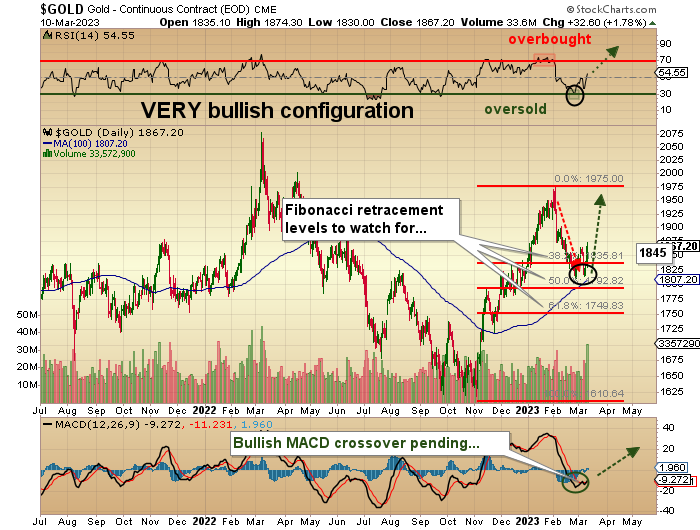
Could we be experiencing the calm before the gold storm this week? The precious metal struggled for direction during early trade, lingering below $1840 as investors waited on the sidelines ahead of the Fed meeting minutes on Wednesday.

It has been a rough month for gold so far thanks to the strong jobs and hot inflation data from the United States pushing up Treasury yields. Hawkish comments from Fed officials rubbed salt into the wound with gold currently down 4.7% month-to-date. Given how the precious metal is enroute to experiencing its first monthly loss since October 2022, bulls need to get their mojo back. But a hawkish set of Fed minutes will most likely add insult to injury, potentially dragging prices toward $1800. Such a development may invite further downside in the short to medium term.


Forex-Time-LogoArticle by ForexTime

ForexTime Ltd (FXTM) is an award winning international online forex broker regulated by CySEC 185/12 www.forextime.com

China is now both a major headwind AND tailwind for global investors

By George Prior

China represents both major headwinds and tailwinds for global investors for the remaining first half of 2023, affirms the CEO and founder of one of the world’s largest independent financial advisory organizations.

The analysis from deVere Group’s Nigel Green comes after China’s foreign minister called on countries to “stop fuelling the fire” in Ukraine ahead of the first anniversary of the war on Friday, and as US President Joe Biden made a surprise visit to Kyiv this week.

It also follows US officials addressing the heightening tensions with China on Sunday after Secretary of State Antony Blinken met with Beijing’s top diplomat, Wang Yi, in Germany to discuss what it calls China’s high-altitude spy balloon and the nation’s approach to sending “lethal aid” to Russia.

Nigel Green says: “Whilst inflation remains an issue, China is now front and centre in investors’ minds.

“Currently, China represents both the major headwinds and tailwinds for global investors for the remaining first half of 2023 at least.”

The headwinds

“On the back of Biden’s trip, amongst other factors, China is accusing the US and Western allies of escalating tensions in Ukraine,” explains the deVere CEO.

“Meanwhile, US Secretary of State Antony Blinken has said Chinese firms were already providing ‘non-lethal support’ to Russia and new information suggested Beijing could provide ‘lethal support’ – which has been strongly denied by China.

“There are also real concerns amongst US allies about a possible military conflict between China and Taiwan, over which Beijing claims sovereignty.”

He continues: “In addition, there are broader worries about the decoupling of China and the US.

“There remains a deep economic interdependence between the United States and China, which has been growing for decades. But this appears to be slowing. We see this in the slowdown of commerce and investment, knowledge-sharing, and smaller global value chains, amongst other issues.

“The deceleration appears to have gained momentum amid the United States’ push to ‘contain’ China in terms of the strategic competition between the two. Also, President Xi Jinping recently reasserted China’s focus away from rapid growth and toward national self-sufficiency.

“All of these headwinds create uncertainty for investors around the world.”

The Tailwinds

“China’s faster-than-anticipated reopening after Covid-19 restrictions is going to deliver a major boost to the economy of China, which is the world’s second-largest, and global growth.

“The rebound will be delivered by significantly bolstering domestic Chinese demand which, in turn, will help regional economies given that neighbouring countries export more to China than many in the West.

“The reopening will positively impact commodity demand and prices, which will help many net exporters.

“Global growth will also be fuelled by renewed demand for international travel – and the associated economic benefit of it – to and from China.”

Nigel Green concludes: “As Beijing seeks to position itself as a force for peace between Russia and Ukraine, and as the economic superpower reopens following years of Covid restrictions, China is being watched with interest from global investors.”

About:

deVere Group is one of the world’s largest independent advisors of specialist global financial solutions to international, local mass affluent, and high-net-worth clients.  It has a network of more than 70 offices across the world, over 80,000 clients and $12bn under advisement.


Japanese Candlesticks Analysis 20.02.2023 (XAUUSD, NZDUSD, GBPUSD)

By RoboForex.com

XAUUSD, “Gold vs US Dollar”

At the support level, gold has formed a Hammer reversal pattern. The instrument is now going by the signal in an ascending wave. The goal of the growth might be 1866.00. Upon testing the resistance level, the pair may break through it and continue the uptrend. However, the quotes may drop to 1830.50 before growth.

GOLD
Risk Warning: the result of previous trading operations do not guarantee the same results in the future

NZDUSD, “New Zealand Dollar vs US Dollar”

On H4, at the support level, the pair has formed a Hammer reversal pattern. The instrument is now going by the signal in an ascending wave. The goal of the growth might be 0.6285. After this level is reached, the quotes might get a chance for continuing the uptrend. However, the price may pull back to 0.6200 before growing.

NZDUSD
Risk Warning: the result of previous trading operations do not guarantee the same results in the future

GBPUSD, “Great Britain Pound vs US Dollar”

On H4, at the support level, the pair has formed a Hammer reversal pattern. The instrument is now going by the signal in an ascending wave. The goal of the growth might be the resistance level of 1.2125. However, the price may pull back to 1.1980 and continue the uptrend after the correction.

GBPUSD

Article By RoboForex.com

Attention!
Forecasts presented in this section only reflect the author’s private opinion and should not be considered as guidance for trading. RoboForex LP bears no responsibility for trading results based on trading recommendations described in these analytical reviews.

US Dollar Has to Retreat

By RoboForex Analytical Department

The market major starts this new week of February with an attempted correction. EUR/USD is balancing near 1.0690. After the lows of the previous week, this is good news though right now the bounce does not look really confident.

Investors are beginning to have more and more doubts that the Federal Reserve System will put aside its tightening monetary policy and include the expectations of further interest rate increases in the quotes. While previously traders used to expect a pause after two subsequent increases by 25 base points this year, now there are no such guarantees.

It is a day off in the US today, which means volatility will be smoothed out.

On the EUR/USD H4 chart, a consolidation range formed around 1.0720. The market extended it downwards to 1.0612. A link of correction to 1.0720 is not excluded (a test from below). Then a decline to 1.0577 should follow, from where the wave might extend to 1.0500. Technically, the scenario is confirmed by the MACD, whose signal line is under zero. Wait for the lows to be renewed.

On H1, the currency pair has completed a wave of decline to 1.0612 and a correction to 1.0690. A consolidation range is expected to form around this level. With an escape downwards, a new wave of decline to 1.0577 should start. Technically, this scenario is confirmed by the Stochastic oscillator. Its signal line is above 50, and a decline to 20 is to follow.

Disclaimer

Any forecasts contained herein are based on the author’s particular opinion. This analysis may not be treated as trading advice. RoboForex bears no responsibility for trading results based on trading recommendations and reviews contained herein.

Stock markets are under pressure again due to concerns about rising rates.

By JustMarkets

Since the release of PPI inflation data on Thursday, fears of the US Federal Reserve returning to a more aggressive pace of rate hikes have returned to financial markets, especially given the strong labor market and GDP growth. All of this was fueled by relevant comments from Fed officials. Cleveland Fed Chair Loretta Mester said Thursday that US interest rates would have to rise above 5% and stay there for a long time to keep inflation down significantly. St. Louis Fed President James Bullard, often considered the most hawkish official at the central bank, also said Thursday that he supports further rate hikes. Bullard added that he would support a 50 basis point increase at the next Fed meeting on March 22. As a result, the US stock market came under pressure late last week. At the close of the stock market on Friday, the Dow Jones index (US30) increased by 0.39% (-0.18% week-to-date), while the S&P 500 Index (US500) fell by 0.28% (-0.43% week-to-date). NASDAQ Technology Index (US100) lost 0.58% on Friday (+0.24% for the week).

The Fed will release the minutes of its January meeting on Wednesday. The minutes may give investors some indication of the appetite for a bigger hike at the Fed’s upcoming March meeting after recent comments from some policymakers indicating support for such a move.

The disappointing fourth-quarter reporting season is coming to an end. The results from the major retailers will provide insight into the strength of consumer spending amid a surge in prices, which is an important topic for investors. Walmart (WMT), the world’s largest retailer by sales, along with home improvement giant Home Depot (HD), are due to report Tuesday. The retailers’ extraordinarily high earnings could raise fears of a tougher Fed response.

Stock markets in Europe were mostly down on Friday. German DAX (DE30) decreased by 0.33% (+1.04% for the week), French CAC 40 (FR40) lost 0.25% (+2.80% for the week), Spanish IBEX 35 (ES35) added 0.06% (+2.17% for the week), British FTSE 100 (UK100) closed Friday down by 0.10% (+1.55% for the week).

The war in Ukraine will cost Germany’s economy about 160 billion euros ($171 billion), or about 4% of its gross domestic product, the German Chamber chief said. An Allianz Trade study says the German industry will pay about 40% more for energy in 2023 than it did in 2022, before the crisis caused by Russia’s February 24 invasion of Ukraine. Germany, which has relied on relatively cheap Russian pipeline gas for decades, now has particularly high energy prices compared to the United States, which has its own natural gas reserves, while France has abundant nuclear energy.

New concerns about inflation and rising rates have forced oil traders to close their long positions, especially after they became wary of an oversupply forming as a result of inventory accumulation. Analysts believe that the data on Chinese imports, which should support the oil rally, is likely to appear no earlier than two weeks.

Gold prices fell for the third week in a row after Fed officials expressed fears of further rate hikes. Gold and silver are inversely correlated to the dollar index and government bond yields. Rising rates tend to raise bond yields, so gold prices are always under pressure during a tightening cycle.

Asian markets were mostly down last week. Japan’s Nikkei 225 (JP225) decreased by 0.14% for the week, China’s FTSE China A50 (CHA50) fell by 1.56% for the week, Hong Kong’s Hang Seng (HK50) ended the week down by 0.91%, India’s NIFTY 50 (IND50) gained 0.62%, and Australia’s S&P/ASX 200 (AU200) ended the week 1.17% negative.

In China, personnel changes in government agencies and major financial regulators are approaching. The question of who will lead the People’s Bank of China is back in the spotlight. The new governor will have to lead the central bank in turbulent times, helping the economy get back on its feet after the disorderly reopening of the economy and dealing with the worst real estate slump in history to maintain financial stability. Another key task for the new leader will be to advocate the central bank’s views to the government since the PBoC is not an independent institution but is accountable to the State Council.

The Reserve Bank of New Zealand (RBNZ) will announce its interest rate decision on February 22. Some economists speculate that this will raise the cost of borrowing by 50 basis points to 4.75%.

In the commodities market, futures on cocoa (+6.6%), coffee (+6.47%), and copper (+2.75%) showed the biggest gains last week. Futures on natural gas (-9.98%), lumber (-8.58%), sugar (-8.11%), orange juice (-7.5%), cotton (-4.55%), WTI oil (-3.96%), gasoline (-3.9%), Brent oil (-3.75%) and platinum (-3.26%) showed the biggest drop.

S&P 500 (F) (US500) 4,079.09 −11.32 (−0.28%)

Dow Jones (US30)33,826.69 +129.84 (+0.39%)

DAX (DE40) 15,482.00 −51.64 (−0.33%)

FTSE 100 (UK100) 8,004.36 −8.17 (−0.10%)

USD Index 103.88 +0.03 (+0.02%)

Important events for today:
  • – China PBoC Prime Rate (m/m) at 03:15 (GMT+2).
  • – Eurozone Consumer Confidence (m/m) at 17:00 (GMT+2);
  • – New Zealand Producer Price Index (q/q) at 23:45 (GMT+2).

By JustMarkets


This article reflects a personal opinion and should not be interpreted as an investment advice, and/or offer, and/or a persistent request for carrying out financial transactions, and/or a guarantee, and/or a forecast of future events.

Trade Of The Week: Will Data Heavy Week Trigger EURUSD Breakout?

By ForexTime 

Over the past two weeks, the EURUSD found itself trapped within a 150-pip range after bulls failed to conquer weekly resistance at 1.09.

It is worth keeping in mind that the euro remains supported by ECB hike expectations and improving sentiment towards the Eurozone economy after GDP unexpectedly grew in the final quarter of 2022. On the other hand, despite the dollar’s recent boost – the bigger picture has not changed with the Fed closer to a peak in rates in the coming few months. Essentially, the narrowing monetary policy divergence between the ECB & Fed suggests that the EURUSD is fundamentally bullish.

Regarding the technical picture, prices remain in an uptrend trend on the weekly charts. However, a technical pullback could be in play before bulls snatch back control.

The low down….

The EURUSD’s tumble over the past few weeks has been a dollar-strength theme, rather than a change in sentiment towards the euro.

Freakishly strong US economic data since the start of the month (NFP) coupled with a hot US CPI forced investors to re-evaluate Fed rate hike expectations. Markets expect the Fed to raise interest rates by 25bp in March with the Fed funds expected to peak around 5.3% by Summer. Given how the central bank is expected to pause and eventually start cutting rates in the longer term, dollar bulls may be rallying on weak foundations with bears lingering in the vicinity.

It is a different story for the ECB with markets pricing in a 50bp hike in March and a 35% probability of another 50bp move in April. However, with Eurozone inflation dropping for a third consecutive month, this has certainly impacted ECB hawks. Expect the euro to remain highly sensitive to economic data and ECB hike expectations over the next few months, especially if inflation continues to cool.

Big week for EURUSD?

The next few days could be eventful for the EUR and USD thanks to key economic data.

On Monday, investors will direct their attention toward the Eurozone consumer confidence figures for February which could influence appetite for the euro. Back in January, confidence slightly improved amid hopes of lower energy prices and government support preventing a recession. Should the figures for February, this could offer a slight boost to euro bulls.

It’s all about the Eurozone February ZEW survey and PMIs from not only Europe but the United States on Tuesday. The ZEW Indicator for the Euro Area rebounded by 40.3 points to 16.7 in January while the PMIs illustrated an encouraging picture in the same month. A similar theme for February will be warmly received by euro and dollar bulls.

Wednesday may be a big day for the USD due to the FOMC meeting minutes. Investors are expected to thoroughly comb through the minutes for more clues about the Feds rate hike path. Much focus will be on how hawkish the central bank was and whether a 50bp rate hike could have been a possibility. The overall tone of the minutes and any fresh insight into the path of future rates will most likely influence the dollar.

We have more economic data from both the Eurozone area and the United States on Thursday with the day kicking off with final January CPI figures from Europe. Annual inflation in the Euro area is forecast to fall to an eight-month low of 8.5% in January 2023 from the 9.2% witnessed last December. In the US, the weekly jobless claims, the second estimate of Q4 US GDP, and a speech from a Fed official will be in focus.

Investors are offered an appetiser on Friday in the form of the final German GDP figures and consumer confidence for March. But the main course will be the US January PCE Core deflator which is the Fed’s preferred measure of inflation. Any further signs of cooling inflation will most likely rekindle expectations around a less aggressive increase in rates by the Fed.

EURUSD: Keep an eye on the range

After failing to secure a weekly close below the 1.0650 support last week, the EURUSD remains trapped within a 150-pip range with resistance back at 1.0800.

The currency pair seems to be waiting for a potent fundamental catalyst and this could come in the form of key economic data this week. In the meantime, the EURUSD remains shaky on the daily charts with prices just below the 50-day SMA. A solid daily close below 1.0650 could signal a selloff towards 1.0500. Alternatively, should 1.0650 prove to be reliable support, prices may rebound back toward the 1.0800 resistance.


Forex-Time-LogoArticle by ForexTime

ForexTime Ltd (FXTM) is an award winning international online forex broker regulated by CySEC 185/12 www.forextime.com

COT Data Releases are delayed for 3rd Week due to Cybersecurity event

By InvestMacro

The Commitment of Traders (COT) data that is published by the Commodities Futures Trading Commission (CFTC) each week has been delayed once again for the third straight week. The delay is due to a recent cybersecurity event that happened in early February. The hack affected ION Cleared Derivatives (a subsidiary of ION Markets) and has created a problem for the large trader positions to be reported.

Here’s the latest CFTC comments:

“Following the ION cyber-related incident, reporting firms are continuing to experience some issues submitting timely and accurate data to the CFTC. As a result, the weekly Commitments of Traders (CoT) report that normally would have been published on Friday, February 17, will be postponed.

“CFTC staff intends to resume publishing the CoT report as early as Friday, February 24, 2023. Staff will begin with the CoT report that was originally scheduled to be published on Friday, February 3, 2023. Thereafter, staff intends to sequentially issue the missed CoT reports in an expedited manner, subject to reporting firms submitting accurate and complete data.”

We will publish our InvestMacro COT articles, data tables and charts once data is released from the CFTC. Stay up to date with the weekly COT data by joining our email list here.

How This Pattern from the Prior Housing Bust is Repeating

Here’s when homes will likely sell for once-in-a-lifetime bargains

By Elliott Wave International

Just like the gold “in them thar hills” motivated people from all walks of life to become miners way back when, real estate booms have motivated people from far and wide to become agents.

In both cases, easy riches seemed to be there for the taking.

But easy riches can be hard to get sometimes, as this New York Times headline indicates:

As Housing Market Cools, Far Fewer Become Agents

You might think that was from the past few months. No, the date of the headline’s publication was Sept. 7, 2007.

This next one is recent — a New York Post headline from Jan. 31 of this year:

Real estate agents vanish en masse as market slows — even in once red-hot Miami

So, agents are closing shop again — just like 15 or 16 years ago — before the worst of the prior housing bust.

The question is: Will this latest weakness in the property market turn out to be as severe as the last time?

No one knows for sure, of course, but Elliott Wave International’s analysis strongly suggests that real estate agents, homeowners, would-be buyers and would-be sellers might want to prepare for a worst-case scenario.

As Robert Prechter noted in his book, Last Chance to Conquer the Crash:

At the bottom, buy the home, office building or business facility of your dreams for ten cents or less per dollar of its peak value.

Remember, financial changes can happen quickly and dramatically.

That was the case with the 2007-2009 financial crisis. And, as indicated, changes are already underway in real estate again. This chart and commentary from our February Elliott Wave Financial Forecast, a monthly publication which covers major U.S. financial markets, provide more insight:

HomeFinalHighs

The monthly chart of existing home prices shows that the June-to-November decline brought the first break of the 12-month moving average since the first quarter of 2020. This is not unusual; the chart shows a seasonal tendency for prices to decline in the second half of the year. What is highly unusual, however, is the seasonal decline’s refusal to break below the 12-month average in 2020 and 2021. The sharp decline in sales, the five wave rise from the 1960s in home prices and the ability for prices to stay above the 12-month average for two straight years suggest that the current move below the 12-month average is no ordinary decline.

The bottom line is that it’s best to prepare now for swift changes ahead — not only in housing, but in financial markets and the economy generally.

Begin your preparation by starting to read Last Chance to Conquer the Crash now — 100% free.

Find out how to get instant access to Robert Prechter’s “must-read” wealth protection guide by following this link now.

This article was syndicated by Elliott Wave International and was originally published under the headline How This Pattern from the Prior Housing Bust is Repeating. EWI is the world’s largest market forecasting firm. Its staff of full-time analysts led by Chartered Market Technician Robert Prechter provides 24-hour-a-day market analysis to institutional and private investors around the world.

The war in Ukraine hasn’t left Europe freezing in the dark, but it has caused energy crises in unexpected places

By Amy Myers Jaffe, New York University 

Through a year of war in Ukraine, the U.S. and most European nations have worked to help counter Russia, in supporting Ukraine both with armaments and in world energy markets. Russia was Europe’s main energy supplier when it invaded Ukraine, and President Vladimir Putin threatened to leave Europeans to freeze “like a wolf’s tail” – a reference to a famous Russian fairy tale – if they imposed sanctions on his country.

But thanks to a combination of preparation and luck, Europe has avoided blackouts and power cutoffs. Instead, less wealthy nations like Pakistan and India have contended with electricity outages on the back of unaffordably high global natural gas prices. As a global energy policy analyst, I see this as the latest evidence that less wealthy nations often suffer the most from globalized oil and gas crises.

I believe more volatility is possible. Russia has said that it will cut its crude oil production starting on March 1, 2023, by 500,000 barrels per day in response to Western energy sanctions. This amount is about 5% of its current crude oil production, or 0.5% of world oil supply. Many analysts expected the move, but it raises concerns about whether more reductions could come in the future.

Europe has avoided an energy crisis in the winter of 2022-2023, but the coming year could be more challenging.

How Europe has kept the lights on

As Russia’s intent toward Ukraine became clear in late 2021 and early 2022, many governments and energy experts feared one result would be an energy crisis in Europe. But one factor that Putin couldn’t control was the weather. Mild temperatures in Europe in recent months, along with proactive conservation policies, have reduced natural gas consumption in key European markets such as Germany, the Netherlands and Belgium by 25%.

With less need for electricity and natural gas, European governments were able to delay drawing on natural gas inventories that they built up over the summer and autumn of 2022. At this point, a continental energy crisis is much less likely than many forecasts predicted.

European natural gas stockpiles are around 67% full, and they will probably still be 50% full at the end of this winter. This will help the continent position itself for next winter as well.

The situation is similar for coal. European utilities stockpiled coal and reactivated 26 coal-fired power plants in 2022, anticipating a possible winter energy crisis. But so far, the continent’s coal use has risen only 7%, and the reactivated coal plants are averaging just 18% of their operating capacity

The U.S. role

Record-high U.S. energy exports in the summer and fall of 2022 also buoyed European energy security. The U.S. exported close to 10 million cubic meters per month of liquefied natural gas in 2022, up 137% from 2021, providing roughly half of all of Europe’s imported LNG.

Although domestic U.S. natural gas production surged to record levels, some producers had the opportunity to export into high-priced global markets. As a result, surpluses of summer natural gas didn’t emerge inside the U.S. market, as might otherwise have happened. Combined with unusually hot summer temperatures, which drove up energy demand for cooling, the export surge socked U.S. consumers with the highest natural gas prices they had experienced since 2008.

Prices also soared at U.S. gas pumps, reaching or exceeding US$5 per gallon in the early summer of 2022 – the highest average ever recorded by the American Automobile Association. The U.S. exported close to 1 million barrels per day of gasoline, mainly to Mexico and Central America, plus some to France, and consolidated its position as a net oil exporter – that is, it exports more oil than it imports.

Much like Europeans, U.S. consumers had to pay high prices to outbid other global consumers for oil and natural gas amid global supply disruptions and competition for available cargoes. High gasoline prices were a political headache for the Biden administration through the spring and summer of 2022.

However, these high prices belied the fact that U.S. domestic gasoline use has stopped growing. Forecasts suggest that it will decline further in 2023 and beyond as the fuel economy of U.S. cars continues to improve and the number of electric vehicles on the road expands.

While energy prices were a burden, especially to lower-income households, European and American consumers have been able to ride out price surges driven by the war in Ukraine and have so far avoided actual outages and the worst recessionary fears. And their governments are offering big economic incentives to switch to clean energy technologies intended to reduce their nations’ need for fossil fuels.

Developing nations priced out

The same can’t be said for consumers in developing nations like Pakistan, Bangladesh and India, who have experienced the energy cutoffs that were feared but didn’t occur in Europe. Notably, Europe’s intensive energy stockpiling in the summer of 2022 caused a huge jump in global prices for liquefied natural gas. In response, many utilities in less developed nations cut their natural gas purchases, creating price-related electricity outages in some regions.

Faced with continuing high global energy prices, countries in the global south – Africa, Asia and Latin America – have had to reevaluate their dependence on foreign imports. Increased use of coal has made headlines, but renewable energy is starting to offer greater advantages, both because it is more affordable and because governments can frame it as more secure and a source of domestic jobs.

India, for example, is doubling down on renewable energy, unveiling plans to produce hydrogen fuel for heavy industry using renewable energy and moving away from imported LNG. Several African countries, such as Ethiopia, are fast-tracking development of hydropower.

Energy prices and climate justice

The energy challenge that the Russia-Ukraine crisis has bred in developing countries has intensified global discussions about climate justice. One less examined impact of giant clean tech stimulus plans enacted in wealthy nations, such as the United States’ Inflation Reduction Act, is that they keep much of the available funding for climate finance at home. As a result, some developing country leaders worry that a clean energy technology knowledge gap will widen, not shrink, as the energy transition gains momentum.

Worsening the problem, members of the G-7 forum of wealthy nations have tightened their monetary policies to control war-driven inflation. This drives up the cost of debt and makes it harder for developing countries to borrow money to invest in clean energy.

The U.S. is supporting a new approach called Just Energy Transition Partnerships, in which wealthy nations provide funding to help developing countries shift away from coal-fired power plants, retain workers and recruit private-sector investors to help finance decarbonization projects. But these solutions are negotiated bilaterally between individual countries, and the pace is slow.

When nations gather in the United Arab Emirates in late 2023 for the next round of global climate talks, wealthy nations – including Middle East oil producers – will face demands for new ways of financing energy security improvements in less wealthy countries. The world’s rich nations pledged in 2009 to direct $100 billion yearly to less wealthy nations by 2020 to help them adapt to climate change and decarbonize their economies, but are far behind on fulfilling this promise.

U.N. Secretary-General Antonio Guterres has called on developed nations to tax fossil fuel companies, which reported record profits in 2022, and use the money to fund climate adaptation in low-income countries. New solutions are needed, because without some kind of major progress, wealthy nations will continue outbidding developing nations for the energy resources that the world’s most vulnerable people desperately need.The Conversation

About the Author:

Amy Myers Jaffe, Director, Energy, Climate Justice, and Sustainability Lab, and Research Professor, New York University

This article is republished from The Conversation under a Creative Commons license. Read the original article.

Canadian Exploration Co. Bullish on Global Tellurium Demand

Source: Streetwise Reports  (2/16/23)

First Tellurium Corp. sees increased tellurium production in a bid to meet rising global demand in 2023.

First Tellurium Corp. (FTEL:CSE) is expecting global demand and prices of tellurium (Te) to increase this year, therefore also seeing bright prospects for its Te production from its Deer Horn property in British Columbia, Canada.

FTEL is a company engaging in the exploration and development of predominantly Te mines. The company has two high-grade mining jurisdictions, which are its Deer Horn property in British Columbia, Canada, and Klondike property in Colorado, U.S.

Why Tellurium? Looming Shortage Driving Demand and Price Increases

Te is essential for the generation of clean and sustainable energy. It is a raw material for manufacturing solar photovoltaic (PV) panels, new batteries, and other advancing technologies.

Te is incorporated in lithium-ion battery cathodes, and this improves the batteries’ energy density for longer-lasting charging; enhanced electrical conductivity for quicker charging time; and safety. For solar panels, Te provides better conductivity, making a thin film efficiently absorb sunlight and convert it into electricity.

Source: First Tellurium

FTEL President and CEO Tyrone Docherty said 90% of Te comes from refining copper, and only 10% comes from mines. The company said there is a looming shortage of Te as the demand is rapidly growing, but much of the supply is not mined on its own.

He said FTEL is well positioned to increase the share of mining in Te production and to meet the increasingly growing demand for Te, which mostly comes from the clean energy sector.

According to a report by Investing Whisperer, other than sourcing through copper processing, Te is a rare and brittle metalloid element found in small quantities in the Earth’s crust — about eight times rarer than gold itself. As the demand from solar panel manufacturers grows, Te production is seen to shoot up in the near future.

“It’s possible that the market for Te could be much larger in the near-to-mid term–due to the increased use of solar panels. Right now, it’s a very small market with just under 600,000 kg produced in 2021,” the report said.

China has 20% of the world’s Te resource and has produced most (61%) of the global Te output last year. Responding to the looming shortage fears and bright prospects in terms of demand, the U.S. wants to get a larger share of the pie — to see more domestic supply chains of Te which denotes an increase in delivery from U.S. suppliers like FTEL.

Chen Lin of What is Chen Buying? What is Chen Selling? recommended FTEL in a December posting. He mentioned that North America is too dependent on outside sources for the element and went on to say, “This metal can be in demand, this is a pure-play, and management just a lot of (its) own money in the stock.” Lin later reiterated his recommendation in a February newsletter.  He said, “FTEL was very well received at both the Metals Investment Forum and Vancouver Resource Investment Conference. The management was surrounded by investors and talked for hours afterward. I think investors’ interests definitely picked up and there could be other newsletters recommending it.”

FTEL Answers Demand

FTEL answers the demand for critical metals such as Te, Au, Ag, Cu, and W, with a focus on Te. Major U.S.-based solar PV manufacturer First Solar has recognized their Deer Horn property as one of the four world-class Te projects, with the other three located in Sichuan, China; Sonora, Mexico; and Boliden Area, Sweden.

New Te supplies from the company will benefit as prices need to increase to meet Te demand. From a US$70 per kg price level a year ago, prices have already gone up to US$80 per kg as of January 2023. Its market price is expected to get a boost from First Solar as its annual Te demand could exceed last year’s Te global production by up to 70%.

The Deer Horn jurisdiction hosts the only Te, Au, and Ag resources in North America, and has also passed a positive PEA or Preliminary Economic Assessment, which is crucial for moving forward with any mining project.

Based on Investing Whisperer’s analysis, FTEL and its two mines with Te deposits close to the surface is the only Te play for investors.

The company adopts a phased expansion approach, where they start exploration and production with small mines, and then expand mining areas in the same territory over time.

The company benefits from this approach with lower exploration and development costs, lower capital spending, faster production and delivery of supplies, a faster-permitting process with small mine applications than larger mines, and many others.

FTEL’s exploration in 2022 extended their mineral zone potential in the Deer Horn property to an additional 1.1 km, expanding their total potential strike length to 3.5 km.

Based on Investing Whisperer’s analysis, FTEL and its two mines with Te deposits close to the surface is the only Te play for investors.

The report also factored in the prospect to expand these sites in the future, and that there are Au, Ag, Cu, and W deposits in the mines which can account for 50% of the company’s value.

The Catalyst: Drilling Set for the Summer

FTEL is set to start its drilling within its polymetallic Deer Horn site in the summer of 2023. This will yield new Te, Au, and Ag production for the company which will allow them to deliver supply this year.

The company will also greatly benefit from favorable market conditions such as the ongoing advances in battery technologies, and solar power demand, as well as the push for funding and focus on critical metals by the U.S. and Canadian governments.

EcoWatch mentioned that as the green energy technology sector grows, then so is the demand for Te and other critical metals which can have Te as a byproduct, given that 90% of global Te supply comes from refining copper mining. FTEL has two predominantly Te mines that can contribute to supporting the growth of green energy technologies.

Source: Clivemaund.com

On February 2, 2023, technical analyst Clive Maund touched on the outlook of the company, saying, “First Tellurium presents a positive picture and overall looks like a low-risk setup. We, therefore, stay long.”

Ownership and Share Structure

Streetwise Ownership Overview*

First Tellurium Corp. (FTEL:CSE)

Retail: 89%
Management/Insiders: 11%
Institutions & Strategic Investors: 0%
89%
11%
*Share Structure as of 2/10/2023


According to the company, 11% of First Tellurium is owned by management and insiders. According to Reuters CEO, President, and Director Tyrone Docherty owns 10.50%m with 7.63 million shares. Director Josef Anthony Steve Fogarassy has 1.38%, with 1 million shares, and Director Lyle Allen Schwabe has 0.77%, with 0.56 million shares.

There are no institutional investors and the rest is retail.

FTEL has CA$1.5 million in the bank with a CA$35,000 to CA$40,000 monthly burn rate.

The company has a market cap of CA$23.37 million and 84.026 million outstanding shares. Their stock is trading between CA$0.085 and CA$0.710 based on its 52-week range.


Disclosures:
1) Nika Cataldo wrote this article for Streetwise Reports LLC as an independent contractor. She or members of her household own securities of the following companies mentioned in the article: None. She or members of her household are paid by the following companies mentioned in this article: None.

2) The following companies mentioned in this article are billboard sponsors of Streetwise Reports: None.  Click here for important disclosures about sponsor fees. As of the date of this article, an affiliate of Streetwise Reports has a consulting relationship with: First Tellurium Corp. Please click here for more information.

3) Statements and opinions expressed are the opinions of the author and not of Streetwise Reports or its officers. The author is wholly responsible for the validity of the statements. The author was not paid by Streetwise Reports for this article. Streetwise Reports was not paid by the author to publish or syndicate this article. Streetwise Reports requires contributing authors to disclose any shareholdings in, or economic relationships with, companies that they write about. Streetwise Reports relies upon the authors to accurately provide this information and Streetwise Reports has no means of verifying its accuracy.

4) This article does not constitute investment advice. Each reader is encouraged to consult with his or her individual financial professional and any action a reader takes as a result of information presented here is his or her own responsibility. By opening this page, each reader accepts and agrees to Streetwise Reports’ terms of use and full legal disclaimer. This article is not a solicitation for investment. Streetwise Reports does not render general or specific investment advice and the information on Streetwise Reports should not be considered a recommendation to buy or sell any security. Streetwise Reports does not endorse or recommend the business, products, services or securities of any company mentioned on Streetwise Reports.

5) From time to time, Streetwise Reports LLC and its directors, officers, employees or members of their families, as well as persons interviewed for articles and interviews on the site, may have a long or short position in securities mentioned. Directors, officers, employees or members of their immediate families are prohibited from making purchases and/or sales of those securities in the open market or otherwise from the time of the decision to publish an article until three business days after the publication of the article. The foregoing prohibition does not apply to articles that in substance only restate previously publish First Tellurium Corp., a company mentioned in this article.