The cryptocurrency market digest (BTC, USDC). Overview for 20.09.2023

By RoboForex.com

The BTC exchange rate surged to 27,104 USD on Wednesday.

Bitcoin is back in the game. On Monday, the market began aggressive buying, which came to a sudden halt on Tuesday, just as abruptly as it started. Nevertheless, during this time, BTC managed to achieve a three-week high. Since September 12, the market capitalisation of BTC has increased by nearly 10%. The pivotal supporting event here is the upcoming launch of the first Bitcoin ETF.

Recall that important support for the leading cryptocurrency is at the 25,150 USD level. Resistance stands at 27,800 USD, and it is critical for BTC to break through this level.

Today marks the conclusion of the regular meeting of the US Federal Reserve. The interest rate situation is clear: it will remain at 5.5% per annum. However, the major intrigue lies in what the Fed will communicate about its future decisions. News from this front could attract more attention to cryptocurrencies.

The cryptocurrency market capitalisation has risen to USD 1.07 trillion. BTC’s share has increased to 49.2%, while the ETH share has decreased to 18.3%.

Binance and Grayscale are the leading BTC holders

According to publicly available information, currently, the most substantial holders of the flagship cryptocurrency include Satoshi Nakamoto, who may own at least 750 thousand BTC. Binance holds another 643.5 thousand BTC, and Grayscale’s assets are estimated at 627.7 thousand BTC.

Circle launched stablecoin

Circle developers have announced the launch of the USDC stablecoin on Polkadot’s Asset Hub. This token can be employed in other parachains using the XCM protocol.

Article By RoboForex.com

Attention!
Forecasts presented in this section only reflect the author s private opinion and should not be considered as guidance for trading. RoboForex LP bears no responsibility for trading results based on trading recommendations described in these analytical reviews.

China kept key interest rates unchanged. Inflation is accelerating in Canada

By JustMarkets

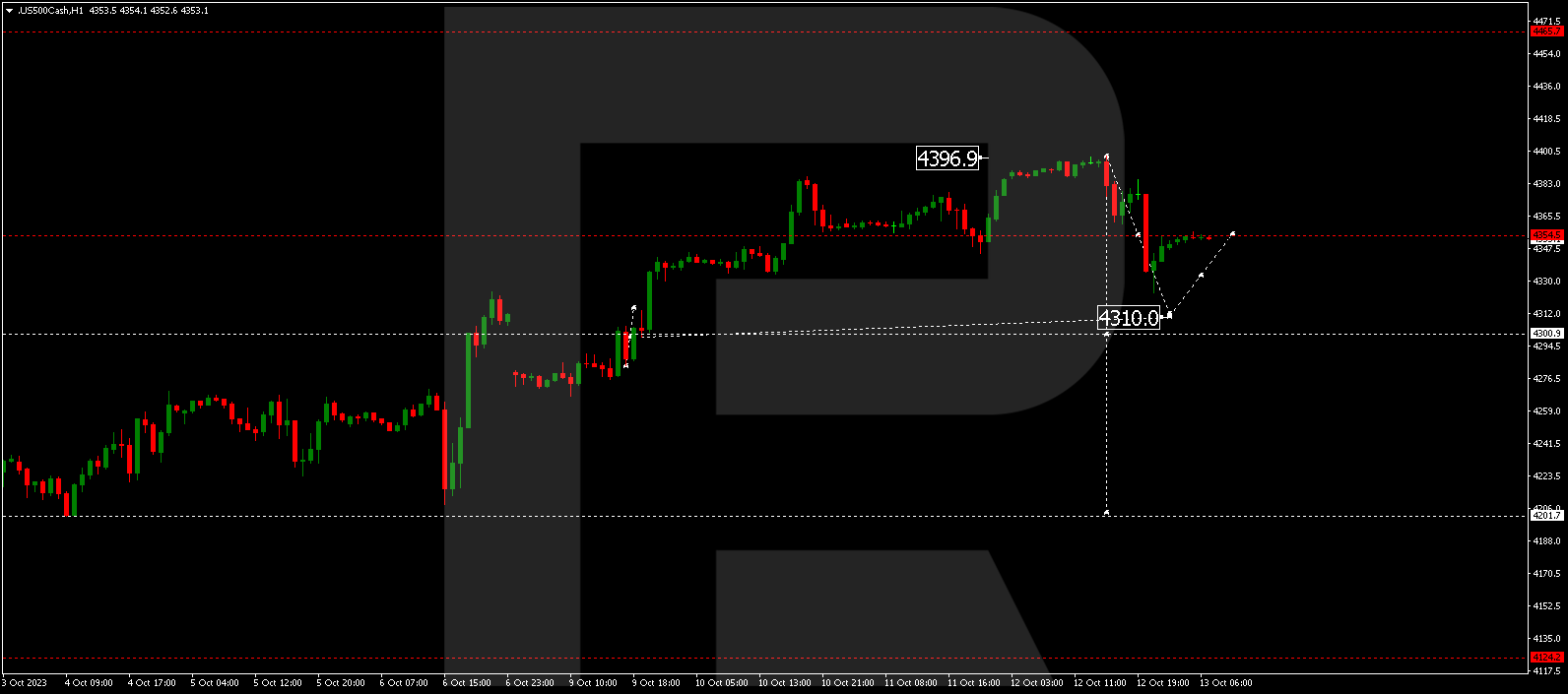
As of Tuesday’s stock market close, the Dow Jones Index (US30) decreased by 0.40%, while the S&P 500 Index (US500) lost 0.22%. The NASDAQ Technology Index (US100) closed negative 0.23% on Tuesday. Stock indices declined amid a weak US housing report and a rise in 10-year bond yields to a 15-year high. US housing starts fell by 11.3% to 1.283 million units in August, much weaker than expectations of a decline of around 1%. In addition, the likelihood of an expanded UAW union strike and the resumption of student loan payments on October 1 also put downward pressure on stocks. Stocks also traded on a cautious note ahead of the two-day FOMC meeting. Markets fully expect the FOMC to leave the lending rate target unchanged at 5.25/5.50%. However, markets expect the FOMC to maintain its hawkish attitude and leave open the possibility of another rate hike later this year. This would be negative for stock indices.

Canadian inflation accelerated more than expected for the second consecutive month. The Consumer Price Index rose from 3.3% to 4% y/y in August, the fastest pace since April. Core inflation (excluding food and energy prices) rose slightly to 3.3% from 3.2%. The three-month moving average of indicators the Bank of Canada cited as key to its team rose a full percentage point to 4.49% on an annualized basis, according to Bloomberg calculations. Investors raised bets that Canada’s Central Bank will resume policy tightening and hold another rate hike at its October meeting.

Equity markets in Europe were mostly up yesterday. Germany’s DAX (DE40) fell by 0.40%, France’s CAC 40 (FR40) gained 0.08%, Spain’s IBEX 35 (ES35) added 0.40%, and the UK’s FTSE 100 (UK100) closed up by 0.09%. The August Eurozone Consumer Price Index was revised slightly from 5.3% to 5.2% y/y. Core CPI remained unchanged at 5.3% y/y. Lower inflationary pressures are dovish for ECB policy.

OECD economists cut the UK’s economic growth forecast for next year due to pressure on households and businesses from high interest rates. The analysts added that economic activity in the UK has “already weakened” due to the “lagged effect on household incomes from a large energy price shock in 2022.” The think tank forecast economic growth of 0.3% in 2023, which would be the second weakest among G7 countries.

WTI crude oil prices rose to a new 10-month high on Tuesday, extending the rally seen over the past three months, driven by expectations of a strong supply outlook for the rest of the year. However, crude oil prices declined later in the session, pressured by liquidations of long positions and some concerns about the global economy. Yesterday, the OECD lowered its 2024 global GDP forecast to 2.7% from 3.0%.

Asian markets traded yesterday without any unified dynamics. Japanese Nikkei 225 declined yesterday by 0.87%, Chinese FTSE China A50 (CHA50) rose by 0.02%, Hong Kong Hang Seng (HK50) increased by 0.37% on the day, and Australian ASX 200 (AU200) was negative 0.47% on Tuesday.

On Wednesday, the People’s Bank of China kept the one-year LPR rate unchanged at 3.45%, while the five-year LPR rate, which is used to determine mortgage rates, was left unchanged at 4.20%. Both rates are at historic lows after three cuts over the past year. Key comments from the People’s Bank of China (PBOC) official following the meeting:

  • The PBOC will pay more attention to changes in the RMB exchange rate against a basket of currencies;
  • There is a solid basis for keeping the RMB exchange rate basically stable;
  • The PBOC will resolutely correct the unilateral pro-cyclical behavior of the RMB exchange rate;
  • The PBOC will resolutely crack down on market disruption, resolutely guard against the risks of exchange rate overvaluation;
  • China’s monetary policy still has ample room to respond to unexpected challenges and changes.

On Friday, the Bank of Japan will hold its monetary policy meeting. While no changes are expected at this meeting, swap market indicators are now showing stronger expectations for a soon-to-be abandonment of negative interest rates by March 2024 than a further widening of the range around the BoJ’s 10-year bond yield target. Against this backdrop, Bank of Japan Governor Kazuo Ueda is expected to take a somewhat hawkish stance, primarily to manage the yen’s depreciation.

S&P 500 (F)(US500) 4,443.95 −9.58 (−0.22%)

Dow Jones (US30) 34,517.73 −106.57 (−0.31%)

DAX (DE40)  15,664.48 −62.64 (−0.40%)

FTSE 100 (UK100) 7,660.20 +7.26 (+0.095%)

USD Index  105.15 −0.06 (−0.05%)

News feed for 2023.09.19:
  • – Japan Trade Balance (m/m) at 02:50 (GMT+3);
  • – China PBoC Loan Prime Rate (m/m) at 04:15 (GMT+3);
  • – UK Consumer Price Index (m/m) at 09:00 (GMT+3);
  • – UK Producer Price Index (m/m) at 09:00 (GMT+3);
  • – German Producer Price Index (m/m) at 09:00 (GMT+3);
  • – US Crude Oil Reserves (w/w) at 17:30 (GMT+3);
  • – US Fed Interest Rate Decision at 21:00 (GMT+3);
  • – US FOMC Statement at 21:00 (GMT+3);
  • – US FOMC Economic Projections at 21:00 (GMT+3);
  • – US FOMC Press Conference at 21:30 (GMT+3).

By JustMarkets


This article reflects a personal opinion and should not be interpreted as an investment advice, and/or offer, and/or a persistent request for carrying out financial transactions, and/or a guarantee, and/or a forecast of future events.

Mid-Week Technical Outlook: precious metals & commodities

By ForexTime 

  • Precious metals & commodities in focus ahead of Fed
  • Gold waits for fresh fundamental spark
  • Silver trapped within range
  • Brent slips from 10-month high
  • Natural Gas tests 200-day SMA

Global equities were mixed on Wednesday as investors braced for the outcome of the Federal Reserve rate decision.

There was some optimism in the air despite the overall caution after UK inflation data eased more than expected in August. This offered some support to European markets while weakening the pound as investors raised bets around the BoE nearing the end of its hiking cycle. The dollar has entered standby mode, oil is under pressure, and gold seems to be waiting for a fresh directional catalyst.

The Fed interest rate decision this evening could trigger explosive levels of volatility, resulting in fresh opportunities across the board. Our focus today falls on precious metals and commodities with the tool of choice technical analysis.

Gold waits on Fed decision

Gold is likely to trade within a tight range until the Fed’s decision this evening.

While the central bank is widely expected to leave rates unchanged, much focus will be on the economic projections, dot plots, and messaging for clues on future hikes. Gold is back within a choppy range on the daily charts with prices recently pushing above the 200-day and 50-day SMA. A breakout may be on the horizon with the Fed decision acting as the directional spark.

  • A strong breakout above $1937 may open a path toward $1953.
  • Should prices slip below the 200-day SMA at $1924, this could see a decline towards $1906 and $1900, respectively.

Silver trapped within range

Silver prices have been trapped within a range on the daily timeframe since early May 2023.

The metal continues to be influenced by the dollar, Fed hike expectations, and the outlook for industrial demand. Despite the recent rebound from the $22.10 support level, prices are still trading below the 50,100 and 200-day SMA while the MACD trades below zero.

  • Sustained weakness below $23.70 could encourage a decline back towards $22.10.
  • Should bulls break above the $23.70 level, this could open the doors toward the $25.20 resistance.

Brent slips from 10-month high

After hitting a fresh 10-month high yesterday, Brent has found itself under noticeable pressure with the daily bearish pin bar signalling further losses.

Prices remain firmly bullish on the daily charts as there have been consistently higher highs and higher lows while the MACD trades above zero. Given the strong upside momentum, Brent may be experiencing a technical throwback before bulls attempt to push the commodity beyond $96.10.

  • However, a strong breakdown and daily close below $89.70 could signal the return of bears, with the next key level back at the 50-day SMA.

WTI bulls take a breather

It is a similar story for Crude which has shed roughly 1% this morning. Although prices are firmly bullish on the daily charts, the daily bearish pin bar could be an invitation for bears.

  • Nevertheless, bulls remain in a position of power above the $88.40 dynamic support level.
  • Should prices slip below this point and hit $86.40, this could invalidate the current uptrend with bears targeting lower levels, starting from $84.50 and 50-day SMA.

Natural Gas tests 200-day SMA

Natural gas prices remain in a weak bullish channel on the daily timeframe. However, prices are currently testing the 200-day SMA which may act as a formidable resistance level.

  • A strong breakout above this point could encourage an incline towards $3.0 and $3.3 before bulls aim for $4.2.
  • If the 200-day SMA proves to be a tough resistance to crack, this could encourage a decline back towards $2.4 and $2.1, respectively.


Forex-Time-LogoArticle by ForexTime

ForexTime Ltd (FXTM) is an award winning international online forex broker regulated by CySEC 185/12 www.forextime.com

Japanese Candlesticks Analysis 19.09.2023 (EURUSD, USDJPY, EURGBP)

By RoboForex.com

EURUSD, “Euro vs US Dollar”

EURUSD has formed a Hammer reversal pattern on H4 near the support level. Currently, the instrument is going by the reversal signal in an ascending wave. The pullback target could be the resistance level of 1.0720. However, the price could drop to 1.0625 and continue the downtrend without testing the resistance.

EURUSD
Risk Warning: the result of previous trading operations do not guarantee the same results in the future

USDJPY, “US Dollar vs Japanese Yen”

USDJPY has formed a Hanging Man reversal pattern on H4. Currently, the instrument is going by the reversal signal in a descending wave. The pullback target might be 147.45. However, the price could rise to 148.50 and continue the uptrend without testing the support.

USDJPY
Risk Warning: the result of previous trading operations do not guarantee the same results in the future

EURGBP, “Euro vs Great Britain Pound”

EURGBP has formed an Inverted Hammer reversal pattern on H4. Currently, the instrument is going by the reversal signal in an ascending wave. The growth target could be 0.8655. Upon testing and breaking this level, the price could continue the uptrend. However, the quotes might correct to 0.8610 before rising.

EURGBP

Article By RoboForex.com

Attention!
Forecasts presented in this section only reflect the author s private opinion and should not be considered as guidance for trading. RoboForex LP bears no responsibility for trading results based on trading recommendations described in these analytical reviews.

Oil’s rally continues. Investors are in no hurry to intensify trading ahead of the Fed meeting

By JustMarkets

At the close of the stock exchange on Monday, the Dow Jones Index (US30) rose by 0.02%, and the S&P 500 Index (US500) increased by 0.07%. The NASDAQ Technology Index (US100) closed Monday at its opening price. Stock indices were down on Monday due to caution ahead of the two-day FOMC meeting on Tuesday and Wednesday. Markets fully expect the FOMC to leave the main rate target unchanged at 5.5% (99% probability) this week. However, the FOMC is expected to maintain a hawkish tone and remain open to one last rate hike, as inflation and the economy have not slowed enough yet.

Markets estimate the probability of the FOMC raising the rate by 25 bps at the November 1 meeting as 31%, and the probability of a 25 bps rate hike at the next meeting on December 13 is 14%. The markets then expect the FOMC to start cutting rates in 2024 in response to an expected slowdown in the US economy.

The NAHB US housing market index published on Monday fell by  5 points to a 5-month low of 45, which was much weaker than expected. The decline in confidence expressed by US homebuilders suggests that home-building activity may weaken in the coming months.

Apple (AAPL) shares jumped by 1.69% on Monday amid optimism about strong pre-orders for the latest iPhone 15 model. PayPal Holdings (PYPL) fell by 1.98% when MoffettNathanson downgraded the company to “downgrade” from “outperform” as analysts expect weak earnings growth due to increased competition.

Equity markets in Europe were mostly down yesterday. Germany’s DAX (DE40) fell by 1.05%, France’s CAC 40 (FR40) lost 1.39%, Spain’s IBEX 35 (ES35) decreased by 0.71%, and the UK’s FTSE 100 (UK100) closed negative 0.76%.

For the Eurozone, the main focus for the week ahead begins today with the inflation report, and another decline could have a negative impact on the euro but a positive impact on European indices. Eurozone and German business PMIs are expected to remain weak, although Friday’s announcement by Fitch that Germany remains under a AAA credit rating suggests a positive and stable outlook for the Eurozone’s largest economy. But overall, the US economy is much stronger right now than the Eurozone economy, and that’s evident in pricing and central bank guidance. This will likely keep the US dollar high against the euro until cracks in the US economy start to appear in the inflationary and labor environment.

WTI crude oil prices rose to a new 11-month high on Monday, extending a rally seen over the past three months on expectations of a tight supply outlook for the rest of the year. Oil company Aramco forecasts record consumption of 103-104 million BPD in the second half of 2023. Oil prices received support from forecasts made last week by the International Energy Agency (IEA) and OPEC that the global oil market will be in deficit until the end of the year. And the bearish factors are not even enough to stop the rally yet.

Asian markets were mostly down. Japan’s Nikkei 225 was not trading yesterday, China’s FTSE China A50 (CHA50) added 0.91%, Hong Kong’s Hang Seng (HK50) decreased by 1.39% on the day, and Australia’s S&P/ASX 200 (AU200) was negative 0.67% on Monday.

The RBA’s Monetary Policy Minutes for August showed that Committee officials believe that inflation is still too high and is expected to remain so for an extended period of time. Committee representatives also noted that the previous month’s payroll data were broadly in line with the Bank’s forecasts: the labor market remains tight, but conditions are easing. The decision to maintain the interest rate at this meeting was due to the fact that interest rates have been raised significantly over a short period of time, and the effect of monetary tightening has not yet been fully realized.

S&P 500 (F)(US500) 4,453.53 +3.21 (+0.07%)

Dow Jones (US30) 34,624.30 +6.06 (+0.02%)

DAX (DE40)  15,727.12 −166.41 (−1.05%)

FTSE 100 (UK100) 7,652.94 −58.44 (−0.76%)

USD Index  105.09 −0.24 (−0.22%)

News feed for 2023.09.19:
  • – Australia RBA Meeting Minutes (m/m) at 04:30 (GMT+3);
  • – Switzerland Trade Balance (m/m) at 09:00 (GMT+3);
  • – Eurozone Consumer Price Index (m/m) at 12:00 (GMT+3);
  • – Canada Consumer Price Index (m/m) at 15:30 (GMT+3);
  • – US Building Permits (m/m) at 15:30 (GMT+3).

By JustMarkets


This article reflects a personal opinion and should not be interpreted as an investment advice, and/or offer, and/or a persistent request for carrying out financial transactions, and/or a guarantee, and/or a forecast of future events.

Stagflation is not the danger, it’s crushing long-term growth: deVere CEO

By George Prior 

Crushing economic growth, and not stagflation, is “the real danger” and should now be the focus of the European Central Bank and the Bank of England, warns the CEO of one of the world’s largest independent financial advisory, asset management and fintech organizations.

Nigel Green of deVere Group is speaking out after economist Nouriel Roubini, who has earned the moniker Dr Doom, told Bloomberg that the two central banks need to keep raising rates to ward off stagflation, which occurs when stagnant growth and high inflation happen simultaneously.

The European Central Bank raised interest rates to a record high last week.

Meanwhile, the Bank of England is expected to raise interest rates by another quarter point at its meeting on Thursday, taking the cost of borrowing to 5.5%, its highest level since early 2008.

The deVere CEO comments: “Crushing already slowing global economic growth through the blunt instrument of monetary policy will be significantly more detrimental to an economy than short-term stagnation.

“While neither extreme is ideal, hindering longer-term economic growth is the real danger, not short-term stagflation, and it should be the focus for policymakers.”

Like a growing number of analysts, Nigel Green also points to the warning signs of a possible looming recession in the US in the form of the inverted Treasury yield curve.

The inverted yield curve in the US suggests a recession is looming because it’s a sign of a tight credit market and weak economic growth.

The inversion of the yield curve has preceded most US recessions since 1950. Of course, the knock-on effect of a downturn in the world’s largest economy would have far-reaching, serious effects globally.

He continues: “Stifling growth through the cost of capital becoming prohibitive for businesses and individuals leads to a decline in capital formation, reduced entrepreneurial activity, and a slowdown in economic development.

“It leads to a slowdown of innovation and development and a reduction of overall investment. These effects hinder future growth potential and undermine an economy’s competitiveness on the global stage.

“Killing off growth will naturally create job losses and a stagnant labor market. A lack of job opportunities can have a cascading effect, leading to increased unemployment rates, reduced consumer spending, and a decline in overall economic well-being.

The deVere CEO says the wounds of stifling growth could also manifest through increased income inequality and decreased government revenue.

“Economic growth typically brings increased prosperity for all segments of society. When growth is crushed, income inequality tends to worsen, which could trigger social unrest and decreased social cohesion.

“Also a growing economy generates more tax revenue for governments, allowing them to fund essential services like healthcare, education, and infrastructure development.

“Stagnation may lead to a budget crunch, but stifling growth can be even more detrimental, potentially requiring austerity measures that hurt households and public services.”

He concludes: “If additional interest rate hikes further hinder economic growth, the longer-term consequences will be far worse than a bout of stagflation.”

About:

deVere Group is one of the world’s largest independent advisors of specialist global financial solutions to international, local mass affluent, and high-net-worth clients.  It has a network of offices across the world, over 80,000 clients and $12bn under advisement.

Coverage Account – Bucketing and Auto Hedging Plugin for MT5 by Your Bourse

Coverage Account – Bucketing and Auto Hedging Plugin for MT5 by Your Bourse

The Coverage Plugin in MT5 is a powerful tool that enables various functions and capabilities within the trading platform. Its primary function is to accumulate opened position volumes from the trading account on the same MT5 server. However, it offers much more than that. In this article, we will explore the features and setup process of the Coverage Plugin, and delve into different scenarios where it can be utilised effectively.

Understanding the Coverage Plugin

The Coverage Plugin in MT5 serves multiple functions, including accumulating position volumes from the trading account on the same server. Additionally, the Your Bourse plugin offers several other capabilities:

  1. Volume Hedging: It enables hedging the volume of lots from the trading accounts to the coverage accounts. The function allows the accumulation of lots from one of the trading accounts to the trading account on the same or different servers.
  2. Symbol Mappings: This capability allows the translation of mapped symbols to core symbols or other mapped symbols. For example, it enables the transfer of volumes from EURUSD.m on the trading account to EURUSD in the coverage account.
  3. Exposure Auto Hedging: This functionality allows for exposure full or partial hedging from B-book to A-book with the possibility to set up a particular volume step increment.
  4. Conditional Hedging: Under certain conditions, such as when the order volume on the B-book exceeds five lots, all customised volume increments can be directed to the A-book coverage account.

Using Coverage Account Auto Hedging Functionality

The Coverage Hedging functionality can be used in various scenarios to suit different trading needs. Here are a few examples:

  1. Common Coverage Scenario: In this scenario, the trades opened or closed will be mirrored in the coverage accounts. This functionality can be enabled in MT5 Administrator.
  2. Mapping Symbols Scenario: This scenario involves transferring orders from mapped symbols in the trading account to core symbols or other mapped symbols on the coverage account. This can be easily configured from the YourBourse portal. When trades are executed on the trading account, corresponding orders will be opened on the coverage account.
  3. Unconditional Hedging Scenario: In this scenario, orders placed in the B-book trading account will be transferred to the B-book coverage account, and an increment value can be configured to be added to the A-book coverage account. The specified increment value will be automatically added to the A-book coverage account for each volume traded on the B-book account.
  4. Conditional Hedging Scenario: In this scenario, orders placed in B-book will be transferred to the B-book coverage account, and, based on specified conditions, a customised increment value will be added to the A-book coverage account. This transfer will occur only if the volume of the order exceeds a predefined unhedged threshold and therefore the position will be hedged.

Setting up Coverage Accounts

The Coverage Plugin consists of several important elements that can be configured on the Your Bourse portal.

To enable coverage hedging functionality, you need to install the coverage plugin, configure the rules on the Your Bourse portal, create trading and coverage accounts, and set up routing rules.

Conclusion

The Coverage Plugin in MT5 provides traders with a range of functionalities and features to enhance their trading experience. By understanding its setup process and various scenarios in which it can be utilised, traders can effectively hedge volumes, map symbols, and customise increments between trading and coverage accounts. The Coverage Plugin offers a versatile tool for risk management and trading strategies on the MT5 platform.

About Your Bourse

Your Bourse offers software solutions for the retail and institutional MT4/MT5 brokers. Including: MT5 gateway & MT4 bridge, multi-asset liquidity aggregation, risk management, client profiling, real-time and historical reporting, MT4/MT5 hosting in all Equinix data centers with 99.999% SLA, plugins for MT4 & MT5 and FIX API connections for the B2B clients.

Gold Continues Three-Day Rally Amid Market Uncertainties: A Detailed Analysis

By RoboForex Analytical Department

Gold prices are on a consecutive three-day rise, reaching $1930.00 per Troy ounce as of Monday. The upward trend seems to be fueled by investors seeking a hedge against uncertainties ahead of key events this week.

Investors are keenly awaiting the U.S. Federal Reserve’s decision, which is widely expected to maintain the interest rate at 5.5% per annum. The primary focus will likely be on the Fed’s outlook on the economy and inflation, which should provide valuable insights into the regulator’s future course of action.

Additionally, the Bank of England and the Bank of Japan are set to hold their meetings this week, while the Reserve Bank of Australia (RBA) will release the minutes from its previous meeting.

Another contributing factor to gold’s demand is the sudden depreciation in the yuan exchange rate, making the precious metal more attractive as a safe-haven asset.

Technical Analysis of XAU/USD price chart

On the 4-hour XAU/USD chart, a downward wave has concluded at $1901.00, followed by a corrective rally to $1930.00. A consolidation phase is anticipated below this level. Should the price break below the consolidation range, there’s potential for an extension of the downward wave to $1893.40. The Moving Average Convergence Divergence (MACD) confirms this scenario, with its signal line positioned above zero but appearing to gear up for a downward movement.

On the 1-hour chart, the price has formed a consolidation zone around $1915.85. Breaking out of this range to the upside, it has corrected to $1930.25. A retracement to $1915.00 is anticipated today. If this level is decisively breached, the door may open for a more significant drop to $1893.40. The Stochastic oscillator supports this outlook, showing its signal line above the 80 mark but trending strictly downward.

In summary, gold is experiencing a bullish streak, propelled by market uncertainties and key economic events on the horizon. Technical indicators point towards a possible short-term decline, but overall sentiment appears cautiously optimistic. Investors should closely monitor upcoming central bank meetings and currency fluctuations for further clues on the metal’s future trajectory.

Disclaimer

Any forecasts contained herein are based on the author’s particular opinion. This analysis may not be treated as trading advice. RoboForex bears no responsibility for trading results based on trading recommendations and reviews contained herein.

Dumping All Gold Into This Intraday Bounce

Source: Michael Ballanger  (9/15/23)

Michael Ballanger takes a look at the current state of gold stock and some energy stocks he believes are worth looking into.

Gold

Fourteen days ago, gold moved above its 100-dma around $1,971/ounce, with both MACD and MFI working solid “buy signals.” It appeared that a move to test $2,000/ounce was in the cards, and I took a position on that basis, also noting that gold seasonality favored an October rally.

While seasonally, September is one of the weakest months for gold, I expected that it would, at the very worst, trade sideways to slightly lower until October’s seasonally strong history kicks in, but it has been literally straight down all month, and now has broken the uptrend line drawn off the March and August lows.

From the seasonality chart shown above, you definitely want to be long the gold market going into December, but the question remains: From what level?

If I continue to hold all SPDR Gold Shares ETF (GLD:NYSE) positions while gold heads down to $1,900, I run the risk of a failure at $1,900 (GLD:US $175), and I wind up with a large drawdown on my hands as I await the always-dependable December rally. That rally might only get us back to a breakeven point, which is doubly frustrating.

I am not going to allow the GLD:US trade to deteriorate into another hit, so by the end of trading:

  • Sell all GLD:US and December $175 calls. I will take a breakeven on the calls and a modest gain on the stock and wait for a better entry point sometime later this month or in November.

Western Uranium & Vanadium Corp.

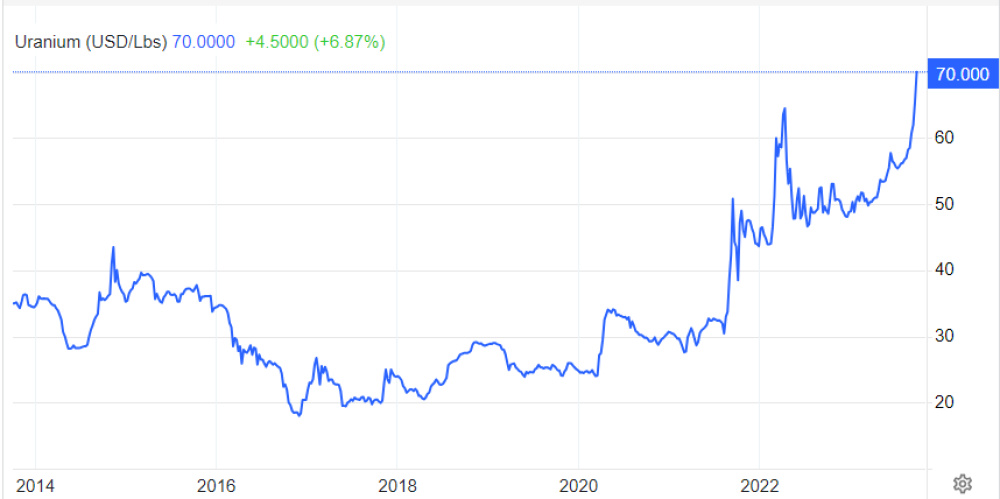
With all of the uranium stocks now catching a bid thanks to a big jump in U3O8 prices at the start of the month, Western Uranium & Vanadium Corp. (WUC:CSE; WSTRF:OTCQX) has once again begun an ascent to higher prices driven by buying from one of the big uranium equity funds south of the border.

First, look at the 7-year chart, which shows the crazy behavior of the uranium market, moving violently in fits and shoves from total disinterest to wild-eyed buy-side mania from out of nowhere and with little advance notice.

The moves in 2018 and 2021 saw bottoms in the early part of those years and peaks in Q4, after which they collapsed back down to earth, where prices drifted sideways month after month.

I did not trade the position because I thought then (and think today) that demand-supply conditions are tilting rapidly in favor for the uranium pricing structure where fifty-seven (57) new nuclear reactors are under construction.

From the chart shown below, you can see that there is a great deal of “room to run” for WUC/WSTRF.

Now, look at the year-to-date chart for the same company, and it tells a somewhat different story.

The stock has blasted off from under CA$0.95 to $1.71 in less than a month, taking RSI to nearly 90 (before pulling back), and both MACD and MFI are now in egregiously “overbought” territories.

Mind you, the run in 2022 saw RSI move above 70 (“overbought”) six times en route to $4.30 from the COVID-19 CRASH low of CA$0.28!

E3 Lithium and Volt Lithium

Due to the stretched RSI and elevated MACD and MFI readings, I would avoid the stock, but once again, I would not try to trade it because it is my only uranium holding in a sector that could easily see new highs for U3O8 above $138 per pound once these new reactors begin taking off all available supply over the next two years.

My theme for the decade is that the electrification movement will place incremental demand-supply pressures on new, clean sources of electricity (nuclear), transmission infrastructure needs (copper), and electricity storage capacity (lithium). Solar and wind are not capable of supplying the grid with enough electricity to satisfy escalating demand, which leaves nuclear energy as the logical heir to the throne.

Uranium producers and developers should do very well in such an environment. However, I have been hearing this for over seven years since I first bought the CA$1.70 placement in WUC:CSE and have twice missed the pops to $3.40 and $4.25. My goal is to take profits at new highs in uranium prices, which has been elusive despite compelling fundamentals.

Trade accordingly.

Last Friday, with E3 Lithium Ltd. (ETL:TSXV;EEMMF:US) trading at $5.00, I put out this chart and got roasted by ETL shareholders from Fairbanks to Boca Raton such that when it hit $5.50 on Tuesday, I was getting emails and DM’s and private messages explaining how I didn’t “get it.”

Here is the updated chart of ETL showing the impact of massively overbought conditions in RSI (above 80), MACD, and MFI, plus chatroom banter talking about a “buyout from Imperial Oil” and “short squeeze to $10 all weekend long.

Volt Lithium Corp. (VLT:TSV;VLTLF:US) is also under pressure, but RSI at 53.83 is now neutral and no longer “overbought.”


Important Disclosures:

  1. Volt Lithium Corp. has a consulting relationship with an affiliate of Streetwise Reports, and pays a monthly consulting fee between US$8,000 and US$20,000.
  2. As of the date of this article, officers and/or employees of Streetwise Reports LLC (including members of their household) own securities of Volt Lithium Corp. and Western Uranium & Vanadium Corp.
  3. Michael Ballanger: I, or members of my immediate household or family, own securities of: All. My company has a financial relationship with Volt. I determined which companies would be included in this article based on my research and understanding of the sector.
  4. Statements and opinions expressed are the opinions of the author and not of Streetwise Reports or its officers. The author is wholly responsible for the validity of the statements. The author was not paid by Streetwise Reports for this article. Streetwise Reports was not paid by the author to publish or syndicate this article. Streetwise Reports requires contributing authors to disclose any shareholdings in, or economic relationships with, companies that they write about. Streetwise Reports relies upon the authors to accurately provide this information and Streetwise Reports has no means of verifying its accuracy.
  5.  This article does not constitute investment advice. Each reader is encouraged to consult with his or her individual financial professional. By opening this page, each reader accepts and agrees to Streetwise Reports’ terms of use and full legal disclaimer. This article is not a solicitation for investment. Streetwise Reports does not render general or specific investment advice and the information on Streetwise Reports should not be considered a recommendation to buy or sell any security. Streetwise Reports does not endorse or recommend the business, products, services or securities of any company.

For additional disclosures, please click here.

Michael Ballanger Disclosures

This letter makes no guarantee or warranty on the accuracy or completeness of the data provided. Nothing contained herein is intended or shall be deemed to be investment advice, implied or otherwise. This letter represents my views and replicates trades that I am making but nothing more than that. Always consult your registered advisor to assist you with your investments. I accept no liability for any loss arising from the use of the data contained on this letter. Options and junior mining stocks contain a high level of risk that may result in the loss of part or all invested capital and therefore are suitable for experienced and professional investors and traders only. One should be familiar with the risks involved in junior mining and options trading and we recommend consulting a financial adviser if you feel you do not understand the risks involved.

China’s economic indicators have started to improve. US stock indices are under pressure from the risk of economic instability

By JustMarkets

As of Friday’s stock market close, the Dow Jones Index (US30) decreased by 0.83% (-0.09% for the week), while the S&P 500 Index (US500) fell by 1.22% (-0.68% for the week). The NASDAQ Technology Index (US100) closed Friday negative by 1.56% (-1.27% for the week).

The US dollar came under pressure on Friday after reports from the University of Michigan on consumer sentiment and inflation expectations fell more than expected, a dovish factor for Fed policy. The University of Michigan’s inflation expectations for September unexpectedly fell to a .5-year low of 3.1%, better than expectations of 3.5%. The University of Michigan’s US Consumer Sentiment Index for September fell by 1.8 to 67.7, weaker than expectations of 69.0. Other data showed that US manufacturing output for August rose by 0.1% m/m, in line with expectations. Industrial production rose by 0.4% m/m in August, stronger than expectations of 0.1% m/m.

The Fed will hold its monetary policy meeting this week. Economists believe that economic instability in the US (as indicated in past FOMC minutes) could go too far and increase the likelihood of a recession. Given this risk, as well as the positive trend in inflation and labor costs, analysts predict that the Fed will hold the rate for several months, and the data flow will gradually weaken the case for a rate hike in November or December. Markets rate the odds of a 25 bps rate hike at the September 20 FOMC meeting at 4% and a 25 bps rate hike at the November 1 FOMC meeting at 33%.

In Canada, the government has begun to tackle the housing crisis. In an effort to boost supply, the Canadian government announced Friday that it will eliminate the federal 5% consumption tax on the construction of new rental apartments and urged cities to be more proactive in addressing the problem.

Equity markets in Europe were mostly up on Friday. Germany’s DAX (DE40) increased by 0.56% (+0.60% for the week), France’s CAC 40 (FR40) gained 0.96% (+1.42% for the week), Spain’s IBEX 35 (ES35) added 0.01% (+1.55% for the week), and the UK’s FTSE 100 (UK100) closed up by 0.50% (+3.12% for the week). The ECB’s hawkish comments on Friday provided a boost for the euro, with European indices also reacting positively. ECB President Lagarde said that the ECB is not discussing cutting interest rates. Meanwhile, ECB Governing Council representative Vasle said that core inflation remains relatively high and did not rule out further interest rate hikes.

Silver (XAGUSD) gained support on Friday after stronger-than-expected reports on Chinese industrial production for August and US industrial production for August were stronger than expected, which is favorable for demand for industrial metals.

A weaker dollar on Friday provided support for energy prices. In addition, stronger-than-expected economic reports from China, the world’s second-largest oil consumer, supported energy demand. Crude oil has been supported since last Tuesday when the International Energy Agency (IEA) and OPEC said the global oil market will be in deficit for the rest of the year. On the bearish side was Friday’s drop in stocks, which undermined confidence in the outlook for the economy and energy demand.

Asian markets were mostly up last week. Japan’s Nikkei 225 (JP225) gained 2.58% for the week, China’s FTSE China A50 (CHA50) fell by 1.33%, Hong Kong’s Hang Seng (HK50) ended the week up by 1.34%, and Australia’s S&P/ASX 200 (AU200) ended the week positive by 1.71%.

The only data to focus on for China this week will be the PBoC’s decision on 1-year and 5-year loans on Wednesday. After commercial banks left the 1-year medium-term lending rate unchanged at 2.50% on Friday following a 25 basis point cut in the commercial banks’ reserve requirement ratio, it is likely that the 1-year and 5-year lending rates will remain unchanged at 3.45% and 4.2%, respectively. China’s economic data has recently started to improve. Retail sales rose by 4.6% y/y in August, beating the consensus forecast of 3% as well as July’s 2.5%, the highest growth rate since May. The August industrial production figure also beat expectations of 3.9% and rose 4.5% y/y, the highest rate since April.

S&P 500 (F)(US500) 4,450.32  −54.78 (−1.22%)

Dow Jones (US30) 34,618.24 −288.87 (−0.83%)

DAX (DE40)  15,893.53 +88.24 (+0.56%)

FTSE 100 (UK100) 7,711.38 +38.30 (+0.50%)

USD Index  105.33 −0.07 (−0.07%)

There are no important events for today.

By JustMarkets


This article reflects a personal opinion and should not be interpreted as an investment advice, and/or offer, and/or a persistent request for carrying out financial transactions, and/or a guarantee, and/or a forecast of future events.