Archive for Stock Market News – Page 49

Elliott Waves: Your “Rhyme & Reason” to Mainstream Market Opinions

R.N. Elliott’s stock market observations fell together “into a general set of principles”

By Elliott Wave International

It’s understandable why investors with little experience consult the market opinions of professionals.

But many of these new investors are left scratching their heads. Two headlines from July 29 indicate why:

  • [Fundstrat Managing Partner] says the 2022 bear market is over, stocks could hit new highs before year-end (CNBC)
  • Stock market’s post-Fed bounce is a ‘trap,’ says Morgan Stanley’s [Chief Investment Officer] (Marketwatch]

Yes, two directly opposing opinions that were published on the same day.

The date before those headlines published (July 28), happened to be Ralph Nelson Elliott’s 151st birthday.

You may be interested in his discovery about stock market behavior because it offers an alternative to consulting mainstream financial stories.

Here’s a brief overview: In the 1930s, Ralph Nelson Elliott (1871-1948) discovered that the stock market moves in recurring patterns that he called waves.

Elliott had led an active life as an accountant and management consultant, working at various times for railroad companies in Mexico, Central America and South America, a business magazine, and for the State Department before becoming seriously ill with pernicious anemia.

In the book, R.N. Elliott’s Masterworks, Elliott Wave International President Robert Prechter describes what happened next:

Despite being physically debilitated by his malady, Elliott needed something to occupy his acute mind while recuperating between its worst attacks. … It was around 1932 that Elliott began turning his full attention to … finding out whether there was any rhyme or reason to the stock market. …

Around May 1934 … his numerous observations of general stock market behavior began falling together into a general set of principles that applied to all degrees of wave movement in the stock price averages.

Elliott’s insights continue to be employed by investors today.

The basic Elliott wave pattern consists of five subwaves (denoted by numbers) which move in the same direction as the trend of the next larger size and three corrective subwaves (denoted by letters) which move against the trend of the next larger size:

When this initial eight-wave cycle such as shown by the illustration ends, a similar cycle begins.

In other words, the basic Elliott wave pattern links to form five- and three-wave structures of increasingly larger size.

An important point is that the Wave Principle helps investors to identify turning points in the trends of financial markets.

Indeed, here’s a quote from Frost & Prechter’s Wall Street classic, Elliott Wave Principle: Key to Market Behavior:

When after a while the apparent jumble gels into a clear picture, the probability that a turning point is at hand can suddenly and excitingly rise to nearly 100%. It is a thrilling experience to pinpoint a turn, and the Wave Principle is the only approach that can occasionally provide the opportunity to do so.

Here’s the good news: You can access the entire online version of the book for free once you become a member of Club EWI, the world’s largest Elliott wave educational community.

Club EWI is free to join without any obligations and members enjoy free access to Elliott wave resources on financial markets and investing, including exclusive articles and interviews with Elliott Wave International’s analysts.

Click on the link to get started right away: Elliott Wave Principle: Key to Market Behavior — get free and instant access.

This article was syndicated by Elliott Wave International and was originally published under the headline Elliott Waves: Your “Rhyme & Reason” to Mainstream Market Opinions. EWI is the world’s largest market forecasting firm. Its staff of full-time analysts led by Chartered Market Technician Robert Prechter provides 24-hour-a-day market analysis to institutional and private investors around the world.

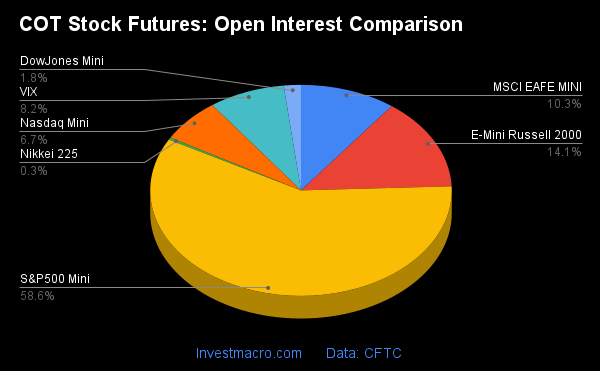
COT Week 31 Charts: Stock Market Speculator bets led lower by Russell 2000 & MSCI EAFE Minis

By InvestMacro | COT | Data Tables | COT Leaders | Downloads | COT Newsletter

Here are the latest charts and statistics for the Commitment of Traders (COT) data published by the Commodities Futures Trading Commission (CFTC).

The latest COT data is updated through Tuesday August 2nd and shows a quick view of how large traders (for-profit speculators and commercial entities) were positioned in the futures markets.

Weekly Speculator Changes

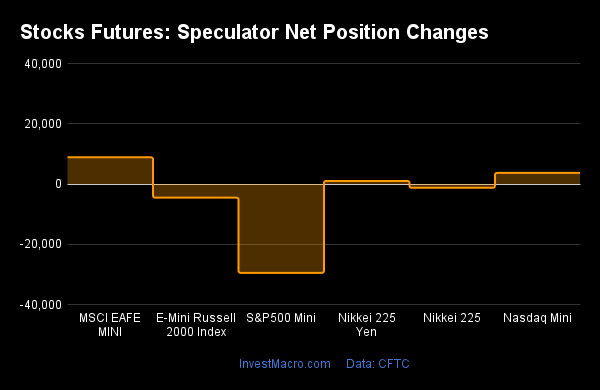
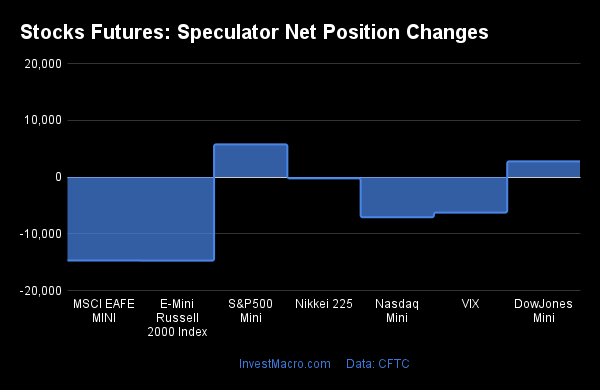
COT stock market speculator bets were overall lower this week as just two out of the seven stock markets we cover had higher positioning this week while the other five markets had lower contracts on the week.

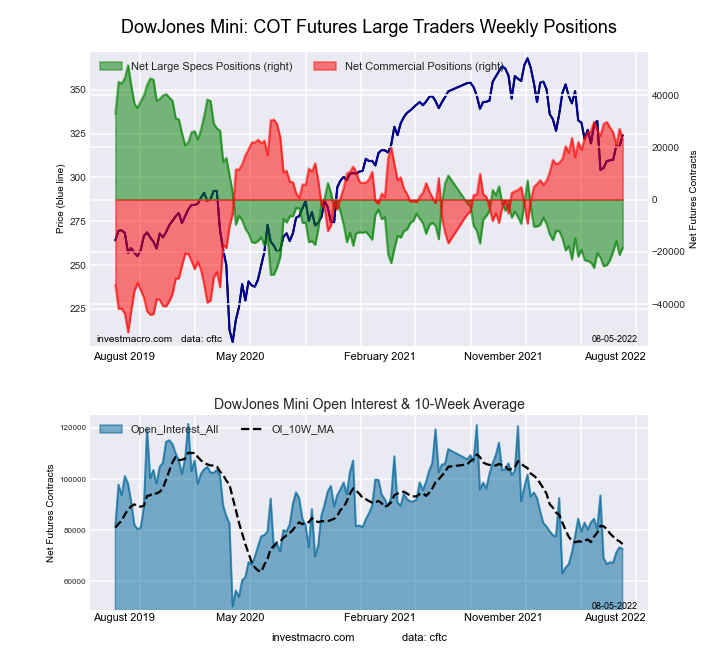
Leading the gains for stock markets was the S&P500 Mini (5,750 contracts) and the Dow Jones Industrial Average Mini with a gain of 2,764 contracts.

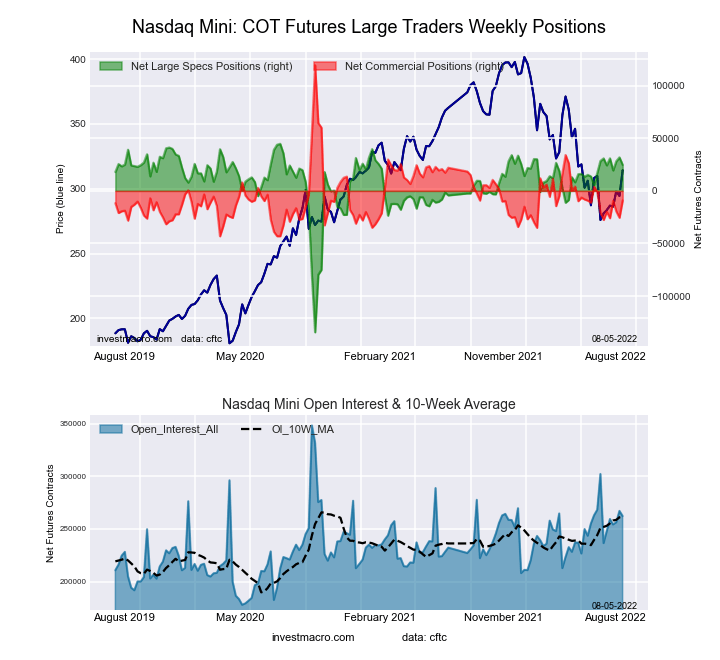
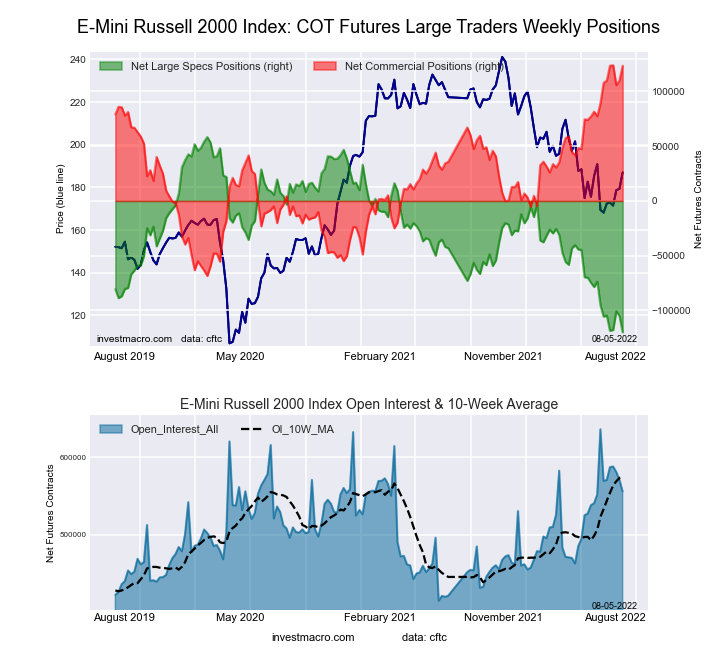
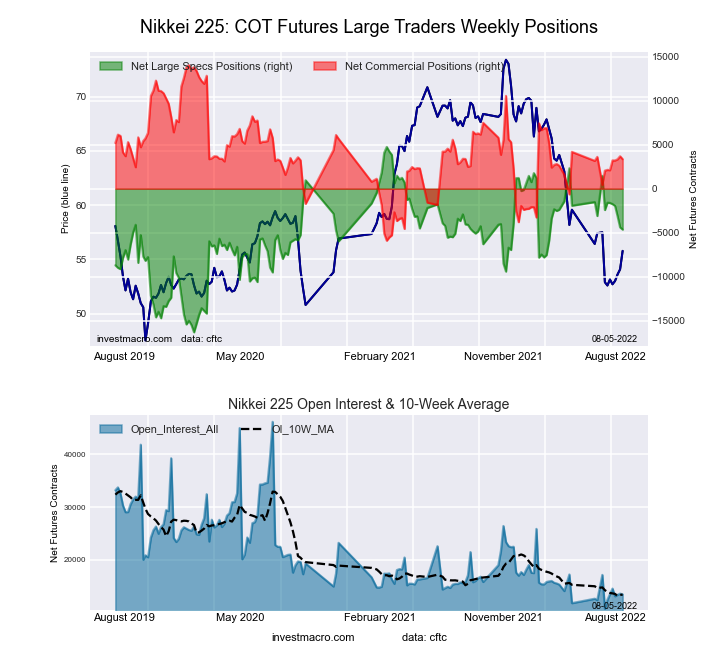
The stock markets leading the declines in speculator bets this week were the Russell 2000 Mini (-14,743 contracts) and the MSCI EAFE Mini (-14,707 contracts) while the Nasdaq Mini (-7,097 contracts), the VIX (-6,273 contracts) and the Nikkei 225 USD (-245 contracts) also had lower bets on the week.


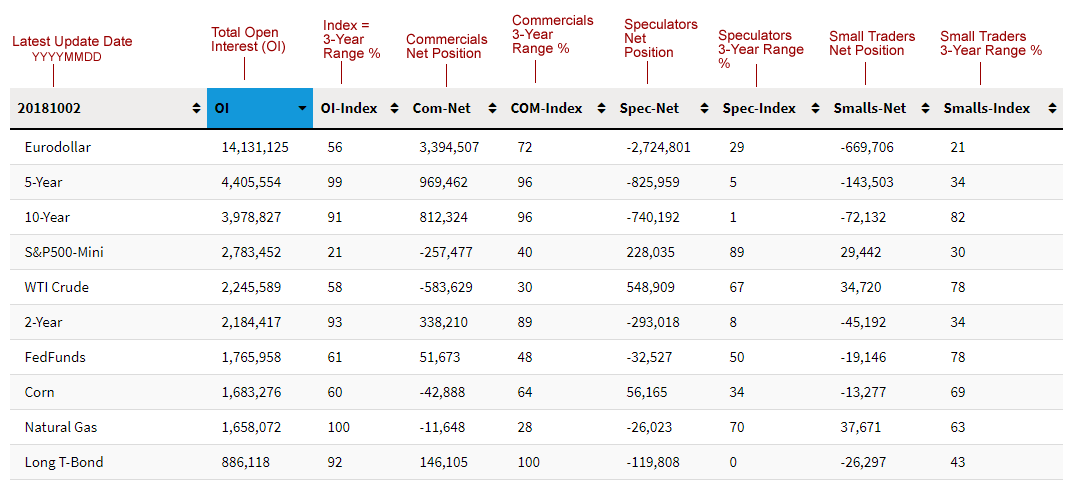
Data Snapshot of Stock Market Traders | Columns Legend
Aug-02-2022OIOI-IndexSpec-NetSpec-IndexCom-NetCOM-IndexSmalls-NetSmalls-Index
S&P500-Mini2,310,6658-231,88513293,137100-61,25214
Nikkei 22513,4108-4,635553,353461,28244
Nasdaq-Mini262,3255024,71289-9,09421-15,61816
DowJones-Mini72,61931-18,4211422,96090-4,53914
VIX322,60433-98,83860105,97141-7,13357
Nikkei 225 Yen59,868438,3486024,11686-32,4648


Strength Scores

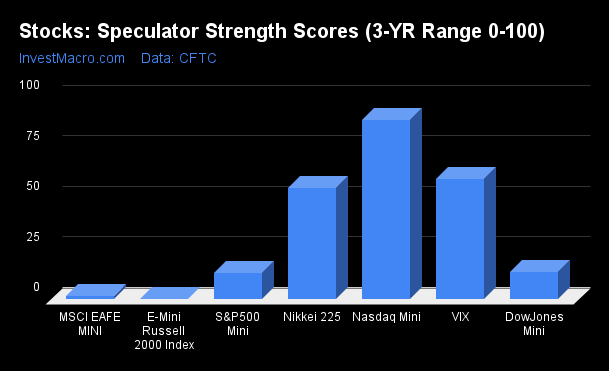
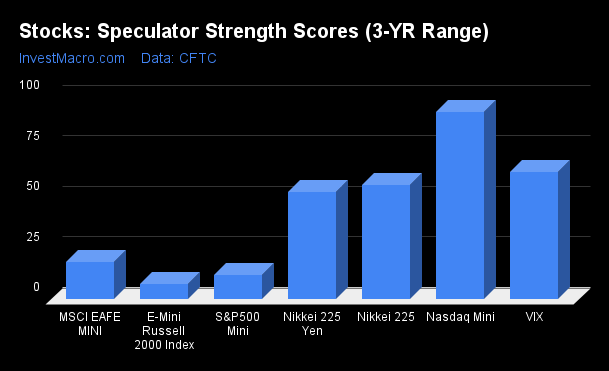
Strength Scores (a normalized measure of Speculator positions over a 3-Year range, from 0 to 100 where above 80 is extreme bullish and below 20 is extreme bearish) showed that the Nasdaq-Mini (88.8 percent) has the highest strength score currently and remains in a bullish extreme position (above 80 percent) although slightly lower from last week (92.8 percent). The VIX (59.8 percent) and the Nikkei USD (55.4 percent) come in as the next highest stocks market in strength scores. On the downside, the Russell 2000-Mini (0.0 percent), the EAFE-Mini (1.9 percent), the S&P500-Mini (13.2 percent) and the DowJones-Mini (13.8 percent) all currently have very weak speculator sentiment and are in bearish extreme positions (below 20 percent).


Strength Statistics:
VIX (59.8 percent) vs VIX previous week (62.9 percent)
S&P500-Mini (13.2 percent) vs S&P500-Mini previous week (12.2 percent)
DowJones-Mini (13.8 percent) vs DowJones-Mini previous week (10.1 percent)
Nasdaq-Mini (88.8 percent) vs Nasdaq-Mini previous week (92.8 percent)
Russell2000-Mini (0.0 percent) vs Russell2000-Mini previous week (8.3 percent)
Nikkei USD (55.4 percent) vs Nikkei USD previous week (56.6 percent)
EAFE-Mini (1.9 percent) vs EAFE-Mini previous week (18.6 percent)

Strength Trends

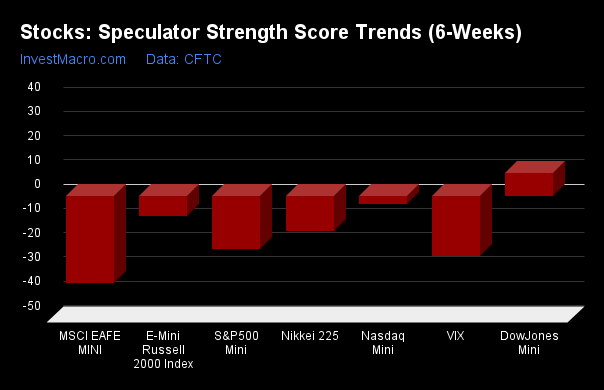
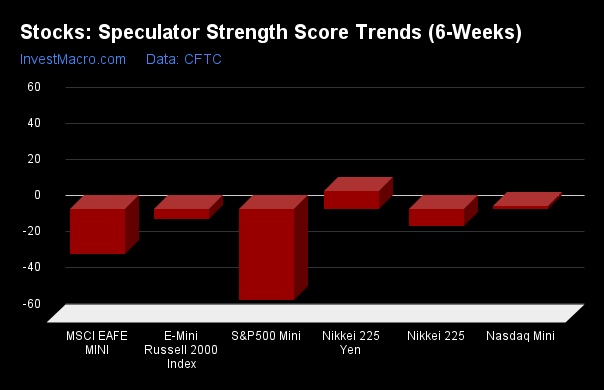
Strength Score Trends (or move index, calculates the 6-week changes in strength scores) showed that the DowJones-Mini (9.4 percent) is the only stock market that has a positive six week trend for stocks at the moment.  The EAFE-Mini (-35.9 percent) leads the downside trend scores currently while the next lower trend scores were from the VIX (-24.5 percent) followed by the S&P500-Mini (-21.8 percent) and the Nikkei USD (-14.5 percent).


Strength Trend Statistics:
VIX (-24.5 percent) vs VIX previous week (-9.2 percent)
S&P500-Mini (-21.8 percent) vs S&P500-Mini previous week (-50.4 percent)
DowJones-Mini (9.4 percent) vs DowJones-Mini previous week (1.5 percent)
Nasdaq-Mini (-3.4 percent) vs Nasdaq-Mini previous week (1.9 percent)
Russell2000-Mini (-8.1 percent) vs Russell2000-Mini previous week (-5.6 percent)
Nikkei USD (-14.5 percent) vs Nikkei USD previous week (-9.4 percent)
EAFE-Mini (-35.9 percent) vs EAFE-Mini previous week (-24.8 percent)


Individual Markets:

VIX Volatility Futures:

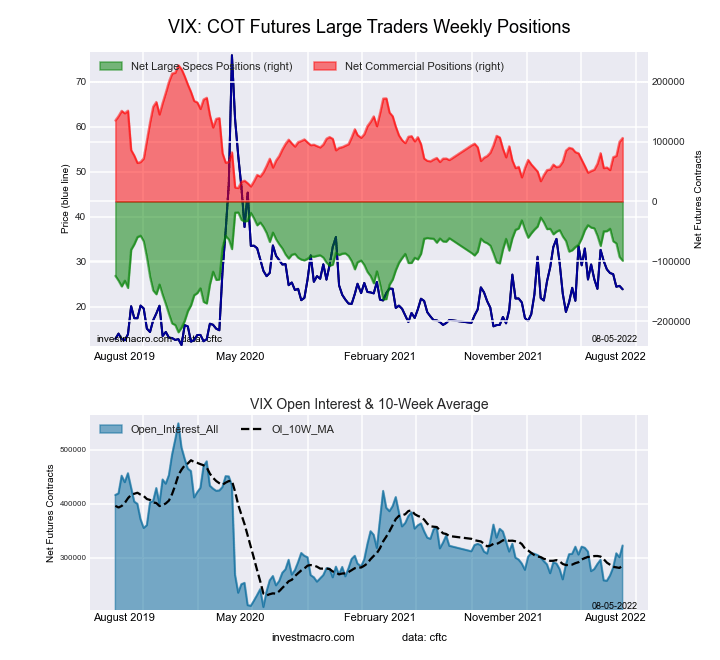
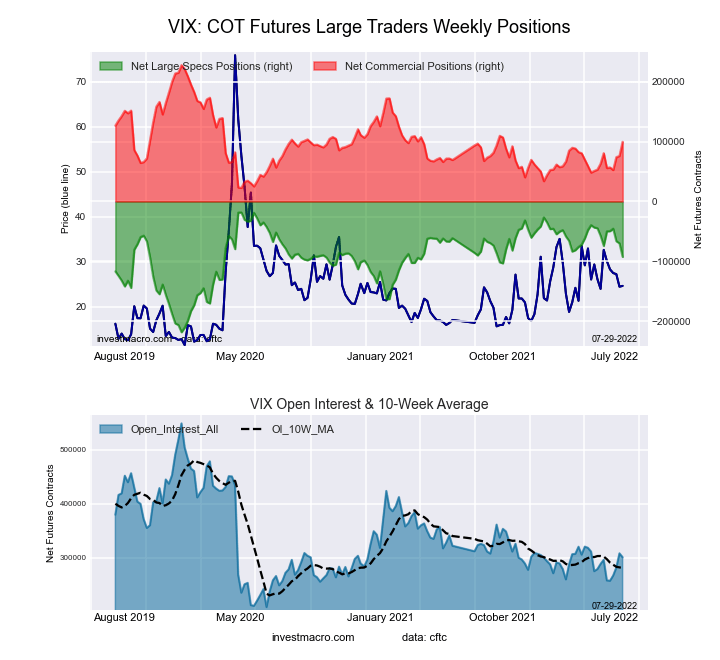
VIX Volatility Futures COT ChartThe VIX Volatility large speculator standing this week resulted in a net position of -98,838 contracts in the data reported through Tuesday. This was a weekly decline of -6,273 contracts from the previous week which had a total of -92,565 net contracts.

This week’s current strength score (the trader positioning range over the past three years, measured from 0 to 100) shows the speculators are currently Bullish with a score of 59.8 percent. The commercials are Bearish with a score of 40.7 percent and the small traders (not shown in chart) are Bullish with a score of 56.8 percent.

VIX Volatility Futures StatisticsSPECULATORSCOMMERCIALSSMALL TRADERS
– Percent of Open Interest Longs:12.262.87.7
– Percent of Open Interest Shorts:42.929.99.9
– Net Position:-98,838105,971-7,133
– Gross Longs:39,442202,54224,811
– Gross Shorts:138,28096,57131,944
– Long to Short Ratio:0.3 to 12.1 to 10.8 to 1
NET POSITION TREND:
– Strength Index Score (3 Year Range Pct):59.840.756.8
– Strength Index Reading (3 Year Range):BullishBearishBullish
NET POSITION MOVEMENT INDEX:
– 6-Week Change in Strength Index:-24.524.5-6.4


S&P500 Mini Futures:

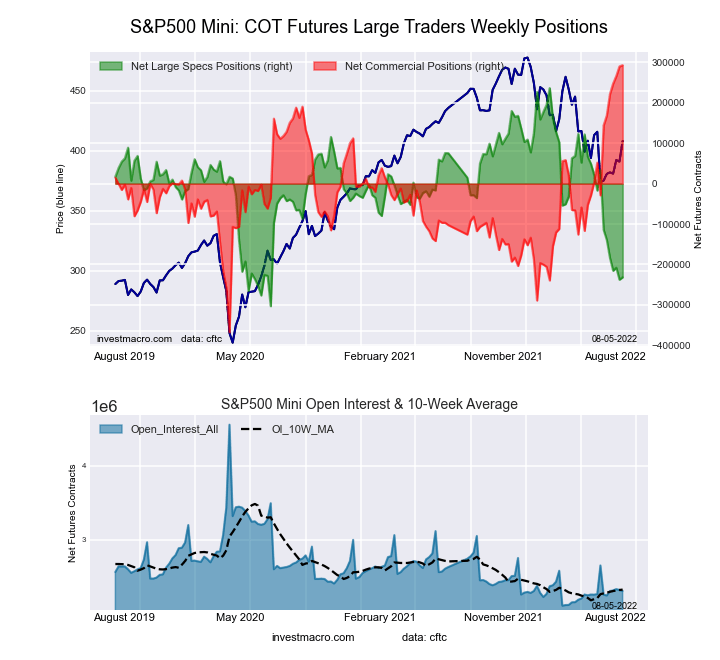
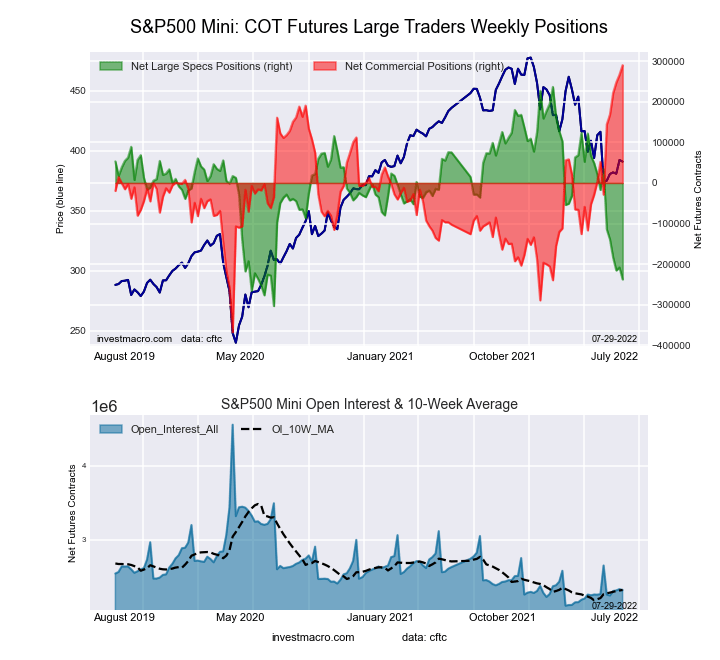
SP500 Mini Futures COT ChartThe S&P500 Mini large speculator standing this week resulted in a net position of -231,885 contracts in the data reported through Tuesday. This was a weekly advance of 5,750 contracts from the previous week which had a total of -237,635 net contracts.

This week’s current strength score (the trader positioning range over the past three years, measured from 0 to 100) shows the speculators are currently Bearish-Extreme with a score of 13.2 percent. The commercials are Bullish-Extreme with a score of 100.0 percent and the small traders (not shown in chart) are Bearish-Extreme with a score of 13.5 percent.

S&P500 Mini Futures StatisticsSPECULATORSCOMMERCIALSSMALL TRADERS
– Percent of Open Interest Longs:10.377.39.6
– Percent of Open Interest Shorts:20.364.612.2
– Net Position:-231,885293,137-61,252
– Gross Longs:237,5941,786,757220,741
– Gross Shorts:469,4791,493,620281,993
– Long to Short Ratio:0.5 to 11.2 to 10.8 to 1
NET POSITION TREND:
– Strength Index Score (3 Year Range Pct):13.2100.013.5
– Strength Index Reading (3 Year Range):Bearish-ExtremeBullish-ExtremeBearish-Extreme
NET POSITION MOVEMENT INDEX:
– 6-Week Change in Strength Index:-21.822.5-6.6


Dow Jones Mini Futures:

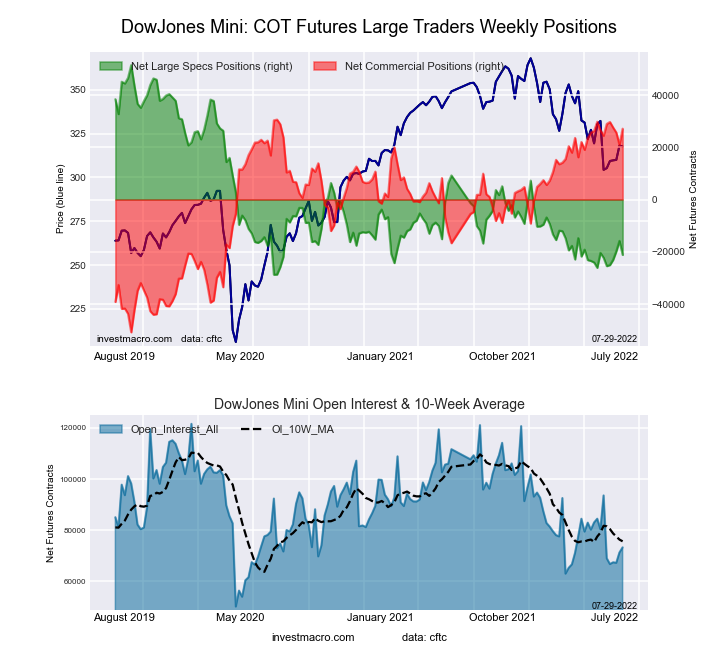
Dow Jones Mini Futures COT ChartThe Dow Jones Mini large speculator standing this week resulted in a net position of -18,421 contracts in the data reported through Tuesday. This was a weekly boost of 2,764 contracts from the previous week which had a total of -21,185 net contracts.

This week’s current strength score (the trader positioning range over the past three years, measured from 0 to 100) shows the speculators are currently Bearish-Extreme with a score of 13.8 percent. The commercials are Bullish-Extreme with a score of 89.8 percent and the small traders (not shown in chart) are Bearish-Extreme with a score of 14.2 percent.

Dow Jones Mini Futures StatisticsSPECULATORSCOMMERCIALSSMALL TRADERS
– Percent of Open Interest Longs:22.362.514.1
– Percent of Open Interest Shorts:47.630.920.4
– Net Position:-18,42122,960-4,539
– Gross Longs:16,16145,38510,253
– Gross Shorts:34,58222,42514,792
– Long to Short Ratio:0.5 to 12.0 to 10.7 to 1
NET POSITION TREND:
– Strength Index Score (3 Year Range Pct):13.889.814.2
– Strength Index Reading (3 Year Range):Bearish-ExtremeBullish-ExtremeBearish-Extreme
NET POSITION MOVEMENT INDEX:
– 6-Week Change in Strength Index:9.4-8.0-5.7


Nasdaq Mini Futures:

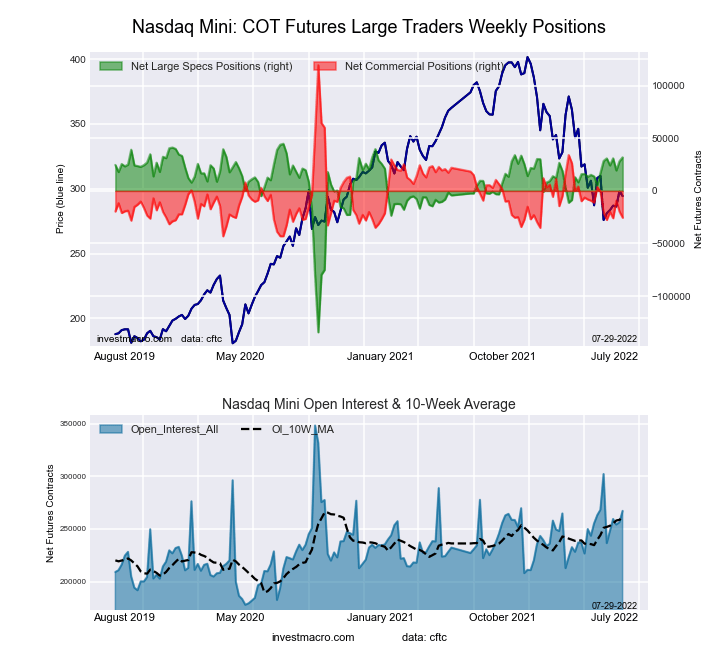
Nasdaq Mini Futures COT ChartThe Nasdaq Mini large speculator standing this week resulted in a net position of 24,712 contracts in the data reported through Tuesday. This was a weekly decrease of -7,097 contracts from the previous week which had a total of 31,809 net contracts.

This week’s current strength score (the trader positioning range over the past three years, measured from 0 to 100) shows the speculators are currently Bullish-Extreme with a score of 88.8 percent. The commercials are Bearish with a score of 20.9 percent and the small traders (not shown in chart) are Bearish-Extreme with a score of 16.3 percent.

Nasdaq Mini Futures StatisticsSPECULATORSCOMMERCIALSSMALL TRADERS
– Percent of Open Interest Longs:28.657.111.6
– Percent of Open Interest Shorts:19.160.617.6
– Net Position:24,712-9,094-15,618
– Gross Longs:74,918149,77330,452
– Gross Shorts:50,206158,86746,070
– Long to Short Ratio:1.5 to 10.9 to 10.7 to 1
NET POSITION TREND:
– Strength Index Score (3 Year Range Pct):88.820.916.3
– Strength Index Reading (3 Year Range):Bullish-ExtremeBearishBearish-Extreme
NET POSITION MOVEMENT INDEX:
– 6-Week Change in Strength Index:-3.411.4-25.5


Russell 2000 Mini Futures:

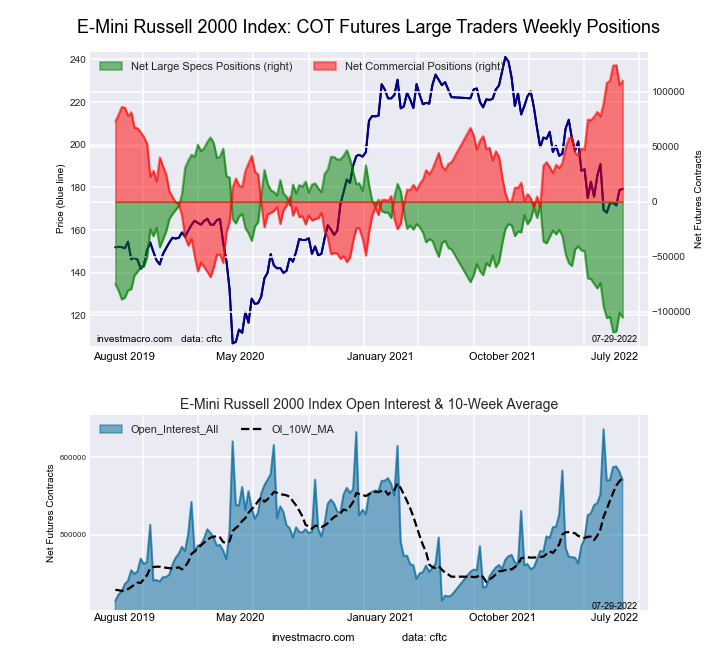
Russell 2000 Mini Futures COT ChartThe Russell 2000 Mini large speculator standing this week resulted in a net position of -119,954 contracts in the data reported through Tuesday. This was a weekly decline of -14,743 contracts from the previous week which had a total of -105,211 net contracts.

This week’s current strength score (the trader positioning range over the past three years, measured from 0 to 100) shows the speculators are currently Bearish-Extreme with a score of 0.0 percent. The commercials are Bullish-Extreme with a score of 99.7 percent and the small traders (not shown in chart) are Bearish-Extreme with a score of 16.6 percent.

Russell 2000 Mini Futures StatisticsSPECULATORSCOMMERCIALSSMALL TRADERS
– Percent of Open Interest Longs:5.589.53.5
– Percent of Open Interest Shorts:27.167.34.1
– Net Position:-119,954123,483-3,529
– Gross Longs:30,724497,84419,324
– Gross Shorts:150,678374,36122,853
– Long to Short Ratio:0.2 to 11.3 to 10.8 to 1
NET POSITION TREND:
– Strength Index Score (3 Year Range Pct):0.099.716.6
– Strength Index Reading (3 Year Range):Bearish-ExtremeBullish-ExtremeBearish-Extreme
NET POSITION MOVEMENT INDEX:
– 6-Week Change in Strength Index:-8.18.1-3.8


Nikkei Stock Average (USD) Futures:

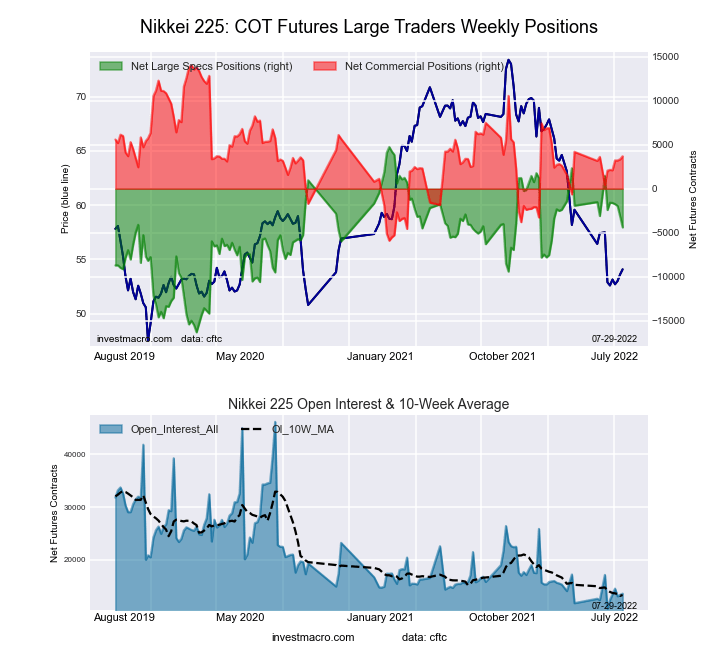
Nikkei Stock Average (USD) Futures COT ChartThe Nikkei Stock Average (USD) large speculator standing this week resulted in a net position of -4,635 contracts in the data reported through Tuesday. This was a weekly fall of -245 contracts from the previous week which had a total of -4,390 net contracts.

This week’s current strength score (the trader positioning range over the past three years, measured from 0 to 100) shows the speculators are currently Bullish with a score of 55.4 percent. The commercials are Bearish with a score of 46.4 percent and the small traders (not shown in chart) are Bearish with a score of 44.4 percent.

Nikkei Stock Average Futures StatisticsSPECULATORSCOMMERCIALSSMALL TRADERS
– Percent of Open Interest Longs:8.860.829.8
– Percent of Open Interest Shorts:43.335.820.3
– Net Position:-4,6353,3531,282
– Gross Longs:1,1788,1514,002
– Gross Shorts:5,8134,7982,720
– Long to Short Ratio:0.2 to 11.7 to 11.5 to 1
NET POSITION TREND:
– Strength Index Score (3 Year Range Pct):55.446.444.4
– Strength Index Reading (3 Year Range):BullishBearishBearish
NET POSITION MOVEMENT INDEX:
– 6-Week Change in Strength Index:-14.56.123.0


MSCI EAFE Mini Futures:

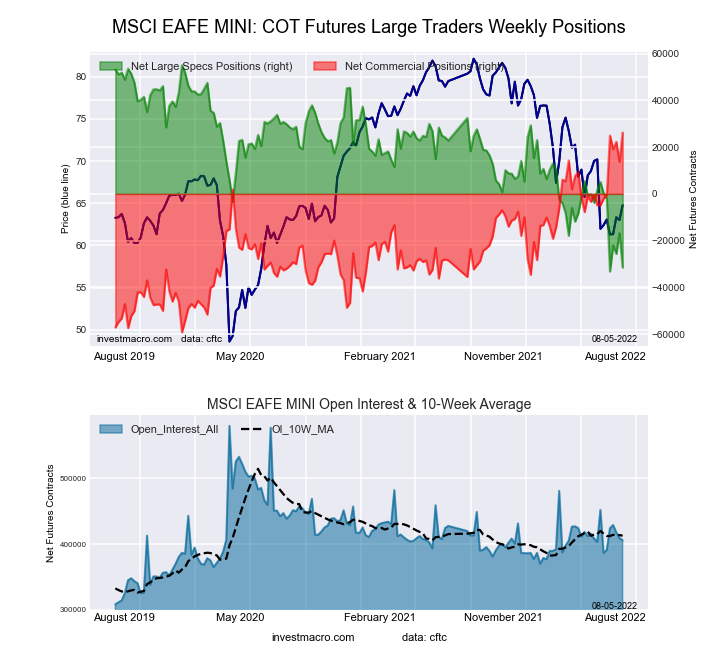
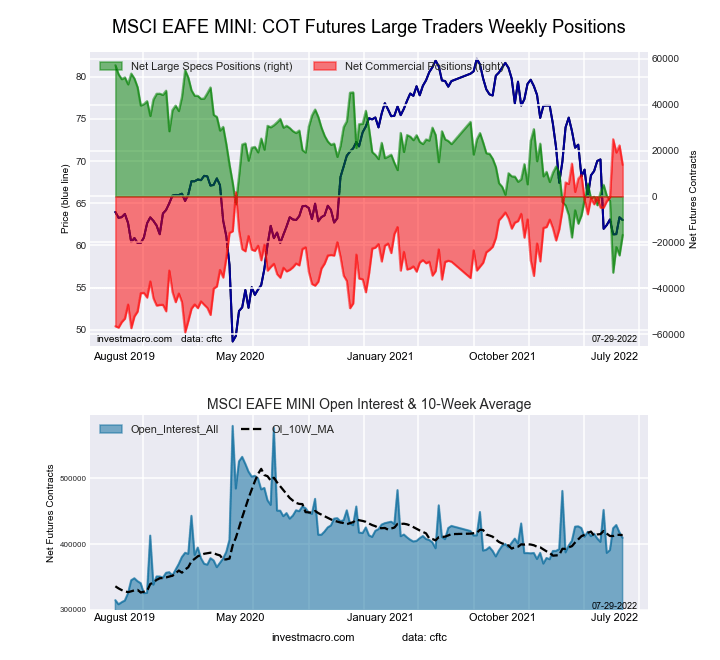
MSCI EAFE Mini Futures COT ChartThe MSCI EAFE Mini large speculator standing this week resulted in a net position of -31,514 contracts in the data reported through Tuesday. This was a weekly fall of -14,707 contracts from the previous week which had a total of -16,807 net contracts.

This week’s current strength score (the trader positioning range over the past three years, measured from 0 to 100) shows the speculators are currently Bearish-Extreme with a score of 1.9 percent. The commercials are Bullish-Extreme with a score of 100.0 percent and the small traders (not shown in chart) are Bullish with a score of 64.8 percent.

MSCI EAFE Mini Futures StatisticsSPECULATORSCOMMERCIALSSMALL TRADERS
– Percent of Open Interest Longs:4.991.42.9
– Percent of Open Interest Shorts:12.784.91.6
– Net Position:-31,51426,2695,245
– Gross Longs:20,008370,69811,622
– Gross Shorts:51,522344,4296,377
– Long to Short Ratio:0.4 to 11.1 to 11.8 to 1
NET POSITION TREND:
– Strength Index Score (3 Year Range Pct):1.9100.064.8
– Strength Index Reading (3 Year Range):Bearish-ExtremeBullish-ExtremeBullish
NET POSITION MOVEMENT INDEX:
– 6-Week Change in Strength Index:-35.933.229.5


Article By InvestMacroReceive our weekly COT Reports by Email

*COT Report: The COT data, released weekly to the public each Friday, is updated through the most recent Tuesday (data is 3 days old) and shows a quick view of how large speculators or non-commercials (for-profit traders) were positioned in the futures markets.

The CFTC categorizes trader positions according to commercial hedgers (traders who use futures contracts for hedging as part of the business), non-commercials (large traders who speculate to realize trading profits) and nonreportable traders (usually small traders/speculators) as well as their open interest (contracts open in the market at time of reporting).See CFTC criteria here.

What are automotive ‘over-the-air’ updates? A marketing professor explains

By Vivek Astvansh, Indiana University 

Whenever automakers discover that a vehicle has a defect or does not comply with U.S. laws, they must notify the National Highway Traffic Safety Administration and mail a notice to each customer who owns or leases the affected vehicles. Automakers must also recall those cars, trucks or SUVs – which means they have to fix the defect across the entire fleet.

People with recalled vehicles usually have to schedule a visit to an authorized dealership, where a mechanic repairs the car.

But vehicles are increasingly high-tech contraptions. Although most recalls still require the replacement or repair of auto parts, such as air bags or brakes, a growing number of issues are resolved without any help from a mechanic.

All they require is an “over-the-air update.” That’s the technical term for what happens when you update any software program used by a device, whether’s it’s a smartphone or a sedan.

Over-the-air updates are especially common for vehicles that run fully or partially on electricity instead of gasoline or another fuel. These digital recalls require little or no effort. For example, Tesla regularly fixes its cars by updating its software. Its drivers often don’t have to do a thing. In other cases, a Tesla owner simply has to tap a few buttons on the car’s touchscreen.

According to the law, it doesn’t matter if safety-related fixes demand a software upgrade or a trip to the dealership. Either way, notifying the National Highway Traffic Safety Administration and all affected drivers is mandatory.

Why over-the-air updates matter

Electric vehicle sales nearly doubled from about 300,000 in 2020 to more than 600,000 in 2021. EV sales rose another 76% in first quarter of 2022 even as sales of all new vehicles dropped by 15.7%.

U.S. EV sales could be on the verge of far more growth, which would make over-the-air updates increasingly common. But drivers and investors are raising an array of safety concerns that could put the brakes on the EV market’s expansion.

Serious problems have included electric vehicles failing to start, losing power and catching fire because of battery defects.

Musk objects to the word ‘recall’

Tesla has pushed harder than its competitors to rely primarily on over-the-air updates to fix problems with its electric vehicles. Its CEO, Elon Musk, has for years publicly questioned the wisdom of calling over-the-air updates “recalls.”

In some cases, Tesla has conducted over-the-air updates to resolve safety defects without notifying the National Highway Traffic Safety Administration or Tesla owners that a recall was underway.

Because that’s against the law, the agency has ordered Tesla to provide those details.

Tesla has used over-the-air updates to resolve, for example, issues with its windshield wipers and seat belt chimes. It has also used over-the-air updates to address problems with its partially automated driving systems. Those features are the subject of a government investigation because of a spate of crashes with parked emergency vehicles in which first responders were using warning signs, such as flashing lights or flares.The Conversation

About the Author:

Vivek Astvansh, Professor of Marketing and Data Science, Indiana University

This article is republished from The Conversation under a Creative Commons license. Read the original article.


3 Stocks Trading Near 52-Week Highs

By Ino.com

So far this year, the stock market has flashed more red signs than green due to various macroeconomic and geopolitical concerns. The immense volatility weighed heavily on equities and government bond yields.

The CBOE Volatility Index (VIX) gained 29.5% year-to-date.

However, the major stock indexes rose in the last trading session to end their best month since 2020, slashing some losses from a gloomy first half of the year. The S&P 500 gained 9.1% in July, while the Dow Jones Industrial Average rose 6.7%, reflecting their strongest month since November 2020. The Nasdaq Composite rose 12.4%, marking its best month since April 2020.

Chris Zaccarelli, chief investment officer for Independent Advisor Alliance, said, “We are seeing a relief rally in the stock market, as pessimism reached extreme levels, and as longer-term interest rates have been coming back down.”

Optimistic expectations from the upcoming earnings releases have also encouraged investors to take a breather from the idea of a slowing economy and further interest rate hikes.

Occidental Petroleum Corporation (OXY), Molina Healthcare, Inc. (MOH), and Greif, Inc. (GEF) are hovering near their 52-week highs and could be the ideal additions to your watchlist now given their strong fundamentals and momentum.

Occidental Petroleum Corporation (OXY)

OXY is engaged in acquiring, exploring, and developing oil and gas properties in the United States, Middle East, Africa, and Latin America.

The company operates through three segments: Oil and Gas, Chemical, Midstream, and Marketing. It develops, processes, transports, and markets oil and condensate, natural gas liquids (NGLs), and natural gas. It also manufactures basic chemicals.

On June 27, 2022, OXY’s subsidiary, 1PointFive, and Manulife Investment Management entered into a lease agreement for approximately 27,000 acres of timberland in Western Louisiana.

This agreement provides 1PointFive with access to subsurface pore space and surface rights to develop and operate a carbon sequestration hub, with access to permanently store industrial carbon emissions. This is expected to promote the company’s sustainability goals.

OXY’s net sales increased 57.7% year-over-year to $8.35 billion in the fiscal 2022 first quarter ended March 31, 2022. Its income from continuing operations rose 1,530.8% from the prior-year period to $4.88 billion.

The company’s adjusted income attributable to common stockholders and adjusted EPS came in at $2.13 billion and $2.12, up 1,664% and 1,513.3%, respectively, year-over-year.

The consensus EPS estimate of $3.03 for the second quarter (ended June 30, 2022) represents an 846.6% improvement year-over-year. The consensus revenue estimate of $9.81 billion for the to-be-reported quarter indicates a 63.2% increase from the same period last year.

The company has an impressive earnings surprise history; it surpassed the consensus EPS estimates in three of the trailing four quarters.

Over the past year, the stock has gained 145.5% to close the last trading session at $65.75. It is currently trading 11.2% below its 52-week high of $74.04, which it hit on May 31, 2022.

OXY’s POWR Ratings reflect solid prospects. The POWR Ratings assess stocks by 118 different factors, each with its own weighting.

It has an A grade for Momentum and a B for Growth and Quality. It is ranked #38 out of 97 stocks in the B-rated Energy – Oil & Gas industry. Click here to learn more about POWR Ratings.

Molina Healthcare, Inc. (MOH)

MOH provides managed health care services to low-income families and individuals under Medicaid and Medicare programs and through state insurance marketplaces. The company operates through four segments: Medicaid, Medicare, Marketplace, and Other.

It offers healthcare services through contracts with providers, independent physicians and physician groups, hospitals, and ancillary providers.

On July 13, 2022, MOH announced that it had agreed to acquire the assets of My Choice Wisconsin. MOH’s President and CEO Joe Zubretsky said, “The addition of My Choice Wisconsin to Molina’s expanding footprint is not only complementary to our existing Medicaid business in Wisconsin, but also representative of our strategic growth initiatives.”

During the fiscal second quarter (ended June 30, 2022), MOH’s total revenue increased 18.4% year-over-year to $8.05 billion. Its operating income rose 32.2% from the year-ago value to $361 million.

The company’s adjusted net income grew 33.7% from the same period last year to $266 million, while its adjusted EPS came in at $4.55, representing a 33.8% increase year-over-year.

Analysts expect MOH’s EPS and revenue for the fiscal third quarter (ending September 2022) to increase 50.5% and 11.4% year-over-year to $4.26 and $7.84 billion. The company has surpassed the consensus EPS estimates in three of the trailing four quarters.

Over the past year, the stock has gained 28.4% to close the last trading session at $327.72. It is currently trading 6.4% below its 52-week high of $350.19, which it hit on April 21, 2022.

MOH’s strong fundamentals are reflected in its POWR Ratings. The stock has an overall rating of A, which equates to a Strong Buy in the POWR Ratings system. MOH also has an A grade for Quality and a B grade for Value.

The stock is ranked #4 of 11 in the A-rated Medical – Health Insurance industry. Click here to learn more about POWR Ratings.

Greif, Inc. (GEF)

GEF is a global producer of industrial packaging products and services with operations in over 35 countries. The company operates through three segments: Global Industrial Packaging, Paper Packaging & Services, and Land Management.

It produces steel, plastic, fiber drums, intermediate bulk containers, containerboard, uncoated and coated recycled paperboard, tubes and cores, and a diverse mix of specialty products.

On June 23, 2022, the company’s Board of Directors announced a $150 million share repurchase program. GEF has entered into a $75 million accelerated share repurchase agreement with Bank of America, N.A. to repurchase its Class A stock shares and plans to repurchase an aggregate of $75 million shares of its Class A and Class B stock in open market purchases. This reflects the company’s strong cash flows and ability to boost shareholder returns.

For the fiscal second quarter ended April 30, 2022, GEF’s net sales increased 24.4% year-over-year to $1.67 billion. The company’s gross profit increased 27.4% year-over-year to $338.70 million. Also, its adjusted EBITDA increased 42.1% year-over-year to $251 million.

For the third quarter ended July 31, 2022, GEF’s EPS and revenue are expected to increase 3.4% and 7.1% year-over-year to $2 and $1.60 billion, respectively. It has surpassed the consensus EPS estimates in three of the trailing four quarters.

The stock has gained 16.1% over the past year to close the last trading session at $70.62. GEF is currently trading 1.9% below its 52-week high of $72, which it hit on November 10, 2021.

GEF’s POWR Ratings reflect this promising outlook. The stock has an overall rating of B, translating to a Buy in the POWR Ratings system. It also has a B grade for Value and Quality.

Within the A – rated Industrial – Packaging industry, it is ranked #3 out of 22 stocks. Click here to learn more about POWR Ratings.


About the Author

Shweta Kumari’s profound interest in financial research and quantitative analysis led her to pursue a career as an investment analyst. She uses her knowledge to help retail investors make educated investment decisions. Shweta graduated with a bachelor’s degree in accounting and finance and is currently pursuing the Chartered Accountancy course. Shweta is a regular contributor for StockNews.com.

By Ino.com – See our Trader Blog, INO TV Free & Market Analysis Alerts

Source: 3 Stocks Trading Near 52-Week Highs

SPY Set To Lose Its Crown

By Ino.com

Since 2017, the King of the Exchange Traded Fund world has slowly been losing ground to its closest competitors.

The SPDR S&P 500 ETF Trust (SPY), the undisputed ETF King since ETFs became popular, is set to lose its crown within the next few years. Well, perhaps it would be better to say that it will lose one of its crowns or maybe one of its world titles while still holding a few others. Let me explain…

The SPY ETF is and has been, with the exception of just a handful of months over the last 20-plus years, the largest Exchange Traded Fund in terms of assets under management. Currently, SPY has $365 billion under management.

In contrast, the next closest competitor, iShares Core S&P 500 ETF (IVV), has $298 billion, and then there is the Vanguard S&P 500 ETF (VOO) at $264 billion in assets.

The SPDR ETF has more than $65 billion in assets compared to the second largest ETF and more than $100 billion compared to the third largest ETF. So why are there predictions that its competitors will overtake it in the coming years?

First and foremost, since 2017, it has been losing ground to IVV and VOO, and based on results from the first half of 2022, the trend doesn’t appear to be changing. VOO has added $29.2 billion in assets year-to-date, while IVV has added $15.7 billion. On the other hand, SPY has lost $22.7 billion.

Also, it is essential to remember that these three ETFs we are comparing all due literally the same thing, track the S&P 500’s performance.

It is not as if we are comparing a NASDAQ-focused ETF and a S&P 500 ETF, these three funds are all built the same. They own the 500 stocks that make up the S&P 500 based on a market capitalization weighting. That matters because this shows that the three fund’s asset changes are not based on performance but on investor preference showing that they are pulling money from one fund in mass and adding it to the others.

Why is this shift occurring?

Simple! Cost.

Despite being the undisputed King of the ETF world, the SPY has one chink in its amour; it is expensive compared to the competition. Like really expensive. The SPY charges a 0.09% expense ratio. So in dollar terms, that would mean an investor with $10,000 in SPY pays $9.00 per year.

But IVV and VOO only charge 0.03% or $3.00 for every $10,000 invested. SPY is three times as expensive as the competition, which offers a nearly identical product. It makes no sense for long-term buy-and-hold investors to stick with SPY and pay the higher fee.

As for other types of investors, say those who trade or put on hedged positions or different complicated investing strategies, it does still make sense why they would use SPY instead of the alternatives. SPY still has the best liquidity.

The current average daily volume for SPY is 93 million shares trading hands per day. IVV’s average volume is 6.2 million, and VOO’s is 5.6 million. Even these figures back the thesis that long-term buy-and-hold investors are buying IVV and VOO while traders are trading SPY.

Traders don’t care as much about the higher cost when they have access to the type of liquidity SPY offers, allowing them to quickly and seamlessly get in and out of a position. This is why SPY may lose its crown as King of the ETFs from an asset standpoint.

Still, it will not likely lose its title as the most liquid ETF because while the competition may be within striking distance from an asset under management standpoint, they aren’t even in the same ballpark when it comes to average daily volume.

So if you are an investor in SPY, you need to ask yourself why. Do you need the liquidity, or have you just been complacent and not switched to one of the ETFs more suited for your type of investing?

Matt Thalman
INO.com Contributor
Follow me on Twitter @mthalman5513

Disclosure: This contributor did not hold a position in any investment mentioned above at the time this blog post was published. This article is the opinion of the contributor themselves. The above is a matter of opinion provided for general information purposes only and is not intended as investment advice. This contributor is not receiving compensation (other than from INO.com) for their opinion.

By Ino.com – See our Trader Blog, INO TV Free & Market Analysis Alerts

Source: SPY Set To Lose Its Crown

Will the S&P 500 Index Go the Way of Meme Stocks?

Here’s what usually happens when “financial lunacy” is prevalent

By Elliott Wave International

You don’t hear much about the meme stock craze anymore — and for good reason.

It’s all but dead and has been for months (Barron’s, Jan. 28):

A Year After It Began, Meme-Stock Mania Is on Life Support

Early last year, the movement to buy meme stocks — like AMC, Gamestop and others — was largely driven by discussions on the internet, mainly by stock market novices.

When the movement was still going strong, the February 2021 Elliott Wave Financial Forecast, a monthly publication which covers major U.S. financial markets, made this comment about meme stocks:

A mania is pretty funny, especially at the very end, when financial lunacy is so prevalent that many assume it to be permanent.

Here’s an update from the July Elliott Wave Financial Forecast:

As you can see on the chart, the Meme Stock Index is down 65% from its early 2021 peak (as of the time the July Elliott Wave Financial Forecast published). So, indeed, the assumption of permanency was what you would call — misplaced.

What you need to know is that an assumption of permanency is now geared toward the main stock indexes — not just by amateur investors, but professionals (Bloomberg June 27):

S&P Analysts Haven’t Been This Bullish In 20 Years

It’s clear that these S&P analysts are shrugging off the downtrends that began in the Dow Industrials and S&P 500 index in January.

They may turn out to be correct — in other words, the downtrend is over and another major leg up is set to start.

Then again, you may want to consult the stock market’s Elliott wave structure.

The July Elliott Wave Financial Forecast describes two Elliott wave options for the S&P 500 index between now and the end of summer.

If you’re unfamiliar with Elliott wave analysis, you are encouraged to read Frost & Prechter’s Wall Street classic, Elliott Wave Principle: Key to Market Behavior. Here’s a quote from the book:

In the 1930s, Ralph Nelson Elliott discovered that stock market prices trend and reverse in recognizable patterns. The patterns he discerned are repetitive in form but not necessarily in time or amplitude. Elliott isolated five such patterns, or “waves,” that recur in market price data. He named, defined and illustrated these patterns and their variations. He then described how they link together to form larger versions of themselves, how they in turn link to form the same patterns of the next larger size, and so on, producing a structured progression. He called this phenomenon The Wave Principle.

Although it is the best forecasting tool in existence, the Wave Principle is not primarily a forecasting tool; it is a detailed description of how markets behave. Nevertheless, that description does impart an immense amount of knowledge about the market’s position within the behavioral continuum and therefore about its probable ensuing path. The primary value of the Wave Principle is that it provides a context for market analysis.

Would you like to delve deeper into the Wave Principle?

If your answer is “yes,” here’s good news: You can access the entire online version of the book for free once you join Club EWI, the world’s largest Elliott wave educational community.

A Club EWI membership is free and allows free access to a wealth of Elliott wave resources on investing and trading. These resources include videos and special reports, many of which are from Elliott Wave International’s analysts.

Get started by following this link: Elliott Wave Principle: Key to Market Behavior — get instant access — free.

This article was syndicated by Elliott Wave International and was originally published under the headline Will the S&P 500 Index Go the Way of Meme Stocks?. EWI is the world’s largest market forecasting firm. Its staff of full-time analysts led by Chartered Market Technician Robert Prechter provides 24-hour-a-day market analysis to institutional and private investors around the world.
As tech giants face a financial downturn, some new players are focusing on people over profit

By Peter Bloom, University of Essex 

The tech industry has been rocked by recent economic woes. While once thought of as close to recession proof, companies from Netflix to Meta are suddenly experiencing serious financial setbacks. As the Washington Post reported last week: “Big tech is bracing for a possible recession, spooking other industries”. Meta (the company that owns Facebook) has seen its share prices drop by more than 50% this year, with its iconoclastic CEO, Mark Zuckerberg, “visibly frustrated” at recent company Q&As with employees.

There are a range of reasons for this downturn, including a troubling mix of reduced consumer spending and fears of an uncertain future. The tech-focused Nasdaq index has dropped 24% in value since January in this year alone, while lay-offs have been announced across the industry – with some reports counting more than 60,000 tech redundancies globally so far this year.

In addition to cutting staff, technology companies are passing on these problems to consumers. People are already facing higher prices for some streaming services, and more increases are expected. Netflix has raised prices for consumers in countries including the UK and the US. They are also trying to stop people from different households sharing passwords. Amazon has also been criticised for increasing its subscription fees recently for Prime delivery and streaming services.
Users have been cancelling subscriptions to cut costs. Many of these services have become heavily embedded in our lives, however, with new technologies fundamentally transforming the way people interact, communicate, work and entertain themselves in recent years.

But there are growing concerns about the way these companies operate, aside from their profit levels and cost burden at a time of belt-tightening. Many users resent the fact that they still have relatively little power over how these technologies are developed and consumed. Tech corporations largely set the prices and conditions for both users and workers.

While many consumers accept this state of affairs, others are attempting to challenge huge tech conglomerates with platforms that give consumers, creators and workers more power. This idea is extending into data use as well. Even before the economic downturn, people were raising serious concerns about the use of algorithms to shape what we listen to and watch, for example, as well as questioning business models based on profiting from user data.

Emerging tech alternatives

New tech startups such as browser provider Gener8 are seeking to target this consumer dissatisfaction. With tens of thousands of users already, this platform allows users to choose their privacy levels and get paid for the data collected from their search activity. They can also use these funds to directly support ethical projects of their choosing.

Across a range of other sectors, platform cooperatives want to revolutionise industries including transport and delivery by providing workers with fair wages and better conditions. Consumers are also given more say with the ability to jointly own, design and run these platforms according to their needs. Such initiatives are just starting to make inroads against their much more powerful for-profit corporate competitors.

This movement is also affecting the entertainment industry by attempting to challenge for-profit streaming services. Means TV was created by the media producers Naomi Burton and Nick Hayes – famous for their viral campaign ad for New York congresswoman Alexandria Ocasia-Cortez. It bills itself as the “world’s first worker-owned, anti-capitalist streaming service”, with a democratic, cooperative structure in which all decisions are made by its employees, cooperative contractors and content creators. Members pay a US$10 (£8.18) monthly fee, but there are also reduced rate options for those who cannot afford this amount.

One full-time employee told the Guardian that what makes Means TV so special is that the platform enables people to make TV and other media content with a small amount of money. Its subscription charges and donations directly fund artists so there are no pressures relating to advertising or corporate overheads.

The cooperative music streaming service Resonate applies the same concept to the music industry, in that it is owned by “artists, listeners and workers”. While less explicitly political than Means TV, Resonate still aims to provide consumers with a new level of power and control.

Under the logo “play fair, pay fair”, the platform gives users monthly credits to spend as they listen to music and after streaming the same track nine times, it is added to their library. It advertises itself as ad and bot-free, and doesn’t sell user data. Resonate’s payment system was also designed to pay artists fairly and more with each listen. By 2021, the service had almost 1,400 monthly users and could potentially handle another 2 million users, according its creators.

These are just a few examples of alternatives that, more than simply rivalling popular tech giants’ offerings, provide people with greater power over the technology they consume. And while these ethical alternatives are still relatively small, they could signal the beginning of an important new era of consumer power for the tech sector.The Conversation

About the Author:

Peter Bloom, Professor of Management, University of Essex

This article is republished from The Conversation under a Creative Commons license. Read the original article.


COT Week 30 Charts: Stock Market Speculator bets lower as S&P500 positions drop

By InvestMacro | COT | Data Tables | COT Leaders | Downloads | COT Newsletter

Here are the latest charts and statistics for the Commitment of Traders (COT) data published by the Commodities Futures Trading Commission (CFTC).

The latest COT data is updated through Tuesday July 26th and shows a quick view of how large traders (for-profit speculators and commercial entities) were positioned in the futures markets.

Weekly Speculator Changes

COT stock market speculator bets were mostly lower this week as just two out of the seven stock markets we cover had higher positioning this week while the other five markets had lower contracts.

Leading the gains for the stock markets was the MSCI EAFE Mini (8,866 contracts) with the Nasdaq Mini (3,692 contracts) also showing a positive week.

The stock markets leading the declines in speculator bets this week were the S&P500 Mini (-29,487 contracts) and the VIX (-22,665 contracts) with the Dow Jones Mini (-5,348 contracts), Russell 2000 Mini (-4,522 contracts) and Nikkei 225 USD (-1,263 contracts) also registering lower bets on the week.

Highlighting the stock markets COT data this week was the continued drop in speculator bets for the S&P500 mini contracts. The SP500 mini spec positions declined for the fifth time in the past six weeks and have now seen a total of -271,913 contracts fall off the net position since June 14th (when the net position was at a total of +34,278 contracts). The current standing for speculators this week is a total of -237,635 contracts. This marks the lowest level since June 16th of 2020 which was shortly after global markets were rocked by the onset of the Covid-19 pandemic.


Data Snapshot of Stock Market Traders | Columns Legend
Jul-26-2022OIOI-IndexSpec-NetSpec-IndexCom-NetCOM-IndexSmalls-NetSmalls-Index
S&P500-Mini2,322,8249-237,63512290,090100-52,45515
Nikkei 22513,5458-4,390573,6844870637
Nasdaq-Mini267,1585231,80993-25,47311-6,33635
DowJones-Mini73,28832-21,185927,10696-5,9217
VIX300,87027-92,5656399,52438-6,95958
Nikkei 225 Yen58,458416,1895322,27883-28,46716


Strength Scores

Strength Scores (a normalized measure of Speculator positions over a 3-Year range, from 0 to 100 where above 80 is extreme bullish and below 20 is extreme bearish) show that the Nasdaq-Mini (92.8 percent) continues to lead the stock markets and is in a bullish extreme position (above 80 percent). The VIX (62.9 percent) and the Nikkei USD (56.6 percent) come in as the next highest stocks markets in strength scores. On the downside, the Russell2000-Mini (7.6 percent) comes in at the lowest strength level currently and is followed by the DowJones-Mini (9.4 percent), the S&P500-Mini (12.2 percent) and the EAFE-Mini (18.6 percent). These four markets are all in extreme bearish readings.


Strength Statistics:
VIX (62.9 percent) vs VIX previous week (74.2 percent)
S&P500-Mini (12.2 percent) vs S&P500-Mini previous week (17.6 percent)
DowJones-Mini (9.4 percent) vs DowJones-Mini previous week (16.1 percent)
Nasdaq-Mini (92.8 percent) vs Nasdaq-Mini previous week (90.7 percent)
Russell2000-Mini (7.6 percent) vs Russell2000-Mini previous week (10.1 percent)
Nikkei USD (56.6 percent) vs Nikkei USD previous week (62.6 percent)
EAFE-Mini (18.6 percent) vs EAFE-Mini previous week (8.5 percent)

Strength Trends

Strength Score Trends (or move index, calculates the 6-week changes in strength scores) show that the Nasdaq-Mini (1.9 percent) and the DowJones-Mini (1.4 percent) leads the past six weeks trends for stocks this week. These two markets are the only markets currently with positive six-week scores. The S&P500-Mini (-50.4 percent) leads the downside trend scores currently while the next market with lower trend scores was the EAFE-Mini (-24.8 percent).


Strength Trend Statistics:
VIX (-9.2 percent) vs VIX previous week (-6.3 percent)
S&P500-Mini (-50.4 percent) vs S&P500-Mini previous week (-35.4 percent)
DowJones-Mini (1.4 percent) vs DowJones-Mini previous week (5.7 percent)
Nasdaq-Mini (1.9 percent) vs Nasdaq-Mini previous week (6.2 percent)
Russell2000-Mini (-5.6 percent) vs Russell2000-Mini previous week (-15.3 percent)
Nikkei USD (-9.4 percent) vs Nikkei USD previous week (-21.8 percent)
EAFE-Mini (-24.8 percent) vs EAFE-Mini previous week (-30.9 percent)


Individual Markets:

VIX Volatility Futures:

VIX Volatility Futures COT ChartThe VIX Volatility large speculator standing this week recorded a net position of -92,565 contracts in the data reported through Tuesday. This was a weekly reduction of -22,665 contracts from the previous week which had a total of -69,900 net contracts.

This week’s current strength score (the trader positioning range over the past three years, measured from 0 to 100) shows the speculators are currently Bullish with a score of 62.9 percent. The commercials are Bearish with a score of 37.6 percent and the small traders (not shown in chart) are Bullish with a score of 57.6 percent.

VIX Volatility Futures StatisticsSPECULATORSCOMMERCIALSSMALL TRADERS
– Percent of Open Interest Longs:11.862.38.0
– Percent of Open Interest Shorts:42.629.210.3
– Net Position:-92,56599,524-6,959
– Gross Longs:35,596187,50823,954
– Gross Shorts:128,16187,98430,913
– Long to Short Ratio:0.3 to 12.1 to 10.8 to 1
NET POSITION TREND:
– Strength Index Score (3 Year Range Pct):62.937.657.6
– Strength Index Reading (3 Year Range):BullishBearishBullish
NET POSITION MOVEMENT INDEX:
– 6-Week Change in Strength Index:-9.29.2-2.6


S&P500 Mini Futures:

SP500 Mini Futures COT ChartThe S&P500 Mini large speculator standing this week recorded a net position of -237,635 contracts in the data reported through Tuesday. This was a weekly decline of -29,487 contracts from the previous week which had a total of -208,148 net contracts.

This week’s current strength score (the trader positioning range over the past three years, measured from 0 to 100) shows the speculators are currently Bearish-Extreme with a score of 12.2 percent. The commercials are Bullish-Extreme with a score of 100.0 percent and the small traders (not shown in chart) are Bearish-Extreme with a score of 15.4 percent.

S&P500 Mini Futures StatisticsSPECULATORSCOMMERCIALSSMALL TRADERS
– Percent of Open Interest Longs:10.477.39.5
– Percent of Open Interest Shorts:20.664.811.8
– Net Position:-237,635290,090-52,455
– Gross Longs:240,6421,795,164221,627
– Gross Shorts:478,2771,505,074274,082
– Long to Short Ratio:0.5 to 11.2 to 10.8 to 1
NET POSITION TREND:
– Strength Index Score (3 Year Range Pct):12.2100.015.4
– Strength Index Reading (3 Year Range):Bearish-ExtremeBullish-ExtremeBearish-Extreme
NET POSITION MOVEMENT INDEX:
– 6-Week Change in Strength Index:-50.448.5-9.9


Dow Jones Mini Futures:

Dow Jones Mini Futures COT ChartThe Dow Jones Mini large speculator standing this week recorded a net position of -21,185 contracts in the data reported through Tuesday. This was a weekly reduction of -5,348 contracts from the previous week which had a total of -15,837 net contracts.

This week’s current strength score (the trader positioning range over the past three years, measured from 0 to 100) shows the speculators are currently Bearish-Extreme with a score of 9.4 percent. The commercials are Bullish-Extreme with a score of 95.7 percent and the small traders (not shown in chart) are Bearish-Extreme with a score of 6.8 percent.

Dow Jones Mini Futures StatisticsSPECULATORSCOMMERCIALSSMALL TRADERS
– Percent of Open Interest Longs:21.864.013.7
– Percent of Open Interest Shorts:50.727.021.8
– Net Position:-21,18527,106-5,921
– Gross Longs:15,95546,90310,025
– Gross Shorts:37,14019,79715,946
– Long to Short Ratio:0.4 to 12.4 to 10.6 to 1
NET POSITION TREND:
– Strength Index Score (3 Year Range Pct):9.495.76.8
– Strength Index Reading (3 Year Range):Bearish-ExtremeBullish-ExtremeBearish-Extreme
NET POSITION MOVEMENT INDEX:
– 6-Week Change in Strength Index:1.43.3-20.2


Nasdaq Mini Futures:

Nasdaq Mini Futures COT ChartThe Nasdaq Mini large speculator standing this week recorded a net position of 31,809 contracts in the data reported through Tuesday. This was a weekly boost of 3,692 contracts from the previous week which had a total of 28,117 net contracts.

This week’s current strength score (the trader positioning range over the past three years, measured from 0 to 100) shows the speculators are currently Bullish-Extreme with a score of 92.8 percent. The commercials are Bearish-Extreme with a score of 10.8 percent and the small traders (not shown in chart) are Bearish with a score of 35.5 percent.

Nasdaq Mini Futures StatisticsSPECULATORSCOMMERCIALSSMALL TRADERS
– Percent of Open Interest Longs:31.353.312.7
– Percent of Open Interest Shorts:19.362.915.1
– Net Position:31,809-25,473-6,336
– Gross Longs:83,491142,52033,962
– Gross Shorts:51,682167,99340,298
– Long to Short Ratio:1.6 to 10.8 to 10.8 to 1
NET POSITION TREND:
– Strength Index Score (3 Year Range Pct):92.810.835.5
– Strength Index Reading (3 Year Range):Bullish-ExtremeBearish-ExtremeBearish
NET POSITION MOVEMENT INDEX:
– 6-Week Change in Strength Index:1.9-2.82.3


Russell 2000 Mini Futures:

Russell 2000 Mini Futures COT ChartThe Russell 2000 Mini large speculator standing this week recorded a net position of -105,211 contracts in the data reported through Tuesday. This was a weekly fall of -4,522 contracts from the previous week which had a total of -100,689 net contracts.

This week’s current strength score (the trader positioning range over the past three years, measured from 0 to 100) shows the speculators are currently Bearish-Extreme with a score of 7.6 percent. The commercials are Bullish-Extreme with a score of 92.7 percent and the small traders (not shown in chart) are Bearish-Extreme with a score of 12.7 percent.

Russell 2000 Mini Futures StatisticsSPECULATORSCOMMERCIALSSMALL TRADERS
– Percent of Open Interest Longs:7.488.03.5
– Percent of Open Interest Shorts:25.868.84.3
– Net Position:-105,211110,009-4,798
– Gross Longs:42,107502,43419,764
– Gross Shorts:147,318392,42524,562
– Long to Short Ratio:0.3 to 11.3 to 10.8 to 1
NET POSITION TREND:
– Strength Index Score (3 Year Range Pct):7.692.712.7
– Strength Index Reading (3 Year Range):Bearish-ExtremeBullish-ExtremeBearish-Extreme
NET POSITION MOVEMENT INDEX:
– 6-Week Change in Strength Index:-5.610.7-32.8


Nikkei Stock Average (USD) Futures:

Nikkei Stock Average (USD) Futures COT ChartThe Nikkei Stock Average (USD) large speculator standing this week recorded a net position of -4,390 contracts in the data reported through Tuesday. This was a weekly fall of -1,263 contracts from the previous week which had a total of -3,127 net contracts.

This week’s current strength score (the trader positioning range over the past three years, measured from 0 to 100) shows the speculators are currently Bullish with a score of 56.6 percent. The commercials are Bearish with a score of 48.1 percent and the small traders (not shown in chart) are Bearish with a score of 37.2 percent.

Nikkei Stock Average Futures StatisticsSPECULATORSCOMMERCIALSSMALL TRADERS
– Percent of Open Interest Longs:10.960.628.3
– Percent of Open Interest Shorts:43.333.423.1
– Net Position:-4,3903,684706
– Gross Longs:1,4788,2043,832
– Gross Shorts:5,8684,5203,126
– Long to Short Ratio:0.3 to 11.8 to 11.2 to 1
NET POSITION TREND:
– Strength Index Score (3 Year Range Pct):56.648.137.2
– Strength Index Reading (3 Year Range):BullishBearishBearish
NET POSITION MOVEMENT INDEX:
– 6-Week Change in Strength Index:-9.48.24.3


MSCI EAFE Mini Futures:

MSCI EAFE Mini Futures COT ChartThe MSCI EAFE Mini large speculator standing this week recorded a net position of -16,807 contracts in the data reported through Tuesday. This was a weekly increase of 8,866 contracts from the previous week which had a total of -25,673 net contracts.

This week’s current strength score (the trader positioning range over the past three years, measured from 0 to 100) shows the speculators are currently Bearish-Extreme with a score of 18.6 percent. The commercials are Bullish-Extreme with a score of 86.7 percent and the small traders (not shown in chart) are Bearish with a score of 45.6 percent.

MSCI EAFE Mini Futures StatisticsSPECULATORSCOMMERCIALSSMALL TRADERS
– Percent of Open Interest Longs:5.191.92.1
– Percent of Open Interest Shorts:9.288.51.4
– Net Position:-16,80713,7553,052
– Gross Longs:20,928376,0158,694
– Gross Shorts:37,735362,2605,642
– Long to Short Ratio:0.6 to 11.0 to 11.5 to 1
NET POSITION TREND:
– Strength Index Score (3 Year Range Pct):18.686.745.6
– Strength Index Reading (3 Year Range):Bearish-ExtremeBullish-ExtremeBearish
NET POSITION MOVEMENT INDEX:
– 6-Week Change in Strength Index:-24.822.128.3


Article By InvestMacroReceive our weekly COT Reports by Email

*COT Report: The COT data, released weekly to the public each Friday, is updated through the most recent Tuesday (data is 3 days old) and shows a quick view of how large speculators or non-commercials (for-profit traders) were positioned in the futures markets.

The CFTC categorizes trader positions according to commercial hedgers (traders who use futures contracts for hedging as part of the business), non-commercials (large traders who speculate to realize trading profits) and nonreportable traders (usually small traders/speculators) as well as their open interest (contracts open in the market at time of reporting).See CFTC criteria here.

Chart Spotlight: Marathon Digital Holdings (MARA)

By Ino.com

Cryptocurrencies are showing big signs of life again.

Look at Bitcoin, for example. After crashing to a low of $19,097, BTC is now back up to $22,960. Not only is that great news for cryptocurrencies, it’s a strong catalyst for mining stocks, like Marathon Digital Holdings (NASDAQ: MARA).

After all, miners rise and fall with the price of Bitcoin.

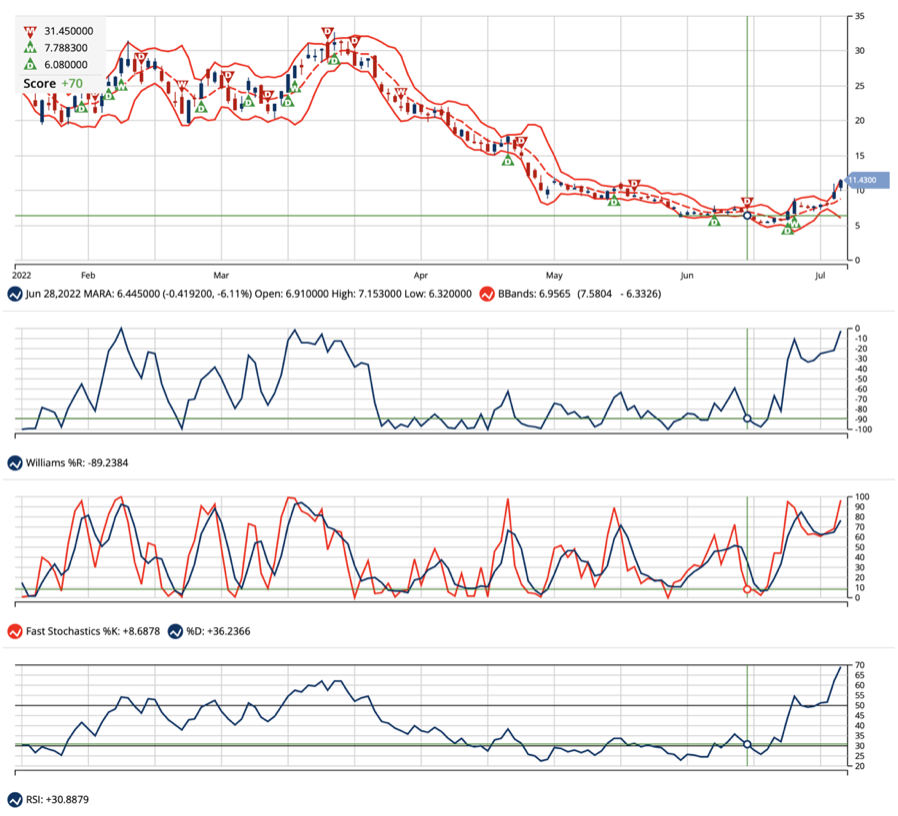
Technically, MARA just broke above double top resistance dating back to late May 2022. Now, from a current price of $11.48, we could see a potential bearish gap refill around $16 a share. If Bitcoin can continue to recover, MARA could even retest $30 at some point.

Granted, there are some red flags…

Not only is MARA at its upper Bollinger Band, it’s also over-extended on Williams’ %R, Fast Stochastics, and on Relative Strength. So, there is some concern. However, if Bitcoin can continue to push higher, MARA is sure to follow.

MARA Chart with Trade Triangles

Source: MarketClub
 

Helping, BTIG analyst Mark Palmer believes Bitcoin could quadruple from current prices to $95,000 by 2023, as noted by U Today.

Changpeng Zhao, the CEO of Binance believes Bitcoin could rally to $70,000 in “a few months or years,” he said, as quoted by The Guardian.

Even the CEO of MicroStrategy, Michael Saylor has been buying weakness in Bitcoin, too.

Fundamentally, there’s a lot to like about MARA, as well.

In the second quarter of 2022, the company produced 707 self-mined Bitcoin, an 8% increase year over year from 654 bitcoin mined in Q2 2021. Year-to-date Marathon Digital produced 1,966 Bitcoin, a 132% increase year over year. In addition, the total number of miners installed and awaiting energization at Texas facilities increased to 29,640 miners.

Marathon Digital also just secured a five-year deal with Applied Blockchain, which builds and operates data centers throughout America.

With that, Marathon “secured approximately 254 megawatts of new hosting arrangements for its Bitcoin mining operations, with an option to increase to 324 megawatts, from a variety of hosting providers. Marathon believes it has now secured ample hosting arrangements to support the Company’s previously stated goal of approximately 23.3 exahashes per second of computing power for Bitcoin mining,” as noted in a company press release.

That’s big news for MARA, and signals that the company will survive the rout.

From a current price of $11.48, I’d like to see the Marathon Digital Holdings stock test $16 a share, near-term. Longer-term, I’d like to see it test $30 again.

Ian Cooper
INO.com Contributor

Disclosure: This contributor did not hold a position in any investment mentioned above at the time this blog post was published. This article is the opinion of the contributor themselves. The above is a matter of opinion provided for general information purposes only and is not intended as investment advice. This contributor is not receiving compensation (other than from INO.com) for their opinion.

By Ino.com – See our Trader Blog, INO TV Free & Market Analysis Alerts

Source: Chart Spotlight: Marathon Digital Holdings (MARA)

Tech firms face more regulation after moves to stop ‘killer’ acquisitions – but innovation could also be under threat

By Renaud Foucart, Lancaster University 

One way to eliminate the competition in business is simply to buy them out and shut them down. And that means less choice for consumers and sometimes the loss of innovative and, in the case of the pharmaceutical industry, even life-saving products. But such so-called killer acquisitions are likely to face greater scrutiny in the US and EU following a recent expansion of competition regulators’ powers.

A July 2022 decision by the European Court of Justice has expanded the European Commission’s ability to investigate a wider range of mergers and acquisitions (M&A). And last year, the US Federal Trade Commission (FTC) also changed its criteria for scrutinising certain deal types.

Historically, these regulators have only been empowered to examine business deals of a certain size, mostly between potential direct competitors. These recent rulings will empower them to examine almost any purchase.

When applying these new powers to fast-moving industries such as pharma or technology, however, regulators must navigate a world of costly and risky investments in research and development. It’s very difficult for regulators to spot a killer acquisition before it happens, and many M&A deals can actually benefit consumers. So calling it wrong could actually stifle innovation and stop new products from reaching the market.

US and EU regulators share the same fear: if dominant players are allowed to buy up start-ups, this could impact innovation and market concentration, depriving consumers of the benefit of new products and technology. In its announcement about its new approach, the FTC said “several decades” of consolidation across the economy has corresponded with a “lessening of competition reflected in growing mark-ups and shrinking wages”.

There is research to support this view. Similarly, EU regulators want to be able to investigate – and potentially prevent – any acquisitions they believe may hurt consumers.

Killer acquisitions

When competition regulators try to ensure that established firms buying small innovative players don’t hinder or even destroy innovation, killer acquisitions are one of their top concerns. As documented in an influential economic paper on the pharmaceutical industry, the goal of the dominant firm in such a deal is to destroy a potential competitor to its own business, even if it means patients never benefit from better treatments.

The recent changes to US and EU M&A scrutiny powers were triggered by a 2020 announcement by US biotech firm Illumina about its plans to acquire Grail, a developer of early-detection cancer tests. At the time, this sounded like the kind of acquisition that would not suffer much scrutiny by antitrust authorities.

Grail’s product is not yet operational and acquiring it does not affect the dominant market position of Illumina. The deal did not even breach the EU merger regulation threshold of €5 billion (£4.3 billion) combined worldwide turnover for the companies involved.

Almost immediately, however, regulators in the US and the EU challenged the merger. Both announced plans to scrutinise its potential impact on competition and innovation in the market for genome-based diagnosis.

In this kind of situation, regulators are often concerned about market concentration. If another start-up comes up with better diagnostic tests, for example, a dominant player like Illumina might make its life difficult in order to protect its recent acquisition.

But killer acquisitions are the most extreme case of this kind of acquisition deal. Research shows that only about 6% of pharma acquisitions involve a large company buying a smaller one with a promising new drug simply to discontinue the innovative project.

In digital markets, dominant firms are also often suspected of pursuing a similar strategy. Last year, the UK regulator ordered Facebook to sell Giphy, a database of GIF-like animations it had acquired in 2020 for US$315 million (£262 million), for fear that it was a killer acquisition aimed at destroying a potential rival in the advertising market. When Meta started its appeal of this decision in April 2022, Giphy had yet to sell a single ad in the UK.

Similar to the pharma sector, however, few tech deals seem to correspond to the specific definition of a killer acquisition. And, in fact, dominant firms buying innovative start-ups before they generate any profit is a common business model in the digital economy.

In 2013, Waze was a potential disruptor to Google Maps as the dominant firm in the market for free online maps. But when Google acquired it for US$1.1 billion, it did not close Waze, as you would expect with a killer acquisition.

Instead, it added some of Waze’s innovative features into Google Maps and kept the former as a niche product. This allowed Google to stay dominant and to boost its profits from user data.

In this case, consumers benefited from a better Google Maps product, but Waze now has less incentive to innovate because it is not competing anymore. The FTC did not oppose the acquisition in 2013 but is now reportedly considering looking at it again.

Regulators’ big gamble

If regulators routinely block such acquisitions, start-ups will need to operate differently. Rather than relying on an acquisition by a dominant player to inject capital into the company, they will have to find other ways to earn money – possibly by charging consumers directly.

WhatsApp and Instagram, for example, had almost no revenue when Facebook bought them for US$19 billion and US$1 billion respectively. But they benefited from being acquired by a larger platform. Neither were killer acquisitions, but both increased market concentration.

By opening acquisitions of small and innovative firms to more scrutiny, regulators are taking a massive bet. To block an acquisition, they must demonstrate that it actually hurts innovation, often in very technical fields.

While researchers have been able to identify killer acquisitions after the fact, convincing a judge at the time of the purchase that a deal is bad for consumers is much more difficult. As such, the stakes are high for regulators: a wrong decision could affect the future of medicine and the future of our digital lives.The Conversation

About the Author:

Renaud Foucart, Senior Lecturer in Economics, Lancaster University Management School, Lancaster University

This article is republished from The Conversation under a Creative Commons license. Read the original article.