Archive for Metals – Page 31

Gold rises again as financial markets don’t believe Powell’s words

By JustMarkets

On Wednesday, the US Federal Reserve raised interest rates by 0.25% to 5% and maintained its outlook for another increase this year. Treasury yields rebounded from session lows, and interest-rate-sensitive sectors of the market, including technology, lost momentum. As the stock market closed yesterday, the Dow Jones Index (US30) decreased by 1.63%, and the S&P 500 Index (US500) lost 1.65%. The NASDAQ Technology Index (US100) was down by 1.60%.

The main theses of the speech of Fed Chairman Jerome Powell:

  • Another 25bp rate hike at the next meeting is possible, but it will all depend on incoming macro data;
  • FOMC is committed to getting inflation back to 2.00% to ensure price stability;
  • Inflation in commodity prices is declining, but progress in services is still insufficient;
  • The US banking system remains strong and resilient;
  • A Fed rate cut this year is not a baseline scenario;
  • Asset reductions in Treasury securities will continue (quantitative tightening – QT).

The benchmark Personal Consumption Expenditures (PCE) Price Index, the Fed’s preferred measure of inflation, is projected to be 3.6% in 2023, up from the previous forecast of 3.5%. Inflation is expected to slow to 2.6% in 2024, but this is higher than the previous forecast of 2.5%. The 2024 rate forecast was raised from 4.1% to 4.3%. GDP growth forecast slightly lowered from 0.5% to 0.4% and from 1.6% to 1.2% in 2024. Labor market strength, which has played a role in sustaining basic services, is also expected to remain unchanged in the near term. The unemployment rate is expected to be 4.5% in 2023 from the previous estimate of 4.6% but will rise to 4.6% next year.

Meanwhile, the Fed’s balance sheet has also been in the spotlight after it began to expand again due to problems in the banking system. The Fed’s balance sheet now stands at $8.6 trillion, up from $8.34 trillion last month. The sharp change in the Fed’s balance sheet from contraction to expansion followed the rising cost of funding and the central bank’s new line of credit to support the banking system.

Bank of America, citing tightening lending standards, said it now expects just one more 25 basis point rate hike to raise rates to a ceiling range of 5.0% to 5.25%.

Europe’s stock indices were mostly rising on Wednesday. German DAX (DE30) gained 0.14%, French CAC 40 (FR40) jumped by 0.26%, Spanish IBEX 35 (ES35) declined by 0.44%, and British FTSE 100 (UK100) closed yesterday up by 0.41%.

Overall, UK inflation rose in February, rising to 10.4% y/y, up from 10.1% y/y in January and market expectations of 9.9%. Core inflation also rose sharply to 6.2% from 5.8%, half a point above market expectations. Such data will undoubtedly require the Bank of England to be more hawkish. Therefore, analysts are expecting a 0.25% rate hike today, with a possible another hike at the next meeting.

UK inflation is expected to fall sharply at the end of the second quarter due to lower energy costs. The Office of Budget Responsibility (OBR) forecasts that inflation will fall to 2.9% by the end of the year.

Falling US government bond yields on the back of the FOMC meeting caused gold prices to spike. Though earlier, when the words tightening and rate hike were used, gold declined. This suggests that investors have overestimated the current US Federal Reserve policy and do not trust the US central bank to tighten further. Although the Fed continues to reiterate that “the banking system is resilient and sound,” US Treasury Secretary Jennet Yellen said that “universal deposit insurance” is not an option – bank stocks immediately plummeted again. In fact, the market is showing that it does not believe the Fed’s words/forecasts. Gold prices may continue to rise, analysts suggested. In their opinion, the chance of new growth in gold prices is indicated by the banks’ difficulties and a possible turning point in the Fed’s policy.

Asian markets were mostly rising on Tuesday. Japan Nikkei 225 (JP225) grew by 1.93%, China FTSE China A50 (CHA50) gained 0.47%, Hong Kong Hang Seng (HK50) jumped by 1.73%, India NIFTY 50 (IND50) added 0.26%, and Australia S&P/ASX 200 (AU200) was up by 0.87% on the day.

Singapore’s core consumer price index remained at 5.5% y/y in February. The decline in service prices was generally offset by higher prices for retail sales as well as other goods and utilities, the Monetary Authority of Singapore (MAS) said in a statement. Analysts believe that core inflation in the country has peaked. At the same time, MAS said it forecasted a core inflation rate in the range of 3.5% to 4.5% in 2023.

On Thursday, the Hong Kong Monetary Authority (HKMA) raised its benchmark rate by 25 basis points to 5.25%. Hong Kong’s monetary policy is in step with that of the US Federal Reserve, as the HKD currency is pegged to the US dollar in a narrow range of 7.75-7.85 per dollar.

S&P 500 (F) (US500) 3,936.97 −65.90 (−1.65%)

Dow Jones (US30)32,030.11 −530.49 (−1.63%)

DAX (DE40) 15,216.19 +20.85 (+0.14%)

FTSE 100 (UK100) 7,566.84 +30.62 (+0.41%)

USD Index 102.54 −0.71 (−0.63%)

Important events for today:
  • – Hong Kong Interest Rate Decision at 04:30 (GMT+2);
  • – Singapore Consumer Price Index (m/m) at 07:00 (GMT+2);
  • – Hong Kong Consumer Price Index at 10:30 (GMT+2);
  • – Switzerland SNB Interest Rate Decision at 10:30 (GMT+2);
  • – Switzerland SNB Monetary Policy Assessment at 10:30 (GMT+2);
  • – Switzerland SNB Press Conference at 11:00 (GMT+2);
  • – UK BoE Interest Rate Decision at 14:00 (GMT+2);
  • – UK BoE MPC Meeting Minutes at 14:00 (GMT+2);
  • – US Initial Jobless Claims (w/w) at 14:30 (GMT+2);
  • – US New Home Sales (m/m) at 16:00 (GMT+2);
  • – US Natural Gas Storage (w/w) at 16:30 (GMT+2).

By JustMarkets


This article reflects a personal opinion and should not be interpreted as an investment advice, and/or offer, and/or a persistent request for carrying out financial transactions, and/or a guarantee, and/or a forecast of future events.

The Importance of Gold

Source: Streetwise Reports  (3/20/23)

James Turk of Goldmoney, the impetus behind The Gold Report here at Streetwise, explains why he believes gold and silver are imperative assets to own in this current economy and how you can get involved with them.

Starting his career in the 1960s working for Chase Manhattan Bank in Thailand, The Philippines, and Hong Kong, James Turk has a long history in the world of finance. In 2001, Turk started goldmoney.com with his eldest son, Geoffrey.

GoldMoney (XAU:TSX) focuses on precious metals buying and selling, storage, coin retailing, and gold jewelry manufacturing and sales through a subsidiary, Menē.com, aka Menē Inc. (MENE:TSX.V; MENEF:OTCMKTS).

The company has clients in over 100 countries around the world and currently safeguards over US$2 billion of assets owned by its clients. Overall, Goldmoney has a reputation for success that comes with the reputation held by James Turk.

However, people don’t know that while James Turk is the force behind Goldmoney, he was also the reason The Gold Report was started.

A Discussion in the Mountains

The conversation started in the mountains. Gordon Holmes, the CEO and founder of Streetwise Reports, and James had been friends for years. Then one day, Gordon invited James to share a bottle of wine at Lookout Ridge (Gordon’s winery in California).

As they spoke about the market over a glass of pinot, James asked Gordon why he hadn’t stepped into the gold market yet. Gordon was honest and relayed to him that he didn’t believe he knew enough about the market to be all that involved.

That is when James looked Gordon in the eye and told him, “You’ll figure it out.”

And The Gold Report was born.

Without that fortuitous meeting, Streetwise Reports as we know it may have never come to be.

Why Gold?

Goldmoney may have been started in 2001, but Turk’s interest in gold was fostered from a young age. Growing up, Turk’s father and grandparents shared stories of fleeing from Austria’s hyperinflation after World War I.

Because of this, Turk said, “I’ve always been of the view that gold and silver had an important role to play in economic activity and that accumulating gold and silver was a means of saving — a way to save purchasing power.”

He went on to say, “It’s never too late to save money, but it doesn’t make sense to save fiat currency anymore because of negative interest rates. In other words, if you deposit money into a bank at the end of the year, you have less purchasing power. Even though you’re earning interest income, the inflation rate is higher than the interest income that you’re earning. So you’ll never get ahead that way. With physical gold and silver, you won’t be earning interest income, but you’re going to preserve your purchasing power over time.”

This is one of the reasons Turk is such an ardent advocate for owning some precious metals in a diversified investment portfolio.

Gold After Nixon

In our wide-ranging discussion, Turk also touched on the value of the U.S. dollar compared to gold beginning with President Nixon.

“Living and working in a bank through the 1970s was, for me, a life-changing experience. And obviously, something I’m never going to forget. Worryingly, there are a lot of similarities today to what occurred back then. But there are also some differences too.”

Turk explained that in the 70s, easy money printing caused inflation to soar out of control. When Paul Volcker was appointed chairman of the Federal Reserve in 1979, he kept raising interest rates until inflation began to decline. He did this to save the U.S. dollar when faith in the currency was rapidly eroding.

Turk said, “I’ve always been of the view that gold and silver had an important role to play in economic activity and that accumulating gold and silver was a means of saving — a way to save purchasing power.”

Turk went on to say: “At the peak, the interest income you could earn over and above the inflation rate was 6%, which is phenomenally high because the natural interest rate is normally about 1%.

It was enough to rebuild confidence in the dollar. Volcker eventually brought inflation under control by decreasing — and this is important — decreasing the growth rate of the quantity of dollar currency. He never actually decreased the quantity of dollar currency. There was never any deflation. It was just disinflation, but what’s happening this time around is different.”

“The Federal Reserve cannot simply raise interest rates to levels that Volcker needed to bring down the inflation rate. There’s too much debt in the economy. So now, what the Fed is doing is decreasing the quantity of dollars. This could lead to a deflationary economic collapse.”

Turk noted, “Ultimately, in a deflationary economy, the debtors end up in trouble. The debt burden increases because the value of the currency increases. Also, liquidity disappears in a deflationary environment. Anyone who’s heavily leveraged — like a lot of the banks — tends to suffer in that type of environment, as occurred in the 1930s. So it’s a very important time to be focusing on gold and silver because regardless of whether it’s inflation or deflation, gold, and silver will get you through the turmoil to the other side of the valley.”

In 1971, Nixon closed the gold window breaking its formal link to the dollar. Since then, the dollar’s purchasing power has been eroding, but this process began much earlier. The dollar has lost 98.5% of its purchasing power since the creation of the Federal Reserve in 1913. In recent decades this debasement of the dollar has accelerated.

Measuring in Ounces

Turk went on to say that while we calculate the price of things using the dollar, we must also be using ounces of gold or silver to measure prices.

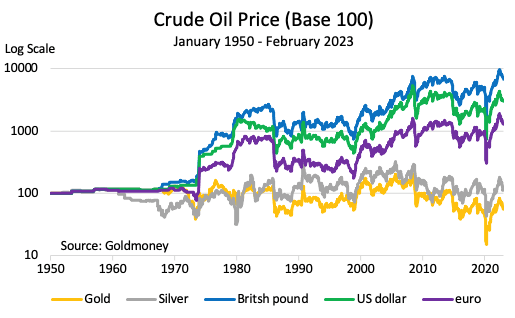
“When looking at the price of crude oil going back to 1950, you get different results depending on the measuring stick used. If you measure oil in terms of ounces of gold, the price of crude oil hasn’t changed much. An ounce of gold buys about the same amount of crude oil today as in 1950.This example shows how gold preserves purchasing power over the long term. It does this because gold is natural money. The quantity of the aboveground stock of gold increases at approximately the same rate as the world’s population and new wealth creation. Because these growth rates are consistent, gold retains its purchasing power.”

“Gold and silver are not investments; they’re money. Gold and silver didn’t increase your wealth — your purchasing power — over these seven decades. They preserved it, which is one of money’s most important functions.”

“I like to tell a story that I remember from growing up in the 1950s. I think is very meaningful.”

“My parents would drive the family car to the local gas station and fill it up for US$2. Back then, the paper currency was silver certificates. You could also pay with silver coins, for example, two silver dollars or four half dollars.”

“Today, US$2 doesn’t even buy a gallon of gas. But the market value of the silver content of those old coins will still fill up the family car.”

The following chart of crude oil prices shows how gold and silver preserve purchasing, but national currencies do not. Measured in dollars, crude oil is 30 times more expensive than it was in 1950. The British pound has fared even worse, with oil 69 times more expensive today in that currency.
“There is one key point that people need to understand,” he continued. “Gold and silver are not investments; they’re money. Gold and silver didn’t increase your wealth — your purchasing power — over these seven decades. They preserved it, which is one of money’s most important functions.”

“Sterile assets like precious metals don’t generate cash flow. When their price rises, purchasing power moves from people owning national currency to people owning precious metals. The precious metals have value because they are useful as money.”

“What’s more,” Turk continued, “they are money that is not based on anyone’s promise, so they don’t have counterparty risk. For that reason, they provide unconditional liquidity. Your purchasing power placed in gold and silver is not reliant upon some bank or a government promise. And by measuring goods, services, and your investment portfolio in terms of ounces, you’ll come up with an entirely different perspective.”

“It is meaningful to use gold to measure accumulated wealth. You are measuring purchasing power with money that has proven its ability to retain its purchasing power over long periods of time — as we can see in the chart of crude oil prices.”

The Decline of the US Dollar

As faith in gold’s purchasing power rises, we see that trust in the U.S. dollar erodes, especially in an inflationary environment.

Turk pointed out that “if you look at measures completed by private economists, the inflation rate is much, much higher than what the government reports. So regardless of who you rely on to measure inflation, the dollar is losing purchasing power every day.”

Will the dollar collapse and become obsolete?

Turk replied: “That involves predicting the future, and unfortunately, no one can predict the future. All you can do is be prepared as best you can for any eventuality. And given their track record going back thousands of years, owning some physical gold and silver is one way to do that. If worse comes to worst, you’ll be prepared and ready by owning some gold and silver so that your wealth is diversified.”

He also favors the shares of precious metal mining companies but advised: “Owning gold and silver is different from owning the shares of mining companies. The shares are investments, not money. Buying shares in mining companies requires the same amount of diligent attention that you apply to any investment. For example, you need to look at the quality of management, the company’s mining property, their financial accounts, country risk where they operate, and many other factors.”

“The mining shares, in my view, are undervalued. They are not tangible assets like gold and silver. I consider them to be ‘near tangible’ because the mining companies own tangible assets in the form of mines and equipment that produce tangible assets.”

How to Store Gold

If you wish to be prepared and get involved in tangible assets, knowing how to store them is imperative. With gold and silver, you have two options. You can either store it yourself or pay for a professional firm to safeguard them for you — this is where Goldmoney comes in.

Turk explained, “Through Goldmoney, customers can store their precious metals in vaults operated by specialized vaulting companies in different places around the world. You can choose among different countries, different political risks, and different geographic risks so that you can diversify. Again, there is no one right answer. But if there is an answer that comes close to being the right choice, it’s diversifying your assets as much as practical.”

When searching for professional storage, Turk pinpointed the importance of working with a company that does independent third-party audits. In this way, you have assurances of integrity that your assets are properly cared for. Goldmoney currently safeguards over US$2 billion in customer assets worldwide.

Money and Liberty: In the Pursuit of Happiness & The Theory of Natural Money

If you’d like to learn more about the importance of gold and silver and how to incorporate them into your portfolio, these and many more topics are covered in James Turk’s latest book, Money and Liberty: In the Pursuit of Happiness & The Theory of Natural Money.

Money and Liberty was published by Wood Lane Books in November 2021 and is available on Amazon. It has been praised as “an excellent and insightful book” that provides “a clear but detailed history of the relationship of sound money to human freedom.”


Disclosures:
1) Katherine DeGilio wrote this article for Streetwise Reports LLC. She or members of her household own securities of the following companies mentioned in the article: None. She or members of her household are paid by the following companies mentioned in this article: None.

2) The following companies mentioned in this article are billboard sponsors of Streetwise Reports: None. Click here for important disclosures about sponsor fees. As of the date of this article, an affiliate of Streetwise Reports has a consulting relationship with: None. Please click here for more information.

3) Statements and opinions expressed are the opinions of the author and not of Streetwise Reports or its officers. The author is wholly responsible for the validity of the statements. The author was not paid by Streetwise Reports for this article. Streetwise Reports was not paid by the author to publish or syndicate this article. Streetwise Reports requires contributing authors to disclose any shareholdings in, or economic relationships with, companies that they write about. Streetwise Reports relies upon the authors to accurately provide this information and Streetwise Reports has no means of verifying its accuracy.

4) This article does not constitute investment advice. Each reader is encouraged to consult with his or her individual financial professional and any action a reader takes as a result of information presented here is his or her own responsibility. By opening this page, each reader accepts and agrees to Streetwise Reports’ terms of use and full legal disclaimer. This article is not a solicitation for investment. Streetwise Reports does not render general or specific investment advice and the information on Streetwise Reports should not be considered a recommendation to buy or sell any security. Streetwise Reports does not endorse or recommend the business, products, services or securities of any company mentioned on Streetwise Reports.

5) From time to time, Streetwise Reports LLC and its directors, officers, employees or members of their families, as well as persons interviewed for articles and interviews on the site, may have a long or short position in securities mentioned. Directors, officers, employees or members of their immediate families are prohibited from making purchases and/or sales of those securities in the open market or otherwise from the time of the decision to publish an article until three business days after the publication of the article. The foregoing prohibition does not apply to articles that in substance only restate previously published company releases.


Tech Analyst Believes Now Is an Excellent Time To Add Positions

Source: Clive Maund  (3/17/23)

Technical analyst Clive Maund of clivemaund.com reviews Dolly Varden Silver Corp.’s 6-month chart to tell you why he believe now would be the time to buy.

The fundamentals for Dolly Varden Silver Corp. (DV:TSX.V; DOLLF:OTCQX) are excellent, as set out by Mr Bob Moriarty of 321gold in a recent piece he wrote on it.

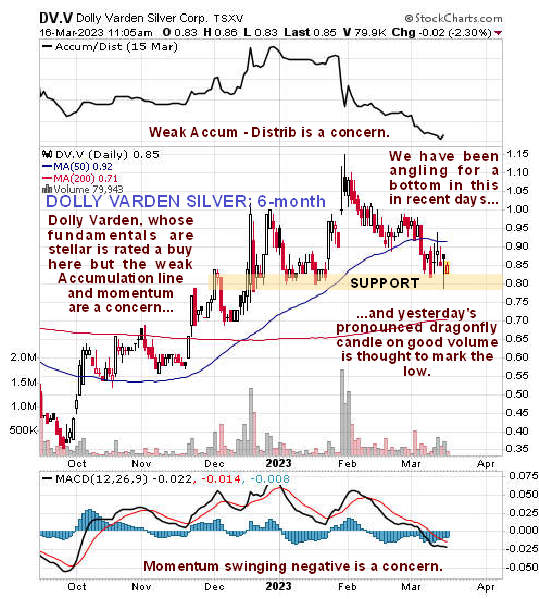
So we have been angling for a good point to add to positions or make fresh purchases but have been waiting for signs that the intermediate downtrend of recent weeks has run its course.

As is so often the case, when too many people are positive on a stock, it drops, and that is what happened with this, excellent fundamentals or not, but now it looks like the excess enthusiasm has been wrung out.

Dolly Varden was mentioned as looking attractive some days back in a wide-ranging Market Notebook article and the reason for this article devoted just to it is that it put in a strongly bullish reversal candle, called a “dragonfly doji” yesterday, which is a sign that the low for the reaction is in and that it should now start higher again.

We have what may prove to be an excellent entry point now, for after closing near to the day’s high yesterday after a wide range that tested support, it is order for it to back off some today which is what it has done.

On short-term charts, we can see greater upside volume kicking in in recent days, which is encouraging.

The conclusion is that this is an excellent point to add to positions in Dolly Varden or make fresh purchases.

Dolly Varden Silver’s website.

Dolly Varden Silver closed for trading at CA$0.90, $0.685 at 12.15 pm on March 16, 2023.


CliveMaund.com Disclosures

The above represents the opinion and analysis of Mr. Maund, based on data available to him, at the time of writing. Mr. Maund’s opinions are his own, and are not a recommendation or an offer to buy or sell securities. Mr. Maund is an independent analyst who receives no compensation of any kind from any groups, individuals or corporations mentioned in his reports. As trading and investing in any financial markets may involve serious risk of loss, Mr. Maund recommends that you consult with a qualified investment advisor, one licensed by appropriate regulatory agencies in your legal jurisdiction and do your own due diligence and research when making any kind of a transaction with financial ramifications. Although a qualified and experienced stock market analyst, Clive Maund is not a Registered Securities Advisor. Therefore Mr. Maund’s opinions on the market and stocks can only be construed as a solicitation to buy and sell securities when they are subject to the prior approval and endorsement of a Registered Securities Advisor operating in accordance with the appropriate regulations in your area of jurisdiction.

Disclosures
1) Clive Maund: I, or members of my immediate household or family, own securities of the following companies mentioned in this article: None. I personally am, or members of my immediate household or family are, paid by the following companies mentioned in this article: None.

2) The following companies mentioned in this article are billboard sponsors of Streetwise Reports: Dolly Varden Silver Corp. Click here for important disclosures about sponsor fees. As of the date of this article, an affiliate of Streetwise Reports has a consulting relationship with: None. Please click here for more information.

3) Statements and opinions expressed are the opinions of the author and not of Streetwise Reports or its officers. The author is wholly responsible for the validity of the statements. The author was not paid by Streetwise Reports for this article. Streetwise Reports was not paid by the author to publish or syndicate this article. Streetwise Reports requires contributing authors to disclose any shareholdings in, or economic relationships with, companies that they write about. Streetwise Reports relies upon the authors to accurately provide this information and Streetwise Reports has no means of verifying its accuracy.

4) This article does not constitute investment advice. Each reader is encouraged to consult with his or her individual financial professional and any action a reader takes as a result of information presented here is his or her own responsibility. By opening this page, each reader accepts and agrees to Streetwise Reports’ terms of use and full legal disclaimer. This article is not a solicitation for investment. Streetwise Reports does not render general or specific investment advice and the information on Streetwise Reports should not be considered a recommendation to buy or sell any security. Streetwise Reports does not endorse or recommend the business, products, services or securities of any company mentioned on Streetwise Reports.

5) From time to time, Streetwise Reports LLC and its directors, officers, employees or members of their families, as well as persons interviewed for articles and interviews on the site, may have a long or short position in securities mentioned. Directors, officers, employees or members of their immediate families are prohibited from making purchases and/or sales of those securities in the open market or otherwise from the time of the decision to publish an article until three business days after the publication of the article. The foregoing prohibition does not apply to articles that in substance only restate previously published company releases. As of the date of this article, officers and/or employees of Streetwise Reports LLC (including members of their household) own securities of Dolly Varden Silver Corp., a company mentioned in this article.

Trade Of The Week: Gold Prices Top $2000…What Next?

By ForexTime 

The explosive price action gold has displayed in recent days mirrors a speeding train reaching maximum velocity, with fundamental forces fuelling the upside momentum.

On Monday, gold punched above $2000 for the first time since March 2022 as concerns over the health of the banking system sweetened the appetite for safe-haven assets. This positive start builds on last week’s whooping 6.5% surge as mounting fears around Credit Suisse AG and the overall health of the banking system sent jitters across the board. A palpable sense of unease continues to linger across financial markets despite news over the emergency weekend sale of Credit Suisse AG to UBS Group AG. Contagion fears are rife and this will most likely accelerate the flight to safety, boosting attraction towards safe-haven gold.

Revisiting our 2023, we thoroughly discussed how gold could be one of the biggest winners these years based on speculation around the Fed pausing rate hikes. While gold prices have surged on contagion fears, the string of negative developments has also tempered expectations around the Fed keeping rates higher for longer. With gold hitting the psychological $2000 level, the key question is whether further upside could be on the cards or the party ends around this resistance.

Taking a quick looking at the technical picture, gold is heavily bullish on the daily charts. However, the $2000 level may be a tough nut to crack for bulls. The last time gold secured a weekly close above $2000 was back in August 2020.

The lowdown….

Gold has experienced a sharp change of fortune this month thanks to the market chaos triggered by the Silicon Valley Bank (SVB) collapse and Credit Suisse drama.

The horrible combination of events and growing fears around the banking system sent tremors across financial markets, leaving investors on edge. The wave of risk aversion prompted investors to scatter from riskier assets and rush to safe-haven destinations. Gold prices have gained over 8% this month not only due to contagion fears but expectations around the Fed adopting a less aggressive approach on rates to preserve the financial system.

Concerns over contagion risks and financial stability are likely to influence market sentiment and risk appetite. Any more negative news or developments could spark another wave of risk aversion – ultimately injecting gold bulls with fresh inspiration.

Keep an eye on the Fed meeting

Markets expect the Federal Reserve to raise interest rates by 25 basis points this month. However, this will be a tough meeting for the central bank as it decides whether to focus on macroeconomic data or the stability of the financial system following the SVB collapse and the Credit Suisse drama. There has been a lot of chatter around the recent string of negative developments empowering doves with traders now predicting a 65% chance of a 25bp hike in March – according to Fed Funds Futures.

If the Federal Reserve surprises markets by leaving rates unchanged, this could signal the end of the rate hike cycle with the next move being lower rates. Such a development is likely to send the dollar tumbling along with Treasury yields, which could see gold shine with renewed intensity. Whatever the outcome of the Fed meeting, it may influence gold’s outlook for the remainder of March and possibly beyond.

Can gold conquer $2000?

After bagging its biggest weekly gain since March 2020, gold bulls are clearly in a position of power. The precious metal is drawing strength from multiple sources, ranging from contagion fears, falling Fed hike bets, a softer dollar, and falling Treasury yields. The path of least resistance for the precious metal certainly points north, but can bulls conquer the $2000 level?

From a technical perspective, there have been consistently higher highs and higher lows while prices are trading above the 50, 100, and 200-day SMA. Given how $2000 has proved to be strong resistance in the past, bulls may need to put in the work to secure a solid weekly close above this point. Should $2000 prove to be too much for bulls to handle, prices may sink back toward $1955 before retesting $2000. A solid break above this psychological level may inspire a move higher toward $2070 and levels not seen since August 2020 above $2075.

If bears make a return and drag prices below $1955, the next point of interest can be found at $1935, $1915, and $1900, respectively.


Forex-Time-LogoArticle by ForexTime

ForexTime Ltd (FXTM) is an award winning international online forex broker regulated by CySEC 185/12 www.forextime.com

COT Metals Charts: February 21st data showed Speculator bets led by Copper & Gold

By InvestMacro

Here are the latest charts and statistics for the Commitment of Traders (COT) data published by the Commodities Futures Trading Commission (CFTC).

The latest COT data is updated through Tuesday February 21st and shows a quick view of how large traders (for-profit speculators and commercial entities) were positioned in the futures markets.

*** This data is still a few weeks behind the current data because the CFTC up-to-date data has been delayed due to a cybersecurity event that happened in early February to ION Cleared Derivatives (a subsidiary of ION Markets). This hack of ION has created a problem for the large trader positions to be reported and reconciled. The CFTC has back-filled some data over the past few weeks and will get the data back up to date in the coming weeks.

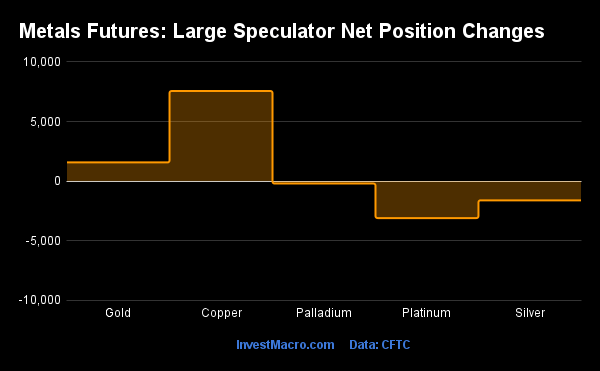
Weekly Speculator Changes led by Copper & Gold

The COT metals markets speculator bets were lower through February 21st as two out of the five precious metals markets we cover had higher positioning while the other three markets had lower speculator contracts.

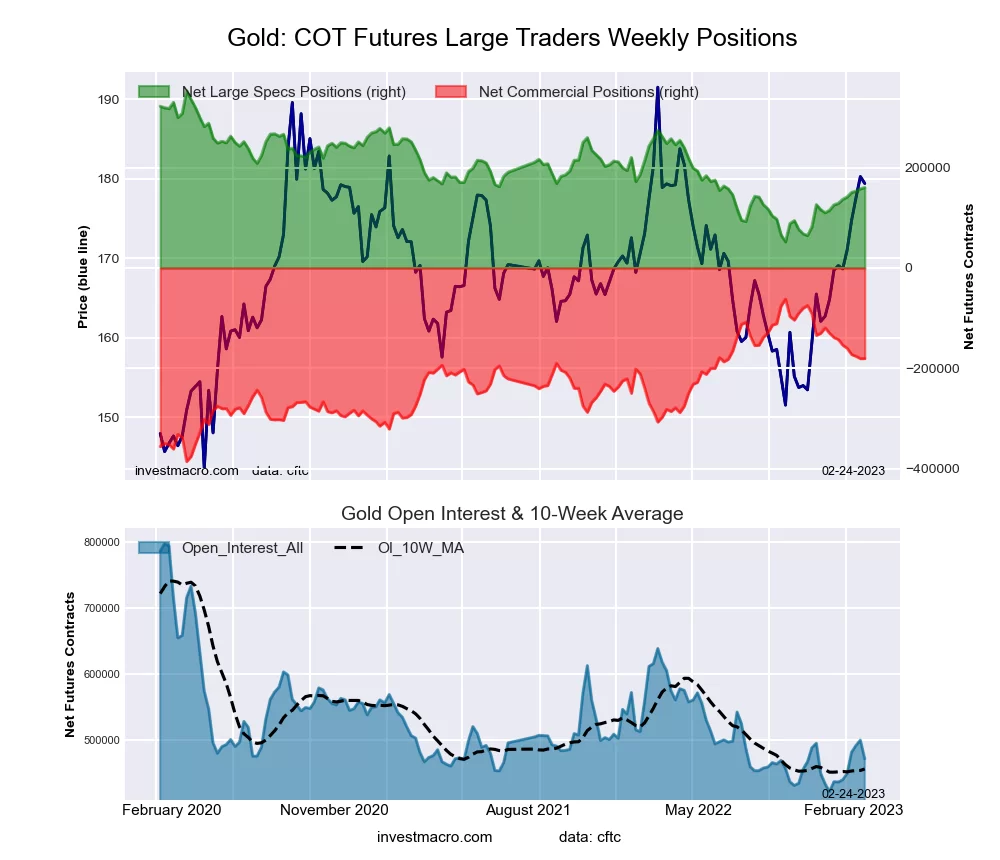
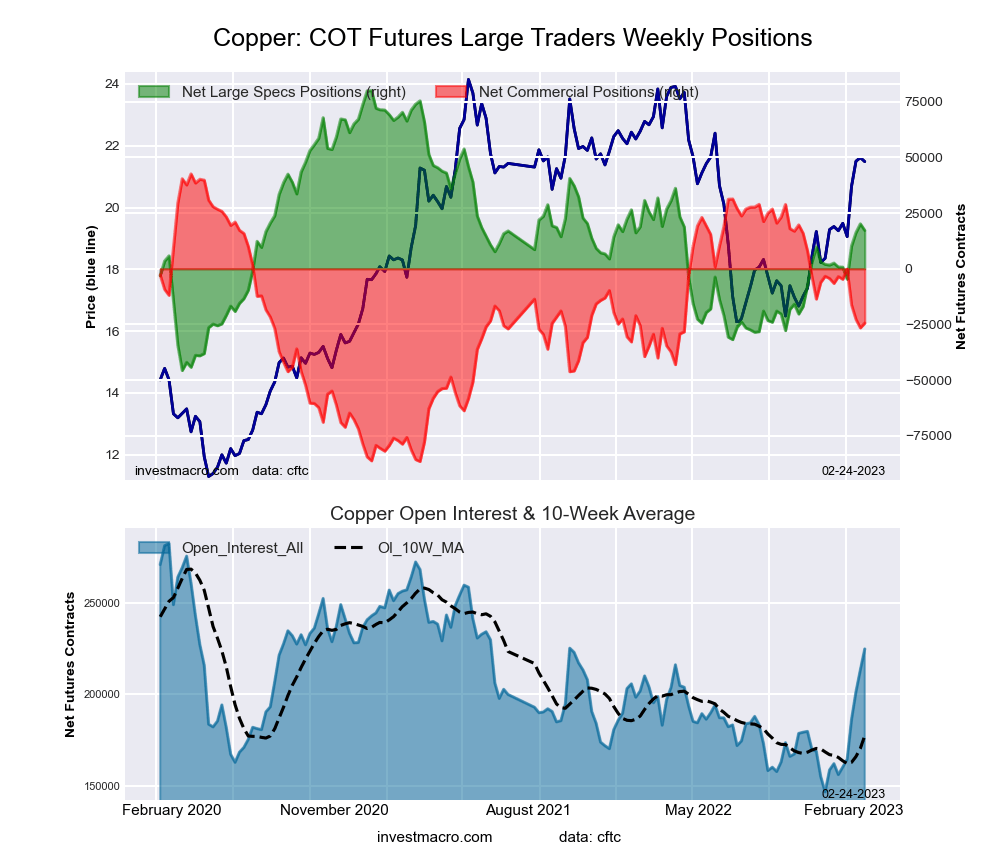
Leading the gains for the metals was Copper (7,560 contracts) with Gold (1,572 contracts) also seeing a positive week.

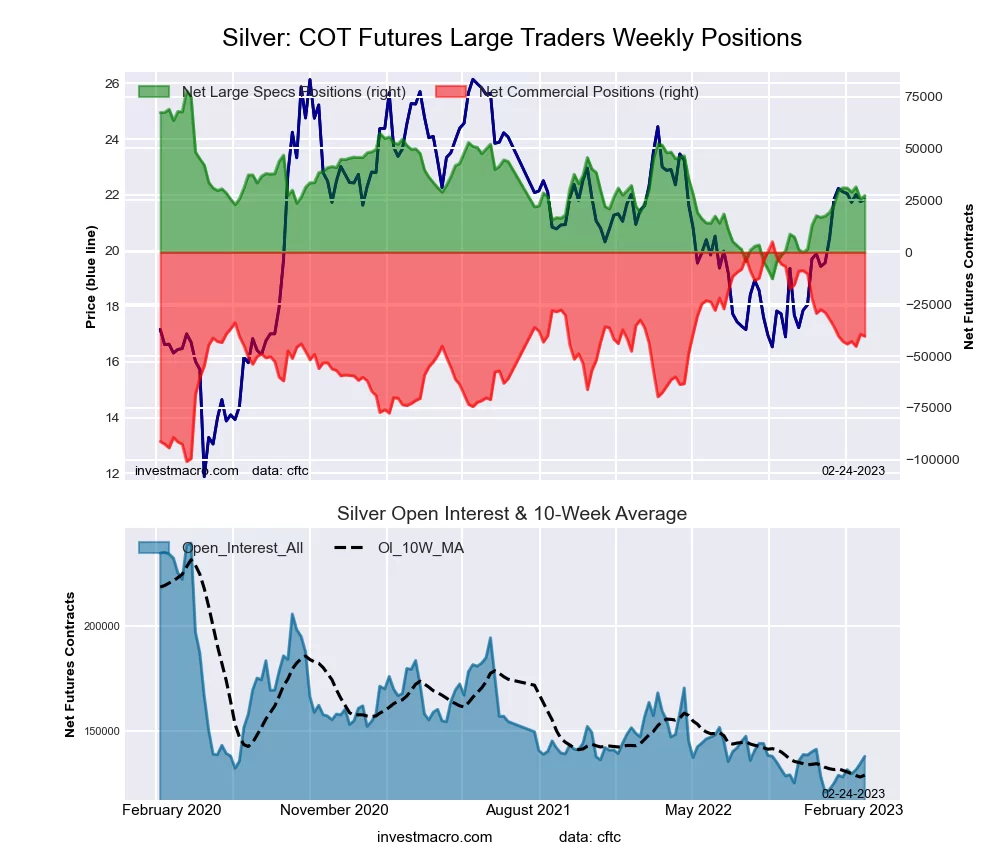
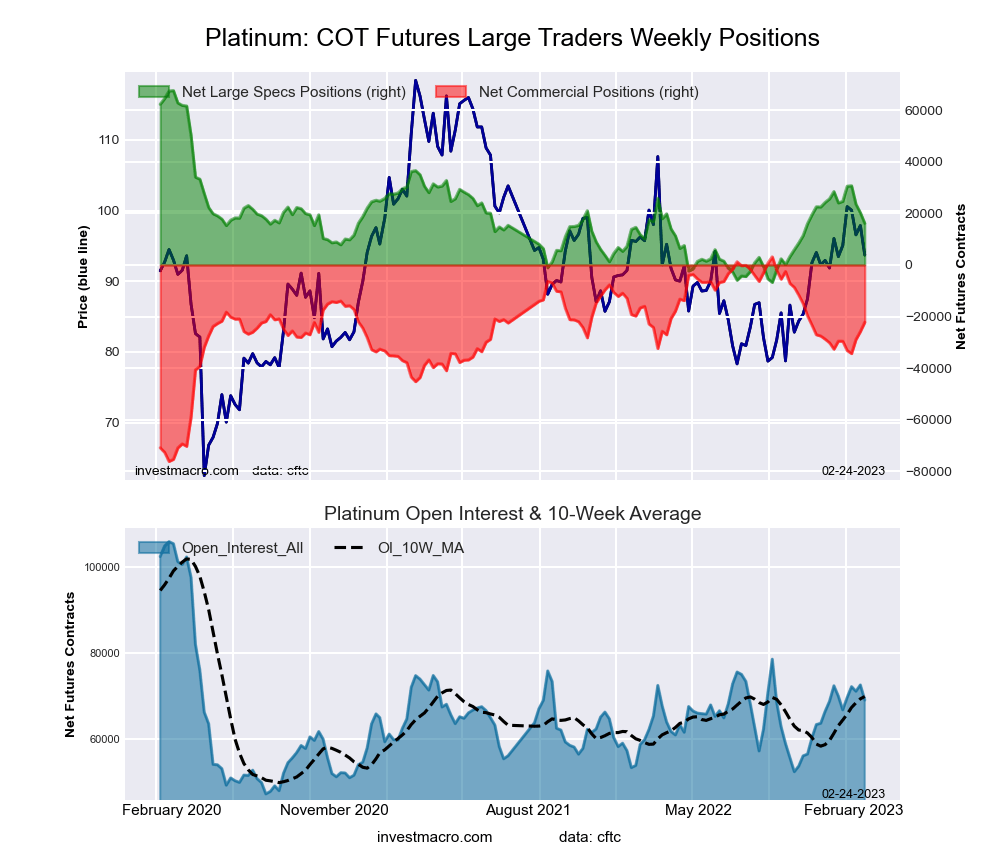
The markets with declines in speculator bets for the week were Platinum (-3,093 contracts), Silver (-1,604 contracts) and Palladium (-199 contracts) with also having lower bets through February 21st.


Data Snapshot of Commodity Market Traders | Columns Legend
Feb-21-2023OIOI-IndexSpec-NetSpec-IndexCom-NetCOM-IndexSmalls-NetSmalls-Index
Gold422,6480107,10121-129,3557722,25436
Silver123,90639,90232-23,0506613,14839
Copper219,205582,04935-8,510626,46163
Palladium11,94384-5,18805,552100-36420
Platinum67,499582,90522-8,394765,48942


Strength Scores led by Copper & Silver

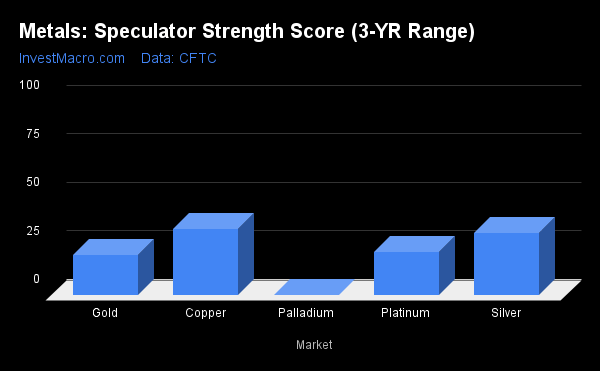
COT Strength Scores (a normalized measure of Speculator positions over a 3-Year range, from 0 to 100 where above 80 is Extreme-Bullish and below 20 is Extreme-Bearish) showed that the Copper (35 percent) led the metals markets through February 21st. Silver (32 percent) came in as the next highest in the weekly strength scores.

On the downside, Palladium (0 percent) comes in at the lowest strength level currently and is in Extreme-Bearish territory (below 20 percent). The next lowest strength score was Gold (21 percent).

Strength Statistics:
Gold (20.6 percent) vs Gold previous week (20.0 percent)
Silver (32.4 percent) vs Silver previous week (34.7 percent)
Copper (34.5 percent) vs Copper previous week (28.2 percent)
Platinum (22.3 percent) vs Platinum previous week (29.4 percent)
Palladium (0.0 percent) vs Palladium previous week (2.2 percent)

Copper & Gold top the 6-Week Strength Trends

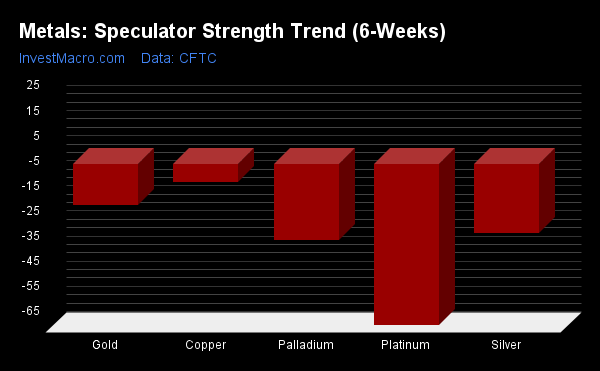
COT Strength Score Trends (or move index, calculates the 6-week changes in strength scores) showed that Copper (-7 percent) led the past six weeks trends for metals through February 21st as all metals were in negative trend territory.

Platinum (-64 percent) led the downside trend scores with Palladium (-30 percent) as the next market with lower trend scores.

Move Statistics:
Gold (-16.2 percent) vs Gold previous week (-13.5 percent)
Silver (-27.3 percent) vs Silver previous week (-27.7 percent)
Copper (-6.9 percent) vs Copper previous week (-0.7 percent)
Platinum (-64.2 percent) vs Platinum previous week (-56.6 percent)
Palladium (-30.2 percent) vs Palladium previous week (-27.4 percent)


Individual Markets:

Gold Comex Futures:

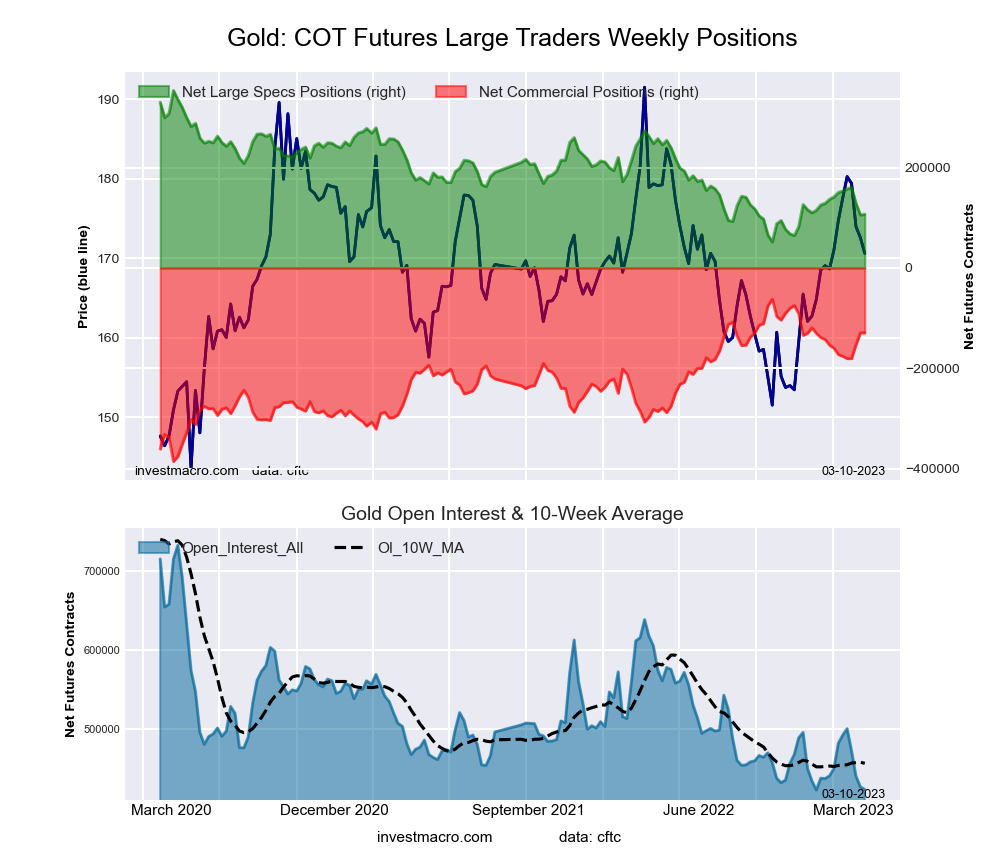
Gold Futures COT ChartThe Gold Comex Futures large speculator standing that week equaled a net position of 107,101 contracts in the data reported through Tuesday February 21st. This was a weekly rise of 1,572 contracts from the previous week which had a total of 105,529 net contracts.

The week’s current strength score (the trader positioning range over the past three years, measured from 0 to 100) shows the speculators are currently Bearish with a score of 20.6 percent. The commercials are Bullish with a score of 76.7 percent and the small traders (not shown in chart) are Bearish with a score of 35.7 percent.

Gold Futures StatisticsSPECULATORSCOMMERCIALSSMALL TRADERS
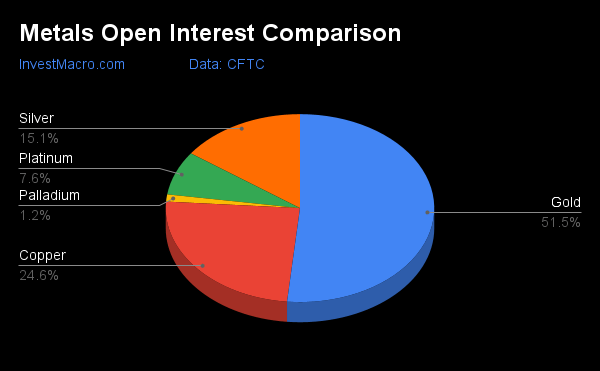
– Percent of Open Interest Longs:49.728.210.4
– Percent of Open Interest Shorts:24.458.85.1
– Net Position:107,101-129,35522,254
– Gross Longs:210,185119,04043,956
– Gross Shorts:103,084248,39521,702
– Long to Short Ratio:2.0 to 10.5 to 12.0 to 1
NET POSITION TREND:
– Strength Index Score (3 Year Range Pct):20.676.735.7
– Strength Index Reading (3 Year Range):BearishBullishBearish
NET POSITION MOVEMENT INDEX:
– 6-Week Change in Strength Index:-16.214.90.8


Silver Comex Futures:

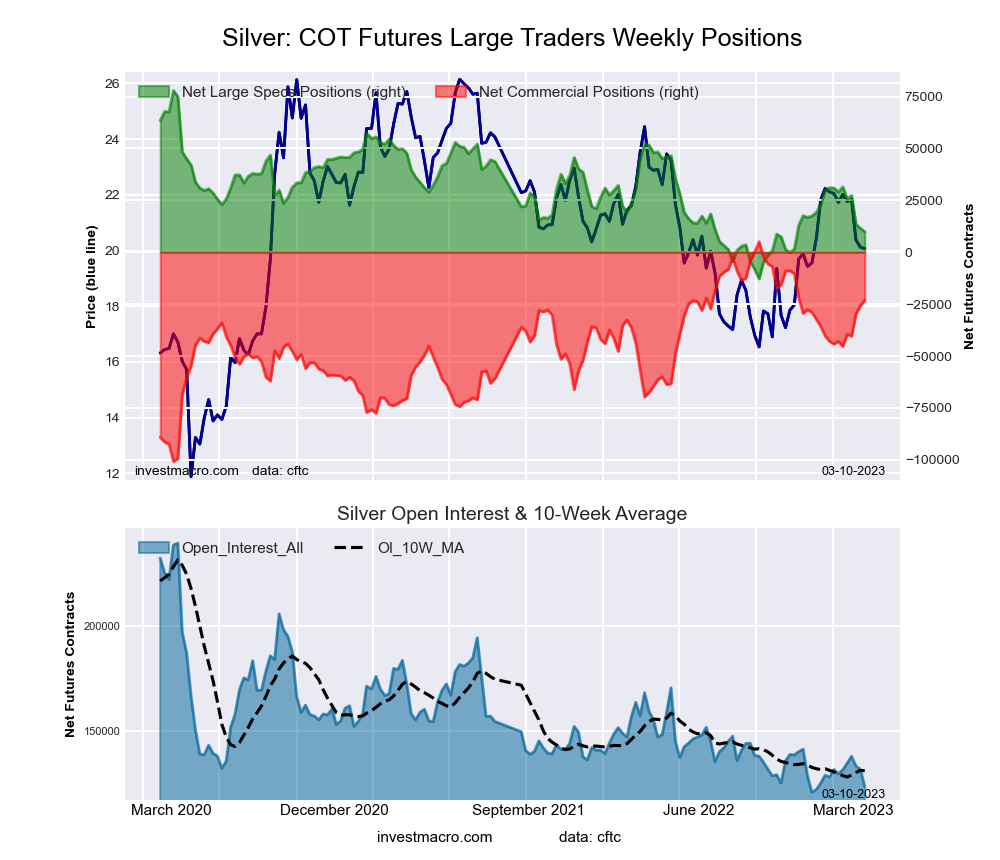
Silver Futures COT ChartThe Silver Comex Futures large speculator standing equaled a net position of 9,902 contracts in the data reported through Tuesday February 21st. This was a weekly reduction of -1,604 contracts from the previous week which had a total of 11,506 net contracts.

The week’s current strength score (the trader positioning range over the past three years, measured from 0 to 100) shows the speculators are currently Bearish with a score of 32.4 percent. The commercials are Bullish with a score of 66.0 percent and the small traders (not shown in chart) are Bearish with a score of 39.4 percent.

Silver Futures StatisticsSPECULATORSCOMMERCIALSSMALL TRADERS
– Percent of Open Interest Longs:36.336.619.9
– Percent of Open Interest Shorts:28.355.29.3
– Net Position:9,902-23,05013,148
– Gross Longs:44,98545,38824,663
– Gross Shorts:35,08368,43811,515
– Long to Short Ratio:1.3 to 10.7 to 12.1 to 1
NET POSITION TREND:
– Strength Index Score (3 Year Range Pct):32.466.039.4
– Strength Index Reading (3 Year Range):BearishBullishBearish
NET POSITION MOVEMENT INDEX:
– 6-Week Change in Strength Index:-27.324.1-4.3


Copper Grade #1 Futures:

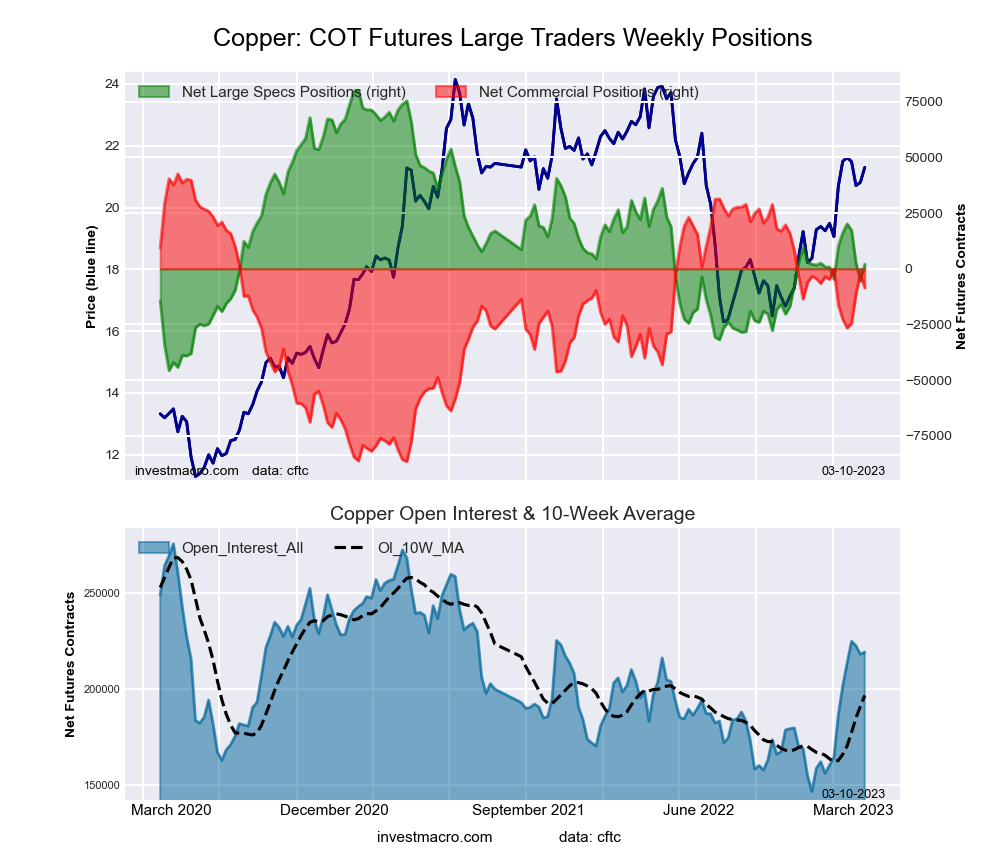
Copper Futures COT ChartThe Copper Grade #1 Futures large speculator standing equaled a net position of 2,049 contracts in the data reported through Tuesday February 21st. This was a weekly boost of 7,560 contracts from the previous week which had a total of -5,511 net contracts.

The week’s current strength score (the trader positioning range over the past three years, measured from 0 to 100) shows the speculators are currently Bearish with a score of 34.5 percent. The commercials are Bullish with a score of 61.6 percent and the small traders (not shown in chart) are Bullish with a score of 62.6 percent.

Copper Futures StatisticsSPECULATORSCOMMERCIALSSMALL TRADERS
– Percent of Open Interest Longs:33.542.99.4
– Percent of Open Interest Shorts:32.546.86.4
– Net Position:2,049-8,5106,461
– Gross Longs:73,39594,04720,560
– Gross Shorts:71,346102,55714,099
– Long to Short Ratio:1.0 to 10.9 to 11.5 to 1
NET POSITION TREND:
– Strength Index Score (3 Year Range Pct):34.561.662.6
– Strength Index Reading (3 Year Range):BearishBullishBullish
NET POSITION MOVEMENT INDEX:
– 6-Week Change in Strength Index:-6.96.12.5


Platinum Futures:

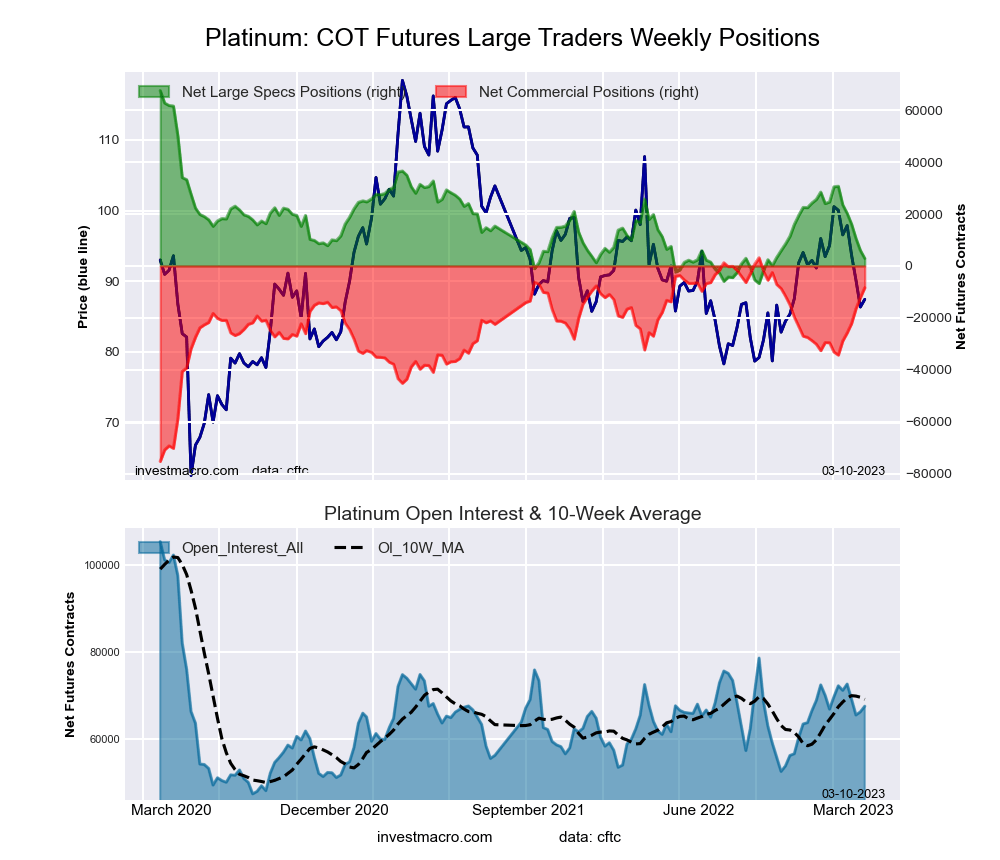
Platinum Futures COT ChartThe Platinum Futures large speculator standing equaled a net position of 2,905 contracts in the data reported through Tuesday February 21st. This was a weekly decrease of -3,093 contracts from the previous week which had a total of 5,998 net contracts.

The week’s current strength score (the trader positioning range over the past three years, measured from 0 to 100) shows the speculators are currently Bearish with a score of 22.3 percent. The commercials are Bullish with a score of 76.1 percent and the small traders (not shown in chart) are Bearish with a score of 41.6 percent.

Platinum Futures StatisticsSPECULATORSCOMMERCIALSSMALL TRADERS
– Percent of Open Interest Longs:41.638.012.8
– Percent of Open Interest Shorts:37.350.44.7
– Net Position:2,905-8,3945,489
– Gross Longs:28,05825,6388,655
– Gross Shorts:25,15334,0323,166
– Long to Short Ratio:1.1 to 10.8 to 12.7 to 1
NET POSITION TREND:
– Strength Index Score (3 Year Range Pct):22.376.141.6
– Strength Index Reading (3 Year Range):BearishBullishBearish
NET POSITION MOVEMENT INDEX:
– 6-Week Change in Strength Index:-64.253.724.5


Palladium Futures:

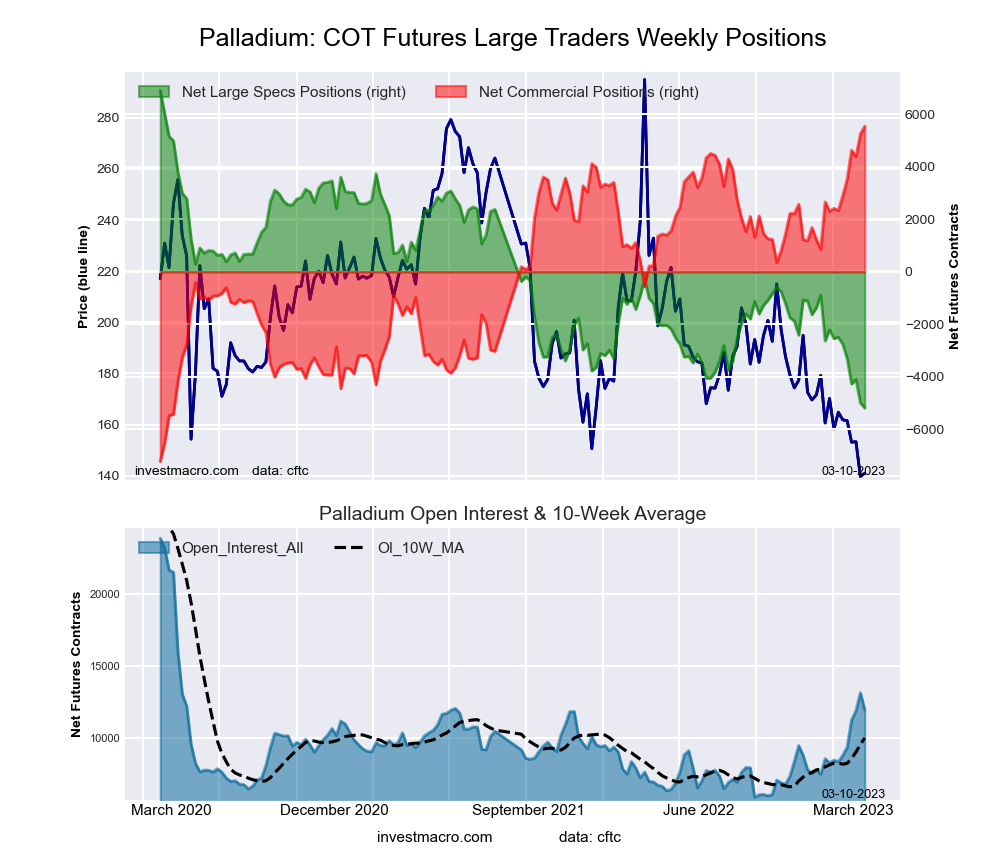
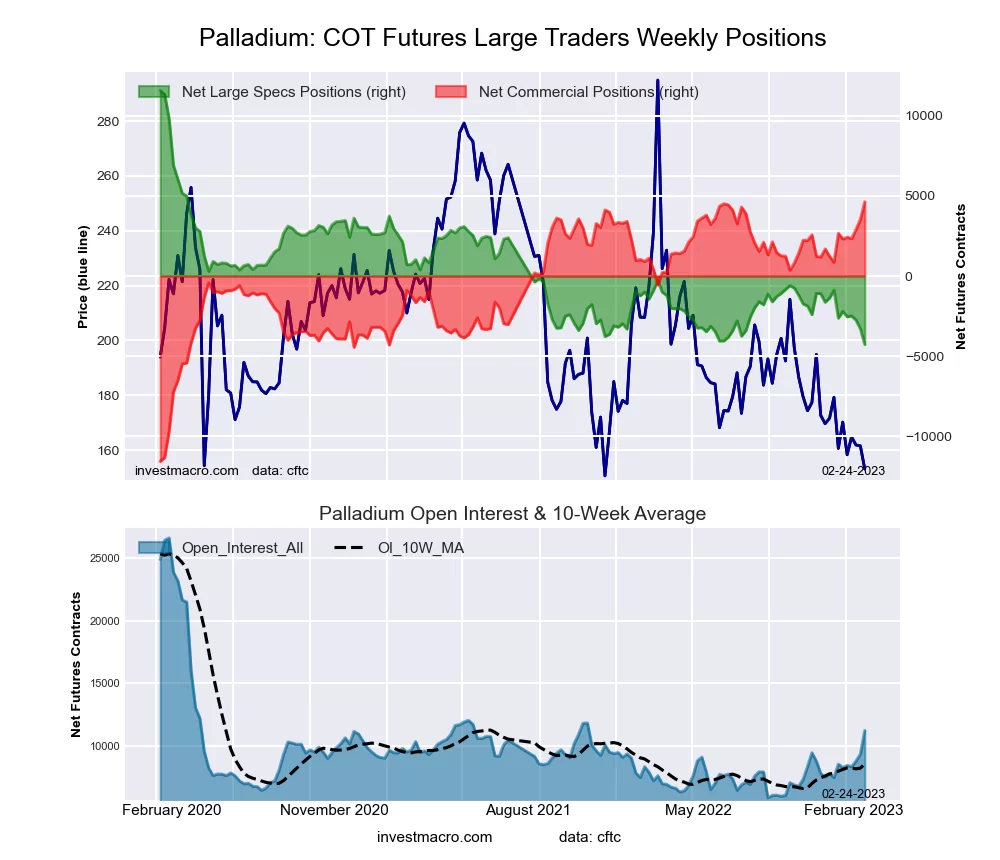
Palladium Futures COT ChartThe Palladium Futures large speculator standing equaled a net position of -5,188 contracts in the data reported through Tuesday February 21st. This was a weekly decrease of -199 contracts from the previous week which had a total of -4,989 net contracts.

The week’s current strength score (the trader positioning range over the past three years, measured from 0 to 100) shows the speculators are currently Bearish-Extreme with a score of 0.0 percent. The commercials are Bullish-Extreme with a score of 100.0 percent and the small traders (not shown in chart) are Bearish-Extreme with a score of 19.8 percent.

Palladium Futures StatisticsSPECULATORSCOMMERCIALSSMALL TRADERS
– Percent of Open Interest Longs:16.068.311.5
– Percent of Open Interest Shorts:59.521.814.5
– Net Position:-5,1885,552-364
– Gross Longs:1,9138,1591,372
– Gross Shorts:7,1012,6071,736
– Long to Short Ratio:0.3 to 13.1 to 10.8 to 1
NET POSITION TREND:
– Strength Index Score (3 Year Range Pct):0.0100.019.8
– Strength Index Reading (3 Year Range):Bearish-ExtremeBullish-ExtremeBearish-Extreme
NET POSITION MOVEMENT INDEX:
– 6-Week Change in Strength Index:-30.232.2-31.1


Article By InvestMacroReceive our weekly COT Newsletter

*COT Report: The COT data, released weekly to the public each Friday, is updated through the most recent Tuesday (data is 3 days old) and shows a quick view of how large speculators or non-commercials (for-profit traders) were positioned in the futures markets.

The CFTC categorizes trader positions according to commercial hedgers (traders who use futures contracts for hedging as part of the business), non-commercials (large traders who speculate to realize trading profits) and nonreportable traders (usually small traders/speculators) as well as their open interest (contracts open in the market at time of reporting). See CFTC criteria here.

Trade Of The Week: Are Gold Bulls Back In Town?

By ForexTime 

After securing its best week since mid-January, could gold prices be gearing up for more upside?

The precious metal staged a solid rebound last week, climbing 2.5% due to dollar weakness and positive economic data from China. A pullback in Treasury yields last Friday fuelled upside gains, pushing prices closer to the 50-day Simple Moving Average around $1870. Price action suggests that bulls could be back in action after gold received a thorough beating last month. However, the key question is whether the current momentum will result in a bullish reversal or a dead cat bounce.

Revisiting our 2023 outlook, we discussed how gold could be one of the biggest winners this year based on expectations around the Federal Reserve pausing rate hikes down the line. In February, these expectations were tempered by robust jobs data and sticky inflation figures which fuelled fears about rates staying higher for longer. Nevertheless, sentiment towards gold may experience a positive shift this month if US economic data disappoints and inflation shows signs of cooling.

Taking a quick looking at the technical picture, gold turned bullish on the daily charts after breaking above the $1845 lower high. A strong daily close above the 50-day SMA could encourage an incline towards $1880 and $1900, respectively.

Big week for gold as Powell & NFP eyed

Watch this space as the events this week could either fuel gold’s upside momentum or end the party for bulls. All eyes will be on Fed Chair Jerome Powell’s Testimony and US jobs data which have the potential to inject the precious metal with explosive levels of volatility.

On Tuesday, Fed Chair Powell provides his semi-annual report to the Senate Banking Committee. Any hints or signals on the Fed potentially straying away from 25bp hikes in future meetings will most likely influence markets. Powell will address the House Financial Services Committee on Wednesday and is expected to reiterate a similar message. If Powell strikes a hawkish tone during Testimony, this could rekindle dollar strength and rate hike bets – ultimately dragging gold prices lower. Alternatively, a cautiously sounding Powell may cool rate hike bets, providing even more room for gold bulls to fight back.

It’s all about the US jobs report on Friday which could determine whether the dollar’s renewed strength is temporary or lasting. After the breathtaking 517,000 reading back in January, around 215,000 is projected for February. Another healthy jobs report may reinforce expectations around the Federal Reserve holding rates higher for longer. On the other hand, if the NFP report fails to meet expectations – the dollar is likely to tumble as investors pare back their rate hike bets.

Other factors influencing gold

It will be wise to keep an eye on the ADP’s monthly read and initial jobless claims which could act as an appetiser before the main course. On the geopolitical front, developments concerning Sino-US relations may add more spice and flavour to the precious metal – especially if investors become edgy. While escalating tensions could fuel risk aversion sweetening appetite for safe-haven assets, this also includes the dollar. As we have identified earlier, dollar strength tends to make things difficult for gold bulls.

Gold to see rebound or dead cat bounce?

Gold turned bullish on the daily charts after prices blasted above $1845 lower high. The precious metal trades above the 100-day and 200-day Simple Moving Average with bulls eyeing the 50-day SMA at $1870. A strong breakout and daily close above this level could encourage an incline toward $1880 and potentially beyond the psychological $1900 resistance level. On the other hand, if bulls are capped below the 50-day SMA or lose momentum around $1880 – this could trigger a move lower with $1825 and $1800 acting as key levels of interest. Ultimately, the pending key US economic reports and Powell’s testimony will most likely shape the outlook for gold this month.


Forex-Time-LogoArticle by ForexTime

ForexTime Ltd (FXTM) is an award winning international online forex broker regulated by CySEC 185/12 www.forextime.com

COT Metals Update: January 31st data shows Speculator Bets led by Gold & Silver

By InvestMacro

Here are the latest charts and statistics for the Commitment of Traders (COT) data published by the Commodities Futures Trading Commission (CFTC).

The latest COT data is updated through Tuesday January 31st and shows a quick view of how large traders (for-profit speculators and commercial entities) were positioned in the futures markets.

*** This data is almost a month old because the CFTC’s up-to-date data has been delayed due to a cybersecurity event that happened in early February to ION Cleared Derivatives (a subsidiary of ION Markets). This hack of ION has created a problem for the large trader positions to be reported and reconciled. The CFTC states that they will be back-filling the data over the next couple weeks and will get the data back up to date soon.

Weekly Speculator Changes led by Gold & Silver

The COT metals markets speculator bets were lower on January 31st as two out of the five precious metals markets we cover had higher positioning while the other three markets had lower speculator contracts.

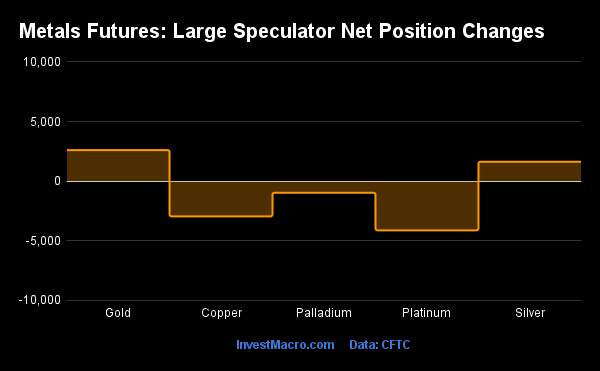
Leading the gains for the metals was Gold (2,608 contracts) with Silver (1,632 contracts) also showing a positive week.

The markets with declines in speculator bets for the week were Platinum (-4,124 contracts), Copper (-2,955 contracts) and Palladium (-974 contracts) also registering lower bets on the week.


Data Snapshot of Commodity Market Traders | Columns Legend
Jan-31-2023OIOI-IndexSpec-NetSpec-IndexCom-NetCOM-IndexSmalls-NetSmalls-Index
Gold471,64216160,28136-180,5206320,23931
Silver138,2631427,31644-40,4345713,11837
Copper224,8246117,21550-24,414487,19967
Palladium11,24534-4,27104,632100-36120
Platinum69,1214016,13733-22,213656,07649


Strength Scores led by Copper & Silver

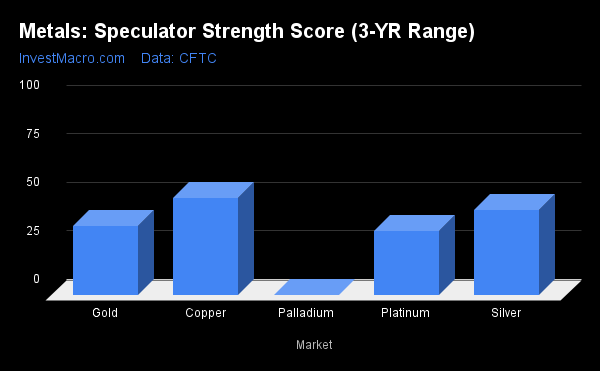
COT Strength Scores (a normalized measure of Speculator positions over a 3-Year range, from 0 to 100 where above 80 is Extreme-Bullish and below 20 is Extreme-Bearish) showed that Copper (50 percent) led the metals markets for that week. Silver (44 percent) came in as the next highest in the weekly strength scores.

On the downside, Palladium (0 percent) came in at the lowest strength level and was in Extreme-Bearish territory (below 20 percent). The next lowest strength score was Platinum (33 percent).

Strength Statistics:
Gold (35.9 percent) vs Gold previous week (35.0 percent)
Silver (44.2 percent) vs Silver previous week (42.4 percent)
Copper (50.0 percent) vs Copper previous week (52.4 percent)
Platinum (33.4 percent) vs Platinum previous week (39.4 percent)
Palladium (0.0 percent) vs Palladium previous week (10.3 percent)


Copper & Gold top the 6-Week Strength Trends

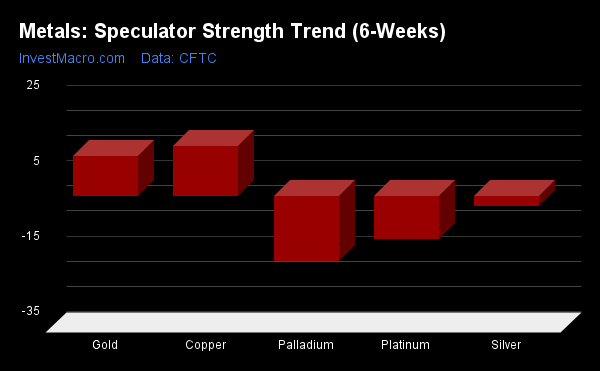
COT Strength Score Trends (or move index, calculates the 6-week changes in strength scores) showed that Copper (13 percent) led the six weeks trends for metals. Gold (10 percent) was the next highest positive mover in the latest trends data.

Palladium (-17 percent) led the downside trend scores with Platinum (-12 percent) and Silver (-2.7 percent) as the next markets with lower trend scores.

Move Statistics:
Gold (10.4 percent) vs Gold previous week (10.6 percent)
Silver (-2.7 percent) vs Silver previous week (3.2 percent)
Copper (13.1 percent) vs Copper previous week (14.0 percent)
Platinum (-11.5 percent) vs Platinum previous week (-11.9 percent)
Palladium (-17.4 percent) vs Palladium previous week (-25.6 percent)


Individual Markets:

Gold Comex Futures:

Gold Futures COT ChartThe Gold Comex Futures large speculator standing for the week recorded a net position of 160,281 contracts in the data reported through Tuesday January 31st. This was a weekly increase of 2,608 contracts from the previous week which had a total of 157,673 net contracts.

This week’s current strength score (the trader positioning range over the past three years, measured from 0 to 100) shows the speculators are currently Bearish with a score of 35.9 percent. The commercials are Bullish with a score of 63.4 percent and the small traders (not shown in chart) are Bearish with a score of 30.7 percent.

Gold Futures StatisticsSPECULATORSCOMMERCIALSSMALL TRADERS
– Percent of Open Interest Longs:54.425.59.3
– Percent of Open Interest Shorts:20.463.75.0
– Net Position:160,281-180,52020,239
– Gross Longs:256,417120,14743,984
– Gross Shorts:96,136300,66723,745
– Long to Short Ratio:2.7 to 10.4 to 11.9 to 1
NET POSITION TREND:
– Strength Index Score (3 Year Range Pct):35.963.430.7
– Strength Index Reading (3 Year Range):BearishBullishBearish
NET POSITION MOVEMENT INDEX:
– 6-Week Change in Strength Index:10.4-11.716.5


Silver Comex Futures:

Silver Futures COT ChartThe Silver Comex Futures large speculator standing for the week recorded a net position of 27,316 contracts in the data reported. This was a weekly rise of 1,632 contracts from the previous week which had a total of 25,684 net contracts.

This week’s current strength score (the trader positioning range over the past three years, measured from 0 to 100) shows the speculators are currently Bearish with a score of 44.2 percent. The commercials are Bullish with a score of 57.0 percent and the small traders (not shown in chart) are Bearish with a score of 37.5 percent.

Silver Futures StatisticsSPECULATORSCOMMERCIALSSMALL TRADERS
– Percent of Open Interest Longs:39.734.717.8
– Percent of Open Interest Shorts:19.964.08.4
– Net Position:27,316-40,43413,118
– Gross Longs:54,86747,99724,665
– Gross Shorts:27,55188,43111,547
– Long to Short Ratio:2.0 to 10.5 to 12.1 to 1
NET POSITION TREND:
– Strength Index Score (3 Year Range Pct):44.257.037.5
– Strength Index Reading (3 Year Range):BearishBullishBearish
NET POSITION MOVEMENT INDEX:
– 6-Week Change in Strength Index:-2.7-0.113.7


Copper Grade #1 Futures:

Copper Futures COT ChartThe Copper Grade #1 Futures large speculator standing for the week recorded a net position of 17,215 contracts in the data reported. This was a weekly decline of -2,955 contracts from the previous week which had a total of 20,170 net contracts.

This week’s current strength score (the trader positioning range over the past three years, measured from 0 to 100) shows the speculators are currently Bullish with a score of 50.0 percent. The commercials are Bearish with a score of 48.1 percent and the small traders (not shown in chart) are Bullish with a score of 66.9 percent.

Copper Futures StatisticsSPECULATORSCOMMERCIALSSMALL TRADERS
– Percent of Open Interest Longs:38.036.38.8
– Percent of Open Interest Shorts:30.347.25.6
– Net Position:17,215-24,4147,199
– Gross Longs:85,41081,69419,764
– Gross Shorts:68,195106,10812,565
– Long to Short Ratio:1.3 to 10.8 to 11.6 to 1
NET POSITION TREND:
– Strength Index Score (3 Year Range Pct):50.048.166.9
– Strength Index Reading (3 Year Range):BullishBearishBullish
NET POSITION MOVEMENT INDEX:
– 6-Week Change in Strength Index:13.1-16.225.8


Platinum Futures:

Platinum Futures COT ChartThe Platinum Futures large speculator standing for the week recorded a net position of 16,137 contracts in the data reported. This was a weekly reduction of -4,124 contracts from the previous week which had a total of 20,261 net contracts.

This week’s current strength score (the trader positioning range over the past three years, measured from 0 to 100) shows the speculators are currently Bearish with a score of 33.4 percent. The commercials are Bullish with a score of 65.5 percent and the small traders (not shown in chart) are Bearish with a score of 49.4 percent.

Platinum Futures StatisticsSPECULATORSCOMMERCIALSSMALL TRADERS
– Percent of Open Interest Longs:50.833.012.4
– Percent of Open Interest Shorts:27.465.13.6
– Net Position:16,137-22,2136,076
– Gross Longs:35,09822,8088,577
– Gross Shorts:18,96145,0212,501
– Long to Short Ratio:1.9 to 10.5 to 13.4 to 1
NET POSITION TREND:
– Strength Index Score (3 Year Range Pct):33.465.549.4
– Strength Index Reading (3 Year Range):BearishBullishBearish
NET POSITION MOVEMENT INDEX:
– 6-Week Change in Strength Index:-11.510.08.0


Palladium Futures:

Palladium Futures COT ChartThe Palladium Futures large speculator standing for the week recorded a net position of -4,271 contracts in the data reported. This was a weekly reduction of -974 contracts from the previous week which had a total of -3,297 net contracts.

This week’s current strength score (the trader positioning range over the past three years, measured from 0 to 100) shows the speculators are currently Bearish-Extreme with a score of 0.0 percent. The commercials are Bullish-Extreme with a score of 100.0 percent and the small traders (not shown in chart) are Bearish with a score of 20.0 percent.

Palladium Futures StatisticsSPECULATORSCOMMERCIALSSMALL TRADERS
– Percent of Open Interest Longs:15.963.411.0
– Percent of Open Interest Shorts:53.922.214.2
– Net Position:-4,2714,632-361
– Gross Longs:1,7927,1311,238
– Gross Shorts:6,0632,4991,599
– Long to Short Ratio:0.3 to 12.9 to 10.8 to 1
NET POSITION TREND:
– Strength Index Score (3 Year Range Pct):0.0100.020.0
– Strength Index Reading (3 Year Range):Bearish-ExtremeBullish-ExtremeBearish
NET POSITION MOVEMENT INDEX:
– 6-Week Change in Strength Index:-17.419.5-19.5


Article By InvestMacroReceive our weekly COT Newsletter

*COT Report: The COT data, released weekly to the public each Friday, is updated through the most recent Tuesday (data is 3 days old) and shows a quick view of how large speculators or non-commercials (for-profit traders) were positioned in the futures markets.

The CFTC categorizes trader positions according to commercial hedgers (traders who use futures contracts for hedging as part of the business), non-commercials (large traders who speculate to realize trading profits) and nonreportable traders (usually small traders/speculators) as well as their open interest (contracts open in the market at time of reporting). See CFTC criteria here.

Gold: What “Colossal” Central Bank Buying May Mean

“Central banks are so confident that gold prices will continue rising that they are…”

By Elliott Wave International

Central banks have been scooping up gold with a vengeance.

Here’s a Jan. 31 Financial Times headline:

‘Colossal’ central bank buying drives gold demand to decade high

Interestingly, just a few days later on Feb. 3, the precious metal dropped by more than 2%. But setting aside near-term price moves in gold, what you need to know is that government is nearly always the last to act on a financial trend. In other words, when government acts, a financial trend is either nearly or already over.

In the case of gold, consider that central banks were furiously buying it in mid-2011. As you may recall, gold had been strongly rallying. Well, just three months later in September of that year, gold hit a top and fell 46% during the next four years.

Going back in history a little further to around 1999 and 2000, there was the gold selling episode which amusingly came to be known as “Brown’s Bottom” — referring to Britain’s Chancellor of the Exchequer at the time, Gordon Brown.

Brown was fervently selling from Britain’s gold reserves after gold had been in a multi-year downtrend.

You no doubt know the rest of the story: After Brown’s gold selling, the precious metal then entered a multi-year uptrend.

But let’s get back to the present, namely, an instructive chart and commentary from our recently published February 2023 Elliott Wave Financial Forecast:

Central banks are so confident that gold prices will continue rising that they are committing generational amounts to its purchase. Central bank behavior is not a short-term timing tool, but it does provide key input for judging sentiment, which appears strongly bullish.

If you would like to get near-term analysis of gold, as well as more of this broader perspective, you can find it in Elliott Wave International’s flagship Financial Forecast Service.

Or you can apply Elliott wave analysis to gold’s price chart yourself — as well as other financial markets.

If you’re unfamiliar with the Elliott wave model, read Frost & Prechter’s book, Elliott Wave Principle: Key to Market Behavior. Here’s a quote:

The practical goal of any analytical method is to identify market lows suitable for buying (or covering shorts) and market highs suitable for selling (or selling short). When developing a system of trading or investing, you should adopt certain patterns of thought that will help you remain both flexible and decisive, both defensive and aggressive, depending upon the demands of the situation. The Elliott Wave Principle is not such a system, but is unparalleled as a basis for creating one.

Learn more by reading the entire online version of the book for free. That’s right — you can access Elliott Wave Principle: Key to Market Behavior for free once you become a member of Club EWI — the world’s largest Elliott wave educational community.

A Club EWI membership is also free and members get complimentary access to a wealth of Elliott wave resources on financial markets, investing and trading.

Join Club EWI now (no obligations as a member) by following this link: Elliott Wave Principle: Key to Market Behaviorget free and instant access.

This article was syndicated by Elliott Wave International and was originally published under the headline Gold: What “Colossal” Central Bank Buying May Mean. EWI is the world’s largest market forecasting firm. Its staff of full-time analysts led by Chartered Market Technician Robert Prechter provides 24-hour-a-day market analysis to institutional and private investors around the world.

Electrification: Generation, Transmission, and Storage

Source: Michael Ballanger  (2/20/23)

 Michael Ballanger of GGM Advisory Inc. reviews the energy market and metals associated with the “electrification movement.”

After a sharp reversal in sentiment at the start of the year, the junior explorers and developers (ex-lithium) have faded back into the same frustrating pattern of listlessness where either operational or exploration results deemed “spectacular” in past eras are instead treated as rare and valuable “liquidity events.” Just as the canine being fed by Mr. Pavlov learned to salivate upon the ringing of a bell just before dinner time, traders in the junior gold, silver, copper and most other base metal issues have learned that it is the first bid that gets hit after a positive news release that is the best bid to hit.

That is because the junior miners trade on the margin to the extent that is usually the first trade that sets the mood. It has gotten so bad that I actually received a note from a young trader that informed me of the “lousy results” at Marathon Gold’s Valentine Gold Project in Quebec. Quickly calling them up and noticing an intercept of 5 g/t Au over 18 meters, I asked the young man what made him think the results were “lousy.”

His reply was “Well, the stock was $1.21 the day of the release and it’s now $0.91. Results were obviously lousy.”

Notwithstanding that the results reported by MOZ were anything but “lousy”, it simply underscores how tape action controls the narrative on every single stock out there these days.

I was in a conversation with a prominent speaker and newsletter writer this week that told me that unless one is invested in the companies producing, developing, or hunting down metals associated with the electrification movement, the new generation of traders is largely disinterested.

He informed me that his subscriber base is down over 50% despite having some big success recently with Great Bear Resources Ltd. (GBR:TSX.V; GTBDF:OTCQX) taken out by Kinross Gold Corp. (K:TSX; KGC:NYSE) for around $30 in February 2022.

Rather than complain about it, I am reminded of an anecdote relayed to a group of us by veteran Wall Street Week Elf Julius Westheimer while we were attending the annual Securities Industry Associations (“SIA”) conference in which industry professionals conduct classes in various sectors of the securities industry.

It is very “blueblood” as it is held at the prestigious “Wharton School of Finance” in Philadelphia and they really milk that because when you leave, they present you with a graduation certificate (a “shingle”) that looks like a real Wharton certificate such that when you hang it on your wall, everybody figures you earned a post-graduate degree from Wharton, which you did not. Three weeks over three years at the SIA is nothing like six semesters at the Wharton.

The old Wall Street Week show came on every Friday night around 7:00 p.m. and in the late 70s, it was really the only TV news show that covered stocks and bonds. It aired on public TV in Maryland but was widely syndicated across North America and I believe Europe and was a “must watch” for any young broker trying to learn the trade.

It was on Wall Street Week on October 16, 1987, that the legendary money manager and author Martin Zweig told the host that he actually expected a market crash. The following Monday was the infamous Crash of ’87 where the Dow lost 23.7% in a single trading day.

While most of the Wall Street Week elves were either analysts or fund managers, they used Mr. Westheimer as their “token stock salesman”  as his area of specialization was managing retail customers. One of the crowd asked him how he could grow his book (increase the number of clients) and then peppered Julius with a bunch of the books he had read and courses he had taken at which point Julius held up his hand in a gesture of “Enough, already!” and proceeded to tell us all a story which describes not only the retail space in 1979 but also the systemic modus operandi of Wall Street since the first began shuffling paper on a New York curb in the 1800s.

One day, I was walking to work at Broad and Wall Streets when I noticed a chap trying to sell these yellow umbrellas out of a hand cart but each time a prospective buyer picked one up and examined it, they frowned and put it back. Now, across the street, another chap was selling the same brand of umbrella but they were blue umbrellas and these umbrellas were flying out of his cart so fast that his young son and to keep running back to their apartment for more inventory. The poor guy in the yellow umbrella cart sitting there with no customers flagged me down and ask me what I thought he could do to improve his sales. I said, “Go around the corner to O’Reilly Hardware and pick up a can of blue spray paint.” Because, ya see, down here we only sell what people want to buy.”

Now, the purists that view precious metals with an almost religious affection would never dream of dumping their stacks for something as abhorrent as copper or lithium or uranium because they think that yellow umbrellas are just as useful as blue umbrellas but where they would be in error is that Marketing 101 says you always need to know what one’s customer wants before embarking on a marketing program.

When you go down the “Most Actives” list for the TSX and TSX Venture exchanges these days, you do not find “Gunner Gold,” “Streaker Silver,” “Pugnacious Platinum” or “Parlay Palladium.”

You find the word “battery” or “lithium” in the names of those corporate issuers dominating the list of “Most Actives,” “Biggest Percentage Gainers” and “Volume Leaders.”

In 2020, my list of juniors was all gold and silver with one token uranium name. By 2023, the list is comprised of eight names with only one pure gold developer (Getchell Gold Corp.) a couple of silver names (that have copper and gold exposure) with the rest exclusively copper and lithium, with Volt Lithium Corp. the most recent addition.

I read the results of a poll of trader/investor types last week that asked participants to list the five most important metals in which they wished to invest. At the top by the widest of margins was lithium while at the nadir was silver. I should add that silver is also the least-trusted of all the metals with gold a close second.

With copper, uranium, nickel, and cobalt all lined up behind lithium as the favorites, it should come as no surprise because the new generation of investors/traders invests in thematic “story” stocks. They also invest as a collective thanks largely to their obsession with social media.

The popularity of these sub-sectors can be broken down into one word: “electrification.” Integral to the replacement of fossil fuels by electricity are three prerequisites:

  • New clean and 100% reliable sources of electricity are going to be needed. The only fuel that can deliver is uranium. Nuclear energy will be the source of the trillions of new megawatts required to complete the transition.
  • With the new supply of electricity being pumped into an antiquated grid, massive increases in the supply of those metals that transmit electricity are going to be required and the metal that has been the most commonly used is copper.
  • Once the new source of electricity provided by nuclear energy has been transmitted by the greatly-fortified copper wiring to households, businesses and vehicles, the need for storage particularly in the EV space is going to require lithium (lithium-ion batteries) along with nickel and cobalt.

Enhanced generation, increased transmission infrastructure, and storage capacity are going to demand huge increases in supply. Over the past five decades, the sector that has discovered the lion’s share of the new mineral deposits around the globe are the juniors which then get absorbed by the multinationals with help from their deep-pocketed investment bank pals.

Therein lies the opportunity for investors as we look out through the rest of the “Boring Twenties.” The younger generation of stock buyers could care less about “profligate government spending” or “currency debasement” that would require they use gold and silver as protection. They represent the “yellow umbrellas” of the day for these youngsters and since liquidity is critical for institutional participation, you will never get the volumes required in yellow umbrellas to create the excitement that the “electrification metals” (including nuclear fuel) can generate.

Of course, over time, this all can change as trends are always cyclical and people’s attitudes and preferences will ebb and flow depending on the impact of the “Narrative of the Day.”

For now, however, I just want to find opportunities that will make money. Unfortunately, we cannot take a silver explorer and turn it into a copper or lithium explorer with a can of blue spray paint. Julius Westheimer taught me to avoid the habit of offering products that the investing public simply does not want so I will heed his advice and instead seek out exploration and development plays that focus on the generation, transmission, and storage of electricity while keeping large barbell positions in gold and silver as hedges.

It was the last week of September when I executed my own personal “pivot” jumping off the bear bandwagon and into the neutral camp after the Bank of England decided to buy $5 billion worth of gilts. A couple of weeks later, I went from neutral to bullish but technically, I was about two weeks early in my “bottom” call as the 3,600 S&P level in late September gave way to the October 13th low at 3,491.

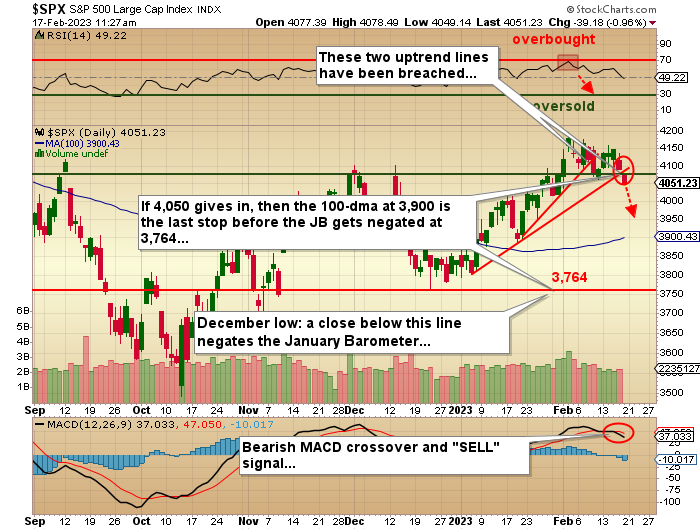
In a similar fashion, I went from bull to neutral on February 8th and then full bearish this week having put on a small put option position in the SPY:US. I did so because I got two sell signals within a week of each other with the major one being the bearish MACD crossover. It took Thursday’s 43-point drubbing to convincingly send the MACD into “sell” mode so just as I was a tad early back in September, I was again early in getting short. There is a line in the sand at the 4,050 level for the S&P but if it closes below that, I see 3,900 (100-dma) then the December low at 3,764.

Michael Ballanger Disclaimer:

This letter makes no guarantee or warranty on the accuracy or completeness of the data provided. Nothing contained herein is intended or shall be deemed to be investment advice, implied or otherwise. This letter represents my views and replicates trades that I am making but nothing more than that. Always consult your registered advisor to assist you with your investments. I accept no liability for any loss arising from the use of the data contained on this letter. Options and junior mining stocks contain a high level of risk that may result in the loss of part or all invested capital and therefore are suitable for experienced and professional investors and traders only. One should be familiar with the risks involved in junior mining and options trading and we recommend consulting a financial adviser if you feel you do not understand the risks involved.

Disclosures:

1) Michael J. Ballanger: I, or members of my immediate household or family, own securities of the following companies mentioned in this article: None.  I personally am, or members of my immediate household or family are, paid by the following companies mentioned in this article: My company, Bonaventure Explorations Ltd., has a consulting relationship with: None.

2) The following companies mentioned in this article are billboard sponsors of Streetwise Reports: None. Click here for important disclosures about sponsor fees. As of the date of this article, an affiliate of Streetwise Reports has a consulting relationship with: None. Please click here for more information.

3) Statements and opinions expressed are the opinions of the author and not of Streetwise Reports or its officers. The author is wholly responsible for the validity of the statements. The author was not paid by Streetwise Reports for this article. Streetwise Reports was not paid by the author to publish or syndicate this article. Streetwise Reports requires contributing authors to disclose any shareholdings in, or economic relationships with, companies that they write about. Streetwise Reports relies upon the authors to accurately provide this information and Streetwise Reports has no means of verifying its accuracy.

4) This article does not constitute investment advice. Each reader is encouraged to consult with his or her individual financial professional and any action a reader takes as a result of information presented here is his or her own responsibility. By opening this page, each reader accepts and agrees to Streetwise Reports’ terms of use and full legal disclaimer. This article is not a solicitation for investment. Streetwise Reports does not render general or specific investment advice and the information on Streetwise Reports should not be considered a recommendation to buy or sell any security. Streetwise Reports does not endorse or recommend the business, products, services or securities of any company mentioned on Streetwise Reports.

5) From time to time, Streetwise Reports LLC and its directors, officers, employees or members of their families, as well as persons interviewed for articles and interviews on the site, may have a long or short position in securities mentioned. Directors, officers, employees or members of their immediate families are prohibited from making purchases and/or sales of those securities in the open market or otherwise from the time of the decision to publish an article until three business days after the publication of the article. The foregoing prohibition does not apply to articles that in substance only restate previously published company releases.
Future Markets Have Been Compromised by Hackers and Gold Bottoms

Source: Ron Struthers  (2/21/23) 

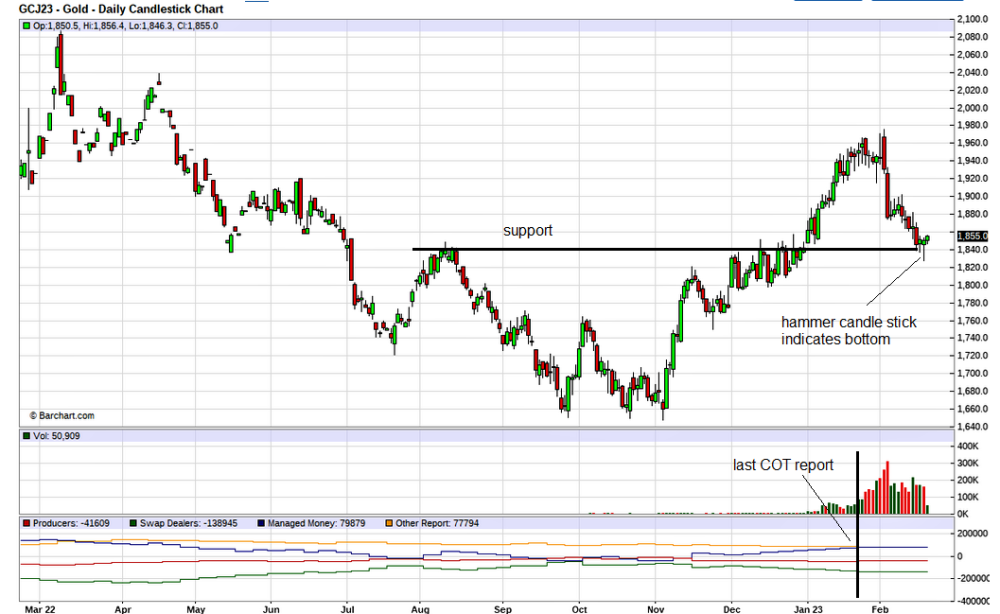
Future markets have been compromised in the past four weeks by hackers blocking the Commitment of Traders reports. There has been unusual trading in the energy markets and there is no way we know who is buying or selling. Gold sold off in this same time frame and has made a technical bottom. Can it be trusted? Ron Struthers of Struthers Stock Report tells you his opinion.

I believe the oil and gas markets along with the Ukraine war are at very pivotal points and they are both closely tied together. Energy is very critical as fuel for a war machine and as well oil and gas have been highly weaponized and politicized.

I commented that I expected the U.S. was behind the Nord Stream pipeline sabotage, but this should shock the world. Famed investigative journalist and Pulitzer prize winner Seymour Hersh, is older, when investigative journalism was the norm, but sadly no longer. Regardless, for decades he was a star reporter writing for The New York Times and New Yorker and on Wednesday published a new bombshell as his first Substack post, prompting a quick White House response.

He went into so much detail about how the sabotage was planned and carried out, you just can’t make this stuff up. What intrigued me a bit more, the highly skilled divers involved were from Panama City, Florida where I happen to be staying now.

This had to be done covertly and secretly because being carried out by a nation is an act of war, but the Americans are good at that. In a nutshell, they planted explosives during the BALTOPS 22 NATO exercise which is carried out each year in the Baltic sea. They used a trigger device that could be set off some time in the future that was inconspicuous. The trigger could be set off by dropping a beacon from a plane that sent out a signal to set the explosion off. It is fascinating how well this was planned out and I suggest you read Seymour Hersh’s February 8th piece here. Tyler at Zero Hedge did a great summary of the report as well.

No doubt the reaction in energy markets from the Ukraine war and blowing up Nord Stream must have been well thought out with a plan to counter high prices. The Biden Administration released a huge amount of oil from the strategic petroleum reserves (SPR) to counter high prices and also an attempt to damage Russia’s strong energy revenues. If you have any doubt this is mainly about hurting Russia, just look at recent news. Russia announced they will cut oil exports by 500,000 barrels and a few days later Biden announced a 23 million barrel release from the SPR, which just happens to work out to about 400,000 barrels per day. Supposedly it was approved by congress years ago, but the timing is awfully suspicious.

It also stands to reason the Biden Administration would also manipulate the natural gas price down. We got lucky with a record-mild winter in North America and Europe. I don’t think governments can control the weather yet, they are not very good at predicting it other than continuous propaganda on climate change. However natural gas prices plunging to lows only seen at the onslaught of Covid-19 look way oversold and the volume of trading has been very high.

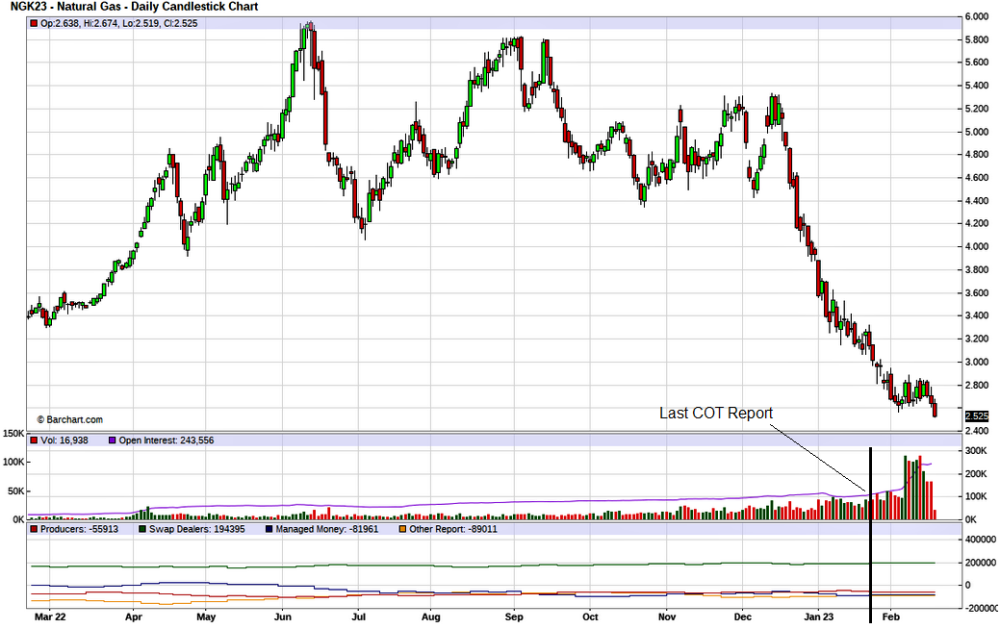
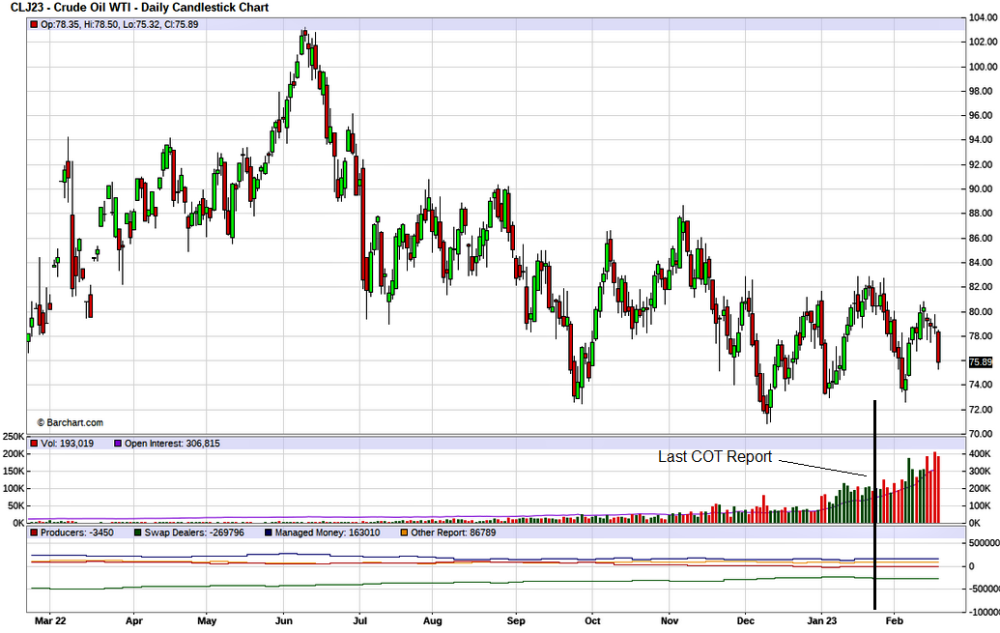
What is more bizarre we don’t have a clue who is doing the trading because the firm (Ion Markets) that produces the Commitment of Traders report was apparently hacked and is broken. The last update on COT was January 24th, it is supposed to be weekly. If you look at my chart you can see the weekly updates as trader positions are reported up or down, but it is a flat line since January 24th, the COT patient is dead. We are missing three weeks of reports and today will be four weeks.

I confirmed this with natural gas, oil, gold, and silver. I am sure it is with all commodities as the CFTC said.

Oil and Gas

What is really suspicious is the strange trading activity with a high volume of natural gas and high open interest, high volume in oil. During this time frame is when gold and silver were whacked lower.

Natural Gas closed last Friday at US$2.50 and the last time it was lower than this was the onslaught of Covid-19 in 2020 when most everything got locked down. I can see no good reason for the market to be almost as bearish as it was at the start of the pandemic.

Biden said he will refill the SPR when oil prices drop below US$72, but I doubt that will ever happen even if prices dip that low. China is reopening, wars are escalating so demand is rising again, at a time when supply is being restrained with a push for green energy. I believe draining the SPR during a time when the risk of war escalation is rising is a bad idea.

The U.S. and NATO are depleting their war inventories supplying Ukraine, and I would bet China is just watching and waiting to time an invasion of Taiwan. While NATO is weakening, China continues to build its war machine. It will be extremely difficult for NATO to take on Russia and China at the same time. Basically, it would be WW3 and with that energy prices would soar.

The EIA forecast highlights a tight market. Global liquids fuel consumption in the forecast increases from an average of 99.4 million barrels per day (b/d) in 2022 to 102.3 million b/d in 2024, driven primarily by growth in China and other non-OECD countries. Global liquid fuels production averaged about 100.0 million b/d in 2022, and EIA forecasts it will increase by an average of 1.1 million b/d in 2023 and 1.5 million b/d in 2024.

Gold

Gold markets are also affected by no COT reports. Prices declined in this period and we have no idea who is buying and selling. However, unlike oil and gas, the volume and open interest in Comex gold has been falling.

Gold dropped down to my expected support area and punched out a hammer bottom last Friday. Normally I would suggest this is a buying opportunity, but I don’t trust these markets that have been hacked, with no COT data along with abnormal volume and price action. I would bet that it ends up they can not retrieve the COT data and we just resume data from a new starting point. If so, this would look more suspicious.

Global physically backed gold ETFs kicked off 2023 with net outflows of US$1.6 billion in January and a 0.8% decline (26 tonnes) in total holdings to 3,446 tonnes, the World Gold Council (WGC) says in its latest monthly update. While the gold price witnessed its strongest January in a decade, registering a 6.1% gain, gold ETF outflows in Europe and Asia dwarfed positive demand in North America and other regions.

I have been harping that inflation has become entrenched and stronger numbers in last week’s January data are pointing that way. January Headline CPI (including energy prices) was 6.4% with the street expecting 6.2%. January Y/Y Core CPI was 5.6% and the street expected +5.5%. Housing contributed the most to the monthly increase.

I believe inflation will continue to ease because year over year will be compared to higher year-ago numbers in the months ahead. However, I doubt inflation will get under 5% and it might struggle to get under 6%.

Retail Sales

Retail sales came in strong last week at +3.0% vs the 1.9% estimate. With that and the inflation data, markets saw it as inflationary, and bonds sold off (rates rose). If you remember my comment that there was a huge short position on U.S. treasuries. At this point looks like those shorts are right. And remember on retail sales that those numbers are not adjusted for inflation of +6.4% so real retail sales declined -by 3.4%

Financial markets have upped their bets on additional rate hikes from the Bank of Canada and the U.S. Federal Reserve after blowout employment reports in both countries and higher-than-expected inflation data from the United States. Interest rate swaps, which capture market expectations about future rate decisions, have gone from pricing in two rate cuts by the Bank of Canada before the end of the year, to pricing in another rate hike in July and no rate cuts until 2024. That would bring the bank’s benchmark rate to 4.75%. In the U.S., markets now see the Fed increasing its benchmark interest rate to 5.25% by July, a quarter-point higher than expected two weeks ago.

The 10-year Treasury has declined a fair bit in February and looks to test the November 2022 lows.

Zonte Metals

I did a zoom interview with CEO Terry Christopher, you can watch it here on youtube.

We covered plans for drilling Cross Hills and all that has been learned that greatly improve the odds of making a discovery this year. Discussed the importance of Victoria Gold exploring up to Zonte Metals Inc.’s (ZON:TSX.V) border at McConnells Jest in the Yukon.

Zonte did have a surface sample there that ran around 100 grams gold and plans to go back there in 2023. Terry gave a synopsis of the Colombia court proceedings. Zonte won in the first two levels of court so it went to the third and final level.

Here B2Gold Corp. (BTG:NYSE; BTO:TSX; B2G:NSX)/AngloGold Ashanti Ltd. (AU:NYSE; ANG:JSE; AGG:ASX; AGD:LSE) presented numerous submissions to try and win the case, but Zonte defeated/defended them all so is batting 100% thus far.

Just before Covid-19, it was supposed to go to trial but everything got shut down.

Things are getting back to normal so I believe we could hear about a trial in 2023.

The technicals on the chart look very good with a long-term wedge pattern in play.

There is long-term support of around CA$0.10 going back about seven years.

A nice stage one base has been built between CA$0.09 and CA$0.125 over the last five months. I think the stock is ready to take off higher ahead of drilling. The key will be a break over the downtrend which is now around CA$0.15 to CA$0.16.

There is not much resistance around the CA$0.21 area, so that looks like a reasonable target at this time.

And for some humor, the one balloon that the U.S. shot down over Canada using two US$400k missiles was a US$12 to US$200 hobby balloon flown by the Northern Illinois Bottlecap Balloon Brigade. Yes, folks, that is correct, let a Chinese spy balloon fly across the U.S., but shoot down a hobby balloon right away. Talk about incompetence or just plain funny. Maybe we should buy defense stocks at this rate of missile consumption.


Struthers Stock Report Disclaimers: 

All forecasts and recommendations are based on opinion. Markets change direction with consensus beliefs, which may change at any time and without notice. The author/publisher of this publication has taken every precaution to provide the most accurate information possible. The information & data were obtained from sources believed to be reliable, but because the information & data source are beyond the author’s control, no representation or guarantee is made that it is complete or accurate.

The reader accepts information on the condition that errors or omissions shall not be made the basis for any claim, demand or cause for action. Because of the ever-changing nature of information & statistics the author/publisher strongly encourages the reader to communicate directly with the company and/or with their personal investment adviser to obtain up to date information.

Past results are not necessarily indicative of future results. Any statements non-factual in nature constitute only current opinions, which are subject to change. The author/publisher may or may not have a position in the securities and/or options relating thereto, & may make purchases and/or sales of these securities relating thereto from time to time in the open market or otherwise. Neither the information, nor opinions expressed, shall be construed as a solicitation to buy or sell any stock, futures or options contract mentioned herein. The author/publisher of this letter is not a qualified financial adviser & is not acting as such in this publication.

Disclosures: 

Charts provided by the author.

1) Ron Struthers: I, or members of my immediate household or family, own shares of the following companies mentioned in this article: Zonte Metals. I personally am, or members of my immediate household or family are, paid by the following companies mentioned in this article: None. My company currently has a financial relationship with the following companies mentioned in this article: Greenbriar Capital. I determined which companies would be included in this article based on my research and understanding of the sector.

2) The following companies mentioned in this article are billboard sponsors of Streetwise Reports: None. Click here for important disclosures about sponsor fees. The information provided above is for informational purposes only and is not a recommendation to buy or sell any security.

3) Statements and opinions expressed are the opinions of the author and not of Streetwise Reports or its officers. The author is wholly responsible for the validity of the statements. The author was not paid by Streetwise Reports for this article. Streetwise Reports was not paid by the author to publish or syndicate this article. Streetwise Reports requires contributing authors to disclose any shareholdings in, or economic relationships with, companies that they write about. Streetwise Reports relies upon the authors to accurately provide this information and Streetwise Reports has no means of verifying its accuracy.

4) This article does not constitute investment advice. Each reader is encouraged to consult with his or her individual financial professional and any action a reader takes as a result of information presented here is his or her own responsibility. By opening this page, each reader accepts and agrees to Streetwise Reports’ terms of use and full legal disclaimer. This article is not a solicitation for investment. Streetwise Reports does not render general or specific investment advice and the information on Streetwise Reports should not be considered a recommendation to buy or sell any security. Streetwise Reports does not endorse or recommend the business, products, services, or securities of any company mentioned on Streetwise Reports.

5) From time to time, Streetwise Reports LLC and its directors, officers, employees, or members of their families, as well as persons interviewed for articles and interviews on the site, may have a long or short position in the securities mentioned. Directors, officers, employees, or members of their immediate families are prohibited from making purchases and/or sales of those securities in the open market or otherwise from the time of the decision to publish an article until three business days after the publication of the article. The foregoing prohibition does not apply to articles that in substance only restate previously published company releases.