Archive for Financial News – Page 327

Big Tech earnings and Fed meeting in focus

By ForexTime

Asian markets edged higher on Tuesday, drawing support from China’s technology sector as investors braced for another busy and potentially volatile week for financial markets.

Overnight, Wall Street delivered a mixed performance thanks to the growing caution ahead of earnings from the tech titans, as well as the Federal Reserve decision on Wednesday. In the FX space, the dollar weakened against most G10 currencies while gold traded within a tight range, waiting for a fresh fundamental catalyst. Oil prices are on the front foot this morning following reports that Russia plans to tighten its gas supplies on Europe.

On the data front, the IMF will be in focus today as it releases an updated world economic outlook. There are also a couple of key economic releases from major economies over the next few days, especially in the United States. It may be wise to keep an eye out on the latest US consumer confidence report for July, US Q2 GDP, and the PCE core deflator among other key economic releases.

The tech megacaps will be under the spotlight as they publish their earnings this week. Google’s parent company, Alphabet, and Microsoft announce their results today after US markets close. Meta, Amazon, and Apple report their earnings over the next few days. If these titans report much better than expected quarterly result, this could support US equity markets, especially the Nasdaq 100 which is down almost 25% year-to-date.

It’s all about the Fed meeting

The Federal Reserve is widely expected to raise interest rates by 75-basis points for a second straight meeting tomorrow. However, the main focus will be directed towards Fed Chair Jerome Powell’s post-meeting conference. When considering how financial markets remain highly sensitive to any topic relating to inflation and interest rates, Powell will have to choose his words very wisely. He is likely to highlight the Fed’s determination to extinguish inflation while inflicting more pain on the economy with continued policy tightening. While the U.S economy seems to be holding steady with the latest employment numbers encouraging, inflation remains a cause for concern as consumer prices jumped 9.1% in June from a year earlier. There have also been worrying signs from recent data with weakness in business survey data and the jobless claims.

If the Fed moves ahead with a 75-basis point hike, this may not be enough to keep dollar bulls in the driving seat. Such a move needs to be complemented by firmly hawkish comments from Powell, feeding speculation around more aggressive hikes this year. Should the Fed surprise the market with a smaller than expected hike, this could send the dollar tumbling with a cautious-sounding Powell adding insult to injury. Whatever the outcome of the Fed meeting, it is likely to influence the dollar which has weakened against most G10 currencies this week.

Commodity spotlight – Gold

Gold is likely to remain on standby until the Fed rate decision on Wednesday. The precious metal has barely moved since Monday due to the absence of a fresh directional catalyst. It will be interesting to see how gold reacts when the Fed moves ahead with a 75-basis rate hike. Will the precious metal weaken due to its zero-yielding status? Or will a weaker dollar limit downside losses?

Looking at the technical picture, prices are trading around the $1724 level as of writing. The $1700 remains a key point of interest this week and a level that can determine whether gold rebounds or extends the decline.


Forex-Time-LogoArticle by ForexTime

ForexTime Ltd (FXTM) is an award winning international online forex broker regulated by CySEC 185/12 www.forextime.com

Half of investors to buy more stocks this year, despite market volatility

By George Prior 

More than half of retail investors are planning to buy more stocks before the end of 2022, reveals a new global survey, but they must do so carefully and avoid over-exposure, warns Nigel Green, CEO of the deVere Group of companies.

The warning from the game-changing chief executive of one of the world’s largest financial advisory, asset management and fintech organisations, comes after a poll of more than 700 clients found that 56% are seeking to add more equities to their investment portfolios this year.

The respondents are clients who currently reside in North America, the UK, Europe, Asia, Africa, the Middle East, and Latin America.

Of the findings, Nigel Green says: “The poll’s findings show that retail investors are not behaving as you might expect.

“A jittery start to the year for stock markets got even worse last month, with most major indexes coping with major bouts of volatility.

“The S&P 500, for example, ended the first half of the year down nearly 21%, the most dramatic first-half shedding in more than five decades.

“However, investors are shrugging off the bearish sentiment and are preparing to top-up their portfolios.”

He continues: “This is a good thing as it shows that people are thinking about the long-term.  They are preparing to use the downturn to their financial advantage by building their future wealth with quality stocks at lower prices.

“They see that the recent panic-selling has created some important long-term opportunities with high upside potential and low-risk possibilities.

“Sensibly, they are not only remaining fully invested but they are looking to build their investments.”

Despite the bullish sentiment, the deVere CEO also issues a warning to those seeking radically more exposure to equities.

“Stepping off the sidelines to enhance your investment portfolios is to be championed, but you must also ensure that those bolsters help to create resilience and dynamism.

“You must buy wisely in this current volatile, high inflation environment.

“You should bear in mind that long-term and short-duration assets respond differently to rising inflation and interest rates.

“In addition, against the current backdrop, you should be considering less familiar, return-enhancing asset classes which could include venture capital, structured products, cryptocurrencies, high dividend stocks, hedge funds and managed futures, and real estate, amongst others.”

Nigel Green concludes: “Building your investments is, clearly, the best way to grow your long-term wealth. But don’t get carried away with one asset class.

“Diversification remains your best tool to reach your financial objectives.”

About:

deVere Group is one of the world’s largest independent advisors of specialist global financial solutions to international, local mass affluent, and high-net-worth clients.  It has a network of more than 70 offices across the world, over 80,000 clients and $12bn under advisement.

Cryptocurrencies are gaining ground across Africa. That’s both good news and bad

By Iwa Salami, University of East London 

Cryptocurrencies have become popular in African and other developing countries. That’s according to a policy brief released recently by UNCTAD, a United Nations agency. Significant proportions of Kenya (8.5%), South Africa (7.1%) and Nigeria’s (6.3%) populations are using these digital currencies. In June, the Central African Republic adopted bitcoin as a legal tender.

The report warns that widespread use of unregulated digital currencies poses danger to the continent’s financial system. In an interview with The Conversation Africa, Iwa Salami, an expert in financial technology law and regulation, examines the future of digital currencies in Africa.

Why is cryptocurrency becoming popular in Africa?

Cryptocurrencies have gained acceptance among a large proportion of the low-income population that was, previously, financially marginalised. Most banks in Africa were not accessible to this segment. Even when they were, low-income account holders were discouraged by high transaction costs.

Another factor is economic stagnation compounded by debt crises and political instability in African economies since the era of independence. This has resulted in weak currencies ravaged by inflation in countries like Kenya and Nigeria.

Cryptocurrencies promised to address both financial exclusion and the problem of weak domestic currencies.

Cryptocurrency gives everyone with access to a mobile device and internet connectivity the opportunity to engage in activities similar to those conducted through financial institutions and intermediaries. That includes payments, sending remittances and making investments.

Investment is particularly inviting to the technically savvy. It gives them the opportunity to hold assets that aren’t affected by rising inflation and depreciating domestic currencies.

Cryptocurrencies are also quicker, cheaper and easier to use than conventional methods. That’s because the technology facilitates peer-to-peer transactions rather than relying on intermediaries. These currencies were more accessible than traditional banks during the pandemic and lockdowns. This further drove their use and growth across Africa.

What does a high number of people holding cryptos imply?

This can facilitate economic activity in African countries. People with no access to banks and banking services are able to pay for goods and services using cryptos.

Crypto transactions are also believed to be a more secure way of transacting. Unless someone gains access to the private key for your crypto wallet, they cannot sign transactions or access your funds.

The system also facilitates transparency. All cryptocurrency transactions take place on the publicly distributed blockchain ledger. There are tools that allow anyone to look up transaction data – including where, when, and how much of a cryptocurrency someone sent from a wallet address.

But there are risks, too. What are those?

First, cryptocurrencies are very complex. They require a bit of technological astuteness to embrace. A significant proportion of the adult population in sub-Saharan Africa (34.7%) is illiterate and may not be able to grasp it. This, to a certain extent, turns the financial inclusion argument on its head.

Secondly, although it is argued that the blockchain is a more secure way of transacting, the downside, of course, is that if you lose your private key there’s no way to recover your funds. This is a threat that does not exist if you have a bank account.

Thirdly, cryptocurrencies have had a history of volatility, as is currently being experienced in the crypto market). This has adversely affected retail investors, especially those who do not understand this type of asset class.

Another issue of profound concern to African states is the potential threat to monetary sovereignty. Should crypto ever be more widely used than domestic fiat currency, national monetary agencies such as central banks may not be able to steer their economies to a path of growth using monetary policy. Such policy is, after all, primarily administered through domestic currencies.

An associated threat is the weakening of effective capital controls in African states. These are needed to prevent capital flight from domestic economies. Any weakening can result in significant volatility in currency rates and the rapid depreciation of domestic currencies.

There are also threats to financial stability. This could arise from significant exposure that financial institutions, like banks, have to crypto firms such as through loans. Regulation in some African countries, such as Nigeria addresses this by restricting transactions between banks and crypto assets service providers.

What is the future of cryptocurrencies in Africa?

Despite the ongoing downturn in the market, cryptocurrency represents the future of finance and financial transactions. And there are indications that cryptocurrencies are here to stay which is seen from their increasing recognition by countries. At one extreme, the governments of El Salvador and the Central African Republic have adopted bitcoin as legal tender, although the implementation and impact of this on their broader economies have been faced with severe criticisms.

Others, such as Nigeria, have recognised the need for state representation of digital currencies in the form of central bank digital currencies. Many other countries are now exploring this option.

It is important to note, however, that the uptake of central bank digital currencies has been very low in developing countries that have rolled them out. There are also ongoing investigations by countries into the economic impact of central bank digital currencies and whether adoption is the right approach.

But if cryptocurrencies are to live up to their promise, both on the African continent and elsewhere, there must be a globally coordinated and holistic approach to regulation, since transactions are global. Although some action on this front is emerging, the current fragmented approach to regulation across the world is not ideal.The Conversation

About the Author:

Iwa Salami, Reader (Associate Professor) in Law, University of East London

This article is republished from The Conversation under a Creative Commons license. Read the original article.


Murrey Math Lines 25.07.2022 (EURUSD, GBPUSD)

Article By RoboForex.com

EURUSD, “Euro vs US Dollar”

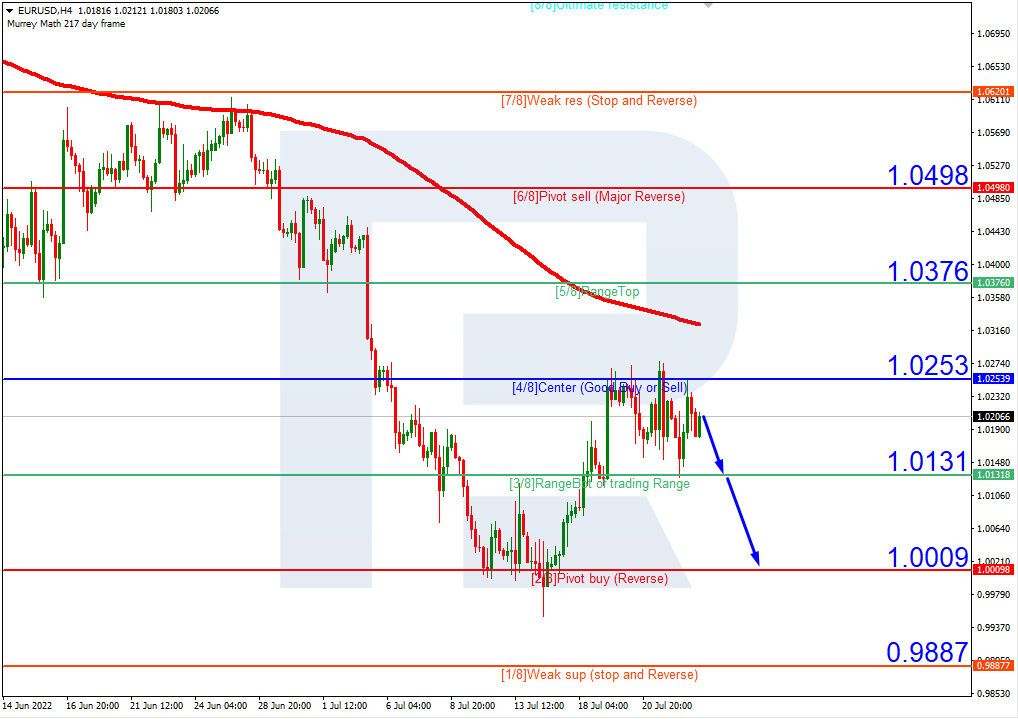
As we can see in the H4 chart, EURUSD is trading below the 200-day Moving Average, thus indicating a descending tendency. In this case, the price is expected to test 3/8, break it, and then continue falling to reach the support at 2/8. Still, this scenario may no longer be valid if the price breaks 4/8 to the upside. After that, the instrument may reverse and grow towards the resistance at 5/8.

EURUSDH4
Risk Warning: the result of previous trading operations do not guarantee the same results in the future

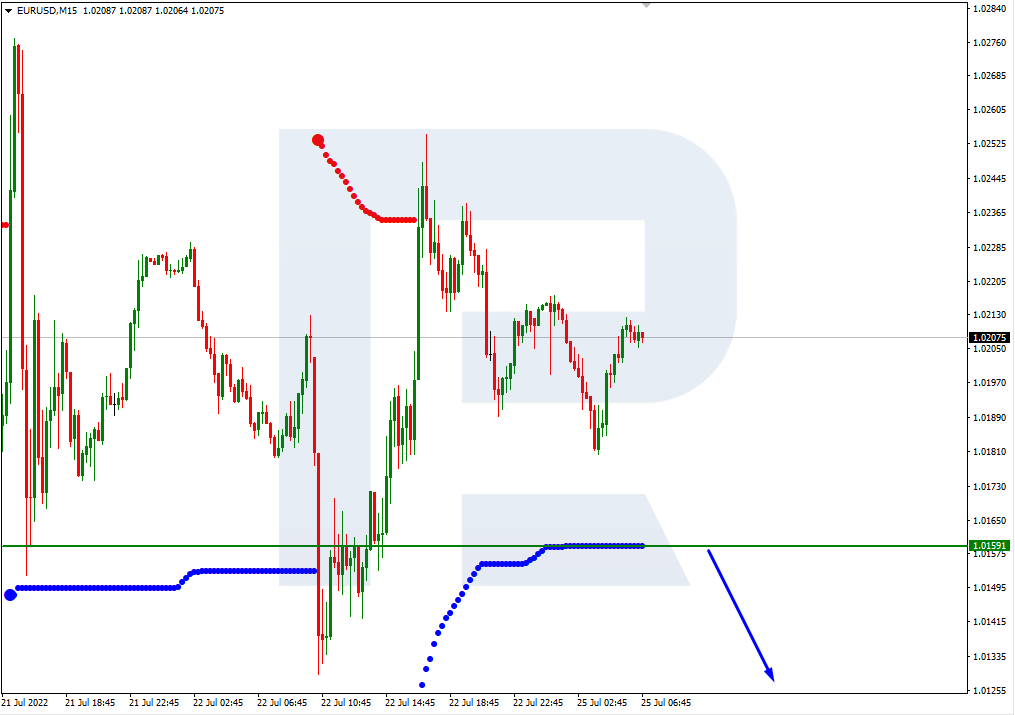
In the M15 chart, the pair may break the downside line of the VoltyChannel indicator and, as a result, continue trading downwards.

EURUSD_M15
Risk Warning: the result of previous trading operations do not guarantee the same results in the future

GBPUSD, “Great Britain Pound vs US Dollar”

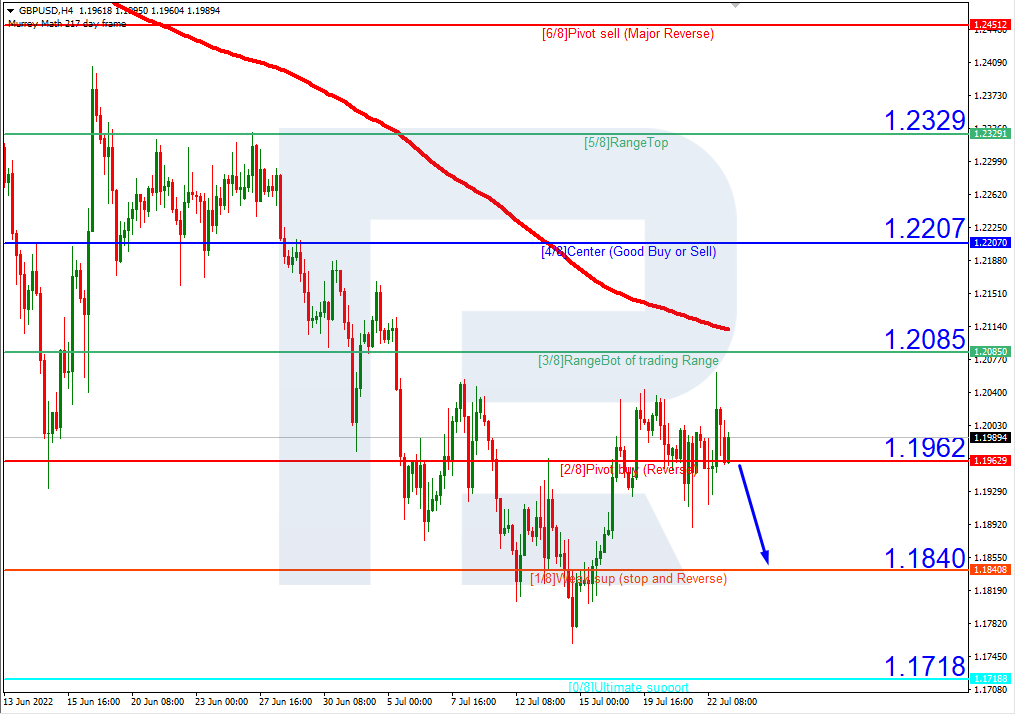
As we can see in the H4 chart, GBPUSD is also trading below the 200-day Moving Average to indicate a possible descending tendency. In this case, the price is expected to break 2/8 and continue falling to reach the support at 1/8. However, this scenario may no longer be valid if the price breaks the resistance 3/8 to the upside. After that, the instrument may reverse and grow towards 4/8.

GBPUSD_H4
Risk Warning: the result of previous trading operations do not guarantee the same results in the future

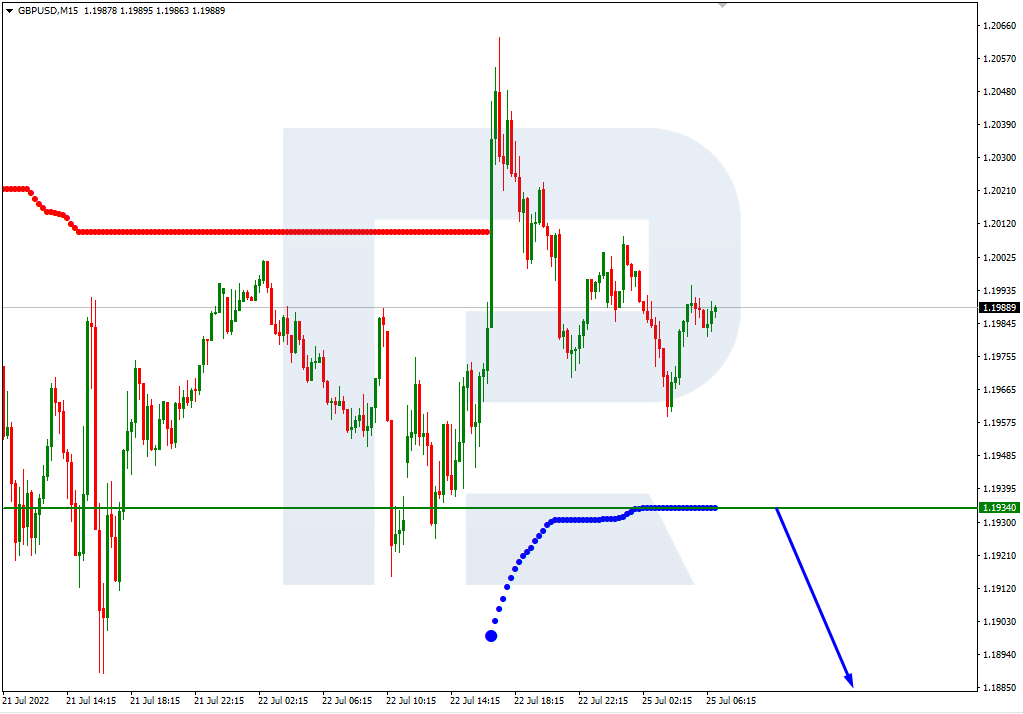
In the M15 chart, the pair may break the downside line of the VoltyChannel indicator and, as a result, continue its decline.

GBPUSD_M15

Article By RoboForex.com

Attention!
Forecasts presented in this section only reflect the author’s private opinion and should not be considered as guidance for trading. RoboForex LP bears no responsibility for trading results based on trading recommendations described in these analytical reviews.

Ichimoku Cloud Analysis 25.07.2022 (GBPUSD, BRENT, USDJPY)

Article By RoboForex.com

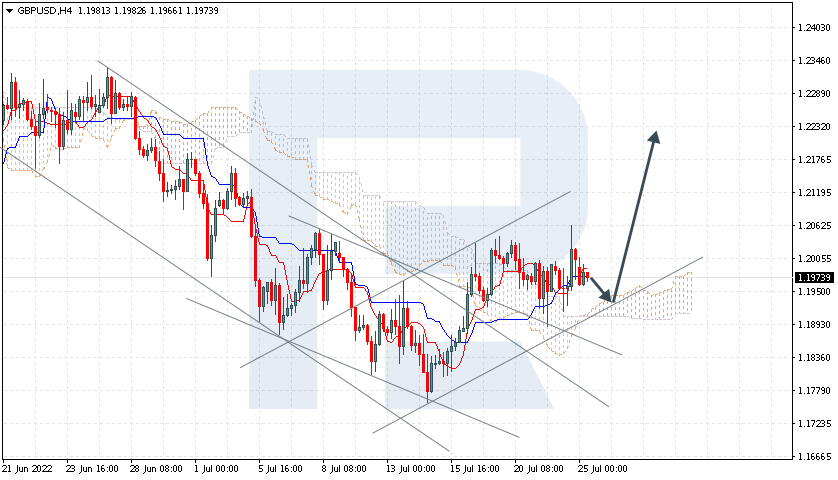
GBPUSD, “Great Britain Pound vs US Dollar”

GBPUSD is testing Tenkan-Sen and Kijun-Sen. The instrument is currently moving above Ichimoku Cloud, thus indicating an ascending tendency. The markets could indicate that the price may test the cloud’s upside border at 1.1935 and then resume moving upwards to reach 1.2235. Another signal in favour of a further uptrend will be a rebound from the rising channel’s downside border. However, the bullish scenario may no longer be valid if the price breaks the cloud’s downside border and fixes below 1.1875. In this case, the pair may continue falling towards 1.1685.

GBPUSD
Risk Warning: the result of previous trading operations do not guarantee the same results in the future

BRENT

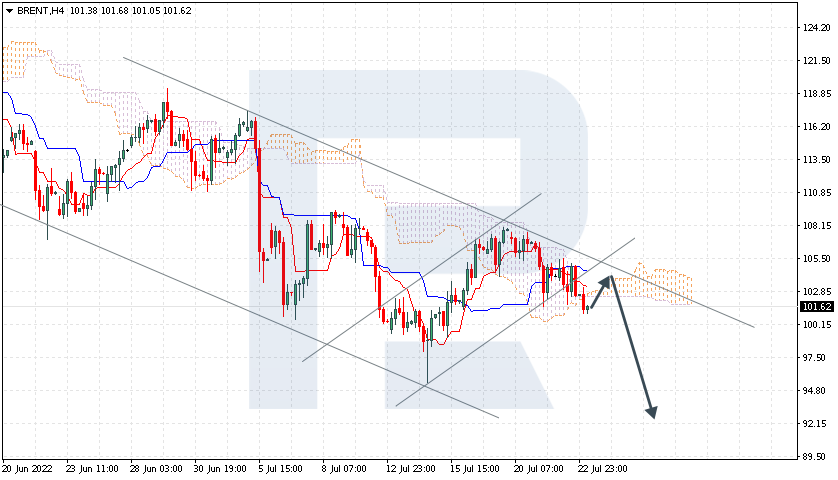
Brent is falling within the bearish channel. The instrument is currently moving below Ichimoku Cloud, thus indicating a descending tendency. The markets could indicate that the price may test the cloud’s upside border at 103.05 and then resume moving downwards to reach 92.15. Another signal in favour of a further downtrend will be a rebound from the descending channel’s upside border. However, the bearish scenario may no longer be valid if the price breaks the cloud’s upside border and fixes above 106.05. In this case, the pair may continue growing towards 110.55.

BRENT
Risk Warning: the result of previous trading operations do not guarantee the same results in the future

USDJPY, “US Dollar vs Japanese Yen”

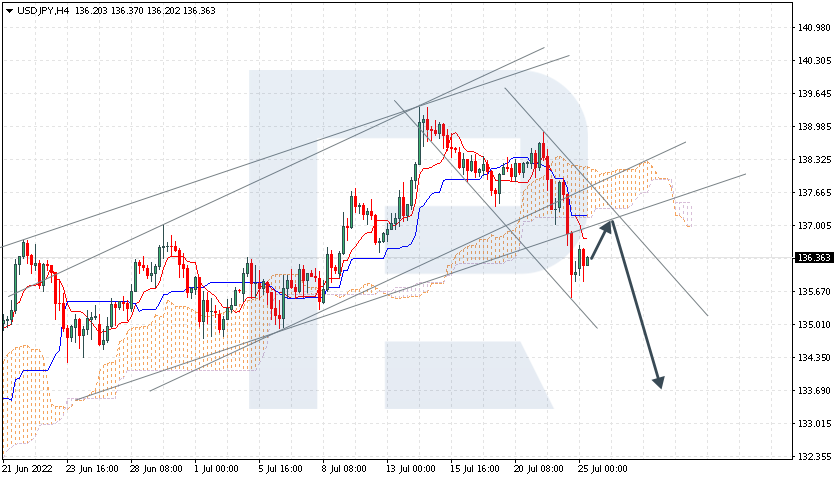
USDJPY is rebounding from the support area. The instrument is currently moving below Ichimoku Cloud, thus indicating a descending tendency. The markets could indicate that the price may test Tenkan-Sen at 137.00 and then resume moving upwards to reach 133.70. Another signal in favour of a further downtrend will be a rebound from the rising channel’s downside border. However, the bearish scenario may no longer be valid if the price breaks the cloud’s upside border and fixes above 138.75. In this case, the pair may continue growing towards 139.65.

USDJPY

Article By RoboForex.com

Attention!
Forecasts presented in this section only reflect the author’s private opinion and should not be considered as guidance for trading. RoboForex LP bears no responsibility for trading results based on trading recommendations described in these analytical reviews.

The Analytical Overview of the Main Currency Pairs on 2022.07.25

By JustForex

The EUR/USD currency pair

Technical indicators of the currency pair:
  • Prev Open: 1.0226
  • Prev Close: 1.0215
  • % chg. over the last day: -0.11%

The European Central Bank joined many other central banks in raising interest rates last week as its focus was on fighting inflation rather than a potential economic slowdown. On Friday, ECB chief Christine Lagarde said that the ECB would raise rates as much as needed to bring inflation back to target levels. By narrowing the interest rate differential, the euro has temporarily strengthened. But it should be noted that the US Federal Reserve will raise interest rates by 0.75-1% this week, which will widen the rates spread, causing the EUR/USD quotes to fall below parity again.

Trading recommendations
  • Support levels: 1.0181, 1.0106, 1.0035, 1.0000
  • Resistance levels: 1.0220, 1.0284, 1.0365, 1.0415, 1.050

From the technical point of view, the trend on the EUR/USD currency pair on the hour time frame is bullish. The price is forming a wide balance, and the MACD indicator has become inactive, but the buyers’ pressure remains. Under such market conditions, it is best to look for buy trades on intraday time frames from the support level of 1.0181 or 1.0106, but only with confirmation. Sell trades can be considered from the resistance level of 1.0220 or 1.0284, but only after additional confirmation and with short targets.

Alternative scenario: if the price breaks down through the 1.0000 support level and fixes below, the downtrend will likely resume.

EUR/USD
News feed for 2022.07.25:
  • – Eurozone German Ifo Business Climate (m/m) at 11:00 (GMT+3).

The GBP/USD currency pair

Technical indicators of the currency pair:
  • Prev Open: 1.1989
  • Prev Close: 1.2006
  • % chg. over the last day: -0.15%

Over the past month, the UK Manufacturing PMI has fallen from 52.8 to 52.2, while the service sector PMI has fallen from 54.3 to 53.3. This is weak data for the economy. The closer the index is to level 50, the closer the recession is. Statistically, if the PMI falls below 50, amid falling GDP, officials declare a recession. Volatile energy prices and a tight labor market have already caused Bank of England policymakers to oscillate between aggressively raising interest rates and the need to protect the economy from rising prices. With its open economy and huge current account deficit, the UK remains very vulnerable.

Trading recommendations
  • Support levels: 1.1964, 1.1907, 1.1803
  • Resistance levels: 1.2085, 1.2137

From the technical point of view, the trend on the GBP/USD currency pair on the hourly time frame is bullish. The price is trading at the level of the moving averages. The MACD indicator has become inactive. Under such market conditions, it is best to look for buy trades on intraday time frames from the support level of 1.1964 or 1.1907, but only with confirmation. Sell trades can be considered intraday from the resistance level of 1.2085, but only after additional confirmation and with short targets.

Alternative scenario: if the price breaks down through the 1.1803 support level and fixes below, the downtrend will likely resume.

GBP/USD
There is no news feed for today.

The USD/JPY currency pair

Technical indicators of the currency pair:
  • Prev Open: 137.34
  • Prev Close: 136.06
  • % chg. over the last day: -0.94%

From the fundamental point of view, nothing has changed on the USD/JPY currency pair, as the Bank of Japan is still keeping its soft monetary policy. At the same time, the US Federal Reserve will raise the rate by another 0.75-1% this week and increase the difference between the US and Japanese rates even more. Even so, Japan’s yen has temporarily strengthened on the back of the dollar, which in turn declined at the end of last week due to the strengthening euro as the ECB raised the interest rate unexpectedly by 0.5%.

Trading recommendations
  • Support levels: 135.99, 135.40, 134.64, 134.11
  • Resistance levels: 136.60, 137.26, 137.81, 138.25, 138.56, 140.29

From the technical point of view, the medium-term trend on the USD/JPY currency pair has changed to bearish. The price has consolidated below the moving averages and broke through the priority change level. But it should be understood that this fall is not accompanied by any fundamental factors, so it is still necessary to be cautious when selling. Under such market conditions, buy trades can be searched for intraday from the support level of 135.99, but with additional confirmation. For sell deals, traders can consider the resistance level of 136.60 or 137.26, but only with additional confirmation and short targets.

Alternative scenario: If the price fixes above 138.25, the uptrend will likely resume.

USD/JPY
There is no news feed for today.

The USD/CAD currency pair

Technical indicators of the currency pair:
  • Prev Open: 1.2865
  • Prev Close: 1.2914
  • % chg. over the last day: +0.38%

Canadian retail sales data for May increased by 1.6% on Friday, beating expectations of 1.2%. Retail sales excluding cars were also stronger than expected, +1.9% compared to the market forecast of 1.6% (m/m). But the Canadian dollar ended the day lower due to lower oil prices.

Trading recommendations
  • Support levels: 1.2862, 1.2781
  • Resistance levels: 1.2934, 1.3006, 1.3085, 1.3154

In terms of technical analysis, the trend on the USD/CAD currency pair is bearish. At the moment, the price is forming a balance and is trading at the levels of the moving lines. The MACD indicator has become inactive. Under such market conditions, it is best to consider sell deals from the resistance level of 1.2934, but with confirmation. Buy trades should be viewed on the lower time frames from the support level of 1.2862, but only with confirmation and short targets.

Alternative scenario: if the price breaks out and consolidates above the 1.3085 resistance level, the uptrend will likely resume.

USD/CAD
There is no news feed for today.

By JustForex


This article reflects a personal opinion and should not be interpreted as an investment advice, and/or offer, and/or a persistent request for carrying out financial transactions, and/or a guarantee, and/or a forecast of future events.

The Reserve Bank of Australia’s Comments Support AUD

By RoboForex Analytical Department

AUD/USD is balancing at 0.6083 on Monday. The bulls managed to break the descending channel and they stand a good chance of starting a new ascending tendency in the near future.

The RBA Governor is ready to tighten the regulator’s monetary policy by doubling the benchmark interest rate. The reason for this announcement is simple – it’s necessary to push inflation back to its target of 2-3%. Market players tend to respond to such comments, that’s why the AUD got significant support.

The quarterly CPI report is scheduled to be released as early as Wednesday and it is expected to show further growth in inflation, which has already reached its 20-year highs. Another important report, Retail Sales, will be published on Thursday and no positive dynamics are expected here as well. If this indicator is also far below expectations, the risks of a rate-hike by the RBA will increase, helping the AUD to continue its uptrend.

It should be noted that early in the year Philip Lowe wasn’t ready for monetary policy tightening and said that he couldn’t see the rate going up in 2022. However, high inflation forced the regulator to take emergency measures and start raising the rate.

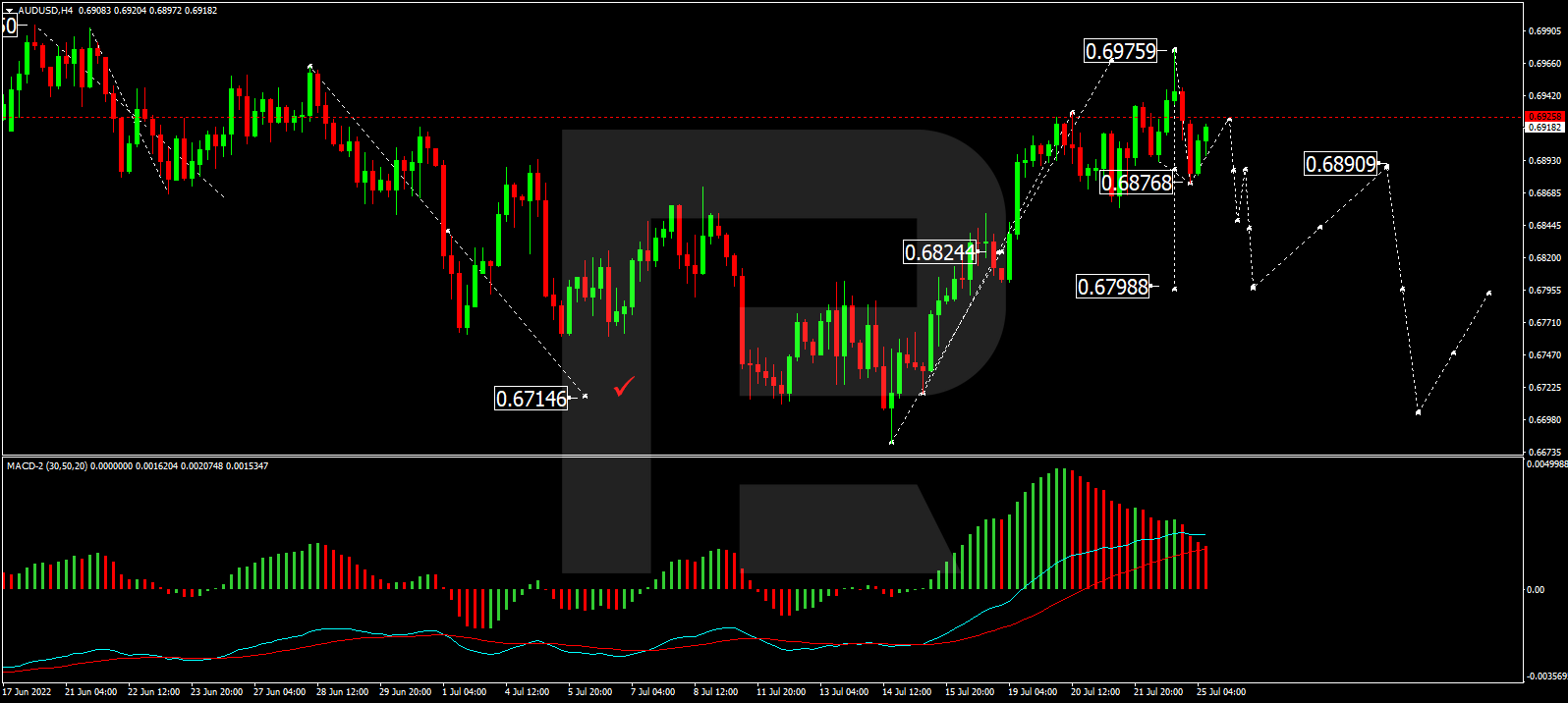
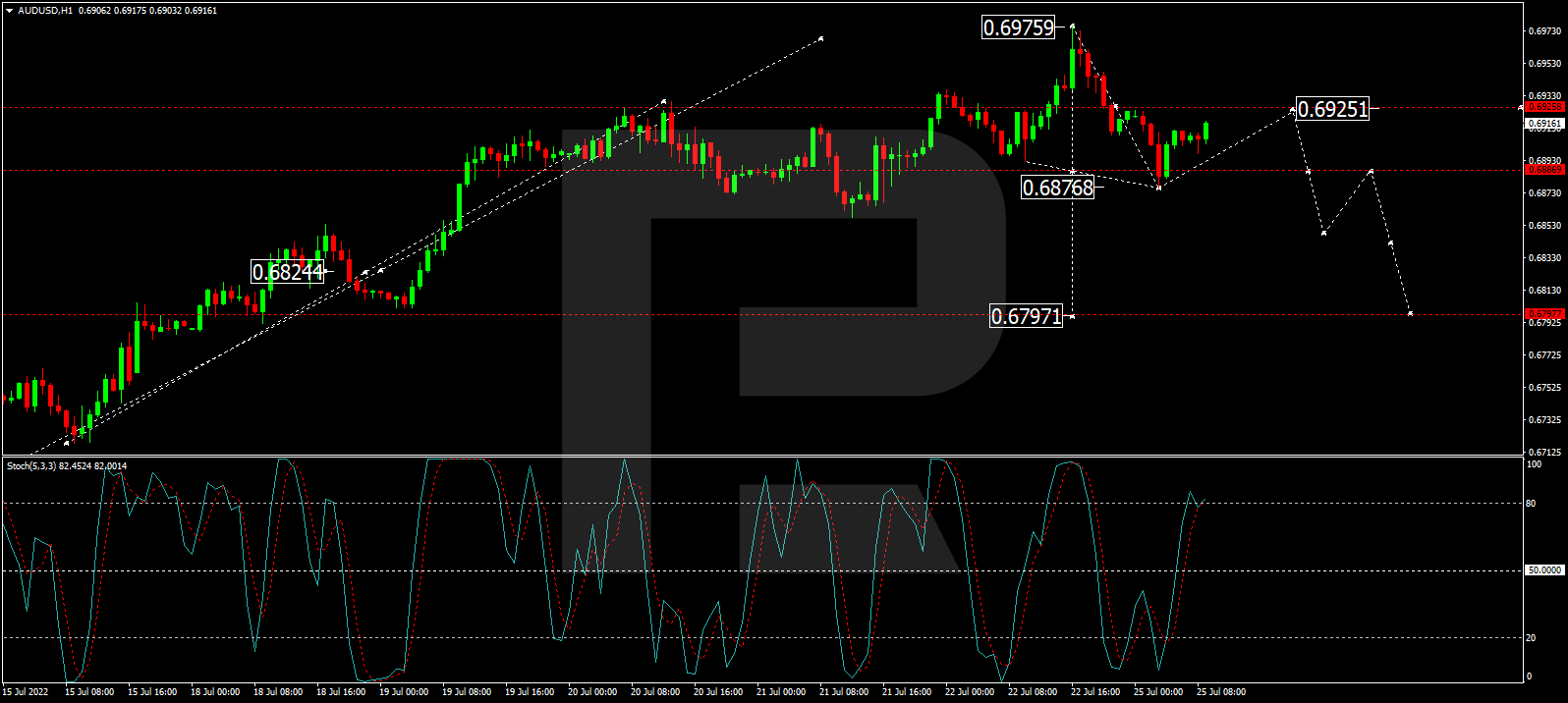
As we can see in the H4 chart, after finishing the first descending impulse at 0.6876, AUD/USD is correcting upwards to reach 0.6925 and may later form another descending impulse towards 0.6886. Later, the market may break the latter level and continue trading within the downtrend with the target at 0.6850, or even extend this structure down to 0.6798. From the technical point of view, this scenario is confirmed by the MACD Oscillator: after leaving the histogram area, its signal line is about to fall and reach 0.

In the H1 chart, having completed the five-wave structure of the first descending impulse at 0.6875, AUD/USD is correcting upwards to reach 0.6925 and may later fall towards 0.6888, thus forming a new consolidation range between the two latter levels. After that, the instrument may break the range to the downside and form a new descending structure with the target at 0.6850. From the technical point of view, this scenario is confirmed by the Stochastic Oscillator: its signal line is moving above 80 and may soon start falling to break 50. Later, it may continue moving down to 20.

Disclaimer

Any forecasts contained herein are based on the author’s particular opinion. This analysis may not be treated as trading advice. RoboForex bears no responsibility for trading results based on trading recommendations and reviews contained herein.

Many important economic events will take place this week and volatility in the markets will be high

By JustForex

In the US, weekly jobless claims hit a five-month high, while existing home sales declined for the fifth straight month. These are signs of problems in the labor and housing markets. According to some analysts, the US Federal Reserve may officially announce the beginning of the recession in the United States this week. The US economy is already down 1.6% in the first quarter, and the second quarter is also negative, so, technically, this recession is possible.

At the close of the stock market on Friday, the Dow Jones index (US30) decreased by 0.43% (+1.34% for the week) and the S&P 500 Index (US500) fell by 0.93% (+2.00% for the week). The NASDAQ Technology Index (US100) lost 1.87% on Friday (+2.36% for the week).

It will be a significant week for US stock indices. Besides the important US Federal Reserve meeting on Wednesday and US GDP data on Thursday, technology giants like Amazon (AMZN), Apple (AAPL), Alphabet (GOOG), Meta (META), and Microsoft (MSFT) will report this week as well.

Stock markets in Europe were mostly up on Friday. German DAX (DE30) gained 0.05% (+2.46% for the week), French CAC 40 (FR 40) added 0.25% (+2.42% for the week), Spanish IBEX 35 (ES35) increased by 0.49% (+0.56% for the week), British FTSE 100 (UK100) gained 0.08% (+1.64% for the week).

Last week, the European Central Bank joined many other central banks in raising interest rates as its focus was on fighting inflation rather than a potential economic slowdown. On Friday, ECB chief Christine Lagarde said that the ECB would raise rates as much as needed to bring inflation back to target levels. By narrowing the interest rate differential, the euro has temporarily strengthened. But it should be noted that the US Federal Reserve will raise interest rates by 0.75-1% this week, which will widen the spread again.

US benchmark WTI crude has fallen nearly 3% in the past week, extending its losses over the past three weeks by almost 13%. However, Brent crude jumped by 2.2%, breaking a five-day losing streak of 17%. The situation in the oil market remains very unstable. On the one hand, the White House is trying to lower the price of oil. On the other hand, sanctions against Russia and supply shortage with high demand — these factors do not allow the price to fall.

Last week, precious metal prices rose. “Gold is starting to act as a haven as weakening economic growth will force many central banks to abandon their aggressive tightening plans,” said Ed Moya, head of research US analytical company.

Russia’s war with Ukraine continues. Last week, Russia, Ukraine, Turkey, and UN officials signed an agreement to allow Ukraine to ship grain from a port in Odesa. Despite this, Russian missiles struck the port on Saturday. Russia proved once again that it is a terrorist state. President Vladimir Zelensky, as well as many European officials, condemned Saturday’s attack as “barbarism,” which showed that Moscow could not be trusted under any circumstances.

Asian markets traded lower last week. Japan’s Nikkei 225 (JP225) gained 4.41%, Hong Kong’s Hang Seng (HK50) added 0.63%, and Australia’s S&P/ASX 200 (AU200) increased by 2.81%. At the opening on Monday, the Asian indices are showing a decline. Investors should also pay attention to Inflation Data in Singapore. Analysts forecast consumer price growth to 6.2% (current 5.6%) on an annualized basis. If the data is worse than expected, it may boost the Singapore dollar but at the same time have a negative impact on Asian indices.

In the commodities market, natural gas futures (+18.37%), palladium (+11.05%), platinum (+4.00%), coffee (+2.98%), cotton (+2.75%), copper (+2.74%) and Brent oil (+2.42%) showed the biggest gains over the week. Lumber futures (-10.06%), soybeans (-9.57%), sugar (-7.17%), corn (-6.95%) and wheat (-2.74%) showed the biggest drops.

S&P 500 (F) (US500) 3,961.63 −37.32 (−0.93%)

Dow Jones (US30) 31,899.29 −137.61 (−0.43%)

DAX (DE40) 13,253.68 +7.04 (+0.053%)

FTSE 100 (UK100) 7,276.37 +5.86 (+0.081%)

USD Index 106.55 −0.37 (−0.34%)

Important events for today:
  • – Singapore Consumer Price Index (m/m) at 08:00 (GMT+3);
  • – Eurozone German Ifo Business Climate (m/m) at 11:00 (GMT+3).

By JustForex


This article reflects a personal opinion and should not be interpreted as an investment advice, and/or offer, and/or a persistent request for carrying out financial transactions, and/or a guarantee, and/or a forecast of future events.

Sri Lanka’s crisis: Can the South Asian economy break from the past and find a route to stability?

By Vidhura S Tennekoon, Indiana University 

Sri Lanka has a new president and prime minister – but a change in who leads the crisis-hit South Asian nation alone will not solve the country’s severe economic problems.

Ranil Wickremesinghe – who on July 20, 2022, was voted in by lawmakers to replace fleeing former president Gotabaya Rajapaksa – and his appointed premier Dinesh Gunawardena inherit an economy grappling with record inflation as high as 59%, a currency that has lost almost half its value since March 2022 and severe shortages of daily necessities such as food and fuel. Nearly all economic activity in the country has ground to a halt.

The government’s deficit is so large it can’t afford to pay public workers, and the central bank has almost no foreign currency – needed to finance imports and pay back foreign debt.

In short, Sri Lanka is facing an unprecedented economic crisis, placing tremendous pressure on the new leaders to act fast to fix things.

As an economist and former official at the Central Bank of Sri Lanka, I believe the path forward will be difficult. The country will need to break with past policies and practices that put it in a financial hole while putting in place reforms to get the economy back on track. In particular, there are four key economic challenges the new government will have to address, though they’re all interconnected.

Addressing Sri Lankans’ immediate needs

To avoid the fate of his now exiled predecessor Gotabaya Rajapaksa, President Wickremesinghe will have to address the immediate needs of his people.

After being sworn in, Wickremesinghe said his priority was to ensure that people are able to eat three meals a day.

While food inflation has reached 76%, prices of many basic food items have increased by a higher margin – rice by 160%, wheat flour by 200% and sugar by 164%. To put that in context, a preschool teacher earning minimum wage would need more than a day’s wages to purchase a kilogram (2.2 pounds) of sugar and a kilogram of wheat flour or rice. A cylinder of cooking gas, if they were lucky to find one, would cost more than a half-month’s salary.

Cost of living ranks alongside other pressing issues. Reopening the shuttered schools and universities is another priority. The other urgent need is restoring transportation services. With no fuel to purchase, private bus services are in limbo and public transportation has become an adventure ride, with passengers dangling from the door and windows and even sitting inside the luggage box.

Restoring transportation and electricity services requires foreign currency to import fuel, but support from the International Monetary Fund, which provides financial help to struggling economies through loan packages, is months away. Unless the new president can persuade its regional powerhouses – India and China – to provide more help, economic hardships will continue and life in Sri Lanka will not be normal.

In the past, Sri Lanka has been able to rely on tourism to help bring revenue to the island nation. But this will be impossible while social unrest continues and shortages of essentials limit the country’s ability to serve visitors. Meanwhile, remittances from overseas Sri Lankans have also suffered because of a lack of confidence in the national currency, known as the rupee.

As Wickremesinghe has noted, things will get worse before they get better.

Balancing the budget

The next item on the president’s to-do list will likely be finding a way to bring the budget deficit down. Last year, expenses were 240% of revenue, and 91% more was needed to repay debt. Money printing covered a large portion of this gap but only exacerbated inflation.

The primary reason for Sri Lanka’s current crisis is decades of fiscal mismanagement, with too much spending and too little revenue.

Fixing this problem will require a combination of higher taxes and significant budget cuts. But the budget gap is too wide to eliminate completely the need for money printing. The best that can be hoped for is an aggressive reduction.

Restructuring Sri Lanka’s huge debt

Such budgetary reforms will likely be necessary to solve another challenge Sri Lanka faces: overseas debt.

Sri Lanka has amassed about US$51 billion in foreign debt over the past decades but has virtually no foreign currency with which to pay it back. The government suspended payments on foreign debt in April, sending it into default.

At the end of 2021, about 45% of the debt was owed to private investors, while the rest belonged to countries and multinational institutions. The Asian Development Bank owned the biggest share, at 16%, while Japan, China and the World Bank held 10% apiece.

For Sri Lanka to emerge from its crisis, it will need significant help from the IMF. But the IMF requires assurances that Sri Lanka’s debt sustainability be restored before lending it money.

And other international organizations, such as the World Bank, will not be willing to lend Sri Lanka more until the country signs an agreement with the IMF. And U.S. lawmakers have recently suggested IMF support will be contingent on Sri Lanka’s increasing the independence of its central bank, fighting corruption and doing more to promote the rule of law.

While G-7 countries, the group of leading economies, including Japan, appear willing to help Sri Lanka in its effort to restructure its debt, some bondholders – such as Caribbean-based Hamilton Reserve Bank, which holds just $250 million worthhave already taken legal action to claim their dues.

In May, Sri Lanka took a first step toward restructuring its debt, but it may take several months before the country is able to successfully negotiate with its creditors to ensure debt sustainability.

Garnering public support for reforms

Wickremesinghe’s biggest and most unenviable challenge, however, is less about the economy and more about the politics of fixing it.

He won’t be able to do much about Sri Lanka’s economy until he’s able to bring about political stability. And right now, Sri Lanka remains in turmoil.

Wickremesinghe, who previously served as prime minister appointed by his toppled predecessor, will need a wide mandate and support from opposition politicians if he is to drastically change Sri Lanka’s policies. Upon election, he immediately urged his rivals to join him and “work together to bring the country out of the crisis,” adding, “Our divisions are now over.”

He will also need to address protesters’ demands over reducing executive powers while bringing in strong anti-corruption measures and strengthening democratic institutions.

Yet many doubt Wickremesinghe’s ability to unite Sri Lanka and question his mandate to serve out the remaining term of the presidency. He has been a target of protesters since being appointed president. And a confrontation between armed forces and protesters soon after Wickremesinghe took power doesn’t bode well.

Turning around an economy so deep in crisis will take time. Inflation in Sri Lanka is not believed to have peaked yet, and people will continue to face economic hardships for some time.

But political stability will be needed before Sri Lanka can get out of its economic mess. The fiscal reforms expected by the IMF will be painful and will be viable only with public support, and that of all major political parties in Sri Lanka’s Parliament.The Conversation

About the Author:

Vidhura S Tennekoon, Assistant Professor of Economics, Indiana University

This article is republished from The Conversation under a Creative Commons license. Read the original article.


 

Europe On Sale: Get It While U Can

By Elliott Wave International

On July 13 and 14, the euro and the U.S. dollar briefly traded at parity — for the first time in 20 years.

Just 19 months ago, EURUSD was at $1.2350. It’s quietly dropped 20%+ since.

Quietly? Yeah, because of all the other fireworks in the market drowned out the news.

What would you have done with this knowledge a year and a half ago?

For one thing, you’d have put off that European vacation until now!

Who could have known? EWI subscribers. Check out this forecast from EWI back on January 8, 2021:

It appears that currencies are delivering the early New Year trend reversal that often occurs. The [Euro]’s high at 1.2350 on Wednesday, January 6, completes the five-wave rally from at least November 4, 2020 (1.1604) and likely from March 23, 2020 (1.0635)…Greater bearish potential exists…

Every student of Elliott knows that when five waves finish, you should anticipate a reversal of equal degree.

Here’s what happened since:

Mmmm, I love a good chart.

And a great tweet. Tip of the hat to Mr_Cuddlez!

So, are you ready to catch the next big euro move?

EWI’s Chief Market Analyst Steven Hochberg guides our Financial Forecast Service subscribers 3X/week through the twist and turns in the euro (and dollar) — plus, U.S. stock indexes, bonds, gold and silver — inside his Short Term Update.

Right now, read our forecasts for all of the markets listed above (and more) inside our Financial Forecast Service Test Drivejust $17 for a full week’s access.

Join the Financial Forecast Service Test Drive now.

Hurry: Your one-time Test Drive opportunity ends Thursday, July 28th.

This article was syndicated by Elliott Wave International and was originally published under the headline Europe On Sale: Get It While U Can. EWI is the world’s largest market forecasting firm. Its staff of full-time analysts led by Chartered Market Technician Robert Prechter provides 24-hour-a-day market analysis to institutional and private investors around the world.