Archive for Financial News – Page 318

How record-setting heat waves in cities across UK, US and mainland Europe could punish economies already reeling from inflation

By Derek Lemoine, University of Arizona 

Hundreds of millions of people struggled to keep cool amid a sweltering summer heat wave as cities across the U.S. and mainland Europe experienced record-high temperatures. In the U.K., thermometers topped 104 Fahrenheit (40 degrees Celsius) on July 19, 2022, the highest ever recorded.

While all this broiling heat is surely punishing on a personal level, it also has significant impacts on the broader economy.

As an economist who has studied the effects of weather and climate change, I have examined a large body of work that links heat to economic outcomes. Here are four ways extreme heat hurts the economy.

1. Growth takes a hit

Research has found that extreme heat can directly hurt economic growth.

For example, a 2018 study found that the economies of U.S. states tend to grow at a slower pace during relatively hot summers. The data shows that annual economic growth falls 0.15 to 0.25 percentage points for every 1 degree Fahrenheit (0.56 C) that a state’s average summer temperature is above normal.

Laborers in weather-exposed industries such as construction work fewer hours when it’s hotter. But higher summer temperatures also reduce growth in many industries that tend to involve indoor work, including retail, services and finance. Workers are less productive when it’s hotter out.

2. Crop yields drop

Agriculture is obviously exposed to weather: After all, crops grow outdoors.

While temperatures up to around 85 F to 90 F (29-32 C) can benefit crop growth, yields fall sharply when thermostats rise further. Some of the crops that can be hit hard by extreme heat include corn, soybeans and cotton. These reductions in yields could be costly for U.S. agriculture.

For example, a recent study I conducted found that an additional 2 degrees C (3.6 F) of global warming would eliminate profits from an average acre of farmland in the eastern U.S.

A prominent example of this was the collapse of the Russian wheat harvest in response to the country’s 2010 heat wave, which raised wheat prices throughout the world.

3. Energy use soars

Of course, when it’s hot, energy use goes up as people and businesses run their air conditioners and other cooling equipment at full blast.

A 2011 study found that just one extra day with temperatures above 90 F (32 C) increases annual household energy use by 0.4%. More recent research shows that energy use increases the most in places that tend to be hotter, probably because more households have air conditioning.

This increase in electricity use on hot days stresses electric grids right when people depend on them most, as seen in California and Texas during past heat waves. Blackouts can be quite costly for the economy, as inventories of food and other goods can spoil and many businesses either have to run generators or shut down. For instance, the 2019 California blackouts cost an estimated US$10 billion.

4. Education and earnings suffer

A long-term impact of increasingly hotter weather involves how it affects children’s ability to learn – and thus their future earnings.

Research has shown that hot weather during the school year reduces test scores. Math scores decrease more and more as the temperature rises beyond 70 F (21 C). Reading scores are more resistant to high temperatures, which this research claims is consistent with how different regions of the brain respond to heat.

One study suggested that students in schools that lack air conditioning learn 1% less for every 1 degree Fahrenheit (0.56 C) increase in the school year’s average temperature. It also found that minority students are especially affected by hotter school years, as their schools are more likely to lack air conditioning.

Lost learning results in lower lifetime earnings and hurts future economic growth.

The impact of extreme heat on development, in fact, begins before we’re even born. Research has found that adults who were exposed to extreme heat as fetuses earn less during their lifetimes. Each extra day with average temperature above 90 F (32 C) reduces earnings 30 years later by 0.1%.

Air conditioning can help – to a point

Air conditioning can offset some of these effects.

For example, studies have found that having a working air conditioner means fewer people die, student learning isn’t compromised and extreme heat outside during pregnancy doesn’t hurt fetuses.

Not everyone has air conditioners, however, especially in states such as Oregon and countries such as the U.K. that have more temperate climates but have nonetheless recently experienced unusually extreme temperatures. And many people can’t afford to own or operate them. Survey data from 2017 found that around half of homes in the U.S. Pacific Northwest
lacked air conditioning. And about 42% of U.S. classrooms lack an air conditioner.

While heat waves are shown to induce more households to install air conditioning, it’s hardly a panacea. By 2100, higher use of air conditioning could increase residential energy consumption by 83% globally. If that energy comes from fossil fuels, it could end up amplifying the heat waves that are causing the higher demand in the first place.

And in the U.S. South, where air conditioning is omnipresent, hotter-than-usual summers still take the greatest toll on states’ economic growth.

In other words, as temperatures rise, economies will continue to suffer.

This is an updated version of an article originally published on Aug. 2, 2021.The Conversation

About the Author:

Derek Lemoine, Associate Professor of Economics, University of Arizona

This article is republished from The Conversation under a Creative Commons license. Read the original article.


 

The Analytical Overview of the Main Currency Pairs on 2022.07.22

By JustForex

The EUR/USD currency pair

Technical indicators of the currency pair:
  • Prev Open: 1.0176
  • Prev Close: 1.0228
  • % chg. over the last day: +0.51%

The European Central Bank unexpectedly raised the interest rate by 0.5%, although Christine Lagarde had indicated that the first increase would be 0.25%. The ECB report indicates that the decision is based on an updated assessment of inflation risks, as rising prices are a growing concern for households and companies. The future trajectory of interest rates will depend on new inflation data. ECB policymakers also agreed to provide additional assistance to the currency bloc’s 19 heavily indebted countries, including Italy, with a new bond-buying scheme designed to limit their rising borrowing costs and thus limit financial fragmentation. Against this news, the euro strengthened significantly.

Trading recommendations
  • Support levels: 1.0188, 1.0154, 1.0106, 1.0035, 1.0000
  • Resistance levels: 1.0284, 1.0365, 1.0415, 1.050

From the technical point of view, the trend on the EUR/USD currency pair on the hourly time frame is bullish. The price is forming a wide balance, and the MACD indicator has become inactive, but the buyer’s pressure remains. Under such market conditions, it is best to look for buy trades on intraday time frames from the support level of 1.0188 or 1.0106, but only with confirmation. Sell trades can be considered from the resistance level of 1.0284, but only after additional confirmation and only with short targets.

Alternative scenario: if the price breaks down through the 1.0000 support level and fixes below, the downtrend will likely resume.

EUR/USD
News feed for 2022.07.22:
  • – Eurozone France Manufacturing PMI (m/m) at 10:15 (GMT+3);
  • – Eurozone France Services PMI (m/m) at 10:15 (GMT+3);
  • – Eurozone German Manufacturing PMI (m/m) at 10:30 (GMT+3);
  • – Eurozone German Services PMI (m/m) at 10:30 (GMT+3);
  • – Eurozone Manufacturing PMI (m/m) at 11:00 (GMT+3);
  • – Eurozone Services PMI (m/m) at 11:00 (GMT+3);
  • – US Manufacturing PMI (m/m) at 16:45 (GMT+3);
  • – US Services PMI (m/m) at 16:45 (GMT+3).

The GBP/USD currency pair

Technical indicators of the currency pair:
  • Prev Open: 1.1974
  • Prev Close: 1.1999
  • % chg. over the last day: -0.21%

In the UK, investors are watching the race for Prime Minister’s seat. Former Treasury Secretary Rishi Sunak and Foreign Secretary Liz Truss made it to the last round of the contest to become party leaders. A number of reports will also be released today. Traders expect a slowdown in the UK Manufacturing PMI for June and a decline in retail sales. If the data is worse than forecast, the British pound may react with a decline.

Trading recommendations
  • Support levels: 1.1955, 1.1907, 1.1803
  • Resistance levels: 1.2065, 1.2137

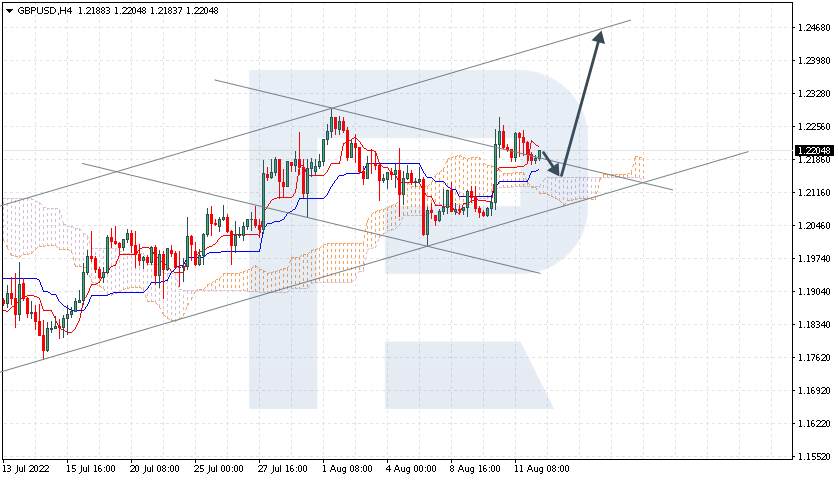
From the technical point of view, the trend on the GBP/USD currency pair on the hour time is bullish. The price has slightly corrected and is trading at the level of the moving averages. The MACD indicator has become inactive. Under such market conditions, it is best to look for buy trades on intraday time frames from the support level of 1.1955 or 1.1907, but only with confirmation. Sell trades can be considered intraday from the resistance level of 1.2065, but only after additional confirmation and with short targets.

Alternative scenario: if the price breaks down through the 1.1803 support level and fixes below, the downtrend will likely resume.

GBP/USD
News feed for 2022.07.22:
  • – UK Retail Sales (m/m) at 09:00 (GMT+3);
  • – UK Manufacturing PMI (m/m) at 11:30 (GMT+3);
  • – UK Services PMI (m/m) at 11:30 (GMT+3).

The USD/JPY currency pair

Technical indicators of the currency pair:
  • Prev Open: 138.13
  • Prev Close: 137.34
  • % chg. over the last day: -0.57%

Japan’s key inflation indicator has further exceeded the Bank of Japan’s target of 2%. According to data released Friday by the Ministry of Internal Affairs, core consumer prices (excluding food and fuel prices) reached an annualized rate of 2.2%. The result was in line with economists’ estimates. Despite the continued rise in prices, the Bank of Japan is unlikely to budge anytime soon, as the Bank of Japan remains unconvinced that inflation in the country is sustainable. Bank of Japan Governor Kuroda has repeatedly said that current cost inflation is unsustainable and that the central bank needs constant easing until it is demand-driven and accompanied by sustained wage growth. But wage growth has not kept pace with inflation, with May data showing that real wages are down 1.8% from a year ago.

Trading recommendations
  • Support levels: 137.11, 136.48, 135.92, 135.40, 134.64, 134.11
  • Resistance levels: 138.25, 138.56, 140.29

From the technical point of view, the medium-term trend on the USD/JPY currency pair is bullish. But the price has corrected to the priority change level and traded below the moving averages, indicating temporary sellers pressure. Under such market conditions, buy trades can be sought intraday from the support level of 137.11, but with confirmation. For sell deals, traders can consider the resistance level of 138.25, but only with additional confirmation and short targets.

Alternative scenario: If the price fixes below 137.11, the downtrend will likely resume.

USD/JPY
News feed for 2022.07.22:
  • – Japan National Core Consumer Price Index at 02:30 (GMT+3).

The USD/CAD currency pair

Technical indicators of the currency pair:
  • Prev Open: 1.2879
  • Prev Close: 1.2864
  • % chg. over the last day: -0.11%

The Canadian dollar is a commodity currency and is highly dependent on instruments such as the dollar index and oil. Both the US Dollar Index and oil quotes decreased yesterday. As a result, the USD/CAD currency pair traded in a volatile corridor. Volatility in the market increased due to a sharp increase in the ECB rate, which led to a sharp rise in the euro and a decline in the dollar index. Today the retail sales report will be published in Canada. Analysts are predicting an increase in value. If the actual value is better than the forecast, the Canadian dollar may strengthen even more (USD/CAD decline).

Trading recommendations
  • Support levels: 1.2853, 1.2781
  • Resistance levels: 1.2934, 1.3006, 1.3085, 1.3154

In terms of technical analysis, the trend on the USD/CAD currency pair is bearish. The price is forming a balance and trades at the levels of the moving average lines. The MACD indicator has become inactive. Under such market conditions, it is best to consider sell deals from the resistance level of 1.2934, but with confirmation. Buy trades should be viewed on the lower time frames from the support level 1.2853, but only with confirmation and short targets.

Alternative scenario: if the price breaks out and consolidates above the 1.3085 resistance level, the uptrend will likely resume.

USD/CAD
News feed for 2022.07.22:
  • – Canada Retail Sales (m/m) at 15:30 (GMT+3).

By JustForex


This article reflects a personal opinion and should not be interpreted as an investment advice, and/or offer, and/or a persistent request for carrying out financial transactions, and/or a guarantee, and/or a forecast of future events.

Week Ahead: Lower dollar if Fed surprises with “smaller” 50bps hike

By ForexTime

Are you ready for yet another jumbo-sized Fed rate hike?

Markets have been preparing for such an outcome at the upcoming FOMC policy decision, which will star in next week’s economic calendar

Monday, July 25

  • EUR: Germany July IFO business climate
  • GBP: UK PM candidates’ debate – Rishi Sunak vs. Liz Truss

Tuesday, July 26

  • JPY: Bank of Japan June meeting minutes
  • USD: US July consumer confidence
  • IMF releases updated world economic outlook
  • Alphabet 2Q earnings

Wednesday, July 27

  • AUD: Australia Q2 CPI
  • CNH: China June industrial profits
  • USD: Fed rate decision
  • US crude: EIA weekly oil inventory report
  • Meta Platforms 2Q earnings

Thursday, July 28

  • AUD: Australia June retail sales
  • EUR: Germany July CPI, Eurozone July economic and consumer confidence
  • USD: US Q2 GDP, weekly jobless claims
  • Amazon 2Q earnings
  • Apple 2Q earnings

Friday, July 29

  • JPY: Japan June unemployment, retail sales, industrial production; July Tokyo CPI
  • EUR: Eurozone July CPI, Q2 GDP
  • USD: US June personal income and spending, PCE core deflator, July consumer sentiment
  • Exxon 2Q earnings
  • Chevron 2Q earnings


Markets have fully priced in a second consecutive 75-basis point hike at next week’s FOMC policy meeting, as the US central bank continues its battle against the hottest inflation in 40 years.

However, that 75bps hike is a relative step down from the 100-basis point hike that some segments of the markets were expecting. Hence the recent unwinding of gains in the equally-weighted USD index. Still, this instrument is well within its uptrend since Q1 2022.

Note that this index compares the US dollar’s performance against six of its major peers, all in equal weights:

  • Euro
  • British Pound
  • Swiss Franc
  • Australian Dollar
  • New Zealand Dollar
  • Canadian Dollar


Any other outcome that deviates from the 75bps script would be a surprise.

  • DOVISH: A “mere” 50bps hike, though still twice the size of the traditional 25bps rate adjustments per meeting deployed by central bankers worldwide, should prompt more declines in the USD index, potentially moving it closer to its 50-day simple moving average (SMA) around the 1.175 region.
  • HAWKISH: Although the bar has been set high for a hawkish outcome at next week’s meeting, a 100bps shocker would reinvigorate dollar bulls into sending this USD index back above the 1.20 line. More dollar gains may also ensue if Fed Chair Jerome Powell, during his press conference, refuses to rule out a 100bps hike at upcoming meetings.


Ultimately, policymakers at the US central bank, as well as market participants, will continue to be guided by the inflation data.

And on that point, after the FOMC meeting concludes, next Friday’s release of the June PCE deflator will be closely watched, considering that it’s the Fed’s preferred way of measuring inflation.

The PCE deflator is forecasted to come in at 6.6% in June, which would mean that it has posted a reading of 6% or higher for every month so far this year. 6.6% is also more than three times the Fed’s 2% target, underscoring the tremendous task that the Fed is up against.

Further evidence of stubbornly elevated price pressures is set to force the Fed into triggering even more jumbo-sized rate hikes over the coming months. Such hawkish expectations could then see the USD index being restored to the last cycle high at 1.21859, or perhaps even higher.

Overall, as long as the Fed keeps the “pedal to the metal” while leaving other major central banks struggling to catch up with their own rate hikes, that should leave the buck with an easier path to climb even higher.


Forex-Time-LogoArticle by ForexTime

ForexTime Ltd (FXTM) is an award winning international online forex broker regulated by CySEC 185/12 www.forextime.com

The European Central Bank surprised the markets. Political crisis in Italy

By JustForex

The US stock indices increased yesterday on the technology sector’s growth, as better-than-expected Tesla earnings supported the sector. The Dow Jones (US30) added 0.51% at the close, while the S&P 500 (US500) increased by 0.99%. The Technology Index NASDAQ (US100) jumped by 1.36%.

Shares of Tesla Inc (TSLA) jumped by 9.7% yesterday, giving confidence to the entire industry and the sector. Shares of Snap Inc (SNAP) fell by 24% in over-the-counter trading Thursday as the company said third-quarter revenue growth was flat and its results were affected by Apple’s privacy changes. Shares of American Airlines (AAL) fell by 7% on the report, even as the company projected third-quarter earnings thanks to increased demand for travel services.

Biden tested positive for coronavirus. The US president has moderate symptoms and is working remotely.

Stock markets in Europe traded flat Thursday. German DAX (DE30) decreased by 0.27% yesterday, French CAC 40 (FR40) added 0.27%, Spanish IBEX 35 (ES35) lost 0.20%, British FTSE 100 (UK100) was up by 0.09%.

The European Central Bank unexpectedly raised its interest rate by 0.5%, even though Christine Lagarde had promised the first increase of 0.25%. The ECB report indicates that the decision is based on an updated assessment of inflation risks, as rising prices are a growing concern for households and companies. The future trajectory of interest rates will depend on the new data. ECB policymakers also agreed to provide additional assistance to the currency bloc’s 19 heavily indebted countries, including Italy, with a new bond-buying scheme designed to limit their rising borrowing costs and thus limit financial fragmentation.

Investors are also closely watching the political situation in Italy, as Prime Minister Mario Draghi resigned on Thursday, and the president accepted his resignation, followed by the dissolution of parliament.

The Nord Stream 1 pipeline reopened after a 10-day hiatus. Germany’s grid regulator has indicated that they are back to a capacity level of 40%. With the resumption of gas flows through Nord Stream, investors are more conciliatory on the part of Russia to continue supplying oil and petroleum products to Europe in the coming weeks or months.

Oil prices have fallen below $100 after a massive inventory build-up in the United States. But demand remains strong in mid-summer, so with production levels lagging, traders should not expect a significant drop in prices.

Asian markets mostly rose yesterday. Japan’s Nikkei 225 (JP225) gained 2.67%, Hong Kong’s Hang Seng (HK50) added 1.11%, and Australia’s S&P/ASX 200 (AU200) closed by 1.65% higher.

Japan’s key inflation indicator was even higher than the Bank of Japan’s target of 2%. According to data released on Friday by the Ministry of the Interior, core consumer prices (excluding food and fuel prices) reached an annualized rate of 2.2%. The result was in line with economists’ estimates. Despite the continued rise in prices, the Bank of Japan is unlikely to budge anytime soon, as the Bank of Japan remains unconvinced that inflation in the country is sustainable. The BoJ Governor Kuroda has repeatedly said that current cost inflation is unsustainable and that the central bank needs constant easing until it is demand-driven and accompanied by sustained wage growth. But wage growth has not kept pace with inflation, with May data showing that real wages are down 1.8% from a year ago.

In Australia, a NAB report showed that the RBA would raise rates to 2.85% by the end of the year. Since the monetary rate is still well below “neutral,” this indicates continued rapid normalization in the coming months. This means a 50 bp interest rate hike at each of the next two meetings and then a pause to assess the impact of the rate hike.

S&P 500 (F) (US500) 3,998.95 +39.05 (+0.99%)

Dow Jones (US30) 32,036.90 +162.06 (+0.51%)

DAX (DE40) 13,246.64 −35.34 (−0.27%)

FTSE 100 (UK100) 7,270.51 +6.20 (+0.085%)

USD Index 106.77 −0.31 (−0.29%)

Important events for today:
  • – Australia Manufacturing PMI (m/m) at 02:00 (GMT+3);
  • – Japan National Core Consumer Price Index at 02:30 (GMT+3);
  • – UK Retail Sales (m/m) at 09:00 (GMT+3);
  • – Eurozone France Manufacturing PMI (m/m) at 10:15 (GMT+3);
  • – Eurozone France Services PMI (m/m) at 10:15 (GMT+3);
  • – Eurozone German Manufacturing PMI (m/m) at 10:30 (GMT+3);
  • – Eurozone German Services PMI (m/m) at 10:30 (GMT+3);
  • – Eurozone Manufacturing PMI (m/m) at 11:00 (GMT+3);
  • – Eurozone Services PMI (m/m) at 11:00 (GMT+3);
  • – UK Manufacturing PMI (m/m) at 11:30 (GMT+3);
  • – UK Services PMI (m/m) at 11:30 (GMT+3);
  • – Canada Retail Sales (m/m) at 15:30 (GMT+3);
  • – US Manufacturing PMI (m/m) at 16:45 (GMT+3);
  • – US Services PMI (m/m) at 16:45 (GMT+3).

By JustForex


This article reflects a personal opinion and should not be interpreted as an investment advice, and/or offer, and/or a persistent request for carrying out financial transactions, and/or a guarantee, and/or a forecast of future events.

Murrey Math Lines 21.07.2022 (USDCHF, GOLD)

Article By RoboForex.com

USDCHF, “US Dollar vs Swiss Franc”

As we can see in the H4 chart, having rebounded from the support at 3/8, USDCHF is consolidating. In this case, the pair is expected to grow towards the resistance at 5/8. However, this scenario may be cancelled if the price breaks 3/8 to the downside. After that, the instrument may move downwards to reach the support at 2/8.

USDCHFH4
Risk Warning: the result of previous trading operations do not guarantee the same results in the future

In the M15 chart, the pair may break the upside line of the VoltyChannel indicator and, as a result, continue its growth.

USDCHF_M15
Risk Warning: the result of previous trading operations do not guarantee the same results in the future

XAUUSD, “Gold vs US Dollar”

As we can see in the H4 chart, XAUUSD is trading inside the “oversold area”. In this case, the price is expected to test -2/8, rebound from it, and then resume moving upwards to reach the resistance at -1/8. However, this scenario may no longer be valid if the price breaks the support at -2/8 to the downside. After that, the lines in the chart will be redrawn, thus helping us to define new downside targets.

XAUUSD_H4
Risk Warning: the result of previous trading operations do not guarantee the same results in the future

In the M15 chart, the pair may break the upside line of the VoltyChannel indicator and, as a result, continue trading upwards.

XAUUSD_M15

Article By RoboForex.com

Attention!
Forecasts presented in this section only reflect the author’s private opinion and should not be considered as guidance for trading. RoboForex LP bears no responsibility for trading results based on trading recommendations described in these analytical reviews.

Japanese Candlesticks Analysis 21.07.2022 (EURUSD, USDJPY, EURGBP)

Article By RoboForex.com

USDCHF, “US Dollar vs Swiss Franc”

As we can see in the H4 chart, having rebounded from the support at 3/8, USDCHF is consolidating. In this case, the pair is expected to grow towards the resistance at 5/8. However, this scenario may be cancelled if the price breaks 3/8 to the downside. After that, the instrument may move downwards to reach the support at 2/8.

USDCHFH4
Risk Warning: the result of previous trading operations do not guarantee the same results in the future

In the M15 chart, the pair may break the upside line of the VoltyChannel indicator and, as a result, continue its growth.

USDCHF_M15
Risk Warning: the result of previous trading operations do not guarantee the same results in the future

XAUUSD, “Gold vs US Dollar”

As we can see in the H4 chart, XAUUSD is trading inside the “oversold area”. In this case, the price is expected to test -2/8, rebound from it, and then resume moving upwards to reach the resistance at -1/8. However, this scenario may no longer be valid if the price breaks the support at -2/8 to the downside. After that, the lines in the chart will be redrawn, thus helping us to define new downside targets.

XAUUSD_H4
Risk Warning: the result of previous trading operations do not guarantee the same results in the future

In the M15 chart, the pair may break the upside line of the VoltyChannel indicator and, as a result, continue trading upwards.

XAUUSD_M15

Article By RoboForex.com

Attention!
Forecasts presented in this section only reflect the author’s private opinion and should not be considered as guidance for trading. RoboForex LP bears no responsibility for trading results based on trading recommendations described in these analytical reviews.

The Analytical Overview of the Main Currency Pairs on 2022.07.21

By JustForex

The EUR/USD currency pair

Technical indicators of the currency pair:
  • Prev Open: 1.0222
  • Prev Close: 1.0181
  • % chg. over the last day: -0.40%

The long-awaited ECB meeting will be held today, and the ECB is expected to raise the interest rate. Analysts are leaning towards a 0.25% hike, even though there is talk of a 0.5% hike as well. Christine Lagarde will not risk her reputation, so it is easier for the ECB to hold the first rate hike of 0.25% and the next by 0.5% or even 0.75%. The attention of investors will also be directed towards the so-called “anti-fragmentation” package, which is expected to be announced together with the interest rate decision.

Trading recommendations
  • Support levels: 1.0154, 1.0106, 1.0035, 1.0000
  • Resistance levels: 1.0284, 1.0365, 1.0415, 1.050

From the technical point of view, the trend on the EUR/USD currency pair on the hourly time frame is bullish. But yesterday, the price corrected a little, and the MACD indicator became inactive. Under such market conditions, it is best to look for buy trades on intraday time frames from the support level of 1.0106, but only with confirmation. Sell trades can be considered from the resistance level of 1.0284, but only after additional confirmation and only with short targets.

Alternative scenario: if the price breaks down through the 1.0000 support level and fixes below, the downtrend will likely resume.

EUR/USD
News feed for 2022.07.21:
  • – Eurozone ECB Monetary Policy Statement at 15:15 (GMT+3);
  • – Eurozone ECB Interest Rate Decision at 15:15 (GMT+3);
  • – US Initial Jobless Claims (w/w) at 15:30 (GMT+3);
  • – US Philadelphia Fed Manufacturing Index (m/m) at 15:30 (GMT+3);
  • – Eurozone ECB Press Conference at 15:45 (GMT+3).

The GBP/USD currency pair

Technical indicators of the currency pair:
  • Prev Open: 1.1988
  • Prev Close: 1.1978
  • % chg. over the last day: -0.08%

In the UK, the Consumer Price Index reached 9.4% on an annual basis compared to 9.1% in May. Monthly inflation rose by 0.8%. The biggest upward contributions to the annual inflation rate were made by household services (mainly electricity, gas, and other fuels) and transportation (mainly due to higher gasoline and diesel prices). The last time this level of inflation was seen in the country was in March 1991. The Bank of England is likely to raise the interest rate immediately by 0.5% at its next meeting.

Trading recommendations
  • Support levels: 1.1955, 1.1907, 1.1803
  • Resistance levels: 1.2065, 1.2137

From the technical point of view, the trend on the GBP/USD currency pair on the hourly time frame is bullish. The price has slightly corrected and is trading at the level of the moving averages. The MACD indicator has become inactive. Under such market conditions, it is best to look for buy trades on intraday time frames from the support level of 1.1955 or 1.1907, but only with confirmation. Sell trades can be considered intraday from the resistance level of 1.2065, but only after additional confirmation and with short targets.

Alternative scenario: if the price breaks down through the 1.1803 support level and fixes below, the downtrend will likely resume.

GBP/USD
There is no news feed for today.

The USD/JPY currency pair

Technical indicators of the currency pair:
  • Prev Open: 138.65
  • Prev Close: 138.27
  • % chg. over the last day: -0.27%

The Bank of Japan kept interest rates and monetary policy unchanged. The monetary policy report highlights concerns about the economy above any potential effects on the yen. The BoJ lowered its economic growth forecast for this year, so a falling economy needs continued support. The inflation forecast is 2.3% for the end of the year. Thus, the BoJ is still targeting stimulus despite a wave of interest rate hikes by other central banks. The medium-term uptrend on the USD/JPY currency pair continues.

Trading recommendations
  • Support levels: 137.67, 137.43, 137.13, 136.48, 135.92, 135.40, 134.64, 134.11
  • Resistance levels: 138.71, 140.29

From the technical point of view, the medium-term trend on the USD/JPY currency pair is bullish. The MACD indicator has become positive, but the price is still forming a balance. Under such market conditions, buy trades can be sought intraday from the support level of 137.67, but with confirmation. For sell deals, traders can consider the resistance level of 138.71, but only with additional confirmation and short targets.

Alternative scenario: If the price fixes below 137.13, the downtrend will likely resume.

USD/JPY
News feed for 2022.07.21:
  • – BoJ Outlook Report at 06:00 (GMT+3);
  • – BoJ Interest Rate Decision at 06:00 (GMT+3);
  • – BoJ Press Conference at 06:00 (GMT+3).

The USD/CAD currency pair

Technical indicators of the currency pair:
  • Prev Open: 1.2868
  • Prev Close: 1.2880
  • % chg. over the last day: +0.09%

Canada’s consumer price level increased by 0.7% last month, twice below expectations. But the country’s annual inflation reached 8.1% after 7.7% in May. This is the highest rate since January 1983. Excluding gasoline and food prices, the Consumer Price Index reached 6.5% on an annual basis in June after 6.3% in May. The acceleration in June was mainly due to higher gasoline prices, but price increases remained broad-based, with seven of the eight major components up 3% or more. Thus, there is no evidence of a slowdown in inflation, which means Canada’s Central Bank will keep pace with the US Federal Reserve and raise interest rates.

Trading recommendations
  • Support levels: 1.2853, 1.2781
  • Resistance levels: 1.2934, 1.3006, 1.3085, 1.3154

In terms of technical analysis, the trend on the USD/CAD currency pair is bearish. The price is trading below the moving average lines. The MACD indicator is in the negative zone, and sellers’ pressure remains, but there are the first signs of divergence. Under such market conditions, it is best to consider sell deals from the resistance level of 1.2934, but with confirmation. Buy trades should be viewed on the lower time frames from the support level 1.2853, but only with confirmation and short targets.

Alternative scenario: if the price breaks out and consolidates above the 1.3085 resistance level, the uptrend will likely resume.

USD/CAD
There is no news feed for today.

By JustForex


This article reflects a personal opinion and should not be interpreted as an investment advice, and/or offer, and/or a persistent request for carrying out financial transactions, and/or a guarantee, and/or a forecast of future events.

The Bank of Japan kept interest rates unchanged. The ECB will raise interest rates today

By JustForex

Wall Street closed up yesterday thanks to a jump in tech stocks on optimistic earnings. At the close, the Dow Jones Index (US30) increased by 0.15%, and the S&P 500 (US500) added 0.59%. The NASDAQ Technology Index (US100) jumped by 1.58%. According to Definitiv, the S&P 500 (US 500) will show a 5.9% year-over-year gain this earnings season, down from an estimate of 6.8% at the beginning of the quarter. Unrestrained inflation initially led markets to estimate a 100 basis point interest rate hike at next week’s upcoming Fed meeting, but 80% probability is now on the side of a 75 basis point hike.

Shares of electric car maker Tesla (TSLA ) rose by 2% in extended trading after reporting higher quarterly earnings. Danaher (DHR), AT&T (T), Philip Morris (PM), Union Pacific (UNP), Blackstone Group (BX), Intuitive Surgical (ISRG), and Snap (SNAP) will report today.

Stock markets in Europe were mostly down on Wednesday. Germany’s DAX (DE30) decreased by 0.20% yesterday, France’s CAC 40 (FR40) lost 0.27%, Spain’s IBEX 35 (ES35) fell by 1.18%, and Britain’s FTSE 100 (UK100) closed down by 0.44%.

According to the German Federal Statistical Office (Destatis), producer prices for manufactured goods were 32.7% higher in June 2022 than in June 2021. In monthly terms, producer prices added 0.6%. In the UK, the Consumer Price Index reached 9.4% on an annual basis compared to 9.1% in May. Monthly inflation rose by 0.8%. The biggest upward contributions to the annual inflation rate were made by household services (mainly electricity, gas, and other fuels) and transportation (mainly due to higher gasoline and diesel prices). The last time this level of inflation was seen in the country was in March 1991. The Bank of England is very likely to raise the interest rate immediately by 0.5% at its next meeting.

Today is that long-awaited ECB interest rate meeting where the ECB will raise the interest rate. The single currency is up about 2% in the last three trading sessions on expectations that the ECB may raise interest rates significantly by 50 basis points, as well as Reuters reports that a key Russian gas pipeline will open on time after maintenance. But most likely, ECB head Christine Lagarde will not risk her reputation, so it is easier for the ECB to hold the first 0.25% increase and the next one already at 0.5% or even 0.75%. Investors’ attention will also be focused on the so-called “anti-fragmentation” package, which is expected to be announced along with the interest rate decision.

On Wednesday, the European Union urged member states to cut gas use by 15% by March as an emergency measure after President Vladimir Putin warned that Russian supplies routed through Europe’s largest pipeline could be cut or even halted.

Italian Prime Minister Mario Draghi won a vote of confidence in the upper chamber’s Senate on Wednesday, but the three main coalition parties refused to participate.

Oil prices are falling as demand concerns outweigh limited supply. US crude oil inventories increased by 3.5 million barrels last week, well above analysts forecasts.

Asian markets were mostly up yesterday. Japan’s Nikkei 225 (JP225) gained 2.67%, Hong Kong’s Hang Seng (HK50) added 1.11%, and Australia’s S&P/ASX 200 (AU200) was up by 1.65%.

The Bank of Japan kept interest rates and monetary policy unchanged. The monetary policy report highlights concerns about the economy above any potential impact on the yen. The BOJ lowered its economic growth forecast for this year, so the falling economy needs continued support. The inflation forecast was 2.3% for the end of the year. So the BoJ is still targeting stimulus, despite a wave of interest rate hikes by other central banks. But it should be noted that there are some changes in the Bank of Japan’s board members. The government announced Tuesday that it would appoint Hajime Takata and Naoki Tamura as new BOJ board members. Both representatives criticize excessive easing policies, especially Takata-san. Therefore, there is a possibility that there could be a change in the Bank of Japan’s rhetoric soon.

The economic outlook for China remains fragile, which fuels negative sentiment around the world as well. Despite China having recovered quickly from the stringent Covid restrictions, worries about the housing sector and the high likelihood of new restrictions are undermining confidence and keeping consumers on edge.

S&P 500 (F) (US500) 3,959.90 +23.21 (+0.59%)

Dow Jones (US30) 31,874.84 +47.79 (+0.15%)

DAX (DE40) 13,281.98 −26.43 (−0.20%)

FTSE 100 (UK100) 7,264.31 −31.97 (−0.44%)

USD Index 107.08 +0.40 (+0.37%)

Important events for today:
  • – BoJ Outlook Report at 06:00 (GMT+3);
  • – BoJ Interest Rate Decision at 06:00 (GMT+3);
  • – BoJ Press Conference at 06:00 (GMT+3);
  • – Eurozone ECB Monetary Policy Statement at 15:15 (GMT+3);
  • – Eurozone ECB Interest Rate Decision at 15:15 (GMT+3);
  • – US Initial Jobless Claims (w/w) at 15:30 (GMT+3);
  • – US Philadelphia Fed Manufacturing Index (m/m) at 15:30 (GMT+3);
  • – Eurozone ECB Press Conference at 15:45 (GMT+3);
  • – US Natural Gas Storage (w/w) at 17:30 (GMT+3).

By JustForex


This article reflects a personal opinion and should not be interpreted as an investment advice, and/or offer, and/or a persistent request for carrying out financial transactions, and/or a guarantee, and/or a forecast of future events.

RM Investment Bank Held an Open Day for Its Clients

On 18 June 2022, RM Investment Bank held an Open Day. The event was attended by clients and partners who had the opportunity to communicate with the company’s management in a relaxed, friendly atmosphere.

During the event, the RM Investment Bank team introduced the company and talked about the opportunities, prospects, and cooperation conditions it has to offer. The guests enjoyed drinks, a food buffet, and an entertainment programme. In addition, there was a giveaway of prizes and promotional merchandise.

Dr. Rostyslav Prus, RM Investment Bank Managing Director, commented: “This event helped us to strengthen our relationship with clients and partners so that they choose to continue investing with us. Many of them wanted to meet with the RM IB team before introducing large investors to the company”.

The RoboMarkets group had earlier announced the opening of an investment bank headquartered in Financial Park in Labuan. RM Investment Bank operates under Labuan FSA № 210138BI and its goal is to offer investment services to clients from Asian countries.

  • RM Investment Bank offers its clients and partners:
  • 7 asset classes and over 12,000 investment instruments
  • 5 account types with competitive investment conditions
  • Cutting-edge investment platforms
  • A multilevel affiliate programme

About RM Investment Bank

RM Investment Bank Ltd is an investment bank operating under Labuan FSA licence No. 210138BI. Find out more detailed information on www.rmib.com.

About RoboMarkets Group

The RoboMarkets Group consists of:

  • RoboMarkets Ltd, a multi-asset broker operating under CySEC (Cyprus Securities and Exchange Commission) licence No. 191/13, that provides investment services to European clients. Find out more detailed information on www.robomarkets.com
  • RM Investment Bank Ltd, an investment bank operating under Labuan FSA licence No. 210138BI
  • RoboMarkets Deutschland GMBH, located in Frankfurt am Main, with licence No. 10154068
  • RFund – RFund AIFLNP V.C.I.C. Ltd, an alternative investment fund located in Limassol, Cyprus, and regulated by CySEC under licence No. N. LPAIF118/2014

ECB Decision: What you need to know

By ForexTime

Investors and traders worldwide are keenly anticipating the European Central Bank’s policy announcements today.

Here are some major points to look out for:

  1. The ECB’s first rate hike since 2011

It is widely expected that the ECB will raise its benchmark interest rates today for the first time since 2011.

What matters now is the size of the hike.

Markets have come to expect at least a 25 basis point hike. However, markets are also expecting about a 50% chance that we could see a larger-than-usual 50 basis point hike today (a la “two-in-one” hike).

This is because the ECB has to play catch up with record-high inflation. Europe’s June consumer price index (used to measure headline inflation) hit 8.6% in June – that’s over four times the ECB’s inflation target of 2%.

And with about 80 other central banks around the world already raising their respective rates, its high time that the ECB follows suit.

NOTE: Interest rate hikes are a central bank’s main tool for taming elevated inflation.


  1. Anti-fragmentation tool

    As the ECB raises rates and gradually reduces its bond buying, investors have been following suit, selling off European bonds in tandem with the central bank. That has resulted in European bond yields moving higher.

    However, the fear is that “fragmentation” will occur, meaning to say that bond yields in more vulnerable economies down to the south (i.e. Italy) climb way higher relative to bond yields of relatively stronger economies (i.e. Germany).

    Much-higher yields then make it that much more expensive for a government to raise debt (get money from investors). As the government uses more money to pay interest on the debt that they issue, that money would then not be available to be spent on supporting its economy.

    Hence, soaring yields of highly-indebted members risks undermining the economy; a scenario that the ECB is trying to avoid.

    Today, the ECB is expected to announce details of a new tool to help limit these so-called fragmentation risks.

    More importantly, the ECB has to convince markets that this new tool can indeed achieve its goals.


When is it due?

Heads up, it’ll be later than usual.

  • The policy statement is due at 12:15PM GMT (30 minutes later than past release times)
  • ECB President Christine Lagarde is set to hold a press conference, starting at 12:45PM GMT (15 minutes later than past start times)


How could all this impact the euro currency?

  • If the ECB triggers only a 25-basis point hike, that could prompt EURUSD to unwind recent gains. This may be because markets think the ECB is falling further behind in the race to combat inflation.
  • If the ECB triggers a larger 50bps hike, that may only provide limited support for EURUSD, given that there are other major worries when considering the Eurozone’s economic outlook (more on this further down).
  • If markets are not convinced that the ECB’s anti-fragmentation tool can do the job, that could further erode sentiment surrounding the euro.
  • If markets are convinced about the efficacy of this new anti-fragmentation tool, that could help shore up the euro’s performance.

Also, expect a combination of the above scenarios.


Key support and resistance levels for EURUSD

  • Resistance: 21-day simple moving average (SMA) around 1.027.
  • Stronger resistance set to arrive around 1.035 region, which market the May and June lows.


  • Support : Parity =1.000 psychologically-important mark

READ MORE: (July 14th) Why isn’t EURUSD below parity … yet?

  • Stronger support perhaps to arrive at the recent cycle low of 0.99522.


EURUSD may plummet back to parity if ECB disappoints markets


Other major concerns to keep an eye on

  • Italy’s political chaos

Italian Prime Minister Mario Draghi has resigned.

The political crisis in Europe’s third largest economy is a major concern for the ECB as policymakers try to combat record-high inflation without doing too much damage to the economy.

Such heightened uncertainty has already increased market fears surrounding Europe’s third-largest economy, prompting investors to sell Italian bonds and send their yields higher today, which exacerbates the “fragmentation risks” mentioned earlier.


  • Europe’s potential energy crisis.

Russia today restored its gas supplies to Germany via the Nord Stream 1 pipeline.

In the lead up to today, markets had feared that Russia could decide not to turn on the taps again after the pipeline has completed its scheduled maintenance.
As I had written in last Thursday’s article:

“Such an apocalyptic event would spark an energy crisis in Europe, and further darken its economic outlook by making a recession all but certain. That could even send EURUSD careening past 0.95!


So, phew … for now.

Still, energy supplies are expected to face further constraints further down the line, especially as we head closer to the winter. The lack of gas supplies may force factories and business to shutter operations, which would negatively impact the economy as well.


Back to today’s main event, if the ECB severely disappoints markets in just a few hours from now, we might even see in the coming sessions a new cycle low for EURUSD below parity.

In short, EURUSD is expected to remain firmly in its downtrend that its adhered to for the past year, with scant reason to expect a sustained recovery in the euro over the near-term.


Forex-Time-LogoArticle by ForexTime

ForexTime Ltd (FXTM) is an award winning international online forex broker regulated by CySEC 185/12 www.forextime.com